10.780.551.50.651.010.010.010.011.431.563.51.7520.555 year2.2351.5736.1062.2301.5706.0932.2801.5524.0002.2751.5483.9924.0001.5522.280--12-31--12-31--12-311.5732.2356.1063.9921.5482.2751.5702.2306.093false2022FY0000811809--06-30P4YC3AUAU1.7112.8484.3904.3812.8421.7070.0450.0212.1052.1010.0210.045 0000811809 2021-07-01 2022-06-30 0000811809 2020-07-01 2021-06-30 0000811809 2019-07-01 2020-06-30 0000811809 2022-06-30 0000811809 2021-06-30 0000811809 2020-06-30 0000811809 2022-05-03 2022-05-03 0000811809 2019-07-31 0000811809 2019-06-30 0000811809 ifrs-full:OperatingSegmentsMember bhp:CopperMember bhp:ExternalCustomersMember 2021-07-01 2022-06-30 0000811809 bhp:ExternalCustomersMember bhp:IronOreMember ifrs-full:OperatingSegmentsMember 2021-07-01 2022-06-30 0000811809 bhp:ExternalCustomersMember bhp:CoalMember ifrs-full:OperatingSegmentsMember 2021-07-01 2022-06-30 0000811809 bhp:ExternalCustomersMember ifrs-full:MaterialReconcilingItemsMember 2021-07-01 2022-06-30 0000811809 bhp:ExternalCustomersMember 2021-07-01 2022-06-30 0000811809 bhp:CopperMember ifrs-full:OperatingSegmentsMember 2021-07-01 2022-06-30 0000811809 bhp:IronOreMember ifrs-full:OperatingSegmentsMember 2021-07-01 2022-06-30 0000811809 bhp:CoalMember ifrs-full:OperatingSegmentsMember 2021-07-01 2022-06-30 0000811809 ifrs-full:MaterialReconcilingItemsMember 2021-07-01 2022-06-30 0000811809 bhp:EscondidaMember bhp:CopperMember ifrs-full:OperatingSegmentsMember 2021-07-01 2022-06-30 0000811809 bhp:PampaNorteMember bhp:CopperMember ifrs-full:OperatingSegmentsMember 2021-07-01 2022-06-30 0000811809 bhp:OlympicDamMember bhp:CopperMember ifrs-full:OperatingSegmentsMember 2021-07-01 2022-06-30 0000811809 bhp:ThirdPartyProductsMember bhp:CopperMember ifrs-full:OperatingSegmentsMember 2021-07-01 2022-06-30 0000811809 bhp:WesternAustraliaIronOreMember bhp:IronOreMember ifrs-full:OperatingSegmentsMember 2021-07-01 2022-06-30 0000811809 bhp:ThirdPartyProductsMember bhp:IronOreMember ifrs-full:OperatingSegmentsMember 2021-07-01 2022-06-30 0000811809 ifrs-full:OtherAssetsMember bhp:IronOreMember ifrs-full:OperatingSegmentsMember 2021-07-01 2022-06-30 0000811809 bhp:BhpMitsubishiAllianceMember ifrs-full:OperatingSegmentsMember bhp:CoalMember 2021-07-01 2022-06-30 0000811809 ifrs-full:OperatingSegmentsMember bhp:CoalMember ifrs-full:OtherAssetsMember 2021-07-01 2022-06-30 0000811809 ifrs-full:OperatingSegmentsMember bhp:CoalMember bhp:NewSouthWalesEnergyCoalMember 2021-07-01 2022-06-30 0000811809 bhp:MetallurgicalCoalMember bhp:CoalMember 2021-07-01 2022-06-30 0000811809 bhp:ThermalCoalMember bhp:CoalMember 2021-07-01 2022-06-30 0000811809 bhp:NickelWestMember ifrs-full:MaterialReconcilingItemsMember 2021-07-01 2022-06-30 0000811809 bhp:CopperMember bhp:CopperProductMember 2021-07-01 2022-06-30 0000811809 bhp:CopperMember bhp:OtherMetalsMember 2021-07-01 2022-06-30 0000811809 bhp:OtherRevenueMember ifrs-full:MaterialReconcilingItemsMember 2021-07-01 2022-06-30 0000811809 bhp:SamarcoDamFailureMember 2021-07-01 2022-06-30 0000811809 bhp:CorporateStructureUnificationCostsMember 2021-07-01 2022-06-30 0000811809 bhp:BhpMitsuiCoalOrBmcGainOnDisposalMember 2021-07-01 2022-06-30 0000811809 ifrs-full:EquityAttributableToOwnersOfParentMember 2021-07-01 2022-06-30 0000811809 bhp:SamarcoGermanoDamDecommissioningOneMember 2021-07-01 2022-06-30 0000811809 bhp:SamarcoDamFailureOneMember 2021-07-01 2022-06-30 0000811809 ifrs-full:DiscontinuedOperationsMember 2021-07-01 2022-06-30 0000811809 ifrs-full:ProvisionForDecommissioningRestorationAndRehabilitationCostsMember bhp:ClosedSitesRehabilitationAssetMember 2021-07-01 2022-06-30 0000811809 bhp:MineraEscondidaLimitadaMember 2021-07-01 2022-06-30 0000811809 bhp:BHPGroupLimitedMember 2021-07-01 2022-06-30 0000811809 ifrs-full:KeyManagementPersonnelOfEntityOrParentMember 2021-07-01 2022-06-30 0000811809 bhp:DirectorRelatedEntitiesMember 2021-07-01 2022-06-30 0000811809 bhp:WMCFinanceUSALimitedMember 2021-07-01 2022-06-30 0000811809 bhp:BHPBillitonFreightSingaporePteLimitedMember 2021-07-01 2022-06-30 0000811809 bhp:BHPBillitonMarketingAGMember 2021-07-01 2022-06-30 0000811809 bhp:BHPBillitonMarketingAsiaPteLtdMember 2021-07-01 2022-06-30 0000811809 bhp:BHPBillitonFinanceLimitedMember 2021-07-01 2022-06-30 0000811809 bhp:BHPBillitonFinanceUSALtdMember 2021-07-01 2022-06-30 0000811809 bhp:BhpCanadaIncMember 2021-07-01 2022-06-30 0000811809 bhp:BHPGroupOperationsPtyLtdMember 2021-07-01 2022-06-30 0000811809 bhp:BhpNickelWestPtyLtdMember 2021-07-01 2022-06-30 0000811809 bhp:BhpMitsuiCoalPtyLtdMember 2021-07-01 2022-06-30 0000811809 bhp:HunterValleyEnergyCoalPtyLtdMember 2021-07-01 2022-06-30 0000811809 bhp:BhpOlympicDamCorporationPtyLtdMember 2021-07-01 2022-06-30 0000811809 bhp:CompaniaMineraCerroColoradoLimitadaMember 2021-07-01 2022-06-30 0000811809 bhp:MineraEscondidaLtdaMember 2021-07-01 2022-06-30 0000811809 bhp:MineraSpenceSAMember 2021-07-01 2022-06-30 0000811809 bhp:BHPIronOreJimblebarPtyLtdMember 2021-07-01 2022-06-30 0000811809 bhp:BhpIronOrePtyLtdMember 2021-07-01 2022-06-30 0000811809 bhp:BHPTowageServicePtyLtdMember 2021-07-01 2022-06-30 0000811809 bhp:BHPBillitonFinanceBVMember 2021-07-01 2022-06-30 0000811809 ifrs-full:AggregatedIndividuallyImmaterialAssociatesMember 2021-07-01 2022-06-30 0000811809 bhp:BhpBrasilLtdaMember bhp:SamarcoMineracaoSAMember 2021-07-01 2022-06-30 0000811809 bhp:ImpairmentOfUsDeferredTaxAssetsMember 2021-07-01 2022-06-30 0000811809 bhp:UnificationMember bhp:BHPGroupLimitedMember 2021-07-01 2022-06-30 0000811809 ifrs-full:BottomOfRangeMember ifrs-full:ProvisionForDecommissioningRestorationAndRehabilitationCostsMember 2021-07-01 2022-06-30 0000811809 ifrs-full:TopOfRangeMember ifrs-full:ProvisionForDecommissioningRestorationAndRehabilitationCostsMember 2021-07-01 2022-06-30 0000811809 ifrs-full:ProvisionForDecommissioningRestorationAndRehabilitationCostsMember ifrs-full:WeightedAverageMember 2021-07-01 2022-06-30 0000811809 bhp:OperatingSitesRehabilitationAssetMember ifrs-full:ProvisionForDecommissioningRestorationAndRehabilitationCostsMember 2021-07-01 2022-06-30 0000811809 ifrs-full:CreditRiskMember 2021-07-01 2022-06-30 0000811809 ifrs-full:IntangibleAssetsOtherThanGoodwillMember 2021-07-01 2022-06-30 0000811809 bhp:TaxComplianceServicesMember 2021-07-01 2022-06-30 0000811809 ifrs-full:AssociatesMember 2021-07-01 2022-06-30 0000811809 ifrs-full:JointVenturesMember 2021-07-01 2022-06-30 0000811809 bhp:ReserveOfCashFlowHedgesGrossMember 2021-07-01 2022-06-30 0000811809 bhp:ReserveOfCashFlowHedgesNetTaxMember 2021-07-01 2022-06-30 0000811809 ifrs-full:ReserveOfCashFlowHedgesMember 2021-07-01 2022-06-30 0000811809 bhp:ProvisionForDividendsAndOtherLiabilitiesMember 2021-07-01 2022-06-30 0000811809 ifrs-full:NoncontrollingInterestsMember 2021-07-01 2022-06-30 0000811809 ifrs-full:EquityAttributableToOwnersOfParentMember 2021-07-01 2022-06-30 0000811809 ifrs-full:RetainedEarningsMember 2021-07-01 2022-06-30 0000811809 ifrs-full:OtherReservesMember 2021-07-01 2022-06-30 0000811809 bhp:SamarcoDamFailureMember ifrs-full:MaterialReconcilingItemsMember 2021-07-01 2022-06-30 0000811809 bhp:AdjustmentsForDepreciationMember 2021-07-01 2022-06-30 0000811809 bhp:ExplorationExpensesMember 2021-07-01 2022-06-30 0000811809 bhp:AdjustmentsForEmployeeBenefitsMember 2021-07-01 2022-06-30 0000811809 ifrs-full:ProvisionForDecommissioningRestorationAndRehabilitationCostsMember 2021-07-01 2022-06-30 0000811809 bhp:ResourceRentTaxMember 2021-07-01 2022-06-30 0000811809 bhp:AdjustmentsForOtherProvisionsMember 2021-07-01 2022-06-30 0000811809 bhp:AdjustmentsForDeferredIncomeMember 2021-07-01 2022-06-30 0000811809 bhp:AdjustmentsForDeferredTaxAssetLiabilityDeferredChargesMember 2021-07-01 2022-06-30 0000811809 bhp:InvestmentsIncludingForeignTaxCreditsMember 2021-07-01 2022-06-30 0000811809 ifrs-full:UnrealisedForeignExchangeGainsLossesMember 2021-07-01 2022-06-30 0000811809 ifrs-full:UnusedTaxLossesMember 2021-07-01 2022-06-30 0000811809 ifrs-full:LeaseLiabilitiesMember 2021-07-01 2022-06-30 0000811809 ifrs-full:OtherTemporaryDifferencesMember 2021-07-01 2022-06-30 0000811809 ifrs-full:ProvisionForDecommissioningRestorationAndRehabilitationCostsMember 2021-07-01 2022-06-30 0000811809 ifrs-full:BuildingsMember 2021-07-01 2022-06-30 0000811809 ifrs-full:OtherPropertyPlantAndEquipmentMember 2021-07-01 2022-06-30 0000811809 ifrs-full:MiningAssetsMember 2021-07-01 2022-06-30 0000811809 bhp:CapitalisedExplorationEvaluationAndDevelopmentExpenditureMember 2021-07-01 2022-06-30 0000811809 bhp:CostOfHedgingReserveGrossMember 2021-07-01 2022-06-30 0000811809 bhp:CostOfHedgingReserveNetTaxMember 2021-07-01 2022-06-30 0000811809 bhp:CostOfHedgingReserveMember 2021-07-01 2022-06-30 0000811809 bhp:SubsidiariesJointVenturesAndAssociatesMember 2021-07-01 2022-06-30 0000811809 bhp:AuditrelatedAssuranceServicesMember 2021-07-01 2022-06-30 0000811809 bhp:OtherAssuranceAndContractualServicesMember 2021-07-01 2022-06-30 0000811809 ifrs-full:ParentMember 2021-07-01 2022-06-30 0000811809 ifrs-full:LandAndBuildingsMember 2021-07-01 2022-06-30 0000811809 ifrs-full:ConstructionInProgressMember 2021-07-01 2022-06-30 0000811809 ifrs-full:TangibleExplorationAndEvaluationAssetsMember 2021-07-01 2022-06-30 0000811809 ifrs-full:CurrencyRiskMember 2021-07-01 2022-06-30 0000811809 bhp:SamarcoDamFailureMember 2021-07-01 2022-06-30 0000811809 bhp:CarbonesdelCerrejonLimitedLiabilityCorporationMember 2021-07-01 2022-06-30 0000811809 bhp:CompanaMineraAntaminaSaMember 2021-07-01 2022-06-30 0000811809 bhp:SamarcoDamFailureMember ifrs-full:JointVenturesMember 2021-07-01 2022-06-30 0000811809 ifrs-full:PropertyPlantAndEquipmentMember bhp:ContinuingOperationMember 2021-07-01 2022-06-30 0000811809 bhp:RevolvingCreditFacility1Member 2021-07-01 2022-06-30 0000811809 bhp:SharePlusMember 2021-07-01 2022-06-30 0000811809 bhp:TransitionalAndCommencementKmpAwardsMember 2021-07-01 2022-06-30 0000811809 bhp:LongTermIncentivePlanAndManagementAwardPlanMember 2021-07-01 2022-06-30 0000811809 bhp:CashAndDeferredPaymentShortTermIncentivePlanMember 2021-07-01 2022-06-30 0000811809 bhp:SamarcoMineracaoSAMember 2021-07-01 2022-06-30 0000811809 ifrs-full:AssociatesMember 2021-07-01 2022-06-30 0000811809 bhp:PostretirementEmployeeBenefitsMember 2021-07-01 2022-06-30 0000811809 bhp:BHPGroupPlcMember 2021-07-01 2022-06-30 0000811809 bhp:EmployeeBenefitsProvisionMember 2021-07-01 2022-06-30 0000811809 ifrs-full:RestructuringProvisionMember 2021-07-01 2022-06-30 0000811809 ifrs-full:DiscontinuedOperationsMember ifrs-full:OperatingSegmentsMember bhp:PetroleumMember 2021-07-01 2022-06-30 0000811809 bhp:SamarcoDamFailureMember bhp:FrameworkAgreementMember 2021-07-01 2022-06-30 0000811809 bhp:BankLoanMember 2021-07-01 2022-06-30 0000811809 bhp:OtherInterestBearingLiabilitiesMember 2021-07-01 2022-06-30 0000811809 currency:USD ifrs-full:InterestRateRiskMember 2021-07-01 2022-06-30 0000811809 currency:GBP ifrs-full:CurrencyRiskMember 2021-07-01 2022-06-30 0000811809 ifrs-full:InterestRateRiskMember 2021-07-01 2022-06-30 0000811809 currency:CAD ifrs-full:InterestRateRiskMember 2021-07-01 2022-06-30 0000811809 currency:CAD ifrs-full:CurrencyRiskMember 2021-07-01 2022-06-30 0000811809 currency:EUR ifrs-full:InterestRateRiskMember 2021-07-01 2022-06-30 0000811809 ifrs-full:CurrencyRiskMember currency:EUR 2021-07-01 2022-06-30 0000811809 currency:GBP ifrs-full:InterestRateRiskMember 2021-07-01 2022-06-30 0000811809 bhp:CashAndDeferredPaymentPlanMember bhp:TrancheOneMember 2021-07-01 2022-06-30 0000811809 bhp:CashAndDeferredPaymentPlanMember bhp:TrancheTwoMember 2021-07-01 2022-06-30 0000811809 bhp:ShortTermIncentivePlanMember 2021-07-01 2022-06-30 0000811809 bhp:LongtermIncentivePlanMember 2021-07-01 2022-06-30 0000811809 bhp:ManagementAwardPlanMember ifrs-full:BottomOfRangeMember 2021-07-01 2022-06-30 0000811809 bhp:ManagementAwardPlanMember ifrs-full:TopOfRangeMember 2021-07-01 2022-06-30 0000811809 bhp:NotesAndDebenturesMember 2021-07-01 2022-06-30 0000811809 ifrs-full:LeaseLiabilitiesMember 2021-07-01 2022-06-30 0000811809 bhp:BHPGroupPlcMember bhp:SharePlusMember 2021-07-01 2022-06-30 0000811809 bhp:BHPGroupPlcMember bhp:ManagementAwardPlanMember 2021-07-01 2022-06-30 0000811809 bhp:BHPGroupLimitedMember bhp:SharePlusMember 2021-07-01 2022-06-30 0000811809 bhp:ManagementAwardPlanMember bhp:BHPGroupLimitedMember 2021-07-01 2022-06-30 0000811809 bhp:BHPGroupLimitedMember bhp:LongtermIncentivePlanMember 2021-07-01 2022-06-30 0000811809 bhp:BHPGroupLimitedMember bhp:ShortTermIncentivePlanMember 2021-07-01 2022-06-30 0000811809 bhp:BHPGroupLimitedMember bhp:CashAndDeferredPaymentAwardsMember 2021-07-01 2022-06-30 0000811809 bhp:TransitionalAndCommencementKmpAwardsMember bhp:BHPGroupLimitedMember 2021-07-01 2022-06-30 0000811809 bhp:BHPGroupLimitedMember bhp:CashAndDeferredPaymentAwardsMember ifrs-full:BottomOfRangeMember 2021-07-01 2022-06-30 0000811809 ifrs-full:TopOfRangeMember bhp:CashAndDeferredPaymentAwardsMember bhp:BHPGroupLimitedMember 2021-07-01 2022-06-30 0000811809 ifrs-full:BottomOfRangeMember bhp:ManagementAwardPlanMember bhp:BHPGroupLimitedMember 2021-07-01 2022-06-30 0000811809 ifrs-full:TopOfRangeMember bhp:ManagementAwardPlanMember bhp:BHPGroupLimitedMember 2021-07-01 2022-06-30 0000811809 bhp:PeerGroupTotalShareholderReturnMember bhp:LongtermIncentivePlanMember 2021-07-01 2022-06-30 0000811809 bhp:IndexTotalShareholderReturnMember bhp:LongtermIncentivePlanMember 2021-07-01 2022-06-30 0000811809 bhp:MedianTotalShareholderReturnMember bhp:LongtermIncentivePlanMember 2021-07-01 2022-06-30 0000811809 bhp:OtherIndividuallyImmaterialSubsidiariesMember 2021-07-01 2022-06-30 0000811809 ifrs-full:SubsidiariesWithMaterialNoncontrollingInterestsMember 2021-07-01 2022-06-30 0000811809 country:AU 2021-07-01 2022-06-30 0000811809 srt:EuropeMember 2021-07-01 2022-06-30 0000811809 country:CN 2021-07-01 2022-06-30 0000811809 country:JP 2021-07-01 2022-06-30 0000811809 country:IN 2021-07-01 2022-06-30 0000811809 country:KR 2021-07-01 2022-06-30 0000811809 bhp:RestOfAsiaMember 2021-07-01 2022-06-30 0000811809 srt:NorthAmericaMember 2021-07-01 2022-06-30 0000811809 srt:SouthAmericaMember 2021-07-01 2022-06-30 0000811809 currency:CAD 2021-07-01 2022-06-30 0000811809 currency:EUR 2021-07-01 2022-06-30 0000811809 currency:GBP 2021-07-01 2022-06-30 0000811809 currency:USD 2021-07-01 2022-06-30 0000811809 bhp:BhpBrasilLtdaMember bhp:SamarcoGermanoDamDecommissioningMember 2021-07-01 2022-06-30 0000811809 bhp:SamarcoMineracaoSAMember 2021-07-01 2022-06-30 0000811809 bhp:CompanaMineraAntaminaSaMember 2021-07-01 2022-06-30 0000811809 bhp:MadDogMember 2021-07-01 2022-06-30 0000811809 bhp:NorthWestShelfMember 2021-07-01 2022-06-30 0000811809 bhp:PyreneesMember 2021-07-01 2022-06-30 0000811809 bhp:RodIntegratedDevelopmentMember 2021-07-01 2022-06-30 0000811809 bhp:GreaterAngosturaAndRubyTrinidadAndTobagoMember 2021-07-01 2022-06-30 0000811809 bhp:ShenziMember 2021-07-01 2022-06-30 0000811809 bhp:MtGoldsworthyMember 2021-07-01 2022-06-30 0000811809 bhp:MtNewmanMember 2021-07-01 2022-06-30 0000811809 bhp:YandiMember 2021-07-01 2022-06-30 0000811809 bhp:CentralQueenslandCoalAssociatesMember 2021-07-01 2022-06-30 0000811809 bhp:AtlantisMember 2021-07-01 2022-06-30 0000811809 bhp:BassStraitMember 2021-07-01 2022-06-30 0000811809 bhp:MacedonMember 2021-07-01 2022-06-30 0000811809 bhp:RangeThreeMember bhp:ManagementAwardPlanMember bhp:BHPGroupLimitedMember 2021-07-01 2022-06-30 0000811809 bhp:RangeFiveMember bhp:ManagementAwardPlanMember bhp:BHPGroupLimitedMember 2021-07-01 2022-06-30 0000811809 bhp:ManagementAwardPlanMember bhp:RangeOneMember bhp:BHPGroupLimitedMember 2021-07-01 2022-06-30 0000811809 bhp:ManagementAwardPlanMember bhp:RangeTwoMember bhp:BHPGroupLimitedMember 2021-07-01 2022-06-30 0000811809 bhp:ManagementAwardPlanMember bhp:RangeFourMember bhp:BHPGroupLimitedMember 2021-07-01 2022-06-30 0000811809 bhp:BHPGroupLimitedMember ifrs-full:IssuedCapitalMember 2021-07-01 2022-06-30 0000811809 bhp:BHPGroupLimitedMember ifrs-full:TreasurySharesMember 2021-07-01 2022-06-30 0000811809 bhp:BHPGroupPlcMember ifrs-full:TreasurySharesMember 2021-07-01 2022-06-30 0000811809 bhp:BhpBrasilLtdaMember bhp:SamarcoDamFailureMember bhp:FrameworkAgreementMember 2021-07-01 2022-06-30 0000811809 bhp:BHPGroupPlcMember ifrs-full:IssuedCapitalMember 2021-07-01 2022-06-30 0000811809 dei:AdrMember bhp:BHPGroupLtdMember 2021-07-01 2022-06-30 0000811809 ifrs-full:OrdinarySharesMember bhp:BHPGroupLtdMember 2021-07-01 2022-06-30 0000811809 bhp:BHPGroupLtdMember dei:BusinessContactMember 2021-07-01 2022-06-30 0000811809 bhp:ContinuingOperationMember 2021-07-01 2022-06-30 0000811809 ifrs-full:BuildingsMember ifrs-full:BottomOfRangeMember 2021-07-01 2022-06-30 0000811809 ifrs-full:BottomOfRangeMember ifrs-full:MachineryMember 2021-07-01 2022-06-30 0000811809 ifrs-full:BottomOfRangeMember ifrs-full:ShipsMember 2021-07-01 2022-06-30 0000811809 ifrs-full:ShipsMember ifrs-full:TopOfRangeMember 2021-07-01 2022-06-30 0000811809 bhp:CrossCurrencyAndInterestRateSwapsMember 2021-07-01 2022-06-30 0000811809 bhp:BHPGroupPlcMember bhp:ManagementAwardPlanMember ifrs-full:BottomOfRangeMember 2021-07-01 2022-06-30 0000811809 ifrs-full:TopOfRangeMember bhp:ManagementAwardPlanMember bhp:BHPGroupPlcMember 2021-07-01 2022-06-30 0000811809 ifrs-full:BottomOfRangeMember ifrs-full:BuildingsMember 2021-07-01 2022-06-30 0000811809 ifrs-full:TopOfRangeMember ifrs-full:BuildingsMember 2021-07-01 2022-06-30 0000811809 ifrs-full:BottomOfRangeMember ifrs-full:OtherPropertyPlantAndEquipmentMember 2021-07-01 2022-06-30 0000811809 ifrs-full:TopOfRangeMember ifrs-full:OtherPropertyPlantAndEquipmentMember 2021-07-01 2022-06-30 0000811809 ifrs-full:TopOfRangeMember 2021-07-01 2022-06-30 0000811809 bhp:SamarcoGermanoDamDecommissioningMember 2021-07-01 2022-06-30 0000811809 ifrs-full:InvestmentsAccountedForUsingEquityMethodMember 2021-07-01 2022-06-30 0000811809 ifrs-full:BottomOfRangeMember 2021-07-01 2022-06-30 0000811809 ifrs-full:MajorOrdinaryShareTransactionsMember 2021-07-01 2022-06-30 0000811809 bhp:GainOnPetroleumDisposalMember ifrs-full:DiscontinuedOperationsMember 2021-07-01 2022-06-30 0000811809 bhp:SamarcoDamFailureMember 2021-07-01 2022-06-30 0000811809 bhp:CerroColoradoMember bhp:CopperMember 2021-07-01 2022-06-30 0000811809 bhp:OtherMember 2021-07-01 2022-06-30 0000811809 ifrs-full:PropertyPlantAndEquipmentMember bhp:CerroColoradoMember bhp:CopperMember 2021-07-01 2022-06-30 0000811809 ifrs-full:PropertyPlantAndEquipmentMember bhp:OtherMember 2021-07-01 2022-06-30 0000811809 bhp:CerroColoradoMember 2021-07-01 2022-06-30 0000811809 bhp:OtherCashGeneratingUnitsMember 2021-07-01 2022-06-30 0000811809 bhp:BhpMitsuiCoalOrBmcGainOnDisposalMember bhp:BhpMitsuiCoalPtyLtdMember 2021-07-01 2022-06-30 0000811809 bhp:JpMorganLimitedMember bhp:BHPGroupPlcMember ifrs-full:PreferenceSharesMember 2021-07-01 2022-06-30 0000811809 ifrs-full:EquityAttributableToOwnersOfParentMember ifrs-full:DiscontinuedOperationsMember 2021-07-01 2022-06-30 0000811809 ifrs-full:PropertyPlantAndEquipmentMember 2021-07-01 2022-06-30 0000811809 ifrs-full:LeaseLiabilitiesMember ifrs-full:DiscontinuedOperationsMember 2021-07-01 2022-06-30 0000811809 bhp:WoodsideMember ifrs-full:DiscontinuedOperationsMember 2021-07-01 2022-06-30 0000811809 bhp:BhpMitsubishiAllianceMember 2021-07-01 2022-06-30 0000811809 bhp:IntersegmentMember ifrs-full:MaterialReconcilingItemsMember 2019-07-01 2020-06-30 0000811809 ifrs-full:MaterialReconcilingItemsMember 2019-07-01 2020-06-30 0000811809 bhp:CoalMember ifrs-full:OperatingSegmentsMember 2019-07-01 2020-06-30 0000811809 ifrs-full:OperatingSegmentsMember bhp:IronOreMember 2019-07-01 2020-06-30 0000811809 ifrs-full:OperatingSegmentsMember bhp:CopperMember 2019-07-01 2020-06-30 0000811809 ifrs-full:OperatingSegmentsMember bhp:IntersegmentMember bhp:CoalMember 2019-07-01 2020-06-30 0000811809 bhp:ExternalCustomersMember 2019-07-01 2020-06-30 0000811809 bhp:ExternalCustomersMember ifrs-full:MaterialReconcilingItemsMember 2019-07-01 2020-06-30 0000811809 bhp:CoalMember bhp:ExternalCustomersMember ifrs-full:OperatingSegmentsMember 2019-07-01 2020-06-30 0000811809 ifrs-full:OperatingSegmentsMember bhp:ExternalCustomersMember bhp:IronOreMember 2019-07-01 2020-06-30 0000811809 ifrs-full:OperatingSegmentsMember bhp:ExternalCustomersMember bhp:CopperMember 2019-07-01 2020-06-30 0000811809 bhp:EscondidaMember bhp:CopperMember ifrs-full:OperatingSegmentsMember 2019-07-01 2020-06-30 0000811809 bhp:PampaNorteMember bhp:CopperMember ifrs-full:OperatingSegmentsMember 2019-07-01 2020-06-30 0000811809 ifrs-full:OperatingSegmentsMember bhp:CopperMember bhp:OlympicDamMember 2019-07-01 2020-06-30 0000811809 bhp:ThirdPartyProductsMember bhp:CopperMember ifrs-full:OperatingSegmentsMember 2019-07-01 2020-06-30 0000811809 bhp:WesternAustraliaIronOreMember bhp:IronOreMember ifrs-full:OperatingSegmentsMember 2019-07-01 2020-06-30 0000811809 ifrs-full:OperatingSegmentsMember bhp:IronOreMember bhp:ThirdPartyProductsMember 2019-07-01 2020-06-30 0000811809 ifrs-full:OtherAssetsMember bhp:IronOreMember ifrs-full:OperatingSegmentsMember 2019-07-01 2020-06-30 0000811809 bhp:BhpMitsubishiAllianceMember ifrs-full:OperatingSegmentsMember bhp:CoalMember 2019-07-01 2020-06-30 0000811809 ifrs-full:OperatingSegmentsMember bhp:CoalMember ifrs-full:OtherAssetsMember 2019-07-01 2020-06-30 0000811809 ifrs-full:OperatingSegmentsMember bhp:CoalMember bhp:NewSouthWalesEnergyCoalMember 2019-07-01 2020-06-30 0000811809 bhp:MetallurgicalCoalMember bhp:CoalMember 2019-07-01 2020-06-30 0000811809 bhp:ThermalCoalMember bhp:CoalMember 2019-07-01 2020-06-30 0000811809 bhp:NickelWestMember ifrs-full:MaterialReconcilingItemsMember 2019-07-01 2020-06-30 0000811809 bhp:OtherRevenueMember ifrs-full:MaterialReconcilingItemsMember 2019-07-01 2020-06-30 0000811809 bhp:CopperMember bhp:CopperProductMember 2019-07-01 2020-06-30 0000811809 bhp:CopperMember bhp:OtherMetalsMember 2019-07-01 2020-06-30 0000811809 bhp:SamarcoDamFailureMember 2019-07-01 2020-06-30 0000811809 bhp:CancellationOfPowerContractsMember 2019-07-01 2020-06-30 0000811809 bhp:CovidNinteenMember 2019-07-01 2020-06-30 0000811809 bhp:CerroColoradoImpairmentMember 2019-07-01 2020-06-30 0000811809 ifrs-full:NoncontrollingInterestsMember 2019-07-01 2020-06-30 0000811809 ifrs-full:EquityAttributableToOwnersOfParentMember 2019-07-01 2020-06-30 0000811809 bhp:SamarcoGermanoDamDecommissioningOneMember 2019-07-01 2020-06-30 0000811809 bhp:SamarcoDamFailureOneMember 2019-07-01 2020-06-30 0000811809 ifrs-full:DiscontinuedOperationsMember 2019-07-01 2020-06-30 0000811809 bhp:ClosedSitesRehabilitationAssetMember ifrs-full:ProvisionForDecommissioningRestorationAndRehabilitationCostsMember 2019-07-01 2020-06-30 0000811809 ifrs-full:PreferenceSharesMember 2019-07-01 2020-06-30 0000811809 ifrs-full:KeyManagementPersonnelOfEntityOrParentMember 2019-07-01 2020-06-30 0000811809 bhp:DirectorRelatedEntitiesMember 2019-07-01 2020-06-30 0000811809 bhp:CerrocoloradoImpairmentMember 2019-07-01 2020-06-30 0000811809 ifrs-full:PreferenceSharesMember bhp:BHPGroupPlcMember 2019-07-01 2020-06-30 0000811809 bhp:TaxComplianceServicesMember 2019-07-01 2020-06-30 0000811809 bhp:TaxAdvisoryServicesMember 2019-07-01 2020-06-30 0000811809 ifrs-full:OtherReservesMember 2019-07-01 2020-06-30 0000811809 ifrs-full:RetainedEarningsMember 2019-07-01 2020-06-30 0000811809 ifrs-full:EquityAttributableToOwnersOfParentMember 2019-07-01 2020-06-30 0000811809 ifrs-full:NoncontrollingInterestsMember 2019-07-01 2020-06-30 0000811809 ifrs-full:MaterialReconcilingItemsMember bhp:SamarcoDamFailureMember 2019-07-01 2020-06-30 0000811809 bhp:AdjustmentsForDepreciationMember 2019-07-01 2020-06-30 0000811809 bhp:ExplorationExpensesMember 2019-07-01 2020-06-30 0000811809 bhp:AdjustmentsForEmployeeBenefitsMember 2019-07-01 2020-06-30 0000811809 ifrs-full:ProvisionForDecommissioningRestorationAndRehabilitationCostsMember 2019-07-01 2020-06-30 0000811809 bhp:ResourceRentTaxMember 2019-07-01 2020-06-30 0000811809 bhp:AdjustmentsForOtherProvisionsMember 2019-07-01 2020-06-30 0000811809 bhp:AdjustmentsForDeferredIncomeMember 2019-07-01 2020-06-30 0000811809 bhp:AdjustmentsForDeferredTaxAssetLiabilityDeferredChargesMember 2019-07-01 2020-06-30 0000811809 bhp:InvestmentsIncludingForeignTaxCreditsMember 2019-07-01 2020-06-30 0000811809 ifrs-full:UnrealisedForeignExchangeGainsLossesMember 2019-07-01 2020-06-30 0000811809 ifrs-full:UnusedTaxLossesMember 2019-07-01 2020-06-30 0000811809 ifrs-full:OtherTemporaryDifferencesMember 2019-07-01 2020-06-30 0000811809 ifrs-full:LeaseLiabilitiesMember 2019-07-01 2020-06-30 0000811809 ifrs-full:ParentMember 2019-07-01 2020-06-30 0000811809 bhp:SubsidiariesJointVenturesAndAssociatesMember 2019-07-01 2020-06-30 0000811809 bhp:AuditrelatedAssuranceServicesMember 2019-07-01 2020-06-30 0000811809 bhp:OtherAssuranceAndContractualServicesMember 2019-07-01 2020-06-30 0000811809 ifrs-full:MajorOrdinaryShareTransactionsMember 2019-07-01 2020-06-30 0000811809 ifrs-full:PropertyPlantAndEquipmentMember bhp:ContinuingOperationMember 2019-07-01 2020-06-30 0000811809 ifrs-full:DiscontinuedOperationsMember ifrs-full:OperatingSegmentsMember bhp:PetroleumMember 2019-07-01 2020-06-30 0000811809 country:AU 2019-07-01 2020-06-30 0000811809 srt:EuropeMember 2019-07-01 2020-06-30 0000811809 country:CN 2019-07-01 2020-06-30 0000811809 country:JP 2019-07-01 2020-06-30 0000811809 country:IN 2019-07-01 2020-06-30 0000811809 country:KR 2019-07-01 2020-06-30 0000811809 bhp:RestOfAsiaMember 2019-07-01 2020-06-30 0000811809 srt:NorthAmericaMember 2019-07-01 2020-06-30 0000811809 srt:SouthAmericaMember 2019-07-01 2020-06-30 0000811809 bhp:RestOfWorldMember 2019-07-01 2020-06-30 0000811809 bhp:SamarcoMineracaoSAMember 2019-07-01 2020-06-30 0000811809 bhp:CompanaMineraAntaminaSaMember 2019-07-01 2020-06-30 0000811809 bhp:CarbonesdelCerrejonLimitedLiabilityCorporationMember 2019-07-01 2020-06-30 0000811809 bhp:SamarcoMineracaoSAMember 2019-07-01 2020-06-30 0000811809 bhp:BHPGroupLimitedMember ifrs-full:TreasurySharesMember 2019-07-01 2020-06-30 0000811809 bhp:BHPGroupPlcMember ifrs-full:TreasurySharesMember 2019-07-01 2020-06-30 0000811809 bhp:BHPGroupLimitedMember 2019-07-01 2020-06-30 0000811809 bhp:ContinuingOperationMember 2019-07-01 2020-06-30 0000811809 ifrs-full:AggregatedIndividuallyImmaterialAssociatesMember 2019-07-01 2020-06-30 0000811809 ifrs-full:InvestmentsAccountedForUsingEquityMethodMember 2019-07-01 2020-06-30 0000811809 bhp:BhpMitsuiCoalOrBmcGainOnDisposalMember 2019-07-01 2020-06-30 0000811809 bhp:BHPGroupPlcMember 2019-07-01 2020-06-30 0000811809 ifrs-full:EquityAttributableToOwnersOfParentMember ifrs-full:DiscontinuedOperationsMember 2019-07-01 2020-06-30 0000811809 bhp:CovidNinteenMember ifrs-full:DiscontinuedOperationsMember 2019-07-01 2020-06-30 0000811809 ifrs-full:MaterialReconcilingItemsMember 2020-07-01 2021-06-30 0000811809 ifrs-full:OperatingSegmentsMember bhp:CoalMember 2020-07-01 2021-06-30 0000811809 bhp:IronOreMember ifrs-full:OperatingSegmentsMember 2020-07-01 2021-06-30 0000811809 bhp:CopperMember ifrs-full:OperatingSegmentsMember 2020-07-01 2021-06-30 0000811809 bhp:ExternalCustomersMember 2020-07-01 2021-06-30 0000811809 ifrs-full:MaterialReconcilingItemsMember bhp:ExternalCustomersMember 2020-07-01 2021-06-30 0000811809 ifrs-full:OperatingSegmentsMember bhp:ExternalCustomersMember bhp:CoalMember 2020-07-01 2021-06-30 0000811809 ifrs-full:OperatingSegmentsMember bhp:ExternalCustomersMember bhp:IronOreMember 2020-07-01 2021-06-30 0000811809 bhp:CopperMember ifrs-full:OperatingSegmentsMember bhp:ExternalCustomersMember 2020-07-01 2021-06-30 0000811809 bhp:EscondidaMember bhp:CopperMember ifrs-full:OperatingSegmentsMember 2020-07-01 2021-06-30 0000811809 bhp:PampaNorteMember bhp:CopperMember ifrs-full:OperatingSegmentsMember 2020-07-01 2021-06-30 0000811809 bhp:OlympicDamMember bhp:CopperMember ifrs-full:OperatingSegmentsMember 2020-07-01 2021-06-30 0000811809 bhp:ThirdPartyProductsMember bhp:CopperMember ifrs-full:OperatingSegmentsMember 2020-07-01 2021-06-30 0000811809 bhp:WesternAustraliaIronOreMember bhp:IronOreMember ifrs-full:OperatingSegmentsMember 2020-07-01 2021-06-30 0000811809 bhp:ThirdPartyProductsMember bhp:IronOreMember ifrs-full:OperatingSegmentsMember 2020-07-01 2021-06-30 0000811809 ifrs-full:OtherAssetsMember bhp:IronOreMember ifrs-full:OperatingSegmentsMember 2020-07-01 2021-06-30 0000811809 bhp:BhpMitsubishiAllianceMember ifrs-full:OperatingSegmentsMember bhp:CoalMember 2020-07-01 2021-06-30 0000811809 ifrs-full:OtherAssetsMember bhp:CoalMember ifrs-full:OperatingSegmentsMember 2020-07-01 2021-06-30 0000811809 ifrs-full:OperatingSegmentsMember bhp:CoalMember bhp:NewSouthWalesEnergyCoalMember 2020-07-01 2021-06-30 0000811809 bhp:MetallurgicalCoalMember bhp:CoalMember 2020-07-01 2021-06-30 0000811809 bhp:ThermalCoalMember bhp:CoalMember 2020-07-01 2021-06-30 0000811809 bhp:NickelWestMember ifrs-full:MaterialReconcilingItemsMember 2020-07-01 2021-06-30 0000811809 bhp:OtherRevenueMember ifrs-full:MaterialReconcilingItemsMember 2020-07-01 2021-06-30 0000811809 bhp:CopperMember bhp:CopperProductMember 2020-07-01 2021-06-30 0000811809 bhp:CopperMember bhp:OtherMetalsMember 2020-07-01 2021-06-30 0000811809 bhp:SamarcoDamFailureMember 2020-07-01 2021-06-30 0000811809 bhp:CovidNinteenMember 2020-07-01 2021-06-30 0000811809 bhp:ImpairmentOfEnergyCoalAssetsMember 2020-07-01 2021-06-30 0000811809 bhp:ImpairmentOfPotashAssetsMember 2020-07-01 2021-06-30 0000811809 ifrs-full:NoncontrollingInterestsMember 2020-07-01 2021-06-30 0000811809 ifrs-full:EquityAttributableToOwnersOfParentMember 2020-07-01 2021-06-30 0000811809 bhp:SamarcoGermanoDamDecommissioningOneMember 2020-07-01 2021-06-30 0000811809 bhp:SamarcoDamFailureOneMember 2020-07-01 2021-06-30 0000811809 ifrs-full:DiscontinuedOperationsMember 2020-07-01 2021-06-30 0000811809 bhp:ClosedSitesRehabilitationAssetMember ifrs-full:ProvisionForDecommissioningRestorationAndRehabilitationCostsMember 2020-07-01 2021-06-30 0000811809 bhp:MineraEscondidaLimitadaMember 2020-07-01 2021-06-30 0000811809 ifrs-full:PreferenceSharesMember 2020-07-01 2021-06-30 0000811809 ifrs-full:KeyManagementPersonnelOfEntityOrParentMember 2020-07-01 2021-06-30 0000811809 bhp:DirectorRelatedEntitiesMember 2020-07-01 2021-06-30 0000811809 bhp:BHPIronOreJimblebarPtyLtdMember 2020-07-01 2021-06-30 0000811809 ifrs-full:AggregatedIndividuallyImmaterialAssociatesMember 2020-07-01 2021-06-30 0000811809 bhp:BhpBrasilLtdaMember bhp:SamarcoMineracaoSAMember 2020-07-01 2021-06-30 0000811809 bhp:NewSouthWalesEnergyCoalMember 2020-07-01 2021-06-30 0000811809 bhp:CerrejonMember 2020-07-01 2021-06-30 0000811809 ifrs-full:PreferenceSharesMember bhp:BHPGroupPlcMember 2020-07-01 2021-06-30 0000811809 ifrs-full:BottomOfRangeMember ifrs-full:ProvisionForDecommissioningRestorationAndRehabilitationCostsMember 2020-07-01 2021-06-30 0000811809 ifrs-full:TopOfRangeMember ifrs-full:ProvisionForDecommissioningRestorationAndRehabilitationCostsMember 2020-07-01 2021-06-30 0000811809 ifrs-full:WeightedAverageMember ifrs-full:ProvisionForDecommissioningRestorationAndRehabilitationCostsMember 2020-07-01 2021-06-30 0000811809 ifrs-full:ProvisionForDecommissioningRestorationAndRehabilitationCostsMember bhp:OperatingSitesRehabilitationAssetMember 2020-07-01 2021-06-30 0000811809 ifrs-full:CreditRiskMember 2020-07-01 2021-06-30 0000811809 ifrs-full:IntangibleAssetsOtherThanGoodwillMember 2020-07-01 2021-06-30 0000811809 bhp:TaxComplianceServicesMember 2020-07-01 2021-06-30 0000811809 bhp:ReserveOfCashFlowHedgesGrossMember 2020-07-01 2021-06-30 0000811809 bhp:ReserveOfCashFlowHedgesNetTaxMember 2020-07-01 2021-06-30 0000811809 ifrs-full:ReserveOfCashFlowHedgesMember 2020-07-01 2021-06-30 0000811809 bhp:ProvisionForDividendsAndOtherLiabilitiesMember 2020-07-01 2021-06-30 0000811809 ifrs-full:NoncontrollingInterestsMember 2020-07-01 2021-06-30 0000811809 ifrs-full:EquityAttributableToOwnersOfParentMember 2020-07-01 2021-06-30 0000811809 ifrs-full:RetainedEarningsMember 2020-07-01 2021-06-30 0000811809 ifrs-full:OtherReservesMember 2020-07-01 2021-06-30 0000811809 ifrs-full:MaterialReconcilingItemsMember bhp:SamarcoDamFailureMember 2020-07-01 2021-06-30 0000811809 bhp:AdjustmentsForDepreciationMember 2020-07-01 2021-06-30 0000811809 bhp:ExplorationExpensesMember 2020-07-01 2021-06-30 0000811809 bhp:AdjustmentsForEmployeeBenefitsMember 2020-07-01 2021-06-30 0000811809 ifrs-full:ProvisionForDecommissioningRestorationAndRehabilitationCostsMember 2020-07-01 2021-06-30 0000811809 bhp:ResourceRentTaxMember 2020-07-01 2021-06-30 0000811809 bhp:AdjustmentsForOtherProvisionsMember 2020-07-01 2021-06-30 0000811809 bhp:AdjustmentsForDeferredIncomeMember 2020-07-01 2021-06-30 0000811809 bhp:AdjustmentsForDeferredTaxAssetLiabilityDeferredChargesMember 2020-07-01 2021-06-30 0000811809 bhp:InvestmentsIncludingForeignTaxCreditsMember 2020-07-01 2021-06-30 0000811809 ifrs-full:UnrealisedForeignExchangeGainsLossesMember 2020-07-01 2021-06-30 0000811809 ifrs-full:UnusedTaxLossesMember 2020-07-01 2021-06-30 0000811809 ifrs-full:LeaseLiabilitiesMember 2020-07-01 2021-06-30 0000811809 ifrs-full:OtherTemporaryDifferencesMember 2020-07-01 2021-06-30 0000811809 ifrs-full:ProvisionForDecommissioningRestorationAndRehabilitationCostsMember 2020-07-01 2021-06-30 0000811809 bhp:CostOfHedgingReserveGrossMember 2020-07-01 2021-06-30 0000811809 bhp:CostOfHedgingReserveNetTaxMember 2020-07-01 2021-06-30 0000811809 bhp:CostOfHedgingReserveMember 2020-07-01 2021-06-30 0000811809 bhp:BHPBillitonFinanceBVMember 2020-07-01 2021-06-30 0000811809 bhp:WMCFinanceUSALimitedMember 2020-07-01 2021-06-30 0000811809 bhp:BHPBillitonFreightSingaporePteLimitedMember 2020-07-01 2021-06-30 0000811809 bhp:BHPBillitonMarketingAGMember 2020-07-01 2021-06-30 0000811809 bhp:BHPBillitonMarketingAsiaPteLtdMember 2020-07-01 2021-06-30 0000811809 bhp:BHPBillitonFinanceLimitedMember 2020-07-01 2021-06-30 0000811809 bhp:BHPBillitonFinanceUSALtdMember 2020-07-01 2021-06-30 0000811809 bhp:BhpCanadaIncMember 2020-07-01 2021-06-30 0000811809 bhp:BHPGroupOperationsPtyLtdMember 2020-07-01 2021-06-30 0000811809 bhp:BhpNickelWestPtyLtdMember 2020-07-01 2021-06-30 0000811809 bhp:BhpMitsuiCoalPtyLtdMember 2020-07-01 2021-06-30 0000811809 bhp:HunterValleyEnergyCoalPtyLtdMember 2020-07-01 2021-06-30 0000811809 bhp:BhpOlympicDamCorporationPtyLtdMember 2020-07-01 2021-06-30 0000811809 bhp:CompaniaMineraCerroColoradoLimitadaMember 2020-07-01 2021-06-30 0000811809 bhp:MineraEscondidaLtdaMember 2020-07-01 2021-06-30 0000811809 bhp:MineraSpenceSAMember 2020-07-01 2021-06-30 0000811809 bhp:BhpIronOrePtyLtdMember 2020-07-01 2021-06-30 0000811809 bhp:BHPTowageServicePtyLtdMember 2020-07-01 2021-06-30 0000811809 ifrs-full:ParentMember 2020-07-01 2021-06-30 0000811809 bhp:SubsidiariesJointVenturesAndAssociatesMember 2020-07-01 2021-06-30 0000811809 bhp:AuditrelatedAssuranceServicesMember 2020-07-01 2021-06-30 0000811809 bhp:OtherAssuranceAndContractualServicesMember 2020-07-01 2021-06-30 0000811809 ifrs-full:LandAndBuildingsMember 2020-07-01 2021-06-30 0000811809 ifrs-full:OtherPropertyPlantAndEquipmentMember 2020-07-01 2021-06-30 0000811809 ifrs-full:MiningAssetsMember 2020-07-01 2021-06-30 0000811809 ifrs-full:ConstructionInProgressMember 2020-07-01 2021-06-30 0000811809 ifrs-full:TangibleExplorationAndEvaluationAssetsMember 2020-07-01 2021-06-30 0000811809 ifrs-full:MajorOrdinaryShareTransactionsMember 2020-07-01 2021-06-30 0000811809 ifrs-full:PropertyPlantAndEquipmentMember bhp:ContinuingOperationMember 2020-07-01 2021-06-30 0000811809 ifrs-full:AssociatesMember 2020-07-01 2021-06-30 0000811809 bhp:GoodwillAndOtherIntangibleAssetsMember bhp:ContinuingOperationMember 2020-07-01 2021-06-30 0000811809 ifrs-full:DiscontinuedOperationsMember ifrs-full:OperatingSegmentsMember bhp:PetroleumMember 2020-07-01 2021-06-30 0000811809 bhp:BankLoanMember 2020-07-01 2021-06-30 0000811809 bhp:OtherInterestBearingLiabilitiesMember 2020-07-01 2021-06-30 0000811809 ifrs-full:InterestRateRiskMember 2020-07-01 2021-06-30 0000811809 ifrs-full:CurrencyRiskMember 2020-07-01 2021-06-30 0000811809 currency:CAD ifrs-full:InterestRateRiskMember 2020-07-01 2021-06-30 0000811809 currency:CAD ifrs-full:CurrencyRiskMember 2020-07-01 2021-06-30 0000811809 currency:EUR ifrs-full:InterestRateRiskMember 2020-07-01 2021-06-30 0000811809 currency:EUR ifrs-full:CurrencyRiskMember 2020-07-01 2021-06-30 0000811809 currency:GBP ifrs-full:InterestRateRiskMember 2020-07-01 2021-06-30 0000811809 currency:GBP ifrs-full:CurrencyRiskMember 2020-07-01 2021-06-30 0000811809 currency:USD ifrs-full:InterestRateRiskMember 2020-07-01 2021-06-30 0000811809 bhp:CrossCurrencyAndInterestRateSwapsMember 2020-07-01 2021-06-30 0000811809 bhp:CarbonesdelCerrejonLimitedLiabilityCorporationMember 2020-07-01 2021-06-30 0000811809 bhp:CompanaMineraAntaminaSaMember 2020-07-01 2021-06-30 0000811809 bhp:SamarcoMineracaoSAMember 2020-07-01 2021-06-30 0000811809 bhp:NotesAndDebenturesMember 2020-07-01 2021-06-30 0000811809 ifrs-full:LeaseLiabilitiesMember 2020-07-01 2021-06-30 0000811809 bhp:OtherIndividuallyImmaterialSubsidiariesMember 2020-07-01 2021-06-30 0000811809 ifrs-full:SubsidiariesWithMaterialNoncontrollingInterestsMember 2020-07-01 2021-06-30 0000811809 country:AU 2020-07-01 2021-06-30 0000811809 srt:EuropeMember 2020-07-01 2021-06-30 0000811809 country:CN 2020-07-01 2021-06-30 0000811809 country:JP 2020-07-01 2021-06-30 0000811809 country:IN 2020-07-01 2021-06-30 0000811809 country:KR 2020-07-01 2021-06-30 0000811809 bhp:RestOfAsiaMember 2020-07-01 2021-06-30 0000811809 srt:NorthAmericaMember 2020-07-01 2021-06-30 0000811809 srt:SouthAmericaMember 2020-07-01 2021-06-30 0000811809 bhp:RestOfWorldMember 2020-07-01 2021-06-30 0000811809 currency:CAD 2020-07-01 2021-06-30 0000811809 currency:EUR 2020-07-01 2021-06-30 0000811809 currency:GBP 2020-07-01 2021-06-30 0000811809 currency:USD 2020-07-01 2021-06-30 0000811809 bhp:BhpBrasilLtdaMember bhp:SamarcoGermanoDamDecommissioningMember 2020-07-01 2021-06-30 0000811809 bhp:CompanaMineraAntaminaSaMember 2020-07-01 2021-06-30 0000811809 bhp:CarbonesdelCerrejonLimitedLiabilityCorporationMember 2020-07-01 2021-06-30 0000811809 bhp:SamarcoMineracaoSAMember 2020-07-01 2021-06-30 0000811809 bhp:MadDogMember 2020-07-01 2021-06-30 0000811809 bhp:RodIntegratedDevelopmentMember 2020-07-01 2021-06-30 0000811809 bhp:ShenziMember 2020-07-01 2021-06-30 0000811809 bhp:MtGoldsworthyMember 2020-07-01 2021-06-30 0000811809 bhp:MtNewmanMember 2020-07-01 2021-06-30 0000811809 bhp:YandiMember 2020-07-01 2021-06-30 0000811809 bhp:CentralQueenslandCoalAssociatesMember 2020-07-01 2021-06-30 0000811809 bhp:AtlantisMember 2020-07-01 2021-06-30 0000811809 bhp:BassStraitMember 2020-07-01 2021-06-30 0000811809 bhp:MacedonMember 2020-07-01 2021-06-30 0000811809 bhp:NorthWestShelfMember ifrs-full:BottomOfRangeMember 2020-07-01 2021-06-30 0000811809 bhp:NorthWestShelfMember ifrs-full:TopOfRangeMember 2020-07-01 2021-06-30 0000811809 bhp:PyreneesMember ifrs-full:BottomOfRangeMember 2020-07-01 2021-06-30 0000811809 bhp:PyreneesMember ifrs-full:TopOfRangeMember 2020-07-01 2021-06-30 0000811809 bhp:GreaterAngosturaAndRubyTrinidadAndTobagoMember ifrs-full:BottomOfRangeMember 2020-07-01 2021-06-30 0000811809 bhp:GreaterAngosturaAndRubyTrinidadAndTobagoMember ifrs-full:TopOfRangeMember 2020-07-01 2021-06-30 0000811809 bhp:BHPGroupPlcMember ifrs-full:TreasurySharesMember 2020-07-01 2021-06-30 0000811809 bhp:BHPGroupLimitedMember ifrs-full:TreasurySharesMember 2020-07-01 2021-06-30 0000811809 bhp:BHPGroupLimitedMember 2020-07-01 2021-06-30 0000811809 bhp:ContinuingOperationMember 2020-07-01 2021-06-30 0000811809 ifrs-full:InvestmentsAccountedForUsingEquityMethodMember 2020-07-01 2021-06-30 0000811809 bhp:HybridDebtRepurchaseProgramMember 2020-07-01 2021-06-30 0000811809 bhp:CerrejnMember 2020-07-01 2021-06-30 0000811809 bhp:BhpMitsuiCoalOrBmcGainOnDisposalMember 2020-07-01 2021-06-30 0000811809 bhp:OtherMember 2020-07-01 2021-06-30 0000811809 bhp:CoalMember bhp:NewSouthWalesEnergyCoalMember 2020-07-01 2021-06-30 0000811809 bhp:CerrejonMember bhp:CoalMember 2020-07-01 2021-06-30 0000811809 ifrs-full:MaterialReconcilingItemsMember bhp:PotashMember 2020-07-01 2021-06-30 0000811809 bhp:GoodwillAndOtherIntangibleAssetsMember 2020-07-01 2021-06-30 0000811809 bhp:PotashMember 2020-07-01 2021-06-30 0000811809 bhp:NewSouthWalesEnergyCoalMember 2020-07-01 2021-06-30 0000811809 bhp:CerrejonMember 2020-07-01 2021-06-30 0000811809 bhp:OtherCashGeneratingUnitsMember 2020-07-01 2021-06-30 0000811809 ifrs-full:InvestmentsAccountedForUsingEquityMethodMember 2020-07-01 2021-06-30 0000811809 bhp:BHPGroupPlcMember 2020-07-01 2021-06-30 0000811809 bhp:CovidNinteenMember ifrs-full:DiscontinuedOperationsMember 2020-07-01 2021-06-30 0000811809 ifrs-full:EquityAttributableToOwnersOfParentMember ifrs-full:DiscontinuedOperationsMember 2020-07-01 2021-06-30 0000811809 bhp:ImpairmentOfPotashAssetsMember ifrs-full:DiscontinuedOperationsMember 2020-07-01 2021-06-30 0000811809 ifrs-full:InvestmentsAccountedForUsingEquityMethodMember bhp:ContinuingOperationMember 2020-07-01 2021-06-30 0000811809 ifrs-full:PropertyPlantAndEquipmentMember ifrs-full:DiscontinuedOperationsMember 2020-07-01 2021-06-30 0000811809 bhp:GoodwillAndOtherIntangibleAssetsMember ifrs-full:DiscontinuedOperationsMember 2020-07-01 2021-06-30 0000811809 ifrs-full:PropertyPlantAndEquipmentMember 2020-07-01 2021-06-30 0000811809 ifrs-full:LeaseLiabilitiesMember ifrs-full:DiscontinuedOperationsMember 2020-07-01 2021-06-30 0000811809 bhp:AdjustmentsForDepreciationMember 2022-06-30 0000811809 bhp:ExplorationExpensesMember 2022-06-30 0000811809 bhp:AdjustmentsForEmployeeBenefitsMember 2022-06-30 0000811809 ifrs-full:ProvisionForDecommissioningRestorationAndRehabilitationCostsMember 2022-06-30 0000811809 bhp:AdjustmentsForOtherProvisionsMember 2022-06-30 0000811809 bhp:AdjustmentsForDeferredIncomeMember 2022-06-30 0000811809 bhp:AdjustmentsForDeferredTaxAssetLiabilityDeferredChargesMember 2022-06-30 0000811809 bhp:InvestmentsIncludingForeignTaxCreditsMember 2022-06-30 0000811809 ifrs-full:UnrealisedForeignExchangeGainsLossesMember 2022-06-30 0000811809 ifrs-full:UnusedTaxLossesMember 2022-06-30 0000811809 ifrs-full:LeaseLiabilitiesMember 2022-06-30 0000811809 ifrs-full:OtherTemporaryDifferencesMember 2022-06-30 0000811809 bhp:DeferredTaxAssetsInLossMakingJurisdictionMember 2022-06-30 0000811809 bhp:BHPGroupLimitedMember 2022-06-30 0000811809 bhp:BHPGroupPlcMember 2022-06-30 0000811809 ifrs-full:NotLaterThanOneYearMember 2022-06-30 0000811809 ifrs-full:LaterThanOneYearAndNotLaterThanTwoYearsMember 2022-06-30 0000811809 ifrs-full:LaterThanTwoYearsAndNotLaterThanFiveYearsMember 2022-06-30 0000811809 ifrs-full:LaterThanFiveYearsMember 2022-06-30 0000811809 bhp:BhpFoundationMember 2022-06-30 0000811809 bhp:CurrentAssetsOtherDerivativesMember ifrs-full:FinancialAssetsAtFairValueThroughProfitOrLossCategoryMember ifrs-full:Level2And3OfFairValueHierarchyMember 2022-06-30 0000811809 bhp:CurrentAssetsOtherInvestmentsMember ifrs-full:FinancialAssetsAtFairValueThroughProfitOrLossCategoryMember bhp:Level1And2OfFairValueHierarchyMember 2022-06-30 0000811809 bhp:NonCurrentAssetsCrossCurrencyAndInterestRateSwapsMember ifrs-full:FinancialAssetsAtFairValueThroughProfitOrLossCategoryMember ifrs-full:Level2OfFairValueHierarchyMember 2022-06-30 0000811809 ifrs-full:Level2And3OfFairValueHierarchyMember ifrs-full:FinancialAssetsAtFairValueThroughProfitOrLossCategoryMember bhp:NonCurrentAssetsOtherDerivativesMember 2022-06-30 0000811809 bhp:NonCurrentAssetsInvestmentInSharesMember ifrs-full:InvestmentsInEquityInstrumentsMeasuredAtFairValueThroughOtherComprehensiveIncomeMember bhp:Level1and3offairvaluehierarchyMember 2022-06-30 0000811809 bhp:NonCurrentAssetsOtherInvestmentMember ifrs-full:FinancialAssetsAtFairValueThroughProfitOrLossCategoryMember bhp:Level1And2OfFairValueHierarchyMember 2022-06-30 0000811809 bhp:CompanaMineraAntaminaSaMember 2022-06-30 0000811809 bhp:SamarcoMineracaoSAMember 2022-06-30 0000811809 bhp:FixedInterestRateNotSwappedToFloatingRateMember 2022-06-30 0000811809 bhp:FixedInterestRateNotSwappedToFloatingRateMember ifrs-full:AtFairValueMember 2022-06-30 0000811809 bhp:BhpBrasilLtdaMember bhp:SamarcoMineracaoSAMember 2022-06-30 0000811809 bhp:MineraEscondidaLimitadaMember 2022-06-30 0000811809 bhp:NotLaterThan10YearMember 2022-06-30 0000811809 bhp:LaterThanTenYearsAndNotLaterThanTwentyYearsMember 2022-06-30 0000811809 ifrs-full:JointOperationsMember 2022-06-30 0000811809 ifrs-full:AggregatedIndividuallyImmaterialAssociatesMember 2022-06-30 0000811809 bhp:DirectorRelatedEntitiesMember 2022-06-30 0000811809 bhp:LoanMember ifrs-full:KeyManagementPersonnelOfEntityOrParentMember 2022-06-30 0000811809 ifrs-full:KeyManagementPersonnelOfEntityOrParentMember 2022-06-30 0000811809 bhp:USTreasuryNotesMember ifrs-full:FinancialAssetsAtFairValueThroughProfitOrLossCategoryMember ifrs-full:Level1OfFairValueHierarchyMember bhp:BhpFoundationMember 2022-06-30 0000811809 ifrs-full:PreferenceSharesMember 2022-06-30 0000811809 ifrs-full:FinancialAssetsAtAmortisedCostCategoryMember 2022-06-30 0000811809 ifrs-full:FinancialAssetsPastDueButNotImpairedMember 2022-06-30 0000811809 bhp:InvestmentsInSubsidiariesMember 2022-06-30 0000811809 bhp:MineralRightsMember 2022-06-30 0000811809 ifrs-full:LaterThanFiveYearsAndNotLaterThanTenYearsMember 2022-06-30 0000811809 bhp:UnlimitedYearMember 2022-06-30 0000811809 bhp:RevolvingCreditFacility1Member 2022-06-30 0000811809 ifrs-full:CurrencyRiskMember 2022-06-30 0000811809 bhp:SamarcoMineracaoSAMember 2022-06-30 0000811809 ifrs-full:AssociatesMember bhp:TradePayablesMember 2022-06-30 0000811809 bhp:AssociatesAndJointVenturesMember 2022-06-30 0000811809 bhp:SubsidiariesAndJointOperationsMember 2022-06-30 0000811809 ifrs-full:FinancialAssetsAtFairValueThroughProfitOrLossCategoryMember ifrs-full:Level3OfFairValueHierarchyMember 2022-06-30 0000811809 ifrs-full:TradeReceivablesMember 2022-06-30 0000811809 ifrs-full:AssociatesMember ifrs-full:TradeReceivablesMember 2022-06-30 0000811809 ifrs-full:CommodityPriceRiskMember bhp:ProvisionallyPricedContractMember 2022-06-30 0000811809 ifrs-full:InterestRateRiskMember 2022-06-30 0000811809 bhp:TradeAndOtherReceivableMember ifrs-full:FinancialAssetsAtAmortisedCostCategoryMember 2022-06-30 0000811809 ifrs-full:FinancialAssetsAtFairValueThroughProfitOrLossCategoryMember ifrs-full:Level2OfFairValueHierarchyMember bhp:ProvisionallyPricedTradeReceivablesMember 2022-06-30 0000811809 bhp:OtherIndividuallyImmaterialSubsidiariesMember 2022-06-30 0000811809 ifrs-full:SubsidiariesWithMaterialNoncontrollingInterestsMember 2022-06-30 0000811809 currency:USD 2022-06-30 0000811809 currency:EUR 2022-06-30 0000811809 currency:GBP 2022-06-30 0000811809 currency:AUD 2022-06-30 0000811809 currency:CAD 2022-06-30 0000811809 bhp:OtherCurrencyMember 2022-06-30 0000811809 bhp:SamarcoDamFailureMember 2022-06-30 0000811809 bhp:ProvisionForDividendsAndOtherLiabilitiesMember 2022-06-30 0000811809 bhp:ManagementAwardPlanMember bhp:BHPGroupPlcMember 2022-06-30 0000811809 bhp:SharePlusMember bhp:BHPGroupPlcMember 2022-06-30 0000811809 bhp:CashAndDeferredPaymentAwardsMember bhp:BHPGroupLimitedMember 2022-06-30 0000811809 bhp:LongtermIncentivePlanMember bhp:BHPGroupLimitedMember 2022-06-30 0000811809 bhp:ManagementAwardPlanMember bhp:BHPGroupLimitedMember 2022-06-30 0000811809 bhp:SharePlusMember bhp:BHPGroupLimitedMember 2022-06-30 0000811809 bhp:BhpBrasilLtdaMember bhp:SamarcoDamFailureMember bhp:FrameworkAgreementMember 2022-06-30 0000811809 bhp:FrameworkAgreementMember bhp:SamarcoMineracaoSAMember bhp:SamarcoDamFailureMember 2022-06-30 0000811809 bhp:CurrentLiabilitiesOtherDerivativesMember ifrs-full:FinancialLiabilitiesAtFairValueThroughProfitOrLossCategoryMember ifrs-full:Level2And3OfFairValueHierarchyMember 2022-06-30 0000811809 ifrs-full:Level2OfFairValueHierarchyMember ifrs-full:FinancialLiabilitiesAtFairValueThroughProfitOrLossCategoryMember bhp:NonCurrentLiabilitiesCrossCurrencyAndInterestRateSwapsMember 2022-06-30 0000811809 bhp:NonCurrentOtherFinancialLiabilitiesMember ifrs-full:FinancialLiabilitiesAtAmortisedCostCategoryMember 2022-06-30 0000811809 ifrs-full:Level2OfFairValueHierarchyMember bhp:CurrentAssetsCrossCurrencyAndInterestRateSwapsMember ifrs-full:FinancialLiabilitiesAtFairValueThroughProfitOrLossCategoryMember 2022-06-30 0000811809 bhp:NonCurrentAssetsOtherDerivativesMember ifrs-full:Level2And3OfFairValueHierarchyMember ifrs-full:FinancialLiabilitiesAtFairValueThroughProfitOrLossCategoryMember 2022-06-30 0000811809 ifrs-full:CommodityPriceRiskMember bhp:ForwardCommodityAndOtherDerivativeContractsMember 2022-06-30 0000811809 bhp:CopperMember ifrs-full:OperatingSegmentsMember 2022-06-30 0000811809 ifrs-full:MaterialReconcilingItemsMember 2022-06-30 0000811809 bhp:SamarcoDamFailureMember bhp:GovernanceAgreementMember bhp:FederalPublicProsecutionOfficeClaimMember 2022-06-30 0000811809 bhp:DefinitiveAndSubstantiveSettlementObligationmemberMember bhp:FederalPublicProsecutionOfficeClaimMember bhp:GovernanceAgreementMember bhp:SamarcoDamFailureMember 2022-06-30 0000811809 bhp:SamarcoDamFailureMember bhp:SamarcoMineracaoSAMember bhp:BrazilianSocialContributionLevyMember 2022-06-30 0000811809 bhp:SamarcoDamFailureMember bhp:SamarcoMineracaoSAMember bhp:BrazilianCorporateIncomeTaxRateMember 2022-06-30 0000811809 bhp:FrameworkAgreementMember bhp:DefinitiveAndSubstantiveSettlementObligationmemberMember 2022-06-30 0000811809 ifrs-full:FinancialLiabilitiesAtAmortisedCostCategoryMember bhp:CurrentOtherFinancialLiabilitiesMember 2022-06-30 0000811809 bhp:BhpBrasilLtdaMember bhp:SamarcoDamFailureMember bhp:FrameworkAgreementMember bhp:LiquidAssetsMember 2022-06-30 0000811809 bhp:BhpBrasilLtdaMember bhp:SamarcoDamFailureMember bhp:FrameworkAgreementMember bhp:ChargeOverAssetsMember 2022-06-30 0000811809 bhp:FrameworkAgreementMember bhp:InsuranceBondsMember bhp:BhpBrasilLtdaMember 2022-06-30 0000811809 bhp:BhpBrasilLtdaMember bhp:SamarcoDamFailureMember bhp:FrameworkAgreementMember bhp:InsuranceBondsMember 2022-06-30 0000811809 bhp:IronOreMember ifrs-full:OperatingSegmentsMember 2022-06-30 0000811809 bhp:CoalMember ifrs-full:OperatingSegmentsMember 2022-06-30 0000811809 country:AU 2022-06-30 0000811809 srt:NorthAmericaMember 2022-06-30 0000811809 srt:SouthAmericaMember 2022-06-30 0000811809 ifrs-full:UnallocatedAmountsMember 2022-06-30 0000811809 bhp:RestOfWorldMember 2022-06-30 0000811809 bhp:TradesAndOtherPayablesMember ifrs-full:FinancialLiabilitiesAtAmortisedCostCategoryMember 2022-06-30 0000811809 bhp:ProvisionallyPricedTradePayablesMember ifrs-full:FinancialLiabilitiesAtFairValueThroughProfitOrLossCategoryMember ifrs-full:Level2OfFairValueHierarchyMember 2022-06-30 0000811809 ifrs-full:InvestmentsAccountedForUsingEquityMethodMember 2022-06-30 0000811809 ifrs-full:FinancialLiabilitiesAtAmortisedCostCategoryMember 2022-06-30 0000811809 bhp:SamarcoMineracaoSAMember bhp:SamarcoDamFailureMember 2022-06-30 0000811809 bhp:SamarcoMineracaoSAMember bhp:BhpBrasilLtdaMember bhp:SamarcoDamFailureMember 2022-06-30 0000811809 ifrs-full:LaterThanTenYearsMember 2022-06-30 0000811809 ifrs-full:LaterThanOneYearAndNotLaterThanFiveYearsMember 2022-06-30 0000811809 ifrs-full:LeaseLiabilitiesMember 2022-06-30 0000811809 ifrs-full:Level3OfFairValueHierarchyMember bhp:FinancialAssetsAndLiabilitiesAtFairValueThroughProfitOrLossCategoryMember bhp:OtherDerivativeContractMember 2022-06-30 0000811809 currency:AUD ifrs-full:CurrencyRiskMember 2022-06-30 0000811809 ifrs-full:CurrencyRiskMember currency:CLP 2022-06-30 0000811809 ifrs-full:CurrencyRiskMember currency:GBP 2022-06-30 0000811809 ifrs-full:CurrencyRiskMember currency:EUR 2022-06-30 0000811809 ifrs-full:CurrencyRiskMember bhp:OtherCurrenciesMember 2022-06-30 0000811809 ifrs-full:InterestRateRiskMember ifrs-full:InterestRateSwapContractMember currency:USD 2022-06-30 0000811809 bhp:NotLaterThanTwoYearsMember ifrs-full:InterestRateSwapContractMember currency:USD ifrs-full:InterestRateRiskMember 2022-06-30 0000811809 ifrs-full:InterestRateRiskMember currency:EUR bhp:CrossCurrencyInterestRateSwapsMember 2022-06-30 0000811809 bhp:NotLaterThanTwoYearsMember bhp:CrossCurrencyInterestRateSwapsMember currency:EUR ifrs-full:InterestRateRiskMember 2022-06-30 0000811809 bhp:CrossCurrencyInterestRateSwapsMember currency:GBP ifrs-full:InterestRateRiskMember 2022-06-30 0000811809 bhp:NotLaterThanTwoYearsMember bhp:CrossCurrencyInterestRateSwapsMember currency:GBP ifrs-full:InterestRateRiskMember 2022-06-30 0000811809 bhp:NotLaterThanTwoYearsMember ifrs-full:InterestRateRiskMember 2022-06-30 0000811809 ifrs-full:ProvisionForDecommissioningRestorationAndRehabilitationCostsMember 2022-06-30 0000811809 bhp:OtherCashGeneratingUnitsMember 2022-06-30 0000811809 bhp:OlympicDamMember 2022-06-30 0000811809 ifrs-full:TopOfRangeMember bhp:OtherCashGeneratingUnitsMember 2022-06-30 0000811809 bhp:BhpMitsuiCoalOrBmcGainOnDisposalMember bhp:BhpMitsuiCoalPtyLtdMember 2022-06-30 0000811809 ifrs-full:DiscontinuedOperationsMember 2022-06-30 0000811809 bhp:AdjustmentsForDepreciationMember 2021-06-30 0000811809 bhp:ExplorationExpensesMember 2021-06-30 0000811809 bhp:AdjustmentsForEmployeeBenefitsMember 2021-06-30 0000811809 ifrs-full:ProvisionForDecommissioningRestorationAndRehabilitationCostsMember 2021-06-30 0000811809 bhp:ResourceRentTaxMember 2021-06-30 0000811809 bhp:AdjustmentsForOtherProvisionsMember 2021-06-30 0000811809 bhp:AdjustmentsForDeferredIncomeMember 2021-06-30 0000811809 bhp:AdjustmentsForDeferredTaxAssetLiabilityDeferredChargesMember 2021-06-30 0000811809 bhp:InvestmentsIncludingForeignTaxCreditsMember 2021-06-30 0000811809 ifrs-full:UnrealisedForeignExchangeGainsLossesMember 2021-06-30 0000811809 ifrs-full:UnusedTaxLossesMember 2021-06-30 0000811809 ifrs-full:LeaseLiabilitiesMember 2021-06-30 0000811809 ifrs-full:OtherTemporaryDifferencesMember 2021-06-30 0000811809 bhp:DeferredTaxAssetsInLossMakingJurisdictionMember 2021-06-30 0000811809 ifrs-full:PreferenceSharesMember bhp:BHPGroupPlcMember 2021-06-30 0000811809 bhp:SpecialVotingShareWithParValueMember bhp:BHPGroupPlcMember 2021-06-30 0000811809 bhp:BHPGroupLimitedMember 2021-06-30 0000811809 ifrs-full:NotLaterThanOneYearMember 2021-06-30 0000811809 ifrs-full:LaterThanOneYearAndNotLaterThanTwoYearsMember 2021-06-30 0000811809 ifrs-full:LaterThanTwoYearsAndNotLaterThanFiveYearsMember 2021-06-30 0000811809 ifrs-full:LaterThanFiveYearsMember 2021-06-30 0000811809 bhp:BhpFoundationMember 2021-06-30 0000811809 bhp:CurrentAssetsCrossCurrencyAndInterestRateSwapsMember ifrs-full:FinancialAssetsAtFairValueThroughProfitOrLossCategoryMember ifrs-full:Level2OfFairValueHierarchyMember 2021-06-30 0000811809 bhp:CurrentAssetsOtherDerivativesMember ifrs-full:FinancialAssetsAtFairValueThroughProfitOrLossCategoryMember ifrs-full:Level2And3OfFairValueHierarchyMember 2021-06-30 0000811809 bhp:Level1And2OfFairValueHierarchyMember ifrs-full:FinancialAssetsAtFairValueThroughProfitOrLossCategoryMember bhp:CurrentAssetsOtherInvestmentsMember 2021-06-30 0000811809 bhp:NonCurrentAssetsCrossCurrencyAndInterestRateSwapsMember ifrs-full:FinancialAssetsAtFairValueThroughProfitOrLossCategoryMember ifrs-full:Level2OfFairValueHierarchyMember 2021-06-30 0000811809 bhp:NonCurrentAssetsOtherDerivativesMember ifrs-full:FinancialAssetsAtFairValueThroughProfitOrLossCategoryMember ifrs-full:Level2And3OfFairValueHierarchyMember 2021-06-30 0000811809 bhp:NonCurrentAssetsInvestmentInSharesMember ifrs-full:InvestmentsInEquityInstrumentsMeasuredAtFairValueThroughOtherComprehensiveIncomeMember bhp:Level1and3offairvaluehierarchyMember 2021-06-30 0000811809 bhp:NonCurrentAssetsOtherInvestmentMember ifrs-full:FinancialAssetsAtFairValueThroughProfitOrLossCategoryMember bhp:Level1And2OfFairValueHierarchyMember 2021-06-30 0000811809 bhp:CompanaMineraAntaminaSaMember 2021-06-30 0000811809 bhp:SamarcoMineracaoSAMember 2021-06-30 0000811809 bhp:FixedInterestRateNotSwappedToFloatingRateMember 2021-06-30 0000811809 ifrs-full:AtFairValueMember bhp:FixedInterestRateNotSwappedToFloatingRateMember 2021-06-30 0000811809 bhp:MineraEscondidaLimitadaMember 2021-06-30 0000811809 ifrs-full:JointOperationsMember 2021-06-30 0000811809 ifrs-full:AggregatedIndividuallyImmaterialAssociatesMember 2021-06-30 0000811809 bhp:DirectorRelatedEntitiesMember 2021-06-30 0000811809 bhp:LoanMember ifrs-full:KeyManagementPersonnelOfEntityOrParentMember 2021-06-30 0000811809 ifrs-full:KeyManagementPersonnelOfEntityOrParentMember 2021-06-30 0000811809 ifrs-full:FinancialAssetsAtFairValueThroughProfitOrLossCategoryMember bhp:USTreasuryNotesMember ifrs-full:Level1OfFairValueHierarchyMember bhp:BhpFoundationMember 2021-06-30 0000811809 ifrs-full:PreferenceSharesMember 2021-06-30 0000811809 ifrs-full:FinancialAssetsPastDueButNotImpairedMember 2021-06-30 0000811809 bhp:InvestmentsInSubsidiariesMember 2021-06-30 0000811809 bhp:DeductibleTemporaryDifferencesRelatingToPRRTMember 2021-06-30 0000811809 bhp:MineralRightsMember 2021-06-30 0000811809 ifrs-full:LaterThanFiveYearsAndNotLaterThanTenYearsMember 2021-06-30 0000811809 bhp:LaterThanTenYearsAndNotLaterThanTwentyYearsMember 2021-06-30 0000811809 bhp:UnlimitedYearMember 2021-06-30 0000811809 bhp:SamarcoMineracaoSAMember 2021-06-30 0000811809 bhp:TradePayablesMember ifrs-full:AssociatesMember 2021-06-30 0000811809 ifrs-full:AssociatesMember bhp:LoanMember 2021-06-30 0000811809 bhp:AssociatesAndJointVenturesMember 2021-06-30 0000811809 bhp:SubsidiariesAndJointOperationsMember 2021-06-30 0000811809 ifrs-full:TradeReceivablesMember 2021-06-30 0000811809 ifrs-full:TradeReceivablesMember ifrs-full:AssociatesMember 2021-06-30 0000811809 ifrs-full:CommodityPriceRiskMember 2021-06-30 0000811809 ifrs-full:FinancialAssetsAtAmortisedCostCategoryMember 2021-06-30 0000811809 bhp:RevolvingCreditFacility1Member 2021-06-30 0000811809 bhp:TradeAndOtherReceivableMember ifrs-full:FinancialAssetsAtAmortisedCostCategoryMember 2021-06-30 0000811809 ifrs-full:FinancialAssetsAtFairValueThroughProfitOrLossCategoryMember ifrs-full:Level2OfFairValueHierarchyMember bhp:ProvisionallyPricedTradeReceivablesMember 2021-06-30 0000811809 bhp:OtherIndividuallyImmaterialSubsidiariesMember 2021-06-30 0000811809 ifrs-full:SubsidiariesWithMaterialNoncontrollingInterestsMember 2021-06-30 0000811809 currency:USD 2021-06-30 0000811809 currency:EUR 2021-06-30 0000811809 currency:GBP 2021-06-30 0000811809 currency:AUD 2021-06-30 0000811809 currency:CAD 2021-06-30 0000811809 bhp:OtherCurrencyMember 2021-06-30 0000811809 bhp:SamarcoDamFailureMember 2021-06-30 0000811809 bhp:ProvisionForDividendsAndOtherLiabilitiesMember 2021-06-30 0000811809 bhp:BhpBrasilLtdaMember bhp:SamarcoDamFailureMember bhp:FrameworkAgreementMember 2021-06-30 0000811809 bhp:SamarcoDamFailureMember bhp:SamarcoMineracaoSAMember bhp:FrameworkAgreementMember 2021-06-30 0000811809 bhp:CurrentLiabilitiesOtherDerivativesMember ifrs-full:FinancialLiabilitiesAtFairValueThroughProfitOrLossCategoryMember ifrs-full:Level2And3OfFairValueHierarchyMember 2021-06-30 0000811809 bhp:NonCurrentLiabilitiesCrossCurrencyAndInterestRateSwapsMember ifrs-full:FinancialLiabilitiesAtFairValueThroughProfitOrLossCategoryMember ifrs-full:Level2OfFairValueHierarchyMember 2021-06-30 0000811809 ifrs-full:FinancialLiabilitiesAtAmortisedCostCategoryMember bhp:NonCurrentOtherFinancialLiabilitiesMember 2021-06-30 0000811809 ifrs-full:CommodityPriceRiskMember bhp:ForwardCommodityAndOtherDerivativeContractsMember 2021-06-30 0000811809 bhp:CopperMember ifrs-full:OperatingSegmentsMember 2021-06-30 0000811809 ifrs-full:MaterialReconcilingItemsMember 2021-06-30 0000811809 bhp:CurrentOtherFinancialLiabilitiesMember ifrs-full:FinancialLiabilitiesAtAmortisedCostCategoryMember 2021-06-30 0000811809 ifrs-full:OperatingSegmentsMember bhp:IronOreMember 2021-06-30 0000811809 ifrs-full:OperatingSegmentsMember bhp:CoalMember 2021-06-30 0000811809 country:AU 2021-06-30 0000811809 srt:NorthAmericaMember 2021-06-30 0000811809 srt:SouthAmericaMember 2021-06-30 0000811809 bhp:RestOfWorldMember 2021-06-30 0000811809 ifrs-full:UnallocatedAmountsMember 2021-06-30 0000811809 bhp:TradesAndOtherPayablesMember ifrs-full:FinancialLiabilitiesAtAmortisedCostCategoryMember 2021-06-30 0000811809 bhp:ProvisionallyPricedTradePayablesMember ifrs-full:FinancialLiabilitiesAtFairValueThroughProfitOrLossCategoryMember ifrs-full:Level2OfFairValueHierarchyMember 2021-06-30 0000811809 ifrs-full:InvestmentsAccountedForUsingEquityMethodMember 2021-06-30 0000811809 ifrs-full:FinancialLiabilitiesAtAmortisedCostCategoryMember 2021-06-30 0000811809 bhp:BHPGroupPlcMember 2021-06-30 0000811809 bhp:SamarcoDamFailureMember bhp:SamarcoMineracaoSAMember 2021-06-30 0000811809 bhp:ProvisionallyPricedContractMember ifrs-full:CommodityPriceRiskMember 2021-06-30 0000811809 ifrs-full:LaterThanTenYearsMember 2021-06-30 0000811809 ifrs-full:LaterThanOneYearAndNotLaterThanFiveYearsMember 2021-06-30 0000811809 bhp:ShenziMember 2021-06-30 0000811809 ifrs-full:LeaseLiabilitiesMember 2021-06-30 0000811809 ifrs-full:InterestRateRiskMember 2021-06-30 0000811809 ifrs-full:CurrencyRiskMember 2021-06-30 0000811809 ifrs-full:Level3OfFairValueHierarchyMember bhp:FinancialAssetsAndLiabilitiesAtFairValueThroughProfitOrLossCategoryMember bhp:OtherDerivativeContractMember 2021-06-30 0000811809 bhp:BhpBrasilLtdaMember bhp:SamarcoMineracaoSAMember 2021-06-30 0000811809 currency:AUD ifrs-full:CurrencyRiskMember 2021-06-30 0000811809 ifrs-full:CurrencyRiskMember currency:CLP 2021-06-30 0000811809 ifrs-full:CurrencyRiskMember currency:GBP 2021-06-30 0000811809 currency:EUR ifrs-full:CurrencyRiskMember 2021-06-30 0000811809 ifrs-full:CurrencyRiskMember bhp:OtherCurrenciesMember 2021-06-30 0000811809 ifrs-full:ProvisionForDecommissioningRestorationAndRehabilitationCostsMember 2021-06-30 0000811809 bhp:CerrejonMember 2021-06-30 0000811809 bhp:PotashMember 2021-06-30 0000811809 bhp:NewSouthWalesEnergyCoalMember 2021-06-30 0000811809 bhp:OtherCashGeneratingUnitsMember 2021-06-30 0000811809 bhp:OlympicDamMember 2021-06-30 0000811809 ifrs-full:TopOfRangeMember bhp:OtherCashGeneratingUnitsMember 2021-06-30 0000811809 bhp:BHPGroupPlcMember ifrs-full:PreferenceSharesMember 2020-06-30 0000811809 bhp:SpecialVotingShareWithParValueMember bhp:BHPGroupPlcMember 2020-06-30 0000811809 bhp:BHPGroupLimitedMember 2020-06-30 0000811809 bhp:DirectorRelatedEntitiesMember 2020-06-30 0000811809 bhp:LoanMember ifrs-full:KeyManagementPersonnelOfEntityOrParentMember 2020-06-30 0000811809 ifrs-full:KeyManagementPersonnelOfEntityOrParentMember 2020-06-30 0000811809 ifrs-full:PreferenceSharesMember 2020-06-30 0000811809 ifrs-full:OperatingSegmentsMember bhp:CoalMember 2020-06-30 0000811809 bhp:CopperMember ifrs-full:OperatingSegmentsMember 2020-06-30 0000811809 ifrs-full:MaterialReconcilingItemsMember 2020-06-30 0000811809 bhp:IronOreMember ifrs-full:OperatingSegmentsMember 2020-06-30 0000811809 country:AU 2020-06-30 0000811809 srt:NorthAmericaMember 2020-06-30 0000811809 srt:SouthAmericaMember 2020-06-30 0000811809 bhp:RestOfWorldMember 2020-06-30 0000811809 ifrs-full:UnallocatedAmountsMember 2020-06-30 0000811809 bhp:SamarcoDamFailureMember bhp:GovernanceAgreementMember bhp:FederalPublicProsecutionOfficeClaimMember 2018-08-08 0000811809 ifrs-full:MajorOrdinaryShareTransactionsMember 2022-08-16 2022-08-16 0000811809 bhp:BhpMitsuiCoalOrBmcGainOnDisposalMember bhp:BhpMitsuiCoalPtyLtdMember 2022-05-03 2022-05-03 0000811809 ifrs-full:PreferenceSharesMember bhp:BHPGroupPlcMember bhp:JpMorganLimitedMember 2022-01-31 0000811809 bhp:BHPGroupPlcMember bhp:SpecialVotingShareOfNoParValueMember 2022-01-31 0000811809 bhp:BHPGroupLimitedMember bhp:SpecialVotingShareWithParValueMember 2022-01-31 0000811809 bhp:SpecialVotingShareOfNoParValueMember bhp:BHPGroupLimitedMember 2022-01-31 0000811809 bhp:BHPGroupPlcMember bhp:SpecialVotingShareWithParValueMember 2022-01-31 0000811809 bhp:BHPGroupLimitedMember bhp:DLCDividendShareMember 2022-01-31 0000811809 bhp:SamarcoMineracaoSAMember 2016-06-30 0000811809 bhp:WorkingCapitalFundingMember bhp:SamarcoMineracaoSAMember 2016-06-30 0000811809 bhp:SamarcoMineracaoSAMember 2015-07-01 2016-06-30 0000811809 bhp:BhpMitsuiCoalOrBmcGainOnDisposalMember bhp:BhpMitsuiCoalPtyLtdMember 2022-05-03 0000811809 bhp:CarbonesdelCerrejonLimitedLiabilityCorporationMember 2022-01-11 2022-01-11 0000811809 bhp:BHPGroupLimitedMember 2021-08-31 0000811809 bhp:JpMorganLimitedMember bhp:BHPGroupPlcMember ifrs-full:PreferenceSharesMember 2022-01-31 2022-01-31 0000811809 bhp:BHPGroupLimitedMember 2022-01-31 2022-01-31 0000811809 bhp:BHPGroupLimitedMember bhp:ManagementAwardPlanMember 2022-01-31 2022-01-31 0000811809 bhp:BHPGroupLimitedMember bhp:SharePlusMember 2022-01-31 2022-01-31 0000811809 bhp:DLCDividendShareMember bhp:BHPGroupLimitedMember 2016-02-23 0000811809 bhp:UpliftAwardsMember bhp:BHPGroupLimitedMember 2022-06-01 2022-06-01 0000811809 bhp:WoodsideMember ifrs-full:DiscontinuedOperationsMember 2022-06-01 2022-06-01 0000811809 bhp:FederalPublicProsecutionOfficeClaimMember bhp:SamarcoDamFailureMember bhp:GovernanceAgreementMember 2018-08-08 2018-08-08 0000811809 ifrs-full:DiscontinuedOperationsMember ifrs-full:OperatingSegmentsMember bhp:PetroleumMember 2022-05-26 2022-05-26 0000811809 ifrs-full:DiscontinuedOperationsMember ifrs-full:OperatingSegmentsMember bhp:PetroleumMember 2022-05-26 0000811809 bhp:BHPGroupLimitedMember bhp:WoodsideMember 2022-06-01 2022-06-30 0000811809 bhp:BHPGroupLimitedMember bhp:WoodsideMember 2022-05-31 0000811809 bhp:WoodsideMember ifrs-full:DiscontinuedOperationsMember 2022-05-31 0000811809 bhp:WoodsideMember ifrs-full:DiscontinuedOperationsMember currency:AUD 2022-05-31 0000811809 bhp:RevolvingCreditFacility1Member 2021-11-30 0000811809 ifrs-full:NoncontrollingInterestsMember 2021-06-30 0000811809 ifrs-full:EquityAttributableToOwnersOfParentMember 2021-06-30 0000811809 ifrs-full:RetainedEarningsMember 2021-06-30 0000811809 ifrs-full:OtherReservesMember 2021-06-30 0000811809 ifrs-full:TreasurySharesMember bhp:BHPGroupPlcMember 2021-06-30 0000811809 bhp:BHPGroupLimitedMember ifrs-full:TreasurySharesMember 2021-06-30 0000811809 bhp:BHPGroupPlcMember ifrs-full:IssuedCapitalMember 2021-06-30 0000811809 bhp:BHPGroupLimitedMember ifrs-full:IssuedCapitalMember 2021-06-30 0000811809 ifrs-full:LandAndBuildingsMember 2021-06-30 0000811809 ifrs-full:OtherPropertyPlantAndEquipmentMember 2021-06-30 0000811809 ifrs-full:MiningAssetsMember 2021-06-30 0000811809 ifrs-full:ConstructionInProgressMember 2021-06-30 0000811809 ifrs-full:TangibleExplorationAndEvaluationAssetsMember 2021-06-30 0000811809 ifrs-full:GoodwillMember 2021-06-30 0000811809 ifrs-full:IntangibleAssetsOtherThanGoodwillMember 2021-06-30 0000811809 bhp:ReserveOfCashFlowHedgesGrossMember 2021-06-30 0000811809 bhp:ReserveOfCashFlowHedgesNetTaxMember 2021-06-30 0000811809 ifrs-full:ReserveOfCashFlowHedgesMember 2021-06-30 0000811809 bhp:CostOfHedgingReserveGrossMember 2021-06-30 0000811809 bhp:CostOfHedgingReserveNetTaxMember 2021-06-30 0000811809 bhp:CostOfHedgingReserveMember 2021-06-30 0000811809 ifrs-full:AssociatesMember 2021-06-30 0000811809 bhp:EmployeeBenefitsProvisionMember 2021-06-30 0000811809 ifrs-full:RestructuringProvisionMember 2021-06-30 0000811809 bhp:PostretirementEmployeeBenefitsMember 2021-06-30 0000811809 bhp:ReserveOfCashFlowHedgesGrossMember 2022-06-30 0000811809 bhp:ReserveOfCashFlowHedgesNetTaxMember 2022-06-30 0000811809 ifrs-full:ReserveOfCashFlowHedgesMember 2022-06-30 0000811809 bhp:CostOfHedgingReserveGrossMember 2022-06-30 0000811809 bhp:CostOfHedgingReserveNetTaxMember 2022-06-30 0000811809 bhp:CostOfHedgingReserveMember 2022-06-30 0000811809 ifrs-full:NoncontrollingInterestsMember 2022-06-30 0000811809 ifrs-full:EquityAttributableToOwnersOfParentMember 2022-06-30 0000811809 ifrs-full:RetainedEarningsMember 2022-06-30 0000811809 ifrs-full:OtherReservesMember 2022-06-30 0000811809 bhp:BHPGroupLimitedMember ifrs-full:TreasurySharesMember 2022-06-30 0000811809 ifrs-full:IssuedCapitalMember bhp:BHPGroupLimitedMember 2022-06-30 0000811809 bhp:BankLoanMember 2021-06-30 0000811809 bhp:NotesAndDebenturesMember 2021-06-30 0000811809 bhp:OtherInterestBearingLiabilitiesMember 2021-06-30 0000811809 bhp:CrossCurrencyAndInterestRateSwapsMember 2021-06-30 0000811809 bhp:TransitionalAndCommencementKmpAwardsMember bhp:BHPGroupLimitedMember 2021-06-30 0000811809 bhp:BHPGroupLimitedMember bhp:CashAndDeferredPaymentAwardsMember 2021-06-30 0000811809 bhp:BHPGroupLimitedMember bhp:ShortTermIncentivePlanMember 2021-06-30 0000811809 bhp:BHPGroupLimitedMember bhp:LongtermIncentivePlanMember 2021-06-30 0000811809 bhp:BHPGroupLimitedMember bhp:ManagementAwardPlanMember 2021-06-30 0000811809 bhp:BHPGroupLimitedMember bhp:SharePlusMember 2021-06-30 0000811809 bhp:BHPGroupPlcMember bhp:ManagementAwardPlanMember 2021-06-30 0000811809 bhp:BHPGroupPlcMember bhp:SharePlusMember 2021-06-30 0000811809 bhp:OperatingSitesRehabilitationAssetMember ifrs-full:ProvisionForDecommissioningRestorationAndRehabilitationCostsMember 2022-06-30 0000811809 bhp:ClosedSitesRehabilitationAssetMember ifrs-full:ProvisionForDecommissioningRestorationAndRehabilitationCostsMember 2022-06-30 0000811809 bhp:BHPGroupLimitedMember bhp:ShortTermIncentivePlanMember 2022-06-30 0000811809 bhp:TransitionalAndCommencementKmpAwardsMember bhp:BHPGroupLimitedMember 2022-06-30 0000811809 ifrs-full:OtherPropertyPlantAndEquipmentMember 2022-06-30 0000811809 ifrs-full:LandAndBuildingsMember 2022-06-30 0000811809 ifrs-full:LandAndBuildingsMember ifrs-full:GrossCarryingAmountMember 2022-06-30 0000811809 ifrs-full:OtherPropertyPlantAndEquipmentMember ifrs-full:GrossCarryingAmountMember 2022-06-30 0000811809 ifrs-full:GrossCarryingAmountMember 2022-06-30 0000811809 ifrs-full:LandAndBuildingsMember ifrs-full:AccumulatedDepreciationAmortisationAndImpairmentMember 2022-06-30 0000811809 ifrs-full:OtherPropertyPlantAndEquipmentMember ifrs-full:AccumulatedDepreciationAmortisationAndImpairmentMember 2022-06-30 0000811809 ifrs-full:AccumulatedDepreciationAmortisationAndImpairmentMember 2022-06-30 0000811809 bhp:EmployeeBenefitsProvisionMember 2022-06-30 0000811809 ifrs-full:RestructuringProvisionMember 2022-06-30 0000811809 bhp:PostretirementEmployeeBenefitsMember 2022-06-30 0000811809 ifrs-full:MiningAssetsMember 2022-06-30 0000811809 ifrs-full:ConstructionInProgressMember 2022-06-30 0000811809 ifrs-full:TangibleExplorationAndEvaluationAssetsMember 2022-06-30 0000811809 ifrs-full:GrossCarryingAmountMember ifrs-full:MiningAssetsMember 2022-06-30 0000811809 ifrs-full:GrossCarryingAmountMember ifrs-full:ConstructionInProgressMember 2022-06-30 0000811809 ifrs-full:GrossCarryingAmountMember ifrs-full:TangibleExplorationAndEvaluationAssetsMember 2022-06-30 0000811809 ifrs-full:MiningAssetsMember ifrs-full:AccumulatedDepreciationAmortisationAndImpairmentMember 2022-06-30 0000811809 ifrs-full:AccumulatedDepreciationAmortisationAndImpairmentMember ifrs-full:ConstructionInProgressMember 2022-06-30 0000811809 ifrs-full:TangibleExplorationAndEvaluationAssetsMember ifrs-full:AccumulatedDepreciationAmortisationAndImpairmentMember 2022-06-30 0000811809 bhp:BankLoanMember 2022-06-30 0000811809 bhp:NotesAndDebenturesMember 2022-06-30 0000811809 bhp:OtherInterestBearingLiabilitiesMember 2022-06-30 0000811809 bhp:CrossCurrencyAndInterestRateSwapsMember 2022-06-30 0000811809 ifrs-full:GoodwillMember 2022-06-30 0000811809 ifrs-full:IntangibleAssetsOtherThanGoodwillMember 2022-06-30 0000811809 ifrs-full:GrossCarryingAmountMember ifrs-full:GoodwillMember 2022-06-30 0000811809 ifrs-full:IntangibleAssetsOtherThanGoodwillMember ifrs-full:GrossCarryingAmountMember 2022-06-30 0000811809 ifrs-full:AccumulatedDepreciationAmortisationAndImpairmentMember ifrs-full:IntangibleAssetsOtherThanGoodwillMember 2022-06-30 0000811809 ifrs-full:AssociatesMember 2022-06-30 0000811809 bhp:BHPGroupLimitedMember bhp:SharesHeldByPublicMember 2022-06-30 0000811809 bhp:BHPGroupLimitedMember ifrs-full:TreasurySharesMember 2022-06-30 0000811809 bhp:BHPGroupLimitedMember ifrs-full:IssuedCapitalMember 2019-06-30 0000811809 bhp:BHPGroupPlcMember ifrs-full:IssuedCapitalMember 2019-06-30 0000811809 bhp:BHPGroupLimitedMember ifrs-full:TreasurySharesMember 2019-06-30 0000811809 ifrs-full:OtherReservesMember 2019-06-30 0000811809 ifrs-full:RetainedEarningsMember 2019-06-30 0000811809 ifrs-full:EquityAttributableToOwnersOfParentMember 2019-06-30 0000811809 ifrs-full:NoncontrollingInterestsMember 2019-06-30 0000811809 bhp:BHPGroupLimitedMember 2019-06-30 0000811809 bhp:BHPGroupPlcMember 2019-06-30 0000811809 ifrs-full:IssuedCapitalMember bhp:BHPGroupLimitedMember 2020-06-30 0000811809 bhp:BHPGroupPlcMember ifrs-full:IssuedCapitalMember 2020-06-30 0000811809 ifrs-full:TreasurySharesMember bhp:BHPGroupLimitedMember 2020-06-30 0000811809 ifrs-full:OtherReservesMember 2020-06-30 0000811809 ifrs-full:RetainedEarningsMember 2020-06-30 0000811809 ifrs-full:EquityAttributableToOwnersOfParentMember 2020-06-30 0000811809 ifrs-full:NoncontrollingInterestsMember 2020-06-30 0000811809 bhp:BHPGroupPlcMember 2020-06-30 0000811809 bhp:SharesHeldByPublicMember bhp:BHPGroupLimitedMember 2020-06-30 0000811809 bhp:BHPGroupPlcMember bhp:SharesHeldByPublicMember 2020-06-30 0000811809 ifrs-full:TreasurySharesMember bhp:BHPGroupLimitedMember 2020-06-30 0000811809 bhp:BHPGroupPlcMember ifrs-full:TreasurySharesMember 2020-06-30 0000811809 bhp:SpecialVotingShareOfNoParValueMember bhp:BHPGroupLimitedMember 2020-06-30 0000811809 bhp:DLCDividendShareMember bhp:BHPGroupLimitedMember 2020-06-30 0000811809 bhp:SamarcoDamFailureMember 2020-06-30 0000811809 ifrs-full:LandAndBuildingsMember 2020-06-30 0000811809 ifrs-full:OtherPropertyPlantAndEquipmentMember 2020-06-30 0000811809 ifrs-full:MiningAssetsMember 2020-06-30 0000811809 ifrs-full:ConstructionInProgressMember 2020-06-30 0000811809 ifrs-full:TangibleExplorationAndEvaluationAssetsMember 2020-06-30 0000811809 ifrs-full:GoodwillMember 2020-06-30 0000811809 ifrs-full:IntangibleAssetsOtherThanGoodwillMember 2020-06-30 0000811809 ifrs-full:ProvisionForDecommissioningRestorationAndRehabilitationCostsMember 2020-06-30 0000811809 bhp:ProvisionForDividendsAndOtherLiabilitiesMember 2020-06-30 0000811809 bhp:ReserveOfCashFlowHedgesGrossMember 2020-06-30 0000811809 bhp:ReserveOfCashFlowHedgesNetTaxMember 2020-06-30 0000811809 ifrs-full:ReserveOfCashFlowHedgesMember 2020-06-30 0000811809 bhp:CostOfHedgingReserveGrossMember 2020-06-30 0000811809 bhp:CostOfHedgingReserveNetTaxMember 2020-06-30 0000811809 bhp:CostOfHedgingReserveMember 2020-06-30 0000811809 bhp:BankLoanMember 2020-06-30 0000811809 bhp:NotesAndDebenturesMember 2020-06-30 0000811809 ifrs-full:LeaseLiabilitiesMember 2020-06-30 0000811809 bhp:OtherInterestBearingLiabilitiesMember 2020-06-30 0000811809 bhp:CrossCurrencyAndInterestRateSwapsMember 2020-06-30 0000811809 bhp:OperatingSitesRehabilitationAssetMember ifrs-full:ProvisionForDecommissioningRestorationAndRehabilitationCostsMember 2021-06-30 0000811809 bhp:ClosedSitesRehabilitationAssetMember ifrs-full:ProvisionForDecommissioningRestorationAndRehabilitationCostsMember 2021-06-30 0000811809 ifrs-full:GrossCarryingAmountMember ifrs-full:LandAndBuildingsMember 2021-06-30 0000811809 ifrs-full:OtherPropertyPlantAndEquipmentMember ifrs-full:GrossCarryingAmountMember 2021-06-30 0000811809 ifrs-full:GrossCarryingAmountMember 2021-06-30 0000811809 ifrs-full:AccumulatedDepreciationAmortisationAndImpairmentMember ifrs-full:LandAndBuildingsMember 2021-06-30 0000811809 ifrs-full:OtherPropertyPlantAndEquipmentMember ifrs-full:AccumulatedDepreciationAmortisationAndImpairmentMember 2021-06-30 0000811809 ifrs-full:AccumulatedDepreciationAmortisationAndImpairmentMember 2021-06-30 0000811809 ifrs-full:MiningAssetsMember ifrs-full:GrossCarryingAmountMember 2021-06-30 0000811809 ifrs-full:ConstructionInProgressMember ifrs-full:GrossCarryingAmountMember 2021-06-30 0000811809 ifrs-full:TangibleExplorationAndEvaluationAssetsMember ifrs-full:GrossCarryingAmountMember 2021-06-30 0000811809 ifrs-full:AccumulatedDepreciationAmortisationAndImpairmentMember ifrs-full:MiningAssetsMember 2021-06-30 0000811809 ifrs-full:TangibleExplorationAndEvaluationAssetsMember ifrs-full:AccumulatedDepreciationAmortisationAndImpairmentMember 2021-06-30 0000811809 ifrs-full:ConstructionInProgressMember ifrs-full:AccumulatedDepreciationAmortisationAndImpairmentMember 2021-06-30 0000811809 ifrs-full:GoodwillMember ifrs-full:GrossCarryingAmountMember 2021-06-30 0000811809 ifrs-full:IntangibleAssetsOtherThanGoodwillMember ifrs-full:GrossCarryingAmountMember 2021-06-30 0000811809 ifrs-full:IntangibleAssetsOtherThanGoodwillMember ifrs-full:AccumulatedDepreciationAmortisationAndImpairmentMember 2021-06-30 0000811809 bhp:SharesHeldByPublicMember bhp:BHPGroupLimitedMember 2021-06-30 0000811809 bhp:BHPGroupPlcMember bhp:SharesHeldByPublicMember 2021-06-30 0000811809 ifrs-full:TreasurySharesMember bhp:BHPGroupLimitedMember 2021-06-30 0000811809 bhp:BHPGroupPlcMember ifrs-full:TreasurySharesMember 2021-06-30 0000811809 bhp:SpecialVotingShareOfNoParValueMember bhp:BHPGroupLimitedMember 2021-06-30 0000811809 bhp:DLCDividendShareMember bhp:BHPGroupLimitedMember 2021-06-30 iso4217:USD xbrli:pure xbrli:shares utr:Day utr:Year iso4217:AUD iso4217:GBP iso4217:EUR iso4217:CLP iso4217:BRL utr:Month bhp:Segment iso4217:GBP xbrli:shares iso4217:USD xbrli:shares iso4217:AUD xbrli:shares utr:t bhp:Customer bhp:Programs bhp:Awards bhp:Years utr:Y
Table of Contents
 
 
UNITED STATES
SECURITIES AND EXCHANGE COMMISSION
Washington, D.C. 20549
 
 
FORM 20-F


REGISTRATION STATEMENT PURSUANT TO SECTION 12(b) OR 12(g) OF THE SECURITIES EXCHANGE ACT OF 1934
OR
 
 
ANNUAL REPORT PURSUANT TO SECTION 13 OR 15 (d) OF THE SECURITIES EXCHANGE ACT OF 1934
FOR THE FISCAL YEAR ENDED 30 JUNE 2022.
OR
 
 
TRANSITION REPORT PURSUANT TO SECTION 13 OR 15 (d) OF THE SECURITIES EXCHANGE ACT OF 1934
For the transition period from
                    
to
                    
OR


SHELL COMPANY REPORT PURSUANT TO SECTION 13 OR 15(d) OF THE SECURITIES EXCHANGE ACT OF 1934
Date of event requiring this shell company report
                    
 
Commission file number: 001-09526
BHP GROUP LIMITED
(ABN 49 004 028 077)
(Exact name of registrant as specified in its charter)
VICTORIA,
AUSTRALIA
(Jurisdiction of incorporation or organisation)
171 COLLINS STREET, MELBOURNE,
VICTORIA
3000
AUSTRALIA
(Address of principal executive offices)
    
STEFANIE WILKINSON
BHP GROUP LIMITED
171 COLLINS STREET
MELBOURNE VIC 3000
AUSTRALIA
TELEPHONE AUSTRALIA 1300 55
47
57
TELEPHONE INTERNATIONAL +61 3 9609 3333
FACSIMILE +61 3 9609 3015
(Name, telephone, email and/or facsimile number and
address of company contact person)
 
 
Securities registered or to be registered pursuant to Section 12(b) of the Act.
 
Title of each class
 
Trading symbol(s)
 
Name of each exchange on
which registered
American Depositary Shares*
  BHP   New York Stock Exchange
Ordinary Shares**
  BHP   New York Stock Exchange
 
*
Evidenced by American Depositary Receipts. Each American Depositary Receipt represents two ordinary shares of BHP Group Limited.
**
Not for trading, but only in connection with the listing of the American Depositary Shares.
Securities registered or to be registered pursuant to Section 12(g) of the Act.
None
Securities for which there is a reporting obligation pursuant to Section 15(d) of the Act.
None
 
 
Indicate the number of outstanding shares of each of the issuer’s classes of capital or common stock as of the close of the period covered by the annual report.
 
    
BHP Group Limited
Fully Paid Ordinary Shares
   5,065,820,556
Indicate by check mark if the registrant is a well-known seasoned issuer, as defined in Rule 405 of the Securities Act.    Yes  ☒    No  ☐
If this report is an annual or transition report, indicate by check mark if the registrant is not required to file reports pursuant to Section 13 or 15(d) of the Securities Exchange Act of 1934.    Yes  ☐    No  ☒
Note – Checking the box above will not relieve any registrant required to file reports pursuant to Section 13 or 15(d) of the Securities Exchange Act of 1934 from their obligations under those Sections.
Indicate by check mark whether the registrant: (1) has filed all reports required to be filed by Section 13 or 15(d) of the Securities Exchange Act of 1934 during the preceding 12 months (or for such shorter period that the registrant was required to file such reports), and (2) has been subject to such filing requirements for the past 90 days.    Yes  ☒    No  ☐
Indicate by check mark whether the registrant has submitted electronically every Interactive Data File required to be submitted pursuant to Rule 405 of Regulation S-T (§ 232.405 of this chapter) during the preceding 12 months (or for such shorter period that the registrant was required to submit such files).    Yes  ☒    No  ☐
Indicate by check mark whether the registrant is a large accelerated filer, an accelerated filer, a non-accelerated filer, or an emerging growth company. See the definitions of “large accelerated filer,” “accelerated filer,” and “emerging growth company” in Rule 12b-2 of the Exchange Act.
 
Large accelerated filer      Accelerated filer  
Non-accelerated filer      Emerging growth company  
If an emerging growth company that prepares its financial statements in accordance with U.S. GAAP, indicate by check mark if the registrant has elected not to use the extended transition period for complying with any new or revised financial accounting standards† provided pursuant to Section 13(a) of the Exchange Act.  ☐
† The term “new or revised financial accounting standard” refers to any update issued by the Financial Accounting Standards Board to its Accounting Standards Codification after April 5, 2012.
Indicate by check mark whether the registrant has filed a report on and attestation to its management’s assessment of the effectiveness of its internal control over financial reporting under Section 404(b) of the Sarbanes-Oxley Act (15 U.S.C. 7262(b)) by the registered public accounting firm that prepared or issued its audit report.  
Indicate by check mark which basis of accounting the registrant has used to prepare the financial statements included in this filing:
 
U.S. GAAP  ☐
   International Financial Reporting Standards as issued by the International Accounting Standards Board  ☒    Other  ☐
If “Other” has been checked in response to the previous question, indicate by check mark which financial statement item the registrant has elected to follow. Item 17  ☐    Item 18  ☐
If this is an annual report, indicate by check mark whether the registrant is a shell company (as defined in Rule 12b-2 of the Exchange Act).    Yes  ☐    No  


Table of Contents
Company details
BHP Group Limited’s registered office and global headquarters are at 171 Collins Street, Melbourne, Victoria 3000, Australia.
‘BHP’, the ‘Company’, the ‘Group’, ‘our business’, ‘organisation’, ‘we’, ‘us’, ‘our’ and ‘ourselves’ refer to BHP Group Limited, and except where the context otherwise requires, our subsidiaries. Refer to Financial Statements note 28 ‘Subsidiaries’ for a list of our significant subsidiaries and to Exhibit 8.1 – List of Subsidiaries for a list of our subsidiaries. Those terms do not include
non-operated
assets.
This Report covers functions and assets (including those under exploration, projects in development or execution phases, sites and closed operations) that have been wholly owned and/or operated by BHP or that have been owned as a joint venture
1
operated by BHP (referred to in this Report as ‘operated assets’ or ‘operations’) from 1 July 2021 to 30 June 2022.
BHP also holds interests in assets that are owned as a joint venture but not operated by BHP (referred to in this Report as
‘non-operated
joint ventures’ or
‘non-operated
assets’). Notwithstanding that this Report may include production, financial and other information from
non-operated
assets,
non-operated
assets are not included in the BHP Group and, as a result, statements regarding our operations, assets and values apply only to our operated assets unless stated otherwise.
On 31 January 2022, we unified our company structure under BHP Group Limited, with a primary listing on the Australian Securities Exchange. BHP holds a standard listing on the London Stock Exchange, a secondary listing on the Johannesburg Stock Exchange and an ADR program listed on the New York Stock Exchange.
All references to websites in this Annual Report are intended to be inactive textual references for information only and any information contained in or accessible through any such website does not form a part of this Annual Report.
Forward-looking statements
This Report contains forward-looking statements, including: statements regarding trends in commodity prices and currency exchange rates; demand for commodities; reserves and resources and production forecasts; expectations, plans, strategies and objectives of management; climate scenarios; approval of certain projects and consummation of certain transactions; closure or divestment of certain assets, operations or facilities (including associated costs); anticipated production or construction commencement dates; capital costs and scheduling; operating costs and supply of materials and skilled employees; anticipated productive lives of projects, mines and facilities; provisions and contingent liabilities; and tax and regulatory developments.
Forward-looking statements may be identified by the use of terminology including, but not limited to, ‘intend’, ‘aim’, ‘ambition’, ‘aspiration’, ‘goal’, ‘target’, ‘project’, ‘see’, ‘anticipate’, ‘estimate’, ‘plan’, ‘objective’, ‘believe’, ‘expect’, ‘commit’, ‘may’, ‘should’, ‘need’, ‘must’, ‘will’, ‘would’, ‘continue’, ‘forecast’, ‘guidance’, ‘trend’ or similar words. These statements discuss future expectations concerning the results of assets or financial conditions, or provide other forward-looking information.
Examples of forward-looking statements contained in this Report include, without limitation, statements describing (i) our strategy, our values and how we define our success; (ii) our expectations regarding future demand for certain commodities, in particular copper, nickel, iron ore, metallurgical coal, steel and potash, and our intentions, commitments or expectations with respect to our supply of certain commodities, including copper, nickel, iron ore and potash; (iii) our future exploration and partnership plans and perceived benefits and opportunities, including our focus to grow our copper and nickel assets; (iv) the structure of our organisation and portfolio and perceived benefits and opportunities; (v) our outlook for long-term economic growth and other macroeconomic and industry trends; (vi) our projected and expected production and performance levels and development projects; (vii) our expectations regarding our investments, including in potential growth options and technology and innovation, and perceived benefits and opportunities; (viii) our reserves and resources; (ix) our plans for our major projects and related budget allocations; (x) our expectations, commitments and objectives with respect to sustainability, decarbonisation, natural resource management, climate change and portfolio resilience and timelines and plans to seek to achieve or implement such objectives, including our new 2030 ‘People, Planet and Prosperity’ goals, our approach to equitable change and transitions, our Climate Transition Action Plan, Climate Change Adaptation Strategy and goals, targets and strategies to seek to reduce or support the reduction of greenhouse gas emissions, and related perceived costs, benefits and opportunities for BHP; (xi) the assumptions, beliefs and conclusions in our climate change related statements and strategies, including in our Climate Change Report 2020, for example, in respect of future temperatures, energy consumption and greenhouse gas emissions, and climate-related impacts; (xii) our commitment to social value; (xiii) our commitments to sustainability reporting, frameworks, standards and initiatives; (xiv) our commitments to improve or maintain safe tailings storage management; (xv) our commitments to achieve certain inclusion and diversity targets, aspirations and outcomes; (xvi) our commitments to achieve certain targets and outcomes with respect to Indigenous peoples and the communities where we operate; and (xvii) our commitments to achieve certain health and safety targets and outcomes.
 
1
 
References in this Annual Report to a ‘joint venture’ are used for convenience to collectively describe assets that are not wholly owned by BHP. Such references are not intended to characterise the legal relationship between the owners of the asset.
 
i

Table of Contents
Forward-looking statements are based on management’s current expectations and reflect judgements, assumptions, estimates and other information available as at the date of this Report and/or the date of BHP’s planning or scenario analysis processes. These statements do not represent guarantees or predictions of future financial or operational performance and involve known and unknown risks, uncertainties and other factors, many of which are beyond our control and which may cause actual results to differ materially from those expressed in the statements contained in this Report. BHP cautions against reliance on any forward-looking statements or guidance, including in light of the current economic climate and the significant volatility, uncertainty and disruption arising in connection with the Ukrainian conflict and
COVID-19.
For example, our future revenues from our assets, projects or mines described in this Report will be based, in part, on the market price of the minerals or metals produced, which may vary significantly from current levels. These variations, if materially adverse, may affect the timing or the feasibility of the development of a particular project, the expansion of certain facilities or mines, or the continuation of existing assets.
Other factors that may affect the actual construction or production commencement dates, revenues, costs or production output and anticipated lives of assets, mines or facilities include: (i) our ability to profitably produce and transport the minerals and/or metals extracted to applicable markets; (ii) the impact of foreign currency exchange rates on the market prices of the minerals or metals we produce; (iii) activities of government authorities in the countries where we sell our products and in the countries where we are exploring or developing projects, facilities or mines, including increases in taxes; (iv) changes in environmental and other regulations; (v) the duration and severity of the
COVID-19
pandemic and its impact on our business; (vi) political or geopolitical uncertainty; (viii) labour unrest; and (viii) other factors identified in the risk factors set out in OFR 9.1.
Except as required by applicable regulations or by law, BHP does not undertake to publicly update or review any forward-looking statements, whether as a result of new information or future events.
Past performance cannot be relied on as a guide to future performance.
Emissions and energy consumption data
Due to the inherent uncertainty and limitations in measuring greenhouse gas (GHG) emissions and operational energy consumption under the calculation methodologies used in the preparation of such data, all GHG emissions and operational energy consumption data or references to GHG emissions and operational energy consumption volumes (including ratios or percentages) in this Report are estimates. There may also be differences in the manner that third parties calculate or report GHG emissions or operational energy consumption data compared to BHP, which means that third-party data may not be comparable to our data. For information on how we calculate our GHG emissions and operational energy consumption data, see our Methodology tab in our ESG Standards and Databook.
 
ii

Table of Contents
Form 20-F Cross Reference Table
 
Item Number
  
Description
  
Report section reference
1.
     
Identity of Directors, Senior Management and Advisors
   Not applicable
2.
     
Offer Statistics and Expected Timetable
   Not applicable
3.
     
Key Information
  
   A    [Reserved]   
   B    Capitalization and indebtedness    Not applicable
   C    Reasons for the offer and use of proceeds    Not applicable
   D    Risk factors    9.1
4.
     
Information on the Company
  
   A    History and development of the company    Cover page, Company details, Chair’s review, Chief Executive Officer’s review, Operating and Financial Review 1 to 10, Additional information 2, 4 to 9.4
   B    Business overview    Operating and Financial Review 1 to 5, 10, Additional information 2, 4 to 8, 9.3, 9.8 and Note 1 to the Financial Statements
   C    Organizational structure    Additional information 9.3 and Note 28 to the Financial Statements
   D    Property, plants and equipment    Operating and Financial Review 3, 5.1, 5.2, 7 to 10, Additional information 2, 4 to 6 and Notes 11, 15 and 21 to the Financial Statements
4A.
     
Unresolved Staff Comments
   None
5.
     
Operating and Financial Review and Prospects
  
   A    Operating results    Operating and Financial Review 4, 10, Additional information 9.8
   B    Liquidity and capital resources    Operating and Financial Review 4, Financial Statements 1.4, Notes 11, 20 to 23 and 37 to the Financial Statements
   C    Research and development, patents and licenses, etc.    Operating and Financial Review 3, 5 to 10, Directors’ Report 10, Additional information 2, 5, 6 and Notes 11 and 15 to the Financial Statements
   D    Trend information    Chair’s review, Chief Executive Officer’s review, Operating and Financial Review 1 to 5, 7, 9, 10, Additional information 2, 4 to 7
   E    Critical Accounting Estimates    IFRS is applied in the Financial Statements as issued by the IASB
6.
     
Directors, Senior Management and Employees
  
   A    Directors and senior management    Governance 4.1, 6.1, Directors’ Report 2.1
   B    Compensation    Remuneration Report
   C    Board practices    Governance 4.1, 4.6, 5.2, 5.4, Remuneration Report
   D    Employees    Operating and Financial Review 6, Additional information 7
   E    Share ownership    Remuneration Report, Directors’ Report 3, 4 and Notes 16, 17 and 25 to the Financial Statements
7.
     
Major Shareholders and Related Party Transactions
  
   A    Major shareholders    Additional information 9.5
   B    Related party transactions    Remuneration Report and Notes 24 and 31 to the Financial Statements
   C    Interests of experts and counsel    Not applicable
8.
     
Financial Information
  
   A    Consolidated Statements and Other Financial Information    Operating and Financial Review 8, Additional information 8, 9.6, Financial Statements beginning on page F-1 in this Annual Report and Financial Statements 1A
   B    Significant Changes    Note 33 to the Financial Statements
9.
     
The Offer and Listing
  
   A    Offer and listing details    Additional information 9.2
   B    Plan of distribution    Not applicable
   C    Markets    Additional information 9.2
   D    Selling shareholders    Not applicable
   E    Dilution    Not applicable
   F    Expenses of the issue    Not applicable
10.
     
Additional Information
  
   A    Share capital    Not applicable
   B    Memorandum and articles of association    Additional information 9.3, 9.4
   C    Material contracts    Not applicable
   D    Exchange controls    Additional information 9.8
   E    Taxation    Additional information 9.9
   F    Dividends and paying agents    Not applicable
   G    Statement by experts    Not applicable
   H    Documents on display    Additional information 9.4
   I    Subsidiary information    Note 28 to the Financial Statements and Exhibit 8.1
11.
     
Quantitative and Qualitative Disclosures About Market Risk
   Note 23 to the Financial Statements
12.
     
Description of Securities Other than Equity Securities
  
   A    Debt Securities    Not applicable
   B    Warrants and Rights    Not applicable
   C    Other Securities    Not applicable
   D    American Depositary Shares    Additional information 9.7 and Exhibit 2.1
13.
     
Defaults, Dividend Arrearages and Delinquencies
   There have been no defaults, dividend arrearages or delinquencies
14.
     
Material Modifications to the Rights of Security Holders and Use of Proceeds
  
   A       Additional information 9.3, 9.4 and Exhibits 1.1 and 2.1
   B       Not applicable
   C       Not applicable
   D       Not applicable
   E       Not applicable
15.
     
Controls and Procedures
   Governance 7.2 and Financial Statements 1A
16A.
     
Audit committee financial expert
   Governance 5.2
16B.
     
Code of Ethics
   Governance 8.1
16C.
     
Principal Accountant Fees and Services
   Governance 7.2 and Note 34 to the Financial Statements
16D.
     
Exemptions from the Listing Standards for Audit Committees
   Not applicable
16E.
     
Purchases of Equity Securities by the Issuer and Affiliated Purchasers
   Directors’ Report 3
16F.
     
Change in Registrant’s Certifying Accountant
   Not applicable
16G.
     
Corporate Governance
   Governance
16H.
     
Mine Safety Disclosure
   Not applicable
16I.
     
Disclosure Regarding Foreign Jurisdictions that Prevent Inspections
   Not applicable
17.
     
Financial Statements
   Not applicable
18.
     
Financial Statements
   Financial Statements begin on page F-1 in this Annual Report
19.
     
Exhibits
   Exhibits
 
iii

Table of Contents
BHP, bringing people and resources together to build a better world.
Our values
Sustainability
Putting health and safety first, being environmentally responsible and supporting our communities.
Integrity
Doing what is right and doing what we say we will do.
Respect
Embracing openness, trust, teamwork, diversity and relationships that are mutually beneficial.
Performance
Achieving superior business results by stretching our capabilities.
Simplicity
Focusing our efforts on the things that matter most.
Accountability
Defining and accepting responsibility and delivering on our commitments.
We are successful when:
 
 
Our people start each day with a sense of purpose and end the day with a sense of accomplishment.
 
 
Our teams are inclusive and diverse.
 
 
Our communities, customers and suppliers value their relationships with us and are better off for our presence.
 
 
Our asset portfolio is world class and sustainably developed.
 
 
Our operational discipline and financial strength enables our future growth.
 
 
Our shareholders receive a superior return on their investment.
 
 
Our commodities support continued economic growth and decarbonisation.
 
iv

Table of Contents
Contents
 
     1  
     2  
  
1    Our business      3  
2    Delivering value      5  
2.1    Our business model      5  
2.2    How we create and grow value      7  
3    Positioning for the future      13  
4    Financial review      16  
4.1    Group overview      16  
4.2    Key performance indicators      17  
4.3    Financial results      19  
4.4    Debt and sources of liquidity      22  
5    Our assets      25  
5.1    Minerals Australia      25  
5.2    Minerals Americas      30  
5.3    Commercial      34  
6    People and culture      35  
7    Sustainability      40  
7.1    Our sustainability approach      40  
7.2    Our material sustainability issues      42  
7.3    Our sustainability performance: Non-financial key performance indicators      43  
7.4    Safety      45  
7.5    Sexual harassment      47  
7.6    Health      50  
7.7    Ethics and business conduct      54  
7.8    Climate change      56  
7.9    Value chain sustainability      68  
7.10    Community      70  
7.11    Human rights      72  
 
v

Table of Contents
7.12    Security services      74  
7.13    Indigenous peoples      75  
7.14    Social investment      78  
7.15    Environment      80  
7.16    Water      81  
7.17    Biodiversity and land      84  
7.18    Tailings storage facilities      85  
7.19    Independent limited assurance report      87  
8    Samarco      88  
9    How we manage risk      90  
9.1    Risk factors      93  
9.2    Management of risks      99  
10    Performance by commodity      106  
10.1    Copper      106  
10.2    Iron Ore      108  
10.3    Coal      110  
10.4    Other assets      112  
10.5    Impact of changes to commodity prices      112  
11    Non-IFRS financial information      113  
11.1    Definition and calculation of non-IFRS financial information      123  
11.2    Definition and calculation of principal factors      126  
12    Other information      126  
12.1    Company details      126  
12.2    Forward Looking statements      126  
Governance
  
  
1    Corporate governance at BHP      127  
2    FY2022 corporate governance highlights      127  
3    BHP’s governance structure      128  
4    Board of Directors      129  
4.1    Overview of the Board      129  
4.2    Director independence      130  
4.3    Board appointments and succession planning      131  
4.4    Director induction, training and development      131  
4.5    Director skills, experience and attributes      131  
4.6    Board evaluation      133  
 
vi

Table of Contents
5    Board Committees      133  
5.1    Nomination and Governance Committee      133  
5.2    Risk and Audit Committee      134  
5.3    Sustainability Committee      135  
5.4    Remuneration Committee      136  
6    Management      137  
6.1    Executive Leadership Team      137  
6.2    Senior management succession      138  
6.3    Performance evaluation of executives      138  
7    Risk management and assurance      138  
7.1    Risk management governance structure      138  
7.2    External audit and financial reporting      139  
8    Culture and conduct      141  
8.1    Our Code of Conduct and Our Charter      141  
8.2    Culture      141  
8.3    BHP’s EthicsPoint      141  
8.4    Diversity      141  
9    Shareholder and stakeholder engagement      142  
10    Market disclosure      143  
11    US requirements      143  
  
1    Review of operations, principal activities and state of affairs      144  
2    Directors      144  
2.1    Biographical details      144  
2.2    Director attendances at meetings      145  
3    Share capital and buy-back programs      146  
4    Share interests      146  
5    Secretaries      147  
6    Indemnities and insurance      147  
7    Dividends      148  
8    Auditors      148  
9    Non-audit services      148  
 
vii

Table of Contents
10    Exploration, research and development      148  
11    ASIC Instrument 2016/191      148  
12    Proceedings on behalf of BHP Group Limited      148  
13    Performance in relation to environmental regulation      148  
14    Additional information      148  
  
     150  
1    Remuneration governance      153  
2    Remuneration framework      154  
2.1    How the remuneration framework is set      154  
2.2    Remuneration framework operation      154  
2.3    Potential remuneration outcomes      156  
3    Remuneration for the CEO and other Executive KMP      157  
3.1    FY2022 remuneration received by the CEO      157  
3.2    FY2022 CDP performance outcomes      158  
3.3    FY2022 LTIP performance outcomes      162  
3.4    Overarching discretion and vesting underpin      162  
3.5    Sign-on performance shares      163  
3.6    LTIP allocated during FY2022      163  
3.7    FY2023 remuneration for the CEO and other Executive KMP      164  
4    Remuneration for Non-executive Directors      165  
4.1    Remuneration framework      165  
4.2    Non-executive Directors’ remuneration in FY2023      166  
5    Statutory KMP remuneration and other disclosures      167  
5.1    KMP remuneration table      167  
5.2    Equity awards      168  
5.3    Estimated value range of equity awards      170  
5.4    Ordinary shareholdings and transactions      170  
5.5    Prohibition on hedging of BHP shares and equity instruments      171  
5.6    Share ownership guidelines and the MSR      171  
5.7    Transactions with KMP      171  
     172  
 
viii

Table of Contents
  
1    Financial information summary      173  
2    Information on mining operations      174  
3    Financial information by commodity      193  
4    Production      196  
5    Mineral resources and mineral reserves      198  
6    Major projects      224  
7    People – performance data      225  
8    Legal proceedings      226  
9
        231  
9.1    History and development      231  
9.2    Markets      231  
9.3    Organisational structure      231  
9.4    Constitution      232  
9.5    Share ownership      236  
9.6    Dividends      238  
9.7    American Depositary Receipts fees and charges      238  
9.8    Government regulations      239  
9.9    Taxation      242  
10    Glossary      247  
     263  
 
ix

Table of Contents
Chair’s review
Dear Shareholders,
I am pleased to provide BHP’s Annual Report for FY2022 which was a transformational year for your company.
During the year BHP:
 
 
unified our dual listed company structure under a single parent company listed on the Australian Securities Exchange
 
 
merged our Petroleum business with Woodside to create a top 10 energy provider and provide shareholders with further choice as to their exposure to oil and gas
 
 
simplified the coal portfolio through the sale of our interests in Cerrej
ó
n and BHP Mitsui Coal to concentrate on higher-quality metallurgical coal which is forecast to be critical for making the steel necessary to support decarbonsiation and infrastructure growth over coming decades
 
 
approved an investment of US$5.7 billion in our Jansen Potash Project in Canada, marking BHP’s entry into a new commodity which provides shareholders with exposure to the growing population megatrend
Your Board would like to thank all shareholders for the trust you have shown in supporting these changes which set your company up to deliver value into the future.
That trust is built over time and through performance, and this year Mike Henry, his management team and all our people, have continued to deliver strong operational and financial performance through a challenging period of ongoing pandemic disruption, global supply chain challenges and cost pressures.
Safety and wellbeing
In terms of safety, FY2022 was the third consecutive year in which there were no workplace occupational fatalities, and the Group made strong progress on other leading safety indicators such as a 30 per cent reduction in high-potential injuries.
These are pleasing indicators of the progress we can make when our focus is unwavering. To achieve truly safe, inclusive and diverse workplaces for all our people we know we must bring this same focus to bear on all aspects of workplace safety including addressing sexual harassment, racism and bullying.
The value we create
It is against a backdrop of commitment to performance and continuous improvement, that BHP has delivered considerable value to you, our shareholders.
In FY2022, the Board determined dividends worth US$36 billion to shareholders (including the distribution of Woodside shares). This takes the total amount returned to shareholders over the past four years to more than US$50 billion.
But it is not just value to shareholders. This year, we also made substantial headway in our sustainability aspirations and focus on social value. We provided shareholders with the first ‘Say on Climate’ shareholder resolution in the Australian market, and our Climate Transition Action Plan (Plan) was supported by almost 85 per cent of shareholders. This Plan aligns our climate goals with our strategic goals, and provides a clear basis for measuring BHP’s climate performance.
We also launched a social value framework and scorecard with 2030 goals to bring additional transparency to our social value goals and outcomes. We are working hard to embed social value in our strategy, capital allocation decisions, plans, processes and culture. It is not only the right thing to do, but we believe it provides a significant competitive advantage for BHP and is vital to delivering long-term sustainable value.
As well as the value delivered to shareholders, this year, we made significant contributions to the communities where we operate, through employment, partnerships, and taxes and royalties paid to governments. This amounted to US$57.5 billion in Australia, US$7.7 billion in Chile and US$12.9 billion in the rest of the world, and our local procurement has increased 40 per cent over the past three years with US$2.7 billion directed to 2,700 local suppliers during FY2022.
Board succession
We welcomed Michelle Hinchliffe and Catherine Tanna to the BHP Board as independent
Non-executive
Directors. Both bring over 35 years’ experience to BHP – Michelle in financial controls and risk management, and Catherine in energy, long-life capital allocation and HSE. We are delighted to welcome Michelle and Catherine.
At the other end of the succession process, we will farewell Malcolm Broomhead and John Mogford at the conclusion of the 2022 Annual General Meeting. Both have announced their intention to retire following exceptional periods of service, and I would like to thank Malcolm and John for their outstanding contribution to BHP and the Board.
FY2022 was a successful year of transformation for our business. I am confident we are building BHP for the future and to create enduring value for our shareholders and communities, customers, suppliers and partners.
Thank you for your continued support of BHP.
Ken MacKenzie
Chair
 
1

Table of Contents
Chief Executive Officer’s review
Dear Shareholders,
BHP performed well in FY2022. Our strong production outcomes and solid cost control allowed us to capture the greatest benefit from the tailwind of high commodity prices during the year. It was pleasing to all of us at BHP to be able to deliver not only record returns to shareholders, but also record contributions to our other stakeholders. We paid record taxes and royalties during the year of US$17.3 billion, slightly higher than our cash returns to shareholders of US$16.4 billion.
Most importantly, we did so safely and sustainably. No one has lost their life while working at BHP for over three and a half consecutive years now. This is a very significant milestone, but we must guard against complacency. We will continue to prioritise our efforts to reduce fatal risk from our workplaces. We also reduced our operational greenhouse gas emissions by 24 per cent over the past two years and have reduced freshwater withdrawals by almost 30 per cent since 2017.
We were successful in partially mitigating the impacts of a number of external challenges, including the ongoing pandemic, to deliver well against our production and unit cost guidance for the year. We achieved record full-year shipments from our Western Australia Iron Ore business for the third year running, and we remain the world’s lowest cost major producer. In copper, our Escondida business in Chile had record material mined and near-record concentrator throughput, while Olympic Dam in South Australia performed strongly in the fourth quarter after our major smelter maintenance overhaul, which takes place every four years.
We anticipate the economic headwinds, including inflation and tight labour markets, and the impacts from
COVID-19
will continue through the year ahead. We aim to navigate these challenges better than our competitors and have the focus and capabilities in place to enable us to do so. Our continued high performance in the past year is thanks to 80,000 highly capable, diverse, engaged people across BHP, who have continued to show tremendous resilience in the face of the multiple challenges thrown at us by the external environment.
We will be safer, more reliable, lower cost and more productive if we are able to more fully harness the experience, passion and ingenuity of everyone across BHP. This is being hard-wired through the BHP Operating System (BOS), which is building a continuous improvement culture and capability right through to the fingertips of the company. This shift, coupled with our progress on creating a more inclusive and diverse workforce is unlocking performance and achieving this in a way that is exciting for BHP and more fulfilling for our people.
I am proud to say that the proportion of females and Indigenous peoples at BHP continues to grow. Representation of female employees reached 32.3 per cent in FY2022 and the executive leadership team is fully balanced. Indigenous peoples now represent 8.3 per cent of our operational workforce in Australia, 8.7 per cent in Chile and 7.2 per cent in our Jansen Potash Project in Canada.
While we have made strong progress in improving the composition of our workforce, you will see in this year’s report increased disclosure in respect of cases of sexual harassment, racism and bullying that have occurred during the year in the company. I am ashamed that these behaviours still occur in BHP. We are fiercely determined to stop them from happening. During the year, we progressed work on upgrading our facilities, improving our processes, providing more support to impacted persons and bystanders, and shifting culture. In the past year, we invested more than US$200 million to improve the security and experience in our accommodation villages, established a global support service to provide dedicated,
end-to-end
case coordination for anyone impacted by sexual harassment, and enhanced training programs, including for both leaders and bystanders. Most recently we took time out from work and production across all of BHP to discuss sexual harassment, racism and bullying. These Safety Stops involved the whole of the workforce globally and were intended to build awareness, understanding, capability, and collective commitment to action.
As well as building an even safer and more inclusive workplace at BHP, we must help to build a better world for all of our stakeholders. We aim to create social value, which is the positive contribution BHP makes to society: our people, partners, the economy, the environment and local communities for the mutual benefit of shareholders and the community. We see this as fundamental to our long-term success and a competitive advantage that will support growth. During the year, we launched our new social value framework and set short-term milestones as well as 2030 goals under each of our six social value pillars. Our commitment to social value contributes to the relevant United Nations (UN) Sustainable Development Goals and aligns with our continued support for the UN Global Compact and its 10 principles.
FY2022 was a year in which we also made significant progress transforming our business for the future through reshaping our portfolio and simplifying our corporate structure. We divested our Petroleum business and created a stronger, more resilient stand-alone business by merging it with Woodside, creating more choice and opportunity for value for shareholders. We further optimised our coal portfolio through the divestment of our stakes in BHP Mitsui Coal and in Cerrejón. We approved the Jansen Stage 1 Potash Project in Canada, opening up a new long-term growth front for the company in potash, a fertiliser that will enable more sustainable farming globally. Finally, we unified our corporate structure, removing the more complex dual listed structure in place since the BHP and Billiton merger of 2001.
We now have a leaner, more agile and more efficient BHP, with a portfolio more aligned to the global megatrends unfolding around us, and better positioned to grow value by supplying the commodities required for a decarbonising world.
I am excited about our plans for the year ahead and for the future. Despite external volatility, the fundamentals that underpin our business are positive and strongly position BHP for enduring success.
Thank you for your ongoing support.
Mike Henry
Chief Executive Officer
 
2

Table of Contents
Operating and Financial Review
1    Our business
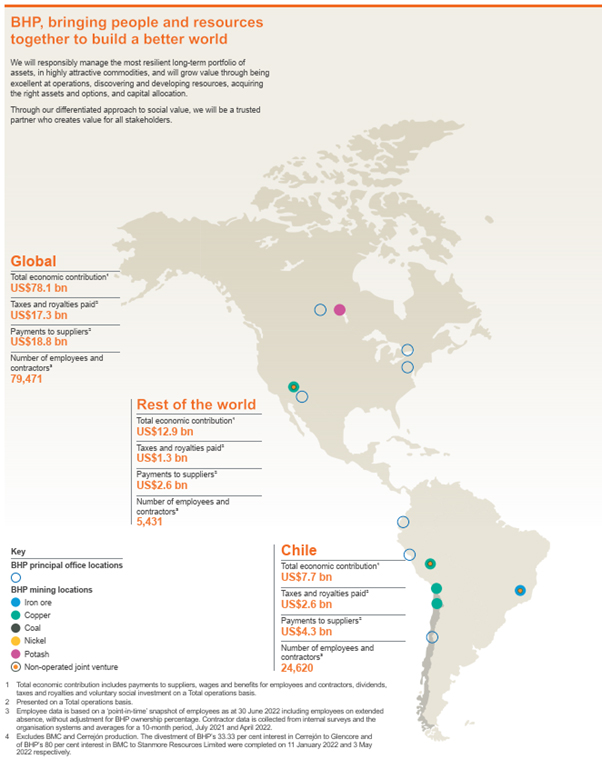
 
 
3

Table of Contents
 
4

Table of Contents
2    Delivering value
2.1    Our business model


5

Table of Contents
 
6

Table of Contents
2.2    How we create and grow value
We produce some of the essential resources needed to support global megatrends, such as decarbonisation, and we strive to produce them sustainably, efficiently and ethically.
We seek to create value with the communities where we operate and for our shareholders:
 
 
We are committed to continuous improvement and we strive to operate more reliably and productively than our competitors. Being the best operator will help us safely generate better return on capital employed and outcompete others for new opportunities.
 
 
We have delivered strong and consistent results and returns through our portfolio and operating discipline. We achieved net operating cashflow on a Total operations basis of US$32.2 billion in FY2022, above US$15 billion for the sixth consecutive year.
 
 
We believe our focus on social value will lead to us being the partner of choice with communities, governments, suppliers, and customers. We seek respectful, mutually beneficial relationships with the communities where we operate and the suppliers, customers and governments we interact with. Our experience has been that engaging with those around us creates optionality, stronger relationships and access to more diverse thinking. It helps us be more creative and to find different ways to problem solve. It also means we are better able to see things coming towards us and can act
pre-emptively.
Aligning strongly with partners can prevent issues or delays with projects and, if issues do arise, means we are better able to collectively work on solutions.
 
 
We assess and rank decarbonisation projects across our operated assets through our Capital Allocation Framework (CAF). During FY2022, we integrated our 1.5°C Paris-aligned scenario into our strategy and capital allocation process, helping to ensure our capital expenditure plans are not misaligned with the Paris Agreement’s aim to pursue efforts to limit global warming to 1.5°C.
 
 
We recruit and retain the best people and empower them to run our operations safely and productively. We promote an inclusive and diverse environment where safety and wellbeing are the highest priorities, invest in development programs to build capability and improve performance and offer competitive remuneration. We invest in technology to manage risk, streamline processes and improve productivity.
 
 
The combination of our people, strategy and operational systems will help us to outperform our competitors and attract a lower cost of capital, while our CAF helps us make better use of this capital.
We bring together essential resources, a strong balance sheet and a differentiated operating capability underpinned by our technical Centres of Excellence and the BHP Operating System (BOS).
This combination of operational excellence, a strong portfolio of large, long-life, quality assets and focus on social value will assist us to grow value more consistently for all stakeholders and underpin continued attractive returns and long-term value for our shareholders.
Our people
Health and safety
Our highest priority is the safety of our workforce and the communities where we operate. We achieved a third consecutive year without a fatality and have seen a sustained improvement in the high-potential injury frequency rate which fell by 30 per cent in FY2022 from FY2021.
We are committed to protecting the health and wellbeing of our workforce. Over the past five years, we have achieved a 68 per cent reduction in the total number of workers exposed to our most material occupational exposures. For more information refer to OFR 7.4 and 7.6.
Our focus on safety and health underpins our strong operational performance and this includes eliminating sexual harassment, racism and bullying. We are committed to eliminating incidents of sexual harassment in our workplaces and accommodation villages, and have strengthened our approach to prevention, reporting and response. Our focus on gender balance is an important factor in addressing this unacceptable behaviour
.
For more information refer to OFR 7.5.
 
7

Table of Contents
Inclusion and diversity
We continue to build a more inclusive and diverse workforce that further enhances our performance and better reflects the communities where we operate:
 
 
We remain on track to achieve our aspirational goal for a gender-balanced employee workforce globally by FY2025
.
For more information refer to
OFR 6.
 
 
We made progress during FY2022 against targets for increased Indigenous employment in our Minerals Australia operations, Minerals Americas operations in Chile and our Jansen Potash Project in Canada.
For more information refer to OFR 6.
Our portfolio
We are reshaping our portfolio to focus on higher-quality iron ore and metallurgical coal preferred by our steelmaking customers, copper for electrification and renewable energy, nickel for electric vehicles and potash to make food production and land use more efficient and sustainable. For more information refer to OFR 3.
Iron Ore
: We are the lowest-cost major iron ore producer globally.
1
Western Australia Iron Ore (WAIO) is one of the lowest emissions intensity iron ore operations
2
and is increasing its grade as the new South Flank mine ramps up. WAIO achieved record sales volumes in FY2022, allowing us to capitalise on the opportunity presented by higher iron ore prices. For more information refer to OFR 5.1.
Copper
: We hold the world’s largest copper endowment.
3
We are using technical innovation such as new floatation technology to help lower energy costs and unlock value and are looking to secure more copper resources through exploration, acquisition, and early-stage entry. Escondida in Chile is the world’s largest copper mine. Escondida had record material mined and near-record concentrator throughput in FY2022, while Olympic Dam in South Australia performed strongly in the June 2022 quarter after planned major smelter maintenance. For more information refer to OFR 5.1 and 5.2.
Metallurgical coal
: Our metallurgical coal operations in Queensland focus on higher-quality product and have one of the lowest production emissions intensities of benchmarked mines.
2
We believe that a wholesale shift away from blast furnace steel making, which uses metallurgical coal, is still decades in the future and that metallurgical coal will remain an essential input into the steelmaking process, which is critical to support decarbonisation infrastructure. We recently completed the sale of our interest in BHP Mitsui Coal (BMC), further focusing our coal portfolio on higher-quality coals for steelmaking with greater potential upside for quality premiums as steelmakers seek to improve blast furnace utilisation and reduce emissions intensity. For more information refer to OFR 5.1.
Nickel
: We hold the second-largest nickel sulphide endowment globally
4
and our nickel operations in Western Australia have one of the lowest production emissions intensities of benchmarked mines.
2
We achieved our first saleable production of nickel sulphate crystals for the
lithium-ion
battery industry in the December 2021 quarter. We are growing value by supplying 87 per cent of BHP’s battery-suitable nickel to battery material suppliers in FY2022. We are seeking more nickel resources through exploration, acquisition and early-stage entry. For more information refer to OFR 5.1.
Potash
: We are developing one of the world’s largest potash mines in Canada. The proposed mine has been designed based on a sustainable approach with a relatively low emissions footprint and low water intensity compared to existing potash mines. The Jansen Potash Project is expected to increase BHP’s product diversification, customer base and operating footprint, opening up a new future growth front. The US$5.7 billion Jansen Stage 1 is tracking to plan and opportunities to bring forward Jansen S1 continue to be assessed. For more information refer to OFR 5.2.
Exceptional performance
Operational excellence
We seek to continuously improve performance by empowering our people through BOS principles, practices and tools. BOS is, at its heart, a people program. It is designed to provide a way of working that creates a culture at BHP where we make continuous improvement central to everyone’s role.
We continued to deploy BOS throughout our business in FY2022 and expect full deployment by the end of FY2024. BOS has delivered over US$2 billion in estimated, recurring and
one-time
cost and revenue improvements since we developed it in CY2018. Based on the success we are seeing, we believe it will deliver further gains in the future.
 
1
 
Based on published C1 unit costs of major iron ore producers. There may be differences in the manner that third parties calculate or report unit costs data compared to BHP, which means that third-party data may not be comparable to our data.
2
 
For more information refer to OFR 7.8.
3
 
Based on ownership interest. Peers include: Anglo American, Antofagasta, Codelco, First Quantum Minerals, Freeport, Glencore, Rio Tinto, Southern Copper and Teck. Source peers: Wood Mackenzie Ltd, Q1 2022.
4
 
Based on ownership interest. Source peers: MinEx Consulting.
 
8

Table of Contents
What is the BHP Operating System?
The BHP Operating System (BOS) is a way of working that seeks to make improvement part of what we do every day through the application of BOS tools and practices. It is anchored in three principles that will help us deliver exceptional safety and productivity performance and an inclusive and empowered culture:
 
 
Serve our customers
– deliver what internal and external customers need, at the right time and at the appropriate levels of quality and cost.
 
 
Pursue operating perfection
– pursue 100 per cent safety for our people, 100 per cent value for our customers, 0 per cent waste.
 
 
Empower our people
– support our people with the right conditions and leadership to excel. They know their work and how to improve it.
Through BOS principles and practices we are delivering more to our employees and contractors, suppliers, shareholders, customers and the communities whose resources we develop.
Embracing technology and innovation
The power of data, innovation and technology, together with the BOS, have helped accelerate continuous improvement across our value chain, from the geoscience required in exploration through to the marketing of our products.
We have used technology to:
 
 
maintain safe, predictable and productive operations
 
 
drive productivity improvements, with an emphasis on automation and real-time, data-driven insights and decision-making
 
 
help drive inclusion and diversity by providing greater opportunities for roles that were traditionally labour intensive
 
 
unlock the next stage of value growth at BHP, from realising greater margins at our existing operations to finding new assets
 
 
improve sustainability outcomes through innovation
The use of technology such as in autonomous trucks, production innovation such as primary sulphide leaching at our copper assets (which has helped us to extract more copper from ore) and digital transformation across all parts of our business has helped to improve safety, increase productivity, reduce costs, build capability and accelerate value creation.
Examples of our application of technology and innovation in FY2022 include:
 
 
We continued to automate our global trucking fleets. At South Flank we began to automate our fleet of 41 Komatsu haul trucks in the June 2022 quarter, with the program expected to be completed within 18 months. We continued deployment at Goonyella Riverside (expected to be completed by the end of December 2022) and completed the rollout at Daunia. We also commenced autonomous drilling at Spence. We expect to commence the rollout of automated trucks at Spence in FY2023.
 
 
We began testing two automated shiploaders at the Port Hedland export facility in Western Australia. In what we believe is a world first, 3D laser scan technology has been used in the A$50 million project. We intend to fully automate eight shiploaders by FY2024. The project is expected to enable an increase in production of more than 1 million tonnes of iron ore each year through greater precision, reduced spillage, faster load times and equipment optimisation.
 
 
Our
in-house
Grade Adjustment Model has been introduced at multiple WAIO sites and is expected to enable a US$22.8 million annual revenue uplift at WAIO. The model uses machine learning to target a reduction in iron ore grade variability across the supply chain. It uses data sources that capture movements of ore to map the iron ore grade coming from the mine to the iron grade shipped at port.
 
 
Through our Maintenance and Engineering Centre of Excellence, we continued the rollout of our Total Equipment Strategies (TES), which were initially applied to our mobile fleets and have been extended to our fixed plant. These strategies use mathematical analysis of breakdowns, maintenance patterns and original equipment manufacturer recommendations to recalibrate our maintenance programs to increase availability and reliability, and reduce maintenance costs and inventory values. For example, at our Newman iron ore operation in Western Australia, the mobile TES project for CAT 6060 excavators helped to extend the average equipment life by 40 per cent and delivered an availability uplift of 2 per cent. The outcome is 3.5 years of extra life which has helped to achieve capital productivity by deferral of US$120 million of capital expenditure over five years.
 
9

Table of Contents
Financial excellence
We use the Capital Allocation Framework (CAF) to assess the most effective and efficient way to deploy capital. This prioritises maintaining safe and reliable operations, meeting our social value and GHG emissions reductions targets, goals and strategies, keeping our balance sheet strong and delivering strong growth and returns for our shareholders. We then look at what would be the most valuable risk-adjusted use for any excess capital. We evaluate the range of investment opportunities and aim to optimise the portfolio based on our assessment of risk, returns and future optionality. We then develop a long-term capital plan and guidance for the Group.
Since the CAF’s introduction in FY2016, we have balanced reinvestment in the business with cash returns to shareholders. We want shareholders to see the short-term benefit of these cash returns and trust us to plan for the future by investing where it matters.
Social value
Social value is BHP’s positive contribution to society – our people, partners, the economy, the environment and local communities. It is about creating enduring, mutual benefit for BHP, our shareholders and the broader community.
Doing this well is essential to better business outcomes and long-term shareholder value, and will create a competitive advantage.
How social value can create competitive advantage
We recognise that decisions we make have the potential to positively or negatively impact those around us, and the environment. Our aim with social value is to be deliberate and proactive in taking into account social, environmental and financial impact in the choices we make.
Embedding social value into everything we do will open up opportunities, increase resilience and help us manage risk. It will influence our access to resources, partners, markets, the best talent, and capital.
Our commitment to social value
We have been committed to sustainability and social value for many years and are making progress in responsibly providing more of the resources the world needs:
 
 
We have set GHG emissions reduction targets and goals (that are described in OFR 7.8) and our Climate Transition Action Plan 2021 (CTAP) received majority approval from shareholders in the ‘Say on Climate’ advisory vote at our 2021 Annual General Meetings.
 
 
We are working to create nature-positive
4
outcomes through the new goal we have set to have at least 30 per cent of the land and water we steward under conservation, restoration or regenerative practices by 2030. For more information refer to 2030 social value scorecard below and OFR 7.15.
 
 
We are working to transition our operations to renewable electricity. For more information, refer to OFR 5.1 and 7.8.
 
 
We are working with suppliers to drive innovation by participating in initiatives such as Komatsu’s GHG Alliance, which aims to develop commercially viable
zero-GHG
emissions haul trucks. For more information refer to OFR 7.8.
 
 
Our spend with Indigenous businesses increased by 75 per cent to US$149.9 million in FY2022 and the number of Indigenous vendors engaged rose by 53 per cent to 148. WAIO announced its intention to more than double its spend with Indigenous vendors to more than US$300 million by the end of FY2024. For more information refer to OFR 7.13.
 
 
We completed our most recent five-year sustainability targets in FY2022. Highlights included three years fatality-free, a reduction in the total number of workers exposed to our most material occupational exposures by 68 per cent, social investment of US$681.4 million over five years and a 29 per cent reduction in freshwater withdrawal volumes from our adjusted FY2017 baseline. For more information refer to OFR 7.3 and 7.8.
 
 
Our Chilean operations Escondida and Spence, and Olympic Dam in Australia were awarded the Copper Mark during FY2022 recognising responsible production practices. For more information on our social value performance refer to OFR 7.
2030 social value scorecard
In June 2022, we launched our social value scorecard with 2030 goals, metrics and milestones (below). We believe it will enhance our opportunity to run our business in a way that delivers long-term, sustainable value to BHP, our shareholders and the broader community.
This scorecard provides clarity to our teams on our ambitions and allows us to measure progress, transparently report, and hold ourselves to account.
Our metrics will evolve over time and some are future metrics that will be developed in the coming years. They show where we are headed with measuring our performance.
At its core, this scorecard represents an emphasis on partnerships, listening and
co-design,
recognising that it is not for us alone to decide what is of value to communities or the environment, and that addressing challenges like climate change require collaboration.
We will disclose our performance against this scorecard every year as part of our Annual Report, starting in FY2023.
 
10

Table of Contents
 
 
11

Table of Contents
 
Supporting local economic development
We aim to source and promote locally available goods and services as an important part of our external expenditure, to help local communities thrive. Our operated assets develop local procurement plans designed to identify opportunities for local suppliers, including small businesses.
In FY2022, BHP made US$18.8 billion in payments to suppliers globally, including US$17.6 billion in payments to more than 8,000 suppliers in the regions where we operate. Of the latter amount, US$2.7 billion, or 15.2 per cent, was paid to local suppliers in the communities where we operate. Our expenditure with local suppliers was primarily in Australia (59 per cent) and Chile (30 per cent). Of our total supplier spend, 94.4 per cent was in the regions where we operate.
 
12

Table of Contents
3    Positioning for the future
Reshaping our corporate structure and portfolio
In FY2022, we took steps to create a simpler, more agile and efficient BHP, better able to capitalise on the megatrends shaping our world.
A simpler corporate structure
For the past two decades, we operated with a dual listed company (DLC) structure with two parent companies – BHP Group Limited in Australia with its shares listed on the Australian Securities Exchange and BHP Group Plc (now known as BHP Group (UK) Ltd) in the United Kingdom with its shares listed on the London Stock Exchange.
Following shareholder approval in January 2022, we unified our corporate structure to one parent company and one share price – under BHP Group Limited. We believe unification gives us a corporate structure that is simpler, more agile and more efficient.
Merging Petroleum with Woodside
During FY2022, we merged our Petroleum business with Woodside Energy Group Ltd (Woodside) to create a global top 10 independent energy company by production. Woodside acquired BHP’s Petroleum business in exchange for Woodside shares that were distributed to BHP shareholders through an in specie dividend.
Based on Woodside’s share price of US$21.39 (A$29.76) at 31 May 2022, the closing date of the transaction, the implied value of BHP’s Petroleum business was US$19.6 billion (A$27.2 billion).
BHP shareholders gained exposure to assets in Woodside through the transaction and greater choice about how to weight their exposure to the different investment and sector propositions. The transaction increased BHP’s portfolio weighting towards future facing commodities that support economic growth and have potential upside through the energy transition.
Consolidating our coal portfolio
In January 2022, we divested our 33.3 per cent interest in Cerrejón, a
non-operated
energy coal joint venture in Colombia, to Glencore, for a total cash consideration of approximately US$294 million.
In May 2022, we divested our 80 per cent interest in BHP Mitsui Coal Pty Ltd (BMC), a metallurgical coal joint venture in Queensland operated by BMC, to Stanmore Resources Limited, for a total cash consideration of up to US$1.35 billion in paid and deferred amounts, plus a final completion adjustment amount.
In June 2022, we announced that, following a
two-year
review, we would retain New South Wales Energy Coal (NSWEC). We will be seeking approvals to continue mining at NSWEC beyond its current mining consent that expires in 2026 and intend to proceed with a managed process to cease mining at the asset by the end of FY2030.
These portfolio changes are consistent with our strategy to focus on producing higher-quality metallurgical coal.
Investing in a new commodity – potash
Potash enables more efficient and sustainable farming, which we believe will be increasingly important in feeding a growing population, and potentially opens a new long-term growth front for BHP.
In August 2021, we approved US$5.7 billion in capital expenditure for Jansen Stage 1 in Saskatchewan, Canada, with first potash production expected in CY2027. We are working to bring forward Jansen Stage 1 first production and are assessing options to accelerate Jansen Stage 2.
The US$2.97 billion Jansen project to finish the excavation and lining of the production and service shafts, and to continue the installation of essential surface infrastructure and utilities, was completed in June 2022. For FY2023, approximately US$740 million in capital expenditure is planned for work at Jansen Stage 1, which will continue to focus on civil and mechanical construction on the surface and underground, as well as equipment procurement and port construction.
Unlocking growth potential at our assets
The large endowments we have under our control are becoming increasingly valuable as the resources industry finds high-quality, Tier 1 (large,
low-cost
and long-life) resources harder to access, deeper, of lower grade, or in countries with more challenging operating conditions.
 
13

Table of Contents
Copper
We hold the largest copper endowment in the world at among the highest average grade.
1
 
 
This includes 27 billion tonnes of ore at an average grade of 0.52 per cent at Escondida, where we are targeting an annual average of 1.2 million tonnes (Mt) of copper production over the medium term, a 20 per cent increase on Escondida’s FY2022 production of 1 Mt.
 
 
On the basis that tailings storage facility anomalies are resolved, production at Spence is expected to reach and average approximately 270 kilotonnes per annum (ktpa) of production for four years (including cathodes) following the completion of Spence Growth Option (SGO) plant modifications. This will be supported by capital expenditure of approximately US$100 million, which is planned for the SGO plant modifications and these are currently planned to be completed in CY2023, with further studies ongoing for additional capacity uplift.
 
 
At Olympic Dam, we have improved operating stability over time. Smelter operations have been strong following our planned major smelter maintenance, completed in January 2022. The next major rebuild is not expected for six years.
Nickel
We hold the second-largest nickel sulphide endowment globally
2
and own the majority of tenements of known resource in the Agnew-Wiluna basin in Western Australia.
 
 
Our nickel sulphate plant at Nickel West delivered first crystals in October 2021, allowing us to add further value to our nickel production. We intend to capitalise on the expected ongoing global demand for nickel for the electric vehicle industry, as the method we use to produce nickel sulphate results in a product we believe is ideal for battery production.
 
 
We continue to explore ways to increase the scale of Nickel West.
Iron Ore
We are one of the world’s largest iron ore producers and expect to increase production over the medium-term.
 
 
We have secured an increase to our WAIO iron ore environmental licence to expand port operations up to 330 million tonnes per annum (Mtpa) subject to the outcomes of a standard appeals process.
 
 
The ramp up of WAIO’s US$3.6 billion South Flank mine is ahead of schedule and we have revised our medium term production guidance to more than 300 Mtpa. We are assessing expansion alternatives to take us toward 330 Mtpa of production.
Growth through exploration, focused on copper and nickel


1
 
Based on ownership interest. Peers include: Anglo American, Antofagasta, Codelco, First Quantum Minerals, Freeport, Glencore, Rio Tinto, Southern Copper, and Teck. Source peers: Wood Mackenzie Ltd, Q1 2022.
2
 
Based on ownership interest. Source peers: MinEx Consulting.
 
14

Table of Contents
Our exploration program is focused on copper and nickel. We look to identify and gain access to new search spaces to test targets capable of delivering high-quality, Tier 1 deposits, and maintain research and technology activities aligned with our exploration strategy.
Despite the slowdown and restrictions on movement due to the
COVID-19
pandemic, in FY2022 our field teams pursued copper opportunities in Chile, Colombia, Peru, Ecuador, the United States and Australia. This involved early-stage reconnaissance work through target definition and drill testing. Elsewhere for copper, we continued to seek, secure and test concessions in regions such as Ecuador, South Australia, Chile, Mexico and Peru.
We have also increased the number of high-quality nickel projects within the exploration pipeline. We are actively exploring nickel targets in Western Australia, while in Canada, we continued our partnership with Midland Exploration Inc in Canada, through our 5 per cent interest and collaboration on a target generation program. BHP made a US$40 million investment in Kabanga Nickel in Tanzania in FY2022, which offers an opportunity to expand the immediate search space to add to the known resource.
Our business partnerships continued to deliver encouraging results. In Ecuador, we maintained a 13.6 per cent ownership in SolGold plc, the majority owner and operator of the Alpala porphyry copper-gold project. In Mexico, we continued our financial agreement with Riverside Resources, a US company with significant operating experience in Mexico, securing additional areas that are scheduled to be drill tested during FY2023. In Australia, we initiated work with Encounter Resources to explore for sediment-hosted copper deposits in the Northern Territory. We also entered into a Letter of Intent with Mundoro to cooperatively explore for copper resources in the highly prospective belt in Serbia and Bulgaria. Several drill-ready targets are scheduled to be tested during FY2023.
Exploration expenditure
Our resource assessment exploration expenditure increased by 30 per cent in FY2022 to US$179 million, while our greenfield expenditure increased by 43 per cent to US$77 million. Expenditure on resources assessment and greenfield exploration over the last three financial years is set out below.
 
Year ended 30 June
  
2022

US$M
     2021
US$M
     2020
US$M
 
Greenfield exploration
  
 
77
 
     54        44  
Resources assessment
  
 
179
 
     138        132  


Total metals exploration and assessment
  
 
256
 
     192        176  


Exploration expense
Exploration expense represents that portion of exploration expenditure that is not capitalised in accordance with our accounting policies, as set out in Financial Statements note 11 ‘Property, plant and equipment’.
Exploration expense for each segment over the last three financial years is set out below.
 
Year ended 30 June
  
2022

US$M
     2021
US$M
     2020
US$M
 
Exploration expense
                          
Copper
  
 
85
 
     53        54  
Iron Ore
  
 
54
 
     55        47  
Coal
  
 
6
 
     7        9  
Group and unallocated items
1
  
 
54
 
     19        13  


Total Group
  
 
199
 
     134        123  


1
 
Group and unallocated items includes functions, other unallocated operations, including Potash, Nickel West and legacy assets (previously disclosed as closed mines in the Petroleum reportable segment), and consolidation adjustments.
 
15

Table of Contents
4    Financial review
4.1    Group overview
We prepare our Consolidated Financial Statements in accordance with International Financial Reporting Standards (IFRS), as issued by the International Accounting Standards Board. We publish our Consolidated Financial Statements in US dollars. All Consolidated Income Statement, Consolidated Balance Sheet and Consolidated Cash Flow Statement information below has been derived from audited Financial Statements. For more information refer to Financial Statements.
We use various
non-IFRS
financial information to reflect our underlying performance.
Non-IFRS
financial information is not defined or specified under the requirements of IFRS however, is derived from the Group’s Consolidated Financial Statements prepared in accordance with IFRS.
Non-IFRS
financial information is consistent with how management reviews financial performance of the Group with the Board and the investment community. OFR 11
‘Non-IFRS
financial information’ includes our
non-IFRS
financial information and OFR 11.1 ‘Definition and calculation of
non-IFRS
financial information’ outlines why we believe
non-IFRS
financial information is useful and the relevant calculation methodology. We believe
non-IFRS
financial information provides useful information, however it should not be considered as an indication of, or as a substitute for, statutory measures as an indicator of actual operating performance (such as profit or net operating cash flow) or any other measure of financial performance or position presented in accordance with IFRS, or as a measure of a company’s profitability, liquidity or financial position.
Summary of financial measures
 
Year ended 30 June
US$M
 
2022
    2021  
Consolidated Income Statement (Financial Statements 1.1)
               
Revenue
1
 
 
65,098
 
    56,921  
Profit/(loss) after taxation from Continuing operations
1
 
 
22,400
 
    13,676  
Profit/(loss) after taxation from Continuing and Discontinued operations attributable to BHP shareholders
 
 
30,900
 
    11,304  
Dividends per ordinary share – paid during the period (US cents)
 
 
350.0
 
    156.0  
Dividends per ordinary share – determined in respect of the period (US cents)
 
 
325.0
 
    301.0  
In specie dividend on merger of Petroleum with Woodside (US cents)
 
 
386.4
 
     
Basic earnings/(loss) per ordinary share (US cents)
 
 
610.6
 
    223.5  
Consolidated Balance Sheet (Financial Statements 1.3)
               
Total assets
 
 
95,166
 
    108,927  
Net assets
 
 
48,766
 
    55,605  
Consolidated Cash Flow Statement (Financial Statements 1.4)
               
Net operating cash flows
 
 
32,174
 
    27,234  
Capital and exploration expenditure
2
 
 
7,545
 
    7,120  
Other financial information (OFR 11)
               
Net debt
 
 
333
 
    4,121  
Underlying attributable profit
 
 
23,815
 
    17,077  
Underlying attributable profit – Continuing operations
1
 
 
21,319
 
    16,985  
Underlying EBITDA
1
 
 
40,634
 
    35,073  
Underlying basic earnings per share (US cents)
 
 
470.6
 
    337.7  
Underlying basic earnings per share – Continuing operations (US cents)
1
 
 
421.2
 
    335.9  
Underlying return on capital employed (per cent)
 
 
48.7
 
    32.5  
 
1
 
Comparative periods have been adjusted for the effects of applying IFRS 5
‘Non-current
Assets Held for Sale and Discontinued Operations’ and discloses them on the same basis as the current period figures. For more information refer to Financial Statements note 27 ‘Discontinued operations’.
 
2
 
Includes US$1,434 million related to Discontinued operations (FY2021: US$1,316 million).
 
16

Table of Contents
4.2    Key performance indicators
Our key performance indicators (KPIs) enable us to measure our sustainable development and financial performance. These KPIs are used to assess performance of our people throughout the Group. For information on our approach to performance and reward refer to Remuneration Report. For information on our overall approach to executive remuneration, including remuneration policies and remuneration outcomes refer to Remuneration Report.
Following BHP’s sale of the Onshore US assets in FY2019 and subsequently the merger of our Petroleum business with Woodside in FY2022, the contribution of these assets to the Group’s results are presented as Discontinued operations. To enable more meaningful comparisons with prior year disclosures and in some cases to comply with applicable statutory requirements, the data in OFR 4.2, except for Underlying EBITDA, has been presented to include Petroleum assets. Footnotes to tables and infographics indicate whether data presented in OFR 4.2 is inclusive or exclusive of Petroleum assets. Details of the contribution of the Petroleum assets to the Group’s results are disclosed in Financial Statements note 27 ‘Discontinued operations’.
 
 
1
 
Includes data for Continuing and Discontinued operations for the financial years being reported.
 
2
 
Excludes data from Discontinued operations for the financial years being reported.
 
3
 
For more information on
non-IFRS
financial information refer to OFR 11.
 
17

Table of Contents
Reconciling our financial results to our key performance indicators
 
   
Profit
   
Earnings
   
Cash
   
Returns


US$M
       
US$M
       
US$M
             
US$M
 
                 
Measure:
 
Profit after taxation from Continuing and Discontinued operations


33,055
 
 
Profit after taxation from Continuing and Discontinued operations
 
 
33,055
 
 
Net operating cash flows from Continuing operations
 
 
29,285
 
 
Profit after taxation from Continuing and Discontinued operations


33,055


Made up of:
  Profit after taxation
 
  Profit after taxation
 
  Cash generated by the Group’s consolidated operations, after dividends received, interest, proceeds and settlements of cash management-related instruments, taxation and royalty-related taxation. It excludes cash flows relating to investing and financing activities
 
  Profit after taxation


Adjusted for:
 
 
Exceptional items before taxation


620


Exceptional items before taxation


620


Net operating cash flows from Discontinued operations


2,889


Exceptional items after taxation


(7,085
 
                   
                                                Net finance costs excluding exceptional items from Discontinued operations


159
 
                   
    Tax effect of exceptional items  
 
454
 
          Tax effect of exceptional items  
 
454
 
              Net finance costs excluding exceptional items from Continuing operations


679
 
                     
    Exceptional items after tax attributable to
non-controlling
interests
 
 
–  
 
          Depreciation and amortisation excluding exceptional items  
 
5,683
 
              Income tax expense on net finance costs          
 
(287


    Exceptional items attributable to BHP shareholders – Continuing operations          
 
1,074


Impairments of property, plant and equipment, financial assets and intangibles excluding exceptional items
 
 
515
 
              Profit after taxation excluding net finance costs and exceptional items          
 
 
26,521


    Exceptional items attributable to BHP shareholders – Discontinued operations          
 
(8,159
  Net finance costs excluding exceptional items from Continuing operations  
 
679
 
              Net assets at the beginning of period  
 
55,605


    Profit after taxation from Continuing and Discontinued operations attributable to
non-controlling
interests
         
 
(2,155
  Taxation expense excluding exceptional items  
 
10,283
 
              Net debt at the beginning of period  
 
4,121


                        Profit after taxation from Discontinued operations (including exceptional items)    
(10,655
)
 
              Capital employed at the beginning of period          
 
59,726
 
                     
                                                Net assets at the end of period  
 
48,766


                                                Net debt at the end of period  
 
333


                                                Capital employed at the end of period          
 
49,099
 
                                                                 
                                                Average capital employed          
 
54,413


To reach our KPIs


Underlying attributable profit


23,815


Underlying EBITDA


40,634


Net operating cash flows


32,174


Underlying return on capital employed


48.7%


Why do we use it?
 
 
Underlying attributable profit allows the comparability of underlying financial performance by excluding the impacts of exceptional items.


Underlying EBITDA is used to help assess current operational profitability excluding the impacts of sunk costs (ie. depreciation from initial investment). It is a measure that management uses internally to assess the performance of the Group’s segments and make decisions on the allocation of resources.


Net operating cash flows provide insights into how we are managing costs and increasing productivity across BHP.


Underlying return on capital employed is an indicator of the Group’s capital efficiency. It is provided on an underlying basis to allow comparability of underlying financial performance by excluding the impacts of exceptional items.
 
 
18

Table of Contents
4.3    Financial results
The following table provides more information on the revenue and expenses of the Group in FY2022.
 
Year ended 30 June
  
2022

US$M
    2021
US$M
Restated
    2020
US$M
Restated
 
Continuing operations
                        
Revenue
1
  
 
65,098
 
    56,921       38,924  
Other income
  
 
1,398
 
    380       720  
Expenses excluding net finance costs
  
 
(32,371
    (30,871     (25,453
Loss from equity accounted investments, related impairments and expenses
  
 
(19
    (915     (508


Profit from operations
  
 
34,106
 
    25,515       13,683  


Net finance costs
  
 
(969
    (1,223     (858
Total taxation expense
  
 
(10,737
    (10,616     (4,197


Profit after taxation from Continuing operations
  
 
22,400
 
    13,676       8,628  


Discontinued operations
                        
Profit/(loss) after taxation from Discontinued operations
  
 
10,655
 
    (225     108  


Profit after taxation from Continuing and Discontinued operations
  
 
33,055
 
    13,451       8,736  


Attributable to
non-controlling
interests
  
 
2,155
 
    2,147       780  
Attributable to BHP shareholders
  
 
30,900
 
    11,304       7,956  


1
 
Includes the sale of third-party products.
Profit after taxation attributable to BHP shareholders increased from US$11.3 billion in FY2021 to US$30.9 billion in FY2022. Attributable profit of US$30.9 billion includes an exceptional gain of US$7.1 billion (after tax), compared to an attributable profit of US$11.3 billion including an exceptional loss of US$5.8 billion (after tax) in the prior period. The FY2022 exceptional gain includes a US$1.1 billion exceptional loss related to Continuing operations comprising of Samarco dam failure impacts, corporate structure unification costs and US deferred tax asset impairments partially offset by the net gain on disposal of BMC. The net gain on merger of our Petroleum business with Woodside is included as an exceptional item related to Discontinued operations included within Profit/(loss) after taxation from Discontinued operations. For more information on Exceptional items refer to Financial Statements note 3 ‘Exceptional items’ and Financial Statements note 27 ‘Discontinued operations’.
Revenue of US$65.1 billion increased by US$8.2 billion, or 14 per cent from FY2021. This increase was mainly due to higher average realised prices for metallurgical coal, thermal coal, copper and nickel, partially offset by lower average realised prices for iron ore.
Lower volumes were experienced across the Group’s portfolio due to
COVID-19
impacts, the planned major smelter maintenance campaign at Olympic Dam and lower feed grade at Escondida and Spence. Volume decline was partially offset by higher concentrate sales at Spence reflecting the continued ramp up of the Spence Growth Option. For information on our average realised prices and production of our commodities refer to OFR 10.
Total expenses excluding net finance costs of US$32.4 billion increased by US$1.5 billion, or 5 per cent from FY2021. This included higher raw materials and consumables of US$1.1 billion due to South Flank operational ramp up and higher input prices mainly due to higher diesel and acid prices, higher royalties of US$0.9 billion mainly driven by prices for metallurgical coal and thermal coal and US$0.7 billion third-party purchases mainly due to higher nickel prices. Higher depreciation and amortisation expense of US$0.6 billion reflected the commissioning of South Flank, Spence Growth Option, and the completion of the major smelter maintenance at Olympic Dam. The increase also included US$0.4 billion of costs related to corporate structure unification. This was partly offset by lower impairments of US$2.0 billion mainly due to Potash and NSWEC asset impairment charges in the prior period.
Loss from equity accounted investments, related impairments and expenses of US$19 million decreased by US$0.9 billion from FY2021. The decrease was primarily related to a lower increase in the Samarco dam failure provision compared to FY2021 and US$0.5 billion impairment of Cerrejón in FY2021. For more information on the total impact of the Samarco dam failure provision and impairment charges connected with equity accounted investments, refer to Financial Statements note 3 ‘Exceptional items’ and Financial Statements note 13 ‘Impairment of
non-current
assets’ respectively.
Net finance costs of US$1.0 billion decreased by US$0.3 billion, or 21 per cent from FY2021. This was mainly due to premiums of US$395 million paid as part of the multi-currency hybrid debt repurchase programs completed during FY2021. For more information on net finance costs refer to Financial Statements note 22 ‘Net finance costs’.
Total taxation expense of US$10.7 billion increased by US$0.1 billion from FY2021. The increase is primarily due to higher profits from higher prices offset by FY2021 reduction of US tax credits related to Chilean taxes and tax losses assessed as not recoverable not repeating. For more information on income tax expense refer to Financial Statements note 6 ‘Income tax expense’.
 
19

Table of Contents
Principal factors that affect Underlying EBITDA
The following table and commentary describes the impact of the principal factors
1
that affected Underlying EBITDA for FY2022 compared with FY2021.
 
     
US$M
       
Underlying EBITDA for year ended 30 June 2021 (Restated)
  
 
35,073
 
    
Net price impact:
             
Change in sales prices
  
 
6,594
 
   Higher average realised prices for metallurgical coal, thermal coal, copper and nickel, partially offset by lower average realised prices for iron ore.
     
Price-linked costs
  
 
(1,047
   Increased royalties reflecting higher realised prices for metallurgical coal and thermal coal and higher third-party concentrate purchase costs reflecting higher nickel prices, partially offset by lower royalties for iron ore.


5,547


Change in volumes
  
 
(1,212
   Lower volumes across our operations associated with the impacts of
COVID-19
(US$952 million), lower volumes at Olympic Dam as a result of the planned major smelter maintenance campaign, lower copper concentrator feed grade at Escondida, lower BMA volumes due to significant wet weather impacts, and lower volumes at Nickel West due to an unplanned smelter outage in the June 2022 quarter. This was partially offset by higher concentrate sales at Spence reflecting the continued ramp up of the Spence Growth Option and favourable weather compared to the prior year at WAIO.
Change in controllable cash costs   
 
(540
   Higher costs across our operations due to the impacts of
COVID-19
(US$277 million) reported as an exceptional item last year, higher costs at WAIO due to South Flank operational
ramp-up
expenditure and higher rail maintenance costs. Higher costs at Escondida due to an increase in material mined and workforce bonus payments for a new collective bargaining agreement. Higher costs at Spence due to a
ramp-up
of concentrate volumes, and a prior year
one-off
gain due to the cancellation of power contracts at Escondida and Spence. This was partially offset by favourable inventory movements at Olympic Dam, Nickel West, Escondida and Spence, and lower costs at BMA due to cost efficiency initiatives.
Change in other costs:   


Exchange rates
  
 
1,180
 
   Impact of movements in the Australian dollar and Chilean peso against the US dollar.
Inflation
  
 
(867
   Impact of inflation on the Group’s cost base.
Fuel, energy, and consumable price movements
  
 
(660
   Predominantly higher diesel and acid prices.
Non-cash
  
 
(3


(350
  
 
Asset sales   
 
2
 
    
Ceased and sold operations   
 
1,668
 
   Reflects the contribution of BMC prior to divestment and a decrease in costs related to the closure and rehabilitation provision for closed mines of US$297 million compared with the prior year.
     
Other items   
 
446
 
   Other includes higher recovery of freight costs caused by movements in the freight index on consecutive voyage charter (CVC) voyages and higher average realised sales prices received by Antamina, partially offset by the
write-off
of iron ore dormant stockpiles.
Underlying EBITDA for year ended 30 June 2022
  
 
40,634


1
 
For information on the method of calculation of the principal factors that affect Underlying EBITDA, refer to OFR 11.2.
 
20

Table of Contents
Discontinued operations
On 22 November 2021, the Group and Woodside signed a binding Share Sale Agreement (‘SSA’) for the merger of the assets with Woodside. Woodside has subsequently acquired the entire share capital of BHP Petroleum International Pty Ltd (‘BHP Petroleum’) in exchange for new Woodside ordinary shares.
While the merger had an economic effective date of 1 July 2021, the Group continued to control the Petroleum assets and carry on business in the normal course for 11 months until 1 June 2022 (Completion Date). As such, the Group recognises its share of revenue, expenses, net finance costs and associated income tax expense related to the discontinued operation until the Completion Date.
All income and expense items relating to the Petroleum Discontinued Operation have been removed from the individual line items in the Consolidated Income Statement. The
post-tax
loss of the Petroleum Discontinued Operation is presented as a single amount in the line item titled ‘Profit/(loss) after taxation from Discontinued operations’.
Petroleum’s contribution to BHP’s 2022 financial results comprised a US$2.5 billion profit after taxation.
As consideration for the sale of BHP Petroleum, the Group received 914,768,948 newly issued Woodside ordinary shares at Completion Date. On the Completion Date, the Group paid a fully franked in specie dividend in the form of Woodside shares to eligible BHP shareholders. Eligible BHP shareholders received one Woodside share for every 5.5340 BHP shares they held on the Group’s register at the record date of 26 May 2022. As part of completion and in order to reflect the economic effective date, the Group made a net cash payment of US$0.7 billion to Woodside in addition to US$0.4 billion in cash that was left in the BHP Petroleum bank accounts to fund ongoing operations. The total cash transfer of US$1.1 billion reflects the net cash flows generated by BHP Petroleum between 1 July 2021 and Completion Date adjusted for dividends Woodside would have paid on the newly issued Woodside ordinary shares, had the merger completed on 1 July 2021. The net cash completion payment to Woodside is subject to a customary post-completion review, which may result in an adjustment to the amount paid. The merger generated a net gain after tax of US$8.2 billion that has been included in the line item titled ‘Profit/(loss) after taxation from Discontinued operations’ and treated as an exceptional item.
For further information refer to Financial Statements note 27 ‘Discontinued operations’.
Cash flow
The following table provides a summary of the Consolidated Cash Flow Statement contained in Financial Statements 1.4, excluding the impact of foreign currency exchange rate changes on cash and cash equivalents.
 
Year ended 30 June
  
2022

US$M
    2021
US$M
Restated
    2020
US$M
Restated
 
Net operating cash flows from Continuing operations
  
 
29,285
 
    25,883       14,685  
Net operating cash flows from Discontinued operations
  
 
2,889
 
    1,351       1,021  


Net operating cash flows
  
 
32,174
 
    27,234       15,706  


Net investing cash flows from Continuing operations
  
 
(4,973
    (6,325     (6,583
Net investing cash flows from Discontinued operations
  
 
(904
    (1,520     (1,033
Net cash completion payment on merger of Petroleum with Woodside
  
 
(683
           
Cash and cash equivalents disposed on merger of Petroleum with Woodside
  
 
(399


Net investing cash flows
  
 
(6,959
    (7,845     (7,616


Net financing cash flows from Continuing operations
  
 
(22,734
    (17,884     (9,713
Net financing cash flows from Discontinued operations
  
 
(33
    (38     (39


Net financing cash flows
  
 
(22,767
    (17,922     (9,752


Net increase/(decrease) in cash and cash equivalents
  
 
2,448
 
    1,467       (1,662


Net increase/(decrease) in cash and cash equivalents from Continuing operations
  
 
1,578
 
    1,674       (1,611
Net increase/(decrease) in cash and cash equivalents from Discontinued operations
  
 
1,952
 
    (207     (51
Net cash completion payment on merger of Petroleum with Woodside
  
 
(683
           
Cash and cash equivalents disposed on merger of Petroleum with Woodside
  
 
(399


Net operating cash inflows from Continuing operations
of US$29.3 billion increased by US$3.4 billion. This reflects higher net commodity prices, favourable foreign exchange and strong underlying operational performance partially offset by
COVID-19
impacts.
 
21

Table of Contents
Net investing cash outflows from Continuing operations
of US$5.0 billion decreased by US$1.4 billion. This is primarily due to net proceeds received of US$1.3 billion, including adjustment for working capital, related to the sale of BHP’s 80 per cent interest in BMC to Stanmore Resources Limited completed in the current period.
For more information and a breakdown of capital and exploration expenditure on a commodity basis refer to OFR 10.
Net financing cash outflows from Continuing operations
of US$22.7 billion increased by US$4.9 billion. This increase reflects higher dividends paid to BHP shareholders of US$10.0 billion offset by lower net repayments of interest bearing liabilities of US$5.6 billion mainly due to bond maturity payments and early repayment of hybrid bonds executed in the FY2021 year.
For more information, refer to Financial Statements note 20 ‘Net debt’.
Net cash flows from Discontinued operations
relate to the Group’s Petroleum business that was merged with Woodside on 1 June 2022. For further information, refer to Financial Statements note 27 ‘Discontinued operations’.
Underlying return on capital employed (ROCE)
of 48.7 per cent increased by 16.2 percentage points (FY2021: 32.5 per cent) reflecting the significant increase in profit after taxation excluding net finance costs and exceptional items of US$6.4 billion. The increase is also due to the disposal of the Group’s Petroleum business and BMC reducing average capital employed.
For more information on Assets under Construction refer to Financial Statements note 11 ‘Property, plant and equipment’.
The comparisons for the year ended 30 June 2021 to 30 June 2020 in connection with Financial results, Principal factors that affect Underlying EBITDA and Cash flow have been omitted from this annual report on Form
20-F
and can be found in our annual report on Form
20-F
for the fiscal year ended 30 June 2021, filed on 21 September 2021.
4.4    Debt and sources of liquidity
Our policies on debt and liquidity management have the following objectives:
 
 
a strong balance sheet through the cycle
 
 
diversification of funding sources
 
 
maintain borrowings and excess cash predominantly in US dollars
Interest bearing liabilities, net debt and gearing
At the end of FY2022, Interest bearing liabilities were US$16.4 billion (FY2021: US$21.0 billion) and Cash and cash equivalents were US$17.2 billion (FY2021: US$15.2 billion). This resulted in Net debt
1
of US$0.3 billion, which represented a decrease of US$3.8 billion compared with the net debt position at 30 June 2021. This was primarily due to significant operating cash flows generated from strong coal and copper prices and reliable operating performance which more than offset the payment of record dividends. Gearing, which is the ratio of Net debt to Net debt plus Net assets, was 0.7 per cent at 30 June 2022, compared with 6.9 per cent at 30 June 2021.
During FY2022, gross debt decreased by US$4.6 billion to US$16.4 billion as at 30 June 2022. This decrease includes a US$0.5 billion repayment of 3.25 per cent USD senior notes that matured on 21 November 2021 and US$0.7 billion repayment of 2.875 per cent USD senior notes that matured on 24 February 2022. The reduction also includes US$2.3 billion of favourable foreign exchange and interest rate adjustments, along with US$0.5 billion of coal and Petroleum leases disposed following the coal divestments and merger of Petroleum business with Woodside.
At the subsidiary level, Escondida refinanced US$0.9 billion of long-term debt and borrowed US$0.3 billion in long-term debt.
 
1
 
We use
non-IFRS
financial information to reflect our underlying financial performance. For a discussion on the
non-IFRS
financial information we use refer to OFR 11. For the definition and method of calculation of
non-IFRS
financial information, refer to OFR 11.1. For the composition of net debt refer to Financial Statements note 20 ‘Net debt’.
 
22

Table of Contents
Funding sources
No new Group-level debt was issued in FY2022 and debt that matured during the year was not refinanced.
Our Group-level borrowing facilities are not subject to financial covenants. Certain specific financing facilities in relation to specific assets are the subject of financial covenants that vary from facility to facility, as is considered normal for such facilities. In addition to the Group’s uncommitted debt issuance programs, we hold the following committed standby facility:
 
    
Facility
available
2022

US$M
    
Drawn

2022

US$M
    
Undrawn

2022
US$M
     Facility
available
2021
US$M
     Drawn
2021
US$M
     Undrawn
2021
US$M
 
Revolving credit facility
1
  
 
5,500


5,500
 
     5,500               5,500  


Total financing facility
  
 
5,500


5,500
 
     5,500               5,500  


1
 
During the year we completed a
one-year
extension of the facility which is now due to mature on 10 October 2026. The committed US$5.5 billion revolving credit facility operates as a back-stop to the Group’s uncommitted commercial paper program. The combined amount drawn under the facility or as commercial paper will not exceed US$5.5 billion. As at 30 June 2022, US$ nil commercial paper was drawn (FY2021: US$ nil), therefore US$5.5 billion of committed facility was available to use (FY2021: US$5.5 billion). A commitment fee is payable on the undrawn balance and interest is payable on any drawn balance comprising a reference rate plus a margin. The agreed margins are typical for a credit facility extended to a company with the Group’s credit rating.
For more information on the maturity profile of our debt obligations and details of our standby and support agreements refer to Financial Statements note 23 ‘Financial risk management’. Information in relation to our material
off-balance
sheet arrangements, principally contingent liabilities, commitments for capital expenditure and commitments under leases at 30 June 2022 is provided in Financial Statements note 11 ‘Property, plant and equipment’, Financial Statements note 21 ‘Leases’ and Financial Statements note 32 ‘Contingent liabilities’, respectively.
In our opinion, working capital is sufficient for our present requirements. Our Moody’s credit rating has remained at
A2/P-1
outlook stable (long-term/short-term) throughout FY2022 and Moody’s affirmed its credit rating on 2 June 2022. Our Standard & Poor’s credit rating changed from
A/A-1
outlook stable (long-term/short-term) to
A/A-1
CreditWatch negative (long-term/short-term) on 23 August 2021, following the announcement of the proposed merger of our Petroleum business with Woodside. Upon completion of the merger, on 1 June 2022 Standard & Poor’s lowered the Group’s long-term credit rating by one notch and removed the credit rating from CreditWatch, and confirmed a credit rating of
A-/A-1
outlook stable (long-term/short-term). Credit ratings are forward-looking opinions on credit risk. Moody’s and Standard & Poor’s credit ratings express the opinion of each agency on the ability and willingness of BHP to meet its financial obligations in full and on time. A credit rating is not a recommendation to buy, sell or hold securities and may be subject to suspension, reduction or withdrawal at any time by an assigning rating agency. Any credit rating should be evaluated independently of any other information.
 
23

Table of Contents
The following table expands on the net debt, to provide more information on the cash and
non-cash
movements in FY2022.
 
Year ended 30 June
  
2022

US$M
    2021
US$M
 
Net debt at the beginning of the financial year
    
 
(4,121
      (12,044


Net operating cash flows
  
 
32,174
 
      27,234    
Net investing cash flows
  
 
(6,959
      (7,845  


Free cash flow – Total operations
    
 
25,215
 
      19,389  


Carrying value of interest bearing liability net repayments
  
 
2,227
 
      7,433    
Net settlements of interest bearing liabilities and debt related instruments
  
 
(2,474
      (7,424  
Dividends paid
  
 
(17,851
      (7,901  
Dividends paid to
non-controlling
interests
  
 
(2,540
      (2,127  
Other financing activities
1
  
 
(149
      (234  


Other cash movements
    
 
(20,787
      (10,253


Fair value adjustment on debt (including debt related instruments)
2
  
 
5
 
      58    
Foreign exchange impacts on cash (including cash management related instruments)
  
 
27
 
      (1  
Lease additions
  
 
(736
      (1,079  
Divestment and demerger of subsidiaries and operations
  
 
492
 
         
Others
  
 
(428
      (191  


Non-cash
movements
    
 
(640
      (1,213


Net debt at the end of the financial year
    
 
(333
      (4,121


1
 
Other financing activities mainly comprises purchases of shares by Employee Share Option Plan trusts of US$149 million (FY2021: US$234 million).
 
2
 
The Group hedges against the volatility in both exchange and interest rates on debt, and also exchange on cash, with associated movements in derivatives reported in Other financial assets/liabilities as effective hedged derivatives (cross currency and interest rate swaps), in accordance with accounting standards. For more information refer to Financial Statements note 23 ‘Financial risk management’.
Dividends
Our dividend policy provides for a minimum 50 per cent payout of Underlying attributable profit (Continuing operations) at every reporting period. The minimum dividend payment for the second half of FY2022 was US$1.15 per share. The Board determined to pay an additional amount of US$0.60 per share, taking the final dividend to US$1.75 per share (US$8.9 billion). In total, cash dividends of US$16.4 billion (US$3.25 per share) have been determined for FY2022. These returns are covered by total free cash flow of US$25.2 billion in FY2022.
In addition, an in specie dividend of US$19.6 billion (US$3.86 per share) was determined in FY2022, distributing the Woodside shares received as consideration for the sale of BHP Petroleum. The total dividends determined in FY2022, both cash and in specie, was US$36.0 billion (US$7.11 per share).
The comparison for the year ended 30 June 2021 to 30 June 2020 has been omitted from this annual report on Form
20-F
and can be found in our annual report on Form
20-F
for the fiscal year ended 30 June 2021, filed on 21 September 2021.
 
24

Table of Contents
5    Our assets
5.1    Minerals Australia
Minerals Australia includes operated assets in Western Australia, Queensland, New South Wales and South Australia, focused on iron ore, metallurgical coal, copper, nickel and energy coal. The commodities produced by our Minerals Australia assets are transported by rail and road to port and exported to our global customers.
Iron Ore
 
Western Australia Iron Ore
Overview
Western Australia Iron Ore (WAIO) is an integrated system of four processing hubs and five
open-cut
operational mines in the Pilbara region of northern Western Australia, connected by more than 1,000 kilometres of rail infrastructure and port facilities.
WAIO’s Pilbara reserve base is relatively concentrated, allowing development through integrated mining hubs connected to the mines and satellite orebodies by conveyors or spur lines. This approach seeks to maximise the value of installed infrastructure by using the same processing plant and rail infrastructure for several orebodies.
Ore is crushed, beneficiated (where necessary) and blended at the processing hubs – Mt Newman operations (which has our beneficiation plant), Yandi, Mining Area C and Jimblebar – to create lump and fines products that are transported along the Port Hedland – Mt Newman rail line to the Finucane Island and Nelson Point port facilities at Port Hedland.
There are four main WAIO joint ventures (JVs): Mt Newman, Yandi, Mt Goldsworthy (which includes the new South Flank mining area) and Jimblebar. BHP’s interest in each is 85 per cent, with Mitsui and ITOCHU owning the remaining 15 per cent. The joint ventures are unincorporated, except Jimblebar.
BHP, Mitsui, ITOCHU and POSCO are also participants in the POSMAC JV. BHP’s interest in POSMAC is 65 per cent. The ore from the POSMAC JV is sold to the main joint ventures.
All ore is transported on the Mt Newman JV and Mt Goldsworthy JV rail lines. The Nelson Point port facility is owned by the Mt Newman JV and the Finucane Island facility is owned by the Mt Goldsworthy JV. On 7 September 2021, BHP received regulatory approval to increase its export capacity at WAIO’s Port Hedland operations up to 330 million tonnes per annum (Mtpa) (100 per cent basis) subject to the outcomes of a standard appeals process. We are assessing 330 Mtpa expansion alternatives.
Our near-term focus remains on sustainable production of 290 Mtpa of iron ore in the short term. Successful
tie-in
of capital projects, including the port debottlenecking project, is expected to enable growth in excess of 300 Mtpa in the medium term.
 
25

Table of Contents
Key developments in FY2022
WAIO’s production of 249 million tonnes (Mt) or 283 Mt on a 100 per cent basis was in line with the prior period, primarily reflecting continued strong supply chain performance and favourable weather compared to the prior period, offset by the impacts of temporary labour constraints relating to
COVID-19
and planned major maintenance including the Jimblebar train load out and car dumper one. Our preventative maintenance programs continue to underpin the strength of the WAIO supply chain, delivering increased car dumper, reclaimer and ship loader availability
year-on-year
and enabling record sales volumes of 284 Mt (100 per cent basis).
South Flank ramp up to full production capacity of 80 Mtpa (100 per cent basis) is ahead of schedule with an average rate of 67 Mtpa achieved in the June 2022 quarter contributing to record production from the Mining Area C hub and record lump sales in FY2022. Yandi continues its
end-of-life
ramp-down as South Flank continues to ramp up. Yandi is expected to provide supply chain flexibility with a lower level of production to continue for a few years.
Testing of two new automated shiploaders has commenced at our Port Hedland operations. This project is utilising 3D laser technology, which is expected to support the full automation of WAIO’s eight shiploaders by CY2023. Together with planned autonomous haulage rollouts at both South Flank and Newman West, these initiatives are expected to deliver significant safety, production and cost improvements as well as new job and development opportunities for our people.
Copper
 
 
Olympic Dam
Overview
Located in South Australia, Olympic Dam (BHP ownership: 100 per cent) is one of the world’s most significant deposits of copper, gold, silver and uranium. It comprises underground and surface operations and is a fully integrated processing facility from ore to metal.
Ore mined underground is hauled by an automated train system to crushing, storage and ore hoisting facilities or trucked directly to the surface.
Olympic Dam has a fully integrated metallurgical complex with a grinding and concentrating circuit, a hydrometallurgical plant incorporating solvent extraction circuits for copper and uranium, a copper smelter, a copper refinery, including an electro-refinery and an electrowinning-refinery, and a recovery circuit for precious metals.
 
26

Table of Contents
Key developments in FY2022
Olympic Dam copper production decreased by 33 per cent to 138 kilotonnes (kt) primarily as a result of a major smelter maintenance campaign (SCM21) completed in January 2022 which was delayed due to
COVID-19
impacts on the availability of the workforce. Near-record production in the June 2022 quarter followed the successful ramp up of the smelter to full capacity in April 2022. Average copper grade of 2.14 per cent was achieved in FY2022 as the majority of material mined is from the Southern Mine Area, investment in which over the past few years enabled strong underground mine performance and a stable ore blend to be delivered to the processing plant. The maintenance campaign included the rebuild of the flash furnace and its ancillary equipment, and refurbishment of the acid plant, which has resulted in significant plant improvements. Short-term focus is on delivering operational stability and improved production performance, through debottlenecking existing facilities.
In February 2022, to support future secure and sustainable water sources for regional South Australia, Olympic Dam entered a Memorandum of Understanding with the South Australian Government, SA Water and OZ Minerals to progress a business case to examine the building of a desalination plant and pipeline. Olympic Dam has also entered into a renewable energy supply arrangement to enable the asset to draw energy supplies from a solar-wind hybrid plant to reduce the Scope 2 greenhouse gas emissions from its electricity consumption by 2025. In FY2022, Olympic Dam became the first Australian copper mine to be awarded the Copper Mark, an international accreditation that recognises responsible production practice.
The Oak Dam exploration program is continuing next stage resource definition drilling with six drill rigs now active on site, an increase from two drill rigs previously, after commencing the program in May 2021. This program is focused on resource definition and potential development pathways.
Coal
 
BHP Mitsubishi Alliance
Overview
BHP Mitsubishi Alliance (BMA) (BHP ownership: 50 per cent) operates seven metallurgical coal mines – Goonyella Riverside, Broadmeadow, Daunia, Peak Downs, Saraji, Blackwater and Caval Ridge in the Bowen Basin, Queensland. With the exception of the Broadmeadow underground longwall operation, BMA’s mines are open cut. A small proportion of BMA’s production is sold as energy coal. BMA has access to infrastructure, including a modern, multi-user rail network and owns and operates its own coal-loading terminal at Hay Point, near Mackay. BMA has contracted capacity at two other multi-user port facilities – the Port of Gladstone (RG Tanna Coal Terminal) and Dalrymple Bay Coal Terminal (DBCT). Following BHP’s divestment of BHP Mitsui Coal Pty Ltd (BMC), BMA no longer has contracted access to BMC’s port allocations at DBCT and North Queensland Export Terminal (NQXT).
 
27

Table of Contents
Key developments in FY2022
BMA production decreased by 9 per cent to 29 Mt or 58 Mt on a 100 per cent basis. Significant wet weather impacts across most BMA operations and labour constraints, including
COVID-19
related absences, which impacted stripping and mine productivity, more than offset record production at the Broadmeadow mine.
Following the automation of Daunia’s truck fleet in November 2021, the automation of Goonyella’s
pre-strip
truck fleet was completed in March 2022 with the Goonyella coal truck fleet expected to be fully autonomous by the end of December 2022.
During the year, BMA commenced a project for the fabrication and installation of a new berth superstructure and shiploader at Hay Point Coal Terminal, with a focus on improving the facility’s operational resilience to withstand significant weather events and increasing its throughput capacity.
In response to regular wet weather events, BMA is continuing to implement a range of wet weather mitigation measures which are aimed at improving the ability to operate in adverse weather conditions. These measures include using drone mapping and rain on grid modelling to manage surface water flows to less impactful areas, improved road preparation and the use of nitrogen filled tyres to enable operation in lightning conditions.
Following the announcement of the change to the Queensland royalty regime from 1 July 2022, we will assess the impact on BMA economic reserves and mine lives, as well as the impact on production, jobs and the communities of Central Queensland. This further cost pressure is expected to discourage investment, operational growth, job creation and local business spending across the state.
New South Wales Energy Coal
Overview
New South Wales Energy Coal (NSWEC) (BHP ownership: 100 per cent) comprises the Mt Arthur Coal
open-cut
energy coal mine in the Hunter Valley. It has access to infrastructure in the Hunter Region, including a multi-user rail network and coal loading terminal access at the Port of Newcastle through Newcastle Coal Infrastructure Group (BHP ownership: 28 per cent) and Port Waratah Coal Services.
Key developments in FY2022
NSWEC production decreased by 4 per cent to 14 Mt primarily reflecting lower volumes due to an increased proportion of washed coal to capitalise on higher margins for higher quality coals,
COVID-19
related labour constraints which impacted stripping performance and mine productivity and wet weather. Higher-quality coals made up almost 90 per cent of sales compared to approximately 60 per cent of sales in the prior year, generating a price premium of nearly 150 per cent between high-quality and lower-quality coals in FY2022.
On 16 June 2022, we announced that we will retain NSWEC in our portfolio, seek the relevant approvals to continue mining beyond its current mining consent that expires in CY2026 and proceed with a managed process to cease mining at the asset by the end of FY2030. A review was announced in August 2020 and a trade sale process for NSWEC was conducted, however the process did not result in a viable offer. Our assessment of the resource economics, geotechnical profile and future investment requirements led us to determine that continued mining in the near term and moving to closure in FY2030 provides the optimal financial outcome when compared to alternate options. Continuation of mining to the end of FY2030 is expected to afford eight years to work with our people, state and federal governments and local communities in the Hunter Valley region on an equitable transition approach that supports long-term community sustainability.
BHP Mitsui Coal divestment
On 3 May 2022, we completed the divestment of our 80 per cent interest in BMC, a metallurgical coal joint venture in Queensland operated by BMC, to Stanmore Resources Limited. Stanmore Resources paid US$1.1 billion cash consideration at completion plus a preliminary completion adjustment of approximately US$200 million for working capital. The sum of US$100 million cash remains payable to BHP on 3 November 2022, with potential for an additional amount of up to US$150 million in a price-linked earnout payable to BHP in CY2024. The total cash consideration for the transaction is up to US$1.35 billion plus the final completion adjustment amount.
 
28

Table of Contents
Nickel
 
 
Nickel West
Overview
Nickel West (BHP ownership: 100 per cent) is a fully integrated nickel business located in Western Australia, with three streams of concentrate. It comprises
open-cut
and underground mines, concentrators, a smelter and refinery. Nickel West owns the majority of tenements of known resource in the Agnew-Wiluna basin in Western Australia.
Disseminated sulphide ore is mined at the Mt Keith
open-pit
operation and Mt Keith Satellite mine (Yakabindie) and crushed and processed onsite to produce nickel concentrate. Nickel sulphide ore is mined at the Cliffs and Leinster underground mines and processed through a concentrator and dryer at Leinster. A concentrator plant in Kambalda processes ore and concentrate purchased from third parties.
The three streams feed the Kalgoorlie nickel smelter, which uses a flash furnace to produce nickel matte. The Kwinana nickel refinery then turns this into nickel powder, briquettes and nickel sulphate.
Key developments in FY2022
Nickel West production decreased by 14 per cent to 77 kt primarily due to the significant impacts of
COVID-19
related labour absences and workforce shortages, and unplanned downtime at the oxygen plant leading to a
15-day
smelter outage in the June 2022 quarter.
The nickel sulphate plant at the Kwinana nickel refinery has been commissioned, with first saleable production achieved in the December 2021 quarter. The plant is expected to produce approximately 100 kilotonnes per annum (ktpa) of nickel sulphate for the
lithium-ion
battery industry.
Leinster B11, BHP’s first block cave, continues development whilst producing. Ore is being hoisted to the Leinster concentrator and the undercut and drawbell development essential to this mining method are expected to be complete in CY2023.
Nickel West expanded its commitment to sourcing renewable energy through the execution of power purchase agreements for 100 per cent output of the 75MW Flat Rocks Wind Farm and for 50 per cent of the 100MW Merredin Solar Farm. The combined output from these two renewable farms is expected to generate the equivalent of greater than 100 per cent of the current power requirements of Nickel West’s Kalgoorlie nickel smelter, Kambalda nickel concentrator and Kwinana nickel refinery from CY2024.
TransAlta has begun construction at the Northern Goldfields Solar Project, a large-scale,
off-grid
mining solar and battery energy storage systems, to help power Nickel West’s Mt Keith and Leinster operations. The solar project, due to be commissioned in early 2023, is expected to reduce Scope 2 emissions by 12 per cent at these operations.
 
29

Table of Contents
5.2    Minerals Americas
The Minerals Americas asset group includes projects, operated assets and
non-operated
joint ventures in Canada, Chile, Peru, the United States and Brazil.
Our operated copper assets in the Americas, Escondida and Pampa Norte, are
open-cut
mines that produce copper concentrate and copper cathodes. The
non-operated
assets in the Minerals Americas portfolio are
open-cut
mines that produce copper (Antamina) and iron ore (Samarco). We have a 45 per cent interest in the Resolution copper project in the United States and a 100 per cent interest in the Jansen Potash Project in Canada. The commodities produced by our Minerals Americas assets are transported to port by pipeline, rail or road and exported to customers around the world.
Copper
 
 
Escondida
Overview
Escondida (BHP ownership: 57.5 per cent) is a leading producer of copper concentrate, with
by-products
including gold and silver, and cathodes located in the Atacama Desert in northern Chile.
Escondida’s two pits feed three concentrator plants, as well as two leaching operations (oxide and sulphide).
Key developments in FY2022
Escondida copper production decreased by 6 per cent to 1,004 kt primarily due to higher than expected concentrator feed grade decline of 4 per cent, public road blockades affecting access to site for both workers and supplies, and the impact of a reduced operational workforce from
COVID-19.
Despite these challenges, Escondida achieved record material mined for the 2022 financial year and near record concentrator throughput of 367 ktpd.
Pampa Norte
Overview
Pampa Norte (BHP ownership: 100 per cent) consists of two assets in the Atacama Desert in northern Chile – Spence and Cerro Colorado.
Spence produces copper cathodes and copper concentrate, with
by-products
including gold, silver and molybdenum.
Cerro Colorado produces copper cathodes. Its current environmental licence expires at the end of CY2023.
Key developments in FY2022
Pampa Norte copper production increased by 29 per cent to 281 kt reflecting the ramp up of the Spence Growth Option, partially offset by the impact of lower cathode production as a result of a 14 per cent decline in Pampa Norte stacking feed grade. The molybdenum plant at Spence produced and sold its first batch of molybdenum concentrate during Q4 FY2022. During May 2022, the new copper concentrator in Spence was inaugurated. The concentrator operates on desalinated seawater and is powered from renewable sources, and will allow the operation to be extended by 50 years.
 
30

Table of Contents
Potash 
 
 
Jansen Potash Project
Overview
The Jansen Potash Project (BHP ownership: 100 per cent) is located about 140 kilometres east of Saskatoon, Canada.
Jansen’s large resource provides the opportunity to develop the project in stages, with Jansen Stage 1 (Jansen S1) expected to produce approximately 4.35 Mt of potash per annum on completion in CY2027 and sequenced brownfield expansions of up to 12 Mtpa (approximately 4 Mtpa per stage).
BHP holds mineral leases covering around 9,600 square kilometres in the Saskatchewan potash basin.
Key developments in FY2022
Excavation and lining of the production and service shafts was completed in June 2022.
On 17 August 2021, BHP approved US$5.7 billion (C$7.5 billion) in capital expenditure for Jansen S1. Jansen S1 includes the design, engineering and construction of an underground potash mine and surface infrastructure, including a processing facility, a product storage building and rail infrastructure. Jansen S1 product is intended to be shipped to export markets through Westshore in Delta, British Columbia. The project includes funding for the required port and rail infrastructure. First ore is targeted in CY2027, with construction expected to take approximately six years, followed by a
ramp-up
period of two years.
Opportunities to bring forward Jansen S1 continue to be assessed. In addition to Jansen S1, study of Jansen Stage 2 (Jansen S2) has commenced.
 
31

Table of Contents
Non-operated
minerals joint ventures
Copper
 
 
Antamina
Overview
Antamina (BHP ownership: 33.75 per cent) is a large,
low-cost
copper and zinc mine in north central Peru with
by-products,
including molybdenum and silver. Antamina is operated independently by Compañía Minera Antamina S.A.
Key developments in FY2022
Antamina copper production increased by 4 per cent to 150 kt (BHP share) reflecting higher copper head grades. Zinc production decreased by 15 per cent to 123 kt (BHP share) reflecting lower zinc head grades.
In April 2022, Antamina submitted to Peruvian authorities a Modification of the Environmental Impact Assessment to sustain mine life from 2028 to 2036 entirely within Antamina’s current operational area.
Resolution Copper


32

Table of Contents
Overview
Resolution Copper (BHP ownership: 45 per cent), located in the US state of Arizona, is operated by Rio Tinto (55 per cent ownership interest). Resolution Copper is one of the largest undeveloped copper projects in the world and has the potential to become one of the largest copper producers in North America. The Resolution Copper deposit lies more than 1,600 metres beneath the surface.
Key developments in FY2022
During FY2022, Resolution continued the engineering and permitting phase of the project. The project is subject to a federal permitting process led by the US Forest Service. The US Forest Service published a Final Environmental Impact Statement in January 2021, which was rescinded in March 2022 for the stated purpose of conducting additional analysis and consultation with Native American tribes. The project team has been cooperating with the US Forest Service as it completes this additional review. During this time, Resolution has sought to deepen its engagement and relationships with local communities and Native American tribes.
Iron Ore
 
 
Samarco
Overview
Samarco (BHP ownership: 50 per cent) comprises a mine and three concentrators located in the Brazilian state of Minas Gerais, and four pellet plants and a port located in Anchieta in the state of Espírito Santo. Three
400-kilometre
pipelines connect the mine site to the pelletising facilities. Samarco is operated independently by Samarco Mineração S.A. Samarco’s main product is iron ore pellets. Pellets are independently marketed by Samarco and sold to customers around the world.
Key developments in FY2022
Samarco produced 4 million tonnes of pellets and ore fines in FY2022 (BHP Share), operating at 26 per cent of its total 26 Mtpa production capacity following the resumption of operations in December 2020. Studies to increase production to 100 per cent by FY2029 are progressing.
The progressive decharacterisation of Samarco’s upstream tailings dam structures is on track and planned to be completed by FY2029. These structures have been certified by independent third parties as stable, are following local stability and monitoring requirements, and have not received tailings since 2015.
Broader studies to unlock solutions for Samarco to operate without tailings dams beyond FY2030 are continuing.
For more information on the Fundão dam failure and the response refer to OFR 8.
 
33

Table of Contents
5.3    Commercial
BHP’s Commercial function seeks to maximise commercial and social value while minimising costs across the
end-to-end
supply chain.
The function is organised around the following core activities in our value chain, supported by credit and market risk management and strategy and planning activities.
Sales and Marketing
Sales and Marketing connects BHP’s resources to market through commercial expertise, sales and operations planning, customer insights and proactive risk management. It presents a single face to markets across multiple assets, with a view to realising maximum value for our products and supporting sustainability initiatives in our downstream supply chain.
Maritime and Supply Chain Excellence
Maritime and Supply Chain Excellence manages BHP’s enterprise-wide maritime transportation strategy and the chartering of ocean freight to meet BHP’s inbound and outbound transportation needs. It focuses on supply chain excellence and sourcing cost-efficient marine freight in addition to partnering within the maritime ecosystem to reduce the GHG emissions intensity of
BHP-chartered
shipping of our products. It also seeks to manage supply chain risk by vetting the safety performance of the ships loading BHP cargo.
Procurement
Our global Procurement team connects asset teams and suppliers to procure the goods and services used by our projects, operated assets and functions globally. Procurement partners with our suppliers to optimise equipment performance, reduce operating costs, optimise working capital and generate social value. Through innovation, we work with suppliers to reduce the GHG emissions intensity of inbound goods and services and the operational GHG emissions of our operated assets. Procurement manages supply chain risk, fosters supplier innovation and develops sustainable relationships with global suppliers and local businesses in the communities where we operate.
Warehousing, Inventory, Logistics and Property
Warehousing, Inventory, Logistics and Property designs and operates our inbound supply chain networks for the delivery and warehousing of spare parts, operating supplies and consumables, and designs and operates our office workspaces globally.
Market Analysis and Economics
Our Market Analysis and Economics team develops BHP’s proprietary view on the outlook for commodity demand and prices, as well as our input costs, the world economy, climate change and financial markets. The team works with our Procurement, Maritime and Supply Chain Excellence, and Sales and Marketing
sub-functions
to help optimise
end-to-end
commercial value, and with the Portfolio Strategy and Development and External Affairs functions to identify and respond to
long-run
strategic changes in our operating environment.
Global Business Services
Global Business Services unites shared services and repeatable process activity across the Group into a single operation. Commencing operation in FY2022 with the BHP Operating System and with process transformation capabilities at its core, it has the mandate to aggregate, operate and improve
end–to-end
processes on behalf of assets and functions to drive operational excellence.
 
34

Table of Contents
6    People and culture
Our employees and contractors, around 80,000 globally, are the foundation of our business. We aim to attract, recruit, empower and retain the best people.
To enable our people to perform at their best, safety is our highest priority and we invest in technology and innovative and effective ways to manage risk, streamline processes and improve productivity. We offer competitive remuneration and invest in development programs to build capability and improve performance.
Developing our capabilities and an enabled culture
To drive continuous improvement, we respect people’s differences and encourage self-accountability, a hunger to learn and a commercial mindset.
One of the ways we seek to achieve this is by applying the BHP Operating System (BOS) practices to help build leader capability. BOS is a way of leading and working that focuses on the safety of our people, value for our customers,
setting clear goals and measuring progress and a mindset of zero waste. In FY2022, we continued to train our leaders through BOS learning academies to improve operational capability and culture, with more than 3,000 people leaders participating.
Three times a year we ask our employees and contractors about their experiences working with BHP via a short Engagement and Perception Survey. After each survey, our team leaders assess what is working well, what they can learn from others and take action to address improvement areas. Despite significant absences and workplace disruptions caused by
COVID-19,
we maintained a high response rate of 82 per cent of employees in March 2022 (81 per cent in February 2021) and achieved a strong engagement score of 82 per cent favourable (84 per cent in February 2021). In particular, 80 per cent of our employees and 88 per cent of our contractors (from 7,932 responses) would recommend BHP as a great place to work, which places us in the top third of global organisations as benchmarked by Qualtrics.
In FY2022, we transformed our approach to developing frontline leadership with the launch of BHP Leadership Programs for supervisors, superintendents and managers. Through a combination of assessment, workshops, experiences and coaching, the suite of programs is designed to identify and develop leaders and prepare them to take on greater responsibility. We anticipate more than 1,000 leaders each year will develop their ability through these programs to lead inclusively, ethically and through complexity as they play their critical role to deliver continuous improvement.
Our Operations Services business unit provides maintenance and production services across our Minerals Australia assets. It employs people on a permanent basis and supports skills building through a structured coaching and
in-field
training program designed to enable our workforce to deliver consistent equipment operation and maintenance that balances safety, maximum productivity and equipment reliability. Operations Services had more than 3,500 employees as at 30 June 2022 and is expected to continue to grow.
To help bolster Australia’s skills base and create new career pathways into the mining sector, the BHP FutureFit Academy located in Perth, Western Australia and Mackay, Queensland provides a pathway to join Minerals Australia through an accredited maintenance and production traineeship or a trade apprenticeship. Once trained and qualified, employees move to one of our Australian operations. The FutureFit Academy training includes the skills required for an increasingly technological and digitised world and focuses on our safety, respectful behaviour, culture and productive ways of working. This helps FutureFit graduates to be ‘BHP site ready’ when they graduate. In FY2022, the FutureFit Academy trained more than 417 apprentices and trainees, with 175 graduating. In FY2023, the FutureFit Academy is expanding the program to include Western Australia Iron Ore (WAIO) and Nickel West. New curricula will be offered, including belt splicing, electrical and auto electrical. The belt splicing program will commence at Newman in August 2022. For more information on BHP’s FutureFit Academy, see our case study at bhp.com/people.
In Minerals Americas, the focus has been on implementing an integrated approach to capability building through defining frameworks and programs for workforce upskilling and reskilling as we transition into autonomous operations at our operated assets. Early career programs (for graduates and trainees in roles such as operators, maintainers, supervisors and engineers) are also a key area to build a sustainable base of diverse talent with the required capabilities. We will also continue building partnerships with training and learning institutions to develop those identified capabilities for the future.
The talent market is dynamic and increasingly competitive. We continue to work on our attraction and retention strategies through strategic workforce planning, talent acquisition, inclusion and diversity, internal talent management, employee mobility and our total value proposition. We believe we are strongly and competitively placed in the market and regularly review our positioning and total reward strategies, with culture being our competitive edge. We have deployed new proactive recruitment methods, including recruitment marketing and talent pooling, strategies for securing critical skills and made improvements to our recruitment processes to increase speed while maintaining our focus on the suitability of candidates.
 
35

Table of Contents
Inclusion and diversity
We believe that an inclusive and diverse workforce promotes safety, productivity and wellbeing, and underpins our ability to attract and retain employees. Our systems, processes and practices are designed to support fair treatment for our people. Our Inclusion and Diversity Position Statement confirms our vision, commitment and contributions to inclusion and diversity. We have further work to do to achieve this goal.
Our strategy is to focus on attracting and retaining a workforce that is truly representative of society. We intend to do this by addressing the barriers and impacts of bias and racism experienced by people within underrepresented groups by listening to their experience combined with insights from our engagement surveys and the recently deployed self-identification survey, ‘Tell Us About You’. So far, around 10,000 people have confidentially shared with us information about themselves (a 22 per cent response rate), which is a good starting point and we expect to see participation grow over time. Our intention is to contrast this data with national/regional census data over time to measure how diverse we are against the general population.
To help mitigate gender pay disparities, we have taken steps to reduce potential bias in remuneration at the time of recruitment and we conduct an annual gender pay review, the results of which are reported to the BHP Remuneration Committee.
Respect is one of our values under
Our Charter
and is fundamental to building stronger teams and being an inclusive and diverse workplace. For some people, this has not been their experience of working at BHP and we are determined to address this.
For information on our approach to addressing workplace sexual harassment refer to OFR 7.5.
Our ambition to achieve a more diverse and inclusive workplace is focused on four areas:
 
 
embedding flexibility into the way we work
 
 
encouraging and working with our supply chain partners to support our commitment to inclusion and diversity
 
 
uncovering and taking steps to mitigate potential bias in our systems, policies and processes, and in behaviours through the Respectful Behaviour campaign
 
 
ensuring our workplaces are safe for and attractive to a diverse range of people
Gender balance
1
In CY2016, we announced our aspiration to achieve gender balance within our employee workforce globally by the end of FY2025, which we define as a minimum 40 per cent women and 40 per cent men in line with the definitions used by entities such as the International Labour Organisation and HESTA.
We increased the representation of women working at BHP in FY2022 by 2.5 percentage points, with almost 8,000 more female employees at the end of the year than in 2016. At 30 June 2022, women represented 32.3 per cent of our employee workforce, up from 17.6 per cent when we set our aspirational goal. We are confident of achieving gender balance by the end of FY2025.
The percentage of employees newly hired to work for BHP in FY2022 was 52.7 per cent male and 47.3 per cent female. This is a marked increase on our baseline for our aspirational goal, which was 10.4 per cent female hired in FY2015.
We also improved our representation of women in leadership by 2.7 percentage points compared to FY2021, with 27.9 per cent female people leaders at the end of FY2022.
To further accelerate female representation in FY2022, we:
 
 
continued market mapping to proactively target people or groups of people not actively looking to work for BHP or our industry
 
 
implemented a ‘Tell Us About You’ survey, our first self-identification survey to measure the rich diversity of our workforce
 
 
integrated inclusive leadership capabilities at all levels of our leadership learning curriculum
 
 
embedded the Ways of Working Framework to guide employees and leaders to ‘Work where you get great outcomes’
 
 
launched Phase 3 of the Respectful Behaviour campaign to reinforce our zero tolerance of sexual harassment, racism and bullying including global ‘Stop for Safety’ sessions for all employees and contractors
 
1
 
Based on a
‘point-in-time’
snapshot of employees as at 30 June 2022, including employees on extended absence, as used in internal management reporting for the purposes of monitoring progress against our goals. This does not include contractors. People leaders are defined as employees with one or more direct report.
 
36

Table of Contents
The table below shows the gender composition of our employees, senior leaders and the Board over the last three financial years
1,2
 
    
2022
     2021      2020  
Female employees
  
 
12,674
 
     11,868        9,961  
Male employees
  
 
26,536
 
     27,953        27,557  
Female people leaders
  
 
1,695
 
     1,439        1,157  
Male people leaders
  
 
4,380
 
     4,276        4,002  
Female Executive Leadership Team members
  
 
5
 
     5        4  
Male Executive Leadership Team members
  
 
5
 
     5        6  
Female Board members
  
 
4
 
     4        3  
Male Board members
  
 
8
 
     8        9  
 
1
 
Based on a
‘point-in-time’
snapshot of employees as at 30 June 2022, as used in internal management reporting for the purposes of monitoring progress against our goals. In FY2021 and FY2022 this includes employees on extended absence, 660 at 30 June 2021 and 948 in 2022, who previously not included in the active headcount.
 
2
 
For FY2022, this does not include employees who left BHP via the merger of BHP Petroleum and Woodside (approximately 1,000 employees) or the sale of BHP Mitsui Coal to Stanmore Resources (approximately 500 employees).
Indigenous employment
Indigenous peoples are critical partners of BHP’s operations around the world. We recognise, as part of our Global Indigenous Peoples Strategy, that we can contribute to the economic empowerment of Indigenous peoples through providing opportunities for employment, training, procurement and by supporting Indigenous enterprises.
We have set targets to increase Indigenous employment in our Minerals Australia operations, Minerals Americas operations in Chile and our Jansen Potash Project and operations in Canada.
For information on our 2030 goals related to Indigenous partnerships refer to OFR 7.13.
Indigenous employee representation
1
 
Location
  
Period
  
Target (%)
    
30 June 2022 (%)
 
Minerals America operations employees in Chile
   By the end of FY2026   
 
10.0


8.7
 
Minerals Australia operations employees in Australia
 2
   By the end of FY2025   
 
8.0


8.3
 
Jansen Potash Project and operation employees in Canada
 3
   By the end of FY2027   
 
20.0


7.2
 
 
1
 
Point in time data at 30 June 2022.
 
2
 
Indigenous employee representation overall in Australia as at 30 June 2022 was 7.4 per cent including Minerals Australia operations, 8.3 per cent Indigenous, and
non-operational
locations, 2.5 per cent Indigenous.
 
3
 
Indigenous workforce representation at Potash Jansen Project and operations of 20.7 per cent includes employees, 7.2 per cent Indigenous, and contractors, 23.8 per cent Indigenous.
In our Minerals Australia operations, we have achieved the Australian Indigenous employment target of 8 per cent ahead of schedule (8.3 per cent of employees at 30 June 2022) through significant effort with targeted Indigenous recruitment campaigns, a tailored application process focused on the cultural needs of applicants and BHP’s commitment to the regional communities where we operate. A key focus in Australia now is the retention and development of our Indigenous workforce. New targets have been set and engagement strategies are being developed as part of BHP’s next Minerals Australia Reconciliation Action Plan.
From FY2023 the targets for Indigenous employee representation are 9.7 per cent by the end of FY2027 in our Minerals Australia operations, 10 per cent by the end of FY2025 in our Minerals Americas operations in Chile and 20 per cent by the end of FY2026 in our Jansen Potash Project and operations in Canada.
 
37

Table of Contents
LGBT+ inclusion
Our LGBT+ ally employee inclusion group, Jasper, established in 2017, is a natural extension of our inclusion and diversity aspirations and reflects our value of Respect under
Our Charter
.
Its membership base grew to around 2,000 in FY2022, with eight regional chapters globally.
In FY2022, we continued to close gaps for LGBT+ inclusion, such as releasing guidelines and implementing support for transgender and gender diverse recruitment, and updated our parental leave policy to be more inclusive by making language more gender neutral and ensuring it applies to birth, long-term guardianship and adoption aligned to changes in Australia.
Flexible working
Our flexible working has evolved throughout the
COVID-19
pandemic and we have embedded a hybrid working model for employees in
non-operational
roles, allowing office and home-based working arrangements, while requiring 30 to 50 per cent of work to be based in the office, depending on the nature of work.
We understand many site-based employees are in roles that cannot be performed remotely. We continue to seek to provide flexible working through lifestyle-friendly rosters with some sites within WAIO moving away from two weeks on (seven days, seven nights)/one week off rosters to eight days on (day shift)/six days off then seven days on (night shift)/seven days off rosters. Part-time and
job-share
arrangements have increased including at senior levels.
Employee relations
Our four key focus areas for employee relations are:
 
 
creating relations with our workforce based on a culture of trust and cooperation
 
 
negotiating where there are requirements to collectively bargain (and recognising the rights of our workforce to collectively bargain)
 
 
closing out agreements with our workforce in South America and Australia, with no lost time due to industrial action, to the extent possible
 
 
ensuring we comply with legal obligations and regional labour regulations
In Australia, we are monitoring potential industrial relations legislative reform after the Government indicated an intention to introduce draft legislation during CY2022 that could have a material impact on our cost of labour and industrial landscape and negatively impact productivity.
Minerals Australia participated in five collective bargaining processes during FY2022:
 
 
BHP Iron Ore Pty Ltd commenced bargaining in January 2022 for the BHPIO Locomotive Drivers Agreement 2022, which is ongoing.
 
 
OS MCAP Pty Ltd recommenced bargaining in December 2022 for the Operations Services Production Agreement 2018, which is ongoing.
 
 
OS ACPM Pty Ltd recommenced bargaining in December 2022 for the Operations Services Maintenance Agreement 2018, which is ongoing.
 
 
BHP Coal Pty Ltd commenced bargaining in February 2021 for the BMA Enterprise Agreement 2021, which is ongoing.
 
 
BM Alliance Coal Operations Pty Ltd commenced bargaining in June 2022 for the BMACO Broadmeadow Mine Agreement 2022, which is ongoing.
 
38

Table of Contents
Minerals Americas participated in two collective bargaining processes during FY2022:
 
 
Escondida: O&M union N°1 of 2,333 employees signed in August 2021 for 36 months.
 
 
Cerro Colorado: O&M union N°1 of 705 employees signed in September 2021 for 36 months.
Negotiations to renew the collective agreements with BHP Chile’s Specialists & Supervisors Union (150 employees) and Escondida’s Intermel Union (140 employees) are expected to be completed in FY2023.
There were no legal industrial actions or strikes at Minerals Americas operated assets, Minerals Australia operated assets or our Jansen Potash Project and operations in Canada in FY2022.
Impacts and challenges from
COVID-19
related to our people
The rising numbers of
COVID-19
cases and measures taken by governments within Australia and Chile to control its spread in FY2022 resulted in continued changes to working patterns for our employees and contractors and unplanned absences. As a result of the
COVID-19
restrictions, we implemented controls across our business to reduce the number of workers required onsite and manage planned and unplanned absences, such as temporary remote working arrangements, increased health and safety requirements, asset-based vaccination campaigns, self-testing and office-testing campaigns and hybrid working. In Australia we also introduced vaccination against
COVID-19
as a site access requirement after consultation with employees and unions. In Canada, all employees are required to remain fully vaccinated against
COVID-19
to perform work at site including a third booster shot.
With state border closures restricting the mobilisation of employees and contractors to our operating sites in Australia at times during FY2022, changes to rosters and hours of work were made to ensure operational requirements for essential work were met. There has also been a further extension of flexible work options for employees and contractors in Australia in response to government-imposed lockdowns preventing them from attending their normal place of work. Flexible work options, including staggered start times, working from home and adapted working hours were in place across many of our office settings.
For information on the impact of
COVID-19
on our workforce refer to OFR 7.6.
More information on people is available at bhp.com/people.
 
39

Table of Contents
7    Sustainability
7.1    Our sustainability approach
Our commitment to social value reflects our purpose and BHP’s role in supplying products essential for the transition of society towards a more sustainable future, a role that we seek to perform in a responsible way.
Our management of sustainability helps generate social value. We also know our stakeholders and partners are increasingly focused on our sustainability performance and use it as a key determinant in assessing BHP and our industry. We strive to continuously improve and exceed these expectations.
A commitment to sustainability sometimes requires us to make difficult choices and we seek to gain and maintain the support of all our stakeholders and partners as we manage complex issues. We respect the right of every stakeholder and partner to challenge the choices we make and recognise that by listening to their views and concerns BHP becomes a better company.
We define our approach to sustainability through
Our Charter
and it is governed through the
Our Requirements
standards. These standards describe our mandatory minimum performance requirements and provide the foundation to develop and implement management systems at our operated assets.
Our approach to sustainability is overseen by BHP’s Board. The Board’s Sustainability Committee advises and assists the Board in its oversight of the Group’s health, safety, environmental and community (HSEC) matters. For more information about the Sustainability Committee and its work refer to the Corporate Governance Statement.
Sustainability targets and goals
We set clear direction through our social value framework and we embed and measure sustainability performance through our public sustainability targets and goals. We completed our most recent five-year sustainability targets in FY2022. For more information on our performance against these targets refer to OFR 7.3.
This year we developed new 2030 goals under the pillars of People, Planet and Prosperity in line with the World Economic Forum and the United Nations (UN) Development Program, following extensive internal and external engagement (refer to OFR 2.2). The 2030 goals comprise overarching long-term goals across six key focus areas and are underpinned by short-term metrics and milestones. We are working to embed them through asset plans and capital allocation.
The key changes compared to the previous five-year sustainability targets include a new time horizon of seven years to align with BHP’s 2030 climate change targets and goals and reference timelines set out in global frameworks and agreements, such as the UN Sustainable Development Goals, the Paris Agreement, the Convention of Biological Diversity and the Global Goal for Nature. The goals provide opportunities for BHP to engage and work in partnership with others, build capability and
co-design
approaches to deliver positive outcomes and shared prosperity for people and our planet. They are reinforced by our continued commitment to pursue zero significant health, safety, environment, community or supply chain events and to making a social investment of at least 1 per cent
pre-tax
profit
1
.
Equitable change and transitions
We recognise that changes in our business, ranging from the opening to the closing of a mine, can have significant, and sometimes disproportionate, effects on communities where we operate. We also recognise that these same communities are navigating broader shifts in the global economy, such as the energy transition and digital disruption, and that the scope and nature of these transitions will continue to evolve.
We are committed to working with communities we are a part of in periods of change and transition to achieve long-term mutual value.
Our approach will be grounded in our existing strategies, policies and frameworks in relation to our people, the environment, communities and other stakeholders and partners. The interconnection of these policies and frameworks
2
aims to ensure change and transitions are equitable and deliberately considered across the life cycle of our business and for the communities where we operate.
 
1
 
To date, our voluntary social investment has been calculated as 1 per cent of the average of the previous three years’
pre-tax
profit. For FY2023–FY2030, our social investment will be assessed as a total over the seven-year goals period to FY2030, rather than calculated as an average of the previous three years’
pre-tax
profit.
 
2
 
These include our Indigenous Peoples Framework, Social Value Framework, Inclusion and Diversity Statement, Climate Change Strategy, approach to the environment, Closure Strategy, Human Rights Policy Statement, and approach to community engagement.
 
40

Table of Contents
Our approach to equitable change and transitions will:
 
 
Recognise our responsibility to our workforce – where a major change in our business is expected to affect our workforce, we will engage in meaningful dialogue and support those impacted.
 
 
Create opportunity for meaningful engagement and
co-designed
processes – we will seek to develop relationships with stakeholders and partners, including government, local businesses, community members, suppliers, Indigenous peoples and workers, that support understanding of the issues and
co-creation
of solutions. We will communicate transparently on the types of changes the business needs to make and enable active participation of those most impacted.
 
 
Recognise the impacts associated with gender, land connectedness and social and economic vulnerability – we will not assume all people are affected similarly. We will seek to understand how impacts may be differently experienced, including for Indigenous peoples, and recognise that plans and solutions must take into account the particular strengths of each community and tackle the unique impacts they experience.
 
 
Recognise that the economic, social and environmental dimensions of sustainable development are interrelated – we will aim to avoid or mitigate adverse environmental impacts of change and transitions, while pursuing opportunities to build climate resilience and environmentally sustainable communities.
Given change and transitions will involve multiple actors, we will seek to be a catalyst to bring people together and use our relationships to advocate for equitable change and transitions in line with the above principles.
Reporting standards and frameworks
We commit to many sustainability frameworks, standards and initiatives and disclose data according to their requirements. Our sustainability reporting, including on our website and in our ESG Standards and Databook, is prepared in accordance with the Global Reporting Initiative (GRI) 2021 Sustainability Reporting Standards, the International Council on Mining and Metals (ICMM) Sustainable Development Framework, the Task Force on Climate-related Financial Disclosures (TCFD) recommendations and the Sustainability Accounting Standards Board (SASB) Metals and Mining standard. It also serves as our UN Global Compact (UNGC) Communication on Progress on implementation of the UNGC Ten Principles and support for its broader development objectives. We have included a summary of our TCFD disclosures in the table below.
There are also responsible mining and sourcing standards that we commit to voluntarily or as part of our memberships. For more information about our implementation of these standards refer to OFR 7.9 Value chain sustainability.
Our sustainability approach – TCFD index
1,2


1
 
Our sustainability standards index is included in our ESG Standards and Databook, available at bhp.com/sustainability.
 
2
 
Certain information has been omitted from this report for the purposes of US reporting.
 
41

Table of Contents
7.2    Our material sustainability issues
Annual sustainability materiality assessment
Each year we identify the sustainability issues most material to our business and stakeholders by assessing the economic, social, environmental and cultural impact of our activities and business relationships.
In FY2022, we adopted the approach of the Global Reporting Initiative (GRI 3: Material Topics 2021) to consider actual and potential negative and positive impacts of our business in order to determine our material sustainability issues for reporting. In doing so we considered BHP’s material risk profile,
1
information recorded in our internal event management system, our social value framework and social investment priorities and a number of other sources. These included issues raised at our Annual General Meetings and through industry sustainability standards and benchmark assessments. We also consult with stakeholders, such as through the BHP Forum on Corporate Responsibility, via ESG investor round tables and advisory groups and with internal stakeholders via focused discussions.
The material sustainability issues identified through our FY2022 assessment are shown in the table below. These issues are consistent with our FY2021 assessment with the addition of security services, sexual harassment and value chain sustainability.
 
 
1
‘Material’ in this context refers to the materiality of a risk under BHP’s Risk Framework. For information on our Risk Framework refer to OFR 9.
 
42

Table of Contents
7.3    Our sustainability performance:
Non-financial
key performance indicators
We completed our most recent five-year sustainability targets in FY2022. Highlights include three years fatality-free, a reduction in the total number of workers exposed to our most material occupational exposures by 68 per cent, social investment of US$681.4 million over five years and a 29 per cent reduction in freshwater withdrawal volumes from our adjusted FY2017 baseline.
The FY2017 baselines and FY2018 – FY2022 data for our occupational exposures, GHG emissions and withdrawal of freshwater have been adjusted for the merger of our Petroleum business with Woodside and divestment of our interest in BHP Mitsui Coal (BMC) in FY2022 (to exclude data related to those operations), together with adjustments made and reported in previous years to ensure ongoing comparability of performance. FY2022 data for safety, social investment and significant community and environmental events includes the operated assets in our Petroleum business up to the date of the merger (1 June 2022) and BMC up to the date of completion of the sale (3 May 2022).
 
People
 
Target
 
FY2022 result
 
Year-on-year
  Zero work-related fatalities   Zero work-related fatalities and there was a 30 per cent decrease in the high-potential injury frequency rate from FY2021. High-potential injury trends remain a primary focus to assess progress against our most important safety objective, eliminating fatalities.  
FY2018
1
FY2019
2
FY2020
FY2021
FY2022
3
 
2
1
0
0
0
 
Year-on-year
improvement of total recordable injury frequency (TRIF)
4
per million hours worked
 
An increase in total recordable injury frequency (TRIF) of 8 per cent from FY2021. This shift was influenced by
COVID-19
through an 8 per cent reduction in hours worked between the first and second halves of FY2022. TRIF has decreased by 9 per cent since FY2018.
 
FY2018
1
FY2019
2
FY2020
FY2021
FY2022
3
 
4.4
4.7
4.2
3.7
4.0
 
50 per cent reduction in the number of workers potentially exposed
5
to our most material exposures of diesel particulate matter, respirable silica and coal mine dust compared to our FY2017
6
baseline by FY2022
 
We exceeded our target by reducing the total number of workers potentially exposed to our most material exposures by 68 per cent compared to our adjusted FY2017
baseline.
6
 
Adjusted FY2017 baseline
6
FY2018
6
FY2019
6
FY2020
6
FY2021
6,7
FY2022
6
 
4,176
2,803
2,160
1,683
1,372
1,333
Society
  Zero significant community events
8
  No significant community events resulting from BHP operated activities were recorded in FY2022  
FY2018
FY2019
FY2020
FY2021
FY2022
3
 
0
0
0
0
0
 
Not less than 1 per cent of
pre-tax profits
9
invested in community programs that contribute to the quality of life in the communities where we operate and support the achievement of the UN Sustainable Development Goals
10
  Social investment of US$681.4 million over five years  
FY2018
1
FY2019
11
FY2020
FY2021
FY2022
3
 
US$77.1 million
US$93.5 million
US$149.6 million
US$174.8 million
US$186.4 million
 
By FY2022, implement our Indigenous Peoples Strategy across all our operated assets through the development of Regional Indigenous Peoples Plans
  Regional Indigenous People Plans have been implemented across Australia (Reconciliation Action Plan (RAP)) and North and South America  


43

Table of Contents
Environment
  Zero significant environmental events
8
  No significant environmental events resulting from BHP operated activities were recorded in FY2022  
FY2018
FY2019
FY2020
FY2021
FY2022
3
 
0
0
0
0
0
  Reduce FY2022 withdrawal of freshwater
12
by 15 per cent from FY2017 levels
  Exceeded our target, with a 29 per cent reduction in freshwater withdrawal volumes compared to our adjusted FY2017 baseline
13
 
Adjusted FY2017 baseline
13
FY2018
13
FY2019
13
FY2020
13
FY2021
13
FY2022
13
 
152,249 ML
133,265 ML
149,237 ML
122,331 ML
108,440 ML
107,398 ML
 
By FY2022, improve marine and terrestrial biodiversity outcomes by:
 
•   developing a framework to evaluate and verify the benefits of our actions, in collaboration with others
 
•   contributing to the management of areas of national or international conservation significance exceeding our disturbed land footprint (‘area conserved’ target)
 
Biodiversity framework was developed with the support of Conservation International and Proteus, a cross-sector partnership between the UN Environment Programme World Conservation Monitoring Centre (UNEP WCMC) and business
 
‘Area conserved’ target has been met by our operational and voluntary conservation investments over the target period, given BHP’s FY2022 total disturbed land footprint was 149,312 hectares.
 
Year-on-year
progress on development of framework to evaluate and verify the benefits of our actions
 
The total land set aside for conservation on land on which we operate and other land we steward was 65,870 hectares in FY2022. In addition to these conservation areas, we made several voluntary investments over the target period, of which an area of 4,465,260 hectares contributed to achievement of the ‘area conserved’ target.
 
1
 
FY2018 data includes Continuing and Discontinued operations (Onshore US assets).
 
2
 
FY2019 data includes Discontinued operations (Onshore US assets) to 28 February 2019 and Continuing operations.
 
3
 
FY2022 data includes the operated assets in our Petroleum business up to the date of the merger with Woodside (1 June 2022) and BMC up to the date of completion of the sale (3 May 2022).
 
4
 
The sum of (fatalities + lost-time cases + restricted work cases + medical treatment cases) multiplied by 1 million/actual hours worked by our employees and contractors. Stated in units of per million hours worked. We adopt the US Government’s Occupational Safety and Health Administration Guidelines for the recording and reporting of occupational injuries and illnesses.
 
5
 
For exposures exceeding our FY2017 baseline occupational exposure limits, without considering protection afforded by the use of personal protective equipment (where required). The baseline exposure profile (as at 30 June 2017) is derived through a combination of quantitative exposure measurements and qualitative assessments undertaken by specialist occupational hygienists consistent with best practice as defined by the American Industrial Hygiene Association.
 
6
 
The FY2017 baseline has been adjusted for Discontinued operations (Onshore US assets and Petroleum) and the divestment of BMC. These adjustments have also been applied to FY2018-FY2022 emissions stated in this table to aid comparability.
 
7
 
As of FY2021, the Occupational Exposure Limit for Coal was reduced to 1.5 mg/m3 compared to 2.0 mg/m3 in previous years.
 
8
 
A significant event resulting from BHP operated activities is one with an actual severity rating of four or above, based on our internal severity rating scale (tiered from one to five by increasing severity) as defined in our mandatory minimum performance requirements for risk management.
 
9
 
To date, our voluntary social investment has been calculated as 1 per cent of the average of the previous three years’
pre-tax
profit. For FY2023–FY2030, our social investment will be assessed as a total over the seven-year goals period to FY2030, rather than calculated as an average of the previous three years’
pre-tax
profit.
 
10
 
Expenditure includes BHP’s equity share for operated and
non-operated
joint ventures, and comprises cash, administrative costs, including costs to facilitate the operation of the BHP Foundation.
 
11
 
FY2019 data includes Discontinued operations (Onshore US assets) to 31 October 2018 and Continuing operations.
 
12
 
‘Withdrawal’ is defined as water withdrawn and intended for use (in accordance with ‘Water Reporting Good Practice Guide’, ICMM (2021)). ‘Fresh water’ is defined as waters other than seawater, wastewater from third parties and hypersaline groundwater. Freshwater withdrawal also excludes entrained water that would not be available for other uses. These exclusions have been made to align with the target’s intent to reduce the use of freshwater sources subject to competition from other users or the environment.
 
13
 
The FY2017 baseline has been adjusted to account for: the materiality of the strike affecting water withdrawals at Escondida in FY2017 and improvements to water balance methodologies at WAIO and BMA, exclusion of hypersaline, wastewater, entrainment, supplies from desalination and removal of data for Discontinued operations (Onshore US assets, Petroleum) and BMC. These adjustments have also been applied to FY2018-FY2022 freshwater withdrawal stated in this table to aid comparability.
 
44

Table of Contents
7.4    Safety
Our highest priority is the safety of our workforce and the communities where we operate.
Our safety performance
In FY2022, we recorded:
 
 
no fatalities at BHP
 
 
a decrease of 30 per cent in the high-potential injury frequency rate from FY2021. The highest number of events with potential for one or more fatalities was related to vehicle and mobile equipment accidents. High-potential injury trends remain a primary focus to assess progress against our most important safety objective, eliminating fatalities
 
 
an increase in total recordable injury frequency (TRIF) of 8 per cent from FY2021. This shift was influenced by
COVID-19
through an 8 per cent reduction in hours worked between the first and second halves of FY2022. TRIF has decreased by 9 per cent since FY2018. The highest number of injuries was related to slips, trips and falls for both employees and contractors
 
 
a consistent application of field leadership activities, which occurred at a sustainable frequency rate of 9,341 activities per million hours worked with over 1,517,117 activities completed and more than 68,000 employees and contractors participating in the program at least once. Scheduled activities compared to
non-scheduled
activities increased by 46 per cent from FY2021 and coaching increased by 6 per cent
 
 
one safety fine at our operated assets
Performance data – workforce health and safety for FY2022
1
High-potential injuries
2
 
Year ended 30 June
  
2022
     2021      2020  
High-potential injuries
  
 
23
 
     33        42  
 
     Employees      Contractors  
High-potential injury frequency 
3
     0.03        0.03  
Total recordable injury frequency
 
Year ended 30 June
  
2022
     2021      2020  
Total recordable injury frequency 
4
  
 
4.0
 
     3.7        4.2  
 
     Employees      Contractors  
Total recordable injury frequency 
3
     0.77        0.82  
 
1
 
Data includes BMC up to the date of completion of the sale (3 May 2022) and operated assets in our Petroleum business up to the date of the merger with Woodside (1 June 2022)
 
2
 
High-potential injury includes injuries with fatality potential. The basis of calculation was revised in FY2020 from event count to injury count as part of a safety reporting methodology improvement.
 
3
 
Employee and contractor frequency per 200,000 hours worked.
 
4
 
Combined employee and contractor frequency per 1 million hours worked.
 
45

Table of Contents
Our results were achieved through a sustained focus on improving our management of risk, including through new and existing programs such as:
 
 
Fatality Elimination Program
 
 
Integrated Contractor Management Program
 
 
Field Leadership Program
Fatality Elimination Program
In FY2022, we continued our Fatality Elimination Program (FEL) towards our goal of no fatalities across our business.
Fatality elimination is not a new priority for us. We have been seeking to improve our safety performance for many years and have considerably reduced high-potential injuries. However, there continues to be more to do to systematise a common set of controls.
In FY2022 we:
 
 
developed five-year fatality elimination roadmap guidelines, including the recommended sequencing of strengthened controls based on effort, cost and near miss reduction impact
 
 
updated the
Our Requirements for Safety
standard to reflect FEL deliverables
 
 
created the ‘Control Shift’ methodology for assets to replicate FEL processes for specific risks not considered within our top 10 risks (i.e. vehicle and mobile equipment, dropped object, electrical, lifting, geotechnical failure, entanglement/crushing, energy release, loss of containment, fire/explosion, fall from height)
 
 
created an online dashboard to enhance local implementation plans, providing global visibility of challenges, similarities and differences, thereby assisting assets with their implementation
 
 
published technical bulletins related to FEL controls to provide detailed implementation guidance based on site experience and lessons learnt
 
 
undertook a human performance benchmarking study to identify the latest developments and best practices in the field of human behaviour
Integrated Contractor Management Program
Our Integrated Contractor Management Program is designed to make it safer and easier for contractors to work with us. Introduced in FY2020, the program is focused on building long-term mutually beneficial relationships, integrating and simplifying processes and systems, and creating an inclusive, respectful and caring workforce culture. Since its introduction, the program has standardised roles and responsibilities of contract owners and promoted improved partnerships with BHP service providers through the implementation of the
Our Requirements for Contractor Management
standard for existing and new onsite service contracts.
In FY2022 we:
 
 
developed the scope of work library as an online resource containing best practice examples for different types of contractor engagements
 
 
created contract execution plans as a means of applying the
Our Requirements for Contractor Management
standard
 
 
established an integration stream ensuring enhancements are holistic and cover functional interactions
 
 
undertook assurance and audit activities across BHP including contractor engagements
 
 
implemented a contractor perception survey that runs in parallel with our internal survey. The survey highlighted some results on the experience of our contractor workforce consistent with the internal survey and other areas of focus
 
 
determined organisational design changes to improve contract ownership and management practices
 
 
commenced deployment of a technology solution which supports an enterprise-wide approach to contractor
on-boarding
and management
Field Leadership Program
Leaders spending time in the field is vital to maintaining safe operations. Our global Field Leadership Program encourages the workforce to provide feedback to their leaders about safety to reinforce an interdependent culture of safety. It involves leaders engaging with workers in the field to drive a common approach to improving health, safety and environment (HSE) performance. The program helps verify that critical safety controls are in place, being applied and are effective in managing risks that have the potential to result in fatalities.
In FY2022 we:
 
 
enhanced the efficiency and effectiveness of supervisor time in the field by integrating the BHP Operating System (BOS) process confirmation and field leadership planned task observation processes into a planned task confirmation
 
 
continued to improve the quality of field leadership activities by increasing coaching and delivery of field leadership engagements
 
 
conducted field leadership activities to support the verification of risks that have the potential to result in fatalities across our operated assets
 
 
embedded the global, standardised field leadership procedure designed to increase the effectiveness of field leadership activities across the business
 
 
conducted field leadership on
COVID-19
controls, designed to sustain effectiveness within the changing environment
More information on safety is available at bhp.com/safety.
 
46

Table of Contents
7.5    Sexual harassment
Sexual harassment
1
is not acceptable and is contrary to our values. Our position on this is clear and aligned to our aspiration of a gender-balanced employee workforce by FY2025. Gender balance in every team and at every level is an important part of our approach to eliminate sexual harassment.
The Australian Human Rights Commission’s most recent national survey on sexual harassment in Australian workplaces has found that 71 per cent of Australians have been sexually harassed in their lifetimes and 39 per cent of Australian women experienced sexual harassment in the workplace in the five years to 2018. The same survey concluded that in the mining industry an estimated 74 per cent of women and 32 per cent of men had experienced workplace sexual harassment in the past five years. Back in 2018, we accepted those findings as true for our industry and for BHP globally, and we have focused on understanding why the behaviours exist, and what we needed to do to urgently address them at BHP.
We are deeply sorry and apologise unreservedly to those who have experienced, or continue to experience, any form of sexual harassment anywhere at BHP. We recognise the harmful impacts on individuals resulting from these behaviours.
We understand that it can be difficult for people to come forward to report sexual harassment and thank all of those who have, for their courage in doing so. We are also grateful to our employees and other stakeholders for their insights and suggestions for changes in our workplaces. Their feedback informs our approach. We are determined to make continued progress in eliminating sexual harassment and in ensuring our workplaces are safe and inclusive for everyone.
Our approach to prevent sexual harassment
In 2018, we defined sexual harassment as a health and safety risk, to be overseen in the same way as other occupational health and safety risks. This approach provides the right framework for addressing these behaviours, allowing us to apply a systematic, risk-based approach to evaluating and managing the risks. Our approach includes conducting risk assessments to identify scenarios in which sexual harassment risks may arise, their causes and the controls we can implement to prevent them and reduce harm.
As part of our risk assessment processes, we engaged members of our workforce with experience at site and accommodation villages, and experts in health and safety, harassment and inclusion and diversity. Through this, we identified factors that can contribute to the risk of workplace sexual harassment that are more pronounced in the mining industry, as well as factors that are common across all industries and workplaces. Examples of risks that can be more pronounced in the mining industry include isolated or remote working locations, a largely male-dominated workforce and accommodation villages.
Taking these into account, we identified and developed controls and actions to help prevent sexual harassment and reduce its harmful impacts. Our core controls and areas for action are culture, leadership and training; security measures at accommodation villages; recruitment processes; contractor and third-party engagement; emergency response; trauma-informed (wellbeing) care; accessible, confidential reporting and person-centred investigations; and appropriate disciplinary action.
Reports of sexual harassment
The reporting rate of sexual harassment at BHP has increased in recent years. We believe this reflects the actions we have taken to increase awareness and promote and centralise reporting and investigations, along with broader societal developments and intolerance of this behaviour. Since October 2020, BHP managers and leaders have been required to enter any serious conduct issues raised directly with them, including sexual harassment, into EthicsPoint
2
(anonymously if requested). This year, 47 per cent of reports received into EthicsPoint have been logged by managers or leaders in accordance with this policy.
During FY2022, across BHP’s global operations and offices, 103 reported and investigated cases of conduct of sexual harassment were substantiated.
3
Of the 103 substantiated cases:
 
 
37 involved
non-consensual
kissing or touching of a sexual nature, which includes a broad range of behaviour of varying severity. None of these cases involved
non-consensual
penetration or intercourse, however we recognise that this conduct can occur and has occurred in the past
 
 
66 involved other forms of sexual harassment, including inappropriate comments of a sexual nature, unwelcome gestures or comments, sending inappropriate text messages or images, or other unwanted advances or invitations
 
 
Of these 103 substantiated cases, in 101 cases the individual responsible has had their employment terminated (or they have been removed from site if a contractor), they have resigned or are otherwise no longer working at BHP.
 
1
 
‘Sexual harassment’ is, as defined in the Respect@Work report, an unwelcome sexual advance, unwelcome request for sexual favours or other unwelcome conduct of a sexual nature, which makes a person feel offended, humiliated and/or intimidated, where a reasonable person would anticipate that reaction in the circumstances. Sexual harassment encompasses a range of conduct including displaying sexually graphic images, sexually suggestive comments, suggestive or inappropriate looks, gestures or staring,
non-consensual
touching or acts of a sexual nature and sexual assault.
 
2
 
EthicsPoint is our confidential reporting tool. It is accessible to all, including external stakeholders and the public, to report conduct that may be unethical, illegal or inconsistent with
Our Code of Conduct
.
 
3
 
This does not include investigations that are currently in progress.
 
47

Table of Contents
In addition to the matters listed above, in FY2022 87 reports of sexual harassment went through Alternative Resolution Options (AROs). AROs are alternative forms of response and resolution other than investigations, including supported conversations with respondents, additional training, monitoring or awareness raising on BHP’s expectations of respectful behaviours in the workplace. This process only occurs where an ARO is proportionate to the nature of the conduct and with the agreement of the impacted person.
We continue to work with external experts on how best to respond to cases to ensure we have a proportionate approach to reports. We will continue to monitor and review the use of AROs to ensure it is meeting the needs of impacted people where it is used and to improve reporting to support organisational learnings.
We will continue to encourage reporting and we are committed to taking action. We put the needs of anyone impacted by this behaviour at the forefront of our processes and we are committed to validating, caring for and supporting anyone in our business who is affected by this behaviour. This includes internal practical and wellbeing support mechanisms, support through our tailored Employee Assistance Program and options to access trauma-specific clinical and
non-clinical
care with experienced clinicians.
We are committed to working closely with our people, others in industry and other stakeholders to implement the necessary processes and systems designed to ensure our workplaces are safe and inclusive for everyone.
Actions we are taking
Oversight
In FY2022, a Project Management Office (PMO) was established through the office of the CEO to provide central governance over all sexual harassment work. The priority focus areas of that work include driving progress toward gender balance, creating a safe and respectful workplace, building accountability and capability of leaders, upskilling our workforce to be ‘active bystanders’, enhancing our policies, processes and controls, and providing person-centred and trauma-informed response and support. The PMO reports on progress against implementation of our critical controls and other key focus areas that underpin our overarching sexual harassment prevention strategy to senior management and the Board.
Security and physical infrastructure
We have continued to invest in security programs and physical infrastructure designed to prevent and respond to sexual harassment at our accommodation facilities. Our minimum security requirements for all BHP owned and operated accommodation villages include requirements for access controls, village policies and procedures to manage respectful behaviours, CCTV, lighting, security signage, room allocation procedures, security personnel and incident response.
Reporting and response
We encourage our workforce to report concerns, including providing centralised and confidential reporting tools and mandatory reporting requirements for line leaders. We do not tolerate any form of retaliation for raising a concern and we address these actions if they occur. We ceased using
non-disclosure
agreements (NDAs) or imposing confidentiality obligations on complainants in settlement agreements relating to sexual harassment in March 2019 and we do not enforce any NDAs or confidentiality obligations on complainants in historical agreements.
Investigation of reports of sexual harassment are conducted by our specialised Central Investigation team, which is independent of our other business units. This team includes experts trained in a person-centred, trauma-informed approach to ensure that the impacted person is placed at the centre of all decisions made during the investigation process and to minimise the risk of further harm to that individual.
We established our global Support Service in FY2022, to provide dedicated,
end-to-end
case coordination for anyone impacted by sexual harassment, designed to ensure they obtain appropriate support and information. The Support Service can also provide resolution options when an investigation is not wanted by the impacted person or cannot proceed.
Communication of expectations
Our position on sexual harassment has been reinforced through regular senior leadership communications. These include messages from our CEO,
on-site
signage regarding our expectations and avenues for support, and we have provided sexual harassment prevention training to BHP line leaders, aimed at setting clear expectations about appropriate conduct and driving consistent disciplinary outcomes. Across June and July 2022, we held Safety Stops specifically focused on sexual harassment, racism and bullying for our teams globally. The stops were intended to build awareness, understanding, and capability, as well as to reinforce expectations within our teams.
 
48

Table of Contents
Alcohol use
As part of our commitment to health and safety, all workplaces should be free from the use of alcohol and illegal drugs, and the misuse of other substances, in accordance with
Our Code of Conduct
. All those who attend a BHP site, including employees, are expected to be alcohol and drug free, and may be asked to undergo random alcohol and drug testing. We also provide support for those who need it to address an alcohol or drug dependency.
For accommodation villages, our Minerals Australia Alcohol Management Standard was implemented across our owned and operated village facilities from 1 July 2021. It includes a range of limits on alcohol consumption. Residents and visitors who breach the standard may be subject to action, including removal of access to the village for a resident or visitor, or disciplinary action for employees. Since the introduction of the standard, our reviews have indicated that there has been a reduction in alcohol consumption and residents are making healthier choices, with an increase in the use of recreational facilities. Alcohol is not permitted at our accommodation villages in Chile and Canada.
Listening to employees, measuring progress and assigning accountability
We have channels through which the Board and senior leaders receive information on workplace culture and conduct. These include anonymous employee and contractor perception surveys and our Field Leadership Program. Our perception surveys are conducted three times per year and were redesigned in FY2021 to include more targeted questions to provide leaders with greater insight into key safety and engagement metrics, which we have identified as critical foundations for our culture. Executive leadership and Group-wide performance criteria are linked to remuneration that includes progress towards greater inclusion, diversity and gender representation. In FY2022, we introduced key performance indicators for our Executive Leadership Team and other BHP employees that linked remuneration outcomes to progress against our program of work to address sexual harassment. This includes implementation of controls in line with BHP’s sexual harassment risk assessments.
Engaging with and learning from others
We continue to measure and test our focus and areas for action. In FY2022 we:
 
 
engaged and learnt from external experts who reviewed the controls we have in place and advised on best practice in preventing sexual harassment, and minimising further harm when responding to sexual harassment
 
 
engaged Kristen Hilton (former Victorian Equal Opportunity and Human Rights Commissioner) to provide expert guidance on our prevention and response framework
 
 
conducted a sexual harassment audit across Minerals Americas further to the FY2021 sexual harassment audit conducted across Minerals Australia
 
 
contributed to knowledge sharing with other industry participants in relation to addressing sexual harassment, and considered broader learnings from external reports such as the Australian Human Rights Commission’s Respect@Work: Sexual Harassment National Inquiry Report and the Report into Workplace Culture at Rio Tinto by Elizabeth Broderick & Co
 
 
worked with our contracting and supplier organisations to address sexual harassment, including collaboration on response protocols, joint training sessions and knowledge sharing
 
 
undertook a series of listening workshops
Through these initiatives we identified a need for further focus on preventative controls, particularly with respect to culture and behaviours. This is in addition to the controls already in place or committed for implementation in FY2022 which included security, accommodation standards, alcohol measures, recruitment and discipline.
We are committed to working with others in the industry and beyond to address sexual harassment risks. BHP is a member of the Minerals Council of Australia Respect@Work Taskforce and the Chamber of Minerals & Energy WA Safe and Respectful Behaviours Working Group. Both groups aim to build industry capability and capacity though sharing knowledge and developing shared resources.
In FY2022, we participated in Western Australia’s parliamentary inquiry into sexual harassment against women in the FIFO mining industry (WA Inquiry), including through a detailed written submission in August 2021 (available at
parliament.wa.gov.au
). BHP welcomes the final report titled ‘Enough is enough’ released on 23 June 2022. We acknowledge the significant work of the parliamentary committee and in particular, the many people who shared their stories and experiences as part of the inquiry process.
Continuing to make progress
While we have made progress, there is still much more to do. Our focus in FY2023 will be to continue:
 
 
focusing on increasing female leader representation across our operations
 
 
continuous improvement across our suite of controls
 
 
engaging with our people, encouraging and empowering them to take action as active bystanders and enhance capability
 
 
encouraging increased reporting
 
 
enhancing our approach to supporting impacted persons to thrive at BHP and have successful careers with us
 
 
49

Table of Contents
7.6    Health
We are committed to protecting the health and wellbeing of our workforce.
We set clear mandatory minimum performance standards to identify, assess and manage health risks and their potential impacts and monitor the health of our workforce.
Occupational illness
The reported occurrence of occupational illness
1
for employees in FY2022 was 265, which was 3.89 per million hours worked, representing a decrease in incidence compared to FY2021, which was 4.36 per million hours worked.
 
For our contractor workforce, the reported occupational illness
1
in FY2022 was 151, which was 1.61 per million hours worked, representing a decrease in incidence compared to FY2021 which was 1.87 per million hours worked. Due to regulatory regimes and limited access to data, we do not have full oversight of the incidence of contractor noise-induced hearing loss (NIHL) cases.
 
1
 
An illness that occurs as a consequence of work-related activities or exposure.
 
50

Table of Contents

Musculoskeletal illness is the predominant occupational illness category representing 65 per cent of our workforce illnesses. These are conditions impacting the musculoskeletal system and connective tissues caused by repetitive work-related stress or strain or exposure over time. Musculoskeletal illness does not include disorders caused by slips, trips, falls or similar incidents.
Noise-induced hearing loss contributes to the second highest illness category representing 10 per cent of illnesses. Where workers are exposed to noise above acceptable levels, workers are placed in hearing conservation programs, which include a periodic hearing test and hearing protection fit testing. Through our Sustainability in Design program, we have also established design recommendations that seek to eliminate or reduce high or prolonged noise exposures. Other illness categories include skin diseases, temperature-related illnesses, mental illness, bites, stings and other unspecified illnesses.
Our occupational illness data excludes cases of
COVID-19
among our employees and contractors. In settings of high levels of community transmission and with an evolving understanding of the epidemiological criteria for infection and
COVID-19
variants with evidence of increased transmission, it is difficult to conclude, with reasonable certainty, that a person was infected because of work-related activities or exposure. For information on our response to
COVID-19
refer to
‘COVID-19’
further in 7.6.
Occupational exposures
Occupational exposure limits (OELs) for our most material exposures are set according to the latest scientific evidence, which for a number of agents, such as diesel particulate matter (DPM), resulted in lower limits than the applicable regulatory requirements. Where exposures potentially exceed regulatory limits or our stricter limits, respiratory protective equipment is required.
For our most material exposures of DPM, silica and coal mine dust, we had a five-year target to achieve, by the end of FY2022, a 50 per cent reduction in the number of workers potentially exposed
1
as compared to our 30 June 2017 baseline exposure profile.
1,2,3
Exposure data in this Report in all cases is presented without considering protection afforded by the use of personal protective equipment (where required).
 
 
1
 
For exposures exceeding our FY2017 occupational exposure limits, without considering protection afforded by the use of personal protective equipment (where required).
 
51

Table of Contents
We are pleased to have achieved our target by reducing the total number of workers potentially exposed to our most material exposures by 68 per cent. That achievement at the end of FY2022 in number of workers potentially exposed to levels exceeding our OELs include; no workers potentially exposed to coal mine dust 78 per cent reduction in the number of workers potentially exposed to DPM
4
and a 61 per cent reduction in the number of workers potentially exposed to respirable silica.
 
This year, an internal audit conducted on FY2021 workforce occupational exposures data at Nickel West identified that a statistical analysis error resulted in an underestimation of the number of workers assessed as potentially exposed to DPM. This has resulted in an increase in the FY2021 total number of workers potentially exposed to material exposures compared to what was reported last year.
With the conclusion of our five-year public target, we will continue to manage exposures to as low as reasonably practicable by focusing our efforts in FY2023 on further implementation of exposure reduction projects, sustaining the exposure reductions achieved by leveraging our Risk Framework and identifying exposure reduction opportunities for inclusion in FY2024 plans and beyond.
 
1
 
The baseline exposure profile is derived through a combination of quantitative exposure measurements and qualitative assessments undertaken by specialist occupational hygienists consistent with best practice as defined by the American Industrial Hygiene Association.
 
2
 
Occupational Exposure target excludes Projects.
 
3
 
The FY2017 to FY2022 data has been adjusted to exclude Discontinued operations (Onshore US assets, Petroleum) and the divestment of BMC.
 
4
 
FY2021 data includes adjustment to DPM exposures as a result of misstatement in previous year.
 
52

Table of Contents
Coal mine dust lung disease
As at 30 June 2022, 12 cases of coal mine dust lung disease (CMDLD)
1
among our employees were reported to the Queensland Department of Natural Resources Mines and Energy (DNRME).
2
In addition to these cases, there were four coal mine dust lung disease claims accepted in FY2022, which consisted of three former workers and one current worker. For cases involving current employees, we offer counselling, medical support and redeployment options where relevant.
Mental health
The mental health of our people continues to be a focus. In FY2022, we continued to implement our Group-wide Mental Health Framework to raise awareness of mental wellbeing, reduce stigma and increase the capacity of our leaders to recognise and support individuals experiencing mental illness. As a founding member of the Global Business Collaboration for Better Workplace Mental Health, we continue to contribute to the global
business-led
alliance to advocate for and accelerate positive change for mental health in the workplace worldwide.
To support the proactive management of mental wellbeing and give our workforce the tools and skills needed to build resilience and positive mental health, we provide and promote the Employee Assistance Program, our mental health toolkit, Thrive, education and awareness campaigns (including stigma reduction) and the BHP Resilience Program.
In May 2022, we continued with our annual BHP Mental Health month, with the aim of increasing mental wellbeing and encouraging everyone to support and look out for one another. We continued to support global mental health campaigns during FY2022, including World Mental Health Day, R U OK? Day and Movember.
In FY2022, we also commenced work to develop a Group-wide psychosocial risk management approach with the aim of taking a proactive and systemic approach to sustaining a mentally healthy workplace. This process will contribute to achieving our 2030 goal for a safe, inclusive and future-ready workforce.
COVID-19
We continued to navigate the challenges of the global
COVID-19
pandemic, including high community transmissions and variants that are more transmissible. In FY2022, we continued to adapt
COVID-19
controls based on current scientific evidence and medical advice designed to protect our workforce and minimise the risk of workplace transmission.
We strongly support vaccination as a control to protect the health of our workforce and the communities where we operate. As part of our
COVID-19
controls, we require vaccinations as a condition of workplace entry subject to local laws and regulatory requirements. We also implemented
pre-entry
testing programs across our operations and offices globally – aimed at reducing workplace transmissions.
More information on health, including a case study on how we supported our people and the communities where we operate through
COVID-19,
is available at bhp.com/health.
 
1
 
CMDLD is the name given to the lung diseases related to exposure to coal mine dust and includes coal workers’ pneumoconiosis, silicosis, mixed dust pneumoconiosis and chronic obstructive pulmonary disease.
 
2
 
Cases reported to DNRME are not an indication of work relatedness. BHP evaluates each case for work relatedness and where identified, the case will be included in occupational illness reporting.
 
53

Table of Contents
7.7    Ethics and business conduct
Our conduct
Our Code of Conduct
(
Our Code
)
1
brings our values to life so we can make the right choices every day. It applies to everyone who works for us, with us, or on our behalf. To ensure all employees and contractors understand how
Our Code
applies, regular training is mandatory. There are consequences for breaching
Our Code
and we encourage people to speak up where a decision or action is not in line with
Our Code
or
Our Charter
.
Our Code
is available in five languages and accessible at bhp.com.
BHP encourages individuals to speak up and report concerns about any conduct that is inconsistent with
Our Charter
,
Our Code
or internal requirements, or conduct that may be illegal or improper. BHP requires reports of business conduct concerns to be treated with appropriate confidentiality and prohibits any kind of retaliation against people who make or may make a report, or who cooperate with an investigation. We consider all forms of retaliation to be misconduct and grounds for disciplinary action, up to and including termination of employment.
In FY2022, 5,402 reports were received into EthicsPoint (of these 4,714 were classified as business conduct concerns)
2
 representing an increase of 33 per cent in business conduct concerns from FY2021. These include reports directly made by employees, contractors or community members. It also includes reports made to leaders (31 per cent) who are then required to register them in EthicsPoint. We believe the increase corresponds to the continuous effort by BHP to promote the reporting of disrespectful behaviour to create an environment in which people can feel safe speaking up. The introduction of a global service to support people involved in sexual harassment incidents and discuss resolution options has also encouraged employees and contractors to report instances of sexual harassment. Of the business conduct reports received, 36 per cent were made anonymously
3
, compared with 42 per cent in FY2021. Of the total business conduct reports closed during FY2022, 43 per cent contained one or more substantiated allegations.
4
 
 
1
Information is available at
bhp.com/our-approach/our-company/our-code-of-conduct/
.
 
2
 
Some EthicsPoint reports are enquiries, or are not related to business conduct concerns, or are a duplicate of an existing report.
 
3
 
This excludes reports not containing a business conduct concern and excludes reports logged by leaders on behalf of others. Case classification is made at the time of the report.
 
4
 
The calculation is based on reports received and completed in FY2022, containing one or more substantiated allegations. Not all reports resulted in a finding. This can occur if there is insufficient information, the respondent is not able to be identified, was previously terminated, or that the impacted person did not wish to proceed.
 
54

Table of Contents
Transparency and accountability
We support initiatives by governments of the countries where we operate to publicly disclose the content of our licences or contracts for the development and production of minerals that form the basis of our payments to government, as outlined in the Extractive Industries Transparency Initiative (EITI) Standard.
Other initiatives include our work in partnership with Transparency International, our representation on the Board of the EITI, our financial support for and Steering Committee membership of the Bribery Prevention Network (in Australia) and our funding of the BHP Foundation, including its Natural Resource Governance Global Program.
In FY2022, we also continued our active and public support for ultimate beneficial ownership transparency. This support included
co-hosting
(with EITI, Open Ownership and the B Team) a Beneficial Ownership Transparency Forum in London and leading efforts with EITI for BHP and other leading resources companies to publicly commit to a Statement by Companies on Beneficial Ownership Transparency, launched at the Forum. Through the Statement, BHP and other leading resources companies recognise the need for publicly available company ownership information and (among other things) commit to promote the global adoption of beneficial ownership transparency, to disclose beneficial ownership data and to identify and use beneficial ownership data in due diligence processes. Our efforts are complementary to BHP Foundation’s partnership with EITI and Open Ownership to support governments to transform the availability and use of beneficial ownership data for effective governance in the extractive sector.
Multi-lateral measures to improve governance, such as these, should help ensure transparency and accountability are cornerstones of a successful energy transition that benefits the citizens of countries bestowed with critical minerals.
Anti-corruption
We continue our commitment to the global fight against corruption in the resources industry. Our commitment to anti-corruption is embodied in
Our Charter
and
Our Code
.
As part of this commitment, we prohibit authorising, offering, giving or promising anything of value directly or indirectly to anyone to influence them in their role, or to encourage them to perform their work disloyally or otherwise improperly. We also prohibit facilitation payments, which are payments to government officials for routine government actions. Our people must take care that third parties acting on our behalf do not violate anti-corruption laws. Disciplinary action including dismissal, or termination of contractual relationships, may follow from a breach of these requirements.
To manage corruption risk, we work to ensure optimal resource allocation to areas of our business with the highest exposure to corruption risks. The identification, assessment and management of corruption risks associated with growth opportunities remains a significant area of focus for our Compliance function, via a
sub-team
dedicated to supporting functions that are responsible for initiating transactions and growth opportunities in countries with high corruption risks.
All activities that potentially involve higher exposure to corruption risk require review or approval by our Compliance function, as documented in our anti-corruption compliance framework. In FY2022, Compliance and Global Corporate Affairs implemented a new
end-to-end
workflow system for sponsorships, donations and community development projects, which provides greater data for enhanced monitoring and increased governance over contracting and post-contact expenditure reporting.
Our Compliance function regularly reviews our anti-corruption framework for compliance with the requirements of the US Foreign Corrupt Practices Act, the UK Bribery Act, the Australian Criminal Code and the applicable laws and regulatory developments of all places where we do business. These laws are consistent with the standards of the OECD Convention on Combating Bribery of Foreign Public Officials in International Business Transactions.
Our Compliance function is independent of our assets and regions and reports to the Chief Legal Governance and External Affairs Officer. The Chief Compliance Officer also reports quarterly to the Risk and Audit Committee on compliance issues and meets at least annually with the Committee Chair.
The Compliance team also participates in anti-corruption risk assessments in respect of our operated assets or functions, our interests in
non-operated
assets and new business opportunities that we consider are exposed to material anti-corruption risks. In FY2022, the team provided input into 44 anti-corruption risk assessments.
Risk awareness in first-line employees remains a critical preventative measure. Anti-corruption training is required to be provided to all employees and contractors as part of mandatory annual training on
Our Code.
Our Compliance function also regularly communicates and engages with identified higher-risk roles. In FY2022, additional risk-based anti-corruption training was undertaken by 1,578 employees and contractors, as well as employees of some of our business partners and community partners.
More information on ethics and business conduct is available at bhp.com/ethics.
 
55

Table of Contents
7.8    Climate change
We believe the world must pursue the aims of the Paris Agreement with increased levels of national and global ambition to limit the impacts of climate change.
In September 2021, we published our Climate Transition Action Plan (CTAP), which sets out our strategic approach to achieving our long-term GHG emissions reduction goals. The CTAP, together with more information on our climate positions, actions and performance, is available at bhp.com/climate.
BHP’s climate change targets and goals
1
Following completion of a number of portfolio changes in FY2022, we have taken the opportunity to streamline the expression (without change to the substance) of the climate change targets and goals we outlined in the CTAP, as set out here.
To support the net zero transition that the world must make, we will continue to pursue sustainable provision of our products, many of which are essential building blocks of decarbonisation.
For operational greenhouse gas (GHG) emissions (Scope 1 and Scope 2 from our operated assets), we have:
 
 
a medium-term target to reduce operational GHG emissions by at least 30 per cent from FY2020 levels by FY2030
 
 
a long-term goal to achieve net zero operational GHG emissions by 2050
For value chain greenhouse gas (GHG) emissions (Scope 3):
 
 
We are pursuing the long-term goal of net zero Scope 3 GHG emissions by 2050. Achievement of this goal is uncertain, particularly given the challenges of a net zero pathway for our customers in steelmaking, and we cannot ensure the outcome alone. To progress towards this goal:
2
 
   
We will target net zero by 2050 for the operational GHG emissions of our direct suppliers.
3
 
   
We will target net zero by 2050 for GHG emissions from all shipping of BHP products.
 
   
We will continue to partner with customers and others to try to accelerate the transition to carbon neutral steelmaking and other downstream processes.
 
 
Our 2030 goals are to:
 
   
support industry to develop technologies and pathways capable of 30 per cent emissions intensity reduction in integrated steelmaking, with widespread adoption expected post 2030
 
   
support 40 per cent emissions intensity reduction of
BHP-chartered
shipping of BHP products
 
1
 
These positions are expressed using terms that are defined in the Glossary to this Report, including the terms ‘target’, ‘goal’, ‘net zero’ and ‘carbon neutral’. The baseline year(s) of our targets will be adjusted for any material acquisitions and divestments, and to reflect progressive refinement of emissions reporting methodologies. The targets’ boundaries may in some cases differ from required reporting boundaries. The use of carbon offsets will be governed by BHP’s approach to carbon offsetting described at bhp.com/climate.
 
2
 
The targets are referable to a FY2020 baseline year. Our ability to achieve the targets is subject to the widespread availability of carbon neutral solutions to meet our requirements, including
low/zero-emissions
technologies, fuels, goods and services.
 
3
 
Operational GHG emissions of our direct suppliers means the Scope 1 and Scope 2 emissions of our direct suppliers included in BHP’s Scope 3 reporting categories of purchased goods and services (including capital goods), fuel- and energy-related activities, business travel and employee commuting.
 
56

Table of Contents
Climate Transition Action Plan progress
FY2022 progress on operational decarbonisation targets and goals
To support progress towards our long-term goal to achieve net zero operational GHG emissions by 2050, in FY2022, we achieved our short-term target due to significant progress made through the execution of Power Purchase Agreements (PPAs), particularly in Chile at two of our copper operated assets but also increasingly across our Australian operations. Meeting our FY2022 target keeps us on track to achieve our FY2030 medium-term target.
 
Targets
  
FY2022 progress
Short-term:
Target to maintain operational GHG emissions at or below FY2017 levels by FY2022, while we continue to grow our business.
 
   We have achieved and exceeded our FY2022 target on the basis of significant progress securing renewable energy supply via PPAs, notably in Minerals Americas, with Escondida and Spence mostly supplied by renewable energy for their electricity in the first half of CY2022.
Medium-term:
Target to reduce operational GHG emissions by at least 30 per cent from FY2020 levels by FY2030.
  
 
FY2022 progress on value chain decarbonisation targets and goals
 
Targets and goals
  
FY2022 progress
Steelmaking
 
2030 goal:
Support industry to develop technologies and pathways capable of 30 per cent emissions intensity reduction in integrated steelmaking, with widespread adoption expected post 2030.
  
•   Announced a Memorandum of Understanding (MOU) for up to US$10 million investment with POSCO in October 2021 to jointly study optimising coal/coke quality for
low-carbon
blast furnace operation and Carbon Capture Utilisation and Storage (CCUS).
 
•   This, together with MOUs announced in FY2021, provides up to US$75 million for steel decarbonisation partnerships with four key customers representing approximately 12 per cent of reported global steel production. For more information refer to our steel decarbonisation framework in Value chain GHG emissions.
 
•   Commenced feasibility studies with Baowu, HBIS, JFE, into CCUS and Direct Reduced Iron (DRI) technologies, use of hydrogen in steelmaking, and iron ore blends suitable for DRI production.
 
•   Invested US$11 million in venture investments in electrolysis technology companies Electrasteel and Boston Metal.
   
Maritime
 
2030 goal:
Support 40 per cent emissions intensity reduction of
BHP-chartered
shipping of BHP products.
 
Target:
We will target net zero by 2050 for GHG emissions from all shipping of BHP products.
  
•   In May 2022, we joined the First Mover’s Coalition as a member in the shipping sector, on the basis of committing that 10 per cent of BHP’s products shipped to our customers, on our time charter vessels, will be on vessels using zero emissions fuels by 2030.
1
 
•   Formed a consortium with Rio Tinto, Oldendorff, Star Bulk, and the Global Maritime Forum to analyse and support the potential to develop an iron ore maritime green corridor, fuelled by green ammonia.
 
•   Chartered the world’s first
LNG-fuelled
Newcastlemax bulk carriers to transport iron ore from Western Australia to Asia for five years. The fuel, along with improved efficiency of the vessel design, is expected to significantly reduce GHG emissions intensity per voyage.
FY2022 progress on CTAP climate change commitments
 
Commitment
  
FY2022 progress
Assessing capital alignment with a 1.5ºC world – our approach to strategy and operational and commercial decision-making in consideration of a range of different global, sectoral and regional scenarios, including a 1.5ºC outcome
  
•   The impact of our 1.5°C Paris-aligned scenario on portfolio value was assessed and reviewed against the portfolio mix and major capital allocation decisions. All investment decisions now require an assessment of viability under our 1.5°C scenario. Work continues to determine future climate requirements for planning and capital allocation processes.
   
Climate policy engagement – including our strengthened approach to industry associations to ensure our review identifies areas of inconsistency with the Paris Agreement
  
•   We plan to publish our next formal industry association review in the second half of CY2022.
 
•   As part of our normal practice, we intend to analyse the industry association reviews published by our peers and relevant material published by civil society groups and other stakeholders, with the goal of strengthening our own review methodology, where possible.
   
Just transition – our approach to dealing with the challenges associated with the transition of our communities and workforce as assets come to the end of their operating life
  
•   We have set out our Equitable Change and Transition Position establishing our approach to changes and transitions in our communities. Refer to OFR 7.1.
 
 
1
 
Subject to the availability of technology, supply, safety standards, and the establishment of reasonable thresholds for price premiums.
 
57

Table of Contents
Climate governance and management
Climate change is a material governance and strategic issue for us. Our Board is actively engaged in the governance of climate change issues, including our strategic approach, oversight of material risk management and performance against our targets, goals and strategies, supported by the Sustainability Committee and the Risk and Audit Committee.
The Board strengthened the link between executive remuneration and delivery of our climate change strategy in 2020, with performance on decarbonisation and adaptation now representing 10 per cent of the Cash and Deferred Plan scorecard.
The Board obtains advice from climate change experts, including by seeking the input of management (including Dr Fiona Wild, our Vice President Sustainability and Climate Change) and independent advisers. In addition, our Forum on Corporate Responsibility (which includes Don Henry, former CEO of the Australian Conservation Foundation and Changhua Wu, former Greater China Director, the Climate Group) engages with operational management teams and with the Sustainability Committee and the Board as appropriate.
Below Board level, key decisions in relation to climate change are made by the CEO and management, in accordance with their delegated authority. Our Executive Leadership Team (ELT) is held to account for a range of measures, including climate-related performance, which are then cascaded through the organisation. While our Board is ultimately responsible for our strategic approach to climate change issues, management has primary responsibility for the design and implementation of our climate change strategy with execution overseen by the Climate Change Steering Committee. BHP has a dedicated Climate Change team responsible for advising the ELT. The team collaborates with BHP’s asset and function teams, external partners and industry to develop practical climate change solutions, designed to preserve and unlock long-term value for BHP. It regularly prepares information and advice for the ELT, Sustainability Committee, Risk and Audit Committee and the Board on climate-related strategy, risks (both threats and opportunities) and performance against climate-related metrics. It also uses key risk indicators to help monitor performance against our appetite for climate change related risks and monitors relevant signposts through our emerging risk process. Climate-related activity is also undertaken across the Group, including in our Portfolio Strategy and Development; Commercial; Planning and Technical; and Environment teams.
Climate risk management
BHP applies a single, Group-wide approach to the management of risk, known as the Risk Framework. Risks are assessed to determine their potential impacts and likelihood, enable prioritisation and determine risk treatment options. We then implement controls designed to prevent, minimise or mitigate threats, and enable or enhance opportunities. Risks and controls are reviewed periodically and on an ad hoc basis to evaluate performance. For more information on BHP’s Risk Framework refer to OFR 9.
Climate-related risks can be grouped into two categories:
 
 
Transition risks
arise from policy, regulatory, legal, technological, market and other societal responses to the challenges posed by climate change and the transition to a
low-carbon
economy. For more information refer to Transition risks.
 
 
Physical risks
refer to acute risks that are event-driven, including increased severity and frequency of extreme weather events, and chronic risks resulting from longer-term changes in climate patterns. For more information refer to Physical risks.
Transition risks
Transition risks are identified, assessed and managed in line with BHP’s Risk Framework. We consider these across short (up to two years), medium (two to five years) and long-term (five to 30 years) time horizons.
For more information on risks associated with the transition to a
low-carbon
economy and why these risks are important to BHP, potential threats and opportunities, and key management actions refer to OFR 9.1.
 
58

Table of Contents
Scenario analysis
When forming strategy, we consider the impact of a range of future pathway scenarios, including our 1.5°C Paris-aligned scenario,
2
and potential responses to the threats and opportunities presented by climate change. At the time of publication of this Report, signposts do not yet indicate the appropriate measures are in place to drive decarbonisation at the pace or scale required for us to assess achieving the aims of the Paris Agreement as the most likely future outcome. However, as governments, institutions, companies and society increasingly focus on addressing climate change, the potential for a
non-linear
and/or more rapid transition and the subsequent impact on threats and opportunities increases.
We seek to maximise our exposure to products with significant opportunity under all scenarios and to minimise the risk that capital will be stranded in a rapidly decarbonising world – through portfolio commodity mix and the position of our operated assets on their cost curves.
Two scenarios (Central Energy View and Lower Carbon View)
1
are currently being used as inputs to our operational planning cases, based on our current estimates of the most likely range of future states for the global economy and associated
sub-systems.
In addition to our operational planning scenarios, we utilise a range of scenarios, including our 1.5°C Paris-aligned scenario when testing the resilience of our portfolio, forming strategy and making investment decisions. These scenarios are reviewed periodically to reflect new information and are benchmarked against scenarios from the Intergovernmental Panel on Climate Change (IPCC) and third-party energy and resource research organisations (including the International Energy Agency, IHS Markit, Wood Mackenzie, Bloomberg New Energy Finance and CRU); an update of the scenarios is expected during FY2023.
The energy and resources modelling from BHP’s 1.5°C scenario, which was conducted in 2020, remains consistent with the updated carbon budget released in the Working Group I report as the first part of the IPCC’s Sixth Assessment Report (AR6) in 2021.
Capital alignment
During FY2022, we systematically integrated our 1.5°C Paris-aligned scenario
2
into our strategy and capital allocation process to test the extent to which our capital allocation is aligned with a rapidly decarbonising global economy. Specifically, we apply our 1.5°C scenario to assess whether future demand for our products under that scenario supports ongoing capital investment. Our analysis and that of others, including the International Energy Agency, have shown that many of the commodities we currently produce are critical for the aims of the Paris Agreement to be met.
The impact of our 1.5°C scenario on our portfolio value was assessed after the merger of our Petroleum business with Woodside and the sale of a number of our coal assets, and was reviewed against portfolio mix and major capital allocation decisions. Our portfolio value increased under the 1.5°C scenario, consistent with the demand outcomes of the analysis published in the BHP Climate Change Report 2020
3
that indicated the world would need around twice as much steel, copper and potash, and four times as much nickel in the next 30 years as it did in the last 30. It also indicated a reduction in the future demand for oil and energy coal.
Our focus for capital expenditure is now on commodities we assess as having a significant upside through the transition. Furthermore, the internal allocation of capital under our Capital Allocation Framework and all major investment decisions now require an assessment of investment viability under our 1.5°C Paris-aligned scenario.
Through these processes, we demonstrate our commitment to ensuring our capital expenditure plans are not misaligned with the Paris Agreement’s aim to pursue efforts to limit global warming to 1.5°C. Our total capital and exploration expenditure for Continuing operations in FY2022 was US$6.1 billion, of which US$73 million or 1 per cent was for our energy coal assets. Spend in FY2022 and all currently approved spend for energy coal assets is limited to maintenance capital. Additional capital is expected to be required for the proposed life extension of the Mt Arthur Coal mine through to the end of FY2030, should relevant approvals be received. This is expected to provide certainty for our people and the community about the future of the mine and time to work together with the community on a plan that contributes to helping the region diversify and strengthen its economy.
In FY2020, we announced a commitment of at least US$400 million to invest in GHG emissions reduction across our operated assets and value chain over the five-year life of our Climate Investment Program. We spent US$47 million on initiatives consistent with this program in FY2022, targeting operational, maritime, and steelmaking emissions and BHP Ventures investments. This figure does not include the operating expenditure associated with renewable electricity arrangements established at a number of our operations, which collectively represented the main source of operational emissions abatement for BHP in FY2022. More than US$200 million has been included in approved budgets for FY2023 as our decarbonisation programs further mature, and we will continue expenditure of up to US$75 million over the coming years channelled towards partnerships with our customers in the steel sector.
 
1
 
Central Energy View reflects, and is periodically updated to respond to, existing policy trends and commitments. Lower Carbon View accelerates decarbonisation trends and policies, particularly in
easier-to-abate
sectors such as power generation and light duty vehicles. For more information refer to the BHP Climate Change Report 2020 available at bhp.com.
 
2
 
This scenario aligns with the aims of the Paris Agreement and requires steep global annual emissions reduction, sustained for decades, to stay within a 1.5°C carbon budget. 1.5°C is above
pre-industrial
levels. For more information about the assumptions, outputs and limitations of our 1.5°C Paris-aligned scenario, refer to the BHP Climate Change Report 2020 available at bhp.com.
 
3
 
There are inherent limitations with scenario analysis and it is difficult to predict which, if any, of the scenarios might eventuate. Scenarios do not constitute definitive outcomes for us. Scenario analysis relies on assumptions that may or may not be, or prove to be, correct and may or may not eventuate, and scenarios may be impacted by additional factors to the assumptions disclosed.
 
59

Table of Contents
Our capital allocation process is structured to ensure capital expenditure plans are aligned with our FY2030 and 2050 operational emissions reduction target and goal. We expect to spend around US$4 billion on operational decarbonisation by FY2030, with plans reflecting an annual capital allocation of between approximately US$200 million and approximately US$600 million per year over the next five years. Going forward, as our climate response is further integrated into
business-as-usual
planning, our spending on climate initiatives is expected to become increasingly indistinguishable from normal business spending.
How we think about and use carbon pricing
Our assets and markets are likely to continue to be subject to variations in regulation and levels of carbon pricing depending on location and industry. Similarly, the competitiveness of our products and the processes in which they are used will be impacted by the adoption of carbon legislation in customer countries. We utilise an explicit regulatory carbon price forecast for major BHP operational, competitor and customer countries. In determining our forecast, we consider factors such as a country’s current and announced climate policies and targets and societal factors such as public acceptance and demographics.
We have incorporated regional carbon price assumptions in our planning, investment decisions and asset valuations for more than 10 years. They are used together with our operational planning cases based on the current economic outlook for asset planning, asset valuations and operational decision-making.
Our carbon price forecasts are also used along with other qualitative and quantitative metrics, such as the outcomes of our 1.5°C Paris-aligned scenario analysis (refer to ‘Scenario analysis’ and ‘Capital alignment’), in our assessment of investments under the Capital Allocation Framework and to inform our portfolio strategy and investment decisions.
When considering initiatives to meet our operational emission medium-term target and long-term goal, we consider a number of additional metrics, including the initiatives’ position on our internal marginal abatement project cost curve, technology maturity and ultimate abatement potential. This informs the implied costs and benefits of our decarbonisation initiatives, allowing us to prioritise and rank those initiatives based on an implied price on carbon.
Physical risks
Our Adaptation Strategy outlines the proactive and collaborative approach we need to take to build the safety, productivity and climate resilience of our operated assets, investments, portfolio, supply chain, communities and ecosystems by adapting to the physical risks of climate change. We have analysed specific climate-related hazards and developed a more detailed approach to enable financial and economic evaluation of physical climate risks and adaptation measures in future years.
BHP requires operated assets and functions to identify and progressively assess potential physical climate change risks (including to our value chain) and build climate change adaptation into their plans, activities and investments. In FY2022, we progressed our Adaptation Strategy, conducting a physical climate risk identification process for our operated assets and supply chain. Risks associated with each hazard were prioritised in accordance with our risk process under BHP’s Risk Framework,
including consideration of their materiality. Across our portfolio of operated assets and associated value chains, we have identified a number of common, high potential impact physical climate risks; where the ‘Highest potential impact physical climate risks across BHP’s operated assets’ table presents the top eight.
1
The risk management column in the table describes our current approach, which is subject to review for new or additional climate-related measures arising from the subsequent risk evaluation work program planned for our operated assets (including legacy assets) in FY2023.
E
quitable change and transitions
There are communities around the world that rely on mining certain commodities that may therefore be disproportionately impacted by the transition to a low-carbon economy. Solutions will require a multi-stakeholder approach including the local community, investors, financiers, government at all levels and, of course, resource companies such as BHP.
We have outlined our approach to equitable change and transition, taking into account the Paris Agreement and the International Labour Organisation’s (ILO’s) Just Transition Guidelines, in OFR 7.1, recognising the role of BHP through changes and transitions.
The approach to equitable change and transition will inform implementation of our strategy for decarbonisation and adaptation to the potential physical impacts of climate change, as well as apply to the intended closure of NSWEC.
 
1
 
The first seven risks in the table were selected based on the number of operated assets that identified them as material in accordance with BHP’s Risk Framework and the average Maximum Foreseeable Loss severity rating assigned to each. The absence of a tick means either the risk was identified at the asset, but not rated as material under our Risk Framework, or that it was not identified for that asset. Legacy assets and
non-operated
joint ventures have been excluded from the analysis. Legacy assets are to be included in the risk evaluations planned for FY2023. The eighth risk in the table is a collation of material value chain risks with implications across the regions; its position in the table does not indicate its level of potential impact relative to the other risks.
 
60

Table of Contents
Highest potential impact physical climate risks across BHP’s operated assets 


Minerals Australia
 
Minerals Americas
    
Risk
description
 
BMA
 
NSWEC
 
Nickel
West
 
Olympic
Dam
 
WAIO
 
Escondida
 
Jansen
 
Pampa
Norte
 
Risk management
1
Geotechnical instability and erosion of tailings storage facility (TSF) landforms and structures under conditions of extreme rainfall, leading to TSF failure


Our approach to TSF failure risk management at operated assets is multi-dimensional and includes the following key elements: maintenance of dam integrity; operation, surveillance and maintenance; emergency preparedness and response; TSF governance and standards; and Group-level oversight and assurance.
 
The
Our Requirements for Tailings Storage Facilities
standard is aligned to the Global Industry Standard on Tailings Management (GISTM) and we contribute to efforts to improve TSF management across the mining industry, including through the ICMM Tailings Working Group. For more information on our management of TSF failure risk refer to OFR 7.18.
 
We are working to incorporate climate risk management into the TSF life cycle and have conducted a detailed study on the potential impact of climate change on Laguna Seca TSF at Escondida.
Water shortages impacting production, associated activities (e.g. dust suppression, ore handling) and reputation due to changes in average rainfall and temperature/evaporation


We have a range of risk management measures for our water-related risks, including consideration of climate change projections as relevant (and where available), covered in more detail at bhp.com/water.
Flooding of mine and/or key production infrastructure (e.g. plants, conveyor belts etc.) due to extreme precipitation


Per above, risk management measures for our water-related risks are covered in more detail at bhp.com/water.
 
We have developed internal guidance on incorporating climate change projections into mine water planning, hydrologic assessment and infrastructure design.
 
We are conducting a pilot study on quantifying the potential impact of this risk, to inform future
value-at-risk
assessments. While our methodology is still under development, our intent is to support more effective decision-making when prioritising capital investment in risk controls.
Disruption and/or damage to port and coastal infrastructure and operations due to higher sea levels, cyclones, storm surge and changes in marine ecosystems


We maintain response plans for various scenarios that could impact our ability to access key markets, including physical disruptions of outbound supply chain logistics.
 
Stockpile and capacity management and use of weather forecasts are some of the tools that may assist in minimising operational disruption at our ports from weather and/or climate-related events.
 
We are undertaking more detailed evaluations of the potential climate change impacts for our port and coastal infrastructure, including at Port Hedland and Hay Point.
 
61

Table of Contents
       
    
Minerals Australia
 
Minerals Americas
    
Risk
description
 
BMA
 
NSWEC
 
Nickel
West
 
Olympic
Dam
 
WAIO
 
Escondida
 
Jansen
 
Pampa
Norte
 
Risk management
1
Workforce health and safety incidents due to extreme events (e.g. extreme temperature causing heat stress)


The
Our Requirements for Health
,
Our Requirements for Safety
and
Our Requirements for Community
standards, together with BHP’s Risk Framework, govern our health and safety risk management approach.
 
At our operating sites, we have weather detection monitoring (e.g. wet bulb temperature) and associated weather preparation and response plans (including Trigger Action Response Plans (TARPs)) to enable our response to potential extreme weather events. Our sites also have Emergency Management Plans in place, and personnel trained in emergency response.
Disruption and/or damage to electrical infrastructure (e.g. motors, cooling and control systems) due to extreme temperatures


We aim to operate our critical equipment in accordance with industry best practice and ensure that critical equipment components are compliant with relevant design standards. We have extensive inspection and maintenance routines, hold inventory of critical spares, and undertake detailed contingency planning, in order to remain resilient in the face of potential equipment failure or inefficiencies.
 
A number of our sites in FY2023 will evaluate the potential impact on electrical infrastructure of extreme temperatures under different climate scenarios.
Disruption and/or damage to water supply infrastructure due to extreme precipitation or flooding


Regular maintenance of water infrastructure, such as treatment plants, pipelines and tanks is critical to ensure that water is adequate for our operated assets, both in quantity and quality.
 
BHP requires our water infrastructure to be designed and constructed to meet internal and external standards.
Disruption in the supply of critical production inputs and critical infrastructure due to extreme weather events
 
Identified as value chain risks across the relevant regions
 
We assess supply categories according to commercial dependency and supplier risk, both elements that have informed our selection of key value chain inputs for further evaluation of physical climate risk. This work aims to minimise potential adverse impacts from physical climate risk in our value chain.
 
At our Spence copper asset, we have assessed supply chain resilience in relation to the impact that swells, extreme rainfall, earthquakes and tsunamis could have on the supply of diesel, sulphuric acid and supplies for concentrates. The assessment identified specific mitigating controls for consideration by the asset.
To underpin the subsequent risk evaluation work program planned across all of our operated assets (including legacy assets) and key supply chain infrastructure, we have sourced projections of acute and chronic climate variables from a leading climate science consultancy. The risk evaluation process will be a further step toward identifying and prioritising additional adaptation measures and reporting potential financial impacts in later years, including a
value-at-risk
range. We have already allocated US$200 million to studies on physical climate risk prevention and mitigation measures at our Minerals Americas operated assets.
 
 
1
 
The risk management measures in this column describe our current approach, which is subject to review for new or additional climate-related measures arising from the subsequent risk evaluation work program planned across all of our operated assets (including legacy assets) in FY2023.
 
62

Table of Contents
We have also identified a number of opportunities to adapt to the potential physical impacts of climate change, primarily related to improving operational efficiency and innovation, taking collaborative action to grow the resilience of our value chain, and supporting local communities and ecosystems. In FY2023, we plan to undertake risk evaluations at our operated assets (including legacy assets) including assessment of chronic physical risks, implement any ‘quick win’ adaptation actions and initiate studies on measures expected to require significant capital investment. We also plan to further study prioritised value chain risks to understand with more specificity where risk is concentrated. These actions are intended to contribute to addressing the climate-related risks noted under the Inadequate business resilience risk factor in OFR 9.1. We also intend to continue to build an understanding of how the communities where we operate may be impacted by future climate events and embed consideration of ecosystem-based adaptation, to contribute to both climate resilience and BHP’s biodiversity commitments and goals.
Our operational decarbonisation pathway
Decarbonising electricity
Decarbonising electricity by switching to renewables at our operated assets is a priority decarbonisation lever for this decade, in addition to a focus on preparing the business for widespread diesel displacement in the 2030s. The majority of our electricity supply is delivered via electricity networks and is accounted for as Scope 2 emissions. We are currently working to reduce Scope 2 emissions via renewable energy PPAs, such as those already executed in Chile, Queensland, South Australia and grid connected sites in Western Australia. Additionally, work is underway to decarbonise remote power demands in Western Australia either through PPAs with independent power producers or via ‘behind the meter’ renewable energy installations where we self-generate electricity in the Pilbara.
Power decarbonisation progressed with key successes in FY2022 including:
 
 
The Minerals Americas PPAs became operational in August 2021 and January 2022, with Escondida and Spence aiming to use 100 per cent renewable electricity by the
mid-2020s.
 
 
BMA’s PPA with CleanCo will deliver approximately 50 per cent of its annual electricity from renewable sources by 2025.
1
 
 
Nickel West signed PPAs to provide its operations with renewable power, with agreements for the Flat Rocks Wind Farm, the Merredin Solar Farm and the Northern Goldfields Solar Project.
 
 
Olympic Dam entered into renewable energy supply arrangements for up to 50 per cent of its electricity by 2025.
2
Decarbonising diesel
Diesel displacement represents the largest technical challenge to our decarbonisation pathway for operated assets in terms of the magnitude of GHG emissions abatement required, predominantly driven by consumption by our haul truck fleet. We are taking steps now to accelerate the essential role that original equipment manufacturers must play in the development of new equipment to address emissions from our trucks and rail fleet. This includes partnerships to trial battery-electric locomotives, to develop electrified haul trucks and collaboration such as the ‘Charge On Innovation Challenge’ aimed at developing concepts for large-scale haul truck electrification and charging systems. In addition to progressing the availability of fleet solutions for zero emission material movement, we are working on readying the business for electrification of material movement by better understanding the energy balance associated with a fully electrified operation, quantifying future electricity demand and associated infrastructure requirements (e.g. transmission lines), modelling potential changes to our concept of operations, and evaluating our reliance on supporting infrastructure such as trolley lines and fast charging capabilities.
Decarbonising fugitive emissions
Although currently relatively small in relation to other emissions sources at BHP’s operated assets, fugitive methane emissions pose considerable technical and economic challenges for our abatement ambitions. We are working closely with a range of leading organisations in technology, research and industry across the globe, to develop new approaches and address the issue collectively. This includes investigating opportunities for improving the comprehensiveness and accuracy of methane emissions measurement. Under current reporting requirements, we use a combination of direct measurement and default, production-based factors for different coal mine methane sources. While emerging satellite and aerial-based sensing technology is providing new and potentially valuable perspectives, much more work is required to understand its practical application to geographically large, diffuse sources of very dilute methane such as open cut coal mines – particularly in crowded neighbourhoods such as the Bowen Basin and Hunter Valley where numerous mines
co-exist
in close proximity with a range of other significant industrial and agricultural methane sources.
Project prioritisation
Through studies and our capital allocation process, we seek to optimise the risk and reward proposition for operational decarbonisation projects to allocate capital and optimise decarbonisation at a portfolio level. We have developed an internal marginal abatement cost curve designed to support the allocation of capital towards the most economically efficient and effective decarbonisation projects.
We regularly monitor our forecasted operational GHG emissions to check we are on track. As a result of actions taken in recent years, particularly securing the supply of renewable energy at some operations, we achieved our short-term target, for FY2022, and our currently projected performance in FY2030 is tracking to plan against our medium-term target. Progression of planned project studies are regularly reviewed.
 
1
 
Including the purchase of large-scale generation certificates (LGCs).
 
2
 
Including the purchase of LGCs. A portion of the LGCs are to be created from the new Port Augusta Renewable Energy Park.
 
63

Table of Contents
Value chain GHG emissions
We recognise the importance of supporting the climate transition in our value chain. In 2020, BHP set Scope 3 emissions goals for 2030 to support decarbonisation for processing of our steelmaking products and maritime transportation of our products. In 2021, we added to these goals with a long-term goal and targets for Scope 3, supported by an action plan of working with industry, including our customers and suppliers, to achieve sectoral decarbonisation. Refer to ‘BHP’s climate change targets and goals’ for our goals and targets for Scope 3 emissions. As a producer of materials that are essential building blocks of decarbonisation, BHP is supporting the global transition to a more sustainable development trajectory by evolving the solutions we provide to our customers and the solutions we procure from our suppliers and partners.
Progress in FY2022
Steelmaking
In FY2022, we progressed our work in supporting the steelmaking industry to accelerate decarbonisation. To support positive climate outcomes in both the near term and long term, we believe it is important to help enable our customers at whatever stage of the ‘steel decarbonisation framework’ they are in. This ‘steel decarbonisation framework’ is designed by BHP to describe the technology pathways to decarbonising the global integrated iron and steel industry.
BHP’s customers in steelmaking are diverse, with some integrated steelmakers in the ‘optimisation’ stage, focused on energy and process efficiency, increasing scrap ratios and raw materials optimisation. Other customers are exploring ‘transition’ stage solutions like alternative fuels, modified blast furnace (BF) operations, and
end-of-pipe
solutions like Carbon Capture and Utilisation (CCU) and Carbon Capture, Utilisation and Storage (CCUS). Some companies are investigating the viability of ‘green
end-state’
technologies, such as hydrogen-based direct reduction iron (DRI) with electric arc furnace steelmaking and direct electrolysis processes, like molten-oxide electrolysis.
Steel decarbonisation framework
 
Potential emissions
intensity reduction
 
Optimisation stage
20% CO
2
reduction vs. BAU
1
 
Transition stage
50-60%
CO
2
reduction vs. BAU
 
Green end state
90% CO
2
reduction vs. BAU
Customer
partnerships
 
•  HBIS: Enhanced lump utilisation, slag recycling
 
•  POSCO: Coke quality optimisation
 
•  JFE: Coking coal and iron ore impact on agglomeration
 
•  Baowu: Modified BF oxygen and hydrogen injection
 
•  Baowu & POSCO: CCUS application within integrated steelmaking
 
•  Tata: Use of biomass and CCU
 
•  HBIS: Hydrogen DRI
 
•  JFE: DRI pathways with BHP ores
     
Innovation &
technology
 
•  R&D novel beneficiation technologies
 
•  R&D microalgae blending for premium coking coal quality
 
•  R&D ultramafic sequestration
 
•  R&D with Hatch and University of Newcastle on hydrogen injection into modified BF
 
•  Supported the CCUS Knowledge Centre, as a member of the CO2CRC
 
•  Ventures completed lab trials producing metallic iron using BHP ores with Boston Metal and Electra Steel
     
Product &
portfolio
 
•  Studying beneficiation at our Jimblebar iron ore operation
 
•  Studying improvements of BMA metallurgical coal quality
 
•  Testing programs to assess performance of BHP’s ores in DRI and electric furnace steel production
   
Advocacy &
standards
 
•  Joined the Global
Low-Carbon
Metallurgy Innovation Alliance, which is led by Baowu and includes World Steel Association and many steel industry stakeholders
 
•  Engage with industry decarbonisation initiatives, including our customers, Responsible Steel, and the Australia Industry Energy Transition Initiative, by sharing expertise and participating in consultation on emissions standards and accelerating decarbonisation pathways
 
1
 
BAU means business as usual, referring to a trajectory of steelmaking emissions intensity if no changes occur.
 
64

Table of Contents
Our strategy to support steelmaking is to partner, innovate, advocate and supply the optimal products across these stages. Access by steelmakers to higher-quality metallurgical coal and iron ore products, which enables them to be more efficient and lower-emissions intensity, is an important component of the transition to a
low-carbon
future. To support this, we are assessing the opportunity to implement beneficiation at our Jimblebar iron ore operation and metallurgical coal product improvements at our BMA operations.
In FY2022, BHP signed a Memorandum of Understanding (MOU) to partner with South Korean steelmaking company POSCO to study optimising coal/coke quality for
low-carbon
blast furnace operation and CCUS. This is in addition to our existing partnerships with Baowu, JFE and HBIS. Across the four partnerships, we are working with companies that represent approximately 12 per cent of reported global steel production capacity, covering 31 per cent of our direct sales in iron ore and 19 per cent in metallurgical coal in FY2022. BHP has committed to invest up to US$75 million in research and development of steel decarbonisation pathways through these customer partnerships. The goal of these partnerships is to support the maturation and
scaling-up
of
fit-for-purpose
solutions across the steelmaking value-chain in all stages of steel decarbonisation.
We intend to progress our customer partnerships over three phases:
 
1.
Conduct feasibility studies or lab/bench-scale research and development in priority areas.
 
2.
Pilot-scale trial, where we jointly test potential solutions to key technical challenges at a larger scale that is sufficient to understand the impact of raw material and operational parameters.
 
3.
Trial at a customer plant, where we focus on optimal, high impact decarbonisation solutions for deployment on a limited basis at select sites.
In FY2023, we intend to progress a subset of existing customer partnerships on projects that in aggregate have the potential to deliver 30 per cent emissions intensity reduction if adopted at scale post-2030. We will also continue exploring other partnerships that are complementary to our geographic or technology priorities, or that can help make existing projects more effective and efficient. For instance, on 20 July 2022, we announced a new MOU with Tata Steel to collaborate on the use of biomass as a source of energy and the application of CCU in steel production.
Maritime
Our strategy for supporting the maritime industry’s climate transition includes advocacy, adoption of
low-
and
zero-emissions
fuels or other efficiency technologies (like wind-assisted propulsion) and deploying real-time data analytics to optimise vessel and route selection to improve operational efficiency. For example, in FY2022:
 
 
Advocacy:
We signed the industry call to action with more than 150 other organisations urging governments to commit to decarbonising international shipping by 2050, surpassing the levels of ambition set out in the International Maritime Organisation’s Initial GHG Strategy. This is in addition to the advocacy work we do with the Global Centre for Maritime Decarbonisation in Singapore, of which we became a founding member in FY2021.
 
 
Zero-emission fuels:
We joined the US Government’s First Mover’s Coalition, launched at COP26 in Glasgow, as a member in the shipping sector. This means we commit to 10 per cent of BHP’s products shipped to our customers on our time charter vessels being on vessels using
zero-emissions
fuels by FY2030.
1
BHP has also formed a consortium with Rio Tinto, Oldendorff, Star Bulk and the Global Maritime Forum to analyse and support the development of an iron ore maritime green corridor, fuelled by green ammonia.
 
 
Transition fuels:
We progressed use of LNG as a transitional fuel. BHP has chartered the world’s first
LNG-fuelled
Newcastlemax bulk carriers to transport iron ore from Western Australia to Asia from Eastern Pacific Shipping (EPS) for five years and awarded the LNG fuel contract to Shell. The fuel, along with improved efficiency of the vessel design, is expected to reduce GHG emissions intensity by up to 30 per cent on a per voyage basis. We have already operationalised two vessels and expect to deliver another three vessels in FY2023. BHP is also exploring biofuels as an interim GHG emission abatement option for shipping. In FY2022, we issued a Request for Proposal for procurement of sustainable-certified (REDII or ISCC)
2
biodiesel.
 
1
 
Subject to the availability of technology, supply, safety standards and the establishment of reasonable thresholds for price premiums.
 
2
 
Renewable Energy Directive or International Sustainability and Carbon Certification.
 
65

Table of Contents
Procurement
In FY2022, we conducted a survey and assessment of the climate positions of our top 500 direct suppliers, representing approximately 76 per cent of our spend.
1
Through this study, we found that 27 per cent of the suppliers surveyed have Scope 1 and Scope 2 targets and/or goals aligned with our own. In the coming years, we intend to systematise our tracking and engagement of suppliers in relation to their public climate strategies.
In order to engage and incentivise our suppliers, we integrated climate commitments into our sourcing document and evaluation criteria. We intend to continue to refine and integrate metrics related to incentivising positive climate outcomes from our suppliers going forward.
Natural climate solutions
Investing in natural ecosystems is a cost-effective and immediately available solution to mitigate climate change that often provides sustainability
co-benefits,
such as biodiversity conservation, improved water quality or support for local communities. We support the development of market mechanisms that channel private sector finance into projects that increase carbon storage or avoid GHG emissions through conservation, restoration and improved management of terrestrial landscapes, wetlands and coastal and marine ecosystems. We focus on project support, governance, knowledge and innovation, and market stimulation for carbon credits generated by these projects. For example, in FY2022 we launched a new A$3 million grants program to help drive the development of the Australian blue carbon market by providing funding and support to emerging blue carbon projects.
2
Governance
BHP advocates for the development of efficient global carbon markets that facilitate high-quality offsetting that is both cost-effective and delivers broader sustainability
co-benefits.
We are an active member on several international carbon markets bodies including the International Emissions Trading Association and the Taskforce on Scaling Voluntary Carbon Markets.
Use of carbon credits or offsets
BHP prioritises emissions reduction at our operated assets to achieve our Scope 1 and 2 target and goal, with investments in external carbon offset projects considered complementary to this ‘structural abatement’. Although we prioritise internal emission reduction, we acknowledge a role for offsets in a temporary or transitional capacity while abatement options are being studied, as well as for ‘hard to abate’ emissions with limited or no current technological solutions, and where access to renewable energy is constrained.
BHP has five potential ‘use cases’ for carbon offsets, to complement the structural emissions abatement that we prioritise (refer to the ‘BHP Carbon Offset Use Cases’ table). This includes contributing to our Scope 1, 2 and 3 emission reduction targets and goals and complying with emissions regulations (e.g. under the Australian Safeguard mechanism) as we work to decarbonise our business. We use our social investment to fund research into new and emerging natural carbon offsetting methodologies, and to fund offsets projects with social value
co-benefits
in line with our social value framework.
3
We also explore commercial opportunities to work with organisations in our value chain to supply offsets to supplement their focus on emissions abatement, including the bundling of offsets into product transactions.
4
 
1
 
This percentage is calculated as a share of our total spend in FY2021, and total spend is defined as the categories of spend that are relevant to Scope 3 emissions reporting categories, which excludes intra-company payments, internal payroll, community and charitable donations, and expenses associated with regulatory compliance and taxation.
 
2
 
For more information refer to
bhp.com/news/articles/2022/06/new-bhp-grants-to-support-blue-carbon-market.
 
3
 
For more information refer to
bhp.com/sustainability/communities/social-investment.
 
4
 
For example, we undertook a pilot carbon neutral commodity transaction with US copper cable and wire manufacturer, Southwire. We did not retire any of the offsets tied to that transaction against our own voluntary targets or goals. For more information refer to
bhp.com/news/media-centre/releases/2021/10/bhp-and-southwire-collaborate-for-first-carbon-neutral-copper-cathode-delivery
.
 
66

Table of Contents
Sourcing
We perform due diligence designed to ensure we invest in carbon offsets that adhere to the following minimum quality standards:
1
 
 
Registered under an internationally recognised standard
that independently verifies and issues voluntary carbon credits and/or satisfies national carbon offset standards for compliance offsets.
 
 
Adheres to a robust emission reduction accounting methodology
to provide assurance of the volume of emissions reduced through a project.
 
 
Demonstrates that the emissions reductions are additional
to ensure that the emissions would not have been reduced in the absence of a carbon offset market.
 
 
Has a high likelihood of permanence
to ensure the emissions reduction are ongoing and not reversed (e.g. in the case of forestry projects, the trees are not cut down or destroyed by a natural disaster).
 
 
Provides robust mitigation against leakage
ensuring an offsetting project does not increase emissions elsewhere (e.g. an area is protected from deforestation through offsetting but another forest area is destroyed).
 
 
Demonstrates high environmental and social integrity
ensuring no broader social or environmental harm (e.g., hydropower projects that require forest clearing and community displacement).
 
 
Restrict early vintage years
to avoid claiming emissions reduction from activities that occurred a long time ago; typically this means not purchasing offsets with a vintage greater than five years.
BHP’s carbon offsets are from a variety of sources including (but not limited to) spot markets and project origination. We see a role for offsets from solutions that remove atmospheric carbon as well as avoid emissions. While we prioritise offsets from nature-based solutions, we also consider the sourcing of offsets from engineered solutions.
BHP is committed to transparently disclosing the carbon offsets that we retire towards meeting our own climate change targets and goals. We did not retire any offsets for this purpose in FY2022.
Engagement and disclosure
Achieving the aims of the Paris Agreement will require supportive policy across jurisdictions globally. The policy-making process is complex, and change is unlikely to be smooth or linear. We believe BHP can best support policy development by ensuring we meet our own climate targets, goals and strategies, continuing to make the case for the economic opportunities arising from the energy transition, and focusing on those policy areas where we are likely to have the greatest ability to influence change.
Our Global Climate Policy Standards clarify how our policy positions on climate change should be reflected in our own advocacy and the advocacy of the associations we belong to. Over the past five years, we have introduced a range of measures to strengthen governance of our membership of industry associations and monitor their climate change advocacy.
More information on our approach to industry associations is available at bhp.com/about/operating-ethically/industry-associations.
 
1
 
For more information refer to
bhp.com/sustainability/climate-change/carbon-offsets
.
 
67

Table of Contents
BHP was one of the first companies to align its climate-related disclosures with the recommendations of the Financial Stability Board’s TCFD, of which our Vice President Sustainability and Climate Change, Dr Fiona Wild, has been a member since its inception in late 2015. We published our Climate Change Report in 2020, and also participate in the CA100+ Net Zero Carbon Benchmark (NZCB), which assesses the world’s largest corporate GHG emitters on their progress in the transition to the net zero future.
In September 2021, we published the CTAP, which sets out the steps BHP intends to take to reduce GHG emissions to net zero within our own operations and to pursue net zero in our value chain. The CTAP received approval from 84.9 per cent of shareholders in the ‘Say on Climate’ advisory vote at our AGMs in 2021.
We also engage on policy matters directly with government and through our membership of industry associations and issue-specific coalitions and initiatives. Examples of these engagements are provided at bhp.com and in the ’Climate policy engagement’ section of our CTAP.
Our TCFD-aligned disclosures and information in support of our NZCB assessment can be found throughout this Report, in our BHP Climate Change Report 2020 and CTAP and at bhp.com. For a navigator showing where to find relevant information in relation to the TCFD recommendations refer to ‘TCFD index’ in OFR 7.1.
7.9    Value chain sustainability
Our role as both a supplier and a customer means it is important we have a coordinated and integrated approach to sustainability across the value chain. We strive to work with our customers, suppliers and other stakeholders in the value chain to create social value through sustainable practices across the full life cycle of our products.
BHP takes a systems approach to value chain sustainability, designed to assess and work with others to improve the sustainability impacts of our upstream supply chains, inbound and outbound logistics, and our products as they move through extraction, processing and use.
In FY2022, BHP developed a sustainability standards strategy that defines our pathway for the implementation of responsible mining and sourcing standards. The strategy is focused on the foundations needed to enable a more efficient adoption of standards to better position BHP’s participation in the sustainability standards landscape. We also established a global sustainability standards team to enhance our systems and processes, integrate planning and enable a more strategic approach to the governance and implementation of sustainability standards across BHP’s operated assets. This team also has accountability for sustainability reporting and disclosure, bringing together our work on sustainability standards and further strengthening our approach to transparency and standards across the value chain.
The standards that form part of our strategy are:
 
 
the Copper Mark
 
 
the London Metal Exchange (LME) Policy on Responsible Sourcing of
LME-Listed
Brands
 
 
the ICMM Mining Principles and associated Performance Expectations
 
 
the Global Industry Standard on Tailings Management
 
 
Towards Sustainable Mining (TSM)
 
68

Table of Contents
Accreditations
Our Chilean operations Escondida and Spence, and Olympic Dam in Australia were awarded the Copper Mark during FY2022 to recognise their responsible production practices. The Copper Mark is a voluntary assurance framework that independently assesses participants in 32 critical areas, including environment, community, human rights and governance issues for mining, smelting and refining operations.
Escondida, Spence and Olympic Dam also completed independent third-party verification of self-assessments against the ICMM Mining Principles and associated Performance Expectations. The ICMM Mining Principles require member companies to conduct a prioritisation process to determine which assets will be subject to third-party validation across a three-year cycle. All BHP’s operated assets have completed their self-assessments and the external validation sequence has been determined in consideration of commitments made by BHP to other standards, such as Copper Mark and the LME Policy on Responsible Sourcing of
LME-Listed
Brands, to enable operational efficiencies.
We recognise the importance of engaging in the sustainability standards ecosystem and we support simplification of the standards landscape and convergence of standards. Integrating multiple global and commodity-specific standards is a complex task and in FY2022 we engaged in a number of forums focused on sustainability standards – through the ICMM, the Minerals Council of Australia and the Mining Association of Canada as well as with standard-setting bodies like the Copper Mark, and the OECD and LME.
In FY2022, BHP disclosed aspects of our sustainability performance through the LMEpassport, which is the LME’s new digital credentials register to enable companies that trade
LME-listed
brands to disclose their sustainability metrics and certifications at corporate, asset and brand levels. BHP added information related to our copper and nickel
LME-registered
products from Olympic Dam, Escondida, Pampa Norte and Nickel West.
Due diligence
In FY2022, a cross-functional team defined a clear scope and began developing a due diligence management system for our minerals and metals supply chain that aligns with the OECD Due Diligence Guidance for Responsible Supply Chains of Minerals from Conflict-Affected and High-Risk Areas (OECD Guidance). This means that, for our operated assets and our inbound supply chain of minerals and metals, BHP intends to adopt the OECD Guidance’s Annex I five-step, risk-based due diligence framework in the form of a new due diligence management system. The new system will involve updating policies and procedures, and ensuring appropriate resources designed to identify, assess and manage risks in our minerals and metals supply chain where there is any origin, transport or trade association with conflict-affected and/or high-risk areas.
Alignment with the OECD Guidance is a reflection of better practice supply chain due diligence and it is also a requirement under the responsible sourcing standards of leading mining and metals industry bodies, including the LME, the Copper Mark, the ICMM and TSM. In FY2023, we aim to finalise our OECD-aligned due diligence management system and commence implementation of that system for our minerals and metals supply chain. For more information about the scope of our OECD-aligned due diligence refer to our Modern Slavery Statement 2022 at bhp.com.
Emerging sustainability initiatives
We also continue to identify sustainability-related opportunities in BHP’s value chain.
We see traceability as a key enabler to lifting sustainability standards across the value chain. In FY2022, BHP and leading US copper cable and wire manufacturer, Southwire, completed their first ‘carbon neutral’
1
copper transaction, involving delivery from BHP’s mines in Chile to Southwire’s processing activities in Georgia, United States. The pilot forms part of a collaboration for BHP that reflects our Climate Transition Action Plan commitment to support industry to develop technologies for improved traceability and the pursuit of carbon-neutral production.
Additionally, circular economy principles are an increasingly critical consideration for building sustainable supply chains in relation to our commodities that meet growing demand for our products, support goals to reduce GHG emissions and minimise the impact of mining and downstream processing on the environments and communities where we operate. Across the business, we are working to identify opportunities that leverage our capabilities to create solutions that can contribute towards a circular economy.
 
1
 
‘Carbon neutral’ is not intended to imply certification under any standard or application of a particular methodology and includes all those greenhouse gas emissions as defined for BHP reporting purposes.
 
69

Table of Contents
7.10    Community
Making a positive contribution to the social and economic wellbeing of the communities where we operate requires long-term partnerships based on respect, transparency and trust. Our approach to community and Indigenous engagement, social investment, cultural heritage and human rights are governed by the
Our Requirements for Community
standard and
Our Code of Conduct.
Community understanding
We understand our activities have the potential to create social, cultural, environmental and human rights impacts, both positive and negative. To analyse the potential risks to communities where we operate, we conduct due diligence to better understand social and human rights contexts, work collaboratively with our community stakeholders, and look for opportunities to create social value.
As part of our due diligence processes, we conduct community perception research in local host communities for each of our operated assets every two years. In FY2022, quantitative and qualitative surveys at all operated assets provided insights into the public’s general concerns and priorities as well as perceptions of mining sector and BHP performance. Globally, community perceptions of our overall performance is positive, being on par or above average when compared to others in the sector in most markets. We tend to be perceived as being safety driven, behaving in a way that promotes diversity and inclusion, having a positive relationship with the community, and providing opportunities for local employment and procurement. The areas where people perceive room for improvement include exceeding regulatory requirements, doing the right thing by the environment, being a leader in water management and taking a more active role in the global response to climate change.
Our operated assets are also required to maintain annual stakeholder engagement plans and conduct regular engagement activities, including
one-on-one
meetings, multi-stakeholder roundtables, issue-based consultation and written communications. These engagements provide a valuable space for more open and
in-depth
dialogues with stakeholders on issues such as those raised in our community perception research, exploring mutually beneficial solutions and building trust.
Community events, complaints and grievances
With no significant community events recorded as resulting from BHP operated activities in FY2022, our five-year target of no significant community events between FY2018 and FY2022 has been met.
1
There were 50 community concerns and 106 complaints (five of which were classified as grievances)
2
received globally across our operated assets through our local complaints and grievance mechanisms. This represented a total increase of 8 per cent from FY2021 figures. The increase is attributable in large part to an overall rise in the level of community reporting, which we consider to be a positive sign that provides earlier opportunities to seek to address issues and understand sentiment to avoid or reduce the adverse impact and risk of escalation.
These concerns, complaints and grievances included:
 
 
The two most common themes across BHP operated assets were concerns regarding: (i) the continued impacts of the
COVID-19
pandemic and associated recovery initiatives; and (ii) local employment.
 
 
In Chile, community concerns focused on environmental impacts and the overall sustainability of the mining industry, the development of local communities and the impacts of automation. Complaints about contractor behaviour included claims that certain commitments were not honoured and some local Indigenous community stakeholders raised concerns about water resources in the high Andean wetlands and greater employment opportunities at Escondida.
 
 
In Canada, community concerns and complaints related to the increase in activity at the Jansen Potash Project, including routes of haul trucks and greater community support and local procurement opportunities.
 
 
In Australia, key community issues centred on local employment and associated skills and labour shortages, the impact on local procurement from supply chain delays, and our
COVID-19
vaccination mandate with particular mental health and wellbeing concerns raised by Traditional Owners. Community complaints also related to operational impacts, largely lighting, dust, noise, odour, emissions, blasting overpressure and vibration.
 
 
Following the announcement of the divestment of our interest in BMC, some local stakeholders focused on whether community support would continue under new ownership and the local Traditional Owners sought assurance that the Indigenous Land Use Agreement would be honoured by the new owners.
 
 
The announcement that BHP would retain New South Wales Energy Coal and intends to proceed with a managed process to cease mining at the asset by the end of FY2030 was received in a neutral to positive manner overall, with community stakeholders generally expressing support for BHP retaining the asset to a managed closure rather than selling to new owners.
 
1
 
A significant event resulting from BHP operated activities is one with an actual severity rating of four or above, based on our internal severity rating scale (tiered from one to five by increasing severity) as defined in our mandatory minimum performance requirements for risk management.
 
2
 
An event or community complaint relating to an adverse impact/event that has escalated to the point where a third-party intervention or adjudication is required to resolve it.
 
 
70

Table of Contents
While we have collected information and sought to understand community issues for some time, in FY2022 we identified opportunities to enhance the visibility and representation of community issues across BHP, including:
 
 
broadening our community data sets to create a more integrated and multidimensional understanding of community issues, including the incorporation of inputs received via Indigenous-specific engagement channels
 
 
greater data triangulation and the overlay of regional, national, global and industry emerging trends analysis with local insights
 
 
implementing an enterprise-wide stakeholder management system with linkages to our local community complaint and grievance mechanisms
 
 
enhancing internal understanding of reporting processes, systems and requirements
 
More information is available at bhp.com/community.
 
71

Table of Contents
7.11    Human rights
Governance and capability
The basis for BHP’s human rights approach is an ongoing commitment to operate in a manner consistent with the UN Guiding Principles on Business and Human Rights (UNGPs) and the 10 UN Global Compact Principles.
Our Human Rights Policy Statement (HRPS) details our commitment, including the additional issue-specific frameworks we adhere to as well as the standards and processes set out for our people, business partners and other relevant parties. Updates to the HRPS commenced in FY2022 to more clearly articulate how our human rights governance and due diligence approach is organised.
Our Code of Conduct (Our Code)
, which applies to everyone who works for us, with us, or on our behalf, includes a section on human rights. Annual training on
Our Code
is mandatory and we provide an additional introductory human rights training video on our internal learning system and our website. Teams within Corporate Affairs and Commercial who lead our operational and supply chain human rights practices completed further human rights training with an external expert to better support their capabilities to identify and manage human rights risks and potential impacts. Our Directors also participated in human rights training, led by an external expert.
Due diligence
In FY2022, we used human rights impact assessments completed in FY2021 to conduct a gap analysis of each operated assets’ material risk profile (as recorded in our enterprise risk management system) and identified opportunities for improvement, including:
 
 
better representing the human rights context and potential impacts to human rights for existing material risks, including labour conditions (such as sexual harassment and mental health) and environment (such as climate change, water and biodiversity)
 
 
improving representation of specific human rights risks in our risk profile, such as risks in local procurement programs that operate independently of our global procurement process, the risk of violating consultation and consent frameworks that respect the rights of Indigenous peoples, the risk of lacking accessible and effective complaints and grievance mechanisms, and analysis regarding potential impacts specific to vulnerable groups (such as Indigenous peoples, women and LGBT+ community)
We are reflecting these learnings in our internal governance standards and processes, which are planned to be updated in FY2023.
In FY2023, relevant risk owners and regional teams will work with our human rights subject matter experts to progress these opportunities for improvement. We intend to also pursue opportunities to improve our overall due diligence process, such as enhancing our external human rights research, better highlighting stakeholder voices throughout our due diligence and better integrating human rights analysis into business planning cycles and our Risk Framework.
Our Modern Slavery Statement 2022, prepared under the Australian Modern Slavery Act (2018) and UK Modern Slavery Act (2015), provides additional information regarding the management of modern slavery risks for our operations and global supply network and is available at bhp.com.
Response and remedy
In FY2022, we continued to evaluate feedback from our stakeholders, external experts, and internal teams on how to make our complaints and grievance mechanisms more accessible and our internal culture and processes more effective in identifying concerns that have a human rights connection. We plan to embed this feedback in our approach by the end of FY2023.
We recognise our business activities create human rights risks and potential impacts across several different areas. In FY2023, we will continue to integrate a human rights perspective when designing, implementing and evaluating our ways of working related to these issues. The human rights signpost table highlights the priority areas identified by our human rights impact assessments and where key updates may be found in this Report.
 
72

Table of Contents
Reporting and disclosure
During FY2023, we intend to develop a refreshed human rights reporting framework that will:
 
 
better align to the UNGP Reporting Framework Index
 
 
include quantitative metrics for our operations and our supply chain, as well as qualitative commentary and the voices of rights holders
 
 
focus on
mid-
to long-term outcomes in addition to short-term outputs
 
 
73

Table of Contents
7.12    Security services
Security risk management
Identifying, understanding and managing physical security risks is critical to the protection of BHP’s people, assets and reputation.
The security risks we face are complex, constantly evolving and differ across the jurisdictions where we operate. We seek to understand the physical security threats we face, to inform the development of security programs that protect our people within a dynamic and constantly changing external environment. We use security controls and mandatory minimum performance requirements to reduce the likelihood of security risks materialising and mitigate their impact if they do. We support this with external environment monitoring, including through our enterprise emerging risk process, to identify changes in the external environment that could shift our exposure to security threats across the jurisdictions where we operate.
BHP is committed to aligning with the Voluntary Principles on Security and Human Rights and sets mandatory minimum performance requirements for our operated assets, to support implementation of these principles.
Responding to a rapidly changing external environment
We are operating in an increasingly volatile, uncertain world, where the physical security risks we face are evolving from local criminal activity and asset protection risks to more complex transnational threats, which transcend traditional asset and jurisdictional boundaries. Key emerging themes include social activism, international criminal enterprise, global terrorism and war. We are also seeing the increasingly integrated nature of physical security with other risk areas, including the physical security threats that stem from cybersecurity risks or climate-related risks. These threats are developing against a backdrop of increasing anti-government sentiment, inequality and political polarisation across the globe; challenges that have been exacerbated by
COVID-19.
To respond to this shifting external landscape, in FY2022 we established a new Group Security function, to provide additional expertise and support to the business and conduct assurance over security risk management globally.
Priorities for the function include revising our security framework, to refresh BHP’s mandatory minimum global security requirements and developing a consistent taxonomy for defining and categorising security threats. This is designed to support robust security risk identification across our operated assets and functions. The team will also build upon its existing network of intelligence sources in FY2023, by establishing an integrated approach to threat intelligence. This will provide decision-makers with a tailored and consolidated view of security insights and support risk-informed decisions.
We are also enhancing BHP’s understanding of the key intersecting security risks that could impact us to provide an integrated view of potential vulnerabilities. This will be complemented by the implementation of a structured global assurance program.
 
74

Table of Contents
7.13    Indigenous peoples
We respect the distinct identities and perspectives of Indigenous peoples and recognise the rights, cultures, insights, aspirations and needs that result from those identities and perspectives. We also recognise our responsibility to develop partnerships based on respect and to pursue mutually beneficial outcomes. These responsibilities are central to BHP’s Global Indigenous Peoples Framework.
 
The Global Indigenous Peoples Framework consists of three key elements:
 
1
BHP Indigenous Peoples Policy Statement
 
2
BHP Indigenous Peoples Strategy and Good Practice Guidance
 
3
Regional Indigenous Peoples Plans
First adopted in FY2015, this Framework has played a key part in guiding BHP towards being an organisation that engages meaningfully and respectfully with Indigenous peoples. However, it has been several years since it was developed and during this time the external environment and BHP’s own purpose, strategy and operating footprint have significantly evolved. Accordingly, BHP has undertaken a review of the Framework, informed by an extensive process of internal and external research and consultation, including extensive engagement with Traditional Owners and First Nations representative organisations, leading external experts, BHP employees and leaders, and several investors.
 
75

Table of Contents
This review has identified a number of opportunities for BHP to further strengthen the Framework, so that it continues to be aligned with our purpose, advances across our mandatory minimum requirements for community and human rights, and our social value framework and new 2030 goals.
BHP agreement-making processes are built on the core principles of good faith negotiation aimed at achieving consent, with a focus on understanding the historical, legal, social, cultural and political contexts relevant to Indigenous peoples in the areas where we operate or seek to operate; and how our activities might impact the rights of potentially affected Indigenous peoples.
The newly established Global Indigenous Engagement and Community team continues to progress immediate opportunities for alignment and improvement initiatives across our operated assets and functions, globally. New senior Indigenous leaders have been appointed and are actively working with the regional teams to support our approach to cultural heritage management, agreement-making, procurement, employment and social investment – all of which are core components of our Global Indigenous Peoples Framework.
Minerals Australia
Indigenous cultural heritage protections are a key component of our relationships with Indigenous peoples and our ability to operate sustainably. We seek to ensure our standards are best practice and forward looking. On 18 October 2021, the Commonwealth Joint Standing Committee on Northern Australia handed down its report into the destruction of Indigenous heritage sites at Juukan Gorge. While there were no adverse findings or recommendations made specifically in relation to BHP, we are committed to understanding the lessons available from this extensive body of work.
Significantly, the finalisation of the Committee’s Report has coincided with important law reform in Western Australia. The Aboriginal Cultural Heritage Act 2021 (WA) provides a revised framework for the recognition, protection, conservation and preservation of Western Australian Aboriginal cultural heritage. The new Act repeals the outdated Aboriginal Heritage Act 1972 (WA) and removes the former section 18 approvals process.
In advance of this law reform, in FY2021, BHP confirmed to Traditional Owners that we would not act on existing section 18 approvals from the Western Australian Government without further extensive consultation with the Traditional Owners. In the case of the South Flank project, BHP and the Banjima people established a Heritage Advisory Council. In the period since, the Heritage Advisory Council has met many times to consider appropriate heritage management practices in the Central Pilbara and to record this common understanding in the form of Cultural Heritage Management Plans that will guide BHP’s operations at those locations.
We are committed to the making of land use agreements to formalise relationships in a manner that is responsive to the aspirations of Traditional Owners and in compliance with the law. These agreements create partnerships designed to realise mutually beneficial outcomes.
Further to the Indigenous Land Use Agreement reached between BMC and the Barada Barna people in FY2021, in April 2022, BMC and the Widi people entered into a native title project agreement for shared country where both the Barada Barna and Widi peoples hold determined native title rights in the vicinity of BMC’s South Walker Creek Mine. In assuming majority ownership and operational control of BMC, Stanmore Resources will be subject to this agreement and its commitments.
With our existing Reconciliation Action Plan (RAP) having concluded in FY2022, we commenced the development of a new FY2023–FY2027 RAP. In a commitment to moving beyond consultation, BHP has been
co-developing
this new RAP with our stakeholders including, Traditional Owners, Aboriginal and Torres Strait Islander organisations, community partners and our employees across Australia. This process has involved nine separate RAP forums held across Australia. The new RAP will also align to and embed the principles of our Global Indigenous Peoples Framework.
BHP’s spend with Indigenous businesses has steadily increased over the past four years. In FY2022, Minerals Australia saw a 75 per cent increase, to US$149.9 million, in our direct spend with Indigenous businesses across our operated assets compared to FY2021 levels. Compared to FY2021 levels, we also increased the number of Indigenous businesses we directly procure from by 53 per cent.
In May 2022, we announced that WAIO intends to more than double its spend with Indigenous vendors to more than US$300 million by the end of FY2024, as it looks to create more opportunities for Indigenous businesses.
We also achieved a significant milestone in FY2022 by reaching our Australian Indigenous employment target of 8 per cent, three years ahead of schedule.
 
76

Table of Contents
Indigenous community investment
1
 
    
Performance
 
RAP target deliverable or metric
2
   FY2018      FY2019      FY2020      FY2021     
FY2022
 
Indigenous spend
3
     US$42.8m        US$57.5m        US$67.4m        US$85.5m     
 
US$149.9m
 
Indigenous community investment
4
     US$11.1m        US$8.2m        US$16.6m        US$12.5m     
 
US$29m
 
 
1
 
Data includes BMC up to the date of completion of the sale (3 May 2022), operated assets in our Petroleum business up to the date of the merger with Woodside (1 June 2022) and Onshore US assets up to the date of completion of the sale (31 October 2018), as applicable.
 
2
 
These RAP targets concluded 31 December 2021.
 
3
 
RAP target – The identification of specific opportunities for business development and engagement for Aboriginal and Torres Strait Islander communities in Local Procurement Plans and associated targets.
 
4
 
RAP target – Australian operations engage and consult with Aboriginal and Torres Strait Islander Peoples in social research that is conducted to understand local and regional contexts, that then informs social investment planning and outcomes.
In FY2022, in support of efforts to ensure
COVID-19
vaccination was accessible to Indigenous Australians, BHP provided A$2 million to Aboriginal Community Controlled Health Organisations (ACCHOs) across Australia. These funds enabled Queensland, Western Australian, New South Wales and South Australian ACCHOs each to receive A$500,000 to distribute to their local Aboriginal Medical Service members or to collective programs that help local medical services accommodate demand. This contribution builds on a donation of A$3.9 million in FY2021, which laid the foundation for partnerships between BHP and organisations in the
Indigenous-led
health sector as
COVID-19
emerged.
Minerals Americas
In line with our Indigenous Peoples Plan for South America, we seek to work closely with the communities where we operate to make a positive contribution, including through reaching agreements with local communities.
In FY2022:
 
 
We created and resourced a new Minerals Americas Indigenous Engagement team to centralise accountability for Indigenous engagement. This promotes alignment across our regions of operation and enables us to share standards and processes designed to support Indigenous communities affected by our existing operations.
 
 
We delivered against our commitment to strengthen our cultural heritage practices within the Americas. Commencing with a particular emphasis on our operations in Chile, we:


¡
 
established new critical controls and procedures to manage cultural heritage values within and around our operations


¡
 
introduced new information systems and geospatial tools to track and protect cultural heritage sites


¡
 
created a dedicated team within our HSE function to administer cultural heritage management activities at the asset level


¡
 
reinforced the consideration of cultural heritage management dimensions within our agreement-making practices


¡
 
engaged independent experts to analyse existing practice against the emerging Indigenous policy landscape
At Escondida, we continued to advance the implementation of the agreement concerning the environmental sustainability of the Salar de Punta Negra, signed at the end of FY2021 between Escondida, the Chilean Attorney General’s Office, the Peine Atacameño Indigenous community and the Council of Atacameño Peoples. Key governance mechanisms have been established and the terms of reference for the conduct of technical studies are currently under development.
 
77

Table of Contents
At Cerro Colorado, as part of the Indigenous consultation process for operational continuity of this asset, we reached agreement with the San Isidro de Quipisca Indigenous agricultural association. Within the framework provided by the Opportunity Agreement Development Plans, FY2022 saw BHP support the advancement of electrical infrastructure that benefits approximately 80 rural families within the Parca Aymara Indigenous community.
Across our Chilean assets, FY2022 delivered steady increases in our levels of Indigenous workforce participation – with representation reaching 8.7 per cent at
year-end.
In total, BHP’s regional annual spend with Indigenous business for the period was US$9.2 million.
In Canada, following the approval of our Jansen Potash Project in Saskatchewan, we continued our commitment to strengthening our Indigenous relationships and engagement practices with those Indigenous communities impacted by the project. There are six primary First Nations in the vicinity of the Jansen Potash Project. BHP has entered into Opportunity Agreements with all six. Two of these agreements were targeted for refresh in FY2022. In the period, we finalised the review of our Opportunity Agreement with the Fishing Lake First Nation and reached an agreement in principle with regards to refreshing our Opportunity Agreement with the Beardy’s & Okemasis’ Cree Nation. The Opportunity Agreements we have entered with our Indigenous partners continue to provide a governance framework and a platform to enable economic participation.
In support of the Canadian Government Truth and Reconciliation Commission’s calls to advance the process of reconciliation in Canada, we plan to develop our first RAP for Canada in FY2023. The RAP will be designed to enable BHP to address the needs and interests of Indigenous communities within our direct area of influence. The RAP is expected to be
co-developed
with the stakeholders we seek relationships with, using similar principles to the process undertaken in Australia.
Resolution Copper
Resolution Copper Mining is owned by Rio Tinto (55 per cent) and BHP (45 per cent) and managed by Rio Tinto.
We acknowledge the Resolution Copper project area includes areas of cultural significance for Native American Tribes and their members. Development of the project continues to be studied and remains subject to regulatory reviews by federal, state and local governments. Resolution Copper Mining continues to cooperatively engage in these regulatory processes and has publicly stated its commitment to deepening ongoing engagement with, Native American Tribes and other stakeholders to understand and seek to mitigate potential negative impacts. We are monitoring and supporting Resolution Copper Mining’s engagement processes.
7.14    Social investment
Social investment is a further tool to create social value and contribute to the resilience of communities and the environment, in line with our broader business priorities. Our long-standing commitment is to invest not less than 1 per cent of
pre-tax
profits
1
in voluntary social and environmental initiatives. For FY2023–FY2030, our social investment will be assessed as a total over the seven-year goals period to FY2030, rather than calculated as an average of the previous three years’
pre-tax
profit. Our social investment performance in the last five years saw BHP fund US$681.4 million in projects with a continued focus on good governance, human capability, social inclusion and environment. For more information on our performance against these and other targets refer to OFR.7.3.
In FY2022, our voluntary social investment totalled US$186.4 million, an increase of 7 per cent compared with FY2021. This investment consisted of US$99.4 million in direct community development and environmental projects and donations, US$14.5 million equity share to
non-operated
joint venture social investment programs, a US$52.4 million donation to the BHP Foundation and US$1.5 million under the Matched Giving Program. Administrative costs
2
to facilitate direct social investment activities totalled US$16.1 million and US$2.5 million supported the operations of the BHP Foundation.
 
1
 
To date, our voluntary social investment has been calculated as 1 per cent of the average of the previous three years’
pre-tax
profit.
 
2
 
The direct costs associated with implementing social investment activities, including labour, travel, research and development, communications and costs to facilitate the operation of the BHP Foundation.
 
78

Table of Contents
 
Social investment framework
Theme
   Aim    FY2022
Future of work
   We aim to enhance human capability and social inclusion through education and vocational training and skills development.   
•   Through our support, 22,401 people completed education or training courses in digital, technology, leadership and/or problem-solving initiatives. Over 10,469 of these participants were Indigenous people and 7,583 were women.
 
•   426 education institutions aligned course content to business needs to better prepare participants for future work readiness.
 
•   1,249 participants found paid employment following completion of their training.
Future of environment
   We aim to contribute to environmental resilience through biodiversity conservation, ecosystem restoration, water stewardship and climate change mitigation and adaptation.   
•   We made 131 investments in nature-based solutions.
 
•   We contributed to improved management of approximately 8 million hectares.
 
•   77 scientific or thought leadership papers or specific knowledge sharing events were supported.
Future of communities
   We aim to contribute to the understanding, development and sustainable use of resources to support communities to be more adaptive and resilient.   
•   Through our support, 940 organisations enhanced their internal capability to be able to support and deliver solutions that contribute to building efficient and sustainable communities.
 
•   1,168 organisations planned or delivered initiatives that increase/improve infrastructure, use of technology and/or use resources that enhance community resilience, including 171 initiatives specific to Indigenous peoples.
More information on social investment, including case studies and other initiatives to support communities where we operate is available at bhp.com.
With our most recent five-year sustainability targets completing in FY2022, BHP developed new 2030 goals to further lift our ambitions as we look to the end of the decade. They represent a shift towards partnership, listening and
co-creation,
and recognise that addressing challenges like community and environment resilience requires close community and stakeholder collaboration. For more information on our 2030 goals refer to OFR 2.2.
The 2030 goals are intended to be complemented by a continued commitment to social investment of at least 1 per cent of
pre-tax
profit
1
in addition to our direct operational decision-making and financial contributions.
We intend to continue to report annually our contribution to social value through our social investment.
The BHP Foundation
The BHP Foundation is a charitable organisation established and funded by BHP that blends ambition, transformational partnerships and business acumen to catalyse new solutions to some of the world’s most complex social and environmental challenges. The BHP Foundation partners with NGOs and international institutions with the goal of driving systemic change. Globally the Foundation focuses on the governance of natural resources, environmental resilience and education equity. These global programs are complemented by the Foundation’s country programs in Australia, Canada, Chile and the United States which work towards improving long-term, economic, social and environmental sustainability at a national level.
The Foundation’s focus is complementary to the social investment work of BHP. Its partnerships include:
 
 
Healthy environment: the Great Barrier Reef Foundation’s Resilient Reefs Initiative has been recognised by UNESCO as a model for successful resilience-based coral reef management and will be promoted as a global model for the management of all World Heritage listed reefs.
 
 
Safe, inclusive and future-ready workforce: UN Women’s Second Chance Education project is providing more than 90,000 marginalised women access to quality learning, entrepreneurship and employment opportunities.
 
 
Thriving, empowered communities: Open Contracting Partnership works with governments and key stakeholders to ensure money flowing from natural resource wealth is converted into better outcomes for citizens, for example, the implementation of open contracting in Chile has reduced the cost of some medicines.
 
 
Indigenous partnerships: Reconciliation Australia’s Narragunnawali: Reconciliation in Education program has resources and tools for schools and early learning services to contribute to the reconciliation movement. Approximately 10,000 Australian schools and early learning services registered to develop a Reconciliation Action Plan on the Narragunnawali platform.
 
1
 
For FY2023–FY2030, our social investment will be assessed as a total over the seven-year goal period to FY2030, rather than calculated as an average of the previous three-years’
pre-tax
profit.
 
79

Table of Contents
7.15    Environment
We are committed to preventing or minimising our adverse environmental impacts and contributing to the resilience of the natural environment. Our operations and growth strategy depend on obtaining and maintaining the right to access environmental resources. However, with growing pressure on and competition for these resources, and with climate change amplifying certain sensitivities of our natural systems, our environmental performance and management of our environmental impacts on the communities where we operate is critical to creating social value. This is recognised in our social value framework where the objective under our healthy environment goal is to create nature-positive outcomes by having at least 30 per cent of the land and water we steward under conservation, restoration or regenerative practices by 2030.
At every stage in the life cycle of our operated assets, we seek to avoid, minimise and mitigate our adverse environmental impacts in line with our defined risk appetite.
We recognise our activities have an environmental footprint and commit to making voluntary contributions to support environmental resilience across the regions where we operate. Our Group-wide approach to environmental management is set out in the
Our Requirements
 for Environment and Climate Change
standard and our mandatory minimum performance requirements for risk management. These standards have been designed taking account of the ISO management system requirements, including ISO14001 for Environmental Management Systems and set the basis for how we manage risk, including realising opportunities, to achieve our environmental objectives.
The
Our Requirements for Environment and Climate Change
standard requires us to take an integrated, risk-based approach to managing any actual or reasonably foreseeable adverse and positive impacts (direct, indirect and cumulative) on biodiversity, land, water and air. This includes establishing and implementing environmental risk monitoring and reviewing practices throughout our business planning and project evaluation cycles. In addition to the broader environment-specific components, the standard includes climate change related requirements for our operated assets.
To support continuous improvement, each of our operated assets is required to have an Environmental Management System (EMS) that aligns with ISO14001 standards and set target environmental outcomes for biodiversity, land, air and water resources that are consistent with the assessed risks and potential impacts. Target environmental outcomes are included in the
life-of-asset
plan and approved by the relevant Asset President or equivalent. We verify our EMS by ISO14001 certification (for sites currently holding ISO14001 certification) or through our internal assurance processes.
In FY2022, no significant environmental events resulting from BHP operated activities were recorded, resulting in our five-year public target of no significant environmental events between FY2018 and FY2022 being met.
During FY2022, we successfully delivered the full suite of five-year environment-related sustainability targets. We also continued work to:
 
 
develop a more integrated nature-positive approach and healthy environment goal as part of our 2030 goals
 
 
refresh our Water Stewardship Strategy and formalise our biodiversity strategy
 
 
invest in voluntary conservation projects as part of BHP’s contribution to environmental resilience more broadly
BHP joined the Taskforce for Nature-related Financial Disclosure (TNFD) Forum (a group of organisations that support the TNFD Member Group) in recognition of the increasing awareness and understanding needed on nature-related risk and the implications for the resilience of economies and society.
More information on our environmental approach, the
Our Requirements for Environment and Climate Change
standard and our environmental management and governance processes is available at bhp.com/sustainability.
Contributing to a resilient environment
Biodiversity is essential to maintain healthy ecosystems and the clean air, water and productive landscapes and seascapes we all need to survive and thrive. We are seeing an increasing societal focus on the urgent need to reverse current trends in biodiversity loss and protect vital ecosystems that are the foundation of the world’s economic security. As a global resources company, we acknowledge we have a role to play in contributing to environmental resilience both inside and outside our footprint. We do this through our Group-wide water stewardship and biodiversity strategies, our social investment strategy and our work with strategic partners and communities. In June 2022, we expressed our aspiration via our 2030 healthy environment goal (described above) to create nature-positive outcomes. ‘Nature positive’ is a high-level goal and a concept describing a future state of nature (e.g. biodiversity, ecosystem services and natural capital) which is greater than the current state. This definition comes from the TNFD.
Our collaborative work with strategic partners, including Conservation International, and local communities is focused on contributing to enduring environmental and social benefits through biodiversity conservation and ecosystem restoration, water stewardship and climate change mitigation and adaptation. Our preference is to invest our voluntary social investment funds in projects that contribute to cultural, economic and community benefits in addition to environmental resilience.
Since FY2011, we have invested more than US$95 million of our social investment funds in voluntary environmental resilience initiatives outside our operational area. This funding is in addition to our investment in
day-to-day
environmental management activities relating to our operations.
More information on the environment and our environmental projects is available at bhp.com/environment.
Our focus on environmental resilience is complementary to the work of the BHP Foundation under its Environmental Resilience Global Program.
More information is available at bhp.com/foundation.
 
80

Table of Contents
7.16    Water 
Access to safe, clean water is a basic human right and essential to maintaining healthy ecosystems. Water is also integral to what we do and we cannot operate without it. In FY2017, we adopted a Water Stewardship Strategy to improve our management of water, increase transparency and contribute to the resolution of shared water challenges. Our Water Stewardship Position Statement was developed in FY2019 and outlines our 2030 vision. In FY2022, we made minor updates to our Water Stewardship Position Statement and Strategy to align with the ambitions of our business and society, and developed our new 2030 healthy environment goal.
More information is available at bhp.com/water.
We recognise our responsibility to effectively manage our interactions with and prevent or minimise our adverse impacts on water resources. Effective water stewardship begins within our operations. We use water in many ways, including but not limited to:
 
 
extracting it for ore processing and to access ore
 
 
dust suppression
 
 
processing mine tailings
 
 
providing drinking water and sanitation facilities
 
 
using marine water for desalination
We work to reduce stress on water resources from our operations and to collaborate with others on challenges and opportunities like water scarcity or high variability in water supply.
We have achieved our public sustainability target to reduce FY2022 freshwater withdrawal
1
by 15 per cent from FY2017 levels
2
across our operated assets. Our FY2022 result demonstrated a 29 per cent reduction on our adjusted FY2017 baseline. Achievement of the target is primarily due to the gradual replacement of groundwater sources with desalinated water for our Escondida operations. This resulted in the cessation of groundwater withdrawal for operational water consumption from the Salar de Punta Negra aquifer in 2017 and from the Monturaqui aquifers in FY2020. This cessation was 10 years ahead of schedule and involved an investment of around US$4 billion in large-scale desalination capability. For more information refer to
bhp.com/news/case-studies/2020/09/breaking-the-water-energy-nexus.
 
1
 
Where ‘withdrawal’ is defined as water withdrawn and intended for use (in accordance with ‘Water Reporting, Good Practice Guide (2
nd
Ed), ICMM (2021)). ‘Fresh water’ is defined as waters other than seawater, wastewater from third parties and hypersaline groundwater. Freshwater withdrawal also excludes entrained water that would not be available for other uses. These exclusions have been made to align with the target’s intent to reduce the use of freshwater sources of potential value to other users or the environment.
 
2
 
The FY2017 baseline data has been adjusted to account for: the materiality of the strike affecting water withdrawals at Escondida in FY2017 and improvements to water balance methodologies at WAIO and BMA, and exclusion of hypersaline, wastewater, entrainment, supplies from desalination and Discontinued operations (Onshore US assets and Petroleum) and the divestment of BMC.
 
81

Table of Contents
Our global freshwater withdrawals from FY2017 to FY2022 are shown in the chart below.
 
While minimisation of freshwater withdrawal will remain important for us, in some of the regions where we operate it may not be the key water-related risk. In recognition of the variation of challenges and opportunities across the regions where we operate, we committed in our Water Stewardship Position Statement to developing context-based water targets (CBWTs). These CBWTs are intended to contribute more effectively to addressing the shared water challenges in our operating regions.
During FY2022, we engaged third parties to review publicly available information and engage with stakeholders to identify shared water challenges through Water Resource Situation Analyses (WRSAs). We also began development of CBWTs for each of our operated assets, which are informed by BHP’s view of water-related risks in the catchments and by the shared water challenges identified in the WRSAs. The WRSAs are expected to be made publicly available to support continued collaboration between stakeholders in the shared water resources of our operating regions. More information on the WRSAs is available at bhp.com/water. During FY2023, we intend to publicly release CBWTs for our operated assets and from FY2023 we will report publicly on progress against the CBWTs.
Water accounting and reporting
We report on water metrics and on the management of water-related risks on our water webpage, in line with the ICMM’s Water Reporting, Good Practice Guide (2
nd
Ed) (ICMM guidance) and the Minerals Council of Australia’s Water Accounting Framework (WAF). Generally, these reporting frameworks align with the reporting requirements of the GRI Standards and the CEO Water Mandate.
1
More information on water accounting and reporting of metrics required by the ICMM guidance is available at bhp.com/water and in our BHP ESG Standards and Databook available at bhp.com/sustainability.
In FY2022, we continued to report on water volumes for those operated assets classed by the World Wildlife Fund Water Risk Filter as being located in areas of high or extremely high water stress. The disclosure of water data in high-stress areas is required by several reporting frameworks, including the ICMM guidance. In FY2022, freshwater withdrawal from those operating assets in high or extremely high water stress areas made up approximately 15 per cent of our total freshwater withdrawals.
 
1
 
The CEO Water Mandate is a UN Global Compact initiative that mobilizes business leaders on water, sanitation, and the Sustainable Development Goals. Endorsers of the CEO Water Mandate commit to continuous progress against six core elements of stewardship and in so doing understand and manage their own water risks. Companies that endorse the Mandate agree to continuous improvement in six core areas of their water stewardship practice: Direct Operations, Supply Chain & Watershed Management, Collective Action, Public Policy, Community Engagement and Transparency. BHP is an active signatory of the Mandate
 
82

Table of Contents
During FY2021, BHP contributed to improving mining sector water reporting through participation in the ICMM Water Working Group to strengthen the ICMM guidance and align it with the GRI requirements. The most significant change for BHP of applying the 2021 update of the ICMM guidance was that the guidance recommends
(non-mandatory)
reporting of the annual change in water storage volumes. We have taken the first step to implement this recommendation by including changes in water storage volumes in our asset water accounts for those operated assets where water storage changes are considered material. In FY2022, we assessed which sites may have changes in water storage volumes that were material to their water management; our coal operated assets (where changes in water storage are the most material within BHP) were a particular focus. In line with our commitment for continuous improvement of our water accounts and data, we continued to review assumptions for accounting for water storage, and other metrics, in asset water models and water balances, recognising that water modelling and balances contains a degree of uncertainty which must be understood. We have now included reporting of material water storage changes across BHP, but note the accuracy of this metric (as for other metrics that we reported for many years) is expected to continue to improve in the forthcoming years as our knowledge and understanding grows.
We continue to seek to minimise our withdrawal of high-quality water. In FY2022, seawater continued to be our largest source of water withdrawal, representing 61 per cent of total withdrawals, predominantly for desalination at Escondida. Groundwater remained our most significant
non-sea
water source in FY2022, at close to
one-fifth
of total water withdrawals. In FY2022, approximately 75 per cent of our water withdrawals consisted of water classified as low quality. The definitions for water quality types is available in section 2.2.4 of the WAF.
Stakeholder engagement and legal matters
Beyond our operational activities, we have committed to engaging across communities, government, business and civil society with the aim of catalysing actions to improve water governance, increase recognition of water’s diverse values and advance sustainable solutions. We continue to collaborate with the CEO Water Mandate to support the development of catchment-scale resilience as part of our commitment to strengthen transparency and collaboration across all sectors for improved water governance. We also continue our collaboration with the University of Notre Dame (United States of America) to develop an approach to water management that considers the human rights to access water.
As reported in our Annual Report 2021, in August 2021 an individual commenced an environmental damage action against Cerro Colorado alleging that Cerro Colorado’s water extraction from the Lagunillas aquifer has damaged the aquifer and a nearby lagoon and wetlands. Following a series of injunctions in February 2022, new orders were received that permit water extraction, subject to ongoing monitoring of aquifer water levels. If the conditions are complied with, the orders permit four staged and gradual increases through to the expiry of the current environment licence in FY2024. The hearing for the environmental damage action was held in April 2022 with the outcomes still pending.
In March 2022, the Chilean Environmental Regulator (SMA) sanctioned Escondida, concluding it had breached its environmental permit from 2005 until 2019, causing irreparable environmental damage due to its water extraction from the Monturaqui aquifer. Escondida’s infraction was classified as ‘very serious’, and the SMA imposed a fine of approximately US$8.3 million. Escondida has lodged a reconsideration motion before the SMA. A decision on the reconsideration motion before the SMA is expected in the second half of 2022. Appeal rights remain an option following the decision.
An environmental damage claim was lodged by the Attorney General’s Office (AGO) against Escondida, Albemarle and Compañía Minera Zaldívar (the latter two being other companies that extract water (or previously extracted) from the Monturaqui aquifer) before the First Environmental Court of Antofagasta during FY2022. The AGO alleges the defendants’ extraction of water from the Monturaqui aquifer has caused environmental damage. The Peine Community (an Indigenous community) has lodged a claim against Escondida based on the same facts. Both claims have been consolidated into a single proceeding. Escondida filed its answer to the claims on 15 June 2022.
More information on our approach to water stewardship, progress against our Water Stewardship Strategy, water performance in FY2022 and case studies on activities we are undertaking to progress towards meeting our water stewardship vision is available at bhp.com/water.
 
83

Table of Contents
7.17    Biodiversity and land
The nature of our activities means we have a significant responsibility for biodiversity and land management. As at 30 June 2022, we owned or managed more than 8 million hectares of land and sea; however, just under 2 per cent is disturbed (physical or chemical alteration that substantially disrupts the
pre-existing
habitats and land cover) for our operational activities. The area we own or manage has decreased by 8 per cent from FY2021, predominantly due to the merger of our Petroleum business with Woodside.
At each of our operated assets, we look to manage threats and opportunities to achieve our environmental objectives. We apply the mitigation hierarchy (avoid, mitigate, rehabilitate and, where appropriate, apply compensatory measures) to any potential or residual adverse impacts on marine or terrestrial ecosystems.
We respect legally designated protected areas and commit to avoiding areas or activities where we consider the environmental risk is outside our risk appetite. As part of our commitments:
 
 
We do not explore or extract resources within the boundaries of World Heritage listed properties.
 
 
We do not explore or extract resources adjacent to World Heritage listed properties, unless the proposed activity is compatible with the outstanding universal values for which the World Heritage property is listed.
 
 
We do not explore or extract resources within or adjacent to the boundaries of the International Union for Conservation of Nature (IUCN) Protected Areas Categories I to IV, unless a plan is implemented that meets regulatory requirements, takes into account stakeholder expectations and contributes to the values for which the protected area is listed.
 
 
We do not operate where there is a risk of direct impacts to ecosystems that could result in the extinction of an IUCN Red List Threatened Species in the wild.
 
 
We do not dispose of mined waste rock or tailings into a river or marine environment.
Our operated assets are required to have plans and processes that reflect local biodiversity risks and regulatory requirements. We revised and formalised a global-level biodiversity strategy in FY2022 that outlines our purpose and strategic priorities, and is designed to inform operational decision-making across the full life cycle of mining operations at our operated assets. The global-level strategy provides a clear direction that aligns asset-level biodiversity and land objectives and supports delivery of the new 2030 healthy environment goal. For more information on our 2030 goals refer to OFR 2.2 and 7.1.
In FY2022, we delivered our most recent five-year sustainability target related to biodiversity. This was to improve marine and terrestrial biodiversity outcomes by developing a framework to evaluate and verify the benefits of our actions, in collaboration with others, which has been tested at all our operated assets, and contribute to the management of areas of national or international conservation significance exceeding our disturbed land footprint, also known as the ‘area conserved’ target. The application of the biodiversity framework is intended to enable us to monitor the impacts of our activities and the effect of our management responses on biodiversity in a consistent way across BHP’s operated assets. The biodiversity framework was developed with the support of Conservation International and Proteus, a cross-sector partnership between the UN Environment Programme World Conservation Monitoring Centre (UNEP WCMC) and business.
For our ‘area conserved’ target, the total land set aside for conservation on land where we operate and other land we steward was 65,870 hectares in FY2022. In addition to these conservation areas, we made several voluntary investments over the target period, including to the Terrebonne Biodiversity Resilience Project (a coastal restoration project in Louisiana) and the Martu Living Desert Project in Australia (support for management and conservation activities on Martu Country). Under the Conservation International and BHP alliance, Conservation International supported an assessment of whether these projects could contribute towards achievement of this target and found that the area that could reasonably be claimed was 4,465,260 hectares. Given BHP’s FY2022 total disturbed land footprint was 149,312 hectares, our ‘area conserved’ target has been achieved by our operational and voluntary conservation investments over the target period.
In addition, we signed a grant agreement in FY2022 with Conservation International to pilot a framework to improve marine and coastal protections and enhance resilience (known as the ‘Seascape Approach’) in Fiji, with the aim of enhancing resilience of coastal Indigenous communities and Lau’s marine and coastal ecosystems. This is expected to be a significant investment in marine biodiversity conservation in Fiji’s eastern islands of the Lau Province and its surrounding waters. The agreement is aligned with the longer-term goal released in FY2018 of supporting actions aligned with the UN Sustainable Development Goals 14 and 15.
More information on our approach to biodiversity and land management and current performance is available at bhp.com/biodiversity.
 
84

Table of Contents
7.18    Tailings storage facilities
Ensuring the integrity of our tailings storage facilities (TSFs) is a primary focus across our business. Our aspiration is to achieve zero harm from tailings and we will continue to work with others and share our progress in an effort to make this a reality.
In 2015, after the tragic failure of the Fundão dam at Samarco, BHP initiated a Dam Risk Review to assess the management of major TSFs. The catastrophic failure of the Brumadinho dam at Vale’s operation in Brazil in January 2019 further strengthened our resolve to reduce TSF failure risk. For information about the Samarco tragedy and our progress with the response refer to OFR 8.
Governance and the Global Industry Standard on Tailings Management
We are committed to the 2020 Global Industry Standard on Tailings Management (GISTM) and are working to implement the requirements in line with the timelines outlined by the ICMM. Our Tailings Storage Facility Policy Statement has been published on our website, outlining our commitment to the safe management of TSFs, emergency preparedness and response, recovery in the event of a failure and transparency.
Delivery of the GISTM implementation plans was a priority in FY2022 and we made notable progress across our operated assets, which was tracked and reported to the Sustainability Committee. As part of our commitment to GISTM and continuous improvement in tailings management, we conducted a
mid-implementation
review that confirmed we are on track to achieve conformance in line with the ICMM timelines. We also implemented our Accountable Executive (AE) model, whereby AEs are direct reports of the BHP Chief Executive Officer and answerable to the Sustainability Committee as stipulated in GISTM’s requirements. The AEs cover both direct operational accountability for BHP’s TSFs, as well as an AE accountable for oversight of BHP’s TSF governance framework. AEs are accountable for the safety, environmental and social impacts of TSFs. Front line employees are the first line (under our three lines risk management model) and manage the
day-to-day
operations and safety at site, while connected via regular communication to the relevant AE.
We continued to progress work on TSF failure risk management in FY2022 with a focus on the delivery of the risk remediation plans completed in FY2021. These plans are in addition to the range of ongoing governance activities we have in place to ensure effective management of TSF failure risk, including Dam Safety Reviews, Independent Tailings Review Boards and project-specific Independent Peer Reviews. Key risk indicators (KRIs) set by management help to monitor performance of our TSFs in dam integrity and design, overtopping/flood management and emergency response planning. These KRIs have been updated to align to the GISTM. For more information on BHP’s approach to risk management including KRIs refer to OFR 9.
Strategy
Our short-term strategy continues to focus on improving KRI performance in line with defined targets. We are completing studies at our operated assets focused on reducing and mitigating potential downstream impacts particularly to populations at risk (PAR). The studies resulted in a diverse range of options to reduce PAR exposure at our TSFs or mitigate TSF failure risk. With this information our assets optimised the design and execution of their risk remediation plans, which collectively are intended to materially reduce PAR across the portfolio in the short to medium term.
Our medium- and long-term strategies focus on the development of technologies to improve tailings management and storage, which we believe are important in our aspiration of zero harm from tailings. Asset-specific strategies have been developed for all our operated assets (including legacy assets) and seek long-term alternative tailings solutions. In addition, while our
non-operated
joint ventures (NOJVs) are independently controlled and have their own operating and management standards, we encourage NOJVs to consider long-term alternative tailings solutions as an option in asset planning.
Industry collaboration
As part of our commitment to achieving zero harm from tailings, we are accelerating transformative approaches and technologies through a wide range of initiatives in collaboration with external industry partners. In FY2022, Future Tails (which is an initiative focused on training, education, research and best-practice guides in the tailings management space that is supported by BHP, Rio Tinto and the University of Western Australia) established training programs tailored to executives, operators and technical tailings engineers. These have been positively received by the industry.
A consortium of industry peers was formed in FY2022, to jointly conduct focused research on tailings innovation solutions and share results and learnings. Expansion of the program is planned for the coming years to bring in additional industry partners and represents a significant opportunity for industry knowledge and capability uplift. As part of this program, we have created partnerships with Rio Tinto and the University of Melbourne designed to both develop novel tailings dewatering technologies and mitigate the risk involved in the large-scale application of known tailings dewatering technologies. Dewatering is a sustainable approach to tailings processing that supports our public commitment to reduce water usage. The BHP Tailings Challenge received over 150 applications from 19 countries in FY2022 and following a rigorous assessment process, two finalists were selected to progress solutions for repurposing tailings into fertiliser and construction material. The program will continue through FY2023 culminating in an
on-site
pilot ahead of full solution development.
 
85

Table of Contents
Transparency
We fully support the GISTM and are working towards implementation at our sites. We have prioritised and actioned a phased disclosure approach towards conformance, starting with an update to our previously published Church of England Disclosure.
1
We have contributed to improvements in tailings storage management across the mining industry, including through the ICMM Tailings Working Group. We are participants in other tailings working groups globally, including those associated with the Canadian Dam Association, Australian National Committee on Large Dams, Australasian Institute of Mining and Metallurgy, Minerals Council of Australia, Mining Association of Canada, Society for Mining, Metallurgy and Exploration, and Fundación Chile. We have continued to participate in the Investor Mining and Tailings Safety Initiative, an
investor-led
engagement convening institutional investors active in extractive industries, including major asset owners and asset managers.
We continued our work to fulfil our commitment to provide detailed, transparent and integrated disclosure of TSF management in FY2022. In addition to our work with industry partners to support the development of credible and meaningful disclosure standards, we have sought to enable the consistent application of these in our own business through the development and rollout of our Sustainability Standards Portal. The portal is a data platform to integrate multiple ESG standards, simplify data management for our assets and further strengthen the process, data quality and governance improvements achieved to date.
Operated and
non-operated
tailings portfolio
The classifications described in this Report align to the Canadian Dam Association (CDA) classification system. The TSF classification is one element of TSF risk management, but does not represent risk itself. It reflects the modelled, hypothetical most significant possible failure and consequences without controls. It does not reflect the current physical stability of the TSF and it is possible for TSF classifications to change over time, for example, following changes to the operating context of a dam. The TSF classification informs the design, surveillance and review components of risk management. Therefore, TSFs with a higher-level classification will have more rigorous requirements than TSFs that have a lower level of classification.
As at 30 June 2022, there were 71 TSFs
2
at our operated assets, 28 of which are of upstream design. Of the 71 operated facilities, none are extreme and a further 20 are classified as very high. The three facilities classified as extreme in FY2021 have been reclassified to a lower-consequence classification following the completion of risk mitigation works this year. In FY2022, two TSFs were removed from the operated TSF portfolio following the divestment of our interest in BMC and one new active TSF, a
low-consequence,
upstream facility, at Olympic Dam, has been added. A substantial portion of our inactive portfolio (56) at our assets is due largely to the number of historic tailings facilities associated with our North American legacy assets portfolio. More information on the risk reduction work underway for high-consequence classification facilities is provided earlier in the Governance and Strategy sections and online, including in our case studies.
There are 10 TSFs at our NOJVs, which are all located in the Americas. The three active TSFs are located at Antamina in Peru, which is of downstream construction, and two TSFs at Samarco in Brazil, Alegria Sul TSF, which is
co-mingled
dry stack, and Alegria Sul Pit, an
in-pit
TSF. In addition, there are seven inactive facilities. These include two upstream facilities at Samarco (Germano) in Brazil (that are being decommissioned following the February 2019 rulings by the Brazilian Government on upstream dams); three upstream inactive facilities and one inactive modified centreline facility at Resolution Copper in the United States; and one downstream inactive facility at Bullmoose in Canada. In FY2022, two NOJV TSFs at Cerrejón in Colombia were removed from our TSF portfolio following the sale of the asset.
 
1
 
In April 2019, the Church of England Pensions Board and the Council on Ethics Swedish National Pension Funds wrote to approximately 700 mining firms to request specific disclosures of their tailings facilities.
 
2
 
The number of tailings storage facilities (TSFs) is based on the definition agreed to by the ICMM Tailings Advisory Group at the original time of submission and expanded to align with the TSF definition established in the Global Industry Standard for Tailings Management (GISTM). We keep this definition under review. In FY2022, four TSFs were removed from the BHP TSF portfolio following the sale of our interests in two assets: two TSFs at Cerrejón (NOJV) in January 2022 and two TSFs at BMC (operated joint venture) in May 2022. One new, active TSF, TSF 6 at Olympic Dam, has been included.
 
86

Table of Contents
7.19    Independent Assurance Report to the Management and Directors of BHP Group Limited (BHP)
Not required for US reporting.
 
87

Table of Contents
8    Samarco
The Fundão dam failure
On 5 November 2015, the Fundão tailings dam operated by Samarco Mineração S.A. (Samarco) failed. Samarco is a
non-operated
joint venture (NOJV) owned by BHP Billiton Brasil Ltda (BHP Brasil) and Vale S.A. (Vale), with each having a 50 per cent shareholding.
A significant volume of tailings (39.2 million cubic metres) resulting from the iron ore beneficiation process was released. Tragically, 19 people died – five community members and 14 people who were working on the dam. The communities of Bento Rodrigues, Paracatu de Baixo and Gesteira were flooded and other communities and the environment downstream in the Rio Doce basin were also affected.
Samarco restarted its operations at a reduced production level in December 2020. For information on Samarco’s operations refer to OFR 5.2.
Our response and support for Fundação Renova
BHP Brasil has been and remains fully committed to supporting the extensive ongoing remediation and compensation efforts of Fundação Renova in Brasil.
The Framework Agreement entered into between Samarco, Vale and BHP Brasil and the relevant Brazillian authorities in March 2016 established Fundação Renova, a
not-for-profit,
private foundation that is implementing 42 remediation and compensatory programs. BHP Brasil provides support to Fundação Renova, including through representation on the foundation’s governance structures.
To 30 June 2022, BHP Brasil has provided US$1.8 billion
to fund Framework Agreement programs when Samarco has been unable to do so.
Fundação Renova
Compensation and financial assistance
Fundação Renova continues to provide fair compensation to people impacted by the dam failure.
Compensation and financial assistance of approximately R$11.2 billion (approximately US$2.3 billion)
1
has been paid to support approximately 388,000 people affected by the dam failure up until 30 June 2022. This includes:
 
 
More than 22,000 general damages claims (including loss of life, injury, property damage, business impacts, loss of income and moral damages) have been resolved, and more than 290,000 people have been paid a total of approximately R$305 million (approximately US$69 million)
1
for temporary water interruption as at 30 June 2022.
 
 
Approximately R$7.1 billion (approximately US$1.4 billion)
1
has been paid to more than 66,000 people under the court-mandated simplified indemnity system (known as the ‘Novel’ system) as at 30 June 2022. The Novel system is designed to provide compensation for informal workers who have had difficulty proving the damages they suffered, such as cart drivers, sand miners, artisanal miners and street vendors. More than 166,000 people have applied to join the Novel system to 30 June 2022.
Updates on the progress of Fundação Renova’s compensation program are available at
fundacaorenova.org/en/repair-data/indemnities-and-productive-resumption.
Resettlement
One of Fundação Renova’s priorities is the resettlement of the communities of Bento Rodrigues, Paracatu de Baixo and Gesteira. This involves ongoing engagement and consultation with a large number of stakeholders, including the affected community members, their technical advisers, state prosecutors, municipal leaders, regulators and other interested parties.
The resettlement process for Bento Rodrigues and Paracatu de Baixo involves designing new towns on land chosen by the communities, to be as close as possible to the previous layout, attending to the wishes and needs of the families and communities, while also meeting permitting requirements.
Mandated
COVID-19
workforce restrictions and suspensions of works
on-site,
increases to the technical scope for resettlement of the communities and permitting delays have impacted the timeline for completion. Ongoing efforts to accelerate completions continued throughout FY2022.
 
1
 
USD amount is calculated based on actual transactional (historical) exchange rates related to Renova funding.
 
88

Table of Contents
A total of 48 houses have been completed and 158 are under construction and mobilisation at Bento Rodrigues and Paracatu de Baixo as at 30 June 2022. Plans for families to move into their completed houses are progressing.
Infrastructure at Bento Rodrigues is complete, including roads, power, water and sewer networks. Public services are also complete, including the health and services centres, a municipal school and sewage treatment station. Infrastructure at Paracatu de Baixo is complete, including roads, power, treated water pipeline, storm water and sewer networks. Public services are under construction, including an elementary school, kindergarten, health centre, water treatment station and sewage treatment station.
At Gesteira, Fundação Renova offered the families a payment solution in which they would be able to purchase property through a ‘letter of credit’. Most families of Gesteira have chosen this option and the 12
th
Federal Court has ratified their agreements.
Some families have chosen not to join the resettlement of their previous community and instead resettle elsewhere. For these families, 88 houses and plots have been purchased, built and/or renovated, and 13 are under construction or renovation as at 30 June 2022. Other families have opted for a cash payment in lieu of any of the other resettlement solutions offered by Fundação Renova.
Updates on the progress of Fundação Renova’s resettlement program are available at
fundacaorenova.org/en/repair-data/resettlement-and-infrastructure.
Other socio-economic programs
Fundação Renova continues to implement a wide range of socio-economic programs in addition to the compensation and resettlement programs. These programs cover health and infrastructure projects in the Rio Doce basin, promotion of economic development in the impacted communities and sewage treatment facilities to improve the water quality in the Rio Doce.
Environmental remediation
Since December 2019, the riverbanks and floodplains have been vegetated, river margins stabilised and in general, water quality and sediment qualities have returned to historic levels. Long-term remediation work is continuing to
re-establish
agriculture and native vegetation.
A ban on fishing activities along the coast of Espírito Santo and a precautionary conservation restriction preventing fishing for native fish species in the Rio Doce in Minas Gerais remain in place. Fundação Renova continues to support the recovery of habitats and aquatic ecology and engage with the authorities with the goal of lifting the restrictions.
Updates on the progress of Fundação Renova’s environmental remediation programs are available at fundacaorenova.org/en/repair-data/socio-environmental-repairs.
Legal proceedings
BHP Group Limited, BHP Group (UK) Ltd (formerly BHP Group Plc) and BHP Brasil are involved in legal proceedings relating to the Samarco dam failure. For more information on the significant legal proceedings involving BHP refer to Additional information 8.
 
89

Table of Contents
9    How we manage risk
Risk management helps us to protect and create value, and is central to achieving our purpose and strategic objectives. Our Risk Framework has four pillars: risk strategy, risk governance, risk process and risk intelligence.
Risk strategy
Risk classification
We classify all risks to which BHP is exposed using our Group Risk Architecture. This is a tool designed to identify, analyse, monitor and report risk, which provides a platform to understand and manage risks. Similar risks are considered together in groups and categories. This gives the Board and management visibility over the aggregate exposure to risks on a Group-wide basis and supports performance monitoring and reporting against BHP’s risk appetite.
Risk appetite
BHP’s Risk Appetite Statement is approved by the Board and is a foundational element of our Risk Framework. It provides guidance to management on the amount and type of risk we seek to take in pursuing our objectives.
Key risk indicators
Key risk indicators (KRIs) are set by management to help monitor performance against our risk appetite. They also support decision-making by providing management with information about financial and
non-financial
risk exposure at a Group level. Each KRI has a target, or optimal level of risk we seek to take, as well as upper and lower limits. Where either limit is exceeded, management will review potential causes to understand if BHP may be taking too little or too much risk and to identify whether further action is required.
Risk culture
Our risk management approach is underpinned by a risk culture that supports decision-making in accordance with BHP’s values, objectives and risk appetite. We use a common foundation across BHP to build the tools and capabilities required to enable us to understand, monitor and manage our risk culture. These include tailored second-line cultural reviews, Group-wide risk culture dashboards and the inclusion of risk culture assessments as part of our internal audit plan.
Strategic business decisions
Strategic business decisions and the pursuit of our strategic objectives can inform, create or affect risks to which BHP is exposed. These risks may represent opportunities as well as threats. Our Risk Appetite Statement and KRIs assist in determining whether a proposed course of action is within BHP’s risk appetite.
Our focus when managing risks associated with strategic business decisions is to enable the pursuit of high-reward strategies. Therefore, as well as having controls designed to protect BHP from threats, we seek to implement controls to enable and/or enhance opportunities.
Risk governance
Three lines model
BHP uses the ‘three lines model’ to define the role of different teams across the organisation in managing risk. This approach sets clear accountabilities for risk management and provides appropriate ‘checks and balances’ to support us in protecting and growing value.
The first line is provided by our frontline staff, operational management and people in functional roles – anyone who makes decisions, deploys resources or contributes to an outcome is responsible for identifying and managing the associated risks.
The Risk team and other second-line teams are responsible for providing expertise, support, monitoring and challenge on risk-related matters, including by defining Group-wide minimum standards.
The third line, our Internal Audit team, is responsible for providing independent and objective assurance over the control environment (governance, risk management and internal controls) to the Board and Executive Leadership Team. Additional assurance may also be provided by external providers, such as our External Auditor.
As of 1 August 2022, the Risk team and Internal Audit team were combined to form a Risk and Internal Audit
sub-function,
led by a Chief Risk and Audit Officer. This reflects the maturity of our Risk Framework and risk management capability across the first and second lines. The integration of these areas in one
sub-function
is designed to improve overall effectiveness of both teams, including through further alignment of second and third line assurance activities across BHP. The Risk team and Internal Audit team will continue to operate in the second and third lines respectively.
 
90

Table of Contents
BHP Board and Committees 
The Board reviews and monitors the effectiveness of the Group’s systems of financial and
non-financial
risk management and internal control. The broad range of skills, experience and knowledge of the Board assists in providing a diverse view on risk management. The Risk and Audit Committee (RAC) and Sustainability Committee assist the Board by reviewing and considering BHP’s material risk profile (covering operational, strategic and emerging risks) on a biannual basis.
Performance against risk appetite is monitored and reported to the RAC, as well as the Sustainability Committee for HSEC matters, supporting the Board to challenge and hold management to account.
Second line risk-based reviews are undertaken to provide greater oversight and enhance our understanding and management of the Group’s most significant risks, with outcomes reported to management, the RAC and the Sustainability Committee. These outcomes may be used to develop remediation plans, adjust BHP’s Risk Appetite Statement or KRIs, enhance our Risk Framework or inform strategic decisions.
For information on other Board Committee activities that support risk governance at BHP refer to Corporate Governance Statement 5.
Risk process
Our Risk Framework requires identification and management of risks (both threats and opportunities) to be embedded in business activities through the following process:
 
 
Risk identification – threats and opportunities are identified and each is assigned an owner, or accountable individual.
 
 
Risk assessments – risks are assessed using appropriate and internationally recognised techniques to determine their potential impacts and likelihood, prioritise them and inform risk treatment options.
 
 
Risk treatment – controls are implemented to prevent, minimise and/or mitigate threats, and enable and/or enhance opportunities.
 
 
Monitoring and review – risks and controls are reviewed periodically and on an ad hoc basis (including where there are high-potential events or changes in the external environment) to evaluate performance.
 
 
Communication – relevant information is recorded in our enterprise risk management system to support continuous improvement and share risk intelligence across the Group.
Our Risk Framework includes requirements and guidance on the tools and process to manage current and emerging risks.
Current risks
Current risks are risks that could impact BHP today or in the near future and comprise current operational risks (risks that have their origin inside BHP or occur as a result of our activities) and current strategic risks (risks that may enhance or impede the achievement of our strategic objectives).
Current risks include material and
non-material
risks (as defined by our Risk Framework). The materiality of a current risk is determined by estimating the maximum foreseeable loss (MFL) if that risk was to materialise. The MFL is the estimated impact to BHP in a worst-case scenario without regard to probability and assuming all risk controls, including insurance and hedging contracts, are ineffective.
For a description of our risk factors refer to OFR 9.1.
Our focus for current risks is to prevent their occurrence or minimise their impact should they occur, but we also consider how to maximise possible benefits that might be associated with strategic risks (as described in the ‘Risk strategy’ section). Current material risks are required to be evaluated once a year at a minimum to determine whether our exposure to the risk is within our risk appetite.
 
91

Table of Contents
Emerging risks
Emerging risks are newly developing or changing risks that are highly uncertain and difficult to quantify. They are generally driven by external influences and often cannot be prevented.
BHP maintains a ‘watch list’ of emerging themes and monitors associated signals to interpret external events and trends, providing an evolving view of the changing external environment and how it might impact our business. We use the watch list and signal monitoring to support the identification and management of emerging risks, as well as to inform and test our corporate strategy.
Once identified, our focus for emerging risks is on structured monitoring of the external environment, advocacy efforts to reduce the likelihood of the threats manifesting and identifying options to increase our resilience to these threats.
Risk intelligence
The Risk team provides the RAC, Sustainability Committee and senior management with insights on risk management across BHP. Risk reports may include trends and aggregate exposure for our most significant risks, performance against risk appetite, updates on the Risk Framework and risk management priorities, an overview of (and material changes in) BHP’s material risk profile and updates on emerging risk themes and signals, and risk culture. In FY2022, risk reports were supported by an opinion from the Chief Risk Officer.
We maintain a risk insights dashboard designed to provide current, data-driven and actionable risk intelligence to our people at all levels of the business to support decision-making. This tool empowers the business to manage risks more effectively, with increased accuracy and transparency.
The Board, RAC and Sustainability Committee also receive reports from other teams to support the Board to review and monitor the effectiveness of BHP’s systems of financial and
non-financial
risk management. These include internal audit reports, ethics and investigations reports, compliance reports and the Chief Executive Officer’s report.
For information on our risk factors refer to OFR 9.1.
 
92

Table of Contents
9.1    Risk factors
Our risk factors are described below and may occur as a result of our activities globally, including in connection with our operated and
non-operated
assets, third parties engaged by BHP or through our value chain. These risks, individually or collectively, could threaten our viability, strategy, business model, future performance, solvency or liquidity and reputation. They could also materially and adversely affect the health and safety of our people or members of the public, the environment, the communities where we or our third-party partners operate, or the interests of our stakeholders, which could in each case lead to litigation, regulatory investigation or enforcement action (including class actions or actions arising from contractual, legacy or other liabilities associated with divested assets), or a loss of stakeholder and/or investor confidence. References to ‘financial performance’ include our financial condition and liquidity, including due to decreased profitability or increased operating costs, capital spend, remediation costs or contingent liabilities. BHP is also exposed to other risks that are not described in this section.
 
 
OPERATIONAL EVENTS
 
Risks associated with operational events in connection with our activities globally, resulting in significant adverse impacts on our people, communities, the environment or our business.
 
 
Why is this important to BHP?
 
We engage in activities that have the potential to cause harm to our people and assets, communities, other stakeholders and/or the environment, including serious injuries, illness and fatalities, loss of infrastructure, amenities and livelihood, and damage to sites of cultural significance. An operational event at our operated or
non-operated
assets or through our value chain could also cause damage or disruptions to our assets and operations, impact our financial performance, result in litigation or class actions and cause long-term damage to our licence to operate and reputation. The potential physical impacts of climate change could increase the likelihood and/or severity of risks associated with operational events. Impacts of operational events may also be amplified if we fail to respond in a way that is consistent with our corporate values and stakeholder expectations.
 
 
Examples of potential threats
 
 
•   Failure of a water or tailings storage facility, such as the tragic failure of the Fundão dam at Samarco in 2015 or a failure at one of our facilities in Australia, Chile, Peru, the United States, Canada or Brazil.
 
•   Unplanned fire events or explosions (on the surface and underground).
 
•   Geotechnical instability events (such as failure of underground excavations, unexpected large wall instabilities in our open pit mines, or potential interaction between our mining activities and community infrastructure or natural systems), including at our underground or open pit mines in Australia, Chile, Peru, the United States, Canada or Brazil.
 
•   Air, land (road and rail) and marine transportation events (such as aircraft crashes or vessel collisions, groundings or hydrocarbon release) that occur while transporting people, supplies or products to exploration, operation or customer locations, which include remote and environmentally sensitive areas in Australia, South America, Asia, the United States and Canada.
 
•   Critical infrastructure or hazardous materials containment failures, other occupational or process safety events or workplace exposures.
 
•   Operational events experienced by third parties, which may also result in unavailability of shared critical infrastructure (such as railway lines or ports) or transportation routes (such as the Port Hedland channel in Western Australia).
 
 
93

Table of Contents
 
ACCESSING KEY MARKETS
 
Risks associated with market concentration and our ability to sell and deliver products into existing and future key markets, impacting our economic efficiency.
 
 
Why is this important to BHP?
 
We rely on the sale and delivery of the commodities we produce to customers around the world. Changes to laws, international trade arrangements, contractual terms or other requirements and/or geopolitical developments could result in physical, logistical or other disruptions to our operations in, or the sale or delivery of our commodities to, key markets. These disruptions could affect sales volumes or prices obtained for our products, adversely impacting our financial performance, results of operations and growth prospects.
 
 
Examples of potential threats
 
 
•   Government actions, including economic sanctions, tariffs or other trade restrictions, imposed by or on countries where we operate or into which we sell or deliver our products may prevent BHP from trading or make it more difficult for BHP to trade in key markets. For example, the Ukraine conflict and corresponding implementation of economic sanctions, export controls and other restrictive measures by the United States, United Kingdom, European Union and other jurisdictions against Russia contributed to increased volatility for some of the commodities we sell and some of the key supplies we buy (including diesel and ammonia).
 
•   Physical disruptions to the delivery of our products to customers in key markets, including due to the disruption of shipping routes, closure or blockage of ports or land logistics (road or rail) or military conflict. In some cases, physical disruptions may be driven or intensified by weather, climate variability or other manifestations of climate change.
 
•   Legal or regulatory changes (such as royalties or taxes, port or import restrictions or customs requirements, shipping/maritime regulatory changes, restrictions on movements or imposition of quarantines, or changing environmental restrictions or regulations, including measures with respect to carbon-intensive industries or imports) and commercial changes (such as changes to the standards and requirements of customers) may adversely impact our ability to sell, deliver or realise full market value for our products.
 
•   Failure to maintain strong relationships with customers or changes to customer demands for our products may reduce our market share or adversely impact our financial performance.
 
•   Increasing geopolitical tensions (such as the escalation of events relating to the Ukraine conflict) may adversely affect our strategic and business planning decisions and/or increase the time it takes us to manage our access to key markets, particularly if we fail to detect or anticipate deviations in the geopolitical environment in a timely manner.


OPTIMISING GROWTH AND PORTFOLIO RETURNS
 
Risks associated with our ability to position our asset portfolio to generate returns and value for shareholders, including through acquisitions, mergers and divestments.
 
 
Why is this important to BHP?
 
We make decisions and take actions in pursuit of our strategy to optimise our asset portfolio and to secure and create growth options in future facing commodities (such as copper, nickel and potash). These may include active portfolio changes (such as divestment of our interests in BMC and Cerrejón, and merger of our Petroleum business with Woodside), as well as maturing organic growth options across our existing portfolio. A strategy that does not support BHP’s objectives and/or
ill-timed
execution of our strategy (including as a result of not having sector-leading talent and capabilities) or other circumstances may lead to a loss of value that impacts our ability to deliver returns to shareholders and fund our investment and expansion opportunities. It may also result in our asset portfolio being less resilient to movements in commodity prices, which are determined by or linked to prices in world markets. In the short term, this may reduce our cash flow, ability to access capital and our dividends. A failure to optimise our asset portfolio for structural movements in commodity prices over the long term may result in asset impairments and could adversely affect the results of our operations, financial performance and returns to investors.
 
 
Examples of potential threats
 
 
•   Failure to optimise our portfolio through effective and efficient acquisitions, exploration, large project delivery, mergers, divestments or expansion of existing assets (including due to
sub-optimal
capital prioritisation) may adversely impact returns to investors. For example, a scarcity of growth options that align with our strategy could require us to mine deeper, lower-grade deposits, which may lead to higher operating and capital costs.
 
•   Failure to identify potential changes in commodity attractiveness and missed entry or commodity exit opportunities may result in decreased return on capital spend for, or overpayment to acquire or invest in, new assets or projects, stranded assets or reduced divestment proceeds.
 
•   Failure to achieve expected commercial objectives from assets or investments, such as cost savings, sales revenues or operational performance (including as a result of inaccurate commodity price assumptions or resources and reserves estimates), may result in returns that are lower than anticipated and loss of value. Impacts could be exacerbated by effects of the
COVID-19
pandemic and Ukraine conflict, including supply chain disruptions (for example, disruption in the energy sector impacting our
end-user
markets), labour shortages, inflationary pressures on raw materials and unfavourable exchange rates, creating operational headwinds and challenging
on-time
and
on-budget
project delivery.
 
 
94

Table of Contents
•   Renegotiation or nullification of permits, inability to secure new permits or approvals, increased royalties, expropriation or nationalisation of our assets, or other legal, regulatory, political, judicial or fiscal or monetary policy instability or changes (for example, legislation, regulations or government policies implemented in Australia by the new federal government, which may include new rules governing the pay of contractors) may increase our costs or adversely impact our ability to achieve expected commercial objectives from assets or investments, access reserves, develop, maintain or operate our assets, enter new jurisdictions, or otherwise optimise our portfolio.
 
•   Inability to predict long-term trends in the supply, demand and price of commodities and optimise our asset portfolio accordingly may restrict our ability to generate long-term returns from the portfolio. For example, slowing economic growth in China due to factors such as the
COVID-19
pandemic, political and trade tensions or the market volatility and uncertainty resulting from the Ukraine conflict may result in lower demand and prices for our products, which would adversely impact our portfolio returns.
 
•   Commodity prices have historically been and may continue to be subject to significant volatility, including due to global economic and geopolitical factors, industrial activity, commodity supply and demand (including inventory levels), technological change, product substitution, tariffs, interest rate movements and exchange rate fluctuations. Our usual policy and practice is to sell our products at prevailing market prices and, as such, movements in commodity prices may affect our financial performance. Long-term price volatility or sustained low prices may adversely impact our financial performance as we do not generally have the ability to offset costs through price increases.


SIGNIFICANT SOCIAL OR ENVIRONMENTAL IMPACTS
 
Risks associated with significant impacts of our operations on and contributions to communities and environments throughout the life cycle of our assets and across our value chain.
 
 
Why is this important to BHP?
 
The long-term viability of our business is closely connected to the wellbeing of the communities and environments where we have a presence. At any stage of the asset life cycle, our activities and operations may have or be seen to have significant adverse impacts on communities and environments. In these circumstances, we may fail to meet the evolving expectations of our stakeholders (including investors, governments, employees, suppliers, customers and Indigenous peoples and other community members) whose support is needed to realise our strategy and purpose. This could lead to loss of stakeholder support or regulatory approvals, increased taxes and regulation, enforcement action, litigation or class actions, or otherwise impact our licence to operate and adversely affect our reputation, ability to attract and retain talent, ability to access capital, operational continuity and financial performance.
 
 
Examples of potential threats
 
 
•   Engaging in or being associated with activities (including through
non-operated
joint ventures and our value chain) that have or are perceived to have individual or cumulative adverse impacts on the environment, biodiversity and land management, water access and management, human rights or cultural heritage.
 
•   Failing to meet stakeholder expectations in connection with our legal and regulatory obligations, relationships with Indigenous peoples, community wellbeing and the way we invest in communities or our approach to environment, climate change, biodiversity and land management, water access and management, human rights or cultural heritage priorities.
 
•   Political, regulatory and judicial developments (such as constitutional reform in Chile that could lead to adjustments to water and other resource rights) could increase uncertainty in relation to our operating environment, requiring us to adjust our business plans or strategy. For example, changes to regulations may require us to modify mine plans, limit our access to reserves and resources, delay the timing or increase costs associated with closure and rehabilitation of assets, or expose BHP to unanticipated environmental or other legacy liabilities.
 
•   Failing to identify and manage potential physical climate change risks to communities, biodiversity and ecosystems. For example, changes to species habitat or distribution as a result of sustained higher temperatures could result in land access restrictions or litigation, or limit our access to new opportunities.
 
 
95

Table of Contents
 
INADEQUATE BUSINESS RESILIENCE
 
Risks associated with unanticipated or unforeseeable adverse events and a failure of planning and preparedness to respond to, manage and recover from adverse events (including potential physical impacts of climate change).
 
 
Why is this important to BHP?
 
In addition to the threats described in our other risk factors, our business could experience unanticipated, unforeseeable or other adverse events (internal or external) that could harm our people, disrupt our operations or value chain, or damage our assets or corporate offices, including our
non-operated
assets in which BHP has a
non-controlling
interest. A failure to identify or understand exposure, adequately prepare for these events (including maintaining business continuity plans) or build wider organisational resilience may inhibit our (or our third-party partners’) ability to respond and recover in an effective and efficient manner. This could cause material adverse impacts on our business, such as reduced ability to access resources, markets and the operational or other inputs required by our business, reduced production or sales of commodities, or increased regulation, which could adversely impact our financial performance, share price or reputation and could lead to litigation (including class actions).
 
 
Examples of potential threats
 
 
•   Geopolitical, global economic, regional or local developments or adverse events, such as social unrest, strikes, work stoppages, labour disruptions, social activism, terrorism, bomb threats, economic slowdown, acts of war or other significant disruptions in areas where we operate or have interests. For example, production at Escondida in FY2022 was impacted by public road blockades associated with social unrest.
 
•   Natural events, including earthquakes, tsunamis, hurricanes, cyclones, fires, solar flares and pandemics. For example, continued
COVID-19
related absences contributed to a fall in production volumes in the March 2022 quarter for copper, iron ore, nickel and energy coal.
 
•   Potential physical impacts of climate change, such as acute risks that are event driven (including increased frequency and severity of extreme weather events) and chronic risks resulting from longer-term changes in climate patterns. Hazards and impacts may include changes in precipitation patterns, water shortages, rising sea levels, increased storm intensity, prolonged extreme temperatures and increased drought, fire and tidal flooding.
 
•   Failure by suppliers, contractors or joint venture partners to perform existing contracts or obligations (including due to insolvency), such as construction of large projects or supply of key inputs to our business (for example, consumables for our mining equipment).
 
•   Failure of our risk management or other processes (including controls) to prepare for or manage any of the risks discussed in this ‘Risk factors’ section may inhibit our (or our third-party partners’) ability to manage any resulting adverse events and may disrupt our operations or adversely impact our financial performance or reputation.
 
 
96

Table of Contents
 
LOW-CARBON
TRANSITION
 
Risks associated with the transition to a
low-carbon
economy.
 
 
Why is this important to BHP?
 
Transition risks arise from policy, regulatory, legal, technological, market and other societal responses to the challenges posed by climate change and the transition to a
low-carbon
economy. As a world-leading resources company, BHP is exposed to a range of transition risks that could affect the execution of our strategy or our operational efficiency, asset values and growth options, resulting in a material adverse impact on our financial performance, share price or reputation, including litigation. The complex and pervasive nature of climate change means transition risks are interconnected with and may amplify our other risk factors. Additionally, the inherent uncertainty of potential societal responses to climate change may create a systemic risk to the global economy.
 
 
Examples of potential threats
 
 
•   Introduction or improvement of
low-carbon
technologies or changes in customer preference for products that support the transition to a
low-carbon
economy may decrease demand for some of our products (which may be abrupt or unanticipated), increase our costs or decrease the availability of key inputs to production. For example:
 
•  ‘Green steel’ technologies may reduce demand for our metallurgical coal or iron ore.
 
•  Increased scrap-based steel production may reduce demand for our metallurgical coal and iron ore by limiting production that is required globally.
 
•  New battery technologies that use less nickel could enter the market and reduce demand for our nickel products.
 
•   Failure to address investor concerns on the potential impact of climate change on and from BHP’s portfolio and operations may result in reduced investor confidence.
 
•   Social concerns around climate change may result in investors divesting our securities or pressure on financial institutions not to provide financing for our fossil fuel assets, which could limit our ability to access capital markets and potentially result in reduced access to financing or increased financing costs, or otherwise adversely impact our ability to optimise our portfolio.
 
•   Perceived or actual misalignment of BHP’s climate actions (goals, targets and performance) with societal and investor expectations, or a failure to deliver our climate actions, may result in damage to our reputation, climate-related litigation (including class actions) or give rise to other adverse regulatory, legal or market responses.
 
•   Sub-optimal
selection, implementation or effectiveness of technology that is intended to contribute towards the delivery of our climate targets, goals and strategies, or unavailability of that technology (including due to a failure of external equipment manufacturers to deliver on schedule or competition for limited supply) could delay or increase costs in achieving our plans for operational decarbonisation.
 
•   Changes in laws, regulations, policies, obligations, government actions and our ability to anticipate and respond to such changes, including GHG emission targets, restrictive licencing, carbon taxes, carbon offset regulations, border adjustments or the addition or removal of subsidies, may give rise to adverse regulatory, legal or market responses. For example, the implementation of regulations intended to reduce GHG emissions in the steel industry in China could adversely impact demand for our metallurgical coal and/or iron ore.


ADOPTING TECHNOLOGIES AND MAINTAINING DIGITAL SECURITY
 
Risks associated with adopting and implementing new technologies, and maintaining the effectiveness of our existing digital landscape (including cyber defences) across our value chain.
 
 
Why is this important to BHP?
 
Our business and operational processes across our value chain are increasingly dependent on the effective application and adoption of technology, which we use as a lever to deliver on our current and future operational, financial and social objectives. This exposes BHP to risks originating from adopting or implementing new technologies, or failing to take appropriate action to position BHP for the digital future, which may impact the capabilities we require, the effectiveness and efficiency of our operations and our ability to compete effectively. We may also fail to maintain the effectiveness of our existing and future digital landscape, including cyber defences, exposing us to technology availability, reliability and cybersecurity risks. These could lead to operational events, commercial disruption (such as an inability to process or ship our products), corruption or loss of system data, misappropriation or loss of funds, unintended loss or disclosure of commercial or personal information, enforcement action or litigation. An inability to adequately maintain existing technology or implement critical new technology, or any sustained disruption to our existing technology, may also adversely affect our licence to operate, reputation, results of operations and financial performance.
 
 
Examples of potential threats
 
 
•   Failure to invest in appropriate technologies or to keep pace with advancements in technology that support the pursuit of our objectives may adversely impact the effectiveness or efficiency of our business and erode our competitive advantage. For example, a failure to implement appropriate technologies that support our assets to produce higher-grade commodities or less waste from existing resources could limit our ability to sell our commodities or reduce costs.
 
•   Failing to identify, access and secure necessary infrastructure and key inputs (including electricity, internet bandwidth, data, software, licences or other rights in intellectual property, hardware and talent) to support new technology innovations and advanced technologies may adversely affect our ability to adopt, operate or retain access to those technologies. This includes artificial intelligence and machine learning, process automation, robotics, data analytics, cloud computing, smart devices and remote working solutions. For example, adopting new technology to reduce GHG emissions through the use of alternative energy sources may require new infrastructure, while effective implementation of new digital technologies may be heavily dependent on access to relevant data.
 
•   Failure or outage of our information or operational technology systems.
 
•   Cyber events or attacks on our information or operational technology systems, including on third-party partners and suppliers (such as our cloud service providers). For example, a cyber attack could result in a failure of business-critical technology systems at one or more of our assets, which may reduce operational productivity and/or adversely impact safety.
 
 
97

Table of Contents
 
ETHICAL MISCONDUCT
 
Risks associated with actual or alleged deviation from societal or business expectations of ethical behaviour (including breaches of laws or regulations) and wider or cumulative organisational cultural failings, resulting in significant reputational impacts.
 
 
Why is this important to BHP?
 
Actual or alleged conduct of BHP or our people or third-party partners that deviates from the standard of ethical behaviour expected of us could result in reputational damage or a breach of law or regulations. Such conduct includes fraud, corruption, anti-competitive behaviour, money laundering, breaching trade or financial sanctions, market manipulation, privacy breaches, ethical misconduct and wider organisational cultural failings. A failure to act ethically or legally may result in negative publicity, investigations, public inquiries, regulatory enforcement action, litigation or other civil or criminal proceedings, or increased regulation. It could also threaten the validity of our tenements or permits, or adversely impact our reputation, results of operations, financial performance or share price. Impacts may be amplified if our senior leaders fail to uphold BHP’s values or address actual or alleged misconduct in a way that is consistent with societal and stakeholder expectations. Our workplace culture may also be eroded, adversely affecting our ability to attract and retain talent. Risks and impacts are also heightened by the complex and continuously evolving legal and regulatory frameworks that apply to the jurisdictions where we operate and potentially conflicting obligations under different national laws.
 
 
Examples of potential threats
 
 
•   Failing to prevent breaches of international standards, laws, regulations or other legal, regulatory, ethical, environmental, governance or compliance obligations, such as external misstatements, inaccurate financial or operational reporting or a breach of our continuous disclosure obligations.
 
•   Corruption (for example, due to the acquisition of early-stage options in
non-OECD
countries), market conduct or anti-competitive behaviour, including in relation to our joint venture operations.
 
•   Failing to comply with trade or financial sanctions (which are complex and subject to rapid change and may potentially result in conflicting obligations), health, safety and environmental laws and regulations, native title and other land right or tax or royalty obligations.
 
•   Failing to protect our people from harm (including to mental and physical health) due to misconduct that takes place in connection with their work, such as discrimination or sexual harassment.
 
 
98

Table of Contents
9.2    Management of risks
Each risk factor may present opportunities as well as threats. We take certain risks for strategic reward in the pursuit of our strategy and purpose, including to grow our asset portfolio and develop the right capabilities for the future of our business. Potential threats and opportunities associated with each of our risk factors are described below, along with the key controls to manage them. These controls are not exhaustive and many Group-wide controls (such as
Our Code of Conduct
, Risk Framework, mandatory minimum performance requirements for risk management, health, safety and other matters, dedicated
non-operated
joint venture teams and our Contractor Management Framework) help to support effective and efficient management of all risks in line with our risk appetite. While we implement preventative and/or mitigating controls designed to reduce the likelihood of a threat from occurring and minimise the impacts if it does, these may not be effective.
Operational events
Examples of potential opportunities
 
 
Our focus on safety and the wellbeing of our people, communities and the environment may increase operational resilience and stakeholder confidence, enhancing our ability to attract and retain talent and access (or lower the cost of) capital.
 
 
Collaborating with industry peers and relevant organisations on minimum standards (such as the internationally recognised Flight Safety Foundation’s Basic Aviation Risk Standard, Global Industry Standard on Tailings Management, Large Open Pit Project guidelines on
open-pit
mining design and management, and the Cave Mining 2040 Consortium on deep mining design and management) supports improvements to wider industry management of operational risks and may also identify opportunities to improve our own practices.
Key management actions
 
 
Planning, designing, constructing, operating, maintaining and monitoring surface and underground mines, water and tailings storage facilities, and other infrastructure and equipment in a manner designed to maintain structural integrity, prevent incidents and protect our people, assets, communities, the environment and other stakeholders.
 
 
Specifying minimum requirements and technical specifications, such as for transportation (including high-occupancy vehicles, aircraft and their operators) and geotechnical (including characterisation, design, ground control and monitoring), and compliance with operating specifications, industry codes and other relevant standards, including BHP’s mandatory minimum performance requirements.
 
 
Defining key governance roles, such as a dam owner (an internal BHP individual who is accountable for maintaining effective governance and integrity of each tailings storage facility) and providing training and qualifications for our people.
 
 
Inspections, technical reviews, audits and other assurance activities, such as independent dam safety reviews and geotechnical review boards.
 
 
Maintaining evacuation routes, supporting equipment, crisis and emergency response plans and business continuity plans.
 
 
Incorporating future climate projections into risks associated with operational events through ongoing assessment of potential physical climate change risks.
FY2022 insights
Our exposure to risks associated with operational events decreased in FY2022 as the divestment of our interests in Cerrejón and BMC, and the merger of our Petroleum business with Woodside, removed associated risks (including the risk of an offshore well blow out) from BHP’s risk profile. Otherwise, our exposure to risks associated with operational events remained relatively unchanged.
Further information
 
 
OFR 7.4 – Safety
 
 
OFR 7.18 – Tailings storage facilities
 
 
OFR 8 – Samarco
 
 
bhp.com/sustainability
 
99

Table of Contents
Accessing key markets
Examples of potential opportunities
 
 
Monitoring macroeconomic, societal, geopolitical and policy developments and trends may reveal new markets or commodities, or identify opportunities to strengthen secondary markets for existing products.
 
 
Developing strategic partnerships and strong, mutually beneficial relationships with our customers may enable us to create value.
 
 
Building a deep understanding of geopolitical threats and opportunities and their potential impacts on global trade flows and our business could enhance our strategy, business planning and response, providing a potential competitive advantage.
 
 
Identifying the potential for weather, climate variability or climate change to disrupt delivery of products and implementing management measures may increase the resilience of our operations and value chain.
 
 
Signal monitoring and building relationships with and understanding the perspectives of influential stakeholders may improve our ability to understand and provide input to policy development, and to respond to and manage any impacts from policy changes (such as trade policies).
Key management actions
 
 
Monitoring and assessing our ability to access key markets, and maintaining sales plans, product placement and business resilience strategies and relationships with relevant stakeholders.
 
 
Maintaining response plans for various scenarios (including physical disruptions of logistics) to mitigate disruptions to our ability to access key markets.
 
 
Monitoring geopolitical and macroeconomic developments and trends, including through signal monitoring and our enterprise-level watch list of emerging themes, to provide an early indication of events that could impact our ability to access key markets.
 
 
Identifying weather and/or climate-related vulnerabilities and implementing controls to mitigate disruptions to our ability to physically access key markets.
 
 
Diversifying our asset and commodity portfolio, such as our ongoing investment in potash through the Jansen Potash Project, to reduce exposure to market concentration risks.
FY2022 insights
Exposure to risks associated with our access to key markets increased in FY2022 due to changes in our external environment, over which we have limited influence. The Ukraine conflict and the corresponding international response has significantly increased volatility and uncertainty in the international trading, business and financial environment. Escalation or expansion of the conflict or the international response could cause greater disruption of global supply chains and affect macroeconomic conditions and our ability to sell to particular customers or markets. In addition, strategic competition between the United States and China continued.
Optimising growth and portfolio returns
Examples of potential opportunities
 
 
Acquisition of new resources or acceleration of organic growth options in future facing commodities may strengthen and diversify our portfolio and protect and grow value over the long term.
 
 
Ability to predict long-term commodity demand, supply and price trends may lead to BHP being able to identify and acquire new future facing commodities and assets ahead of our competitors or exit from declining commodities in a timely manner, strengthening our portfolio and leading to long-term, higher portfolio returns.
 
 
BHP may be perceived as a welcome and valued or preferred partner for the development of new resource opportunities, enabling us to secure new assets or exploration opportunities to create long-term optionality in the portfolio.
 
100

Table of Contents
Key management actions 
 
 
Strategies, processes and frameworks to grow and protect our portfolio and to assist in delivering ongoing returns to shareholders include:
 
   
our exploration and business development programs, which focus on replenishing our resource base and enhancing our portfolio (including creating and securing more options in future facing commodities)
 
   
our long-term strategic outlook and ongoing strategic processes to assess our competitive advantage and enable the identification of threats to, or opportunities for, our portfolio through forecasting and scenario modelling
 
   
monitoring signals to interpret external events and trends, and designing commodity strategies and price protocols that are reviewed by management and the Board
 
   
our Capital Allocation Framework, corporate planning processes, investment approval processes and annual reviews (including resilience testing) of portfolio valuations
 
   
our balance sheet and liquidity framework, which is designed to maintain a robust balance sheet with sufficient liquidity and access to diverse sources of funding
 
 
Pursuing a considered approach to new country entry, including development of capability to operate in higher-risk jurisdictions, in order to support portfolio opportunities.
 
 
Further developing BHP’s social value proposition to position BHP as a preferred partner for the development of resource opportunities in line with the expectations of local communities, host governments and other global stakeholders.
 
 
Managing commodity price exposure through the diversity of commodities, markets, geographies and currencies provided by our portfolio, as well as our financial risk management practices in relation to our commercial activities.
FY2022 insights
Our exposure to risks associated with optimising growth and portfolio returns increased in FY2022 as a result of volatility and uncertainty across global economies, fiscal regimes and industrial relations, licencing-regulatory uncertainty and escalating social value expectations. The ongoing conflict in Ukraine has contributed to inflationary pressures for key inputs across our value chain (such as diesel, acid, ammonia and explosives). In FY2022, we completed the divestment of our interests in BMC and Cerrejón, and the merger of our Petroleum business with Woodside,
which are intended to optimise and consolidate our portfolio to align with BHP’s long-term strategy.
Further information
 
 
OFR 3 – Positioning for the future
 
 
OFR 10 – Performance by commodity
 
 
Financial Statements note 23 ‘Financial risk management’
Significant social or environmental impacts
Examples of potential opportunities
 
 
Our support for responsible stewardship of natural resources may enhance the resilience of environments and communities to potential threats (including the potential physical impacts of climate change). For example, BHP has commenced a pilot study on developing a Natural Capital Account at a restored mine site to understand how we can better incorporate nature-related threats and opportunities into our strategic planning, risk management and asset allocation decisions.
 
 
Strong social performance, including sustainable mining and a focus on the wellbeing of communities, could generate competitive advantage in the jurisdictions where we operate. For example, BHP was recognised for our contribution to the development of female leaders in the Chilean mining sector (Inspirational Women in Mining Awards), which may enhance our attractiveness as a place to work and support talent retention.
 
 
Our global social value strategy may improve stakeholder relations, enhance community trust and increase investor confidence and demand for our commodities.
 
 
Greater clarity, transparency and standards associated with regulatory regimes that support and protect communities and the environment may increase requirements across our sector, generating competitive advantage for companies that have already invested in social and environmental performance.
 
 
Building our reputation for sustainable and responsible operating practices (such as through the Copper Mark, which was awarded to three of our copper assets in FY2022) may increase demand for some of our commodities and improve our access to talent and capital.
 
101

Table of Contents
Key management actions
 
 
The
Our Requirements for Community
and
Our Requirements for Environment and Climate Change
standards provide requirements and practices that are designed to strengthen our social, human rights and environmental performance. Our Human Rights Policy Statement, Water Stewardship Position Statement, Climate Transition Action Plan 2021 and Indigenous Peoples Policy Statement set out our targets, goals, commitments and/or approach to these matters.
 
 
Engaging in regular, open and transparent dialogue with stakeholders to better understand their expectations, concerns and interests, and undertaking research to better understand stakeholder perceptions.
 
 
Building social value into our decision-making process, along with financial considerations, including through our new social value framework and 2030 People, Planet and Prosperity goals.
 
 
Building stakeholder trust and contributing to environmental and community resilience, including through collaborating on shared challenges (such as climate change and water stewardship), enhanced external reporting of our operated assets’ potential impacts on biodiversity and maximising the value of social investments through our social investment strategy.
 
 
Conducting regular research and impact assessments for operated assets to better understand the social, environmental, human rights and economic context. This supports us to identify and analyse stakeholder, community and human rights impacts, including modern slavery risks and emerging issues. We also complete due diligence screening on suppliers through our Ethical Supply Chain and Transparency program.
 
 
Integrating closure into our planning, decision-making and other activities through the life cycle of our operated assets, as set out in our mandatory minimum performance requirements for closure.
FY2022 insights
Our exposure to risks with potentially significant social or environmental impacts increased in FY2022 due to environmental, political and regulatory developments, and increasing societal expectations, including of regulators and other stakeholders on Indigenous peoples’ rights, climate change and the potential impacts of our operations throughout the asset life cycle. We have continued to focus on improving engagement with Indigenous peoples, including the protection of cultural heritage. The economic importance of biodiversity is increasingly at the forefront of investor considerations (particularly following the Dasgupta Review in the United Kingdom in FY2021) and is expected to be strengthened through the development of institutional frameworks, including the Taskforce on Nature-related Financial Disclosures. The opportunity for BHP in measuring and ascribing value to natural assets is to gain a better understanding of the value of environmental impacts and dependencies, and the risks they may pose to delivery of our strategy, purpose and public targets, goals and commitments.
Further information
 
 
OFR 6 – People and culture
 
 
OFR 7.8 – Climate change
 
 
OFR 7.10 – Community
 
 
OFR 7.11 – Human rights
 
 
OFR 7.13 – Indigenous peoples
 
 
OFR 7.14 – Social investment
 
 
OFR 7.15 – Environment
 
 
OFR 7.16 – Water
 
 
OFR 7.17 –Biodiversity and land
 
 
bhp.com/sustainability
Inadequate business resilience
Examples of potential opportunities
 
 
Risk identification and management supports proactive, focused and prioritised deployment of resources to reduce exposure to adverse events. It may be used to inform priorities and strategies across BHP, supporting a proportionate and cost-effective response, which could provide a competitive advantage at a regional or global level.
 
 
Building wider organisational resilience may enable us to maintain dividends to shareholders amid adverse external events and make growth-generating, counter-cyclical investments, as well as to help us mitigate the impacts of unforeseeable adverse events. For example, we have developed new agile and remote ways of working in response to the
COVID-19
pandemic, which may also increase our resilience to other adverse events.
 
 
Adapting to climate change across our operations and value chain could enhance the safety, productivity and climate resilience of our operated assets, position BHP as a supplier of choice and provide competitive advantage (for example, by fulfilling our commitment to security of supply). Support for climate vulnerable communities and ecosystems may also improve our social value proposition.
 
102

Table of Contents
Key management actions
 
 
Implementing Group-wide controls to enhance business resilience, including BHP’s mandatory minimum performance requirements for security, crisis and emergency management and business continuity plans, and seeking to maintain an investment grade credit rating.
 
 
Monitoring our current state of readiness (preparedness, redundancy and resilience), including through scenario analysis and business resilience exercises, supporting organisational capability in our operations, functions and senior management to effectively and efficiently respond to and recover from adverse events should they materialise.
 
 
Monitoring the external environment, including political and economic factors, through signal monitoring, our geopolitical monitoring and public policy frameworks and our enterprise-level watch list of emerging themes, to support early identification of policy changes or adverse events for which we may need to increase preparedness.
 
 
Identifying security threats that could directly or indirectly impact our operations and people in countries of interest to BHP.
 
 
Implementing our Adaptation Strategy with respect to the physical risks of climate change, including requiring operated assets and functions to identify and progressively assess potential physical climate change risks (including to our value chain) and build climate change adaptation into their plans, activities and investments.
 
 
Sourcing quality, centralised climate data covering each of our operating locations so that our operated assets and functions have access to appropriate data to support climate studies that will inform investment decisions around enhancing our operational resilience.
FY2022 insights
Our exposure to risks associated with inadequate business resilience continued to grow in FY2022, with the external environment becoming increasingly volatile. Key emerging themes (including social activism, international criminal enterprise, global terrorism, cyber threats and war) signal heightened levels of global uncertainty and an increased likelihood of unexpected shocks or disruptions. At the same time, crisis events are increasing in frequency and scale. Some of these events directly impacted our business during FY2022, including the emergence of new COVID-19 variants and flooding in eastern and southern Australia (which flooded the road to Olympic Dam and impacted inbound critical consumables). In addition to continuing to build organisational resilience to such threats, adaptation of our business to the potential physical impacts of climate change continues to be at the forefront of our thinking, with the Intergovernmental Panel on Climate Change 6
th
Assessment Report noting the increased frequency and magnitude of climatic events.
Further information
 
 
BHP Climate Change Report 2020
 
 
BHP Climate Transition Action Plan 2021
 
 
OFR 7.8 – Climate change
 
 
OFR 7.12 – Security services
 
 
bhp.com/sustainability
Low-carbon
transition
Examples of potential opportunities
 
 
Our copper, nickel, iron ore and metallurgical coal provide essential building blocks for renewable power generation and electric vehicles, and can play an important part in the transition to a
low-carbon
economy.
 
 
Our potash fertiliser options can promote more efficient and profitable agriculture and alleviate the increased competition for arable land.
 
 
Increased collaboration with customers, suppliers and original equipment manufacturers, such as BHP’s partnerships with HBIS Group, China Baowu, JFE, POSCO and Tata Steel to explore technologies to reduce GHG emissions across the steel value chain, can provide opportunities for the development of new products and markets.
Key management actions
 
 
Establishing public positions on, and mandatory minimum performance requirements for managing, climate change threats and opportunities, which are set out in our Climate Change Report 2020, our Climate Transition Action Plan 2021 and the
Our Requirements for Environment and Climate Change
standard.
 
 
Using climate-related scenarios (including our Paris-aligned 1.5°C scenario), themes and signposts (such as monitoring policy, regulatory, legal, technological, market and other societal developments) to evaluate the resilience of our portfolio and inform our strategy.
 
 
Considering transition risks (including carbon prices) when making capital expenditure decisions or allocating capital through our Capital Allocation Framework, supporting the prioritisation of capital and investment approval processes.
 
 
Seeking to mitigate our exposure to risks arising from policy and regulation in our operating jurisdictions and markets by reducing our operational GHG emissions and taking a product stewardship approach to GHG emissions in our value chain.
 
 
Advocating for the introduction of an effective, long-term policy framework that can deliver a measured transition to a
low-carbon
economy.
 
103

Table of Contents
FY2022 insights
Our exposure to transition risks decreased in FY2022 due to portfolio changes involving the merger of our Petroleum business with Woodside and divestment of our interests in BMC and Cerrejón. However, societal pressure for change continued to increase with many governments and organisations making commitments to achieve GHG emissions targets within specified timeframes, including commitments at the United Nations Climate Change Conference (COP 26) in November 2021. Investor and other stakeholder interest in understanding how climate change might impact our strategy and portfolio continued to grow in FY2022, and stakeholder expectations of BHP regarding disclosure of climate-related information have increased accordingly.
Further information
 
 
BHP Climate Change Report 2020
 
 
BHP Climate Transition Action Plan 2021
 
 
OFR 3 – Positioning for the future
 
 
OFR 7.8 – Climate change
 
 
bhp.com/sustainability/climate-change
Adopting technologies and maintaining digital security
Examples of potential opportunities
 
 
Applying digital solutions across our operations and value chain may unlock greater productivity and safety performance. For example, using predictive analytics to enable operations to identify asset condition and efficiencies may improve safety, production and equipment availability, and reduce maintenance and other costs.
 
 
Technology solutions to reduce GHG emissions may support BHP, our suppliers and customers in achieving climate action targets. For example, BHP has become a founding partner of Komatsu’s GHG Alliance in the ongoing development of zero GHG emissions haul trucks.
 
 
Developing and applying artificial intelligence in mine planning, remote operation and advanced robotic technologies may identify or provide access to previously unknown or inaccessible deposits and development of end-to-end autonomous mining systems.
 
 
Using digital simulations and predictive trend modelling may enable us to optimise the deployment of new technologies, such as automation and electrification, support early identification of process variances and faults, and support the marketing of our products to customers.
Key management actions
 
 
Our assets, functions and projects are responsible for managing localised or project-specific exposure to technology and cyber risks, including risks associated with business- critical technology systems. Enterprise-level risks that are specific to technology, such as those that pose a greater threat to our wider business and strategic opportunities, are generally managed by our global Technology team and other relevant stakeholders to support delivery of our technology strategy.
 
 
We collaborate with industry and research partners to develop technological solutions.
 
 
Our Technology Risk Committee oversees the management and improvement of technology risks and controls, and supports the embedment of a sustainable risk culture in our Technology team.
 
 
We employ a number of measures designed to protect against, detect and respond to cyber events or attacks, including BHP’s mandatory minimum performance requirements for technology and cybersecurity, cybersecurity performance requirements for suppliers, cybersecurity resilience programs, an enterprise security framework and cybersecurity standards, cybersecurity risk and control guidance, security awareness programs and training to build capability, security assessments and continuous monitoring, restricted physical access to hardware and crisis management plans.
FY2022 insights
As we continued to leverage technology and enable digital transformation in FY2022, our exposure to associated risks increased. In particular, a continued increase in the frequency and sophistication of cyber attacks against companies, as well as on supply chains and critical infrastructure (for example, cyber attacks affecting South Africa Transfer Port Terminals and the Toronto Transit Commission) highlighted the importance of our ongoing focus to strengthen management of cybersecurity risk across the Group. We continued to adopt digital technologies where appropriate, including through the use of greater automation at our operations.
Further information
 
 
OFR 2.2
 
104

Table of Contents
Ethical misconduct
Examples of potential opportunities
 
 
Our capability to manage ethical misconduct risks may expand portfolio growth options by providing greater assurance that we can operate legally and ethically in high-risk jurisdictions.
 
 
Managing ethical misconduct risks in line with societal and stakeholder expectations may distinguish BHP from competitors and enhance our ability to raise capital, attract and retain talent, engage with governments and communities in new jurisdictions, obtain permits, partner with external organisations or suppliers, or market our products to customers.
 
 
Playing a leading role in the management of ethical misconduct risks, such as sexual harassment risks, may help BHP to increase ethical and behavioural standards across the resources industry.
Key management actions
 
 
Setting the ‘tone from the top’ through Our Charter, which is central to our business and describes our purpose, values and how we measure success.
 
 
Implementing internal policies, standards, systems and processes for governance and compliance to support an appropriate culture and prioritise respectful behaviours at BHP, including:


¡
 
Our Code of Conduct and BHP’s mandatory minimum performance requirements for business conduct, market disclosure and other matters


¡
 
training on Our Code of Conduct and in relation to anti-corruption, market conduct and competition


¡
 
ring fencing protocols to separate potentially competing businesses within BHP


¡
 
governance and compliance processes, including classification of sensitive transactions, as well as accounting, procurement and other internal controls, and tailored monitoring of control effectiveness


¡
 
oversight and engagement with high-risk areas by our Ethics and Investigations, Compliance and Internal Audit teams, and the Disclosure Committee


¡
 
review and endorsement by our Compliance team of the highest-risk transactions, such as gifts and hospitality, engagement of third parties, community donations and sponsorships above defined thresholds


¡
 
automated counterparty and transaction screening against lists of entities subject to trade sanctions


¡
 
our EthicsPoint anonymous reporting service, supported by an ethics and investigations framework and central investigations team


¡
 
our ‘Together we can stop sexual harassment’ campaign, launched across all our offices and sites in Australia, and ‘Stop for Safety’ sessions held globally by our leaders to set expectations around racism, sexual harassment and other disrespectful behaviours
 
 
Continuing to enforce Our Code of Conduct via appropriate investigations and responses including disciplinary action, in addition to deployment of appropriate safety controls to prevent harm.
 
 
Requiring anti-corruption and human rights risks to be considered as part of our new country entry approval process.
FY2022 insights
Our exposure to ethical misconduct risks increased in FY2022, including due to continued exploration of, and investment in, potential growth options in high-risk or less economically developed jurisdictions. Societal expectations regarding respectful behaviours in the workplace continued to grow. We continued to implement and improve controls designed to create a safe and respectful workplace and prevent sexual harassment from occurring. The ongoing conflict in Ukraine triggered the introduction of trade and financial sanctions by the United States, United Kingdom, European Union and other jurisdictions against Russia, underscoring the importance of continued management of associated risks across our global operations.
Further information
 
 
Our Charter and Our Code of Conduct
 
 
OFR 7.5 – Sexual harassment
 
 
OFR 7.7 – Ethics and business conduct
 
 
Corporate Governance Statement
 
105

Table of Contents
10    Performance by commodity
Management believes the following information presented by commodity provides a meaningful indication of the underlying financial and operating performance of the assets, including equity accounted investments, of each reportable segment. Information relating to assets that are accounted for as equity accounted investments is shown to reflect BHP’s share, unless otherwise noted, to provide insight into the drivers of these assets.
For more information as to the statutory determination of our reportable segments, refer to Financial Statements note 1 ‘Segment reporting’.
Unit costs is one of our
non-IFRS
financial measures used to monitor the performance of our individual assets and is included in the analysis of each reportable segment. For the definition and method of calculation of our
non-IFRS
financial measures, including Underlying EBITDA and Unit costs, refer to OFR 11.
10.1    Copper
Detailed below is financial and operating information for our Copper assets comparing FY2022 to FY2021.
 
Year ended 30 June
US$M


2022
     2021  
Revenue
    
 
16,849
 
     15,726  
Underlying EBITDA
    
 
8,565
 
     8,489  
Net operating assets
    
 
27,420
 
     26,928  
Capital expenditure
    
 
2,528
 
     2,180  
Total copper production (kt)
    
 
1,574
 
     1,636  
Average realised prices
       
Copper (US$/lb)
    
 
4.16
 
     3.81  
Key drivers of Copper’s financial results
Price overview
Our average realised sales price for FY2022 was US$4.16 per pound (FY2021: US$3.81 per pound). Copper prices spent much of FY2022 trading around historic highs, buoyed by robust demand, low visible inventories, delays to new copper projects and Russian supply risks. However, prices fell in two stages in the June quarter. The first decline was due to the demand impact of China’s
COVID-19
lockdowns. The second was due to recession speculation in advanced economies. We believe mine supply and scrap collection will grow in the coming few years, covering near-term demand growth. Longer term, traditional
end-use
demand is expected to be solid, while broad exposure to the electrification megatrend offers attractive upside.
Production
Total Copper production for FY2022 decreased by 4 per cent to 1,574 kt.
Escondida copper production decreased by 6 per cent to 1,004 kt primarily due to concentrator feed grade decline of 4 per cent, public road blockades affecting access to site for both workers and supplies, and the impact of a reduced operational workforce from
COVID-19.
Despite these challenges, Escondida achieved record material mined for FY2022 and near record concentrator throughput of 367 ktpd.
Pampa Norte copper production increased by 29 per cent to 281 kt reflecting the ramp up of the Spence Growth Option (SGO), partially offset by the impact of lower cathode production as a result of a 14 per cent decline in Pampa Norte stacking feed grade.
Olympic Dam copper production decreased by 33 per cent to 138 kt as a result of the major smelter maintenance campaign (SCM21) completed in January 2022 which was delayed due to
COVID-19
impacts on the availability of the workforce. Near record production in the June 2022 quarter followed the successful ramp up of the smelter to full capacity in April 2022. Average copper grade of 2.14 per cent was achieved in FY2022 as the majority of material mined is from the Southern Mine Area.
Antamina copper production increased by 4 per cent to 150 kt, reflecting higher copper head grades. Zinc production decreased by 15 per cent to 123 kt reflecting lower zinc head grades.
 
106

Table of Contents
Financial results
Copper revenue increased by US$1.1 billion to US$16.8 billion in FY2022 due to higher average realised Copper prices offset by lower production.
Underlying EBITDA for Copper increased by US$76 million to US$8.6 billion. Price impacts, net of price-linked costs, increased Underlying EBITDA by US$1.0 billion. Lower volumes decreased Underlying EBITDA by US$652 million.
Controllable cash costs increased by US$107 million, due to higher costs at Escondida in line with record material mined and workforce bonus payments for renewal of a collective bargaining agreement, and also at Spence from a ramp up of concentrate volumes. In addition, controllable costs increased at both Escondida and Pampa Norte due to costs associated with the implementation of
COVID-19
preventative measures (reported as an exceptional item in the prior year). This was partially offset by favourable inventory movements at Escondida and Spence as well as lower costs at Olympic Dam reflecting favourable inventory movements due to reduced operational activity during the major smelter maintenance campaign. In the prior year, costs benefited from a
one-off
gain from cancelled power contracts at Escondida and Spence.
Inflation and higher input prices for diesel, acid and consumables negatively impacted Underlying EBITDA by US$408 million and US$295 million respectively, partially offset by favourable foreign exchange rate movements of US$497 million. Equity accounted investment profits attributable to Antamina increased by US$97 million due to higher realised prices for both copper and zinc.
Escondida unit costs increased by 20 per cent to US$1.20 per pound at realised exchange rates. This reflected strong cost discipline despite higher prices for consumables, workforce bonus payments following renewal of a new collective bargaining agreement and a
one-off
gain recorded in the prior year due to cancelled power contracts as part of Escondida’s transition to renewable electricity. Costs associated with a planned material mined increase of approximately 20 per cent, incremental costs associated with
COVID-19
preventative measures and lower
by-product
credits also contributed to higher unit costs. These increases were partially offset by lower power prices achieved by Escondida’s transition towards 100 per cent renewable electricity.
The calculation of Escondida unit costs is set out in the table below.
 
Escondida unit costs
(US$M)
  
FY2022
     FY2021  
Revenue
  
 
9,500
 
     9,470  
Underlying EBITDA
  
 
6,198
 
     6,483  


Gross costs
  
 
3,302
 
     2,987  


Less:
by-product
credits
  
 
430
 
     478  
Less: freight
  
 
230
 
     162  


Net costs
  
 
2,642
 
     2,347  


Sales (kt)
  
 
1,001
 
     1,066  
Sales (Mlb)
  
 
2,206
 
     2,350  


Cost per pound (US$)
1,2,3
  
 
1.20
 
     1.00  


1
 
FY2022 based on average exchange rates of USD/CLP 811.
 
2
 
FY2022 includes
COVID-19
related costs of US$0.02 per pound, which was reported as an exceptional item in FY2021 (FY2021: US$0.03 per pound).
 
3
 
FY2021 includes a one off gain from the optimised outcome from renegotiation of cancelled power contracts of US$0.04 per pound.
Outlook
Total Copper production of between 1,635 and 1,825 kt is expected in FY2023. Escondida production of between 1,080 and 1,180 kt is expected in FY2023, reflecting an expected increase in concentrator feed grade compared to FY2022. Production at Pampa Norte is expected to be between 240 and 290 kt in FY2023, reflecting a forecast decline in stacking feed grade at Pampa Norte, the commencement of plant design modifications at SGO and the continued transition towards the planned closure of Cerro Colorado at the end of CY2023. At Olympic Dam, production is expected to be between 195 and 215 kt in FY2023.
Antamina Copper production is expected between 120 and 140 kt in FY2023.
Escondida unit costs in FY2023 are expected to be between US$1.25 and US$1.45 per pound (based on an exchange rate of USD/CLP 830). This largely reflects inflationary pressures, including expected further price increases for consumables, and planned higher costs to study the potential to increase optionality at Escondida longer term. In the medium term, unit cost guidance for Escondida has been revised to less than US$1.15 per pound from less than US$1.10 per pound (based on an exchange rate of USD/CLP 830), reflecting inflation, the impact of higher power consumption and increased water costs. Medium-term production guidance for Escondida of 1.2 Mtpa on average over the next five years remains unchanged.
The comparison for the year ended 30 June 2021 to 30 June 2020 has been omitted from this Annual Report on Form
20-F
and can be found in our Annual Report on Form
20-F
for the fiscal year ended 30 June 2021, filed on 21 September 2021.
 
107

Table of Contents
10.2    Iron Ore
Detailed below is financial and operating information for our Iron Ore assets comparing FY2022 to FY2021.
 
Year ended 30 June
US$M
      
2022
     2021  
Revenue


30,767
 
     34,475  
Underlying EBITDA
    
 
21,707
 
     26,278  
Net operating assets
    
 
16,823
 
     18,663  
Capital expenditure
    
 
1,848
 
     2,188  
Total iron ore production (Mt)
    
 
253
 
     254  
Average realised prices
       
Iron ore (US$/wmt, FOB)
    
 
113.10
 
     130.56  
Key drivers of Iron Ore’s financial results
Price overview
Iron Ore’s average realised sales price for FY2022 was US$113.10 per wet metric tonne (wmt) (FY2021: US$130.56 per wmt). The iron ore market was firm for much of the second half of FY2022, supported by resilient demand, constrained supply of competing scrap in China, and lower than expected seaborne supply from some
low-cost
and swing suppliers. As a result, Chinese port stocks declined steadily for much of the period. Near the close of the year, weakening sentiment within the steel value chain fed back into lower prices for iron ore. Looking ahead, the key near-term uncertainties are the pace of steel
end-use
sector recovery in China, how the Chinese authorities will administer steel production cuts in the remainder of CY2022, and the performance of seaborne supply. In the medium term, China’s demand for iron ore is expected to be lower than it is today as crude steel production plateaus and the
scrap-to-steel
ratio rises. In the long term, prices are expected to be determined by high-cost production, on a
value-in-use
adjusted basis, from Australia or Brazil. It is imperative that we continue to compete on both quality and operational effectiveness.
Production
Total Iron Ore production was in line with the prior period.
WAIO production of 249 Mt (283 Mt on a 100 per cent basis) was in line with the prior period, reflecting continued strong supply chain performance and favourable weather compared to the prior period, offset by the impacts of temporary labour constraints relating to
COVID-19,
planned major maintenance including the Jimblebar train load out and car dumper one. Our preventative maintenance programs continue to underpin the strength of the WAIO supply chain, delivering increased car dumper, reclaimer and ship loader availability year on year and enabling record sales volumes of 284 Mt (100 per cent basis).
South Flank ramp up to full production capacity of 80 Mtpa (100 per cent basis) is ahead of schedule with an average rate of 67Mtpa achieved in the June 2022 quarter contributing to record production from the Mining Area C hub and record lump sales.
Samarco production of 4.1 Mt (BHP share) reflected the ramp up of production to capacity, following the recommencement of iron ore pellet production at one concentrator in December 2020.
Financial results
Total Iron Ore revenue decreased by US$3.7 billion to US$30.8 billion in FY2022 reflecting lower average realised prices.
Underlying EBITDA for Iron Ore decreased by US$4.6 billion to US$21.7 billion primarily due to lower average realised prices, net of price linked costs, of US$4.0 billion and higher operating cash costs of US$431 million. The higher cash costs are primarily a result of South Flank operational ramp up spend, increased rail maintenance, incremental costs associated with
COVID-19
(mainly higher demurrage costs due to delays, reported as an exceptional item in the prior year) and inventory movements to support the supply chain. Other items such as inflation and higher fuel and energy costs negatively impacted Underlying EBITDA by US$392 million. This was partially offset by favourable foreign exchange rate impacts of US$332 million.
WAIO unit costs increased by 13 per cent to US$16.81 per tonne at realised exchange rates. The increase in unit cost was mainly due to higher diesel prices, costs associated with the ramp up of South Flank, higher rail track maintenance costs, and costs associated with
COVID-19
of approximately US$0.50 per tonne, which has been taken to unit costs in this period but reported as an exceptional item in the prior period. The cost increase was partially offset by the impact of favourable exchange rate movements.
 
108

Table of Contents
The calculation of WAIO unit costs is set out in the table below.
 
WAIO unit costs
(US$M)
  
FY2022
     FY2021  
Revenue
  
 
30,632
 
     34,337  
Underlying EBITDA
  
 
21,788
 
     26,270  


Gross costs
  
 
8,844
 
     8,067  


Less: freight
1
  
 
2,497
 
     1,755  
Less: royalties
  
 
2,134
 
     2,577  


Net costs
  
 
4,213
 
     3,735  


Sales (kt, equity share)
  
 
250,688
 
     252,052  


Cost per tonne (US$)
2,3
  
 
16.81
 
     14.82  


1
 
Year on year increase of freight costs driven by higher diesel prices and vessel demand increases from global supply chain pressures relating to
COVID-19.
 
2
 
FY2022 based on an average realised exchange rate of AUD/USD 0.73.
 
3
 
FY2022 includes
COVID-19
related costs of US$0.50 per tonne (including US$0.22 per tonne relating to operations and US$0.28 per tonne relating to demurrage). FY2021 excluded
COVID-19
related costs of US$0.51 per tonne (including US$0.25 per tonne relating to operations and US$0.26 per tonne relating to demurrage) that was reported as an exceptional item. In FY2021 an additional US$0.12 per tonne relating to capital projects was also reported as an exceptional item.
Outlook
WAIO production for FY2023 is expected to increase to between 246 and 256 Mt (278 and 290 Mt on a 100 per cent basis) reflecting the
tie-in
of the port debottlenecking project (PDP1) and the continued ramp up of South Flank.
Samarco production of between 3 and 4 Mt (BHP share) is expected in FY2023.
Unit costs in FY2023 are expected to be between US$18 and US$19 per tonne (based on an exchange rate of AUD/USD 0.72). In the medium term, unit costs have been revised to less than US$17 per tonne reflecting updated guidance exchange rates (based on an exchange rate of AUD/USD 0.72) and inflationary pressures, and our plan to creep production to greater than 300 Mtpa.
The comparison for the year ended 30 June 2021 to 30 June 2020 has been omitted from this Annual Report on Form
20-F
and can be found in our Annual Report on Form
20-F
for the fiscal year ended 30 June 2021, filed on 21 September 2021.
 
109

Table of Contents
10.3    Coal
Detailed below is financial and operating information for our Coal assets comparing FY2022 to FY2021.
 
Year ended 30 June
US$M
      
2022
     2021  
Revenue
    
 
15,549
 
     5,154  
Underlying EBITDA


9,504
 
     288  
Net operating assets
    
 
7,650
 
     7,512  
Capital expenditure
    
 
621
 
     579  
Total metallurgical coal production (Mt)
    
 
37
 
     41  
Total energy coal production (Mt)
    
 
18
 
     19  
Average realised prices
       
Metallurgical coal (US$/t)
    
 
347.10
 
     106.64  
Hard coking coal (HCC) (US$/t)
    
 
366.82
 
     112.72  
Weak coking coal (WCC) (US$/t)
    
 
296.51
 
     89.62  
Thermal coal (US$/t)
    
 
216.78
 
     58.42  
Key drivers of Coal’s financial results
Price overview
Metallurgical coal
Our average realised sales price for FY2022 was US$366.82 per tonne for hard coking coal (HCC) (FY2021: US$112.72 per tonne) and US$296.51 per tonne for weak coking coal (WCC) (FY2021: US$89.62 per tonne). Metallurgical coal prices surged to record highs in the second half of FY2022 on firm rest of world demand, uncertainty over Russia and multi-regional, multi-causal supply disruptions. The deterioration in rest of world steelmaking profitability late in the June quarter saw prices descend from their extreme highs. The industry faces a difficult and uncertain period ahead. Natural trade flows are impaired, including uncertainty around China’s import policy and Russian coal supply. The regulatory environment has also become less conducive to long-life capital investment. Long term, we believe that a wholesale shift away from blast furnace steelmaking is still decades in the future. That assessment is based on our
bottom-up
analysis of likely regional steel decarbonisation pathways, as discussed in our Climate Transition Action Plan. Demand for seaborne Hard Coking Coals (HCC) is expected to expand alongside the growth of the steel industry in hard coking coal importing countries such as India.
Energy coal
Our average realised sales price for FY2022 was US$216.78 per tonne (FY2021: US$58.42 per tonne). The Newcastle 6,000 kcal/kg price reached a record high in May 2022 due to very strong demand and constrained supply. Trade flow redirection from Asia to Europe due to the Russian invasion of Ukraine,
gas-to-coal
switching as LNG prices spiked upwards, and hot weather in major importing regions, all contributed to the swift
run-up
in pricing. Longer term, total primary energy derived from coal (power and
non-power)
is expected to be challenged, particularly under deep decarbonisation scenarios, where demand is expected to decline in absolute terms.
Production
Metallurgical coal
Metallurgical coal production consisted of BMA production and BMC production up to 3 May 2022 when the divestment of our interest in BMC completed.
BMA production decreased by 9 per cent to 29 Mt (58 Mt on a 100 per cent basis). Record production at the Broadmeadow mine was more than offset by significant wet weather impacts across most BMA operations and labour constraints, including
COVID-19
related absenteeism which impacted stripping and mine productivity.
BMC production decreased by 9 per cent to 8 Mt due to the divestment of our 80 per cent interest in BMC to Stanmore Resources Limited on 3 May 2022.
Energy coal
Energy coal production consisted of NSWEC production and Cerrejón production up to 11 January 2022 when the divestment of our interest in Cerrejón completed.
NSWEC production decreased by 4 per cent to 14 Mt, reflecting lower volumes due to an increased proportion of washed coal to capitalise on higher margins for higher-quality coals,
COVID-19
related labour constraints which impacted stripping performance and mine productivity, and wet weather. Higher-quality coals made up almost 90 per cent of sales compared to approximately 60 per cent of sales in the prior year.
Cerrejón production decreased by 15 per cent to 4 Mt due to the divestment of our interest on 11 January 2022.
 
110

Table of Contents
Financial results
Coal revenue increased by US$10.4 billion to US$15.5 billion in FY2022 mainly due to higher average realised prices.
Underlying EBITDA for Coal increased by US$9.2 billion to US$9.5 billion. Price impacts, net of price-linked costs, increased Underlying EBITDA by US$8.1 billion combined with the higher contribution of BMC of US$1.4 billion, mainly due to higher realised prices, prior to the divestment of our 80 per cent interest. Lower volumes decreased Underlying EBITDA by US$341 million and other items such as inflation and fuel and energy costs also negatively impacted Underlying EBITDA by US$279 million. This was partially offset by favourable foreign exchange rate impacts of US$268 million.
BMA unit costs
1
increased by 8 per cent to US$89 per tonne primarily due to lower volumes following significant wet weather impacts across most BMA operations and labour constraints, including
COVID-19
related absenteeism which impacted stripping and mine productivity, and higher diesel and electricity prices. This was partially offset by cost reduction initiatives and favourable exchange rate movements.
NSWEC unit costs increased by 10 per cent to US$71 per tonne reflecting lower volumes due to an increased proportion of washed coal to capitalise on higher margins for higher-quality coals and
COVID-19
related labour constraints which impacted stripping performance and mine productivity combined with higher diesel and electricity prices. This was partially offset by cost reduction initiatives and favourable exchange rate movements.
The calculation of BMA and NSWEC unit costs is set out in the table below:
 
    
BMA unit costs
1
    
NSWEC unit costs
 
US$M
  
FY2022
     FY2021     
FY2022
     FY2021  
Revenue
  
 
10,254
 
     3,537     
 
3,034
 
     839  
Underlying EBITDA
  
 
6,335
 
     567     
 
1,807
 
     (169


Gross costs
  
 
3,919
 
     2,970     
 
1,227
 
     1,008  


Less: freight
  
 
50
 
     54     


Less: royalties
  
 
1,282
 
     275     
 
227
 
     66  


Net costs
  
 
2,587
 
     2,641     
 
1,000
 
     942  


Sales (kt, equity share)
  
 
29,049
 
     31,958     
 
14,124
 
     14,626  


Cost per tonne (US$)
2,3
  
 
89.06
 
     82.64     
 
70.80
 
     64.41  


1
 
Queensland Coal unit costs no longer reported as the divestment of BHP’s 80 per cent interest in BMC to Stanmore Resources Limited was completed on 3 May 2022.
 
2
 
FY2022 based on an average realised exchange rate of AUD/USD 0.73.
 
3
 
FY2022 includes
COVID-19
related costs of US$0.24 per tonne and US$0.57 per tonne, which was reported as an exceptional item in FY2021 (FY2021: US$0.98 and US$0.40 per tonne) relating to BMA and NSWEC respectively.
Outlook
BMA coal production for FY2023 is expected to be between 29 and 32 Mt (58 and 64 Mt on a 100 per cent basis).
NSWEC production for FY2023 is expected to be between 13 and 15 Mt reflecting a continued focus on higher-quality coals.
BMA unit costs in FY2023 are expected to be between US$90 and US$100 per tonne (based on an exchange rate of AUD/USD 0.72) as a result of continued higher diesel and electricity prices. We remain focused on cost reduction and productivity initiatives, however given the ongoing uncertainty regarding restrictions on coal imports into China and the announcement of the change to the Queensland royalty regime, we are unable to provide medium-term volume and unit cost guidance. We are seeking to preserve
low-cost
incremental growth optionality in our portfolio with a focus on higher-quality coking coals.
NSWEC unit costs in FY2023 are expected to be between US$76 and US$86 per tonne (based on an exchange rate of AUD/USD 0.72) reflecting inflationary pressures, higher port toll charges at the NCIG coal export terminal and a continued focus on higher-quality coals, offset by mine plan optimisation, productivity improvements and cost reduction initiatives.
The comparison for the year ended 30 June 2021 to 30 June 2020 has been omitted from this Annual Report on Form
20-F
and can be found in our Annual Report on Form
20-F
for the fiscal year ended 30 June 2021, filed on 21 September 2021.
 
111

Table of Contents
10.4    Other assets
Detailed below is an analysis of Other assets’ financial and operating performance comparing FY2022 to FY2021.
Nickel West
Key drivers of Nickel West’s financial results
Price overview
Our average realised sales price for FY2022 was US$23,275 per tonne (FY2021: US$16,250 per tonne). The nickel market was in deficit across the 2021 calendar year and early 2022. Visible inventories were drawn down steeply, putting upward pressure on prices. These tight fundamentals emerged due to a combination of strong demand from conventional
end-use
sectors, rapid growth in the electric vehicle value chain, uncertainty over the actual and potential loss of supply from Russia, and constrained
Class-1
supply in the 2021 calendar year. These forces culminated in a dramatic spike in LME prices in March 2022. Prices have since fallen back to levels before the Russian invasion of Ukraine due to recession fears, alongside other exchange-traded metals. Longer term, we believe nickel will be a core beneficiary of the electrification mega-trend and that nickel sulphides will be particularly attractive.
Production
Nickel West production in FY2022 decreased by 14 per cent to 77 kt due to the significant impacts of
COVID-19
related labour absenteeism and workforce shortages, and unplanned downtime at the oxygen plant leading to a
15-day
smelter outage in the June 2022 quarter.
Financial results
Higher average realised sales prices resulted in revenue increasing by US$381 million to US$1.9 billion in FY2022.
Nickel West’s Underlying EBITDA increased from US$259 million in FY2021 to US$420 million in FY2022, reflecting higher average realised prices and favourable exchange rate movements. This was partially offset by lower volumes mainly due to the significant impacts of
COVID-19
related labour absenteeism and workforce shortages, unplanned downtime at the oxygen plant leading to a
15-day
smelter outage in the June 2022 quarter, and the adverse impacts of the stronger nickel price on third-party concentrate purchase costs.
Outlook
Nickel West production for FY2023 is expected to be between 80 and 90 kt, weighted to the second half of the year due to planned smelter maintenance in the first half.
Potash
Potash recorded an Underlying EBITDA loss of US$147 million in FY2022, and a loss of US$167 million in FY2021.
The comparison for the year ended 30 June 2021 to 30 June 2020 has been omitted from this Annual Report on Form
20-F
and can be found in our Annual Report on Form
20-F
for the fiscal year ended 30 June 2021, filed on 21 September 2021.
10.5    Impact of changes to commodity prices
The prices we obtain for our products are a key driver of value for BHP. Fluctuations in these commodity prices affect our results, including cash flows and asset values. The estimated impact of changes in commodity prices in FY2022 on our key financial measures is set out below.
 
    
Impact on profit
after taxation from
Continuing
operations (US$M)
    
Impact on
Underlying
EBITDA (US$M)
 
US¢1/lb on copper price
     22        31  
US$1/t on iron ore price
     160        228  
US$1/t on metallurgical coal price
     16        23  
US$1/t on energy coal price
     9        13  
US¢1/lb on nickel price
     1        1  
 
112

Table of Contents
11    Non-IFRS
financial information
We use various
non-IFRS
financial information to reflect our underlying financial performance.
Non-IFRS
financial information is not defined or specified under the requirements of IFRS, but is derived from the Group’s Consolidated Financial Statements prepared in accordance with IFRS. The
non-IFRS
financial information and the below reconciliations included in this document are unaudited. The
non-IFRS
financial information presented is consistent with how management review financial performance of the Group with the Board and the investment community.
Sections 1.1 and 1.2 outline why we believe
non-IFRS
financial information is useful and the calculation methodology. We believe
non-IFRS
financial information provides useful information, however should not be considered as an indication of, or as a substitute for, statutory measures as an indicator of actual operating performance (such as profit or net operating cash flow) or any other measure of financial performance or position presented in accordance with IFRS, or as a measure of a company’s profitability, liquidity or financial position.
Comparative periods have been adjusted for the effects of applying IFRS 5
‘Non-current
Assets Held for Sale and Discontinued Operations’ and discloses them on the same basis as the current period figures.
The following tables provide reconciliations between
non-IFRS
financial information and their nearest respective IFRS measure.
Exceptional items
To improve the comparability of underlying financial performance between reporting periods, some of our
non-IFRS
financial information adjusts the relevant IFRS measures for exceptional items. For more information on exceptional items refer to Financial Statements note 3 ‘Exceptional items’.
Exceptional items are those gains or losses where their nature, including the expected frequency of the events giving rise to them, and impact is considered material to the Group’s Consolidated Financial Statements. The exceptional items included within the Group’s profit from Continuing and Discontinued operations for the financial years are detailed below.
 
Year ended 30 June
  
2022

US$M
    2021
US$M
Restated
    2020
US$M
Restated
 
Continuing operations
      
Revenue


Other income
  
 
840
 
    34       489  
Expenses excluding net finance costs, depreciation, amortisation and impairments
  
 
(494
    (545     (1,019
Depreciation and amortisation


Net impairments


    (2,371     (409
Loss from equity accounted investments, related impairments and expenses
  
 
(676
    (1,456     (508


Profit/(loss) from operations
  
 
(330
    (4,338     (1,447


Financial expenses
  
 
(290
    (85     (93
Financial income


Net finance costs
  
 
(290
    (85     (93


Profit/(loss) before taxation
  
 
(620
    (4,423     (1,540


Income tax (expense)/benefit
  
 
(454
    (1,057     239  
Royalty-related taxation (net of income tax benefit)


Total taxation (expense)/benefit
  
 
(454
    (1,057     239  


Profit/(loss) after taxation from Continuing operations
  
 
(1,074
    (5,480     (1,301


Discontinued operations
      
Profit/(loss) after taxation from Discontinued operations
  
 
8,159
 
    (317     (4


Profit/(loss) after taxation from Continuing and Discontinued operations
  
 
7,085
 
    (5,797     (1,305


Total exceptional items attributable to
non-controlling
interests


    (24     (201
Total exceptional items attributable to BHP shareholders
  
 
7,085
 
    (5,773     (1,104


Exceptional items attributable to BHP shareholders per share (US cents)
  
 
140.0
 
    (114.2     (21.9


Weighted basic average number of shares (Million)
  
 
5,061
 
    5,057       5,057  


113

Table of Contents
Non-IFRS
financial information derived from Consolidated Income Statement
Underlying attributable profit
 
Year ended 30 June
  
2022

US$M
    2021
US$M
     2020
US$M
 
Profit after taxation from Continuing and Discontinued operations attributable to BHP shareholders
  
 
30,900
 
    11,304        7,956  
Total exceptional items attributable to BHP shareholders
1
  
 
(7,085
    5,773        1,104  


Underlying attributable profit
  
 
23,815
 
    17,077        9,060  


1
 
For more information refer to Financial Statements note 3 ‘Exceptional items’.
Underlying basic earnings per share
 
Year ended 30 June
  
2022

US cents
    2021
US cents
     2020
US cents
 
Basic earnings per ordinary share
  
 
610.6
 
    223.5        157.3  
Exceptional items attributable to BHP shareholders per share
1
  
 
(140.0
    114.2        21.9  


Underlying basic earnings per ordinary share
  
 
470.6
 
    337.7        179.2  


1
 
For more information refer to Financial Statements note 3 ‘Exceptional items’.
Underlying attributable profit – Continuing operations
 
Year ended 30 June
  
2022

US$M
    2021
US$M
Restated
    2020
US$M
Restated
 
Profit after taxation from Continuing and Discontinued operations attributable to BHP shareholders
  
 
30,900
 
    11,304       7,956  
(Profit)/loss after taxation from Discontinued operations attributable to members of BHP
  
 
(10,655
    225       (108
Total exceptional items attributable to BHP shareholders
1
  
 
(7,085
    5,773       1,104  
Total exceptional items attributable to BHP shareholders for Discontinued operations
2
  
 
8,159
 
    (317     (4


Underlying attributable profit – Continuing operations
  
 
21,319
 
    16,985       8,948  


1
 
For more information refer to Financial Statements note 3 ‘Exceptional items’.
 
2
 
For more information refer to Financial Statements note 27 ‘Discontinued operations’.
Underlying basic earnings per share – Continuing operations
 
Year ended 30 June
  
2022

US$M
     2021
US$M
Restated
     2020
US$M
Restated
 
Underlying attributable profit – Continuing operations
  
 
21,319
 
     16,985        8,948  
Weighted basic average number of shares (Million)
  
 
5,061
 
     5,057        5,057  


Underlying attributable earnings per ordinary share – Continuing operations (US cents)
  
 
421.2
 
     335.9        176.9  


Underlying EBITDA
 
Year ended 30 June
  
2022

US$M
     2021
US$M
Restated
    2020
US$M
Restated
 
Profit from operations
  
 
34,106
 
     25,515       13,683  
Exceptional items included in profit from operations
1
  
 
330
 
     4,338       1,447  


Underlying EBIT
  
 
34,436
 
     29,853       15,130  


Depreciation and amortisation expense
  
 
5,683
 
     5,084       4,667  
Net impairments
  
 
515
 
     2,507       482  
Exceptional item included in Depreciation, amortisation and impairments
1


     (2,371     (409


Underlying EBITDA
  
 
40,634
 
     35,073       19,870  


1
 
For more information refer to Financial Statements note 3 ‘Exceptional items’.
 
114

Table of Contents
Underlying EBITDA – Segment
 
Year ended 30 June 2022
US$M
  
Copper
    
Iron Ore
    
Coal
   
Group and

unallocated

items/

eliminations
2
   
Total Group
 
Profit from operations
  
 
6,249


18,823


9,582


(548
 
 
34,106
 
Exceptional items included in profit from operations
1
  
 
81


648


(849
 
 
450


330
 
Depreciation and amortisation expense
  
 
1,765


2,203


762


953


5,683
 
Net impairments
  
 
470


33


9


3


515


Underlying EBITDA
  
 
8,565


21,707


9,504


858


40,634


Year ended 30 June 2021
US$M
Restated
   Copper      Iron Ore      Coal     Group and
unallocated
items/
eliminations
2
    Total Group  
Profit from operations
     6,665        22,975        (2,144     (1,981     25,515  
Exceptional items included in profit from operations
1
     144        1,319        1,567       1,308       4,338  
Depreciation and amortisation expense
     1,608        1,971        845       660       5,084  
Net impairments
     72        13        1,077       1,345       2,507  
Exceptional item included in Depreciation, amortisation and impairments
1
                   (1,057     (1,314     (2,371


Underlying EBITDA
     8,489        26,278        288       18       35,073  


Year ended 30 June 2020
US$M
Restated
   Copper     Iron Ore      Coal      Group and
unallocated
items/
eliminations
2
    Total Group  
Profit from operations
     1,362       12,310        793        (782     13,683  
Exceptional items included in profit from operations
1
     1,228       614        18        (413     1,447  
Depreciation and amortisation expense
     1,740       1,608        807        512       4,667  
Net impairments
     426       22        14        20       482  
Exceptional item included in Depreciation, amortisation and impairments
1
     (409                         (409


Underlying EBITDA
     4,347       14,554        1,632        (663     19,870  


1
 
For more information refer to Financial Statements note 3 ‘Exceptional items’.
 
2
 
Group and unallocated items includes functions, other unallocated operations, including Potash, Nickel West, legacy assets, and consolidation adjustments.
 
115

Table of Contents
Year ended 30 June 2022
US$M
  
Profit from

operations
   
Exceptional

items

included in

profit from

operations
1
   
Depreciation

and

amortisation
    
Net

impairments
    
Exceptional items
included in
Depreciation,

amortisation and

impairments
1
   
Underlying

EBITDA
 
Potash
  
 
(149


2


(147
Nickel West
  
 
327


91


2


420
 
Corporate, legacy assets and eliminations
  
 
(726
 
 
450


860


1


585


Total
  
 
(548
 
 
450


953


3


858


Year ended 30 June 2021
US$M
Restated
   Profit from
operations
    Exceptional
items
included in
profit from
operations
1
    Depreciation
and
amortisation
     Net
impairments
     Exceptional items
included in
Depreciation,
amortisation and
impairments
1
    Underlying
EBITDA
 
Potash
     (1,489     1,320       2        1,314        (1,314     (167
Nickel West
     146       3       79        31              259  
Corporate, legacy assets and eliminations
     (638     (15     579                     (74


Total
     (1,981     1,308       660        1,345        (1,314     18  


Year ended 30 June 2020
US$M
Restated
   Profit from
operations
    Exceptional
items
included in
profit from
operations
1
    Depreciation
and
amortisation
     Net
impairments
     Exceptional items
included in
Depreciation,
amortisation and
impairments
1
    Underlying
EBITDA
 
Potash
     (130           3                     (127
Nickel West
     (113     5       68        3              (37
Corporate, legacy assets and eliminations
     (539     (418     441        17              (499


Total
     (782     (413     512        20              (663


1
 
For more information refer to Financial Statements note 3 ‘Exceptional items’.
 
116

Table of Contents
Underlying EBITDA margin
 
Year ended 30 June 2022
US$M
  
Copper
    
Iron Ore
   
Coal
    
Group and

unallocated

items/

eliminations
1
   
Total Group
 
Revenue – Group production
  
 
13,946


30,748


15,549


1,860


62,103
 
Revenue – Third-party products
  
 
2,903


19


73


2,995


Revenue
  
 
16,849


30,767


15,549


1,933


65,098


Underlying EBITDA – Group production
  
 
8,529


21,707


9,504


858


40,598
 
Underlying EBITDA – Third-party products
  
 
36


36


Underlying EBITDA
2
  
 
8,565


21,707


9,504


858


40,634


Segment contribution to the Group’s Underlying EBITDA
3
  
 
22%


54%


24%


100%
 
Underlying EBITDA margin
4
  
 
61%


71%


61%


65%
 
Year ended 30 June 2021
US$M
Restated
   Copper      Iron Ore     Coal      Group and
unallocated
items/
eliminations
1
    Total Group  
Revenue – Group production
     13,482        34,457       5,154        1,543       54,636  
Revenue – Third-party products
     2,244        18              23       2,285  


Revenue
     15,726        34,475       5,154        1,566       56,921  


Underlying EBITDA – Group production
     8,425        26,277       288        18       35,008  
Underlying EBITDA – Third-party products
     64        1                    65  


Underlying EBITDA
2
     8,489        26,278       288        18       35,073  


Segment contribution to the Group’s Underlying EBITDA
3
     24%        75%       1%          100%  
Underlying EBITDA margin
4
     62%        76%       6%          64%  
Year ended 30 June 2020
US$M
Restated
   Copper      Iron Ore     Coal      Group and
unallocated
items/
eliminations
1
    Total Group  
Revenue – Group production
     9,577        20,782       6,242        1,191       37,792  
Revenue – Third-party products
     1,089        15              28       1,132  


Revenue
     10,666        20,797       6,242        1,219       38,924  


Underlying EBITDA – Group production
     4,306        14,561       1,632        (663     19,836  
Underlying EBITDA – Third-party products
     41        (7                  34  


Underlying EBITDA
2
     4,347        14,554       1,632        (663     19,870  


Segment contribution to the Group’s Underlying EBITDA
3
     21%        71%       8%          100%  
Underlying EBITDA margin
4
     45%        70%       26%          52%  
 
1
 
Group and unallocated items includes functions, other unallocated operations, including Potash, Nickel West, legacy assets, and consolidation adjustments. Revenue not attributable to reportable segments comprises the sale of freight and fuel to third parties. Exploration and technology activities are recognised within relevant segments.
 
2
 
We differentiate sales of our production from sales of third-party products to better measure the operational profitability of our operations as a percentage of revenue. These tables show the breakdown between our production and third-party products, which is necessary for the calculation of the Underlying EBITDA margin and margin on third-party products.
We engage in third-party trading for the following reasons:
 
   
Production variability and occasional shortfalls from our assets means that we sometimes source third-party materials to ensure a steady supply of product to our customers.
 
   
To optimise our supply chain outcomes, we may buy physical product from third parties.
 
   
To support the development of liquid markets, we will sometimes source third-party physical products and manage risk through both the physical and financial markets.
 
3
 
Percentage contribution to Group Underlying EBITDA, excluding Group and unallocated items.
 
4
 
Underlying EBITDA margin excludes third-party products.
 
117

Table of Contents
Effective tax rate
 
   
2022
    2021 (Restated)     2020 (Restated)  
Year ended 30 June
 
Profit before

taxation

US$M
   
Income tax

expense

US$M
   
%
    Profit before
taxation
US$M
    Income tax
expense
US$M
    %     Profit before
taxation
US$M
    Income tax
expense
US$M
    %  
Statutory effective tax rate
 
 
33,137


(10,737
 
 
32.4
 
    24,292       (10,616     43.7       12,825       (4,197     32.7  
Adjusted for:
                 
Exchange rate movements


(233
            (33             41    
Exceptional items
1
 
 
620


454
 
      4,423       1,057         1,540       (239  


Adjusted effective tax rate
 
 
33,757


(10,516
 
 
31.2
 
    28,715       (9,592     33.4       14,365       (4,395     30.6  


1
 
For more information refer to Financial Statements note 3 ‘Exceptional items’.
Non-IFRS
financial information derived from Consolidated Cash Flow Statement
Capital and exploration expenditure
 
Year ended 30 June
  
2022

US$M
     2021
US$M
Restated
     2020
US$M
Restated
 
Capital expenditure (purchases of property, plant and equipment)
  
 
5,855
 
     5,612        5,991  
Add: Exploration expenditure
  
 
256
 
     192        176  


Capital and exploration expenditure (cash basis) – Continuing operations
  
 
6,111
 
     5,804        6,167  


Capital expenditure (purchases of property, plant and equipment) – Discontinued operations
  
 
1,050
 
     994        909  
Add: Exploration expenditure – Discontinued operations
  
 
384
 
     322        564  


Capital and exploration expenditure (cash basis) – Discontinued operations
  
 
1,434
 
     1,316        1,473  


Capital and exploration expenditure (cash basis) – Total operations
  
 
7,545
 
     7,120        7,640  


Free cash flow
 
Year ended 30 June
  
2022

US$M
    2021
US$M
Restated
    2020
US$M
Restated
 
Net operating cash flows from Continuing operations
  
 
  29,285
 
      25,883         14,685  
Net investing cash flows from Continuing operations
  
 
(4,973
    (6,325     (6,583


Free cash flow – Continuing operations
  
 
24,312
 
    19,558       8,102  


Net operating cash flows from Discontinued operations
  
 
2,889
 
    1,351       1,021  
Net investing cash flows from Discontinued operations
  
 
(904
    (1,520     (1,033
Net cash completion payment on merger of Petroleum with Woodside
  
 
(683
           
Cash and cash equivalents disposed on merger of Petroleum with Woodside
  
 
(399


Free cash flow – Discontinued operations
  
 
903
 
    (169     (12


Free cash flow – Total operations
  
 
25,215
 
    19,389       8,090  


118

Table of Contents
Non-IFRS
financial information derived from Consolidated Balance Sheet
Net debt and gearing ratio
 
Year ended 30 June
  
2022

US$M
    2021
US$M
     2020
US$M
 
Interest bearing liabilities – Current
  
 
2,622
 
    2,628        5,012  
Interest bearing liabilities – Non current
  
 
13,806
 
    18,355        22,036  


Total interest bearing liabilities
  
 
16,428
 
    20,983        27,048  


Comprising:
       
Borrowing
  
 
13,852
 
    17,087        23,605  
Lease liabilities
  
 
2,576
 
    3,896        3,443  


Less: Lease liability associated with index-linked freight contracts
  
 
274
 
    1,025        1,160  


Less: Cash and cash equivalents
  
 
17,236
 
    15,246        13,426  


Less: Net debt management related instruments
1
  
 
(1,688
    557        433  
Less: Net cash management related instruments
2
  
 
273
 
    34        (15


Less: Total derivatives included in net debt
  
 
(1,415
    591        418  


Net debt
  
 
333
 
    4,121        12,044  


Net assets
  
 
48,766
 
    55,605        52,175  


Gearing
  
 
0.7%
 
    6.9%        18.8%  


1
 
Represents the net cross currency and interest rate swaps included within current and
non-current
other financial assets and liabilities.
 
2
 
Represents the net forward exchange contracts related to cash management included within current and
non-current
other financial assets and liabilities.
Net debt waterfall
 
Year ended 30 June
  
2022

US$M
    2021
US$M
 
Net debt at the beginning of the period
  
 
(4,121
    (12,044


Net operating cash flows
  
 
32,174
 
    27,234  
Net investing cash flows
  
 
(6,959
    (7,845
Net financing cash flows
  
 
(22,767
    (17,922


Net increase in cash and cash equivalents from Continuing and Discontinued operations
  
 
2,448
 
    1,467  


Carrying value of interest bearing liability net repayments
  
 
2,227
 
    7,433  


Carrying value of debt related instruments settlements/(proceeds)


    (167


Carrying value of cash management related instruments (proceeds)/settlements
  
 
(247
    403  


Fair value adjustment on debt (including debt related instruments)
  
 
5
 
    58  
Foreign exchange impacts on cash (including cash management related instruments)
  
 
27
 
    (1
Lease additions
  
 
(736
    (1,079
Divestment and demerger of subsidiaries and operations
  
 
492
 
     
Other
  
 
(428
    (191


Non-cash
movements
  
 
(640
    (1,213


Net debt at the end of the period
  
 
(333
    (4,121


119

Table of Contents
Net operating assets
The following table reconciles Net operating assets for the Group to Net assets on the Consolidated Balance Sheet.
 
Year ended 30 June
  
2022

US$M
    2021
US$M
Restated
 
Net assets
  
 
48,766
 
    55,605  
Less:
Non-operating
assets
    
Cash and cash equivalents
  
 
(17,236
    (15,246
Trade and other receivables
1
  
 
(72
    (280
Other financial assets
2
  
 
(1,363
    (1,516
Current tax assets
  
 
(263
    (279
Deferred tax assets
  
 
(56
    (1,912
Assets held for sale


    (324
Petroleum Discontinued operations operating assets
3


    (13,757


Add:
Non-operating
liabilities
    
Trade and other payables
4
  
 
201
 
    227  
Interest bearing liabilities
  
 
16,428
 
    20,983  
Other financial liabilities
5
  
 
1,851
 
    588  
Current tax payable
  
 
3,032
 
    2,800  
Non-current
tax payable
  
 
87
 
    120  
Deferred tax liabilities
  
 
3,063
 
    3,314  
Liabilities directly associated with the assets held for sale


    17  
Petroleum Discontinued operations operating liabilities
3


    5,684  


Net operating assets
  
 
54,438
 
    56,024  


Net operating assets
    
Copper
  
 
27,420
 
    26,928  
Iron Ore
  
 
16,823
 
    18,663  
Coal
  
 
7,650
 
    7,512  
Group and unallocated items
6
  
 
2,545
 
    2,921  


Total
  
 
54,438
 
    56,024  


1
 
Represents loans to associates, external finance receivable and accrued interest receivable included within other receivables.
 
2
 
Represents cross currency and interest rate swaps, forward exchange contracts related to cash management and investment in shares, other investments and receivables contingent on outcome of future events relating to mining and regulatory approvals.
 
3
 
Represents the Petroleum operating assets and operating liabilities as at 30 June 2021 that were merged with Woodside on 1 June 2022.
 
4
 
Represents accrued interest payable included within other payables.
 
5
 
Represents cross currency and interest rate swaps and forward exchange contracts related to cash management.
 
6
 
Group and unallocated items include functions, other unallocated operations including Potash, Nickel West, legacy assets, and consolidation adjustments.
 
120

Table of Contents
Other
non-IFRS
financial information
Principal factors that affect Revenue, Profit from operations and Underlying EBITDA
The following table describes the impact of the principal factors that affected Revenue, Profit from operations and Underlying EBITDA for FY2022 and relates them back to our Consolidated Income Statement. For information on the method of calculation of the principal factors that affect Revenue, Profit from operations and Underlying EBITDA refer to OFR 11.2.
 
   
Revenue

US$M
   
Total expenses,

Other income

and Loss from

equity

accounted

investments

US$M
   
Profit from

operations

US$M
   
Depreciation,

amortisation and

impairments and

Exceptional

Items

US$M
   
Underlying

EBITDA

US$M
 
Year ended 30 June 2021 (Restated)
         
Revenue
 
 
56,921
 
       
Other income
   
 
380
 
     
Expenses excluding net finance costs
   
 
(30,871
     
Loss from equity accounted investments, related impairments and expenses
   
 
(915


Total other income, expenses excluding net finance costs and Loss from equity accounted investments, related impairments and expenses
   
 
(31,406


Profit from operations
     
 
25,515
 
   
Depreciation, amortisation and impairments
1
       
 
7,591
 
 
Exceptional item included in Depreciation, amortisation and impairments
       
 
(2,371
 
Exceptional items
       
 
4,338


Underlying EBITDA
         
 
35,073


Change in sales prices
    7,267       (673  
 
6,594


6,594
 
Price-linked costs
          (1,047  
 
(1,047
       
 
(1,047


Net price impact
    7,267       (1,720  
 
5,547


5,547


Change in volumes
    (1,235     23    
 
(1,212
       
 
(1,212


Operating cash costs
          (473  
 
(473
       
 
(473
Exploration and business development
          (67  
 
(67
       
 
(67


Change in controllable cash costs
2
          (540  
 
(540
       
 
(540


Exchange rates
    (3     1,183    
 
1,180


1,180
 
Inflation on costs
          (867  
 
(867
       
 
(867
Fuel, energy, and consumable price movements
          (660  
 
(660
       
 
(660
Non-cash
          (3  
 
(3
       
 
(3
One-off
items


Change in other costs
    (3     (347  
 
(350
       
 
(350


Asset sales
          2    
 
2


2
 
Ceased and sold operations
    1,482       186    
 
1,668


1,668
 
Other
    666       (220  
 
446


446


Depreciation, amortisation and impairments
          (978  
 
(978
    978    
 
 
Exceptional items
          4,008    
 
4,008
 
    (4,008  


Year ended 30 June 2022
         
Revenue
 
 
65,098
 
       
Other income
   
 
1,398
 
     
Expenses excluding net finance costs
   
 
(32,371
     
Loss from equity accounted investments, related impairments and expenses
   
 
(19


Total other income, expenses excluding net finance costs and Loss from equity accounted investments, related impairments and expenses
   
 
(30,992


Profit from operations
     
 
34,106
 
   
Depreciation, amortisation and impairments
1
       
 
6,198
 
 
Exceptional item included in Depreciation, amortisation and impairments


Exceptional items
       
 
330


Underlying EBITDA
         
 
40,634


1
 
Depreciation and impairments that we classify as exceptional items are excluded from depreciation, amortisation and impairments. Depreciation, amortisation and impairments includes
non-exceptional
impairments of US$515 million (FY2021: US$136 million).
 
2
 
Collectively, we refer to the change in operating cash costs and change in exploration and business development as Change in controllable cash costs. Operating cash costs by definition do not include
non-cash
costs. The change in operating cash costs also excludes the impact of exchange rates and inflation, changes in fuel, energy costs and consumable costs, changes in exploration and business development costs and
one-off
items. These items are excluded so as to provide a consistent measurement of changes in costs across all segments, based on the factors that are within the control and responsibility of the segment.
 
121

Table of Contents
Underlying return on capital employed (ROCE)
 
Year ended 30 June
  
2022

US$M
    2021
US$M
    2020
US$M
 
Profit after taxation from Continuing and Discontinued operations
  
 
33,055
 
    13,451       8,736  
Exceptional items
1
  
 
(7,085
    5,797       1,305  


Subtotal
  
 
25,970
 
    19,248       10,041  


Adjusted for:
      
Net finance costs
  
 
1,128
 
    1,305       911  
Exceptional items included within net finance costs
1
  
 
(290
    (85     (93
Income tax expense on net finance costs
  
 
(287
    (337     (267


Profit after taxation excluding net finance costs and exceptional items
  
 
26,521
 
    20,131       10,592  


Net assets at the beginning of the period
  
 
55,605
 
    52,175       51,753  
Net debt at the beginning of the period
  
 
4,121
 
    12,044       9,446  


Capital employed at the beginning of the period
  
 
59,726
 
    64,219       61,199  


Net assets at the end of the period
  
 
48,766
 
    55,605       52,175  
Net debt at the end of the period
  
 
333
 
    4,121       12,044  


Capital employed at the end of the period
  
 
49,099
 
    59,726       64,219  


Average capital employed
  
 
54,413
 
    61,973       62,709  


Underlying return on capital employed
  
 
48.7%
 
    32.5%       16.9%  


1
 
For more information refer to Financial Statements note 3 ‘Exceptional items’.
Underlying return on capital employed (ROCE) by segment
 
Year ended 30 June 2022
US$M
  
Copper
    
Iron Ore
    
Coal
   
Group and

unallocated

items/

eliminations
1
   
Total

Continuing
    
Petroleum

Discontinued

operations
    
Total
Group
 
Profit after taxation excluding net finance costs and exceptional items
  
 
3,981


13,896


6,293


(256
 
 
23,914


2,607


26,521
 
Average capital employed
  
 
24,310


15,275


6,893


3,196


49,674


4,739


54,413


Underlying return on capital employed
  
 
16%


91%


91%


48.1%


48.7%


Year ended 30 June 2021
US$M
Restated
   Copper      Iron Ore      Coal     Group and
unallocated
items/
eliminations
1
    Total
Continuing
     Petroleum
Discontinued
operations
     Total
Group
 
Profit after taxation excluding net finance costs and exceptional items
     4,191        16,640        (454     (395     19,982        149        20,131  
Average capital employed
     23,710        16,042        8,262       4,470       52,484        9,489        61,973  


Underlying return on capital employed
     18%        104%        (5%           38.1%        1.6%        32.5%  


1
 
Group and unallocated items includes functions, other unallocated operations including Potash, Nickel West, legacy assets and consolidation adjustments.
Underlying return on capital employed (ROCE) by asset
 
Year ended 30 June 2022
US$M
 
Western
Australia
Iron

Ore
   
BHP

Mitsubishi

Alliance
   
Antamina
   
Nickel

West
   
Escondida
   
Pampa

Norte
   
Olympic

Dam
   
Potash
   
New

South

Wales

Energy

Coal
1
   
Other
   
Total

Continuing
   
Petroleum

Discontinued

operations
   
Total

Group
 
Profit after taxation excluding net finance costs and exceptional items
 
 
14,051


4,153


684


250


3,346


81


(9
 
 
(123
 
 
1,309


172


23,914


2,607


26,521
 
Average capital employed
 
 
18,783


6,725


1,284


650


9,891


4,380


8,660


3,321


(413
 
 
(3,607
 
 
49,674


4,739


54,413


Underlying return on capital employed
 
 
75%


62%


53%


38%


34%


2%


(0
)% 
 
 
(4
)% 


48.1%


48.7%


Year ended 30 June 2021
US$M
Restated
  Western
Australia
Iron
Ore
    BHP
Mitsubishi
Alliance
    Antamina     Nickel
West
    Escondida     Pampa
Norte
    Olympic
Dam
    Potash     New
South
Wales
Energy
Coal
    Other     Total
Continuing
    Petroleum
Discontinued
operations
    Total
Group
 
Profit after taxation excluding net finance costs and exceptional items
    16,665       (13     593       136       3,281       302       214       5       (203     (998     19,982       149       20,131  
Average capital employed
    18,661       6,796       1,353       295       10,353       3,760       8,021       3,710       269       (734     52,484       9,489       61,973  


Underlying return on capital employed
    89%       (0%     44%       46%       32%       8%       3%       0%       (75%           38.1%       1.6%       32.5%  


1
 
NSWEC has not been shown as ROCE is distorted by negative capital employed due to the rehabilitation provision being the primary balance remaining on Balance Sheet following previous impairments.
 
122

Table of Contents
11.1    Definition and calculation of
non-IFRS
financial information
 
Non-IFRS
financial
information
  
Reasons why we believe the
non-IFRS

financial information are useful
  
Calculation methodology
Underlying attributable profit
  
Allows the comparability of underlying financial performance by excluding the impacts of exceptional items.
 
Allows the comparability of underlying financial performance by excluding the impacts of exceptional items and the contribution of Discontinued operations and is also the basis on which our dividend payout ratio policy is applied.
  
Profit after taxation from Continuing and Discontinued operations attributable to BHP shareholders excluding any exceptional items attributable to BHP shareholders.
Underlying attributable profit – Continuing operations
  
Underlying attributable profit from Continuing operations also excludes the contribution of Discontinued operations from the above metrics.
Underlying basic earnings per share
  
On a per share basis, allows the comparability of underlying financial performance by excluding the impacts of exceptional items.
 
On a per share basis, allows the comparability of underlying financial performance by excluding the impacts of exceptional items and the contribution of Discontinued operations.
  
Underlying attributable profit divided by the weighted basic average number of shares.
Underlying basic earnings per share – Continuing operations
  
Underlying attributable profit – Continuing operations divided by the weighted basic average number of shares.
Underlying EBITDA
  
Used to help assess current operational profitability excluding the impacts of sunk costs (i.e. depreciation from initial investment). Each is a measure that management uses internally to assess the performance of the Group’s segments and make decisions on the allocation of resources.
  
Earnings before net finance costs, depreciation, amortisation and impairments, taxation expense, Discontinued operations and exceptional items. Underlying EBITDA includes BHP’s share of profit/(loss) from investments accounted for using the equity method including net finance costs, depreciation, amortisation and impairments and taxation expense/(benefit).
Underlying EBITDA margin
  
Underlying EBITDA excluding third-party product EBITDA, divided by revenue excluding third-party product revenue.
Underlying EBIT
  
Used to help assess current operational profitability excluding net finance costs and taxation expense (each of which are managed at the Group level) as well as Discontinued operations and any exceptional items.
  
Earnings before net finance costs, taxation expense, Discontinued operations and any exceptional items. Underlying EBIT includes BHP’s share of profit/(loss) from investments accounted for using the equity method including net finance costs and taxation expense/(benefit).
Profit from operations
  
Earnings before net finance costs, taxation expense and Discontinued operations. Profit from operations includes Revenue, Other income, Expenses excluding net finance costs and BHP’s share of profit/(loss) from investments accounted for using the equity method including net finance costs and taxation expense/(benefit).
 
123

Table of Contents
Non-IFRS
financial
information
  
Reasons why we believe the
non-IFRS

financial information are useful
  
Calculation methodology
Capital and exploration expenditure
  
Used as part of our Capital Allocation Framework to assess efficient deployment of capital. Represents the total outflows of our operational investing expenditure.
 
Represents the total outflows of our operational investing expenditure excluding the contribution of Discontinued operations.
  
Purchases of property, plant and equipment and exploration expenditure including the contribution of Discontinued operations
Capital and exploration expenditure – Continuing operations
  
Purchases of property, plant and equipment and exploration expenditure.
Free cash flow
  
It is a key measure used as part of our Capital Allocation Framework. Reflects our operational cash performance inclusive of investment expenditure, which helps to highlight how much cash was generated in the period to be available for the servicing of debt and distribution to shareholders.
 
Reflects our operational cash performance inclusive of investment expenditure, but excluding the contribution of Discontinued operations.
  
Net operating cash flows less net investing cash flows.
Free cash flow – Continuing operations
  
Net operating cash flows from Continuing operations less net investing cash flows from Continuing operations.
Net debt
  
Net debt shows the position of gross debt less index-linked freight contracts offset by cash immediately available to pay debt if required and any associated derivative financial instruments. Liability associated with index-linked freight contracts, which are required to be remeasured to the prevailing freight index at each reporting date, are excluded from the net debt calculation due to the short-term volatility of the index they relate to not aligning with how the Group uses net debt for decision making in relation to the Capital Allocation Framework. Net debt includes the fair value of derivative financial instruments used to hedge cash and borrowings to reflect the Group’s risk management strategy of reducing the volatility of net debt caused by fluctuations in foreign exchange and interest rates.
 
Net debt, along with the gearing ratio, is used to monitor the Group’s capital management by relating net debt relative to equity from shareholders.
  
Interest bearing liabilities less liability associated with index-linked freight contracts less cash and cash equivalents less net cross currency and interest rate swaps less net cash management related instruments for the Group at the reporting date.
Gearing ratio
  
Ratio of Net debt to Net debt plus Net assets.
Net operating assets
  
Enables a clearer view of the assets deployed to generate earnings by highlighting the net operating assets of the business separate from the financing and tax balances. This measure helps provide an indicator of the underlying performance of our assets and enhances comparability between them.
  
Operating assets net of operating liabilities, including the carrying value of equity accounted investments and predominantly excludes cash balances, loans to associates, interest bearing liabilities, derivatives hedging our net debt, assets held for sale, liabilities directly associated with assets held for sale and tax balances.
 
124

Table of Contents
Non-IFRS
financial
information
  
Reasons why we believe the
non-IFRS

financial information are useful
  
Calculation methodology
Underlying return on capital employed (ROCE)
  
Indicator of the Group’s capital efficiency and is provided on an underlying basis to allow comparability of underlying financial performance by excluding the impacts of exceptional items.
  
Profit after taxation excluding exceptional items and net finance costs (after taxation) divided by average capital employed.
 
Profit after taxation excluding exceptional items and net finance costs (after taxation) is profit after taxation from Continuing and Discontinued operations excluding exceptional items, net finance costs and the estimated taxation impact of net finance costs. These are annualised for a half year end reporting period.
 
The estimated tax impact is calculated using a prima facie taxation rate on net finance costs (excluding any foreign exchange impact).
 
Average capital employed is calculated as the average of net assets less net debt for the last two reporting periods.
Adjusted effective tax rate
  
Provides an underlying tax basis to allow comparability of underlying financial performance by excluding the impacts of exceptional items.
  
Total taxation expense/(benefit) excluding exceptional items and exchange rate movements included in taxation expense/(benefit) divided by Profit before taxation from Continuing operations excluding exceptional items.
Unit cost
  
Used to assess the controllable financial performance of the Group’s assets for each unit of production. Unit costs are adjusted for site specific non controllable factors to enhance comparability between the Group’s assets.
  
Ratio of net costs of the assets to the equity share of sales tonnage. Net costs is defined as revenue less Underlying EBITDA and excludes freight and other costs, depending on the nature of each asset. Freight is excluded as the Group believes it provides a similar basis of comparison to our peer group.
 
Escondida unit costs exclude:
 
•   by-product
credits being the favourable impact of
by-products
(such as gold or silver) to determine the directly attributable costs of copper production.
 
WAIO, BMA and NSWEC unit costs exclude:
 
•   royalties as these are costs that are not deemed to be under the Group’s control, and the Group believes exclusion provides a similar basis of comparison to our peer group.
 
125

Table of Contents
11.2    Definition and calculation of principal factors
The method of calculation of the principal factors that affect the period on period movements of Revenue, Profit from operations and Underlying EBITDA are as follows:
 
Principal factor
  
Method of calculation
Change in sales prices
   Change in average realised price for each operation from the prior period to the current period, multiplied by current period sales volumes.
Price-linked costs
   Change in price-linked costs (mainly royalties) for each operation from the prior period to the current period, multiplied by current period sales volumes.
Change in volumes
   Change in sales volumes for each operation multiplied by the prior year average realised price less variable unit cost.
Controllable cash costs
   Total of operating cash costs and exploration and business development costs.
Operating cash costs
   Change in total costs, other than price-linked costs, exchange rates, inflation on costs, fuel, energy, and consumable price movements,
non-cash
costs and
one-off
items as defined below for each operation from the prior period to the current period.
Exploration and business development
   Exploration and business development expense in the current period minus exploration and business development expense in the prior period.
Exchange rates
   Change in exchange rate multiplied by current period local currency revenue and expenses.
Inflation on costs
   Change in inflation rate applied to expenses with contractual links to inflation indexes, other than depreciation and amortisation, price-linked costs, exploration and business development expenses, expenses in ceased and sold operations and expenses in new and acquired operations.
Fuel, energy, and consumable price movements
   Fuel and energy expense and price differences above inflation on consumables in the current period minus fuel and energy expense in the prior period.
Non-cash
   Change in net impact of capitalisation and depletion of deferred stripping from the prior period to the current period.
One-off
items
   Change in costs exceeding a
pre-determined
threshold associated with an unexpected event that had not occurred in the last two years and is not reasonably likely to occur within the next two years.
Asset sales
   Profit/(loss) on the sale of assets or operations in the current period minus profit/(loss) on sale of assets or operations in the prior period.
Ceased and sold operations
   Underlying EBITDA for operations that ceased or were sold in the current period minus Underlying EBITDA for operations that ceased or were sold in the prior period.
Share of profit/(loss) from equity accounted investments
   Share of profit/(loss) from equity accounted investments for the current period minus share of profit/(loss) from equity accounted investments in the prior period.
Other
   Variances not explained by the above factors.
12    Other information
12.1    Company details
Refer to page i for further information.
12.2    Forward Looking statements
Refer to page i for further information.
This Report is made in accordance with a resolution of the Board.
Ken MacKenzie
Chair
Dated: 16 August 2022
 
 
126

Table of Contents
Governance
1    Corporate governance at BHP
Good corporate governance underpins the way we conduct business.
We are committed to the highest level of governance and strive to foster a culture that values and rewards exemplary ethical standards, personal and corporate integrity and respect for others.
This Corporate Governance Statement sets out the corporate governance framework currently in place for the Group, including the key policies and practices. These arrangements are consistent with:
 
 
the fourth edition of the ASX Corporate Governance Council’s Corporate Governance Principles and Recommendations (ASX Fourth Edition); and
 
 
the governance requirements that apply to us as a result of our London Stock Exchange and New York Stock Exchange (NYSE) listings and our registration with the Securities Exchange Commission (SEC) in the United States.
The ASX Fourth Edition (available at asx.com.au) requires the Board to consider the application of the relevant corporate governance principles, while recognising departures from those principles are appropriate in some circumstances. The Board considers that during FY2022, it complied with the ASX Fourth Edition, with no exceptions.
This Corporate Governance Statement is current as at 2 September 2022 and has been approved by the Board.
More information about our corporate governance framework and practices can be found on our website at bhp.com/governance, which includes links to our Appendix 4G and each of the publicly available documents referenced in this Corporate Governance Statement.
2    FY2022 corporate governance highlights
 
 
127

Table of Contents
3    BHP’s governance structure
The Board has ultimate responsibility for overseeing BHP’s governance. The role of the Board, as set out in the
Board Governance Document,
is
to represent shareholders and promote and protect the interests of BHP in the short and long term. The Board considers the interests of the Group’s shareholders as a whole and the interests of other relevant stakeholders where appropriate.
The Chair is responsible for leading the Board and ensuring it operates to high governance standards. In particular, the Chair facilitates constructive Board relations and the effective contribution of all
Non-executive
Directors.
The Group Company Secretary is accountable to the Board and advises the Chair and the Board and individual Directors on all matters of governance process.
The Board has established Committees to assist it in exercising its authority, including monitoring the performance of BHP to gain assurance that progress is being made towards our purpose within the limits imposed by the Board. These Committees include the Nomination and Governance Committee, Risk and Audit Committee, Sustainability Committee and the Remuneration Committee. Each of these permanent Committees has a Terms of Reference under which authority is delegated by the Board. These are available at bhp.com/governance.
The Board has extensive access to members of senior management who frequently attend Board and Committee meetings. Management make presentations and engage in discussions with Directors, answer questions and provide input and perspective on their areas of responsibility. The Chief Executive Officer (CEO) is accountable to the Board for the authority that is delegated to the CEO and for the performance of the Group. The CEO works in a constructive partnership with the Board and is required to report regularly to the Board on progress.
The Board also holds discussions in the absence of management at each Board meeting.
The diagram below illustrates BHP’s governance structure.
 
 
128

Table of Contents
4    Board of Directors
4.1    Overview of the Board
 
The Board currently has 12 members. At the end of BHP’s 2022 Annual General Meeting (AGM), Malcolm Broomhead and John Mogford will be stepping down from the Board.
The Directors’ qualifications, experience and special responsibilities are listed in Directors’ Report 2.1.
The
Board Governance Document
outlines the processes relating to the Board’s tasks and activities, the matters specifically reserved for Board decision making, the authority delegated to the CEO and the accountability of the CEO for that authority, guidance on the management of the relationship between the Board and the CEO, and the boundaries on CEO action.
 
129

Table of Contents
The matters reserved for the Board include:
 
 
CEO appointment and determination of the terms of the appointment
 
 
approval of the appointment of Executive Leadership Team (ELT) members, and material changes to the organisational structure involving direct reports to the CEO
 
 
strategy, annual budgets, balance sheet management and funding strategy
 
 
determination of commitments, capital and
non-capital
items, acquisitions and divestments above specified limits
 
 
performance assessment of the CEO and the Group
 
 
approving the Group’s values,
Our Code of Conduct
, purpose and risk appetite
 
 
management of Board composition, processes and performance
 
 
determination and adoption of documents (including the publication of reports and statements to shareholders) that are required by the Group’s constitutional documents, statute or by other external regulation
The
Board Governance Document
is
available at bhp.com/governance.
4.2    Director independence
The Board is committed to ensuring that a majority of Directors are independent.
The Board has adopted a policy that it uses to determine the independence of its Directors. During FY2022, as part of the unification of our Dual Listed Company structure, the Board amended the policy for changes arising from unification that were in line with the ASX Fourth Edition and current best governance practice.
The
Independence of Directors Policy
is available at bhp.com/governance.
Determination of Director independence
The Board confirms that it considers all of the current
Non-executive
Directors, including the Chair, to be independent of management and any business, interest or other relationship that could or could be perceived to materially interfere with the exercise of objective, unfettered or independent judgement by the Director or the Director’s ability to act in the best interests of the BHP Group rather than an individual shareholder or other group.
A determination of independence is carried out upon a Director’s appointment, annually and at any other time where the change in circumstances of a Director warrant reconsideration. Some Directors hold, or have previously held, positions in companies with which BHP has commercial relationships. The Board has assessed the relationships between BHP and the companies in which Directors hold or held positions and has concluded that the relationships do not interfere with the Directors’ exercise of objective, unfettered or independent judgement, or their ability to act in the best interests of BHP.
For example, the Chair, Mr Ken MacKenzie, is a Strategic Advisor at Barrenjoey Capital Partners. Barrenjoey was established as a financial services firm in September 2020 and provides strategic advisory and corporate finance services.
In 2020, the Board considered Mr MacKenzie’s proposed appointment and it was approved on the basis that Barrenjoey would not advise BHP and that Mr MacKenzie himself would not advise on transactions or advise BHP competitors or our significant customers or suppliers.
During FY2022, at the request of the CEO, the Board reconsidered these conditions without Mr MacKenzie present. The Board considered that there may be circumstances where it would be in the best interests of shareholders to permit Barrenjoey to advise the Group. For example, where other advisers were conflicted or where Barrenjoey had specifically relevant expertise. The Board approved, without Mr MacKenzie present, the removal of the restriction on Barrenjoey advising BHP, subject to the requirement that the CEO and the Senior Independent Director consult on any engagement on a case by case basis and where appropriate they will seek approval from the independent directors of the engagement and the arrangements to manage conflicts of interest. The other condition will continue and Mr MacKenzie himself will not advise on transactions or advise BHP competitors or our significant customers or suppliers.
Accordingly, the Board is satisfied that Mr MacKenzie is able to continue to apply objective, unfettered and independent judgement and to act in the best interests of BHP. The Board does not consider that Mr MacKenzie’s involvement with Barrenjoey to adversely impact his role or commitment to BHP. In particular, Mr MacKenzie has committed to the Board that BHP would remain his priority.
Mr Broomhead is and was throughout FY2022, a Director and the Chair of Orica Limited (a company BHP has commercial dealings with). The BHP Board assessed the relationship between BHP and Orica and remains satisfied that Mr Broomhead was and remained during FY2022 able to apply objective, unfettered and independent judgement and to act in the best interests of BHP.
Conflicts of interest
In accordance with Australian law, if a situation arises for consideration where a Director has a material personal interest, the affected Director takes no part in decision making unless approval is provided by the
non-interested
Directors. Provisions for Directors’ interests are set out in the Constitution of BHP Group Limited.
 
130

Table of Contents
4.3    Board appointments and succession planning
BHP adopts a structured and rigorous approach to Board succession planning to guard against unforeseen departures and facilitate the orderly replacement of current Directors, and oversees the development of a diverse pipeline. This process is continuous, allowing the Board to ensure there is a right balance on the Board between experience and fresh perspectives, and the Board continues to be fit for purpose.
As part of this process, we are delighted to have appointed Michelle Hinchliffe and Catherine Tanna to our Board during FY2022. Malcolm Broomhead and John Mogford will retire at the conclusion of the 2022 AGM, and we thank both Malcolm and John for their commitment to our ongoing success.
Before the Board formally appoints a person or puts a person forward for election, the Board, with the assistance of external consultants, will conduct appropriate background and reference checks as to that person’s character, experience, education, criminal and bankruptcy history.
The Board has adopted a letter of appointment that contains the terms on which
Non-executive
Directors will be appointed, including the basis upon which they will be indemnified by the Group. The letter of appointment defines the role of Directors, including the expectations in terms of independence, participation, time commitment and continuous improvement. Written agreements are in place for all
Non-executive
Directors.
4.4    Director induction, training and development
Upon appointment, each new
Non-executive
Director undertakes an induction program tailored to their needs.
Following the induction program,
Non-executive
Directors participate in continuous improvement activities through a training and development program, which is overseen by the Nomination and Governance Committee to help ensure that Directors, individually and collectively develop and maintain the skills and knowledge to assist them in performing their role effectively. The training and development program is periodically reviewed to maximise effectiveness and to ensure it is tailored to Directors’ needs and the Board’s areas of focus.
Throughout the year, the Chair discusses development areas with each Director. Board Committees review and agree their needs for more briefings. The benefit of this approach is that induction and learning opportunities can be tailored to Directors’ Committee memberships, as well as the Board’s specific areas of focus. This approach is also intended to ensure a coordinated process on succession planning, Board renewal, training and development and Committee composition. In turn, these processes are relevant to the Nomination and Governance Committee’s role in identifying appropriate
Non-executive
Director candidates.
Examples of activities in the training and development program include:
 
 
briefings and development sessions to provide each Director with a deeper understanding of the activities, environment, key issues and direction of the assets, along with broader sustainability and geopolitical considerations
 
 
site visits to provide insights into key issues at the site and to provide an opportunity for direct engagement with stakeholders
 
 
engagement with the Forum on Corporate Responsibility (FCR), which comprises civil society leaders in various fields of sustainability, to discuss FCR members’ views on current and emerging trends and risks
4.5    Director skills, experience and attributes
Overarching statement of Board requirements
At BHP, we know that inclusive and diverse teams are safer and more productive. This is because people in these teams feel safe to speak up, share their ideas and different points of view, and work together to solve problems and make better decisions.
The BHP Board is no different and believes that its membership should comprise Directors with a broad range of skills and diversity in order for the Board to:
 
 
provide the breadth and depth of understanding necessary to effectively create long-term shareholder value
 
 
protect and promote the interests of BHP and the creation of social value
 
 
ensure the talent, capability and culture of BHP to support the long-term delivery of our strategy
Attributes and commitment to role
All Directors are expected to comply with
Our
Code of Conduct,
act with integrity, lead by example and promote the desired culture.
The Board believes each
Non-executive
Director has demonstrated the attributes of sufficient time to undertake the responsibilities of the role, honesty and integrity, and a preparedness to question, challenge and critique throughout the year through their participation in Board meetings, and the other activities that they have undertaken in their roles.
 
131

Table of Contents
Skills matrix
The Board, supported by the Nomination and Governance Committee, reviews the skills and diversity represented by the Directors on the Board and determines whether the composition and mix of those skills remains appropriate to achieve BHP’s purpose and strategy.
The Board maintains a skills matrix which identifies the skills and experience the Board needs for the next period of BHP’s development, considering BHP’s circumstances and the changing external environment.
The Board has redesigned its Board skills matrix to identify the future facing skills that the Board intends to build, acquire and retain over the medium term in anticipation of its needs as it pursues its strategy of securing growth options in future facing commodities. The new Board skills matrix not only indicates the skills that the Board currently possesses, but also provides an illustration of the new skills that the Board intends to acquire, and indicates the preferred manner in which it intends to acquire them.
The Board collectively possesses all the skills and experience set out in the skills matrix, and each Director satisfies the Board requirements and attributes discussed above.
 
Skills and attributes
  
Number of
Directors
 
Mining
 
Senior executive who has deep operating or technical mining experience with a large company operating in multiple countries; successfully optimised and led a suite of large, global, complex operating assets that have delivered consistent and sustaining levels of high performance (related to cost, returns and throughput); successfully led exploration projects with proven results and performance; delivered large capital projects that have been successful in terms of performance and returns; and a proven record in terms of health, safety and environmental performance and results.
     4  
Global experience
 
Global experience gained from working, managing business units and residing in multiple geographies over an extended period of time, including a deep understanding of and experience with global markets, and macro-political and economic environments.
     10  
Strategy
 
Senior executive who has had accountability for enterprise-wide strategy development and implementation in industries with long cycles, and developing and leading business transformation strategies.
     12  
Commodity value chain and customers
 
End-to-end
value or commodity chain experience – understanding of consumers and customers, marketing demand drivers (including specific geographic markets) and other aspects of commodity chain development.
     10  
Financial acumen
 
Extensive experience and the capability to evaluate financial statements and understand key financial drivers of the business, bringing a deep understanding of corporate finance and internal financial controls.
     12  
Operating risk
 
Extensive experience with the development and oversight of complex frameworks focused on the identification, assessment and assurance of operational workplace, health, safety and environmental risks.
     11  
Technology
 
Recent experience and expertise with the development, selection and implementation of leading and business transforming technology and innovation, and responding to digital disruption.
     6  
Capital allocation and cost efficiency
 
Extensive direct experience gained through a senior executive role in capital allocation discipline, cost efficiency and cash flow, with proven long-term performance.
     10  
Social value, community and stakeholder engagement
 
Extensive track record of positive external stakeholder engagement including in relation to community issues and social responsibility.
In-depth
understanding of public policy, government relations and the intersection between value generation and corporate reputation.
     8  
 
132

Table of Contents
4.6    Board evaluation
The Board has adopted a policy under which all
Non-executive
Directors seek
re-election
annually.
The Board is committed to transparency in assessing the performance of Directors. The Board conducts regular evaluations of its performance, the performance of its Committees, the Group Chair, Directors and the governance processes that support the Board’s work.
The evaluation considers the balance of skills, experience, independence and knowledge of the Group and the Board, its diversity, including gender diversity, and how the Board works together as a unit.
Internal evaluations of the Board, its Committees and Directors were conducted in FY2022. An external board review is conducted approximately every three years and was not conducted in FY2022 and is scheduled for CY2023.
Review of individual Director performance
In FY2022, an assessment was conducted of each Director’s performance with the assistance of external service provider, Lintstock. Lintstock does not have any other connection with the Group or individual Directors.
The assessment of Directors focused on the contribution of each Director to the work of the Board and its Committees, and the expectations of Directors as set out in BHP’s governance framework. In addition, the assessment focused on how each Director contributes to Board cohesion and effective relationships with fellow Directors, commits the time required to fulfil their role and effectively performs their responsibilities. Directors were asked to comment on areas where their fellow Directors contribute the greatest value and on potential areas for development.
Lintstock provided feedback received to the Chair, which was then discussed with Directors. Feedback relating to the Chair was discussed with the Chair by the Senior Independent Director. As a result of these outcomes, the review supported the Board’s decision to endorse those Directors standing for
re-election.
Committee assessments
Following an assessment of its work, each Committee concluded that it had met the requirements under its Terms of Reference in FY2022.
5    Board Committees
For Committee attendance and members during FY2022 refer to Directors’ Report 2.2.
5.1    Nomination and Governance Committee
Members
Ken MacKenzie (Chair), Terry Bowen, Gary Goldberg, Christine O’Reilly
Role and focus
The Nomination and Governance Committee oversees and monitors renewal and succession planning, Board and Director performance evaluation, Director training and development, and advises and makes recommendations on the Group’s governance practices.
More information on the role and responsibilities of the Nomination and Governance Committee can be found in its Terms of Reference, which is available at bhp.com/governance.
Committee activities in FY2022 included:
Succession planning processes
 
 
Review of skills and experience matrix
 
 
Identification of suitable
Non-executive
Director candidates
 
 
Board and Committee succession
 
 
Partnering with search firms regarding candidate searches
 
133

Table of Contents
Evaluation and training
 
 
Board evaluation and Director development
 
 
2022 training and development program
 
 
Director induction
Corporate governance practices
 
 
Independence of
Non-executive
Directors
 
 
Authorisation of situations of actual or potential conflict
 
 
Crisis management
5.2    Risk and Audit Committee
Members
Terry Bowen (Chair), Xiaoqun Clever, Ian Cockerill, Michelle Hinchliffe, Christine O’Reilly
Role and focus
The Risk and Audit Committee (RAC) oversees and monitors financial reporting, other periodic reporting, external and internal audit, capital management, and risk (including effectiveness of the systems of risk management and internal control).
More information on the role and responsibilities of the RAC can be found in its Terms of Reference, which is available at bhp.com/governance.
US committee membership requirements
The Board is satisfied that Terry Bowen meets the audit committee financial expert requirements under the US Securities and Exchange Commission (SEC) Rules. In addition, he is the Board’s nominated ‘audit committee financial expert’ for the purposes of the SEC Rules.
The Board is also satisfied that the Committee meets the independence criteria under Rule
10A-3
of the Exchange Act.
Committee activities in FY2022 included:
Integrity of Financial Statements and funding matters
 
 
Accounting matters for consideration, materiality limits, half-year and full-year results
 
 
Sarbanes-Oxley Act of 2002 (SOX) compliance
 
 
Financial governance procedures
 
 
Funding loan and guarantee updates
 
 
Samarco dam failure provision, including related provisions and contingent liabilities
 
 
Carrying value of other long-term assets
 
 
Climate change in financial reporting
 
 
Closure and rehabilitation provisions
 
 
Disputes and litigation updates
External Auditor and integrity of the audit process
 
 
Status and results of the external audit
 
 
Management and External Auditor closed sessions
 
 
Audit plan and review of the External Auditor’s performance
 
 
External Auditor independence and
non-audit
services
Effectiveness of systems of internal control and risk management
 
 
Material risk reports including updates on BHP’s Risk Framework, our most significant risks, performance against risk appetite, emerging risks and signals, and risk culture
 
 
Internal audit reports, annual internal audit plan and review of performance of the Internal Audit team
 
 
Compliance, Ethics and Investigations reports including on sexual harassment, regulatory compliance reports, and grievance and investigation processes
 
 
Reserves and resources updates
The RAC assists the Remuneration Committee with reviewing the audited parts of the Remuneration Report.
 
134

Table of Contents
5.3    Sustainability Committee
Members
Gary Goldberg (Chair), Ian Cockerill, John Mogford, Catherine Tanna, Dion Weisler
Role and focus
The Sustainability Committee oversees and monitors material health, safety, environment and community (HSEC) matters, including the adequacy of the Group’s HSEC Framework and HSEC Management Systems, and the Group’s HSEC reporting and performance. This includes consideration of existing HSEC issues, such as climate, safety and Indigenous and human rights, as well as emerging areas of HSEC risk for the Group.
More information on the role and responsibilities of the Sustainability Committee can be found in its Terms of Reference, which is available at bhp.com/governance.
Committee activities in FY2022 included:
Assurance and adequacy of the HSEC Framework and HSEC Management Systems
 
 
Review of key HSEC risks
 
 
Site visits and asset deep dives that include updates on key HSEC matters and HSEC performance and an opportunity to engage directly with the workforce
 
 
Review of internal audit reports and approval of the HSEC components of the internal audit plan
 
 
Review of the HSE function and Group HSE Officer
Compliance and reporting
 
 
Review of sustainability reporting, including consideration of processes for preparation and assurance provided by EY
 
 
Review of BHP’s Modern Slavery Statement
Performance
 
 
Review of BHP’s performance on HSEC matters, including cultural heritage, community relations, greenhouse gas emissions targets and goals, closure and rehabilitation, biodiversity and human rights
 
 
Monitoring against the FY2018–FY2022 HSEC targets
 
 
Approving and recommending to the Board, the Group’s 2030 goals which form part of the new social value framework
 
 
Review of performance outcomes under the FY2022 HSEC performance metrics and considering HSEC performance metrics for FY2023
For information on sustainability matters refer to OFR 7.
 
135

Table of Contents
5.4    Remuneration Committee
Members
Christine O’Reilly (Chair), Catherine Tanna, Dion Weisler
Role and focus
The Remuneration Committee oversees and monitors the remuneration framework and practices (including the adoption of incentive plans and levels of reward for the CEO and other ELT members), compliance with applicable requirements associated with remuneration matters and the review, at least annually, of remuneration by gender.
More information on the role and responsibilities of the Remuneration Committee can be found in its Terms of Reference, which is available at bhp.com/governance.
Committee activities in FY2022 included:
Remuneration of the ELT and the Board
 
 
Remuneration of the CEO, other ELT members and the Group Company Secretary
 
 
Remuneration arrangements for ELT members upon appointment
 
 
The impact of the
COVID-19
pandemic on remuneration
 
 
Considering remuneration implications of unification and the merger of Petroleum and Woodside Energy Group Limited
 
 
Performance measures, performance levels and incentive award outcomes
 
 
Long-Term Incentive Plan sector peer group review
 
 
Chair fees
Other remuneration matters
 
 
Remuneration by gender
 
 
Annual Remuneration Report
 
 
Shareholder engagement
 
 
Shareplus enrolment update
Other
 
 
Induction, training and development program
 
 
Board Committee procedures, including closed sessions
The Sustainability Committee and the RAC assist the Remuneration Committee in determining appropriate HSEC and financial metrics, respectively, to be included in senior executive scorecards and in assessing performance against those measures.
For more information on the Remuneration Committee’s work refer to the 2022 Remuneration Report.
 
136

Table of Contents
6    Management
Below the level of the Board, key management decisions are made by the CEO, the ELT, management committees and members of management in accordance with their delegated authority.
6.1    Executive Leadership Team
 
 
137

Table of Contents
6.2    Senior management succession
A senior management succession process is conducted to support pipeline stability for critical roles. A talent deep dive is conducted by the Board at least once a year to evaluate these pipelines, including the diversity of the pipeline.
Senior management succession is viewed from a five-year perspective that considers the readiness of successors across time horizons, contexts and future capability demands. Select Board members are involved in the interview process for executive-level appointments one level below the CEO and occasionally for roles two levels below the CEO. Appropriate checks are undertaken before appointing a member of the ELT. BHP has a written agreement with each ELT member setting out the terms of their appointment.
In May 2022, the Board approved the appointment of Jad Vodopija as the Chief People Officer, effective 1 July 2022 and replacing Athalie Williams.
6.3    Performance evaluation of executives
The performance of executives and other senior employees is reviewed on an annual basis. The annual performance review process considers the performance of executives against criteria designed to capture ‘what’ is achieved and ‘how’ it is achieved. All performance assessments of executives include how effective they have been in undertaking their role and what they have achieved against their specified key performance indicators.
A performance evaluation was conducted for all members of the ELT during FY2022. For the CEO, the performance evaluation was led by the Chair of the Board on behalf of all the
Non-executive
Directors and was discussed with the Remuneration Committee.
7    Risk management and assurance
7.1    Risk management governance structure
Risk governance
The RAC assists the Board with the oversight of risk management and the Board retains accountability for BHP’s risk profile. The Board requires the CEO to implement a system of control for identifying and managing risk. The Risk team is accountable for this system, known as BHP’s Risk Framework, and also supports, challenges and verifies risk management activities to give assurance to management and the Board. The Directors, through the RAC, monitor our Risk Framework and review it at least annually to satisfy themselves that the Risk Framework continues to be sound and that BHP is operating with regard to the risk appetite set by the Board. For more information refer to OFR 9.
Internal Audit
The Internal Audit team provides assurance to the Board, CEO and Executive Leadership Team on whether risk management, internal control and governance processes are adequate and functioning. The Internal Audit team is independent of the External Auditor. The RAC evaluates and, if thought fit, approves the Terms of Reference of the Internal Audit team and the annual internal audit plan and monitors the effectiveness of the internal audit activities.
As of 1 August 2022, the Risk team and Internal Audit team were combined to form a Risk and Internal Audit
sub-function,
led by a Chief Risk and Audit Officer. The Risk team and Internal Audit team will continue to operate in the second and third lines respectively. Refer to OFR 9 for more information.
The RAC approves the appointment and dismissal of the Chief Audit Officer and assesses their performance, independence and objectivity. During FY2022, the Group Audit Officer reported directly to the RAC and functional oversight of the Internal Audit team was provided by the Chief Legal, Governance and External Affairs Officer. As of 1 August 2022, functional oversight of the Risk and Internal Audit
sub-function
is provided by the Chief Financial Officer.
Effectiveness of systems of internal control and risk management
In delegating authority to the CEO, the Board has established CEO limits, outlined in the
Board Governance Document
and these require the CEO to ensure there is a system of control in place for identifying and managing risk in BHP. Through the RAC, the Directors regularly review these systems for their effectiveness. These reviews include assessing whether processes continue to meet evolving external governance requirements.
The RAC oversees and reviews the internal controls and risk management systems (including procedures, processes and systems for, among other things, budgeting and forecasting, provisions, financial controls, financial reporting and reporting of reserves and resources, compliance, preventing fraud and serious breaches of business conduct,
speak-up
procedures, and protecting information and data systems). Any material breaches of
Our Code of Conduct
, including breaches of our anti-bribery and corruption requirements and any material incidents reported under our
speak-up
procedures are reported quarterly to the RAC by the Chief Compliance Officer. These reports are then communicated to the Board through the
report-out
process.
During FY2022, management presented an assessment of the material risks facing BHP and the effectiveness of the Group’s systems of risk management. The reviews were overseen by the RAC, with findings and recommendations reported to the Board. In addition to considering key risks facing BHP, the Board assessed the effectiveness of internal controls over key risks identified through the work of the Board Committees.
Having carried out a review during FY2022, the Board is satisfied with the effectiveness of BHP’s risk management and internal control systems.
Environmental and social risks
BHP’s risk factors (including material exposure to environmental and social risks) and how we manage these risks are described in OFR 9 and 9.1.
 
138

Table of Contents
7.2    External audit and financial reporting
Integrity of Financial Statements
The RAC assists the Board in assuring the integrity of the Financial Statements. The RAC evaluates and makes recommendations to the Board about the appropriateness of accounting policies and practices, areas of judgement, compliance with accounting standards, stock exchange and legal requirements and the results of the external audit.
CEO and CFO assurance
For the FY2022 full year and half year, the CEO and CFO have certified that in their opinion, BHP’s financial records have been properly maintained and the FY2022 Financial Statements present a true and fair view of our financial condition and operating results and are in accordance with accounting standards and applicable regulatory requirements.
The CEO and CFO have also certified to the Board that this opinion was formed on the basis of a sound system of risk management and internal control and the system is operating efficiently and effectively. The RAC considered these certifications when recommending the Financial Statements to the Board for approval.
External Auditor
The RAC manages the relationship with the External Auditor on behalf of the Board. It considers the independence and reappointment of the External Auditor each year, as well as remuneration and other terms of engagement and makes a recommendation to the Board.
Evaluation of External Auditor and external audit process
The RAC evaluates the objectivity and independence of the External Auditor and the quality and effectiveness of the external audit arrangements, including through:
 
 
reviewing the terms of engagement of the External Auditor
 
 
considering the external audit plan, in particular to gain assurance that it is tailored to reflect changes in circumstances from the prior year
 
 
meeting with the audit partners, particularly the lead audit engagement partners, throughout the year and without management present
 
 
discussing with the audit engagement partners the skills and experience of the broader audit team
 
 
considering the quality of the External Auditor’s performance following the completion of the audit
In addition, the RAC reviews the integrity, independence and objectivity of the External Auditor and assesses whether there is any element of the relationship that impairs or appears to impair the External Auditor’s judgement or independence. The External Auditor also certifies its independence to the RAC.
Non-audit
services
Although the External Auditor provides some
non-audit
services to the Group, the objectivity and independence of the External Auditor are safeguarded through restrictions on the provision of these services with some services prohibited from being undertaken.
Pre-approved
services
The RAC has adopted a policy entitled Provision of Audit and Other Services by the External Auditor covering the RAC’s
pre-approval
policies and procedures to maintain the independence of the External Auditor.
The categories of
‘pre-approved’
services are:
 
 
Audit services – work that constitutes the agreed scope of the statutory audit and includes the statutory audits of BHP and its entities (including interim reviews).The RAC monitors the audit services engagements and if necessary, approves any changes in terms and conditions resulting from changes in audit scope, Group structure or other relevant events.
 
 
Audit-related and other assurance services – work that is outside the scope of the statutory audit but is consistent with the role of the external statutory auditor. This category includes work that is reasonably related to the performance of an audit or review and is a logical extension of the audit or review scope, is of an assurance or compliance nature and is work that the external auditors must or are best placed to undertake and is permissible under the relevant applicable standard.
 
139

Table of Contents
Activities outside the scope of the categories above are not
‘pre-approved’
and must be approved by the RAC prior to engagement, regardless of the dollar value involved. In addition, any engagement for other services with a value over US$250,000, even if listed as a
‘pre-approved’
service, requires the approval of the RAC.
All engagements for
non-audit
services, whether
‘pre-approved’
or not and regardless of the dollar value involved, are reported quarterly to the RAC. While not prohibited by BHP’s policy, any proposed engagement of the External Auditor that contains an internal control element requires specific prior approval from the RAC. In addition, while the categories of
‘pre-approved’
services include a list of certain
pre-approved
services, the use of the External Auditor to perform these services will always be subject to our overriding governance practices as articulated in the policy.
In addition, the RAC did not approve any services during the year ended 30 June 2022 pursuant to paragraph (c)(7)(i)(C) of Rule
2-01
of SEC Regulation
S-X
(provision of services other than audit).
Fees paid to BHP’s External Auditor during FY2022 for audit and other services were US$20.3 million, of which 51 per cent comprised audit fees (including in relation to SOX matters), 10 per cent for audit-related fees and 39 per cent for all other fees. No fees were paid in relation to tax services. Details of the fees paid are set out in Financial Statements note 34 ‘Auditor’s remuneration’.
Our policy on Provision of Audit and Other Services by the External Auditor is available at bhp.com/governance.
Management’s assessment of internal control over financial reporting
Management is responsible for establishing and maintaining adequate internal control over financial reporting (as defined in Rule
13a-15(f)
and Rule
15d-15(f)
under the Exchange Act).
Because of its inherent limitations, internal control over financial reporting may not prevent or detect misstatements and, even when determined to be effective, can only provide reasonable assurance with respect to financial statement preparation and presentation. Projections of any evaluation of effectiveness to future periods are subject to the risk that controls may become inadequate because of changes in conditions, or the degree of compliance with the policies or procedures may deteriorate.
Under the supervision and with the participation of our management, including our CEO and CFO, the effectiveness of BHP’s internal control over financial reporting was evaluated based on the framework and criteria established in Internal Controls – Integrated Framework (2013), issued by the Committee of the Sponsoring Organizations of the Treadway Commission. Based on this evaluation, management concluded that internal control over financial reporting was effective as at 30 June 2022. There were no material weaknesses in BHP’s internal controls over financial reporting identified by management as at 30 June 2022.
BHP has engaged our independent registered public accounting firm, EY, to issue an audit report on our internal control over financial reporting for inclusion in the Financial Statements of the Annual Report and the Annual Report on Form
20-F
as filed with the SEC.
There were no changes in our internal control over financial reporting during FY2022 that materially affected or were reasonably likely to materially affect our internal control over financial reporting.
During FY2022, the RAC reviewed our compliance with the obligations imposed by SOX, including evaluating and documenting internal controls as required by section 404 of SOX.
Management’s assessment of disclosure controls and procedures
Management, with the participation of our CEO and CFO, performed an evaluation of the effectiveness of the design and operation of our disclosure controls and procedures as at 30 June 2022. Disclosure controls and procedures are designed to provide reasonable assurance that the material financial and
non-financial
information required to be disclosed by BHP, including in the reports it files or submits under the Exchange Act, is recorded, processed, summarised and reported on a timely basis. This information is accumulated and communicated to BHP’s management, including our CEO and CFO, as appropriate, to allow timely decisions regarding required disclosure. Based on the evaluation, management (including the CEO and CFO) concluded that, as at 30 June 2022, our disclosure controls and procedures are effective in providing that reasonable assurance.
There are inherent limitations to the effectiveness of any system of disclosure controls and procedures, including the possibility of human error and the circumvention or overriding of the controls and procedures. Even effective disclosure controls and procedures can only provide reasonable assurance of achieving their control objectives.
In the design and evaluation of our disclosure controls and procedures, management was required to apply its judgement in evaluating the cost-benefit relationship of possible controls and procedures.
 
140

Table of Contents
8    Culture and conduct
Successful delivery of our strategy relies on workforce capability and a strong culture, and the Board, together with management plays a critical role in setting the culture of the Group. Supporting our people’s wellbeing, creating and promoting an inclusive and diverse environment for our people to work, and keeping them safe in the workplace are critically important and core to our values.
8.1    Our Code of Conduct and Our Charter
Our Code of Conduct (Our Code)
is approved by the Board and is based on
Our Charter
values.
Our Code
includes our policies on speaking up and anti-bribery and corruption, sets out standards of behaviour for our people and is an important statement of the culture at BHP.
During FY2022, we began work to refresh
Our Code
to align it with global best practice and to provide an effective basis for standard setting and enforcement. We expect to launch the refreshed version of
Our Code
in FY2023.
Our
Code
and
Our Charter
are accessible at bhp.com.
8.2    Culture
The Board, supported by the Committees, considers a range of qualitative and quantitative information in relation to culture at BHP and monitors and assesses culture on an ongoing basis for alignment with our strategy, purpose and values. Board and Committee papers include workforce planning in the context of
COVID-19,
Employee Perception Survey results, updates on sexual harassment controls, inclusion and diversity updates, RAC report-outs on
Our Code
investigations, the culture and capability required to execute our strategy, and culture as a part of asset reviews. Recognising our culture cannot be measured using a single number or index, a culture dashboard is used to provide the Board with a tool to monitor our culture. The dashboard includes simple measures to provide key signposts on the health of our culture. This data, combined with the Employee Perception Survey results, provides the Board with insight on safety, engagement and enablement.
Directors also gain insights into culture through direct engagement with a cross-section of the workforce where they can gain direct feedback on a range of issues, including sexual harassment, ongoing
COVID-19
impacts, diversity, HSEC topics and social value.
8.3    BHP’s EthicsPoint
We have mechanisms in place for anyone to raise a query about
Our Code
or make a report if they feel
Our Code
has been breached.
EthicsPoint is our
24-hour
confidential reporting tool for reporting misconduct and can be used by employees, contractors and external stakeholders, including members of the public to raise concerns about misconduct that has either happened to them or they have witnessed.
All reports received in EthicsPoint are reviewed and categorised by the Ethics team. Once categorised, reports are assigned in accordance with internal policy and processes to an investigator, line leader or appropriate team for resolution.
All significant
Our
Code
matters and key trends from investigations are reported to the RAC. These are then reported to the Board as part of its
report-out
process.
8.4    Diversity
The Board and management believe diversity is required to meet our purpose and strategy. Diversity is key to supporting the Board and its Committees to have the right blend of perspectives so that the Board oversees BHP effectively for shareholders.
We have adopted an Inclusion and Diversity Position Statement, which sets out our diversity policy in relation to the Board, senior management and our workforce, and our priorities to accelerate the development of a more inclusive work environment and enhanced overall workplace diversity. BHP’s Inclusion and Diversity Position Statement
is available at bhp.com/careers/inclusion-diversity and is summarised in OFR 6. As described in our Inclusion and Diversity Position Statement, our aspiration is to achieve gender balance (which we define as a minimum 40 per cent women and 40 per cent men, in line with the definition used by entities such as the International Labour Organization) on our Board, among our senior executives and across our workforce by FY2025.
Currently 33 per cent of Directors are female and we therefore satisfy the guidance of having at least 30 per cent of Directors of each gender in accordance with the ASX Fourth Edition. When Mr Broomhead and Mr Mogford retire from the Board at the conclusion of the 2022 AGM, 40 per cent of Directors will be female. We also continue to seek additional ethnic diversity on our Board and throughout BHP.
Part of the Board’s role continues to be to consider and approve BHP’s measurable objectives for diversity on its Board, among its senior executives and general workforce each financial year and to oversee our progress in achieving those objectives. For more information, including our progress against our FY2022 measurable objectives and our employee profile more generally, refer to OFR 6.
The diagram below illustrates the diversity that is currently represented on the Board.
 
 
141

Table of Contents
9    Shareholder and stakeholder engagement
Shareholder engagement
Part of the Board’s commitment to high-quality governance is expressed through the approach BHP takes to engaging and communicating with our shareholders. As part of our investor relations program to facilitate effective
two-way
communication with investors, the Board uses formal and informal communication channels to understand and take into account the views of shareholders. BHP provides information about itself and its governance to investors via its website at bhp.com.
 
We encourage shareholders to make their views known to us. Shareholders can contact us at any time through our Investor Relations team, with contact details available at bhp.com. In addition, shareholders can communicate with us and our registrar electronically.
We facilitate and encourage shareholder participation at our AGM. The AGM provides an update for shareholders on our performance and offers an opportunity for shareholders to ask questions and vote. The External Auditor will also be available to answer questions at the AGM.
Information on our AGM is available at bhp.com/meetings.
Before the AGM, shareholders are provided with all material information in BHP’s possession relevant to their decision on whether or not to elect or
re-elect
a Director. Copies of the speeches delivered by the Chair and CEO at the AGM are released to the relevant stock exchanges and posted on our website.
Proceedings at shareholder meetings are webcast live from our website. Substantive resolutions at general meetings are decided by a poll rather than by a show of hands.
A summary of proceedings and the outcome of voting on the items of business are released to the relevant stock exchanges and posted on our website as soon as they are available.
 
142

Table of Contents
During FY2022, key shareholder engagement initiatives included:
 
 
discussions with major institutional investors and proxy advisers in relation to the Climate Transition Action Plan 2021, and obtaining shareholder approval at the 2021 AGMs
 
 
presentations and briefings provided to investors about the merger of BHP’s Petroleum business with Woodside
 
 
communications to investors about the unification of our Dual Listed Company structure, including General Meetings in Australia and London for investors to directly engage with the Board on this topic
 
 
live webcasts and Q&A sessions with senior leaders for shareholders to directly ask questions of management
 
 
an investor briefing on social value which included the launch of our 2030 social value goals
Stakeholder engagement
The Board considers effective stakeholder engagement a key element of its governance and oversight role.
There are multiple ways the views of stakeholders, beyond shareholders, are brought to the Board and its Committees. For example, site visits (physical and virtual where necessary) involving engagement with the workforce, community members and government, Employee Perception Survey findings, gender pay gap reports, updates from the CEO and Chief People Officer and engagement with the Forum on Corporate Responsibility. In addition, the RAC and Sustainability Committee receive reports on engagement with regulators. They also receive reports on material litigation and disputes with third parties and complaints raised through the
speak-up
hotline, EthicsPoint, which allows our workforce to raise concerns in confidence.
The strategic framework, focus on social value, our purpose and Risk Appetite Statement reflect the significance of external stakeholders in decision making.
10    Market disclosure
We have disclosure controls in place for periodic disclosures, including the Operational Review, our results announcements, debt investor documents (such as the prospectus for the Euro or Australian Medium Term Notes) and Annual Report documents, which must comply with relevant regulatory requirements.
More information about these verification processes can be found in the Periodic Disclosure – Disclosure Controls document available at bhp.com/governance.
To safeguard the effective dissemination of information, we have developed mandatory minimum performance requirements for market disclosure, which outline how we identify and distribute information to shareholders and market participants and sets out the role of the Disclosure Committee in managing compliance with market disclosure obligations. In addition, where an announcement is determined to be material by the Disclosure Committee, the Board receives a copy promptly after it has been made. Where BHP gives a new and substantive investor or analyst presentation, it releases a copy of the presentation materials on the ASX Market Announcements Platform ahead of the presentation.
A copy of the Market Disclosure and Communications Policy is available at bhp.com/governance.
Copies of announcements to the stock exchanges on which BHP is listed, investor briefings, Financial Statements, the Annual Report and other relevant information can be found at bhp.com
.
To receive email alerts of news releases, subscribe at bhp.com.
11    US requirements
BHP Group Limited is a registrant with the SEC in the United States. It is classified as a foreign private issuer and has American Depositary Shares listed on the NYSE.
We have reviewed the governance requirements applicable to foreign private issuers under SOX, including the rules promulgated by the SEC and the rules of the NYSE, and are satisfied that we comply with those requirements.
Under NYSE rules, foreign private issuers such as BHP are required to disclose any significant ways our corporate governance practices differ from those followed by US companies under the NYSE corporate governance standards. After a comparison of our corporate governance practices with the requirements of Section 303A of the NYSE-Listed Company Manual followed by US companies, a significant difference was identified:
Rule
10A-3
of the Exchange Act requires NYSE-listed companies to ensure their audit committees are directly responsible for the appointment, compensation, retention and oversight of the work of the External Auditor unless the company’s governing law or documents or other home country legal requirements require or permit shareholders to ultimately vote on or approve these matters. Prior to unification, the ultimate responsibility for the appointment and retention of the External Auditor rested with our shareholders in accordance with UK law (and our constitutional documents reflected this legal requirement). The RAC was then directly responsible for the compensation and oversight of the work of the External Auditor throughout the year. Following the unification of our corporate structure, BHP is no longer subject to the UK requirement to
re-appoint
the External Auditor by shareholder vote annually and our constitution has been amended to remove this requirement. From January 2022 our shareholders remain ultimately responsible for the appointment and retention of the External Auditor and are required to vote on the appointment of the External Auditor from time to time (as required under Australian law), and the RAC remains directly responsible for the compensation and oversight of the work of the External Auditor.
 
143

Table of Contents
Directors’ Report
The information presented by the Directors in this Directors’ Report relates to BHP Group Limited and its subsidiaries. The Operating and Financial Review (OFR), the Remuneration Report, and the ‘Lead Auditor’s Independence Declaration’ are incorporated by reference into, and form part of, this Directors’ Report.
1    Review of operations, principal activities and state of affairs
A review of the operations of BHP during FY2022, the results of those operations during FY2022 and the expected results of those operations in future financial years are set out in the OFR. Information on the development of BHP and likely developments in future years also appears in this section.
Our principal activities, including significant changes in the nature of BHP’s principal activities during FY2022 are disclosed in the OFR.
There were no significant changes in BHP’s state of affairs that occurred during FY2022 and no significant post balance date events other than as disclosed in the OFR and Financial Statements note 33 ‘Subsequent events’.
No other matter or circumstance has arisen since the end of FY2022 that has significantly affected or is expected to significantly affect the operations, the results of operations or state of affairs of BHP in future years.
2    Directors
The Directors who served at any time during FY2022 or up until the date of this Directors’ Report are listed in the Board and Board Committee attendance table in Directors’ Report 2.2. Information on the current Directors is set out in Directors’ Report 2.1.
2.1    Biographical details


144

Table of Contents
2.2    Director attendances at meetings
The Board meets as often as required. During FY2022, the Board met 15 times.
Members of the Executive Leadership Team and other members of senior management attend meetings of the Board by invitation.
Each Board Committee provides a standing invitation for any
Non-executive
Director to attend Committee meetings (rather than just limiting attendance to Committee members). Committee agendas and papers are provided to all Directors to ensure they are aware of matters to be considered.
Board and Board Committee attendance in FY2022
 
    
Board
    
Risk and Audit
Committee
    
Nomination
and Governance
Committee
   
Remuneration
Committee
   
Sustainability
Committee
 
Terry Bowen
     15/15        11/11        5/5              
Malcolm Broomhead
     15/15               2/2
1
 
          2/2
1
 
Xiaoqun Clever
     15/15        11/11                     
Ian Cockerill
     15/15        11/11                    5/5  
Anita Frew
2
     7/7        5/5              2/2        
Gary Goldberg
3
     15/15               5/5       5/5       5/5  
Mike Henry
     15/15                            
Michelle Hinchliffe
4
     4/4        2/2                     
Susan Kilsby
5
     7/7                     2/2
5
 
     
Ken MacKenzie
     15/15               5/5              
John Mogford
6
     15/15               5/5             5/5  
Christine O’Reilly
     15/15        11/11        5/5       5/5        
Catherine Tanna
7
     3/3                     2/2       2/2  
Dion Weisler
     15/15                     5/5       3/3
8


1
 
Malcolm Broomhead ceased being a member of the Nomination and Governance Committee and Sustainability Committee on 11 November 2021
 
2
 
Anita Frew served as a
Non-executive
Director from 15 September 2015 until her retirement as a member of the Board, Risk and Audit Committee and Remuneration Committee on 11 November 2021
 
3
 
Gary Goldberg ceased being a member of the Remuneration Committee on 17 June 2022. He became Chair of the Sustainability Committee on 18 June 2022
 
4
 
Michelle Hinchliffe became a member of the Board and the Risk and Audit Committee on 1 March 2022
 
5
 
Susan Kilsby served as a
Non-executive
Director from 1 April 2019 until her retirement as a member of the Board and the Remuneration Committee on 11 November 2021
 
6
 
John Mogford ceased being a member of the Nomination and Governance Committee on 17 June 2022. He ceased being the Chair of the Sustainability Committee on 17 June 2022, but remains a member of this Committee
 
7
 
Catherine Tanna became a member of the Board, Remuneration Committee and Sustainability Committee on 4 April 2022
 
8
 
Dion Weisler became a member of the Sustainability Committee on 12 November 2021
 
145

Table of Contents
3    Share capital and
buy-back
programs
At the Annual General Meetings held in 2019, 2020 and 2021, shareholders authorised BHP Group Plc to make
on-market
purchases of up to 211,207,180 of its ordinary shares, representing 10 per cent of BHP Group Plc’s issued share capital at that time. During FY2022, we did not make any
on-market
or
off-market
purchases of BHP Group Limited or BHP Group Plc ordinary shares under any share
buy-back
program. As at the date of this Directors’ Report, there were no current
on-market
buy-backs.
BHP Group Plc (now BHP Group (UK) Limited) is no longer able to make
on-market
purchases of its ordinary shares as a result of its delisting in connection with the unification transaction with BHP Group Limited and as such it can no longer utilise the shareholder authorisation in relation to
on-market
purchases obtained at the Annual General Meeting in 2021.
Some of our executives receive rights over BHP shares as part of their remuneration arrangements. Entitlements may be satisfied by the transfer of existing shares, which are acquired
on-market
by the Employee Share Ownership Plan (ESOP) Trusts or, in respect of some entitlements, by the issue of shares.
The number of shares referred to in column A below were purchased to satisfy awards made under the various BHP Group employee share schemes during FY2022.
 
Period
  
A

Total number

of shares

purchased and

transferred to

employees to

satisfy

employee

awards
    
B

Average

price paid

per share
1

US$
    
C

Total number

of shares

purchased as

part of
publicly

announced
plans or

programs
    
D

Maximum number of
shares that may yet be
purchased under the

plans or programs
 
                         
BHP Group
Limited
2
    
BHP Group Plc
(now BHP
Group (UK)
Limited)
 
1 Jul 2021 to 31 Jul 2021
                                 211,207,180
3
 
1 Aug 2021 to 31 Aug 2021
     63,567        32.08                      211,207,180
3
 
1 Sep 2021 to 30 Sep 2021
                                 211,207,180
3
 
1 Oct 2021 to 31 Oct 2021
                                 211,207,180
3
 
1 Nov 2021 to 30 Nov 2021
                                 211,207,180
3
 
1 Dec 2021 to 31 Dec 2021
                                 211,207,180
3
 
1 Jan 2022 to 31 Jan 2022
                                 211,207,180
3,4
 
1 Feb 2022 to 28 Feb 2022
                                  
1 Mar 2022 to 31 Mar 2022
     3,354,850        35.95                       
1 Apr 2022 to 30 Apr 2022
                                  
1 May 2022 to 31 May 2022
                                  
1 Jun 2022 to 30 Jun 2022
     949,819        28.37                       


Total
     4,368,236        34.24                       


1
 
The shares were purchased in the currency of the stock exchange on which the purchase took place and the sale price has been converted into US dollars using the average weekly exchange rate of the week that such purchases took place for purchases on the ASX, and the average monthly exchange rate of the month that such purchases took place for purchases on the LSE
 
2
 
BHP Group Limited is able to
buy-back
and cancel BHP Group Limited shares within the ‘10/12 limit’ without shareholder approval in accordance with section 257B of the Australian Corporations Act 2001. Any future
on-market
share
buy-back
program would be conducted in accordance with the Australian Corporations Act 2001 and with the ASX Listing Rules
 
3
 
At the Annual General Meetings held during 2019, 2020 and 2021, shareholders authorised BHP Group Plc to make
on-market
purchases of up to 211,207,180 of its ordinary shares, representing 10 per cent of BHP Group Plc’s issued capital at the time
 
4
 
BHP Group Plc (now BHP Group (UK) Limited) is no longer able to make
on-market
purchases of its ordinary shares as a result of its delisting in connection with the unification transaction with BHP Group Limited and as such it can no longer utilise the shareholder authorisation in relation to
on-market
purchases obtained at the Annual General Meeting in 2021
As at the date of this Directors’ Report, there were 15,846,572 unvested equity awards outstanding in relation to BHP Group Limited ordinary shares held by 20,790 holders. The expiry dates of these unvested equity awards range between August 2022 and August 2026 and there is no exercise price. 4,400,000 fully paid ordinary shares in BHP Group Limited were issued as a result of the exercise of rights over unissued shares during or since the end of FY2022.
No options over unissued shares or unissued interests in BHP have been granted during or since the end of FY2022 and no shares or interests were issued as a result of the exercise of an option over unissued shares or interests during or since the end of FY2022. For more information refer to Financial Statements note 25 ‘Employee share ownership plans’. For information on movements in share capital during and since the end of FY2022 refer to Financial Statements note 16 ‘Share capital’.
4    Share interests
Directors
‘Ordinary shareholdings and transactions’ in the Remuneration Report 5.4 sets out the relevant interests in shares in BHP Group Limited of the Directors who held office during FY2022, at the beginning and end of FY2022. No rights or options over shares in BHP Group Limited are held by any of the
Non-executive
Directors. Interests held by the Executive Director under employee equity plans as at 30 June 2022 are set out in the tables showing interests in incentive plans contained in ‘Equity awards’ in the Remuneration Report 5.2. Except for Mike Henry, as at the date of this Directors’ Report, the information pertaining to shares in BHP Group Limited and held directly, indirectly or beneficially by Directors is the same as set out in the table in ‘Ordinary shareholdings and transactions’ in the Remuneration Report 5.4. Where applicable, the information includes shares held in the name of a spouse, superannuation fund, nominee and/or other controlled entities.
All Directors have met the minimum shareholding requirement under their Terms of Appointment.
 
146

Table of Contents
As at the date of this Directors’ Report, Mike Henry held:
 
 
(either directly, indirectly or beneficially) 521,592 shares in BHP Group Limited
 
 
rights and options over 978,790 shares in BHP Group Limited
Where applicable, the above information includes shares held in the name of a spouse, superannuation fund, nominee and/or other controlled entities.
We have not made available to any Directors any interest in a registered scheme.
Executive Key Management Personnel
Interests held by members of the Executive KMP under employee equity plans as at 30 June 2022 are set out in the tables contained in the ‘Equity awards’ section in the Remuneration Report 5.2.
The table below sets out the relevant interests in shares in BHP Group Limited held directly, indirectly or beneficially, as at the date of this Directors’ Report by those senior executives who were Executive Key Management Personnel (KMP) (other than the Executive Director) on that date. Where applicable, the information also includes shares held in the name of a spouse, superannuation fund, nominee and/or other controlled entities.
 
Executive KMP member
  
As at date of

Directors’ Report
 
Edgar Basto
     130,038  
David Lamont
     6,345  
Geraldine Slattery
     127,232  
Ragnar Udd
     118,955  
5    Secretaries
Stefanie Wilkinson is the Group Company Secretary. For details of her qualifications and experience refer to the Biographical details in Directors’ Report 2.1. The following people also acted during FY2022 as Company Secretaries of BHP Group Limited: Geof Stapledon, BEc, LLB (Hons), DPhil, FCIS, until 7 July 2021, Prakash Kakkad, LLB, LPC, from 7 July 2021, John-Paul Santamaria, BEng (Civil) (Hons), LLB, from 7 July 2021.
Each individual has experience in a company secretariat role or other relevant fields arising from time spent in roles within BHP, other large listed companies or other relevant entities.
6    Indemnities and insurance
Rule 146 of the BHP Group Limited Constitution requires the company to indemnify, to the extent permitted by law, each Officer of BHP Group Limited against liability incurred in, or arising out of, the conduct of the business of BHP or the discharge of the duties of the Officer. The Directors named in 2.1 of the Directors’ Report, the Company Secretaries and other Officers of BHP Group Limited have the benefit of this requirement, as do individuals who formerly held one of those positions.
In accordance with this requirement, BHP Group Limited has entered into Deeds of Indemnity, Access and Insurance (Deeds of Indemnity) with its Directors.
We have a policy that BHP will, as a general rule, support and hold harmless an employee, including an employee appointed as a Director of a subsidiary who, while acting in good faith, incurs personal liability to others as a result of working for BHP.
In addition, as part of the arrangements to effect the demerger of South32, we agreed to indemnify certain former Officers of BHP who transitioned to South32 from certain claims and liabilities incurred in their capacity as Directors or Officers of South32.
The terms of engagement for certain services include that we must compensate and reimburse EY for, and protect EY against, any loss, damage, expense, or liability incurred by EY in respect of third-party claims arising from a breach by BHP of any obligation under the engagement terms.
We have insured against amounts that we may be liable to pay to Directors, Company Secretaries or certain employees (including former Officers) pursuant to Rule 146 of the Constitution of BHP Group Limited or that we otherwise agree to pay by way of indemnity. The insurance policy also insures Directors, Company Secretaries and some employees (including former Officers) against certain liabilities (including legal costs) they may incur in carrying out their duties. For this Directors’ and Officers’ insurance, we paid premiums of US$21,772,900 excluding taxes during FY2022.
No indemnity in favour of a current or former officer of BHP Group Limited, or in favour of the External Auditor, was called on during FY2022.
 
147

Table of Contents
7    Dividends
A final dividend of 175 US cents per share will be paid on 22 September 2022, resulting in total cash dividends determined in respect of FY2022 of 325 US cents per share.
The merger of BHP’s oil and gas portfolio with Woodside Energy was completed on 1 June 2022 and BHP paid a fully franked in specie dividend of US$3.86 per share or US$19.6 billion.
For information on the dividends paid refer to Financial Statements note 16 ‘Share capital’ and note 18 ‘Dividends’.
8    Auditors
No current officer of BHP has held the role of director or partner of the Group’s current external auditor.
9    Non-audit
services
For information on the
non-audit
services undertaken by BHP’s External Auditor, including the amounts paid for
non-audit
services, refer to Financial Statements note 34 ‘Auditor’s remuneration’. All
non-audit
services were approved in accordance with the process set out in the Policy on Provision of Audit and Other Services by the External Auditor. No
non-audit
services were carried out that were specifically excluded by the Policy on Provision of Audit and Other Services by the External Auditor. Based on advice provided by the Risk and Audit Committee, the Directors have formed the view that the provision of
non-audit
services is compatible with the general standard of independence for auditors, and that the nature of
non-audit
services means that auditor independence was not compromised. The reason for this view is that the objectivity and independence of the External Auditor are safeguarded through restrictions on the provision of these services with some services prohibited from being undertaken.
For a more information about our policy in relation to the provision of
non-audit
services by the external auditor refer to 7.2 ‘External audit and financial reporting’ of our Corporate Governance Statement.
10    Exploration, research and development
Companies within the Group carry out exploration and research and development necessary to support their activities. Details are provided in OFR 5 ‘Our assets’, OFR 10 ‘Performance by commodity’ and Resources and Reserves in the Annual Report.
11    ASIC Instrument 2016/191
BHP Group Limited is an entity to which Australian Securities and Investments Commission (ASIC) Corporations (Rounding in Financial/Directors’ Reports) Instrument 2016/191 dated 24 March 2016 applies. Amounts in this Directors’ Report and the Financial Statements, except estimates of future expenditure or where otherwise indicated, have been rounded to the nearest million dollars in accordance with ASIC Instrument 2016/191.
12    Proceedings on behalf of BHP Group Limited
No proceedings have been brought on behalf of BHP Group Limited, nor has any application been made, under section 237 of the Australian Corporations Act 2001.
13    Performance in relation to environmental regulation
BHP seeks to be compliant with all applicable environmental laws and regulations relevant to its operations. We monitor compliance on a regular basis, including through external and internal means, to minimise the risk of
non-compliance.
For more information on BHP’s performance in relation to health, safety and the environment refer to OFR 7.4, 7.6 and 7.15.
For the purposes of section 299 (1)(f) of the Australian Corporations Act 2001, in FY2022 BHP was levied four fines in relation to environmental laws and regulations at our operated assets, the total amount payable being US$22,514.
14    Additional information
BHP Group Limited has a branch registered in the United Kingdom. The Group, through various subsidiaries, has also established branches in a number of other countries.
The Directors’ Report is approved in accordance with a resolution of the Board.
 
Ken MacKenzie
 
Mike Henry
Chair   Chief Executive Officer
Dated: 16 August 2022  
 
148

Table of Contents
Remuneration Report
 
Abbreviation
  
Item
AGM
   Annual General Meeting
CDP
   Cash and Deferred Plan
CEO
   Chief Executive Officer
DEP
   Dividend Equivalent Payment
ELT
   Executive Leadership Team
GHG
   Greenhouse gas
HSEC
   Health, safety, environment and community
IFRS
   International Financial Reporting Standards
KMP
   Key Management Personnel
LTIP    Long-Term Incentive Plan
MAP    Management Award Plan
MSR    Minimum shareholding requirement
ROCE    Return on Capital Employed
STIP    Short-Term Incentive Plan
TSR    Total Shareholder Return
 
149

Table of Contents
Remuneration Committee Chair Letter to Shareholders
Dear Shareholders,
I am pleased to introduce BHP’s Remuneration Report for the financial year to 30 June 2022. During FY2022, the Remuneration Committee (
Committee
) continued its focus on achieving remuneration outcomes that fairly reflect the performance of BHP and the contribution of our employees, and which are aligned to the interests of shareholders and other key stakeholders.
Our approach and framework
Our Charter
sets out our values upon which the Committee places great weight in the determination of performance-based remuneration outcomes for BHP executives.
Our Charter
places health and safety at the forefront of our values while setting out our purpose, our strategy and how we measure success. The Committee aims to support our executives to take a long-term approach to decision-making in order to build a sustainable and value-adding business.
The Committee is focused on a remuneration framework and approach that supports the Group’s strategy and enables us to attract, retain and motivate our executives located in different geographies. This is critical to delivering the best outcomes for all BHP stakeholders. As BHP is a global organisation, the Committee is also mindful of navigating the priorities and expectations of multiple jurisdictions.
At the 2021 AGMs, we received strong support for our remuneration framework and outcomes, with over 97 per cent voting in favour of the Remuneration Report. This means that over the past five years we have received an average of approximately 96 per cent support. The Committee and the Board continue to incorporate shareholder feedback into their approach to remuneration.
FY2022 represents the third year of operation of our revised remuneration framework and we believe the framework is continuing to serve stakeholders well. The key changes to variable remuneration that took effect from 1 July 2019 for the CEO were to significantly reduce the LTIP grant size from 400 per cent of base salary (on a face value basis) to 200 per cent, and a rebalancing to a CDP award with a long term focus. The CDP outcome is delivered
one-third
as a cash award, with
two-thirds
delivered in equity that is deferred equally for
two-year
and five-year periods. This structure aligns participants’ incentive remuneration with performance over the short, medium and long term.
We continue to benchmark the CEO and other executives’ remuneration against CEO and executive roles in other global companies of similar complexity, size, reach and industry. This detailed benchmarking ensures BHP’s executive remuneration framework remains competitive to attract, motivate and retain key talented executives and is consistent with the global market.
The majority of the CEO’s remuneration package continues to be delivered in BHP equity, not in cash, and the CEO’s remuneration is deliberately tied to the performance of the business. In addition, the CEO is required to meet a MSR of five times
pre-tax
base salary and this applies for two years post-retirement. This ensures that the CEO’s remuneration is aligned to the experience of BHP’s shareholders. As at the date of this Report, the CEO’s BHP shareholding is in excess of his MSR.
Business performance
I am pleased to say BHP’s performance for FY2022 has been underpinned by safe, reliable operations and firm demand for our commodities. We completed another year fatality free and we are unwavering in our effort to improve safety, including the elimination of sexual harassment, racism and bullying.
We delivered reliable operational performance at Western Australia Iron Ore, with record sales for a third consecutive year and the South Flank project ramp up ahead of schedule. In copper, Escondida in Chile achieved record material mined and near-record concentrator throughput, while Olympic Dam in South Australia performed strongly in the fourth quarter after planned smelter maintenance. Queensland metallurgical coal ended the year with strong underlying performance in the face of significant wet weather.
We have made strong progress on actions required to meet our commitments to reduce operational GHG emissions, which are down by 15 per cent since FY2017. We have further progressed our emission reduction partnerships with three major steelmakers in China and Japan and we also entered a new partnership with a fourth steelmaker in South Korea. The combined output of these four steelmakers equates to around 12 per cent of global steel production.
Our US$5.7 billion Jansen potash project in Canada is tracking to plan and opportunities to bring forward first potash production at Jansen continue to be assessed. In addition, during FY2022, we merged our Petroleum business with Woodside, completed the sales of our interests in BMC and Cerrejón, and following a strategic review decided to retain New South Wales Energy Coal. As a consequence, we will seek approvals to continue mining until 2030. We also unified our corporate structure, and added to our global options in copper and nickel.
COVID-19
continued to impact in FY2022, particularly in the areas of labour and supply chain constraints. We remain vigilant with continued social distancing and hygiene practices, and other additional protocols as appropriate to protect our workforce and communities. Despite the challenges that the
COVID-19
pandemic continues to present, in FY2022 BHP continued its approach to not furlough any employees, did not seek any government assistance, and did not raise additional equity. In addition, BHP’s safe and reliable operational performance through this year, together with strong profitability, enabled the Board to announce record dividends for FY2022. This continues the delivery of strong and consistent returns to shareholders.
 
150

Table of Contents
FY2022 CDP
The CDP scorecard used to assess Mike Henry’s annual performance comprises stretching performance measures, including HSEC, financial and individual performance elements. For FY2022, the Committee has assessed the CEO’s performance and determined a CDP outcome of 96 per cent against a target of 100 per cent (and 64 per cent of the maximum).
For the HSEC element, the outcome took into account BHP’s strong HSEC performance during the year, with no fatalities recorded, the strong progress against our Fatality Elimination Program and delivery of our cultural heritage commitments. This year we have also made progress on the implementation of controls for sexual harassment, although there remains more to be done. We also saw strong progress against our climate change targets, and our progress in the management of priority tailings storage facilities was pleasing. The CDP outcome for the HSEC measures was 31 per cent out of a target of 25 per cent.
Our financial performance was strong, and during FY2022 shareholders have again benefitted through record dividends. However, after fully eliminating the positive impacts of commodity prices during the year, operating performance at our assets was below the challenging internal targets set at the commencement of the year. This is in part due to higher than expected unplanned costs and other impacts of the COVID-19 pandemic, which flowed through into CDP outcomes without moderation for FY2022. This is a similar approach that was applied in FY2021 and FY2020 and has the effect of reducing the remuneration outcomes for executives. The CDP outcome for the financial measure was 40 per cent out of a target of 50 per cent.
Finally, from a personal performance perspective, the Committee considered Mike Henry’s performance against his individual measures. These included projects and initiatives in respect of social value (long term growth in value and returns for all stakeholders), people (right people, right skills, coming together in the right way to support exceptional performance), performance (material improvement in the system that supports exceptional performance) and portfolio (material progress on our strategic objectives to create a portfolio that will set BHP up for the next 20 years). The Committee considered Mike’s performance against his individual objectives met expectations and warranted an outcome aligned with the target of 25 per cent.
The CDP scorecard outcomes for other Executive KMP and the short-term incentive pool applicable to the majority of BHP employees below the ELT level, were, like the CEO, slightly below the 100 per cent target.
2017 LTIP award
The vesting outcome for the 2017 LTIP award was 100 per cent. The LTIP performance condition is relative TSR and BHP outperformed both the sector peer group and the MSCI World Index. This level of vesting is aligned with the projected vesting outcome that was communicated to shareholders in the Remuneration Report at the time the changes to our remuneration framework were approved by shareholders at the 2019 AGMs. The table below outlines the level of vesting each year from 2009 to 2022, together with the vesting outcomes projected in 2019.
LTIP vesting
 
As shareholders will recall, one of the key elements of our revised remuneration framework was to reduce the weighting of future LTIP grants in the overall CEO remuneration package from FY2020. Pre-existing grants remained on foot and their vesting would be determined on the basis of existing service and performance conditions.
The value of the vested 2017 LTIP award is higher than the value of the award at the time it was granted due to the increase in share price during the five-year vesting period and strong dividends. In terms of value realised, 44 per cent is due to the value at the time the awards were granted and 56 per cent is due to share price appreciation and dividends. This reflects the experience of shareholders over the period.
 
151

Table of Contents
Consistent with its normal practice, in considering vesting, the Board and Committee have also conducted a holistic review of business performance over the five years since the award was granted to ensure this level of vesting was appropriate. More information on the 2017 LTIP vesting outcome, including the five-year holistic business review covering HSEC performance, profitability, cash flow, balance sheet health, returns to shareholders, corporate governance and conduct, is included in 3.3 LTIP performance outcomes and 3.4 Overarching discretion and vesting underpin.
More information on the overall remuneration outcomes for the CEO for the year, and how the outcomes are aligned to performance during FY2022, is provided in 3.1 FY2022 Remuneration received by the CEO. Having considered the overall remuneration outcomes for the CEO carefully, as set out above and in 3.1, the Committee concluded it was a fair reflection of performance and the experience of shareholders, and the application of any downwards discretion was not warranted.
FY2023 remuneration
For FY2023, the Committee determined that the CEO’s base salary would increase by 3 per cent, effective 1 September 2022. This was assessed as appropriate having conducted updated benchmarking and considered the external market demand for senior executive talent. The Committee considers the increase modest in this context, as well as being below the median salary increase applied for other BHP employees of approximately 4 per cent. Other components of the CEO’s total target remuneration (pension contributions, benefits, CDP and LTIP) remain unchanged and, where relevant, as percentages of base salary. A summary of the CEO’s arrangements for FY2023 is set out below.
 
Fixed remuneration
  
CDP
  
LTIP
•   Base salary US$1.750 million per annum, an increase of 3% from 1 September 2022.
 
•   Pension contribution 10% of base salary.
  
•   Target cash award of 80% of base salary (maximum 120%).
 
•   Plus two awards of deferred shares each of equivalent value to the cash award, vesting in two and five years, respectively.
 
•   Three performance categories:
 
•   HSEC – 25%
 
•   Financial – 50%
 
•   Individual – 25%
  
•   The LTIP grant is based on a face value of 200% of base salary.
 
•   Our LTIP awards have rigorous relative TSR performance hurdles measured over five years.
The Committee has also reviewed the base salaries and total target remuneration packages for other Executive KMP. The Committee determined they would also increase by 3 per cent, effective 1 September 2022. An additional increase has been determined for Ragnar Udd reflecting his performance and development in role (for more information regarding base salaries for FY2023 refer to 3.7 FY2023 remuneration for the CEO and other Executive KMP). Other aspects of other Executive KMP remuneration arrangements remain unchanged.
Remuneration outcomes for the Chair and
Non-executive
Directors
Fees for the Chair and Non-executive Directors are reviewed annually and are benchmarked against peer companies. No changes to the Chair’s fee will be made for FY2023. The Chair fee has remained unchanged since 1 July 2017. In 2017, a decision was made to reduce the Chair’s annual fee by approximately 8 per cent from US$0.960 million to US$0.880 million with effect from 1 July 2017. This followed an earlier reduction on 1 July 2015 of approximately 13 per cent from US$1.100 million to US$0.960 million.
Base fee levels for Non-executive Directors will also remain unchanged. The fees of Non-executive Directors were also reduced on 1 July 2015 by approximately 6 per cent, from US$0.170 million to US$0.160 million per annum.
In FY2022, BHP undertook a series of major transactions. As a consequence, modest fees were paid to certain Non-executive Directors for additional or extra services performed in FY2022 in connection with major transactions undertaken by the Group.
Summary
This year the
COVID-19
pandemic continued to impact not only BHP, but our customers, suppliers, governments, employees, families and communities across the world. On behalf of the Committee, I would like to recognise the continued hard work, dedication and sacrifices of our employees. Through their steadfast commitment, they have enabled BHP to generate strong results for all stakeholders and continued to support their communities.
We deliberately align our executive remuneration with performance, with a significant component of possible remuneration structured as variable pay. We are confident that the outcomes this year are consistent with our long held approach of remuneration outcomes reflecting the performance of BHP and the experience of our shareholders. Given our critical need to attract, motivate and retain our executives in order to progress our strategic objectives and deliver the best outcomes for all BHP stakeholders, this is a pleasing result for all concerned.
We look forward to ongoing dialogue with and the support of BHP’s shareholders. As always, we welcome your feedback and comments on any aspect of this Report.
Christine O’Reilly
Chair, Remuneration Committee
16 August 2022
 
152

Table of Contents
1    Remuneration governance
Board oversight
The Board is responsible for ensuring the Group’s remuneration arrangements are equitable and aligned with the long-term interests of BHP and its shareholders. In performing this function, it is critical the Board is independent of management when making decisions affecting remuneration of the CEO, other Executive KMP and the Group’s employees.
The Board has established the Committee to assist it in making such decisions. The Committee is comprised solely of
Non-executive
Directors, all of whom are independent. The Committee has extensive access to members of senior management and regularly invites them to attend meetings to provide reports and updates. However, members of management are not present when decisions are considered or taken concerning their own remuneration. The Committee can also draw on services from a range of external sources, including independent remuneration advisers.
Remuneration Committee
The activities of the Committee are governed by its Terms of Reference which is available at bhp.com. The current members of the Committee are: Christine O’Reilly (Chair), Catherine Tanna (member from 4 April 2022) and Dion Weisler. The following present and former
Non-executive
Directors served as members of the Committee during the year: Gary Goldberg (member to 17 June 2022), Anita Frew (member to 11 November 2021) and Susan Kilsby (member to 11 November 2021). The role and focus of the Committee and details of meeting attendances can be found in 2.2 Directors’ Report.
Key decisions and activities of the Committee during FY2022 included:
 
 
considering and approving remuneration for members of the ELT
 
 
setting targets for and reviewing outcomes against performance measures and conditions of relevant incentive plans, including the Committee considering its discretion over FY2022 plan outcomes
 
 
reviewing the fee for the BHP Chair, which remains unchanged
 
 
considering remuneration and remuneration reporting implications of unification and the merger of the Petroleum business and Woodside
 
 
reviewing and adopting changes and improvements flowing from regulatory requirements and guidance, which in turn helps us improve our processes and approaches
 
 
engaging with shareholders and other key stakeholders
 
 
undertaking reviews of remuneration by gender and the annual Shareplus enrolment
Engagement of independent remuneration advisers
The Committee seeks and considers advice from independent remuneration advisers where appropriate. Remuneration consultants are engaged by and report directly to the Committee. Potential conflicts of interest are taken into account when remuneration consultants are selected and their terms of engagement regulate their level of access to, and require their independence from, BHP’s management.
PwC has been appointed to act as an independent remuneration adviser and is currently the only remuneration adviser appointed by the Committee. In that capacity, they may provide remuneration recommendations in relation to KMP, however, they did not provide any remuneration recommendations in FY2022.
KMP for FY2022
This Remuneration Report describes the remuneration policies, practices, outcomes and governance for the KMP of BHP. At BHP, KMP consists of our Board (including the CEO), as well as certain members of our ELT who have authority and responsibility for planning, directing and controlling the activities of the Group directly or indirectly. After due consideration, the Committee determined the KMP for FY2022 comprised all
Non-executive
Directors and the following Executive KMP: the CEO, the Chief Financial Officer, the President Minerals Australia, the President Minerals Americas and the Senior Executive Officer (i.e. President Petroleum until 31 May 2022).
The following individuals have held their positions and were KMP for the whole of FY2022, unless stated otherwise:
 
 
Mike Henry, CEO and Executive Director
 
 
Edgar Basto, President Minerals Australia
 
 
David Lamont, Chief Financial Officer
 
 
Geraldine Slattery, President Petroleum from 1 July 2021 to 31 May 2022 and Senior Executive Officer from 1 June to 30 June 2022
 
 
Ragnar Udd, President Minerals Americas
 
 
Non-executive
Directors – for details
of
Non-executive
Directors, including dates of appointment or cessation (where relevant), refer to 2.2 Directors’ Report.
 
153

Table of Contents
2    Remuneration framework
BHP has an overarching remuneration framework that guides the Committee’s decisions and is designed to support our strategy and reinforce our culture and values.
2.1    How the remuneration framework is set
The Committee sets the remuneration framework for the Executive KMP, including the CEO. The Committee is briefed on and considers prevailing market conditions, the competitive environment and the positioning and relativities of pay and employment conditions across the wider BHP workforce. The Committee takes into account the annual base salary increases for our employee population when determining any change in the Executive KMP’s base salary. The salary increases in locations where our Executive KMP are based are particularly relevant when reviewing their remuneration to ensure that their remuneration also reflects the local economic conditions.
The principles that underpin the remuneration framework for Executives are the same as those that apply to other employees, however Executive KMP arrangements have a greater emphasis on and a higher proportion of remuneration that is at risk as performance-related variable pay. The performance measures used to determine variable pay outcomes for the Executive KMP and all other employees are linked to the delivery of our strategy and behaviours that are aligned to
Our Charter
values
.
As part of the Board’s commitment to good governance, the Committee considers shareholder views and those of the wider community when setting the remuneration framework for the Executive KMP. We are committed to engaging and communicating with shareholders regularly and, as our shareholders are spread across the globe, we are proactive with our engagement on remuneration and governance matters with institutional shareholders and investor representative organisations. Feedback from shareholders and investors is used as input into decision-making by the Board and the Committee in relation to our remuneration framework and its application. The Committee considers that this approach provides a robust mechanism to ensure Directors are aware of matters raised, have a deep understanding of current shareholder views and can formulate frameworks and make decisions as appropriate. We encourage shareholders to make their views known to us by directly contacting our Investor Relations team (contact details available at bhp.com).
2.2    Remuneration framework operation
Our approved remuneration policy was adopted by shareholders in 2019 for a three-year period in accordance with UK requirements and following the unification of our corporate structure in early 2022 BHP is no longer required to have our policy approved by shareholders every three years. However, the following table shows the current components of our remuneration framework, which is consistent with the prior approved remuneration policy.
 
    
Fixed remuneration
  
CDP
  
LTIP
Purpose and link to strategy
   Market competitive fixed remuneration is paid in order to attract, motivate and retain high-quality and experienced executives, and provide appropriate remuneration for these important roles in the Group.    The CDP encourages and focuses executives’ efforts for the relevant financial year on the delivery of the Group’s strategic priorities, balancing financial and
non-financial
performance, to deliver short, medium and long-term success aligned to our purpose and
Our Charter
, and to motivate executives to strive to achieve stretch performance objectives.
   The purpose of the LTIP is to focus executive’s efforts on the achievement of sustainable long-term value creation and success of the Group (including appropriate management of business risks).
Remuneration components and link to performance
  
Fixed remuneration comprises base salary, pension contributions and benefits.
 
Competitive fixed remuneration is aligned to global complexity, size, reach and industry, and reflects executives’ responsibilities, location, skills, performance, qualifications and experience.
   Annual variable pay opportunity linked to execution of business strategy. A balanced scorecard of short, medium and long-term elements including HSEC (25% weighting), financial (50% weighting) and individual performance measures (25% weighting) are chosen on the basis that they are expected to have a significant short, medium and long-term impact on the success of the Group, with appropriate targets for each measure which will appropriately motivate Executive KMP to achieve outperformance that contributes to the long-term sustainability of the Group and shareholder wealth creation.   
Annual long-term variable pay opportunity based on grants of five-year performance rights designed to align executives’ reward with sustained shareholder wealth creation in excess of relevant comparator group(s), through the relative TSR performance condition.
 
Relative TSR has been chosen as an appropriate measure as it enables an objective external assessment over a sustained period on a basis that is familiar to shareholders.
 
154

Table of Contents
    
CDP
  
LTIP
Assessment of performance
  
Achievement against each scorecard measure is assessed by the Committee and the Board, with guidance provided by other relevant Board Committees in respect of HSEC, financial and other measures, and a CDP award determined.
 
If performance is below the threshold level for any measure, no CDP award will be provided in respect of that portion of the CDP award opportunity.
 
In the event the Committee does not consider the outcomes that would otherwise apply to be a true reflection of the performance of the Group or should it consider that individual performance or other circumstances makes this an inappropriate outcome, it retains the discretion to not provide all or a part of any CDP award. This is an important mitigation against the risk of unintended award outcomes.
  
Vesting of the LTIP award is dependent on BHP’s TSR relative to the TSR of relevant comparator group(s) over a five-year performance period.
 
25% of the award will vest where BHP’s TSR is equal to the median TSR of the relevant comparator group(s), as measured over the performance period. Where TSR is below the median, awards will not vest.
 
Vesting occurs on a sliding scale between the median TSR of the relevant comparator group(s) up to a nominated level of TSR outperformance over the relevant comparator group(s), as determined by the Committee, above which 100% of the award will vest.
 
Where the TSR performance condition is not met, there is no retesting and awards will lapse. The Committee also retains discretion to lapse any portion or all of the award where it considers the vesting outcome is not appropriate given Group or individual performance. This is an important mitigation against the risk of unintended outcomes.
Delivery and vesting
  
CDP awards are provided as cash and two awards of deferred shares, each of equivalent value to the cash award, vesting in two and five years respectively.
 
Awards of deferred shares comprise rights to receive ordinary BHP shares in the future at the end of the deferral periods. Before the awards vest (or are exercised), these rights are not ordinary shares and do not carry entitlements to ordinary dividends or other shareholder rights; however, a DEP is provided on vested awards. The Committee has a discretion to settle CDP awards in cash.
 
Vesting of five-year deferred shares under the CDP is underpinned by a holistic review of performance at the end of the five-year vesting period, including a review of HSEC performance, profitability, cash flow, balance sheet health, returns to shareholders, corporate governance and conduct over the five-year period.
  
LTIP awards consist of rights to receive ordinary BHP shares in the future if the performance and service conditions are met.
 
Before vesting (or exercise), these rights are not ordinary shares and do not carry entitlements to ordinary dividends or other shareholder rights; however, a DEP is provided on vested awards. The Committee has a discretion to settle LTIP awards in cash.
 
Vesting of five-year performance rights under the LTIP is underpinned by a holistic review of performance at the end of the five-year performance period, including a review of HSEC performance, profitability, cash flow, balance sheet health, returns to shareholders, corporate governance and conduct over the five-year period.
Cessation of employment
   On cessation of employment, a ‘good leaver’
1
may receive a
pro-rated
cash award based on performance for that year. For a ‘good leaver’, their unvested CDP deferred awards generally remain on foot (wholly or in part) unless the Committee determine otherwise. If the executive is not a ‘good leaver’, all unvested CDP deferred awards will lapse.
   On cessation of employment, for a ‘good leaver’
1
their unvested LTIP awards generally remain on foot on termination and are
pro-rated
for the portion of the vesting period served. These awards are eligible for vesting in the ordinary course, subject to any applicable performance conditions. If the executive is not a ‘good leaver’, all unvested LTIP awards will lapse.
Malus and clawback
   CDP awards (including cash and deferred share awards) and LTIP awards are subject to the Group’s malus and clawback policy (see below).
 
1
 
‘Good leaver’ treatment may apply where the reason for the cessation of employment with BHP is due to forced early retirement, retrenchment or redundancy, termination by mutual agreement or retirement with the agreement of the Group, or such other circumstances that do not constitute resignation or termination for cause.
Malus and clawback
As has been set out in prior Remuneration Reports, for many years we have had malus and clawback provisions in place. During FY2022, we enhanced our malus and clawback policy covering awards made from 2021 under the CDP and LTIP. This enhanced policy further clarified the circumstances in which the Committee is able to reduce or clawback awards, which include:
 
 
an error in the Group’s Financial Statements that requires a material downward restatement
 
 
performance of a participant, or of the business or of the Group does not justify vesting or where the participant’s conduct or performance has been in breach of their employment contract, any laws, rules, codes of conduct or policies applicable to them or the standards reasonably expected of a person in their position
 
 
misstatement or misrepresentation of the performance of the company
 
 
where any team, business area, member of the Group or profit centre in which the participant works or worked has been found guilty in connection with any regulatory investigation or has been in breach of any laws, rules, codes of conduct or policies applicable to it or the standards reasonably expected of it
 
155

Table of Contents
 
an event that has had, or may have a material adverse effect on the value or reputation of any member of the Group
 
 
where the Committee determines there has been material damage to the Group’s social licence to operate
 
 
a catastrophic health, safety, environment or community event or events occurring in any part of the Group
 
 
an act, omission or event occurs which constitutes a material failure of risk management or of other operational systems and controls
 
 
a participant is found to have contributed to circumstances that give rise to a material loss for any Group Company
These malus and clawback provisions apply whether or not awards are made in the form of cash or equity, whether or not the equity has vested, and whether or not employment is ongoing.
Service contracts
The terms of employment for the CEO and Executive KMP are formalised in their employment contracts. The current contracts of the CEO and Executive KMP are not fixed term. BHP may choose to terminate a contract on up to 12 months’ notice. BHP can require an executive to work through the notice period or may terminate the individual’s contract immediately by paying base salary plus pension contributions in lieu of the notice period. The CEO and Executive KMP must provide up to 12 months’ notice for voluntary resignation.
Approach to recruitment and promotion
For external candidates that are appointed Executive KMP, the Committee may determine that it is appropriate to provide additional cash and/or equity components to replace any remuneration forfeited or not received from a former employer. It is anticipated any foregone equity awards would be replaced by equity. The value of the replacement remuneration would not be any greater than the fair value of the awards foregone or not received (as determined by the Committee’s independent adviser). The Committee would determine appropriate service conditions and performance conditions within BHP’s remuneration framework, taking into account the conditions attached to the foregone awards. The Committee is mindful of limiting such payments and not providing any more compensation than is necessary. For any internal Executive KMP appointment, any entitlements provided under former arrangements will be honoured and remain on foot according to their existing terms.
2.3    Potential remuneration outcomes
The Committee recognises market forces influence remuneration practices and it strongly believes the fundamental driver of remuneration outcomes should be performance. It also believes that overall remuneration should be fair to the individual, and remuneration levels should accurately reflect the CEO’s and other Executive KMP’s responsibilities and contributions, while aligning with the expectations of our shareholders and considering the positioning and relativities of pay and employment conditions across the wider BHP workforce.
The amount of remuneration actually received each year depends on the achievement of business and individual performance that generate sustained shareholder value. Before deciding on the final incentive outcomes for the CEO and other Executive KMP, the Committee first considers the achievement of
pre-determined
performance conditions. The Committee then applies its overarching discretion to determine what it considers to be a fair and commensurate remuneration level in order to decide if the outcome should be reduced. In this way, the Committee believes it can set a remuneration level for the CEO and other Executive KMP that is sufficient to incentivise and is also fair and commensurate with shareholder expectations and prevailing market conditions.
The diagram below provides the scenarios for the potential total remuneration of the CEO and other Executive KMP at different levels of performance.
 
Minimum
: consists of fixed remuneration, which comprises base salary, pension contributions (10 per cent of base salary) and other benefits (notional 10 per cent of base salary), details of which are set out in 5.1 KMP remuneration table.
Target
: consists of fixed remuneration, target CDP (a cash award of 80 per cent of base salary plus two awards of deferred shares each of equivalent value to the cash award, vesting in two and five years, respectively) and target LTIP. The LTIP target value in the chart above is based on the fair value of the award, which is 41 per cent of the face value of 200 per cent of base salary for the CEO and 175 per cent for other Executive KMP. The potential impact of future share price movements is not included in the value of deferred CDP awards or LTIP awards.
 
156

Table of Contents
Maximum
: consists of fixed remuneration, maximum CDP (a cash award of 120 per cent of base salary plus two awards of deferred shares each of equivalent value to the cash award, vesting in two and five years respectively), and maximum LTIP (in the chart above based on the face value of 200 per cent of base salary for the CEO and 175 per cent for other Executive KMP). The potential impact of future share price movements is not included in the value of deferred CDP awards or LTIP awards.
The maximum opportunity represented above is the most that could potentially be paid for each remuneration component. It does not reflect any intention by the Group to award that amount. In determining the maximum remuneration opportunity, the Committee reviews relevant benchmarking data and industry practices and believes the maximum remuneration opportunity is appropriate.
3    Remuneration for the CEO and other Executive KMP
3.1    FY2022 remuneration received by the CEO
The table below is a voluntary
non-statutory
disclosure of the remuneration received by the CEO during FY2022 and FY2021. This table is unaudited and differs from the audited remuneration calculated in accordance with the Australian Accounting Standards (refer to 5.1 KMP remuneration table and in Financial Statements note 25 Employee share ownership plans).
The difference between the disclosure in the table below and remuneration calculated in accordance with Australian Accounting Standards relates to the CDP and LTIP. The remuneration calculated in accordance with Australian Accounting Standards require the fair value of the CDP and LTIP to be calculated at the time of grant and to be amortised over the relevant vesting periods regardless of the performance outcome. This may not reflect what the executive receives. In the table below, the CDP and LTIP values relate to the performance outcomes and actual amount received each year under the CDP (i.e. against the CDP scorecard) and the LTIP (i.e. the LTIP vesting outcome).
This table is designed to provide greater transparency for shareholders on the remuneration for the CEO during FY2022 and FY2021 as it has a stronger link to performance, with the CDP and LTIP included below representing those amounts that have been received as a consequence of satisfying performance conditions in the relevant financial year.
Details of the components of remuneration are contained in 2.2 Remuneration framework operation and the values in the table are explained further in the notes below.
 
US$(’000)
         
Base salary
    
Benefits
1
    
Pension
2
    
CDP
3
    
LTIP
4
    
Total
 
Mike Henry
  
 
FY2022


1,700


168


170


3,917


8,712


14,667
 
     FY2021        1,700        120        170        4,692        7,939        14,621  
 
1
 
Benefits are
non-pensionable
and include net movements in leave balances, private family health insurance, spouse business-related travel, car parking, fringe benefits tax and personal tax return preparation in required countries.
 
2
 
Mike Henry’s FY2022 and FY2021 pension contributions were provided based on 10 per cent of base salary.
 
3
 
The values shown are the full CDP value (cash and deferred equity) earned as a consequence of performance during FY2022 and FY2021. The FY2022 CDP award will be provided
one-third
in cash in September 2022 and
two-thirds
in deferred equity, with
one-third
due to vest in FY2025 and
one-third
due to vest in FY2027 (on the terms of the CDP). The FY2021 CDP award was provided
one-third
in cash in September 2021 and
two-thirds
in deferred equity, with
one-third
due to vest in FY2024 and
one-third
due to vest in FY2026 (on the terms of the CDP).
 
4
 
Mike Henry’s LTIP award values for FY2022 and FY2021 (refer below) are based on the full awards he received in 2017 and 2016 respectively when he was President Operations, Minerals Australia (prior to becoming and with no proration applied for time as CEO), and 100 per cent of the awards vesting. For FY2022 the LTIP award value is calculated on the average share price for the month of July 2022 (which will be updated for the actual share price on the vesting date in the 2023 Remuneration Report); whereas the LTIP award value for FY2021 was calculated on the actual share price on the vesting date.
A revised remuneration framework took effect from 1 July 2019 and significantly reduced the LTIP grant size for the CEO from 400 per cent of base salary (on a face value basis) to 200 per cent and a rebalancing to a CDP award with a long-term focus. As a result, the remuneration for Mike Henry reported above reflects the transition to this structure and includes the full amounts of the CDP award earned during FY2022 and FY2021 (i.e. irrespective that some elements of the CDP award are deferred) together with the full amounts of the
pre-existing
LTIP awards vesting at the end of FY2022 and FY2021 which were granted in 2017 and 2016, respectively (i.e. when the LTIP award size was double the current grant size).
Had the current remuneration framework been in place when Mike’s 2017 and 2016 LTIP awards were granted and a reduced size awarded, the reported LTIP values would have been US$4.356 million for FY2022 and US$3.970 million for FY2021 (instead of US$8.712 million and US$7.939 million in the table above). The reported total remuneration would have therefore been US$10.311 million for FY2022 and US$10.652 million for FY2021 (instead of US$14.667 million and US$14.621 million in the table above).
 
157

Table of Contents
CEO pay ratio
The FY2022 CEO pay ratio, calculated using the reported total fixed and variable remuneration above for the CEO, and compared to the median remuneration for all of our employees worldwide was 123:1 (FY2021 – 130:1). The remuneration calculation for all employees is based on actual earnings for the 12 months to 31 March 2022, including annual incentive payments for employees calculated using the Group performance outcome, and vested equity received if applicable. Pension contributions are calculated as the total cost of contributions made by the Group over the
12-month
period. Employees on international assignments have been excluded from the analysis as their remuneration structures are generally not consistent with the remuneration received by the CEO as noted in the table above.
The FY2022 ratio of 123:1 at the median compared to the FY2021 ratio of 130:1 reflects the proportion of the CEO’s pay being more heavily weighted to variable pay, including share-based long-term incentives, than for other employees. The change from FY2021 to FY2022 is driven by a lower FY2022 CDP outcome of 96 per cent (FY2021: 115 per cent) for the CEO, a higher value of the CEO’s vested LTIP award in FY2022 compared to FY2021 and an increase in the median remuneration for all of our employees worldwide.
The Group believes the median pay ratio reflects the diversity of our global business footprint and employee population. BHP’s remuneration policies and practices are based on a high degree of alignment and consistency, with total remuneration at all levels providing a competitive package that enables the attraction and retention of talent while also providing
at-risk
remuneration based on performance.
3.2    FY2022 CDP performance outcomes
The Board and the Committee assessed the Executive KMP’s CDP outcomes in light of the Group’s performance in FY2022 and took into account performance against the measures in each Executive KMP’s CDP scorecard. For the CEO, the Board and the Committee determined a CDP outcome for FY2022 at 96 per cent against the target of 100 per cent (which represents an outcome of 64 per cent against maximum). The Board and Committee believe this outcome is appropriately aligned with the shareholder experience and the interests of the Group’s other stakeholders.
The CEO’s CDP scorecard outcome for FY2022 is summarised in the following tables, including a narrative description of each performance measure and the CEO’s level of achievement, as determined by the Committee and approved by the Board. The level of performance for each measure is determined based on a range of threshold (the minimum necessary to qualify for any reward outcome), target (where the performance requirements are met), and maximum (where the performance requirements are significantly exceeded).
Summary of outcomes for the CEO
 
HSEC
The HSEC targets for the CEO are aligned to the Group’s 2030 public sustainability goals. As it has done for several years, when assessing HSEC performance against the scorecard targets, the Committee seeks guidance from the Sustainability Committee. The Committee has taken a holistic view of Group performance in critical areas, including considering any additional matters outside the scorecard targets that the Sustainability Committee has provided and considers relevant.
The performance commentary below is provided against the HSEC scorecard targets, which were set on the basis of operated assets only.
 
158

Table of Contents
HSEC measures
  
Scorecard targets
  
Performance against scorecard targets
  
Measure outcome
Significant events    No significant (actual level 4) health, safety (including fatalities), environment or community events during the year.   
•   There were no fatalities or other significant HSEC events during FY2022 at operated assets.
 
•   In addition, for a maximum outcome to be awarded, strong progress was required on the development and implementation of controls in relation to the Fatality Elimination Program, sexual harassment and cultural heritage, and this was achieved in relation to the Fatality Elimination Program and cultural heritage for FY2022. While we continued to make progress on the implementation of our actions to eliminate sexual harassment during FY2022, we have more to do in FY2023.
   Between target and maximum.
Climate change   
Reported GHG emissions in FY2022 are below the FY2017 level.
 
A majority of planned decarbonisation projects are presented for tollgates and all asset adaptation plans are updated.
 
Work undertaken as planned under partnerships with strategic customers in the steel sector established in FY2021, one more partnership formalised, and a review of Scope 3 goals and estimation methodologies completed.
  
•   For FY2022, we improved on our operational GHG emissions target of 14.6Mt, with an outcome of 12.5Mt
1
, which was greater than 10% below the target (i.e. required for maximum).
 
•   Each region presented 90% of GHG reduction projects schedules and adaptation plans, updated for material changes, which were incorporated in the planning process. The completion of early stage development studies that contributed to the Group’s medium term target and financial and economic evaluation of physical climate change risks and adaptation measures (i.e. both required for maximum) was largely completed, with work continuing into FY2023.
 
•   During the year, we commenced Phase 1 work for each of the three strategic Memorandum of Understandings (MOUs) signed with steel customers in FY2021 (China Baowu (China), JFE Steel Corporation (Japan) and HBIS Limited (China)), including the commencement and delivery of work plans for each partnership. An additional steelmaking partnership MOU was signed with POSCO (South Korea) in October 2021, a new customer partnership was signed focussed on plant trials with Zenith Steel (China), and a review of BHP Scope 3 goals and methodology was completed. An industrial scale sinter plant emission reduction trial (i.e. required for maximum) was commenced with Zenith Steel in May 2022 relating to the optimisation stage of steel decarbonisation.
   Between target and maximum.
Management of priority tailings storage facilities (TSFs)    All priority TSFs are assessed based on key risk indicator data, and are either within appetite or continued operation outside appetite is approved with remediation progressing to plan.   
•   All priority TSFs are within appetite based on key risk indicator data or continued operation outside appetite is approved with remediation progressing to plan.
 
•   We have continued improving our key risk indicator performance with 85% of all key risk indicators for priority TSFs rated either on target or less risk being taken than target, against a target of 85% and 90% required for maximum.
   Target.
The outcome against the HSEC measure for FY2022 was 31 per cent out of the target of 25 per cent.
 
1
 
As reported to the Sustainability Committee and Remuneration Committee meetings in early August 2022 and considered for the purposes of determining FY2022 CDP outcomes. The GHG emissions for FY2022 are subject to third-party verification.
Financial
ROCE is underlying profit after taxation (excluding after-taxation finance costs and exceptional items) divided by average capital employed. ROCE is the key financial measure against which CDP outcomes for our senior executives are measured and is, in our view, a relevant measure to assess the financial performance of the Group for this purpose. While ROCE excludes exceptional items, the Committee reviews each exceptional item to assess if it should be included in the result when determining the ROCE CDP outcome.
When we are assessing management’s performance, we make adjustments to the ROCE result to allow for changes in commodity prices, foreign exchange movements and other material items (from the levels assumed in setting the targets) to ensure the assessment appropriately measures outcomes that are within the control and influence of the Group and its executives. Of these, changes in commodity prices have historically been the most material due to volatility in prices and the impact on Group revenue and ROCE. As it has done for several years, the Committee seeks guidance each year from the Risk and Audit Committee when assessing financial performance against scorecard targets.
 
159

Table of Contents
Financial
measure
 
Scorecard targets
 
Performance against scorecard targets
  
Measure outcome
ROCE  
For FY2022, the target for ROCE was 38.1%, with a threshold of 33.5% and a maximum of 42.0%.
 
Achievement of the ROCE target will result in a target CDP outcome. The ROCE target considers the upside opportunities and downside risks inherent in BHP’s businesses, and is an outcome that the Committee believes would be a level of performance that shareholders would view positively. The maximum and threshold are an appropriate range of ROCE outcomes, given the upside opportunities and downside risks, that represent an upper limit of stretch outperformance that would represent the maximum CDP award, and a lower limit of underperformance below which no CDP award should be made.
 
The performance range around target is subject to a greater level of downside risk than there is upside opportunity, mainly due to physical and regulatory asset constraints. Accordingly, the range between threshold and target is somewhat greater than that between target and maximum. For maximum, the Committee takes care not to create leveraged incentives that encourage executives to push for short-term performance that goes beyond our risk appetite and current operational capacity.
 
The Committee retains, and has a track record of applying, downward discretion (but not upwards discretion) to ensure the CDP outcome is appropriately aligned with the overall performance of the Group for the year, and is fair and equitable to management and shareholders.
 
ROCE of 48.7% was reported by BHP for FY2022. Adjusted for the factors outlined below, ROCE is 36.3%, which is below target. The following adjustments were made to ensure the outcomes appropriately reflect the performance of management for the year:
 
•   The full elimination of the impacts of positive movements in commodities prices and exchange rates decreased ROCE by 6.9 percentage points.
 
•   Adjustments for other material items made to ensure the outcomes reflect the performance of management for the year decreased ROCE by 5.5 percentage points. This was mainly due to the elimination of the positive effect on reported ROCE outcomes of lower depreciation and lower asset values in the closing balance sheet due to the merger of the Petroleum business with Woodside and the sale of our interest in BMC. This downwards adjustment was necessary to ensure the basis of the ROCE outcome for CDP purposes was the same as the basis upon which Petroleum and our interest in BMC were included in the ROCE target for FY2022.
 
•   Having reviewed the FY2022 exceptional items (as described in Financial Statements note 3 Exceptional items), the Committee determined these should not be considered for the purposes of determining the FY2022 ROCE CDP outcome and that no further action was required in respect of exceptional items.
 
The key drivers of the FY2022 ROCE outcome of 36.3% being below the target for FY2022 of 38.1% set at the commencement of the year were:
 
•   In Minerals Australia, production volumes were lower than expected mainly driven by labour and supply constraints across most assets associated with
COVID-19,
delays in the ramp up of South Flank at Western Australian Iron Ore, labour availability issues and interrupted autonomous haulage rollout at BMA, and the longer than planned duration of the smelter maintenance campaign at Olympic Dam. In addition, input prices were higher across all assets.
   Below target.
       
 
•   In Minerals Americas, in addition to unplanned maintenance and higher input prices at all assets, production volumes were impacted by lower than expected recoveries at Pampa Norte due to plant design issues related to the Spence Growth Option and higher clay content, and lower than expected copper concentrator feed grade at Escondida.
 
•   In Petroleum, despite achieving planned production, sales volumes were lower than expected due to unfavourable timing, partly offset by better than expected cost performance.
    
The outcome against the ROCE measure for FY2022 was 40 per cent out of the target of 50 per cent.
 
160

Table of Contents
Individual measures for the CEO
Individual measures for the CEO are determined at the commencement of the financial year. The application of personal measures remains an important element of effective performance management. These measures seek to provide a balance between the financial and
non-financial
performance requirements that maintain our position as a leader in our industry. The CEO’s individual measures for FY2022 included contribution to BHP’s overall performance and the management team, and the delivery of projects and initiatives within the scope of the CEO role as specified by the Board, as set out in the table below.
 
Individual
measures
  
Individual scorecard targets
  
Performance against scorecard targets
  
Measure
outcome
Social value    Deliver a successful Say on Climate outcome at the 2021 AGMs.   
•   The Climate Transition Action Plan/Say on Climate was successfully approved at the 2021 AGMs with 85% of votes in favour.
   Target.
 
   Deliver an external update on BHP’s embedment and measurement of Social Value.   
•   A Social Value Framework (SVF) was developed and approved by the Board in October 2021 and subsequently deployed across BHP. In June 2022, the SVF was presented to our workforce as well as externally via an investor roundtable, and both internal and external engagements were received positively.
  
 
People    Increase in female participation by three percentage points.   
•   Female participation increased in FY2022 by 2.5 percentage points to 32.3% at 30 June 2022, compared to 29.8% at 30 June 2021.
   Below target.
 
   Engagement and Perception Survey (EPS) improvement survey on survey over the year and substantively improve lower performing teams.   
•   While most of our people continue to feel safe, engaged and enabled, our EPS results declined marginally in FY2022. The EPS results of lower performing teams were, on average, similar in FY2022 compared to the prior year, even though a number of lower performing teams did show improvement.
  
 
Performance    >90% of BHP Operating System (BOS) deployments on track, Operational Excellence Indicator (OEI) > 40 at 75% of sites at end of deployment, and > 75% improving OEI improving
assessment-on-assessment
for other sites.
  
•   94% of BOS deployments are on track according to plan. 88% of BOS sites at the end of deployment achieved an OEI score above the target of 40 (with an average OEI score of 43). 91% of sites already in deployment recorded an
assessment-on-assessment
improvement over FY2022.
   Slightly above target.
 
   Enable the data strategy and associated value creation through transforming data accuracy, consistency and access.   
•   The data strategy has been reinforced to enable value creation through transformation of data accuracy, consistency and cloud-native access. We have also established a data analytics operating model which retains capabilities in the assets and functions whilst enabling standards and tool replication across the Group to remove duplication, and migrated 1SAP and an additional 78 applications to the cloud to unlock enhanced performance and enhance cybersecurity.
  
 
Portfolio    Progress the strategic review activities with respect to Petroleum, our interest in BMC and New South Wales Energy Coal as approved by the Board.   
•   We made strong progress on strategic review activities as approved by the Board, including the merger of our Petroleum business with Woodside (completed in June 2022), and the divestments of our interests in Cerrejón (completed in January 2022) and BMC (completed in May 2022). In June 2022, we announced that we will retain New South Wales Energy Coal and will seek approval to continue mining through to cessation of operations in FY2030.
   Slightly above target.
   Additional nickel and copper search spaces captured.   
•   While we secured additional investments in nickel and copper projects, the public offer made for Noront Resources (nickel) was unsuccessful.
  
 
   Continued maturation of the innovation and venture business units.   
•   Our pursuit of innovation has progressed, with 60 innovation concepts generated for evaluation in FY2022. Strong progress also continues across ventures, with 9 investments executed during FY2022, while ventures also supported market intelligence in our strategic evaluations of new products and processes.
  
 
Overall, it was considered the performance of the CEO against the individual measures for FY2022 had met expectations and warranted an outcome aligned to the target of 25 per cent.
The CDP performance measures for other Executive KMP for FY2022 are similar to those of the CEO outlined above. However, for the other Executive KMP, the weighting of each performance measure will vary to reflect the focus required from each Executive KMP role. As with the CEO, individual performance measures are determined at the start of the financial year. These include the other Executive KMP’s contribution to the delivery of projects and initiatives within the scope of their role and the overall performance of the Group. Individual performance of other Executive KMP was reviewed against these measures by the Committee and, on average, were considered to have met expectations and warranted an outcome aligned with target.
 
161

Table of Contents
The diagram below represents the FY2022 CDP weightings and outcomes against the original scorecard for other Executive KMP.
 
3.3    FY2022 LTIP performance outcomes
The five-year performance period for the 2017 LTIP award for relevant Executive KMP ended on 30 June 2022. Vesting is subject to achievement of the relative TSR performance conditions and any discretion applied by the Committee (refer to 3.4 Overarching discretion and vesting underpin).
For the 2017 LTIP award to vest in full, BHP’s TSR over the performance period from 1 July 2017 to 30 June 2022 must be at or exceed the 80th percentile of the Sector Group TSR and the World TSR. TSR includes returns to BHP shareholders in the form of share price movements along with dividends paid and reinvested in BHP (including cash and
in-specie
dividends).
BHP’s TSR performance was positive 181.7 per cent over the five-year period from 1 July 2017 to 30 June 2022. This is above the 80th percentile of the Sector Group TSR of positive 168.7 per cent and above the 80th percentile of the World TSR of positive 128.8 per cent over the same period. This level of performance results in 100 per cent vesting for the 2017 LTIP award. The value of the CEO’s vested 2017 LTIP award has been reported in 3.1 FY2022 remuneration received by the CEO.
The graph below shows BHP’s performance relative to comparator groups.
 
The value of the vested 2017 LTIP award is higher than the value of the award at the time it was granted. With the share price having risen appreciably during the five-year period and strong dividends, 44 per cent of the value realised is due to the value at the time the awards were granted and 56 per cent is due to share price appreciation and dividends. This value increment due to share price appreciation and dividends is consistent with the experience of shareholders over the period.
3.4    Overarching discretion and vesting underpin
The rules of the CDP and LTIP and the terms and conditions of the awards provide the Committee with an overarching discretion to reduce the number of awards that will vest, notwithstanding that the performance condition or the relevant service conditions have been met.
This overarching discretion is a holistic, qualitative judgement and is applied as an underpin test before final vesting is confirmed. It is an important risk management tool to ensure vesting is not simply driven by a formula or the passage of time that may give unexpected or unintended remuneration outcomes.
The Committee considers its discretion carefully each year ahead of the scheduled vesting of CDP and LTIP equity awards in August. It considers performance holistically over the five-year period, including a five-year ‘look back’ on HSEC performance, profitability, cash flow, balance sheet health, returns to shareholders, corporate governance and conduct. For the five years from FY2018 to FY2022, the Committee noted BHP’s continued improvement in HSEC outcomes, strong operational performance with improving production and cost performance, and significant returns to shareholders, together with no governance or conduct issues of note.
Firstly, in respect of the vesting of CDP
two-year
deferred shares (granted in November 2020 in respect of performance in FY2020), the Committee chose not to exercise its discretion and allowed the CDP awards to vest in full.
Secondly, in respect of the vesting of the 2017 LTIP five-year performance shares, the formulaic outcome of the 2017 LTIP was 100 per cent vesting. Having undertaken the ‘look back’ review described above, the Committee concluded the vesting outcome was appropriate given Group and individual performance, and chose not to exercise its discretion and allowed 100 per cent of the LTIP awards to vest. There is no upwards discretion available to the Committee in respect of the LTIP and the overarching discretion may only reduce the number of awards that may vest.
 
162

Table of Contents
3.5    Sign-on
performance shares
David Lamont joined BHP as Chief Financial Officer on 1 December 2020. David left his former employer, CSL Limited (CSL), a major Australian company listed on the Australian Stock Exchange, on 30 October 2020. As a consequence of his resignation, certain CSL incentive awards, which were expected to have been paid or vested in 2021 and beyond, were foregone. Replacement BHP awards were provided in accordance with BHP’s remuneration framework. In accordance with that policy, remuneration that David forfeited or did not receive as a consequence of leaving CSL to join BHP was partly replaced with 86,279 performance shares (i.e. 77,000 awards granted plus 9,279 additional uplift awards allocated as part of the merger of the Petroleum business with Woodside) and the Committee determined appropriate service and performance conditions.
The performance conditions were a holistic assessment of underlying financial performance of BHP and personal performance of David during the vesting period. At the time of grant, the target was 80 per cent vesting of awards, with a maximum of 100 per cent and a minimum of zero.
The service condition was satisfied and the Committee assessed the performance condition over the relevant performance period (1 December 2020 to 30 June 2022). The Committee considered BHP’s TSR, the CDP finance measure outcomes and David’s personal performance (with guidance on this assessment from the CEO).
In particular, the Committee considered the following information over the relevant period:
 
 
BHP’s relative TSR performance was slightly above the weighted median of BHP’s sector peers
 
 
BHP’s financial performance, as measured by the CDP finance measure outcomes, was slightly below target
 
 
the CEO’s view that David had performed in line with expectations in his role
The Committee exercised its discretion and determined to vest 80 per cent or 69,023 of the performance shares. The awards which will not vest will instead lapse. A holding lock will apply to the vested shares until August 2023, at which time they will be released to David. Should David voluntarily resign or retire during the holding lock period, or be terminated for cause, the shares subject to the holding lock will be forfeited.
3.6    LTIP allocated during FY2022
Following shareholder approval at the 2021 AGMs, 107,183 LTIP awards (in the form of performance rights) were granted to the CEO on 23 November 2021. The face value of the CEO’s award was 200 per cent of his base salary of US$1.700 million at the time of grant. The fair value of the awards is ordinarily calculated by multiplying the face value of the award by the fair value factor of 41 per cent (for the current plan design, as determined by the independent adviser to the Committee).
The 107,183 LTIP awards for the CEO was determined based on the US$ face value of the LTIP awards of US$3.400 million and calculated using the average share price and US$/A$ exchange rate over the 12 months up to and including 30 June 2021. LTIP awards granted to other Executive KMP during FY2022 were calculated on the same basis as described above for the CEO, except that awards for other Executive KMP had a face value of 175 per cent of base salary.
In addition to the LTIP terms set out in 2.2 Remuneration framework operation, the Committee has determined the following terms for the 2021 LTIP:
 
Performance period
  
•   1 July 2021 to 30 June 2026
Performance conditions
  
•   An averaging period of six months will be used in the TSR calculations.
 
•   BHP’s TSR relative to the weighted median TSR of sector peer companies selected by the Committee (Sector Group TSR) and the MSCI World Index (World TSR) will determine the vesting of 67% and 33% of the award, respectively.
 
•   Each company in the sector peer group is weighted by market capitalisation. The maximum weighting for any one company is 25% and the minimum is set at 0.4% to reduce sensitivity to any single sector peer company.
 
•   For the whole of either portion of the award to vest, BHP’s TSR must be at or exceed the weighted 80th percentile of the Sector Group TSR or the World TSR (as applicable). Threshold vesting (25% of each portion of the award) occurs where BHP’s TSR equals the weighted 50th percentile (i.e. the median) of the Sector Group TSR or the World TSR (as applicable). Vesting occurs on a sliding scale between the weighted 50th and 80th percentiles.
   
Sector peer group companies
(1)
  
•   Resources (85%): Anglo American, Fortescue Metals, Freeport-McMoRan, Glencore, Rio Tinto, Southern Copper, Teck Resources, Vale.
 
•   Oil and gas (15%): Apache, BP, Canadian Natural Res., Chevron, ConocoPhillips, Devon Energy, EOG Resources, ExxonMobil, Occidental Petroleum, Shell, Woodside.
 
1
 
From November 2018, CONSOL Energy was removed from the sector comparator group, as due to its internal restructuring it had become a less comparable peer.
 
 
163

Table of Contents
3.7     FY2023 remuneration for the CEO and other Executive KMP
The remuneration for the CEO and other Executive KMP in FY2023 will be in accordance with 2.2 Remuneration framework operation.
Base salary review
Base salaries are reviewed annually and increases are applicable from 1 September. The CEO commenced in the role on 1 January 2020 and did not receive a base salary increase in FY2021 or FY2022. The Board and the Committee have assessed the CEO and other Executive KMP’s performance and determined that, as of 1 September 2022:
 
 
The CEO’s and other Executive KMP’s base salaries will increase by 3 per cent following a review by the Committee of the external market demand for senior executive talent and updated benchmarking. The Committee considers the increases modest in this context, as well as being below the median salary increase applied for other BHP employees of approximately 4 per cent.
 
 
In addition, having reviewed Ragnar Udd’s performance and development in role since appointment in November 2020, including the dynamic context and growing importance of the Americas region to the Group, the Committee provided an additional increase of 6 per cent increase in base salary (i.e. 9 per cent in total).
The CEO’s and other Executive KMP’s base salaries will be kept under review in future years to ensure they remain competitive.
FY2023 CDP performance measures
For FY2023, the Board and the Committee have set the following CDP scorecard performance measures for the CEO. The weighting of each performance measure and specific individual performance measures will vary for other Executive KMP to reflect the focus required from each of them in their role:
 
Performance categories
  
Weighting
   
Target measures
Safety and Sustainability
     25  
The following Safety and Sustainability (previously HSEC) performance measures are designed to incentivise achievement of the Group’s public goals.
 
Significant events (10%): No significant (actual level 4) health, safety (including fatalities), environment or community events during the year. Achievement of sexual harassment and Fatality Implementation Program FY2023 deliverables.
 
Climate change (10%): FY2023 GHG emissions targets met, aligned with progress towards the 2030 medium term target. A majority of planned decarbonisation projects are presented for tollgates or milestones as scheduled. Progress Memorandum of Understanding commitments with steel customers.
 
Indigenous partnerships (5%): Achieve uplift in Indigenous, Traditional Owner and First Nations vendor procurement. Planned progress on Indigenous employment/participation targets. Release revised Global Indigenous Peoples Strategy.
Financial
     50   ROCE is underlying profit after taxation (excluding after-taxation finance costs and exceptional items) divided by average capital employed. When assessing management’s performance, adjustments are made to the ROCE result to allow for changes in commodity prices, foreign exchange movements and other material items to ensure the assessment appropriately measures outcomes that are within the control and influence of the Group and its executives. For reasons of commercial sensitivity, the target for ROCE is not disclosed in advance.
Individual
     25  
The CEO’s individual measures for FY2023 comprise the contribution to BHP’s overall performance and the management team and the delivery of projects and initiatives within the scope of the CEO role as set out by the Board. These include projects and initiatives in respect of social value, people, performance and portfolio.
 
These performance measures are aligned with medium and long-term strategy aspirations that are intended to drive long-term value for shareholders and other stakeholders, and the Board considers a 25% weighting in the CDP to be appropriate for these important elements.
 
Individual performance measures for other Executive KMP similarly contribute to the delivery of projects and initiatives within the scope of their role and BHP’s overall performance.
 
164

Table of Contents
FY2023 LTIP award
The maximum face value of the CEO’s FY2023 LTIP award under the remuneration framework is US$3.500 million, being 200 per cent of the CEO’s base salary at the time of grant. The number of LTIP awards in FY2023 has been determined using the share price and US$/A$ exchange rate over the 12 months up to and including 30 June 2022 (adjusted to eliminate the value of the
in-specie
dividend distributed in connection with the merger of BHP’s Petroleum business with Woodside from the daily BHP Group Limited share prices between 1 July 2021 to 31 May 2022). Based on this, a FY2023 grant of 118,853 LTIP awards is proposed and approval for this LTIP grant will be sought from shareholders at the 2022 AGM. If approved, the award will be granted following the AGM (i.e. in or around November 2022, subject to securities dealing considerations). The FY2023 LTIP award will use the same performance and service conditions as the FY2022 LTIP award, except that the MSCI World Metals and Mining Index will replace the sector group companies comparator group, due to the merger of the Petroleum business with Woodside. Accordingly, the FY2023 LTIP award will use the following comparator groups: the new MSCI World Metals and Mining Index and the existing MSCI World Index, which will determine the vesting of 67 per cent and 33 per cent of the award, respectively.
LTIP awards granted to other Executive KMP during FY2023 will be calculated on the same basis as described above for the CEO, except that awards for other Executive KMP will have a maximum face value of 175 per cent of base salary.
4    Remuneration for
Non-executive
Directors
Our remuneration framework for
Non-executive
Directors aligns with the Australian Securities Exchange Corporate Governance Council’s Principles and Recommendations (4
th
Edition).
4.1    Remuneration framework
The following table shows the components for
Non-executive
Directors’ remuneration.
Non-executive
Directors are not eligible to participate in any CDP or LTIP awards.
 
    
Fees
  
Benefits
Purpose and link to strategy
   Competitive fees are paid in order to attract and retain high-quality individuals, and to provide appropriate remuneration for the role undertaken. Fees are set at a competitive level based on benchmarks and advice provided by external advisers.    Competitive benefits are paid in order to attract and retain high-quality individuals and adequately remunerate them for the role undertaken, including the considerable travel burden.
Remuneration components
  
The Chair is paid a single fee for all responsibilities.
Non-executive
Directors are paid a base fee and relevant committee membership fees. Committee Chairs and the Senior Independent Director are paid an additional fee to reflect their extra responsibilities.
 
All fee levels are reviewed annually and any changes are ordinarily effective from 1 July.
 
Fee levels reflect the size and complexity of the Group and the geographies in which the Group operates. The economic environment and the financial performance of the Group are taken into account. Consideration is also given to salary reviews across the rest of the Group.
 
Where the payment of pension contributions is required by law, these contributions are deducted from the Director’s overall fee entitlements.
  
Travel allowances are paid on a
per-trip
basis reflecting the considerable travel burden imposed on members of the Board as a consequence of the global nature of the organisation and apply when a Director needs to travel internationally to attend a Board meeting or site visits at our multiple geographic locations.
 
As a consequence of our prior dual listed company structure,
Non-executive
Directors are required to prepare personal tax returns in Australia and the UK, regardless of whether they reside in one or neither of those countries. They are accordingly reimbursed for the costs of personal tax return preparation in whichever of the UK and/or Australia is not their place of residence (including payment of the tax cost associated with the provision of the benefit).
 
165

Table of Contents
Letters of appointment
The Board has adopted a letter of appointment that contains the terms on which
Non-executive
Directors will be appointed, including the basis upon which they will be indemnified by the Group. The Board has adopted a policy under which all
Non-executive
Directors must seek
re-election
at the AGM each year. As a result of requiring
re-election
each year,
Non-executive
Directors do not have a fixed term in their letter of appointment.
The maximum aggregate fees payable to
Non-executive
Directors (including the Chair) were approved by shareholders at the 2008 AGMs at US$3.800 million per annum. This sum includes base fees, Committee fees and pension contributions. Travel allowances and
non-monetary
benefits are not included in this limit.
Payments on early termination or loss of office
There are no provisions in any of the
Non-executive
Directors’ appointment arrangements for compensation payable on early termination of their directorship. A
Non-executive
Director may resign on reasonable notice. No payments are made to
Non-executive
Directors on loss of office.
4.2    Non-executive
Directors’ remuneration in FY2023
In FY2023, the remuneration for the
Non-executive
Directors will be paid in accordance with the remuneration framework set out above. Fee levels for the
Non-executive
Directors and the Chair are reviewed annually. The review includes benchmarking against peer companies, with the assistance of external advisers.
From 1 July 2017, the Chair’s annual fee was reduced by approximately 8 per cent from US$0.960 million to US$0.880 million and will remain at that level for FY2023. This fee reduction was in addition to the reduction of approximately 13 per cent from US$1.100 million to US$0.960 million effective 1 July 2015. Base fee levels for
Non-executive
Directors will remain at the reduced levels that took effect from 1 July 2015, at which time they were reduced by approximately 6 per cent from US$0.170 million to US$0.160 million per annum.
The below table sets out the annualised total remuneration and total fixed fees for FY2023, which remain unchanged from FY2022.
 
Levels of fees and travel allowances for
Non-executive
Directors (in US$)
  
From 1 July 2022
 
Base annual fee
     160,000  


Plus additional fees for:
  
Senior Independent Director
     48,000  


Committee Chair:
  
Risk and Audit
     60,000  
Remuneration
     45,000  
Sustainability
     45,000  
Nomination and Governance
     No additional fee  


Committee membership:
  
Risk and Audit
     32,500  
Remuneration
     27,500  
Sustainability
     27,500  
Nomination and Governance
     18,000  


Travel allowance:
1
  
Greater than 3 but less than 10 hours
     7,000  
10 hours or more
     15,000  


Chair’s fee
     880,000  


1
 
In relation to travel for Board business, the time thresholds relate to the flight time to travel to the meeting location (i.e. one way flight time). Only one travel allowance is paid per round trip.
 
166

Table of Contents
5    Statutory KMP remuneration and other disclosures
5.1    KMP remuneration table
The table below has been prepared in accordance with relevant accounting standards. Remuneration data for KMP are for the periods of FY2021 and FY2022 that they were KMP. More information on the framework and operation of each element of remuneration is provided earlier in this Report.
 
Share-based payments
The figures included in the shaded columns of the statutory table below for share-based payments were not actually provided to the Executive KMP including the CEO during FY2022 or FY2021. These amounts are calculated in accordance with accounting standards and are the amortised IFRS fair values at grant date of equity and equity-related instruments that have been granted to the executives. For information on awards that were allocated and vested during FY2022 and FY2021, refer to 5.2 Equity awards.
 
             
Short-term benefits
   
Post-
employment
benefits
   
Share-based payments
       
US$(‘000)
 
Financial
year
 
Base
salary /

Fees
1
   
Annual cash
incentive
2
   
Non-monetary

benefits
3
   
Other
benefits
4
   
Retirement
benefits
5
   
Value of CDP/STIP
awards
2, 6
   
Value of LTIP
awards
6
   
Total
 
Executive Director
                 
Mike Henry
 
FY2022
 
 
1,700


1,306


168


170


1,890


2,297


7,531
 
  FY2021     1,700       1,564       120             170       1,487       2,315       7,356  
Other Executive KMP
               
Edgar Basto
 
FY2022
 
 
950


646


45


95


698


786


3,220
 
  FY2021     950       866       60             95       432       839       3,242  
Peter Beaven
7
 
FY2021
 
 
417


400


39


83


876


787


2,602
 
David Lamont
 
FY2022
 
 
950


730


37


300


95


615


1,754


4,481
 
  FY2021     554       510       42             55       167       935       2,263  
Daniel Malchuk
7
 
FY2021
 
 
333


307


23


67


765


620


2,115
 
Geraldine Slattery
 
FY2022
 
 
850


700


695


128


1,019


856


4,248
 
  FY2021     800       800       25             160       777       930       3,492  
Ragnar Udd
 
FY2022
 
 
850


653


32


85


576


676


2,872
 
  FY2021     567       521       49       420       57       190       483       2,287  
Non-Executive
Directors
               
Terry Bowen
 
FY2022
 
 
248


32


15


295
 
  FY2021     219                   4       12                   235  
Malcolm Broomhead
 
FY2022
 
 
165


31


12


208
 
  FY2021     195                   3       10                   208  
Ian Cockerill
 
FY2022
 
 
233


61


294
 
  FY2021     220                                           220  
Xiaoqun Clever
8
 
FY2022
 
 
193


18


211
 
  FY2021     144                                           144  
Anita Frew
9
 
FY2022
 
 
81


2


83
 
  FY2021     220                   2                         222  
Gary Goldberg
3
 
FY2022
 
 
301


71


372
 
  FY2021     246                   2                         248  
Michelle Hinchliffe
8
 
FY2022
 
 
64


30


94
 
Susan Kilsby
9
 
FY2022
 
 
69


16


85
 
  FY2021     220                   1                         221  
Ken MacKenzie
 
FY2022
 
 
863


32


17


912
 
  FY2021     864                   4       16                   884  
Lindsay Maxsted
9
 
FY2021
 
 
33


3


2


38
 
John Mogford
 
FY2022
 
 
234


17


251
 
  FY2021     215                   2                         217  
Christine O’Reilly
8
 
FY2022
 
 
276


32


308
 
  FY2021     162                         9                   171  
Catherine Tanna
8
 
FY2022
 
 
49


30


4


83
 
Shriti Vadera
9
 
FY2021
 
 
74


1


75
 
Dion Weisler
3
 
FY2022
 
 
191


32


14


237
 
  FY2021     178                   1       9                   188  
 
167

Table of Contents
 
1
 
Base salaries and fees shown in this table reflect the amounts paid over the
12-month
period from 1 July 2021 to 30 June 2022 for each Executive KMP and
Non-Executive
Director. There were no changes to Executive KMP base salaries during FY2022. The following
Non-Executive
Directors have received special exertion fees for additional or extra services they performed in FY2022 in connection with major transactions undertaken by the Group: in connection with the unification of BHP’s dual listed structure – Gary Goldberg received an additional fee of US$20,000 as Chair of the Transaction Committee and Ian Cockerill and Terry Bowen received US$12,500 each as members of the Transaction Committee; and in connection with the merger of the Petroleum business with Woodside – Christine O’Reilly received an additional fee of US$20,000 as Chair of the Transaction Committee and Terry Bowen and John Mogford received US$12,500 each as members of the Transaction Committee.
 
2
 
Annual cash incentive in this table is the cash portion of CDP awards earned in respect of performance during each financial year for each executive. CDP is provided
one-third
in cash and
two-thirds
in deferred equity (which are included in the Share-based payments columns of the table). The cash portion of CDP awards is paid to Executive KMP in September of the year following the relevant financial year. The minimum possible value awarded to each individual is nil and the maximum is 360 per cent of base salary (120 per cent in cash and 240 per cent in deferred equity). For FY2022, Executive KMP earned the following CDP awards as a percentage of the maximum (the remaining portion has been forfeited): Mike Henry 64 per cent, Edgar Basto 57 per cent, David Lamont 64 per cent, Geraldine Slattery 69 per cent, and Ragnar Udd 64 per cent. Peter Beaven’s and Daniel Malchuk’s FY2021 CDP was paid in cash and prorated to reflect the period served until they ceased to be KMP on 30 November 2020 and 31 October 2020 respectively.
 
3
 
Non-monetary
benefits are
non-pensionable
and include items such as net leave accruals, private family health insurance, spouse business-related travel, car parking, fringe benefits tax and personal tax return preparation in required countries.
 
4
 
Other benefits are
non-pensionable
and for FY2022 include a
sign-on
cash award on commencement of employment for David Lamont representing compensation for remuneration that David forfeited or did not receive as a consequence of leaving CSL to join BHP in 2020; an encashment of annual leave entitlements under the US Annual Leave policy for Geraldine Slattery, together with a retention award for Geraldine to ensure her services were retained by BHP after the August 2021 announcement of the merger of the Petroleum business with Woodside; and in FY2021, a
one-off
relocation allowance (with no trailing entitlements) provided to Ragnar Udd relating to his international relocation from Australia to Chile. The majority of the amounts disclosed for benefits for
Non-executive
Directors are usually travel allowances (amounts of between US$ nil and US$70,000 for FY2022) however, the
COVID-19
pandemic restricted
Non-executive
Director travel during FY2021 and FY2022. For FY2022, amounts of between US$ nil and US$4,000 are included in respect of tax return preparation; and amounts of between US$ nil and US$1,500 are included in respect of the reimbursement of the tax cost associated with the provision of taxable benefits.
 
5
 
Retirement benefits for each Executive KMP in FY2021 and FY2022 were 10 per cent of base salary as per the remuneration framework, with the exception of the retirement benefits reported for Geraldine Slattery of 15 per cent of base salary for FY2022 and the retirement benefits reported for Peter Beaven, Daniel Malchuk and Geraldine Slattery of 20 per cent of base salary for FY2021 in accordance with prior remuneration framework.
Non-Executive
Director fees are inclusive of minimum superannuation contributions of up to 10 per cent of remuneration for FY2022 in accordance with Australian superannuation legislation. No other pension contributions were paid.
 
6
 
The IFRS fair value of CDP and LTIP awards is estimated at grant date. Refer to Financial Statements note 25 Employee share ownership plans.
 
7
 
The remuneration reported for Peter Beaven and Daniel Malchuk reflects service as Executive KMP up to 30 November 2020 and 31 October 2020, respectively.
 
8
 
The FY2021 remuneration for Xiaoqun Clever and Christine O’Reilly relates to part of the year only, as they joined the Board on 1 October 2020 and 12 October 2020 respectively. The FY2022 remuneration for Michelle Hinchliffe and Catherine Tanna relates to part of the year only, as they joined the Board on 1 March 2022 and 4 April 2022 respectively.
 
9
 
The FY2022 remuneration for Anita Frew and Susan Kilsby relates to part of the year only, as they retired from the Board on 11 November 2021. The FY2021 remuneration for Lindsay Maxsted and Shriti Vadera relates to part of the year only, as they retired from the Board on 4 September 2020 and 15 October 2020 respectively.
5.2    Equity awards
The interests held by Executive KMP under the Group’s employee equity plans are set out in the table below. Each equity award is a right to acquire one ordinary share in BHP Group Limited upon satisfaction of the vesting conditions. Our mandatory minimum performance requirements for securities dealing governs and restricts dealing arrangements and the provision of shares on vesting or exercise of awards. No interests under the Group’s employee equity plans are held by related parties of Executive KMP.
Approval from BHP’s shareholders for the issue of equity awards to the CEO under the CDP and LTIP was obtained under ASX Listing Rule 10.14 at the 2021 AGM.
DEP applies to awards provided to Executive KMP under the CDP and LTIP as detailed in 2.2 Remuneration framework operation. No DEP is payable on MAP awards previously provided to Executive KMP.
Executive KMP received or will receive awards under the CDP, STIP and LTIP. The terms and conditions of CDP and LTIP awards, including the performance conditions, are described in 2.2 Remuneration framework operation.
BHP senior management who are not KMP receive awards under the MAP. While no MAP awards were granted to Executive KMP after becoming KMP, Edgar Basto, Geraldine Slattery and Ragnar Udd still hold MAP awards that were allocated to them prior to commencing their Executive KMP service.
 
168

Table of Contents
Award type
 
Date of grant
 
At 1 July
2021
   
Granted
   
Uplift
1
   
Vested
   
Lapsed
   
At 30 June
2022
   
Award vesting
date
2
 
Market price on date of:
   
Gain on
awards
(‘000)
5
   
DEP on
awards
(‘000)
 
 
Grant
3
 
Vesting
4
 
Mike Henry


CDP
 
23-Nov-21
          49,304                         49,304     Aug 26   A$38.05                  
CDP
 
23-Nov-21
          49,304                         49,304     Aug 23   A$38.05                  
CDP
 
20-Oct-20
    44,348                               44,348     Aug 25   A$35.90                  
CDP
 
20-Oct-20
    44,348                               44,348     Aug 22   A$35.90                  
STIP
 
20-Nov-19
    17,420                   17,420                 18 Aug 21   A$37.24     A$47.70       A$831       A$66  
LTIP
 
23-Nov-21
          107,183                         107,183     Aug 26   A$38.05                  
LTIP
 
20-Oct-20
    140,239                               140,239     Aug 25   A$35.90                  
LTIP
 
20-Nov-19
    153,631                               153,631     Aug 24   A$37.24                  
LTIP
 
18-Dec-18
    172,413                               172,413     Aug 23   A$33.50                  
LTIP
 
24-Nov-17
    218,020                               218,020     Aug 22   A$27.97                  
LTIP
 
9-Dec-16
    192,360                   192,360                 18 Aug 21   A$25.98     A$47.70       A$9,176       A$1,634  
Edgar Basto


CDP
 
23-Nov-21
          27,312       3,292                   30,604     Aug 26   A$38.05                  
CDP
 
23-Nov-21
          27,312       3,292                   30,604     Aug 23   A$38.05                  
LTIP
 
23-Nov-21
          52,409       6,316                   58,725     Aug 26   A$38.05                  
LTIP
 
20-Oct-20
    68,572             8,263                   76,835     Aug 25   A$35.90                  
MAP
 
19-May-20
    28,245             3,404                   31,649     Aug 24   A$35.05                  
MAP
 
19-May-20
    28,245             3,404                   31,649     Aug 23   A$35.05                  
MAP
 
25-Sep-19
    28,245             3,404                   31,649     Aug 22   A$36.53                  
MAP
 
24-Sep-18
    27,651                   27,651                 18 Aug 21   A$33.83     A$47.70       A$1,319        
David Lamont


Performance shares
 
1-Dec-20
    77,000             9,279                   86,279     Aug 22   A$38.56                  
CDP
 
23-Nov-21
          16,072       1,937                   18,009     Aug 26   A$38.05                  
CDP
 
23-Nov-21
          16,072       1,937                   18,009     Aug 23   A$38.05                  
LTIP
 
23-Nov-21
          52,409       6,316                   58,725     Aug 26   A$38.05                  
LTIP
 
1-Dec-20
    68,572             8,263                   76,835     Aug 25   A$38.56                  
Geraldine Slattery


CDP
 
23-Nov-21
          25,219       3,039                   28,258     Aug 26   A$38.05                  
CDP
 
23-Nov-21
          25,219       3,039                   28,258     Aug 23   A$38.05                  
CDP
 
20-Oct-20
    25,490             3,072                   28,562     Aug 25   A$35.90                  
CDP
 
20-Oct-20
    25,490             3,072                   28,562     Aug 22   A$35.90                  
STIP
 
20-Nov-19
    6,628                   6,628                 18 Aug 21   A$37.24     A$47.70       A$316       A$25  
LTIP
 
23-Nov-21
          46,892       5,651                   52,543     Aug 26   A$38.05                  
LTIP
 
20-Oct-20
    54,136             6,524                   60,660     Aug 25   A$35.90                  
LTIP
 
20-Nov-19
    104,748             12,623                   117,371     Aug 24   A$37.24                  
MAP
 
21-Feb-19
    28,527             3,438                   31,965     Aug 23   A$34.83                  
MAP
 
21-Feb-19
    28,527             3,438                   31,965     Aug 22   A$34.83                  
MAP
 
24-Sep-18
    28,527               28,527                 18 Aug 21   A$33.83     A$47.70       A$1,361        
Ragnar Udd


CDP
 
23-Nov-21
          16,434       1,981                   18,415     Aug 26   A$38.05                  
CDP
 
23-Nov-21
          16,434       1,981                   18,415     Aug 23   A$38.05                  
LTIP
 
23-Nov-21
          46,892       5,651                   52,543     Aug 26   A$38.05                  
LTIP
 
2-Nov-20
    61,354             7,394                   68,748     Aug 25   A$33.81                  
MAP
 
21-Aug-20
    21,231             2,559                   23,790     Aug 24   A$38.36                  
MAP
 
21-Aug-20
    21,231             2,559                   23,790     Aug 23   A$38.36                  
MAP
 
25-Sep-19
    21,231             2,559                   23,790     Aug 22   A$36.53                  
MAP
 
24-Sep-18
    25,565          


    25,565                 18 Aug 21   A$33.83     A$47.70       A$1,219        
 
1
 
Uplift awards granted as a consequence of the merger of the Petroleum business with Woodside. For the CEO shareholder approval for these awards will be sought at the 2022 AGM and following approval these would be granted in or around November 2022. Uplift awards for other Executive KMP were granted on 17 June 2022.
 
2
 
Where the vesting date is not yet known, the estimated vesting month is shown. Where awards lapse, the lapse date is shown. If the vesting conditions are met, awards will vest on or as soon as practicable after the first
non-prohibited
period date occurring after 30 June of the preceding year of vest. The year of vesting is the second (STIP and CDP
two-year
awards), third (MAP), fourth (MAP) or fifth (MAP, CDP five-year awards and LTIP) financial year after grant. All awards are conditional awards and have no exercise period, exercise price or expiry date; instead ordinary fully paid shares are automatically delivered upon the vesting conditions being met. Where vesting conditions are not met, the conditional awards will immediately lapse.
 
3
 
The market price shown is the closing price of BHP shares on the relevant date of grant. No price is payable by the individual to receive a grant of awards. The IFRS fair value of the CDP and LTIP awards granted in FY2022 at the grant date of 23 November 2021 are as follows: CDP – A$38.05 and LTIP – A$18.92.
 
4
 
The market price shown is the closing price of BHP shares on the relevant date of vest.
 
5
 
The gain on awards is calculated using the market price on date of vesting or exercise (as applicable) less any exercise price payable. The amounts that vested and were lapsed for the awards during FY2022 are as follows: CDP – 100 per cent vested; LTIP – 100 per cent vested; MAP – 100 per cent vested.
 
169

Table of Contents
5.3    Estimated value range of equity awards
The current face value (and estimate of the maximum possible total value) of equity awards allocated during FY2022 and yet to vest are the awards as set out in the previous table multiplied by the current share price of BHP Group Limited. The minimum possible total value of the awards is nil. The actual value that may be received by participants in the future cannot be determined as it is dependent on and therefore fluctuates with the share prices of BHP Group Limited at the date that any particular award vests or is exercised.
Five-year share price, dividend and earnings history
The table below provides the five-year share price history for BHP Group Limited, history of dividends paid and the Group’s earnings.
 
BHP Group Limited
  
FY2022
   
FY2021
    
FY2020
    
FY2019
   
FY2018
 
Share price at beginning of year
  
 
A$48.22
 
    A$35.82        A$41.68        A$33.60       A$23.23  
Share price at end of year
  
 
A$41.25
 
    A$48.57        A$35.82        A$41.16       A$33.91  
Dividends paid
    
A$10.18
1
 
    A$2.07        A$2.13        A$3.08
2
 
    A$1.24  
Attributable profit (US$ million, as reported)
  
 
30,900
 
    11,304        7,956        8,306       3,705  
 
1
.
The FY2022 dividends paid includes A$5.38 in respect of the
in-specie
dividend associated with the merger of the Petroleum business with Woodside.
 
2
 
The FY2019 dividends paid includes A$1.41 in respect of the special dividend associated with the divestment of Onshore US.
The highest and lowest closing share price during FY2022 were A$54.06 and A$35.56 respectively.
5.4    Ordinary share holdings and transactions
The number of ordinary shares in BHP Group Limited held directly, indirectly or beneficially, by each individual (including shares held in the name of all close members of the Director’s or Executive KMP’s family and entities over which either the Director or Executive KMP or the family member has, directly or indirectly, control, joint control or significant influence) are shown below. No shares are held nominally by any KMP or their related parties. These are ordinary shares held without performance conditions or restrictions and are included in MSR calculations for each individual.
 
    
Held at
1 July 2021
1
    
Purchased
    
Received as
remuneration
2
    
Sold
    
Held at

30 June 2022
 
Mike Henry
     395,241        –          245,423        119,072        521,592  
Edgar Basto
     134,889        –          27,651        32,502        130,038  
David Lamont
     6,345        –          –          –          6,345  
Geraldine Slattery
3, 4
     100,917        –          35,681        9,366        127,232  
Ragnar Udd
3
     105,816        –          25,565        12,426        118,955  
Terry Bowen
     11,000        –          –          –          11,000  
Malcolm Broomhead
     19,000        –          –          –          19,000  
Xiaoqun Clever
     7,000        1,000        –          –          8,000  
Ian Cockerill
3
     13,188        1,111        –          –          14,299  
Anita Frew
6
     15,000        –          –          –          15,000  
Gary Goldberg
4
     10,000        2,000        –          –          12,000  
Michelle Hinchliffe
5
     –          8,508        –          –          8,508  
Susan Kilsby
6
     6,900        –          –          –          6,900  
Ken MacKenzie
     52,351        –          –          –          52,351  
John Mogford
     13,938        –          –          –          13,938  
Christine O’Reilly
3
     7,420        2,000        –          –          9,420  
Catherine Tanna
5
     10,400        –          –          –          10,400  
Dion Weisler
     1,544        6,000        –          –          7,544  
 
1
 
Includes shares in BHP Group Plc held directly, indirectly or beneficially, by each individual (including shares held in the name of all close members of the Director’s or Executive KMP’s family and entities over which either the Director or Executive KMP or the family member has, directly or indirectly, control, joint control or significant influence) prior to unification.
 
2
 
Includes DEP in the form of shares on equity awards vesting, where applicable, as disclosed in 5.2 Equity awards.
 
3
 
The opening balances for Ian Cockerill, Christine O’Reilly, Geraldine Slattery and Ragnar Udd have been adjusted to include an additional 929 shares, 420 shares, 3,592 shares and 398 shares, respectively.
 
4
 
The following BHP Group Limited shares were held in the form of American Depositary Shares: 1,892 for Geraldine Slattery and 6,000 for Gary Goldberg.
 
5
 
The opening balances for Michelle Hinchliffe and Catherine Tanna reflect their shareholdings on the date that each became
Non-executive
Directors being 1 March 2022 and 4 April 2022, respectively.
 
6
 
Shares shown as held by Anita Frew and Susan Kilsby at 30 June 2022 are their balances at the date of their retirement from the Board on 11 November 2021.
 
170

Table of Contents
5.5    Prohibition on hedging of BHP shares and equity instruments
The Executive KMP may not use unvested BHP equity awards as collateral or protect the value of any unvested BHP equity awards or the value of shares and securities held as part of meeting the MSR.
Any securities that have vested and are no longer subject to restrictions, or not held as part of meeting the MSR, may be subject to hedging arrangements or used as collateral, provided that prior consent is obtained.
5.6    Share ownership guidelines and the MSR
The share ownership guidelines and the MSR help to ensure the interests of Directors, executives and shareholders remain aligned.
The CEO and other Executive KMP are expected to grow their holdings to the MSR from the scheduled vesting of their employee awards over time. The MSR is tested at the time that shares are to be sold. Shares may be sold to satisfy tax obligations arising from the granting, holding, vesting, exercise or sale of the employee awards or the underlying shares whether the MSR is satisfied at that time or not.
For FY2022:
 
 
The MSR for the CEO was five times annual
pre-tax
base salary. At the end of FY2022, the CEO met the MSR.
 
 
The MSR for other Executive KMP was three times annual
pre-tax
base salary. At the end of FY2022, the other Executive KMP met the MSR, except for David Lamont, as he was appointed as Executive KMP on 1 December 2020.
 
 
No Executive KMP sold or purchased shares during FY2022, other than sales to satisfy taxation obligations, apart from Edgar Basto, who sold shares in order to fund the purchase of a residential dwelling.
Effective 1 July 2020, a
two-year
post-retirement shareholding requirement for the CEO applies from the date of retirement, which will be the lower of the CEO’s MSR or the CEO’s actual shareholding at the date of retirement.
Subject to securities dealing constraints,
Non-executive
Directors have agreed to apply at least 25 per cent of their remuneration (base fees plus Committee fees) to the purchase of BHP shares until they achieve an MSR equivalent in value to one year of remuneration (base fees plus Committee fees). Thereafter, they must maintain at least that level of shareholding throughout their tenure. At the end of FY2022, each
Non-executive
Director met the MSR.
5.7    Transactions with KMP
During the financial year, there were no transactions between the Group and its subsidiaries and KMP (including their related parties) (2021: US$ nil; 2020: US$ nil). There were no amounts payable by or loans with KMP (including their related parties) at 30 June 2022 (2021: US$ nil).
A number of KMP hold or have held positions in other companies (i.e. personally related entities) where it is considered they control or significantly influence the financial or operating policies of those entities. There have been no transactions with those entities and no amounts were owed by the Group to personally related entities or any other related parties (2021: US$ nil; 2020: US$ nil).
This Remuneration Report was approved by the Board on 16 August 2022 and signed on its behalf by:


Christine O’Reilly
Chair, Remuneration Committee
16 August 2022
 
171

Table of Contents
Financial Statements
Refer to the pages beginning on page
F-1
in this Annual Report.
 
172

Table of Contents
Additional information
1    Financial information summary
We prepare our Consolidated Financial Statements in accordance with International Financial Reporting Standards (IFRS), as issued by the International Accounting Standards Board. We publish our Consolidated Financial Statements in US dollars. All Consolidated Income Statement, Consolidated Balance Sheet and Consolidated Cash Flow Statement information below has been derived from audited Financial Statements. For more information refer to the Financial Statements.
Some information in this section has been presented on a Continuing operations basis to exclude the contribution from Discontinued operations. Details of the contribution of Discontinued operations to the Group’s results are disclosed in Financial Statements note 27 ‘Discontinued operations’.
 
Year ended 30 June
US$M
  
2022
     2021     2020      2019      2018  
Consolidated Income Statement (Financial Statements 1.1)
             
Revenue
1
  
 
65,098
 
     56,921       38,924        38,446        37,817  
Profit from operations
1
  
 
34,106
 
     25,515       13,683        13,629        14,437  
Profit after taxation from Continuing operations
1
  
 
22,400
 
     13,676       8,628        8,528        8,559  
Profit/(loss) after taxation from Discontinued operations
1
  
 
10,655
 
     (225     108        657        (3,736
Profit after taxation from Continuing and Discontinued operations attributable to BHP shareholders (Attributable profit)
  
 
30,900
 
     11,304       7,956        8,306        3,705  
Profit after taxation from Continuing operations attributable to BHP shareholders
1
  
 
20,245
 
     11,529       7,848        7,656        7,467  
Dividends per ordinary share – paid during the period (US cents)
  
 
350.0
 
     156.0       143.0        220.0        98.0  
Dividends per ordinary share – determined in respect of the period (US cents)
  
 
325.0
 
     301.0       120.0        235.0        118.0  
In specie dividend on merger of Petroleum with Woodside (US cents)
  
 
386.4
 
                          
Basic earnings per ordinary share (US cents)
2
  
 
610.6
 
     223.5       157.3        160.3        69.6  
Diluted earnings per ordinary share (US cents)
2
  
 
609.3
 
     223.0       157.0        159.9        69.4  
Basic earnings from Continuing operations per ordinary share (US cents)
1,2
  
 
400.0
 
     228.0       155.2        147.8        140.3  
Diluted earnings from Continuing operations per ordinary share (US cents)
1,2
  
 
399.2
 
     227.5       154.8        147.4        139.9  
Number of ordinary shares (million)
2
                                           
– At period end
  
 
5,062
 
     5,058       5,058        5,058        5,324  
– Weighted average
  
 
5,061
 
     5,057       5,057        5,180        5,323  
– Diluted
  
 
5,071
 
     5,068       5,069        5,193        5,337  
Consolidated Balance Sheet (Financial Statements 1.3)
3
             
Total assets
  
 
95,166
 
     108,927       105,733        101,811        112,943  
Net assets
  
 
48,766
 
     55,605       52,175        51,753        60,599  
Share capital (including share premium)
  
 
4,638
 
     2,686       2,686        2,686        2,761  
Total equity attributable to BHP shareholders
  
 
44,957
 
     51,264       47,865        47,169        55,521  
Consolidated Cash Flow Statement (Financial Statements 1.4)
             
Net operating cash flows
4
  
 
32,174
 
     27,234       15,706        17,871        18,461  
Capital and exploration expenditure
5
  
 
7,545
 
     7,120       7,640        7,566        6,753  
Other financial information (OFR 11)
             
Net debt
6
  
 
333
 
     4,121       12,044        9,446        11,605  
Underlying attributable profit
6
  
 
23,815
 
     17,077       9,060        9,124        8,933  
Underlying attributable profit - Continuing operations
1,6
  
 
21,319
 
     16,985       8,948        8,431        10,393  
Underlying EBITDA
1,6
  
 
40,634
 
     35,073       19,870        19,093        19,829  
Underlying EBIT
1,6
  
 
34,436
 
     29,853       15,130        14,581        15,003  
Underlying basic earnings per share (US cents)
6
  
 
470.6
 
     337.7       179.2        176.1        167.8  
Underlying basic earnings per share - Continuing operations (US cents)
1,6
  
 
421.2
 
     335.9       176.9        162.8        195.2  
Underlying return on capital employed (per cent)
6
  
 
48.7
 
     32.5       16.9        16.0        14.2  
 
1
 
Comparative periods have been adjusted for the effects of applying IFRS 5
‘Non-current
Assets Held for Sale and Discontinued Operations’ and discloses them on the same basis as the current period figures. For more information refer to Financial Statements note 27 ‘Discontinued operations’.
 
2
 
For more information on earnings per share refer to Financial Statements note 7 ‘Earnings per share’.
 
3
 
The Consolidated Balance Sheet for comparative periods includes the associated assets and liabilities in relation to Petroleum (merger with Woodside in FY2022), BMC and Cerrejón (both disposed in FY2022) and Onshore US (disposed in FY2019) as IFRS 5
‘Non-current
Assets Held for Sale and Discontinued Operations’ does not require the Consolidated Balance Sheet to be restated for comparative periods.
 
4
 
Net operating cash flows are after dividends received, net interest paid, proceeds and settlements of cash management related instruments, net taxation paid and includes Net operating cash flows from Discontinued operations.
 
5
 
Capital and exploration expenditure is presented on a cash basis and represents purchases of property, plant and equipment plus exploration expenditure from the Consolidated Cash Flow Statement and includes purchases of property, plant and equipment plus exploration expenditure from Discontinued operations. For more information refer to Financial Statements note 27 ‘Discontinued operations’. Exploration expenditure is capitalised in accordance with our accounting policies, as set out in Financial Statements note 11 ‘Property, plant and equipment’.
 
6
 
We use
non-IFRS
financial information to reflect the underlying performance of the Group. Underlying attributable profit, Underlying basic earnings per share and Underlying return on capital employed includes Continuing and Discontinued operations. Refer to OFR 11 for a reconciliation of
non-IFRS
financial information to their respective IFRS measure. Refer to OFR 11.1 for the definition and method of calculation of
non-IFRS
financial information. Refer to Financial Statements note 20 ‘Net debt’ for the composition of Net debt.
 
173

Table of Contents
2    Information on mining operations
Minerals Australia
Copper mining operations
The following table contains additional details of our mining operations. This table should be read in conjunction with OFR 5.1 and the production table and reserves and resources tables in Additional information 4 and 5.
 
Mine & location
 
Means of access
 
Type and
amount of
ownership
 
Operator
 
Title, leases or
options and
acreage
involved
 
History and
stage of
property
 
Mine type &
mineralisation
style
 
Power source
 
Processing
plants and
other available
facilities
Olympic Dam
               
560 km northwest of Adelaide, South Australia  
Public road
 
Copper cathode trucked to ports
 
Uranium oxide transported by road to ports
 
Gold bullion transported by road and plane
  BHP 100%   BHP  
Mining lease granted by South Australian Government expires in 2036.
Approximately 17,788 hectares
 
Right of extension for 50 years (subject to remaining mine life)
 
Production stage
 
Acquired in 2005 as part of Western Mining Corporation (WMC) acquisition
 
Copper production began in 1988
 
Nominal milling capacity raised to 9 Mtpa in 1999
 
Optimisation project completed in 2002
 
New copper solvent extraction plant commissioned in 2004
 
Major smelter maintenance campaigns completed in 2017 and 2022
 
Underground
 
Large poly-metallic deposit of iron oxide-copper-uranium-gold mineralisation
 
Electricity transmitted via (i) BHP’s 275 kV power line from Port Augusta and (ii) ElectraNet’s system upstream of Port Augusta
 
Energy purchased via Retail Agreement
 
Underground automated train and trucking network feeding crushing, storage and ore hoisting facilities
 
2 grinding circuits
 
Nominal milling capacity: 10.3 Mtpa
 
Flash furnace produces copper anodes, which are then refined to produce copper cathodes
 
Electrowon copper cathode and uranium oxide concentrate produced by leaching and solvent extracting flotation tailings
 
Gold cyanide leach circuit and gold room producing gold bullion
 
   
Key permit conditions
 
The Roxby Downs (Indenture Ratification) Act 1982 (Indenture Act) applies to Olympic Dam’s operations. It contains conditions from the South Australian Government, including relating to the protection and management of the environment; water; closure and rehabilitation considerations; local procurement and community plans/initiatives/project commitments; and payment of royalties. Olympic Dam also holds other relevant approvals and tenements granted by the South Australian Government, including under the SA Mining Act.
 
174

Table of Contents
Iron ore mining operations
The following table contains additional details of our iron ore mining operations. This table should be read in conjunction with OFR 5.1 and the production table and reserves and resources tables in Additional information 4 and 5.
 
Mine & location
 
Means of access
 
Type and
amount of
ownership
 
Operator
 
Title, leases or
options and
acreage
involved
 
History and
stage of
property
 
Mine type &
mineralisation
style
 
Power source
 
Processing
plants and
other available
facilities
WAIO
Mt Newman joint venture
Pilbara region, Western Australia
 
Newman West (Mt Whaleback, Orebodies 29, 30, 31, 32 and 35)
 
Newman East (Orebodies 24, 25)
 
Private road
 
Ore transported by Mt Newman
JV-owned
rail to Port Hedland (427 km)
 
BHP Minerals 85%
Mitsui-ITOCHU Iron 10%
 
ITOCHU Minerals and Energy of Australia 5%
  BHP   Mineral lease granted and held under the Iron Ore (Mount Newman) Agreement Act 1964 expires in 2030 with right to successive renewals of 21 years each. ML244SA - approximately 78,934 hectares  
Production stage
 
Production began at Mt Whaleback in 1969
 
Production from Orebodies 24, 25, 29, 30, 31, 32 and 35 complements production from Mt Whaleback
 
Production from Orebodies 31 and 32 started in 2015 and 2017 respectively
 
Mining at Orebody 18 ceased in 2020 after depletion
 
Open-cut
 
Bedded ore types classified as per host Archaean or Proterozoic iron formation, which are Brockman and Marra Mamba; also present is iron-rich detrital material
 
Power for all mine operations in the Central and Eastern Pilbara is supplied by BHP’s natural
gas-fired
Yarnima power station
 
Power consumed in port operations is supplied via a contract with Alinta
 
Newman Hub: primary crusher, ore handling plant, heavy media beneficiation plant, stockyard blending facility, single cell rotary car dumper, train load out (nominal capacity 75 Mtpa)
 
Orebody 25 Ore processing plant (nominal capacity 12 Mtpa) ceased operation mid FY2022
   
Key permit conditions
 
State Agreement contains conditions set by the Western Australian Government, including requirements for future development proposals; environmental compliance and reporting obligations; closure and rehabilitation considerations; local procurement and community plans/initiatives/investment requirements; payment of rent, taxes and government royalties.
 
Tenements granted by the Western Australian Government under the Mining Act. Key permit conditions include resource reporting, environmental compliance and reporting, rehabilitation considerations and offset payments and payment of lease rentals, and royalties.
 
Registered Indigenous Land Use Agreements with conditions, including appropriate native title compensation and opportunity sharing; enshrine heritage protections and land access rights; and guarantee certain heritage, environment and consultation processes.
 
175

Table of Contents
Mine & location
 
Means of access
 
Type and
amount of
ownership
 
Operator
 
Title, leases or
options and
acreage involved
 
History and stage
of property
 
Mine type &
mineralisation
style
 
Power source
 
Processing plants
and other
available
facilities
WAIO
             
Yandi joint venture
             
Pilbara region, Western Australia  
Private road
 
Ore transported by Mt Newman
JV-owned
rail to Port Hedland (316 km)
 
Yandi JV’s railway spur links Yandi hub to Mt Newman JV main line
 
BHP Minerals 85%
 
ITOCHU Minerals and Energy of Australia 8%
 
Mitsui Iron Ore Corporation 7%
  BHP  
Mining lease granted pursuant to the Iron Ore (Marillana Creek) Agreement Act 1991 expires in 2033 with 1 renewal right to a further 21 years to 2054
 
M270SA - approximately 30,344 hectares
 
Production stage
 
Production began at the Yandi mine in 1992
Capacity of Yandi hub expanded between 1994 and 2013
 
Yandi has commenced production ramp down activity in FY2022
 
Open-cut
 
Channel Iron Deposits are Cainozoic fluvial sediments
 
Power for all mine operations in the Central and Eastern Pilbara is supplied by BHP’s natural
gas-fired
Yarnima power station
 
Power consumed in port operations is supplied via a contract with Alinta
 
4 primary crushers, 3 ore handling plants, stockyard blending facility and 2 train load outs (nominal capacity 80 Mtpa)
 
Decommissioning has commenced on 2 ore handling plants, as part of planned ramp down activities
   
Key permit conditions
 
State Agreement contains conditions set by the Western Australian Government, including requirements for future development proposals; environmental compliance and reporting obligations; closure and rehabilitation considerations; local procurement and community plans/initiatives/investment requirements; payment of rent, taxes and government royalties.
 
Tenements granted by the Western Australian Government under the Mining Act. Key permit conditions include resource reporting, environmental compliance and reporting, rehabilitation considerations and offset payments and payment of lease rentals, and royalties.
 
Registered Indigenous Land Use Agreements with conditions, including appropriate native title compensation and opportunity sharing; enshrine heritage protections and land access rights; and guarantee certain heritage, environment and consultation processes.
 
176

Table of Contents
Mine & location
 
Means of access
 
Type and
amount of
ownership
 
Operator
 
Title, leases or
options and
acreage involved
 
History and stage
of property
 
Mine type &
mineralisation
style
 
Power source
 
Processing plants
and other
available
facilities
WAIO
             
Jimblebar operation*
             
Pilbara region, Western Australia
 
Jimblebar
 
Bill’s Hill, Eastern Syncline and Mt Helen (jointly called Western Ridge deposits)
 
Private road
 
Jimblebar ore is transported via overland conveyor (12.4 km) and by Mt Newman
JV-owned
rail to Port Hedland (428 km)
 
The Western Ridge deposits are located close to Newman Operations and all production will be trucked and/or transported via overland conveyor
 
BHP Minerals 85%
 
ITOCHU Minerals and Energy of Australia 8%
 
Mitsui & Co. Iron Ore Exploration & Mining 7%
 
*Jimblebar is an ‘incorporated’ venture, with the above companies holding A Class Shares with rights to certain parts of mining lease 266SA held by BHP Iron Ore (Jimblebar) Pty Ltd (BHPIOJ)
 
BHPIOJ holds 100% of the B Class Shares, which has rights to all other Jimblebar assets
  BHP  
Mining lease granted pursuant to the Iron Ore (McCamey’s Monster) Agreement Authorisation Act 1972 expires in 2030 with rights to successive renewals of 21 years each
M266SA – approximately 51,756 hectares
 
Production stage
 
Production began in March 1989
 
From 2004, production was transferred to Wheelarra JV as part of the Wheelarra sublease agreement
 
This sublease agreement expired in March 2018
 
Ore was first produced from the newly commissioned Jimblebar hub in late 2013
 
Jimblebar sells ore to the Newman JV proximate to the Jimblebar hub
 
Production at Western Ridge commenced in FY2022
 
Open-cut
 
Bedded ore types classified as per host Archaean or Proterozoic banded iron formation, which are Brockman and Marra Mamba; also present is iron-rich detrital material
 
Power for all mine operations in the Central and Eastern Pilbara is supplied by BHP’s natural
gas-fired
Yarnima power station
 
Power consumed in port operations is supplied via a contract with Alinta
 
3 primary crushers, ore handling plant, train loadout, stockyard blending facility and supporting mining hub infrastructure (nominal capacity 71 Mtpa)
 
Production from the Western Ridge deposits will be processed through existing processing facility for Newman Operations
   
Key permit conditions
 
State Agreement contains conditions set by the Western Australian Government, including requirements for future development proposals; environmental compliance and reporting obligations; closure and rehabilitation considerations; local procurement and community plans/initiatives/investment requirements; payment of rent, taxes and government royalties.
 
Tenements granted by the Western Australian Government under the Mining Act. Key permit conditions include resource reporting, environmental compliance and reporting, rehabilitation considerations and offset payments and payment of lease rentals, and royalties.
 
Registered Indigenous Land Use Agreement with conditions, including appropriate native title compensation and opportunity sharing; enshrine heritage protections and land access rights; and guarantee certain heritage, environment and consultation processes.
 
177

Table of Contents
Mine & location
 
Means of access
 
Type and
amount of
ownership
 
Operator
 
Title, leases or
options and
acreage involved
 
History and stage
of property
 
Mine type &
mineralisation
style
 
Power source
 
Processing plants
and other
available
facilities
WAIO
             
Mt Goldsworthy joint venture
             
Pilbara region, Western Australia
 
Yarrie
 
Nimingarra
 
Mining Area C (includes South Flank)
 
Private road
 
Yarrie and Nimingarra iron ore transported by Mt Goldsworthy
JV-owned
rail to Port Hedland (218 km)
 
Mining Area C iron ore transported by Mt Newman
JV-owned
rail to Port Hedland (360 km)
 
South Flank iron ore transported by overland conveyors (8–16 km) to the Mining Area C processing hub
 
Mt Goldsworthy JV railway spur links Mining Area C and South Flank to Yandi railway spur
 
BHP Minerals 85%
 
Mitsui Iron Ore Corporation 7%
 
ITOCHU Minerals and Energy of Australia 8%
  BHP  
1 mineral lease and 1 mining lease both granted pursuant to the Iron Ore (Goldsworthy – Nimingarra) Agreement Act 1972, expire 2035, with rights to successive renewals of 21 years each. ML251SA and M263SA – approximately 15,623 hectares
 
A number of smaller mining leases granted under the Mining Act 1978 expire in 2026 with rights to successive renewals of 21 years. 5 leases – approximately 2,999 hectares
 
3 mineral leases granted under the Iron Ore (Mount Goldsworthy) Agreement Act 1964, which expire 2028, with rights to successive renewals of 21 years each. ML235SA, ML249SA and ML281SA – approximately 91,124 hectares
 
Production stage
 
Operations commenced at Mt Goldsworthy in 1966 and at Shay Gap in 1973
 
Original Goldsworthy mine closed in 1982
 
Associated Shay Gap mine closed in 1993
 
Mining at Nimingarra mine ceased in 2007, then continued from adjacent Yarrie area
 
Production commenced at Mining Area C mine in 2003
 
Yarrie mine operations were suspended in February 2014
 
First ore at South Flank commenced in May 2021
 
Mining Area C, South Flank, Yarrie and Nimingarra are
open-cut
 
Bedded ore types classified as per host Archaean or Proterozoic iron formation, which are Brockman, Marra Mamba and Nimingarra; also present is iron-rich detrital material
 
 
Power for all remaining mine operations in the Central and Eastern Pilbara is supplied by BHP’s natural
gas-fired
Yarnima power station
 
Power consumed in port operations is supplied via a contract with Alinta
 
Mining Area C: 2 primary crushers, 2 ore handling plants, stockyard blending facility and train load out (nominal capacity 60 Mtpa)
 
South Flank: 2 primary crushers, 1 ore handling plant, stockyard and blending facility and train load out (nominal capacity 80 Mtpa)
   
Key permit conditions
 
State Agreements contain conditions set by the Western Australian Government, including requirements for future development proposals; environmental compliance and reporting obligations; closure and rehabilitation considerations; local procurement and community plans/initiatives/investment requirements; payment of rent, taxes and government royalties.
 
Tenements granted by the Western Australian Government under the Mining Act. Key permit conditions include resource reporting, environmental compliance and reporting, rehabilitation considerations and offset payments and payment of lease rentals, and royalties.
 
Registered Indigenous Land Use Agreements with conditions, including appropriate native title compensation and opportunity sharing; enshrine heritage protections and land access rights; and guarantee certain heritage, environment and consultation processes.
 
178

Table of Contents
Mine & location
 
Means of access
 
Type and
amount of
ownership
 
Operator
 
Title, leases or
options and
acreage involved
 
History and stage
of property
 
Mine type &
mineralisation
style
 
Power source
 
Processing plants
and other
available
facilities
WAIO
             
POSMAC joint venture
             
Pilbara region, Western Australia  
Private road
 
POSMAC JV sells ore to Mt Goldsworthy JV at Mining Area C
 
Ore is transported via Mt Goldsworthy
JV-owned
rail and Mt Newman
JV-owned
rail to Port Hedland
 
BHP Minerals 65%
 
ITOCHU Minerals and Energy of Australia 8%
 
Mitsui Iron Ore Corporation 7%
 
POS-Ore
20%
  BHP   Sublease over part of Mt Goldsworthy Mining Area C mineral lease that expires on the earlier of termination of the mineral lease or the end of the POSMAC JV. ML281SA – approximately 56,335 hectares  
Production stage
 
Production commenced in October 2003
 
POSMAC JV sells all ore to Mt Goldsworthy JV at Mining Area C
 
Open-cut
 
Bedded ore types classified as per host Archaean or Proterozoic iron formation, which is Marra Mamba
 
Power for all mine operations in the Central and Eastern Pilbara is supplied by BHP’s natural
gas-fired
Yarnima power station
 
Power consumed in port operations is supplied via a contract with Alinta
  POSMAC sells all ore to Mt Goldsworthy JV, which is then processed at Mining Area C
   
Key permit conditions
 
Key permit conditions of POSMAC joint venture are captured within the Mount Goldsworthy joint venture key permit conditions outlined above.
 
179

Table of Contents
Coal mining operations
The following table contains additional details of our mining operations. This table should be read in conjunction with OFR 5.1 and the production table and reserves and resources tables in Additional information 4 and 5.
 
Mine & location
 
Means of access
 
Type and amount
of ownership
 
Operator
 
Title, leases or
options and
acreage involved
 
History and stage
of property
 
Mine type &
mineralisation
style
 
Power source
 
Processing plants
and other
available facilities
BHP Mitsubishi Alliance
Central Queensland Coal Associates joint venture
Bowen Basin, Queensland, Australia
 
Goonyella Riverside
 
Broadmeadow
 
Daunia
 
Caval Ridge
 
Peak Downs
 
Saraji
 
Blackwater
 
Saraji South
 
Public road
 
Coal transported by rail to Hay Point, Gladstone, Dalrymple Bay and Abbot Point ports
 
Distances between the mines and port are between 160 km and 315 km
 
BHP 50%
 
Mitsubishi Development 50%
  BMA  
Mining leases, including undeveloped tenements, have expiry dates ranging up to 2043, renewable for further periods as Queensland Government legislation allows. Approximately 125,100 hectares
 
Mining is permitted to continue under the legislation during the renewal application period
 
All required renewal applications were lodged and pending a decision from the Minister
 
Production stage
 
Goonyella mine commenced in 1971, merged with adjoining Riverside mine in 1989
 
Operates as Goonyella Riverside
 
Production commenced at:
 
Peak Downs in 1972
 
Saraji in 1974
 
Norwich Park in 1979
 
Blackwater in 1967
 
Broadmeadow (longwall operations) in 2005
 
Daunia in 2013 and
 
Caval Ridge in 2014
 
Production at Saraji South (formerly Norwich Park) ceased in May 2012; limited product is due to be sourced from Saraji South for processing at Saraji scheduled from the December 2022 quarter and will be included under the Saraji mine
 
All
open-cut
except Broadmeadow (longwall underground)
 
Bituminous coal is mined from the Permian Moranbah and Rangal Coal measures
 
Products range from premium quality, low volatile, high vitrinite, hard coking coal to medium volatile hard coking coal, to weak coking coal, some pulverised coal injection (PCI) coal and medium ash thermal coal as a secondary product
  Queensland electricity grid connection is under long-term contracts and energy purchased via Retail Agreements  
On-site
beneficiation processing facilities
 
Combined nominal capacity: in excess of 67 Mtpa
   
Key permit conditions
  Key permit conditions are contained in the various legislation set by the Queensland Government and include conditions relating to carrying out works in accordance with the environmental authority and approved development plans, payment of rents, reporting and payment of royalties. Mining leases granted under the Central Queensland Coal Associates Agreement Act 1968 place an extraction cap of 1,860 Mt.
 
180

Table of Contents
Mine & location
 
Means of
access
 
Type and amount
of ownership
 
Operator
 
Title, leases or
options and
acreage involved
 
History and stage
of property
 
Mine type &
mineralisation
style
 
Power source
 
Processing plants
and other
available facilities
New South Wales Energy Coal
Mt Arthur Coal
Approximately 126 km northwest of Newcastle, New South Wales, Australia  
Public road
 
Export coal transported by
third-party
rail to Newcastle port
  BHP 100%   BHP  
Current Development Consent expires in 2026
 
Mt Arthur Coal Mine (MAC) continues to work on obtaining new State and Commonwealth approvals to continue
open-cut
mining at MAC beyond 30 June 2026
 
MAC holds 10 mining leases, 2 sub leases and 3 exploration licences
 
MAC’s primary mining lease (ML 1487) was granted for a further
21-year
term from June 2022
 
Total mining leases approximately 8,750 hectares
 
Production stage
 
Production commenced in 2002
 
Approval to expand mining granted in 2010 with an additional area also granted by an approval modification in 2014
 
Domestic sales ceased during FY2020 with conveyor to Bayswater and Liddell Power Stations decommissioned
 
On 16 June 2022, BHP announced the decision to cease mining at the asset by the end of FY2030
 
Open-cut
 
Produces a medium rank bituminous thermal coal
  NSW electricity grid connection under a deemed long-term contract and energy purchased via a Retail Agreement  
Beneficiation facilities: coal handling, preparation, washing plants
 
Nominal capacity: in excess of 23 Mtpa
   
Key permit conditions
 
The project approval contains key conditions: (i) it requires MAC to be operated generally in accordance with the environmental assessment; and (ii) permits extraction of up to 36 Mtpa of run of mine coal from underground and
open-cut
operations, with
open-cut
extraction limited to 32 Mtpa.
 
181

Table of Contents
Nickel mining operations
The following table contains additional details of our mining operations. This table should be read in conjunction with OFR 5.1 and the production table and reserves and resources tables in Additional information 4 and 5.
 
Mine &
location
 
Means of access
 
Type and amount
of ownership
 
Operator
 
Title, leases or
options and
acreage involved
 
History and stage
of property
 
Mine type &
mineralisation
style
 
Power source
 
Processing plants
and other
available facilities
Nickel West
Mt Keith mine and concentrator
450 km north of Kalgoorlie, Western Australia
 
Mt Keith Mine
 
Mt Keith Satellite Mine (Yakabindie)
 
Private road
 
Nickel concentrate transported by road to Leinster for drying and
on-shipping
  BHP 100%   BHP  
Mining leases granted by Western Australian Government
 
Key leases expire between 2029 and 2036
 
First renewal of 21 years is as a right. Further renewals at government discretion
 
Mt Keith mining leases approximately 9,240 hectares
 
Mt Keith satellite mining leases approximately 3,835 hectares
 
Production stage
 
Commissioned in 1995 by WMC
 
Acquired in 2005 as part of WMC acquisition
 
Mt Keith Satellite Mine contains 2
open-pit
mines: Six Mile Well in full production and Goliath currently being
pre-stripped
 
Open-cut
 
Disseminated textured magmatic nickel-sulphide mineralisation associated with a metamorphosed ultramafic intrusion
 
On-site
third-party
gas-fired
turbines with backup from diesel engine generation
 
Contracts expire in December 2038
 
Natural gas sourced and transported under separate long-term contracts
  Concentration plant with a nominal capacity of 11 Mtpa of ore
   
Key permit conditions
 
Use of the land for the purposes set out by the Western Australian Government under granted mining tenements and broadly comprise of submission of detailed mining proposals; payment of royalties, annual rent to the State Government; rates to relevant local governments; compliance with environmental regulations and mine closure requirements and other reporting obligations. Existing mining operations are also subject to an Indigenous Land Use Agreement (ILUA), which includes commitments for payments made to trust accounts; Indigenous employment and business opportunities; heritage and cultural protections.
 
182

Table of Contents
Mine & location
 
Means of access
 
Type and amount
of ownership
 
Operator
 
Title, leases or
options and
acreage involved
 
History and stage
of property
 
Mine type &
mineralisation
style
 
Power source
 
Processing plants
and other
available facilities
Nickel West
         
Leinster mine complex and concentrator
         
375 km north of Kalgoorlie, Western Australia
 
Venus
sub-level
caving operation
 
B11 block caving operation
 
Camelot
open-pit
mine
 
Rocky’s Reward
open-pit
mine
 
Public road
 
Nickel concentrate shipped by road and rail to Kalgoorlie Nickel Smelter
  BHP 100%   BHP  
Mining leases granted by Western Australian Government
 
Key leases expire between 2025 and 2040
 
Renewals of principal mineral lease in accordance with State Agreement ratified by the Nickel (Agnew) Agreement Act 1974
 
Leinster mining leases approximately 6,325 hectares
 
Camelot mining leases approximately 2,353 hectares
 
Production stage
 
Production commenced in 1979
 
Acquired in 2005 as part of WMC acquisition
 
Leinster underground ceased operations in 2013 and recommenced operations in 2016 with Venus
sub-level
cave now in operation and B11 block cave developing its undercut and draw points
 
Rocky’s Reward
open-pit
mine ceased mining in 2021
 
Open-cut
and underground
 
Steeply dipping disseminated and massive textured nickel-sulphide mineralisation associated with metamorphosed ultramafic lava flows and intrusions
 
On-site
third-party
gas-fired
turbines with back up from diesel engine generation
 
Contracts expire in December 2038
 
Natural gas sourced and transported under separate long-term contracts
  Concentration plant with a nominal capacity: 3 Mtpa of ore
   
Key permit conditions
 
Use of the land for the purposes set out by the Western Australian Government in the Nickel (Agnew) Agreement Act 1974 and other Nickel West granted tenements broadly comprise of submission of detailed mining proposals; payment of royalties, annual rent to Western Australian Government; rates to relevant local governments; compliance with environmental regulations and mine closure requirements and other reporting obligations. Existing mining operations are also subject to an Indigenous Land Use Agreement (ILUA), which includes commitments for payments made to trust accounts; Indigenous employment and business opportunities; heritage and cultural protections.
 
183

Table of Contents
Mine & location
 
Means of access
 
Type and amount
of ownership
 
Operator
 
Title, leases or
options and
acreage involved
 
History and stage
of property
 
Mine type &
mineralisation
style
 
Power source
 
Processing plants
and other
available facilities
Nickel West
               
Cliffs mine
               
450 km north of Kalgoorlie, Western Australia  
Private road
 
Nickel ore transported by road to Leinster or Mt Keith for further processing
  BHP 100%   BHP  
Mining leases granted by Western Australian Government
 
Key leases expire between 2025 and 2028
 
First renewal of 21 years is as of right. Further renewals at government discretion
 
Mining leases approximately 2,675 hectares
 
Production stage
 
Production commenced in 2008
 
Acquired in 2005 as part of WMC acquisition
 
Underground
 
Steeply dipping massive textured nickel-sulphide mineralisation associated with metamorphosed ultramafic lava flows
  Supplied from Mt Keith   Mine site
   
Key permit conditions
 
Use of the land for the purposes set out by the Western Australian Government under granted mining tenements and broadly comprise of submission of detailed mining proposals; payment of royalties, annual rent to the State Government; rates to relevant local government; compliance with environmental regulations and mine closure requirements and other reporting obligations. Existing mining operations are also subject to an Indigenous Land Use Agreement (ILUA), which includes commitments for payments made to trust accounts; Indigenous employment and business opportunities; heritage and cultural protections.
 
184

Table of Contents
Nickel smelters, refineries and processing plants
 
Smelter, refinery or
processing plant
 
Location
 
Ownership
 
Operator
 
Title, leases or
options
 
Key permit
conditions
 
Product
 
Power source
 
Nominal
production
capacity
Nickel West
               
Kambalda
               
nickel concentrator   56 km south of Kalgoorlie, Western Australia   BHP 100%   BHP  
Mineral leases granted by Western Australian Government
 
Key leases expire in 2028
 
Mining leases approximately 242 hectares
  Use of the land for the purposes set out by the Western Australian Government under granted mining tenements and broadly comprise of submission of detailed mining proposals; payment of royalties, annual rent to the State Government; rates to relevant local government; compliance with environmental regulations and mine closure requirements and other reporting obligations   Concentrate containing approximately 13% nickel  
On-site
third-party
gas-fired
turbines supplemented by access to grid power
 
Contracts expire in December 2038
 
Natural gas sourced and transported under separate long-term contracts
 
1.6 Mtpa ore
 
Nickel sourced through ore tolling and concentrate purchase arrangements with third parties in Kambalda and outer regions
Kalgoorlie
               
nickel smelter   Kalgoorlie, Western Australia   BHP 100%   BHP   Freehold title over the property     Matte containing approximately 65% nickel  
On-site
third-party
gas-fired
turbines supplemented by access to grid power
 
Contracts expire in December 2038
 
Natural gas sourced and transported under separate long-term contracts
  110 ktpa nickel metal in matte
Kwinana
               
nickel refinery   30 km south of Perth, Western Australia   BHP 100%   BHP   Freehold title over the property    
London Metal Exchange grade nickel briquettes, nickel powder
 
Also intermediate products, including copper sulphide, cobalt-nickel-sulphide, ammonium-sulphate
 
Nickel sulphate containing approximately 22% nickel
  Power is sourced from the local grid, which is supplied under a retail contract, supplemented by a Power Purchase Agreement with Merredin Solar Farm for 50% of its output  
82.5 ktpa nickel metal in powder, briquettes, and nickel sulphate (with approval to increase up to 90 ktpa)
 
99 kt–100 kt nickel sulphate (approximately 22 kt–24 kt nickel)
 
185

Table of Contents
Minerals Americas
Copper mining operations
The following table contains additional details of our mining operations. This table should be read in conjunction with OFR 5.2 and the production table and reserves and resources tables in Additional information 4 and 5.
 
Mine & location
 
Means of access
 
Type and amount
of ownership
 
Operator
 
Title, leases
or options
and acreage
involved
 
History and
stage of
property
 
Mine type &
mineralisation
style
 
Power source
 
Processing plants
and other available
facilities
Escondida
             
Atacama Desert
 
170 km southeast of Antofagasta, Chile
 
Private road available for public use
 
Copper cathode transported by privately owned rail to ports at Antofagasta and Mejillones
 
Copper concentrate transported by Escondida-owned pipelines to its Coloso port facilities
 
BHP 57.5%
 
Rio Tinto 30%
 
JECO Corporation consortium comprising Mitsubishi, JX Nippon Mining and Metals 10%
 
JECO 2 Ltd 2.5%
  BHP  
Mining concession from Chilean Government valid indefinitely (subject to payment of annual fees)
 
Mining concessions (exploitation): approximately 380,000 hectares
 
Production stage
 
Original construction completed and production commenced in 1990
 
Start of operations of the third concentrator plant in 2015
 
Inauguration of Escondida Water Supply desalination plant (CY2018) and its extension (CY2019)
 
2
open-cut
pits: Escondida and Escondida Norte
 
Escondida and Escondida Norte mineral deposits are adjacent but distinct supergene enriched porphyry copper deposits
 
Escondida-owned transmission lines connect to Chile’s northern power grid
 
Electricity sourced from external vendors and Tamakaya SpA (100% owned by BHP), which generates power from the Kelar
gas-fired
power plant
 
Renewable power agreements signed in FY2020 with supply commenced in FY2022
 
Crushing facilities feed concentrator and leaching processes
 
3 concentrator plants produce copper concentrate from sulphide ore by flotation extraction process
(by-products:
gold and silver)
 
2 solvent extraction and electrowinning plants produce copper cathode
 
Nominal capacity: 422 ktpd (nominal milling capacity) and 350 ktpa copper cathode (nominal capacity of tank house)
               
 
2 x 168 km concentrate pipelines, 167 km water pipeline
Port facilities at Coloso, Antofagasta
 
Desalinated water plant (total water capacity of 3,800 litres per second)
   
Key permit conditions
 
Mining companies in Chile must comply with an Environmental Impact Assessment (EIA) approved by the Environmental Assessment Service (SEA) in order to operate.
 
Changes in the scope of the operation can trigger a Environmental Impact Declaration (DIA) or a full EIA.
 
Mining companies must also pay a yearly mining concession.
 
186

Table of Contents
Mine & location
 
Means of access
 
Type and amount
of ownership
 
Operator
 
Title, leases
or options
and acreage
involved
 
History and
stage of
property
 
Mine type &
mineralisation
style
 
Power source
 
Processing plants
and other available
facilities
Pampa Norte Spence
             
Atacama Desert
 
162 km northeast of Antofagasta, Chile
 
Public road
 
Copper cathode transported by rail to ports at Mejillones and Antofagasta
 
Copper concentrate transported by rail or trucks to port in Mejillones
 
Molybdenum concentrate is transported by trucks
  BHP 100%   BHP  
Mining concession from Chilean Government valid indefinitely (subject to payment of annual fees)
 
Mining concessions (exploitation): approximately 44,000 hectares
 
Production stage
 
First copper produced in 2006
 
Spence Growth Option project (i.e. new 95 ktpd copper concentrator and molybdenum plants) produced first copper in December 2020 and first molybdenum in April 2022
 
Open-cut
 
Enriched and oxidised porphyry copper deposit containing in situ copper oxide mineralisation that overlies a near-horizontal sequence of supergene sulphides, transitional sulphides, and finally primary (hypogene) sulphide mineralisation
 
Spence-owned transmission lines connect to Chile’s northern power grid
 
Electricity purchased from external vendors
 
Renewable power agreements signed in FY2020 with supply commenced in FY2022
 
Crushing facilities feed concentrator and leaching processes
 
1 copper concentrator plant with 95 ktpd capacity
(by-products:
gold and silver), molybdenum plant and a 1,000 lps desalinated water plant under a Build, Own, Operate, Transfer (BOOT) agreement
 
Dynamic leach pads, solvent extraction and electrowinning plant
 
Nominal capacity of tank house: 200 ktpa copper cathode
   
Key permit conditions
 
Mining companies in Chile must comply with an EIA approved by the SEA in order to operate
 
Changes in the scope of the operation can trigger a DIA or a full EIA
 
Mining companies must also pay a yearly mining concession
 
187

Table of Contents
Mine & location
 
Means
of
access
 
Type and
amount of
ownership
 
Operator
 
Title, leases or options
and acreage involved
 
History and stage of
property
 
Mine type &
mineralisation
style
 
Power
source
 
Processing
plants and
other available
facilities
Pampa Norte Cerro Colorado
             
Atacama Desert
 
120 km east of Iquique, Chile
 
Public road
 
Copper cathode trucked to port at Iquique
  BHP 100%   BHP  
Mining concession from Chilean Government valid indefinitely (subject to payment of annual fees)
 
Current environmental licence expires at the end of CY2023
 
Mining concessions (exploitation): approximately 34,000 hectares
 
Production stage
 
Commercial production commenced in 1994
 
Expansions in 1996 and 1998
 
Open-cut
 
Enriched and oxidised porphyry copper deposit containing in situ copper oxide mineralisation that overlies a near-horizontal sequence of supergene sulphides, transitional sulphides and finally primary (hypogene) sulphide mineralisation
  Electricity purchased from external vendors  
Crushing facilities, dynamic leach pads, solvent extraction plant, electrowinning plant
 
Nominal capacity of tank house: 130 ktpa copper cathode
   
Key permit conditions
 
Mining companies in Chile must comply with an EIA approved by the SEA in order to operate.
 
Changes in the scope of the operation can trigger a DIA or a full EIA.
 
Mining companies must also pay a yearly mining concession.
 
188

Table of Contents
Mine & location
 
Means of
access
 
Type and
amount of
ownership
 
Operator
 
Title, leases
or options
and acreage
involved
 
History and
stage of property
 
Mine type &
mineralisation
style
 
Power
source
 
Processing plants
and other
available
facilities
Antamina
               
Andes mountain range
 
270 km northeast of Lima, Peru
 
Public road
 
Copper and zinc concentrates transported by Antamina-owned pipeline to its Punta Lobitos port
 
Molybdenum and lead/bismuth concentrates transported by truck
 
BHP 33.75%
 
Glencore 33.75%
 
Teck 22.5%
 
Mitsubishi 10%
  Compañía Minera Antamina S.A.  
Mining rights from Peruvian Government held indefinitely, subject to payment of annual fees and supply of information on investment and production
 
Total acreage: approximately 6,600 hectares
 
Production stage
 
Commercial production commenced in 2001
 
Open-cut
 
Zoned porphyry and skarn deposit with central copper dominated ores and an outer band of copper-zinc dominated ores
 
Long-term
contracts with individual power producers
 
Primary crusher, concentrator, copper and zinc flotation circuits, bismuth/moly cleaning circuit
 
Nominal milling capacity 145 ktpd
 
304 km concentrate pipeline
 
Port facilities at Huarmey
   
Key permit conditions
 
In April 2022, Antamina submitted to Peruvian authorities an Environmental Impact Study Modification (MEIA), which would enable Antamina to extend its life from 2028 to 2036, maintaining annual production volumes within its current operational footprint.
 
189

Table of Contents
Mine & location
 
Means of
access
 
Type and
amount of
ownership
 
Operator
 
Title, leases
or options
and acreage
involved
 
History and
stage of property
 
Mine type &
mineralisation
style
 
Power source
 
Processing plants
and other available
facilities
Resolution
               
Superior,
Arizona, Pinal
County, US
  Public road  
BHP 45%
 
Rio Tinto 55% (operator)
  Resolution Copper Mining LLC  
Private land, patented and unpatented mining claims
 
Total acreage: approximately 46,000 acres
 
Exploration stage
 
The Resolution deposit is within the footprint and adjacent the historical Magma Copper Mine
 
The Resolution
Non-Operated
Joint Venture (NOJV) was formed in 2004 with Rio Tinto as operator
 
Underground
 
Porphyry copper and molybdenum deposit
  115kV power lines to East and West Plant sites with supply contract with Salt River Project   Water treatment and reverse osmosis plant, two active underground shafts with associated support infrastructure including hoisting, ventilation and cooling, and a rail corridor connecting the site to the national rail network
   
Key permit conditions  
The Resolution Copper Project is subject to a federal permitting process pursuant to the National Environmental Policy Act (NEPA) and other U.S. legislation, including requirements for consultation, coordination and collaboration with Native American Tribes.
 
The NEPA process is led by the U.S. Forest Service.
 
The Resolution Copper Project is also required to obtain several state and local permits, including air quality and groundwater protection permits.
 
190

Table of Contents
Iron ore mining operations
The following table contains additional details of our mining operations. This table should be read in conjunction with OFR 5.2 and the production table and reserves and resources tables in Additional information 4 and 5.
 
Mine & location
 
Means of access
 
Type and
amount of
ownership
 
Operator
 
Title, leases or
options and
acreage involved
 
History and stage
of property
 
Mine type &
mineralisation
style
 
Power source
 
Processing plants
and other
available
facilities
Samarco
               
Southeast Brazil  
Public road
 
Conveyor belts used to transport iron ore to beneficiation plant
 
Three slurry pipelines owned by Samarco used to transport concentrate to its pellet plants on coast
 
Iron ore pellets exported via port facilities
 
BHP Brasil 50%
 
Vale S.A. 50%
  Samarco  
Mining concessions granted by Brazilian Government subject to compliance with the mine plan
 
Samarco recommenced iron ore pellet production in December 2020, having met licensing requirements to restart operations at its Germano complex in Minas Gerais and its Ubu complex in Espírito Santo
 
Mining rights for approximately 1,605 hectares
 
Production stage
 
Production began at Germano mine in 1977 and at Alegria complex in 1992
 
Second pellet plant built in 1997
 
Third pellet plant, second concentrator and second pipeline built in 2008
 
Fourth pellet plant, third concentrator and third pipeline built in 2014
 
Open-cut
 
Itabirites (metamorphic quartz-hematite rock) and friable hematite ores
 
Samarco holds interests in 2 hydroelectric power plants, which supply part of its electricity
 
Power supply contract with Cemig Geração e Transmissão expires in 2026
 
Samarco’s gradual restart of operations includes 1 concentrator and a new system of tailings disposal combining a confined pit and filtration plant for dry stacking of sandy tailings
 
Beneficiation plants, pipelines, pellet plants and port facilities
   
Key permit conditions
 
Samarco has an operating licence (LOC – Corrective Operating License) obtained for the return of operations.
 
For the continuity of operations, it has a long-term licensing plan that includes expansion of the mining area and new structures for the disposal of waste and tailings.
 
 
191

Table of Contents
Other mining operations
The following table contains additional details of our mining operations. This table should be read in conjunction with OFR 5.2 and the production table and reserves and resources tables in Additional information 4 and 5.
 
Mine & location
 
Means of access
 
Type and
amount of
ownership
 
Operator
 
Title, leases or
options and
acreage
involved
 
History and
stage of
property
 
Mine type &
mineralisation
style
 
Power source
 
Processing
plants and
other available
facilities
Jansen Stage 1 (under construction)
               
Province of Saskatchewan
 
Approximately 150 km east of Saskatoon, Canada
 
Public road
 
Muriate of Potash (MOP) to be transported by rail to the port at Westshore Terminal in Delta, British Columbia, Canada
  BHP 100%   BHP  
The total area of the Jansen lease is approximately 1,156 square km
 
All surface lands have been acquired
 
Development stage
 
Stage 1 is currently under construction
 
Underground
 
The Lower Patience Lake (LPL)
sub-member
is the potash horizon targeted for Jansen. The
LPL sub-member
is composed of sylvite (KCl), halite (NaCl) with variable amounts of disseminated insolubles and clay seams
  Permanent power supply to be constructed  
Mill, buildings, and other facilities and infrastructure are planned to be constructed
 
Construction of production and service shafts was completed during FY2022
   
Key permit conditions
 
An Environmental Assessment is required to be submitted to the regulatory authority in order to determine the potential environmental and social impacts of a project during construction, operation and closure.
 
Depending on the activity, permits from municipal, provincial and federal agencies may also be required.
 
192

Table of Contents
3    Financial information by commodity
Management believes the following financial information presented by commodity provides a meaningful indication of the underlying financial performance of the assets, including equity accounted investments, of each reportable segment. Information relating to assets that are accounted for as equity accounted investments is shown to reflect BHP’s share, unless otherwise noted, to provide insight into the drivers of these assets.
For the purposes of this financial information, segments are reported on a statutory basis in accordance with IFRS 8/AASB 8 ‘Operating Segments’. The tables for each commodity include an ‘adjustment for equity accounted investments’ to reconcile the equity accounted results to the statutory segment results.
For a reconciliation of
non-IFRS
financial information to respective IFRS measures and an explanation as to the use of Underlying EBITDA in assessing our performance refer to OFR 11. For the definition and method of calculation of
non-IFRS
financial information refer to OFR 11.1. For more information as to the statutory determination of our reportable segments refer to Financial Statements note 1 ‘Segment reporting’.
3.1    Copper
Detailed below is financial information for our Copper assets for FY2022 and FY2021.
 
Year ended
30 June 2022
US$M
  
Revenue
   
Underlying

EBITDA
   
D&A
   
Underlying

EBIT
   
Net

operating

assets
   
Capital

expenditure
   
Exploration

gross
   
Exploration

to profit
 
Escondida
1
  
 
9,500


6,198


907


5,291


11,703


860
 
   
Pampa Norte
2
  
 
2,670


1,363


893


470


4,543


673
 
   
Antamina
3
  
 
1,777


1,289


146


1,143


1,306


323
 
   
Olympic Dam
  
 
1,776


409


421


(12
 
 
9,877


966
 
   
Other
3,4


(157
 
 
16


(173
 
 
(9
 
 
29


Total Copper from Group production
  
 
15,723


9,102


2,383


6,719


27,420


2,851


Third-party products
  
 
2,903


36


36


Total Copper
  
 
18,626


9,138


2,383


6,755


27,420


2,851


96


92


Adjustment for equity accounted investments
5
  
 
(1,777
 
 
(573
 
 
(148
 
 
(425


(323
 
 
(11
 
 
(7


Total Copper statutory result
  
 
16,849


8,565


2,235


6,330


27,420


2,528


85


85


Year ended
30 June 2021
US$M
   Revenue     Underlying
EBITDA
    D&A     Underlying
EBIT
    Net
operating
assets
    Capital
expenditure
    Exploration
gross
    Exploration
to profit
 
Escondida
1
     9,470       6,483       969       5,514       11,926       666      
Pampa Norte
2
     1,801       954       390       564       4,510       678      
Antamina
3
     1,627       1,158       142       1,016       1,362       237      
Olympic Dam
     2,211       598       313       285       9,045       830      
Other
3,4
           (230     10       (240     85       7      


Total Copper from Group production
     15,109       8,963       1,824       7,139       26,928       2,418      


Third-party products
     2,244       64             64                  


Total Copper
     17,353       9,027       1,824       7,203       26,928       2,418       62       58  


Adjustment for equity accounted investments
5
     (1,627     (538     (144     (394           (238     (9     (5


Total Copper statutory result
     15,726       8,489       1,680       6,809       26,928       2,180       53       53  


1
 
Escondida is consolidated under IFRS 10 and reported on a 100 per cent basis.
 
2
 
Includes Spence and Cerro Colorado.
 
3
 
Antamina, SolGold and Resolution are equity accounted investments and their financial information presented above with the exception of net operating assets reflects BHP Group’s share.
 
4
 
Predominantly comprises divisional activities, greenfield exploration and business development. Includes Resolution and SolGold.
 
5
 
Total Copper statutory result revenue excludes US$1,777 million (FY2021: US$1,627 million) revenue related to Antamina. Total Copper statutory result Underlying EBITDA includes US$148 million (FY2021: US$144 million) D&A and US$425 million (FY2021: US$394 million) net finance costs and taxation expense related to Antamina, Resolution and SolGold that are also included in Underlying EBIT. Total Copper Capital expenditure excludes US$323 million (FY2021: US$237 million) related to Antamina and US$ nil (FY2021: US$1 million) related to SolGold. Exploration gross excludes US$11 million (FY2021: US$9 million) related to SolGold of which US$7 million (FY2021: US$5 million) was expensed.
 
193

Table of Contents
3.2    Iron Ore
Detailed below is financial information for our Iron Ore assets for FY2022 and FY2021.
 
Year ended
30 June 2022
US$M
  
Revenue
    
Underlying

EBITDA
   
D&A
    
Underlying

EBIT
   
Net

operating

assets
   
Capital

expenditure
    
Exploration

gross
1
    
Exploration

to profit
 
Western Australia Iron Ore
  
 
30,632


21,788


2,119


19,669


20,376


1,847
 
     
Samarco
2


(3,433


Other
3
  
 
116


(81
 
 
117


(198
 
 
(120
 
 
1


Total Iron Ore from Group production
  
 
30,748


21,707


2,236


19,471


16,823


1,848


Third-party products
4
  
 
19


Total Iron Ore
  
 
30,767


21,707


2,236


19,471


16,823


1,848


95


54


Adjustment for equity accounted investments


Total Iron Ore statutory result
  
 
30,767


21,707


2,236


19,471


16,823


1,848


95


54


Year ended
30 June 2021
US$M
   Revenue      Underlying
EBITDA
    D&A      Underlying
EBIT
    Net
operating
assets
    Capital
expenditure
     Exploration
gross
1
     Exploration
to profit
 
Western Australia Iron Ore
     34,337        26,270       1,959        24,311       21,289       2,186        
Samarco
2
                               (2,794            
Other
3
     120        7       25        (18     168       2        


Total Iron Ore from Group production
     34,457        26,277       1,984        24,293       18,663       2,188        


Third-party products
4
     18        1              1                    


Total Iron Ore
     34,475        26,278       1,984        24,294       18,663       2,188        100        55  


Adjustment for equity accounted investments


Total Iron Ore statutory result
     34,475        26,278       1,984        24,294       18,663       2,188        100        55  


1
 
Includes US$41 million of capitalised exploration (FY2021: US$45 million).
 
2
 
Samarco is an equity accounted investment and its financial information presented above, with the exception of net operating assets, reflects BHP Billiton Brasil Ltda’s share. All financial impacts following the Samarco dam failure have been reported as exceptional items in both reporting periods.
 
3
 
Predominantly comprises divisional activities, towage services, business development and ceased operations.
 
4
 
Includes inter-segment and external sales of contracted gas purchases.
 
194

Table of Contents
3.3    Coal
Detailed below is financial information for our Coal assets for FY2022 and FY2021.
 
Year ended
30 June 2022
US$M
  
Revenue
   
Underlying

EBITDA
   
D&A
   
Underlying

EBIT
   
Net

operating

assets
   
Capital

expenditure
   
Exploration

gross
    
Exploration

to profit
 
BHP Mitsubishi Alliance
  
 
10,254


6,335


627


5,708


7,802


491
 
    
New South Wales Energy Coal
1
  
 
3,122


1,868


91


1,777


(121
 
 
73
 
    
Colombia
2


Other
3,4
  
 
2,260


1,363


80


1,283


(31
 
 
57


Total Coal from Group production
  
 
15,636


9,566


798


8,768


7,650


621


Third-party products


Total Coal
  
 
15,636


9,566


798


8,768


7,650


621


17


6


Adjustment for equity accounted investments
5,6
  
 
(87
 
 
(62
 
 
(27
 
 
(35


Total Coal statutory result
  
 
15,549


9,504


771


8,733


7,650


621


17


6


Year ended
30 June 2021
US$M
   Revenue     Underlying
EBITDA
    D&A     Underlying
EBIT
    Net
operating
assets
    Capital
expenditure
    Exploration
gross
     Exploration
to profit
 
BHP Mitsubishi Alliance
     3,537       567       597       (30     7,240       440       
New South Wales Energy Coal
1
     927       (87     144       (231     (289     50       
Colombia
2
     281       74       86       (12           21       
Other
3,4
     778       (96     152       (248     561       90       


Total Coal from Group production
     5,523       458       979       (521     7,512       601       


Third-party products


Total Coal
     5,523       458       979       (521     7,512       601       20        7  


Adjustment for equity accounted investments
5,6
     (369     (170     (114     (56           (22             


Total Coal statutory result
     5,154       288       865       (577     7,512       579       20        7  


1
 
Newcastle Coal Infrastructure Group is an equity accounted investment and its financial information presented above with the exception of net operating assets reflects BHP Group’s share.
 
2
 
On 11 January 2022, BHP completed the sale of its 33.33 per cent interest in Cerrejón to Glencore. The transaction was first announced on 28 June 2021 for a total cash consideration of US$294 million with an effective economic date of 31 December 2020. During the year ended 30 June 2022, the Group received dividends of US$238 million from Cerrejón, reducing completion proceeds, net of expected transaction costs at completion date. For more information refer to Financial Statements note 29 ‘Investments accounted for using the equity method’.
 
3
 
On 3 May 2022, BHP completed the sale of its 80 per cent interest in BHP Mitsui Coal (BMC) to Stanmore SMC Holdings Pty Ltd, a wholly owned entity of Stanmore Resources Limited (Stanmore Resources) resulting in a net after tax gain on disposal of US$840 million that has been recognised as an exceptional item. For more information refer to Financial Statements note 3 ‘Exceptional items’. The Group’s share of BMC revenue, Underlying EBITDA, D&A, Underlying EBIT, Net operating assets and Capital expenditure have been presented within ‘Other’.
 
4
 
Predominantly comprises BMC, divisional activities and ceased operations.
 
5
 
Total Coal statutory result revenue excludes US$ nil (FY2021: US$281 million) revenue related to Cerrejón. Total Coal statutory result Underlying EBITDA includes US$ nil (FY2021: US$86 million) D&A and US$ nil (FY2021: US$2 million) net finance costs and taxation benefit related to Cerrejón, that are also included in Underlying EBIT. Total Coal statutory result Capital expenditure excludes US$ nil (FY2021: US$21 million) related to Cerrejón.
 
6
 
Total Coal statutory result revenue excludes US$87 million (FY2021: US$88 million) revenue related to Newcastle Coal Infrastructure Group. Total Coal statutory result excludes US$62 million (FY2021: US$82 million) Underlying EBITDA, US$27 million (FY2021: US$28 million) D&A and US$35 million (FY2021: US$54 million) Underlying EBIT related to Newcastle Coal Infrastructure Group until future profits exceed accumulated losses. Total Coal Capital expenditure excludes US$ nil (FY2021: US$1 million) related to Newcastle Coal Infrastructure Group.
3.4    Other assets
Detailed below is financial information for our Other assets for FY2022 and FY2021.
 
Year ended
30 June 2022
US$M
  
Revenue
    
Underlying

EBITDA
   
D&A
    
Underlying

EBIT
   
Net

operating

assets
    
Capital

expenditure
    
Exploration

gross
    
Exploration

to profit
 
Potash


(147
 
 
2


(149
 
 
3,570


376


Nickel West
  
 
1,926


420


93


327


721


362


42


37


Year ended
30 June 2021
US$M
   Revenue      Underlying
EBITDA
    D&A      Underlying
EBIT
    Net
operating
assets
     Capital
expenditure
     Exploration
gross
     Exploration
to profit
 
Potash


     (167     2        (169     3,073        268     


Nickel West
     1,545        259       110        149       300        286        17        17  


195

Table of Contents
4    Production
The table below details our mineral and derivative product production for all operations for the three years ended 30 June 2022, 2021 and 2020. Unless otherwise stated, the production numbers represent our share of production and include BHP’s share of production from which profit is derived from our equity accounted investments. Production information for equity accounted investments is included to provide insight into the operational performance of these entities. For discussion of minerals pricing during the past three years refer to OFR 10.
 
    
BHP interest

%
    
BHP share of production
1

Year ended 30 June
 
    
2022
     2021      2020  
Copper
2
           
Payable metal in concentrate (‘000 tonnes)
           
Escondida, Chile
3
     57.5     
 
802.6
 
     871.7        925.9  
Pampa Norte, Chile
5
     100     
 
111.2
 
     27.4        0  
Antamina, Peru
4
     33.75     
 
149.9
 
     144.0        124.5  


Total copper concentrate
     
 
1,063.7
 
     1,043.1        1,050.4  


Copper cathode
(‘000 tonnes)
           
Escondida, Chile
3
     57.5     
 
201.4
 
     196.5        259.4  
Pampa Norte, Chile
5
     100     
 
170.0
 
     190.8        242.7  
Olympic Dam, Australia
     100     
 
138.4
 
     205.3        171.6  


Total copper cathode
     
 
509.8
 
     592.6        673.7  


Total copper concentrate and cathode
     
 
1,573.5
 
     1,635.7        1,724.1  


Lead
           
Payable metal in concentrate (‘000 tonnes)
           
Antamina, Peru
4
     33.75     
 
1.1
 
     2.5        1.7  


Total lead
     
 
1.1
 
     2.5        1.7  


Zinc
           
Payable metal in concentrate (‘000 tonnes)
           
Antamina, Peru
4
     33.75     
 
123.2
 
     145.1        88.5  


Total zinc
     
 
123.2
 
     145.1        88.5  


Gold
           
Payable metal in concentrate (‘000 ounces)
           
Escondida, Chile
3
     57.5     
 
167.0
 
     167.0        177.4  
Pampa Norte, Chile
5
     100     
 
28.9
 
     4.7     
Olympic Dam, Australia (refined gold)
     100     
 
119.5
 
     146.0        146.0  


Total gold
     
 
315.4
 
     317.7        323.4  


Silver
           
Payable metal in concentrate (‘000 ounces)
           
Escondida, Chile
3
     57.5     
 
5,334
 
     5,759        6,413  
Antamina, Peru
4
     33.75     
 
5,078
 
     5,965        4,116  
Pampa Norte, Chile
5
     100     
 
1,011
 
     214     
Olympic Dam, Australia (refined silver)
     100     
 
743
 
     810        984  


Total silver
     
 
12,166
 
     12,748        11,513  


Uranium
           
Payable metal in concentrate (tonnes)
           
Olympic Dam, Australia
     100     
 
2,375
 
     3,267        3,678  


Total uranium
     
 
2,375
 
     3,267        3,678  


Molybdenum
           
Payable metal in concentrate (tonnes)
           
Antamina, Peru
4
     33.75     
 
798
 
     863        1,666  
Pampa Norte, Chile
5
     100     
 
71


Total molybdenum
     
 
869
 
     863        1,666  


196

Table of Contents
    
BHP interest

%
    
BHP Group share of production
1

Year ended 30 June
 
    
2022
     2021      2020  
Iron ore
           
Western Australia Iron Ore
           
Production (‘000 tonnes)
6
           
Newman, Australia
     85     
 
57,041
 
     63,221        65,641  
Area C Joint Venture, Australia
     85     
 
94,431
 
     52,386        51,499  
Yandi Joint Venture, Australia
     85     
 
38,922
 
     68,596        69,262  
Jimblebar, Australia
7
     85     
 
58,782
 
     67,393        61,754  
Wheelarra, Australia
     85     
 
0
 
     0        3  


Total Western Australia Iron Ore
     
 
249,176
 
     251,596        248,159  


Samarco, Brazil
4
     50     
 
4,071
 
     1,938         


Total iron ore
     
 
253,247
 
     253,534        248,159  


Coal
           
Metallurgical coal
           
Production (‘000 tonnes)
8
           
Blackwater, Australia
     50     
 
5,834
 
     6,224        5,545  
Goonyella Riverside, Australia
     50     
 
8,360
 
     9,448        8,765  
Peak Downs, Australia
     50     
 
4,944
 
     5,892        5,783  
Saraji, Australia
     50     
 
4,614
 
     4,489        4,963  
Daunia, Australia
     50     
 
1,491
 
     1,928        2,170  
Caval Ridge, Australia
     50     
 
3,899
 
     3,903        4,349  


Total BHP Mitsubishi Alliance
     
 
29,142
 
     31,884        31,575  


South Walker Creek, Australia
9
     80     
 
4,941
 
     4,887        5,415  
Poitrel, Australia
9
     80     
 
2,981
 
     3,854        4,128  


Total BHP Mitsui Coal
11
     
 
7,922
 
     8,741        9,543  


Total metallurgical coal
     
 
37,064
 
     40,625        41,118  


Energy coal
           
Production (‘000 tonnes)
           
New South Wales Energy Coal, Australia
     100     
 
13,701
 
     14,326        16,052  
Cerrejón, Colombia
4
     33.3     
 
4,236
 
     4,964        7,115  


Total energy coal
     
 
17,937
 
     19,290        23,167  


Nickel
           
Saleable production (‘000 tonnes)
           
Nickel West, Australia
10
     100     
 
76.8
 
     89.0        80.1  


Total nickel
     
 
76.8
 
     89.0        80.1  


1
 
BHP share of production includes the Group’s share of production for which profit is derived from our equity accounted investments, unless otherwise stated.
 
2
 
Metal production is reported on the basis of payable metal.
 
3
 
Shown on 100 per cent basis. BHP interest in saleable production is 57.5 per cent.
 
4
 
For statutory financial reporting purposes, this is an equity accounted investment. We have included production numbers from our equity accounted investments as the level of production and operating performance from these operations impacts Underlying EBITDA of the Group. Our use of Underlying EBITDA is explained in OFR 4.3. BHP completed the sale of its 33.3 per cent interest in Cerrejón on 11 January 2022. Production for Cerrejón reported until 31 December 2021.
 
5
 
Includes Cerro Colorado and Spence.
 
6
 
Iron ore production is reported on a wet tonnes basis.
 
7
 
Shown on 100 per cent basis. BHP interest in saleable production is 85 per cent.
 
8
 
Metallurgical coal production is reported on the basis of saleable product. Production figures include some thermal coal.
 
9
 
Shown on 100 per cent basis. BHP interest in saleable production is 80 per cent.
 
10
Nickel contained in matte and refined nickel metal, including briquette, powder, nickel sulphate and
by-product
streams.
 
11
BHP completed the sale of its 80 per cent interest in BHP Mitsui Coal (BMC) on 3 May 2022. Production reported until 30 April 2022.
 
197

Table of Contents
5    Mineral resources and mineral reserves
Our mineral resources and mineral reserves presented in this annual report have been prepared in accordance with US Securities and Exchange Commission (SEC) regulations Subpart 1300 of Regulation
S-K
(S-K
1300).
Mineral resource is a concentration or occurrence of material of economic interest in or on the Earth’s crust in such form, grade or quality, and quantity that there are reasonable prospects for economic extraction. A mineral resource is a reasonable estimate of mineralisation, taking into account relevant factors such as
cut-off
grade, likely mining dimensions, location or continuity, that, with the assumed and justifiable technical and economic conditions, is likely to, in whole or in part, become economically extractable. It is not merely an inventory of all mineralisation drilled or sampled.
Our mineral resources have been classified as measured, indicated or inferred depending on the level of geological certainty and confidence in the estimates, as defined in Item 1300 of
S-K
1300.
Mineral reserve is an estimate of tonnage and grade or quality of indicated and measured mineral resources that, in the opinion of the qualified person, can be the basis of an economically viable project. More specifically, it is the economically mineable part of a measured or indicated mineral resource, which includes diluting materials and allowances for losses that may occur when the material is mined or extracted.
Our mineral reserves have been classified as proven and probable depending on the mineral resource classification and level of confidence in the assumptions, as defined in Item 1300 of
S-K
1300.
To estimate mineral reserves, assumptions are required about a range of technical and economic factors, including quantities, qualities, production techniques, recovery efficiency, production and transport costs, commodity supply and demand, commodity prices and exchange rates. Estimating the quantity and/or quality of mineral reserves requires the size, shape and depth of ore bodies to be determined by analysing geological data such as drilling samples and geophysical survey interpretations. Economic assumptions used to estimate reserves may change from period to period as additional technical, financial and operational data becomes available.
Our mineral resources and mineral reserves are constrained to tenure that we have rights to. Our mineral leases are of sufficient duration (or convey a legal right to renew for sufficient duration) to enable all reserves on the leased properties to be mined in accordance with current production schedules. Reserves may include areas where some additional approvals remain outstanding, however it is anticipated these approvals will be obtained with the timeframe required by the current life of mine schedules.
Presentation of mineral resources and mineral reserves
Mineral resources and mineral reserves are presented at the proportion attributable to our economic interest and represent estimates as at 30 June 2022. Mineral resources are presented exclusive of mineral reserves. The specific point of reference and commodity prices defining the mineral resources and mineral reserves estimates are provided in the footnotes associated with each of the mineral resources and mineral reserves tables below. Quantities of mineral reserves and mineral resources are reported in million metric tonnes (Mt). Tonnes are reported as dry metric tonnes (unless otherwise stated). All tonnes and quality information have been rounded, small differences may be present in the totals. Refer to the Glossary for definitions of technical terms relating to mineral resources, mineral reserves, geology, mining or related matters and abbreviations.
Our mineral resources and mineral reserves presented in this annual report differ from the Mineral Resources and Ore Reserves we report in our home jurisdiction of Australia. The jurisdiction of Australia requires reporting in accordance with the Australian Stock Exchange (ASX) listing rules and the Australasian Code for reporting of Exploration Results, Mineral Resources and Ore Reserves, December 2012 (the JORC Code).
A key difference in the estimation of our resources and reserves pursuant to the ASX listing rules and
S-K
1300 are the economic inputs, commodity prices and cost assumptions. Estimates we report in accordance with the ASX listing rules are based on internally generated, projected long-term commodity prices and current operating costs or costs used in studies for development projects.
S-K
1300 requires mineral resources and mineral reserves estimates to be based on reasonable and justifiable commodity prices selected by a qualified person. Further, the prices must provide a reasonable basis for establishing the prospects of economic extraction for mineral resources, and be the expected prices for mineral reserves. Since
S-K
1300 requires the disclosure of the prices used in the estimation of mineral resources and mineral reserves, due to commercial sensitivity regarding the disclosure of our internally generated projected long-term commodity prices, estimates included in this report in accordance with
S-K
1300 are based on historical average commodity prices. Our mineral resources are based on the third quartile average monthly prices over the timeframe of 1 July 2018 to 30 June 2021, unless otherwise stated. Our mineral reserves are based on the second quartile average monthly prices over the timeframe of 1 July 2018 to 30 June 2021, unless otherwise stated. Exceptions are described in the footnotes associated with each of the mineral resources or mineral reserves tables below.
Except as otherwise stated, the estimates included in this report in accordance with
S-K
1300 are based on average costs over the timeframe of 1 July 2018 to 30 June 2021 for production-stage properties or, for development-stage properties, costs are determined from first principles.
For
non-operated
properties that we have an economic interest in, the commodity prices and costs used are as the operator has advised.
The qualified persons consider that the use of historic prices and costs are appropriate to demonstrate economic viability of the mineral resources and mineral reserves. The prices are factual and the time interval is of sufficient duration to consider a range of price fluctuations. The commodity prices used to estimate the mineral resources and mineral reserves are included as footnotes to the mineral resources and mineral reserves tables below.
 
198

Table of Contents
Internal controls and assurance programs
We have internal controls over our mineral resources and mineral reserves estimation efforts that are designed to produce reasonable and reliable estimates aligned with industry practice and our regulatory reporting requirements. The governance for our estimation efforts is located at both the asset and the BHP Group level within our Resource Centre of Excellence, an internal assurance team independent of our qualified persons and BHP employees who are responsible for the estimations. The assets provide first-line assurance on estimates through peer review and validation processes. The Resource Centre of Excellence is responsible for assurance over the processes implemented by the assets as they relate to mineral resources and mineral reserves estimation and the compiling of the mineral resources and mineral reserves estimates to be reported in accordance with
S-K
1300.
Our internal controls utilise management systems, including, but not limited to, formal quality assurance and quality control processes, standardised procedures, workflow processes, data security covering record keeping, chain of custody and data storage, supervision and management approval, reconciliations, internal and external reviews and audits.
Our internal requirements and standards provide the basis for the governance over the estimation and reporting of mineral resources and mineral reserves and provide technical guidance to all reporting assets. These internal requirements and standards are periodically reviewed and updated for alignment with industry practice and reporting regulations.
Our internal controls for exploration data, as they relate to mineral resources and mineral reserves estimations, are managed by our operating assets with assurance provided by the Resource Centre of Excellence. These include, but are not limited to:
 
 
documented procedures and standards defining minimum requirements on critical aspects to support exploration and resource development programs
 
 
peer review of data collection including staged sign off by reviewers
 
 
quality control checks on drill hole positions, collar and down hole surveys
 
 
geological logs verified by either peer review or cross validation from other data sources, such as, sample analysis, downhole geophysical logging, core photography or scanning technologies
 
 
sample security protocols at all stages of handling, from sample collection, transportation, preparation and analysis, including the storage of core or pulps post analysis
 
 
industry standard practices for sample analysis quality control. Insertion of standards, duplicates, and blanks into sample batches at a frequency to enable the assessment of analytical data quality
 
 
commercial or internal laboratories site inspected periodically and their internal quality control data is reviewed. From time to time a selection of samples are analysed at alternate laboratories to monitor laboratory performance
 
 
quality control data reviewed at regular intervals to verify deviations to enable timely remediation
 
 
quality assurance and quality control data validation and verification processes in place to support database integrity. This is based on automatic routines inbuilt into the geological databases. Inconsistencies are reviewed, verified and where required rectified by the responsible geologist
 
 
geological databases periodically audited from source data
 
 
geological data is stored on company servers and are routinely backed up
 
 
geological models, including interpretation and mineralisation domains, internally peer reviewed prior to estimation
 
199

Table of Contents
Our internal controls for mineral resources and mineral reserves estimation include, but are not limited to:
 
 
source data review from database extracts, using exploratory data statistical analysis prior to use in the estimation of mineral resources. Identification of data to exclude, outliers and visual checks against estimation domains
 
 
peer reviews of the estimation inputs based on statistical studies and estimation parameters as applied in industry standard estimation software
 
 
visual and statistical validation of the estimates against source data and where available reconciliation to previous models, operational models and production data
 
 
peer review of the classification applied, considering quantitative measures and qualitative considerations
 
 
peer review of assumptions applied that convert resources to reserves
 
 
independent audits or reviews for new or materially changed mineral resources and mineral reserves
Operating assets manage internal risk registers relating to uncertainties in the mineral resources and mineral reserves estimates to direct future work programs or estimation updates. These may include but are not limited to:
 
 
areas of uncertainty in the estimates impacting local interpretations
 
 
bulk density assumptions, based on sample test work or operational results
 
 
metallurgical recovery assumptions, based on test work or plant performance
 
 
changes in commodity prices, costs and exchange rate assumptions
 
 
geotechnical and hydrogeological considerations impacting on underground or open-cut mining assumptions
 
 
ore loss and dilution, mining selectivity and production rate assumptions
 
 
cut-off
value changes to meet product specifications
 
 
changes in environmental, permitting and social license to operate assumptions
Further to assurance activities by the assets specifically relating to the estimation of mineral resources and mineral reserves, the Resource Centre of Excellence with subject matter experts have developed standards and guidelines across BHP for reviewing and documenting the information supporting our mineral resources and mineral reserves estimates, describing the methods used and verifying the reliability of such estimates. These activities are supported by the following controls:
 
 
The reporting of mineral resources and mineral reserves estimates are required to follow BHP’s standard procedures for public reporting in accordance with current regulatory requirements.
 
 
Annual risk reviews are conducted with qualified persons and BHP employees on all mineral resources and mineral reserves to be reported including year on year change impact assessment, reconciliation performance metrics for the operating mines and control assessment for the estimation inputs. The information and supporting documentation is prepared by the applicable qualified persons relating to the estimates and is evaluated for compliance with BHP’s internal controls. Based on these reviews, recommendations of endorsement are provided to our senior management for the use and reporting of the mineral resources and mineral reserves estimates.
 
 
Periodic internal technical ‘deep dive’ assessments of mineral resources and mineral reserves estimates are conducted on a frequency that is informed by asset materiality and outcomes of the annual risk reviews.
 
 
Management and closure reviews of actions assigned to qualified persons and BHP employees resulting from the annual risk reviews and technical ‘deep dive’ assessments are conducted.
 
 
Assurance is undertaken over the reporting documentation provided by qualified persons for public release and management and verification of inputs into BHP mineral resources and mineral reserves reporting database.
The Resource Centre of Excellence also provides an annual update on assurance activities and changes relating to our mineral resources and mineral reserves estimation efforts to the Risk and Audit Committee (RAC) in connection with the RAC’s responsibility over the effectiveness of systems of internal control and risk management of BHP.
 
200

Table of Contents
Inherent risks in the estimation of mineral resources and mineral reserves
The estimation of our mineral resources and mineral reserves are largely based on historical average prices of the commodities we produce or intend to produce, primarily iron ore, copper, coal, potash and nickel. Estimated annual cash flows from our future operations, estimated production schedules, estimated capital expenditure and operating costs, estimated site closure costs, estimated royalty and tax costs, valuation assumptions and interpretations of geologic data obtained from drill holes and other exploration techniques, all of which may not necessarily be indicative of future results. The assumptions and interpretations used to estimate our mineral resources and mineral reserves may change from period to period, and, because additional geological data generated during the course of our operations may not be consistent with the data on which we based our mineral resources and mineral reserves, such estimates may change from period to period or may need to be revised. No assurance can be given that our mineral resources or mineral reserves presented in this report will be recovered at the grade, quality or quantities presented or at all.
There are numerous uncertainties inherent in the estimation of mineral resources and mineral reserves. Areas of uncertainty that may materially impact our mineral resources or mineral reserves estimates may include, but are not limited to: (i) changes to long-term commodity prices, external market factors, foreign exchange rates and other economic assumptions; (ii) changes in geological interpretations of mineral deposits and geological modelling, including estimation input parameters and techniques; (iii) changes to metallurgical or process recovery assumptions which adversely affect the volume, grade or qualities of our commodities produced (for example, processing that results in higher deleterious elements that result in penalties) or other changes to mining method assumptions; (iv) changes to input assumptions used to derive the potentially mineable shapes applicable to the assumed underground or open-pit mining methods used to constrain the estimates; (v) changes to life of mine or production rate assumptions; (vi) changes to dilution and mining recovery assumptions; (vii) changes to
cut-off
grades applied to the estimates; (viii) changes to geotechnical (including seismicity), structures, rock mass strength, stress regime, hydrogeological, hydrothermal or geothermal factors; (ix) changes to infrastructure supporting the operations of or access to the applicable mine site; (x) changes to mineral, surface, water or other natural resources rights; (xi) changes to royalty, taxes, environmental, permitting and social license assumptions in the jurisdictions in which we operate; and (xii) changes in capital or operating costs.
Additionally, the term “mineral resources” does not indicate recoverable proven and probable mineral reserves pursuant to
S-K
1300. Estimates of mineral resources are subject to further exploration and evaluation of development and operating costs, grades, recoveries and other material factors, and, therefore, are subject to considerable uncertainty. Mineral resources do not meet the threshold for mineral reserve modifying factors, such as engineering, legal or economic feasibility, that would allow for the conversion to mineral reserves. Accordingly, no assurance can be given that our mineral resources not included in mineral reserves will become recoverable proven and probable mineral reserves.
Refer to “Forward-looking statements” and the Risk Factors in OFR 9.1 for other factors that may affect our mineral resources and mineral reserves estimates.
 
201

Table of Contents
5.1    Copper
Mineral Resources
As at 30 June 2022
 
Copper
1,2
 
Mining
Method
   
Measured Resources
   
Indicated Resources
   
Measured + Indicated Resources
   
Inferred Resources
 
 
Tonnage
   
Qualities
   
Tonnage
   
Qualities
   
Tonnage
   
Qualities
   
Tonnage
   
Qualities
 
 
Mt
   
%Cu
                     
Mt
   
%Cu
                     
Mt
   
%Cu
                     
Mt
   
%Cu
                   
Chile
 
                                       
Escondida
3,4,5,6,7
                                         
Oxide
    OC       4.0       0.48                         5.0       0.47                         9.0       0.48                         2.0       0.75                    
Mixed
    OC       4.0       0.53                         9.0       0.44                         13       0.47                         11       0.49                    
Sulphide
    OC       596       0.49                         1,020       0.49                         1,620       0.49                         5,370       0.53                    


Escondida Total
   
 
604


0.49


1,030


0.49


1,640


0.49


5,380


0.53


Pampa Norte
8
    OC       282       0.45                         570       0.47                         852       0.46                         636       0.44                    
Australia
       
Mt
   
%Cu
   
kg/tU
3
O
8
   
g/tAu
   
g/tAg
   
Mt
   
%Cu
   
kg/tU
3
O
8
   
g/tAu
   
g/tAg
   
Mt
   
%Cu
   
kg/tU
3
O
8
   
g/tAu
   
g/tAg
   
Mt
   
%Cu
   
kg/tU
3
O
8
   
g/tAu
   
g/tAg
 
Olympic Dam
9
    UG       485       1.32       0.38       0.56       2       437       1.26       0.37       0.50       2       922       1.29       0.38       0.53       2       170       1.41       0.39       0.62       3  
Peru
       
Mt
   
%Cu
   
%Zn
   
g/tAg
   
ppmMo
   
Mt
   
%Cu
   
%Zn
   
g/tAg
   
ppmMo
   
Mt
   
%Cu
   
%Zn
   
g/tAg
   
ppmMo
   
Mt
   
%Cu
   
%Zn
   
g/tAg
   
ppmMo
 
Antamina
10
   
OC &
UG
 
 
    41       0.70       0.51       11       150       159       0.85       0.63       11       180       200       0.82       0.61       11       180       425       0.99       0.57       11       170  


Total copper
   
 
1,410


0.77


2,200


0.66


3,620


0.71


6,610


0.57


1
 
Mineral resources are being first time reported in accordance with
S-K
1300 and are presented for the portion attributable to BHP’s economic interest. All tonnes and quality information have been rounded, small differences may be present in the totals.
 
2
 
Mineral resources are presented exclusive of mineral reserves.
 
3
 
Escondida, in which BHP has a 57.5% interest, is considered a material property for purposes of Item 1304 of
S-K
1300.
 
4
 
Escondida point of reference for the mineral resources was mine gate.
 
5
 
Escondida mineral resources estimates were based on a copper price of US$3.04/lb.
 
6
 
Escondida mineral resources
cut-off
criteria used was Oxide ≥ 0.20% soluble Cu; Mixed ≥ 0.30% Cu; Sulphide ≥ 0.25% Cu for mineralisation assigned to be processed via leaching or ≥ 0.30% Cu for mineralisation assigned to be processed via the concentrator.
 
7
 
Escondida metallurgical recoveries for Oxide 62%; Mixed 42%; Sulphide 42% for material processed by leaching or 83% for material processed via the concentrator.
 
8
 
Pampa Norte, in which BHP has a 100% interest, includes Cerro Colorado and Spence deposits. The mineral resources estimates were based on a copper price of US$3.04/lb. The reference point for the mineral resources was mine gate.
 
9
 
Olympic Dam mineral resources estimates, in which BHP has a 100% interest, were based on a copper price of US$3.04/lb, uranium oxide price of US$30.06/lb, gold price of US$1,817/troy oz and silver price of US$24.40/troy oz. The reference point for the mineral resources was mine gate,
ex-processing.
 
10
 
Antamina mineral resources estimates, in which BHP has a 33.75% interest, were based on a copper price of US$3.30/lb, zinc price of US$1.20/lb, silver price of US$25.10/troy oz and molybdenum price of US$11.10/lb. The reference point for the mineral resources was in situ.
 
202

Table of Contents
Mineral Reserves
As at 30 June 2022
 
Copper
1
 
Mining
Method
   
Proven Reserves
   
Probable Reserves
   
Total Reserves
 
 
Tonnage
   
Qualities
   
Tonnage
   
Qualities
   
Tonnage
   
Qualities
 
 
Mt
   
%Cu
                     
Mt
   
%Cu
                     
Mt
   
%Cu
                   
Chile
                               
Escondida
2,3,4,5,6
                               
Oxide
    OC       75       0.57                         31       0.51                         106       0.55                    
Sulphide
    OC       1,560       0.70                         939       0.56                         2,500       0.65                    
Sulphide Leach
    OC       755       0.46                         197       0.40                         952       0.45                    


Escondida Total
   
 
2,390


0.62


1,170


0.53


3,560


0.59


Pampa Norte
7
    OC       725       0.51                         419       0.50                         1,150       0.50                    
Australia
       
Mt
   
%Cu
   
kg/tU
3
O
8
   
g/tAu
   
g/tAg
   
Mt
   
%Cu
   
kg/tU
3
O
8
   
g/tAu
   
g/tAg
   
Mt
   
%Cu
   
kg/tU
3
O
8
   
g/tAu
   
g/tAg
 
Olympic Dam
8
    UG       285       1.96       0.59       0.72       5       263       1.71       0.53       0.63       4       548       1.84       0.56       0.68       5  
Peru
       
Mt
   
%Cu
   
%Zn
   
g/tAg
   
ppmMo
   
Mt
   
%Cu
   
%Zn
   
g/tAg
   
ppmMo
   
Mt
   
%Cu
   
%Zn
   
g/tAg
   
ppmMo
 
Antamina
9
    OC       57       0.92       0.65       9       280       48       0.98       0.99       11       230       105       0.94       0.80       10       260  


Total copper
   
 
3,460


0.71


1,900


0.70


5,360


0.71


1
 
Mineral reserves are being first time reported in accordance with
S-K
1300 and are presented for the portion attributable to BHP’s economic interest. All tonnes and quality information have been rounded, small differences may be present in the totals.
 
2
 
Escondida, in which BHP has a 57.5% interest, is considered a material property for purposes of Item 1304 of
S-K
1300.
 
3
 
Escondida point of reference for the mineral reserves was mine gate.
 
4
 
Escondida mineral reserves estimates were based on a copper price of US$2.79/lb.
 
5
 
Escondida mineral reserves
cut-off
criteria used was Oxide ≥ 0.20% soluble Cu. For Sulphide ≥ 0.30% Cu and where greater than the variable
cut-off
of the concentrator. Sulphide ore is processed in the concentrator plants as a result of an optimised mine plan with consideration of technical and economic parameters in order to maximise net present value. Sulphide Leach ≥ 0.25% Cu and 70% or less of copper contained in chalcopyrite and lower than the variable
cut-off
grade. Sulphide leach ore is processed in the leaching plant as an alternative to the concentrator process.
 
6
 
Escondida metallurgical recoveries for Oxide 62%; Sulphide Leach 42%; Sulphide 42% for material processed by leaching or 83% for material processed via the concentrator.
 
7
 
Pampa Norte, in which BHP has a 100% interest, includes Cerro Colorado and Spence deposits. The mineral reserves estimates were based on a copper price of US$2.79/lb. The point of reference for the mineral reserves was mine gate.
 
8
 
Olympic Dam mineral reserves estimates, in which BHP has a 100% interest, were based on a copper price of US$2.79/lb, uranium oxide price of US$28.68/lb, gold price of US$1,535.75/troy oz and silver price of US$17.16/troy oz. The point of reference for the mineral reserves was mine gate,
ex-processing.
 
9
 
Antamina mineral reserves estimates, in which BHP has a 33.75% interest, were based on a copper price of US$3.30/lb, zinc price of US$1.10/lb, silver price of US$20.70/troy oz and molybdenum price of US$9.30/lb. The point of reference for the mineral reserves was delivery to processing plant.
 
203

Table of Contents
5.2    Escondida individual property disclosure
5.2.1    Property description
Escondida copper mine (Escondida) is a production stage property operated by Minera Escondida Limitada (MEL) consisting of Escondida and Escondida Norte deposits located in northern Chile, 170 km south-east of Antofagasta at an elevation of approximately 3,100 m above sea level.
The location of the operations centred upon the two pits are listed and shown below.
 
 
Escondida: Latitude 24°16’ S, Longitude 69° 04’ W
 
 
Escondida Norte: Latitude 24°13’ S, Longitude 69° 03’ W


204

Table of Contents
5.2.2    Infrastructure
All required infrastructure supporting the current mine plan including roads, rail and port, power and water supply is in place. Access to the property is via a company maintained public road from Antofagasta. The city of Antofagasta is serviced by the regional airport.
The site infrastructure, centred on the two pits, includes three concentrator plants, one heap and one dump leaching process facilities, associated cathode production plant, tailings deposit, along with support and service facilities.
Two MEL owned and operated seawater desalination plants are located at Punta Coloso on the Antofagasta coastline and supply water for processing plants, mine operations and supporting infrastructure via three pipelines to the mine site. Water is recycled from the tailings dam for
re-use
in the concentrator plants.
The nearby Coloso port facility receives copper concentrate via a pipeline from the mine site and processes this to a dry concentrate ready for stockpiling and loading via a dedicated concentrate shiploading facility. Both concentrate pipeline and port facilities are owned and operated by MEL.
Additional third-party owned port infrastructure is located at Antofagasta, including rail, train unloading and ship loading facilities.
Escondida utilises an existing privately owned railway system to transport copper cathode product from site and consumables to site through the ports of Antofagasta and Mejillones. Escondida owns a minor rail spur connecting the mine site into the publicly owned railway.
The source of water for the mine, processing plants and supporting infrastructure is provided from two seawater desalination plants located at Punta Coloso, and pumping facilities to site via three pipelines. Water is recycled from the tailings dam for
re-use
in the concentrator plants.
Electrical power supplied to site infrastructure was purchased from suppliers Power Angamos and Tamakaya. From FY2023, MEL are expected to be supplied via a third-party renewable power purchase agreement, contributing towards reducing the site’s emissions. The contract has two providers Enel Generation (60%) and Colbun (40%).
The power is supplied at 220kV and then distributed throughout the operations to the required locations via a series of substations. The power transmission system that supplies the mine site is owned and managed by MEL.
The workforce is a combination of employees and contractors supporting the operations. Operational personnel reside on site in MEL accommodation and are sourced from Antofagasta or from other parts of Chile.
 
205

Table of Contents
5.2.3    Mineral tenure
MEL holds a total of 764 mining concessions covering an area of 406,018 ha. There are 18 principal mining concessions that provide MEL with the right to explore and mine indefinitely, subject to payment of annual license fees. All leases were obtained through the legally established process in which judicial requests are presented to the Chilean state.
 
Lease name
  
Registered tenement holder
  
Expiry date
  
Surface
area (ha)
    
Annual rent
and rate (UTM)
1
 
Alexis 1/1424
  
Minera Escondida Ltda.
  
Permanent
     7,059        705.9  
Amelia 1/1049
  
Minera Escondida Ltda.
  
Permanent
     5,235        523.5  
Catita 1/376
  
Minera Escondida Ltda.
  
Permanent
     1,732        173.2  
Claudia 1/70
  
Minera Escondida Ltda.
  
Permanent
     557        55.7  
Colorado 501/977
  
Minera Escondida Ltda.
  
Permanent
     2,385        238.5  
Costa 1/1861
  
Minera Escondida Ltda.
  
Permanent
     9,159        915.9  
Donaldo 1/612
  
Minera Escondida Ltda.
  
Permanent
     3,060        306.0  
Ela 1/100
  
Minera Escondida Ltda.
  
Permanent
     500        50.0  
Gata 1 1/100
  
Minera Escondida Ltda.
  
Permanent
     400        40.0  
Gata 2 1/50
  
Minera Escondida Ltda.
  
Permanent
     200        20.0  
Guillermo 1/368
  
Minera Escondida Ltda.
  
Permanent
     1,785        178.5  
Hole 14
  
Minera Escondida Ltda.
  
Permanent
     1        0.1  
Naty 1/46
  
Minera Escondida Ltda.
  
Permanent
     230        23.0  
Paola 1/3000
  
Minera Escondida Ltda.
  
Permanent
     15,000        1,500.0  
Pista 1/22
  
Minera Escondida Ltda.
  
Permanent
     22        2.2  
Pistita 1/5
  
Minera Escondida Ltda.
  
Permanent
     9        0.9  
Ramón 1/640
  
Minera Escondida Ltda.
  
Permanent
     3,200        320.0  
Rola 1/1680
  
Minera Escondida Ltda.
  
Permanent
     8,400        840.0  
  
Total
     
 
58,934


5,893.0
 
 
1
 
Unidad Tributaria Mensual (UTM) is a Chilean state tax unit valued in Chilean pesos (CLP) per hectare. The 2022 rate is 0.1 UTM. Annual payments are made at the end of the Chilean tax year (end of March) for concessions.
In addition to mining concessions, Chilean law also regulates, independently of mining concessions, the rights to the use of the land surface. MEL owns 155,000 ha of surface rights and these are also renewable on an annual basis. These rights are also obtained through legal process presented to the Chilean state and potentially to other third party owners, including the Chilean “Consejo de Defensa del Estado” as required, MEL’s main surface rights cover operational activities such as pits, dumps, leach pads, plant and other infrastructure.
 
Infrastructure
  
Surface rights identifier
1
            
Surface
area (ha)
  
Folio
  
Number
  
Year
  
Register
  
Regional office
Pits, waste dumps, leach pads, plants
   619 V    964    1984    Hipotecas y Gravámenes    Bienes Raíces Antofagasta    22,084
Energy transmission lines, aqueducts, mineral pipelines, roads
   1121 V    1117    2018    Hipotecas y Gravámenes    Bienes Raíces Antofagasta    26,988
 
1
 
As defined by Chilean legal requirements
MEL also holds maritime concessions for the Coloso port facilities. These concessions are requested through submission of the proposed project to the Chilean Ministry of Defence and are awarded by legal decree.
5.2.4    Registrant interest
BHP does not hold any royalty in the Escondida property in addition to its economic interest of 57.5%.
5.2.5    Present condition of property
Escondida is a production-stage property actively operating two open cut mines, Escondida and Escondida Norte.
Continuous resource definition activities are ongoing to upgrade mineral resources understanding to support the mine plans and to develop mineral reserves. These activities include drilling and
in-pit
mapping. Geological understanding of the two deposits is supported by a total of approximately 2,700 km of drilling undertaken in a total of approximately 8,600 drill holes.
 
 
206

Table of Contents
Surface mining is by drilling and blasting along with shovel/excavator loading and truck haulage from each of the two open pits. Extracted sulphide ore undergoes crushing prior to processing in one of three concentrators with concentrate piped to the Coloso port for drying. Lower grade sulphide ore is directly dumped onto leach pads and is processed by biological leaching. Oxide and transitional ores are processed using heap leaching. Leached products are converted to copper cathode then railed to Antofagasta port.
5.2.6    Physical condition
Construction commenced on the Escondida property in 1988 with first production in 1990. A number of expansion phases followed from 1993 onwards which included the development of additional infrastructure to increase production. Key milestones subsequent to first production in 1990 relating to the development of the operations were:
 
 
1998 Acid heap leaching of oxides commenced
 
 
2002 Second concentrator (Phase 4) inaugurated
 
 
2005 Mining commenced at Escondida Norte
 
 
2006 Dump
bio-leaching
of sulphides commenced
 
 
2007 First desalination plant commenced pumping
 
 
2016 Third concentrator inaugurated
 
 
2017 Second desalination plant commenced pumping
 
 
2020 Operation converted to 100% use of desalination water
The operations undertake planned maintenance programs and implement scheduled replacement of mine fleet and infrastructure components that is intended to maintain the continued reliable operating of equipment, facilities and infrastructure to meet operational requirements.
5.2.7    Book value
The total book value for the Escondida property and its associated plant and equipment was US$10.6 billion as of 30 June 2022.
5.2.8    History of previous operations
Utah International Inc. (Utah) and Getty Oil Co. (Getty) commenced geochemical exploration in the region in 1978 which led to the discovery of Escondida deposit in 1981. In 1984 through corporate acquisitions, BHP acquired the Escondida property. Ownership changed in 1985 to a joint venture between BHP (57.5%), Rio Tinto Zinc (30%), JECO Corporation (10%) and World Bank (2.5%). The joint venture undertook all the subsequent exploration and development work to bring Escondida into operation in 1990. Current ownership, since 2010 is BHP (57.5%), Rio Tinto (30%), JECO Corporation (10%) and JECO 2 Limited (2.5%). Minera Escondida Limitada operates Escondida.
5.2.9    Significant encumbrances
Minera Escondida holds the licenses to operate pursuant to the current mine plan. BHP is not aware of any material encumbrances that would impact the current mineral resources or mineral reserves.
5.2.10    Geology and mineralisation
The Escondida and Escondida Norte copper deposits lie in the Escondida-Sierra de Varas shear lens of the Domeyko Fault System. The deposits are supergene-enriched copper porphyries with primary sulphide mineralisation associated with multiple phase intrusions of monzonite to granodiorite composition into host volcanics.
Primary mineralisation has undergone secondary supergene leaching and enrichment with associated local formation of copper oxide mineralisation, predominately brochantite. Supergene enrichment generated laterally-continuous and
sub-horizontal
high-grade sulphide mineralisation zones across the deposit, predominately chalcocite and covellite. The primary hypogene mineralisation, present in the deepest parts of the deposits is chalcopyrite with bornite.
 
207

Table of Contents
5.2.11    Mineral resources and mineral reserves
Tables of mineral resources and mineral reserves for Escondida reported by ore type are included in section 5.1 above.
5.2.12    Changes to mineral resources and mineral reserves
Mineral resources are being reported for the first time in a filing with the SEC in accordance with
S-K
1300 for the fiscal year ending 30 June 2022. There are no comparable estimates for the preceding year ending 30 June 2021.
Similarly, mineral reserves are being reported for the first time in accordance with
S-K
1300 for the fiscal year ending 30 June 2022. In the preceding year ending 30 June 2021, BHP had reported mineral reserves for Escondida in accordance with the US SEC Industry Guide 7 at a 100% ownership basis.
Total reserves as at 30 June 2022 were 3,560Mt, compared to the previous year as at 30 June 2021 which were 4,010Mt (on an equity basis), a decrease of 11% (-450Mt). The changes were mainly due to the application of economic assumptions relating to commodity prices and costs in response to the disclosure requirements of
S-K
1300 relative to the assumptions we applied for the previous year in accordance with the US SEC Industry Guide 7 with some depletion.
5.2.13    Material assumptions and criteria
Material assumptions in the estimation of mineral resources are:
 
 
Resources estimated using ordinary kriging.
 
 
The sample data preparation including data capping.
 
 
The pit optimisation used to determine the resources that have reasonable prospects of economic extraction based on a copper price of US$3.04/lb.
Material assumptions in the estimation of mineral reserves are:
 
 
The classified resource model.
 
 
Variable
cut-off
grade strategy that maximises throughput for the concentrator, smelter and refinery.
 
 
Commodity prices, operating and capital costs.
Details of the material assumptions are described in the Technical Report Summary filed as an exhibit to this report, sections 11 Mineral Resource Estimates and 12 Mineral Reserve Estimates.
 
208

Table of Contents
5.3    Iron ore
Mineral Resources
As at 30 June 2022
 
Iron ore
1,2
 
Mining
Method
   
Measured Resources
   
Indicated Resources
   
Measured + Indicated Resources
   
Inferred Resources
 
 
Tonnage
   
Qualities
   
Tonnage
   
Qualities
   
Tonnage
   
Qualities
   
Tonnage
   
Qualities
 
 
Mt
   
%Fe
   
%P
   
%SiO
2
   
%Al
2
O
3
   
%LOI
   
Mt
   
%Fe
   
%P
   
%SiO
2
   
%Al
2
O
3
   
%LOI
   
Mt
   
%Fe
   
%P
   
%SiO
2
   
%Al
2
O
3
   
%LOI
   
Mt
   
%Fe
   
%P
   
%SiO
2
   
%Al
2
O
3
   
%LOI
 
Australia
 
                                               
WAIO
3,4,5,6,7,8
                                                 
Mt Newman
    OC       250       61.0       0.11       3.5       2.3       6.2       770       59.7       0.13       4.8       2.8       6.3       1,020       60.0       0.12       4.5       2.7       6.3       2,240       59.7       0.12       4.8       2.6       6.4  
Goldsworthy
9
    OC       100       56.7       0.13       7.9       3.6       6.8       490       58.8       0.08       6.0       3.0       6.0       590       58.4       0.09       6.4       3.1       6.2       3,900       59.9       0.10       5.2       2.3       6.2  
Yandi
    OC       360       58.3       0.11       4.7       2.4       8.9       1,300       59.4       0.14       4.5       2.3       7.6       1,660       59.2       0.13       4.5       2.3       7.8       1,930       57.9       0.13       5.5       2.6       8.3  
Jimblebar
    OC       210       60.1       0.10       5.1       2.9       5.2       560       59.5       0.14       5.3       3.1       5.7       760       59.7       0.13       5.2       3.0       5.6       280       58.6       0.10       5.7       3.4       6.2  
BHP
(Non-JV)
10
    OC       170       60.5       0.13       4.8       2.5       5.6       200       59.3       0.13       6.1       2.5       6.0       370       59.9       0.13       5.5       2.5       5.8       2,050       59.0       0.13       4.9       2.8       7.1  


Total iron ore
   
 
1,090


59.5


0.11


4.8


2.6


6.8


3,320


59.4


0.13


5.0


2.7


6.6


4,400


59.4


0.12


5.0


2.6


6.7


10,410


59.3


0.12


5.1


2.6


6.8


1
 
Mineral resources are being first time reported in accordance with
S-K
1300 and are presented for the portion attributable to BHP’s economic interest in the respective joint venture. All tonnes and quality information have been rounded, small differences may be present in the totals.
 
2
 
Mineral resources are presented exclusive of mineral reserves.
 
3
 
WAIO is considered a material property for purposes of Item 1304 of
S-K
1300. BHP interest is 85% for all joint ventures except BHP
(Non-JV)
where it is 100%.
 
4
 
Mineral resources qualities are presented as in situ mass percentage on a dry weight basis and tonnage as wet tonnes. Moisture content is based on deposit types, Brockman (BKM) – 3%; Marra Mamba (MM) – 4%; Channel Iron Deposit (CID) – 8% and Detrital Iron Deposits (DID) – 4%.
 
5
 
WAIO point reference for the mineral resources was in situ.
 
6
 
Mineral resources estimates were based on an iron ore price of US$86/dmt for Platts 62% Fe Fines Index free on board (FOB) Port Hedland basis. Based on the median three-year monthly average price over a timeframe of 1 July 2018 to 30 June 2021.
 
7
 
Mineral resource estimates
cut-off
criteria was based on deposit types identified in the joint venture. These are BKM and MM 54% Fe; CID 52% Fe and DID 58% Fe and less than 6% Al
2
O
3
.
 
8
 
WAIO is predominantly a producer of direct shipping ore and the metallurgical recovery was assumed as 100% for the purpose of reporting all mineral resources.
 
9
 
Goldsworthy joint venture includes 2 Mt measured + indicated and 3 Mt of inferred mineral resources from the POSMAC joint venture that BHP has a 65% economic interest.
 
10
 
BHP
(Non-JV)
mineral resources are those that are wholly attributable to BHP without associated mineral reserves.
 
209

Table of Contents
Mineral Reserves
As at 30 June 2022
 
Iron ore
1
 
Mining
Method
   
Proven Reserves
   
Probable Reserves
   
Total Reserves
 
 
Tonnage
   
Qualities
   
Tonnage
   
Qualities
   
Tonnage
   
Qualities
 
 
Mt
   
%Fe
   
%P
   
%SiO
2
   
%Al
2
O
3
   
%LOI
   
Mt
   
%Fe
   
%P
   
%SiO
2
   
%Al
2
O
3
   
%LOI
   
Mt
   
%Fe
   
%P
   
%SiO
2
   
%Al
2
O
3
   
%LOI
 
Australia
 
                                   
WAIO
2,3,4,5,6,7
                                     
Mt Newman
    OC       240       63.7       0.10       2.9       1.8       3.3       510       61.9       0.11       3.4       2.1       5.3       750       62.5       0.11       3.3       2.0       4.6  
Goldsworthy
8
    OC       910       62.0       0.09       3.2       1.8       5.8       1,030       61.0       0.08       3.9       1.9       6.4       1,940       61.5       0.08       3.6       1.8       6.1  
Jimblebar
    OC       480       61.8       0.12       3.4       2.5       5.1       410       61.4       0.11       4.1       2.7       4.7       900       61.6       0.12       3.7       2.6       4.9  


Total iron ore
   
 
1,630


62.2


0.10


3.2


2.0


5.2


1,960


61.3


0.09


3.8


2.1


5.7


3,590


61.7


0.10


3.6


2.1


5.5


1
 
Mineral reserves are being first time reported in accordance with
S-K
1300 regulations and are presented for the portion attributable to BHP’s economic interest in the respective joint ventures. All tonnes and quality information have been rounded, small differences may be present in the totals.
 
2
 
WAIO is considered a material property for purposes of Item 1304 of
S-K
1300. BHP interest is 85% for all joint ventures.
 
3
 
Mineral reserves qualities are presented as in situ mass percentage on a dry weight basis and tonnage as wet tonnes. Moisture content is based on deposit types, Brockman (BKM) – 3%; Marra Mamba (MM) – 4%; Channel Iron Deposit (CID) – 8% and Detrital Iron Deposits (DID) – 4%.
 
4
 
WAIO point of reference for the mineral reserves was as delivered to the ore handling/process plant.
 
5
 
Mineral reserves estimates were based on an iron ore price of US$86/dmt for Platts 62% Fe Fines Index and US$103/dmt for lump, both FOB Port Hedland basis.
 
6
 
WAIO joint ventures include Brockman (BKM) and Marra Mamba (MM) deposit types. All mineral reserves estimates applied a
cut-off
criteria of 58% Fe.
 
7
 
WAIO is predominantly a producer of direct shipping ore and the metallurgical recovery was assumed as 99% for Mt Newman and 100% for Goldsworthy and Jimblebar joint ventures for the purposes of reporting mineral reserves.
 
8
 
Goldsworthy joint venture includes 11Mt of mineral reserves from the POSMAC joint venture that BHP has a 65% economic interest.
 
210

Table of Contents
5.4    WAIO individual property disclosure
5.4.1    Property description
WAIO is a production-stage property with mines located in the Pilbara iron ore province in the north-west of Western Australia (WA), Australia and is centred on the regional town of Newman located approximately 1,000 km north of WA’s capital city Perth. The property is accessible from Perth by road via the Great Northern Highway and by air via regular commercial flights to Newman.
Mines, processing facilities, railways and port facilities comprising WAIO are spread over a geographical area of 350 km
N-S
and 250 km
E-W
between Port Hedland and Newman towns in the Pilbara region.
The geographic coordinates of the central points of the five mines are provided below and their locations shown below.
 
 
Newman: Latitude: 23°21’40” S, Longitude: 119°40’15” E
 
 
Jimblebar: Latitude: 23°22’40” S, Longitude: 120°07’45” E
 
 
Mining Area C: Latitude: 22°55’30” S, Longitude: 118°58’55” E
 
 
South Flank: Latitude: 22°59’35” S, Longitude: 118°59’45” E
 
 
Yandi: Latitude: 22°43’15” S, Longitude: 119°05’15” E


211

Table of Contents
5.4.2    Infrastructure
Most of the infrastructure required for WAIO to support the current mining operations including roads, airport, rail and port, power and water supply is in place. These have been developed by BHP gradually over the last six decades in pace with staged expansion of production capacity.
WAIO’s mines (Newman, Jimblebar, Mining Area C, South Flank and Yandi) and processing hubs (Newman, Jimblebar, Mining Area C and Yandi) are connected to its two ports (Nelson Point and Finucane Island) located at Port Hedland by a network of more than 1,000 km of rail infrastructure.
The mines have a network of BHP owned roads to service the mining operations and connect to the Great Northern Highway.
Water is sourced from ground water supplies for all WAIO mines, process plants and mine camps. These water supplies are drawn from BHP managed bore fields around mine sites established by WAIO under license for its operations and mine camps. Port Hedland operations are supplied water under contract from the municipal provider, sourced from nearby coastal aquifers.
WAIO has a natural
gas-fired
power plant (Yarnima Power Station, in Newman town), with an installed generator capacity for 190 megawatt. The plant supplies the entire power requirement for all its mining, processing facilities and mine camps. Power consumed for WAIO’s port operations at Port Hedland is purchased via a power purchase agreement with Alinta Energy, a large energy supplier in Australia.
BHP has set up its own accommodation villages / camps at the mines to accommodate its
fly-in-fly-out
(FIFO) personnel. In addition to the commercial airport at Newman, BHP has set up private airports at mine sites and operates regular charter flights from Perth directly to transport FIFO workforce.
WAIO relies mainly on FIFO workforce sourced primarily from within Western Australia (Perth and other regional towns) and to a lesser extent from other states in Australia.
5.4.3    Mineral tenure
BHP and its joint venture partners hold mineral rights in 54 mineral titles covering a total area of approximately 4,523 km
2
. Of this, approximately 2,678 km
2
is contributed by eight mineral titles held pursuant to five State Agreement Acts of the state of Western Australia and the remaining area (1,845 km
2
) by 46 mineral titles held pursuant to the Mining Act, 1978 (Western Australia).
The five State Agreement Acts (incorporating agreements between BHP along with its joint venture partners and the state of Western Australia) are ratified by the parliament of Western Australia and provide WAIO long-term tenure security for mineral development. These acts and details of mining titles held pursuant to each State Agreement are provided in the list and table below.
 
1.
Iron Ore (Mount Newman) Agreement Act 1964 (WA) - ML244SA held by the Mount Newman Joint Venture.
 
2.
Iron Ore (Mount Goldsworthy) Agreement Act 1964 (WA) - ML235SA and ML249SA held by the Mount Goldsworthy (Northern Areas) Joint Venture and ML281SA held by the Mount Goldsworthy (Area C) Joint Venture.
 
3.
Iron Ore (Goldsworthy-Nimingarra) Agreement Act 1972 (WA) - M263SA & ML251SA held by the Mount Goldsworthy (Northern Areas) Joint Venture.
 
4.
Iron Ore (McCamey’s Monster) Agreement Authorisation Act 1972 (WA) - M266SA held by BHP Iron Ore (Jimblebar) Pty Ltd.
 
5.
Iron Ore (Marillana Creek) Agreement Act 1991 (WA) - M270SA held by the Yandi Joint Venture.
 
212

Table of Contents
Lease number
  
Registered tenement holders
1
/ interest
  
Start date
  
Expiry date
2
  
Legal

area (ha)
    
Annual rent

and rate
4
 
ML235SA
  
BHP (85/100), Itochu (8/100), Mitsui (7/100)
   5/08/1965    4/08/2028      4,142      $ 4,818  
ML244SA
  
BHP (85/100), Itochu (10/100), Mitsui (5/100)
   7/04/1967    6/04/2030      78,934      $ 116,342  
ML251SA
  
BHP (85/100), Itochu (8/100), Mitsui (7/100)
   22/09/1972    21/09/2035      1,300      $ 7,433  
ML249SA
  
BHP (85/100), Itochu (8/100), Mitsui (7/100)
   8/05/1974    4/08/2028      30,647      $ 36,618  
M266SA
  
BHP (100/100)
3
   11/10/1988    10/10/2030      51,756      $ 123,468  
M263SA
  
BHP (85/100), Itochu (8/100), Mitsui (7/100)
   22/01/1989    21/09/2035      14,323      $ 325,346  
M270SA
  
BHP (85/100), Itochu (8/100), Mitsui (7/100)
   4/09/1991    3/09/2033      30,344      $ 1,571,645  
ML281SA
  
BHP (85/100), Itochu (8/100), Mitsui (7/100)
   26/04/2002    4/08/2028      56,335      $ 157,882  
 
1
 
Full Legal entity names for the tenement holders are: (i) BHP: BHP Minerals Pty Ltd, (ii) Mitsui-Itochu: Mitsui-Itochu Iron Pty Ltd, (iii) Itochu: Itochu Minerals & Energy of Australia Pty Ltd and (iv) Mitsui: Mitsui Iron Ore Corporation Pty Ltd.
 
2
 
All State Agreement Act leases, except M270SA, have right to successive renewals of 21 years each. M270SA has right to only two renewals, each for 21 years ultimately expiring in 2054. The lease will then revert to Mining Act. BHP will need to engage with the State Government before the expiry to renegotiate the terms of the State Agreement.
 
3
 
M266SA is held by BHP Iron Ore (Jimblebar) Pty Ltd, a subsidiary of BHP Minerals Pty Ltd (BHP). In 2013, BHP entered into an incorporated Joint Venture (Jimblebar IJV) with Itochu and Mitsui in respect of the Jimblebar mining hub, owned by BHP Iron Ore (Jimblebar) Pty Ltd (BHPIOJ). The Jimblebar IJV is structured so that BHP, Itochu and Mitsui hold A Class Shares in BHPIOJ, which confer an 85:8:7 economic interest, respectively in the “Jimblebar Assets”, being certain assets of BHPIOJ including the Jimblebar mine. BHPIOJ also owns other assets, called “Excluded Assets”, in which BHP alone holds a 100% economic interest through B Class Shares in BHPIOJ.
 
4
 
Statutory Rents and Rates are payable annually to the State Government and the Local Government/Shire respectively.
As at 30 June 2022, all of WAIO’s mineral reserves and 86% of mineral resources (exclusive of mineral reserves) were located on the eight mineral titles held pursuant to the five State Agreement Acts. The remaining 14% of mineral resources are located across the 46 mineral titles held pursuant to the Mining Act. All mineral development and extraction activities are currently being undertaken only within tenements held pursuant to the State Agreement Acts. Activities within the Mining Act tenements are currently limited to exploration work aimed at defining mineral resources.
5.4.4    Registrant interest
In addition to being the majority owner of the property, BHP holds one royalty stream which entitles BHP to earn royalty income in relation to ore produced only from Mining Area C and South Flank. This royalty stream contributed 0.1% of free on board (FOB) revenue in FY2022.
5.4.5    Present condition of property
WAIO is a production-stage property with a large base of mineral reserves and mineral resources.
Exploration activities have been ongoing on the property since the 1960s. Drilling is the primary method for exploration and sampling. From the 1950s to December 2021, WAIO had completed over 145,000 exploration drill holes for a total of 11,400 km, including 8,312 km reverse circulation and 773 km diamond core drilling, across its tenements for the purpose of resource identification and definition. For the past 15 years, annually 400 to 500 km of drilling was carried out.
The exploration activities have occurred in areas adjacent to operating mines (brownfield areas) to replenish mineral resources depleted by mine production. In addition, activities have also been completed in strategic greenfield areas to provide optionality for future development.
All mines are open cut, with ore extracted using excavator and truck. After extraction, the ore is crushed before train loading and transporting to the port for direct shipping.
 
213

Table of Contents
5.4.6    Physical condition
Production on the WAIO property started in late 1960s from one mine. Currently there are five operating mines, Newman, Yandi, Mining Area C Jimblebar and South Flank, started in 1969, 1992, 2003, 2013 and 2021 respectively. Equipment fleet for the mining operations are replaced and upgraded routinely as required to ensure these are meeting the production targets.
Yandi mine has started its
end-of-life
production ramp down, closure and decommissioning of associated infrastructure commenced in July 2021.
The operations undertake planned maintenance programs and implement scheduled replacement of equipment and infrastructure that is required to maintain the continued reliable operation of the mines and supporting services such as power, port facilities, water supplies and rail.
Modernisation of rail operations and automation of haul trucks are currently in progress.
5.4.7    Book value
The total book value of the WAIO property and its associated plant and equipment was US$17.5 billion on equity ownership basis, as of 30 June 2022.
5.4.8    History of previous operations
Since the 1960s, BHP has been continuously exploring, developing and extracting iron ore at gradually increasing rates of production to keep pace with global
sea-borne
market demands.
In 1966, BHP’s joint venture partner Goldsworthy Mining Limited (GML) was the first company to develop an iron ore mine in the Pilbara. The mine, Mount Goldsworthy ceased operations in 1982 with production entirely for export purposes. BHP was initially a joint venture partner in GML, but acquired the full ownership of GML in 1990.
In 1969, BHP developed the Mount Whaleback deposit at Newman entirely for export purposes as a part of the Mount Newman Mining Joint Venture (NJV). The majority ownership of NJV was acquired by BHP in 1986.
In 1991, BHP developed the Yandi deposit and in 1992 acquired the Jimblebar deposits. In the 1990s, subleases tied to ore purchase agreements by a Chinese consortium over part of the Jimblebar deposits and by South Korea’s POSCO for C Deposit at Mining Area C.
Since the 1990s to present day, BHP has been expanding production from its five mining hubs, Newman, Jimblebar, Mining Area C, South Flank and Yandi. South Flank commenced production in May 2021 to replace Yandi production. Yandi is decreasing production towards closure and decommissioning of infrastructure.
5.4.9    Significant encumbrances
BHP is not aware of any significant encumbrances to the property, including current and future permitting requirements and associated timelines or permit conditions.
5.4.10    Geology and mineralisation
The WAIO iron ore deposits are hosted in the late Archaean to early
Proterozoic-age
banded iron formations of the Hamersley Group in the Pilbara region of Western Australia. The two main hosts for bedrock mineralisation in the Hamersley Group are the Brockman and Marra Mamba iron formations.
Brockman Iron Formation tend to have higher phosphorous and alumina concentration (both deleterious elements) with a lower
loss-on
ignition than the Marra Mamba Iron Formation. These compositional differences are one of reasons for dividing the ore by stratigraphy. The bedded iron deposits are further subdivided in terms of their genesis and mineralogy into hypogene martite-microplaty hematite and supergene martite-geothite ores.
Widespread detrital sequences occur adjacent to the bedded iron deposits in the form of colluvial-alluvial fans. The detrital deposits economic value depends on the size and concentration and are mostly exploited when associated with bedrock deposits.
In addition, mineralisation is found in fluviatile channel iron deposits of the late Eocene to early Miocene age. The iron content in the channel iron deposits tends to be lower than the bedrock mineralisation, however, they tend to be lower in phosphorous and alumina.
The primary iron bearing minerals are hematite and goethite which vary in concentration within the deposits.
Mineralisation extends more or less continuously over strike lengths of
5-10km
for the majority of deposits, but may extend for up to
50-60km.
The width of mineralisation at surface typically ranges from about 200m up to 1500m. Mineralisation extends to depths of between 100 and 400m and deposits typically have some form of surface expression.
 
214

Table of Contents
5.4.11    Mineral resources and mineral reserves
Tables of mineral resources and mineral reserves for WAIO reported by joint venture are included in section 5.3 above.
5.4.12    Changes to mineral resources and mineral reserves
Mineral resources are being reported for the first time in a filing with the SEC in accordance with
S-K
1300 for the fiscal year ending 30 June 2022. There are no comparable estimates for the preceding year ending 30 June 2021.
Similarly, mineral reserves are being reported for the first time in accordance with
S-K
1300 for the fiscal year ending 30 June 2022. In the preceding year ending 30 June 2021, BHP reported mineral reserves for WAIO in accordance with the US SEC Industry Guide 7 and at a 100% ownership basis.
Total reserves as at 30 June 2022 were 3,590 Mt, compared to the previous year as at 30 June 2021 which were 3,780 Mt (on equity basis), a decrease of 5% (190 Mt). The changes were mainly due to the application of economic assumptions relating to commodity prices and costs in response to the disclosure requirements of
S-K
1300 relative to the assumptions we applied for the previous year in accordance with the SEC Industry Guide 7, as well as, the removal of mineral reserves late in the life of asset plan requiring updating to current economic assumptions and depletion.
5.4.13    Material assumptions and criteria
Mineral resources estimated for WAIO’s active mines and undeveloped deposits consider the following assumptions:
 
 
Resources estimated using ordinary kriging and inverse distance weighted methods.
 
 
Resources are reported exclusive of mineral reserves and are presented as in situ estimates.
 
 
Resources are reported on a wet tonnage basis for all deposit types associated with the joint ventures.
 
 
Standard open cut practices are assumed for all ore extraction.
 
 
Resources are excluded from reporting as appropriate for heritage, environmental, hydrological, tenure, and infrastructure purposes to minimise any potential impacts.
Mineral reserves are estimated for WAIO’s active mining areas and considers the following assumptions:
 
 
The latest and approved resource models and mineral resource estimates have been used for mine planning and conversion to mineral reserves by application of all relevant modifying factors.
 
 
The resource models are converted to mining models (WAIO equivalent of a “reserve” model) by regularising the resource model blocks to
SMU-sized
blocks.
 
 
The average of the previous three years (FY2019 to FY2021) actual yearly operating and capital costs are used to estimate the
cut-off
grades and mineral reserves.
 
 
The median of the three-year trailing calendar monthly average iron ore prices from July 2018 to June 2021 are used to estimate the
cut-off
grades and mineral reserves.
 
 
Mineral reserves are estimated using conventional
open-cut
mining method involving drill and blast with load and haul activities.
 
 
Pit optimisations are completed to determine economic pit limits using industry standard Lerch-Grossman algorithm.
 
 
Mine designs including pit, waste dumps and haul roads are generated in industry standard CAD software. The designs incorporate the minimum mining width based on the equipment and slope design parameters from geotechnical models.
 
 
WAIO’s
run-of-mine
(ROM) ore is direct shipping ore without the need of concentration or beneficiation. The processing method involves simple crushing and screening of the ore to produce lump and fines products.
Details of the material assumptions are described in the Technical Report Summary filed as an exhibit to this report, sections 11 Mineral Resource Estimates, 12 Mineral Reserve Estimates, 13 Mining Methods, 14 Processing and Recovery Methods and 18 Capital and Operating Costs.
 
215

Table of Contents
5.5    Metallurgical coal
Coal Resources
1
As at 30 June 2022
 
         
Measured Resources
   
Indicated Resources
   
Measured + Indicated Resources
   
Inferred Resources
 
Metallurgical coal
2,3
 
Mining

method
   
Tonnage
Mt
   
%Ash
   
Qualities

%VM
   
%S
   
Tonnage

Mt
   
%Ash
   
Qualities

%VM
   
%S
   
Tonnage

Mt
   
%Ash
   
Qualities

%VM
   
%S
   
Tonnage

Mt
   
%Ash
   
Qualities

%VM
   
%S
 
Australia
                                 
BMA
4,5,6
    OC & UG       1,038       9.9       19.8       0.57       599       10.3       20.9       0.60       1,637       10.1       20.2       0.58       746       11.0       22.2       0.58  


Total metallurgical coal
     
1,038
     
9.9
     
19.8
     
0.57
     
599
     
10.3
     
20.9
     
0.60
     
1,637
     
10.1
     
20.2
     
0.58
     
746
     
11.0
     
22.2
     
0.58


1
 
Coal resources is used as an equivalent term to mineral resources.
 
2
 
Coal resources are being first time reported in accordance with
S-K
1300 and are presented for the portion attributable to BHP’s economic interest in the respective joint venture. All tonnes and quality information have been rounded, small differences may be present in the totals.
 
3
 
Coal resources are presented exclusive of coal reserves.
 
4
 
BMA mineral resources, in which BHP has a 50% interest, includes Goonyella Complex, Daunia, Caval Ridge, Peak Downs, Saraji, Saraji South and Blackwater deposits.
 
5
 
The point of reference for the coal resources tonnage estimates is in situ. Coal qualities are presented as a potential product on an
air-dried
basis.
 
6
 
Coal resources estimates comprise 94% metallurgical and 6% thermal coal product categories. Coal resources were assessed for reasonable prospects of economic extraction assuming a hard coking coal (Met) price of US$197/t and a thermal coal price of US$96/t for optimisation studies.
Coal Reserves
1
As at 30 June 2022
 
         
Proven
Reserves
   
Probable
Reserves
   
Total
Reserves
   
Proven Marketable Reserves
   
Probable Marketable Reserves
   
Total Marketable Reserves
 
Metallurgical coal
2
 
Mining

method
   
Tonnage

Mt
   
Tonnage

Mt
   
Tonnage

Mt
   
Tonnage

Mt
   
%Ash
   
Qualities

%VM
   
%S
   
Tonnage

Mt
   
%Ash
   
Qualities

%VM
   
%S
   
Tonnage

Mt
   
%Ash
   
Qualities

%VM
   
%S
 
Australia
                               
BMA
3,4,5,6
    OC & UG       1,012       283       1,295       659       10.0       21.1       0.56       169       10.4       22.3       0.62       828       10.0       21.4       0.57  


Total metallurgical coal
     
1,012
     
283
     
1,295
     
659
     
10.0
     
21.1
     
0.56
     
169
     
10.4
     
22.3
     
0.62
     
828
     
10.0
     
21.4
     
0.57


1
 
Coal reserves is used as an equivalent term to mineral reserves.
 
2
 
Coal reserves are being first time reported in accordance with
S-K
1300 and are presented for the portion attributable to BHP’s economic interest in the respective joint venture. All tonnes and quality information have been rounded, small differences may be present in the totals.
 
3
 
BMA mineral reserves, in which BHP has a 50% interest, includes Goonyella Complex, Daunia, Caval Ridge, Peak Downs, Saraji, Saraji South and Blackwater deposits.
 
4
 
Total coal reserves were at a 4% moisture content when mined. Total marketable reserves were at a product specification moisture content
(9.5-10%
Goonyella Complex; 9.5% Peak Downs; 10.5% Caval Ridge; 10.1% Saraji;
10-11%
Saraji South;
7.5-11.5%
Blackwater;
10-10.5%
Daunia) and at an
air-dried
quality basis for sale after the beneficiation of the total coal reserves.
 
5
 
The point of reference for the coal reserves was delivery to the coal handling process plants.
 
6
 
Coal reserves estimates comprise 95% hard coking coal, 2% soft coking coal, 1% pulverised coal injection (PCI) and 2% thermal coal product categories. Coal reserves prices used for each of the coal categories were hard coking coal US$155/t, soft coking coal US$98/t, PCI US$99/t and thermal coal US$75/t.
 
 
216

Table of Contents
5.6    Energy coal
Coal Resources
1
As at 30 June 2022
 
         
Measured Resources
   
Indicated Resources
   
Measured + Indicated Resources
   
Inferred Resources
 
Energy coal
2,3
 
Mining

Method
   
Tonnage
Mt
   
%Ash
   
Qualities
%VM
   
%S
   
Kcal/kgCV
   
Tonnage
Mt
   
%Ash
   
Qualities
%VM
   
%S
   
Kcal/kgCV
   
Tonnage
Mt
   
%Ash
   
Qualities
%VM
   
%S
   
Kcal/kgCV
   
Tonnage
Mt
   
%Ash
   
Qualities
%VM
   
%S
   
Kcal/kgCV
 
Australia
                                         
NSWEC
4,5,6,7
    OC       6.2       19.0       29.6       0.66       6,170       0.6       19.7       29.3       0.54       6,060       6.8       19.2       29.5       0.63       6,130       8.6       23.1       28.8       0.49       5,720  


Total energy coal
     
6.2
     
19.0
     
29.6
     
0.66
     
6,170
     
0.6
     
19.7
     
29.3
     
0.54
     
6,060
     
6.8
     
19.2
     
29.5
     
0.63
     
6,130
     
8.6
     
23.1
     
28.8
     
0.49
     
5,720


1
 
Coal resources is used as an equivalent term to mineral resources.
 
2
 
Coal resources are being first time reported in accordance with
S-K
1300 and are presented for the portion attributable to BHP’s economic interest. All tonnes and quality information have been rounded, small differences may be present in the totals.
 
3
 
Coal resources are presented exclusive of coal reserves.
 
4
 
NSWEC, in which BHP has a 100% interest, includes Mt Arthur Coal deposit.
 
5
 
Coal qualities are reported on an
air-dried
in situ basis. Tonnages are reported as in situ.
 
6
 
The point of reference for the coal resources was in situ.
 
7
 
Coal resources estimates were based on thermal coal price of US$96/t.
Coal Reserves
1
As at 30 June 2022
 
         
Proven
Reserves
   
Probable
Reserves
   
Total
Reserves
   
Proven Marketable Reserves
   
Probable Marketable Reserves
   
Total Marketable Reserves
 
Energy coal
2
 
Mining

Method
   
Tonnage

Mt
   
Tonnage

Mt
   
Tonnage

Mt
   
Tonnage

Mt
   
%Ash
   
Qualities

%VM
   
%S
   
Kcal/kgCV
   
Tonnage

Mt
   
%Ash
   
Qualities
%VM
   
%S
   
Kcal/kgCV
   
Tonnage
Mt
   
%Ash
   
Qualities

%VM
   
%S
   
Kcal/kgCV
 
Australia
                                     
NSWEC
3,4,5,6
    OC       95       49       144       69       15.8       30.5       0.53       5,880       36       15.8       30.4       0.53       5,880       104       15.8       30.4       0.53       5,880  


Total energy coal
     
95
     
49
     
144
     
69
     
15.8
     
30.5
     
0.53
     
5,880
     
36
     
15.8
     
30.4
     
0.53
     
5,880
     
104
     
15.8
     
30.4
     
0.53
     
5,880


1
 
Coal reserves is used as an equivalent term to mineral reserves.
 
2
 
Coal reserves are being first time reported in accordance with
S-K
1300 and are presented for the portion attributable to BHP’s economic interest. All tonnes and quality information have been rounded, small differences may be present in the totals.
 
3
 
NSWEC, in which BHP has a 100% interest, includes Mt Arthur Coal deposit.
 
4
 
Coal qualities are presented as a potential product on an
air-dried
basis. Tonnages for the coal reserves are reported on an in situ moisture basis. Moisture when mined was 8.7% and for marketable reserves was 9.5%.
 
5
 
The point of reference for the coal reserves was as delivered to the coal handling process plant.
 
6
 
Coal reserves estimates were based on thermal coal price of US$85/t.
 
217

Table of Contents
5.7    Potash
Mineral Resources
As at 30 June 2022
 
         
Measured Resources
   
Indicated Resources
   
Measured + Indicated Resources
   
Inferred Resources
 
Potash
1,2
 
Mining

Method
   
Tonnage

Mt
   
%K
2
O
   
Qualities

%Insol.
   
%MgO
   
Tonnage

Mt
   
%K
2
O
   
Qualities

%Insol.
   
%MgO
   
Tonnage

Mt
   
%K
2
O
   
Qualities

%Insol.
   
%MgO
   
Tonnage

Mt
   
%K
2
O
   
Qualities

%Insol.
   
%MgO
 
Canada
                                 
Jansen
3,4,5,6,7,8,9,10
                                 
LPL
   
UG


1,280
     
25.6
      7.7      
0.08


Total potash


1,280
     
25.6
   
 
7.7
 
   
0.08


1
 
Mineral resources are being first time reported in accordance with
S-K
1300 and are presented for the portion attributable to BHP’s economic interest. All tonnes and quality information have been rounded, small differences may be present in the totals.
 
2
 
Mineral resources are presented exclusive of mineral reserves.
 
3
 
Jansen, in which BHP has a 100% interest, is considered a material property for the purposes of item 1304 of
S-K
1300.
 
4
 
The point of reference for the mineral resources was in situ.
 
5
 
Mineral resources estimate was based on a potash price of US$338/t. The primary basis was Nutrien’s quarterly published offshore and onshore realised price from 2008 to 2020.
 
6
 
Mineral resources are stated for the Lower Patient Lake (LPL) potash unit and using a seam thickness of 3.96 m from the top of 406 clay seam.
 
7
 
Mineral resources are based on the expected metallurgical recovery of 92%.
 
8
 
Potash or sylvite (KCl) content of the deposit is reported in potassium oxide form (K
2
O). The conversion from KCl to K
2
O uses a mineralogical conversion factor of 1.583, for example, 25.6% K
2
O grade is equivalent to 40.5% KCl.
 
9
 
% MgO is used as a measure of carnallite (KCl.MgCl
2
.6H
2
O) content where per cent carnallite equivalent = % MgO x 6.8918.
 
10
 
Mineral resources tonnages are reported on an in situ moisture content basis and was estimated to be 0.3%.
Mineral Reserves
As at 30 June 2022
 
         
Proven Reserves
   
Probable Reserves
   
Total Reserves
 
Potash
1,2
 
Mining

Method
   
Tonnage

Mt
   
%K
2
O
   
Qualities

%Insol.
   
%MgO
   
Tonnage

Mt
   
%K
2
O
   
Qualities

%Insol.
   
%MgO
   
Tonnage

Mt
   
%K
2
O
   
Qualities

%Insol.
   
%MgO
 
Canada
                         
Jansen
3,4,5,6,7,8,9
                         
LPL
   
UG


1,070
     
24.9
     
7.5
     
0.10
     
1,070
     
24.9
     
7.5
     
0.10


Total potash


1,070
     
24.9
     
7.5
     
0.10
     
1,070
     
24.9
     
7.5
     
0.10


1
 
Mineral reserves are being first time reported in accordance with
S-K
1300 and are presented for the portion attributable to BHP’s economic interest. All tonnes and quality information have been rounded, small differences may be present in the totals.
 
2
 
Jansen, in which BHP has a 100% interest, is considered a material property for the purposes of item 1304 of
S-K
1300.
 
3
 
The point of reference for the mineral reserves was ore as delivered to the mill for processing.
 
4
 
Mineral reserves estimates were based on a potash price of US$338/t. The primary basis was Nutrien’s quarterly published offshore and onshore realised price from 2008 to 2020.
 
5
 
Mineral reserves estimates
cut-off
is a function of mining parameters and seam thickness. The calculated
cut-off
grade from economic modelling where the mine plan would be break-even is 11.6% K
2
O.
 
6
 
Mineral reserves are based on the expected metallurgical recovery of 92%.
 
7
 
Potash or sylvite (KCl) content of the deposit is reported in potassium oxide form (K
2
O). The conversion from KCl to K
2
O uses a mineralogical conversion factor of 1.583, for example, 25.6% K
2
O grade is equivalent to 40.5% KCl.
 
8
 
% MgO is used as a measure of carnallite (KCl.MgCl
2
.6H
2
O) content where per cent carnallite equivalent = % MgO x 6.8918.
 
9
 
Mineral reserves tonnages are reported on an
in-situ
moisture content basis and was estimated to be 0.3%.
 
218

Table of Contents
5.8    Jansen individual property disclosure
5.8.1    Property description
The Jansen potash project is located in the rural municipalities of Leroy and Prairie Rose in the province of Saskatchewan, Canada, approximately 150 kilometres east of the city of Saskatoon.
The geographic coordinate location for the service shaft is Latitude 51°53’56.62“N and Longitude 104°42’53.44“W.
 
 
219

Table of Contents
5.8.2    Infrastructure
The site is accessed by road from provincial Highway 16 approximately 12 kilometres to the south and Highway 5 approximately 32 kilometres to the north. Access to the mine site from these highways uses upgraded secondary and/or primary roads from the village of Jansen to the south and the town of LeRoy to the north. The nearest commercial airport is in the city of Saskatoon.
Communications, power, water, and natural gas are provided by provincial crown corporations. The pipeline connection to the Saskatoon South East Water Supply system for Jansen’s primary water use is complete. The natural gas supply pipeline has been installed. Currently temporary construction power is provided by SaskPower with a 138 kV overhead line, the permanent 230kV supply is to be completed when mine construction is complete.
The Jansen site has two mine shafts, the service shaft and the production shaft. The service shaft permanent headframe, hoist houses, and collar house are constructed. The production shaft sinking headframe and ground mounted drum winders are installed and in use.
A third party rail provider is planned to transport the potash produced from the Jansen site to the port terminal, located in Delta, British Columbia, Canada, which is owned and operated by a third party provider. The port facility will unload the railcars, store the product, and load shipping vessels.
The processing facilities to be constructed at Jansen include:
 
 
Raw ore handling, storage and crushing;
 
 
Process mill building wet area comprising attrition scrubbing,
de-sliming,
flotation and
de-brining;
 
 
Process mill building dry area comprising drying, screening, compaction and glazing;
 
 
Tailings processing, crystallizer and reagents;
 
 
Product handling, storage and loadout.
Employees of Jansen mine are anticipated to reside in several existing communities located in the area.
5.8.3    Mineral tenure
The total area of the Jansen project lease is approximately 115,638 ha. Most mineral rights parcels are owned by the Saskatchewan Crown, the remaining mineral parcels are owned by individuals or corporations. To gain access to the potash within mineral parcels owned by individuals or corporations (‘freehold mineral lease’), BHP must either purchase the mineral parcels or negotiate mineral lease agreement(s) with the registered owner(s) of the mineral parcel(s). The freehold mineral leases secured by BHP have a term of 21 years and are renewable at the option of BHP for successive terms of 21 years. An annual rental payment of CA$4.94/hectare is also paid to keep these leases in good standing.
All surface lands that form part of the Jansen mine operations footprint have been acquired by BHP Canada.
On 23 November 2012, the Government of Saskatchewan and BHP Canada entered into Potash Lease Special Agreement KLSA 011. This agreement gives BHP the exclusive right to search for, dig, work, mine, extract, recover, process, and carry away subsurface minerals under or within all of the Saskatchewan Crown mineral parcels of KLSA 011. The lease pertains to two categories of lands, ‘KLSA 011 Core Lands’ comprising primarily the mineral reserves and ‘KLSA 011 Expansion Lands’, area outside mineral reserves that includes the primarily inferred resources.
During the first three years of KLSA 011, BHP was required to complete CA$12M of work on the lease area. This work commitment has been met.
 
Lease description
  
Area
(ha)
    
%
    
Expiry date
    
Annual lease
payment
1
 
Jansen project total lease area
     115,638        100        
KLSA 011 Core lands
     63,939.43        55        22/11/2033        1,056,623.66  
KLSA 011 Expansion lands
     41,724.73        36        22/11/2033     
BHP acquired freehold mineral rights
     8,997.56        8        Not applicable     
Total of Core, Expansion, and acquired freehold mineral rights
  
 
114,661.72


99


1
 
Annual lease payment in CA$
 
220

Table of Contents
5.8.4    Registrant interest
BHP does not hold any royalty in Jansen in addition to its economic interest of 100%.
5.8.5    Present condition of property
Jansen is currently in construction phase. A substantial portion of the site grading, drainage and road network is in place. The site is connected to natural gas supply, construction electrical power, communication fibre and
non-potable
water. A 2,600 person construction camp has been constructed and in use. The service shaft and the production shaft have been excavated and hydrostatically lined. The service shaft permanent headframe, hoist houses, and collar house are constructed. The production shaft sinking headframe and ground mounted drum winders are installed and in use.
5.8.6    Physical condition
Jansen is a development stage property that is in the process of construction with board approval to proceed with Stage 1 announced in August 2021. Some permanent infrastructure is in place including site facilities, service and production shafts, along with temporary construction infrastructure. BHP has a construction program to complete all the necessary requirements such as installation of processing, underground development, mining equipment, rail and port facilities to enable the mine to commence operations.
5.8.7    Book value
The total book value for the Jansen property and its associated plant and equipment was US$3.7 billion as of 30 June 2022.
5.8.8    History of previous operations
There is no history of previous operations on the Jansen project area.
5.8.9    Significant encumbrances
There have been no material encumbrances to the property identified as of the date of this report. Federal, provincial, municipal permits and approval for construction and operation have been received. All material permits that have been applied for
to-date
have been received.
5.8.10    Geology and mineralisation
The Jansen potash deposit is located within the Williston Basin, a large, intracratonic, and horizontally bedded sedimentary basin that has not been subject to structural deformation, either faulting or folding.
The potash beds are hosted within the Prairie Evaporite Formation, in regionally extensive, horizontal layers created by the repeated, cyclical evaporation of a shallow, inland sea during the Devonian period. The potash deposit extends from east to west in the province and are relatively uniform, except where there are anomalies due to local alterations or disruption of the potash beds.
In the Jansen area, the potash is at a depth of 800 to 1,050 metres. Two potash members are present the Patience Lake and Belle Plaine Members. The Patience Lake Member is further subdivided into Upper Patience Lake and Lower Patience Lake
sub-members.
The Lower Patience Lake
sub-member
is the potash horizon targeted for Jansen. The Lower Patience Lake
sub-member
is composed of sylvite (KCl), halite (NaCl) with variable amounts of disseminated insolubles and clay seams. Carnallite (KCl.MgCl
2
.6H
2
O), a mineral which can impact processing and ground stability, occasionally occurs in place of sylvite within the potash layer. Large carnallite zones can typically be mapped using 3D seismic survey information.
The Dawson Bay Formation includes the Second Red Beds Member and the Dawson Bay Carbonate members which overlay the Prairie Evaporite Formation. The Dawson Bay Formation in the Jansen area is expected to have low permeability or relatively low inflow deliverability potential.
Approximately 400 metres below the Prairie Evaporite Formation are the Cambrian-Ordovician Winnipeg and Deadwood formations. Sediments of these formations were deposited in near shore, shallow water marine environments on top of the Precambrian rocks. The coarse to fine sands of the formations, host a vast deep saline aquifer that is used for brine disposal.
 
221

Table of Contents
5.8.11    Mineral resources and mineral reserves
Tables of mineral resources and mineral reserves for Jansen reported by ore type are included in section 5.7 above.
5.8.12    Changes to mineral resources and mineral reserves
Mineral resources and mineral reserves are being reported for the first time in a filing with the SEC in accordance with
S-K
1300 for the fiscal year ending 30 June 2022. There are no comparable estimates for the preceding year ending 30 June 2021.
5.8.13    Material assumptions and criteria
The key assumptions in the estimation of mineral resources are summarised as:
 
 
Cut-off
parameter of 3.96 m from the top of the 406 clay seam contact with the top of Lower Patience Lake
sub-member,
aligned with the mining equipment requirements.
 
 
Geological anomalies identification including collapses representing potential water ingress hazards, carnallite anomalies impacting extraction and processing and no potash zones creating additional dilution.
 
 
Exclusion zones sterilising sections of the reserves due to lease boundaries and around drill holes.
 
 
Brine and solid salt waste estimate for disposal modelling into the aquifer and tailings management area.
The key assumptions in the estimation of mineral reserves are summarised as:
 
 
The mining method will be continuous mining using long room and pillar method.
 
 
Extraction ratios to reduce stress and provide room stability.
 
 
Thickness of the roof salt beam (horizon) as potential planes of weakness, impacting amount of ground support or dilution estimates.
 
 
Mine design layout maximising the Mineral Resource extraction based on estimated thicknesses, avoiding anomalies (collapse, massive carnallite and no potash zones) and salt beam modelling.
 
 
Commodity price and operating costs.
Details of the material assumptions are described in the Technical Report Summary filed as an exhibit to this report, sections 11 Mineral Resource Estimates, 12 Mineral Reserve Estimates and 13 Mining Methods.
 
222

Table of Contents
5.9     Nickel
Mineral Resources
As at 30 June 2022
 
Nickel
1,2
  
Mining
Method
    
Measured Resources
    
Indicated Resources
    
Measured + Indicated
Resources
    
Inferred Resources
 
  
Tonnage
Mt
    
Qualities
%Ni
    
Tonnage
Mt
    
Qualities
%Ni
    
Tonnage
Mt
    
Qualities
%Ni
    
Tonnage
Mt
    
Qualities
%Ni
 
Australia
                          
Nickel West
3,4,5
     OC & UG        54        0.59        166        0.73        220        0.69        20        0.75  


Total nickel
       
54
      
0.59
      
166
      
0.73
      
220
      
0.69
      
20
      
0.75


1
 
Mineral resources are being first time reported in accordance with
S-K
1300 and are presented for the portion attributable to BHP’s economic interest. All tonnes and quality information have been rounded, small differences may be present in the totals.
 
2
 
Mineral resources are presented exclusive of mineral reserves.
 
3
 
Nickel West mineral resources, in which BHP has a 100% interest, includes Leinster, Mt Keith, Yakabindie, Venus and Honeymoon Well deposits.
 
4
 
The point of reference for the mineral resources was delivery to Leinster gatehouse.
 
5
 
Mineral resources estimates were based on a nickel price of US$7.24/lb.
Mineral Reserves
As at 30 June 2022
 
Nickel
1
  
Mining
Method
    
Proven Reserves
    
Probable Reserves
    
Total Reserves
 
  
Tonnage
Mt
    
Qualities
%Ni
    
Tonnage
Mt
    
Qualities
%Ni
    
Tonnage
Mt
    
Qualities
%Ni
 
Australia
                    
Nickel West
2,3,4
     OC & UG        110        0.58        47        0.72        157        0.62  


Total nickel
       
110
      
0.58
      
47
      
0.72
      
157
      
0.62


1
 
Mineral reserves are being first time reported in accordance with
S-K
1300 and are presented for the portion attributable to BHP’s economic interest. All tonnes and quality information have been rounded, small differences may be present in the totals.
 
2
 
Nickel West mineral reserves, in which BHP has a 100% interest, includes Leinster, Mt Keith and Yakabindie deposits.
 
3
 
The point of reference for the mineral reserves was delivery to Leinster gatehouse.
 
4
 
Mineral reserves estimates were based on nickel price of US$6.13/lb.
 
223

Table of Contents
6    Major projects
The Jansen Stage 1 project was tracking to plan at the end of FY2022. We are working to bring forward Jansen Stage 1 first production to 2026 and assessing options to accelerate Jansen Stage 2. Approximately US$740 million in capital expenditure is planned for work at Jansen Stage 1 in FY2023, which is expected to continue to focus on civil and mechanical construction on the surface and underground, as well as equipment procurement and port construction.
 
Commodity
 
Project and
ownership
 
Project scope/capacity
1
 
Capital

expenditure
1

US$M
   
Date of

initial
production
   
Progress/comments
           
Budget
   
Target
     
Projects completed during FY2022
     
Potash
 
Jansen Potash Project
(Canada)
100%
  Investment to finish the excavation and lining of the production and service shafts, and to continue the installation of essential surface infrastructure and utilities     2,972       CY2027     Completed in June 2022
Projects in execution at 30 June 2022
     
Potash
 
Jansen Stage 1
(Canada)
100%
  Design, engineering and construction of an underground potash mine and surface infrastructure, with capacity to produce 4.35 Mtpa     5,723       CY2027     Approved in August 2021. The project is 8% complete
 
1
 
Unless noted otherwise, references to capacity are on a 100 per cent basis, references to capital expenditure from subsidiaries are reported on a 100 per cent basis and references to capital expenditure from joint operations reflects BHP’s share.
Capital and exploration expenditure (continuing operations) of US$6.1 billion in the 2022 financial year was lower than guidance of US$6.5 billion primarily due to favourable exchange rate movements. This included maintenance expenditure of US$2.8 billion and exploration of US$256 million.
Capital and exploration expenditure of approximately US$7.6 billion and US$9.0 billion are expected for the 2023 and 2024 financial years, including a US$0.4 billion exploration program planned in the 2023 financial year. In the medium term, capital and exploration expenditure of approximately US$10 billion per annum on average is expected. Guidance is subject to exchange rate movements.
 
224

Table of Contents
7    People – performance data – 2022
Table 1 – Workforce data and diversity by region FY2022
 
                                
Employees by gender number and %
 
Region
  
Number and

% of employees
    
Average number and

% of contractors
2
    
Male
    
Male %
    
Female
    
Female %
 
Asia
     1,544        3.9        2,188        5.4        619        40.1        925        59.9  
Australia
     29,368        74.9        20,052        49.8        20,341        69.3        9,027        30.7  
Europe
     61        0.2        10        <1.0        29        47.5        32        52.5  
North America
     467        1.2        928        2.3        259        55.5        208        44.5  
South America
     7,770        19.8        17,083        42.4        5,288        68.1        2,482        31.9  


Total
  
 
39,210


100


40,261


100


26,536


67.7


12,674


32.3


Table 2 – Employees by category and diversity for FY2022
 
                  
Gender
    
Region
 
Employment category
  
Total
    
% of Total
    
Male
    
Female
    
Asia
    
Australia
    
Europe
    
North

America
    
South

America
 
Full time
     36,965        94.3        25,622        11,343        1,513        27,489        56        459        7,448  
Part time
     1,233        3.1        581        652        3        1,224        4        2     
Fixed term full time
     943        2.4        311        632        28        587        1        5        322  
Fixed term part time
     28        0.1        6        22           27           1     
Casual
     41        0.1        16        25           41           


Total
  
 
39,210


100


26,536


12,674


1,544


29,368


61


467


7,770


Table 3 – Employees by category and diversity for FY2022
 
           
Gender
    
Gender %
    
Age group %
 
Category
  
Total
    
Male
    
Female
    
Male %
    
Female %
    
Under 30
    
30-39
    
40-49
    
50+
 
Senior leaders
     259        168        91        64.9        35.1        0.0        12.4        53.6        34.0  
Managers
     1,228        781        447        63.6        36.4        0.2        28.3        48.5        23.0  
Supervising and professional
     16,208        10,131        6,077        62.5        37.5        10.1        40.4        31.2        18.3  
Operators and general support
     21,515        15,456        6,059        71.8        28.2        18        29.7        26.3        26.0  


Total
  
 
39,210


26,536


12,674


67.7


32.3


14.0


34.0


29.2


22.8


1
 
Based on a ‘point in time’ snapshot of employees as at 30 June including employees on extended absence, which was 948 in FY2022. There is no significant seasonal variation in employment numbers.
 
2
 
Contractor data is collected from internal surveys and the organisation systems and averages for a 10-month period.
 
3
 
Employees who left BHP via the merger of our Petroleum business with WoodsideEnergy Group Ltd (Woodside), which completed on 1 June 2022 (approximately 1,000 employees), or the sale of our 80 per cent interest in BHP Mitsui Coal Pty Ltd (BMC) to Stanmore Resources, which completed on 3 May 2022 (approximately 500 employees) are excluded.
 
225

Table of Contents
8    Legal proceedings
The Group is involved from time to time in legal proceedings and governmental investigations of a character normally incidental to our business, including claims and pending actions against it seeking damages, or clarification or prosecution of legal rights and regulatory inquiries regarding business practices. Insurance or other indemnification protection may offset the financial impact on the Group of a successful claim.
This section summarises the significant legal proceedings and investigations and associated matters in which the Group is currently involved or has finalised since our last Annual Report. The timing of many of the legal proceedings and investigations continue to be delayed or uncertain as a result of court closures or delays in response to the
COVID-19
pandemic.
Legal proceedings relating to the failure of the Fundão tailings dam at the Samarco iron ore operations in Minas Gerais and Espírito Santo (Samarco dam failure)
The Group is engaged in numerous legal proceedings relating to the Samarco dam failure. While there has been progress in priority areas, such as individual compensation and indemnification for the damage caused by the dam failure, it is not possible at this time to provide a range of possible outcomes for all proceedings or a reliable estimate of potential future exposures. There are numerous additional lawsuits against Samarco relating to the dam failure to which the Group is not party. Currently, there are approximately 54 ongoing public civil claims and 36 that are suspended. The most significant of these proceedings are summarised below.
R$20 billion public civil claim commenced by the Federal Government of Brazil, states of Espírito Santo and Minas Gerais and other authorities (R$20 billion Public Civil claim)
On 30 November 2015, the Federal Government of Brazil, states of Espírito Santo and Minas Gerais and other public authorities collectively filed a public civil claim before the 12
th
Federal Court of Belo Horizonte against Samarco and its shareholders, BHP Billiton Brasil Ltda. (BHP Brasil) and Vale S.A. (Vale), seeking the establishment of a fund of up to R$20 billion (approximately US$4 billion) in aggregate for
clean-up
costs and damages.
On 2 March 2016, Samarco, BHP Brasil and Vale, entered into a Framework Agreement with the states of Espírito Santo and Minas Gerais and other public authorities to establish a foundation (Fundação Renova) to develop and execute environmental and socioeconomic programs (Programs) to remediate and provide compensation for damage caused by the Samarco dam failure.
The term of the Framework Agreement is 15 years, renewable for periods of one year successively until all obligations under the Framework Agreement have been performed. Under the Framework Agreement, Samarco is responsible, as a primary obligor, for funding Fundação Renova’s annual calendar year budget for the duration of the Framework Agreement. The amount of funding for each calendar year will be dependent on the remediation and compensation projects to be undertaken in a particular year. To the extent that Samarco does not meet its funding obligations under the Framework Agreement, each of BHP Brasil and Vale has funding obligations under the Framework Agreement, as secondary obligors, in proportion to its 50 per cent shareholding in Samarco.
R$155 billion public civil claim commenced by the Federal Public Prosecutors’ Office (R$155 billion Federal Public Prosecutors’ Office claim)
On 3 May 2016, the Brazilian Federal Public Prosecutors’ Office filed a public civil claim before the 12
th
Federal Court of Belo Horizonte against Samarco, BHP Brasil and Vale – as well as 18 other public entities (which has since been reduced to five defendants
1
by the 12
th
Federal Court) – seeking R$155 billion (approximately US$30 billion) for reparation, compensation and collective moral damages in relation to the Samarco dam failure.
This public civil claim and the R$20 billion Public Civil claim are broad claims that encompass the majority of the public civil claims filed against Samarco, BHP Brasil and Vale. For this reason, the 12
th
Federal Court has suspended other public civil claims while negotiations continue in relation to the settlement of the R$155 billion Federal Public Prosecutors’ Office claim.
This public civil claim was suspended for a period of two years from the date of ratification of the Governance Agreement (described below) on 8 August 2018.
On 19 March 2021, the parties to the case agreed to extend the suspension of this case until 27 April 2021. Although the stay period has formally elapsed, neither party has made any filings to date, and the parties are engaged in negotiations to seek a definitive settlement (summarised below).
 
 
1
 
Currently, solely BHP Brasil, Vale and Samarco, the Federal Government and the state of Minas Gerais are defendants.
 
226

Table of Contents
Governance Agreement
On 25 June 2018, Samarco, BHP Brasil, Vale, the other parties to the Framework Agreement, the Public Prosecutors’ Office
2
and the Public Defense Office
3
entered into a Governance Agreement, which settled the R$20 billion Public Civil claim and established a process to renegotiate the Programs over two years to progress settlement of the R$155 billion Federal Public Prosecutors’ Office claim.
Under the Governance Agreement, renegotiation of the Programs will be based on certain agreed principles, including full reparation consistent with Brazilian law, the requirement for a technical basis for any proposed changes, consideration of findings from experts appointed by Samarco, BHP Brasil and Vale, consideration of findings from experts appointed by prosecutors and consideration of feedback from impacted communities.
Since early CY2021, the parties have been engaging in negotiations to seek a definitive and substantive settlement of claims relating to the dam failure. The negotiations are overseen by the President of the National Council of Justice, as the Chief Justice of the Supreme Court in Brazil, and are expected to continue until at least the expected end of the term of the current President on 31 August 2022. Outcomes of the negotiations are highly uncertain, and it is therefore not possible to provide a reliable estimate of potential outcomes and there is a risk that a negotiated outcome may be materially higher than amounts currently reflected in the Samarco dam failure provision. Until revisions to the Programs are agreed, Fundação Renova will continue to implement the Programs in accordance with the terms of the Framework Agreement and the Governance Agreement.
Enforcement Proceedings
Since 7 January 2020, the 12
th
Federal Court of Belo Horizonte has issued several decisions creating 13 enforcement proceedings (Enforcement Proceedings) linked to the R$20 billion Public Civil claim and R$155 billion Federal Public Prosecutors’ Office claim described above.
Issues covered by these Enforcement Proceedings include environmental recovery, human health risk and ecological risk, resettlement of affected communities, infrastructure and development, registration of certain impacted individuals under the Programs and indemnities for people impacted by the dam failure, resumption of economic activities, water supply for human consumption and hiring of technical advisers to impacted people, and restructuring Fundação Renova’s management system, among other key delivery areas.
In the context of these Enforcement Proceedings, Samarco, BHP Brasil and Vale are seeking determinations, including, among other things, the repealing of fishing bans ordered by the courts or administration entities,
set-off
of compensation paid against future damages that may need to be paid, and regarding the hiring and supervision of technical assistants to impacted people.
In August 2020, a Simplified Indemnification System (the Novel System) was created by the 12
th
Federal Court of Belo Horizonte with specific rules designed for those who could not easily demonstrate their status as an impacted person based on ‘rough justice’ principles. Led by Fundação Renova, the Novel System has, as at the date of this Report, settled with more than 68,000 claimants who were able to prove their damages, with approximately 66,500 claims already having been paid.
On 26 June 2022, the President of the Federal Court of Appeals issued a preliminary ruling applying to impacted persons from Naque (a city in Minas Gerais) regarding the Novel System, determining that its terms do not provide a full release from damages. The amounts paid under the Novel System should therefore be considered as a ‘minimum indemnification’ granting a partial release from damages. For the same reasons, it was also determined that impacted persons should have the option to seek legal representation when settling claims under the Novel System, and that the Novel System settlement agreement does not prevent impacted persons from pursuing lawsuits in foreign jurisdictions. On 1 July 2022, the Federal Prosecutors filed a motion requesting the extension of the decision to all affected areas, as well as any settlements which have already been paid. On 6 July 2022, BHP Brasil filed its appeal and, as at the date of this Report, no decision has been made.
On 30 June 2022, the 12
th
Federal Court of Belo Horizonte extended the deadline for claim applications under the Novel System from 30 June 2022 to 31 August 2022.
 
2
 
The Public Prosecutors’ Office includes the Federal, State of Minas Gerais and State of Espírito Santo public prosecutors’ offices.
 
3
 
The Public Defense Office includes the Federal, State of Minas Gerais and State of Espírito Santo public defense offices.
 
227

Table of Contents
Samarco’s judicial reorganisation
On 9 April 2021, Samarco filed for judicial reorganisation (JR) with the Second Business State Court for the Belo Horizonte District of Minas Gerais (JR Court). The JR proceeding seeks to enable Samarco to negotiate and implement an orderly restructuring of its financial indebtedness in order to establish a sustainable financial position for Samarco, among other things, to continue to rebuild its operations and meet its Fundação Renova obligations. Samarco filed for JR following multiple enforcement actions filed by some of Samarco’s creditors that threatened its operations. The JR Court granted Samarco’s JR motion on 12 April 2021 and granted a stay of the enforcement actions.
On 10 June 2021, Samarco submitted its first proposed Plan of Reorganisation (Plan) to the JR Court. Certain of Samarco’s creditors have submitted formal objections to the Plan.
On 18 August 2021, the State Prosecutor’s Office filed an application to hold BHP Brasil and Vale responsible for Samarco’s debt. On 18 October 2021, certain creditors of Samarco filed a similar application with the same purpose. Neither application has been decided yet.
Pursuant to the list of creditors produced by Judicial Administrators appointed by the JR Court, Samarco’s obligation to fund Renova is not subject to the JR. Certain creditors of Samarco have challenged the Judicial Administrators’ list of creditors. Among other things, such creditors are seeking to disallow shareholders’ claims against Samarco and impair Samarco’s obligation to fund Renova. No final decision has been rendered on these issues yet.
Certain creditors of Samarco have also requested that the JR Court appoint an examiner and a judicial manager for Samarco. The JR Court has not ruled on that request yet.
On 18 April 2022, certain creditors of Samarco voted to reject the Plan in a General Meeting of Creditors (GMC). Samarco, BHP Brasil and Vale have challenged the votes of such creditors and the JR Court has not ruled on such challenge yet.
On 18 May 2022, certain creditors of Samarco submitted an alternative plan of reorganisation (Lenders Plan), which, among other things, caps Samarco’s Renova funding obligations and contemplates a change in Samarco’s control. On the same date, the local labour unions also filed an alternative plan with the support of Samarco’s shareholders. Samarco, BHP Brasil and Vale filed objections to the Lenders Plan, which are pending. No plan of reorganisation has been approved or confirmed.
No BHP entity is a debtor in Samarco’s JR case. BHP Brasil is participating in Samarco’s JR proceeding in its capacities as a shareholder and creditor of Samarco.
United States Chapter 15 case
On 19 April 2021, Samarco filed a petition with the US Bankruptcy Court for the Southern District of New York seeking recognition of the JR proceeding under Chapter 15 of the US Bankruptcy Code. On 13 May 2021, the US Bankruptcy Court granted recognition of the JR proceeding as a ‘foreign main proceeding’ and accordingly stayed enforcement actions against Samarco in US territory. No BHP entity is a debtor in Samarco’s Chapter 15 case. BHP Brasil is participating in Samarco’s Chapter 15 proceeding in its capacities as a shareholder and creditor of Samarco.
Civil public actions commenced by the State Prosecutors’ Office in the state of Minas Gerais (Mariana CPA cases)
The State Prosecutors of Mariana have commenced several civil public actions (CPA) against Samarco, BHP Brasil and Vale.
On 10 December 2015, the State Prosecutors’ Office in the state of Minas Gerais filed a CPA against Samarco, BHP Brasil and Vale before the State Court in Mariana claiming indemnification (amount not specified) for moral and material damages to an unspecified group of individuals affected by the Samarco dam failure, including the payment of costs for housing and social and economic assistance (CPA Mariana I).
On 2 October 2018, the parties reached a settlement dismissing the claim, which was ratified by the Court. Under this settlement, Fundação Renova has reached more than 100 individual agreements with impacted families in Mariana for the payment of damages.
In connection with CPA Mariana I, the State Prosecutors (Minas Gerais) started enforcement proceedings against Samarco, BHP Brasil and Vale. There are seven enforcement proceedings under way seeking (i) to set a deadline for completion of resettlement of the residents of Mariana’s districts and for fines to be imposed for delays to resettlement; (ii) to set the final term that will allow new households to join the resettlement; (iii) payment of compensation to affected individuals for delivery of houses below standard; (iv) to guarantee access to water sources for the families of the collective resettlements; (v) payment of fines for alleged delays in presenting proposals and making payments to affected individuals; and (vi) payment of compensation to impacted individuals who allege that they have not yet received compensation and a penalty for the alleged delays in making such payments.
In addition to CPA Mariana I, the State Prosecutors (Minas Gerais) commenced nine other CPAs in Mariana against Samarco, BHP Brasil, Vale and, in some cases, Fundação Renova. The claims presented in those CPAs are related to damages that, according to the State Prosecutors, are not covered by CPA Mariana I.
The remaining CPAs have either been settled by the parties, including BHP Brasil, or the claims to which the CPAs relate have been dismissed (though the decisions are not yet final). Fundação Renova is responsible for any pending obligations set forth in the settlement agreements relating to the CPAs.
 
228

Table of Contents
Fundação Renova dissolution lawsuit
On 24 February 2021, the Minas Gerais State Prosecutor filed a CPA against Samarco, BHP Brasil, Vale and Fundação Renova seeking the dissolution of Fundação Renova. The plaintiffs are seeking R$10 billion (approximately US$2 billion) for moral damages and an injunction for the immediate intervention of Fundação Renova was also made, alleging the need to preserve information and documents produced by Fundação Renova to evaluate criminal and civil responsibilities. On 25 May 2021, the Superior Court of Justice granted urgent relief to suspend the lawsuit. As at the date of this Report, the Court’s decision regarding the merits remains pending.
Civil public action commenced by the State Prosecutors’ Office in the state of Espírito Santo and Minas Gerais (CPA Advertising)
On 11 May 2021, Federal and State Prosecutors (Minas Gerais and Espírito Santo) filed a CPA against Samarco, BHP Brasil, Vale and Fundação Renova, challenging Fundação Renova’s advertising expenditures. The plaintiffs requested injunctive relief for Fundação Renova to cease advertisements and stop incurring new expenses on advertising. The plaintiffs requested approximately R$56 million (approximately US$11 million) to be paid as compensation to the communities and approximately R$28 million (approximately US$5 million) to be spent on execution of Fundação Renova’s socio-economic and socio-environmental programs. A ruling is still pending.
Civil public action commenced by Associations concerning the use of tanfloc for water treatment (R$120 billion Associations claim)
On 28 October 2021, Vila Lenira Residents Association, State of Espírito Santo Rural Producers and Artisans Association, Colatina Velha Neighborhood Residents Association, and United for the Progress of Palmeiras Neighborhood Association filed a lawsuit against Samarco, BHP Brasil and Vale and others, including the State of Minas Gerais, the State of Espirito Santo and the Federal Government. The plaintiffs allege that the defendants carried out a clandestine study on the citizens of the locations affected by the Fundão’s Dam Failure, using tanfloc – a tannin-based flocculant/coagulant – that is currently used for wastewater treatment applications. The plaintiffs claim that this product allegedly put the population at risk due to its alleged experimental qualities.
The plaintiffs are seeking multiple kinds of relief – material damage, moral damages, loss of profits – and that the defendants should pay for water supply in all locations where there is no water source other than the Doce River.
On 25 July 2022, Samarco, BHP Brasil and Vale presented their defences individually, as well as the State of Minas Gerais, the State of Espírito Santo and the Federal Government. The Court’s decision is still pending.
Public civil claims currently suspended
Approximately 20 of the proceedings to which BHP Brasil is a party are currently suspended due to their connection with R$20 billion Public Civil claim and R$155 billion Federal Public Prosecutors’ Office claim. There has not yet been a ruling in these cases.
The suspended proceedings include proceedings commenced by the State Prosecutors (Minas Gerais and Espírito Santo), Public Defenders (Minas Gerais and Espírito Santo), and the states of Minas Gerais and Espírito Santo against Samarco, BHP Brasil, Vale and Fundação Renova. The claims relate to environmental remediation measures, compensation for the impacts of the dam failure, including moral damages, reconstruction of properties and populations, including historical, religious, cultural, social, environmental and intangible heritages affected by the dam failure, and suspension of public water supply, among others.
 
229

Table of Contents
Other civil proceedings in Brazil
As noted above, BHP Brasil has been named as a defendant in numerous lawsuits relating to the Samarco dam failure. In addition, government inquiries and investigations relating to the Samarco dam failure have been commenced by numerous agencies of the Brazilian Government and are ongoing, including criminal investigations by the federal and state police, and by federal prosecutors.
BHP Brasil’s potential liabilities, if any, resulting from other pending and future claims, lawsuits and enforcement actions relating to the Samarco dam failure, together with the potential cost of implementing remedies sought in the various proceedings, cannot be reliably estimated at this time and therefore a provision has not been recognised and nor has any contingent liability been quantified for these matters. Ultimately, these could have a material adverse impact on BHP’s business, competitive position, cash flows, prospects, liquidity and shareholder returns. For more information on the Samarco dam failure refer to OFR 8.
As at June 2022, Samarco had been named as a defendant in more than 57,000 small claims for moral damages in which people argue their public water service was interrupted for between five and 10 days. BHP Brasil is a
co-defendant
in more than 24,000 of these cases.
The Brazilian Code of Civil Procedure provides that repetitive claims can be settled through a system known as the Resolution of Repetitive Demands Procedure (IRDR). Under the IRDR, a court will hear a ‘pilot case’ representative of such recurring legal matters and the judgment in that decision will set a precedent for the resolution of similar cases in that jurisdiction. An IRDR has been established in Minas Gerais and the court in the pilot case has ruled that the mandatory parameter for resolution of claims will be the payment of R$2,000 (approximately US$400) per individual claim for moral damages due to the suspension of public water supply. Appeals before higher courts are pending judgment. Meanwhile, Samarco has reached settlement in more than 9,900 individual cases.
Criminal charges
On 20 October 2016, the Federal Prosecutors’ Office in Brazil filed criminal charges against Samarco, BHP Brasil, Vale and certain of their employees and former employees in the Federal Court of Ponte Nova, Minas Gerais. On 3 March 2017, BHP Brasil and the charged employees and former employees of BHP Brasil (Affected Individuals) filed their preliminary defences. The Federal Court granted Habeas Corpus petitions in favour of all eight Affected Individuals terminating the charges against those individuals. The Federal Prosecutors’ Office appealed seven of the decisions with hearings of the appeals still pending. BHP Brasil rejects outright the charges against BHP Brasil and the Affected Individuals and will defend the charges and fully support each of the Affected Individuals in their defences of the charges.
Australian class action claim
BHP Group Limited is named as a defendant in a shareholder class action in the Federal Court of Australia on behalf of persons who acquired shares in BHP Group Limited on the Australian Securities Exchange or shares in BHP Group Plc (now known as BHP Group (UK) Ltd) on the London Stock Exchange and Johannesburg Stock Exchange in periods prior to the Samarco dam failure. The amount of damages sought in the class action is unspecified.
On 12 May 2020, BHP Group Limited filed an application seeking declaratory relief which, if successful, would narrow the group of claimants in the class action. BHP Group Limited was unsuccessful at first instance and on appeal to the Full Court of the Federal Court of Australia. The High Court of Australia heard an appeal from the Full Court’s decision on 9 August 2022 and a decision is pending.
United Kingdom group action claim
BHP Group (UK) Ltd (formerly BHP Group Plc) and BHP Group Limited are named as defendants in group action claims for damages that have been filed in the courts of England. These claims have been filed on behalf of certain individuals, governments, businesses and communities in Brazil allegedly impacted by the Samarco dam failure.
On 7 August 2019, the BHP parties filed a preliminary application to strike out or stay this action on jurisdictional and other procedural grounds. That application was successful before the High Court and the action was dismissed. However, on 8 July 2022, the Court of Appeal reversed the dismissal decision and allowed the action to proceed in England. The BHP parties will now seek leave to appeal the Court of Appeal judgment to the Supreme Court.
 
230

Table of Contents
9    Shareholder information
9.1    History and development
BHP Group Limited (formerly BHP Billiton Limited, then BHP Limited and, before that, The Broken Hill Proprietary Company Limited) was incorporated in 1885 and is registered in Australia with ABN 49 004 028 077. BHP Group Plc (formerly BHP Billiton Plc, and before that Billiton Plc) was incorporated in 1996 and is registered in England and Wales with registration number 3196209. Successive predecessor entities to BHP Group Plc have operated since 1860.
We operated under a Dual Listed Company (DLC) structure from 29 June 2001 until 31 January 2022. Under the DLC structure, the two parent companies, BHP Group Limited and BHP Group Plc, operated as a single economic entity, run by a unified Board and senior executive management team.
On 31 January 2022, we unified our corporate structure under BHP Group Limited, which is now the sole parent company.
9.2    Markets
As at the date of this Annual Report, BHP Group Limited has a primary listing on the Australian Securities Exchange (ASX) (ticker BHP) in Australia, a standard listing on the London Stock Exchange (LSE) (ticker BHP), a secondary listing on the Johannesburg Stock Exchange (ticker BHG) and is listed on the New York Stock Exchange (NYSE) in the United States.
Trading on the NYSE is in the form of American Depositary Receipts (ADRs) evidencing American Depositary Shares (ADSs), with each ADS representing two ordinary shares of BHP Group Limited. Citibank N.A. (Citibank) is the Depositary for the ADS program. BHP Group Limited’s ADSs have been listed for trading on the NYSE (ticker BHP) since 28 May 1987.
9.3    Organisational structure
From June 2001 to January 2022, BHP operated under a Dual Listed Company structure, with two separate parent companies (BHP Group Limited and BHP Group Plc) and their respective subsidiaries operating as a single unified economic entity.
On 31 January 2022, BHP unified its Dual Listed Company structure, following which BHP Group Plc became a subsidiary of BHP Group Limited. BHP Group Limited is now the ultimate BHP parent company of all subsidiaries within the BHP Group.
Refer to Financial Statements note 28 ‘Subsidiaries’ for a list of our significant subsidiaries and to Exhibit 8.1 – List of Subsidiaries for a list of our subsidiaries.
 
231

Table of Contents
9.4    Constitution
This section sets out a summary of BHP Group Limited’s Constitution, as well as other related arrangements under applicable laws and regulations.
Provisions of the Constitution of BHP Group Limited can be amended only where such amendment is approved by special resolution. A ‘special resolution’ is a resolution that is passed by 75 per cent (i.e. at least three quarters) of the votes cast by BHP shareholders entitled to vote being in favour of the resolution.
Directors
The Board may exercise all powers of BHP, other than those that are reserved for BHP shareholders to exercise in a general meeting.
Power to issue securities
Under the Constitution, the Board of Directors has the power to issue any BHP shares or other securities (including redeemable shares) with preferred, deferred or other special rights, obligations or restrictions. The Board may issue shares on any terms it considers appropriate, provided that:
 
 
the issue does not affect any special rights of shareholders
 
 
if required, the issue is approved by shareholders
 
 
if the issue is of a class other than ordinary shares, the rights attaching to the class are expressed at the date of issue
Restrictions on voting by Directors
A Director may not vote in respect of any contract or arrangement or any other proposal in which they have a material personal interest except in certain prescribed circumstances, including (subject to applicable laws) where the material personal interest:
 
 
arises because the Director is a shareholder of BHP and is held in common with the other shareholders of BHP
 
 
arises in relation to the Director’s remuneration as a Director of BHP
 
 
relates to a contract BHP is proposing to enter into that is subject to approval by the shareholders and will not impose any obligation on BHP if it is not approved by the shareholders
 
 
arises merely because the Director is a guarantor or has given an indemnity or security for all or part of a loan, or proposed loan, to BHP
 
 
arises merely because the Director has a right of subrogation in relation to a guarantee or indemnity referred to above
 
 
relates to a contract that insures, or would insure, the Director against liabilities the Director incurs as an officer of BHP, but only if the contract does not make BHP or a related body corporate the insurer
 
 
relates to any payment by BHP or a related body corporate in respect of an indemnity permitted by law, or any contract relating to such an indemnity, or
 
 
is in a contract, or proposed contract with, or for the benefit of, or on behalf of, a related body corporate and arises merely because the Director is a director of a related body corporate
If a Director has a material personal interest and is not entitled to vote on a proposal, they will not be counted in the quorum for any vote on a resolution concerning the material personal interest.
Loans by Directors
Any Director may lend money to BHP at interest with or without security or may, for a commission or profit, guarantee the repayment of any money borrowed by BHP and underwrite or guarantee the subscription of shares or securities of BHP or of any corporation in which BHP may be interested without being disqualified as a Director and without being liable to account to BHP for any commission or profit.
 
232

Table of Contents
Appointment and retirement of Directors
Appointment of Directors
The Constitution provides that a person may be appointed as a Director of BHP by the existing Directors of BHP or may be elected by the shareholders in a general meeting.
Any person appointed as a Director of BHP by the existing Directors will hold office only until the next general meeting that includes an election of Directors.
A person may be nominated by shareholders as a Director of BHP if:
 
 
a shareholder provides a valid written notice of the nomination; and
 
 
the person nominated by the shareholder satisfies candidature for the office and consents in writing to his or her nomination as a Director,
and the nomination is provided at least 40 business days before the date of the general meeting. The person nominated as a Director may be elected to the Board by ordinary resolution passed in a general meeting.
Retirement of Directors
The Board has a policy under which all Non-executive Directors must, if they wish to remain on the Board, seek
re-election
by shareholders annually. This policy took effect from the 2011 Annual General Meetings (AGMs) and replaced the previous system that required Non-executive Directors to submit themselves to shareholders for
re-election
at least every three years.
A Director may be removed by BHP in accordance with applicable law and must vacate his or her office as a Director in certain circumstances set out in the Constitution. There is no requirement for a Director to retire on reaching a certain age.
Rights attaching to shares
Dividend rights
Under Australian law, dividends on shares may be paid only if the company’s assets exceed its liabilities immediately before the dividend is determined and the excess is sufficient for payment of the dividend, the payment of the dividend is fair and reasonable to the company’s shareholders as a whole and the payment of the dividend does not materially prejudice the company’s ability to pay its creditors.
The Constitution provides that payment of any dividend may be made in any manner, by any means and in any currency determined by the Board.
All unclaimed dividends may be invested or otherwise used by the Board for the benefit of BHP Group Limited until claimed or otherwise disposed of according to law. BHP Group Limited is governed by the Victorian unclaimed monies legislation, which requires BHP Group Limited to pay to the State Revenue Office any unclaimed dividend payments of A$20 or more that have remained unclaimed for over 12 months.
Voting rights
For the purposes of determining which shareholders are entitled to attend or vote at a meeting of BHP Group Limited, and how many votes such shareholder may cast, the Notice of Meeting will specify when a shareholder must be entered on the Register of Shareholders in order to have the right to attend or vote at the meeting. The specified time must be not more than 48 hours before the time of the meeting.
Shareholders who wish to appoint a proxy to attend, vote or speak at a meeting of BHP Group Limited on their behalf must deposit the form appointing a proxy so that it is received not less than 48 hours before the time of the meeting.
 
233

Table of Contents
Rights to share in BHP Group Limited’s profits
The rights attached to the ordinary shares of BHP Group Limited, as regards the participation in the profits available for distribution that the Board determines to distribute, are as follows:
 
 
The holders of any preference shares will be entitled, in priority to any payment of dividend to the holders of any other class of shares, to a preferred right to participate as regards dividends up to but not beyond a specified amount in distribution.
 
 
Any surplus remaining after payment of the distributions above will be payable to the holders of BHP Group Limited ordinary shares in equal amounts per share.
Rights on return of assets on liquidation
On a return of assets on liquidation of BHP Group Limited, the assets of BHP Group Limited remaining available for distribution among shareholders after the payment of all prior ranking amounts owed to all creditors and holders of preference shares, and to all prior ranking statutory entitlements, are to be applied on an equal priority with any amount paid to the holders of BHP Group Limited ordinary shares, and any surplus remaining is to be applied in making payments solely to the holders of BHP Group Limited ordinary shares in accordance with their entitlements.
Redemption of preference shares
If BHP Group Limited at any time proposes to create and issue any preference shares, the terms of the preference shares may give either or both of BHP Group Limited and the holder the right to redeem the preference shares.
The preference shares terms may also give the holder the right to convert the preference shares into ordinary shares.
Under the Constitution, the preference shares must give the holders:
 
 
the right (on redemption and on a
winding-up)
to payment in cash in priority to any other class of shares of (i) the amount paid or agreed to be considered as paid on each of the preference shares; and (ii) the amount, if any, equal to the aggregate of any dividends accrued but unpaid and of any arrears of dividends; and
 
 
the right, in priority to any payment of dividend on any other class of shares, to the preferential dividend.
Capital calls
Subject to the terms on which any shares may have been issued, the Board may make calls on the shareholders in respect of all monies unpaid on their shares. BHP has a lien on every partly paid share for all amounts payable in respect of that share. Each shareholder is liable to pay the amount of each call in the manner, at the time and at the place specified by the Board (subject to receiving at least 14 days’ notice specifying the time and place for payment). A call is considered to have been made at the time when the resolution of the Board authorising the call was passed.
Borrowing powers
Subject to relevant law, the Directors may exercise all powers of BHP to borrow money, and to mortgage or charge its undertaking, property, assets (both present and future) and all uncalled capital or any part or parts thereof and to issue debentures and other securities, whether outright or as collateral security for any debt, liability or obligation of BHP or of any third party.
Variation of class rights
Rights attached to any class of shares issued by BHP Group Limited can only be varied where such variation is approved by:
 
 
the company as a special resolution; and
 
 
the holders of the issued shares of the affected class, either by a special resolution passed at a separate meeting of the holders of the issued shares of the class affected, or with the written consent of members with at least 75 per cent of the votes of that class.
 
234

Table of Contents
Annual General Meetings
The Annual General Meeting (AGM) provides a forum to facilitate the sharing of shareholder views and is an important event in the BHP calendar. The meeting provides an update for shareholders on our performance and offers an opportunity for shareholders to ask questions and vote. To vote at an AGM, a shareholder must be a registered holder of BHP Group Limited shares at a designated time before the relevant AGM.
Key members of management, including the Chief Executive Officer (CEO) and Chief Financial Officer, are present and available to answer questions. The External Auditor will also be available to answer questions.
Proceedings at shareholder meetings are webcast live from our website. Copies of the speeches delivered by the Chair and CEO to the AGM are released to the relevant stock exchanges and posted on our website. The outcome of voting on the items of business are released to the relevant stock exchanges and posted on our website as soon as they are available following completion of the AGM and finalisation of the polls.
More information on our AGMs is available at bhp.com/meetings.
Conditions governing general meetings
The Board may, and must on requisition in accordance with applicable laws, call a general meeting of the shareholders at the time and place or places and in the manner determined by the Board. No shareholder may convene a general meeting of BHP except where entitled under law to do so. Any Director may convene a general meeting whenever the Director thinks fit. General meetings can also be adjourned or cancelled, or postponed where permitted by law or the Constitution. Notice of a general meeting must be given to each shareholder entitled to vote at the meeting and such notice of meeting must be given in the form and manner in which the Board thinks fit subject to any applicable law. Five shareholders of the company present in person or by proxy constitute a quorum for a meeting. A shareholder who is entitled to attend and cast a vote at a general meeting of BHP may appoint a person as a proxy to attend and vote for the shareholder in accordance with applicable law. All provisions relating to general meetings apply with any necessary modifications to any special meeting of any class of shareholders that may be held.
Limitations of rights to own securities
There are no limitations under the Constitution restricting the right to own BHP shares or other securities. In addition, the Australian Foreign Acquisitions and Takeovers Act 1975 imposes a number of conditions that restrict foreign ownership of Australian-based companies.
For information on share control limits imposed by relevant laws refer to Additional information 9.8.
Documents on display
Documents filed by BHP Group Limited on the Australian Securities Exchange (ASX) are available at asx.com.au and documents filed on the London Stock Exchange (LSE) are available at data.fca.org.uk/#/nsm/nationalstoragemechanism. Documents filed on the ASX or on the LSE are not incorporated by reference into this Annual Report. The documents referred to in this Annual Report as being available on our website, bhp.com, are not incorporated by reference and do not form part of this Annual Report.
BHP Group Limited files Annual Reports and other reports and information with the US Securities and Exchange Commission (SEC). These filings are available on the SEC website at sec.gov.
 
235

Table of Contents
9.5    Share ownership
Share capital
The details of the share capital for BHP Group Limited are presented in Financial Statements note 16 ‘Share capital’ and remain current as at 4 August 2022.
Major shareholders
The table in ‘Ordinary share holdings and transactions’ in Remuneration Report 5.4 and the information set out in ‘Executive Key Management Personnel’ in Directors’ Report 4 present information pertaining to the shares in BHP Group Limited held by Directors and members of the Key Management Personnel.
BHP Group Limited is not directly or indirectly controlled by another corporation or by any government. No shareholder possesses voting rights that differ from those attaching to all of BHP Group Limited’s voting securities.
Substantial shareholders in BHP Group Limited
The following table shows holdings of 5 per cent or more of voting rights in BHP Group Limited’s shares as notified to BHP Group Limited under the Australian Corporations Act 2001, Section 671B as at 30 June 2022.
1
 
       
Date of last notice
           
Title of class
 
Identity of person or group
 
Date received
 
Date of change
 
Number owned
   
% of total

voting rights
2
 
Ordinary shares
  Citigroup Global Markets Australia Pty Limited   26 April 2022   21 April 2022     318,921,856.17       6.2999
Ordinary shares
  BlackRock Group   3 February 2022   31 January 2022     351,161,439       6.93
Ordinary shares
  First Sentier Investors Holdings Pty Limited   25 January 2022   21 January 2022     148,776,229       5.04
 
1
 
Between 1 July 2022 and 4 August 2022, BHP received a substantial shareholder notice from State Street Corporation on 22 July 2022, which included the following information: date of change 20 July 2022, the number of securities owned 261,205,833 and percentage of voting rights 5.16 per cent.
 
2
 
The percentages quoted are based on the voting rights provided in the last substantial shareholders notice.
Twenty largest shareholders as at 4 August 2022 (as named on the Register of Shareholders)
1
 
BHP Group Limited
  
Number of fully

paid shares
    
% of issued
capital
 
1.  
HSBC Custody Nominees (Australia) Limited
2
     1,308,389,176        25.85  
2.  
J P Morgan Nominees Australia Pty Limited
     808,044,953        15.96  
3.  
Computershare Clearing Pty Ltd <CCNL DI A/C>
3
     377,361,065        7.45  
4.  
Citicorp Nominees Pty Ltd
     345,389,241        6.82  
5.  
Citicorp Nominees Pty Limited <Citibank NY ADR Dep A/C>
     287,052,215        5.67  
6.  
South Africa Control A/C\C
4
     215,543,062        4.26  
7.  
BNP Paribas Noms Pty Ltd <Drp>
     140,537,183        2.78  
8.  
National Nominees Limited
     133,886,307        2.64  
9.  
BNP Paribas Nominees Pty Ltd <Agency Lending Drp A/C>
     61,711,472        1.22  
10.  
Citicorp Nominees Pty Limited <Colonial First State Inv A/C>
     41,973,139        0.83  
11.  
HSBC Custody Nominees (Australia) Limited
<Nt-Comnwlth
Super Corp A/C>
     32,952,696        0.65  
12.  
BNP Paribas Nominees Pty Ltd ACF Clearstream
     21,016,512        0.42  
13.  
Computershare Nominees CI Ltd <ASX Shareplus Control A/C>
     19,149,708        0.38  
14.  
Australian Foundation Investment Company Limited
     13,413,159        0.26  
15.  
Netwealth Investments Limited <Wrap Services A/C>
     12,887,342        0.25  
16.  
BNP Paribas Nominees Pty Ltd Hub24 Custodial Serv Ltd <DRP A/C>
     10,288,935        0.20  
17.  
Argo Investments Limited
     8,968,304        0.18  
18.  
HSBC Custody Nominees (Australia) Limited
2
     7,379,822        0.15  
19.  
HSBC Custody Nominees (Australia) Limited <Euroclear Bank SA NV A/C>
     6,927,263        0.14  
20.  
Solium Nominees (Australia) Pty Ltd <VSA A/C>
     5,574,376        0.11  


3,858,445,930


76.22


1
 
Many of the 20 largest shareholders shown for BHP Group Limited hold shares as a nominee or custodian. In accordance with the reporting requirements, the tables reflect the legal ownership of shares and not the details of the underlying beneficial holders.
 
2
 
HSBC Custody Nominees (Australia) Limited is listed twice in the above table as they are registered separately under the same name on the share register.
 
3
 
Computershare Clearing Pty Ltd <CCNL DI A/C> represents the Depositary Interest Register (UK).
 
4
 
South Africa Control A/C\C represents the South African branch register.
 
236

Table of Contents
US share ownership as at 4 August 2022
 
    
BHP Group Limited
 
    
Number of
shareholders
    
%
    
Number of
shares
   
%
 
Classification of holder
          
Registered holders of voting securities
     1,613        0.26        3,665,430       0.07  
ADR holders
         1,760          0.29           285,080,406
1
 
      5.63  
 
1
 
These shares translate to 142,540,203 ADRs.
Geographical distribution of shareholders and shareholdings as at 4 August 2022
 
    
BHP Group Limited
 
    
Number of
shareholders
    
%
    
Number of
shares
   
%
 
Registered address
          
Australia
     595,906        97.41        5,006,223,404       98.89  
New Zealand
     7,448        1.22        17,288,389       0.34  
United Kingdom
     2,463        0.40        6,396,636       0.13  
United States
     1,613        0.26        3,665,430       0.07  
South Africa
     93        0.02        194,146       0.00  
Other
     4,206        0.69        28,555,185        0.57  


Total
     611,729        100        5,062,323,190       100  


Distribution of shareholdings by size as at 4 August 2022
 
    
BHP Group Limited
 
    
Number of
shareholders
    
%
    
Number of
shares
1
    
%
 
Size of holding
           
1 – 500
2
     294,628        48.163        59,084,642        1.17  
501 – 1,000
     109,464        17.894        83,778,512        1.65  
1,001 – 5,000
     164,130        26.831        367,994,711        7.27  
5,001 – 10,000
     26,073        4.262        183,985,534        3.63  
10,001 – 25,000
     13,245        2.165        198,949,969        3.93  
25,001 – 50,000
     2,766        0.452        94,261,200        1.86  
50,001 – 100,000
     936        0.153        64,334,549        1.27  
100,001 – 250,000
     347        0.057        49,498,045        0.98  
250,001 – 500,000
     66        0.011        22,227,516        0.44  
500,001 – 1,000,000
     25        0.004        17,084,058        0.34  
1,000,001 and over
     49        0.008        3,921,124,454        77.46  


Total
     611,729        100        5,062,323,190        100  


1
 
One ordinary share entitles the holder to one vote.
 
2
 
The number of BHP Group Limited shareholders holding less than a marketable parcel (A$500) based on the market price of A$38.17 as at 4 August 2022 was 9,468.
 
237

Table of Contents
9.6    Dividends
Policy
The Group adopted a dividend policy in February 2016 that provides for a minimum 50 per cent payout of Underlying attributable profit (Continuing operations) at every reporting period. For information on Underlying attributable profit (Continuing operations) for FY2022 refer to OFR 4.2 and OFR 11.
The Board will assess, at each reporting period, the ability to pay amounts additional to the minimum payment, in accordance with the Capital Allocation Framework, as described in OFR 2.2.
In FY2022, we determined our dividends and other distributions in US dollars as it is our main functional currency.
Payments
BHP Group Limited shareholders may have their cash dividends paid directly into their bank account in Australian dollars, UK pounds sterling, New Zealand dollars, or US dollars, provided they have submitted direct credit details and if required, a valid currency election nominating a financial institution to the BHP Share Registrar in Australia no later than close of business on the dividend reinvestment plan election date. BHP Group Limited shareholders who do not provide their direct credit details will receive dividend payments by way of a cheque in Australian dollars.
Dividend reinvestment plan
BHP offers a dividend reinvestment plan to registered shareholders, which provides the opportunity to use cash dividends to purchase BHP shares in the market. Following the unification of BHP’s DLC structure, BHP made amendments to its dividend reinvestment programme to provide former shareholders of BHP Group Plc (now known as BHP Group (UK) Ltd) with an ongoing opportunity to participate in the BHP Group Limited dividend reinvestment plan.
9.7    American Depositary Receipts fees and charges
We have an American Depositary Receipts (ADR) program for BHP Group Limited which has a 2:1 ordinary shares to American Depositary Share (ADS) ratio.
Depositary fees
Citibank serves as the depositary bank for our ADR program. ADR holders agree to the terms in the deposit agreement filed with the SEC for depositing ordinary shares or surrendering ADSs for cancellation and for certain services as provided by Citibank. Holders are required to pay certain fees for general depositary services provided by Citibank, as set out in the tables below.
Standard depositary fees
 
Depositary service
  
Fee payable by the ADR holders
Issuance of ADSs upon deposit of shares    Up to US$5.00 per 100 ADSs (or fraction thereof) issued
Delivery of Deposited Securities against surrender of ADSs    Up to US$5.00 per 100 ADSs (or fraction thereof) surrendered
Distribution of Cash Dividends    Up to US$1.50 per 100 ADSs (or fraction thereof) held
Corporate actions depositary fees
 
Depositary service
  
Fee payable by the ADR holders
Cash Distributions other than Cash Dividends (i.e. sale of rights, other entitlements, return of capital)    Up to US$2.00 per 100 ADSs (or fraction thereof) held
Distribution of ADSs pursuant to exercise of rights to purchase additional ADSs. Excludes stock dividends and stock splits    Up to US$5.00 per 100 ADSs (or fraction thereof) held
Distribution of securities other than ADSs or rights to purchase additional ADSs (i.e.,
spin-off
shares)
   Up to US$5.00 per 100 ADSs (or fraction thereof) held
Distribution of ADSs pursuant to an ADR ratio change in which shares are distributed    No fee
 
238

Table of Contents
Fees payable by the Depositary to the Issuer
Citibank has provided BHP net reimbursement of US$1,067,481.21 in FY2022 for ADR program-related expenses for BHP’s ADR program (FY2021: US$1,157,500). ADR program-related expenses include legal and accounting fees, listing fees, expenses related to investor relations in the United States, fees payable to service providers for the distribution of material to ADR holders, expenses of Citibank as administrator of the ADS Direct Plan and expenses to remain in compliance with applicable laws.
Citibank has further agreed to waive other ADR program-related expenses for FY2022, amounting to US$18,195.03 which are associated with the administration of the ADR program (FY2021: US$24,189.85).
The ADSs issued under our ADR program trade on the NYSE under the stock ticker BHP. As of 4 August 2022, there were 142,540,203 ADSs on issue and outstanding in the BHP Group Limited ADR program.
Charges
Holders are also required to pay the following charges in connection with depositing of ordinary shares and surrendering ADSs for cancellation and for the purpose of withdrawing deposited securities: taxes and other governmental charges, registration fees, transmission and delivery expenses, expenses and charges incurred by the depositary in the conversion of foreign currency, fees and expenses of the depositary in connection with compliance with exchange control regulations and other regulatory requirements and fees and expenses incurred by the depositary or other nominee in connection with servicing or delivery of deposit securities.
9.8    Government regulations
Our assets are subject to a broad range of laws and regulations imposed by governments and regulatory bodies. These regulations touch all aspects of our assets, including how we extract, process and explore for minerals and how we conduct our business, including regulations governing matters such as environmental protection, land rehabilitation, occupational health and safety, human rights, the rights and interests of Indigenous peoples, competition, foreign investment, export, marketing of minerals, and taxes.
The ability to extract and process minerals is fundamental to BHP. In most jurisdictions, the rights to extract mineral deposits are owned by the government. We obtain the right to access the land and extract the product by entering into licences or leases with the government that owns the mineral deposit. We also rely on governments to grant the rights necessary to transport and treat the extracted material to prepare it for sale. The terms of the lease or licence, including the time period of the lease or licence, vary depending on the laws of the relevant government or terms negotiated with the relevant government. Generally, we own the product we extract and we are required to pay royalties or other taxes to the government. The Queensland Government recently announced that a
10-year
freeze on coal royalties would expire on 30 June 2022, with a new progressive royalty system to apply from 1 July 2022. The revised system replaced the fixed royalty amount of 15 per cent on any amounts above A$150 per tonne with a tiered approach, which increases the royalty amount payable as the price of coal passes certain monetary thresholds. The royalty rates for amounts up to and including A$150 will not change despite the expiry of the royalty freeze. For more information refer to OFR 5.1.
The rights to explore for minerals are granted to us by the government that owns the natural resources we wish to explore. Usually, the right to explore carries with it the obligation to spend a defined amount of money on the exploration, or to undertake particular exploration activities.
Environmental protection, mine closure and land rehabilitation, and occupational health and safety are principally regulated by governments and to a lesser degree, if applicable, by leases. These obligations often require us to make substantial expenditures to minimise or remediate the environmental impact of our assets and to ensure the safety of our employees and contractors and the communities where we operate. Regulations setting emissions standards for fuels used to power vehicles and equipment at our assets and the modes of transport used in our supply chains can also have a substantial impact, both directly and indirectly, on the markets for these products, with
flow-on
impacts on our costs. For more information on these types of obligations refer to OFR 7.
The Parliament of Western Australia recently passed the Aboriginal Cultural Heritage Act 2021
(WA) (ACH Act). The ACH Act, which received assent on 22 December 2021, will replace the Aboriginal Cultural Heritage Act
1972
(WA), concluding more than three years of consultation with Indigenous Australians, industry representatives, heritage professionals and the Western Australian community. The ACH Act will strengthen the Western Australian government’s authority to regulate land use including mining activities, and the consultation process in relation to Aboriginal cultural heritage sites in Western Australia. Before the ACH Act comes into operation, there will be a transitional period of at least 12 months during which subordinate legislation, statutory guidelines and operational policies will be developed to ensure the ACH Act will achieve its intended effects. There is potential for the ACH Act to impact BHP’s mining operations or future access to mining areas. For more information refer to OFR 7.13.
From time to time, certain trade sanctions are adopted by the United Nations (UN) Security Council and/or various governments, including in the United Kingdom, the United States, the European Union (EU), China and Australia against certain countries, entities or individuals, that may restrict our ability to sell extracted minerals, oil or natural gas to, and/or our ability to purchase goods or services from, these countries, entities or individuals.
 
239

Table of Contents
Disclosure of Iran-related activities pursuant to section 13(r) of the US Securities Exchange Act of 1934
Section 13(r) of the US Securities Exchange Act of 1934, as amended (the Exchange Act) requires an issuer to disclose in its annual reports whether it or any of its affiliates knowingly engaged in certain activities, transactions or dealings relating to Iran. If applicable, disclosure is required even where the activities, transactions or dealings are conducted outside the United States by
non-US
persons in compliance with applicable law, and whether or not the activities are sanctionable under US law. Provided in this section is certain information concerning activities of certain affiliates of BHP that took place in FY2022. BHP believes that these activities are not sanctionable either as being outside the scope of US sanctions, or within the scope of a specific licence issued by the US Department of the Treasury‘s Office of Foreign Assets Control (OFAC).
On 30 November 2018, BHP Billiton Petroleum Great Britain Ltd (BHP GB), a wholly owned subsidiary of BHP, and its
co-venturers
in the Bruce and Keith gas and oil fields offshore United Kingdom (BP Exploration Operating Company (BP), Marubeni Oil & Gas (UK) Limited (Marubeni) and Total E&P UK Limited (Total)) completed the sale of their interests in the Bruce and Keith gas and oil fields to Serica Energy (UK) Limited (Serica) (the Bruce and Keith Transaction). BHP divested its entire licence interests in Bruce and Keith but retained the obligation to fund decommissioning in accordance with its previous licence interest.
The transfer of licence interests and retention of decommissioning liabilities for the Bruce and Keith
co-venturers
in the respective gas and oil fields is described below:
 
    
Bruce
    
Keith
 
    
Pre-sale

interest %
    
Post-sale

licence
interest %
    
Post-sale

decom.

interest %
    
Pre-sale

interest %
    
Post-sale

licence
interest %
    
Post-sale

decom.
interest %
 
BP
     37        1        37        34.83        0        34.83  
Total
     43.25        1        43.25        25        0        25  
BHP GB
     16        0        16        31.83        0        31.83  
Marubeni
     3.65        0        0        8.33        0        0  
Serica
     0        98        3.75        0        100        8.33  
While the sale closed on 30 November 2018, it was effective in economic terms as of 1 January 2018. In addition to initial cash consideration received from Serica at completion, BHP:
 
 
subsequently received a share of
pre-tax
net cash flow attributable to its historic interest in the Bruce and Keith gas and oil fields of 60 per cent during December 2018, 50 per cent in CY2019 and 40 per cent in each of CY2020 and CY2021 under a Net Cash Flow Sharing Deed; and
 
 
will continue to receive a share of projected decommissioning costs up to a specified cap.
The Bruce platform provides transportation and processing services to the nearby Rhum gas field pursuant to a contract between the Bruce owners and Rhum owners (the Bruce-Rhum Agreement). At the same time as the Bruce and Keith Transaction, Serica acquired from BP its 50 per cent interest and operatorship of the Rhum gas field. The Rhum gas field is now owned by a 50:50 unincorporated joint venture arrangement between Serica and Iranian Oil Company (UK) Limited (IOC). IOC is an indirect subsidiary of the National Iranian Oil Company, which is a corporation owned by the Government of Iran.
OFAC issued licence No.
IA-2018-352294-2
(the OFAC Licence) authorising BP, Serica and all US persons and
US-owned
or controlled foreign entities identified in the licence application to provide goods, services and support for the operation, maintenance and production of the Rhum gas field, and goods, services and support to the Bruce platform for a period from 2 November 2018 through 31 October 2019. On 22 October 2019, OFAC renewed this licence through to 28 February 2021, and on 19 January 2021, OFAC renewed the license through to 31 January 2023. OFAC also provided an assurance that
non-US
persons would not be exposed to US secondary sanctions for engaging in these activities and transactions involving Rhum or the Bruce platform, namely providing goods, services, and support to the Rhum field.
BHP continues to monitor developments concerning US sanctions with respect to Iran to maintain compliance with applicable sanctions laws and requirements. Although BHP has no ongoing direct dealings with any Iranian party, because BHP received ongoing consideration from Serica related to the sale of its interest in the Bruce-Rhum Agreement, BHP has included this disclosure.
BHP recognised the following transactions in FY2022 related to the Bruce-Rhum Agreement. For the period 1 July 2021 to 30 June 2022, BHP received US$6.5 million from Serica under the Net Cash Flow Sharing Deed.
 
240

Table of Contents
Shareholding limits
Under current Australian legislation, the payment of any dividends, interest or other payments by BHP Group Limited to
non-resident
holders of BHP Group Limited’s shares is not restricted by exchange controls or other limitations, except that, in certain circumstances, BHP Group Limited may be required to withhold Australian taxes.
From time to time, certain sanctions are adopted by the UN Security Council and/or various governments, including in the United Kingdom, the United States, the EU and Australia. Those sanctions prohibit or, in some cases, impose certain approval and reporting requirements on transactions involving sanctioned countries, entities and individuals and/or assets controlled or owned by them. Certain transfers into or out of Australia of amounts greater than A$10,000 in any currency may also be subject to reporting requirements.
The Australian Foreign Acquisitions and Takeovers Act 1975 (the FATA) restricts certain acquisitions of interests in securities in Australian companies, including BHP Group Limited. Generally, under the FATA, the prior approval of the Australian Treasurer must be obtained for proposals by a foreign person (either alone or together with its associates) to acquire 20 per cent or more of the voting power or issued securities in an Australian company. Lower approval thresholds apply in certain circumstances, including
for acquisitions of interests in entities that operate a ‘national security business’, and acquisitions of interests by foreign government investors of voting power or issued securities in an Australian company.
The FATA also empowers the Treasurer to make certain orders prohibiting acquisitions by foreign persons in Australian companies, including BHP Group Limited (and requiring divestiture if the acquisition has occurred) where the Treasurer considers the acquisition to be contrary to national security or the national interest.
Except for the restrictions under the FATA, there are no limitations, either under Australian law or under the Constitution of BHP Group Limited, on the right of
non-residents
to hold or vote BHP Group Limited ordinary shares.
Post-unification requirements under FATA
The Treasurer gave approval under the FATA for the actions taken as part of implementation of the unification of BHP’s DLC structure on the conditions set out below:
 
 
BHP Group Limited remains an Australian resident company, incorporated under the Corporations Act, that is listed on the ASX under the name ‘BHP Group Limited’ and trades under that name.
 
 
BHP Group Limited remains the ultimate holding company of, and continues to ultimately manage and control the companies conducting the businesses which are presently conducted by the subsidiaries of BHP Group Limited, including the Minerals and Services businesses, for so long as those businesses form part of the BHP Group.
 
 
The headquarters of BHP Group Limited (including the BHP Group’s corporate head offices) are to be in Australia.
 
 
The Chief Executive Officer of BHP Group Limited has their principal office in Australia.
 
 
The centre of administrative and practical management of BHP Group Limited is in Australia and BHP Group Limited’s corporate head office activities, of the kind presently carried on in Australia, continue to be managed in Australia.
 
 
The headquarters of BHP Group Limited is publicly acknowledged as being in Australia in significant public announcements and in all public documents.
 
 
The Chief Executive Officer of BHP Group Limited has their principal place of residence in Australia.
 
 
The majority of all regularly scheduled Board meetings of BHP Group Limited in any calendar year occurs in Australia.
 
241

Table of Contents
9.9    Taxation
The taxation discussion below describes the material Australian, UK and US federal income tax consequences to a US holder owning BHP Group Limited ordinary shares or ADSs.
The following discussion is not relevant to
non-US
holders of BHP Group Limited ordinary shares or ADSs. By its nature, the commentary below is of a general nature and we recommend that holders of ordinary shares or ADSs consult their own tax advisers regarding the Australian, UK and US federal, state and local tax and other tax consequences of owning and disposing of ordinary shares and ADSs in their particular circumstances.
For purposes of this commentary, a US holder is a beneficial owner of ordinary shares or ADSs who is, for US federal income tax purposes:
 
 
a citizen or resident alien of the US;
 
 
a corporation (or other entity treated as a corporation for US federal income tax purposes) that is created or organised under the laws of the US or any political subdivision thereof;
 
 
an estate, the income of which is subject to US federal income taxation regardless of its source; or
 
 
a trust:
 
  (a)
if a court within the US is able to exercise primary supervision over its administration and one or more US persons have the authority to control all of its substantial decisions; or
 
  (b)
that has made a valid election to be treated as a US person for tax purposes.
This discussion of material tax consequences for US holders is based on the Australian, UK and US laws currently in effect, the published practice of tax authorities in those jurisdictions and the double taxation treaties and conventions currently in existence. These laws are subject to change, possibly on a retroactive basis.
(a) Australian taxation
Dividends
Dividends (including other distributions treated as dividends for Australian tax purposes) paid by BHP Group Limited to a US holder that is not an Australian resident for Australian tax purposes will generally not be subject to Australian withholding tax if they are fully franked (broadly, where a dividend is franked, tax paid by BHP Group Limited is imputed to the shareholders).
Dividends paid to such US holders, which are not fully franked, will generally be subject to Australian withholding tax not exceeding 15 per cent only to the extent (if any) that the dividend is neither:
 
 
franked; nor
 
 
declared by BHP Group Limited to be conduit foreign income. (Broadly, this means that the relevant part of the dividend is declared to have been paid out of foreign source amounts received by BHP Group Limited that are not subject to tax in Australia, such as dividends remitted to Australia by foreign subsidiaries).
The Australian withholding tax outcome described above applies to US holders who are eligible for benefits under the Tax Convention between Australia and the US as to the Avoidance of Double Taxation (the Australian Tax Treaty). Otherwise, the rate of Australian withholding tax may be 30 per cent.
In contrast, dividends (including other distributions treated as dividends for Australian tax purposes) paid by BHP Group Limited to a US holder may instead be taxed by assessment in Australia if the US holder:
 
 
is an Australian resident for Australian tax purposes (although the tax will generally not exceed 15 per cent where the US holder is eligible for benefits under the Australian Tax Treaty as a treaty resident of the US and any franking credits may be creditable against their Australian income tax liability); or
 
 
carries on business in Australia through a permanent establishment as defined in the Australian Tax Treaty, or performs personal services from a fixed base in Australia, and the shareholding in respect of which the dividend is paid is effectively connected with that permanent establishment or fixed base, (however, in such a case any franking credits may be creditable against the Australian income tax liability).
The treatment of dividends outlined above may be modified where the shareholding in BHP
Group
Limited is held through a trust, limited partnership, limited liability company, pension fund, sovereign wealth fund or other investment vehicle. Affected US holders should seek their own advice in relation to such arrangements.
 
242

Table of Contents
Sale of ordinary shares and ADSs
Gains made by US holders on the sale of ordinary shares or ADSs will generally not be taxed in Australia.
However, the precise Australian tax treatment of gains made by US holders on the sale of ordinary shares or ADSs generally depends on whether or not the gain is an Australian sourced gain of an income nature for Australian income tax purposes.
Where the gain is of an income nature, a US holder will generally only be liable to Australian income tax on an assessment basis (whether or not they are also an Australian resident for Australian tax purposes) if:
 
 
they are not eligible for benefits under the Australian Tax Treaty and the gain is sourced in Australia for Australian tax purposes; or
 
 
they are eligible for benefits under the Australian Tax Treaty but the gain constitutes any of the following (in which case the gain will be deemed to have an Australian source):
 
   
business profits of an enterprise attributable to a permanent establishment situated in Australia through which the enterprise carries on business in Australia; or
 
   
income or gains from the alienation of property that form part of the business property of a permanent establishment of an enterprise that the US holder has in Australia, or pertain to a fixed base available to the US holder in Australia for the purpose of performing independent personal services; or
 
   
income derived from the disposition of shares in a company, the assets of which consist wholly or principally of real property (which includes rights to exploit or to explore for natural resources) situated in Australia, whether such assets are held directly or indirectly through one or more interposed entities.
Where the gain is not taxed as Australian sourced income, the US holder will generally only be liable to Australian capital gains tax on an assessment basis if they acquired (or are deemed to have acquired) their shares or ADSs after 19 September 1985 and one or more of the following applies:
 
 
the US holder is an Australian resident for Australian tax purposes; or
 
 
the ordinary shares or ADSs have been used by the US holder in carrying on a business through a permanent establishment in Australia; or
 
 
the ordinary shares or ADSs constitute an ‘indirect Australian real property interest’ for Australian CGT purposes – this will generally be the case if the US holder (either alone or together with associates) directly or indirectly owns or owned 10 per cent or more of the issued share capital of BHP Group Limited at the time of the disposal or throughout a
12-month
period during the two years prior to the time of disposal and, at the time of the disposal, the sum of the market values of BHP Group Limited’s assets that are taxable Australian real property (held directly or through interposed entities) exceeds the sum of the market values of BHP Group Limited’s assets (held directly or through interposed entities) that are not taxable Australian real property at that time (which, for these purposes includes mining, quarrying or prospecting rights in respect of minerals, petroleum or quarry materials situated in Australia); or
 
 
the US holder is an individual who is not eligible for benefits under the Australian Tax Treaty as a treaty resident of the US and elected on becoming a
non-resident
of Australia to continue to have the ordinary shares or ADSs subject to Australian capital gains tax.
In certain circumstances, if the ordinary shares or ADSs constitute an ‘indirect Australian real property interest’ for Australian CGT purposes, the purchaser may be required to withhold under the
non-resident
CGT withholding regime an amount equal to 12.5 per cent of the purchase price in situations including where the acquisition is undertaken by way of an
off-market
transfer. Affected US holders should seek their own advice in relation to how this withholding regime may apply to them.
The comments above on the sale of ordinary shares and ADSs do not apply:
 
 
to temporary residents of Australia who should seek advice that is specific to their circumstances; or
 
 
if the Investment Management Regime (IMR) applies to the US holder, which exempts from Australian income tax and capital gains tax gains made on disposals by certain categories of
non-resident
funds – called IMR entities – of (relevantly) portfolio interests in Australian public companies (subject to a number of conditions). The IMR exemptions broadly apply to widely held IMR entities in relation to their direct investments and indirect investments made through an independent Australian fund manager. The exemptions apply to gains made by IMR entities that are treated as companies for Australian tax purposes as well as gains made by
non-resident
investors in IMR entities that are treated as trusts and partnerships for Australian tax purposes.
Stamp duty, gift, estate and inheritance tax
Australia does not impose any stamp duty, gift, estate or inheritance taxes in relation to transfers or gifts of shares or ADSs or upon the death of a shareholder.
 
243

Table of Contents
(b) US taxation
This section describes the material US federal income tax consequences to a US holder of owning ordinary shares or ADSs. It applies only to ordinary shares or ADSs that are held as capital assets for tax purposes. This discussion addresses only US federal income taxation and does not discuss all of the tax consequences that may be relevant to US holders in light of their individual circumstances, including foreign, state or local tax consequences, estate and gift tax consequences, and tax consequences arising under the Medicare contribution tax on net investment income. This section does not apply to a holder of ordinary shares or ADSs that is a member of a special class of holders subject to special rules, including a dealer in securities, a trader in securities that elects to use a
mark-to-market
method of accounting for its securities holdings, a
tax-exempt
organisation, a life insurance company, a person liable for alternative minimum tax, a person who actually or constructively owns 10 per cent or more of the combined voting power of the voting stock or of the total value of the stock of BHP Group Limited, a person that holds ordinary shares or ADSs as part of a straddle or a hedging or conversion transaction, a person that purchases or sells ordinary shares or ADSs as part of a wash sale for tax purposes, or a person whose functional currency is not the US dollar.
If an entity or arrangement that is treated as a partnership for US federal income tax purposes holds the ordinary shares or ADSs, the US federal income tax treatment of a partner generally will depend on the status of the partner and the tax treatment of the partnership. A partner in a partnership holding the ordinary shares or ADSs should consult its tax adviser with regard to the US federal income tax treatment of an investment in the ordinary shares or ADSs.
This section is based on the Internal Revenue Code of 1986, as amended, its legislative history, existing and proposed regulations, published rulings and court decisions, and the Australian Tax Treaty, all as currently in effect. These authorities are subject to change, possibly on a retroactive basis.
This section is in part based on the representations of the Depositary and the assumption that each obligation in the deposit agreement and any related agreement will be performed in accordance with its terms.
In general, for US federal income tax purposes, a holder of ADSs will be treated as the owner of the ordinary shares represented by those ADSs. Exchanges of ordinary shares for ADSs, and ADSs for ordinary shares, generally will not be subject to US federal income tax.
Dividends
Under US federal income tax laws and subject to the Passive Foreign Investment Company (PFIC) rules discussed below, a US holder must include in its gross income the amount of any dividend paid by BHP Group Limited out of its current or accumulated earnings and profits (as determined for US federal income tax purposes) plus any Australian tax withheld from the dividend payment even though the holder does not receive it. The dividend is taxable to the holder when the holder, in the case of ordinary shares, or the Depositary, in the case of ADSs, actually or constructively receives the dividend.
Dividends paid to a
non-corporate
US holder on shares or ADSs will be taxable at the preferential rates applicable to long-term capital gains provided the US holder holds the shares or ADSs for more than 60 days during the
121-day
period beginning 60 days before the
ex-dividend
date and does not enter into certain risk reduction transactions with respect to the shares or ADSs during the abovementioned holding period. However, a
non-corporate
US holder that elects to treat the dividend income as ‘investment income’ pursuant to Section 163(d)(4) of the US Internal Revenue Code will not be eligible for such preferential rates. In the case of a corporate US holder, dividends on shares and ADSs are taxed as ordinary income and will not be eligible for the dividends received deduction generally allowed to US corporations in respect of dividends received from other US corporations.
Distributions in excess of current and accumulated earnings and profits, as determined for US federal income tax purposes, will be treated as a
non-taxable
return of capital to the extent of the holder’s tax basis, determined in US dollars, in the ordinary shares or ADSs and thereafter as a capital gain. However, BHP Group Limited does not expect to calculate earnings and profits in accordance with US federal income tax principles. Accordingly, holders should expect to generally treat distributions made by BHP Group Limited as dividends.
The amount of any cash distribution paid in any foreign currency will be equal to the US dollar value of such currency, calculated by reference to the spot rate in effect on the date such distribution is received by the US holder or, in the case of ADSs, by the Depositary, regardless of whether and when the foreign currency is in fact converted into US dollars. If the foreign currency is converted into US dollars on the date received, the US holder generally should not recognise foreign currency gain or loss on such conversion. If the foreign currency is not converted into US dollars on the date received, the US holder will have a basis in the foreign currency equal to its US dollar value on the date of the distribution, and generally will recognise foreign currency gain or loss on a subsequent conversion or other disposal of such currency. Such foreign currency gain or loss generally will be treated as ordinary income or loss ineligible for the preferential tax rate applicable to dividend income and generally will be income or loss from US sources for foreign tax credit limitation purposes.
Subject to certain limitations, Australian tax withheld in accordance with the Australian Tax Treaty and paid over to Australia will be creditable against an individual’s US federal income tax liability. However, under recently finalized Treasury regulations, it is possible that such withholding tax will not be creditable unless the U.S. holder is eligible to claim the benefits of the Australian Tax Treaty and elects to apply the Australian Tax Treaty. Special rules apply in determining the foreign tax credit limitation with respect to dividends that are taxed at the preferential rates applicable to long-term capital gains. To the extent a reduction or refund of the tax withheld is available to a US holder under Australian law or under the Australian Tax Treaty, the amount of tax withheld that could have been reduced or that is refundable will not be eligible for credit against the holder’s US federal income tax liability. A US holder that does not elect to claim a US foreign tax credit may instead claim a deduction for Australian income tax withheld, but only for a taxable year in which the US holder elects to do so with respect to all foreign income taxes paid or accrued in such taxable year.
Dividends will be income from sources outside the US, and generally will be ‘passive category’ income for the purpose of computing the foreign tax credit allowable to a US holder. In general, a taxpayer’s ability to use foreign tax credits may be limited and is dependent on the particular circumstances. US holders should consult their tax advisers with respect to these matters.
 
244

Table of Contents
Sale of ordinary shares and ADSs
Subject to the PFIC rules discussed below, a US holder who sells or otherwise disposes of ordinary shares or ADSs will recognise a capital gain or loss for US federal income tax purposes equal to the difference between the US dollar value of the amount realised and the holder’s tax basis, determined in US dollars, in those ordinary shares or ADSs. The gain or loss will generally be income or loss from sources within the US for foreign tax credit limitation purposes. The capital gain of a
non-corporate
US holder is generally taxed at preferential rates where the holder has a holding period greater than 12 months in the shares or ADSs sold. There are limitations on the deductibility of capital losses.
The US dollar value of any foreign currency received upon a sale or other disposition of ordinary shares or ADSs will be calculated by reference to the spot rate in effect on the date of sale or other disposal (or, in the case of a cash basis or electing accrual basis taxpayer, on the settlement date). A US holder will have a tax basis in the foreign currency received equal to that US dollar amount, and generally will recognise foreign currency gain or loss on a subsequent conversion or other disposal of the foreign currency. This foreign currency gain or loss generally will be treated as US source ordinary income or loss for foreign tax credit limitation purposes.
Passive Foreign Investment Company rules
We do not believe that the BHP Group Limited ordinary shares or ADSs will be treated as stock of a PFIC for US federal income tax purposes, but this conclusion is a factual determination that is made annually at the end of the year and thus may be subject to change. If BHP Group Limited were treated as a PFIC, any gain realised on the sale or other disposition of ordinary shares or ADSs would in general not be treated as a capital gain. Instead, a US holder would be treated as if it had realised such gain and certain ‘excess distributions’ ratably over its holding period for the ordinary shares or ADSs and would be taxed at the highest tax rate in effect for each such year to which the gain was allocated, together with an interest charge in respect of the tax attributable to each such year. In addition, dividends received with respect to ordinary shares or ADSs would not be eligible for the preferential tax rates applicable to dividend income if BHP Group Limited were a PFIC either in the taxable year of the distribution or the preceding taxable year, but instead would be taxable at rates applicable to ordinary income. Assuming the shares or ADSs are ‘marketable stock’, a US holder may mitigate the adverse tax consequences described above by electing to be taxed annually on a
mark-to-market
basis with respect to such shares or ADSs.
(c) UK taxation
Dividends
Under UK law, no UK tax is required to be withheld at source from dividends paid on ordinary shares or ADSs.
Sale of ordinary shares and ADSs
US holders will not be liable for UK tax on capital gains realised on disposal of ordinary shares or ADSs unless:
 
 
they are resident in the UK; or
 
 
they carry on a trade, profession or vocation in the UK through a branch or agency for the year in which the disposal occurs and the shares or ADSs have been used, held or acquired for the purposes of such trade (or profession or vocation), branch or agency. In the case of a trade, the term ‘branch’ includes a permanent establishment.
An individual who ceases to be a resident in the UK for tax purposes while owning shares or ADSs and then disposes of those shares or ADSs while not a UK resident may become subject to UK tax on capital gains if he/she:
 
 
had sole UK residence in the UK tax year preceding his/her departure from the UK;
 
 
had sole UK residence at any time during at least four of the seven UK tax years preceding his/her year of departure from the UK; and
 
 
subsequently becomes treated as having sole UK residence again before five complete UK tax years of
non-UK
residence have elapsed from the date he/she left the UK.
In this situation US holders will generally be entitled to claim US tax paid on such a disposition as a credit against any corresponding UK tax payable.
 
245

Table of Contents
UK inheritance tax
Under the current UK–US Estate and Gift Tax Treaty, ordinary shares or ADSs held by a US holder who is domiciled for the purposes of the UK–US Estate and Gift Tax Treaty in the US, and is not for the purposes of the UK–US Estate and Gift Tax Treaty a national of the UK, will generally not be subject to UK inheritance tax on the individual’s death or on a chargeable gift of the ordinary shares or ADSs during the individual’s lifetime, provided that any applicable US federal gift or estate tax liability is paid. The position as previously set out will not apply to ordinary shares or ADSs which: (a) are part of the business property of a permanent establishment of the individual in the UK; or (b) in the case of a shareholder who performs independent personal services, pertain to a fixed base situated in the UK. Where the ordinary shares or ADSs have been placed in trust by a settlor who, at the time of settlement, was a US resident shareholder, the ordinary shares or ADSs will generally not be subject to UK inheritance tax unless the settlor, at the time of settlement, was not domiciled in the US and was a UK national. In the exceptional case where the ordinary shares or ADSs are subject to both UK inheritance tax and US federal gift or estate tax, the UK–US Estate and Gift Tax Treaty generally provides for double taxation to be relieved by means of credit relief.
UK stamp duty and stamp duty reserve tax
Under applicable legislation, UK stamp duty or stamp duty reserve tax (SDRT) is, subject to certain exemptions, payable on any issue or transfer of shares to the Depositary or their nominee where those shares are for inclusion in the ADR program at a rate of 1.5 per cent of their price (if issued), the amount of any consideration provided (if transferred on sale) or their value (if transferred for no consideration). This 1.5 per cent charge will not generally be payable on the issue or transfer of shares to the Depository or their nominee where, for SDRT purposes, the shares are in a
non-UK
incorporated company and, for stamp duty purposes, the instrument of transfer is executed and remains at all times outside the UK.
Similarly, no SDRT should be payable on the transfer of an ordinary share to a person other than the Depository or their nominee or on the transfer of an ADS. No UK stamp duty should be payable on the transfer of an ADS or an ordinary share provided that the instrument of transfer is executed and remains at all times outside the UK. Where it is payable, the relevant rate is currently 0.5 per cent of the amount payable for the shares. The purchaser normally pays the stamp duty or SDRT.
Special rules apply to transactions involving intermediates and stock lending.
 
246

Table of Contents
10    Glossary
10.1    Mining-related terms
3D
Three dimensional.
AIG
The Australian Institute of Geoscientists.
Anth (Anthracite)
Coal of high rank with the highest carbon content.
APEGS
Association of Professional Engineers and Geoscientists of Saskatchewan.
ASPB
Alberta Society of Professional Biologists
AusIMM
The Australasian Institute of Mining and Metallurgy.
Beneficiation
The process of physically separating ore from waste material prior to subsequent processing of the improved ore.
Bituminous
Coal of intermediate rank with relatively high carbon content.
Block cave
An area resulting from an underground mining method where the orebody is undermined to make it collapse under its own weight.
Brownfield
The development or exploration located inside the area of influence of existing mine operations which can share infrastructure/management.
Coal Reserves
Equivalent to mineral reserves, but specifically concerning coal.
Coal Resources
Equivalent to mineral resources, but specifically concerning coal.
Coking coal
Used in the manufacture of coke, which is used in the steelmaking process by virtue of its carbonisation properties. Coking coal may also be referred to as metallurgical coal.
Copper cathode
Electrolytically refined copper that has been deposited on the cathode of an electrolytic bath of acidified copper sulphate solution. The refined copper may also be produced through leaching and electrowinning.
Cut-off
grade
Cut-off
grade is the grade (i.e., the concentration of metal or mineral in rock) that determines the destination of the material during mining. For purposes of establishing “prospects of economic extraction,” the
cut-off
grade is the grade that distinguishes material deemed to have no economic value (it will not be mined in underground mining or if mined in surface mining, its destination will be the waste dump) from material deemed to have economic value (its ultimate destination during mining will be a processing facility). Other terms used in similar fashion as
cut-off
grade include net smelter return, pay limit, and break-even stripping ratio.
Development stage
Development stage, as used in “Additional Information—Information on mining operations”, refers to a property that has mineral reserves disclosed, pursuant to
S-K
1300, but no material extraction.
 
247

Table of Contents
Electrowinning/electrowon
An electrochemical process in which metal is recovered by dissolving a metal within an electrolyte and plating it onto an electrode.
Energy coal
Used as a fuel source in electrical power generation, cement manufacture and various industrial applications. Energy coal may also be referred to as steaming or thermal coal.
Exploration stage
Exploration stage, as used in “Additional Information—Information on mining operations”, refers to a property that has no mineral reserves disclosed.
First Principles
First principles refers to building up the costs for a piece of work considering all the parts and activities needed to put it together.
Flotation
A method of selectively recovering minerals from finely ground ore using a froth created in water by specific reagents. In the flotation process, certain mineral particles are induced to float by becoming attached to bubbles of froth and the unwanted mineral particles sink.
Grade or Quality
Any physical or chemical measurement of the characteristics of the material of interest in samples or product.
Greenfield
The development or exploration located outside the area of influence of existing mine operations/infrastructure.
Hypogene Sulphide
Hypogene mineralisation is formed by fluids at high temperature and pressure derived from magmatic activity. Copper in Hypogene Sulphide is mainly provident from the copper bearing mineral chalcopyrite and higher metal recoveries are achieved via grinding/flotation concentration processes.
Indicated mineral resource
Indicated mineral resources is that part of a mineral resource for which quantity and grade or quality are estimated on the basis of adequate geological evidence and sampling. The level of geological certainty associated with an indicated mineral resource is sufficient to allow a Qualified Person to apply modifying factors in sufficient detail to support mine planning and evaluation of the economic viability of the deposit. Because an indicated mineral resource has a lower level of confidence than the level of confidence of a measured mineral resource, an indicated mineral resource may only be converted to a probable mineral reserve.
Inferred mineral resources
Inferred mineral resource is that part of a mineral resource for which quantity and grade or quality are estimated on the basis of limited geological evidence and sampling. The level of geological uncertainty associated with an inferred mineral resource is too high to apply relevant technical and economic factors likely to influence the prospects of economic extraction in a manner useful for evaluation of economic viability. Because an inferred mineral resource has the lowest level of geological confidence of all mineral resources, which prevents the application of the modifying factors in a manner useful for evaluation of economic viability, an inferred mineral resource may not be considered when assessing the economic viability of a mining project, and may not be converted to a mineral reserve.
In situ
Situated in the original place.
Joint Ore Reserves Committee (JORC) Code
A set of minimum standards, recommendations and guidelines for public reporting in Australasia of Exploration Results, Mineral Resources and Ore Reserves. The guidelines are defined by the Australasian Joint Ore Reserves Committee (JORC), which is sponsored by the Australian mining industry and its professional organisations.
Leaching
The process by which a soluble metal can be economically recovered from minerals in ore by dissolution.
 
248

Table of Contents
LOI (loss on ignition)
A measure of the percentage of volatile matter (liquid or gas) contained within a mineral or rock. LOI is determined to calculate loss in mass when subjected to high temperatures.
Marketable Coal Reserves
Tonnes of coal available, at specified moisture content and
air-dried
qualities, for sale after the beneficiation of Coal Reserves.
Material of economic interest
Material of economic interest when used in the context of mineral resource determination, includes mineralization, including dumps and tailings, mineral brines, and other resources extracted on or within the earth’s crust. It does not include oil and gas resources resulting from oil and gas producing activities, gases (e.g. helium and carbon dioxide), geothermal fields, and water.
MAusIMM
Member of the Australasian Institute of Mining and Metallurgy.
Measured mineral resource
Measured mineral resource is that part of a mineral resource for which quantity and grade or quality are estimated on the basis of conclusive geological evidence and sampling. The level of geological certainty associated with a measured mineral resource is sufficient to allow a Qualified Person to apply modifying factors, as defined in this section, in sufficient detail to support detailed mine planning and final evaluation of the economic viability of the deposit. Because a measured mineral resource has a higher level of confidence than the level of confidence of either an indicated mineral resource or an inferred mineral resource, a measured mineral resource may be converted to a proven mineral reserve or to a probable mineral reserve.
Metallurgical coal
A broader term than coking coal, which includes all coals used in steelmaking, such as coal used for the pulverised coal injection process.
Mine Gate
The location at which the product is transferred from the mining operation on to the next stage, either for further
off-site
processing or distribution to customers as a saleable product.
Mineral resource
Mineral resource is a concentration or occurrence of material of economic interest in or on the Earth’s crust in such form, grade or quality, and quantity that there are reasonable prospects for economic extraction. A mineral resource is a reasonable estimate of mineralization, taking into account relevant factors such as
cut-off
grade, likely mining dimensions, location or continuity, that, with the assumed and justifiable technical and economic conditions, is likely to, in whole or in part, become economically extractable. It is not merely an inventory of all mineralization drilled or sampled.
Mineral reserve
Mineral reserve is an estimate of tonnage and grade or quality of indicated and measured mineral resources that, in the opinion of the Qualified Person, can be the basis of an economically viable project. More specifically, it is the economically mineable part of a measured or indicated mineral resource, which includes diluting materials and allowances for losses that may occur when the material is mined or extracted.
Mineralisation
Any single mineral or combination of minerals occurring in a mass, or deposit, of economic interest.
Mixed (ore type)
Refer to Transitional Sulphide.
Modifying Factors
Modifying factors are the factors that a qualified person must apply to indicated and measured mineral resources and then evaluate in order to establish the economic viability of mineral reserves. A Qualified Person must apply and evaluate modifying factors to convert measured and indicated mineral resources to proven and probable mineral reserves. These factors include, but are not restricted to: Mining; processing; metallurgical; infrastructure; economic; marketing; legal; environmental compliance; plans, negotiations, or agreements with local individuals or groups; and governmental factors. The number, type and specific characteristics of the modifying factors applied will necessarily be a function of and depend upon the mineral, mine, property, or project.
 
249

Table of Contents
Nominated production rate
The approved average production rate for the remainder of the
life-of-asset
plan or five-year plan production rate if significantly different to
life-of-asset
production rate.
Open-cut
(OC)
Surface working in which the working area is kept open to the sky.
PCI
Pulverised coal injection.
Probable mineral reserve
Probable mineral reserve is the economically mineable part of an indicated and, in some cases, a measured mineral resource.
Production stage
Production stage, as used in “Additional Information—Information on mining operations”, refers to a property with material extraction of mineral reserves.
Proven mineral reserve
Proven mineral reserve is the economically mineable part of a measured mineral resource and can only result from conversion of a measured mineral resource.
Qualified Person
Defined by US SEC as an individual who is both (1) a mineral industry professional with at least five years of relevant experience in the type of mineralisation and type of deposit under consideration and in the specific type of activity that person is undertaking on behalf of the registrant; and (2) an eligible member or licensee in good standing of a recognised professional organisation at the time the technical report is prepared.
ROM (run of mine)
Run of mine product mined in the course of regular mining activities. Tonnes include allowances for diluting materials and for losses that occur when the material is mined.
Slag
A
by-product
of smelting after the desired metal has been extracted from its ore.
Smelting
The process of extracting metal from its ore by heating and melting.
Solvent extraction
A method of separating one or more metals from a leach solution by treating with a solvent that will extract the required metal, leaving the others. The metal is recovered from the solvent by further treatment.
Stockpile
An accumulation of ore or mineral built up when demand slackens or when the treatment plant or beneficiation equipment is incomplete or temporarily unable to process the mine output; any heap of material formed to create a buffer for loading or other purposes or material dug and piled for future use.
Sub-level
cave
An area within an underground mine which uses the
sub-level
cave method. This is where an ore body is extracted from the upper horizons first and mining progresses downwards level by level.
Supergene Sulphide
Supergene is a term used to describe near-surface processes and their products, formed at low temperature and pressure by the activity of meteoric or surface water. Copper in Supergene Sulphide is mainly provident from the copper bearing minerals chalcocite and covellite and is amenable to both grinding/flotation concentration and leaching processes.
 
250

Table of Contents
Tailings
Those portions of washed or milled ore that are too poor to be treated further or remain after the required metals and minerals have been extracted.
Total resources
The sum of inferred, indicated and measured mineral resources.
Total reserves
The sum of proved and probable mineral reserves.
Transitional Sulphide
Transitional Sulphide is a term used to describe the zone of mineralisation that is a gradation between Supergene Sulphide and Hypogene Sulphide resulting from the incomplete development of the former as it overprints the latter. This results in a more irregular distribution of the three main copper bearing minerals and is amenable to both grinding/flotation concentration and leaching processes.
Troy oz
Troy ounce is a unit of measure of precious metals.
Underground (UG)
Below the surface mining activities.
Wet tonnes
Production is usually quoted in terms of wet metric tonnes (wmt). To adjust from wmt to dry metric tonnes (dmt) a factor is applied based on moisture content.
 
251

Table of Contents
10.2    Terms used in reserves and resources
 
Ag
  
silver
AI
2
O
3
  
alumina
Anth
  
anthracite
Ash
  
inorganic material remaining after combustion
Au
  
gold
Cu
  
copper
CV
  
calorific value
Fe
  
iron
Insol.
  
insolubles
K
2
O
  
potassium oxide
KCl
  
potassium chloride
KCl.MgCl2.6H2O
  
carnallite
LOI
  
loss on ignition
LPL
  
Lower Patience Lake (stratigraphic unit)
Met
  
metallurgical coal
MgO
  
magnesium oxide
Mo
  
molybdenum
Ni
  
nickel
P
  
phosphorous
Pc
  
phosphorous in concentrate
PCI
  
pulverised coal injection
S
  
sulphur
SCu
  
soluble copper
SiO
2
  
silica
TCu
  
total copper
Th
  
thermal coal
U
3
O
8
  
uranium oxide
VM
  
volatile matter
Yield
  
the percentage of material of interest that is extracted during mining and/or processing
Zn
  
zinc
 
252

Table of Contents
10.3    Units of measure
 
%
  
percentage or per cent
dmt
  
dry metric tonne
g/t
  
grams per tonne
ha
  
hectare
kcal/kg
  
kilocalories per kilogram
kg/tonne or kg/t
  
kilograms per tonne
km
  
kilometre
koz
  
thousand troy ounces
kt
  
kilotonnes
ktpa
  
kilotonnes per annum
ktpd
  
kilotonnes per day
kV
  
kilovolt
kW
  
kilowatt
kWh
  
kilowatt hour
lb
  
pound
m
  
metre
m
3
  
cubic metre
ML
  
megalitre
Mt
  
million tonnes
Mtpa
  
million tonnes per annum
MW
  
megawatt
oz
  
ounce
ppm
  
parts per million
scf
  
standard cubic feet
t
  
tonne
TW
  
terawatt
TWh
  
terawatt hour
tpa
  
tonnes per annum
tpd
  
tonnes per day
t/h
  
tonnes per hour
wmt
  
wet metric tonnes
 
253

Table of Contents
10.4    Other terms
AASB (Australian Accounting Standards Board)
Accounting standards as issued by the Australian Accounting Standards Board.
Activity data
A quantitative measure of a level of activity that results in greenhouse gas emissions. Activity data is multiplied by an energy and/or emissions factor to derive the energy consumption and greenhouse gas emissions associated with a process or an operation. Examples of activity data include kilowatt-hours of electricity used, quantity of fuel used, output of a process, hours equipment is operated, distance travelled and floor area of a building.
ADR (American Depositary Receipt)
An instrument evidencing American Depositary Shares or ADSs, which trades on a stock exchange in the United States.
ADS (American Depositary Share)
A share issued under a deposit agreement that has been created to permit
US-resident
investors to hold shares in
non-US
companies and, if listed, trade them on the stock exchanges in the United States.
ADSs are evidenced by American Depositary Receipts, or ADRs, which are the instruments that, if listed, trade on a stock exchange in the United States.
ASIC (Australian Securities and Investments Commission)
The Australian Government agency that enforces laws relating to companies, securities, financial services and credit in order to protect consumers, investors and creditors.
Assets
Assets are a set of one or more geographically proximate operations (including
open-cut
mines and underground mines). Assets include our operated and
non-operated
assets
Asset groups
We group our assets into geographic regions in order to provide effective governance and accelerate performance improvement. Minerals assets are grouped under Minerals Australia or Minerals Americas based on their geographic location.
ASX (Australian Securities Exchange)
ASX is a multi-asset class vertically integrated exchange group that functions as a market operator, clearing house and payments system facilitator. It oversees compliance with its operating rules, promotes standards of corporate governance among Australia’s listed companies and helps educate retail investors.
BHP
BHP Group Limited and its subsidiaries.
BHP Group Limited
BHP Group Limited and its subsidiaries.
BHP Group Limited share
A fully paid ordinary share in the capital of BHP Group Limited.
 
254

Table of Contents
BHP Group Limited shareholders
The holders of BHP Group Limited shares.
BHP Group Limited Special Voting Share
A single voting share issued to facilitate joint voting by shareholders of BHP Group Limited on Joint Electorate Actions (prior to unification of the DLC structure).
BHP Group Plc
BHP Group Plc (now known as BHP Group (UK) Ltd) and its subsidiaries.
BHP Group Plc share
A fully paid ordinary share in the capital of BHP Group Plc (now known as BHP Group (UK) Ltd).
BHP Group Plc shareholders
The holders of BHP Group Plc shares (prior to unification of the DLC structure).
BHP Group Plc Special Voting Share
A single voting share issued to facilitate joint voting by shareholders of BHP Group Plc (now known as BHP Group (UK) Ltd) on Joint Electorate Actions (prior to unification of the DLC structure).
BHP Group (UK) Ltd
BHP Group (UK) Ltd (formerly known as BHP Group Plc) and its subsidiaries.
BHP shareholders
In the context of BHP’s financial results, BHP shareholders refers to the holders of shares in BHP Group Limited.
Board
The Board of Directors of BHP.
Carbon dioxide equivalent (CO
2
-e)
The universal unit of measurement to indicate the global warming potential (GWP) of each greenhouse gas, expressed in terms of the GWP of one unit of carbon dioxide. It is used to evaluate releasing (or avoiding releasing) different greenhouse gases against a common basis.
Carbon neutral
Carbon neutral includes all those greenhouse gas emissions as defined for BHP reporting purposes.
Carbon offsets
The central purpose of a carbon offset for an organisation is to substitute for internal GHG emission reductions. Offsets may be generated through projects in which GHG emissions are avoided, reduced, removed from the atmosphere or permanently stored (sequestration). Carbon offsets are generally created and independently verified in accordance with either a voluntary program or under a regulatory program. The purchaser of a carbon offset can ‘retire’ or ‘surrender’ it to claim the underlying reduction towards their own GHG emissions reduction targets or goals or to meet legal obligations.
 
255

Table of Contents
CEO Water Mandate
The CEO Water Mandate is a UN Global Compact initiative that mobilises business leaders on water, sanitation, and the Sustainable Development Goals. Endorsers of the CEO Water Mandate commit to continuous progress against six core elements of stewardship and in so doing understand and manage their own water risks. Companies that endorse the Mandate agree to continuous improvement in six core areas of their water stewardship practice: Direct Operations, Supply Chain & Watershed Management, Collective Action, Public Policy, Community Engagement and Transparency. BHP is an active signatory of the Mandate.
Commercial
Our Commercial function seeks to maximise commercial and social value across our
end-to-end
supply chain. It provides effective and efficient service levels to our assets and customers through world-class insights and market intelligence, deep subject-matter expertise, simple processes and centralised standard activities. The function is organised around the core activities in our inbound and outbound value chains, supported by credit and market risk management, and strategy and planning activities.
Company
BHP Group Limited and its subsidiaries.
Continuing operations
Assets/operations/entities that are owned and/or operated by BHP, excluding assets/operations/entities classified as Discontinued Operations.
Convention of Biological Diversity
The Convention on Biological Diversity (CBD) is the international legal instrument for ‘the conservation of biological diversity, the sustainable use of its components and the fair and equitable sharing of the benefits arising out of the utilization of genetic resources’ that has been ratified by 196 nations.
CQCA
Central Queensland Coal Associates.
Discontinued operations
Assets/operations/entities that have either been disposed of or are classified as held for sale in accordance with IFRS 5/AASB 5
Non-current
Assets Held for Sale and Discontinued Operations
.
Dividend record date
The date, determined by a company’s board of directors, by when an investor must be recorded as an owner of shares in order to qualify for a forthcoming dividend.
DLC (Dual Listed Company)
BHP’s Dual Listed Company structure had two parent companies (BHP Group Limited and BHP Group Plc (now known as BHP Group (UK) Ltd)) operating as a single economic entity as a result of the DLC merger. The DLC structure was unified on 31 January 2022
DLC Dividend Share
A share to enable a dividend to be paid by BHP Group Plc to BHP Group Limited or by BHP Group Limited to BHP Group Plc (as applicable) prior to unification of the DLC structure
DLC merger
The Dual Listed Company merger between BHP Group Limited and BHP Group Plc (now known as BHP Group (UK) Ltd) on 29 June 2001.
ECR
BHP’s Economic Contribution Report for the year ended 30 June 2022.
ELT (Executive Leadership Team)
The Executive Leadership Team directly reports to the Chief Executive Officer and is responsible for the
day-to-day
management of BHP and leading the delivery of our strategic objectives.
Emission factor
A factor that converts activity data into greenhouse gas emissions data (e.g. kgCO
2
-e emitted per GJ of fuel consumed, kg CO
2
-e emitted per KWh of electricity used).
Energy
Energy means all forms of energy products where ‘energy products’ means combustible fuels, heat, renewable energy, electricity, or any other form of energy from operations that are owned or controlled by BHP. The primary sources of energy consumption come from fuel consumed by haul trucks at our operated assets, as well as purchased electricity used at our operated assets.
 
256

Table of Contents
Energy content factor
The energy content of a fuel is an inherent chemical property that is a function of the number and types of chemical bonds in the fuel.
Entrained water
Entrained water includes water incorporated into product and/or waste streams, such as tailings, that cannot be easily recovered.
Equity share approach
A consolidation approach whereby a company accounts for greenhouse gas emissions from operations according to its share of equity in the operation. The equity share reflects economic interest, which is the extent of rights a company has to the risks and rewards flowing from an operation. Also see the definition for ‘Operational control approach’.
Executive KMP (Key Management Personnel)
Executive KMP includes the Executive Director (our CEO), the Chief Financial Officer, the President Operations (Minerals Australia), the President Operations (Minerals Americas), and the Senior Executive Officer (President Petroleum until 31 May). It does not include the
Non-Executive
Directors (our Board).
Financial control approach
A consolidation approach whereby a company reports greenhouse gas emissions based on the accounting treatment in the company’s consolidated financial statements, as follows:
 
 
100 per cent for operations accounted for as subsidiaries, regardless of the equity interest owned
 
 
for operations accounted for as a joint operation, the company’s interest in the operations
It does not report greenhouse gas emissions from operations that are accounted for using the equity method in the company’s financial statements.
Functions
Functions operate along global reporting lines to provide support to all areas of the organisation. Functions have specific accountabilities and deep expertise such as finance, legal, governance, technology, human resources, corporate affairs, health, safety and community.
Gearing ratio
The ratio of net debt to net debt plus net assets.
GHG (greenhouse gas
)
For BHP reporting purposes, these are the aggregate anthropogenic carbon dioxide equivalent emissions of carbon dioxide (CO
2
), methane (CH
4
), nitrous oxide (N
2
O), hydrofluorocarbons (HFCs), perfluorocarbons (PFCs) and sulphur hexafluoride (SF
6
). Nitrogen trifluoride (NF
3
) GHG emissions are currently not relevant for BHP reporting purposes.
Global goal for nature
The global goal for nature defines what is needed to halt and reverse today’s catastrophic loss of nature. It is supported by a number of organisations that ask governments to adopt the goal at the international level, which each country, the private sector, communities and others can contribute to achieving.
Goal (in respect of greenhouse gas emissions)
An ambition to seek an outcome for which there is no current pathway(s), but for which efforts will be pursued towards addressing that challenge, subject to certain assumptions or conditions.
GRI (Global Reporting Initiative)
GRI works with businesses and governments to understand and communicate their impact on critical sustainability issues.
Groundwater
Water beneath the earth’s surface, including beneath the seabed, which fills pores or cracks between porous media such as soil, rock, coal, and sand, often forming aquifers. Groundwater may be abstracted for use from bore fields or accessed via dewatering to access ore. For accounting purposes, water that is entrained in the ore can be considered as groundwater.
Group
BHP Group Limited and its subsidiaries.
 
257

Table of Contents
GWP (global warming potential)
A factor describing the radiative forcing impact (degree of harm to the atmosphere) of one unit of a given greenhouse gas relative to one unit of CO
2
. BHP currently uses GWP from the Intergovernmental Panel on Climate Change (IPCC) Assessment Report 5 (AR5) based on a
100-year
timeframe.
HPI (high-potential injuries)
High-potential injuries (HPI) are recordable injuries and first aid cases where there was the potential for a fatality.
ICMM (International Council on Mining and Metals)
The International Council on Mining and Metals is an international organisation dedicated to a safe, fair and sustainable mining and metals industry.
IFRS (International Financial Reporting Standards)
Accounting standards as issued by the International Accounting Standards Board.
IPCC (Intergovernmental Panel on Climate Change)
The Intergovernmental Panel on Climate Change (IPCC) is the United Nations body for assessing the science related to climate change.
IUCN (International Union for Conservation of Nature)
The International Union for Conservation of Nature is an international organisation working in the field of nature conservation and sustainable use of natural resources.
KMP (Key Management Personnel)
Key Management Personnel (KMP) includes the roles which have the authority and responsibility for planning, directing and controlling the activities of BHP. These are
Non-executive
Directors, the CEO, the Chief Financial Officer, the President Minerals Australia, the President Minerals Americas and the Senior Executive Officer (i.e. President Petroleum until 31 May 2022).
KPI (key performance indicator)
Used to measure the performance of the Group, individual businesses and executives in any one year.
Legacy assets
Legacy assets refer to those
BHP-operated
assets, or part thereof, located in the Americas that are in the closure phase.
LME (London Metal Exchange)
A major futures exchange for the trading of industrial metals.
Location-based reporting
Scope 2 greenhouse gas emissions based on average energy generation emission factors for defined geographic locations, including local, subnational, or national boundaries (i.e. grid factors). In the case of a direct line transfer, the location-based emissions are equivalent to the market-based emissions.
Market-based reporting
Scope 2 greenhouse gas emissions based on the generators (and therefore the generation fuel mix from which the reporter contractually purchases electricity and/or is directly provided electricity via a direct line transfer).
Nature positive
A high-level goal and concept describing a future state of nature (e.g. biodiversity, ecosystem services and natural capital) which is greater than the current state. This definition comes from the Taskforce on Nature-related Financial Disclosures (TNFD) Framework – Beta release v0.1.
Net zero (for a BHP greenhouse gas goal, target or pathway, or similar)
Net zero includes the use of carbon offsets as governed by BHP’s approach to carbon offsetting described at bhp.com/climate.
Net zero (for industry sectors, the global economy, transition or future, or similar)
Net zero refers to a state in which the greenhouse gases (as defined in this Glossary) going into the atmosphere are balanced by removal out of the atmosphere.
 
258

Table of Contents
NGER (National Greenhouse and Energy Reporting Scheme)
The Australian National Greenhouse and Energy Reporting (NGER) scheme is a single national framework for reporting and disseminating company information about greenhouse gas emissions, energy production, energy consumption and other information specified under NGER legislation.
Nickel intermediates
Concentrate, matte, residue, and mix sulphide.
Non-operated
asset/non-operated
joint venture (NOJV)
Non-operated
assets/non-operated
joint ventures include interests in assets that are owned as a joint venture but not operated by BHP. References in this Annual Report to a ‘joint venture’ are used for convenience to collectively describe assets that are not wholly owned by BHP. Such references are not intended to characterise the legal relationship between the owners of the asset.
Occupational illness
An illness that occurs as a consequence of work-related activities or exposure. It includes acute or chronic illnesses or diseases, which may be caused by inhalation, absorption, ingestion or direct contact.
OELs (occupational exposure limits)
An occupational exposure limit is an upper limit on the acceptable concentration of a hazardous substance in workplace air for a particular material or class of materials. OELs may also be set for exposure to physical agents such as noise, vibration or radiation.
OFR
BHP’s Operating and Financial Review for the year ended 30 June 2022.
Onshore US
BHP’s Petroleum asset (divested in the year ended 30 June 2019) in four US shale areas (Eagle Ford, Permian, Haynesville and Fayetteville), where we produced oil, condensate, gas and natural gas liquids.
Operated assets
Operated assets include assets that are wholly owned and operated by BHP and assets that are owned as a joint venture and operated by BHP. References in this Annual Report to a ‘joint venture’ are used for convenience to collectively describe assets that are not wholly owned by BHP. Such references are not intended to characterise the legal relationship between the owners of the asset.
Operational control approach
A consolidation approach whereby a company accounts for 100 per cent of the greenhouse gas emissions over which it has operational control (a company is considered to have operational control over an operation if it or one of its subsidiaries has the full authority to introduce and implement its operating policies at the operation). It does not account for greenhouse gas emissions from operations in which it owns an interest but does not have operational control. Also see the definition for ‘Equity share approach’.
Operations
Open-cut
mines, underground mines and processing facilities.
Other (with respect to water consumption volumes)
This includes water volumes used for purposes such as potable water consumption and amenity facilities at our operated assets.
Paris Agreement
The Paris Agreement is an agreement between countries party to the United Nations Framework Convention on Climate Change (UNFCC) to strengthen efforts to combat climate change and adapt to its effects, with enhanced support to assist developing countries to do so.
Aims of the Paris Agreement
The central objective of the Paris Agreement is its long-term temperature goal to hold global average temperature increase to well below 2°C above
pre-industrial
levels and pursue efforts to limit the temperature increase to 1.5°C above
pre-industrial
levels.
Paris-aligned
Aligned to the Paris Agreement goals.
 
259

Table of Contents
Petroleum (asset group)
A group of oil and gas assets (see ‘Asset groups’) formerly operated by BHP before its merger with Woodside in June 2022. Petroleum’s core production operations were located in the US Gulf of Mexico, Australia and Trinidad and Tobago. Petroleum produced crude oil and condensate, gas and natural gas liquids.
PPE (personal protective equipment)
PPE means anything used or worn to minimise risk to worker’s health and safety, including air supplied respiratory equipment.
Residual mix
The mix of energy generation resources and associated attributes such as greenhouse gas emissions in a defined geographic boundary left after contractual instruments have been claimed/retired/cancelled. The residual mix can provide an emission factor for companies without contractual instruments to use in a market-based method calculation. A residual mix is currently unavailable to account for voluntary purchases and this may result in double counting between electricity consumers.
SASB (Sustainability Accounting Standards Board)
The Sustainability Accounting Standards Board is a
non-profit
organisation that develops standards focused on the financial impacts of sustainability.
Scope 1 greenhouse gas emissions
Scope 1 greenhouse gas emissions are direct emissions from operations that are owned or controlled by the reporting company. For BHP, these are primarily emissions from fuel consumed by haul trucks at our operated assets, as well as fugitive methane emissions from coal and petroleum production at our operated assets.
Scope 2 greenhouse gas emissions
Scope 2 greenhouse gas emissions are indirect emissions from the generation of purchased or acquired electricity, steam, heat or cooling that is consumed by operations that are owned or controlled by the reporting company. BHP’s Scope 2 emissions have been calculated using the market-based method unless otherwise specified.
Scope 3 greenhouse gas emissions
Scope 3 greenhouse gas emissions are all other indirect emissions (not included in Scope 2) that occur in the reporting company’s value chain. For BHP, these are primarily emissions resulting from our customers using and processing the commodities we sell, as well as upstream emissions associated with the extraction, production and transportation of the goods, services, fuels and energy we purchase for use at our operations; emissions resulting from the transportation and distribution of our products; and operational emissions (on an equity basis) from our
non-operated
joint ventures.
SEC (United States Securities and Exchange Commission)
The US regulatory commission that aims to protect investors, maintain fair, orderly and efficient markets and facilitate capital formation.
Senior manager
An employee who has responsibility for planning, directing or controlling the activities of the entity or a strategically significant part of it. In the OFR, senior manager includes senior leaders and any persons who are directors of any subsidiary company even if they are not senior leaders.
Shareplus
All-employee
share purchase plan.
Social investment
Social investment is our voluntary contribution towards projects or donations with the primary purpose of contributing to the resilience of the communities where we operate and the environment, aligned with our broader business priorities. BHP’s targeted level of contribution is 1 per cent of
pre-tax
profit calculated on the average of the previous three years’
pre-tax
profit as reported. For FY2023-FY2030, our social investment will be assessed as a total over the seven-year goals period to FY2030, rather than calculated as an average of the previous three years’
pre-tax
profit.
South32
During FY2015, BHP demerged a selection of our alumina, aluminium, coal, manganese, nickel, silver, lead and zinc assets into a new company – South32 Limited.
 
260

Table of Contents
Surface water
All water naturally open to the atmosphere, including rivers, lakes and creeks and external water dams but excluding water from oceans, seas and estuaries (e.g. precipitation and runoff, including snow and hail).
Target (in respect of greenhouse gas emissions)
An intended outcome in relation to which we have identified one or more pathways for delivery of that outcome, subject to certain assumptions or conditions.
Third-party water
Water supplied by an entity external to the operational facility. Third-party water may contains water from three sources, surface water, groundwater and seawater.
Tier 1 asset
An asset that we believe is large, long life and low cost.
TRIF (total recordable injury frequency)
The sum of (fatalities + lost-time cases + restricted work cases + medical treatment cases) x 1,000,000 ÷ actual hours worked.
Stated in units of per million hours worked. BHP adopts the US Government Occupational Safety and Health Administration guidelines for the recording and reporting of occupational injury and illnesses. TRIF statistics exclude
non-operated
assets.
TSR (total shareholder return)
TSR measures the return delivered to shareholders over a certain period through the movements in share price and dividends paid (which are assumed to be reinvested). It is the measure used to compare BHP’s performance to that of other relevant companies under the Long-Term Incentive Plan.
Underlying attributable profit
Profit/(loss) after taxation attributable to BHP shareholders excluding any exceptional items attributable to BHP shareholders as described in Financial Statements note 3 ‘Exceptional items’. For more information refer to OFR 11.
Underlying EBIT
Earnings before net finance costs, taxation expense, Discontinued operations and any exceptional items. Underlying EBIT includes BHP’s share of profit/(loss) from investments accounted for using the equity method including net finance costs and taxation expense/(benefit). For more information refer to OFR 11.
Underlying EBITDA
Earnings before net finance costs, depreciation, amortisation and impairments, taxation expense, Discontinued operations and exceptional items. Underlying EBITDA includes BHP’s share of profit/(loss) from investments accounted for using the equity method including net finance costs, depreciation, amortisation and impairments and taxation expense/(benefit). For more information refer to OFR 11.
Unification
The unification of BHP’s corporate structure under BHP Group Limited as effected on 31 January 2022.
Unit costs
One of the financial measures BHP uses to monitor the performance of individual assets. Unit costs are calculated as ratio of net costs of the assets to the equity share of sales tonnage. Net costs is defined as revenue less Underlying EBITDA excluding freight and other costs, depending on the nature of each asset. Western Australia Iron Ore, Queensland Coal and New South Wales Energy Coal unit costs exclude government royalties; Escondida unit costs exclude
by-product
credits.
United Nations Sustainable Development Goals (SDGs)
The Sustainable Development Goals (SDGs), also known as the Global Goals, were adopted by the United Nations in 2015 as a universal call to action to end poverty, protect the planet, and ensure that by 2030 all people enjoy peace and prosperity.
WAF (Water Accounting Framework)
The Water Accounting Framework is a common mining and metals industry approach to water accounting in Australia.
 
261

Table of Contents
Water quality – Type 1
Water of high quality that would require minimal (if any) treatment to meet drinking water standards. This water is considered high-quality/high-grade in the International Council on Mining and Metals (ICMM) ‘Good Practice Guide’ (2nd Edition) (2021).
Water quality – Type 2
Water of medium quality that would require moderate treatment to meet drinking water standards (it may have a high salinity threshold of no higher than 5,000 milligrams per litre total dissolved solids and other individual constituents). This water is considered high-quality/high-grade in the International Council on Mining and Metals (ICMM) ‘Good Practice Guide’ (2nd Edition) (2021).
Water quality – Type 3
Water of low quality that would require significant treatment to meet drinking water standards. It may have individual constituents with high values of total dissolved solids, elevated levels of metals or extreme levels of pH. This type of water also includes seawater. This water is considered
low-quality/low-grade
in the International Council on Mining and Metals (ICMM) ‘Good Practice Guide’ (2nd Edition) (2021).
WRSA (Water Resource Situational Analysis)
A Water Resource Situational Analysis (WRSA) is a holistic assessment of the water situation where an asset operates. The process is designed to describe the water challenges that stakeholders share and the opportunities for collective action to address those challenges. The WRSA is prepared by a credible third-party and draws on publicly available information and direct stakeholder input. Within a defined area that includes the water resources that BHP interacts, each WRSA includes assessment of:
 
 
the sustainability of the volume and quality of the water resources, taking into account interactions of all other parties and any related environmental, social or cultural values and climate change forecasts
 
 
the state of water infrastructure, water access, sanitation and hygiene of local communities
 
 
the environmental health of the water catchments that feed the water resources taking into account the extent of vegetation, runoff, and any conservation of the area
 
 
external water governance arrangements and their effectiveness
 
262

Table of Contents
Exhibits
Exhibits marked “*” have been filed as exhibits to this annual report on Form
20-F.
Remaining exhibits have been incorporated by reference as indicated.
 
Exhibit 1
 
Constitution
*1.1
 
Exhibit 2
 
Securities
*2.1
 
Exhibit 4
 
Material Contracts
*4.1
 
*4.2
 
4.3
 
Exhibit 8
 
List of Subsidiaries
*8.1
 
Exhibit 12
 
Certifications (section 302)
*12.1
 
*12.2
 
Exhibit 13
 
Certifications (section 906)
*13.1
 
*13.2
 
Exhibit 15
 
Consents
*15.1
 
*15.2
 
*15.3
 
*15.4
 
Exhibit 96
 
Technical Report Summaries
*96.1
 
*96.2
 
*96.3
 
Exhibit 101
 
Interactive Data File
*101.INS
 
Inline XBRL Instance Document—this instance document does not appear in the Interactive Data File because its XBRL tags embedded within the Inline XBRL document
*101.SCH
 
Inline XBRL Taxonomy Extension Schema Document
*101.CAL
 
Inline XBRL Taxonomy Extension Calculation Linkbase Document
*101.DEF
 
Inline XBRL Taxonomy Extension Definition Linkbase Document
*101.LAB
 
Inline XBRL Taxonomy Extension Label Linkbase Document
*101.PRE
 
Inline XBRL Taxonomy Extension Presentation Linkbase Document
Exhibit 104
 
Cover Page Interactive Data File
*104
 
Cover page Interactive Data File (embedded within the Inline XBRL document)
 
Footnotes
 
1
 
Previously filed as an exhibit to BHP’s annual report on Form
20-F
for the year ended 30 June 2016 on 21 September 2016.
 
263

Table of Contents
SIGNATURE
The registrant hereby certifies that it meets all of the requirements for filing on Form 20-F and that it has duly caused and authorised the undersigned to sign this annual report on its behalf.
BHP Group Limited
/s/ David Lamont
David Lamont
Chief Financial Officer
Date: 6 September 2022
 
264

Table of Contents
Financial Statements
 
1
  
 
F-2
  
 
F-2
  
 
F-3
  
 
F-4
  
 
F-5
  
 
F-6
  
 
F-12
1A
  
 
F-78
2
  
 
F-83
3
  
 
F-84
4
  
 
F-84
 
F-12
 
F-12
1
  
 
F-12
2
  
 
F-15
3
  
 
F-16
4
  
 
F-19
5
  
 
F-25
6
  
 
F-26
7
  
 
F-29
 
F-30
8
  
 
F-30
9
  
 
F-31
10
  
 
F-31
 
F-32
11
  
 
F-32
12
  
 
F-35
13
  
 
F-36
14
  
 
F-39
15
  
 
F-41
 
F-44
16
  
 
F-44
17
  
 
F-46
18
  
 
F-48
19
  
 
F-48
 
F-49
20
  
 
F-49
21
  
 
F-51
22
  
 
F-54
23
  
 
F-55
 
F-62
24
  
 
F-62
25
  
 
F-62
26
  
 
F-66
 
F-68
27
  
 
F-68
28
  
 
F-70
29
  
 
F-71
30
  
 
F-74
31
  
 
F-75
 
F-76
32
  
 
F-76
33
  
 
F-76
 
F-77
34
  
 
F-77
35
  
 
F-77
36
  
 
F-77
37
  
 
F-77

Table of Contents
About these Financial Statements
Reporting entity
BHP Group Limited, an incorporated Australian-listed company, and BHP Group Plc, an incorporated UK-listed company, formed a Dual Listed Company (DLC) until 31 January 2022. Under the DLC structure BHP Group Limited, BHP Group Plc and their subsidiaries operated together as a single for-profit economic entity with a common Board of Directors, unified management structure and joint objectives. On 31 January 2022, BHP unified its corporate structure under BHP Group Limited, and subsequently BHP Group Plc changed its name to BHP Group (UK) Ltd. Throughout the Consolidated Financial Statements (the Financial Statements), the collective contributions of the aforementioned entities are referred to as ‘BHP’ or ‘the Group’, regardless of the DLC or unified corporate structure.
Group and related party information is presented in note 31 ‘Related party transactions’ to the Financial Statements. This details transactions between the Group’s subsidiaries, associates, joint arrangements and other related parties. The nature of the operations and principal activities of the Group are described in the segment information (refer to note 1 ‘Segment reporting’ to the Financial Statements).
Presentation of the Consolidated Financial Statements
Directors of BHP have included information in this report they deem to be material and relevant to the understanding of the Financial Statements. Disclosure may be considered material and relevant if the dollar amount is significant due to its size or nature, or the information is important to understand the:
 
 
Group’s current year results
 
impact of significant changes in the Group’s business or
 
aspects of the Group’s operations that are important to future performance
On 22 November 2021, the Group and Woodside Energy Group Limited (‘Woodside’) signed a binding Share Sale Agreement (‘SSA’) for the merger of the Group’s oil and gas portfolio with Woodside. While the merger had an economic effective date of 1 July 2021, the Group continued to control the Petroleum assets and carry on business in the normal course for 11 months until 1 June 2022 (Completion Date). As such, the Group recognises its share of revenue, expenses, net finance costs and associated income tax expense related to the Discontinued operation until the Completion Date. Comparative periods have been adjusted for the effects of applying IFRS 5/AASB 5 ‘Non-current Assets Held for Sale and Discontinued Operations’ to disclose the Group’s Petroleum business on the same basis as the current period.
These Financial Statements were approved by the Board of Directors on 16 August 2022.
 
F-1

Table of Contents
1    Consolidated Financial Statements
1.1    Consolidated Income Statement for the year ended 30 June 2022


2022
 
 
2021
 
 
2020


Notes
 
  
US$M
 
 
US$M
Restated
 
 
US$M
Restated
 
Continuing operations


Revenue
     2     
 
65,098
 
     56,921       38,924  
Other income
     5     
 
1,398
 
     380       720  
Expenses excluding net finance costs
     5     
 
(32,371
)
     (30,871     (25,453
Loss from equity accounted investments, related impairments and expenses
     29     
 
(19
)
 
     (915     (508


Profit from operations
           
 
34,106
 
     25,515       13,683  


Financial expenses
           
 
(1,050
)
     (1,290     (1,192
Financial income
           
 
81
 
     67       334  


Net finance costs
     22     
 
(969
)
     (1,223     (858


Profit before taxation
           
 
33,137
 
     24,292       12,825  


Income tax expense
           
 
(10,430
)
     (10,376     (4,216
Royalty-related taxation (net of income tax benefit)
           
 
(307
)
     (240     19  


Total taxation expense
     6     
 
(10,737
)
     (10,616     (4,197


Profit after taxation from Continuing operations
           
 
22,400
 
     13,676       8,628  


Discontinued operations
                                  
Profit/(loss) after taxation from Discontinued operations
     27     
 
10,655
 
     (225     108  


Profit after taxation from Continuing and Discontinued operations
           
 
33,055
 
     13,451       8,736  


Attributable to non-controlling interests
           
 
2,155
 
     2,147       780  
Attributable to BHP shareholders
           
 
30,900
 
     11,304       7,956  


Basic earnings per ordinary share (cents)
     7     
 
610.6
 
     223.5       157.3  
Diluted earnings per ordinary share (cents)
     7     
 
609.3
 
     223.0       157.0  
Basic earnings from Continuing operations per ordinary share (cents)
     7     
 
400.0
 
     228.0       155.2  
Diluted earnings from Continuing operations per ordinary share (cents)
     7     
 
399.2
 
     227.5       154.8  


The accompanying notes form part of these Financial Statements.
 
F-2

Table of Contents

1.2    Consolidated Statement of Comprehensive Income for the year ended 30 June 2022
 
           
2022
     2021     2020  
    
Notes

    
US$M
     US$M     US$M  
Profit after taxation from Continuing and Discontinued operations
           
 
33,055
 
     13,451       8,736  
Other comprehensive income
                                  
Items that may be reclassified subsequently to the income statement:
                                  
Hedges:
                                  
(Losses)/gains taken to equity
           
 
(914
)      863       (315
Losses/(gains) transferred to the income statement
           
 
881
 
     (837     297  
Exchange fluctuations on translation of foreign operations taken to equity
           
 
(5
)      5       1  
Exchange fluctuations on translation of foreign operations transferred to income statement
           
 
(54
           
Tax recognised within other comprehensive income
     6     
 
10
 
     (8     5  


Total items that may be reclassified subsequently to the income statement
           
 
(82
)      23       (12


Items that will not be reclassified to the income statement:
                                  
Re-measurement gains/(losses) on pension and medical schemes
           
 
24
 
     58       (81
Equity investments held at fair value
           
 
(8
)      (2     (2
Tax recognised within other comprehensive income
     6     
 
(9
)      (20     26  


Total items that will not be reclassified to the income statement
           
 
7
 
     36       (57


Total other comprehensive (loss)/income
           
 
(75
)      59       (69


Total comprehensive income
           
 
32,980
 
     13,510       8,667  


Attributable to non-controlling interests
           
 
2,160
 
     2,158       769  
Attributable to BHP shareholders
           
 
30,820
 
     11,352       7,898  


The accompanying notes form part of these Financial Statements.
 
F-3

Table of Contents

1.3    Consolidated Balance Sheet as at 30 June 2022


2022
 
 
2021


Notes
 
  
US$M
 
 
US$M
 
ASSETS


Current assets


Cash and cash equivalents
     20     
 
17,236
 
     15,246  
Trade and other receivables
     8     
 
5,426
 
     6,059  
Other financial assets
     23     
 
629
 
     230  
Inventories
     10     
 
4,935
 
     4,426  
Assets held for sale


     324  
Current tax assets
           
 
263
 
     279  
Other
           
 
175
 
     129  


Total current assets
           
 
28,664
 
     26,693  


Non-current assets
                          
Trade and other receivables
     8     
 
153
 
     337  
Other financial assets
     23     
 
802
 
     1,610  
Inventories
     10     
 
1,315
 
     1,358  
Property, plant and equipment
     11     
 
61,295
 
     73,813  
Intangible assets
     12     
 
1,369
 
     1,437  
Investments accounted for using the equity method
     29     
 
1,420
 
     1,742  
Deferred tax assets
     14     
 
56
 
     1,912  
Other
           
 
92
 
     25  


Total non-current assets
           
 
66,502
 
     82,234  


Total assets
           
 
95,166
 
     108,927  


LIABILITIES
                          
Current liabilities
                          
Trade and other payables
     9     
 
6,687
 
     7,027  
Interest bearing liabilities
     20     
 
2,622
 
     2,628  
Liabilities directly associated with the assets held for sale


     17  
Other financial liabilities
     23     
 
579
 
     130  
Current tax payable
           
 
3,032
 
     2,800  
Provisions
     4,15,19,26     
 
3,965
 
     3,696  
Deferred income
           
 
34
 
     105  


Total current liabilities
           
 
16,919
 
     16,403  


Non-current liabilities
                          
Interest bearing liabilities
     20     
 
13,806
 
     18,355  
Other financial liabilities
     23     
 
1,997
 
     1,146  
Non-current tax payable
           
 
87
 
     120  
Deferred tax liabilities
     14     
 
3,063
 
     3,314  
Provisions
     4,15,19,26     
 
10,478
 
     13,799  
Deferred income
           
 
50
 
     185  


Total non-current liabilities
           
 
29,481
 
     36,919  


Total liabilities
           
 
46,400
 
     53,322  


Net assets
           
 
48,766
 
     55,605  


EQUITY
                          
Share capital – BHP Group Limited
           
 
4,638
 
     1,111  
Share capital – BHP Group Plc


     1,057  
Treasury shares
           
 
(31
)
 
     (33
Reserves
     17     
 
12
 
     2,350  
Retained earnings
           
 
40,338
 
     46,779  


Total equity attributable to BHP shareholders
           
 
44,957
 
     51,264  
Non-controlling interests
     17     
 
3,809
 
     4,341  


Total equity
           
 
48,766
 
     55,605  


The accompanying notes form part of these Financial Statements.
The Financial Statements were approved by the Board of Directors on 16 August 2022 and signed on its behalf by:
 
Ken MacKenzie
  
Mike Henry
Chair
   Chief Executive Officer
 
F-4

Table of Contents

1.4    Consolidated Cash Flow Statement for the year ended 30 June 2022


2022
 
 
2021
 
 
2020


US$M
 
 
US$M
 
 
US$M


Notes


Restated
 
 
Restated
 
Operating activities


Profit before taxation from Continuing operations
           
 
33,137
 
     24,292       12,825  
Adjustments for:
                                  
Depreciation and amortisation expense
           
 
5,683
 
     5,084       4,667  
Impairments of property, plant and equipment, financial assets and intangibles
           
 
515
 
     2,507       482  
Net finance costs
           
 
969
 
     1,223       858  
Loss from equity accounted investments, related impairments and expenses
           
 
19
 
     915       508  
Other
           
 
(350
)      573       896  
Changes in assets and liabilities:
                                  
Trade and other receivables
           
 
(703
)      (2,389     128  
Inventories
           
 
(865
)      (405     (714
Trade and other payables
           
 
727
 
     1,149       (589
Provisions and other assets and liabilities
           
 
(248
)      486       1,350  


Cash generated from operations
           
 
38,884
 
     33,435       20,411  
Dividends received
           
 
1,018
 
     728       117  
Interest received
           
 
58
 
     97       368  
Interest paid
           
 
(657
)      (766     (1,213
Proceeds/(settlements) of cash management related instruments
           
 
378
 
     (401     85  
Net income tax and royalty-related taxation refunded
           
 
105
 
     222       47  
Net income tax and royalty-related taxation paid
           
 
(10,501
)      (7,432     (5,130


Net operating cash flows from Continuing operations
           
 
29,285
 
     25,883       14,685  


Net operating cash flows from Discontinued operations
     27     
 
2,889
 
     1,351       1,021  


Net operating cash flows
           
 
32,174
 
     27,234       15,706  


Investing activities
                                  
Purchases of property, plant and equipment
           
 
(5,855
)      (5,612     (5,991
Exploration expenditure
           
 
(256
)      (192     (176
Exploration expenditure expensed and included in operating cash flows
           
 
199
 
     134       123  
Net investment and funding of equity accounted investments
           
 
(266
)      (553     (596
Proceeds from sale of assets
           
 
221
 
     158       187  
Proceeds/(settlements) from sale of subsidiaries, operations and joint operations net of their cash
           
 
1,255
 
    (3      
Other investing
           
 
(271
)      (257     (130


Net investing cash flows from Continuing operations
           
 
(4,973
)      (6,325     (6,583


Net investing cash flows from Discontinued operations
     27     
 
(904
)      (1,520     (1,033


Net cash completion payment on merger of Petroleum with Woodside
     27     
 
(683
)             


Cash and cash equivalents disposed on merger of Petroleum with Woodside
     27     
 
(399


Net investing cash flows
           
 
(6,959
)      (7,845     (7,616


Financing activities
                                  
Proceeds from interest bearing liabilities
           
 
1,164
 
     568       514  
Proceeds/(settlements) of debt related instruments


     167       (157
Repayment of interest bearing liabilities
           
 
(3,358
)      (8,357     (2,008
Purchase of shares by Employee Share Ownership Plan (ESOP) Trusts
           
 
(149
)      (234     (143
Dividends paid
           
 
(17,851
)      (7,901     (6,876
Dividends paid to non-controlling interests
           
 
(2,540
)      (2,127     (1,043


Net financing cash flows from Continuing operations
           
 
(22,734
)      (17,884     (9,713


Net financing cash flows from Discontinued operations
     27     
 
(33
)      (38     (39


Net financing cash flows
           
 
(22,767
)      (17,922     (9,752


Net increase/(decrease) in cash and cash equivalents from Continuing operations
           
 
1,578
 
     1,674       (1,611
Net increase/(decrease) in cash and cash equivalents from Discontinued operations
           
 
1,952
 
     (207     (51
Net cash completion payment on merger of Petroleum with Woodside
           
 
(683
)             
Cash and cash equivalents disposed on merger of Petroleum with Woodside
           
 
(399
           
Cash and cash equivalents, net of overdrafts, at the beginning of the financial year
           
 
15,246
 
     13,426       15,593  
Foreign currency exchange rate changes on cash and cash equivalents
           
 
(458
)      353       (505


Cash and cash equivalents, net of overdrafts, at the end of the financial year
     20     
 
17,236
 
     15,246       13,426  


The accompanying notes form part of these Financial Statements.
 
F-5

Table of Contents

1.5    Consolidated Statement of Changes in Equity for the year ended 30 June 2022
 
    
Attributable to BHP shareholders
             
    
Share capital
    
Treasury
shares
   
Reserves
   
Retained

earnings
   
Total equity

attributable

to BHP

shareholders
             
US$M
  
BHP

Group

Limited
    
BHP

Group

Plc
    
BHP

Group

Limited
   
BHP

Group

Plc
   
Non-

controlling

interests
   
Total

equity
 
Balance as at 1 July 2021
  
 
1,111


1,057


(32
 
 
(1
 
 
2,350


46,779


51,264


4,341


55,605


Total comprehensive income


(90
)  
 
30,910


30,820


2,160


32,980
 
Transactions with owners:
                                                                          
BHP Group Limited shares issued
  
 
172


(172
)  


Purchase of shares by ESOP Trusts


(148
)  
 
(1
)  


(149
)  


(149
)
Employee share awards exercised net of employee
contributions net of tax


321


2


(207
)  
 
(116
)  


Vested employee share awards that have lapsed, been cancelled
 

or forfeited


(30
)  
 
30


Accrued employee entitlement for unexercised awards net of
tax


143


143


143
 
Corporate structure unification
  
 
3,355


(1,057
)   


(2,298
)  


Dividends


(17,720
)  
 
(17,720
)  
 
(2,540
)  
 
(20,260
)
In specie dividend on merger of Petroleum with Woodside


(19,559
 
 
(19,559


(19,559
Divestment of subsidiaries, operations and joint operations


(157
 
 
(157
Transfers within equity on divestment of subsidiaries,
operations and joint operations


(14
 
 
14


Equity contributed net of tax


158


158


5


163


Balance as at 30 June 2022
  
 
4,638


(31
)  


12


40,338


44,957


3,809


48,766


Balance as at 1 July 2020
     1,111        1,057        (5           2,306       43,396       47,865       4,310       52,175  


Total comprehensive income
                               22       11,330       11,352       2,158       13,510  
Transactions with owners:
                                                                          
Purchase of shares by ESOP Trusts
                   (229     (5                 (234           (234
Employee share awards exercised net of employee
contributions net of tax
                   202       4       (149     (57                  
Vested employee share awards that have lapsed, been cancelled
or forfeited
                               (4     4                    
Accrued employee entitlement for unexercised awards net of
tax
                               175             175             175  
Dividends
                                     (7,894     (7,894     (2,127     (10,021


Balance as at 30 June 2021
     1,111        1,057        (32     (1     2,350       46,779       51,264       4,341       55,605  


Balance as at 1 July 2019
     1,111        1,057        (32           2,285       42,748       47,169       4,584       51,753  


Total comprehensive income
                               (12     7,910       7,898       769       8,667  
Transactions with owners:
                                                                          
Purchase of shares by ESOP Trusts
                   (139     (4                 (143           (143
Employee share awards exercised net of employee
contributions net of tax
                   166       4       (132     (38                  
Vested employee share awards that have lapsed, been cancelled
or forfeited
                               (10     10                    
Accrued employee entitlement for unexercised awards net of
tax
                               175             175             175  
Dividends
                                     (7,234     (7,234     (1,043     (8,277


Balance as at 30 June 2020
     1,111        1,057        (5           2,306       43,396       47,865       4,310       52,175  


The accompanying notes form part of these Financial Statements.
 
F-6

Table of Contents

Basis of preparation
The Group’s Financial Statements as at and for the year ended 30 June 2022:
 
 
are a consolidated general purpose financial report
 
 
have been prepared in accordance with the requirements of:


¡
 
the Australian Corporations Act 2001 (Corporations Act 2001)


¡
 
Australian Accounting Standards and other authoritative pronouncements of the Australian Accounting Standards Board (AASB) and International Financial Reporting Standards as issued by the International Accounting Standards Board (IASB) (collectively referred to as IFRS)
 
 
are prepared on a going concern basis as the Directors:


¡
 
have made an assessment of the Group’s ability to continue as a going concern for the 12 months from the date of this report


¡
 
consider it appropriate to adopt the going concern basis of accounting in preparing the Group’s Financial Statements
 
 
measure items on the basis of historical cost principles, except for the following items:


¡
 
derivative financial instruments and certain other financial assets and liabilities, which are carried at fair value


¡
 
non-current assets or disposal groups that are classified as held-for-sale or held-for-distribution, which are measured at the lower of carrying amount and fair value less costs to sell
 
 
include significant accounting policies in the notes to the Financial Statements that summarise the recognition and measurement basis used and are relevant to an understanding of the Financial Statements
 
 
apply a presentation currency of US dollars, consistent with the predominant functional currency of the Group’s operations. Amounts are rounded to the nearest million dollars, unless otherwise stated, in accordance with ASIC (Rounding in Financial/Directors’ Reports) Instrument 2016/191
 
 
present reclassified comparative information where required for consistency with the current year’s presentation
 
 
adopt all new and amended standards and interpretations under IFRS, that are mandatory for application in periods beginning on 1 July 2021. None had a significant impact on the Financial Statements. Refer note 37 ‘New and amended accounting standards and interpretations and changes to accounting policies’ for details
 
 
have not early adopted any standards and interpretations that have been issued or amended but are not yet effective. Refer note 37 ‘New and amended accounting standards and interpretations and changes to accounting policies’ for details
The accounting policies are consistently applied by all entities included in the Financial Statements.
Following unification of the Group’s corporate structure under BHP Group Limited, which was completed in January 2022, the Group Financial Statements are no longer required to be prepared in accordance with:
 
 
the UK Companies Act 2006
 
 
International Accounting Standards in conformity with the requirements of the UK Companies Act 2006 and International Financial Reporting Standards adopted pursuant to Regulation (EC) No. 1606/2002 as it applies in the European Union (EU)
 
 
International Accounting Standards adopted for use within the UK
In assessing the appropriateness of the going concern assumption over the going concern period, management have stress tested BHP’s most recent financial projections to incorporate a range of potential future outcomes by considering BHP’s principal risks. The Group’s financial forecasts, including downside commodity price and production scenarios, demonstrate that the Group believes that it has sufficient financial resources to meet its obligations as they fall due throughout the going concern period. As such, the Financial Statements continue to be prepared on the going concern basis.
Principles of consolidation
In preparing the Financial Statements, the effects of all intragroup balances and transactions have been eliminated.
A list of significant entities in the Group, including subsidiaries, joint arrangements and associates at year-end is contained in note 28 ‘Subsidiaries’, note 29 ‘Investments accounted for using the equity method’ and note 30 ‘Interests in joint operations’.
Subsidiaries:
The Financial Statements of the Group include the consolidation of BHP Group Limited (the Company or parent entity) and its subsidiaries, being the entities controlled by the parent entity during the year and BHP Group Plc and its subsidiaries whilst the DLC was in effect. Control exists where the Group:
 
 
has power over the investee
 
 
is exposed to, or has rights to, variable returns from its involvement with the entity
 
 
has the ability to affect those returns through its power to direct the activities of the entity
 
F-7

Table of Contents
The ability to approve the operating and capital budget of a subsidiary and the ability to appoint key management personnel are decisions that demonstrate that the Group has the existing rights to direct the relevant activities of a subsidiary.
Consolidation of a subsidiary begins when the Company obtains control over the subsidiary and ceases when the Company loses control of the subsidiary. Specifically, the results of subsidiaries acquired or disposed of during the year are included in profit or loss from the date the Company gains control until the date when the Company ceases to control the subsidiary.
Where the Group’s interest is less than 100 per cent, the interest attributable to outside shareholders is reflected in non-controlling interests.
Changes in the Group’s interests in subsidiaries that do not result in a loss of control are accounted for as equity transactions. The carrying amount of the Group’s interests and the non-controlling interests are adjusted to reflect the changes in their relative interests in the subsidiaries. Any difference between the amount by which the non-controlling interests are adjusted and the fair value of the consideration paid or received is recognised directly in equity and attributed to the owners of the Company.
When the Group loses control of a subsidiary, the gain or loss on disposal is recognised in profit or loss.
The Financial Statements of subsidiaries are prepared for the same reporting period as the Group. The acquisition method of accounting is used to account for the Group’s business combinations.
Joint arrangements:
The Group undertakes a number of business activities through joint arrangements, which exist when two or more parties have joint control. Joint arrangements are classified as either joint operations or joint ventures, based on the contractual rights and obligations between the parties to the arrangement:
 
 
Joint operations:
A joint operation is an arrangement in which the Group shares joint control, primarily via contractual arrangements with other parties. In a joint operation, the Group has rights to the underlying assets and obligations for the liabilities relating to the arrangement. This includes situations where the parties benefit from the joint activity through a share of the output, rather than by receiving a share of the results of trading. In relation to the Group’s interest in a joint operation, the Group recognises: its assets and liabilities, including its share of any assets and liabilities held or incurred jointly; revenue from the sale of its share of the output and its share of any revenue generated from the sale of the output by the joint operation; and its expenses including its share of expenses incurred jointly. All such amounts are allocated in accordance with the terms of the arrangement, which is usually in proportion to the Group’s interest in the joint operation.
The Group accounts for the assets, liabilities, revenue and expenses relating to its interest in a joint operation in accordance with the IFRS Standards applicable to the particular assets, liabilities, revenue and expenses.
 
 
Joint ventures:
A joint venture is a joint arrangement in which the parties that share joint control have rights to the net assets of the arrangement. A separate vehicle, not the parties, will have the rights to the assets and obligations for the liabilities relating to the arrangement. More than an insignificant share of output from a joint venture is sold to third parties, which indicates the joint venture is not dependent on the parties to the arrangement for funding, nor do the parties have an obligation for the liabilities of the arrangement. Joint ventures are accounted for using the equity method as outlined below.
Associates:
The Group accounts for investments in associates using the equity method as outlined below. An entity is considered an associate where the Group is deemed to have significant influence but not control or joint control. Significant influence is presumed to exist where the Group:
 
 
has over 20 per cent but less than 50 per cent of the voting rights of an entity, unless it can be clearly demonstrated that this is not the case or
 
 
holds less than 20 per cent of the voting rights of an entity; however, has the power to participate in the financial and operating policy decisions affecting the entity
The Group uses the term ‘equity accounted investments’ to refer to joint ventures and associates collectively.
Under the equity method, an investment in an associate or a joint venture is recognised initially at cost and adjusted thereafter to recognise the Group’s share of the profit or loss and other comprehensive income of the associate or joint venture. When the Group’s share of losses of an associate or a joint venture exceeds the Group’s interest in that associate or joint venture, the Group discontinues recognising its share of further losses. Additional losses are recognised only to the extent that the Group has incurred legal or constructive obligations or made payments on behalf of the associate or joint venture.
Foreign currencies
Transactions related to the Group’s worldwide operations are conducted in a number of foreign currencies. The majority of the subsidiaries, joint arrangements and associates within each of the operations have assessed US dollars as the functional currency, however, some subsidiaries, joint arrangements and associates have functional currencies other than US dollars.
Transactions and monetary items denominated in foreign currencies are translated into US dollars as follows:
 
Foreign currency item
  
Applicable exchange rate
Transactions
  
Date of underlying transaction
Monetary assets and liabilities
  
Period-end rate
 
F-8

Table of Contents
Foreign exchange gains and losses resulting from translation are recognised in the income statement, except for qualifying cash flow hedges (which are deferred to equity) and foreign exchange gains or losses on foreign currency provisions for site closure and rehabilitation costs (which are capitalised in property, plant and equipment for operating sites).
On consolidation, the assets, liabilities, income and expenses of foreign operations with non-US dollar functional currencies are translated into US dollars using the following applicable exchange rates:
 
Foreign currency amount
  
Applicable exchange rate
Income and expenses
  
Date of underlying transaction
Assets and liabilities
  
Period-end rate
Equity
  
Historical rate
Reserves
  
Historical rate
Foreign exchange differences resulting from translation are initially recognised in the foreign currency translation reserve and subsequently transferred to the income statement on disposal of a foreign operation.
 
Significant accounting policies, judgements and estimates
 
The Group’s accounting policies require the use of judgement, estimates and assumptions. All judgements, estimates and assumptions are based on the most current facts and circumstances and are reassessed on an ongoing basis. Actual results in future reporting periods may differ for these estimates under different assumptions and conditions.
 
Further information regarding the Group’s significant judgements and key estimates and assumptions, being those where changes may materially affect financial results and the carrying amount of assets and liabilities to be reported in the next reporting period, are embedded within the following notes:
  Note
  
  
    4
  
Significant events – Samarco dam failure
    6
  
Taxation
  11
  
Overburden removal costs
  11
  
Depreciation of property, plant and equipment
  13
  
Impairments of non-current assets
  15
  
Closure and rehabilitation provisions
  21
  
Leases
Additional information including sensitivity analysis, where appropriate, has been provided in the relevant notes to enhance an understanding of the impact of key estimates and assumptions on the Group’s financial position and performance.
 
Reserve estimates
Reserves are estimates of the amount of product that can be demonstrated to be able to be economically and legally extracted from the Group’s properties. In order to estimate reserves, assumptions are required about a range of technical and economic factors, including quantities, qualities, production techniques, recovery efficiency, production and transport costs, commodity supply and demand, commodity and carbon prices and exchange rates.
Estimating the quantity and/or quality of reserves requires the size, shape and depth of ore bodies to be determined by analysing geological data, such as drilling samples and geophysical survey interpretations. Economic assumptions used to estimate reserves change from period-to-period as additional technical and operational data is generated. This process may require complex and difficult geological judgements to interpret the data.
Reserve impact on financial reporting
Estimates of reserves may change from period-to-period as the economic assumptions used to estimate reserves change and additional geological data is generated during the course of operations. Changes in reserves may affect the Group’s financial results and financial position in a number of ways, including:
•   asset carrying values may be affected due to changes in estimated future production levels
•   depreciation, depletion and amortisation charged to the income statement may change where such charges are determined on the units of production basis, or where the useful economic lives of assets change
•   overburden removal costs recorded on the balance sheet or charged to the income statement may change due to changes in stripping ratios or the units of production basis of depreciation
•   closure and rehabilitation provisions may change where changes in estimated reserves affect expectations about the timing or cost of these activities
•   the carrying amount of deferred tax assets may change due to changes in estimates of the likely recovery of the tax benefits
 
F-9

Table of Contents
Climate change
The Group continues to develop its assessment of the potential impacts of climate change and the transition to a low carbon economy. The Group’s current climate change strategy focuses on reducing operational greenhouse gas (GHG) emissions, investing in low emissions technologies, supporting emissions reductions in our value chain and promoting product stewardship, managing climate-related risk and opportunity, and working with others to enhance the global policy and market response. Future changes to the Group’s climate change strategy or global decarbonisation signposts may impact the Group’s significant judgements and key estimates and result in material changes to financial results and the carrying values of certain assets and liabilities in future reporting periods.
During FY2022, the Group completed the merger of the Group’s Petroleum business with Woodside and the divestments of the Group’s interests in BHP Mitsui Coal Pty Ltd (BMC) and the Cerrejón non-operated energy coal joint venture. In addition, the Group announced that it will retain New South Wales Energy Coal (NSWEC) in its portfolio, seek approvals to continue mining at NSWEC beyond its current mining consent that expires in 2026, and intends to proceed with a managed process to cease mining at the asset by the end of FY2030. While climate change and the transition to a low carbon economy remain key considerations in the Group’s significant judgements and estimates, the portfolio updates during FY2022 have reduced the Group’s exposure to fossil fuels. Following the updates, the potential risk to the carrying value of the Group’s assets and liabilities from long-term price estimates for oil, gas and energy coal is largely limited to the impact of those commodities on the Group’s supply chain.
The Group’s current climate change strategy is reflected in the Group’s significant judgements and key estimates, and therefore the Financial Statements, as follows:
Transition risks
The Group’s targets and goals
As part of its response to the Paris Agreement goals, the Group has set a target to reduce its operational GHG emissions (Scope 1 and Scope 2 from our operated assets) by at least 30 per cent from FY2020 levels by FY2030 and a goal to achieve net zero operational GHG emissions by 2050. For the FY2030 target, the FY2020 baseline has been adjusted to reflect the divestment of the Group’s Petroleum and BMC operations and will be adjusted for any material future acquisitions and divestments. Approved emissions reduction projects aimed at contributing to the achievement of the Group’s operational GHG emissions target and goal have been incorporated into the forecast cash flows of the Group’s assets. The use of carbon offsets will be governed by the Group’s approach to carbon offsetting, with the Group’s offset strategy currently being managed at a consolidated Group level and therefore not currently incorporated into the forecast cash flows of individual assets. Any change to the Group’s climate change strategy could impact these forecasts and the Group’s significant judgements and key estimates.
The Group continues to invest, including in partnership with others, in emissions reduction projects and technology innovation and development in its value chain to support reductions to its total reported Scope 3 GHG emissions inventory, with a particular focus on steelmaking and maritime emissions. However, while we seek to influence, Scope 3 emissions occur outside of our direct control. Reduction pathways are dependent on the development, and upstream or downstream deployment of solutions and/or supportive policy. Where possible, the financial impact of the Group’s activities in support of Scope 3 reduction pathways is reflected in the financial statements, for example the Group’s chartering of LNG-fuelled vessels. It is however currently not possible to reliably estimate or measure the full potential financial statement impacts of the Group’s pursuit of its Scope 3 goals and targets.
The Climate Investment Program (CIP), as announced by the Group in July 2019, aims to invest at least US$400 million over the CIP’s five-year life in emissions reduction projects across the Group’s operated assets and value chain. Spend under the CIP, along with capital expenditure in support of operational decarbonisation at our operated assets, is recognised in the relevant year of spend.
Global transition signposts
In addition to the Group’s targets and goals, significant judgements and key estimates are also impacted by the Group’s current assessment of the range of economic and climate related conditions that could exist in transitioning to a low carbon economy, considering the current trajectory of society and the global economy as a whole. Signposts do not yet indicate that the appropriate measures are in place to drive decarbonisation at the pace or scale required for the Group to assess achieving the aims of the Paris Agreement as the most likely future outcome. However, as governments, institutions, companies and society increasingly focus on addressing climate change, the potential for a non-linear and/or more rapid transition and the subsequent impact on threats and opportunities increases.
The BHP Climate Transition Action Plan 2021 references the Group’s divergent climate scenarios across a range of temperature outcomes. The Group currently uses two of those scenarios, being the Central Energy View and Lower Carbon View
1
as inputs to the Group’s operational planning cases. The use of these two scenarios reflects the Group’s current estimates of the most likely range of future states for the global economy and associated sub-systems. These operational planning cases inform updates to the Group’s supply, demand and price outlooks, capital allocation and portfolio decisions.
Given the complexity of climate modelling, these scenarios are reviewed periodically to reflect new information, with developments in the periods between scenario updates being reflected in updated internal long-term price outlooks.
Investment decisions and asset valuations also incorporate carbon price assumptions for major Group operational, competitor and customer countries. In determining the Group’s forecast, factors such as a country’s current and announced climate policies and targets and societal factors such as public acceptance and demographics are considered, with the Group forecasting the global range of regional carbon prices to reach between US$0-175/tCO
2
-e in FY2030 and US$10-250/tCO
2
-e in FY2050, and US$10-175/tCO
2
-e in FY2030 and US$100-250/tCO
2
-e in FY2050 in BHP’s current major operational and market countries.
 
1
 
Central Energy View reflects, and is periodically updated to respond to, existing policy trends and commitments. Lower Carbon View accelerates decarbonisation trends and policies, particularly in easier-to-abate sectors such as power generation and light duty vehicles. BHP’s Climate Change Report 2020 describes these scenarios in more detail.
 
F-10

Table of Contents
The operational planning cases, price outlooks and cost of carbon assumptions, impact certain significant judgements and key estimates, including the determination of the valuation of assets and potential impairment charges (notes 11 ‘Property, plant and equipment’ and 13 ‘Impairment of non-current assets’), the estimation of the remaining useful economic life of assets for depreciation purposes (note 11 ‘Property, plant and equipment’) and the timing of closure and rehabilitation activities (note 15 ‘Closure and rehabilitation provisions’).
In addition to the operational planning cases, the Group utilises a range of scenarios, including its 1.5°C Paris-aligned scenario
2
, when testing the resilience of its portfolio, forming strategy and making investment decisions. While a 1.5ºC Paris-aligned scenario does not currently represent one of the inputs to the Group’s operational planning cases, the Group has, during FY2022, systematically integrated the Group’s 1.5ºC Paris-aligned scenario into the Group’s strategy and capital allocation process to test the extent to which its capital allocation is aligned with a rapidly decarbonising global economy. Specifically, the Group applies the Group’s 1.5°C Paris-aligned scenario to assess whether future demand for the Group’s products under that scenario supports ongoing capital investment. The internal allocation of capital under the Group’s Capital Allocation Framework and all major investment decisions now require an assessment of investment viability under the Group’s 1.5°C Paris-aligned scenario.
The Group continues to monitor global decarbonisation signposts and update its operational planning cases, price outlooks, and cost of carbon assumptions and assessments relating to strategy and capital allocation accordingly. Where such signposts indicate the appropriate measures are in place for achievement of a 1.5ºC Paris-aligned scenario, this will be reflected in the Group’s operational planning cases.
Sensitivity to demand for the Group’s commodities
The Group acknowledges that there are a range of possible energy transition scenarios, including those that are aligned with the aims of the Paris Agreement, that may indicate different outcomes for individual commodities. The resilience of the Group’s portfolio to a 1.5°C Paris-aligned scenario (the Group’s 1.5°C Paris-aligned scenario) continues to be considered, including the impact of Paris-aligned commodity price estimates under that scenario on the Group’s latest asset plans.
There are inherent limitations with scenario analysis and it is difficult to predict which, if any, of the scenarios might eventuate and none of the scenarios considered constitutes a definitive outcome for the Group.
However, the long-term commodity price estimates under the Group’s 1.5°C Paris-aligned scenario reflect the world needing around twice as much steel, copper and potash and four times as much nickel in the next 30 years as in the last 30. In addition, the Group’s portfolio is transitioning towards higher quality iron ore and metallurgical coal that enable steelmakers to be more efficient and operate with a lower emissions intensity.
As such, although all potential financial reporting consequences under the Group’s 1.5°C Paris-aligned scenario are currently impracticable to fully assess, the long-term commodity price outlooks under this scenario for iron ore, copper, metallurgical coal, nickel and potash are either largely consistent with or favourable to the price outlooks in the Group’s current operational planning cases.
Given the positive long-term price outlooks for these commodities, the Group currently considers that a material adverse change is not expected to the valuation, and remaining useful life, of assets and discounting of closure and rehabilitation provisions for assets relating to these commodities under its 1.5°C Paris-aligned scenario.
While energy coal long-term commodity price outlooks under the Group’s 1.5°C Paris-aligned scenario are unfavourable when compared to the price outlooks in the Group’s current operational planning cases, following impairments recognised in FY2021, the carrying value of assets at the Group’s remaining energy coal operations at NSWEC is no longer material.
Further, the Group’s closure provision for NSWEC reflects the announcement in FY2022 of the Group’s plans to seek approvals to continue mining at NSWEC beyond its current mining consent that expires in 2026 and intention to proceed with a managed process to cease mining at NSWEC by the end of FY2030. While the closure provision remains subject to estimation and assumptions, the timing of closure is no longer considered materially susceptible to the long-term impacts of climate change.
Physical risks
The Group is progressing work to assess the potential impact of physical risks of climate change in line with the Group’s Risk Management Framework. In FY2022, the Group conducted a physical risk identification process that prioritised key potential climate hazards for more detailed analysis including, for example, risks associated with higher sea levels disrupting port operations and extreme rainfall impacting the stability of tailings storage facilities. Given the ongoing nature of the Group’s physical risk assessment process, inclusion of adaptation risk in the Group’s operating plans, and associated asset valuations, is currently limited. As the Group progresses its adaptation strategy, including risk evaluations planned for FY2023, the identification of additional risks or the detailed development of the Group’s response may result in material changes to financial results and the carrying values of assets and liabilities in future reporting periods.
 
2
 
This scenario aligns with the aims of the Paris Agreement and requires steep global annual emissions reduction, sustained for decades, to stay within a 1.5°C carbon budget. 1.5°C is above pre-industrial levels. BHP’s Climate Change Report 2020 describes this scenario, including its assumptions, outputs and limitations, in more detail.
 
F-11

Table of Contents
1.6    Notes to the Financial Statements
Performance

1    Segment reporting
Reportable segments
The Group operated three reportable segments during FY2022, which are aligned with the commodities that are extracted and marketed and reflect the structure used by the Group’s management to assess the performance of the Group.
 
Reportable segment
  
Principal activities
   
Copper
  
Mining of copper, silver, zinc, molybdenum, uranium and gold
   
Iron Ore
  
Mining of iron ore
   
Coal
  
Mining of metallurgical coal and energy coal
On 22 November 2021, the Group signed a binding SSA for the merger of the Group’s oil and gas portfolio with Woodside. Following that announcement, the Group’s Petroleum business no longer meets the reporting segment recognition criteria as outlined in IFRS 8/AASB 8 ‘Operating segments’ and therefore does not form part of the reportable segments. Comparative periods have been adjusted for the effects of applying IFRS 5/AASB 5 ‘Non-current Assets Held for Sale and Discontinued Operations’ to disclose the Group’s Petroleum business on the same basis as the current period.
Group and unallocated items includes functions, other unallocated operations including Potash, Nickel West and legacy assets, and consolidation adjustments. Revenue not attributable to reportable segments comprises the sale of freight and fuel to third parties, as well as revenues from unallocated operations. Exploration and technology activities are recognised within relevant segments.
 
Year ended 30 June 2022
US$M
  
Copper
 
 
Iron Ore
 
 
Coal
 
 
Group and
unallocated
items/
eliminations
 
 
Group
total
 
Revenue
    
16,849
      
30,767
      
15,549
      
1,933
      
65,098
 
Inter-segment revenue


Total revenue
  
 
16,849


30,767


15,549


1,933


65,098


Underlying EBITDA
  
 
8,565


21,707


9,504


858


40,634


Depreciation and amortisation
    
(1,765
)
 
    
(2,203
)
 
    
(762
)
 
    
(953
)
 
    
(5,683
)
 
Impairment losses
1

    
(470
)     
(33
)
    
(9
)
    
(3
)
    
(515
)


Underlying EBIT
  
 
6,330


19,471


8,733


(98
)   
 
34,436


Exceptional items
2
    
(81
)
    
(648
)
    
849
      
(450
)
    
(330
)
Net finance costs
                                        
(969
)


Profit before taxation


33,137


Capital expenditure (cash basis)
  
 
2,528


1,848


621


858


5,855


Profit/(loss) from equity accounted investments, related impairments and
expenses
  
 
577


(595
)


(1
)
  
 
(19
)


Investments accounted for using the equity method
  
 
1,415


5


1,420


Total assets
3
  
 
32,762


24,613


11,524


26,267


95,166


Total liabilities
3
  
 
5,342


7,790


3,874


29,394


46,400


F-12

Table of Contents

Year ended 30 June 2021
US$M
Restated
   Copper     Iron Ore     Coal     Group and
unallocated
items/
eliminations
    Group
total
 
Revenue
     15,726       34,475       5,154       1,566       56,921  
Inter-segment revenue


Total revenue
     15,726       34,475       5,154       1,566       56,921  


Underlying EBITDA
     8,489       26,278       288       18       35,073  


Depreciation and amortisation
     (1,608     (1,971     (845     (660     (5,084
Impairment losses
1
     (72     (13     (20     (31     (136


Underlying EBIT
     6,809       24,294       (577     (673     29,853  


Exceptional items
2
     (144     (1,319     (1,567     (1,308     (4,338
Net finance costs
                                     (1,223


Profit before taxation
                                     24,292  


Capital expenditure (cash basis)
     2,180       2,188       579       665       5,612  


Profit/(loss) from equity accounted investments, related impairments and expenses
     692       (1,126     (480     (1     (915


Investments accounted for using the equity method
     1,482                   260       1,742  


Total
assets
3
     31,517       26,171       11,030       40,209       108,927  


Total
liabilities
3
     4,589       7,508       3,518       37,707       53,322  


Year ended 30 June 2020
US$M
Restated
   Copper     Iron Ore     Coal     Group and
unallocated
items/
eliminations
    Group
total
 
Revenue
     10,666       20,797       6,241       1,220       38,924  
Inter-segment revenue
                 1       (1      


Total revenue
     10,666       20,797       6,242       1,219       38,924  


Underlying EBITDA
     4,347       14,554       1,632       (663     19,870  


Depreciation and amortisation
     (1,740     (1,608     (807     (512     (4,667
Impairment losses
1
     (17     (22     (14     (20     (73


Underlying EBIT
     2,590       12,924       811       (1,195     15,130  


Exceptional items
2
     (1,228     (614     (18     413       (1,447
Net finance costs
                                     (858


Profit before taxation
                                     12,825  


Capital expenditure (cash basis)
     2,434       2,328       603       626       5,991  


Profit/(loss) from equity accounted investments, related impairments and expenses
     67       (508     (68     1       (508


Investments accounted for using the equity method
     1,558             776       251       2,585  


Total
assets
3
     28,892       23,841       12,110       40,890       105,733  


Total
liabilities
3
     3,535       5,441       2,601       41,981       53,558  


1
 
Impairment losses exclude exceptional items of US$ nil (2021: US$2,371 million; 2020: US$409 million).
 
2
Exceptional items reported in Group and unallocated include Samarco dam failure costs of US$(13) million (2021: US$(14) million; 2020: US$(32) million) and Samarco related other income of US$
 
nil (2021: US$34 million; 2020: US$489 million). Refer to note 3 ‘Exceptional items’ for further information.
 
3
 
Group and unallocated comparative periods total assets and total liabilities include Petroleum assets and liabilities that were previously disclosed as part of the Petroleum segment.
 
F-13

Table of Contents
Geographical information


Revenue by location of customer


2022
 
  
2021
 
  
2020


US$M
 
  
US$M
 
  
US$M


Restated
 
  
Restated
 
Australia
  
 
1,649
 
     1,871        1,212  
Europe
  
 
2,129
 
     886        963  
China
  
 
36,618
 
     39,653        26,503  
Japan
  
 
8,401
 
     4,387        3,314  
India
  
 
5,215
 
     2,189        1,475  
South Korea
  
 
4,786
 
     3,420        2,666  
Rest of Asia
  
 
4,303
 
     2,934        1,730  
North America
  
 
1,282
 
     1,147        719  
South America
  
 
715
 
     426        315  
Rest of world


     8        27  


65,098
 
     56,921        38,924  


Non-current assets by location of assets
 
    
2022
     2021      2020  
    
US$M
     US$M      US$M  
Australia
  
 
43,250
 
     48,612        48,236  
North America
  
 
3,964
 
     9,701        9,682  
South America
  
 
18,280
 
     18,548        18,179  
Rest of world
  
 
150
 
     1,851        1,955  
Unallocated assets
1
  
 
858
 
     3,522        6,210  


66,502
 
     82,234        84,262  


1
Unallocated assets comprise deferred tax assets and other financial assets.
Underlying EBITDA
Underlying EBITDA is earnings before net finance costs, depreciation, amortisation and impairments, taxation expense, Discontinued operations and any exceptional items. Underlying EBITDA includes BHP’s share of profit/(loss) from investments accounted for using the equity method including net finance costs, depreciation, amortisation and impairments and taxation expense/(benefit).
Exceptional items are excluded from Underlying EBITDA in order to enhance the comparability of such measures from period-to-period and provide investors with further clarity in order to assess the performance of the Group’s operations. Management monitors exceptional items separately. Refer to note 3 ‘Exceptional items’ for additional detail.
Segment assets and liabilities
Total segment assets and liabilities of reportable segments represents operating assets and operating liabilities, including the carrying amount of equity accounted investments and predominantly excludes cash balances, loans to associates, interest bearing liabilities and deferred tax balances. The carrying value of investments accounted for using the equity method represents the balance of the Group’s investment in equity accounted investments, with no adjustment for any cash balances, interest bearing liabilities or deferred tax balances of the equity accounted investment.
 
F-14

Table of Contents

2    Revenue
Revenue by segment and asset


2022
 
  
2021
 
  
2020


US$M
 
  
US$M
 
  
US$M


Restated
 
  
Restated
 
Escondida
  
 
9,500
 
     9,470        6,719  
Pampa Norte
  
 
2,670
 
     1,801        1,395  
Olympic Dam
  
 
1,776
 
     2,211        1,463  
Third
-
party products
  
 
2,903
 
     2,244        1,089  


Total Copper
1
  
 
16,849
 
     15,726        10,666  


Western Australia Iron Ore
  
 
30,632
 
     34,337        20,663  
Third-party products
  
 
19
 
     18        15  
Other
  
 
116
 
     120        119  


Total Iron Ore
  
 
30,767
 
     34,475        20,797  


BHP Mitsubishi Alliance
  
 
10,254
 
     3,537        4,422  
New South Wales Energy Coal
  
 
3,035
 
     839        885  
Other
2
  
 
2,260
 
     778        935  


Total Coal
3
  
 
15,549
 
     5,154        6,242  


Group and unallocated items
4
  
 
1,933
 
     1,566        1,220  
Inter-segment adjustment


            (1


Total revenue
  
 
65,098
 
     56,921        38,924  


1
Total Copper revenue includes: copper US$15,992 million (2021: US$14,812 million; 2020: US$10,044 million) and other US$857 million (2021: US$914 million; 2020: US$622 million). Other consists of silver, zinc, molybdenum, uranium and gold.
 
2
Includes revenue related to BHP Mitsui Coal (BMC) divested in May 2022. 


3
Total Coal revenue includes: metallurgical coal US$11,990 million (2021: US$4,260 million; 2020: US$5,311 million) and energy coal US$3,559 million (2021: US$894 million; 2020: US$931 million).


4
Group and unallocated items revenue includes: Nickel West US$1,926 million (2021: US$1,545 million; 2020: US$1,189 million) and other revenue US$7 million (2021: US$21 million; 2020: US$31 million).
Revenue consists of revenue from contracts with customers of US$
65,504
 
million (2021: US$55,562 million; 2020: US$38,917 million) and other revenue predominantly relating to provisionally priced sales of US$(406) million (2021: US$1,359 million; 2020: US$7 million).
Recognition and measurement
The Group generates revenue from the production and sale of commodities. Revenue is recognised when or as control of the promised goods or services passes to the customer. In most instances, control passes when the goods are delivered to a destination specified by the customer, typically on board the customer’s appointed vessel. Revenue from the provision of services is recognised over time as the services are provided, but does not represent a significant proportion of total revenue and is aggregated with the respective asset and product revenue for disclosure purposes.
The amount of revenue recognised reflects the consideration to which the Group expects to be entitled in exchange for transferring goods or services.
Where the Group’s sales are provisionally priced, the final price depends on future index prices. The amount of revenue initially recognised is based on the relevant forward market price. Adjustments between the provisional and final price are accounted for under IFRS 9/AASB 9 ‘Financial Instruments’ (IFRS 9), separately recorded as other revenue and presented as part of the total revenue of each asset. The period between provisional pricing and final invoicing is typically between 60 and 120 days.
Revenue from the sale of significant by-products is included within revenue. Where a by-product is not significant, revenue is credited against costs.
The Group applies the practical expedient to not adjust the expected consideration for the effects of the time value of money if the period between the delivery and when the customer pays for the promised good or service is one year or less.
The Group applies the practical expedient not to disclose information relating to unfulfilled performance obligations, either due to the expected duration of the contract term being one year or less, or for longer term contracts, because the entity has a right to consideration (and can recognise revenue) for goods delivered.
 
F-15

Table of Contents
3    Exceptional items
Exceptional items are those gains or losses where their nature, including the expected frequency of the events giving rise to them, and impact is considered material to the Financial Statements. Such items included within the Group’s profit from Continuing operations for the year are detailed below. Exceptional items attributable to
D
iscontinued operations are detailed in note 27 ‘Discontinued operations’.
 
Year ended 30 June 2022
  
Gross
 
 
Tax
 
 
Net


US$M
 
 
US$M
 
 
US$M
 
Exceptional items by category


Samarco dam failure
  
 
(1,032
)


(31
)


(1,063
)
 
Impairment of US deferred tax assets


(423
)   
 
(423
)
Corporate structure unification costs
  
 
(428
)


(428
)
BHP Mitsui Coal (BMC) gain on disposal
  
 
840


840


Total
  
 
(620
)
  
 
(454
)
  
 
(1,074
)


Attributable to non-controlling interests


Attributable to BHP shareholders
  
 
(620
)
  
 
(454
)
  
 
(1,074
)


Samarco Mineração S.A. (Samarco) dam failure
The FY2022 exceptional loss of US$1,063 million (after tax) related to the Samarco dam failure in November 2015 comprises the following:
 
Year ended 30 June 2022
  
US$M
 
Other income


Expenses excluding net finance costs:
        
Costs incurred directly by BHP Brasil and other BHP entities in relation to the Samarco dam failure
  
 
(66
)
Loss from equity accounted investments, related impairments and expenses:
        
Samarco impairment expense


Samarco Germano dam decommissioning
  
 
68
 
Samarco dam failure provision
  
 
(663
)
 
Fair value change on forward exchange derivatives
  
 
(81
)
Net finance costs
  
 
(290
)
Income tax expense
  
 
(31
)


Total
1
  
 
(1,063
)


1
 
Refer to note 4 ‘Significant events – Samarco dam failure’ for further information.
Impairment of US deferred tax assets
The Group recognised an impairment charge of US$423 million (after tax) in relation to deferred tax assets where the recoverability has historically been reliant on Petroleum earnings in the same tax group. While these tax assets remained with the Group following the merger of the Group’s oil and gas portfolio with Woodside, the impairment charge reflects the extent of other currently forecast future earnings against which the assets can be recovered.
Corporate structure unification costs
The Group incurred transaction costs associated with the unification of the Group corporate structure under its existing Australian parent company, BHP Group Limited, which was completed on 31 January 2022. Refer note 16 ‘Share capital’ for further information.
BHP Mitsui Coal (BMC) gain on disposal
On 3 May 2022 the Group sold it
s 80 
per cent interest in BHP Mitsui Coal Pty Ltd (BMC) to Stanmore SMC Holdings Pty Ltd, a wholly owned subsidiary of Stanmore Resources Limited (Stanmore Resources). 
Stanmore Resources paid
US$1.1
billion cash consideration at completion plus a preliminary completion adjustment
of
US$218
million for working capital
. US$100
million in cash remains payable in
six months
on 3 November 2022 with potential for an additional amount of up to
US$150
million (US$122 million discounted) in a price-linked earnout payable in the 2024 calendar year.

 
F-16

Table of Contents

Details of the gain on disposal is as follows:


US$M
 
Assets
  
     
Cash and cash equivalents
  
 
   63
 
Trade and other receivables
  
 
360
 
Other financial assets
  
 
26
 
Inventories
  
 
92
 
Property, plant and equipment
  
 
1,214
 
Total assets
  
 
1,755


Liabilities
        
Trade and other payables
  
 
253
 
Interest bearing liabilities
  
 
249
 
Tax payable
s
  
 
9
 
Provisions
  
 
425
 
Deferred tax liabilities
  
 
31


Total liabilities
  
 
967


Net assets disposed
  
 
788


Less non-controlling interest share of net assets disposed
  
 
157


BHP share of net assets disposed
  
 
631


Gross consideration
  
 
1,318
 
Transaction and other directly applicable costs
  
 
(69
)
Income tax expense


Deferred consideration
  
 
222


Gain on disposal
  
 
840


The exceptional items relating to the year ended 30 June 2021 and the year ended 30 June 2020 are detailed below.
30 June 2021
 
Year ended 30 June 2021
Restated
   Gross     Tax     Net  
     US$M     US$M     US$M  
Exceptional items by category
                        
Samarco dam failure
     (1,087     (71     (1,158
COVID-19 related costs
     (499     138       (361
Impairment of Energy coal assets
     (1,523     (651     (2,174
Impairment of Potash assets
     (1,314     (473     (1,787


Total
     (4,423     (1,057     (5,480


Attributable to non-controlling interests
     (34     10       (24
Attributable to BHP shareholders
     (4,389     (1,067     (5,456


Samarco Mineração S.A. (Samarco) dam failure
The FY2021 exceptional loss of US$1,158 million related to the Samarco dam failure in November 2015 comprises the following:
 
Year ended 30 June 2021
   US$M  
Other income
     34  
Expenses excluding net finance costs:
        
Costs incurred directly by BHP Brasil and other BHP entities in relation to the Samarco dam failure
     (46
Loss from equity accounted investments, related impairments and expenses:
        
Samarco impairment expense
     (111
Samarco Germano dam decommissioning
     (15
Samarco dam failure provision
     (1,000
Fair value change on forward exchange derivatives
     136  
Net finance costs
     (85
Income tax expense
     (71


Total
1
     (1,158


1
 
Refer to note 4 ‘Significant events – Samarco dam failure’ for further information.
COVID-19 related costs
The exceptional item reflects the directly attributable COVID-19 pandemic related additional costs for the Group for FY2021, including costs associated with the increased provision of health and hygiene services, the impacts of maintaining social distancing requirements and demurrage and other standby charges related to delays caused by COVID-19. At the time, COVID-19 was considered a single protracted globally pervasive event.
However, as the pandemic has continued to evolve, certain impacts that were initially considered to be potentially short-term in nature are now expected to continue over a number of reporting periods. These activities are now considered to be part of business as usual operations and, as such, for FY2022, the incremental costs have not been classified as an exceptional item.
 
F-17

Table of Contents
Impairment of Energy coal assets
The Group recognised an impairment charge of US$1,704 million (after tax) in relation to New South Wales Energy Coal (NSWEC) reflecting the status of the divestment process and current market conditions for thermal coal, the strengthening Australian dollar and changes to the mine plan. In addition, the Group recognised an impairment charge of US$470 million (after tax) for Cerrejón, reflecting the expected net sales proceeds.
Impairment of Potash assets
The Group recognised an impairment charge of US$1,787 million (after tax) in relation to Potash. The impairment charge reflect
ed
 an analysis of
 
market perspectives and the value that we
expected
a market participant to attribute to our investments to date.
30 June 2020
 
Year ended 30 June 2020 
Restated
   Gross     Tax     Net  
     US$M     US$M     US$M  
Exceptional items by category
                        
Samarco dam failure
     (176           (176
Cancellation of power contracts
     (778     271       (507
COVID-19 related costs
     (177     51       (126
Cerro Colorado impairment
     (409     (83     (492


Total
     (1,540     239       (1,301


Attributable to non-controlling interests
     (291     90       (201
Attributable to BHP shareholders
     (1,249     149       (1,100


Samarco Mineração S.A. (Samarco) dam failure
The FY2020 exceptional loss of US$176 million related to the Samarco dam failure in November 2015 comprises the following:
 
Year ended 30 June 2020
   US$M  
Other income
     489  
Expenses excluding net finance costs:
        
Costs incurred directly by BHP Brasil and other BHP entities in relation to the Samarco dam failure
     (64
Loss from equity accounted investments, related impairments and expenses:
        
Samarco impairment expense
     (95
Samarco Germano dam decommissioning
     46  
Samarco dam failure provision
     (459
Net finance costs
     (93


Total
1
     (176


1
 
Refer to note 4 ‘Significant events – Samarco dam failure’ for further information.
Cancellation of power contracts
Reflects an onerous contract provision in relation to the cancellation of power contracts at the Group’s Escondida and Spence operations, as part of the shift towards 100 per cent renewable energy supply contracts.
COVID-19 related costs
The exceptional item reflects the directly attributable COVID-19 pandemic related additional costs for the Group for FY2020, including costs associated with the increased provision of health and hygiene services, the impacts of maintaining social distancing requirements and other standby charges related to delays caused by COVID-19. At the time, COVID-19 was considered a single protracted globally pervasive event.
However, as the pandemic has continued to evolve, certain impacts that were initially considered to be potentially short-term in nature are now expected to continue over a number of reporting periods. These activities are now considered to be part of business as usual operations and, as such, for FY2022, the incremental costs have not been classified as an exceptional item.
Cerro Colorado impairment
The Group recognised an impairment charge of US$492 million (after tax) in relation to Cerro Colorado. This reflects the decision taken by the Group to reduce Cerro Colorado’s throughput for the remaining period of its current environmental licence, which expires at the end of CY2023.
 
F-18

Table of Contents

4    Significant events – Samarco dam failure
On 5 November 2015, the Samarco Mineração S.A. (Samarco) iron ore operation in Minas Gerais, Brazil, experienced a tailings dam failure that resulted in a release of mine tailings, flooding the communities of Bento Rodrigues, Gesteira and Paracatu and impacting other communities downstream (the Samarco dam failure). Refer to section on ‘Samarco’ in the Operating and Financial Review.
Samarco is jointly owned by BHP Billiton Brasil Ltda (BHP Brasil) and Vale S.A. (Vale). BHP Brasil’s 50 per cent interest is accounted for as an equity accounted joint venture investment. BHP Brasil does not separately recognise its share of the underlying assets and liabilities of Samarco, but instead records the investment as one line on the balance sheet. Each period, BHP Brasil recognise
d
 its 50 per cent share of Samarco’s profit or loss
and adjust
ed
 the carrying value of the investment in Samarco accordingly. Such adjustment continue
d
 until the investment carrying value
was
reduced
to US$ nil, with any additional share of Samarco losses only recognised to the extent that BHP Brasil has an obligation to fund the losses. After
applying equity accounting, any remaining carrying value of the investment is tested for impairment.
Any charges relating to the Samarco dam failure incurred directly by BHP Brasil or other BHP entities are recognised 100 per cent in the Group’s results.
The financial impacts of the Samarco dam failure on the Group’s income statement, balance sheet and cash flow statement for the year ended 30 June 2022 are shown in the tables below and have been treated as an exceptional item.
 
Financial impacts of Samarco dam failure
  
2022
     2021     2020  
    
US$M
     US$M     US$M  
Income statement
                         
Other income
1


     34       489  
Expenses excluding net finance costs:
                         
Costs incurred directly by BHP Brasil and other BHP entities in relation to the Samarco dam failure
2
  
 
(66
)      (46     (64
Loss from equity accounted investments, related impairments and expenses:


Samarco impairment expense
3


     (111     (95
Samarco Germano dam decommissioning
4
  
 
68
 
     (15     46  
Samarco dam failure provision
5
  
 
(663
)
     (1,000     (459
Fair value change on forward exchange derivatives
6
  
 
(81
)
     136        


Loss from operations
  
 
(742
)
     (1,002     (83
Net finance costs
7
  
 
(290
)
     (85     (93


Loss before taxation
  
 
(1,032
)
 
     (1,087     (176
Income tax expense
8
  
 
(31
)
     (71      


Loss after taxation
  
 
(1,063
)
     (1,158     (176


Balance sheet movement
                         
Trade and other payables
  
 
(1
)
     (5     (5
Derivatives
  
 
(160
)
     136        
Tax liabilities
  
 
(31
)
     (71      
Provisions
  
 
(629
)
     (741     (137


Net liabilities
  
 
(821
)
     (681     (142


2022
           2021           2020  
           
US$M
           US$M           US$M  
Cash flow statement
                                                  
Loss before taxation


(1,032
)
 
             (1,087             (176
Adjustments for:
                                                  
Samarco impairment expense
3


              111               95          
Samarco Germano dam decommissioning
4
  
 
(68
)
 
              15               (46        
Samarco dam failure provision
5
  
 
663
 
              1,000               459          
Fair value change on forward exchange derivatives
6
  
 
81
 
              (136                      
Proceeds
 
of cash management related instruments
  
 
79
 
                                     
Net finance costs
7
  
 
290
 
              85               93          
Changes in assets and liabilities:
                                                  
Trade and other payables
  
 
1
 
              5               5          


Net operating cash flows
           
 
14
 
             (7             430  


Net investment and funding of equity accounted investments
9
           
 
(256
)              (470             (464


Net investing cash flows
           
 
(256
)              (470             (464


Net decrease in cash and cash equivalents
           
 
(242
)              (477             (34


1
Proceeds from insurance settlements.
 
2
Includes legal and advisor costs incurred.
 
Impairment expense from working capital funding provided during the period.
 
US$(56) million (2021: US$(6) million; 2020: US$37 million) change in estimate and US$(12) million (2021: US$21 million; 2020: US$(83) million) exchange translation.
 
US$747 million (2021: US$842 million; 2020: US$916 million) change in estimate and US$(84) million (2021: US$158 million; 2020: US$(457) million) exchange translation.
 
During the period the Group entered into forward exchange contracts to limit the Brazilian reais exposure on the dam failure provisions. While not applying hedge accounting, the fair value changes in the forward exchange instruments are recorded within Loss from equity accounted investments, related impairments and expenses in the Income Statement.
 
Amortisation of discounting of provision.
 
Includes tax on forward exchange derivatives and other taxes incurred during the period.
 
9
 
Includes US
$
 
nil (2021: US$(111) million; 2020: US$(95) million) funding provided during the period, US$(256)
 
million (2021: US$(351) million; 2020: US$(365) million) utilisation of the Samarco dam failure provision, and US
$
 
nil (2021: US$(8) million; 2020: US$(4) million) utilisation of the Samarco Germano decommissi
o
ning provision.

F-19

Table of Contents
Equity accounted investment in Samarco
BHP Brasil’s investment in Samarco remains at US$ nilNo dividends have been received by BHP Brasil from Samarco during the period and Samarco currently does not have profits available for distribution.

Provisions related to the Samarco dam failure


2022


2021


US$M


US$M
 
At the beginning of the financial year


2,792
 
             2,051  
Movement in provisions
             
629

               741  
Comprising:
                                  
Utilised
    
 
(256
)
              (359        
Adjustments charged to the income statement:


Change in estimate - Samarco dam failure provision
    
 
747
                842          
Change in estimate - Samarco Germano dam decommissioning
    
 
(56
)
 

              (6        
Amortisation of discounting impacting net finance costs
  
 
290
 
              85          
Exchange translation
    
(96
)

              179          


At the end of the financial year
           
 
3,421
 
             2,792  


Comprising:
                                  
Current
           
 
1,815
 
             1,206  
Non-current
           
 
1,606
 
             1,586  


At the end of the financial year
           
 
3,421
 
             2,792  


Comprising:
                                  
Samarco dam failure provision
           
 
3,237
 
             2,560  
Samarco Germano dam decommissioning provision
           
 
184
 
             232  


Samarco dam failure provisions and contingencies
As at 30 June 2022, BHP Brasil has identified provisions and contingent liabilities arising as a consequence of the Samarco dam failure as follows:
Provisions
Provision for Samarco dam failure
On 2 March 2016, BHP Brasil, Samarco and Vale, entered into a Framework Agreement with the Federal Government of Brazil, the states of Espírito Santo and Minas Gerais and certain other public authorities to establish a foundation (Fundação Renova) that is developing and executing environmental and socio-economic programs (Programs) to remediate and provide compensation for damage caused by the Samarco dam failure (the Framework Agreement). Key Programs include those for financial assistance and compensation of impacted persons, including fisherfolk impacted by the dam failure, and those for remediation of impacted areas and resettlement of impacted communities. A committee (Interfederative Committee) comprising representatives from the Brazilian Federal and State Governments, local municipalities, environmental agencies, impacted communities and Public Defence Office oversees the activities of the Fundação Renova in order to monitor, guide and assess the progress of actions agreed in the Framework Agreement. In addition, the 12th Federal Court is supervising the work of the Fundação Renova and the Court’s decisions, including decisions relating to the scope of individuals eligible for compensation and the amount of damages to which they are entitled, have been considered in the Samarco dam failure provision change in estimate. Any future decisions will be analysed for impacts on the provision at the time of any decision and the provision may be impacted in future reporting periods as a result of appeals and motions for clarification on certain Court decisions that remain outstanding.
The term of the Framework Agreement is 15 years, renewable for periods of one year successively until all obligations under the Framework Agreement have been performed. Under the Framework Agreement, Samarco has primary responsibility for funding Fundação Renova’s annual calendar year budget for the duration of the Framework Agreement. The funding amounts for each calendar year will be dependent on the remediation and compensation projects to be undertaken in a particular year. Annual contributions may be reviewed under the Framework Agreement. To the extent that Samarco does not meet its funding obligations, each of BHP Brasil and Vale have secondary funding obligations under the Framework Agreement in proportion to
their
50 per cent shareholding in Samarco.
Samarco began to gradually recommence operations in December 2020, however, there remains significant uncertainty regarding Samarco’s long-term cash flow generation
 
and the outcome of the Judicial Reorganisation (outlined below)
. In light of these uncertainties and based on currently available information, BHP Brasil’s provision for its obligations under the Framework Agreement Programs is US$3.2 billion before tax and after discounting at 30 June 2022 (30 June 2021: US$2.6 billion)
.
The dam failure provision at 30 June 2022 reflects only the Group’s estimate of the costs to be incurred in completing those Programs, as the Group is unable to provide a range of possible outcomes or a reliable estimate of other existing or potential future claims (refer to contingent liabilities below).
Under a Governance Agreement ratified on 8 August 2018, BHP Brasil, Samarco and Vale were to establish a process to renegotiate the Programs over two years to progress settlement of the R$155 billion (approximately US$30 billion) Federal Public Prosecution Office claim (described below). Pre-requisites established in the Governance Agreement, for re-negotiation of the Framework Agreement
,
were not implemented during the two year period and on 30 September 2020, Brazilian Federal and State prosecutors and public defenders filed a request for the immediate resumption of the R$155 billion (approximately US$30 billion) claim, which
was
suspended from the date of ratification of the Governance Agreement.
Formal
 suspension
of the claim ceased 
on
10 December
 2021
, however no further rulings have been made
.

BHP Brasil, Samarco, Vale and Federal and State prosecutors have been engaging in negotiations to seek a definitive and substantive settlement of the obligations under the Framework Agreement and the R$155 billion (approximately US$30 billion)
Federal Public Prosecution Office claim. The negotiations are overseen by the President of the National Council of Justice, as the Chief Justice of the Supreme Court in Brazil and are expected to continue until at least the expected end of the term of the current President on 31 August 2022. Outcomes of the negotiations are highly uncertain and, until any revisions to the Programs are agreed, Fundação Renova will continue to implement the Programs in accordance with the terms of the Framework Agreement and the Governance Agreement. 
BHP Brasil, Samarco and Vale are required to maintain security of an amount equal to the Fundação Renova’s annual budget up to a limit of R$2.2 billion (approximately US$420 million). The security currently comprises R$1.3 billion (approximately US$250 million) in insurance bonds and a charge of R$800 million (approximately US$150 million) over Samarco’s assets. A further R$100 million (approximately US$20 million) in liquid assets previously maintained as security was released for COVID-19 related response efforts in Brazil.

 
F-2
0

Table of Contents
Samarco Germano dam decommissioning
Samarco is currently progressing plans for the accelerated decommissioning of its upstream tailings dams (the Germano dam complex). Given the uncertainties surrounding Samarco’s long-term cash flow generation, BHP Brasil’s provision for
a 50
 
per cent share of the expected Germano decommissioning costs i
s
US$184
million (30 June 2021:
U
S$232
million). The decommissioning is progressing, however further engineering work and required validation by Brazilian authorities could lead to changes to estimates in future reporting periods.
 
Key judgements and estimates
Judgements
The outcomes of litigation are inherently difficult to predict and significant judgement has been applied in assessing the likely outcome of legal claims and determining which legal claims require recognition of a provision or disclosure of a contingent liability. The facts and circumstances relating to these cases are regularly evaluated in determining whether a provision for any specific claim is required.
Management has determined that a provision can only be recognised for obligations under the Framework Agreement and Samarco Germano dam decommissioning as at 30 June 2022. It is not yet possible to provide a range of possible outcomes or a reliable estimate of potential future exposures to BHP in connection to the contingent liabilities noted below, given their status.
Estimates
 
The provision for the Samarco dam failure currently only reflects the Group’s estimate of the remaining costs to complete Programs under the Framework Agreement and requires the use of significant judgements, estimates and assumptions. Based on current estimates, it is expected that approximately 95 per cent of remaining costs for Programs under the Framework Agreement will be incurred by December 2024.
 
While the provision has been measured based on the latest information available, changes in facts and circumstances are likely in future reporting periods and may lead to material revisions to these estimates. However, it is currently not possible to determine what facts and circumstances may change, therefore revisions in future reporting periods due to the key estimates and factors outlined below cannot be reliably measured.
 
The key estimates that may have a material impact on the provision in the next and future reporting periods include the:
   
  
number of people eligible for financial assistance and compensation and the corresponding amount of expected compensation
   
  
costs to complete key infrastructure programs
 
The provision may also be affected by factors including but not limited to:
   
  
potential changes in scope of work and funding amounts required under the Framework Agreement including the impact of the decisions of the Interfederative Committee along with further technical analysis, community participation required under the Governance Agreement and rulings made by the 12
th
Federal Court
   
  
the outcome of ongoing negotiations with State and Federal Prosecutors, including review of Fundação Renova’s Programs as provided in the Governance Agreement
   
  
actual costs incurred
   
  
resolution of uncertainty in respect of the nature and extent of Samarco’s long-term cash generation
   
  
updates to discount and foreign exchange rates
   
  
the outcomes of Samarco’s judicial reorganisation
 
In addition, the provision may be impacted by decisions in, or resolution of, existing and potential legal claims in Brazil and other jurisdictions, including the outcome of the United Kingdom group action complaint and the negotiations seeking a definitive and substantive settlement of the obligations under the Framework Agreement and the R$155 billion (approximately US$30 billion) Federal Public Prosecution Office claim.
 
Outcomes of the negotiations are highly uncertain and it is therefore not possible to provide a reliable estimate of potential outcomes.
 
Given these factors, future actual cash outflows may differ from the amounts currently provided and changes to any of the key assumptions and estimates outlined above could result in a material impact to the provision in the next and future reporting periods.
Contingent liabilities
The following matters are disclosed as contingent liabilities and given the status of these matters it is not possible to provide a range of possible outcomes or a reliable estimate of potential future exposures for BHP, unless otherwise stated. A number of the claims below have not specified the amount of damages sought and, where this is specified, amounts could change as the matter progresses. Ultimately, all the legal matters disclosed as contingent liabilities could have a material adverse impact on BHP’s business, competitive position, cash flows, prospects, liquidity and shareholder returns.
Federal Public Prosecution Office claim
BHP Brasil is among the defendants named in a claim brought by the Federal Public Prosecution Office on 3
 May 2016
, seeking R$155 billion (approximately US$30 billion) for reparation, compensation and moral damages in relation to the Samarco dam failure
.
The 12th Federal Court previously suspended the Federal Public Prosecution
Office
claim, including a R$7.7 billion (approximately US$1.5 billion) injunction request. On 30
 September 2020, Brazilian Federal and State prosecutors and public defenders filed a request for the immediate resumption of the R$155 billion (approximately US$30 billion)
claim, which was suspended since the date of ratification of the Governance Agreement. Formal suspension of the claim ceased on 10 December 2021, however no further rulings have been made.
 
F-2
1

Table of Contents

BHP Brasil, Samarco, Vale and Federal and State prosecutors have been engaging in negotiations to seek a definitive and substantive settlement of the obligations under the Framework Agreement and the R$155 billion (approximately US$30 billion)
Federal Public Prosecution Office claim. The negotiations are overseen by the President of the National Council of Justice, as the Chief Justice of the Supreme Court in Brazil and are expected to continue until at least the expected end of the term of the current President on 31 August 2022. Outcomes of the negotiations are highly uncertain and it is therefore not possible to provide a reliable estimate of potential outcomes and there is a risk that a negotiated outcome may be materially higher than amounts currently reflected in the Samarco dam failure provision.
Australian class action complaint
BHP Group Ltd is named as a defendant in a shareholder class action filed in the Federal Court of Australia on behalf of persons who acquired shares in BHP Group Ltd on the Australian Securities Exchange or shares in BHP Group Plc on the London Stock Exchange and Johannesburg Stock Exchange in periods prior to the Samarco dam failure. The amount of damages sought is unspecified.
United Kingdom group action complaint
BHP Group Plc and BHP Group Ltd were named as defendants in group action claims for damages filed in the courts of England. These claims were filed on behalf of certain individuals, governments, businesses and communities in Brazil allegedly impacted by the Samarco dam failure. The amount of damages sought in these claims is unspecified. In August 2019, the BHP parties filed a preliminary application to strike out or stay this action on jurisdictional and other procedural grounds. That application was successful before the High Court and the action was dismissed. However, on 8 July 2022, the Court of Appeal reversed the dismissal decision and allowed the action to proceed in England. BHP Group Ltd and BHP Group (UK) Ltd (formerly BHP Group Plc) will seek permission to appeal to the Supreme Court of the United Kingdom.
Criminal charges
The Federal Prosecutors’ Office has filed criminal charges against BHP Brasil, Samarco and Vale and certain employees and former employees of BHP Brasil (Affected Individuals) in the Federal Court of Ponte Nova, Minas Gerais. On 3 March 2017, BHP Brasil filed its preliminary defences. The Federal Court terminated the charges against eight of the Affected Individuals. The Federal Prosecutors’ Office has appealed seven of those decisions with hearings of the appeals still pending. BHP Brasil rejects outright the
charges against the company and the Affected Individuals and is defending itself from all charges while fully supporting each of the Affected Individuals in their defence of the charges. 

Civil public action commenced by Associations concerning the use of Tanfloc for water treatment
The Vila Lenira Residents Association, State of Espírito Santo Rural Producers and Artisans Association, Colatina Velha Neighborhood Residents Association, and United for the Progress of Palmeiras Neighborhood Association have filed a lawsuit against Samarco, BHP Brasil and Vale and others, including the State of Minas Gerais, the State of Espirito Santo and the Federal Government. The plaintiffs allege that the defendants carried out a clandestine study on the citizens of the locations affected by the Fundão’s Dam Failure, using TANFLOC – a tannin-based flocculant/coagulant – that is currently used for wastewater treatment applications. The plaintiffs claim that this product allegedly put the population at risk due to its alleged experimental qualities.
The plaintiffs are seeking multiple kinds of relief – material damage, moral damages, loss of profits – and that the defendants should pay for water supply in all locations where there is no water source other than the Doce River.
On 25 July 2022, Samarco, BHP Brasil and Vale presented their defences individually, as well as the State of Minas Gerais, the State of Espírito Santo and the Federal Government. The Court’s decision is still pending.

Other claims
BHP Brasil is among the companies named as defendants in a number of legal proceedings initiated by individuals, non-governmental organisations, corporations and governmental entities in Brazilian Federal and State courts following the Samarco dam failure. The other defendants include Vale, Samarco and Fundação Renova. The lawsuits include claims for compensation, environmental reparation and violations of Brazilian environmental and other laws, among other matters. The lawsuits seek various remedies including reparation costs, compensation to injured individuals and families of the deceased, recovery of personal and property losses, moral damages and injunctive relief. In addition, government inquiries and investigations relating to the Samarco dam failure have been commenced by numerous agencies of the Brazilian government and are ongoing.
Additional lawsuits and government investigations relating to the Samarco dam failure could be brought against BHP Brasil and possibly other BHP entities in Brazil or other jurisdictions.
BHP insurance
BHP has various third party general liability and directors and officers insurances for claims related to the Samarco dam failure made directly against BHP Brasil or other BHP entities, their directors and officers, including class actions. External insurers have been notified of the Samarco dam failure along with the third party claims and class actions referred to above. In the period since the dam failure, the Group has recognised US$573 million other income from general liability insurance proceeds relat
ed
 to the dam failure. Recoveries related to general liability insurance are now considered complete.
As at 30 June 2022, an insurance receivable has not been recognised f
o
r any potential recoveries in respect of ongoing matters.
 
F-2
2

Table of Contents
Commitments
Under the terms of the Samarco joint venture agreement, BHP Brasil does not have an existing obligation to fund Samarco.
BHP has agreed to fund a total of up to US$1,350
million for the Fundação Renova programs and Samarco’s working capital during calendar year 2022
. Samarco’s cash flow generation in the period was sufficient to fund its working capital and the Fundação Renova programs, as such no funding was provided by the Group in the six months to 30
June 2022
. Any additional requests for funding or future investment provided would be subject to a future decision by BHP, accounted for at that time.
 
Samarco judicial reorganisation
Samarco filed for Judicial Reorganisation (JR) in April 2021
, with the Commercial Courts of Belo Horizonte, State of Minas Gerais, Brazil (JR Court), after multiple enforcement actions taken by certain financial creditors of Samarco which threatened Samarco’s operations. The JR Court granted a stay of the enforcement actions in Brazil until 15
October 2022
.
The JR is an insolvency proceeding that provides a means for Samarco to seek to restructure its financial debts and establish a sustainable financial position that allows Samarco to, among other things, continue to rebuild its operations and strengthen its ability to meet its Fundação Renova funding obligations. Samarco’s operations have continued during the JR proceeding.
According to the list of creditors filed with the JR Court by the Judicial Administrators (who are in charge of a first review of the list of creditors filed by Samarco), Fundação Renova’s funding obligations undertaken by Samarco are not subject to the JR, although some financial creditors of Samarco have objected to this position. Some such creditors filed challenges to the list of creditors filed by the Judicial Administrators, in order to, among other things, prevent Samarco from funding Fundação Renova. In December 2021
, the 12
th Federal Court granted BHP Brasil’s request that Samarco be able to fund Fundação Renova obligations, overturning a temporary injunction against such funding previously granted by the State Court in October 2021
. BHP Brasil also obtained a preliminary injunction from the Superior Court supporting the jurisdiction of the 12
th Federal Court, and not the State Court, in this matter. An appeal against this ruling by certain financial creditors is still to be ruled upon. Samarco has, with the support of BHP Brasil and Vale, continued to meet its Fundação Renova funding obligations.
In April 2022
, Samarco presented a restructure proposal for voting at a meeting of its creditors under the JR proceeding, which was rejected by certain of the Samarco financial creditors. Certain Samarco creditors, including a group of financial creditors and Samarco’s employee unions then proposed alternative restructure proposals. Samarco, BHP Brasil and Vale subsequently each filed objections with the JR Court to both the voting process regarding the rejection of the Samarco proposal and the restructure proposal filed by a group of financial creditors. These legal disputes, and others in the JR process, have yet to be ruled on by the JR Court.
It is expected that there will be continuing litigation from creditors against Samarco and its shareholders over the course of the JR proceeding, including with respect to the treatment of Samarco’s Fundação Renova-related obligations and attempts to pierce Samarco’s corporate veil to hold BHP Brasil and Vale liable for Samarco’s debts. The duration and outcome of the JR remains uncertain with the potential for protracted litigation and appeals because, among other things, the Samarco JR is occurring under new and untested Brazilian bankruptcy legislation.
While the JR is not expected to affect Samarco’s obligation or commitment to make full redress for the 2015
Fundão dam failure, and is not expected to impact Fundação Renova’s ability to undertake that remediation and compensation, it is not possible to determine the outcomes of the JR or reliably estimate any impact that the reorganisation may have for BHP Brasil, including its share of the Samarco dam failure provisions.
 
F-2
3

Table of Contents

The following section includes disclosure required by IFRS of Samarco’s provisions, contingencies and other matters arising from the dam failure for matters in addition to the above-mentioned claims to which Samarco is a party.
 
Samarco
 
Dam failure related provisions and contingencies
 
In addition to its obligations under the Framework Agreement as at 30 June 2022, Samarco has recognised provisions of US$0.3 billion (30 June 2021: US$0.2 billion), based on currently available information. The magnitude, scope and timing of these additional costs are subject to a high degree of uncertainty and Samarco has indicated that it anticipates that it will incur future costs beyond those provided. These uncertainties are likely to continue for a significant period and changes to key assumptions could result in a material change to the amount of the provision in future reporting periods. Any such unrecognised obligations are therefore contingent liabilities and, at present, it is not practicable to estimate their magnitude or possible timing of payment. Accordingly, it is also not possible to provide a range of possible outcomes or a reliable estimate of total potential future exposures at this time.
 
Samarco is also named as a defendant in a number of other legal proceedings initiated by individuals, non-governmental organisations, corporations and governmental entities in Brazilian Federal and State courts following the Samarco dam failure. The lawsuits include claims for compensation, environmental rehabilitation and violations of Brazilian environmental and other laws, among other matters. The lawsuits seek various remedies including rehabilitation costs, compensation to injured individuals and families of the deceased, recovery of personal and property losses, moral damages and injunctive relief. In addition, government inquiries and investigations relating to the Samarco dam failure have been commenced by numerous agencies of the Brazilian government and are ongoing. Given the status of proceedings it is not possible to provide a range of possible outcomes or a reliable estimate of total potential future exposures to Samarco.
 
Additional lawsuits and government investigations relating to the Samarco dam failure could be brought against Samarco.
 
Samarco insurance
 
Samarco has standalone insurance policies in place with Brazilian and global insurers. Insurers’ loss adjusters or claims representatives continue to investigate and assist with the claims process for matters not yet settled. As at 30 June 2022, an insurance receivable has not been recognised by Samarco in respect of ongoing matters.
 
Samarco commitments
 
At 30 June 2022, Samarco has commitments of US$0.7 billion (30 June 2021: US$0.7 billion). Following the dam failure Samarco invoked force majeure clauses in a number of long-term contracts with suppliers and service providers to suspend contractual obligations.
 
Samarco non-dam failure related contingent liabilities
 
The following non-dam failure related contingent liabilities pre-date and are unrelated to the Samarco dam failure. Samarco is currently contesting both of these matters in the Brazilian courts. Given the status of these tax matters, the timing of resolution and potential economic outflow for Samarco is uncertain.
 
Brazilian Social Contribution Levy
 
Samarco has received tax assessments for the alleged non-payment of Brazilian Social Contribution Levy for the calendar years 2007-2014 totalling approximately R$6.2 billion (approximately US$1.2 billion).
 
Brazilian corporate income tax rate
 
Samarco has received tax assessments for alleged incorrect calculation of Corporate Income Tax (IRPJ) in respect of the 2000-2003 and 2007-2014 income years totalling approximately R$4.8 billion (approximately US$0.9 billion).
 
F-2
4

Table of Contents
5    Expenses and other income


2022
 
 
2021
 
 
2020


US$M
 
 
US$M
Restated
 
 
US$M
Restated
 
Employee benefits expense:


Wages, salaries and redundancies
  
 
4,197
 
     4,018       3,318  
Employee share awards
  
 
109
 
     88       90  
Social security costs
  
 
4
 
     3       2  
Pension and other post-retirement obligations
  
 
338
 
     274       246  
Less employee benefits expense classified as exploration and evaluation expenditure
  
 
(30
)
     (26     (15
Changes in inventories of finished goods and work in progress
  
 
(774
)
     (321     (348
Raw materials and consumables used
  
 
5,991
 
     4,899       5,472  
Freight and transportation
  
 
2,319
 
     1,900       1,838  
External services
  
 
4,525
 
     4,640       3,899  
Third-party commodity purchases
  
 
2,959
 
     2,220       1,098  
Net foreign exchange (gains)/losses
  
 
(326
)
     293       (617
Fair value change on derivatives
1
  
 
(29
)
     87       393  
Government royalties paid and payable
  
 
4,014
 
     3,080       2,171  
Exploration and evaluation expenditure incurred and expensed in the current period
  
 
199
 
     134       123  
Depreciation and amortisation expense
  
 
5,683
 
     5,084       4,667  
Net impairments:
                         
Property, plant and equipment
  
 
515
 
     2,474       482  
Goodwill and other intangible assets


     33        
All other operating expenses
  
 
2,677
 
     1,991       2,634  


Total expenses
  
 
32,371
 
     30,871       25,453  


Insurance recoveries
2
  
 
(4
)      (46     (489
(Gain)/loss on disposal of subsidiaries and operations
3
  
 
(840
)      2        
Dividend income
4
  
 
(241
    (2     (2
Other income
5
  
 
(313
)
     (334
)

    (229


Total other income
  
 
(1,398
)
     (380     (720


1
Fair value change on derivatives is principally related to commodity price contracts, foreign exchange contracts and embedded derivatives used in the ordinary course of business as well as derivatives used as part of the funding of dividends.
 
2
Insurance recoveries is principally related to claims received from Samarco dam failure. Refer to note 4 ‘Significant events – Samarco dam failure’ for further information.
 
3
Mainly relates to the divestment of BMC in FY2022. Refer to note 3 ‘Exceptional items’ for further information.
 
4
 
During FY2022, the Group received dividends of US$238 million from Cerrejón, which reduced completion proceeds net of transaction costs to US$50 million. Refer to note 29 ‘Investments accounted for using the equity method’ for details.
 
5
 
Other income is generally income earned from transactions outside the course of the Group’s ordinary activities and may include certain management fees from non-controlling interests and joint arrangements, royalties and commission income.
 

Recognition and measurement
Other income is recognised when it is probable that the economic benefits associated with a transaction will flow to the Group and can be reliably measured. Dividend income is recognised upon declaration.
 
F-2
5

Table of Contents
6    Income tax expense


2022
 
  
2021
 
  
2020


US$M
 
  
US$M
 
  
US$M


Restated
 
  
Restated
 
Total taxation expense comprises:


Current tax expense
  
 
10,673
 
     9,018        4,285  
Deferred tax expense/(benefit)
  
 
64
 
     1,598        (88


10,737
 
     10,616        4,197  


2022
 
 
2021
 
 
2020


US$M
 
 
US$M
 
 
US$M


Restated
 
 
Restated
 
Factors affecting income tax expense for the year


Income tax expense differs to the standard rate of corporation tax as follows:


Profit before taxation
  
 
33,137
 
     24,292       12,825  


Tax on profit at Australian prima facie tax rate of 30 per cent
  
 
9,941
 
     7,288       3,847  


Non-tax effected operating losses and capital gains
1
  
 
1,087
 
     2,640       409  
Tax on remitted and unremitted foreign earnings
  
 
441
 
     485       225  
Investment and development allowance


           (99 )
Tax rate changes


(1
)
    (8
Recognition of previously unrecognised tax assets
  
 
(3
)
     (28     (7
Tax effect of loss from equity accounted investments, related impairments and expenses
2
  
 
(19
)
     315       153  
Amounts (over)/under provided in prior years
  
 
(80
)
     (57     13  
Foreign exchange adjustments
  
 
(233
)
     (33     41  
Impact of tax rates applicable outside of Australia
  
 
(801
)
 
     (669     (272
Other
  
 
97
 
     436       (86


Income tax expense
  
 
10,430
 
     10,376       4,216  


Royalty-related taxation (net of income tax benefit)
  
 
307
 
     240       (19


Total taxation expense
  
 
10,737
 
     10,616       4,197  


1
 
Includes the tax impacts related to the exceptional impairments of
US deferred tax assets in the year ended 30 June 2022
,
 
NSWEC and Potash in the year ended 30 June 2021 and Cerro Colorado in the year ended 30 June 2020, as presented in note 3 ‘Exceptional items’.
 
2
 
The loss from equity accounted investments, related impairments and expenses is net of income tax, with the exception of the Samarco forward exchange derivatives described in note 4 ‘Significant events – Samarco dam failure’. This item removes the prima facie tax effect on such loss, related impairments and expenses, excluding the impact of the Samarco forward exchange derivatives which are taxable.
Income tax recognised in other comprehensive income is as follows:


2022
 
 
2021
 
 
2020


US$M
 
 
US$M
 
 
US$M
 
Income tax effect of:


Items that may be reclassified subsequently to the income statement
:


Hedges:


Gains/(losses) taken to equity
  
 
274
 
     (259     94  
(Gains)/losses transferred to the income statement
  
 
(264
)
 
     252       (89
Others


     (1      


Income tax credit/(charge) relating to items that may be reclassified subsequently to the income statement
  
 
10
 
     (8     5  


Items that will not be reclassified to the income statement:
                         
Remeasurement gains/(losses) on pension and medical schemes
  
 
(9
)
     (21     25  
Others


     1       1  


Income tax (charge)/credit relating to items that will not be reclassified
to the income statement
  
 
(9
)
     (20     26  


Total income tax credit/(charge) relating to components of other comprehensive income
1
  
 
1
 
     (28     31  


1
 
Included within total income tax relating to components of other comprehensive income is US$1 million relating to deferred taxes and US$ nil relating to current taxes (2021: US$(28) million and US$ nil; 2020: US$31 million and US$
nil
).
 
F-2
6

Table of Contents
Recognition and measurement
Taxation on the profit/(loss) for the year comprises current and deferred tax. Taxation is recognised in the income statement except to the extent that it relates to items recognised directly in equity or other comprehensive income, in which case the tax effect is also recognised in equity or other comprehensive income.
 
Current tax
  
Deferred tax
  
Royalty-related taxation
Current tax is the expected tax on the taxable income for the year, using tax rates and laws enacted or substantively enacted at the reporting date, and any adjustments to tax payable in respect of previous years.
  
Deferred tax is the tax expected to be payable or recoverable on differences between the carrying amounts of assets and liabilities in the financial statements and the corresponding tax bases used in the computation of taxable profit, and is accounted for in accordance with IAS 12.
 
Deferred tax is generally provided on temporary differences arising between the tax bases of assets and liabilities and their carrying amounts in the Financial Statements. Deferred tax assets are recognised to the extent that it is probable that future taxable profits will be available against which the temporary differences can be utilised.
 
Deferred tax is not recognised for temporary differences relating to:
 
•   initial recognition of goodwill
 
•   initial recognition of assets or liabilities in a transaction that is not a business combination and that affects neither accounting nor taxable profit
 
•   investment in subsidiaries, associates and jointly controlled entities where the Group is able to control the timing of the reversal of the temporary difference and it is probable that they will not reverse in the foreseeable future
 
Deferred tax is measured at the tax rates that are expected to be applied when the asset is realised or the liability is settled, based on the laws that have been enacted or substantively enacted at the reporting date.
 
Current and deferred tax assets and liabilities are offset when the Group has a legally enforceable right to offset and when the tax balances are related to taxes levied by the same tax authority and the Group intends to settle on a net basis, or realise the asset and settle the liability simultaneously.
 
The carrying amount of deferred tax assets is reviewed at each reporting date and reduced to the extent that it is no longer probable that sufficient taxable profits will be available to allow all or part of the asset to be recovered.
  
Royalties are treated as taxation arrangements (impacting income tax expense/(benefit)) when they are imposed under government authority and the amount payable is calculated by reference to revenue derived (net of any allowable deductions) after adjustment for temporary differences. Obligations arising from royalty arrangements that do not satisfy these criteria are recognised as current liabilities and included in expenses.
 
F-2
7

Table of Contents
Uncertain tax and royalty matters
The Group operates across many tax jurisdictions. Application of tax law can be complex and requires judgement to assess risk and estimate outcomes, particularly in relation to the Group’s cross-border operations and transactions. These judgements are subject to risk and uncertainty, hence there is a possibility that changes in circumstances will alter expectations, which may impact the amount of tax assets and tax liabilities, including deferred tax, recognised on the balance sheet and the amount of other tax losses and temporary differences not yet recognised. The evaluation of tax risks considers both amended assessments received and potential sources of challenge from tax authorities. The status of proceedings for these matters will impact the ability to determine the potential exposure and in some cases, it may not be possible to determine a range of possible outcomes or a reliable estimate of the potential exposure.
The Group has unresolved tax and royalty matters for which the timing of resolution and potential economic outflow are uncertain. Tax and royalty matters with uncertain outcomes arise in the normal course of business and occur due to changes in tax law, changes in interpretation of tax law, periodic challenges and disagreements with tax authorities and legal proceedings.
Tax and royalty obligations assessed as having probable future economic outflows capable of reliable measurement are provided for as at 30 June 2022. Matters with a possible economic outflow and/or presently incapable of being measured reliably are contingent liabilities and disclosed in note 32 ‘Contingent liabilities’. Details of uncertain tax and royalty matters relating to Samarco are disclosed in note 4 ‘Significant events – Samarco dam failure’.
 
Key judgements and estimates
 
Income tax classification
 
Judgements
: The Group’s accounting policy for taxation, including royalty-related taxation, requires management’s judgement as to the types of arrangements considered to be a tax on income in contrast to an operating cost.
 
Deferred tax
 
Judgements:
Judgement is required to determine the amount of deferred tax assets that are recognised based on the likely timing and the level of future taxable profits. Judgement is applied in recognising deferred tax liabilities arising from temporary differences in investments. These deferred tax liabilities caused principally by retained earnings held in foreign tax jurisdictions are recognised unless repatriation of retained earnings can be controlled and is not expected to occur in the foreseeable future.
 
Estimates:
The Group assesses the recoverability of recognised and unrecognised deferred taxes, including losses in Australia, the United States and Canada on a consistent basis. Estimates and assumptions relating to projected earnings and cash flows as applied in the Group impairment process are used for operating assets.
 
F-2
8

Table of Contents
7     Earnings per share
 
    
2022
     2021      2020  
            Restated      Restated  
Earnings attributable to BHP shareholders (US$M)
                          
- Continuing operations
  
 
20,245
 
     11,529        7,848  
- Total
  
 
30,900
 
     11,304        7,956  
Weighted average number of shares (Million)
                          
- Basic
  
 
5,061
 
     5,057        5,057  
- Diluted
  
 
5,071
 
     5,068        5,069  
Basic earnings per ordinary share (US cents)
                          
- Continuing operations
  
 
400.0
 
     228.0        155.2  
- Total
  
 
610.6
 
     223.5        157.3  
Diluted earnings per ordinary share (US cents)
                          
- Continuing operations
  
 
399.2
 
     227.5        154.8  
- Total
  
 
609.3
 
     223.0        157.0  
Headline earnings per ordinary share (US cents)
                          
- Basic
  
 
439.0
 
     284.8        171.1  
- Diluted
  
 
438.1
 
     284.2        170.7  
Refer to note 27 ‘Discontinued operations’ for basic earnings per share and diluted earnings per share for Discontinued operations.
Earnings on American Depositary Shares represent twice the
earnings
for BHP Group Limited ordinary shares.
Headline earnings is a Johannesburg Stock Exchange defined performance measure and is reconciled from earnings attributable to ordinary shareholders as follows:
 
    
2022
     2021     2020  
    
US$M
     US$M     US$M  
Earnings attributable to BHP shareholders
  
 
30,900
 
     11,304       7,956  
Adjusted for:
                         
(Gain)/loss on sales of PP&E, Investments and Operations
1
  
 
(95
)
     (50     4  
Impairments of property, plant and equipment, financial assets and intangibles
  
 
515
 
     2,633       494  
Samarco impairment expense


     111       95  
Cerrejón impairment expense


     466        
Gain on disposal of BHP Mitsui Coal
  
 
(840
           
Gain on merger of Petroleum
  
 
(8,167
           
Other
2


           48  
Tax effect of above adjustments
  
 
(97
)
     (60     54  


Subtotal of adjustments
  
 
(8,684
)
     3,100       695  


Headline earnings
  
 
22,216
 
     14,404       8,651  


Diluted headline earnings
  
 
22,216
 
     14,404       8,651  


1
 
Included in other income.
 
2
 
Mainly represent BHP share of impairment embedded in the statutory income statement of the Group’s equity accounted investments.
Recognition and measurement
Diluted earnings attributable to BHP shareholders are equal to the earnings attributable to BHP shareholders.
Prior to Group’s corporate structure unification, the calculation of the number of ordinary shares used in the computation of basic earnings per share was the aggregate of the weighted average number of ordinary shares of BHP Group Limited and BHP Group Plc outstanding during the period after deduction of the number of shares held by the Billiton Employee Share Ownership Trust and the BHP Billiton Limited Employee Equity Trust. Effective from 31 January 2022, the aggregate of the weighted average number of ordinary shares of only BHP Group Limited is considered in the computation of basic earnings per share. Refer to note 16 ‘Share capital’ for details on unification.
For the purposes of calculating diluted earnings per share, the effect of 10
 
million dilutive shares has been taken into account for the year ended 30 June 2022 (2021: 11 million shares; 2020: 12 million shares). The Group’s only potential dilutive ordinary shares are share awards granted under the employee share ownership plans for which terms and conditions are described in note 25 ‘Employee share ownership plans’. Diluted earnings per share calculation excludes instruments which are considered antidilutive.
At 30 June 2022, there are no instruments which are considered antidilutive (2021: nil; 2020: nil).
 
F-
29

Table of Contents
Working capital
8     Trade and other receivables


2022
 
  
2021


US$M
 
  
US$M
 
Trade receivables
  
 
4,411
 
     4,450  
Other receivables
1
  
 
1,168
 
     1,946  


Total
  
 
5,579
 
     6,396  


Comprising:
                 
Current
  
 
5,426
 
     6,059  
Non-current
  
 
153
 
     337  


1
Other receivables mainly relate to indirect tax refunds and receivables from joint venture partners.
Recognition and measurement
Trade receivables are recognised initially at their transaction price or, for those receivables containing a significant financing component, at fair value. Trade receivables are subsequently measured at amortised cost using the effective interest method, less an allowance for impairment, except for provisionally priced receivables which are subsequently measured at fair value through profit or loss under IFRS 9.
The collectability of trade and other receivables is assessed continuously. At the reporting date, specific allowances are made for any expected credit losses based on a review of all outstanding amounts at reporting period-end. Individual receivables are written off when management deems them unrecoverable. The net carrying amount of trade and other receivables approximates their fair values.
Credit risk
Trade receivables generally have terms of less than 30 days. The Group has no material concentration of credit risk with any single counterparty and is not dominantly exposed to any individual industry.
Credit risk can arise from the non-performance by counterparties of their contractual financial obligations towards the Group. To manage credit risk, the Group maintains Group-wide procedures covering the application for credit approvals, granting and renewal of counterparty limits, proactive monitoring of exposures against these limits and requirements triggering secured payment terms. As part of these processes, the credit exposures with all counterparties are regularly monitored and assessed on a timely basis. The credit quality of the Group’s customers is reviewed and the solvency of each debtor and their ability to pay the receivable is considered in assessing receivables for impairment.
The 10 largest customers represented 34 per cent (2021: 31 per cent) of total credit risk exposures managed by the Group.
Receivables are deemed to be past due or impaired in accordance with the Group’s terms and conditions. These terms and conditions are determined on a case-by-case basis with reference to the customer’s credit quality, payment performance and prevailing market conditions. As at 30 June 2022, trade receivables of US$103 million (2021: US$68 million) were past due but not impaired. The majority of these receivables were less than 30 days overdue.
At 30 June 2022, trade receivables are stated net of provisions for expected credit losses of US$3 million (2021: US$3 million)
.

 
F-3
0

Table of Contents
9    Trade and other payables


2022
 
  
2021


US$M
 
  
US$M
 
Trade payables
  
 
5,360
 
     5,079  
Other payables
  
 
1,327
 
     1,948  


Total
  
 
6,687
 
     7,027  


Comprising:
                 
Current
  
 
6,687
 
     7,027  
Non-current


10    Inventories


2022
 
  
2021
 
  
Definitions
 
  
US$M
 
  
US$M


Raw materials and consumables
  
 
1,713


1,904
 
  
Spares, consumables and other supplies yet to be utilised in the production process or in the rendering of services.
Work in progress
  
 
3,827


3,046
 
  
Commodities currently in the production process that require further processing by the Group to a saleable form.
Finished goods
  
 
710


834
 
  
Commodities ready-for-sale and not requiring further processing by the Group.


Total
1
  
 
6,250


5,784


Comprising:


Inve
n
tories
 classified as non-current are not expected to b
e utilised

Current
  
 
4,935


4,426
 
  
or sold within 12 months after the
 reporting date
 or within the

Non-current
  
 
1,315


1,358
 
  
operating cyc
le o
f the business.


1
Inventory write-downs of US$163 million were recognised during the year (2021: US$58 million; 2020: US$37 million). Inventory write-downs of US$23 million made in previous periods wer
e
 reversed during the year (2021: US$26 million; 2020: US$8 million).
Recognition and measurement
Regardless of the type of inventory and its stage in the production process, inventories are valued at the lower of cost and net realisable value. Cost is determined primarily on the basis of average costs and involves estimates of expected metal recoveries and work in progress volumes, calculated using available industry, engineering and scientific data. These estimates are periodically reassessed by the Group taking into account technical analysis and historical performance.
For processed inventories, cost is derived on an absorption costing basis. Cost comprises costs of purchasing raw materials and costs of production, including attributable mining and manufacturing overheads taking into consideration normal operating capacity.
Inventory quantities are assessed primarily through surveys and assays.
 
F-3
1

Table of Contents
Resource assets
11    Property, plant and equipment
 
    
Land and
buildings
   
Plant and
equipment
   
Other
mineral
assets
   
Assets under
construction
   
Exploration
and
evaluation
   
Total
 
    
US$M
   
US$M
   
US$M
   
US$M
   
US$M
   
US$M
 
Net book value – 30 June 2022
                                                
At the beginning of the financial year
  
 
8,072


44,682


8,941


10,432


1,686


73,813
 
Additions
1
  
 
41


1,935


792


5,872


137


8,777
 
Remeasurements of index-linked freight contracts
2


(369
)


(369
)
Depreciation for the year
  
 
(663
)
 
 
(5,564
)
 
 
(276
)


(6,503
)
Impairments for the year
3
  
 
(14
)
 
 
(499
)
 
 
(2
)


(515
)
Disposals
  
 
(3
)
 
 
(22
)


(25
)
Divestment and demerger of subsidiaries and operations
4
  
 
(448
)
 
 
(8,007
)
 
 
(545
)
 
 
(3,549
)
 
 
(842
)
 
 
(13,391
)
Transfers and other movements
  
 
1,094


3,344


(416
)
 
 
(3,724
)
 
 
(790
)
 
 
(492
)


At the end of the financial year
5
  
 
8,079


35,500


8,494


9,031


191


61,295


– Cost
  
 
14,823


81,218


14,353


9,755


981


121,130
 
– Accumulated depreciation and impairments
  
 
(6,744
)
 
 
(45,718
)
 
 
(5,859
)
 
 
(724
)
 
 
(790
)
 
 
(59,835
)


Net book value – 30 June 2021
                                                
At the beginning of the financial year
     8,387       39,429       8,652       13,774       2,120       72,362  
Additions
1
     25       3,841       797       5,961       93       10,717  
Acquisition of subsidiaries & operations
6
           151       491                   642  
Remeasurements of index-linked freight contracts
2
           (59                       (59
Depreciation for the year
     (694     (5,748     (310                 (6,752
Impairments for the year
3
     (208     (877     (687     (745     (66     (2,583
Disposals
     (18     (9                       (27
Divestment and demerger of subsidiaries and operations
          
(14

)

         
(2
)

         
(16

)

Transfers and other movements
     580       7,968       (2     (8,556     (461     (471


At the end of the financial year
5
     8,072       44,682       8,941       10,432       1,686       73,813  


– Cost
     14,545       108,049       15,059       11,177       2,531       151,361  
– Accumulated depreciation and impairments
     (6,473     (63,367     (6,118     (745     (845     (77,548


1

Includes change in estimates and net foreign exchange gains/(losses) related to the closure and rehabilitation provisions for operating sites. Refer to note 15 ‘Closure and rehabilitation provisions’.
 
2
 
Relates to remeasurements of index-linked freight contracts including continuous voyage charters (CVCs). Refer to note 21 ‘Leases’.
 
3
Refer to note 13 ‘Impairment of non-current assets’ for information on impairments.
 
4
BMC and Petroleum were disposed in May 2022 and June 2022 respectively. Refer to notes 3 ‘Exceptional items’ and 27 ‘Discontinued operations’ for more information.
 
5
 
Includes the carrying value of the Group’s right-of-use assets relating to land and buildings and plant and equipment of US$2,361 million (2021: US$3,350 million). Refer to note 21 ‘Leases’ for the movement of the right-of-use assets.
 
6

Relates to the acquisition of an additional 28 per cent working interest in Shenzi.
Recognition and measurement
Property, plant and equipment
Property, plant and equipment is recorded at cost less accumulated depreciation and impairment charges. Cost is the fair value of consideration given to acquire the asset at the time of its acquisition or construction and includes the direct costs of bringing the asset to the location and the condition necessary for operation and the estimated future costs of closure and rehabilitation of the facility.
Right-of-use assets are measured at cost, less any accumulated depreciation and impairment losses, and adjusted for any remeasurement of lease liabilities. Refer to note 21 ‘Leases’ for further details. Right-of-use assets are presented within the category of property, plant and equipment according to the nature of the underlying asset leased.
 
F-3
2

Table of Contents
Exploration and evaluation
Exploration costs are incurred to discover mineral resources. Evaluation costs are incurred to assess the technical feasibility and commercial viability of resources found.
Exploration and evaluation expenditure is charged to the income statement as incurred, except in the following circumstances in which case the expenditure may be capitalised:
 
 
the exploration and evaluation activity is within an area of interest that was previously acquired as an asset acquisition or in a business combination and measured at fair value on acquisition or
 
 
the existence of a commercially viable mineral deposit has been established
A regular review of each area of interest is undertaken to determine the appropriateness of continuing to carry forward costs in relation to that area. Capitalised costs are only carried forward to the extent that they are expected to be recovered through the successful exploitation of the area of interest or alternatively by its sale. To the extent that capitalised expenditure is no longer expected to be recovered, it is charged to the income statement.
Development expenditure
When proven mineral reserves are determined and development is sanctioned, capitalised exploration and evaluation expenditure is reclassified as assets under construction within property, plant and equipment. All subsequent development expenditure is capitalised and classified as assets under construction, provided commercial viability conditions continue to be satisfied.
The Group may use funds sourced from external parties to finance the acquisition and development of assets and operations. Finance costs are expensed as incurred, except where they relate to the financing of construction or development of qualifying assets. Borrowing costs directly attributable to acquiring or constructing a qualifying asset are capitalised during the development phase. Development expenditure is net of proceeds from the saleable material extracted during the development phase. On completion of development, all assets included in assets under construction are reclassified as either plant and equipment or other mineral assets and depreciation commences.
Other mineral assets
Other mineral assets comprise:
 
 
capitalised exploration, evaluation and development expenditure for assets in production
 
 
mineral rights acquired
 
 
capitalised development and production stripping costs
Overburden removal costs
The process of removing overburden and other waste materials to access mineral deposits is referred to as stripping. Stripping is necessary to obtain access to mineral deposits and occurs throughout the life of an open-pit mine. Development and production stripping costs are classified as other mineral assets in property, plant and equipment.
Stripping costs are accounted for separately for individual components of an ore body. The determination of components is dependent on the mine plan and other factors, including the size, shape and geotechnical aspects of an ore body. The Group accounts for stripping activities as follows:
Development stripping costs
These are initial overburden removal costs incurred to obtain access to mineral deposits that will be commercially produced. These costs are capitalised when it is probable that future economic benefits (access to mineral ores) will flow to the Group and costs can be measured reliably.
Once the production phase begins, capitalised development stripping costs are depreciated using the units of production method based on the proven and probable reserves of the relevant identified component of the ore body which the initial stripping activity benefits.
 
F-3
3

Table of Contents
Production stripping costs
These are post initial overburden removal costs incurred during the normal course of production activity, which commences after the first saleable minerals have been extracted from the component. Production stripping costs can give rise to two benefits, the accounting for which is outlined below:
 
     
Production stripping activity
Benefits of stripping activity
   Extraction of ore (inventory) in current period.    Improved access to future ore extraction.
     
Period benefited
   Current period    Future period(s)
     
Recognition and measurement criteria
   When the benefits of stripping activities are realised in the form of inventory produced; the associated costs are recorded in accordance with the Group’s inventory accounting policy.   
When the benefits of stripping activities are improved access to future ore; production costs are capitalised when all the following criteria are met:
 
•   the production stripping activity improves access to a specific component of the ore body and it is probable that economic benefits arising from the improved access to future ore production will be realised
 
•   the component of the ore body for which access has been improved can be identified
 
•   costs associated with that component can be measured reliably
   
Allocation of costs
   Production stripping costs are allocated between the inventory produced and the production stripping asset using a life-of-component waste-to-ore (or mineral contained) strip ratio. When the current strip ratio is greater than the estimated life-of-component ratio a portion of the stripping costs is capitalised to the production stripping asset.
     
Asset recognised from stripping activity
   Inventory    Other mineral assets within property, plant and equipment.
     
Depreciation basis
   Not applicable    On a component-by-component basis using the units of production method based on proven and probable reserves.
 
Key judgements and estimates
 
Judgements:
Judgement is applied by management in determining the components of an ore body.
 
Estimates:
Estimates are used in the determination of stripping ratios and mineral reserves by component. Changes to estimates related to life-of-component waste-to-ore (or mineral contained) strip ratios and the expected ore production from identified components are accounted for prospectively and may affect depreciation rates and asset carrying values.
Depreciation
Depreciation of assets, other than land, assets under construction and capitalised exploration and evaluation that are not depreciated, is calculated using either the straight-line (SL) method or units of production (UoP) method, net of residual values, over the estimated useful lives of specific assets. The depreciation method and rates applied to specific assets reflect the pattern in which the asset’s benefits are expected to be used by the Group. The Group’s proved reserves for petroleum assets and proved and probable reserves for minerals assets are used to determine UoP depreciation unless doing so results in depreciation charges that do not reflect the asset’s useful life. Where this occurs, alternative approaches to determining reserves are applied, such as using management’s expectations of future oil and gas prices rather than yearly average prices, to provide a phasing of periodic depreciation charges that better reflects the asset’s expected useful life.
Where assets are dedicated to a mine or petroleum lease, the useful lives below are subject to the lesser of the asset category’s useful life and the life of the mine or petroleum lease, unless those assets are readily transferable to another productive mine or lease.
Assets classified as held for sale are measured at the lower of their carrying amount and fair value less cost to sell and therefore not depreciated. BMC and Petroleum were classified as held for sale since November 2021 and December 2021 respectively.
 

Key estimates
 
The determination of useful lives, residual values and depreciation methods involves estimates and assumptions and is reviewed annually. Any changes to useful lives or any other estimates or assumptions, including the expected impact of climate change and the transition to a lower carbon economy, may affect prospective depreciation rates and asset carrying values. The table below summarises the principal depreciation methods and rates applied to major asset categories by the Group.
 
 
Category
  
Buildings
  
Plant and
equipment
  
Mineral rights and
petroleum interests
  
Capitalised exploration,
evaluation and
development
expenditure


Typical depreciation methodology
   SL    SL    UoP    UoP    
             
   
Depreciation rate
  
25-50
years
  
3-30
years
   Based on the rate of depletion of reserves    Based on the rate of depletion of reserves    
 

Commitments
The Group’s commitments for capital expenditure were US$2,820
 
million as at 30 June 2022 (2021: US$2,469 million). The Group’s commitments related to leases are included in
note 21 ‘Leases’.
 
F-34

Table of Contents
12    Intangible assets


2022
 
 
2021


Goodwill
 
  
Other
intangibles
 
 
Total
 
 
Goodwill
 
  
Other
intangibles
 
 
Total


US$M
 
  
US$M
 
 
US$M
 
 
US$M
 
  
US$M
 
 
US$M
 
Net book value


At the beginning of the financial year
  
 
1,197


240


1,437
 
     1,197        377       1,574  
Additions


36


36
 
            23       23  
Amortisation for the year


(60
)
  
 
(60
)
 
            (93     (93
Impairments for the year
1


            (52     (52
Disposals


(16
)
  
 
(16
)
                   
Divestment and demerger of subsidiaries and operations
2


(66
)


(66
)
                   
Transfers and other movements


38


38
 
            (15     (15


At the end of the financial year
  
 
1,197


172


1,369
 
     1,197        240       1,437  


– Cost
  
 
1,197


1,363


2,560
 
     1,197        1,506       2,703  
– Accumulated amortisation and impairments


(1,191
)
  
 
(1,191
)
            (1,266     (1,266


1
 
Refer to note 13 ‘Impairment of non-current assets’ for information on impairments.
 
2
 
Relates to the merger of Petroleum with Woodside. Refer to note 27 ‘Discontinued operations’ for more information.
Recognition and measurement
Goodwill
Where th
e
 fair value of the consideration paid for a business acquisition exceeds the fair value of the identifiable assets, liabilities and contingent liabilities acquired, the difference is treated as goodwill. Where consideration is less than the fair value of acquired net assets, the difference is recognised immediately in the income statement. Goodwill is not amortised and is measured at cost less any impairment losses.
Other intangibles
The Group capitalises amounts paid for the acquisition of identifiable intangible assets, such as software, licences and initial payments for the acquisition of mineral lease assets, where it is considered that they will contribute to future periods through revenue generation or reductions in cost. These assets, classified as finite life intangible assets, are carried in the balance sheet at the fair value of consideration paid (cost) less accumulated amortisation and impairment charges. Intangible assets with finite useful lives are amortised on a straight-line basis over their useful lives. The estimated useful lives are generally no greater than eight years.
Initial payments for the acquisition of intangible mineral lease assets are capitalised and amortised over the term of the permit. A regular review is undertaken of each area of interest to determine the appropriateness of continuing to carry forward costs in relation to that area. Capitalised costs are only carried forward to the extent that they are expected to be recovered through the successful exploitation of the area of interest or alternatively by its sale. To the extent that capitalised expenditure is no longer expected to be recovered, it is charged to the income statement.

Assets classified as held for sale are measured at the lower of their carrying amount and fair value less cost to sell and therefore not amortised.
 
F-3
5

Table of Contents

13    Impairment of non-current assets


2022
 
Cash generating unit
  
Segment
  
Property,
plant and
equipment
 
  
Goodwill and
other intangibles
 
  
Equity-
accounted
investment
 
  
Total


US$M
 
  
US$M
 
  
US$M
 
  
US$M
 
Cerro Colorado
   Copper   
 
455


455


Other
   Various   
 
60


60


Total impairment of non-current assets
       
 
515


515


Reversal of impairment


Net impairment of non-current assets – Continuing operations


515


515
 
Net impairment of non-current assets – Discontinued operations


Net impairment of non-current assets
       
 
515


515


          2021
Restated
 
Cash generating unit
  
Segment
   Property,
plant and
equipment
     Goodwill and
other intangibles
     Equity-
accounted
investment
     Total  
          US$M      US$M      US$M      US$M  
New South Wales Energy Coal
   Coal      1,025        32               1,057  
Cerrejón
   Coal                    466        466  
Potash
   G&U      1,314                      1,314  
Other
   Various      135        1               136  


Total impairment of non-current assets
     2,474        33        466        2,973  


Reversal of impairment
                           
Net impairment of non-current assets – Continuing operations
     2,474        33        466        2,973  
Net impairment of non-current assets – Discontinued operations
     109        19               128  


Net impairment of non-current assets
     2,583        52        466        3,101  


Recognition and measurement
Impairment tests for all non-financial assets (excluding goodwill) are performed when there is an indication of impairment. Goodwill is tested for impairment at least annually. Where the asset does not generate cash flows that are independent from other assets, the Group estimates the recoverable amount of the cash generating unit (CGU) to which the asset belongs, being the smallest identifiable group of assets that generates cash inflows that are largely independent of the cash inflows from other assets or groups of assets. If the carrying amount of the asset or CGU exceeds its recoverable amount, the asset or CGU is impaired and an impairment loss is charged to the income statement so as to reduce the carrying amount in the balance sheet to its recoverable amount.
Previously impaired assets (excluding goodwill as impairment losses are not reversed in subsequent periods) are reviewed for possible reversal of previous impairment at each reporting date. Impairment reversal cannot exceed the carrying amount that would have been determined (net of depreciation) had no impairment loss been recognised for the asset or CGU. Such reversal is recognised in the income statement. There were no reversals of impairment in the current or prior year.
How recoverable amount is calculated
The recoverable amount is the higher of an asset’s or CGU’s fair value less cost of disposal (FVLCD) and its value in use (VIU).
Fair value less cost of disposal
FVLCD is an estimate of the amount that a market participant would pay for an asset or CGU, less the cost of disposal. FVLCD for mineral assets is generally determined using independent market assumptions to calculate the present value of the estimated future post-tax cash flows expected to arise from the continued use of the asset, including the anticipated cash flow effects of any capital expenditure to enhance production or reduce cost, and its eventual disposal where a market participant may take a consistent view. Cash flows are discounted using an appropriate post-tax market discount rate to arrive at a net present value of the asset, which is compared against the asset’s carrying value. FVLCD may also take into consideration other market-based indicators of fair value. FVLCD are based primarily on Level 3 inputs as defined in note 23 ‘Financial risk management’ unless otherwise noted.
Value in use
VIU is determined as the present value of the estimated future cash flows expected to arise from the continued use of the asset in its present form and its eventual disposal or closure. VIU is determined by applying assumptions specific to the Group’s continued use and cannot take into account future development. These assumptions are different to those used in calculating FVLCD and consequently the VIU calculation is likely to give a different result (usually lower) to a FVLCD calculation.
 
F-3
6

Table of Contents
Impairment of non-current assets (excluding goodwill)
Impairment of non-current assets relating to the year ended 30 June 2022 are detailed below.
Impairment of Cerro Colorado
The Group recognised a pre-tax impairment charge of US$455 million. The impairment charge primarily relates to an increase in closure and rehabilitation provision at Cerro Colorado due to additional work required to re-profile waste dumps for closure and an increase in scope for the closure activities.
Impairments of non-current assets relating to the year ended 30 June 2021 are detailed below.
Impairment of New South Wales Energy Coal
The Group recognised pre-tax impairment charges of US$1,057 million. The recoverable amount of negative US$300 million as at 30 June 2021 was determined using VIU methodology, applying discounted cash flow (DCF) techniques. The valuation for NSWEC was most sensitive to changes in energy coal prices, estimated future production volumes and discount rates. The valuation applied a post-tax real discount rate of 6.5 per cent.
Impairment of Cerrejón
The Group recognised a pre-tax impairment charge of US$466 million. The recoverable amount of US$284 million as at 30 June 2021 represented a FVLCD based on the expected net sale proceeds.
Impairment of Potash assets
The Group recognised a pre-tax impairment charge of US$1,314 million. The recoverable amount of US$3.3 billion as at 30 June 2021 was determined using FVLCD methodology, applying DCF techniques. The valuation was most sensitive to changes in the long-term potash price outlook and the risking applied to the future development phases of the potash resource. The valuation applied a post-tax real discount rate of 6.5 per cent.
Impairment test for goodwill
The carrying amount of goodwill has been allocated to the CGUs, or groups of CGUs, as follows:
 
Cash generating unit
  
2022
 
  
2021


US$M
 
  
US$M
 
Olympic Dam
  
 
1,010
 
     1,010  
Other
  
 
187
 
     187  


Total goodwill
  
 
1,197
 
     1,197  


For the purpose of impairment testing, goodwill has been allocated to CGUs or groups of CGUs, that are expected to benefit from the synergies of previous business combinations, which represent the level at which management will monitor and manage goodwill.
 
Olympic Dam goodwill
Impairment test conclusion
   The Group performed an impairment test of the Olympic Dam CGU, including goodwill, as at 31 December 2021 and an impairment charge was not required. A goodwill impairment test was not required at 30 June 2022 as there were no indicators of impairment.
    
 
How did the goodwill arise?
   Goodwill arose on the acquisition of WMC Resources Ltd in June 2005.
    
 
Segment
   Olympic Dam is part of the Copper reportable segment.
    
 
How were the valuations calculated?
   FVLCD methodology using DCF techniques has been applied in determining the recoverable amount of Olympic Dam.
    
 
Significant assumptions and sensitivities
  
The current valuation of Olympic Dam exceeds its carrying amount by approximately US$2.4 billion (2021: US$1.8 billion) and is most sensitive to changes in copper and gold commodity prices, production volumes, operating costs and discount rates. The valuation applied a post-tax real discount rate of 6.5 per cent (2021: 6 per cent).
 
Management consider that there are no reasonably possible changes in copper and gold price forecasts, operating cost estimates or the discount rate that would, in isolation, result in the estimated recoverable amount being equal to the carrying amount.
 
A production volume decrease of 6 per cent (2021: 4.8 per cent) across all commodities (copper, gold, silver and uranium) would, in isolation, result in the estimated recoverable amount being equal to the carrying amount. Typically, changes in any one of the aforementioned assumptions (including operating performance) would be accompanied by a change in another assumption which may have an offsetting impact. Action is usually taken to respond to adverse changes in assumptions to mitigate the impact of any such change.
 
Key judgements and estimates that have been applied in the FVLCD valuation are disclosed further below.
Other goodwill
Goodwill held by other CGUs is US$187 million (2021: US$187 million). This represents less than one per cent of net assets at 30 June 2022 (2021: less than one per cent). There was no impairment of other goodwill in the year to 30 June 2022 (2021: US$ nil).
 
F-3
7

Table of Contents
 
Key judgements and estimates
Judgements:
Assessment of indicators of impairment or impairment reversal and the determination of CGUs for impairment purposes require significant management judgement.
Indicators of impairment may include changes in the Group’s operating and economic assumptions, including those arising from changes in reserves or mine planning, updates to the Group’s commodity supply, demand and price forecasts, or the possible additional impacts from emerging risks including those related to climate change and the transition to a low carbon economy.
Climate change
Impacts related to climate change and the transition to a low carbon economy may include:


demand for the Group’s commodities decreasing, due to policy, regulatory (including carbon pricing mechanisms), legal, technological, market or societal responses to climate change, resulting in a proportion of a CGU’s reserves becoming incapable of extraction in an economically viable fashion


physical impacts related to acute risks resulting from increased frequency or severity of extreme weather events, and those related to chronic risks resulting from longer-term changes in climate patterns
The Group’s assessment of the potential impacts of climate change and the transition to a low carbon economy continues to mature. As outlined in the Basis of Preparation, where sufficiently developed, the potential financial impacts on the Group of climate change and the transition to a low carbon economy have been considered in the assessment of indicators of impairment, including:


the Group’s current assumptions relating to demand for commodities and carbon pricing, including their impact on the Group’s long-term price forecasts


the Group’s operational emissions reduction strategy
Estimates:
The Group performs a recoverable amount determination for an asset or CGU when there is an indication of impairment or impairment reversal.
When the recoverable amount is measured by reference to FVLCD, in the absence of quoted market prices or binding sale agreement, estimates are made regarding the present value of future post-tax cash flows. These estimates are made from the perspective of a market participant and include prices, future production volumes, operating costs, capital expenditure, closure and rehabilitation costs, taxes, risking factors applied to cash flows and discount rates. The cash flow forecasts may include net cash flows expected from the extraction, processing and sale of material that does not currently qualify for inclusion in reserves. Reserves and resources are included in the assessment of FVLCD to the extent that it is considered probable that a market participant would attribute value to them.
When recoverable amount is measured using VIU, estimates are made regarding the present value of future cash flows based on internal budgets and forecasts and life of asset plans. Key estimates are similar to those identified for FVLCD, although some assumptions and values may differ as they reflect the perspective of management rather than a market participant.
All estimates require management judgements and assumptions and are subject to risk and uncertainty that may be beyond the control of the Group; hence, there is a possibility that changes in circumstances will materially alter projections, which may impact the recoverable amount of assets/CGUs at each reporting date. While no indicators of impairment, or impairment reversal, were identified across the Group’s CGUs at 30 June 2022, with the exception of the Cerro Colorado CGU, the carrying value of the Spence CGU is the most susceptible to changes in the significant estimates outlined below in the next reporting period.
The significant estimates impacting the Group’s recoverable amount determinations are:
Commodity prices
Commodity prices were based on latest internal forecasts which assume short-term market prices will revert to the Group’s assessment of long-term price. These price forecasts reflect management’s long-term views of global supply and demand, built upon past experience of the commodity markets and are benchmarked with external sources of information such as analyst forecasts. Prices are adjusted based upon premiums or discounts applied to global price markers to reflect the location, nature and quality of the Group’s production, or to take into account contracted prices.
Future production volumes
Estimated production volumes were based on detailed data and took into account development plans established by management as part of the Group’s long-term planning process. When estimating FVLCD, assumptions reflect all reserves and resources that a market participant would consider when valuing the respective CGU, which in some cases are broader in scope than the reserves that would be used in a VIU test. In determining FVLCD, risk factors may be applied to reserves and resources which do not meet the criteria to be treated as proved.
Cash outflows (including operating costs, capital expenditure, closure and rehabilitation costs and taxes)
Cash outflows are based on internal budgets and forecasts and life of asset plans. Cost assumptions reflect management experience and expectations. Tax assumptions reflect existing tax and royalty regimes and rates applicable in the jurisdiction of the CGU. In the case of FVLCD, cash flow projections include the anticipated cash flow effects of any capital expenditure to enhance production or reduce cost where a market participant may take a consistent view. VIU does not take into account future development.
Discount rates
The Group uses real
post-tax
discount rates applied to real
post-tax
cash flows. The discount rates are derived using the weighted average cost of capital methodology. Adjustments to the rates are made for any risks that are not reflected in the underlying cash flows, including country risk.
 
F-3
8

Table of Contents

14    Deferred tax balances
The movement for the year in the Group’s net deferred tax position is as follows:


2022
 
 
2021
 
 
2020


US$M
 
 
US$M
 
 
US$M
 
Net deferred tax (liability)/asset


At the beginning of the financial year
  
 
(1,402
)
    (91     (491
Income tax (charge)/credit recorded in the income statement
1
  
 
(125
)
   
(1,325
   
335
 
Income tax (charge)/credit recorded directly in equity
  
 
(42
)
 
    42       34  
Divestment and demerger of subsidiaries and operations
2
  
 
(1,439
)
           
Other movements
  
 
1
 
    (28     31  


At the end of the financial year
  
 
(3,007
)
    (1,402     (91


1
 
Includes Discontinued operations income tax (charge)/credit to the income statement of US$(61) million (2021: US$273 million; 2020: US$247 million).
 
2
 
Relates to the divestment of BMC and merger of Petroleum with Woodside. Refer to notes 3 ‘Exceptional items’ and 27 ‘Discontinued operations’ for more information.
For recognition and measurement refer to note 6 ‘Income tax expense’.
The composition of the Group’s net deferred tax assets and liabilities recognised in the balance sheet and the deferred tax expense charged/(credited) to the income statement is as follows:


Deferred tax
assets
 
 
Deferred tax
liabilities
 
 
Charged/(credited) to
the income statement


2022
 
 
2021
 
 
2022
 
 
2021
 
 
2022
 
 
2021
 
 
2020


US$M
 
 
US$M
 
 
US$M
 
 
US$M
 
 
US$M
 
 
US$M
 
 
US$M
 
Type of temporary difference


Depreciation
1
  
 
(526
)
     (1,349  
 
4,844
 
     4,716    
 
554
 
     488       1,394  
Exploration expenditure
  
 
9
 
     51    


13
 
     347       51  
Employee benefits
  
 
21
 
     94    
 
(322
)
  
  (333  
 
20
 
     (68     (38
Closure and rehabilitation
  
 
104
 
     638    
 
(1,448
)
     (2,086  
 
24
 
     (515     (334
Resource rent tax


     122    
 
 
     368    
 
(129
)
 
     (309     (119
Other provisions
  
 
70
 
     108    
 
(192
)
 
     (227  
 
49
 
     77       (268
Deferred income
  
 
51
 
     11    
 
(1
)
     (16  
 
(31
)
     (31     33  
Deferred charges
  
 
(57
)
     (36  
 
584
 
     602    
 
7
 
     68       (132
Investments, including foreign tax credits
  
 
139
 
     147    
 
365
 
     671    
 
(298
)
     414       (77
Foreign exchange gains and losses
  
 
(13
)
 
     (3  
 
154
 
     133    
 
33
 
     63       (18
Tax losses
  
 
225
 
     1,999    
 
(307
)
     (82  
 
28
 
     678       (148
Lease liability
1
  
 
17
 
     68    
 
(594
)
     (658  
 
(10
)
     67       (793
Other
  
 
16
 
     62    
 
(20
)
     226    
 
(135
)
     46       114  


Total
  
 
56
 
     1,912    
 
3,063
 
     3,314    
 
125
 
     1,325       (335


1
 
Includes deferred tax associated with the recognition of
right-of-use
assets and lease liabilities on adoption of IFRS 16. Refer to note 21 ‘Leases’.
The amount of deferred tax assets dependent on future taxable profits not arising from the reversal of existing deferred tax liabilities, and which relate to tax jurisdictions where the taxable entity has suffered a loss in the current or preceding year, was US$18 million at 30 June 2022 (2021: US$1,675
million). The decrease from FY2021 is primarily attributable to the disposal of assets giving rise to these deferred tax assets as part of the merger of Petroleum with Woodside. For operating assets, the group assesses the recoverability of these deferred tax assets using estimates and assumptions relating to projected earnings and cash flows as applied in the Group impairment process for associated operations. Further information on the key judgements and estimates relating to the recognition of deferred tax assets is provided in note 6 ‘Income tax expense’.
 
F-
39

Table of Contents

The composition of the Group’s unrecognised deferred tax assets and liabilities is as follows:
 
    
2022
     2021  
    
US$M
     US$M  
Unrecognised deferred tax assets
                 
Tax losses and tax credits
1
  
 
8,462
 
     5,944  
Investments in subsidiaries
2
  
 
1,597
 
     1,712  
Deductible temporary differences relating to PRRT
3


     2,402  
Mineral rights
4
  
 
2,781
 
     3,359  
Other deductible temporary differences
5
  
 
1,777
 
     1,630  


Total unrecognised deferred tax assets
  
 
14,617
 
     15,047  


Unrecognised deferred tax liabilities
                 
Investments in subsidiaries
2
  
 
2,099
 
     2,203  
Future taxable temporary differences relating to unrecognised deferred tax asset for PRRT
3


     720  


Total unrecognised deferred tax liabilities
  
 
2,099
 
     2,923  


1
 
At 30 June 2022, the Group had income and capital tax losses with a tax benefit of US$5,777 million (2021: US$3,569 million) and tax credits of US$2,685 million (2021: US$2,375 million), which are not recognised as deferred tax assets, because it is not probable that future taxable profits or capital gains will be available against which the Group can utilise the benefits.
The gross amount of tax losses carried forward that have not been recognised is as follows:
 
Year of expiry
  
2022
     2021  
    
US$M
     US$M  
Income tax losses
                 
Not later than one year


     13  
Later than one year and not later than two years


     5  
Later than two years and not later than five years
  
 
43
 
     105  
Later than five years and not later than 10 years
  
 
248
 
     1,449  
Later than 10 years and not later than 20 years
  
 
1,290
 
     3,347  
Unlimited
  
 
4,157
 
     4,799  


5,738
 
     9,718  


Capital tax losses
                 
Not later than one year


Later than two years and not later than five years


Unlimited
  
 
14,173
 
     4,238  


Gross amount of tax losses not recognised
  
 
19,911
 
     13,956  


Tax effect of total losses not recognised
  
 
5,777
 
     3,569  


Of the US$2,685 million of tax credits, US$2,129
 
million expires not later than 10 years and US$556 million expires later than 10 years and not later than 20 years.
 
2
The Group had deferred tax assets and deferred tax liabilities associated with undistributed earnings of subsidiaries that have not been recognised because the Group is able to control the timing of the reversal of the temporary differences and it is not probable that these differences will reverse in the foreseeable future. Where the Group has undistributed earnings held by associates and joint interests, the deferred tax liability will be recognised as there is no ability to control the timing of the potential distributions.
 
3
The Group had unrecognised deferred tax assets relating to Australian Petroleum Resource Rent Tax (PRRT
) in FY2021. The assets giving rise to these deferred tax assets were disposed as part of the merger of Petroleum with Woodside. Refer to note 27 ‘Discontinued operations’ for more information. 
 
4
The Group had deductible temporary differences relating to mineral rights for which deferred tax assets had not been recognised because it is not probable that future capital gains will be available against which the Group can utilise the benefits. The deductible temporary differences do not expire under current tax legislation.
 
5
The Group had other deductible temporary differences for which deferred tax assets had not been recognised because it is not probable that future taxable profits will be available against which the Group can utilise the benefits. The deductible temporary differences do not expire under current tax legislation.
 
F-4
0

Table of Contents
15    Closure and rehabilitation provisions


2022
 
 
2021


US$M
 
 
US$M
 
At the beginning of the financial year
  
 
11,910
 
    8,810  
Capitalised amounts for operating sites:
                
Change in estimate
  
 
1,579
 
    1,974  
Exchange translation
  
 
(694
)
 
    483  
Adjustments charged/(credited) to the income statement:


Increases to existing and new provisions
  
 
174
 
    564  
Exchange translation
  
 
(58
)
    76  
Released during the year
  
 
(42
)
    (157
Other adjustments to the provision:


Amortisation of discounting impacting net finance costs
  
 
554
 
    380  
Acquisition of subsidiaries and operations


    179  
Divestment and demerger of subsidiaries and operations
  
 
(4,477
)
    (81
Expenditure on closure and rehabilitations activities
  
 
(316
)
    (321
Exchange variations impacting foreign currency translation reserve
  
 
(3
)
    3  
Other movements
  
 
62


At the end of the financial year
  
 
8,689
 
    11,910  


Comprising:
                
Current
  
 
475
 
    591  
Non-current
  
 
8,214
 
    11,319  


Operating sites
  
 
6,198
 
    9,279  
Closed sites
  
 
2,491
 
    2,631  


The Group is required to close and rehabilitate sites and associated facilities at the end of or, in some cases, during the course of production to a condition acceptable to the relevant authorities, as specified in licence requirements and the Group’s closure performance requirements as set out within
Our Charter.
The key components of closure and rehabilitation activities are:
 
 
the removal of all unwanted infrastructure associated with an operation
 
 
the return of disturbed areas to a safe, stable and self-sustaining condition, consistent with the agreed post-closure land use
 
F-4
1

Table of Contents

Recognition and measurement
Provisions for closure and rehabilitation are recognised by the Group when:
 
 
it has a present legal or constructive obligation as a result of past events
 
 
it is more likely than not that an outflow of resources will be required to settle the obligation
 
 
the amount can be reliably estimated
 
Initial recognition and measurement
  
Subsequent measurement
Closure and rehabilitation provisions are initially recognised when an environmental disturbance first occurs. The individual site provisions are an estimate of the expected value of future cash flows required to close the relevant site using current standards and techniques and taking into account risks and uncertainties. Individual site provisions are discounted to their present value using currency specific discount rates aligned to the estimated timing of cash outflows.
 
When provisions for closure and rehabilitation are initially recognised, the corresponding cost is capitalised as an asset, representing part of the cost of acquiring the future economic benefits of the operation.
  
The closure and rehabilitation asset, recognised within property, plant and equipment, is depreciated over the life of the operations. The value of the provision is progressively increased over time as the effect of discounting unwinds, resulting in an expense recognised in net finance costs.
 
The closure and rehabilitation provision is reviewed at each reporting date to assess if the estimate continues to reflect the best estimate of the obligation. If necessary, the provision is remeasured to account for factors such as:
 
•   additional disturbance during the period
 
•   revisions to estimated reserves, resources and lives of operations including any changes to expected operating lives arising from the Group’s latest assessment of the potential impacts of climate change and the transition to a low carbon economy
 
•   developments in technology
 
•   changes to regulatory requirements and environmental management strategies
 
•   changes in the estimated extent and costs of anticipated activities, including the effects of inflation and movements in foreign exchange rates
 
•   movements in interest rates affecting the discount rate applied


Changes to the closure and rehabilitation estimate for operating sites are added to, or deducted from, the related asset and amortised on a prospective basis over the remaining life of the operation, generally applying the units of production method.


Costs arising from unforeseen circumstances, such as the contamination caused by unplanned discharges, are recognised as an expense and liability when the event gives rise to an obligation that is probable and capable of reliable estimation.
Closed sites
Where future economic benefits are no longer expected to be derived through operation, changes to the associated closure and remediation costs are charged to the income statement in the period identified. This amounted to US$74
 
million in the year ended 30 June 2022 (2021: US$483 million; 2020: US$669 million).
 
F-4
2

Table of Contents

Key estimates
Closure cost estimates are generally based on conceptual level studies early in the operating life of an asset with more detailed studies and planning performed as closure risks (including those related to climate change) are identified and/or as an asset, or parts thereof, near closure. As such, the recognition and measurement of closure and rehabilitation provisions requires the use of significant estimates and assumptions, including, but not limited to:


the extent (due to legal or constructive obligations) of potential activities required for the removal of infrastructure, decharacterisation of tailings storage facilities and rehabilitation activities


costs associated with future closure activities
 
 
the extent and period of post-closure monitoring and maintenance, including water management


applicable discount rates


the timing of cash flows and ultimate closure of operations
The extent, cost and timing of future closure activities may also be impacted by the potential physical impacts of climate change. In estimating the potential cost of closure activities, the Group considers factors such as long-term weather outlooks, for example forecast changes in rainfall patterns. Closure cost estimates also consider the impact of the Group’s energy transition strategy on the costs and timing of performing closure activities and the impact of new technology when appropriately developed and tested. For example, closure cost estimates largely continue to reflect the use of existing fuel sources for the Group’s equipment while the Group continues to invest in the development of alternative fuel sources and fleet electrification.
Estimates for post-closure monitoring and maintenance reflect the Group’s strategies for individual sites, which may include possible relinquishment. The period of monitoring and maintenance included in the provision requires judgement and considers regulatory and licencing requirements, the outcomes of studies and management’s current assessment of stakeholder expectations. As post-closure monitoring and maintenance may be required for significant periods beyond the completion of other closure activities, it is exposed to the potential long-term impacts of climate change, particularly changes in rainfall patterns. While reflecting management’s current best estimate, the cost of post-closure monitoring and maintenance may change in future reporting periods as the understanding of, and potential long-term impacts from, climate change continue to evolve.
While progressive closure is performed across a number of operations, significant activities are generally undertaken at the end of the production life at the individual sites, the estimated timing of which is informed by the Group’s current assumptions relating to demand for commodities and carbon pricing, and their impact on the Group’s long-term price forecasts.

Remaining
 
production lives range from
2-104
years
(2021
:
3-91
years). Given the generally shorter remaining
operational
lives of the Group’s previously held Petroleum assets, the average remaining production life for all
operating 
sites, weighted by current closure provision, has increased to approximately
29 years
(2021
:
27 years
). The discount rates applied to the Group’s closure and rehabilitation provisions are determined by reference to the currency of the closure cash flows, the period over which the cash flows will be incurred and prevailing market interest rates (where available).
The Group continues to monitor 
current market conditions
 with
no
change
made to the Group’s discount rates in the current year.

The increase in closure and rehabilitation provisions relating to continuing operating sites reflects updates to the expected cost and timing of closure activities across the Group’s portfolio, with the most significant increases in the year ended 30 June 2022 being at BHP Mitsubishi Alliance (BMA) and Cerro Colorado.

For BMA, the increase largely reflects a preliminary assessment of the potential impacts on BMA mine lives resulting from:

 
the significant increase in coal royalties applicable in Queensland from 1 July 2022
 
 
consideration of the Group’s long term outlook for metallurgical coal commodity prices, which reflects a range of drivers of commodity demand and supply, for example, the latest climate-related announcements from key market countries
These factors have resulted in the Group recognising that the end of operations at BMA sites may be earlier than previously anticipated. The best estimate of the impact on the estimated closure cash flows and their timing, and therefore the discounting of the provision, contributed to an increase in the provision, and associated rehabilitation asset, of approximately US$750 million. Given the timing of the announcement of the change to the Queensland coal royalty regime and the preliminary nature of the assessment, further changes to the provision may arise in future reporting periods.
At Cerro Colorado, additional work required to re-profile waste dumps for closure and an increase in scope for other closure activities have contributed to an increase in the closure provision of approximately US$
400
million. As operations are ongoing at Cerro Colorado the increase has initially been capitalised. However, given the proximity to closure and the estimated future cash flows of Cerro Colorado the resulting rehabilitation asset has been impaired as outlined in note 13 ‘Impairment of non-current assets’.
While the closure and rehabilitation provisions reflect management’s best estimates based on current knowledge and information, further studies, trials and detailed analysis of relevant knowledge and resultant closure activities for individual assets continue to be performed throughout the life of asset. Such studies and analysis can impact the estimated costs of closure activities. Estimates can also be impacted by the emergence of new closure and rehabilitation techniques, changes in regulatory requirements and stakeholder expectations for closure (including costs associated with equitable transition), development of new technologies, risks relating to climate change and the transition to a low carbon economy, and experience at other operations. These uncertainties may result in future actual expenditure differing from the amounts currently provided for in the balance sheet.
Sensitivity
A
 0.5 per cent
increase
in the discount rates applied at 30 June 2022 would result in
a decrease
to the closure and rehabilitation provision of approximately US$675 million,
a decrease
in property, plant and equipment of approximately US$490 million in relation to operating sites and an income statement
credit
of approximately US$185 million in respect of closed sites. In addition, the change would result in
a decrease
of approximately US$70 million to depreciation expense and a US$25 million
increment
in net finance costs for the year ending 30 June 2023.
Given the long-lived nature of the majority of the Group’s assets, the majority of final closure activities are generally not expected to occur for a significant period of
time.
However
, a
 
one-year
acceleration in forecast cash flows of the Group’s closure and rehabilitation provisions, in isolation, would result in an increase to the provision of approximately US$
185
million, an increase in property, plant and equipment of US$
125
million in relation to operating sites and an income statement charge of US$
60
million in respect of closed sites.
 
F-4
3

Table of Contents

Capital structure
16    Share capital


BHP Group Limited
 
 
BHP Group Plc


2022

shares
 
 
2021
shares
 
 
2020
shares
 
 
2022

shares
 
 
2021
shares
 
 
2020
shares
 
Share capital issued


Opening number of shares
  
 
2,945,851,394
 
    2,945,851,394       2,945,851,394    
 
2,112,071,796
 
    2,112,071,796       2,112,071,796  
Issue of shares
  
 
4,400,000


Corporate structure unification
  
 
2,112,071,796


(2,112,071,796
)
           
Purchase of shares by ESOP Trusts
  
 
(8,704,669
)
 
    (7,587,353 )
 
    (5,975,189 )


(63,567
)
 
    (185,054 )
 
    (185,297 )
 
Employee share awards exercised following vesting
  
 
8,522,684
 
    6,948,683       6,893,113    
 
77,748
 
    173,644       222,245  
Movement in treasury shares under Employee Share Plans
  
 
181,985
 
    638,670       (917,924 )  
 
(14,181
)
    11,410       (36,948 )


Closing number of shares
  
 
5,062,323,190
 
    2,945,851,394       2,945,851,394    
 
 
    2,112,071,796       2,112,071,796  


Comprising:
                                                
Shares held by the public
  
 
5,061,272,144
 
    2,944,982,333       2,945,621,003    
 
 
    2,112,057,615       2,112,069,025  
Treasury shares
  
 
1,051,046
 
    869,061       230,391    
 
 
    14,181       2,771  
Other share classes
                                                
5.5% Preference shares of £1 each


    50,000       50,000  
Special Voting share of no par value


    1       1    


Special Voting share of US$0.50 par
value


    1       1  
DLC Dividend share


    1       1    


During August 2021, BHP Group Limited issued 4,400,000 fully paid ordinary shares to the BHP Billiton Limited Employee Equity Trust at A$52.99 per share, to satisfy the vesting of employee share awards and related dividend equivalent entitlements under those employee share plans.
On 3 September 2021, BHP Group Plc acquired by way of gift from J.P. Morgan Limited the 50,000 issued 5.5 per cent cumulative preference shares of £1.00, in the capital of BHP Group Plc. These preference shares held by BHP Group Plc were cancelled on 31 January 2022.
On 31 January 2022,
2,112,071,796 fully paid ordinary shares in BHP Group Limited were issued to BHP Group Plc shareholders in a one for one exchange of their BHP Group Plc ordinary shares, resulting in BHP Group Limited becoming the sole parent company of the Group with a single set of shareholders.
BHP Group Plc had one Special Voting share on issue and BHP Group Limited had
one Special Voting share
and one DLC dividend share on issue to facilitate operation of the Group’s dual listed structure.
These
shares were bought back for nominal value in January 2022 and subsequently cancelled.
 
F-4
4

Table of Contents
Share capital of BHP Group Limited at 30 June 2022 is composed of the following classes of shares:
 
Ordinary shares fully paid
  
Treasury shares
Each fully paid ordinary share of BHP Group Limited carries the right to one vote at a meeting of the Company.
  
Treasury shares are shares of BHP Group Limited that are held by the ESOP Trusts for the purpose of issuing shares to employees under the Group’s Employee Share Plans. Treasury shares are recognised at cost and deducted from equity, net of any income tax effects. When the treasury shares are subsequently sold or reissued, any consideration received, net of any directly attributable costs and income tax effects, is recognised as an increase in equity. Any difference between the carrying amount and the consideration, if reissued, is recognised in retained earnings.
The following classes of shares existed prior to the Group’s unification on 31 January 2022:
 
Special Voting shares
  
Preference shares
  
DLC Dividend share
Each of BHP Group Limited and BHP Group Plc issued one
 
Special Voting share to facilitate joint voting by shareholders of BHP Group Limited and BHP Group Plc on Joint Electorate Actions.
   Preference shares have the right to repayment of the amount paid up on the nominal value and any unpaid dividends in priority to the holders of any other class of shares in BHP Group Plc on a return of capital or winding up. The holders of preference shares have limited voting rights if payment of the preference dividends are six months or more in arrears or a resolution is passed changing the rights of the preference shareholders.    The DLC Dividend share supported the Dual Listed Company (DLC) equalisation principles in place since the merger in 2001, including the requirement that ordinary shareholders of BHP Group Plc and BHP Group Limited are paid equal cash dividends per share. This share enabled efficient and flexible capital management across the DLC and was issued on 23 February 2016 at par value of US$10.
 
F-4
5

Table of Contents

17    Other equity


2022
 
 
2021
 
 
2020
 
 
Recognition and measurement
 
  
US$M
 
 
US$M
 
 
US$M


Share premium account


     518       518     The share premium account represented the premium paid on the issue of BHP Group Plc shares recognised in accordance with the UK Companies Act 2006.
It was transferred to the common control reserve as part of the unification of
the
Group’s
corporate structure.
Capital redemption reserve


     177       177     The capital redemption reserve represented the par value of BHP Group Plc
shares that were purchased and subsequently cancelled. It was transferred to the common control reserve as part of unification of the
Group’s
corporate
structure.
Common control reserves
  
 
(1,603
)
              
The common control reserve arose on unification of the Group’s corporate structure and represents the residual on consolidation between BHP Group
Ltd’s investment in BHP Group Plc’s and BHP Group Plc’s share capital, share premium and capital redemption reserve at the time of unification.
Employee share awards reserve
  
 
174
 
     268       246    
The employee share awards reserve represents the accrued employee
entitlements to share awards that have been charged to the income statement
and have not yet been exercised.
Once exercised, the difference between the accumulated fair value of the
awards and their historical
on-market
purchase price is recognised in retained
earnings.
Cash flow hedge reserve
  
 
41
 
     100       50     The cash flow hedge reserve represents hedging gains and losses recognised on the effective portion of cash flow hedges. The cumulative deferred gain or loss
on the hedge is recognised in the income statement when the hedged
transaction impacts the income statement, or is recognised as an adjustment to
the cost of
non-financial
hedged items. The hedging reserve records the portion of the gain or loss on a hedging instrument in a cash flow hedge that is
determined to be an effective hedge relationship.
Cost of hedging reserve
  
 
(19
)
     (54     (23   The cost of hedging reserve represents the recognition of certain costs of
hedging for example, basis adjustments, which have been excluded from the hedging relationship and deferred in other comprehensive income until the hedged transaction impacts the income statement.
Foreign currency translation reserve
  
 
(14
)
 
     43       39     The foreign currency translation reserve represents exchange differences
arising from the translation of
non-US
dollar functional currency operations
within the Group into US dollars.
Equity investments reserve
  
 
(8
)
     15       16     The equity investment reserve represents the revaluation of investments in
shares recognised through other comprehensive income. Where a revalued financial asset is sold, the relevant portion of the reserve is transferred to
retained earnings.
Non-controlling
interest contribution reserve
  
 
1,441
 
     1,283       1,283     The
non-controlling
interest contribution reserve represents the excess of consideration received over the book value of net assets attributable to equity instruments when acquired by
non-controlling
interests.


Total reserves
  
 
12
 
     2,350       2,306      


F-4
6

Summarised financial information relating to each of the Group’s subsidiaries with
non-controlling
interests (NCI) that are material to the Group before any intra-group eliminations is shown below:


2022
 
  
2021
 
US$M
  
Minera
Escondida
Limitada
 
 
Other
individually
immaterial
subsidiaries
(incl. intra

-group
eliminations)
 
  
Total
 
  
Minera
Escondida
Limitada
 
 
Other
individually
immaterial
subsidiaries
(incl. intra
-group
eliminations)
 
  
Total
 
Group share (per cent)
  
 
57.5


     57.5                   


Current assets
  
 
2,929


     2,996                   
Non-current
assets
  
 
11,636


     11,867                   
Current liabilities
  
 
(2,192
)


     (1,912                 
Non-current
liabilities
  
 
(4,762
)


     (4,733                 


Net assets
  
 
7,611


     8,218                   


Net assets attributable to NCI
  
 
3,235


574


3,809
 
     3,493       848        4,341  


Revenue
  
 
9,500


     9,470                   
Profit after taxation
  
 
3,522


     3,605                   
Other comprehensive income
  
 
11


     27                   


Total comprehensive income
  
 
3,533


     3,632                   


Profit after taxation attributable to NCI
  
 
1,497


658


2,155
 
     1,532       615        2,147  
Other comprehensive income attributable to NCI
  
 
5


5
 
     11              11  


Net operating cash flow
  
 
4,519


     5,007                   
Net investing cash flow
  
 
(860
)


     (655                 
Net financing cash flow
  
 
(4,029
)


     (4,001                 


Dividends paid to NCI
  
 
1,760


780


2,540
 
     1,590       537        2,127  


While the Group controls Minera Escondida Limitada, the
non-controlling
interests hold certain protective rights that restrict the Group’s ability to sell assets held by Minera Escondida Limitada, or use the assets in other subsidiaries and operations owned by the Group. Minera Escondida Limitada is also restricted from paying dividends without the approval of the
non-controlling
interests.
 
F-4
7

Table of Contents

18    Dividends


Year ended

30 June 2022
 
  
Year ended
30 June 2021
 
  
Year ended
30 June 2020


Per share
 
  
Total
 
  
Per share
 
  
Total
 
  
Per share
 
  
Total


US cents
 
  
US$M
 
  
US cents
 
  
US$M
 
  
US cents
 
  
US$M
 
Dividends paid during the period
1


Prior year final dividend
  
 
200


10,119
 
     55        2,779        78        3,946  
Interim dividend
  
 
150


7,601
 
     101        5,115        65        3,288  


350


17,720
 
     156        7,894        143        7,234  


1
5.5 per cent dividend on 50,000 preference shares of £1 each determined and paid for
 financial
years 2021 and 2020. No dividend paid for the financial year 2022. These preference shares were cancelled on 31 January 2022.
Dividends paid during the period differs from the amount of dividends paid in the Consolidated Cash Flow Statement as a result of foreign exchange gains and losses relating to the timing of equity distributions between the record date and the payment date. Additional derivative proceeds of 
US$127 million
were received as part of the funding of the interim dividend and is disclosed in Proceeds/(settlements) of cash management related instruments in the Consolidated Cash Flow Statement. 
Prior to the corporate structure unification, the Dual Listed Company merger terms required that ordinary shareholders of BHP Group Limited and BHP Group Plc were paid equal cash dividends on a per share basis.
Each American Depositary Share (ADS) represents two ordinary shares of BHP Group Limited. Dividends determined on each ADS represent twice the dividend determined on BHP Group Limited ordinary share.
Dividends are determined after
period-end
and announced with the results for the period. Interim dividends are determined in February and paid in March. Final dividends are determined in August and paid in September. Dividends determined are not recorded as a liability at the end of the period to which they relate. Subsequent to
year-end,
on 16 August 2022, BHP Group Limited determined a final dividend of 175 US cents per share (US$8,857 million), which will be paid on
22
 September 2022 (30 June 2021: final dividend of 200 US cents per share – US$10,114 million; 30 June 2020: final dividend of 55 US cents per share – US$2,782 million).
BHP Group Limited dividends for all periods presented are, or will be, fully franked based on a tax rate of 30 per cent.


2022
 
  
2021
 
  
2020


US$M
 
  
US$M
 
  
US$M
 
Franking credits as at 30 June
  
 
7,007
 
     14,302        10,980  
Franking credits arising from the payment of current tax
  
 
2,043
 
     1,799        471  


Total franking credits available
1
  
 
9,050
 
     16,101        11,451  


1
 
The payment of the final 2022 dividend determined after 30 June 2022 will reduce the franking account balance by US$3,796 million.
In addition to dividends paid, the Group made an in specie dividend to eligible BHP shareholders during the period by distributing the 914,768,948 Woodside shares it received as consideration for the sale of BHP Petroleum. The closing price of Woodside shares on ASX on 31 May 2022 was A$29.76. The implied value of the in specie dividend was therefore A$27.2 billion (US$19.6 billion). At this valuation, the in specie dividend was approximately A$5.38 (US$3.86), with A$2.30 (US$1.66) of franking credits being distributed, per BHP share. Further detail are detailed in note 27 ‘Discontinued operations’.
19    Provisions for dividends and other liabilities
The disclosure below excludes closure and rehabilitation provisions (refer to note 15 ‘Closure and rehabilitation provisions’), employee benefits, restructuring and post-retirement employee benefits provisions (refer to note 26 ‘Employee benefits, restructuring and post-retirement employee benefits provisions’) and provisions related to the Samarco dam failure (refer to note 4 ‘Significant events – Samarco dam failure’).


2022
 
 
2021


US$M
 
 
US$M
 
Movement in provision for dividends and other liabilities


At the beginning of the financial year
  
 
581
 
     1,240  
Dividends determined
  
 
17,720
 
     7,894  
Charge/(credit) for the year:
                 
Underlying
  
 
493
 
     260  
Discounting
  
 
1
 
     2  
Exchange variations
  
 
122
 
     20  
Released during the year
  
 
(48
)
     (43
Utilisation
  
 
(96
)
 
     (267
Dividends paid
  
 
(17,851
)
     (7,901
Divestment and demerger of subsidiaries and operations


(146
)
      
Transfers and other movements
  
 
(102
)
     (624


At the end of the financial year
  
 
674
 
     581  


Comprising:
                 
Current
  
 
356
 
     293  
Non-current
  
 
318
 
     288  


F-4
8

Financial management
20    Net debt
The Group seeks to maintain a strong balance sheet and deploys its capital with reference to the Capital Allocation Framework.
The Group monitors capital using the net debt balance and the gearing ratio, being the ratio of net debt to net debt plus net assets.
The net debt definition includes the fair value of derivative financial instruments used to hedge cash and borrowings which reflects the Group’s risk management strategy of reducing the volatility of net debt caused by fluctuations in foreign exchange and interest rates.
Under IFRS 16/AASB16 ‘Leases’, vessel lease contracts are required to be remeasured at each reporting date to the prevailing freight index. While these liabilities are included in the Group interest bearing liabilities, they are excluded from the net debt calculation as they do not align with how the Group assesses net debt for decision making in relation to the Capital Allocation Framework. In addition, the freight index has historically been volatile which creates significant short-term fluctuation in these liabilities.


2022
 
 
2021
 
US$M
  
Current
 
 
Non-current
 
 
Current
 
  
Non-current
 
Interest bearing liabilities


Bank loans
  
 
397


2,075
 
     437        1,823  
Notes and debentures
  
 
1,690


9,673
 
     1,244        13,525  
Lease liabilities
  
 
519


2,057
 
     889        3,007  
Bank overdraft and short-term borrowings


Other
  
 
16


1
 
     58         


Total interest bearing liabilities
  
 
2,622


13,806
 
     2,628        18,355  


Less: Lease liability associated with index-linked freight contracts
  
 
113


161
 
     346        679  


Less: Cash and cash equivalents
                                   
Cash
  
 
5,728


     4,408         
Short-term deposits
  
 
11,508


     10,838         


Less: Total cash and cash equivalents
  
 
17,236


     15,246         


Less: Derivatives included in net debt
                                   
Net debt management related instruments
1
  
 
(358
)
  
 
(1,330
)
     20        537  
Net cash management related instruments
2
  
 
273


     34         


Less: Total derivatives included in net debt
  
 
(85
)


(1,330
)
 
     54        537  


Net debt
           
 
333
 
              4,121  


Net assets
           
 
48,766
 
              55,605  


Gearing
           
 
0.7
%
 
              6.9


1
 
Represents the net cross currency and interest rate swaps designated as effective hedging instruments included within current and
non-current
other financial assets and liabilities.
 
2
 
Represents the net forward exchange contracts included within current and
non-current
other financial assets and liabilities.
Cash and short-term deposits are disclosed in the cash flow statement net of bank overdrafts and interest bearing liabilities at call.


2022
     2021      2020  
    
US$M
     US$M      US$M  
Total cash and cash equivalents
  
 
17,236
 
     15,246        13,426  
Bank overdrafts and short-term borrowings


Total cash and cash equivalents, net of overdrafts
  
 
17,236
 
     15,246        13,426  


Cash and cash equivalents includes US$127 million (2021: US$159 million) restricted by legal or contractual arrangements.
Recognition and measurement
Cash and short-term deposits in the balance sheet comprise cash at bank and on hand and highly liquid cash deposits with short-term maturities that are readily convertible to known amounts of cash with insignificant risk of change in value. The Group considers that the carrying value of cash and cash equivalents approximate fair value due to their short-term to maturity. Refer to note 21 ‘Leases’ and note 23 ‘Financial risk management’ for the recognition and measurement principles for lease liabilities and other financial liabilities.
 
F-
49

Table of Contents

Interest bearing liabilities and cash and cash equivalents include balances denominated in the following currencies:


Interest bearing liabilities
 
  
Cash and cash equivalents


2022
 
  
2021
 
  
2022
 
  
2021


US$M
 
  
US$M
 
  
US$M
 
  
US$M
 
USD
  
 
8,813
 
     11,146     
 
7,654
 
     12,003  
EUR
  
 
3,463
 
     4,505     
 
2,656
 
     4  
GBP
  
 
2,621
 
     3,415     
 
30
 
     32  
AUD
  
 
783
 
     1,053     
 
3,360
 
     573  
CAD
  
 
584
 
     635       
3,437
       2,455  
Other
  
 
164
 
     229     
 
99
 
     179  


Total
  
 
16,428
 
     20,983     
 
17,236
 
     15,246  


The Group enters into derivative transactions to convert the majority of its exposures above into US dollars. Further information on the Group’s risk management activities relating to these balances is provided in note 23 ‘Financial risk management’.
Liquidity risk
The Group’s liquidity risk arises from the possibility that it may not be able to settle or meet its obligations as they fall due and is managed as part of the portfolio risk management strategy. Operational, capital and regulatory requirements are considered in the management of liquidity risk, in conjunction with short-term and long-term forecast information.
Recognising the cyclical volatility of operating cash flows, the Group has defined minimum target cash and liquidity buffers to be maintained to mitigate liquidity risk and support operations through the cycle.
The Group’s strong credit profile, diversified funding sources, its minimum cash buffer and its committed credit facilities ensure that sufficient liquid funds are maintained to meet its daily cash requirements.
The Group’s Moody’s credit rating has remained at
A2/P-1
outlook stable (long-term/short-term) throughout FY2022 and Moody’s affirmed its credit rating on 2 June 2022. The Group’s Standard & Poor’s rating changed from
A/A-1
outlook stable (long-term/short-term) to
A/A-1
CreditWatch negative (long-term/short-term) on 23 August 2021 following the announcement of the proposed merger of our petroleum business with Woodside. Upon completion of the merger, on 1 June 2022 Standard & Poor’s lowered the Group’s long-term credit rating by one notch, removed the credit rating from CreditWatch, and confirmed a credit rating of A-/A-1 outlook stable (long-term/short-term).
There were no defaults on the Group’s liabilities during the period.
Counterparty risk
The Group is exposed to credit risk from its financing activities, including short-term cash investments such as deposits with banks and derivative contracts. This risk is managed by Group Treasury in line with the counterparty risk framework, which aims to minimise the exposure to a counterparty and mitigate the risk of financial loss through counterparty failure.
Exposure to counterparties is monitored at a Group level across all products and includes exposure with derivatives and cash investments.
Investments and derivatives are only transacted with approved counterparties who have been assigned specific limits based on a quantitative credit risk model. These limits are updated at least
bi-annually.
Additionally, derivatives are subject to tenor limits and investments are subject to concentration limits by rating.
Derivative fair values are inclusive of valuation adjustments that take into account both the counterparty and the Group’s risk of default.
Standby arrangements and unused credit facilities
The Group’s committed revolving credit facility operates as a back-stop to the Group’s uncommitted commercial paper program. The combined amount drawn under the facility or as commercial paper will not exceed US$5.5 billion. As at 30 June 2022, US$ nil commercial paper was drawn (2021: US$ nil). The facility
was amended in November 2021 for IBOR transition and 
is due to mature on 10 October 2026.
A commitment fee is payable on the undrawn balance and interest is payable on any drawn balance comprising a reference rate plus a margin. The agreed margins are typical for a credit facility extended to a company with the Group’s credit rating. 
 
F-5
0

Table of Contents
Maturity profile of financial liabilities
The maturity profile of the Group’s financial liabilities based on the undiscounted contractual amounts, taking into account the derivatives related to debt, is as follows:
 
2022
US$M
  
Bank loans,

debentures and

other loans
 
  
Expected

future

interest

payments
 
  
Derivatives

related to

debentures
 
  
Other

derivatives
 
  
Obligations

under

lease
liabilities
 
  
Trade
and

other

payables
1
 
  
Total
 
Due for payment:


In one year or less or on demand
  
 
2,109


492


525


221


579


6,608


10,534
 
In more than one year but not more than two years
  
 
1,634


427


300


112


443


2,916
 
In more than two years but not more than five years
  
 
2,609


1,032


492


246


936


5,315
 
In more than five years
  
 
7,550


3,705


1,467


245


1,470


14,437


Total
  
 
13,902


5,656


2,784


824


3,428


6,608


33,202


Carrying amount
  
 
13,852


1,824


752


2,576


6,608


25,612


2021
US$M
  
Bank loans,
debentures and
other loans
 
  
Expected
future
interest
payments
 
  
Derivatives
related to
debentures
 
  
Other
derivatives
 
  
Obligations
under
lease
liabilities
 
  
Trade and
other
payables
1
 
  
Total
 
Due for payment:


In one year or less or on demand
     1,722        729        61        149        980        6,851        10,492  
In more than one year but not more than two years
     2,278        661        267        80        680               3,966  
In more than two years but not more than five years
     4,062        1,492        256        240        1,397               7,447  
In more than five years
     7,801        4,136        585        317        1,842               14,681  


Total
     15,863        7,018        1,169        786        4,899        6,851        36,586  


Carrying amount
     17,087               586        690        3,896        6,851        29,110  


1
Excludes input taxes of US$79 million (2021: US$176 million) included in other payables. Refer to note 9 ‘Trade and other payables’.
21    Leases
Movements in the Group’s lease liabilities during the year are as follows:


2022
 
 
2021


US$M
 
 
US$M
 
At the beginning of the financial year
  
 
3,896
 
     3,443  
Additions
  
 
866
 
     1,223  
Remeasurements of index-linked freight contracts
  
 
(369
)
     (59
Lease payments
1
  
 
(1,288
)
     (879
Foreign exchange movement
  
 
(126
)
     115  
Amortisation of discounting
  
 
125
 
     109  
Divestment and demerger of subsidiaries and operations
2
  
 
(492
)
      
Transfers and other movements
  
 
(36
)
 
     (56


At the end of the financial year
  
 
2,576
 
     3,896  


Comprising:
                 
Current liabilities
  
 
519
 
     889  
Non-current
liabilities
  
 
2,057
 
     3,007  


1
 
Includes US$39 million (2021: US$45 million) related to Discontinued operations.
 
2
 
Relates to the divestment of BMC and merger of Petroleum with Woodside. Refer to notes 3 ‘Exceptional items’ and 27 ‘Discontinued operations’ for more information.
A significant proportion by value of the Group’s lease contracts relate to plant facilities, office buildings and vessels. Lease terms for plant facilities and office buildings typically run for over 10 years and vessels for four to 10 years. Other leases include port facilities, various equipment and vehicles. The lease contracts contain a wide range of different terms and conditions including extension and termination options and variable lease payments.
The Group’s lease obligations are included in the Group’s Interest bearing liabilities and, with the exception of vessel lease contracts that are priced with reference to a freight index, form part of the Group’s net debt.
 
F-5
1

Table of Contents

The maturity profile of lease liabilities based on the undiscounted contractual amounts is as follows:
 
Lease liability
  
2022
 
  
2021


US$M
 
  
US$M
 
Due for payment:


In one year or less or on demand
  
 
579
 
     980  
In more than one year but not more than two years
  
 
443
 
     680  
In more than two years but not more than five years
  
 
936
 
     1,397  
In more than five years
1
  
 
1,470
 
     1,842  


Total
  
 
3,428
 
     4,899  


Carrying amount
  
 
2,576
 
     3,896  


1
 
Includes
US$707 million (2021: US$878 million) due for payment in more than ten years.
At 30 June 2022, commitments for leases not yet commenced based on undiscounted contractual amounts were US$928 million (2021: US$457 million).
Movements in the Group’s
right-of-use
assets during the year are as follows:


2022
 
 
2021


Land and

buildings
 
 
Plant and

equipment
 
 
Total
 
 
Land and
buildings
 
 
Plant and
equipment
 
 
Total


US$M
 
 
US$M
 
 
US$M
 
 
US$M
 
 
US$M
 
 
US$M
 
Net book value


At the beginning of the financial year
  
 
638


2,712


3,350
 
     689       2,358       3,047  
Additions
  
 
41


825


866
 
     25       1,227       1,252  
Remeasurements of index-linked freight contracts


(369
)
  
 
(369
)
 
           (59     (59
Depreciation expensed during the period
  
 
(103
)   
 
(872
)
  
 
(975
)
     (111     (670     (781
Depreciation classified as exploration


(3
)
  
 
(3
)
           (19     (19
Impairments
 for the year
  
 
(7
)


(7
)
     (30     (2     (32
Divestment and demerger of subsidiaries and operations
1


(116
)
  
 
(313
)
  
 
(429
)
                  
Transfers and other movements
  
 
(1
)
  
 
(71
)
  
 
(72
)
     65       (123     (58


At the end of the financial year
  
 
452


1,909


2,361
 
     638       2,712       3,350  


– Cost
  
 
745


4,307


5,052
 
     897       4,393       5,290  
– Accumulated depreciation and impairments
  
 
(293
)
  
 
(2,398
)


(2,691
)
     (259     (1,681     (1,940


1
Relates to the divestment of BMC and merger of Petroleum with Woodside. Refer to notes 3 ‘Exceptional items’ and 27 ‘Discontinued operations’ for more information.
Right-of-use
assets are included within the underlying asset classes in Property, plant and equipment. Refer to note 11 ‘Property, plant and equipment’.
Amounts recorded in the income statement and the cash flow statement for the year were:


2022
 
  
2021
 
  
2020


US$M
 
  
US$M
Restated
 
  
US$M
Restated
 
  
Included within
Income statement


Depreciation of
right-of-use
assets
  
 
964
 
     753        623      Profit from operations
Short-term,
low-value
and variable lease costs
1
  
 
847
 
     834        637      Profit from operations
Interest on lease liabilities
  
 
119
 
     102        82      Financial expenses
Cash flow statement
                               
Principal lease payments
  
 
1,130
 
     732        632      Cash flows from financing activities
Lease interest payments
  
 
119
 
     102        82      Cash flows from operating activities
 
1
Relates to US$585 million of variable lease costs (2021: US$510 million; 2020: US$415 million), US$222 million of short-term lease costs (2021: US$294 million; 2020: US$201 million) and US$40 million of
low-value
lease costs (2021: US$30 million; 2020: US$21 million). Variable lease costs include contracts for hire of mining service equipment, drill rigs and transportation services. These contracts contain variable lease payments based on usage and asset performance.
 
F-5
2

Table of Contents
Recognition and measurement
All leases with the exception of short-term (under 12 months) and
low-value
leases are recognised on the balance sheet, as a
right-of-use
asset and a corresponding interest bearing liability. Lease liabilities are initially measured at the present value of the future lease payments from the lease commencement date and are subsequently adjusted to reflect the interest on lease liabilities, lease payments and any remeasurements due to, for example, lease modifications or a change to future lease payments linked to an index or rate. Lease payments are discounted using the interest rate implicit in the lease, where this is readily determinable. Where the implicit interest rate is not readily determinable, the interest payments are discounted at the Group’s incremental borrowing rate, adjusted to reflect factors specific to the lease, including where relevant the currency, tenor and location of the lease.
In addition to containing a lease, the Group’s contractual arrangements may include
non-lease
components. For example, certain mining services arrangements involve the provision of additional services, including maintenance, drilling activities and the supply of personnel. The Group has elected to separate these
non-lease
components from the lease components in measuring lease liabilities.
Non-lease
components are accounted for in accordance with the accounting policies applied to each underlying good or service received.
Low-value
and short-term leases continue to be expensed to the income statement. Variable lease payments not dependent on an index or rate are excluded from lease liabilities, and expensed to the income statement.
Right-of-use
assets are measured at cost, less any accumulated depreciation and impairment losses, and adjusted for any remeasurement of lease liabilities. The cost will initially correspond to the lease liability, adjusted for initial direct costs, lease payments made prior to lease commencement, capitalised provisions for closure and rehabilitation and any lease incentives received.
The lease asset and liability associated with all index-linked freight contracts, including continuous voyage charters (CVCs), are measured at each reporting date based on the prevailing freight index (generally the Baltic C5 index).
Lease costs are recognised in the income statement over the lease term in the form of depreciation on the
right-of-use
asset and the unwinding of finance charges on the lease liability.
Where the Group is the operator of an unincorporated joint operation and all investors are parties to a lease, the Group recognises its proportionate share of the lease liability and associated
right-of-use
asset. In the event the Group is the sole signatory to a lease, and therefore has the sole legal obligation to make lease payments, the lease liability is recognised in full. Where the associated
right-of-use
asset is
sub-leased
(under a finance
sub-lease)
to a joint operation, for instance where it is dedicated to a single operation and the joint operation has the right to direct the use of the asset, the Group (as lessor) recognises its proportionate share of the
right-of-use
asset and a net investment in the lease, representing amounts to be recovered from the other parties to the joint operation. If the Group is not party to the head lease contract but
sub-leases
the associated
right-of-use
asset (as lessee), it recognises its proportionate share of the
right-of-use
asset and a lease liability which is payable to the operator.
 
Key judgements and estimates
 
Judgements:
Certain contractual arrangements not in the form of a lease require the Group to apply significant judgement in evaluating whether the Group controls the right to direct the use of assets and therefore whether the contract contains a lease. Management considers all facts and circumstances in determining whether the Group or the supplier has the rights to direct how, and for what purpose, the underlying assets are used in certain mining contracts and other arrangements, including outsourcing and shipping arrangements. Judgement is used to assess which decision-making rights mostly affect the benefits of use of the assets for each arrangement.
 
Where a contract includes the provision of
non-lease
services, judgement is required to identify the lease and
non-lease
components.
 
Estimates:
Where the Group cannot readily determine the interest rate implicit in the lease, estimation is involved in the determination of the weighted average incremental borrowing rate to measure lease liabilities. The incremental borrowing rate reflects the rates of interest a lessee would have to pay to borrow over a similar term, with similar security, the funds necessary to obtain an asset of similar value to the
right-of-use
asset in a similar economic environment. Under the Group’s portfolio approach to debt management, the Group does not specifically borrow for asset purchases. Therefore, the incremental borrowing rate is estimated referencing the Group’s corporate borrowing portfolio and other similar rated entities, adjusted to reflect the terms and conditions of the lease (including the impact of currency, credit rating of subsidiary entering into the lease and the term of the lease), at the inception of the lease arrangement or the time of lease modification.
 
The Group estimates stand-alone prices, where such prices are not readily observable, in order to allocate the contractual payments between lease and
non-lease
components.
 
F-5
3

Table of Contents

22    Net finance costs


2022
 
 
2021
 
 
2020


US$M
 
 
US$M
Restated
 
 
US$M
Restated
 
Financial expenses


Interest expense using the effective interest rate method:


Interest on bank loans, overdrafts and all other borrowings
  
 
491
 
     607       1,093  
Interest capitalised at 2.90% (2021: 2.83%; 2020: 4.14%)
1
  
 
(113
)
     (204     (265
Interest on lease liabilities
  
 
119
 
     102       82  
Discounting on provisions and other liabilities
  
 
645
 
     353       343  
Other gains and losses:
                         
Fair value change on hedged loans
  
 
(1,286
)
     (779     721  
Fair value change on hedging derivatives
  
 
1,277
 
     704       (788
Loss on bond repurchase
2


     395        
Exchange variations on net debt
  
 
(99
)
     99       (18
Other
  
 
16
 
     13       24  


Total financial expenses
  
 
1,050
 
     1,290       1,192  


Financial income
                         
Interest income
  
 
(81
)
 
     (67     (334


Net finance costs
  
 
969
 
     1,223       858  


1
Interest has been capitalised at the rate of interest applicable to the specific borrowings financing the assets under construction or, where financed through general borrowings, at a capitalisation rate representing the average interest rate on such borrowings. Tax relief for capitalised interest is approximately US$34 million (2021: US$61 million; 2020: US$80 million).
 
2
Relates to the additional cost on settlement of two multi-currency hybrid debt repurchase programs and the unwind of the associated hedges, included in a total cash payment of US$3,402 million disclosed in repayment of interest bearing liabilities in the Consolidated Cash Flow Statement.
Recognition and measurement
Interest income is accrued using the effective interest rate method. Finance costs are expensed as incurred, except where they relate to the financing of construction or development of qualifying
assets.
 
F-54

Table of Contents
23    Financial risk management
23.1 Financial risks
Financial and capital risk management strategy
The financial risks arising from the Group’s operations comprise market, liquidity and credit risk. These risks arise in the normal course of business and the Group manages its exposure to them in accordance with the Group’s portfolio risk management strategy. The objective of the strategy is to support the delivery of the Group’s financial targets, while protecting its future financial security and flexibility by taking advantage of the natural diversification provided by the scale, diversity and flexibility of the Group’s operations and activities.
As part of the risk management strategy, the Group monitors target gearing levels and credit rating metrics under a range of different stress test scenarios incorporating operational and macroeconomic factors.
Market risk management
The Group’s activities expose it to market risks associated with movements in interest rates, foreign currencies and commodity prices. Under the strategy outlined above, the Group seeks to achieve financing costs, currency impacts, input costs and commodity prices on a floating or index basis.
In executing the strategy, financial instruments are potentially employed in three distinct but related activities. The following table summarises these activities and the key risk management processes:
 
Activity
  
Key risk management processes
   
1   Risk mitigation
 
On an exception basis, hedging for the purposes of mitigating risk related to specific and significant expenditure on investments or capital projects will be executed if necessary to support the Group’s strategic objectives.
  
 
Execution of transactions within approved mandates.
   
2   Economic hedging of commodity sales, operating costs, short-term cash deposits, other monetary items and debt instruments
    
   
Where Group commodity production is sold to customers on pricing terms that deviate from the relevant index target and where a relevant derivatives market exists, financial instruments may be executed as an economic hedge to align the revenue price exposure with the index target and US dollars.    Measuring and reporting the exposure in customer commodity contracts and issued debt instruments.
   
Where debt is issued in a currency other than the US dollar and/or at a fixed interest rate, fair value and cash flow hedges may be executed to align the debt exposure with the Group’s functional currency of US dollars and/or to swap to a floating interest rate.    Executing hedging derivatives to align the total group exposure to the index target.
   
Where short-term cash deposits and other monetary items are denominated in a currency other than US dollars, derivative financial instruments may be executed to align the foreign exchange exposure to the Group’s functional currency of US dollars.    Execution of transactions within approved mandates.
   
3   Strategic financial transactions
    
   
Opportunistic transactions may be executed with financial instruments to capture value from perceived market over/under valuations.    Execution of transactions within approved mandates.
Primary responsibility for the identification and control of financial risks, including authorising and monitoring the use of financial instruments for the above activities and stipulating policy thereon, rests with the Financial Risk Management Committee under authority delegated by the Chief Executive Officer.
Interest rate risk
The Group is exposed to interest rate risk on its outstanding borrowings and short-term cash deposits from the possibility that changes in interest rates will affect future cash flows or the fair value of fixed interest rate financial instruments. Interest rate risk is managed as part of the portfolio risk management strategy.
The majority of the Group’s debt is issued at fixed interest rates. The Group has entered into interest rate swaps and cross currency interest rate swaps to convert most of its fixed interest rate exposure to floating US dollar interest rate exposure. As at 30 June 2022,
80
per cent of the Group’s borrowings were exposed to floating interest rates inclusive of the effect of swaps (2021: 82 per cent).
The fair value of interest rate swaps and cross currency interest rate swaps in hedge relationships used to hedge both interest rate and foreign currency risks are shown in the valuation hierarchy in section 23.4 ‘Derivatives and hedge accounting’.
Based on the net debt position as at 30 June 2022, taking into account interest rate swaps and cross currency interest rate swaps, it is estimated that a one percentage point increase in the US LIBOR interest rate will increase the Group’s equity and profit after taxation by US$29 million (2021: increase of US$7 million). This assumes the change in interest rates is effective from the beginning of the financial year and the fixed/floating mix and balances are constant over the year.
Interest Rate Benchmark Reform
The London Interbank Offered Rate (LIBOR) and other benchmark interest rates are being replaced by alternative risk-free rates (ARR) as part of inter-bank offer rate (IBOR) reform. Sterling LIBOR ceased to be published on 1 January 2022 and USD LIBOR will no longer be published after 30 June 2023. The Group has assessed the implication of IBOR reform and has updated various policies, systems and processes including the adoption of the International Swaps and Derivatives Association (ISDA) IBOR Fallbacks Protocol. In November 2021, the Group amended its US$5.5 billion revolving credit facility to reference ARRs. Furthermore, in March 2022 Escondida executed the Group’s first Secured Overnight Financing Rate (SOFR) linked loans.
The amendments to IFRS 9/AASB 9 ‘Financial Instruments’, IFRS 7/AASB 7 ‘Financial Instruments (IFRS 7): Disclosures’ and IFRS 16/AASB 16 ‘Leases’ in relation to IBOR reform early adopted by the Group in previous periods impact the Group’s cross currency and interest rate swaps, which reference US LIBOR, and the associated hedge accounting. Refer to section 23.4 ‘Derivatives and hedge accounting’ for further information.
 
F-5
5

Table of Contents

Currency risk
The US dollar is the predominant functional currency within the Group and as a result, currency exposures arise from transactions and balances in currencies other than the US dollar. The Group’s potential currency exposures comprise:
 
 
translational exposure in respect of
non-functional
currency monetary items
 
 
transactional exposure in respect of
non-functional
currency expenditure and revenues
The Group’s foreign currency risk is managed as part of the portfolio risk management strategy.
Translational exposure in respect of
non-functional
currency monetary items
Monetary items, including financial assets and liabilities, denominated in currencies other than the functional currency of an operation are restated at the end of each reporting period to US dollar equivalents and the associated gain or loss is taken to the income statement. The exception is foreign exchange gains or losses on foreign currency denominated provisions for closure and rehabilitation at operating sites, which are capitalised in property, plant and equipment.
The Group has entered into cross currency interest rate swaps and foreign exchange forwards to convert its significant foreign currency exposures in respect of monetary items into US dollars. Fluctuations in foreign exchange rates are therefore not expected to have a significant impact on equity and profit after tax.
The following table shows the carrying values of financial assets and liabilities at the end of the reporting period denominated in currencies other than the US dollar that are exposed to foreign currency risk:
 
Net financial (liabilities)/assets - by currency of denomination
  
2022
 
 
2021


US$M
 
 
US$M
 
AUD
  
 
(3,649
)
     (4,421
CLP
  
 
(602
)
 
     (649
GBP
  
 
388
 
     535  
EUR
  
 
280
 
     366  
Other
  
 
187
 
     128  


Total
  
 
(3,396
)
     (4,041


The principal
non-functional
currencies to which the Group is exposed are the Australian dollar, the Chilean peso, the Pound sterling and the Euro. Based on the Group’s net financial assets and liabilities as at 30 June 2022, a weakening of the US dollar against these currencies (one cent strengthening in Australian dollar, 10 pesos strengthening in Chilean peso, one penny strengthening in Pound sterling and one cent strengthening in Euro), with all other variables held constant, would decrease the Group’s equity and profit after taxation by US$16
 
million (2021: decrease of US$21 million).
Transactional exposure in respect of
non-functional
currency expenditure and revenues
Certain operating and capital expenditure is incurred in currencies other than an operation’s functional currency. To a lesser extent, certain sales revenue is earned in currencies other than the functional currency of operations and certain exchange control restrictions may require that funds be maintained in currencies other than the functional currency of the operation. These currency risks are managed as part of the portfolio risk management strategy. The Group may enter into forward exchange contracts when required under this strategy.
Commodity price risk
The risk associated with commodity prices is managed as part of the portfolio risk management strategy. Substantially all of the Group’s commodity production is sold on market-based index pricing terms, with derivatives used from time to time to achieve a specific outcome.
Financial instruments with commodity price risk comprise forward commodity and other derivative contracts with net
liabilities
at fair value of US$56 million (2021:
net assets of 
US$138 million).
Provisionally priced commodity sales and purchases contracts
Provisionally priced sales or purchases volumes are those for which price finalisation, referenced to the relevant index, is outstanding at the reporting date. Provisional pricing mechanisms within these sales and purchases arrangements have the character of a commodity derivative. Trade receivables or payables under these contracts are carried at fair value through profit or loss using Level 2 valuation inputs based on forecast selling prices in the quotation period. The Group’s exposure at 30 June 2022 to the impact of movements in commodity prices upon provisionally invoiced sales and purchases volumes was predominately around copper.
The Group had 289 thousand tonnes of copper exposure as at 30 June 2022 (2021: 254 thousand tonnes) that was provisionally priced. The final price of these sales and purchases volumes will be determined during the first half of FY2023. A 10 per cent change in the price of copper realised on the provisionally priced sales, with all other factors held constant, would increase or decrease profit after taxation by US$162
 
million (2021: US$166 million).
The relationship between commodity prices and foreign currencies is complex and movements in foreign exchange rates can impact commodity prices.
 
F-5
6

Table of Contents
Liquidity risk
Refer to note 20 ‘Net debt’ for details on the Group’s liquidity risk.
Credit risk
Credit risk is the risk that a counterparty will not meet its obligations under a financial instrument or customer contract, leading to a financial loss. The Group is exposed to credit risk from its operating activities (primarily from customer receivables) and from its financing activities, including deposits with banks and financial institutions, other short-term investments, interest rate and currency derivative contracts and other financial instruments.
Refer to note 8 ‘Trade and other receivables’ and note 20 ‘Net debt’ for details on the Group credit risk.
23.2 Recognition and measurement
All financial assets and liabilities, other than derivatives and trade receivables, are initially recognised at the fair value of consideration paid or received, net of transaction costs as appropriate. Financial assets are initially recognised on their trade date.
Financial assets are subsequently carried at fair value or amortised cost based on:
 
 
the Group’s purpose, or business model, for holding the financial asset
 
 
whether the financial asset’s contractual terms give rise to cash flows that are solely payments of principal and interest
The resulting Financial Statements classifications of financial assets can be summarised as follows:
 
Contractual cash flows
  
Business model
  
Category
Solely principal and interest    Hold in order to collect contractual cash flows    Amortised cost
     
Solely principal and interest    Hold in order to collect contractual cash flows and sell    Fair value through other comprehensive income
     
Solely principal and interest    Hold in order to sell    Fair value through profit or loss
     
Other    Any of those mentioned above    Fair value through profit or loss
Solely principal and interest refers to the Group receiving returns only for the time value of money and the credit risk of the counterparty for financial assets held. The main exceptions for the Group are provisionally priced receivables and derivatives which are measured at fair value through profit or loss under IFRS 9.
The Group has the intention of collecting payment directly from its customers in most cases, however the Group also participates in receivables financing programs in respect of selected customers. Receivables in these portfolios which are classified as ‘hold in order to sell’, are provisionally priced receivables and are therefore held at fair value through profit or loss prior to sale to the financial institution.
With the exception of derivative contracts and provisionally priced trade payables which are carried at fair value through profit or loss, the Group’s financial liabilities are classified as subsequently measured at amortised cost.
The Group may in addition elect to designate certain financial assets or liabilities at fair value through profit or loss or to apply hedge accounting where they are not mandatorily held at fair value through profit or loss.
Fair value measurement
The carrying amount of financial assets and liabilities measured at fair value is principally calculated based on inputs other than quoted prices that are observable for these financial assets or liabilities, either directly (i.e. as unquoted prices) or indirectly (i.e. derived from prices). Where no price information is available from a quoted market source, alternative market mechanisms or recent comparable transactions, fair value is estimated based on the Group’s views on relevant future prices, net of valuation allowances to accommodate liquidity, modelling and other risks implicit in such estimates.
The inputs used in fair value calculations are determined by the relevant segment or function. The functions support the assets and operate under a defined set of accountabilities authorised by the Executive Leadership Team. Movements in the fair value of financial assets and liabilities may be recognised through the income statement or in other comprehensive income according to the designation of the underlying instrument.
For financial assets and liabilities carried at fair value, the Group uses the following to categorise the inputs to the valuation method used based on the lowest level input that is significant to the fair value measurement as a whole:
 
IFRS 13 Fair value hierarchy
 
Level 1
 
Level 2
 
Level 3
Valuation inputs   Based on quoted prices (unadjusted) in active markets for identical financial assets and liabilities.   Based on inputs other than quoted prices included within Level 1 that are observable for the financial asset or liability, either directly (i.e. as unquoted prices) or indirectly (i.e. derived from prices).   Based on inputs not observable in the market using appropriate valuation models, including discounted cash flow modelling.
 
F-5
7

Table of Contents

23.3 Financial assets and liabilities
The financial assets and liabilities are presented by class in the table below at their carrying amounts.


IFRS 13
Fair value
hierarchy
Level
1
 
 
IFRS 9 Classification
  
2022

US$M
 
  
2021
US$M
 
Current cross currency and interest rate swaps
2
     2     Fair value through profit or loss   
 
 
     20  
Current other derivative contracts
3
     2,3     Fair value through profit or loss   
 
326
 
     207  
Current other financial assets
          
Amortised cost 


100
 
      
Current other investments
5
     1,2     Fair value through profit or loss   
 
203
 
     3  
Non-current
cross currency and interest rate swaps
2
     2     Fair value through profit or loss   
 
136
 
     1,123  
Non-current
other derivative contracts
3
     2,3     Fair value through profit or loss   
 
16
 
     152  
Non-current
other financial assets
4
     3     Fair value through profit or loss   
 
273
 
      
Non-current
investment in shares
    
1,3

    Fair value through other comprehensive income   
 
138
 
     31  
Non-current
other investments
5
     1,2     Fair value through profit or loss   
 
239
 
     304  


Total other financial assets
               
 
1,431
 
     1,840  
Cash and cash equivalents
           Amortised cost   
 
17,236
 
     15,246  
Trade and other receivables
6
           Amortised cost   
 
1,674
 
     2,363  
Provisionally priced trade receivables
     2     Fair value through profit or loss   
 
3,478
 
     3,547  


Total financial assets
               
 
23,819
 
     22,996  


Non-financial
assets
               
 
71,347
 
     85,931  


Total assets
               
 
95,166
 
     108,927  


Current cross currency and interest rate swaps
2
     2     Fair value through profit or loss   
 
358
 
      
Current other derivative contracts
3
     2,3     Fair value through profit or loss   
 
118
 
     52  
Current other financial liabilities
7
           Amortised cost   
 
103
 
     78  
Non-current
cross currency and interest rate swaps
2
     2     Fair value through profit or loss   
 
1,466
 
     586  
Non-current
other derivative contracts
3
     2,3     Fair value through profit or loss   
 
31
 
      
Non-current
other financial liabilities
7
           Amortised cost   
 
500
 
     560  


Total other financial liabilities
               
 
2,576
 
     1,276  
Trade and other payables
8
           Amortised cost   
 
5,223
 
     6,277  
Provisionally priced trade payables
     2     Fair value through profit or loss   
 
1,385
 
     574  
Bank loans
9
           Amortised cost   
 
2,472
 
     2,260  
Notes and debentures
9
           Amortised cost   
 
11,363
 
     14,769  
Lease liabilities
               
 
2,576
 
     3,896  
Other
9
           Amortised cost   
 
17
 
     58  


Total financial liabilities
               
 
25,612
 
     29,110  


Non-financial
liabilities
               
 
20,788
 
     24,212  


Total liabilities
               
 
46,400
 
     53,322  


1
 
All of the Group’s financial assets and financial liabilities recognised at fair value were valued using market observable inputs categorised as Level 2 unless specified otherwise in the following footnotes.
 
2
 
Cross currency and interest rate swaps are valued using market data including interest rate curves (which include the base LIBOR rate and swap rates) and foreign exchange rates. A discounted cash flow approach is used to derive the fair value of cross currency and interest rate swaps at the reporting date.
 
3
Includes other derivative contracts of US$
 
nil (2021: US$121 million) categorised as Level 3. Significant items in FY2021 were derivatives embedded in physical commodity purchase and sales contracts of gas in Trinidad and Tobago which were disposed as part of the merger of the Petroleum business during the period.
 
4
Includes receivables contingent on outcome of future events relating to mining
,
and regulatory approvals of US$233 million (2021: US$ nil).
 
5
Includes investments held by BHP Billiton Foundation which are restricted and not available for general use by the Group of US$252
 
million (2021: US$260 million) of which other investment (
mainly 
US Treasury Notes) of US$119
 
million categorised as Level 1 (2021: US$72 million).
 
6
Excludes input taxes of US$427
 
million (2021: US$486 million) included in other receivables.
 
7
Includes the discounted settlement liability in relation to the cancellation of power contracts at the Group’s Escondida operations.
 
8
Excludes input taxes of US$79
 
million (2021: US$176 million) included in other payables.
 
9
All interest bearing liabilities, excluding lease liabilities, are unsecured.
The carrying amounts in the table above generally approximate to fair value. In the case of US$
3,018
million (2021: US$3,018 million) of fixed rate debt not swapped to floating rate, the fair value at 30 June 2022 was US$3,126
 
million (2021: US$4,052 million). The fair value is determined using a method that can be categorised as Level 2 and uses inputs based on benchmark interest rates, alternative market mechanisms or recent comparable transactions.
 

For financial instruments that are carried at fair value on a recurring basis, the Group determines whether transfers have occurred between levels in the hierarchy by reassessing categorisation at the end of each reporting period. There were no transfers between categories during the period.

F-58

Table of Contents
Offsetting financial assets and liabilities
The Group enters into money market deposits and derivative transactions under International Swaps and Derivatives Association master netting agreements that do not meet the criteria in IAS 32 ‘Financial Instruments: Presentation’ for offsetting, but allow for the related amounts to be
set-off
in certain circumstances. The amounts set out as cross currency and interest rate swaps in the table above represent the derivative financial assets and liabilities of the Group that may be subject to the above arrangements and are presented on a gross basis.
23.4    Derivatives and hedge accounting
The Group uses derivatives to hedge its exposure to certain market risks and may elect to apply hedge accounting.
Hedge accounting
Derivatives are included within financial assets or liabilities at fair value through profit or loss unless they are designated as effective hedging instruments. Financial instruments in this category are classified as current if they are due or expected to be settled within 12 months otherwise they are classified as
non-current.
Where hedge accounting is applied, at the start of the transaction, the Group documents the type of hedge, the relationship between the hedging instrument and hedged items and its risk management objective and strategy for undertaking various hedge transactions. The documentation also demonstrates that the hedge is expected to be effective.
The Group applies the following types of hedge accounting to its derivatives hedging the interest rate and currency risks of its notes and debentures:
 
 
Fair value hedges – the fair value gain or loss on interest rate and cross currency swaps relating to interest rate risk, together with the change in the fair value of the hedged fixed rate borrowings attributable to interest rate risk are recognised immediately in the income statement. If the hedge no longer meets the criteria for hedge accounting, the fair value adjustment on the note or debenture is amortised to the income statement over the period to maturity using a recalculated effective interest rate.
 
 
Cash flow hedges – changes in the fair value of cross currency interest rate swaps which hedge foreign currency cash flows on the notes and debentures are recognised directly in other comprehensive income and accumulated in the cash flow hedging reserve. To the extent a hedge is ineffective, changes in fair value are recognised immediately in the income statement.
When a hedging instrument expires, or is sold, terminated or exercised, or when a hedge no longer meets the criteria for hedge accounting, any cumulative gain or loss existing in equity at that time remains in equity and is amortised to the income statement over the period to the hedged item’s maturity.
When hedged, the Group hedges the full notional value of notes or debentures. However, certain components of the fair value of derivatives are not permitted under IFRS 9 to be included in the hedge accounting above. Certain costs of hedging are permitted to be recognised in other comprehensive income. Any change in the fair value of a derivative that does not qualify for hedge accounting, or is ineffective in hedging the designated risk due to contractual differences between the hedged item and hedging instrument, is recognised immediately in the income statement.
The table below shows the carrying amounts of the Group’s notes and debentures by currency and the derivatives which hedge them:
 
 
The carrying amount of the notes and debentures includes foreign exchange remeasurement to
period-end
rates and fair value adjustments when included in a fair value hedge.
 
 
The breakdown of the hedging derivatives includes remeasurement of foreign currency notional values at
period-end
rates, fair value movements due to interest rate risk, foreign currency cash flows designated into cash flow hedges, costs of hedging recognised in other comprehensive income, ineffectiveness recognised in the income statement and accruals or prepayments.
 
 
The hedged value of notes and debentures includes their carrying amounts adjusted for the offsetting derivative fair value movements due to foreign currency and interest rate risk remeasurement.
 
F-
59

Table of Contents


Fair value of derivatives


2022
US$M                                    
  
Carrying
amount of
notes and
debentures
 
  
Foreign
exchange
notional
at spot
rates
 
  
Interest
rate risk
 
 
Recognised
in cash flow
hedging
reserve
 
 
Recognised
in cost of
hedging
reserve
 
  
Recognised
in the
income
statement
1
 
 
Accrued
cash
flows
 
 
Total
 
 
Hedged
value of
notes and
debentures
2


A
 
  
B
 
  
C
 
 
D
 
 
E
 
  
F
 
 
G
 
 
B to G
 
 
A + B + C
 
USD
  
 
4,740


(16
)  


(7
)  
 
86


63


4,724
 
GBP
  
 
2,599


796


(115
)  
 
(35
)  
 
13


26


42


727


3,280
 
EUR
  
 
3,449


585


112


(16
)  
 
8


(4
)  
 
45


730


4,146
 
CAD
  
 
575


167


5


(8
)  
 
6


(3
)  
 
1


168


747


Total
  
 
11,363


1,548


(14
)  
 
(59
)  
 
27


12


174


1,688


12,897


Fair value of derivatives


2021
US$M                                    
  
Carrying
amount of
notes and
debentures
 
  
Foreign
exchange
notional
at spot
rates
 
  
Interest
rate risk
 
 
Recognised
in cash flow
hedging
reserve
 
 
Recognised
in cost of
hedging
reserve
 
  
Recognised
in the
income
statement
1
 
 
Accrued
cash
flows
 
 
Total
 
 
Hedged
value of
notes and
debentures
2


A
 
  
B
 
  
C
 
 
D
 
 
E
 
  
F
 
 
G
 
 
B to G
 
 
A + B + C
 
USD
     6,270               (318                  11       77       (230     5,952  
GBP
     3,387        435        (544     (81     25        (34     53       (146     3,278  
EUR
     4,486        73        (418     (33     27        7       49       (295     4,141  
CAD
     626        142        (21     (28     25        (2     (2     114       747  


Total
     14,769        650        (1,301     (142     77        (18     177       (557     14,118  


1
Predominantly related to ineffectiveness.
 
2
Includes US$3,018
 
million (2021: US$3,018
million) of fixed rate debt not swapped to floating rate that is not in a hedging relationship. 
The weighted average interest rate payable is USD LIBOR + 1.74 per cent (2021: USD LIBOR + 2.18 per cent). Refer to note 22 ‘Net finance costs’ for details of net finance costs for the year.


Interest Rate Benchmark Reform
IBOR reform impacts the Group’s cross currency and interest rate swaps, which reference
3-month
US LIBOR, and the associated hedge accounting. At 30 June 2022, the notional value of hedging instruments that reference
3-month
US LIBOR is
US$
15.6
billion (2021: US$
16.8
billion). The SOFR benchmark rate is being widely adopted by market participants as the replacement for US LIBOR in new contracts. However, a number of US LIBOR settings, including
3-month
US LIBOR, will continue to be published until 30 June 2023. Accordingly, absent of any agreement with counterparties to transition to an alternative risk-free rate before this date, the Group’s existing cross currency and interest rate swaps with maturity dates beyond 30 June 2023 will only transition to ARR once US LIBOR publication ceases. As at 30 June 2022, the Group has not transitioned any of its existing cross currency and interest rate swaps to alternative risk-free rates, however it is expecting to commence active transition of the existing cross currency and interest rate swaps portfolio to alternative benchmark rates during FY2023.
The following table shows the notional value of the Group’s hedging instruments that are expected to expire before 30 June 2023.
 
Hedging instrument
  
Notional
currency
  
Notional value

US$M
 
  
Notional value to mature before
LIBOR expires FY2023

US$M
 
Interest rate swaps
   USD   
 
10,719


748


Cross-currency interest rate swaps
   EUR   
 
3,187


404
 
     GBP   
 
1,673


923


Total
  
 
15,579


2,075


In addition, the Group has other arrangements which reference
3-month
US LIBOR benchmarks and extend beyond 2022. These include USD bank loans of
US$1.6 billion (2021: US$
2.3
billion). Refer to note 20 ‘Net debt’.
The Group has previously adopted amendments to IFRS 9 and IFRS 7 in relation to IBOR Reform. These amendments provide reliefs from applying specific hedge accounting requirements to hedging arrangements directly impacted by these reforms. In particular, where changes to the Group’s instruments arise solely as a result of IBOR reform and do not change the economic substance of the Group’s arrangements, the Group is able to maintain its existing hedge relationships and accounting. The Group has continued to apply these reliefs, resulting in no impact on the Group’s hedge accounting. Upon transition to alternative risk-free rates, the Group will seek to apply further reliefs in IFRS 9 and continue to apply hedge accounting to its hedging arrangements.

F-60

Table of Contents
Movements in reserves relating to hedge accounting
The following table shows a reconciliation of the components of equity and an analysis of the movements in reserves for all hedges. For a description of these reserves, refer to note
17
‘Other equity’.
 
2022
US$M
  
Cash flow hedging
reserve
 
 
Cost of hedging
reserve
 
 
Total


Gross
 
 
Tax
 
 
Net
 
 
Gross
 
 
Tax
 
 
Net


At the beginning of the financial year
  
 
142


(42
 
 
100


(77
 
 
23


(54
 
 
46
 
Add: Change in fair value of hedging instrument recognised in OCI
  
 
(914
)
 
 
274


(640
)


(640
)
Less: Reclassified from reserves to interest expense – recognised through OCI
  
 
831


(250
)
 
 
581


50


(15
)


35


616


At the end of the financial year
  
 
59


(18
 
 
41


(27
 
 
8


(19
 
 
22


2021
US$M
   Cash flow hedging
reserve
    Cost of hedging
reserve
    Total  
     Gross     Tax     Net     Gross     Tax      Net        
At the beginning of the financial year
     71       (21     50       (32     9        (23     27  
Add: Change in fair value of hedging instrument recognised in OCI
     863       (259     604                          604  
Less: Reclassified from reserves to interest expense – recognised through OCI
     (792     238       (554     (45     14        (31     (585


At the end of the financial year
     142       (42     100       (77     23        (54     46  


Changes in interest bearing liabilities and related derivatives resulting from financing activities
The movement in the year in the Group’s interest bearing liabilities and related derivatives are as
follows:


Interest bearing liabilities
 
 
Derivatives
(assets)/

liabilities


2022
US$M
  
Bank
loans
 
 
Notes and
debentures
 
 
Lease
liabilities
 
 
Bank
overdraft
and
short-term

borrowings
 
  
Other
 
 
Cross
currency
a
n
d
interest
rate swaps
 
 
Total
 
At the beginning of the financial year
  
 
2,260


14,769


3,896


58


(557
       
Proceeds from interest bearing liabilities
  
 
1,150


14


1,164
 
Settlements of debt related instruments


Repayment of interest bearing liabilities
1
  
 
(941
)
 
 
(1,232
)
 
 
(1,163
)


(55
)


(3,391
)


Change from Net financing cash flows
  
 
209


(1,232
)
 
 
(1,163
)


(41
)


(2,227
)


Other movements:
                                                         
Divestment and demerger of subsidiaries and operations


(492
)


Interest rate impacts


(1,286
)


1,277
 
       
Foreign exchange impacts
  
 
3


(894
)
 
 
(126
)


(2
)  
 
898
 
       
Lease additions


866


Remeasurement of index-linked freight contracts


(369
)


Other interest bearing liabilities/derivative related changes


6


(36
)


2


70


At the end of the financial year
  
 
2,472


11,363


2,576


17


1,688


     Interest bearing liabilities     Derivatives
(assets)/
liabilities
       
2021
US$M
   Bank
loans
    Notes and
debentures
    Lease
liabilities
    Bank
overdraft
and
short-term

borrowings
     Other     Cross
currency
and
interest
rate swaps
    Total  
At the beginning of the financial year
     2,492       21,045       3,443              68       (433        
Proceeds from interest bearing liabilities
     504                          64             568  
Settlements of debt related instruments
                                    167       167  
Repayment of interest bearing liabilities
1
     (737     (6,888     (770                        (8,395


Change from Net financing cash flows
     (233     (6,888     (770            64       167       (7,660


Other movements:
                                                         
Loss on bond repurchase
           579                          (184        
Interest rate impacts
           (764                        704          
Foreign exchange impacts
     (1     798       115              (14     (796        
Lease additions
                 1,223                             
Remeasurement of index-linked freight contracts
                 (59                           
Other interest bearing liabilities/derivative related changes
     2       (1     (56            (60     (15        


At the end of the financial year
     2,260       14,769       3,896              58       (557        


1
 
Includes US$33 million (2021: US$38 million) of Discontinued operations cash flows.
 
F-
6
1

Table of Contents
Employee matters
24    Key management personnel
Key management personnel compensation
comprises:


2022
 
  
2021
 
  
2020


US$
 
  
US$
 
  
US$
 
Short-term employee benefits
  
 
13,979,139
 
     14,081,625        12,564,637  
Post-employment benefits
  
 
634,363
 
     744,951        1,172,727  
Share-based payments
  
 
11,165,439
 
     11,601,866        13,514,588  


Total
  
 
25,778,941
 
     26,428,442        27,251,952  


Key Management Personnel (KMP) includes the roles which have the authority and responsibility for planning, directing and controlling the activities of BHP. These are
Non-executive
Directors, the CEO, the Chief Financial Officer, the President Minerals Australia, the President Minerals Americas and the Senior Executive Officer (i.e. President Petroleum until 31 May 2022).
Transactions and outstanding loans/amounts with key management personnel
There were no purchases by key management personnel from the Group during FY2022 (2021: US$ nil; 2020: US$ nil).
There were no amounts payable by key management personnel at 30 June 2022 (2021: US$ nil; 2020: US$ nil).
There were no loans receivable from or payable to key management personnel at 30 June 2022 (2021: US$ nil; 2020: US$ nil).
Transactions with personally related entities
A number of Directors of the Group hold or have held positions in other companies (personally related entities) where it is considered they control or significantly influence the financial or operating policies of those entities. There were no reportable transactions with those entities and no amounts were owed by the Group to personally related entities at 30 June 2022 (2021: US$ nil; 2020: US$ nil).
For more information on remuneration and transactions with key management personnel, refer to the Remuneration Report under Governance.
25    Employee share ownership plans
Awards, in the form of the right to receive ordinary shares in BHP Group Limited have been granted under the following employee share ownership plans: Cash and Deferred Plan (CDP), Short-Term Incentive Plan (STIP), Long-Term Incentive Plan (LTIP), Management Award Plan (MAP), Transitional and Commencement KMP awards and the
all-employee
share plan, Shareplus. Following unification of our dual listed company structure in January 2022, employees holding unvested BHP Group Plc awards received one BHP Group Limited award per BHP Group Plc award held at the time of unification. Vesting of awards will stay on the original timeframes. Employees holding BHP Group Plc acquired shares under Shareplus received one BHP Group Limited share for each BHP Group Plc share owned.
Some awards are eligible to receive a cash payment, or the equivalent value in shares, equal to the dividend amount that would have been earned on the underlying shares awarded to those participants (the Dividend Equivalent Payment, or DEP). The DEP is provided to the participants once the underlying shares are allocated or transferred to them. Awards under the plans do not confer any rights to participate in a share issue; however, there is discretion under each of the plans to adjust the awards in response to a variation in the share capital of BHP Group Limited.
On completion of the merger between BHP Petroleum and Woodside on 1 June 2022, adjustments were made to unvested awards held under the above mentioned employee share ownership plans to ensure participants continue to be appropriately treated. The number of ‘Uplift’ awards granted of 1,574,034 shares was calculated based on the number of unvested awards held prior to the merger multiplied by 1.1205 being the USD value of the in specie dividend divided by the closing BHP Group Limited share price on 31 May 2022 (converted into USD on the same date) plus one.
 
F-6
2

Table of Contents

The table below provides a description of each of the
plans.
 
Plan
 
CDP and STIP
 
LTIP and MAP
 
Transitional and
Commencement KMP
awards
 
Shareplus
Type
  Short-term incentive   Long-term incentive   Long-term incentive   All-employee share purchase plan


Overview
 
The CDP was implemented in FY2020 as a replacement for the STIP, both of which are generally plans for Executive KMP and members of the Executive Leadership Team who are not Executive KMP.
 
Under the CDP, two thirds of the value of a participant’s short-term incentive amount is awarded as rights to receive BHP Group Limited shares at the end of the vesting period (and the remaining one third is delivered in cash). Two awards of deferred shares are granted, each of the equivalent value to the cash award, vesting in two and five years respectively.
 
Under STIP, half of the value of a participant’s short-term incentive amount is awarded as rights to receive BHP Group Limited shares at the end of the
two-year
vesting period.
 
The LTIP is a plan for Executive KMP and members of the Executive Leadership Team who are not Executive KMP, and awards are granted annually.
 
The MAP is a plan for BHP senior management who are not KMP. The number of share rights awarded is determined by a participant’s role and grade.
  Awards may be granted to new Executive KMP recruited into or within the Group to bridge the time-based gap between the vesting of awards either granted in their
non-KMP
roles or to replace awards foregone from a previous company.
  Employees may contribute up to US$5,000 to acquire shares in any plan year. On the third anniversary of the start of a plan year, the Group will match the number of acquired shares.


Vesting conditions
 
CDP: Service conditions only for the
two-year
award. Vesting of the five-year award is subject to service conditions and also to holistic review of performance at the end of the five-year vesting period, including a five-year view on HSEC performance, profitability, cash flow, balance sheet health, returns to shareholders, corporate governance and conduct.
 
STIP: Service conditions only.
 
LTIP: Service and performance conditions.
 
BHP’s Total Shareholder
Return
1
(TSR) performance relative to the Peer Group TSR over a five-year performance period determines the vesting of 67 per cent of the awards, while performance relative to the Index TSR (being the index value where the comparator group is a market index) determines the vesting of 33 per cent of the awards.
For awards granted from December 2017 onwards, 25 per cent of the award will vest where BHP’s TSR is equal to the median TSR of the relevant comparator group(s), as measured over the performance period. Where TSR is below the median, awards will not vest. Vesting occurs on a sliding scale when BHP’s TSR measured over the performance period is between the median TSR of the relevant comparator group(s) up to a nominated level of TSR outperformance over the relevant comparator group(s), as determined by the Committee, above which 100 per cent of the award will vest.
 
MAP: Service conditions only.
 
Service and performance conditions.
 
The Remuneration Committee has absolute discretion to determine if the performance condition has been met and whether any, all or part of the award will vest (or otherwise lapse), having regard to personal performance and the underlying financial performance of the Group during the performance period.
 
To the extent the performance condition is not achieved, awards will lapse. There is no retesting of the performance condition. Vested awards may be subject to a holding lock.
  Service conditions only.


F-6
3

Table of Contents
 
Plan
 
CDP and STIP
 
LTIP and MAP
 
Transitional and
Commencement KMP
awards
 
Shareplus
         
Vesting period
 
CDP – 2 and 5 years
 
STIP – 2 years
 
LTIP – 5 years
 
MAP – 1 to 5 years
  2 years   3 years


Dividend Equivalent Payment
 
CDP – Yes
 
STIP – Yes
 
LTIP – Yes
 
MAP – Varies
  Yes   No


Exercise period
  None   None   None   None
 
1
 
For LTIP awards granted prior to unification and where the five-year performance period ends after unification, the TSR at the start of the performance period is based on the weighted average of the TSRs of BHP Group Limited and BHP Group Plc and the TSR at the end of the performance period is based on the TSR of BHP Group Limited.
Employee share awards

 
2022
 
Number of
awards

at the
beginning
of the
financial
year
 
 
Number of
awards
issued
during the
year
 
 
Number of
awards
vested and
exercised
 
 
Number of
awards
lapsed
 
 
Number of
BHP Group
Plc awards
transferred to
BHP Group
Limited on
unification
1
 
 
Number of
awards

at the end
of the
financial
year
 
 
Weighted
average
remaining
contractual
life (years)
 
 
Weighted
average
share
price at
exercise
date
 
BHP Group Limited
                                                               
CDP awards
 
 
216,340


491,654


707,994


2.2


n/a
 
STIP awards
 
 
200,785


9,014


125,989


83,810


0.2


A$47.70
 
LTIP awards
 
 
3,543,220


714,781


1,114,524


3,143,477


1.8


A$47.70
 
MAP awards
2
 
 
9,953,517


3,915,785


4,615,318


2,321,453


161,642


7,094,173


1.2


A$46.62
 
Transitional and Commencement KMP
awards
 
 
77,000


9,279


86,279


0.2


n/a
 
Shareplus
 
 
4,539,194


3,091,639


2,465,378


531,479


280,494


4,914,470


1.3


A$50.54


BHP Group Plc


MAP awards
 
 
176,049


72,412


70,657


16,162


161,642


n/a


£22.18
 
Shareplus
 
 
232,767


63,209


2,174


13,308


280,494


n/a


£22.11
 
 
1
 
On unification of the Group’s corporate structure on 31 January 2022 (refer note 16 ‘Share capital’ for details) 161,642 of unvested awards over BHP Group Plc shares lapsed and were replaced by equivalent awards over BHP Group Limited on the terms of the MAP awards.
Under the rules of the Shareplus, on unification, holders of acquired BHP Group Plc shares, exchanged them for BHP Group Limited shares on the same terms of other BHP Group Plc shareholders. As participants were not eligible for matching shares in BHP Group Plc, BHP Group Limited made an equivalent offer of rights to match 280,494 unvested awards, which will vest based on their original timeline and will be satisfied with the delivery of BHP Group Limited shares.
Given the unification had no impact on the vesting timelines or the terms and conditions of the MAP awards and Shareplus, the changes did not represent a modification that changed the fair value of the awards.
 
2
 
There were 2,761 number of awards vested and exercisable at the end of the financial year.
 
F-6
4

Table of Contents

Fair value and assumptions in the calculation of fair value for awards issued
 
2022
 
Weighted
average fair
value of
awards
granted
during the
year US$
 
 
Risk-free

interest
rate
 
 
Estimated
life of
awards
 
 
Share price at
grant date
 
 
Estimated
volatility
of share
price
 
 
Dividend yield
 
BHP Group Limited


CDP awards
 
 
27.46


n/a


2 and 5
 
years


A$38.05


n/a


n/a
 
LTIP awards
 
 
13.66


1.36%


5 years


A$38.05


30.0%


n/a
 
MAP awards
1
 
 
22.10


n/a


1-5 years


A$51.33/A$36.39/

A$46.55/
A$50.58
/
A$42.52


n/a


5.0% up to 30 June
2022 and 7.5% per
annum thereafter


Shareplus
 
 
22.80


0.12%


3 years


A$45.66


n/a


5.51
%


BHP Group Plc
                                               
MAP awards
 
 
20.85


n/a


3 years


£18.62


n/a


5.0% up to 30 June
2022 and 7.5% per
annum thereafter


Shareplus
 
 
14.53


0.15%
   
 
3 years


£20.68


n/a


6.60
%


1
Includes MAP awards granted on 17 August 2021, 29 September 2021, 1 March 2022, 30 March 2022 and 17 June 2022.
Recognition and measurement
The fair value at grant date of equity-settled share awards is charged to the income statement over the period for which the benefits of employee services are expected to be derived. The fair values of awards granted were estimated using a Monte Carlo simulation methodology and Black-Scholes option pricing technique and consider the following factors:
 
 
exercise price
 
 
expected life of the award
 
 
current market price of the underlying shares
 
 
expected volatility using an analysis of historic volatility over different rolling periods. For the LTIP, it is calculated for all sector comparators and the published MSCI World index
 
 
expected dividends
 
 
risk-free interest rate, which is an applicable government bond rate
 
 
market-based performance hurdles
 
 
non-vesting
conditions
Where awards are forfeited because
non-market-based
vesting conditions are not satisfied, the expense previously recognised is proportionately reversed.
The tax effect of awards granted is recognised in income tax expense, except to the extent that the total tax deductions are expected to exceed the cumulative remuneration expense. In this situation, the excess of the associated current or deferred tax is recognised in equity and forms part of the employee share awards reserve. The fair value of awards as presented in the tables above represents the fair value at grant date.
In respect of employee share awards, the Group utilises the BHP Billiton Limited Employee Equity Trust. The trustee of this trust is an independent company, resident in Jersey. The trust uses funds provided by the Group to acquire ordinary shares to enable awards to be made or satisfied. The ordinary shares may be acquired by purchase in the market or by subscription at not less than nominal value.
 
F-6
5

Table of Contents
26    Employee benefits, restructuring and post-retirement employee benefits provisions


2022
 
  
2021


US$M
 
  
US$M
 
Employee benefits
1
  
 
1,351
 
     1,624  
Restructuring
2
  
 
27
 
     54  
Post-retirement employee benefits
3
  
 
281
 
     534  


Total provisions
  
 
1,659
 
     2,212  


Comprising:
                 
Current
  
 
1,319
 
     1,606  
Non-current
  
 
340
 
     606  
 
2022
  
Employee
benefits
 
 
Restructuring
 
 
Post-
retirement
employee
benefits
3
 
 
Total


US$M
 
 
US$M
 
 
US$M
 
 
US$M
 
At the beginning of the financial year
  
 
1,624


54


534


2,212
 
Charge/(credit) for the year:
                                   
Underlying
  
 
1,424


24


78


1,526
 
Discounting


30


30
 
Net interest expense


(9
)
  
 
(9
)
 
Exchange variations
  
 
(131
)
  
 
(1
)


(51
)
  
 
(183
)
Released during the year
  
 
(58
)
  
 
(2
)
  
 
(2
)
  
 
(62
)
Remeasurement gains taken to retained earnings


(24
)
  
 
(24
)
Utilisation
  
 
(1,381
)


(43
)
  
 
(58
)
  
 
(1,482
)
Divestment and demerger of subsidiaries and operations
  
 
(128
)
  
 
(6
)
  
 
(217
)


(351
)
Transfers and other movements
  
 
1


1


2


At the end of the financial year
  
 
1,351


27


281


1,659


1
The expenditure associated with total employee benefits will occur in a pattern consistent with when employees choose to exercise their entitlement to benefits.
 
2
Total restructuring provisions include provisions for terminations and office closures.
 
3
The net liability recognised in the Consolidated Balance Sheet includes US$165 million present value of funded defined benefits pension obligation (2021: US$377 million) offset by fair value of defined benefit scheme assets US$(169) million (2021: US$(398) million), US$85 million present value of unfunded defined pension and post-retirement medical benefits obligation (2021: US$321 million) and US$200 million unfunded post-employment benefits obligation in Chile (2021: US$234 million).
Recognition and measurement
Provisions are recognised by the Group when:
 
 
there is a present legal or constructive obligation as a result of past events
 
 
it is more likely than not that a permanent outflow of resources will be required to settle the obligation
 
 
the amount can be reliably estimated and measured at the present value of management’s best estimate of the cash outflow required to settle the obligation at the reporting date
 
Provision
  
Description
Employee benefits
  
Liabilities for benefits accruing to employees up until the reporting date in respect of wages and salaries, annual leave and any accumulating sick leave are recognised in the period the related service is rendered.
 
Liabilities recognised in respect of short-term employee benefits expected to be settled within 12 months are measured at the amounts expected to be paid when the liabilities are settled.
 
Liabilities for other long-term employee benefits, including long service leave are measured as the present value of estimated future payments for the services provided by employees up to the reporting date.
 
Liabilities that are not expected to be settled within 12 months are discounted at the reporting date using market yields of high-quality corporate bonds or government bonds for countries where there is no deep market for corporate bonds. The rates used reflect the terms to maturity and currency that match, as closely as possible, the estimated future cash outflows.
 
In relation to industry-based long service leave funds, the Group’s liability, including obligations for funding shortfalls, is determined after deducting the fair value of dedicated assets of such funds.
 
Liabilities for short and long-term employee benefits (other than unpaid wages and salaries) are disclosed within employee benefits. Liabilities for unpaid wages and salaries are recognised in other creditors.
 
F-6
6

Table of Contents

Provision
  
Description
Restructuring
  
Restructuring provisions are recognised when:
 
•   the Group has developed a detailed formal plan identifying the business or part of the business concerned, the location and approximate number of employees affected, a detailed estimate of the associated costs, and an appropriate timeline
 
•   the restructuring has either commenced or been publicly announced and can no longer be withdrawn
 

Payments that are not expected to be settled within 12 months of the reporting date are measured at the present value of the estimated future cash payments expected to be made by the Group.
   
Post-retirement employee benefits
  
Defined contribution pension schemes and multi-employer pension schemes
 
For defined contribution schemes or schemes operated on an industry-wide basis where it is not possible to identify assets attributable to the participation by the Group’s employees, the pension charge is calculated on the basis of contributions payable. The Group contributed US$324
 
million during the financial year (2021: US$301 million; 2020: US$243 million) to defined contribution plans and multi-employer defined contribution plans. These contributions are expensed as incurred.
 
Defined benefit pension and post-retirement medical schemes
 
The Group operates or participates in a number of defined benefit pension schemes throughout the world, all of which are closed to new entrants. The funding of the schemes complies with local regulations. The assets of the schemes are generally held separately from those of the Group and are administered by trustees or management boards. The Group also operates a number of unfunded post-retirement medical schemes in the United States, Canada and Europe.
 
For defined benefit schemes, an asset or liability is recognised in the balance sheet based at the present value of defined benefit obligations less, where funded, the fair value of plan assets, except that any such asset cannot exceed the present value of expected refunds from and reductions in future contributions to the plan. Full actuarial valuations are prepared by local actuaries for all schemes, using discount rates based on market yields at the reporting date on high-quality corporate bonds or by reference to national government bonds if high-quality corporate bonds are not available.
 
Where funded, scheme assets are invested in a diversified range of asset classes, predominantly comprising bonds and equities.
 
F-6
7

Table of Contents
Group and related party information
27    Discontinued operations
On 22 November 2021, the Group and Woodside signed a binding SSA for the merger of the Group’s oil and gas portfolio with Woodside. Woodside has subsequently acquired the entire share capital of BHP Petroleum International Pty Ltd (‘BHP Petroleum’) in exchange for new Woodside ordinary shares.
While the merger had an economic effective date of 1 July 2021, the Group continued to control the Petroleum assets and carry on business in the normal course for 11 months until 1 June 2022 (Completion Date). As such, the Group recognises its share of revenue, expenses, net finance costs and associated income tax expense related to the Discontinued operation until the Completion Date.
As consideration for the sale of BHP Petroleum, the Group received
 914,768,948 newly
issued Woodside ordinary shares at Completion Date. On the Completion Date, the Group paid a fully franked in specie dividend in the form of Woodside shares to eligible BHP shareholders. Eligible BHP shareholders received one Woodside share for every
 5.5340 BHP
shares they held on the Group’s register at the record date of 26 May 2022. 
As part of completion and in order to reflect the economic effective date, the Group made a net cash payment of US$0.7 billion to Woodside in addition to US$0.4 billion in cash that was left in the BHP Petroleum bank accounts to fund ongoing operations. The total cash transfer of US$1.1 billion reflects the net cash flows generated by BHP Petroleum between 1 July 2021 and Completion Date adjusted for dividends Woodside would have paid on the newly issued Woodside ordinary shares, had the
m
erger completed on 1 July 2021. The net cash completion payment to Woodside is subject to a customary post-completion review, which may result in an adjustment to the amount paid.
BHP Mitsui Coal Pty Ltd (BMC), while being divested on 3 May 2022, is not considered to meet the criteria for classification as a Discontinued operation given its relative size to the Group and the Coal segment. For further information, refer to note 3 ‘Exceptional items’.
The contribution of Discontinued operations to the Group’s profit and cash flows is detailed below:
Income statement – Discontinued operations


2022
 
 
2021
 
 
2020


US$M
 
 
US$M
 
 
US$M
 
Revenue
  
 
6,404
 
     3,896       4,007  
Other income
  
 
170
 
     130       57  
Expenses excluding net finance costs
  
 
(2,207
)
 
     (3,629     (3,322
Loss from equity accounted investments, related impairments and expenses
  
 
(4
)
     (6     (4


Profit from operations
  
 
4,363
 
     391       738  


Financial expenses
  
 
(165
)
     (88     (70
Financial income
  
 
6
 
     6       17  


Net finance costs
  
 
(159
)
     (82     (53


Profit before taxation
  
 
4,204
 
     309       685  


Income tax expense
  
 
(1,471
)
     (545     (492
Royalty-related taxation (net of income tax benefit)
  
 
(237
)
     11       (85


Total taxation expense
  
 
(1,708
)
     (534     (577


Profit/(loss) after taxation from operating activities
  
 
2,496
 
     (225     108  


Net gain on
Petroleum merger with Woodside (after tax)
  
 
8,159


Profit/(loss) after taxation
  
 
10,655
 
     (225     108  


Attributable to
non-controlling
interests


Attributable to BHP shareholders
  
 
10,655
 
     (225     108  


Basic earnings/(loss) per ordinary share (cents)
  
 
210.5
 
     (4.5     2.1  
Diluted earnings/(loss) per ordinary share (cents)
  
 
210.1
 
     (4.5     2.1  


The total comprehensive income attributable to BHP shareholders from
Discontinued
operations was a gain of US$10,596 million (30 June 2021: loss of US$231 million; 30 June 2020: gain of US$118 million).
The conversion of options and share rights would decrease the loss per share for the year ended 30 June 2021, therefore its impact has been excluded from the diluted earnings per share calculation.
Cash flows from Discontinued operations


2022
 
 
2021
 
 
2020


US$M
 
 
US$M
 
 
US$M
 
Net operating cash flows
  
 
2,889
 
    1,351       1,021  
Net investing cash flows
1
  
 
(904
)
 
 
  (1,520 )     (1,033
Net financing cash flows
2
  
 
(33
)
    (38 )     (39


Net increase/(decrease) in cash and cash equivalents from Discontinued operations
  
 
1,952
 
    (207 )     (51


Net
cash completion 
payment
on merger of Petroleum with
Woodside
  
 
(683
)
           
Cash and cash equivalents
 disposed
  
 
(399
)


Total cash impact
  
 
870
 
    (207 )
 
    (51


1
Includes purchases of property, plant and equipment and capitalised exploration of US$1,144
 
million related to drilling and development expenditure (30 June 2021: US$1,020 million; 30 June 2020: US$1,079 million),
proceeds from sale of
 subsidiaries, operations and joint operations, net of cash of US$91
million 
(30 June 2021:
investment of 
US$480 million; 30 June 2020: US$ nil), proceeds from sale of assets of US$151 million (30 June 2021: US$39 million; 30 June 2020: US$78 million) and other investing outflows of US$2
 
million (30 June 2021:
outflow of 
US$59 million; 30 June 2020:
outflow of 
US$32 million).
 
2
Represents net repayment of interest bearing liabilities of US$33
 
million (30 June 2021: US$38 million; 30 June 2020: US$39 million).
 
F-
68

Table of Contents

Exceptional items – Discontinued operations
Exceptional items are those gains or losses where their nature, including the expected frequency of the events giving rise to them, and impact is considered material to the Financial Statements.
Items related to Discontinued operations included within the Group’s profits for the year ended 30 June 2022 are detailed below.
 
Year ended 30 June 2022
  
Gross
 
  
Tax
 
 
Net


US$M
 
  
US$M
 
 
US$M
 
Exceptional items by category


Net gain on Petroleum merger with Woodside
1
  
 
8,167


(8
)
  
 
8,159


Total
  
 
8,167


(8
)


8,159


Attributable to
non-controlling
interests


Attributable to BHP shareholders
  
 
8,167


(8
)
  
 
8,159


1
 
The tax expense associated with the exceptional item reflects the tax impact of transaction costs and other restructuring related activities undertaken pre-merger. There are no further tax impacts arising on the net gain on merger of our Petroleum business with Woodside as generated tax losses were either offset with capital gains in other entities in the Group, or not recognised on the basis that it is not probable that future capital gains will be available against which the Group can utilise the tax losses.
Net gain on disposal of Discontinued operations

Details of the net gain on Petroleum merger with Woodside is presented below:


2022


US$M
 
Assets
        
Cash and cash equivalents
  
 
399
 
Trade and other receivables
  
 
1,560
 
Other financial assets
  
 
91
 
Inventories
  
 
295
 
Property, plant and equipment
  
 
12,055
 
Intangible assets
  
 
66
 
Investments accounted for using the equity method
  
 
240
 
Deferred tax assets
  
 
1,470
 
Other
  
 
18


Total assets
  
 
16,194


Liabilities
        
Trade and other payables
  
 
913
 
Interest bearing liabilities
  
 
243
 
Tax payables
  
 
300
 
Provisions
  
 
4,518
 
Deferred income
  
 
48


Total liabilities
  
 
6,022


Net assets
  
 
10,172


Fair value of Woodside shares
1
  
 
19,566
 
Net cash completion payment on merger of Petroleum with Woodside
2
  
 
(683
Foreign currency translation reserve transferred to the income statement
  
 
54
 
Other provisions and related indemnities recognised at completion
  
 
(353
Transaction and other directly attributable costs
  
 
(245
)
Income tax expense
  
 
(8
)


Net gain on Petroleum merger with Woodside
  
 
8,159


1
 
Represents the consideration received being the fair value of 914,768,948 Woodside ordinary shares received using the closing ASX share price of A$29.76 on 31 May 2022 (US$21.39 equivalent based on an exchange rate of AUD/USD 0.7187).
 
2
 
Reflects the net cash flows generated by BHP Petroleum between 1 July 2021 and Completion Date adjusted for dividends Woodside would have paid on the newly issued Woodside ordinary shares, had the
m
erger completed on 1 July 2021.
 
F-
69

Table of Contents
The Exceptional items related to Discontinued operations included within the Group’s profit for the years ended 30 June 2021 and 30 June 2020 are outlined below:
 
Year ended 30 June 2021
  
Gross
   
Tax
   
Net
 
    
US$M
   
US$M
   
US$M
 
Exceptional items by category
                        
Impairment of Potash assets
1
           (278     (278
COVID-19
related costs
     (47     8       (39


Total
     (47     (270     (317


Attributable to
non-controlling
interests
                  
Attributable to BHP shareholders
     (47     (270     (317


1
The exceptional item reflects the impairment of tax losses originally expected to be recoverable against taxable profits from the Group’s Potash assets. The impairment is included in Discontinued operations as the entity with the losses transferred to Woodside and therefore the losses are no longer available to the Group.
 
Year ended 30 June 2020
  
Gross
 
 
Tax
 
  
Net


US$M
 
 
US$M
 
  
US$M
 
Exceptional items by category
                         
COVID-19
related costs
     (6     2        (4


Total
     (6     2        (4


Attributable to
non-controlling
interests
                   
Attributable to BHP shareholders
     (6     2        (4


28    Subsidiaries
Significant subsidiaries of the Group are those with the most significant contribution to the Group’s net profit or net assets. The Group’s interest in the subsidiaries’ results are listed in the table below. For a list of the Group’s subsidiaries, refer to Exhibit 8.1 - List of Subsidiaries.


Country of
incorporation
  
Principal activity
  
Group’s interest
 
Significant subsidiaries
  
2022

%
 
  
2021
%
 
Coal
                           
BHP Mitsui Coal Pty Ltd
1
   Australia    Coal mining   
 
 
     80  
Hunter Valley Energy Coal Pty Ltd
   Australia    Coal mining   
 
100
 
     100  
Copper
                           
BHP Olympic Dam Corporation Pty Ltd
   Australia    Copper and uranium mining   
 
100
 
     100  
Compañia Minera Cerro Colorado Limitada
   Chile    Copper mining   
 
100
 
     100  
Minera Escondida Ltda
2
   Chile    Copper mining   
 
57.5
 
     57.5  
Minera Spence SA
   Chile    Copper mining   
 
100
 
     100  
Iron Ore
                           
BHP Iron Ore (Jimblebar) Pty Ltd
3
   Australia    Iron ore mining   
 
85
 
     85  
BHP Iron Ore Pty Ltd
   Australia    Service company   
 
100
 
     100  
BHP (Towage Service) Pty Ltd
   Australia    Towing services   
 
100
 
     100  
Marketing
                           
BHP Billiton Freight Singapore Pte Limited
   Singapore    Freight services   
 
100
 
     100  
BHP Billiton Marketing AG
   Switzerland    Marketing and trading   
 
100
 
     100  
BHP Billiton Marketing Asia Pte Ltd
   Singapore    Marketing support and other services   
 
100
 
     100  
Group and Unallocated
                           
BHP Billiton Finance B.V.
   The Netherlands    Finance   
 
100
 
     100  
BHP Billiton Finance Limited
   Australia    Finance   
 
100
 
     100  
BHP Billiton Finance (USA) Limited
   Australia    Finance   
 
100
 
     100  
BHP Canada Inc.
   Canada    Potash development   
 
100
 
     100  
BHP Group Operations Pty Ltd
   Australia    Administrative services   
 
100
 
     100  
BHP Nickel West Pty Ltd
   Australia    Nickel mining, smelting, refining and administrative services   
 
100
 
     100  
WMC Finance (USA) Limited
   Australia    Finance   
 
100
 
     100  
 
1
The divestment of BHP’s 80 per cent interest in BHP Mitsui Coal Pty Ltd (BMC) to Stanmore Resources Limited was completed on 3 May 2022. Refer to note 3 ‘Exceptional items’ for further information.
 
2
As the Group has the ability to direct the relevant activities at Minera Escondida Ltda, it has control over the entity. The assessment of the most relevant activity in this contractual arrangement is subject to judgement. The Group establishes the mine plan and the operating budget and has the ability to appoint the key management personnel, demonstrating that the Group has the existing rights to direct the relevant activities of Minera Escondida Ltda.
 
3
The Group has an effective interest of 92.5 per cent in BHP Iron Ore (Jimblebar) Pty Ltd; however, by virtue of the shareholder agreement with ITOCHU Iron Ore Australia Pty Ltd and Mitsui & Co. Iron Ore Exploration & Mining Pty Ltd, the Group’s interest in the Jimblebar mining operation is 85 per cent, which is consistent with the other respective contractual arrangements at Western Australia Iron Ore.
 
F-7
0

Table of Contents

29    Investments accounted for using the equity method
Significant interests in equity accounted investments of the Group are those with the most significant contribution to the Group’s net profit or net assets. The Group’s ownership interest in equity accounted investments results are listed in the table below. For a list of the Group’s associates and joint ventures, refer to Exhibit 8.1 - List of Subsidiaries.
 
Significant associates
and joint ventures
 
Country of
incorporation/
principal
place of
business
 
Associate or
joint
venture
 
Principal
activity
 
Reporting
date
 
Ownership interest
 
 
2022

%
    2021
%
 
Cerrejón
1
  Anguilla/Colombia/Ireland   Associate   Coal mining in
Colombia
  31 December  
 
 
    33.33  
Compañía Minera Antamina S.A. (Antamina)
  Peru   Associate   Copper and zinc
mining
  31 December  
 
33.75
 
    33.75  
Samarco Mineração S.A. (Samarco)
  Brazil   Joint venture   Iron ore mining   31 December  
 
50.00
 
    50.00  
 
1

At 30 June 2021, the Group’s investment in Cerrejón was classified as ‘Assets held for sale’ and payables owed to Cerrejón was classified as ‘Liabilities directly associated with the assets held for sale’. During FY2022 the Group received dividends of US$238 million from Cerrejón and on 11 January 2022, BHP completed the sale of its 33.33 per cent interest in Cerrejón to Glencore. In accordance with the sale agreement, the final sale proceeds was adjusted for the dividends received to a final number of US$50 million.
Voting in relation to relevant activities in Antamina, determined to be the approval of the operating and capital budgets, does not require unanimous consent of all participants to the arrangement, therefore joint control does not exist. Instead, because the Group has the power to participate in the financial and operating policies of the investee, this investment is accounted for as an associate.
Samarco is jointly owned by BHP Billiton Brasil Ltda (BHP Brasil) and Vale S.A. (Vale). As the Samarco entity has the rights to the assets and obligations to the liabilities relating to the joint arrangement and not its owners, this investment is accounted for as a joint venture.
The Group is restricted in its ability to make dividend payments from its investments in associates and joint ventures as any such payments require the approval of all investors in the associates and joint ventures. The ownership interest at the Group’s and the associates’ or joint ventures’ reporting dates are the same. When the annual financial reporting date is different to the Group’s, financial information is obtained as at 30 June in order to report on an annual basis consistent with the Group’s reporting date.
The movement for the year in the Group’s investments accounted for using the equity method is as follows:
 
Year ended 30 June 2022
US$M
  
Investment in
associates
 
 
Investment in
joint ventures
 
 
Total equity
accounted
investments
 
At the beginning of the financial year
  
 
1,742


1,742
 
Loss from equity accounted investments, related impairments and expenses
1,2


653


(676
)


(23
)
Investment in equity accounted investments
  
 
52


52
 
Dividends received from equity accounted investments
3
  
 
(787
)


(787
)
Divestment and demerger of equity accounted investments
  
 
(240


(240
Other


676


676


At the end of the financial year
  
 
1,420


1,420


1
US$(676) million represents US$(663) million movement in the Samarco dam failure provision including US$(747) million change in estimate and US$84 million exchange translation, US$68 million movement in provisions related to the Samarco Germano dam decommissioning provision including US$56 million change in estimate and US$12 million exchange translation and US$(81)
million fair value change on forward exchange derivatives. Refer to note 4 ‘Significant events – Samarco dam failure’ for further information.
 
2
 
Includes share of operating losses of equity accounted investments from Discontinued operations of US$4 million (2021: US$6 million; 2020: US$4 million). Refer to note 27 ‘Discontinued operations’.
 
3
 
Includes dividends received from equity accounted investments from Discontinued operations of US$10 million (2021: US$10 million; 2020: US$12 million).
 
F-7
1

Table of Contents
T
he following table summarises the financial information relating to each of the Group’s significant equity accounted investments. BHP Brasil’s 50 per cent portion of Samarco’s commitments, for which BHP Brasil has no funding obligation, is US$350 million (2021: US$350 million).


Associates
 
 
Joint ventures


2022
US$M
  
Antamina
 
 
Individually
immaterial
1
 
 
Samarco
2
 
 
Individually
immaterial
 
  
Total
 
Current assets
  
 
1,275


499
3


Non-current
assets
  
 
5,293


5,717


Current liabilities
  
 
(847
)


(10,830
)
4


Non-current
liabilities
  
 
(1,851
)


(7,873
)


Net assets/(liabilities) – 100%
  
 
3,870


(12,487
)


Net assets/(liabilities) – Group share
  
 
1,306


(6,244
)


Adjustments to net assets related to accounting policy adjustments


268
5


Investment in Samarco


516
6


Impairment of the carrying value of the investment in Samarco


(1,041
)
7


Additional share of Samarco losses


5,326
8


Unrecognised losses


1,175
9


Carrying amount of investments accounted for using the equity
method
  
 
1,306


114


1,420


Revenue – 100%
  
 
5,264


1,670


Profit/(loss) from Continuing operations – 100%
  
 
2,133


(528
)
10


Share of profit/(loss) of equity accounted investments
  
 
720


(276
)
11


Impairment of the carrying value of the investment in Samarco


Additional share of Samarco losses


290


Fair value change on forward exchange derivatives


(81


Unrecognised losses


(609
)
9


Profit/(loss) from equity accounted investments, related
impairments and expenses
  
 
720


(63
)


(676
)


(19
)


Comprehensive income – 100%
  
 
2,133


(528
)


Share of comprehensive income/(loss) – Group share in equity
accounted investments
  
 
720


(63
)   
 
(676
)


(19
)


Dividends received from equity accounted investments
  
 
776


11


787


Associates
 
 
Joint ventures


2021
US$M
Restated
  
Antamina
 
 
Cerrejón
 
 
Individually
immaterial
1
 
 
Samarco
2
 
 
Individually
immaterial
 
  
Total
 
Current assets
     1,499                     509
3

                       
Non-current
assets
     4,885                     4,380                   
Current liabilities
     (1,285                   (9,222 )
4
                
Non-current
liabilities
     (1,062                   (7,627 )                 


Net assets/(liabilities) – 100%
     4,037                     (11,960 )                 


Net assets/(liabilities) – Group share
     1,362                     (5,980 )                 
Adjustments to net assets related to accounting policy adjustments
                         280
5

                
Investment in Samarco
                         516
6

                
Impairment of the carrying value of the investment in Samarco
                         (1,041 )
7
                
Additional share of Samarco losses
                         4,442
8

                
Unrecognised losses
                         1,783
9


Carrying amount of investments accounted for using the equity
method
     1,362             380       –               1,742  


Revenue – 100%
     4,822       844               814                    
Profit/(loss) from Continuing operations – 100%
     1,847       (43             (2,202 )
10


Share of profit/(loss) of equity accounted investments
     623       (14             (1,076 )
11
                
Impairment of the carrying value of the investment in Cerrejón
           (466             –                    
Impairment of the carrying value of the investment in Samarco
                         (111 )
                
Additional share of Samarco losses
                         85                   
Fair value change on forward exchange derivatives
                         136                   
Unrecognised losses
                         (24 )


Profit/(loss) from equity accounted investments, related impairments
and expenses
     623       (480     (68     (990 )            (915


Comprehensive income/(loss) – 100%
     1,847       (43             (2,202 )                 


Share of comprehensive income/(loss) – Group share in equity accounted investments
     623       (480     (68     (990 )            (915


Dividends received from equity accounted investments
     714       13      
10
      –               737  


F-7
2

Table of Contents
 
  
Associates
 
 
Joint ventures


2020
US$M
Restated
  
Antamina
 
  
Cerrejón
 
 
Individually
immaterial
 
 
Samarco
2
 
 
Individually
immaterial
 
  
Total
 
Revenue – 100%
           2,464        1,091               26                          
Profit/(loss) from Continuing operations – 100%
     629        (182             (3,617 )
10


Share of profit/(loss) of equity accounted investments
     212        (68             (1,918 )
11
                
Impairment of the carrying value of the investment in Samarco
                          (95 )
7
 
                
Additional share of Samarco losses
                          93                   
Unrecognised losses
                          1,412
9


Profit/(loss) from equity accounted investments, related impairments and expenses
     212        (68     (144     (508            (508


Comprehensive income/(loss) – 100%
     629        (182             (3,617                 


Share of comprehensive income/(loss) – Group share in equity accounted investments
     212        (68     (144     (508            (508


Dividends received from equity accounted investments
     105        9      
12
                   126  


1
 
The unrecognised share of gain for the period was US$
16 million (2021: unrecognised share of loss for the period was US$40
 million), which decreased the cumulative losses to US$
217 million (2021: increase to US$233 million).
 
2
Refer to note 4 ‘Significant events – Samarco dam failure’ for further information regarding the financial impact of the Samarco dam failure in November 2015 on BHP Brasil’s share of Samarco’s losses.
 
3
Includes cash and cash equivalents of US$106 million (2021: US$134 million).
 
4
Includes current financial liabilities (excluding trade and other payables and provisions) of US$6,837 million (2021: US$6,567 million).
 
5
Relates mainly to dividends declared by Samarco that remain unpaid at balance date and which, in accordance with the Group’s accounting policy, are recognised when received not receivable.
 
6
Working capital funding provided to Samarco during the period is capitalised as part of the Group’s investments in joint ventures and disclosed as an impairment included within the Samarco impairment expense line item.
 
7
In the year ended 30 June 2016 BHP Brasil adjusted its investment in Samarco to US$
 
nil (resulting from US$(655) million share of loss from Samarco and US$(525) million impairment). Additional cumulative impairment losses relating to working capital funding of US$(516) million have also been recognised.
 
8
BHP Brasil has recognised accumulated additional share of Samarco losses of US$(5,326) million resulting from US$(4,539) million provisions relating to the Samarco dam failure, including US$(787) million recognised as net finance costs.
 
9
Share of Samarco’s losses for which BHP Brasil does not have an obligation to fund.
 
10
Includes depreciation and amortisation of US$205 million (2021: US$154 million; 2020: US$84 million), interest income of US$19 million (2021: US$1 million; 2020: US$16 million), interest expense of US$628 million (2021: US$492 million;
2020
: US$588 million) and income tax (expense)/benefit of
US$
(7) million (2021: US$(303) million; 2020: US$(256) million).
 
11
Includes accounting policy adjustments mainly related to the removal of foreign exchange gains on excluded dividends payable.
 
F-7
3

Table of Contents

30    Interests in joint operations
Significant joint operations of the Group are those with the most significant contributions to the Group’s net profit or net assets. The Group’s interest in the joint operations results are listed in the table below. For a list of the Group’s investments in joint operations, refer to Exhibit 8.1 - List of Subsidiaries.


Group’s interest
 
Significant joint operations
 
Country of operation
 
Principal activity
  
2022

%
 
  
2021
%
 
Mt Goldsworthy
1
  Australia   Iron ore mining   
 
85
 
     85  
Mt Newman
1
  Australia   Iron ore mining   
 
85
 
     85  
Yandi
1
  Australia   Iron ore mining   
 
85
 
     85  
Central Queensland Coal Associates
  Australia   Coal mining   
 
50
 
     50  
Atlantis
2
  US   Hydrocarbons production   
 
 
     44  
Bass Strait
2
  Australia   Hydrocarbons production   
 
 
     50  
Macedon
2
  Australia   Hydrocarbons production   
 
 
     71.43  
Mad Dog
2
  US   Hydrocarbons production   
 
 
     23.9  
North West Shelf
2
  Australia   Hydrocarbons production   
 
 
     12.516.67  
Pyrenees
2
  Australia   Hydrocarbons production   
 
 
     4071.43  
ROD Integrated Development
2
  Algeria   Hydrocarbons production   
 
 
     28.85  
Shenzi
2
  US   Hydrocarbons production   
 
 
     72  
Trinidad/Tobago
2
  Trinidad and Tobago   Hydrocarbons production   
 
 
     4568.46  
 
1
These contractual arrangements are controlled by the Group and do not meet the definition of joint operations. However, as they are formed by contractual arrangement and are not entities, the Group recognises its share of assets, liabilities, revenue and expenses arising from these arrangements.
 
2
 
These joint operations formed part of the Group’s oil and gas portfolio that merged with Woodside on 1 June 2022. Refer to note 27 ‘Discontinued operations’ for details.
Assets held in joint operations subject to significant restrictions are as follows:


Group’s share


2022
 
  
2021


US$M
 
  
US$M
 
Current assets
  
 
1,928
 
     2,260  
Non-current
assets
  
 
26,256
 
     38,725  


Total assets
1
  
 
28,184
 
     40,985  


1
While the Group is unrestricted in its ability to sell a share of its interest in these joint operations, it does not have the right to sell individual assets that are used in these joint operations without the unanimous consent of the other participants. The assets in these joint operations are also restricted to the extent that they are only available to be used by the joint operation itself and not by other operations of the Group.
 
F-7
4

Table of Contents
31    Related party transactions
The Group’s related parties are predominantly subsidiaries, associates and joint ventures, and key management personnel of the Group. Disclosures relating to key management personnel are set out in note 24 ‘Key management personnel’. Transactions between each parent company and its subsidiaries are eliminated on consolidation and are not disclosed in this note.
 
 
All transactions to/from related parties are made at arm’s length, i.e. at normal market prices and rates and on normal commercial terms.
 
 
Outstanding balances at
year-end
are unsecured and settlement occurs in cash. Loan amounts owing from related parties represent secured loans made to associates and joint ventures under
co-funding
arrangements. Such loans are made on an arm’s length basis.
 
 
No guarantees are provided or received for any related party receivables or payables.
 
 
No provision for expected credit losses has been recognised in relation to any outstanding balances and no expense has been recognised in respect of expected credit losses due from related parties.
 
 
There were no other related party transactions in the year ended 30 June 2022 (2021: US$ nil), other than those with post-employment benefit plans for the benefit of Group employees. These are shown in note 26 ‘Employee benefits, restructuring and post-retirement employee benefits provisions’.
 
 
Related party transactions with Samarco are described in note 4 ‘Significant events – Samarco dam failure’.
Further disclosures related to related party transactions are as follows:
Transactions with related parties


Joint ventures
 
  
Associates


2022
 
  
2021
 
  
2022
 
 
2021


US$M
 
  
US$M
 
  
US$M
 
 
US$M
 
Sales of goods/services


Purchases of goods/services


1,852.132
 
     1,564.073  
Interest income


0.398
 
     2.241  
Interest expense


0.005
 
      
Dividends received


787.208
 
     737.250  
Net loans made to/(repayments from) related parties


(23.554
)
     (12.108
Outstanding balances with related parties


Joint ventures
 
  
Associates


2022
 
  
2021
 
  
2022
 
 
2021


US$M
 
  
US$M
 
  
US$M
 
 
US$M
 
Trade amounts owing to related parties


351.607
 
     316.269  
Loan amounts owing to related parties


     17.097  
Trade amounts owing from related parties


6.855
 
     0.004  
Loan amounts owing from related parties


     40.651  
 
F-7
5

Table of Contents

Unrecognised items and uncertain events
32    Contingent liabilities


2022
 
  
2021


US$M
 
  
US$M
 
Associates and joint ventures
1
  
 
1,541
 
     1,532  
Subsidiaries and joint operations
1
  
 
925
 
     1,615  


Total
  
 
2,466
 
     3,147  


1
There are a number of matters, for which it is not possible at this time to provide a range of possible outcomes or a reliable estimate of potential future exposures, and for which no amounts have been included in the table above.
A contingent liability is a possible obligation arising from past events and whose existence will be confirmed only by occurrence or
non-occurrence
of one or more uncertain future events not wholly within the control of the Group. A contingent liability may also be a present obligation arising from past events but is not recognised on the basis that an outflow of economic resources to settle the obligation is not viewed as probable, or the amount of the obligation cannot be reliably measured.
When the Group has a present obligation, an outflow of economic resources is assessed as probable and the Group can reliably measure the obligation, a provision is recognised.
The Group has entered into various counter-indemnities of bank and performance guarantees related to its own future performance, which are in the normal course of business. The likelihood of these guarantees being called upon is considered remote.
The Group presently has tax matters, litigation and other claims, for which the timing of resolution and potential economic outflow are uncertain. Obligations assessed as having probable future economic outflows capable of reliable measurement are provided at reporting date and matters assessed as having possible future economic outflows capable of reliable measurement are included in the total amount of contingent liabilities above. Individually significant matters, including narrative on potential future exposures incapable of reliable measurement, are disclosed below, to the extent that disclosure does not prejudice the Group.
 
Uncertain tax and royalty matters
  
The Group is subject to a range of taxes and royalties across many jurisdictions, the application of which is uncertain in some regards. Changes in tax law, changes in interpretation of tax law, periodic challenges and disagreements with tax authorities, and legal proceedings result in uncertainty of the outcome of the application of taxes and royalties to the Group’s business. Areas of uncertainty at reporting date include the application of taxes and royalties to the Group’s cross-border operations and transactions.
 
To the extent uncertain tax and royalty matters give rise to a contingent liability, an estimate of the potential liability is included within the table above, where it is capable of reliable measurement.
   
Samarco contingent liabilities
  
The table above includes contingent liabilities related to the Group’s equity accounted investment in Samarco to the extent they are capable of reliable measurement. Details of contingent liabilities related to Samarco are disclosed in note 4 ‘Significant events – Samarco dam failure’.
   
Divestments and

demergers

  
Where the Group divests or demerges entities, it is generally agreed to provide certain indemnities to the acquiring or demerged entity. Such indemnities include those provided as part of the demerger of South 32 Ltd in May 2015, divestment of Group’s Onshore US assets in September 2018 and October 2018, divestment of BMC in May 2022 and the merger of the Group’s Petroleum business with Woodside in June 2022. No material claims have been made pursuant to these indemnities as at 30 June 2022.
33    Subsequent events
Other than the matters outlined elsewhere in the Financial Statements, no matters or circumstances have arisen since the end of the financial year that have significantly affected, or may significantly affect, the operations, results of operations or state of affairs of the Group in subsequent accounting periods.
 
F-
76

Table of Contents
Other items
34    Auditor’s remuneration


2022
 
  
2021
 
  
2020


US$M
 
  
US$M
 
  
US$M
 
Fees payable to the Group’s auditors for assurance services


Audit of the Group’s Annual Report
  
 
9.816
 
     10.642        11.196  
Audit of the accounts of subsidiaries, joint ventures and associates
  
 
0.605
 
     1.234        1.262  
Audit-related assurance services required by legislation to be provided by the auditor
  
 
1.933
 
     1.770        1.815  
Other assurance and agreed-upon procedures under legislation or contractual arrangements
  
 
7.938
 
     1.867        2.003  


Total assurance services
  
 
20.292
 
     15.513        16.276  


Fees payable to the Group’s auditors for
non-assurance
services
                          
Other services


            0.400  


Total other services


            0.400  


Total fees
  
 
20.292
 
     15.513        16.676  


All amounts were paid to EY or EY affiliated firms with fees determined, and predominantly billed, in US dollars.
Fees payable to the Group’s auditors for assurance services
Audit of the Group’s Annual Report comprises fees for auditing the statutory financial report of the Group and includes audit work in relation to compliance with section 404 of the US Sarbanes-Oxley Act.
Audit-related assurance services required by legislation to be provided by the auditors mainly comprises review of half-year reports.
Other assurance services comprise assurance in respect of the Group’s sustainability reporting and economic contribution report, in addition to the audits of the financial reports prepared in connection with the merger of BHP’s oil and gas portfolio with Woodside and the unification of BHP’s dual listed corporate structure.
Fees payable to the Group’s auditors for other services
No
 amounts were payable for other services in FY2022 or FY2021. Amounts for other services in FY2020 comprised tax compliance services   
(US$
0.269
 million) and tax advisory services (US$
0.131
 million). 
35    Not required for US reporting
36    Not required for US reporting
37    New and amended accounting standards and interpretations and changes to accounting policies
New and amended accounting pronouncements adopted in the current year
The adoption of new and amended accounting pronouncements applicable from 1 July 2021 did not result in a significant impact on the Group’s Financial Statements. This includes the Interest Rate Benchmark (IBOR) Reform – Phase 2 (Amendments to IFRS 9/AASB 9 ‘Financial Instruments’, IAS 39/AASB139 ‘Financial Instruments: Recognition and Measurement’; IFRS 7/AASB 7 ‘Financial Instruments: Disclosures’; IFRS 4/AASB 4 ‘Insurance Contracts’ and IFRS 16/AASB 16 ‘Leases’) early adopted in the prior year.
New and amended accounting pronouncements on issue but not yet effective
From 1 July 2022, the Group will adopt an amendment to IAS 16/AASB 116 ‘Property, Plant and Equipment’ that
requires an entity to recognise the sales proceeds from selling items produced while preparing property, plant and equipment for its intended use, and the related cost, in profit or loss, instead of deducting the amounts received from the cost of the asset.
The amendment is applied retrospectively, but only to items of property, plant and equipment that became ready for its intended use on or after 1 July 2020.
The impact of the amendment on the Group is not expected to be significant and the Group has not identified any material amounts deducted from the cost of assets since 1 July 2020.
A number of other accounting standards and interpretations have been issued and will be applicable in future periods. While these remain subject to ongoing assessment, no significant impacts have been identified to date.
These pronouncements have not been applied in the preparation of these Financial Statements.
 
F-
77

Table of Contents
1A    Reports of Independent Registered Public Accounting Firm
Report of Independent Registered Public Accounting Firm
To the Shareholders and the Board of Directors of BHP Group Limited
Opinion on the Financial Statements
We have audited the accompanying consolidated balance sheets of BHP Group Limited (the “Company”) as of 30 June 2022 and 2021, the related consolidated income statements, consolidated statements of comprehensive income, consolidated statements of changes in equity, and consolidated cash flow statements for each of the three years in the period ended 30 June 2022, and the related notes (collectively referred to as the “consolidated financial statements”).
In our opinion, the consolidated financial statements present fairly, in all material respects, the financial position of the Company at 30 June 2022 and 2021, and the results of its operations and its cash flows for each of the three years in the period ended 30 June 2022, in conformity with International Financial Reporting Standards (“IFRS”) as issued by the International Accounting Standards Board.
We also have audited, in accordance with the standards of the Public Company Accounting Oversight Board (United States) (“PCAOB”), the Company’s internal control over financial reporting as of 30 June 2022, based on criteria established in Internal Control-Integrated Framework issued by the Committee of Sponsoring Organisations of the Treadway Commission (2013 framework) and our report dated 6 September 2022 expressed an unqualified opinion thereon.
Basis for Opinion
These financial statements are the responsibility of the Company’s management. Our responsibility is to express an opinion on the Company’s financial statements based on our audits. We are a public accounting firm registered with the PCAOB and are required to be independent with respect to the Company in accordance with the U.S. federal securities laws and the applicable rules and regulations of the Securities and Exchange Commission and the PCAOB.
We conducted our audits in accordance with the standards of the PCAOB. Those standards require that we plan and perform the audit to obtain reasonable assurance about whether the financial statements are free of material misstatement, whether to due to error or fraud. Our audits included performing procedures to assess the risks of material misstatement of the financial statements, whether due to error or fraud, and performing procedures that respond to those risks. Such procedures included examining, on a test basis, evidence regarding the amounts and disclosures in the financial statements. Our audits also included evaluating the accounting principles used and significant estimates made by management, as well as evaluating the overall presentation of the financial statements. We believe that our audits provide a reasonable basis for our opinion.
Critical Audit Matters
The critical audit matters communicated below are matters arising from the current period audit of the financial statements that were communicated or required to be communicated to the Risk and Audit Committee and that: (1) relate to accounts or disclosures that are material to the consolidated financial statements and (2) involved our especially challenging, subjective or complex judgements. The communication of critical audit matters does not alter in any way our opinion on the consolidated financial statements, taken as a whole, and we are not, by communicating the critical audit matters below, providing separate opinions on the critical audit matters or on the accounts or disclosures to which they relate.
 
F-
78

Table of Contents
 
  
Carrying value of property, plant and equipment

   
Description of the Matter
  
As disclosed in Note 11 to the consolidated financial statements the Company recorded US$61,295 million in property plant and equipment as of 30 June 2022. The Company performs an assessment of indicators of impairment and impairment reversal for all cash generating units (CGU) at the end of each reporting period.
 
Auditing management’s assessment of indicators of impairment and impairment reversal was complex due to the high degree of estimation uncertainty in forecasting the future cash flows for each CGU. Specifically, the indicators of impairment or impairment reversal and forecasted cash flows are sensitive to changes in significant assumptions, such as forecast commodity prices, reserve quantities, discount rates and the possible impacts related to climate change and the transition to a low carbon economy, which includes carbon price assumptions and the Company’s operational emissions reduction strategy.
   
How We Addressed the Matter in Our Audit
  
We obtained an understanding, evaluated the design, and tested the operating effectiveness of the controls over the Company’s process to identify indicators of impairment or impairment reversal.
 
We performed an analysis for indicators of impairment and impairment reversal. Our procedures involved assessing the key inputs such as forecast commodity prices, reserve quantities, discount rates and the impact of climate change and the transition to a low carbon economy used in the assessment of indicators of impairment or impairment reversal.
 
We involved our valuation and climate change specialists to assist in assessing the reasonableness of commodity prices by comparing the forecasted commodity and carbon price assumptions to analyst and broker forecasts and those used by other market participants.
 
In addition, our valuation specialists assisted in testing the discount rates used, including a comparison to external market data and evaluating whether the valuation methodology used was consistent with industry practice.
 
To test the reserve quantities, we examined the information provided by the Company’s experts and we involved our mining reserve specialists to assist in the assessment of the reserve estimation methodology against the relevant industry and regulatory guidance.
 
With the assistance of our climate change specialists, we tested that the Company’s forecast cash flows incorporated the Company’s operational emissions reduction strategy.
 
In addition, we assessed the competence, qualifications, and objectivity of management’s internal and external specialists. Finally, we assessed the adequacy of the disclosures within Notes 11 and 13 of the consolidated financial statements.
 
F-
79

Table of Contents
 
  
Closure and rehabilitation provisions
   
Description of the Matter
  
As disclosed in Note 15 to the consolidated financial statements, the Company recorded US$8,689 million in closure and rehabilitation provisions as at 30 June 2022. Provisions for closure and rehabilitation are recognised by the Company when there is a present legal or constructive obligation, it is more likely than not that an outflow of resources will be required to settle the obligation, and the amount can be reliably estimated.
 
The Company estimates the individual site provisions using the expected value of future cash flows required to close and rehabilitate the relevant site using current restoration standards and techniques and taking into account risks and uncertainties. Individual site provisions are discounted to the present value using currency specific risk-free discount rates aligned to the estimated timing of cash outflows.
 
Auditing management’s closure and rehabilitation provisions was complex and highly judgemental due to the significant estimation uncertainty within the key assumptions. Specifically, there was significant judgement in determining the expected life of sites including the impact of the Company’s climate related strategies, estimated cost and extent of rehabilitation activities, timing of activities, and the discount rates used. As a result of these inputs the provisions have a significant estimation uncertainty and a wide range of potential outcomes.
   
How We Addressed the Matter in Our Audit
  
We obtained an understanding, evaluated the design and tested the operating effectiveness of controls over the Company’s closure and rehabilitation provision estimate process. Specifically, our procedures involved testing the controls around the significant assumptions used within the estimate, such as the estimated cost and extent of rehabilitation activities, in addition to the timing of activities.
 
Our procedures included evaluation of the Company’s process for identifying legal and regulatory obligations for closure and rehabilitation, and the completeness and accuracy of data used within management’s estimate.
 
We tested that the future rehabilitation costs were consistent with the closure plans prepared by management’s internal specialists. We compared the expected life of sites and resulting timing of closure activities used in the provision to the life of asset plans prepared by management’s internal specialists.
 
With the assistance of our environmental specialists, we evaluated a sample of closure and rehabilitation provisions for operating and closed sites. Our testing included evaluating the closure and rehabilitation plan based on the relevant legal and regulatory requirements. In addition, we compared the timing of future cash flows and cost estimates against the closure and rehabilitation plan, environmental studies, and industrial practices. We evaluated the discount rates used against market data.
 
With the assistance of our climate change and environmental specialists, we evaluated the Company’s consideration of physical risks, estimates related to post closure monitoring and maintenance and the timing of closure activities impacted by mine operating lives within the closure and rehabilitation provision.
 
We tested the mathematical accuracy of the closure and rehabilitation provision calculations and assessed the competence, qualifications, and objectivity of management’s internal and external specialists. Finally, we assessed the adequacy of the disclosures within Note 15 to the consolidated financial statements.
 
F-8
0

Table of Contents
  
Samarco dam failure provisions recognised, including the Germano dam decommissioning and contingent liabilities disclosed
Description of the Matter
  
As described in Notes 3, 4, and 32 to the consolidated financial statements, the Company recorded a loss of US$1,032 million (pre-tax) for the year ended 30 June 2022 and recognised provisions of US$3,237 million for the Samarco dam failure and US$184 million for the Germano dam decommissioning as of 30 June 2022. The Company recognises a provision when it has a present obligation, and an outflow of economic resources is probable, and the obligation can be reliably measured.
 
Auditing management’s estimate of the Samarco dam failure provisions and contingent liabilities disclosure was complex and highly judgemental due to the significant estimation uncertainty in determining the measurement and completeness of future cash outflows, as well as the extent of the Company’s legal obligations to fund the costs under the Framework and Governance Agreements. There was significant judgement in determining the nature and extent of remediation activities, the cost estimates for remediation and the number and categorisation of impacted people entitled to compensation. As a result of these inputs the provision has a significant estimation uncertainty and a wide range of potential outcomes.
How We Addressed the Matter in Our Audit
  
We obtained an understanding, evaluated the design and tested the operating effectiveness of the Company’s controls in determining the Samarco dam failure provisions. Specifically, we tested management’s controls over the significant assumptions as described above and the completeness and accuracy of data used within management’s estimates.
 
To test the provisions, we performed audit procedures that included, amongst others, assessing methodologies and testing the significant assumptions discussed above and underlying data used by the Company in its analysis. We tested a sample of cost estimates used to source documents such as court decisions outlining compensation levels. We compared the nature and extent of activities included in the forecasted cash flows to the Framework Agreement. We also tested the mathematical accuracy of the models used to calculate the provisions. To assess management’s ability to forecast, we compared the prior years forecasted cash flows to actual results and understood key differences.
 
To assess the status of claims we held discussions with internal and external legal counsel regarding ongoing Samarco dam failure litigation matters. In addition, we obtained legal confirmations and inspected communications with the Company’s external legal counsel.
 
We evaluated the competence, qualifications and objectivity of the Company’s experts who assisted management in estimating the provision by considering the scope of work, their professional qualifications and remuneration structure. We also assessed the adequacy and completeness of the disclosures within Note 4 and 32 to the consolidated financial statements.
/s/ Ernst & Young
We have served as BHP Group Limited’s auditor since 2019
Melbourne, Australia
6 September 2022
 
F-8
1

Table of Contents
Report of Independent Registered Public Accounting Firm
To the Shareholders and the Board of Directors of BHP Group Limited
Opinion on Internal Control Over Financial Reporting
We have audited BHP Group Limited and its subsidiaries’ internal control over financial reporting as of 30 June 2022, based on criteria established in Internal Control – Integrated Framework issued by the Committee of Sponsoring Organizations of the Treadway Commission (2013 Framework) (the “COSO criteria”). In our opinion, BHP Group Limited and its subsidiaries (the “Company”) maintained, in all material respects, effective internal control over financial reporting as of 30 June 2022, based on the COSO criteria.
We also have audited, in accordance with the standards of the Public Company Accounting Oversight Board (United States) (“PCAOB”), the consolidated balance sheets of the Company as of 30 June 2022 and 2021, the related consolidated income statements, consolidated statements of comprehensive income, consolidated statements of changes of equity, and consolidated cash flow statements for each of the three years in the period ended 30 June 2022, and the related notes (collectively referred to as the “consolidated financial statements”) and our report dated 6 September 2022 expressed an unqualified opinion thereon.
Basis for Opinion
The Company’s management is responsible for maintaining effective internal control over financial reporting and for its assessment of the effectiveness of internal control over financial reporting included in the accompanying section 7.2 Corporate Governance Report / Management’s assessment of internal control over financial reporting. Our responsibility is to express an opinion on the Company’s internal control over financial reporting based on our audit. We are a public accounting firm registered with the PCAOB and are required to be independent with respect to the Company in accordance with the U.S. federal securities laws and the applicable rules and regulations of the Securities and Exchange Commission and the PCAOB.
We conducted our audit in accordance with the standards of the PCAOB. Those standards require that we plan and perform the audit to obtain reasonable assurance about whether effective internal control over financial reporting was maintained in all material respects.
Our audit included obtaining an understanding of internal control over financial reporting, assessing the risk that a material weakness exists, testing and evaluating the design and operating effectiveness of internal control based on the assessed risk, and performing such other procedures as we considered necessary in the circumstances. We believe that our audit provides a reasonable basis for our opinion.
Definition and Limitations of Internal Control over Financial Reporting
A company’s internal control over financial reporting is a process designed to provide reasonable assurance regarding the reliability of financial reporting and the preparation of financial statements for external purposes in accordance with generally accepted accounting principles. A company’s internal control over financial reporting includes those policies and procedures that (1) pertain to the maintenance of records that, in reasonable detail, accurately and fairly reflect the transactions and dispositions of the assets of the company; (2) provide reasonable assurance that transactions are recorded as necessary to permit preparation of financial statements in accordance with generally accepted accounting principles, and that receipts and expenditures of the company are being made only in accordance with authorisations of management and directors of the company; and (3) provide reasonable assurance regarding prevention or timely detection of unauthorised acquisition, use, or disposition of the company’s assets that could have a material effect on the financial statements.
Because of its inherent limitations, internal control over financial reporting may not prevent or detect misstatements. Also, projections of any evaluation of effectiveness to future periods are subject to the risk that controls may become inadequate because of changes in conditions, or that the degree of compliance with the policies or procedures may deteriorate.
/s/ Ernst & Young
Melbourne, Australia
6 September 2022

 
F-
82

Table of Contents
2    Directors’ declaration
In accordance with a resolution of the Directors of BHP Group Limited, the Directors declare that:
 
(a)
in the Directors’ opinion the Financial Statements and notes are in accordance with the Australian Corporations Act 2001 (Cth), including:
 
 
(i)
complying with the applicable Accounting Standards and the Australian Corporations Regulations 2001 (Cth); and
 
 
(ii)
giving a true and fair view of the assets, liabilities, financial position and profit or loss of BHP Group Limited and the Group as at 30 June 2022 and of their performance for the year ended 30 June 2022
 
(b)
the Financial Statements also comply with International Financial Reporting Standards, as disclosed in the Basis of preparation to the Financial Statements
 
(c)
to the best of the Directors’ knowledge, the management report (comprising the Operating and Financial Review and Directors’ Report) includes a fair review of the development and performance of the business and the position of the Group and the undertakings included in the consolidation taken as a whole, together with a description of the principal risks and uncertainties that the Group faces
 
(d)
in the Directors’ opinion there are reasonable grounds to believe that BHP Group Limited will be able to pay its debts as and when they become due and payable
 
(e)
as at the date of this declaration, there are reasonable grounds to believe that BHP Group Limited and each of the Closed Group entities identified in Exhibit 8.1 – List of Subsidiaries will be able to meet any liabilities to which they are, or may become, subject because of the Deed of Cross Guarantee between BHP Group Limited and those group entities pursuant to ASIC Corporations (Wholly-owned Companies) Instrument 2016/785
 
(f)
the Directors have been given the declarations required by Section 295A of the Australian Corporations Act 2001 (Cth) from the Chief Executive Officer and Chief Financial Officer for the financial year ended 30 June 2022
Signed in accordance with a resolution of the Board of Directors.
Ken MacKenzie
Chair
Mike Henry
Chief Executive Officer
Dated this 16th day of August 2022
 
F-
83

Table of Contents
3    Not required for US reporting
4    Included as section 1A
 
F-
84