| | | | | | | | | | | |
REPORT TO SHAREHOLDERS | | |
| Year ended December 31, 2024 | |
| | | |
| MANAGEMENT'S DISCUSSION AND ANALYSIS | |
| | | |
| | | |
| Table of Contents | | | |
| | | |
| |
| |
| |
| |
| |
| |
| |
| |
| |
| |
| |
| |
| |
| |
| |
| | | |
| | | |
| | | |
Basis of Presentation
The following Management's Discussion and Analysis ("MD&A") of the financial and operating results of Pembina Pipeline Corporation ("Pembina" or the "Company") is dated February 27, 2025, and is supplementary to, and should be read in conjunction with, Pembina's audited consolidated financial statements as at and for the year ended December 31, 2024 ("Consolidated Financial Statements"). The Consolidated Financial Statements have been prepared in accordance with International Financial Reporting Standards ("IFRS") as issued by the International Accounting Standards Board, using the accounting policies described in Note 3 of the Consolidated Financial Statements. All dollar amounts contained in this MD&A are expressed in Canadian dollars unless otherwise noted. For further details on Pembina and Pembina's significant assets, including definitions for capitalized terms used herein and not otherwise defined, refer to Pembina's annual information form ("AIF") for the year ended December 31, 2024. Additional information about Pembina filed with Canadian and U.S. securities commissions, including quarterly and annual reports, annual information forms (filed with the U.S. Securities and Exchange Commission under Form 40-F) and management information circulars, can be found online at www.sedarplus.ca, www.sec.gov and through Pembina's website at www.pembina.com. Information contained in or otherwise accessible through Pembina's website does not form part of this MD&A and is not incorporated into this document by reference.
Abbreviations
For a list of abbreviations that may be used in this MD&A, refer to the Abbreviations section of this MD&A.
Non-GAAP and Other Financial Measures
Pembina has disclosed certain financial measures and ratios within this MD&A that management believes provide meaningful information in assessing Pembina's underlying performance, but which are not specified, defined or determined in accordance with the Canadian generally accepted accounting principles ("GAAP") and which are not disclosed in Pembina's Consolidated Financial Statements. Such non-GAAP financial measures and non-GAAP ratios do not have any standardized meaning prescribed by IFRS and may not be comparable to similar financial measures or ratios disclosed by other issuers. Refer to the "Non-GAAP & Other Financial Measures" section of this MD&A for additional information regarding these non-GAAP measures and non-GAAP ratios.
Risk Factors and Forward-Looking Information
Management has identified the primary risk factors that could have a material impact on the financial results and operations of Pembina. Such risk factors are described in the "Risk Factors" section of this MD&A and are also included in Pembina's AIF. The Company's financial and operational performance is potentially affected by a number of factors, including, but not limited to, the factors described within the "Forward-Looking Statements & Information" section of this MD&A. This MD&A contains forward-looking statements based on Pembina's current expectations, estimates, projections and assumptions. This information is provided to assist readers in understanding the Company's future plans and expectations and may not be appropriate for other purposes.
Pembina Pipeline Corporation 2024 Annual Report 1
1. ABOUT PEMBINA
Pembina Pipeline Corporation is a leading energy transportation and midstream service provider that has served North America's energy industry for more than 70 years. Pembina owns an extensive network of strategically-located assets, including hydrocarbon liquids and natural gas pipelines, gas gathering and processing facilities, oil and natural gas liquids infrastructure and logistics services, and an export terminals business. Through our integrated value chain, we seek to provide safe and reliable energy solutions that connect producers and consumers across the world, support a more sustainable future and benefit our customers, investors, employees and communities. For more information, please visit www.pembina.com.
Pembina's Purpose and Strategy
We deliver extraordinary energy solutions so the world can thrive.
Pembina will build on its strengths by continuing to invest in and grow the core businesses that provide critical transportation and midstream services to help ensure reliable and secure energy supply. Pembina will capitalize on exciting opportunities to leverage its assets and expertise into new service offerings that enable the transition to a lower-carbon economy. In continuing to meet global energy demand and its customers' needs, while ensuring Pembina's long-term success and resilience, the Company has established four strategic priorities:
1.To be resilient, we will sustain, decarbonize, and enhance our businesses. This priority is focused on strengthening and growing our existing franchise and demonstrating environmental leadership.
2.To thrive, we will invest in the energy transition to improve the basins in which we operate. We will prioritize lighter commodities as we continue to invest in new infrastructure and expand our portfolio to include new businesses associated with lower-carbon commodities.
3.To meet global demand, we will transform and export our products. We will continue our focus on supporting the transformation of Western Canadian Sedimentary Basin commodities into higher margin products and enabling more coastal egress.
4.To set ourselves apart, we will create a differentiated experience for our stakeholders. We remain committed to delivering excellence for our four key stakeholder groups meaning that:
a.Employees say we are the 'employer of choice' and value our safe, respectful, collaborative, and inclusive work culture.
b.Communities welcome us and recognize the net positive impact of our social and environmental commitment.
c.Customers choose us first for reliable and value-added services.
d.Investors receive sustainable industry-leading total returns.
2 Pembina Pipeline Corporation 2024 Annual Report
Alliance/Aux Sable Acquisition
On April 1, 2024, Pembina completed the acquisition of Enbridge Inc.'s ("Enbridge") interests in the Alliance, Aux Sable, and NRGreen joint ventures (the "Acquirees") for an aggregate purchase price of $2.8 billion, net of $327 million of assumed debt, representing Enbridge's proportionate share of the indebtedness of Alliance (the "Alliance/Aux Sable Acquisition" or the "Acquisition"). Pursuant to the Acquisition, Pembina acquired all equity interests in Alliance, Aux Sable's Canadian operations, and NRGreen businesses, and an 85.4 percent interest in Aux Sable's U.S. operations. The accounting for the results of the Acquirees changed from the equity method of accounting to being fully consolidated and incorporated into Pembina's financial results commencing April 1, 2024. Following the Acquisition, Alliance and NRGreen are fully consolidated into the financial results of the Pipelines Division, while Aux Sable is reported within the Facilities Division and Marketing & New Ventures Division. Refer to Note 5 to the Consolidated Financial Statements for more information. On August 1, 2024, Pembina acquired the remaining 14.6 percent interest in Aux Sable's U.S. operations from certain subsidiaries of The Williams Companies for U.S. $160 million.
The Alliance/Aux Sable Acquisition was funded through a combination of: (i) the net proceeds of Pembina's bought deal offering of 29.9 million subscription receipts (the "Subscription Receipt Offering"), which closed on December 19, 2023; (ii) a portion of the net proceeds of the offering of $1.8 billion aggregate principal amount of senior unsecured medium-term notes (the "January MTN Offering"), which closed on January 12, 2024; and (iii) amounts drawn under Pembina's credit facilities and cash on hand. Refer to the "Share Capital" and "Liquidity & Capital Resources – Financing Activity" sections of this MD&A for additional information.
The Cedar LNG Project
On June 25, 2024, the Haisla Nation and Pembina, partners in Cedar LNG Partners LP ("Cedar LNG"), announced a positive Final Investment Decision ("FID") in respect of the Cedar LNG project (the "Cedar LNG Project"), a floating liquefied natural gas facility located in Kitimat, British Columbia, Canada, within the traditional territory of the Haisla Nation. Refer to the "Segment Results – Marketing & New Ventures Division – Projects & New Developments" section of this MD&A for additional information.
Pembina Pipeline Corporation 2024 Annual Report 3
2. FINANCIAL & OPERATING OVERVIEW
Consolidated Financial Overview for the Three Months Ended December 31
Results of Operations
| | | | | | | | | | | | |
| ($ millions, except where noted) | 2024 | 2023 | Change | |
Revenue(1) | 2,145 | | 1,836 | | 309 | | |
Net revenue(1)(2) | 1,383 | | 1,142 | | 241 | | |
| | | | |
Gross profit | 1,024 | | 850 | | 174 | | |
Adjusted EBITDA(2) | 1,254 | | 1,033 | | 221 | | |
| | | | |
Earnings | 572 | | 698 | | (126) | | |
Earnings per common share – basic and diluted (dollars) | 0.92 | | 1.21 | | (0.29) | | |
| | | | |
| Cash flow from operating activities | 902 | | 880 | | 22 | | |
Cash flow from operating activities per common share – basic (dollars) | 1.55 | | 1.60 | | (0.05) | | |
Adjusted cash flow from operating activities(2) | 922 | | 747 | | 175 | | |
Adjusted cash flow from operating activities per common share – basic (dollars)(2) | 1.59 | | 1.36 | | 0.23 | | |
| Capital expenditures | 242 | | 177 | | 65 | | |
| | | | |
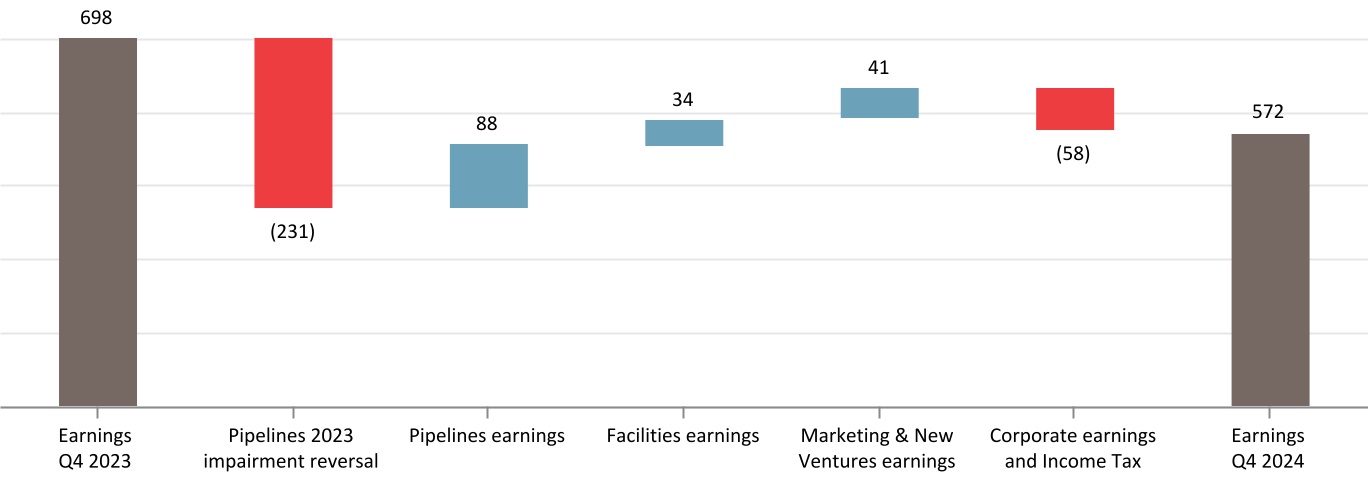
Change in Earnings ($ millions)
Results Overview
Earnings in the fourth quarter of 2024 decreased by $126 million compared to the prior period, which included the reversal of impairment related to the reactivation of the Nipisi Pipeline. Other significant factors impacting the quarter by segment include:
•Pipelines: Positive impacts from the Alliance/Aux Sable Acquisition, partially offset by lower net revenue on the Cochin Pipeline.
•Facilities: Positive impacts from Pembina acquiring a controlling ownership interest in Aux Sable following the Acquisition, and higher share of profit from equity accounted investees ("Share of Profit") from PGI largely due to higher contributions from certain PGI assets and unrealized gains on interest rate derivative financial instruments.
•Marketing & New Ventures: Higher net revenue driven by higher NGL margins, and the Acquisition, as well as higher Share of Profit from Cedar LNG largely due to unrealized gains on interest rate derivative financial instruments. This was partially offset by unrealized losses on risk management and physical derivative contracts in the quarter compared to gains in the fourth quarter of 2023.
•Corporate and Income Tax: Higher income tax expense, driven by the recognition of deferred tax assets in the fourth quarter of 2023, which lowered income tax expense in 2023, partially offset by lower consolidated earnings. Additionally, higher net finance costs, largely due to higher interest expense, were largely offset by lower incentive costs.
Additional factors impacting the segments are discussed in the table below and in the "Segment Results" section of this MD&A.
4 Pembina Pipeline Corporation 2024 Annual Report
| | | | | | |
Changes in Results for the Three Months Ended December 31 |
Net revenue(1)(2) | | $241 million increase, largely due to the Acquisition, in which Pembina acquired a controlling ownership interest in Alliance and Aux Sable, resulting in a change from equity accounting to being fully consolidated on April 1, 2024. Refer to the "About Pembina – Alliance/Aux Sable Acquisition" section of this MD&A. The fourth quarter of 2024 includes $306 million in consolidated net revenue related to Alliance and Aux Sable as wholly-owned entities. In addition, the Marketing & New Ventures Division saw increased net revenue from contracts with customers, largely due to higher NGL margins. There was also higher net revenue in the Pipelines Division, related to the timing of capital recovery recognition on certain Pipelines assets ($23 million).
These results were partially offset by unrealized losses on crude oil-based and NGL-based derivatives in the fourth quarter of 2024, compared to gains in the fourth quarter of 2023, and lower realized gains on crude oil-based derivatives. Additionally, on the Cochin Pipeline, net revenue decreased by $40 million due to lower tolls on new contracts ($33 million), which replaced long-term contracts that expired in mid-July 2024, and lower interruptible demand during the period resulting from a narrower condensate price differential between western Canada and the U.S. Gulf Coast. |
| | |
| Operating expenses | | $53 million increase, primarily due to operating expenses from Alliance and Aux Sable now being fully consolidated, combined with higher integrity spending and higher recoverable geotechnical costs on certain Pipelines assets, partially offset by lower recoverable power costs. The fourth quarter of 2024 includes $52 million in operating expenses related to Alliance and Aux Sable as wholly-owned entities. |
| | |
| | |
| | |
| Cash flow from operating activities | | $22 million increase, primarily driven by an increase in earnings adjusted for items not involving cash, partially offset by the change in non-cash working capital. Additionally, lower distributions from equity accounted investees and higher net interest paid, both largely a result of the Acquisition, further offset the increase. |
Adjusted cash flow from operating activities(2) | | $175 million increase, primarily due to the same items impacting cash flow from operating activities, discussed above, excluding the change in non-cash working capital, combined with lower accrued share-based payment expense, partially offset by higher current income tax expense. |
Adjusted EBITDA(2) | | $221 million increase, largely due to approximately $105 million related to Pembina's increased ownership interest in the Acquirees and approximately $50 million from improved NGL margins and asset performance in the Acquirees, as well as higher NGL margins in the NGL marketing business and lower incentives costs. Additionally, there was higher net revenue of $37 million related to the timing of capital recovery recognition on certain Pipelines assets and at PGI, and higher contributions from PGI, largely due to higher revenue associated with the oil batteries acquired from Veren Inc. ("Veren") in the fourth quarter of 2024 and higher volumes at certain PGI assets.
These results were partially offset by lower net revenue on the Cochin Pipeline, combined with lower realized gains on crude oil-based derivatives. |
| | |
(1) Comparative 2023 period has been adjusted. See "Accounting Policies & Estimates – Change in Accounting Policies" and Note 4 to the Consolidated Financial Statements.
(2) Refer to the "Non-GAAP & Other Financial Measures" section of this MD&A.
Pembina Pipeline Corporation 2024 Annual Report 5
Consolidated Financial Overview for the 12 Months Ended December 31
Results of Operations
| | | | | | | | | | | | |
| ($ millions, except where noted) | 2024 | 2023 | Change | |
Revenue(1) | 7,384 | | 6,331 | | 1,053 | | |
Net revenue(1)(2) | 4,776 | | 3,973 | | 803 | | |
| | | | |
Gross profit | 3,316 | | 2,840 | | 476 | | |
Adjusted EBITDA(2) | 4,408 | | 3,824 | | 584 | | |
| | | | |
Earnings | 1,874 | | 1,776 | | 98 | | |
Earnings per common share – basic (dollars) | 3.00 | | 3.00 | | — | | |
Earnings per common share – diluted (dollars) | 3.00 | | 2.99 | | 0.01 | | |
| Cash flow from operating activities | 3,214 | | 2,635 | | 579 | | |
Cash flow from operating activities per common share – basic (dollars) | 5.61 | | 4.79 | | 0.82 | | |
Adjusted cash flow from operating activities(2) | 3,265 | | 2,646 | | 619 | | |
Adjusted cash flow from operating activities per common share – basic (dollars)(2) | 5.70 | | 4.81 | | 0.89 | | |
| Capital expenditures | 955 | | 606 | | 349 | | |
| | | | |
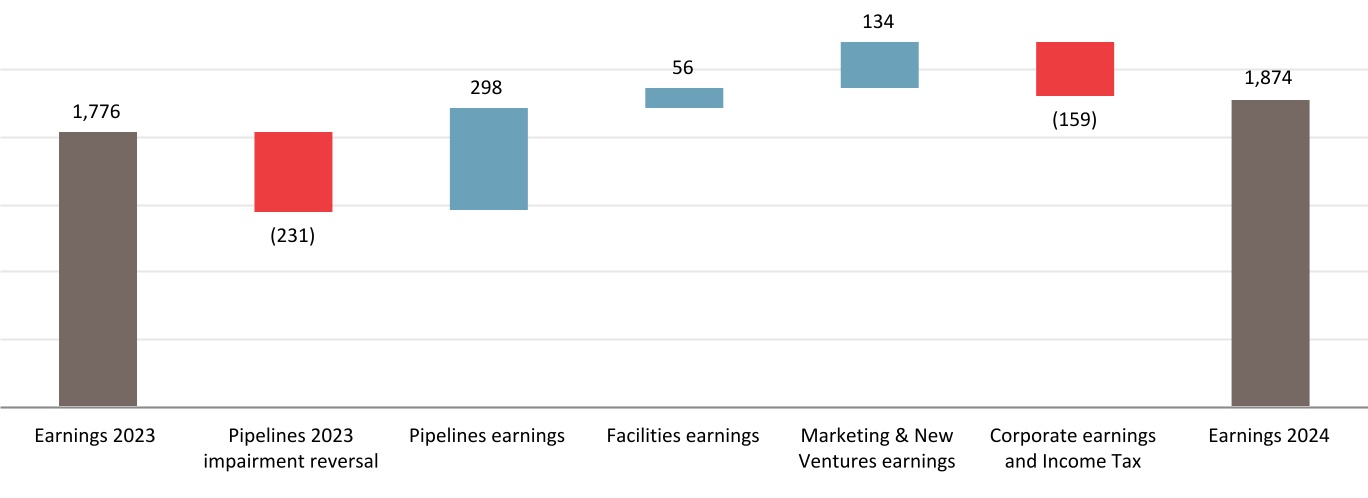
Change in Earnings ($ millions)
Results Overview
Earnings during 2024 increased by $98 million compared to the prior year, which included the reversal of impairment related to the reactivation of the Nipisi Pipeline. Other significant factors impacting the period by segment include:
•Pipelines: Positive impacts from the Alliance/Aux Sable Acquisition, and the 2024 period not being impacted by the Northern Pipeline system outage and the wildfires in Alberta and British Columbia that affected 2023. Additionally, there were higher net revenues due to increased volumes on certain Pipelines assets and contractual inflation adjustments on tolls. These were partially offset by the reversal of impairment related to the Nipisi Pipeline reactivation, and lower net revenue on the Cochin Pipeline.
•Facilities: Positive impacts from Pembina acquiring a controlling ownership interest in Aux Sable following the Acquisition and the 2024 period not being impacted by the Northern Pipeline system outage that affected 2023, partially offset by a gain on the recognition of a finance lease included in other income in 2023.
•Marketing & New Ventures: Positive impacts from higher NGL margins and the Acquisition, higher Share of Profit from Cedar LNG, and higher other income due to gains related to Pembina's financial assurances assumed by Cedar LNG. These factors were partially offset by losses on risk management and physical derivative contracts, which included larger unrealized losses and realized losses in the period, compared to realized gains in 2023.
•Corporate and Income Tax: Higher interest expense, and higher acquisition and integration costs, were partially offset by the net impact of the deferred tax recovery recognized from the Acquisition and the loss on Acquisition recognized during the second quarter of 2024, combined with lower general & administrative costs.
Additional factors impacting the segments are discussed in the table below and in the "Segment Results" section of this MD&A.
6 Pembina Pipeline Corporation 2024 Annual Report
| | | | | | |
Changes in Results for the 12 Months Ended December 31 |
Net revenue(1)(2) | | $803 million increase, largely due to the Acquisition, in which Pembina acquired a controlling ownership interest in Alliance and Aux Sable. The 2024 period includes $851 million in consolidated net revenue related to Alliance and Aux Sable as wholly-owned entities. Additionally, there were higher net revenues in the Pipelines and Facilities Divisions due to higher volumes compared to 2023, which was impacted by the Northern Pipeline system outage and the wildfires. Higher contracted volumes primarily on the Peace Pipeline system, contractual inflation adjustments on tolls, the reactivation of the Nipisi Pipeline, and higher net revenue largely related to the timing of capital recovery recognition on certain Pipelines assets ($23 million), further contributed to the increase. Higher net revenue in the Marketing & New Ventures Division was driven by higher NGL margins and the impacts of the Acquisition, as well as lower unrealized losses on NGL-based derivatives.
These results were partially offset by lower revenue from risk management and physical derivative contracts due to larger unrealized losses on renewable power purchase agreements, combined with realized losses on NGL-based derivatives and unrealized losses on crude oil-based derivatives in 2024, compared to gains in 2023. Lower operating recoveries were largely related to lower power costs in the Pipelines and Facilities Divisions. Additionally, on the Cochin Pipeline, there was lower net revenue due to lower tolls on new contracts ($54 million), which replaced long-term contracts that expired in mid-July 2024, lower volumes from a contracting gap from mid-July to August 1, 2024 associated with the return of line fill to certain customers, and lower interruptible demand during the year resulting from a narrower condensate price differential between western Canada and the U.S. Gulf Coast. This is combined with a nine-day unplanned outage at Aux Sable in July 2024 ($13 million) which also partially offset the increase in net revenue. |
| | |
| Operating expenses | | $151 million increase, primarily due to operating expenses from Alliance and Aux Sable now being fully consolidated, combined with higher recoverable geotechnical costs and higher integrity spending. The 2024 period includes $159 million in consolidated operating expenses related to Alliance and Aux Sable as wholly-owned entities. These increases were partially offset by lower recoverable power costs, and lower costs in the Pipelines Division in 2024 compared to 2023, as 2023 was impacted by the Northern Pipeline system outage. |
| | |
| Cash flow from operating activities | | $579 million increase, primarily driven by an increase in earnings adjusted for items not involving cash, the change in non-cash working capital, and an increase in payments collected through contract liabilities. This is partially offset by lower distributions from equity accounted investees and higher net interest paid, both largely a result of the Acquisition, as well as higher taxes paid and share-based payments. |
Adjusted cash flow from operating activities(2) | | $619 million increase, primarily due to the same items impacting cash flow from operating activities, discussed above, excluding the change in non-cash working capital, taxes paid, and share-based payments, combined with lower current income tax expense. The increase was partially offset by higher accrued share-based payment expense, distributions to non-controlling interest, and higher preferred dividends paid. |
Adjusted EBITDA(2) | | $584 million increase, largely due to approximately $230 million related to Pembina's increased ownership interest in the Acquirees and approximately $210 million from improved NGL margins and asset performance in the Acquirees. Additional contributors included higher net revenue and volumes on certain of Pembina's Pipelines and Facilities assets compared to 2023, which was affected by the Northern Pipeline system outage and the wildfires, as well as higher NGL margins in the NGL marketing business and increased marketed volumes in the Marketing & New Ventures Division. Higher adjusted EBITDA from PGI also contributed to the increase, largely due to higher revenue associated with the oil batteries acquired from Veren in the fourth quarter of 2024 and higher volumes at certain PGI assets. Other factors included higher contracted volumes on the Peace Pipeline system, contractual inflation adjustments on tolls, the reactivation of the Nipisi Pipeline, and a $37 million increase in net revenue related to the timing of capital recovery recognition on certain Pipelines assets and at PGI.
These results were partially offset by realized losses on NGL-based derivatives compared to gains in 2023, and lower net revenue on the Cochin Pipeline, combined with a change to other expense in the Facilities Division, compared to other income in 2023, which included a gain on the recognition of a finance lease, and a nine-day unplanned outage at Aux Sable in July 2024. |
| | |
(1) Comparative 2023 period has been adjusted. See "Accounting Policies & Estimates – Change in Accounting Policies" and Note 4 to the Consolidated Financial Statements.
(2) Refer to the "Non-GAAP & Other Financial Measures" section of this MD&A.
Pembina Pipeline Corporation 2024 Annual Report 7
3. SEGMENT RESULTS
Business Overview
The Pipelines Division provides customers with pipeline transportation, terminalling, and storage in key market hubs in Canada and the United States for crude oil, condensate, natural gas liquids and natural gas. The Pipelines Division manages pipeline transportation capacity of 3.0 mmboe/d(1) and above ground storage capacity of approximately 10 mmbbls(1) within its conventional, oil sands and heavy oil, and transmission assets. The conventional assets include strategically located pipelines and terminalling hubs that gather and transport light and medium crude oil, condensate and natural gas liquids from western Alberta and northeast British Columbia to downstream pipelines and processing facilities in the Edmonton, Alberta area. The oil sands and heavy oil assets transport heavy and synthetic crude oil produced within Alberta to the Edmonton, Alberta area and offer associated storage and terminalling. The transmission assets transport natural gas, ethane and condensate throughout Canada and the United States on long haul pipelines linking various key market hubs. In addition, the Pipelines Division assets provide linkages to Pembina's Facilities Division assets across North America, enhancing flexibility and optionality in our customer service offerings. Together, these assets supply products from hydrocarbon producing regions to refineries, fractionators and market hubs in Alberta, British Columbia, and Illinois, as well as other regions throughout North America.
The Facilities Division includes infrastructure that provides Pembina's customers with natural gas, condensate and NGL services. Through its wholly-owned assets and its interest in PGI, Pembina's natural gas gathering and processing facilities are strategically positioned in active, liquids-rich areas of the WCSB and Williston Basin and may be serviced by the Company's other businesses. Pembina provides sweet and sour gas gathering, compression, condensate stabilization, and both shallow cut and deep cut gas processing services with a total capacity of approximately 6.7 bcf/d(1) for its customers. Condensate and NGL extracted at virtually all Canadian-based facilities have access to transportation on Pembina's pipelines. In addition, all NGL transported along the Alliance Pipeline are extracted through the Channahon Facility at the terminus. The Facilities Division includes approximately 430 mbpd(1) of NGL fractionation capacity, 21 mmbbls(1) of cavern storage capacity, various oil batteries, associated pipeline and rail terminalling facilities and a liquefied propane export facility on Canada's West Coast. These facilities are accessible to Pembina's other strategically-located assets and pipeline systems, providing customers with flexibility and optionality to access a comprehensive suite of services to enhance the value of their hydrocarbons. In addition, Pembina owns a bulk marine import/export terminal in Vancouver, British Columbia.
The Marketing & New Ventures Division leverages Pembina's integrated value chain and existing network of pipelines, facilities, and energy infrastructure assets to maximize the value of hydrocarbon liquids and natural gas originating in the basins where the Company operates. Pembina pursues the creation of new markets, and further enhances existing markets, to support both the Company's and its customers' business interests. In particular, Pembina seeks to identify opportunities to connect hydrocarbon production to new demand locations through the development of infrastructure.
Within the Marketing & New Ventures Division, Pembina undertakes value-added commodity marketing activities, including buying and selling products (natural gas, ethane, propane, butane, condensate, crude oil, electricity, and carbon credits), commodity arbitrage, and optimizing storage opportunities. The marketing business enters into contracts for capacity on both Pembina's and third-party infrastructure, handles proprietary and customer volumes and aggregates production for onward sale. Through this infrastructure capacity, including Pembina's Prince Rupert Terminal, as well as utilizing the Company's expansive rail fleet and logistics capabilities, Pembina's marketing business adds incremental value to the commodities by accessing high value markets across North America and globally.
The Marketing & New Ventures Division is also responsible for the development of new large-scale, or value chain extending projects, including those that provide enhanced access to global markets and support a transition to a lower-carbon economy. The Marketing & New Ventures Division includes Pembina's interest in the Cedar LNG Project, a liquified natural gas ("LNG") export facility currently under construction. Additionally, Pembina is pursuing opportunities associated with low-carbon commodities and large-scale greenhouse gas ("GHG") emissions reductions.
(1)Net capacity.
8 Pembina Pipeline Corporation 2024 Annual Report
Financial and Operational Overview by Division
| | | | | | | | | | | | | | | | | | | | | | | | |
| 3 Months Ended December 31 |
| 2024 | 2023 |
($ millions, except where noted) | Volumes(1) | Earnings (Loss) | | | Adjusted EBITDA(2) | Volumes(1) | Earnings (Loss) | | | Adjusted EBITDA(2) |
| Pipelines | 2,790 | | 534 | | | | 686 | | 2,652 | | 677 | | | | 617 | |
| Facilities | 877 | | 177 | | | | 373 | | 801 | | 143 | | | | 324 | |
Marketing & New Ventures | 349 | | 245 | | | | 234 | | 299 | | 204 | | | | 173 | |
| Corporate | — | | (212) | | | | (39) | | — | | (209) | | | | (81) | |
| | | | | | | | | | |
| Income tax expense | — | | (172) | | | | — | | — | | (117) | | | | — | |
| Total | | 572 | | | | 1,254 | | | 698 | | | | 1,033 | |
| | | | | | | | | | |
| |
| | |
| | | | | | | | | | |
| | | | | | | | | | |
| | | | | | | | | | |
| | | | | | | | | | |
| | | | | | | | | | |
| | | | | | | | | | |
| | | | | | | | | | | | | | | | | | | | | | | | |
| 12 Months Ended December 31 |
| 2024 | 2023 |
($ millions, except where noted) | Volumes(1) | Earnings (Loss) | | | Adjusted EBITDA(2) | Volumes(1) | Earnings (Loss) | | | Adjusted EBITDA(2) |
| Pipelines | 2,711 | | 1,907 | | | | 2,533 | | 2,538 | | 1,840 | | | | 2,234 | |
| Facilities | 837 | | 666 | | | | 1,347 | | 768 | | 610 | | | | 1,213 | |
Marketing & New Ventures | 327 | | 569 | | | | 724 | | 271 | | 435 | | | | 597 | |
| Corporate | — | | (1,422) | | | | (196) | | — | | (696) | | | | (220) | |
| | | | | | | | | | |
| Income tax expense/recovery | — | | 154 | | | | — | | — | | (413) | | | | — | |
| Total | | 1,874 | | | | 4,408 | | | 1,776 | | | | 3,824 | |
| | | | | | | | | | |
| |
| | |
| | | | | | | | | | |
| | | | | | | | | | |
| | | | | | | | | | |
| | | | | | | | | | |
| | | | | | | | | | |
| | | | | | | | | | |
(1) Volumes in mboe/d. See the "Abbreviations" section of this MD&A for definition. Volumes for Pipelines and Facilities divisions are revenue volumes, which are physical volumes plus volumes recognized from take-or-pay commitments. Volumes for Marketing & New Ventures are marketed crude and NGL volumes.
(2) Refer to the "Non-GAAP & Other Financial Measures" section of this MD&A.
Equity Accounted Investees Overview by Division
| | | | | | | | | | | | | | | | | | | | | | | | | | | | | | | | |
| 3 Months Ended December 31 |
| | | | |
| 2024 | 2023 |
| ($ millions, except where noted) | Share of profit | Adjusted EBITDA(4) | Contributions | Distributions(5) | Volumes(6) | Share of profit | Adjusted EBITDA(4) | Contributions | Distributions(5) | Volumes(6) |
| | | | | | | | | | |
| | | | | | | | | | |
| | | | | | | | | | |
Pipelines(1) | — | | — | | — | | — | | — | | 31 | | 76 | | 19 | | 79 | | 142 | |
| | | | | | | | | | |
| | | | | | | | | | |
| | | | | | | | | | |
Facilities(2) | 59 | | 195 | | — | | 131 | | 358 | | 48 | | 183 | | — | | 123 | | 356 | |
| | | | | | | | | | |
| | | | | | | | | | |
| | | | | | | | | | |
| | | | | | | | | | |
Marketing & New Ventures(3) | 74 | | — | | — | | — | | — | | 15 | | 21 | | 183 | | 25 | | 35 | |
| Total | 133 | | 195 | | — | | 131 | | 358 | | 94 | | 280 | | 202 | | 227 | | 533 | |
| | | | | | | | | | | | | | | | | | | | | | | | | | | | | | | | |
| 12 Months Ended December 31 |
| | | | |
| 2024 | 2023 |
| ($ millions, except where noted) | Share of profit | Adjusted EBITDA(4) | Contributions | Distributions(5) | Volumes(6) | Share of profit (loss) | Adjusted EBITDA(4) | Contributions | Distributions(5) | Volumes(6) |
| | | | | | | | | | |
| | | | | | | | | | |
| | | | | | | | | | |
Pipelines(1) | 42 | | 88 | | 5 | | 80 | | 37 | | 109 | | 281 | | 20 | | 279 | | 140 | |
| | | | | | | | | | |
| | | | | | | | | | |
| | | | | | | | | | |
Facilities(2) | 231 | | 717 | | 124 | | 515 | | 358 | | 233 | | 671 | | 33 | | 470 | | 351 | |
| | | | | | | | | | |
| | | | | | | | | | |
| | | | | | | | | | |
| | | | | | | | | | |
Marketing & New Ventures(3) | 55 | | 39 | | 242 | | 31 | | 9 | | (26) | | 58 | | 218 | | 70 | | 34 | |
| Total | 328 | | 844 | | 371 | | 626 | | 404 | | 316 | | 1,010 | | 271 | | 819 | | 524 | |
(1) Pipelines includes Alliance and Grand Valley. Pembina owned a 50 percent interest in Alliance up to the closing of the Alliance/Aux Sable Acquisition on April 1, 2024. Refer to the "About Pembina – Alliance/Aux Sable Acquisition" and "Abbreviations" sections of this MD&A for more information.
(2) Facilities includes PGI and Fort Corp.
(3) Marketing and New Ventures includes Aux Sable, Cedar LNG, and ACG. Pembina owned approximately a 42.7 percent ownership in Aux Sable's U.S operations and a 50 percent ownership in Aux Sable's Canadian operations up to the closing of the Alliance/Aux Sable Acquisition on April 1, 2024. Refer to the "About Pembina – Alliance/Aux Sable Acquisition" and "Abbreviations" sections of this MD&A for more information.
(4) Refer to the "Non-GAAP & Other Financial Measures" section of this MD&A.
(5) Distributions exclude returns of capital. In 2024, Pembina received an incremental $63 million from Cedar LNG as a return of capital (2023: $61 million from PGI).
(6) Volumes in mboe/d. See the "Abbreviations" section of this MD&A for definition.
In 2024, contributions in the Facilities Division were made to PGI to partially fund growth capital projects and the previously announced acquisition of midstream assets. Contributions in Marketing & New Ventures in 2024 were made to Cedar LNG to fund the Cedar LNG Project. Refer to the "Segment Results – Marketing & New Ventures Division – Projects & New Developments" sections of this MD&A for additional information.
Pembina Pipeline Corporation 2024 Annual Report 9
Pipelines
Financial Overview for the Three Months Ended December 31
Results of Operations
| | | | | | | | | | | | |
| ($ millions, except where noted) | 2024 | 2023 | Change | |
| | | | |
| | | | |
| | | | |
Pipelines revenue(1) | 948 | | 737 | | 211 | | |
Cost of goods sold(1) | 5 | | 11 | | (6) | | |
Net revenue(1)(2) | 943 | | 726 | | 217 | | |
Operating expenses(1) | 231 | | 171 | | 60 | | |
| Depreciation and amortization included in gross profit | 147 | | 110 | | 37 | | |
| Share of profit from equity accounted investees | — | | 31 | | (31) | | |
| Gross profit | 565 | | 476 | | 89 | | |
| Earnings | 534 | | 677 | | (143) | | |
Adjusted EBITDA(2) | 686 | | 617 | | 69 | | |
Volumes(3) | 2,790 | | 2,652 | | 138 | | |
| | | | | | |
| Change in Results | | |
| | |
| | |
| | |
Net revenue(1)(2) | | Higher largely due to the Acquisition, in which Pembina acquired a controlling ownership interest in Alliance. The fourth quarter of 2024 includes $227 million in net revenue related to Alliance as a wholly-owned entity. Additionally, higher revenue related to the timing of capital recovery recognition on certain Pipelines assets ($23 million), and increasing volumes on the Nipisi Pipeline following its reactivation in October 2023, also contributed to the increase in net revenue. These increases were partially offset by lower net revenue on the Cochin Pipeline due to lower tolls on new contracts ($33 million), which replaced long-term contracts that expired in mid-July 2024, and lower interruptible demand during the period resulting from a narrower condensate price differential between western Canada and the U.S. Gulf Coast. Net revenues on the Peace Pipeline system were consistent as higher contracted volumes and contractual inflation adjustments on tolls were largely offset by earlier recognition of take-or-pay deferred revenue during the first half of 2024, as well as net loss allowance. |
| | |
Operating expenses(1) | | Increase largely due to the Acquisition. The fourth quarter of 2024 includes $54 million in operating expenses related to Alliance as a wholly-owned entity. |
| Depreciation and amortization included in gross profit | | Higher largely due to the Acquisition, combined with the reactivation of the Nipisi Pipeline, partially offset by fewer asset retirements compared to the fourth quarter of 2023. |
| Share of profit from equity accounted investees | | Following the Acquisition on April 1, 2024, the results from Alliance are no longer accounted for in Share of Profit and are now being fully consolidated. |
| Earnings | | Decrease largely due to the reversal of impairment related to the reactivation of the Nipisi Pipeline which increased revenue in the fourth quarter of 2023 by $231 million, combined with lower net revenue on the Cochin Pipeline. This was partially offset by the net impacts of the Acquisition, higher revenue related to the timing of capital recovery recognition on certain Pipelines assets, and increasing volumes on the Nipisi Pipeline following its reactivation in October 2023. |
Adjusted EBITDA(2) | | Increase largely due to the net impacts of the Acquisition, combined with higher revenue related to the timing of capital recovery recognition on certain Pipelines assets, higher adjusted EBITDA from Alliance driven by higher demand on seasonal contracts, and increasing volumes on the Nipisi Pipeline following its reactivation in October 2023. This was partially offset by lower net revenue on the Cochin Pipeline. |
Volumes(3) | | Higher largely due to the Acquisition, discussed above, combined with the reactivation of the Nipisi Pipeline. The increase was partially offset by lower volumes on the Peace Pipeline system due to earlier recognition of take-or-pay deferred revenue in the first half of 2024, which more than offset the increase from higher contracted volumes. Additionally, lower volumes on the Cochin Pipeline were largely due to lower interruptible demand during the period resulting from a narrower condensate price differential between western Canada and the U.S. Gulf Coast. |
Change in Adjusted EBITDA ($ millions)(1)(2)
(1) Includes inter-segment transactions. See Note 6 to the Consolidated Financial Statements.
(2) Refer to the "Non-GAAP & Other Financial Measures" section of this MD&A.
(3) Revenue volumes in mboe/d. See the "Abbreviations" section of this MD&A for definition.
10 Pembina Pipeline Corporation 2024 Annual Report
Financial Overview for the 12 Months Ended December 31
Results of Operations
| | | | | | | | | | | | |
| ($ millions, except where noted) | 2024 | 2023 | Change | |
| | | | |
| | | | |
| | | | |
Pipelines revenue(1) | 3,386 | | 2,707 | | 679 | | |
Cost of goods sold(1) | 40 | | 17 | | 23 | | |
Net revenue(1)(2) | 3,346 | | 2,690 | | 656 | | |
Operating expenses(1) | 832 | | 695 | | 137 | | |
| Depreciation and amortization included in gross profit | 557 | | 414 | | 143 | | |
| Share of profit from equity accounted investees | 42 | | 109 | | (67) | | |
| Gross profit | 1,999 | | 1,690 | | 309 | | |
| Earnings | 1,907 | | 1,840 | | 67 | | |
Adjusted EBITDA(2) | 2,533 | | 2,234 | | 299 | | |
Volumes(3) | 2,711 | | 2,538 | | 173 | | |
| | | | | | |
| Change in Results | | |
| | |
| | |
| | |
Net revenue(1)(2) | | Higher largely due to the Acquisition, in which Pembina acquired a controlling ownership interest in Alliance. The 2024 period includes $622 million in net revenue related to Alliance as a wholly-owned entity. Also contributing to the increase in net revenue were contractual inflation adjustments on tolls, higher volumes compared to 2023, which was impacted by the Northern Pipeline system outage and the wildfires, and higher contracted volumes on the Peace Pipeline system. The reactivation of the Nipisi Pipeline, and higher net revenue related to the timing of capital recovery recognition on certain Pipelines assets ($23 million) also contributed to the increase. These factors were partially offset by lower net revenue on the Cochin Pipeline due to lower tolls on new contracts ($54 million), which replaced long-term contracts that expired in mid-July 2024, lower volumes from a contracting gap from mid-July to August 1, 2024 associated with the return of line fill to certain customers, and lower interruptible demand during the period resulting from a narrower condensate price differential between western Canada and the U.S. Gulf Coast. Lower recoverable power costs and project costs also contributed to the decrease in net revenue. |
| | |
Operating expenses(1) | | Increase largely due to the Acquisition, discussed above, higher recoverable geotechnical costs, and higher integrity spending. The 2024 period includes $156 million in operating expenses related to Alliance as a wholly-owned entity. These increases are partially offset by lower recoverable power costs resulting from a lower power pool price, and lower costs as 2023 was impacted by the Northern Pipeline system outage. |
Depreciation and amortization included in gross profit | | Higher largely due to the Acquisition, discussed above, combined with the reactivation of the Nipisi Pipeline, partially offset by fewer asset retirements in 2024 compared to 2023. |
Share of profit from equity accounted investees | | Following the Acquisition on April 1, 2024, the results from Alliance are no longer accounted for in Share of Profit and are now being fully consolidated. |
| Earnings | | Higher largely due to the net impacts of the Acquisition, and no impacts in 2024 from the Northern Pipeline system outage and the wildfires, which affected 2023. Higher net revenue and volumes, primarily on the Peace Pipeline system and on the Nipisi Pipeline, contractual inflation adjustments on tolls, and higher net revenue related to the timing of capital recovery recognition on certain Pipelines assets also contributed to the increase. These results were partially offset by the reversal of impairment related to the reactivation of the Nipisi Pipeline in the fourth quarter of 2023 ($231 million), and lower net revenue and volumes on the Cochin Pipeline in 2024. |
Adjusted EBITDA(2) | | Increase largely due to the same factors impacting earnings, discussed above, excluding the reversal of impairment. Higher demand on seasonal contracts also contributed to higher adjusted EBITDA from Alliance. |
Volumes(3) | | Higher largely due to the Acquisition, and the reactivation of the Nipisi Pipeline, combined with higher volumes compared to 2023 which was impacted by the Northern Pipeline system outage and the wildfires, and higher volumes on the Peace Pipeline system due to higher contracted volumes. The increase was partially offset by lower volumes on the Cochin Pipeline resulting from a contracting gap from mid-July to August 1, 2024 associated with the return of line fill to certain customers, and lower interruptible demand resulting from a narrower condensate price differential between western Canada and the U.S. Gulf Coast. |
Change in Adjusted EBITDA ($ millions)(1)(2)
(1) Includes inter-segment transactions. See Note 6 to the Consolidated Financial Statements.
(2) Refer to the "Non-GAAP & Other Financial Measures" section of this MD&A.
(3) Revenue volumes in mboe/d. See the "Abbreviations" section of this MD&A for definition.
Pembina Pipeline Corporation 2024 Annual Report 11
Financial and Operational Overview
| | | | | | | | | | | | | | | | | | | | | | | | | | | | | | | | | | | | | | |
| 3 Months Ended December 31 | 12 Months Ended December 31 |
| | |
| 2024 | 2023 | 2024 | 2023 |
| ($ millions, except where noted) | Volumes(1) | Earnings | Adjusted EBITDA(2) | Volumes(1) | Earnings | Adjusted EBITDA(2) | Volumes(1) | Earnings | Adjusted EBITDA(2) | Volumes(1) | Earnings | Adjusted EBITDA(2) |
Pipelines(3) | | | | | | | | | | | | |
| Conventional | 1,034 | | 322 | | 374 | | 1,054 | | 311 | | 370 | | 1,001 | | 1,153 | | 1,374 | | 968 | | 1,085 | | 1,296 | |
| Transmission | 720 | | 160 | | 224 | | 590 | | 117 | | 189 | | 687 | | 592 | | 865 | | 586 | | 421 | | 702 | |
| Oil Sands & Heavy Oil | 1,036 | | 53 | | 89 | | 1,008 | | 251 | | 60 | | 1,023 | | 166 | | 298 | | 984 | | 341 | | 243 | |
| General & administrative | — | | (1) | | (1) | | — | | (2) | | (2) | | — | | (4) | | (4) | | — | | (7) | | (7) | |
| Total | 2,790 | | 534 | | 686 | | 2,652 | | 677 | | 617 | | 2,711 | | 1,907 | | 2,533 | | 2,538 | | 1,840 | | 2,234 | |
(1) Revenue volumes in mboe/d. See the "Abbreviations" section of this MD&A for definition.
(2) Refer to the "Non-GAAP & Other Financial Measures" section of this MD&A.
(3) Includes values attributed to Pembina's conventional, transmission and oil sands and heavy oil assets within the Pipelines Division. Refer to Pembina's AIF for the year ended December 31, 2024.
Projects & New Developments(1)
Pipelines continues to focus on the execution of various system expansions. The projects in the following table were placed into service in 2024.
| | | | | |
| Significant Projects | In-service Date |
Phase VIII Peace Pipeline Expansion | May 2024 |
| NEBC MPS Expansion | November 2024 |
|
(1) For further details on Pembina's significant assets, including definitions for capitalized terms used herein that are not otherwise defined, refer to Pembina's AIF for the year ended December 31, 2024 filed at www.sedarplus.ca (filed with the U.S. Securities and Exchange Commission at www.sec.gov under Form 40-F) and on Pembina's website at www.pembina.com.
12 Pembina Pipeline Corporation 2024 Annual Report
Facilities
Financial Overview for the Three Months Ended December 31
Results of Operations | | | | | | | | | | | | |
| ($ millions, except where noted) | 2024 | 2023 | Change | |
| | | | |
| | | | |
Facilities revenue(1) | 320 | | 248 | | 72 | | |
| | | | |
| | | | |
Operating expenses(1) | 138 | | 95 | | 43 | | |
Depreciation and amortization included in gross profit | 55 | | 46 | | 9 | | |
Share of profit from equity accounted investees | 59 | | 48 | | 11 | | |
| Gross profit | 186 | | 155 | | 31 | | |
| Earnings | 177 | | 143 | | 34 | | |
Adjusted EBITDA(2) | 373 | | 324 | | 49 | | |
Volumes(3) | 877 | | 801 | | 76 | | |
| | | | | | |
| Changes in Results | | |
| | |
| | |
Revenue(1) | | Increase largely due to Pembina acquiring a controlling ownership interest in Aux Sable, pursuant to the Alliance/Aux Sable Acquisition on April 1, 2024. The fourth quarter of 2024 includes $82 million in revenue related to Aux Sable as a wholly-owned entity. |
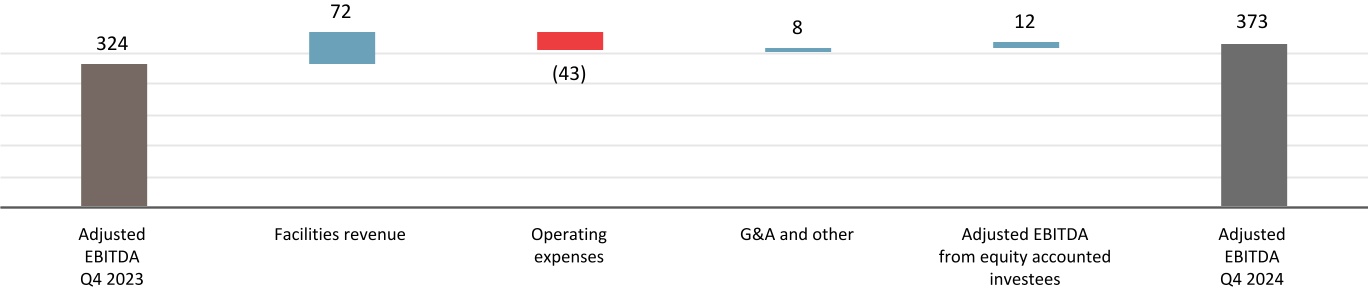
Operating expenses(1) | | Increase largely due to the Acquisition, discussed above. The fourth quarter of 2024 includes $50 million in operating expenses related to Aux Sable as a wholly-owned entity. |
| | |
Share of profit from equity accounted investees | | Increase due to higher contributions from certain PGI assets, driven by higher revenue associated with the oil batteries acquired from Veren in the fourth quarter of 2024, higher volumes at certain PGI assets, and the timing of revenue recognition on capital recoveries ($14 million). Additionally, PGI recognized unrealized gains on interest rate derivative financial instruments in the fourth quarter of 2024 compared to losses in the fourth quarter of 2023. These results were partially offset by higher income tax expense and higher other expense related to asset disposals. |
| Earnings | | Increase largely due to the net impacts of the Acquisition, and higher Share of Profit from PGI, discussed above. |
Adjusted EBITDA(2) | | Higher largely due to the net impacts of the Acquisition, discussed above, and higher net revenue from PGI, driven by higher revenue associated with the oil batteries acquired from Veren in the fourth quarter of 2024, higher volumes at certain PGI assets, and the timing of revenue recognition on capital recoveries. Included in adjusted EBITDA is $193 million (2023: $179 million) related to PGI. |
| | |
Volumes(3) | | Increase primarily due to the volumes now being recognized at Aux Sable following the Acquisition. Volumes at PGI were consistent with prior period as higher interruptible and contracted volumes on certain PGI assets were largely offset by contract expirations in 2024. Volumes include 358 mboe/d (2023: 356 mboe/d) related to PGI. |
Change in Adjusted EBITDA ($ millions)(1)(2)
(1) Includes inter-segment transactions. See Note 6 to the Consolidated Financial Statements.
(2) Refer to the "Non-GAAP & Other Financial Measures" section of this MD&A.
(3) Revenue volumes in mboe/d. See the "Abbreviations" section of this MD&A for definition.
Pembina Pipeline Corporation 2024 Annual Report 13
Financial Overview for the 12 Months Ended December 31
Results of Operations
| | | | | | | | | | | | |
($ millions, except where noted) | 2024 | 2023 | Change | |
| | | | |
| | | | |
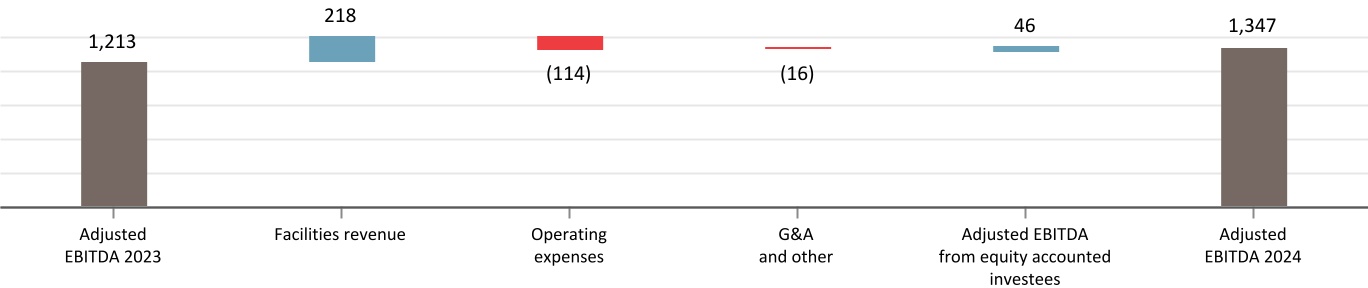
Facilities revenue(1) | 1,127 | | 909 | | 218 | | |
| | | | |
| | | | |
Operating expenses(1) | 474 | | 360 | | 114 | | |
Depreciation and amortization included in gross profit | 183 | | 159 | | 24 | | |
Share of profit from equity accounted investees | 231 | | 233 | | (2) | | |
| Gross profit | 701 | | 623 | | 78 | | |
| Earnings | 666 | | 610 | | 56 | | |
Adjusted EBITDA(2) | 1,347 | | 1,213 | | 134 | | |
Volumes(3) | 837 | | 768 | | 69 | | |
| | | | | | |
| Changes in Results | | |
| | |
| | |
Revenue(1) | | Increase largely due to Pembina acquiring a controlling ownership interest in Aux Sable, pursuant to the Alliance/Aux Sable Acquisition on April 1, 2024. The 2024 period includes $223 million in revenue related to Aux Sable as a wholly-owned entity. Additionally, there were no impacts in 2024 from the Northern Pipeline system outage that affected the same period in 2023, which further contributed to the increase in revenue. These increases were partially offset by lower recoverable power and fuel costs primarily at the Redwater Complex. |
Operating expenses(1) | | Increase largely due to the Acquisition, discussed above, partially offset by lower recoverable power and fuel costs. The 2024 period includes $136 million in operating expenses related to Aux Sable as a wholly-owned entity. |
| Depreciation and amortization included in gross profit | | Higher largely due to the Acquisition, discussed above. |
| | |
| | |
Share of profit from equity accounted investees | | Consistent with prior period. Higher contributions from certain PGI assets, driven by higher revenue associated with the oil batteries acquired from Veren in the fourth quarter of 2024, higher volumes, and the timing of revenue recognition on capital recoveries ($14 million), which were more than offset by higher income tax expense and larger unrealized losses recognized by PGI on interest rate derivative financial instruments in 2024 compared to the same period in 2023. |
| Earnings | | Increase largely due to the net impacts of the Acquisition, and no impacts in 2024 from the Northern Pipeline system outage. The increase was partially offset by a $16 million gain on the recognition of a finance lease included as other income in 2023. |
Adjusted EBITDA(2) | | Increase largely due to the net impacts of the Acquisition, and higher adjusted EBITDA from PGI, largely due to higher revenue associated with the oil batteries acquired from Veren in the fourth quarter of 2024, higher volumes at certain PGI assets, and the timing of revenue recognition on capital recoveries. Additionally, there were no impacts in 2024 from the Northern Pipeline system outage, which affected 2023. These increases were partially offset by a $16 million gain on the recognition of a finance lease included as other income in 2023. Included in adjusted EBITDA is $709 million (2023: $657 million) related to PGI. |
Volumes(3) | | Increase primarily due to the volumes now being recognized at Aux Sable following the Acquisition, and higher volumes compared to 2023, which was impacted by the Northern Pipeline system outage, combined with higher interruptible and contracted volumes on certain PGI assets. These increases were partially offset by lower volumes largely due to a planned outage and a rail strike at the Redwater Complex in the third quarter of 2024, resulting in volume curtailments. Volumes include 358 mboe/d (2023: 351 mboe/d) related to PGI. |
Change in Adjusted EBITDA ($ millions)(1)(2)
(1) Includes inter-segment transactions. See Note 6 to the Consolidated Financial Statements.
(2) Refer to the "Non-GAAP & Other Financial Measures" section of this MD&A.
(3) Revenue volumes in mboe/d. See the "Abbreviations" section of this MD&A for definition.
14 Pembina Pipeline Corporation 2024 Annual Report
Financial and Operational Overview
| | | | | | | | | | | | | | | | | | | | | | | | | | | | | | | | | | | | | | |
| 3 Months Ended December 31 | 12 Months Ended December 31 |
| 2024 | 2023 | 2024 | 2023 |
| ($ millions, except where noted) | Volumes(1) | Earnings | Adjusted EBITDA(2) | Volumes(1) | Earnings | Adjusted EBITDA(2) | Volumes(1) |
Earnings | Adjusted EBITDA(2) | Volumes(1) | Earnings | Adjusted EBITDA(2) |
Facilities(3) | | | | | | | | | | | | |
| Gas Services | 597 | | 77 | | 222 | | 602 | | 57 | | 203 | | 598 | | 300 | | 818 | | 584 | | 285 | | 755 | |
| NGL Services | 280 | | 100 | | 151 | | 199 | | 87 | | 122 | | 239 | | 367 | | 530 | | 185 | | 327 | | 460 | |
| General & administrative | — | | — | | — | | — | | (1) | | (1) | | — | | (1) | | (1) | | — | | (2) | | (2) | |
| Total | 877 | | 177 | | 373 | | 801 | | 143 | | 324 | | 837 | | 666 | | 1,347 | | 768 | | 610 | | 1,213 | |
(1) Revenue volumes in mboe/d. See the "Abbreviations" section of this MD&A for definition.
(2) Refer to the "Non-GAAP & Other Financial Measures" section of this MD&A.
(3) Includes values attributed to Pembina's gas services and NGL services assets within the Facilities operating segment. For a description of Pembina's gas and NGL assets, refer to Pembina's AIF for the year ended December 31, 2024.
Pembina Pipeline Corporation 2024 Annual Report 15
Projects & New Developments(1)
Facilities continues to build-out its natural gas and NGL processing and fractionation assets to service customer demand. The following outlines the projects and new developments within Facilities:
| | | | | | | | |
| RFS IV | | |
Capital Budget: $525 million | In-service Date(2): First half of 2026 | Status: On time, on updated budget |
RFS IV is a 55,000 bpd propane-plus fractionator at the existing Redwater fractionation and storage complex (the "Redwater Complex"). The project includes additional rail loading capacity and will leverage the design, engineering, and operating best practices of the existing facilities at the Redwater Complex. With the addition of RFS IV, the fractionation capacity at the Redwater Complex will total 256,000 bpd. As previously announced, the estimated project cost has been revised to $525 million (previously $460 million), reflecting project scope changes as well as higher equipment, material and labour costs in light of growing Alberta construction activity. Pembina has entered into a lump-sum engineering, procurement and construction agreement in respect of the project, for more than 70 percent of the project cost. Fabrication and construction activities continued for the facility in the fourth quarter of 2024, while piling and foundation work was completed for both the facility and infrastructure. |
| | | | | | | | |
| Wapiti Expansion | | |
Capital Budget: $140 million (net to Pembina) | In-service Date(2): First half of 2026 | Status: On time, on budget |
PGI is developing an expansion that will increase natural gas processing capacity at the Wapiti Plant by 115 mmcf/d (gross to PGI). The expansion opportunity is driven by strong customer demand supported by growing Montney production and is fully underpinned by long-term, take-or-pay contracts. The project includes a new sales gas pipeline and other related infrastructure. During the fourth quarter of 2024, engineering and equipment fabrication progressed and early works construction commenced. |
| | | | | | | | |
| K3 Cogeneration Facility | | |
Capital Budget: $70 million (net to Pembina) | In-service Date(2): First half of 2026 | Status: On time, on budget |
PGI is developing a 28 MW cogeneration facility at its K3 Plant, which is expected to reduce overall operating costs by providing power and heat to the gas processing facility, while reducing customers' exposure to power prices. The K3 Cogeneration Facility is expected to fully supply the K3 Plant's power requirements, with excess power sold to the grid at market rates. Further, through the utilization of the cogeneration waste heat and the low-emission power generated, the project is expected to contribute to a reduction in annual emissions compliance costs at the K3 Plant. During the fourth quarter of 2024, early works construction commenced. |
Pembina announced the closing of PGI's acquisition of a 50 percent working interest in Whitecap Resources Inc.'s ("Whitecap") 15-07 Kaybob Complex effective December 31, 2024. Concurrent with the acquisition, PGI agreed to support future infrastructure development for Whitecap's Lator area development, including a new battery and gathering laterals (the "Lator Infrastructure"), which PGI will own. PGI anticipates funding up to $400 million ($240 million net to Pembina) for the battery and gathering laterals within the first phase of the Lator Infrastructure, with all gas volumes flowing to PGI's Musreau facility upon startup in late 2026/early 2027, supporting long-term plant utilization.
Pembina announced the closing of PGI's transaction with Veren, which includes the acquisition of Veren's Gold Creek and Karr area oil batteries and support for future infrastructure development effective October 9, 2024. As part of the transaction, PGI committed to fund capital up to $300 million ($180 million net to Pembina) for future battery and gathering infrastructure in the Gold Creek and Karr areas.
(1) For further details on Pembina's significant assets, including definitions for capitalized terms used herein that are not otherwise defined, refer to Pembina's AIF for the year ended December 31, 2024 filed at www.sedarplus.ca (filed with the U.S. Securities and Exchange Commission at www.sec.gov under Form 40-F) and on Pembina's website at www.pembina.com.
(2) Subject to environmental and regulatory approvals. See the "Forward-Looking Statements & Information" section of this MD&A.
16 Pembina Pipeline Corporation 2024 Annual Report
Marketing & New Ventures
Financial Overview for the Three Months Ended December 31
Results of Operations | | | | | | | | | | | | |
| ($ millions, except where noted) | 2024 | 2023 | Change | |
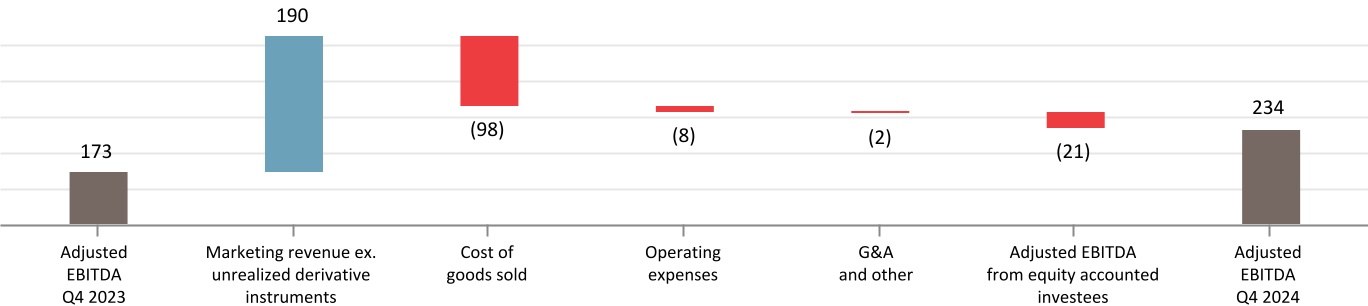
Marketing revenue(1)(2) | 1,133 | | 1,030 | | 103 | | |
Cost of goods sold(1)(2) | 919 | | 821 | | 98 | | |
Net revenue(1)(2)(3) | 214 | | 209 | | 5 | | |
Operating expenses(2) | 12 | | 4 | | 8 | | |
| Depreciation and amortization included in gross profit | 17 | | 12 | | 5 | | |
| Share of profit from equity accounted investees | 74 | | 15 | | 59 | | |
| Gross profit | 259 | | 208 | | 51 | | |
| Earnings | 245 | | 204 | | 41 | | |
Adjusted EBITDA(3) | 234 | | 173 | | 61 | | |
Crude oil sales volumes(4) | 96 | | 82 | | 14 | | |
NGL sales volumes(4) | 252 | | 217 | | 35 | | |
| | | | | | |
| Change in Results | | |
| | |
| | |
Net revenue(1)(2)(3) | | Consistent with prior period. Higher NGL net revenue from contracts with customers was largely due to higher NGL margins and the Acquisition, in which Pembina acquired a controlling ownership interest in Aux Sable. The fourth quarter of 2024 includes $49 million in net revenue related to Aux Sable as a wholly-owned entity. Net revenue from crude oil sales was largely consistent with prior period as higher volumes were partially offset by lower prices.
Higher NGL net revenue from contracts with customers was offset by lower revenue from risk management and physical derivative contracts largely due to unrealized losses on crude oil-based and NGL-based derivatives compared to gains in the fourth quarter of 2023, combined with lower realized gains on crude oil-based derivatives, primarily due to changes in pricing. The fourth quarter of 2024 includes unrealized losses on commodity-related derivatives of $41 million (2023: $46 million gain) and realized gains on commodity-related derivatives of $52 million (2023: $66 million gain). |
| | |
| | |
| | |
| | |
| Share of profit from equity accounted investees | | Increase largely due to unrealized gains on interest rate derivative financial instruments recognized by Cedar LNG, which were entered into in the third quarter of 2024, partially offset by foreign exchange losses. Share of Profit in the fourth quarter of 2023 relates to the results from Aux Sable. Following the Acquisition on April 1, 2024, the results from Aux Sable are no longer accounted for in Share of Profit and are now being fully consolidated. |
| Earnings | | Increase primarily due to higher Share of Profit from Cedar LNG and higher net revenue from contracts with customers, which were largely offset by lower revenue from risk management and physical derivative contracts, discussed above. |
Adjusted EBITDA(3) | | Higher largely due to higher NGL margins and the impacts of the Acquisition, partially offset by lower realized gains on commodity-related derivatives, discussed above. |
Crude oil sales volumes(4) | | Primarily higher due to increased blending opportunities driven by favorable price differentials in the fourth quarter of 2024 compared to the fourth quarter of 2023. |
NGL sales volumes(4) | | Increase primarily due to higher ethane, propane, and butane sales largely due to the increase in Pembina's ownership interest in Aux Sable. |
Change in Adjusted EBITDA ($ millions)(1)(2)(3)
(1) Comparative 2023 period has been adjusted. See "Accounting Policies & Estimates – Change in Accounting Policies" and Note 4 to the Consolidated Financial Statements.
(2) Includes inter-segment transactions. See Note 6 to the Consolidated Financial Statements.
(3) Refer to the "Non-GAAP & Other Financial Measures" section of this MD&A.
(4) Marketed crude and NGL volumes in mboe/d. See the "Abbreviations" section of this MD&A for definition.
Pembina Pipeline Corporation 2024 Annual Report 17
Financial Overview for the 12 Months Ended December 31
Results of Operations
| | | | | | | | | | | | |
| ($ millions, except where noted) | 2024 | 2023 | Change | |
Marketing revenue(1)(2) | 3,796 | | 3,293 | | 503 | | |
Cost of goods sold(1)(2) | 3,198 | | 2,736 | | 462 | | |
Net revenue(1)(2)(3) | 598 | | 557 | | 41 | | |
Operating expenses(2) | 25 | | 7 | | 18 | | |
| Depreciation and amortization included in gross profit | 64 | | 46 | | 18 | | |
| Share of profit (loss) from equity accounted investees | 55 | | (26) | | 81 | | |
| Gross profit | 564 | | 478 | | 86 | | |
| Earnings | 569 | | 435 | | 134 | | |
Adjusted EBITDA(3) | 724 | | 597 | | 127 | | |
Crude oil sales volumes(4) | 99 | | 86 | | 13 | | |
NGL sales volumes(4) | 228 | | 185 | | 43 | | |
| | | | | | |
| Change in Results | | |
| | |
| | |
Net revenue(1)(2)(3) | | Higher net NGL revenue from contracts with customers was largely due to higher NGL margins and the Acquisition, in which Pembina acquired a controlling ownership interest in Aux Sable, and a cost recovery related to a storage insurance settlement recognized in the third quarter of 2024. These increases were partially offset by a nine-day unplanned outage at Aux Sable in July 2024 ($13 million). The 2024 period includes $139 million in net revenue related to Aux Sable as a wholly-owned entity. Net revenue from crude oil sales was largely consistent with prior period.
Lower revenue from risk management and physical derivative contracts was primarily due to larger unrealized losses on renewable power purchase agreements largely due to a decline in forward power prices, combined with unrealized losses on crude oil-based derivatives and realized losses on NGL-based derivatives in 2024, compared to gains in 2023. These results were partially offset by lower unrealized losses on NGL-based derivatives, and larger realized gains on crude oil-based derivatives. The 2024 period includes unrealized losses on commodity-related derivatives of $170 million (2023: $32 million loss) and realized gains on commodity-related derivatives of $241 million (2023: $315 million gain). |
Operating expenses(1) | | Increase due to certain freight costs previously included in cost of goods sold. |
| | |
| | |
| Share of profit (loss) from equity accounted investees | | Increase largely due to unrealized gains on interest rate derivative financial instruments recognized by Cedar LNG, which were entered into in the third quarter of 2024, as well as strong results from Aux Sable in the first quarter of 2024, partially offset by foreign exchange losses in Cedar LNG. Following the Acquisition on April 1, 2024, the results from Aux Sable are no longer accounted for in Share of Profit and are now being fully consolidated. The loss in 2023 largely relates to provisions recognized by Aux Sable. |
| Depreciation and amortization included in gross profit | | Increase largely due to a change in the expected useful life of certain intangible assets. |
| Earnings | | Increase largely due to higher Share of Profit, higher net revenue,discussed above, and gains associated with the derecognition of the provision related to financial assurances provided by Pembina which were assumed by Cedar LNG following the positive FID in June 2024, partially offset by higher depreciation. |
Adjusted EBITDA(3) | | Increase mainly from higher NGL margins and the Acquisition, partially offset by realized losses on NGL-based derivatives in 2024 compared to gains in 2023, and the nine-day unplanned outage at Aux Sable in July 2024. |
Crude oil sales volumes(4) | | Primarily higher due to increased blending opportunities driven by favorable price differentials in 2024 compared to the same period in 2023. |
NGL sales volumes(4) | | Increase primarily due to higher ethane, propane, and butane sales largely due to the increase in Pembina's ownership interest in Aux Sable, and the impact of lower supply volumes from the Redwater Complex in 2023 due to the impacts of the Northern Pipeline system outage. |
Change in Adjusted EBITDA ($ millions)(1)(2)(3)
(1) Comparative 2023 period has been adjusted. See "Accounting Policies & Estimates – Change in Accounting Policies" and Note 4 to the Consolidated Financial Statements.
(2) Includes inter-segment transactions. See Note 6 to the Consolidated Financial Statements.
(3) Refer to the "Non-GAAP & Other Financial Measures" section of this MD&A.
(4) Marketed crude and NGL volumes in mboe/d. See the "Abbreviations" section of this MD&A for definition.
18 Pembina Pipeline Corporation 2024 Annual Report
Financial and Operational Overview
| | | | | | | | | | | | | | | | | | | | | | | | | | | | | | | | | | | | | | |
| 3 Months Ended December 31 | 12 Months Ended December 31 |
| 2024 | 2023 | 2024 | 2023 |
| ($ millions, except where noted) | Volumes(1) | Earnings | Adjusted EBITDA(2) | Volumes(1) | Earnings (loss) | Adjusted EBITDA(2) | Volumes(1) | Earnings | Adjusted EBITDA(2) | Volumes(1) | Earnings (loss) | Adjusted EBITDA(2) |
Marketing & New Ventures(3) | | | | | | | | | | | | |
| Marketing | 349 | | 174 | | 237 | | 299 | | 206 | | 174 | | 327 | | 510 | | 731 | | 271 | | 465 | | 625 | |
New Ventures(4) | — | | 71 | | (3) | | — | | (2) | | (1) | | — | | 59 | | (7) | | — | | (30) | | (28) | |
| | | | | | | | | | | | |
| | | | | | | | | | | | |
| Total | 349 | | 245 | | 234 | | 299 | | 204 | | 173 | | 327 | | 569 | | 724 | | 271 | | 435 | | 597 | |
(1) Marketed crude and NGL volumes in mboe/d. See the "Abbreviations" section of this MD&A for definition.
(2) Refer to the "Non-GAAP & Other Financial Measures" section of this MD&A.
(3) Includes values attributed to Pembina's marketing activities and new ventures projects within the Marketing & New Ventures operating segment. For further details on Pembina's marketing activities and projects, refer to Pembina's AIF for the year ended December 31, 2024.
(4) All New Ventures projects have not yet commenced operations and therefore have no volumes.
Pembina Pipeline Corporation 2024 Annual Report 19
Projects & New Developments(1)
The New Ventures group is responsible for the development of new large-scale, or value chain extending projects, including those that provide enhanced access to global markets and support a transition to a lower-carbon economy. Currently, Pembina is pursuing opportunities associated with LNG, low-carbon commodities, and large-scale GHG emissions reductions.
Cedar LNG
In June 2024, Pembina and its partner, the Haisla Nation, announced a positive FID in respect of the Cedar LNG Project, a 3.3 mtpa floating LNG facility in Kitimat, British Columbia, within the traditional territory of the Haisla Nation. The Cedar LNG Project will provide a valuable outlet for WCSB natural gas to access global markets and is expected to achieve higher prices for Canadian producers and enhance global energy security. Given that it will be a floating LNG facility, manufactured in the controlled conditions of a shipyard, it is expected that the Cedar LNG Project will have lower construction and execution risk. Further, powered by BC Hydro, the Cedar LNG Project is expected to be one of the lowest emissions LNG facilities in the world.
Cedar LNG has secured a 20-year take-or-pay, fixed toll contract with ARC Resources Ltd. ("ARC") for 1.5 mtpa of LNG. As part of the arrangement with ARC, ARC will supply Cedar LNG with approximately 200 MMcf/d of natural gas to be transported via the Coastal GasLink Pipeline from its production base in the Montney. Pembina has also entered into an agreement with Cedar LNG for 1.5 mtpa of capacity on the same terms as ARC. In late 2024, Pembina initiated remarketing discussions with a broad range of potential customers, including both LNG portfolio players and Canadian producers. Pembina has received non-binding proposals covering well in excess of its contracted capacity and is in the process of shortlisting preferred counterparties to transition to definitive agreements.
The Cedar LNG Project has an estimated cost of approximately U.S.$3.4 billion (gross), including U.S.$2.3 billion (gross), or approximately 70 percent of the estimated cost, for the floating LNG production unit, which is being constructed under a fixed-price, lump-sum agreement with Samsung Heavy Industries and Black & Veatch, and U.S.$1.1 billion (gross) related to onshore infrastructure, owner's costs, commissioning and start-up costs, financial assurances during construction, and other costs. The total cost of the Cedar LNG Project, including approximately U.S.$0.6 billion (gross) of interest during construction and transaction costs, is expected to be approximately U.S.$4.0 billion (gross). Site clearing and civil works on the marine terminal site commenced in the third quarter of 2024 and construction of the floating LNG facility is expected to begin in mid-2025. The anticipated in-service date of the Cedar LNG Project is in late 2028.
Alberta Carbon Grid
Pembina and TC Energy have formed a partnership to develop the Alberta Carbon Grid, a carbon transportation and sequestration platform. Alberta Carbon Grid completed the appraisal well drilling, logging and testing, with well data that was incorporated into a detailed subsurface model confirming the sequestration capability. Alberta Carbon Grid continues commercial conversations with potential customers and refining the project scope.
(1) For further details on Pembina's significant assets, including definitions for capitalized terms used herein that are not otherwise defined, refer to Pembina's AIF for the year ended December 31, 2024 filed at www.sedarplus.ca (filed with the U.S. Securities and Exchange Commission at www.sec.gov under Form 40-F) and on Pembina's website at www.pembina.com.
20 Pembina Pipeline Corporation 2024 Annual Report
Corporate and Income Tax
Financial Overview for the Three Months Ended December 31
Results of Operations
| | | | | | | | | | | | |
| ($ millions) | 2024 | 2023 | Change | |
| | | | |
| | | | |
Revenue(1) | 11 | 12 | | (1) | | |
| General and administrative | 67 | | 103 | (36) | | |
| Other expense | 8 | | 6 | | 2 | | |
| | | | |
| Net finance costs | 151 | 111 | 40 | | |
| | | | |
| | | | |
| | | | |
| Earnings (loss) | (212) | | (209) | | (3) | | |
Adjusted EBITDA(2) | (39) | | (81) | | 42 | | |
| Income tax expense | 172 | | 117 | | 55 | | |
| | | | | | |
| Change in Results | | |
Revenue(1) | | Consistent with prior period. Relates primarily to fixed fee income related to shared service agreements with PGI. |
| General and administrative | | Decrease largely due to lower incentives costs, primarily driven by the change in Pembina's share price in the fourth quarter of 2024 compared to the fourth quarter of 2023. |
| | |
| | |
| Net finance costs | | Increase largely due to higher interest expense on long-term debt due to a combination of additional borrowing following the Acquisition, and higher interest rates. |
| Earnings (loss) | | Consistent with prior period, as higher net finance costs were largely offset by lower incentives costs. |
Adjusted EBITDA(2) | | Increase largely due to lower incentives costs, discussed above. |
| Income tax expense | | Increase largely due to the recognition of deferred tax assets in the fourth quarter of 2023, which lowered income tax expense in 2023, partially offset by lower earnings. |
| | |
Financial Overview for the 12 Months Ended December 31
Results of Operations
| | | | | | | | | | | | |
| ($ millions) | 2024 | 2023 | Change | |
| | | | |
| | | | |
Revenue(1) | 45 | 47 | | (2) | | |
General and administrative | 305 | 314 | (9) | | |
| Other expense | 35 | | 6 | | 29 | | |
| Loss on Alliance/Aux Sable Acquisition | 616 | — | | 616 | | |
| Net finance costs | 518 | 425 | 93 | | |
| Earnings (loss) | (1,422) | | (696) | | (726) | | |
Adjusted EBITDA(2) | (196) | | (220) | | 24 | | |
| | | | |
| | | | |
| Income tax (recovery) expense | (154) | | 413 | | (567) | | |
| | | | | | |
| Change in Results | | |
Revenue(1) | | Consistent with prior period. Relates primarily to fixed fee income related to shared service agreements with PGI. |
| General and administrative | | Decrease largely due to lower consulting fees and lower incentives costs, partially offset by higher salaries and wages, and higher information technology-related maintenance costs. |
| Other expense | | Increase largely due to higher acquisition fees and integration costs related to the Alliance/Aux Sable Acquisition. |
| Loss on Alliance/Aux Sable Acquisition | | $616 million loss recognized from the deemed disposition of Pembina's previous investments in the Acquirees following the Acquisition, offset by a $626 million deferred tax recovery recognized from the Acquisition, resulting in a net gain of $10 million. Refer to Note 4 and Note 5 to the Consolidated Financial Statements for further details. |
| Net finance costs | | Increase largely due to higher interest expense on long-term debt due to a combination of additional borrowing following the Acquisition, and higher interest rates, partially offset by higher interest income. |
| Earnings (loss) | | Decrease largely due to the loss recognized on the Acquisition, higher net finance costs, and higher acquisition fees and integration costs related to the Acquisition, partially offset by lower general & administrative costs. |
Adjusted EBITDA(2) | | Increase largely due to lower general & administrative costs, discussed above. |
| Income tax (recovery) expense | | The income tax recovery in 2024 is largely due to a deferred tax recovery recognized in connection with the Acquisition, combined with an adjustment in the tax basis of an investment in partnership, and lower earnings, which resulted in a nine percent effective tax recovery rate in 2024 compared to an effective tax rate of 18.9 percent in 2023. Refer to Note 5 and Note 12 to the Consolidated Financial Statements for further details. |
(1) Excludes inter-segment eliminations.
(2) Refer to the "Non-GAAP & Other Financial Measures" section of this MD&A.
Pembina Pipeline Corporation 2024 Annual Report 21
4. LIQUIDITY & CAPITAL RESOURCES
Available Sources of Liquidity
| | | | | | | | |
| | |
As at December 31 ($ millions) | 2024 | 2023 |
Working capital(1) | (1,335) | | (588) | |
Variable rate debt | | |
Senior unsecured credit facilities(2) | 1,148 | | 778 | |
| Interest rate swapped debt | (360) | | (31) | |
| | |
Total variable rate loans and borrowings outstanding (weighted average interest rate of 5.2% (2023: 6.3%)) | 788 | | 747 | |
Fixed rate debt | | |
| Senior unsecured medium-term notes | 10,900 | | 9,100 | |
| Interest rate swapped debt | 360 | | 31 | |
| | |
Total fixed rate loans and borrowings outstanding (weighted average interest rate of 4.4% (2023: 4.0%)) | 11,260 | | 9,131 | |
| Total loans and borrowings outstanding | 12,048 | | 9,878 | |
| Cash and unutilized debt facilities | 2,518 | | 2,240 | |
Subordinated hybrid notes (weighted average interest rate of 4.8% (2023: 4.8%)) | 600 | | 600 | |
| | |
(1) Current assets of $1.6 billion (December 31, 2023: $2.6 billion) less current liabilities of $2.9 billion (December 31, 2023: $3.2 billion). As at December 31, 2024, working capital included $1.5 billion (December 31, 2023: $650 million) associated with the current portion of long-term debt.
(2) Includes U.S. $250 million variable rate debt outstanding at December 31, 2024 (December 31, 2023: U.S. $250 million), with the full notional amount hedged using an interest rate swap at 1.47 percent.
Pembina currently anticipates that its cash flow from operating activities, the majority of which is derived from fee-based contracts, will be more than sufficient to meet its operating obligations, to fund its dividends and to fund its capital expenditures in the short term and long term. Pembina expects to source funds required for debt maturities from cash, its credit facilities and by accessing the capital markets, as required. Based on its successful access to financing in the capital markets over the past several years, Pembina expects to continue to have access to additional funds as required. Refer to "Risk Factors – General Risk Factors – Additional Financing and Capital Resources" in this MD&A and Note 24 to the Consolidated Financial Statements for more information. Management continues to monitor Pembina's liquidity and remains satisfied that the leverage employed in Pembina's capital structure is sufficient and appropriate given the characteristics and operations of the underlying asset base.
Management may adjust Pembina's capital structure as a result of changes in economic conditions or the risk characteristics of the underlying assets. To maintain or modify Pembina's capital structure in the future, Pembina may renegotiate debt terms, repay existing debt, seek new borrowings, issue additional equity or hybrid securities and/or repurchase or redeem additional common or preferred shares.
As at December 31, 2024, Pembina's credit facilities consisted of: an unsecured $1.5 billion (December 31, 2023: $1.5 billion) revolving credit facility, which includes a $750 million (December 31, 2023: $750 million) accordion feature, which provides Pembina with the ability to increase the credit facility subject to lender approval, and matures in June 2029 (the "Revolving Facility"); an unsecured $1.0 billion (December 31, 2023: $1.0 billion) sustainability linked revolving credit facility, which matures in June 2027 (the "SLL Credit Facility"); an unsecured U.S. $250 million (December 31, 2023: U.S. $250 million) non-revolving term loan, which matures in May 2025; and an operating facility of $50 million (December 31, 2023: $50 million), which matures in June 2025 and is typically renewed on an annual basis (collectively, the "Credit Facilities").
Following the Alliance/Aux Sable Acquisition, Pembina assumed Alliance's unsecured credit facilities, including a $315 million term loan and a U.S. $250 million term loan, which mature in December 2025. In the fourth quarter of 2024, these term loans were reduced to $270 million and U.S. $240 million, respectively. Pembina also assumed two multi-use operating/revolving facilities of $30 million and U.S. $30 million, which were later cancelled in the third quarter of 2024. Additionally, Pembina assumed Aux Sable's unsecured credit facilities including a U.S. $20 million revolving credit facility and a U.S. $45 million revolving credit facility, both of which were cancelled in the fourth quarter of 2024. These cancellations were executed as a result of synergies identified following the Acquisition.
22 Pembina Pipeline Corporation 2024 Annual Report
There are no mandatory principal repayments due over the term of the Credit Facilities. Pembina is required to meet certain specific and customary affirmative and negative financial covenants under the indenture governing its medium-term notes and the agreements governing its Credit Facilities, including a requirement to maintain certain financial ratios. See "Liquidity & Capital Resources – Covenants" below for more information.
The SLL Credit Facility contains pricing adjustments that reduce or increase borrowing costs based on Pembina's performance relative to a GHG emissions intensity reduction performance target. Previously, Pembina announced its commitment to reduce its GHG emissions intensity by 30 percent by 2030, relative to baseline 2019 levels. The specific terms of the SLL Credit Facility include annual intermediate targets that align with Pembina's trajectory towards its 2030 target.
Pembina is also subject to customary restrictions on its operations and activities under the indenture governing its medium-term notes and the agreements governing its Credit Facilities, including restrictions on the granting of security, incurring indebtedness and the sale of its assets.
With the exception of the sustainability-linked adjustments to borrowing costs, the terms and conditions of the SLL Credit Facility and the Revolving Facility, including financial covenants, are substantially similar to each other.
Financing Activity
On January 12, 2024, Pembina closed an offering of $1.8 billion aggregate principal amount of senior unsecured medium-term notes. The January MTN Offering was conducted in three tranches, consisting of the issuance of $600 million aggregate principal amount of senior unsecured medium-term notes, series 20 (the "Series 20 notes"), having a fixed coupon of 5.02 percent per annum, payable semi-annually and maturing on January 12, 2032; $600 million aggregate principal amount of senior unsecured medium-term notes, series 21, having a fixed coupon of 5.21 percent per annum, payable semi-annually and maturing on January 12, 2034; and $600 million aggregate principal amount of senior unsecured medium-term notes, series 22 (the "Series 22 notes"), having a fixed coupon of 5.67 percent per annum, payable semi-annually and maturing on January 12, 2054. Pembina used a portion of the net proceeds of the January MTN Offering to repay indebtedness of the Company under the Revolving Facility and for general corporate purposes. Pembina used the remaining net proceeds of the January MTN Offering to fund a portion of the purchase price for the Acquisition. Refer to the "Alliance/Aux Sable Acquisition" section of this MD&A for additional information.
On January 22, 2024, Pembina's $650 million aggregate principal amount of senior unsecured medium-term notes, series 8, matured and were fully repaid.
On April 18, 2024, Pembina completed an extension on its $1.5 billion Revolving Facility, which now matures on June 1, 2029, and an extension on its $50 million operating facility, which now matures on June 1, 2025.
On June 28, 2024, Pembina closed an offering of $950 million aggregate principal amount of senior unsecured medium-term notes (the "June MTN Offering"). The June MTN Offering was conducted in three tranches, consisting of the issuance of $650 million aggregate principal amount of senior unsecured medium-term notes, series 23 (the "Series 23 notes") having a fixed coupon of 5.22 percent per annum, payable semi-annually and maturing on June 28, 2033; $150 million aggregate principal amount issued through a re-opening of the Series 20 notes; and $150 million aggregate principal amount issued through a re-opening of the Series 22 notes. The net proceeds of the June MTN Offering were used to repay indebtedness of the Company under the Revolving Facility, to fund the partial redemption of the Series 19 notes (as defined below), and for general corporate purposes.
Pembina Pipeline Corporation 2024 Annual Report 23
On July 6, 2024, Pembina completed the redemption of $150 million aggregate principal amount of its outstanding $300 million aggregate principal amount of senior unsecured medium-term notes, series 19 (the "Series 19 notes") due June 22, 2026 for cash. The Series 19 notes were redeemed at a redemption price of approximately $1,002 for each $1,000 principal amount of Series 19 notes, being equal to the outstanding principal amount, plus accrued but unpaid interest up until, but excluding, July 6, 2024. Pembina funded the redemption of the Series 19 notes through a portion of the net proceeds of the June MTN Offering.
On November 17, 2024, Pembina completed the redemption of its remaining outstanding $150 million aggregate principal amount of the Series 19 notes due June 22, 2026, for cash. The Series 19 notes were redeemed at a redemption price of approximately $1,023 for each $1,000 principal amount of Series 19 notes, being equal to the outstanding principal amount, plus accrued but unpaid interest up until, but excluding, November 17, 2024. The redemption was funded through a combination of cash on hand and the use of Pembina's credit facility.
Covenants
Pembina is subject to certain financial covenants under the indentures governing its medium-term notes and the agreements governing the senior unsecured credit facilities. As at December 31, 2024, Pembina was in compliance with those covenants (December 31, 2023: in compliance). | | | | | | | | | | | | |
| Debt | Financial Covenant(1) | Ratio | Ratio as at December 31, 2024 | |
| Senior unsecured medium-term notes | Funded Debt to Capitalization | Maximum 0.70(2) | 0.40 | | |
| Credit facilities | Debt to Capital | Maximum 0.70(3) | 0.40 | | |
| | | | |
(1) Terms as defined in relevant agreements.
(2) Covenant must be met at the reporting date and filed within 90 days after the end of each fiscal year and within 10 business days after filing of the Consolidated Financial Statements.
(3) Covenant must be met at the reporting date and filed within 120 days after the end of each fiscal year and 60 days after each quarter.
Credit Risk
Pembina continues to actively monitor and reassess the creditworthiness of its counterparties. The majority of Pembina's credit exposure is to investment grade counterparties. Pembina assesses all high exposure counterparties during the on-boarding process and actively monitors credit limits and exposure across the business. Pembina may reduce or mitigate its exposure to certain counterparties where it is deemed warranted and permitted under contractual terms. Where warranted, financial assurances may be sought from counterparties to mitigate and reduce risk, and such assurances may include guarantees, letters of credit and cash collateral. Letters of credit totaling $276 million (December 31, 2023: $124 million) were held as at December 31, 2024, primarily in respect of customer trade receivables.
Credit Ratings
The following information with respect to Pembina's credit ratings is provided as such information relates to Pembina's financing costs and liquidity. Specifically, credit ratings affect Pembina's ability to obtain short-term and long-term financing and the cost of such financing. A reduction in the current ratings of Pembina's debt by its rating agencies, particularly a downgrade below investment-grade ratings, could adversely affect Pembina's cost of financing and its access to sources of liquidity and capital. In addition, changes in credit ratings and the associated costs may affect Pembina's ability to enter into normal course derivative or hedging transactions. Credit ratings are intended to provide investors with an independent measure of the credit quality of any issues of securities. The credit ratings assigned by the rating agencies are not recommendations to purchase, hold or sell the securities, nor do the credit rating agencies comment on the market price or suitability for a particular investor. Any credit rating may not remain in effect for a given period of time or may be revised or withdrawn entirely by a rating agency in the future if, in its judgment, circumstances so warrant.
24 Pembina Pipeline Corporation 2024 Annual Report
DBRS Limited ("DBRS") rates Pembina's senior unsecured medium-term notes 'BBB (high)'. DBRS has also assigned a debt rating of 'BBB (low)' to Pembina's Fixed-To-Fixed Rate Subordinated Notes, Series 1 (the "Series 1 Subordinated Notes") and a rating of 'Pfd-3 (high)' for each issued series of Pembina's Class A Preferred Shares, other than the Class A Preferred Shares, Series 2021-A (the "Series 2021-A Class A Preferred Shares"), which are deliverable to the holders of the Series 1 Subordinated Notes following the occurrence of certain bankruptcy or insolvency events in respect of Pembina.
The long-term corporate credit rating assigned by S&P Global Ratings ("S&P") on Pembina is 'BBB'. S&P has also assigned a debt rating of 'BBB' to Pembina's senior unsecured medium-term notes, a debt rating of 'BB+' to the Series 1 Subordinated Notes, and a rating of 'P-3 (High)' to each issued series of Pembina's Class A Preferred Shares, other than the Series 2021-A Class A Preferred Shares.
Refer to "Description of the Capital Structure of Pembina – Credit Ratings" in the AIF for the year ended December 31, 2024 for further information.
Commitments and Off-Balance Sheet Arrangements
Commitments
Pembina had the following contractual obligations outstanding as at December 31, 2024:
| | | | | | | | | | | | | | | | | |
Contractual Obligations(1) | Payments Due By Period |
| ($ millions) | Total | Less than 1 year | 1 – 3 years | 3 – 5 years | After 5 years |
Long-term debt(2) | 19,805 | | 2,170 | | 2,148 | | 2,307 | | 13,180 | |
Transportation and processing(3) | 10,766 | | 83 | | 81 | | 565 | | 10,037 | |
Leases(4) | 867 | | 113 | | 201 | | 160 | | 393 | |
Construction commitments(5) | 409 | | 396 | | 13 | | — | | — | |
Other commitments related to lease contracts(6) | 430 | | 43 | | 83 | | 78 | | 226 | |
| | | | | |
| Funding commitments, software, and other | 46 | | 14 | | 24 | | 8 | | — | |
| | | | | |
Total contractual obligations | 32,323 | | 2,819 | | 2,550 | | 3,118 | | 23,836 | |
(1)Pembina enters into product purchase agreements and power purchase agreements to secure supply for future operations. Purchase prices of both NGL and power are dependent on current market prices. Volumes and prices for NGL and power contracts cannot be reasonably determined, and therefore, an amount has not been included in the contractual obligations schedule. Product purchase agreements range from one to seventeen years and involve the purchase of NGL products from producers. Assuming product is available, Pembina has secured between 16 and 148 mbpd of NGL each year up to and including 2041. Power purchase agreements range from one to 25 years and involve the purchase of power from electrical service providers. Pembina has secured up to 76 megawatts per day each year up to and including 2050.
(2)Includes loans and borrowings, subordinated hybrid notes and interest payments on Pembina's senior unsecured medium-term notes. Excludes deferred financing costs.
(3)Pembina signed two agreements relating to the Cedar LNG Project: (a) Liquefaction Tolling Services Agreement ("LTSA"); and, (b) Gas Supply Agreement ("GSA"). The LTSA is a 20-year take-or-pay fixed toll contract for 1.5 million tonnes per annum, while the GSA will allow for transport on the Coastal GasLink pipeline approximately 200 million cubic feet per day of Canadian natural gas to Cedar LNG. These commercial agreements account for approximately 50 percent of Cedar LNG's operating capacity and a total commitment of approximately $10.5 billion. These commitments are expected to commence upon the anticipated in-service date of the Cedar LNG Project in late 2028.
(4)Includes pipelines, facilities, terminals, rail, office space, land and vehicle leases.
(5)Excludes significant projects that are awaiting regulatory approval, projects which Pembina is not committed to construct, and projects that are executed by equity accounted investees.
(6)Relates to expected variable lease payments excluded from the measurement of the lease liability, payments under lease contracts which have not yet commenced, and payments related to non-lease components in lessee lease contracts.
Contingencies
Pembina, including its subsidiaries and its investments in equity accounted investees, are subject to various legal and regulatory and tax proceedings, actions and audits arising in the normal course of business. Pembina represents its interests vigorously in all proceedings in which it is involved. Legal and administrative proceedings involving possible losses are inherently complex, and the Company applies significant judgment in estimating probable outcomes. As at December 31, 2024, there were no significant claims filed against Pembina for which management believes the resolution of any such actions or proceedings would have a material impact on Pembina's financial position or results of operations.
Off-Balance Sheet Arrangements
As at December 31, 2024, Pembina does not have any off-balance sheet arrangements that have, or are reasonably likely to have, a current or future effect on Pembina's financial condition, results of operations, liquidity or capital expenditures.
Pembina Pipeline Corporation 2024 Annual Report 25
Letters of Credit
Pembina has provided letters of credit to various third parties in the normal course of conducting business. The letters of credit include financial guarantees to counterparties for product purchases and sales, transportation services, utilities, engineering and construction services. The letters of credit have not had, and are not expected to have, a material impact on Pembina's financial position, earnings, liquidity or capital resources. As at December 31, 2024, Pembina had $209 million (December 31, 2023: $201 million) in letters of credit issued.
26 Pembina Pipeline Corporation 2024 Annual Report
5. SHARE CAPITAL
Common Shares
On May 13, 2024, the Toronto Stock Exchange ("TSX") accepted the renewal of Pembina's normal course issuer bid (the "NCIB") that allowed the Company to repurchase, at its discretion, up to five percent of the Company's outstanding common shares (representing approximately 29 million common shares) through the facilities of the TSX, the New York Stock Exchange and/or alternative Canadian trading systems or as otherwise permitted by applicable securities law, subject to certain restrictions on the number of common shares that may be purchased on a single day. The NCIB commenced on May 16, 2024 and will expire on the earlier of May 15, 2025 and the date on which Pembina has acquired the maximum number of common shares allowable under the NCIB or the date on which Pembina otherwise decides not to make any further repurchases under the NCIB. No common shares were purchased by Pembina during the year ended December 31, 2024. During the year ended December 31, 2023, 1.2 million common shares were repurchased and cancelled at an average price of $41.76 per share, for a total cost of $50 million.
Common Share Dividends
Common share dividends are payable if, as and when declared by Pembina's Board of Directors. The amount and frequency of dividends declared and payable is at the discretion of Pembina's Board of Directors, which considers earnings, cash flow, capital requirements, the financial condition of Pembina and other relevant factors when making its dividend determination.
Preferred Shares
On February 15, 2024, Pembina announced that none of the six million Cumulative Redeemable Rate Reset Class A Preferred Shares, Series 3 ("Series 3 Class A Preferred Shares") outstanding were converted into Cumulative Redeemable Floating Rate Class A Preferred Shares, Series 4. The annual dividend rate for the Series 3 Class A Preferred Shares for the five-year period from and including March 1, 2024 to, but excluding, March 1, 2029 will be 6.019 percent.
On March 18, 2024, Pembina announced that none of the six million Cumulative Redeemable Rate Reset Class A Preferred Shares, Series 17 ("Series 17 Class A Preferred Shares") outstanding were converted into Cumulative Redeemable Floating Rate Class A Preferred Shares, Series 18. The annual dividend rate for the Series 17 Class A Preferred Shares for the five-year period from and including March 31, 2024 to, but excluding, March 31, 2029 will be 6.605 percent.
On May 17, 2024, Pembina announced that none of the ten million Cumulative Redeemable Rate Reset Class A Preferred Shares, Series 5 ("Series 5 Class A Preferred Shares") outstanding were converted into Cumulative Redeemable Floating Rate Class A Preferred Shares, Series 6. The annual dividend rate for the Series 5 Class A Preferred Shares for the five-year period from and including June 1, 2024 to, but excluding, June 1, 2029 will be 6.814 percent.
On November 18, 2024, Pembina announced that none of the ten million Cumulative Redeemable Rate Reset Class A Preferred Shares, Series 7 ("Series 7 Class A Preferred Shares") outstanding were converted into Cumulative Redeemable Floating Rate Class A Preferred Shares, Series 8. The annual dividend rate for the Series 7 Class A Preferred Shares for the five-year period from and including December 1, 2024 to, but excluding, December 1, 2029 will be 5.953 percent.
On December 9, 2024, Pembina announced its intention to redeem its issued and outstanding Cumulative Redeemable Floating Rate Class A Preferred Shares, Series 22 ("Series 22 Class A Preferred Shares") for a redemption price equal to $25.50 per Series 22 Class A Preferred Share. Subsequent to the end of the year, on January 8, 2025, Pembina redeemed all of the approximately one million issued and outstanding Series 22 Class A Preferred Shares. Accordingly, Pembina recognized a financial liability of approximately $26 million for the total redemption price of the Series 22 Class A Preferred Shares.
Pembina Pipeline Corporation 2024 Annual Report 27
Preferred Share Dividends
Other than in respect of the Series 2021-A Class A Preferred Shares, the holders of Pembina's Class A Preferred Shares are entitled to receive fixed or floating cumulative dividends, as applicable. Dividends on the Series 1, 3, 5, 7, 9, and 21 Class A Preferred Shares are payable quarterly on the first day of March, June, September and December, if, as and when declared by the Board of Directors of Pembina. Dividends on the Series 15, 17 and 19 Class A Preferred Shares are payable on the last day of March, June, September and December in each year, if, as and when declared by the Board of Directors of Pembina. Dividends on the Series 25 Class A Preferred Shares are payable on the 15th day of February, May, August and November in each year, if, as and when declared by the Board of Directors of Pembina.
Dividends are not payable on the Series 2021-A Class A Preferred Shares, nor shall any dividends accumulate or accrue, prior to delivery of Series 2021-A Class A Preferred Shares to the holders of the Series 1 Subordinated Notes following the occurrence of certain bankruptcy or insolvency events in respect of Pembina. Thereafter, dividends on the Series 2021-A Class A Preferred Shares are payable on the 25th day of January and July in each year, if, as and when declared by the Board of Directors.
Subscription Receipts
In connection with the Alliance/Aux Sable Acquisition, on December 19, 2023, Pembina closed its Subscription Receipt Offering of 29.9 million subscription receipts (including 3.9 million subscription receipts issued pursuant to the exercise in full by the underwriters for the offering of the over-allotment option granted to them by Pembina) at a price of $42.85 per subscription receipt for total gross proceeds of $1.3 billion.
Pursuant to the terms of the subscription receipts, on March 28, 2024, a payment of $0.6675 per subscription receipt (a "Dividend Equivalent Payment") was made to the holders of subscription receipts of record as of March 15, 2024. The amount of the Dividend Equivalent Payment was equivalent to the dividend paid per common share on the same date to the holders of common shares.
After accounting for the Dividend Equivalent Payment, the underwriter fees, other expenses, and interest income related to the Subscription Receipt Offering, net proceeds were $1.2 billion. The net proceeds of the Subscription Receipt Offering were received by Pembina on March 27, 2024 and were used to fund a portion of the purchase price of the Acquisition which closed on April 1, 2024. Concurrent with the closing of the Acquisition, each holder of subscription receipts received, automatically and without additional consideration or further action on the part of the holder, one common share of the Company.
Outstanding Share Data
| | | | | |
| |
Issued and outstanding (thousands)(1) | February 21, 2025 |
| Common shares | 580,595 | |
| |
Stock options(2) | 4,118 | |
| |
| Series 1 Class A Preferred Shares | 10,000 | |
| Series 3 Class A Preferred Shares | 6,000 | |
| Series 5 Class A Preferred Shares | 10,000 | |
| Series 7 Class A Preferred Shares | 10,000 | |
| Series 9 Class A Preferred Shares | 9,000 | |
| Series 15 Class A Preferred Shares | 8,000 | |
| Series 17 Class A Preferred Shares | 6,000 | |
| Series 19 Class A Preferred Shares | 8,000 | |
| Series 21 Class A Preferred Shares | 14,972 | |
| |
| Series 25 Class A Preferred Shares | 10,000 | |
| |
(1) Pembina issued 600,000 Series 2021-A Class A Preferred Shares to the Computershare Trust Company of Canada, to be held in trust to satisfy its obligations under the indenture governing the Series 1 Subordinated Notes, in connection with the issuance of the Series 1 Subordinated Notes.
(2) Balance includes 2.2 million exercisable stock options.
28 Pembina Pipeline Corporation 2024 Annual Report
6. CAPITAL EXPENDITURES
| | | | | | | | | | | | | | |
| 3 Months Ended December 31 | 12 Months Ended December 31 |
| ($ millions) | 2024 | 2023 | 2024 | 2023 |
| Pipelines | 97 | | 135 | | 539 | | 448 | |
| Facilities | 127 | | 25 | | 345 | | 102 | |
| Marketing & New Ventures | 9 | | 3 | | 30 | | 10 | |
| Corporate and other projects | 9 | | 14 | | 41 | | 46 | |
Total capital expenditures(1) | 242 | | 177 | | 955 | | 606 | |
(1) Includes $79 million for the three months ended December 31, 2024 (2023: $28 million) and $179 million for the twelve months ended December 31, 2024 (2023: $101 million) related to non-recoverable sustainment activities.
In both 2024 and 2023, Pipelines capital expenditures continued to be largely related to Pembina's Peace Pipeline system expansion projects, including the Phase VIII Expansion which was placed into service in the second quarter of 2024, and the NEBC MPS Expansion. Facilities capital expenditures in 2024 and 2023 primarily related to Redwater expansion projects. In 2024 and 2023, there were no significant projects for Marketing & New Ventures capital expenditures. Corporate capital expenditures in 2024 and 2023 related mainly to information technology infrastructure and systems development.
Future capital expenditures for 2025 are estimated to be between $745 million and $945 million and are primarily related to the construction of RFS IV, expansions to support volume growth in NEBC, investments required to meet Pembina's ethane supply commitments, investments in smaller growth projects, including various laterals and terminals, and spending on projects previously placed into service. Of the total future capital expenditure, approximately $200 million is designated for non-recoverable sustaining capital to support safe and reliable operations.
For contributions to equity accounted investees, refer to the "Segment Results – Equity Accounted Investees Overview by Division" section of this MD&A.
Pembina Pipeline Corporation 2024 Annual Report 29
7. SELECTED QUARTERLY INFORMATION
Selected Quarterly Operating Information
| | | | | | | | | | | | | | | | | | | | | | | | | | | | | |
| (mboe/d) | 2024 | 2023 | |
| Q4 | Q3 | Q2 | Q1 | Q4 | Q3 | Q2 | Q1 | | | |
Volumes(1)(2) | | | | | | | | | | | |
Pipelines – transportation volumes | | | | | | | | | | | |
Conventional Pipelines | 1,034 | | 992 | | 969 | | 1,007 | | 1,054 | | 1,034 | | 881 | | 900 | | | | |
| Transmission Pipelines | 720 | | 713 | | 726 | | 588 | | 590 | | 582 | | 580 | | 594 | | | | |
| Oil Sands and Heavy Oil Pipelines | 1,036 | | 1,033 | | 1,021 | | 1,003 | | 1,008 | | 979 | | 977 | | 973 | | | | |
Facilities – processing and fractionation volumes | | | | | | | | | | | |
Gas Services | 597 | | 584 | | 599 | | 612 | | 602 | | 605 | | 564 | | 563 | | | | |
| NGL Services | 280 | | 226 | | 256 | | 193 | | 199 | | 198 | | 185 | | 158 | | | | |
| | | | | | | | | | | |
| Total revenue volumes | 3,667 | | 3,548 | | 3,571 | | 3,403 | | 3,453 | | 3,398 | | 3,187 | | 3,188 | | | | |
Marketing & New Ventures – sales volumes | | | | | | | | | | | |
| Marketed crude | 96 | | 117 | | 100 | | 80 | | 82 | | 89 | | 98 | | 73 | | | | |
| Marketed NGL | 252 | | 227 | | 219 | | 215 | | 217 | | 166 | | 163 | | 194 | | | | |
(1) Volumes in mboe/d. See the "Abbreviations" section of this MD&A for definition. Volumes for Pipelines and Facilities divisions are revenue volumes, which are physical volumes plus volumes recognized from take-or-pay commitments. Volumes for Marketing & New Ventures are marketed crude and NGL volumes and are excluded from total volumes to avoid double counting.
(2) Includes Pembina's proportionate share of volumes from equity accounted investees.
Take-or-pay Contract Liabilities
| | | | | | | | | | | | | | | | | | | | | | | | | | | | | | | |
| ($ millions) | 2024 | 2023 | | | |
| Q4 | Q3 | Q2 | Q1 | Q4 | Q3 | Q2 | Q1 | | | | | |
Opening balance | 11 | | 12 | | 7 | | 1 | | 22 | | 40 | | 26 | | 3 | | | | | | |
Revenue deferred | 58 | | 67 | | 55 | | 52 | | 56 | | 59 | | 50 | | 43 | | | | | | |
| Revenue recognized | (68) | | (68) | | (50) | | (46) | | (77) | | (77) | | (36) | | (20) | | | | | | |
| | | | | | | | | | | | | |
| | | | | | | | | | | | | |
Ending take-or-pay contract liability balance | 1 | | 11 | | 12 | | 7 | | 1 | | 22 | | 40 | | 26 | | | | | | |
| | | | | | | | | | | | | |
Selected Quarterly Market Pricing
| | | | | | | | | | | | | | | | | | | | | | | | | | | | | | |
| 2024 | 2023 | |
| ($ average) | Q4 | Q3 | Q2 | Q1 | Q4 | Q3 | Q2 | Q1 | | | | |
WTI (USD/bbl) | 70.27 | | 75.10 | | 80.57 | | 76.96 | | 78.32 | | 82.26 | | 73.78 | | 76.13 | | | | | |
FX (USD/CAD) | 1.40 | | 1.36 | | 1.37 | | 1.35 | | 1.36 | | 1.34 | | 1.34 | | 1.35 | | | | | |
AECO Natural Gas (CAD/GJ) | 1.38 | | 0.77 | | 1.36 | | 1.94 | | 2.52 | | 2.26 | | 2.22 | | 4.12 | | | | | |
Station 2 Natural Gas (CAD/GJ) | 0.85 | | 0.47 | | 0.72 | | 2.45 | | 1.95 | | 2.08 | | 1.79 | | 2.74 | | | | | |
| Chicago Citygate Natural Gas (USD/mmbtu) | 2.71 | | 1.76 | | 1.60 | | 2.49 | | 2.63 | | 2.31 | | 1.99 | | 4.32 | | | | | |
Mt Belvieu Propane (USD/gal) | 0.77 | | 0.73 | | 0.75 | | 0.84 | | 0.67 | | 0.69 | | 0.68 | | 0.82 | | | | | |
| Alberta Power Pool (CAD/MWh) | 51.72 | | 55.23 | | 45.28 | | 98.89 | | 81.74 | | 151.18 | | 159.87 | | 141.42 | | | | | |
Pembina 20-day volume-weighted average share price at quarter end | 54.05 | | 55.19 | | 50.22 | | 47.54 | | 45.13 | | 41.43 | | 41.57 | | 43.63 | | | | | |
| | | | | | | | | | | | |
30 Pembina Pipeline Corporation 2024 Annual Report
Quarterly Financial Information
| | | | | | | | | | | | | | | | | | | | | | | | | | | | | | |
($ millions, except where noted) | 2024 | 2023(2) | |
| Q4 | Q3 | Q2 | Q1 | Q4 | Q3 | Q2 | Q1 | | | | |
| Revenue | 2,145 | | 1,844 | | 1,855 | | 1,540 | | 1,836 | | 1,455 | | 1,422 | | 1,618 | | | | | |
Net revenue(1) | 1,383 | | 1,259 | | 1,222 | | 912 | | 1,142 | | 989 | | 906 | | 936 | | | | | |
| Operating expenses | 270 | | 277 | | 240 | | 189 | | 217 | | 219 | | 189 | | 200 | | | | | |
| Share of (loss) profit from equity accounted investees | 133 | | (17) | | 61 | | 151 | | 94 | | 43 | | 97 | | 82 | | | | | |
| Gross profit | 1,024 | | 747 | | 815 | | 730 | | 850 | | 659 | | 659 | | 672 | | | | | |
Adjusted EBITDA(1) | 1,254 | | 1,019 | | 1,091 | | 1,044 | | 1,033 | | 1,021 | | 823 | | 947 | | | | | |
| Earnings | 572 | | 385 | | 479 | | 438 | | 698 | | 346 | | 363 | | 369 | | | | | |
Earnings per common share – basic (dollars) | 0.92 | | 0.60 | | 0.75 | | 0.74 | | 1.21 | | 0.58 | | 0.60 | | 0.61 | | | | | |
Earnings per common share – diluted (dollars) | 0.92 | | 0.60 | | 0.75 | | 0.73 | | 1.21 | | 0.57 | | 0.60 | | 0.61 | | | | | |
| Cash flow from operating activities | 902 | | 922 | | 954 | | 436 | | 880 | | 644 | | 653 | | 458 | | | | | |
Cash flow from operating activities per common share – basic (dollars) | 1.55 | | 1.59 | | 1.64 | | 0.79 | | 1.60 | | 1.17 | | 1.19 | | 0.83 | | | | | |
Adjusted cash flow from operating activities(1) | 922 | | 724 | | 837 | | 782 | | 747 | | 659 | | 606 | | 634 | | | | | |
Adjusted cash flow from operating activities per common share – basic (dollars)(1) | 1.59 | | 1.25 | | 1.44 | | 1.42 | | 1.36 | | 1.20 | | 1.10 | | 1.15 | | | | | |
Common shares outstanding (millions): | | | | | | | | | | | | |
| Weighted average – basic | 581 | | 580 | | 580 | | 549 | | 549 | | 549 | | 550 | | 550 | | | | | |
| Weighted average – diluted | 582 | | 581 | | 581 | | 550 | | 550 | | 550 | | 551 | | 551 | | | | | |
| End of period | 581 | | 580 | | 580 | | 549 | | 549 | | 549 | | 549 | | 550 | | | | | |
| Common share dividends declared | 401 | | 401 | | 400 | | 367 | | 367 | | 366 | | 367 | | 359 | | | | | |
Dividends per common share | 0.69 | | 0.69 | | 0.69 | | 0.67 | | 0.67 | | 0.67 | | 0.67 | | 0.65 | | | | | |
| Preferred share dividends declared | 34 | | 34 | | 33 | | 31 | | 30 | | 31 | | 31 | | 28 | | | | | |
| Capital expenditures | 242 | | 262 | | 265 | | 186 | | 177 | | 169 | | 123 | | 137 | | | | | |
| Contributions to equity accounted investees | — | | 124 | | 144 | | 103 | | 202 | | 20 | | 11 | | 38 | | | | | |
| Distributions from equity accounted investees | 131 | | 133 | | 123 | | 239 | | 227 | | 202 | | 191 | | 199 | | | | | |
| | | | | | | | | | | | |
| | | | | | | | | | | | |
| | | | | | | | | | | | |
| | | | | | | | | | | | |
(1) Refer to the "Non-GAAP & Other Financial Measures" section of this MD&A.
(2) Comparative 2023 period has been adjusted. See "Accounting Policies & Estimates – Change in Accounting Policies" and Note 4 to the Consolidated Financial Statements.
During the periods highlighted in the table above, there were new large-scale growth projects across Pembina's business being placed into service. The Company's financial and operating results have also been impacted by the volatility of commodity market prices, fluctuations in foreign exchange rates, and inflation. In addition to these factors, several other notable elements have impacted Pembina's financial and operating results during the specified periods above, including:
•contributions made by Pembina of $241 million to Cedar LNG in 2024 to fund the Cedar LNG Project;
•the completion of the Alliance/Aux Sable Acquisition;
•the closing of the Subscription Receipt Offering and the conversion of 29.9 million subscription receipts into common shares of the Company, concurrent with the closing of the Acquisition on April 1, 2024;
•the impairment reversal of $231 million recognized in the fourth quarter of 2023 in the Pipelines Division related to successful contract negotiations on the Nipisi Pipeline and the pipeline being put back into service in October 2023;
•contributions made by Pembina of $145 million to Aux Sable in the fourth quarter of 2023, representing Pembina's proportionate share of a claim filed by a counterparty to an NGL supply agreement with Aux Sable which was settled and discontinued in the fourth quarter of 2023; and
•the Northern Pipeline system outage in the first and second quarter of 2023 and the wildfires in Alberta and British Columbia in the second quarter of 2023, collectively resulted in a total impact on earnings of $95 million in 2023.
Pembina Pipeline Corporation 2024 Annual Report 31
8. SELECTED EQUITY ACCOUNTED INVESTEE INFORMATION
Loans and Borrowings of Equity Accounted Investees
Under equity accounting, the assets and liabilities of an investee are reported as a single line item in the Consolidated Statement of Financial Position, "Investments in Equity Accounted Investees". To assist readers' understanding and to evaluate the capitalization of Pembina's investments, loans and borrowings associated with investments in equity accounted investees are presented below based on Pembina's proportionate ownership in such investees, as at December 31, 2024. The loans and borrowings are presented and classified by the division in which the results for the investee are reported. Please refer to the "Abbreviations" section for a summary of Pembina's investments in equity accounted investees and the division in which their results are reported.
| | | | | | | | |
| | |
As at December 31 ($ millions)(1) | 2024 | 2023 |
Pipelines(2) | 19 | | 344 | |
| Facilities | 2,941 | | 2,461 | |
Marketing & New Ventures(3) | 373 | | — | |
| Total | 3,333 | | 2,805 | |
(1) Balances reflect Pembina's ownership percentage of the outstanding balance face value.
(2) Pipelines included Alliance up to the closing of the Alliance/Aux Sable Acquisition on April 1, 2024. Refer to the "About Pembina – Alliance/Aux Sable Acquisition" and "Abbreviations" sections of this MD&A for more information.
(3) Relates to the Cedar Term Loan (as defined below).
Financing Activities for Equity Accounted Investees
Cedar LNG
On June 25, 2024, Pembina and its partner, the Haisla Nation, announced a positive FID in respect of the Cedar LNG Project. Prior to the positive FID, various letters of credit of $102 million and other parental guarantees were issued by Pembina on behalf of Cedar LNG, which had given rise to an insurance contract liability on Pembina's financial statements. Following the positive FID, the required financial assurances were assumed by Cedar LNG and as a result, Pembina recorded a gain of $34 million upon the derecognition of the related insurance contract liability in the second quarter of 2024. Cedar LNG secured a letter of credit facility whereby future financial assurances will be provided directly by Cedar LNG.
In connection with the positive FID, Cedar LNG entered into project financing including a U.S. $2.7 billion senior secured construction/term loan facility ("Cedar Term Loan") and a $2.6 billion senior secured revolving credit facility ("Cedar Revolving Facility"). The borrowings on the Cedar Term Loan will be used to finance approximately 60 percent of the Cedar LNG Project's costs. The Cedar Revolving Facility will be utilized to provide various letters of credit in support of the Project, including replacing the financial assurances previously issued by Pembina on behalf of Cedar LNG.
Further, during the third quarter of 2024, Cedar LNG also entered into a series of economic interest rate hedges. These hedges, at a weighted average effective rate of 3.84 percent, fix a minimum of 75 percent of Cedar LNG's senior secured debt instruments. The floating debt is priced at USD Secured Overnight Financing Rate ("SOFR").
PGI
In 2024, PGI leveraged its existing credit facilities to finance the previously announced acquisition of midstream assets from Whitecap Resources Inc. and Veren Inc.
32 Pembina Pipeline Corporation 2024 Annual Report
Commitments to Equity Accounted Investees
Pembina has commitments to provide contributions to certain equity accounted investees based on annual budgets approved by the joint venture partners and contractual agreements.
Credit Risk for Equity Accounted Investees
As at December 31, 2024, Pembina's various equity accounted investees held letters of credit totaling $164 million (December 31, 2023: $62 million) primarily in respect of obligations for engineering, procurement and construction.
Pembina Pipeline Corporation 2024 Annual Report 33
9. RELATED PARTY TRANSACTIONS
Pembina enters into transactions with related parties in the normal course of business and all transactions are measured at their exchange amount, unless otherwise noted. Pembina provides management and operational oversight services, on a fixed fee and cost recovery basis, to certain equity accounted investees. Pembina also contracts for services and capacity from certain of its equity accounted investees, advances funds to support operations and provides letters of credit, including financial guarantees.
A summary of the significant related party transactions and balances are as follows:
| | | | | | | | | | |
| | |
| | |
| | | | |
For the years ended December 31 ($ millions) | | | 2024 | 2023 |
Services provided(1) | | | | |
| PGI | | | 242 | | 272 | |
Aux Sable(2) | | | 32 | | 132 | |
Alliance(2) | | | 4 | | 15 | |
| Cedar LNG | | | 26 | | 12 | |
Other(3) | | | 2 | | 2 | |
| Total services provided | | | 306 | | 433 | |
| Services received | | | | |
| PGI | | | 8 | | 12 | |
| | | | |
Alliance(2) | | | 3 | | 12 | |
| | | | |
| | | | |
| | | | |
| | | | |
| Total services received | | | 11 | | 24 | |
| | | | |
| | | | |
As at December 31 ($ millions) | | | 2024 | 2023 |
| | | | |
Trade receivables and other(4) | | | 37 | | 36 | |
| Trade payables and other | | | — | | 1 | |
(1) Services provided by Pembina include payments made by Pembina on behalf of related parties.
(2) Prior to the Acquisition, Pembina held a joint control equity interest in Aux Sable and Alliance. As of April 1, 2024, following the completion of the Acquisition, Alliance and Aux Sable became consolidated subsidiaries of Pembina and, as such, are no longer related parties.
(3) Other includes transactions with Grand Valley and ACG.
(4) As at December 31, 2024, trade receivables and other includes $34 million due from PGI (December 31, 2023: $33 million), and $2 million due from Cedar LNG (2023: $2 million).
34 Pembina Pipeline Corporation 2024 Annual Report
10. ACCOUNTING POLICIES & ESTIMATES
Changes in Accounting Policies
The accounting policies used in preparing the Consolidated Financial Statements are described in Note 3 of Pembina's Consolidated Financial Statements.
Voluntary Change in Accounting Policies
Physical derivative instruments include purchases and sales of commodities (crude, natural gas liquids, natural gas, and others), which are physically settled by receipt or delivery of the commodity. Unrealized gains and losses and the settlement of physical derivative instruments, including any realized gains and losses, have historically been recorded as revenue from contracts with customers and cost of sales for sales and purchases, respectively.
Commodity-related financial derivative instruments include purchases and sales of commodities executed for risk management purposes that are net settled in cash, with no receipt or delivery of the underlying commodity. Unrealized gains and losses and the settlement of commodity-related financial 'sale' and 'purchase' derivative instruments, including any realized gains and losses, have historically been recorded net as 'Loss (gain) on commodity-related derivative financial instruments', which was previously presented separately from the Company's revenue-generating activities.
Foreign exchange and interest rate risk management activities give rise to financial derivative contracts. Unrealized gains and losses for instruments that did not apply hedge accounting and the settlement of other financial derivative instruments, including any realized gains and losses, have historically been recorded as 'Net finance costs'. Consequently, all other non-commodity related financial derivative contracts have been recorded and presented on a net basis in the Consolidated Statements of Earnings and Comprehensive Income.
With respect to the related accounting policies above, Pembina has made the following voluntary changes retrospectively: (a) all unrealized and realized gains and losses and the settlement of physical derivative instruments and commodity-related financial derivative instruments recorded at fair value (purchases and sales) will be recorded on a net basis in revenue as 'Revenue from risk management and physical derivative contracts'; and (b) all unrealized and realized gains and losses and the settlement of foreign exchange-related financial derivative instruments that are executed to economically hedge foreign exchange risk on commodity-related contracts will be recorded on a net basis in revenue as 'Revenue from risk management and physical derivative contracts'. These voluntary changes in accounting policies were made for the following reasons in aid of providing more reliable and relevant information: (a) to better align the related financial reporting with the Company's business model; (b) to provide a more suitable illustration of the Company's use of derivative instruments for the purpose of asset optimization, risk management, and servicing customer needs; and (c) to improve consistency with peer and industry financial reporting and practices.
The Consolidated Financial Statements have been adjusted to reflect adjustments made as a result of these voluntary changes in accounting policies. There is no impact to the Consolidated Statements of Financial Position, Changes in Equity and Cash Flows for the current or any historic reporting period. The following table presents the impacts of the voluntary changes in accounting policies on the Consolidated Statements of Earnings and Comprehensive Income for each of the line items affected:
Pembina Pipeline Corporation 2024 Annual Report 35
Reconciliation of the Consolidated Statements of Earnings and Comprehensive Income
| | | | | | | | | | | | | | | | | | | | |
| 3 Months Ended December 31, 2023 | 12 Months Ended December 31, 2023 |
($ millions) | Previously reported | Policy change | Adjusted | Previously reported | Policy change | Adjusted |
| | | | | | |
| Revenue | 2,466 | | (630) | | 1,836 | | 9,125 | | (2,794) | | 6,331 | |
| Cost of sales | 1,735 | | (655) | | 1,080 | | 6,580 | | (2,773) | | 3,807 | |
| (Gain) loss on commodity-related derivative financial instruments | (25) | | 25 | | — | | 21 | | (21) | | — | |
| Gross profit | 850 | | — | | 850 | | 2,840 | | — | | 2,840 | |
| Earnings before income tax | 815 | | — | | 815 | | 2,189 | | — | | 2,189 | |
New Standards and Interpretations Not Yet Adopted
IFRS 18 Presentation and Disclosure in Financial Statements ("IFRS 18")
IFRS 18 was issued in April 2024 and effective January 1, 2027, with early application permitted. The standard introduces key changes to the structure of the statement of earnings and comprehensive income, required disclosures for certain management-defined performance measures, and aggregation and disaggregation of line items in the financial statements. Pembina is currently reviewing the impact of this standard on its Consolidated Financial Statements.
Amendments to IFRS 9 and IFRS 7 - Contracts referencing Nature-dependent Electricity ("Contracts referencing NDE")
Contracts referencing NDE was issued in December 2024 and effective January 1, 2026, with early adoption permitted. The amendments provide relief as it relates to accounting for contracts to purchase or sell electricity from nature-dependent sources such as wind and solar power, including clarifying the application of own-use requirements, permitting hedge accounting if these contracts are used as hedging instruments, and adding new disclosure to enable investors to understand the effect of these contracts to Pembina. Pembina is currently reviewing the impact of this amendment as it relates to Pembina's wind-based power purchase agreements.
Critical Accounting Judgments and Estimates
The preparation of the Consolidated Financial Statements in conformity with IFRS requires management to make judgments, estimates, and assumptions that are based on facts and circumstances as at the date of the Consolidated Financial Statements, which could affect the reported amounts of assets, liabilities, income and expenses. Actual results may differ from these estimates.
Judgments, estimates, and underlying assumptions are reviewed on an ongoing basis. Revisions to accounting estimates are recognized in the period in which the estimates are revised and in any future periods affected. Information about estimates and judgments made in applying accounting policies that have the most significant effects on the amounts recognized in the financial statements is included in the following notes to the Consolidated Financial Statements:
Judgments
•Note 2(b)(ii): Assessment of joint control for joint arrangements;
•Note 3(f)(ii): The determination of cash generating units ("CGUs") in the assessment of non-financial asset impairments; and
•Note 3(j): Identification of performance obligations in revenue arrangements.
Estimates
•Note 5: Fair value of previously held interest in the Alliance/Aux Sable Acquisition;
•Note 3(f)(ii): Recoverability of non-financial assets; and
•Note 24: Fair value of Level 3 derivative instruments.
36 Pembina Pipeline Corporation 2024 Annual Report
11. RISK FACTORS
Pembina's value proposition is based on balancing economic benefit against risk. Where appropriate, Pembina will seek to reduce risk. Pembina continually works to mitigate the impact of potential risks to its business by identifying all significant risks so that they can be appropriately managed. To assist with identifying and managing risk, Pembina has implemented a comprehensive risk management program. The risks that may affect the business and operations of Pembina and its operating subsidiaries are described below. Further, additional discussion about counterparty risk, market risk, liquidity risk and additional information on financial risk management can be found in Note 24 of the Consolidated Financial Statements.
Risks Inherent in Pembina's Business
Commodity Price and Volume Risk
Pembina's business is exposed to commodity price volatility and a substantial decline in the prices of these commodities could adversely affect its financial results.
Certain of the transportation contracts or tolling arrangements with respect to Pembina's pipeline assets do not include take-or-pay commitments from crude oil and natural gas producers and, as a result, Pembina is exposed to volume risk with respect to those assets. A decrease in volumes transported can directly and adversely affect Pembina's revenues and earnings. The demand for, and utilization of, Pembina's pipeline assets may be impacted by factors such as changing market fundamentals, capacity bottlenecks, operational incidents, regulatory restrictions, system maintenance, weather and increased competition. Market fundamentals, such as commodity prices and price differentials, natural gas and gasoline consumption, alternative energy sources and global supply disruptions outside of Pembina's control can impact both the supply of and demand for the commodities transported on Pembina's pipelines, which can, in turn, impact the demand for, and utilization of, Pembina's pipeline assets. See "Reserve Replacement, Throughput and Product Demand" below.
Pembina's Marketing business includes activities related to product storage, terminalling, and hub services. These activities expose Pembina to certain risks relating to fluctuations in commodity prices and, as a result, Pembina may experience volatility in revenue and impairments related to the book value of stored product with respect to these activities. Primarily, Pembina enters into contracts to purchase and sell crude oil, condensate, NGL and natural gas at floating market prices and, as a result, the prices of products that are marketed by Pembina are subject to volatility as a result of factors such as seasonal demand changes, the actions of OPEC, extreme weather conditions (the severity of which could increase due to climate change), geopolitical events such as armed conflict and political instability, and developments relating thereto, market inventory levels, general economic conditions, the availability and price of transportation logistics, changes in commodity markets, the availability and pricing of alternate fuel sources and other factors. Pembina manages its risk exposure by balancing purchases and sales to secure less volatile margins; however, Pembina may be unsuccessful in securing such margins and may, at times, have unbalanced purchases and sales. Further, in certain situations, a producer or supplier could fail to deliver contracted volumes or could deliver in excess of contracted volumes, or a purchaser could purchase less than contracted volumes. Any of these circumstances could cause Pembina's purchases and sales to be unbalanced, which may increase Pembina's exposure to commodity price risks and could increase volatility in its revenue and cash flows. Notwithstanding Pembina's management of price and quality risk, marketing margins for commodities can vary and have varied significantly from period to period in the past. This variability could have an adverse effect on the results of Pembina's Marketing business and its overall results of operations. To assist in reducing this inherent variability in its Marketing business, Pembina has invested, and will continue to invest, in assets that have a fee-based revenue component.
Pembina Pipeline Corporation 2024 Annual Report 37
Pembina is also exposed to potential price declines and decreasing frac spreads between the time Pembina purchases NGL feedstock and sells NGL products. Frac spread is the difference between the revenue from the sale of NGL if removed from a gas stream and the value such NGL would have had if left in the gas stream and sold at natural gas prices. Frac spreads can change significantly from period to period depending on the relationship between NGL and natural gas prices (the "frac spread ratio"), absolute commodity prices, transport differentials and changes in the Canadian to U.S. dollar exchange rate. In addition to the frac spread ratio changes, there is also a differential between NGL product prices and crude oil prices which can change margins realized for midstream products. The amount of profit or loss made on the extraction portion of the business will generally increase or decrease with frac spreads. This exposure could result in variability of cash flow generated by the Marketing business.
Regulation and Legislation
In addition to environmental and social considerations, regulatory authorities consider economic aspects of pipelines. There is legislation aimed at ensuring that producers have fair and reasonable opportunities to produce, process and market their reserves. For example, in certain instances, regulatory authorities may declare the operator of a pipeline to be a common carrier of crude oil, NGL or natural gas. In doing so, regulators establish conditions under which a pipeline must accept and carry product, including the tariffs that may be charged, and requires that operators cannot unduly discriminate between their customers. Additionally, producers and shippers may apply to the appropriate regulatory authorities for a review of tariffs in certain instances, and such tariffs may then be regulated if it is found that the tariffs are not just and reasonable. The potential for enhanced regulatory oversight of tariffs for pipelines, including the Alliance Pipeline (the tolls and tariffs of which are subject to enhanced Canadian Energy Regulator ("CER") oversight as a Group 1 company) and certain pipelines owned by Pembina's subsidiaries in British Columbia (the tolls and tariffs of which are subject to BCUC oversight), could result in tariff levels that are less favourable to Pembina and could impact the economic operation of such pipeline systems.
The AER is the primary regulatory body that oversees Pembina's Alberta-issued development permits, with some minor exceptions. Certain of Pembina's subsidiaries own pipelines in British Columbia, which are regulated by the BCER and the BCUC, and pipelines that cross provincial or international boundaries, which are regulated by the CER and/or the FERC and PHMSA. Certain of Pembina's operations and expansion projects are subject to additional regulations and, as Pembina's operations expand throughout Canada and North America, Pembina may be required to comply with the requirements of additional regulators and legislative bodies, including the Impact Assessment Agency of Canada (the "IAAC"), the BCEAO, the Ontario Energy Board, the Ontario Ministry of Natural Resources and Forestry, the Ontario Ministry of the Environment, Conservation and Parks, the Saskatchewan Ministry of Energy and Resources and Regulatory Services (Oil and Gas) under Manitoba Economic Development, Investment, Trade and Natural Resources.
In the U.S., FERC regulates interstate natural gas pipelines and the transportation of crude oil, NGL and refined products in interstate commerce. Under the NGA, FERC regulates the construction, extension, and abandonment of interstate natural gas pipelines and the rates, terms and conditions of service and other aspects of the business of interstate natural gas pipelines. Interstate natural gas pipelines rates, terms and conditions of service are filed at FERC and publicly available. Under the ICA, FERC regulates the rates, terms and conditions of the transportation in interstate commerce of crude oil, NGL and refined products. Pipeline safety is regulated by the PHMSA, which sets standards for the design, construction, pressure testing, operation and maintenance, corrosion control, training and qualification of personnel, accident reporting and record keeping. The Office of Pipeline Safety, within the PHMSA, inspects and enforces the pipeline safety regulations across the U.S. All regulations and environmental, safety and economic compliance obligations are subject to change at the initiative of FERC, PHMSA or other United States Federal agencies with jurisdiction over aspects of the operations of pipelines, including environmental, economic and safety regulations. Changes by FERC in its regulations or policies could adversely impact Pembina's natural gas pipelines, making the construction, extension, expansion or abandonment of such pipelines more costly, causing delays in the permitting of such projects or impacting the likelihood of success of completion of such projects.
38 Pembina Pipeline Corporation 2024 Annual Report
Similarly, changes in FERC's regulations or policies could adversely impact the rates that Pembina's FERC-regulated pipelines are able to charge and how such pipelines do business, whether such pipelines are regulated by FERC pursuant to the NGA or the ICA. Pembina continually monitors existing, new and changing regulations in all jurisdictions in which it currently operates, or into which it may expand in the future, and the potential implications to its operations; however, Pembina cannot predict future regulatory changes, and any such compliance and regulatory changes in any one or multiple jurisdictions could have a material adverse impact on Pembina and its financial results.
Pursuant to the Impact Assessment Act (Canada) (the "IAA"), the IAAC is the authority responsible for conducting all federal impact assessments for certain designated projects under the IAA. Pursuant to the five-year review process mandated by the IAA, the federal government is currently reviewing the list of designated projects which are subject to mandatory assessment under the IAA, such as international and interprovincial pipelines of at least 75 kilometers in length. Based on the IAAC's 2024 discussion paper regarding its review of designated projects, it does not appear that the IAAC is considering any changes to the inclusion or types of pipelines that are currently listed as designated projects. The Minister of Environment and Climate Change Canada (the "Minister") may also designate a project as reviewable under the IAA. However, pursuant to recent amendments to the IAA as further discussed below, a potential for non-negligible adverse effects within federal jurisdiction must exist for the Minister to designate a project as reviewable.
The CER continues to oversee approved federal, interprovincial and international energy projects, with new projects being referred to a review panel under the IAA. On July 16, 2020, the federal government published the Strategic Assessment of Climate Change ("SACC") under the provisions for such assessments in the IAA. The SACC imposes the new requirements regarding GHG emissions planning on projects subject to the IAA and has also been incorporated in legacy assessments begun under the Canadian Environmental Assessment Act, 2012 but concluded by the IAAC. Indications are that the SACC and new guidance on a "best in class" approach to GHG emissions requirements, which guidance is yet to be released, will strictly limit GHG emissions from IAA-regulated projects, in support of the federal government's net-zero by 2050 goal discussed under "Environmental Costs and Liabilities" below.
On October 13, 2023, the Supreme Court of Canada held that the IAA was, in significant part, unconstitutional. In response to this decision, the federal government amended the IAA pursuant to the Budget Implementation Act (2024, No. 1), which received royal assent on June 20, 2024. The amendments narrow the scope of project effects that may trigger an assessment pursuant to the IAA. The amendments also permit the substitution of a federal impact assessment with equivalent assessment processes from another jurisdiction and clarify the public interest test to be applied when determining whether to allow a designated project to proceed. Relatively few projects have been subject to the federal impact assessment regime to date and Pembina continues to actively monitor developments in this area. To the extent these changes lengthen the review timeline for projects or expand the scope of the matters to be considered, the regime could materially impact the amount of time and capital resources required by Pembina to seek and obtain approval to construct and operate certain international or interprovincial pipelines or other projects designated pursuant to the IAA project list or ministerial designation powers under the IAA. The ongoing development of the CER Act and IAA regime could therefore materially and directly impact Pembina's business and financial results, and could indirectly affect Pembina's business and financial results by impacting the financial condition and growth projects of its customers and, ultimately, production levels and throughput on Pembina's pipelines and in its facilities.In addition to the direct regulation of pipelines and midstream facilities, Pembina's business and operations are subject to, and may be adversely affected by changes in, environmental, health and safety laws and regulations, as described under "Environmental Costs and Liabilities" below. Pembina's business and financial condition may also be influenced by regulatory changes applicable to land sales, exploration, development and retail and consumer uses, and federal and foreign legislation affecting, in particular, foreign investment, through legislation such as the Competition Act (Canada), the Investment Canada Act (Canada) and equivalent legislation in foreign jurisdictions.
There can be no assurance that changes to regulatory and environmental laws or policies and government incentive programs relating to the pipeline or crude oil and natural gas industry, or unfavourable decisions of regulatory bodies or outcomes of regulatory hearings, will not adversely affect Pembina or the value of its securities.
Pembina Pipeline Corporation 2024 Annual Report 39
See "Other Information Relating to Pembina's Business – Industry Regulation" in the AIF for the year ended December 31, 2024 for further information.
Operational Risks
Operational risks include, but are not limited to: pipeline leaks; the breakdown or failure of equipment, pipelines and facilities, information systems or processes; the compromise of information and control systems; the performance of equipment at levels below those originally intended (whether due to misuse, unexpected degradation or design, construction or manufacturing defects); releases at truck terminals, storage terminals and hubs; releases associated with the loading and unloading of potentially harmful substances onto rail cars and trucks; adverse sea conditions (including storms and rising sea levels) and releases or spills from shipping vessels loaded at Pembina's Vancouver Wharves or the Prince Rupert Terminal; failure to maintain adequate supplies of spare parts; operator error; labour disputes; disputes with interconnected facilities and carriers; operational disruptions or apportionment on third-party systems or refineries, which may prevent the full utilization of Pembina's facilities and pipelines; and catastrophic events, including, but not limited to, those related to climate change and extreme weather events, including fires, floods and other natural disasters, explosions, train derailments, earthquakes, widespread epidemics or pandemic outbreaks, acts of civil protest or disobedience, terrorism or sabotage, and other similar events, many of which are beyond the control of Pembina and all of which could result in operational disruptions, damage to assets, related releases or other environmental issues, and delays in construction, labour and materials. Pembina may also be exposed from time to time to additional operational risks not stated in the immediately preceding sentence. In addition, the consequences of any operational incident (including as a result of adverse sea conditions) at Vancouver Wharves and the Prince Rupert Terminal or involving a vessel receiving products from Vancouver Wharves or the Prince Rupert Terminal may be even more significant as a result of the complexities involved in addressing leaks and releases occurring in the ocean or along coastlines and/or the repair of marine terminals. Any leaks, releases or other incidents involving such vessels, or other similar operations along the West Coast, could result in significant harm to the environment, curtailment of, or disruptions of and/or delays in, offshore shipping activity in the affected areas, including Pembina's ability to effectively carry on operations at Vancouver Wharves and the Prince Rupert Terminal. The occurrence or continuance of any of the foregoing events could increase the cost of operating Pembina's assets and/or reduce revenue, or result in damages, claims or fines, environmental damages, personal injury or loss of life, all of which could adversely affect Pembina's operations, financial performance and/or reputation. Additionally, facilities and pipelines are reliant on electrical power for their operations. A failure or disruption within the local or regional electrical power supply or distribution or transmission systems could significantly affect ongoing operations. Further, a significant increase in the cost of power or fuel, whether through increased demand or otherwise, could have a materially negative effect on the level of profit realized in cases where the relevant contracts do not provide for recovery of such costs.
Pembina is committed to preserving customer and shareholder value by proactively managing operational risk through safe and reliable operations. Operational leaders are responsible for the supervision of operational risk by ensuring appropriate policies, procedures and systems are in place within their business units and internal controls are operating efficiently. Pembina also has an extensive program to manage pipeline system integrity, which includes the development and use of in-line inspection tools and various other leak detection technologies. Pembina's maintenance, inspection, excavation and repair programs are focused on risk mitigation and, as such, integrity maintenance programs are developed and resources are directed to areas based on continual risk assessments and infrastructure is replaced or repaired as required to ensure that Pembina's assets are operated safely and reliably. Pembina carries insurance coverage with respect to some, but not all, casualty occurrences in amounts customary for similar business operations, which coverage may not be sufficient to compensate for all casualty occurrences. In addition, Pembina has a comprehensive Security Management Program designed to reduce security-related risks.
40 Pembina Pipeline Corporation 2024 Annual Report
Competition
Pembina competes with other pipeline, midstream, marketing and gas processing, fractionation and handling/storage service providers in its service areas as well as other transporters of crude oil, NGL and natural gas. The introduction of competing transportation alternatives into Pembina's service areas could result in the reduction of throughput in Pembina's pipelines which could result in decreased revenues and profits for Pembina. Additionally, potential pricing differentials on the components of NGL may result in these components being transported by competing gas pipelines. Pembina is determined to meet, and believes that it is prepared for, these existing and potential competitive pressures, including through agreements which provide for areas of dedication over the geographic areas in which Pembina's pipeline infrastructure is located. In addition, competition from non-hydrocarbon based energy sources may have an adverse effect on the production of crude oil, NGL and natural gas and, as a result, on the demand for Pembina's services. Pembina also competes with other businesses for growth and business opportunities, including competition related to potential greenfield development opportunities, which could impact its ability to grow through acquisitions and developments and could impact earnings and cash flow available to pay dividends and to service obligations under Pembina's debt securities and other debt obligations.
See "Description of Pembina's Business and Operations" in the AIF for the year ended December 31, 2024 for further information.
Reliance on Principal Customers
Pembina sells services and products to large customers within its area of operations and relies on several significant customers to purchase product for the Marketing business. Although none of these customers alone account for more than 10 percent of Pembina's revenue as of December 31, 2024, if for any reason any of these parties are unable to perform their obligations under the various agreements with Pembina, the revenue and operations of Pembina could be negatively impacted, which could also adversely affect the cash flow available for dividends and to service obligations under Pembina's debt securities and other debt obligations. See "General Risk Factors – Counterparty Credit Risk" below.
Completion and Timing of Expansion Projects
The successful completion of Pembina's growth and expansion projects is dependent on a number of factors outside of Pembina's control, including the impact of general economic, business and market conditions, availability of capital on terms and rates acceptable to Pembina, receipt of regulatory approvals, reaching long-term commercial arrangements with customers in respect of certain portions of the expansions, construction schedules, commissioning difficulties or delays and costs that may change depending on supply, demand and/or inflation, labour, materials and equipment availability, contractor non-performance, acts of civil protest or disobedience, terrorism or sabotage, weather conditions, cost of engineering services, change in governments that granted the requisite regulatory approvals, and completion of third-party infrastructure projects that Pembina's projects rely upon. There is no certainty, nor can Pembina provide any assurance, that necessary regulatory approvals will be received on terms that maintain the expected return on investment associated with a specific project, or at all, or that satisfactory commercial arrangements with suppliers or customers will be entered into on a timely basis, or at all, or that third parties will comply with contractual obligations in a timely manner. Factors such as special interest group opposition, Indigenous, landowner and other stakeholder consultation requirements, civil protest or disobedience, changes in shipper support, and changes to the legislative or regulatory framework could all have an impact on meeting contractual and regulatory milestones. As a result, the cost estimates and completion dates for Pembina's major projects may change during different stages of the project. Greenfield and early stage projects face additional challenges, including securing leases, easements, rights-of-way, permits and/or licenses from landowners or governmental authorities allowing access for such purposes, as well as Indigenous consultation requirements. Accordingly, actual costs and construction schedules may vary from initial estimates and these differences can be significant, and certain projects may not proceed as planned, or at all. Further, there is a risk that maintenance will be required more often than currently planned or that significant maintenance capital projects could arise that were not previously anticipated.
Pembina Pipeline Corporation 2024 Annual Report 41
Under most of Pembina's construction and operating agreements, the Company is obligated to construct the facilities and pipelines regardless of delays and cost increases and Pembina bears the risk for any cost overruns. Future agreements entered into with customers with respect to expansions may contain similar conditions. While Pembina is not currently aware of any significant undisclosed cost overruns with respect to its current projects at the date hereof, any such cost overruns may adversely affect the economics of particular projects, as well as Pembina's business operations and financial results, and could reduce Pembina's expected return on investment which could, in turn, reduce the level of cash available for dividends and to service obligations under Pembina's debt securities and other debt obligations.
See "General Risk Factors – Additional Financing and Capital Resources" and "Customer Contracts" below.
Urban Encroachment Near Leases and Rights of Way
Pembina operates certain of its assets in or near urban areas. Land use decisions made by municipal governments or other authorities may increase or introduce exposure to the public within defined emergency planning zones. Unmitigated, such exposure has the potential to increase the severity and likelihood of public safety impacts should a failure event occur. Urban encroachment may result in incremental capital expenditures to increase pipeline wall thickness and re-route pipelines so that emergency planning zones can be reduced in size or avoid areas of development. Operational pressures may also be required to be lowered, which reduces throughput on pipelines. These issues could impact the competitiveness of certain assets and Pembina's ability to meet customer demand.
Reliance on Other Facilities and Third-Party Services
Certain of the Company's terminals, pipelines and rail activities are dependent upon their interconnections with other terminals, pipelines and rail networks and facilities owned and operated by third parties to reach end markets and as a significant source of supply for the Company's facilities. These connections are important to Pembina and its customers as they provide critical transportation routes, both from the perspective of delivering product to Pembina's facilities and providing product egress. Risks may be created as a result of: differences in pressures; specifications or capacities which affect operations; planned and unplanned outages or curtailments at third-party facilities that restrict deliveries to or from Pembina's facilities; and measurement and component balancing errors affecting product deliveries. As well, there may be issues with respect to scheduling and service delivery by third parties that affect Pembina's operations, such as the scheduling and availability of timely and reliable rail service by the railway companies on which Pembina relies to move product. Operational disruptions, apportionment, regulatory action and other events on third-party systems and infrastructure may prevent the full utilization of Pembina's facilities, require Pembina to spend additional capital, or otherwise negatively affect Pembina's operations.
Pembina is unable to control operations, events, decisions, regulatory actions or public perceptions with respect to third-party assets and facilities, making the mitigation of these risks challenging. Although Pembina employs strategies to assist in mitigating these risks, including having multiple connections, service arrangements or transportation alternatives available in order to provide flexibility during curtailments or interruptions, there is no assurance such strategies will be effective. Where such alternatives are not available or are not effective, Pembina's operations may be significantly affected.
Possible Failure to Realize Anticipated Benefits of Corporate Strategy
Pembina evaluates the value proposition for new investments, acquisitions and divestitures on an ongoing basis. Planning and investment analysis is highly dependent on accurate forecasting assumptions and, to the extent that these assumptions do not materialize, financial performance may be lower or more volatile than expected. Volatility in the economy, changes in cost estimates, failure to obtain regulatory approvals and permits, project scoping and risk assessment could result in decreased returns and loss of profits for Pembina.
42 Pembina Pipeline Corporation 2024 Annual Report
As part of its ongoing strategy, Pembina may complete acquisitions of assets or other entities in the future. Achieving the benefits of completed and future acquisitions depends, in part, on successfully consolidating functions and integrating operations, procedures and personnel in a timely and efficient manner, as well as Pembina's ability to realize the anticipated growth opportunities and synergies from combining the acquired businesses and operations with those of Pembina. In particular, large scale acquisitions may involve significant pricing and integration risk. The integration of acquired businesses and entities requires the dedication of substantial management effort, time and resources, which may divert management's focus and resources from other strategic opportunities and from operational matters during this process. The integration process may also result in the loss of key employees and the disruption of ongoing business, customer and employee relationships, which may adversely affect Pembina's ability to achieve the anticipated benefits of any acquisitions. Acquisitions may also expose Pembina to additional risks, including risks relating to entry into markets or businesses in which Pembina has little or no direct prior experience, increased credit risks through the assumption of additional debt, costs and contingent liabilities and exposure to liabilities of the acquired business or assets.
As part of its value proposition evaluation, Pembina may also desire to divest assets to optimize its operations and financial performance. Pembina may, however, be unable to sell certain assets or, if Pembina is able to sell certain assets, it may not receive the optimal or desired amount of proceeds from such asset sales. Additionally, the timing to close any asset sales could be significantly different than Pembina's expected timeline.
See "General Risk Factors – Additional Financing and Capital Resources" below.
Joint Ownership and Third-Party Operators
Certain of Pembina's assets are jointly owned and are governed by partnership or shareholder agreements entered into with third-parties. As a result, certain decisions relating to these assets require the approval of a simple majority of the owners, while others require supermajority or unanimous approval of the owners. In addition, certain of these assets are operated by unrelated third-party entities. The success of these assets is, to some extent, dependent on the effectiveness of the business relationship and decision-making among Pembina and the other joint owner(s) and the expertise and ability of any third-party operators to operate and maintain the assets. While Pembina believes that there are prudent governance and other contractual rights in place, there can be no assurance that Pembina will not encounter disputes with joint owners or that assets operated by third parties will perform as expected. Further, if a joint owner were to become insolvent, regulators may require Pembina to assume such joint owner's obligations and Pembina may face operational challenges during any insolvency proceedings, resulting in additional costs. Such events could impact operations or cash flows of these assets or cause them to not operate as Pembina expects which could, in turn, have a negative impact on Pembina's business operations and financial results, and could reduce Pembina's expected return on investment, thereby reducing the level of cash available for dividends and to service obligations under Pembina's debt securities and other debt obligations.
Agreements for joint ownership often contain restrictions on transferring an interest in an asset or an entity, including consent requirements and rights of first refusal. Such provisions may restrict Pembina's ability to transfer its interests in such assets or entities or to acquire a joint venture owner's interest in such assets or entities, and may also restrict Pembina's ability to maximize the value of a sale of its interest.
Pembina Pipeline Corporation 2024 Annual Report 43
Reserve Replacement, Throughput and Product Demand
Pembina's pipeline revenue is based on a variety of tolling arrangements, including fee-for-service, cost-of-service agreements and market‑based tolls. As a result, certain pipeline revenue is heavily dependent upon throughput levels of crude oil, condensate, NGL and natural gas. Future throughput on crude oil, NGL and natural gas pipelines and replacement of crude oil and natural gas reserves in Pembina's service areas will be dependent upon the activities of producers operating in those areas as they relate to exploiting their existing reserve bases and exploring for and developing additional reserves, and technological improvements leading to increased recovery rates. Similarly, the volumes of natural gas processed through Pembina's gas processing assets depends on the production of natural gas in the areas serviced by the gas processing business and associated pipelines. Without reserve additions, or expansion of the service areas, volumes on such pipelines and in such facilities would decline over time as reserves are depleted. As crude oil and natural gas reserves are depleted, production costs may increase relative to the value of the remaining reserves in place, causing producers to shut-in production or seek out lower cost alternatives for transportation. If, as a result, the level of tolls collected by Pembina decreases, cash flow available for dividends to Shareholders and to service obligations under Pembina's debt securities and Pembina's other debt obligations could be adversely affected.
Over the long-term, the ability and willingness of shippers to continue production will also depend, in part, on the level of demand and prices for crude oil, condensate, NGL and natural gas in the markets served by the crude oil, NGL and natural gas pipelines and gas processing and gathering infrastructure in which Pembina has an interest. Producers may shut-in production at lower product prices or higher production costs.
Global economic events may continue to have a substantial impact on the prices of crude oil, condensate, NGL and natural gas. Pembina cannot predict the impact of future supply/demand or economic conditions, fuel conservation measures, alternative fuel requirements, governmental regulation or technological advances in fuel efficiency and energy generation in the energy and petrochemical industries or future demand for and prices of natural gas, crude oil, condensate and NGL. A lower commodity price environment will generally reduce drilling activity and, as a result, the demand for Pembina's assets and services could decline. Producers in the areas serviced by Pembina may not be successful in exploring for and developing additional reserves or achieving technological improvements to increase recovery rates and lower production costs during periods of lower commodity prices, which may also reduce demand for Pembina's assets and services.
Future prices of these hydrocarbons are determined by supply and demand factors, including weather and general economic conditions as well as economic, political and other conditions in other crude oil and natural gas producing regions, all of which are beyond Pembina's control. The rate and timing of production from proven natural gas reserves tied into gas plants is at the discretion of producers and is subject to regulatory constraints. Producers have no obligation to produce from their natural gas reserves, which means production volumes are at the discretion of producers. Lower production volumes may increase the competition for natural gas supply at gas processing plants, which could result in higher shrinkage premiums being paid to natural gas producers. In addition, lower production volumes may lead to less demand for pipelines and processing capacity and could adversely impact Pembina's ability to re-contract on favourable terms with shippers as current agreements expire.
44 Pembina Pipeline Corporation 2024 Annual Report
Customer Contracts
Throughput on Pembina's pipelines is governed by transportation contracts or tolling arrangements with various crude oil and natural gas producers. Pembina is party to numerous contracts of varying durations in respect of its gas gathering, processing and fractionation facilities as well as its terminalling and storage services. Any default by counterparties under such contracts or any expiration or early termination of such contracts or tolling arrangements without renewal or replacement, provided that such contracts are material to Pembina's business and operations, may have an adverse effect on Pembina's business and results from operations and there is no guarantee that any of the contracts that Pembina currently has in place will be renewed at the end of their term, including on terms favourable to Pembina, or replaced with other contracts in the event of early termination. Further, certain contracts associated with the services described above are comprised of a mixture of firm and non-firm commitments. The revenue that Pembina earns on non-firm or firm commitments without take-or-pay service is dependent on the volume of crude oil, condensate, NGL and natural gas produced by producers in the relevant geographic areas. Accordingly, lower production volumes in these areas, including for reasons such as low commodity prices, may have an adverse effect on Pembina's revenue, which could also adversely affect the cash flow available for dividends and to service obligations under Pembina's debt securities and other debt obligations.
See "Description of Pembina's Business and Operations" in the AIF for the year ended December 31, 2024 for further information.
Inflation
The general rate of inflation impacts the economies and business environments in which Pembina operates. In response to easing global inflationary pressures, major central banks, including the Bank of Canada and the U.S. Federal Reserve, decreased benchmark interest rates multiple times throughout 2024 and, although inflation trended downward in 2024, inflationary pressures may increase in the future, resulting in central banks raising interest rates in the future. While many of Pembina's pipeline transportation agreements and facilities agreements contain provisions protecting against inflation by adjusting pricing based on changes in the consumer price index or other similar figures, increased inflation and any economic conditions resulting from governmental attempts to reduce future increases in inflation, including the imposition of higher interest rates or wage and price controls, may negatively impact levels of demand for Pembina's services and cost of inputs, and could, accordingly, have a negative impact on Pembina's business, financial condition and results of operations. Higher interest rates as a result of inflation could negatively impact the Company's borrowing costs, which could, in turn, have a negative impact on Pembina's cash flow and ability to service obligations under its debt securities and other debt obligations, and impact Pembina's ability to sanction new projects.
Risks Relating to Natural Gas and NGL Composition
Each of Pembina's gas processing facilities is designed to process natural gas and NGL feedstock within a certain range of composition specifications. The facilities may require modification to operate efficiently if the composition of the natural gas or NGL being processed changes significantly. The configuration of each of Pembina's gas processing facilities may not be optimal for efficient operation in the future if a change in inlet natural gas or NGL composition is outside a plant’s acceptable range of composition specifications.
Pembina monitors plant throughput, natural gas and NGL composition, third-party system performance and industry development activity in the production areas surrounding its facilities on an ongoing basis. This information is used to assist with ongoing operational decisions, bringing on new production and new customers, evaluating expansion opportunities and assessing opportunities to modify or add new services to accept the inlet gas and NGL in the areas surrounding its facilities.
Pembina Pipeline Corporation 2024 Annual Report 45
Risks Relating to Leases and Rights of Way Access
Certain Pembina facilities and associated infrastructure are located on lands leased or licensed from third parties and such leases and licenses must be renewed from time to time. Failure to renew the leases or licenses on terms acceptable to Pembina could significantly reduce the operations of such facilities and could result in related decommissioning costs for Pembina, pursuant to the terms of such leases or licenses. Successful development of new pipelines or extensions to existing pipelines depends in part on securing leases, easements, rights-of-way, permits and/or licenses from landowners or governmental authorities allowing access for such purposes. The process of securing rights-of-way or similar access is becoming more complex, particularly in more densely populated, environmentally sensitive and other areas. The inability to secure such rights-of-way or similar access could have an adverse effect on Pembina's operations and financial results.
Reputation
Reputational risk is the potential risk that market- or company-specific events, or other factors, could result in the deterioration of Pembina's reputation with key stakeholders. Pembina's business and operations, projects and growth opportunities require us to have strong relationships with key stakeholders, including local communities, Indigenous communities and other groups directly impacted by the Company's activities, as well as governments and government agencies.
The potential for deterioration of Pembina's reputation exists in many business decisions, which may negatively impact Pembina's business and the value of its securities. Reputational risk cannot be managed in isolation from other forms of risk. Credit, market, operational, insurance, liquidity, environmental, regulatory and legal, and technology risks, among others, must all be managed effectively to safeguard Pembina's reputation. Pembina's reputation could also be impacted by the actions and activities of other companies operating in the energy industry, particularly other energy infrastructure providers, over which Pembina has no control. In particular, Pembina's reputation could be impacted by negative publicity related to pipeline incidents, expansion plans or new projects or due to opposition from civilians or organizations opposed to energy, oil sands and pipeline development and, particularly, with transportation of production from oil sands producing regions. Further, Pembina's reputation could be negatively impacted by changing public attitudes towards climate change and the perceived causes thereof, over which the Company has no control. Negative impacts resulting from a compromised reputation, whether caused by Pembina's actions or otherwise, could include revenue loss, reduction in customer base, delays in obtaining regulatory approvals with respect to growth projects, reduced access to capital or decreased value of Pembina's securities and reduced insurance capacity and coverage.
Environmental Costs and Liabilities
Pembina's operations, facilities and petroleum product shipments are subject to extensive national, regional and local environmental, health and safety laws and regulations governing, among other things, discharges to air, land and water, the handling and storage of petroleum products and hazardous materials, waste disposal, the protection of employee health, safety and the environment, and the investigation and remediation of contamination. Pembina's facilities may experience incidents, malfunctions or other unplanned events that may result in spills or emissions and/or result in personal injury, fines, penalties, other sanctions or property damage. Pembina may also incur liability for environmental contamination associated with past and present activities and properties.
46 Pembina Pipeline Corporation 2024 Annual Report
Pembina's pipelines and facilities must maintain a number of environmental and other permits from various governmental authorities in order to operate, and Pembina's facilities are subject to inspection and audit from time to time. Failure to maintain compliance with regulatory and permit requirements could result in operational interruptions, fines or penalties, or the need to install additional pollution control technology. Licenses and permits must be renewed from time to time and there is no guarantee that a license or permit will be renewed on the same or similar conditions as it was initially granted. There can be no assurance that Pembina will be able to obtain all licenses, permits, registrations, approvals and authorizations that may be required to conduct operations that it may wish to undertake. Further, if at any time regulatory authorities deem any of Pembina's pipelines or facilities unsafe or not in compliance with applicable laws or regulations, they may order such facilities to be shut down. Certain significant environmental legislative initiatives that may materially impact Pembina's business and financial results and condition are outlined below.
On June 29, 2021, the federal government enacted the Canadian Net-Zero Emissions Accountability Act, which legislated a federal commitment to achieve net-zero GHG emissions by 2050 and a nearer-term target of the federal government's Nationally Determined Contribution under the Paris Climate Agreement, which currently is a 40 to 50 percent GHG emissions reduction by 2030. The upstream crude oil and natural gas industry is expected to contribute a significant amount of the reduction needed to achieve these goals. On December 7, 2023, the federal government released its "2023 Progress Report on the 2030 Emissions Reduction Plan" and highlighted the importance of new regulatory changes, such as the implementation of an oil and gas emissions cap and methane reduction requirements, to Canada's success in reaching long-term climate targets.
The federal government's net-zero strategy includes a number of specific measures described below, but is also expected to affect the decision-making of all federal government bodies, including federal regulators, consistent with, for instance, the application of the SACC to projects subject to the IAA, as described above. However, given the Supreme Court of Canada's holding that the IAA was substantially unconstitutional in 2023, the implementation of many of these measures is expected to be subject to challenge.
The federal government has mandated a pan-Canadian carbon price pursuant to the GGPPA. The carbon price is $80 per tonne in 2024, rising by $15 per tonne per year until 2030 to a price of $170 per tonne. The GGPPA establishes a set of minimum national standards for carbon pricing in Canada, which standards apply to provinces that otherwise fail to impose adequate provincial carbon pricing measures. A revised minimum national benchmark released in August 2021 under the GGPPA increased the stringency of the pan-Canadian carbon price and the 2030 Emissions Reduction Plan stated that the federal government will explore ways to maintain the carbon price against future legislative changes. The increasing carbon price and any potential future amendments to the GGPPA may impose additional costs on the operations of Pembina and Pembina's customers.
The federal Regulations Respecting Reduction in the Release of Methane and Certain Volatile Organic Compounds (Upstream Oil and Gas Sector) ("Federal Methane Regulations"), which require reduction of fugitive and vented gas emissions from the upstream oil and gas sector, came into force on January 1, 2020. Draft amendments to the Federal Methane Regulations were released on December 16, 2023 ("Amended Federal Methane Regulations"). The Amended Federal Methane Regulations include enhanced reduction targets, an annual third-party inspection requirement and a performance-based option as an alternative pathway to compliance. The Amended Federal Methane Regulations are planned to take effect in 2027 and apply across the sector by 2030, and may impose additional costs on the operations of Pembina and Pembina's customers.
By an equivalency agreement with the federal government, which came into force October 26, 2020, the Federal Methane Regulations do not currently apply in Alberta. The application of the Federal Methane Regulations in Alberta or the stringency of Alberta regulations may change due to the Amended Federal Methane Regulations. The Methane Emission Reduction Regulation came into force in Alberta on January 1, 2020, and, along with certain AER Directives, imposes largely the same requirements as the Federal Methane Regulations. The Federal Methane Regulations apply in Ontario and Manitoba but not currently, by equivalency agreements similar to that in effect in Alberta, in British Columbia or Saskatchewan, with the same potential changes which may be required by the Amended Federal Methane Regulations as in Alberta.
Pembina Pipeline Corporation 2024 Annual Report 47
2023 was the first compliance period for the federal Clean Fuel Regulations, which requires all producers and importers of gasoline and diesel in Canada to reduce or offset the carbon intensity of the fuels they produce or import. The Clean Fuel Regulations are intended to facilitate a decrease in the carbon intensity of gasoline and diesel used in Canada by approximately 15 percent below 2016 levels by 2030. The potential costs and benefits of the Clean Fuel Regulations to Pembina and its customers are continuing to be assessed.
In late 2024, the federal government released proposed regulations that, if adopted, would impose a cap on GHG emissions from the upstream oil and gas sector and the LNG sector. The proposed regulations would establish a cap-and-trade system for prescribed activities, such as onshore and offshore oil and gas production, oil sands production and upgrading, natural gas production and processing, and the production of LNG. GHG emissions from certain activities will be capped while emissions of GHGs from specified industrial activities will be prohibited, unless the operator registers in accordance with the regulations. The proposed regulations contemplate reducing emissions from the oil and gas sector by 35 percent below 2019 levels by 2030 to 2032. The federal government has announced that it anticipates publishing the final regulations in 2025 following public consultations. Additionally, the federal government released the Clean Electricity Regulations on December 17, 2024, which sets limits on the amount of CO2 that is emitted during the generation of electricity from fossil fuels.
Alberta currently satisfies federal requirements with respect to output-based carbon pricing for large emitters but has been and continues to be subject to the federal fuel charge pursuant to the GGPPA, beginning as of January 1, 2020.
The Technology Innovation and Emissions Reduction Regulation ("TIER") is Alberta's output-based carbon pricing regime for large emitters. The TIER facilitates emissions reductions for facilities that emitted 100,000 tonnes of GHGs or more in 2016 or any subsequent year. The TIER also allows facilities emitting less than 100,000 tonnes of GHGs but more than 2,000 tonnes of GHGs to opt-in as a regulated facility. Facilities which are subject to the TIER are exempt from the federal output-based carbon price included in the GGPPA as the regimes are currently deemed equivalent. Amendments to the TIER came into force on January 1, 2023 and include, among other things, the addition of emissions associated with flaring to the regulated emissions of aggregate oil and gas facilities and the annual tightening of emission reduction benchmarks.
As at December 31, 2024, Pembina had eleven TIER large final emitter facilities, including the Alberta section of the Alliance Pipeline, and five TIER aggregate facilities. At present, the operational and financial impacts of TIER are anticipated to increase over the next five years, due to annual increases in both carbon pricing and stringency of emissions performance benchmarks. As more facilities expand and increase production, it is anticipated that additional facilities will become subject to the TIER. The potential costs and benefits to Pembina of those facilities under the TIER are continuing to be assessed.
In British Columbia, a newly designed output-based pricing system ("B.C. OBPS") was introduced on April 1, 2024, replacing the Clean B.C. Industrial Incentive Program. The B.C. OBPS ensures that there is a price incentive for industrial emitters to reduce GHG emissions, while also seeking to promote innovation and protect competitiveness. Pembina has four facilities subject to the B.C. OBPS, including the B.C. section of the Alliance Pipeline. The financial impacts of this new program on Pembina and its facilities are still being determined.
In Saskatchewan, an output-based performance standards ("SK OBPS") program came into effect in 2019. Similar to the B.C. OBPS, it is an intensity-based program in which covered facilities are required to meet an established intensity benchmark. The SK OBPS program was expanded in 2020 and updated in 2023, covering more industrial sectors including the natural gas pipeline sector. Pembina has four facilities subject to the SK OBPS, including the Saskatchewan section of the Alliance Pipeline, which became covered under this program in 2023. The financial impacts of the SK OBPS program on Pembina and its facilities are expected to increase over the next five years.
48 Pembina Pipeline Corporation 2024 Annual Report
The Government of Alberta, in its climate change legislation and guidelines, has legislated an overall cap on oil sands GHG emissions. The legislated emissions cap on oil sands operations has been set to a maximum of 100 megatonnes of CO2e in any year, which excludes new upgrading capacity and existing upgrader expansions, up to a combined maximum of 10 million tonnes of CO2e, and the electricity portion of cogeneration. Oil sands operations emitted approximately 82 megatonnes of CO2e in 2023. This legislated cap may limit oil sands production growth in the future, and its interaction with the proposed federal oil and gas sector emissions cap is unknown at this time.
Pembina is subject to regulation by the AER under the AER's liability management framework, including the Licensee Management Program, the Inventory Reduction Program, the Licensee Liability Rating Program and the Large Facility Liability Management Program. Directive 088, which came into force in 2021, is replacing the AER's current Licensee Liability Rating Program over time. Directive 088 institutes a holistic assessment regime with several different regulatory tools not limited to the current use of security deposits. This holistic regime currently applies to license transfers and has implemented the Inventory Reduction Program. Under the Inventory Reduction Program, which became effective in 2022, all licensees that have liability associated with inactive infrastructure are required to spend a specified amount each year on reclamation activities, or post equivalent security with the AER.
Pembina is subject to regulation by the BCER under the Permittee Capability Assessment program ("PCA Program"), which became effective in 2022. The PCA Program is similar to the intent of the AER's Directive 088 to assess licensees holistically. It assesses the overall risk of the licensee by examining both financial health measures and deemed liabilities. Licensees are then required to provide security deposits or reduce their deemed liabilities such that their assessed risk under the PCA Program is reduced to zero in a given year. Failure to do so may restrict the licensee's ability to transfer licenses or result in enforcement action by the BCER. Pursuant to the Energy Statutes Amendment Act, 2022 (British Columbia), the BCER has broadened authority to impose liability for cleanup, restoration and management of oil and gas infrastructure sites on directors and/or officers of a current or former permittee, or on a "responsible person", which is broadly defined to include those holding a legal or beneficial interest in petroleum or natural gas rights, production or profits associated with the oil and gas activity at issue, among others. As of June 1, 2024, the PCA Program was expanded to include dormant facilities and pipelines.
Policy reviews relating to climate change, liability management and other environmental issues are ongoing in the jurisdictions in which Pembina operates. Through active participation with industry associations and direct engagement with regulatory bodies, Pembina will continue to monitor and assess for material impacts to Pembina's business as regulations and policies continue to be developed.
While Pembina believes its current operations are in material compliance with applicable environmental, health and safety laws, there can be no assurance that substantial costs or liabilities will not be incurred as a result of non-compliance with such laws. Moreover, it is possible that other developments, such as changes in environmental, health and safety laws, regulations and enforcement policies thereunder, including with respect to climate change, claims for damages to persons or property resulting from Pembina's operations, and the discovery of pre-existing environmental liabilities in relation to Pembina's existing or future properties or operations, could result in significant costs and liabilities to Pembina. If Pembina is not able to recover the resulting costs or increased costs through insurance or increased tolls, cash flow available to pay dividends to Shareholders and to service obligations under Pembina's debt securities and Pembina's other debt obligations could be adversely affected.
Changes in environmental, health and safety regulations and legislation, including with respect to climate change, may also impact Pembina's customers and could result in crude oil and natural gas development and production becoming uneconomical, which would impact throughput and revenue on Pembina's systems and in its facilities.
See "Risks Inherent in Pembina's Business – Reserve Replacement, Throughput and Product Demand" above.
Pembina Pipeline Corporation 2024 Annual Report 49
While Pembina maintains insurance for damage caused by seepage or pollution from its pipelines or facilities in an amount it considers prudent and in accordance with industry standards, certain provisions of such insurance may limit the availability thereof in respect of certain occurrences unless they are discovered within fixed time periods, which typically range from 72 hours to 30 days. Although Pembina believes it has adequate pipeline monitoring systems in place to monitor for a significant spill of product, if Pembina is unaware of a problem or is unable to locate the problem within the relevant time period, insurance coverage may lapse and may not be available.
Abandonment Costs
Pembina is responsible for compliance with all applicable laws and regulations regarding the dismantling, decommissioning, environmental, reclamation and remediation activities associated with abandonment of its pipeline systems and other assets at the end of their economic life, and these abandonment costs may be significant. An accounting provision is made for the estimated cost of site restoration and such cost is either capitalized in the relevant asset category or applied directly to profit and loss. A provision is recognized if, as a result of a past event, Pembina has a present legal or constructive obligation that can be reliably estimated, and it is probable that an outflow of economic benefits will be required to settle the obligation. Pembina's estimates of the costs of such abandonment or decommissioning could be materially different than the actual costs incurred. For more information with respect to Pembina's estimated net present value of decommissioning obligations, see Note 16 to the Consolidated Financial Statements.
The proceeds from the disposition of certain assets, including in respect of certain pipeline systems and line fill, may be available to offset abandonment costs. Pembina may, in the future, determine it prudent or be required by applicable laws or regulations to establish and fund additional reclamation funds to provide for payment of future abandonment costs. Such reserves could decrease cash flow available to pay for dividends to Shareholders and to service obligations under Pembina's debt securities and Pembina's other debt obligations.
To the best of its knowledge, Pembina has complied in all material respects with CER requirements relative to its wholly-owned CER-regulated pipelines for abandonment funding and has completed the compliance-based filings that are required under the applicable CER rules and regulations regarding the abandonment of its pipeline systems and assets. Pembina also has ownership in CER-regulated pipelines including in respect of the Alliance Pipeline, the Tupper pipelines and the Kerrobert pipeline. Pembina, and its joint venture partner, in the case of the Tupper pipelines, is responsible for the abandonment funding and the submission of the CER-compliance based filings for those CER-regulated pipelines. Every five years, the CER reviews the amount of funds that companies must set aside to pay for future abandonment of their pipeline systems. Most recently, the CER completed a review of the abandonment funding calculations and obligations on March 27, 2024. Pembina continues to complete the annual reporting as required by the CER and meet the funding obligations imposed by the CER.
Operating and Capital Costs
The operating and capital costs of Pembina's assets may vary considerably from current and forecasted values and rates and represent significant components of the cost of providing service. In general, as equipment ages, costs associated with such equipment may increase over time. In addition, operating and capital costs may increase as a result of a number of factors beyond Pembina's control, including general economic, business and market conditions and supply, demand and/or inflation in respect of required goods and/or services. Dividends may be reduced if significant increases in operating or capital costs are incurred and this may also impact the ability of Pembina to service obligations under its debt securities and other debt obligations.
Although certain operating costs are recaptured through the tolls charged on natural gas volumes processed and crude oil and NGL transported, respectively, to the extent such tolls escalate, producers may seek lower cost alternatives or stop production of their crude oil and/or natural gas.
50 Pembina Pipeline Corporation 2024 Annual Report
Hedging Activities
The Company utilizes financial derivative instruments as part of its overall risk management strategy to assist in managing the exposure to commodity price, interest rate, cost of power and foreign exchange risks. As an example of commodity price mitigation, the Company actively fixes a portion of its exposure to fractionation margins through the use of derivative financial instruments. Additionally, Pembina's Marketing business is also exposed to variability in quality, time and location differentials for various products, and financial instruments may be used to offset the Company's exposures to these differentials. However, these hedging arrangements may expose the Company to risk of financial loss in certain circumstances and there is no guarantee that such hedging arrangements and other efforts to manage market and inventory risks will generate profits or mitigate all of the market and inventory risk associated with Pembina's business. Further, certain hedging arrangements may limit the benefit the Company would otherwise receive from increases in commodity price, decreases in interest rates and changes in foreign exchange rates, and may expose Pembina to credit risks associated with counterparties with whom the Company has contracts. The Company does not trade financial instruments for speculative purposes. Commodity price fluctuations and volatility can also impact producer activity and throughput in Pembina's infrastructure, which is discussed in more detail above.
For more information with respect to Pembina's financial instruments and financial risk management program, see Note 24 to the Consolidated Financial Statements.
Risks Relating to NGL by Rail
Pembina's operations include rail loading, offloading and terminalling facilities. Pembina relies on railroads and trucks to distribute its products for customers and to transport raw materials to its processing facilities. Costs for environmental damage, damage to property and/or personal injury in the event of a railway incident involving hydrocarbons have the potential to be significant. At this time, the Railway Safety Act (Canada), which governs the operation of railway equipment, does not contemplate regulatory enforcement proceedings against shippers, but consignors and shippers may be subject to regulatory proceedings under the Transportation of Dangerous Goods Act (Canada), which specifies, among other things, the obligations of shippers to identify and classify dangerous goods, select appropriate equipment and prepare shipping documentation. While the Canada Transportation Act was amended in 2015 to preclude railway companies from shifting liability for third-party claims to shippers by tariff publication alone, major Canadian railways have adopted standard contract provisions designed to implement such a shift. Under various environmental statutes in both Canada and the U.S., Pembina could be held responsible for environmental damage caused by hydrocarbons loaded at its facilities or being carried on its leased rail cars. Pembina partially mitigates this risk by securing insurance coverage, but such insurance coverage may not be adequate in the event of an incident.
Railway incidents in Canada and the U.S. have prompted regulatory bodies to initiate reviews of transportation rules and publish various directives. Regulators in Canada and the U.S. have begun to phase-in more stringent engineering standards for tank cars used to move hydrocarbon products, which require all North American tank cars carrying crude oil or ethanol to be retrofitted and all tank cars carrying flammable liquids to be compliant in accordance with the required regulatory timelines. In addition, in 2020, the Government of Canada directed industry to review and update the rules regarding the transportation of crude oil and liquefied petroleum gas. While most legislative and regulatory changes apply directly to railway companies, costs associated with retrofitting locomotives and rail cars, implementing safety systems, increased inspection and reporting requirements may be indirectly passed on to Pembina through increased freight rates and car leasing costs. In addition, regulators in Canada and the U.S. have implemented changes that impose obligations directly on consignors and shippers, such as Pembina, relating to the certification of product, equipment procedures and emergency response procedures.
In the event that Pembina is ultimately held liable for any damages resulting from its activities relating to transporting NGL by rail, for which insurance is not available, or increased costs or obligations are imposed on Pembina as a result of new regulations, this could have an impact on Pembina's business, operations and prospects and could impact earnings and cash flow available to pay dividends and to service obligations under Pembina's debt securities and other debt obligations.
Pembina Pipeline Corporation 2024 Annual Report 51
Risks Related to Diluent Usage in the Oil Sands
Oil sands production continues to rely on diluent (primarily condensate) blending to enable transportation of bitumen to markets via pipeline or rail. A shortage, or increase in the price, of diluent may cause oil sands producers' transportation costs to increase, which may result in less demand for the Company's services and have a negative impact on Pembina's financial performance and cash flows. Further, oil sands producers continue to invest in and evaluate technologies and methodologies to reduce the volume of diluent required for product transport. Constraints of diluent supply in the market or increases in diluent costs may accelerate such producers' investments in diluent replacement technologies. A material reduction in diluent demand from oil sands producers, whether as a result of decreased supply, or increased prices, of diluent or due to the successful implementation of diluent reduction technologies, could reduce volumes shipped on Pembina's pipeline assets and reduce demand for capacity at certain of Pembina's facilities particularly for fractionation services, which could, in either case, have a negative impact on Pembina's financial performance and cash flows.
Risk Factors Relating to the Securities of Pembina
Dilution of Shareholders
Pembina is authorized to issue, among other classes of shares, an unlimited number of Common Shares for consideration on terms and conditions as established by the Board of Directors without the approval of Shareholders in certain instances. Existing Shareholders have no pre-emptive rights in connection with such further issuances. Any issuance of Common Shares may have a dilutive effect on existing Shareholders.
Risk Factors Relating to the Activities of Pembina and the Ownership of Securities
The following is a list of certain risk factors relating to the activities of Pembina and the ownership of its securities:
•the level of Pembina's indebtedness from time to time could impair Pembina's ability to obtain additional financing on a timely basis to take advantage of business opportunities that may arise, which may have an adverse effect on the value of Pembina's securities;
•the uncertainty of future dividend payments by Pembina and the level thereof, as Pembina's dividend practices and the funds available for the payment of dividends from time to time will be dependent upon, among other things, operating cash flow generated by Pembina and its subsidiaries, financial requirements for Pembina's operations, the execution of its growth strategy and the satisfaction of solvency tests imposed by the ABCA for the declaration and payment of dividends;
•Pembina may make future acquisitions or may enter into financings or other transactions involving the issuance of securities of Pembina which may be dilutive to the holders of Pembina's securities;
•the inability of Pembina to manage growth effectively, and realize the anticipated growth opportunities from acquisitions and new projects, could have an adverse impact on Pembina's business, operations and prospects, which may also have an adverse effect on the value of Pembina's securities; and
•the market value of the Common Shares may deteriorate materially if Pembina is unable to maintain its cash dividend practices or make cash dividends in the future.
52 Pembina Pipeline Corporation 2024 Annual Report
Market Value of Common Shares and Other Securities
Pembina cannot predict at what price the Common Shares, Class A Preferred Shares or other securities issued by Pembina will trade in the future. Common Shares, Class A Preferred Shares and other securities of Pembina will not necessarily trade at values determined solely by reference to the underlying value of Pembina's assets. One of the factors that may influence the market price of the Common Shares and the Class A Preferred Shares is the annual dividend yield of such securities. An increase in interest rates may lead holders and/or purchasers of Common Shares or Class A Preferred Shares to demand a higher annual dividend yield, which could adversely affect the market price of the Common Shares or Class A Preferred Shares. In addition, the market price for Common Shares, Class A Preferred Shares and other securities of Pembina may be affected by announcements of new developments, changes in Pembina's operating results, failure to meet analysts' expectations, changes in credit ratings, changes in general market conditions, fluctuations in the market for equity or debt securities and other factors beyond the control of Pembina. There can be no assurance that the market price of the Common Shares, Class A Preferred Shares and other securities of Pembina will not experience significant fluctuations in the future, including fluctuations that are unrelated to Pembina's performance. For these reasons, investors should not rely on past trends in the price of Common Shares, Class A Preferred Shares or other securities issued by Pembina to predict the future price of Common Shares or Class A Preferred Shares or Pembina's financial results.
Accordingly, holders are encouraged to obtain independent legal, tax and investment advice with respect to the holding of Common Shares or Class A Preferred Shares and other securities issued by Pembina.
General Risk Factors
Health and Safety
The operation of Pembina's business is subject to hazards of gathering, processing, transporting, fractionating, storing and marketing hydrocarbon products. Such hazards include, but are not limited to: blowouts; fires; explosions; gaseous leaks, including sour gas; migration of harmful substances; oil spills; corrosion; and acts of vandalism and terrorism. These hazards may interrupt operations, impact Pembina's reputation, cause loss of life or personal injury to the Company's workers or contractors, result in loss of or damage to equipment, property, information technology systems, related data and control systems or cause environmental damage that may include polluting water, land or air. Further, several of the Company's pipeline systems and related assets are operated in close proximity to populated areas and a major incident could result in injury or loss of life to members of the public. A public safety incident could also result in reputational damage to the Company, material repair costs or increased costs of operating and insuring Pembina's assets.
Cybersecurity
Pembina's technology infrastructure, technologies and data are becoming increasingly integrated. Such integration creates a risk that the failure of one system, including due to factors such as telecommunication failures, cyber-terrorism, security breaches and intentional or inadvertent user misuse or error, could lead to failure of other systems which may also have an impact on the Company's physical assets and its ability to safely operate such assets. Furthermore, Pembina and its third-party vendors collect and store sensitive data in the ordinary course of business, including personal identification information of employees as well as proprietary business information and that of the Company's customers, suppliers, investors and other stakeholders. Notable cybersecurity threats include unauthorized access to information technology systems due to hacking, viruses, cyber phishing attacks and other causes that can result in service disruptions, system failures and unauthorized access to confidential business information. Due to Pembina's high level of technological integration, such an attack on the information technology systems of one segment or asset of Pembina could have a material adverse effect on the broader business, operations or financial results of the Company.
Pembina Pipeline Corporation 2024 Annual Report 53
A breach in the security or failure of Pembina's information technology could result in operational outages, delays, damage to assets or the environment, reputational harm, increased vulnerability to fraud or extortion, lost profits, compromised or otherwise unusable internal systems, lost data and other adverse outcomes for which Pembina could be held liable, all of which could adversely affect Pembina's reputation, business, operations or financial results. As a result of a cyber-attack or security breach, Pembina could also be liable under laws that protect the privacy of personal information or subject to regulatory penalties.
As a result of the critical nature of energy infrastructure and Pembina's use of information systems and other digital technologies to control its assets, Pembina faces an increased risk of cyber-attacks. Cyber threat actors have attacked and threatened to attack energy infrastructure, and various government agencies have increasingly stressed that these attacks are targeting critical infrastructure, and are increasing in sophistication, magnitude, and frequency. New cybersecurity legislation, regulations and orders have been recently implemented or proposed resulting in additional actual and anticipated regulatory oversight and compliance requirements, which is expected to require significant internal and external resources. Pembina cannot predict the potential impact to its business of potential future legislation, regulations or orders relating to cybersecurity.
Furthermore, media reports about a cyber-attack or other significant security incident affecting the Company, whether accurate or not, or, under certain circumstances, Pembina's failure to make adequate or timely disclosures to the public, law enforcement, other regulatory agencies or affected individuals following any such event, whether due to delayed discovery or otherwise, could negatively impact its operating results and result in other negative consequences, including damage to Pembina's reputation or competitiveness, harm to its relationships with customers, partners, suppliers and other third parties, interruption to its management, remediation or increased protection costs, significant litigation or regulatory action, fines or penalties, all of which could materially adversely affect the Company's business, operations, reputation or financial results.
Artificial Intelligence
Pembina's infrastructure, technologies and data may integrate the use of artificial intelligence ("AI"), which presents certain risks, challenges and unintended consequences that could impact Pembina's business and operations. AI algorithms and training methodologies may be flawed, and dependence on AI for decision-making, without adequate safeguards, could introduce operational vulnerabilities by generating inaccurate outcomes or unintended results based on deficiencies in underlying data. The use of AI also carries inherent risks related to data privacy and cybersecurity, including the potential for intended or unintended transmission of proprietary or sensitive information. AI tools may rely on datasets that include content subject to license, copyright, trademark, patent or other intellectual property protections, raising potential compliance concerns. The legal and regulatory framework for AI remains uncertain and under development, with potential liability risks related to breaches of intellectual property or privacy rights. As new AI laws and regulations develop, Pembina's obligation to comply could result in significant costs, impact its business or limit the incorporation of certain AI capabilities into its operations.
54 Pembina Pipeline Corporation 2024 Annual Report
Additional Financing and Capital Resources
The timing and amount of Pembina's capital expenditures and contributions to equity accounted investees, and the ability of Pembina to repay or refinance existing debt as it becomes due, directly affects the amount of cash available for Pembina to pay dividends. Future acquisitions, expansions of Pembina's assets, other capital expenditures and the repayment or refinancing of existing debt as it becomes due may be financed from sources such as cash generated from operations, the issuance of additional Common Shares, Class A Preferred Shares or other securities (including debt securities) of Pembina and borrowings. Dividends may be reduced, or even eliminated, at times when significant capital or other expenditures are made. There can be no assurance that sufficient capital will be available on terms acceptable to Pembina, or at all, to make additional investments, fund future expansions or make other required capital expenditures. During periods of weakness in the global economy, and, in particular, the commodity-related industry sectors, Pembina may experience restricted access to capital and increased borrowing costs. The ability of Pembina to raise capital depends on, among other factors, the overall state of capital markets, Pembina's credit rating, investor demand for investments in the energy industry generally and demand for Pembina's securities specifically. To the extent that external sources of capital, including the proceeds from the issuance of additional Common Shares, Class A Preferred Shares or other securities or the availability of additional credit facilities, become limited or unavailable on acceptable terms, or at all, due to credit market conditions or otherwise, Pembina's ability to make the necessary capital investments to maintain or expand its operations, to repay outstanding debt or to invest in assets, as the case may be, may be impaired. To the extent Pembina is required to use operating cash flow to finance capital expenditures or acquisitions or to repay existing debt as it becomes due, the level of dividends payable may be reduced.
Counterparty Credit Risk
Counterparty credit risk represents the financial loss Pembina may experience if a counterparty to a financial instrument or commercial agreement fails to meet its contractual obligations to Pembina in accordance with the terms and conditions of such instruments or agreements with Pembina. Counterparty credit risk arises primarily from Pembina's short-term investments, trade and other receivables, advances to related parties and from counterparties to its derivative financial instruments.
Pembina continues to closely monitor and reassess the creditworthiness of its counterparties, including financial institutions. Pembina may reduce or mitigate its exposure to certain counterparties where it is deemed warranted and permitted under contractual terms. Pembina manages counterparty credit risk through established credit management techniques, including conducting comprehensive financial and other assessments on all high exposure new counterparties. Pembina utilizes various sources of financial, credit and business information in assessing the creditworthiness of a counterparty, including external credit ratings, where available, and, in other cases, detailed financial statement analysis in order to generate an internal credit rating based on quantitative and qualitative factors. The establishment of counterparty exposure limits is governed by a Board-designated counterparty exposure limit matrix which represents the maximum dollar amounts of counterparty exposure by debt rating that can be approved for a particular counterparty. While Pembina takes active steps to monitor and manage its counterparty credit risk, its credit procedures and policies cannot completely eliminate counterparty credit risk and Pembina cannot predict to what extent Pembina's business would be impacted by deteriorating conditions in the economy, including possible declines in the creditworthiness of its customers, vendors or counterparties. Further, it is possible that payment or performance defaults from these parties, if significant, could adversely affect Pembina's earnings, cash flows and financial results.
Financial assurances from counterparties may include guarantees, letters of credit and cash. As at December 31, 2024, letters of credit totaling approximately $276 million (2023: $124 million) were held primarily in respect of customer trade receivables.
Pembina Pipeline Corporation 2024 Annual Report 55
Pembina has typically collected its receivables in full. As at December 31, 2024, approximately 99 percent (2023: 98 percent) of receivables were current. Pembina has a general lien and a continuing and first priority security interest in, and a secured charge on, all of a shipper's petroleum products in its custody. The risk of non-collection is considered to be low and no material impairment of trade and other receivables has been made as of the date hereof.
Pembina monitors and manages its concentration of counterparty credit risk on an ongoing basis. Pembina also evaluates counterparty risk from the perspective of future exposure with existing or new counterparties that support future capital expansion projects. Pembina believes these measures are prudent and allow for effective management of its counterparty credit risk but there is no certainty that they will protect Pembina against all material losses. As part of its ongoing operations, Pembina must balance its market and counterparty credit risks when making business decisions.
Debt Service
As at December 31, 2024, Pembina had exposure to floating interest rates on approximately $788 million (2023: $747 million) in debt. Pembina has entered into certain derivative financial instruments to manage the Company's exposure to floating interest rates.
Pembina and its subsidiaries are permitted to borrow funds to finance the purchase of pipelines and other energy infrastructure assets, to fund capital expenditures or other financial obligations or expenditures in respect of such assets and for working capital purposes. Amounts paid in respect of interest and principal on debt incurred in respect of those assets reduce the amount of cash flow available for dividends on the Common Shares and Class A Preferred Shares. Pembina is also required to meet certain financial covenants under the credit facilities and is subject to customary restrictions on its operations and activities, including restrictions on the granting of security, incurring indebtedness and the sale of its assets. In addition, the borrowing costs under the SLL Credit Facility are based on Pembina's performance relative to a GHG emissions intensity reduction performance target. To the extent that Pembina is unable to meet that GHG emissions intensity reduction performance target, or the annual intermediate GHG emissions intensity reduction targets, Pembina's borrowing costs under the SLL Credit Facility will increase, which may adversely affect Pembina's financial position.
The lenders under Pembina's credit facilities have been provided with guarantees and subordination agreements. If Pembina becomes unable to pay its debt service charges or otherwise commits an event of default, payments to the lenders under its credit facilities will rank in priority to dividends.
Although Pembina believes its existing credit facilities are sufficient for its immediate liquidity requirements, there can be no assurance that the amount available thereunder will be adequate for the future financial obligations of Pembina or that additional funds will be able to be obtained on terms acceptable to Pembina, or at all.
Credit Ratings
Rating agencies regularly evaluate Pembina and base their ratings of Pembina's long-term and short-term debt and Class A Preferred Shares on a number of factors. These factors include Pembina's financial strength as well as factors not entirely within Pembina's control, including conditions affecting the industry in which Pembina operates generally and the wider state of the economy. A credit rating downgrade could also limit Pembina’s access to debt and preferred share markets.
Pembina's borrowing costs and ability to raise funds are also directly impacted by its credit ratings. Credit ratings may also be important to suppliers or counterparties when they seek to engage in certain transactions with Pembina. A credit rating downgrade may impair Pembina's ability to enter into arrangements with suppliers or counterparties, engage in certain transactions, limit Pembina's access to private and public credit markets or increase the costs of borrowing under its existing credit facilities. There can be no assurance that one or more of Pembina's credit ratings will not be downgraded.
56 Pembina Pipeline Corporation 2024 Annual Report
Reliance on Management, Key Individuals and a Skilled Workforce
Pembina is dependent on senior management and directors of the Company in respect of the governance, administration and management of all matters relating to Pembina and its operations and administration. The loss of the services of key individuals could have a detrimental effect on Pembina and the Company might not be able to find replacements on a timely basis or with the same level of skill and experience. In addition, Pembina's operations require the retention and recruitment of a skilled workforce, including engineers, technical personnel and other professionals. Pembina competes with other companies in the energy industry for this skilled workforce. If the Company is unable to retain current employees and/or recruit new employees of comparable skill, knowledge and experience, Pembina's business and operations could be negatively impacted. The costs associated with retaining and recruiting key individuals and a skilled workforce could adversely affect Pembina's business opportunities and financial results and there is no assurance that Pembina will continue to attract and retain all personnel necessary for the development and operation of its business.
Indigenous Land Claims and Consultation Obligations
Indigenous people have claimed title and rights to a considerable portion of the lands in western Canada. The successful assertion of Indigenous title or other Indigenous rights claims may have an adverse effect on western Canadian crude oil and natural gas production or oil sands development and may result in reduced demand for Pembina's assets and infrastructure that service those areas, which could have a material adverse effect on Pembina's business and operations.
In Canada, the federal and provincial governments (the "Crown") have a duty to consult and, when appropriate, accommodate Indigenous peoples when the interests of the Indigenous peoples may be affected by a Crown action or decision. Crown actions include the decision to issue a regulatory approval relating to activities that may impact Indigenous rights, interests or lands. The Crown may rely on steps undertaken by a regulatory agency to fulfill its duty to consult and accommodate in whole or in part. Therefore, the processes established by regulatory bodies, such as the AER, the BCER, the BCEAO and the CER, often include an assessment of Indigenous rights claims and consultation obligations. While the Crown holds ultimate responsibility for ensuring consultation is adequate, this issue is often a major aspect of regulatory permitting processes. If a regulatory body, or the Crown itself, determines that the duty to consult has not been appropriately discharged relative to the issuance of regulatory approvals required by Pembina, the issuance of such approvals may be delayed or denied, thereby impacting Pembina's Canadian operations.
As described in "Regulation and Legislation" above, the CER Act, IAA, and associated amendments to the Fisheries Act (Canada) and the Canadian Navigable Waters Act (Canada) replaced previously applicable regimes in 2019. A number of the federal regulatory process amendments pertained to the participation of Indigenous groups and the protection of Indigenous and treaty rights. The now-current legislation generally codifies existing law and practice with respect to these matters. For example, decision makers are now expressly required to consider the effects (positive or negative) of a proposed project on constitutionally-protected Indigenous rights, as well as Indigenous peoples themselves, and ensure that consultation is undertaken during the planning phase of impact assessment processes. The legislation also creates a larger role for Indigenous governing bodies in the impact assessment process (enabling the delegation of certain aspects of the impact assessment process to such groups) and requires decision makers to consider Indigenous traditional knowledge in certain cases.
The federal government is advancing recognition of Indigenous rights across Canada. As part of these efforts, the federal government enacted the United Nations Declaration on the Rights of Indigenous Peoples Act ("UNDRIP") on June 21, 2021, with the purpose of affirming the application of the UNDRIP in Canadian law. The federal government published its UNDRIP Action Plan on June 21, 2023, which is comprised of 181 guiding measures spanning the 2023-2028 period. Structurally similar legislation, the Declaration on the Rights of Indigenous Peoples Act ("DRIPA"), was enacted by British Columbia in 2019. Courts have not, to date, found that these laws create new substantive rights which might impact the development activities of Pembina or its customers.
Pembina Pipeline Corporation 2024 Annual Report 57
The DRIPA is just one piece of the Government of British Columbia's strategy to include greater First Nation involvement in regulatory decision-making. The recognition of Indigenous rights is also facilitated by the renewed British Columbia Environmental Assessment Act (the "EA Act") that came into force in late 2019. The EA Act is designed as a "consent-based" environmental assessment model and is intended to support reconciliation with Indigenous peoples and the implementation of the UNDRIP. The legislation requires the BCEAO to seek participating Indigenous groups' consent with respect to, among other things, the decision to issue an environmental assessment certificate to a given project. While the EA Act does not strictly require consent in most cases, the legislation creates significant participation opportunities for Indigenous groups during environmental assessments. Furthermore, the Government of British Columbia is beginning to explore bilateral "Consent Decision-Making Agreements" under the DRIPA which require First Nation consent for certain resource development projects, including having completed two of such agreements since June 6, 2022. These developments may increase the time required to obtain regulatory approvals or the risk of such approvals and thereby impact Pembina's operations in British Columbia.
Pembina continues to actively monitor the development of the regulations required to facilitate the implementation of the UNDRIP Act, DRIPA, EA Act and the impact that other federal and provincial government initiatives on Indigenous rights may have on its business.
In addition, Pembina is monitoring the impact of the recent judgments of the Supreme Court of British Columbia with respect to First Nation claims as well as similar developments in Alberta, including the judgment in favour of the Blueberry River First Nation ("BRFN") against the Province of British Columbia relating to the cumulative impact of industrial development within the BRFN treaty area, the judgment in favour of Saik'uz First Nation and Stellat'en First Nation in nuisance against the Crown and private company Rio Tinto Alcan Inc., and the judgment in favour of the Gitxaala Nation and Ehattesahet First Nation requiring consultation prior to staking mineral claims. The judgments have contributed and may further contribute to the acceleration of the Government of British Columbia's imposition of additional requirements to obtain regulatory approvals for developing pipelines or associated facilities, and in some instances restrictions on those approvals, and could cause delays, suspensions, or deferrals in the development of such facilities. The recent judgments may also impact the current and future activities of producers operating in British Columbia and cause them to decrease production, which could, in turn, reduce such producers' demand for Pembina's existing pipeline capacity and processing assets, and may have an adverse effect on Pembina's business. On January 18, 2023, the Government of British Columbia and BRFN announced that they had entered into the Blueberry River First Nations Implementation Agreement in response to the BRFN decision. The agreement creates a framework for how resource development may continue within the BRFN claim area, which includes, among other things, limiting new surface disturbances from oil and gas development in BRFN's claim area to 750 hectares per year while a long-term cumulative effects management regime is developed and implemented. The Government of British Columbia has also reached interim agreements with four other Treaty 8 First Nations which commit to a similar development of a revised approach to environmental assessment in their territories. Duncan's First Nation in Alberta has also filed a claim similar to that of BRFN regarding cumulative impacts in Northwestern Alberta. Pembina continues to actively monitor regulatory developments relating to Indigenous claims in British Columbia and Alberta; however, Pembina cannot predict future regulatory changes that may arise to address the Court's decisions in these or future cases and any such regulatory changes could impact the operations of Pembina and Pembina's customers.
Potential Conflicts of Interest
Shareholders and other securityholders of Pembina are dependent on senior management and the directors of Pembina for the governance, administration and management of Pembina. Certain directors and officers of Pembina may be directors or officers of entities in competition to Pembina or may be directors or officers of certain entities in which Pembina holds an equity investment in. As such, certain directors or officers of Pembina may encounter conflicts of interest in the administration of their duties with respect to Pembina. Pembina mitigates this risk by requiring directors and officers to disclose the existence of potential conflicts in accordance with Pembina's Code of Ethics Policy and in accordance with the ABCA.
58 Pembina Pipeline Corporation 2024 Annual Report
Litigation
In the course of their business, Pembina and its various subsidiaries and affiliates may be subject to lawsuits and other claims, including with respect to Pembina's growth or expansion projects. In recent years, there has been an increase in climate and disclosure-related litigation against governments as well as companies involved in the energy industry and there is no assurance that Pembina will not be impacted by such litigation, or by other legal proceedings. Defence and settlement costs associated with such lawsuits and claims may be substantial, even with respect to lawsuits and claims that have no merit. Due to the inherent uncertainty of the litigation process, the resolution of any particular legal or other proceeding may have a material adverse effect on the financial position or operating results of Pembina.
Changes in Tax Legislation
Tax legislation that Pembina is subject to may be amended (or the interpretation of such legislation may change), retroactively or prospectively, resulting in tax consequences that materially differ from those contemplated by Pembina in the jurisdictions in which Pembina has operations, which may create a risk of non-compliance and re-assessment. While Pembina believes that its tax filing positions are appropriate and supportable, it is possible that governing tax authorities may: (i) amend tax legislation (or its interpretation of such legislation may change), or (ii) successfully challenge Pembina's interpretation of tax legislation, either of which could expose Pembina to additional tax liabilities and may affect Pembina's estimate of current and future income taxes and could have an adverse effect on the financial condition and prospects of Pembina and the distributable cash flow available to pay dividends and to service obligations under Pembina's debt securities and other debt obligations.
Foreign Exchange Risk
Pembina's cash flows, including a portion of its commodity-related cash flows and certain cash flows from U.S.-based infrastructure assets, are subject to currency risk, arising from the denomination of specific cash flows in U.S. dollars. Additionally, a portion of Pembina's capital expenditures, and contributions or loans to Pembina's U.S.-based investments in equity accounted investees, may be denominated in U.S. dollars. Pembina monitors, assesses and responds to these foreign currency risks using an active risk management program, which may include the exchange of foreign currency for domestic currency at a fixed rate.
Political Uncertainty
Political and social events and decisions made in Canada, the U.S. and elsewhere, including changes to federal, provincial, state or municipal governments in Canada and the U.S., may create future uncertainty on international and national financial and economic markets. This uncertainty may impact the energy industry in Canada and may have an adverse effect on Pembina's business and financial results.
The next Canadian federal election will occur in 2025. Depending on the timing of the election, proposed regulations, such as the proposed oil and gas emissions cap regulation, may not take effect. If a new governing party is elected, there may be a change in the federal government’s approach to climate change policy, thereby impacting regulations that pertain to Pembina’s business activities.
Policy changes at the provincial level are also a source of uncertainty. For example, the Government of Alberta introduced various legislative changes pertaining to the generation and transmission of electricity in 2024 and has indicated additional changes are forthcoming. Such changes have created uncertainty with respect to the pace and requirements of future renewables development in Alberta, which could impact renewables projects that Pembina's customers or partners have under development, which might in turn impact, among other things, progress on GHG emissions reduction efforts. Pembina continues to evaluate the impact of any potential changes on its business and to monitor new developments.
Pembina Pipeline Corporation 2024 Annual Report 59
Tariffs and Trade Policies
Pembina's business could be adversely affected by the imposition of new tariffs or changes to existing tariffs and export or import restrictions. A significant portion of Pembina's revenue is derived from the transportation, processing and marketing of hydrocarbons produced in Canada, and many of Pembina's Canadian customers rely on access, through Pembina's and third party pipelines and facilities, to U.S. markets for the sale of their products. In addition, although a significant portion of Pembina's assets and operations are located in Canada, Pembina also owns and operates assets in the United States. Further, Pembina's Marketing business markets products to customers in both the U.S. and to customers in Canada.
Accordingly, the introduction of new trade policies or barriers, including the imposition of new tariffs, duties or other trade restrictions on Canadian hydrocarbon products exported to the U.S., or the imposition of new or retaliatory tariffs, duties or trade restrictions on hydrocarbon products imported into Canada from the U.S., could result in a decrease in, or increase the volatility of, commodity prices and/or price differentials which could, in turn, reduce the demand for Pembina's services and have an adverse effect on Pembina's business, financial condition and results of operations. Pembina continues to monitor developments in Canada-U.S. trade relations closely. However, the Company cannot predict the full impact that changing government policies, legislation or trade disputes may have on its business, financial condition and results of operations.
Risks Relating to Breach of Confidentiality
Pembina regularly enters into confidentiality agreements with third parties prior to the disclosure of any confidential information when discussing potential business relationships or other transactions. Breaches of confidentiality could subject Pembina to competitive risk and may cause significant damage to its business. There is no assurance that, in the event of a breach of confidentiality, Pembina will be able to obtain equitable remedies from a court of competent jurisdiction in a timely manner, if at all, in order to prevent or mitigate any damage to its business that such a breach of confidentiality may cause.
Concentration of Assets in the Western Canadian Sedimentary Basin
The majority of Pembina's assets are concentrated in the WCSB, which leaves the company exposed to the economic conditions of that area. Pembina mitigates this risk through a diversity of business activities within the area and by owning and operating assets in the U.S.
Impacts of Geopolitical Events
While Pembina's operations, based solely in North America, have not been directly impacted to date, global or international geopolitical events such as armed conflict and political instability, including the current conflicts in the Middle East and between Ukraine and Russia, and international responses thereto, may have potential wide-ranging consequences for global market volatility and economic conditions, including energy and commodity prices, which may, in turn, increase inflationary pressures and interest rates. The short-, medium- and long-term implications of any such geopolitical events, including potential direct and indirect impacts on Pembina which could have a material and adverse effect on Pembina's business, financial condition and results of operations, are difficult to predict with any certainty. Depending on their extent, duration, and severity, such geopolitical events may have the effect of heightening many of the other risks described herein, including, without limitation, the risks relating to Pembina's exposure to commodity prices; the successful completion of Pembina's growth and expansion projects, including the expected return on investment thereof; supply chains and Pembina's ability to obtain required equipment, materials or labour; cybersecurity risks; inflationary pressures; and restricted access to capital and increased borrowing costs as a result of increased interest rates.
60 Pembina Pipeline Corporation 2024 Annual Report
Internal Controls
Effective internal controls are necessary for Pembina to provide reliable financial reports, manage its risk exposure and help prevent fraud. Although Pembina undertakes numerous procedures to help ensure the reliability of its financial reports, including those imposed by Canadian and U.S. securities laws, Pembina cannot be certain that such measures will ensure that it will maintain adequate control over financial processes and reporting. If Pembina or its independent auditors discover a material weakness, the disclosure of that fact, even if quickly remedied, could reduce the market's confidence in Pembina and its financial statements and negatively impact the trading price of the Common Shares or Class A Preferred Shares.
Risks Related to Climate Change
Risks Relating to Changing Investor Sentiment in the Oil and Gas Industry
A number of factors, including the concerns of the effects of the use of fossil fuels on climate change, concerns of the impact of oil and gas operations on the environment, concerns of environmental damage relating to spills of petroleum products during transportation and concerns of Indigenous rights, have affected certain investors' sentiments towards investing in the oil and gas industry. As a result of these concerns, some investors have announced that they are no longer willing to fund or invest in oil and gas properties or companies and/or are reducing the amount of such investments over time. Additionally, companies across all sectors have been subjected to a heightened level of awareness and scrutiny from institutional, retail and public investors with respect to their ESG practices and, as such, issuers are increasingly being required to develop and implement more robust ESG policies, practices and disclosures. Developing and implementing such policies and practices and preparing such disclosures can involve significant costs and require a significant time commitment from the Board of Directors, management and employees. Failure to implement the policies and practices expected by investors may result in such investors reducing their investment in Pembina or not investing in Pembina at all. Any reduction in the investor base interested or willing to invest in the oil and gas industry and, more specifically, Pembina may result in limits on Pembina's ability to access capital, increases to the cost of capital, a downgrade in Pembina's credit ratings and outlooks, and a decrease in the price and liquidity of Pembina's securities even if Pembina's operating results, underlying asset values or prospects have not changed.
In May 2024, Pembina published its 2023 Sustainability Report which highlights certain of Pembina's ESG policies and practices, including, but not limited to, energy transition, GHG emissions reduction, employee well-being and culture, health and safety, responsible asset management and Indigenous and community engagement. However, certain investors of Pembina may not be satisfied with the degree and/or speed at which Pembina is implementing and bolstering its ESG policies and practices. If Pembina is unable to meet such investors' expectations, Pembina's business, as well as its reputation, could be adversely affected. Additionally, Pembina may be subject to increased potential liability in connection with its ESG-related disclosures pursuant to legislation restricting "greenwashing", including the interpretation of any such legislation. See "Risk Factors – Risks Inherent to Pembina's Business – Regulation and Legislation".
Energy Market Transition
Changing consumer preferences, new technologies, government regulation or other external factors may lead to an acceleration away from fossil-based sources of energy, including energy derived from crude oil and natural gas, to renewable and other alternative sources of energy. This may lead to lower global demand for crude oil and natural gas and related commodities and, in turn, may lead to lower prices for crude oil, natural gas and NGL and related commodities. This could negatively impact the Company's producing customers and lead to less demand for Pembina's services, which could negatively impact the revenue the Company receives from, and the value of, its pipelines, facilities and other infrastructure assets, the useful life of those assets and accelerate the timing of decommissioning.
Pembina Pipeline Corporation 2024 Annual Report 61
In addition, Pembina may invest in opportunities related to an energy transition, which may involve investments in businesses, operations or assets relating to renewable or other alternative forms of energy. Such investments may involve certain risks and uncertainties in addition to those identified herein in respect of Pembina's existing businesses, operations and assets, including the obligation to comply with additional regulatory and other legal requirements associated with such businesses, operations or assets and the potential requirement for additional sources of capital to make, develop and/or maintain such investments and Pembina's ability to access such sources of capital. In the event Pembina were to complete such investments, there can be no guarantee that Pembina will realize a return on those investments or businesses, operations or assets that is similar to the returns it receives in respect of its existing business, operations and assets or that would offset any loss in revenue from, or the value of, the Company's existing pipeline, facilities and other infrastructure assets resulting from the impact of the potential energy transition. As a result, any such investment could reduce the level of cash available for dividends and to service obligations under Pembina's debt securities and other debt obligations and may also negatively impact the trading price of Pembina's securities.
Greenhouse Gas Emissions and Targets
Among other sustainability goals, Pembina has committed to reducing GHG emissions intensity of its operations by 30 percent by 2030 (based on a 2019 baseline year). The Company's ability to lower GHG emissions in respect of its 2030 emissions intensity reduction target is subject to numerous risks and uncertainties, and Pembina's actions taken to implement these objectives may also expose the Company to certain additional and/or heightened financial and operational risks. A reduction in GHG emissions intensity relies on, among other things, Pembina's ability to implement and improve energy efficiency at all facilities, future development and growth opportunities, development and deployment of new technologies, investment in lower-carbon power and transition to greater use of renewable and lower emission energy sources. In the event that the Company is unable to implement these strategies and technologies as planned without negatively impacting its expected operations or business plans, or in the event that such strategies or technologies do not perform as expected, the Company may be unable to meet its GHG emissions intensity reduction targets or goals on the current timelines, or at all.
In addition, achieving the Company's GHG emissions intensity reductions target and goals could require significant capital expenditures and resources, with the potential that the costs required to achieve such target and goals materially differ from Pembina's original estimates and expectations. In addition, while the intent is to improve efficiency and increase the use of renewable and lower-carbon energy, the shift in resources and focus towards GHG emissions reduction could have a negative impact on Pembina's operating results. The overall final cost of investing in and implementing a GHG emissions intensity reduction strategy and technologies in furtherance of such strategy, and the resultant change in the deployment of the Company's resources and focus, could have a material adverse effect on Pembina's business, financial condition and results of operations.
Risks Relating to Weather Conditions
Weather conditions (including those associated with climate change) can affect the demand for and price of natural gas and NGL. As a result, changes in weather patterns may affect Pembina's gas processing business. For example, colder winter temperatures generally increase demand for natural gas and NGL used for heating which tends to result in increased throughput volume on the Alliance Pipeline and at the Company's gas processing facilities and higher prices in the processing and storage businesses. Pembina has capacity to handle any such increased volume of throughput and storage at its facilities to meet changes in seasonal demand; however, at any given time, processing and storage capacity is finite.
Weather conditions (including those associated with climate change) may impact Pembina's ability to complete capital projects, repairs or facility turnarounds on time, potentially resulting in delays and increased costs. Weather may also affect access to Pembina's facilities, and the operations and projects of Pembina's customers or shippers, which may impact the supply and/or demand for Pembina's services. With respect to construction activities, in areas where construction can be conducted in non-winter months, Pembina attempts to schedule its construction timetables so as to minimize potential delays due to cold winter weather.
62 Pembina Pipeline Corporation 2024 Annual Report
Changes and/or extreme variability in weather patterns, including with respect to the impact on the geophysical environment, as well as increases in the frequency of extreme weather events, such as floods, cyclones, hurricanes, droughts and forest fires, increases the potential risk for Pembina's assets, including operational disruptions, transportation difficulties, supply chain disruptions, employee safety incidents, and damage to assets, which may result in lower revenues, higher costs or project delays.
See also "Risk Factors – Risks Inherent in Pembina's Business – Environmental Costs and Liabilities"; and "Risk Factors – Risks Inherent in Pembina's Business – Reputation".
Pembina Pipeline Corporation 2024 Annual Report 63
12. NON-GAAP & OTHER FINANCIAL MEASURES
Throughout this MD&A, Pembina has disclosed certain financial measures and ratios that are not specified, defined or determined in accordance with GAAP and which are not disclosed in Pembina's financial statements. Non-GAAP financial measures either exclude an amount that is included in, or include an amount that is excluded from, the composition of the most directly comparable financial measure specified, defined and determined in accordance with GAAP. These non-GAAP financial measures and non-GAAP ratios, together with financial measures and ratios specified, defined and determined in accordance with GAAP, are used by management to evaluate the performance and cash flows of Pembina and its businesses and to provide additional useful information respecting Pembina's financial performance and cash flows to investors and analysts.
In this MD&A, Pembina has disclosed the following non-GAAP financial measures and non-GAAP ratios: net revenue, earnings before interest, taxes, depreciation, and amortization ("adjusted EBITDA"), adjusted EBITDA per common share, adjusted EBITDA from equity accounted investees, adjusted cash flow from operating activities and adjusted cash flow from operating activities per common share.
Non-GAAP financial measures and non-GAAP ratios disclosed in this MD&A do not have any standardized meaning under IFRS and may not be comparable to similar financial measures disclosed by other issuers. The financial measures and ratios should not, therefore, be considered in isolation or as a substitute for, or superior to, measures and ratios of Pembina's financial performance, or cash flows specified, defined or determined in accordance with IFRS, including revenue, earnings, share of profit from equity accounted investees and cash flow from operating activities.
Except as otherwise described herein, these non-GAAP financial measures and non-GAAP ratios are calculated on a consistent basis from period to period. Specific reconciling items may only be relevant in certain periods.
Below is a description of each non-GAAP financial measure and non-GAAP ratio disclosed in this MD&A, together with, as applicable, disclosure of: the most directly comparable financial measure that is specified, defined and determined in accordance with GAAP to which each non-GAAP financial measure relates; a quantitative reconciliation of each non-GAAP financial measure to such directly comparable GAAP financial measure; the composition of each non-GAAP financial measure and non-GAAP ratio; an explanation of how each non-GAAP financial measure and non-GAAP ratio provides useful information to investors and the additional purposes, if any, for which management uses each non-GAAP financial measure and non-GAAP ratio; and an explanation of the reason for any change in the label or composition of each non-GAAP financial measure and non-GAAP ratio from what was previously disclosed.
Net Revenue
Net revenue is a non-GAAP financial measure which is defined as total revenue less cost of goods sold. Management believes that net revenue provides investors with a single measure to indicate the margin on sales before non-product operating expenses that is comparable between periods. Management utilizes net revenue to compare consecutive results, to aggregate revenue generated by each of the Company's divisions and to set comparable objectives. The most directly comparable financial measure to net revenue that is specified, defined and determined in accordance with GAAP and disclosed in Pembina's financial statements is revenue.
| | | | | | | | | | | | | | | | | | | | | | | | | | | | | | | | |
| 3 Months Ended December 31 | Pipelines | Facilities | Marketing &
New Ventures(1) | Corporate &
Inter-segment Eliminations | Total(1) |
| ($ millions) |
| 2024 | 2023 | 2024 | 2023 | 2024 | 2023 | 2024 | 2023 | 2024 | 2023 |
| Revenue | 948 | | 737 | | 320 | | 248 | | 1,133 | | 1,030 | | (256) | | (179) | | 2,145 | | 1,836 | |
Cost of goods sold | 5 | | 11 | | — | | — | | 919 | | 821 | | (162) | | (138) | | 762 | | 694 | |
| Net revenue | 943 | | 726 | | 320 | | 248 | | 214 | | 209 | | (94) | | (41) | | 1,383 | | 1,142 | |
(1) Comparative 2023 period has been adjusted. See "Accounting Policies & Estimates – Change in Accounting Policies" and Note 4 to the Consolidated Financial Statements.
64 Pembina Pipeline Corporation 2024 Annual Report
| | | | | | | | | | | | | | | | | | | | | | | | | | | | | | | | |
| 12 Months Ended December 31 | Pipelines | Facilities | Marketing &
New Ventures(1) | Corporate &
Inter-segment Eliminations | Total(1) |
| ($ millions) |
| 2024 | 2023 | 2024 | 2023 | 2024 | 2023 | 2024 | 2023 | 2024 | 2023 |
| Revenue | 3,386 | | 2,707 | | 1,127 | | 909 | | 3,796 | | 3,293 | | (925) | | (578) | | 7,384 | | 6,331 | |
Cost of goods sold | 40 | | 17 | | — | | — | | 3,198 | | 2,736 | | (630) | | (395) | | 2,608 | | 2,358 | |
| Net revenue | 3,346 | | 2,690 | | 1,127 | | 909 | | 598 | | 557 | | (295) | | (183) | | 4,776 | | 3,973 | |
(1) Comparative 2023 period has been adjusted. See "Accounting Policies & Estimates – Change in Accounting Policies" and Note 4 to the Consolidated Financial Statements.
Adjusted EBITDA and Adjusted EBITDA per Common Share
Adjusted EBITDA is a non-GAAP financial measure and is calculated as earnings before net finance costs, income taxes, depreciation and amortization (included in operations and general and administrative expense), and unrealized gains or losses from derivative instruments. The exclusion of unrealized gains or losses from derivative instruments eliminates the non-cash impact of such gains or losses.
Adjusted EBITDA also includes adjustments to earnings for non-controlling interest, losses (gains) on disposal of assets, transaction costs incurred in respect of acquisitions, dispositions and restructuring, impairment charges or reversals in respect of goodwill, intangible assets, investments in equity accounted investees and property, plant and equipment, certain non-cash provisions and other amounts not reflective of ongoing operations. These additional adjustments are made to exclude various non-cash and other items that are not reflective of ongoing operations. Following completion of the Alliance/Aux Sable Acquisition, Pembina revised the definition of adjusted EBITDA to deduct earnings for the 14.6 percent non-controlling interest in the Aux Sable U.S. operations. Pembina's subsequent acquisition of the remaining interest in Aux Sable's U.S. operations in the third quarter of 2024 resulted in all of Aux Sable's results being included in the adjusted EBITDA calculation beginning on August 1, 2024.
Management believes that adjusted EBITDA provides useful information to investors as it is an important indicator of Pembina's ability to generate liquidity through cash flow from operating activities and equity accounted investees. Management also believes that adjusted EBITDA provides an indicator of operating income generated from capital expenditures, which includes operational finance income and gains from lessor lease arrangements. Adjusted EBITDA is also used by investors and analysts for assessing financial performance and for the purpose of valuing Pembina, including calculating financial and leverage ratios. Management utilizes adjusted EBITDA to set objectives and as a key performance indicator of the Company's success. Pembina presents adjusted EBITDA as management believes it is a measure frequently used by analysts, investors and other stakeholders in evaluating the Company's financial performance. The most directly comparable financial measure to adjusted EBITDA that is specified, defined and determined in accordance with GAAP and disclosed in Pembina's financial statements is earnings.
Adjusted EBITDA per common share is a non-GAAP ratio which is calculated by dividing adjusted EBITDA by the weighted average number of common shares outstanding.
Pembina Pipeline Corporation 2024 Annual Report 65
| | | | | | | | | | | | | | | | | | | | | | | | | | | | | | | | |
| 3 Months Ended December 31 | Pipelines | Facilities | Marketing &
New Ventures | Corporate &
Inter-segment Eliminations | Total |
| ($ millions, except per share amounts) |
| 2024 | | 2023 | | 2024 | | 2023 | | 2024 | | 2023 | | 2024 | | 2023 | | 2024 | | 2023 | |
Earnings (loss) | 534 | | 677 | | 177 | | 143 | | 245 | | 204 | | (212) | | (209) | | 572 | | 698 | |
| Income tax expense | — | | — | | — | | — | | — | | — | | — | | — | | 172 | | 117 | |
| Adjustments to share of profit from equity accounted investees and other | — | | 45 | | 136 | | 135 | | (74) | | 6 | | — | | — | | 62 | | 186 | |
Net finance costs (income) | 5 | | 6 | | 2 | | 3 | | 5 | | (4) | | 151 | | 111 | | 163 | | 116 | |
Depreciation and amortization | 148 | | 109 | | 55 | | 46 | | 17 | | 12 | | 15 | | 11 | | 235 | | 178 | |
Unrealized loss (gain) from derivative instruments | — | | — | | — | | — | | 41 | | (46) | | — | | — | | 41 | | (46) | |
| | | | | | | | | | |
| | | | | | | | | | |
| | | | | | | | | | |
| | | | | | | | | | |
| | | | | | | | | | |
| | | | | | | | | | |
| | | | | | | | | | |
| Impairment reversal | — | | (231) | | — | | — | | — | | — | | — | | — | | — | | (231) | |
| | | | | | | | | | |
| | | | | | | | | | |
| | | | | | | | | | |
| | | | | | | | | | |
| | | | | | | | | | |
| | | | | | | | | | |
| | | | | | | | | | |
| | | | | | | | | | |
| Transaction and integration costs in respect of acquisitions | — | | — | | — | | — | | — | | — | | 7 | | 2 | | 7 | | 2 | |
| | | | | | | | | | |
| | | | | | | | | | |
| Gain on disposal of assets, other non-cash provisions, and other | (1) | | 11 | | 3 | | (3) | | — | | 1 | | — | | 4 | | 2 | | 13 | |
| Adjusted EBITDA | 686 | | 617 | | 373 | | 324 | | 234 | | 173 | | (39) | | (81) | | 1,254 | | 1,033 | |
Adjusted EBITDA per common share – basic (dollars) | | | | | | | | | 2.16 | 1.87 |
| | | | | | | | | | | | | | | | | | | | | | | | | | | | | | | | |
| 12 Months Ended December 31 | Pipelines | Facilities | Marketing &
New Ventures | Corporate &
Inter-segment Eliminations | Total |
| ($ millions, except per share amounts) |
| 2024 | | 2023 | | 2024 | | 2023 | | 2024 | | 2023 | | 2024 | | 2023 | | 2024 | | 2023 | |
| Earnings (loss) | 1,907 | | 1,840 | | 666 | | 610 | | 569 | | 435 | | (1,422) | | (696) | | 1,874 | | 1,776 | |
| Income tax (recovery) expense | — | | — | | — | | — | | — | | — | | — | | — | | (154) | | 413 | |
| Adjustments to share of profit (loss) from equity accounted investees and other | 46 | | 172 | | 486 | | 438 | | (16) | | 84 | | — | | — | | 516 | | 694 | |
| Net finance costs | 24 | | 28 | | 10 | | 9 | | 9 | | 4 | | 518 | | 425 | | 561 | | 466 | |
| Depreciation and amortization | 560 | | 414 | | 183 | | 159 | | 64 | | 46 | | 55 | | 44 | | 862 | | 663 | |
| Unrealized loss from derivative instruments | — | | — | | — | | — | | 170 | | 32 | | — | | — | | 170 | | 32 | |
Non-controlling interest(1) | — | | — | | — | | — | | (12) | | — | | — | | — | | (12) | | — | |
| | | | | | | | | | |
| | | | | | | | | | |
| | | | | | | | | | |
| Loss on Alliance/Aux Sable Acquisition | — | | — | | — | | — | | — | | — | | 616 | | — | | 616 | | — | |
| | | | | | | | | | |
| | | | | | | | | | |
| Impairment reversal | — | | (231) | | — | | — | | — | | — | | — | | — | | — | | (231) | |
| | | | | | | | | | |
| | | | | | | | | | |
| | | | | | | | | | |
| | | | | | | | | | |
| | | | | | | | | | |
| | | | | | | | | | |
| | | | | | | | | | |
| | | | | | | | | | |
| Transaction and integration costs in respect of acquisition | — | | — | | — | | — | | — | | — | | 25 | | 2 | | 25 | | 2 | |
| Derecognition of insurance contract provision | — | | — | | — | | — | | (34) | | — | | — | | — | | (34) | | — | |
| | | | | | | | | | |
| | | | | | | | | | |
| | | | | | | | | | |
| Gain on disposal of assets, other non-cash provisions, and other | (4) | | 11 | | 2 | | (3) | | (26) | | (4) | | 12 | | 5 | | (16) | | 9 | |
| Adjusted EBITDA | 2,533 | | 2,234 | | 1,347 | | 1,213 | | 724 | | 597 | | (196) | | (220) | | 4,408 | | 3,824 | |
Adjusted EBITDA per common share – basic (dollars) | | | | | | | | | 7.69 | | 6.95 | |
(1) Presented net of adjusting items.
66 Pembina Pipeline Corporation 2024 Annual Report
Adjusted EBITDA from Equity Accounted Investees
In accordance with IFRS, Pembina's joint ventures are accounted for using equity accounting. Under equity accounting, the assets and liabilities of the investment are presented net in a single line item in the Consolidated Statement of Financial Position, "Investments in Equity Accounted Investees". Earnings from investments in equity accounted investees are recognized in a single line item in the Consolidated Statement of Earnings and Comprehensive Income "Share of Profit from Equity Accounted Investees". The adjustments made to earnings, in adjusted EBITDA above, are also made to share of profit from investments in equity accounted investees. Cash contributions and distributions from investments in equity accounted investees represent Pembina's share paid and received in the period to and from the investments in equity accounted investees.
To assist in understanding and evaluating the performance of these investments, Pembina is supplementing the IFRS disclosure with non-GAAP proportionate consolidation of Pembina's interest in the investments in equity accounted investees. Pembina's proportionate interest in equity accounted investees has been included in adjusted EBITDA.
| | | | | | | | | | | | | | | | | | | | | | | | | | | | |
| 3 Months Ended December 31 | Pipelines | Facilities | Marketing &
New Ventures | | Total |
| ($ millions) |
| 2024 | | 2023 | | 2024 | | 2023 | | 2024 | | 2023 | | | | 2024 | | 2023 | |
Share of profit from equity accounted investees | — | | 31 | | 59 | | 48 | | 74 | | 15 | | | | 133 | | 94 | |
| Adjustments to share of profit from equity accounted investees: | | | | | | | | | | |
Net finance costs (income) | — | | 7 | | 37 | | 84 | | (74) | | — | | | | (37) | | 91 | |
| Income tax expense (recovery) | — | | — | | 23 | | (13) | | — | | — | | | | 23 | | (13) | |
Depreciation and amortization | — | | 38 | | 66 | | 60 | | — | | 6 | | | | 66 | | 104 | |
| Unrealized (gain) loss on commodity-related derivative financial instruments | — | | — | | (3) | | 7 | | — | | — | | | | (3) | | 7 | |
| | | | | | | | | | |
| | | | | | | | | | |
| | | | | | | | | | |
| | | | | | | | | | |
| | | | | | | | | | |
| Transaction costs incurred in respect of acquisitions and non-cash provisions | — | | — | | 13 | | (3) | | — | | — | | | | 13 | | (3) | |
| Total adjustments to share of profit from equity accounted investees | — | | 45 | | 136 | | 135 | | (74) | | 6 | | | | 62 | | 186 | |
| | | | | | | | | | |
| Adjusted EBITDA from equity accounted investees | — | | 76 | | 195 | | 183 | | — | | 21 | | | | 195 | | 280 | |
| | | | | | | | | | | | | | | | | | | | | | | | | | | | |
| 12 Months Ended December 31 | Pipelines | Facilities | Marketing &
New Ventures | | Total |
| ($ millions) |
| 2024 | | 2023 | | 2024 | | 2023 | | 2024 | 2023 | | | | 2024 | | 2023 | |
Share of profit (loss) from equity accounted investees | 42 | | 109 | | 231 | | 233 | | 55 | | (26) | | | | 328 | | 316 | |
| Adjustments to share of profit (loss) from equity accounted investees: | | | | | | | | | | |
Net finance costs (income) | 7 | | 22 | | 175 | | 160 | | (23) | | 1 | | | | 159 | | 183 | |
| Income tax expense | — | | — | | 73 | | 41 | | — | | — | | | | 73 | | 41 | |
Depreciation and amortization | 39 | | 150 | | 221 | | 207 | | 7 | | 25 | | | | 267 | | 382 | |
| Unrealized loss on commodity-related derivative financial instruments | — | | — | | 2 | | 16 | | — | | — | | | | 2 | | 16 | |
| | | | | | | | | | |
| | | | | | | | | | |
| | | | | | | | | | |
| | | | | | | | | | |
| | | | | | | | | | |
| Transaction costs incurred in respect of acquisitions and non-cash provisions | — | | — | | 15 | | 14 | | — | | 58 | | | | 15 | | 72 | |
| Total adjustments to share of profit from equity accounted investees | 46 | | 172 | | 486 | | 438 | | (16) | | 84 | | | | 516 | | 694 | |
| | | | | | | | | | |
| Adjusted EBITDA from equity accounted investees | 88 | | 281 | | 717 | | 671 | | 39 | | 58 | | | | 844 | | 1,010 | |
Pembina Pipeline Corporation 2024 Annual Report 67
Adjusted Cash Flow from Operating Activities and Adjusted Cash Flow from Operating Activities per Common Share
Adjusted cash flow from operating activities is a non-GAAP measure which is defined as cash flow from operating activities adjusting for the change in non-cash operating working capital, adjusting for current tax and share-based compensation payments, and deducting distributions to non-controlling interests and preferred share dividends paid. Adjusted cash flow from operating activities deducts distributions to non-controlling interest and preferred share dividends paid because they are not attributable to common shareholders. The calculation has been modified to include current tax expense and accrued share-based payment expense as it allows management to better assess the obligations discussed below. Management believes that adjusted cash flow from operating activities provides comparable information to investors for assessing financial performance during each reporting period. Management utilizes adjusted cash flow from operating activities to set objectives and as a key performance indicator of the Company's ability to meet interest obligations, dividend payments and other commitments. Adjusted cash flow from operating activities per common share is a non-GAAP financial ratio which is calculated by dividing adjusted cash flow from operating activities by the weighted average number of common shares outstanding.
Following completion of the Alliance/Aux Sable Acquisition, Pembina revised the definition of adjusted cash flow from operating activities to deduct distributions related to non-controlling interest in the Aux Sable U.S. operations. On August 1, 2024, Pembina acquired the remaining interest in Aux Sable's U.S. operations.
| | | | | | | | | | | | | | |
| 3 Months Ended December 31 | 12 Months Ended December 31 |
| | |
| ($ millions, except per share amounts) | 2024 | 2023 | 2024 | 2023 |
| Cash flow from operating activities | 902 | 880 | 3,214 | 2,635 |
Cash flow from operating activities per common share – basic (dollars) | 1.55 | | 1.60 | | 5.61 | | 4.79 | |
| Add (deduct): | | | | |
| Change in non-cash operating working capital | 73 | | (54) | | 43 | | 210 | |
| Current tax expense | (73) | | (54) | | (261) | | (325) | |
| Taxes paid, net of foreign exchange | 52 | | 49 | | 404 | | 236 | |
| Accrued share-based payment expense | (3) | | (44) | | (82) | | (67) | |
| Share-based compensation payment | 5 | | — | | 91 | | 77 | |
| Preferred share dividends paid | (34) | | (30) | | (132) | | (120) | |
| Distributions to non-controlling interest | — | | — | | (12) | | — | |
| Adjusted cash flow from operating activities | 922 | | 747 | | 3,265 | | 2,646 | |
Adjusted cash flow from operating activities per common share – basic (dollars) | 1.59 | | 1.36 | | 5.70 | | 4.81 | |
68 Pembina Pipeline Corporation 2024 Annual Report
13. OTHER
Selected Annual Financial Information
| | | | | | | | | | | |
| ($ millions, except where noted) | 2024 | | 2023(1) | 2022(1) |
| Revenue | 7,384 | | 6,331 | | 7,519 | |
| Earnings | 1,874 | | 1,776 | | 2,971 | |
Per common share - basic (dollars) | 3.00 | | 3.00 | | 5.14 | |
Per common share - diluted (dollars) | 3.00 | | 2.99 | | 5.12 | |
| Total assets | 35,967 | | 32,618 | | 31,487 | |
Total non-current liabilities | 15,549 | | 13,584 | | 13,640 | |
Common share dividends declared ($ per share) | 2.74 | | 2.66 | | 2.55 | |
| Preferred share dividends declared | 132 | | 120 | | 126 | |
(1) Comparative 2023 and 2022 period has been adjusted. See "Accounting Policies & Estimates – Change in Accounting Policies" and Note 4 to the Consolidated Financial Statements.
See the "Quarterly Financial Information" section for the factors impacting the years ended December 31, 2024 and 2023. The decrease in revenues, earnings and earnings per common share (basic and diluted) between 2023 and 2022 was largely due to lower global energy prices in 2023, Pembina's recognition of the gain on the PGI Transaction in 2022, and the impacts of Northern Pipeline system outage and the wildfires in 2023. Additionally, there was higher income tax expense in 2023 as 2022 was impacted by the PGI Transaction, lower Share of Profit from Aux Sable and Alliance, and higher general & administrative expense. These factors were partially offset by an impairment reversal related to the reactivation of the Nipisi Pipeline in 2023, and lower net finance costs.
Risk Management
Pembina's risk management strategies, policies and limits, ensure risks and exposures are aligned to its business strategy and risk tolerance. Pembina's Board of Directors is responsible for providing risk management oversight at Pembina and oversees how management monitors compliance with Pembina's risk management policies and procedures and reviews the adequacy of this risk framework in relation to the risks faced by Pembina.
Pembina has exposure to counterparty credit risk, liquidity risk and market risk. Pembina utilizes derivative instruments to stabilize the results of its business and, as at December 31, 2024, the Company has entered into certain financial derivative contracts in order to manage commodity price, interest rate, cost of power and foreign exchange risk. Pembina has also entered into power purchase agreements to secure cost-competitive renewable energy, fix the price for a portion of the power Pembina consumes, and reduce its emissions.
Financial Instruments
Fair Values
The fair value of financial instruments utilizes a variety of valuation inputs. When measuring fair value, Pembina uses observable market data to the greatest extent possible. Depending on the nature of these valuation inputs, financial instruments are categorized as follows:
a. Level 1
Level 1 fair values are based on inputs that are unadjusted observable quoted prices from active markets for identical assets or liabilities as at the measurement date.
Pembina Pipeline Corporation 2024 Annual Report 69
b. Level 2
Level 2 fair values are based on inputs, other than quoted market prices included in Level 1, that are either directly or indirectly observable. Level 2 fair value inputs include quoted forward market prices, time value, and broker quotes that are observable for the duration of the financial instrument's contractual term. These inputs are often adjusted for factors specific to the asset or liability, such as, location differentials and credit risk.
Financial instruments that utilize Level 2 fair valuation inputs, include derivatives arising from physical commodity forward contracts, commodity swaps and options, and forward interest rate and foreign-exchange swaps. In addition, Pembina's loans and borrowings utilize Level 2 fair valuation inputs, whereby the valuation technique is based on discounted future interest and principal payments using the current market interest rates of instruments with similar terms.
c. Level 3
Level 3 fair values utilize inputs that are not based on observable market data. Rather, various valuation techniques are used to develop inputs.
Financial instruments that utilize Level 3 fair valuation inputs include embedded derivative instruments arising from long-term power purchase agreements. The fair value of long-term power purchase agreements is measured using a pricing and cash flow model that accounts for forward power prices, renewable wind power pricing discounts and differentials, and inflationary metrics. The rate used to discount the respective estimated cash flows is a government risk-free interest rate that is adjusted for an appropriate credit spread. The fair valuation of the embedded derivative instruments is judged to be a significant management estimate. These assumptions and inputs are susceptible to change and may differ from actual future developments. This estimation uncertainty could materially impact the quantified fair value; and therefore, the gains and losses on commodity-related derivative financial instruments.
| | | | | | | | | | | | | | | | | | | | | | | | | | | |
| 2024 | 2023 |
| As at December 31 | Carrying
Value | Fair Value | Carrying Value | Fair Value | |
| ($ millions) | Level 1 | Level 2 | Level 3 | Level 1 | Level 2 | Level 3 | |
Financial assets carried at fair value | | | | | | | | | |
Derivative financial instruments(1) | 13 | | — | | 13 | | — | | 80 | | — | | 51 | | 29 | | |
| | | | | | | | | |
| | | | | | | | | |
| | | | | | | | | |
| | | | | | | | | |
| | | | | | | | | |
| | | | | | | | | |
Financial liabilities carried at fair value | | | | | | | | | |
Derivative financial instruments(1) | 159 | | — | | 42 | | 117 | | 40 | | — | | 26 | | 14 | | |
Contingent consideration(2) | — | | — | | — | | — | | 39 | | — | | — | | 39 | | |
Financial liabilities carried at amortized cost | | | | | | | | | |
Long-term debt(3) | 12,656 | | — | | 12,649 | | — | | 10,499 | | — | | 9,989 | | — | | |
(1) At December 31, 2024 all derivative financial instruments are carried at fair value through earnings, except for $5 million in interest rate derivative financial assets that have been designated as cash flow hedges (2023: $18 million).
(2) Under the terms of the agreements on Pembina's investment in the Cedar LNG Project, Pembina had committed to make additional payments on a positive FID. Following the positive FID outcome in June 2024, the consideration payable is no longer contingent in nature.
(3) Carrying value of current and non-current balances. Includes loans and borrowings and subordinated hybrid notes.
70 Pembina Pipeline Corporation 2024 Annual Report
Gains and Losses from Derivative Instruments
| | | | | | | | | | |
| | |
| For the years ended December 31 | | | | |
| ($ millions) | | | 2024 | 2023 |
| Derivative instruments held at fair value through earnings | | | | |
| Realized (gain) loss | | | | |
Commodity-related gain recorded in revenue from risk management and physical derivative contracts(1) | | | (241) | | (315) | |
| Foreign exchange loss recorded in net finance costs | | | — | | 15 | |
| Unrealized loss (gain) | | | | |
Commodity-related loss recorded in revenue from risk management and physical derivative contracts(1) | | | 170 | | 32 | |
| Foreign exchange gain recorded in net finance costs | | | — | | (18) | |
| Derivative instruments in hedging relationships | | | | |
Interest rate loss recorded in other comprehensive income(2) | | | 10 | | 13 | |
| | | | |
| | | | |
(1) Comparative 2023 period has been adjusted. See "Accounting Policies & Estimates – Change in Accounting Policies" and Note 4 to the Consolidated Financial Statements.
(2) Unrealized losses or gains for designated cash flow hedges are recognized in impact of hedging activities in the Consolidated Statements of Earnings and Comprehensive Income, with realized losses or gains being reclassified to net finance costs. As at December 31, 2024 the movement in other comprehensive income includes a realized gain of $17 million (2023: $16 million realized gain). No losses or gains have been recognized in net income relating to discontinued cash flow hedges.
Tax Regulations
Under Pillar Two legislation, Pembina applies the mandatory exception to recognize and disclose information about deferred tax assets and liabilities related to Pillar Two income taxes. The mandatory exception has been applied retrospectively with no material impact to Pembina's Consolidated Financial Statements. Refer to Note 12 to the Consolidated Financial Statements for more information.
Pension Plan
Pembina maintains defined contribution plans and defined benefit pension plans for employees and retirees. The defined benefit plans include a funded registered plan for all qualified employees and an unfunded supplemental retirement plan for those employees affected by the Canada Revenue Agency maximum pension limits. At the end of 2024, the pension plans carried a net obligation of $8 million (2023: net asset of $9 million). At December 31, 2024, plan obligations amounted to $284 million (2023: $264 million) compared to plan assets of $292 million (2023: $255 million). In 2024, the pension plans' expense was $28 million (2023: $18 million). Pembina's contributions to the pension plans totaled $18 million in 2024 (2023: $17 million).
Disclosure Controls and Procedures and Internal Control over Financial Reporting
Disclosure Controls and Procedures
Pembina maintains disclosure controls and procedures ("DC&P") designed to provide reasonable assurance that information required to be disclosed in Pembina's annual filings, interim filings and other reports filed or submitted by it under applicable securities laws is recorded, processed, summarized and reported accurately and in the time periods specified under such securities laws, and include controls and procedures designed to ensure such information is accumulated and communicated to Pembina's management, including its certifying officers, as appropriate to allow timely decisions regarding required disclosure. As at December 31, 2024, an evaluation of the effectiveness of the design and operation of Pembina's DC&P, as defined in Rule 13a – 15(e) and 15(d) – 15(e) under the United States Securities Exchange Act of 1934, as amended (the "Exchange Act") and National Instrument 52-109 Certification of Disclosure in Issuer's Annual and Interim Filings ("NI 52-109"), was carried out by management, including the President and Chief Executive Officer ("CEO") and the Senior Vice President and Chief Financial Officer ("CFO"). Based on the evaluation, the CEO and CFO have concluded that the design and operation of Pembina's DC&P were effective as at December 31, 2024 to ensure that material information relating to Pembina is made known to the CEO and CFO by others.
Pembina Pipeline Corporation 2024 Annual Report 71
It should be noted that while the CEO and CFO believe that Pembina's DC&P provide a reasonable level of assurance that they are effective, they do not expect that Pembina's DC&P will prevent all errors or fraud. A control system, no matter how well conceived or operated, can provide only reasonable, not absolute, assurance that the objectives of the control system are met.
Management's Annual Report on Internal Control over Financial Reporting
Pembina maintains internal control over financial reporting which is designed to provide reasonable assurance regarding the reliability of financial reporting and the preparation of financial statements for external purposes in accordance with IFRS.
Management is responsible for establishing and maintaining adequate internal control over financial reporting, as defined in Rule 13a – 15(e) and 15(d) – 15(e) under the Exchange Act and NI 52-109.
Under the supervision and with the participation of our CEO and our CFO, management has conducted an evaluation of the effectiveness of our internal control over financial reporting, as at December 31, 2024 based on the framework set forth in Internal Control – Integrated Framework issued in 2013 by the Committee of Sponsoring Organizations of the Treadway Commission ("COSO"). Based on management's assessment as at December 31, 2024, the CEO and CFO have concluded that Pembina's internal control over financial reporting is effective.
Pembina acquired Enbridge Inc.'s interests in the Alliance, Aux Sable, and NRGreen joint ventures on April 1, 2024. In accordance with the provisions of NI 52-109 and consistent with SEC guidance, the scope of the evaluation did not include internal controls over financial reporting of the Acquirees and were excluded from management's evaluation of the effectiveness of Pembina's internal control over financial reporting as at December 31, 2024. Further details related to the Alliance/Aux Sable Acquisition are disclosed in Note 5 to the Consolidated Financial Statements. As at and for the period ended December 31, 2024, the assets and revenue acquired in the Alliance/Aux Sable Acquisition represented approximately 19 percent and 17 percent, respectively of Pembina's total assets and revenue.
Due to its inherent limitations, internal control over financial reporting is not intended to provide absolute assurance that a misstatement of Pembina's financial statements would be prevented or detected. Further, the evaluation of the effectiveness of internal control over financial reporting was made as at a specific date, and continued effectiveness in future periods is subject to the risks that controls may become inadequate.
The effectiveness of internal control over financial reporting as at December 31, 2024 was audited by KPMG LLP, an independent registered public accounting firm, as stated in their Report of Independent Registered Public Accounting Firm, which is included in the Consolidated Financial Statements.
Changes in Internal Control over Financial Reporting
Pembina's internal controls over financial reporting commencing April 1, 2024 include the systems, processes and controls associated with the Alliance/Aux Sable Acquisition, as well as additional controls designed to result in complete and accurate consolidation of the financial information relating to the Alliance/Aux Sable Acquisition.
Other than the Alliance/Aux Sable Acquisition, there has been no change in Pembina's internal control over financial reporting that occurred during the year ended December 31, 2024 that has materially affected, or are reasonably likely to materially affect, Pembina's internal control over financial reporting.
72 Pembina Pipeline Corporation 2024 Annual Report
14. ABBREVIATIONS
The following is a list of abbreviations that may be used in this MD&A:
| | | | | |
Other | |
| AECO | Alberta Energy Company benchmark price for natural gas |
B.C. | British Columbia |
GAAP | Canadian generally accepted accounting principles |
IFRS | International Financial Reporting Standards |
| |
| |
NGL | Natural gas liquids |
| LNG | Liquefied natural gas |
U.S. | United States |
WCSB | Western Canadian Sedimentary Basin |
Deep cut | Ethane-plus capacity extraction gas processing capabilities |
Shallow cut | Sweet gas processing with propane and/or condensate-plus extraction capabilities |
| |
| |
Volumes | Volumes for Pipelines and Facilities are revenue volumes, defined as physical volumes plus volumes from take-or-pay commitments. Volumes for Marketing & New Ventures are marketed crude and NGL volumes. Volumes are stated in mboe/d, with natural gas volumes converted to mboe/d from MMcf/d at a 6:1 ratio, and also include revenue volumes from Pembina's equity accounted investees. |
| | | | | | | | | | | |
Measurement | | Regulators & Acts | |
bpd | barrels per day | ABCA | Business Corporations Act (Alberta) |
mbbls | thousands of barrels | AER | Alberta Energy Regulator |
mbpd | thousands of barrels per day | BCEAO | British Columbia Environmental Assessment Office |
mmbpd | millions of barrels per day | BCER | British Columbia Energy Regulator |
mmbbls | millions of barrels | BCUC | British Columbia Utilities Commission |
mboe/d | thousands of barrels of oil equivalent per day | CER | Canadian Energy Regulator |
mmboe/d | millions of barrels of oil equivalent per day | FERC | United States Federal Energy Regulatory Commission |
| mtpa | million tonnes per annum | GGPPA | Greenhouse Gas Pollution Pricing Act (Canada) |
MMcf/d | millions of cubic feet per day | ICA | Interstate Commerce Act of 1887 (United States) |
bcf/d | billions of cubic feet per day | NGA | Natural Gas Act of 1938 (United States) |
km | kilometer | OPEC | Organization of the Petroleum Exporting Countries |
| | PHMSA | Pipeline and Hazardous Material Safety Administration |
| | IAAC | Impact Assessment Agency of Canada |
Pembina Pipeline Corporation 2024 Annual Report 73
| | | | | |
Investments in Equity Accounted Investees | |
| Pipelines: | |
| Alliance | Prior to the completion of the Alliance/Aux Sable Acquisition on April 1, 2024, Pembina owned a 50 percent interest in Alliance Pipeline Limited Partnership, Alliance Pipeline L.P., and NRGreen Power Limited Partnership |
| Grand Valley | 75 percent interest in Grand Valley 1 Limited Partnership wind farm |
| Facilities: | |
| PGI | 60 percent interest in Pembina Gas Infrastructure Inc., a premier gas processing entity in western Canada serving customers throughout the Montney and Duvernay trends from central Alberta to northeast British Columbia |
| Fort Corp | 50 percent interest in Fort Saskatchewan Ethylene Storage Limited Partnership and Fort Saskatchewan Ethylene Storage Corporation |
| Marketing & New Ventures: | |
| Aux Sable | Prior to the completion of the Alliance/Aux Sable Acquisition on April 1, 2024, Pembina owned an ownership interest in Aux Sable (approximately 42.7 percent in Aux Sable U.S. and 50 percent in Aux Sable Canada), which includes an NGL fractionation facility and gas processing capacity near Chicago, Illinois and other natural gas and NGL processing facilities, logistics and distribution assets in the U.S. and Canada, and transportation contracts on Alliance. |
| CKPC | 50 percent interest in Canada Kuwait Petrochemical Corporation which was dissolved on December 31, 2023, and the PDH/PP Facility which was cancelled in the third quarter of 2022. |
| Cedar LNG | 49.9 percent interest in Cedar LNG Partners LP and the proposed floating LNG facility in Kitimat, British Columbia, Canada |
| ACG | 50 percent interest in Alberta Carbon Grid Heartland Limited Partnership and the proposed Heartland carbon dioxide transportation and sequestration system. |
| |
Readers are referred to the AIF for the year ended December 31, 2024 for additional descriptions, which is available at www.sedarplus.ca, www.sec.gov and through Pembina's website at www.pembina.com.
74 Pembina Pipeline Corporation 2024 Annual Report
15. FORWARD-LOOKING STATEMENTS & INFORMATION
In the interest of providing Pembina's security holders and potential investors with information regarding Pembina, including management's assessment of the Company's future plans and operations, certain statements contained in this MD&A constitute forward-looking statements or forward-looking information (collectively, "forward-looking statements"). Forward-looking statements are typically identified by words such as "anticipate", "continue", "estimate", "expect", "may", "will", "project", "should", "could", "would", "believe", "plan", "intend", "design", "target", "undertake", "view", "indicate", "maintain", "explore", "entail", "schedule", "objective", "strategy", "likely", "potential", "outlook", "aim", "purpose", "goal" and similar expressions suggesting future events or future performance.
By their nature, such forward-looking statements involve known and unknown risks, uncertainties and other factors that may cause actual results or events to differ materially from those anticipated in such forward-looking statements. Pembina believes the expectations reflected in those forward-looking statements are reasonable but no assurance can be given that these expectations will prove to be correct and such forward-looking statements included in this MD&A should not be unduly relied upon. These forward-looking statements speak only as of the date of this MD&A.
In particular, this MD&A contains forward-looking statements pertaining to the following:
•future levels and sustainability of cash dividends that Pembina intends to pay to its shareholders and the dividend payment dates;
•planning, construction, locations, capital expenditure and funding estimates, schedules, regulatory and environmental applications and anticipated approvals, expected capacity, incremental volumes, contractual arrangements, completion and in-service dates, sources of product, activities, benefits and operations with respect to new construction of, or expansions on existing, pipelines, systems, gas services facilities, processing and fractionation facilities, terminalling, storage and hub facilities and other facilities or energy infrastructure, as well as the impact of Pembina's new projects on its future financial performance;
•future pipeline, processing, fractionation, and storage facility and system operations;
•treatment under existing and proposed governmental laws, policies and regulations, including those relating to taxes, the environmental, tariffs and project assessments;
•Pembina's strategy and the development and expected timing of new business; initiatives and growth opportunities and the impact thereof;
•increased processing capacity and fractionation capacity due to increased oil and gas industry activity and new connections and other initiatives on Pembina's pipelines and at Pembina's facilities;
•expected future cash flows and the sufficiency thereof, financial strength, sources of and access to funds, future contractual obligations, future financing options, availability of capital for capital expenditures, operating obligations, debt maturities, letters of credit and the use of proceeds from financings;
•Pembina's capital structure, including the sufficiency of the amount of leverage employed therein and future actions that may be taken with respect thereto, including expectations regarding the repurchase or redemption of common shares, repayments of existing debt, new borrowings, equity or hybrid securities issuances and the timing thereof;
•potential actions undertaken by Pembina to mitigate counterparty risk;
•tolls and tariffs, and processing, transportation, fractionation, storage and services commitments and contracts;
•the outcomes and effectiveness of Pembina's DC&P and ICFR;
•the expected demand for, and prices and inventory levels of, crude oil and other petroleum products, including NGL;
•the development and anticipated benefits of Pembina's new projects and developments, including RFS IV, the Wapiti Expansion, the K3 Cogeneration Facility, the Cedar LNG Project, Greenlight Electricity Centre, the Yellowhead Mainline Extraction project, and ACG, including the timing thereof;
•expectations in respect of PGI's infrastructure development commitments, including the amounts and timing thereof; and
•the impact of current market conditions on Pembina.
Various factors or assumptions are typically applied by Pembina in drawing conclusions or making the forecasts, projections, predictions or estimations set out in forward-looking statements based on information currently available to Pembina. These factors and assumptions include, but are not limited to:
•oil and gas industry exploration and development activity levels and the geographic region of such activity;
•the success of Pembina's operations;
•prevailing commodity prices, interest rates, carbon prices, tax rates, exchange rates and inflation rates;
•the ability of Pembina to maintain current credit ratings;
•the availability and cost of capital to fund future capital requirements relating to existing assets, projects and the repayment of refinancing existing debt as it becomes due;
•future operating costs, including geotechnical and integrity costs being consistent with historical costs;
•oil and gas industry compensation levels remaining consistent;
•in respect of current developments, expansions, planned capital expenditures, completion dates and capacity expectations: that third parties will provide any necessary support; that any third-party projects relating to Pembina's growth projects will be sanctioned and completed as expected; that any required commercial agreements can be reached; that all required regulatory and environmental approvals can be obtained on acceptable terms in a timely manner; that there are no supply chain disruptions impacting Pembina's ability to obtain required equipment, materials or labour; that counterparties will comply with contracts in a timely manner; that there are no unforeseen events preventing the performance of contracts or the completion of the relevant facilities, and that there are no unforeseen material costs relating to the facilities which are not recoverable from customers;
•in respect of the stability of Pembina's dividends: prevailing commodity prices, margins and exchange rates; that Pembina's future results of operations will be consistent with past performance and management expectations in relation thereto; the continued availability of capital at attractive prices to fund future capital requirements relating to existing assets and projects, including but not limited to future capital expenditures relating to expansion, upgrades and maintenance shutdowns; the success of growth projects; future operating costs; that counterparties to agreements will continue to perform their obligations in a timely manner; that there are no unforeseen events preventing the performance of contracts; and that there are no unforeseen material construction or other costs related to current growth projects; current operations or the repayment or refinancing of existing debt as it becomes due;
•the inputs used by Pembina's management in the fair valuation of embedded derivative instruments remaining consistent;
•prevailing regulatory, tax and environmental laws and regulations and tax pool utilization; and
•the amount of future liabilities relating to lawsuits and environmental incidents and the availability of coverage under Pembina's insurance policies (including in respect of Pembina's business interruption insurance policy).
The actual results of Pembina could differ materially from those anticipated in these forward-looking statements as a result of the material risk factors set forth below:
•the regulatory environment and decisions, including the outcome of regulatory hearings, and Indigenous and landowner consultation requirements;
•the impact of competitive entities and pricing;
•reliance on third parties to successfully operate and maintain certain assets;
•labour and material shortages;
•reliance on key relationships, joint venture partners, and agreements and the outcome of stakeholder engagement;
•the strength and operations of the oil and natural gas production industry and related commodity prices;
•non-performance or default by counterparties to agreements which Pembina or one or more of its subsidiaries has entered into in respect of its business;
•actions by joint venture partners or other partners which hold interests in certain of Pembina's assets;
•actions by governmental or regulatory authorities including changes in tax laws and treatment, the imposition of new tariffs, changes in royalty rates, regulatory decisions, changes in regulatory processes or increased environmental regulation;
•fluctuations in operating results;
•adverse general economic and market conditions, including potential recessions in Canada, North America and worldwide, resulting in changes, or prolonged weaknesses, as applicable, in interest rates, foreign currency exchange rates, inflation rates, commodity prices, supply/demand trends and overall industry activity levels;
•constraints on, or the unavailability of adequate infrastructure;
•the political environment in North America and elsewhere, including changes in trade relations between Canada and the U.S., and public opinion thereon;
•ability to access various sources of debt and equity capital on acceptable terms;
•adverse changes in credit ratings;
•counterparty credit risk;
•operating risks, including the amount of future liabilities related to pipelines spills and other environmental incidents;
•technology and security risks, including cyber-security risks;
•natural catastrophes; and
•the other factors discussed under "Risk Factors" herein and in the AIF for the year ended December 31, 2024, which is available at www.sedarplus.ca, www.sec.gov and through Pembina's website at www.pembina.com.
These factors should not be construed as exhaustive. Unless required by law, Pembina does not undertake any obligation to publicly update or revise any forward-looking statements, whether as a result of new information, future events or otherwise. Management approved the 2024 capital expenditure guidance contained herein as of the date of MD&A. The purpose of the 2024 capital expenditure guidance is to assist readers in understanding Pembina's expected future capital expenditures, and this information may not be appropriate for other purposes. Any forward-looking statements contained herein are expressly qualified by this cautionary statement.
Pembina Pipeline Corporation 2024 Annual Report 75
| | | | | |
| CONSOLIDATED FINANCIAL STATEMENTS AND NOTES |
| |
| Table of Contents | |
| |
| |
| |
| |
| |
| |
| |
| |
| |
| |
| |
| |
| |
| |
| |
| |
| |
| |
| |
| |
| |
| |
| |
| |
| |
| |
| |
| |
| |
| |
| |
| |
| |
| |
| |
| |
| |
| |
| |
| |
| |
| |
| |
76 Pembina Pipeline Corporation 2024 Annual Report
MANAGEMENT'S REPORT
The audited consolidated financial statements of Pembina Pipeline Corporation (the "Company" or "Pembina") are the responsibility of Pembina's management. The financial statements have been prepared in accordance with International Financial Reporting Standards as issued by the International Accounting Standards Board, using management's best estimates and judgments, where appropriate.
Management is responsible for the reliability and integrity of the financial statements, the notes to the financial statements and other financial information contained in this report. In the preparation of these financial statements, estimates are sometimes necessary because a precise determination of certain assets and liabilities is dependent on future events. Management believes such estimates have been based on careful judgments and have been properly reflected in the accompanying financial statements.
Management's Assessment of Internal Control over Financial Reporting
Management is responsible for establishing and maintaining disclosure controls and procedures ("DC&P") and internal control over financial reporting, as defined in Rule 13a – 15(e) and 15(d) – 15(e) under the United States Securities Exchange Act of 1934, as amended (the "Exchange Act") and National Instrument 52-109 Certification of Disclosure in Issuers' Annual and Interim Filings.
Under the supervision and with the participation of the President and Chief Executive Officer ("CEO") and the Senior Vice President and Chief Financial Officer ("CFO"), management has conducted an evaluation of Pembina's internal control over financial reporting based on the framework set forth in Internal Control – Integrated Framework issued in 2013 by the Committee of Sponsoring Organizations of the Treadway Commission ("COSO"). Based on management's assessment as at December 31, 2024, the CEO and CFO have concluded that Pembina's internal control over financial reporting is effective.
In accordance with the provisions of NI 52-109 and consistent with SEC guidance, the scope of the evaluation did not include internal controls over financial reporting of Alliance/Aux Sable, which Pembina acquired on April 1, 2024, and were excluded from management's evaluation of the effectiveness of Pembina's internal control over financial reporting as at December 31, 2024. Further details related to the Alliance/Aux Sable Acquisition are disclosed in Note 5 to the Consolidated Financial Statements. As at and for the period ended December 31, 2024, the assets and revenue acquired in the Alliance/Aux Sable Acquisition represented approximately 19 percent and 17 percent of Pembina's total assets and revenue, respectively.
Due to its inherent limitations, internal control over financial reporting is not intended to provide absolute assurance that a misstatement of Pembina's financial statements would be prevented or detected. Further, the evaluation of the effectiveness of internal control over financial reporting was made as at a specific date, and continued effectiveness in future periods is subject to the risks that controls may become inadequate.
The Board of Directors of Pembina (the "Board") is responsible for ensuring management fulfills its responsibilities for financial reporting and internal control. The Board is assisted in exercising its responsibilities through the Audit Committee, which consists of five non-management directors. The Audit Committee meets periodically with management and the internal and external auditors to satisfy itself that management's responsibilities are properly discharged, to review the financial statements and to recommend approval of the financial statements to the Board.
KPMG LLP, the independent auditors, have audited Pembina's consolidated financial statements and the effectiveness of internal control over financial reporting as of December 31, 2024 in accordance with the standards of the Public Company Accounting Oversight Board (United States). The independent auditors have full and unrestricted access to the Audit Committee to discuss their audit and their related findings.
Pembina Pipeline Corporation 2024 Annual Report 77
Changes in Internal Control over Financial Reporting
Pembina's internal controls over financial reporting commencing April 1, 2024 include the systems, processes and controls associated with the Alliance/Aux Sable Acquisition, as well as additional controls designed to result in complete and accurate consolidation of the financial information relating to the Alliance/Aux Sable Acquisition.
Other than the Alliance/Aux Sable Acquisition, there has been no change in Pembina's internal control over financial reporting that occurred during the year ended December 31, 2024 that has materially affected, or are reasonably likely to materially affect, Pembina's internal control over financial reporting.
| | | | | |
"J. Scott Burrows" J. Scott Burrows President and Chief Executive Officer | "Cameron J. Goldade" Cameron J. Goldade Senior Vice President and Chief Financial Officer |
February 27, 2025
78 Pembina Pipeline Corporation 2024 Annual Report
REPORT OF INDEPENDENT REGISTERED PUBLIC ACCOUNTING FIRM
To the Shareholders and Board of Directors
Pembina Pipeline Corporation:
Opinion on the Consolidated Financial Statements
We have audited the accompanying consolidated statement of financial position of Pembina Pipeline Corporation and subsidiaries (the Company) as of December 31, 2024 and 2023, the related consolidated statements of earnings and comprehensive income, changes in equity, and cash flows for each of the years then ended December 31, 2024, and the related notes (collectively, the consolidated financial statements). In our opinion, the consolidated financial statements present fairly, in all material respects, the financial position of the Company as of December 31, 2024 and 2023, and the financial performance and its cash flows for each of the years then ended December 31, 2024, in conformity with International Financial Reporting Standards as issued by the International Accounting Standards Board.
We also have audited, in accordance with the standards of the Public Company Accounting Oversight Board (United States) (PCAOB), the Company's internal control over financial reporting as of December 31, 2024 based on criteria established in Internal Control – Integrated Framework (2013) issued by the Committee of Sponsoring Organizations of the Treadway Commission, and our report dated February 27, 2025 expressed an unqualified opinion on the effectiveness of the Company's internal control over financial reporting.
Change in Accounting Principle
As discussed in Note 4 to the consolidated financial statements, the Company has elected to change its method of accounting for the gains and losses from physically settled commodity derivatives and financial derivatives that economically hedge commodity derivatives to be presented as 'Revenue from risk management and physical derivative contracts' as of January 1, 2023.
Basis for Opinion
These consolidated financial statements are the responsibility of the Company's management. Our responsibility is to express an opinion on these consolidated financial statements based on our audits. We are a public accounting firm registered with the PCAOB and are required to be independent with respect to the Company in accordance with the U.S. federal securities laws and the applicable rules and regulations of the Securities and Exchange Commission and the PCAOB.
We conducted our audits in accordance with the standards of the PCAOB. Those standards require that we plan and perform the audit to obtain reasonable assurance about whether the consolidated financial statements are free of material misstatement, whether due to error or fraud. Our audits included performing procedures to assess the risks of material misstatement of the consolidated financial statements, whether due to error or fraud, and performing procedures that respond to those risks. Such procedures included examining, on a test basis, evidence regarding the amounts and disclosures in the consolidated financial statements. Our audits also included evaluating the accounting principles used and significant estimates made by management, as well as evaluating the overall presentation of the consolidated financial statements. We believe that our audits provide a reasonable basis for our opinion.
Critical Audit Matters
The critical audit matters communicated below are matters arising from the current period audit of the consolidated financial statements that were communicated or required to be communicated to the audit committee and that: (1) relate to accounts or disclosures that are material to the consolidated financial statements and (2) involved our especially challenging, subjective, or complex judgments. The communication of critical audit matters does not alter in any way our opinion on the consolidated financial statements, taken as a whole, and we are not, by communicating the critical audit matters below, providing separate opinions on the critical audit matters or on the accounts or disclosures to which they relate.
Pembina Pipeline Corporation 2024 Annual Report 79
Evaluation of the recoverable amount of Pembina Gas Infrastructure Inc.
As discussed in Note 11 to the consolidated financial statements, the Company's equity method investment in Pembina Gas Infrastructure Inc. ("PGI") as of December 31, 2024 was $3,740 million. As discussed in Note 2, the Company records its share of the investee's profit or loss and comprehensive income, which includes any impairment losses recorded by PGI. As discussed in Note 11 to the consolidated financial statements, PGI is required to estimate the recoverable amount of its goodwill at least annually, or whenever PGI identifies an impairment indicator. PGI calculated the recoverable amount in its annual goodwill impairment test using a fair value less cost to sell approach based on a discounted cash flow model. No impairment loss was recognized by PGI for the year ended December 31, 2024.
We identified the evaluation of the recoverable amount of PGI as a critical audit matter. A high degree of subjective auditor judgment was required to evaluate the projected cash flows over the remaining useful life of the assets, and after-tax discount rate assumptions used in the discounted cash flow model. Minor changes to those assumptions could have had a significant impact on the assessment of the recoverable amount of PGI and the share of profit recognized by the Company under the equity method of accounting.
The following are the primary procedures we performed to address this critical audit matter. We evaluated the design and tested the operating effectiveness of certain internal controls related to the critical audit matter, including controls related to the determination of the projected cash flows over the remaining useful life of the assets, and after-tax discount rate assumptions used in the calculation of the recoverable amount. We compared PGI's historical projected cash flows over the remaining useful life of the assets to actual historical results to assess PGI's ability to accurately forecast. We evaluated PGI's projected cash flows over the remaining useful life of the assets by comparing to actual historical results. In addition, we involved valuation professionals with specialized skills and knowledge, who assisted in:
•testing the recoverable amount for PGI using the investee's projected cash flows over the remaining useful life of the assets and after-tax discount rate, and comparing the result to the investee’s calculated recoverable amount
•evaluating the after-tax discount rate used in the valuation by comparing the inputs against publicly available market data for comparable entities and assessing the resulting after-tax discount rate
•evaluating the historical and forecasted cash flow multiples implied in the valuation by comparing them to publicly available historical and forecasted cash flow multiples for comparable entities.
Evaluation of the loss on disposition and consideration paid related to the previous investments under the equity method of accounting
As discussed in Note 5 to the consolidated financial statements, the Company completed its acquisition of Enbridge Inc.'s interest in Alliance, Aux Sable and NRGreen joint ventures for an aggregate purchase price of $2.8 billion, net of $327 million of assumed debt. Accounting for the completion of this acquisition resulted in an in-substance disposition at fair value of $2.6 billion for the Company's previous investments, which were accounted for under the equity method of accounting at $2.8 billion, as well as allocated goodwill of $380 million, resulting in a loss on disposition of $616 million. As discussed in Note 2 b) ii), when the Company acquires control of investees of which it previously had joint control, the previously recorded equity investment is remeasured to fair value and recorded as an in-substance disposition. The fair value of the Company's previous equity investment in the entities was determined based on the negotiated purchase price paid, adjusted for identified control synergies measured using a discounted cash flow model. The control synergies include significant estimates for timing, amount, and likelihood. Changes to the estimates of the timing, amount and likelihood of control synergies could impact the fair value of the previously recorded equity investment and therefore the loss on disposition. In addition, the fair value of the previously held equity investment in the entities is included as a component of the purchase price. Changes to the estimates of the timing, amount and likelihood of control synergies could impact the measurement of property, plant and equipment, other assets, deferred tax liabilities, and non-controlling interest.
80 Pembina Pipeline Corporation 2024 Annual Report
We identified the estimate of the control synergies as a critical audit matter. A high degree of subjective auditor judgment was required to evaluate the estimates of the timing, amount and likelihood of control synergies. Changes to those estimates could have had a significant impact on the measurement of the consideration paid and the recognized loss on in-substance disposition.
The following are the primary procedures we performed to address this critical audit matter. We evaluated the design and tested the operating effectiveness of certain internal controls related to the critical audit matter, including controls related to the determination of the forecasted cash flow assumptions regarding the control synergies, including their amount, timing and likelihood. We assessed the forecasted cash flow assumptions which were used to estimate the value of the control synergies by comparing them to the business forecast approved by the Company's board of directors. We compared the timing, amounts and likelihood of estimated control synergies to historical activities, asset capabilities and existing operations of the acquired entities. We evaluated the amounts of forecasted control synergies by comparing to actual historical results and compared forecasted control synergies to actual control synergies since the date of acquisition to evaluate the amounts and likelihood. In addition, we involved valuation professionals with specialized skills and knowledge, who assisted in:
• evaluating the implied control premium paid to acquire a controlling interest in the previously held equity method investment by comparing publicly available historical control premiums for comparable transactions.
/s/ KPMG LLP
Chartered Professional Accountants
We have served as the Company's auditor since 1997.
Calgary, Canada
February 27, 2025
Pembina Pipeline Corporation 2024 Annual Report 81
REPORT OF INDEPENDENT REGISTERED PUBLIC ACCOUNTING FIRM
To the Shareholders and Board of Directors of Pembina Pipeline Corporation
Opinion on Internal Control Over Financial Reporting
We have audited Pembina Pipeline Corporation's and subsidiaries' (the Company) internal control over financial reporting as of December 31, 2024, based on criteria established in Internal Control – Integrated Framework (2013) issued by the Committee of Sponsoring Organizations of the Treadway Commission. In our opinion, the Company maintained, in all material respects, effective internal control over financial reporting as of December 31, 2024, based on criteria established in Internal Control – Integrated Framework (2013) issued by the Committee of Sponsoring Organizations of the Treadway Commission.
We also have audited, in accordance with the standards of the Public Company Accounting Oversight Board (United States) (PCAOB), the consolidated statements of financial position of the Company as of December 31, 2024 and 2023, the related consolidated statements of earnings and comprehensive income, changes in equity, and cash flows for the years then ended, and the related notes (collectively, the consolidated financial statements), and our report dated February 27, 2025 expressed an unqualified opinion on those consolidated financial statements.
The Company acquired Enbridge Inc.'s interests in the Alliance, Aux Sable, and NRGreen joint ventures during 2024, and management excluded from its assessment of the effectiveness of the Company's internal control over financial reporting as of December 31, 2024, Alliance, Aux Sable, and NRGreen's internal control over financial reporting associated with 19% and 17% of total assets and total revenues, respectively, included in the consolidated financial statements of the Company as at and for the year ended December 31, 2024. Our audit of internal control over financial reporting of the Company also excluded an evaluation of the internal control over financial reporting of Alliance, Aux Sable, and NRGreen.
Basis for Opinion
The Company's management is responsible for maintaining effective internal control over financial reporting and for its assessment of the effectiveness of internal control over financial reporting, included under the heading Management's Annual Report on Internal Control over Financial Reporting on page 72 of Management’s Discussion and Analysis. Our responsibility is to express an opinion on the Company's internal control over financial reporting based on our audit. We are a public accounting firm registered with the PCAOB and are required to be independent with respect to the Company in accordance with the U.S. federal securities laws and the applicable rules and regulations of the Securities and Exchange Commission and the PCAOB.
We conducted our audit in accordance with the standards of the PCAOB. Those standards require that we plan and perform the audit to obtain reasonable assurance about whether effective internal control over financial reporting was maintained in all material respects. Our audit of internal control over financial reporting included obtaining an understanding of internal control over financial reporting, assessing the risk that a material weakness exists, and testing and evaluating the design and operating effectiveness of internal control based on the assessed risk. Our audit also included performing such other procedures as we considered necessary in the circumstances. We believe that our audit provides a reasonable basis for our opinion.
82 Pembina Pipeline Corporation 2024 Annual Report
Definition and Limitations of Internal Control Over Financial Reporting
A company's internal control over financial reporting is a process designed to provide reasonable assurance regarding the reliability of financial reporting and the preparation of financial statements for external purposes in accordance with generally accepted accounting principles. A company's internal control over financial reporting includes those policies and procedures that (1) pertain to the maintenance of records that, in reasonable detail, accurately and fairly reflect the transactions and dispositions of the assets of the company; (2) provide reasonable assurance that transactions are recorded as necessary to permit preparation of financial statements in accordance with generally accepted accounting principles, and that receipts and expenditures of the company are being made only in accordance with authorizations of management and directors of the company; and (3) provide reasonable assurance regarding prevention or timely detection of unauthorized acquisition, use, or disposition of the company's assets that could have a material effect on the financial statements.
Because of its inherent limitations, internal control over financial reporting may not prevent or detect misstatements. Also, projections of any evaluation of effectiveness to future periods are subject to the risk that controls may become inadequate because of changes in conditions, or that the degree of compliance with the policies or procedures may deteriorate.
/s/ KPMG LLP
Chartered Professional Accountants
Calgary, Canada
February 27, 2025
Pembina Pipeline Corporation 2024 Annual Report 83
CONSOLIDATED STATEMENTS OF FINANCIAL POSITION
| | | | | | | | | | |
| | | | |
| | | | |
As at December 31 ($ millions) | | 2024 | 2023 | |
Assets
Current assets | | | | |
| Cash and cash equivalents | | 141 | | 137 | | |
Trade receivables and other (Note 7) | | 1,005 | | 852 | | |
Subscription receipts (Note 17) | | — | | 1,256 | | |
Income tax receivable (Note 12) | | 113 | | — | | |
| | | | |
Inventory (Note 8) | | 301 | | 333 | | |
Derivative financial instruments (Note 24) | | 13 | | 55 | | |
| | | | |
| | 1,573 | | 2,633 | | |
| Non-current assets | | | | |
Property, plant and equipment (Note 9) | | 22,738 | | 15,798 | | |
Intangible assets and goodwill (Note 10) | | 6,528 | | 6,065 | | |
Investments in equity accounted investees (Note 11) | | 4,267 | | 6,987 | | |
Right-of-use assets (Note 14) | | 530 | | 523 | | |
Finance lease receivables (Note 14) | | 223 | | 230 | | |
Deferred tax assets (Note 12) | | — | | 285 | | |
Derivative financial instruments (Note 24) | | — | | 25 | | |
| Other assets | | 108 | | 72 | | |
| | | | |
| | 34,394 | | 29,985 | | |
| Total assets | | 35,967 | | 32,618 | | |
Liabilities and equity
Current liabilities | | | | |
Trade payables and other (Note 13) | | 1,202 | | 1,154 | | |
Loans and borrowings (Note 15) | | 1,525 | | 650 | | |
Subscription receipts (Note 17) | | — | | 1,281 | | |
| Lease liabilities | | 89 | | 77 | | |
Contract liabilities (Note 19) | | 43 | | 33 | | |
| | | | |
Derivative financial instruments (Note 24) | | 49 | | 26 | | |
| | | | |
| | | | |
| | | | |
| | 2,908 | | 3,221 | | |
| Non-current liabilities | | | | |
Loans and borrowings (Note 15) | | 10,535 | | 9,253 | | |
| | | | |
Subordinated hybrid notes (Note 15) | | 596 | | 596 | | |
| Lease liabilities | | 576 | | 567 | | |
Decommissioning provision (Note 16) | | 426 | | 336 | | |
Contract liabilities (Note 19) | | 255 | | 126 | | |
| | | | |
| | | | |
Deferred tax liabilities (Note 12) | | 2,868 | | 2,623 | | |
Derivative financial instruments (Note 24) | | 110 | | — | | |
| Other liabilities | | 183 | | 83 | | |
| | 15,549 | | 13,584 | | |
| Total liabilities | | 18,457 | | 16,805 | | |
| | | | |
| | | | |
| | | | |
| | | | |
| | | | |
| | | | |
| | | | |
| Total equity | | 17,510 | | 15,813 | | |
| Total liabilities and equity | | 35,967 | | 32,618 | | |
| | | | |
| | | | |
| | | | |
| | | | |
See accompanying notes to the audited consolidated financial statements
| | | | | | | | |
| Approved on behalf of the Board of Directors: | | |
| | |
"Maureen E. Howe" Maureen E. Howe Director | | "Henry W. Sykes" Henry W. Sykes Director |
84 Pembina Pipeline Corporation 2024 Annual Report
CONSOLIDATED STATEMENTS OF EARNINGS AND COMPREHENSIVE INCOME
| | | | | | | | | | |
| | | |
| | |
| For the years ended December 31 | | | | |
| ($ millions, except per share amounts) | | | 2024 | 2023(1) |
Revenue (Note 19) | | | 7,384 | | 6,331 |
Cost of sales (Note 6) | | | 4,396 | | 3,807 |
Share of profit from equity accounted investees (Note 11) | | | 328 | | 316 | |
| | | | |
| Gross profit | | | 3,316 | | 2,840 | |
| General and administrative | | | 444 | | 422 | |
| Other income | | | (25) | | (6) | |
Loss on acquisition (Note 5) | | | 616 | | — | |
| Impairment reversal | | | — | | (231) | |
| | | | |
| Results from operating activities | | | 2,281 | | 2,655 | |
Net finance costs (Note 20) | | | 561 | | 466 | |
| Earnings before income tax | | | 1,720 | | 2,189 | |
Current tax expense (Note 12) | | | 261 | | 325 | |
Deferred tax (recovery) expense (Note 12) | | | (415) | | 88 | |
Income tax (recovery) expense (Note 12) | | | (154) | | 413 | |
| Earnings | | | 1,874 | | 1,776 | |
| Earnings attributable to: | | | | |
| Shareholders | | | 1,864 | | 1,776 | |
| Non-controlling interest | | | 10 | | — | |
| | | | |
Other comprehensive income (loss), net of tax (Note 23) | | | | |
| | | | |
| Exchange gain (loss) on translation of foreign operations | | | 436 | | (106) | |
| Impact of hedging activities | | | (37) | | (3) | |
Re-measurement of defined benefit asset or liability (Note 21) | | | 21 | | (11) | |
| Other comprehensive income (loss), net of tax | | | 420 | | (120) | |
| Total comprehensive income | | | 2,294 | | 1,656 | |
| Comprehensive income attributable to: | | | | |
| Shareholders | | | 2,284 | | 1,656 | |
| Non-controlling interest | | | 10 | | — | |
| | | | |
Earnings attributable to common shareholders, net of preferred share dividends (Note 18) | | | 1,721 | | 1,648 | |
Earnings per common share – basic (dollars) (Note 18) | | | 3.00 | | 3.00 | |
Earnings per common share – diluted (dollars) (Note 18) | | | 3.00 | | 2.99 | |
Weighted average number of common shares (millions) | | | | |
| Basic | | | 573 | | 550 | |
| Diluted | | | 574 | | 551 | |
|
|
(1) Comparative 2023 period has been adjusted. See Note 4 Changes in Accounting Policies.
See accompanying notes to the audited consolidated financial statements
Pembina Pipeline Corporation 2024 Annual Report 85
CONSOLIDATED STATEMENTS OF CHANGES IN EQUITY
| | | | | | | | | | | | | | | | | | | | | | | | |
| | Attributable to Shareholders of the Company | | Total Equity |
($ millions) | | Common Share Capital | Preferred Share Capital | Deficit | AOCI(1) | Total | Non-Controlling Interest |
| December 31, 2023 | | 15,765 | | 2,199 | | (2,372) | | 221 | | 15,813 | | — | | 15,813 | |
Total comprehensive income | | | | | | | | |
Earnings | | — | | — | | 1,864 | | — | | 1,864 | | 10 | | 1,874 | |
Other comprehensive income (Note 23) | | — | | — | | — | 420 | | 420 | | — | | 420 | |
| | | | | | | | |
| | | | | | | | |
| | | | | | | | |
| | | | | | | | |
Total comprehensive income | | — | | — | | 1,864 | | 420 | | 2,284 | | 10 | | 2,294 | |
Transactions with shareholders of the Company (Note 17) | | | | | | |
Common shares issued, net of issue costs | | 1,230 | | — | | — | | — | | 1,230 | | — | | 1,230 | |
Part VI.1 tax on preferred shares | | — | | (9) | | — | | — | | (9) | | — | | (9) | |
| | | | | | | | |
| | | | | | | | |
| | | | | | | | |
Share-based payment transactions | | 13 | | — | | — | | — | | 13 | | — | | 13 | |
Dividends declared – common | | — | | — | | (1,569) | | — | | (1,569) | | — | | (1,569) | |
Dividends declared – preferred | | — | | — | | (132) | | — | | (132) | | — | | (132) | |
Dividend equivalent payment – subscription receipts | | — | | — | | (20) | | — | | (20) | | — | | (20) | |
| Preferred shares reclassified to trade payables and other | | — | | (26) | | — | | — | | (26) | | — | | (26) | |
Distributions to non-controlling interests | | — | | — | | — | | — | | — | | (12) | | (12) | |
Non-controlling interest recognized on acquisition (Note 5) | | — | | — | | — | | — | | — | | 148 | | 148 | |
Purchase of non-controlling interest (Note 5) | | — | | — | | (74) | | — | | (74) | | (146) | | (220) | |
| Total transactions with shareholders of the Company | | 1,243 | | (35) | | (1,795) | | — | | (587) | | (10) | | (597) | |
| December 31, 2024 | | 17,008 | | 2,164 | | (2,303) | | 641 | | 17,510 | | — | | 17,510 | |
| | | | | | | | |
| December 31, 2022 | | 15,793 | | 2,208 | | (2,613) | | 341 | | 15,729 | | 60 | | 15,789 | |
Total comprehensive income (loss) | | | | | | | | |
Earnings | | — | — | | 1,776 | | — | 1,776 | | — | | 1,776 | |
Other comprehensive loss (Note 23) | | — | — | — | (120) | | (120) | | — | | (120) | |
| | | | | | | | |
| | | | | | | | |
| Total comprehensive income (loss) | | — | — | | 1,776 | | (120) | | 1,656 | | — | | 1,656 | |
Transactions with shareholders of the Company (Note 17) | | | | | | |
| | | | | | | | |
Part VI.1 tax on preferred shares | | — | | (9) | | — | | — | | (9) | | — | | (9) | |
| Repurchase of common shares | | (34) | | — | | (16) | | — | | (50) | | — | | (50) | |
| | | | | | | | |
Share-based payment transactions | | 6 | | — | | — | | — | | 6 | | — | | 6 | |
Dividends declared – common | | — | | — | | (1,459) | | — | | (1,459) | | — | | (1,459) | |
Dividends declared – preferred | | — | | — | | (120) | | — | | (120) | | — | | (120) | |
Derecognition of non-controlling interest(2) | | — | | — | | 60 | | — | | 60 | | (60) | | — | |
| Total transactions with shareholders of the Company | | (28) | | (9) | | (1,535) | | — | | (1,572) | | (60) | | (1,632) | |
| December 31, 2023 | | 15,765 | | 2,199 | | (2,372) | | 221 | | 15,813 | | — | | 15,813 | |
|
| | | | | |
|
(1) Accumulated Other Comprehensive Income ("AOCI").
(2) In the fourth quarter of 2023, Williams Partners Operating, LLC provided notice to Pacific Gas Pipeline, LLC of its intent to withdraw from the Limited Partnership, effective
December 31, 2023. As a result, the $60 million originally recognized in non-controlling interest was reclassified to owner's equity on December 31, 2023.
See accompanying notes to the audited consolidated financial statements
86 Pembina Pipeline Corporation 2024 Annual Report
CONSOLIDATED STATEMENTS OF CASH FLOWS
| | | | | | | | | | |
| | | |
| | |
| For the years ended December 31 | | | | |
| ($ millions) | | | 2024 | 2023 |
| Cash provided by (used in) | | | | |
| Operating activities | | | | |
| Earnings | | | 1,874 | | 1,776 | |
| Adjustments for items not involving cash: | | | | |
| | | | |
Share of profit from equity accounted investees (Note 11) | | | (328) | | (316) | |
| | | | |
| Depreciation and amortization | | | 862 | | 663 | |
| Impairment reversal | | | — | | (231) | |
Loss on Acquisition (Note 5) | | | 616 | | — | |
Unrealized loss from derivative instruments (Note 24) | | | 170 | | 32 | |
Net finance costs (Note 20) | | | 561 | | 466 | |
Share-based compensation expense (Note 22) | | | 84 | | 72 | |
Income tax (recovery) expense (Note 12) | | | (154) | | 413 | |
| Gain on asset disposal | | | (27) | | (20) | |
Derecognition of insurance contract provision (Note 11) | | | (34) | | — | |
| Cash items paid or received: | | | | |
Distributions from equity accounted investees (Note 11) | | | 626 | | 819 | |
Net interest paid (Note 20) | | | (502) | | (447) | |
| Share-based compensation payment | | | (91) | | (77) | |
| | | | |
| | | | |
| | | | |
| | | | |
| Taxes paid | | | (404) | | (236) | |
| Change in non-cash operating working capital | | | (43) | | (210) | |
Net change in contract liabilities (Note 19) | | | (3) | | (33) | |
| Other | | | 7 | | (36) | |
Cash flow from operating activities | | | 3,214 | | 2,635 | |
| Financing activities | | | | |
Net (decrease) increase in bank borrowings (Note 15) | | | (274) | | 14 | |
Proceeds from issuance of long-term debt, net of issue costs (Note 15) | | | 2,733 | | 490 | |
Proceeds from subscription receipts (Note 17) | | | 1,228 | | — | |
| Repayment of long-term debt | | | (1,009) | | (600) | |
| Repayment of lease liability | | | (78) | | (76) | |
| | | | |
| | | | |
| Issuance of common shares on exercise of options | | | 11 | | 1 | |
| | | | |
Repurchase of common shares (Note 17) | | | — | | (50) | |
| | | | |
Common share dividends paid (Note 17) | | | (1,569) | | (1,459) | |
Preferred share dividends paid (Note 17) | | | (132) | | (120) | |
| | | | |
| Distributions to non-controlling interest | | | (12) | | — | |
Purchase of non-controlling interest (Note 5) | | | (220) | | — | |
| Cash flow (used in) from financing activities | | | 678 | | (1,800) | |
| Investing activities | | | | |
| Capital expenditures | | | (955) | | (606) | |
Contributions to equity accounted investees (Note 11) | | | (371) | | (265) | |
| | | | |
Acquisition net of cash acquired (Note 5) | | | (2,620) | | — | |
| | | | |
| | | | |
| | | | |
| | | | |
| | | | |
| Proceeds from sale of assets | | | 38 | | 17 | |
Interest paid during construction (Note 20) | | | (26) | | (15) | |
| | | | |
| Long-term loan receivable on asset | | | — | | (30) | |
| Return of capital from equity accounted investees | | | 63 | | 61 | |
| | | | |
| | | | |
| Changes in non-cash investing working capital and other | | | (42) | | 49 | |
| | | | |
| | | | |
| | | | |
| | | | |
| | | | |
| | | | |
| Cash flow used in investing activities | | | (3,913) | | (789) | |
| Change in cash and cash equivalents | | | (21) | | 46 | |
| | | | |
| Effect of movement in exchange rates on cash held | | | 11 | | (2) | |
| Cash and cash equivalents, beginning of period | | | 151 | | 107 | |
| Cash and cash equivalents, end of period | | | 141 | | 151 | |
| Long-term restricted cash included in other assets | | | — | | 14 | |
| Short-term cash and cash equivalents, end of period | | | 141 | | 137 | |
|
|
See accompanying notes to the audited consolidated financial statements
Pembina Pipeline Corporation 2024 Annual Report 87
NOTES TO THE CONSOLIDATED FINANCIAL STATEMENTS
1. REPORTING ENTITY
Pembina Pipeline Corporation ("Pembina" or the "Company") is a Calgary-based, leading transportation and midstream service provider serving North America's energy industry. The audited consolidated financial statements ("Consolidated Financial Statements") include the accounts of Pembina, its subsidiary companies, partnerships and any investments in associates and joint arrangements as at and for the year ended December 31, 2024.
Pembina owns an extensive network of strategically located assets which include hydrocarbon liquids and natural gas pipelines, gas gathering and processing facilities, oil and natural gas liquids infrastructure and logistics services, and an export terminals business. Pembina's network of strategically located assets and commercial operations along the majority of the hydrocarbon value chain allow it to offer a full spectrum of midstream and marketing services to the energy sector.
2. BASIS OF PREPARATION
The Consolidated Financial Statements are presented in Canadian dollars, Pembina's functional currency, with all values presented in millions, unless otherwise indicated.
The Consolidated Financial Statements have been prepared in accordance with International Financial Reporting Standards ("IFRS") as issued by the International Accounting Standards Board ("IASB"). The material accounting policies applied in preparation of the Consolidated Financial Statements are set out below in Note 3 and have been applied consistently to all periods presented.
The Consolidated Financial Statements were authorized for issue by Pembina's Board of Directors on February 27, 2025.
a. Basis of Measurement
The Consolidated Financial Statements have been prepared on a historical cost basis with some exceptions, as detailed in the accounting policies set out below.
b. Basis of Consolidation
These Consolidated Financial Statements include the results of the Company and its subsidiaries together with its interests in joint arrangements.
i) Subsidiaries
Subsidiaries are entities, including unincorporated entities such as partnerships, controlled by Pembina. The financial results of subsidiaries are included in the Consolidated Financial Statements from the date that control commences until the date when control ceases. Balances and transactions, including any revenue and expenses, with or between subsidiaries have been eliminated in preparing the Consolidated Financial Statements.
When there is a loss of control of a subsidiary, the Company derecognizes the assets and liabilities of the subsidiary and other components of equity. However, there is an accounting policy choice to recognize the entirety of any resulting gain or loss in earnings on loss of control or to recognize the gain or loss only to the extent of the unrelated investor's interest in the joint venture. Pembina has elected to recognize the full gain in its entirety. As a result, any interest retained in the former subsidiary is measured at fair value when control is lost.
Pembina's previous non-controlling interest, which related to the Company's Jordan Cove project, was initially recognized at fair value on the acquisition date. The non-controlling interest was derecognized in 2023 when the related equity interest had expired. The derecognition resulted in a re-classification from non-controlling interest to equity attributable to shareholders.
88 Pembina Pipeline Corporation 2024 Annual Report
For the Acquisition (as defined in Note 5), Pembina elected to measure its initial carrying value of the non-controlling interests equal to the proportionate value of the net assets that the non-controlling interests relate to. Non-controlling interests are recognized as a component of equity and are subsequently increased by the proportionate amount of net income or contributions attributable to the non-controlling interest, and decreased by any distributions paid.
After initial recognition, if a non-controlling interest is acquired, the non-controlling interest is derecognized. Differences between the carrying amount of the non-controlling interest and the consideration paid are recognized directly in retained earnings, and are not recognized in earnings. Refer to Note 5 for information on Pembina's acquisition of the remaining 14.6 percent interest in Aux Sable's U.S. operations
ii) Joint Arrangements
Joint arrangements represent arrangements where Pembina has joint control established by a contractual agreement. Joint arrangements give rise to either joint operations or joint ventures. The determination of joint control requires significant judgment about each party's substantive rights, exposure to variability of returns, and the power necessary for the party to affect its respective returns. Joint control exists when decisions about the relevant activities require the unanimous consent of the parties that control the arrangement collectively. Ownership percentage alone may not be a determinant of joint control.
Joint Operations
Pembina recognizes its direct right to the assets, liabilities, revenues and expenses of joint operations and its share of any jointly held or incurred assets, liabilities, revenues and expenses from the date that joint control commences until the date that joint control ceases.
Joint Ventures and the Equity Method
Joint ventures are accounted for using the equity method of accounting. The acquisition of interests in a joint venture that is a business are measured and recorded using the acquisition method. Other acquisitions of interests in a joint venture are measured and recorded at cost. Joint ventures are adjusted thereafter for any change in the Company's share of the investees' net assets.
Pembina's Consolidated Financial Statements include its share of the equity accounted investees' profit or loss and comprehensive income until the date that joint control ceases. When Pembina's share of losses exceeds its interest in an equity accounted investee, the carrying amount of that interest, including any long-term investments, is reduced to nil, and the recognition of further losses is discontinued except to the extent that Pembina has an obligation or has made payments on behalf of the investee. Distributions from and contributions to investments in equity accounted investees are recognized when received or paid.
Unrealized gains arising from transactions with joint ventures are eliminated against the investment to the extent of Pembina's interest in the investee. However, unrealized gains that arise in a circumstance where the Company has contributed a business to a joint venture are fully recognized. Losses are eliminated in the same way as unrealized gains, but only to the extent that there is no evidence of impairment.
Business Combinations Achieved in Stages
When Pembina acquires control of investees that it previously had joint control or significant influence of, the previously recognized equity investment is remeasured to fair value and recorded as an in-substance disposition, with a corresponding gain or loss recognized for the difference between the fair value and the carrying value on the acquisition date. An allocation of goodwill is included in the carrying value of the net assets disposed, however, the derecognition of deferred tax liabilities previously recognized by Pembina on its investment in the investees is excluded from the measurement of the gain or loss and presented separately.
Pembina Pipeline Corporation 2024 Annual Report 89
When measuring the acquired assets, assumed liabilities, non-controlling interests, and goodwill acquired in a business combination achieved in stages, the fair value of Pembina's ownership in the investees as well as the fair value of the other previous relationships with the investees are included as part of the consideration paid in exchange for the business.
iii) Foreign Currency
For each subsidiary and joint venture, Pembina determines the entity's respective functional currency. The assets and liabilities of these entities, whose functional currencies are other than Canadian dollars, are translated into Canadian dollars at the foreign exchange rate as at the reporting date, while revenues and expenses are translated using average monthly foreign exchange rates. Foreign exchange differences arising on translation of these entities are included in exchange gain (loss) on translation of foreign operations in other comprehensive income. Judgments are required concerning the entity's economic environment in which it operates and the nature of the cash flows that materialize, with consideration given to the currency that influences sales prices, financing activities, the country whose competitive forces and regulatory environment has the most influence, and the currency that most significantly impacts operating costs and economics.
c. Use of Estimates and Judgments
The preparation of the Consolidated Financial Statements in conformity with IFRS requires management to make judgments, estimates, and assumptions that are based on facts and circumstances as at the date of the Consolidated Financial Statements, which could affect the reported amounts of assets, liabilities, income and expenses. Actual results may differ from these estimates.
Judgments, estimates, and underlying assumptions are reviewed on an ongoing basis. Revisions to accounting estimates are recognized in the period in which the estimates are revised and in any future periods affected. Information about estimates and judgments made in applying accounting policies that have the most significant effects on the amounts recognized in the financial statements is included in the following notes:
Judgments
•Note 2(b)(ii): Assessment of joint control for joint arrangements;
•Note 3(f)(ii): The determination of cash generating units ("CGUs") in the assessment of non-financial asset impairments; and
•Note 3(j): Identification of performance obligations in revenue arrangements.
Estimates
•Note 5: Fair value of previously held interest in the Alliance/Aux Sable Acquisition;
•Note 3(f)(ii): Recoverability of non-financial assets; and
•Note 24: Fair value of Level 3 derivative instruments.
3. MATERIAL ACCOUNTING POLICIES
a. Inventories
Inventories are measured at the lower of cost and net realizable value and consist primarily of crude oil, natural gas liquids ("NGL") and spare parts that are expected to be used within one year of the financial reporting date. The cost of inventories is determined using the weighted average costing method and includes direct purchase costs and when applicable, costs of production, extraction, fractionation, and transportation. All changes in the measurement of inventories are reflected in earnings.
90 Pembina Pipeline Corporation 2024 Annual Report
b. Financial Instruments
Financial assets and liabilities are offset and the net amount presented in the Consolidated Statement of Financial Position when, and only when, Pembina has a legal right to offset the amounts and intends either to settle on a net basis or to realize the asset and settle the liability simultaneously.
i) Non-Derivative Financial Assets
Pembina initially recognizes trade receivables, loan receivables and cash deposits on the date that they are originated. All other financial assets are recognized on the trade date at which Pembina becomes a party to the contractual provisions of the instrument.
Pembina derecognizes a financial asset when the contractual rights to the cash flows from the asset expire, or it transfers the rights to receive the contractual cash flows and the related risks and rewards of ownership in a transaction with a third party. Any remaining interest of a transferred financial asset is recognized as a separate asset or liability. On derecognition, the difference between the carrying amount and the consideration received is recognized in earnings.
Pembina classifies non-derivative financial assets into the following categories:
Financial Assets at Amortized Cost
A financial asset is classified in this category if the asset is held for the intention of collecting contractual cash flows on specified dates that are solely payments of principal and interest. At initial recognition, financial assets at amortized cost are recognized at fair value plus directly attributable transaction costs. After initial recognition, these financial assets are recorded at amortized cost using the effective interest method less any expected credit losses and impairment loss allowances. Pembina's non-derivative financial assets measured at amortized cost include cash and cash equivalents, trade receivables and other, and other assets.
Financial Assets at Fair Value Through Other Comprehensive Income
A financial asset is classified in this category if the asset is held for the intention of both collecting contractual cash flows and selling financial assets.
ii) Non-Derivative Financial Liabilities
Pembina's non-derivative financial liabilities are comprised of trade payables and other, loans and borrowings, and other liabilities.
Pembina initially recognizes non-derivative financial liabilities at fair value less any directly attributable transaction costs, on the trade date at which Pembina becomes a party to the contractual provisions of the instrument. After initial recognition these financial liabilities are measured at amortized cost using the effective interest method.
Pembina derecognizes a financial liability when its contractual obligations are discharged, cancelled or expire. On derecognition, the difference between the carrying value of the liability and the consideration paid, including any non-cash assets transferred or liabilities assumed, is recognized in earnings.
Pembina records a modification or exchange of an existing liability as a derecognition of the original financial liability if the terms are substantially different, assessing both qualitative and quantitative factors. In doing so, the original instrument is derecognized with any extinguishment gain or loss recognized in net finance expense, and the modified or exchanged instrument is accounted for as a new instrument.
Pembina Pipeline Corporation 2024 Annual Report 91
If the expected cashflows of an existing non-derivative liability are modified but the modification is not treated as a derecognition, Pembina adjusts the gross carrying amount of the liability to the present value of the estimated contractual cash flows using the instrument's original effective interest rate, with the difference recorded in earnings. However, if contractual cashflows include variable market interest payments, such as Pembina's revolving credit facilities, the effective interest rate on the instrument is revised at the same time as the revision to the estimated cashflows resulting in no change to the carrying value of the financial liability.
iii) Common Share Capital
Common shares and share options arising from share-based payment transactions are classified as equity. When the company repurchases its own common shares, share capital is reduced by the average carrying value of the shares repurchased. The excess of the purchase price over the average carrying value is recognized as an increase in deficit. Shares are cancelled upon repurchase.
iv) Preferred Share Capital
Preferred shares are classified as equity because they bear discretionary dividends and do not contain any obligations to deliver cash or other financial assets. Pembina’s preferred shares include a redemption option that allow Pembina to call the instrument. If Pembina provides a redemption notice to the preferred shareholders, the instrument is reclassified from equity to be a financial liability until the redemption amount is paid and the shares are cancelled.
v) Derivative and Hedge Accounting
Contracts that meet the definition of a derivative instrument are recorded at fair value through earnings. This includes contracts for the physical delivery of commodities under a purchases and or sale contract where the contract or underlying commodity being delivered is net cash settleable, unless the Company has (a) elected to apply the "own use" (or "normal purchase normal sale") scope exemption, or (b) the derivative instrument has formally been designated as a hedging instrument.
To assess whether the own-use scope exemption is appropriate, Pembina uses judgment to evaluate whether (a) the transaction is reasonable in relation to the business needs; and (b) the business has the intent to deliver or take delivery of the underlying item or commodity. Application of the own use scope exemption is reviewed each reporting period to assess whether the qualifying factors continue to be met.
Derivative instruments that arise from financial contracts do not qualify for the own use scope exemption as such transactions do not result in physical settlement or delivery of the underlying item or commodity. Rather, these arrangements form part of Pembina's risk management strategy, whereby derivative instruments are used to assist in managing exposure to commodity prices, interest rates, and foreign exchange rates.
All unrealized and realized gains and losses from physical derivative instruments and commodity-related financial derivative instruments (purchases, sales, and related foreign exchange instruments) are recorded on a net basis in revenue as Revenue from risk management and physical derivative contracts. All unrealized and realized gains and losses from non-commodity related financial instruments (interest rate and foreign exchange instruments) are included in Net finance costs.
Embedded derivatives in other financial instruments or contracts (host instruments) are recorded separately if the following criteria are met: (a) The economic characteristics and risks are not closely related to the host; (b) a separate instrument with the same terms as the embedded derivative would meet the definition of a derivative; and, (c) the host instrument is not measured at fair value through profit or loss. The embedded derivative can be formally designated as a hedging instrument or recorded at fair value, with changes in fair value recorded in earnings.
92 Pembina Pipeline Corporation 2024 Annual Report
Derivative instruments executed for risk management purposes may be designated as hedging instruments. At the inception and formal designation of the hedge relationship, Pembina documents the following: The relationship between the hedging instrument and hedged item; the related risk management strategy and objectives; the nature of the risk being hedged; and, how the Company will assess whether the hedging relationship meets the hedge effectiveness requirements on an ongoing basis. Hedge accounting is discontinued prospectively when the hedging relationship no longer qualifies for hedge accounting, or the hedging instrument is sold or terminated.
All derivative instruments that have been formally designated as hedging instruments are accounted for and classified as either: (a) cash flow hedges; or (b) net investment hedges. For both classifications, the effective portion of gains or losses is recognized and accumulated in 'other comprehensive income' ("OCI"), while any ineffective portion is recognized immediately in earnings. For Pembina's current cash flow hedges, the amount accumulated in OCI is reclassified into earnings when the hedged forecasted transaction occurs. For net investment hedges, the amount accumulated in OCI is reclassified to earnings on disposal of the foreign operation.
c. Property, Plant and Equipment
Items of property, plant and equipment are measured initially at cost, or at fair value if acquired as part of a business combination or has been transferred from a customer. Such a fair value is determined using either (a) comparable and observable market values when available, (b) an income approach, or (c) the depreciated replacement cost valuation method.
Depreciation is measured on a straight line or declining balance basis over the useful life of the asset, commencing when an asset is placed into service, and is included in cost of sales and general and administrative expense. Estimated useful lives are based on management's assumptions, such as, an asset's economic life and physical life, which can include the relevant commodity reserves in a particular production area that the asset serves. Assets are also assessed to determine whether they may have significant components with different useful lives. Estimated useful lives and depreciation methods are reviewed annually and are subject to revision based on new or additional information. Pembina has assessed the residual values of depreciable assets to be insignificant.
d. Intangible Assets and Goodwill
Intangible assets that are acquired individually are initially measured at cost or measured at fair value if acquired as part of a business combination. Intangible assets other than goodwill are amortized straight-line over their estimated remaining useful life, based on their remaining carrying value. Amortization expense is included in cost of sales and general and administrative expense. Finite intangible assets include purchase and sales contracts and other, customer relationships and certain software costs.
Amortization methods, useful lives and residual values are reviewed annually and adjusted if appropriate. Goodwill is not amortized.
e. Leases
A specific asset is the subject of a lease if a contract conveys the right to control the use of that identified asset for a period of time in exchange for consideration. This determination is made at inception of a contract, on the acquisition date if acquired as part of a business combination, or when the terms and conditions of the contract are amended.
At inception or on reassessment of a contract that contains a lease component, Pembina allocates contract consideration to the lease and non-lease components based on the components' relative stand-alone prices. The consideration allocated to the lease components is recognized in accordance with the policies for lessee and lessor leases, as described below. The consideration allocated to non-lease components is recognized in accordance with the nature of the non-lease component.
Pembina Pipeline Corporation 2024 Annual Report 93
i) Lessee
The lease liability is initially measured at the present value of the lease payments, discounted using the rate Pembina would be required to pay to borrow over a similar term with a similar security to obtain an asset of a similar value to the right-of-use asset, or using the interest rate implicit in the lease if readily determinable. Lease payments used in the calculation of the lease liability exclude variable payments unless those payments are in-substance fixed. Lease payments in an optional renewal period are included in the lease liability if Pembina is reasonably certain to exercise such an option. Management applies its best estimate with respect to the likelihood of exercising renewal, extension and termination options in determining the lease term. The lease liability is subsequently increased by interest expense and decreased by lease payments made.
The lease liability is remeasured when there is a change in future lease payments arising from a previously-variable payment becoming in-substance fixed, or a change in the assessment of whether a purchase option, extension option or termination option is reasonably certain to be exercised. A corresponding adjustment is made to the right-of-use asset when a liability is remeasured, or the adjustment is recorded in earnings if the right-of-use asset has been reduced to zero. Right-of-use assets are initially recognized at an amount equal to the lease liability, then subsequently depreciated over the lease term on a straight-line basis and adjusted for any lease liability remeasurements. The right-of-use assets are included in the respective CGUs for the purposes of impairment testing.
Pembina has elected to apply the recognition exemptions for short-term and low value leases. Pembina recognizes lease payments associated with these leases as an expense on a straight-line basis over the lease term.
ii) Lessor
Lessor leases are classified as either operating leases or finance leases according to the substance of the contract at contract inception. Leases transferring substantially all of the risks incidental to asset ownership are classified as finance leases, while all other leases are classified as operating leases. Subleases are classified as either operating or finance leases in reference to the right-of-use asset arising from the head lease.
Finance lease receivables acquired in a business combination are initially recognized at an amount equal to the fair value of the underlying leased assets. Finance lease receivables outside of a business combination are initially measured at the net present value of the future lease payments and the unguaranteed residual values of the underlying assets, discounted using the interest rate implicit in the lease.
Finance lease income is subsequently recognized using the interest rate implicit in the lease. Operational finance lease income generated from physical assets in the normal course of operations is recorded as a component of revenue. Lease payments received for finance leases include both the finance income and a principal repayment of the finance lease receivable. Payments related to the principal repayment are not recognized in earnings and are classified as investing cashflows in the Consolidated Statements of Cash Flows.
Lease payments from operating leases are recognized in revenue on a straight-line basis and are fully recognized in earnings and operating cash flows in the Consolidated Statements of Cash Flows. Variable lease income represents lease payments that were uncertain and are excluded from measurement of the operating or finance lease and are comprised of non-minimum charges based on customer-usage or on flow-through costs incurred by Pembina in operating the leased assets. Variable lease income is recognized in the period the uncertainty is resolved. When the timing of lease income differs from when Pembina is entitled to the associated lease payment, a receivable or a deferred lease liability is recognized in the Consolidated Statement of Financial Position.
94 Pembina Pipeline Corporation 2024 Annual Report
f. Impairment
i) Non-Derivative Financial Assets
Impairment of financial assets carried at amortized cost is assessed using the lifetime expected credit loss of the financial asset at initial recognition and throughout the life of the financial asset. However, if credit risk has not increased significantly since initial recognition, impairment is assessed at the 12-month expected credit loss of the financial asset at the reporting date.
Impairment losses are recognized in earnings and reflected as a reduction in the related financial asset.
ii) Non-Financial Assets
Non-financial assets, other than inventory, assets arising from employee benefits, and deferred tax assets, are assessed at each reporting date to determine whether there is any indication of impairment. If any such indication exists, the asset's recoverable amount is estimated.
Goodwill is assessed at each reporting date to determine whether there is any indication of impairment. In addition, goodwill is tested for impairment annually, or more frequently, if an impairment indicator exists.
For the purpose of impairment testing, assets that cannot be tested individually are grouped together into CGUs. CGUs are the smallest group of assets that generate cash inflows from the continued use of the related assets, and are largely independent from other assets. CGUs may incorporate integrated assets from multiple operating segments, which reflects the lowest level at which goodwill is monitored for management purposes. Goodwill acquired in a business combination is allocated to CGUs or groups of CGUs that are expected to benefit from the synergies of the combination. In determining CGUs, significant management judgment is required to assess what constitutes independent cash flows. When an impairment test is performed, the carrying value of a CGU or group of CGUs is compared to its recoverable amount. As such, the asset composition of a CGU or group of CGUs directly impacts both the carrying value and recoverability of the assets included therein.
An impairment loss is recognized if the carrying amount of an asset, CGU or group of CGUs exceeds its estimated recoverable amount. The estimated recoverable amount is determined as the higher of value in use and fair value less costs of disposal, by using either the income (cash flow) approach or comparable market transactions, if available. When using the income approach, management is required to make significant estimates and assumptions concerning future cash flows, which are impacted by energy transition considerations, access to global markets, and business contracting assumptions. In addition, when determining the appropriate discount rate, management is required to make assumptions concerning the current industry and economic environment, as well as asset and cash-flow specific risk premiums.
These estimates and assumptions are susceptible to change and may differ from actual future developments. This estimation uncertainty could impact quantified recoverable amounts; and therefore, any related impairment charges, which may be material.
Impairment losses are recognized in earnings. Impairment losses recognized in respect of a CGU (group of CGUs) are allocated first to reduce the carrying amount of any goodwill allocated to the CGU (group of CGUs), and then to reduce the carrying amounts of the other assets in the CGU (group of CGUs) on a pro rata basis.
For non-financial assets, excluding goodwill, impairment losses recognized in prior periods are assessed at each reporting date for any indications that the loss has decreased or no longer exists. An impairment loss is reversed if there has been a change in the estimates used to determine the recoverable amount. An impairment loss is reversed only to the extent that the asset's carrying amount does not exceed the carrying amount that would have been determined, net of depreciation or amortization, if no impairment loss had been recognized. An impairment reversal is recognized in earnings under impairment (reversal) expense. An impairment loss in respect of goodwill is not reversed.
Pembina Pipeline Corporation 2024 Annual Report 95
Goodwill that forms part of the carrying amount of an investment in an equity accounted investee is not recognized separately; and therefore, is not tested for impairment separately. Rather, the investment, including its respective goodwill, is tested for impairment as a single asset when there is objective evidence it may be impaired as a result of one or more events having occurred that could negatively impact the estimated future cash flows from the investment. If the investment does not generate cash flows that are largely independent of those from other Pembina assets, its carrying value is added to a CGU to which the investment relates.
g. Employee Benefits
i) Defined Benefit Pension Plans
Pembina's net obligation in respect of defined benefit pension plans is calculated separately for each plan by estimating the amount of future benefit that employees have earned in return for their service in the current and prior periods, discounted to determine its present value, less the fair value of any plan assets. The discount rate used to determine the present value is established by referencing market yields on high-quality corporate bonds on the measurement date with cash flows that match the timing and amount of expected benefits.
The calculation of the defined benefit obligation is performed each reporting period; however, the calculation of the actuarial funding valuation is performed, at a minimum, every three years by a qualified actuary using the actuarial cost method. The actuarial valuation is prepared using management's best estimates with respect to longevity, discount and inflation rates, compensation increases, market returns on plan assets, retirement and termination rates. When the calculation results in a benefit to Pembina, the recognized asset is limited to the present value of economic benefits available in the form of future expenses payable from the plan, any future refunds from the plan or reductions in future contributions to the plan.
Pembina recognizes all actuarial gains and losses arising from defined benefit plans in other comprehensive income and expenses related to defined benefit plans in earnings.
ii) Share-Based Payment Transactions
For equity settled share-based payment plans ("options"), the fair value of the share-based payment at grant date is recognized as an expense, with a corresponding increase in equity, over the period that the employees unconditionally become entitled to the awards. The amount recognized as an expense is adjusted to reflect the number of awards for which the related service and non-market vesting conditions are expected to be met, such that the amount ultimately recognized as an expense is based on the number of awards that meet the related service conditions at the vesting date.
The fair value of options are measured using the Black-Scholes formula on grant date. Measurement inputs include share price on measurement date, exercise price of the option, expected volatility (based on weighted average historic volatility adjusted for changes expected due to publicly available information), weighted average expected life of the option (based on historical experience and general option holder behavior), expected dividends, expected forfeitures and the risk-free interest rate (based on government bonds). Service and performance conditions attached to the transactions are not taken into account in determining fair value. The fair value of the long-term share unit award incentive plan and associated distribution units are measured based on the volume-weighted average price of Pembina's shares for the 20 days ending of the relevant financial year.
For cash settled share-based payment plans, the fair value of the amount payable to employees is recognized as an expense with a corresponding increase in liabilities, over the period that the employees unconditionally become entitled to payment. The liability is remeasured at each reporting date and at settlement date. The fair value is determined by using a model that takes into account the extent to which the employees have rendered services or performance conditions to date, share price volatility assumptions, and other market conditions which may impact the number of awards expected to be earned and vest. Any changes in the fair value of the liability are recognized as an expense in earnings.
96 Pembina Pipeline Corporation 2024 Annual Report
h. Provisions
A provision is recognized if, as a result of a past event, Pembina has a present legal or constructive obligation that can be estimated reliably, and it is probable that an outflow of economic resources will be required to settle the obligation. With regards to these potential obligations, Pembina considers environmental laws, regulations and interpretations by regulatory authorities in determining expected cash flows.
Provisions are measured at each reporting date based on the best estimate of the settlement amount. Where the effect of the time value of money is material, provisions are discounted at a pre-tax rate that reflects current market assessments of the time value of money and the risks specific to the liability. The unwinding of the discount rate is recognized as accretion in finance costs.
i) Decommissioning Provision
Pembina's activities give rise to certain dismantling, decommissioning, environmental reclamation, and remediation obligations at the end of an asset's economic life. Decommissioning costs are recognized as part of the cost of the relevant asset. The unwinding of the discount is expensed as incurred and recognized in net finance costs. To measure the decommissioning provision, estimated future expected cash flows, including assumptions concerning inflation and anticipated changes in environmental laws and regulations, are discounted using a credit-adjusted risk-free rate. Changes in the estimated future expected cash flows used in measuring the decommissioning provision are added to or deducted from the cost of the respective asset to which the decommissioning provision relates.
i. Insurance contracts
Pembina may issue parental guarantees and or letters of credit on behalf of the Company's joint ventures. Under the contracts, Pembina will reimburse the third party beneficiary of the contract in the event that the Company's joint ventures are unable to pay their obligations when due, and as a result are classified as insurance contracts. Pembina does not receive premiums from the counterparties for providing the insurance contract, and as a result the contracts are considered onerous. During 2023 and 2024, insurance contracts were issued on behalf of the Company's joint venture, Cedar LNG, however at as December 31, 2024, all of these contracts had been extinguished.
On initial recognition or when an insurance contract is modified, Pembina recognizes its share of the cost of providing the contract on behalf of the joint venture as an in-substance contribution to the joint venture. All other changes to the insurance liability are recognized in earnings. Pembina applies judgments to determine the future probability and expected cashflows related to its insurance contracts. During 2023 and 2024, these judgments included assessing different scenarios for the likelihood that the Cedar LNG project would reach a positive final investment decision ("FID") and assessing the potential cash outflows that Pembina would have been required to make under the different scenarios. A risk adjustment was then applied to the probability weighted cash outflows for the non-financial risks inherent in the scenarios, and a credit-adjusted discount rate was used to incorporate the financial risks of non-performance. Following positive FID, Cedar replaced the Pembina guarantees and letters of credit with Cedar's own security, Pembina's insurance contract obligations were extinguished, and a corresponding recovery was recognized in net finance costs.
j. Revenue
Pembina recognizes revenue equal to the consideration that it is entitled to for satisfying a performance obligation to a customer.
Performance obligations in Pembina's contracts with customers include:
•promises to perform transportation, gas processing, fractionation, terminalling, and storage services over a specified contractual term and/or for a specified volume of commodities; and
•promises to transfer control of commodities to the customer at a specified time periods and locations.
Pembina Pipeline Corporation 2024 Annual Report 97
Certain contracts may arise that require Pembina to apply significant judgment when identifying the contract's performance obligations where (i) Pembina is providing both services and commodities; (ii) Pembina is providing services and purchasing commodities from the same counterparty; or (iii) Pembina is both purchasing and selling commodities from the same counterparty.
In contracts where Pembina performs service-type activities to enhance the value of a product and is either purchasing or selling the product, identification of the performance obligations in the contract will depend on whether Pembina or the customer has control of the product when Pembina performs the service activity. If Pembina controls a product while performing the service activity that enhances the product, the service activity is for Pembina’s benefit and is not considered a performance obligation. As a result, any fees that Pembina receives from a supplier for performing a service for Pembina’s benefit are treated as a reduction in the purchase price of the product rather than as revenue, or in the case of a product sales contract, any fees related to performing the service are allocated to the product sales revenue rather than separately recognizing service revenues.
Other situations may have Pembina purchasing and subsequently selling a product without ever obtaining control of that product or selling and then subsequently repurchasing a product without ever losing control of the product. In these cases, Management will determine whether the substance of the arrangement is to provide a service to a customer where the net proceeds will be recognized as service revenue, or to receive a service where the net proceeds will be recognized as a cost outside of revenue.
Pembina disaggregates its revenue streams from contacts with customers into three categories based on the nature of the revenue generating activity and the certainty of the associated cashflows to be received from the customer. Information about the nature of the services provided, consideration received, and timing of the satisfaction of performance obligations for each category is discussed below.
i) Take-or-Pay
Transportation, processing, and other services
Pembina provides transportation, gas processing, fractionation, terminalling, and storage services under take-or-pay contracts. In a take-or-pay contract, Pembina is entitled to a minimum fee for the firm service promised to a customer over the contract period, regardless of actual volumes transported, processed, terminalled, or stored. This minimum fee is either a set fee for an annual minimum volume, or an annual minimum revenue requirement. In addition, the minimum fee may include variable consideration for operating or capital costs incurred by Pembina that are recovered from the customer. Estimating the variable consideration to be recognized involves judgment, particularly in assessing the risk of a significant revenue reversal. For contracts where management has identified multiple performance obligations, management estimates the stand-alone selling price of each performance obligation taking into consideration the location and volume of goods and services being provided, the market environment, and customer specific considerations.
Pembina satisfies its performance obligations and recognizes revenue for services under take-or-pay commitments when volumes are transported, processed, terminalled, stored, or capacity utilized. Make-up rights may arise when a customer does not fulfill their minimum volume commitment in a certain period but is allowed to use the delivery of past or future volumes to meet this commitment. These make-up rights are subject to expiry and have varying conditions associated with them. When contract terms allow a customer to exercise their make-up rights using firm volume commitments, revenue is not recognized until these make-up rights are used, expire, or management determines breakage has occurred. If Pembina bills a customer for unused service in an earlier period and the customer utilizes available make-up rights, Pembina records a refund liability for the amount to be returned to the customer through an annual adjustment process. For contracts where no make-up rights exist, revenue is recognized to take-or-pay levels once Pembina has an enforceable right to payment for the take-or-pay volumes. Make-up rights generally expire within a contract year and substantially all the related contract years follow the calendar year.
98 Pembina Pipeline Corporation 2024 Annual Report
As a result of deferring revenue related to customer underutilization until the earlier of when the customer uses the volumes or the customers' make-up rights expire, a portion of cashflows received from the customer in early quarters of the year is deferred and not recognized in revenue until later quarters, although there is no impact on cash flows received from the customers.
When up-front payments or non-cash consideration is received in exchange for future services to be performed, revenue is deferred as a contract liability and recognized over the period the performance obligation is expected to be satisfied. Non- cash consideration is measured at fair value when received.
Operating services
When a contract has the effect of providing the customer with a lease over a Pembina-owned processing, transportation, or storage asset, Pembina remains responsible for operating and maintaining the asset over the contract term. Pembina’s promise to provide a service of operating a leased asset is a stand-ready performance obligation. Fixed fees earned for operating services are recognized evenly over the contract term and variable flow-through fees, including capital maintenance and turnaround charges, are recognized in the period the services are performed. When the timing of payments received in exchange for the services performed differs from when the work is performed and the revenue recognized, a contract asset or liability is recognized in the Consolidated Statement of Financial Position.
ii) Fee-for-Service
Fee-for-service revenue includes firm contracted revenue that is not subject to take-or-pay commitments and interruptible service. Pembina satisfies its performance obligations for transportation, gas processing, fractionation, terminalling, and storage as volumes of product are transported, processed, fractionated, terminalled, or stored. Revenue is based on a contracted fee and consideration is variable with respect to volumes. Payment is generally due in the month following Pembina's provision of service and revenue is recognized as the performance obligation is satisfied.
iii) Product Sales
Pembina's performance obligation in a product sale is to transfer control of a distinct product or products to the customer. Pembina satisfies its performance obligation on product sales and recognizes the associated revenue when the customer obtains control of the product, which may differ from when legal title or physical custody transfers. The determination of control requires judgments in determining who has the rights to direct the use of and obtain substantially all the remaining economic benefits from the specified product. Such judgments consider the specific nature and purposes of the product in relation to Pembina's operations and business model, the location and point of sale, and what purpose the product serves for the customer.
Product sale contracts that are concluded to be derivative instruments and that settle by physical delivery of the underlying commodity are not accounted for as revenue from contracts with customers. Rather, such derivative instruments are recorded on a net basis in revenue as 'Revenue from risk management and physical derivative contracts'.
k. Income Tax
Income tax expense comprises current and deferred tax. Current and deferred taxes are recognized in earnings except to the extent that they relate to a business combination, or items that are recognized directly in equity or in other comprehensive income.
Deferred tax is recognized in respect of temporary differences between the carrying amounts of assets and liabilities for financial reporting purposes and the amounts used for taxation purposes. Deferred tax is not recognized for:
•Temporary differences relating to investments in subsidiaries and joint arrangements to the extent that it is probable that they will not reverse in the foreseeable future; and,
•Taxable temporary differences arising on the initial recognition of goodwill.
Pembina Pipeline Corporation 2024 Annual Report 99
The measurement of deferred tax reflects the tax consequences that would follow the manner in which Pembina expects, at the end of the reporting period, to recover or settle the carrying amount of its assets and liabilities.
Deferred tax is measured at the tax rates that are expected to be applied to temporary differences when they reverse, based on the laws that have been enacted or substantively enacted by the reporting date.
Deferred tax assets and liabilities are offset only if there is a legally enforceable right to offset, and they relate to income taxes levied by the same taxation authority on either: i) the same taxable entity; or ii) different taxable entities where the intent is to settle current tax liabilities and assets on a net basis, or where tax liabilities and assets will be realized simultaneously in each future period.
The calculation of the deferred tax asset or liability is based on assumptions about the timing of many taxable events and the enacted or substantively enacted rates anticipated to be applicable to income in the years in which temporary differences are expected to be realized or reversed. Deferred income tax assets are recognized to the extent that it is probable that the deductible temporary differences will be recoverable in future periods and estimates and judgment are used in assessing the recognition. Deferred tax assets are reviewed at each reporting date and are reduced to the extent that it is no longer probable that the related tax benefit will be realized. Estimates including, but not limited to, the timing of reversal and future taxability may differ on actual realization and may result in an income tax charge or credit in future periods.
In determining the amount of current and deferred tax, Pembina considers income tax exposures and whether additional taxes and interest may be due. This assessment relies on estimates and assumptions and may involve a series of judgments about future events. New information may become available that causes Pembina to change its judgment regarding the adequacy of existing tax liabilities, such changes to tax liabilities will impact tax expense in the period that such a determination is made.
As provided in the amendments to IAS 12, Pembina applies the mandatory exception to recognize and disclose information about deferred tax assets and liabilities related to Pillar Two income taxes. The mandatory exception has been applied retrospectively with no material impact to Pembina's Consolidated Financial Statements.
l. Segment Reporting
An operating segment is a component of Pembina that engages in business activities from which it may earn revenues and incur expenses, including revenues and expenses that relate to transactions with any of the Company's other components. All operating segments' operating results are reviewed regularly by Pembina's President and Chief Executive Officer ("CEO"), Senior Vice President and Chief Financial Officer ("CFO") and other Senior Vice Presidents ("SVPs") to make decisions about resources to be allocated to the segment and assess its performance, and for which discrete financial information is available.
Segment results that are reported to the CEO, CFO and other SVPs include items directly attributable to a segment as well as those that can be allocated on a reasonable basis.
m. New Standards and Interpretations Adopted in the Current Year
i) Amendments to IAS 1 - Classification of Liabilities as Current or Non-current and Non-current Liabilities with Covenants
The Company adopted Amendments to IAS 1 Classification of Liabilities as Current or Non-current and Non-current Liabilities with Covenants effective January 1, 2024. The amendments did not have an impact on Pembina other than additional disclosure related to debt covenants (refer to Note 15 Long-Term Debt – Covenants for further information).
n. New Standards and Interpretations Not Yet Adopted
Pembina continually monitors for new accounting standards and amendments to existing accounting standards issued by the IASB. The new standards or amendments are not expected to have a material impact to Pembina’s financial statements except for the items outlined below.
100 Pembina Pipeline Corporation 2024 Annual Report
i) IFRS 18 Presentation and Disclosure in Financial Statements ("IFRS 18")
IFRS 18 was issued in April 2024 and effective January 1, 2027, with early application permitted. The standard introduces key changes to the structure of the statement of earnings and comprehensive income, required disclosures for certain management-defined performance measures, and aggregation and disaggregation of line items in the financial statements. Pembina is currently reviewing the impact of this standard on its Consolidated Financial Statements.
ii) Amendments to IFRS 9 and IFRS 7 - Contracts referencing Nature-dependent Electricity ("Contracts referencing NDE")
Contracts referencing NDE was issued in December 2024 and effective January 1, 2026, with early adoption permitted. The amendments provide relief as it relates to accounting for contracts to purchase or sell electricity from nature-dependent sources such as wind and solar power, including clarifying the application of own-use requirements, permitting hedge accounting if these contracts are used as hedging instruments, and adding new disclosure to enable investors to understand the effect of these contracts to Pembina. Pembina is currently reviewing the impact of this amendment as it relates to Pembina's wind-based power purchase agreements.
4. VOLUNTARY CHANGE IN ACCOUNTING POLICIES
Physical derivative instruments include purchases and sales of commodities (crude, natural gas liquids, natural gas, and others), which are physically settled by receipt or delivery of the commodity. Unrealized gains and losses and the settlement of physical derivative instruments, including any realized gains and losses, have historically been recorded as revenue from contracts with customers and cost of sales for sales and purchases, respectively.
Commodity-related financial derivative instruments include purchases and sales of commodities executed for risk management purposes that are net settled in cash, with no receipt or delivery of the underlying commodity. Unrealized gains and losses and the settlement of commodity-related financial 'sale' and 'purchase' derivative instruments, including any realized gains and losses, have historically been recorded net as 'Loss (gain) on commodity-related derivative financial instruments', which was previously presented separately from the Company's revenue-generating activities.
Foreign exchange and interest rate risk management activities give rise to financial derivative contracts. Unrealized gains and losses for instruments that did not apply hedge accounting and the settlement of other financial derivative instruments, including any realized gains and losses, have historically been recorded as 'Net finance costs'. Consequently, all other non-commodity related financial derivative contracts have been recorded and presented on a net basis in the Consolidated Statements of Earnings and Comprehensive Income.
With respect to the related accounting policies above, Pembina has made the following voluntary changes retrospectively: (a) all unrealized and realized gains and losses and the settlement of physical derivative instruments and commodity-related financial derivative instruments recorded at fair value (purchases and sales) will be recorded on a net basis in revenue as 'Revenue from risk management and physical derivative contracts'; and (b) all unrealized and realized gains and losses and the settlement of foreign exchange-related financial derivative instruments that are executed to economically hedge foreign exchange risk on commodity-related contracts will be recorded on a net basis in revenue as 'Revenue from risk management and physical derivative contracts'. These voluntary changes in accounting policies were made for the following reasons in aid of providing more reliable and relevant information: (a) to better align the related financial reporting with the Company's business model; (b) to provide a more suitable illustration of the Company's use of derivative instruments for the purpose of asset optimization, risk management, and servicing customer needs; and (c) to improve consistency with peer and industry financial reporting and practices.
Pembina Pipeline Corporation 2024 Annual Report 101
The Consolidated Financial Statements have been adjusted to reflect adjustments made as a result of these voluntary changes in accounting policies. There is no impact to the Consolidated Statements of Financial Position, Changes in Equity and Cash Flows for the current or any historic reporting period. The following table presents the impacts of the voluntary changes in accounting policies on the Consolidated Statements of Earnings and Comprehensive Income for each of the line items affected:
Reconciliation of the Consolidated Statements of Earnings and Comprehensive Income | | | | | | | | | | | | | | | |
| For the year ended December 31, 2023 | | | Previously reported | Policy change | Adjusted |
($ millions) | | | | |
| Revenue | | | | | 9,125 | | (2,794) | | 6,331 | |
| Cost of sales | | | | | 6,580 | | (2,773) | | 3,807 | |
| Loss on commodity-related derivative financial instruments | | | | | 21 | | (21) | | — | |
| Gross profit | | | | | 2,840 | | — | | 2,840 | |
| Earnings before income tax | | | | | 2,189 | | — | | 2,189 | |
102 Pembina Pipeline Corporation 2024 Annual Report
5. ACQUISITION
On April 1, 2024, Pembina completed the acquisition of Enbridge Inc.'s ("Enbridge") interests in the Alliance, Aux Sable, and NRGreen joint ventures (the "Acquirees") for an aggregate purchase price of $2.8 billion, net of $327 million of assumed debt, representing Enbridge's proportionate share of the indebtedness of Alliance (the "Acquisition"). As a result of the Acquisition, Pembina obtained control over the Alliance, Aux Sable, and NRGreen joint ventures (the "Acquirees") and, as such, the accounting for the results of the Acquirees following completion of the Acquisition changed from the equity method of accounting to being fully consolidated and incorporated into Pembina's financial results. Pembina's completion of the Acquisition resulted in an in-substance disposition at fair value of $2.6 billion for the Company's previous investments, which were accounted for under the equity method of accounting at $2.8 billion, as well as allocated goodwill of $380 million, resulting in a loss on disposition of $616 million. The loss was offset by a deferred tax recovery of $626 million. The loss on disposition and the deferred tax recovery were recorded in the Consolidated Statement of Earnings and Comprehensive Income for the period ended December 31, 2024. The fair value of the previously held equity investment in the Acquirees is included as a component of the purchase price.
Following the Acquisition, Pembina owned all equity interests in Alliance, Aux Sable's Canadian operations and NRGreen businesses, and an 85.4 percent interest in Aux Sable's U.S. operations. Alliance and NRGreen are fully consolidated into the financial results of the Pipelines Division, while Aux Sable is reported within the Facilities Division and Marketing & New Ventures Division. These assets complement Pembina's strategy of providing access to long-life resources from the Western Canadian Sedimentary Basin to premium end markets and increases exposure to lighter hydrocarbons, including natural gas and NGL.
The Acquisition was accounted for as a business combination using the acquisition method where the acquired tangible and intangible assets and assumed liabilities were recorded at their estimated fair values at the date of acquisition, with the exception of right-of-use assets, deferred tax liabilities, and lease liabilities, which are measured in accordance with Pembina's accounting policies. Pembina elected to take the accounting policy choice to measure the non-controlling interest at the proportionate value of Aux Sable's U.S. operations' net assets.
The purchase price equation, subject to finalization, is based on assessed fair values and is as follows: | | | | | | | | | | | | | | | | | |
| As at April 1, 2024 | Previously reported | Adjustments | Updated | | | | | | |
| ($ millions) | in Q2 2024 | | | |
| Purchase Price Consideration | | | | |
| Cash (net of cash acquired) | 2,620 | | — | | 2,620 | | |
| Equity investment in Acquirees | 2,562 | | — | | 2,562 | | |
| Other | 12 | | — | | 12 | | |
| 5,194 | | — | | 5,194 | | |
| Fair Value of Net Assets Acquired | | | | |
| Current assets | 240 | | — | | 240 | | |
| Property, plant and equipment | 6,339 | | 6 | | 6,345 | | |
| Other long-term assets | 38 | | 19 | | 57 | | |
| Goodwill | 805 | | (2) | | 803 | | | | | | | |
| Current liabilities | (219) | | (17) | | (236) | | | | | | | |
| Long-term debt | (596) | | — | | (596) | | | | | | | |
| Deferred tax liabilities | (937) | | 1 | | (936) | | | | | | | |
| Provisions | (52) | | — | | (52) | | | | | | | |
| Other long-term liabilities | (276) | | (7) | | (283) | | | | | | | |
| Non-controlling interest in Aux Sable's U.S. operations | (148) | | — | | (148) | | | | | | | |
| 5,194 | | — | | 5,194 | | | | | | | |
Pembina Pipeline Corporation 2024 Annual Report 103
Pembina engaged an independent valuator to assist with determining the fair value of Pembina's previously held equity investments in the Acquirees, as well as certain tangible and intangible assets within the purchase price equation. The fair value of Pembina's previous equity investment in the Acquirees was determined based on the negotiated purchase price paid to Enbridge, adjusted for identified control synergies measured using a discounted cash flow model. The resulting control premium implied by the control synergies was compared to comparable market transactions. The control synergies include significant estimates for timing, amount, and likelihood. Changes to the estimates of the timing, amount and likelihood of the control synergies could impact the fair value of the previously held equity investments and therefore the loss on disposition. In addition, the fair value of the previously held equity investments is included as a component of the purchase price. Changes to the estimates of the timing, amount and likelihood of the control synergies could impact the measurement of property, plant and equipment, other assets, deferred tax liabilities and non-controlling interest. Property, plant and equipment assets of $6.3 billion were valued primarily using a cost approach, which includes the determination of the replacement cost for a market participant buyer to acquire or construct a comparable asset, adjusted for external conditions, including physical, functional and economic obsolescence.
Goodwill of $803 million recognized on the transaction is a result of deferred taxes recognized on the transaction, which are recorded at the Company's effective tax rate without discounting. Pembina recognized $24 million in acquisition-related expenses. All acquisition-related expenses have been expensed as incurred and are included in other expenses in the Consolidated Financial Statements.
The purchase price allocation is not final, as Pembina continues to obtain and verify information required to determine the acquisition date value of deferred income taxes. During the third and fourth quarters of 2024, Pembina adjusted the preliminary fair value of the identifiable net assets to reflect updated information. This included an increase in the value of right-of-use assets and corresponding lease liabilities, an increase in the value of litigation liabilities, as well as a decrease in the value of long-term contract liabilities, with a corresponding increase in the value of accounts payable. These changes resulted in an increase in the fair value of the property, plant, and equipment and an increase in the value of the deferred tax liabilities, with a corresponding increase in the value of goodwill. Any further adjustments to the purchase price allocation will be made as soon as practicable but no later than one year from the date of acquisition.
Revenue generated by the acquisition for the period from the acquisition date of April 1, 2024 to December 31, 2024 was $1.3 billion. Earnings for the same period were $493 million. If the acquisition had occurred on January 1, 2024, management estimates that consolidated revenue would have increased by an additional $524 million and consolidated earnings for the period would have increased by an additional $74 million. In determining these amounts, management has assumed that the fair value adjustments that arose on the date of acquisition would have been the same if the acquisition had occurred on January 1, 2024.
On August 1, 2024, Pembina acquired the remaining 14.6 percent interest in Aux Sable's U.S. operations from certain subsidiaries of The Williams Companies for U.S. $160 million. Pembina's subsequent acquisition of the non-controlling interest was recorded directly in equity.
104 Pembina Pipeline Corporation 2024 Annual Report
6. OPERATING SEGMENTS
Pembina determines its reportable segments based on the nature of operations and includes three operating segments: Pipelines, Facilities and Marketing & New Ventures.
The Pipelines segment includes conventional, oil sands and transmission pipeline systems, crude oil storage and terminalling business and related infrastructure serving various markets and basins across North America.
The Facilities segment includes processing and fractionation facilities and related infrastructure, and a liquefied propane export facility on Canada's West Coast. In addition, all NGL transported along the Alliance Pipeline are extracted through the Pembina operated Channahon Facility at the terminus. These facilities provide Pembina's customers with natural gas and NGL services that are fully accessible to Pembina's other strategically located assets and pipeline systems. The Facilities segment also includes a bulk marine terminal in the Port of Vancouver, Canada.
The Marketing & New Ventures segment undertakes value-added commodity marketing activities including buying and selling products and optimizing storage opportunities, by contracting capacity on Pembina's and various third-party pipelines and utilizing Pembina's rail fleet and rail logistics capabilities. Marketing activities also include identifying commercial opportunities to further develop other Pembina assets. Pembina's Marketing business also includes sales of products from Aux Sable's NGL extraction facility near Chicago, Illinois and other natural gas and NGL processing facilities, logistics and distribution assets in the United States and Canada.
The financial results of the operating segments are included below. Performance is measured based on results from operating activities, as included in the internal management reports that are reviewed by Pembina's CEO, CFO and other SVPs. These results are used to measure performance as management believes that such information is the most relevant in evaluating results of certain segments relative to other entities that operate within these industries. Inter-segment transactions are recorded at market value and eliminated under corporate and inter-segment eliminations.
| | | | | | | | | | | | | | | | | |
| For the year ended December 31, 2024 | Pipelines(1) | Facilities | Marketing & New Ventures(2) | Corporate & Inter-segment Eliminations | Total |
|
| ($ millions) |
| Revenue from external customers | 3,185 | | 358 | | 3,796 | | 45 | | 7,384 | |
| Inter-segment revenue | 201 | | 769 | | — | | (970) | | — | |
Total revenue(3) | 3,386 | | 1,127 | | 3,796 | | (925) | | 7,384 | |
Operating expenses(5) | 832 | | 474 | | 25 | | (355) | | 976 | |
| Cost of goods sold | 40 | | — | | 3,198 | | (630) | | 2,608 | |
| Depreciation and amortization included in gross profit | 557 | | 183 | | 64 | | 8 | | 812 | |
| Cost of sales | 1,429 | | 657 | | 3,287 | | (977) | | 4,396 | |
| Share of profit from equity accounted investees | 42 | | 231 | | 55 | | — | | 328 | |
| | | | | |
| | | | | |
| Gross profit | 1,999 | | 701 | | 564 | | 52 | | 3,316 | |
| Depreciation included in general and administrative | 3 | | — | | — | | 47 | | 50 | |
Other general and administrative(5) | 65 | | 23 | | 48 | | 258 | | 394 | |
| | | | | |
| | | | | |
| Other expense (income) | — | | 2 | | (62) | | 35 | | (25) | |
Loss on Acquisition (Note 5) | — | | — | | — | | 616 | | 616 | |
Results from operating activities | 1,931 | | 676 | | 578 | | (904) | | 2,281 | |
| Net finance costs | 24 | | 10 | | 9 | | 518 | | 561 | |
Earnings (loss) before tax | 1,907 | | 666 | | 569 | | (1,422) | | 1,720 | |
| Income tax recovery | — | | — | | — | | — | | (154) | |
| Earnings (loss) | 1,907 | | 666 | | 569 | | (1,422) | | 1,874 | |
Capital expenditures | 539 | | 345 | | 30 | | 41 | | 955 | |
| Contributions to equity accounted investees | 5 | | 124 | | 242 | | — | | 371 | |
Pembina Pipeline Corporation 2024 Annual Report 105
| | | | | | | | | | | | | | | | | |
| For the year ended December 31, 2023 | Pipelines(1) | Facilities | Marketing & New Ventures(2)(4) | Corporate & Inter-segment Eliminations | Total(4) |
|
|
| ($ millions) |
| Revenue from external customers | 2,542 | | 449 | | 3,293 | | 47 | | 6,331 | |
| Inter-segment revenue | 165 | | 460 | | — | | (625) | | — | |
Total revenue(3) | 2,707 | | 909 | | 3,293 | | (578) | | 6,331 | |
Operating expenses(5) | 695 | | 360 | | 7 | | (237) | | 825 | |
| Cost of goods sold | 17 | | — | | 2,736 | | (395) | | 2,358 | |
| Depreciation and amortization included in gross profit | 414 | | 159 | | 46 | | 5 | | 624 | |
| Cost of sales | 1,126 | | 519 | | 2,789 | | (627) | | 3,807 | |
| Share of profit (loss) from equity accounted investees | 109 | | 233 | | (26) | | — | | 316 | |
| | | | | |
| | | | | |
| Gross profit | 1,690 | | 623 | | 478 | | 49 | | 2,840 | |
| Depreciation included in general and administrative | — | | — | | — | | 39 | | 39 | |
Other general and administrative(5) | 42 | | 23 | | 43 | | 275 | | 383 | |
| Other expense (income) | 11 | | (19) | | (4) | | 6 | | (6) | |
| Impairment reversal | (231) | | — | | — | | — | | (231) | |
| | | | | |
| | | | | |
| Results from operating activities | 1,868 | | 619 | | 439 | | (271) | | 2,655 | |
| Net finance costs | 28 | | 9 | | 4 | | 425 | | 466 | |
| Earnings (loss) before tax | 1,840 | | 610 | | 435 | | (696) | | 2,189 | |
| Income tax expense | — | | — | | — | | — | | 413 | |
| Earnings (loss) | 1,840 | | 610 | | 435 | | (696) | | 1,776 | |
| Capital expenditures | 448 | | 102 | | 10 | | 46 | | 606 | |
| Contributions to equity accounted investees | 20 | | 33 | | 218 | | — | | 271 | |
(1) Pipelines revenue includes $501 million (2023: $302 million) associated with U.S. pipeline revenue.
(2) Marketing & New Ventures includes revenue of $845 million (2023: $186 million) associated with U.S. midstream sales.
(3) During 2024 and 2023, no one customer accounted for 10 percent or more of total revenues reported throughout all segments.
(4) Comparative 2023 period has been adjusted. See Note 4 Changes in Accounting Policies.
(5) Pembina incurred $576 million (2023: $486 million) of employee costs, of which $329 million (2023: $243 million) was recorded in operating expenses and $247 million (2023: $243 million) in general and administrative expenses. Employee costs include salaries, benefits and share-based compensation.
Geographical Information
Non-Current Assets
| | | | | | | | |
For the years ended December 31 | | |
($ millions) | 2024 | 2023 |
| Canada | 27,701 | | 25,954 | |
| United States | 6,685 | | 3,721 | |
Total non-current assets(1) | 34,386 | | 29,675 | |
(1) Excludes deferred income tax assets, derivative financial instruments, and post-employment benefit assets.
7. TRADE RECEIVABLES AND OTHER
| | | | | | | | |
As at December 31 | | |
($ millions) | 2024 | 2023 |
| Trade and accrued receivables from customers | 844 | | 698 | |
| Other receivables | 89 | | 64 | |
| | |
| Prepayments | 35 | | 28 | |
Prepaid share issuance costs (Note 17) | — | | 26 | |
| | |
Related party receivables (Note 27) | 37 | | 36 | |
| Total trade receivables and other | 1,005 | | 852 | |
106 Pembina Pipeline Corporation 2024 Annual Report
8. INVENTORY
| | | | | | | | |
As at December 31 | | |
($ millions) | 2024 | 2023 |
| Crude oil and NGL | 149 | | 249 | |
| Materials, supplies and other | 152 | | 84 | |
| Total inventory | 301 | | 333 | |
9. PROPERTY, PLANT AND EQUIPMENT
| | | | | | | | | | | | | | | | | | | | |
| ($ millions) | Land and Land Rights | Pipelines | Facilities and Equipment | Cavern Storage and Other(1) | Assets Under Construction | Total |
| Cost | | | | | | |
| Balance at December 31, 2022 | 481 | | 9,495 | | 6,949 | | 2,014 | | 367 | | 19,306 | |
| | | | | | |
| Additions and transfers | — | | 150 | | 112 | | 81 | | 230 | | 573 | |
| | | | | | |
| Disposition and other | — | | (15) | | (33) | | (76) | | (9) | | (133) | |
| Change in decommissioning provision | — | | 4 | | 29 | | 8 | | — | | 41 | |
| Foreign exchange | (1) | | (21) | | (9) | | — | | — | | (31) | |
| | | | | | |
| Balance at December 31, 2023 | 480 | | 9,613 | | 7,048 | | 2,027 | | 588 | | 19,756 | |
| Additions and transfers | 4 | | 452 | | 416 | | 141 | | (79) | | 934 | |
| | | | | | |
| Change in decommissioning provision | — | | 8 | | 21 | | 4 | | — | | 33 | |
| | | | | | |
| | | | | | |
Acquisition (Note 5) | 200 | | 4,538 | | 1,509 | | 41 | | 57 | | 6,345 | |
| Foreign Exchange | 12 | | 216 | | 105 | | 2 | | 5 | | 340 | |
| | | | | | |
| Dispositions and other | (2) | | (38) | | (4) | | (94) | | (6) | | (144) | |
| | | | | | |
| Balance at December 31, 2024 | 694 | | 14,789 | | 9,095 | | 2,121 | | 565 | | 27,264 | |
| | | | | | |
| Depreciation | | | | | | |
| Balance at December 31, 2022 | 32 | | 2,087 | | 1,185 | | 484 | | — | | 3,788 | |
| Depreciation | 6 | | 195 | | 177 | | 75 | | — | | 453 | |
| Impairment reversal | — | | (190) | | (35) | | (4) | | — | | (229) | |
| | | | | | |
| Dispositions and Other | — | | (9) | | (11) | | (34) | | — | | (54) | |
| Balance at December 31, 2023 | 38 | | 2,083 | | 1,316 | | 521 | | — | | 3,958 | |
| | | | | | |
| Depreciation | 8 | | 268 | | 259 | | 92 | | — | | 627 | |
| | | | | | |
| | | | | | |
| | | | | | |
| Dispositions and other | 1 | | (16) | | 19 | | (63) | | — | | (59) | |
| | | | | | |
| Balance at December 31, 2024 | 47 | | 2,335 | | 1,594 | | 550 | | — | | 4,526 | |
| | | | | | |
| Carrying amounts | | | | | | |
| Balance at December 31, 2023 | 442 | | 7,530 | | 5,732 | | 1,506 | | 588 | | 15,798 | |
| Balance at December 31, 2024 | 647 | | 12,454 | | 7,501 | | 1,571 | | 565 | | 22,738 | |
| | | | | | |
| Assets subject to operating leases | | | | | | |
| Balance at December 31, 2023 | 39 | | 607 | | 521 | | 119 | | — | | 1,286 | |
| Balance at December 31, 2024 | 43 | | 649 | | 564 | | 111 | | — | | 1,367 | |
(1) At December 31, 2024, the movement in Cavern Storage and Other includes nil in net assets transferred to finance lease receivables (2023: $25 million).
Property, Plant and Equipment Under Construction
For the year ended December 31, 2024, included in additions and transfers are capitalized borrowing costs related to the construction of new pipelines or facilities amounting to $23 million (2023: $15 million), with capitalization rates ranging from 4.45 percent to 4.75 percent (2023: 4.15 percent to 4.38 percent).
Pembina Pipeline Corporation 2024 Annual Report 107
Depreciation
Pipeline assets, facilities and equipment are depreciated using the straight-line method with remaining useful life of one to 75 years with the majority of assets depreciated over 40 years. Cavern storage and other assets are depreciated using the straight-line method over ten to 40 years with the majority of assets depreciated over 40 years. These rates are established to depreciate remaining net book value over the shorter of their useful lives or economic lives.
10. INTANGIBLE ASSETS AND GOODWILL
| | | | | | | | | | | | | | | | | | |
| | Intangible Assets | |
| ($ millions) | Goodwill | Purchase and Sale Contracts and Other | Customer Relationships | | Total | Total Goodwill & Intangible Assets |
| Cost | | | | | | |
| Balance at December 31, 2022 | 4,557 | | 404 | | 1,843 | | | 2,247 | | 6,804 | |
| Additions | — | | 47 | | — | | | 47 | | 47 | |
| Disposition and other | — | | (155) | | — | | | (155) | | (155) | |
| Foreign exchange adjustments | (6) | | — | | (17) | | | (17) | | (23) | |
| Balance at December 31, 2023 | 4,551 | | 296 | | 1,826 | | | 2,122 | | 6,673 | |
| Additions | — | | 30 | | 28 | | | 58 | | 58 | |
Acquisition (Note 5) | 803 | | — | | — | | | — | | 803 | |
Dispositions and other (Note 5) | (380) | | (2) | | (38) | | | (40) | | (420) | |
| Foreign exchange adjustments | 50 | | — | | 61 | | | 61 | | 111 | |
| Balance at December 31, 2024 | 5,024 | | 324 | | 1,877 | | | 2,201 | | 7,225 | |
| | | | | | |
| Amortization | | | | | | |
| Balance at December 31, 2022 | — | | 190 | | 483 | | | 673 | | 673 | |
| Amortization | — | | 13 | | 81 | | | 94 | | 94 | |
| Disposition and other | — | | (155) | | (4) | | | (159) | | (159) | |
| | | | | | |
| Balance at December 31, 2023 | — | | 48 | | 560 | | | 608 | | 608 | |
| Amortization | — | | 17 | | 99 | | | 116 | | 116 | |
| Dispositions and other | — | | — | | (27) | | | (27) | | (27) | |
| | | | | | |
| | | | | | |
| Balance at December 31, 2024 | — | | 65 | | 632 | | | 697 | | 697 | |
| | | | | | |
| Carrying amounts | | | | | | |
| | | | | | |
| Balance at December 31, 2023 | 4,551 | | 248 | | 1,266 | | | 1,514 | | 6,065 | |
| Balance at December 31, 2024 | 5,024 | | 259 | | 1,245 | | | 1,504 | | 6,528 | |
Intangible assets have a finite useful life and are amortized using the straight-line method over five to 50 years.
The aggregate carrying amount of goodwill allocated to each operating segment is as follows:
| | | | | | | | |
| As at December 31 | 2024 | 2023 |
| ($ millions) |
| Pipelines | 3,089 | | 2,716 | |
| Facilities | 442 | | 396 | |
| Marketing & New Ventures | 1,493 | | 1,439 | |
| | |
| Total goodwill | 5,024 | | 4,551 | |
108 Pembina Pipeline Corporation 2024 Annual Report
Goodwill Impairment Testing
For the purpose of impairment testing, goodwill is allocated to Pembina's operating segments which represent the groups of CGUs at which goodwill is monitored for management purposes. Annually, impairment testing for goodwill is performed in the fourth quarter.
The goodwill test was performed and no impairment was identified as it was determined that the recoverable amount for each operating segment exceeded the carrying amount, including goodwill. The recoverable amount was determined using a fair value less costs of disposal approach by discounting each operating segment's expected future cash flows (Level 3). The key assumptions that impact the recoverable amount include the following:
•Cash flows for the first five years are projected based on past experience, actual operating results and the business plan approved by management. Cash flows for Pipelines and Facilities incorporate assumptions regarding contracted volumes and rates, which are based on market expectations. In addition, revenue and cost of product projections for Marketing & New Ventures incorporate assumptions regarding commodity volumes and pricing, which are sensitive to changes in the commodity price environment.
•Cash flows for the remaining years of the useful lives of the assets within each operating segment are extrapolated for periods up to 75 years (2023: 60 years) using a long-term growth rate, except where contracted, long-term cash flows indicate that no growth rate should be applied or a specific reduction in cash flows is more appropriate.
•After-tax discount rates are applied in determining the recoverable amount of operating segments. Discount rates are estimated based on the risk free rate and average cost of debt, targeted debt to equity ratio, in addition to estimates of the specific operating segment's equity risk premium, size premium, projection risk, asset risk, and betas.
For each operating segment, key assumptions and discount rate sensitivity are presented below:
| | | | | | | | | | | | |
| Operating Segments |
| As at December 31, 2024 | Pipelines | Facilities | | Marketing & New Ventures |
| | | | |
| Key assumptions used | | | | |
Average annual pre-tax cash flow ($ millions) | 2,170 | | 1,790 | | | 719 | |
After-tax discount rate (percent) | 6.1 | | 6.0 | | | 8.0 | |
Long-term growth rate (percent) | 1.6 | | 1.8 | | | 2.3 | |
| Incremental change in rates that would result in carrying value equal to recoverable amount | | | | |
Increase in after-tax discount rate (percent) | 3.4 | | 2.8 | | | 15.4 | |
|
| | | | |
Pembina Pipeline Corporation 2024 Annual Report 109
11. INVESTMENTS IN EQUITY ACCOUNTED INVESTEES
| | | | | | | | | | | | | | | | | | | | |
| Ownership Interest at December 31 (percent) | Share of Profit from Equity Investments | Investment in Equity Accounted
Investees at December 31 |
For the years ended December 31 |
| ($ millions) | 2024 | 2023 | 2024 | 2023 | 2024 | 2023 |
| PGI | 60 | 60 | 227 | | 226 | | 3,740 | | 3,894 | |
| Alliance | 100 | 50 | 42 | | 109 | | — | | 2,427 | |
| Aux Sable | 100 | 42.7 - 50 | 33 | | (16) | | — | | 362 | |
| | | | | | |
| | | | | | |
| | | | | | |
| Cedar LNG | 49.9 | 49.9 | 22 | | (9) | | 430 | | 202 | |
Other(1) | 50 - 75 | 50 - 75 | 4 | | 6 | | 97 | | 102 | |
| Total | | | 328 | | 316 | | 4,267 | | 6,987 | |
(1) Other includes Pembina's interest in CKPC, Grand Valley, Fort Corp, and ACG. On December 31, 2023, CKPC was dissolved.
Investments in equity accounted investees include the unamortized differences between the purchase price and the underlying net book value of the investee's assets and liabilities at the purchase date, which is comprised of $1.1 billion (2023: $1.1 billion) in goodwill and $(0.4) billion (2023: $1.7 billion) in property, plant and equipment and intangible assets.
Alliance/Aux Sable Acquisition
On April 1, 2024, Pembina completed its acquisition of Enbridge's interests in the Alliance, Aux Sable, and NRGreen joint ventures. On August 1, 2024, Pembina acquired the remaining non-controlling interest in Aux Sable's U.S. operations. As a result, Pembina now holds 100 percent equity ownership in all Alliance, Aux Sable, and NRGreen businesses. Refer to Note 5 for further information.
At December 31, 2024, as a result of the Acquisition, Pembina had no investments in equity accounted investees held by entities whose functional currency is the U.S. dollar. Previously recognized foreign exchange gains and losses are included in other comprehensive income. For the year ended December 31, 2024, Pembina recorded a gain of $38 million (2023: loss of $41 million).
Distributions and Contributions
The following table summarizes distributions from and contributions to Pembina's investments in equity accounted investees:
| | | | | | | | | | | | | | |
| For the years ended December 31 | Distributions(1) | Contributions |
| ($ millions) | 2024 | 2023 | 2024 | 2023 |
| PGI | 505 | | 463 | | 124 | | 33 | |
| Alliance | 80 | | 279 | | 5 | | 20 | |
| Aux Sable | 31 | | 70 | | 1 | | 163 | |
| | | | |
| | | | |
| Cedar LNG | — | | — | | 241 | | 41 | |
| | | | |
| | | | |
Other(2) | 10 | | 7 | | — | | 14 | |
| Total | 626 | | 819 | | 371 | | 271 | |
(1) Distributions exclude returns of capital. In 2024, Pembina received an incremental $63 million from Cedar LNG as a return of capital (2023: $61 million from PGI).
(2) Other includes Pembina's interest in CKPC, Grand Valley, Fort Corp, and ACG. On December 31, 2024, CKPC was dissolved.
Distributions received from equity accounted investees, excluding returns of capital, are included in operating activities in the Consolidated Statement of Cash Flows. Distributions from Alliance are subject to satisfying certain financing conditions including complying with financial covenants.
Contributions made to and returns of capital received from investments in equity accounted investees are included in investing activities in the Consolidated Statement of Cash Flows.
110 Pembina Pipeline Corporation 2024 Annual Report
Financing Activities for Equity Accounted Investees
Cedar LNG
On June 25, 2024, Pembina and its partner, the Haisla Nation, announced a positive Final Investment Decision ("FID") on the Cedar LNG Project (the "Project"), a floating liquefied natural gas facility to be located in Kitimat, British Columbia. Cedar LNG expects to use asset-level funding to finance approximately 60 percent of the Project's costs with the remaining 40 percent of the Project's costs expected to be financed through equity contributions from both partners.
In advance of the positive FID, various financing arrangements were established between Pembina, the Haisla Nation, and Cedar LNG, to ensure the joint venture had sufficient and adequate cash-flow for all necessary pre-FID activities. As a result of the positive FID, various provisions within these financing arrangements were triggered, whereby Pembina became entitled to either (a) returns of pre-FID contributions; or (b) principal and interest relating to lending arrangements that had been established.
During the first six months of 2024, Pembina made total pre-FID cash payments of $446 million to Cedar LNG, with $241 million as Pembina's equity contributions and $205 million recognized as a loan receivable from its partner. Following the positive FID, Pembina received full repayment of the loan receivable including accrued interest. In addition, Pembina received $63 million in equity distributions from Cedar LNG as a return of pre-FID capital that had been provided on behalf of its partner or in support of other pre-FID commitments. On FID, Pembina also recognized a liability for amounts previously recorded as a provision for contingent consideration on acquisition of Cedar LNG in 2021.
Prior to the positive FID, various letters of credit of $102 million and other parental guarantees were issued by Pembina on behalf of Cedar LNG, which had given rise to an insurance contract liability on Pembina's financial statements. Following the positive FID, the required financial assurances were assumed by Cedar LNG and as a result, Pembina recorded a gain of $34 million upon the derecognition of the related insurance contract liability in the second quarter of 2024. Cedar LNG secured a letter of credit facility whereby future financial assurances will be provided directly by Cedar LNG.
In connection with the positive FID, Cedar LNG entered into project financing including a U.S. $2.7 billion senior secured construction/term loan facility ("Cedar Term Loan") and a $2.6 billion senior secured revolving credit facility ("Cedar Revolving Facility"). The borrowings on the Cedar Term Loan will be used to finance approximately 60 percent of the Cedar LNG Project's costs. The Cedar Revolving Facility will be utilized to provide various letters of credit in support of the Project, including replacing the financial assurances previously issued by Pembina on behalf of Cedar LNG.
Further, during the third quarter of 2024, Cedar LNG also entered into a series of economic interest rate hedges. These hedges, at a weighted average effective rate of 3.84 percent, fix a minimum of 75 percent of Cedar LNG's senior secured debt instruments. The floating debt is priced at USD Secured Overnight Financing Rate ("SOFR").
PGI
In 2024, PGI leveraged its existing credit facilities to finance the previously announced acquisition of midstream assets from Whitecap Resources Inc. and Veren Inc.
Summarized Financial Information
Financial information for Pembina's equity accounted investees is presented (at 100 percent) in the following tables and is prepared under the financial reporting framework adopted by each equity accounted investee (IFRS except for Alliance, Aux Sable, and Grand Valley which are in accordance with U.S. GAAP). Differences between the equity accounted investee's earnings (loss) and earnings attributable to Pembina relate to the different accounting standards applied and amortization of the excess of the purchase price over the underlying net book value of the investee's assets and liabilities at the purchase date.
Pembina Pipeline Corporation 2024 Annual Report 111
| | | | | | | | | | | | | | | | | |
For the year ended December 31, 2024 ($ millions) | PGI | Alliance(1) | Aux Sable(1) | Cedar LNG | Other(3) |
| Earnings and Comprehensive Income | | | | | |
| Revenue | 1,676 | | 252 | | 329 | | — | | 44 | |
| Expenses | (522) | | (81) | | (238) | | (3) | | (20) | |
Depreciation and amortization | (368) | | (40) | | (13) | | — | | (14) | |
| Interest expense | (253) | | (11) | | — | | — | | (1) | |
| Finance costs and other | (39) | | 2 | | — | | 47 | | (1) | |
| Income tax expense | (122) | | — | | — | | — | | — | |
| Earnings | 372 | | 122 | | 78 | | 44 | | 8 | |
| Earnings attributable to Pembina | 227 | | 42 | | 33 | | 22 | | 4 | |
| | | | | | | | | | | | | | | | | |
As at December 31, 2024 ($ millions) | PGI | Alliance(2) | Aux Sable(2) | Cedar LNG | Other(3) |
| Statements of Financial Position | | | | | |
| Cash and cash equivalents | — | | — | | — | | 79 | | 4 | |
| Other current assets | 501 | | — | | — | | 3 | | 5 | |
| Non-current assets | 13,033 | | — | | — | | 1,665 | | 86 | |
| Current trade, other payables and provisions | 210 | | — | | — | | 7 | | 3 | |
| Other current liabilities | 47 | | — | | — | | — | | 3 | |
| Non-current trade, other payables and provisions | 129 | | — | | — | | — | | — | |
| Other non-current liabilities | 6,913 | | — | | — | | 1,048 | | 22 | |
(1) The accounting for the results of all Alliance, Aux Sable, and NRGreen businesses changed from the equity method of accounting to being fully consolidated and incorporated into Pembina's financial results commencing April 1, 2024. As such, the numbers presented reflect only the results for the three months ended March 31, 2024. Refer to Note 5 for further information.
(2) As at December 31, 2024, Pembina holds 100 percent equity ownership in all Alliance, Aux Sable, and NRGreen businesses. Refer to Note 5 for further information.
(3) Other includes Pembina's interest in Grand Valley, Fort Corp, and ACG.
| | | | | | | | | | | | | | | | | |
For the year ended December 31, 2023 ($ millions) | PGI | Alliance | Aux Sable | Cedar LNG | Other(1) |
| Earnings and Comprehensive Income | | | | | |
| Revenue | 1,584 | | 885 | | 798 | | — | | 49 | |
| Expenses | (547) | | (330) | | (919) | | (17) | | (24) | |
Depreciation and amortization | (356) | | (151) | | (49) | | — | | (15) | |
| Interest expense | (259) | | (42) | | (1) | | — | | (1) | |
| Finance costs and other | (8) | | 7 | | — | | — | | (3) | |
| Income tax expense | (67) | | (1) | | — | | — | | — | |
| Earnings (loss) | 347 | | 368 | | (171) | | (17) | | 6 | |
| Earnings (loss) attributable to Pembina | 226 | | 109 | | (16) | | (9) | | 6 | |
| | | | | | | | | | | | | | | | | |
As at December 31, 2023 ($ millions) | PGI | Alliance | Aux Sable | Cedar LNG | Other(1) |
| Statements of Financial Position | | | | | |
| Cash and cash equivalents | 8 | | 74 | | 19 | | — | | 17 | |
| Other current assets | 521 | | 112 | | 85 | | — | | 5 | |
| Non-current assets | 12,342 | | 1,532 | | 696 | | 161 | | 92 | |
| Current trade, other payables and provisions | 199 | | 51 | | 74 | | 64 | | 10 | |
| Other current liabilities | 39 | | 79 | | 31 | | 1 | | 3 | |
| Non-current trade, other payables and provisions | 102 | | 8 | | — | | — | | — | |
| Other non-current liabilities | 6,032 | | 810 | | 123 | | — | | 25 | |
(1) Other includes Pembina's interest in Ruby, CKPC, Grand Valley, Fort Corp, and ACG. Pembina owned a 50 percent convertible, cumulative preferred interest in Ruby which it sold on January 13, 2023. On December 31, 2023, CKPC was dissolved.
112 Pembina Pipeline Corporation 2024 Annual Report
PGI Goodwill Impairment Testing
At each reporting date, Pembina determines whether there is objective evidence that its equity accounted investments are impaired. For the period ended December 31, 2024, it was determined that there is no objective evidence indicating that Pembina's equity accounted investments are impaired. Pembina's assessment of whether there is objective evidence the equity accounted investment in PGI is impaired requires significant judgment as it is sensitive to a decrease in PGI's projected cash flows, a decrease in the long-term growth rate, or an increase in the after-tax discount rate; any of which could be objective evidence that Pembina's equity accounted investment in PGI is impaired. Pembina also believes an impairment loss recognized by PGI as a result of its annual goodwill impairment test would provide objective evidence that Pembina's equity accounted investment in PGI is impaired.
PGI performed its annual goodwill impairment test in the third quarter of 2024 calculating the recoverable amount based on the fair value less cost to sell. No impairment loss was recognized.
There is measurement uncertainty associated with PGI's annual impairment test. The key assumptions used by PGI that impact the recoverable amount were the projected cash flows for the remaining useful life of the assets, the after-tax discount rate and the long-term growth rate. The following table provides sensitivities to reasonably possible changes in each estimate that could result in an impairment of PGI's goodwill.
| | | | | | | | |
| Actual | Change required for impairment (percent) |
| Key assumptions used | | |
Average annual pre-tax cash flow ($ millions)(1) | 1,232 | | 6.0 | |
After-tax discount rate (percent) | 7.6 | | 0.6 | |
Long-term growth rate (percent) | 1.4 | | 0.7 | |
(1) Average annual forecasted pre-tax cash flows represent 100 percent of PGI's forecasted cash flows.
Pembina Pipeline Corporation 2024 Annual Report 113
12. INCOME TAXES
The movements in the components of the deferred tax assets and deferred tax liabilities are as follows:
| | | | | | | | | | | | | | | | | | | | | |
| ($ millions) | Balance at December 31, 2023 | Recognized in Earnings | Recognized in Other Comprehensive Income | Acquisition | | Other | Balance at December 31, 2024 |
| Deferred income tax assets | | | | | | | |
| | | | | | | |
| | | | | | | |
| Derivative financial instruments | (19) | | 39 | | 5 | | — | | | — | | 25 | |
| Share-based payments | 39 | | (3) | | — | | — | | | — | | 36 | |
| Provisions | 84 | | 9 | | — | | 13 | | | — | | 106 | |
| Benefit of loss carryforwards | 710 | | (23) | | — | | — | | | — | | 687 | |
| Other deductible temporary differences | 70 | | (66) | | — | | 110 | | | (7) | | 107 | |
| | | | | | | |
| | | | | | | |
| | | | | | | |
| Deferred income tax liabilities | | | | | | | |
| Property, plant and equipment | 2,203 | | 85 | | — | | 1,038 | | | — | | 3,326 | |
| Employee benefits | (2) | | (3) | | 7 | | — | | | — | | 2 | |
| Intangible assets | 262 | | 9 | | — | | (2) | | | — | | 269 | |
| Investments in equity accounted investees | 786 | | (635) | | — | | — | | | — | | 151 | |
| | | | | | | |
| Taxable limited partnership income deferral | (27) | | 85 | | — | | 23 | | | — | | 81 | |
| | | | | | | |
| | | | | | | |
| | | | | | | |
| | | | | | | |
Total net deferred income tax liabilities(1) | 2,338 | | (415) | | 2 | | 936 | | | 7 | | 2,868 | |
| | | | | | | | | | | | | | | | | | | | | |
| ($ millions) | Balance at December 31, 2022 | Recognized in Earnings | Recognized in Other
Comprehensive Income (Loss) | Disposition | | Other | Balance at December 31, 2023 |
| Deferred income tax assets | | | | | | | |
| | | | | | | |
| Employee benefits | (2) | | 1 | | 3 | | — | | | — | | 2 | |
| Share-based payments | 41 | | (2) | | — | | — | | | — | | 39 | |
| Provisions | 64 | | 20 | | — | | — | | | — | | 84 | |
| Benefit of loss carryforwards | 450 | | 260 | | — | | — | | | — | | 710 | |
| Other deductible temporary differences | 118 | | (39) | | — | | — | | | (9) | | 70 | |
| Taxable limited partnership income deferral | (68) | | 95 | | — | | — | | | — | | 27 | |
| | | | | | | |
| Deferred income tax liabilities | | | | | | | |
| Property, plant and equipment | 2,029 | | 174 | | — | | — | | | — | | 2,203 | |
| Intangible assets | 262 | | — | | — | | — | | | — | | 262 | |
| Investments in equity accounted investees | 535 | | 251 | | — | | — | | | — | | 786 | |
| Derivative financial instruments | 23 | | (2) | | (2) | | — | | | — | | 19 | |
| | | | | | | |
| | | | | | | |
Total net deferred tax liabilities(1) | 2,246 | | 88 | | (5) | | — | | | 9 | | 2,338 | |
(1) Comprised of deferred tax liabilities of $2.9 billion (2023: $2.6 billion) net of deferred tax assets of nil (2023: $285 million).
Reconciliation of Effective Tax Rate | | | | | | | | |
For the years ended December 31 | | |
($ millions, except as noted) | 2024 | 2023 |
| Earnings before income tax | 1,720 | | 2,189 | |
Canadian statutory tax rate (percent) | 23.8 | | 23.6 | |
| Income tax at statutory rate | 409 | | 517 | |
| Tax rate changes and foreign rate differential | 4 | | (20) | |
| Changes in estimate and other | (32) | | (4) | |
| | |
| Permanent items | 7 | | 3 | |
| Unrecognized tax benefit | — | | (30) | |
| Income in equity accounted investee | (54) | | (53) | |
| Acquisition impact | (488) | | — | |
| Income tax (recovery) expense | (154) | | 413 | |
114 Pembina Pipeline Corporation 2024 Annual Report
The decrease in the effective tax rate from 18.9 percent to (9.0) percent is primarily due to the deferred tax liability derecognition as a result of the Acquisition.
Under Pillar Two legislation, Pembina is liable to pay a top-up tax for differences between the Company's Global Anti-Base Erosion effective tax rate and the 15.0 percent minimum tax rate. For jurisdictions where Pembina operates that have enacted the Pillar Two legislation, it was determined that there is no material impact to the Company. Pembina also operates in jurisdictions where Pillar Two regime has not been adopted. For these jurisdictions, Pembina has assessed the exposure to the Pillar Two legislation and foresees no material impact to the Company.
The excessive interest and financing expenses limitation regime has been enacted in Canada as of June 20, 2024. Pembina has assessed this limitation and determined that there are no material impacts to the Company as a result of this legislation.
Income Tax Expense
| | | | | | | | |
For the years ended December 31 | | |
($ millions) | 2024 | 2023 |
| Current tax expense | 261 | | 325 | |
| Deferred tax (recovery) expense | | |
| Origination and reversal of temporary differences | (476) | | 337 | |
| Tax rate changes on deferred tax balances | (1) | | 8 | |
| Decrease (Increase) in tax loss carry forward | 62 | | (257) | |
| Total deferred tax (recovery) expense | (415) | | 88 | |
| Total income tax (recovery) expense | (154) | | 413 | |
Deferred Tax Items Recovered Directly in Equity
| | | | | | | | |
For the years ended December 31 | | |
($ millions) | 2024 | 2023 |
| Preferred share issue costs | (1) | | — | |
Other comprehensive (loss) income (Note 23): | | |
| | |
| Change in fair value of net investment hedges | 5 | | 2 | |
| | |
| Remeasurements of defined benefit liability or asset | (7) | | 3 | |
| Deferred tax items recovered directly in equity | (3) | | 5 | |
Pembina has temporary differences associated with its investments in subsidiaries. At December 31, 2024, Pembina had not recorded a deferred tax asset or liability for these temporary differences (2023: nil) as Pembina controls the timing of the reversal and it is not probable that the temporary differences will reverse in the foreseeable future.
At December 31, 2024, Pembina had U.S. $1.7 billion (2023: U.S. $1.8 billion) of U.S. tax losses that do not expire and $32 million (2023: $40 million) of Canadian tax losses that will expire after 2035. Pembina has determined that it is probable that future taxable profits will be sufficient to utilize these losses. The gross amount of deductible temporary differences for which no deferred tax asset is recognized as at December 31, 2024 is $57 million (2023: $57 million).
13. TRADE PAYABLES AND OTHER
| | | | | | | | |
As at December 31 | | |
($ millions) | 2024 | 2023 |
| Trade payables | 530 | | 555 | |
| Other payables & accrued liabilities | 646 | | 598 | |
Preferred share liability (Note 17) | 26 | | — | |
Related party payables (Note 27) | — | | 1 | |
| Total trade payables and other | 1,202 | | 1,154 | |
Pembina Pipeline Corporation 2024 Annual Report 115
14. LEASES
Lessee Leases
Pembina enters into arrangements to secure access to assets necessary for operating the business. Leased (right-of-use) assets include terminals, rail, buildings, land and other assets. Total cash outflows related to leases were $110 million for the year ended December 31, 2024 (2023: $106 million).
Right-of-Use Assets
| | | | | | | | | | | | | | | | | |
| ($ millions) | Terminals | Rail | Buildings | Land & Other | Total |
| Balance at January 1, 2022 | 176 | | 142 | | 127 | | 73 | | 518 | |
| Additions and adjustments | — | | 39 | | 1 | | 40 | | 80 | |
| | | | | |
| | | | | |
| Depreciation | (18) | | (35) | | (15) | | (7) | | (75) | |
| | | | | |
| Balance at December 31, 2023 | 158 | | 146 | | 113 | | 106 | | 523 | |
| Additions and adjustments | — | | 32 | | — | | 24 | | 56 | |
Acquisition (Note 5) | 12 | | 1 | | — | | 15 | | 28 | |
| | | | | |
| Depreciation | (14) | | (35) | | (15) | | (13) | | (77) | |
| | | | | |
| Balance at December 31, 2024 | 156 | | 144 | | 98 | | 132 | | 530 | |
Lessor Leases
Pembina has entered into contracts for the use of its assets that have resulted in lease treatment for accounting purposes. Assets under operating leases include pipelines, terminals and storage assets. See Note 9 for carrying value of property, plant and equipment under operating leases. Assets under finance leases include pipelines, terminals, and storage assets.
Maturity of Lease Receivables
| | | | | | | | | | | | | | |
| | |
| As at December 31 | 2024 | 2023 |
| ($ millions) | Operating Leases | Finance Leases | Operating Leases | Finance Leases |
| Less than one year | 186 | | 30 | | 208 | | 39 | |
| One to two years | 168 | | 31 | | 180 | | 32 | |
| Two to three years | 160 | | 31 | | 167 | | 31 | |
| Three to four years | 145 | | 31 | | 158 | | 31 | |
| Four to five years | 139 | | 32 | | 147 | | 31 | |
| More than five years | 450 | | 294 | | 687 | | 326 | |
| Total undiscounted lease receipts | 1,248 | | 449 | | 1,547 | | 490 | |
| Unearned finance income on lease receipts | | (241) | | | (266) | |
| Discounted unguaranteed residual value | | 21 | | | 19 | |
| Finance lease receivable | | 229 | | | 243 | |
Less current portion(1) | | (6) | | | (13) | |
| Total non-current | | 223 | | | 230 | |
(1) Included in trade receivables and other on the Consolidated Statement of Financial Position.
116 Pembina Pipeline Corporation 2024 Annual Report
15. LONG-TERM DEBT
This note provides information about the contractual terms of Pembina's interest-bearing long-term debt, which is measured at amortized cost.
Carrying Value, Terms and Conditions, and Debt Maturity Schedule
| | | | | | | | | | | | | | | | | |
| | | | Carrying Value |
($ millions) | Authorized at December 31, 2024 | Nominal Interest Rate | Year of Maturity | December 31, 2024 | December 31, 2023 |
| Variable rate debt | | | | | |
Senior unsecured credit facilities(1)(2)(3)(4) | 3,525 | | 5.35(5) | Various(1)(2) | 1,148 | | 778 | |
| Fixed rate debt | | | | | |
| Senior unsecured medium-term notes series 3 | 450 | | 4.75 | 2043 | 450 | | 450 | |
| Senior unsecured medium-term notes series 4 | 600 | | 4.81 | 2044 | 600 | | 600 | |
| Senior unsecured medium-term notes series 5 | 550 | | 3.54 | 2025 | 550 | | 550 | |
| Senior unsecured medium-term notes series 6 | 600 | | 4.24 | 2027 | 600 | | 600 | |
| Senior unsecured medium-term notes series 7 | 600 | | 3.71 | 2026 | 600 | | 600 | |
| Senior unsecured medium-term notes series 8 | — | | 2.99 | 2024 | — | | 650 | |
| Senior unsecured medium-term notes series 9 | 550 | | 4.74 | 2047 | 550 | | 550 | |
| Senior unsecured medium-term notes series 10 | 650 | | 4.02 | 2028 | | 650 | | 650 | |
| Senior unsecured medium-term notes series 11 | 800 | | 4.75 | 2048 | | 800 | | 800 | |
| Senior unsecured medium-term notes series 12 | 650 | | 3.62 | 2029 | | 650 | | 650 | |
| Senior unsecured medium-term notes series 13 | 700 | | 4.54 | 2049 | | 700 | | 700 | |
| Senior unsecured medium-term notes series 15 | 600 | | 3.31 | 2030 | 600 | | 600 | |
| Senior unsecured medium-term notes series 16 | 400 | | 4.67 | 2050 | 400 | | 400 | |
| Senior unsecured medium-term notes series 17 | 500 | | 3.53 | 2031 | 500 | | 500 | |
| Senior unsecured medium-term notes series 18 | 500 | | 4.49 | 2051 | 500 | | 500 | |
| Senior unsecured medium-term notes series 19 | — | | 5.72 | 2026 | — | | 300 | |
| Senior unsecured medium-term notes series 20 | 750 | | 5.02 | 2032 | 750 | | — | |
| Senior unsecured medium-term notes series 21 | 600 | | 5.21 | 2034 | 600 | | — | |
| Senior unsecured medium-term notes series 22 | 750 | | 5.67 | 2054 | 750 | | — | |
| Senior unsecured medium-term notes series 23 | 650 | | 5.22 | 2033 | 650 | | — | |
| Total fixed rate loans and borrowings outstanding | | | | 10,900 | | 9,100 | |
| Deferred financing costs | | | | 12 | | 25 | |
| Total loans and borrowings | | | | 12,060 | | 9,903 | |
| Less current portion loans and borrowings | | | | (1,525) | | (650) | |
| Total non-current loans and borrowings | | | | 10,535 | | 9,253 | |
| Subordinated hybrid notes | | | | | |
| Subordinated notes, series 1 | 600 | | 4.80 | 2081 | 596 | | 596 | |
(1) Pembina's unsecured credit facilities include a $1.5 billion revolving facility that matures in June 2029, a $1.0 billion sustainability linked revolving facility that matures in June 2027, a U.S. $250 million non-revolving term loan that matures in May 2025 and a $50 million operating facility that matures in June 2025, which is typically renewed on an annual basis.
(2) Alliance's unsecured credit facilities include a $270 million term loan, and a U.S. $240 million term loan, both of which mature in December 2025.
(3) Includes U.S. $250 million variable rate debt outstanding at December 31, 2024 (2023: U.S. $250 million), with the full notional amount hedged using an interest rate swap at 1.47 percent.
(4) The U.S. dollar denominated non-revolving term loan is designated as a hedge of the Company's net investment in selected foreign operations with a U.S. dollar functional currency.
(5) The nominal interest rate is the weighted average of all drawn credit facilities based on Pembina's credit rating at December 31, 2024. Borrowings under the credit facilities bear interest at prime rates, the Canadian Overnight Repo Rate Average ("CORRA"), or the USD Secured Overnight Financing Rate ("SOFR"), plus applicable margins. The impact of interest rate hedges described in the footnote above are not reflected in this figure.
Pembina Pipeline Corporation 2024 Annual Report 117
On January 12, 2024, Pembina closed an offering of $1.8 billion aggregate principal amount of senior unsecured medium-term notes (the "January MTN Offering"). The January MTN Offering was conducted in three tranches, consisting of the issuance of $600 million aggregate principal amount of senior unsecured medium-term notes, series 20 (the "Series 20 notes"), having a fixed coupon of 5.02 percent per annum, payable semi-annually and maturing on January 12, 2032; $600 million aggregate principal amount of senior unsecured medium-term notes, series 21, having a fixed coupon of 5.21 percent per annum, payable semi-annually and maturing on January 12, 2034; and $600 million aggregate principal amount of senior unsecured medium-term notes, series 22 (the "Series 22 notes"), having a fixed coupon of 5.67 percent per annum, payable semi-annually and maturing on January 12, 2054.
Pembina used a portion of the net proceeds of the January MTN Offering to repay indebtedness of the Company under the Revolving Facility and for general corporate purposes. Pembina used the remaining net proceeds of the January MTN Offering to fund a portion of the purchase price for the Acquisition.
On January 22, 2024, Pembina's $650 million aggregate principal amount of senior unsecured medium-term notes, series 8, matured and were fully repaid.
On April 18, 2024, Pembina completed an extension on its $1.5 billion Revolving Facility, which now matures on June 1, 2029, and an extension on its $50 million operating facility, which now matures on June 1, 2025.
On June 28, 2024, Pembina closed an offering of $950 million aggregate principal amount of senior unsecured medium-term notes (the "June MTN Offering"). The June MTN Offering was conducted in three tranches, consisting of the issuance of $650 million aggregate principal amount of senior unsecured medium-term notes, series 23 (the "Series 23 notes") having a fixed coupon of 5.22 percent per annum, payable semi-annually and maturing on June 28, 2033; $150 million aggregate principal amount issued through a re-opening of the Series 20 notes; and $150 million aggregate principal amount issued through a re-opening of the Series 22 notes. The net proceeds of the June MTN Offering were used to repay indebtedness of the Company under the Revolving Facility, to fund the partial redemption of the Series 19 notes (as defined below), and for general corporate purposes.
On July 6, 2024, Pembina completed the redemption of $150 million aggregate principal amount of its outstanding $300 million aggregate principal amount of senior unsecured medium-term notes, series 19 (the "Series 19 notes") due June 22, 2026 for cash. The Series 19 notes were redeemed at a redemption price of approximately $1,002 for each $1,000 principal amount of Series 19 notes, being equal to the outstanding principal amount, plus accrued but unpaid interest up until, but excluding, July 6, 2024. Pembina funded the redemption of the Series 19 notes through a portion of the net proceeds of the June MTN Offering.
On November 17, 2024, Pembina completed the redemption of its remaining outstanding $150 million aggregate principal amount of the Series 19 notes due June 22, 2026, for cash. The Series 19 notes were redeemed at a redemption price of approximately $1,023 for each $1,000 principal amount of Series 19 notes, being equal to the outstanding principal amount, plus accrued but unpaid interest up until, but excluding, November 17, 2024. The redemption was funded through a combination of cash on hand and the use of Pembina's credit facility.
For more information about Pembina's exposure to interest rate, foreign currency and liquidity risk, see Note 24 Financial Instruments & Risk Management.
118 Pembina Pipeline Corporation 2024 Annual Report
Covenants
Pembina is subject to certain financial covenants under its medium-term note indentures and credit facilities agreements and complies with all financial covenants as of December 31, 2024. Pembina's financial covenants under the indenture governing its medium-term notes and the agreements governing the credit facilities include the following:
| | | | | | | | | | |
| Debt | Financial Covenant(1) | Ratio | | |
| Senior unsecured medium-term notes | Funded Debt to Capitalization | Maximum 0.70(2) | | |
| Credit facilities | Debt to Capital | Maximum 0.70(3) | | |
| | | | |
(1) Terms as defined in relevant agreements.
(2) Covenant must be met at the reporting date and filed within 90 days after the end of each fiscal year and within 10 business days after filing of the Consolidated Financial Statements.
(3) Covenant must be met at the reporting date and filed within 120 days after the end of each fiscal year and 60 days after each quarter.
Pembina Pipeline Corporation 2024 Annual Report 119
16. DECOMMISSIONING PROVISION
The decommissioning provision reflects the discounted cash flows expected to be incurred to decommission Pembina's pipeline systems, gas processing and fractionation plants, storage and terminalling hubs, including estimated environmental reclamation and remediation costs.
The undiscounted cash flows at the time of decommissioning are calculated using an estimated timing of economic outflows ranging from one to 83 years, with the majority estimated at 50 years. The estimated economic lives of the underlying assets form the basis for determining the timing of economic outflows. Pembina applied credit-adjusted risk-free rates of 4.6 percent to 5.5 percent (2023: 5.0 percent to 5.8 percent) and an inflation rate of 2.3 percent (2023: 2.3 percent).
| | | | | | | | | |
| ($ millions) | 2024 | 2023 | |
| Balance at January 1 | 342 | | 261 | | |
| Unwinding of discount rate | 20 | | 16 | | |
| Change in rates | 49 | | 65 | | |
Acquisition (Note 5) | 52 | | — | | |
| Disposition | (17) | | — | | |
| | | |
| | | |
| Change in cost estimates and other | (14) | | — | | |
| Total | 432 | | 342 | | |
Current portion of provision(1) | 6 | | 6 | | |
Balance at December 31 | 426 | | 336 | | |
| | | |
| | | |
(1) Included in trade payables and other on the Consolidated Statement of Financial Position.
Pembina collects funds from shippers for future abandonment costs for Canada Energy Regulator ("CER") pipelines. Funds collected from shippers are set aside in trusts and are eligible to be withdrawn for abandonment activities related to the applicable CER pipelines. The funds collected from shippers are reported within revenue and a reimbursement right is recorded within other assets. As at December 31, 2024, Pembina's reimbursement right is valued at $20 million (2023: $5 million).
120 Pembina Pipeline Corporation 2024 Annual Report
17. SHARE CAPITAL
Pembina is authorized to issue an unlimited number of common shares, without par value, 254,850,850 Class A preferred shares, issuable in series and an unlimited number of Class B preferred shares. The holders of the common shares are entitled to receive notice of, attend and vote at any meeting of the shareholders of Pembina, receive dividends declared and share in the remaining property of Pembina upon distribution of the assets of Pembina among its shareholders for the purpose of winding-up its affairs.
Common Share Capital
| | | | | | | | |
| ($ millions, except as noted) | Number of Common Shares (millions) | Common Share Capital |
| Balance at December 31, 2022 | 550 | | 15,793 | |
| | |
| | |
| | |
Share-based payment transactions(1) | — | | 6 | |
| Repurchased | (1) | | (34) | |
| Balance at December 31, 2023 | 549 | | 15,765 | |
| Issued in connection with subscription receipts conversion, net of issue costs | 30 | | 1,230 | |
| | |
| | |
Share-based payment transactions(1) | 2 | | 13 | |
| | |
| Balance at December 31, 2024 | 581 | | 17,008 | |
(1) Exercised options are settled by issuing the net number of common shares equivalent to the gain upon exercise.
Share Repurchase Program
On May 13, 2024, the Toronto Stock Exchange ("TSX") accepted the renewal of Pembina's normal course issuer bid (the "NCIB") that allowed the Company to repurchase, at its discretion, up to five percent of the Company's outstanding common shares (representing approximately 29 million common shares) through the facilities of the TSX, the New York Stock Exchange and/or alternative Canadian trading systems or as otherwise permitted by applicable securities law, subject to certain restrictions on the number of common shares that may be purchased on a single day. The NCIB commenced on May 16, 2024 and will expire on the earlier of May 15, 2025 and the date on which Pembina has acquired the maximum number of common shares allowable under the NCIB or the date on which Pembina otherwise decides not to make any further repurchases under the NCIB. No common shares were purchased by Pembina during the year ended December 31, 2024. During the year ended December 31, 2023, 1 million common shares were repurchased and cancelled at an average price of $41.76 per share, for a total cost of $50 million.
Subscription Receipts
In connection with the Acquisition, on December 19, 2023, Pembina closed its offering of 29.9 million subscription receipts (including 3.9 million subscription receipts issued pursuant to the exercise in full by the underwriters for the offering of the over-allotment option granted to them by Pembina) at a price of $42.85 per subscription receipt for total gross proceeds of $1.3 billion (the "Subscription Receipt Offering").
Pursuant to the terms of the subscription receipts, on March 28, 2024, a payment of $0.6675 per subscription receipt (a "Dividend Equivalent Payment") was made to the holders of subscription receipts of record as of March 15, 2024. The amount of the Dividend Equivalent Payment was equivalent to the dividend paid per common share on the same date to the holders of common shares.
After accounting for the Dividend Equivalent Payment, the underwriter fees, other expenses, and interest income related to the Subscription Receipt Offering, net proceeds were $1.2 billion. The net proceeds of the Subscription Receipt Offering were received by Pembina on March 27, 2024 and were used to fund a portion of the purchase price of the Acquisition which closed on April 1, 2024. Concurrent with the closing of the Acquisition, each holder of subscription receipts received, automatically and without additional consideration or further action on the part of the holder, one common share of the Company.
Pembina Pipeline Corporation 2024 Annual Report 121
Preferred Share Capital
| | | | | | | | |
| ($ millions, except as noted) | Number of Preferred Shares (millions) | Preferred Share Capital |
| Balance at December 31, 2022 | 93 | | 2,208 | |
| | |
| Part VI.1 tax | — | | (9) | |
| Balance at December 31, 2023 | 93 | | 2,199 | |
| | |
| | |
| Class A, Series 22 Preferred shares reclassification | — | | (26) | |
| Part VI.1 tax | — | | (9) | |
| Balance at December 31, 2024 | 93 | | 2,164 | |
On February 15, 2024, Pembina announced that none of the six million Cumulative Redeemable Rate Reset Class A Preferred Shares, Series 3 ("Series 3 Class A Preferred Shares") outstanding were converted into Cumulative Redeemable Floating Rate Class A Preferred Shares, Series 4. The annual dividend rate for the Series 3 Class A Preferred Shares for the five-year period from and including March 1, 2024 to, but excluding, March 1, 2029 will be 6.019 percent.
On March 18, 2024, Pembina announced that none of the six million Cumulative Redeemable Rate Reset Class A Preferred Shares, Series 17 ("Series 17 Class A Preferred Shares") outstanding were converted into Cumulative Redeemable Floating Rate Class A Preferred Shares, Series 18. The annual dividend rate for the Series 17 Class A Preferred Shares for the five-year period from and including March 31, 2024 to, but excluding, March 31, 2029 will be 6.605 percent.
On May 17, 2024, Pembina announced that none of the ten million Cumulative Redeemable Rate Reset Class A Preferred Shares, Series 5 ("Series 5 Class A Preferred Shares") outstanding were converted into Cumulative Redeemable Floating Rate Class A Preferred Shares, Series 6. The annual dividend rate for the Series 5 Class A Preferred Shares for the five-year period from and including June 1, 2024 to, but excluding, June 1, 2029 will be 6.814 percent.
On November 18, 2024, Pembina announced that none of the ten million Cumulative Redeemable Rate Reset Class A Preferred Shares, Series 7 ("Series 7 Class A Preferred Shares") outstanding were converted into Cumulative Redeemable Floating Rate Class A Preferred Shares, Series 8. The annual dividend rate for the Series 7 Class A Preferred Shares for the five-year period from and including December 1, 2024 to, but excluding, December 1, 2029 will be 5.953 percent.
On December 9, 2024, Pembina announced its intention to redeem its issued and outstanding Cumulative Redeemable Floating Rate Class A Preferred Shares, Series 22 ("Series 22 Class A Preferred Shares") for a redemption price equal to $25.50 per Series 22 Class A Preferred Share. Subsequent to the end of the year, on January 8, 2025, Pembina redeemed all of the approximately one million issued and outstanding Series 22 Class A Preferred Shares. Accordingly, Pembina recognized a financial liability of approximately $26 million for the total redemption price of the Series 22 Class A Preferred Shares.
122 Pembina Pipeline Corporation 2024 Annual Report
Dividends
The following dividends were declared and paid by Pembina:
| | | | | | | | |
| | |
| For the years ended December 31 | | |
| ($ millions) | 2024 | 2023 |
| Common shares | | |
$2.74 per common share (2023: $2.66) | 1,569 | 1,459 | |
| Class A preferred shares | | |
$1.63 per Series 1 Class A Preferred Share (2023: $1.23) | 16 | 12 |
$1.41 per Series 3 Class A Preferred Share (2023: $1.12) | 8 | 7 |
$1.42 per Series 5 Class A Preferred Share (2023: $1.14) | 14 | 11 |
$1.10 per Series 7 Class A Preferred Share (2023: $1.10) | 11 | 11 |
$1.08 per Series 9 Class A Preferred Share (2023: $1.08) | 10 | 10 |
| | |
| | |
$1.54 per Series 15 Class A Preferred Share (2023: $1.54) | 12 | | 12 | |
$1.54 per Series 17 Class A Preferred Share (2023: $1.21) | 9 | | 7 | |
$1.17 per Series 19 Class A Preferred Share (2023: $1.17) | 9 | | 9 | |
$1.58 per Series 21 Class A Preferred Share (2023: $1.49) | 24 | | 23 | |
| | |
$2.04 per Series 22 Class A Preferred Share (2023: $1.49) | 3 | | 2 | |
| | |
$1.62 per Series 25 Class A Preferred Share (2023: $1.54) | 16 | | 16 | |
| 132 | 120 |
| | |
| | |
| | |
| | |
| | |
| | |
| | |
On February 27, 2025, Pembina announced that its Board of Directors had declared a common share cash dividend for the first quarter of 2025 of $0.69 per share to be paid on March 27, 2025, to shareholders of record on March 17, 2025.
Pembina's Board of Directors also declared quarterly dividends for Pembina's Class A preferred shares on January 8, 2025 as outlined in the following table:
| | | | | | | | | | | | | | |
| Series | Record Date | Payable Date | Per Share Amount | Dividend Amount ($ millions) |
| Series 1 | February 3, 2025 | March 3, 2025 | $0.407813 | 4 | |
| Series 3 | February 3, 2025 | March 3, 2025 | $0.376188 | 2 | |
| Series 5 | February 3, 2025 | March 3, 2025 | $0.425875 | 4 | |
| Series 7 | February 3, 2025 | March 3, 2025 | $0.372063 | 4 | |
| Series 9 | February 3, 2025 | March 3, 2025 | $0.268875 | 2 | |
| Series 15 | March 17, 2025 | March 31, 2025 | $0.385250 | 3 | |
| Series 17 | March 17, 2025 | March 31, 2025 | $0.412813 | 2 | |
| Series 19 | March 17, 2025 | March 31, 2025 | $0.292750 | 2 | |
| Series 21 | February 3, 2025 | March 3, 2025 | $0.393875 | 6 | |
| | | | |
| Series 25 | January 31, 2025 | February 17, 2025 | $0.405063 | 4 | |
| | | | |
Pembina Pipeline Corporation 2024 Annual Report 123
18. EARNINGS PER COMMON SHARE
Basic Earnings Per Common Share
The calculation of basic earnings per common share at December 31, 2024 was based on the earnings attributable to common shareholders of $1.7 billion (2023: $1.6 billion) and a weighted average number of common shares outstanding of 573 million (2023: 550 million).
Diluted Earnings Per Common Share
The calculation of diluted earnings per common share at December 31, 2024 was based on earnings attributable to common shareholders of $1.7 billion(1) (2023: $1.6 billion(1)), and a weighted average number of common shares outstanding after adjustment for the effects of all dilutive potential common shares of 574 million (2023: 551 million).
Earnings Attributable to Common Shareholders
| | | | | | | | |
For the years ended December 31 | | |
($ millions) | 2024 | 2023 |
| Earnings attributable to common shareholders | 1,864 | | 1,776 | |
| Dividends on preferred shares | (143) | | (128) | |
| | |
| | |
| Basic and diluted earnings attributable to common shareholders | 1,721 | | 1,648 | |
| | |
| | |
Weighted Average Number of Common Shares
| | | | | | | | |
| (In millions of shares, except as noted) | 2024 | 2023 |
| Issued common shares at January 1 | 549 | | 550 | |
| Effect of shares repurchased | — | | (1) | |
| Effect of shares issued on exercise of options | 1 | | 1 | |
| | |
| Effect of subscription receipt issuance | 23 | | — | |
| | |
| Basic weighted average number of common shares at December 31 | 573 | | 550 | |
| | |
| | |
Dilutive effect of share options on issue(1) | 1 | | 1 | |
| Diluted weighted average number of common shares at December 31 | 574 | | 551 | |
| | |
| Basic earnings per common share (dollars) | 3.00 | | 3.00 | |
| Diluted earnings per common share (dollars) | 3.00 | | 2.99 | |
(1) The average market value of Pembina's shares for purposes of calculating the dilutive effect of share options for the years ended December 31, 2024 and 2023 was based on quoted market prices for the period during which the options were outstanding.
124 Pembina Pipeline Corporation 2024 Annual Report
19. REVENUE
Revenue has been disaggregated into categories to reflect how the nature, timing and uncertainty of revenue and cash flows are affected by economic factors.
a.Revenue Disaggregation
| | | | | | | | | | | | | | | | | | | | | | | | | | | | | | | | | | |
| For the years ended December 31 | 2024 | 2023 | | |
| Pipelines | Facilities | Marketing & New Ventures | | Total | Pipelines | Facilities | Marketing & New Ventures | Corporate | Total | | |
($ millions) | Corporate | | |
Take-or-pay(1) | 2,422 | | 209 | | 5 | | — | | 2,636 | | 1,816 | | 273 | | — | | — | | 2,089 | | | |
Fee-for-service(1) | 512 | | 85 | | 138 | | — | | 735 | | 490 | | 120 | | 62 | | — | | 672 | | | |
Product sales(2)(3) | 2 | | — | | 3,569 | | — | | 3,571 | | — | | — | | 2,948 | | — | | 2,948 | | | |
| Revenue from contracts with customers | 2,936 | | 294 | | 3,712 | | — | | 6,942 | | 2,306 | | 393 | | 3,010 | | — | | 5,709 | | | |
| Realized gain from derivative instruments | — | | — | | 241 | | — | | 241 | | — | | — | | 315 | | — | | 315 | | | |
| Unrealized loss from derivative instruments | — | | — | | (170) | | — | | (170) | | — | | — | | (32) | | — | | (32) | | | |
Revenue from risk management and physical derivative contracts(3) | — | | — | | 71 | | — | | 71 | | — | | — | | 283 | | — | | 283 | | | |
| | | | | | | | | | | | |
| | | | | | | | | | | | |
| | | | | | | | | | | | |
| Lease income | 223 | | 40 | | 4 | | — | | 267 | | 225 | | 39 | | — | | — | | 264 | | | |
Shared service revenue(4) and other | 26 | | 24 | | 9 | | 45 | | 104 | | 11 | | 17 | | — | | 47 | | 75 | | | |
| Total external revenue | 3,185 | | 358 | | 3,796 | | 45 | | 7,384 | | 2,542 | | 449 | | 3,293 | | 47 | | 6,331 | | | |
(1) Revenue recognized over time.
(2) Revenue recognized at a point in time.
(3) Comparative 2023 period has been adjusted. See Note 4 Changes in Accounting Policies.
(4) Includes $58 million of fixed fee income (2023: $63 million) related to shared service agreements with joint ventures.
b.Contract Liabilities
Significant changes in the contract liabilities balances during the period are as follows:
| | | | | | | | | | | | | | | | | | | | |
| | |
| For the years ended December 31 | 2024 | 2023 |
($ millions) | Take-or-Pay | Other Contract Liabilities | Total
Contract Liabilities | Take-or-Pay | Other Contract Liabilities | Total
Contract Liabilities |
| Opening balance | 1 | | 158 | | 159 | | 3 | | 191 | | 194 | |
Additions (net in the period) | — | | 49 | | 49 | | (2) | | 21 | | 19 | |
| Acquisition | — | | 144 | | 144 | | — | | — | | — | |
| | | | | | |
Revenue recognized from contract liabilities(1) | — | | (44) | | (44) | | — | | (54) | | (54) | |
| Disposition | — | | (10) | | (10) | | — | | — | | — | |
Closing balance | 1 | | 297 | | 298 | | 1 | | 158 | | 159 | |
Less current portion(2) | (1) | | (42) | | (43) | | (1) | | (32) | | (33) | |
| Ending balance | — | | 255 | | 255 | | — | | 126 | | 126 | |
(1) Recognition of revenue related to performance obligations satisfied in the period that were included in the opening balance of contract liabilities.
(2) Represents cash collected under take-or-pay contracts which will be recognized within one year as the customer chooses to ship, process, or otherwise forego the associated service.
Contract liabilities depict Pembina's obligation to perform services in the future for cash and non-cash consideration which have been received from customers. Contract liabilities include up-front payments or non-cash consideration received from customers for future transportation, gas processing, terminalling, and storage services. Contract liabilities also include consideration received from customers for take-or-pay commitments where the customer has a make-up right to ship or process future volumes under a firm contract. These amounts are non-refundable should the customer not use its make-up rights. In all instances where goods or services have been transferred to a customer in advance of the receipt of customer consideration, Pembina's right to consideration is unconditional and has therefore been presented as a receivable.
Pembina Pipeline Corporation 2024 Annual Report 125
c.Revenue Allocated to Remaining Performance Obligations
Pembina expects to recognize revenue in future periods that includes current unsatisfied remaining performance obligations totaling $17.9 billion (2023: $11.7 billion). Over the next five years, these remaining performance obligations will be recognized annually ranging from $2.3 billion (2023: $1.7 billion) declining to $1.5 billion (2023: $1.0 billion). Subsequently, up to 2049 (2023: 2047), Pembina will recognize $1.3 billion (2023: $955 million) declining to $563 million (2023: $3 million) per year.
In preparing the above figures, Pembina has taken the practical expedient to exclude contracts that have original expected durations of one year or less. Variable consideration relating to flow through costs are not included in the amounts presented. These flow through costs do not impact net income or cash flow, and due to the long-term nature of the contracts there is significant uncertainty in estimating these amounts. In addition, Pembina excludes contracted revenue amounts for assets not yet in-service unless both Board of Directors approval and regulatory approval for the asset has been obtained.
20. NET FINANCE COSTS
| | | | | | | | | | |
| | | |
| | |
| For the years ended December 31 | | | | |
($ millions) | | | 2024 | 2023 |
| Interest expense on financial liabilities measured at amortized cost: | | | | |
| Loans and borrowings | | | 514 | | 395 | |
| Subordinated hybrid notes | | | 29 | | 29 | |
| Leases | | | 32 | | 30 | |
| Interest income | | | (46) | | (7) | |
| Unwinding of discount rate | | | 20 | | 16 | |
| Gain in fair value of non-commodity-related derivative financial instruments | | | — | | (19) | |
| Foreign exchange losses and other | | | 12 | | 22 | |
| Net finance costs | | | 561 | | 466 | |
Net interest paid of $528 million (2023: $462 million) includes interest paid during construction and capitalized of $26 million (2023: $15 million).
21. PENSION PLAN
| | | | | | | | |
As at December 31 | | |
($ millions) | 2024 | 2023 |
| Registered defined benefit net asset | (23) | | (5) | |
| Supplemental defined benefit net obligation | 15 | | 14 | |
| | |
| Net employee benefit (assets) obligations | (8) | | 9 | |
Pembina maintains defined contribution plans and non-contributory defined benefit pension plans covering its employees. Pembina contributes five to 10 percent of an employee's salary to the defined contribution plan, until the employee's age plus years of service equals 50, at which time they become eligible for the defined benefit plans. Pembina has ended eligibility for new entrants to the defined benefit plan as of January 1, 2021. Pembina recognized $16 million in expense for the defined contribution plan during the year (2023: $14 million). The defined benefit plans include a funded registered plan for all eligible employees and an unfunded supplemental retirement plan for those employees affected by the Canada Revenue Agency maximum pension limits. The defined benefit plans are administered by separate pension funds that are legally separated from Pembina. Benefits under the plans are based on the length of service and the annual average best three years of earnings during the last 10 years of service of the employee. Benefits paid out of the plans are not indexed. Pembina measures its accrued benefit obligations and the fair value of plan assets for accounting purposes as at December 31 of each year. The most recent actuarial funding valuation was at December 31, 2022. The defined benefit plans expose Pembina to actuarial risks such as longevity risk, interest rate risk, and market (investment) risk.
126 Pembina Pipeline Corporation 2024 Annual Report
Defined Benefit Obligations
| | | | | | | | | | | | | | |
As at December 31 ($ millions) | 2024 | 2023 |
Registered Plans | Supplemental Plan | Registered Plan | Supplemental Plan |
| Present value of unfunded obligations | — | | 15 | | — | | 14 | |
| Present value of funded obligations | 269 | | — | | 250 | | — | |
| Total present value of obligations | 269 | | 15 | | 250 | | 14 | |
| Fair value of plan assets | 292 | | — | | 255 | | — | |
| Recognized defined benefit assets (obligations) | 23 | | (15) | | 5 | | (14) | |
Pembina funds the defined benefit obligation plans in accordance with government regulations by contributing to trust funds administered by an independent trustee. The funds are invested primarily in equities and bonds. Defined benefit plan contributions totaled $18 million for the year ended December 31, 2024 (2023: $17 million).
Pembina has determined that, in accordance with the terms and conditions of the defined benefit plans, and in accordance with statutory requirements of the plans, the present value of refunds or reductions in future contributions is not lower than the balance of the total fair value of the plan assets less the total present value of obligations. As such, no decrease in the defined benefit asset is necessary at December 31, 2024 (2023: nil).
Registered Defined Benefit Pension Plan Assets Comprise
| | | | | | | | |
As at December 31 | | |
(Percent) | 2024 | 2023 |
| Equity securities | 61 | | 59 | |
| Debt | 34 | | 35 | |
| Other | 5 | | 6 | |
| 100 | | 100 | |
Movement in the Present Value of the Defined Benefit Pension Obligation
| | | | | | | | | | | | | | |
| 2024 | 2023 |
| ($ millions) | Registered Plans | Supplemental Plan | Registered Plan | Supplemental Plan |
| Defined benefits obligations at January 1 | 250 | | 14 | | 207 | | 11 | |
| Benefits paid by the plan | (15) | | (1) | | (11) | | (1) | |
| Current service costs | 28 | | 1 | | 18 | | 1 | |
| Interest expense | 11 | | 1 | | 11 | | 1 | |
| | | | |
| Actuarial (gains) losses in other comprehensive income | (5) | | — | | 25 | | 2 | |
| Defined benefit obligations at December 31 | 269 | | 15 | | 250 | | 14 | |
Movement in the Present Value of Registered Defined Benefit Pension Plan Assets | | | | | | | | |
($ millions) | 2024 | 2023 |
| Fair value of plan assets at January 1 | 255 | | 224 | |
| Contributions paid into the plan | 18 | | 17 | |
| Benefits paid by the plan | (15) | | (11) | |
| Return on plan assets | 22 | | 13 | |
| | |
| Interest income | 12 | | 12 | |
| Fair value of registered plan assets at December 31 | 292 | | 255 | |
Pembina Pipeline Corporation 2024 Annual Report 127
Expense Recognition in Earnings
| | | | | | | | |
For the years ended December 31 | | |
($ millions) | 2024 | 2023 |
| Registered Plan | | |
| Current service costs | 29 | | 19 | |
| Interest on obligation | 11 | | 11 | |
| Interest on plan assets | (12) | | (12) | |
| 28 | | 18 | |
The expense is recognized in the following line items in the Consolidated Statement of Comprehensive Income:
| | | | | | | | |
For the years ended December 31 | | |
($ millions) | 2024 | 2023 |
| Registered Plan | | |
| Operating expenses | 15 | | 8 | |
| General and administrative expense | 13 | | 10 | |
| 28 | | 18 | |
Expense recognized for the Supplemental Plan was less than $2 million for each of the years ended December 31, 2024 and 2023.
Actuarial Gains and Losses Recognized in Other Comprehensive Income
| | | | | | | | | | | | | | | | | | | | |
| 2024 | 2023 |
| ($ millions) | Registered Plans | Supplemental Plan | Total | Registered Plan | Supplemental Plan | Total |
| Balance at January 1 | (8) | | 1 | | (7) | | 1 | | 3 | | 4 | |
| Remeasurements: | | | | | | |
| | | | | | |
| | | | | | |
| Financial assumptions | 2 | | — | | 2 | | (16) | | (1) | | (17) | |
| Experience adjustments | 2 | | — | | 2 | | (3) | | (1) | | (4) | |
| Return on plan assets excluding interest income | 17 | | — | | 17 | | 10 | | — | | 10 | |
| Recognized gain (loss) during the period after tax | 21 | | — | | 21 | | (9) | | (2) | | (11) | |
| Balance at December 31 | 13 | | 1 | | 14 | | (8) | | 1 | | (7) | |
Principal actuarial assumptions used:
| | | | | | | | |
| As at December 31 | | |
| (weighted average percent) | 2024 | 2023 |
| Discount rate | 4.7 | | 4.6 | |
| Future pension earning increases | 4.0 | | 4.0 | |
Assumptions regarding future mortality are based on published statistics and mortality tables. The current longevities underlying the values of the liabilities in the defined plans are as follows:
| | | | | | | | |
As at December 31 | | |
(years) | 2024 | 2023 |
| Longevity at age 65 for current pensioners | | |
| Males | 22.1 | 22.1 |
| Females | 24.4 | 24.4 |
| Longevity at age 65 for current member aged 45 | | |
| Males | 23.0 | 23.0 |
| Females | 25.4 | 25.4 |
128 Pembina Pipeline Corporation 2024 Annual Report
The calculation of the defined benefit obligation is sensitive to the discount rate, compensation increases, retirements and termination rates as set out above. A change in the estimated discount rate of 4.7 percent by 100 basis points at December 31, 2024 is considered reasonably possible in the next financial year. An increase by 100 basis points would result in a $31 million reduction to the obligation whereas, a decrease would lead to a $38 million increase to the obligation.
Pembina expects to contribute $20 million to the defined benefit plans in 2025.
22. SHARE-BASED PAYMENTS
At December 31, 2024, Pembina has the following share-based payment arrangements:
Share Option Plan (Equity-Settled)
Pembina has a share option plan under which employees are eligible to receive options to purchase shares in Pembina.
Long-Term Share Unit Award Incentive Plan (Cash-Settled)
Pembina has a long-term share unit award incentive plan. Under the share-based compensation plan, awards of restricted ("RSU") and performance ("PSU") share units are made to officers and employees. The plan results in participants receiving cash compensation based on the value of the underlying notional shares granted under the plan. Payments are based on the trading value of Pembina's common shares plus notional dividends and performance of Pembina.
Pembina also has a deferred share unit ("DSU") plan. Under the DSU plan, directors are required to take at least 50 percent of total director compensation as DSUs, until such time that they have met certain share ownership guidelines. A DSU is a notional share that has the same value as one Pembina common share. Its value changes with Pembina's share price. DSUs do not have voting rights but they accrue dividends as additional DSU units, at the same rate as dividends paid on Pembina's common shares. DSUs are paid out when a director retires from the board and are redeemed for cash using the weighted average trading price of common shares on the Toronto Stock Exchange ("TSX") for the last five trading days before the redemption date, multiplied by the number of DSUs the director holds.
Terms and Conditions of Share Option Plan and Share Unit Award Incentive Plan
Share Option Plan
Share options vest one-third on the first anniversary of the grant date, one-third on the second anniversary of the grant date and one-third on the third anniversary of the grant date and have a contractual life of seven years. In 2021, Pembina granted select executive officers and non-officers stock options that vest after a four-year period and expire seven years after issuance.
Long-Term Share Unit Award Incentive Plan(1)
| | | | | | | | | | | | | | |
Grant date RSUs, PSUs and DSUs to Officers, Employees and Directors (thousands of units) | PSUs (2) | RSUs (2) | DSUs | Total |
| 2023 | 626 | | 1,217 | | 34 | | 1,877 | |
| 2024 | 780 | | 1,359 | | 32 | | 2,171 | |
(1) Distribution units are granted in addition to RSU and PSU grants based on notional accrued dividends.
(2) Contractual life of 3 years.
PSUs vest on the third anniversary of the grant date. RSUs vest one-third on the first anniversary of the grant date, one-third on the second anniversary of the grant date and one-third on the third anniversary of the grant date. Actual units awarded are based on the trading value of the shares and performance of Pembina.
Pembina Pipeline Corporation 2024 Annual Report 129
Disclosure of Share Option Plan
The number and weighted average exercise prices of share options is as follows:
| | | | | | | | |
| (thousands of options, except as noted) | Number of Options | Weighted Average Exercise Price (dollars) |
| Balance at December 31, 2022 | 12,085 | | $41.56 |
| Granted | 577 | | $45.37 |
Exercised(1) | (1,412) | | $36.24 |
| Forfeited | (181) | | $39.85 |
| Expired | (387) | | $44.80 |
| Balance at December 31, 2023 | 10,682 | | $42.38 |
| Granted | 165 | | $50.46 |
Exercised(1) | (6,519) | | $42.90 |
| Forfeited | (37) | | $46.02 |
| Expired | (119) | | $44.80 |
| Balance at December 31, 2024 | 4,172 | | $41.78 |
(1) Exercise represents the net number of common shares equivalent to the employee's gain upon exercise.
As of December 31, 2024, the following options are outstanding:
| | | | | | | | | | | |
(thousands of options, except as noted) Exercise Price (dollars) | Options Outstanding at December 31, 2024 | Options Exercisable | Weighted Average Remaining Life (years) |
| $26.83 – $37.03 | 563 | | 563 | | 3 |
| $37.04 – $37.50 | 1,200 | | — | | 3 |
| $37.51 – $45.50 | 973 | | 781 | | 3 |
| $45.51 – $47.71 | 726 | | 382 | | 4 |
| $47.72 – $50.46 | 710 | | 546 | | 3 |
| Total | 4,172 | | 2,272 | | 3 |
Options are exercised regularly throughout the year. Therefore, the weighted average share price during the year of $51.47 (2023: $44.68) is representative of the weighted average share price at the date of exercise.
Expected volatility is estimated by considering historic average share price volatility. The weighted average inputs used in the measurement of the fair values at grant date of share options are the following:
Share Options Granted
| | | | | | | | | | |
For the years ended December 31 (dollars, except as noted) | 2024 | | 2023 | |
| | | | |
| Weighted average | | | | |
| Fair value at grant date | 6.96 | | | 8.96 | | |
| | | | |
| | | | |
Expected volatility (percent) | 25.1 | | | 35.7 | | |
Expected option life (years) | 3.67 | | 3.67 | |
| Expected annual dividends per option | 2.74 | | | 2.66 | | |
Expected forfeitures (percent) | 7.2 | | | 7.4 | | |
Risk-free interest rate (based on government bonds) (percent) | 3.9 | | | 3.9 | | |
Disclosure of Long-Term Share Unit Award Incentive Plan
The long-term share unit award incentive plans were valued using the volume weighted average price for the 20 days ending December 31, 2024 of $54.05 (2023: $45.13). Actual payment may differ from the amount valued based on market price and company performance.
130 Pembina Pipeline Corporation 2024 Annual Report
Employee Expenses
| | | | | | | | |
For the years ended December 31 | | |
| ($ millions) | 2024 | 2023 |
| Share option plan, equity settled | 3 | | 5 | |
| Long-term share unit award incentive plan | 81 | | 67 | |
| Share-based compensation expense | 84 | | 72 | |
| | |
| Total carrying amount of liabilities for cash settled arrangements | 158 | | 163 | |
| Total intrinsic value of liability for vested benefits | 105 | | 108 | |
23. ACCUMULATED OTHER COMPREHENSIVE INCOME
| | | | | | | | | | | | | | |
| ($ millions) | Currency Translation Reserve | Cash Flow Hedge Reserve | Pension and other Post-Retirement Benefit Plan Adjustments(2) | Total |
| Balance at December 31, 2022 | 307 | | 31 | | 3 | | 341 | |
| Other comprehensive loss before hedging activities | (106) | | — | | (11) | | (117) | |
Other comprehensive gain (loss) resulting from hedging activities(1) | 10 | | (13) | | — | | (3) | |
| | | | |
| | | | |
| | | | |
| | | | |
| | | | |
| Balance at December 31, 2023 | 211 | | 18 | | (8) | | 221 | |
| Other comprehensive gain before hedging activities | 436 | | — | | 21 | | 457 | |
Other comprehensive loss resulting from hedging activities(1) | (27) | | (10) | | — | | (37) | |
| | | | |
| | | | |
| Balance at December 31, 2024 | 620 | | 8 | | 13 | | 641 | |
(1) Amounts relate to hedges of the Company's net investment in foreign operations (reported in Currency Translation Reserve) and interest rate forward swaps (reported in Cash Flow Hedge Reserve) (Note 24). At December 31, 2024, the other comprehensive loss resulting from hedging activities for interest rate forward swaps includes a realized gain of $17 million that was reclassified to net finance costs (2023: $16 million realized gain).
(2) Pension and other Post-Retirement Benefit Plan Adjustments will not be reclassified into earnings.
24. FINANCIAL INSTRUMENTS & RISK MANAGEMENT
Risk Management Overview
Pembina has exposure to counterparty credit risk, liquidity risk, and market risk. Pembina recognizes that effective management of these risks is a critical success factor in managing organization and shareholder value.
Risk management strategies, policies, and limits ensure risks and exposures are aligned to Pembina's business strategy and risk tolerance. Pembina's Board of Directors is responsible for providing risk management oversight and oversees how management monitors compliance with the organization's risk management policies and procedures. In addition, the Board of Directors reviews the adequacy of this risk framework in relation to the risks faced by Pembina. Internal audit personnel assist the Board of Directors in its oversight role by monitoring and evaluating the effectiveness of the organization's risk management system.
Counterparty Credit Risk
Counterparty credit risk represents the financial loss Pembina may experience if a counterparty to a financial instrument or commercial agreement fails to meet its contractual obligations to Pembina in accordance with the terms and conditions of such instruments or agreements with Pembina. Counterparty credit risk arises primarily from Pembina's short-term investments, trade and other receivables, advances to related parties and from counterparties to its derivative financial instruments.
Pembina Pipeline Corporation 2024 Annual Report 131
Pembina manages counterparty credit risk through established credit management techniques. These techniques include conducting comprehensive financial and other assessments for new high exposure counterparties, regular reviews of existing counterparties to monitor a counterparty's creditworthiness, setting exposure limits, monitoring exposures against these limits, entering into master netting arrangements, and obtaining financial assurances where warranted. Pembina utilizes various sources of financial, credit and business information in assessing the creditworthiness of a counterparty. This information includes external credit ratings, where available, and in other cases, detailed financial statement analysis in order to generate an internal credit rating based on quantitative and qualitative factors. The Board of Directors has approved a counterparty exposure limit matrix which establishes the maximum exposure that can be approved for a counterparty based on debt rating. Pembina continues to closely monitor and reassess the creditworthiness of its counterparties, which has resulted in Pembina reducing or mitigating its exposure to certain counterparties where it was deemed warranted and permitted under contractual terms.
Financial assurances from counterparties may include guarantees, letters of credit and cash. As at December 31, 2024, letters of credit totaling approximately $276 million (2023: $124 million) were held primarily in respect of customer trade receivables.
Pembina typically has collected its trade receivables in full and at December 31, 2024, 99 percent were current (2023: 98 percent). Management defines current as outstanding accounts receivable under 30 days past due. Pembina has a general lien and a continuing and first priority security interest in, and a secured charge on, all of a shipper's petroleum products in its custody.
At December 31, the aging of past due trade and other receivables was as follows:
| | | | | | | | |
| ($ millions) | 2024 | 2023 |
| 31-60 days past due | 1 | | 2 | |
| Greater than 61 days past due | 2 | | 3 | |
| | |
| 3 | | 5 | |
Pembina uses a loss allowance matrix to measure lifetime expected credit losses at initial recognition and throughout the life of the receivable. The loss allowance matrix is determined based on Pembina's historical default rates over the expected life of trade receivables, adjusted for forward-looking estimates. Management believes the unimpaired amounts that are past due by greater than 30 days are fully collectible based on historical default rates of customers and management's assessment of counterparty credit risk through established credit management techniques as discussed above.
Expected credit losses on trade and other receivables related to leases are determined using a probability-weighted estimate of credit losses, measured as the present value of all expected cash shortfalls, discounted at the interest rates implicit in the leases, using reasonable and supportable information about past events, current conditions, and forecasts of future economic conditions. Pembina considers the risk of default relating to lease receivables low based on Pembina's assessment of individual counterparty credit risk through established credit management techniques as discussed above.
Pembina monitors and manages its concentration of counterparty credit risk on an ongoing basis. Pembina believes these measures minimize its counterparty credit risk, but there is no certainty that they will protect it against all material losses. As part of its ongoing operations, Pembina must balance its market and counterparty credit risks when making business decisions.
132 Pembina Pipeline Corporation 2024 Annual Report
Liquidity Risk
Liquidity risk is the risk Pembina will not be able to meet its financial obligations as they come due. The following are the contractual maturities of financial liabilities, including estimated interest payments.
| | | | | | | | | | | | | | | | | | | | |
| | | Outstanding Balances Due by Period |
| As at December 31, 2024 | Carrying Amount | Expected Cash Flows | Less Than 1 Year | 1 - 3 Years | 3 - 5 Years | More Than 5 Years |
| ($ millions) |
| Trade payables and other | 1,202 | | 1,202 | | 1,202 | | — | | — | | — | |
| | | | | | |
| Loans and borrowings | 12,060 | | 18,882 | | 1,994 | | 2,090 | | 2,249 | | 12,549 | |
| Subordinated hybrid notes | 596 | | 776 | | 29 | | 58 | | 58 | | 631 | |
| | | | | | |
| Derivative financial liabilities | 159 | | 159 | | 49 | | 20 | | 16 | | 74 | |
| Lease liabilities | 665 | | 867 | | 113 | | 201 | | 160 | | 393 | |
| | | | | | |
Pembina manages its liquidity risk by forecasting cash flows over a 12-month rolling time period to identify financing requirements. These financing requirements are then addressed through a combination of credit facilities and through access to capital markets, if required.
Market Risk
Pembina's results are subject to movements in commodity prices, foreign exchange, and interest rates. A formal Risk Management Program, which includes policies and procedures, has been designed to mitigate these risks.
a. Commodity Price Risk
Certain of the transportation contracts or tolling arrangements with respect to Pembina's pipeline assets do not include take-or-pay commitments from crude oil and natural gas producers and, as a result, Pembina is exposed to volume risk with respect to those assets. A decrease in volumes transported can directly and adversely affect Pembina's revenues and earnings. The demand for, and utilization of, Pembina's pipeline assets may be impacted by factors such as changing market fundamentals, capacity bottlenecks, operational incidents, regulatory restrictions, system maintenance, weather and increased competition. Market fundamentals, such as commodity prices and price differentials, natural gas and gasoline consumption, alternative energy sources and global supply disruptions outside of Pembina's control can impact both the supply of and demand for the commodities transported on Pembina's pipelines, which can, in turn, impact the demand for, and utilization of, Pembina's pipeline assets.
Pembina's Marketing business includes activities related to product storage, terminalling, and hub services. These activities expose Pembina to certain risks relating to fluctuations in commodity prices and, as a result, Pembina may experience volatility in revenue and impairments related to the book value of stored product with respect to these activities. Primarily, Pembina enters into contracts to purchase and sell crude oil, condensate, NGL, power and natural gas at floating market prices. As a result, the prices of products that are marketed by Pembina are subject to volatility due to factors such as seasonal demand changes, extreme weather conditions, market inventory levels, general economic conditions, changes in global markets and other factors. Pembina manages its risk exposure by balancing purchases and sales to secure less volatile margins. Notwithstanding Pembina's management of price and quality risk, marketing margins for commodities can vary and have varied significantly from period to period in the past. This variability could have an adverse effect on the results of Pembina's Marketing business and its overall results of operations. To assist in reducing this inherent variability in its Marketing business, Pembina has invested, and will continue to invest, in assets that have a fee-based revenue component.
Pembina Pipeline Corporation 2024 Annual Report 133
Pembina is also exposed to potential price declines and decreasing frac spreads between the time Pembina purchases NGL feedstock and sells NGL products. Frac spread is the difference between the revenue from the sale of NGL if removed from a gas stream and the value such NGL would have had if left in the gas stream and sold at natural gas prices. Frac spreads can change significantly from period to period depending on the relationship between NGL and natural gas prices (the "frac spread ratio"), absolute commodity prices, transport differentials and changes in the Canadian to U.S. dollar exchange rate. In addition to the frac spread ratio changes, there is also a differential between NGL product prices and crude oil prices which can change margins realized for midstream products. The amount of profit or loss made on the extraction portion of the business will generally increase or decrease with frac spreads. This exposure could result in variability of cash flow generated by the Marketing business.
Pembina utilizes financial derivative instruments as part of its overall risk management strategy to assist in managing the exposure to commodity price, interest rate, cost of power, and foreign exchange risk. As an example of commodity price mitigation, Pembina actively fixes a portion of its exposure to frac spread margins through the use of derivative financial instruments. Pembina has also entered into power purchase agreements to secure cost-competitive renewable energy, fix the price for a portion of the power Pembina consumes, and reduce its emissions. Pembina's Marketing business is exposed to variability in quality, time and location differentials for various products, and financial instruments may be used to offset Pembina's exposures to these differentials.
The following table shows the impact on earnings if the underlying forward commodity prices of the derivative financial instruments increased or decreased by 15 percent, with other variables held constant.
| | | | | | | | | | | |
| As at December 31, 2024 | | 15 Percent | 15 Percent |
($ millions) | | Price Increase | Price Decrease |
Crude oil(1) | | (12) | | 12 | |
| Natural gas | | 12 | | (12) | |
NGL(2) | | (46) | | 46 | |
(1) Includes condensate.
(2) Includes propane and butane.
b. Foreign Exchange Risk
Certain of Pembina's cash flows, namely a portion of its commodity-related cash flows, certain cash flows from U.S.-based infrastructure assets and distributions from U.S.-based investments in equity accounted investees, are subject to currency risk, arising from the denomination of specific cash flows in U.S. dollars. Additionally, a portion of Pembina's capital expenditures and contributions or loans to Pembina's U.S.-based investments in equity accounted investees, may be denominated in U.S. dollars. Furthermore, the value of the investment in U.S. dollar denominated subsidiaries will fluctuate with changes in exchange rates when translated into Pembina's functional currency.
Pembina monitors, assesses and responds to these foreign currency risks using an active risk management program, which may include the issuance of U.S. dollar debt, and exchange of foreign currency for domestic currency at a fixed rate.
The following table shows the impact on earnings(1) if the underlying foreign exchange risk rate of the derivative financial instruments increased or decreased by $0.10, with other variables held constant.
| | | | | | | | | | | |
| As at December 31, 2024 | | $0.10 | $0.10 |
($ millions) | | Rate Increase | Rate Decrease |
| U.S. to Canadian dollars | | (22) | | 22 | |
(1) Based on the U.S. to Canadian dollar exchange rate.
c. Interest Rate Risk
Interest bearing financial liabilities include Pembina's debt and lease liabilities. Pembina has floating interest rate debt in the form of its Credit Facilities, which subjects Pembina to interest rate risk. Pembina monitors and assesses variable interest rate risk and responds to this risk by issuing long-term debt with fixed interest rates or by entering into interest rate swaps.
134 Pembina Pipeline Corporation 2024 Annual Report
Pembina's U.S. drawings on its Credit Facilities and Pembina's interest rate swaps have variable rate components that reference the U.S. SOFR. Pembina's Canadian dollar drawings on its Credit Facilities have variable rate components that reference the CORRA.
At the reporting date, the interest rate profile of Pembina's interest-bearing financial instruments was:
| | | | | | | | |
| As at December 31 | | |
($ millions) | 2024 | 2023 |
| Carrying amounts of financial liability | | |
Fixed rate instruments(1) | 12,173 | | 10,365 | |
Variable rate instruments(2) | 1,148 | | 778 | |
| 13,321 | | 11,143 | |
(1) Includes lease liabilities and subordinated hybrid notes.
(2) Includes financial derivative contracts designated as cash flow hedging instruments, fixing the interest rates on U.S. $250 million of variable rate debt as at December 31, 2024 (2023: U.S. $250 million).
Cash Flow Sensitivity Analysis for Variable Rate Instruments
The following table shows the impact on earnings if interest rates at the reporting date would have increased or decreased by 100 basis points, with other variables held constant.
| | | | | | | | |
As at December 31, 2024 | 100 Basis Point | 100 Basis Point |
| ($ millions) | Increase | Decrease |
| Variable rate instruments | (8) | | 8 | |
Fair Values
The fair value of financial instruments utilizes a variety of valuation inputs. When measuring fair value, Pembina uses observable market data to the greatest extent possible. Depending on the nature of these valuation inputs, financial instruments are categorized as follows:
a. Level 1
Level 1 fair values are based on inputs that are unadjusted observable quoted prices from active markets for identical assets or liabilities as at the measurement date.
b. Level 2
Level 2 fair values are based on inputs, other than quoted market prices included in Level 1, that are either directly or indirectly observable. Level 2 fair value inputs include quoted forward market prices, time value, and broker quotes that are observable for the duration of the financial instrument's contractual term. These inputs are often adjusted for factors specific to the asset or liability, such as, location differentials and credit risk.
Financial instruments that utilize Level 2 fair valuation inputs, include derivatives arising from physical commodity forward contracts, commodity swaps and options, and forward interest rate and foreign-exchange swaps. In addition, Pembina's loans and borrowings utilize Level 2 fair valuation inputs, whereby the valuation technique is based on discounted future interest and principal payments using the current market interest rates of instruments with similar terms.
Pembina Pipeline Corporation 2024 Annual Report 135
c. Level 3
Level 3 fair values utilize inputs that are not based on observable market data. Rather, various valuation techniques are used to develop inputs.
Financial instruments that utilize Level 3 fair valuation inputs include embedded derivative instruments arising from long-term power purchase agreements. The fair value of long-term power purchase agreements is measured using a pricing and cash flow model that accounts for forward power prices, renewable wind power pricing discounts and differentials, and inflationary metrics. The rate used to discount the respective estimated cash flows is a government risk-free interest rate that is adjusted for an appropriate credit spread. The fair valuation of the embedded derivative instruments is judged to be a significant management estimate. These assumptions and inputs are susceptible to change and may differ from actual future developments. This estimation uncertainty could materially impact the quantified fair value; and therefore, the gains and losses on commodity-related derivative financial instruments.
As at December 31, 2024, a ten percent increase or decrease of wind power pricing discounts and forward power prices would increase or decrease earnings by $53 million (2023: $80 million) due to the resulting unrealized mark-to-market adjustment.
The carrying values of financial assets and liabilities in relation to their respective fair values, together with their appropriate fair value categorization are illustrated in the table below. Certain other non-derivative financial instruments measured at amortized cost, including cash and cash equivalents, trade receivables and other, trade payables and other, and other liabilities have been excluded since their carrying values are judged to approximate their fair values due to their nature and short maturity. These instruments would be categorized as Level 2 in the fair value hierarchy.
| | | | | | | | | | | | | | | | | | | | | | | | | | | |
| | |
| 2024 | 2023 | |
| As at December 31 | Carrying
Value | Fair Value | Carrying Value | Fair Value | |
| ($ millions) | Level 1 | Level 2 | Level 3 | Level 1 | Level 2 | Level 3 | |
Financial assets carried at fair value | | | | | | | | | |
Derivative financial instruments(1) | 13 | | — | | 13 | | — | | 80 | | — | | 51 | | 29 | | |
| | | | | | | | | |
| | | | | | | | | |
| | | | | | | | | |
| | | | | | | | | |
| | | | | | | | | |
| | | | | | | | | |
Financial liabilities carried at fair value | | | | | | | | | |
Derivative financial instruments(1) | 159 | | — | | 42 | | 117 | | 40 | | — | | 26 | | 14 | | |
Contingent consideration(2) | — | | — | | — | | — | | 39 | | — | | — | | 39 | | |
Financial liabilities carried at amortized cost | | | | | | | | | |
Long-term debt(3) | 12,656 | | — | | 12,649 | | — | | 10,499 | | — | | 9,989 | | — | | |
(1) At December 31, 2024, all derivative financial instruments are carried at fair value through earnings, except for $5 million in interest rate derivative financial assets that have been designated as cash flow hedges (2023: $18 million).
(2) Under the terms of the agreements on Pembina's investment in the Cedar LNG Project, Pembina had committed to make additional payments on a positive FID. Following the positive FID outcome in June 2024, the consideration payable is no longer contingent in nature.
(3) Carrying value of current and non-current balances. Includes loans and borrowings and subordinated hybrid notes.
Changes in fair value of the derivative net liabilities classified as Level 3 in the fair value hierarchy were as follows:
| | | | | | | | |
| For the year ended December 31 | | |
| ($ millions) | 2024 | 2023 |
Level 3 derivative net asset at January 1 | 15 | | 30 | |
| | |
Loss included in revenue from risk management and physical derivative contracts | (132) | | (15) | |
| | |
| | |
| | |
| | |
Level 3 derivative net (liability) asset at December 31 | (117) | | 15 | |
There were no transfers into or out of Level 3 during the year ended December 31, 2024.
136 Pembina Pipeline Corporation 2024 Annual Report
Hedge Accounting
a. Net Investment Hedges
Pembina has designated certain U.S. dollar denominated debt as a hedge of the Company's net investment in U.S. dollar denominated subsidiaries and investments in equity accounted investees. This hedging activity is in aid of Pembina’s risk management strategy for foreign exchange risk. The designated debt has been assessed as having no ineffectiveness as the U.S. dollar denominated debt has an equal and opposite exposure to U.S. dollar fluctuations. The designated debt is recorded in loans and borrowings on the Consolidated Statements of Financial Position and all related gains and losses are recorded directly in other comprehensive income.
The details of the U.S. dollar denominated debt are as follows:
| | | | | | | | |
| | |
For the years ended December 31 ($ millions) | 2024 | 2023 |
Notional amount of U.S. debt designated (in U.S. dollars) | 250 | | 250 | |
| Carrying value of U.S. debt designated | 360 | | 330 | |
| Maturity date | 2025 | 2025 |
b. Cash Flow Hedges
Pembina has designated interest rate forward swaps as hedging instruments to manage interest rate risk exposure related to Credit Facilities. The designated interest rate forward swaps are recorded in derivative financial instruments on the Consolidated Statements of Financial Position and all related gains or losses are recorded directly in other comprehensive income, with realized gains or losses reclassified to net finance costs.
The details of the interest rate forward swap derivative instruments are as follows:
| | | | | | | | |
For the years ended December 31 ($ millions) | 2024 | 2023 |
| Notional amount of interest rate forward swaps | 360 | | 331 | |
| Carrying value of interest rate forward swaps | 5 | | 18 | |
| Maturity date | 2025 | 2025 |
Gains and Losses from Derivative Instruments
| | | | | | | | | | |
| | |
For the years ended December 31 | | | | |
| ($ millions) | | | 2024 | 2023 |
| Derivative instruments held at fair value through earnings | | | | |
| Realized (gain) loss | | | | |
Commodity-related gain recorded in revenue from risk management and physical derivative contracts(1) | | | (241) | | (315) | |
| Foreign exchange loss recorded in net finance costs | | | — | | 15 | |
| Unrealized loss (gain) | | | | |
Commodity-related loss recorded in revenue from risk management and physical derivative contracts(1) | | | 170 | | 32 | |
| Foreign exchange gain recorded in net finance costs | | | — | | (18) | |
| Derivative instruments in hedging relationships | | | | |
Interest rate loss recorded in other comprehensive income(2) | | | 10 | | 13 | |
(1) Comparative 2023 period has been adjusted. See Note 4 Changes in Accounting Policies.
(2) Unrealized losses or gains for designated cash flow hedges are recognized in impact of hedging activities in the Consolidated Statements of Earnings and Comprehensive Income, with realized losses or gains being reclassified to net finance costs. As at December 31, 2024 the movement in other comprehensive income includes a realized gain of $17 million (2023: $16 million realized gain). No losses or gains have been recognized in net income relating to discontinued cash flow hedges.
Pembina Pipeline Corporation 2024 Annual Report 137
25. CAPITAL MANAGEMENT
Pembina's objective when managing capital is to ensure a strong financial position and a stable stream of dividends to shareholders that is sustainable over the long-term. Pembina manages its capital structure based on requirements arising from significant capital development activities, the risk characteristics of its underlying asset base and changes in economic conditions. Pembina manages its capital structure and short-term financing requirements using non-GAAP measures, including the ratios of debt to adjusted EBITDA, debt to total enterprise value, adjusted cash flow to debt, debt to equity, and rating agency metrics such as funds from operations to debt. The metrics are used to measure Pembina's financial leverage and measure the strength of Pembina's balance sheet. Pembina remains satisfied that the leverage currently employed in its capital structure is appropriate given the characteristics and operations of the underlying asset base.
Pembina maintains a conservative capital structure that allows it to finance its day-to-day cash requirements through its operations, without requiring external sources of capital. Pembina funds its operating commitments, short-term capital spending as well as its dividends to shareholders through this cash flow, while new borrowing and equity issuances are primarily reserved for the support of specific significant development activities. The capital structure of Pembina consists of shareholder's equity, comprised of common and preferred equity, and long-term debt. Long-term debt is comprised of bank credit facilities, unsecured notes, and subordinated hybrid notes.
Note 17 of these financial statements shows the change in share capital for the year ended December 31, 2024.
26. GROUP ENTITIES
Significant Subsidiaries
| | | | | | | | | | | |
As at December 31 | | Ownership Interest |
(percentages) | Jurisdiction | 2024 | 2023 |
| Pembina Pipeline | Alberta | 100 | | 100 | |
| Pembina Empress NGL Partnership | Alberta | 100 | | 100 | |
| | | |
| | | |
| Pembina Holding Canada L.P. | Alberta | 100 | | 100 | |
| Pembina Infrastructure and Logistics L.P. | Alberta | 100 | | 100 | |
| Pembina Midstream Limited Partnership | Alberta | 100 | | 100 | |
| Pembina Oil Sands Pipeline L.P. | Alberta | 100 | | 100 | |
| Pembina West Limited Partnership | Alberta | 100 | | 100 | |
| Alliance Pipeline Limited Partnership | Alberta | 100 | | 50 | |
| Alliance Pipeline L.P. | Delaware U.S. | 100 | | 50 | |
| Pembina Cochin LLC | Delaware U.S. | 100 | | 100 | |
| | | |
| | | |
| | | |
| | | |
| | | |
| | | |
| | | |
| | | |
| | | |
| | | |
138 Pembina Pipeline Corporation 2024 Annual Report
27. RELATED PARTIES
Pembina enters into transactions with related parties in the normal course of business and all transactions are measured at their exchange amount, unless otherwise noted. Pembina provides management and operational oversight services, on a fixed fee and cost recovery basis, to certain equity accounted investees. Pembina also contracts for services and capacity from certain of its equity accounted investees, advances funds to support operations and provides letters of credit, including financial guarantees.
A summary of the significant related party transactions and balances are as follows:
| | | | | | | | | | |
| | |
| | | | |
For the years ended December 31 ($ millions) | | | 2024 | 2023 |
Services provided(1) | | | | |
| PGI | | | 242 | | 272 | |
Aux Sable(2) | | | 32 | | 132 | |
Alliance(2) | | | 4 | | 15 | |
| Cedar LNG | | | 26 | | 12 | |
| | | | |
Other(3) | | | 2 | | 2 | |
| Total services provided | | | 306 | | 433 | |
| Services received | | | | |
| PGI | | | 8 | | 12 | |
Alliance(2) | | | 3 | | 12 | |
| | | | |
| | | | |
| Total services received | | | 11 | | 24 | |
| | | | |
As at December 31 ($ millions) | | | 2024 | 2023 |
| | | | |
| | | | |
Trade receivables and other(4) | | | 37 | | 36 | |
| Trade payables and other | | | — | | 1 | |
(1) Services provided by Pembina include payments made by Pembina on behalf of related parties.
(2) Prior to the Acquisition, Pembina held a joint control equity interest in Aux Sable and Alliance. As of April 1, 2024, following the completion of the Acquisition, Alliance and Aux Sable became consolidated subsidiaries of Pembina and, as such, are no longer related parties. Refer to Note 5 for more information.
(3) Other includes transactions with Grand Valley and ACG.
(4) As at December 31, 2024, trade receivables and other includes $34 million due from PGI (2023: $33 million), and $2 million due from Cedar LNG (2023: $2 million).
Key Management Personnel and Director Compensation
Key management consists of Pembina's directors and certain key officers.
Compensation
In addition to short-term employee benefits, including salaries, director fees and short-term incentives, Pembina also provides key management personnel with share-based compensation, contributes to post employment pension plans and provides car allowances, parking and business club memberships.
Key management personnel compensation comprised:
| | | | | | | | |
For the years ended December 31 | | |
($ millions) | 2024 | 2023 |
| Short-term employee benefits | 11 | | 16 | |
Share-based compensation and other(1) | 13 | | 13 | |
| Total compensation of key management | 24 | | 29 | |
(1) Includes termination benefits.
Pembina Pipeline Corporation 2024 Annual Report 139
Transactions
Key management personnel and directors of Pembina control less than one percent of the voting common shares of Pembina (consistent with the prior year). Certain directors and key management personnel also hold Pembina preferred shares. Dividend payments received for the common and preferred shares held are commensurate with other non-related holders of those instruments.
Certain officers are subject to employment agreements in the event of termination without just cause or change of control.
Post-Employment Benefit Plans
Pembina has significant influence over the pension plans for the benefit of their respective employees. No balance payable is outstanding at December 31, 2024 (2023: nil).
| | | | | | | | | | | |
| ($ millions) | | Transaction Value Years Ended December 31 |
| Post-employment benefit plan | Transaction | 2024 | 2023 |
| Defined benefit plan | Funding | 18 | | 17 | |
140 Pembina Pipeline Corporation 2024 Annual Report
28. COMMITMENTS AND CONTINGENCIES
Commitments
Pembina was committed for the following amounts under its contracts and arrangements as at December 31, 2024:
| | | | | | | | | | | | | | | | | |
Contractual Obligations(1) | Payments Due by Period |
| ($ millions) | Total | Less than 1 year | 1 – 3 years | 3 – 5 years | After 5 years |
Transportation and processing(2) | 10,766 | | 83 | | 81 | | 565 | | 10,037 | |
Construction commitments(3) | 409 | | 396 | | 13 | | — | | — | |
Other commitments related to lease contracts(4) | 430 | | 43 | | 83 | | 78 | | 226 | |
| | | | | |
Funding commitments, software, and other | 46 | | 14 | | 24 | | 8 | | — | |
| | | | | |
| | | | | |
Total contractual obligations | 11,651 | | 536 | | 201 | | 651 | | 10,263 | |
(1)Pembina enters into product purchase agreements and power purchase agreements to secure supply for future operations. Purchase prices of both NGL and power are dependent on current market prices. Volumes and prices for NGL and power contracts cannot be reasonably determined, and therefore, an amount has not been included in the contractual obligations schedule. Product purchase agreements range from one to 17 years and involve the purchase of NGL products from producers. Assuming product is available, Pembina has secured between 16 and 148 mbpd of NGL each year up to and including 2041. Power purchase agreements range from one to 25 years and involve the purchase of power from electrical service providers. Pembina has secured up to 76 megawatts per day each year up to and including 2050.
(2)Pembina signed two agreements relating to the Cedar LNG Project: (a) Liquefaction Tolling Services Agreement ("LTSA"); and, (b) Gas Supply Agreement ("GSA"). The LTSA is a 20-year take-or-pay fixed toll contract for 1.5 million tonnes per annum, while the GSA will allow for transport on the Coastal GasLink pipeline approximately 200 million cubic feet per day of Canadian natural gas to Cedar LNG. These commercial agreements account for approximately 50 percent of Cedar LNG's operating capacity and a total commitment of approximately $10.5 billion. These commitments are expected to commence upon the anticipated in-service date of the Cedar LNG Project in late 2028.
(3)Excludes significant projects that are awaiting regulatory approval, projects which Pembina is not committed to construct, and projects that are executed by equity accounted investees.
(4)Relates to expected variable lease payments excluded from the measurement of the lease liability, payments under lease contracts which have not yet commenced, and payments related to non-lease components in lessee lease contracts.
Commitments to Equity Accounted Investees
Pembina has commitments to provide contributions to certain equity accounted investees based on annual budgets approved by the joint venture partners and contractual agreements.
Contingencies
Pembina, including its subsidiaries and its investments in equity accounted investees, are subject to various legal and regulatory and tax proceedings, actions and audits arising in the normal course of business. Pembina represents its interests vigorously in all proceedings in which it is involved. Legal and administrative proceedings involving possible losses are inherently complex, and the Company applies significant judgment in estimating probable outcomes. As at December 31, 2024, there were no significant claims filed against Pembina for which management believes the resolution of any such actions or proceedings would have a material impact on Pembina's financial position or results of operations.
Letters of Credit
Pembina has provided letters of credit to various third parties in the normal course of conducting business. The letters of credit include financial guarantees to counterparties for product purchases and sales, transportation services, utilities, engineering and construction services. The letters of credit have not had and are not expected to have a material impact on Pembina's financial position, earnings, liquidity or capital resources. As at December 31, 2024, Pembina had $209 million (2023: $201 million) in letters of credit issued.
Pembina Pipeline Corporation 2024 Annual Report 141
| | | | | |
| |
HEAD OFFICE Pembina Pipeline Corporation Suite 4000, 585 - 8th Avenue SW Calgary, Alberta T2P 1G1 AUDITORS KPMG LLP Chartered Professional Accountants Calgary, Alberta TRUSTEE, REGISTRAR & TRANSFER AGENT Computershare Trust Company of Canada Suite 600, 530 - 8th Avenue SW Calgary, Alberta T2P 3S8 1.800.564.6253 STOCK EXCHANGE Pembina Pipeline Corporation Toronto Stock Exchange listing symbols for: COMMON SHARES PPL PREFERRED SHARES PPL.PR.A, PPL.PR.C, PPL.PR.E, PPL.PR.G, PPL.PR.I, PPL.PR.O, PPL.PR.Q, PPL.PR.S, PPL.PF.A and PPL.PF.E New York Stock Exchange listing symbol for: COMMON SHARES PBA INVESTOR INQUIRIES PHONE 403.231.3156 FAX 403.237.0254 TOLL FREE 1.855.880.7404 EMAIL investor-relations@pembina.com WEBSITE www.pembina.com |