2024FYfalse0001039765P2YP5YP4Yxbrli:sharesiso4217:EURxbrli:pureiso4217:EURxbrli:sharesing:segmentiso4217:USDing:eMPLOYEEing:directoring:lawsuiting:appealing:classActioning:claimanting:savingsAllowance00010397652024-01-012024-12-310001039765dei:OtherAddressMember2024-01-012024-12-310001039765dei:BusinessContactMember2024-01-012024-12-310001039765ing:AmericanDepositorySharesMember2024-01-012024-12-310001039765ing:IngOrdinarySharesMember2024-01-012024-12-310001039765ing:FixedRateSeniorNoesDue20273950PercentMember2024-01-012024-12-310001039765ing:FixedRateSeniorNotesDue20284550PercentMember2024-01-012024-12-310001039765ing:FixedRateSeniorNotesDue20294050PercentMember2024-01-012024-12-310001039765ing:CallableFixedToFloatingRateSeniorNotesDue20271726PercentMember2024-01-012024-12-310001039765ing:CallableFixedToFloatingRateSeniorNotesDue20322727PercentMember2024-01-012024-12-310001039765ing:CallableFloatingRateSeniorNotesDue2027Member2024-01-012024-12-310001039765ing:A4017CallableFixedToFloatingRateSeniorNotesDue2028Member2024-01-012024-12-310001039765ing:A3869CallableFixedToFloatingRateSeniorNotesDue2026Member2024-01-012024-12-310001039765ing:A4252CallableFixedToFloatingRateSeniorNotesDue2033Member2024-01-012024-12-310001039765ing:CallableFloatingRateSeniorNotesDue2026Member2024-01-012024-12-310001039765ing:A6083CallableFixedToFloatingRateSeniorNotesDue2027Member2024-01-012024-12-310001039765ing:A500mCallableFloatingRateSeniorNotesDue2027Member2024-01-012024-12-310001039765ing:A6114CallableFixedToFloatingRateSeniorNotesDue2034Member2024-01-012024-12-310001039765ing:A5.335CallableFixedToFloatingRateSeniorNotesDue2030Member2024-01-012024-12-310001039765ing:A5.550CallableFixedToFloatingRateSeniorNotesDue2035Member2024-01-012024-12-3100010397652024-12-3100010397652023-12-3100010397652022-12-3100010397652023-01-012023-12-3100010397652022-01-012022-12-310001039765ing:WholesaleBankingMember2024-01-012024-12-310001039765ing:RealEstate1Membering:RetailBeneluxMember2024-01-012024-12-310001039765ing:NoninvestmentGradeWholesaleMember2024-01-012024-12-310001039765ing:NoninvestmentGradeWholesaleMember2023-01-012023-12-310001039765ing:PerformingRestructuringMember2024-01-012024-12-310001039765ing:PerformingRestructuringMember2023-01-012023-12-310001039765ing:NonPerformingGradeMember2024-01-012024-12-310001039765ing:NonPerformingGradeMember2023-01-012023-12-310001039765ing:InvestmentGradeMembering:WholesaleBankingMember2024-01-012024-12-310001039765ing:InvestmentGradeMembering:WholesaleBankingMember2023-01-012023-12-310001039765ing:NoninvestmentGradeWholesaleMembering:WholesaleBankingMember2024-01-012024-12-310001039765ing:NoninvestmentGradeWholesaleMembering:WholesaleBankingMember2023-01-012023-12-310001039765ing:PerformingRestructuringMembering:WholesaleBankingMember2024-01-012024-12-310001039765ing:PerformingRestructuringMembering:WholesaleBankingMember2023-01-012023-12-310001039765ing:NonPerformingGradeMembering:WholesaleBankingMember2024-01-012024-12-310001039765ing:NonPerformingGradeMembering:WholesaleBankingMember2023-01-012023-12-310001039765ing:InvestmentGradeMembering:RetailBeneluxMember2024-01-012024-12-310001039765ing:InvestmentGradeMembering:RetailBeneluxMember2023-01-012023-12-310001039765ing:NoninvestmentGradeWholesaleMembering:RetailBeneluxMember2024-01-012024-12-310001039765ing:NoninvestmentGradeWholesaleMembering:RetailBeneluxMember2023-01-012023-12-310001039765ing:PerformingRestructuringMembering:RetailBeneluxMember2024-01-012024-12-310001039765ing:PerformingRestructuringMembering:RetailBeneluxMember2023-01-012023-12-310001039765ing:NonPerformingGradeMembering:RetailBeneluxMember2024-01-012024-12-310001039765ing:PrivateIndividualsMember2024-01-012024-12-310001039765ing:NonbankFinancialInstitutionsMember2024-01-012024-12-310001039765ing:CommercialBanksMember2024-01-012024-12-310001039765ing:PrivateIndividualsMember2023-01-012023-12-310001039765ing:AAAccreditGradesMembering:WholesaleBankingMember2024-12-310001039765ing:AAAccreditGradesMembering:WholesaleBankingMember2023-12-310001039765ing:AAAccreditGradesMembering:RetailBeneluxMember2024-12-310001039765ing:AAAccreditGradesMembering:RetailBeneluxMember2023-12-310001039765ing:AAAccreditGradesMembering:CorporateLineMember2024-12-310001039765ing:AAAccreditGradesMembering:CorporateLineMember2023-12-310001039765ing:AAAccreditGradesMember2024-12-310001039765ing:AAAccreditGradesMember2023-12-310001039765ing:AACreditGradesMembering:WholesaleBankingMember2024-12-310001039765ing:AACreditGradesMembering:WholesaleBankingMember2023-12-310001039765ing:AACreditGradesMembering:RetailBeneluxMember2024-12-310001039765ing:AACreditGradesMembering:RetailBeneluxMember2023-12-310001039765ing:AACreditGradesMembering:CorporateLineMember2024-12-310001039765ing:AACreditGradesMembering:CorporateLineMember2023-12-310001039765ing:AACreditGradesMember2024-12-310001039765ing:AACreditGradesMember2023-12-310001039765ing:ACreditGradesMembering:WholesaleBankingMember2024-12-310001039765ing:ACreditGradesMembering:WholesaleBankingMember2023-12-310001039765ing:ACreditGradesMembering:RetailBeneluxMember2024-12-310001039765ing:ACreditGradesMembering:RetailBeneluxMember2023-12-310001039765ing:ACreditGradesMembering:CorporateLineMember2024-12-310001039765ing:ACreditGradesMembering:CorporateLineMember2023-12-310001039765ing:ACreditGradesMember2024-12-310001039765ing:ACreditGradesMember2023-12-310001039765ing:BBBCreditGradesMembering:WholesaleBankingMember2024-12-310001039765ing:BBBCreditGradesMembering:WholesaleBankingMember2023-12-310001039765ing:BBBCreditGradesMembering:RetailBeneluxMember2024-12-310001039765ing:BBBCreditGradesMembering:RetailBeneluxMember2023-12-310001039765ing:BBBCreditGradesMembering:CorporateLineMember2024-12-310001039765ing:BBBCreditGradesMembering:CorporateLineMember2023-12-310001039765ing:BBBCreditGradesMember2024-12-310001039765ing:BBBCreditGradesMember2023-12-310001039765ing:BBCreditGradesMembering:WholesaleBankingMember2024-12-310001039765ing:BBCreditGradesMembering:WholesaleBankingMember2023-12-310001039765ing:BBCreditGradesMembering:RetailBeneluxMember2024-12-310001039765ing:BBCreditGradesMembering:RetailBeneluxMember2023-12-310001039765ing:BBCreditGradesMembering:CorporateLineMember2024-12-310001039765ing:BBCreditGradesMembering:CorporateLineMember2023-12-310001039765ing:BBCreditGradesMember2024-12-310001039765ing:BBCreditGradesMember2023-12-310001039765ing:BCreditGradesMembering:WholesaleBankingMember2024-12-310001039765ing:BCreditGradesMembering:WholesaleBankingMember2023-12-310001039765ing:BCreditGradesMembering:RetailBeneluxMember2024-12-310001039765ing:BCreditGradesMembering:RetailBeneluxMember2023-12-310001039765ing:BCreditGradesMembering:CorporateLineMember2024-12-310001039765ing:BCreditGradesMembering:CorporateLineMember2023-12-310001039765ing:BCreditGradesMember2024-12-310001039765ing:BCreditGradesMember2023-12-310001039765ing:CcccreditgradesMembering:WholesaleBankingMember2024-12-310001039765ing:CcccreditgradesMembering:WholesaleBankingMember2023-12-310001039765ing:CcccreditgradesMembering:RetailBeneluxMember2024-12-310001039765ing:CcccreditgradesMembering:RetailBeneluxMember2023-12-310001039765ing:CcccreditgradesMembering:CorporateLineMember2024-12-310001039765ing:CcccreditgradesMembering:CorporateLineMember2023-12-310001039765ing:CcccreditgradesMember2024-12-310001039765ing:CcccreditgradesMember2023-12-310001039765ing:CcCreditGradesMembering:WholesaleBankingMember2024-12-310001039765ing:CcCreditGradesMembering:WholesaleBankingMember2023-12-310001039765ing:CcCreditGradesMembering:RetailBeneluxMember2024-12-310001039765ing:CcCreditGradesMembering:RetailBeneluxMember2023-12-310001039765ing:CcCreditGradesMembering:CorporateLineMember2024-12-310001039765ing:CcCreditGradesMembering:CorporateLineMember2023-12-310001039765ing:CcCreditGradesMember2024-12-310001039765ing:CcCreditGradesMember2023-12-310001039765ing:CCreditGradesMembering:WholesaleBankingMember2024-12-310001039765ing:CCreditGradesMembering:WholesaleBankingMember2023-12-310001039765ing:CCreditGradesMembering:RetailBeneluxMember2024-12-310001039765ing:CCreditGradesMembering:RetailBeneluxMember2023-12-310001039765ing:CCreditGradesMembering:CorporateLineMember2024-12-310001039765ing:CCreditGradesMembering:CorporateLineMember2023-12-310001039765ing:CCreditGradesMember2024-12-310001039765ing:CCreditGradesMember2023-12-310001039765ing:DefaultCreditGradeMembering:WholesaleBankingMember2024-12-310001039765ing:DefaultCreditGradeMembering:WholesaleBankingMember2023-12-310001039765ing:DefaultCreditGradeMembering:RetailBeneluxMember2024-12-310001039765ing:DefaultCreditGradeMembering:RetailBeneluxMember2023-12-310001039765ing:DefaultCreditGradeMembering:CorporateLineMember2024-12-310001039765ing:DefaultCreditGradeMembering:CorporateLineMember2023-12-310001039765ing:DefaultCreditGradeMember2024-12-310001039765ing:DefaultCreditGradeMember2023-12-310001039765ing:WholesaleBankingMember2024-12-310001039765ing:WholesaleBankingMember2023-12-310001039765ing:RetailBeneluxMember2024-12-310001039765ing:RetailBeneluxMember2023-12-310001039765ing:CorporateLineMember2024-12-310001039765ing:CorporateLineMember2023-12-310001039765ing:PrivateIndividualsMembering:WholesaleBankingMember2024-12-310001039765ing:PrivateIndividualsMembering:WholesaleBankingMember2023-12-310001039765ing:PrivateIndividualsMembering:RetailBeneluxMember2024-12-310001039765ing:PrivateIndividualsMembering:RetailBeneluxMember2023-12-310001039765ing:PrivateIndividualsMembering:CorporateLineMember2024-12-310001039765ing:PrivateIndividualsMembering:CorporateLineMember2023-12-310001039765ing:PrivateIndividualsMember2024-12-310001039765ing:PrivateIndividualsMember2023-12-310001039765ing:CentralBanksMembering:WholesaleBankingMember2024-12-310001039765ing:CentralBanksMembering:WholesaleBankingMember2023-12-310001039765ing:CentralBanksMembering:RetailBeneluxMember2024-12-310001039765ing:CentralBanksMembering:RetailBeneluxMember2023-12-310001039765ing:CentralBanksMembering:CorporateLineMember2024-12-310001039765ing:CentralBanksMembering:CorporateLineMember2023-12-310001039765ing:CentralBanksMember2024-12-310001039765ing:CentralBanksMember2023-12-310001039765ing:NaturalResourcesMembering:WholesaleBankingMember2024-12-310001039765ing:NaturalResourcesMembering:WholesaleBankingMember2023-12-310001039765ing:NaturalResourcesMembering:RetailBeneluxMember2024-12-310001039765ing:NaturalResourcesMembering:RetailBeneluxMember2023-12-310001039765ing:NaturalResourcesMembering:CorporateLineMember2024-12-310001039765ing:NaturalResourcesMembering:CorporateLineMember2023-12-310001039765ing:NaturalResourcesMember2024-12-310001039765ing:NaturalResourcesMember2023-12-310001039765ing:RealEstate1Membering:WholesaleBankingMember2024-12-310001039765ing:RealEstate1Membering:WholesaleBankingMember2023-12-310001039765ing:RealEstate1Membering:RetailBeneluxMember2024-12-310001039765ing:RealEstate1Membering:RetailBeneluxMember2023-12-310001039765ing:RealEstate1Membering:CorporateLineMember2024-12-310001039765ing:RealEstate1Membering:CorporateLineMember2023-12-310001039765ing:RealEstate1Member2024-12-310001039765ing:RealEstate1Member2023-12-310001039765ing:CommercialBanksMembering:WholesaleBankingMember2024-12-310001039765ing:CommercialBanksMembering:WholesaleBankingMember2023-12-310001039765ing:CommercialBanksMembering:RetailBeneluxMember2024-12-310001039765ing:CommercialBanksMembering:RetailBeneluxMember2023-12-310001039765ing:CommercialBanksMembering:CorporateLineMember2024-12-310001039765ing:CommercialBanksMembering:CorporateLineMember2023-12-310001039765ing:CommercialBanksMember2024-12-310001039765ing:CommercialBanksMember2023-12-310001039765ing:NonbankFinancialInstitutionsMembering:WholesaleBankingMember2024-12-310001039765ing:NonbankFinancialInstitutionsMembering:WholesaleBankingMember2023-12-310001039765ing:NonbankFinancialInstitutionsMembering:RetailBeneluxMember2024-12-310001039765ing:NonbankFinancialInstitutionsMembering:RetailBeneluxMember2023-12-310001039765ing:NonbankFinancialInstitutionsMembering:CorporateLineMember2024-12-310001039765ing:NonbankFinancialInstitutionsMembering:CorporateLineMember2023-12-310001039765ing:NonbankFinancialInstitutionsMember2024-12-310001039765ing:NonbankFinancialInstitutionsMember2023-12-310001039765ing:CentralGovernmentsMembering:WholesaleBankingMember2024-12-310001039765ing:CentralGovernmentsMembering:WholesaleBankingMember2023-12-310001039765ing:CentralGovernmentsMembering:RetailBeneluxMember2024-12-310001039765ing:CentralGovernmentsMembering:RetailBeneluxMember2023-12-310001039765ing:CentralGovernmentsMembering:CorporateLineMember2024-12-310001039765ing:CentralGovernmentsMembering:CorporateLineMember2023-12-310001039765ing:CentralGovernmentsMember2024-12-310001039765ing:CentralGovernmentsMember2023-12-310001039765ing:TransportationAndLogisticsMembering:WholesaleBankingMember2024-12-310001039765ing:TransportationAndLogisticsMembering:WholesaleBankingMember2023-12-310001039765ing:TransportationAndLogisticsMembering:RetailBeneluxMember2024-12-310001039765ing:TransportationAndLogisticsMembering:RetailBeneluxMember2023-12-310001039765ing:TransportationAndLogisticsMembering:CorporateLineMember2024-12-310001039765ing:TransportationAndLogisticsMembering:CorporateLineMember2023-12-310001039765ing:TransportationAndLogisticsMember2024-12-310001039765ing:TransportationAndLogisticsMember2023-12-310001039765ing:UtilitiesMembering:WholesaleBankingMember2024-12-310001039765ing:UtilitiesMembering:WholesaleBankingMember2023-12-310001039765ing:UtilitiesMembering:RetailBeneluxMember2024-12-310001039765ing:UtilitiesMembering:RetailBeneluxMember2023-12-310001039765ing:UtilitiesMembering:CorporateLineMember2024-12-310001039765ing:UtilitiesMembering:CorporateLineMember2023-12-310001039765ing:UtilitiesMember2024-12-310001039765ing:UtilitiesMember2023-12-310001039765ing:FoodBeveragesPersonalCareMembering:WholesaleBankingMember2024-12-310001039765ing:FoodBeveragesPersonalCareMembering:WholesaleBankingMember2023-12-310001039765ing:FoodBeveragesPersonalCareMembering:RetailBeneluxMember2024-12-310001039765ing:FoodBeveragesPersonalCareMembering:RetailBeneluxMember2023-12-310001039765ing:FoodBeveragesPersonalCareMembering:CorporateLineMember2024-12-310001039765ing:FoodBeveragesPersonalCareMembering:CorporateLineMember2023-12-310001039765ing:FoodBeveragesPersonalCareMember2024-12-310001039765ing:FoodBeveragesPersonalCareMember2023-12-310001039765ing:ServicesMembering:WholesaleBankingMember2024-12-310001039765ing:ServicesMembering:WholesaleBankingMember2023-12-310001039765ing:ServicesMembering:RetailBeneluxMember2024-12-310001039765ing:ServicesMembering:RetailBeneluxMember2023-12-310001039765ing:ServicesMembering:CorporateLineMember2024-12-310001039765ing:ServicesMembering:CorporateLineMember2023-12-310001039765ing:ServicesMember2024-12-310001039765ing:ServicesMember2023-12-310001039765ing:GeneralIndustriesMembering:WholesaleBankingMember2024-12-310001039765ing:GeneralIndustriesMembering:WholesaleBankingMember2023-12-310001039765ing:GeneralIndustriesMembering:RetailBeneluxMember2024-12-310001039765ing:GeneralIndustriesMembering:RetailBeneluxMember2023-12-310001039765ing:GeneralIndustriesMembering:CorporateLineMember2024-12-310001039765ing:GeneralIndustriesMembering:CorporateLineMember2023-12-310001039765ing:GeneralIndustriesMember2024-12-310001039765ing:GeneralIndustriesMember2023-12-310001039765ing:LowerPublicAdministrationMembering:WholesaleBankingMember2024-12-310001039765ing:LowerPublicAdministrationMembering:WholesaleBankingMember2023-12-310001039765ing:LowerPublicAdministrationMembering:RetailBeneluxMember2024-12-310001039765ing:LowerPublicAdministrationMembering:RetailBeneluxMember2023-12-310001039765ing:LowerPublicAdministrationMembering:CorporateLineMember2024-12-310001039765ing:LowerPublicAdministrationMembering:CorporateLineMember2023-12-310001039765ing:LowerPublicAdministrationMember2024-12-310001039765ing:LowerPublicAdministrationMember2023-12-310001039765ing:OtherEconomicSectorMembering:WholesaleBankingMember2024-12-310001039765ing:OtherEconomicSectorMembering:WholesaleBankingMember2023-12-310001039765ing:OtherEconomicSectorMembering:RetailBeneluxMember2024-12-310001039765ing:OtherEconomicSectorMembering:RetailBeneluxMember2023-12-310001039765ing:OtherEconomicSectorMembering:CorporateLineMember2024-12-310001039765ing:OtherEconomicSectorMembering:CorporateLineMember2023-12-310001039765ing:OtherEconomicSectorMember2024-12-310001039765ing:OtherEconomicSectorMember2023-12-310001039765country:NLing:WholesaleBankingMember2024-12-310001039765country:NLing:WholesaleBankingMember2023-12-310001039765country:NLing:RetailBeneluxMember2024-12-310001039765country:NLing:RetailBeneluxMember2023-12-310001039765country:NLing:CorporateLineMember2024-12-310001039765country:NLing:CorporateLineMember2023-12-310001039765country:NL2024-12-310001039765country:NL2023-12-310001039765country:BEing:WholesaleBankingMember2024-12-310001039765country:BEing:WholesaleBankingMember2023-12-310001039765country:BEing:RetailBeneluxMember2024-12-310001039765country:BEing:RetailBeneluxMember2023-12-310001039765country:BEing:CorporateLineMember2024-12-310001039765country:BEing:CorporateLineMember2023-12-310001039765country:BE2024-12-310001039765country:BE2023-12-310001039765country:DEing:WholesaleBankingMember2024-12-310001039765country:DEing:WholesaleBankingMember2023-12-310001039765country:DEing:RetailBeneluxMember2024-12-310001039765country:DEing:RetailBeneluxMember2023-12-310001039765country:DEing:CorporateLineMember2024-12-310001039765country:DEing:CorporateLineMember2023-12-310001039765country:DE2024-12-310001039765country:DE2023-12-310001039765country:PLing:WholesaleBankingMember2024-12-310001039765country:PLing:WholesaleBankingMember2023-12-310001039765country:PLing:RetailBeneluxMember2024-12-310001039765country:PLing:RetailBeneluxMember2023-12-310001039765country:PLing:CorporateLineMember2024-12-310001039765country:PLing:CorporateLineMember2023-12-310001039765country:PL2024-12-310001039765country:PL2023-12-310001039765country:ESing:WholesaleBankingMember2024-12-310001039765country:ESing:WholesaleBankingMember2023-12-310001039765country:ESing:RetailBeneluxMember2024-12-310001039765country:ESing:RetailBeneluxMember2023-12-310001039765country:ESing:CorporateLineMember2024-12-310001039765country:ESing:CorporateLineMember2023-12-310001039765country:ES2024-12-310001039765country:ES2023-12-310001039765country:GBing:WholesaleBankingMember2024-12-310001039765country:GBing:WholesaleBankingMember2023-12-310001039765country:GBing:RetailBeneluxMember2024-12-310001039765country:GBing:RetailBeneluxMember2023-12-310001039765country:GBing:CorporateLineMember2024-12-310001039765country:GBing:CorporateLineMember2023-12-310001039765country:GB2024-12-310001039765country:GB2023-12-310001039765country:LUing:WholesaleBankingMember2024-12-310001039765country:LUing:WholesaleBankingMember2023-12-310001039765country:LUing:RetailBeneluxMember2024-12-310001039765country:LUing:RetailBeneluxMember2023-12-310001039765country:LUing:CorporateLineMember2024-12-310001039765country:LUing:CorporateLineMember2023-12-310001039765country:LU2024-12-310001039765country:LU2023-12-310001039765country:FRing:WholesaleBankingMember2024-12-310001039765country:FRing:WholesaleBankingMember2023-12-310001039765country:FRing:RetailBeneluxMember2024-12-310001039765country:FRing:RetailBeneluxMember2023-12-310001039765country:FRing:CorporateLineMember2024-12-310001039765country:FRing:CorporateLineMember2023-12-310001039765country:FR2024-12-310001039765country:FR2023-12-310001039765ing:RestOfEuropeMembering:WholesaleBankingMember2024-12-310001039765ing:RestOfEuropeMembering:WholesaleBankingMember2023-12-310001039765ing:RestOfEuropeMembering:RetailBeneluxMember2024-12-310001039765ing:RestOfEuropeMembering:RetailBeneluxMember2023-12-310001039765ing:RestOfEuropeMembering:CorporateLineMember2024-12-310001039765ing:RestOfEuropeMembering:CorporateLineMember2023-12-310001039765ing:RestOfEuropeMember2024-12-310001039765ing:RestOfEuropeMember2023-12-310001039765srt:AmericasMembering:WholesaleBankingMember2024-12-310001039765srt:AmericasMembering:WholesaleBankingMember2023-12-310001039765srt:AmericasMembering:RetailBeneluxMember2024-12-310001039765srt:AmericasMembering:RetailBeneluxMember2023-12-310001039765srt:AmericasMembering:CorporateLineMember2024-12-310001039765srt:AmericasMembering:CorporateLineMember2023-12-310001039765srt:AmericasMember2024-12-310001039765srt:AmericasMember2023-12-310001039765srt:AsiaPacificMembering:WholesaleBankingMember2024-12-310001039765srt:AsiaPacificMembering:WholesaleBankingMember2023-12-310001039765srt:AsiaPacificMembering:RetailBeneluxMember2024-12-310001039765srt:AsiaPacificMembering:RetailBeneluxMember2023-12-310001039765srt:AsiaPacificMembering:CorporateLineMember2024-12-310001039765srt:AsiaPacificMembering:CorporateLineMember2023-12-310001039765srt:AsiaPacificMember2024-12-310001039765srt:AsiaPacificMember2023-12-310001039765country:AUing:WholesaleBankingMember2024-12-310001039765country:AUing:WholesaleBankingMember2023-12-310001039765country:AUing:RetailBeneluxMember2024-12-310001039765country:AUing:RetailBeneluxMember2023-12-310001039765country:AUing:CorporateLineMember2024-12-310001039765country:AUing:CorporateLineMember2023-12-310001039765country:AU2024-12-310001039765country:AU2023-12-310001039765srt:AfricaMembering:WholesaleBankingMember2024-12-310001039765srt:AfricaMembering:WholesaleBankingMember2023-12-310001039765srt:AfricaMembering:RetailBeneluxMember2024-12-310001039765srt:AfricaMembering:RetailBeneluxMember2023-12-310001039765srt:AfricaMembering:CorporateLineMember2024-12-310001039765srt:AfricaMembering:CorporateLineMember2023-12-310001039765srt:AfricaMember2024-12-310001039765srt:AfricaMember2023-12-310001039765country:NL2024-01-012024-12-310001039765country:NL2023-01-012023-12-310001039765country:DE2024-01-012024-12-310001039765country:DE2023-01-012023-12-310001039765country:BE2024-01-012024-12-310001039765country:BE2023-01-012023-12-310001039765srt:EuropeMember2024-01-012024-12-310001039765srt:EuropeMember2023-01-012023-12-310001039765srt:AmericasMember2024-01-012024-12-310001039765srt:AmericasMember2023-01-012023-12-310001039765country:AU2024-01-012024-12-310001039765country:AU2023-01-012023-12-310001039765country:IT2024-12-310001039765country:CH2024-12-310001039765country:RO2024-12-310001039765country:TR2024-12-310001039765country:IE2024-12-310001039765country:PL2024-01-012024-12-310001039765country:FR2024-01-012024-12-310001039765country:NLing:PrivateIndividualsMember2024-01-012024-12-310001039765country:NLing:PrivateIndividualsMember2023-01-012023-12-310001039765country:BEing:PrivateIndividualsMember2024-01-012024-12-310001039765country:BEing:PrivateIndividualsMember2023-01-012023-12-310001039765country:DEing:PrivateIndividualsMember2024-01-012024-12-310001039765country:DEing:PrivateIndividualsMember2023-01-012023-12-310001039765country:AUing:PrivateIndividualsMember2024-01-012024-12-310001039765country:AUing:PrivateIndividualsMember2023-01-012023-12-310001039765srt:AsiaPacificMember2024-01-012024-12-310001039765ing:InvestmentGradeAndNonInvestmentGradeMembercountry:NL2024-01-012024-12-310001039765ing:InvestmentGradeAndNonInvestmentGradeMembercountry:NL2023-01-012023-12-310001039765ing:InvestmentGradeAndNonInvestmentGradeMembercountry:DE2024-01-012024-12-310001039765ing:InvestmentGradeAndNonInvestmentGradeMembercountry:DE2023-01-012023-12-310001039765ing:InvestmentGradeAndNonInvestmentGradeMembercountry:BE2024-01-012024-12-310001039765ing:InvestmentGradeAndNonInvestmentGradeMembercountry:BE2023-01-012023-12-310001039765ing:InvestmentGradeMembercountry:PL2024-01-012024-12-310001039765ing:InvestmentGradeMembercountry:FR2024-01-012024-12-310001039765ing:InvestmentGradeMembercountry:ES2024-01-012024-12-310001039765ing:InvestmentGradeMembercountry:BE2024-01-012024-12-310001039765ing:InvestmentGradeMembercountry:LU2024-01-012024-12-310001039765ing:NoninvestmentGradeWholesaleMembercountry:NL2024-01-012024-12-310001039765ing:NoninvestmentGradeWholesaleMembercountry:PL2024-01-012024-12-310001039765ing:NoninvestmentGradeWholesaleMembercountry:LU2024-01-012024-12-310001039765ing:NoninvestmentGradeWholesaleMembercountry:ES2024-01-012024-12-310001039765ing:PrivateIndividualsMembercountry:NL2024-12-310001039765ing:PrivateIndividualsMembercountry:BE2024-12-310001039765ing:PrivateIndividualsMembercountry:DE2024-12-310001039765ing:PrivateIndividualsMembercountry:PL2024-12-310001039765ing:PrivateIndividualsMembercountry:ES2024-12-310001039765ing:PrivateIndividualsMembercountry:GB2024-12-310001039765ing:PrivateIndividualsMembercountry:LU2024-12-310001039765ing:PrivateIndividualsMembercountry:FR2024-12-310001039765ing:PrivateIndividualsMembering:RestOfEuropeMember2024-12-310001039765ing:PrivateIndividualsMembersrt:AmericasMember2024-12-310001039765ing:PrivateIndividualsMembersrt:AsiaPacificMember2024-12-310001039765ing:PrivateIndividualsMembercountry:AU2024-12-310001039765ing:PrivateIndividualsMembersrt:AfricaMember2024-12-310001039765ing:CentralBanksMembercountry:NL2024-12-310001039765ing:CentralBanksMembercountry:BE2024-12-310001039765ing:CentralBanksMembercountry:DE2024-12-310001039765ing:CentralBanksMembercountry:PL2024-12-310001039765ing:CentralBanksMembercountry:ES2024-12-310001039765ing:CentralBanksMembercountry:GB2024-12-310001039765ing:CentralBanksMembercountry:LU2024-12-310001039765ing:CentralBanksMembercountry:FR2024-12-310001039765ing:CentralBanksMembering:RestOfEuropeMember2024-12-310001039765ing:CentralBanksMembersrt:AmericasMember2024-12-310001039765ing:CentralBanksMembersrt:AsiaPacificMember2024-12-310001039765ing:CentralBanksMembercountry:AU2024-12-310001039765ing:CentralBanksMembersrt:AfricaMember2024-12-310001039765ing:NaturalResourcesMembercountry:NL2024-12-310001039765ing:NaturalResourcesMembercountry:BE2024-12-310001039765ing:NaturalResourcesMembercountry:DE2024-12-310001039765ing:NaturalResourcesMembercountry:PL2024-12-310001039765ing:NaturalResourcesMembercountry:ES2024-12-310001039765ing:NaturalResourcesMembercountry:GB2024-12-310001039765ing:NaturalResourcesMembercountry:LU2024-12-310001039765ing:NaturalResourcesMembercountry:FR2024-12-310001039765ing:NaturalResourcesMembering:RestOfEuropeMember2024-12-310001039765ing:NaturalResourcesMembersrt:AmericasMember2024-12-310001039765ing:NaturalResourcesMembersrt:AsiaPacificMember2024-12-310001039765ing:NaturalResourcesMembercountry:AU2024-12-310001039765ing:NaturalResourcesMembersrt:AfricaMember2024-12-310001039765ing:RealEstate1Membercountry:NL2024-12-310001039765ing:RealEstate1Membercountry:BE2024-12-310001039765ing:RealEstate1Membercountry:DE2024-12-310001039765ing:RealEstate1Membercountry:PL2024-12-310001039765ing:RealEstate1Membercountry:ES2024-12-310001039765ing:RealEstate1Membercountry:GB2024-12-310001039765ing:RealEstate1Membercountry:LU2024-12-310001039765ing:RealEstate1Membercountry:FR2024-12-310001039765ing:RealEstate1Membering:RestOfEuropeMember2024-12-310001039765ing:RealEstate1Membersrt:AmericasMember2024-12-310001039765ing:RealEstate1Membersrt:AsiaPacificMember2024-12-310001039765ing:RealEstate1Membercountry:AU2024-12-310001039765ing:RealEstate1Membersrt:AfricaMember2024-12-310001039765ing:CommercialBanksMembercountry:NL2024-12-310001039765ing:CommercialBanksMembercountry:BE2024-12-310001039765ing:CommercialBanksMembercountry:DE2024-12-310001039765ing:CommercialBanksMembercountry:PL2024-12-310001039765ing:CommercialBanksMembercountry:ES2024-12-310001039765ing:CommercialBanksMembercountry:GB2024-12-310001039765ing:CommercialBanksMembercountry:LU2024-12-310001039765ing:CommercialBanksMembercountry:FR2024-12-310001039765ing:CommercialBanksMembering:RestOfEuropeMember2024-12-310001039765ing:CommercialBanksMembersrt:AmericasMember2024-12-310001039765ing:CommercialBanksMembersrt:AsiaPacificMember2024-12-310001039765ing:CommercialBanksMembercountry:AU2024-12-310001039765ing:CommercialBanksMembersrt:AfricaMember2024-12-310001039765ing:NonbankFinancialInstitutionsMembercountry:NL2024-12-310001039765ing:NonbankFinancialInstitutionsMembercountry:BE2024-12-310001039765ing:NonbankFinancialInstitutionsMembercountry:DE2024-12-310001039765ing:NonbankFinancialInstitutionsMembercountry:PL2024-12-310001039765ing:NonbankFinancialInstitutionsMembercountry:ES2024-12-310001039765ing:NonbankFinancialInstitutionsMembercountry:GB2024-12-310001039765ing:NonbankFinancialInstitutionsMembercountry:LU2024-12-310001039765ing:NonbankFinancialInstitutionsMembercountry:FR2024-12-310001039765ing:NonbankFinancialInstitutionsMembering:RestOfEuropeMember2024-12-310001039765ing:NonbankFinancialInstitutionsMembersrt:AmericasMember2024-12-310001039765ing:NonbankFinancialInstitutionsMembersrt:AsiaPacificMember2024-12-310001039765ing:NonbankFinancialInstitutionsMembercountry:AU2024-12-310001039765ing:NonbankFinancialInstitutionsMembersrt:AfricaMember2024-12-310001039765ing:CentralGovernmentsMembercountry:NL2024-12-310001039765ing:CentralGovernmentsMembercountry:BE2024-12-310001039765ing:CentralGovernmentsMembercountry:DE2024-12-310001039765ing:CentralGovernmentsMembercountry:PL2024-12-310001039765ing:CentralGovernmentsMembercountry:ES2024-12-310001039765ing:CentralGovernmentsMembercountry:GB2024-12-310001039765ing:CentralGovernmentsMembercountry:LU2024-12-310001039765ing:CentralGovernmentsMembercountry:FR2024-12-310001039765ing:CentralGovernmentsMembering:RestOfEuropeMember2024-12-310001039765ing:CentralGovernmentsMembersrt:AmericasMember2024-12-310001039765ing:CentralGovernmentsMembersrt:AsiaPacificMember2024-12-310001039765ing:CentralGovernmentsMembercountry:AU2024-12-310001039765ing:CentralGovernmentsMembersrt:AfricaMember2024-12-310001039765ing:TransportationAndLogisticsMembercountry:NL2024-12-310001039765ing:TransportationAndLogisticsMembercountry:BE2024-12-310001039765ing:TransportationAndLogisticsMembercountry:DE2024-12-310001039765ing:TransportationAndLogisticsMembercountry:PL2024-12-310001039765ing:TransportationAndLogisticsMembercountry:ES2024-12-310001039765ing:TransportationAndLogisticsMembercountry:GB2024-12-310001039765ing:TransportationAndLogisticsMembercountry:LU2024-12-310001039765ing:TransportationAndLogisticsMembercountry:FR2024-12-310001039765ing:TransportationAndLogisticsMembering:RestOfEuropeMember2024-12-310001039765ing:TransportationAndLogisticsMembersrt:AmericasMember2024-12-310001039765ing:TransportationAndLogisticsMembersrt:AsiaPacificMember2024-12-310001039765ing:TransportationAndLogisticsMembercountry:AU2024-12-310001039765ing:TransportationAndLogisticsMembersrt:AfricaMember2024-12-310001039765ing:UtilitiesMembercountry:NL2024-12-310001039765ing:UtilitiesMembercountry:BE2024-12-310001039765ing:UtilitiesMembercountry:DE2024-12-310001039765ing:UtilitiesMembercountry:PL2024-12-310001039765ing:UtilitiesMembercountry:ES2024-12-310001039765ing:UtilitiesMembercountry:GB2024-12-310001039765ing:UtilitiesMembercountry:LU2024-12-310001039765ing:UtilitiesMembercountry:FR2024-12-310001039765ing:UtilitiesMembering:RestOfEuropeMember2024-12-310001039765ing:UtilitiesMembersrt:AmericasMember2024-12-310001039765ing:UtilitiesMembersrt:AsiaPacificMember2024-12-310001039765ing:UtilitiesMembercountry:AU2024-12-310001039765ing:UtilitiesMembersrt:AfricaMember2024-12-310001039765ing:FoodBeveragesPersonalCareMembercountry:NL2024-12-310001039765ing:FoodBeveragesPersonalCareMembercountry:BE2024-12-310001039765ing:FoodBeveragesPersonalCareMembercountry:DE2024-12-310001039765ing:FoodBeveragesPersonalCareMembercountry:PL2024-12-310001039765ing:FoodBeveragesPersonalCareMembercountry:ES2024-12-310001039765ing:FoodBeveragesPersonalCareMembercountry:GB2024-12-310001039765ing:FoodBeveragesPersonalCareMembercountry:LU2024-12-310001039765ing:FoodBeveragesPersonalCareMembercountry:FR2024-12-310001039765ing:FoodBeveragesPersonalCareMembering:RestOfEuropeMember2024-12-310001039765ing:FoodBeveragesPersonalCareMembersrt:AmericasMember2024-12-310001039765ing:FoodBeveragesPersonalCareMembersrt:AsiaPacificMember2024-12-310001039765ing:FoodBeveragesPersonalCareMembercountry:AU2024-12-310001039765ing:FoodBeveragesPersonalCareMembersrt:AfricaMember2024-12-310001039765ing:ServicesMembercountry:NL2024-12-310001039765ing:ServicesMembercountry:BE2024-12-310001039765ing:ServicesMembercountry:DE2024-12-310001039765ing:ServicesMembercountry:PL2024-12-310001039765ing:ServicesMembercountry:ES2024-12-310001039765ing:ServicesMembercountry:GB2024-12-310001039765ing:ServicesMembercountry:LU2024-12-310001039765ing:ServicesMembercountry:FR2024-12-310001039765ing:ServicesMembering:RestOfEuropeMember2024-12-310001039765ing:ServicesMembersrt:AmericasMember2024-12-310001039765ing:ServicesMembersrt:AsiaPacificMember2024-12-310001039765ing:ServicesMembercountry:AU2024-12-310001039765ing:ServicesMembersrt:AfricaMember2024-12-310001039765ing:GeneralIndustriesMembercountry:NL2024-12-310001039765ing:GeneralIndustriesMembercountry:BE2024-12-310001039765ing:GeneralIndustriesMembercountry:DE2024-12-310001039765ing:GeneralIndustriesMembercountry:PL2024-12-310001039765ing:GeneralIndustriesMembercountry:ES2024-12-310001039765ing:GeneralIndustriesMembercountry:GB2024-12-310001039765ing:GeneralIndustriesMembercountry:LU2024-12-310001039765ing:GeneralIndustriesMembercountry:FR2024-12-310001039765ing:GeneralIndustriesMembering:RestOfEuropeMember2024-12-310001039765ing:GeneralIndustriesMembersrt:AmericasMember2024-12-310001039765ing:GeneralIndustriesMembersrt:AsiaPacificMember2024-12-310001039765ing:GeneralIndustriesMembercountry:AU2024-12-310001039765ing:GeneralIndustriesMembersrt:AfricaMember2024-12-310001039765ing:LowerPublicAdministrationMembercountry:NL2024-12-310001039765ing:LowerPublicAdministrationMembercountry:BE2024-12-310001039765ing:LowerPublicAdministrationMembercountry:DE2024-12-310001039765ing:LowerPublicAdministrationMembercountry:PL2024-12-310001039765ing:LowerPublicAdministrationMembercountry:ES2024-12-310001039765ing:LowerPublicAdministrationMembercountry:GB2024-12-310001039765ing:LowerPublicAdministrationMembercountry:LU2024-12-310001039765ing:LowerPublicAdministrationMembercountry:FR2024-12-310001039765ing:LowerPublicAdministrationMembering:RestOfEuropeMember2024-12-310001039765ing:LowerPublicAdministrationMembersrt:AmericasMember2024-12-310001039765ing:LowerPublicAdministrationMembersrt:AsiaPacificMember2024-12-310001039765ing:LowerPublicAdministrationMembercountry:AU2024-12-310001039765ing:LowerPublicAdministrationMembersrt:AfricaMember2024-12-310001039765ing:OtherEconomicSectorMembercountry:NL2024-12-310001039765ing:OtherEconomicSectorMembercountry:BE2024-12-310001039765ing:OtherEconomicSectorMembercountry:DE2024-12-310001039765ing:OtherEconomicSectorMembercountry:PL2024-12-310001039765ing:OtherEconomicSectorMembercountry:ES2024-12-310001039765ing:OtherEconomicSectorMembercountry:GB2024-12-310001039765ing:OtherEconomicSectorMembercountry:LU2024-12-310001039765ing:OtherEconomicSectorMembercountry:FR2024-12-310001039765ing:OtherEconomicSectorMembering:RestOfEuropeMember2024-12-310001039765ing:OtherEconomicSectorMembersrt:AmericasMember2024-12-310001039765ing:OtherEconomicSectorMembersrt:AsiaPacificMember2024-12-310001039765ing:OtherEconomicSectorMembercountry:AU2024-12-310001039765ing:OtherEconomicSectorMembersrt:AfricaMember2024-12-310001039765ing:InvestmentGradeMembercountry:NL2024-12-310001039765ing:InvestmentGradeMembercountry:BE2024-12-310001039765ing:InvestmentGradeMembercountry:DE2024-12-310001039765ing:InvestmentGradeMembercountry:PL2024-12-310001039765ing:InvestmentGradeMembercountry:ES2024-12-310001039765ing:InvestmentGradeMembercountry:GB2024-12-310001039765ing:InvestmentGradeMembercountry:LU2024-12-310001039765ing:InvestmentGradeMembercountry:FR2024-12-310001039765ing:InvestmentGradeMembering:RestOfEuropeMember2024-12-310001039765ing:InvestmentGradeMembersrt:AmericasMember2024-12-310001039765ing:InvestmentGradeMembersrt:AsiaPacificMember2024-12-310001039765ing:InvestmentGradeMembercountry:AU2024-12-310001039765ing:InvestmentGradeMembersrt:AfricaMember2024-12-310001039765ing:InvestmentGradeMember2024-12-310001039765ing:NoninvestmentGradeWholesaleMembercountry:NL2024-12-310001039765ing:NoninvestmentGradeWholesaleMembercountry:BE2024-12-310001039765ing:NoninvestmentGradeWholesaleMembercountry:DE2024-12-310001039765ing:NoninvestmentGradeWholesaleMembercountry:PL2024-12-310001039765ing:NoninvestmentGradeWholesaleMembercountry:ES2024-12-310001039765ing:NoninvestmentGradeWholesaleMembercountry:GB2024-12-310001039765ing:NoninvestmentGradeWholesaleMembercountry:LU2024-12-310001039765ing:NoninvestmentGradeWholesaleMembercountry:FR2024-12-310001039765ing:NoninvestmentGradeWholesaleMembering:RestOfEuropeMember2024-12-310001039765ing:NoninvestmentGradeWholesaleMembersrt:AmericasMember2024-12-310001039765ing:NoninvestmentGradeWholesaleMembersrt:AsiaPacificMember2024-12-310001039765ing:NoninvestmentGradeWholesaleMembercountry:AU2024-12-310001039765ing:NoninvestmentGradeWholesaleMembersrt:AfricaMember2024-12-310001039765ing:NoninvestmentGradeWholesaleMember2024-12-310001039765ing:PerformingRestructuringMembercountry:NL2024-12-310001039765ing:PerformingRestructuringMembercountry:BE2024-12-310001039765ing:PerformingRestructuringMembercountry:DE2024-12-310001039765ing:PerformingRestructuringMembercountry:PL2024-12-310001039765ing:PerformingRestructuringMembercountry:ES2024-12-310001039765ing:PerformingRestructuringMembercountry:GB2024-12-310001039765ing:PerformingRestructuringMembercountry:LU2024-12-310001039765ing:PerformingRestructuringMembercountry:FR2024-12-310001039765ing:PerformingRestructuringMembering:RestOfEuropeMember2024-12-310001039765ing:PerformingRestructuringMembersrt:AmericasMember2024-12-310001039765ing:PerformingRestructuringMembersrt:AsiaPacificMember2024-12-310001039765ing:PerformingRestructuringMembercountry:AU2024-12-310001039765ing:PerformingRestructuringMembersrt:AfricaMember2024-12-310001039765ing:PerformingRestructuringMember2024-12-310001039765ing:NonPerformingGradeMembercountry:NL2024-12-310001039765ing:NonPerformingGradeMembercountry:BE2024-12-310001039765ing:NonPerformingGradeMembercountry:DE2024-12-310001039765ing:NonPerformingGradeMembercountry:PL2024-12-310001039765ing:NonPerformingGradeMembercountry:ES2024-12-310001039765ing:NonPerformingGradeMembercountry:GB2024-12-310001039765ing:NonPerformingGradeMembercountry:LU2024-12-310001039765ing:NonPerformingGradeMembercountry:FR2024-12-310001039765ing:NonPerformingGradeMembering:RestOfEuropeMember2024-12-310001039765ing:NonPerformingGradeMembersrt:AmericasMember2024-12-310001039765ing:NonPerformingGradeMembersrt:AsiaPacificMember2024-12-310001039765ing:NonPerformingGradeMembercountry:AU2024-12-310001039765ing:NonPerformingGradeMembersrt:AfricaMember2024-12-310001039765ing:NonPerformingGradeMember2024-12-310001039765ing:PrivateIndividualsMembercountry:NL2023-12-310001039765ing:PrivateIndividualsMembercountry:BE2023-12-310001039765ing:PrivateIndividualsMembercountry:DE2023-12-310001039765ing:PrivateIndividualsMembercountry:PL2023-12-310001039765ing:PrivateIndividualsMembercountry:ES2023-12-310001039765ing:PrivateIndividualsMembercountry:GB2023-12-310001039765ing:PrivateIndividualsMembercountry:LU2023-12-310001039765ing:PrivateIndividualsMembercountry:FR2023-12-310001039765ing:PrivateIndividualsMembering:RestOfEuropeMember2023-12-310001039765ing:PrivateIndividualsMembersrt:AmericasMember2023-12-310001039765ing:PrivateIndividualsMembersrt:AsiaPacificMember2023-12-310001039765ing:PrivateIndividualsMembercountry:AU2023-12-310001039765ing:PrivateIndividualsMembersrt:AfricaMember2023-12-310001039765ing:CentralBanksMembercountry:NL2023-12-310001039765ing:CentralBanksMembercountry:BE2023-12-310001039765ing:CentralBanksMembercountry:DE2023-12-310001039765ing:CentralBanksMembercountry:PL2023-12-310001039765ing:CentralBanksMembercountry:ES2023-12-310001039765ing:CentralBanksMembercountry:GB2023-12-310001039765ing:CentralBanksMembercountry:LU2023-12-310001039765ing:CentralBanksMembercountry:FR2023-12-310001039765ing:CentralBanksMembering:RestOfEuropeMember2023-12-310001039765ing:CentralBanksMembersrt:AmericasMember2023-12-310001039765ing:CentralBanksMembersrt:AsiaPacificMember2023-12-310001039765ing:CentralBanksMembercountry:AU2023-12-310001039765ing:CentralBanksMembersrt:AfricaMember2023-12-310001039765ing:NaturalResourcesMembercountry:NL2023-12-310001039765ing:NaturalResourcesMembercountry:BE2023-12-310001039765ing:NaturalResourcesMembercountry:DE2023-12-310001039765ing:NaturalResourcesMembercountry:PL2023-12-310001039765ing:NaturalResourcesMembercountry:ES2023-12-310001039765ing:NaturalResourcesMembercountry:GB2023-12-310001039765ing:NaturalResourcesMembercountry:LU2023-12-310001039765ing:NaturalResourcesMembercountry:FR2023-12-310001039765ing:NaturalResourcesMembering:RestOfEuropeMember2023-12-310001039765ing:NaturalResourcesMembersrt:AmericasMember2023-12-310001039765ing:NaturalResourcesMembersrt:AsiaPacificMember2023-12-310001039765ing:NaturalResourcesMembercountry:AU2023-12-310001039765ing:NaturalResourcesMembersrt:AfricaMember2023-12-310001039765ing:RealEstate1Membercountry:NL2023-12-310001039765ing:RealEstate1Membercountry:BE2023-12-310001039765ing:RealEstate1Membercountry:DE2023-12-310001039765ing:RealEstate1Membercountry:PL2023-12-310001039765ing:RealEstate1Membercountry:ES2023-12-310001039765ing:RealEstate1Membercountry:GB2023-12-310001039765ing:RealEstate1Membercountry:LU2023-12-310001039765ing:RealEstate1Membercountry:FR2023-12-310001039765ing:RealEstate1Membering:RestOfEuropeMember2023-12-310001039765ing:RealEstate1Membersrt:AmericasMember2023-12-310001039765ing:RealEstate1Membersrt:AsiaPacificMember2023-12-310001039765ing:RealEstate1Membercountry:AU2023-12-310001039765ing:RealEstate1Membersrt:AfricaMember2023-12-310001039765ing:CommercialBanksMembercountry:NL2023-12-310001039765ing:CommercialBanksMembercountry:BE2023-12-310001039765ing:CommercialBanksMembercountry:DE2023-12-310001039765ing:CommercialBanksMembercountry:PL2023-12-310001039765ing:CommercialBanksMembercountry:ES2023-12-310001039765ing:CommercialBanksMembercountry:GB2023-12-310001039765ing:CommercialBanksMembercountry:LU2023-12-310001039765ing:CommercialBanksMembercountry:FR2023-12-310001039765ing:CommercialBanksMembering:RestOfEuropeMember2023-12-310001039765ing:CommercialBanksMembersrt:AmericasMember2023-12-310001039765ing:CommercialBanksMembersrt:AsiaPacificMember2023-12-310001039765ing:CommercialBanksMembercountry:AU2023-12-310001039765ing:CommercialBanksMembersrt:AfricaMember2023-12-310001039765ing:NonbankFinancialInstitutionsMembercountry:NL2023-12-310001039765ing:NonbankFinancialInstitutionsMembercountry:BE2023-12-310001039765ing:NonbankFinancialInstitutionsMembercountry:DE2023-12-310001039765ing:NonbankFinancialInstitutionsMembercountry:PL2023-12-310001039765ing:NonbankFinancialInstitutionsMembercountry:ES2023-12-310001039765ing:NonbankFinancialInstitutionsMembercountry:GB2023-12-310001039765ing:NonbankFinancialInstitutionsMembercountry:LU2023-12-310001039765ing:NonbankFinancialInstitutionsMembercountry:FR2023-12-310001039765ing:NonbankFinancialInstitutionsMembering:RestOfEuropeMember2023-12-310001039765ing:NonbankFinancialInstitutionsMembersrt:AmericasMember2023-12-310001039765ing:NonbankFinancialInstitutionsMembersrt:AsiaPacificMember2023-12-310001039765ing:NonbankFinancialInstitutionsMembercountry:AU2023-12-310001039765ing:NonbankFinancialInstitutionsMembersrt:AfricaMember2023-12-310001039765ing:CentralGovernmentsMembercountry:NL2023-12-310001039765ing:CentralGovernmentsMembercountry:BE2023-12-310001039765ing:CentralGovernmentsMembercountry:DE2023-12-310001039765ing:CentralGovernmentsMembercountry:PL2023-12-310001039765ing:CentralGovernmentsMembercountry:ES2023-12-310001039765ing:CentralGovernmentsMembercountry:GB2023-12-310001039765ing:CentralGovernmentsMembercountry:LU2023-12-310001039765ing:CentralGovernmentsMembercountry:FR2023-12-310001039765ing:CentralGovernmentsMembering:RestOfEuropeMember2023-12-310001039765ing:CentralGovernmentsMembersrt:AmericasMember2023-12-310001039765ing:CentralGovernmentsMembersrt:AsiaPacificMember2023-12-310001039765ing:CentralGovernmentsMembercountry:AU2023-12-310001039765ing:CentralGovernmentsMembersrt:AfricaMember2023-12-310001039765ing:TransportationAndLogisticsMembercountry:NL2023-12-310001039765ing:TransportationAndLogisticsMembercountry:BE2023-12-310001039765ing:TransportationAndLogisticsMembercountry:DE2023-12-310001039765ing:TransportationAndLogisticsMembercountry:PL2023-12-310001039765ing:TransportationAndLogisticsMembercountry:ES2023-12-310001039765ing:TransportationAndLogisticsMembercountry:GB2023-12-310001039765ing:TransportationAndLogisticsMembercountry:LU2023-12-310001039765ing:TransportationAndLogisticsMembercountry:FR2023-12-310001039765ing:TransportationAndLogisticsMembering:RestOfEuropeMember2023-12-310001039765ing:TransportationAndLogisticsMembersrt:AmericasMember2023-12-310001039765ing:TransportationAndLogisticsMembersrt:AsiaPacificMember2023-12-310001039765ing:TransportationAndLogisticsMembercountry:AU2023-12-310001039765ing:TransportationAndLogisticsMembersrt:AfricaMember2023-12-310001039765ing:UtilitiesMembercountry:NL2023-12-310001039765ing:UtilitiesMembercountry:BE2023-12-310001039765ing:UtilitiesMembercountry:DE2023-12-310001039765ing:UtilitiesMembercountry:PL2023-12-310001039765ing:UtilitiesMembercountry:ES2023-12-310001039765ing:UtilitiesMembercountry:GB2023-12-310001039765ing:UtilitiesMembercountry:LU2023-12-310001039765ing:UtilitiesMembercountry:FR2023-12-310001039765ing:UtilitiesMembering:RestOfEuropeMember2023-12-310001039765ing:UtilitiesMembersrt:AmericasMember2023-12-310001039765ing:UtilitiesMembersrt:AsiaPacificMember2023-12-310001039765ing:UtilitiesMembercountry:AU2023-12-310001039765ing:UtilitiesMembersrt:AfricaMember2023-12-310001039765ing:FoodBeveragesPersonalCareMembercountry:NL2023-12-310001039765ing:FoodBeveragesPersonalCareMembercountry:BE2023-12-310001039765ing:FoodBeveragesPersonalCareMembercountry:DE2023-12-310001039765ing:FoodBeveragesPersonalCareMembercountry:PL2023-12-310001039765ing:FoodBeveragesPersonalCareMembercountry:ES2023-12-310001039765ing:FoodBeveragesPersonalCareMembercountry:GB2023-12-310001039765ing:FoodBeveragesPersonalCareMembercountry:LU2023-12-310001039765ing:FoodBeveragesPersonalCareMembercountry:FR2023-12-310001039765ing:FoodBeveragesPersonalCareMembering:RestOfEuropeMember2023-12-310001039765ing:FoodBeveragesPersonalCareMembersrt:AmericasMember2023-12-310001039765ing:FoodBeveragesPersonalCareMembersrt:AsiaPacificMember2023-12-310001039765ing:FoodBeveragesPersonalCareMembercountry:AU2023-12-310001039765ing:FoodBeveragesPersonalCareMembersrt:AfricaMember2023-12-310001039765ing:ServicesMembercountry:NL2023-12-310001039765ing:ServicesMembercountry:BE2023-12-310001039765ing:ServicesMembercountry:DE2023-12-310001039765ing:ServicesMembercountry:PL2023-12-310001039765ing:ServicesMembercountry:ES2023-12-310001039765ing:ServicesMembercountry:GB2023-12-310001039765ing:ServicesMembercountry:LU2023-12-310001039765ing:ServicesMembercountry:FR2023-12-310001039765ing:ServicesMembering:RestOfEuropeMember2023-12-310001039765ing:ServicesMembersrt:AmericasMember2023-12-310001039765ing:ServicesMembersrt:AsiaPacificMember2023-12-310001039765ing:ServicesMembercountry:AU2023-12-310001039765ing:ServicesMembersrt:AfricaMember2023-12-310001039765ing:GeneralIndustriesMembercountry:NL2023-12-310001039765ing:GeneralIndustriesMembercountry:BE2023-12-310001039765ing:GeneralIndustriesMembercountry:DE2023-12-310001039765ing:GeneralIndustriesMembercountry:PL2023-12-310001039765ing:GeneralIndustriesMembercountry:ES2023-12-310001039765ing:GeneralIndustriesMembercountry:GB2023-12-310001039765ing:GeneralIndustriesMembercountry:LU2023-12-310001039765ing:GeneralIndustriesMembercountry:FR2023-12-310001039765ing:GeneralIndustriesMembering:RestOfEuropeMember2023-12-310001039765ing:GeneralIndustriesMembersrt:AmericasMember2023-12-310001039765ing:GeneralIndustriesMembersrt:AsiaPacificMember2023-12-310001039765ing:GeneralIndustriesMembercountry:AU2023-12-310001039765ing:GeneralIndustriesMembersrt:AfricaMember2023-12-310001039765ing:LowerPublicAdministrationMembercountry:NL2023-12-310001039765ing:LowerPublicAdministrationMembercountry:BE2023-12-310001039765ing:LowerPublicAdministrationMembercountry:DE2023-12-310001039765ing:LowerPublicAdministrationMembercountry:PL2023-12-310001039765ing:LowerPublicAdministrationMembercountry:ES2023-12-310001039765ing:LowerPublicAdministrationMembercountry:GB2023-12-310001039765ing:LowerPublicAdministrationMembercountry:LU2023-12-310001039765ing:LowerPublicAdministrationMembercountry:FR2023-12-310001039765ing:LowerPublicAdministrationMembering:RestOfEuropeMember2023-12-310001039765ing:LowerPublicAdministrationMembersrt:AmericasMember2023-12-310001039765ing:LowerPublicAdministrationMembersrt:AsiaPacificMember2023-12-310001039765ing:LowerPublicAdministrationMembercountry:AU2023-12-310001039765ing:LowerPublicAdministrationMembersrt:AfricaMember2023-12-310001039765ing:OtherEconomicSectorMembercountry:NL2023-12-310001039765ing:OtherEconomicSectorMembercountry:BE2023-12-310001039765ing:OtherEconomicSectorMembercountry:DE2023-12-310001039765ing:OtherEconomicSectorMembercountry:PL2023-12-310001039765ing:OtherEconomicSectorMembercountry:ES2023-12-310001039765ing:OtherEconomicSectorMembercountry:GB2023-12-310001039765ing:OtherEconomicSectorMembercountry:LU2023-12-310001039765ing:OtherEconomicSectorMembercountry:FR2023-12-310001039765ing:OtherEconomicSectorMembering:RestOfEuropeMember2023-12-310001039765ing:OtherEconomicSectorMembersrt:AmericasMember2023-12-310001039765ing:OtherEconomicSectorMembersrt:AsiaPacificMember2023-12-310001039765ing:OtherEconomicSectorMembercountry:AU2023-12-310001039765ing:OtherEconomicSectorMembersrt:AfricaMember2023-12-310001039765ing:InvestmentGradeMembercountry:NL2023-12-310001039765ing:InvestmentGradeMembercountry:BE2023-12-310001039765ing:InvestmentGradeMembercountry:DE2023-12-310001039765ing:InvestmentGradeMembercountry:PL2023-12-310001039765ing:InvestmentGradeMembercountry:ES2023-12-310001039765ing:InvestmentGradeMembercountry:GB2023-12-310001039765ing:InvestmentGradeMembercountry:LU2023-12-310001039765ing:InvestmentGradeMembercountry:FR2023-12-310001039765ing:InvestmentGradeMembering:RestOfEuropeMember2023-12-310001039765ing:InvestmentGradeMembersrt:AmericasMember2023-12-310001039765ing:InvestmentGradeMembersrt:AsiaPacificMember2023-12-310001039765ing:InvestmentGradeMembercountry:AU2023-12-310001039765ing:InvestmentGradeMembersrt:AfricaMember2023-12-310001039765ing:InvestmentGradeMember2023-12-310001039765ing:NoninvestmentGradeWholesaleMembercountry:NL2023-12-310001039765ing:NoninvestmentGradeWholesaleMembercountry:BE2023-12-310001039765ing:NoninvestmentGradeWholesaleMembercountry:DE2023-12-310001039765ing:NoninvestmentGradeWholesaleMembercountry:PL2023-12-310001039765ing:NoninvestmentGradeWholesaleMembercountry:ES2023-12-310001039765ing:NoninvestmentGradeWholesaleMembercountry:GB2023-12-310001039765ing:NoninvestmentGradeWholesaleMembercountry:LU2023-12-310001039765ing:NoninvestmentGradeWholesaleMembercountry:FR2023-12-310001039765ing:NoninvestmentGradeWholesaleMembering:RestOfEuropeMember2023-12-310001039765ing:NoninvestmentGradeWholesaleMembersrt:AmericasMember2023-12-310001039765ing:NoninvestmentGradeWholesaleMembersrt:AsiaPacificMember2023-12-310001039765ing:NoninvestmentGradeWholesaleMembercountry:AU2023-12-310001039765ing:NoninvestmentGradeWholesaleMembersrt:AfricaMember2023-12-310001039765ing:NoninvestmentGradeWholesaleMember2023-12-310001039765ing:PerformingRestructuringMembercountry:NL2023-12-310001039765ing:PerformingRestructuringMembercountry:BE2023-12-310001039765ing:PerformingRestructuringMembercountry:DE2023-12-310001039765ing:PerformingRestructuringMembercountry:PL2023-12-310001039765ing:PerformingRestructuringMembercountry:ES2023-12-310001039765ing:PerformingRestructuringMembercountry:GB2023-12-310001039765ing:PerformingRestructuringMembercountry:LU2023-12-310001039765ing:PerformingRestructuringMembercountry:FR2023-12-310001039765ing:PerformingRestructuringMembering:RestOfEuropeMember2023-12-310001039765ing:PerformingRestructuringMembersrt:AmericasMember2023-12-310001039765ing:PerformingRestructuringMembersrt:AsiaPacificMember2023-12-310001039765ing:PerformingRestructuringMembercountry:AU2023-12-310001039765ing:PerformingRestructuringMembersrt:AfricaMember2023-12-310001039765ing:PerformingRestructuringMember2023-12-310001039765ing:NonPerformingGradeMembercountry:NL2023-12-310001039765ing:NonPerformingGradeMembercountry:BE2023-12-310001039765ing:NonPerformingGradeMembercountry:DE2023-12-310001039765ing:NonPerformingGradeMembercountry:PL2023-12-310001039765ing:NonPerformingGradeMembercountry:ES2023-12-310001039765ing:NonPerformingGradeMembercountry:GB2023-12-310001039765ing:NonPerformingGradeMembercountry:LU2023-12-310001039765ing:NonPerformingGradeMembercountry:FR2023-12-310001039765ing:NonPerformingGradeMembering:RestOfEuropeMember2023-12-310001039765ing:NonPerformingGradeMembersrt:AmericasMember2023-12-310001039765ing:NonPerformingGradeMembersrt:AsiaPacificMember2023-12-310001039765ing:NonPerformingGradeMembercountry:AU2023-12-310001039765ing:NonPerformingGradeMembersrt:AfricaMember2023-12-310001039765ing:NonPerformingGradeMember2023-12-310001039765ing:ConsumerLendingMember2024-12-310001039765ing:ConsumerLendingMemberifrs-full:MortgagesMember2024-12-310001039765ing:ConsumerLendingMembering:EligibleFinancialCollateralMember2024-12-310001039765ing:ConsumerLendingMemberifrs-full:GuaranteesMember2024-12-310001039765ing:ConsumerLendingMembering:OtherCoversMember2024-12-310001039765ing:ConsumerLendingMembering:NoCoverMember2024-01-012024-12-310001039765ing:ConsumerLendingMembering:PartiallyCoveredMember2024-01-012024-12-310001039765ing:ConsumerLendingMembering:FullyCoveredMember2024-01-012024-12-310001039765ing:BusinessLendingMember2024-12-310001039765ing:BusinessLendingMemberifrs-full:MortgagesMember2024-12-310001039765ing:BusinessLendingMembering:EligibleFinancialCollateralMember2024-12-310001039765ing:BusinessLendingMemberifrs-full:GuaranteesMember2024-12-310001039765ing:BusinessLendingMembering:OtherCoversMember2024-12-310001039765ing:BusinessLendingMembering:NoCoverMember2024-01-012024-12-310001039765ing:BusinessLendingMembering:PartiallyCoveredMember2024-01-012024-12-310001039765ing:BusinessLendingMembering:FullyCoveredMember2024-01-012024-12-310001039765ing:InvestmentAndMoneyMarketMember2024-12-310001039765ing:InvestmentAndMoneyMarketMemberifrs-full:MortgagesMember2024-12-310001039765ing:InvestmentAndMoneyMarketMembering:EligibleFinancialCollateralMember2024-12-310001039765ing:InvestmentAndMoneyMarketMemberifrs-full:GuaranteesMember2024-12-310001039765ing:InvestmentAndMoneyMarketMembering:OtherCoversMember2024-12-310001039765ing:InvestmentAndMoneyMarketMembering:NoCoverMember2024-01-012024-12-310001039765ing:InvestmentAndMoneyMarketMembering:PartiallyCoveredMember2024-01-012024-12-310001039765ing:InvestmentAndMoneyMarketMembering:FullyCoveredMember2024-01-012024-12-310001039765ing:AggregateLendingInvestmentAndMoneyMarketMember2024-12-310001039765ing:AggregateLendingInvestmentAndMoneyMarketMemberifrs-full:MortgagesMember2024-12-310001039765ing:AggregateLendingInvestmentAndMoneyMarketMembering:EligibleFinancialCollateralMember2024-12-310001039765ing:AggregateLendingInvestmentAndMoneyMarketMemberifrs-full:GuaranteesMember2024-12-310001039765ing:AggregateLendingInvestmentAndMoneyMarketMembering:OtherCoversMember2024-12-310001039765ing:AggregateLendingInvestmentAndMoneyMarketMembering:NoCoverMember2024-01-012024-12-310001039765ing:AggregateLendingInvestmentAndMoneyMarketMembering:PartiallyCoveredMember2024-01-012024-12-310001039765ing:AggregateLendingInvestmentAndMoneyMarketMembering:FullyCoveredMember2024-01-012024-12-310001039765ing:AggregateLendingInvestmentAndMoneyMarketMembering:NonPerformingGradeMember2024-12-310001039765ing:AggregateLendingInvestmentAndMoneyMarketMemberifrs-full:MortgagesMembering:NonPerformingGradeMember2024-12-310001039765ing:AggregateLendingInvestmentAndMoneyMarketMembering:EligibleFinancialCollateralMembering:NonPerformingGradeMember2024-12-310001039765ing:AggregateLendingInvestmentAndMoneyMarketMemberifrs-full:GuaranteesMembering:NonPerformingGradeMember2024-12-310001039765ing:AggregateLendingInvestmentAndMoneyMarketMembering:OtherCoversMembering:NonPerformingGradeMember2024-12-310001039765ing:AggregateLendingInvestmentAndMoneyMarketMembering:NonPerformingGradeMembering:NoCoverMember2024-01-012024-12-310001039765ing:AggregateLendingInvestmentAndMoneyMarketMembering:NonPerformingGradeMembering:PartiallyCoveredMember2024-01-012024-12-310001039765ing:AggregateLendingInvestmentAndMoneyMarketMembering:NonPerformingGradeMembering:FullyCoveredMember2024-01-012024-12-310001039765ing:Presettlement1Member2024-12-310001039765ing:ConsumerLendingMember2023-12-310001039765ing:ConsumerLendingMemberifrs-full:MortgagesMember2023-12-310001039765ing:ConsumerLendingMembering:EligibleFinancialCollateralMember2023-12-310001039765ing:ConsumerLendingMemberifrs-full:GuaranteesMember2023-12-310001039765ing:ConsumerLendingMembering:OtherCoversMember2023-12-310001039765ing:ConsumerLendingMembering:NoCoverMember2023-01-012023-12-310001039765ing:ConsumerLendingMembering:PartiallyCoveredMember2023-01-012023-12-310001039765ing:ConsumerLendingMembering:FullyCoveredMember2023-01-012023-12-310001039765ing:BusinessLendingMember2023-12-310001039765ing:BusinessLendingMemberifrs-full:MortgagesMember2023-12-310001039765ing:BusinessLendingMembering:EligibleFinancialCollateralMember2023-12-310001039765ing:BusinessLendingMemberifrs-full:GuaranteesMember2023-12-310001039765ing:BusinessLendingMembering:OtherCoversMember2023-12-310001039765ing:BusinessLendingMembering:NoCoverMember2023-01-012023-12-310001039765ing:BusinessLendingMembering:PartiallyCoveredMember2023-01-012023-12-310001039765ing:BusinessLendingMembering:FullyCoveredMember2023-01-012023-12-310001039765ing:InvestmentAndMoneyMarketMember2023-12-310001039765ing:InvestmentAndMoneyMarketMemberifrs-full:MortgagesMember2023-12-310001039765ing:InvestmentAndMoneyMarketMembering:EligibleFinancialCollateralMember2023-12-310001039765ing:InvestmentAndMoneyMarketMemberifrs-full:GuaranteesMember2023-12-310001039765ing:InvestmentAndMoneyMarketMembering:OtherCoversMember2023-12-310001039765ing:InvestmentAndMoneyMarketMembering:NoCoverMember2023-01-012023-12-310001039765ing:InvestmentAndMoneyMarketMembering:PartiallyCoveredMember2023-01-012023-12-310001039765ing:InvestmentAndMoneyMarketMembering:FullyCoveredMember2023-01-012023-12-310001039765ing:AggregateLendingInvestmentAndMoneyMarketMember2023-12-310001039765ing:AggregateLendingInvestmentAndMoneyMarketMemberifrs-full:MortgagesMember2023-12-310001039765ing:AggregateLendingInvestmentAndMoneyMarketMembering:EligibleFinancialCollateralMember2023-12-310001039765ing:AggregateLendingInvestmentAndMoneyMarketMemberifrs-full:GuaranteesMember2023-12-310001039765ing:AggregateLendingInvestmentAndMoneyMarketMembering:OtherCoversMember2023-12-310001039765ing:AggregateLendingInvestmentAndMoneyMarketMembering:NoCoverMember2023-01-012023-12-310001039765ing:AggregateLendingInvestmentAndMoneyMarketMembering:PartiallyCoveredMember2023-01-012023-12-310001039765ing:AggregateLendingInvestmentAndMoneyMarketMembering:FullyCoveredMember2023-01-012023-12-310001039765ing:AggregateLendingInvestmentAndMoneyMarketMembering:NonPerformingGradeMember2023-12-310001039765ing:AggregateLendingInvestmentAndMoneyMarketMemberifrs-full:MortgagesMembering:NonPerformingGradeMember2023-12-310001039765ing:AggregateLendingInvestmentAndMoneyMarketMembering:EligibleFinancialCollateralMembering:NonPerformingGradeMember2023-12-310001039765ing:AggregateLendingInvestmentAndMoneyMarketMemberifrs-full:GuaranteesMembering:NonPerformingGradeMember2023-12-310001039765ing:AggregateLendingInvestmentAndMoneyMarketMembering:OtherCoversMembering:NonPerformingGradeMember2023-12-310001039765ing:AggregateLendingInvestmentAndMoneyMarketMembering:NonPerformingGradeMembering:NoCoverMember2023-01-012023-12-310001039765ing:AggregateLendingInvestmentAndMoneyMarketMembering:NonPerformingGradeMembering:PartiallyCoveredMember2023-01-012023-12-310001039765ing:AggregateLendingInvestmentAndMoneyMarketMembering:NonPerformingGradeMembering:FullyCoveredMember2023-01-012023-12-310001039765ing:Presettlement1Member2023-12-310001039765country:NLing:InvestmentGradeMember2024-01-012024-12-310001039765country:DEing:InvestmentGradeMember2024-01-012024-12-310001039765ing:BelgiumAndLuxembourgMembering:InvestmentGradeMember2024-01-012024-12-310001039765country:AUing:InvestmentGradeMember2024-01-012024-12-310001039765ing:BusinessLendingMember2024-01-012024-12-310001039765ing:BusinessLendingMember2023-01-012023-12-310001039765ing:PerformingNotPastDueMembering:IngBankPortfolioOutstandingsMember2024-12-310001039765ing:PerformingNotPastDueMembering:IngBankPortfolioOutstandingsMember2023-12-310001039765ing:BusinessLendingPerformingPastDueMembering:IngBankPortfolioOutstandingsMember2024-12-310001039765ing:BusinessLendingPerformingPastDueMembering:IngBankPortfolioOutstandingsMember2023-12-310001039765ing:ConsumerLendingPerformingPastDueMembering:IngBankPortfolioOutstandingsMember2024-12-310001039765ing:ConsumerLendingPerformingPastDueMembering:IngBankPortfolioOutstandingsMember2023-12-310001039765ing:NonperformingMembering:IngBankPortfolioOutstandingsMember2024-12-310001039765ing:NonperformingMembering:IngBankPortfolioOutstandingsMember2023-12-310001039765ing:LendingAndInvestmentMembering:IngBankPortfolioOutstandingsMember2024-12-310001039765ing:LendingAndInvestmentMembering:IngBankPortfolioOutstandingsMember2023-12-310001039765ing:MoneyMarketFunds1Membering:IngBankPortfolioOutstandingsMember2024-12-310001039765ing:MoneyMarketFunds1Membering:IngBankPortfolioOutstandingsMember2023-12-310001039765ing:PreSettlementMembering:IngBankPortfolioOutstandingsMember2024-12-310001039765ing:PreSettlementMembering:IngBankPortfolioOutstandingsMember2023-12-310001039765ing:IngBankPortfolioOutstandingsMember2024-12-310001039765ing:IngBankPortfolioOutstandingsMember2023-12-310001039765ifrs-full:CurrentMembering:INGBankConsumerLendingPortfolioOutstandingsMembercountry:BE2024-12-310001039765ifrs-full:LaterThanOneMonthAndNotLaterThanTwoMonthsMembering:INGBankConsumerLendingPortfolioOutstandingsMembercountry:BE2024-12-310001039765ifrs-full:LaterThanTwoMonthsAndNotLaterThanThreeMonthsMembering:INGBankConsumerLendingPortfolioOutstandingsMembercountry:BE2024-12-310001039765ing:INGBankConsumerLendingPortfolioOutstandingsMembercountry:BE2024-12-310001039765ifrs-full:CurrentMembering:INGBankConsumerLendingPortfolioOutstandingsMembercountry:BE2023-12-310001039765ifrs-full:LaterThanOneMonthAndNotLaterThanTwoMonthsMembering:INGBankConsumerLendingPortfolioOutstandingsMembercountry:BE2023-12-310001039765ifrs-full:LaterThanTwoMonthsAndNotLaterThanThreeMonthsMembering:INGBankConsumerLendingPortfolioOutstandingsMembercountry:BE2023-12-310001039765ing:INGBankConsumerLendingPortfolioOutstandingsMembercountry:BE2023-12-310001039765ifrs-full:CurrentMembering:INGBankConsumerLendingPortfolioOutstandingsMembercountry:DE2024-12-310001039765ifrs-full:LaterThanOneMonthAndNotLaterThanTwoMonthsMembering:INGBankConsumerLendingPortfolioOutstandingsMembercountry:DE2024-12-310001039765ifrs-full:LaterThanTwoMonthsAndNotLaterThanThreeMonthsMembering:INGBankConsumerLendingPortfolioOutstandingsMembercountry:DE2024-12-310001039765ing:INGBankConsumerLendingPortfolioOutstandingsMembercountry:DE2024-12-310001039765ifrs-full:CurrentMembering:INGBankConsumerLendingPortfolioOutstandingsMembercountry:DE2023-12-310001039765ifrs-full:LaterThanOneMonthAndNotLaterThanTwoMonthsMembering:INGBankConsumerLendingPortfolioOutstandingsMembercountry:DE2023-12-310001039765ifrs-full:LaterThanTwoMonthsAndNotLaterThanThreeMonthsMembering:INGBankConsumerLendingPortfolioOutstandingsMembercountry:DE2023-12-310001039765ing:INGBankConsumerLendingPortfolioOutstandingsMembercountry:DE2023-12-310001039765ifrs-full:CurrentMembering:INGBankConsumerLendingPortfolioOutstandingsMembercountry:PL2024-12-310001039765ifrs-full:LaterThanOneMonthAndNotLaterThanTwoMonthsMembering:INGBankConsumerLendingPortfolioOutstandingsMembercountry:PL2024-12-310001039765ifrs-full:LaterThanTwoMonthsAndNotLaterThanThreeMonthsMembering:INGBankConsumerLendingPortfolioOutstandingsMembercountry:PL2024-12-310001039765ing:INGBankConsumerLendingPortfolioOutstandingsMembercountry:PL2024-12-310001039765ifrs-full:CurrentMembering:INGBankConsumerLendingPortfolioOutstandingsMembercountry:PL2023-12-310001039765ifrs-full:LaterThanOneMonthAndNotLaterThanTwoMonthsMembering:INGBankConsumerLendingPortfolioOutstandingsMembercountry:PL2023-12-310001039765ifrs-full:LaterThanTwoMonthsAndNotLaterThanThreeMonthsMembering:INGBankConsumerLendingPortfolioOutstandingsMembercountry:PL2023-12-310001039765ing:INGBankConsumerLendingPortfolioOutstandingsMembercountry:PL2023-12-310001039765ifrs-full:CurrentMembering:INGBankConsumerLendingPortfolioOutstandingsMembercountry:NL2024-12-310001039765ifrs-full:LaterThanOneMonthAndNotLaterThanTwoMonthsMembering:INGBankConsumerLendingPortfolioOutstandingsMembercountry:NL2024-12-310001039765ifrs-full:LaterThanTwoMonthsAndNotLaterThanThreeMonthsMembering:INGBankConsumerLendingPortfolioOutstandingsMembercountry:NL2024-12-310001039765ing:INGBankConsumerLendingPortfolioOutstandingsMembercountry:NL2024-12-310001039765ifrs-full:CurrentMembering:INGBankConsumerLendingPortfolioOutstandingsMembercountry:NL2023-12-310001039765ifrs-full:LaterThanOneMonthAndNotLaterThanTwoMonthsMembering:INGBankConsumerLendingPortfolioOutstandingsMembercountry:NL2023-12-310001039765ifrs-full:LaterThanTwoMonthsAndNotLaterThanThreeMonthsMembering:INGBankConsumerLendingPortfolioOutstandingsMembercountry:NL2023-12-310001039765ing:INGBankConsumerLendingPortfolioOutstandingsMembercountry:NL2023-12-310001039765ifrs-full:CurrentMembering:INGBankConsumerLendingPortfolioOutstandingsMembercountry:LU2024-12-310001039765ifrs-full:LaterThanOneMonthAndNotLaterThanTwoMonthsMembering:INGBankConsumerLendingPortfolioOutstandingsMembercountry:LU2024-12-310001039765ifrs-full:LaterThanTwoMonthsAndNotLaterThanThreeMonthsMembering:INGBankConsumerLendingPortfolioOutstandingsMembercountry:LU2024-12-310001039765ing:INGBankConsumerLendingPortfolioOutstandingsMembercountry:LU2024-12-310001039765ifrs-full:CurrentMembering:INGBankConsumerLendingPortfolioOutstandingsMembercountry:LU2023-12-310001039765ifrs-full:LaterThanOneMonthAndNotLaterThanTwoMonthsMembering:INGBankConsumerLendingPortfolioOutstandingsMembercountry:LU2023-12-310001039765ifrs-full:LaterThanTwoMonthsAndNotLaterThanThreeMonthsMembering:INGBankConsumerLendingPortfolioOutstandingsMembercountry:LU2023-12-310001039765ing:INGBankConsumerLendingPortfolioOutstandingsMembercountry:LU2023-12-310001039765ifrs-full:CurrentMembering:INGBankConsumerLendingPortfolioOutstandingsMembercountry:ES2024-12-310001039765ifrs-full:LaterThanOneMonthAndNotLaterThanTwoMonthsMembering:INGBankConsumerLendingPortfolioOutstandingsMembercountry:ES2024-12-310001039765ifrs-full:LaterThanTwoMonthsAndNotLaterThanThreeMonthsMembering:INGBankConsumerLendingPortfolioOutstandingsMembercountry:ES2024-12-310001039765ing:INGBankConsumerLendingPortfolioOutstandingsMembercountry:ES2024-12-310001039765ifrs-full:CurrentMembering:INGBankConsumerLendingPortfolioOutstandingsMembercountry:ES2023-12-310001039765ifrs-full:LaterThanOneMonthAndNotLaterThanTwoMonthsMembering:INGBankConsumerLendingPortfolioOutstandingsMembercountry:ES2023-12-310001039765ifrs-full:LaterThanTwoMonthsAndNotLaterThanThreeMonthsMembering:INGBankConsumerLendingPortfolioOutstandingsMembercountry:ES2023-12-310001039765ing:INGBankConsumerLendingPortfolioOutstandingsMembercountry:ES2023-12-310001039765ifrs-full:CurrentMembering:INGBankConsumerLendingPortfolioOutstandingsMembering:RestOfEuropeMember2024-12-310001039765ifrs-full:LaterThanOneMonthAndNotLaterThanTwoMonthsMembering:INGBankConsumerLendingPortfolioOutstandingsMembering:RestOfEuropeMember2024-12-310001039765ifrs-full:LaterThanTwoMonthsAndNotLaterThanThreeMonthsMembering:INGBankConsumerLendingPortfolioOutstandingsMembering:RestOfEuropeMember2024-12-310001039765ing:INGBankConsumerLendingPortfolioOutstandingsMembering:RestOfEuropeMember2024-12-310001039765ifrs-full:CurrentMembering:INGBankConsumerLendingPortfolioOutstandingsMembering:RestOfEuropeMember2023-12-310001039765ifrs-full:LaterThanOneMonthAndNotLaterThanTwoMonthsMembering:INGBankConsumerLendingPortfolioOutstandingsMembering:RestOfEuropeMember2023-12-310001039765ifrs-full:LaterThanTwoMonthsAndNotLaterThanThreeMonthsMembering:INGBankConsumerLendingPortfolioOutstandingsMembering:RestOfEuropeMember2023-12-310001039765ing:INGBankConsumerLendingPortfolioOutstandingsMembering:RestOfEuropeMember2023-12-310001039765ifrs-full:CurrentMembering:INGBankConsumerLendingPortfolioOutstandingsMembersrt:AmericasMember2024-12-310001039765ifrs-full:LaterThanOneMonthAndNotLaterThanTwoMonthsMembering:INGBankConsumerLendingPortfolioOutstandingsMembersrt:AmericasMember2024-12-310001039765ifrs-full:LaterThanTwoMonthsAndNotLaterThanThreeMonthsMembering:INGBankConsumerLendingPortfolioOutstandingsMembersrt:AmericasMember2024-12-310001039765ing:INGBankConsumerLendingPortfolioOutstandingsMembersrt:AmericasMember2024-12-310001039765ifrs-full:CurrentMembering:INGBankConsumerLendingPortfolioOutstandingsMembersrt:AmericasMember2023-12-310001039765ifrs-full:LaterThanOneMonthAndNotLaterThanTwoMonthsMembering:INGBankConsumerLendingPortfolioOutstandingsMembersrt:AmericasMember2023-12-310001039765ifrs-full:LaterThanTwoMonthsAndNotLaterThanThreeMonthsMembering:INGBankConsumerLendingPortfolioOutstandingsMembersrt:AmericasMember2023-12-310001039765ing:INGBankConsumerLendingPortfolioOutstandingsMembersrt:AmericasMember2023-12-310001039765ifrs-full:CurrentMembering:INGBankConsumerLendingPortfolioOutstandingsMembersrt:AsiaMember2024-12-310001039765ifrs-full:LaterThanOneMonthAndNotLaterThanTwoMonthsMembering:INGBankConsumerLendingPortfolioOutstandingsMembersrt:AsiaMember2024-12-310001039765ifrs-full:LaterThanTwoMonthsAndNotLaterThanThreeMonthsMembering:INGBankConsumerLendingPortfolioOutstandingsMembersrt:AsiaMember2024-12-310001039765ing:INGBankConsumerLendingPortfolioOutstandingsMembersrt:AsiaMember2024-12-310001039765ifrs-full:CurrentMembering:INGBankConsumerLendingPortfolioOutstandingsMembersrt:AsiaMember2023-12-310001039765ifrs-full:LaterThanOneMonthAndNotLaterThanTwoMonthsMembering:INGBankConsumerLendingPortfolioOutstandingsMembersrt:AsiaMember2023-12-310001039765ifrs-full:LaterThanTwoMonthsAndNotLaterThanThreeMonthsMembering:INGBankConsumerLendingPortfolioOutstandingsMembersrt:AsiaMember2023-12-310001039765ing:INGBankConsumerLendingPortfolioOutstandingsMembersrt:AsiaMember2023-12-310001039765ifrs-full:CurrentMembering:INGBankConsumerLendingPortfolioOutstandingsMembercountry:AU2024-12-310001039765ifrs-full:LaterThanOneMonthAndNotLaterThanTwoMonthsMembering:INGBankConsumerLendingPortfolioOutstandingsMembercountry:AU2024-12-310001039765ifrs-full:LaterThanTwoMonthsAndNotLaterThanThreeMonthsMembering:INGBankConsumerLendingPortfolioOutstandingsMembercountry:AU2024-12-310001039765ing:INGBankConsumerLendingPortfolioOutstandingsMembercountry:AU2024-12-310001039765ifrs-full:CurrentMembering:INGBankConsumerLendingPortfolioOutstandingsMembercountry:AU2023-12-310001039765ifrs-full:LaterThanOneMonthAndNotLaterThanTwoMonthsMembering:INGBankConsumerLendingPortfolioOutstandingsMembercountry:AU2023-12-310001039765ifrs-full:LaterThanTwoMonthsAndNotLaterThanThreeMonthsMembering:INGBankConsumerLendingPortfolioOutstandingsMembercountry:AU2023-12-310001039765ing:INGBankConsumerLendingPortfolioOutstandingsMembercountry:AU2023-12-310001039765ifrs-full:CurrentMembering:INGBankConsumerLendingPortfolioOutstandingsMembersrt:AfricaMember2024-12-310001039765ifrs-full:LaterThanOneMonthAndNotLaterThanTwoMonthsMembering:INGBankConsumerLendingPortfolioOutstandingsMembersrt:AfricaMember2024-12-310001039765ifrs-full:LaterThanTwoMonthsAndNotLaterThanThreeMonthsMembering:INGBankConsumerLendingPortfolioOutstandingsMembersrt:AfricaMember2024-12-310001039765ing:INGBankConsumerLendingPortfolioOutstandingsMembersrt:AfricaMember2024-12-310001039765ifrs-full:CurrentMembering:INGBankConsumerLendingPortfolioOutstandingsMembersrt:AfricaMember2023-12-310001039765ifrs-full:LaterThanOneMonthAndNotLaterThanTwoMonthsMembering:INGBankConsumerLendingPortfolioOutstandingsMembersrt:AfricaMember2023-12-310001039765ifrs-full:LaterThanTwoMonthsAndNotLaterThanThreeMonthsMembering:INGBankConsumerLendingPortfolioOutstandingsMembersrt:AfricaMember2023-12-310001039765ing:INGBankConsumerLendingPortfolioOutstandingsMembersrt:AfricaMember2023-12-310001039765ifrs-full:CurrentMembering:INGBankConsumerLendingPortfolioOutstandingsMember2024-12-310001039765ifrs-full:LaterThanOneMonthAndNotLaterThanTwoMonthsMembering:INGBankConsumerLendingPortfolioOutstandingsMember2024-12-310001039765ifrs-full:LaterThanTwoMonthsAndNotLaterThanThreeMonthsMembering:INGBankConsumerLendingPortfolioOutstandingsMember2024-12-310001039765ing:INGBankConsumerLendingPortfolioOutstandingsMember2024-12-310001039765ifrs-full:CurrentMembering:INGBankConsumerLendingPortfolioOutstandingsMember2023-12-310001039765ifrs-full:LaterThanOneMonthAndNotLaterThanTwoMonthsMembering:INGBankConsumerLendingPortfolioOutstandingsMember2023-12-310001039765ifrs-full:LaterThanTwoMonthsAndNotLaterThanThreeMonthsMembering:INGBankConsumerLendingPortfolioOutstandingsMember2023-12-310001039765ing:INGBankConsumerLendingPortfolioOutstandingsMember2023-12-310001039765ing:INGBankConsumerLendingPortfolioOutstandingsMember2024-01-012024-12-310001039765ifrs-full:CurrentMembering:INGBankConsumerLendingPortfolioOutstandingsMember2024-01-012024-12-310001039765ifrs-full:LaterThanOneMonthAndNotLaterThanTwoMonthsMembering:INGBankConsumerLendingPortfolioOutstandingsMember2024-01-012024-12-310001039765ing:INGBankConsumerLendingPortfolioOutstandingsMembercountry:BE2024-01-012024-12-310001039765ing:INGBankConsumerLendingPortfolioOutstandingsMembercountry:DE2024-01-012024-12-310001039765ing:INGBankConsumerLendingPortfolioOutstandingsMembercountry:NL2024-01-012024-12-310001039765ifrs-full:CurrentMembering:BusinessLendingMembercountry:BE2024-12-310001039765ifrs-full:LaterThanOneMonthAndNotLaterThanTwoMonthsMembering:BusinessLendingMembercountry:BE2024-12-310001039765ifrs-full:LaterThanTwoMonthsAndNotLaterThanThreeMonthsMembering:BusinessLendingMembercountry:BE2024-12-310001039765ing:BusinessLendingMembercountry:BE2024-12-310001039765ifrs-full:CurrentMembering:BusinessLendingMembercountry:BE2023-12-310001039765ifrs-full:LaterThanOneMonthAndNotLaterThanTwoMonthsMembering:BusinessLendingMembercountry:BE2023-12-310001039765ifrs-full:LaterThanTwoMonthsAndNotLaterThanThreeMonthsMembering:BusinessLendingMembercountry:BE2023-12-310001039765ing:BusinessLendingMembercountry:BE2023-12-310001039765ifrs-full:CurrentMembering:BusinessLendingMembercountry:GB2024-12-310001039765ifrs-full:LaterThanOneMonthAndNotLaterThanTwoMonthsMembering:BusinessLendingMembercountry:GB2024-12-310001039765ifrs-full:LaterThanTwoMonthsAndNotLaterThanThreeMonthsMembering:BusinessLendingMembercountry:GB2024-12-310001039765ing:BusinessLendingMembercountry:GB2024-12-310001039765ifrs-full:CurrentMembering:BusinessLendingMembercountry:GB2023-12-310001039765ifrs-full:LaterThanOneMonthAndNotLaterThanTwoMonthsMembering:BusinessLendingMembercountry:GB2023-12-310001039765ifrs-full:LaterThanTwoMonthsAndNotLaterThanThreeMonthsMembering:BusinessLendingMembercountry:GB2023-12-310001039765ing:BusinessLendingMembercountry:GB2023-12-310001039765ifrs-full:CurrentMembering:BusinessLendingMembercountry:LU2024-12-310001039765ifrs-full:LaterThanOneMonthAndNotLaterThanTwoMonthsMembering:BusinessLendingMembercountry:LU2024-12-310001039765ifrs-full:LaterThanTwoMonthsAndNotLaterThanThreeMonthsMembering:BusinessLendingMembercountry:LU2024-12-310001039765ing:BusinessLendingMembercountry:LU2024-12-310001039765ifrs-full:CurrentMembering:BusinessLendingMembercountry:LU2023-12-310001039765ifrs-full:LaterThanOneMonthAndNotLaterThanTwoMonthsMembering:BusinessLendingMembercountry:LU2023-12-310001039765ifrs-full:LaterThanTwoMonthsAndNotLaterThanThreeMonthsMembering:BusinessLendingMembercountry:LU2023-12-310001039765ing:BusinessLendingMembercountry:LU2023-12-310001039765ifrs-full:CurrentMembering:BusinessLendingMembercountry:NL2024-12-310001039765ifrs-full:LaterThanOneMonthAndNotLaterThanTwoMonthsMembering:BusinessLendingMembercountry:NL2024-12-310001039765ifrs-full:LaterThanTwoMonthsAndNotLaterThanThreeMonthsMembering:BusinessLendingMembercountry:NL2024-12-310001039765ing:BusinessLendingMembercountry:NL2024-12-310001039765ifrs-full:CurrentMembering:BusinessLendingMembercountry:NL2023-12-310001039765ifrs-full:LaterThanOneMonthAndNotLaterThanTwoMonthsMembering:BusinessLendingMembercountry:NL2023-12-310001039765ifrs-full:LaterThanTwoMonthsAndNotLaterThanThreeMonthsMembering:BusinessLendingMembercountry:NL2023-12-310001039765ing:BusinessLendingMembercountry:NL2023-12-310001039765ifrs-full:CurrentMembering:BusinessLendingMembercountry:PL2024-12-310001039765ifrs-full:LaterThanOneMonthAndNotLaterThanTwoMonthsMembering:BusinessLendingMembercountry:PL2024-12-310001039765ifrs-full:LaterThanTwoMonthsAndNotLaterThanThreeMonthsMembering:BusinessLendingMembercountry:PL2024-12-310001039765ing:BusinessLendingMembercountry:PL2024-12-310001039765ifrs-full:CurrentMembering:BusinessLendingMembercountry:PL2023-12-310001039765ifrs-full:LaterThanOneMonthAndNotLaterThanTwoMonthsMembering:BusinessLendingMembercountry:PL2023-12-310001039765ifrs-full:LaterThanTwoMonthsAndNotLaterThanThreeMonthsMembering:BusinessLendingMembercountry:PL2023-12-310001039765ing:BusinessLendingMembercountry:PL2023-12-310001039765ifrs-full:CurrentMembering:BusinessLendingMembercountry:ES2024-12-310001039765ifrs-full:LaterThanOneMonthAndNotLaterThanTwoMonthsMembering:BusinessLendingMembercountry:ES2024-12-310001039765ifrs-full:LaterThanTwoMonthsAndNotLaterThanThreeMonthsMembering:BusinessLendingMembercountry:ES2024-12-310001039765ing:BusinessLendingMembercountry:ES2024-12-310001039765ifrs-full:CurrentMembering:BusinessLendingMembercountry:ES2023-12-310001039765ifrs-full:LaterThanOneMonthAndNotLaterThanTwoMonthsMembering:BusinessLendingMembercountry:ES2023-12-310001039765ifrs-full:LaterThanTwoMonthsAndNotLaterThanThreeMonthsMembering:BusinessLendingMembercountry:ES2023-12-310001039765ing:BusinessLendingMembercountry:ES2023-12-310001039765ifrs-full:CurrentMembering:BusinessLendingMembercountry:FR2024-12-310001039765ifrs-full:LaterThanOneMonthAndNotLaterThanTwoMonthsMembering:BusinessLendingMembercountry:FR2024-12-310001039765ifrs-full:LaterThanTwoMonthsAndNotLaterThanThreeMonthsMembering:BusinessLendingMembercountry:FR2024-12-310001039765ing:BusinessLendingMembercountry:FR2024-12-310001039765ifrs-full:CurrentMembering:BusinessLendingMembercountry:FR2023-12-310001039765ifrs-full:LaterThanOneMonthAndNotLaterThanTwoMonthsMembering:BusinessLendingMembercountry:FR2023-12-310001039765ifrs-full:LaterThanTwoMonthsAndNotLaterThanThreeMonthsMembering:BusinessLendingMembercountry:FR2023-12-310001039765ing:BusinessLendingMembercountry:FR2023-12-310001039765ifrs-full:CurrentMembering:BusinessLendingMembercountry:DE2024-12-310001039765ifrs-full:LaterThanOneMonthAndNotLaterThanTwoMonthsMembering:BusinessLendingMembercountry:DE2024-12-310001039765ifrs-full:LaterThanTwoMonthsAndNotLaterThanThreeMonthsMembering:BusinessLendingMembercountry:DE2024-12-310001039765ing:BusinessLendingMembercountry:DE2024-12-310001039765ifrs-full:CurrentMembering:BusinessLendingMembercountry:DE2023-12-310001039765ifrs-full:LaterThanOneMonthAndNotLaterThanTwoMonthsMembering:BusinessLendingMembercountry:DE2023-12-310001039765ifrs-full:LaterThanTwoMonthsAndNotLaterThanThreeMonthsMembering:BusinessLendingMembercountry:DE2023-12-310001039765ing:BusinessLendingMembercountry:DE2023-12-310001039765ifrs-full:CurrentMembering:BusinessLendingMembering:RestOfEuropeMember2024-12-310001039765ifrs-full:LaterThanOneMonthAndNotLaterThanTwoMonthsMembering:BusinessLendingMembering:RestOfEuropeMember2024-12-310001039765ifrs-full:LaterThanTwoMonthsAndNotLaterThanThreeMonthsMembering:BusinessLendingMembering:RestOfEuropeMember2024-12-310001039765ing:BusinessLendingMembering:RestOfEuropeMember2024-12-310001039765ifrs-full:CurrentMembering:BusinessLendingMembering:RestOfEuropeMember2023-12-310001039765ifrs-full:LaterThanOneMonthAndNotLaterThanTwoMonthsMembering:BusinessLendingMembering:RestOfEuropeMember2023-12-310001039765ifrs-full:LaterThanTwoMonthsAndNotLaterThanThreeMonthsMembering:BusinessLendingMembering:RestOfEuropeMember2023-12-310001039765ing:BusinessLendingMembering:RestOfEuropeMember2023-12-310001039765ifrs-full:CurrentMembering:BusinessLendingMembersrt:AmericasMember2024-12-310001039765ifrs-full:LaterThanOneMonthAndNotLaterThanTwoMonthsMembering:BusinessLendingMembersrt:AmericasMember2024-12-310001039765ifrs-full:LaterThanTwoMonthsAndNotLaterThanThreeMonthsMembering:BusinessLendingMembersrt:AmericasMember2024-12-310001039765ing:BusinessLendingMembersrt:AmericasMember2024-12-310001039765ifrs-full:CurrentMembering:BusinessLendingMembersrt:AmericasMember2023-12-310001039765ifrs-full:LaterThanOneMonthAndNotLaterThanTwoMonthsMembering:BusinessLendingMembersrt:AmericasMember2023-12-310001039765ifrs-full:LaterThanTwoMonthsAndNotLaterThanThreeMonthsMembering:BusinessLendingMembersrt:AmericasMember2023-12-310001039765ing:BusinessLendingMembersrt:AmericasMember2023-12-310001039765ifrs-full:CurrentMembering:BusinessLendingMembersrt:AsiaMember2024-12-310001039765ifrs-full:LaterThanOneMonthAndNotLaterThanTwoMonthsMembering:BusinessLendingMembersrt:AsiaMember2024-12-310001039765ifrs-full:LaterThanTwoMonthsAndNotLaterThanThreeMonthsMembering:BusinessLendingMembersrt:AsiaMember2024-12-310001039765ing:BusinessLendingMembersrt:AsiaMember2024-12-310001039765ifrs-full:CurrentMembering:BusinessLendingMembersrt:AsiaMember2023-12-310001039765ifrs-full:LaterThanOneMonthAndNotLaterThanTwoMonthsMembering:BusinessLendingMembersrt:AsiaMember2023-12-310001039765ifrs-full:LaterThanTwoMonthsAndNotLaterThanThreeMonthsMembering:BusinessLendingMembersrt:AsiaMember2023-12-310001039765ing:BusinessLendingMembersrt:AsiaMember2023-12-310001039765ifrs-full:CurrentMembering:BusinessLendingMembercountry:AU2024-12-310001039765ifrs-full:LaterThanOneMonthAndNotLaterThanTwoMonthsMembering:BusinessLendingMembercountry:AU2024-12-310001039765ifrs-full:LaterThanTwoMonthsAndNotLaterThanThreeMonthsMembering:BusinessLendingMembercountry:AU2024-12-310001039765ing:BusinessLendingMembercountry:AU2024-12-310001039765ifrs-full:CurrentMembering:BusinessLendingMembercountry:AU2023-12-310001039765ifrs-full:LaterThanOneMonthAndNotLaterThanTwoMonthsMembering:BusinessLendingMembercountry:AU2023-12-310001039765ifrs-full:LaterThanTwoMonthsAndNotLaterThanThreeMonthsMembering:BusinessLendingMembercountry:AU2023-12-310001039765ing:BusinessLendingMembercountry:AU2023-12-310001039765ifrs-full:CurrentMembering:BusinessLendingMembersrt:AfricaMember2024-12-310001039765ifrs-full:LaterThanOneMonthAndNotLaterThanTwoMonthsMembering:BusinessLendingMembersrt:AfricaMember2024-12-310001039765ifrs-full:LaterThanTwoMonthsAndNotLaterThanThreeMonthsMembering:BusinessLendingMembersrt:AfricaMember2024-12-310001039765ing:BusinessLendingMembersrt:AfricaMember2024-12-310001039765ifrs-full:CurrentMembering:BusinessLendingMembersrt:AfricaMember2023-12-310001039765ifrs-full:LaterThanOneMonthAndNotLaterThanTwoMonthsMembering:BusinessLendingMembersrt:AfricaMember2023-12-310001039765ifrs-full:LaterThanTwoMonthsAndNotLaterThanThreeMonthsMembering:BusinessLendingMembersrt:AfricaMember2023-12-310001039765ing:BusinessLendingMembersrt:AfricaMember2023-12-310001039765ifrs-full:CurrentMembering:BusinessLendingMember2024-12-310001039765ifrs-full:LaterThanOneMonthAndNotLaterThanTwoMonthsMembering:BusinessLendingMember2024-12-310001039765ifrs-full:LaterThanTwoMonthsAndNotLaterThanThreeMonthsMembering:BusinessLendingMember2024-12-310001039765ing:BusinessLendingMember2024-12-310001039765ifrs-full:CurrentMembering:BusinessLendingMember2023-12-310001039765ifrs-full:LaterThanOneMonthAndNotLaterThanTwoMonthsMembering:BusinessLendingMember2023-12-310001039765ifrs-full:LaterThanTwoMonthsAndNotLaterThanThreeMonthsMembering:BusinessLendingMember2023-12-310001039765ing:BusinessLendingMember2023-12-310001039765ing:BusinessLendingMember2024-01-012024-12-310001039765ifrs-full:CurrentMembering:BusinessLendingMember2024-01-012024-12-310001039765ifrs-full:LaterThanOneMonthAndNotLaterThanTwoMonthsMembering:BusinessLendingMember2024-01-012024-12-310001039765ifrs-full:LaterThanTwoMonthsAndNotLaterThanThreeMonthsMembering:BusinessLendingMember2024-01-012024-12-310001039765ing:BusinessLendingMembersrt:AmericasMember2024-01-012024-12-310001039765ing:BusinessLendingMembercountry:GB2024-01-012024-12-310001039765ing:PerformingMembering:WholesaleBankingMember2024-12-310001039765ing:NonperformingMembering:WholesaleBankingMember2024-12-310001039765ing:PerformingMembering:WholesaleBankingMember2023-12-310001039765ing:NonperformingMembering:WholesaleBankingMember2023-12-310001039765ing:WholesaleBankingMember2023-01-012023-12-310001039765ing:RetailBankingMember2024-12-310001039765ing:PerformingMembering:RetailBankingMember2024-12-310001039765ing:NonperformingMembering:RetailBankingMember2024-12-310001039765ing:RetailBankingMember2024-01-012024-12-310001039765ing:RetailBankingMember2023-12-310001039765ing:PerformingMembering:RetailBankingMember2023-12-310001039765ing:NonperformingMembering:RetailBankingMember2023-12-310001039765ing:RetailBankingMember2023-01-012023-12-310001039765ing:PerformingMember2024-12-310001039765ing:NonperformingMember2024-12-310001039765ing:PerformingMember2023-12-310001039765ing:NonperformingMember2023-12-310001039765ing:LoanModificationMember2024-12-310001039765ing:PerformingMembering:LoanModificationMember2024-12-310001039765ing:NonperformingMembering:LoanModificationMember2024-12-310001039765ing:LoanModificationMember2024-01-012024-12-310001039765ing:LoanModificationMember2023-12-310001039765ing:PerformingMembering:LoanModificationMember2023-12-310001039765ing:NonperformingMembering:LoanModificationMember2023-12-310001039765ing:LoanModificationMember2023-01-012023-12-310001039765ing:RefinancingMember2024-12-310001039765ing:PerformingMembering:RefinancingMember2024-12-310001039765ing:NonperformingMembering:RefinancingMember2024-12-310001039765ing:RefinancingMember2024-01-012024-12-310001039765ing:RefinancingMember2023-12-310001039765ing:PerformingMembering:RefinancingMember2023-12-310001039765ing:NonperformingMembering:RefinancingMember2023-12-310001039765ing:RefinancingMember2023-01-012023-12-310001039765ing:ForbearanceMember2024-01-012024-12-310001039765ing:ForbearanceMembering:WholesaleBankingMember2024-01-012024-12-310001039765ing:ForbearanceMembering:RetailBankingMember2024-01-012024-12-310001039765ing:ForbearanceMembering:WholesaleBankingMember2024-12-310001039765ing:ForbearanceMembering:WholesaleBankingMember2023-12-310001039765ing:ForbearanceMembering:WholesaleBankingMember2023-01-012023-12-310001039765country:NLing:WholesaleBankingMembering:PerformingMember2024-12-310001039765country:NLing:WholesaleBankingMembering:NonperformingMember2024-12-310001039765country:NLing:WholesaleBankingMembering:PerformingMember2023-12-310001039765country:NLing:WholesaleBankingMembering:NonperformingMember2023-12-310001039765country:BEing:WholesaleBankingMembering:PerformingMember2024-12-310001039765country:BEing:WholesaleBankingMembering:NonperformingMember2024-12-310001039765country:BEing:WholesaleBankingMembering:PerformingMember2023-12-310001039765country:BEing:WholesaleBankingMembering:NonperformingMember2023-12-310001039765country:DEing:WholesaleBankingMembering:PerformingMember2024-12-310001039765country:DEing:WholesaleBankingMembering:NonperformingMember2024-12-310001039765country:DEing:WholesaleBankingMembering:PerformingMember2023-12-310001039765country:DEing:WholesaleBankingMembering:NonperformingMember2023-12-310001039765country:GBing:WholesaleBankingMembering:PerformingMember2024-12-310001039765country:GBing:WholesaleBankingMembering:NonperformingMember2024-12-310001039765country:GBing:WholesaleBankingMembering:PerformingMember2023-12-310001039765country:GBing:WholesaleBankingMembering:NonperformingMember2023-12-310001039765country:ITing:WholesaleBankingMember2024-12-310001039765country:ITing:WholesaleBankingMembering:PerformingMember2024-12-310001039765country:ITing:WholesaleBankingMembering:NonperformingMember2024-12-310001039765country:ITing:WholesaleBankingMember2023-12-310001039765country:ITing:WholesaleBankingMembering:PerformingMember2023-12-310001039765country:ITing:WholesaleBankingMembering:NonperformingMember2023-12-310001039765country:NOing:WholesaleBankingMember2024-12-310001039765country:NOing:WholesaleBankingMembering:PerformingMember2024-12-310001039765country:NOing:WholesaleBankingMembering:NonperformingMember2024-12-310001039765country:NOing:WholesaleBankingMember2023-12-310001039765country:NOing:WholesaleBankingMembering:PerformingMember2023-12-310001039765country:NOing:WholesaleBankingMembering:NonperformingMember2023-12-310001039765country:PLing:WholesaleBankingMembering:PerformingMember2024-12-310001039765country:PLing:WholesaleBankingMembering:NonperformingMember2024-12-310001039765country:PLing:WholesaleBankingMembering:PerformingMember2023-12-310001039765country:PLing:WholesaleBankingMembering:NonperformingMember2023-12-310001039765ing:RestOfEuropeMembering:WholesaleBankingMembering:PerformingMember2024-12-310001039765ing:RestOfEuropeMembering:WholesaleBankingMembering:NonperformingMember2024-12-310001039765ing:RestOfEuropeMembering:WholesaleBankingMembering:PerformingMember2023-12-310001039765ing:RestOfEuropeMembering:WholesaleBankingMembering:NonperformingMember2023-12-310001039765srt:AmericasMembering:WholesaleBankingMembering:PerformingMember2024-12-310001039765srt:AmericasMembering:WholesaleBankingMembering:NonperformingMember2024-12-310001039765srt:AmericasMembering:WholesaleBankingMembering:PerformingMember2023-12-310001039765srt:AmericasMembering:WholesaleBankingMembering:NonperformingMember2023-12-310001039765srt:AsiaMembering:WholesaleBankingMember2024-12-310001039765srt:AsiaMembering:WholesaleBankingMembering:PerformingMember2024-12-310001039765srt:AsiaMembering:WholesaleBankingMembering:NonperformingMember2024-12-310001039765srt:AsiaMembering:WholesaleBankingMember2023-12-310001039765srt:AsiaMembering:WholesaleBankingMembering:PerformingMember2023-12-310001039765srt:AsiaMembering:WholesaleBankingMembering:NonperformingMember2023-12-310001039765country:AUing:WholesaleBankingMembering:PerformingMember2024-12-310001039765country:AUing:WholesaleBankingMembering:NonperformingMember2024-12-310001039765country:AUing:WholesaleBankingMembering:PerformingMember2023-12-310001039765country:AUing:WholesaleBankingMembering:NonperformingMember2023-12-310001039765srt:AfricaMembering:WholesaleBankingMembering:PerformingMember2024-12-310001039765srt:AfricaMembering:WholesaleBankingMembering:NonperformingMember2024-12-310001039765srt:AfricaMembering:WholesaleBankingMembering:PerformingMember2023-12-310001039765srt:AfricaMembering:WholesaleBankingMembering:NonperformingMember2023-12-310001039765ing:NaturalResourcesMembering:WholesaleBankingMembering:PerformingMember2024-12-310001039765ing:NaturalResourcesMembering:WholesaleBankingMembering:NonperformingMember2024-12-310001039765ing:NaturalResourcesMembering:WholesaleBankingMembering:PerformingMember2023-12-310001039765ing:NaturalResourcesMembering:WholesaleBankingMembering:NonperformingMember2023-12-310001039765ing:RealEstate1Membering:WholesaleBankingMembering:PerformingMember2024-12-310001039765ing:RealEstate1Membering:WholesaleBankingMembering:NonperformingMember2024-12-310001039765ing:RealEstate1Membering:WholesaleBankingMembering:PerformingMember2023-12-310001039765ing:RealEstate1Membering:WholesaleBankingMembering:NonperformingMember2023-12-310001039765ing:TransportationAndLogisticsMembering:WholesaleBankingMembering:PerformingMember2024-12-310001039765ing:TransportationAndLogisticsMembering:WholesaleBankingMembering:NonperformingMember2024-12-310001039765ing:TransportationAndLogisticsMembering:WholesaleBankingMembering:PerformingMember2023-12-310001039765ing:TransportationAndLogisticsMembering:WholesaleBankingMembering:NonperformingMember2023-12-310001039765ing:FoodBeveragesPersonalCareMembering:WholesaleBankingMembering:PerformingMember2024-12-310001039765ing:FoodBeveragesPersonalCareMembering:WholesaleBankingMembering:NonperformingMember2024-12-310001039765ing:FoodBeveragesPersonalCareMembering:WholesaleBankingMembering:PerformingMember2023-12-310001039765ing:FoodBeveragesPersonalCareMembering:WholesaleBankingMembering:NonperformingMember2023-12-310001039765ing:ServicesMembering:WholesaleBankingMembering:PerformingMember2024-12-310001039765ing:ServicesMembering:WholesaleBankingMembering:NonperformingMember2024-12-310001039765ing:ServicesMembering:WholesaleBankingMembering:PerformingMember2023-12-310001039765ing:ServicesMembering:WholesaleBankingMembering:NonperformingMember2023-12-310001039765ing:AutomotiveMembering:WholesaleBankingMember2024-12-310001039765ing:AutomotiveMembering:WholesaleBankingMembering:PerformingMember2024-12-310001039765ing:AutomotiveMembering:WholesaleBankingMembering:NonperformingMember2024-12-310001039765ing:AutomotiveMembering:WholesaleBankingMember2023-12-310001039765ing:AutomotiveMembering:WholesaleBankingMembering:PerformingMember2023-12-310001039765ing:AutomotiveMembering:WholesaleBankingMembering:NonperformingMember2023-12-310001039765ing:UtilitiesMembering:WholesaleBankingMembering:PerformingMember2024-12-310001039765ing:UtilitiesMembering:WholesaleBankingMembering:NonperformingMember2024-12-310001039765ing:UtilitiesMembering:WholesaleBankingMembering:PerformingMember2023-12-310001039765ing:UtilitiesMembering:WholesaleBankingMembering:NonperformingMember2023-12-310001039765ing:GeneralIndustriesMembering:WholesaleBankingMembering:PerformingMember2024-12-310001039765ing:GeneralIndustriesMembering:WholesaleBankingMembering:NonperformingMember2024-12-310001039765ing:GeneralIndustriesMembering:WholesaleBankingMembering:PerformingMember2023-12-310001039765ing:GeneralIndustriesMembering:WholesaleBankingMembering:NonperformingMember2023-12-310001039765ing:Retail1Membering:WholesaleBankingMember2024-12-310001039765ing:Retail1Membering:WholesaleBankingMembering:PerformingMember2024-12-310001039765ing:Retail1Membering:WholesaleBankingMembering:NonperformingMember2024-12-310001039765ing:Retail1Membering:WholesaleBankingMember2023-12-310001039765ing:Retail1Membering:WholesaleBankingMembering:PerformingMember2023-12-310001039765ing:Retail1Membering:WholesaleBankingMembering:NonperformingMember2023-12-310001039765ing:ChemicalsHealthAndPharmaceuticalsMembering:WholesaleBankingMember2024-12-310001039765ing:ChemicalsHealthAndPharmaceuticalsMembering:WholesaleBankingMembering:PerformingMember2024-12-310001039765ing:ChemicalsHealthAndPharmaceuticalsMembering:WholesaleBankingMembering:NonperformingMember2024-12-310001039765ing:ChemicalsHealthAndPharmaceuticalsMembering:WholesaleBankingMember2023-12-310001039765ing:ChemicalsHealthAndPharmaceuticalsMembering:WholesaleBankingMembering:PerformingMember2023-12-310001039765ing:ChemicalsHealthAndPharmaceuticalsMembering:WholesaleBankingMembering:NonperformingMember2023-12-310001039765ing:BuildersAndContractorsMembering:WholesaleBankingMember2024-12-310001039765ing:BuildersAndContractorsMembering:WholesaleBankingMembering:PerformingMember2024-12-310001039765ing:BuildersAndContractorsMembering:WholesaleBankingMembering:NonperformingMember2024-12-310001039765ing:BuildersAndContractorsMembering:WholesaleBankingMember2023-12-310001039765ing:BuildersAndContractorsMembering:WholesaleBankingMembering:PerformingMember2023-12-310001039765ing:BuildersAndContractorsMembering:WholesaleBankingMembering:NonperformingMember2023-12-310001039765ing:OtherNettingMembering:WholesaleBankingMember2024-12-310001039765ing:OtherNettingMembering:WholesaleBankingMembering:PerformingMember2024-12-310001039765ing:OtherNettingMembering:WholesaleBankingMembering:NonperformingMember2024-12-310001039765ing:OtherNettingMembering:WholesaleBankingMember2023-12-310001039765ing:OtherNettingMembering:WholesaleBankingMembering:PerformingMember2023-12-310001039765ing:OtherNettingMembering:WholesaleBankingMembering:NonperformingMember2023-12-310001039765ing:WholesaleBankingMembering:PerformingMembering:ForbearanceMember2024-01-012024-12-310001039765ing:NonperformingMembering:ForbearanceMember2024-01-012024-12-310001039765ing:PrivateIndividualsMembering:RetailBankingMember2024-01-012024-12-310001039765country:NLing:RetailBankingMember2024-12-310001039765country:NLing:RetailBankingMembering:PerformingExposureMember2024-12-310001039765country:NLing:RetailBankingMembering:NonperformingExposureMember2024-12-310001039765country:NLing:RetailBankingMember2023-12-310001039765country:NLing:RetailBankingMembering:PerformingExposureMember2023-12-310001039765country:NLing:RetailBankingMembering:NonperformingExposureMember2023-12-310001039765country:BEing:RetailBankingMember2024-12-310001039765country:BEing:RetailBankingMembering:PerformingExposureMember2024-12-310001039765country:BEing:RetailBankingMembering:NonperformingExposureMember2024-12-310001039765country:BEing:RetailBankingMember2023-12-310001039765country:BEing:RetailBankingMembering:PerformingExposureMember2023-12-310001039765country:BEing:RetailBankingMembering:NonperformingExposureMember2023-12-310001039765country:DEing:RetailBankingMember2024-12-310001039765country:DEing:RetailBankingMembering:PerformingExposureMember2024-12-310001039765country:DEing:RetailBankingMembering:NonperformingExposureMember2024-12-310001039765country:DEing:RetailBankingMember2023-12-310001039765country:DEing:RetailBankingMembering:PerformingExposureMember2023-12-310001039765country:DEing:RetailBankingMembering:NonperformingExposureMember2023-12-310001039765country:PLing:RetailBankingMember2024-12-310001039765country:PLing:RetailBankingMembering:PerformingExposureMember2024-12-310001039765country:PLing:RetailBankingMembering:NonperformingExposureMember2024-12-310001039765country:PLing:RetailBankingMember2023-12-310001039765country:PLing:RetailBankingMembering:PerformingExposureMember2023-12-310001039765country:PLing:RetailBankingMembering:NonperformingExposureMember2023-12-310001039765country:TRing:RetailBankingMember2024-12-310001039765country:TRing:RetailBankingMembering:PerformingExposureMember2024-12-310001039765country:TRing:RetailBankingMembering:NonperformingExposureMember2024-12-310001039765country:TRing:RetailBankingMember2023-12-310001039765country:TRing:RetailBankingMembering:PerformingExposureMember2023-12-310001039765country:TRing:RetailBankingMembering:NonperformingExposureMember2023-12-310001039765country:ITing:RetailBankingMember2024-12-310001039765country:ITing:RetailBankingMembering:PerformingExposureMember2024-12-310001039765country:ITing:RetailBankingMembering:NonperformingExposureMember2024-12-310001039765country:ITing:RetailBankingMember2023-12-310001039765country:ITing:RetailBankingMembering:PerformingExposureMember2023-12-310001039765country:ITing:RetailBankingMembering:NonperformingExposureMember2023-12-310001039765country:ROing:RetailBankingMember2024-12-310001039765country:ROing:RetailBankingMembering:PerformingExposureMember2024-12-310001039765country:ROing:RetailBankingMembering:NonperformingExposureMember2024-12-310001039765country:ROing:RetailBankingMember2023-12-310001039765country:ROing:RetailBankingMembering:PerformingExposureMember2023-12-310001039765country:ROing:RetailBankingMembering:NonperformingExposureMember2023-12-310001039765country:ESing:RetailBankingMember2024-12-310001039765country:ESing:RetailBankingMembering:PerformingExposureMember2024-12-310001039765country:ESing:RetailBankingMembering:NonperformingExposureMember2024-12-310001039765country:ESing:RetailBankingMember2023-12-310001039765country:ESing:RetailBankingMembering:PerformingExposureMember2023-12-310001039765country:ESing:RetailBankingMembering:NonperformingExposureMember2023-12-310001039765ing:RestOfEuropeMembering:RetailBankingMember2024-12-310001039765ing:RestOfEuropeMembering:RetailBankingMembering:PerformingExposureMember2024-12-310001039765ing:RestOfEuropeMembering:RetailBankingMembering:NonperformingExposureMember2024-12-310001039765ing:RestOfEuropeMembering:RetailBankingMember2023-12-310001039765ing:RestOfEuropeMembering:RetailBankingMembering:PerformingExposureMember2023-12-310001039765ing:RestOfEuropeMembering:RetailBankingMembering:NonperformingExposureMember2023-12-310001039765srt:AmericasMembering:RetailBankingMember2024-12-310001039765srt:AmericasMembering:RetailBankingMembering:PerformingExposureMember2024-12-310001039765srt:AmericasMembering:RetailBankingMembering:NonperformingExposureMember2024-12-310001039765srt:AmericasMembering:RetailBankingMember2023-12-310001039765srt:AmericasMembering:RetailBankingMembering:PerformingExposureMember2023-12-310001039765srt:AmericasMembering:RetailBankingMembering:NonperformingExposureMember2023-12-310001039765srt:AsiaMembering:RetailBankingMember2024-12-310001039765srt:AsiaMembering:RetailBankingMembering:PerformingExposureMember2024-12-310001039765srt:AsiaMembering:RetailBankingMembering:NonperformingExposureMember2024-12-310001039765srt:AsiaMembering:RetailBankingMember2023-12-310001039765srt:AsiaMembering:RetailBankingMembering:PerformingExposureMember2023-12-310001039765srt:AsiaMembering:RetailBankingMembering:NonperformingExposureMember2023-12-310001039765country:AUing:RetailBankingMember2024-12-310001039765country:AUing:RetailBankingMembering:PerformingExposureMember2024-12-310001039765country:AUing:RetailBankingMembering:NonperformingExposureMember2024-12-310001039765country:AUing:RetailBankingMember2023-12-310001039765country:AUing:RetailBankingMembering:PerformingExposureMember2023-12-310001039765country:AUing:RetailBankingMembering:NonperformingExposureMember2023-12-310001039765srt:AfricaMembering:RetailBankingMember2024-12-310001039765srt:AfricaMembering:RetailBankingMembering:PerformingExposureMember2024-12-310001039765srt:AfricaMembering:RetailBankingMembering:NonperformingExposureMember2024-12-310001039765srt:AfricaMembering:RetailBankingMember2023-12-310001039765srt:AfricaMembering:RetailBankingMembering:PerformingExposureMember2023-12-310001039765srt:AfricaMembering:RetailBankingMembering:NonperformingExposureMember2023-12-310001039765ing:PerformingExposureMembering:RetailBankingMember2024-12-310001039765ing:NonperformingExposureMembering:RetailBankingMember2024-12-310001039765ing:PerformingExposureMembering:RetailBankingMember2023-12-310001039765ing:NonperformingExposureMembering:RetailBankingMember2023-12-310001039765country:BEing:ForbearanceMember2024-01-012024-12-310001039765country:BEing:ForbearanceMember2023-01-012023-12-310001039765country:BEing:NonperformingMembering:ForbearanceMember2024-01-012024-12-310001039765country:BEing:NonperformingMembering:ForbearanceMember2023-01-012023-12-310001039765country:NLing:NonperformingMembering:ForbearanceMember2024-01-012024-12-310001039765country:NLing:NonperformingMembering:ForbearanceMember2023-01-012023-12-310001039765country:DEing:NonperformingMembering:ForbearanceMember2024-01-012024-12-310001039765country:DEing:NonperformingMembering:ForbearanceMember2023-01-012023-12-310001039765ing:PrivateIndividualsMemberifrs-full:FinancialAssetsPastDueButNotImpairedMembering:WholesaleBankingMember2024-12-310001039765ing:PrivateIndividualsMemberifrs-full:FinancialAssetsPastDueButNotImpairedMembering:WholesaleBankingMember2023-12-310001039765ing:PrivateIndividualsMemberifrs-full:FinancialAssetsPastDueButNotImpairedMembering:RetailBeneluxMember2024-12-310001039765ing:PrivateIndividualsMemberifrs-full:FinancialAssetsPastDueButNotImpairedMembering:RetailBeneluxMember2023-12-310001039765ing:PrivateIndividualsMemberifrs-full:FinancialAssetsPastDueButNotImpairedMember2024-12-310001039765ing:PrivateIndividualsMemberifrs-full:FinancialAssetsPastDueButNotImpairedMember2023-12-310001039765ing:NaturalResourcesMemberifrs-full:FinancialAssetsPastDueButNotImpairedMembering:WholesaleBankingMember2024-12-310001039765ing:NaturalResourcesMemberifrs-full:FinancialAssetsPastDueButNotImpairedMembering:WholesaleBankingMember2023-12-310001039765ing:NaturalResourcesMemberifrs-full:FinancialAssetsPastDueButNotImpairedMembering:RetailBeneluxMember2024-12-310001039765ing:NaturalResourcesMemberifrs-full:FinancialAssetsPastDueButNotImpairedMembering:RetailBeneluxMember2023-12-310001039765ing:NaturalResourcesMemberifrs-full:FinancialAssetsPastDueButNotImpairedMember2024-12-310001039765ing:NaturalResourcesMemberifrs-full:FinancialAssetsPastDueButNotImpairedMember2023-12-310001039765ing:FoodBeveragesPersonalCareMemberifrs-full:FinancialAssetsPastDueButNotImpairedMembering:WholesaleBankingMember2024-12-310001039765ing:FoodBeveragesPersonalCareMemberifrs-full:FinancialAssetsPastDueButNotImpairedMembering:WholesaleBankingMember2023-12-310001039765ing:FoodBeveragesPersonalCareMemberifrs-full:FinancialAssetsPastDueButNotImpairedMembering:RetailBeneluxMember2024-12-310001039765ing:FoodBeveragesPersonalCareMemberifrs-full:FinancialAssetsPastDueButNotImpairedMembering:RetailBeneluxMember2023-12-310001039765ing:FoodBeveragesPersonalCareMemberifrs-full:FinancialAssetsPastDueButNotImpairedMember2024-12-310001039765ing:FoodBeveragesPersonalCareMemberifrs-full:FinancialAssetsPastDueButNotImpairedMember2023-12-310001039765ing:TransportationLogisticsMemberifrs-full:FinancialAssetsPastDueButNotImpairedMembering:WholesaleBankingMember2024-12-310001039765ing:TransportationLogisticsMemberifrs-full:FinancialAssetsPastDueButNotImpairedMembering:WholesaleBankingMember2023-12-310001039765ing:TransportationLogisticsMemberifrs-full:FinancialAssetsPastDueButNotImpairedMembering:RetailBeneluxMember2024-12-310001039765ing:TransportationLogisticsMemberifrs-full:FinancialAssetsPastDueButNotImpairedMembering:RetailBeneluxMember2023-12-310001039765ing:TransportationLogisticsMemberifrs-full:FinancialAssetsPastDueButNotImpairedMember2024-12-310001039765ing:TransportationLogisticsMemberifrs-full:FinancialAssetsPastDueButNotImpairedMember2023-12-310001039765ing:ServicesMemberifrs-full:FinancialAssetsPastDueButNotImpairedMembering:WholesaleBankingMember2024-12-310001039765ing:ServicesMemberifrs-full:FinancialAssetsPastDueButNotImpairedMembering:WholesaleBankingMember2023-12-310001039765ing:ServicesMemberifrs-full:FinancialAssetsPastDueButNotImpairedMembering:RetailBeneluxMember2024-12-310001039765ing:ServicesMemberifrs-full:FinancialAssetsPastDueButNotImpairedMembering:RetailBeneluxMember2023-12-310001039765ing:ServicesMemberifrs-full:FinancialAssetsPastDueButNotImpairedMember2024-12-310001039765ing:ServicesMemberifrs-full:FinancialAssetsPastDueButNotImpairedMember2023-12-310001039765ing:RealEstate1Memberifrs-full:FinancialAssetsPastDueButNotImpairedMembering:WholesaleBankingMember2024-12-310001039765ing:RealEstate1Memberifrs-full:FinancialAssetsPastDueButNotImpairedMembering:WholesaleBankingMember2023-12-310001039765ing:RealEstate1Memberifrs-full:FinancialAssetsPastDueButNotImpairedMembering:RetailBeneluxMember2024-12-310001039765ing:RealEstate1Memberifrs-full:FinancialAssetsPastDueButNotImpairedMembering:RetailBeneluxMember2023-12-310001039765ing:RealEstate1Memberifrs-full:FinancialAssetsPastDueButNotImpairedMember2024-12-310001039765ing:RealEstate1Memberifrs-full:FinancialAssetsPastDueButNotImpairedMember2023-12-310001039765ing:GeneralIndustriesMemberifrs-full:FinancialAssetsPastDueButNotImpairedMembering:WholesaleBankingMember2024-12-310001039765ing:GeneralIndustriesMemberifrs-full:FinancialAssetsPastDueButNotImpairedMembering:WholesaleBankingMember2023-12-310001039765ing:GeneralIndustriesMemberifrs-full:FinancialAssetsPastDueButNotImpairedMembering:RetailBeneluxMember2024-12-310001039765ing:GeneralIndustriesMemberifrs-full:FinancialAssetsPastDueButNotImpairedMembering:RetailBeneluxMember2023-12-310001039765ing:GeneralIndustriesMemberifrs-full:FinancialAssetsPastDueButNotImpairedMember2024-12-310001039765ing:GeneralIndustriesMemberifrs-full:FinancialAssetsPastDueButNotImpairedMember2023-12-310001039765ing:BuildersContractorsMemberifrs-full:FinancialAssetsPastDueButNotImpairedMembering:WholesaleBankingMember2024-12-310001039765ing:BuildersContractorsMemberifrs-full:FinancialAssetsPastDueButNotImpairedMembering:WholesaleBankingMember2023-12-310001039765ing:BuildersContractorsMemberifrs-full:FinancialAssetsPastDueButNotImpairedMembering:RetailBeneluxMember2024-12-310001039765ing:BuildersContractorsMemberifrs-full:FinancialAssetsPastDueButNotImpairedMembering:RetailBeneluxMember2023-12-310001039765ing:BuildersContractorsMemberifrs-full:FinancialAssetsPastDueButNotImpairedMember2024-12-310001039765ing:BuildersContractorsMemberifrs-full:FinancialAssetsPastDueButNotImpairedMember2023-12-310001039765ing:Retail1Memberifrs-full:FinancialAssetsPastDueButNotImpairedMembering:WholesaleBankingMember2024-12-310001039765ing:Retail1Memberifrs-full:FinancialAssetsPastDueButNotImpairedMembering:WholesaleBankingMember2023-12-310001039765ing:Retail1Memberifrs-full:FinancialAssetsPastDueButNotImpairedMembering:RetailBeneluxMember2024-12-310001039765ing:Retail1Memberifrs-full:FinancialAssetsPastDueButNotImpairedMembering:RetailBeneluxMember2023-12-310001039765ing:Retail1Memberifrs-full:FinancialAssetsPastDueButNotImpairedMember2024-12-310001039765ing:Retail1Memberifrs-full:FinancialAssetsPastDueButNotImpairedMember2023-12-310001039765ing:UtilitiesMemberifrs-full:FinancialAssetsPastDueButNotImpairedMembering:WholesaleBankingMember2024-12-310001039765ing:UtilitiesMemberifrs-full:FinancialAssetsPastDueButNotImpairedMembering:WholesaleBankingMember2023-12-310001039765ing:UtilitiesMemberifrs-full:FinancialAssetsPastDueButNotImpairedMembering:RetailBeneluxMember2024-12-310001039765ing:UtilitiesMemberifrs-full:FinancialAssetsPastDueButNotImpairedMembering:RetailBeneluxMember2023-12-310001039765ing:UtilitiesMemberifrs-full:FinancialAssetsPastDueButNotImpairedMember2024-12-310001039765ing:UtilitiesMemberifrs-full:FinancialAssetsPastDueButNotImpairedMember2023-12-310001039765ing:ChemicalsHealthPharmaceuticalsMemberifrs-full:FinancialAssetsPastDueButNotImpairedMembering:WholesaleBankingMember2024-12-310001039765ing:ChemicalsHealthPharmaceuticalsMemberifrs-full:FinancialAssetsPastDueButNotImpairedMembering:WholesaleBankingMember2023-12-310001039765ing:ChemicalsHealthPharmaceuticalsMemberifrs-full:FinancialAssetsPastDueButNotImpairedMembering:RetailBeneluxMember2024-12-310001039765ing:ChemicalsHealthPharmaceuticalsMemberifrs-full:FinancialAssetsPastDueButNotImpairedMembering:RetailBeneluxMember2023-12-310001039765ing:ChemicalsHealthPharmaceuticalsMemberifrs-full:FinancialAssetsPastDueButNotImpairedMember2024-12-310001039765ing:ChemicalsHealthPharmaceuticalsMemberifrs-full:FinancialAssetsPastDueButNotImpairedMember2023-12-310001039765ing:TelecomMemberifrs-full:FinancialAssetsPastDueButNotImpairedMembering:WholesaleBankingMember2024-12-310001039765ing:TelecomMemberifrs-full:FinancialAssetsPastDueButNotImpairedMembering:WholesaleBankingMember2023-12-310001039765ing:TelecomMemberifrs-full:FinancialAssetsPastDueButNotImpairedMembering:RetailBeneluxMember2024-12-310001039765ing:TelecomMemberifrs-full:FinancialAssetsPastDueButNotImpairedMembering:RetailBeneluxMember2023-12-310001039765ing:TelecomMemberifrs-full:FinancialAssetsPastDueButNotImpairedMember2024-12-310001039765ing:TelecomMemberifrs-full:FinancialAssetsPastDueButNotImpairedMember2023-12-310001039765ing:OtherNettingMemberifrs-full:FinancialAssetsPastDueButNotImpairedMembering:WholesaleBankingMember2024-12-310001039765ing:OtherNettingMemberifrs-full:FinancialAssetsPastDueButNotImpairedMembering:WholesaleBankingMember2023-12-310001039765ing:OtherNettingMemberifrs-full:FinancialAssetsPastDueButNotImpairedMembering:RetailBeneluxMember2024-12-310001039765ing:OtherNettingMemberifrs-full:FinancialAssetsPastDueButNotImpairedMembering:RetailBeneluxMember2023-12-310001039765ing:OtherNettingMemberifrs-full:FinancialAssetsPastDueButNotImpairedMember2024-12-310001039765ing:OtherNettingMemberifrs-full:FinancialAssetsPastDueButNotImpairedMember2023-12-310001039765ifrs-full:FinancialAssetsPastDueButNotImpairedMembering:WholesaleBankingMember2024-12-310001039765ifrs-full:FinancialAssetsPastDueButNotImpairedMembering:WholesaleBankingMember2023-12-310001039765ifrs-full:FinancialAssetsPastDueButNotImpairedMembering:RetailBeneluxMember2024-12-310001039765ifrs-full:FinancialAssetsPastDueButNotImpairedMembering:RetailBeneluxMember2023-12-310001039765ifrs-full:FinancialAssetsPastDueButNotImpairedMember2024-12-310001039765ifrs-full:FinancialAssetsPastDueButNotImpairedMember2023-12-310001039765ing:PrivateIndividualsMembercountry:NLifrs-full:FinancialAssetsPastDueButNotImpairedMember2024-12-310001039765ing:PrivateIndividualsMembercountry:BEifrs-full:FinancialAssetsPastDueButNotImpairedMember2024-12-310001039765ing:PrivateIndividualsMembercountry:DEifrs-full:FinancialAssetsPastDueButNotImpairedMember2024-12-310001039765ing:PrivateIndividualsMembercountry:PLifrs-full:FinancialAssetsPastDueButNotImpairedMember2024-12-310001039765ing:PrivateIndividualsMembercountry:ESifrs-full:FinancialAssetsPastDueButNotImpairedMember2024-12-310001039765ing:PrivateIndividualsMembercountry:GBifrs-full:FinancialAssetsPastDueButNotImpairedMember2024-12-310001039765ing:PrivateIndividualsMembercountry:FRifrs-full:FinancialAssetsPastDueButNotImpairedMember2024-12-310001039765ing:PrivateIndividualsMembercountry:LUifrs-full:FinancialAssetsPastDueButNotImpairedMember2024-12-310001039765ing:PrivateIndividualsMembering:RestOfEuropeMemberifrs-full:FinancialAssetsPastDueButNotImpairedMember2024-12-310001039765ing:PrivateIndividualsMembersrt:AmericasMemberifrs-full:FinancialAssetsPastDueButNotImpairedMember2024-12-310001039765ing:PrivateIndividualsMembersrt:AsiaPacificMemberifrs-full:FinancialAssetsPastDueButNotImpairedMember2024-12-310001039765ing:PrivateIndividualsMembercountry:AUifrs-full:FinancialAssetsPastDueButNotImpairedMember2024-12-310001039765ing:PrivateIndividualsMembersrt:AfricaMemberifrs-full:FinancialAssetsPastDueButNotImpairedMember2024-12-310001039765ing:NaturalResourcesMembercountry:NLifrs-full:FinancialAssetsPastDueButNotImpairedMember2024-12-310001039765ing:NaturalResourcesMembercountry:BEifrs-full:FinancialAssetsPastDueButNotImpairedMember2024-12-310001039765ing:NaturalResourcesMembercountry:DEifrs-full:FinancialAssetsPastDueButNotImpairedMember2024-12-310001039765ing:NaturalResourcesMembercountry:PLifrs-full:FinancialAssetsPastDueButNotImpairedMember2024-12-310001039765ing:NaturalResourcesMembercountry:ESifrs-full:FinancialAssetsPastDueButNotImpairedMember2024-12-310001039765ing:NaturalResourcesMembercountry:GBifrs-full:FinancialAssetsPastDueButNotImpairedMember2024-12-310001039765ing:NaturalResourcesMembercountry:FRifrs-full:FinancialAssetsPastDueButNotImpairedMember2024-12-310001039765ing:NaturalResourcesMembercountry:LUifrs-full:FinancialAssetsPastDueButNotImpairedMember2024-12-310001039765ing:NaturalResourcesMembering:RestOfEuropeMemberifrs-full:FinancialAssetsPastDueButNotImpairedMember2024-12-310001039765ing:NaturalResourcesMembersrt:AmericasMemberifrs-full:FinancialAssetsPastDueButNotImpairedMember2024-12-310001039765ing:NaturalResourcesMembersrt:AsiaPacificMemberifrs-full:FinancialAssetsPastDueButNotImpairedMember2024-12-310001039765ing:NaturalResourcesMembercountry:AUifrs-full:FinancialAssetsPastDueButNotImpairedMember2024-12-310001039765ing:NaturalResourcesMembersrt:AfricaMemberifrs-full:FinancialAssetsPastDueButNotImpairedMember2024-12-310001039765ing:FoodBeveragesPersonalCareMembercountry:NLifrs-full:FinancialAssetsPastDueButNotImpairedMember2024-12-310001039765ing:FoodBeveragesPersonalCareMembercountry:BEifrs-full:FinancialAssetsPastDueButNotImpairedMember2024-12-310001039765ing:FoodBeveragesPersonalCareMembercountry:DEifrs-full:FinancialAssetsPastDueButNotImpairedMember2024-12-310001039765ing:FoodBeveragesPersonalCareMembercountry:PLifrs-full:FinancialAssetsPastDueButNotImpairedMember2024-12-310001039765ing:FoodBeveragesPersonalCareMembercountry:ESifrs-full:FinancialAssetsPastDueButNotImpairedMember2024-12-310001039765ing:FoodBeveragesPersonalCareMembercountry:GBifrs-full:FinancialAssetsPastDueButNotImpairedMember2024-12-310001039765ing:FoodBeveragesPersonalCareMembercountry:FRifrs-full:FinancialAssetsPastDueButNotImpairedMember2024-12-310001039765ing:FoodBeveragesPersonalCareMembercountry:LUifrs-full:FinancialAssetsPastDueButNotImpairedMember2024-12-310001039765ing:FoodBeveragesPersonalCareMembering:RestOfEuropeMemberifrs-full:FinancialAssetsPastDueButNotImpairedMember2024-12-310001039765ing:FoodBeveragesPersonalCareMembersrt:AmericasMemberifrs-full:FinancialAssetsPastDueButNotImpairedMember2024-12-310001039765ing:FoodBeveragesPersonalCareMembersrt:AsiaPacificMemberifrs-full:FinancialAssetsPastDueButNotImpairedMember2024-12-310001039765ing:FoodBeveragesPersonalCareMembercountry:AUifrs-full:FinancialAssetsPastDueButNotImpairedMember2024-12-310001039765ing:FoodBeveragesPersonalCareMembersrt:AfricaMemberifrs-full:FinancialAssetsPastDueButNotImpairedMember2024-12-310001039765ing:TransportationLogisticsMembercountry:NLifrs-full:FinancialAssetsPastDueButNotImpairedMember2024-12-310001039765ing:TransportationLogisticsMembercountry:BEifrs-full:FinancialAssetsPastDueButNotImpairedMember2024-12-310001039765ing:TransportationLogisticsMembercountry:DEifrs-full:FinancialAssetsPastDueButNotImpairedMember2024-12-310001039765ing:TransportationLogisticsMembercountry:PLifrs-full:FinancialAssetsPastDueButNotImpairedMember2024-12-310001039765ing:TransportationLogisticsMembercountry:ESifrs-full:FinancialAssetsPastDueButNotImpairedMember2024-12-310001039765ing:TransportationLogisticsMembercountry:GBifrs-full:FinancialAssetsPastDueButNotImpairedMember2024-12-310001039765ing:TransportationLogisticsMembercountry:FRifrs-full:FinancialAssetsPastDueButNotImpairedMember2024-12-310001039765ing:TransportationLogisticsMembercountry:LUifrs-full:FinancialAssetsPastDueButNotImpairedMember2024-12-310001039765ing:TransportationLogisticsMembering:RestOfEuropeMemberifrs-full:FinancialAssetsPastDueButNotImpairedMember2024-12-310001039765ing:TransportationLogisticsMembersrt:AmericasMemberifrs-full:FinancialAssetsPastDueButNotImpairedMember2024-12-310001039765ing:TransportationLogisticsMembersrt:AsiaPacificMemberifrs-full:FinancialAssetsPastDueButNotImpairedMember2024-12-310001039765ing:TransportationLogisticsMembercountry:AUifrs-full:FinancialAssetsPastDueButNotImpairedMember2024-12-310001039765ing:TransportationLogisticsMembersrt:AfricaMemberifrs-full:FinancialAssetsPastDueButNotImpairedMember2024-12-310001039765ing:ServicesMembercountry:NLifrs-full:FinancialAssetsPastDueButNotImpairedMember2024-12-310001039765ing:ServicesMembercountry:BEifrs-full:FinancialAssetsPastDueButNotImpairedMember2024-12-310001039765ing:ServicesMembercountry:DEifrs-full:FinancialAssetsPastDueButNotImpairedMember2024-12-310001039765ing:ServicesMembercountry:PLifrs-full:FinancialAssetsPastDueButNotImpairedMember2024-12-310001039765ing:ServicesMembercountry:ESifrs-full:FinancialAssetsPastDueButNotImpairedMember2024-12-310001039765ing:ServicesMembercountry:GBifrs-full:FinancialAssetsPastDueButNotImpairedMember2024-12-310001039765ing:ServicesMembercountry:FRifrs-full:FinancialAssetsPastDueButNotImpairedMember2024-12-310001039765ing:ServicesMembercountry:LUifrs-full:FinancialAssetsPastDueButNotImpairedMember2024-12-310001039765ing:ServicesMembering:RestOfEuropeMemberifrs-full:FinancialAssetsPastDueButNotImpairedMember2024-12-310001039765ing:ServicesMembersrt:AmericasMemberifrs-full:FinancialAssetsPastDueButNotImpairedMember2024-12-310001039765ing:ServicesMembersrt:AsiaPacificMemberifrs-full:FinancialAssetsPastDueButNotImpairedMember2024-12-310001039765ing:ServicesMembercountry:AUifrs-full:FinancialAssetsPastDueButNotImpairedMember2024-12-310001039765ing:ServicesMembersrt:AfricaMemberifrs-full:FinancialAssetsPastDueButNotImpairedMember2024-12-310001039765ing:RealEstate1Membercountry:NLifrs-full:FinancialAssetsPastDueButNotImpairedMember2024-12-310001039765ing:RealEstate1Membercountry:BEifrs-full:FinancialAssetsPastDueButNotImpairedMember2024-12-310001039765ing:RealEstate1Membercountry:DEifrs-full:FinancialAssetsPastDueButNotImpairedMember2024-12-310001039765ing:RealEstate1Membercountry:PLifrs-full:FinancialAssetsPastDueButNotImpairedMember2024-12-310001039765ing:RealEstate1Membercountry:ESifrs-full:FinancialAssetsPastDueButNotImpairedMember2024-12-310001039765ing:RealEstate1Membercountry:GBifrs-full:FinancialAssetsPastDueButNotImpairedMember2024-12-310001039765ing:RealEstate1Membercountry:FRifrs-full:FinancialAssetsPastDueButNotImpairedMember2024-12-310001039765ing:RealEstate1Membercountry:LUifrs-full:FinancialAssetsPastDueButNotImpairedMember2024-12-310001039765ing:RealEstate1Membering:RestOfEuropeMemberifrs-full:FinancialAssetsPastDueButNotImpairedMember2024-12-310001039765ing:RealEstate1Membersrt:AmericasMemberifrs-full:FinancialAssetsPastDueButNotImpairedMember2024-12-310001039765ing:RealEstate1Membersrt:AsiaPacificMemberifrs-full:FinancialAssetsPastDueButNotImpairedMember2024-12-310001039765ing:RealEstate1Membercountry:AUifrs-full:FinancialAssetsPastDueButNotImpairedMember2024-12-310001039765ing:RealEstate1Membersrt:AfricaMemberifrs-full:FinancialAssetsPastDueButNotImpairedMember2024-12-310001039765ing:GeneralIndustriesMembercountry:NLifrs-full:FinancialAssetsPastDueButNotImpairedMember2024-12-310001039765ing:GeneralIndustriesMembercountry:BEifrs-full:FinancialAssetsPastDueButNotImpairedMember2024-12-310001039765ing:GeneralIndustriesMembercountry:DEifrs-full:FinancialAssetsPastDueButNotImpairedMember2024-12-310001039765ing:GeneralIndustriesMembercountry:PLifrs-full:FinancialAssetsPastDueButNotImpairedMember2024-12-310001039765ing:GeneralIndustriesMembercountry:ESifrs-full:FinancialAssetsPastDueButNotImpairedMember2024-12-310001039765ing:GeneralIndustriesMembercountry:GBifrs-full:FinancialAssetsPastDueButNotImpairedMember2024-12-310001039765ing:GeneralIndustriesMembercountry:FRifrs-full:FinancialAssetsPastDueButNotImpairedMember2024-12-310001039765ing:GeneralIndustriesMembercountry:LUifrs-full:FinancialAssetsPastDueButNotImpairedMember2024-12-310001039765ing:GeneralIndustriesMembering:RestOfEuropeMemberifrs-full:FinancialAssetsPastDueButNotImpairedMember2024-12-310001039765ing:GeneralIndustriesMembersrt:AmericasMemberifrs-full:FinancialAssetsPastDueButNotImpairedMember2024-12-310001039765ing:GeneralIndustriesMembersrt:AsiaPacificMemberifrs-full:FinancialAssetsPastDueButNotImpairedMember2024-12-310001039765ing:GeneralIndustriesMembercountry:AUifrs-full:FinancialAssetsPastDueButNotImpairedMember2024-12-310001039765ing:GeneralIndustriesMembersrt:AfricaMemberifrs-full:FinancialAssetsPastDueButNotImpairedMember2024-12-310001039765ing:BuildersContractorsMembercountry:NLifrs-full:FinancialAssetsPastDueButNotImpairedMember2024-12-310001039765ing:BuildersContractorsMembercountry:BEifrs-full:FinancialAssetsPastDueButNotImpairedMember2024-12-310001039765ing:BuildersContractorsMembercountry:DEifrs-full:FinancialAssetsPastDueButNotImpairedMember2024-12-310001039765ing:BuildersContractorsMembercountry:PLifrs-full:FinancialAssetsPastDueButNotImpairedMember2024-12-310001039765ing:BuildersContractorsMembercountry:ESifrs-full:FinancialAssetsPastDueButNotImpairedMember2024-12-310001039765ing:BuildersContractorsMembercountry:GBifrs-full:FinancialAssetsPastDueButNotImpairedMember2024-12-310001039765ing:BuildersContractorsMembercountry:FRifrs-full:FinancialAssetsPastDueButNotImpairedMember2024-12-310001039765ing:BuildersContractorsMembercountry:LUifrs-full:FinancialAssetsPastDueButNotImpairedMember2024-12-310001039765ing:BuildersContractorsMembering:RestOfEuropeMemberifrs-full:FinancialAssetsPastDueButNotImpairedMember2024-12-310001039765ing:BuildersContractorsMembersrt:AmericasMemberifrs-full:FinancialAssetsPastDueButNotImpairedMember2024-12-310001039765ing:BuildersContractorsMembersrt:AsiaPacificMemberifrs-full:FinancialAssetsPastDueButNotImpairedMember2024-12-310001039765ing:BuildersContractorsMembercountry:AUifrs-full:FinancialAssetsPastDueButNotImpairedMember2024-12-310001039765ing:BuildersContractorsMembersrt:AfricaMemberifrs-full:FinancialAssetsPastDueButNotImpairedMember2024-12-310001039765ing:Retail1Membercountry:NLifrs-full:FinancialAssetsPastDueButNotImpairedMember2024-12-310001039765ing:Retail1Membercountry:BEifrs-full:FinancialAssetsPastDueButNotImpairedMember2024-12-310001039765ing:Retail1Membercountry:DEifrs-full:FinancialAssetsPastDueButNotImpairedMember2024-12-310001039765ing:Retail1Membercountry:PLifrs-full:FinancialAssetsPastDueButNotImpairedMember2024-12-310001039765ing:Retail1Membercountry:ESifrs-full:FinancialAssetsPastDueButNotImpairedMember2024-12-310001039765ing:Retail1Membercountry:GBifrs-full:FinancialAssetsPastDueButNotImpairedMember2024-12-310001039765ing:Retail1Membercountry:FRifrs-full:FinancialAssetsPastDueButNotImpairedMember2024-12-310001039765ing:Retail1Membercountry:LUifrs-full:FinancialAssetsPastDueButNotImpairedMember2024-12-310001039765ing:Retail1Membering:RestOfEuropeMemberifrs-full:FinancialAssetsPastDueButNotImpairedMember2024-12-310001039765ing:Retail1Membersrt:AmericasMemberifrs-full:FinancialAssetsPastDueButNotImpairedMember2024-12-310001039765ing:Retail1Membersrt:AsiaPacificMemberifrs-full:FinancialAssetsPastDueButNotImpairedMember2024-12-310001039765ing:Retail1Membercountry:AUifrs-full:FinancialAssetsPastDueButNotImpairedMember2024-12-310001039765ing:Retail1Membersrt:AfricaMemberifrs-full:FinancialAssetsPastDueButNotImpairedMember2024-12-310001039765ing:UtilitiesMembercountry:NLifrs-full:FinancialAssetsPastDueButNotImpairedMember2024-12-310001039765ing:UtilitiesMembercountry:BEifrs-full:FinancialAssetsPastDueButNotImpairedMember2024-12-310001039765ing:UtilitiesMembercountry:DEifrs-full:FinancialAssetsPastDueButNotImpairedMember2024-12-310001039765ing:UtilitiesMembercountry:PLifrs-full:FinancialAssetsPastDueButNotImpairedMember2024-12-310001039765ing:UtilitiesMembercountry:ESifrs-full:FinancialAssetsPastDueButNotImpairedMember2024-12-310001039765ing:UtilitiesMembercountry:GBifrs-full:FinancialAssetsPastDueButNotImpairedMember2024-12-310001039765ing:UtilitiesMembercountry:FRifrs-full:FinancialAssetsPastDueButNotImpairedMember2024-12-310001039765ing:UtilitiesMembercountry:LUifrs-full:FinancialAssetsPastDueButNotImpairedMember2024-12-310001039765ing:UtilitiesMembering:RestOfEuropeMemberifrs-full:FinancialAssetsPastDueButNotImpairedMember2024-12-310001039765ing:UtilitiesMembersrt:AmericasMemberifrs-full:FinancialAssetsPastDueButNotImpairedMember2024-12-310001039765ing:UtilitiesMembersrt:AsiaPacificMemberifrs-full:FinancialAssetsPastDueButNotImpairedMember2024-12-310001039765ing:UtilitiesMembercountry:AUifrs-full:FinancialAssetsPastDueButNotImpairedMember2024-12-310001039765ing:UtilitiesMembersrt:AfricaMemberifrs-full:FinancialAssetsPastDueButNotImpairedMember2024-12-310001039765ing:ChemicalsHealthPharmaceuticalsMembercountry:NLifrs-full:FinancialAssetsPastDueButNotImpairedMember2024-12-310001039765ing:ChemicalsHealthPharmaceuticalsMembercountry:BEifrs-full:FinancialAssetsPastDueButNotImpairedMember2024-12-310001039765ing:ChemicalsHealthPharmaceuticalsMembercountry:DEifrs-full:FinancialAssetsPastDueButNotImpairedMember2024-12-310001039765ing:ChemicalsHealthPharmaceuticalsMembercountry:PLifrs-full:FinancialAssetsPastDueButNotImpairedMember2024-12-310001039765ing:ChemicalsHealthPharmaceuticalsMembercountry:ESifrs-full:FinancialAssetsPastDueButNotImpairedMember2024-12-310001039765ing:ChemicalsHealthPharmaceuticalsMembercountry:GBifrs-full:FinancialAssetsPastDueButNotImpairedMember2024-12-310001039765ing:ChemicalsHealthPharmaceuticalsMembercountry:FRifrs-full:FinancialAssetsPastDueButNotImpairedMember2024-12-310001039765ing:ChemicalsHealthPharmaceuticalsMembercountry:LUifrs-full:FinancialAssetsPastDueButNotImpairedMember2024-12-310001039765ing:ChemicalsHealthPharmaceuticalsMembering:RestOfEuropeMemberifrs-full:FinancialAssetsPastDueButNotImpairedMember2024-12-310001039765ing:ChemicalsHealthPharmaceuticalsMembersrt:AmericasMemberifrs-full:FinancialAssetsPastDueButNotImpairedMember2024-12-310001039765ing:ChemicalsHealthPharmaceuticalsMembersrt:AsiaPacificMemberifrs-full:FinancialAssetsPastDueButNotImpairedMember2024-12-310001039765ing:ChemicalsHealthPharmaceuticalsMembercountry:AUifrs-full:FinancialAssetsPastDueButNotImpairedMember2024-12-310001039765ing:ChemicalsHealthPharmaceuticalsMembersrt:AfricaMemberifrs-full:FinancialAssetsPastDueButNotImpairedMember2024-12-310001039765ing:TelecomMembercountry:NLifrs-full:FinancialAssetsPastDueButNotImpairedMember2024-12-310001039765ing:TelecomMembercountry:BEifrs-full:FinancialAssetsPastDueButNotImpairedMember2024-12-310001039765ing:TelecomMembercountry:DEifrs-full:FinancialAssetsPastDueButNotImpairedMember2024-12-310001039765ing:TelecomMembercountry:PLifrs-full:FinancialAssetsPastDueButNotImpairedMember2024-12-310001039765ing:TelecomMembercountry:ESifrs-full:FinancialAssetsPastDueButNotImpairedMember2024-12-310001039765ing:TelecomMembercountry:GBifrs-full:FinancialAssetsPastDueButNotImpairedMember2024-12-310001039765ing:TelecomMembercountry:FRifrs-full:FinancialAssetsPastDueButNotImpairedMember2024-12-310001039765ing:TelecomMembercountry:LUifrs-full:FinancialAssetsPastDueButNotImpairedMember2024-12-310001039765ing:TelecomMembering:RestOfEuropeMemberifrs-full:FinancialAssetsPastDueButNotImpairedMember2024-12-310001039765ing:TelecomMembersrt:AmericasMemberifrs-full:FinancialAssetsPastDueButNotImpairedMember2024-12-310001039765ing:TelecomMembersrt:AsiaPacificMemberifrs-full:FinancialAssetsPastDueButNotImpairedMember2024-12-310001039765ing:TelecomMembercountry:AUifrs-full:FinancialAssetsPastDueButNotImpairedMember2024-12-310001039765ing:TelecomMembersrt:AfricaMemberifrs-full:FinancialAssetsPastDueButNotImpairedMember2024-12-310001039765ing:OtherNettingMembercountry:NLifrs-full:FinancialAssetsPastDueButNotImpairedMember2024-12-310001039765ing:OtherNettingMembercountry:BEifrs-full:FinancialAssetsPastDueButNotImpairedMember2024-12-310001039765ing:OtherNettingMembercountry:DEifrs-full:FinancialAssetsPastDueButNotImpairedMember2024-12-310001039765ing:OtherNettingMembercountry:PLifrs-full:FinancialAssetsPastDueButNotImpairedMember2024-12-310001039765ing:OtherNettingMembercountry:ESifrs-full:FinancialAssetsPastDueButNotImpairedMember2024-12-310001039765ing:OtherNettingMembercountry:GBifrs-full:FinancialAssetsPastDueButNotImpairedMember2024-12-310001039765ing:OtherNettingMembercountry:FRifrs-full:FinancialAssetsPastDueButNotImpairedMember2024-12-310001039765ing:OtherNettingMembercountry:LUifrs-full:FinancialAssetsPastDueButNotImpairedMember2024-12-310001039765ing:OtherNettingMembering:RestOfEuropeMemberifrs-full:FinancialAssetsPastDueButNotImpairedMember2024-12-310001039765ing:OtherNettingMembersrt:AmericasMemberifrs-full:FinancialAssetsPastDueButNotImpairedMember2024-12-310001039765ing:OtherNettingMembersrt:AsiaPacificMemberifrs-full:FinancialAssetsPastDueButNotImpairedMember2024-12-310001039765ing:OtherNettingMembercountry:AUifrs-full:FinancialAssetsPastDueButNotImpairedMember2024-12-310001039765ing:OtherNettingMembersrt:AfricaMemberifrs-full:FinancialAssetsPastDueButNotImpairedMember2024-12-310001039765country:NLifrs-full:FinancialAssetsPastDueButNotImpairedMember2024-12-310001039765country:BEifrs-full:FinancialAssetsPastDueButNotImpairedMember2024-12-310001039765country:DEifrs-full:FinancialAssetsPastDueButNotImpairedMember2024-12-310001039765country:PLifrs-full:FinancialAssetsPastDueButNotImpairedMember2024-12-310001039765country:ESifrs-full:FinancialAssetsPastDueButNotImpairedMember2024-12-310001039765country:GBifrs-full:FinancialAssetsPastDueButNotImpairedMember2024-12-310001039765country:FRifrs-full:FinancialAssetsPastDueButNotImpairedMember2024-12-310001039765country:LUifrs-full:FinancialAssetsPastDueButNotImpairedMember2024-12-310001039765ing:RestOfEuropeMemberifrs-full:FinancialAssetsPastDueButNotImpairedMember2024-12-310001039765srt:AmericasMemberifrs-full:FinancialAssetsPastDueButNotImpairedMember2024-12-310001039765srt:AsiaPacificMemberifrs-full:FinancialAssetsPastDueButNotImpairedMember2024-12-310001039765country:AUifrs-full:FinancialAssetsPastDueButNotImpairedMember2024-12-310001039765srt:AfricaMemberifrs-full:FinancialAssetsPastDueButNotImpairedMember2024-12-310001039765ing:PrivateIndividualsMembercountry:NLifrs-full:FinancialAssetsPastDueButNotImpairedMember2023-12-310001039765ing:PrivateIndividualsMembercountry:BEifrs-full:FinancialAssetsPastDueButNotImpairedMember2023-12-310001039765ing:PrivateIndividualsMembercountry:DEifrs-full:FinancialAssetsPastDueButNotImpairedMember2023-12-310001039765ing:PrivateIndividualsMembercountry:PLifrs-full:FinancialAssetsPastDueButNotImpairedMember2023-12-310001039765ing:PrivateIndividualsMembercountry:ESifrs-full:FinancialAssetsPastDueButNotImpairedMember2023-12-310001039765ing:PrivateIndividualsMembercountry:GBifrs-full:FinancialAssetsPastDueButNotImpairedMember2023-12-310001039765ing:PrivateIndividualsMembercountry:FRifrs-full:FinancialAssetsPastDueButNotImpairedMember2023-12-310001039765ing:PrivateIndividualsMembercountry:LUifrs-full:FinancialAssetsPastDueButNotImpairedMember2023-12-310001039765ing:PrivateIndividualsMembering:RestOfEuropeMemberifrs-full:FinancialAssetsPastDueButNotImpairedMember2023-12-310001039765ing:PrivateIndividualsMembersrt:AmericasMemberifrs-full:FinancialAssetsPastDueButNotImpairedMember2023-12-310001039765ing:PrivateIndividualsMembersrt:AsiaPacificMemberifrs-full:FinancialAssetsPastDueButNotImpairedMember2023-12-310001039765ing:PrivateIndividualsMembercountry:AUifrs-full:FinancialAssetsPastDueButNotImpairedMember2023-12-310001039765ing:PrivateIndividualsMembersrt:AfricaMemberifrs-full:FinancialAssetsPastDueButNotImpairedMember2023-12-310001039765ing:NaturalResourcesMembercountry:NLifrs-full:FinancialAssetsPastDueButNotImpairedMember2023-12-310001039765ing:NaturalResourcesMembercountry:BEifrs-full:FinancialAssetsPastDueButNotImpairedMember2023-12-310001039765ing:NaturalResourcesMembercountry:DEifrs-full:FinancialAssetsPastDueButNotImpairedMember2023-12-310001039765ing:NaturalResourcesMembercountry:PLifrs-full:FinancialAssetsPastDueButNotImpairedMember2023-12-310001039765ing:NaturalResourcesMembercountry:ESifrs-full:FinancialAssetsPastDueButNotImpairedMember2023-12-310001039765ing:NaturalResourcesMembercountry:GBifrs-full:FinancialAssetsPastDueButNotImpairedMember2023-12-310001039765ing:NaturalResourcesMembercountry:FRifrs-full:FinancialAssetsPastDueButNotImpairedMember2023-12-310001039765ing:NaturalResourcesMembercountry:LUifrs-full:FinancialAssetsPastDueButNotImpairedMember2023-12-310001039765ing:NaturalResourcesMembering:RestOfEuropeMemberifrs-full:FinancialAssetsPastDueButNotImpairedMember2023-12-310001039765ing:NaturalResourcesMembersrt:AmericasMemberifrs-full:FinancialAssetsPastDueButNotImpairedMember2023-12-310001039765ing:NaturalResourcesMembersrt:AsiaPacificMemberifrs-full:FinancialAssetsPastDueButNotImpairedMember2023-12-310001039765ing:NaturalResourcesMembercountry:AUifrs-full:FinancialAssetsPastDueButNotImpairedMember2023-12-310001039765ing:NaturalResourcesMembersrt:AfricaMemberifrs-full:FinancialAssetsPastDueButNotImpairedMember2023-12-310001039765ing:FoodBeveragesPersonalCareMembercountry:NLifrs-full:FinancialAssetsPastDueButNotImpairedMember2023-12-310001039765ing:FoodBeveragesPersonalCareMembercountry:BEifrs-full:FinancialAssetsPastDueButNotImpairedMember2023-12-310001039765ing:FoodBeveragesPersonalCareMembercountry:DEifrs-full:FinancialAssetsPastDueButNotImpairedMember2023-12-310001039765ing:FoodBeveragesPersonalCareMembercountry:PLifrs-full:FinancialAssetsPastDueButNotImpairedMember2023-12-310001039765ing:FoodBeveragesPersonalCareMembercountry:ESifrs-full:FinancialAssetsPastDueButNotImpairedMember2023-12-310001039765ing:FoodBeveragesPersonalCareMembercountry:GBifrs-full:FinancialAssetsPastDueButNotImpairedMember2023-12-310001039765ing:FoodBeveragesPersonalCareMembercountry:FRifrs-full:FinancialAssetsPastDueButNotImpairedMember2023-12-310001039765ing:FoodBeveragesPersonalCareMembercountry:LUifrs-full:FinancialAssetsPastDueButNotImpairedMember2023-12-310001039765ing:FoodBeveragesPersonalCareMembering:RestOfEuropeMemberifrs-full:FinancialAssetsPastDueButNotImpairedMember2023-12-310001039765ing:FoodBeveragesPersonalCareMembersrt:AmericasMemberifrs-full:FinancialAssetsPastDueButNotImpairedMember2023-12-310001039765ing:FoodBeveragesPersonalCareMembersrt:AsiaPacificMemberifrs-full:FinancialAssetsPastDueButNotImpairedMember2023-12-310001039765ing:FoodBeveragesPersonalCareMembercountry:AUifrs-full:FinancialAssetsPastDueButNotImpairedMember2023-12-310001039765ing:FoodBeveragesPersonalCareMembersrt:AfricaMemberifrs-full:FinancialAssetsPastDueButNotImpairedMember2023-12-310001039765ing:TransportationLogisticsMembercountry:NLifrs-full:FinancialAssetsPastDueButNotImpairedMember2023-12-310001039765ing:TransportationLogisticsMembercountry:BEifrs-full:FinancialAssetsPastDueButNotImpairedMember2023-12-310001039765ing:TransportationLogisticsMembercountry:DEifrs-full:FinancialAssetsPastDueButNotImpairedMember2023-12-310001039765ing:TransportationLogisticsMembercountry:PLifrs-full:FinancialAssetsPastDueButNotImpairedMember2023-12-310001039765ing:TransportationLogisticsMembercountry:ESifrs-full:FinancialAssetsPastDueButNotImpairedMember2023-12-310001039765ing:TransportationLogisticsMembercountry:GBifrs-full:FinancialAssetsPastDueButNotImpairedMember2023-12-310001039765ing:TransportationLogisticsMembercountry:FRifrs-full:FinancialAssetsPastDueButNotImpairedMember2023-12-310001039765ing:TransportationLogisticsMembercountry:LUifrs-full:FinancialAssetsPastDueButNotImpairedMember2023-12-310001039765ing:TransportationLogisticsMembering:RestOfEuropeMemberifrs-full:FinancialAssetsPastDueButNotImpairedMember2023-12-310001039765ing:TransportationLogisticsMembersrt:AmericasMemberifrs-full:FinancialAssetsPastDueButNotImpairedMember2023-12-310001039765ing:TransportationLogisticsMembersrt:AsiaPacificMemberifrs-full:FinancialAssetsPastDueButNotImpairedMember2023-12-310001039765ing:TransportationLogisticsMembercountry:AUifrs-full:FinancialAssetsPastDueButNotImpairedMember2023-12-310001039765ing:TransportationLogisticsMembersrt:AfricaMemberifrs-full:FinancialAssetsPastDueButNotImpairedMember2023-12-310001039765ing:ServicesMembercountry:NLifrs-full:FinancialAssetsPastDueButNotImpairedMember2023-12-310001039765ing:ServicesMembercountry:BEifrs-full:FinancialAssetsPastDueButNotImpairedMember2023-12-310001039765ing:ServicesMembercountry:DEifrs-full:FinancialAssetsPastDueButNotImpairedMember2023-12-310001039765ing:ServicesMembercountry:PLifrs-full:FinancialAssetsPastDueButNotImpairedMember2023-12-310001039765ing:ServicesMembercountry:ESifrs-full:FinancialAssetsPastDueButNotImpairedMember2023-12-310001039765ing:ServicesMembercountry:GBifrs-full:FinancialAssetsPastDueButNotImpairedMember2023-12-310001039765ing:ServicesMembercountry:FRifrs-full:FinancialAssetsPastDueButNotImpairedMember2023-12-310001039765ing:ServicesMembercountry:LUifrs-full:FinancialAssetsPastDueButNotImpairedMember2023-12-310001039765ing:ServicesMembering:RestOfEuropeMemberifrs-full:FinancialAssetsPastDueButNotImpairedMember2023-12-310001039765ing:ServicesMembersrt:AmericasMemberifrs-full:FinancialAssetsPastDueButNotImpairedMember2023-12-310001039765ing:ServicesMembersrt:AsiaPacificMemberifrs-full:FinancialAssetsPastDueButNotImpairedMember2023-12-310001039765ing:ServicesMembercountry:AUifrs-full:FinancialAssetsPastDueButNotImpairedMember2023-12-310001039765ing:ServicesMembersrt:AfricaMemberifrs-full:FinancialAssetsPastDueButNotImpairedMember2023-12-310001039765ing:RealEstate1Membercountry:NLifrs-full:FinancialAssetsPastDueButNotImpairedMember2023-12-310001039765ing:RealEstate1Membercountry:BEifrs-full:FinancialAssetsPastDueButNotImpairedMember2023-12-310001039765ing:RealEstate1Membercountry:DEifrs-full:FinancialAssetsPastDueButNotImpairedMember2023-12-310001039765ing:RealEstate1Membercountry:PLifrs-full:FinancialAssetsPastDueButNotImpairedMember2023-12-310001039765ing:RealEstate1Membercountry:ESifrs-full:FinancialAssetsPastDueButNotImpairedMember2023-12-310001039765ing:RealEstate1Membercountry:GBifrs-full:FinancialAssetsPastDueButNotImpairedMember2023-12-310001039765ing:RealEstate1Membercountry:FRifrs-full:FinancialAssetsPastDueButNotImpairedMember2023-12-310001039765ing:RealEstate1Membercountry:LUifrs-full:FinancialAssetsPastDueButNotImpairedMember2023-12-310001039765ing:RealEstate1Membering:RestOfEuropeMemberifrs-full:FinancialAssetsPastDueButNotImpairedMember2023-12-310001039765ing:RealEstate1Membersrt:AmericasMemberifrs-full:FinancialAssetsPastDueButNotImpairedMember2023-12-310001039765ing:RealEstate1Membersrt:AsiaPacificMemberifrs-full:FinancialAssetsPastDueButNotImpairedMember2023-12-310001039765ing:RealEstate1Membercountry:AUifrs-full:FinancialAssetsPastDueButNotImpairedMember2023-12-310001039765ing:RealEstate1Membersrt:AfricaMemberifrs-full:FinancialAssetsPastDueButNotImpairedMember2023-12-310001039765ing:GeneralIndustriesMembercountry:NLifrs-full:FinancialAssetsPastDueButNotImpairedMember2023-12-310001039765ing:GeneralIndustriesMembercountry:BEifrs-full:FinancialAssetsPastDueButNotImpairedMember2023-12-310001039765ing:GeneralIndustriesMembercountry:DEifrs-full:FinancialAssetsPastDueButNotImpairedMember2023-12-310001039765ing:GeneralIndustriesMembercountry:PLifrs-full:FinancialAssetsPastDueButNotImpairedMember2023-12-310001039765ing:GeneralIndustriesMembercountry:ESifrs-full:FinancialAssetsPastDueButNotImpairedMember2023-12-310001039765ing:GeneralIndustriesMembercountry:GBifrs-full:FinancialAssetsPastDueButNotImpairedMember2023-12-310001039765ing:GeneralIndustriesMembercountry:FRifrs-full:FinancialAssetsPastDueButNotImpairedMember2023-12-310001039765ing:GeneralIndustriesMembercountry:LUifrs-full:FinancialAssetsPastDueButNotImpairedMember2023-12-310001039765ing:GeneralIndustriesMembering:RestOfEuropeMemberifrs-full:FinancialAssetsPastDueButNotImpairedMember2023-12-310001039765ing:GeneralIndustriesMembersrt:AmericasMemberifrs-full:FinancialAssetsPastDueButNotImpairedMember2023-12-310001039765ing:GeneralIndustriesMembersrt:AsiaPacificMemberifrs-full:FinancialAssetsPastDueButNotImpairedMember2023-12-310001039765ing:GeneralIndustriesMembercountry:AUifrs-full:FinancialAssetsPastDueButNotImpairedMember2023-12-310001039765ing:GeneralIndustriesMembersrt:AfricaMemberifrs-full:FinancialAssetsPastDueButNotImpairedMember2023-12-310001039765ing:BuildersContractorsMembercountry:NLifrs-full:FinancialAssetsPastDueButNotImpairedMember2023-12-310001039765ing:BuildersContractorsMembercountry:BEifrs-full:FinancialAssetsPastDueButNotImpairedMember2023-12-310001039765ing:BuildersContractorsMembercountry:DEifrs-full:FinancialAssetsPastDueButNotImpairedMember2023-12-310001039765ing:BuildersContractorsMembercountry:PLifrs-full:FinancialAssetsPastDueButNotImpairedMember2023-12-310001039765ing:BuildersContractorsMembercountry:ESifrs-full:FinancialAssetsPastDueButNotImpairedMember2023-12-310001039765ing:BuildersContractorsMembercountry:GBifrs-full:FinancialAssetsPastDueButNotImpairedMember2023-12-310001039765ing:BuildersContractorsMembercountry:FRifrs-full:FinancialAssetsPastDueButNotImpairedMember2023-12-310001039765ing:BuildersContractorsMembercountry:LUifrs-full:FinancialAssetsPastDueButNotImpairedMember2023-12-310001039765ing:BuildersContractorsMembering:RestOfEuropeMemberifrs-full:FinancialAssetsPastDueButNotImpairedMember2023-12-310001039765ing:BuildersContractorsMembersrt:AmericasMemberifrs-full:FinancialAssetsPastDueButNotImpairedMember2023-12-310001039765ing:BuildersContractorsMembersrt:AsiaPacificMemberifrs-full:FinancialAssetsPastDueButNotImpairedMember2023-12-310001039765ing:BuildersContractorsMembercountry:AUifrs-full:FinancialAssetsPastDueButNotImpairedMember2023-12-310001039765ing:BuildersContractorsMembersrt:AfricaMemberifrs-full:FinancialAssetsPastDueButNotImpairedMember2023-12-310001039765ing:Retail1Membercountry:NLifrs-full:FinancialAssetsPastDueButNotImpairedMember2023-12-310001039765ing:Retail1Membercountry:BEifrs-full:FinancialAssetsPastDueButNotImpairedMember2023-12-310001039765ing:Retail1Membercountry:DEifrs-full:FinancialAssetsPastDueButNotImpairedMember2023-12-310001039765ing:Retail1Membercountry:PLifrs-full:FinancialAssetsPastDueButNotImpairedMember2023-12-310001039765ing:Retail1Membercountry:ESifrs-full:FinancialAssetsPastDueButNotImpairedMember2023-12-310001039765ing:Retail1Membercountry:GBifrs-full:FinancialAssetsPastDueButNotImpairedMember2023-12-310001039765ing:Retail1Membercountry:FRifrs-full:FinancialAssetsPastDueButNotImpairedMember2023-12-310001039765ing:Retail1Membercountry:LUifrs-full:FinancialAssetsPastDueButNotImpairedMember2023-12-310001039765ing:Retail1Membering:RestOfEuropeMemberifrs-full:FinancialAssetsPastDueButNotImpairedMember2023-12-310001039765ing:Retail1Membersrt:AmericasMemberifrs-full:FinancialAssetsPastDueButNotImpairedMember2023-12-310001039765ing:Retail1Membersrt:AsiaPacificMemberifrs-full:FinancialAssetsPastDueButNotImpairedMember2023-12-310001039765ing:Retail1Membercountry:AUifrs-full:FinancialAssetsPastDueButNotImpairedMember2023-12-310001039765ing:Retail1Membersrt:AfricaMemberifrs-full:FinancialAssetsPastDueButNotImpairedMember2023-12-310001039765ing:UtilitiesMembercountry:NLifrs-full:FinancialAssetsPastDueButNotImpairedMember2023-12-310001039765ing:UtilitiesMembercountry:BEifrs-full:FinancialAssetsPastDueButNotImpairedMember2023-12-310001039765ing:UtilitiesMembercountry:DEifrs-full:FinancialAssetsPastDueButNotImpairedMember2023-12-310001039765ing:UtilitiesMembercountry:PLifrs-full:FinancialAssetsPastDueButNotImpairedMember2023-12-310001039765ing:UtilitiesMembercountry:ESifrs-full:FinancialAssetsPastDueButNotImpairedMember2023-12-310001039765ing:UtilitiesMembercountry:GBifrs-full:FinancialAssetsPastDueButNotImpairedMember2023-12-310001039765ing:UtilitiesMembercountry:FRifrs-full:FinancialAssetsPastDueButNotImpairedMember2023-12-310001039765ing:UtilitiesMembercountry:LUifrs-full:FinancialAssetsPastDueButNotImpairedMember2023-12-310001039765ing:UtilitiesMembering:RestOfEuropeMemberifrs-full:FinancialAssetsPastDueButNotImpairedMember2023-12-310001039765ing:UtilitiesMembersrt:AmericasMemberifrs-full:FinancialAssetsPastDueButNotImpairedMember2023-12-310001039765ing:UtilitiesMembersrt:AsiaPacificMemberifrs-full:FinancialAssetsPastDueButNotImpairedMember2023-12-310001039765ing:UtilitiesMembercountry:AUifrs-full:FinancialAssetsPastDueButNotImpairedMember2023-12-310001039765ing:UtilitiesMembersrt:AfricaMemberifrs-full:FinancialAssetsPastDueButNotImpairedMember2023-12-310001039765ing:ChemicalsHealthPharmaceuticalsMembercountry:NLifrs-full:FinancialAssetsPastDueButNotImpairedMember2023-12-310001039765ing:ChemicalsHealthPharmaceuticalsMembercountry:BEifrs-full:FinancialAssetsPastDueButNotImpairedMember2023-12-310001039765ing:ChemicalsHealthPharmaceuticalsMembercountry:DEifrs-full:FinancialAssetsPastDueButNotImpairedMember2023-12-310001039765ing:ChemicalsHealthPharmaceuticalsMembercountry:PLifrs-full:FinancialAssetsPastDueButNotImpairedMember2023-12-310001039765ing:ChemicalsHealthPharmaceuticalsMembercountry:ESifrs-full:FinancialAssetsPastDueButNotImpairedMember2023-12-310001039765ing:ChemicalsHealthPharmaceuticalsMembercountry:GBifrs-full:FinancialAssetsPastDueButNotImpairedMember2023-12-310001039765ing:ChemicalsHealthPharmaceuticalsMembercountry:FRifrs-full:FinancialAssetsPastDueButNotImpairedMember2023-12-310001039765ing:ChemicalsHealthPharmaceuticalsMembercountry:LUifrs-full:FinancialAssetsPastDueButNotImpairedMember2023-12-310001039765ing:ChemicalsHealthPharmaceuticalsMembering:RestOfEuropeMemberifrs-full:FinancialAssetsPastDueButNotImpairedMember2023-12-310001039765ing:ChemicalsHealthPharmaceuticalsMembersrt:AmericasMemberifrs-full:FinancialAssetsPastDueButNotImpairedMember2023-12-310001039765ing:ChemicalsHealthPharmaceuticalsMembersrt:AsiaPacificMemberifrs-full:FinancialAssetsPastDueButNotImpairedMember2023-12-310001039765ing:ChemicalsHealthPharmaceuticalsMembercountry:AUifrs-full:FinancialAssetsPastDueButNotImpairedMember2023-12-310001039765ing:ChemicalsHealthPharmaceuticalsMembersrt:AfricaMemberifrs-full:FinancialAssetsPastDueButNotImpairedMember2023-12-310001039765ing:TelecomMembercountry:NLifrs-full:FinancialAssetsPastDueButNotImpairedMember2023-12-310001039765ing:TelecomMembercountry:BEifrs-full:FinancialAssetsPastDueButNotImpairedMember2023-12-310001039765ing:TelecomMembercountry:DEifrs-full:FinancialAssetsPastDueButNotImpairedMember2023-12-310001039765ing:TelecomMembercountry:PLifrs-full:FinancialAssetsPastDueButNotImpairedMember2023-12-310001039765ing:TelecomMembercountry:ESifrs-full:FinancialAssetsPastDueButNotImpairedMember2023-12-310001039765ing:TelecomMembercountry:GBifrs-full:FinancialAssetsPastDueButNotImpairedMember2023-12-310001039765ing:TelecomMembercountry:FRifrs-full:FinancialAssetsPastDueButNotImpairedMember2023-12-310001039765ing:TelecomMembercountry:LUifrs-full:FinancialAssetsPastDueButNotImpairedMember2023-12-310001039765ing:TelecomMembering:RestOfEuropeMemberifrs-full:FinancialAssetsPastDueButNotImpairedMember2023-12-310001039765ing:TelecomMembersrt:AmericasMemberifrs-full:FinancialAssetsPastDueButNotImpairedMember2023-12-310001039765ing:TelecomMembersrt:AsiaPacificMemberifrs-full:FinancialAssetsPastDueButNotImpairedMember2023-12-310001039765ing:TelecomMembercountry:AUifrs-full:FinancialAssetsPastDueButNotImpairedMember2023-12-310001039765ing:TelecomMembersrt:AfricaMemberifrs-full:FinancialAssetsPastDueButNotImpairedMember2023-12-310001039765ing:OtherNettingMembercountry:NLifrs-full:FinancialAssetsPastDueButNotImpairedMember2023-12-310001039765ing:OtherNettingMembercountry:BEifrs-full:FinancialAssetsPastDueButNotImpairedMember2023-12-310001039765ing:OtherNettingMembercountry:DEifrs-full:FinancialAssetsPastDueButNotImpairedMember2023-12-310001039765ing:OtherNettingMembercountry:PLifrs-full:FinancialAssetsPastDueButNotImpairedMember2023-12-310001039765ing:OtherNettingMembercountry:ESifrs-full:FinancialAssetsPastDueButNotImpairedMember2023-12-310001039765ing:OtherNettingMembercountry:GBifrs-full:FinancialAssetsPastDueButNotImpairedMember2023-12-310001039765ing:OtherNettingMembercountry:FRifrs-full:FinancialAssetsPastDueButNotImpairedMember2023-12-310001039765ing:OtherNettingMembercountry:LUifrs-full:FinancialAssetsPastDueButNotImpairedMember2023-12-310001039765ing:OtherNettingMembering:RestOfEuropeMemberifrs-full:FinancialAssetsPastDueButNotImpairedMember2023-12-310001039765ing:OtherNettingMembersrt:AmericasMemberifrs-full:FinancialAssetsPastDueButNotImpairedMember2023-12-310001039765ing:OtherNettingMembersrt:AsiaPacificMemberifrs-full:FinancialAssetsPastDueButNotImpairedMember2023-12-310001039765ing:OtherNettingMembercountry:AUifrs-full:FinancialAssetsPastDueButNotImpairedMember2023-12-310001039765ing:OtherNettingMembersrt:AfricaMemberifrs-full:FinancialAssetsPastDueButNotImpairedMember2023-12-310001039765country:NLifrs-full:FinancialAssetsPastDueButNotImpairedMember2023-12-310001039765country:BEifrs-full:FinancialAssetsPastDueButNotImpairedMember2023-12-310001039765country:DEifrs-full:FinancialAssetsPastDueButNotImpairedMember2023-12-310001039765country:PLifrs-full:FinancialAssetsPastDueButNotImpairedMember2023-12-310001039765country:ESifrs-full:FinancialAssetsPastDueButNotImpairedMember2023-12-310001039765country:GBifrs-full:FinancialAssetsPastDueButNotImpairedMember2023-12-310001039765country:FRifrs-full:FinancialAssetsPastDueButNotImpairedMember2023-12-310001039765country:LUifrs-full:FinancialAssetsPastDueButNotImpairedMember2023-12-310001039765ing:RestOfEuropeMemberifrs-full:FinancialAssetsPastDueButNotImpairedMember2023-12-310001039765srt:AmericasMemberifrs-full:FinancialAssetsPastDueButNotImpairedMember2023-12-310001039765srt:AsiaPacificMemberifrs-full:FinancialAssetsPastDueButNotImpairedMember2023-12-310001039765country:AUifrs-full:FinancialAssetsPastDueButNotImpairedMember2023-12-310001039765srt:AfricaMemberifrs-full:FinancialAssetsPastDueButNotImpairedMember2023-12-310001039765ing:RetailChallengersAndGrowthMarketsMember2024-01-012024-12-310001039765ifrs-full:GrossCarryingAmountMembering:StageOneCreditImpairmentMember2024-12-310001039765ifrs-full:GrossCarryingAmountMembering:StageOneCreditImpairmentMember2023-12-310001039765ifrs-full:GrossCarryingAmountMembering:StageTwoMember2024-12-310001039765ifrs-full:GrossCarryingAmountMembering:StageTwoMember2023-12-310001039765ifrs-full:GrossCarryingAmountMembering:StageThreeMember2024-12-310001039765ifrs-full:GrossCarryingAmountMembering:StageThreeMember2023-12-310001039765ing:StageOneCreditImpairmentMemberifrs-full:GrossCarryingAmountMemberifrs-full:IFRS9Membering:AAAccreditGradesMember2024-12-310001039765ing:StageOneCreditImpairmentMemberifrs-full:GrossCarryingAmountMemberifrs-full:IFRS9Membering:AAAccreditGradesMember2023-12-310001039765ing:StageOneCreditImpairmentMemberifrs-full:AccumulatedImpairmentMemberifrs-full:IFRS9Membering:AAAccreditGradesMember2024-12-310001039765ing:StageOneCreditImpairmentMemberifrs-full:AccumulatedImpairmentMemberifrs-full:IFRS9Membering:AAAccreditGradesMember2023-12-310001039765ing:StageTwoMemberifrs-full:GrossCarryingAmountMemberifrs-full:IFRS9Membering:AAAccreditGradesMember2024-12-310001039765ing:StageTwoMemberifrs-full:GrossCarryingAmountMemberifrs-full:IFRS9Membering:AAAccreditGradesMember2023-12-310001039765ifrs-full:GrossCarryingAmountMemberifrs-full:IFRS9Membering:AAAccreditGradesMember2024-12-310001039765ifrs-full:GrossCarryingAmountMemberifrs-full:IFRS9Membering:AAAccreditGradesMember2023-12-310001039765ifrs-full:AccumulatedImpairmentMemberifrs-full:IFRS9Membering:AAAccreditGradesMember2024-12-310001039765ifrs-full:AccumulatedImpairmentMemberifrs-full:IFRS9Membering:AAAccreditGradesMember2023-12-310001039765ing:StageOneCreditImpairmentMemberifrs-full:GrossCarryingAmountMemberifrs-full:IFRS9Membering:AACreditGradesMember2024-12-310001039765ing:StageOneCreditImpairmentMemberifrs-full:GrossCarryingAmountMemberifrs-full:IFRS9Membering:AACreditGradesMember2023-12-310001039765ing:StageOneCreditImpairmentMemberifrs-full:AccumulatedImpairmentMemberifrs-full:IFRS9Membering:AACreditGradesMember2024-12-310001039765ing:StageOneCreditImpairmentMemberifrs-full:AccumulatedImpairmentMemberifrs-full:IFRS9Membering:AACreditGradesMember2023-12-310001039765ing:StageTwoMemberifrs-full:GrossCarryingAmountMemberifrs-full:IFRS9Membering:AACreditGradesMember2024-12-310001039765ing:StageTwoMemberifrs-full:GrossCarryingAmountMemberifrs-full:IFRS9Membering:AACreditGradesMember2023-12-310001039765ing:StageTwoMemberifrs-full:AccumulatedImpairmentMemberifrs-full:IFRS9Membering:AACreditGradesMember2024-12-310001039765ing:StageTwoMemberifrs-full:AccumulatedImpairmentMemberifrs-full:IFRS9Membering:AACreditGradesMember2023-12-310001039765ifrs-full:GrossCarryingAmountMemberifrs-full:IFRS9Membering:AACreditGradesMember2024-12-310001039765ifrs-full:GrossCarryingAmountMemberifrs-full:IFRS9Membering:AACreditGradesMember2023-12-310001039765ifrs-full:AccumulatedImpairmentMemberifrs-full:IFRS9Membering:AACreditGradesMember2024-12-310001039765ifrs-full:AccumulatedImpairmentMemberifrs-full:IFRS9Membering:AACreditGradesMember2023-12-310001039765ing:StageOneCreditImpairmentMemberifrs-full:GrossCarryingAmountMemberifrs-full:IFRS9Membering:ACreditGradesMember2024-12-310001039765ing:StageOneCreditImpairmentMemberifrs-full:GrossCarryingAmountMemberifrs-full:IFRS9Membering:ACreditGradesMember2023-12-310001039765ing:StageOneCreditImpairmentMemberifrs-full:AccumulatedImpairmentMemberifrs-full:IFRS9Membering:ACreditGradesMember2024-12-310001039765ing:StageOneCreditImpairmentMemberifrs-full:AccumulatedImpairmentMemberifrs-full:IFRS9Membering:ACreditGradesMember2023-12-310001039765ing:StageTwoMemberifrs-full:GrossCarryingAmountMemberifrs-full:IFRS9Membering:ACreditGradesMember2024-12-310001039765ing:StageTwoMemberifrs-full:GrossCarryingAmountMemberifrs-full:IFRS9Membering:ACreditGradesMember2023-12-310001039765ing:StageTwoMemberifrs-full:AccumulatedImpairmentMemberifrs-full:IFRS9Membering:ACreditGradesMember2024-12-310001039765ing:StageTwoMemberifrs-full:AccumulatedImpairmentMemberifrs-full:IFRS9Membering:ACreditGradesMember2023-12-310001039765ifrs-full:GrossCarryingAmountMemberifrs-full:IFRS9Membering:ACreditGradesMember2024-12-310001039765ifrs-full:GrossCarryingAmountMemberifrs-full:IFRS9Membering:ACreditGradesMember2023-12-310001039765ifrs-full:AccumulatedImpairmentMemberifrs-full:IFRS9Membering:ACreditGradesMember2024-12-310001039765ifrs-full:AccumulatedImpairmentMemberifrs-full:IFRS9Membering:ACreditGradesMember2023-12-310001039765ing:StageOneCreditImpairmentMemberifrs-full:GrossCarryingAmountMemberifrs-full:IFRS9Membering:BBBCreditGradesMember2024-12-310001039765ing:StageOneCreditImpairmentMemberifrs-full:GrossCarryingAmountMemberifrs-full:IFRS9Membering:BBBCreditGradesMember2023-12-310001039765ing:StageOneCreditImpairmentMemberifrs-full:AccumulatedImpairmentMemberifrs-full:IFRS9Membering:BBBCreditGradesMember2024-12-310001039765ing:StageOneCreditImpairmentMemberifrs-full:AccumulatedImpairmentMemberifrs-full:IFRS9Membering:BBBCreditGradesMember2023-12-310001039765ing:StageTwoMemberifrs-full:GrossCarryingAmountMemberifrs-full:IFRS9Membering:BBBCreditGradesMember2024-12-310001039765ing:StageTwoMemberifrs-full:GrossCarryingAmountMemberifrs-full:IFRS9Membering:BBBCreditGradesMember2023-12-310001039765ing:StageTwoMemberifrs-full:AccumulatedImpairmentMemberifrs-full:IFRS9Membering:BBBCreditGradesMember2024-12-310001039765ing:StageTwoMemberifrs-full:AccumulatedImpairmentMemberifrs-full:IFRS9Membering:BBBCreditGradesMember2023-12-310001039765ifrs-full:GrossCarryingAmountMemberifrs-full:IFRS9Membering:BBBCreditGradesMember2024-12-310001039765ifrs-full:GrossCarryingAmountMemberifrs-full:IFRS9Membering:BBBCreditGradesMember2023-12-310001039765ifrs-full:AccumulatedImpairmentMemberifrs-full:IFRS9Membering:BBBCreditGradesMember2024-12-310001039765ifrs-full:AccumulatedImpairmentMemberifrs-full:IFRS9Membering:BBBCreditGradesMember2023-12-310001039765ing:StageOneCreditImpairmentMemberifrs-full:GrossCarryingAmountMemberifrs-full:IFRS9Membering:BBCreditGradesMember2024-12-310001039765ing:StageOneCreditImpairmentMemberifrs-full:GrossCarryingAmountMemberifrs-full:IFRS9Membering:BBCreditGradesMember2023-12-310001039765ing:StageOneCreditImpairmentMemberifrs-full:AccumulatedImpairmentMemberifrs-full:IFRS9Membering:BBCreditGradesMember2024-12-310001039765ing:StageOneCreditImpairmentMemberifrs-full:AccumulatedImpairmentMemberifrs-full:IFRS9Membering:BBCreditGradesMember2023-12-310001039765ing:StageTwoMemberifrs-full:GrossCarryingAmountMemberifrs-full:IFRS9Membering:BBCreditGradesMember2024-12-310001039765ing:StageTwoMemberifrs-full:GrossCarryingAmountMemberifrs-full:IFRS9Membering:BBCreditGradesMember2023-12-310001039765ing:StageTwoMemberifrs-full:AccumulatedImpairmentMemberifrs-full:IFRS9Membering:BBCreditGradesMember2024-12-310001039765ing:StageTwoMemberifrs-full:AccumulatedImpairmentMemberifrs-full:IFRS9Membering:BBCreditGradesMember2023-12-310001039765ifrs-full:GrossCarryingAmountMemberifrs-full:IFRS9Membering:BBCreditGradesMember2024-12-310001039765ifrs-full:GrossCarryingAmountMemberifrs-full:IFRS9Membering:BBCreditGradesMember2023-12-310001039765ifrs-full:AccumulatedImpairmentMemberifrs-full:IFRS9Membering:BBCreditGradesMember2024-12-310001039765ifrs-full:AccumulatedImpairmentMemberifrs-full:IFRS9Membering:BBCreditGradesMember2023-12-310001039765ing:StageOneCreditImpairmentMemberifrs-full:GrossCarryingAmountMemberifrs-full:IFRS9Membering:BCreditGradesMember2024-12-310001039765ing:StageOneCreditImpairmentMemberifrs-full:GrossCarryingAmountMemberifrs-full:IFRS9Membering:BCreditGradesMember2023-12-310001039765ing:StageOneCreditImpairmentMemberifrs-full:AccumulatedImpairmentMemberifrs-full:IFRS9Membering:BCreditGradesMember2024-12-310001039765ing:StageOneCreditImpairmentMemberifrs-full:AccumulatedImpairmentMemberifrs-full:IFRS9Membering:BCreditGradesMember2023-12-310001039765ing:StageTwoMemberifrs-full:GrossCarryingAmountMemberifrs-full:IFRS9Membering:BCreditGradesMember2024-12-310001039765ing:StageTwoMemberifrs-full:GrossCarryingAmountMemberifrs-full:IFRS9Membering:BCreditGradesMember2023-12-310001039765ing:StageTwoMemberifrs-full:AccumulatedImpairmentMemberifrs-full:IFRS9Membering:BCreditGradesMember2024-12-310001039765ing:StageTwoMemberifrs-full:AccumulatedImpairmentMemberifrs-full:IFRS9Membering:BCreditGradesMember2023-12-310001039765ifrs-full:GrossCarryingAmountMemberifrs-full:IFRS9Membering:BCreditGradesMember2024-12-310001039765ifrs-full:GrossCarryingAmountMemberifrs-full:IFRS9Membering:BCreditGradesMember2023-12-310001039765ifrs-full:AccumulatedImpairmentMemberifrs-full:IFRS9Membering:BCreditGradesMember2024-12-310001039765ifrs-full:AccumulatedImpairmentMemberifrs-full:IFRS9Membering:BCreditGradesMember2023-12-310001039765ing:StageOneCreditImpairmentMemberifrs-full:GrossCarryingAmountMemberifrs-full:IFRS9Membering:CcccreditgradesMember2024-12-310001039765ing:StageOneCreditImpairmentMemberifrs-full:GrossCarryingAmountMemberifrs-full:IFRS9Membering:CcccreditgradesMember2023-12-310001039765ing:StageOneCreditImpairmentMemberifrs-full:AccumulatedImpairmentMemberifrs-full:IFRS9Membering:CcccreditgradesMember2024-12-310001039765ing:StageOneCreditImpairmentMemberifrs-full:AccumulatedImpairmentMemberifrs-full:IFRS9Membering:CcccreditgradesMember2023-12-310001039765ing:StageTwoMemberifrs-full:GrossCarryingAmountMemberifrs-full:IFRS9Membering:CcccreditgradesMember2024-12-310001039765ing:StageTwoMemberifrs-full:GrossCarryingAmountMemberifrs-full:IFRS9Membering:CcccreditgradesMember2023-12-310001039765ing:StageTwoMemberifrs-full:AccumulatedImpairmentMemberifrs-full:IFRS9Membering:CcccreditgradesMember2024-12-310001039765ing:StageTwoMemberifrs-full:AccumulatedImpairmentMemberifrs-full:IFRS9Membering:CcccreditgradesMember2023-12-310001039765ifrs-full:GrossCarryingAmountMemberifrs-full:IFRS9Membering:CcccreditgradesMember2024-12-310001039765ifrs-full:GrossCarryingAmountMemberifrs-full:IFRS9Membering:CcccreditgradesMember2023-12-310001039765ifrs-full:AccumulatedImpairmentMemberifrs-full:IFRS9Membering:CcccreditgradesMember2024-12-310001039765ifrs-full:AccumulatedImpairmentMemberifrs-full:IFRS9Membering:CcccreditgradesMember2023-12-310001039765ing:StageTwoMemberifrs-full:GrossCarryingAmountMemberifrs-full:IFRS9Membering:CcCreditGradesMember2024-12-310001039765ing:StageTwoMemberifrs-full:GrossCarryingAmountMemberifrs-full:IFRS9Membering:CcCreditGradesMember2023-12-310001039765ing:StageTwoMemberifrs-full:AccumulatedImpairmentMemberifrs-full:IFRS9Membering:CcCreditGradesMember2024-12-310001039765ing:StageTwoMemberifrs-full:AccumulatedImpairmentMemberifrs-full:IFRS9Membering:CcCreditGradesMember2023-12-310001039765ifrs-full:GrossCarryingAmountMemberifrs-full:IFRS9Membering:CcCreditGradesMember2024-12-310001039765ifrs-full:GrossCarryingAmountMemberifrs-full:IFRS9Membering:CcCreditGradesMember2023-12-310001039765ifrs-full:AccumulatedImpairmentMemberifrs-full:IFRS9Membering:CcCreditGradesMember2024-12-310001039765ifrs-full:AccumulatedImpairmentMemberifrs-full:IFRS9Membering:CcCreditGradesMember2023-12-310001039765ing:StageTwoMemberifrs-full:GrossCarryingAmountMemberifrs-full:IFRS9Membering:CCreditGradesMember2024-12-310001039765ing:StageTwoMemberifrs-full:GrossCarryingAmountMemberifrs-full:IFRS9Membering:CCreditGradesMember2023-12-310001039765ing:StageTwoMemberifrs-full:AccumulatedImpairmentMemberifrs-full:IFRS9Membering:CCreditGradesMember2024-12-310001039765ing:StageTwoMemberifrs-full:AccumulatedImpairmentMemberifrs-full:IFRS9Membering:CCreditGradesMember2023-12-310001039765ifrs-full:GrossCarryingAmountMemberifrs-full:IFRS9Membering:CCreditGradesMember2024-12-310001039765ifrs-full:GrossCarryingAmountMemberifrs-full:IFRS9Membering:CCreditGradesMember2023-12-310001039765ifrs-full:AccumulatedImpairmentMemberifrs-full:IFRS9Membering:CCreditGradesMember2024-12-310001039765ifrs-full:AccumulatedImpairmentMemberifrs-full:IFRS9Membering:CCreditGradesMember2023-12-310001039765ing:StageThreeMemberifrs-full:GrossCarryingAmountMemberifrs-full:IFRS9Membering:DefaultCreditGradeMember2024-12-310001039765ing:StageThreeMemberifrs-full:GrossCarryingAmountMemberifrs-full:IFRS9Membering:DefaultCreditGradeMember2023-12-310001039765ing:StageThreeMemberifrs-full:AccumulatedImpairmentMemberifrs-full:IFRS9Membering:DefaultCreditGradeMember2024-12-310001039765ing:StageThreeMemberifrs-full:AccumulatedImpairmentMemberifrs-full:IFRS9Membering:DefaultCreditGradeMember2023-12-310001039765ifrs-full:GrossCarryingAmountMemberifrs-full:IFRS9Membering:DefaultCreditGradeMember2024-12-310001039765ifrs-full:GrossCarryingAmountMemberifrs-full:IFRS9Membering:DefaultCreditGradeMember2023-12-310001039765ifrs-full:AccumulatedImpairmentMemberifrs-full:IFRS9Membering:DefaultCreditGradeMember2024-12-310001039765ifrs-full:AccumulatedImpairmentMemberifrs-full:IFRS9Membering:DefaultCreditGradeMember2023-12-310001039765ing:StageOneCreditImpairmentMemberifrs-full:GrossCarryingAmountMemberifrs-full:IFRS9Member2024-12-310001039765ing:StageOneCreditImpairmentMemberifrs-full:GrossCarryingAmountMemberifrs-full:IFRS9Member2023-12-310001039765ing:StageOneCreditImpairmentMemberifrs-full:AccumulatedImpairmentMemberifrs-full:IFRS9Member2024-12-310001039765ing:StageOneCreditImpairmentMemberifrs-full:AccumulatedImpairmentMemberifrs-full:IFRS9Member2023-12-310001039765ing:StageTwoMemberifrs-full:GrossCarryingAmountMemberifrs-full:IFRS9Member2024-12-310001039765ing:StageTwoMemberifrs-full:GrossCarryingAmountMemberifrs-full:IFRS9Member2023-12-310001039765ing:StageTwoMemberifrs-full:AccumulatedImpairmentMemberifrs-full:IFRS9Member2024-12-310001039765ing:StageTwoMemberifrs-full:AccumulatedImpairmentMemberifrs-full:IFRS9Member2023-12-310001039765ing:StageThreeMemberifrs-full:GrossCarryingAmountMemberifrs-full:IFRS9Member2024-12-310001039765ing:StageThreeMemberifrs-full:GrossCarryingAmountMemberifrs-full:IFRS9Member2023-12-310001039765ing:StageThreeMemberifrs-full:AccumulatedImpairmentMemberifrs-full:IFRS9Member2024-12-310001039765ing:StageThreeMemberifrs-full:AccumulatedImpairmentMemberifrs-full:IFRS9Member2023-12-310001039765ifrs-full:GrossCarryingAmountMemberifrs-full:IFRS9Member2024-12-310001039765ifrs-full:GrossCarryingAmountMemberifrs-full:IFRS9Member2023-12-310001039765ifrs-full:AccumulatedImpairmentMemberifrs-full:IFRS9Member2024-12-310001039765ifrs-full:AccumulatedImpairmentMemberifrs-full:IFRS9Member2023-12-310001039765ing:UndrawnCommitmentsMember2024-12-310001039765ing:UndrawnCommitmentsMember2023-12-310001039765ing:OtherPositionsMember2024-12-310001039765ing:OtherPositionsMember2023-12-310001039765ing:NonIfrs9EligibleAssetsCommitmentsMember2024-12-310001039765ing:NonIfrs9EligibleAssetsCommitmentsMember2023-12-310001039765ing:StageThreeLifetimeExpectedCreditLossesMemberifrs-full:GrossCarryingAmountMemberifrs-full:FinancialInstrumentsPurchasedOrOriginatedCreditimpairedMember2024-12-310001039765ing:StageThreeLifetimeExpectedCreditLossesMemberifrs-full:GrossCarryingAmountMemberifrs-full:FinancialInstrumentsPurchasedOrOriginatedCreditimpairedMember2023-12-310001039765ifrs-full:LoanCommitmentsMembering:StageThreeMemberifrs-full:GrossCarryingAmountMember2024-01-012024-12-310001039765ifrs-full:LoanCommitmentsMembering:StageThreeMemberifrs-full:GrossCarryingAmountMember2023-12-310001039765ifrs-full:LoanCommitmentsMembering:StageThreeMemberifrs-full:GrossCarryingAmountMember2024-12-310001039765ifrs-full:GrossCarryingAmountMembering:NonperformingMemberifrs-full:LoanCommitmentsMembering:StageThreeMemberifrs-full:FinancialInstrumentsCreditimpairedMember2024-01-012024-12-310001039765ifrs-full:LoanCommitmentsMembering:StageThreeMemberifrs-full:GrossCarryingAmountMemberifrs-full:FinancialInstrumentsCreditimpairedMember2024-01-012024-12-310001039765ifrs-full:LoanCommitmentsMembering:StageThreeMemberifrs-full:AccumulatedImpairmentMember2024-01-012024-12-310001039765ifrs-full:GrossCarryingAmountMembering:StageTwoMember2024-01-012024-12-310001039765ifrs-full:LoanCommitmentsMembering:StageTwoMemberifrs-full:GrossCarryingAmountMember2023-12-310001039765ifrs-full:LoanCommitmentsMembering:StageTwoMemberifrs-full:GrossCarryingAmountMember2024-12-310001039765ifrs-full:GrossCarryingAmountMemberifrs-full:LoanCommitmentsMemberifrs-full:LifetimeExpectedCreditLossesMembering:StageTwoMemberifrs-full:FinancialInstrumentsNotCreditimpairedMember2024-01-012024-12-310001039765ifrs-full:LoanCommitmentsMembering:StageTwoMemberifrs-full:AccumulatedImpairmentMember2024-01-012024-12-310001039765ifrs-full:LoanCommitmentsMembering:StageTwoMemberifrs-full:AccumulatedImpairmentMember2024-12-310001039765ifrs-full:LoanCommitmentsMembering:StageOneCreditImpairmentMemberifrs-full:GrossCarryingAmountMember2023-12-310001039765ifrs-full:LoanCommitmentsMembering:StageOneCreditImpairmentMemberifrs-full:AccumulatedImpairmentMember2023-12-310001039765ifrs-full:LoanCommitmentsMembering:StageTwoMemberifrs-full:GrossCarryingAmountMember2023-12-310001039765ifrs-full:LoanCommitmentsMembering:StageTwoMemberifrs-full:AccumulatedImpairmentMember2023-12-310001039765ifrs-full:LoanCommitmentsMembering:StageThreeMemberifrs-full:GrossCarryingAmountMember2023-12-310001039765ifrs-full:LoanCommitmentsMembering:StageThreeMemberifrs-full:AccumulatedImpairmentMember2023-12-310001039765ifrs-full:GrossCarryingAmountMemberifrs-full:LoanCommitmentsMember2023-12-310001039765ifrs-full:AccumulatedImpairmentMemberifrs-full:LoanCommitmentsMember2023-12-310001039765ifrs-full:LoanCommitmentsMembering:StageOneCreditImpairmentMemberifrs-full:GrossCarryingAmountMember2022-12-310001039765ifrs-full:LoanCommitmentsMembering:StageOneCreditImpairmentMemberifrs-full:AccumulatedImpairmentMember2022-12-310001039765ifrs-full:LoanCommitmentsMembering:StageTwoMemberifrs-full:GrossCarryingAmountMember2022-12-310001039765ifrs-full:LoanCommitmentsMembering:StageTwoMemberifrs-full:AccumulatedImpairmentMember2022-12-310001039765ifrs-full:LoanCommitmentsMembering:StageThreeMemberifrs-full:GrossCarryingAmountMember2022-12-310001039765ifrs-full:LoanCommitmentsMembering:StageThreeMemberifrs-full:AccumulatedImpairmentMember2022-12-310001039765ifrs-full:GrossCarryingAmountMemberifrs-full:LoanCommitmentsMember2022-12-310001039765ifrs-full:AccumulatedImpairmentMemberifrs-full:LoanCommitmentsMember2022-12-310001039765srt:CumulativeEffectPeriodOfAdoptionAdjustmentMemberifrs-full:LoanCommitmentsMembering:StageOneCreditImpairmentMemberifrs-full:GrossCarryingAmountMember2022-12-310001039765srt:CumulativeEffectPeriodOfAdoptionAdjustmentMemberifrs-full:LoanCommitmentsMembering:StageOneCreditImpairmentMemberifrs-full:AccumulatedImpairmentMember2022-12-310001039765srt:CumulativeEffectPeriodOfAdoptionAdjustmentMemberifrs-full:LoanCommitmentsMembering:StageTwoMemberifrs-full:GrossCarryingAmountMember2022-12-310001039765srt:CumulativeEffectPeriodOfAdoptionAdjustmentMemberifrs-full:LoanCommitmentsMembering:StageTwoMemberifrs-full:AccumulatedImpairmentMember2022-12-310001039765srt:CumulativeEffectPeriodOfAdoptionAdjustmentMemberifrs-full:LoanCommitmentsMembering:StageThreeMemberifrs-full:GrossCarryingAmountMember2022-12-310001039765srt:CumulativeEffectPeriodOfAdoptionAdjustmentMemberifrs-full:LoanCommitmentsMembering:StageThreeMemberifrs-full:AccumulatedImpairmentMember2022-12-310001039765srt:CumulativeEffectPeriodOfAdoptionAdjustmentMemberifrs-full:LoanCommitmentsMemberifrs-full:GrossCarryingAmountMember2022-12-310001039765srt:CumulativeEffectPeriodOfAdoptionAdjustmentMemberifrs-full:LoanCommitmentsMemberifrs-full:AccumulatedImpairmentMember2022-12-310001039765srt:CumulativeEffectPeriodOfAdoptionAdjustedBalanceMemberifrs-full:LoanCommitmentsMembering:StageOneCreditImpairmentMemberifrs-full:GrossCarryingAmountMember2022-12-310001039765srt:CumulativeEffectPeriodOfAdoptionAdjustedBalanceMemberifrs-full:LoanCommitmentsMembering:StageOneCreditImpairmentMemberifrs-full:AccumulatedImpairmentMember2022-12-310001039765srt:CumulativeEffectPeriodOfAdoptionAdjustedBalanceMemberifrs-full:LoanCommitmentsMembering:StageTwoMemberifrs-full:GrossCarryingAmountMember2022-12-310001039765srt:CumulativeEffectPeriodOfAdoptionAdjustedBalanceMemberifrs-full:LoanCommitmentsMembering:StageTwoMemberifrs-full:AccumulatedImpairmentMember2022-12-310001039765srt:CumulativeEffectPeriodOfAdoptionAdjustedBalanceMemberifrs-full:LoanCommitmentsMembering:StageThreeMemberifrs-full:GrossCarryingAmountMember2022-12-310001039765srt:CumulativeEffectPeriodOfAdoptionAdjustedBalanceMemberifrs-full:LoanCommitmentsMembering:StageThreeMemberifrs-full:AccumulatedImpairmentMember2022-12-310001039765srt:CumulativeEffectPeriodOfAdoptionAdjustedBalanceMemberifrs-full:LoanCommitmentsMemberifrs-full:GrossCarryingAmountMember2022-12-310001039765srt:CumulativeEffectPeriodOfAdoptionAdjustedBalanceMemberifrs-full:LoanCommitmentsMemberifrs-full:AccumulatedImpairmentMember2022-12-310001039765ifrs-full:LoanCommitmentsMemberifrs-full:TwelvemonthExpectedCreditLossesMembering:StageOneCreditImpairmentMemberifrs-full:GrossCarryingAmountMember2024-01-012024-12-310001039765ifrs-full:LoanCommitmentsMemberifrs-full:TwelvemonthExpectedCreditLossesMembering:StageOneCreditImpairmentMemberifrs-full:AccumulatedImpairmentMember2024-01-012024-12-310001039765ifrs-full:LoanCommitmentsMemberifrs-full:TwelvemonthExpectedCreditLossesMembering:StageTwoMemberifrs-full:GrossCarryingAmountMember2024-01-012024-12-310001039765ifrs-full:LoanCommitmentsMemberifrs-full:TwelvemonthExpectedCreditLossesMembering:StageTwoMemberifrs-full:AccumulatedImpairmentMember2024-01-012024-12-310001039765ifrs-full:LoanCommitmentsMemberifrs-full:TwelvemonthExpectedCreditLossesMembering:StageThreeMemberifrs-full:GrossCarryingAmountMember2024-01-012024-12-310001039765ifrs-full:LoanCommitmentsMemberifrs-full:TwelvemonthExpectedCreditLossesMembering:StageThreeMemberifrs-full:AccumulatedImpairmentMember2024-01-012024-12-310001039765ifrs-full:LoanCommitmentsMemberifrs-full:TwelvemonthExpectedCreditLossesMemberifrs-full:GrossCarryingAmountMember2024-01-012024-12-310001039765ifrs-full:LoanCommitmentsMemberifrs-full:TwelvemonthExpectedCreditLossesMemberifrs-full:AccumulatedImpairmentMember2024-01-012024-12-310001039765ifrs-full:LoanCommitmentsMemberifrs-full:TwelvemonthExpectedCreditLossesMembering:StageOneCreditImpairmentMemberifrs-full:GrossCarryingAmountMember2023-01-012023-12-310001039765ifrs-full:LoanCommitmentsMemberifrs-full:TwelvemonthExpectedCreditLossesMembering:StageOneCreditImpairmentMemberifrs-full:AccumulatedImpairmentMember2023-01-012023-12-310001039765ifrs-full:LoanCommitmentsMemberifrs-full:TwelvemonthExpectedCreditLossesMembering:StageTwoMemberifrs-full:GrossCarryingAmountMember2023-01-012023-12-310001039765ifrs-full:LoanCommitmentsMemberifrs-full:TwelvemonthExpectedCreditLossesMembering:StageTwoMemberifrs-full:AccumulatedImpairmentMember2023-01-012023-12-310001039765ifrs-full:LoanCommitmentsMemberifrs-full:TwelvemonthExpectedCreditLossesMembering:StageThreeMemberifrs-full:GrossCarryingAmountMember2023-01-012023-12-310001039765ifrs-full:LoanCommitmentsMemberifrs-full:TwelvemonthExpectedCreditLossesMembering:StageThreeMemberifrs-full:AccumulatedImpairmentMember2023-01-012023-12-310001039765ifrs-full:LoanCommitmentsMemberifrs-full:TwelvemonthExpectedCreditLossesMemberifrs-full:GrossCarryingAmountMember2023-01-012023-12-310001039765ifrs-full:LoanCommitmentsMemberifrs-full:TwelvemonthExpectedCreditLossesMemberifrs-full:AccumulatedImpairmentMember2023-01-012023-12-310001039765ifrs-full:GrossCarryingAmountMemberifrs-full:LoanCommitmentsMemberifrs-full:LifetimeExpectedCreditLossesMembering:StageOneCreditImpairmentMemberifrs-full:FinancialInstrumentsNotCreditimpairedMember2024-01-012024-12-310001039765ifrs-full:AccumulatedImpairmentMemberifrs-full:LoanCommitmentsMemberifrs-full:LifetimeExpectedCreditLossesMembering:StageOneCreditImpairmentMemberifrs-full:FinancialInstrumentsNotCreditimpairedMember2024-01-012024-12-310001039765ifrs-full:AccumulatedImpairmentMemberifrs-full:LoanCommitmentsMemberifrs-full:LifetimeExpectedCreditLossesMembering:StageTwoMemberifrs-full:FinancialInstrumentsNotCreditimpairedMember2024-01-012024-12-310001039765ifrs-full:GrossCarryingAmountMemberifrs-full:LoanCommitmentsMemberifrs-full:LifetimeExpectedCreditLossesMembering:StageThreeMemberifrs-full:FinancialInstrumentsNotCreditimpairedMember2024-01-012024-12-310001039765ifrs-full:AccumulatedImpairmentMemberifrs-full:LoanCommitmentsMemberifrs-full:LifetimeExpectedCreditLossesMembering:StageThreeMemberifrs-full:FinancialInstrumentsNotCreditimpairedMember2024-01-012024-12-310001039765ifrs-full:LoanCommitmentsMemberifrs-full:LifetimeExpectedCreditLossesMemberifrs-full:GrossCarryingAmountMemberifrs-full:FinancialInstrumentsNotCreditimpairedMember2024-01-012024-12-310001039765ifrs-full:LoanCommitmentsMemberifrs-full:LifetimeExpectedCreditLossesMemberifrs-full:AccumulatedImpairmentMemberifrs-full:FinancialInstrumentsNotCreditimpairedMember2024-01-012024-12-310001039765ifrs-full:GrossCarryingAmountMemberifrs-full:LoanCommitmentsMemberifrs-full:LifetimeExpectedCreditLossesMembering:StageOneCreditImpairmentMemberifrs-full:FinancialInstrumentsNotCreditimpairedMember2023-01-012023-12-310001039765ifrs-full:AccumulatedImpairmentMemberifrs-full:LoanCommitmentsMemberifrs-full:LifetimeExpectedCreditLossesMembering:StageOneCreditImpairmentMemberifrs-full:FinancialInstrumentsNotCreditimpairedMember2023-01-012023-12-310001039765ifrs-full:GrossCarryingAmountMemberifrs-full:LoanCommitmentsMemberifrs-full:LifetimeExpectedCreditLossesMembering:StageTwoMemberifrs-full:FinancialInstrumentsNotCreditimpairedMember2023-01-012023-12-310001039765ifrs-full:AccumulatedImpairmentMemberifrs-full:LoanCommitmentsMemberifrs-full:LifetimeExpectedCreditLossesMembering:StageTwoMemberifrs-full:FinancialInstrumentsNotCreditimpairedMember2023-01-012023-12-310001039765ifrs-full:GrossCarryingAmountMemberifrs-full:LoanCommitmentsMemberifrs-full:LifetimeExpectedCreditLossesMembering:StageThreeMemberifrs-full:FinancialInstrumentsNotCreditimpairedMember2023-01-012023-12-310001039765ifrs-full:AccumulatedImpairmentMemberifrs-full:LoanCommitmentsMemberifrs-full:LifetimeExpectedCreditLossesMembering:StageThreeMemberifrs-full:FinancialInstrumentsNotCreditimpairedMember2023-01-012023-12-310001039765ifrs-full:LoanCommitmentsMemberifrs-full:LifetimeExpectedCreditLossesMemberifrs-full:GrossCarryingAmountMemberifrs-full:FinancialInstrumentsNotCreditimpairedMember2023-01-012023-12-310001039765ifrs-full:LoanCommitmentsMemberifrs-full:LifetimeExpectedCreditLossesMemberifrs-full:AccumulatedImpairmentMemberifrs-full:FinancialInstrumentsNotCreditimpairedMember2023-01-012023-12-310001039765ifrs-full:GrossCarryingAmountMemberifrs-full:LoanCommitmentsMemberifrs-full:LifetimeExpectedCreditLossesMembering:StageOneCreditImpairmentMemberifrs-full:FinancialInstrumentsCreditimpairedMember2024-01-012024-12-310001039765ifrs-full:AccumulatedImpairmentMemberifrs-full:LoanCommitmentsMemberifrs-full:LifetimeExpectedCreditLossesMembering:StageOneCreditImpairmentMemberifrs-full:FinancialInstrumentsCreditimpairedMember2024-01-012024-12-310001039765ifrs-full:GrossCarryingAmountMemberifrs-full:LoanCommitmentsMemberifrs-full:LifetimeExpectedCreditLossesMembering:StageTwoMemberifrs-full:FinancialInstrumentsCreditimpairedMember2024-01-012024-12-310001039765ifrs-full:AccumulatedImpairmentMemberifrs-full:LoanCommitmentsMemberifrs-full:LifetimeExpectedCreditLossesMembering:StageTwoMemberifrs-full:FinancialInstrumentsCreditimpairedMember2024-01-012024-12-310001039765ifrs-full:GrossCarryingAmountMemberifrs-full:LoanCommitmentsMemberifrs-full:LifetimeExpectedCreditLossesMembering:StageThreeMemberifrs-full:FinancialInstrumentsCreditimpairedMember2024-01-012024-12-310001039765ifrs-full:AccumulatedImpairmentMemberifrs-full:LoanCommitmentsMemberifrs-full:LifetimeExpectedCreditLossesMembering:StageThreeMemberifrs-full:FinancialInstrumentsCreditimpairedMember2024-01-012024-12-310001039765ifrs-full:LoanCommitmentsMemberifrs-full:LifetimeExpectedCreditLossesMemberifrs-full:GrossCarryingAmountMemberifrs-full:FinancialInstrumentsCreditimpairedMember2024-01-012024-12-310001039765ifrs-full:LoanCommitmentsMemberifrs-full:LifetimeExpectedCreditLossesMemberifrs-full:AccumulatedImpairmentMemberifrs-full:FinancialInstrumentsCreditimpairedMember2024-01-012024-12-310001039765ifrs-full:GrossCarryingAmountMemberifrs-full:LoanCommitmentsMemberifrs-full:LifetimeExpectedCreditLossesMembering:StageOneCreditImpairmentMemberifrs-full:FinancialInstrumentsCreditimpairedMember2023-01-012023-12-310001039765ifrs-full:AccumulatedImpairmentMemberifrs-full:LoanCommitmentsMemberifrs-full:LifetimeExpectedCreditLossesMembering:StageOneCreditImpairmentMemberifrs-full:FinancialInstrumentsCreditimpairedMember2023-01-012023-12-310001039765ifrs-full:GrossCarryingAmountMemberifrs-full:LoanCommitmentsMemberifrs-full:LifetimeExpectedCreditLossesMembering:StageTwoMemberifrs-full:FinancialInstrumentsCreditimpairedMember2023-01-012023-12-310001039765ifrs-full:AccumulatedImpairmentMemberifrs-full:LoanCommitmentsMemberifrs-full:LifetimeExpectedCreditLossesMembering:StageTwoMemberifrs-full:FinancialInstrumentsCreditimpairedMember2023-01-012023-12-310001039765ifrs-full:GrossCarryingAmountMemberifrs-full:LoanCommitmentsMemberifrs-full:LifetimeExpectedCreditLossesMembering:StageThreeMemberifrs-full:FinancialInstrumentsCreditimpairedMember2023-01-012023-12-310001039765ifrs-full:AccumulatedImpairmentMemberifrs-full:LoanCommitmentsMemberifrs-full:LifetimeExpectedCreditLossesMembering:StageThreeMemberifrs-full:FinancialInstrumentsCreditimpairedMember2023-01-012023-12-310001039765ifrs-full:LoanCommitmentsMemberifrs-full:LifetimeExpectedCreditLossesMemberifrs-full:GrossCarryingAmountMemberifrs-full:FinancialInstrumentsCreditimpairedMember2023-01-012023-12-310001039765ifrs-full:LoanCommitmentsMemberifrs-full:LifetimeExpectedCreditLossesMemberifrs-full:AccumulatedImpairmentMemberifrs-full:FinancialInstrumentsCreditimpairedMember2023-01-012023-12-310001039765ifrs-full:LoanCommitmentsMembering:StageOneCreditImpairmentMemberifrs-full:GrossCarryingAmountMember2024-01-012024-12-310001039765ifrs-full:LoanCommitmentsMembering:StageOneCreditImpairmentMemberifrs-full:AccumulatedImpairmentMember2024-01-012024-12-310001039765ifrs-full:LoanCommitmentsMembering:StageTwoMemberifrs-full:GrossCarryingAmountMember2024-01-012024-12-310001039765ifrs-full:LoanCommitmentsMembering:StageThreeMemberifrs-full:GrossCarryingAmountMember2024-01-012024-12-310001039765ifrs-full:GrossCarryingAmountMemberifrs-full:LoanCommitmentsMember2024-01-012024-12-310001039765ifrs-full:AccumulatedImpairmentMemberifrs-full:LoanCommitmentsMember2024-01-012024-12-310001039765ifrs-full:LoanCommitmentsMembering:StageOneCreditImpairmentMemberifrs-full:GrossCarryingAmountMember2023-01-012023-12-310001039765ifrs-full:LoanCommitmentsMembering:StageOneCreditImpairmentMemberifrs-full:AccumulatedImpairmentMember2023-01-012023-12-310001039765ifrs-full:LoanCommitmentsMembering:StageTwoMemberifrs-full:GrossCarryingAmountMember2023-01-012023-12-310001039765ifrs-full:LoanCommitmentsMembering:StageTwoMemberifrs-full:AccumulatedImpairmentMember2023-01-012023-12-310001039765ifrs-full:LoanCommitmentsMembering:StageThreeMemberifrs-full:GrossCarryingAmountMember2023-01-012023-12-310001039765ifrs-full:LoanCommitmentsMembering:StageThreeMemberifrs-full:AccumulatedImpairmentMember2023-01-012023-12-310001039765ifrs-full:GrossCarryingAmountMemberifrs-full:LoanCommitmentsMember2023-01-012023-12-310001039765ifrs-full:AccumulatedImpairmentMemberifrs-full:LoanCommitmentsMember2023-01-012023-12-310001039765ifrs-full:LoanCommitmentsMembering:StageOneCreditImpairmentMemberifrs-full:GrossCarryingAmountMember2024-12-310001039765ifrs-full:LoanCommitmentsMembering:StageOneCreditImpairmentMemberifrs-full:AccumulatedImpairmentMember2024-12-310001039765ifrs-full:LoanCommitmentsMembering:StageTwoMemberifrs-full:GrossCarryingAmountMember2024-12-310001039765ifrs-full:LoanCommitmentsMembering:StageThreeMemberifrs-full:GrossCarryingAmountMember2024-12-310001039765ifrs-full:LoanCommitmentsMembering:StageThreeMemberifrs-full:AccumulatedImpairmentMember2024-12-310001039765ifrs-full:GrossCarryingAmountMemberifrs-full:LoanCommitmentsMember2024-12-310001039765ifrs-full:AccumulatedImpairmentMemberifrs-full:LoanCommitmentsMember2024-12-310001039765ifrs-full:AccumulatedImpairmentMember2024-01-012024-12-310001039765ifrs-full:AccumulatedImpairmentMember2023-01-012023-12-310001039765ifrs-full:AccumulatedImpairmentMembering:Ifrs9EligibleFinancialAssetsMember2024-01-012024-12-310001039765ifrs-full:AccumulatedImpairmentMembering:Ifrs9EligibleFinancialAssetsMember2023-01-012023-12-310001039765ifrs-full:AccumulatedImpairmentMembering:NonCreditReplacementGuaranteesMember2024-01-012024-12-310001039765ifrs-full:AccumulatedImpairmentMembering:NonCreditReplacementGuaranteesMember2023-01-012023-12-310001039765ifrs-full:AccumulatedImpairmentMembering:ModificationGainsAndLossesOnRestructuredFinancialAssetsMember2024-01-012024-12-310001039765ifrs-full:AccumulatedImpairmentMembering:ModificationGainsAndLossesOnRestructuredFinancialAssetsMember2023-01-012023-12-310001039765srt:ScenarioForecastMember2025-01-012025-12-310001039765srt:ScenarioForecastMember2026-01-012026-12-310001039765srt:ScenarioForecastMember2027-01-012027-12-310001039765country:US2023-01-012023-12-310001039765country:US2024-01-012024-12-310001039765ing:EurozoneMember2024-01-012024-12-310001039765ing:EurozoneMembersrt:ScenarioForecastMember2025-01-012025-12-310001039765ing:EurozoneMembersrt:ScenarioForecastMember2026-01-012026-12-310001039765country:PLsrt:ScenarioForecastMember2025-01-012025-12-310001039765country:PLsrt:ScenarioForecastMember2026-01-012026-12-310001039765country:TR2024-01-012024-12-310001039765country:TRsrt:ScenarioForecastMember2025-01-012025-12-310001039765country:TRsrt:ScenarioForecastMember2026-01-012026-12-310001039765country:RU2024-01-012024-12-310001039765country:RUsrt:ScenarioForecastMember2025-01-012025-12-310001039765country:RUsrt:ScenarioForecastMember2026-01-012026-12-310001039765country:CN2024-01-012024-12-310001039765country:CNsrt:ScenarioForecastMember2025-01-012025-12-310001039765country:CNsrt:ScenarioForecastMember2026-01-012026-12-310001039765country:AUsrt:ScenarioForecastMember2025-01-012025-12-310001039765country:AUsrt:ScenarioForecastMember2026-01-012026-12-310001039765country:ES2024-01-012024-12-310001039765country:DE2024-01-012024-12-310001039765country:AU2024-01-012024-12-310001039765country:NL2024-01-012024-12-310001039765country:NL2023-01-012023-12-310001039765country:DE2023-01-012023-12-310001039765ing:UpsideMembercountry:NLing:GrossDomesticProductEconomicVariableMember2024-01-012024-12-310001039765ing:UpsideMembercountry:NL2024-12-310001039765country:NL2024-12-310001039765ing:UpsideMembercountry:NLing:UnemploymentEconomicCoreVariableMember2024-01-012024-12-310001039765ing:UpsideMembercountry:NLing:HousePriceIndexEconomicCoreVariableMember2024-01-012024-12-310001039765ing:BaselineMembercountry:NLing:GrossDomesticProductEconomicVariableMember2024-01-012024-12-310001039765ing:BaselineMembercountry:NL2024-12-310001039765ing:BaselineMembercountry:NLing:UnemploymentEconomicCoreVariableMember2024-01-012024-12-310001039765ing:BaselineMembercountry:NLing:HousePriceIndexEconomicCoreVariableMember2024-01-012024-12-310001039765ing:DownsideMembercountry:NLing:GrossDomesticProductEconomicVariableMember2024-01-012024-12-310001039765ing:DownsideMembercountry:NL2024-12-310001039765ing:DownsideMembercountry:NLing:UnemploymentEconomicCoreVariableMember2024-01-012024-12-310001039765ing:DownsideMembercountry:NLing:HousePriceIndexEconomicCoreVariableMember2024-01-012024-12-310001039765ing:UpsideMembercountry:DEing:GrossDomesticProductEconomicVariableMember2024-01-012024-12-310001039765ing:UpsideMembercountry:DE2024-12-310001039765country:DE2024-12-310001039765ing:UpsideMembercountry:DEing:UnemploymentEconomicCoreVariableMember2024-01-012024-12-310001039765ing:UpsideMembercountry:DEing:HousePriceIndexEconomicCoreVariableMember2024-01-012024-12-310001039765ing:BaselineMembercountry:DEing:GrossDomesticProductEconomicVariableMember2024-01-012024-12-310001039765ing:BaselineMembercountry:DE2024-12-310001039765ing:BaselineMembercountry:DEing:UnemploymentEconomicCoreVariableMember2024-01-012024-12-310001039765ing:BaselineMembercountry:DEing:HousePriceIndexEconomicCoreVariableMember2024-01-012024-12-310001039765ing:DownsideMembercountry:DEing:GrossDomesticProductEconomicVariableMember2024-01-012024-12-310001039765ing:DownsideMembercountry:DE2024-12-310001039765ing:DownsideMembercountry:DEing:UnemploymentEconomicCoreVariableMember2024-01-012024-12-310001039765ing:DownsideMembercountry:DEing:HousePriceIndexEconomicCoreVariableMember2024-01-012024-12-310001039765ing:UpsideMembercountry:BEing:GrossDomesticProductEconomicVariableMember2024-01-012024-12-310001039765ing:UpsideMembercountry:BE2024-12-310001039765country:BE2024-12-310001039765ing:UpsideMembercountry:BEing:UnemploymentEconomicCoreVariableMember2024-01-012024-12-310001039765ing:UpsideMembercountry:BEing:HousePriceIndexEconomicCoreVariableMember2024-01-012024-12-310001039765ing:BaselineMembercountry:BEing:GrossDomesticProductEconomicVariableMember2024-01-012024-12-310001039765ing:BaselineMembercountry:BE2024-12-310001039765ing:BaselineMembercountry:BEing:UnemploymentEconomicCoreVariableMember2024-01-012024-12-310001039765ing:BaselineMembercountry:BEing:HousePriceIndexEconomicCoreVariableMember2024-01-012024-12-310001039765ing:DownsideMembercountry:BEing:GrossDomesticProductEconomicVariableMember2024-01-012024-12-310001039765ing:DownsideMembercountry:BE2024-12-310001039765ing:DownsideMembercountry:BEing:UnemploymentEconomicCoreVariableMember2024-01-012024-12-310001039765ing:DownsideMembercountry:BEing:HousePriceIndexEconomicCoreVariableMember2024-01-012024-12-310001039765ing:UpsideMembercountry:USing:GrossDomesticProductEconomicVariableMember2024-01-012024-12-310001039765ing:UpsideMembercountry:US2024-12-310001039765country:US2024-12-310001039765ing:UpsideMembercountry:USing:UnemploymentEconomicCoreVariableMember2024-01-012024-12-310001039765ing:UpsideMembercountry:USing:HousePriceIndexEconomicCoreVariableMember2024-01-012024-12-310001039765ing:BaselineMembercountry:USing:GrossDomesticProductEconomicVariableMember2024-01-012024-12-310001039765ing:BaselineMembercountry:US2024-12-310001039765ing:BaselineMembercountry:USing:UnemploymentEconomicCoreVariableMember2024-01-012024-12-310001039765ing:BaselineMembercountry:USing:HousePriceIndexEconomicCoreVariableMember2024-01-012024-12-310001039765ing:DownsideMembercountry:USing:GrossDomesticProductEconomicVariableMember2024-01-012024-12-310001039765ing:DownsideMembercountry:US2024-12-310001039765ing:DownsideMembercountry:USing:UnemploymentEconomicCoreVariableMember2024-01-012024-12-310001039765ing:DownsideMembercountry:USing:HousePriceIndexEconomicCoreVariableMember2024-01-012024-12-310001039765ing:UpsideMembercountry:NLing:GrossDomesticProductEconomicVariableMember2023-01-012023-12-310001039765ing:UpsideMembercountry:NL2023-12-310001039765country:NL2023-12-310001039765ing:UpsideMembercountry:NLing:UnemploymentEconomicCoreVariableMember2023-01-012023-12-310001039765ing:UpsideMembercountry:NLing:HousePriceIndexEconomicCoreVariableMember2023-01-012023-12-310001039765ing:BaselineMembercountry:NLing:GrossDomesticProductEconomicVariableMember2023-01-012023-12-310001039765ing:BaselineMembercountry:NL2023-12-310001039765ing:BaselineMembercountry:NLing:UnemploymentEconomicCoreVariableMember2023-01-012023-12-310001039765ing:BaselineMembercountry:NLing:HousePriceIndexEconomicCoreVariableMember2023-01-012023-12-310001039765ing:DownsideMembercountry:NLing:GrossDomesticProductEconomicVariableMember2023-01-012023-12-310001039765ing:DownsideMembercountry:NL2023-12-310001039765ing:DownsideMembercountry:NLing:UnemploymentEconomicCoreVariableMember2023-01-012023-12-310001039765ing:DownsideMembercountry:NLing:HousePriceIndexEconomicCoreVariableMember2023-01-012023-12-310001039765ing:UpsideMembercountry:DEing:GrossDomesticProductEconomicVariableMember2023-01-012023-12-310001039765ing:UpsideMembercountry:DE2023-12-310001039765country:DE2023-12-310001039765ing:UpsideMembercountry:DEing:UnemploymentEconomicCoreVariableMember2023-01-012023-12-310001039765ing:UpsideMembercountry:DEing:HousePriceIndexEconomicCoreVariableMember2023-01-012023-12-310001039765ing:BaselineMembercountry:DEing:GrossDomesticProductEconomicVariableMember2023-01-012023-12-310001039765ing:BaselineMembercountry:DE2023-12-310001039765ing:BaselineMembercountry:DEing:UnemploymentEconomicCoreVariableMember2023-01-012023-12-310001039765ing:BaselineMembercountry:DEing:HousePriceIndexEconomicCoreVariableMember2023-01-012023-12-310001039765ing:DownsideMembercountry:DEing:GrossDomesticProductEconomicVariableMember2023-01-012023-12-310001039765ing:DownsideMembercountry:DE2023-12-310001039765ing:DownsideMembercountry:DEing:UnemploymentEconomicCoreVariableMember2023-01-012023-12-310001039765ing:DownsideMembercountry:DEing:HousePriceIndexEconomicCoreVariableMember2023-01-012023-12-310001039765ing:UpsideMembercountry:BEing:GrossDomesticProductEconomicVariableMember2023-01-012023-12-310001039765ing:UpsideMembercountry:BE2023-12-310001039765country:BE2023-12-310001039765ing:UpsideMembercountry:BEing:UnemploymentEconomicCoreVariableMember2023-01-012023-12-310001039765ing:UpsideMembercountry:BEing:HousePriceIndexEconomicCoreVariableMember2023-01-012023-12-310001039765ing:BaselineMembercountry:BEing:GrossDomesticProductEconomicVariableMember2023-01-012023-12-310001039765ing:BaselineMembercountry:BE2023-12-310001039765ing:BaselineMembercountry:BEing:UnemploymentEconomicCoreVariableMember2023-01-012023-12-310001039765ing:BaselineMembercountry:BEing:HousePriceIndexEconomicCoreVariableMember2023-01-012023-12-310001039765ing:DownsideMembercountry:BEing:GrossDomesticProductEconomicVariableMember2023-01-012023-12-310001039765ing:DownsideMembercountry:BE2023-12-310001039765ing:DownsideMembercountry:BEing:UnemploymentEconomicCoreVariableMember2023-01-012023-12-310001039765ing:DownsideMembercountry:BEing:HousePriceIndexEconomicCoreVariableMember2023-01-012023-12-310001039765ing:UpsideMembercountry:USing:GrossDomesticProductEconomicVariableMember2023-01-012023-12-310001039765ing:UpsideMembercountry:US2023-12-310001039765country:US2023-12-310001039765ing:UpsideMembercountry:USing:UnemploymentEconomicCoreVariableMember2023-01-012023-12-310001039765ing:UpsideMembercountry:USing:HousePriceIndexEconomicCoreVariableMember2023-01-012023-12-310001039765ing:BaselineMembercountry:USing:GrossDomesticProductEconomicVariableMember2023-01-012023-12-310001039765ing:BaselineMembercountry:US2023-12-310001039765ing:BaselineMembercountry:USing:UnemploymentEconomicCoreVariableMember2023-01-012023-12-310001039765ing:BaselineMembercountry:USing:HousePriceIndexEconomicCoreVariableMember2023-01-012023-12-310001039765ing:DownsideMembercountry:USing:GrossDomesticProductEconomicVariableMember2023-01-012023-12-310001039765ing:DownsideMembercountry:US2023-12-310001039765ing:DownsideMembercountry:USing:UnemploymentEconomicCoreVariableMember2023-01-012023-12-310001039765ing:DownsideMembercountry:USing:HousePriceIndexEconomicCoreVariableMember2023-01-012023-12-310001039765ing:ExcludingAllManagmentAdjustmentsMember2024-12-310001039765ifrs-full:AccumulatedImpairmentMemberifrs-full:ExpectedCreditLossesCollectivelyAssessedMember2024-12-310001039765ifrs-full:AccumulatedImpairmentMemberifrs-full:ExpectedCreditLossesCollectivelyAssessedMember2023-12-310001039765ifrs-full:AccumulatedImpairmentMemberifrs-full:ExpectedCreditLossesIndividuallyAssessedMember2024-12-310001039765ifrs-full:AccumulatedImpairmentMemberifrs-full:ExpectedCreditLossesIndividuallyAssessedMember2023-12-310001039765ifrs-full:AccumulatedImpairmentMembering:ExpectedCreditLossesFromManagmentAdjustmentsMember2024-12-310001039765ifrs-full:AccumulatedImpairmentMembering:ExpectedCreditLossesFromManagmentAdjustmentsMember2023-12-310001039765ifrs-full:AccumulatedImpairmentMember2024-12-310001039765ifrs-full:AccumulatedImpairmentMember2023-12-310001039765ing:InvestmentGradeMemberifrs-full:MortgagesMember2024-12-310001039765ing:NoninvestmentGradeWholesaleMemberifrs-full:MortgagesMember2024-12-310001039765ing:InvestmentGradeMemberifrs-full:MortgagesMember2023-12-310001039765ing:NoninvestmentGradeWholesaleMemberifrs-full:MortgagesMember2023-12-310001039765ing:InvestmentGradeMembering:ConsumerLendingMember2024-12-310001039765ing:NoninvestmentGradeWholesaleMembering:ConsumerLendingMember2024-12-310001039765ing:InvestmentGradeMembering:ConsumerLendingMember2023-12-310001039765ing:NoninvestmentGradeWholesaleMembering:ConsumerLendingMember2023-12-310001039765ing:InvestmentGradeMembering:BusinessLendingMember2024-12-310001039765ing:NoninvestmentGradeWholesaleMembering:BusinessLendingMember2024-12-310001039765ing:InvestmentGradeMembering:BusinessLendingMember2023-12-310001039765ing:NoninvestmentGradeWholesaleMembering:BusinessLendingMember2023-12-310001039765ing:InvestmentGradeMembering:GovernmentAndFinancialInstitutionsMember2024-12-310001039765ing:NoninvestmentGradeWholesaleMembering:GovernmentAndFinancialInstitutionsMember2024-12-310001039765ing:InvestmentGradeMembering:GovernmentAndFinancialInstitutionsMember2023-12-310001039765ing:NoninvestmentGradeWholesaleMembering:GovernmentAndFinancialInstitutionsMember2023-12-310001039765ing:InvestmentGradeMembering:OtherWholesaleBankingMember2024-12-310001039765ing:NoninvestmentGradeWholesaleMembering:OtherWholesaleBankingMember2024-12-310001039765ing:InvestmentGradeMembering:OtherWholesaleBankingMember2023-12-310001039765ing:NoninvestmentGradeWholesaleMembering:OtherWholesaleBankingMember2023-12-310001039765ing:UpsideMember2024-12-310001039765ing:UpsideMember2024-01-012024-12-310001039765ing:DownsideMember2024-12-310001039765ing:DownsideMember2024-01-012024-12-310001039765ing:RampedUnflooredParallelDownwardMembercurrency:EURing:InterestIncomeRiskNettingMember2024-12-310001039765ing:RampedUnflooredParallelUpwardMembercurrency:EURing:InterestIncomeRiskNettingMember2024-12-310001039765ing:RampedUnflooredParallelDownwardMembercurrency:EURing:InterestIncomeRiskNettingMember2023-12-310001039765ing:RampedUnflooredParallelUpwardMembercurrency:EURing:InterestIncomeRiskNettingMember2023-12-310001039765ing:RampedUnflooredParallelDownwardMembercurrency:USDing:InterestIncomeRiskNettingMember2024-12-310001039765ing:RampedUnflooredParallelUpwardMembercurrency:USDing:InterestIncomeRiskNettingMember2024-12-310001039765ing:RampedUnflooredParallelDownwardMembercurrency:USDing:InterestIncomeRiskNettingMember2023-12-310001039765ing:RampedUnflooredParallelUpwardMembercurrency:USDing:InterestIncomeRiskNettingMember2023-12-310001039765ing:RampedUnflooredParallelDownwardMembersrt:OtherCurrencyMembering:InterestIncomeRiskNettingMember2024-12-310001039765ing:RampedUnflooredParallelUpwardMembersrt:OtherCurrencyMembering:InterestIncomeRiskNettingMember2024-12-310001039765ing:RampedUnflooredParallelDownwardMembersrt:OtherCurrencyMembering:InterestIncomeRiskNettingMember2023-12-310001039765ing:RampedUnflooredParallelUpwardMembersrt:OtherCurrencyMembering:InterestIncomeRiskNettingMember2023-12-310001039765ing:RampedUnflooredParallelDownwardMembering:InterestIncomeRiskNettingMember2024-12-310001039765ing:RampedUnflooredParallelUpwardMembering:InterestIncomeRiskNettingMember2024-12-310001039765ing:RampedUnflooredParallelDownwardMembering:InterestIncomeRiskNettingMember2023-12-310001039765ing:RampedUnflooredParallelUpwardMembering:InterestIncomeRiskNettingMember2023-12-310001039765ing:RampedUnflooredParallelDownwardMembercurrency:EURing:InterestIncomeRiskNettingMember2024-01-012024-12-310001039765ing:RampedUnflooredParallelUpwardMembercurrency:EURing:InterestIncomeRiskNettingMember2024-01-012024-12-310001039765ing:RampedUnflooredParallelDownwardMembercurrency:EURing:InterestIncomeRiskNettingMember2023-01-012023-12-310001039765ing:RampedUnflooredParallelUpwardMembercurrency:EURing:InterestIncomeRiskNettingMember2023-01-012023-12-310001039765ing:RampedUnflooredParallelDownwardMembercurrency:USDing:InterestIncomeRiskNettingMember2024-01-012024-12-310001039765ing:RampedUnflooredParallelUpwardMembercurrency:USDing:InterestIncomeRiskNettingMember2024-01-012024-12-310001039765ing:RampedUnflooredParallelDownwardMembercurrency:USDing:InterestIncomeRiskNettingMember2023-01-012023-12-310001039765ing:RampedUnflooredParallelUpwardMembercurrency:USDing:InterestIncomeRiskNettingMember2023-01-012023-12-310001039765ing:RampedUnflooredParallelDownwardMembersrt:OtherCurrencyMembering:InterestIncomeRiskNettingMember2024-01-012024-12-310001039765ing:RampedUnflooredParallelUpwardMembersrt:OtherCurrencyMembering:InterestIncomeRiskNettingMember2024-01-012024-12-310001039765ing:RampedUnflooredParallelDownwardMembersrt:OtherCurrencyMembering:InterestIncomeRiskNettingMember2023-01-012023-12-310001039765ing:RampedUnflooredParallelUpwardMembersrt:OtherCurrencyMembering:InterestIncomeRiskNettingMember2023-01-012023-12-310001039765ing:RampedUnflooredParallelDownwardMembering:InterestIncomeRiskNettingMember2024-01-012024-12-310001039765ing:RampedUnflooredParallelUpwardMembering:InterestIncomeRiskNettingMember2024-01-012024-12-310001039765ing:RampedUnflooredParallelDownwardMembering:InterestIncomeRiskNettingMember2023-01-012023-12-310001039765ing:RampedUnflooredParallelUpwardMembering:InterestIncomeRiskNettingMember2023-01-012023-12-310001039765ing:WarsawInterbankOfferedRateWIBORMembering:NonDerivativeFinancialInstrumentsToTransitionToAlternativeBenchmarksMember2024-12-310001039765ing:NonDerivativeFinancialInstrumentsToTransitionToAlternativeBenchmarksMember2024-12-310001039765ing:UsdLiborMembering:NonDerivativeFinancialInstrumentsToTransitionToAlternativeBenchmarksMember2023-12-310001039765ing:WarsawInterbankOfferedRateWIBORMembering:NonDerivativeFinancialInstrumentsToTransitionToAlternativeBenchmarksMember2023-12-310001039765ing:NonDerivativeFinancialInstrumentsToTransitionToAlternativeBenchmarksMember2023-12-310001039765ing:UsdLiborMembering:DerivativesByBenchmarkRateMembering:DerivativeFinancialInstrumentsToTransitionToAlternativeBenchmarksMember2023-12-310001039765ing:WarsawInterbankOfferedRateWIBORMembering:DerivativesByBenchmarkRateMembering:DerivativeFinancialInstrumentsToTransitionToAlternativeBenchmarksMember2024-12-310001039765ing:WarsawInterbankOfferedRateWIBORMembering:DerivativesByBenchmarkRateMembering:DerivativeFinancialInstrumentsToTransitionToAlternativeBenchmarksMember2023-12-310001039765currency:PLNing:WIBORIndexedFairValueAndCashFlowHedgesMember2024-12-310001039765currency:PLNing:WIBORIndexedFairValueAndCashFlowHedgesMember2023-12-310001039765ing:WarsawInterbankOfferedRateWIBORMembering:MaturityBeyondDecemberDecember2027Member2024-01-012024-12-310001039765ing:WarsawInterbankOfferedRateWIBORMembering:MaturityBeyondDecemberDecember2027Member2023-01-012023-12-310001039765currency:USDifrs-full:CurrencyRiskMember2024-01-012024-12-310001039765currency:USDifrs-full:CurrencyRiskMember2023-01-012023-12-310001039765currency:USDing:HedgesCurrencyRiskMember2024-01-012024-12-310001039765currency:USDing:HedgesCurrencyRiskMember2023-01-012023-12-310001039765currency:USD2024-01-012024-12-310001039765currency:USD2023-01-012023-12-310001039765currency:GBPifrs-full:CurrencyRiskMember2024-01-012024-12-310001039765currency:GBPifrs-full:CurrencyRiskMember2023-01-012023-12-310001039765currency:GBPing:HedgesCurrencyRiskMember2024-01-012024-12-310001039765currency:GBPing:HedgesCurrencyRiskMember2023-01-012023-12-310001039765currency:GBP2024-01-012024-12-310001039765currency:GBP2023-01-012023-12-310001039765currency:PLNifrs-full:CurrencyRiskMember2024-01-012024-12-310001039765currency:PLNifrs-full:CurrencyRiskMember2023-01-012023-12-310001039765currency:PLNing:HedgesCurrencyRiskMember2024-01-012024-12-310001039765currency:PLNing:HedgesCurrencyRiskMember2023-01-012023-12-310001039765currency:PLN2024-01-012024-12-310001039765currency:PLN2023-01-012023-12-310001039765currency:AUDifrs-full:CurrencyRiskMember2024-01-012024-12-310001039765currency:AUDifrs-full:CurrencyRiskMember2023-01-012023-12-310001039765currency:AUDing:HedgesCurrencyRiskMember2024-01-012024-12-310001039765currency:AUDing:HedgesCurrencyRiskMember2023-01-012023-12-310001039765currency:AUD2024-01-012024-12-310001039765currency:AUD2023-01-012023-12-310001039765currency:TRYifrs-full:CurrencyRiskMember2024-01-012024-12-310001039765currency:TRYifrs-full:CurrencyRiskMember2023-01-012023-12-310001039765currency:TRYing:HedgesCurrencyRiskMember2024-01-012024-12-310001039765currency:TRYing:HedgesCurrencyRiskMember2023-01-012023-12-310001039765currency:TRY2024-01-012024-12-310001039765currency:TRY2023-01-012023-12-310001039765currency:CNYifrs-full:CurrencyRiskMember2024-01-012024-12-310001039765currency:CNYifrs-full:CurrencyRiskMember2023-01-012023-12-310001039765currency:CNYing:HedgesCurrencyRiskMember2024-01-012024-12-310001039765currency:CNYing:HedgesCurrencyRiskMember2023-01-012023-12-310001039765currency:CNY2024-01-012024-12-310001039765currency:CNY2023-01-012023-12-310001039765currency:RUBifrs-full:CurrencyRiskMember2024-01-012024-12-310001039765currency:RUBifrs-full:CurrencyRiskMember2023-01-012023-12-310001039765currency:RUBing:HedgesCurrencyRiskMember2024-01-012024-12-310001039765currency:RUBing:HedgesCurrencyRiskMember2023-01-012023-12-310001039765currency:RUB2024-01-012024-12-310001039765currency:RUB2023-01-012023-12-310001039765currency:RONifrs-full:CurrencyRiskMember2024-01-012024-12-310001039765currency:RONifrs-full:CurrencyRiskMember2023-01-012023-12-310001039765currency:RONing:HedgesCurrencyRiskMember2024-01-012024-12-310001039765currency:RONing:HedgesCurrencyRiskMember2023-01-012023-12-310001039765currency:RON2024-01-012024-12-310001039765currency:RON2023-01-012023-12-310001039765currency:THBifrs-full:CurrencyRiskMember2024-01-012024-12-310001039765currency:THBifrs-full:CurrencyRiskMember2023-01-012023-12-310001039765currency:THBing:HedgesCurrencyRiskMember2024-01-012024-12-310001039765currency:THBing:HedgesCurrencyRiskMember2023-01-012023-12-310001039765currency:THB2024-01-012024-12-310001039765currency:THB2023-01-012023-12-310001039765srt:OtherCurrencyMemberifrs-full:CurrencyRiskMember2024-01-012024-12-310001039765srt:OtherCurrencyMemberifrs-full:CurrencyRiskMember2023-01-012023-12-310001039765srt:OtherCurrencyMembering:HedgesCurrencyRiskMember2024-01-012024-12-310001039765srt:OtherCurrencyMembering:HedgesCurrencyRiskMember2023-01-012023-12-310001039765srt:OtherCurrencyMember2024-01-012024-12-310001039765srt:OtherCurrencyMember2023-01-012023-12-310001039765ifrs-full:CurrencyRiskMember2024-01-012024-12-310001039765ifrs-full:CurrencyRiskMember2023-01-012023-12-310001039765ing:HedgesCurrencyRiskMember2024-01-012024-12-310001039765ing:HedgesCurrencyRiskMember2023-01-012023-12-310001039765ing:EquitySecuritiesAtFairValueThroughOtherComprehensiveIncomeMember2024-12-310001039765ing:EquitySecuritiesAtFairValueThroughOtherComprehensiveIncomeMember2023-12-310001039765ing:RevaluationReserveEquitySecuritiesMember2023-12-310001039765ing:RevaluationReserveEquitySecuritiesMember2024-12-310001039765ing:RevaluationReserveEquitySecuritiesMember2024-01-012024-12-310001039765ing:RevaluationReserveEquitySecuritiesMembering:BankOfBeijingMember2024-01-012024-12-310001039765ing:EquitySecuritiesAtFairValueThroughOtherComprehensiveIncomeMember2024-01-012024-12-310001039765ing:EquitySecuritiesAtFairValueThroughOtherComprehensiveIncomeMembering:PositiveRemeasurementOfReserveMember2024-12-310001039765ing:EquitySecuritiesAtFairValueThroughOtherComprehensiveIncomeMembering:PositiveRemeasurementOfReserveMember2023-12-310001039765ing:EquitySecuritiesAtFairValueThroughOtherComprehensiveIncomeMembering:NegativeRemeasurementOfReserveMember2024-12-310001039765ing:EquitySecuritiesAtFairValueThroughOtherComprehensiveIncomeMembering:NegativeRemeasurementOfReserveMember2023-12-310001039765currency:USDing:TradingPortfoliosNettingMemberifrs-full:CurrencyRiskMember2024-12-310001039765currency:JPYing:TradingPortfoliosNettingMemberifrs-full:CurrencyRiskMember2023-12-310001039765currency:TRYing:TradingPortfoliosNettingMemberifrs-full:CurrencyRiskMember2024-12-310001039765currency:TWDing:TradingPortfoliosNettingMemberifrs-full:CurrencyRiskMember2023-12-310001039765currency:KRWing:TradingPortfoliosNettingMemberifrs-full:CurrencyRiskMember2024-12-310001039765currency:RONing:TradingPortfoliosNettingMemberifrs-full:CurrencyRiskMember2023-12-310001039765currency:JPYing:TradingPortfoliosNettingMemberifrs-full:CurrencyRiskMember2024-12-310001039765currency:CNYing:TradingPortfoliosNettingMemberifrs-full:CurrencyRiskMember2023-12-310001039765currency:CNYing:TradingPortfoliosNettingMemberifrs-full:CurrencyRiskMember2024-12-310001039765currency:HKDing:TradingPortfoliosNettingMemberifrs-full:CurrencyRiskMember2023-12-310001039765currency:EURing:TradingPortfoliosNettingMemberifrs-full:InterestRateRiskMember2024-12-310001039765currency:EURing:TradingPortfoliosNettingMemberifrs-full:InterestRateRiskMember2023-12-310001039765currency:USDing:TradingPortfoliosNettingMemberifrs-full:InterestRateRiskMember2024-12-310001039765currency:CZKing:TradingPortfoliosNettingMemberifrs-full:InterestRateRiskMember2023-12-310001039765currency:GBPing:TradingPortfoliosNettingMemberifrs-full:InterestRateRiskMember2024-12-310001039765currency:KPWing:TradingPortfoliosNettingMemberifrs-full:InterestRateRiskMember2023-12-310001039765currency:KPWing:TradingPortfoliosNettingMemberifrs-full:InterestRateRiskMember2024-12-310001039765currency:USDing:TradingPortfoliosNettingMemberifrs-full:InterestRateRiskMember2023-12-310001039765currency:PHPing:TradingPortfoliosNettingMemberifrs-full:InterestRateRiskMember2024-12-310001039765currency:GBPing:TradingPortfoliosNettingMemberifrs-full:InterestRateRiskMember2023-12-310001039765country:USing:TradingPortfoliosNettingMemberifrs-full:CreditSpreadMeasurementInputMember2024-12-310001039765country:DEing:TradingPortfoliosNettingMemberifrs-full:CreditSpreadMeasurementInputMember2023-12-310001039765country:NLing:TradingPortfoliosNettingMemberifrs-full:CreditSpreadMeasurementInputMember2024-12-310001039765country:NLing:TradingPortfoliosNettingMemberifrs-full:CreditSpreadMeasurementInputMember2023-12-310001039765country:FRing:TradingPortfoliosNettingMemberifrs-full:CreditSpreadMeasurementInputMember2024-12-310001039765country:KRing:TradingPortfoliosNettingMemberifrs-full:CreditSpreadMeasurementInputMember2023-12-310001039765country:PLing:TradingPortfoliosNettingMemberifrs-full:CreditSpreadMeasurementInputMember2024-12-310001039765country:JPing:TradingPortfoliosNettingMemberifrs-full:CreditSpreadMeasurementInputMember2023-12-310001039765country:DEing:TradingPortfoliosNettingMemberifrs-full:CreditSpreadMeasurementInputMember2024-12-310001039765country:GBing:TradingPortfoliosNettingMemberifrs-full:CreditSpreadMeasurementInputMember2023-12-310001039765ing:GradeOneMembering:TradingPortfoliosNettingMemberifrs-full:CreditSpreadMeasurementInputMembering:CorporateSegmentMember2024-12-310001039765ing:GradeOneMembering:TradingPortfoliosNettingMemberifrs-full:CreditSpreadMeasurementInputMembering:FinancialInstitutionsMember2024-12-310001039765ing:GradeOneMembering:TradingPortfoliosNettingMemberifrs-full:CreditSpreadMeasurementInputMembering:CorporateSegmentMember2023-12-310001039765ing:GradeOneMembering:TradingPortfoliosNettingMemberifrs-full:CreditSpreadMeasurementInputMembering:FinancialInstitutionsMember2023-12-310001039765ing:GradeTwoMembering:TradingPortfoliosNettingMemberifrs-full:CreditSpreadMeasurementInputMembering:CorporateSegmentMember2024-12-310001039765ing:GradeTwoMembering:TradingPortfoliosNettingMemberifrs-full:CreditSpreadMeasurementInputMembering:FinancialInstitutionsMember2024-12-310001039765ing:GradeTwoMembering:TradingPortfoliosNettingMemberifrs-full:CreditSpreadMeasurementInputMembering:CorporateSegmentMember2023-12-310001039765ing:GradeTwoMembering:TradingPortfoliosNettingMemberifrs-full:CreditSpreadMeasurementInputMembering:FinancialInstitutionsMember2023-12-310001039765ing:InternalCreditGradeThreeMembering:TradingPortfoliosNettingMemberifrs-full:CreditSpreadMeasurementInputMembering:CorporateSegmentMember2024-12-310001039765ing:InternalCreditGradeThreeMembering:TradingPortfoliosNettingMemberifrs-full:CreditSpreadMeasurementInputMembering:FinancialInstitutionsMember2024-12-310001039765ing:InternalCreditGradeThreeMembering:TradingPortfoliosNettingMemberifrs-full:CreditSpreadMeasurementInputMembering:CorporateSegmentMember2023-12-310001039765ing:InternalCreditGradeThreeMembering:TradingPortfoliosNettingMemberifrs-full:CreditSpreadMeasurementInputMembering:FinancialInstitutionsMember2023-12-310001039765ing:InternalCreditGradeFourMembering:TradingPortfoliosNettingMemberifrs-full:CreditSpreadMeasurementInputMembering:CorporateSegmentMember2024-12-310001039765ing:InternalCreditGradeFourMembering:TradingPortfoliosNettingMemberifrs-full:CreditSpreadMeasurementInputMembering:FinancialInstitutionsMember2024-12-310001039765ing:InternalCreditGradeFourMembering:TradingPortfoliosNettingMemberifrs-full:CreditSpreadMeasurementInputMembering:CorporateSegmentMember2023-12-310001039765ing:InternalCreditGradeFourMembering:TradingPortfoliosNettingMemberifrs-full:CreditSpreadMeasurementInputMembering:FinancialInstitutionsMember2023-12-310001039765ing:InternalCreditGradeFiveMembering:TradingPortfoliosNettingMemberifrs-full:CreditSpreadMeasurementInputMembering:CorporateSegmentMember2024-12-310001039765ing:InternalCreditGradeFiveMembering:TradingPortfoliosNettingMemberifrs-full:CreditSpreadMeasurementInputMembering:FinancialInstitutionsMember2024-12-310001039765ing:InternalCreditGradeFiveMembering:TradingPortfoliosNettingMemberifrs-full:CreditSpreadMeasurementInputMembering:CorporateSegmentMember2023-12-310001039765ing:InternalCreditGradeFiveMembering:TradingPortfoliosNettingMemberifrs-full:CreditSpreadMeasurementInputMembering:FinancialInstitutionsMember2023-12-310001039765ing:InternalGradeSixMembering:TradingPortfoliosNettingMemberifrs-full:CreditSpreadMeasurementInputMembering:CorporateSegmentMember2024-12-310001039765ing:InternalGradeSixMembering:TradingPortfoliosNettingMemberifrs-full:CreditSpreadMeasurementInputMembering:FinancialInstitutionsMember2024-12-310001039765ing:InternalGradeSixMembering:TradingPortfoliosNettingMemberifrs-full:CreditSpreadMeasurementInputMembering:CorporateSegmentMember2023-12-310001039765ing:InternalGradeSixMembering:TradingPortfoliosNettingMemberifrs-full:CreditSpreadMeasurementInputMembering:FinancialInstitutionsMember2023-12-310001039765ing:InternalGradeSevenMembering:TradingPortfoliosNettingMemberifrs-full:CreditSpreadMeasurementInputMembering:CorporateSegmentMember2024-12-310001039765ing:InternalGradeSevenMembering:TradingPortfoliosNettingMemberifrs-full:CreditSpreadMeasurementInputMembering:FinancialInstitutionsMember2024-12-310001039765ing:InternalGradeSevenMembering:TradingPortfoliosNettingMemberifrs-full:CreditSpreadMeasurementInputMembering:CorporateSegmentMember2023-12-310001039765ing:InternalGradeSevenMembering:TradingPortfoliosNettingMemberifrs-full:CreditSpreadMeasurementInputMembering:FinancialInstitutionsMember2023-12-310001039765ing:TradingPortfoliosNettingMemberifrs-full:CreditSpreadMeasurementInputMembering:CorporateSegmentMember2024-12-310001039765ing:TradingPortfoliosNettingMemberifrs-full:CreditSpreadMeasurementInputMembering:FinancialInstitutionsMember2024-12-310001039765ing:TradingPortfoliosNettingMemberifrs-full:CreditSpreadMeasurementInputMembering:CorporateSegmentMember2023-12-310001039765ing:TradingPortfoliosNettingMemberifrs-full:CreditSpreadMeasurementInputMembering:FinancialInstitutionsMember2023-12-310001039765ing:ClassesOfShareCapitalAndSharePremiumMember2023-12-310001039765ifrs-full:OtherReservesMember2023-12-310001039765ifrs-full:RetainedEarningsMember2023-12-310001039765ifrs-full:EquityAttributableToOwnersOfParentMember2023-12-310001039765ifrs-full:NoncontrollingInterestsMember2023-12-310001039765ifrs-full:OtherReservesMember2024-01-012024-12-310001039765ifrs-full:RetainedEarningsMember2024-01-012024-12-310001039765ifrs-full:EquityAttributableToOwnersOfParentMember2024-01-012024-12-310001039765ifrs-full:NoncontrollingInterestsMember2024-01-012024-12-310001039765ing:ClassesOfShareCapitalAndSharePremiumMember2024-01-012024-12-310001039765ing:ClassesOfShareCapitalAndSharePremiumMember2024-12-310001039765ifrs-full:OtherReservesMember2024-12-310001039765ifrs-full:RetainedEarningsMember2024-12-310001039765ifrs-full:EquityAttributableToOwnersOfParentMember2024-12-310001039765ifrs-full:NoncontrollingInterestsMember2024-12-310001039765ing:ClassesOfShareCapitalAndSharePremiumMember2022-12-310001039765ifrs-full:OtherReservesMember2022-12-310001039765ifrs-full:RetainedEarningsMember2022-12-310001039765ifrs-full:EquityAttributableToOwnersOfParentMember2022-12-310001039765ifrs-full:NoncontrollingInterestsMember2022-12-310001039765srt:CumulativeEffectPeriodOfAdoptionAdjustmentMemberifrs-full:RetainedEarningsMember2022-12-310001039765srt:CumulativeEffectPeriodOfAdoptionAdjustmentMemberifrs-full:EquityAttributableToOwnersOfParentMember2022-12-310001039765srt:CumulativeEffectPeriodOfAdoptionAdjustmentMemberifrs-full:NoncontrollingInterestsMember2022-12-310001039765srt:CumulativeEffectPeriodOfAdoptionAdjustmentMember2022-12-310001039765srt:CumulativeEffectPeriodOfAdoptionAdjustedBalanceMembering:ClassesOfShareCapitalAndSharePremiumMember2022-12-310001039765srt:CumulativeEffectPeriodOfAdoptionAdjustedBalanceMemberifrs-full:OtherReservesMember2022-12-310001039765srt:CumulativeEffectPeriodOfAdoptionAdjustedBalanceMemberifrs-full:RetainedEarningsMember2022-12-310001039765srt:CumulativeEffectPeriodOfAdoptionAdjustedBalanceMemberifrs-full:EquityAttributableToOwnersOfParentMember2022-12-310001039765srt:CumulativeEffectPeriodOfAdoptionAdjustedBalanceMemberifrs-full:NoncontrollingInterestsMember2022-12-310001039765srt:CumulativeEffectPeriodOfAdoptionAdjustedBalanceMember2022-12-310001039765ifrs-full:OtherReservesMember2023-01-012023-12-310001039765ifrs-full:RetainedEarningsMember2023-01-012023-12-310001039765ifrs-full:EquityAttributableToOwnersOfParentMember2023-01-012023-12-310001039765ifrs-full:NoncontrollingInterestsMember2023-01-012023-12-310001039765ing:ClassesOfShareCapitalAndSharePremiumMember2023-01-012023-12-310001039765ing:ClassesOfShareCapitalAndSharePremiumMember2021-12-310001039765ifrs-full:OtherReservesMember2021-12-310001039765ifrs-full:RetainedEarningsMember2021-12-310001039765ifrs-full:EquityAttributableToOwnersOfParentMember2021-12-310001039765ifrs-full:NoncontrollingInterestsMember2021-12-3100010397652021-12-310001039765srt:CumulativeEffectPeriodOfAdoptionAdjustmentMemberifrs-full:OtherReservesMember2021-12-310001039765srt:CumulativeEffectPeriodOfAdoptionAdjustmentMemberifrs-full:RetainedEarningsMember2021-12-310001039765srt:CumulativeEffectPeriodOfAdoptionAdjustmentMemberifrs-full:EquityAttributableToOwnersOfParentMember2021-12-310001039765srt:CumulativeEffectPeriodOfAdoptionAdjustmentMember2021-12-310001039765srt:CumulativeEffectPeriodOfAdoptionAdjustedBalanceMembering:ClassesOfShareCapitalAndSharePremiumMember2021-12-310001039765srt:CumulativeEffectPeriodOfAdoptionAdjustedBalanceMemberifrs-full:OtherReservesMember2021-12-310001039765srt:CumulativeEffectPeriodOfAdoptionAdjustedBalanceMemberifrs-full:RetainedEarningsMember2021-12-310001039765srt:CumulativeEffectPeriodOfAdoptionAdjustedBalanceMemberifrs-full:EquityAttributableToOwnersOfParentMember2021-12-310001039765srt:CumulativeEffectPeriodOfAdoptionAdjustedBalanceMemberifrs-full:NoncontrollingInterestsMember2021-12-310001039765srt:CumulativeEffectPeriodOfAdoptionAdjustedBalanceMember2021-12-310001039765ifrs-full:OtherReservesMember2022-01-012022-12-310001039765ifrs-full:RetainedEarningsMember2022-01-012022-12-310001039765ifrs-full:EquityAttributableToOwnersOfParentMember2022-01-012022-12-310001039765ifrs-full:NoncontrollingInterestsMember2022-01-012022-12-310001039765ing:ClassesOfShareCapitalAndSharePremiumMember2022-01-012022-12-310001039765ing:DebtSecuritiesInIssueMember2023-12-310001039765ing:DebtSecuritiesInIssueMember2022-12-310001039765ing:DebtSecuritiesInIssueMember2021-12-310001039765ing:SubordinatedLoansMember2023-12-310001039765ing:SubordinatedLoansMember2022-12-310001039765ing:SubordinatedLoansMember2021-12-310001039765ifrs-full:LeaseLiabilitiesMember2023-12-310001039765ifrs-full:LeaseLiabilitiesMember2022-12-310001039765ifrs-full:LeaseLiabilitiesMember2021-12-310001039765ing:DebtSecuritiesInIssueMember2024-01-012024-12-310001039765ing:DebtSecuritiesInIssueMember2023-01-012023-12-310001039765ing:DebtSecuritiesInIssueMember2022-01-012022-12-310001039765ing:SubordinatedLoansMember2024-01-012024-12-310001039765ing:SubordinatedLoansMember2023-01-012023-12-310001039765ing:SubordinatedLoansMember2022-01-012022-12-310001039765ifrs-full:LeaseLiabilitiesMember2024-01-012024-12-310001039765ifrs-full:LeaseLiabilitiesMember2023-01-012023-12-310001039765ifrs-full:LeaseLiabilitiesMember2022-01-012022-12-310001039765ing:DebtSecuritiesInIssueMember2024-12-310001039765ing:SubordinatedLoansMember2024-12-310001039765ifrs-full:LeaseLiabilitiesMember2024-12-310001039765ing:TargetedLongerTermRefinancingMember2024-03-012024-03-310001039765ifrs-full:LandAndBuildingsMemberifrs-full:BottomOfRangeMember2024-01-012024-12-310001039765ifrs-full:LandAndBuildingsMemberifrs-full:TopOfRangeMember2024-01-012024-12-310001039765ifrs-full:ComputerEquipmentMemberifrs-full:BottomOfRangeMember2024-01-012024-12-310001039765ifrs-full:ComputerEquipmentMemberifrs-full:TopOfRangeMember2024-01-012024-12-310001039765ifrs-full:FixturesAndFittingsMemberifrs-full:BottomOfRangeMember2024-01-012024-12-310001039765ifrs-full:FixturesAndFittingsMemberifrs-full:TopOfRangeMember2024-01-012024-12-310001039765ifrs-full:ComputerSoftwareMemberifrs-full:TopOfRangeMember2024-01-012024-12-310001039765ifrs-full:GrossCarryingAmountMemberifrs-full:CountryOfDomicileMember2024-12-310001039765ifrs-full:GrossCarryingAmountMemberifrs-full:CountryOfDomicileMember2023-12-310001039765ifrs-full:GrossCarryingAmountMemberifrs-full:ForeignCountriesMember2024-12-310001039765ifrs-full:GrossCarryingAmountMemberifrs-full:ForeignCountriesMember2023-12-310001039765ifrs-full:GrossCarryingAmountMember2024-12-310001039765ifrs-full:GrossCarryingAmountMember2023-12-310001039765ifrs-full:AccumulatedImpairmentMemberifrs-full:CountryOfDomicileMember2024-12-310001039765ifrs-full:AccumulatedImpairmentMemberifrs-full:CountryOfDomicileMember2023-12-310001039765ifrs-full:AccumulatedImpairmentMemberifrs-full:ForeignCountriesMember2024-12-310001039765ifrs-full:AccumulatedImpairmentMemberifrs-full:ForeignCountriesMember2023-12-310001039765ifrs-full:CountryOfDomicileMember2024-12-310001039765ifrs-full:CountryOfDomicileMember2023-12-310001039765ifrs-full:ForeignCountriesMember2024-12-310001039765ifrs-full:ForeignCountriesMember2023-12-310001039765ing:LoansAndAdvancesToBanksMembering:SecuritiesInReverseRepurchaseTransactionMemberifrs-full:LoansAndReceivablesCategoryMember2024-12-310001039765ing:LoansAndAdvancesToBanksMembering:SecuritiesInReverseRepurchaseTransactionMemberifrs-full:LoansAndReceivablesCategoryMember2023-12-310001039765ing:LoansAndAdvancesToCustomersMembering:SecuritiesInReverseRepurchaseTransactionMemberifrs-full:LoansAndReceivablesCategoryMember2024-12-310001039765ing:LoansAndAdvancesToCustomersMembering:SecuritiesInReverseRepurchaseTransactionMemberifrs-full:LoansAndReceivablesCategoryMember2023-12-310001039765ifrs-full:FinancialAssetsAtFairValueThroughProfitOrLossClassifiedAsHeldForTradingCategoryMembering:SecuritiesInReverseRepurchaseTransactionMemberifrs-full:FinancialAssetsAtFairValueThroughProfitOrLossClassifiedAsHeldForTradingCategoryMember2024-12-310001039765ifrs-full:FinancialAssetsAtFairValueThroughProfitOrLossClassifiedAsHeldForTradingCategoryMembering:SecuritiesInReverseRepurchaseTransactionMemberifrs-full:FinancialAssetsAtFairValueThroughProfitOrLossClassifiedAsHeldForTradingCategoryMember2023-12-310001039765ifrs-full:LoansAndReceivablesCategoryMembering:SecuritiesInReverseRepurchaseTransactionMemberifrs-full:FinancialAssetsAtFairValueThroughProfitOrLossMandatorilyMeasuredAtFairValueCategoryMember2024-12-310001039765ifrs-full:LoansAndReceivablesCategoryMembering:SecuritiesInReverseRepurchaseTransactionMemberifrs-full:FinancialAssetsAtFairValueThroughProfitOrLossMandatorilyMeasuredAtFairValueCategoryMember2023-12-310001039765ing:SecuritiesInReverseRepurchaseTransactionMember2024-12-310001039765ing:SecuritiesInReverseRepurchaseTransactionMember2023-12-310001039765ifrs-full:FinancialLiabilitiesAtFairValueThroughProfitOrLossDesignatedUponInitialRecognitionCategoryMembering:ReceivablesRelatedToSecuritiesInRepurchaseTransactionsMemberMembering:DepositsFromBanksCategoryMember2024-12-310001039765ifrs-full:FinancialLiabilitiesAtFairValueThroughProfitOrLossDesignatedUponInitialRecognitionCategoryMembering:ReceivablesRelatedToSecuritiesInRepurchaseTransactionsMemberMembering:DepositsFromBanksCategoryMember2023-12-310001039765ifrs-full:FinancialLiabilitiesAtFairValueThroughProfitOrLossDesignatedUponInitialRecognitionCategoryMembering:ReceivablesRelatedToSecuritiesInRepurchaseTransactionsMemberMembering:DepositsFromCustomersCategoryMember2024-12-310001039765ifrs-full:FinancialLiabilitiesAtFairValueThroughProfitOrLossDesignatedUponInitialRecognitionCategoryMembering:ReceivablesRelatedToSecuritiesInRepurchaseTransactionsMemberMembering:DepositsFromCustomersCategoryMember2023-12-310001039765ifrs-full:FinancialLiabilitiesAtFairValueThroughProfitOrLossThatMeetDefinitionOfHeldForTradingCategoryMembering:ReceivablesRelatedToSecuritiesInRepurchaseTransactionsMemberMemberifrs-full:FinancialLiabilitiesAtFairValueThroughProfitOrLossThatMeetDefinitionOfHeldForTradingCategoryMember2024-12-310001039765ifrs-full:FinancialLiabilitiesAtFairValueThroughProfitOrLossThatMeetDefinitionOfHeldForTradingCategoryMembering:ReceivablesRelatedToSecuritiesInRepurchaseTransactionsMemberMemberifrs-full:FinancialLiabilitiesAtFairValueThroughProfitOrLossThatMeetDefinitionOfHeldForTradingCategoryMember2023-12-310001039765ifrs-full:FinancialLiabilitiesAtFairValueThroughProfitOrLossDesignatedUponInitialRecognitionCategoryMembering:ReceivablesRelatedToSecuritiesInRepurchaseTransactionsMemberMembering:FundsEntrustedMember2024-12-310001039765ifrs-full:FinancialLiabilitiesAtFairValueThroughProfitOrLossDesignatedUponInitialRecognitionCategoryMembering:ReceivablesRelatedToSecuritiesInRepurchaseTransactionsMemberMembering:FundsEntrustedMember2023-12-310001039765ing:ReceivablesRelatedToSecuritiesInRepurchaseTransactionsMemberMember2024-12-310001039765ing:ReceivablesRelatedToSecuritiesInRepurchaseTransactionsMemberMember2023-12-310001039765ifrs-full:EquityInvestmentsMember2024-12-310001039765ifrs-full:EquityInvestmentsMember2023-12-310001039765ifrs-full:DebtSecuritiesMember2024-12-310001039765ifrs-full:DebtSecuritiesMember2023-12-310001039765ifrs-full:DerivativesMember2024-12-310001039765ifrs-full:DerivativesMember2023-12-310001039765ifrs-full:LoansAndReceivablesCategoryMember2024-12-310001039765ifrs-full:LoansAndReceivablesCategoryMember2023-12-310001039765ifrs-full:FairValueHedgesMembering:NonTradingDerivativeMember2024-12-310001039765ifrs-full:FairValueHedgesMembering:NonTradingDerivativeMember2023-12-310001039765ifrs-full:CashFlowHedgesMembering:NonTradingDerivativeMember2024-12-310001039765ifrs-full:CashFlowHedgesMembering:NonTradingDerivativeMember2023-12-310001039765ifrs-full:HedgesOfNetInvestmentInForeignOperationsMembering:NonTradingDerivativeMember2024-12-310001039765ifrs-full:HedgesOfNetInvestmentInForeignOperationsMembering:NonTradingDerivativeMember2023-12-310001039765ing:OtherNonTradingDerivativesMembering:NonTradingDerivativeMember2024-12-310001039765ing:OtherNonTradingDerivativesMembering:NonTradingDerivativeMember2023-12-310001039765ifrs-full:DebtSecuritiesMember2024-12-310001039765ifrs-full:DebtSecuritiesMember2023-12-310001039765ifrs-full:LoansAndReceivablesCategoryMember2024-12-310001039765ifrs-full:LoansAndReceivablesCategoryMember2023-12-310001039765ifrs-full:FinancialAssetsAtFairValueThroughProfitOrLossCategoryMember2024-01-012024-12-310001039765ifrs-full:FinancialAssetsAtFairValueThroughProfitOrLossCategoryMember2023-01-012023-12-310001039765ifrs-full:CreditRiskMemberifrs-full:FinancialAssetsAtFairValueThroughProfitOrLossCategoryMember2024-12-310001039765ifrs-full:CreditRiskMemberifrs-full:FinancialAssetsAtFairValueThroughProfitOrLossCategoryMember2023-12-310001039765ifrs-full:FinancialAssetsAtFairValueThroughProfitOrLossCategoryMember2024-12-310001039765ifrs-full:FinancialAssetsAtFairValueThroughProfitOrLossCategoryMember2023-12-310001039765ifrs-full:DerivativesMemberifrs-full:FinancialAssetsAtFairValueThroughProfitOrLossCategoryMember2024-12-310001039765ifrs-full:DerivativesMemberifrs-full:FinancialAssetsAtFairValueThroughProfitOrLossCategoryMember2023-12-310001039765ifrs-full:DerivativesMemberifrs-full:FinancialAssetsAtFairValueThroughProfitOrLossCategoryMember2024-01-012024-12-310001039765ifrs-full:DerivativesMemberifrs-full:FinancialAssetsAtFairValueThroughProfitOrLossCategoryMember2023-01-012023-12-310001039765ifrs-full:TradingEquitySecuritiesMember2024-12-310001039765ifrs-full:TradingEquitySecuritiesMember2023-12-310001039765ifrs-full:InvestmentsInEquityInstrumentsMeasuredAtFairValueThroughOtherComprehensiveIncomeMember2024-12-310001039765ifrs-full:InvestmentsInEquityInstrumentsMeasuredAtFairValueThroughOtherComprehensiveIncomeMember2023-12-310001039765ifrs-full:LoansAndReceivablesCategoryMember2024-12-310001039765ifrs-full:LoansAndReceivablesCategoryMember2023-12-310001039765ifrs-full:DebtSecuritiesMemberifrs-full:AccumulatedImpairmentMemberifrs-full:FinancialAssetsAtFairValueThroughOtherComprehensiveIncomeCategoryMember2024-12-310001039765ifrs-full:DebtSecuritiesMemberifrs-full:AccumulatedImpairmentMemberifrs-full:FinancialAssetsAtFairValueThroughOtherComprehensiveIncomeCategoryMember2023-12-310001039765ifrs-full:LoansAndReceivablesCategoryMemberifrs-full:AccumulatedImpairmentMemberifrs-full:FinancialAssetsAtFairValueThroughOtherComprehensiveIncomeCategoryMember2024-12-310001039765ifrs-full:LoansAndReceivablesCategoryMemberifrs-full:AccumulatedImpairmentMemberifrs-full:FinancialAssetsAtFairValueThroughOtherComprehensiveIncomeCategoryMember2023-12-310001039765ing:InvestmentInBankOfBeijingMember2024-12-310001039765ing:InvestmentInBankOfBeijingMember2023-12-310001039765ing:InvestmentInBankOfBeijingMember2024-01-012024-12-310001039765ing:InvestmentInBankOfBeijingMember2023-01-012023-12-310001039765ing:OtherEquityInvestmentsMember2024-12-310001039765ing:OtherEquityInvestmentsMember2023-12-310001039765ing:OtherEquityInvestmentsMember2024-01-012024-12-310001039765ing:OtherEquityInvestmentsMember2023-01-012023-12-310001039765ifrs-full:OtherEquitySecuritiesMemberifrs-full:FinancialAssetsAtFairValueThroughOtherComprehensiveIncomeCategoryMember2023-12-310001039765ifrs-full:OtherEquitySecuritiesMemberifrs-full:FinancialAssetsAtFairValueThroughOtherComprehensiveIncomeCategoryMember2022-12-310001039765ing:DebtSecuritiesAndLoansAndAdvancesMemberifrs-full:FinancialAssetsAtFairValueThroughOtherComprehensiveIncomeCategoryMember2023-12-310001039765ing:DebtSecuritiesAndLoansAndAdvancesMemberifrs-full:FinancialAssetsAtFairValueThroughOtherComprehensiveIncomeCategoryMember2022-12-310001039765ifrs-full:FinancialAssetsAtFairValueThroughOtherComprehensiveIncomeCategoryMember2023-12-310001039765ifrs-full:FinancialAssetsAtFairValueThroughOtherComprehensiveIncomeCategoryMember2022-12-310001039765ifrs-full:OtherEquitySecuritiesMemberifrs-full:FinancialAssetsAtFairValueThroughOtherComprehensiveIncomeCategoryMember2024-01-012024-12-310001039765ifrs-full:OtherEquitySecuritiesMemberifrs-full:FinancialAssetsAtFairValueThroughOtherComprehensiveIncomeCategoryMember2023-01-012023-12-310001039765ing:DebtSecuritiesAndLoansAndAdvancesMemberifrs-full:FinancialAssetsAtFairValueThroughOtherComprehensiveIncomeCategoryMember2024-01-012024-12-310001039765ing:DebtSecuritiesAndLoansAndAdvancesMemberifrs-full:FinancialAssetsAtFairValueThroughOtherComprehensiveIncomeCategoryMember2023-01-012023-12-310001039765ifrs-full:FinancialAssetsAtFairValueThroughOtherComprehensiveIncomeCategoryMember2024-01-012024-12-310001039765ifrs-full:FinancialAssetsAtFairValueThroughOtherComprehensiveIncomeCategoryMember2023-01-012023-12-310001039765ifrs-full:OtherEquitySecuritiesMemberifrs-full:FinancialAssetsAtFairValueThroughOtherComprehensiveIncomeCategoryMember2024-12-310001039765ing:DebtSecuritiesAndLoansAndAdvancesMemberifrs-full:FinancialAssetsAtFairValueThroughOtherComprehensiveIncomeCategoryMember2024-12-310001039765ifrs-full:FinancialAssetsAtFairValueThroughOtherComprehensiveIncomeCategoryMember2024-12-310001039765ing:InvestmentInBankOfBeijingMemberifrs-full:FinancialAssetsAtFairValueThroughOtherComprehensiveIncomeCategoryMember2024-01-012024-12-310001039765ing:InvestmentInBankOfBeijingMemberifrs-full:FinancialAssetsAtFairValueThroughOtherComprehensiveIncomeCategoryMember2023-01-012023-12-310001039765ifrs-full:OtherEquitySecuritiesMembering:NNHBEquityInstrumentsMemberifrs-full:FinancialAssetsAtFairValueThroughOtherComprehensiveIncomeCategoryMember2024-01-012024-12-310001039765ifrs-full:DebtSecuritiesMemberifrs-full:FinancialAssetsAtFairValueThroughOtherComprehensiveIncomeCategoryMember2024-01-012024-12-310001039765ifrs-full:DebtSecuritiesMemberifrs-full:FinancialAssetsAtFairValueThroughOtherComprehensiveIncomeCategoryMember2023-01-012023-12-310001039765ifrs-full:DebtSecuritiesMemberifrs-full:FinancialAssetsAtFairValueThroughOtherComprehensiveIncomeCategoryMember2024-12-310001039765ifrs-full:DebtSecuritiesMemberifrs-full:FinancialAssetsAtFairValueThroughOtherComprehensiveIncomeCategoryMember2023-12-310001039765ifrs-full:DebtSecuritiesMemberifrs-full:FinancialAssetsAtAmortisedCostCategoryMember2024-12-310001039765ifrs-full:DebtSecuritiesMemberifrs-full:FinancialAssetsAtAmortisedCostCategoryMember2023-12-310001039765ifrs-full:DebtSecuritiesMembering:FairValueThroughOtherComprehensiveIncomeAndAmortisedCostMember2024-12-310001039765ifrs-full:DebtSecuritiesMembering:FairValueThroughOtherComprehensiveIncomeAndAmortisedCostMember2023-12-310001039765ifrs-full:DebtSecuritiesMemberifrs-full:FinancialAssetsAtFairValueThroughProfitOrLossClassifiedAsHeldForTradingCategoryMember2024-12-310001039765ifrs-full:DebtSecuritiesMemberifrs-full:FinancialAssetsAtFairValueThroughProfitOrLossClassifiedAsHeldForTradingCategoryMember2023-12-310001039765ifrs-full:DebtSecuritiesMemberifrs-full:FinancialAssetsAtFairValueThroughProfitOrLossDesignatedUponInitialRecognitionCategoryMember2024-12-310001039765ifrs-full:DebtSecuritiesMemberifrs-full:FinancialAssetsAtFairValueThroughProfitOrLossDesignatedUponInitialRecognitionCategoryMember2023-12-310001039765ifrs-full:DebtSecuritiesMemberifrs-full:FinancialAssetsAtFairValueThroughProfitOrLossMandatorilyMeasuredAtFairValueCategoryMember2024-12-310001039765ifrs-full:DebtSecuritiesMemberifrs-full:FinancialAssetsAtFairValueThroughProfitOrLossMandatorilyMeasuredAtFairValueCategoryMember2023-12-310001039765ifrs-full:DebtSecuritiesMemberifrs-full:FinancialAssetsAtFairValueThroughProfitOrLossCategoryMember2024-12-310001039765ifrs-full:DebtSecuritiesMemberifrs-full:FinancialAssetsAtFairValueThroughProfitOrLossCategoryMember2023-12-310001039765ifrs-full:DebtSecuritiesMembering:DebtSecuritiesPortfolioMember2024-12-310001039765ifrs-full:DebtSecuritiesMembering:DebtSecuritiesPortfolioMember2023-12-310001039765ifrs-full:DebtSecuritiesMembering:GovernmentBondsMemberifrs-full:GrossCarryingAmountMemberifrs-full:FinancialAssetsAtFairValueThroughProfitOrLossCategoryMember2024-12-310001039765ifrs-full:DebtSecuritiesMembering:GovernmentBondsMemberifrs-full:GrossCarryingAmountMemberifrs-full:FinancialAssetsAtFairValueThroughProfitOrLossCategoryMember2023-12-310001039765ifrs-full:DebtSecuritiesMembering:GovernmentBondsMemberifrs-full:GrossCarryingAmountMemberifrs-full:FinancialAssetsAtFairValueThroughOtherComprehensiveIncomeCategoryMember2024-12-310001039765ifrs-full:DebtSecuritiesMembering:GovernmentBondsMemberifrs-full:GrossCarryingAmountMemberifrs-full:FinancialAssetsAtFairValueThroughOtherComprehensiveIncomeCategoryMember2023-12-310001039765ifrs-full:DebtSecuritiesMembering:GovernmentBondsMemberifrs-full:GrossCarryingAmountMemberifrs-full:FinancialAssetsAtAmortisedCostCategoryMember2024-12-310001039765ifrs-full:DebtSecuritiesMembering:GovernmentBondsMemberifrs-full:GrossCarryingAmountMemberifrs-full:FinancialAssetsAtAmortisedCostCategoryMember2023-12-310001039765ifrs-full:DebtSecuritiesMembering:GovernmentBondsMemberifrs-full:GrossCarryingAmountMember2024-12-310001039765ifrs-full:DebtSecuritiesMembering:GovernmentBondsMemberifrs-full:GrossCarryingAmountMember2023-12-310001039765ifrs-full:DebtSecuritiesMembering:CentralBankBondsMemberifrs-full:GrossCarryingAmountMemberifrs-full:FinancialAssetsAtFairValueThroughProfitOrLossCategoryMember2024-12-310001039765ifrs-full:DebtSecuritiesMembering:CentralBankBondsMemberifrs-full:GrossCarryingAmountMemberifrs-full:FinancialAssetsAtFairValueThroughProfitOrLossCategoryMember2023-12-310001039765ifrs-full:DebtSecuritiesMembering:CentralBankBondsMemberifrs-full:GrossCarryingAmountMemberifrs-full:FinancialAssetsAtFairValueThroughOtherComprehensiveIncomeCategoryMember2024-12-310001039765ifrs-full:DebtSecuritiesMembering:CentralBankBondsMemberifrs-full:GrossCarryingAmountMemberifrs-full:FinancialAssetsAtFairValueThroughOtherComprehensiveIncomeCategoryMember2023-12-310001039765ifrs-full:DebtSecuritiesMembering:CentralBankBondsMemberifrs-full:GrossCarryingAmountMemberifrs-full:FinancialAssetsAtAmortisedCostCategoryMember2024-12-310001039765ifrs-full:DebtSecuritiesMembering:CentralBankBondsMemberifrs-full:GrossCarryingAmountMemberifrs-full:FinancialAssetsAtAmortisedCostCategoryMember2023-12-310001039765ifrs-full:DebtSecuritiesMembering:CentralBankBondsMemberifrs-full:GrossCarryingAmountMember2024-12-310001039765ifrs-full:DebtSecuritiesMembering:CentralBankBondsMemberifrs-full:GrossCarryingAmountMember2023-12-310001039765ifrs-full:DebtSecuritiesMembering:SubsovereignSupranationalsAndAgenciesMemberifrs-full:GrossCarryingAmountMemberifrs-full:FinancialAssetsAtFairValueThroughProfitOrLossCategoryMember2024-12-310001039765ifrs-full:DebtSecuritiesMembering:SubsovereignSupranationalsAndAgenciesMemberifrs-full:GrossCarryingAmountMemberifrs-full:FinancialAssetsAtFairValueThroughProfitOrLossCategoryMember2023-12-310001039765ifrs-full:DebtSecuritiesMembering:SubsovereignSupranationalsAndAgenciesMemberifrs-full:GrossCarryingAmountMemberifrs-full:FinancialAssetsAtFairValueThroughOtherComprehensiveIncomeCategoryMember2024-12-310001039765ifrs-full:DebtSecuritiesMembering:SubsovereignSupranationalsAndAgenciesMemberifrs-full:GrossCarryingAmountMemberifrs-full:FinancialAssetsAtFairValueThroughOtherComprehensiveIncomeCategoryMember2023-12-310001039765ifrs-full:DebtSecuritiesMembering:SubsovereignSupranationalsAndAgenciesMemberifrs-full:GrossCarryingAmountMemberifrs-full:FinancialAssetsAtAmortisedCostCategoryMember2024-12-310001039765ifrs-full:DebtSecuritiesMembering:SubsovereignSupranationalsAndAgenciesMemberifrs-full:GrossCarryingAmountMemberifrs-full:FinancialAssetsAtAmortisedCostCategoryMember2023-12-310001039765ifrs-full:DebtSecuritiesMembering:SubsovereignSupranationalsAndAgenciesMemberifrs-full:GrossCarryingAmountMember2024-12-310001039765ifrs-full:DebtSecuritiesMembering:SubsovereignSupranationalsAndAgenciesMemberifrs-full:GrossCarryingAmountMember2023-12-310001039765ifrs-full:DebtSecuritiesMembering:CoveredBondsMemberifrs-full:GrossCarryingAmountMemberifrs-full:FinancialAssetsAtFairValueThroughProfitOrLossCategoryMember2024-12-310001039765ifrs-full:DebtSecuritiesMembering:CoveredBondsMemberifrs-full:GrossCarryingAmountMemberifrs-full:FinancialAssetsAtFairValueThroughProfitOrLossCategoryMember2023-12-310001039765ifrs-full:DebtSecuritiesMembering:CoveredBondsMemberifrs-full:GrossCarryingAmountMemberifrs-full:FinancialAssetsAtFairValueThroughOtherComprehensiveIncomeCategoryMember2024-12-310001039765ifrs-full:DebtSecuritiesMembering:CoveredBondsMemberifrs-full:GrossCarryingAmountMemberifrs-full:FinancialAssetsAtFairValueThroughOtherComprehensiveIncomeCategoryMember2023-12-310001039765ifrs-full:DebtSecuritiesMembering:CoveredBondsMemberifrs-full:GrossCarryingAmountMemberifrs-full:FinancialAssetsAtAmortisedCostCategoryMember2024-12-310001039765ifrs-full:DebtSecuritiesMembering:CoveredBondsMemberifrs-full:GrossCarryingAmountMemberifrs-full:FinancialAssetsAtAmortisedCostCategoryMember2023-12-310001039765ifrs-full:DebtSecuritiesMembering:CoveredBondsMemberifrs-full:GrossCarryingAmountMember2024-12-310001039765ifrs-full:DebtSecuritiesMembering:CoveredBondsMemberifrs-full:GrossCarryingAmountMember2023-12-310001039765ifrs-full:DebtSecuritiesMembering:CorporateBondsMemberifrs-full:GrossCarryingAmountMemberifrs-full:FinancialAssetsAtFairValueThroughProfitOrLossCategoryMember2024-12-310001039765ifrs-full:DebtSecuritiesMembering:CorporateBondsMemberifrs-full:GrossCarryingAmountMemberifrs-full:FinancialAssetsAtFairValueThroughProfitOrLossCategoryMember2023-12-310001039765ifrs-full:DebtSecuritiesMembering:CorporateBondsMemberifrs-full:GrossCarryingAmountMemberifrs-full:FinancialAssetsAtFairValueThroughOtherComprehensiveIncomeCategoryMember2024-12-310001039765ifrs-full:DebtSecuritiesMembering:CorporateBondsMemberifrs-full:GrossCarryingAmountMemberifrs-full:FinancialAssetsAtFairValueThroughOtherComprehensiveIncomeCategoryMember2023-12-310001039765ifrs-full:DebtSecuritiesMembering:CorporateBondsMemberifrs-full:GrossCarryingAmountMemberifrs-full:FinancialAssetsAtAmortisedCostCategoryMember2024-12-310001039765ifrs-full:DebtSecuritiesMembering:CorporateBondsMemberifrs-full:GrossCarryingAmountMemberifrs-full:FinancialAssetsAtAmortisedCostCategoryMember2023-12-310001039765ifrs-full:DebtSecuritiesMembering:CorporateBondsMemberifrs-full:GrossCarryingAmountMember2024-12-310001039765ifrs-full:DebtSecuritiesMembering:CorporateBondsMemberifrs-full:GrossCarryingAmountMember2023-12-310001039765ifrs-full:DebtSecuritiesMembering:FinancialInstitutionsBondsMemberifrs-full:GrossCarryingAmountMemberifrs-full:FinancialAssetsAtFairValueThroughProfitOrLossCategoryMember2024-12-310001039765ifrs-full:DebtSecuritiesMembering:FinancialInstitutionsBondsMemberifrs-full:GrossCarryingAmountMemberifrs-full:FinancialAssetsAtFairValueThroughProfitOrLossCategoryMember2023-12-310001039765ifrs-full:DebtSecuritiesMembering:FinancialInstitutionsBondsMemberifrs-full:GrossCarryingAmountMemberifrs-full:FinancialAssetsAtFairValueThroughOtherComprehensiveIncomeCategoryMember2024-12-310001039765ifrs-full:DebtSecuritiesMembering:FinancialInstitutionsBondsMemberifrs-full:GrossCarryingAmountMemberifrs-full:FinancialAssetsAtFairValueThroughOtherComprehensiveIncomeCategoryMember2023-12-310001039765ifrs-full:DebtSecuritiesMembering:FinancialInstitutionsBondsMemberifrs-full:GrossCarryingAmountMemberifrs-full:FinancialAssetsAtAmortisedCostCategoryMember2024-12-310001039765ifrs-full:DebtSecuritiesMembering:FinancialInstitutionsBondsMemberifrs-full:GrossCarryingAmountMemberifrs-full:FinancialAssetsAtAmortisedCostCategoryMember2023-12-310001039765ifrs-full:DebtSecuritiesMembering:FinancialInstitutionsBondsMemberifrs-full:GrossCarryingAmountMember2024-12-310001039765ifrs-full:DebtSecuritiesMembering:FinancialInstitutionsBondsMemberifrs-full:GrossCarryingAmountMember2023-12-310001039765ifrs-full:DebtSecuritiesMembering:ABSPortfolioMemberifrs-full:GrossCarryingAmountMemberifrs-full:FinancialAssetsAtFairValueThroughProfitOrLossCategoryMember2024-12-310001039765ifrs-full:DebtSecuritiesMembering:ABSPortfolioMemberifrs-full:GrossCarryingAmountMemberifrs-full:FinancialAssetsAtFairValueThroughProfitOrLossCategoryMember2023-12-310001039765ifrs-full:DebtSecuritiesMembering:ABSPortfolioMemberifrs-full:GrossCarryingAmountMemberifrs-full:FinancialAssetsAtFairValueThroughOtherComprehensiveIncomeCategoryMember2024-12-310001039765ifrs-full:DebtSecuritiesMembering:ABSPortfolioMemberifrs-full:GrossCarryingAmountMemberifrs-full:FinancialAssetsAtFairValueThroughOtherComprehensiveIncomeCategoryMember2023-12-310001039765ifrs-full:DebtSecuritiesMembering:ABSPortfolioMemberifrs-full:GrossCarryingAmountMemberifrs-full:FinancialAssetsAtAmortisedCostCategoryMember2024-12-310001039765ifrs-full:DebtSecuritiesMembering:ABSPortfolioMemberifrs-full:GrossCarryingAmountMemberifrs-full:FinancialAssetsAtAmortisedCostCategoryMember2023-12-310001039765ifrs-full:DebtSecuritiesMembering:ABSPortfolioMemberifrs-full:GrossCarryingAmountMember2024-12-310001039765ifrs-full:DebtSecuritiesMembering:ABSPortfolioMemberifrs-full:GrossCarryingAmountMember2023-12-310001039765ifrs-full:DebtSecuritiesMemberifrs-full:GrossCarryingAmountMemberifrs-full:FinancialAssetsAtFairValueThroughProfitOrLossCategoryMember2024-12-310001039765ifrs-full:DebtSecuritiesMemberifrs-full:GrossCarryingAmountMemberifrs-full:FinancialAssetsAtFairValueThroughProfitOrLossCategoryMember2023-12-310001039765ifrs-full:DebtSecuritiesMemberifrs-full:GrossCarryingAmountMemberifrs-full:FinancialAssetsAtFairValueThroughOtherComprehensiveIncomeCategoryMember2024-12-310001039765ifrs-full:DebtSecuritiesMemberifrs-full:GrossCarryingAmountMemberifrs-full:FinancialAssetsAtFairValueThroughOtherComprehensiveIncomeCategoryMember2023-12-310001039765ifrs-full:DebtSecuritiesMemberifrs-full:GrossCarryingAmountMemberifrs-full:FinancialAssetsAtAmortisedCostCategoryMember2024-12-310001039765ifrs-full:DebtSecuritiesMemberifrs-full:GrossCarryingAmountMemberifrs-full:FinancialAssetsAtAmortisedCostCategoryMember2023-12-310001039765ifrs-full:GrossCarryingAmountMemberifrs-full:DebtSecuritiesMember2024-12-310001039765ifrs-full:GrossCarryingAmountMemberifrs-full:DebtSecuritiesMember2023-12-310001039765ifrs-full:DebtSecuritiesMemberifrs-full:AccumulatedImpairmentMemberifrs-full:FinancialAssetsAtFairValueThroughProfitOrLossCategoryMember2024-12-310001039765ifrs-full:DebtSecuritiesMemberifrs-full:AccumulatedImpairmentMemberifrs-full:FinancialAssetsAtFairValueThroughProfitOrLossCategoryMember2023-12-310001039765ifrs-full:DebtSecuritiesMemberifrs-full:AccumulatedImpairmentMemberifrs-full:FinancialAssetsAtAmortisedCostCategoryMember2024-12-310001039765ifrs-full:DebtSecuritiesMemberifrs-full:AccumulatedImpairmentMemberifrs-full:FinancialAssetsAtAmortisedCostCategoryMember2023-12-310001039765ifrs-full:AccumulatedImpairmentMemberifrs-full:DebtSecuritiesMember2024-12-310001039765ifrs-full:AccumulatedImpairmentMemberifrs-full:DebtSecuritiesMember2023-12-310001039765ifrs-full:DebtSecuritiesMembering:DebtSecuritiesPortfolioMemberifrs-full:FinancialAssetsAtFairValueThroughProfitOrLossCategoryMember2024-12-310001039765ifrs-full:DebtSecuritiesMembering:DebtSecuritiesPortfolioMemberifrs-full:FinancialAssetsAtFairValueThroughProfitOrLossCategoryMember2023-12-310001039765ifrs-full:DebtSecuritiesMembering:DebtSecuritiesPortfolioMemberifrs-full:FinancialAssetsAtFairValueThroughOtherComprehensiveIncomeCategoryMember2024-12-310001039765ifrs-full:DebtSecuritiesMembering:DebtSecuritiesPortfolioMemberifrs-full:FinancialAssetsAtFairValueThroughOtherComprehensiveIncomeCategoryMember2023-12-310001039765ifrs-full:DebtSecuritiesMembering:DebtSecuritiesPortfolioMemberifrs-full:FinancialAssetsAtAmortisedCostCategoryMember2024-12-310001039765ifrs-full:DebtSecuritiesMembering:DebtSecuritiesPortfolioMemberifrs-full:FinancialAssetsAtAmortisedCostCategoryMember2023-12-310001039765ifrs-full:LoansToGovernmentMembercountry:NLifrs-full:GrossCarryingAmountMember2024-12-310001039765ifrs-full:LoansToGovernmentMembercountry:NLifrs-full:GrossCarryingAmountMember2023-12-310001039765ifrs-full:LoansToGovernmentMemberifrs-full:ForeignCountriesMemberifrs-full:GrossCarryingAmountMember2024-12-310001039765ifrs-full:LoansToGovernmentMemberifrs-full:ForeignCountriesMemberifrs-full:GrossCarryingAmountMember2023-12-310001039765ifrs-full:GrossCarryingAmountMemberifrs-full:LoansToGovernmentMember2024-12-310001039765ifrs-full:GrossCarryingAmountMemberifrs-full:LoansToGovernmentMember2023-12-310001039765ifrs-full:MortgagesMembercountry:NLifrs-full:GrossCarryingAmountMember2024-12-310001039765ifrs-full:MortgagesMembercountry:NLifrs-full:GrossCarryingAmountMember2023-12-310001039765ifrs-full:MortgagesMemberifrs-full:ForeignCountriesMemberifrs-full:GrossCarryingAmountMember2024-12-310001039765ifrs-full:MortgagesMemberifrs-full:ForeignCountriesMemberifrs-full:GrossCarryingAmountMember2023-12-310001039765ifrs-full:GrossCarryingAmountMemberifrs-full:MortgagesMember2024-12-310001039765ifrs-full:GrossCarryingAmountMemberifrs-full:MortgagesMember2023-12-310001039765ing:PersonalLendingMembercountry:NLifrs-full:GrossCarryingAmountMember2024-12-310001039765ing:PersonalLendingMembercountry:NLifrs-full:GrossCarryingAmountMember2023-12-310001039765ing:PersonalLendingMemberifrs-full:ForeignCountriesMemberifrs-full:GrossCarryingAmountMember2024-12-310001039765ing:PersonalLendingMemberifrs-full:ForeignCountriesMemberifrs-full:GrossCarryingAmountMember2023-12-310001039765ifrs-full:GrossCarryingAmountMembering:PersonalLendingMember2024-12-310001039765ifrs-full:GrossCarryingAmountMembering:PersonalLendingMember2023-12-310001039765ifrs-full:CorporateLoansMembercountry:NLifrs-full:GrossCarryingAmountMember2024-12-310001039765ifrs-full:CorporateLoansMembercountry:NLifrs-full:GrossCarryingAmountMember2023-12-310001039765ifrs-full:CorporateLoansMemberifrs-full:ForeignCountriesMemberifrs-full:GrossCarryingAmountMember2024-12-310001039765ifrs-full:CorporateLoansMemberifrs-full:ForeignCountriesMemberifrs-full:GrossCarryingAmountMember2023-12-310001039765ifrs-full:GrossCarryingAmountMemberifrs-full:CorporateLoansMember2024-12-310001039765ifrs-full:GrossCarryingAmountMemberifrs-full:CorporateLoansMember2023-12-310001039765ifrs-full:GrossCarryingAmountMembercountry:NL2024-12-310001039765ifrs-full:GrossCarryingAmountMembercountry:NL2023-12-310001039765country:NLifrs-full:AccumulatedImpairmentMembering:LoansAndAdvancesToCustomersMember2024-12-310001039765country:NLifrs-full:AccumulatedImpairmentMembering:LoansAndAdvancesToCustomersMember2023-12-310001039765ifrs-full:ForeignCountriesMemberifrs-full:AccumulatedImpairmentMembering:LoansAndAdvancesToCustomersMember2024-12-310001039765ifrs-full:ForeignCountriesMemberifrs-full:AccumulatedImpairmentMembering:LoansAndAdvancesToCustomersMember2023-12-310001039765ifrs-full:AccumulatedImpairmentMembering:LoansAndAdvancesToCustomersMember2024-12-310001039765ifrs-full:AccumulatedImpairmentMembering:LoansAndAdvancesToCustomersMember2023-12-310001039765ing:NonsubordinatedMember2024-12-310001039765ing:NonsubordinatedMember2023-12-310001039765ifrs-full:NotLaterThanOneYearMember2024-12-310001039765ifrs-full:NotLaterThanOneYearMember2023-12-310001039765ifrs-full:LaterThanOneYearAndNotLaterThanTwoYearsMember2024-12-310001039765ifrs-full:LaterThanOneYearAndNotLaterThanTwoYearsMember2023-12-310001039765ifrs-full:LaterThanTwoYearsAndNotLaterThanThreeYearsMember2024-12-310001039765ifrs-full:LaterThanTwoYearsAndNotLaterThanThreeYearsMember2023-12-310001039765ifrs-full:LaterThanThreeYearsAndNotLaterThanFourYearsMember2024-12-310001039765ifrs-full:LaterThanThreeYearsAndNotLaterThanFourYearsMember2023-12-310001039765ifrs-full:LaterThanFourYearsAndNotLaterThanFiveYearsMember2024-12-310001039765ifrs-full:LaterThanFourYearsAndNotLaterThanFiveYearsMember2023-12-310001039765ifrs-full:LaterThanFiveYearsMember2024-12-310001039765ifrs-full:LaterThanFiveYearsMember2023-12-310001039765ing:LoansAndAdvancesToBanksMember2024-12-310001039765ing:LoansAndAdvancesToBanksMember2023-12-310001039765ifrs-full:ConsumerLoansMember2024-12-310001039765ifrs-full:ConsumerLoansMember2023-12-310001039765ifrs-full:AccumulatedImpairmentMembering:FinanceLeasesMember2024-12-310001039765ifrs-full:AccumulatedImpairmentMembering:FinanceLeasesMember2023-12-310001039765ing:TMBThanachartBankPublicCompanyLimitedMemberifrs-full:AssociatesMember2024-01-012024-12-310001039765ing:TMBThanachartBankPublicCompanyLimitedMemberifrs-full:AssociatesMember2024-12-310001039765ing:OtherInvestmentsInAssociatesAndJointVenturesMember2024-12-310001039765ing:TMBThanachartBankPublicCompanyLimitedMemberifrs-full:AssociatesMember2023-01-012023-12-310001039765ing:TMBThanachartBankPublicCompanyLimitedMemberifrs-full:AssociatesMember2023-12-310001039765ing:OtherInvestmentsInAssociatesAndJointVenturesMember2023-12-310001039765ing:AssociatesAndJointVenturesMember2023-12-310001039765ing:AssociatesAndJointVenturesMember2022-12-310001039765ing:AssociatesAndJointVenturesMember2024-01-012024-12-310001039765ing:AssociatesAndJointVenturesMember2023-01-012023-12-310001039765ing:AssociatesAndJointVenturesMember2024-12-310001039765ing:TMBThanachartBankPublicCompanyLimitedMember2024-01-012024-12-310001039765ing:TMBThanachartBankPublicCompanyLimitedMember2023-01-012023-12-310001039765ing:BelgiumAssociateMember2024-01-012024-12-310001039765ing:TMBThanachartBankPublicCompanyLimitedMember2024-12-310001039765ing:TMBThanachartBankPublicCompanyLimitedMember2023-12-310001039765ing:TMBThanachartBankPublicCompanyLimitedMember2024-12-310001039765ing:IncreaseInCashFlowsMembering:TMBThanachartBankPublicCompanyLimitedMember2024-01-012024-12-310001039765ing:DecreaseInCashFlowsMembering:TMBThanachartBankPublicCompanyLimitedMember2024-01-012024-12-310001039765ing:IncreaseInDiscountRateMembering:TMBThanachartBankPublicCompanyLimitedMember2024-01-012024-12-310001039765ing:DecreaseInDiscountRateMembering:TMBThanachartBankPublicCompanyLimitedMember2024-01-012024-12-310001039765ing:IncreaseInTerminalGrowthRateMembering:TMBThanachartBankPublicCompanyLimitedMember2024-01-012024-12-310001039765ing:DecreaseInTerminalGrowthRateMembering:TMBThanachartBankPublicCompanyLimitedMember2024-01-012024-12-310001039765ifrs-full:LandAndBuildingsMemberifrs-full:PropertyPlantAndEquipmentMember2024-12-310001039765ifrs-full:LandAndBuildingsMemberifrs-full:PropertyPlantAndEquipmentMember2023-12-310001039765ifrs-full:ComputerEquipmentMemberifrs-full:PropertyPlantAndEquipmentMember2024-12-310001039765ifrs-full:ComputerEquipmentMemberifrs-full:PropertyPlantAndEquipmentMember2023-12-310001039765ing:OtherEquipmentMemberifrs-full:PropertyPlantAndEquipmentMember2024-12-310001039765ing:OtherEquipmentMemberifrs-full:PropertyPlantAndEquipmentMember2023-12-310001039765ifrs-full:LandAndBuildingsMemberifrs-full:RightofuseAssetsMember2024-12-310001039765ifrs-full:LandAndBuildingsMemberifrs-full:RightofuseAssetsMember2023-12-310001039765ifrs-full:MotorVehiclesMemberifrs-full:RightofuseAssetsMember2024-12-310001039765ifrs-full:MotorVehiclesMemberifrs-full:RightofuseAssetsMember2023-12-310001039765ifrs-full:OtherPropertyPlantAndEquipmentMemberifrs-full:RightofuseAssetsMember2024-12-310001039765ifrs-full:OtherPropertyPlantAndEquipmentMemberifrs-full:RightofuseAssetsMember2023-12-310001039765ifrs-full:LandAndBuildingsMemberifrs-full:PropertyPlantAndEquipmentMember2022-12-310001039765ifrs-full:OfficeEquipmentMemberifrs-full:PropertyPlantAndEquipmentMember2023-12-310001039765ifrs-full:OfficeEquipmentMemberifrs-full:PropertyPlantAndEquipmentMember2022-12-310001039765ifrs-full:RightofuseAssetsMember2023-12-310001039765ifrs-full:RightofuseAssetsMember2022-12-310001039765ifrs-full:LandAndBuildingsMemberifrs-full:PropertyPlantAndEquipmentMember2024-01-012024-12-310001039765ifrs-full:LandAndBuildingsMemberifrs-full:PropertyPlantAndEquipmentMember2023-01-012023-12-310001039765ifrs-full:OfficeEquipmentMemberifrs-full:PropertyPlantAndEquipmentMember2024-01-012024-12-310001039765ifrs-full:OfficeEquipmentMemberifrs-full:PropertyPlantAndEquipmentMember2023-01-012023-12-310001039765ifrs-full:RightofuseAssetsMember2024-01-012024-12-310001039765ifrs-full:RightofuseAssetsMember2023-01-012023-12-310001039765ifrs-full:OfficeEquipmentMemberifrs-full:PropertyPlantAndEquipmentMember2024-12-310001039765ifrs-full:RightofuseAssetsMember2024-12-310001039765ifrs-full:PropertyPlantAndEquipmentMemberifrs-full:GrossCarryingAmountMemberifrs-full:LandAndBuildingsMember2024-12-310001039765ifrs-full:PropertyPlantAndEquipmentMemberifrs-full:GrossCarryingAmountMemberifrs-full:LandAndBuildingsMember2023-12-310001039765ifrs-full:PropertyPlantAndEquipmentMemberifrs-full:GrossCarryingAmountMemberifrs-full:OfficeEquipmentMember2024-12-310001039765ifrs-full:PropertyPlantAndEquipmentMemberifrs-full:GrossCarryingAmountMemberifrs-full:OfficeEquipmentMember2023-12-310001039765ifrs-full:GrossCarryingAmountMemberifrs-full:RightofuseAssetsMember2024-12-310001039765ifrs-full:GrossCarryingAmountMemberifrs-full:RightofuseAssetsMember2023-12-310001039765ifrs-full:PropertyPlantAndEquipmentMemberifrs-full:AccumulatedDepreciationAndAmortisationMemberifrs-full:LandAndBuildingsMember2024-12-310001039765ifrs-full:PropertyPlantAndEquipmentMemberifrs-full:AccumulatedDepreciationAndAmortisationMemberifrs-full:LandAndBuildingsMember2023-12-310001039765ifrs-full:PropertyPlantAndEquipmentMemberifrs-full:AccumulatedDepreciationAndAmortisationMemberifrs-full:OfficeEquipmentMember2024-12-310001039765ifrs-full:PropertyPlantAndEquipmentMemberifrs-full:AccumulatedDepreciationAndAmortisationMemberifrs-full:OfficeEquipmentMember2023-12-310001039765ifrs-full:AccumulatedDepreciationAndAmortisationMemberifrs-full:RightofuseAssetsMember2024-12-310001039765ifrs-full:AccumulatedDepreciationAndAmortisationMemberifrs-full:RightofuseAssetsMember2023-12-310001039765ifrs-full:AccumulatedDepreciationAndAmortisationMember2024-12-310001039765ifrs-full:AccumulatedDepreciationAndAmortisationMember2023-12-310001039765ifrs-full:PropertyPlantAndEquipmentMemberifrs-full:AccumulatedImpairmentMemberifrs-full:LandAndBuildingsMember2024-12-310001039765ifrs-full:PropertyPlantAndEquipmentMemberifrs-full:AccumulatedImpairmentMemberifrs-full:LandAndBuildingsMember2023-12-310001039765ifrs-full:PropertyPlantAndEquipmentMemberifrs-full:AccumulatedImpairmentMemberifrs-full:OfficeEquipmentMember2024-12-310001039765ifrs-full:PropertyPlantAndEquipmentMemberifrs-full:AccumulatedImpairmentMemberifrs-full:OfficeEquipmentMember2023-12-310001039765ifrs-full:AccumulatedImpairmentMemberifrs-full:RightofuseAssetsMember2024-12-310001039765ifrs-full:AccumulatedImpairmentMemberifrs-full:RightofuseAssetsMember2023-12-310001039765ifrs-full:PropertyPlantAndEquipmentMembering:AccumulatedRevaluationSurplusMemberifrs-full:LandAndBuildingsMember2024-12-310001039765ifrs-full:PropertyPlantAndEquipmentMembering:AccumulatedRevaluationSurplusMemberifrs-full:LandAndBuildingsMember2023-12-310001039765ifrs-full:PropertyPlantAndEquipmentMembering:AccumulatedRevaluationSurplusMemberifrs-full:OfficeEquipmentMember2024-12-310001039765ifrs-full:PropertyPlantAndEquipmentMembering:AccumulatedRevaluationSurplusMemberifrs-full:OfficeEquipmentMember2023-12-310001039765ing:AccumulatedRevaluationSurplusMemberifrs-full:RightofuseAssetsMember2024-12-310001039765ing:AccumulatedRevaluationSurplusMemberifrs-full:RightofuseAssetsMember2023-12-310001039765ing:AccumulatedRevaluationSurplusMember2024-12-310001039765ing:AccumulatedRevaluationSurplusMember2023-12-310001039765ifrs-full:PropertyPlantAndEquipmentMembering:RemeasurementMemberifrs-full:LandAndBuildingsMember2024-12-310001039765ifrs-full:PropertyPlantAndEquipmentMembering:RemeasurementMemberifrs-full:LandAndBuildingsMember2023-12-310001039765ifrs-full:PropertyPlantAndEquipmentMembering:RemeasurementMemberifrs-full:OfficeEquipmentMember2024-12-310001039765ifrs-full:PropertyPlantAndEquipmentMembering:RemeasurementMemberifrs-full:OfficeEquipmentMember2023-12-310001039765ing:RemeasurementMemberifrs-full:RightofuseAssetsMember2024-12-310001039765ing:RemeasurementMemberifrs-full:RightofuseAssetsMember2023-12-310001039765ing:RemeasurementMember2024-12-310001039765ing:RemeasurementMember2023-12-310001039765ifrs-full:GrossCarryingAmountMemberifrs-full:LandAndBuildingsMember2024-12-310001039765ifrs-full:GrossCarryingAmountMemberifrs-full:LandAndBuildingsMember2023-12-310001039765ifrs-full:GoodwillMember2023-12-310001039765ifrs-full:GoodwillMember2022-12-310001039765ifrs-full:ComputerSoftwareMember2023-12-310001039765ifrs-full:ComputerSoftwareMember2022-12-310001039765ifrs-full:OtherIntangibleAssetsMember2023-12-310001039765ifrs-full:OtherIntangibleAssetsMember2022-12-310001039765ifrs-full:GoodwillMember2024-01-012024-12-310001039765ifrs-full:ComputerSoftwareMember2024-01-012024-12-310001039765ifrs-full:ComputerSoftwareMember2023-01-012023-12-310001039765ifrs-full:OtherIntangibleAssetsMember2024-01-012024-12-310001039765ifrs-full:OtherIntangibleAssetsMember2023-01-012023-12-310001039765ifrs-full:GoodwillMember2023-01-012023-12-310001039765ifrs-full:GoodwillMember2024-12-310001039765ifrs-full:ComputerSoftwareMember2024-12-310001039765ifrs-full:OtherIntangibleAssetsMember2024-12-310001039765ifrs-full:GrossCarryingAmountMemberifrs-full:GoodwillMember2024-12-310001039765ifrs-full:GrossCarryingAmountMemberifrs-full:GoodwillMember2023-12-310001039765ifrs-full:GrossCarryingAmountMemberifrs-full:ComputerSoftwareMember2024-12-310001039765ifrs-full:GrossCarryingAmountMemberifrs-full:ComputerSoftwareMember2023-12-310001039765ifrs-full:GrossCarryingAmountMemberifrs-full:OtherIntangibleAssetsMember2024-12-310001039765ifrs-full:GrossCarryingAmountMemberifrs-full:OtherIntangibleAssetsMember2023-12-310001039765ifrs-full:AccumulatedDepreciationAndAmortisationMemberifrs-full:ComputerSoftwareMember2024-12-310001039765ifrs-full:AccumulatedDepreciationAndAmortisationMemberifrs-full:ComputerSoftwareMember2023-12-310001039765ifrs-full:AccumulatedDepreciationAndAmortisationMemberifrs-full:OtherIntangibleAssetsMember2024-12-310001039765ifrs-full:AccumulatedDepreciationAndAmortisationMemberifrs-full:OtherIntangibleAssetsMember2023-12-310001039765ifrs-full:AccumulatedImpairmentMemberifrs-full:GoodwillMember2024-12-310001039765ifrs-full:AccumulatedImpairmentMemberifrs-full:GoodwillMember2023-12-310001039765ifrs-full:AccumulatedImpairmentMemberifrs-full:ComputerSoftwareMember2024-12-310001039765ifrs-full:AccumulatedImpairmentMemberifrs-full:ComputerSoftwareMember2023-12-310001039765ifrs-full:AccumulatedImpairmentMemberifrs-full:OtherIntangibleAssetsMember2024-12-310001039765ifrs-full:AccumulatedImpairmentMemberifrs-full:OtherIntangibleAssetsMember2023-12-310001039765ing:RetailNetherlandsMembering:CashGeneratingUnitMember2024-12-310001039765ing:RetailNetherlandsMembering:CashGeneratingUnitMember2023-12-310001039765ing:RetailGermanyMembering:CashGeneratingUnitMember2024-12-310001039765ing:RetailGermanyMembering:CashGeneratingUnitMember2023-12-310001039765ing:RetailPolandMembering:CashGeneratingUnitMember2024-12-310001039765ing:RetailPolandMembering:CashGeneratingUnitMember2023-12-310001039765ing:RetailRomaniaMembering:CashGeneratingUnitMember2024-12-310001039765ing:RetailRomaniaMembering:CashGeneratingUnitMember2023-12-310001039765ing:CashGeneratingUnitMember2024-12-310001039765ing:CashGeneratingUnitMember2023-12-310001039765ifrs-full:InternallyGeneratedMemberifrs-full:ComputerSoftwareMember2024-12-310001039765ifrs-full:InternallyGeneratedMemberifrs-full:ComputerSoftwareMember2023-12-310001039765ing:TargetedLongerTermRefinancingMember2023-12-310001039765ing:PrivateIndividualsMember2024-12-310001039765ing:PrivateIndividualsMember2023-12-310001039765ifrs-full:TradingEquitySecuritiesMember2024-12-310001039765ifrs-full:TradingEquitySecuritiesMember2023-12-310001039765ifrs-full:DebtSecuritiesMember2024-12-310001039765ifrs-full:DebtSecuritiesMember2023-12-310001039765ing:CustomerDepositsAndOtherFundsOnDepositMember2024-12-310001039765ing:CustomerDepositsAndOtherFundsOnDepositMember2023-12-310001039765ifrs-full:DerivativesMember2024-12-310001039765ifrs-full:DerivativesMember2023-12-310001039765ifrs-full:FairValueHedgesMember2024-12-310001039765ifrs-full:FairValueHedgesMember2023-12-310001039765ifrs-full:CashFlowHedgesMember2024-12-310001039765ifrs-full:CashFlowHedgesMember2023-12-310001039765ifrs-full:HedgesOfNetInvestmentInForeignOperationsMember2024-12-310001039765ifrs-full:HedgesOfNetInvestmentInForeignOperationsMember2023-12-310001039765ing:OtherNonTradingDerivativesMember2024-12-310001039765ing:OtherNonTradingDerivativesMember2023-12-310001039765ing:FundsEntrustedMember2024-12-310001039765ing:FundsEntrustedMember2023-12-310001039765ing:SubordinatedLiabilitiesMember2024-12-310001039765ing:SubordinatedLiabilitiesMember2023-12-310001039765ifrs-full:RestructuringProvisionMember2024-12-310001039765ifrs-full:RestructuringProvisionMember2023-12-310001039765ifrs-full:LegalProceedingsProvisionMember2024-12-310001039765ifrs-full:LegalProceedingsProvisionMember2023-12-310001039765ifrs-full:MiscellaneousOtherProvisionsMember2024-12-310001039765ifrs-full:MiscellaneousOtherProvisionsMember2023-12-310001039765ing:LoanLossProvisionsForGuaranteesMember2024-12-310001039765ing:LoanLossProvisionsForGuaranteesMember2023-12-310001039765ifrs-full:RestructuringProvisionMember2022-12-310001039765ifrs-full:LegalProceedingsProvisionMember2022-12-310001039765ifrs-full:MiscellaneousOtherProvisionsMember2022-12-310001039765ifrs-full:RestructuringProvisionMember2024-01-012024-12-310001039765ifrs-full:RestructuringProvisionMember2023-01-012023-12-310001039765ifrs-full:LegalProceedingsProvisionMember2024-01-012024-12-310001039765ifrs-full:LegalProceedingsProvisionMember2023-01-012023-12-310001039765ifrs-full:MiscellaneousOtherProvisionsMember2024-01-012024-12-310001039765ifrs-full:MiscellaneousOtherProvisionsMember2023-01-012023-12-310001039765ing:CompensationOfDutchRetailCustomersMember2024-01-012024-12-310001039765ing:CompensationOfDutchRetailCustomersMember2023-01-012023-12-310001039765ing:Ias37Ifrs9OffBalanceProvisionsMember2022-12-310001039765ifrs-full:AccumulatedImpairmentMembering:NonFinancialGuaranteesMember2022-12-310001039765srt:CumulativeEffectPeriodOfAdoptionAdjustmentMemberifrs-full:MiscellaneousOtherProvisionsMemberifrs-full:IncreaseDecreaseDueToVoluntaryChangesInAccountingPolicyMember2022-12-310001039765ifrs-full:NotLaterThanOneYearMemberifrs-full:FixedInterestRateMember2024-12-310001039765ifrs-full:NotLaterThanOneYearMemberifrs-full:FixedInterestRateMember2023-12-310001039765ifrs-full:LaterThanOneYearAndNotLaterThanTwoYearsMemberifrs-full:FixedInterestRateMember2024-12-310001039765ifrs-full:LaterThanOneYearAndNotLaterThanTwoYearsMemberifrs-full:FixedInterestRateMember2023-12-310001039765ifrs-full:LaterThanTwoYearsAndNotLaterThanThreeYearsMemberifrs-full:FixedInterestRateMember2024-12-310001039765ifrs-full:LaterThanTwoYearsAndNotLaterThanThreeYearsMemberifrs-full:FixedInterestRateMember2023-12-310001039765ifrs-full:LaterThanThreeYearsAndNotLaterThanFourYearsMemberifrs-full:FixedInterestRateMember2024-12-310001039765ifrs-full:LaterThanThreeYearsAndNotLaterThanFourYearsMemberifrs-full:FixedInterestRateMember2023-12-310001039765ifrs-full:LaterThanFourYearsAndNotLaterThanFiveYearsMemberifrs-full:FixedInterestRateMember2024-12-310001039765ifrs-full:LaterThanFourYearsAndNotLaterThanFiveYearsMemberifrs-full:FixedInterestRateMember2023-12-310001039765ifrs-full:LaterThanFiveYearsMemberifrs-full:FixedInterestRateMember2024-12-310001039765ifrs-full:LaterThanFiveYearsMemberifrs-full:FixedInterestRateMember2023-12-310001039765ifrs-full:FixedInterestRateMember2024-12-310001039765ifrs-full:FixedInterestRateMember2023-12-310001039765ifrs-full:NotLaterThanOneYearMemberifrs-full:FloatingInterestRateMember2024-12-310001039765ifrs-full:NotLaterThanOneYearMemberifrs-full:FloatingInterestRateMember2023-12-310001039765ifrs-full:LaterThanOneYearAndNotLaterThanTwoYearsMemberifrs-full:FloatingInterestRateMember2024-12-310001039765ifrs-full:LaterThanOneYearAndNotLaterThanTwoYearsMemberifrs-full:FloatingInterestRateMember2023-12-310001039765ifrs-full:LaterThanTwoYearsAndNotLaterThanThreeYearsMemberifrs-full:FloatingInterestRateMember2024-12-310001039765ifrs-full:LaterThanTwoYearsAndNotLaterThanThreeYearsMemberifrs-full:FloatingInterestRateMember2023-12-310001039765ifrs-full:LaterThanThreeYearsAndNotLaterThanFourYearsMemberifrs-full:FloatingInterestRateMember2024-12-310001039765ifrs-full:LaterThanThreeYearsAndNotLaterThanFourYearsMemberifrs-full:FloatingInterestRateMember2023-12-310001039765ifrs-full:LaterThanFourYearsAndNotLaterThanFiveYearsMemberifrs-full:FloatingInterestRateMember2024-12-310001039765ifrs-full:LaterThanFourYearsAndNotLaterThanFiveYearsMemberifrs-full:FloatingInterestRateMember2023-12-310001039765ifrs-full:LaterThanFiveYearsMemberifrs-full:FloatingInterestRateMember2024-12-310001039765ifrs-full:LaterThanFiveYearsMemberifrs-full:FloatingInterestRateMember2023-12-310001039765ifrs-full:FloatingInterestRateMember2024-12-310001039765ifrs-full:FloatingInterestRateMember2023-12-310001039765ing:A8PerpetualAdditionalTier1ContingentConvertibleCapitalSecuritiesUSDMember2024-02-290001039765ing:A4.38FixedRateSubordinatedTier2NotesMember2024-05-310001039765ing:A4.25FixedRateSubordinatedTier2NotesMember2024-08-310001039765ing:A7.25PerpetualAdditionalTier1ContingentConvertibleCapitalSecuritiesUSDMember2024-09-300001039765ing:INGTurkiyeMembering:A8.50FixedRateSubordinatedTier2NotesUSDMember2024-09-300001039765ing:A6.75PerpetualAdditionalTier1ContingentConvertibleCapitalSecuritiesUSDMember2024-04-012024-04-300001039765ing:A6.75PerpetualAdditionalTier1ContingentConvertibleCapitalSecuritiesUSDMember2024-04-300001039765ing:A2.50FixedRateSubordinatedTier2NotesUSDMember2024-02-012024-02-290001039765ing:A2.50FixedRateSubordinatedTier2NotesUSDMember2024-02-290001039765ing:A1.63FixedRateSubordinatedTier2NotesUSDMember2024-09-012024-09-300001039765ing:A1.63FixedRateSubordinatedTier2NotesUSDMember2024-09-300001039765ifrs-full:WeightedAverageMembering:SubordinatedLoansMember2024-12-310001039765ifrs-full:WeightedAverageMembering:SubordinatedLoansMember2023-12-310001039765ifrs-full:EquityInvestmentsMember2022-12-310001039765ifrs-full:DebtSecuritiesMember2022-12-310001039765ifrs-full:OpeningBalanceAfterAdjustmentCumulativeEffectAtDateOfInitialApplicationMembering:IAS29Member2024-12-310001039765ifrs-full:OpeningBalanceAfterAdjustmentCumulativeEffectAtDateOfInitialApplicationMembering:IAS29Member2023-12-310001039765ifrs-full:OpeningBalanceAfterAdjustmentCumulativeEffectAtDateOfInitialApplicationMembering:IAS29Member2022-12-310001039765ifrs-full:OpeningBalanceAfterAdjustmentCumulativeEffectAtDateOfInitialApplicationMembering:IAS29Member2024-01-012024-12-310001039765ifrs-full:OpeningBalanceAfterAdjustmentCumulativeEffectAtDateOfInitialApplicationMembering:IAS29Member2023-01-012023-12-310001039765ifrs-full:OpeningBalanceAfterAdjustmentCumulativeEffectAtDateOfInitialApplicationMembering:IAS29Member2022-01-012022-12-310001039765ifrs-full:OrdinarySharesMember2024-12-310001039765ing:PerpetualAdditionalTier1ContingentCapitalSecuritiesMember2024-12-310001039765ing:PerpetualAdditionalTier1ContingentCapitalSecuritiesMember2023-12-310001039765ing:PerpetualAdditionalTier1ContingentCapitalSecuritiesMember2022-12-310001039765ifrs-full:TreasurySharesMember2024-12-310001039765ifrs-full:TreasurySharesMember2023-12-310001039765ifrs-full:TreasurySharesMember2022-12-310001039765ifrs-full:ReserveOfGainsAndLossesOnFinancialAssetsMeasuredAtFairValueThroughOtherComprehensiveIncomeMemberifrs-full:EquityInvestmentsMember2023-12-310001039765ifrs-full:ReserveOfGainsAndLossesOnFinancialAssetsMeasuredAtFairValueThroughOtherComprehensiveIncomeMemberifrs-full:EquityInvestmentsMember2022-12-310001039765ifrs-full:ReserveOfGainsAndLossesOnFinancialAssetsMeasuredAtFairValueThroughOtherComprehensiveIncomeMemberifrs-full:EquityInvestmentsMember2021-12-310001039765ifrs-full:ReserveOfGainsAndLossesOnFinancialAssetsMeasuredAtFairValueThroughOtherComprehensiveIncomeMemberifrs-full:DebtSecuritiesMember2023-12-310001039765ifrs-full:ReserveOfGainsAndLossesOnFinancialAssetsMeasuredAtFairValueThroughOtherComprehensiveIncomeMemberifrs-full:DebtSecuritiesMember2022-12-310001039765ifrs-full:ReserveOfGainsAndLossesOnFinancialAssetsMeasuredAtFairValueThroughOtherComprehensiveIncomeMemberifrs-full:DebtSecuritiesMember2021-12-310001039765ifrs-full:ReserveOfGainsAndLossesOnFinancialAssetsMeasuredAtFairValueThroughOtherComprehensiveIncomeMemberifrs-full:EquityInvestmentsMember2024-01-012024-12-310001039765ifrs-full:ReserveOfGainsAndLossesOnFinancialAssetsMeasuredAtFairValueThroughOtherComprehensiveIncomeMemberifrs-full:EquityInvestmentsMember2023-01-012023-12-310001039765ifrs-full:ReserveOfGainsAndLossesOnFinancialAssetsMeasuredAtFairValueThroughOtherComprehensiveIncomeMemberifrs-full:EquityInvestmentsMember2022-01-012022-12-310001039765ifrs-full:ReserveOfGainsAndLossesOnFinancialAssetsMeasuredAtFairValueThroughOtherComprehensiveIncomeMemberifrs-full:DebtSecuritiesMember2024-01-012024-12-310001039765ifrs-full:ReserveOfGainsAndLossesOnFinancialAssetsMeasuredAtFairValueThroughOtherComprehensiveIncomeMemberifrs-full:DebtSecuritiesMember2023-01-012023-12-310001039765ifrs-full:ReserveOfGainsAndLossesOnFinancialAssetsMeasuredAtFairValueThroughOtherComprehensiveIncomeMemberifrs-full:DebtSecuritiesMember2022-01-012022-12-310001039765ifrs-full:ReserveOfGainsAndLossesOnFinancialAssetsMeasuredAtFairValueThroughOtherComprehensiveIncomeMemberifrs-full:EquityInvestmentsMember2024-12-310001039765ifrs-full:ReserveOfGainsAndLossesOnFinancialAssetsMeasuredAtFairValueThroughOtherComprehensiveIncomeMemberifrs-full:DebtSecuritiesMember2024-12-310001039765ifrs-full:ReserveOfGainsAndLossesOnFinancialAssetsMeasuredAtFairValueThroughOtherComprehensiveIncomeMember2024-01-012024-12-310001039765ifrs-full:ReserveOfGainsAndLossesOnFinancialAssetsMeasuredAtFairValueThroughOtherComprehensiveIncomeMember2023-01-012023-12-310001039765ifrs-full:ReserveOfGainsAndLossesOnFinancialAssetsMeasuredAtFairValueThroughOtherComprehensiveIncomeMember2022-01-012022-12-310001039765ifrs-full:ReserveOfGainsAndLossesOnFinancialAssetsMeasuredAtFairValueThroughOtherComprehensiveIncomeMembering:BankOfBeijingMember2024-01-012024-12-310001039765ifrs-full:ReserveOfGainsAndLossesOnFinancialAssetsMeasuredAtFairValueThroughOtherComprehensiveIncomeMembering:BankOfBeijingMember2023-01-012023-12-310001039765ifrs-full:ReserveOfGainsAndLossesOnFinancialAssetsMeasuredAtFairValueThroughOtherComprehensiveIncomeMembering:BankOfBeijingMember2022-01-012022-12-310001039765ifrs-full:ReserveOfCashFlowHedgesMember2023-12-310001039765ifrs-full:ReserveOfCashFlowHedgesMember2022-12-310001039765ifrs-full:ReserveOfCashFlowHedgesMember2021-12-310001039765ifrs-full:ReserveOfChangeInFairValueOfFinancialLiabilityAttributableToChangeInCreditRiskOfLiabilityMember2023-12-310001039765ifrs-full:ReserveOfChangeInFairValueOfFinancialLiabilityAttributableToChangeInCreditRiskOfLiabilityMember2022-12-310001039765ifrs-full:ReserveOfChangeInFairValueOfFinancialLiabilityAttributableToChangeInCreditRiskOfLiabilityMember2021-12-310001039765ifrs-full:ReserveOfChangeInFairValueOfFinancialLiabilityAttributableToChangeInCreditRiskOfLiabilityMember2024-01-012024-12-310001039765ifrs-full:ReserveOfChangeInFairValueOfFinancialLiabilityAttributableToChangeInCreditRiskOfLiabilityMember2023-01-012023-12-310001039765ifrs-full:ReserveOfChangeInFairValueOfFinancialLiabilityAttributableToChangeInCreditRiskOfLiabilityMember2022-01-012022-12-310001039765ifrs-full:ReserveOfCashFlowHedgesMember2024-01-012024-12-310001039765ifrs-full:ReserveOfCashFlowHedgesMember2023-01-012023-12-310001039765ifrs-full:ReserveOfCashFlowHedgesMember2022-01-012022-12-310001039765ifrs-full:ReserveOfCashFlowHedgesMember2024-12-310001039765ifrs-full:ReserveOfChangeInFairValueOfFinancialLiabilityAttributableToChangeInCreditRiskOfLiabilityMember2024-12-310001039765ing:ReserveOfProertyInUseMember2023-12-310001039765ing:ReserveOfProertyInUseMember2022-12-310001039765ing:ReserveOfProertyInUseMember2021-12-310001039765srt:CumulativeEffectPeriodOfAdoptionAdjustmentMembering:ReserveOfProertyInUseMember2021-12-310001039765ing:ReserveOfProertyInUseMember2024-01-012024-12-310001039765ing:ReserveOfProertyInUseMember2023-01-012023-12-310001039765ing:ReserveOfProertyInUseMember2022-01-012022-12-310001039765ing:ReserveOfProertyInUseMember2024-12-310001039765ifrs-full:ReserveOfExchangeDifferencesOnTranslationMember2023-12-310001039765ifrs-full:ReserveOfExchangeDifferencesOnTranslationMember2022-12-310001039765ifrs-full:ReserveOfExchangeDifferencesOnTranslationMember2021-12-310001039765srt:CumulativeEffectPeriodOfAdoptionAdjustmentMemberifrs-full:ReserveOfExchangeDifferencesOnTranslationMember2021-12-310001039765ifrs-full:ReserveOfExchangeDifferencesOnTranslationMember2024-01-012024-12-310001039765ifrs-full:ReserveOfExchangeDifferencesOnTranslationMember2023-01-012023-12-310001039765ifrs-full:ReserveOfExchangeDifferencesOnTranslationMember2022-01-012022-12-310001039765ifrs-full:ReserveOfExchangeDifferencesOnTranslationMember2024-12-310001039765ing:UnrealisedRevaluationsAndExchangeRateDifferencesMember2024-01-012024-12-310001039765currency:USDifrs-full:ReserveOfExchangeDifferencesOnTranslationMember2024-01-012024-12-310001039765currency:TRYifrs-full:ReserveOfExchangeDifferencesOnTranslationMember2024-01-012024-12-310001039765ing:IAS29Membercurrency:TRYifrs-full:ReserveOfExchangeDifferencesOnTranslationMember2024-01-012024-12-310001039765currency:GBPifrs-full:ReserveOfExchangeDifferencesOnTranslationMember2024-01-012024-12-310001039765currency:PLNifrs-full:ReserveOfExchangeDifferencesOnTranslationMember2024-01-012024-12-310001039765currency:CHFifrs-full:ReserveOfExchangeDifferencesOnTranslationMember2024-01-012024-12-310001039765currency:AUDifrs-full:ReserveOfExchangeDifferencesOnTranslationMember2024-01-012024-12-310001039765currency:RUBifrs-full:ReserveOfExchangeDifferencesOnTranslationMember2024-01-012024-12-310001039765currency:THBifrs-full:ReserveOfExchangeDifferencesOnTranslationMember2024-01-012024-12-310001039765currency:CNYifrs-full:ReserveOfExchangeDifferencesOnTranslationMember2024-01-012024-12-310001039765srt:OtherCurrencyMemberifrs-full:ReserveOfExchangeDifferencesOnTranslationMember2024-01-012024-12-310001039765ing:ShareOfAssociatesJointVenturesAndOtherReservesMember2023-12-310001039765ing:ShareOfAssociatesJointVenturesAndOtherReservesMember2022-12-310001039765ing:ShareOfAssociatesJointVenturesAndOtherReservesMember2021-12-310001039765ing:ShareOfAssociatesJointVenturesAndOtherReservesMember2024-01-012024-12-310001039765ing:ShareOfAssociatesJointVenturesAndOtherReservesMember2023-01-012023-12-310001039765ing:ShareOfAssociatesJointVenturesAndOtherReservesMember2022-01-012022-12-310001039765ing:ShareOfAssociatesJointVenturesAndOtherReservesMember2024-12-310001039765ing:StichtingRegioBankAndStichtingVakbondsspaarbankSpnMember2024-12-310001039765ing:StichtingRegioBankAndStichtingVakbondsspaarbankSpnMember2023-12-310001039765ing:StichtingRegioBankAndStichtingVakbondsspaarbankSpnMember2022-12-310001039765ifrs-full:ComputerSoftwareMember2024-12-310001039765ifrs-full:ComputerSoftwareMember2023-12-310001039765ifrs-full:ComputerSoftwareMember2022-12-310001039765ifrs-full:StatutoryReserveMember2024-01-012024-12-310001039765ifrs-full:StatutoryReserveMember2023-01-012023-12-310001039765ifrs-full:StatutoryReserveMember2022-01-012022-12-310001039765ifrs-full:TreasurySharesMember2021-12-310001039765ifrs-full:TreasurySharesMember2024-01-012024-12-310001039765ifrs-full:TreasurySharesMember2023-01-012023-12-310001039765ifrs-full:TreasurySharesMember2022-01-012022-12-310001039765ing:ShareRepurchaseProgramOneMember2023-11-032023-11-030001039765ing:ShareRepurchaseProgramOneMember2023-11-032024-02-290001039765ing:ShareRepurchaseProgramTwoMember2024-03-042024-03-040001039765ing:ShareRepurchaseProgramTwoMember2024-03-042024-03-050001039765ing:ShareRepurchaseProgramThreeMember2024-05-022024-05-020001039765ing:ShareRepurchaseProgramThreeMember2024-05-022024-10-310001039765ing:ShareRepurchaseProgramFourMember2024-10-312024-10-310001039765ing:ShareRepurchaseProgramFourMember2024-11-012024-12-310001039765srt:CumulativeEffectPeriodOfAdoptionAdjustmentMemberifrs-full:RetainedEarningsMember2023-12-310001039765ing:INGGroupMember2024-01-012024-12-310001039765ing:INGGroupMember2023-01-012023-12-310001039765ing:INGGroupMember2022-01-012022-12-310001039765ifrs-full:SubsidiariesMember2024-12-310001039765ifrs-full:SubsidiariesMember2023-12-310001039765ifrs-full:SubsidiariesMember2022-12-310001039765ing:OtherBankMember2024-12-310001039765ing:OtherBankMember2023-12-310001039765ing:OtherBankMember2022-12-310001039765ing:CumulativePreferenceSharesMember2024-12-310001039765ing:EuIas39CarveOutMember2024-01-012024-12-310001039765ing:EuIas39CarveOutMember2023-01-012023-12-310001039765ing:EuIas39CarveOutMember2022-01-012022-12-310001039765ing:WithoutEuIas39CarveOutMember2024-01-012024-12-310001039765country:PL2022-01-012022-12-310001039765ing:TLTROIIIMember2024-01-012024-12-310001039765ing:TLTROIIIMember2023-01-012023-12-310001039765ifrs-full:FairValueHedgesMember2024-01-012024-12-310001039765ifrs-full:FairValueHedgesMember2023-01-012023-12-310001039765ifrs-full:FairValueHedgesMember2022-01-012022-12-310001039765ifrs-full:CashFlowHedgesMember2024-01-012024-12-310001039765ifrs-full:CashFlowHedgesMember2023-01-012023-12-310001039765ifrs-full:CashFlowHedgesMember2022-01-012022-12-310001039765ing:OtherNonTradingDerivativesMember2024-01-012024-12-310001039765ing:OtherNonTradingDerivativesMember2023-01-012023-12-310001039765ing:OtherNonTradingDerivativesMember2022-01-012022-12-310001039765ifrs-full:TradingSecuritiesMember2024-01-012024-12-310001039765ifrs-full:TradingSecuritiesMember2023-01-012023-12-310001039765ifrs-full:TradingSecuritiesMember2022-01-012022-12-310001039765ifrs-full:TradingSecuritiesMemberifrs-full:FinancialAssetsAtFairValueThroughProfitOrLossClassifiedAsHeldForTradingCategoryMember2024-01-012024-12-310001039765ifrs-full:TradingSecuritiesMemberifrs-full:FinancialAssetsAtFairValueThroughProfitOrLossClassifiedAsHeldForTradingCategoryMember2023-01-012023-12-310001039765ifrs-full:TradingSecuritiesMemberifrs-full:FinancialAssetsAtFairValueThroughProfitOrLossClassifiedAsHeldForTradingCategoryMember2022-01-012022-12-310001039765country:NL2022-01-012022-12-310001039765ifrs-full:ForeignCountriesMember2024-01-012024-12-310001039765ifrs-full:ForeignCountriesMember2023-01-012023-12-310001039765ifrs-full:ForeignCountriesMember2022-01-012022-12-310001039765ifrs-full:KeyManagementPersonnelOfEntityOrParentMember2024-01-012024-12-310001039765ifrs-full:KeyManagementPersonnelOfEntityOrParentMember2023-01-012023-12-310001039765ifrs-full:KeyManagementPersonnelOfEntityOrParentMember2022-01-012022-12-310001039765ing:ManagementBoardOfIngBankMember2024-01-012024-12-310001039765ing:ManagementBoardOfIngBankMember2023-01-012023-12-310001039765ing:ManagementBoardOfIngBankMember2022-01-012022-12-310001039765ing:SeniorManagementAndOtherEmployeesMember2024-01-012024-12-310001039765ing:SeniorManagementAndOtherEmployeesMember2023-01-012023-12-310001039765ing:SeniorManagementAndOtherEmployeesMember2022-01-012022-12-310001039765ing:ShareAwardsMember2023-12-310001039765ing:ShareAwardsMember2022-12-310001039765ing:ShareAwardsMember2021-12-310001039765ing:ShareAwardsMember2024-01-012024-12-310001039765ing:ShareAwardsMember2023-01-012023-12-310001039765ing:ShareAwardsMember2022-01-012022-12-310001039765ing:ShareAwardsMember2024-12-310001039765ing:NetherlandsGermanyBelgiumPolandMember2024-01-012024-12-310001039765ing:NetherlandsGermanyBelgiumPolandMember2023-01-012023-12-310001039765ing:NetherlandsGermanyBelgiumPolandMember2022-01-012022-12-3100010397652022-08-012022-08-3100010397652023-05-012023-05-3100010397652023-08-012023-08-3100010397652024-05-012024-05-3100010397652024-08-012024-08-3100010397652024-04-252024-04-2500010397652024-10-012024-10-310001039765ifrs-full:MajorOrdinaryShareTransactionsMember2025-01-012025-01-310001039765ing:NetResultsIfrsEuMembering:CorporateLineBankingMembering:BankingActivitiesMember2024-01-012024-12-310001039765ing:NetResultsIfrsEuMembering:CorporateLineBankingMembering:BankingActivitiesMember2023-01-012023-12-310001039765ing:AdjustmentOfEuIas39CarveOutMember2024-01-012024-12-310001039765ing:AdjustmentOfEuIas39CarveOutMember2023-01-012023-12-310001039765ing:AdjustmentOfEuIas39CarveOutMember2022-01-012022-12-310001039765ing:IFRSEUResultsMember2024-01-012024-12-310001039765ing:IFRSEUResultsMember2023-01-012023-12-310001039765ing:IFRSEUResultsMember2022-01-012022-12-310001039765ing:IFRSEUResultsMembering:INGBankNVMembering:INGGroupMember2024-01-012024-12-310001039765ing:IFRSEUResultsMembering:OtherBankingNettingMembering:INGGroupMember2024-01-012024-12-310001039765ing:IFRSEUResultsMembering:INGGroupMember2024-01-012024-12-310001039765ing:IFRSEUResultsMembering:INGBankNVMembering:INGGroupMember2023-01-012023-12-310001039765ing:IFRSEUResultsMembering:OtherBankingNettingMembering:INGGroupMember2023-01-012023-12-310001039765ing:IFRSEUResultsMembering:INGGroupMember2023-01-012023-12-310001039765ing:IFRSEUResultsMembering:INGBankNVMembering:INGGroupMember2022-01-012022-12-310001039765ing:IFRSEUResultsMembering:OtherBankingNettingMembering:INGGroupMember2022-01-012022-12-310001039765ing:IFRSEUResultsMembering:INGGroupMember2022-01-012022-12-310001039765ing:AdjustmentOfEuIas39CarveOutMembering:WholesaleBankingMembering:BankingActivitiesMember2024-01-012024-12-310001039765ing:AdjustmentOfEuIas39CarveOutMembering:WholesaleBankingMember2024-01-012024-12-310001039765ing:AdjustmentOfEuIas39CarveOutMembering:WholesaleBankingMembering:BankingActivitiesMember2023-01-012023-12-310001039765ing:AdjustmentOfEuIas39CarveOutMembering:WholesaleBankingMember2023-01-012023-12-310001039765ing:AdjustmentOfEuIas39CarveOutMembering:WholesaleBankingMembering:BankingActivitiesMember2022-01-012022-12-310001039765ing:AdjustmentOfEuIas39CarveOutMembering:WholesaleBankingMember2022-01-012022-12-310001039765ing:INGBankNVMembering:INGGroupMember2024-01-012024-12-310001039765ing:OtherBankingNettingMembering:INGGroupMember2024-01-012024-12-310001039765ing:INGBankNVMembering:INGGroupMember2023-01-012023-12-310001039765ing:OtherBankingNettingMembering:INGGroupMember2023-01-012023-12-310001039765ing:INGBankNVMembering:INGGroupMember2022-01-012022-12-310001039765ing:OtherBankingNettingMembering:INGGroupMember2022-01-012022-12-310001039765ing:NetResultsIfrsEuMembering:RetailNetherlandsMembering:BankingActivitiesMember2024-01-012024-12-310001039765ing:NetResultsIfrsEuMembering:RetailBelgiumMembering:BankingActivitiesMember2024-01-012024-12-310001039765ing:NetResultsIfrsEuMembering:RetailGermanyMembering:BankingActivitiesMember2024-01-012024-12-310001039765ing:NetResultsIfrsEuMembering:RetailOtherMembering:BankingActivitiesMember2024-01-012024-12-310001039765ing:NetResultsIfrsEuMembering:WholesaleBankingMembering:BankingActivitiesMember2024-01-012024-12-310001039765ing:NetResultsIfrsEuMembering:BankingActivitiesMember2024-01-012024-12-310001039765ing:NetResultsIfrsEuMembering:RetailNetherlandsMembering:BankingActivitiesMember2023-01-012023-12-310001039765ing:NetResultsIfrsEuMembering:RetailBelgiumMembering:BankingActivitiesMember2023-01-012023-12-310001039765ing:NetResultsIfrsEuMembering:RetailGermanyMembering:BankingActivitiesMember2023-01-012023-12-310001039765ing:NetResultsIfrsEuMembering:RetailOtherMembering:BankingActivitiesMember2023-01-012023-12-310001039765ing:NetResultsIfrsEuMembering:WholesaleBankingMembering:BankingActivitiesMember2023-01-012023-12-310001039765ing:NetResultsIfrsEuMembering:BankingActivitiesMember2023-01-012023-12-310001039765ing:NetResultsIfrsEuMembering:RetailNetherlandsMembering:BankingActivitiesMember2022-01-012022-12-310001039765ing:NetResultsIfrsEuMembering:RetailBelgiumMembering:BankingActivitiesMember2022-01-012022-12-310001039765ing:NetResultsIfrsEuMembering:RetailGermanyMembering:BankingActivitiesMember2022-01-012022-12-310001039765ing:NetResultsIfrsEuMembering:RetailOtherMembering:BankingActivitiesMember2022-01-012022-12-310001039765ing:NetResultsIfrsEuMembering:WholesaleBankingMembering:BankingActivitiesMember2022-01-012022-12-310001039765ing:NetResultsIfrsEuMembering:CorporateLineBankingMembering:BankingActivitiesMember2022-01-012022-12-310001039765ing:NetResultsIfrsEuMembering:BankingActivitiesMember2022-01-012022-12-310001039765ing:RetailNetherlandsMember2023-01-012023-12-310001039765ing:RetailBelgiumMember2023-01-012023-12-310001039765ing:CorporateLineBankingMember2023-01-012023-12-310001039765ing:AdjustmentOfEuIas39CarveOutMembering:BankingActivitiesMember2024-01-012024-12-310001039765ing:AdjustmentOfEuIas39CarveOutMembering:BankingActivitiesMember2023-01-012023-12-310001039765ing:AdjustmentOfEuIas39CarveOutMembering:BankingActivitiesMember2022-01-012022-12-310001039765ing:BankingActivitiesMembering:RetailNetherlandsMember2024-01-012024-12-310001039765ing:BankingActivitiesMembering:RetailBelgiumMember2024-01-012024-12-310001039765ing:BankingActivitiesMembering:RetailGermanyMember2024-01-012024-12-310001039765ing:BankingActivitiesMembering:RetailOtherMember2024-01-012024-12-310001039765ing:BankingActivitiesMembering:WholesaleBankingMember2024-01-012024-12-310001039765ing:BankingActivitiesMembering:CorporateLineBankingMember2024-01-012024-12-310001039765ing:BankingActivitiesMember2024-01-012024-12-310001039765ing:BankingActivitiesMembering:RetailNetherlandsMember2023-01-012023-12-310001039765ing:BankingActivitiesMembering:RetailBelgiumMember2023-01-012023-12-310001039765ing:BankingActivitiesMembering:RetailGermanyMember2023-01-012023-12-310001039765ing:BankingActivitiesMembering:RetailOtherMember2023-01-012023-12-310001039765ing:BankingActivitiesMembering:WholesaleBankingMember2023-01-012023-12-310001039765ing:BankingActivitiesMembering:CorporateLineBankingMember2023-01-012023-12-310001039765ing:BankingActivitiesMember2023-01-012023-12-310001039765ing:BankingActivitiesMembering:RetailNetherlandsMember2022-01-012022-12-310001039765ing:BankingActivitiesMembering:RetailBelgiumMember2022-01-012022-12-310001039765ing:BankingActivitiesMembering:RetailGermanyMember2022-01-012022-12-310001039765ing:BankingActivitiesMembering:RetailOtherMember2022-01-012022-12-310001039765ing:BankingActivitiesMembering:WholesaleBankingMember2022-01-012022-12-310001039765ing:BankingActivitiesMembering:CorporateLineBankingMember2022-01-012022-12-310001039765ing:BankingActivitiesMember2022-01-012022-12-310001039765ing:NetResultsIfrsEuMembering:RetailNetherlandsMembering:GeographicalSegmentsBankingMember2024-01-012024-12-310001039765ing:NetResultsIfrsEuMembering:RetailBelgiumMembering:GeographicalSegmentsBankingMember2024-01-012024-12-310001039765ing:NetResultsIfrsEuMembering:RetailGermanyMembering:GeographicalSegmentsBankingMember2024-01-012024-12-310001039765ing:NetResultsIfrsEuMembering:OtherChallengersMembering:GeographicalSegmentsBankingMember2024-01-012024-12-310001039765ing:NetResultsIfrsEuMembering:GrowthMarketMembering:GeographicalSegmentsBankingMember2024-01-012024-12-310001039765ing:NetResultsIfrsEuMembering:WholesaleBankingRestOfWorldMembering:GeographicalSegmentsBankingMember2024-01-012024-12-310001039765ing:NetResultsIfrsEuMembering:OtherSegmentMembering:GeographicalSegmentsBankingMember2024-01-012024-12-310001039765ing:NetResultsIfrsEuMembering:GeographicalSegmentsBankingMember2024-01-012024-12-310001039765ing:NetResultsIfrsEuMembering:RetailNetherlandsMembering:GeographicalSegmentsBankingMember2023-01-012023-12-310001039765ing:NetResultsIfrsEuMembering:RetailBelgiumMembering:GeographicalSegmentsBankingMember2023-01-012023-12-310001039765ing:NetResultsIfrsEuMembering:RetailGermanyMembering:GeographicalSegmentsBankingMember2023-01-012023-12-310001039765ing:NetResultsIfrsEuMembering:OtherChallengersMembering:GeographicalSegmentsBankingMember2023-01-012023-12-310001039765ing:NetResultsIfrsEuMembering:GrowthMarketMembering:GeographicalSegmentsBankingMember2023-01-012023-12-310001039765ing:NetResultsIfrsEuMembering:WholesaleBankingRestOfWorldMembering:GeographicalSegmentsBankingMember2023-01-012023-12-310001039765ing:NetResultsIfrsEuMembering:OtherSegmentMembering:GeographicalSegmentsBankingMember2023-01-012023-12-310001039765ing:NetResultsIfrsEuMembering:GeographicalSegmentsBankingMember2023-01-012023-12-310001039765ing:NetResultsIfrsEuMembering:RetailNetherlandsMembering:GeographicalSegmentsBankingMember2022-01-012022-12-310001039765ing:NetResultsIfrsEuMembering:RetailBelgiumMembering:GeographicalSegmentsBankingMember2022-01-012022-12-310001039765ing:NetResultsIfrsEuMembering:RetailGermanyMembering:GeographicalSegmentsBankingMember2022-01-012022-12-310001039765ing:NetResultsIfrsEuMembering:OtherChallengersMembering:GeographicalSegmentsBankingMember2022-01-012022-12-310001039765ing:NetResultsIfrsEuMembering:GrowthMarketMembering:GeographicalSegmentsBankingMember2022-01-012022-12-310001039765ing:NetResultsIfrsEuMembering:WholesaleBankingRestOfWorldMembering:GeographicalSegmentsBankingMember2022-01-012022-12-310001039765ing:NetResultsIfrsEuMembering:OtherSegmentMembering:GeographicalSegmentsBankingMember2022-01-012022-12-310001039765ing:NetResultsIfrsEuMembering:GeographicalSegmentsBankingMember2022-01-012022-12-310001039765ing:NetResultsIfrsEuMembering:RetailNetherlandsMembering:RetailBankingMember2024-01-012024-12-310001039765ing:NetResultsIfrsEuMembering:RetailBelgiumMembering:RetailBankingMember2024-01-012024-12-310001039765ing:NetResultsIfrsEuMembering:RetailGermanyMembering:RetailBankingMember2024-01-012024-12-310001039765ing:NetResultsIfrsEuMembering:OtherChallengersMembering:RetailBankingMember2024-01-012024-12-310001039765ing:NetResultsIfrsEuMembering:GrowthMarketMembering:RetailBankingMember2024-01-012024-12-310001039765ing:NetResultsIfrsEuMembering:RetailBankingMember2024-01-012024-12-310001039765ing:NetResultsIfrsEuMembering:RetailNetherlandsMembering:RetailBankingMember2023-01-012023-12-310001039765ing:NetResultsIfrsEuMembering:RetailBelgiumMembering:RetailBankingMember2023-01-012023-12-310001039765ing:NetResultsIfrsEuMembering:RetailGermanyMembering:RetailBankingMember2023-01-012023-12-310001039765ing:NetResultsIfrsEuMembering:OtherChallengersMembering:RetailBankingMember2023-01-012023-12-310001039765ing:NetResultsIfrsEuMembering:GrowthMarketMembering:RetailBankingMember2023-01-012023-12-310001039765ing:NetResultsIfrsEuMembering:RetailBankingMember2023-01-012023-12-310001039765ing:NetResultsIfrsEuMembering:RetailNetherlandsMembering:RetailBankingMember2022-01-012022-12-310001039765ing:NetResultsIfrsEuMembering:RetailBelgiumMembering:RetailBankingMember2022-01-012022-12-310001039765ing:NetResultsIfrsEuMembering:RetailGermanyMembering:RetailBankingMember2022-01-012022-12-310001039765ing:NetResultsIfrsEuMembering:OtherChallengersMembering:RetailBankingMember2022-01-012022-12-310001039765ing:NetResultsIfrsEuMembering:GrowthMarketMembering:RetailBankingMember2022-01-012022-12-310001039765ing:NetResultsIfrsEuMembering:RetailBankingMember2022-01-012022-12-310001039765ing:NetResultsIfrsEuMembering:RetailNetherlandsMembering:WholesaleBankingMember2024-01-012024-12-310001039765ing:NetResultsIfrsEuMembering:RetailBelgiumMembering:WholesaleBankingMember2024-01-012024-12-310001039765ing:NetResultsIfrsEuMembering:RetailGermanyMembering:WholesaleBankingMember2024-01-012024-12-310001039765ing:NetResultsIfrsEuMembering:OtherChallengersMembering:WholesaleBankingMember2024-01-012024-12-310001039765ing:NetResultsIfrsEuMembering:GrowthMarketMembering:WholesaleBankingMember2024-01-012024-12-310001039765ing:NetResultsIfrsEuMembering:WholesaleBankingRestOfWorldMembering:WholesaleBankingMember2024-01-012024-12-310001039765ing:NetResultsIfrsEuMembering:OtherSegmentMembering:WholesaleBankingMember2024-01-012024-12-310001039765ing:NetResultsIfrsEuMembering:WholesaleBankingMember2024-01-012024-12-310001039765ing:NetResultsIfrsEuMembering:RetailNetherlandsMembering:WholesaleBankingMember2023-01-012023-12-310001039765ing:NetResultsIfrsEuMembering:RetailBelgiumMembering:WholesaleBankingMember2023-01-012023-12-310001039765ing:NetResultsIfrsEuMembering:RetailGermanyMembering:WholesaleBankingMember2023-01-012023-12-310001039765ing:NetResultsIfrsEuMembering:OtherChallengersMembering:WholesaleBankingMember2023-01-012023-12-310001039765ing:NetResultsIfrsEuMembering:GrowthMarketMembering:WholesaleBankingMember2023-01-012023-12-310001039765ing:NetResultsIfrsEuMembering:WholesaleBankingRestOfWorldMembering:WholesaleBankingMember2023-01-012023-12-310001039765ing:NetResultsIfrsEuMembering:OtherSegmentMembering:WholesaleBankingMember2023-01-012023-12-310001039765ing:NetResultsIfrsEuMembering:WholesaleBankingMember2023-01-012023-12-310001039765ing:NetResultsIfrsEuMembering:RetailNetherlandsMembering:WholesaleBankingMember2022-01-012022-12-310001039765ing:NetResultsIfrsEuMembering:RetailBelgiumMembering:WholesaleBankingMember2022-01-012022-12-310001039765ing:NetResultsIfrsEuMembering:RetailGermanyMembering:WholesaleBankingMember2022-01-012022-12-310001039765ing:NetResultsIfrsEuMembering:OtherChallengersMembering:WholesaleBankingMember2022-01-012022-12-310001039765ing:NetResultsIfrsEuMembering:GrowthMarketMembering:WholesaleBankingMember2022-01-012022-12-310001039765ing:NetResultsIfrsEuMembering:WholesaleBankingRestOfWorldMembering:WholesaleBankingMember2022-01-012022-12-310001039765ing:NetResultsIfrsEuMembering:WholesaleBankingMember2022-01-012022-12-310001039765ing:NetResultsIfrsEuMembering:OtherSegmentMembering:CorporateLineBankingMember2024-01-012024-12-310001039765ing:NetResultsIfrsEuMembering:CorporateLineBankingMember2024-01-012024-12-310001039765ing:NetResultsIfrsEuMembering:OtherSegmentMembering:CorporateLineBankingMember2023-01-012023-12-310001039765ing:NetResultsIfrsEuMembering:CorporateLineBankingMember2023-01-012023-12-310001039765ing:NetResultsIfrsEuMembering:OtherSegmentMembering:CorporateLineBankingMember2022-01-012022-12-310001039765ing:NetResultsIfrsEuMembering:CorporateLineBankingMember2022-01-012022-12-310001039765ing:AdjustmentOfEuIas39CarveOutMembering:RetailNetherlandsMembering:GeographicalSegmentsBankingMember2024-01-012024-12-310001039765ing:AdjustmentOfEuIas39CarveOutMembering:RetailBelgiumMembering:GeographicalSegmentsBankingMember2024-01-012024-12-310001039765ing:AdjustmentOfEuIas39CarveOutMembering:RetailGermanyMembering:GeographicalSegmentsBankingMember2024-01-012024-12-310001039765ing:AdjustmentOfEuIas39CarveOutMembering:OtherChallengersMembering:GeographicalSegmentsBankingMember2024-01-012024-12-310001039765ing:AdjustmentOfEuIas39CarveOutMembering:WholesaleBankingRestOfWorldMembering:GeographicalSegmentsBankingMember2024-01-012024-12-310001039765ing:AdjustmentOfEuIas39CarveOutMembering:GeographicalSegmentsBankingMembering:BankingActivitiesMember2024-01-012024-12-310001039765ing:AdjustmentOfEuIas39CarveOutMembering:RetailNetherlandsMembering:GeographicalSegmentsBankingMember2023-01-012023-12-310001039765ing:AdjustmentOfEuIas39CarveOutMembering:RetailBelgiumMembering:GeographicalSegmentsBankingMember2023-01-012023-12-310001039765ing:AdjustmentOfEuIas39CarveOutMembering:RetailGermanyMembering:GeographicalSegmentsBankingMember2023-01-012023-12-310001039765ing:AdjustmentOfEuIas39CarveOutMembering:OtherChallengersMembering:GeographicalSegmentsBankingMember2023-01-012023-12-310001039765ing:AdjustmentOfEuIas39CarveOutMembering:WholesaleBankingRestOfWorldMembering:GeographicalSegmentsBankingMember2023-01-012023-12-310001039765ing:AdjustmentOfEuIas39CarveOutMembering:GeographicalSegmentsBankingMembering:BankingActivitiesMember2023-01-012023-12-310001039765ing:AdjustmentOfEuIas39CarveOutMembering:RetailNetherlandsMembering:GeographicalSegmentsBankingMember2022-01-012022-12-310001039765ing:AdjustmentOfEuIas39CarveOutMembering:RetailBelgiumMembering:GeographicalSegmentsBankingMember2022-01-012022-12-310001039765ing:AdjustmentOfEuIas39CarveOutMembering:RetailGermanyMembering:GeographicalSegmentsBankingMember2022-01-012022-12-310001039765ing:AdjustmentOfEuIas39CarveOutMembering:OtherChallengersMembering:GeographicalSegmentsBankingMember2022-01-012022-12-310001039765ing:AdjustmentOfEuIas39CarveOutMembering:WholesaleBankingRestOfWorldMembering:GeographicalSegmentsBankingMember2022-01-012022-12-310001039765ing:AdjustmentOfEuIas39CarveOutMembering:GeographicalSegmentsBankingMembering:BankingActivitiesMember2022-01-012022-12-310001039765ing:RetailNetherlandsMember2024-01-012024-12-310001039765ing:RetailBelgiumMember2024-01-012024-12-310001039765ing:RetailGermanyMember2024-01-012024-12-310001039765ing:OtherChallengersMember2024-01-012024-12-310001039765ing:GrowthMarketMember2024-01-012024-12-310001039765ing:WholesaleBankingRestOfWorldMember2024-01-012024-12-310001039765ing:OtherSegmentMember2024-01-012024-12-310001039765ing:RetailNetherlandsMember2023-01-012023-12-310001039765ing:RetailBelgiumMember2023-01-012023-12-310001039765ing:RetailGermanyMember2023-01-012023-12-310001039765ing:OtherChallengersMember2023-01-012023-12-310001039765ing:GrowthMarketMember2023-01-012023-12-310001039765ing:WholesaleBankingRestOfWorldMember2023-01-012023-12-310001039765ing:OtherSegmentMember2023-01-012023-12-310001039765ing:RetailNetherlandsMember2022-01-012022-12-310001039765ing:RetailBelgiumMember2022-01-012022-12-310001039765ing:RetailGermanyMember2022-01-012022-12-310001039765ing:OtherChallengersMember2022-01-012022-12-310001039765ing:GrowthMarketMember2022-01-012022-12-310001039765ing:WholesaleBankingRestOfWorldMember2022-01-012022-12-310001039765ing:OtherSegmentMember2022-01-012022-12-310001039765country:BGsrt:MaximumMember2024-01-012024-12-310001039765country:CHsrt:MaximumMember2024-01-012024-12-310001039765country:IEsrt:MaximumMember2024-01-012024-12-310001039765srt:ProFormaMember2024-01-012024-12-310001039765country:SGsrt:ProFormaMember2024-01-012024-12-310001039765country:IEsrt:ProFormaMember2024-01-012024-12-310001039765country:BGsrt:ProFormaMember2024-01-012024-12-310001039765country:CHsrt:ProFormaMember2024-01-012024-12-310001039765ifrs-full:CountryOfDomicileMember2024-01-012024-12-310001039765ifrs-full:CountryOfDomicileMember2023-01-012023-12-310001039765ifrs-full:CountryOfDomicileMember2022-01-012022-12-310001039765ifrs-full:CountryOfDomicileMember2024-12-310001039765ifrs-full:CountryOfDomicileMember2023-12-310001039765ifrs-full:CountryOfDomicileMember2022-12-310001039765country:BE2024-01-012024-12-310001039765country:BE2023-01-012023-12-310001039765country:BE2022-01-012022-12-310001039765country:BE2022-12-310001039765country:LU2024-01-012024-12-310001039765country:LU2023-01-012023-12-310001039765country:LU2022-01-012022-12-310001039765country:LU2024-12-310001039765country:LU2023-12-310001039765country:LU2022-12-310001039765country:DE2022-01-012022-12-310001039765country:DE2022-12-310001039765country:PL2024-01-012024-12-310001039765country:PL2023-01-012023-12-310001039765country:PL2024-12-310001039765country:PL2023-12-310001039765country:PL2022-12-310001039765country:ES2023-01-012023-12-310001039765country:ES2022-01-012022-12-310001039765country:ES2024-12-310001039765country:ES2023-12-310001039765country:ES2022-12-310001039765country:IT2024-01-012024-12-310001039765country:IT2023-01-012023-12-310001039765country:IT2022-01-012022-12-310001039765country:IT2024-12-310001039765country:IT2023-12-310001039765country:IT2022-12-310001039765country:RO2024-01-012024-12-310001039765country:RO2023-01-012023-12-310001039765country:RO2022-01-012022-12-310001039765country:RO2024-12-310001039765country:RO2023-12-310001039765country:RO2022-12-310001039765country:TR2024-01-012024-12-310001039765country:TR2023-01-012023-12-310001039765country:TR2022-01-012022-12-310001039765country:TR2024-12-310001039765country:TR2023-12-310001039765country:TR2022-12-310001039765country:GB2024-01-012024-12-310001039765country:GB2023-01-012023-12-310001039765country:GB2022-01-012022-12-310001039765country:GB2024-12-310001039765country:GB2023-12-310001039765country:GB2022-12-310001039765country:CH2024-01-012024-12-310001039765country:CH2023-01-012023-12-310001039765country:CH2022-01-012022-12-310001039765country:CH2024-12-310001039765country:CH2023-12-310001039765country:CH2022-12-310001039765country:FR2024-01-012024-12-310001039765country:FR2023-01-012023-12-310001039765country:FR2022-01-012022-12-310001039765country:FR2024-12-310001039765country:FR2023-12-310001039765country:FR2022-12-310001039765country:IE2024-01-012024-12-310001039765country:IE2023-01-012023-12-310001039765country:IE2022-01-012022-12-310001039765country:IE2024-12-310001039765country:IE2023-12-310001039765country:IE2022-12-310001039765country:CZ2024-01-012024-12-310001039765country:CZ2023-01-012023-12-310001039765country:CZ2022-01-012022-12-310001039765country:CZ2024-12-310001039765country:CZ2023-12-310001039765country:CZ2022-12-310001039765country:HU2024-01-012024-12-310001039765country:HU2023-01-012023-12-310001039765country:HU2022-01-012022-12-310001039765country:HU2024-12-310001039765country:HU2023-12-310001039765country:HU2022-12-310001039765country:RU2024-01-012024-12-310001039765country:RU2023-01-012023-12-310001039765country:RU2022-01-012022-12-310001039765country:RU2024-12-310001039765country:RU2023-12-310001039765country:RU2022-12-310001039765country:SK2024-01-012024-12-310001039765country:SK2023-01-012023-12-310001039765country:SK2022-01-012022-12-310001039765country:SK2024-12-310001039765country:SK2023-12-310001039765country:SK2022-12-310001039765country:PT2024-01-012024-12-310001039765country:PT2023-01-012023-12-310001039765country:PT2022-01-012022-12-310001039765country:PT2024-12-310001039765country:PT2023-12-310001039765country:PT2022-12-310001039765country:UA2024-01-012024-12-310001039765country:UA2023-01-012023-12-310001039765country:UA2022-01-012022-12-310001039765country:UA2024-12-310001039765country:UA2023-12-310001039765country:UA2022-12-310001039765country:BG2024-01-012024-12-310001039765country:BG2023-01-012023-12-310001039765country:BG2022-01-012022-12-310001039765country:BG2024-12-310001039765country:BG2023-12-310001039765country:BG2022-12-310001039765country:AT2024-01-012024-12-310001039765country:AT2023-01-012023-12-310001039765country:AT2022-01-012022-12-310001039765country:AT2024-12-310001039765country:AT2023-12-310001039765country:AT2022-12-310001039765country:AU2023-01-012023-12-310001039765country:AU2022-01-012022-12-310001039765country:AU2024-12-310001039765country:AU2023-12-310001039765country:AU2022-12-310001039765country:US2024-01-012024-12-310001039765country:US2023-01-012023-12-310001039765country:US2022-01-012022-12-310001039765country:US2022-12-310001039765country:SG2024-01-012024-12-310001039765country:SG2023-01-012023-12-310001039765country:SG2022-01-012022-12-310001039765country:SG2024-12-310001039765country:SG2023-12-310001039765country:SG2022-12-310001039765country:JP2024-01-012024-12-310001039765country:JP2023-01-012023-12-310001039765country:JP2022-01-012022-12-310001039765country:JP2024-12-310001039765country:JP2023-12-310001039765country:JP2022-12-310001039765country:KR2024-01-012024-12-310001039765country:KR2023-01-012023-12-310001039765country:KR2022-01-012022-12-310001039765country:KR2024-12-310001039765country:KR2023-12-310001039765country:KR2022-12-310001039765country:HK2024-01-012024-12-310001039765country:HK2023-01-012023-12-310001039765country:HK2022-01-012022-12-310001039765country:HK2024-12-310001039765country:HK2023-12-310001039765country:HK2022-12-310001039765country:TW2024-01-012024-12-310001039765country:TW2023-01-012023-12-310001039765country:TW2022-01-012022-12-310001039765country:TW2024-12-310001039765country:TW2023-12-310001039765country:TW2022-12-310001039765country:CN2024-01-012024-12-310001039765country:CN2023-01-012023-12-310001039765country:CN2022-01-012022-12-310001039765country:CN2024-12-310001039765country:CN2023-12-310001039765country:CN2022-12-310001039765country:PH2024-01-012024-12-310001039765country:PH2023-01-012023-12-310001039765country:PH2022-01-012022-12-310001039765country:PH2024-12-310001039765country:PH2023-12-310001039765country:PH2022-12-310001039765country:AE2024-01-012024-12-310001039765country:AE2023-01-012023-12-310001039765country:AE2022-01-012022-12-310001039765country:AE2024-12-310001039765country:AE2023-12-310001039765country:AE2022-12-310001039765country:LK2024-01-012024-12-310001039765country:LK2023-01-012023-12-310001039765country:LK2022-01-012022-12-310001039765country:LK2024-12-310001039765country:LK2023-12-310001039765country:LK2022-12-310001039765country:BR2024-01-012024-12-310001039765country:BR2023-01-012023-12-310001039765country:BR2022-01-012022-12-310001039765country:BR2024-12-310001039765country:BR2023-12-310001039765country:BR2022-12-310001039765country:MX2024-01-012024-12-310001039765country:MX2023-01-012023-12-310001039765country:MX2022-01-012022-12-310001039765country:MX2024-12-310001039765country:MX2023-12-310001039765country:MX2022-12-310001039765country:CA2024-01-012024-12-310001039765country:CA2023-01-012023-12-310001039765country:CA2022-01-012022-12-310001039765country:CA2024-12-310001039765country:CA2023-12-310001039765country:CA2022-12-310001039765country:MO2024-01-012024-12-310001039765country:MO2023-01-012023-12-310001039765country:MO2022-01-012022-12-310001039765country:MO2024-12-310001039765country:MO2023-12-310001039765country:MO2022-12-310001039765country:ID2024-01-012024-12-310001039765country:ID2023-01-012023-12-310001039765country:ID2022-01-012022-12-310001039765country:ID2024-12-310001039765country:ID2023-12-310001039765country:ID2022-12-310001039765country:MY2024-01-012024-12-310001039765country:MY2023-01-012023-12-310001039765country:MY2022-01-012022-12-310001039765country:MY2024-12-310001039765country:MY2023-12-310001039765country:MY2022-12-310001039765country:MU2024-01-012024-12-310001039765country:MU2023-01-012023-12-310001039765country:MU2022-01-012022-12-310001039765country:MU2024-12-310001039765country:MU2023-12-310001039765country:MU2022-12-310001039765country:NLing:NonDeductibleDutchBankTaxMember2024-01-012024-12-310001039765country:NLing:NonDeductibleDutchBankTaxMember2023-01-012023-12-310001039765country:ES2023-01-012023-12-310001039765country:NLing:NonDeductibleDutchBankTaxMember2022-01-012022-12-310001039765ing:ImpairmentOfGoodwillMember2022-01-012022-12-310001039765ing:ImpairmentOfTTBMember2022-01-012022-12-310001039765country:RU2022-03-040001039765country:RU2022-12-310001039765ing:CountriesOtherThanRussiaMember2022-12-310001039765country:RU2022-01-012022-12-310001039765country:US2024-12-310001039765country:US2023-12-310001039765ing:OtherCountriesMember2024-12-310001039765ing:OtherCountriesMember2023-12-310001039765ifrs-full:PlanAssetsMember2023-12-310001039765ifrs-full:PlanAssetsMember2022-12-310001039765ifrs-full:PlanAssetsMember2024-01-012024-12-310001039765ifrs-full:PlanAssetsMember2023-01-012023-12-310001039765ifrs-full:PlanAssetsMember2024-12-310001039765ifrs-full:PresentValueOfDefinedBenefitObligationMember2023-12-310001039765ifrs-full:PresentValueOfDefinedBenefitObligationMember2022-12-310001039765ing:OtherPostEmploymentBenefitsMember2023-12-310001039765ing:OtherPostEmploymentBenefitsMember2022-12-310001039765ifrs-full:PresentValueOfDefinedBenefitObligationMember2024-01-012024-12-310001039765ifrs-full:PresentValueOfDefinedBenefitObligationMember2023-01-012023-12-310001039765ing:OtherPostEmploymentBenefitsMember2024-01-012024-12-310001039765ing:OtherPostEmploymentBenefitsMember2023-01-012023-12-310001039765ifrs-full:PresentValueOfDefinedBenefitObligationMember2024-12-310001039765ing:OtherPostEmploymentBenefitsMember2024-12-310001039765ing:NetDefinedBenefitAssetsLiabilitiesMember2024-01-012024-12-310001039765ing:NetDefinedBenefitAssetsLiabilitiesMember2023-01-012023-12-310001039765ing:NetDefinedBenefitAssetsLiabilitiesMember2022-01-012022-12-310001039765ing:OtherPostEmploymentBenefitsNettingMember2024-01-012024-12-310001039765ing:OtherPostEmploymentBenefitsNettingMember2023-01-012023-12-310001039765ing:OtherPostEmploymentBenefitsNettingMember2022-01-012022-12-310001039765ing:OtherPostEmploymentBenefitsMember2024-01-012024-12-310001039765ing:OtherPostEmploymentBenefitsMember2023-01-012023-12-310001039765ing:OtherPostEmploymentBenefitsMember2022-01-012022-12-310001039765ifrs-full:ActuarialAssumptionOfMortalityRatesMember2024-01-012024-12-310001039765ifrs-full:ActuarialAssumptionOfDiscountRatesMember2024-12-310001039765ifrs-full:LaterThanOneYearAndNotLaterThanFiveYearsMembering:NetDefinedBenefitAssetsLiabilitiesMember2024-01-012024-12-310001039765ifrs-full:LaterThanOneYearAndNotLaterThanFiveYearsMembering:OtherPostEmploymentBenefitsMember2024-01-012024-12-310001039765ifrs-full:LaterThanFiveYearsAndNotLaterThanTenYearsMember2024-01-012024-12-310001039765ing:FinancialAssetsAndLiabilitiesAtFairValueThroughProfitOrLossMember2023-12-310001039765ing:FinancialAssetsAndLiabilitiesAtFairValueThroughProfitOrLossMember2024-01-012024-12-310001039765ing:FinancialAssetsAndLiabilitiesAtFairValueThroughProfitOrLossMember2024-12-310001039765ing:DepreciationMember2023-12-310001039765ing:DepreciationMember2024-01-012024-12-310001039765ing:DepreciationMember2024-12-310001039765ing:PensionAndPostemploymentBenefitsMember2023-12-310001039765ing:PensionAndPostemploymentBenefitsMember2024-01-012024-12-310001039765ing:PensionAndPostemploymentBenefitsMember2024-12-310001039765ing:OtherProvisionMember2023-12-310001039765ing:OtherProvisionMember2024-01-012024-12-310001039765ing:OtherProvisionMember2024-12-310001039765ing:LoansAndAdvancesMember2023-12-310001039765ing:LoansAndAdvancesMember2024-01-012024-12-310001039765ing:LoansAndAdvancesMember2024-12-310001039765ifrs-full:UnusedTaxLossesMember2023-12-310001039765ifrs-full:UnusedTaxLossesMember2024-01-012024-12-310001039765ifrs-full:UnusedTaxLossesMember2024-12-310001039765ing:OtherNettingMember2023-12-310001039765ing:OtherNettingMember2024-01-012024-12-310001039765ing:OtherNettingMember2024-12-310001039765ing:DeferredTaxLiabilitiesMember2023-12-310001039765ing:DeferredTaxLiabilitiesMember2024-12-310001039765ing:DeferredTaxAssetsMember2023-12-310001039765ing:DeferredTaxAssetsMember2024-12-310001039765ing:NetDeferredTaxMember2023-12-310001039765ing:FinancialAssetsAndLiabilitiesAtFairValueThroughProfitOrLossMember2023-01-012023-12-310001039765ing:LoansAndAdvancesMember2023-01-012023-12-310001039765ing:OtherNettingMember2023-01-012023-12-310001039765ing:FinancialAssetsAndLiabilitiesAtFairValueThroughProfitOrLossMember2022-12-310001039765ing:DepreciationMember2022-12-310001039765ing:DepreciationMember2023-01-012023-12-310001039765ifrs-full:CashFlowHedgesMember2022-12-310001039765ing:PensionAndPostemploymentBenefitsMember2022-12-310001039765ing:PensionAndPostemploymentBenefitsMember2023-01-012023-12-310001039765ing:OtherProvisionMember2022-12-310001039765ing:OtherProvisionMember2023-01-012023-12-310001039765ing:LoansAndAdvancesMember2022-12-310001039765ifrs-full:UnusedTaxLossesMember2022-12-310001039765ifrs-full:UnusedTaxLossesMember2023-01-012023-12-310001039765ing:OtherNettingMember2022-12-310001039765ing:DeferredTaxLiabilitiesMember2022-12-310001039765ing:DeferredTaxAssetsMember2022-12-310001039765ing:NetDeferredTaxMember2022-12-310001039765ifrs-full:LaterThanOneYearAndNotLaterThanFiveYearsMember2024-12-310001039765ifrs-full:LaterThanOneYearAndNotLaterThanFiveYearsMember2023-12-310001039765ifrs-full:LaterThanFiveYearsAndNotLaterThanTenYearsMember2024-12-310001039765ifrs-full:LaterThanFiveYearsAndNotLaterThanTenYearsMember2023-12-310001039765ing:LaterThanTenYearsAndNotLaterThanTwentyYearsMember2024-12-310001039765ing:LaterThanTenYearsAndNotLaterThanTwentyYearsMember2023-12-310001039765ing:UnlimitedMember2024-12-310001039765ing:UnlimitedMember2023-12-310001039765country:SK2024-12-310001039765country:SK2023-12-310001039765country:CN2024-12-310001039765country:CN2023-12-310001039765country:CZ2024-12-310001039765country:CZ2023-12-310001039765country:HK2024-12-310001039765country:HK2023-12-310001039765country:TR2023-12-310001039765country:TW2024-12-310001039765country:TW2023-12-310001039765ing:ReleaseToProfitLossMember2024-01-012024-12-310001039765ing:ReleaseToProfitLossMember2023-01-012023-12-310001039765ing:AmortisationAndExchangeDifferencesMember2024-01-012024-12-310001039765ing:AmortisationAndExchangeDifferencesMember2023-01-012023-12-310001039765ing:DeferredDayOneProfitOrLossReserveMember2024-01-012024-12-310001039765ing:DeferredDayOneProfitOrLossReserveMember2023-01-012023-12-310001039765ing:OwnCreditAdjustmentsMember2024-01-012024-12-310001039765ing:OwnCreditAdjustmentsMember2023-01-012023-12-310001039765ing:BidofferMember2024-01-012024-12-310001039765ing:BidofferMember2023-01-012023-12-310001039765ing:ModelRiskMember2024-01-012024-12-310001039765ing:ModelRiskMember2023-01-012023-12-310001039765ing:CvaMember2024-01-012024-12-310001039765ing:CvaMember2023-01-012023-12-310001039765ing:DvaMember2024-01-012024-12-310001039765ing:DvaMember2023-01-012023-12-310001039765ing:CollvaMember2024-01-012024-12-310001039765ing:CollvaMember2023-01-012023-12-310001039765ing:FvaMember2024-01-012024-12-310001039765ing:FvaMember2023-01-012023-12-310001039765ing:OtherValuationAdjustmentsMember2024-01-012024-12-310001039765ing:OtherValuationAdjustmentsMember2023-01-012023-12-310001039765ing:TotalOfModelReservesMember2024-01-012024-12-310001039765ing:TotalOfModelReservesMember2023-01-012023-12-310001039765ifrs-full:Level1OfFairValueHierarchyMemberifrs-full:OtherEquitySecuritiesMember2024-12-310001039765ifrs-full:Level1OfFairValueHierarchyMemberifrs-full:OtherEquitySecuritiesMember2023-12-310001039765ifrs-full:Level2OfFairValueHierarchyMemberifrs-full:OtherEquitySecuritiesMember2024-12-310001039765ifrs-full:Level2OfFairValueHierarchyMemberifrs-full:OtherEquitySecuritiesMember2023-12-310001039765ifrs-full:Level3OfFairValueHierarchyMemberifrs-full:OtherEquitySecuritiesMember2024-12-310001039765ifrs-full:Level3OfFairValueHierarchyMemberifrs-full:OtherEquitySecuritiesMember2023-12-310001039765ifrs-full:OtherEquitySecuritiesMember2024-12-310001039765ifrs-full:OtherEquitySecuritiesMember2023-12-310001039765ifrs-full:Level1OfFairValueHierarchyMembering:DebtSecuritiesAndStructuredNotesMember2024-12-310001039765ifrs-full:Level1OfFairValueHierarchyMembering:DebtSecuritiesAndStructuredNotesMember2023-12-310001039765ifrs-full:Level2OfFairValueHierarchyMembering:DebtSecuritiesAndStructuredNotesMember2024-12-310001039765ifrs-full:Level2OfFairValueHierarchyMembering:DebtSecuritiesAndStructuredNotesMember2023-12-310001039765ifrs-full:Level3OfFairValueHierarchyMembering:DebtSecuritiesAndStructuredNotesMember2024-12-310001039765ifrs-full:Level3OfFairValueHierarchyMembering:DebtSecuritiesAndStructuredNotesMember2023-12-310001039765ing:DebtSecuritiesAndStructuredNotesMember2024-12-310001039765ing:DebtSecuritiesAndStructuredNotesMember2023-12-310001039765ifrs-full:Level1OfFairValueHierarchyMemberifrs-full:DerivativesMember2024-12-310001039765ifrs-full:Level1OfFairValueHierarchyMemberifrs-full:DerivativesMember2023-12-310001039765ifrs-full:Level2OfFairValueHierarchyMemberifrs-full:DerivativesMember2024-12-310001039765ifrs-full:Level2OfFairValueHierarchyMemberifrs-full:DerivativesMember2023-12-310001039765ifrs-full:Level3OfFairValueHierarchyMemberifrs-full:DerivativesMember2024-12-310001039765ifrs-full:Level3OfFairValueHierarchyMemberifrs-full:DerivativesMember2023-12-310001039765ifrs-full:DerivativesMember2024-12-310001039765ifrs-full:DerivativesMember2023-12-310001039765ifrs-full:Level1OfFairValueHierarchyMemberifrs-full:LoansAndReceivablesCategoryMember2024-12-310001039765ifrs-full:Level1OfFairValueHierarchyMemberifrs-full:LoansAndReceivablesCategoryMember2023-12-310001039765ifrs-full:Level2OfFairValueHierarchyMemberifrs-full:LoansAndReceivablesCategoryMember2024-12-310001039765ifrs-full:Level2OfFairValueHierarchyMemberifrs-full:LoansAndReceivablesCategoryMember2023-12-310001039765ifrs-full:Level3OfFairValueHierarchyMemberifrs-full:LoansAndReceivablesCategoryMember2024-12-310001039765ifrs-full:Level3OfFairValueHierarchyMemberifrs-full:LoansAndReceivablesCategoryMember2023-12-310001039765ifrs-full:Level1OfFairValueHierarchyMember2024-12-310001039765ifrs-full:Level1OfFairValueHierarchyMember2023-12-310001039765ifrs-full:Level2OfFairValueHierarchyMember2024-12-310001039765ifrs-full:Level2OfFairValueHierarchyMember2023-12-310001039765ifrs-full:Level3OfFairValueHierarchyMember2024-12-310001039765ifrs-full:Level3OfFairValueHierarchyMember2023-12-310001039765ifrs-full:Level1OfFairValueHierarchyMemberifrs-full:DebtSecuritiesMember2024-12-310001039765ifrs-full:Level1OfFairValueHierarchyMemberifrs-full:DebtSecuritiesMember2023-12-310001039765ifrs-full:Level2OfFairValueHierarchyMemberifrs-full:DebtSecuritiesMember2024-12-310001039765ifrs-full:Level2OfFairValueHierarchyMemberifrs-full:DebtSecuritiesMember2023-12-310001039765ifrs-full:Level3OfFairValueHierarchyMemberifrs-full:DebtSecuritiesMember2024-12-310001039765ifrs-full:Level3OfFairValueHierarchyMemberifrs-full:DebtSecuritiesMember2023-12-310001039765ifrs-full:Level1OfFairValueHierarchyMembering:DebtSecuritiesLiabilitiesMember2024-12-310001039765ifrs-full:Level1OfFairValueHierarchyMembering:DebtSecuritiesLiabilitiesMember2023-12-310001039765ifrs-full:Level2OfFairValueHierarchyMembering:DebtSecuritiesLiabilitiesMember2024-12-310001039765ifrs-full:Level2OfFairValueHierarchyMembering:DebtSecuritiesLiabilitiesMember2023-12-310001039765ifrs-full:Level3OfFairValueHierarchyMembering:DebtSecuritiesLiabilitiesMember2024-12-310001039765ifrs-full:Level3OfFairValueHierarchyMembering:DebtSecuritiesLiabilitiesMember2023-12-310001039765ing:DebtSecuritiesLiabilitiesMember2024-12-310001039765ing:DebtSecuritiesLiabilitiesMember2023-12-310001039765ifrs-full:Level1OfFairValueHierarchyMembering:Deposits1Member2024-12-310001039765ifrs-full:Level1OfFairValueHierarchyMembering:Deposits1Member2023-12-310001039765ifrs-full:Level2OfFairValueHierarchyMembering:Deposits1Member2024-12-310001039765ifrs-full:Level2OfFairValueHierarchyMembering:Deposits1Member2023-12-310001039765ifrs-full:Level3OfFairValueHierarchyMembering:Deposits1Member2024-12-310001039765ifrs-full:Level3OfFairValueHierarchyMembering:Deposits1Member2023-12-310001039765ing:Deposits1Member2024-12-310001039765ing:Deposits1Member2023-12-310001039765ifrs-full:Level1OfFairValueHierarchyMemberifrs-full:TradingSecuritiesMember2024-12-310001039765ifrs-full:Level1OfFairValueHierarchyMemberifrs-full:TradingSecuritiesMember2023-12-310001039765ifrs-full:Level2OfFairValueHierarchyMemberifrs-full:TradingSecuritiesMember2024-12-310001039765ifrs-full:Level2OfFairValueHierarchyMemberifrs-full:TradingSecuritiesMember2023-12-310001039765ifrs-full:Level3OfFairValueHierarchyMemberifrs-full:TradingSecuritiesMember2024-12-310001039765ifrs-full:Level3OfFairValueHierarchyMemberifrs-full:TradingSecuritiesMember2023-12-310001039765ifrs-full:TradingSecuritiesMember2024-12-310001039765ifrs-full:TradingSecuritiesMember2023-12-310001039765ifrs-full:Level1OfFairValueHierarchyMemberifrs-full:DerivativesMember2024-12-310001039765ifrs-full:Level1OfFairValueHierarchyMemberifrs-full:DerivativesMember2023-12-310001039765ifrs-full:Level2OfFairValueHierarchyMemberifrs-full:DerivativesMember2024-12-310001039765ifrs-full:Level2OfFairValueHierarchyMemberifrs-full:DerivativesMember2023-12-310001039765ifrs-full:Level3OfFairValueHierarchyMemberifrs-full:DerivativesMember2024-12-310001039765ifrs-full:Level3OfFairValueHierarchyMemberifrs-full:DerivativesMember2023-12-310001039765ifrs-full:DebtSecuritiesMember2024-01-012024-12-310001039765ifrs-full:Level3OfFairValueHierarchyMember2024-01-012024-12-310001039765ifrs-full:Level3OfFairValueHierarchyMember2023-01-012023-12-310001039765ing:PriceBasedMemberifrs-full:Level3OfFairValueHierarchyMemberifrs-full:DebtSecuritiesMemberifrs-full:DebtSecuritiesMemberifrs-full:BottomOfRangeMembering:PriceMember2024-01-012024-12-310001039765ing:PriceBasedMemberifrs-full:Level3OfFairValueHierarchyMemberifrs-full:DebtSecuritiesMemberifrs-full:DebtSecuritiesMemberifrs-full:BottomOfRangeMembering:PriceMember2023-01-012023-12-310001039765ing:PriceBasedMemberifrs-full:Level3OfFairValueHierarchyMemberifrs-full:DebtSecuritiesMemberifrs-full:DebtSecuritiesMemberifrs-full:TopOfRangeMembering:PriceMember2024-01-012024-12-310001039765ing:PriceBasedMemberifrs-full:Level3OfFairValueHierarchyMemberifrs-full:DebtSecuritiesMemberifrs-full:DebtSecuritiesMemberifrs-full:TopOfRangeMembering:PriceMember2023-01-012023-12-310001039765ing:PriceBasedMemberifrs-full:Level3OfFairValueHierarchyMemberifrs-full:DebtSecuritiesMemberifrs-full:BottomOfRangeMembering:PriceNonPercentMember2024-01-012024-12-310001039765ing:PriceBasedMemberifrs-full:Level3OfFairValueHierarchyMemberifrs-full:DebtSecuritiesMemberifrs-full:BottomOfRangeMembering:PriceNonPercentMember2023-01-012023-12-310001039765ing:PriceBasedMemberifrs-full:Level3OfFairValueHierarchyMemberifrs-full:DebtSecuritiesMemberifrs-full:TopOfRangeMembering:PriceNonPercentMember2024-01-012024-12-310001039765ing:PriceBasedMemberifrs-full:Level3OfFairValueHierarchyMemberifrs-full:DebtSecuritiesMemberifrs-full:TopOfRangeMembering:PriceNonPercentMember2023-01-012023-12-310001039765ing:PresentValueTechniquesMemberifrs-full:Level3OfFairValueHierarchyMemberifrs-full:DebtSecuritiesMemberifrs-full:BottomOfRangeMemberifrs-full:CreditSpreadMeasurementInputMember2023-01-012023-12-310001039765ing:PresentValueTechniquesMemberifrs-full:Level3OfFairValueHierarchyMemberifrs-full:DebtSecuritiesMemberifrs-full:TopOfRangeMemberifrs-full:CreditSpreadMeasurementInputMember2023-01-012023-12-310001039765ing:PresentValueTechniquesMemberifrs-full:Level3OfFairValueHierarchyMemberifrs-full:DebtSecuritiesMemberifrs-full:BottomOfRangeMembering:PriceMember2024-01-012024-12-310001039765ing:PresentValueTechniquesMemberifrs-full:Level3OfFairValueHierarchyMemberifrs-full:DebtSecuritiesMemberifrs-full:TopOfRangeMembering:PriceMember2024-01-012024-12-310001039765ifrs-full:Level3OfFairValueHierarchyMemberifrs-full:EquityInvestmentsMember2024-12-310001039765ifrs-full:Level3OfFairValueHierarchyMemberifrs-full:EquityInvestmentsMember2023-12-310001039765ing:PriceBasedMemberifrs-full:Level3OfFairValueHierarchyMemberifrs-full:EquityInvestmentsMemberifrs-full:BottomOfRangeMembering:PriceNonPercentMember2024-01-012024-12-310001039765ing:PriceBasedMemberifrs-full:Level3OfFairValueHierarchyMemberifrs-full:EquityInvestmentsMemberifrs-full:BottomOfRangeMembering:PriceNonPercentMember2023-01-012023-12-310001039765ing:PriceBasedMemberifrs-full:Level3OfFairValueHierarchyMemberifrs-full:EquityInvestmentsMemberifrs-full:TopOfRangeMembering:PriceNonPercentMember2024-01-012024-12-310001039765ing:PriceBasedMemberifrs-full:Level3OfFairValueHierarchyMemberifrs-full:EquityInvestmentsMemberifrs-full:TopOfRangeMembering:PriceNonPercentMember2023-01-012023-12-310001039765ifrs-full:Level3OfFairValueHierarchyMembering:LoansAndAdvancesMember2024-12-310001039765ifrs-full:Level3OfFairValueHierarchyMembering:LoansAndAdvancesMember2023-12-310001039765ing:PriceBasedMemberifrs-full:Level3OfFairValueHierarchyMembering:LoansAndAdvancesMemberifrs-full:BottomOfRangeMembering:PriceMember2024-01-012024-12-310001039765ing:PriceBasedMemberifrs-full:Level3OfFairValueHierarchyMembering:LoansAndAdvancesMemberifrs-full:BottomOfRangeMembering:PriceMember2023-01-012023-12-310001039765ing:PriceBasedMemberifrs-full:Level3OfFairValueHierarchyMembering:LoansAndAdvancesMemberifrs-full:TopOfRangeMembering:PriceMember2024-01-012024-12-310001039765ing:PriceBasedMemberifrs-full:Level3OfFairValueHierarchyMembering:LoansAndAdvancesMemberifrs-full:TopOfRangeMembering:PriceMember2023-01-012023-12-310001039765ing:PresentValueTechniquesMemberifrs-full:Level3OfFairValueHierarchyMembering:LoansAndAdvancesMemberifrs-full:BottomOfRangeMemberifrs-full:CreditSpreadMeasurementInputMember2024-01-012024-12-310001039765ing:PresentValueTechniquesMemberifrs-full:Level3OfFairValueHierarchyMembering:LoansAndAdvancesMemberifrs-full:BottomOfRangeMemberifrs-full:CreditSpreadMeasurementInputMember2023-01-012023-12-310001039765ing:PresentValueTechniquesMemberifrs-full:Level3OfFairValueHierarchyMembering:LoansAndAdvancesMemberifrs-full:TopOfRangeMemberifrs-full:CreditSpreadMeasurementInputMember2024-01-012024-12-310001039765ing:PresentValueTechniquesMemberifrs-full:Level3OfFairValueHierarchyMembering:LoansAndAdvancesMemberifrs-full:TopOfRangeMemberifrs-full:CreditSpreadMeasurementInputMember2023-01-012023-12-310001039765ing:PresentValueTechniquesMemberifrs-full:Level3OfFairValueHierarchyMembering:LoansAndAdvancesMemberifrs-full:BottomOfRangeMemberifrs-full:ConstantPrepaymentRateMeasurementInputMember2024-01-012024-12-310001039765ing:PresentValueTechniquesMemberifrs-full:Level3OfFairValueHierarchyMembering:LoansAndAdvancesMemberifrs-full:TopOfRangeMemberifrs-full:ConstantPrepaymentRateMeasurementInputMember2024-01-012024-12-310001039765ifrs-full:Level3OfFairValueHierarchyMembering:ReverseReposMember2024-12-310001039765ifrs-full:Level3OfFairValueHierarchyMembering:ReverseReposMember2023-12-310001039765ing:PresentValueTechniquesMemberifrs-full:Level3OfFairValueHierarchyMembering:ReverseReposMemberifrs-full:BottomOfRangeMembering:InterestRateMember2024-01-012024-12-310001039765ing:PresentValueTechniquesMemberifrs-full:Level3OfFairValueHierarchyMembering:ReverseReposMemberifrs-full:TopOfRangeMembering:InterestRateMember2024-01-012024-12-310001039765ifrs-full:Level3OfFairValueHierarchyMembering:StructuredNotesMember2024-12-310001039765ifrs-full:Level3OfFairValueHierarchyMembering:StructuredNotesMember2023-12-310001039765ing:PriceBasedMemberifrs-full:Level3OfFairValueHierarchyMembering:StructuredNotesMemberifrs-full:BottomOfRangeMembering:PriceMember2024-01-012024-12-310001039765ing:PriceBasedMemberifrs-full:Level3OfFairValueHierarchyMembering:StructuredNotesMemberifrs-full:BottomOfRangeMembering:PriceMember2023-01-012023-12-310001039765ing:PriceBasedMemberifrs-full:Level3OfFairValueHierarchyMembering:StructuredNotesMemberifrs-full:TopOfRangeMembering:PriceMember2024-01-012024-12-310001039765ing:PriceBasedMemberifrs-full:Level3OfFairValueHierarchyMembering:StructuredNotesMemberifrs-full:TopOfRangeMembering:PriceMember2023-01-012023-12-310001039765ifrs-full:OptionPricingModelMemberifrs-full:Level3OfFairValueHierarchyMembering:StructuredNotesMemberifrs-full:BottomOfRangeMembering:EquityVolatilityMember2023-01-012023-12-310001039765ifrs-full:OptionPricingModelMemberifrs-full:Level3OfFairValueHierarchyMembering:StructuredNotesMemberifrs-full:TopOfRangeMembering:EquityVolatilityMember2023-01-012023-12-310001039765ifrs-full:OptionPricingModelMemberifrs-full:Level3OfFairValueHierarchyMembering:StructuredNotesMemberifrs-full:BottomOfRangeMembering:EquityAndEquityCorrelationOneMember2024-01-012024-12-310001039765ifrs-full:OptionPricingModelMemberifrs-full:Level3OfFairValueHierarchyMembering:StructuredNotesMemberifrs-full:BottomOfRangeMembering:EquityAndEquityCorrelationOneMember2023-01-012023-12-310001039765ifrs-full:OptionPricingModelMemberifrs-full:Level3OfFairValueHierarchyMembering:StructuredNotesMemberifrs-full:TopOfRangeMembering:EquityAndEquityCorrelationOneMember2024-01-012024-12-310001039765ifrs-full:OptionPricingModelMemberifrs-full:Level3OfFairValueHierarchyMembering:StructuredNotesMemberifrs-full:TopOfRangeMembering:EquityAndEquityCorrelationOneMember2023-01-012023-12-310001039765ifrs-full:OptionPricingModelMemberifrs-full:Level3OfFairValueHierarchyMembering:StructuredNotesMemberifrs-full:BottomOfRangeMembering:EquityAndForeignExchangeCorrelationMember2023-01-012023-12-310001039765ifrs-full:OptionPricingModelMemberifrs-full:Level3OfFairValueHierarchyMembering:StructuredNotesMemberifrs-full:TopOfRangeMembering:EquityAndForeignExchangeCorrelationMember2023-01-012023-12-310001039765ifrs-full:OptionPricingModelMemberifrs-full:Level3OfFairValueHierarchyMembering:StructuredNotesMemberifrs-full:BottomOfRangeMembering:DividendYieldMember2023-01-012023-12-310001039765ifrs-full:OptionPricingModelMemberifrs-full:Level3OfFairValueHierarchyMembering:StructuredNotesMemberifrs-full:TopOfRangeMembering:DividendYieldMember2023-01-012023-12-310001039765ing:PresentValueTechniquesMemberifrs-full:Level3OfFairValueHierarchyMembering:StructuredNotesMemberifrs-full:BottomOfRangeMemberifrs-full:CreditSpreadMeasurementInputMember2023-01-012023-12-310001039765ing:PresentValueTechniquesMemberifrs-full:Level3OfFairValueHierarchyMembering:StructuredNotesMemberifrs-full:TopOfRangeMemberifrs-full:CreditSpreadMeasurementInputMember2023-01-012023-12-310001039765ing:PresentValueTechniquesMemberifrs-full:Level3OfFairValueHierarchyMembering:StructuredNotesMemberifrs-full:BottomOfRangeMemberifrs-full:ConstantPrepaymentRateMeasurementInputMember2024-01-012024-12-310001039765ing:PresentValueTechniquesMemberifrs-full:Level3OfFairValueHierarchyMembering:StructuredNotesMemberifrs-full:TopOfRangeMemberifrs-full:ConstantPrepaymentRateMeasurementInputMember2024-01-012024-12-310001039765ifrs-full:Level3OfFairValueHierarchyMembering:DerivativesAtRatesMember2024-12-310001039765ifrs-full:Level3OfFairValueHierarchyMembering:DerivativesAtRatesMember2023-12-310001039765ifrs-full:OptionPricingModelMemberifrs-full:Level3OfFairValueHierarchyMembering:DerivativesAtRatesMemberifrs-full:BottomOfRangeMembering:InterestRateVolatilityMember2023-01-012023-12-310001039765ifrs-full:OptionPricingModelMemberifrs-full:Level3OfFairValueHierarchyMembering:DerivativesAtRatesMemberifrs-full:TopOfRangeMembering:InterestRateVolatilityMember2023-01-012023-12-310001039765ing:PresentValueTechniquesMemberifrs-full:Level3OfFairValueHierarchyMembering:DerivativesAtRatesMemberifrs-full:BottomOfRangeMembering:ResetSpreadMember2024-01-012024-12-310001039765ing:PresentValueTechniquesMemberifrs-full:Level3OfFairValueHierarchyMembering:DerivativesAtRatesMemberifrs-full:TopOfRangeMembering:ResetSpreadMember2024-01-012024-12-310001039765ing:PresentValueTechniquesMemberifrs-full:Level3OfFairValueHierarchyMembering:DerivativesAtRatesMemberifrs-full:BottomOfRangeMemberifrs-full:ConstantPrepaymentRateMeasurementInputMember2023-01-012023-12-310001039765ing:PresentValueTechniquesMemberifrs-full:Level3OfFairValueHierarchyMembering:DerivativesAtRatesMemberifrs-full:TopOfRangeMemberifrs-full:ConstantPrepaymentRateMeasurementInputMember2023-01-012023-12-310001039765ifrs-full:Level3OfFairValueHierarchyMembering:DerivativesAtForeignExchangeMember2024-12-310001039765ifrs-full:Level3OfFairValueHierarchyMembering:DerivativesAtForeignExchangeMember2023-12-310001039765ifrs-full:OptionPricingModelMemberifrs-full:Level3OfFairValueHierarchyMembering:DerivativesAtForeignExchangeMemberifrs-full:BottomOfRangeMembering:ImpliedVolatilityMember2024-01-012024-12-310001039765ifrs-full:OptionPricingModelMemberifrs-full:Level3OfFairValueHierarchyMembering:DerivativesAtForeignExchangeMemberifrs-full:BottomOfRangeMembering:ImpliedVolatilityMember2023-01-012023-12-310001039765ifrs-full:OptionPricingModelMemberifrs-full:Level3OfFairValueHierarchyMembering:DerivativesAtForeignExchangeMemberifrs-full:TopOfRangeMembering:ImpliedVolatilityMember2024-01-012024-12-310001039765ifrs-full:OptionPricingModelMemberifrs-full:Level3OfFairValueHierarchyMembering:DerivativesAtForeignExchangeMemberifrs-full:TopOfRangeMembering:ImpliedVolatilityMember2023-01-012023-12-310001039765ifrs-full:Level3OfFairValueHierarchyMembering:DerivativeAtCreditMember2024-12-310001039765ifrs-full:Level3OfFairValueHierarchyMembering:DerivativeAtCreditMember2023-12-310001039765ing:PresentValueTechniquesMemberifrs-full:Level3OfFairValueHierarchyMembering:DerivativeAtCreditMemberifrs-full:BottomOfRangeMemberifrs-full:CreditSpreadMeasurementInputMember2024-01-012024-12-310001039765ing:PresentValueTechniquesMemberifrs-full:Level3OfFairValueHierarchyMembering:DerivativeAtCreditMemberifrs-full:BottomOfRangeMemberifrs-full:CreditSpreadMeasurementInputMember2023-01-012023-12-310001039765ing:PresentValueTechniquesMemberifrs-full:Level3OfFairValueHierarchyMembering:DerivativeAtCreditMemberifrs-full:TopOfRangeMemberifrs-full:CreditSpreadMeasurementInputMember2024-01-012024-12-310001039765ing:PresentValueTechniquesMemberifrs-full:Level3OfFairValueHierarchyMembering:DerivativeAtCreditMemberifrs-full:TopOfRangeMemberifrs-full:CreditSpreadMeasurementInputMember2023-01-012023-12-310001039765ing:PriceBasedMemberifrs-full:Level3OfFairValueHierarchyMembering:DerivativeAtCreditMemberifrs-full:BottomOfRangeMembering:PriceMember2024-01-012024-12-310001039765ing:PriceBasedMemberifrs-full:Level3OfFairValueHierarchyMembering:DerivativeAtCreditMemberifrs-full:BottomOfRangeMembering:PriceMember2023-01-012023-12-310001039765ing:PriceBasedMemberifrs-full:Level3OfFairValueHierarchyMembering:DerivativeAtCreditMemberifrs-full:TopOfRangeMembering:PriceMember2024-01-012024-12-310001039765ing:PriceBasedMemberifrs-full:Level3OfFairValueHierarchyMembering:DerivativeAtCreditMemberifrs-full:TopOfRangeMembering:PriceMember2023-01-012023-12-310001039765ifrs-full:Level3OfFairValueHierarchyMembering:DerivativesAtEquityMember2024-12-310001039765ifrs-full:Level3OfFairValueHierarchyMembering:DerivativesAtEquityMember2023-12-310001039765ifrs-full:OptionPricingModelMemberifrs-full:Level3OfFairValueHierarchyMembering:DerivativesAtEquityMemberifrs-full:BottomOfRangeMembering:EquityVolatilityMember2024-01-012024-12-310001039765ifrs-full:OptionPricingModelMemberifrs-full:Level3OfFairValueHierarchyMembering:DerivativesAtEquityMemberifrs-full:BottomOfRangeMembering:EquityVolatilityMember2023-01-012023-12-310001039765ifrs-full:OptionPricingModelMemberifrs-full:Level3OfFairValueHierarchyMembering:DerivativesAtEquityMemberifrs-full:TopOfRangeMembering:EquityVolatilityMember2024-01-012024-12-310001039765ifrs-full:OptionPricingModelMemberifrs-full:Level3OfFairValueHierarchyMembering:DerivativesAtEquityMemberifrs-full:TopOfRangeMembering:EquityVolatilityMember2023-01-012023-12-310001039765ifrs-full:OptionPricingModelMemberifrs-full:Level3OfFairValueHierarchyMembering:DerivativesAtEquityMemberifrs-full:BottomOfRangeMembering:EquityAndEquityCorrelationOneMember2024-01-012024-12-310001039765ifrs-full:OptionPricingModelMemberifrs-full:Level3OfFairValueHierarchyMembering:DerivativesAtEquityMemberifrs-full:BottomOfRangeMembering:EquityAndEquityCorrelationOneMember2023-01-012023-12-310001039765ifrs-full:OptionPricingModelMemberifrs-full:Level3OfFairValueHierarchyMembering:DerivativesAtEquityMemberifrs-full:TopOfRangeMembering:EquityAndEquityCorrelationOneMember2024-01-012024-12-310001039765ifrs-full:OptionPricingModelMemberifrs-full:Level3OfFairValueHierarchyMembering:DerivativesAtEquityMemberifrs-full:TopOfRangeMembering:EquityAndEquityCorrelationOneMember2023-01-012023-12-310001039765ifrs-full:OptionPricingModelMemberifrs-full:Level3OfFairValueHierarchyMembering:DerivativesAtEquityMemberifrs-full:BottomOfRangeMembering:EquityAndForeignExchangeCorrelationMember2024-01-012024-12-310001039765ifrs-full:OptionPricingModelMemberifrs-full:Level3OfFairValueHierarchyMembering:DerivativesAtEquityMemberifrs-full:BottomOfRangeMembering:EquityAndForeignExchangeCorrelationMember2023-01-012023-12-310001039765ifrs-full:OptionPricingModelMemberifrs-full:Level3OfFairValueHierarchyMembering:DerivativesAtEquityMemberifrs-full:TopOfRangeMembering:EquityAndForeignExchangeCorrelationMember2024-01-012024-12-310001039765ifrs-full:OptionPricingModelMemberifrs-full:Level3OfFairValueHierarchyMembering:DerivativesAtEquityMemberifrs-full:TopOfRangeMembering:EquityAndForeignExchangeCorrelationMember2023-01-012023-12-310001039765ifrs-full:OptionPricingModelMemberifrs-full:Level3OfFairValueHierarchyMembering:DerivativesAtEquityMemberifrs-full:BottomOfRangeMembering:DividendYieldMember2024-01-012024-12-310001039765ifrs-full:OptionPricingModelMemberifrs-full:Level3OfFairValueHierarchyMembering:DerivativesAtEquityMemberifrs-full:BottomOfRangeMembering:DividendYieldMember2023-01-012023-12-310001039765ifrs-full:OptionPricingModelMemberifrs-full:Level3OfFairValueHierarchyMembering:DerivativesAtEquityMemberifrs-full:TopOfRangeMembering:DividendYieldMember2024-01-012024-12-310001039765ifrs-full:OptionPricingModelMemberifrs-full:Level3OfFairValueHierarchyMembering:DerivativesAtEquityMemberifrs-full:TopOfRangeMembering:DividendYieldMember2023-01-012023-12-310001039765ing:PriceBasedMemberifrs-full:Level3OfFairValueHierarchyMembering:DerivativesAtEquityMemberifrs-full:BottomOfRangeMembering:PriceMember2023-01-012023-12-310001039765ing:PriceBasedMemberifrs-full:Level3OfFairValueHierarchyMembering:DerivativesAtEquityMemberifrs-full:TopOfRangeMembering:PriceMember2023-01-012023-12-310001039765ifrs-full:Level3OfFairValueHierarchyMembering:OtherDerivativesMember2024-12-310001039765ifrs-full:Level3OfFairValueHierarchyMembering:OtherDerivativesMember2023-12-310001039765ifrs-full:OptionPricingModelMemberifrs-full:Level3OfFairValueHierarchyMembering:OtherDerivativesMemberifrs-full:BottomOfRangeMembering:CommodityVolatilityMember2024-01-012024-12-310001039765ifrs-full:OptionPricingModelMemberifrs-full:Level3OfFairValueHierarchyMembering:OtherDerivativesMemberifrs-full:BottomOfRangeMembering:CommodityVolatilityMember2023-01-012023-12-310001039765ifrs-full:OptionPricingModelMemberifrs-full:Level3OfFairValueHierarchyMembering:OtherDerivativesMemberifrs-full:TopOfRangeMembering:CommodityVolatilityMember2024-01-012024-12-310001039765ifrs-full:OptionPricingModelMemberifrs-full:Level3OfFairValueHierarchyMembering:OtherDerivativesMemberifrs-full:TopOfRangeMembering:CommodityVolatilityMember2023-01-012023-12-310001039765ifrs-full:OptionPricingModelMemberifrs-full:Level3OfFairValueHierarchyMembering:OtherDerivativesMemberifrs-full:BottomOfRangeMembering:CommodityAndForeignExchangeCorrelationMember2024-01-012024-12-310001039765ifrs-full:OptionPricingModelMemberifrs-full:Level3OfFairValueHierarchyMembering:OtherDerivativesMemberifrs-full:TopOfRangeMembering:CommodityAndForeignExchangeCorrelationMember2024-01-012024-12-310001039765ing:PriceBasedMemberifrs-full:Level3OfFairValueHierarchyMembering:OtherDerivativesMemberifrs-full:BottomOfRangeMembering:PriceMember2024-01-012024-12-310001039765ing:PriceBasedMemberifrs-full:Level3OfFairValueHierarchyMembering:OtherDerivativesMemberifrs-full:TopOfRangeMembering:PriceMember2024-01-012024-12-310001039765ifrs-full:Level3OfFairValueHierarchyMembering:LoanAndAdvancesAtFairValueThroughOtherComprehensiveIncomeMember2024-12-310001039765ifrs-full:Level3OfFairValueHierarchyMembering:LoanAndAdvancesAtFairValueThroughOtherComprehensiveIncomeMember2023-12-310001039765ing:PriceBasedMemberifrs-full:Level3OfFairValueHierarchyMembering:LoanAndAdvancesAtFairValueThroughOtherComprehensiveIncomeMemberifrs-full:BottomOfRangeMembering:PriceMember2023-01-012023-12-310001039765ing:PriceBasedMemberifrs-full:Level3OfFairValueHierarchyMembering:LoanAndAdvancesAtFairValueThroughOtherComprehensiveIncomeMemberifrs-full:TopOfRangeMembering:PriceMember2023-01-012023-12-310001039765ifrs-full:Level3OfFairValueHierarchyMembering:EquityAtFairValueThroughOtherComprehensiveIncomeMember2024-12-310001039765ifrs-full:Level3OfFairValueHierarchyMembering:EquityAtFairValueThroughOtherComprehensiveIncomeMember2023-12-310001039765ing:PresentValueTechniquesMemberifrs-full:Level3OfFairValueHierarchyMembering:EquityAtFairValueThroughOtherComprehensiveIncomeMemberifrs-full:BottomOfRangeMemberifrs-full:CreditSpreadMeasurementInputMember2024-01-012024-12-310001039765ing:PresentValueTechniquesMemberifrs-full:Level3OfFairValueHierarchyMembering:EquityAtFairValueThroughOtherComprehensiveIncomeMemberifrs-full:BottomOfRangeMemberifrs-full:CreditSpreadMeasurementInputMember2023-01-012023-12-310001039765ing:PresentValueTechniquesMemberifrs-full:Level3OfFairValueHierarchyMembering:EquityAtFairValueThroughOtherComprehensiveIncomeMemberifrs-full:TopOfRangeMemberifrs-full:CreditSpreadMeasurementInputMember2024-01-012024-12-310001039765ing:PresentValueTechniquesMemberifrs-full:Level3OfFairValueHierarchyMembering:EquityAtFairValueThroughOtherComprehensiveIncomeMemberifrs-full:TopOfRangeMemberifrs-full:CreditSpreadMeasurementInputMember2023-01-012023-12-310001039765ing:PresentValueTechniquesMemberifrs-full:Level3OfFairValueHierarchyMembering:EquityAtFairValueThroughOtherComprehensiveIncomeMemberifrs-full:BottomOfRangeMembering:InterestRateMember2024-01-012024-12-310001039765ing:PresentValueTechniquesMemberifrs-full:Level3OfFairValueHierarchyMembering:EquityAtFairValueThroughOtherComprehensiveIncomeMemberifrs-full:BottomOfRangeMembering:InterestRateMember2023-01-012023-12-310001039765ing:PresentValueTechniquesMemberifrs-full:Level3OfFairValueHierarchyMembering:EquityAtFairValueThroughOtherComprehensiveIncomeMemberifrs-full:TopOfRangeMembering:InterestRateMember2024-01-012024-12-310001039765ing:PresentValueTechniquesMemberifrs-full:Level3OfFairValueHierarchyMembering:EquityAtFairValueThroughOtherComprehensiveIncomeMemberifrs-full:TopOfRangeMembering:InterestRateMember2023-01-012023-12-310001039765ing:PresentValueTechniquesMemberifrs-full:Level3OfFairValueHierarchyMembering:EquityAtFairValueThroughOtherComprehensiveIncomeMemberifrs-full:BottomOfRangeMembering:PayoutRatioMember2024-01-012024-12-310001039765ing:PresentValueTechniquesMemberifrs-full:Level3OfFairValueHierarchyMembering:EquityAtFairValueThroughOtherComprehensiveIncomeMemberifrs-full:TopOfRangeMembering:PayoutRatioMember2024-01-012024-12-310001039765ing:PriceBasedMemberifrs-full:Level3OfFairValueHierarchyMembering:EquityAtFairValueThroughOtherComprehensiveIncomeMemberifrs-full:BottomOfRangeMembering:PriceMember2024-01-012024-12-310001039765ing:PriceBasedMemberifrs-full:Level3OfFairValueHierarchyMembering:EquityAtFairValueThroughOtherComprehensiveIncomeMemberifrs-full:BottomOfRangeMembering:PriceMember2023-01-012023-12-310001039765ing:PriceBasedMemberifrs-full:Level3OfFairValueHierarchyMembering:EquityAtFairValueThroughOtherComprehensiveIncomeMemberifrs-full:TopOfRangeMembering:PriceMember2024-01-012024-12-310001039765ing:PriceBasedMemberifrs-full:Level3OfFairValueHierarchyMembering:EquityAtFairValueThroughOtherComprehensiveIncomeMemberifrs-full:TopOfRangeMembering:PriceMember2023-01-012023-12-310001039765ifrs-full:Level3OfFairValueHierarchyMembering:TradingAssetsMember2023-12-310001039765ifrs-full:Level3OfFairValueHierarchyMembering:TradingAssetsMember2022-12-310001039765ifrs-full:Level3OfFairValueHierarchyMembering:NonTradingDerivativesAssetsMember2023-12-310001039765ifrs-full:Level3OfFairValueHierarchyMembering:NonTradingDerivativesAssetsMember2022-12-310001039765ifrs-full:Level3OfFairValueHierarchyMemberifrs-full:FinancialAssetsAtFairValueThroughProfitOrLossMandatorilyMeasuredAtFairValueCategoryMember2023-12-310001039765ifrs-full:Level3OfFairValueHierarchyMemberifrs-full:FinancialAssetsAtFairValueThroughProfitOrLossMandatorilyMeasuredAtFairValueCategoryMember2022-12-310001039765ifrs-full:Level3OfFairValueHierarchyMemberifrs-full:FinancialAssetsAtFairValueThroughProfitOrLossDesignatedUponInitialRecognitionCategoryMember2023-12-310001039765ifrs-full:Level3OfFairValueHierarchyMemberifrs-full:FinancialAssetsAtFairValueThroughProfitOrLossDesignatedUponInitialRecognitionCategoryMember2022-12-310001039765ifrs-full:Level3OfFairValueHierarchyMemberifrs-full:FinancialAssetsAtFairValueThroughOtherComprehensiveIncomeCategoryMember2023-12-310001039765ifrs-full:Level3OfFairValueHierarchyMemberifrs-full:FinancialAssetsAtFairValueThroughOtherComprehensiveIncomeCategoryMember2022-12-310001039765ifrs-full:Level3OfFairValueHierarchyMember2022-12-310001039765ifrs-full:Level3OfFairValueHierarchyMembering:TradingAssetsMember2024-01-012024-12-310001039765ifrs-full:Level3OfFairValueHierarchyMembering:TradingAssetsMember2023-01-012023-12-310001039765ifrs-full:Level3OfFairValueHierarchyMembering:NonTradingDerivativesAssetsMember2024-01-012024-12-310001039765ifrs-full:Level3OfFairValueHierarchyMembering:NonTradingDerivativesAssetsMember2023-01-012023-12-310001039765ifrs-full:Level3OfFairValueHierarchyMemberifrs-full:FinancialAssetsAtFairValueThroughProfitOrLossMandatorilyMeasuredAtFairValueCategoryMember2024-01-012024-12-310001039765ifrs-full:Level3OfFairValueHierarchyMemberifrs-full:FinancialAssetsAtFairValueThroughProfitOrLossMandatorilyMeasuredAtFairValueCategoryMember2023-01-012023-12-310001039765ifrs-full:Level3OfFairValueHierarchyMemberifrs-full:FinancialAssetsAtFairValueThroughProfitOrLossDesignatedUponInitialRecognitionCategoryMember2024-01-012024-12-310001039765ifrs-full:Level3OfFairValueHierarchyMemberifrs-full:FinancialAssetsAtFairValueThroughProfitOrLossDesignatedUponInitialRecognitionCategoryMember2023-01-012023-12-310001039765ifrs-full:Level3OfFairValueHierarchyMemberifrs-full:FinancialAssetsAtFairValueThroughOtherComprehensiveIncomeCategoryMember2023-01-012023-12-310001039765ifrs-full:Level3OfFairValueHierarchyMemberifrs-full:FinancialAssetsAtFairValueThroughOtherComprehensiveIncomeCategoryMember2024-01-012024-12-310001039765ifrs-full:Level3OfFairValueHierarchyMembering:TradingAssetsMember2024-12-310001039765ifrs-full:Level3OfFairValueHierarchyMembering:NonTradingDerivativesAssetsMember2024-12-310001039765ifrs-full:Level3OfFairValueHierarchyMemberifrs-full:FinancialAssetsAtFairValueThroughProfitOrLossMandatorilyMeasuredAtFairValueCategoryMember2024-12-310001039765ifrs-full:Level3OfFairValueHierarchyMemberifrs-full:FinancialAssetsAtFairValueThroughProfitOrLossDesignatedUponInitialRecognitionCategoryMember2024-12-310001039765ifrs-full:Level3OfFairValueHierarchyMemberifrs-full:FinancialAssetsAtFairValueThroughOtherComprehensiveIncomeCategoryMember2024-12-310001039765ifrs-full:FinancialAssetsAtFairValueMember2024-01-012024-12-310001039765ifrs-full:FinancialAssetsAtFairValueMember2023-01-012023-12-310001039765ifrs-full:Level3OfFairValueHierarchyMemberifrs-full:FinancialLiabilitiesAtFairValueThroughProfitOrLossThatMeetDefinitionOfHeldForTradingCategoryMember2023-12-310001039765ifrs-full:Level3OfFairValueHierarchyMemberifrs-full:FinancialLiabilitiesAtFairValueThroughProfitOrLossThatMeetDefinitionOfHeldForTradingCategoryMember2022-12-310001039765ifrs-full:Level3OfFairValueHierarchyMembering:NonTradingDerivativesLiabilitiesMember2023-12-310001039765ifrs-full:Level3OfFairValueHierarchyMembering:NonTradingDerivativesLiabilitiesMember2022-12-310001039765ifrs-full:Level3OfFairValueHierarchyMemberifrs-full:FinancialLiabilitiesAtFairValueThroughProfitOrLossDesignatedUponInitialRecognitionCategoryMember2023-12-310001039765ifrs-full:Level3OfFairValueHierarchyMemberifrs-full:FinancialLiabilitiesAtFairValueThroughProfitOrLossDesignatedUponInitialRecognitionCategoryMember2022-12-310001039765ifrs-full:Level3OfFairValueHierarchyMemberifrs-full:FinancialLiabilitiesAtFairValueThroughProfitOrLossThatMeetDefinitionOfHeldForTradingCategoryMember2024-01-012024-12-310001039765ifrs-full:Level3OfFairValueHierarchyMemberifrs-full:FinancialLiabilitiesAtFairValueThroughProfitOrLossThatMeetDefinitionOfHeldForTradingCategoryMember2023-01-012023-12-310001039765ifrs-full:Level3OfFairValueHierarchyMembering:NonTradingDerivativesLiabilitiesMember2024-01-012024-12-310001039765ifrs-full:Level3OfFairValueHierarchyMembering:NonTradingDerivativesLiabilitiesMember2023-01-012023-12-310001039765ifrs-full:Level3OfFairValueHierarchyMemberifrs-full:FinancialLiabilitiesAtFairValueThroughProfitOrLossDesignatedUponInitialRecognitionCategoryMember2024-01-012024-12-310001039765ifrs-full:Level3OfFairValueHierarchyMemberifrs-full:FinancialLiabilitiesAtFairValueThroughProfitOrLossDesignatedUponInitialRecognitionCategoryMember2023-01-012023-12-310001039765ifrs-full:Level3OfFairValueHierarchyMemberifrs-full:FinancialLiabilitiesAtFairValueThroughProfitOrLossThatMeetDefinitionOfHeldForTradingCategoryMember2024-12-310001039765ifrs-full:Level3OfFairValueHierarchyMembering:NonTradingDerivativesLiabilitiesMember2024-12-310001039765ifrs-full:Level3OfFairValueHierarchyMemberifrs-full:FinancialLiabilitiesAtFairValueThroughProfitOrLossDesignatedUponInitialRecognitionCategoryMember2024-12-310001039765ifrs-full:FinancialLiabilitiesAtFairValueMember2024-01-012024-12-310001039765ifrs-full:FinancialLiabilitiesAtFairValueMember2023-01-012023-12-310001039765ifrs-full:Level3OfFairValueHierarchyMembering:EquityDerivativesStructuredNotesMemberifrs-full:FinancialAssetsAtFairValueThroughProfitOrLossCategoryMember2024-01-012024-12-310001039765ifrs-full:Level3OfFairValueHierarchyMembering:EquityDerivativesStructuredNotesMemberifrs-full:FinancialAssetsAtFairValueThroughProfitOrLossCategoryMember2023-01-012023-12-310001039765ifrs-full:Level3OfFairValueHierarchyMembering:InterestRatesDerivativesForeignExchangeDerivativesMemberifrs-full:FinancialAssetsAtFairValueThroughProfitOrLossCategoryMember2024-01-012024-12-310001039765ifrs-full:Level3OfFairValueHierarchyMembering:InterestRatesDerivativesForeignExchangeDerivativesMemberifrs-full:FinancialAssetsAtFairValueThroughProfitOrLossCategoryMember2023-01-012023-12-310001039765ifrs-full:Level3OfFairValueHierarchyMembering:CreditDebtSecuritiesLoansStructuredNotesCreditDerivativesMemberifrs-full:FinancialAssetsAtFairValueThroughProfitOrLossCategoryMember2024-01-012024-12-310001039765ifrs-full:Level3OfFairValueHierarchyMembering:CreditDebtSecuritiesLoansStructuredNotesCreditDerivativesMemberifrs-full:FinancialAssetsAtFairValueThroughProfitOrLossCategoryMember2023-01-012023-12-310001039765ifrs-full:Level3OfFairValueHierarchyMembering:LoansAndAdvancesMemberifrs-full:FinancialAssetsAtFairValueThroughProfitOrLossCategoryMember2024-01-012024-12-310001039765ifrs-full:Level3OfFairValueHierarchyMembering:LoansAndAdvancesMemberifrs-full:FinancialAssetsAtFairValueThroughProfitOrLossCategoryMember2023-01-012023-12-310001039765ifrs-full:FinancialAssetsAtAmortisedCostMembering:CarryingAmount1Member2024-12-310001039765ifrs-full:FinancialAssetsAtAmortisedCostMembering:CarryingAmount1Member2023-12-310001039765ifrs-full:FinancialAssetsAtAmortisedCostMemberifrs-full:NotMeasuredAtFairValueInStatementOfFinancialPositionButForWhichFairValueIsDisclosedMember2024-12-310001039765ifrs-full:FinancialAssetsAtAmortisedCostMemberifrs-full:NotMeasuredAtFairValueInStatementOfFinancialPositionButForWhichFairValueIsDisclosedMember2023-12-310001039765ifrs-full:Level1OfFairValueHierarchyMemberifrs-full:FinancialAssetsAtAmortisedCostMember2024-12-310001039765ifrs-full:Level1OfFairValueHierarchyMemberifrs-full:FinancialAssetsAtAmortisedCostMember2023-12-310001039765ifrs-full:Level2OfFairValueHierarchyMemberifrs-full:FinancialAssetsAtAmortisedCostMember2024-12-310001039765ifrs-full:Level2OfFairValueHierarchyMemberifrs-full:FinancialAssetsAtAmortisedCostMember2023-12-310001039765ifrs-full:Level3OfFairValueHierarchyMemberifrs-full:FinancialAssetsAtAmortisedCostMember2024-12-310001039765ifrs-full:Level3OfFairValueHierarchyMemberifrs-full:FinancialAssetsAtAmortisedCostMember2023-12-310001039765ifrs-full:FinancialAssetsAtAmortisedCostMember2024-12-310001039765ifrs-full:FinancialAssetsAtAmortisedCostMember2023-12-310001039765ifrs-full:FinancialLiabilitiesAtAmortisedCostMembering:CarryingAmount1Member2024-12-310001039765ifrs-full:FinancialLiabilitiesAtAmortisedCostMembering:CarryingAmount1Member2023-12-310001039765ifrs-full:FinancialLiabilitiesAtAmortisedCostMemberifrs-full:NotMeasuredAtFairValueInStatementOfFinancialPositionButForWhichFairValueIsDisclosedMember2024-12-310001039765ifrs-full:FinancialLiabilitiesAtAmortisedCostMemberifrs-full:NotMeasuredAtFairValueInStatementOfFinancialPositionButForWhichFairValueIsDisclosedMember2023-12-310001039765ifrs-full:Level1OfFairValueHierarchyMemberifrs-full:FinancialLiabilitiesAtAmortisedCostMember2024-12-310001039765ifrs-full:Level1OfFairValueHierarchyMemberifrs-full:FinancialLiabilitiesAtAmortisedCostMember2023-12-310001039765ifrs-full:Level2OfFairValueHierarchyMemberifrs-full:FinancialLiabilitiesAtAmortisedCostMember2024-12-310001039765ifrs-full:Level2OfFairValueHierarchyMemberifrs-full:FinancialLiabilitiesAtAmortisedCostMember2023-12-310001039765ifrs-full:Level3OfFairValueHierarchyMemberifrs-full:FinancialLiabilitiesAtAmortisedCostMember2024-12-310001039765ifrs-full:Level3OfFairValueHierarchyMemberifrs-full:FinancialLiabilitiesAtAmortisedCostMember2023-12-310001039765ifrs-full:FinancialLiabilitiesAtAmortisedCostMember2024-12-310001039765ifrs-full:FinancialLiabilitiesAtAmortisedCostMember2023-12-310001039765ifrs-full:FairValueHedgesMemberifrs-full:InterestRateSwapContractMemberifrs-full:DerivativesMemberifrs-full:InterestRateRiskMember2024-12-310001039765ifrs-full:FairValueHedgesMemberifrs-full:InterestRateSwapContractMemberifrs-full:DerivativesMemberifrs-full:InterestRateRiskMember2023-12-310001039765ifrs-full:FairValueHedgesMembering:OtherInterestDerivativesMemberifrs-full:DerivativesMemberifrs-full:InterestRateRiskMember2024-12-310001039765ifrs-full:FairValueHedgesMembering:OtherInterestDerivativesMemberifrs-full:DerivativesMemberifrs-full:InterestRateRiskMember2023-12-310001039765ifrs-full:FairValueHedgesMemberifrs-full:CurrencySwapContractMemberifrs-full:DerivativesMemberifrs-full:CurrencyRiskMember2024-12-310001039765ifrs-full:FairValueHedgesMemberifrs-full:FinancialAssetsAtFairValueThroughProfitOrLossCategoryMember2024-12-310001039765ifrs-full:FairValueHedgesMemberifrs-full:FinancialAssetsAtFairValueThroughProfitOrLossCategoryMember2023-12-310001039765ifrs-full:FinancialLiabilitiesAtFairValueThroughProfitOrLossCategoryMemberifrs-full:FairValueHedgesMember2024-12-310001039765ifrs-full:FinancialLiabilitiesAtFairValueThroughProfitOrLossCategoryMemberifrs-full:FairValueHedgesMember2023-12-310001039765currency:EURifrs-full:FairValueHedgesMember2024-12-310001039765currency:EURifrs-full:FairValueHedgesMember2023-12-310001039765currency:USDifrs-full:FairValueHedgesMember2024-12-310001039765currency:USDifrs-full:FairValueHedgesMember2023-12-310001039765ifrs-full:FairValueHedgesMembering:PayerAndReceiverSwapNettingMemberifrs-full:InterestRateRiskMemberifrs-full:InterestRateSwapContractMemberifrs-full:NotLaterThanOneMonthMember2024-12-310001039765ifrs-full:FairValueHedgesMembering:PayerAndReceiverSwapNettingMemberifrs-full:InterestRateRiskMemberifrs-full:InterestRateSwapContractMemberifrs-full:LaterThanOneMonthAndNotLaterThanThreeMonthsMember2024-12-310001039765ifrs-full:FairValueHedgesMembering:PayerAndReceiverSwapNettingMemberifrs-full:InterestRateRiskMemberifrs-full:InterestRateSwapContractMemberifrs-full:LaterThanThreeMonthsAndNotLaterThanOneYearMember2024-12-310001039765ifrs-full:FairValueHedgesMembering:PayerAndReceiverSwapNettingMemberifrs-full:InterestRateRiskMemberifrs-full:InterestRateSwapContractMemberifrs-full:LaterThanOneYearAndNotLaterThanTwoYearsMember2024-12-310001039765ifrs-full:FairValueHedgesMembering:PayerAndReceiverSwapNettingMemberifrs-full:InterestRateRiskMemberifrs-full:InterestRateSwapContractMemberifrs-full:LaterThanTwoYearsAndNotLaterThanThreeYearsMember2024-12-310001039765ifrs-full:FairValueHedgesMembering:PayerAndReceiverSwapNettingMemberifrs-full:InterestRateRiskMemberifrs-full:InterestRateSwapContractMemberifrs-full:LaterThanThreeYearsAndNotLaterThanFourYearsMember2024-12-310001039765ifrs-full:FairValueHedgesMembering:PayerAndReceiverSwapNettingMemberifrs-full:InterestRateRiskMemberifrs-full:InterestRateSwapContractMemberifrs-full:LaterThanFourYearsAndNotLaterThanFiveYearsMember2024-12-310001039765ifrs-full:FairValueHedgesMembering:PayerAndReceiverSwapNettingMemberifrs-full:InterestRateRiskMemberifrs-full:InterestRateSwapContractMemberifrs-full:LaterThanFiveYearsMember2024-12-310001039765ifrs-full:FairValueHedgesMemberifrs-full:InterestRateSwapContractMembering:PayerAndReceiverSwapNettingMemberifrs-full:InterestRateRiskMember2024-12-310001039765ifrs-full:FairValueHedgesMembering:PayerAndReceiverSwapNettingMemberifrs-full:InterestRateRiskMembering:OtherInterestDerivativesMemberifrs-full:NotLaterThanOneMonthMember2024-12-310001039765ifrs-full:FairValueHedgesMembering:PayerAndReceiverSwapNettingMemberifrs-full:InterestRateRiskMembering:OtherInterestDerivativesMemberifrs-full:LaterThanOneMonthAndNotLaterThanThreeMonthsMember2024-12-310001039765ifrs-full:FairValueHedgesMembering:PayerAndReceiverSwapNettingMemberifrs-full:InterestRateRiskMembering:OtherInterestDerivativesMemberifrs-full:LaterThanThreeMonthsAndNotLaterThanOneYearMember2024-12-310001039765ifrs-full:FairValueHedgesMembering:PayerAndReceiverSwapNettingMemberifrs-full:InterestRateRiskMembering:OtherInterestDerivativesMemberifrs-full:LaterThanOneYearAndNotLaterThanTwoYearsMember2024-12-310001039765ifrs-full:FairValueHedgesMembering:PayerAndReceiverSwapNettingMemberifrs-full:InterestRateRiskMembering:OtherInterestDerivativesMemberifrs-full:LaterThanTwoYearsAndNotLaterThanThreeYearsMember2024-12-310001039765ifrs-full:FairValueHedgesMembering:PayerAndReceiverSwapNettingMemberifrs-full:InterestRateRiskMembering:OtherInterestDerivativesMemberifrs-full:LaterThanThreeYearsAndNotLaterThanFourYearsMember2024-12-310001039765ifrs-full:FairValueHedgesMembering:PayerAndReceiverSwapNettingMemberifrs-full:InterestRateRiskMembering:OtherInterestDerivativesMemberifrs-full:LaterThanFourYearsAndNotLaterThanFiveYearsMember2024-12-310001039765ifrs-full:FairValueHedgesMembering:PayerAndReceiverSwapNettingMemberifrs-full:InterestRateRiskMembering:OtherInterestDerivativesMemberifrs-full:LaterThanFiveYearsMember2024-12-310001039765ifrs-full:FairValueHedgesMembering:OtherInterestDerivativesMembering:PayerAndReceiverSwapNettingMemberifrs-full:InterestRateRiskMember2024-12-310001039765ifrs-full:FairValueHedgesMembering:PayerAndReceiverSwapNettingMemberifrs-full:CurrencyRiskMemberifrs-full:CurrencySwapContractMemberifrs-full:NotLaterThanOneMonthMember2024-12-310001039765ifrs-full:FairValueHedgesMembering:PayerAndReceiverSwapNettingMemberifrs-full:CurrencyRiskMemberifrs-full:CurrencySwapContractMemberifrs-full:LaterThanOneMonthAndNotLaterThanThreeMonthsMember2024-12-310001039765ifrs-full:FairValueHedgesMembering:PayerAndReceiverSwapNettingMemberifrs-full:CurrencyRiskMemberifrs-full:CurrencySwapContractMemberifrs-full:LaterThanThreeMonthsAndNotLaterThanOneYearMember2024-12-310001039765ifrs-full:FairValueHedgesMembering:PayerAndReceiverSwapNettingMemberifrs-full:CurrencyRiskMemberifrs-full:CurrencySwapContractMemberifrs-full:LaterThanOneYearAndNotLaterThanTwoYearsMember2024-12-310001039765ifrs-full:FairValueHedgesMembering:PayerAndReceiverSwapNettingMemberifrs-full:CurrencyRiskMemberifrs-full:CurrencySwapContractMemberifrs-full:LaterThanTwoYearsAndNotLaterThanThreeYearsMember2024-12-310001039765ifrs-full:FairValueHedgesMembering:PayerAndReceiverSwapNettingMemberifrs-full:CurrencyRiskMemberifrs-full:CurrencySwapContractMemberifrs-full:LaterThanThreeYearsAndNotLaterThanFourYearsMember2024-12-310001039765ifrs-full:FairValueHedgesMembering:PayerAndReceiverSwapNettingMemberifrs-full:CurrencyRiskMemberifrs-full:CurrencySwapContractMemberifrs-full:LaterThanFourYearsAndNotLaterThanFiveYearsMember2024-12-310001039765ifrs-full:FairValueHedgesMembering:PayerAndReceiverSwapNettingMemberifrs-full:CurrencyRiskMemberifrs-full:CurrencySwapContractMemberifrs-full:LaterThanFiveYearsMember2024-12-310001039765ifrs-full:FairValueHedgesMemberifrs-full:CurrencySwapContractMembering:PayerAndReceiverSwapNettingMemberifrs-full:CurrencyRiskMember2024-12-310001039765ifrs-full:FairValueHedgesMembering:PayerAndReceiverSwapNettingMemberifrs-full:InterestRateRiskMemberifrs-full:InterestRateSwapContractMemberifrs-full:NotLaterThanOneMonthMember2023-12-310001039765ifrs-full:FairValueHedgesMembering:PayerAndReceiverSwapNettingMemberifrs-full:InterestRateRiskMemberifrs-full:InterestRateSwapContractMemberifrs-full:LaterThanOneMonthAndNotLaterThanThreeMonthsMember2023-12-310001039765ifrs-full:FairValueHedgesMembering:PayerAndReceiverSwapNettingMemberifrs-full:InterestRateRiskMemberifrs-full:InterestRateSwapContractMemberifrs-full:LaterThanThreeMonthsAndNotLaterThanOneYearMember2023-12-310001039765ifrs-full:FairValueHedgesMembering:PayerAndReceiverSwapNettingMemberifrs-full:InterestRateRiskMemberifrs-full:InterestRateSwapContractMemberifrs-full:LaterThanOneYearAndNotLaterThanTwoYearsMember2023-12-310001039765ifrs-full:FairValueHedgesMembering:PayerAndReceiverSwapNettingMemberifrs-full:InterestRateRiskMemberifrs-full:InterestRateSwapContractMemberifrs-full:LaterThanTwoYearsAndNotLaterThanThreeYearsMember2023-12-310001039765ifrs-full:FairValueHedgesMembering:PayerAndReceiverSwapNettingMemberifrs-full:InterestRateRiskMemberifrs-full:InterestRateSwapContractMemberifrs-full:LaterThanThreeYearsAndNotLaterThanFourYearsMember2023-12-310001039765ifrs-full:FairValueHedgesMembering:PayerAndReceiverSwapNettingMemberifrs-full:InterestRateRiskMemberifrs-full:InterestRateSwapContractMemberifrs-full:LaterThanFourYearsAndNotLaterThanFiveYearsMember2023-12-310001039765ifrs-full:FairValueHedgesMembering:PayerAndReceiverSwapNettingMemberifrs-full:InterestRateRiskMemberifrs-full:InterestRateSwapContractMemberifrs-full:LaterThanFiveYearsMember2023-12-310001039765ifrs-full:FairValueHedgesMemberifrs-full:InterestRateSwapContractMembering:PayerAndReceiverSwapNettingMemberifrs-full:InterestRateRiskMember2023-12-310001039765ifrs-full:FairValueHedgesMembering:PayerAndReceiverSwapNettingMemberifrs-full:InterestRateRiskMembering:OtherInterestDerivativesMemberifrs-full:NotLaterThanOneMonthMember2023-12-310001039765ifrs-full:FairValueHedgesMembering:PayerAndReceiverSwapNettingMemberifrs-full:InterestRateRiskMembering:OtherInterestDerivativesMemberifrs-full:LaterThanOneMonthAndNotLaterThanThreeMonthsMember2023-12-310001039765ifrs-full:FairValueHedgesMembering:PayerAndReceiverSwapNettingMemberifrs-full:InterestRateRiskMembering:OtherInterestDerivativesMemberifrs-full:LaterThanThreeMonthsAndNotLaterThanOneYearMember2023-12-310001039765ifrs-full:FairValueHedgesMembering:PayerAndReceiverSwapNettingMemberifrs-full:InterestRateRiskMembering:OtherInterestDerivativesMemberifrs-full:LaterThanOneYearAndNotLaterThanTwoYearsMember2023-12-310001039765ifrs-full:FairValueHedgesMembering:PayerAndReceiverSwapNettingMemberifrs-full:InterestRateRiskMembering:OtherInterestDerivativesMemberifrs-full:LaterThanTwoYearsAndNotLaterThanThreeYearsMember2023-12-310001039765ifrs-full:FairValueHedgesMembering:PayerAndReceiverSwapNettingMemberifrs-full:InterestRateRiskMembering:OtherInterestDerivativesMemberifrs-full:LaterThanThreeYearsAndNotLaterThanFourYearsMember2023-12-310001039765ifrs-full:FairValueHedgesMembering:PayerAndReceiverSwapNettingMemberifrs-full:InterestRateRiskMembering:OtherInterestDerivativesMemberifrs-full:LaterThanFourYearsAndNotLaterThanFiveYearsMember2023-12-310001039765ifrs-full:FairValueHedgesMembering:PayerAndReceiverSwapNettingMemberifrs-full:InterestRateRiskMembering:OtherInterestDerivativesMemberifrs-full:LaterThanFiveYearsMember2023-12-310001039765ifrs-full:FairValueHedgesMembering:OtherInterestDerivativesMembering:PayerAndReceiverSwapNettingMemberifrs-full:InterestRateRiskMember2023-12-310001039765ifrs-full:FairValueHedgesMemberifrs-full:DerivativesMembering:InterestRateAndForexRiskMemberifrs-full:FinancialAssetsAtFairValueThroughOtherComprehensiveIncomeCategoryMemberifrs-full:DebtSecuritiesMember2024-12-310001039765ifrs-full:FairValueHedgesMemberifrs-full:DerivativesMembering:InterestRateAndForexRiskMemberifrs-full:FinancialAssetsAtFairValueThroughOtherComprehensiveIncomeCategoryMemberifrs-full:DebtSecuritiesMember2024-01-012024-12-310001039765ifrs-full:FairValueHedgesMemberifrs-full:DerivativesMembering:InterestRateAndForexRiskMemberifrs-full:FinancialAssetsAtFairValueThroughOtherComprehensiveIncomeCategoryMembering:LoansAtFVOCIMember2024-01-012024-12-310001039765ing:LoansAndAdvancesToCustomersMemberifrs-full:FairValueHedgesMemberifrs-full:DerivativesMembering:InterestRateAndForexRiskMember2024-12-310001039765ing:LoansAndAdvancesToCustomersMemberifrs-full:FairValueHedgesMemberifrs-full:DerivativesMembering:InterestRateAndForexRiskMember2024-01-012024-12-310001039765ifrs-full:FairValueHedgesMemberifrs-full:DerivativesMembering:InterestRateAndForexRiskMemberifrs-full:FinancialAssetsAtAmortisedCostCategoryMemberifrs-full:DebtSecuritiesMember2024-12-310001039765ifrs-full:FairValueHedgesMemberifrs-full:DerivativesMembering:InterestRateAndForexRiskMemberifrs-full:FinancialAssetsAtAmortisedCostCategoryMemberifrs-full:DebtSecuritiesMember2024-01-012024-12-310001039765ifrs-full:DebtSecuritiesMemberifrs-full:FairValueHedgesMemberifrs-full:DerivativesMembering:InterestRateAndForexRiskMember2024-12-310001039765ifrs-full:DebtSecuritiesMemberifrs-full:FairValueHedgesMemberifrs-full:DerivativesMembering:InterestRateAndForexRiskMember2024-01-012024-12-310001039765ing:SubordinatedLoansMemberifrs-full:FairValueHedgesMemberifrs-full:DerivativesMembering:InterestRateAndForexRiskMember2024-12-310001039765ing:SubordinatedLoansMemberifrs-full:FairValueHedgesMemberifrs-full:DerivativesMembering:InterestRateAndForexRiskMember2024-01-012024-12-310001039765ing:CustomerDepositsAndOtherFundsOnDepositMemberifrs-full:FairValueHedgesMemberifrs-full:DerivativesMembering:InterestRateAndForexRiskMember2024-12-310001039765ing:CustomerDepositsAndOtherFundsOnDepositMemberifrs-full:FairValueHedgesMemberifrs-full:DerivativesMembering:InterestRateAndForexRiskMember2024-01-012024-12-310001039765ifrs-full:FairValueHedgesMemberifrs-full:DerivativesMembering:InterestRateAndForexRiskMember2024-12-310001039765ifrs-full:FairValueHedgesMemberifrs-full:DerivativesMembering:InterestRateAndForexRiskMember2024-01-012024-12-310001039765ifrs-full:FairValueHedgesMemberifrs-full:DerivativesMembering:InterestRateAndForexRiskMemberifrs-full:FinancialAssetsAtFairValueThroughOtherComprehensiveIncomeCategoryMemberifrs-full:DebtSecuritiesMember2023-12-310001039765ifrs-full:FairValueHedgesMemberifrs-full:DerivativesMembering:InterestRateAndForexRiskMemberifrs-full:FinancialAssetsAtFairValueThroughOtherComprehensiveIncomeCategoryMemberifrs-full:DebtSecuritiesMember2023-01-012023-12-310001039765ing:LoansAndAdvancesToCustomersMemberifrs-full:FairValueHedgesMemberifrs-full:DerivativesMembering:InterestRateAndForexRiskMember2023-12-310001039765ing:LoansAndAdvancesToCustomersMemberifrs-full:FairValueHedgesMemberifrs-full:DerivativesMembering:InterestRateAndForexRiskMember2023-01-012023-12-310001039765ifrs-full:FairValueHedgesMemberifrs-full:DerivativesMembering:InterestRateAndForexRiskMemberifrs-full:FinancialAssetsAtAmortisedCostCategoryMemberifrs-full:DebtSecuritiesMember2023-12-310001039765ifrs-full:FairValueHedgesMemberifrs-full:DerivativesMembering:InterestRateAndForexRiskMemberifrs-full:FinancialAssetsAtAmortisedCostCategoryMemberifrs-full:DebtSecuritiesMember2023-01-012023-12-310001039765ifrs-full:DebtSecuritiesMemberifrs-full:FairValueHedgesMemberifrs-full:DerivativesMembering:InterestRateAndForexRiskMember2023-12-310001039765ifrs-full:DebtSecuritiesMemberifrs-full:FairValueHedgesMemberifrs-full:DerivativesMembering:InterestRateAndForexRiskMember2023-01-012023-12-310001039765ing:SubordinatedLoansMemberifrs-full:FairValueHedgesMemberifrs-full:DerivativesMembering:InterestRateAndForexRiskMember2023-12-310001039765ing:SubordinatedLoansMemberifrs-full:FairValueHedgesMemberifrs-full:DerivativesMembering:InterestRateAndForexRiskMember2023-01-012023-12-310001039765ing:CustomerDepositsAndOtherFundsOnDepositMemberifrs-full:FairValueHedgesMemberifrs-full:DerivativesMembering:InterestRateAndForexRiskMember2023-12-310001039765ifrs-full:FairValueHedgesMemberifrs-full:DerivativesMembering:InterestRateAndForexRiskMember2023-12-310001039765ifrs-full:FairValueHedgesMemberifrs-full:DerivativesMembering:InterestRateAndForexRiskMember2023-01-012023-12-310001039765ifrs-full:CashFlowHedgesMemberifrs-full:InterestRateSwapContractMembering:PayerAndReceiverSwapNettingMemberifrs-full:DerivativesMember2024-12-310001039765ifrs-full:CashFlowHedgesMemberifrs-full:InterestRateSwapContractMembering:PayerAndReceiverSwapNettingMemberifrs-full:DerivativesMember2023-12-310001039765ifrs-full:CashFlowHedgesMemberifrs-full:CurrencySwapContractMembering:PayerAndReceiverSwapNettingMemberifrs-full:DerivativesMember2024-12-310001039765ifrs-full:CashFlowHedgesMemberifrs-full:CurrencySwapContractMembering:PayerAndReceiverSwapNettingMemberifrs-full:DerivativesMember2023-12-310001039765ifrs-full:CashFlowHedgesMembering:CrossCurrencyInterestRateSwapContractMembering:PayerAndReceiverSwapNettingMemberifrs-full:DerivativesMember2024-12-310001039765ifrs-full:CashFlowHedgesMembering:CrossCurrencyInterestRateSwapContractMembering:PayerAndReceiverSwapNettingMemberifrs-full:DerivativesMember2023-12-310001039765ifrs-full:CashFlowHedgesMemberifrs-full:FinancialAssetsAtFairValueThroughProfitOrLossCategoryMember2024-12-310001039765ifrs-full:CashFlowHedgesMemberifrs-full:FinancialAssetsAtFairValueThroughProfitOrLossCategoryMember2023-12-310001039765ifrs-full:FinancialLiabilitiesAtFairValueThroughProfitOrLossCategoryMemberifrs-full:CashFlowHedgesMember2024-12-310001039765ifrs-full:FinancialLiabilitiesAtFairValueThroughProfitOrLossCategoryMemberifrs-full:CashFlowHedgesMember2023-12-310001039765ifrs-full:CashFlowHedgesMemberifrs-full:InterestRateSwapContractMembercurrency:EURifrs-full:WeightedAverageMember2024-01-012024-12-310001039765ifrs-full:CashFlowHedgesMemberifrs-full:InterestRateSwapContractMembercurrency:EURifrs-full:WeightedAverageMember2023-01-012023-12-310001039765ifrs-full:CashFlowHedgesMemberifrs-full:InterestRateSwapContractMembercurrency:PLNifrs-full:WeightedAverageMember2024-01-012024-12-310001039765ifrs-full:CashFlowHedgesMemberifrs-full:InterestRateSwapContractMembercurrency:PLNifrs-full:WeightedAverageMember2023-01-012023-12-310001039765ifrs-full:CashFlowHedgesMemberifrs-full:InterestRateSwapContractMembercurrency:USDifrs-full:WeightedAverageMember2024-01-012024-12-310001039765ifrs-full:CashFlowHedgesMemberifrs-full:InterestRateSwapContractMembercurrency:USDifrs-full:WeightedAverageMember2023-01-012023-12-310001039765ifrs-full:CashFlowHedgesMemberifrs-full:InterestRateSwapContractMembercurrency:AUDifrs-full:WeightedAverageMember2024-01-012024-12-310001039765ifrs-full:CashFlowHedgesMemberifrs-full:InterestRateSwapContractMembercurrency:AUDifrs-full:WeightedAverageMember2023-01-012023-12-310001039765ifrs-full:CashFlowHedgesMemberifrs-full:CurrencySwapContractMembercurrency:USD2024-01-012024-12-310001039765ifrs-full:CashFlowHedgesMemberifrs-full:CurrencySwapContractMembercurrency:USD2023-01-012023-12-310001039765ifrs-full:CashFlowHedgesMemberifrs-full:CurrencySwapContractMembercurrency:AUD2024-01-012024-12-310001039765ifrs-full:CashFlowHedgesMemberifrs-full:CurrencySwapContractMembercurrency:AUD2023-01-012023-12-310001039765ifrs-full:CashFlowHedgesMembering:PayerAndReceiverSwapNettingMemberifrs-full:DerivativesMemberifrs-full:InterestRateSwapContractMemberifrs-full:NotLaterThanOneMonthMember2024-12-310001039765ifrs-full:CashFlowHedgesMembering:PayerAndReceiverSwapNettingMemberifrs-full:DerivativesMemberifrs-full:InterestRateSwapContractMemberifrs-full:LaterThanOneMonthAndNotLaterThanThreeMonthsMember2024-12-310001039765ifrs-full:CashFlowHedgesMembering:PayerAndReceiverSwapNettingMemberifrs-full:DerivativesMemberifrs-full:InterestRateSwapContractMemberifrs-full:LaterThanThreeMonthsAndNotLaterThanOneYearMember2024-12-310001039765ifrs-full:CashFlowHedgesMembering:PayerAndReceiverSwapNettingMemberifrs-full:DerivativesMemberifrs-full:InterestRateSwapContractMemberifrs-full:LaterThanOneYearAndNotLaterThanTwoYearsMember2024-12-310001039765ifrs-full:CashFlowHedgesMembering:PayerAndReceiverSwapNettingMemberifrs-full:DerivativesMemberifrs-full:InterestRateSwapContractMemberifrs-full:LaterThanTwoYearsAndNotLaterThanThreeYearsMember2024-12-310001039765ifrs-full:CashFlowHedgesMembering:PayerAndReceiverSwapNettingMemberifrs-full:DerivativesMemberifrs-full:InterestRateSwapContractMemberifrs-full:LaterThanThreeYearsAndNotLaterThanFourYearsMember2024-12-310001039765ifrs-full:CashFlowHedgesMembering:PayerAndReceiverSwapNettingMemberifrs-full:DerivativesMemberifrs-full:InterestRateSwapContractMemberifrs-full:LaterThanFourYearsAndNotLaterThanFiveYearsMember2024-12-310001039765ifrs-full:CashFlowHedgesMembering:PayerAndReceiverSwapNettingMemberifrs-full:DerivativesMemberifrs-full:InterestRateSwapContractMemberifrs-full:LaterThanFiveYearsMember2024-12-310001039765ifrs-full:CashFlowHedgesMembering:PayerAndReceiverSwapNettingMemberifrs-full:DerivativesMemberifrs-full:CurrencySwapContractMemberifrs-full:NotLaterThanOneMonthMember2024-12-310001039765ifrs-full:CashFlowHedgesMembering:PayerAndReceiverSwapNettingMemberifrs-full:DerivativesMemberifrs-full:CurrencySwapContractMemberifrs-full:LaterThanOneMonthAndNotLaterThanThreeMonthsMember2024-12-310001039765ifrs-full:CashFlowHedgesMembering:PayerAndReceiverSwapNettingMemberifrs-full:DerivativesMemberifrs-full:CurrencySwapContractMemberifrs-full:LaterThanThreeMonthsAndNotLaterThanOneYearMember2024-12-310001039765ifrs-full:CashFlowHedgesMembering:PayerAndReceiverSwapNettingMemberifrs-full:DerivativesMemberifrs-full:CurrencySwapContractMemberifrs-full:LaterThanOneYearAndNotLaterThanTwoYearsMember2024-12-310001039765ifrs-full:CashFlowHedgesMembering:PayerAndReceiverSwapNettingMemberifrs-full:DerivativesMemberifrs-full:CurrencySwapContractMemberifrs-full:LaterThanTwoYearsAndNotLaterThanThreeYearsMember2024-12-310001039765ifrs-full:CashFlowHedgesMembering:PayerAndReceiverSwapNettingMemberifrs-full:DerivativesMemberifrs-full:CurrencySwapContractMemberifrs-full:LaterThanThreeYearsAndNotLaterThanFourYearsMember2024-12-310001039765ifrs-full:CashFlowHedgesMembering:PayerAndReceiverSwapNettingMemberifrs-full:DerivativesMemberifrs-full:CurrencySwapContractMemberifrs-full:LaterThanFourYearsAndNotLaterThanFiveYearsMember2024-12-310001039765ifrs-full:CashFlowHedgesMembering:PayerAndReceiverSwapNettingMemberifrs-full:DerivativesMemberifrs-full:CurrencySwapContractMemberifrs-full:LaterThanFiveYearsMember2024-12-310001039765ifrs-full:CashFlowHedgesMembering:PayerAndReceiverSwapNettingMemberifrs-full:DerivativesMembering:CrossCurrencyInterestRateSwapContractMemberifrs-full:NotLaterThanOneMonthMember2024-12-310001039765ifrs-full:CashFlowHedgesMembering:PayerAndReceiverSwapNettingMemberifrs-full:DerivativesMembering:CrossCurrencyInterestRateSwapContractMemberifrs-full:LaterThanOneMonthAndNotLaterThanThreeMonthsMember2024-12-310001039765ifrs-full:CashFlowHedgesMembering:PayerAndReceiverSwapNettingMemberifrs-full:DerivativesMembering:CrossCurrencyInterestRateSwapContractMemberifrs-full:LaterThanThreeMonthsAndNotLaterThanOneYearMember2024-12-310001039765ifrs-full:CashFlowHedgesMembering:PayerAndReceiverSwapNettingMemberifrs-full:DerivativesMembering:CrossCurrencyInterestRateSwapContractMemberifrs-full:LaterThanOneYearAndNotLaterThanTwoYearsMember2024-12-310001039765ifrs-full:CashFlowHedgesMembering:PayerAndReceiverSwapNettingMemberifrs-full:DerivativesMembering:CrossCurrencyInterestRateSwapContractMemberifrs-full:LaterThanTwoYearsAndNotLaterThanThreeYearsMember2024-12-310001039765ifrs-full:CashFlowHedgesMembering:PayerAndReceiverSwapNettingMemberifrs-full:DerivativesMembering:CrossCurrencyInterestRateSwapContractMemberifrs-full:LaterThanThreeYearsAndNotLaterThanFourYearsMember2024-12-310001039765ifrs-full:CashFlowHedgesMembering:PayerAndReceiverSwapNettingMemberifrs-full:DerivativesMembering:CrossCurrencyInterestRateSwapContractMemberifrs-full:LaterThanFourYearsAndNotLaterThanFiveYearsMember2024-12-310001039765ifrs-full:CashFlowHedgesMembering:PayerAndReceiverSwapNettingMemberifrs-full:DerivativesMembering:CrossCurrencyInterestRateSwapContractMemberifrs-full:LaterThanFiveYearsMember2024-12-310001039765ifrs-full:CashFlowHedgesMembering:PayerAndReceiverSwapNettingMemberifrs-full:DerivativesMemberifrs-full:InterestRateSwapContractMemberifrs-full:NotLaterThanOneMonthMember2023-12-310001039765ifrs-full:CashFlowHedgesMembering:PayerAndReceiverSwapNettingMemberifrs-full:DerivativesMemberifrs-full:InterestRateSwapContractMemberifrs-full:LaterThanOneMonthAndNotLaterThanThreeMonthsMember2023-12-310001039765ifrs-full:CashFlowHedgesMembering:PayerAndReceiverSwapNettingMemberifrs-full:DerivativesMemberifrs-full:InterestRateSwapContractMemberifrs-full:LaterThanThreeMonthsAndNotLaterThanOneYearMember2023-12-310001039765ifrs-full:CashFlowHedgesMembering:PayerAndReceiverSwapNettingMemberifrs-full:DerivativesMemberifrs-full:InterestRateSwapContractMemberifrs-full:LaterThanOneYearAndNotLaterThanTwoYearsMember2023-12-310001039765ifrs-full:CashFlowHedgesMembering:PayerAndReceiverSwapNettingMemberifrs-full:DerivativesMemberifrs-full:InterestRateSwapContractMemberifrs-full:LaterThanTwoYearsAndNotLaterThanThreeYearsMember2023-12-310001039765ifrs-full:CashFlowHedgesMembering:PayerAndReceiverSwapNettingMemberifrs-full:DerivativesMemberifrs-full:InterestRateSwapContractMemberifrs-full:LaterThanThreeYearsAndNotLaterThanFourYearsMember2023-12-310001039765ifrs-full:CashFlowHedgesMembering:PayerAndReceiverSwapNettingMemberifrs-full:DerivativesMemberifrs-full:InterestRateSwapContractMemberifrs-full:LaterThanFourYearsAndNotLaterThanFiveYearsMember2023-12-310001039765ifrs-full:CashFlowHedgesMembering:PayerAndReceiverSwapNettingMemberifrs-full:DerivativesMemberifrs-full:InterestRateSwapContractMemberifrs-full:LaterThanFiveYearsMember2023-12-310001039765ifrs-full:CashFlowHedgesMembering:PayerAndReceiverSwapNettingMemberifrs-full:DerivativesMemberifrs-full:CurrencySwapContractMemberifrs-full:NotLaterThanOneMonthMember2023-12-310001039765ifrs-full:CashFlowHedgesMembering:PayerAndReceiverSwapNettingMemberifrs-full:DerivativesMemberifrs-full:CurrencySwapContractMemberifrs-full:LaterThanOneMonthAndNotLaterThanThreeMonthsMember2023-12-310001039765ifrs-full:CashFlowHedgesMembering:PayerAndReceiverSwapNettingMemberifrs-full:DerivativesMemberifrs-full:CurrencySwapContractMemberifrs-full:LaterThanThreeMonthsAndNotLaterThanOneYearMember2023-12-310001039765ifrs-full:CashFlowHedgesMembering:PayerAndReceiverSwapNettingMemberifrs-full:DerivativesMemberifrs-full:CurrencySwapContractMemberifrs-full:LaterThanOneYearAndNotLaterThanTwoYearsMember2023-12-310001039765ifrs-full:CashFlowHedgesMembering:PayerAndReceiverSwapNettingMemberifrs-full:DerivativesMemberifrs-full:CurrencySwapContractMemberifrs-full:LaterThanTwoYearsAndNotLaterThanThreeYearsMember2023-12-310001039765ifrs-full:CashFlowHedgesMembering:PayerAndReceiverSwapNettingMemberifrs-full:DerivativesMemberifrs-full:CurrencySwapContractMemberifrs-full:LaterThanThreeYearsAndNotLaterThanFourYearsMember2023-12-310001039765ifrs-full:CashFlowHedgesMembering:PayerAndReceiverSwapNettingMemberifrs-full:DerivativesMemberifrs-full:CurrencySwapContractMemberifrs-full:LaterThanFourYearsAndNotLaterThanFiveYearsMember2023-12-310001039765ifrs-full:CashFlowHedgesMembering:PayerAndReceiverSwapNettingMemberifrs-full:DerivativesMemberifrs-full:CurrencySwapContractMemberifrs-full:LaterThanFiveYearsMember2023-12-310001039765ifrs-full:CashFlowHedgesMembering:PayerAndReceiverSwapNettingMemberifrs-full:DerivativesMembering:CrossCurrencyInterestRateSwapContractMemberifrs-full:NotLaterThanOneMonthMember2023-12-310001039765ifrs-full:CashFlowHedgesMembering:PayerAndReceiverSwapNettingMemberifrs-full:DerivativesMembering:CrossCurrencyInterestRateSwapContractMemberifrs-full:LaterThanOneMonthAndNotLaterThanThreeMonthsMember2023-12-310001039765ifrs-full:CashFlowHedgesMembering:PayerAndReceiverSwapNettingMemberifrs-full:DerivativesMembering:CrossCurrencyInterestRateSwapContractMemberifrs-full:LaterThanThreeMonthsAndNotLaterThanOneYearMember2023-12-310001039765ifrs-full:CashFlowHedgesMembering:PayerAndReceiverSwapNettingMemberifrs-full:DerivativesMembering:CrossCurrencyInterestRateSwapContractMemberifrs-full:LaterThanOneYearAndNotLaterThanTwoYearsMember2023-12-310001039765ifrs-full:CashFlowHedgesMembering:PayerAndReceiverSwapNettingMemberifrs-full:DerivativesMembering:CrossCurrencyInterestRateSwapContractMemberifrs-full:LaterThanTwoYearsAndNotLaterThanThreeYearsMember2023-12-310001039765ifrs-full:CashFlowHedgesMembering:PayerAndReceiverSwapNettingMemberifrs-full:DerivativesMembering:CrossCurrencyInterestRateSwapContractMemberifrs-full:LaterThanThreeYearsAndNotLaterThanFourYearsMember2023-12-310001039765ifrs-full:CashFlowHedgesMembering:PayerAndReceiverSwapNettingMemberifrs-full:DerivativesMembering:CrossCurrencyInterestRateSwapContractMemberifrs-full:LaterThanFourYearsAndNotLaterThanFiveYearsMember2023-12-310001039765ifrs-full:CashFlowHedgesMembering:PayerAndReceiverSwapNettingMemberifrs-full:DerivativesMembering:CrossCurrencyInterestRateSwapContractMemberifrs-full:LaterThanFiveYearsMember2023-12-310001039765ifrs-full:FloatingInterestRateMemberifrs-full:InterestRateSwapContractMembering:LendingMember2024-01-012024-12-310001039765ifrs-full:FloatingInterestRateMemberifrs-full:InterestRateSwapContractMembering:LendingMember2024-12-310001039765ifrs-full:FloatingInterestRateMemberifrs-full:InterestRateSwapContractMembering:Borrowings1Member2024-01-012024-12-310001039765ifrs-full:FloatingInterestRateMemberifrs-full:InterestRateSwapContractMembering:Borrowings1Member2024-12-310001039765ifrs-full:CashFlowHedgesMemberifrs-full:InterestRateSwapContractMembering:OtherHedgingInstrumentsMember2024-01-012024-12-310001039765ifrs-full:CashFlowHedgesMemberifrs-full:InterestRateSwapContractMembering:OtherHedgingInstrumentsMember2024-12-310001039765ing:DiscontinuedHedgesMemberifrs-full:InterestRateSwapContractMemberifrs-full:DerivativesMember2024-12-310001039765ing:DiscontinuedHedgesMemberifrs-full:InterestRateSwapContractMemberifrs-full:DerivativesMember2024-01-012024-12-310001039765ifrs-full:CashFlowHedgesMemberifrs-full:InterestRateSwapContractMemberifrs-full:DerivativesMember2024-01-012024-12-310001039765ifrs-full:CashFlowHedgesMemberifrs-full:InterestRateSwapContractMemberifrs-full:DerivativesMember2024-12-310001039765ifrs-full:FloatingInterestRateMemberifrs-full:CurrencySwapContractMembering:LendingMember2024-01-012024-12-310001039765ifrs-full:FloatingInterestRateMemberifrs-full:CurrencySwapContractMembering:LendingMember2024-12-310001039765ifrs-full:FloatingInterestRateMemberifrs-full:CurrencySwapContractMembering:Borrowings1Member2024-01-012024-12-310001039765ifrs-full:FloatingInterestRateMemberifrs-full:CurrencySwapContractMembering:Borrowings1Member2024-12-310001039765ing:OtherHedgingInstrumentsMemberifrs-full:CurrencySwapContractMember2024-01-012024-12-310001039765ing:OtherHedgingInstrumentsMemberifrs-full:CurrencySwapContractMember2024-12-310001039765ing:DiscontinuedHedgesMemberifrs-full:CurrencySwapContractMemberifrs-full:DerivativesMember2024-12-310001039765ing:DiscontinuedHedgesMemberifrs-full:CurrencySwapContractMemberifrs-full:DerivativesMember2024-01-012024-12-310001039765ifrs-full:CashFlowHedgesMemberifrs-full:CurrencySwapContractMemberifrs-full:DerivativesMember2024-01-012024-12-310001039765ifrs-full:CashFlowHedgesMemberifrs-full:CurrencySwapContractMemberifrs-full:DerivativesMember2024-12-310001039765ifrs-full:FloatingInterestRateMembering:CrossCurrencyInterestRateSwapContractMembering:LendingMember2024-01-012024-12-310001039765ifrs-full:FloatingInterestRateMembering:CrossCurrencyInterestRateSwapContractMembering:LendingMember2024-12-310001039765ifrs-full:FloatingInterestRateMembering:CrossCurrencyInterestRateSwapContractMembering:Borrowings1Member2024-01-012024-12-310001039765ifrs-full:FloatingInterestRateMembering:CrossCurrencyInterestRateSwapContractMembering:Borrowings1Member2024-12-310001039765ing:OtherHedgingInstrumentsMembering:CrossCurrencyInterestRateSwapContractMember2024-01-012024-12-310001039765ing:OtherHedgingInstrumentsMembering:CrossCurrencyInterestRateSwapContractMember2024-12-310001039765ing:DiscontinuedHedgesMembering:CrossCurrencyInterestRateSwapContractMemberifrs-full:DerivativesMember2024-12-310001039765ing:DiscontinuedHedgesMembering:CrossCurrencyInterestRateSwapContractMemberifrs-full:DerivativesMember2024-01-012024-12-310001039765ifrs-full:CashFlowHedgesMembering:CrossCurrencyInterestRateSwapContractMemberifrs-full:DerivativesMember2024-01-012024-12-310001039765ifrs-full:CashFlowHedgesMembering:CrossCurrencyInterestRateSwapContractMemberifrs-full:DerivativesMember2024-12-310001039765ifrs-full:DerivativesMemberifrs-full:CashFlowHedgesMember2024-01-012024-12-310001039765ifrs-full:DerivativesMemberifrs-full:CashFlowHedgesMember2024-12-310001039765ifrs-full:FloatingInterestRateMemberifrs-full:InterestRateSwapContractMembering:LendingMember2023-01-012023-12-310001039765ifrs-full:FloatingInterestRateMemberifrs-full:InterestRateSwapContractMembering:LendingMember2023-12-310001039765ifrs-full:FloatingInterestRateMemberifrs-full:InterestRateSwapContractMembering:Borrowings1Member2023-01-012023-12-310001039765ifrs-full:FloatingInterestRateMemberifrs-full:InterestRateSwapContractMembering:Borrowings1Member2023-12-310001039765ing:DiscontinuedHedgesMemberifrs-full:InterestRateSwapContractMember2023-12-310001039765ing:DiscontinuedHedgesMemberifrs-full:InterestRateSwapContractMember2023-01-012023-12-310001039765ifrs-full:CashFlowHedgesMemberifrs-full:InterestRateSwapContractMemberifrs-full:DerivativesMember2023-01-012023-12-310001039765ifrs-full:CashFlowHedgesMemberifrs-full:InterestRateSwapContractMemberifrs-full:DerivativesMember2023-12-310001039765ifrs-full:FloatingInterestRateMemberifrs-full:CurrencySwapContractMembering:LendingMember2023-01-012023-12-310001039765ifrs-full:FloatingInterestRateMemberifrs-full:CurrencySwapContractMembering:LendingMember2023-12-310001039765ifrs-full:FloatingInterestRateMemberifrs-full:CurrencySwapContractMembering:Borrowings1Member2023-01-012023-12-310001039765ifrs-full:FloatingInterestRateMemberifrs-full:CurrencySwapContractMembering:Borrowings1Member2023-12-310001039765ing:OtherHedgingInstrumentsMemberifrs-full:CurrencySwapContractMember2023-01-012023-12-310001039765ing:OtherHedgingInstrumentsMemberifrs-full:CurrencySwapContractMember2023-12-310001039765ing:DiscontinuedHedgesMemberifrs-full:CurrencySwapContractMemberifrs-full:DerivativesMember2023-12-310001039765ing:DiscontinuedHedgesMemberifrs-full:CurrencySwapContractMemberifrs-full:DerivativesMember2023-01-012023-12-310001039765ifrs-full:CashFlowHedgesMemberifrs-full:CurrencySwapContractMemberifrs-full:DerivativesMember2023-01-012023-12-310001039765ifrs-full:CashFlowHedgesMemberifrs-full:CurrencySwapContractMemberifrs-full:DerivativesMember2023-12-310001039765ifrs-full:FloatingInterestRateMembering:CrossCurrencyInterestRateSwapContractMembering:LendingMember2023-01-012023-12-310001039765ifrs-full:FloatingInterestRateMembering:CrossCurrencyInterestRateSwapContractMembering:LendingMember2023-12-310001039765ifrs-full:FloatingInterestRateMembering:CrossCurrencyInterestRateSwapContractMembering:Borrowings1Member2023-01-012023-12-310001039765ifrs-full:FloatingInterestRateMembering:CrossCurrencyInterestRateSwapContractMembering:Borrowings1Member2023-12-310001039765ing:OtherHedgingInstrumentsMembering:CrossCurrencyInterestRateSwapContractMember2023-01-012023-12-310001039765ing:OtherHedgingInstrumentsMembering:CrossCurrencyInterestRateSwapContractMember2023-12-310001039765ing:DiscontinuedHedgesMembering:CrossCurrencyInterestRateSwapContractMember2023-12-310001039765ing:DiscontinuedHedgesMembering:CrossCurrencyInterestRateSwapContractMember2023-01-012023-12-310001039765ifrs-full:CashFlowHedgesMembering:CrossCurrencyInterestRateSwapContractMemberifrs-full:DerivativesMember2023-01-012023-12-310001039765ifrs-full:CashFlowHedgesMembering:CrossCurrencyInterestRateSwapContractMemberifrs-full:DerivativesMember2023-12-310001039765ifrs-full:DerivativesMemberifrs-full:CashFlowHedgesMember2023-01-012023-12-310001039765ifrs-full:DerivativesMemberifrs-full:CashFlowHedgesMember2023-12-310001039765ifrs-full:HedgesOfNetInvestmentInForeignOperationsMembering:FxForwardsAndCrossCurrencySwapsMemberifrs-full:DerivativesMember2024-12-310001039765ifrs-full:HedgesOfNetInvestmentInForeignOperationsMembering:FxForwardsAndCrossCurrencySwapsMemberifrs-full:DerivativesMember2023-12-310001039765ifrs-full:HedgesOfNetInvestmentInForeignOperationsMemberifrs-full:FinancialAssetsAtFairValueThroughProfitOrLossCategoryMember2024-12-310001039765ifrs-full:HedgesOfNetInvestmentInForeignOperationsMemberifrs-full:FinancialAssetsAtFairValueThroughProfitOrLossCategoryMember2023-12-310001039765ifrs-full:FinancialLiabilitiesAtFairValueThroughProfitOrLossCategoryMemberifrs-full:HedgesOfNetInvestmentInForeignOperationsMember2024-12-310001039765ifrs-full:FinancialLiabilitiesAtFairValueThroughProfitOrLossCategoryMemberifrs-full:HedgesOfNetInvestmentInForeignOperationsMember2023-12-310001039765currency:USDifrs-full:HedgesOfNetInvestmentInForeignOperationsMember2024-01-012024-12-310001039765currency:USDifrs-full:HedgesOfNetInvestmentInForeignOperationsMember2023-01-012023-12-310001039765currency:PLNifrs-full:HedgesOfNetInvestmentInForeignOperationsMember2024-01-012024-12-310001039765currency:PLNifrs-full:HedgesOfNetInvestmentInForeignOperationsMember2023-01-012023-12-310001039765currency:AUDifrs-full:HedgesOfNetInvestmentInForeignOperationsMember2024-01-012024-12-310001039765currency:AUDifrs-full:HedgesOfNetInvestmentInForeignOperationsMember2023-01-012023-12-310001039765currency:THBifrs-full:HedgesOfNetInvestmentInForeignOperationsMember2024-01-012024-12-310001039765currency:THBifrs-full:HedgesOfNetInvestmentInForeignOperationsMember2023-01-012023-12-310001039765ifrs-full:HedgesOfNetInvestmentInForeignOperationsMembering:PayerAndReceiverSwapNettingMemberifrs-full:DerivativesMembering:FxForwardsAndCrossCurrencySwapsMemberifrs-full:NotLaterThanOneMonthMember2024-12-310001039765ifrs-full:HedgesOfNetInvestmentInForeignOperationsMembering:PayerAndReceiverSwapNettingMemberifrs-full:DerivativesMembering:FxForwardsAndCrossCurrencySwapsMemberifrs-full:LaterThanOneMonthAndNotLaterThanThreeMonthsMember2024-12-310001039765ifrs-full:HedgesOfNetInvestmentInForeignOperationsMembering:PayerAndReceiverSwapNettingMemberifrs-full:DerivativesMembering:FxForwardsAndCrossCurrencySwapsMemberifrs-full:LaterThanThreeMonthsAndNotLaterThanOneYearMember2024-12-310001039765ifrs-full:HedgesOfNetInvestmentInForeignOperationsMembering:PayerAndReceiverSwapNettingMemberifrs-full:DerivativesMembering:FxForwardsAndCrossCurrencySwapsMemberifrs-full:LaterThanOneYearAndNotLaterThanTwoYearsMember2024-12-310001039765ifrs-full:HedgesOfNetInvestmentInForeignOperationsMembering:PayerAndReceiverSwapNettingMemberifrs-full:DerivativesMembering:FxForwardsAndCrossCurrencySwapsMemberifrs-full:LaterThanTwoYearsAndNotLaterThanThreeYearsMember2024-12-310001039765ifrs-full:HedgesOfNetInvestmentInForeignOperationsMembering:PayerAndReceiverSwapNettingMemberifrs-full:DerivativesMembering:FxForwardsAndCrossCurrencySwapsMemberifrs-full:LaterThanThreeYearsAndNotLaterThanFourYearsMember2024-12-310001039765ifrs-full:HedgesOfNetInvestmentInForeignOperationsMembering:PayerAndReceiverSwapNettingMemberifrs-full:DerivativesMembering:FxForwardsAndCrossCurrencySwapsMemberifrs-full:LaterThanFourYearsAndNotLaterThanFiveYearsMember2024-12-310001039765ifrs-full:HedgesOfNetInvestmentInForeignOperationsMembering:PayerAndReceiverSwapNettingMemberifrs-full:DerivativesMembering:FxForwardsAndCrossCurrencySwapsMemberifrs-full:LaterThanFiveYearsMember2024-12-310001039765ifrs-full:HedgesOfNetInvestmentInForeignOperationsMembering:FxForwardsAndCrossCurrencySwapsMembering:PayerAndReceiverSwapNettingMemberifrs-full:DerivativesMember2024-12-310001039765ifrs-full:HedgesOfNetInvestmentInForeignOperationsMembering:PayerAndReceiverSwapNettingMemberifrs-full:DerivativesMembering:FxForwardsAndCrossCurrencySwapsMemberifrs-full:NotLaterThanOneMonthMember2023-12-310001039765ifrs-full:HedgesOfNetInvestmentInForeignOperationsMembering:PayerAndReceiverSwapNettingMemberifrs-full:DerivativesMembering:FxForwardsAndCrossCurrencySwapsMemberifrs-full:LaterThanOneMonthAndNotLaterThanThreeMonthsMember2023-12-310001039765ifrs-full:HedgesOfNetInvestmentInForeignOperationsMembering:PayerAndReceiverSwapNettingMemberifrs-full:DerivativesMembering:FxForwardsAndCrossCurrencySwapsMemberifrs-full:LaterThanThreeMonthsAndNotLaterThanOneYearMember2023-12-310001039765ifrs-full:HedgesOfNetInvestmentInForeignOperationsMembering:PayerAndReceiverSwapNettingMemberifrs-full:DerivativesMembering:FxForwardsAndCrossCurrencySwapsMemberifrs-full:LaterThanOneYearAndNotLaterThanTwoYearsMember2023-12-310001039765ifrs-full:HedgesOfNetInvestmentInForeignOperationsMembering:PayerAndReceiverSwapNettingMemberifrs-full:DerivativesMembering:FxForwardsAndCrossCurrencySwapsMemberifrs-full:LaterThanTwoYearsAndNotLaterThanThreeYearsMember2023-12-310001039765ifrs-full:HedgesOfNetInvestmentInForeignOperationsMembering:PayerAndReceiverSwapNettingMemberifrs-full:DerivativesMembering:FxForwardsAndCrossCurrencySwapsMemberifrs-full:LaterThanThreeYearsAndNotLaterThanFourYearsMember2023-12-310001039765ifrs-full:HedgesOfNetInvestmentInForeignOperationsMembering:PayerAndReceiverSwapNettingMemberifrs-full:DerivativesMembering:FxForwardsAndCrossCurrencySwapsMemberifrs-full:LaterThanFourYearsAndNotLaterThanFiveYearsMember2023-12-310001039765ifrs-full:HedgesOfNetInvestmentInForeignOperationsMembering:PayerAndReceiverSwapNettingMemberifrs-full:DerivativesMembering:FxForwardsAndCrossCurrencySwapsMemberifrs-full:LaterThanFiveYearsMember2023-12-310001039765ifrs-full:HedgesOfNetInvestmentInForeignOperationsMembering:FxForwardsAndCrossCurrencySwapsMembering:PayerAndReceiverSwapNettingMemberifrs-full:DerivativesMember2023-12-310001039765ifrs-full:HedgesOfNetInvestmentInForeignOperationsMember2024-01-012024-12-310001039765ing:DiscontinuedHedgesMember2024-12-310001039765ing:DiscontinuedHedgesMember2024-01-012024-12-310001039765ifrs-full:HedgesOfNetInvestmentInForeignOperationsMember2023-01-012023-12-310001039765ing:DiscontinuedHedgesMember2023-12-310001039765ing:DiscontinuedHedgesMember2023-01-012023-12-310001039765ifrs-full:NotLaterThanOneMonthMember2024-12-310001039765ifrs-full:LaterThanOneMonthAndNotLaterThanThreeMonthsMember2024-12-310001039765ifrs-full:LaterThanThreeMonthsAndNotLaterThanOneYearMember2024-12-310001039765ing:MaturityNotApplicableMember2024-12-310001039765ifrs-full:NotLaterThanOneMonthMemberifrs-full:EquityInvestmentsMember2024-12-310001039765ifrs-full:LaterThanOneMonthAndNotLaterThanThreeMonthsMemberifrs-full:EquityInvestmentsMember2024-12-310001039765ifrs-full:LaterThanThreeMonthsAndNotLaterThanOneYearMemberifrs-full:EquityInvestmentsMember2024-12-310001039765ifrs-full:LaterThanOneYearAndNotLaterThanFiveYearsMemberifrs-full:EquityInvestmentsMember2024-12-310001039765ifrs-full:LaterThanFiveYearsMemberifrs-full:EquityInvestmentsMember2024-12-310001039765ing:MaturityNotApplicableMemberifrs-full:EquityInvestmentsMember2024-12-310001039765ifrs-full:EquityInvestmentsMember2024-12-310001039765ifrs-full:NotLaterThanOneMonthMemberifrs-full:DebtSecuritiesMember2024-12-310001039765ifrs-full:LaterThanOneMonthAndNotLaterThanThreeMonthsMemberifrs-full:DebtSecuritiesMember2024-12-310001039765ifrs-full:LaterThanThreeMonthsAndNotLaterThanOneYearMemberifrs-full:DebtSecuritiesMember2024-12-310001039765ifrs-full:LaterThanOneYearAndNotLaterThanFiveYearsMemberifrs-full:DebtSecuritiesMember2024-12-310001039765ifrs-full:LaterThanFiveYearsMemberifrs-full:DebtSecuritiesMember2024-12-310001039765ing:MaturityNotApplicableMemberifrs-full:DebtSecuritiesMember2024-12-310001039765ifrs-full:NotLaterThanOneMonthMembering:LoansAndAdvancesMember2024-12-310001039765ifrs-full:LaterThanOneMonthAndNotLaterThanThreeMonthsMembering:LoansAndAdvancesMember2024-12-310001039765ifrs-full:LaterThanThreeMonthsAndNotLaterThanOneYearMembering:LoansAndAdvancesMember2024-12-310001039765ifrs-full:LaterThanOneYearAndNotLaterThanFiveYearsMembering:LoansAndAdvancesMember2024-12-310001039765ifrs-full:LaterThanFiveYearsMembering:LoansAndAdvancesMember2024-12-310001039765ing:MaturityNotApplicableMembering:LoansAndAdvancesMember2024-12-310001039765ing:LoansAndAdvancesMember2024-12-310001039765ifrs-full:NotLaterThanOneMonthMember2023-12-310001039765ifrs-full:LaterThanOneMonthAndNotLaterThanThreeMonthsMember2023-12-310001039765ifrs-full:LaterThanThreeMonthsAndNotLaterThanOneYearMember2023-12-310001039765ing:MaturityNotApplicableMember2023-12-310001039765ifrs-full:NotLaterThanOneMonthMemberifrs-full:EquityInvestmentsMember2023-12-310001039765ifrs-full:LaterThanOneMonthAndNotLaterThanThreeMonthsMemberifrs-full:EquityInvestmentsMember2023-12-310001039765ifrs-full:LaterThanThreeMonthsAndNotLaterThanOneYearMemberifrs-full:EquityInvestmentsMember2023-12-310001039765ifrs-full:LaterThanOneYearAndNotLaterThanFiveYearsMemberifrs-full:EquityInvestmentsMember2023-12-310001039765ifrs-full:LaterThanFiveYearsMemberifrs-full:EquityInvestmentsMember2023-12-310001039765ing:MaturityNotApplicableMemberifrs-full:EquityInvestmentsMember2023-12-310001039765ifrs-full:EquityInvestmentsMember2023-12-310001039765ifrs-full:NotLaterThanOneMonthMemberifrs-full:DebtSecuritiesMember2023-12-310001039765ifrs-full:LaterThanOneMonthAndNotLaterThanThreeMonthsMemberifrs-full:DebtSecuritiesMember2023-12-310001039765ifrs-full:LaterThanThreeMonthsAndNotLaterThanOneYearMemberifrs-full:DebtSecuritiesMember2023-12-310001039765ifrs-full:LaterThanOneYearAndNotLaterThanFiveYearsMemberifrs-full:DebtSecuritiesMember2023-12-310001039765ifrs-full:LaterThanFiveYearsMemberifrs-full:DebtSecuritiesMember2023-12-310001039765ing:MaturityNotApplicableMemberifrs-full:DebtSecuritiesMember2023-12-310001039765ifrs-full:NotLaterThanOneMonthMembering:LoansAndAdvancesMember2023-12-310001039765ifrs-full:LaterThanOneMonthAndNotLaterThanThreeMonthsMembering:LoansAndAdvancesMember2023-12-310001039765ifrs-full:LaterThanThreeMonthsAndNotLaterThanOneYearMembering:LoansAndAdvancesMember2023-12-310001039765ifrs-full:LaterThanOneYearAndNotLaterThanFiveYearsMembering:LoansAndAdvancesMember2023-12-310001039765ifrs-full:LaterThanFiveYearsMembering:LoansAndAdvancesMember2023-12-310001039765ing:MaturityNotApplicableMembering:LoansAndAdvancesMember2023-12-310001039765ing:LoansAndAdvancesMember2023-12-310001039765ing:LaterThanThreeMonthsAndNotLaterThanTwelveMonthsMember2024-12-310001039765ing:AdjustmentMember2024-12-310001039765ifrs-full:NotLaterThanOneMonthMembering:ContingentLiabilityForDiscountedBillsMember2024-12-310001039765ifrs-full:LaterThanOneMonthAndNotLaterThanThreeMonthsMembering:ContingentLiabilityForDiscountedBillsMember2024-12-310001039765ing:LaterThanThreeMonthsAndNotLaterThanTwelveMonthsMembering:ContingentLiabilityForDiscountedBillsMember2024-12-310001039765ifrs-full:LaterThanOneYearAndNotLaterThanFiveYearsMembering:ContingentLiabilityForDiscountedBillsMember2024-12-310001039765ifrs-full:LaterThanFiveYearsMembering:ContingentLiabilityForDiscountedBillsMember2024-12-310001039765ing:MaturityNotApplicableMembering:ContingentLiabilityForDiscountedBillsMember2024-12-310001039765ing:AdjustmentMembering:ContingentLiabilityForDiscountedBillsMember2024-12-310001039765ing:ContingentLiabilityForDiscountedBillsMember2024-12-310001039765ifrs-full:NotLaterThanOneMonthMemberifrs-full:ContingentLiabilityForGuaranteesMember2024-12-310001039765ifrs-full:LaterThanOneMonthAndNotLaterThanThreeMonthsMemberifrs-full:ContingentLiabilityForGuaranteesMember2024-12-310001039765ing:LaterThanThreeMonthsAndNotLaterThanTwelveMonthsMemberifrs-full:ContingentLiabilityForGuaranteesMember2024-12-310001039765ifrs-full:LaterThanOneYearAndNotLaterThanFiveYearsMemberifrs-full:ContingentLiabilityForGuaranteesMember2024-12-310001039765ifrs-full:LaterThanFiveYearsMemberifrs-full:ContingentLiabilityForGuaranteesMember2024-12-310001039765ing:MaturityNotApplicableMemberifrs-full:ContingentLiabilityForGuaranteesMember2024-12-310001039765ing:AdjustmentMemberifrs-full:ContingentLiabilityForGuaranteesMember2024-12-310001039765ifrs-full:ContingentLiabilityForGuaranteesMember2024-12-310001039765ifrs-full:NotLaterThanOneMonthMembering:ContingentLiabilityForIrrevocableLettersOfCreditMember2024-12-310001039765ifrs-full:LaterThanOneMonthAndNotLaterThanThreeMonthsMembering:ContingentLiabilityForIrrevocableLettersOfCreditMember2024-12-310001039765ing:LaterThanThreeMonthsAndNotLaterThanTwelveMonthsMembering:ContingentLiabilityForIrrevocableLettersOfCreditMember2024-12-310001039765ifrs-full:LaterThanOneYearAndNotLaterThanFiveYearsMembering:ContingentLiabilityForIrrevocableLettersOfCreditMember2024-12-310001039765ifrs-full:LaterThanFiveYearsMembering:ContingentLiabilityForIrrevocableLettersOfCreditMember2024-12-310001039765ing:MaturityNotApplicableMembering:ContingentLiabilityForIrrevocableLettersOfCreditMember2024-12-310001039765ing:AdjustmentMembering:ContingentLiabilityForIrrevocableLettersOfCreditMember2024-12-310001039765ing:ContingentLiabilityForIrrevocableLettersOfCreditMember2024-12-310001039765ing:LaterThanThreeMonthsAndNotLaterThanTwelveMonthsMember2023-12-310001039765ing:AdjustmentMember2023-12-310001039765ifrs-full:NotLaterThanOneMonthMembering:ContingentLiabilityForDiscountedBillsMember2023-12-310001039765ifrs-full:LaterThanOneMonthAndNotLaterThanThreeMonthsMembering:ContingentLiabilityForDiscountedBillsMember2023-12-310001039765ing:LaterThanThreeMonthsAndNotLaterThanTwelveMonthsMembering:ContingentLiabilityForDiscountedBillsMember2023-12-310001039765ifrs-full:LaterThanOneYearAndNotLaterThanFiveYearsMembering:ContingentLiabilityForDiscountedBillsMember2023-12-310001039765ifrs-full:LaterThanFiveYearsMembering:ContingentLiabilityForDiscountedBillsMember2023-12-310001039765ing:MaturityNotApplicableMembering:ContingentLiabilityForDiscountedBillsMember2023-12-310001039765ing:AdjustmentMembering:ContingentLiabilityForDiscountedBillsMember2023-12-310001039765ing:ContingentLiabilityForDiscountedBillsMember2023-12-310001039765ifrs-full:NotLaterThanOneMonthMemberifrs-full:ContingentLiabilityForGuaranteesMember2023-12-310001039765ifrs-full:LaterThanOneMonthAndNotLaterThanThreeMonthsMemberifrs-full:ContingentLiabilityForGuaranteesMember2023-12-310001039765ing:LaterThanThreeMonthsAndNotLaterThanTwelveMonthsMemberifrs-full:ContingentLiabilityForGuaranteesMember2023-12-310001039765ifrs-full:LaterThanOneYearAndNotLaterThanFiveYearsMemberifrs-full:ContingentLiabilityForGuaranteesMember2023-12-310001039765ifrs-full:LaterThanFiveYearsMemberifrs-full:ContingentLiabilityForGuaranteesMember2023-12-310001039765ing:MaturityNotApplicableMemberifrs-full:ContingentLiabilityForGuaranteesMember2023-12-310001039765ing:AdjustmentMemberifrs-full:ContingentLiabilityForGuaranteesMember2023-12-310001039765ifrs-full:ContingentLiabilityForGuaranteesMember2023-12-310001039765ifrs-full:NotLaterThanOneMonthMembering:ContingentLiabilityForIrrevocableLettersOfCreditMember2023-12-310001039765ifrs-full:LaterThanOneMonthAndNotLaterThanThreeMonthsMembering:ContingentLiabilityForIrrevocableLettersOfCreditMember2023-12-310001039765ing:LaterThanThreeMonthsAndNotLaterThanTwelveMonthsMembering:ContingentLiabilityForIrrevocableLettersOfCreditMember2023-12-310001039765ifrs-full:LaterThanOneYearAndNotLaterThanFiveYearsMembering:ContingentLiabilityForIrrevocableLettersOfCreditMember2023-12-310001039765ifrs-full:LaterThanFiveYearsMembering:ContingentLiabilityForIrrevocableLettersOfCreditMember2023-12-310001039765ing:MaturityNotApplicableMembering:ContingentLiabilityForIrrevocableLettersOfCreditMember2023-12-310001039765ing:AdjustmentMembering:ContingentLiabilityForIrrevocableLettersOfCreditMember2023-12-310001039765ing:ContingentLiabilityForIrrevocableLettersOfCreditMember2023-12-310001039765ing:CashAndBalancesWithCentralBanksMember2024-12-310001039765ing:CashAndBalancesWithCentralBanksMember2023-12-310001039765ing:LoansAndAdvancesToBanksMember2024-12-310001039765ing:LoansAndAdvancesToBanksMember2023-12-310001039765ing:SecuritiesAtAmortisedCostMember2024-12-310001039765ing:SecuritiesAtAmortisedCostMember2023-12-310001039765ing:LoansAndAdvancesToCustomersMember2024-12-310001039765ing:LoansAndAdvancesToCustomersMember2023-12-310001039765ifrs-full:OtherAssetsMember2024-12-310001039765ifrs-full:OtherAssetsMember2023-12-310001039765ing:MandatoryReserveDepositsMember2024-12-310001039765ing:MandatoryReserveDepositsMember2023-12-310001039765ing:EquitySecuritiesLendingMemberifrs-full:FinancialAssetsAtFairValueThroughProfitOrLossCategoryMember2024-12-310001039765ing:EquitySecuritiesLendingMemberifrs-full:FinancialAssetsAtFairValueThroughProfitOrLossCategoryMember2023-12-310001039765ing:SecuritiesLendingDebtMemberifrs-full:FinancialAssetsAtFairValueThroughProfitOrLossCategoryMember2024-12-310001039765ing:SaleAndRepurchaseOfEquitySecuritiesMemberifrs-full:FinancialAssetsAtFairValueThroughProfitOrLossCategoryMember2024-12-310001039765ing:SaleAndRepurchaseOfEquitySecuritiesMemberifrs-full:FinancialAssetsAtFairValueThroughProfitOrLossCategoryMember2023-12-310001039765ing:SaleAndRepurchaseOfDebtSecuritiesMemberifrs-full:FinancialAssetsAtFairValueThroughProfitOrLossCategoryMember2024-12-310001039765ing:SaleAndRepurchaseOfDebtSecuritiesMemberifrs-full:FinancialAssetsAtFairValueThroughProfitOrLossCategoryMember2023-12-310001039765ing:SecuritiesLendingDebtMemberifrs-full:FinancialAssetsAtFairValueThroughOtherComprehensiveIncomeCategoryMember2024-12-310001039765ing:SecuritiesLendingDebtMemberifrs-full:FinancialAssetsAtFairValueThroughOtherComprehensiveIncomeCategoryMember2023-12-310001039765ing:SaleAndRepurchaseOfDebtSecuritiesMemberifrs-full:FinancialAssetsAtFairValueThroughOtherComprehensiveIncomeCategoryMember2024-12-310001039765ing:SaleAndRepurchaseOfDebtSecuritiesMemberifrs-full:FinancialAssetsAtFairValueThroughOtherComprehensiveIncomeCategoryMember2023-12-310001039765ing:SaleAndRepurchaseOfDebtSecuritiesMembering:LoansAndAdvancesToCustomersMember2024-12-310001039765ing:SaleAndRepurchaseOfDebtSecuritiesMembering:LoansAndAdvancesToCustomersMember2023-12-310001039765ing:SecuritiesLendingDebtMembering:SecuritiesAtAmortisedCostMember2024-12-310001039765ing:SecuritiesLendingDebtMembering:SecuritiesAtAmortisedCostMember2023-12-310001039765ing:SaleAndRepurchaseOfDebtSecuritiesMembering:SecuritiesAtAmortisedCostMember2024-12-310001039765ing:SaleAndRepurchaseOfDebtSecuritiesMembering:SecuritiesAtAmortisedCostMember2023-12-310001039765ifrs-full:FinancialLiabilitiesAtFairValueThroughProfitOrLossCategoryMembering:SaleAndRepurchaseOfEquitySecuritiesMember2024-12-310001039765ifrs-full:FinancialLiabilitiesAtFairValueThroughProfitOrLossCategoryMembering:SaleAndRepurchaseOfEquitySecuritiesMember2023-12-310001039765ifrs-full:FinancialLiabilitiesAtFairValueThroughProfitOrLossCategoryMembering:SaleAndRepurchaseOfDebtSecuritiesMember2024-12-310001039765ifrs-full:FinancialLiabilitiesAtFairValueThroughProfitOrLossCategoryMembering:SaleAndRepurchaseOfDebtSecuritiesMember2023-12-310001039765ing:ReverseRepurchaseSecuritiesBorrowingAndSimilarAgreementsMembering:LoansAndAdvancesToBanksMember2024-12-310001039765ing:OtherFinancialInstrumentMembering:LoansAndAdvancesToBanksMember2024-12-310001039765ing:LoansAndAdvancesToBanksMember2024-12-310001039765ing:TradingAndNonTradingMembering:ReverseRepurchaseSecuritiesBorrowingAndSimilarAgreementsMemberifrs-full:FinancialAssetsAtFairValueThroughProfitOrLossCategoryMember2024-12-310001039765ifrs-full:DerivativesMembering:TradingAndNonTradingMemberifrs-full:FinancialAssetsAtFairValueThroughProfitOrLossCategoryMember2024-12-310001039765ing:TradingAndNonTradingMemberifrs-full:FinancialAssetsAtFairValueThroughProfitOrLossCategoryMember2024-12-310001039765ing:ReverseRepurchaseSecuritiesBorrowingAndSimilarAgreementsMembering:LoansAndAdvancesToCustomersMember2024-12-310001039765ing:CashPoolsMembering:LoansAndAdvancesToCustomersMember2024-12-310001039765ing:LoansAndAdvancesToCustomersMember2024-12-310001039765ing:OtherItemsWhereOffsettingIsAppliedInTheStatementOfFinancialPositionNettingMember2024-12-310001039765ing:CashPoolsMembering:LoansAndAdvancesToBanksMember2024-12-310001039765ing:ReverseRepurchaseSecuritiesBorrowingAndSimilarAgreementsMembering:LoansAndAdvancesToBanksMember2023-12-310001039765ing:OtherFinancialInstrumentMembering:LoansAndAdvancesToBanksMember2023-12-310001039765ing:LoansAndAdvancesToBanksMember2023-12-310001039765ing:TradingAndNonTradingMembering:ReverseRepurchaseSecuritiesBorrowingAndSimilarAgreementsMemberifrs-full:FinancialAssetsAtFairValueThroughProfitOrLossCategoryMember2023-12-310001039765ifrs-full:DerivativesMembering:TradingAndNonTradingMemberifrs-full:FinancialAssetsAtFairValueThroughProfitOrLossCategoryMember2023-12-310001039765ing:TradingAndNonTradingMemberifrs-full:FinancialAssetsAtFairValueThroughProfitOrLossCategoryMember2023-12-310001039765ing:ReverseRepurchaseSecuritiesBorrowingAndSimilarAgreementsMembering:LoansAndAdvancesToCustomersMember2023-12-310001039765ing:CashPoolsMembering:LoansAndAdvancesToCustomersMember2023-12-310001039765ing:LoansAndAdvancesToCustomersMember2023-12-310001039765ing:OtherItemsWhereOffsettingIsAppliedInTheStatementOfFinancialPositionNettingMember2023-12-310001039765ing:CashPoolsMembering:LoansAndAdvancesToBanksMember2023-12-310001039765ing:DepositsFromBanksCategoryMembering:RepurchaseSecuritiesLendingAndSimilarAgreementsMember2024-12-310001039765ing:DepositsFromBanksCategoryMembering:OtherFinancialInstrumentMember2024-12-310001039765ing:DepositsFromBanksCategoryMember2024-12-310001039765ing:CustomerDepositsCategoryMembering:RepurchaseSecuritiesLendingAndSimilarAgreementsMember2024-12-310001039765ing:CustomerDepositsCategoryMembering:CashPoolsMember2024-12-310001039765ing:CustomerDepositsCategoryMember2024-12-310001039765ifrs-full:FinancialLiabilitiesAtFairValueThroughProfitOrLossCategoryMembering:RepurchaseSecuritiesLendingAndSimilarAgreementsMembering:TradingAndNonTradingLiabilitiesMember2024-12-310001039765ifrs-full:FinancialLiabilitiesAtFairValueThroughProfitOrLossCategoryMembering:DerivativesLiabilitiesMembering:TradingAndNonTradingLiabilitiesMember2024-12-310001039765ifrs-full:FinancialLiabilitiesAtFairValueThroughProfitOrLossCategoryMembering:TradingAndNonTradingLiabilitiesMember2024-12-310001039765ing:OtherItemsWhereOffsettingIsAppliedInTheStatementOfFinancialPositionNettingMember2024-12-310001039765ing:DepositsFromBanksCategoryMembering:CashPoolsMember2024-12-310001039765ing:DepositsFromBanksCategoryMembering:RepurchaseSecuritiesLendingAndSimilarAgreementsMember2023-12-310001039765ing:DepositsFromBanksCategoryMembering:OtherFinancialInstrumentMember2023-12-310001039765ing:DepositsFromBanksCategoryMember2023-12-310001039765ing:CustomerDepositsCategoryMembering:RepurchaseSecuritiesLendingAndSimilarAgreementsMember2023-12-310001039765ing:CustomerDepositsCategoryMembering:CashPoolsMember2023-12-310001039765ing:CustomerDepositsCategoryMember2023-12-310001039765ifrs-full:FinancialLiabilitiesAtFairValueThroughProfitOrLossCategoryMembering:RepurchaseSecuritiesLendingAndSimilarAgreementsMembering:TradingAndNonTradingLiabilitiesMember2023-12-310001039765ifrs-full:FinancialLiabilitiesAtFairValueThroughProfitOrLossCategoryMembering:DerivativesLiabilitiesMembering:TradingAndNonTradingLiabilitiesMember2023-12-310001039765ifrs-full:FinancialLiabilitiesAtFairValueThroughProfitOrLossCategoryMembering:TradingAndNonTradingLiabilitiesMember2023-12-310001039765ing:OtherItemsWhereOffsettingIsAppliedInTheStatementOfFinancialPositionNettingMember2023-12-310001039765ing:DepositsFromBanksCategoryMembering:CashPoolsMember2023-12-310001039765ing:DiscountedBillsMember2024-12-310001039765ing:DiscountedBillsMember2023-12-310001039765ing:VoyaFinancialIncMemberifrs-full:ContingentLiabilityForGuaranteesMember2023-12-310001039765ing:VoyaFinancialIncMemberifrs-full:ContingentLiabilityForGuaranteesMember2024-12-310001039765ing:VoyaFinancialIncMember2024-12-310001039765ing:VoyaFinancialIncMember2023-12-310001039765ing:IrrevocablePaymentCommitmentsMembering:SingleResolutionFundMember2024-12-310001039765ing:IrrevocablePaymentCommitmentsMembering:SingleResolutionFundMember2023-12-310001039765ing:IrrevocablePaymentCommitmentsMembering:SingleResolutionFundMember2024-01-012024-12-310001039765ing:IrrevocablePaymentCommitmentsMembering:SingleResolutionFundMember2023-01-012023-12-310001039765ing:IrrevocablePaymentCommitmentsMembering:DepositGuaranteeSchemeMember2024-12-310001039765ing:IrrevocablePaymentCommitmentsMembering:DepositGuaranteeSchemeMember2023-12-310001039765ing:IrrevocablePaymentCommitmentsMembering:DepositGuaranteeSchemeMember2024-01-012024-12-310001039765ing:IrrevocablePaymentCommitmentsMembering:DepositGuaranteeSchemeMember2023-01-012023-12-310001039765ing:DepositGuaranteeSchemeMember2023-12-3100010397652024-04-012024-04-300001039765ing:ConclusionOfLitigationMember2025-01-012025-01-3100010397652024-01-012024-01-310001039765country:ES2024-01-012024-12-3100010397652024-03-012024-03-310001039765ing:CertainConsumerCreditProductsMember2021-12-310001039765ing:CertainConsumerCreditProductsMember2022-07-012022-09-300001039765ing:IntersoftwareHoldingBVMember2022-12-132022-12-130001039765ing:INGBankNVMember2024-01-012024-12-310001039765ing:INGBankNVMember2023-01-012023-12-310001039765ing:BankMendesGansNVMember2024-01-012024-12-310001039765ing:BankMendesGansNVMember2023-01-012023-12-310001039765ing:INGBelgiumSANVMember2024-01-012024-12-310001039765ing:INGBelgiumSANVMember2023-01-012023-12-310001039765ing:IngLuxembourgSAMember2024-01-012024-12-310001039765ing:IngLuxembourgSAMember2023-01-012023-12-310001039765ing:IngDibaagMember2024-01-012024-12-310001039765ing:IngDibaagMember2023-01-012023-12-310001039765ing:IngBankSlaskiSAMember2024-01-012024-12-310001039765ing:IngBankSlaskiSAMember2023-01-012023-12-310001039765ing:IngFinancialHoldingsCorporationMember2024-01-012024-12-310001039765ing:IngFinancialHoldingsCorporationMember2023-01-012023-12-310001039765ing:IngBankASMember2024-01-012024-12-310001039765ing:IngBankASMember2023-01-012023-12-310001039765ing:IngBankAustraliaLimitedMember2024-01-012024-12-310001039765ing:IngBankAustraliaLimitedMember2023-01-012023-12-310001039765ing:IngCommercialFinanceBvMember2024-01-012024-12-310001039765ing:IngCommercialFinanceBvMember2023-01-012023-12-310001039765ing:IngGroenbankNvMember2024-01-012024-12-310001039765ing:IngGroenbankNvMember2023-01-012023-12-310001039765ifrs-full:ConsolidatedStructuredEntitiesMemberifrs-full:SecuritisationsMember2024-01-012024-12-310001039765ifrs-full:ConsolidatedStructuredEntitiesMemberifrs-full:SecuritisationsMember2023-01-012023-12-310001039765ing:ThirdPartySecuritisationVehiclesMemberifrs-full:SecuritisationsMember2024-01-012024-12-310001039765ing:ThirdPartySecuritisationVehiclesMemberifrs-full:SecuritisationsMember2023-01-012023-12-310001039765ing:CoveredBondProgrammesMember2024-12-310001039765ing:CoveredBondProgrammesMember2023-12-310001039765ing:DibaMortgagePfandbriefeMember2024-12-310001039765ing:DibaMortgagePfandbriefeMember2023-12-310001039765ing:INGBelgiumResidentialPandbrievenProgrammeMember2024-12-310001039765ing:INGBelgiumResidentialPandbrievenProgrammeMember2023-12-310001039765ing:IBALCoveredBondMember2024-12-310001039765ing:IBALCoveredBondMember2023-12-310001039765ing:INGBankHipotecznyCBPMember2024-12-310001039765ing:INGBankHipotecznyCBPMember2023-12-310001039765ing:MontBlancMember2024-12-310001039765ing:MontBlancMember2023-12-3100010397652013-01-012013-12-310001039765ifrs-full:SwapContractMember2024-12-310001039765ifrs-full:SwapContractMember2023-12-310001039765ifrs-full:SwapContractMember2024-01-012024-12-310001039765ifrs-full:SwapContractMember2023-01-012023-12-310001039765ifrs-full:AssociatesMember2024-12-310001039765ifrs-full:AssociatesMember2023-12-310001039765ifrs-full:JointVenturesWhereEntityIsVenturerMember2024-12-310001039765ifrs-full:JointVenturesWhereEntityIsVenturerMember2023-12-310001039765ifrs-full:AssociatesMember2024-01-012024-12-310001039765ifrs-full:AssociatesMember2023-01-012023-12-310001039765ifrs-full:JointVenturesWhereEntityIsVenturerMember2024-01-012024-12-310001039765ifrs-full:JointVenturesWhereEntityIsVenturerMember2023-01-012023-12-310001039765srt:ExecutiveOfficerMember2024-12-310001039765srt:ExecutiveOfficerMember2022-12-310001039765srt:ExecutiveOfficerMember2023-12-310001039765ifrs-full:KeyManagementPersonnelOfEntityOrParentMember2024-01-012024-12-310001039765ifrs-full:OtherRelatedPartiesMember2024-01-012024-12-310001039765ifrs-full:KeyManagementPersonnelOfEntityOrParentMember2023-01-012023-12-310001039765ifrs-full:OtherRelatedPartiesMember2023-01-012023-12-310001039765ifrs-full:KeyManagementPersonnelOfEntityOrParentMember2022-01-012022-12-310001039765ifrs-full:OtherRelatedPartiesMember2022-01-012022-12-310001039765ing:SupervisoryBoardMember2024-01-012024-12-310001039765ing:SupervisoryBoardMember2023-01-012023-12-310001039765ing:SupervisoryBoardMember2022-01-012022-12-310001039765ifrs-full:KeyManagementPersonnelOfEntityOrParentMember2024-12-310001039765ifrs-full:KeyManagementPersonnelOfEntityOrParentMember2023-12-310001039765ing:INGGroepNVMemberifrs-full:KeyManagementPersonnelOfEntityOrParentMember2024-12-310001039765ing:INGGroepNVMemberifrs-full:KeyManagementPersonnelOfEntityOrParentMember2023-12-310001039765ing:INGGroepNVMembering:ManagementBoardOfINGBankNVMember2024-12-310001039765ing:INGGroepNVMembering:ManagementBoardOfINGBankNVMember2023-12-310001039765ing:INGGroepNVMembering:SupervisoryBoardMember2024-12-310001039765ing:INGGroepNVMembering:SupervisoryBoardMember2023-12-310001039765ifrs-full:IncreaseDecreaseDueToDepartureFromRequirementOfIFRSMember2024-12-310001039765ing:FullyloadedMember2024-12-310001039765ing:FullyloadedMember2023-12-310001039765ing:FullyloadedMember2024-01-012024-12-310001039765ing:FullyloadedMember2023-01-012023-12-310001039765ifrs-full:IncreaseDecreaseDueToDepartureFromRequirementOfIFRSMembering:Pillar1RequirementMember2024-01-012024-12-310001039765ifrs-full:IncreaseDecreaseDueToDepartureFromRequirementOfIFRSMember2024-01-012024-12-310001039765ifrs-full:IncreaseDecreaseDueToDepartureFromRequirementOfIFRSMembering:Pillar2RequirementMember2024-01-012024-12-310001039765ifrs-full:IncreaseDecreaseDueToDepartureFromRequirementOfIFRSMembering:CapitalConservationBufferMember2024-01-012024-12-310001039765ifrs-full:IncreaseDecreaseDueToDepartureFromRequirementOfIFRSMembering:CountercyclicalBufferMember2024-01-012024-12-310001039765ifrs-full:IncreaseDecreaseDueToDepartureFromRequirementOfIFRSMembering:OSiiMember2024-01-012024-12-310001039765ifrs-full:IncreaseDecreaseDueToDepartureFromRequirementOfIFRSMember2024-10-012024-12-310001039765ifrs-full:IncreaseDecreaseDueToDepartureFromRequirementOfIFRSMember2023-10-012023-12-310001039765srt:ParentCompanyMember2024-12-310001039765srt:ParentCompanyMember2023-12-310001039765ing:SubordinatedLoansMembersrt:ParentCompanyMember2024-12-310001039765ing:SubordinatedLoansMembersrt:ParentCompanyMember2023-12-310001039765srt:ParentCompanyMember2024-01-012024-12-310001039765srt:ParentCompanyMember2023-01-012023-12-310001039765srt:ParentCompanyMember2022-01-012022-12-310001039765ifrs-full:IssuedCapitalMembersrt:ParentCompanyMember2023-12-310001039765ifrs-full:SharePremiumMembersrt:ParentCompanyMember2023-12-310001039765ifrs-full:StatutoryReserveMembersrt:ParentCompanyMember2023-12-310001039765ifrs-full:OtherReservesMembersrt:ParentCompanyMember2023-12-310001039765ifrs-full:RetainedEarningsMembersrt:ParentCompanyMember2023-12-310001039765ifrs-full:StatutoryReserveMembersrt:ParentCompanyMember2024-01-012024-12-310001039765ifrs-full:RetainedEarningsMembersrt:ParentCompanyMember2024-01-012024-12-310001039765ifrs-full:OtherReservesMembersrt:ParentCompanyMember2024-01-012024-12-310001039765ifrs-full:IssuedCapitalMembersrt:ParentCompanyMember2024-01-012024-12-310001039765ifrs-full:IssuedCapitalMembersrt:ParentCompanyMember2024-12-310001039765ifrs-full:SharePremiumMembersrt:ParentCompanyMember2024-12-310001039765ifrs-full:StatutoryReserveMembersrt:ParentCompanyMember2024-12-310001039765ifrs-full:OtherReservesMembersrt:ParentCompanyMember2024-12-310001039765ifrs-full:RetainedEarningsMembersrt:ParentCompanyMember2024-12-310001039765ifrs-full:IssuedCapitalMembersrt:ParentCompanyMember2022-12-310001039765ifrs-full:SharePremiumMembersrt:ParentCompanyMember2022-12-310001039765ifrs-full:StatutoryReserveMembersrt:ParentCompanyMember2022-12-310001039765ifrs-full:OtherReservesMembersrt:ParentCompanyMember2022-12-310001039765ifrs-full:RetainedEarningsMembersrt:ParentCompanyMember2022-12-310001039765srt:ParentCompanyMember2022-12-310001039765ifrs-full:StatutoryReserveMembersrt:ParentCompanyMember2023-01-012023-12-310001039765ifrs-full:RetainedEarningsMembersrt:ParentCompanyMember2023-01-012023-12-310001039765ifrs-full:OtherReservesMembersrt:ParentCompanyMember2023-01-012023-12-310001039765ifrs-full:IssuedCapitalMembersrt:ParentCompanyMember2023-01-012023-12-310001039765ifrs-full:IssuedCapitalMembersrt:ParentCompanyMember2021-12-310001039765ifrs-full:SharePremiumMembersrt:ParentCompanyMember2021-12-310001039765ifrs-full:StatutoryReserveMembersrt:ParentCompanyMember2021-12-310001039765ifrs-full:OtherReservesMembersrt:ParentCompanyMember2021-12-310001039765ifrs-full:RetainedEarningsMembersrt:ParentCompanyMember2021-12-310001039765srt:ParentCompanyMember2021-12-310001039765ifrs-full:StatutoryReserveMembersrt:ParentCompanyMember2022-01-012022-12-310001039765ifrs-full:RetainedEarningsMembersrt:ParentCompanyMember2022-01-012022-12-310001039765ifrs-full:OtherReservesMembersrt:ParentCompanyMember2022-01-012022-12-310001039765ifrs-full:IssuedCapitalMembersrt:ParentCompanyMember2022-01-012022-12-310001039765ifrs-full:SharePremiumMembersrt:ParentCompanyMember2022-01-012022-12-310001039765ing:SubordinatedLoansMembersrt:ParentCompanyMemberifrs-full:NotLaterThanOneYearMember2024-12-310001039765ing:SubordinatedLoansMembersrt:ParentCompanyMemberifrs-full:NotLaterThanOneYearMember2023-12-310001039765ing:DebentureLoansMembersrt:ParentCompanyMemberifrs-full:NotLaterThanOneYearMember2024-12-310001039765ing:DebentureLoansMembersrt:ParentCompanyMemberifrs-full:NotLaterThanOneYearMember2023-12-310001039765ing:SubordinatedLoansMembersrt:ParentCompanyMemberifrs-full:LaterThanOneYearAndNotLaterThanTwoYearsMember2024-12-310001039765ing:SubordinatedLoansMembersrt:ParentCompanyMemberifrs-full:LaterThanOneYearAndNotLaterThanTwoYearsMember2023-12-310001039765ing:DebentureLoansMembersrt:ParentCompanyMemberifrs-full:LaterThanOneYearAndNotLaterThanTwoYearsMember2024-12-310001039765ing:DebentureLoansMembersrt:ParentCompanyMemberifrs-full:LaterThanOneYearAndNotLaterThanTwoYearsMember2023-12-310001039765ing:SubordinatedLoansMembersrt:ParentCompanyMemberifrs-full:LaterThanTwoYearsAndNotLaterThanThreeYearsMember2024-12-310001039765ing:SubordinatedLoansMembersrt:ParentCompanyMemberifrs-full:LaterThanTwoYearsAndNotLaterThanThreeYearsMember2023-12-310001039765ing:DebentureLoansMembersrt:ParentCompanyMemberifrs-full:LaterThanTwoYearsAndNotLaterThanThreeYearsMember2024-12-310001039765ing:DebentureLoansMembersrt:ParentCompanyMemberifrs-full:LaterThanTwoYearsAndNotLaterThanThreeYearsMember2023-12-310001039765ing:SubordinatedLoansMembersrt:ParentCompanyMemberifrs-full:LaterThanThreeYearsAndNotLaterThanFourYearsMember2024-12-310001039765ing:SubordinatedLoansMembersrt:ParentCompanyMemberifrs-full:LaterThanThreeYearsAndNotLaterThanFourYearsMember2023-12-310001039765ing:DebentureLoansMembersrt:ParentCompanyMemberifrs-full:LaterThanThreeYearsAndNotLaterThanFourYearsMember2024-12-310001039765ing:DebentureLoansMembersrt:ParentCompanyMemberifrs-full:LaterThanThreeYearsAndNotLaterThanFourYearsMember2023-12-310001039765ing:SubordinatedLoansMembersrt:ParentCompanyMemberifrs-full:LaterThanFourYearsAndNotLaterThanFiveYearsMember2024-12-310001039765ing:SubordinatedLoansMembersrt:ParentCompanyMemberifrs-full:LaterThanFourYearsAndNotLaterThanFiveYearsMember2023-12-310001039765ing:DebentureLoansMembersrt:ParentCompanyMemberifrs-full:LaterThanFourYearsAndNotLaterThanFiveYearsMember2024-12-310001039765ing:DebentureLoansMembersrt:ParentCompanyMemberifrs-full:LaterThanFourYearsAndNotLaterThanFiveYearsMember2023-12-310001039765ing:SubordinatedLoansMembersrt:ParentCompanyMemberifrs-full:LaterThanFiveYearsMember2024-12-310001039765ing:SubordinatedLoansMembersrt:ParentCompanyMemberifrs-full:LaterThanFiveYearsMember2023-12-310001039765ing:DebentureLoansMembersrt:ParentCompanyMemberifrs-full:LaterThanFiveYearsMember2024-12-310001039765ing:DebentureLoansMembersrt:ParentCompanyMemberifrs-full:LaterThanFiveYearsMember2023-12-310001039765ing:SubordinatedLoansMembersrt:ParentCompanyMembering:MaturityNotApplicableMember2024-12-310001039765ing:SubordinatedLoansMembersrt:ParentCompanyMembering:MaturityNotApplicableMember2023-12-310001039765ing:DebentureLoansMembersrt:ParentCompanyMembering:MaturityNotApplicableMember2024-12-310001039765ing:DebentureLoansMembersrt:ParentCompanyMembering:MaturityNotApplicableMember2023-12-310001039765ing:SubordinatedLoansMembersrt:ParentCompanyMember2024-12-310001039765ing:SubordinatedLoansMembersrt:ParentCompanyMember2023-12-310001039765ing:DebentureLoansMembersrt:ParentCompanyMember2024-12-310001039765ing:DebentureLoansMembersrt:ParentCompanyMember2023-12-310001039765country:RUifrs-full:DisposalOfMajorSubsidiaryMember2025-01-280001039765country:RUifrs-full:DisposalOfMajorSubsidiaryMembersrt:ScenarioForecastMember2025-01-282025-01-280001039765ing:VanLanschotKempenN.VMembering:AcquisitionOfAssociateMembersrt:ScenarioForecastMember2025-03-020001039765ing:AcquisitionOfAssociateMembering:VanLanschotKempenN.VMember2025-03-020001039765ing:VanLanschotKempenN.VMember2024-01-012024-12-310001039765ing:VanLanschotKempenN.VMembering:AcquisitionOfAssociateMembersrt:ScenarioForecastMember2025-03-022025-03-02
UNITED STATES
SECURITIES AND EXCHANGE COMMISSION
WASHINGTON, D.C. 20549
FORM 20-F
(Mark One) | | | | | |
| ☐ | REGISTRATION STATEMENT PURSUANT TO SECTION 12(b) OR (g) OF THE SECURITIES EXCHANGE ACT OF 1934 |
OR | | | | | |
| ☒ | ANNUAL REPORT PURSUANT TO SECTION 13 OR 15(d) OF THE SECURITIES EXCHANGE ACT OF 1934 |
For the fiscal year ended 31 December 2024 OR | | | | | |
| ☐ | TRANSITION REPORT PURSUANT TO SECTION 13 OR 15(d) OF THE SECURITIES EXCHANGE ACT OF 1934 |
OR | | | | | |
| ☐ | SHELL COMPANY REPORT PURSUANT TO SECTION 13 OR 15(d) OF THE SECURITIES EXCHANGE ACT OF 1934 |
Commission File Number: 001-14642
ING GROEP NV
(Exact name of Registrant as specified in its charter)
ING GROUP
(Translation of Registrant’s name into English)
The Netherlands
(Jurisdiction of incorporation or organization)
Bijlmerdreef 106
1102 CT Amsterdam
P.O. Box 1800, 1000 BV Amsterdam
The Netherlands
(Address of principal executive offices)
Erwin Olijslager
Telephone: +31 20 564 7705
E-mail: Erwin.Olijslager@ing.com
Bijlmerdreef 106
1102 CT Amsterdam
The Netherlands
(Name, Telephone, E-mail and/or Facsimile number and Address of Company Contact Person)
Securities registered or to be registered pursuant to Section 12(b) of the Act. | | | | | | | | | | | | | | |
| Title of each class | | Trading symbols | | Name of each exchange on which registered |
| American Depositary Shares | | ING | | New York Stock Exchange |
| Ordinary shares | | | | New York Stock Exchange(i) |
| 3.950% Fixed Rate Senior Notes due 2027 | | ING27 | | New York Stock Exchange |
| 4.550% Fixed Rate Senior Notes due 2028 | | ING28 | | New York Stock Exchange |
| 4.050% Fixed Rate Senior Notes due 2029 | | ING29 | | New York Stock Exchange |
| 1.726% Callable Fixed-to-Floating Rate Senior Notes due 2027 | | ING27A | | New York Stock Exchange |
| 2.727% Callable Fixed-to-Floating Rate Senior Notes due 2032 | | ING32 | | New York Stock Exchange |
| Callable Floating Rate Senior Notes due 2027 | | ING27B | | New York Stock Exchange |
| 4.017% Callable Fixed-to-Floating Rate Senior Notes due 2028 | | ING28A | | New York Stock Exchange |
| 3.869% Callable Fixed-to-Floating Rate Senior Notes due 2026 | | ING26 | | New York Stock Exchange |
| 4.252% Callable Fixed-to-Floating Rate Senior Notes due 2033 | | ING33 | | New York Stock Exchange |
| Callable Floating Rate Senior Notes due 2026 | | ING26A | | New York Stock Exchange |
| 6.083% Callable Fixed-to-Floating Rate Senior Notes due 2027 | | ING27C | | New York Stock Exchange |
| $500,000,000 Callable Floating Rate Senior Notes due 2027 | | ING27D | | New York Stock Exchange |
| $1,250,000,000 6.114% Callable Fixed-to-Floating Rate Senior Notes due 2034 | | ING34 | | New York Stock Exchange |
| 5.335% Callable Fixed-to-Floating Rate Senior Notes due 2030 | | ING30 | | New York Stock Exchange |
| 5.550% Callable Fixed-to-Floating Rate Senior Notes due 2035 | | ING35 | | New York Stock Exchange |
(i) Not for trading, but only in connection with the registration of American Depositary Shares representing such ordinary shares, pursuant to the requirements of the Securities and Exchange Commission.
Securities registered or to be registered pursuant to Section 12(g) of the Act. None
Securities for which there is a reporting obligation pursuant to Section 15(d) of the Act. None
Indicate the number of outstanding shares of each of the issuer’s classes of capital or common stock as of the close of the period covered by the annual report.
Ordinary Shares, nominal value EUR 0.01 per Ordinary Share 3,147,391,173
Indicate by check mark if the registrant is a well-known seasoned issuer, as defined in Rule 405 of the Securities Act. ☒ Yes ☐ No
If this report is an annual or transition report, indicate by check mark if the registrant is not required to file reports pursuant to Section 13 or 15(d) of the Securities Exchange Act of 1934. ☐ Yes ☒ No
Note — Checking the box above will not relieve any registrant required to file reports pursuant to Section 13 or 15(d) of the Securities Exchange Act of 1934 from their obligations under those Sections.
Indicate by check mark whether the registrant (1) has filed all reports required to be filed by Section 13 or 15(d) of the Securities Exchange Act of 1934 during the preceding 12 months (or for such shorter period that the registrant was required to file such reports), and (2) has been subject to such filing requirements for the past 90 days. ☒ Yes ☐ No
Indicate by check mark whether the registrant has submitted electronically every Interactive Data File required to be submitted pursuant to Rule 405 of Regulation S-T (§232.405 of this chapter) during the preceding 12 months (or for such shorter period that the registrant was required to submit and post such files). ☒ Yes ☐ No
Indicate by check mark whether the registrant is a large accelerated filer, an accelerated filer, a non-accelerated filer, or an emerging growth company. See definition of “large accelerated filer,” accelerated filer,” and “emerging growth company” in Rule 12b-2 of the Exchange Act.
Large accelerated filer☒ Accelerated filer☐ Non-accelerated filer☐ Emerging growth company☐
If an emerging growth company that prepares its financial statements in accordance with U.S. GAAP, indicate by check mark if the registrant has elected not to use the extended transition period for complying with any new or revised financial accounting standards† provided pursuant to Section 13(a) of the Exchange Act. ☐
| | | | | |
| † | The term “new or revised financial accounting standard” refers to any update issued by the Financial Accounting Standards Board to its Accounting Standards Codification after April 5, 2012. |
Indicate by check mark whether the registrant has filed a report on and attestation to its management’s assessment of the effectiveness of its internal control over financial reporting under Section 404(b) of the Sarbanes-Oxley Act (15 U.S.C.7262(b)) by the registered public accounting firm that prepared or issued its audit report. ☒
If securities are registered pursuant to Section 12(b) of the Act, indicate by check mark whether the financial statements of the registrant included in the filing reflect the correction of an error to previously issued financial statements. ☐
Indicate by check mark whether any of those error corrections are restatements that required a recovery analysis of incentive based compensation received by any of the registrant’s executive officers during the relevant recovery period pursuant to §240.10D-1(b). ☐
Indicate by check mark which basis of accounting the registrant has used to prepare the financial statements included in this filing:
| | | | | | | | | | | | | | |
| U.S. GAAP☐ | | International Financial Reporting Standards as issued by the International Accounting Standards Board ☒ | | Other ☐ |
If “Other” has been checked in response to the previous question, indicate by check mark which financial statement item the registrant has elected to follow.
☐ Item 17 ☐ Item 18
If this is an annual report, indicate by check mark whether the registrant is a shell company (as defined in Rule 12b-2 of the Exchange Act). ☐ Yes ☒ No
Part III
Additional information
Presentation of information
In this Annual Report, and unless otherwise stated or the context otherwise dictates, references to "ING Groep N.V.", "ING Groep NV", "ING Groep" and "ING Group" refer to ING Groep NV and references to "ING", the "Company", the "Group", "we" and "us" refer to ING Groep NV and its consolidated subsidiaries. ING Groep N.V.'s primary banking subsidiary is ING Bank N.V. (together with its consolidated subsidiaries, "ING Bank"). References to "Executive Board" and "Supervisory Board" refer to the Executive Board or Supervisory Board of ING Groep N.V., respectively.
ING presents its consolidated financial statements in euros, the currency of the European Economic and Monetary Union. Unless otherwise specified or the context otherwise requires, references to “$”, “US$” and “Dollars” are to the United States dollars and references to "€" and “EUR” are to euros.
ING prepares financial information in accordance with International Financial Reporting Standards as issued by the International Accounting Standards Board (“IFRS-IASB”) for purposes of reporting with the U.S. Securities and Exchange Commission (“SEC”), including financial information contained in this Annual Report on Form 20-F. ING Group’s accounting policies and its use of various options under IFRS-IASB are described under Note '1.2 Basis of preparation of the Consolidated financial statements’ in the consolidated financial statements. In this document the term “IFRS-IASB” is used to refer to IFRS-IASB as applied by ING Group.
The published 2024 Financial Statements of ING Group, however, are prepared in accordance with IFRS-EU. IFRS-EU refers to International Financial Reporting Standards (“IFRS”) as adopted by the European Union (“EU”), including the decisions ING Group made with regard to the options available under IFRS as adopted by the EU (IFRS-EU).
IFRS-EU differs from IFRS-IASB, in respect of certain paragraphs in IAS 39 ‘Financial Instruments: Recognition and Measurement’ regarding hedge accounting for portfolio hedges of interest rate risk. Under IFRS-EU, ING Group applies fair value hedge accounting for portfolio hedges of interest rate risk (fair value macro hedges)
in accordance with the EU “carve-out” version of IAS 39. Under the EU “IAS 39 carve-out”, hedge accounting may be applied, in respect of fair value macro hedges, to core deposits and hedge ineffectiveness is only recognised when the revised estimate of the amount of cash flows in scheduled time buckets falls below the original designated amount of that bucket, and is not recognised when the revised amount of cash flows in scheduled time buckets is more than the original designated amount. Under IFRS-IASB, hedge accounting for fair value macro hedges cannot be applied to core deposits and hedge ineffectiveness arises whenever the revised estimate of the amount of cash flows in scheduled time buckets is either more or less than the original designated amount of that bucket. IFRS-IASB financial information is prepared by reversing the hedge accounting impacts that are applied under the EU “carve-out” version of IAS 39. Financial information under IFRS-IASB accordingly does not take into account the possibility that, had ING Group applied IFRS-IASB as its primary accounting framework, it might have applied alternative hedge strategies where those alternative hedge strategies could have qualified for IFRS-IASB compliant hedge accounting. These decisions could have resulted in different shareholders’ equity and net result amounts compared to those indicated in this Annual Report on Form 20-F.
Other than for the purpose of SEC reporting, ING Group intends to continue to prepare its Financial Statements under IFRS-EU. A reconciliation between IFRS-EU and IFRS-IASB for shareholders’ equity and net result is included in Note 1 ‘Basis of preparation and material accounting policy information’ to the consolidated financial statements.
Certain amounts set forth herein, such as percentages, may not sum due to rounding.
ING Group Annual Report 2024 on Form 20-F 6
Cautionary Statement with respect to Forward-looking Statements
Certain of the statements contained herein are not historical facts, including, without limitation, certain statements made of future expectations and other forward-looking statements that are based on management’s current views and assumptions and involve known and unknown risks and uncertainties that could cause actual results, performance or events to differ materially from those expressed or implied in such statements. Actual results, performance or events may differ materially from those in such statements due to a number of factors, including, without limitation,
•changes in general economic conditions and customer behaviour, in particular economic conditions in ING’s core markets, including changes affecting currency exchange rates and the regional and global economic impact of the invasion of Russia into Ukraine and related international response measures
•changes affecting interest rate levels
•any default of a major market participant and related market disruption
•changes in performance of financial markets, including in Europe and developing markets
•fiscal uncertainty in Europe and the United States
•discontinuation of or changes in ‘benchmark’ indices
•inflation and deflation in our principal markets
•changes in conditions in the credit and capital markets generally, including changes in borrower and counterparty creditworthiness
•failures of banks falling under the scope of state compensation schemes
•non-compliance with or changes in laws and regulations, including those concerning financial services, financial economic crimes and tax laws, and the interpretation and application thereof
•geopolitical risks, political instabilities and policies and actions of governmental and regulatory authorities, including in connection with the invasion of Russia into Ukraine and the related international response measures
•legal and regulatory risks in certain countries with less developed legal and regulatory frameworks
•prudential supervision and regulations, including in relation to stress tests and regulatory restrictions on dividends and distributions, (also among members of the group)
•ING’s ability to meet minimum capital and other prudential regulatory requirements
•changes in regulation of US commodities and derivatives businesses of ING and its customers
•application of bank recovery and resolution regimes, including write-down and conversion powers in relation to our securities
•outcome of current and future litigation, enforcement proceedings, investigations or other regulatory actions, including claims by customers or stakeholders who feel misled or treated unfairly, and other conduct issues
•changes in tax laws and regulations and risks of non-compliance or investigation in connection with tax laws, including FATCA
•operational and IT risks, such as system disruptions or failures, breaches of security, cyber-attacks, human error, changes in operational practices or inadequate controls including in respect of third parties with which we do business and including any risks as a result of incomplete, inaccurate, or otherwise flawed outputs from the algorithms and data sets utilized in artificial intelligence
•risks and challenges related to cybercrime including the effects of cyber-attacks and changes in legislation and regulation related to cybersecurity and data privacy, including such risks and challenges as a consequence of the use of emerging technologies, such as advanced forms of artificial intelligence and quantum computing
•changes in general competitive factors, including ability to increase or maintain market share
•inability to protect our intellectual property and infringement claims by third parties
•inability of counterparties to meet financial obligations or ability to enforce rights against such counterparties
•changes in credit ratings
•business, operational, regulatory, reputation, transition and other risks and challenges in connection with climate change, diversity, equity and inclusion and other and ESG-related matters, including data gathering and reporting and also including managing the conflicting laws and requirements of governments, regulators and authorities with respect to these topics
•inability to attract and retain key personnel
•future liabilities under defined benefit retirement plans
•failure to manage business risks, including in connection with use of models, use of derivatives, or maintaining appropriate policies and guidelines
•changes in capital and credit markets, including interbank funding, as well as customer deposits, which provide the liquidity and capital required to fund our operations, and
•the other risks and uncertainties detailed in the most recent annual report of ING Groep N.V. (including the Risk Factors contained therein) and ING’s more recent disclosures, including press releases, which are available on www.ing.com.
This document may contain ESG-related material that has been prepared by ING on the basis of publicly available information, internally developed data and other third-party sources believed to be reliable. ING has not sought to independently verify information obtained from public and third-party sources and makes no representations or warranties as to accuracy, completeness, reasonableness or reliability of such information.
ING Group Annual Report 2024 on Form 20-F 7
Materiality, as used in the context of ESG, is distinct from, and should not be confused with, such term as defined in the Market Abuse Regulation or as defined for Securities and Exchange Commission (‘SEC’) reporting purposes. Any issues identified as material for purposes of ESG in this annual report are therefore not necessarily material as defined in the Market Abuse Regulation or for SEC reporting purposes. In addition, there is currently no single, globally recognized set of accepted definitions in assessing whether activities are “green” or “sustainable.” Without limiting any of the statements contained herein, we make no representation or warranty as to whether any of our securities constitutes a green or sustainable security or conforms to present or future investor expectations or objectives for green or sustainable investing. For information on characteristics of a security, use of proceeds, a description of applicable project(s) and/or any other relevant information, please reference the offering documents for such security.
This annual report contains inactive textual addresses to internet websites operated by us and third parties. Reference to such websites is made for information purposes only, and information found at such websites is not incorporated by reference into this annual report. ING does not make any representation or warranty with respect to the accuracy or completeness of, or take any responsibility for, any information found at any websites operated by third parties. ING specifically disclaims any liability with respect to any information found at websites operated by third parties. ING cannot guarantee that websites operated by third parties remain available following the filing of this annual report or that any information found at such websites will not change following the filing of this annual report. Many of those factors are beyond ING’s control.
Any forward-looking statements made by or on behalf of ING speak only as of the date they are made, and ING assumes no obligation to publicly update or revise any forward-looking statements, whether as a result of new information or for any other reason.
This document does not constitute an offer to sell, or a solicitation of an offer to purchase, any securities in the United States or any other jurisdiction.
ING Group Annual Report 2024 on Form 20-F 8
PART I
Item 1. Identity of Directors, Senior Management and Advisors
Not applicable.
Item 2. Offer Statistics and Expected Timetable
Not applicable.
Item 3. Key Information
A. [Reserved]
B. Capitalization and indebtedness
This item does not apply to annual reports on Form 20-F.
C. Reasons for the offer and use of proceeds
This item does not apply to annual reports on Form 20-F.
D. Risk Factors
Summary of Risk factors
The following is a summary of the principal risk factors that could have a material adverse effect on the reputation, business activities, financial condition, results and prospects of ING. Please carefully consider all of the information discussed in this section “Risk Factors” for a detailed description of these risks.
Risks related to financial conditions, market environment and general economic trends
•Our revenues and earnings are affected by the volatility and strength of the economic, business, liquidity, funding and capital markets environments of the various geographic regions in which we conduct business, as well as by changes in customer behaviour in these regions, and an adverse change in any one region could have an impact on our business, results and financial condition.
•Inflation and deflation scenarios, as well as interest rate volatility and changes may adversely affect our business, results and financial condition.
•The default of a major market participant could disrupt the markets and may have an adverse effect on our business, results and financial condition.
•Continued risk of political instability and fiscal uncertainty around the globe, as well as ongoing volatility in the financial markets and the economy generally have adversely affected, and may continue to adversely affect, our business, results and financial condition.
•Market conditions, including those observed over the past few years, may increase the risk of loans being impaired and have a negative effect on our results and financial condition.
•Discontinuation of interest rate benchmarks may negatively affect our business, results and financial condition.
•We may incur losses due to failures of banks falling under the scope of resolution funding or deposit schemes.
Risks related to the regulation and supervision of the Group
•Non-compliance with laws and/or regulations could result in fines and other liabilities, penalties or consequences for us, which could materially affect our business and reputation and reduce our profitability.
•Changes in laws and/or regulations governing financial services or financial institutions or the application of such laws and/or regulations may increase our operating costs and limit our business activities.
ING Group Annual Report 2024 on Form 20-F 9
•We are subject to additional legal and regulatory risk in certain countries with less developed or less predictable legal and regulatory frameworks or the supervision thereof.
•We are subject to the regulatory supervision of the ECB and other regulators and public bodies with extensive supervisory and investigatory powers.
•Failure to meet minimum capital and other prudential regulatory requirements as applicable to us from time to time may have a material adverse effect on our business, results and financial condition and on our ability to make payments on certain of our securities.
•Our US commodities and derivatives business is subject to CFTC and SEC regulation under the Dodd-Frank Act.
•We are subject to the EU recovery and resolution regime and several other bank recovery and resolution regimes that include statutory write-down and conversion as well as other powers, which remain subject to significant uncertainties as to the scope and impact on us.
Risks related to litigation, enforcement proceedings and investigations and to changes in tax laws
•We may be subject to litigation, enforcement proceedings, investigations or other regulatory actions, and adverse publicity.
•We are subject to different tax regulations in each of the jurisdictions where we conduct business, and are exposed to changes in tax laws and risks of non-compliance resulting in proceedings or investigations with respect to tax laws.
•Our reputation could be harmed and we could be subject to enforcement actions, fines and penalties if we fail to comply with our obligations under tax laws and regulations.
•ING is exposed to the risk of claims from customers or stakeholders who feel misled or treated unfairly because of advice or information received.
Risks related to the Group’s business and operations
•ING may be unable to meet internal or external targets, ambitions, aims or expectations or requirements with respect to ESG-related matters.
•ING may be unable to adapt its products and services to meet changing customer behaviour and demand, including as a result of ESG-related matters.
•ING’s business and operations are exposed to transition risks related to climate change.
•ING’s business and operations are exposed to physical risks, including as a direct result of climate change.
•Operational and IT risks, such as systems disruptions or failures, breaches of security, human error, changes in operational practices, inadequate controls including in respect of third parties with which we do business or outbreaks of communicable diseases may adversely impact our reputation, business and results.
•We are subject to increasing risks related to cybercrime and compliance with cybersecurity regulation.
•Because we operate in highly competitive markets, including our home market, we may not be able to increase or maintain our market share, which may have an adverse effect on our results.
•We may not always be able to protect our intellectual property developed in our products and services and may be subject to infringement claims, which could adversely impact our core business, inhibit efforts to monetise our internal innovations and restrict our ability to capitalise on future opportunities.
•The inability of counterparties to meet their financial obligations or our inability to fully enforce our rights against counterparties could have a material adverse effect on our results.
•Ratings are important to our business for a number of reasons, and a downgrade or a potential downgrade in our credit ratings could have an adverse impact on our results and net results.
•An inability to retain or attract key personnel may affect our business and results.
•We may incur further liabilities in respect of our defined benefit retirement plans if the value of plan assets is not sufficient to cover potential obligations, including as a result of differences between actual results and underlying actuarial assumptions and models.
Risks related to the Group’s risk management practices
•Risks relating to our use of quantitative models to model client behaviour for the purposes of our calculations may adversely impact our results and reputation.
•We may be unable to manage our risks successfully through derivatives.
Risks related to the Group’s liquidity and financing activities
•We depend on the capital and credit markets, as well as customer deposits, to provide the liquidity and capital required to fund our operations, and adverse conditions in the capital and credit markets, or significant withdrawals of customer deposits, may negatively impact our liquidity, borrowing and capital positions, as well as increase the cost of liquidity, borrowings and capital.
•As a holding company, ING Groep N.V. is dependent for liquidity on payments from its subsidiaries, many of which are subject to regulatory and other restrictions on their ability to transact with affiliates.
Additional risks relating to ownership of ING shares
•Holders of ING shares may experience dilution of their holdings and may be impacted by any share buyback programme.
•Because we are incorporated under the laws of the Netherlands and many of the members of our Supervisory and Executive Boards and our officers reside outside of the United States, it may be difficult to enforce judgements of US courts against ING or the members of our Supervisory Board and Executive Board or our officers.
ING Group Annual Report 2024 on Form 20-F 10
Risk factors
Any of the risks described below could have a material adverse effect on the business activities, financial condition, results and prospects of ING as well as ING’s reputation. ING may face a number of the risks described below simultaneously and some risks described below may be interdependent. While the risk factors below have been divided into categories, some risk factors could belong in more than one category and investors should carefully consider all of the risk factors set out in this section. Additional risks of which the Company is not presently aware, or that are currently viewed as immaterial, could also affect the business operations of ING and have a material adverse effect on ING’s business activities, financial condition, results and prospects. The market price of ING shares or other securities could decline due to any of those risks including the risks described below, and investors could lose all or part of their investments.
Although the most material risk factors have been presented first within each category, the order in which the remaining risk factors are presented is not necessarily an indication of the likelihood of the risks actually materialising, of the potential significance of the risks or of the scope of any potential negative impact to our business, results, financial condition and prospects.
Risks related to financial conditions, market environment and general economic trends
Our revenues and earnings are affected by the volatility and strength of the economic, business, liquidity, funding and capital markets environments of the various geographic regions in which we conduct business, as well as by changes in customer behaviour in these regions, and an adverse change in any one region could have an impact on our business, results and financial condition.
Because ING is a multinational banking and financial services corporation, with a global presence and serving 40 million customers, corporate clients and financial institutions in 38 countries, ING’s business, results and financial condition may be significantly impacted by turmoil and volatility in the worldwide financial markets or in the particular geographic areas in which we operate. In Retail Banking, our products include savings, payments, investments, loans and mortgages. In Wholesale Banking, we provide specialised lending, tailored corporate finance, debt and equity market solutions, payments & cash management, trade and treasury services. Negative developments in relevant financial markets and/or countries or regions have in the past had and may in the future have a material adverse impact on our business, results and financial condition, including as a result of the potential consequences listed below.
Factors such as inflation or deflation, interest rates, securities prices, credit spreads, liquidity spreads, exchange rates, consumer spending, changes in customer behaviour, climate change, business investment, real estate values and private equity valuations, government spending, the volatility and strength of the capital markets, geopolitical events and trends, supply chain disruptions, shortages, terrorism, pandemics and epidemics (such as the recent Covid-19 pandemic) or other widespread health emergencies all impact the business and economic environment and, ultimately, our solvency, liquidity and the amount and profitability of business we conduct in a specific geographic region. Some of these risks are often
experienced globally as well as in specific geographic regions and are described in greater detail below under the headings: ‘Inflation and deflation scenarios, as well as interest rate volatility and changes may adversely affect our business, results and financial condition'; 'Market conditions, including those observed over the past few years may increase the risk of loans being impaired and have a negative effect on our results and financial condition'; and 'Continued risk of political instability and fiscal uncertainty, as well as ongoing volatility in the financial markets and the economy generally have adversely affected, and may continue to adversely affect, our business, results and financial condition'. All of these are factors in local and regional economies as well as in the global economy, and we may be affected by changes in any one of these factors in any one country or region, and more if more of these factors occur simultaneously and/or in multiple countries or regions or on a global scale.
In case one or more of the factors mentioned above adversely affects the profitability of our business, this might also result, among other things, in the following:
•inadequate reserves or provisions, in relation to which losses could ultimately be realised through profit and loss and shareholders’ equity;
•the write-down of tax assets impacting net results and/or equity;
•impairment expenses related to goodwill and other intangible assets, impacting our net result and equity; and/or
•movements in risk-weighted assets for the determination of required capital.
In particular, we are exposed to financial, economic, market and political conditions in the Benelux countries and Germany, from which we derive a significant portion of our revenues in both Retail Banking and Wholesale Banking, and which could present risks of economic downturn. Though less material, we also derive substantial revenues in the following geographic regions: United States, Türkiye, Poland and the remainder of Eastern Europe, Southern Europe, East Asia (primarily Singapore among others) and Australia. In an economic downturn affecting some or all of these jurisdictions, we expect that higher unemployment, lower family income, lower corporate earnings, higher corporate and private debt defaults, lower business investments and lower consumer spending would adversely affect the demand for banking products, and that ING may need to increase its reserves and provisions, each of which may result in overall lower earnings. Securities prices, real estate values and private equity valuations may also be adversely impacted, and any such losses would be realised through profit and loss and shareholders’ equity. We also offer a number of financial products that expose us to risks associated with fluctuations in interest rates, securities prices, corporate and private default rates, the value of real estate assets, exchange rates and credit spreads. As a result, their impact may continue to affect our business. We also have wholesale banking activities in both Russia and Ukraine, as well as investments in Russia, some of which are denominated in local currency. In response to Russia’s invasion of Ukraine, the international community imposed various punitive measures, including sanctions, capital controls, restrictions on SWIFT access and restrictions on central bank activity. These measures and Russia’s response thereto have significantly impacted, and may continue to significantly impact, Russia’s economy, our activities in Russia and our activities involving
ING Group Annual Report 2024 on Form 20-F 11
Russian-owned parties. They have contributed to heightened instability in global markets and increased inflation due in part to supply chain constraints, as well as higher energy and commodity prices. Should prices remain elevated for an extended period, most businesses and households would be negatively impacted, and our business in Russia and Ukraine, as well as our broader business, may be adversely affected, including through spill-over risk to the entire wholesale banking portfolio (e.g. commodities financing, energy and utilities and energy-consuming clients).
On 28 January 2025, ING announced that it has reached an agreement on the sale of its business in Russia to Global Development JSC, a Russian company owned by a Moscow-based financial investor with a background in factoring services. This transaction will effectively end ING’s activities in the Russian market. Under the terms of the agreement, Global Development will acquire all shares of ING Bank (Eurasia) JSC, taking over all Russian onshore activities and staff. Global Development intends to continue to serve customers in Russia under a new brand. The transaction, which has been preceded by extensive due diligence, is subject to various regulatory approvals and is expected to be closed in the third quarter of 2025.
Environmental and/or climate risks have also directly and indirectly impacted ING without significant financial impact, for example through, among other things, losses suffered as a result of extreme weather events, the impact of climate-related transition risk on the risk and return profile or value of security or operations of certain categories of customer to which ING has exposure. In addition, these risks may also increase ING’s reputational and litigation risk if the economic activity that ING supports is not in line with community expectations or ING’s external commitments or legal or regulatory requirements (this includes, but is not limited to, greenwashing risk).
For further information on ING’s exposure to particular geographic areas, see Note 31 ‘Information on geographical areas’ to the consolidated financial statements.
Inflation and deflation scenarios, as well as interest rate volatility and changes may adversely affect our business, results and financial condition.
In general, both inflation and deflation may influence consumers’ spending habits, affecting the economic activity and consequently our core revenue stream (e.g. in terms of overall financial health of borrowers and loan demand, and collateral management, among other things). Furthermore, inflation and deflation may have repercussions on interest rate spreads, and therefore on the profitability of traditional banking
activities. Overall, both inflation and deflation can pose significant challenges, impacting our ability to generate revenue, manage risk, and maintain a stable financial position.
Furthermore, a significant and sustained increase in inflation has historically also been associated with decreased prices for equity securities and sluggish performance of equity markets generally. A sustained decline in equity markets may:
•result in impairment charges to equity securities that we hold in our investment portfolios and reduced levels of unrealised capital gains available to us which would reduce our net income, and;
•lower the value of our equity investments impacting our capital position.
Central banks have started easing their policy and further rates cuts are likely. However, they have also reiterated their commitment to keep policy rates sufficiently restrictive, and therefore undertaken further measures during the course of 2025 in order to keep inflation at a lower level compared to previous years.
Changes in interest rates may impact our business. In case of increased interest rates, we may:
•experience a decrease of the estimated fair value of certain fixed income securities that we hold in our investment portfolios, resulting in:
•reduced levels of unrealised capital gains available to us, which could negatively impact our solvency position and net income, and/or
•a decrease in collateral values;
•face an increased withdrawal of certain savings products, particularly those with fixed rates below market rates;
•be required, as an issuer of securities, to pay higher interest rates on debt securities that we issue in the financial markets from time to time to finance our operations, which would increase our interest expenses and reduce our results;
•experience further customer defaults as interest rate rises flow through into payment stress for lower credit quality customers.
On the other hand, a decrease in prevailing interest rates may lead to lower interest income from loans and investments, reduced profitability of traditional banking activities, and potential declines in the value of
ING Group Annual Report 2024 on Form 20-F 12
certain fixed income securities we hold in our investment portfolio, as well as negatively affecting our business in other ways, including leading to:
•lower interest rates, which can compress the net interest income margins because of a potential reduction in the interest income earned from loans;
•lower earnings over time on investments, as reinvestments will earn lower rates;
•increased prepayment or redemption of mortgages and fixed maturity securities in our investment portfolios, as well as increased prepayments of corporate loans. This as borrowers seek to borrow at lower interest rates potentially combined with lower credit spreads. Consequently, we may be required to reinvest the proceeds into assets at lower interest rates;
•lower profitability as the result of a decrease in the spread between client rates earned on assets and client rates paid on savings, current account and other liabilities;
•higher costs for certain derivative instruments that may be used to hedge certain of our product risks;
•lower profitability since we may not be able to fully track the decline in interest rates in our savings rates;
•lower profitability since we may not always be entitled to impose surcharges to customers to compensate for the decline in interest rates;
•lower profitability since we may have to pay a higher premium for the defined contribution scheme in the Netherlands for which the premium paid is dependent on interest rate developments and the Dutch Central Bank’s (DNB) methodology for determining the ultimate forward rate;
•lower interest rates that may cause asset margins to decrease, thereby lowering our results. This may, for example, be the consequence of increased competition for investments as result of the low rates, thereby driving margins down; and/or
•(depending on the position) a significant collateral posting requirement associated with our interest rate hedge programs, which could materially and adversely affect liquidity and our profitability.
In addition, given the volatility in inflation and related volatility in interest rates, a failure to accurately anticipate inflation on an ongoing basis and factor it into our product pricing assumptions may result in the mispricing of our products, which could materially and adversely impact our results.
Each of the preceding risks, should they materialise, may adversely affect our business, results and financial condition.
The default of a major market participant could disrupt the markets and may have an adverse effect on our business, results and financial condition.
Within the financial services industry, the severe distress or default of any one institution (including sovereigns and central counterparties (CCPs)) could lead to defaults by, or the severe distress of, other market participants. While prudential regulation may reduce the probability of a default by a major financial institution, the actual occurrence of such a default could have a material adverse impact on ING. Such
distress of, or default by, a major financial institution could disrupt markets or clearance and settlement systems and lead to a chain of defaults by other financial institutions, since the commercial and financial soundness of many financial institutions may be closely related as a result of credit, trading, clearing or other relationships. Also, the perceived lack of creditworthiness of a sovereign or a major financial institution (or a default by any such entity) may lead to market-wide liquidity problems and losses or defaults by us or by other institutions. This risk is also referred to as ‘systemic risk’ and may adversely affect financial intermediaries, such as clearing agencies, clearing houses, banks, securities firms and exchanges with whom we interact on a daily basis, and financial instruments of sovereigns in which we invest. Systemic risk could impact ING directly, by exposing it to material credit losses on transactions with defaulting counterparties or indirectly by significantly reducing the available market liquidity on which ING and its lending customers depend to fund their operations and/or leading to a write-down of loans or securities held by ING. In addition, ING may also be faced with additional open market risk for which hedging or mitigation strategies may not be available or effective (either by hedges eliminated by defaulting counterparties, or reduce market liquidity). Systemic risk could have a material adverse effect on our ability to raise new funding and on our business, results and financial condition. In addition, such distress or failure could impact future product sales as a potential result of reduced confidence in the financial services industry.
Continued risk of political instability and fiscal uncertainty around the globe, as well as ongoing volatility in the financial markets and the economy generally have adversely affected, and may continue to adversely affect, our business, results and financial condition.
Our global business and results are materially affected by conditions in the global capital markets and the economy generally. In Europe, there are continuing concerns over weaker economic conditions, levels of unemployment in certain countries, including tariffs or other trade barriers introduced by the United States and responses to those trade barriers, the availability and cost of credit, as well as credit spreads. In addition, geopolitical issues, including trade tensions between the US and China, increasing protectionism between key countries, and issues with respect to North Korea and the Middle East, may all contribute to adverse developments in the global capital markets and the economy generally. Sustained uncertainty about, or worsening of, current global economic conditions and further escalation of trade tensions between the US and its trading partners, especially China, could result in a global economic slowdown and long-term changes to global trade. In addition, Russia’s invasion of Ukraine and related international response measures have had, and are expected to continue to have, a negative impact on regional and global economic conditions, including heightened instability in global markets and increased inflation due in part to supply chain constraints, as well as higher energy and commodity prices. Should prices remain elevated for an extended period, most businesses and households would be negatively impacted, and our business in Russia and Ukraine, as well as our broader business, may be adversely affected, including through spill-over risk to our entire Wholesale Banking portfolio, in areas such as commodities financing, energy and utilities and energy-consuming clients
Moreover, there is a risk that an adverse credit event at one or more European sovereign debtors (including a credit rating downgrade or a default) could trigger a broader economic downturn in Europe and elsewhere.
ING Group Annual Report 2024 on Form 20-F 13
In addition, the confluence of these and other factors has resulted in volatile foreign exchange markets. International equity markets have also continued to experience heightened volatility and turmoil. These events, market upheavals and continuing risks, including high levels of volatility, may have an adverse effect on our results, in part because we have a large investment portfolio.
There is also continued uncertainty over the long-term outlook for the tax, spending and borrowing policies of the US, the future economic performance of the US within the global economy and any potential future budgetary restrictions in the US, with a potential impact on a future sovereign credit ratings downgrade of the US government, including the rating of US Treasury securities. A downgrade of US Treasury securities could also impact the ratings and perceived creditworthiness of instruments issued, insured or guaranteed by institutions, agencies or instrumentalities directly linked to the US government. US Treasury securities and other US government-linked securities are key assets on the balance sheets of many financial institutions and are widely used as collateral by financial institutions to meet their day-to-day cash flows in the short-term debt market. The impact of any further downgrades to the sovereign credit rating of the US government or a default by the US government on its debt obligations would create broader financial turmoil and uncertainty, which would weigh heavily on the global financial system and could consequently result in a significant adverse impact to the Group’s business and operations.
In many cases, the markets for investments and instruments have been and remain illiquid, and issues relating to counterparty credit ratings and other factors have exacerbated pricing and valuation uncertainties. Valuation of such investments and instruments is a complex process involving the consideration of market transactions, pricing models, management judgement and other factors, and is also impacted by external factors, such as underlying mortgage default rates, interest rates, rating agency actions and property valuations. Historically these factors have resulted in, among other things, valuation and impairment issues in connection with our exposures to European sovereign debt and other investments.
Any of these general developments in global financial and political conditions could negatively impact our business, results and financial condition in future periods.
Discontinuation of interest rate benchmarks may negatively affect our business, results and financial condition.
Changes to major interest rate benchmarks may negatively affect our business, including the level of net interest revenue. Financial markets have historically relied on Interbank Offered Rates (IBORs) benchmarks, such as the London Interbank Offered Rate (LIBOR), the Euro Over Night Index Average (EONIA) and the Euro Interbank Offered Rate (EURIBOR). While some interest rate benchmarks have been reformed and will continue to exist, such as EURIBOR, others such as EONIA and LIBOR have been replaced by recommended alternative rates. EONIA ceased to be published on 3 January 2022, and was succeeded by €STR. GBP, JPY, CHF and EUR LIBOR ceased in 2021/2022, and USD LIBOR ceased on 30 June 2023. Synthetic rates of certain
GBP and USD LIBOR rates are available for a limited time to facilitate the transition of remaining legacy transactions.
In 2022 the Polish National Working Group published a roadmap indicating that the market should be prepared for a cessation of, among others, the WIBOR reference rate. It is expected that the reform will be completed by the end of 2027, with the offering of financial products using the new benchmark (WIRON) to progress gradually in 2023 and 2024.
The discontinuation of WIBOR, CDOR and other local benchmarks in the future could result in a number of risks for the Group, its customers, and the financial services industry more widely. These risks include legal risks and costs in relation to changes required to documentation for existing transactions and for clients’ contracts. In addition to the heightened conduct and operational risks, the process of adopting new reference rates may expose the Group to an increased level of financial risk, such as potential earnings volatility resulting from contract modifications and changes in hedge accounting relationships.
ING continues to monitor market developments and reform plans for other rates to anticipate the impact on our customers and any related risks.
Market conditions, including those observed over the past few years, may increase the risk of loans being impaired and have a negative effect on our results and financial condition.
We are exposed to the risk that our borrowers (including sovereigns) may not repay their loans according to their contractual terms and that the collateral securing the payment of these loans may be insufficient. We may see adverse changes in the credit quality of our borrowers and counterparties, for example, as a result of their inability to refinance their indebtedness or in the case of a decline in financial performance. Adverse changes in the credit quality of our borrowers and/or decreasing collateral values would result in increased capital requirements and provisions, and any deterioration of market conditions may lead to increasing delinquencies, defaults and insolvencies across a range of sectors. This may lead to impairment charges on loans and other assets, higher costs and additions to loan loss provisions. A significant increase in the size of our provision for loan losses could have a material adverse effect on our business, results and financial condition.
If we are significantly exposed to a concentrated set of customers or counterparties, an adverse event affecting these parties could lead to increased losses for the Group, and adversely affect our business, results and financial condition.
We may incur losses due to failures of banks falling under the scope of resolution funding or deposit schemes.
While prudential regulation is intended to minimise the risk of bank failures, in the event such a failure occurs, given our size, we may incur significant compensation payments to be made under the Dutch
ING Group Annual Report 2024 on Form 20-F 14
Deposit Guarantee Scheme (DGS), which we may be unable to recover from the bankrupt estate, and therefore the consequences of any future failure of such a bank could be significant to ING. Such costs and the associated costs to be borne by us may have a material adverse effect on our results and financial condition. On the basis of the EU Directive on deposit guarantee schemes, ING pays quarterly risk-weighted contributions into a DGS-fund. The Dutch DGS-fund reached its intended target size of 0.8 percent of all deposits guaranteed under the DGS, in July 2024. Further, quarterly risk-weighted contributions are only required when individual and / or collective covered deposits show an increase in a quarter. In case of failure of a Dutch bank, depositor compensation is paid from the DGS-fund. If the available financial means of the fund are insufficient, Dutch banks, including ING, may be required to pay extraordinary ex-post contributions not exceeding 0.5 percent of their covered deposits per calendar year. In exceptional circumstances, and with the consent of the competent authority, higher contributions may be required. However, extraordinary ex-post contributions may be temporarily deferred if, and for so long as, they would jeopardise the solvency or liquidity of a bank. Depending on the size of the failed bank, the available financial means in the DGS-fund, and the required additional financial means, the impact of the extraordinary ex-post contributions on ING may be material.
Since 2015, the EU has been discussing the introduction of a pan-European deposit guarantee scheme (EDIS), which would (partly) replace or complement national compensation schemes. As of the date of this report, negotiations regarding EDIS have stalled and no such scheme has been introduced.
On 18 April 2023, the European Commission published its proposals for the revision of the common framework for bank crisis management and deposit insurance (CMDI) that focuses on small and medium-sized banks, but will affect banks in the EU. The CMDI framework consists of the Bank Recovery and Resolution Directive (BRRD), the Single Resolution Mechanism (SRMR) and the Deposit Guarantee Schemes Directive (DGSD). The European Parliament adopted its first-reading reports on the proposals in April 2024. The Council agreed on a negotiating mandate for the revision of the CMDI on 19 June 2024. With this agreement, the Council is ready to negotiate with the European Parliament on the final form of this legislative proposal. The revision of the CMDI framework is part of the debate on the completion of the Banking Union and in particular its third and missing pillar EDIS.
Risks related to the regulation and supervision of the Group
Non-compliance with laws and/or regulations could result in fines and other liabilities, penalties or consequences for us, which could materially affect our business and reputation and reduce our profitability.
ING has faced, and in the future may continue to face, the consequences of non-compliance with applicable laws and regulations, including the potential initiation of regulatory investigations or legal proceedings. For additional information on legal proceedings, see Note 41 ‘Legal proceedings’ in the consolidated financial statements. There are potential risks in areas where applicable regulations may be unclear, subject to multiple interpretations or under development; where regulations may conflict with one another; or where regulators revise their previous guidance or courts overturn previous rulings. These could result in our failure
to comply with applicable standards. Regulators and other authorities have the power to initiate investigations and/or administrative or judicial proceedings against us, which may result, among other things, in suspension or revocation of our licences, cease and desist orders, fines, civil penalties, criminal penalties or other disciplinary measures, which could materially harm our results and financial condition as well as ING’s reputation. If we fail, or appear to fail to properly address, any of these matters, our reputation may be harmed and we may be exposed to additional legal risk, which in turn may increase the size and number of claims and damages brought against us or subject us to enforcement actions, fines and penalties.
Furthermore, as a financial institution, we are exposed to the risk of unintentional involvement in criminal activity in connection with financial economic crimes, including the circumvention of sanctions, money laundering and the funding of terrorist and other criminal activities. The failure or perceived failure by us to comply with legal and regulatory requirements with respect to financial economic crimes may result in adverse publicity, claims and allegations, litigation and regulatory investigations and sanctions, which may have a material adverse effect on our business, results, financial condition and/or prospects in any given period. For further discussion on the impact of litigation, enforcement proceedings, investigations or other regulatory actions with respect to financial economic crimes, see 'We may be subject to litigation, enforcement proceedings, investigations or other regulatory actions, and adverse publicity' below.
Changes in laws and/or regulations governing financial services or financial institutions or the application of such laws and/or regulations may increase our operating costs and limit our business activities.
We are subject to detailed banking laws and financial regulations in the jurisdictions in which we conduct business. The regulations governing the industries in which we operate has become more extensive and complex, while also attracting supervisory scrutiny. Compliance with current and new laws and regulations is resource-intensive and may materially increase our operating costs. Moreover, these regulations are designed to protect our customers, markets and society as a whole and can limit or redirect our activities, among others, through stricter net capital, market conduct and transparency requirements and restrictions on the businesses in which we can operate or invest.
Our revenues and profitability and those of our industry have been and continue to be affected by requirements relating to capital, additional loss-absorbing capacity, leverage, minimum liquidity and long-term funding levels, resolution and recovery planning requirements, derivatives clearing and margin rules and levels of regulatory oversight, as well as restrictions on which and, if permitted, how certain business activities may be carried out by financial institutions.
We are subject to additional legal and regulatory risk in certain countries with less developed or less predictable legal and regulatory frameworks or the supervision thereof.
In certain countries where we operate or where our clients reside, judicial and dispute resolution systems may be less effective. As a result, in the event of a breach of contract, we have experienced in the past and may continue to have difficulties in making and enforcing claims against contractual counterparties and, if
ING Group Annual Report 2024 on Form 20-F 15
claims are made against us, we have experienced in the past and may continue to encounter difficulties in mounting a defence against such allegations. If we become party to legal proceedings in a market with an insufficiently developed judicial system, it could have an adverse effect on our operations and net results. For additional information on legal proceedings, see Note 41 ‘Legal proceedings’ in the consolidated financial statements.
In addition, as a result of our operations in certain countries, we are subject to risks of possible nationalisation, expropriation, price controls, exchange controls and other restrictive government actions, as well as the outbreak of hostilities and/or war, in these markets. In particular, we have wholesale banking activities in both Russia and Ukraine, as well as investments in Russia, some of which are denominated in local currency. Furthermore, the current economic environment in certain countries in which we operate may increase the likelihood for regulatory initiatives to enhance consumer protection or to protect homeowners from foreclosures. Any such regulatory initiative could have an adverse impact on our ability to protect our economic interest, for instance in the event of defaults on residential mortgages.
We are subject to the regulatory supervision of the ECB and other regulators and public bodies with extensive supervisory and investigatory powers.
In its capacity as the principal prudential supervisor in the EU, the ECB has extensive supervisory and investigatory powers, including the ability to issue requests for information, to conduct regulatory investigations and on-site inspections, and impose monetary and other sanctions. For example, under the Single Supervisory Mechanism (SSM), the relevant (national) competent authorities, including the ECB, can conduct stress tests and have the discretionary power to impose capital surcharges on financial institutions for risks not otherwise recognised in risk-weighted assets or other surcharges depending on the individual situation of the bank, and take or require other measures, such as restrictions on or changes to the Group’s business. Competent authorities may also prohibit the Group from making dividend payments to shareholders or distributions to holders of its regulatory capital instruments if the Group fails to comply with regulatory requirements, in particular with regard to supervisory measures, minimum capital requirements (including buffer requirements) or with liquidity requirements, or if there are deficiencies in its governance and risk management processes. A failure to comply with prudential or conduct regulations may have a material adverse effect on the Group’s business, results and financial condition.
Failure to meet minimum capital and other prudential regulatory requirements as applicable to us from time to time may have a material adverse effect on our business, results and financial condition and on our ability to make payments on certain of our securities.
ING is subject to a variety of regulations that require us to comply with minimum requirements for capital (own funds) and additional loss-absorbing capacity, as well as for liquidity, and to comply with leverage restrictions. In addition, such capital, liquidity and leverage requirements and their application and interpretation may change. Any changes may require us to maintain more capital or to raise a different type of capital by disqualifying existing capital instruments from continued inclusion in regulatory capital, requiring replacement with new capital instruments that meet the new criteria. Sometimes changes are
introduced subject to a transitional period during which the new requirements are being phased in, gradually progressing to a fully phased-in, or fully-loaded, application of the requirements.
Any failure to comply with these requirements, or to adapt to changes in such requirements, may have a material adverse effect on our business, results and financial condition, and may require us to seek additional capital. Failures to meet minimum capital or other prudential requirements may also result in ING being prohibited from making payments on certain of our securities. Because implementation phases and transposition into EU or national regulation where required may often involve a lengthy period, the impact of changes in capital, liquidity and leverage regulations on our business, results and financial condition, and on our ability to make payments on certain of our securities, is often unclear.
Our US commodities and derivatives business is subject to CFTC and SEC regulation under the Dodd-Frank Act.
Our affiliate ING Capital Markets LLC is registered with the Commodity Futures Trading Commission (CFTC) as a swap dealer and is subject to CFTC regulation pursuant to Title VII of the US Dodd-Frank Wall Street Reform and Consumer Protection Act (Dodd-Frank). Operating as a swap dealer requires compliance with CFTC regulatory requirements, which may be burdensome, impose additional compliance costs and could adversely affect the profitability of this business, as well as exposing ING to the risk of non-compliance with these regulations.
ING Capital Markets LLC is also registered with the SEC as a security-based swap dealer. Operating as a security-based swap dealer requires compliance with SEC regulatory requirements, which may be burdensome, impose additional compliance costs and could adversely affect the profitability of this business, as well as exposing ING to the risk of non-compliance with these regulations. While most of these SEC requirements apply to ING Capital Markets LLC, in addition to its CFTC swap dealer requirements, SEC rules have permitted an Alternative Compliance Mechanism that allows for compliance, subject to eligibility requirements, with CFTC capital and margin rules applying to swap dealers in lieu of SEC capital and margin rules applying to security-based swap dealers. ING Capital Markets LLC has elected to use the Alternative Compliance Mechanism. However, should ING Capital Markets LLC in the future be ineligible for the Alternative Compliance Mechanism, it would be subject to SEC security-based swap dealer rules for margin, capital, and related financial reporting instead of the CFTC swap dealer rules which could be more capital- intensive.
Any of the foregoing factors, and any further regulatory developments with respect to commodities and derivatives, could have a material impact on our business, results and financial condition.
ING Group Annual Report 2024 on Form 20-F 16
We are subject to the EU recovery and resolution regime and several other bank recovery and resolution regimes that include statutory write-down and conversion as well as other powers, which remains subject to significant uncertainties as to scope and impact on us.
We are subject to several recovery and resolution regimes, including the Single Resolution Mechanism (SRM) and the Bank Recovery and Resolution Directive (BRRD) as implemented in national legislation such as the Dutch Financial Supervision Act. The SRM applies to banks that are supervised by the ECB under the SSM, with the aim of ensuring an orderly resolution of failing banks at minimum cost for taxpayers and the real economy. The BRRD establishes a common framework for the recovery and resolution of banks within the European Union, with the aim of providing supervisory authorities and resolution authorities with common tools and powers to address banking crises pre-emptively to safeguard financial stability and minimise taxpayers’ exposure to losses. Any application of statutory write-down and conversion or other powers would not be expected to constitute an event of default under our securities entitling holders to seek repayment. If any of these powers were to be exercised in respect of ING, there could be a material adverse effect on both ING and on holders of ING securities, including through a material adverse effect on credit ratings and/or the price of our securities. Investors in our securities may lose their investment if resolution measures are taken under current or future regimes.
Risks related to litigation, enforcement proceedings and investigations and to changes in tax laws
We may be subject to litigation, enforcement proceedings, investigations or other regulatory actions, and adverse publicity.
We are involved in governmental, regulatory, arbitration and legal proceedings and investigations involving claims by and against us which arise in the ordinary course of our businesses, including in connection with our activities as financial services provider, employer, investor and taxpayer. As a financial institution, we are subject to specific laws and regulations governing financial services and/or financial institutions. See 'Changes in laws and/or regulations governing financial services or financial institutions or the application of such laws and/or regulations may increase our operating costs and limit our activities' and 'Our US commodities and derivatives business is subject to CFTC and SEC regulation under the Dodd-Frank Act' above. Financial reporting irregularities involving other large and well-known companies, possible findings of government authorities in various jurisdictions which are investigating several processes, notifications made by whistleblowers, increasing regulatory and law enforcement scrutiny of ‘know your customer’ anti-money laundering regulations, tax evasion, prohibited transactions with countries or persons subject to sanctions, and bribery or other anti-corruption measures and anti-terrorist-financing procedures and their effectiveness, regulatory investigations of the banking industry, and litigation that arises from the failure or perceived failure by us to comply with legal, regulatory, tax and compliance requirements could result in adverse publicity and reputational harm, lead to increased regulatory supervision, affect our ability to attract and retain customers and employees and maintain access to the capital markets, result in cease and desist orders, claims, enforcement actions, fines and civil and criminal penalties, other disciplinary action or have other material adverse effects on us in ways that are not predictable. With respect to sanctions, Russia’s continued occupation of Ukraine and the associated conflict has seen successive significant sanctions
packages imposed and continued focus of the EU, US, and other governments on the potential circumvention of sanctions against Russia, and the roles of third countries and companies in facilitating the circumvention or undermining of such sanctions' measures. The EU’s additional measures combating sanctions circumvention has led to focus on several locations as potential diversion hubs. While various sanctions include grace periods before full compliance is required, there is no guarantee that ING will be able to implement all required procedures within the applicable grace periods. In addition, some claims and allegations may be brought by or on behalf of a class and claimants may seek large or indeterminate amounts of damages, including compensatory, liquidated, treble and punitive damages. Our reserves for litigation liabilities may prove to be inadequate. Claims and allegations, should they become public, need not be well founded, true or successful to have a negative impact on our reputation. In addition, press reports and other public statements that assert some form of wrongdoing could result in inquiries or investigations by regulators, legislators and law enforcement officials, and responding to these inquiries and investigations, regardless of their ultimate outcome, is time consuming and expensive. Adverse publicity claims and allegations, litigation and regulatory investigations and sanctions have had in the past and may continue to have in the future a material adverse effect on our business, results, financial condition and/or prospects.
We are subject to different tax regulations in each of the jurisdictions where we conduct business, and are exposed to changes in tax laws and risks of non-compliance resulting in proceedings or investigations with respect to tax laws.
Changes in tax laws (including case law) and tax treaties (including the termination thereof) could increase our taxes and our effective tax rates and could materially impact our tax receivables and liabilities as well as deferred tax assets and deferred tax liabilities, which could have a material adverse effect on our business, results and financial condition. Changes in tax laws could also make certain ING products less attractive, which could have adverse consequences for our businesses and results.
Because of the geographic spread of its business, ING may be subject to tax audits, investigations and procedures in numerous jurisdictions at any point in time. Although we believe that we have adequately provided for all our tax positions, the ultimate resolution of these audits, investigations and procedures may result in liabilities which are different from the amounts recognised. In addition, increased bank taxes in countries where the Group is active result in increased taxes on ING’s banking operations, which could negatively impact our operations, financial condition and liquidity.
Our reputation could be harmed and we could be subject to enforcement actions, fines and penalties if we fail to comply with our obligations under tax laws and regulations.
Due to the nature of its business, ING is subject to various provisions of EU, US, and other local tax laws in relation to its customers. These include, amongst others, the Foreign Account Tax Compliance Act (FATCA), which requires ING to provide certain information for the US Internal Revenue Service (IRS); the Qualified Intermediary (QI) requirements, which require withholding tax on certain US-source payments; and the Common Reporting Standards (CRS) which requires ING to provide certain information to local tax authorities. Failure to comply with these requirements and regulations could harm our reputation and could
ING Group Annual Report 2024 on Form 20-F 17
subject the Group to enforcement actions, fines and penalties, which could have a material adverse effect on our business, reputation, revenues, results, financial condition and prospects.
ING is exposed to the risk of claims from customers or stakeholders who feel misled or treated unfairly because of advice or information received.
Our products and services, including banking products and advice services for third-party products are exposed to claims from customers who might allege that they have received insufficient advice or misleading information from advisers (both internal and external) as to which products were most appropriate for them, or that the terms and conditions of the products, the nature of the products or the circumstances under which the products were sold, were misrepresented to them. When new financial products are brought to the market, it is ING’s policy to engage in a multidisciplinary product approval process in connection with the development and distribution of such products, including production of appropriate marketing and communication materials. Notwithstanding these processes, customers have made in the past and may continue to make in the future claims against ING if the products do not meet their expectations, either at the purchase/execution of the product and/or through the life of the product. Customer protection regulations, as well as changes in interpretation and perception by both the public at large and governmental authorities of acceptable market practices, influence customer expectations.
Products distributed through person-to-person sales forces have a higher exposure to such claims as the sales forces may provide face-to-face financial planning and advisory services. Complaints may also arise if customers feel that they have not been treated reasonably or fairly, or that the duty of care has not been complied with. While a considerable amount of time and resources have been invested in reviewing and assessing historical sales practices and products that were sold in the past, and in the maintenance of risk management, legal and compliance procedures to monitor current sales practices, there can be no assurance that all of the issues associated with current and historical sales practices have been or will be identified, nor that any issues already identified will not be more widespread than presently estimated.
The negative publicity associated with any sales practices, any compensation payable in respect of any such issues and regulatory changes resulting from such issues, have had and could have a material adverse effect on our reputation, business, results, financial condition and prospects. For additional information regarding legal proceedings or claims, see Note 41 ‘Legal proceedings’ to the consolidated financial statements.
Risks related to the Group’s business and operations
ING may be unable to meet internal or external targets, ambitions, aims or expectations or requirements with respect to ESG-related matters.
Environmental, Social and Governance (ESG) is an area of significant and increased public dialogue and focus for governments and regulators, investors, ING’s customers and employees, and other stakeholders or third parties (e.g. non-governmental organisations or NGOs). As a result, an increasing number of laws, regulations and legislative actions have been introduced to address ESG-related matters, including in
relation to the financial sector’s operations and strategy. Such ESG-related matters may relate to climate change, sustainability, diversity, equity and inclusion (DEI) or other ESG-related matters. Such recent regulations include the EU Sustainable Finance Disclosure Regulation (SFDR), EU Taxonomy regulation and EU Green Bond Standards, which broadly focus on disclosure obligations, standardised definitions and classification frameworks for environmentally sustainable activities, and the EU Corporate Sustainability Reporting Directive (CSRD), which requires certain companies, including ING, to disclose information on what they see as the risks and opportunities arising from environmental, social and governance issues, and on the impact of their activities on people and the environment. Similarly, the SEC climate-related disclosure rules could require disclosure of climate-related information and the State of California’s legislation requires broad disclosure of greenhouse gas emissions and other climate-related information.
National or international regulatory actions or developments may also result in financial institutions coming under increased pressure from internal and external stakeholders regarding the management and disclosure of their ESG risks and related lending and investment activities. ING may from time to time establish ESG-related initiatives, adopt reporting frameworks and announce several targets, ambitions or aims in connection with the conduct of its business and operations. However, these goals may change from time to time and, ultimately, there is no guarantee that ING will be able to implement such initiatives or meet such targets, ambitions or aims within anticipated timeframes, or at all. Our ability to achieve any ESG-related initiatives, targets, ambitions, aims or expectations and to accurately report performance or developments with respect to such initiatives, targets, aims or expectations is subject to numerous risks, many of which are outside of our control, including the evolving legal environment, regulatory requirements for the tracking and reporting of standards or disclosures, the actions of suppliers, partners, and other third parties, and data that is outside of ING’s control.
Our stakeholders may hold differing views on ESG-related matters, including DEI, which may result in negative attention in traditional and social media or a negative perception of our response to concerns regarding these matters. In addition, we may also face potentially conflicting supervisory directives as certain US regulatory and non-US authorities have prioritized ESG-related issues while Congress and certain US state governments have signalled pursuing potentially conflicting priorities. These circumstances, among others, may result in pressure from investors, unfavourable reputational impacts, including inaccurate perceptions or a misrepresentation of our actual ESG-related practices and diversion of management’s attention and resources. Any failure, or perceived failure, by us to adhere to our public statements, comply fully with developing interpretations of ESG-related laws and regulations, including with respect to DEI-related matters, or meet evolving and varied stakeholder expectations and standards could negatively impact our reputation or result in legal and enforcement proceedings against ING. For instance, Friends of
ING Group Annual Report 2024 on Form 20-F 18
the Earth Netherlands (Milieudefensie) reiterated in January 2025 that it holds ING liable for alleged contribution to climate change and threatened to initiate legal proceedings against ING.
Any of these factors may have an adverse impact on ING’s reputation and brand value, or on ING’s business, financial condition and operating results.
ING may be unable to adapt its products and services to meet changing customer behaviour and demand, including as a result of ESG-related matters.
Customers or other counterparties may increasingly assess sustainability or other ESG-related matters in their economic decisions. For instance, customers may choose investment products or services based on sustainability or other ESG criteria or may look at a financial institution’s ESG-related lending strategy when choosing to make deposits. At the same time, there also exists 'anti-ESG' sentiment among certain stakeholders, including governmental authorities, and we may face scrutiny, reputational risk, product boycotts, lawsuits or market access restrictions from these parties regarding our ESG-related initiatives, including with respect to DEI matters. To remain competitive and to safeguard its reputation, ING is required to continuously adapt its business strategy, products and services to respond to emerging, increasing or changing sustainability and other ESG-related demands from customers, investors and other stakeholders. However, there is no guarantee that ING’s current or future products or services will meet applicable ESG-related regulatory requirements, customer preferences or investor expectations.
ING’s business and operations are exposed to transition risks related to climate change.
The transition to a low-carbon or net-zero economy gives rise to risks and uncertainties associated with climate change-related laws, regulations and oversight, changing or new technologies, and shifting customer sentiment. For instance, ING may be required to change its lending portfolio to comply with new climate change-related regulations and other ESG-related demands from customers, investors and other stakeholders. As a result, it might be unable and unwilling to lend to certain prospective customers, or lead to the termination of certain existing relationships with certain customers. This could result in claims or legal challenges from such customers against ING. At the same time, there also exists 'anti-ESG' sentiment among certain stakeholders, and we may face scrutiny, reputational risk, product boycotts, lawsuits or market access restrictions from these parties regarding our ESG-related initiatives. This transition may also adversely impact the business and operations of ING’s customers and other counterparties. Further, there is a risk that changing community standards and market expectations could lead to a reduction in demand and a decline in valuations for certain assets, which may affect the value of collateral we hold or the financial strength of certain of our portfolios. If ING fails to adequately factor in such risks in its lending or other business decisions, ING could be exposed to losses.
The low-carbon or net-zero transition may also require ING to modify or implement new compliance systems, internal controls and procedures or governance frameworks. The integration and automation of internal governance, compliance, and disclosure and reporting frameworks across ING could lead to increased operational costs for ING and other execution and operational risks. The implementation cost of
these systems may especially be higher in the near term as ING seeks to adapt its business, or address overlapping, duplicative or conflicting regulatory or other requirements in this fast-developing area. Furthermore, ING’s ongoing aim to implement appropriate systems, controls and frameworks increasingly requires ING to develop adequate climate change-related risk assessment and modelling capabilities (as there is currently no standard approach or methodology available), and to collect customer, third-party or other data. There are significant risks and uncertainties inherent in the development of new risk modelling methodologies and the collection of data, potentially resulting in systems or frameworks that could be inadequate, inaccurate, incomplete or susceptible to incorrect customer, third-party or other data.
Any delay, change or failure in developing, implementing or meeting ING’s climate change-related commitments and regulatory requirements may have a material adverse impact on our business, financial condition, operating results and reputation, and lead to climate change or ESG-related investigations, enforcement proceedings or litigation.
ING’s business and operations are exposed to physical risks, including as a direct result of climate change.
ING’s business and operations are exposed to the impacts of physical risks arising from climate and weather-related events, including heatwaves, droughts, flooding, storms, rising sea levels, other extreme weather events or natural disasters, and to the impacts of physical risks arising from environmental degradation, including the loss of biodiversity, water or resource scarcity, pollution or waste management. Such physical risks have disrupted in the past and could continue in the future to disrupt ING’s business continuity and operations or impact ING’s premises or property portfolio, as well as its customers’ property, business or other financial interests. These risks could potentially result in impairing asset values, financial losses, declining creditworthiness of customers and increased defaults, delinquencies, write-offs and impairment charges in ING’s portfolio, etc. In particular, changing climate patterns resulting in more frequent and extreme weather events, such as the severe flooding that occurred in Spain in October 2024 or the severe flooding in Germany in mid-2024, could lead to unexpected business interruptions or losses for ING or its customers.
Furthermore, ING’s ongoing aim to implement appropriate systems, controls and frameworks increasingly requires ING to develop adequate physical risk assessment and modelling capabilities (as there is currently no standard approach or methodology available), and to collect customer, third-party or other data. There are significant risks and uncertainties inherent in the development of new risk modelling methodologies and the collection of data, potentially resulting in systems or frameworks that could be inadequate, inaccurate, incomplete or susceptible to incorrect customer, third-party or other data.
For a description of physical risks to our operations and business other than resulting from natural disasters as a result of climate change, see 'Operational and IT risks, such as system disruptions or failures, breaches of security, cyber attacks, human error, changes in operational practices, inadequate controls including in
ING Group Annual Report 2024 on Form 20-F 19
respect of third parties with which we do business or outbreaks of communicable diseases may adversely impact our reputation, business and results' below.
Operational and IT risks, such as systems disruptions or failures, breaches of security, human error, changes in operational practices, inadequate controls including in respect of third parties with which we do business or outbreaks of communicable diseases may adversely impact our reputation, business and results.
Operational and IT risks are inherent to our business. Our clients depend on our ability to process and report a large number of transactions efficiently and accurately. In addition, we routinely transmit, receive and store personal, confidential and proprietary information electronically. Losses can result from inadequately trained or skilled personnel, IT failures (including due to a cyber attack), inadequate or failed internal control processes and systems (including, as the role of artificial intelligence in the finance industry and in our business increases, any errors as a result of incomplete, inaccurate, or otherwise flawed outputs from the algorithms and data sets utilised), regulatory breaches, human errors, employee misconduct, including fraud, or from natural disasters or other external events that interrupt normal business operations. Such losses may adversely affect our reputation, business and results.
We depend on the secure processing, storage and transmission of confidential and other information in our computer systems and networks. The equipment and software used in our computer systems and networks may not always be capable of processing, storing or transmitting information as expected. Despite our business continuity plans and procedures, certain of our computer systems and networks may have insufficient recovery capabilities in the event of a malfunction or loss of data. We are consistently managing and monitoring our IT risk profile globally. ING is subject to increasing regulatory requirements including EU General Data Protection Regulation (GDPR) and EU Payment Services Directive (PSD2) and the new Digital Operational Resilience Act (DORA) which entered into force in January 2025. Failure to appropriately manage and monitor our IT risk profile could affect our ability to comply with these regulatory requirements, to securely and efficiently serve our clients or to timely, completely or accurately process, store and transmit information, and may adversely impact our reputation, business and results. For further description of the particular risks associated with cybercrime, which is a specific risk to ING as a result of its strategic focus on technology and innovation, see 'We are subject to increasing risks related to cybercrime and compliance with cybersecurity regulation' below.
In addition, as finance industry participants are increasingly incorporating artificial intelligence into their processes and systems, the risk of data and information leaks is correspondingly increasing. Our or our customers’ sensitive, proprietary, or confidential information could be leaked, disclosed, or revealed as a result of or in connection with our or our third-party providers’ use of generative or other artificial intelligence technologies. Any such information that we input into a third-party generative or other artificial intelligence or machine learning platform could be revealed to others, including if information is used to train the third party's artificial intelligence models. Additionally, where an artificial intelligence model ingests
personal information and makes connections using such data, those technologies may reveal other sensitive, proprietary, or confidential information generated by the model.
Widespread outbreaks of communicable diseases may impact the health of our employees, increasing absenteeism, or may cause a significant increase in the utilisation of health benefits offered to our employees, either or both of which could adversely impact our business. Further, a significant portion of our staff continue to work from home on a full- or part-time basis, which may raise operational risks, including with respect to information security, data protection, availability of key systems and infrastructure integrity. In addition, other events including unforeseeable and/or catastrophic events can lead to an abrupt interruption of activities, and our operations may be subject to losses resulting from such disruptions. Losses can result from destruction or impairment of property, financial assets, trading positions, and the loss of key personnel. If our business continuity plans are not able to be implemented, are not effective or do not sufficiently take such events into account, losses may increase further.
We are subject to increasing risks related to cybercrime and compliance with cybersecurity regulation.
Like other financial institutions and global companies, we are regularly the target of cyber attacks, which is a specific risk to ING as a result of its strategic focus on technology and innovation. In particular, threats from Distributed Denial of Service (DDoS), targeted attacks (also called Advanced Persistent Threats) and ransomware have intensified worldwide, and attempts to gain unauthorised access and the sophistication of techniques used for such attacks is increasing. Cyber threats are constantly evolving and the techniques used in these attacks change, develop and evolve rapidly, including the use of emerging technologies, such as advanced forms of artificial intelligence and quantum computing. The new cyber risks introduced by these changes in technology require us to devote significant attention to the identification, assessment and analysis of the risks and the implementation of corresponding preventative measures. We have faced, and expect to continue to face, an increasing number of cyber attacks (both successful and unsuccessful) as we have further digitalised. This includes the continuing expansion of our mobile- and other internet-based products and services, as well as our usage and reliance on cloud technology.
Cybersecurity, the use and safeguarding of customer data and data privacy have become the subject of increasing legislative and regulatory focus. The EU’s second Payment Services Directive (PSD2), GDPR, DORA and the Cyber Resilience Act are examples of such regulations. The resilience of financial institutions against ransomware attacks is now a subject of the yearly stress test executed by the ECB. In certain locations where ING is active, there are additional local regulatory requirements and legislation on top of EU regulations that must be followed for business conducted in that jurisdiction. Some of these legislations and regulations may be conflicting due to local regulatory interpretations. We may become subject to new legislation or regulation concerning cybersecurity, security of customer data in general or the privacy of information we may store or maintain. Compliance with such new legislation or regulation could increase
ING Group Annual Report 2024 on Form 20-F 20
the Group’s compliance cost. Failure to comply with new and existing legislation or regulation could harm our reputation and could subject the Group to enforcement actions, fines and penalties.
ING may be exposed to the risks of misappropriation, unauthorised access, computer viruses or other malicious code, cyber attacks and other external attacks or internal breaches for purposes of misappropriating assets or sensitive information, corrupting data, or impairing operational performance, each of which could have a security impact. These events could also jeopardise our confidential information or that of our clients or our counterparties. These events can potentially result in financial loss and harm to our reputation, hinder our operational effectiveness, result in regulatory censure, compensation costs or fines resulting from regulatory investigations and could have a material adverse effect on our business, reputation, revenues, results, financial condition and prospects. Even when we are successful in defending against cyber attacks, such defence may consume significant resources or impose significant additional costs on ING.
Over 95 percent of our customers now interact with us via digital channels only. This increased reliance on digital banking and remote working may increase the risk of cybersecurity breaches, loss of personal data and related reputational risk. If any of these risks were to materialise that may adversely affect our business, results and financial condition.
Because we operate in highly competitive markets, including our home market, we may not be able to increase or maintain our market share, which may have an adverse effect on our results.
There is substantial competition in the Netherlands and the other countries in which we do business for the types of wholesale banking, retail banking, investment banking and other products and services we provide. Customer loyalty and retention can be influenced by several factors, including brand recognition, reputation, relative service levels, the prices and attributes of products and services, scope of distribution, credit ratings and actions taken by existing or new competitors (including non-bank or financial technology competitors). A decline in our competitive position as to one or more of these factors could adversely impact our ability to maintain or further increase our market share, which would adversely affect our results. Such competition is most pronounced in our more mature markets of the Netherlands, Belgium, the rest of Western Europe and Australia. In recent years, however, competition in emerging markets, such as Asia and Central and Eastern Europe, has also increased as large financial services companies from more developed countries have sought to establish themselves in markets which are perceived to offer higher growth potential, and as local institutions have become more sophisticated and competitive and proceeded to form alliances, mergers or strategic relationships with some of our competitors. The Netherlands is our largest market. Our main competitors in the banking sector in the Netherlands are ABN AMRO Bank and Rabobank.
Competition could also increase due to new entrants (including non-bank and financial technology competitors) in the markets that may have new operating models that are not burdened by potentially costly legacy operations and that are subject to reduced regulation. New entrants may rely on new technologies, advanced data and analytic tools, lower cost to serve, less extensive oversight from regulators
compared to the frameworks established in respect of traditional banks and/or faster processes to challenge traditional banks. Developments in technology have also accelerated the use of new business models, and ING may not be successful in adapting to this pace of change or may incur significant costs in adapting its business and operations to meet such changes. For example, new business models have been observed in retail payments, consumer and commercial lending (such as peer-to-peer lending), foreign exchange and low-cost investment advisory services. In particular, the emergence of disintermediation in the financial sector resulting from new banking, lending and payment solutions offered by rapidly evolving incumbents, challengers and new entrants, in particular with respect to payment services and products, and the introduction of disruptive technology may impede our ability to grow or retain our market share and impact our revenues and profitability.
Increasing competition in the markets in which we operate (including from non-banks and financial technology competitors) may significantly impact our results if we are unable to match the products and services offered by our competitors. Future economic turmoil may accelerate additional consolidation activity. Over time, certain sectors of the financial services industry have become more concentrated, as institutions involved in a broad range of financial services have been acquired by or merged into other firms or have declared bankruptcy. These developments could result in our competitors gaining greater access to capital and liquidity, expanding their ranges of products and services, or gaining geographic diversity. We may experience pricing pressures as a result of these factors in the event that some of our competitors seek to increase market share by reducing prices, which may have a material adverse impact on our business, results and financial condition.
We may not always be able to protect our intellectual property developed in our products and services and may be subject to infringement claims, which could adversely impact our core business, inhibit efforts to monetise our internal innovations and restrict our ability to capitalise on future opportunities.
In the conduct of our business, we rely on a combination of contractual rights with third parties and copyright, trademark, trade name, patent and trade secret laws to establish and protect our intellectual property, which we develop in connection with our products and services. Third parties may infringe or misappropriate our intellectual property. We may have to litigate to enforce and protect our copyrights, trademarks, trade names, patents, trade secrets and know-how or to determine their scope, validity or enforceability. In that event, we may be required to incur significant costs, and our efforts may not prove successful. The inability to secure or protect our intellectual property assets could have an adverse effect on our core business and our ability to compete, including through the monetisation of our internal innovations.
We may also be subject to claims made by third parties for (i) patent, trademark or copyright infringement, (ii) breach of copyright, trademark or licence usage rights, or (iii) misappropriation of trade secrets. Any such claims and any resulting litigation could result in significant expense and liability for damages. If we were found to have infringed or misappropriated a third-party patent or other intellectual property right (including where we or a third party have used generative artificial intelligence outputs based on data for which the
ING Group Annual Report 2024 on Form 20-F 21
generative model may not have had consent), we could in some circumstances be enjoined from providing certain products or services to our customers or from utilising and benefiting from certain methods, processes, copyrights, trademarks, trade secrets or licences. Alternatively, we could be required to enter into costly licensing arrangements with third parties or to implement a costly workaround. Any of these scenarios could have a material adverse effect on our business and results and could restrict our ability to pursue future business opportunities.
The inability of counterparties to meet their financial obligations or our inability to fully enforce our rights against counterparties could have a material adverse effect on our results.
Third parties that have payment obligations to ING, or obligations to return money, securities or other assets, may not pay or perform under their obligations. These parties include the issuers and guarantors (including sovereigns) of securities we hold, borrowers under loans originated, reinsurers, customers, trading counterparties, securities lending and repurchase counterparties, counterparties under swaps, credit default and other derivative contracts, clearing agents, exchanges, clearing houses and other financial intermediaries. Defaults by one or more of these parties on their obligations to us due to bankruptcy, lack of liquidity, downturns in the economy or real estate values, continuing low oil or other commodity prices, operational failure or other factors, or even rumours about potential defaults by one or more of these parties or regarding a severe distress of the financial services industry generally, could have a material adverse effect on our results, financial condition and liquidity. Given the high level of interdependence between financial institutions, we are and will continue to be subject to the risk of deterioration of the commercial and financial soundness, or perceived soundness, of sovereigns and other financial services institutions. This is particularly relevant to our franchise as an important and large counterparty in equity, fixed income and foreign exchange markets, including related derivatives.
We routinely execute a high volume of transactions, such as unsecured debt instruments, derivative transactions and equity investments with counterparties and customers in the financial services industry, including brokers and dealers, commercial and investment banks, mutual and hedge funds, insurance companies, institutional clients, futures clearing merchants, swap dealers, and other institutions, resulting in large periodic settlement amounts, which may result in us having significant credit exposure to one or more of such counterparties or customers. As a result, we could face concentration risk with respect to liabilities or amounts we expect to collect from specific counterparties and customers. We are exposed to increased counterparty risk as a result of recent financial institution failures and weakness and will continue to be exposed to the risk of loss if counterparty financial institutions fail or are otherwise unable to meet their obligations. As a result of the Russian invasion of Ukraine and related international response measures, including sanctions and capital controls, we may be exposed to an increased risk of default of counterparties located in Russia and Ukraine, counterparties of which the ultimate parent is located in Russia or may be considered effectively controlled or influenced through Russian involvement, and other counterparties in sectors affected by the response measures. Also, liquidity or currency controls enforced by the Russian central bank may impact Russian companies’ ability to pay. In addition, we have counterparty exposure to Russian entities in connection with foreign exchange derivatives for future receipt of foreign currencies
against the Russian rouble (RUB). Remaining at risk for ING at year-end 2024 is €1.0 billion of credit exposures booked outside of Russia and €550 million with clients in Ukraine. A default by, or even concerns about the creditworthiness of, one or more of these counterparties or customers or other financial services institutions could therefore have an adverse effect on our results or liquidity.
With respect to secured transactions, our credit risk may be exacerbated when the collateral held by us cannot be liquidated or is liquidated at prices not sufficient to recover the full amount of the loan or derivative exposure due to us. We also have exposure to a number of financial institutions in the form of unsecured debt instruments, derivative transactions and equity investments. For example, we hold certain hybrid regulatory capital instruments issued by financial institutions which permit the issuer to cancel coupon payments on the occurrence of certain events or at their option. The ECB has indicated that, in certain circumstances, it may require these financial institutions to cancel payment. If this were to happen, we expect that such instruments may experience ratings downgrades and/or a drop in value and we may have to treat them as impaired, which could result in significant losses. There is no assurance that losses on, or impairments to the carrying value of, these assets would not materially and adversely affect our business, results or financial condition.
In addition, we are subject to the risk that our rights against third parties may not be enforceable in all circumstances, including sanction risk. The deterioration or perceived deterioration in the credit quality of third parties whose securities or obligations we hold could result in losses and/or adversely affect our ability to rehypothecate or otherwise use those securities or obligations for liquidity purposes. A significant downgrade in the credit ratings of our counterparties could also have a negative impact on our income and risk weighting, leading to increased capital requirements. While in many cases we are permitted to require additional collateral from counterparties that experience financial difficulty, disputes may arise as to the amount of collateral we are entitled to receive and the value of pledged assets. Also in this case, our credit risk may also be exacerbated when the collateral we hold cannot be liquidated at prices sufficient to recover the full amount of the loan or derivative exposure due to us, which is most likely to occur during periods of illiquidity and depressed asset valuations, such as those experienced during the financial crisis of 2008. The termination of contracts and the foreclosure on collateral may subject us to claims. Bankruptcies, downgrades and disputes with counterparties as to the valuation of collateral tend to increase in times of market stress and illiquidity. Any of these developments or losses could materially and adversely affect our business, results, financial condition, and/or prospects.
Ratings are important to our business for a number of reasons, and a downgrade or a potential downgrade in our credit ratings could have an adverse impact on our results and net results.
Credit ratings represent the opinions of rating agencies regarding an entity’s ability to repay its indebtedness. Our credit ratings are important to our ability to raise capital and funding through the issuance of debt and to the cost of such financing. In the event of a downgrade, the cost of issuing debt will increase, having an adverse effect on our net results. Certain institutional investors may also be obliged to withdraw their deposits from ING following a downgrade, which could have an adverse effect on our liquidity.
ING Group Annual Report 2024 on Form 20-F 22
They can also have lower risk appetite for our debt notes, leading to lower purchases of (newly issued) debt notes. We have credit ratings from S&P, Moody’s Investor Service and Fitch Ratings. Each of the rating agencies reviews its ratings and rating methodologies on a recurring basis and may decide on a downgrade at any time.
As rating agencies continue to evaluate the financial services industry, it is possible that rating agencies will heighten the level of scrutiny that they apply to financial institutions, increase the frequency and scope of their credit reviews, request additional information from the companies that they rate and potentially adjust upward the capital and other requirements employed in the rating agency models for maintenance of certain ratings levels. It is possible that the outcome of any such review of us would have additional adverse ratings consequences, which could have a material adverse effect on our results and financial condition. We may need to take actions in response to changing standards or capital requirements set by any of the rating agencies, which could cause our business and operations to suffer. We cannot predict what additional actions rating agencies may take, or what actions we may take in response to the actions of rating agencies.
Furthermore, ING’s assets are risk-weighted. Downgrades of these assets could result in a higher risk-weighting, which may result in higher capital requirements. This may impact net earnings and the return on capital, and may have an adverse impact on our competitive position.
An inability to retain or attract key personnel may affect our business and results.
ING Group relies to a considerable extent on the quality of its senior management, such as members of the executive committee, and management in the jurisdictions which are material to ING’s business and operations. The success of ING Group’s operations is dependent, among other things, on its ability to attract and retain highly qualified personnel. Competition for key personnel in most countries in which ING Group operates, and globally for senior management, is intense. ING Group’s ability to attract and retain key personnel, in senior management and in particular areas such as technology and operational management, client relationship management, finance, risk and product development, is dependent on a number of factors, including prevailing market conditions and compensation packages offered by companies competing for the same talent.
The increasing restrictions on, and public and political scrutiny of, remuneration (especially in the Netherlands), may continue to have an impact on existing ING Group remuneration policies and individual remuneration packages for personnel. For example, under the EU’s amended Shareholder Rights Directive, known as SRD II, which came into effect on 10 June 2019, ING is required to hold a shareholder binding vote on ING’s Executive Board remuneration policy and Supervisory Board remuneration policy at least every four years. Furthermore, the shareholders have an advisory vote on ING’s remuneration report annually. This may restrict our ability to offer competitive compensation compared with companies (financial and/or non-
financial) that are not subject to such restrictions and it could adversely affect ING Group’s ability to retain or attract key personnel, which, in turn, may affect our business and results.
We may incur further liabilities in respect of our defined benefit retirement plans if the value of plan assets is not sufficient to cover potential obligations, including as a result of differences between actual results and underlying actuarial assumptions and models.
ING Group companies operate various defined benefit retirement plans covering the post-employment benefits of a number of our employees. The liability recognised in our consolidated balance sheet in respect of our defined benefit plans is the present value of the defined benefit obligations at the balance sheet date, less the fair value of each plan’s assets, together with adjustments for unrecognised actuarial gains and losses and unrecognised past service costs. We determine our defined benefit plan obligations based on internal and external actuarial models and calculations using the projected unit credit method. Inherent in these actuarial models are assumptions, including discount rates, rates of increase in future salary and benefit levels, mortality rates and the consumer price index. These assumptions are based on available market data and are updated annually. Nevertheless, the actuarial assumptions may differ significantly from actual results due to changes in market conditions, economic and mortality trends and other assumptions. Any changes in these assumptions could have a significant impact on our present and future liabilities and costs associated with our defined benefit plans.
Risks related to the Group’s risk management practices
Risks relating to our use of quantitative models to model client behaviour for the purposes of our calculations may adversely impact our results and reputation.
We use quantitative methods, systems or approaches that apply statistical, economic, financial, or mathematical theories, techniques and assumptions to process input data into quantitative estimates. Errors in the development, implementation, use or interpretation of such models, or from incomplete or incorrect data, can lead to inaccurate, noncompliant or misinterpreted model outputs, which may adversely impact our results and reputation. In addition, we use assumptions to model client behaviour for risk calculations in our banking books. Assumptions are used to determine the interest rate risk profile of savings and current accounts and to estimate the embedded option risk in loans and investment portfolios. Assumptions based on past client behaviour may not always be a reliable indicator of future behaviour. The use of different assumptions to determine client behaviour could have a material adverse effect on the calculated risk figures and, ultimately, our future results or reputation. Furthermore, we may be subject to risks related to changes in laws and regulations (e.g. with reference to client rates, prepayment compensation, etc.) governing the risk management practices of financial institutions. For further information, see 'Risks related to the regulation and supervision of the Group – Changes in laws and/or regulations governing financial services or financial institutions or the application of such laws and/or regulations may increase our operating costs and limit our activities' above. As noted there, regulation of the industries in which we operate is becoming increasingly more extensive and complex, while also attracting
ING Group Annual Report 2024 on Form 20-F 23
supervisory scrutiny. Compliance failures may lead to changes in the laws and regulations governing the risk management practices and materially increase our operating costs.
We may be unable to manage our risks successfully through derivatives.
We employ various economic hedging strategies with the objective of mitigating the market risks that are inherent in our business and operations. These risks include currency fluctuations, changes in the fair value of our investments, the impact of interest rates, equity markets and credit spread changes, the occurrence of credit defaults and changes in client behaviour. We seek to control these risks by, among other things, entering into a number of derivative instruments, such as swaps (e.g. CCY, IR, etc.), options, futures and forward contracts, including, from time to time, macro hedges for parts of our business, either directly as a counterparty or as a credit support provider to affiliate counterparties. Developing an effective strategy for dealing with these risks is complex, and no strategy can completely insulate us from risks associated with those fluctuations. Our hedging strategies also rely on assumptions and projections regarding our assets, liabilities, general market factors and the creditworthiness of our counterparties that may prove to be incorrect or prove to be inadequate. Accordingly, our hedging activities may not have the desired beneficial impact on our results or financial condition. Poorly designed strategies or improperly executed transactions could actually increase our risks and losses. Hedging strategies involve transaction costs and other costs, and if we terminate a hedging arrangement, we may also be required to pay additional costs, such as transaction fees or breakage costs. There have been periods in the past, and it is likely that there will be periods in the future, during which we have incurred or may incur losses on transactions, possibly significant, after taking into account our hedging strategies. Further, the nature and timing of our hedging transactions could actually increase our risk and losses. Hedging instruments we use to manage product and other risks might not perform as intended or expected, which could result in higher realised or unrealised losses, such as credit value adjustment risks or unexpected P&L effects, and unanticipated cash needs to collateralise or settle such transactions. Adverse market conditions can limit the availability and increase the costs of hedging instruments, and such costs may not be recovered in the pricing of the underlying products being hedged. In addition, hedging counterparties may fail to perform their obligations, resulting in unhedged exposures and losses on positions that are not collateralised. As such, our hedging strategies and the derivatives that we use or may use may not adequately mitigate or offset the risks they intend to cover, and our hedging transactions may result in losses.
Our hedging strategy additionally relies on the assumption that hedging counterparties remain able and willing to provide the hedges required by our strategy. Increased regulation, market shocks, worsening market conditions, and/or other factors that affect or are perceived to affect the financial condition, liquidity and creditworthiness of ING may reduce the ability and/or willingness of such counterparties to engage in
hedging contracts with us and/or other parties, affecting our overall ability to hedge our risks and adversely affecting our business, results and financial condition.
Risks related to the Group’s liquidity and financing activities
We depend on the capital and credit markets, as well as customer deposits, to provide the liquidity and capital required to fund our operations, and adverse conditions in the capital and credit markets, or significant withdrawals of customer deposits, may negatively impact our liquidity, borrowing and capital positions, as well as increase the cost of liquidity, borrowings and capital.
Adverse capital market conditions may negatively impact our cost of borrowed funds and our ability to borrow on a secured and unsecured basis, thereby impacting our ability to support and/or grow our businesses. Furthermore, although interest rates are still relatively low by historical standards and have remained so since the financial crisis of 2008, interest rates were recently raised resulting in increased funding costs due in part due to the withdrawal of perceived government support of financial institutions in the event of future financial crises. Financing costs could remain higher as result of this perception, even if rates are lowered again in the upcoming years. In addition, liquidity in the financial markets has also been negatively impacted as market participants and market practices adjust to newer and more comprehensive regulations.
We require liquidity to fund new and ongoing business, to pay our operating expenses and interest on our debt as well as dividends on our capital stock, maintain our securities lending activities and replace maturing liabilities. Without sufficient liquidity, we will be forced to curtail our operations and our business will suffer. The principal sources of our funding include a variety of short- and long-term instruments, including deposit funds, repurchase agreements, commercial paper, medium- and long-term debt, subordinated debt securities, capital securities and shareholders’ equity.
In addition, as we rely on customer deposits to fund our business and operations, the confidence of customers in financial institutions may be tested in a manner that may adversely impact our liquidity and capital position. Consumer confidence in financial institutions may, for example, decrease due to ING’s or our competitors’ failure to communicate to customers the terms of, and the benefits and risks to customers of, complex or high-fee financial products. Reduced customer confidence could have an adverse effect on our liquidity and capital position through the withdrawal of deposits, as well as on our revenues and total financial results. As a significant percentage of our customer deposit base is originated via internet banking, a loss of customer confidence may result in a rapid withdrawal of deposits over the internet.
In the event that our current resources do not satisfy our liquidity requirements, we may need to seek additional financing. The availability of additional financing will depend on a variety of factors, such as market conditions, the general availability of credit, the volume of trading activities, the overall availability of credit to the financial services industry, our credit rating and credit capacity, as well as the possibility that
ING Group Annual Report 2024 on Form 20-F 24
customers or lenders could develop a negative perception of our long- or short-term financial prospects. See also under the heading 'Ratings are important to our business for a number of reasons, and a downgrade or a potential downgrade in our credit ratings could have an adverse impact on our results and net results'. Similarly, our access to funding may be limited if regulatory authorities or rating agencies take negative actions against us. If our internal sources of liquidity prove to be insufficient, there is a risk that we may not be able to successfully obtain additional financing on favourable terms, or at all. Any actions we might take to access financing may, in turn, cause rating agencies to re-evaluate our ratings.
Disruptions, uncertainty or volatility in the capital and credit markets may also limit our access to capital. Such market conditions may in the future limit our ability to raise additional capital to support business growth, to counterbalance the consequences of losses, or to meet increased regulatory capital and rating agency capital requirements. This could force us to (i) delay raising capital, (ii) reduce, cancel or postpone payment of dividends on our shares, (iii) reduce, cancel or postpone interest payments on our other securities, (iv) issue capital of different types or under different terms than we would otherwise, or (v) incur a higher cost of capital than in a more stable market environment. This would have the potential to decrease both our profitability and our financial flexibility. Our results, financial condition, cash flows, regulatory capital and rating agency capital positions could be materially adversely affected by disruptions in the financial markets.
Furthermore, regulatory liquidity requirements in certain jurisdictions in which we operate remain stringent, undermining our efforts to maintain centralised management of our liquidity. This may continue to cause trapped pools of liquidity and capital, resulting in inefficiencies in the cost of managing our liquidity and solvency, and hinder our efforts to integrate our balance sheet. An example of such trapped liquidity includes our operations in Germany where German regulations impose separate liquidity requirements that restrict ING’s ability to move a liquidity surplus out of the German subsidiary.
As a holding company, ING Groep N.V. is dependent for liquidity on payments from its subsidiaries, many of which are subject to regulatory and other restrictions on their ability to transact with affiliates.
ING Groep N.V. is a holding company and, therefore, depends on dividends, distributions and other payments from its subsidiaries to fund dividend payments to its shareholders and to fund all payments on its obligations, including debt service obligations.
ING Groep N.V.’s ability to obtain funds to meet its obligations depends on legal and regulatory restrictions applicable to ING Groep N.V.’s subsidiaries. Many of ING Groep N.V.’s direct and indirect subsidiaries, including certain subsidiaries of ING Bank N.V., may be subject to laws that restrict dividend payments, as well as requirements with respect to capital and liquidity levels. For example, certain local governments and regulators have taken steps and may take further steps to 'ring fence' or impose minimum internal total loss-absorbing capacity on the local affiliates of a foreign financial institution to protect clients and creditors of such affiliates in the event of financial difficulties involving such affiliates or the broader banking group.
Increased local regulation and supervision have therefore limited and may in the future further limit the ability to move capital and liquidity among affiliated entities and between ING Groep N.V. and its direct and indirect subsidiaries; limit the flexibility to structure intercompany and external activities of ING as otherwise deemed most operationally efficient, and increase in the overall level of capital and liquidity required by ING on a consolidated basis.
Lower earnings of a local entity may also reduce the ability of such local entity to make dividends and distributions to ING Groep N.V. Other restrictions, such as restrictions on payments from subsidiaries or limitations on the use of funds in client accounts, may also apply to distributions to ING Groep N.V. from its subsidiaries.
ING Groep N.V. has also in the past guaranteed and may in the future continue to guarantee the payment obligations of some of its subsidiaries, including ING Bank N.V.. Any such guarantees may require ING Groep N.V. to provide substantial funds or assets to its subsidiaries or the creditors or counterparties of these subsidiaries at a time when the guaranteed subsidiary is in need of liquidity to fund its own obligations.
Finally, ING Groep N.V., as the resolution entity of ING, has an obligation to remove impediments to resolution and to improve resolvability. Regulatory authorities have required and may continue to require ING to increase capital or liquidity levels at the level of the resolution entity or at particular subsidiaries. This may result in, among other things, the issuance of additional long-term debt issuance at the level of ING Groep N.V. or particular subsidiaries.
Additional risks relating to ownership of ING shares
Holders of ING shares may experience dilution of their holdings and may be impacted by any share buyback programme.
ING’s AT1 Securities may, under certain circumstances, convert into equity securities. Such conversion would dilute the ownership interests of existing holders of ING shares and such dilution could be substantial. Additionally, any conversion, or the anticipation of the possibility of a conversion, could depress the market price of ING shares. Furthermore, we may undertake future equity offerings with or without subscription rights. In case of equity offerings without subscription rights, holders of ING shares may suffer dilutions. In case of equity offerings with subscription rights, holders of ING shares in certain jurisdictions, however, may not be entitled to exercise such rights unless the rights and the related shares are registered or qualified for sale under the relevant legislation or regulatory framework. Holders of ING shares in these jurisdictions may suffer dilution of their shareholding should they not be permitted to, or otherwise chose not to, participate in future equity offerings with subscription rights.
Any share repurchases could affect the price of our ordinary shares, ADSs or other securities and increase trading price volatility. The existence of a share buyback programme could also cause the price of our ordinary shares, ADSs or other securities to be higher than it would be in the absence of such a share
ING Group Annual Report 2024 on Form 20-F 25
buyback programme, and could potentially reduce the market liquidity of our ordinary shares, ADSs or other securities. There can be no assurance that any share buybacks will enhance shareholder value because the market price of our ordinary shares or ADSs may decline below the levels at which we repurchase any ordinary shares or ADSs.
In addition, ING cannot guarantee that any future share buyback programme will be fully consummated. The timing and amount of share repurchases pursuant to a share buyback programme will depend upon a number of factors, including market, business conditions, and the trading price of the our ordinary shares or ADSs. A share buyback programme may also be suspended or terminated at any time, and any such suspension or termination could negatively affect the trading price of, increase trading price volatility of or reduce the market liquidity of our ordinary shares, ADSs or other securities. Additionally, a share buyback programme could diminish our cash reserves, which may impact our ability to finance future growth and to pursue possible future strategic opportunities.
Because we are incorporated under the laws of the Netherlands and many of the members of our Supervisory and Executive Boards and our officers reside outside of the United States, it may be difficult to enforce judgments of US courts against ING or the members of our Supervisory Board and Executive Board or our officers.
Most of our Supervisory Board members, our Executive Board members and some of the experts named in this Annual Report, as well as many of our officers are persons who are not residents of the United States, and most of our and their assets are located outside the United States. As a result, investors may not be able to serve process on those persons within the United States or to enforce in the United States judgments obtained in US courts against us or those persons based on the civil liability provisions of the US securities laws.
Investors also may not be able to enforce judgments of US courts under the US federal securities laws in courts outside the United States, including the Netherlands. The United States and the Netherlands do not currently have a treaty providing for the reciprocal recognition and enforcement of judgments (other than arbitration awards) in civil and commercial matters. Therefore, a final judgment for the payment of money rendered by any federal or state court in the United States based on civil liability, whether or not predicated solely upon the US federal securities laws, would not be enforceable in the Netherlands unless the underlying claim is re-litigated before a Dutch court. However, under current practice, the courts of the Netherlands may be expected to render a judgment in accordance with the judgment of the relevant US court, provided that such judgment (i) is a final judgment and has been rendered by a court which has established its jurisdiction on the basis of internationally accepted grounds of jurisdiction, (ii) has not been rendered in violation of elementary principles of fair trial, (iii) is not contrary to the public policy of the Netherlands, and (iv) is not incompatible with (a) a prior judgment of a Netherlands court rendered in a dispute between the same parties, or (b) a prior judgment of a foreign court rendered in a dispute between the same parties, concerning the same subject matter and based on the same cause of action, provided that
such prior judgment is not capable of being recognised in the Netherlands. It is uncertain whether this practice extends to default judgments as well.
Based on the foregoing, there can be no assurance that US investors will be able to enforce against us or members of our board of directors, officers or certain experts named herein who are residents of the Netherlands or countries other than the United States any judgments obtained in US courts in civil and commercial matters, including judgments under the US federal securities laws.
In addition, there is doubt as to whether a Dutch court would impose civil liability on us, the members of our board of directors, our officers or certain experts named herein in an original action predicated solely upon the US federal securities laws brought in a court of competent jurisdiction in the Netherlands against us or such members, officers or experts, respectively.
ING Group Annual Report 2024 on Form 20-F 26
Item 4. Information on the Company
A. History and development of the company
General
ING Groep N.V. was established as a Naamloze Vennootschap (a Dutch public limited liability company) on March 4, 1991. ING Groep N.V. is incorporated under the laws of the Netherlands.
The corporate site of ING, www.ing.com, provides news, investor relations and general information about the company.
ING is required to file certain documents and information with the United States Securities and Exchange Commission (SEC). These filings relate primarily to periodic reporting requirements applicable to issuers of securities, as well as to beneficial ownership reporting requirements as a holder of securities. The most common filings we submit to the SEC are Forms 6-K and 20-F (periodic reporting requirements). The SEC maintains an internet site that contains reports, proxy and information statements, and other information regarding issuers that file electronically with the SEC at http://www.sec.gov. ING’s electronic filings are available on the SEC’s internet site under CIK ID 0001039765 (ING Groep NV).
The official address of ING Group is:
| | |
ING Groep N.V. Bijlmerdreef 106 1102 CT Amsterdam P.O. Box 1800, 1000 BV Amsterdam The Netherlands |
| Telephone +31 20 563 9111 |
The name and address of ING Group’s agent for service of process in the United States in connection with ING’s registration statement on Form F-3 is:
| | |
ING Financial Holdings Corporation
1133 Avenue of the Americas
New York, NY 10036 United States of America |
| Telephone +1 646 424 6000 |
Changes in the composition of the Group
For information on changes in the composition of the Group, reference is made to Note 42 'Consolidated companies and businesses acquired and divested'. There were no significant acquisitions in 2024, 2023 or 2022, and there was no significant divestment in 2024 and 2023.
ING Group Annual Report 2024 on Form 20-F 27
B. Business Overview
Our strategy
Our strategy is focused on Growing the difference by providing superior value for our customers and putting sustainability at the heart of what we do.
This evolved strategy is a result of ING’s entrepreneurial spirit, collaborative attitude and customer focus, built on the strong foundation we laid with the previous phase of our strategy, called ‘Making the difference’. These key ingredients make us uniquely ING and ready to grow.
Growing the difference is about building scale and impact in more market segments and the economies we operate in. We want to become more relevant to our customers, so we’ll invest to expand our services, grow our customer base and deepen our customer relationships. We also continue to strive to make banking as easy and frictionless as possible.
Our goal is to accelerate growth, increase impact and deliver value to become the best European bank for all our stakeholders. This is how we want to be valued by investors and analysts compared to our banking peers. Our businesses in Asia Pacific and the Americas are instrumental to our strategy.
Growing the difference is translated into business-specific strategies. In Retail, being the best European bank is to ‘Be First’, becoming the most loved, most impactful and most valued retail bank. For Wholesale Banking, it’s about continuing to leverage the ING difference, building on our network strength, sector expertise and sustainability leadership.
Our strategy is guided by our purpose – empowering people to stay a step ahead in life and business. This represents our belief in people’s potential. However big or small, modest or grand, we empower people and businesses to realise their own vision for a better future.
Our two overarching priorities are providing superior value for customers and aiming to put sustainability at the heart of what we do. These priorities are supported by our four ‘enablers’.
Providing superior value for customers
Banking is a relationship just like any other, and the best relationships are those in which people feel valued, confident, empowered and in control. That’s how we want customers to feel at every step with us. Growing the difference means focusing more specifically on growing customer value, moving from more one-size-fits-all services to a more tailored approach for different customer segments. In Retail Banking, that means giving our customers the right services, at the right time, in the right way. In Wholesale Banking, we aim to provide ever more value to our clients by growing as their strategic partner and core bank.
Putting sustainability at the heart of what we do
We have a role in society to define new ways of doing business that align with economic growth and social impact. Climate change is one of the world’s biggest challenges, threatening life on our planet, including its people, many of whom also struggle with inequality, poor financial health and a lack of basic human rights. ING wants to build a sustainable future for our company, our customers, society and the environment. We aim to lead by example by striving for net zero in our own operations. And we play our part in the low-carbon transformation that’s necessary to achieve a sustainable future, aiming to steer financing towards meeting global climate goals and working with clients to achieve their own sustainability goals.
Four enabling priorities
Providing seamless digital services
We can serve our customers better if we use ‘always-on’ channels, providing data-enabled personalised experiences and end-to-end digital processes, with human intervention only where needed or desired.
Using scalable technology and operations
A technology and operations foundation that is modular and scalable brings many benefits, including superior customer experience and safety.
Staying safe and secure
Trust is the starting point, the most basic requirement, for all stakeholders. That’s especially true for a digital-first bank like ING. People trust us with their money and with their data. Keeping it safe and maintaining this trust are crucial.
Unlocking our people’s full potential
We want to attract, develop and retain the right fit-for-future talents and skills. We believe our people can thrive in a diverse, inclusive environment, where a superior employee experience can help unlock their time and energy to grow the difference.
ING Group Annual Report 2024 on Form 20-F 28
Superior customer value
Providing superior value for customers is one of our two overarching priorities. For Retail Banking, delivering superior customer value means making banking simple and expertise accessible, offering the right products, at the right time, in the right way. For Wholesale Banking, delivering superior customer value means building on our network strength, sector expertise and sustainability leadership.
Retail Banking
In Retail Banking, we service customers across three pillars: Private Individuals, Business Banking and Private Banking. Equipped with leading digital capabilities, we aim to provide a digital-first, frictionless and relevant banking experience, shaped to specific client needs for all of these pillars.
Private Individuals
ING offers retail banking products and services to cover the needs of individual retail banking customers. We serve nearly 40 million customers in 10 countries: the Netherlands, Belgium, Luxembourg, Germany, Spain, Italy, Türkiye, Poland, Romania and Australia.
Growing the difference means focusing more specifically on growing customer value. As part of our strategy, we aim to expand our offering with a more tailored approach and develop relevant propositions for our customers. Priority areas include making ourselves the bank of choice for Gen Z and affluent customers, growing our subscription business through products and services that provide superior value for customers, diversifying our Private Individuals lending portfolio, and partnering to create full-service retrofitting offers to support homeowners in making their homes more sustainable.
ING aims to build ‘primary relationships’ with customers, earning their loyalty to the extent that they consider us as the first bank for their financial business. In Retail Banking, we define a primary relationship as one where customers hold an active payment account with recurrent income and at least one other active product with us.
Earning ‘primary relationships’ with customers is an important driver for profitable growth. It leads to deeper relationships, greater customer satisfaction and ultimately customers choosing us for more of their banking needs. In 2024, the number of primary customers increased by 0.8 million to 16.2 million.
Through our products and services, we aim to provide a seamless digital, mobile-led experience. We want to engage with our customers on mobile at every stage of their journey and give them personalised products and services based on relevant, data-driven insights. Mobile adoption is growing and customers are expecting more from digital services. In 2024, over 84 percent of customers used mobile as their preferred channel (mobile device login through the app or website), compared to 79 percent in 2023. High adoption of mobile banking is especially visible in Türkiye (93 percent), Romania (92 percent) and the Netherlands (91 percent).
This has resulted in more mobile primary customers, who are primary customers with at least one mobile interaction through our app or mobile website per quarter. In 2024, in line with our mobile-first ambition, we grew our mobile primary customer base by 1.1 million to 14.4 million. Particularly strong growth was achieved in Germany (+314,000), the Netherlands (+174,000) and Spain (+152,000). Mobile primary customers now represent 89 percent of our 16.2 million primary customers.
Our customers logged in more than eight billion times to our digital platforms in 2024, up by 6 percent versus 2023, with mobile representing 96 percent of total interactions. This increasing engagement offers us the opportunity to further increase the relevance and value we provide to our customers.
Business Banking
Business Banking serves customers in eight markets: the Netherlands, Belgium, Luxembourg, Poland, Romania, Türkiye, Germany and most recently Australia where we began offering Business Banking services in 2024.
Our ambition is to be the first choice for customers to manage and grow their businesses, contributing to their financial health and sustainable future through relevant, seamless, trusted and tailored financial solutions and expertise in key moments.
Our needs-based customer segmentation approach differentiates between basic and more complex and/or specific needs. We offer our customers solutions through a range of service models, from 'self-service' through our digital platform to remote and face-to-face advice, with the emphasis on deepening client relationships and offering deep sector knowledge and advice.
As with all our segments, we aim to deliver superior customer value in Business Banking. For example, we offer digital onboarding and instant lending in five of our markets (the Netherlands, Belgium, Poland, Romania, Türkiye) for certain customer groups. The Netherlands, Belgium and Poland have an e-commerce offer to support online sales of our customers.
ING Group Annual Report 2024 on Form 20-F 29
Private Banking
Private Banking offers banking services and personalised wealth management to affluent and (ultra) high-net-worth individuals and their entities in the Netherlands, Belgium and Luxembourg. This is offered through digital channels, supplemented by dedicated relationship managers and the support of product specialists. Private Banking aims to give customers access to a diverse range of products and services suited to their specific needs.
We aim to lead the way to redefine private banking by leveraging digital engagement and data to be able to scale wealth management. In doing so, we endeavour to drive a step-change in delivering customer value, with interactive, digital and enabling tools.
In Private Banking, we see ourselves as the bank of choice for entrepreneurs looking to grow their wealth. Our ambition is to become the leader in business-originated wealth by providing a one-stop solution with a segmented approach, leveraging our strong position in Business Banking.
Customer Experience (CX) day
As part of ING’s focus on continuous improvement of the customer journey, ING this year held its fifth global CX day where more than 6,800 colleagues from across the bank, together with customers, put their collective minds together to come up with tangible ideas to delight our customers. The event attracted employees from Retail Banking, Wholesale Banking and support functions all around the world. They identified more than 270 improvements, some of which were created and tested on the day.
Wholesale Banking
Growing the difference for our customers means we strive to be the best - and in this case, the best European wholesale bank. We define ‘best’ by having a high Net Promoter Score (NPS) (in the industry top quartile), aim to lead in sustainability, in our digital service offering and as an employer, and achieving sustainable returns. Our work begins in providing corporate clients and financial institutions with the financial solutions they need across their value chains. Underpinning this is the ‘ING difference’, three major characteristics that offer value to clients:
1.Our global reach, with local experts: no matter where clients are, our network of experts offers them a seamless local experience with a global view.
2.We’re sector experts: clients trust us to provide tailored solutions to meet their needs.
3.We’re sustainability pioneers: we don’t just aim to be leaders in sustainable finance; we work hand-in-hand with clients to address some of the most pressing issues in the world today.
ING’s Wholesale Banking network serves clients around the world and operates from 35 countries across three regions: EMEA, APAC and the Americas. Our global reach is reflected in the fact that 58 percent of our
income is cross-border. Clients benefit from our deep sector knowledge of eight sectors and 29 sub-sectors, including: commodities, food and agriculture; corporate sector coverage; energy; financial institutions; infrastructure and real estate; sustainable value chains; technology, media, telecom and healthcare; and transport and logistics. Together with our target sector research capabilities and our client segmentation model, we aim to help clients navigate the highs and lows of economic cycles, providing them with relevant advice, data-driven insights and customised, integrated solutions that support their business ambitions.
As a large wholesale bank, with billions of euros flowing through our balance sheet, ING aims to play an important role in accelerating our clients’ transitions to net zero by 2050. In addition to the financial support and incentives we provide, we help and advise clients by putting our climate-action experience and other sustainability-related insights to work for them. For more information, including on Terra and the client transition tool, see ‘Environment - Climate change’.
Given the significant level of sustainable finance needed for the energy transition, banks have an opportunity and an imperative to increase the available level of finance.
Our NPS performance
One of the ways we measure our ability to deliver superior customer value is through the Net Promoter Score (NPS). The NPS indicates whether customers would recommend ING to others. We compare our NPS to selected peers in each market.
Our ambition is to achieve a number one NPS ranking in all our Retail markets. In 2024, ING ranked number one in five of our Retail markets: Australia, Poland, Germany, Romania and Spain. ING ranks in the top three in another two markets: Italy (ranked second) and the Netherlands (ranked third).
We ran an NPS programme in 32 Wholesale Banking (WB) markets throughout 2024, to ensure a broad coverage of our client base, and achieved a 76 percent response rate. ING's WB NPS score rose to 74 (on a scale of -100 to +100), compared to a score of 72 in 2023. The insights from the survey showed how our sector expertise, global reach and local experts are highly appreciated by clients and important reasons for why they chose ING. We also asked clients how satisfied they were with our product areas, people, processes and digital offering, with the highest scores going to our product offering, relationship management and client support. Off the back of these results, we will continue to prioritise building strong relationships with excellent execution, simplifying and automating our KYC processes, and optimising our digital offering.
ING Group Annual Report 2024 on Form 20-F 30
Sustainability at the heart
Sustainability is one of the biggest challenges for society. ING aims to play a leading role in accelerating the transition to a low-carbon economy. We want to build a sustainable future for our company, our customers, society and the environment. That’s why we’re striving to put sustainability at the heart of what we do: it is a pillar of our strategy and central to our long-term success.
The urgency of climate change and biodiversity loss is becoming more evident all the time. Sustainability, in all its forms, is under threat, endangering the welfare of the planet and its people. The challenges do not only come from extreme weather events and rising ocean temperatures, but also as people struggle with inequality, poor financial health and even a lack of basic human rights.
As such, the need to build a more sustainable, climate-resilient future is a mission facing us all. As the challenges increase, there’s a growing sense of urgency that governments and businesses should step in and help tackle them.
As a systemically important financial institution, we can contribute to the transition of society. We aim to do this by playing a leading role in financing the changes needed in the transition to a low-carbon economy. We focus on this because it matters to us as a bank, to our clients and to society.
We do this by bringing aspects of climate change, nature and respecting human rights into our dialogue with clients and financing decisions. We engage with clients to help them transition their businesses in line with net-zero goals and halt nature loss in their operations, and take a risk-and-rights-based approach to human rights that
supports a just transition. We aim to be a frontrunner in financing the future economy and we want to find ways to empower people to prepare for the future, with financial health and inclusion a focus of our social approach.
Putting sustainability at the heart of what we do also means embedding sustainability into our decision-making processes, our risk-management frameworks, our own operations and our company culture. We strive to lead by example by aiming for net zero in our own operations well before 2050, and we’re working to improve sustainability in our supply chain. We manage our material sustainability risks and are building up an effective sustainability culture through education, upskilling and other employee-engagement initiatives.
A successful transition demands systems-level solutions. Together with our partners, we advocate for the changes that need to happen and we want to collaborate with all those who have a role to play in contributing to solutions and accelerating progress. We also aim to take a leading role in driving collective efforts to set sustainability standards for the financial sector, working with partners, peers and the industry on new frameworks for helping to decarbonise and transform the sectors we’re active in.
Focus on climate action
Our climate-action activities are focused on the three areas where we believe we can make the greatest impact, based on what needs to happen in the transition: helping to drive down emissions to meet the global goal of net zero by 2050; building up the financing of the new technologies and sustainable systems of the future; and finding ways to enable people to play their part in the transition.
Driving down emissions: supporting businesses in their transition to net zero
As a bank, the most significant contribution we can make to help drive down global emissions is to engage with our clients and steer our portfolios for net-zero alignment. In our recent Climate Progress Update, we shared how we have developed our engagement with clients to accelerate their plans for transition – and how we intend to strengthen that engagement in the future. Our analysis of clients’ climate disclosures and transition planning guides our decision-making and informs discussions with clients about their transition strategy and how ING can support them. We also have in place our ‘Terra’ approach, through which we steer our portfolios in high-emitting sectors towards net-zero alignment by 2050.
While our main impact is in our financing and working with our clients, we also strive to lead by example by having an environmental programme in place that works towards net zero in our own operations. This
ING Group Annual Report 2024 on Form 20-F 31
means bringing our buildings, data centres and business travel in line with the net-zero economy of the future.
Building up a sustainable future: financing technologies and solutions for a low-carbon world
We have a role to play in mobilising the finance needed to make the low-carbon transition a reality, including backing the technologies and solutions that will contribute to a low-carbon world. We continue to evolve and innovate our approach to sustainable financing. This includes how we strive to make connections and support collaboration, both within particular value chains and across them, with the goal of supporting the development of the systemic solutions necessary to accelerate the transition.
In 2023 we tripled our target for financing of renewable power generation to €7.5 billion annually by 2025, up from our earlier €2.5 billion target set in 2022, where financing refers to the amount we commit to our clients, either as ING or via other parties involved in the transaction. See our 'sector transition plan' for more details.
Including everyone in the transition: finding new ways to enable people to stay a step ahead on climate
We believe most people want to play a role in the transition and our climate action approach includes finding ways to enable people to play their part, starting with existing and prospective retail customers. This includes empowering mortgage customers to make their homes more sustainable and advocating for change in housing policy.
Progress can only be driven through collaborative action and partnering and advocating for change. We do this by working together across the industry and sectors, with governments, policymakers and civil society. We continue to play an active role in the development and adoption of methodologies and frameworks that support decarbonisation at sector level.
The low-carbon transition cannot happen overnight. Even though we finance a lot of sustainable activities, we still finance more that’s not, which is a reflection of the global economy. We strongly believe we can make the most impact by engaging with clients, talking to them about their climate and nature goals, and helping finance what they need to reach them.
Climate action is a fast-changing, dynamic landscape, and our approach needs to evolve to keep pace. For instance, in our approach to take climate action we take the links and interdependencies into account between climate-change mitigation, climate adaptation, nature and biodiversity, human rights and just transition.
ING Group Annual Report 2024 on Form 20-F 32
How we are growing the difference
We focus and continue to work on our four key enablers that will help us grow the difference: providing seamless digital services, using scalable technology and operations, staying safe and secure, and unlocking our people’s full potential.
Providing seamless digital services
Through our ‘Growing the difference’ strategy, we strive to build on our success of making banking easy. One of the ways we aim to do this is by making banking as frictionless and relevant as possible. We can serve our customers better if we use ‘always-on’ channels, providing data-enabled personalised experiences and end-to-end digital processes, with human intervention only where needed or desired. For Private Individuals, for example, we seek to simplify customer journeys through digitalisation and to lead in using data and GenAI. In Private Banking and Business Banking, our ambition is to lead the digital way to service our clients. And as part of our aim to be the best European wholesale bank, we place a strong emphasis on digital leadership.
We use data analytics and machine learning to personalise digital services for customers. Personalising customer interactions helps them make more informed financial decisions and supports mobile sales, while also reducing the need to use other channels. In 2024, 77 percent of our communication to retail customers was personalised. Given the importance of data in offering personal and relevant services, data security and privacy protection are crucial.
Data analytics
We use advanced analytics and artificial intelligence (AI) as a way to fulfil our strategy. Our ING Analytics organisation, which delivers analytics and AI products across our markets and domains, is made up of four specialist areas that reflect the priorities of the bank in the analytics domain (Retail, Wholesale, Operations and Platforms).
In 2024, we extended our AI capabilities with GenAI. The new technology has the potential to transform banking and unlock significant value for our colleagues and customers. At the same time, it comes with challenges and risks, which demand a responsible approach to capture its opportunities.
We currently focus on GenAI projects in five high-value areas: contact centres, hyper personalisation in marketing, KYC, software engineering and Wholesale Banking lending – with risk, tech, people and governance being our enablers on this journey. In 2024, as part of the responsible scaling of the new technology, we worked on the challenges that come with multiple platforms and models in use, and launched a number of important solutions such as a brand-new GenAI chatbot in our contact centres.
To scale responsibly with GenAI, we identified a need for standardised risk assessments that can be efficiently and effectively applied across multiple GenAI use cases. In 2024, we executed several pilots (including customer facing), providing a solid foundation for 2025. A virtual AI Risk Center of Excellence (CoE) comprising expertise in model risk, non-financial risk and compliance was also established to support AI risk assessments and ensure consistent application.
We recognise that investing in people and talent is as vital as investing in technology. To this end, in 2024, we launched a mandatory GenAI e-learning. 92 percent of ING’s global workforce completed this training, with insights into the opportunities and risks of the new technology. Also, more than 4,000 ING employees are now trained in data fluency through internal e-learnings, to be able to draw on data and analytics for informed decision-making.
We also initiated ‘AI Future Leaders programmes’ for employees who want to professionalise their AI capabilities. The aim is to build a healthy pipeline of future AI leaders throughout the organisation, and 'AI pivot' for employees who want to enhance their AI capabilities. Through these initiatives, we aim to empower our talent to actively contribute to innovation at ING and to take advantage of GenAI through learning and development initiatives. We are also continuing our partnerships with academia, including the University of Amsterdam and the University of Twente, to foster collaboration on advanced research in the GenAI domain.
Within Retail Banking, we applied AI and GenAI in areas like loans, mortgages and marketing personalisation. As in previous years, we delivered several AI capabilities that increased the percentage of loans provided instantly to both our retail and business banking customers. In marketing personalisation, we tested the use of GenAI in creating highly personalised campaigns for our customers in Spain and Germany.
In the contact-centre area, we upgraded traditional chatbots, empowering them with GenAI, with the aim of improving straight-through-processing (STP) and customers’ NPS.
Our AI and GenAI initiatives are delivering significant business impact. We successfully introduced a programme that identifies affluent customers based on their transactional behaviour across units, yielding promising results. Key outcomes include a 40 percent increase in term deposit selling, a 40 percent growth in deposit volume per deposit and a 20 percent higher cross-sell performance in payment account campaigns. In 2025, we will scale a GenAI tool that will enable marketeers to create personalised campaigns globally.
ING Group Annual Report 2024 on Form 20-F 33
Our team will continue to support and protect our bank against increasingly sophisticated fraud efforts through AI-based detection models globally. We're implementing AI to strengthen our ability to fight Financial Economic Crime and support the Retail Banking and COO domain in automating processes. To support the analysis of transactions, we also deployed an AI model, which we plan to scale in 2025.
In Wholesale Banking, we continued to build analytics products, supporting sustainability initiatives. In this domain, GenAI can make CDD more efficient, allowing analysts to spend less time on data gathering and more on customer analysis. We launched a project that provides the CDD transaction profile report, which was further developed in 2024. This initiative saves our front office an average of two hours per client and is now operational across 19 countries. We are also exploring a GenAI-powered solution aiming to boost productivity while maintaining risk effectiveness.
Scalable technology and operations
ING uses scalable technology and operations that enable us to reach the market faster, achieve volume more quickly, maintain consistent and higher quality, and enhance productivity. This also helps us attract and retain talent by offering employees the opportunity to not only work with technology but also collaborate across countries and make an impact globally. Scalable technology allows ING to create specific and local propositions that serve our customers, while leveraging ING’s scale when it comes to engineering, security and data experts.
Scalable technology
Our scalable technology platform provides a foundation for the IT modular components we use to build and operate propositions. It allows ING countries to introduce propositions quickly and easily, while providing the opportunity to add local flavour.
In 2024, we reconfirmed our direction, further growing our scalable technology platform. The ING technology vision is one of a unified technology platform (ING ‘Scalable Tech Platform’) that provides a key competitive advantage. To reach the full potential of our scalable technology platform, the Chief Technology Office defined three major goals to set the tone for ‘Banking with impact’.
The three goals are:
•increase our productivity by reducing complexity;
•excel in customer experience by driving for customer satisfaction; and
•be a top employer for engineering talents by cultivating a strong engineering mindset.
Our scalable technology is divided into three parts: ING’s private cloud infrastructure (IPC), our engineering pipeline (OnePipeline) and our banking technology platform. IPC is where we store and manage applications and data such as channel applications, core banking systems and other banking applications. We measure
IPC adoption by the percentage of physical cores – also known as processing cores or CPU cores – in IPC compared to the total number of physical cores in ING data centres globally. By the end of 2024, 67 percent of all physical cores in ING were on IPC (2023: 63 percent).
OnePipeline, our continuous integration and delivery pipeline, provides engineers with a consistent and secure global capability to develop, test and deploy software. At the end of 2024, 85 percent of applications were onboarded to this pipeline (2023: 63 percent) out of the total number of applications registered in our IT management platform across all ING entities. As part of our strategy, we structurally evolve towards a hybrid cloud set-up, optimising our infrastructure landscape using both private as well as public cloud to run our applications.
Touchpoint is part of our banking technology platform, providing a set of reusable shared services, used by engineers to deliver business solutions like Instant Payments and Open Banking quicker and easier. We measure the Touchpoint-enabled customer online traffic using the Touchpoint authentication, represented by the number of Touchpoint-enabled unique customer authentications against the total ING number of unique customer authentications. At the end of 2024, approximately 75 percent of customer logins used Touchpoint (2023: approximately 64 percent).
Digital access
In a digital society, customers expect to have round-the-clock access to digital channels, including their banking services. To live up to their expectations, we strive to provide uninterrupted access to our banking services, while allowing for scheduled maintenance and downtime. We are evaluating ways to broaden the scope of Retail Countries to be included in our Channel Availability calculations, taking into account technical feasibility. For 2024, we expanded our Retail scope to include Germany, in addition to the Netherlands and Belgium. The combined digital channel availability of the Netherlands, Belgium and Germany was 99.86 percent.
For Wholesale Banking clients worldwide, the availability for our Inside Business Payments channel was 99.82 percent and for our Inside Business Connect channel (file transfer), 100 percent. These figures are based on outputs of availability monitoring processes, which are run with a high frequency per hour.
Scalable operations
Our scalable operations are driven by digitalisation and capability hubs, focusing on becoming fully STP, removing friction towards a seamless experience for our customers in a safe and secure way. In all we do, our customers are our point of departure. Our processes, both digital and non-digital, are designed and executed to embed excellent customer experience. We apply the same mindset to all our employee journeys.
ING Group Annual Report 2024 on Form 20-F 34
Digitalising key customer journeys allows us to enable superior customer value at a reduced cost-to-serve, while measuring impact through NPS and cost efficiency. In 2024, our Digi Index Score was 77.2 percent. The Digi Index Score concerns a figure that reflects the average of STP rates of key customer journeys that are handled without manual intervention.
Capability hubs provide shared services and solutions across ING worldwide, leveraging expertise and using scale, and sharing productive, quality services across the ING network. The hubs are mainly located in the Netherlands, Poland, Romania, Slovakia, the Philippines and Türkiye.
By enabling self-service through mobile and increasing the use of chatbots, we reduced inbound contacts to contact centres by 26 percent in 2024 (versus 2021).
We are boosting scalability with advanced analytics and (Gen)AI developments, supporting the bank with intelligence and insights to enrich our operational and decision-making processes.
Staying safe and secure
Trust is the starting point, the most basic requirement, for all stakeholders. That’s especially true for a digital-first bank like ING. People trust us with their money and their data. Keeping these safe, and maintaining this trust, is crucial.
A comprehensive risk management framework helps to ensure that material risks to our business are identified, measured and managed. Alongside this, our Risk Appetite Framework (RAF) helps us to pursue our ‘Growing the difference’ strategy in a safe, secure and compliant way while meeting regulatory requirements at all times. And as we look to do business with more customers, it's important to know exactly who they are in order to protect our organisation, our clients and the financial system as a whole. As part of our ongoing anti-money laundering (AML) efforts, we screen customers, carry out due-diligence checks and monitor transactions for unusual or suspicious behaviour. While we deliver on this priority, we are also putting an increased emphasis on providing superior customer value in our processes. Alongside AML, we play an important role in preventing and detecting fraud. By deploying innovative solutions, we seek to limit the number of fraud victims and the impact of fraud loss on our clients and society.
Cybercrime remains a continuous threat to companies and financial institutions in particular. We monitor the cyberthreat landscape closely and invest in cybersecurity capabilities in all domains (prediction, prevention, detection, response and recovery). We continuously test both our technical and operational resilience, and perform crisis management as well as red-team exercises to improve our response to attacks. In 2024, we identified no cyber incidents on ING infrastructure that required public disclosure as soon as possible. However, earlier in the year we reported to the authorities that our login web channel in Spain suffered an unsuccessful attack, which was controlled by our cyber-defence capabilities. We reported
another incident to authorities when an IT change resulted in limited non-personal data disclosure for a dozen clients. We are currently not aware of any threats in our environment that are likely to materialise in the near future.
As a global financial institution, we process personal data belonging to our customers, employees, suppliers and business partners. They trust us with confidential and personal information, so it’s important that we maintain that trust and keep this data safe from loss or misuse. Ethical standards are always evolving, so we closely monitor regulatory compliance and potential new requirements to gain an ‘outside-in’ view on data ethics. And to provide further protection, we encourage employees to speak up when confronted with unethical, undesirable or illegal behaviour, which they can do anonymously through a variety of reporting channels.
For more information on ING’s policies and processes to stay safe and secure, see ‘Risk management’.
Unlocking our people’s full potential
Unlocking our people’s full potential is a key enabler of our strategy as we believe we have an abundance of talent and potential at ING. We attract, develop, retain and reward the right fit-for-future talents and skills. We strive to deliver a superior employee experience to unlock our people’s time and energy to grow the difference. We are dedicated to fostering a safe and inclusive environment for our 60,000+ employees, as we aim to create a friendly, collaborative workplace that mirrors the diverse world we operate in. This is reinforced by our Orange Culture and Orange Behaviours. We ask our people to act with honesty, prudence and responsibility, and that they strive to ‘take it on and make it happen’, ‘help others be successful’, and are ‘always a step ahead’.
In 2024, we continued to focus on unlocking our people’s potential through three strategic pillars: ‘talent & leadership’, ‘culture & organisation’ and ‘employee experience’.
Talent & leadership
To grow the difference and keep ING fit for the future, we need the right people with the right skills and a readiness to learn and develop. That’s why we make it easy for employees to upskill, something we’ve seen a strong desire for in 2024. The positive trend for non-mandatory training has continued, with more people electing to learn new skills and build capabilities relevant to their job and function.
Our focused attention on training complements our efforts to build strong, diverse talent pipelines. Through our strategic global talent reviews, conducted for approximately 5,000 senior employees, each domain evaluated their contributions to growing the difference and identified the talent, leadership and capability needs to advance our ING goals and help future-proof our talent pipelines. One example is our Global Leadership Accelerator, run in partnership with the IMD Business School, where, following completion,
ING Group Annual Report 2024 on Form 20-F 35
participants are demonstrating increased readiness for senior roles. But as we strengthen the talent of today, we can also look ahead with confidence: the International Talent Programme continues to welcome new trainees to ING to develop their banking skills, cultivate professional expertise and support their personal growth. This rigorous, global two-year programme is just one of our investments in helping to grow our future experts and leaders.
Our commitment to a fair and transparent performance and rewards process supports our talent and leadership goals. Our focus for 2024 was on providing our people with more clarity and consistency. We introduced a new five-point performance rating scale in our performance evaluation scheme and clearly linked remuneration decisions to performance outcomes. These changes also included the upskilling of our managers to make our pay decisions more objective.
As of 2025 ING is using a transparent and communicated variable remuneration pay structure. This means that all employees eligible for variable remuneration (over 35,000 employees) will have a variable remuneration target, including our Wholesale Banking employees. Previously, variable remuneration awards were fully discretionary within Wholesale Banking, but from 2025, the annual variable remuneration will be based on a set percentage (target) of fixed pay. This will provide managers with a decision framework for determining variable remuneration rewards equitably, while having enough flexibility to differentiate outcomes for individual performance. Employees will see increased transparency and better understand how their personal performance influences their variable remuneration.
Culture & organisation
Teams and leaders that reflect the world we operate in are crucial in creating a diverse and inclusive environment. We aim to increase diverse representation and inclusive behaviours through our diversity, inclusion and belonging (DIB) policy, strategies, standards and trainings. Another effort includes aiming to increase the number of women in leadership roles. To further support our DIB efforts, we have structured feedback mechanisms, including our annual global Inclusion Index, and hold continuous dialogues with our employees via our Employee Resource Groups, of which there are over 45 globally relating to culture, disability, gender, generations, LGBTQI+, and race and ethnicity.
Furthermore, good mental and physical wellbeing can also contribute to an inclusive environment and a healthy and engaged workforce. We promote a flexible way of working among our employees, are piloting personalised healthy ‘Working Habits’, and equip managers to support their teams with their wellbeing.
Equally important is the role feedback plays in sustaining our Orange Culture. We maintain a continuous listening framework, which gives our people formal channels to provide feedback on our strategy, working conditions, behaviours and experiences. Our Organisational Health Index (OHI) is the most comprehensive of these listening tools. In 2024, we held two OHI surveys and received feedback from 80 percent of our workforce, achieving our highest response rate ever. We saw sustained engagement among our employees, and feedback showed that our people continue to value and appreciate their colleagues, the ability to work hybrid and the opportunities that support their wellbeing.
Employee experience
Providing superior customer value starts by delivering a superior employee experience. We aim to pave the way for our people to focus on the things that are truly important while enabling sustainable high-performance. In 2024, we focused on designing easier, more personal and relevant services for employees through the collective efforts of the Employee Experience Design Board, with representatives from Human Resources, Facilities Services, Operations, Information Technology and Global Communications. For example, we introduced large-scale projects to onboard new countries to our global people management systems and improved our process automation, resulting in a 45 percent reduction in manual employee notifications and an 18 percent decrease in Human Resources support tickets filed. Initiatives like these have enhanced the employee experience by reducing administrative burdens and allowing our people to focus on more meaningful work.
Competition
ING is a leading European universal bank with global activities. Our more than 60,000 colleagues based in 40 countries serve around 40 million individuals, corporates and financial institutions in 10 retail and over 100 wholesale banking markets. ING’s purpose is to empower people to stay a step ahead in life and in business.
Our Retail Banking business, which consists of Private Individuals, Business Banking, and Private Banking & Wealth Management, offers individuals, small to medium-sized businesses (SMEs) and mid-corporates a full range of products and services covering payments, savings, insurance, investments, mortgages, trade finance, structured finance and financial markets solutions, among others. In Wholesale Banking we provide corporate clients and financial institutions with specialised lending, tailored corporate finance, debt & equity market solutions and sustainable finance solutions. We also offer daily banking services such as payments & cash management and trade & treasury services.
There is substantial competition in the countries in which we do business for the types of wholesale banking, retail banking, business banking and other products and services we provide. In recent years, competition has further increased in both developed and emerging markets. Our largest market is the Netherlands, where our main competitors are ABN AMRO and Rabobank.
ING Group Annual Report 2024 on Form 20-F 36
Our competitive landscape is transforming as society becomes increasingly digitalised and ever more reliant on technology and the online economy. In our Retail markets we see an accelerated shift to mobile banking and contactless payments, which has provided new opportunities for new entrants to join. Our main competitors are no longer just other banks.
The opening up of the European payments market under the open banking regulation is a significant competitive development. It has created a more crowded, uneven playing field as third-party payment providers, fintechs and Big Tech enter this area. These new entrants have operating models that are not burdened with potentially costly legacy operations. Less regulated than banks, new entrants use technology and advanced data and analytic tools to lower costs and speed up processes.
Advances in technology are accelerating the use of new business models, for example in retail payments, peer-to-peer lending, foreign exchange and low-cost investment advisory services. New solutions offered by rapidly evolving incumbents, challengers and new entrants, especially with respect to payment services and products, have disrupted the financial services sector and led to the emergence of disintermediation.
In this competitive landscape, where banking products and services have mostly become commodified, the main differentiator is being able to provide superior value for customers. For Retail Banking, delivering superior customer value means making banking simple and expertise accessible, offering the right products, at the right time, in the right way. Businesses too want to benefit from gains in speed, transparency, security and efficiency created by technologies such as blockchain and artificial intelligence. Winners will be those with a strong trusted brand and a superior digital experience, taking the effort out of managing finances and offering personalised, real-time advice, products and services for all financial needs.
Statements regarding ING’s competitive position reflect the assessment of ING’s management about the general competitive landscape in which ING operates.
Environment - Climate change
Our climate is changing due to the release of greenhouse gas (GHG) emissions into the atmosphere. Our climate action activities are focused on the three areas where we believe we can make the greatest impact: helping to drive down emissions to meet the global goal of net zero by 2050; building up the financing of the new technologies and sustainable systems of the future; and finding ways to enable people to play their part in the transition. For ING, climate adaptation is essential to reduce vulnerability against the physical impact of climate change. We work on reducing those risks by financing the required adaptation of our clients and communities.
Climate change mitigation
Climate change mitigation refers to the process of reducing GHG emissions and holding the increase in the global average temperature to 1.5 °C above pre-industrial levels, in line with the ambition of the Paris Agreement.
Climate change adaptation
Climate change adaptation refers to the process of adjusting to actual and anticipated climate change and its impacts. It is intrinsically linked to physical risk, as it involves implementing strategies to manage and mitigate the effects of climate-related physical events.
ING Group Annual Report 2024 on Form 20-F 37
Our transition plan
At ING, putting sustainability at the heart of what we do is one of the core pillars of our strategy. Climate change is one of the world's biggest challenges, threatening societies as we know them today. We want to play our part in the low-carbon transition that’s necessary to achieve a sustainable future. We aim to steer the most carbon-intensive parts of our portfolio towards meeting global climate goals and working with clients to achieve their own sustainability goals.
Our ambition is to help accelerate the transition – because it matters to us as a bank, to our clients and to society. Our activities are focused on the areas where we believe we can make the greatest impact. For more information on our strategy, see ‘Sustainability at the heart’.
Approach to the transition plan
With the Terra approach, ING measures the emission intensities of clients active in the most carbon-intensive sectors, except for upstream oil & gas which we steer on financial exposures. This information helps us to benchmark our clients’ activities against the relevant decarbonisation scenarios per sector. In addition, we
started collecting information from Client Transition Plan (CTP) assessments in our Wholesale Banking portfolio. This increase in data availability will support us in gathering additional insights for the sector-based transition plans and enable us to engage more effectively with clients in strategic discussions about their transition strategies and identifying opportunities to support them with tailored advice, financing and investments solutions.
By engaging with our clients using this information, we steer our lending portfolio and support them in their transition, helping them to drive down the emissions caused by their business activities and financing the change that is needed. Additionally, by measuring the absolute financed emissions, where data is available, we perform hotspot analyses to monitor the ultimate impact of our lending book, identifying risks and opportunities, and defining next steps for expanding the scope of our Terra approach.
As each sector is unique, so is our approach and the way we steer these sectors. To sharpen our sector-specific strategies and approach to the net-zero targets, we have developed sector transition plans. These plans align with the recommendations from the Glasgow Financial Alliance for Net Zero (GFANZ) Transition Plan Framework and fulfill our Net Zero Banking Alliance (NZBA) commitment to be published within 12 months of setting net-zero targets for a sector.
In the next section on ‘Our Terra approach’, we describe the developments of the sectors for which we developed transition plans, along with the challenges we observe and the actions we advocate for from other stakeholders, to transition to a low-carbon economy. Currently we have transition plans in place for 10 sectors, where the plan for residential real estate is under refinement, while for aluminium and dairy the transition plans are under development.
Our commitment to net zero and our transition planning were approved and overseen by ING’s management boards, who also have the responsibility for the global ambition-setting and oversight of our Terra approach.
Resources for our transition plan
As a bank, we primarily support our clients’ transition through our financing – which is how we implement our own transition plan. We leverage our internal planning process to integrate climate considerations into our business planning by setting boundaries through Risk Appetite Statements, setting specific sustainability targets through KPIs, and rolling these out throughout the organisation. This supports us to stimulate the financing activities aligned with our sustainability strategy and limit financing activities that do not fit our climate risk appetite.
More reliable and timely data and tooling is one of the key enablers for our climate approach. It allows us to make better decisions by more accurately assessing impacts, risks and opportunities. It drives our client
ING Group Annual Report 2024 on Form 20-F 38
engagement, risk management assessments, Terra measurements and our reporting of our progress. The success of our Terra approach therefore depends on data availability and data quality.
Embedding client alignment into our decision-making
In Wholesale Banking, we started embedding client alignment into our decision-making, with the goal of steering the most carbon-intensive parts to net zero and supporting our clients in transitioning to a low-carbon economy. As such, we strive to align our business decisions with our sustainability strategy and incorporate climate considerations into our core processes – embedding climate action into the heart of our business.
To assess potential new transactions from a climate-alignment perspective, we introduced mandatory Terra- and climate-related questions into our Wholesale Banking commercial business-approval process. This process facilitates the consideration of what role ING can play from a sustainability perspective in any new deal assessment. This process was expanded in 2024, as we further incorporate climate and overall ESG-alignment into our decision-making. We’ve created a data-driven ESG risk assessment of our clients and transactions. Among other considerations, this takes into account the climate alignment of the client against science-based pathways as set out in our Terra approach. We also assess the ambition of clients’ transition plans and their financial capability to act on that plan. Where we perceive high transition risk of the client or activity, we escalate our decision-making to the Environmental & Social Risk (ESR) team. We also set a Climate Risk Appetite Statement and establish a specific metrics to manage high-risk clients in sectors with the highest GHG emissions. For more information, see our ‘Policies, actions and performance’ section.
We have also introduced internal quarterly and annual climate alignment benchmark values per sector. This supports our intermediate 2030 targets and allows us to regularly measure how we’re progressing.
Our client engagement starting point continues to be inclusion-first, based on the conviction that we can make the most impact by helping clients – especially the carbon-intensive ones – to transition their businesses. To further support our client engagement, we have developed an online tool called ESG.X to collect clients’ publicly disclosed data on their climate transition plans, including their current emissions, targets, commitments, action plans and how the plans are governed and embedded in their business strategy. We began with Wholesale Banking clients in scope of our Terra approach and our largest clients, collecting plans of around 2,000 clients. Since 2023, we have started assessing these plans, resulting in a Client Transition Plan (CTP) score per client which can be Advanced, Moderate or Low. This provides us with a more forward-looking understanding of our clients’ actions towards reducing their GHG emissions.
In 2024, we started to use the CTP assessments to inform our discussions with these clients to better understand their plans and enrich our data with qualitative information. These data-driven client engagement discussions are supported by a new Sustainability Client Engagement toolkit and training for
client-facing teams in Wholesale Banking to establish consistency when tracking progress and providing support for clients in their transitions.
Through these CTP disclosure assessments and the more strategic engagement with our clients, we will have more robust proof of our clients’ progress. For those clients that remain unable or unwilling to progress, we intend to apply stricter credit conditions on the type of business we want to do with them, or cease financing.
Our Terra approach
ING’s integrated climate approach considers how we can mitigate climate change through our financing as well as how climate change may adversely impact our business. Our Terra approach is based on three main principles: (1) impact-based, (2) climate science-based, (3) engagement-driven. Our transition plan, guided by our Terra approach, is portfolio- and sector-focused. It measures how our most carbon-intensive clients have progressed against their sector net-zero pathways, as well as the progress in net-zero alignment of our portfolio on a sector and portfolio level. This approach allows us to set decarbonisation targets and identify the corresponding actions for each sector to manage the transition risks of our balance sheet. For details about the process of identifying our transition risks and the corresponding policies, see the 'Policies, actions and performance’ section.
Target setting and portfolio steering
We use financed emissions as a hotspot analysis to prioritise high-emitting sectors, after which we select the science-based scenario. We then focus on the parts of the value chain the scenario prescribes to ensure the largest impact in driving down emissions and set targets based on methodologies developed with peers and experts determining which products to take in scope. The visual presents per sector what part of the value chain we focus on, and how this relates to the world emissions, showing that we focus on the high emitting sectors.
ING Group Annual Report 2024 on Form 20-F 39
Scenario selection, target setting and metrics measurement
As part of the selection process, and to align our lending portfolio with net zero, we check whether there is an available International Energy Agency (IEA) NZE scenario or other relevant scientific 1.5°C scenarios from recognised institutions. These scenarios determine what net-zero targets should be set for specific sectors in the real economy. We use the most recent scenarios at the time of target setting.
When setting the reporting boundaries, the emissions scope used in the baseline is consistent with the scope used in the reporting year. The specific boundaries of the activities that we cover per sector are defined by the methodologies adopted and the available scientific scenarios. For each of the sectors in scope, the benchmark scenarios are translated into convergence pathways that reflect the alignment of ING’s portfolio with the global climate objectives on sector level. These are the basis for setting intermediary targets for 2030, and ultimately converge towards net zero by 2050.
We calculate the alignment metrics using the latest available emissions data (in general from 2023) obtained from our data providers against the financial data as of year-end 2024. Unlike financial data, which
is available internally, emissions data rely on external sources and generally have a time lag. For shipping and aviation sectors, we use both asset emissions data and financial data as of year-end 2023, because the sectoral methodology requires an alignment of reporting period between them.
When measuring our lending portfolio alignment, we do not use any offsets, nor do we plan to use them to achieve our Terra approach targets in the future. Our data providers also do not account for offsets in measuring ING‘s clients’ climate performance.
Our commitments, targets, baselines, calculation methodologies and alignment approach may be subject to change due to international agreements, regulations, data availability and quality, pathway availability, methodology updates, changes (or lack thereof) in public policy and government action and/ or other developments affecting our clients, the sectors in which they operate or society as a whole.
ING Group Annual Report 2024 on Form 20-F 40
Our sector transition plans
Power generation
We expect the power generation industry to maximise renewable energy and boost power-storage technology. Power-storage technologies such as batteries and hydrogen are critical and, where necessary, would require incentive. In addition, permits and infrastructure for carbon capture and storage on existing waste and biomass incineration plants would create negative emissions. Finally, the market should expand, strengthen and modernise power grids to prepare for increased electricity demand, increased volatility due to rapid renewable capacity build-out and extreme weather conditions.
The key highlights of our action plan for power generation
In 2015, ING decided to end the financing of new coal-fired power plants and thermal coal mines worldwide. In 2017, we set a goal to bring our financing to coal-fired power plants down to close to zero by the end of 2025.
Oil & gas
Oil & gas accounts for about 60 percent of all primary energy consumed worldwide. According to the International Energy Agency (IEA), the supply of crude oil & natural gas combusted for energy production will phase out in the net zero emissions by 2050 scenario. Sustainable bio- and e-fuels can replace fossil fuels, and the IEA says they need to make up 13 percent of the total energy supply by 2030 to achieve net-zero emissions by 2050. Alongside the reduction of the crude oil & natural gas supply (upstream), the industry – especially the mid- & downstream value chain - has to decarbonise. Reducing methane (CH4) leaks to the atmosphere is the single most important and cost-effective way to bring down these emissions. The pace of decarbonisation of fossil fuels can be accelerated by harnessing the potential for carbon capture and storage (CCS). These steps are all important for moving towards a low-carbon future.
The key highlights of our action plan for oil & gas
In March 2022, we announced that we would stop dedicated financing to new oil & gas fields (upstream). In December 2023, we announced next steps in our energy approach, by phasing out the financing of upstream oil and gas activities by 2040.
In March 2023, we expanded our restriction to dedicated finance to connected ‘midstream’ (oil & gas infrastructure) activities that unlock new field developments. In September 2024, we decided to stop providing new financing for new liquefied natural gas (LNG) export terminals after 2025, as guided by the NZE2050 scenario as part of IEA's World Energy Outlook 2023. We also announced our aim to reduce the combined volume of traded oil and gas in line with IEA pathways, and to include our Trade and Commodity Finance (TCF) business in our Terra approach.
We continue to support our oil & gas clients that are investing in the production of sustainable fuel 'new energies', replacing fossil hydrocarbons to decarbonise the activities of other sectors.
Cement
For the cement industry to decarbonise, technology needs to be stimulated – such as low clinker cement, carbon capture and storage, alternative fuels and electric kilns, together with emerging technologies in material efficiency and cement recycling. More cooperation between advanced and developing economies is needed to establish effective climate policies and prevent carbon leakage.
The key highlights of our action plan for cement
We steer our portfolio actively and focus on supporting and advising clients in their transition through dedicated sustainable finance solutions in line with market standards and recognised science-based targets for the sector. We also engage with our clients in strategic discussions about their transition strategies, in order to stay up to date with the latest technological developments and seeking opportunities to support them with advice and tailored financing and investment solutions. In particular, we assist the transition of our clients by supporting on carbon capture, utilisation and storage, recycling activities and alternative fuels, as these levers are crucial for the cement sector to meet climate goals.
Steel
The steel industry is recognised as a hard-to-abate sector operating within a highly competitive wholesale market. The long lifespan of its assets presents a significant challenge for industry players seeking to decarbonise their operations. For the steel sector to reach its net-zero targets, clear regulation that incentivises and supports the substantial investments needed in new technology is essential. In addition, the transition this sector is going through will need vast amounts of affordable green electricity and a robust hydrogen infrastructure. Cooperation between developed countries on carbon pricing and border taxes will be required to avoid carbon leakage in the initial phase, after which the knowledge gained should be used to support other major markets like China and India in their transition.
The key highlights of our action plan for steel
We restrict dedicated liquid or crude steel project and asset financing for clients to net-zero-ready retrofits of existing steel mills and net-zero-ready new steel mills. We also engage frequently with existing steelmakers, new entrants and projects on their plans, in order to stay up to date with the latest technological developments and finance projects that we deem impactful. We steer our portfolio towards net zero by seeking prospective new clients that are developing net zero-ready steel mills, and when making commercial decisions, we take into account the emissions intensity of steel producers and whether they have a credible transition plan in place.
In terms of stakeholder advocacy, we actively engage with the European Commission at senior levels on measures that would facilitate a faster transition of the European steel industry.
ING Group Annual Report 2024 on Form 20-F 41
Automotive
For the automotive industry to decarbonise, there is a need to continue to stimulate the shift to electric vehicles (EVs), by setting norms and phasing out internal combustion engine vehicles (ICEs), with the aim to gain scale in EV production, stimulate product range development, and reduce the relative total cost of ownership of EV. Furthermore, more investments are required in the accelerated roll-out of EV-related (charging) infrastructure, shifting subsidies from fossil fuels to renewable power, establishing localised battery value chains and promoting circular practices to secure resources in the long term. From a wider value chain perspective, it is important to enforce EV battery recycling and hold both manufacturers and mining companies accountable for decarbonising their production processes.
The key highlights of our action plan for automotive
We finance the transition of our clients by offering dedicated products and services, like our sustainability-linked loans, bonds, supply-chain financing, green loans, green bonds, and (for Germany only) financial market instruments. We also continue supporting companies in the value chain, and create internal commercial incentives to support the development of critical parts in the value chain, such as traction batteries, EV charging infrastructure, increasing circularity in the sector, etc. In addition, in seeking new business, we focus on prospective new clients which already have a high degree of electrification and/or an ambitious transition plan to grow their electric vehicle (EV) production.
In terms of stakeholder advocacy, we continue to monitor the development of green policies, recycling and waste treatment, and advocate for setting more standards and data disclosure requirements.
Aviation
For the aviation industry to meet the net-zero targets, there is a need for more research into policy, regulatory and market trends to monitor developments in pricing schemes and sustainable aviation fuel (SAF). Actions to engage with government and policymakers are also needed to meet net-zero targets.
The key highlights of our action plan for aviation
We continue the focus on increasing the proportion of next-generation aircraft in our overall aviation financing portfolio. Given that half of the global fleet is owned by leasing companies, we engage with the leasing companies on the calculation and reporting of emissions and setting emissions-reduction targets. We also engage with the energy sector to explore opportunities to finance SAF production capacity.
In terms of stakeholder advocacy, through our participation in IMPACT, we support the enablers of sustainable aviation (including (SAF) production) by sharing research and facilitating dialogues between relevant stakeholders.
Shipping
While there has been material progress in reducing shipping emissions in recent years, the scaling up of alternative low-carbon fuels is crucial for the industry to meet its net-zero target. In parallel, the supply chain to ensure availability of such fuels in ports needs to develop over time. Upcoming regulations both from the International Maritime Organization (IMO) and the EU, will incentivise the use of alternative fuels to create an environment that is conducive for the production and use of such fuels. There has been an increase in the ordering of vessels which are capable of operating on alternative fuels.
The retrofitting of existing vessels to enable them to switch to alternative fuels and retrofitting of energy efficiency devices is expected to be another key part of the solution to achieve the emissions-reduction targets. This will require increased shipyard capacity and financing to support the sizeable CAPEX investments. The effective implementation of green corridors is seen as a driver to accelerate the transition. ING is the only commercial bank in the Silk Alliance Green Corridor initiative and leads the finance workstream for the Alliance. The Silk Alliance engages with governments and ports as part of their outreach and lobbying efforts for the Green Corridor.
The key highlights of our action plan for shipping
We engage proactively with clients to support and accelerate their transition plans towards net-zero goals, as well as supporting them in new technologies and fuels. This includes financing solutions (e.g. Export Credit Agency options) for energy-efficiency retrofits and alternative fuel-propulsion systems.
In terms of stakeholder advocacy, we collaborate across sectors and value chains to identify opportunities and connect clients to new developments on alternative fuels or carbon capture, utilisation and storage by sharing research and best practices. For new alternative energy projects which will involve shipping as a part of the supply chain, a cross-sector sustainable value chain approach can be explored. Meanwhile, we continue to partner with governments, development banks, and specialised institutions to enable green corridors to create a demand signal for alternative fuels. We are also actively involved in steering the sector towards climate goals through our representation on key forums and initiatives, such as Poseidon Principles, 1.5°C Initiative, UK Clean Maritime Council, NZBA, Silk Alliance, and others.
Commercial real estate
For the commercial real estate industry to decarbonise, norms and regulation on data measurement and disclosure are important, as data measurement is a precondition for managing CO2 emissions. The sector should be required to measure and disclose the CO2 emissions of buildings and define strategies to fill in 'data gaps'. At the moment, the requirements for the real estate sector from current legislation about sustainability are still limited, and sometimes voluntary, while national regulations on building standards already adopting elements on energy efficiency or circular economy. We believe it is necessary to urgently implement a blend of subsidies, regulations, and norms that incentivise the deployment of decarbonisation measures (like insulation, heat pumps, district heating, smart meters etc.) and limit transition risks. For
ING Group Annual Report 2024 on Form 20-F 42
assets in the EU, the Energy Performance of Buildings Directive IV (EPBD IV) is expected to drive the transformation of the low-performing assets in the coming years significantly, and will also help to create more transparency in the industry. On a global basis, it remains a major challenge.
The key highlights of our action plan for commercial real estate
For our real estate portfolio managed by Business Banking Real Estate for the Netherlands (RE BB NL), we've set and communicate a clear sustainability strategy and targets to our clients and our colleagues. RE BB NL already has a clear sustainability target in place, which is applied to both existing and new financing. All buildings should have a valid energy label 'A' by 2030. In 2024, RE BB NL focused on receiving transition plans how to reach an Energy label A in 2030 from all our clients. In 2025, these plans will be interpreted and gradually part of the credit approval process.
For Wholesale Banking Real Estate, all new Wholesale Banking transactions, where data is available, are benchmarked against the CRREM convergence pathway, and either need to meet minimum standards for sustainable financing, or have a transition plan in place. For the existing lending book, there is a proactive approach towards our clients in case of non-sustainable assets to enter into a transition plan, which needs to be cost- and carbon efficient and allow adjustments based on available technology and regulatory developments.
In terms of stakeholder advocacy, we will continue working with external stakeholders on projects like standardisation of ESG data for the Real Estate sector, valuation standards in light of climate-related transitional risks or alignment in decarbonisation legislation.
Residential real estate
Residential real estate, also referred to as residential mortgages, is a substantial part of ING's lending portfolio and is a relevant contributor to our financed emissions. As a bank, ING can reduce the CO2e intensity of our portfolio by incentivising new customers to choose higher efficiency homes, and by enabling existing customers to renovate their homes.
Next to homeowners and banks, many stakeholders play a role in reducing emissions in this sector. For example, reaching net-zero milestones largely depends on the national energy mix of countries where the homes are located. This requires governments and institutions to accelerate the installation of renewable electricity capacity and shift away from fossil fuels. Governments also play a crucial role in mandating, incentivising, and supporting homeowners to prioritise sustainability in home construction and renovation. We hope to see governments take their role further in this regard by setting ambitious National Renovation Plans under the Energy Performance of Buildings Directive IV (EPBD IV). We aim to continue working with all stakeholders to address this common challenge.
The key highlights of our action plan for residential real estate
We continued to finance our customers’ transition. In 2024, we offered sustainable mortgages which provide an incentive to customers choosing energy-efficient homes in Belgium, Germany, the Netherlands, Poland, Spain, as well as in other markets like Romania and Italy. We also offer mortgages features or unsecured loans that support customers to renovate in Belgium, Germany, the Netherlands, Poland, Australia, and Romania.
In several markets, including Belgium, Germany, and the Netherlands we have continued to offer digital tools that support customers to understand their renovation options. In the Netherlands we launched ING Upgrader, which starts with a digital tool that gives customers easy and non-binding insight into the possibilities for sustainability and a cost benefit estimate. Customers can pursue those renovations with our Upgrader service, that connects them to providers who can provide advice and installation.
Policies, actions and performance
With our sector transition plan we focus on the most carbon-intensive sectors and steering them towards net zero, as described in the previous section. As a bank, we have more measures in place to manage our impacts, risks and opportunities. These actions are not part of our sector transition plan, but do present our strategic direction and are an integral part of how we do and manage our business.
This next section includes the relevant policies and guidelines to address the material impacts, risks and opportunities and the related actions to execute those policies and guidelines.
The Environmental, Social and Governance (ESG) Risk Policy
The ESG Risk Framework, as further described in the ‘ESG risk’ section, outlines ING’s approach to managing ESG risk as a risk driver of existing risk types.
The ESG Risk Policy outlines ING’s approach to effectively identify, assess, mitigate, monitor and report ESG related risks as per ING’s ESG risk appetite. The policy is applicable to ING Groep N.V. and all majority-owned and/or controlled ING entities, unless deviation is allowed by pursuant to local laws, regulations and/or supervisory acts. Relevant legislation and supervisory guidance on risk management practices, as well as ESG-related disclosures including the EBA Implementing Technical Standards (ITS) on Pillar 3 disclosures on ESG risk, the Corporate Sustainability Reporting Directive (CSRD), the EU taxonomy for sustainable activities, and Sustainable Finance Disclosure Regulation (SFDR) are taken into account when drafting the policy. The ESG Risk Policy outlines its objectives and purpose, referencing relevant laws, regulations and global documentation. It also details the high-level obligations for entities, including control objectives to manage and mitigate ESG risks. The obligations are provided for applicable value-chain components. The ESG Risk Department, as the policy owner, performs oversight and monitoring of the policy implementation to obtain sufficient comfort of compliance with policy obligations across ING.
ING Group Annual Report 2024 on Form 20-F 43
ESG risks are an overarching set of risk drivers affecting financial, non-financial, and other overarching risks. Consequently, ESG risk management is embedded within existing risk processes and procedures related to credit granting criteria, risk appetite steering, and credit risk management. ING local entities integrate global requirements into local policy annexes, taking into account specifics of local regulations and market practices. Mostly such adjustments are done through lending criteria, local systems of loan management, systems of records and sales force procedures.
Actions to implement the ESG Risk Policy
As part of the risk management cycle (refer to ESG Risk section), ING takes a proactive approach to mitigating identified risks in line with its risk appetite. This is achieved through various risk mitigation strategies, such as reducing, avoiding, accepting, or transferring the risk. These measures are embedded in updates to existing policies and procedures across different risk categories. In the following paragraphs we elaborate on the key initiatives for each of the business lines where climate change has been identified as a material risk.
Retail Banking: Residential mortgages
ING regularly analyses different transmission channels and takes actions to manage associated risks. Transition and physical risks for the mortgage portfolio have been incorporated into ING’s business strategy, data controls, risk appetite, lending criteria and collateral valuation processes for local retail entities. Each local entity implements the ESG Risk Policy via the global guidance on material identified topics. Local adaptations are made in line with local regulations and market practices (reference: Organisational bodies,
ESG Risk Section).
•Some local entities have already implemented policies to increase financing amounts and reduce pricing for properties with high-quality Energy Performance Certificates (EPCs). Additionally, customer-engagement procedures, supported by advisory services and duty of care, aim at shifting customer interest towards low-emitting buildings.
•One of the most crucial actions ING took to achieve more accurate emissions-based target setting and to better understand the effectiveness of its business strategy was implementing a set of mandatory data controls. For new originations, ING local entities implemented controls to ensure the mandatory collection of EPC data. Additionally, for the existing portfolio, controls on the development of energy performance proxy models facilitated high-quality data remediation.
•Risk appetite is aligned with the business strategy and includes specific metrics for managing low-quality EPCs at new origination. Breaches in risk appetite are managed within the Risk Appetite Framework, with timely escalation to the ESG Risk Committee and top management.
•The incorporation of climate-related risks into lending criteria is aligned with our risk appetite and business strategy.
•Transition and physical risks are incorporated into collateral valuation through external valuers or by internally managing collateral haircuts and loan-to-value limitations for high-emitting properties.
Retail Banking: Business Banking lending
ING regularly reviews its business strategy and sets decarbonisation goals for sectors identified as major drivers of negative impact. Decarbonisation efforts are supported by defining relevant processes and actions, such as data collection and controls (e.g. EPC data for income-producing real estate), specifying dedicated lending criteria for these sectors, and implementing regular monitoring procedures. ING also engages with a selection of clients that have a negative impact to better understand their current situation and plans, and to support them in their transition process.
ING takes actions to manage associated risks. In line with its risk appetite, ING accepts exposure to risks inherent to its business model and its commitment to financing the transition to a net-zero economy. These risks are regularly assessed, monitored and managed through client-specific assessments across different entities, defining risk-appetite limits for exposure to transition risks, key risk indicators related to physical risks, and additional acceptance criteria for specific segments like income-producing real estate.
Risks that do not align with ING’s risk appetite should be effectively mitigated or may not be accepted. Mitigation strategies may include insurance for physical risks, if possible, incorporating transition and physical risks into collateral valuation, or setting covenants that require certain investments in line with the client’s transition plan. For specific sectors, lending policies are adjusted to ensure that transition and physical risks are properly assessed and mitigated as needed. All these initiatives are supported by data collection procedures and controls tailored to specific sectors, enabling a better assessment of the current portfolio and facilitating active portfolio management.
Wholesale Banking lending
ING conducts regular reviews of its business strategy and sets decarbonisation objectives for Terra sectors identified as having a high negative impact. These initiatives are supported by the establishment of relevant processes and mitigation actions to address the risks associated with operating in these high-emitting sectors.
•Climate Risk Appetite Statement: The primary source of negative impact in Terra sectors arises from financing high-emitting corporate clients. However, the contribution varies among clients. We assess the severity of negative impact at the client level, considering their current emissions, financial capacity for transitioning to net-zero, and the quality of their transition plans. Our client-level transition risk assessment enables us to differentiate risks effectively. High-severity impact clients are managed by setting risk appetite limits to control financing, including imposing growth constraints. A specific metric is established to manage high-risk clients in sectors with the highest GHG emissions, aligning with our decarbonisation targets and guiding future lending.
ING Group Annual Report 2024 on Form 20-F 44
•Lending policies and steering signals: All sector lending policies and steering signals reference the ESG Risk Policy and apply its minimum requirements. In the steering signals, sector transition plans, addressing climate change mitigation and adaptation challenges, are crucial in defining these signals. Lending criteria are established per sector, aligned with the steering. The lending policies include ESG factors and transmission channels relevant to each sector, detailing acceptable mitigants to address potential financial risks from ESG factors.
•ESG risk assessment tool: For WB, ING has developed a new ESG risk-assessment approach, which considers the Environmental (including Climate), Social and Governance risk factors, negative impacts and dependencies of our WB customers, and fully integrates the previous ESR framework. Tooling was developed to support the implementation of the assessment approach in the credit granting process. The new approach (including addition of S&G factors) was gradually rolled out over 2024, and enhancements and refinements will continue during 2025. Depending on the ESG risk-assessment outcome, mitigation actions and escalation to the ESR team, for additional due diligence and (binding) advice, might be required. The process steps are as follows:
•First, a materiality check is performed for all clients and transactions to determine if a company is likely to have a significant negative impact and/or dependency on an ESG factor, based on its business model. This check is data-driven and relies on the company’s primary sector and the typical negative impacts and dependencies of that sector.
•Second, for material ESG factors, an initial assessment for the entity/transaction is provided. Assessing the impact of the ESG factor and reputational risk.
•Third, the front office conducts a qualitative assessment and identifies potential mitigants to either reduce the impact or the financial risk of a given transaction. Additionally, the transaction is checked against the minimum standards for the sector and the list of restricted activities and companies.
•Fourth, for (very) high risk outcomes, ESR desk performs a due diligence and provides an advice which may contain additional conditions or a go/no go decision.
•Fifth, credit risk experts review the ESG factor assessment. Mitigants are reviewed if deemed material for credit risk.
•Client-engagement strategy: A business-driven client-engagement strategy is aimed at enhancing clients’ performance and management in terms of climate change.
•Data infrastructure: The ESG data infrastructure is being improved to integrate external and internal ESG data sources across the entire business line. This integration provides a foundation for ESG data-driven solutions, such as centralised corporate-client location data and EPC label data for commercial real estate, ensuring the highest possible level of granularity.
•Collateral valuation for commercial real estate: Material risks affecting property value are integrated into ING’s collateral valuation practices, including initial valuation, collateral monitoring and re-valuation.
Environment - Biodiversity and ecosystems
Biodiversity is the variety of and interaction between all living things (red. species) which work together in ecosystems to maintain, balance and support life. It supports in nature all we need to survive, but since we put increasing pressure on the earth by using and consuming more natural resources, we are upsetting the balance of ecosystems, leading to loss of biodiversity.
Our nature strategy
The overarching ambition of our nature strategy is to empower our clients to contribute to halting and reversing nature loss and support the goals of the Kunming-Montreal Global Biodiversity Framework (GBF). Our nature approach, available on ing.com, addresses all the main drivers of nature loss that are inextricably linked to the state of species. While these drivers are not material for our portfolio, they are relevant for the assessment of all transactions. We are currently developing a transition plan that should become operational in the coming years, building on the structure and experience of our Terra approach for climate, enabling us to engage our clients on relevant environmental topics. Although this approach is focused on nature as a whole, this is relevant for our material sub-topic, state of species. The below visual illustrates our current strategic approach towards nature.
ING Group Annual Report 2024 on Form 20-F 45
Policies, actions and performance
As a financial institution, we can make the largest impact through our financing activities. Therefore, we have policies and guidelines in place to manage nature-related risks and impacts.
ESG Risk Policy
ING’s strategic objectives of managing nature-related risks and impacts are being implemented by the ESG Risk Policy. The ESG Risk Policy is a comprehensive environmental and social risk policy that evaluates material environmental risk factors in relation to our financing. This entails the evaluation of the direct drivers of biodiversity loss, climate change, land-use, sea-use or freshwater use change, pollution and the exploitation of natural resources, as well as the extent to which the company’s operations and products/services likely impact the state of species and habitats, and the extent and condition of ecosystems, given its
sector. It further assesses the extent to which the company is likely dependent on ecosystem services for its operations, products and services, given its sector.
The ESG Risk Policy addresses our negative impact on the state of species, our dependencies on species and ecosystems, and our risk related to that. Our risk is lower if we finance fewer transactions that are harmful to the state of species, or support our clients in reducing their impact by implementing minimum requirements and encouraging them to improve. The ESG Risk Policy contains several biodiversity and ecosystem-specific requirements for our financing activities with the aim of avoiding further habitat destruction and species loss. These include, but are not limited to:
•We will not finance any operations located in, or that significantly impact, based on experts’ assessments, UNESCO World Heritage Sites, wetlands registered by the Ramsar Convention, or critical natural habitats registered by the International Union for the Conservation of Nature (IUCN) Category I and II.
•We will not finance operations or any newly developed asset that involves illegal logging, deforestation or burning down of tropical forest, or removal of primary or High Conservation (HCV) forests.
•We conduct enhanced due diligence before financing projects requiring significant land-use change, and for operations impacting IUCN Category III and IV sites or potentially vulnerable ecosystems including ‘Key Biodiversity Areas’. These are home to critical populations of the world’s threatened species.
Furthermore, we have sector-specific minimum standards that aim at minimising impacts within the industry. They especially target the industry sectors chemicals, bioenergy, forestry & agricultural commodities, manufacturing, metals & mining, and shipping. Examples of restrictions to the most harmful practices within sectors with a high risk of impacting the state of species are:
•ING has no intention of expanding its palm oil client base. For existing clients, ING performs strict assessment criteria that are closely monitored;
•ING will not directly finance artisanal and small-scale mining (ASM) companies or activities;
•Use of endangered species or non-human primates for all testing/experimental purposes; and
•Arctic offshore oil & gas exploration and production.
Specific requirements under the ESG Risk Policy support the traceability of products, components and raw materials. For example, ING requires all relevant clients to adopt the Forest Stewardship Council (FSC) schemes or the programme for the endorsement of forest certification schemes. This includes wood plantations, traders, pulp producers, and secondary processors. ING also requires production, sourcing and consumption from ecosystems to limit the impact on species. For example, we expect that our clients producing biofuels or involved in the value chain to understand and assess the climate-related, environmental and social risks related to their biofuels business, and manage and mitigate these risks
ING Group Annual Report 2024 on Form 20-F 46
responsibly. This includes a request to the client to have a sustainable sourcing policy, including supplier standards, in place together with regular monitoring.
As a financial institution, we do not have sustainable land, agriculture, oceans or seas policies in places for our own operations. Under our ESG Risk Policy, we do however encourage our clients to have such policies in accordance with sector initiatives such as Rainforest Alliance Sustainable Agriculture Standard, UTZ Certified Sustainable Agriculture Practice Standard, and Sustainable Agriculture Initiative Platform. For deforestation information, see the next section.
While the ESG Risk Policy and its assessment addresses both environmental and social risks, only if risks are identified does a more in-depth assessment take place that may connect biodiversity and ecosystem-related impacts to social consequences.
Our deforestation and ecosystem conversion approach actions
Deforestation and other forms of ecosystem conversion is contributing significantly to the demise of species, reducing population sizes, potentially up to the point of extinction. ING’s impact is largely connected to activities of global Wholesale Banking clients in the commodity, food and agriculture sectors, active in cattle, palm oil, soy, cocoa, and coffee. Even though ING is not in scope of EU Deforestation Regulation, we did develop an engagement approach to address deforestation and ecosystem conversion, which was updated in 2024. We map high-risk commodities and clients via an annually published assessment, and encourage in-scope clients to put in place:
1.Commitments to achieve no-deforestation and no-ecosystem conversion
2.Actions and targets to work towards full traceability in their supply chains.
Full traceability helps to verify whether and where adverse impacts occur. We recognise, however, that not all our clients currently have full traceability and therefore plan to engage with our clients to discuss where they stand and what their commitment is. Biodiversity offsetting and incorporation of local and indigenous knowledge or nature-based solutions may occur but are currently not formally part of this approach. For the proportion of clients unable or unwilling to progress on the conditions set by ING, we may as of 2027, on a case-by-case basis, apply stricter credit conditions on the client, or cease financing them altogether.
Our Equator Principles actions
The Equator Principles (EPs) are a risk management framework adopted by financial institutions for determining, assessing, and managing environmental and social risk in large infrastructure and industrial projects1 of our Wholesale Banking project clients (downstream value chain).
The application of the EPs reduces negative impacts on biodiversity and ecosystems and therefore (reputational) risks for ING on an ongoing basis whereby time horizons depend on the relevant project.
Projects are categorised depending on the impact on human rights, climate change and biodiversity as well as the country where the project will be implemented, and requirements vary depending on the category. Activities under the EPs include: environmental and social assessments; compliance with local laws; regulations and permits or international best practice standards (often supported by independent consultants); developing an environmental and social management system; biodiversity action plan (or similar); and stakeholder engagement (especially with those having local and indigenous knowledge, monitoring and reporting). Furthermore, grievance mechanisms have to be incorporated as part of the EPs to remedy those harmed. In cases where a client does not follow the conditions, ING has the right to adjust or terminate the contract.
Within the EPs, ING also follows the IFC Performance Standard PS6 – Biodiversity Conservation and Sustainable Management of Living Natural Resources. The standard has the aim of avoiding, minimising, and where residual impacts remain, compensating/offsetting for risks and impacts to biodiversity and ecosystems. Depending on the habitat, the standard sets restrictions and conditions on the permitted activities. The modification of the composition of the state of species is thereby used as a distinctive factor. If biodiversity offsets are proposed as a last resort, the client has the obligation to assess the project’s residual impacts and adequate mitigation.
Our planned actions and targets
ING aims to integrate nature in the Client Transition Plan in 2025, and in our sustainability approach more generally, and started to identify and collect data that will help us to address nature and climate performance in a holistic manner. With this information we aim to strengthen ING's environmental risk assessments and enrich engagements with clients. We also aim to incentivise them to make business decisions that benefit nature and ecosystems, such as sustainability-linked loans, and reward clients for their sustainability performance linked to positive change.
Social - Own workforce
Our own workforce2 is our greatest asset. Unlocking our people’s full potential is a key enabler of our 'Growing the difference’ strategy as we believe we have an abundance of talent and potential at ING.
1 The EPs apply globally to all industry sectors and to five financial products: 1) project finance advisory services, 2) project finance, 3) project-related corporate loans, 4) bridge loans, and 5) project-related refinance and project-related acquisition finance.
2 Own workforce refers to our employees and non-employees (contractors and individuals engaged via employment agencies), also referred to as our 'employees'.
ING Group Annual Report 2024 on Form 20-F 47
We believe we will succeed when we equip our workforce with the skills and capabilities they need to make significant contributions to the continued and sustainable growth of our business. We seek to create a diverse and inclusive environment that reflects the world we operate in, and where our employees feel they can belong and thrive.
Own workforce strategy – Unlocking our people’s full potential
ING strives to provide a safe, diverse and inclusive workplace. Unlocking our people’s full potential is the strategic approach we take to meet this commitment for our workforce, complemented by our global policies, targets, actions and data-driven insights. ‘Growing the difference’, ING’s global strategy, is supported by four enablers, including ‘unlocking our people’s full potential’, which encompasses our workforce strategy. We consider both external and internal factors, such as geopolitical forces, evolving technology and changing employee expectations, as these trends shape our business needs and, consequently, our strategy. For more on ‘unlocking our people’s full potential’, see our ‘Strategy’ section.
The governance of our diversity, inclusion and belonging (DIB) strategy, of our measures against harassment and violence, and of our initiatives supporting wellbeing, employment, and the inclusion of persons with disabilities, is structured in such a way that ING can address its material risks and impacts in a timely and effective manner. These risks, such as harassment and violence, can result in lower employee morale, reduced productivity and harm to ING’s overall reputation and operational instability, as well as potential legal claims with financial consequences. To strengthen our adaptability and resilience, tools like the Annual Gender Pay Gap Process and the Organizational Health Index provide valuable insights that guide the refinement of our policies, inform strategic direction, and support the implementation of regulatory changes. Through ongoing policy reviews, residual risk assessments, and the alignment of processes with evolving regulations, we continuously enhance our capacity to manage both current and emerging risks effectively.
Our approach to diversity, inclusion and belonging is focused on understanding, mutual respect, and celebration. We recognise that not everyone experiences work and life in the same way, and so we aim to ensure fairness and equity in everything we do. ING has a diversity, inclusion and belonging strategy in place to foster an inclusive culture and environment. The strategy focuses on mitigating potential negative impacts and highlights the actions we take around disability and gender equality, such as our global accessibility obligations, and our reporting on our gender pay gap and equal pay for equal work. These aim to ensure fairness for all and mitigate the risk of discrimination. In addition, our employees are expected to adhere to our Global Code of Conduct, which complements our strategy and is focused on fostering and maintaining a safe working environment. Together with focused initiatives on work-life balance and employee training and skill development, the environment we seek to create can enhance employee engagement, improve wellbeing, and create a strong and diverse performance culture.
ING introduced its global accessibility strategic vision, ‘Leave no-one Behind’, in 2022, setting out to improve the position of our employees and customers with disabilities. This was expanded upon in December 2024 with the launch of a global strategy for disability and neuro-inclusion for our workforce.
Policies, actions and performance
Diversity and inclusion policy
As a globally operating bank, we are continuously navigating the complexities of global and local regulations. In some instances, we set general, globally applicable policies to help address the material risks and material negative impacts our workforce may face, with consideration for local laws and regulations which may necessitate tailored local policies to ensure full compliance. Our global diversity & inclusion (D&I) policy, aligned with and recognised as a policy under the CSRD’s policy definition, outlines our global ambitions and targets. Among other things, the D&I policy focuses on the impacts and risks related to ‘diversity’ and ‘gender equality and equal pay for work of equal value’ and the risks regarding ‘employment and inclusion of persons with disabilities’. We have initiatives and guidance addressing the topics of work-life balance (wellbeing) and training and skill development.
The global D&I policy outlines our approach to creating an inclusive culture and environment where everyone can be themselves and reach their full potential. Our global diversity, inclusion and belonging strategy was endorsed by ING’s senior management, approved by the Management Board and supported by the Supervisory Board in November 2022 to work towards the ambitions set out in our global D&I policy. The Supervisory Board is informed by the ESG committee on related developments on a quarterly basis. Our D&I policy drives us to:
•actively support diversity, equity, and inclusion, and embed a culture where everyone is valued and treated with dignity and respect;
•ensure that people leaders work in partnership with their teams to create and sustain an inclusive working environment where everyone’s unique contribution is valued and where everyone feels a sense of belonging;
•ensure that decisions affecting employment, learning and development, promotion and career development are based on an individual's ability and reflect genuine requirements of the job;
•conduct annual analyses of our global gender pay gap and equal pay for equal work as part of our commitment to denounce discrimination and to promote equal remuneration for work of equal value for all employees;
•provide everyone with the appropriate information, and training, on diversity, equity, and inclusion in the workplace;
•make the necessary adjustments to meet the needs of people with disabilities where reasonable and practicable to do so;
•strive continually to provide people with a working environment that is free from discrimination and/or harassment of any kind; and
ING Group Annual Report 2024 on Form 20-F 48
•behave in accordance with the values and behaviours of our Orange Code, which applies to all ING business units in all countries worldwide.
At ING, we denounce all forms of discrimination. Our global D&I policy and global DIB strategy, gender diversity targets, and various DIB action plans are aimed at preventing discrimination and driving inclusion. Discrimination includes any distinction, exclusion or preference made on the basis of age, sex, gender identity or expression, gender reassignment, sexual orientation, family responsibility (including pregnancy, maternity, paternity and adoption), partnership status, cultural background, religion, race, ethnicity, physical or mental disability, nationality, political opinion, social origin or any other status, that has the effect of nullifying or impairing equal opportunity or treatment in employment. Any distinction, exclusion or preference not based on the inherent requirements of the job is deemed as discrimination.
ING’s workforce policies are aligned with local labour laws and regulations in all countries where we have operations. In countries where local legislation goes further than the principles set out by the Universal Declaration of Human Rights and ILO Core Conventions, we also apply additional and stricter requirements. In addition, we seek alignment with international standards on human rights (such as the UNGPs) through the implementation of EU Directives and the development of internal policies, such as our D&I policy, Whistleblower policy and other mechanisms, such as our human rights statement and workplace statement. Our D&I policy is available on ing.com.
Actions, targets and metrics
We take various actions to further understand the impacts coming from outside ING, and we continuously inform our workforce and leaders on best practices related to developments and learnings in DIB. This is exemplified in our collaboration with external organisations to understand the impact of global events, socio-economic movements, and changes in legislation on DIB. For example, we make the most of our memberships of Workplace Pride and the Business Disability Forum to draw on their expertise and guidance to refine our strategy and actions for, respectively, the LGBTQI+ and disability communities. Where appropriate, we participate in external assessments, to understand our maturity on specific areas and our need for focus and improvement in others. In 2024, ING was named as an ‘Advocate’ in the annual Workplace Pride global benchmark, the highest ranking possible for an organisation. ING continues to investigate how we can further mitigate potential negative impacts and risks on our own workforce within the scope of diversity, inclusion and belonging, gender pay and remuneration.
During the course of 2023 and 2024, we rolled out the ‘Inclusive Leadership’ workshop across the MBB, their leadership teams and country Executive Committees. Across 13 workshops attended by a total of nearly 250 leaders, participants gained an understanding of how the global DIB strategy supports the bank’s strategy and were empowered to take practical action to create a more inclusive ING and more connected teams. We also developed and launched the DIB Learning Explorer curriculum in 2023 and are continuing to promote and embed this across the business. By fostering self-awareness among our workforce and leaders and
deepening the understanding of diversity and inclusion, we help to reduce the risk of discriminatory behaviour within the organisation.
Our efforts go beyond formal training and skill development, actively promoting inclusion, self-awareness and allyship through our employee resource groups (ERGs) and continuous listening. There are over 45 ERGs globally relating to culture, disability, gender, generations, LGBTQI+, and race and ethnicity, with members of our Management Board as sponsors. Through structured dialogue with the leaders of our ERGs across ING, the global DIB team can gather feedback on people's experiences. This is used to help shape ING’s global DIB strategy and associated actions, both at a global and local level. Similarly, ongoing engagement with country HR teams creates additional channels for any inclusion-related challenges to be raised. Efforts are made to resolve issues collaboratively and as far as is possible. In addition, we have incorporated a yearly Inclusion Index in our OHI survey to analyse different experiences of inclusion based on gender, age, and organisational demographic, enabling us to monitor the effectiveness of the policy and allowing us to take targeted action where required.
Actions on training and skill development
Through our engagement with our workforce, we understand that to drive meaningful change, we must attract, develop, and retain fit-for-future talents. Therefore, we have both scalable and curated learning and development offerings tailored to our employees’ roles and growth to meet our current and future skills and capability needs. This includes domain-level academies, mandatory and non-mandatory learnings (online and in-person) and both formal and informal development opportunities for our range of employee scales. To complement our training agenda we also focus on talent development. In 2024 we performed strategic talent reviews across the bank for more than 5,000 senior roles in order to better identify and understand the leadership, skill and capability needs of our domains to grow the difference.
Workforce characteristics
In addition to our strategy, policies, targets and actions, the following table of workforce insights includes the total number of our own employees by head count, with breakdowns by gender and country for significant locations, and details on permanent and temporary employee hours. ING has no employees with non-guaranteed working hours, as employees with on-call agreements have agreed fixed hours and are treated as full-time or part-time employees. We also examine other contextual information and methodologies for data compilation to aid in understanding our workforce characteristics. For example, we measure turnover on a monthly basis as it has the potential to impact operational effectiveness. In 2024 total turnover was 9 percent, no change compared to 2023. Additional disclosures include breakdowns by region for full-time and part-time employees, in order to obtain a comprehensive insight into our employment practices and impacts. The related staff expenses and the number of own employees are disclosed in notes to the consolidated statement of profit or loss (Note 25 'Staff expenses').
Actions and targets on gender diversity
ING Group Annual Report 2024 on Form 20-F 49
In order to more systemically address the representation of women in senior leadership, a bank-wide gender equity action plan was launched in 2022. This was aimed at making sustainable improvements to how we hire, progress, and retain female talent. This action plan includes results from our gender pay gap and equal pay for equal work analyses, which are designed to highlight disparity and seek to address the inequities that exist in relation to pay and performance. There is also a set of gender-related targets focused on the representation of women in leadership roles as agreed by the Management Banking Board (MBB). A part of the variable pay of our Executive Board and Management Board Banking is linked to the delivery of these internal targets on gender diversity.
The Global Head of Diversity, Inclusion & Belonging proposes annual gender diversity targets to the HR Management Team, after which they are discussed with the MBB and Supervisory Board for final approval. The workforce or workers’ representatives are not involved in this process, but these commitments are shared externally and are publicly available. We track progress against these gender diversity targets internally, and the results are shared with global domain HR directors and relevant senior business leaders to drive progress. This progress is also shared quarterly with both the MBB and Supervisory Board ESG committee.
One of our efforts to boost broader diverse representation is by striving to increase the number of women in leadership roles. See ‘Unlocking our people’s full potential’ to learn about progress on our efforts. In addition to these gender targets, we are enhancing our gender equity awareness and broadening our scope with the launch of new global guidelines and standards for successful parental leave transitions in 2025, designed to enhance the support previously in place for people leaving and returning to the bank when having a family. These global guidelines aim to ensure equal support for all working parents, before, during and after parental leave with a focus on equal access to career development opportunities.
Actions work-life balance
At ING we consider a healthy work-life balance important for sustainable and engaged employees. We promote a flexible way of working among our employees through different programmes such as hybrid working, international remote working, and various paid-time off programmes in order to support our employees in distinct phases of their lives. Our broad range of family-related or personal event-related leave, such as parental leave, diversity leave and care leave, is country-dependent and in compliance with local legislation and requirements.
In 2024, we launched ING’s ‘Working habits’, which provides tailored insights and proposals for healthy and effective ways of working. This scalable technology is enhanced by global training for our managers which equips them with practical tips to adopt ‘best practice’ working habits with their teams. As part of our ambition to promote wellbeing, including mental wellbeing, physical wellbeing, and a healthy work-life balance, we are working towards a global wellbeing strategy in 2025.
Actions on disability and neurodiversity
We recognise our role in supporting disability inclusion and our responsibility to provide accessibility in banking and employment, in support of our employees and customers with and without disabilities.
ING has an existing Global Accessibility & Inclusivity Centre of Excellence (CoE) that is responsible for ensuring our digital and physical environment is accessible for all at ING through universal design. ING is currently implementing mandatory accessibility obligations throughout its internal policies with the aim of informing ING employees of their responsibilities more thoroughly in delivering an accessible bank for persons with disabilities and/or neurodiversity. With these accessibility obligations, we aim to set an internal global standard for accessibility. Accessibility is also a part of the ING ESG risk framework.
In 2024, ING introduced a new global disability and neuro-inclusion strategy, aimed at breaking down the barriers people face and ensuring everyone has the support they need to thrive. During a three-year period between 2025 and 2027, all countries across ING will be expected to take several strategic actions to help drive change, create more equity and improve people’s experience at ING no matter where they work and what they do. Furthermore, we will continue to share our accessibility efforts through global internal and external communications on disability awareness-related days, including Global Accessibility Awareness Day (GAAD) and International Day for Persons with Disabilities (IDPD). The purpose is to raise awareness of key topics and build understanding within the organisation, contributing to an open, safe, and caring culture and to encourage people to share their lived experiences so we can better support them.
Whistleblower Policy
Regarding the risks and negative impacts related to ‘measures against violence and harassment’, our Whistleblower Policy provides instructions on treating concerns in a careful and proportionate manner, aimed at ensuring that ING takes appropriate, lawful, and timely action in case of concerns related to human rights by or within ING. Read more about our Whistleblower Policy in the ‘Governance’ section.
Our actions against violence and harassment in the workplace
We are committed to upholding both the requirements set by human rights, laws, and regulations, as well as the exacting standards of our Orange Code and Global Code of Conduct, through which we can fulfil our purpose of empowering people while countering potential negative impacts and risks related to, for example, violence and harassment. We encourage employees to share concerns in confidentiality and speak up through multiple initiatives and channels, such as the OHI survey and the whistleblower process. These channels are globally known, encompass mature processes and are made available on ING’s intranet, with guidance and trainings additionally available so employees and managers have a full understanding of the infrastructure in place. Read more about our Global Code of Conduct in the Governance section.
In accordance with our Whistleblower Policy and related control standards, we record and monitor concerns according to specific categories, as represented in the adjacent table. The overview contains concerns reported with respect to our own workforce, through the dedicated whistleblower channel. The concerns are
ING Group Annual Report 2024 on Form 20-F 50
reported quarterly (in numbers and on content) via the chief compliance officer up to the level of the Supervisory Board Risk Committee.
Whistleblower concerns are grouped into the categories that link to internationally recognised human rights:
•Discrimination;
•Aggression, violence, and bullying;
•Breach of confidentiality and data privacy related to an employee;
•(Sexual) Harassment; and
•Work-pressure/unrealistic targets; and
•Retaliation
We have escalation channels in place to report on incidents related to diversity, inclusion and belonging. We are also continuously designing and developing interventions in close cooperation with Human Resources and our Compliance team to improve ‘speak up’ and escalation behaviour across the organisation. For more information, see our ‘Governance’ section.
Social -Consumers and end-users
Consumers and end-users of ING’s services include companies and private individuals who we provide our services to. We focus in this section on private individual customers within our Retail Banking domain, also referred to as our ‘customers’. At ING, we strive to make access to our products fair and our communication transparent, and to respect the rights of our customers when providing our services. This includes mitigating impacts and risks related to access to quality information, social inclusion, and privacy.
We assessed the materiality in acknowledgement that the topics are particularly relevant to customers in a vulnerable position. A customer is in a vulnerable position when, due to their personal circumstances, they are especially susceptible to harm or exclusion, particularly when ING is not acting with appropriate levels of care. Customers in a vulnerable position may include elderly customers, customers who experience (temporary) sensory, physical, cognitive, neurodiverse disabilities, or chronic disease and customers with reading difficulties.
Strategy: Superior customer value
We strive to make banking easy, instant, personal and relevant so customers can stay up to date with all that ING offers. We aim to clearly price products and services, avoid complicated jargon and always be accessible. And as part of our accessibility strategy of ‘Leave no one behind’, we strive for inclusion of all our customers, with and without disabilities.
Access to quality information and social inclusion is important in promoting financial health and accessibility. Enhancing financial literacy is also essential to empower customers to make informed decisions. These topics, along with related issues such as non-discrimination, access to products and services, and responsible marketing, are validated through our customer-centric compliance risk assessment. Additionally, safeguarding customer privacy and data security is a key compliance and reputational priority, reflecting our responsibility to protect personal information. We manage related risks by continuously assessing the regulatory environment for updates and implementing these in line with our governance measures. This ensures we remain compliant while safeguarding our strategy to provide superior customer value. The processes for managing our risks and impacts, as laid out in this section, are integrated into existing risk management and compliance processes.
Policies, actions and performance
Customer Centricity Policy
ING offers a large variety of financial products and services to customers, and so we face different risks and are subject to a multitude of regulations. Our Customer Centricity Policy (CCP) helps in preventing and mitigating impacts and risks regarding the topics of social inclusion and access to quality information, including mis-selling and unfair customer treatment. For instance, we want all our customers to have equitable access to our products and services, including persons with disabilities, which is why we strive to comply with the procedures of our policies and apply controls.
We rolled out the CCP to all countries in 2024. In alignment with the CCP, we have governance measures in place to integrate new rules and regulations, such as the European Accessibility Act (EAA), the Consumer Credit Directive, and the Retail Investor Strategy, into our business processes and control environment. Our governance framework, supported by continuous policy reviews, risk assessments, and regulatory change implementation, enables us to address material risks related to discrimination, inclusivity, and access to information in a timely and effective manner.
The CCP defines high-level obligations aiming to ensure ING handles risks in line with regulations appropriately. We want to offer products and services suitable for our customers throughout the whole relationship lifecycle at a fair price considering the market, costs and risks. We monitor internal controls and processes, such as our Product Review and Approval Process (PARP), in which all elements of customer centricity are considered and challenged. The CCP requires us to communicate information on products and services in a clear and non-misleading manner, and provide services and trusted advice through professionals with the necessary knowledge and expertise. In doing so, we also consider the ESG risks and impact of our products and services on customers.
ING Group Annual Report 2024 on Form 20-F 51
Having a global CCP enables us to align and assess whether customer centricity is applied to all products and customers across the globe. Norms that we have formalised into minimum standards include the need to only create and sell products that are in the interests of customers and society, to have an aligned standard on complaints processes, to provide clear and accessible information that is at all times fair and not misleading, and to assess the needs of individual customers both when we sell a product and when the customer uses a product. With this, we aim to mitigate potential and actual financial distress for individual customers, resulting from not having access to products, services and/or quality information.
While we do not have a human rights policy commitment in relation to our customers, ING seeks alignment with fundamental rights through the implementation of relevant financial markets EU directives such as IDD and MiFID, which reference human rights in the preamble. In 2025, our CCP will be enhanced further and updated on the accessibility of our products and services, to establish minimum compliance standards on non-discrimination and access to banking (basic needs) across all countries.
Complaints and remediation process
In addition to our general engagement activities, we use our complaints channels to gain a clearer picture of the impacts we have on our customers. The insights we obtain into complaints can help us to implement structural changes in our products and processes. The CCP sets out the minimum requirements for complaints procedures in all ING entities, including the need to be transparent about the complaints process and to keep customers informed of the progress in ING’s handling of a complaint. All complaints must be assessed regularly, and root cause analyses must be carried out to mitigate the risks of customer harm. The CCP also ensures that customers can raise complaints about ING’s financial products through third parties, including distributors, brokers and manufacturers. There are several ways our customers can file a complaint. Within nearly all our Retail markets there is at least one assisted channel available (e.g. call centre, branch, human chat, social media), and at least one self-service channel (e.g. mail, e-mail, online channels app and web) where customers can file a complaint which will then be handled by a human agent.
Customers are made aware of these channels via publicly available information e.g. websites of ING (FAQs and search engine) and via the Terms & Conditions provided to customers during onboarding. Furthermore, a call centre, branch and/or a chat agent can provide further information regarding the complaints processes when a customer contacts ING. We value our customers and evaluate their concerns seriously and, while not embedded in our customer focused policies, we do not tolerate retaliation by any employee. For our anti-retaliation measures included in our Whistleblower policy, see the ‘Business conduct' chapter.
We manage complaints primarily through contact centres and when possible complaints are solved upon initial contact. If unresolved, they escalate to specialised teams. We evaluate the complaints handling process, for instance, through an assessment of the time it takes to resolve complaints and how frequently we do so. A change in products, financial compensation and/or apologies can help to address any negative impacts on customers. We analyse complaints to implement structural changes in products, processes, policies, procedures, and communication, and involve relevant risk parties and internal stakeholders as
needed. We have established channels and procedures to ensure that customers are aware of and have confidence in our complaints procedures. However, we do not assess this confidence separately. Instead, if concerns about our complaints procedures are raised, they are considered within our broader evaluation of customer concerns.
Over the course of 2024, ING developed a minimum set of standardised labels on human rights (like discrimination, accessibility, privacy), customer centricity and ESG. These labels will be applied to complaints and become operational in 2025, enabling us to perform root cause analyses and to rectify service breakdowns, improve the customer journey, address potential human rights abuses and provide appropriate remedy, help senior management better understand customer protection and further strengthen customer trust. We are currently developing an internal approach to enable a granular and systematic identification of severe human rights incidents.
Actions regarding access to quality information and social inclusion
We have introduced various measures to make ING a more accessible bank, such as installing voice-activated ATMs in certain countries for people with a visual impairment to withdraw money, and issuing bank cards with a notch on top so they can insert them correctly. In Australia, customers with speech or hearing difficulties can do their phone banking via the national relay service, and we offer a sign-language service in some of our bank branches in Poland. Also, in the Netherlands, customers with a visual impairment can use screen readers (software applications that read out information displayed on a screen) in compatibility with ING.nl and the banking app, Mijn ING. The Mobile Banking App also contains a screen reader function to transfer money or to get current account insights. Furthermore, we also want to make sure everyone can easily understand our terms and conditions, that the information on our websites is readily accessible, and that customers can use our online banking channels and mobile apps, irrespective of their situation. We started a programme in 2022 (EAA Program) to align our customer-facing services in all our EU Retail Banking countries with the goal to comply with the requirements set out in the EAA and we are planning to finalise this in 2025.
To further mitigate potential material negative impacts and risks related to social inclusion, we are collaborating with the United Nations Environment Programme Finance Initiative under the Principles for Responsible Banking to contribute towards setting a measurement standard for the financial health impact of our industry. As a founding signatory of the Commitment to Financial Health and Inclusion, we’ve committed to setting targets supported by measures around products and services, data analytics and/or partnerships, with the aim of promoting financial inclusion and resilience. In multiple European locations, we implemented tools designed to encourage customers to build savings and manage their expenses. For more information on financial health, see ing.com.
ING Group Annual Report 2024 on Form 20-F 52
As mentioned, it is pivotal to continuously improve social inclusion and ensure our customers have uninterrupted access to products and relevant information. We continuously monitor and optimise the performance and uptime of our channels to meet customer expectations and ensure seamless banking experiences. We track the availability of our channels through our Channel Availability metrics for which we refer to the strategy section in this report.
Compliance policies, such as the CCP, are implemented in the locations we operate in. Outcomes of our monitoring, complaints analyses, event analysis or regulatory interactions, are recorded as an issue in our global database. We monitor and follow up on issues on a local and global level. In addition, the CCP standards and our compliance risks are subject to continuous monitoring and in alignment with our risk based approach subject to periodic assessment and measurement. In relation to products and services, we perform periodic reviews in the context of the Product Approval and Review Process, which may lead to the remediation of a product if, for example, it is considered unfit for our customers.
Global Personal Data Protection Internal Policy
Just as we strive to enable customers to engage with ING without issue or interruption, we aim to protect the information they provide to us throughout their ING journey. The same applies for our business partners, service providers and our employees. In line with the EU's General Data Protection Regulation (GDPR) and other applicable data protection requirements, ING aims to process personal data for a specific business purpose in a fair and lawful manner, observing the rights and liberties of data subjects in scope of our activities. To fulfil this ambition, ING has implemented a Global Personal Data Protection Internal Policy (GPDP) which reflects the requirements based on laws and regulations, industry standards and ING’s internal risk appetite. This GPDP contains specific requirements and controls which ensure the necessity and accuracy of the personal data ING is processing. The GPDP helps in preventing and mitigating impacts and risks regarding the topic (data) privacy.
It is our policy to have operational flows regarding data subject rights (such as the right to access personal data, right to erase personal data which no longer needs to be retained, right to object to data processing etc.) and that these are adequately provided to all individuals whose personal data is subjected to processing. This means that ING has implemented operational flows which allow us to process requests concerning access to personal data, the amendment/correction of personal data, opposition to processing of personal data etc. in a timely manner, in line with regulatory requirements.
In line with our policies, we strive to be transparent about what we do with the personal data of customers, employees, suppliers and business partners, as well as who we share personal data with and why. We want our business entities, support functions, and the third parties that we engage with, to grant a level of protection to the data subject equivalent to that guaranteed by the GDPR, especially if personal data is transferred outside of the European Economic Area. Part of the data protection scope is that personal data is
managed in a safe and secure manner, in line with current information security standards. More information can be found in the Privacy Statement on ing.com.
Actions regarding Privacy
ING manages personal data protection and retention risks and impacts via the Global Data Protection and Data Retention frameworks and control standards. Potential material impacts are identified and addressed by relevant data protection risk assessments such as:
•the Data Protection Impact Assessment – performed at processing activity level and allows for an in-depth scrutiny of personal data processing activities in line with applicable regulations and data protection principles;
•the Legitimate Interest assessment – performed in order to assess whether ING can rely on legitimate interest as a lawful basis in case of certain personal data processing activities; in the case of this assessment the legitimate interests of ING are considered and balanced against the interests and rights of individuals in scope of the processing; and
•the Transfer Impact Assessment – performed in case personal data is transferred to a non-EEA country; in this case the soundness of contractual and technical protective measures and controls is assessed.
All assessments mentioned lead to concrete risk identification and impact mitigation measures which are implemented on a granular level (business process or IT asset-level). This enables ING to continuously identify, manage and limit relevant data protection risks, as data protection risk assessments represent an integral part of defining new business processes or introducing changes to existing ones.
Equally, personal data protection considerations are assessed and documented at product level, within the PARP process. Furthermore, the data protection framework consists of policies and control standards which are subject to continuous monitoring and in alignment with our risk based approach subject to periodic assessment and measurement.
In the case of security incidents impacting personal data (e.g. data breaches) it is our policy to take the necessary containment and mitigation measures as soon as possible after identifying such an occurrence. As part of this policy we assess related data protection risks and impacts and determine whether external reporting to supervisors is required, ensuring compliance with regulatory requirements. Depending on the impacts and risks related to the incident, we undertake ‘lessons learned’ sessions to enhance workflows to prevent similar future occurrences in order to improve the protection of customer personal data. These lessons learned take into account, first and foremost, the potential or actual impact of a data breach occurrence on affected customers.
ING Group Annual Report 2024 on Form 20-F 53
The effectiveness of our data protection and retention controls is monitored and tested periodically as part of the ING Key Control Testing framework. Data protection and retention controls are managed in line with implemented data protection governance. Relevant business process asset and contract owners are supported in identifying and managing data protection and retention risks, including by implementing appropriate mitigation measures, by dedicated first- and second-line teams, the Data Protection Executive Office and Data Protection Compliance. Our Privacy Statement provides information on how individuals can submit a data protection-related complaints.
For 2024, relevant improvements of the personal data protection framework have been delivered, with a focus on the retention and deletion of data. We continuously optimise data protection processes with the aim to ensure the compliant embedding of data protection requirements in relevant business processes.
Metrics and targets
Regarding accessibility and availability of our channels, we monitor and report our Channel Availability for Retail Banking. In 2024, we measured the availability of our Channels in the Netherlands, Belgium and Germany. The Channel Availability indicator is disclosed in the ‘Strategy’ section.
We aim to limit the number of complaints and/or breaches related to access to quality information, social inclusion, data privacy, and associated reputational risks. If these occur, we take actions to remediate risks and impacts, as described in the previous paragraph. For our reputational risks, we have a Compliance Risk Framework which contains risk appetite indicators used for internal monitoring.
Governance
Our culture drives the way we do business and impacts all our stakeholders. We are guided by ING’s Orange Code, which sets our values and behaviours and ensures we work with integrity, transparency, and high standards of business ethics. Our employees are encouraged to speak up and report concerns, and have a zero-tolerance approach to any form of bribery and corruption.
Business conduct
Business conduct refers to the way we do business. Our Global Code of Conduct reflects the standards we must adhere to, and includes our values, principles, and ethical standards. Business conduct includes matters such as business ethics and corporate culture, including anti-corruption and anti-bribery, and the protection of whistleblowers – and these are the specific sustainability matters we have identified.
Policies, actions and performance
Corporate Culture – Integrity above all
Our operations touch many lives: customers, employees, shareholders, and society at large. Everyone within these groups has a reasonable expectation that we act with integrity. At ING, we all have a duty to put integrity above all we do and to live up to the values we hold. We will not ignore, tolerate or excuse behaviour that breaches our values. To do so would break the trust of society and the thousands of great colleagues who do the right thing to take this company forward every day.
Our corporate culture starts with the Orange Code – it is a declaration of who we are, with the overarching principle of ‘integrity above all’. While the Orange Code sets out general values and behaviours, the ING policies and guidelines are much more specific and state the rules in more detail. The ING Global Code of Conduct is the link between the Orange Code and the main ING policies and guidelines.
| | | | | | | | | | | | | | |
| Our values and behaviours | | Main ING policies and procedures |
| | | | |
| | Business Conduct Framework |
| | | | |
The Orange Code is a manifesto that describes our way of working. It is comprised of our values and behaviours | | Orange Code | ING Global Code of Conduct | Whistleblower Policy |
| Global Investigations Charter | | |
| | | | |
| | | | |
Zero tolerance on corruption and bribery | | Anti-bribery and Corruption Policy | ABC High-Risk Roles Guidance | Global Event Management Procedure |
| | | | |
ING Group Annual Report 2024 on Form 20-F 54
The above table displays ING’s main policies and procedures within our Business Conduct Framework, with key business conduct policies identified in bold. All policies are subject to Internal Control Binding Principles (ICBP), which set the standard for the entire life cycle of the policy and apply to all ING Business Units (i.e. all branches and majority-owned subsidiaries of ING Groep N.V.). In accordance with ICBP, policies are checked annually for compliance with laws and regulations and a periodic (three-year cycle, unless otherwise approved) full review is performed in line with the ING Governance Framework. Policies, procedures and guidances are available and easily accessible for all staff on the ING intranet. The Orange Code and Global Code of Conduct are available for external stakeholders on ing.com.
In addition to these policies, ING has several internal processes and guidelines in place to provide guidance towards the actions and monitoring of the risks and policies.
The following processes and guidelines are linked to the global policies:
•The Global Investigations Charter specifies which incidents are to be investigated under the local or global responsibility of Central Special Investigations (CSI), and how the investigation is to be initiated, conducted and resolved. It defines the governing principles for organising, managing and conducting the investigations function within ING.
•The Global Event Management Procedure outlines the processes for the management of operational risk events, as well as the roles and responsibilities for mitigating the impact of such identified events and their related reporting.
•The High-Risk Role Guidance defines job activities considered to be at risk or vulnerable from the bribery and corruption risk perspective, in order to assist ING learning academies, and the business and functions management in evaluating roles to determine if they meet the criteria for High-Risk Role training.
Training and awareness are of great importance for policies to be effective. To this end, we have developed global mandatory training for business conduct-related policies (e.g. Global Code of Conduct, whistleblower, anti-bribery and corruption).
| | | | | |
Values | Behaviours |
We are honest | You take it on and make it happen. |
We are prudent | You help others to be successful. |
We are responsible | You are always a step ahead. |
The Orange Behaviours are embedded in commitments we make to each other and the standards by which we measure each other’s performance.
Risk culture
Having a sound risk culture enables us to play our role in society responsibly and to keep the bank safe and secure. Our employees contribute to ING’s risk culture by acting with the right mindset and living up to our Orange Code and Global Code of Conduct. To monitor ING’s risk culture, we developed a risk culture monitoring methodology that displays the risk culture maturity across ING entities. We look at four key behaviours from ING’s risk culture framework: risk awareness, risk judgement, escalation & follow-up and leadership. To understand the behaviours, we identify the formal and informal drivers of risk culture. Risk culture is not easily captured by a single data point, so we combine different sources, such as the annual risk culture survey, professional judgement, and quantitative indicators. We track the progress of our risk culture maturity on an annual basis, and the MBB and SB actively discuss the risk culture on a bi-annual basis.
Orange Code decision-making
Balancing the rights and interests of our stakeholders is one of the key Orange Code principles. To further enhance risk judgement, we continued to apply the Orange Code decision-making model to dilemmas. This four-step model supports well-balanced and informed decision-making.
In 2024, the focus was on supporting decision-making and advisory bodies at ING – dealing with, for example, environmental and social risk, product approval and review processes, data ethics and model validation – in organising dilemma dialogues as part of their decision-making process.
Behavioural risk
Behavioural risk is an increasingly important area for ING and across the financial industry. It arises when behavioural patterns are at the root of financial and non-financial risks in the organisation. The complexity of this type of risk is that it is less tangible compared to other risk areas because it focuses on behavioural patterns and their drivers. There are patterns in how decisions are made, how people communicate, and whether they can and are willing to take ownership. Behaviour is driven by formal and informal mechanisms. Examples of formal drivers are the processes ING applies and how its governance is structured. Informal drivers are less tangible, such as group dynamics or underlying beliefs that influence behaviour.
Behavioural risk assessments
Behavioural risk assessments identify and analyse undesired behaviours within ING and provide management with specific direction on how to change these behaviours. They focus on the effectiveness of groups rather than individuals, the role of leadership, and on less visible aspects such as team dynamics and unwritten social norms. The goal is to understand and systematically assess what drives undesired habits at ING. The behavioural risk management framework is used as a guide across ING to identify behavioural risks in the organisation that require deeper investigation.
Behavioural risk interventions
Based on the results of the executed behavioural risk assessments, interventions are taken to mitigate the behavioural risks in a focused manner. Effective mitigation requires a deep understanding of what drives
ING Group Annual Report 2024 on Form 20-F 55
undesired behaviours. Behavioural and organisational science theories and evidence-based techniques and tools play an important role in designing and facilitating interventions.
In 2024, ING rolled out a global activation plan across the organisation aimed at promoting productive conversations, and to improve speak-up and escalation behaviour. This intervention has been designed for senior leadership teams and is supported by an e-learning and toolkit to further cascade the intervention to all teams.
ING’s Global Code of Conduct
Building on the values and behaviours of our Orange Code, the ING Global Code of Conduct outlines the 10 conduct principles expected from all of us. The principles aim to prevent and protect us from making unethical and/or illegal decisions within ING’s day-to-day business. Prevention of bribery & corruption (AB&C), and whistleblowing (speaking up), are among those 10 core principles and have their own policy.
When ING employees go through the onboarding process, they are required to take an e-learning and commit to adhere to the Global Code of Conduct. Also, every year, all ING employees must acknowledge their adherence to the Global Code of Conduct. We monitor this acknowledgement via the compliance risk dashboard.
The Global Code of Conduct was updated in 2024. A mandatory global required learning will be launched in the first quarter of 2025, accompanied by email communications and a newsletter announcement.
Whistleblower Policy
At ING we systematically look for ways to enhance and harmonise our ‘speak up’ channels. Concerns can be reported to a variety of channels, like managers, HR, confidential advisers and Whistleblower Reporting Officers. We want our people to feel safe to raise concerns and to be confident that we will treat any concern reported adequately.
We also support our people in raising whistleblower concerns by providing them with an anonymous reporting option – regardless of how concerns are reported, these are always treated with utmost confidentiality; disclosing reporters’ rights and responsibilities; and having strict anti-retaliation measures in place. Also, external parties such as customers, shareholders, suppliers and other stakeholders can report any suspicions and complaints on misconduct or behaviour via the page 'Complaints about our conduct' on ing.com.
ING does not tolerate any form of retaliation by any employee, including (senior) management. It is strictly prohibited to retaliate against a reporter or anyone providing information or assisting in an investigation. The global Whistleblower Policy and procedure as well as the Global Investigations Charter outline the minimum
mechanisms to ensure fair, timely, careful and proportionate follow-up on concerns raised. All concerns reported are tracked by a Whistleblower Reporting Officer who performs an intake (scoping assessment) and, if in scope, a review (determining if there is sufficient ground to advise on investigation). The department of Corporate Special Investigations (CSI), part of Corporate Audit Services, or the local Special Investigations Function (SIF), is responsible for conducting the investigations. CSI or SIF follow the Global Investigations Charter, which aims to ensure the investigation is conducted in an independent, objective, impartial and confidential manner.
In 2024, ING further reiterated the importance of the protection of reporters and anyone providing information or who otherwise assists in an investigation in an updated Whistleblower Policy and global procedure. This process included a revamp of both global and specialist learnings. Furthermore, ING entities have created local policy annexes where necessary in case of specific local legal requirements based on the transposition of the EU Directive 2019/1937 (on the protection of persons who report breaches of Union law/ Whistleblowing into national law).
A new mandatory global e-learning was rolled out to employees educating them on the whistleblower channel, anonymity and confidentiality, their rights and responsibilities as reporters, the importance of awareness on retaliation, and how the follow up on concerns is handled. We monitor the timely completion of the e-learning by employees via the compliance risk dashboard. Furthermore, next to the existing global community for support to (local) Whistleblower Reporting Officers, ING launched a new specialist learning journey to provide a one-stop shop for mandatory obligations, investigative interviewing, useful guidance, and templates.
Anti-bribery and Corruption Policy
We are committed to doing business in an honest, prudent and responsible manner and aim to ensure compliance with applicable anti-bribery and corruption (AB&C) laws and regulations. ING’s AB&C Policy outlines the obligations, key risks, and control objectives that are necessary to ensure that inherent and critical bribery and corruption risks are identified, assessed, managed, and monitored accordingly.
ING has a zero-tolerance approach to bribery and corruption in all its relationships and business dealings. ING does not permit accepting or paying bribes or offering improper inducements or anything that could be perceived as such. ING expects the same from its business partners and third parties that perform services or deliver business on its behalf. Investigations into possible breaches of anti-bribery regulations are the responsibility of CSI, as we want to ensure independence, objectivity, and confidentiality. ING entities are required to report instances of bribery and/or corruption, in accordance with the Global Event Management Procedure. This includes reporting to the Management Board and chairman of the Supervisory Board.
ING has a key risk indicator (KRI) in place to, on a monthly basis, monitor the ‘Zero tolerance to instances of bribery and/or corruption by ING employees and/or third parties’. The reporting is based on event data
ING Group Annual Report 2024 on Form 20-F 56
included in ING’s Non-Financial Risk (NFR) Management tool, iRisk. NFR-related events are captured in the system and iRisk provides standard reports to be used for risk reporting. The data and reporting on instances of bribery and/or corruption is not validated by an external body.
For 2024, there were no instances of convictions and fines related to violations of anti-bribery or anti-corruption laws. Therefore, no provisions were taken in accordance with the Global Event Management Procedure and to accounting principles.
For 2024, there were no instances of convictions and fines related to violations of anti-bribery or anti-corruption laws. Therefore, no provisions were taken in accordance with the Global Event Management Procedure and to accounting principles.
ING has published an updated AB&C Policy, effective 1 April 2024 – on our intranet and on ing.com. The policy is intended to align with relevant local and international laws, including the US Foreign Corrupt Practices Act (FCPA) and the UK Bribery Act (UKBA).
Global mandatory training on anti-bribery and corruption has been designed to provide all employees, including contractors, with an understanding of the bribery and corruption risks faced by ING, the risks they may be exposed to, and how ING manages these risks. The goal of the training is to enable the learners to:
•recognise the importance of our role in fighting bribery and corruption;
•understand the consequences of bribery and corruption on society and the organisation;
•recognise how we identify, manage, and mitigate potential bribery and corruption risks; and
•escalate any suspicious behaviour or suspicions of potential bribery/corruption risks through appropriate channels.
The global mandatory training, which is part of the financial crime fundamentals e-learning, was rolled out in the first quarter of 2023 and continued in 2024. New joiners are expected to undertake the training on joining ING.
ING has an approach for identifying the roles with an increased exposure to bribery and corruption risks. These are also known as High-Risk Roles. The High-Risk Role Guidance defines in detail the job activities considered to be at risk or vulnerable from the bribery and corruption risk perspective. In 2024, employees in a High-Risk Role were enrolled in a specific HRR e-learning, which takes about one hour to complete. It covers the following key areas of activity:
•The regulatory requirements relating to anti-bribery and corruption, the risks for the financial industry, and the impact of a regulatory breach;
•The internal anti-bribery and corruption governance, risks & controls framework;
•The ING gifts & entertainment (G&E) approach (roles and responsibilities relating to registering G&E);
•The risks associated with public officials (POs) and why they represent an enhanced risk;
•The bribery and corruption risks in the hiring process; and
•The bribery and corruption risks when engaging with third parties.
Both the global mandatory and the High-Risk Roles training completion by employees is monitored via the compliance dashboard. To date 98% of employees completed the Global mandatory training on anti-bribery and corruption and 89% of eligible employees completed the High-Risk Roles training.
Regulation and Supervision
The banking and broker-dealer businesses of ING are subject to detailed and comprehensive supervision in all of the jurisdictions in which ING conducts business.
Regulatory agencies and supervisors have broad administrative power and enforcement capabilities over many aspects of our business, which may include liquidity, capital adequacy, permitted investments, ethical issues, money laundering, anti-terrorism measures, privacy, recordkeeping, product and sale suitability, marketing and sales practices, ESG, remuneration policies, personal conduct and our own internal governance practices. Also, regulators and other supervisory authorities in the EU, the US and elsewhere continue to scrutinise payment processing and other transactions and activities of the financial services industry through laws and regulations governing such matters as money laundering, anti-terrorism financing, tax evasion, prohibited transactions with countries or persons subject to sanctions, and bribery or other anti-corruption measures.
As discussed under “Item 3. Key Information - Risk Factors”, as a large multinational financial institution we are subject to reputational and other risks in connection with regulatory and compliance matters involving these countries.
ING Group Annual Report 2024 on Form 20-F 57
European Regulatory framework
The Single Supervisory Mechanism (“SSM”) is the first pillar of the Banking Union and has been operational since 4 November 2014. The SSM consists of the European Central Bank (“ECB”) and the national competent authorities of the participating EU member states. The main objective of European banking supervision are to ensure the safety and soundness of the European banking system, enhance financial integration and stability and ensure consistent supervision. Under the SSM, the ECB is the main prudential supervisor of ING Group and ING Bank. The ECB's responsibilities include tasks such as market access, compliance with capital and liquidity requirements and governance arrangements. National competent authorities, including the Dutch Central Bank (De Nederlandsche Bank or “DNB”) for ING Group and ING Bank, remain responsible for supervising tasks not transferred to the ECB such as financial crime and payment supervision.
The SSM is complemented by the second pillar of the Banking Union, the Single Resolution Mechanism (“SRM”), which consists the Single Resolution Board (“SRB”) and the national resolution authorities. The SRM has been fully responsible for the resolution of banks within the Eurozone since 1 January 2016.
As the third pillar of the Banking Union, the EU wants to further harmonise the regulation for Deposit Guarantee Schemes (DGS). One of the key elements is the creation of ex-ante funded DGS funds, financed by risk-weighted contributions from banks. Since 2015, the EU has been discussing a pan-European (or pan-banking union) DGS (the European Deposit Insurance Scheme (EDIS)), which would (partly) replace or complement national compensation schemes, but there is no EDIS yet as political negotiations have stalled. On 18 April 2023, the European Commission published the proposals for the revision of the common framework for bank crisis management and deposit insurance (CMDI) that focuses on small and medium-sized banks, but will affect all banks in the EU. The CMDI framework consists of the Bank Recovery and Resolution Directive (BRRD), the Single Resolution Mechanism (SRMR) and the Deposit Guarantee Schemes Directive (DGSD). The European Parliament adopted its first-reading reports on the proposals in April 2024. The Council agreed on a negotiating mandate for the revision of the CMDI on 19 June 2024. With this agreement, the Council is ready to negotiate with the European Parliament on the final form of this legislative proposal.
Dutch Regulatory Framework
The Dutch regulatory system for financial supervision consists of prudential supervision – monitoring the soundness of financial institutions and the financial sector, and conduct-of-business supervision – regulating institutions’ conduct in the financial markets. To the extent that prudential supervision is not transferred to the ECB, it is carried out by the Dutch Central Bank (De Nederlandsche Bank or “DNB”), while conduct-of-business supervision is carried out by the Dutch Authority for the Financial Markets (Autoriteit Financiële Markten or “AFM”).
Global Regulatory Environment
There are several legislative and regulatory proposals that could impact ING globally, in particular the proposals of the Financial Stability Board and the Basel Committee on Banking Supervision at the transnational level and an growing set of supranational directives and national legislation in the European Union (see “Item 3. Key Information — Risk Factors — We operate in highly regulated industries. Changes in laws and/or regulations governing financial services or financial institutions or the application of such laws and/or regulations governing our business may reduce our profitability). The aggregated impact and possible interaction of all these proposals is difficult to determine, and it may be difficult to reconcile them if they are not aligned. The financial industry has also taken initiatives through guidelines and self-regulatory initiatives.
Dodd-Frank Act and other US Regulations
ING Bank has a limited direct presence in the United States through the ING Bank Representative Offices in New York, Dallas, Houston, and Los Angeles. Although the offices’ activities are strictly limited to essentially that of a marketing agent of lending and other similar products (i.e. the offices may not take deposits or execute any transactions), the offices are subject to the regulation of the State of New York Department of Financial Services, the State of Texas Department of Banking, the California Department of Financial Protection and Innovation, as well as the Federal Reserve. ING Bank also has a subsidiary in the United States, ING Financial Holdings Corporation, which through several operating subsidiaries offers various financial products, including lending, and financial markets products. These entities do not accept deposits in the United States on their own behalf or on behalf of ING Bank N.V.
The ING subsidiary, ING Capital Markets LLC, is registered as a U.S. swap dealer and subject to a statutory regulatory regime and CFTC rules and oversight. As a result, it is subject to, among others, business conduct, record-keeping and reporting requirements, as well as margin requirements and capital requirements. In addition to the obligations imposed on registrants (such as swap dealers), other requirements relating to reporting, clearing, and on-facility trading have been imposed for much of the off-exchange derivatives market and new risk management requirements have been proposed focused on business continuity, cybersecurity, and operation resilience generally. The proposed new risk management requirements could impose significant compliance costs to the extent inconsistent with the existing group-wide framework.
ING Capital Markets LLC is also registered as a security-based swap dealer and is subject to a statutory regulatory regime and SEC rules and oversight. The SEC has adopted regulations, among others, establishing registration, reporting, risk management, business conduct, and margin and capital requirements for security-based swaps. While ING Capital Markets LLC, as a security-based swap dealer, is required to comply with SEC rules with respect to most of these requirements, SEC rules have permitted an “Alternative Compliance Mechanism” that allows for compliance, subject to eligibility requirements, with CFTC capital and margin rules applying to swap dealers in lieu of SEC capital and margin rules applying to security-based swap dealers. ING Capital Markets LLC has elected to use the Alternative Compliance Mechanism. However, should ING Capital Markets LLC in the future be ineligible for the “Alternative Compliance Mechanism”, it
ING Group Annual Report 2024 on Form 20-F 58
would be subject to SEC security-based swap dealer rules for margin, capital, and related financial reporting instead of the CFTC swap dealer rules applied to security-based swaps with respect to margin, capital, and related financial reporting.
The Dodd-Frank Act also created an agency, the Financial Stability Oversight Council (FSOC), an interagency body that is responsible for monitoring the activities of the U.S. financial system, designating systemically significant financial services firms and recommending a framework for substantially increased regulation of such firms, including systemically important non-bank financial companies that could consist of securities firms, insurance companies and other providers of financial services, including non-U.S. companies. ING has not been designated a systemically significant non-bank financial company by FSOC and FSOC initiating such a designation currently is deemed unlikely.
Dodd-Frank continues to impose significant requirements on us, some of which may have a material impact on our operations and results, as discussed further under “Item 3. Key Information — Risk Factors—We operate in highly regulated industries. Changes in laws and/or regulations governing financial services or financial institutions or the application of such laws and/or regulations governing our business may reduce our profitability”.
Basel III and European Union Standards as currently applied by ING Bank
In all jurisdictions where the bank operates through a separate legal entity that is a credit institution, ING must meet the local implementation of Basel requirements. ING uses the Advanced IRB Approach for credit risk, the Internal Model Approach for its trading book exposures and the Advanced Measurement Approach (AMA) for operational risk (from 1 January 2025 AMA will be replaced by a new, mandatory non-model based standardized approach). A small number of portfolios including certain sovereign exposures are reported under the Standardized Approach for credit risk.
In December 2010, the Basel Committee on Banking Supervision announced higher global minimum capital standards for banks, and introduced a new global liquidity standard and a new leverage ratio (LR). The Basel Committee's package of reforms, collectively referred to as the “Basel III” rules, among other requirements, increased the amount of common equity required to be held by subject banking institutions, prescribed the amount of liquid assets and the long term funding a subject banking institution must hold at any given moment, and limited leverage. Banks are required to hold a “capital conservation buffer” to withstand future periods of stress. Basel III also introduced a “countercyclical buffer” as an extension of the capital conservation buffer, which permits national regulators to require banks to hold more capital during periods of high credit growth (to strengthen capital reserves and moderate the debt markets). Further, Basel III strengthened the definition of capital that had the effect of disqualifying many hybrid securities, as well as increased capital requirements associated with certain business conditions (for example, for credit value adjustments (CVAs) and illiquid collateral) as part of a number of reforms to the Basel II framework. In addition, the Basel Committee and Financial Stability Board (“FSB”) published measures that have had the effect of requiring higher loss absorbency capacity, liquidity surcharges, exposure limits and special
resolution regimes for, and instituting more intensive and effective supervision of, “systemically important financial institutions” (SIFIs), in addition to the Basel III requirements otherwise applicable to most financial institutions. One such measure, published by the FSB in November 2015, is the Final Total-Loss Absorbing Capacity (TLAC) standard for G-SIFIs, which aims for G-SIFIs to have sufficient loss-absorbing and recapitalisation capacity available in resolution. ING has been designated by the Basel Committee and FSB as a so-called “Global Systemically Important Bank” (G-SIB, or Global Systemically Important Institution- G-SII in the European legislation), since 2011, and by DNB and the Dutch Ministry of Finance as a “other SII” (O-SII) since 2011. Since December 2020 DNB has required ING Group to hold O-SII Buffer in addition to the capital conservation buffer and the countercyclical buffer described above. ING Group is subject to O-SII Buffer of 2.0% (from 31 May 2024 when DNB lowered it from 2.5% that applied previously). In December 2024 DNB announced that it reviewed the identification and buffer requirements for systemically important banks, and maintained 2.0% O-SII Buffer requirement for ING. The higher of G-SIB or O-SII buffers apply, hence ING Group's risk based capital requirements are not affected by G-SII Buffer of 1%. However G-SII buffer increases ING's Leverage Ratio requirement from a regular 3.00% that applies to non G-SII banks to 3.50% (50% of G-SII buffer).
For European banks the Basel III requirements have been implemented through the Capital Requirement Regulation (CRR) and the Capital Requirement Directive (CRD IV). The CRD IV regime entered into effect in August 2014 in the Netherlands, but not all requirements were implemented all at once. Having started in 2014, the requirements have been gradually tightened, mostly before 2019, until the Basel III migration process was completed.
CRD IV has not only resulted in new quantitative requirements but has also led to the setting of new standards and evolving regulatory and supervisory expectations in the area of governance, including with regard to topics like conduct and culture, strategy and business models, outsourcing and reporting accuracy.
CRRII / CRD V and BRRD II
On 27 June 2019, a series of measures referred to as the Banking Reform Package (including certain amendments to CRR and CRDIV commonly referred to as ‘CRR II’ and CRD V’) came into force, subject to various transitional and staged timetables. The adoption of the Banking Reform Package concluded a process that began in November 2016 and marked an important step toward the completion of the European post-crisis regulatory reforms, drawing on a number of international standards agreed by the Basel Committee, the Financial Stability Board and the G20. CRDV was implemented in Dutch law in 2020. The Banking Reform Package updates the framework of harmonized rules established following the financial crisis of 2008 and introduces changes to the CRR, CRDIV, the Bank Recovery and Resolution Directive (BRRD) and the Single Resolution Mechanism Regulation (SRMR). The Banking Reform Package covers multiple areas, including the Pillar 2 framework, the introduction of a leverage ratio requirement of 3% and a leverage ratio buffer requirement of 50% of the G-SIB buffer requirement (applicable per 1 January 2023), a binding Net Stable Funding (NSFR) ratio based on the Basel NSFR standard but including adjustments with regard to e.g. pass-through models and covered bonds issuance, mandatory restrictions on distributions, permission for
ING Group Annual Report 2024 on Form 20-F 59
reducing own funds and eligible liabilities, macroprudential tools, a new category of ‘non-preferred’ senior debt, the minimum requirement for own funds and eligible liabilities (MREL) and the integration of the TLAC standard into EU legislation. Further, the EBA obtained a mandate to investigate how to incorporate environmental, social, and governance (ESG) risks into the supervisory process and what the prudential treatment of assets associated with environmental or social objectives should look like.
Whilst the Banking Reform Package was being developed, the ECB introduced the Targeted Review of Internal Models (TRIM) in June 2017 to assess reliability and comparability between banks’ models for calculating each bank’s risk-weighted assets (‘RWA’) used for determining certain of such bank’s capital requirements. In July 2019, the ECB published the final chapters of the guide to internal models, covering credit risk, market risk and counterparty credit risk. These risk type-specific chapters are intended to ensure a common and consistent approach to the most relevant aspects of the regulations on internal models for banks directly supervised by the ECB. Additionally, they provide transparency on how the ECB understands the regulations on the use of internal models to calculate own funds requirements for the three risk types. Impact on ING is through more stringent regulation on the end-to-end process and governance around internal models as well as an increase of risk weighted assets (RWA).
In 2020, the last TRIM ECB inspection ended. Most of the remedial actions triggered by the TRIM assessments resulted in the redevelopment of the credit risk models and were addressed. The resolution of remaining remedial actions is ongoing and is linked mainly to the implementation timelines of the CRR III/CRD VI.
CRR “quick fix” in response to the Covid‐19 pandemic
On 26 June 2020 Regulation (EU) 2020/873 of the European Parliament and of the Council of 24 June 2020 amending Regulations CRR as regards certain adjustments in response to the COVID-19 pandemic (commonly referred to as CRR ”quick fix”) was published.
The CRR ‘quick fix’ introduced certain adjustments to the CRR, including temporary measures and measures that early adopt changes in the regulations that were intended to become effective at a future date. This notably included reduced capital requirement for certain exposures to small- and medium sized enterprises (SMEs), a more favourable prudential treatment for certain software assets, one year delay in the application of the leverage ratio buffer requirement of 50% of the G-SIB buffer (to 1 January 2023). Also, the ‘quick fix’ extended by 2 years transitional arrangements for mitigating the impact on own funds of the introduction of IFRS 9 (Article 473a (8) of CRR).
Final Basel III reforms
In December 2017 the Basel Committee finalised its Basel III post-crisis reforms with the publication of the revisions to the prudential standards for credit, operational and credit valuation adjustment (CVA) risk as well as the introduction of an output floor. This package of reforms aims to increase consistency in risk-weighted asset calculations and improve the comparability of banks’ capital ratios. The use of internal models will be reduced and the standardised approaches will be made more risk-sensitive and granular.
Following a one-year deferral due to COVID-19, these reforms took effect from 1 January 2023, however national implementation dates can differ. and will be phased in over five years.
CRRIII / CRD VI
On 27 October 2021, the European Commission published a legislative proposal to review the EU’s CRD/CRR framework. The review consisted of the following legislative elements: a proposal to amend CRD V ("CRD VI"), a proposal to amend CRR II ("CRR III"), and a separate, targeted proposal to amend CRR II in the area of resolution (the so-called ‘daisy chain’-proposal).
This proposed legislative review’s key aim was to implement the final Basel III framework – agreed at the end of 2017 - in the EU. It is meant to ensure banks remain resilient and capable of withstanding future crises. The revisions mainly relate to the prudential standards for credit, market, operational and credit valuation adjustment (CVA) risk as well as the introduction of an output floor. Key changes comprise the reduced use of internal models and more risk-sensitive and granular standardised approaches. It aims to increase consistency in risk-weighted asset calculations and improve comparability of bank capital ratios. The Commission’s proposal remained close to the 2017 Basel agreement, but in some areas (often temporarily) included targeted measures to account for specificities of the EU banking sector. These measures relate to topics such as the calculation of the output floor, lending to unrated corporates, specialized lending, property lending and counterparty credit risk.
Those legislative proposals were published as final in June 2024. Most of the CRR III changes apply from 1 January 2025, however some of the provisions are phased in over the coming years. Specifically, the output floor will be generally phased in over 5 years with some of the output floor and general phase-in provisions lasting until 2032. CRR III also requires secondary legislation that has not yet been finalised. CRD VI must be transposed by the EU Member States into regulations and administrative provisions. Most of them shall apply from 11 January 2026.
ING Group Annual Report 2024 on Form 20-F 60
Capital requirements applicable to ING Group at a consolidated level
In accordance with the CRR the minimum Pillar I capital requirements applicable to ING Group are: a Common Equity Tier 1 (CET1) ratio of 4.5%, a Tier 1 ratio of 6% and a Total capital ratio of 8% of risk-weighted assets.
In 2020, as a reaction to the COVID-19 pandemic, relevant regulators introduced a number of changes to the Pillar II capital requirements and the capital buffer requirements applicable to ING, including structural reductions. The structural reductions of these capital requirements reflect the application of Art.104a in CRD V, which allowed ING to replace CET1 capital with additional Tier 1 / Tier 2 securities to meet Pillar II requirement, and a reduction in the overall systemic buffer (i.e. the Systemic Risk Buffer plus the highest of the O-SII and G-SII buffer). Similarly, various competent authorities changed or removed their Countercyclical Buffer (CCyB) requirements as a response to COVID-19 pandemic.
After COVID-19 pandemic, however, various authorities began to increase the CCyB again, including De Nederlandsche Bank (DNB; for exposures in the Netherlands), Bundesanstalt für Finanzdienstleistungsaufsicht (BaFin; for exposures in Germany) and National Bank of Belgium (NBB; for exposures in Belgium). DNB increased the CCyB to 1% from May 2023 and to 2% from May 2024 (in line with the revised countercyclical capital buffer framework DNB intends to apply a 2% CcyB in a standard risk environment). BaFin decided to set the CcyB at 0.75% from February 2023. NBB increased the CCyB to 0.5% from October 2023 and to 1% from October 2024. Other authorities announced increases, too.
For more information reference is made to Note 46 ‘Capital management’ and ‘Capital management’ in Additional Information.
Bank recovery and resolution directive
Since its adoption by the European Parliament in 2014, the Bank recovery and resolution directive (BRRD) has become effective in all EU countries after transposition into national law, including in the Netherlands. The BRRD aims to safeguard financial stability and minimise the use of public funds in case banks face financial distress or fail to comply with the BRRD. Banks across the EU need to have recovery plans in place and need to cooperate with resolution authorities to determine, and make feasible, the preferred resolution strategy. The banking reform which came into force on 27 June 2019 includes changes to the minimum requirement for own funds and eligible liabilities (MREL) to ensure an effective bail in process. It also includes new competences for resolution authorities and requires G-SIBs and other banks to build up loss-absorbing and recapitalization capacity.
In April 2023 the European Commission published a legislative proposal to review the EU’s existing bank crisis management and deposit insurance (CMDI) framework, with a focus on medium-sized and smaller banks. Key elements of the proposal include among others: 1) a further harmonization of national insolvency hierarchies - all deposits would rank above ordinary unsecured claims in insolvency and the relative ranking
between the different categories of deposits would be replaced by a single tier depositor preference (this may result in a detriment to ordinary unsecured liabilities in case they would no longer rank pari-passu with some of the deposits), 2) a broader use of deposit guarantee schemes to support resolution of banks, and 3) an expansion of the scope of resolution tools for smaller and mid-size banks. The EU co-legislators continue to negotiate the proposals. Based on the draft proposal, majority of the changes would apply from 18 months from the date of entry into force.
ING has had a recovery plan in place since 2012. The plan includes information on crisis governance, recovery indicators, recovery options, and operational stability and communication measures. The plan enhances the bank’s readiness and decisiveness in case of a financial crisis. The plan is updated annually to make sure it stays fit for purpose. The completeness, quality and credibility of the updated plan is assessed each year by ING’s regulators.
The Single Resolution Board (SRB) confirmed to ING in 2017 that a single-point-of-entry (SPE) strategy is ING’s preferred resolution strategy, with ING Groep N.V. as the resolution entity.
In July 2024, ING Group received an updated formal notification from De Nederlandsche Bank (DNB) of its MREL requirements. The MREL requirement has been established to ensure that banks in the European Union have sufficient own funds and eligible liabilities to absorb losses and to recapitalize bank in the case of a resolution. The MREL requirement is set for ING Group at a consolidated level, as determined each year by the Single Resolution Board (SRB). The following MREL requirements for ING Group were applicable on 31 December 2024: 23.75% of RWA, and 7.32% of LR exposure.
CRR II implements the Financial Stability Board’s total loss absorbing (TLAC) requirement for Global Systemically Important Institutions (G-SII), which is the EU equivalent of a G-SIB. The transitional requirement—the higher of 16% of the resolution group’s RWA or 6% of the leverage ratio exposure measure—applied immediately. The higher requirement—18% and 6.75%, respectively—came into effect as of 1 January 2022. As a G-SII ING is required to meet the TLAC requirement alongside the other minimum regulatory requirements set out in EU regulation.
On top of MREL and TLAC RWA requirements, ING Group is required to meet the Combined Buffer Requirement (CBR) of 5.33% of CET1 (as of 31 December 2024). Fully loaded CBR (that reflects measures already known on 31 December 2024 but not yet applicable) would amount to 5.45%. ING Group met these requirements. If ING Group breaches the CBR on top of MREL/TLAC (M-MDA), ING may face restrictions on dividend payments, AT1 instruments coupons and payment of variable remuneration.
Apart from the requirements for the Group on a consolidated level, the internal MREL requirements are also set for individual ING subsidiaries in EU.
ING Group Annual Report 2024 on Form 20-F 61
Stress testing
Stress testing is an important risk management tool that provides input for strategic decisions and capital planning. The purpose of stress testing is to assess the impact of plausible but severe stress scenarios on ING’s capital and liquidity position. Stress tests provide complementary and forward-looking insights into the vulnerabilities of certain portfolios, with regards to adverse macroeconomic circumstances, stressed financial markets, and changes in the (geo)political climate. In addition to assessing P&L, capital and liquidity positions of ING for a range of different scenarios, idiosyncratic risks are also included. The outcome of these stress tests help management get insight into the potential impact and define actions to mitigate this potential impact.
In addition to running internal stress test scenarios to reflect the outcomes of the annual risk assessment, ING also participates in regulatory stress test exercises. ING participated in the 2023 EU-wide stress test. The exercise has been coordinated by the European Banking Authority (EBA) and carried out in cooperation with the European Central Bank (ECB), the European Systemic Risk Board (ESRB), the European Commission (EC) and the Competent Authorities (CAs) from all relevant national jurisdictions. The baseline macro-financial scenario is based on the projections from the EU national central banks, IMF and OECD. The adverse stress test scenario was developed by the ESRB. Both the scenario covers the three years from 2023 to 2025 in line with the EBA methodology.
The 2023 EU-wide stress test exercise was carried out applying a static balance sheet assumption as of December 2022, and therefore does not take into account current or future business strategies and mitigating actions. The results of the EBA stress test shows that even under the severe but hypothetical scenario ING’s is able to withstand these circumstances even when no mitigating actions have been taken into account. Under the hypothetical baseline scenario and EBA’s methodological instructions, ING Group would have a fully loaded common equity Tier 1 capital ratio (CET1) of 14.37% in 2025. Under the hypothetical adverse scenario and EBA’s methodological instructions, ING Group would have a fully loaded CET1 ratio of 8.92% in 2025. Our commitment to maintain a robust, fully-loaded Group common equity Tier 1 (CET1) ratio in excess of prevailing requirements remains. ING Group published an actual CET1 ratio of 14.47% per 31 December 2022 (a reference date for the stress test), 14.68 % per 31 December 2023, and 13.56% per 31 December 2024. The next EBA EU-wide stress test is held in 2025.
Deposit Schemes
In the Netherlands and other jurisdictions, deposit guarantee schemes and similar funds (‘Compensation Schemes’) have been implemented to provide compensation to customers of financial services firms if the financial firm is unable, or unlikely to pay, claims against it. These Compensation Schemes are funded, directly or indirectly, by financial services firms operating and/or licensed in the relevant jurisdiction.
Dutch Deposit Guarantee Scheme (‘DGS’):, ING Bank participates in the Dutch Deposit Guarantee Scheme (DGS) which guarantees an amount of EUR 100,000 per person per bank, regardless of the number of
accounts held. Based on the EU Directive on deposit guarantee schemes, ING pays quarterly risk-weighted contributions into a DGS-fund. The Dutch DGS fund reached its to a target size of 0.8% of all deposits guaranteed under the DGS in July 2024.
In the event of a Dutch bank's failure, depositor compensation is paid from the DGS-fund. If the available financial means of the fund are insufficient, Dutch banks, including ING, may be required to pay extraordinary ex-post contributions not exceeding 0.5% of their covered deposits per calendar year. In exceptional circumstances and with the consent of the competent authority, higher contributions may be required. However, extraordinary ex-post contributions may be temporarily deferred if they would jeopardise the solvency or liquidity of a bank.
A number of elements of the regulations governing the Dutch DGS changed on 1 September 2024. The Amendment Decree aims to further implement the 2014 European DGS Directive and update provisions relating to the DGS. Key changes include:
1.Contributions to the DGS fund will be levied quarterly to maintain the fund at its target size, with exceptions for banks whose deposit base has grown.
2.The Dutch Central Bank (DNB) may transfer all or part of the accumulated individual DGS balance of a bank whose deposits are transferred to another bank within the Netherlands.
3.Non-natural persons without legal personality, such as general or commercial partnerships, will be considered a single depositor, with deposits protected up to EUR 100,000 per bank.
Since 2015, the EU has been discussing the introduction of a pan-European Deposit Guarantee Scheme (EDIS), but no political agreement has been reached on its creation. To strengthen the Banking Union, the common framework for bank crisis management and deposit insurance (CMDI) might be reformed by making changes to three existing key pieces of EU legislation: the Bank Recovery and Resolution Directive (BRRD), the Single Resolution Mechanism Regulation (SRMR), and the Deposit Guarantee Schemes Directive (DGSD). The European Commission published proposals for these reforms on 18 April 2023.
Instant Payments and the Payment Services Regulation/PSD3
In November 2023 the Council and the European Parliament reached political agreement on the proposal for an instant payments regulation. The proposal aims to ensure that instant payments in euro are affordable, secure and without hindrance across the European Union. Instant Payments are to be credited to the account of the beneficiary within 10 seconds after receipt of the payment order by the payer’s payment service provider and shall be available 24 hours a day all year round. The regulation introduces a service to be provided by payment service providers to payers to verify the match between the bank account number and the name of the beneficiary provided by the payer to prevent mistakes or fraud.
In June 2023 the European Commission launched its proposal for the Payment Services Regulation (PSR) and Payment Services Directive 3, which together will succeed the current directive for payment services (PSD2).
ING Group Annual Report 2024 on Form 20-F 62
The main proposed changes relate to fraud, further development of open banking, the granting of access to payment systems to non-bank payment service providers, further improving consumer rights and obligations and national competent authorities to closely monitor compliance and take enforcement action where relevant.
The PSR is currently under negotiation among member states. The combat of fraud stands out and addresses new fraud types, such as impersonation fraud. To that end priorities emerging from PSR negotiation include: an obligation for electronic communications services providers to contribute to the collective fight against fraud, the IBAN/name check, a legal basis for payment service providers to share fraud related data, intensified transaction monitoring and an obligation for payment service providers to increase fraud awareness through education. Political consensus is emerging that all actors in the ecosystem must contribute to the combat of fraud. PSR may grant certain refund rights to consumers that suffered damages from the failure of the IBAN/name verification or that are a victim of bank employee impersonation fraud. Agreement on final texts has not yet been reached.
The single currency package: the digital euro and access to cash
In October 2023 the ECB’s governing council announced to start the preparation phase for the digital euro. In June 2023 the European Commission launched its legislative proposal establishing the legal framework for such euro. It will ensure that people and business when paying with central bank money also have the possibility to pay digitally, both online and offline, in addition to coins and banknotes. The legislative proposal on the legal tender of euro cash safeguards the role of cash, it shall continue to be a means of payment and should continue to be easily accessible. If enacted, the digital euro could have an impact on ING’s deposit funding, as a portion of our clients may transfer part of their deposits held at ING, to digital euros. In addition, depending on the set-up of the digital euro, which is still being negotiated by European co-legislators, it could have an impact on the competitive landscape between banks and non-bank financial services providers.
Benchmarks Regulation
In 2016, the EU adopted a Regulation (the ‘Benchmarks Regulation’ or ‘BMR’) on indices used in the EU as benchmarks in financial contracts and financial instruments. The Benchmarks Regulation became effective on 1 January 2018.
The BMR among others requires that supervised entities may only use benchmarks in the EU if these benchmarks are provided by administrators that are registered with the European Securities and Markets Authority (‘ESMA’).
Benchmarks that are based on input from contributors shall have a code of conduct in place designed primarily to ensure reliability of input data, governing issues such as conflicts of interest, internal controls
and benchmark methodologies. Financial contracts and financial instruments in which benchmarks are used by supervised entities require to have robust fall back wording included in their documentation.
Benchmarks, such as the London Interbank Offered Rate (LIBOR), Euro Overnight Index Average (EONIA), Canadian Dollar Offered Rate (CDOR) have already been discontinued. The benchmarks i.e. Warsaw Interbank Offered Rate (WIBOR) and Philippine Interbank Reference Rate (PHIREF) are subject of ongoing national and international regulatory reform. ING has established a global benchmarks transition office which is coordinating benchmark transitions with a global impact, to safeguard a controlled execution of all elements in a transition. For qualitative and quantitative disclosures on IBOR transition refer to “Additional information – ING Group Risk Management – Market Risk”.
KYC Requirements
Financial institutions continue to face new and increasingly complex regulatory requirements, contributing to increasing costs of compliance, in the context of heightened regulatory scrutiny. Generally, we expect the scope and extent of regulations in the jurisdictions in which we operate to continue to increase.
The evolving regulatory landscape drives the need for continuous change in the various processes, procedures and systems of the bank. Where the timeline for implementation of new or revised requirements is sometimes quite short, this presents challenges to financial institutions in general. In addition, in some instances, the complexity of the regulatory landscape gives rise to potential tension between applicable laws and regulations at a local and/or global level. For example, there is the potential tension between data privacy (GDPR) and AML/CFT and anti-corruption laws and regulations; including the requirement to share information relating to financial crime concerns to manage risk exposure across the group, while complying with the legislative requirements relating to data, which can differ significantly depending on the jurisdiction. In contrast, the European Union’s proposed Anti-Money Laundering Regulation (AMLR) seeks to create a harmonized framework across EU member states, enhancing consistency in anti-money laundering and counter-terrorist financing efforts when it is implemented in 2027.
ING is focused on continuing to embed applicable requirements in our processes and procedures, including in our IT systems and data sources, in a robust and sustainable way; driving a business environment which is compliant by desire and design. The bank also executes ongoing training and awareness to develop its people to have the right knowledge and skills.
In addition, ING aims to continuously monitor regulatory developments, as well as considering emerging and evolving risks. This supports assessment of the risks that ING may be exposed to and of the associated controls and processes ING has in place, so we can appropriately manage these risks in accordance with our risk appetite.
ING Group Annual Report 2024 on Form 20-F 63
AML/CTF-related developments
The Authority for Anti-Money Laundering and Countering the Financing of Terrorism (AMLA) is a decentralised EU agency that will coordinate national authorities to ensure the correct and consistent application of EU rules. The aim of the EU Authority is to transform the anti-money laundering and countering the financing of terrorism (AML/CFT) supervision in the EU and enhance cooperation among financial intelligence units (FIUs). AMLA was approved by the European Parliament on 24 April 2024 and adopted by the European Council on 30 May 2024.
AMLA’s key responsibilities will include directly supervising selected financial sector entities that operate on cross border basis, as well as indirectly supervising other entities in the financial and non-financial sectors. It is therefore highly probable that ING will become an entity which is directly supervised by AMLA.
Policy with respect to certain countries
As a result of frequent evaluation of all businesses from economic, strategic and risk perspective ING continues to believe that for business reasons doing business involving certain specified countries should be discontinued. In that respect, ING has a policy not to enter into new relationships with clients from these countries and processes remain in place to discontinue existing relationships involving these countries. At present these countries are Cuba, Iran, North Korea, Sudan and Syria, as well as the Crimea region.
ING Group maintains a limited legacy portfolio of guarantees, accounts, and loans that involve various entities with a connection to Iran. These positions remain on the books but certain accounts related thereto are ‘frozen’ where prescribed by applicable laws and procedures and in all cases subject to increased scrutiny within ING Group. ING Group may receive loan repayments, duly authorised by the relevant competent authorities where prescribed by applicable laws. For the calendar year 2024, ING Group had limited revenues of approximately USD 15 thousand. No net profit is made as there were no repayments made in 2024.
Sanctions related developments
With respect to sanctions, as a result of Russia’s continued occupation of Ukraine and the associated conflict there has been a continued focus of the EU, US, and other governments to impose additional sanctions and combat the potential circumvention of sanctions against Russia. In addition to several new sanctions packages there has been an increased focus on the roles of third countries and companies in facilitating the circumvention or undermining of such sanction’s measures. The EU has increased their efforts to ensure that EU operators are adhering to the sanctions by implementing new reporting requirements and by implementing new rules to harmonise criminal offences and penalties for the violation and circumvention of EU sanctions. The EU also introduced the “best efforts” requirements, which seek to hamper sanctions circumvention through a new requirement for EU parent companies to do their “best efforts” to make their non-EU subsidiaries to align with EU sanctions.
Accordingly, as part of ING’s Know Your Customer and compliance risk governance and procedures, ING is continuously monitoring the situation to stay abreast on all relevant updates to implement effective and appropriate additional control measures and to manage the increased risk and financial impacts of these developments.
Operationally, the impact of these enhancements has resulted in the need for additional staff members to review and apply greater scrutiny of transactions alerted for heightened risk of non-compliance with applicable sanctions. Additionally ING is actively exploring the use of AI to help manage the impact.
For additional information regarding regulatory developments, see also this Form 20-F 2024, under “Additional Information – ING Group Risk Management- Compliance Risk”.
ESG Reporting Regulations
Environmental, Social and Governance (ESG) metrics and disclosures are an increasing focus for businesses as they respond to a wave of scrutiny from all manner of stakeholders, from investors and regulators to employees and customers. There’s an expectation that ESG disclosures will comply with mandatory and voluntary reporting requirements and be reliable, verifiable and comparable to allow those stakeholders to make decisions that matter to them.
There is currently a legislative initiative ongoing at the European Commission level (i.e the EU Omnibus Regulation) which aims to streamline and simplify certain sustainability regulations, such as the CSDDD, CSRD and EU Taxonomy. The outcome of this initiative may impact the interpretation and implementation of these regulations in the future.
Non-Financial Reporting Directive (NFRD)
Since 2018, companies like ING within the scope of the NFRD (Directive 2014/95/EU) have been required to disclose information on non-financial matters (environmental, social and employee matters, human rights, bribery and corruption). The objective of the NFRD is to improve the quality and quantity of corporate non-financial information reporting.
Under the NFRD, large, listed companies, banks and insurance companies ('public interest entities') with more than 500 employees are required to publish reports on the policies they implement in relation to social responsibility and treatment of employees; respect for human rights; anti-corruption and bribery; and diversity on company boards (in terms of age, gender, educational and professional background). In particular, the NFRD requires companies to disclose information about their business models, policies (including implemented due diligence processes), outcomes, risks and risk management, and Key Performance Indicators relevant to the business.
ING Group Annual Report 2024 on Form 20-F 64
Corporate Sustainability Reporting Directive (CSRD)
The CSRD (directive (EU) 2022/2464) was published in December 2022 in the Official Journal of the European Union and should have been transposed into national law by 6 July 2024. CSRD has however not yet been transposed into Dutch law and is legally not binding. In addition, currently several European Union Member States, including the Netherlands, have not yet notified the European Commission on the full transposition of the CSRD into national law and missed the deadline of July 6, 2024. This situation creates an ambiguity in terms of legal enforcement of the CSRD in local context(s). On 26 September, 2024, the European Commission has opened infringement procedures for those countries by sending a letter of formal notice due to the absence of measures taken to transpose EU directives into national law.
CSRD profoundly revises the ESG reporting requirements under the NFRD, Accounting Directive and the Transparency Directive, and it is designed to bring sustainability reporting on par with financial reporting over time and monitor the progress of companies’ activities in relation to sustainability matters. With the CSRD, the existing sustainability matters of ESG reporting will be expanded and standardized. Its aims are to:
•harmonize and improve the quality of information published by undertakings, particularly information on ESG (sustainability-related information);
•provide financial undertakings, investors, relevant stakeholders and the general public with relevant, comparable and reliable sustainability information;
•encourage investment that supports the transition to a sustainable economy in line with the European Green Deal.
Undertakings subject to the CSRD will be required to provide more information than under the NFRD. Undertakings falling within its scope will be required to include the following disclosures in their management report:
•information necessary to understand the undertaking's impacts on sustainability matters, that is, ESG matters; and
•information necessary to understand how sustainability matters affect the undertaking's development, performance and position (double materiality).
The first-time application for undertakings such as ING that are already subject to reporting under the NFRD is for financial years beginning on or after 1 January 2024. These companies will be later joined by large non-listed companies (2025), listed SMEs (2026) and certain European subsidiaries of non-EU groups. Although the objective is to have a similar level of assurance for financial and sustainability reporting, a progressive approach is taken. ING Group, as well as some of its subsidiaries are to disclose sustainability related information in its Management Board report.
European Sustainability Reporting Standards (ESRS)
In July 2023, the European Commission has adopted the final delegated act of the European Sustainability Reporting Standards (ESRS). Companies subject to the CSRD shall report according to the ESRS and ING will have to apply the standards over financial year 2024, for reports published in 2025.
The first set of ESRS specify the new sustainability reporting requirements based on the CSRD, covering the full range of sustainability matters (Environment, Social and Governance). The overall architecture of the first set of ESRS is designed to ensure that sustainability information is reported in the companies’ management report in a carefully articulated manner and is based on the following reporting structure:
1.Governance: the governance processes, controls and procedures used to monitor and manage impacts, risks and opportunities
2.Strategy: how the undertaking’s strategy and business model(s) interact with its material impacts, risks and opportunities, including the strategy for addressing them
3.Impact, risk and opportunity management: the process(es) by which impacts, risks and opportunities are identified, assessed and managed through policies and actions
4.Metrics and targets: how the undertaking measures its performance, including progress toward the targets it has set
The first set of standards only includes the cross-cutting and sector-agnostic standards. Sector-specific and SME-proportionate standards are in the process of being developed and will be submitted for a separate public consultation, however the Commission has announced a delay in the implementation.
The cross-cutting standards consist of:
•ESRS 1 which prescribes the mandatory concepts and principles to be applied when preparing sustainability statements under the CSRD.
•ESRS 2 is on general, strategy, governance, and materiality assessment disclosure requirements.
The topical standards consist of:
•Environment topical standards (ESRS E1–E5) outline disclosure requirements for companies to report on matters related to climate change, pollution, water and marine resources, biodiversity and ecosystems, and resource use and circular economy.
•Social topical standards (ESRS S1–S4) provide a framework for entities to report on topics related to their own workforce, the workers in their value chains, the communities impacted by their operations and the consumers and end-users of their products or services.
•Governance topical standards (ESRS G1–G2) set out disclosure requirements that seek to enhance users’ understanding of a company’s governance structure, its internal control and risk management system, the company’s strategy and approach, and the processes, procedures and performance in relation to their business conduct.
ING Group Annual Report 2024 on Form 20-F 65
EU Taxonomy
The EU Taxonomy Regulation (EU Taxonomy), published in the Official Journal of the EU in 2020, is a classification system, establishing a list of ‘environmentally sustainable’ economic activities and introducing reporting requirements. The EU Taxonomy provides companies, investors and policymakers with appropriate definitions for which economic activities can be considered ‘environmentally sustainable’ and can be reported accordingly. In this way, it creates security for investors and protect private investors from greenwashing. For economic activities to be recognized as ‘environmentally sustainable”, they should meet the following criteria:
•Substantially contributing to one of the six EU environmental objectives:
•Climate change mitigation
•Climate change adaptation
•Sustainable use and protection of water and marine resources
•Transition to a circular economy
•Pollution prevention and control
•Protection and restoration of biodiversity and ecosystems
•Do not significantly harm to any of the other 5 objectives
•Meeting minimum safeguards, including OECD Guidelines for Multinational Enterprises and the UN Guiding Principles on Business, ILO standards and Human Rights.
For disclosure requirements under the EU Taxonomy, a delegated act supplementing Article 8 of the Taxonomy is applicable since January 2022. Article 8 of the EU Taxonomy requires companies falling within the scope of the existing NFRD – and the additional companies to be brought under the scope of the proposed CSRD in the future – to report on the extent to which their activities are environmentally sustainable according to the EU Taxonomy. Article 8 of the EU Taxonomy aims to increase transparency in the market and help prevent greenwashing by providing information to investors about the environmental performance of assets and economic activities of financial and non-financial undertakings subject to the NFRD. This delegated act specifies the content, methodology and presentation of information to be disclosed concerning the proportion of environmentally sustainable economic activities in their businesses, depending on the type of the company (i.e. non-financial/financial). Within the scope of Article 8 delegated act, all NFRD non-financial companies have to determine the parts of their turnover, capital and operating expenditures that are eligible and aligned with the EU Taxonomy. Financial companies on the other hand, will disclose certain KPIs such as the Green Asset Ratio (GAR), and disclose the EU Taxonomy aligned part of their balance sheet such as their mortgage book, and loan book by using non-financial companies' EU Taxonomy disclosures. Credit institutions such as ING should follow the below listed disclosures requirements:
•From 1 January 2022 (reference date: 31 December 2021): only disclose (i) the proportion in their total assets of exposures to Taxonomy non-eligible and Taxonomy-eligible economic activities; (ii) the proportion in their total assets of the exposures to central governments, central banks, and supranational issuers, derivatives and undertakings that are not in-scope entities, together with (iii) certain qualitative information for the previous financial year.
•From 1 January 2024 (reference date: 31 December 2023): disclose 5 quantitative templates including the GAR and accompanying qualitative information.
•1 January 2026: in addition to previous requirements, need to report on the Taxonomy-alignment of their trading book and fees and commissions for non-banking activities.
Pillar 3 ESG Disclosures
Article 449a of Regulation (EU) No 575/2013 (CRR) requires large institutions with securities traded on a regulated market of any Member State to disclose prudential information on environmental, social and governance risks, including physical risks and transition risks, as defined in the report referred to in Article 98(8) of Directive 2013/36/EU. Article 434a CRR mandates the EBA to develop draft implementing technical standards (ITS) specifying uniform formats and associated instructions for the disclosure of this information.
The ITS on Pillar III disclosures on Environmental, Social and Governance (ESG) risks was adopted by the European Commission in November 2022, published in the Official Journal of the EU in December 2022 with a first reporting date in 2023 (reference date: 31 December 2022). The ESG Pillar 3 requires credit institutions such as ING to disclose the following information:
•Climate risks: how climate change may exacerbate other risks within banks' balance sheets.
•Mitigating actions: what mitigating actions banks have in place to address those risks, including financing activities that reduce carbon emissions.
•Green Asset ratio and Banking Book Taxonomy Alignment ratio: to understand how banks are financing activities that will meet the publicly agreed Paris agreement objectives of climate change mitigation and adaptation based on the EU taxonomy of green activities.
The EBA ESG Pillar 3 requirements features (i) a set of 10 quantitative templates that request banks to disclose climate-related risks and actions to mitigate them, together with exposure to assets that support the climate change mitigation and adaptation and (ii) qualitative information on their ESG strategies, governance and risk management arrangements with regard to ESG risk. It should be noted that the EBA ESG Pillar 3 requirements will become binding following a phased-in approach, with a transitional period for certain disclosures until 2025 (reference date: 31 December 2024).
Note that CRR III extends the scope of application to large subsidiaries on an individual, or where applicable on a sub-consolidated basis. An updated ITS is expected in 2025 to provide further information on the application by institutions that fall under the new scope.
Sustainable Finance Disclosure Regulation
The Sustainable Finance Disclosure Regulation (SFDR) is a European regulation intended to improve financial sector transparency for certain sustainable investment products, via website and pre-contractual disclosures. It also aims to prevent greenwashing and to increase transparency around sustainability claims
ING Group Annual Report 2024 on Form 20-F 66
made by financial sector participants. The SFDR imposes sustainability disclosure requirements on certain financial actors who are offering certain type of financial products or investment advice in the EU covering a broad range of environmental, social and governance (ESG) metrics at both entity- and product-level. Subsidiaries of ING Groep N.V. in the European Union are, or may be, subject to the SFDR through certain products or services they provide. The SFDR came into effect on 10 March 2021, with certain disclosure requirements being in effect at a later stage.
SEC Climate-Related Disclosures
On March 6, 2024, the SEC adopted final rules that require registrants to disclose certain climate-related information in registration statements and annual reports. The final rules require, among other things, disclosure of material climate-related risks and their material impacts; activities to mitigate or adapt to such risks; information about the registrant's board of directors' oversight of climate-related risks and management’s role in managing material climate-related risks; and information on any climate-related targets or goals that are material to the registrant's business, results of operations, or financial condition. In addition, the final rules require disclosure of Scope 1 and/or Scope 2 greenhouse gas (GHG) emissions by certain larger registrants when those emissions are material and the filing of an attestation report covering the required disclosure of such registrants’ Scope 1 and/or Scope 2 emissions, each on a phased-in basis. Further, where applicable, the final rules also require certain disaggregated financial information relating to carbon offsets and renewable energy credits or certificates and the financial impacts of certain weather events and other natural conditions to be disclosed in the notes to the registrant’s financial statements.
Subsequent to its adoption, the SEC has stayed the rule due to a judicial review by the U.S. Court of Appeals for the Eighth Circuit, following a claim initiated by petitioners, including the US Chamber of Commerce, on the legality of the rules. In its original timelines, the rule would become effective in 2024 and ING would be required to comply with certain parts of the rules on a phased-in basis beginning with the 2025 financial year. However at this stage, it is unclear whether and when these disclosure requirements will be applicable.
California Climate Disclosure Bills
California has enacted climate disclosure laws (SB 253 & SB 261) which require companies that has business activities in California and meet certain revenue thresholds to provide; (1) annual greenhouse gas (GHG) emissions reporting in accordance with the GHG Protocol in 2026 for fiscal year 2025; and (2) biennial climate-related financial risk reporting in line with the recommendations of the Task Force on Climate-Related Disclosures (TCFD) or with another framework that is consistent with the recommendations by the beginning of 2026. There are phased in requirements in relation to GHG emissions reporting where scope 3 emissions are only to be disclosed in 2027. In addition, scope 1 and scope 2 emissions are subject to limited assurance in 2026 and to reasonable assurance in 2030; whereas scope 3 emissions are subject to limited assurance only in 2030. Authorities will issue further guidance in relation to implementation of disclosure laws. In the meantime ING is assessing the applicability of these laws to its US operations and whether consolidated Group reporting would ensure compliance with these laws.
Additional information regarding regulatory developments
For additional information regarding regulatory developments, see also this Form 20-F 2024, under “Additional Information – ING Group Risk Management- Environmental, social and governance Risk”.
For a description of our segments including a breakdown of total revenues by category for the last three financial years, refer to "Item 5. Operating and financial review and prospects - Segment reporting”.
C. Organisational structure
ING Groep N.V., a publicly-listed company, is the parent of one main legal entity: ING Bank N.V. (ING Bank). ING Bank is the parent company of various Dutch and foreign banking and other subsidiaries.
Reference is made to Exhibit 8 “List of subsidiaries of ING Groep N.V.” for a list of principal subsidiaries of ING Groep. N.V. For the majority of ING’s principal subsidiaries, ING Groep N.V. has control because it either directly or indirectly owns more than half of the voting power. For subsidiaries in which the interest held is below 50%, control exists based on the combination of ING’s financial interest and its rights from other contractual arrangements which result in control over the operating and financial policies of the entity.
D. Property, plants and equipment
ING predominantly leases the land and buildings used in the normal course of its business. In addition, ING has invested in land and buildings. Management believes that ING’s facilities are adequate for its present needs in all material respects.
For information on property, plants and equipment, reference is made to Note 9 'Property and equipment', for information on lease liabilities reference is made to Note 16 'Other liabilities' and for information on investment properties reference is made to Note 11 'Other assets' in the consolidated financial statements.
ING Group Annual Report 2024 on Form 20-F 67
Item 4A. Unresolved Staff comments
Not applicable.
Item 5. Operating and Financial Review and Prospects
The following operating and financial review and prospects should be read in conjunction with the consolidated financial statements and the related Notes thereto included elsewhere herein. The consolidated financial statements have been prepared in accordance with IFRS-IASB. Unless otherwise indicated, financial information for ING Group included herein is presented on a consolidated basis under IFRS-IASB.
A. Operating results
It’s essential that our business is resilient, adapting to and navigating the changing environment we operate in, including new consumer and banking sector trends, economic shifts and geopolitical volatility.
We continuously adapt the implementation of our strategy, taking into account changes affecting the banking sector, including technological advancements, competition and disruption, sustainability developments, regulatory demands and the battle for talent. While the trends outlined below are certainly not new, some intensified in 2024. By proactively addressing developments around us, we can mitigate risks while increasing impact and value for our customers.
Technology drives evolving consumer demands
Technology is transforming consumer expectations in banking by emphasising seamless, personalised and on-demand services. With increased reliance on mobile apps, AI-powered customer service and data-driven insights, consumers expect banks to offer an excellent customer experience. ING’s digital-first approach (predominantly in Retail) provides customers with easy, instant, personal and relevant interactions. We’ll
continue to build on our position of strength and invest in digital infrastructure to make sure our services are simple and accessible. Generative artificial intelligence (GenAI) has the potential to revolutionise banking and unlock significant value. We recognise GenAI’s potential and are taking a prudent and responsible approach to using it in a safe and secure way. But the new technology comes with challenges and risks. We recognise that the increased digitalisation of banking requires us to strengthen our measures to protect consumers, invest in cybersecurity capabilities and continue to focus on operational resilience.
Competition from banks and non-banks is intensifying
We face increasing competition from traditional and non-banking entities, including fintechs and digital-only banks. Competitors are capitalising on advanced technologies, low operating costs and flexible regulatory environments, enabling disruption in areas such as payments, lending and investment services. This competition pushes us to innovate, as new entrants challenge traditional banking models. We’ll continue to focus on brand loyalty, enhancing digital services and customer experience and build on our strong customer base as we aim to become the best European bank for all our stakeholders.
Sustainability is moving to the core of society
The need to build a more sustainable, climate-resilient future is a mission facing the whole of society. As the challenges increase, governments and businesses should step in and help tackle them. ING aims to play a leading role in accelerating the transition to a low-carbon economy. We want to build a sustainable future for our company, our customers, society and the environment. That’s why we’re striving to put sustainability at the heart of what we do; it is a pillar of our strategy and central to our long-term success.
Regulatory demands are growing and fragmented
The complex and fragmented regulatory landscape we operate in requires us to be highly adaptable, ensuring robust controls and investing in compliance technology. We must also stay ahead of emerging regulations in data privacy & ethics, cybersecurity and ESG. We adapt to these evolving regulatory requirements to manage risk and stay competitive.
The battle for talent is globalising
Our sector faces significant talent shortages, particularly in technology and specialised areas such as cybersecurity, AI and sustainability. To stay competitive, we invest in a range of global recruitment and internal development programmes to develop our people’s capabilities and skills and build a diverse and capable workforce. We have to use talent pools more globally to make sure the best people are considered for the job.
ING Group Annual Report 2024 on Form 20-F 68
Dynamic geopolitical environment
The past year was a ‘super election year’, as nearly half of the global population went to the polls. In Europe, there was a broad political shift that could alter future EU policies. Following the US elections in November, we have seen significant shifts in foreign policy and economic policy from the new administration. This includes policy changes that have heightened concerns about long-term support for Ukraine. In 2024, the war there led to continued energy market and supply chain disruption. Tensions in the Middle East escalated, intensifying the suffering endured by civilians in Gaza and neighbouring areas and leading to military engagements between Israel and Iran. A six-week ceasefire agreed in early 2025 between Israel and militant group Hamas has provided temporary relief and helped stabilise oil prices, while efforts continue toward a permanent truce. However, the situation remains fragile, increasing uncertainty and risk of renewed hostilities, possibly affecting regional stability and consequently global trade. For further information on other factors that can impact ING Group’s results of operations, reference is made to “Item 3. Key information - Risk Factors”.
For further information on regulatory changes reference is made to “Item 4. Information on the Company – Regulation and Supervision”.
Fluctuations in markets
Fluctuations in equity markets
Our banking operations are exposed to fluctuations in equity markets. ING maintains an internationally diversified and mainly client-related trading portfolio. Accordingly, market downturns are likely to lead to declines in securities trading and brokerage activities which we execute for customers and therefore to a decline in related commissions and trading results. In addition to this, ING also maintains equity investments in its own non-trading books. Fluctuations in equity markets may affect the value of these investments.
Fluctuations in interest rates
Our banking operations are exposed to fluctuations in interest rates. Mismatches in the interest re-pricing and maturity profile of assets and liabilities in our balance sheet can affect the future interest earnings and economic value of the bank's underlying banking operations. In addition, changing interest rates may impact the (assumed) behavior of our customers, impacting the interest rate exposure, interest hedge positions and future interest earnings, solvency and economic value of the bank’s underlying banking operations. The stability of future interest earnings and margin also depends on the ability to actively manage pricing of customer assets and liabilities. Especially, the pricing of customer savings portfolios in relation to re-pricing customer assets and other investments in our balance sheet is a key factor in the management of the bank’s interest earnings.
Fluctuations in exchange rates
ING Group is exposed to fluctuations in exchange rates. Our management of exchange rate sensitivity affects the results of our operations through the trading activities (which includes local country versus international transactions) and because we prepare and publish our consolidated financial statements in Euros. Because a substantial portion of our income, expenses and foreign investments is denominated in currencies other than Euros, fluctuations in the exchange rates can impact our reported results of operations, cash flows and reserves from year to year. Fluctuations in exchange rates will also impact the value (denominated in Euro) of our investments in our non-Euro reporting subsidiaries. The impact of these fluctuations in exchange rates is mitigated to some extent by the fact that income and related expenses, as well as assets and liabilities, of each of our non-Euro reporting subsidiaries are generally denominated in the same currencies. FX translation risk is managed by taking into account the effect of translation results on the Common Equity Tier 1 ratio (CET1).
Consolidated result of operations
ING Group monitors and evaluates the performance of ING Group at a consolidated level and by segment using results based on figures according to IFRS as adopted by the European Union (IFRS-EU). The Executive Board and the Management Board Banking consider this measure to be relevant to an understanding of the Group’s financial performance, because it allows investors to understand the primary method used by management to evaluate the Group’s operating performance and make decisions about allocating resources. In addition, ING Group believes that the presentation of results in accordance with IFRS-EU helps investors compare its segment performance on a meaningful basis by highlighting result before tax attributable to ongoing operations and the profitability of the segment businesses. IFRS-EU result is derived by including the impact of the IFRS-EU ‘IAS 39 carve out’ adjustment compared to IFRS-IASB.
The IFRS-EU ‘IAS 39 carve-out’ adjustment relates to fair value portfolio hedge accounting strategies for the mortgage and savings portfolios in the Benelux, Germany and Other Challengers that are not eligible under IFRS-IASB. As no hedge accounting is applied to these mortgage and savings portfolios under IFRS-IASB, the fair value changes of the derivatives are not offset by fair value changes of the hedge items (mortgages and savings).
For a reconciliation to IFRS-EU of non-GAAP measures 'Net core lending growth' and 'Net core deposits growth', please refer to the end of this section.
Our financial performance
The published 2024 financial statements of ING Group includes financial information in accordance with International Financial Reporting Standards as adopted by the European Union (IFRS-EU). The segment reporting in the annual report on Form 20-F has been reconciled with International Financial Reporting Standards as issued by the International Accounting Standards Board (IFRS-IASB) for consistency with the
ING Group Annual Report 2024 on Form 20-F 69
other financial information contained in this report. The difference between the accounting standards is reflected in the Wholesale Banking segment, and in the geographical split of the segments in the Netherlands, Belgium, Germany and Other Challengers. Reference is made to Note 1 ‘Basis of preparation and material accounting policy information’ for a reconciliation between IFRS-EU and IFRS-IASB.
For further information on the segments by line of business and the main sources of income of each of the segments, reference is made to Note 30 ‘Segments’.
Total Operations
The following table sets forth the contribution of ING’s business lines and the corporate line to the net result for each of the years 2024, 2023 and 2022.
| | | | | | | | | | | | | | | | | | | | | | | |
| Total operations | | | | | | | |
1 January to 31 December 2024 in EUR million | Retail Banking Netherlands | Retail Banking Belgium | Retail Banking Germany | Retail Other | Wholesale Banking | Corporate Line | Total |
| Income: | | | | | | | |
| - Net interest income | 3,027 | | 1,959 | | 2,647 | | 3,817 | | 3,259 | | 315 | | 15,023 | |
| - Net fee and commission income | 1,049 | | 603 | | 433 | | 609 | | 1,317 | | -3 | | 4,008 | |
| - Total investment and other income | 835 | | 189 | | -173 | | 263 | | 2,405 | | 66 | | 3,584 | |
| Total income | 4,910 | | 2,751 | | 2,906 | | 4,688 | | 6,981 | | 378 | | 22,615 | |
| | | | | | | |
| Expenditure: | | | | | | | |
| - Operating expenses | 2,124 | | 1,811 | | 1,303 | | 2,792 | | 3,558 | | 533 | | 12,121 | |
| - Additions to loan loss provision | -8 | | 134 | | 149 | | 291 | | 627 | | 1 | | 1,194 | |
| Total expenditure | 2,117 | | 1,944 | | 1,452 | | 3,083 | | 4,185 | | 534 | | 13,315 | |
| | | | | | | |
| Result before taxation | 2,793 | | 807 | | 1,455 | | 1,605 | | 2,796 | | -156 | | 9,300 | |
| Taxation | 723 | | 210 | | 505 | | 381 | | 693 | | 138 | | 2,650 | |
| Non-controlling interests | | | | | 1 | | 221 | | 35 | | | | 258 | |
| Net result IFRS-EU | 2,070 | | 597 | | 949 | | 1,002 | | 2,068 | | -294 | | 6,392 | |
| Adjustment of the EU 'IAS 39 carve-out' | | | | | -1,058 | | | -1,058 | |
| Net result IFRS-IASB | 2,070 | | 597 | | 949 | | 1,002 | | 1,010 | | -294 | | 5,334 | |
| | | | | | | | | | | | | | | | | | | | | | | |
| Total operations | | | | | | | |
1 January to 31 December 2023 in EUR million | Retail Banking Netherlands | Retail Banking Belgium | Retail Banking Germany | Retail Other | Wholesale Banking | Corporate Line | Total |
| Income: | | | | | | | |
| - Net interest income | 3,096 | | 2,063 | | 2,862 | | 3,437 | | 4,028 | | 489 | | 15,976 | |
| - Net fee and commission income | 959 | | 502 | | 357 | | 519 | | 1,259 | | -1 | | 3,595 | |
| - Total investment and other income | 945 | | 117 | | -67 | | 277 | | 1,771 | | -38 | | 3,005 | |
| Total income | 5,001 | | 2,683 | | 3,152 | | 4,233 | | 7,057 | | 450 | | 22,575 | |
| | | | | | | |
| Expenditure: | | | | | | | |
| - Operating expenses | 2,135 | | 1,852 | | 1,243 | | 2,479 | | 3,313 | | 542 | | 11,564 | |
| - Additions to loan loss provision | 5 | | 169 | | 119 | | 313 | | -92 | | 5 | | 520 | |
| Total expenditure | 2,140 | | 2,022 | | 1,362 | | 2,792 | | 3,222 | | 547 | | 12,084 | |
| | | | | | | |
| Result before taxation | 2,861 | | 661 | | 1,790 | | 1,441 | | 3,836 | | -97 | | 10,492 | |
| Taxation | 740 | | 182 | | 631 | | 359 | | 900 | | 158 | | 2,970 | |
| Non-controlling interests | | | | | | | 174 | | 61 | | | | 235 | |
| Net result IFRS-EU | 2,121 | | 479 | | 1,159 | | 908 | | 2,875 | | -255 | | 7,287 | |
| Adjustment of the EU 'IAS 39 carve-out' | | | | | -3,147 | | | -3,147 | |
| Net result IFRS-IASB | 2,121 | | 479 | | 1,159 | | 908 | | -272 | | -255 | | 4,140 | |
ING Group Annual Report 2024 on Form 20-F 70
| | | | | | | | | | | | | | | | | | | | | | | |
| Total operations | | | | | | | |
1 January to 31 December 2022 in EUR million | Retail Banking Netherlands | Retail Banking Belgium | Retail Banking Germany | Retail Other | Wholesale Banking | Corporate Line | Total |
| Income: | | | | | | | |
| - Net interest income | 2,888 | | 1,668 | | 1,666 | | 2,725 | | 4,260 | | 550 | | 13,756 | |
| - Net fee and commission income | 892 | | 511 | | 437 | | 535 | | 1,217 | | -6 | | 3,586 | |
| - Total investment and other income | 417 | | -32 | | 69 | | 377 | | 849 | | -460 | | 1,219 | |
| Total income | 4,196 | | 2,147 | | 2,172 | | 3,637 | | 6,325 | | 84 | | 18,561 | |
| | | | | | | |
| Expenditure: | | | | | | | |
| - Operating expenses | 2,115 | | 1,786 | | 1,140 | | 2,509 | | 3,114 | | 535 | | 11,199 | |
| - Additions to loan loss provision | 67 | | 139 | | 131 | | 302 | | 1,220 | | 2 | | 1,861 | |
| Total expenditure | 2,182 | | 1,924 | | 1,271 | | 2,812 | | 4,334 | | 537 | | 13,060 | |
| | | | | | | |
| Result before taxation | 2,014 | | 223 | | 901 | | 825 | | 1,991 | | -453 | | 5,502 | |
| Taxation | 540 | | 72 | | 202 | | 254 | | 581 | | 76 | | 1,725 | |
| Non-controlling interests | | | | | 3 | | 47 | | 52 | | 1 | | 102 | |
| Net result IFRS-EU | 1,474 | | 151 | | 696 | | 525 | | 1,358 | | -530 | | 3,674 | |
| Adjustment of the EU 'IAS 39 carve-out' | | | | | 8,451 | | | 8,451 | |
| Net result IFRS-IASB | 1,474 | | 151 | | 696 | | 525 | | 9,810 | | -530 | | 12,126 | |
Year ended 31 December 2024 compared to year ended 31 December 2023
Without application of the EU ‘IAS 39 carve-out’, ING’s net result rose by EUR 1,195 million, or 29%, to EUR 5,334 million compared with EUR 4,140 million in 2023. The net result was affected by a EUR 1,058 million negative contribution of fair value changes on derivatives related to asset-liability-management activities for the mortgage and savings portfolios in the Benelux, Germany, France, Spain, and Italy, versus a EUR 3,147 million negative contribution in 2023. These fair value changes were mainly caused by changes in market interest rates. No hedge accounting is applied to these derivatives under IFRS-IASB.
ING’s IFRS-EU net result (when applying the EU ‘IAS 39 carve-out’) declined to EUR 6,392 million from EUR 7,287 million in 2023. The total income in 2024 was supported by double-digit growth in fee income and strongly increased customer lending and customer deposit volumes. Higher expenses show the continued investments in the growth of our business, as well as inflationary effects on staff expenses. Risk costs remained below our through-the-cycle average.
Total income rose to EUR 22,615 million. This was supported by continued growth of our customer base, double-digit growth in fee income and sharply increased lending and deposit volumes.
We recorded outstanding commercial growth in 2024. Net core lending growth (which is the increase in customer lending adjusted for currency impacts and excluding Treasury and the run-off portfolios) was EUR 27.7 billion. We were particularly successful in increasing our residential mortgages portfolio, by EUR 18.9 billion, spread across all our retail countries. In addition, we also grew our consumer lending and business lending books (by EUR 6.9 billion in total). And we recorded a net growth in Wholesale Banking of EUR 1.8 billion, while we continued to optimise our capital usage.
Net core deposits growth (which excludes FX impacts and movements in Treasury deposits) was EUR 47.4 billion in 2024, with strong contributions from both Retail Banking and Wholesale Banking. At the end of 2024, 68% of our balance sheet was funded by customer deposits.
Net interest income (NII) from lending and liabilities held up well; however, total NII declined 6.0% to EUR 15,023 million due to lower NII in Financial Markets and Treasury. Lending NII rose by EUR 139 million, reflecting volume growth at a stabilising margin. Liability NII declined by EUR 318 million as deposit growth could not entirely offset the impact of normalising margins. Financial Markets NII was EUR 494 million more negative than in 2023 as higher interest rates led to an increase in funding costs. This impacted NII while the income from related positions is reflected in other income due to accounting asymmetry. NII in Treasury dropped by EUR 335 million, primarily impacted by the ECB’s adjustment in September 2023 of the remuneration on the minimum reserve requirements to zero basis points as well as by less favourable conditions in the money markets. Other NII included a one-off income of EUR 70 million in Wholesale Banking and a EUR -39 million impact from the Polish mortgage moratorium. The net interest margin was 1.45% in 2024, which is 11 basis points lower than in 2023, mainly due to a lower NII in Financial Markets and Treasury.
Net fee and commission income strongly increased in line with our ambition to diversify our income and was up 11% to over EUR 4 billion. Fee income from retail investment products was significantly up, reflecting an increase in accounts, in assets under management and customer trading activity. Daily banking fees rose on the back of strong growth in the number of customers and an updated pricing for payment packages. The increase in fee income for Wholesale Banking was mainly attributable to a higher income from Capital Markets issuance.
Total investment and other income increased 19% to EUR 3,584 million. This was mainly due to the positive effect of accounting asymmetry in Financial Markets, as well as to a smaller IAS 29 impact (reflecting lower inflation in Türkiye). Furthermore, in 2024 we recorded EUR 77 million as our share in the one-off profit of an associate in Belgium and a EUR 53 million receivable (recorded in the Corporate Line) related to a prior insolvency of a financial institution in the Netherlands.
ING Group Annual Report 2024 on Form 20-F 71
Operating expenses increased 4.8% to EUR 12,121 million. Expenses in 2024 included EUR 882 million of regulatory costs, a decline of EUR 160 million year-on-year, mainly because no contribution to the eurozone’s Single Resolution Fund was required in 2024 and because the Dutch deposit guarantee fund reached its target level in 2024. Furthermore, expenses in 2024 included EUR 178 million of incidental items (largely related to restructuring provisions) compared with EUR 247 million of incidental items in 2023.
Expenses excluding regulatory costs and incidental items rose 7.6%, mainly attributable to the impact of inflation on staff expenses and the implementation of the ‘Danske Bank’ ruling on VAT in the Netherlands. In Retail Banking, this was coupled with investments in digitalisation and in client acquisition to support growth. Wholesale Banking expenses also reflect front office growth in Capital Markets & Advisory and Transaction Services, as well as investments to enhance the digital experience and the scalability of our systems. The cost/income ratio came out at 53.6% in 2024 compared with 51.2% a year earlier.
Net additions to loan loss provisions increased to EUR 1,194 million compared with EUR 520 million in 2023. This is equivalent to 18 basis points of average customer lending, and below our through-the-cycle average of 20 basis points.
The increase year-on-year was largely due to additions for a number of Stage 3 files in Wholesale Banking. This was partly compensated by a net release from loan loss provisions in Stage 1 and 2, mainly reflecting a partial release of management overlays.
The net result (attributable to shareholders of the parent) in 2024 was EUR 6,392 million compared with EUR 7,287 million in 2023. The effective tax rate in 2024 was 28.5% compared with 28.3% in 2023.
Year ended 31 December 2023 compared to year ended 31 December 2022
Without application of the EU ‘IAS 39 carve-out’, ING’s net result declined by EUR 7,986 million, or -66%, to EUR 4,140 million compared with EUR 12,126 million in 2022. The net result was affected by a EUR 3,147 million negative contribution of fair value changes on derivatives related to asset-liability-management activities for the mortgage and savings portfolios in the Benelux, Germany, France, Spain, and Italy, versus a EUR 8,451 million positive contribution in 2022. These fair value changes were mainly caused by changes in market interest rates. No hedge accounting is applied to these derivatives under IFRS-IASB.
ING’s IFRS-EU net result (when applying the EU ‘IAS 39 carve-out’) increased to EUR 7,287 million from EUR 3,674 million in 2022. Our interest income benefited from the positive rate environment and expense growth was limited, despite inflationary effects on staff expenses and continued investments in the growth of our business. Risk costs declined considerably and were well below the through-the-cycle average, reflecting the quality of our loan book and our prudent credit risk management.
Total income increased 22% to EUR 22,575 million. Next to a positive rate environment, this was supported by a growing primary customer base and an increase in lending and deposits. In Retail Banking, we added 750,000 primary customers to reach a total of 15.3 million. Especially Germany, Spain and the Netherlands contributed to this growth. Net core lending growth (which is the increase in customer lending adjusted for currency impacts and excluding Treasury and the run-off portfolios) was EUR 8.6 billion in 2023, including EUR 8.0 billion growth in our mortgage portfolio in a challenging housing market. Our diversified customer deposit base was resilient. For the full-year 2023, net core deposits growth (which excludes FX impacts and movements in Treasury deposits) totalled EUR 10.6 billion, driven entirely by Retail Banking.
Net interest income (NII) increased 16% to EUR 15,976 million, as we benefited from a positive interest rate environment. This was particularly visible in a strong increase of the liability NII. This increase was somewhat offset by continued subdued loan demand, which impacted our lending NII. In addition, NII for Treasury and Financial Markets declined, but in each case this was more than compensated in other income. Net interest income in 2022 had included a EUR -343 million impact from new regulation in Poland for mortgages and a net TLTRO impact of EUR -87 million. ING’s full-year net interest margin rose to 1.56% in 2023 from 1.34% in 2022. Excluding the impact of the Polish moratorium and TLTRO, the net interest margin showed an increase of 17 basis points year-on-year.
Net fee and commission income grew only 0.3% to EUR 3,595 million, despite a strong growth in primary customers and pricing initiatives for payment packages. This is fully explained by limited demand for mortgages, which led to lower mortgage brokerage volumes, and low trading levels in investment products.
Total investment and other income jumped to EUR 3,005 million in 2023 from EUR 1,219 million in 2022. This was driven by strong results for Treasury and higher trading results in Financial Markets (both partly offset by a lower net interest income). Other income in 2022 had included a hedge accounting impact of EUR -288 million and EUR 165 million of impairments on our stake in TTB (TMBThanachart Bank), partly offset by a EUR 125 million gain from the transfer of our investment business in France, a EUR 67 million gain from a legacy entity in Belgium and EUR 38 million related to the sale of a non-performing loan portfolio in Spain.
Operating expenses increased 3.3% to EUR 11,564 million. Expenses in 2023 included EUR 1,042 million of regulatory costs, a decline of EUR 208 million year-on-year due to a lower contribution to the Single Resolution Fund and because 2022 had included a EUR 99 million contribution to the Institutional Protection Scheme in Poland. Furthermore, expenses in 2023 included EUR 247 million of incidental items, largely related to restructuring provisions and impairments, compared with EUR 325 million of incidental items in 2022. Expenses excluding regulatory costs and incidental items increased by 6.8%. This increase was mostly driven by the effect of high inflation on staff expenses, while we also continued to invest in our business. The cost/income ratio improved significantly in 2023, to 51.2%, compared with 60.3% a year earlier.
Net additions to loan loss provisions dropped to EUR 520 million, or eight basis points of average customer lending, from EUR 1,861 million (29 basis points) in 2022. Our strong asset quality and robust approach to
ING Group Annual Report 2024 on Form 20-F 72
risk management resulted in limited new defaults and this was combined with effective recoveries. A net addition of EUR 533 million on our Russia-related exposure in 2022 was followed by a net release of EUR 218 million in 2023, mainly as a result of continued reduction of our Russia-related exposure.
The effective tax rate in 2023 was 28.3%, down from 31.4% recorded in 2022 which had included non-deductible impairments on TTB and higher non-deductible expenses in various countries.
Retail Netherlands
| | | | | | | | | | | |
| Retail Netherlands | | | |
| in EUR million | 2024 | 2023 | 2022 |
| Income: | | | |
| Net interest income | 3,027 | | 3,096 | | 2,888 | |
| Net fee and commission income | 1,049 | | 959 | | 892 | |
| Investment income and other income | 835 | | 945 | | 417 | |
| Total income | 4,910 | | 5,001 | | 4,196 | |
| | | |
| Expenditure: | | | |
| Operating expenses | 2,124 | | 2,135 | | 2,115 | |
| Additions to the provision for loan losses | -8 | | 5 | | 67 | |
| Total expenditure | 2,117 | | 2,140 | | 2,182 | |
| | | |
| Result before tax | 2,793 | | 2,861 | | 2,014 | |
| Taxation | 723 | | 740 | | 540 | |
| Non-controlling interests | 0 | | 0 | | 0 | |
| Net result IFRS-IASB | 2,070 | | 2,121 | | 1,474 | |
Year ended 31 December 2024 compared to year ended 31 December 2023
The net result of Retail Netherlands decreased by EUR 51 million, or 2.4%, to EUR 2,070 million in 2024 from EUR 2,121 million in 2023. Retail Netherlands posted a result before tax of EUR 2,793 million compared with EUR 2,861 million in 2023. The 2.4% decline was due to lower Treasury-related income, while expenses were broadly flat and risk costs showed a small net release.
Net interest income was EUR 3,027 million, or 2.2% lower than a year earlier. The decline was attributable to lower Treasury-related interest income, reflecting the impact of the ECB’s adjustment of the remuneration on the minimum reserve requirement to zero basis points in September 2023 as well as less favourable money market conditions. Net interest income from lending increased, supported by significant growth in
the mortgage portfolio. Net fee and commission income was strong and rose 9.4% to EUR 1,049 million. This was driven by growth in the number of customers, higher fees for payment packages and a double-digit increase in assets under management. Other income decreased due to lower other income from specific money market and FX transactions in Treasury.
Net core lending growth (which excludes movements in Treasury and in the WestlandUtrecht Bank run-off portfolio) was EUR 9.6 billion, driven by strong growth of the mortgage portfolio. Customer deposits (excluding Treasury) grew by EUR 5.0 billion.
Operating expenses slightly decreased to EUR 2,124 million. Regulatory costs declined by EUR 98 million because no contribution to the Single Resolution Fund was required in 2024 and because the Dutch deposit guarantee fund in the Netherlands reached its target level in 2024. This more than compensated for a higher bank tax in the Netherlands. Expenses excluding regulatory costs rose 4.6% to EUR 2,011 million. This included higher internal staff expenses due to collective labour agreement (CLA) increases, partly offset by savings on external staff.
In 2024, a net release from loan loss provisions was recorded of EUR -8 million. This was attributable to a net release for mortgages, driven by a strong improvement in the housing market and a partial release of management overlays.
Year ended 31 December 2023 compared to year ended 31 December 2022
The net result of Retail Netherlands increased by EUR 647 million, or 44%, to EUR 2,121 million in 2023 from EUR 1,474 million in 2022. The result before tax of Retail Netherlands increased 42% to EUR 2,861 million from EUR 2,014 million in 2022. This was mainly driven by a 19% increase in total income while operating expenses were broadly flat and risk costs were minimal.
Net interest income was EUR 3,096 million, or 7.2% higher than a year earlier, supported by a strong increase in liability margins. This was partly offset, however, by lower Treasury-related interest income (compensated in other income), reflecting activities to benefit from favourable market opportunities through money market and FX transactions. Net fee and commission income rose by EUR 67 million, or 7.5%, supported by higher fees for payment packages and new service fees. Investment and other income increased by EUR 528 million, driven by much higher Treasury-related income (that was partly offset by lower net interest income).
Net core lending (which excludes Treasury products and a EUR 0.4 billion decline in the Westland Utrecht Bank run-off portfolio) grew by EUR 2.3 billion, as EUR 2.6 billion growth in the mortgage portfolio more than compensated for a EUR 0.3 billion decrease in other lending. Customer deposits (excluding Treasury) declined by EUR 1.6 billion, partially due to a shift from deposits to assets under management.
ING Group Annual Report 2024 on Form 20-F 73
Operating expenses amounted to EUR 2,135 million compared with EUR 2,115 million in 2022. Excluding EUR 38 million lower regulatory costs and EUR 75 million of incidental item costs in 2022 (related to consumer credit products), expenses rose by EUR 133 million or 7.4%. This was primarily due to higher staff expenses, reflecting the impact of a new collective labour agreement in 2023, and restructuring provisions.
The net addition to loan loss provisions was very low at EUR 5 million, down from EUR 67 million in the prior year. Limited net additions in 2023 for the mortgage portfolio, including the impact of a methodology update, were almost fully offset by a net release for the business lending portfolio.
Retail Belgium
| | | | | | | | | | | |
| Retail Belgium | | | |
| in EUR million | 2024 | 2023 | 2022 |
| Income: | | | |
| Net interest income | 1,959 | | 2,063 | | 1,668 | |
| Net fee and commission income | 603 | | 502 | | 511 | |
| Investment income and other income | 189 | | 117 | | -32 | |
| Total income | 2,751 | | 2,683 | | 2,147 | |
| | | |
| Expenditure: | | | |
| Operating expenses | 1,811 | | 1,852 | | 1,786 | |
| Additions to the provision for loan losses | 134 | | 169 | | 139 | |
| Total expenditure | 1,944 | | 2,022 | | 1,924 | |
| | | |
| Result before tax | 807 | | 661 | | 223 | |
| Taxation | 210 | | 182 | | 72 | |
| Net result IFRS-IASB | 597 | | 479 | | 151 | |
Year ended 31 December 2024 compared to year ended 31 December 2023
The net result of Retail Belgium (including ING in Luxembourg) increased by EUR 118 million, or 25%, to EUR 597 million in 2024 from EUR 479 million in 2023. The result before tax for Retail Belgium rose 22% to EUR 807 million. The increase was attributable to higher income, coupled with lower operating expenses and a decline in risk costs.
Net interest income decreased by EUR 104 million or 5.0%, mainly due to lower Treasury-related interest income. In addition, net interest income was impacted by higher funding costs for mortgages. Net fee and commission income rose by EUR 101 million or 20%, supported by an increase in assets under management
and lower commissions paid. Investment and other income was strongly up because 2024 included EUR 77 million for our share in the one-off profit of an associate.
Net core lending (which excludes Treasury) rose by EUR 3.7 billion, reflecting a EUR 2.7 billion increase in business lending and EUR 1.0 billion of growth in the mortgage portfolio. Net core deposits (which excludes Treasury) increased by EUR 6.4 billion, driven by a EUR 5.5 billion inflow from our successful term deposit campaigns (exceeding the EUR 2.6 billion outflow we saw in 2023 when customers bought bonds issued by the Belgian government).
Operating expenses amounted to EUR 1,811 million, including EUR 206 million of regulatory costs (versus EUR 211 million in 2023) and EUR 59 million of incidental item costs related to restructuring and a further optimisation of the branch network (compared with EUR 76 million for this in 2023). Expenses excluding regulatory costs and incidental items declined 1.3%, as the impact of automatic salary indexation was offset by FTE reductions.
The net addition to the provision for loan losses amounted to EUR 134 million, or 14 basis points of average customer lending, down from EUR 169 million in 2023. Risk costs for mortgages and consumer lending declined while risk costs for business lending were stable.
Year ended 31 December 2023 compared to year ended 31 December 2022
The net result of Retail Belgium (including ING in Luxembourg) more than tripled to EUR 479 million in 2023 from EUR 151 million in 2022. The result before tax for Retail Belgium (which includes ING’s retail activities in Luxembourg) jumped to EUR 661 million compared with EUR 223 million in 2022. The strong increase was mainly due to growth in net interest income and the impact of one-off income items in the year before. Total income rose by EUR 536 million, or 25%, to EUR 2,683 million. Net interest income increased by EUR 395 million, or 24%, as higher income from liabilities more than compensated for the impact of lower margins on mortgages due to higher funding costs.
Net fee and commission income slipped 1.8% from a year earlier as higher fees on investment products, reflecting an increase in assets under management, were offset by lower daily banking fees due to higher fees paid to brokers. Investment and other income in 2022 had included an impact of EUR -247 million to unwind a macro fair value hedge and a EUR 67 million gain from a legacy entity. Excluding the aforementioned two items, investment and other income declined by EUR 31 million, mainly reflecting lower Treasury-related income.
Net core lending (which excludes Treasury) rose by EUR 1.4 billion, equally split over mortgages and other lending. Net core deposits (which excludes Treasury) declined by EUR 1.3 billion, mainly due to customers buying retail bonds issued by the Belgian government and a shift to assets under management.
ING Group Annual Report 2024 on Form 20-F 74
Operating expenses were EUR 1,852 million, up 3.7% on the year before. This included EUR 76 million of incidental item costs related to restructuring and a further optimisation of the branch network, while 2022 had EUR 97 million of incidental item costs. Expenses excluding regulatory costs (which were EUR 33 million lower year-on-year) and incidental items increased 8.4%. This was mainly due to the impact of automatic salary indexation on staff expenses.
The net addition to the provision for loan losses amounted to EUR 169 million, or 18 basis points of average customer lending, up from EUR 139 million in 2022. The increase year-on-year included the impact of model updates for the mortgage and consumer lending portfolios in 2023.
Retail Germany
| | | | | | | | | | | |
| Retail Germany | | | |
| in EUR million | 2024 | 2023 | 2022 |
| Income: | | | |
| Net interest income | 2,647 | | 2,862 | | 1,666 | |
| Net fee and commission income | 433 | | 357 | | 437 | |
| Investment income and other income | -173 | | -67 | | 69 | |
| Total income | 2,906 | | 3,152 | | 2,172 | |
| | | |
| Expenditure: | | | |
| Operating expenses | 1,303 | | 1,243 | | 1,140 | |
| Additions to the provision for loan losses | 149 | | 119 | | 131 | |
| Total expenditure | 1,452 | | 1,362 | | 1,271 | |
| | | |
| Result before tax | 1,455 | | 1,790 | | 901 | |
| Taxation | 505 | | 631 | | 202 | |
| Non-controlling interests | 1 | | 0 | | 3 | |
| Net result IFRS-IASB | 949 | | 1,159 | | 696 | |
Year ended 31 December 2024 compared to year ended 31 December 2023
The net result of Retail Germany decreased by EUR 210 million, or 18%, to EUR 949 million in 2024 from EUR 1,159 million in 2023. The result before tax for Retail Germany was EUR 1,455 million, a decline of 19% year-on-year, which was mainly due to lower income from liabilities.
Net interest income decreased 7.5% to EUR 2,647 million, as higher client rates on savings led to a narrowing of the liability margin in comparison to the elevated levels we had seen in 2023. This was partly offset by
volume growth in both lending and deposits. Net fee and commission income increased 21% to EUR 433 million, mainly fuelled by investment products, where we recorded a higher number of trades and exceeded the milestone of EUR 100 billion in assets under management in 2024. The increase in fee income was also attributable to higher fees from daily banking and mortgage brokerage. Total investment and other income declined, reflecting lower Treasury-related income.
Net core lending growth (which excludes Treasury) was EUR 4.4 billion. Next to EUR 3.6 billion in mortgages we grew our other lending portfolio by EUR 0.8 billion, with an increase in both our consumer lending and business lending portfolio.
Customer deposits (excluding Treasury) increased by EUR 7.5 billion following a successful campaign to attract new savings and private customers, as well as a net inflow of EUR 0.8 billion in Business Banking.
Operating expenses rose 4.8% to EUR 1,303 million. Excluding EUR 88 million of regulatory costs (down from EUR 96 million in 2023) and EUR 20 million of incidental items for restructuring costs and staff allowances recorded in 2023, cost growth was 7.8%. This was due to higher staff expenses and investments in business growth.
Net additions to loan loss provisions amounted to EUR 149 million (14 basis points of average customer lending) and were primarily related to consumer lending.
Year ended 31 December 2023 compared to year ended 31 December 2022
The net result of Retail Germany increased by EUR 463 million, or 67%, to EUR 1,159 million in 2023 from EUR 696 million in 2022.
The result before tax for Retail Germany almost doubled to EUR 1,790 million compared with EUR 901 million in 2022, mainly on the back of a 45% increase in total income. This was driven by a 72% growth in net interest income, supported by higher liability volumes at significantly improved margins, and by an increase in interest income from treasury-related products and mortgages.
Net fee and commission income declined 18% to EUR 357 million. This reflected a decrease in fees from mortgages (due to lower brokerage volumes) and from investment products (due to a lower number of brokerage trades). Investment and other income decreased by EUR 136 million, largely due to lower Treasury-related revenues.
Net core lending growth (which excludes Treasury) was EUR 1.7 billion, consisting of EUR 1.4 billion growth in the residential mortgages portfolio and EUR 0.3 billion growth in other lending. Net core deposits (which excludes Treasury) increased by EUR 8.5 billion following successful promotional campaigns to attract new savings and customers.
ING Group Annual Report 2024 on Form 20-F 75
Operating expenses rose 9.0% to EUR 1,243 million. This included EUR 96 million of regulatory costs (up EUR 3 million from 2022) and EUR 20 million of incidental items for restructuring costs and staff allowances (compared with EUR 10 million in 2022). Excluding regulatory costs and incidental items, cost growth was 8.7% due to higher staff expenses related to annual salary increases, and higher marketing expenses and investments to support business growth.
Net additions to loan loss provisions declined to EUR 119 million (12 basis points of average customer lending) and were primarily related to consumer lending.
Retail Other
| | | | | | | | | | | |
| Retail Other | | | |
| in EUR million | 2024 | 2023 | 2022 |
| Income: | | | |
| Net interest income | 3,817 | | 3,437 | | 2,725 | |
| Net fee and commission income | 609 | | 519 | | 535 | |
| Investment income and other income | 263 | | 277 | | 377 | |
| Total income | 4,688 | | 4,233 | | 3,637 | |
| | | |
| Expenditure: | | | |
| Operating expenses | 2,792 | | 2,479 | | 2,509 | |
| Additions to the provision for loan losses | 291 | | 313 | | 302 | |
| Total expenditure | 3,083 | | 2,792 | | 2,812 | |
| | | |
| Result before tax | 1,605 | | 1,441 | | 825 | |
| Taxation | 381 | | 359 | | 254 | |
| Non-controlling interests | 221 | | 174 | | 47 | |
| Net result IFRS-IASB | 1,002 | | 908 | | 525 | |
Year ended 31 December 2024 compared to year ended 31 December 2023
Retail Other consists of the Other Challengers & Growth Markets. The net result of Retail Other increased to EUR 1,002 million in 2024 from EUR 908 million in 2023. For Retail Other, result before tax increased 11% to EUR 1,605 million, mainly thanks to higher income.
Total income rose 11% to EUR 4,688 million. Net interest income was up 11% to EUR 3,817 million, supported by growth in both lending and deposit volumes in all countries, coupled with higher margins on liabilities outside the eurozone. Net interest income in 2024 included a EUR -39 million impact from the Polish
mortgage moratorium, following amendments to the regulation that offers some customers the right to suspend up to four instalment payments on their mortgage loan. Net fee and commission income increased 17% to EUR 609 million. This was driven by higher fees in daily banking, reflecting an increase in the number of customers and an updated pricing for payment packages, combined with higher fee income from investment products. Other income decreased due to lower Treasury-related income.
Net customer lending growth (adjusted for currency effects and Treasury) was EUR 8.2 billion in 2024, with growth in all countries, but particularly in Australia, Poland, Spain and Italy. Net core deposits growth (also excluding currency impacts and Treasury) was EUR 12.7 billion, primarily driven by net inflows in Poland, Spain and Australia.
Operating expenses in 2024 amounted to EUR 2,792 million. Excluding regulatory costs (which were slightly up on 2023) and restructuring costs and impairments (EUR 17 million in 2024 versus EUR 36 million in 2023), expenses increased by 15%. This was due to inflationary pressure (particularly in Türkiye), higher client acquisition expenses and investments in further business growth.
The net addition to loan loss provisions was EUR 291 million, or 26 basis points of average customer lending, compared with EUR 313 million in 2023. Risk costs in 2024 were primarily attributable to net additions in Poland and Spain.
Year ended 31 December 2023 compared to year ended 31 December 2022
Retail Other consists of the Other Challengers & Growth Markets. The net result of Retail Other increased to EUR 908 million in 2023 from EUR 525 million in 2022.
Following a change in governance, the Asian stakes (our investments in Bank of Beijing and TMBThanachart Bank) are reported in Corporate Line as of 2023 (with a profit before tax of EUR 185 million), whereas previously they were reported in Retail Other. Comparable data have been adjusted accordingly.
Retail Other’s result before tax increased 75% to EUR 1,441 million, from EUR 825 million in 2022, mainly thanks to higher interest income and lower regulatory costs.
Total income rose 16% to EUR 4,233 million. Net interest income was up 26% to EUR 3,437 million, supported by improved margins on liabilities in a higher interest rate environment, and because 2022 had included a EUR -343 million impact from the introduction of the Polish mortgage moratorium. This more than compensated negative currency impacts and tighter lending margins. Net fee and commission income declined by EUR 16 million, or 3.0%, mainly due to lower fees on investment products. This reflected subdued trading activity and the impact of ING’s exit from the French retail market in 2022. Investment and other income in 2022 had included EUR 125 million income from the transfer of our investment business in France to Boursorama (with another EUR 14 million recorded in 2023 for the final settlement) and EUR 38 million of
ING Group Annual Report 2024 on Form 20-F 76
proceeds from the sale of a non-performing loan portfolio in Spain. Excluding these specific income items, investment and other income increased by EUR 49 million, mainly due to higher Treasury-related income.
Net customer lending growth (adjusted for currency effects and Treasury) was EUR 4.3 billion in 2023, with growth in all countries, but particularly in Australia. Net core deposits growth (also excluding currency impacts and Treasury) was EUR 12.9 billion, primarily driven by net inflows in Spain and Poland.
Operating expenses in 2023 amounted to EUR 2,479 million. This included EUR 36 million of restructuring costs and impairments, mainly for Poland. By comparison, 2022 had included EUR 51 million of incidental item costs, mainly restructuring costs for France and the Philippines. Excluding these incidental items and much lower regulatory costs (as 2022 had included a EUR 99 million contribution to the Institutional Protection Scheme in Poland), expenses increased by EUR 102 million or 4.9%. This was mainly due to inflationary pressure on staff expenses, partly offset by savings following the discontinuation of our retail activities in France and the Philippines, and FX impacts in Türkiye.
The net addition to loan loss provisions amounted to EUR 313 million, or 29 basis points of average customer lending, compared with EUR 302 million in 2022. Risk costs in 2023 were primarily attributable to net additions in Poland and Spain, with Poland including EUR 67 million for adjustments to the expected future cash flows of CHF-indexed mortgages.
Wholesale Banking
| | | | | | | | | | | |
| Wholesale Banking | | | |
| in EUR million | 2024 | 2023 | 2022 |
| Income: | | | |
| Net interest income | 3,259 | | 4,028 | | 4,260 | |
| Net fee and commission income | 1,317 | | 1,259 | | 1,217 | |
| Investment income and other income | 2,405 | | 1,771 | | 849 | |
| Total income | 6,981 | | 7,057 | | 6,325 | |
| | | |
| Expenditure: | | | |
| Operating expenses | 3,558 | | 3,313 | | 3,114 | |
| Additions to the provision for loan losses | 627 | | -92 | | 1,220 | |
| Total expenditure | 4,185 | | 3,222 | | 4,334 | |
| | | |
| Result before tax | 2,796 | | 3,836 | | 1,991 | |
| Taxation | 693 | | 900 | | 581 | |
| Non-controlling interests | 35 | | 61 | | 52 | |
| Net result IFRS-EU | 2,068 | | 2,875 | | 1,358 | |
| Adjustment of the EU 'IAS 39 carve-out' | -1,058 | | -3,147 | | 8,451 | |
| Net result IFRS-IASB | 1,010 | | -272 | | 9,810 | |
Year ended 31 December 2024 compared to year ended 31 December 2023
Without application of the EU ‘IAS 39 carve-out’, ING’s net result of Wholesale Banking turned to EUR 1,010 million in 2024, compared with a loss of EUR -272 million in 2023. The adjustment of the EU ‘IAS 39 carve-out’, included in the net result, was EUR -1,058 million in 2024, compared with EUR -3,147 million in 2023, due to fair value changes on derivatives related to asset-liability-management activities for the mortgage and savings portfolios in the Benelux, Germany, France, Spain, and Italy. These fair value changes were mainly a result of changes in market interest rates. No hedge accounting is applied to these derivatives under IFRS-IASB.
The IFRS-EU net result (when applying the EU ‘IAS 39 carve-out’) decreased to EUR 2,068 million from EUR 2,875 million in 2023. Total income was resilient, supported by increased lending and deposit volumes and strong results in Financial Markets, which compensated for margin compression in Payments & Cash Management. Expenses rose, primarily due to the impact of collective labour agreements, inflation and investments in business growth and in our product foundations. We remained disciplined in capital management, with a modest increase of EUR 1.9 billion in risk-weighted assets, fully due to the strengthening of the US dollar, and income over average risk-weighted assets was resilient at 458 basis
ING Group Annual Report 2024 on Form 20-F 77
points. The net result declined 28% to EUR 2,068 million, mainly due to higher risk costs versus a net release in 2023. The return on equity came out at 11.0% in 2024.
Net core lending growth was EUR 1.8 billion in 2024, with the increase being softened by loan sales and other ongoing efforts to optimise our capital usage. Net core deposits growth was EUR 15.8 billion in 2024, mainly attributable to strategic initiatives in Payments & Cash Management and Money Markets.
Total income in 2024 amounted to EUR 6,981 million and was almost stable year-on-year. Our focus on income diversification yielded positive results, as evidenced by higher income from Financial Markets and an increase in fee income. Our Capital Markets & Advisory business continued to grow, following investments to further build on our expertise. Income from Payments & Cash Management declined, reflecting lower margins.
Total income in Lending rose 1.7% to EUR 3,278 million, with an increase in both net interest income and in fee income. We further optimised our capital efficiency and kept our risk-weighted assets flat despite the strengthening of the US dollar, leading to an improvement in income over average risk-weighted assets.
In Daily Banking & Trade Finance we were successful in attracting deposit balances. Income declined year-on-year, reflecting lower margins for Payments & Cash Management. This was partly offset by income growth for Trade Finance Services, on the back of higher margins and increased fee income.
Financial Markets had a strong year, with income increasing 11% to EUR 1,417 million. This was primarily driven by increased Capital Markets issuance income and an enhanced performance in Global Securities Finance products.
Income from Treasury & Other declined, largely due to a lower remuneration on the ECB minimum reserve requirement, while Treasury had also benefited from the rapid increase in interest rates in 2023. This was coupled with lower results from Corporate Investments, and partly offset by a EUR 70 million one-off income.
Total operating expenses increased 7.4% to EUR 3,558 million. Regulatory costs were lower, mainly because no contribution to the eurozone’s Single Resolution Fund was required in 2024. Excluding regulatory costs and incidental item costs (EUR 10 million in 2024 versus EUR 17 million in the year before), expenses increased 10%. This was due to the impact of collective labour agreements, inflation and front office growth in Capital Markets & Advisory and Transaction Services, as well as investments to enhance the digital customer experience and the scalability of our systems.
The net addition to loan loss provision amounted to EUR 627 million in 2024 (33 basis points of average customer lending). This compares to a net release of EUR 92 million in 2023, when EUR 218 million of provisions for our Russia-related portfolio could be released, mainly due to a reduction of our exposure. Risk
costs in 2024 were primarily related to individual Stage 3 provisioning. Additions for a number of unrelated files in Stage 3 were partly offset by releases from collective provisions in Stage 1 and 2 (including a partial release of management overlays).
Year ended 31 December 2023 compared to year ended 31 December 2022
Without application of the EU ‘IAS 39 carve-out’, ING’s net result of Wholesale Banking turned to a loss of EUR -272 million in 2023, compared with a gain of EUR 9,810 million in 2022. The adjustment of the EU ‘IAS 39 carve-out’, included in the net result, was EUR -3,147 million in 2023, compared with EUR 8,451 million in 2022, due to fair value changes on derivatives related to asset-liability-management activities for the mortgage and savings portfolios in the Benelux, Germany, France, Spain, and Italy. These fair value changes were mainly a result of changes in market interest rates. No hedge accounting is applied to these derivatives under IFRS-IASB.
The IFRS-EU net result (when applying the EU ‘IAS 39 carve-out’) increased to EUR 2,875 million from EUR 1,358 million in 2022. In 2023, Wholesale Banking recorded strong results as higher income and significantly lower risk costs led to a 93% increase in result before tax, to EUR 3,836 million. In 2023, the Wholesale Banking business was supported by strong capital management, which included steps to de-risk our portfolio and improve our book quality, for instance via sales initiatives and ongoing management of underperforming risk-weighted assets (RWAs).
Wholesale Banking posted double-digit income growth to come out at EUR 7,057 million, up 12% from EUR 6,325 million in 2022. This was mainly driven by a 30% increase in income for Daily Banking & Trade Finance, particularly in Payments & Cash Management, Bank Mendes Gans and Working Capital Solutions, all of which benefited from the higher interest rate environment. And we managed to grow our income from Trade Finance Services as we continued to support the activities and initiatives of our clients. Income from Trade & Commodity Finance declined as volumes were under pressure, reflecting lower commodity prices and lower economic activity.
In Lending we focused on further optimising our capital usage while decreasing risk-weights, prioritising own origination of high-quality loans. Average asset volumes decreased, reflecting the weaker economic climate and a continued reduction of our Russia-related exposure. This was more than compensated by a slightly higher interest margins and a 5.3% growth in fees and commissions, lifting total income for Lending 2.1% to EUR 3,224 million. Combined with a 7.0% reduction in risk-weighted assets, this led to a significant improvement in income over average risk-weighted assets .
Financial Markets' income increased by 4.4% to EUR 1,280 million. They recorded strong trading results, especially in Rates and Credits, as these desks benefited the most from market volatility and good client flows. In addition, fee income was up by 55%, mainly reflecting higher Capital Markets issuance income.
Income from Treasury & Other increased by EUR 121 million to EUR 401 million, driven by higher income from Corporate Investments and Corporate Finance. The prior year had included high mark-to-market gains
ING Group Annual Report 2024 on Form 20-F 78
from credit default positions but also a EUR -41 million hedge accounting impact in Belgium and a net TLTRO impact of EUR -51 million.
Total operating expenses increased 6.4% to EUR 3,313 million. Excluding lower regulatory costs and EUR 17 million of restructuring costs (versus EUR 10 million of incidental items recorded in 2022) expense growth was 7.6%. This reflected the impact of collective labour agreements, higher performance-related payments and strategic investments for business expansion.
In 2023, a net release of EUR 92 million from loan loss provisions was recorded compared to a net addition of EUR 1,220 million in 2022. Risk costs in 2022 had been significantly impacted by the Russian invasion in Ukraine, which then led to a net addition of EUR 533 million on our Russia-related exposure. In addition, 2022 had included an increase in Stage 3 individual risk costs, partly as a result of a more negative macroeconomic outlook. In 2023, EUR 218 million of provisions for our Russia-related portfolio could be released, mainly due to a reduction of our exposure. Moreover, Stage 3 risk costs were limited in 2023 as additions for specific files in the real estate portfolio were largely offset by recoveries from previously provisioned files and secondary market sales.
ING Group Annual Report 2024 on Form 20-F 79
Alternative performance measures
Our financial information is prepared in accordance with IFRS as detailed out in the financial statements of our Annual Report. In addition, in the discussion of our financial performance, we use a number of alternative performance measures, including resilient net profit, net core lending and deposits growth. Resilient net profit is defined as net profit adjusted for significant items not linked to the normal course of business, reference is made to 'Capital Management' for a reconciliation. We consider net core lending and deposits growth as useful information to track our real commercial growth in customer balances. It measures the development of our customer lending and deposits adjusted for currency impacts and changes in the Treasury and run-off portfolios.
The tables below show how net core lending growth and net core deposits growth can be reconciled to the nearest IFRS measure.
| | | | | | | | | | | | | | | | | | | | | | | | | | | | | | | | | | | | | | | | | | | | | | | | | | | | | | | | | | | | | | | | | |
| Customer lending IFRS-IASB versus Customer lending IFRS-EU and Net core lending growth by business line |
| Retail Netherlands | Retail Belgium | Retail Germany | Retail Other | Wholesale Banking | Corporate Line | Total |
| in EUR billion | 2024 | 2023 | change | 2024 | 2023 | change | 2024 | 2023 | change | 2024 | 2023 | change | 2024 | 2023 | change | 2024 | 2023 | change | 2024 | 2023 | change |
Customer lending IFRS-IASB 1 | 164.3 | | 152.8 | | 11.4 | | 98.3 | | 94.3 | | 4.0 | | 110.2 | | 102.9 | | 7.3 | | 117.2 | | 109.8 | | 7.4 | | 199.2 | | 192.9 | | 6.3 | | 0.3 | | 0.3 | | 0.0 | | 689.4 | | 652.9 | | 36.5 | |
| IFRS-EU 'IAS 39 carve out' impact | | | | | | | | | | | | | -3.4 | | -4.9 | | 1.5 | | | | | -3.4 | | -4.9 | | 1.5 | |
| Customer lending IFRS-EU | 164.3 | | 152.8 | | 11.4 | | 98.3 | | 94.3 | | 4.0 | | 110.2 | | 102.9 | | 7.3 | | 117.2 | | 109.8 | | 7.4 | | 195.8 | | 188.0 | | 7.8 | | 0.3 | | 0.3 | | 0.0 | | 686.1 | | 648.0 | | 38.0 | |
| Exclude: FX impact | | | 0.0 | | | | 0.0 | | | | 0.0 | | | | 0.9 | | | | -4.7 | | | | | | | -3.8 | |
| Exclude: Change in fair value of macro hedged loans | | | 0.0 | | | | 0.0 | | | | 0.0 | | | | 0.0 | | | | -1.5 | | | | | | | -1.5 | |
| Exclude: Treasury, run-off portfolios and other | | | -1.9 | | | | -0.4 | | | | -2.9 | | | | -0.2 | | | | 0.2 | | | | 0.0 | | | | -5.1 | |
| Net core lending growth | | | 9.6 | | | | 3.7 | | | | 4.4 | | | | 8.2 | | | | 1.8 | | | | 0.0 | | | | 27.7 | |
1 Loans and advances to customers excluding loan loss provision. | | | | | | | | | | | | | | | | | | | | | | | | | | | | | | | | | | | | | | | | | | | | | | | | | | | | | | | | | | | | | | | | | |
| Customer deposits IFRS-IASB versus Customer deposits IFRS-EU and Net core deposits growth by business line |
| Retail Netherlands | Retail Belgium | Retail Germany | Retail Other | Wholesale Banking | Corporate Line | Total |
| in EUR billion | 2024 | 2023 | change | 2024 | 2023 | change | 2024 | 2023 | change | 2024 | 2023 | change | 2024 | 2023 | change | 2024 | 2023 | change | 2024 | 2023 | change |
| Customer deposits IFRS-IASB | 200.7 | | 199.7 | | 1.0 | | 97.1 | | 91.2 | | 5.9 | | 151.1 | | 143.6 | | 7.5 | | 163.2 | | 151.0 | | 12.1 | | 79.6 | | 64.8 | | 14.9 | | 0.0 | | 0.0 | | 0.0 | | 691.7 | | 650.3 | | 41.4 | |
| IFRS-EU 'IAS 39 carve out' impact | | | | | | | | | | | | | 0.0 | | 0.0 | | 0.0 | | | | | 0.0 | | 0.0 | | 0.0 | |
| Customer deposits IFRS-EU | 200.7 | | 199.7 | | 1.0 | | 97.1 | | 91.2 | | 5.9 | | 151.1 | | 143.6 | | 7.5 | | 163.2 | | 151.0 | | 12.1 | | 79.6 | | 64.8 | | 14.9 | | 0.0 | | 0.0 | | 0.0 | | 691.7 | | 650.3 | | 41.4 | |
| Exclude: FX impact | | | 0.0 | | | | 0.0 | | | | 0.0 | | | | 0.6 | | | | -0.4 | | | | | | | 0.3 | |
| | | | | | | | | | | | | | | | | | | | | |
| Exclude: Treasury, run-off portfolios and other | | | 4.0 | | | | 0.5 | | | | 0.0 | | | | -0.1 | | | | 1.3 | | | | 0.0 | | | | 5.8 | |
| Net core deposits growth | | | 5.0 | | | | 6.4 | | | | 7.5 | | | | 12.7 | | | | 15.8 | | | | 0.0 | | | | 47.4 | |
ING Group Annual Report 2024 on Form 20-F 80
| | | | | | | | | | | | | | | | | | | | | | | | | | | | | | | | | | | | | | | | | | | | | | | | | | | | | | | | | | | | | | | | | |
| Customer lending IFRS-IASB versus Customer lending IFRS-EU and Net core lending growth by business line |
| Retail Netherlands | Retail Belgium | Retail Germany | Retail Other | Wholesale Banking | Corporate Line | Total |
| in EUR billion | 2023 | 2022 | change | 2023 | 2022 | change | 2023 | 2022 | change | 2023 | 2022 | change | 2023 | 2022 | change | 2023 | 2022 | change | 2023 | 2022 | change |
Customer lending IFRS-IASB 1 | 152.8 | | 153.6 | | -0.7 | | 94.3 | | 91.7 | | 2.6 | | 102.9 | | 98.3 | | 4.6 | | 109.8 | | 108.2 | | 1.6 | | 192.9 | | 198.9 | | -6.1 | | 0.3 | | 0.2 | | 0.1 | | 652.9 | | 650.9 | | 2.1 | |
| IFRS-EU 'IAS 39 carve out' impact | | | | | | | | | | | | | -4.9 | | -9.4 | | 4.5 | | | | | -4.9 | | -9.4 | | 4.5 | |
| Customer lending IFRS-EU | 152.8 | | 153.6 | | -0.7 | | 94.3 | | 91.7 | | 2.6 | | 102.9 | | 98.3 | | 4.6 | | 109.8 | | 108.2 | | 1.6 | | 188.0 | | 189.5 | | -1.6 | | 0.3 | | 0.2 | | 0.1 | | 648.0 | | 641.5 | | 6.5 | |
| Exclude: FX impact | | | 0.0 | | | | 0.0 | | | | 0.0 | | | | 0.3 | | | | 2.6 | | | | | | | 2.9 | |
| Exclude: Change in fair value of macro hedged loans | | | 0.0 | | | | 0.0 | | | | 0.0 | | | | 0.0 | | | | -4.5 | | | | | | | -4.5 | |
| Exclude: Treasury, run-off portfolios and other | | | 3.0 | | | | -1.2 | | | | -2.9 | | | | 2.4 | | | | 2.3 | | | | -0.1 | | | | 3.6 | |
| Net core lending growth | | | 2.3 | | | | 1.4 | | | | 1.7 | | | | 4.3 | | | | -1.2 | | | | 0.0 | | | | 8.6 | |
1 Loans and advances to customers excluding loan loss provision. | | | | | | | | | | | | | | | | | | | | | | | | | | | | | | | | | | | | | | | | | | | | | | | | | | | | | | | | | | | | | | | | | |
| Customer deposits IFRS-IASB versus Customer deposits IFRS-EU and Net core deposits growth by business line |
| Retail Netherlands | Retail Belgium | Retail Germany | Retail Other | Wholesale Banking | Corporate Line | Total |
| in EUR billion | 2023 | 2022 | change | 2023 | 2022 | change | 2023 | 2022 | change | 2023 | 2022 | change | 2023 | 2022 | change | 2023 | 2022 | change | 2023 | 2022 | change |
| Customer deposits IFRS-IASB | 199.7 | | 201.1 | | -1.4 | | 91.2 | | 91.5 | | -0.3 | | 143.6 | | 135.9 | | 7.7 | | 151.0 | | 137.7 | | 13.3 | | 64.8 | | 74.6 | | -9.8 | | 0.0 | | 0.0 | | 0.0 | | 650.3 | | 640.8 | | 9.5 | |
| IFRS-EU 'IAS 39 carve out' impact | | | | | | | | | | | | | 0.0 | | 0.0 | | 0.0 | | | | | 0.0 | | 0.0 | | 0.0 | |
| Customer deposits IFRS-EU | 199.7 | | 201.1 | | -1.4 | | 91.2 | | 91.5 | | -0.3 | | 143.6 | | 135.9 | | 7.7 | | 151.0 | | 137.7 | | 13.3 | | 64.8 | | 74.5 | | -9.8 | | 0.0 | | 0.0 | | 0.0 | | 650.3 | | 640.8 | | 9.5 | |
| Exclude: FX impact | | | 0.0 | | | | 0.0 | | | | 0.0 | | | | -0.4 | | | | 0.3 | | | | | | | -0.1 | |
| | | | | | | | | | | | | | | | | | | | | |
| Exclude: Treasury, run-off portfolios and other | | | -0.2 | | | | -1.0 | | | | 0.8 | | | | 0.0 | | | | 1.6 | | | | 0.0 | | | | 1.2 | |
| Net core deposits growth | | | -1.6 | | | | -1.3 | | | | 8.5 | | | | 12.9 | | | | -7.9 | | | | 0.0 | | | | 10.6 | |
ING Group Annual Report 2024 on Form 20-F 81
B. Liquidity and capital resources
ING believes that its working capital is sufficient for its present requirements.
For information regarding our material short and long- term cash requirements from known contractual and other obligations, see “Additional information – ING Group Risk Management section Funding and liquidity risk”, "Additional information - ING Capital management" and Note 46 'Capital management' in the consolidated financial statements.
For information on legal or economic restrictions on the ability of subsidiaries to transfer funds to the company in the form of cash dividends, loans or advances, see Note 19 'Equity' in the consolidated financial statements.
For information on the maturity profile of borrowings and a further description of the borrowings, please see Note 17 'Debt securities in issue', Note 18 'Subordinated loans' and Note 37 'Liabilities and off-balance sheet commitments by maturity' in the consolidated financial statements.
For information on currency and interest rate structure, see “Additional information – ING Group Risk Management section Market risk” and “Additional information – ING Group Risk Management section Funding and liquidity risk”.
For information on the use of financial instruments for hedging purposes, please see Note 35 'Derivatives and hedge accounting' in the consolidated financial statements.
| | | | | | | | | | | |
| ING Group Consolidated Cash Flows | | | |
| | | |
| cash and cash equivalents | | | |
| in EUR million | 2024 | 2023 | 2022 |
| Treasury bills and other eligible bills included in securities at AC | 37 | | 0 | | 1 | |
| Deposits from banks | -6,303 | | -5,132 | | -6,172 | |
| Loans and advances to banks | 4,982 | | 7,931 | | 13,948 | |
| Cash and balances with central banks | 70,353 | | 90,214 | | 87,614 | |
| Cash and cash equivalents at end of year | 69,069 | | 93,012 | | 95,391 | |
Year ended 31 December 2024 compared to year ended 31 December 2023
Net cash flow from operating activities amounts to EUR -22,544 million for the year-end 2024, compared to EUR -11,340 million for the year-end 2023. The decrease in cash flow from operating activities of EUR
-11,204 million in 2024 is explained by higher cash outflows for trading assets and liabilities (EUR -9,400 million), assets and liabilities mandatorily and designated at fair value through profit or loss (EUR -4,515 million), other assets and liabilities (EUR -4,326 million), non-trading derivatives (EUR -2,463 million) and is partly offset by higher cash inflows from loans and deposits to/from customers (EUR 3,992 million), loans and deposits to/from banks (EUR 3,558 million) and higher result before tax, after adjustment for non cash items (EUR 2,224 million) .
Net cash flow from investing activities amounts to EUR -6,033 million for the year-end 2024 compared to EUR -8,545 million in 2023. The net cash flow from investing activities increased by EUR 2,511 million and is explained by a net increase from Financial assets at fair value through OCI of EUR 3,939 million and net decrease from Securities at amortised costs of EUR -1,231 million.
Net cash flow from financing activities amounts to EUR 5,374 million in 2024, compared to EUR 18,404 million in 2023. The decrease of EUR -13,030 million is explained by a net decrease of EUR -14,175 million of debt securities and higher dividend paid of EUR -911 million partly offset by a net increase of EUR 2,341 million of Subordinated loans.
The operating, investing and financing activities described above result in a decrease of EUR -23,944 million in cash and cash equivalents to EUR 69,069 million at year end 2024 including exchange rate effect on cash and cash equivalents of EUR -740 million.
Year ended 31 December 2023 compared to year ended 31 December 2022
Net cash flow from operating activities amounts to EUR -11,340 million for the year-end 2023, compared to EUR -11,112 million for the year-end 2022. The lower in cash flow from operating activities of EUR -228 million in 2023 is explained by higher cash outflows for trading assets and liabilities (EUR -11,714 million), loans and deposits to/from customers (EUR -3,063 million), taxation paid (EUR -1,227), lower cash inflows from result before tax, after adjustment for non cash items (EUR -4,301 million) offset by higher cash inflows from loans and deposits to/from banks (EUR 13,701 million) and non-trading derivatives (EUR 7,878 million).
Net cash flow from investing activities amounts to EUR -8,545 million for the year-end 2023 compared to EUR -5,307 million in 2022. The net cash flow from investing activities decreased by EUR -3,238 million and is explained by a net decrease from Financial assets at fair value through OCI of EUR -3,802 million and increase from Securities at amortised costs of EUR 619 million.
Net cash flow from financing activities amounts to EUR 18,404 million in 2023, compared to EUR 4,649 million in 2022. The increase of EUR 13,755 million is explained by a net increase of EUR 15,999 million of debt securities partly offset by a net decrease of EUR -562 million of Subordinated loans and higher dividend and repurchases of treasury shares of EUR -1,688 million in 2023.
ING Group Annual Report 2024 on Form 20-F 82
The operating, investing and financing activities described above result in a decrease of EUR -2,379 million in cash and cash equivalents to EUR 93,012 million at year end 2023 including exchange rate effect on cash and cash equivalents of EUR -898 million.
C. Research and development, patents and licenses, etc.
Not applicable.
D. Trend information
For information regarding trend information, see Item 5.A of this Form 20-F.
E. Critical Accounting Estimates
Reference is made to Note 1 'Basis of preparation and material accounting policy information' to the consolidated financial statements for detailed information on Critical Accounting Estimates.
Item 6. Directors, Senior Management and Employees
A. Directors and senior management
Executive Board
Roles and responsibilities
The Executive Board (EB) is entrusted with the management of ING Group and its subsidiaries and is responsible for the continuity and long-term value creation of ING. This includes the day-to-day management of the business and setting ING’s strategy, the responsibility of which is vested in the members
of the EB collectively. The organisation, main roles and responsibilities of the EB are set out in the Management Board Charter, which is available on ing.com.
The EB performs its activities under the supervision of the Supervisory Board (SB). The Articles of Association, the Management Board Charter and the Supervisory Board Charter, which are available on ing.com, outline which resolutions of the EB are subject to approval by the SB.
ING Group indemnifies the members of the Executive Board as far as legally permitted against direct financial losses in connection with claims from third parties filed, or threatened to be filed, against them by virtue of their service as a member of the Executive Board in accordance with the Articles of Association and their commission contract. ING Group has taken out liability insurance for the members of the EB.
Composition and diversity
ING Group aims to have an adequate and balanced composition of its EB, with a diverse selection of persons with knowledge, skills and executive experience, preferably gained in the banking sector, experience in corporate governance of large stock-listed companies and experience in the political and social environment in which such companies operate. In the selection of the members of the EB, ING strives for a balance in nationality, gender, education and work background. In addition, there should be a balance of experience and affinity with the nature and culture of the business of ING. We believe that diverse leadership at the level of the EB fosters a diversity of views and experiences and facilitates independent opinions and sound decision-making, which has a positive impact on ING’s business. The Dutch Gender Diversity Act requires ING to set appropriate and ambitious targets for gender diversity in its EB and senior management. As such, ING applies a gender diversity target of at least 30 percent to the EB. In addition, there should be a balance of experience and affinity with the nature and culture of the business of ING. Factors such as nationality, age and education are also taken into account for the composition of the EB. Also, the EB had an international composition in 2024, with one board member of Dutch nationality and two board members with other nationalities.
The SB is responsible for selecting and nominating candidates to be appointed or reappointed to the EB by the General Meeting, based on, among other factors, the EB profile, which is available on ing.com. The SB regularly assesses the composition and functioning of the EB.
The following two topics form part of this process:
1.Bench strength and succession planning for EB positions are continuous attention points. Potential internal candidates for such roles may be complemented with potential talent from outside ING.
2.A long-term view is taken on the composition of the EB, which, for example, means that steps are taken to improve the development path of women within ING and the appointment of women in senior positions throughout the organisation, in line with ING’s D&I policy.
ING Group Annual Report 2024 on Form 20-F 83
Appointment, suspension and dismissal
Members of the EB are appointed, suspended and dismissed by the General Meeting. The SB may draw up a binding list of candidates for appointment and may propose the dismissal and suspension of EB members. Candidates for appointment to the EB are assessed by the DNB and the ECB for suitability and integrity and must continue to meet these criteria while in function.
A resolution of the General Meeting to render this list non-binding, or to suspend or dismiss EB members without this being proposed by the SB, requires an absolute majority of the votes cast. Additionally, this majority must represent more than half of the issued share capital. In a second general meeting, such a resolution also requires an absolute majority of the votes cast, and this majority must represent more than half of the issued share capital. This ensures that such significant resolutions can only be adopted with substantial support of ING Group’s shareholders.
Remuneration and share ownership
Details of the remuneration of members of the EB, including shares granted to them, are set out in the ‘Remuneration report’.
Members of the EB are permitted to hold shares in the share capital of ING Group for long-term investment purposes. Transactions by members of the Executive Board in these shares need to comply with the ING regulations for insiders, which are available on ing.com.
Relevant positions pursuant to CRD IV/conflicting interests
Members of the EB may hold other positions outside ING. No member of the EB had corporate directorships relevant under CRD IV outside ING throughout 2024.
Members of the EB are to report any conflict of interest (including potential conflicts of interest) to the chairperson of the EB and the other EB members, and shall provide all relevant information. The Executive Board, excluding the member concerned, decides whether a conflict of interest exists.
In the case of a conflict of interest, the relevant member of the EB abstains from discussions and decision- making on the topic or the transaction in relation to which they have a conflict of interest with ING Group.
Transactions involving actual or potential conflicts of interest
There were no transactions reported in 2024 in which there were conflicts of interest with EB members that are of material significance to ING Group and/or to the relevant board members.
If a member of the EB obtains financial products and services, other than loans, which are provided by subsidiaries of ING Group in the ordinary course of business on terms that apply to employees, this is not considered a significant conflict of interest and is therefore not reported. Banking and financial products in which the granting of credit is of a secondary nature (e.g. credit cards and overdrafts in current accounts) are not considered a loan for this purpose and are therefore not disclosed in the ‘‘Remuneration report’. For an overview of loans granted to members of the Executive Board, see the ‘Remuneration report’.
ING Group Annual Report 2024 on Form 20-F 84
Members of the Executive Board (and Management Board Banking)
| | | | | | | | | | | | | | | | | | | | | | | | | | | | | | | | | | | | | | | | | | | | | | | | | | |
| | | | | | | | | | | | | | | | |
| | | | | | | | | | | | | | | | |
Steven van Rijswijk (CEO) Born: 1970 Nationality: Dutch | | Tanate Phutrakul (CFO) Born: 1965 Nationality: Thai | | Ljiljana Čortan (CRO) Born: 1971 Nationality: Croatian | | Pinar Abay Born: 1977 Nationality: Turkish | | Andrew Bester Born: 1965 Nationality: British/South African | | Marnix van Stiphout (COO) Born: 1970 Nationality: Dutch | | Daniele Tonella (CTO) Born: 1971 Nationality: Swiss | | | | |
| | | | | | | | | | | | | | | | |
Steven has been a member of the Executive Board since May 2017. He has been CEO and chairperson of this Board since July 2020. Prior to his appointment as CEO and chairperson of this Board, he was the chief risk officer.
Steven is responsible for ING's strategy including ESG and sustainability, decision- making, results, governance, culture, branding, reputation and people. | | Tanate was appointed as chief financial officer and member of the Management Board Banking in February 2019. Subsequently, Tanate was appointed as a member of the Executive Board of ING Groep at the Annual General Meeting in April 2019.
Tanate is responsible for ING's financial strategy, budgeting, cost control and the financing of the company. | | Ljiijana was appointed as chief risk officer and a member of the Management Board Banking effective January 2021. Ljiijana was appointed as a member of the Executive Board At the Annual General Meeting in April 2021.
Ljiijana is responsible for ING's risk activities including formulating our risk framework and risk appetite, risk culture and awareness, risk governance and policies and compliance. | | Pinar was appointed a member of the Management Board Banking in January 2020. She is also head of Retail, Market Leaders and Challengers & Growth Markets. She was appointed as non-executive member of the board of ING in Belgium in March 2021 and was chairperson of that board from May 2022 until December 2023. In May 2023, Pinar was appointed a member of the supervisory board of ING-DiBa AG.
Pinar is responsible for defining strategy and priorities for global retail banking and driving performance, operations and compliance of retail, market leaders and challengers & growth markets. | | Andrew was appointed as a member of the Management Board Banking and head of Wholesale Banking in April 2021.
Andrew is responsible for ING's wholesale banking activities globally. | | Marnix was appointed as a member of the Management Board Banking and chief operations officer in September 2021.
Marnix is responsible for translating, overseeing and implementing ING's strategies into a strategy for the operations function.
| | Daniele joined ING's Management Board Banking as chief technology officer on 5 August 2024. Daniele is responsible for overseeing and managing the total IT landscape and advising on technology-driven business opportunities. | | | | |
| | | | | | | | | | | | | | | | |
| | | | | | | | | | | | | | | | |
Relevant CRD IV position(s) CEO and chairperson of the EB and MBB
Other ancillary positions ▪Member of the Management Board of the Nederlandse Vereniging van Banken (NVB) ▪Member of the Cyber Security Council (CSR) | | Relevant CRD IV position(s) CFO and member of the EB and the MBB
Other ancillary positions ▪None | | Relevant CRD IV position(s) CRO and member of the EB and the MBB
Other ancillary positions ▪None | | Relevant CRD IV position(s) Member of the MBB, non-executive member of the board of ING Belgium N.V./S.A. and member of the supervisory board of ING-DiBa A.G.
Other ancillary positions ▪Member of the board of EPI Company SE | | Relevant CRD IV position(s) Member of the MBB
Other ancillary positions ▪None | | Relevant CRD IV position(s) Member of the MBB
Other ancillary positions ▪None | | Relevant CRD IV position(s) Member of the MBB
Other ancillary positions ▪None | | | | |
ING Group Annual Report 2024 on Form 20-F 85
Supervisory Board
Roles and responsibilities
The Supervisory Board (SB) members are collectively responsible for supervising and advising the Executive Board (EB) and for overseeing the activities of ING and the business connected with it. The organisation, powers and modus operandi of the SB are set out in the Charter of the Supervisory Board, available on ing.com.
In performing their duties, members of the SB are required to:
•be guided by the interests of ING and the business connected with it, thereby carefully balancing the interests of all stakeholders of ING and in this consideration give paramount importance to customers' interests, as set out in the Dutch Banker’s Oath;
•foster a culture focused on sustainable long-term value creation, financial and non-financial risk awareness, compliance with ING’s risk appetite, responsible and ethical behaviour;
•stimulate openness and accountability within ING and its subsidiaries; and
•act without mandate from third parties and independent of any interest in the business of ING; and
•ensure that the Supervisory Board functions effectively.
The articles of association of ING Group (Articles of Association), the Management Board Charter and the Supervisory Board Charter outline which resolutions of the EB are subject to approval by the SB.
ING Group indemnifies the members of the SB as far as legally permitted against direct financial losses in connection with claims from third parties filed, or threatened to be filed, against them by virtue of their service as a member of the SB in accordance with the Articles of Association.
Composition and diversity
ING Group aims to have an adequate and balanced composition of its SB, with a mix of persons with knowledge, skills and executive experience, preferably gained in the banking sector, experience in corporate governance of large stock-listed companies, and experience in the political and social environment in which such companies operate. In the selection of the members of the SB, ING strives for a balance in nationality, gender, education and work background. In addition, there should be a balance of experience and affinity with the nature and culture of the business of ING. ING believes that diverse leadership at the level of the SB fosters a diversity of views and experiences and facilitates independent opinions and sound decision-making, which has a positive impact on ING’s business. According to the Dutch Gender Diversity Act, ING is required to comply with a gender-diversity quota of one third male and one third female for its SB. In 2024, the SB consisted of six male members and three female members. ING believes the SB is also well balanced in terms of other relevant diversity aspects. Also, the SB had an international composition in 2024, with five persons of Dutch nationality and four persons with other nationalities.
The SB is responsible for selecting and nominating candidates for appointment or reappointment to the SB, based on, among other factors, the SB profile, which is available on ing.com. The SB regularly assesses its composition.
Appointment, suspension and dismissal
Members of the SB are appointed, suspended and dismissed by the General Meeting. The SB may draw up a binding list of candidates for appointment and may propose the dismissal and suspension of SB members. Candidates for appointment to the SB are assessed by the DNB and ECB for suitability and reliability and must continue to meet these criteria while in function.
A resolution of the General Meeting to render this list non-binding, or to suspend or dismiss SB members without this being proposed by the SB, requires an absolute majority of the votes cast. Additionally, this majority must represent more than half of the issued share capital. In a second general meeting, such a resolution also requires an absolute majority of the votes cast, and this majority must represent more than half of the issued share capital. This ensures that such significant resolutions can only be adopted with substantial support of ING Group’s shareholders.
Term of appointment of the Supervisory Board members
As a general rule, SB members step down from the SB after the fourth anniversary of their last appointment or reappointment term. SB members are appointed for four years and may be reappointed once for another four-year term. Thereafter, they may be reappointed for an additional two-year term, which may be extended by no more than two years. The SB may deviate from this general rule under special circumstances and with explanation, for instance to maintain a balanced composition of the SB and/or to preserve valuable expertise and experience. The retirement schedule is available on ing.com.
Relevant positions pursuant to CRD IV / conflicting interests
Members of the SB may hold other positions outside ING, including directorships, either paid or unpaid. CRD IV restricts the total number of SB positions or non-executive directorships with predominantly commercial organisations that may be held by an SB member to four. If an SB member also has an EB position, the number of positions is restricted to two. The ECB may, under special circumstances, permit an SB member to fulfil an additional SB position or non-executive directorship. Positions with, inter alia, subsidiaries or qualified holdings are not taken into account in the application of these restrictions. Such positions may not conflict with the interests of ING Group. It is the responsibility of the individual member of the SB and the SB collectively to ensure that the directorship duties are performed properly and are not affected by any other positions that the individual may hold outside ING Group.
ING Group Annual Report 2024 on Form 20-F 86
Members of the SB are to report any conflict of interest (including potential conflicts of interest) to the chairperson of the SB (or, in the case of the chairperson, to the vice-chairperson) and to the other SB members, and shall provide all relevant information. The SB, excluding the member concerned, decides whether a conflict of interest exists.
In the case of a conflict of interest, the relevant member of the SB abstains from discussions and decision making on the topic or the transaction in relation to which they have a conflict of interest with ING Group.
Transactions involving actual or potential conflicts of interest
There were no transactions reported in 2024 in which there were conflicts of interest with SB members that are of material significance to ING Group and/or to the relevant board members.
If a member of the SB obtains financial products and services, other than loans, which are provided by ING Group subsidiaries in the ordinary course of business on terms that apply to employees, this is not considered to be a material conflicting interest. Banking and financial products in which the granting of credit is of a secondary nature, e.g. credit cards and overdrafts in a current account, are not considered a loan for this purpose and are therefore not disclosed in the ‘Remuneration report’. For an overview of loans granted to members of the SB, see the ‘Remuneration report’.
Independence All SB members, with the exception of no more than one person, should qualify as independent as defined in the best practice provision 2.1.8 of the Dutch Corporate Governance Code. The members of the SB are therefore requested to assess annually whether or not they are independent as set out in the Dutch Corporate Governance Code and to confirm this in writing. On this basis, the SB confirms that all members of the SB are to be regarded as independent on 31 December 2024. On this date all members of the SB were also to be regarded as independent within the meaning of the NYSE listing standards.
Committees of the Supervisory Board
On 31 December 2024, the SB had six committees: the Risk Committee, the Audit Committee, the Nomination and Corporate Governance Committee, the Remuneration Committee, the ESG Committee and the Technology & Operations Committee (as of July 2024).
Separate charters have been drawn up for these committees, which are available on ing.com.
Remuneration and share ownership
Remuneration of the members of the SB is determined by the General Meeting and does not depend on the results of ING Group. Members of the SB are permitted to hold shares in the share capital of ING Group for long-term investment purposes. Details are given in the ‘Remuneration report’. Transactions by members of the SB in these shares need to comply with the ING insider regulations, which are available on ing.com.
ING Group Annual Report 2024 on Form 20-F 87
Members of the Supervisory Board
| | | | | | | | | | | | | | | | | | | | | | | | | | | | | | | | | | | | | | | | | | | | | | | | | | |
| | | | | | | | | | | | | | | | |
| | | | | | | | | | | | | | | | |
Karl Guha (chairperson) Born: 1964 Nationality: Dutch Term expires: 2027 | | Mike Rees (vice-chairperson) Born: 1956 Nationality: British Term expires: 2027 | | Juan Colombás Born: 1962 Nationality: Spanish Term expires: 2028 | | Margarete Haase Born: 1953 Nationality: Austrian Term expires: 2025 | | Lodewijk Hijmans van den Bergh Born: 1963 Nationality: Dutch Term expires: 2025 | | Herman Hulst Born: 1955 Nationality: Dutch Term expires: 2028 | | Harold Naus Born: 1969 Nationality: Dutch Term expires: 2028 | | Alexandra Reich Born: 1963 Nationality: Austrian Term expires: 2027 | | Herna Verhagen Born: 1966 Nationality: Dutch Term expires: 2027 |
| | | | | | | | | | | | | | | | |
Karl was appointed chairperson of the SB at the General Meeting in April 2023. He started in July 2023.
Karl is chairperson of the Nomination and Corporate Governance Committee and member of the Remuneration Committee, the Risk Committee, the Audit Committee, the ESG Committee and the Technology & Operations Committee. | | Mike was appointed a member of the SB at the General Meeting in April 2019.
Mike is vice-chairperson of the SB, chairperson of the Risk Committee and member of the Nomination and Corporate Governance Committee and the Audit Committee. | | Juan was appointed a member of the SB at the General Meeting in April 2020. He started in October 2020.
Juan is chairperson of the Technology & Operations Committee and member of the Risk Committee, the Audit Committee and the ESG Committee. | | Margarete was appointed a member of the SB at the General Meeting in May 2017.
Margarete is chairperson of the Audit Committee and member of the Risk Committee and the Remuneration Committee. | | Lodewijk was appointed a member of the SB at the General Meeting in April 2021.
Lodewijk is chairperson of the ESG Committee and member of the Risk Committee. | | Herman was appointed a member of the SB at the General Meeting in April 2020.
Herman is member of the Audit Committee, the Risk Committee and the ESG Committee. | | Harold was appointed a member of the SB at the General Meeting in April 2020.
Harold is member of the Remuneration Committee, the Risk Committee and the Technology & Operations Committee. | | Alexandra was appointed a member of the SB at the General Meeting in April 2023.
Alexandra is member of the Risk Committee, the Technology & Operations Committee and the ESG Committee. | | Herna was appointed a member of the SB at the General Meeting in April 2019, and started in October 2019.
Herna is chairperson of the Remuneration Committee and member of the Nomination and Corporate Governance Committee. |
| | | | | | | | | | | | | | | | |
| | | | | | | | | | | | | | | | |
Former position: CEO of Van Lanschot Kempen
Relevant CRD IV position(s) ▪Chairperson of the SB ▪Member of the supervisory board of SHV Holdings N.V.
Other ancillary positions ▪Member of the supervisory board of Rijksmuseum Fonds
| | Former position: Deputy CEO of Standard Chartered Bank PLC.
Relevant CRD IV position(s) ▪Vice-chairperson of the SB ▪Non-executive chairperson of the board of directors of Travelex International Limited ▪Non-executive chairperson of the board of directors of Midlands Mindforge
Other ancillary positions ▪Non-executive chairperson of the board of directors of Mauritius Africa FinTech Hub | | Former position: Chief operations officer and executive board member of the board of directors of Lloyds Banking Group
Relevant CRD IV position(s) ▪Member of the SB ▪Non-executive member of the board of directors of Azora Capital S.L. ▪Non-executive chairperson of the board of directors of Bluserena Spa
Other ancillary positions ▪Member of the global alumni advisory board of the Institute de Empresa (IE) Business School | | Former position: CFO of Deutz AG
Relevant CRD IV position(s) ▪Member of the SB ▪Chairperson of the supervisory board of ams-OSRAM AG ▪Member of the supervisory board of Fraport AG
Other ancillary positions ▪Chairperson of the employers association of Kölnmetall ▪Member of the German Corporate Governance Commission | | Former position: Partner/member of the management committee of De Brauw Blackstone Westbroek N.V.
Relevant CRD IV position(s) ▪Member of the SB ▪Deputy chairperson of the supervisory board of HAL Holding N.V. ▪Member of the supervisory board of Heineken N.V.
Other ancillary positions ▪Chairperson of the board of Utrecht University Fund (the Netherlands) ▪Chairperson of the executive committee of Vereniging Aegon | | Former position: Global vice-chairperson EY Japan
Relevant CRD IV position(s) ▪Member of the SB
Other ancillary positions ▪None | | Former position: Global head of Trading Risk Management and general manager Market Risk of ING Bank
Relevant CRD IV position(s) ▪Member of the SB ▪CEO of Cardano Asset Management N.V. ▪CEO of Cardano Risk Management B.V. ▪Member of the executive board of Cardano Holding Limited
Other ancillary positions ▪None | | Former position: CEO of Telenor Thailand
Relevant CRD IV position(s) ▪Member of the SB ▪Member of the non-executive board of directors of Cellnex Telecom S.A. ▪Member of the non-executive board of directors of Salt Mobile S.A. ▪Member of the non-executive board of directors of DELTA Fiber
Other ancillary positions ▪None | | Former position: Member of the supervisory board of SNS Reaal N.V. (now: SRH N.V.)
Relevant CRD IV position(s) ▪Member of the SB ▪CEO of PostNL N.V. ▪Member of the supervisory board of Koninklijke Philips N.V.
Other ancillary positions ▪Member of the supervisory board of Het Concertgebouw N.V. ▪Member of the advisory council of Goldschmeding Foundation |
ING Group Annual Report 2024 on Form 20-F 88
B. Compensation
Remuneration report
This Remuneration report is based on the remuneration policies for the Executive Board (EB) and Supervisory Board (SB). This section of the report is the Remuneration report as referred to in the Dutch Act implementing the Shareholder Rights Directive II (SRD II). It will be presented to shareholders at the 2025 AGM for an advisory vote. An explanation of how the results of this vote are taken into account will be included in the 2025 Remuneration report.
This Remuneration report includes under section 2024 Executive Board performance and remuneration, further alignment with prescribed tables from the draft (non-binding) ‘Guidelines on the standardised presentation of the remuneration report’ from the European Commission.
2024 AGM
The 2023 Remuneration report was presented for an advisory vote at the AGM held on 22 April 2024 (hereafter called the 2024 AGM). The outcome was an advisory vote of 95.43 percent in favour. During the AGM the shareholders made no specific comments regarding remuneration. The strong support for the previous Remuneration report underscores the value of transparency. In this year's report, we are providing more transparency around stakeholder alignment. We try to consider all views of our stakeholders in relation to EB remuneration.
In addition, the 2024 Executive Board remuneration policy and 2024 Supervisory Board remuneration policy were up for a binding vote at the 2024 AGM. The vote was 95.34 percent in favour of the Executive Board remuneration policy and 97.90 percent in favour of the Supervisory Board remuneration policy. Both policies were adopted by shareholders and became effective retroactively from 1 January 2024 until the 2028 AGM at the latest. The full remuneration policies can be found on ING.com/remuneration.
We recognise that remuneration is an important and sensitive topic and that viewpoints on the topic may vary for different stakeholder groups. The SB is fully committed to ensuring that our approach to remuneration achieves a balance of interests across different stakeholders. Stakeholder engagement is a key element in the formulation of our remuneration policies, and we have regular dialogues with our stakeholders. The SB will continue to foster transparent dialogue on remuneration and future policy amendments.
Board changes and business events in 2024
There were no changes to the EB in 2024.
Shareholders at the 2024 AGM approved the reappointment of Juan Colombás, Herman Hulst and Harold Naus to the SB for another four-year term.
Main decisions on the remuneration of the Executive Board and Supervisory Board for 2025
The following decisions were taken in relation to remuneration for 2025:
•From 1 January 2025 the base salary of the CEO was increased by 4.0 percent and 6.0 percent for the CRO and CFO in line with the Executive Board remuneration policy. For more, see '2025 Executive Board remuneration'.
•The Supervisory Board fees were indexed with an increase at 5.2 percent for 2025 based on ING's wider workforce. For more, see '2025 Supervisory Board remuneration'.
ING Group Annual Report 2024 on Form 20-F 89
2024 Executive Board remuneration at a glance
For more on the EB members' performance and variable remuneration outcomes, see '2024 Executive Board performance and remuneration' 1
1 For more, see table 2. '2024 remuneration outcomes' and table 3. 'Breakdown of benefits paid in 2024'.
ING Group Annual Report 2024 on Form 20-F 90
Alignment of Executive Board remuneration to stakeholder expectations
We seek to consider the views of all our stakeholders in remuneration decision-making, including employees, shareholders, regulators, customers and society at large. The below provides a non-limitative overview of the main stakeholders influencing EB remuneration.
| | | | | | | | | | | | | | | | | | | | | | | | | | | | | |
| Stakeholder alignment | Employees | | Shareholders | | Regulators | | Customers | | Society at large |
| | | | | | | | | |
| ▪The Executive Board remuneration policy is aligned with the remuneration principles that apply to all ING employees.
▪Salaries for the EB are reviewed in the context of salary developments across ING's wider workforce.
▪EB members' variable remuneration is determined using a multi-step and integrated process, which is closely aligned to the approach used to determine variable remuneration for the wider workforce.
▪We communicate with our employees through our ongoing engagement with the Works Council in the Netherlands on EB remuneration.
▪In recent years, this stakeholder group has focused on ensuring EB remuneration levels and decisions are acceptable to society at large. | | ▪Remuneration outcomes take into account performance against stretching financial and non-financial targets that are consistent with ING's strategy.
▪Variable remuneration for EB members is deferred fully into ING Group shares.
▪In recent years, shareholders continuously expressed their concerns about the low variable remuneration and low total remuneration levels of EB members.
▪Alignment of EB performance targets and variable remuneration serves as an important driver of the Company’s strategic priorities and long-term shareholder value creation.
| | ▪Variable remuneration outcomes reflect ex-ante and ex-post risk performance.
▪Variable remuneration pay structures are aligned with regulatory requirements, including deferral, malus and clawback.
| | ▪Through our qualitative survey we engaged with and listened to the views of our customers on a range of executive compensation topics, which was used to inform our remuneration policy and decision-making.
▪Variable remuneration is designed with appropriate consideration of the views and interest of customers and clients, ensuring this is represented in the Executive Board remuneration policy and decision-making.
| | ▪In recent years, customers are increasingly interested in the way EB remuneration is linked to environmental and social objectives.
▪Environmental and social objectives within variable remuneration for the EB reflects ING's wider purpose and strategy.
▪Variable remuneration includes measures to drive our diversity and gender ambitions.
|
ING Group Annual Report 2024 on Form 20-F 91
Executive Board remuneration
Executive Board remuneration policy
The Executive Board remuneration policy presents the remuneration approach designed to attract, motivate and retain leaders. Retention is an important goal since this contributes to long-term performance. In addition, delivery of both financial and non-financial KPIs, including ESG performance targets, contributes towards sustainable long-term value creation for stakeholders.
The remuneration decisions for the EB are a result of the application of the remuneration principles in respect of 2024. The Executive Board remuneration principles comprise the following:
| | |
| Executive Board remuneration principles |
Consistent with ING’s strategy and the promotion of sound and effective risk management; |
Being able to attract, motivate and retain leaders with the ability, experience, skills, values and behaviours to fulfil our role as a global bank; |
| The interest of EB members to receive fair, consistent and balanced remuneration; |
| Maintaining a sustainable balance between the short and long-term interests of our clients, shareholders, employees, society at large and other stakeholders, and encouraging sustainable long-term value creation; |
Complying with all applicable regulatory requirements. |
The Executive Board remuneration policy was approved by shareholders at the 2024 AGM and became effective retroactively from 1 January 2024 until the 2028 AGM at the latest. A summary of the remuneration components of the policy for the EB is set out in the table on this page. The remuneration components consist of base salary, variable remuneration, pension and benefits. See the full policy, including arrangements for recruitment and leaver provisions, on ING.com/remuneration.
Executive Board remuneration policy summary
| | | | | |
| Remuneration component | Operation |
| Base salary | ▪Base salary is set to reflect the individual's role, responsibilities, and experience, and to reward ongoing contribution to the role. ▪Base salary is fully paid out in cash. ▪Base salary is reviewed annually by the SB with potential increases normally applying from January.
|
| Pension | ▪Participation in ING's general collective defined contribution (CDC) pension plan in the same way as all employees working in the Netherlands. ▪Same approach to all participants in the Dutch CDC pension plan who earn a salary above the maximum allowed pensionable salary, the EB members are compensated for the lack of pension accrual by means of a monthly individual savings allowance.
|
| Benefits | ▪Benefits are offered if considered appropriate by the SB in the context of the executive’s role, specific individual circumstances and benefits offered to the wider workforce, and for comparable roles in ING’s peer group. ▪Benefits may include reimbursement of costs related to travel and accident insurance, expatriate allowances, banking and insurance benefits from ING, tax and financial planning services, and the use of a company car or driver service.
|
| Variable remuneration | ▪The maximum annual variable remuneration opportunity is 20 percent of annual base salary. In case of achievement of target performance, variable remuneration of 16 percent of annual base salary will be awarded. ▪Variable remuneration is delivered fully in ING Group shares. ▪The amount of variable remuneration is based on performance as measured against agreed financial, non-financial and risk objectives. At least 50 percent of variable remuneration metrics must be based on non-financial targets. At the beginning of each performance year, the Supervisory Board determines the performance measures and targets applicable for determining variable remuneration that year. ▪Variable remuneration awards are paid 40 percent upfront and 60 percent is deferred. The deferred portion vests in equal annual tranches over five years plus an additional retention year as of the vesting date.
|
ING Group Annual Report 2024 on Form 20-F 92
Delivery of Executive Board variable remuneration
Illustrated below is the pay-out scheme of variable remuneration for EB members.
| | | | | | | | | | | | | | | | | | | | | | | | | | | | | | | | | | | |
| | | | | | | | | | | |
| | | Variable remuneration is awarded taking into consideration performance over the prior year. | | 100% | |
| | | | | | | | | | |
| | | | | | | | | | | |
| Delivery fully in shares | | Upfront shares are awarded and vest on the same date and have a five-year retention period. | | 40% | | | | | | |
| | | | | 60% | |
| | | | | | | | | | | |
| | | Deferred shares are awarded on the same date but vest in five tranches. There is a holding period requirement of five years from the award date plus a minimum retention period of 12 months post vesting. | | 12% | | | | | | |
| | | | | | | | | | |
| | | | 12% | | | | | | |
| | | | | | | | | | |
| | | | 12% | | | | | | |
| | | | | | | | | | |
| | | | 12% | | | | | | |
| | | | | | | | | | |
| | | | 12% | | | | | | |
| | | | | | | | | | | |
| Holdback | | Unvested tranches are subject to holdback provision. | | | | | | | | |
| | | | | | | | | | | |
| Clawback | | Vested tranches remain subject to clawback provision. Clawback provision applies during the maximum limitation period as permitted by applicable law. | | | | | | | | |
| | | | | | | | | | | |
1 Aegon will be replaced by ASR Nederland in 2025.
Executive Board benchmark approach
ING competes for executive talent in a global marketplace, with many of our key competitors based outside the Netherlands, predominantly in the United Kingdom and Continental Europe. In line with the Dutch Banking Code, we review EB fixed and variable remuneration opportunity against a peer group of Dutch and international organisations – in both the financial services and general industry sectors – to ensure it remains balanced and appropriately competitive. This peer group includes the incorporation by law of Dutch firms and other UK and European banks, recognising our broader European footprint where we largely compete for talent. Market data used in benchmarking is based on total direct compensation, which is the total of fixed and variable remuneration, excluding benefits such as pension and allowances.
The peer group is based on five guiding principles, reflecting ING’s current profile, and is further explained in the Executive Board remuneration policy. These principles are described in the following table:
| | | | | |
Guiding principle | Short description |
Size | ING acknowledges the importance of including companies that are broadly comparable in terms of size and complexity. |
Governance framework | ING is subject to the Dutch (financial services) regulatory framework and operates within a Dutch stakeholder environment. |
Geography | ING is a leading European universal bank with a global presence and is headquartered in the Netherlands. |
Talent market | ING is increasingly experiencing a cross-pollination of talent across sectors/industries, not limited to traditional banking competitors. |
Balancing | ING acknowledges the importance of not losing sight of relevant peer companies that do not match on the other criteria. |
Based on these principles, the current peer group has been updated. In line with the Executive Board remuneration policy, the peer group has been increased to 20 companies by adding two banks from the United Kingdom and two European banks. These are aligned to ING in terms of size, business profile, and the changing landscape in the markets in which ING competes for executive talent (as defined by the peer group guiding principles). In recent years, the United Kingdom has proven to be an increasingly important talent market for our executive talent.
The peer group comprises:
| | | | | | | | | | | |
▪ABN AMRO ▪Aegon1 ▪Ahold Delhaize ▪ASML ▪Banco Santander | ▪BBVA ▪BNP Paribas ▪Commerzbank ▪Crédit Agricole ▪Deutsche Bank | ▪Heineken ▪Intesa Sanpaolo ▪KBC ▪Lloyds Banking Group ▪NatWest | ▪NN Group ▪Philips ▪Rabobank ▪Société Générale ▪UniCredit |
ING Group Annual Report 2024 on Form 20-F 93
In line with the requirements laid out in the Dutch Banking Code, the actual earned total direct compensation of members of the EB under the Executive Board remuneration policy should be below the market median of the peer group. The calculation of pay positioning of the EB members against the peer group is performed on this basis (i.e. actual fixed salary plus actual variable remuneration). Based on the latest available survey data of actual total direct compensation earned, ING's EB members were all paid below the market median as shown in the chart below. The CEO is positioned 56% below the median on total compensation, the CFO is positioned 25% below the median and the CRO is positioned 7% below the median on total compensation.
Comparing actual total direct compensation against the EB peer group and market benchmark
Annual review of the Executive Board remuneration
In accordance with the Executive Board (EB) remuneration policy, the SB annually determines the actual remuneration for members of the EB, based on advice from the Remuneration Committee of the SB.
The Remuneration Committee’s responsibilities include preparing and advising the SB for decisions regarding the individual remuneration of members of the EB. In performing its tasks, the Remuneration Committee takes note of the views of individual EB members with regard to the amount and structure of their own remuneration. Fixed remuneration proposals for individual EB members are drawn up in accordance with the Executive Board remuneration policy and cover the following aspects: remuneration structure, external benchmark results based on an annual review, and validation of the EB peer group, the performance criteria used and, if and when considered appropriate, stakeholder engagement and the pay ratios within the company and its affiliated enterprises. In the performance of its tasks, the Remuneration Committee works with the Risk Committee.
The EB variable remuneration proposals were determined based on scenario analysis performed against different performance standards and payout levels including threshold, target and maximum, and presented to the SB for consideration. In conclusion, the proposed variable remuneration awards for the EB members were considered fair and appropriate and in line with legislative requirements of maximum of 20 percent of base salary. The scenario analysis provided no issues or new insights that warranted further adjustments to the proposed variable remuneration awards by the SB.
2024 Executive Board performance management and reward process
The EB performance management and reward process includes a number of key steps. This process serves as the foundation to determine the variable remuneration for EB members.
ING Group Annual Report 2024 on Form 20-F 94
Performance measures and targets
At the start of the performance year, the SB annually approves the performance measures and targets to align with our strategic priorities, ensuring the measures support delivery of ING’s strategy. The target areas cover:
•Financial performance target areas, including profit-based and return-based targets; and
•Non-financial and risk performance target areas include customer-related factors (except the CRO), risk & regulatory matters, strategy, and environment and social (sustainability) targets.
Each performance target area is weighted and when combined, all weightings total 100 percent. The CEO is aligned fully to Group performance, while for the CFO, it is a mix of both Group and functional performance targets. The non-financial targets for the CRO are predominantly based on performance targets that are linked to the function and role.
The applicable non-financial performance targets are based on ING's strategy, with customers and sustainability as the core pillars. The performance targets for the EB members reflect ING's priorities for the financial year, aiming to drive sustainable outcomes, including financial returns that drive shareholder returns in both the short and longer term. In addition, non-financial targets, including ESG-related targets, are also taken into account and contribute towards sustainable long-term value creation for both ING and society. ING's remuneration approach is strongly linked to a robust and transparent performance management process which aims to reward sustainable performance.
The target areas, targets and weightings are included in the performance target cards for each EB member (see table 1. '2024 variable remuneration outcome'). The performance target card consists of both quantitative- and qualitative-based targets to achieve a balanced and holistic assessment. The qualitative-based targets are assessed using a standard five-point rating scale, which is the same as ING's Step Up Performance rating approach used for the wider workforce. The overall outcome of the performance target card assessment described above is the starting point for determining the variable remuneration of the EB members.
Throughout the year, regular conversations take place between the SB and the EB members to review their performance. Progress against performance measures is formally tracked and discussed at least twice a year in the mid-year and year-end reviews. The Nomination and Corporate Governance Committee takes an active role in assessing the performance of individual EB members and informs both the Risk Committee and the Remuneration Committee.
At the end of the year, the Risk Committee and Remuneration Committee provide input and assess the performance of EB members to determine the variable remuneration to be awarded. They jointly advise the SB on the recommendations to obtain final approval of the awards.
There is a strong alignment and cross-participation between the Remuneration Committee, Risk Committee, Nomination and Corporate Governance Committee and ESG Committee to support effective performance and remuneration decision-making.
Managing risk and conduct (including holdback and clawback)
The integrated performance assessment process for determining variable remuneration also takes into account financial and operational performance, risk and compliance, as well as behaviour and conduct of each EB member. This is supported by a robust framework for considering risk and conduct with potential adjustments to their variable remuneration awards, which is in line with regulations and the wider workforce. It includes the following elements:
•Performance hurdles – EB members are only eligible for consideration of their variable remuneration if both of the performance hurdles are met. This is in line with all employees who are eligible for discretionary variable remuneration. For more, see Step 2 of the 'Variable Remuneration Accrual Model'.
•Risk and regulatory adjustments – Performance against risk and regulatory targets within the core performance target cards are made, including an assessment of financial risk and non-financial risk targets measured on an ex-ante basis. The targets and ranges are set at the beginning of the financial year, taking into account ING’s risk appetite statement framework. Performance against these risk and regulatory targets may lead to a downward or upward adjustment in variable remuneration.
•Additional risk adjustments – Further downward risk adjustments may also be made to variable remuneration based on broader risk management performance not within risk appetite, including additional ex-ante risk performance that needs to be considered and/or ex-post risk events that may lead to a financial or reputational impact on ING. Finally, the Risk function assesses individual risk requirements that apply to identified staff, including EB members, who are considered risk takers, which can also lead to a downward adjustment in variable remuneration, also known as a risk modifier. In the most serious of incidents, additional risk adjustments in the form of holdbacks or clawbacks1 can also impact individual variable remuneration in line with regulatory requirements.
The CRO is responsible for recommending any risk adjustments to variable remuneration awards for the CEO and CFO. The Risk Committee is responsible for recommending this for the CRO. The SB, based on the advice of the Remuneration Committee and Risk Committee, decides on any risk adjustments to variable remuneration (potentially to zero) for EB members. As a final step in the process, in exceptional circumstances, the SB may apply its discretion to adjust upwards or downwards the variable remuneration of EB members.
1 A holdback is the forfeiture of up to 100 percent of the awarded and unvested variable remuneration, and a clawback is an arrangement under which staff have to return ownership of up to 100 percent of the paid and/or vested variable remuneration.
ING Group Annual Report 2024 on Form 20-F 95
2024 Executive Board performance and remuneration
This section outlines the implementation of the Executive Board remuneration policy for 2024.
This section provides more details on the financial and non-financial performance of the EB members. Key financial and non-financial achievements against the 2024 predefined target areas are summarised in the table for each of the EB members. This has been discussed and approved by the SB. The individual performance against non-financial performance targets for each EB member is further summarised in a separate overview per board member in the following pages.
| | | | | | | | | | | | | | | | | | | | | | | | | | | | | | | | | | | | | | | | | | | | |
| 1. 2024 variable remuneration outcomes | | | | | | | | | | | | | |
| | Target – Minimum | Target | Target – Maximum | Performance | Steven van Rijswijk (CEO) | Tanate Phutrakul (CFO) | Ljiljana Čortan (CRO) |
| | | | | | Weighting | Assessment | Outcome | Weighting | Assessment | Outcome | Weighting | Assessment | Outcome |
| Financial | Profit before tax | 6,790 | 8,488 | 10,185 | 9,300 | 16.7 | % | 90 | % | 15 | % | 16.7 | % | 90 | % | 15 | % | 8.3 | % | 90 | % | 7 | % |
| Return on equity | 9.7 | % | 12.2 | % | 14.6 | % | 13.0 | % | 16.7 | % | 87 | % | 14 | % | 16.7 | % | 87 | % | 14 | % | 8.3 | % | 87 | % | 7 | % |
| Operational expenses | 12,731 | 12,125 | 11,519 | 12,121 | 16.7 | % | 80 | % | 13 | % | 16.7 | % | 80 | % | 13 | % | 8.3 | % | 80 | % | 7 | % |
| Non-financial | Customer | Performance against non-financial measures are organised around these target areas. Please see the following pages for more details on the non-financial performance of each Executive Board member. | 7.5 | % | 77 | % | 6 | % | 5.0 | % | 77 | % | 4 | % | NA | NA | NA |
Risk & Regulatory | 15.0 | % | 91 | % | 14 | % | 17.5 | % | 92 | % | 16 | % | 45.0 | % | 89 | % | 40 | % |
| Strategy | 12.5 | % | 80 | % | 10 | % | 12.5 | % | 90 | % | 11 | % | 15.0 | % | 87 | % | 13 | % |
Environment & Social | 15.0 | % | 81 | % | 12 | % | 15.0 | % | 84 | % | 13 | % | 15.0 | % | 91 | % | 14 | % |
| Total | | | | | | 100 | % | | 84 | % | 100 | % | | 86 | % | 100 | % | | 88 | % |
| Final 2024 variable remuneration outcomes | | | | | | | 84 | % | | | 86 | % | | | 88 | % |
Payout out of 20 percent variable remuneration cap (16 percent is at target variable remuneration) | | | 17 | % | | | 17 | % | | | 18 | % |
* Due to rounding, percentages presented in the table may not add up precisely to the total percentages provided.
ING Group Annual Report 2024 on Form 20-F 96
| | | | | | | | | | | | | | | | | | | | | | | | | | | | | | | | | | | | | | | | | | | | |
| Steven van Rijswijk CEO | | | | | | | | | |
| | | | | | | | | | | | | | |
| Customer | | Risk & Regulatory | | Strategy | | Environment | | Social |
| | | | | | | | | | | | | | |
▪Increase number of primary customers ▪Increase customer satisfaction of Retail and Wholesale customers by increasing NPS
| | ▪Manage financial risk within risk appetite with a specific focus on the revision of the use of internal models ▪Manage non-financial risk within risk appetite with a specific focus on identity and access management and operational resilience ▪Deliver on regulatory programmes, including KYC | | ▪Increase digitisation and STP rate of customer processes
| | ▪Increase sustainable volume mobilised ▪Support the transition of the most carbon-intensive sectors in Wholesale Banking (being power generation, oil & gas, cement, steel, automotive, aviation, shipping, and commercial real estate) towards a better carbon performance, in line with our 2030 decarbonisation target | | ▪Strengthen organisational health with a focus on four priority areas: –Strategic clarity –Role clarity –Customer focus –Operational discipline ▪Increase gender balance in ING's leadership cadre |
▪Earning 'primary relationships' with customers is an important driver for profitable growth. In 2024, the number of primary customers increased by 0.8 to 16.2 million. This is slightly below target. ▪In 2024, ING ranked number one in five of our Retail markets: Australia, Poland, Germany, Romania and Spain, which was in line with target. ING ranks in the top three in another two markets: Italy and the Netherlands. ▪In Wholesale Banking the NPS score exceeded target, as it increased to 74, up from 72 in 2023, with clients recognising ING's sector expertise, global reach and local experts.
| | ▪Credit, financial and non-financial risk were managed well within ING’s risk appetite. ▪The delivery of credit risk models in 2024 was in line with the defined multi-year plan for redevelopment of credit models. ▪Continued improvement of identity and access management (IAM) by standardisation and harmonisation of processes, workflows and automation of IAM controls, as well as the further rollout of supporting global tooling. ▪Implementation of the Digital Operational Resilience Act (DORA), which aims to further strengthen the digital operational resilience. ▪The bank’s KYC activities further matured and maintained a sustainable level of operational effectiveness during 2024.
| | ▪Developed and rolled out the next phase of ING’s strategy, 'Growing the difference', aimed at being the best European bank by accelerating growth, increasing impact and delivering value. ▪In 2024, the digitalisation of key customer journeys developed in line with target to create the foundation for providing a superior customer experience which is easy, instant, personal, and relevant. –Customer friction has been further decreased. This is measured by the percentage of customer journeys that is handled without manual intervention, which went up from 71 percent year-end 2023 to 77 percent year-end 2024. – Improved customer experience through the use of our GenAI chatbot, which also led to higher chat deflection. –Continuous investment in AI to further strengthen ING's position as one of the leaders in the AI and analytics space by, among others, the launch of personalised marketing for specific retail segments.
| | ▪Increased the sustainable finance volume mobilised to more than €130 bn in 2024, up from €115 bn in 2023, with 835 sustainable deals supported in 2024. ▪Sharpened relationship management approach towards our clients to be able to perform tighter monitoring and tracking of our clients' sustainability progress and a deeper risk-based analysis. During the year, engagement with Wholesale Banking clients has taken place on their transition plans. ▪ING uses the 'Terra' approach to steer our portfolios in high-emitting sectors towards net-zero alignment by 2050. The transition of the most carbon-intensive Wholesale Banking sectors was measured using eight sector indicators. Overall, we demonstrated good progress, and most sectors showed significant advancement. Two sectors, cement and steel, did not meet their targets. The sectors experienced slower progress, requiring further technological advancements and close collaboration among multiple stakeholders to stay on track for their targets.
| | ▪In 2024, we held two OHI surveys, and 80 percent of our workforce provided feedback – the highest response rate ever. There is sustained engagement among ING's employees and feedback showed that the employees continue to value and appreciate their colleagues, the ability to work hybrid, and the opportunities that support their wellbeing. ▪Female representation in senior management increased in line with expectations from 31 percent at the end of 2023 to 32 percent at the end of 2024, with progress in nearly all domains.
|
ING Group Annual Report 2024 on Form 20-F 97
| | | | | | | | | | | | | | | | | | | | | | | | | | | | | | | | | | | | | | | | | | | | |
| Tanate Phutrakul CFO | | | | | | | | | |
| | | | | | | | | | | | | | |
| Customer | | Risk & Regulatory | | Strategy | | Environment | | Social |
| | | | | | | | | | | | | | |
▪Increase number of primary customers ▪Increase customer satisfaction of Retail and Wholesale customers by increasing NPS
| | ▪Manage financial risk within risk appetite with a specific focus on the revision of the use of internal models ▪Manage non-financial risk within risk appetite with a specific focus on identity and access management and operational resilience
| | ▪Increase efficiency of finance processes while maintaining the effectiveness of controls | | ▪Prepare for Corporate Sustainability Reporting Directive (CSRD) disclosure requirements | | ▪Strengthen organisational health with a focus on four priority areas: –Strategic clarity –Role clarity –Customer focus –Operational discipline ▪Increase gender balance in ING's leadership cadre |
▪Earning 'primary relationships' with customers is an important driver for profitable growth. In 2024, the number of primary customers increased by 0.8 to 16.2 million. This is slightly below target. ▪In 2024, ING ranked number one in five of our Retail markets: Australia, Poland, Germany, Romania and Spain, which was in line with target. ING ranks in the top three in another two markets: Italy and the Netherlands. ▪In Wholesale Banking the NPS score exceeded target, as it increased to 74, up from 72 in 2023, with clients recognising ING's sector expertise, global reach and local experts.
| | ▪Credit, financial and non-financial risk were managed well within ING’s risk appetite. ▪The delivery of credit risk models in 2024 was in line with the defined multi-year plan for redevelopment of credit models. ▪Continued improvement of identity and access management (IAM) by standardisation and harmonisation of processes, workflows, and automation of IAM controls as well as the further rollout of supporting global tooling. ▪Implementation of the Digital Operational Resilience Act (DORA), which aims to further strengthen the digital operational resilience.
| | ▪Developed and rolled out the next phase of ING’s strategy, 'Growing the difference', aimed at being the best European bank by accelerating growth, increasing impact and delivering value. ▪Increased efficiency of finance processes while maintaining overall effectiveness of the financial reporting control environment by: improving control efficiency across processes; further automation of manual controls and processes; and focusing on first time right for new and remediated controls in design and execution.
| | ▪Enhanced the internal controls supporting the preparation of the 2024 sustainability disclosures (CSRD/ESRS): –Installed proper governance to prepare, review, and approve disclosures. –Implemented improved controls around receiving external climate data from vendors. –Implemented improved controls in reporting processes with respective data and disclosure owners.
| | ▪In 2024, we held two OHI surveys, and 80 percent of our workforce provided feedback - the highest response rate ever. There is sustained engagement among ING's employees, and feedback showed that the employees continue to value and appreciate their colleagues, the ability to work hybrid, and the opportunities that support their wellbeing. ▪Female representation in senior management increased in line with expectations from 31 percent at the end of 2023 to 32 percent at the end of 2024 with progress in nearly all domains.
|
ING Group Annual Report 2024 on Form 20-F 98
| | | | | | | | | | | | | | | | | | | | | | | | | | | | | | | | | | | | | | | | | | | | |
| Ljiljana Čortan CRO | | | | | | | | | |
| | | | | | | | | | | | | | |
| Risk & Regulatory | | Strategy | | Environment | | Social | | | |
| | | | | | | | | | | | | | |
▪Manage financial risk within risk appetite with a specific focus on the revision of the use of internal models ▪Manage non-financial risk within risk appetite with a specific focus on identity and access management and operational resilience ▪Deliver on regulatory programmes including KYC | | ▪Increase efficiency of risk processes while maintaining the effectiveness of controls
| | ▪Implementation of ESG risk assessment methodology following CSRD requirements | | ▪Strengthen organisational health with a focus on four priority areas: –Strategic clarity –Role clarity –Customer focus –Operationally disciplined ▪Increase gender balance in ING's leadership cadre | | |
▪Credit, financial and non-financial risk were managed well within ING’s risk appetite. ▪The delivery of credit risk models in 2024 was in line with the defined multi-year plan for redevelopment of credit models. ▪Ongoing improvement of identity and access management (IAM) by standardisation and harmonisation of processes, workflows, and automation of IAM controls as well as the further rollout of supporting global tooling. ▪Implementation of the Digital Operational Resilience Act (DORA), which aims to further strengthen the digital operational resilience. ▪Maintained a sustainable level of operational effectiveness of KYC through oversight and challenge as the second line of defence, as the bank's KYC activities have matured. | | ▪Developed the next phase of ING’s strategy, 'Growing the difference', aimed at being the best European bank by accelerating growth, increasing impact, and delivering value. ▪Contributed to the digitalisation of lending processes by delivering on the defined automation milestones in risk processes of the retail and business banking lending journeys beyond expectation. ▪Improved the non-financial risk control processes in line with target while maintaining the effectiveness. | | ▪Exceeding expectations by implementing multiple initiatives to support the climate and environmental risk assessment process, among which: –Enhancing the climate stress-testing methodology to assess the impact of climate risks on corporate and mortgage exposures from a credit risk perspective; –Development and implementation of a transition risk scorecard, which is used to quantify transition risk with a scorecard approach at client level in order to identify the pool of high-risk clients within specific sectors; –Developed a tool to measure and assign a level of physical risk for four chronic and nine acute physical risks across the short, medium and long term for portfolios and geographies in which ING operates; and –Developed a new ESG risk assessment approach which considers the (climate and) environmental, social and governance risk factors, negative impacts and dependencies of ING's Wholesale Banking customers, and fully integrates the previous ESR framework. Tooling was developed to support the implementation of the assessment approach in the credit granting process. The new approach was gradually rolled out in 2024. | | ▪In 2024, we held two OHI surveys and 80 percent of our workforce provided feedback – the highest response rate ever. There is sustained engagement among ING's employees and feedback showed that the employees continue to value and appreciate their colleagues, the ability to work hybrid, and the opportunities that support their wellbeing. ▪Female representation in senior management increased in line with expectations from 31 percent at the end of 2023 to 32 percent at the end of 2024 with progress in nearly all domains. | | |
ING Group Annual Report 2024 on Form 20-F 99
2024 variable remuneration and total direct compensation outcomes
In 2024, we again delivered strong results and executed well on our strategy to accelerate growth, increase impact, and deliver value for all stakeholders. A net result of €6,392 million reflected a record total income, supported by double-digit growth in fee income and strongly increased customer lending and customer deposit volumes. Higher expenses reflected the continued investments in the growth of our business, as well as inflationary effects on staff expenses. Risk costs remained below the through-the-cycle average.
The number of mobile primary customers increased by 1.1 million, resulting in a total of 14.4 million mobile primary customers. Core lending grew across all markets, by €28 billion, with particularly strong growth of €19 billion in our mortgage portfolio. The deposit base rose by €47 billion, again with contributions from all Retail countries and our Wholesale business. In Wholesale Banking, there were strong results from Financial Markets and continued investment in the front office and building product foundations. Wholesale Banking’s NPS score further increased up to 74, up from 72 in 2023, with clients recognising ING’s sector expertise, global reach, and local experts.
Full-year profit before tax was €9,300 million, with a full-year return on equity of 13.0%.
Sustainability is a strategic, business and commercial priority for ING. We increased our sustainable volume mobilised to €130 billion, up from €115 billion in 2023, showing strong progress against our 2027 target of €150 billion per annum. Terra is our approach to steer the most carbon-intensive parts of our loan book towards net zero by 2050, and this year, eight sectors are almost on track to meet climate goals on time, with two sectors behind schedule. And in the past year, we expanded our Terra approach yet again to cover two more sectors, aluminium and dairy.
Financial and capital results in 2024 were well above the performance hurdles. Following this achievement, the SB conducted a thorough and balanced performance assessment. Based on the outcomes of this and their overall achievements, the SB concluded that the EB members delivered strong results in 2024.
Furthermore, the SB considered whether any discretionary adjustment was required and determined that both the financial and non-financial results speak for themselves in the current environment. The SB also considered the behaviour of the EB members and saw no reason to apply any discretionary adjustments.
In the final step, the SB took into consideration the feedback of the CRO and Risk Committee on risk and compliance matters. Here, there was no reason to apply any individual additional risk adjustments in accordance with ING's Remuneration Regulations Framework (IRRF2).
Following this performance assessment process, the resulting variable remuneration award for Steven van Rijswijk is €311,806; for Tanate Phutrakul €219,704; and for Ljiljana Čortan €223,626. For the CEO, this equates to a variable remuneration award at 17 percent out of the maximum 20 percent cap. For the CFO, it represents 17 percent out of the maximum 20 percent cap, and for the CRO, it represents 18 percent out of the maximum 20 percent cap (see table 1. '2024 variable remuneration outcomes').
Certain components of variable remuneration are not recognised in the statement of profit or loss directly, but are allocated over the vesting period of the award. As recognised in the profit or loss statement of 2024, the expenses for each EB member, relating to their role on the EB, amount to €2.6 million for the CEO, €1.8 million for the CFO and €2.0 million for the CRO. These amounts include deferred elements from previous years, paid out in 2024.
The following paragraphs (i.e. total direct compensation, pension costs and benefits) show the remuneration awarded to individual Executive Board members with respect to the performance years 2024 and 2023.3 All EB remuneration is paid directly by ING.
2 The IRRF consists of the most important regulatory requirements with respect to remuneration, to which all remuneration policies of majority-owned entities have to adhere. Furthermore, it consists of our general remuneration principles that apply to all staff globally working under the responsibility of ING.
3 ING indemnifies the members of the EB against direct financial losses in connection with claims from third parties filed, or threatened to be filed, against them by virtue of their service as a member of the EB, as far as permitted by law, on the conditions laid down in the Articles of Association and their commission contract. ING has taken out liability insurance for the members of the EB.
ING Group Annual Report 2024 on Form 20-F 100
| | | | | | | | | | | | | | | | | | | | | | | | | | | | | | | | |
| 2. 2024 remuneration outcomes |
| | 1. Fixed remuneration | 2. Variable remuneration | 3. Extraordinary items | 4. Pension benefits | 5. Total remuneration | 6. Proportion of fixed and variable remuneration |
Amounts in euros
(rounded figures) | | Base salary | Fees | Other benefits | One-year variable1 | Multi-year variable |
| Steven van Rijswijk (CEO) | 2024 | 1,847,300 | | — | | 507,200 | | 311,800 | | — | | — | | 27,900 | | 2,694,200 | | 88.4% / 11.6% |
| 2023 | 1,776,300 | | — | | 503,300 | | 299,600 | | — | | — | | 26,100 | | 2,605,200 | 88.5% / 11.5% |
| | | | | | | | | | |
| Tanate Phutrakul (CFO) | 2024 | 1,270,500 | | — | | 336,100 | | 219,700 | | — | | — | | 27,900 | | 1,854,300 | | 88.2% / 11.8% |
| 2023 | 1,221,700 | | — | | 362,300 | | 224,100 | | — | | — | | 26,100 | | 1,834,200 | 87.8% / 12.2% |
| | | | | | | | | | |
| Ljiljana Čortan (CRO) | 2024 | 1,270,500 | | — | | 495,000 | | 223,600 | | — | | — | | 27,900 | | 2,017,100 | | 88.9% / 11.1% |
| 2023 | 1,221,700 | | — | | 481,400 | | 208,000 | | — | | — | | 26,100 | | 1,937,200 | 89.3% / 10.7% |
1 The variable remuneration percentages over 2024 for the EB members are as follows: CEO 17%, CFO 17% and CRO 18%. Thus the ratio between base salary and total direct compensation is as follows: CEO 85.6%, CFO 85.3% and CRO 85.0%.
Benefits
The individual members of the EB receive benefits. The table below shows the breakdown of all benefits paid in 2024.
| | | | | | | | | | | |
| 3. Breakdown of benefits paid in 2024 |
| Amounts in euros (rounded figures) | Steven van Rijswijk (CEO) | Tanate Phutrakul (CFO) | Ljiljana Čortan (CRO) |
| Contribution individual savings plans | 64,700 | | 44,500 | | 44,500 | |
| Individual savings allowance | 378,100 | | 250,500 | | 250,500 | |
| Travel and accident insurance | 15,000 | | 15,000 | | 15,000 | |
Other benefits1 | 49,400 | | 26,100 | | 185,000 | |
| Total | 507,200 | | 336,100 | | 495,000 | |
1This includes expatriate allowances (such as housing, school/tuition fees and international health insurances, if applicable); banking and insurance benefits from ING (on the same terms as for other employees of ING in the Netherlands); tax and financial planning services to ensure compliance with the relevant legislative requirements and the use of a company car or driver service.
ING Group Annual Report 2024 on Form 20-F 101
Shares
Deferred shares, awarded as part of the variable remuneration, are shares conditionally granted subject to a tiered vesting over a period of five years, with the ultimate value of each deferred share based on ING’s share price on the vesting date. This is conditional on there being no holdback. The main condition for vesting is that these shares require continued employment through vesting date. The table below details all share-based remuneration for the EB members.
| | | | | | | | | | | | | | | | | | | | | | | | | | | | | | | | | | | | | | | | | | | | |
| 4. Share-based remuneration for Executive Board members |
| The main conditions of share award plans | Information regarding the reported financial year |
| | | | | Opening balance | During the year | Closing balance |
| 1 | 2 | 3 | 4 | 5 | 6A | 6B | 6C | 7 | 8 | 9 | 10 | 11A | 11B |
Specification of plan1 | Performance period | Granting/ offering date | Vesting date | End of retention period | Shares held at the beginning of the year | Shares subject to retention at the beginning of the year | Shares sold-to-cover2 | Shares granted/ offered |
Shares vested | Shares subject to a performance condition | Shares granted/ offered and unvested at year-end | Shares subject to a retention period | Vested shares sold-to-cover2 |
| Steven van Rijswijk (CEO) | LSPP Deferred Shares Idnt | 2017 | 27/03/2018 | 27/03/2023 | 27/03/2024 | - | 179 | 167 | - | - | - | - | - | - |
| LSPP Deferred Shares Idnt | 2017 | 10/05/2018 | 11/05/2023 | 11/05/2024 | - | 410 | 380 | - | - | - | - | - | - |
| LSPP Upfront Shares | 2019 | 11/05/2020 | 11/05/2020 | 11/05/2025 | - | 4,193 | 3,350 | - | - | - | - | 4,193 | - |
| LSPP Deferred Shares Idnt | 2019 | 11/05/2020 | 11/05/2021 | 11/05/2025 | - | 1,241 | 1,022 | - | - | - | - | 1,241 | - |
| LSPP Deferred Shares Idnt | 2019 | 11/05/2020 | 11/05/2022 | 11/05/2025 | - | 1,224 | 1,039 | - | - | - | - | 1,224 | - |
| LSPP Deferred Shares Idnt | 2019 | 11/05/2020 | 11/05/2023 | 11/05/2025 | - | 1,202 | 1,061 | - | - | - | - | 1,202 | - |
| LSPP Deferred Shares Idnt | 2019 | 11/05/2020 | 11/05/2024 | 11/05/2025 | 2,263 | - | - | - | 2,263 | - | - | 1,174 | 1,089 |
| LSPP Deferred Shares Idnt | 2019 | 11/05/2020 | 11/05/2025 | 11/05/2026 | 2,263 | - | - | - | - | - | 2,263 | - | - |
| LSPP Upfront Shares | 2021 | 09/05/2022 | 09/05/2022 | 09/05/2027 | - | 5,108 | 4,082 | - | - | - | - | 5,108 | - |
| LSPP Deferred Shares Idnt | 2021 | 09/05/2022 | 11/05/2023 | 09/05/2027 | - | 1,512 | 1,245 | - | - | - | - | 1,512 | - |
| LSPP Deferred Shares Idnt | 2021 | 09/05/2022 | 11/05/2024 | 09/05/2027 | 2,757 | - | - | - | 2,757 | - | - | 1,491 | 1,266 |
| LSPP Deferred Shares Idnt | 2021 | 09/05/2022 | 11/05/2025 | 09/05/2027 | 2,757 | - | - | - | - | - | 2,757 | - | - |
| LSPP Deferred Shares Idnt | 2021 | 09/05/2022 | 11/05/2026 | 11/05/2027 | 2,757 | - | - | - | - | - | 2,757 | - | - |
| LSPP Deferred Shares Idnt | 2021 | 09/05/2022 | 11/05/2027 | 11/05/2028 | 2,757 | - | - | - | - | - | 2,757 | - | - |
| LSPP Upfront Shares | 2022 | 11/05/2023 | 11/05/2023 | 11/05/2028 | - | 4,846 | 3,872 | - | - | - | - | 4,846 | - |
| LSPP Deferred Shares Idnt | 2022 | 11/05/2023 | 11/05/2024 | 11/05/2028 | 2,615 | - | - | - | 2,615 | - | - | 1,434 | 1,181 |
| LSPP Deferred Shares Idnt | 2022 | 11/05/2023 | 11/05/2025 | 11/05/2028 | 2,615 | - | - | - | - | - | 2,615 | - | - |
| LSPP Deferred Shares Idnt | 2022 | 11/05/2023 | 11/05/2026 | 11/05/2028 | 2,615 | - | - | - | - | - | 2,615 | - | - |
| LSPP Deferred Shares Idnt | 2022 | 11/05/2023 | 11/05/2027 | 11/05/2028 | 2,615 | - | - | - | - | - | 2,615 | - | - |
| LSPP Deferred Shares Idnt | 2022 | 11/05/2023 | 11/05/2028 | 11/05/2029 | 2,618 | - | - | - | - | - | 2,618 | - | - |
| LSPP Upfront Shares | 2023 | 10/05/2024 | 10/05/2024 | 10/05/2029 | - | - | - | 9,742 | 9,742 | - | - | 5,415 | 4,327 |
| LSPP Deferred Shares Idnt | 2023 | 10/05/2024 | 11/05/2025 | 10/05/2029 | - | - | - | 2,922 | - | - | 2,922 | - | - |
| LSPP Deferred Shares Idnt | 2023 | 10/05/2024 | 11/05/2026 | 10/05/2029 | - | - | - | 2,922 | - | - | 2,922 | - | - |
| LSPP Deferred Shares Idnt | 2023 | 10/05/2024 | 11/05/2027 | 10/05/2029 | - | - | - | 2,922 | - | - | 2,922 | - | - |
| LSPP Deferred Shares Idnt | 2023 | 10/05/2024 | 11/05/2028 | 11/05/2029 | - | - | - | 2,922 | - | - | 2,922 | - | - |
| LSPP Deferred Shares Idnt | 2023 | 10/05/2024 | 11/05/2029 | 11/05/2030 | - | - | - | 2,925 | - | - | 2,925 | - | - |
| Total | | | | | | 28,632 | 19,915 | 16,218 | 24,355 | 17,377 | - | 35,610 | 28,840 | 7,863 |
ING Group Annual Report 2024 on Form 20-F 102
| | | | | | | | | | | | | | | | | | | | | | | | | | | | | | | | | | | | | | | | | | | | |
| 4. Share-based remuneration for Executive Board members – continued |
| The main conditions of share award plans | Information regarding the reported financial year |
| | | | | Opening Balance | During the year | Closing balance |
| 1 | 2 | 3 | 4 | 5 | 6A | 6B | 6C | 7 | 8 | 9 | 10 | 11A | 11B |
Specification of plan1 | Performance period | Granting/ offering date | Vesting date | End of retention period | Shares held at the beginning of the year | Shares subject to retention at the beginning of the year | Shares sold-to-cover2 | Shares granted/ offered | Shares vested | Shares subject to a performance condition | Shares granted/ offered and unvested at year-end | Shares subject to a retention period | Vested shares sold-to-cover2 |
| Tanate Phutrakul (CFO) | LSPP Deferred Units Idnt (Equity settled) | 2016 | 27/03/2017 | 27/03/2023 | NULL | - | 238 | 247 | - | - | - | - | - | - |
| LSPP Deferred Units Idnt (Equity settled) | 2017 | 27/03/2018 | 27/03/2023 | NULL | - | 197 | 200 | - | - | - | - | - | - |
| LSPP Deferred Units Idnt (Equity settled) | 2017 | 27/03/2018 | 27/03/2024 | NULL | 401 | - | - | - | 401 | - | - | 200 | 201 |
| LSPP Deferred Shares Idnt | 2018 | 27/03/2019 | 27/03/2023 | 27/03/2024 | - | 117 | 110 | - | - | - | - | - | - |
| LSPP Deferred Shares Idnt | 2018 | 27/03/2019 | 27/03/2024 | 27/03/2025 | 227 | - | - | - | 227 | - | - | 117 | 110 |
| LSPP Upfront Shares | 2019 | 11/05/2020 | 11/05/2020 | 11/05/2025 | - | 3,934 | 3,144 | - | - | - | - | 3,934 | - |
| LSPP Deferred Shares Idnt | 2019 | 11/05/2020 | 11/05/2021 | 11/05/2025 | - | 1,164 | 959 | - | - | - | - | 1,164 | - |
| LSPP Deferred Shares Idnt | 2019 | 11/05/2020 | 11/05/2022 | 11/05/2025 | - | 1,148 | 975 | - | - | - | - | 1,148 | - |
| LSPP Deferred Shares Idnt | 2019 | 11/05/2020 | 11/05/2023 | 11/05/2025 | - | 1,127 | 996 | - | - | - | - | 1,127 | - |
| LSPP Deferred Shares Idnt | 2019 | 11/05/2020 | 11/05/2024 | 11/05/2025 | 2,123 | - | - | - | 2,123 | - | - | 1,102 | 1,021 |
| LSPP Deferred Shares Idnt | 2019 | 11/05/2020 | 11/05/2025 | 11/05/2026 | 2,124 | - | - | - | - | - | 2,124 | - | - |
| LSPP Upfront Shares | 2021 | 09/05/2022 | 09/05/2022 | 09/05/2027 | - | 3,700 | 2,956 | - | - | - | - | 3,700 | - |
| LSPP Deferred Shares Idnt | 2021 | 09/05/2022 | 11/05/2023 | 09/05/2027 | - | 1,095 | 902 | - | - | - | - | 1,095 | - |
| LSPP Deferred Shares Idnt | 2021 | 09/05/2022 | 11/05/2024 | 09/05/2027 | 1,997 | - | - | - | 1,997 | - | - | 1,080 | 917 |
| LSPP Deferred Shares Idnt | 2021 | 09/05/2022 | 11/05/2025 | 09/05/2027 | 1,997 | - | - | - | - | - | 1,997 | - | - |
| LSPP Deferred Shares Idnt | 2021 | 09/05/2022 | 11/05/2026 | 11/05/2027 | 1,997 | - | - | - | - | - | 1,997 | - | - |
| LSPP Deferred Shares Idnt | 2021 | 09/05/2022 | 11/05/2027 | 11/05/2028 | 1,997 | - | - | - | - | - | 1,997 | - | - |
| LSPP Upfront Shares | 2022 | 11/05/2023 | 11/05/2023 | 11/05/2028 | - | 3,351 | 2,678 | - | - | - | - | 3,351 | - |
| LSPP Deferred Shares Idnt | 2022 | 11/05/2023 | 11/05/2024 | 11/05/2028 | 1,808 | - | - | - | 1,808 | - | - | 991 | 817 |
| LSPP Deferred Shares Idnt | 2022 | 11/05/2023 | 11/05/2025 | 11/05/2028 | 1,808 | - | - | - | - | - | 1,808 | - | - |
| LSPP Deferred Shares Idnt | 2022 | 11/05/2023 | 11/05/2026 | 11/05/2028 | 1,808 | - | - | - | - | - | 1,808 | - | - |
| LSPP Deferred Shares Idnt | 2022 | 11/05/2023 | 11/05/2027 | 11/05/2028 | 1,808 | - | - | - | - | - | 1,808 | - | - |
| LSPP Deferred Shares Idnt | 2022 | 11/05/2023 | 11/05/2028 | 11/05/2029 | 1,811 | - | - | - | - | - | 1,811 | - | - |
| LSPP Upfront Shares | 2023 | 10/05/2024 | 10/05/2024 | 10/05/2029 | - | - | - | 7,288 | 7,288 | - | - | 4,051 | 3,237 |
| LSPP Deferred Shares Idnt | 2023 | 10/05/2024 | 11/05/2025 | 10/05/2029 | - | - | - | 2,186 | - | - | 2,186 | - | - |
| LSPP Deferred Shares Idnt | 2023 | 10/05/2024 | 11/05/2026 | 10/05/2029 | - | - | - | 2,186 | - | - | 2,186 | - | - |
| LSPP Deferred Shares Idnt | 2023 | 10/05/2024 | 11/05/2027 | 10/05/2029 | - | - | - | 2,186 | - | - | 2,186 | - | - |
| LSPP Deferred Shares Idnt | 2023 | 10/05/2024 | 11/05/2028 | 11/05/2029 | - | - | - | 2,186 | - | - | 2,186 | - | - |
| LSPP Deferred Shares Idnt | 2023 | 10/05/2024 | 11/05/2029 | 11/05/2030 | - | - | - | 2,188 | - | - | 2,188 | - | - |
| Total | | | | | | 21,906 | 16,071 | 13,167 | 18,220 | 13,844 | - | 26,282 | 23,060 | 6,303 |
ING Group Annual Report 2024 on Form 20-F 103
| | | | | | | | | | | | | | | | | | | | | | | | | | | | | | | | | | | | | | | | | | | | |
| 4. Share-based remuneration for Executive Board members – continued |
| The main conditions of share award plans | Information regarding the reported financial year |
| | | | | Opening Balance | During the year | Closing balance |
| 1 | 2 | 3 | 4 | 5 | 6A | 6B | 6C | 7 | 8 | 9 | 10 | 11A | 11B |
Specification of plan1 | Performance period | Granting/ offering date | Vesting Date | End of retention period | Shares held at the beginning of the year | Shares subject to retention at the beginning of the year | Shares sold-to-cover2 | Shares granted/ offered | Shares vested | Shares subject to a performance condition | Shares granted/ offered and unvested at year-end | Shares subject to a retention period | Vested shares sold-to-cover2 |
| Ljiljana Cortan (CRO) | LSPP Upfront Shares | 2021 | 09/05/2022 | 09/05/2022 | 09/05/2027 | - | 4,478 | 1,936 | - | - | - | - | 4,478 | - |
| LSPP Deferred Shares Idnt | 2021 | 09/05/2022 | 11/05/2023 | 09/05/2027 | - | 1,331 | 593 | - | - | - | - | 1,331 | - |
| LSPP Deferred Shares Idnt | 2021 | 09/05/2022 | 11/05/2024 | 09/05/2027 | 1,924 | - | - | - | 1,924 | - | - | 1,319 | 605 |
| LSPP Deferred Shares Idnt | 2021 | 09/05/2022 | 11/05/2025 | 09/05/2027 | 1,924 | - | - | - | - | - | 1,924 | - | - |
| LSPP Deferred Shares Idnt | 2021 | 09/05/2022 | 11/05/2026 | 11/05/2027 | 1,924 | - | - | - | - | - | 1,924 | - | - |
| LSPP Deferred Shares Idnt | 2021 | 09/05/2022 | 11/05/2027 | 11/05/2028 | 1,925 | - | - | - | - | - | 1,925 | - | - |
| LSPP Upfront Shares | 2022 | 11/05/2023 | 11/05/2023 | 11/05/2028 | - | 4,419 | 1,911 | - | - | - | - | 4,419 | - |
| LSPP Deferred Shares Idnt | 2022 | 11/05/2023 | 11/05/2024 | 11/05/2028 | 1,899 | - | - | - | 1,899 | - | - | 1,313 | 586 |
| LSPP Deferred Shares Idnt | 2022 | 11/05/2023 | 11/05/2025 | 11/05/2028 | 1,899 | - | - | - | - | - | 1,899 | - | - |
| LSPP Deferred Shares Idnt | 2022 | 11/05/2023 | 11/05/2026 | 11/05/2028 | 1,899 | - | - | - | - | - | 1,899 | - | - |
| LSPP Deferred Shares Idnt | 2022 | 11/05/2023 | 11/05/2027 | 11/05/2028 | 1,899 | - | - | - | - | - | 1,899 | - | - |
| LSPP Deferred Shares Idnt | 2022 | 11/05/2023 | 11/05/2028 | 11/05/2029 | 1,899 | - | - | - | - | - | 1,899 | - | - |
| LSPP Upfront Shares | 2023 | 10/05/2024 | 10/05/2024 | 10/05/2029 | - | - | - | 6,766 | 6,766 | - | - | 4,724 | 2,042 |
| LSPP Deferred Shares Idnt | 2023 | 10/05/2024 | 11/05/2025 | 10/05/2029 | - | - | - | 2,029 | - | - | 2,029 | - | - |
| LSPP Deferred Shares Idnt | 2023 | 10/05/2024 | 11/05/2026 | 10/05/2029 | - | - | - | 2,029 | - | - | 2,029 | - | - |
| LSPP Deferred Shares Idnt | 2023 | 10/05/2024 | 11/05/2027 | 10/05/2029 | - | - | - | 2,029 | - | - | 2,029 | - | - |
| LSPP Deferred Shares Idnt | 2023 | 10/05/2024 | 11/05/2028 | 11/05/2029 | - | - | - | 2,029 | - | - | 2,029 | - | - |
| LSPP Deferred Shares Idnt | 2023 | 10/05/2024 | 11/05/2029 | 11/05/2030 | - | - | - | 2,033 | - | - | 2,033 | - | - |
| Total | | | | | | 17,192 | 10,228 | 4,440 | 16,915 | 10,589 | - | 23,518 | 17,584 | 3,233 |
1All Executive Board members participate in the ING Group Long-term Sustainable Performance Plan (LSPP) and receive their shares under its plan rules.
2These relate to the number of shares that were sold at the vesting date to cover the estimated tax liabilities due on the vested awards.
ING Group Annual Report 2024 on Form 20-F 104
Loans and advances to Executive Board members
Executive Board members may obtain banking and insurance services from ING Group and its subsidiaries in the ordinary course of their business and on terms that are customary in the sector. The EB members do not receive privileged financial services. On 31 December 2024, there were no loans or advances outstanding to the EB members.
ING shares held by Executive Board members
EB members are encouraged to hold ING shares as a long-term investment to maintain alignment with ING. The table below shows an overview of the shares held by members of the EB on 31 December 2024 and 2023.
| | | | | | | | |
| 5. ING shares held by Executive Board members | | |
| Numbers of shares | 2024 | 2023 |
| Steven van Rijswijk (CEO) | 101,908 | 92,394 |
| Tanate Phutrakul (CFO) | 33,160 | 25,619 |
| Ljiljana Čortan (CRO) | 17,584 | 10,228 |
2025 Executive Board remuneration
The SB makes base salary decisions on the EB members based on a range of factors as outlined in the Executive Board remuneration policy agreed with shareholders. These factors include the salary increases of other employees within ING, the increase of general price indices, and market competitiveness. In terms of market competitiveness, the total compensation for each EB member is behind the market median when compared to the equivalent total compensation levels for comparable roles in our Dutch and European peer group. Therefore, the SB considers it appropriate to increase the base salary of the CEO by 4.0% and 6.0% for the CFO and CRO, in line with the current Executive Board remuneration policy. After these base salary increases, the total compensation for each EB member remains behind the market median across our peer group.
2025 annual variable remuneration performance measures
Performance measures with appropriately stretching targets were selected to cover a range of financial, non-financial and risk objectives that support the key strategic priorities of ING. For the 2025 annual variable remuneration, the performance measures and weightings are shown on the next page.
ING Group Annual Report 2024 on Form 20-F 105
For 2025, the following target areas and percentage weightings will be taken into account for the EB members:
| | | | | | | | | | | | | | | | | |
| 6. 2025 Target areas | CEO | CFO | CRO |
| | | Weighting | Weighting | Weighting |
| Financial | Profit before tax | 16.7% | 16.7% | 8.3% |
| Return on equity | 16.7% | 16.7% | 8.3% |
| Operational expenses | 16.7% | 16.7% | 8.3% |
| | 50% | 50% | 25% |
| Non-financial | Customer | ▪Increase number of mobile primary customers as this leads to deeper relationships, greater customer satisfaction, and ultimately customers choosing ING for more of their financial needs ▪Increase customer satisfaction of Retail and Wholesale by increasing NPS | 7.5% | 5% | NA |
| Risk & Regulatory | ▪Manage financial risk within risk appetite, with a specific focus on the revision of the use of internal models ▪Manage non-financial risk within risk appetite, with a specific focus on the IT risk management ▪Maintain operational effectiveness of KYC | 15% | 17.5% | 45% |
| Strategy | ▪Increase digitisation and straight-through-processing (STP) rate of customer processes | 12.5% | | |
▪Increase efficiency of finance processes while maintaining the effectiveness of controls | | 12.5% | |
▪Increase efficiency of risk processes while maintaining the effectiveness of controls | | | 15% |
| Environment | ▪Increase sustainable volume mobilised ▪Support the transition of the most carbon-intensive sectors in Wholesale Banking towards a better carbon performance, in line with our 2030 decarbonisation target | 10% | | |
▪Continuous refinement of CSRD disclosures | | 10% | |
▪Continuous refinement of ESG risk assessment methodology | | | 10% |
| Social | ▪Strengthen organisational health with a focus on five priority areas: strategic clarity, role clarity, customer orientation, data driven decision making, talent development ▪Increase gender balance in ING's leadership cadre | 5% | 5% | 5% |
| | 50% | 50% | 75% |
| Total | 100% | 100% | 100% |
ING Group Annual Report 2024 on Form 20-F 106
Internal ratio
This section includes details of remuneration for EB members relating to the period served on the EB in 2024.
In line with the Dutch Corporate Governance Code, ING calculates the internal ratio of the remuneration for the chief executive officer (CEO) compared to the average remuneration of all ING staff. Using the CEO's total remuneration (i.e., the total of fixed and variable remuneration, including benefits such as pension and allowances) compared to the average remuneration for all ING staff, the ratio in 2024 was 1:24. The ratio is the same as disclosed last year. The reason why the ratio has reduced over the past few years is largely due to the fact that the average remuneration of the CEO has remained broadly stable, while the average remuneration of ING staff has increased.
| | | | | |
| 7. Internal ratio for CEO | All ING staff |
| 2024 | 1:24 |
| 2023 | 1:24 |
| 2022 | 1:25 |
| 2021 | 1:28 |
| 2020 | 1:31 |
ING is also required to disclose the annual total remuneration ratio based on ESRS, which deviates from the internal ratio. For further details please see section S1 - Own workforce.
Furthermore, we calculated the average ratio of total remuneration for the chief financial officer (CFO) and chief risk officer (CRO) compared to all ING staff. On that basis, the average ratio in 2024 for the CFO and CRO was 1:18, which is comparable to that of 2023.
Remuneration versus company performance and average employee remuneration
Table 8 (on the next page) shows the development of directors’ remuneration (EB and SB members), company performance, and the average remuneration of an ING employee. This is carried out by showing the development of the remuneration for EB and SB members over the past five years presented in percentages. This table comes from the draft (non-binding) 'Guidelines on the standardised presentation of the remuneration report' from the European Commission.
To maintain the Supervisory Board's independent role, its remuneration is not linked to company performance metrics.
The relative performance of the company is presented on three different metrics over the past five years. The metrics consist of:
•Retail primary relationships;
•Profit before tax for ING Group; and
•Return on equity based on IFRS-EU equity.
Finally, we present the development of the remuneration on average (per employee). For this number, we use the same data as for the internal ratio.
ING Group Annual Report 2024 on Form 20-F 107
| | | | | | | | | | | | | | | | | | | | | | | | | | | | | | | | | | | |
| 8. Development of directors’ remuneration, company performance and employee remuneration ¹ |
| Amount in thousands of euros unless otherwise stated | FY 2024 | FY 2024 vs FY 2023 | FY 2023 vs FY 2022 | FY 2022 vs FY 2021 | FY 2021 vs FY 2020 | FY 2020 vs FY 2019 |
Directors' remuneration (Executive Board) 2, 3, 4, 5 |
| Steven van Rijswijk (CEO) | 2,159 | 83 | 4.0% | 23 | 1.1% | -24 | -1.2% | 578 | 38.6% | 100 | 7.2% |
| Tanate Phutrakul (CFO) | 1,490 | 44 | 3.0% | 33 | 2.3% | -27 | -1.9% | 218 | 17.9% | - | - |
Ljiljana Čortan (CRO) | 1,494 | 64 | 4.5% | 7 | 0.5% | - | - | - | - | - | - |
Directors' remuneration (Supervisory Board) 6 |
Karl Guha (chairperson) | 206 | - | - | - | - | - | - | - | - | - | - |
Mike Rees (vice-chairperson) | 158 | 7 | 4.6% | 12 | 8.8% | 10 | 7.8% | 0 | 0% | - | - |
| Juan Colombás | 141 | 18 | 14.7% | 21 | 20.4% | 8 | 8.5% | - | - | - | - |
| Margarete Haase | 128 | 11 | 9.3% | 6 | 4.9% | 8 | 7.7% | -1 | -1.0% | 7 | 7.1% |
| Lodewijk Hijmans van den Bergh | 111 | 4 | 3.4% | 11 | 10.8% | - | - | - | - | - | - |
| Herman Hulst | 111 | 4 | 3.4% | 8 | 7.5% | 5 | 5.0% | - | - | - | - |
| Harold Naus | 106 | 8 | 8.7% | 6 | 6.0% | -3 | -2.9% | - | - | - | - |
| Alexandra Reich | 118 | - | - | - | - | - | - | - | - | - | - |
| Herna Verhagen | 111 | 4 | 3.4% | 6 | 5.4% | 2 | 2.0% | -21 | -17.4% | - | - |
| Company’s performance |
| Retail primary relationships (in mln) | 16.2 | 0.9 | 6% | 0.7 | 5% | 0.3 | 2% | 0.4 | 3% | 0.6 | 5% |
| Profit before tax ING Group (in mln) | 9,300 | -1,192 | -11% | 4,990 | 91% | -1,280 | -19% | 2,973 | 78% | -3,025 | -44% |
| Return on equity based on IFRS-EU equity | 13% | -1.8% | -12% | 7.6% | 106% | -2% | -22% | 4.4% | 92% | -4.6% | -49% |
Average employee remuneration |
| Average fixed and annual variable remuneration | 81 | 3.8 | 4.9% | 4.8 | 6.5% | 2.4 | 3.5% | 2.7 | 4.0% | - | - |
1For consistency reasons, this table only makes a comparison between two full financial years in which the respective EB or SB member served in their role as board member.
2The remuneration of the EB consists of base salary and variable remuneration (total direct compensation).
3Variable remuneration for the EB is included in the year in which the performance was delivered i.e. prior to the year in which it is paid out.
4Fixed remuneration for EB members is not linked to company performance but is predominantly based on a benchmark exercise. Total direct compensation of EB members should stay below the median of the benchmark, in line with the Dutch Banking Code. This has a mitigating effect on the correlation with company performance.
5The relative total compensation increase from 2020 to 2021 is mainly caused by the fact that no variable remuneration was awarded for the performance year 2020.
6There is no correlation between SB remuneration and company performance. SB members do not receive any variable remuneration. This remuneration is based on fixed fees related to their role and number of meetings. The high fluctuations are caused by the role changes during the year and differences in the number of meetings.
ING Group Annual Report 2024 on Form 20-F 108
Supervisory Board remuneration
Supervisory Board remuneration policy
Our Supervisory Board remuneration policy was approved by shareholders at the 2024 AGM and became effective retroactively from 1 January 2024 until the 2028 AGM at the latest. The full policy, including contract information and governance, can be found on ING.com/remuneration. The Supervisory Board remuneration policy is aimed at enabling ING to attract qualified SB members with the ability, experience, skills, values and behaviours to deliver on ING's strategy, long-term interest and sustainability.
Supervisory Board remuneration policy summary
The SB remuneration structure is outlined in the Supervisory Board remuneration policy. The remuneration components and operation of the Supervisory Board remuneration policy are set out in the table below.
| | | | | |
| Remuneration component | Operation |
| Annual remuneration, committee fees and attendance fees | ▪SB members receive fees for their service on the SB as set out in the remuneration structure table below. The remuneration is awarded to the SB members by the General Meeting. ▪The remuneration structure reflects the roles and responsibilities of individual SB members. ▪All fees are paid out fully in cash. No variable remuneration is provided to ensure that the SB members can maintain independence and provide objective stewardship of ING, thereby contributing to the long-term performance of the company. ▪The fees of SB members may be indexed annually based on the salary increases for the wider workforce within ING for that relevant year. ▪Any adjustments in fee levels other than those following from the indexation will be subject to the approval of the General Meeting. ▪Any changes in the fee levels will be presented in ING’s Annual Report for the relevant year.4 |
| Expenses | ▪SB members are reimbursed for their travel and business-related expenses incurred in their capacity as SB members. |
In accordance with the Articles of Association ING indemnifies the members of the SB as far as legally permitted against direct financial losses in connection with claims from third parties filled or threatened to be filed against them by virtue of their services as a member of the SB.
The SB members are not awarded any variable remuneration, therefore no variable remuneration is reported.
2024 Supervisory Board remuneration
The following visual shows the remuneration, including attendance fees', for each SB member. All fees for the SB are paid directly by ING. For total costs for the SB, see Note 45 'Related parties'.
4 The SB members are not eligible for retirement benefits nor any other benefits in relation to their position on the SB.
ING Group Annual Report 2024 on Form 20-F 109
Loans and advances to Supervisory Board members
SB members may obtain banking and insurance services from ING and its subsidiaries in the ordinary course of their business and on terms that are customary in the sector. The SB members do not receive privileged financial services. On 31 December 2024 there were no loans or advances outstanding to SB members.
ING shares held by Supervisory Board members
SB members are permitted to hold ING shares as a long-term investment. The table below shows the holdings by members of the SB on 31 December 2024 and 2023.
| | | | | | | | |
| 9. ING shares held by Supervisory Board members | | |
| Numbers of shares | 2024 | 2023 |
| Herman Hulst | 3,650 | 3,650 |
| Harold Naus | 1,645 | 1,645 |
2025 Supervisory Board remuneration
The SB remuneration policy aims to attract qualified SB members with the ability, experience, skills, values and behaviours to support delivery of ING's strategy and purpose. Over the past years the remuneration awarded to SB members has fallen behind the market where we are on-average 33% below the market median against our Dutch and international peer group. In this context the SB will continue to review the appropriateness of our current policies. For 2025, the fees for the SB were reviewed and increased by 5.2 percent in line with the annual indexation percentage increase of the wider workforce, which is in adherence to the Supervisory Board remuneration policy. The fees for the chairperson and other SB roles are shown in the table and are with effect from 1 January 2025.
| | | | | | | | |
| 10. Supervisory Board remuneration | | |
| Amounts in euros | 2024 | 2025 |
| Annual remuneration | | |
| Chairperson | 131,700 | 138,500 |
| Vice-chairperson | 100,100 | 105,300 |
| Member | 73,700 | 77,500 |
| Committee fees (annual amounts) | | |
| Committee chairperson | 21,000 | 22,000 |
| Committee member | 10,500 | 11,000 |
| Attendance fees (per meeting) | | |
| Attendance fee outside country of residence | 2,000 | 2,100 |
| Attendance fee outside continent of residence | 7,500 | 7,800 |
ING Group Annual Report 2024 on Form 20-F 110
Wider workforce remuneration
Our people offer (OPO) aims to deliver competitive remuneration that balances financial and non-financial elements. Together they form our differentiating offer and ask of our people. We recognise that financial rewards are an important part of our offer, and that our total rewards offering (compensation and benefits) should be transparent, fair, and competitive.
To understand OPO, it is useful to view it in the context of key ING fundamentals. Firstly, OPO is informed by and aligned with our ING purpose – empowering people to stay a step ahead in life and in business. This purpose and the Orange Code are the foundations of ING. Secondly, OPO supports our people vision: unlocking our people's full potential, which is a key enabler of our 'Growing the difference' strategy. We have translated our fundamentals, people vision and strategy into what it means for our people – both what we offer and what we ask of our people. This means that OPO does not include descriptions of detailed practices, but rather provides guidance through principles about what our people practices should be.
The remuneration principles are an integral part of ING’s strategy and risk profile. They maintain a sustainable balance between short- and long-term value creation and build on ING’s long-term responsibility towards its employees, customers, shareholders, and other stakeholders. Our approach to the remuneration principles have been refreshed and aligned with our people vision.
Our remuneration principles apply to all staff and are embedded in OPO and ING’s Remuneration Regulations Framework (IRRF). The OPO and IRRF comply with relevant international and local legislation and regulations.
Wider workforce remuneration principles
The remuneration decisions for the wider workforce are a result of the application of our remuneration principles in respect of 2024. Our remuneration principles apply to all employees and comprise the following:
| | |
Remuneration principles |
Attract and retain to deliver ING's strategic goals Support ING's ambition to be the best European bank by attracting, retaining, and rewarding qualified employees who have the desired values, skills, behaviours, and knowledge to deliver this goal with market competitive pay. |
Pay for performance Define a clear link between the group, business line, and employee performance and individual remuneration, motivating, recognising, and rewarding long-term sustainable value. |
Fair and transparent Foster transparency and fairness on how remuneration is determined, ensuring fair and equitable determination of remuneration, and enabling an inclusive and motivating work environment. |
Align with risk appetite and conduct Design rewards for employees to achieve results in line with ING's risk appetite and conduct expectations. |
Purpose led Reward business results achieved in a manner consistent with our Orange Code values and behaviours. |
Remuneration structure for wider workforce
Our remuneration principles are delivered through ING's reward package. The remuneration components and operation of our remuneration structure – set out in the table on the next page – applies to the wider workforce on a group-wide basis, subject to compliance with local laws and regulations.
ING Group Annual Report 2024 on Form 20-F 111
| | | | | |
| Remuneration component | Operation |
Fixed remuneration | ▪Fixed remuneration aims to attract, motivate, and retain qualified employees. ▪This may include base salary, fixed pay allowance, and other cash allowances in accordance with local market practices and regulations. ▪Fixed remuneration represents a sufficiently high proportion, in line with the level of knowledge, expertise and skills. |
| Pension | ▪Company pension is offered according to local market practice. A standard, defined contribution pension policy applies in each country. ▪No additional discretionary pension benefits are paid to employees over and above those acquired under an employer pension plan. |
| Benefits | ▪Benefits ensure market competitiveness and are designed in consideration of local social plans (e.g. retirement, insurance plans), local regulations, and market practice. ▪Benefits do not depend on performance and are often indirectly paid out by ING via a third party. This may include, but is not limited to, medical insurance, and life insurance. |
| Variable remuneration | ▪Variable remuneration aims to align reward with group, business line, and individual performance. Variable remuneration rewards employees for their performance and the delivery of financial and non-financial targets, values and behaviours, while reflecting performance, risks, affordability, and the financial and capital situation of ING. ▪The types of variable remuneration may consist of a broad variety of schemes such as discretionary variable remuneration (see section on VRAM) and collective variable remuneration (e.g. profit-share schemes etc.) ▪Variable remuneration awards are subject to the applicable regulatory caps, are performance-driven, fully flexible and may potentially reduce to zero. ▪For employees eligible for variable remuneration, a minimum of 50 percent non-financial targets applies, which follows regulatory requirements. ▪For identified staff (i.e. staff considered to have a material impact on ING's risk profile), at least 40 percent of variable remuneration is deferred over a period of four or five years (depending on the level of seniority) with a tiered vesting schedule. Furthermore, at least 50 percent of variable remuneration is awarded in equity (or equity-linked instruments unless local legislation prescribes otherwise). The deferral scheme and instruments used to deliver variable remuneration awards align with ING's long-term performance and risk-management framework. ▪At the 2021 AGM, shareholders approved to apply an increased maximum percentage of up to 200 percent for employees outside the EEA for a period of five performance years until end-2026, in line with the Dutch WBFO.5 |
Benchmark approach
ING aims to provide a market competitive total direct compensation level for expected business and individual performance across the markets in which it operates. ING's main reference market against which we compare and benchmark our compensation levels consists of other European-headquartered banks and financial services organisations that are comparable in terms of size, business mix and scope. ING has not only identified additional local banks and financial services organisations in order to capture the local dynamics (including the local talent pool), but also technology firms that serve as a secondary reference point for benchmarking certain roles. This reference market is reviewed annually to ensure our peer firms remain balanced, appropriate, and relevant to the sectors in which we compete for talent, and our pay levels market competitive.
Performance management
An effective and transparent performance culture is necessary to help our people reach their full potential. Our global Step Up Performance Management (SUPM) approach helps us drive better alignment, development and execution of our strategy. By linking pay and performance, employees who are performing better are also rewarded more. That is why ING’s remuneration approach is strongly linked to a robust and transparent performance-management process. Outcomes of performance evaluations (including collective and individual risk assessments) provide input for remuneration.
SUPM applies to almost all employees. It aims to improve people’s individual performance, and thereby team performance and ultimately ING's performance. SUPM is one of our people practices that helps to increase focus, alignment, and transparency. We do this through continuous conversations between managers, employees, and teams. To support these conversations, there are three formal moments to discuss performance during the year: target-setting, mid-year review, and year-end evaluation.
We evaluate performance according to two dimensions:
•Job: the impact employees have in their daily work on an individual and team level. This is based on quantitative and qualitative job targets and the overall performance in the job. It takes into account responsibilities and expectations based on the qualitative job description, and the strategic targets of the business or function, cascaded throughout the organisation, for a given performance year.
•Orange Behaviours: we aim to boost productivity and steer personal development through the Orange Behaviours. We expect all employees to act in line with ING’s Orange Code and the underlying behaviours to deliver on ING's purpose in a sustainable way.
This assessment is reflected in employee performance ratings and variable remuneration outcomes.
5 For 2024, it was applied to 33 employees worldwide. This mandate is used on an exceptional basis by ING and in 2021, 2022 and 2023 also applied to a limited number of employees worldwide.
ING Group Annual Report 2024 on Form 20-F 112
For 2024, we introduced a new five-point rating scale to help improve performance and pay differentiation and to motivate outperformance. In addition, we have continued to embed our new approach to performance management by creating a more transparent, real-time, and continuous feedback process, coaching, and two-way performance and development conversations with managers. We will continue to work on areas such as further encouraging feedback, upskilling managers, and ensuring a new approach is understood across the bank.
2024 Group variable remuneration pool outcomes
In determining the 2024 Group variable remuneration pool, the Supervisory Board considered:
•the Group's financial and non-financial performance in 2024;
•the performance of business lines within the Group and their contributions to our strategic targets; and
•the Group's capital position and current and future risks.
The award of discretionary variable remuneration is based on a transparent, structured, and robust mechanism for measuring performance and applying risk adjustments (the Variable Remuneration Accrual Model or VRAM). The VRAM construct follows a five-step process, as shown in the schematic below, in order to determine Group and business line risk-adjusted variable remuneration pools.
ING Group Annual Report 2024 on Form 20-F 113
Variable Remuneration Accrual Model6,7
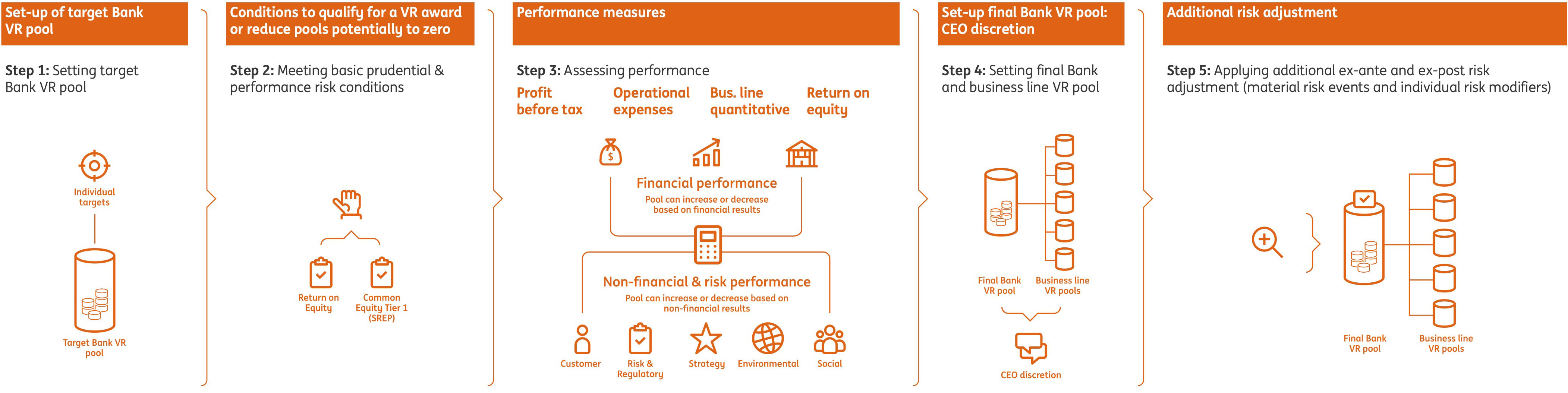
| | | | | | | | | | | | | | | | | | | | | | | | | | |
| Step 1 | | Step 2 | | Step 3 | | Step 4 | | Step 5 |
Target VR pool is a sum of individual VR targets which are set in reference to market pay levels.
| | ROE and CET1 hurdles, as qualifiers, are requirements that both need to be met before for the VR pools can be unlocked. | | The performance scorecards are based on an assessment against financial, non-financial and risk measures. All scorecards are structured and a formulaic approach is used to generate a VR pool at a Group and business line level. | | Group CEO reviews the VR pools and, where appropriate, makes a discretionary recommendation to adjust upwards or downwards the VR pools based on performance parameters. | | Final and independent assessment by the Group CRO recommending additional risk adjustments to VR pools, based on ex-ante risks focusing on material outliers not captured under step 3 and ex-post risk events at a Group, business line, entity or team level.
Furthermore, the Group CRO also recommends risk modifiers to individual variable awards where risk requirements are below expectations applicable on to IDS Risk Takers2 as well as holdback (i.e. forfeiture of up to 100 percent of the unvested variable remuneration awards) and/or clawback sanctions (i.e. repayment of up to 100 percent of the paid or vested variable remuneration) for employee significant incidents.
|
6 ING also operates collective variable remuneration based on collective labour agreements that are driven by regulation, law and/or works council agreements in various countries, and this represents to 20/25 percent of the total spend on variable remuneration.
7 Identified Staff reporting hierarchically to a business line and not working in a control function.
ING Group Annual Report 2024 on Form 20-F 114
The SB used its judgement to establish the right balance between annual variable remuneration outcomes that reflect the performance and risk adjustments of the Group, while supporting ING’s ability to attract, retain, and reward employees who will drive the delivery of the Group’s strategy and long-term sustainable growth for shareholders in the future, in line with our remuneration principles.
On this basis, the SB approved a Group VR pool for 2024 performance of €421.6 million (2023: €401.0 million), up by 6% compared to the target variable remuneration baseline ('starting point') and 5.1% up against the final VR pool for 2023. The risk and conduct adjustments to the 2024 VR pool are slightly less than those for 2023.
Overall, the total actual amount of both discretionary and collective variable remuneration awarded to all eligible employees globally for 2024 was €522.7 million (€101.1 million in collective variable remuneration), compared to the total staff expenses of €7,184 million. For 2023, the total amount was €514.9 million (€113.8 million in collective variable remuneration) on €6,725 million staff expenses. Collective variable remuneration is based on collective labour agreements that are driven by regulation, law and/or workers council agreements in various countries.
In 2024, 22 employees, excluding members of the Management Board Banking, were awarded total annual remuneration (including employer pension contributions and excluding severance payments made) of €1 million or more. For more information on our CRR disclosure (including a breakdown by each group of employees), see the section ‘Annual reports’ on ing.com.
ING Group Annual Report 2024 on Form 20-F 115
C. Board practices
For information regarding board practices, see Item 6.A.
Severance payments to members of the Executive Board
The contracts entered into with the members of the EB provide for severance payments that become due upon termination of the applicable member’s contract, including if termination occurs in connection with a public bid as defined in section 5:70 of the Dutch Financial Supervision Act. Severance payments to the members of the Executive Board are limited to a maximum of one year’s fixed salary.
Transactions between ING Group and significant shareholders
ING Group did not enter into any transactions with shareholders holding at least 10 percent of the share capital.
D. Employees
The average number of internal employees at a full time equivalent basis was 61,121 at the end of 2024, of which 14,821 or 24%, were employed in the Netherlands. Substantially all of the Group’s Dutch employees are subject to a collective labor agreement covering ING in the Netherlands.
The distribution of employees with respect to the Group’s continuing operations for the years 2024, 2023 and 2022 were as follows:
| | | | | | | | | | | | | | | | | | | | | | | | | | | | | |
| Number of employees |
| Netherlands | Rest of the world | Total |
| 2024 | 2023 | 2022 | 2024 | 2023 | 2022 | 2024 | 2023 | 2022 |
Total average number of internal employees at full time equivalent basis | 14,821 | 14,449 | 14,488 | 46,301 | 44,985 | 43,081 | 61,121 | 59,434 | 57,569 |
The Group employs a number of temporary employees. The average number of temporary employees, not included in the table above, at a full time equivalent basis was 3,420 at the end of 2024.
E. Share ownership
For information regarding share ownership, see Item 6.B of this Form 20-F, Note 45 'Related parties' and Note 25 'Staff expenses' in the consolidated financial statements.
F. Disclosure of a registrant’s action to recover erroneously awarded compensation
Not applicable.
Reference is made to Exhibit 97 to this Form 20-F for the policy on 'Clawback rules for erroneously awarded variable remuneration for executive officers'.
ING Group Annual Report 2024 on Form 20-F 116
Item 7. Major Shareholders and Related Party Transactions
A. Major shareholders
ING Group ordinary shares are listed on the stock exchanges of Amsterdam (Euronext Amsterdam) and Brussels (Euronext Brussels). ING Group American Depositary Shares (“ADSs”) are listed on the New York Stock Exchange (NYSE). Options on ING Group ordinary shares or in the form of American depository receipts (ADRs) are traded on the Euronext Amsterdam Derivative Markets and the Chicago Board Options Exchange.
Major shareholders as filed with SEC
According to the U.S. Securities and Exchange Commission, shareholders in a company which have registered a class of their equity securities under the Exchange Act, are required to file beneficial owner reports if the ownership exceeds more than 5% of the outstanding shares of that class. The shareholder is obliged to file Schedule 13D or 13G until their holdings drop below 5%.
To the best of our knowledge, as of 31 December 2024, no holder of ordinary shares or ADSs, other than BlackRock Inc. held 5% or more of ING Group’s issued share capital.
On 1 February 2023, BlackRock, Inc. disclosed by way of a Schedule 13G filed with the SEC, beneficial ownership of 259,211,756 ordinary shares of ING Group as of 31 December 2022, representing 7.0% of ING Group's issued share capital. On 13 February 2023, Capital Research Global Investors disclosed by way of a Schedule 13G filed with the SEC, beneficial ownership of 57,557,399 ordinary shares of ING Group as of 30 December 2022, representing 1.5% of ING Group's issued share capital. On 6 February 2024, BlackRock, Inc. disclosed by way of a Schedule 13G filed with the SEC, beneficial ownership of 255,592,935 ordinary shares of ING Group as of 31 December 2023, representing 7.3% of ING Group's issued share capital.
On 12 November 2024, Capital Research Global Investors disclosed by way of a Schedule 13G filed with the SEC, beneficial ownership of 214,691,773 ordinary shares of ING Group as of September 30, 2024, representing 6.5% of ING Group's issued share capital. On 13 February 2025, Capital Research Global Investors disclosed by way of a Schedule 13G filed with the SEC, beneficial ownership of 152,644,673 ordinary shares of ING Group as of 31 December 2024, representing 4.8% of ING Group's issued share capital.
Major shareholders as filed with AFM
Pursuant to section 5.3 of the Dutch Financial Supervision Act (“Major Holdings Rules”), any person who, directly or indirectly, acquires or disposes of an interest in the voting rights and/or the capital of (in short) a public limited company incorporated under the laws of the Netherlands with an official listing on a stock exchange within the European Economic Area, as a result of which acquisition or disposal the percentage of his voting rights or capital interest - whether through ownership of shares, American depositary receipts (ADRs) or any other financial instrument, whether stock-settled or cash-settled, such as call or put options, warrants, swaps or any other similar contract - reaches, exceeds or falls below the threshold levels of 3%, 5%, 10%, 15%, 20%, 25%, 30%, 40%, 50%, 60%, 75% and 95% is required to provide updated information on its holdings and are recorded in the Dutch AFM (Authority for the Financial Markets) register (http://www.afm.nl/nl-en/professionals/registers/meldingenregisters/substantiele-deelnemingen). This notification obligation also applies in respect of gross short positions that exceed the relevant threshold levels.
In addition, any person who acquires or disposes of a net short position relating to the issued share capital of ING Group, whether by a transaction in shares or ADRs, or by a transaction creating or relating to any financial instrument where the effect or one of the effects of the transaction is to confer a financial advantage on the person entering into that transaction in the event of a change in the price of such shares or ADRs, is required to notify the AFM if, as a result of such acquisition or disposal, the person’s net short position reaches, exceeds or falls below 0.1% of the issued share capital of ING Group and each 0.1% above that. Each reported net short position equal to 0.5% of the issued share capital of ING Group and any subsequent increase of that position by 0.1% will be made public via the short selling register on afm.nl/en/.
Based on the AFM register as per 31 December 2024, shareholders with (potential) holdings of 3% or more are BlackRock Inc. (5.28% interest and 6.33% voting rights reported on 15 March 2024) and Capital Research and Management Company (4.99% voting rights reported on 26 November 2024).
As a result, other than based on information available from public filings available under the applicable laws of any other jurisdiction, ING Groep N.V. is not aware of any changes in the ownership of ordinary shares or ADSs between the thresholds levels mentioned in the previous sentence.
ING Group Annual Report 2024 on Form 20-F 117
On 31 December 2024, ING Groep N.V. and its subsidiaries held 51,116,640 ordinary shares or ADSs, representing 1.62% of ING Group’s issued share capital. ING Groep N.V. does not have voting rights in respect of shares and ADSs it holds or which are held by its subsidiaries.
On 31 December 2024, no person is known to ING Groep N.V. to be the owner of more than 10% of the ordinary shares or ADSs.
As of 31 December 2024, members of the Supervisory Board and their related third parties held 5,295 Ordinary Shares. Members of the Supervisory Board do not hold ING options.
As at 31 December 2024, members of the Executive Board and their related third parties held 152,652 ordinary shares.
As at 31 December 2024, members of the Management Board Banking and their related third parties held 343,055 ordinary shares.
Change of control matters
As at 31 December 2024 ING Groep N.V. was not a party to any material agreement that becomes effective, or is required to be amended or terminated in case of a change of control of ING Groep N.V. following a public bid as defined in the Dutch Financial Supervision Act. ING Groep N.V.’s subsidiaries may have customary change of control arrangements included in agreements related to various business activities, such as joint venture agreements, letters of credit and other credit facilities, ISDA-agreements, hybrid capital and debt instruments, reinsurance contracts and futures and option trading agreements. Following a change of control of ING Groep N.V. (as the result of a public bid or otherwise), such agreements may be amended or terminated, leading, for example, to an obligatory transfer of the interest in the joint venture, early repayment of amounts due, loss of credit facilities or reinsurance cover and liquidation of outstanding futures and option trading positions.
As of 31 December 2024 ING Groep N.V. was not aware of any arrangements the operation of which may result in a change of control of ING Groep N.V.
B. Related Party Transactions
In the normal course of business, ING Group enters into various transactions with related parties. Parties are considered to be related if one party has the ability to control or exercise significant influence over the other party in making financial or operating decisions. Related parties of ING Group include, among others, its associates, joint ventures, key management personnel, and various defined benefit and contribution plans. Transactions between related parties include rendering or receiving of services, leases, transfers under finance arrangements and provisions of guarantees or collateral. There are no significant provisions
for doubtful debts or individually significant bad debt expenses recognised on outstanding balances with related parties.
ING Group has entered into various transactions with related parties. For more information, reference is made to Note 45 “Related parties” in the consolidated financial statements.
As described under “Item 6. Directors, Senior Management and Employees”, some members of the Supervisory Board are current or former senior executives of leading multi-national corporations based primarily in the Netherlands. ING Group may at any time have lending, investment banking or other financial relationships with one or more of these corporations in the ordinary course of business on terms which we believe are no less favorable to ING than those reached with unaffiliated parties of comparable creditworthiness.
C. Interests of experts and counsel
This item does not apply to annual reports on Form 20-F.
ING Group Annual Report 2024 on Form 20-F 118
Item 8. Financial information
A. Consolidated statements and other financial information
Consolidated statements
For information regarding consolidated statements and other financial information, see Item 18 of this Form 20-F.
Legal Proceedings
For a description of ING’s legal proceedings, see Note 41 'Legal proceedings' in the consolidated financial statements.
Dividend and distribution policy
ING’s distribution policy is a pay-out ratio of 50% of resilient net profit and additional distributions in case of structural excess capital. Prerequisite for a distribution is a CET1 ratio of at least prevailing Maximum Distributable Amount (MDA) level after distribution. For detailed information on ING’s 2024 dividend, reference is made to ‘Capital Management’ in Additional Information.
Cash distributions on ING Groups ordinary shares are generally paid in Euros. However, the Executive Board may decide, with the approval of the Supervisory Board, to declare dividends in the currency of a country other than the Netherlands in which the shares are traded. Amounts payable to holders of ADSs that are paid to the Depositary in a currency other than dollars will be converted to dollars and subjected to a charge by the Depositary for any expenses incurred by it in such conversion.
If the Executive Board has been designated as a body authorised to resolve to issue shares, it may decide, with the approval of the Supervisory Board, that a distribution on ordinary shares shall be made in the form of ordinary shares instead of cash or to decide that the holders of ordinary shares shall be given the choice of receiving the distribution in cash or in the form of ordinary shares.
The right to dividends and distributions in respect of the ordinary shares will lapse if such dividends or distributions are not claimed within five years following the day after the date on which they were made available.
There are no legislative or other legal provisions currently in force in the Netherlands or arising under ING Groups’ Articles of Association restricting the remittance of dividends to holders of ordinary shares, or
ADSs not resident in the Netherlands. Insofar as the laws of the Netherlands are concerned, cash dividends paid in Euro may be transferred from the Netherlands and converted into any other currency, except that for statistical purposes such payments and transactions must be reported by ING Group to DNB and, further, no payments, including dividend payments, may be made to jurisdictions or persons, that are subject to certain sanctions, adopted by the Government of the Netherlands, implementing resolutions of the Security Council of the United Nations, or adopted by the European Union.
Dividends are subject to withholding taxes in the Netherlands as described under "Item 10. Additional Information - Taxation - Netherlands Taxation”.
ING’s distribution policy may be changed at any time and there is no guarantee that any dividends or other distributions will be made in accordance with the distribution policy in effect from time to time or at all.
B. Significant changes
For information on subsequent events reference is made to Note 48 ‘Subsequent events’ of the consolidated financial statements.
Since 31 December 2024, until the filing of this report, no other significant changes have occurred in the financial statements of the Group included in “Item 18. Consolidated Financial Statements” of this document.
ING Group Annual Report 2024 on Form 20-F 119
Item 9. The Offer and Listing
A. Offer and listing details
Ordinary Shares (nominal value EUR 0.01 per share) are traded on Euronext Amsterdam, the principal trading market for the Ordinary Shares, under the symbol “INGA”. The Ordinary Shares are also listed on the stock exchange of Euronext Brussels, under the symbol “INGA”. ADSs, representing an equal number of Ordinary Shares, are traded on the New York Stock Exchange under the symbol “ING”.
B. Plan of distribution
This item does not apply to annual reports on Form 20-F.
C. Markets
For information regarding markets, see Item 9.A of this Form 20-F.
D. Selling shareholders
This item does not apply to annual reports on Form 20-F.
E. Dilution
This item does not apply to annual reports on Form 20-F.
F. Expenses of the issue
This item does not apply to annual reports on Form 20-F.
ING Group Annual Report 2024 on Form 20-F 120
Item 10. Additional information
A. Share capital
This item does not apply to annual reports on Form 20-F.
B. Memorandum and articles of association
For a description of ING’s memorandum and articles of association, please see Exhibit 2.1 “Description of Securities Registered under Section 12 of the Exchange Act”, which is incorporated by reference herein.
Reference is made to Exhibit 1.1 to this Form 20-F for the articles of association.
C. Material contracts
There have been no material contracts outside the ordinary course of business to which ING Groep N.V. or any of its subsidiaries is a party in the last two years.
D. Exchange controls
Cash distributions, if any, payable in Euros on Ordinary Shares and ADSs may be officially transferred from the Netherlands and converted into any other currency without violating Dutch law, except that for statistical purposes such payments and transactions must be reported by ING Groep N.V. to the Dutch Central Bank and, further, no payments, including dividend payments, may be made to jurisdictions or persons subject to certain sanctions, adopted by the government of the Netherlands or the European Union.
E. Taxation
The following is a summary of certain Netherlands tax consequences, and the United States federal income tax consequences, of the ownership of our Ordinary Shares or American Depositary Shares (“ADSs”) by U.S. Shareholders (as defined below) who hold Ordinary Shares or ADSs as capital assets for tax purposes.
For the purposes of this summary, a “U.S. Shareholder” is a beneficial owner of Ordinary Shares or ADSs that is, for United States federal income tax purposes:
•an individual citizen or resident of the United States,
•a corporation organized under the laws of the United States or of any state of the United States, or any entity taxable as United States corporation,
•an estate, the income of which is subject to United States federal income tax without regard to its source, or
•a trust if a court within the United States is able to exercise primary supervision over the administration of the trust and one or more United States persons have the authority to control all substantial decisions of the trust.
Further, this summary is limited to U.S. Shareholders who are not, and are not deemed to be, a resident of the Netherlands for Dutch tax purposes.
This summary is based on the United States Internal Revenue Code of 1986 and the laws of the Netherlands, each as amended, their legislative history, existing and proposed regulations, published rulings and court decisions, and the tax treaty between the United States and the Netherlands for the Avoidance of Double Taxation and the Prevention of Fiscal Evasion with respect to Taxes on Income (“Treaty”), all as applicable as of the date hereof. These laws are subject to change, possibly on a retroactive basis. The information provided below is neither intended as tax advice nor purports to describe all of the tax considerations that may be relevant to investors and prospective investors including foreign, state or local tax consequences, estate and gift tax consequences, and tax consequences arising under the Medicare contribution tax on net investment income or the alternative minimum tax. It should not be read as extending to matters not specifically discussed, and investors should consult their own advisors as to the tax consequences of their ownership and disposal of Ordinary Shares or ADSs. In particular, the summary does not take into account the specific circumstances of particular investors (such as tax-exempt organizations, banks, insurance companies, dealers in securities, traders in securities that elect to use a mark-to-market method of accounting for their securities holdings, investors whose functional currency is not the U.S. dollar, investors that actually or constructively own 10% or more of the combined voting power of the voting stock or of the total value of ING Groep N.V., investors that hold Ordinary Shares or ADSs as part of a straddle or a hedging or conversion transaction or investors that acquired or dispose of Ordinary Shares or ADSs as part of a wash sale for tax purposes, some of which may be subject to special rules). If an entity or arrangement that is treated as a partnership for United States federal income tax purposes holds the Ordinary Shares or ADSs, the United States federal income tax treatment of a partner will generally depend on the status of the partner and the tax treatment of the partnership. A partner in a partnership holding the Ordinary Shares or ADSs should consult its tax advisor with regard to the United States federal income tax treatment of an investment in the Ordinary Shares or ADSs.
Moreover, this summary does not discuss the Dutch tax treatment of a holder of Ordinary Shares or ADSs that is an individual who receives income or capital gains derived from the Ordinary Shares and ADSs if such income received or capital gains derived is attributable to the past, present or future employment activities of such holder.
ING Group Annual Report 2024 on Form 20-F 121
The summary is based in part upon the representations of the Depositary and the assumption that each obligation in the Deposit Agreement and any related agreement will be performed in accordance with its terms. In general, for United States federal income tax and Netherlands tax purposes, holders of ADSs will be treated as the owners of the Ordinary Shares underlying the ADSs, and exchanges of Ordinary Shares for ADSs, and exchanges of ADSs for Ordinary Shares, will not be subject to United States federal income tax or Netherlands income tax. References to Ordinary Shares in this section include references to ADSs.
It is assumed, for purposes of this summary, that a U.S. Shareholder is eligible for the benefits of the Treaty and that a U.S. Shareholder’s eligibility is not limited by the limitation on benefits provisions of the Treaty.
Netherlands Taxation
Dutch dividend withholding tax
The Netherlands imposes a withholding tax on a distribution of a dividend at the statutory rate of 15%. Dividends include:
1.dividends paid in cash and in kind;
2.deemed and constructive dividends;
3.the consideration for the repurchase or redemption of shares in excess of the qualifying average paid-in capital unless such repurchase is made for temporary investment purposes or is exempt by law;
4.any (partial) repayment of paid-in capital not qualifying as capital for Dutch dividend withholding tax purposes;
5.liquidation proceeds in excess of the qualifying average paid-in capital for Dutch dividend withholding tax purposes; and
6.stock dividends up to their nominal value (unless distributed out of ING Groep N.V.’s qualifying paid-in capital).
Reduction of Dutch dividend withholding tax based on Dutch law
Under certain circumstances, a reduction of Dutch dividend withholding tax can be obtained based on Dutch law:
1.An exemption at source is available if the Dutch participation exemption applies and the Ordinary Shares or ADSs are attributable to a business carried out in the Netherlands. To qualify for the Dutch participation exemption, the U.S. Shareholder must generally hold at least 5.0 percent of our nominal paid-in capital and meet certain other requirements.
2.An exemption at source is available for dividend distributions to certain qualifying corporate U.S. Shareholders owning our Ordinary Shares or ADSs if such shareholder would have been able to apply the Dutch participation exemption if it would have been resident of the Netherlands, unless such shareholder holds the Ordinary Shares or ADSs with the primary aim or one of the primary aims to avoid the levy of Dutch dividend withholding tax at the level of another person and the Ordinary Shares or ADSs are not held for valid commercial reasons that reflect economic reality.
3.Certain tax exempt organizations (e.g. pension funds and excluding collective investment vehicles) may be eligible for a refund of Dutch dividend withholding tax upon their request or in certain cases, an exemption at source.
4.Upon request and under certain conditions, certain qualifying individual and corporate U.S Shareholders of Ordinary Shares or ADSs which are not subject to personal or corporate income tax in the Netherlands may request a refund of Dutch dividend withholding tax insofar as the withholding tax withheld on the gross dividend is higher than the personal or corporate income tax which would have been due on the net dividend if they were resident or established in the Netherlands. This refund is however not applicable when, based on the Treaty, the Dutch dividend withholding tax can be fully credited in the United States by the U.S. Shareholder. However, it is unclear whether (i) which (financing) costs can be taken into account when determining the hypothetical personal or corporate income tax due on the net income (ii) or how the Netherlands would determine whether, based on the double taxation convention, a full credit is available in the country of residence of the holder for purposes of this refund. See “United States Taxation—Taxes on dividends” for more information. The provision in essence is intended to be a codification of certain judgments by both the European Free Trade Association Court of Justice and the European Court of Justice that already indicated that in certain circumstances a refund should be available prior to the introduction of the provision in Dutch law. It is possible that this provision is an insufficient codification of these judgments and that based on EU law a larger refund should be provided.
Reduction of Dutch dividend withholding tax based on the Treaty
Pursuant to the provisions of the Treaty, certain corporate U.S. Shareholders owning directly at least 10% of our voting power are eligible for a reduction to 5% Dutch dividend withholding tax provided that the U.S. Shareholder is the beneficial owner of the dividends received and does not have an enterprise or an interest in an enterprise that is, in whole or in part, carried on through a permanent establishment or permanent representative in the Netherlands to which the dividends are attributable. The Treaty also provides for a dividend withholding tax exemption on dividends, but only for a shareholder owning directly at least 80.0 percent of our voting power and meeting all other requirements.
Provided that certain conditions are met, under the Treaty dividends paid to qualifying exempt pension trusts and other qualifying exempt organizations, as defined in the Treaty, are exempt from Dutch dividend withholding tax. To obtain a refund of the tax withheld such qualifying exempt pension trusts are required to file a request. Only if certain conditions are fulfilled, such qualifying exempt pension trusts may be eligible for relief at source upon payment of the dividend. Qualifying exempt organizations (other than qualifying exempt pension trusts) can only file for a refund of the tax withheld.
Anti-dividend stripping rules
Pursuant to the Dutch anti-dividend stripping rules, in the case of dividend-stripping, the 15% dividend withholding tax cannot be reduced or refunded. Dividend-stripping is deemed to be present if the recipient of a dividend is, contrary to what has been assumed above, not the beneficial owner thereof and is entitled to a
ING Group Annual Report 2024 on Form 20-F 122
larger credit, reduction or refund of dividend withholding tax than the beneficial owner of the dividends. Under these rules, a recipient of dividends will not be considered the beneficial owner thereof if as a consequence of a combination of transactions a person other than the recipient wholly or partly benefits from the dividends, whereby such person retains, whether directly or indirectly, an interest similar to the shares on which the dividends were paid.
Credit for ING Groep N.V.
ING Groep N.V. may, with respect to certain dividends received from qualifying non-Netherlands subsidiaries, credit taxes withheld from those dividends against the Netherlands withholding tax imposed on certain qualifying dividends that are redistributed by ING Groep N.V., up to a maximum of the lesser of:
3% of the amount of qualifying dividends redistributed by ING Groep N.V.; and
3% of the gross amount of certain qualifying dividends received by ING Groep N.V.
The reduction is applied to the Dutch dividend withholding tax that ING Groep N.V. must pay to the Dutch tax authorities and not to the Dutch dividend withholding tax that ING Groep N.V. must withhold.
Dutch conditional withholding tax
From 1 January 2024 onwards, in addition to Dutch dividend withholding tax, Dutch conditional withholding tax may apply at a statutory rate of 25.8% on dividends and other (deemed) distributions to certain affiliated (gelieerde) entities of ING Groep N.V. for the purpose of the Dutch Withholding Tax Act 2021 (Wet bronbelasting 2021).
The Dutch conditional withholding tax only applies on dividends and other (deemed) distributions to entities that are resident (gevestigd), or have a permanent establishment to which the dividend or distribution is attributable, in a jurisdiction that is listed in the yearly updated Dutch Regulation on low-taxing states and non-cooperative jurisdictions for tax purposes (Regeling laagbelastende staten en niet-coöperatieve rechtsgebieden voor belastingdoeleinden), and in certain deemed abusive situations.
An entity is generally affiliated within the meaning of the Dutch Withholding Tax Act 2021 if there is a controlling relationship between such entity and ING Groep N.V.
Taxes on income and capital gains
Income and capital gains
Income and capital gains derived from the Ordinary Shares or ADSs by an individual or corporate U.S. Shareholder are generally not subject to Netherlands income tax or corporation tax, unless:
1.such income and gains are attributable to a (deemed) permanent establishment or (deemed) permanent representative in the Netherlands of the U.S. Shareholder; or
2.the shareholder is entitled to a share in the profits of an enterprise or (in case of a non-Dutch resident corporate shareholder only) a co-entitlement to the net worth of an enterprise, that is effectively managed in the Netherlands (other than by way of securities) and to which enterprise the Ordinary Shares or ADSs are attributable; or
3.such income and capital gains are derived from a direct, indirect or deemed substantial interest in the share capital of ING Groep N.V. (such substantial interest not being a business asset), and in the case of a non-Dutch resident corporate shareholder only, that substantial interest is being held with the primary aim or one of the primary aims to avoid the levy of income tax from another person and is put in place without valid economic reasons that reflect economic reality;
4.in case of a non-Dutch resident corporate shareholder, such shareholder is a resident of Aruba, Curaçao or Saint Martin with a permanent establishment or permanent representative in Bonaire, Eustatius or Saba to which the Ordinary Shares or ADS are attributable, while the profits of such shareholder are taxable in the Netherlands pursuant to Article 17(3)(c) of the Dutch Corporate Tax Act 1969; or
5.in case of a non-Dutch resident individual, such individual derives income or capital gains from the Ordinary Shares or ADSs that are taxable as benefits from ‘miscellaneous activities’ in the Netherlands (‘resultaat uit overige werkzaamheden’, as defined in the Dutch Income Tax Act 2001), which includes the performance of activities with respect to the Ordinary Shares or ADSs that exceed regular portfolio management.
Substantial interest
Generally speaking, for Dutch tax purposes, an interest in the share capital of ING Groep N.V., should not be considered a substantial interest if the holder of such interest, and, in case of an individual, his or her spouse, registered partner, certain other relatives or certain persons sharing the holder’s household, alone or together, does or do not hold, either directly or indirectly, the ownership of, or certain rights over, shares or rights resembling shares representing 5% or more of the total issued and outstanding capital, or the issued and outstanding capital of any class of shares, of ING Groep N.V.
Gift or inheritance tax
No Netherlands gift or inheritance tax will be imposed on the transfer or deemed transfer of the Ordinary Shares or ADSs by way of a gift by or on the death of a U.S. Shareholder if, at the time of the gift or the death of that shareholder, such shareholder is not a (deemed) resident of the Netherlands.
Netherlands inheritance or gift taxes (as the case may be) are due, however, if the transfer of the Ordinary Shares or ADSs is construed as an inheritance or as a gift made by or on behalf of a person who, at the time of the gift or death, is deemed to be a resident of the Netherlands. For the purposes of Netherlands gift or inheritance tax, an individual of Dutch nationality is deemed to be a resident of the Netherlands if he or she has been a resident thereof at any time during the ten years preceding the time of the gift or death. For the purposes of Netherlands gift tax, any person is deemed to be a resident of the Netherlands if he or she has resided therein at any time in the twelve months preceding the gift.
ING Group Annual Report 2024 on Form 20-F 123
United States Taxation
Taxes on dividends
The tax treatment of owning Ordinary Shares or ADSs will depend in part on whether or not ING Groep N.V. is classified as a passive foreign investment company, or PFIC, for United States federal income tax purposes. Except as discussed below under “-PFIC Rules”, this discussion assumes that ING Groep N.V. is not classified as a PFIC for United States federal income tax purposes.
Under the United States federal income tax laws, a U.S. Shareholder will be required to include in gross income the gross amount of a cash dividend (including any Netherlands withholding tax withheld) as ordinary income when the dividend is actually or constructively received by the U.S. Shareholder in the case of Ordinary shares, or by the Depositary, in the case of ADSs. For this purpose, a “dividend” will include any distribution paid by ING Groep N.V. with respect to the Ordinary Shares or ADSs, but only to the extent such distribution is not in excess of ING Groep N.V.’s current and accumulated earnings and profits as determined for United States federal income tax purposes. Distributions in excess of current and accumulated earnings and profits, as determined for United States federal income tax purposes, will be treated as a non-taxable return of capital to the extent of a U.S. Shareholder’s basis in the Ordinary Shares or ADSs and thereafter as capital gain. Because ING Groep N.V. does not keep account of its earnings and profits, as determined for United States federal income tax purposes, U.S. Shareholders should generally expect to treat any distribution as a dividend for U.S. federal income tax purposes.
For foreign tax credit limitation purposes, dividends will generally be income from sources outside the United States and will, depending on the circumstances of the U.S. Shareholder, generally be “passive” income for purposes of computing the foreign tax credit allowable to the shareholder. However, if (a) we are 50% or more owned, by vote or value, by United States persons and (b) at least 10% of our earnings and profits are attributable to sources within the United States, then for foreign tax credit purposes, a portion of our dividends would be treated as derived from sources within the United States. With respect to any dividend paid for any taxable year, the United States source ratio of our dividends for foreign tax credit purposes would be equal to the portion of our earnings and profits from sources within the United States for such taxable year, divided by the total amount of our earnings and profits for such taxable year.
A dividend will not be eligible for the dividends-received deduction generally allowed to U.S. corporations in respect of dividends received from other U.S. corporations. Dividends paid to a non-corporate U.S. Shareholder that are considered qualified dividend income will be taxable to the shareholder at preferential rates applicable to long-term capital gains provided that the shareholder holds the Ordinary Shares or ADSs for more than 60 days during the 121-day period beginning 60 days before the ex-dividend date and meets other holding period requirements. Dividends paid by ING Groep N.V. with respect to the Ordinary Shares or ADSs generally will be qualified dividend income, provided that, in the year that you receive the dividend, we are eligible for the benefits of the Treaty. We believe that we are currently eligible for the benefits of the
Treaty and we therefore expect that dividends on the Ordinary Shares or ADSs will be qualified dividend income, but there can be no assurance that we will continue to be eligible for the benefits of the Treaty.
Subject to certain limitations, a U.S. Shareholder may generally deduct from income, or credit against its United States federal income tax liability, the amount of any Netherlands withholding taxes withheld under the Treaty and paid over to the Netherlands Tax Administration. However, the Netherlands withholding tax may not be creditable unless a U.S. Shareholder is eligible for and elects to apply the benefits of the Treaty. Even in such case, the Netherlands withholding tax will likely not be creditable against the U.S. Shareholder’s United States tax liability to the extent that ING Groep N.V. is allowed to reduce the amount of dividend withholding tax paid over to the Netherlands Tax Administration by crediting withholding tax imposed on certain dividends paid to ING Groep N.V. In addition, special rules apply in determining the foreign tax credit limitation with respect to dividends that are subject to preferential rates. To the extent a reduction or refund of the tax withheld is available to a U.S. Shareholder under Dutch law or under the Treaty, the amount of tax withheld that could have been reduced or is refundable will not be eligible for credit against the U.S. Shareholder's United States federal income tax liability. In addition, to the extent an amount of Dutch tax withheld is contingent on the availability of a credit against the amount of income tax owed to another country, that amount of Dutch tax withheld will not be eligible for a credit against the U.S. Shareholder's United States federal income tax liability. It is unclear whether or how the Netherlands would apply this rule in determining whether, based on the Treaty, a credit is available in the United States for purposes of the dividend withholding tax refund provision described in Section IV under “Netherlands Taxation—Withholding tax on dividends—Reduction of Dutch dividend withholding tax based on Dutch law”.
Since payments of dividends with respect to Ordinary Shares or ADSs will be made in Euros, a U.S. Shareholder will generally be required to determine the amount of dividend income by translating the Euro into U.S. dollars at the “spot rate” on the date the dividend is distributed, regardless of whether the payment is in fact converted into U.S. dollars. Generally, any gain or loss resulting from currency exchange fluctuations during the period from the date the dividend is distributed to the date such payment is converted into U.S. dollars will be treated as ordinary income or loss and will not be eligible for the special tax rate applicable to qualified dividend income. Such gain or loss will generally be income or loss from sources within the United States for foreign tax credit limitation purposes.
Taxes on capital gains
Gain or loss on a sale or exchange of Ordinary Shares or ADSs by a U.S. Shareholder will generally be a capital gain or loss for United States federal income tax purposes equal to the difference between the U.S. dollar value of the amount that such U.S. Shareholder realizes and such U.S. Shareholder's tax basis, determined in U.S. dollars, in the Ordinary Shares or ADSs. If such U.S. Shareholder has held the Ordinary Shares or ADSs for more than one year, such gain or loss will generally be long-term capital gain or loss. Long-term capital gain of a non-corporate U.S. Shareholder is generally taxed at preferential rates. In general, gain or loss from a sale or exchange of Ordinary Shares or ADSs by a U.S. Shareholder will be treated as income or loss from sources within the United States for foreign tax credit limitation purposes.
ING Group Annual Report 2024 on Form 20-F 124
PFIC rules
ING Groep N.V. believes it is not a PFIC for United States federal income tax purposes, and it does not expect to become a PFIC in the foreseeable future. However, this conclusion is a factual determination that must be made annually and thus may be subject to change. It is therefore possible that we could become a PFIC in a future taxable year.
If ING Groep N.V. were to be treated as a PFIC, unless a U.S. Shareholder made an effective election to be taxed annually on a mark-to-market basis with respect to the Ordinary Shares or ADSs, any gain from the sale or disposition of Ordinary Shares or ADSs by a U.S. Shareholder would be allocated ratably to each year in the holder’s holding period and would be treated as ordinary income. Tax would be imposed on the amount allocated to each year prior to the year of disposition at the highest rate in effect for that year, and interest would be charged at the rate applicable to underpayments on the tax payable in respect of the amount so allocated. The same rules would apply to “excess distributions”, defined generally as any distributions in a single taxable year, other than the taxable year in which the U.S. Shareholder's holding period in the shares or ADSs begins, exceeding 125% of the average annual distribution made by ING Groep N.V. in respect of the Ordinary Shares or ADSs over the shorter of the three preceding taxable years or the portion of the holder’s holding period that preceded the taxable year in which the holder receives the distribution. Dividends received by a U.S. Shareholder will not be eligible for the special tax rates applicable to qualified dividend income if ING Groep N.V. were a PFIC (or were to be treated as a PFIC with respect to the shareholder) either in the taxable year of the distribution or the preceding taxable year, but instead will be taxable at rates applicable to ordinary income. A U.S. Shareholder who owns Ordinary Shares or ADSs during any year that ING Groep N.V. is a PFIC may be required to file Internal Revenue Service Form 8621.
F. Dividends and paying agents
This item does not apply to annual reports on Form 20-F.
G. Statement by experts
This item does not apply to annual reports on Form 20-F.
H. Documents on display
ING Groep N.V. is subject to the informational requirements of the Securities Exchange Act of 1934, as amended. In accordance with these requirements, ING Groep N.V. files reports and other information with the Securities and Exchange Commission (”SEC”). These materials, including this Annual Report and its exhibits, may be inspected and copied on the SEC’s website at www.sec.gov. You may also inspect ING Groep N.V.’s SEC reports and other information on the website of ING Groep N.V. (www.ing.com).
I. Subsidiary information
This item does not apply to annual reports on Form 20-F.
J. Annual Report to Security Holders
Not applicable.
ING Group Annual Report 2024 on Form 20-F 125
Item 11. Quantitative and Qualitative Disclosure of Market Risk
See “Item 5. Operating and Financial Review and Prospects – Factors Affecting Results of Operations” and “Additional information - ING Group Risk Management” for these disclosures, including disclosures relating to operational, compliance and other non-market-related risks.
ING Group Annual Report 2024 on Form 20-F 126
Item 12. Description of Securities other than Equity Securities
A. Debt securities
This item does not apply to annual reports on Form 20-F.
B. Warrants and rights
This item does not apply to annual reports on Form 20-F.
C. Other securities
This item does not apply to annual reports on Form 20-F.
D. American depositary shares
Fees and Charges Payable by a Holder of ADSs
JPMorgan Chase Bank, N.A., as ADR depositary, may collect fees for, among other things, the delivery and surrender of ADSs directly from investors, or from intermediaries acting for them, depositing Ordinary Shares or surrendering ADSs for the purpose of withdrawal.
The charges of the ADR depositary payable which may be payable by investors are as follows:
| | | | | | | | | | | | | | |
| Type of Service | | ADR Depositary Actions | | Fee Payable |
| Depositing or substituting the underlying Ordinary Shares | | Issuance of ADSs against the deposit of Ordinary Shares, including deposits and issuances in respect of: •share distributions, rights and other distributions.
•a stock dividend or stock split.
•a merger, exchange of securities or other transactions or events affecting the ADSs or the underlying Ordinary Shares. | | $5.00 for each 100 ADSs (or portion thereof) issued, delivered or upon which a share distributive or elective distribution is made or offered. The ADR depositary may sell sufficient securities or property received in respect of share distributions, rights and other distributions prior to such deposit to pay such charge. |
Receiving or distributing cash dividends | | Distribution of cash dividends or other cash distributions, or offering of elective cash/stock dividends. | | $0.05 or less per ADS held. |
|
|
| Selling or exercising rights | | •additional ADRs resulting from a dividend or free distribution consisting of Ordinary Shares, or U.S dollars resulting from sales of Ordinary Shares received in a distribution.
•Instruments representing rights to acquire additional ADRs as a result of distribution on Ordinary Shares, or U.S dollars resulting from sales of such rights.
•other securities available to the ADR depositary resulting from any distribution on the deposited Ordinary Shares, or U.S dollars resulting from sales of such other securities. | | An amount equal to the fee for the execution and delivery of ADSs which would have been charged as a result of the deposit of such securities. |
| | | | |
| Withdrawing an underlying Ordinary Share | | Acceptance of ADSs surrendered for withdrawal of deposited Ordinary Shares | | $5.00 for each 100 ADSs (or portion thereof) reduced, cancelled or surrendered. |
ING Group Annual Report 2024 on Form 20-F 127
| | | | | | | | | | | | | | |
| Type of Service | | ADR Depositary Actions | | Fee Payable |
| Transferring, splitting or grouping of ADRs | | Registration, registration of transfer, combination and split-up of ADRs in the ADR register as evidenced by the ADRs surrendered or upon delivery of proper instruments of transfer | | $1.50 per ADR. |
| General depositary services, particularly those charged on an annual basis | | Other services performed by the ADR depositary in administering the ADR program | | $0.05 per ADS per calendar year (or portion thereof), which may be charged on a periodic basis during each calendar year against holders of the record date(s) set by the ADR depositary and shall be payable at the sole discretion of the ADR depositary by billing such holders or deducting such charge from one or more cash distributions. |
| | | | |
| Reimbursement of fees, charges and expenses of the ADR depositary | | The ADR depositary and/or any of its agents may incur fees, charges and expenses (including expenses incurred on behalf of holders of ADRs in connection with compliance with foreign exchange control regulations or any law or regulation relating to foreign investment) in connection with the servicing of the underlying Ordinary Shares or other deposited securities, the sale of securities (including, without limitation, deposited securities), the delivery of deposited securities or otherwise in connection with the ADR depositary’s compliance with applicable law, rule or regulation. | | Fees and charges shall be assessed on a proportionate basis against holders of ADRs as of the record date or dates set by the ADR depositary and shall be payable at the sole discretion of the ADR depositary by billing such holders of ADRs or by deducting such charge from one or more cash dividends or other cash distributions. |
| | | | |
| | | | | | | | | | | | | | |
| Type of Service | | ADR Depositary Actions | | Fee Payable |
| Other charges and expenses of the ADR depositary | | The ADR depositary may incur charges and expenses on behalf of holders in connection with: •stock transfer or other taxes and other governmental charges.
•SWIFT, cable, telex and facsimile transmission and delivery charges incurred at the request of persons •depositing, or holders of ADRs delivering underlying Ordinary Shares, ADRs or deposited securities.
•transfer or registration fees for the registration or transfer of deposited securities. | | Payable by holders or persons depositing Ordinary Shares.
Payable by persons depositing, or holders of ADRs delivering underlying Ordinary Shares, Ads or deposited securities.
Payable by persons depositing or withdrawing deposited securities. |
| | | | |
Fees and Payments made by the ADR depositary to ING
In consideration for acting as depositary, the ADR depositary has agreed to provide ING with certain amounts on an annual basis. In the year ended 31 December 2024, the ADR depositary paid aggregate fees and made other direct and indirect payments to ING in an amount of USD 6,154,943.
Under certain circumstances, including removal of the ADR depositary or termination of the ADR program by ING, ING is required to repay the ADR depositary certain amounts reimbursed and/or expenses paid to or on behalf of ING.
ING Group Annual Report 2024 on Form 20-F 128
PART II.
Item 13. Defaults, Dividend Arrearages and Delinquencies
None.
Item 14. Material Modifications to the Rights of Security Holders and Use of Proceeds
None.
Item 15. Controls and Procedures
Internal control over financial reporting
Due to the listing of ING shares on the New York Stock Exchange, ING Group is required to comply with the SEC regulations adopted pursuant to Section 404 of the Sarbanes-Oxley Act (SOX 404). These regulations require that the Chief Executive Officer (“CEO”) and the Chief Financial Officer (“CFO”) of ING Group report and certify on an annual basis on the effectiveness of ING Group’s internal control over financial reporting. Moreover, the external auditors are required to provide an opinion on the effectiveness of ING Group’s internal control over financial reporting.
SOX 404 activities are organised along the lines of the governance structure and involve the participation of senior management across ING. Following the SOX 404 process, ING is in the position to publish an unqualified statement that the Company’s internal control over financial reporting was effective as of 31 December 2024. The SOX 404 statement by the Executive Board is included on this page, followed by the report of the external auditor as issued on Form 20-F.
Disclosure Controls and Procedures
The Company’s management, under the supervision and with the participation of the CEO and CFO, has performed an evaluation of the effectiveness of the design and operation of the Company’s disclosure controls and procedures. Based on that evaluation, the CEO and CFO concluded that the Company’s disclosure controls and procedures were effective as of December 31, 2024, the end of the period covered by the 2024 Form 20-F.
Report of the Executive Board on Internal Control Over Financial Reporting
The Executive Board is responsible for establishing and maintaining adequate internal control over financial reporting. ING’s internal control over financial reporting is a process designed under the supervision of our principal executive and principal financial officers to provide reasonable assurance regarding the reliability of financial reporting and the preparation of financial statements for external purposes in accordance with generally accepted accounting principles.
Our internal control over financial reporting includes those policies and procedures that:
•Pertain to the maintenance of records that, in reasonable detail, accurately and fairly reflect the transactions and dispositions of assets of ING;
•Provide reasonable assurance that transactions are recorded as necessary to permit preparation of financial statements in accordance with generally accepted accounting principles, and that our receipts and expenditures are being made only in accordance with authorisations of our management and directors; and
•Provide reasonable assurance regarding prevention or timely detection of unauthorised acquisition, use or disposition of our assets that could have a material effect on our financial statements.
Because of its inherent limitations, internal control over financial reporting may not prevent or detect misstatements. Also, projections of any evaluation of effectiveness to future periods are subject to the risk that controls may become inadequate because of changes in conditions, or that the degree of compliance with the policies or procedures may deteriorate.
The Executive Board assessed the effectiveness of internal control over financial reporting as of 31 December 2024. In making this assessment, the Executive Board performed tests based on the criteria of the Committee of Sponsoring Organizations of the Treadway Commission (“COSO”) in Internal Control – Integrated Framework (2013 Framework). Based on the Executive Board’s assessment and those criteria, the
ING Group Annual Report 2024 on Form 20-F 129
Executive Board concluded that the Company’s internal control over financial reporting was effective as of 31 December 2024.
Attestation Report of the Registered Public Accounting Firm
Our independent registered public accounting firm has audited and issued their report on ING’s internal control over financial reporting, which appears on the page below.
Changes in Internal Controls over Financial Reporting
There have been no changes in the Company’s internal controls over financial reporting during the period covered by this Annual Report that have materially affected or are reasonably likely to materially affect, our internal control over financial reporting.
Report of Independent Registered Public Accounting Firm
To the Shareholders and the Supervisory Board ING Groep N.V.
Opinion on Internal Control Over Financial Reporting
We have audited ING Groep N.V. and subsidiaries’ (the Company) internal control over financial reporting as of December 31, 2024, based on criteria established in Internal Control – Integrated Framework (2013) issued by the Committee of Sponsoring Organizations of the Treadway Commission. In our opinion, the Company maintained, in all material respects, effective internal control over financial reporting as of December 31, 2024, based on criteria established in Internal Control – Integrated Framework (2013) issued by the Committee of Sponsoring Organizations of the Treadway Commission.
We also have audited, in accordance with the standards of the Public Company Accounting Oversight Board (United States) (PCAOB), the consolidated statements of financial position of the Company as of December 31, 2024 and 2023, the related consolidated statements of profit or loss, comprehensive income, changes in equity, and cash flows for each of the years in the three-year period ended December 31, 2024, and the related notes and specific disclosures described in Note 1 as being part of the consolidated financial statements (collectively, the consolidated financial statements), and our report dated March 3, 2025 expressed an unqualified opinion on those consolidated financial statements.
Basis for Opinion
The Company’s management is responsible for maintaining effective internal control over financial reporting and for its assessment of the effectiveness of internal control over financial reporting, included in the accompanying Report of the Executive Board on Internal Control Over Financial Reporting. Our responsibility is to express an opinion on the Company’s internal control over financial reporting based on our audit. We are a public accounting firm registered with the PCAOB and are required to be independent with respect to
the Company in accordance with the U.S. federal securities laws and the applicable rules and regulations of the Securities and Exchange Commission and the PCAOB.
We conducted our audit in accordance with the standards of the PCAOB. Those standards require that we plan and perform the audit to obtain reasonable assurance about whether effective internal control over financial reporting was maintained in all material respects. Our audit of internal control over financial reporting included obtaining an understanding of internal control over financial reporting, assessing the risk that a material weakness exists, and testing and evaluating the design and operating effectiveness of internal control based on the assessed risk. Our audit also included performing such other procedures as we considered necessary in the circumstances. We believe that our audit provides a reasonable basis for our opinion.
Definition and Limitations of Internal Control Over Financial Reporting
A company’s internal control over financial reporting is a process designed to provide reasonable assurance regarding the reliability of financial reporting and the preparation of financial statements for external purposes in accordance with generally accepted accounting principles. A company’s internal control over financial reporting includes those policies and procedures that (1) pertain to the maintenance of records that, in reasonable detail, accurately and fairly reflect the transactions and dispositions of the assets of the company; (2) provide reasonable assurance that transactions are recorded as necessary to permit preparation of financial statements in accordance with generally accepted accounting principles, and that receipts and expenditures of the company are being made only in accordance with authorizations of management and directors of the company; and (3) provide reasonable assurance regarding prevention or timely detection of unauthorized acquisition, use, or disposition of the company’s assets that could have a material effect on the financial statements.
Because of its inherent limitations, internal control over financial reporting may not prevent or detect misstatements. Also, projections of any evaluation of effectiveness to future periods are subject to the risk that controls may become inadequate because of changes in conditions, or that the degree of compliance with the policies or procedures may deteriorate.
/s/ KPMG Accountants N.V.
Utrecht, The Netherlands
March 3, 2025
ING Group Annual Report 2024 on Form 20-F 130
Item 16A. Audit Committee Financial Expert
The Supervisory Board has determined that Margarete Haase, who is a member of the Supervisory Board, qualifies as an “audit committee financial expert” as defined by the SEC pursuant to section 407 of the Sarbanes-Oxley Act of 2002. The Supervisory Board has further determined that Margarete Haase is “independent”, as defined in Rule 10A-3 under the Securities Exchange Act of 1934. She was appointed as a member of the Supervisory Board at the General Meeting in May 2017 and her appointment became effective as per 1 May 2018, as decided by the Supervisory Board in January 2018. Margarete Haase is chair of the Audit Committee.
Item 16B. Code of Ethics
Orange code and the global Code of Conduct
Building on the values and behaviours of our Orange Code, the ING Global Code of Conduct outlines the 10 conduct principles expected from all of us. The principles aim to prevent and protect us from making unethical and/or illegal decisions within ING's day-to-day business. Prevention of bribery & corruption (AB&C), and whistleblowing (speak up), are among those 10 core principles and have their own policy.
When ING employees go through the onboarding process, they are required to take an e-learning and commit to adhere to the Global Code of Conduct. Also, every year, all ING employees must acknowledge their adherence to the Global Code of Conduct. We monitor this acknowledgement via the compliance risk dashboard.
The global Code of Conduct was updated in Q4 2024. A mandatory global required learning will be launched in Q1 2025, accompanied by email communications and a newsletter announcement.
The ING Code of ethics are the ING Orange Code and the ING Global Code of Conduct and no waivers have been granted for either of them.
The Orange Code applies to all employees worldwide, including the principal executive, financial and accounting officers. The values and behaviours of the Orange Code are available on the ING website at https://www.ing.jobs/global/careers/why-join/our-orange-code.htm.
In 2024, there were no amendments to the Orange Code. ING did not grant any waivers (including implicit waivers) under the Orange Code to the principal executive, financial or accounting officers in 2024.
Orange Code Decision Making
Balancing the rights and interests of our stakeholders is one of the key Orange Code principles. To further enhance risk judgement, we continued to apply the Orange Code decision-making model to dilemmas. This four-step model supports well-balanced and informed decision-making.
In 2024, the focus was on supporting decision-making and advisory bodies at ING – dealing with e.g., environmental and social risk, product approval and review processes, data ethics and model validation – in organising dilemma dialogues as part of their decision-making process.
Conflicts of Interest
ING, being a large financial institution, is prone to multiple conflicts of interest, due to overlapping interests of different stakeholders as businesses, employees, customers, shareholders, and society. In 2024, we updated the global conflicts of interest policy, including the related framework document, coming into effect in May 2025.
ING maintains a policy on Conflicts of Interests which applies to all employees worldwide, including the principal executive, financial and accounting officers. A description of the policy on Conflicts of Interest is available to view on the ING website at https://www.ing.com/About-us/Compliance/Conflicts-of-interest-and-confidential-information.htm.
ING did not grant any waivers (including implicit waivers) under the Conflicts of Interest Policy to the principal executive, financial or accounting officers in 2024.
Whistleblower
ING wants to create, facilitate and maintain an environment in which employees feel encouraged and supported to speak up at all times. Conduct Ethics is about supporting and protecting our employees by means of (i) dealing with dilemmas, (ii) setting the right environment for ethical decisions and behaviours, (iii) providing for an escalation/reporting process in case of concerns, and ensuring fair consequence management. For this we rely on our Orange Code, with the values and behaviours that guide us, the Global Code of Conduct - revised in 2024 - that prevents and protects employees from behaving unethically, and the whistleblowing framework in case of concerns.
ING Group Annual Report 2024 on Form 20-F 131
In 2024, ING further enhanced the whistleblower process with explicit focus on anti-retaliation, fair consequence management, and deliberate after-care. A global cross-channel Speak up programme is in place to harmonise the different Speak up channels for undesirable behaviour.
The Whistleblower Policy is available on the ING website at www.ing.com/About-us/Compliance/ING-Group-Whistleblower-Policy.html.
ING granted ING Türkiye a waiver and ING Bank Śląski S.A (Poland) a deviation, because local regulations in both locations are stricter than the ING Whistleblower Policy. No further waivers or deviations were granted (including implicit waivers) under the Whistleblower Policy to the principal executive, financial or accounting officers in 2024.
Dutch Banker’s Oath
In the Netherlands, all employees are required to take the Banker's Oath. The Oath came into force in the Netherlands on 1 April 2015, as part of a joint approach from all banks, aimed at introducing social regulations, a revised Dutch Banking Code implementing an oath with associated rules of conduct and disciplinary law. Before taking the oath, an e-learning and a challenge (discussing dilemmas) are mandatory, to stress the content and the importance of the oath. It also shows employees the dilemmas they may face in their daily work, and how to carefully balance the interests of all our stakeholders in the decisions they make.
In 2024, there were no amendments to the Banker's Oath. ING NL did grant temporary waivers for the Banker's Oath, but not to any principal executives, financial and accounting officers in 2024 (unless they were not in scope of the Banker’s Oath obligation according to ING NL’s Banker’s Oath Guidelines). The text of the Banker’s Oath can be found here: https://www.ing.com/About-us/Corporate-governance/Dutch-Banking-Code.htm.
Item 16C. Principal Accountant Fees and Services
At the Annual General Meeting held on 24 April 2023, KPMG (KPMG Accountants N.V. in Amstelveen, the Netherlands – PCAOB ID: 1012) was re-appointed as the external audit firm for ING Group for the financial years 2024 and 2025 which will be the maximum term for KPMG as the external auditor. This appointment includes the responsibility to provide an audit opinion on the financial statements and internal control over
financial reporting on 31 December 2024 and to report on the outcome of these audits to the Executive Board and the Supervisory Board.
The external auditor may be questioned at the Annual General Meeting in relation to its audit opinion on the financial statements. The external auditor will therefore attend and be entitled to address this meeting. The external auditor attended the meetings of the Risk Committee and of the Audit Committee and attended and addressed the 2023 Annual General Meeting, at which the external auditor provided an explanation on the audit activities and the audit opinion.
The external auditor may only provide services to ING Group and its subsidiaries with the permission of the Audit Committee, in line with the ING Group Policy on External Auditors’ Independence. All services were approved by the Audit Committee.
More information on the ING Group Policy on External Auditors’ Independence is available on the website of ING Group www.ing.com.
Audit fees
Audit fees were paid for audit and assurance services provided by the auditors. The services provided include the audit of ING Group’s consolidated financial statements and Form 20-F. Moreover, these services include the audits of the statutory financial statements of its subsidiaries. And, it includes assurance services provided by the auditor regarding other filings for regulatory and supervisory purposes as well as the review on interim financial statements. Furthermore, it includes the assurance services relating to comfort letters issued in connection with prospectuses and reviews of SEC product filings.
Audit-related fees
Audit-related fees were paid for assurance and related services that are reasonably related to the performance of the audit or review of the consolidated financial statements not reported under the audit fee item above. These services consisted primarily of specific agreed-upon procedure engagements and assurance engagements for third parties.
Tax fees
Over 2024 no tax fees were paid. Under the current ING Group Policy on External Auditors’ Independence most tax services are prohibited. Some tax services are only allowed after specific approval under an ‘exception procedure’.
Reference is made to Note 27 ‘Audit fees’ in the consolidated financial statements for audit, audit-related, tax and all other fees paid to the external auditors in 2024, 2023 and 2022.
ING Group Annual Report 2024 on Form 20-F 132
Item 16D. Exemptions from the Listing Standards for Audit Committees
Not applicable.
Item 16E. Purchases of Equity Securities by the Issuer and Affiliated Purchasers
Share buyback programmes executed in 2024
On 31 October 2024, ING announced a shareholder distribution of up to EUR 2,500 million. The distribution consists of a share buyback programme for a maximum total amount of EUR 2,000 million and an additional cash distribution of EUR 500 million. The share buyback programme is expected to end no later than 30 April 2025. The purpose of the additional distribution is to converge our CET1 ratio towards our target of around 12.5%.
On 2 May 2024, ING announced a share buyback programme under which it planned to repurchase ordinary shares of ING Groep N.V., for a maximum total amount of EUR 2,500 million. The share buyback programme was completed on 15 October 2024. The total number of ordinary shares repurchased under the programme is 155,990,753 at an average price of EUR 15.94 for a total consideration of EUR 2,486 million. The purpose of the share buyback programme is to converge our CET1 ratio towards our target of around 12.5%. The shares have been cancelled in November and December 2024.
On 4 March 2024, ING announced a share buyback programme for a maximum total amount of EUR 50 million. The share buyback programme was executed by ING and completed on 5 March 2024 for a total consideration of EUR 43.1 million. The purpose of the share repurchase programme was to meet obligations under the share-based compensation plans. After fulfilling delivery obligations under the employee share-based compensation scheme, the buyback programme had negligible impact on our CET1 ratio.
On 2 November 2023, ING announced a share buyback programme for a maximum total amount of EUR 2,500 million. The share buyback programme was completed on 5 February 2024. The total number of
shares repurchased under the programme is 194,812,543 ordinary shares at an average price of EUR 12.87 for a total consideration of EUR 2,508 million. The purchases exceeded 100% due to performance arrangements, including the average price per share, with our executing broker for the programme. The broker repurchased shares until the performance arrangements were fulfilled. The total consideration for ING was limited to EUR 2,500 million. The excess purchases above this amount were funded by the executing broker. Based on the total programme period, the effective average price for ING was EUR 12.83. The purpose of the share buyback programme was to reduce the share capital of ING. It is a next step in converging our CET1 ratio towards our target of around 12.5% by the end of 2025. The shares have been cancelled in April 2024.
General
All share buyback programmes have been approved by the ECB and were executed within the limitations of the existing authority of a maximum of 20% of the issued shares as granted by the general meeting of shareholders on 22 April 2024, or a maximum of 10% of the issued shares as granted by the general meeting of shareholders on 24 April 2023, in compliance with the Market Abuse Regulation. For each buyback, ING entered into a non-discretionary arrangement with a financial intermediary to conduct the buybacks, except for the share repurchase programmes for the employee share-based compensation plans which were executed by ING.
ING Groep N.V. has no other publicly announced plans or programmes to repurchase shares. In 2024, ING Groep N.V. did not determine to terminate any publicly announced plans or programmes prior to expiration, or determine that it intends not to make any further purchases under any publicly announced plans or programmes.
There were no other purchases by us or any of our affiliated purchasers of any of our equity securities registered pursuant to Section 12 of the Securities Exchange Act of 1934 during the fiscal years ended December 31, 2024 and 2023.
ING Group Annual Report 2024 on Form 20-F 133
| | | | | | | | | | | | | | |
| Purchases of Equity Securities by the Issuer and affiliated Purchasers |
| Month of purchase | Total number of shares purchased1 | Average price paid per share in EUR | Total number of shares purchased as part of publicly announced plans or programmes 2, 3, 4, 5 | Maximum Value of shares that may yet be purchased under the plans or programmes in EUR million |
| January 2024 | 29,561,721 | 13.02 | 29,561,721 | 133 |
| February 2024 | 11,555,298 | 12.23 | 11,555,298 | |
| March 2024 | 3,318,806 | 12.99 | 3,318,806 | |
| April 2024 | | | | |
| May 2024 | 50,465,518 | 16.13 | 50,465,518 | 1,686 |
| June 2024 | 12,613,087 | 15.92 | 12,613,087 | 1,485 |
| July 2024 | 14,060,917 | 16.75 | 14,060,917 | 1,250 |
| August 2024 | 50,265,341 | 15.45 | 50,265,341 | 473 |
| September 2024 | 13,722,160 | 16.36 | 13,722,160 | 249 |
| October 2024 | 17,909,332 | 15.78 | 17,909,332 | 1,952 |
| November 2024 | 25,580,942 | 14.97 | 25,580,942 | 1,569 |
| December 2024 | 21,850,094 | 14.88 | 21,850,094 | 1,244 |
| Total | 250,903,216 | 15.19 | 250,903,216 | |
| Of which: | | | | |
| Purchased in the open market | 250,903,216 | 15.19 | 250,903,216 | 1,244 |
| Acquired through exercise of call options / settlement of forward contracts | n.a. | n.a. | n.a. | n.a. |
1 The table excludes purchases on behalf of clients in ING Groep N.V. shares.
2 On 2 November 2023, ING announced a share buyback programme for a maximum total amount of EUR 2,500 million. The share buyback programme commenced on 3 November 2023 and was completed on 5 February 2024. The total number of shares repurchased in 2024 under the programme is 41,117,019 ordinary shares at an average price of EUR 12.80 per share for a total consideration of EUR 526 million with EUR 1,982 million purchased in 2023. For the full programme in 2023 and 2024, the purchases exceeded 100% due to performance arrangements, including the average price per share, with the executing broker for the programme. The excess purchases were funded by the executing broker. The programme is executed by an intermediary to allow for purchases in the open market during both open and closed periods. The purpose of the share buyback programme is to reduce the share capital of ING. The shares have been cancelled in April 2024.
3 On 4 March 2024, ING announced a share buyback programme for EUR 50 million. The programme was completed on 5 March 2024. The total number of shares repurchased under the programme is 3,318,806 ordinary shares at an average price of EUR 12.99 per share for a total consideration of EUR 43 million. The programme is executed by ING during a two day period. The purpose of the share buyback programme was to meet obligations under the employee share-based compensation plans.
4 On 2 May 2024, ING announced a share buyback programme for a maximum total amount of EUR 2,500 million. The programme was completed on 11 October 2024. The total number of shares repurchased under the programme is 155,990,753 ordinary shares at an average price of 15.94 per share for a total consideration of EUR 2,486 million. The programme is executed by an intermediary to allow for purchases in the open market during both open and closed periods. The purpose of the share buyback programme is to reduce the share capital of ING. The shares have been cancelled in November and December 2024.
5 On 31 October 2024, ING announced an additional distribution for a maximum total amount of EUR 2,500 million. The distribution consists of a share buyback programme for a maximum total amount of EUR 2,000 million and a cash payment of EUR 500 million. The share buyback programme is expected to end no later than 30 April 2025. The total number of shares repurchased under the programme as per 31 December 2024 is 50,476,638 ordinary shares at an average price of EUR 14.97 per share for a total consideration of EUR 756 million with EUR 1,244 million remaining to be purchased in 2025. The programme is executed by an intermediary to allow for purchases in the open market during both open and closed periods. The purpose of the additional distribution is to converge our CET1 ratio towards our target of around 12.5%.
Item 16F. Changes in Registrant’s Certifying Accountant
While there has been no change in ING’s certifying accountant during the most recent two financial years, in the 2024 Annual General Meeting of Shareholders, the shareholders of ING appointed Deloitte Accountants BV (Deloitte), as the new external audit firm for ING Group for the audit of the annual accounts for the financial years 2026 through 2029. The proposal to appoint Deloitte was the result of a thorough tender process overseen by the Audit Committee of the Supervisory Board and in accordance with ING Group’s policy on the Auditors’ Independence . The change in auditors is being made based on European and Dutch legislation. Accordingly the engagement of KPMG Accountants N.V. (KPMG), ING Group’s current auditor, cannot be renewed in respect of financial year 2026.
The information required by Item 16F was previously reported in ING’s Annual Report on Form 20-F for the year ended December 31, 2023.
ING Group Annual Report 2024 on Form 20-F 134
Item 16G. Corporate Governance
Dutch Corporate Governance Code, Banking Code and Dutch Tax Governance Code
As ING Group is established and listed in the Netherlands, it must comply with Dutch laws and regulations and is subject to the Dutch Corporate Governance Code (the DCGC).
The DCGC provides guidance for ING’s corporate governance structure and practices. ING supports the DCGC and its principles to ensure sound corporate governance within its organisation. ING’s application of the DCGC is described in the booklet ‘Application of the Dutch Corporate Governance Code by ING Groep N.V. (FY2024) dated 6 March 2025, which is available on ing.com. The DCGC can be downloaded from the website of the Corporate Governance Monitoring Committee (mccg.nl).
The Dutch Banking Code (the Banking Code) is only applicable to ING Bank, but ING Group voluntarily applies the principles of the Banking Code on remuneration for its Executive Board members and senior management. The Banking Code can be downloaded from the website of the Dutch Banking Association (nvb.nl). ING Group also voluntarily applies the principles of the Dutch Tax Governance Code.
Differences between Dutch and US corporate governance practices
ING Group qualifies as a foreign private issuer under the US Securities and Exchange Commission (SEC) rules and is permitted to follow home-country practice in some circumstances, in lieu of certain corporate governance standards required by the New York Stock Exchange (NYSE) applicable to US domestic companies. Accordingly, ING Group must disclose in its Annual Report on Form 20-F any significant differences between its corporate governance practices and those applicable to US companies under NYSE listing standards. ING Group believes these differences are the following:
•ING Group has a two-tier board structure, in contrast to the one-tier board structure used by most US companies. In the Netherlands, a public limited liability company with a two-tier board structure has an executive board as its management body and a supervisory board that advises and supervises the executive board. Supervisory board members are often former state or business leaders and sometimes former members of the executive board. A member of the executive board or other officer or employee of the company cannot simultaneously be a member of the supervisory board. The supervisory board must approve specified decisions of the executive board.
•Under the DCGC, all members of the supervisory board, with the exception of not more than one person, should be ‘independent’ as determined under the DCGC. However, the definition of ‘independent’ under
the DCGC differs in its details from the definition of ‘independent’ under the NYSE listing standards. All members of ING’s Supervisory Board, are independent as determined under the DCGC.
•NYSE listing standards require a US company to have a compensation committee and a nominating/corporate governance committee, each composed entirely of independent directors (as determined under the NYSE listing standards). ING’s Nomination and Corporate Governance Committee and Remuneration Committee are composed entirely of members of the Supervisory Board who are independent as determined under the DCGC.
•NYSE listing standards require that, when a member of the audit committee of a US company serves on four or more audit committees of public companies, the company should disclose (on its website, in its annual proxy statement or in its annual report filed with the SEC) that the board of directors has determined this simultaneous service would not impair the director’s service to the company. Dutch law does not require the Supervisory Board to make such a determination.
•In contrast to the NYSE listing standards, the DCGC contains a ‘comply-or-explain’ principle, offering the possibility of deviating from the DCGC. For any deviations by ING Group, please refer to the paragraph ‘Dutch Corporate Governance Code, Banking Code and Dutch Tax Governance Code’.
•NYSE listing standards require external auditors to be appointed by the audit committee. By contrast, Dutch law requires ING Group’s external auditors to be appointed by the General Meeting and not by the Audit Committee. The Audit Committee is responsible for preparing the Supervisory Board’s nomination to the General Meeting for the appointment and remuneration of ING Group’s external auditor, and annually evaluates the independence and functioning of, and developments in the relationship with, ING Group’s external auditor and informs the Supervisory Board of its findings and proposed measures.
•Under NYSE listing standards, shareholders of US companies must be given the opportunity to vote (of which the result is advisory in nature) on all equity compensation plans applicable to any employee, director or other service provider of a company (or on material revisions thereto), with limited exceptions set forth in the NYSE rules. Under Dutch law and the DCGC, binding shareholder approval is only required for equity compensation plans (or changes thereto) for members of the executive board and supervisory board, and not for equity compensation plans for other groups of employees.
•The NYSE listing standards require certain transactions with related parties to be reviewed by a company’s audit committee or another independent body of the board of directors for potential conflicts of interest, and for the audit committee or other independent body to prohibit such a transaction if it determines it to be inconsistent with the interests of the company and its shareholders. However, foreign private issuers can rely on home country practice with respect to review and approval of related party transactions. ING has adopted internal policies and procedures for the purposes of identifying, assessing, and recording conflicts of interest, including with respect to whether related party transactions are on customary or arm’s length terms. These policies and procedures are intended, if and to the extent required under applicable law, prudential rules and other applicable guidelines, to enable the Executive Board and Supervisory Board to assess the terms of these intended transactions.
ING Group Annual Report 2024 on Form 20-F 135
Item 16H. Mine Safety Disclosure
Not applicable.
Item 16I. Disclosure Regarding Foreign Jurisdictions that Prevent Inspections
Not applicable.
Item 16J. Insider Trading Policies
ING has adopted insider trading policies and procedures governing the purchase, sale, and other dispositions of our securities by directors, senior management, employees, and ING itself that are reasonably designed to promote compliance with applicable insider trading laws, rules, and regulations, and any listing standards applicable to us. Reference is made to Exhibit 11 to this Form 20-F for the policy on 'Insider trading' and ‘Market Abuse’.
Item 16K. Cybersecurity
Introduction
Cybercrime remains a continuous threat to companies in general and to financial institutions in particular. Both the frequency and the intensity of attacks continue to increase on a global scale. The sophistication and implications of ransomware attacks are of particular concern in the threat landscape. Phishing or email-based social engineering attacks, usually used to initiate ransomware/malware infection or plant an info/password stealer for password reuse of valid accounts, or drive-by compromise attacks. Distributed denial of
service attacks, against financial sector and digital services operators are used for reputational damage and/or extortion. There has been noticeable increase in supply chain attacks using compromised 3rd party vendors as a delivery of attack vectors. This includes abusing cloud misconfigurations to gain access to cloud infrastructure and application.
The continuous enhancement of the control environment to protect from- and detect and respond to- distributed denial-of-service (DDoS), targeted attacks and more specific ransomware attacks is of the highest priority.
Based on regular scenario analysis done in ING’s first line of defence, additional defensive controls continue to be embedded in the organisation as part of the overall internal control framework and are continuously re-assessed against existing and new threats.
The further digitalisation of banking services, increasing electronic exchange of information via different consumer channels, use of and dependency on third-party vendors for services, and the implementation of the EU Digital Operational Resilience Act (DORA) are likely to present ongoing cybercrime-resilience and IT-security challenges, both in the short and medium-term. Criminal actors are targeting financial and sensitive (payment) data, such as customer user credentials outside the traditional banking environment. Sensitive (payment) or personal data can be obtained by criminals via social forums such as Facebook and Linked-In.
IT and Cyber Risk Assessment and Reporting
To safeguard customer trust and to keep the bank secure the office of the Chief Information Security Officer (CISO) is predicting, preventing, detecting, and responding to threats and incidents. Secure architecture, engineering, and Identity and Access Management are preventive measures to define, implement and review components that mitigate the risk of unauthorised access to IT systems and the data processed and stored therein. Security detection and Response functionality is implemented to identify and provide timely alerts of malicious behaviour. Cyber threat assessments delivers awareness about new and existing threats and vulnerabilities targeting ING infrastructure.
ING continues to invest in cybersecurity capabilities in all domains (prediction, prevention, detection, response, and recovery).
Different types of cyberthreats are not only relevant for the financial industry, but are increasingly hitting its supply chains. We are monitoring these Cybersecurity risks from our suppliers, via the Third-Party Cyber Risk Management process. This process is part of the generic risk management framework as defined in the Non-Financial Risk Framework Policies. These policies are detailed out in a set of Minimum Standards, amongst which the Security Monitoring Minimum Standard.
ING Group Annual Report 2024 on Form 20-F 136
The policy documents (policies, minimum standards, process control standards) identify inherent risks and contain objectives and controls to mitigate identified inherent risks as well as a section on roles and responsibilities regarding IT and controls.
The different processes for assessing, identifying, and managing material risks from cybersecurity threats address the objectives as defined in the Information and Technology Risk Policy.
The Global CISO and key security positions are held by internal staff. ING Group IT Audit function is fully internally staffed. The key controls in the risk management framework relevant for internal control over financial reporting are being audited by an external auditor.
In addition, ING continues to strengthen its global cybercrime resilience through collaboration. with financial industry peers, law enforcement authorities, government (e.g. National Cyber Security Centre) and Internet Service Providers (ISPs).
Cybersecurity incidents
In 2024, we identified no cyber incidents on ING infrastructure that required public disclosure as soon as possible. However early this year we reported to the authorities that our login web channel in Spain suffered an unsuccessful attack, which was controlled by our cyber defense capabilities. We reported another incident to authorities when an IT change resulted in limited non-personal data disclosure for a dozen clients.
We are currently not aware of any threats in our own environment that are likely to materialise in the near future.
Cybersecurity Governance
ING's risk and control structure is based on the three lines of defence (“3 LoD”) model. The 3 LoD model aims to provide a sound governance framework for financial and non-financial risk management by defining and implementing three risk management ‘layers’, with distinct roles, execution and oversight responsibilities. In 1st LoD, the IT Risk department within the CISO domain acts as a 1st line entity to support ING's local IT domains in managing, identifying, and dealing with IT and Cybersecurity Risk. Within each entity of ING, local IT Risk and IT Security functions exist. The Corporate IT Risk Management department is the 2nd LoD which objectively challenges the execution in the 1st LoD and 3rd LoD Corporate Audit Services (CAS) provides an independent assessment of the internal controls.
For operational reporting of the risks, the 1st line of defence (LoD) uses dashboard tooling and IT Risk Measurement Platform (ITRMP), enabling continuous management of its own control state. Material deviations found by the 1st LoD or by 2nd LoD (through second-line monitoring, i.e. quality assurance, risk
assessments, etc.) or by the 3rd LoD (internal IT audits), are monitored by 2nd LoD and 3rd LoD to ensure adequate mitigation of issues and risks by 1st LoD.
The Risk monitoring processes, as described, report the cybersecurity risks to the Bank non-financial risk Committee on a quarterly basis. The 3LoD reports quarterly (CAS reports) to the Management Board Banking, Executive Board and Audit Committee including relevant results, details of the key reports issued during the quarter and the follow-up of reported findings. The 3LoD Annual Report to the Management Banking Board, Executive Board and Audit Committee provides the relevant results of the CAS activities and a CAS’ view on the adequacy and effectiveness of ING’s processes for controlling its activities and managing its risk in all the areas of ING.
The Management Board Banking (MBB) and Executive Board (EB) of ING is informed of key IT / cybersecurity risks on a quarterly basis via Non-Financial Risk updates, and IT risks are included as well in regular Integrated Risk updates. In addition, the MBB is immediately informed of any material cybersecurity incident after it occurred. The Risk Committee (RiCo) of ING’s Supervisory Board (SB) receives the aforementioned Non-Financial Risk (NFR) update as well. Whenever a larger cyber incident occurs, this is in principle also discussed in the RiCo and SB on an ad hoc basis.
Those quarterly reports are pre-discussed by the Bank Non-Financial Risk Committee, in which senior NFR/Risk management is represented, before they are shared with the MBB/EB and RiCo.
Relevant expertise
To ensure that the entire Workforce have appropriate competences and capabilities to fulfil their assigned tasks and responsibilities, ING developed Global Job Profiles which are embedded in the Global Job Architecture. These profiles describe in detail and regularly assess the maturity of the workforce on required competences and capabilities as well as on behavioural aspects. Development gaps, if any, are identified quickly, regularly reviewed, and closed when possible. Relevant training and certification are being offered by the Tech academy or the local IT academies to help our employees develop further.
Every year ING enrols a mandatory cybersecurity e-learning to all countries, covering both in- and external employees. The content is based on the basic cybersecurity topics, and it is mandatory during the year for all new onboarded employees as well. The Management Board steers on 92% completeness (due to in/outflow, maternity leaves, illness) this is proven realistic. During the year there are many global (newsletters) and local (presentations) initiatives to cover the trending cybersecurity threat topics.
On an annual basis a Permanent Education Plan for the EB/MBB and SB is drafted in which topics related to IT/digitalisation, including IT risk management are covered. Such sessions include, e.g. sessions on Operational Resilience, Cyber, Cybersecurity/Ransomware, and digitalisation.
ING Group Annual Report 2024 on Form 20-F 137
The members of supervisory and oversight bodies have a broad competency in the area of IT & Cybersecurity. In the Management Board Banking of ING Bank, which has ING Groep as its sole shareholder, a dedicated Chief Technology Officer role is embedded. The Global Head of CISO reports directly to the CTO. The CTO is a technology executive with over 20 years of experience in leadership roles in the financial industry. The CTO has a strong understanding of data, technology, the application of it in ING’s operations and the risks related to it.
ING Global CISO is actively involving internal and external stakeholders on actions to manage cybersecurity relevant measures and impacts. This includes staff, board members, customers, partners, suppliers, governments, and regulators. Examples of active involvement are a yearly mandatory cybersecurity e-learning, covering both in- and external employees, ING podcasts, webinars and round table sessions with clients and suppliers, and on our websites we provide useful information to improve resilience for retail customers.
ING Group Annual Report 2024 on Form 20-F 138
PART III.
Item 17. Consolidated Financial Statements
Not applicable.
Item 18. Consolidated Financial Statements
Reference is made to the Consolidated financial statements of ING Group on page F-221.
ING Group Annual Report 2024 on Form 20-F 139
The following exhibits are filed as part of this Annual Report:
| | | | | |
| Exhibit 1.1 | |
| |
Exhibit 2.1 | |
| |
| Exhibit 2.2 | |
| |
| Exhibit 2.3 | |
| |
| Exhibit 2.4 | |
| |
| Exhibit 2.5 | |
| |
| | | | | |
| Exhibit 2.7 | |
| |
| Exhibit 2.8 | |
| |
| Exhibit 2.9 | |
| |
| Exhibit 2.10 | |
| |
| Exhibit 2.11 | |
| |
| Exhibit 2.12 | |
| |
ING Group Annual Report 2024 on Form 20-F 140
| | | | | |
| Exhibit 2.13 | |
| |
| Exhibit 2.14 | |
| |
| Exhibit 2.15 | |
| |
| Exhibit 2.16 | |
| |
| Exhibit 2.17 | |
| |
| Exhibit 2.18 | |
| | | | | |
Exhibit 8 | |
| |
| Exhibit 11 | |
| |
Exhibit 12.1 | |
| |
Exhibit 12.2 | |
| |
| | | | | |
Exhibit 13.1 | |
| |
Exhibit 13.2 | |
| |
Exhibit 15.1 | |
| |
| Exhibit 97 | |
| |
| Exhibit 101 | Inline eXtensible Business Reporting Language (Inline XBRL) |
| |
| Exhibit 104 | Cover Page Interactive Datafile (embedded in Exhibit 101) |
ING Group Annual Report 2024 on Form 20-F 141
The registrant hereby certifies that it meets all the requirements for filing on Form 20-F and that it has duly caused and authorised the undersigned to sign this annual report on its behalf.
ING Groep N.V.
T. Phutrakul
Chief Financial Officer
ING Group Annual Report 2024 on Form 20-F 142
Capital management
ING’s capital management strategy ensures sufficient capital to cover risks, including economic risks, at all levels and comply with local and global regulations, while delivering value for our shareholders and supporting the commercial business activities to serve our client needs. ING’s capital position remained strong despite the uncertain geopolitical environment. At both the consolidated and entity level, ING has sufficient buffers to withstand various stressed scenarios.
Capital management strategy
Group Treasury (“GT”) is responsible for maintaining the adequate capitalisation of ING Group and ING Bank entities to manage the risk associated with ING’s business activities. This involves not only managing, planning and allocating capital within ING Group, ING Bank and its various entities, but also executing necessary capital market transactions, term (capital) funding and risk management transactions. ING takes an integrated approach to assess the adequacy of its capital position in relation to its risk profile and operating environment. This means GT takes into account both regulatory and internal, economic-based metrics and requirements as well as the interests of key stakeholders, such as customers, shareholders and rating agencies. ING manages capital using the IFRS-EU equity position as a basis.
ING applies the following main capital definitions:
•Common equity Tier 1 capital (CET1) is defined as shareholders’ equity less regulatory adjustments. CET1 capital divided by risk-weighted assets equals the CET1 ratio.
•Tier 1 capital is defined as CET1 capital plus Additional Tier 1 (hybrid) securities and other regulatory adjustments. Tier 1 capital divided by risk-weighted assets equals the Tier 1 capital ratio.
•Total capital is Tier 1 capital plus subordinated Tier 2 liabilities and regulatory adjustments. Total capital divided by risk-weighted assets equals the Total capital ratio.
•ING's fully loaded CET1 ratio target is built on the CET1 requirements specified for ING, potential increase in the regulatory requirement of the countercyclical buffer, the potential impact of a standardised and pre-determined stress scenario and available mitigating actions, and general uncertainties.
•Leverage ratio (LR) is defined as Tier 1 capital divided by the leverage exposure.
•Minimum Required Eligible Liabilities (MREL)/ Total Loss Absorbing Capacity (TLAC) is Total capital plus senior unsecured bonds and amortisations. MREL/ TLAC ratios are based on both risk-weighted assets and leverage exposure.
Processes for managing capital
GT aims to ensure adherence to ING’s solvency risk appetite statements by capital planning and executing capital management transactions. The ongoing assessment and monitoring of capital adequacy is embedded in the capital planning process as part of the internal capital adequacy assessment process (ICAAP) framework. As part of the dynamic business planning process, ING prepares a capital and funding plan on a regular basis for all its material businesses, and continuously assesses the timing, need and feasibility for capital management actions in scope of its execution strategy. Sufficient financial flexibility should be preserved to meet important financial objectives. Risk appetite statements are at the foundation of the capital plan and are cascaded to the different businesses in line with ING’s risk management framework. Contingency capital measures and early warning indicators are in place - in conjunction with ING’s contingency and recovery plan - to support the strategy in times of stress.
Adverse planning and stress testing, which reflect the outcome of the annual risk assessment, are integral components of ING’s risk and capital management framework. It allows us to (i) identify and assess potential vulnerabilities in ING’s business model, business portfolios or operating environment; (ii) understand the sensitivities of the core assumptions used in ING’s strategic and capital plan; and (iii) improve decision-making and business steering through balancing risk and return following a forward looking and prudent management approach.
ING Group Annual Report 2024 on Form 20-F 143
Capital position as of 31 December 2024
| | | | | | | | |
| ING Group capital position according to CRR II / CRD V |
| in € million | 2024 | 2023 |
Shareholders’ equity 1 | 50,314 | 51,240 |
| Interim profits not included in CET1 capital | -2,152 | -2,504 |
| - Other adjustments | -2,902 | -1,880 |
| Regulatory adjustments | -5,054 | -4,384 |
| Available common equity Tier 1 capital | 45,260 | 46,856 |
| | |
Additional Tier 1 securities | 7,965 | 6,983 |
| Regulatory adjustments additional Tier | 66 | 59 |
| Available Tier 1 capital | 53,291 | 53,898 |
| | |
Supplementary capital Tier 2 bonds 2 | 9,852 | 9,115 |
| Regulatory adjustments Tier 2 | 50 | 40 |
| Available Total capital | 63,194 | 63,052 |
| | |
| Risk weighted assets | 333,708 | 319,169 |
| | |
| Common equity Tier 1 ratio | 13.6 | % | 14.7 | % |
| Tier 1 ratio | 16.0 | % | 16.9 | % |
| Total capital ratio | 18.9 | % | 19.8 | % |
1 Shareholders' equity is determined in accordance with IFRS-EU.
2 All T2 securities are CRR/CRD V-compliant for 2024.
Capital developments
ING’s capital position remained strong despite the challenging geopolitical environment. At both the consolidated and entity level, ING has sufficient buffers to withstand various stressed scenarios.
ING’s CET1 target level of around 12.5% is well above the prevailing maximum distributable amount (MDA) level of 10.76%, implying a management buffer of about 170 basis points.
ING Group’s capital ratios at the end of the year decreased compared to 2023, primarily due to higher risk-weighted assets coupled with lower CET1 capital. CET1 capital decreased due to additional distributions that
were only partially offset by the inclusion of net profit after dividend reserving. Besides the regular 50% dividend distribution, ING twice distributed an additional €2.5 billion, mostly in the form of share buybacks, as next steps to converge towards ING’s CET1 target by the end of 2025. Risk-weighted assets were mainly impacted by higher net volume, currency movements, improvement in book quality and model impacts.
ING Group had a CET1 ratio of 13.6% as of 31 December 2024 versus an overall SREP requirement (including buffer requirements) of 10.76%. ING Group’s Tier 1 ratio decreased to 16.0%. The Total capital ratio decreased from 19.8% at the end of 2023 to 18.9% at the end of 2024.
Dividend and distribution policy
ING’s distribution policy is a pay-out ratio of 50% of resilient net profit. Resilient net profit is defined as net profit adjusted for significant items not linked to the normal course of business. The 50% pay-out may be in the form of cash, or a combination of cash and share repurchases, with the majority in cash. Additional distributions are to be considered periodically, taking into account alternative opportunities, macro-economic circumstances and the outcome of our capital planning. The prerequisite for a distribution is a CET1 ratio of at least the prevailing MDA) level after distribution.
For 2024, the resilient net profit amounts to €6,548 million (IFRS-EU net result: €6,392 million), of which €3,274 million was reserved for regular distribution outside of CET1 capital, reflecting ING’s distribution policy of a 50% pay-out ratio. Resilient net profit includes a positive adjustment to the net profit of €156 million related to hyperinflation accounting according to IAS 29 in the consolidation of our subsidiary in Türkiye.
Following ING’s distribution policy of a 50% pay-out ratio on resilient net profit:
•A final dividend over 2023 of €0.756 per share was paid was paid in May 2024.
•An interim dividend over 2024 of €0.35 per share was paid in August 2024.
•The boards have proposed to pay a final cash dividend over 2024 of €0.71 per share. This is subject to the approval by shareholders at the Annual General Meeting on 22 April 2025.
In addition to this, ING twice announced an additional distribution of €2.5 billion in 2024:
•An additional distribution of €2.5 billion, by means of a share buyback programme, was announced on 2 May 2024. Between 2 May 2024 and 11 October 2024, almost 156 million of ordinary shares have been repurchased for a total consideration of €2.5 billion.
•An additional distribution of €2.5 billion was announced on 31 October 2024, of which €2.0 billion as a share buyback programme and €0.5 billion as an additional cash distribution. Between 31 October 2024 and 31 December 2024, approximately 50.5 million of ordinary shares were repurchased for a total consideration of around €0.8 billion.
ING Group Annual Report 2024 on Form 20-F 144
Regulatory requirements
Capital adequacy and the determination of required regulatory capital are based on the guidelines developed by the Basel Committee on Banking Supervision (the Basel Committee) and the European Union Directives, as implemented by the Dutch Central Bank and the ECB for supervisory purposes. In 2010, the Basel Committee issued new solvency and liquidity requirements that superseded Basel II, implemented in the European Union (EU) via Capital Requirements Regulation (CRR) / Capital Requirements Directive (CRD). In accordance with the CRR the minimum Pillar 1 capital requirements applicable to ING Group are: a CET1 ratio of 4.5%, a Tier 1 ratio of 6.0% and a Total capital ratio of 8.0% of risk-weighted assets.
The overall SREP CET1 requirement (including buffer requirements) for ING Group at a consolidated level decreased during 2024, mainly due to a reduction of the O-SII (other systemically important institutions) buffer requirement and was 10.76% at the end of December 2024. This requirement is the sum of a 4.5% Pillar I requirement, a 0.93% Pillar II requirement, a 2.5% capital conservation buffer (CCB), a 0.83% countercyclical buffer (CCyB) and a 2.0% O-SII (Other Systemically Important Institutions) buffer that is set separately for Dutch systemic banks by the Dutch Central Bank (De Nederlandsche Bank). This requirement excludes the Pillar II guidance, which is not disclosed. ING met the externally imposed regulatory capital requirements in 2024.
ING’s fully loaded CET1 requirement stood at 10.88% in 4Q2024 (4Q2023: 10.76%), which is higher than the prevailing CET1 ratio requirement as a result of countercyclical buffers that will become effective over the coming quarters.
The MDA trigger level stood at 10.76% in 4Q2024 for CET1, 12.57% for Tier 1 Capital and 14.98% for Total capital. These MDA levels are in line with the application of Art.104a in CRD V, which allows ING to partly fulfil the total Pillar II requirement (1.65%) with Additional Tier 1 and Tier 2 capital. An MDA requirement on the leverage ratio of 3.5% applies to ING Group. In the event that ING Group breaches an MDA level, ING may face restrictions on dividend payments, coupons on AT1 securities and payment of variable remuneration.
MREL and TLAC requirements
The minimum requirement for own fund and eligible liabilities (MREL) and total loss absorbing capacity (TLAC) apply to ING Group at the consolidated level of the resolution group. MREL and TLAC provide additional capacity to absorb losses and facilitate recapitalisation in the case of resolution. ING Group has a single point of entry resolution strategy.
MREL requirements were 29.08% on RWA and 7.32% on leverage exposure as of December 2024. ING meets these MREL requirements with a MREL ratio of 33.3% on RWA and 9.8% on leverage exposure at the end of December 2024. MREL is for ING Group more binding than TLAC.
As of December 2024, TLAC requirements were 23.33% of RWA and 6.75% of leverage exposure. The available TLAC capacity consists of own funds and senior debt instruments issued by ING Group. With a TLAC ratio of 33.3% on RWA and 9.8% on leverage exposure, ING comfortably meets the TLAC requirements.
Regulatory developments
On 31 May 2024, the EU formally adopted the amended CRR III and CRD VI that implement the finalised Basel III framework in the EU. These regulations were published in the EU’s Official Journal on 20 June 2024. Most of the CRR III changes apply from 1 January 2025, however some of the provisions are phased in over the coming years. Specifically, the output floor will be generally phased in over five years, with some of the output floor and general phase-in provisions lasting until 2032.
CRR III impacts RWA measurement through:
1.enhancing the robustness and/ or risk sensitivity of the standardised approaches for credit risk, credit valuation adjustment (CVA) risk and operational risk;
2.constraining the use of the internal model approaches by placing limits on certain inputs used to calculate capital requirements under the internal ratings-based (IRB) approach for credit risk and by removing the use of the internal model approaches for CVA risk and for operational risk;
3.introduction of a risk-sensitive output floor based on the standardised approaches.
The application date of CRR III is 1 January 2025, with 31 March 2025 as the first reporting reference date. The impact on ING’s capital ratios is expected to be negligible.
ING Group Annual Report 2024 on Form 20-F 145
Ratings
ING’s credit ratings and outlook are shown in the table below. Each of these ratings only reflects the view of the applicable rating agency at the time the rating was issued. Any explanation of the significance of a rating may be obtained only from the rating agency.
| | | | | | | | | | | |
| Main credit ratings of ING at 31 December 2024 |
| S&P | Moody’s | Fitch |
| ING Groep N.V. | | | |
| Issuer rating | | | |
| Long-term | A- | n/a | A+ |
| Short-term | A-2 | n/a | F1 |
| Outlook | Stable | Positive 1 | Stable |
| Senior unsecured rating | A- | Baa1 | A+ |
| ING Bank N.V. | | | |
| Issuer rating | | | |
| Long-term | A+ | A1 | AA- |
| Short-term | A-1 | P-1 | F1+ |
| Outlook | Stable | Positive | Stable |
| Senior unsecured rating | A+ | A1 | AA- |
1 Outlook refers to the senior unsecured rating.
A security rating is not a recommendation to buy, sell or hold securities and each rating should be evaluated independently of other ratings. There is no assurance that any credit rating will remain in effect for any given period of time or that a rating will not be lowered, suspended or withdrawn entirely by the rating agency if, in the rating agency’s judgement, circumstances so warrant. ING accepts no responsibility for the accuracy or reliability of the ratings.
ING Group Annual Report 2024 on Form 20-F 146
Risk management
As a global financial institution with a strong European base, offering banking services, ING is exposed to a variety of risks. We manage these through a comprehensive risk management framework that integrates risk management into strategic planning and daily business activities. This aims to safeguard ING’s financial strength and reputation by promoting the identification, measurement and management of risks at all levels of the organisation. Taking measured risks aligned with its risk appetite is core to ING’s business.
This section sets out how ING manages its risks on a day-to-day basis. It explains how the risk management function is embedded within the organisation based on the ‘three-lines-of-defence’ (3 LoD) model. It describes the key risks that arise from ING’s business model and how these are managed by dedicated risk management departments, with specific areas of expertise. The section provides qualitative and quantitative risk disclosures on solvency, credit, market, funding and liquidity, ESG (environmental, social and governance), operational, information technology (IT), compliance, model, and business and strategy risks.
| | | | | | | | | | | |
Basis of disclosures (*) The risk management section contains information relating to the nature and extent of the risks of financial instruments as required by International Financial Reporting Standards (IFRS) 7 'Financial Instruments: Disclosures'. These disclosures are an integral part of the ING Group Consolidated financial statements and are indicated by the symbol (*). This is applicable for the chapters, paragraphs, graphs or tables within the risk management section that are indicated with this symbol in the respective headings or table header. This risk management section includes additional disclosures beyond those required by IFRS standards, such as certain legal and regulatory disclosures. Not all information in this section can be reconciled back to the primary financial statements and corresponding notes, as it has been prepared using risk data that differs to the accounting basis of measurement. Disclosures in accordance with Part Eight of the CRR2 and CRD V, and as required by the supervisory authority, are published in our ‘Additional Pillar III Report’, which can be found on our corporate website ing.com. |
|
|
|
|
|
|
|
|
|
Top and emerging risks
The risks listed below are defined as top (already existing) and emerging risks that could cause actual results to differ, in some instances materially, from those anticipated. They may have a material impact on the reputation of the company, introduce volatility in future operating results or impact ING’s medium- and long-term strategy, including the ability to pay dividends, maintain appropriate levels of capital or meet liquidity and funding targets. An emerging risk is defined as a new or future risk that might challenge ING. Therefore, these risks require proactive identification and monitoring. The impact on the organisation is therefore more difficult to assess compared to other risks.
The topics mainly originated from the annual risk assessment that feeds into, among others, the annual review of the stress-testing framework and the Risk Appetite Framework. The sequence in which the risks are presented below is not indicative of their likelihood of occurrence or the potential magnitude of their financial consequences.
The 2024 risk assessment confirmed our top and emerging risks. The top risks in 2024 relate to geopolitical risk, people risk, cybercrime, inflation risk, IT risk, and model risk. Environmental risk remains an emerging risk, and reflects the impact that climate change may have on ING’s financial position and/or reputation.
Geopolitical risk
Geopolitical risk is an important concern for ING. Election outcomes in major economies such as the US and in Europe can lead to policy shifts that impact financial markets, regulatory environments, and trade relations. Economic growth was generally restrained in 2024, although eurozone growth faced significant challenges marked by sustained inflation and political instability in major countries. Ongoing conflicts, such as the war in Ukraine and conflict in the Middle East further heighten uncertainty, often causing market volatility, disrupting cross-border transactions, and increasing already elevated oil prices.
In 2024, ING conducted ad hoc risk assessments on significant geopolitical events for potential risk management measures if needed.
International elections
There were an unprecedented number of national elections in 2024, with nearly half of the global population voting. This surge in electoral activity has led to significant political shifts worldwide, creating both opportunities and challenges for banks and their clients. These developments are likely to introduce new economic policies and reshape public policy, impacting trade, immigration, and the climate agenda. In Europe, particularly in the Netherlands, a broad political shift emerged, reflecting growing support for parties that could influence future EU policies and regulatory frameworks, including trade agreements and financial regulation. Meanwhile, political instability in France and Germany further added uncertainty, with potential implications for policy coordination, economic decision-making, and investor confidence across the region.
ING Group Annual Report 2024 on Form 20-F 147
Similarly, the outcome of the US elections in November signaled a shift in political power, potentially affecting for global economic policy, trade relations, and financial markets.
US-EU-China relations and regional tensions
US-China relations face renewed strain as the United States moves to reintroduce tariffs on Chinese imports, raising concerns over potential retaliatory measures from China. These trade restrictions not only increase costs for businesses reliant on international supply chain but also risk triggering a cycle of escalating tariffs, as each side responds with countermeasure. This dynamic can disrupt global trade flows, pressure industries that depend on cross-border trade, and contribute to broader economic uncertainty.
Beyond tensions between US and China, trade frictions between the US, the EU, and China have also intensified, with tariffs and regulatory disputes affecting key industries. The US and the EU remain at disagreement over tariffs on steel, aluminium, and technology products, reflecting broader concerns about trade imbalances and industrial competitiveness. Simultaneously, the EU is considering imposing tariffs on Chinese electric vehicles and other industrial goods, citing market distortions and state subsidies. In response, China has signaled potential countermeasures, adding to uncertainty for global industries reliant on Chinese manufacturing and export markets.
These economic conflicts are further compounded by regional tensions, particularly in the Asia-Pacific region. Chinese military exercises near Taiwan and the Philippines have raised regional security concerns, prompting stronger US commitments to defend Taiwan and strengthen its alliance with the Philippines. Further tensions may escalate into further financial disconnection between major economies, causing significant disruption to global economic markets.
Deglobalisation
The period of Western-based liberalisation and globalisation is being challenged by a global trend towards polarisation and more assertive political policies. The rise of nationalism, protectionism, populist movements and anti-global sentiments in recent years has created an environment of increasing uncertainty. This could potentially lead to a reversal or slowdown of globalisation.
The war in Ukraine
The war in Ukraine continued to pose a significant geopolitical risk in 2024. The conflict has intensified, with Russian forces making advances and Ukraine conducting attacks on Russian territory. This escalation has heightened concerns among global leaders about sustaining military support, especially in light of potential policy shifts under the new US administration. The conflict has disrupted energy markets and supply chains, with an increased risk of further sanctions affecting global trade and increasing operational risk for businesses with exposure to the region. For further detailed information on sanctions see ‘Compliance risk’.
Exposure in Russia
In March 2022, we announced a decision to no longer do new business with Russian counterparties. Nevertheless, ING’s remaining operations in Russia and with Russian counterparties are subject to various risks, including, but not limited to, credit risk, changes in laws and regulations including sanctions and counter sanctions as well as conflicts of law, potential litigations and deconsolidation events.
In December 2024, ING’s remaining credit exposures to Russian counterparties, booked outside of Russia, is €1.0 billion (2023: €1.3 billion).
On 28 January 2025, ING announced it had reached an agreement on the sale of its business in Russia to Global Development JSC, a Russian company owned by a Moscow-based financial investor with a background in factoring services. This transaction will effectively end ING’s activities in the Russian market. Under the terms of the agreement, Global Development will acquire all shares of ING Bank (Eurasia) JSC, taking over all Russian onshore activities and staff. Global Development intends to continue to serve customers in Russia under a new brand. The transaction, which has been preceded by extensive due diligence, is subject to various regulatory approvals and is expected to be closed in the third quarter of 2025.
ING expects a negative P&L impact of around €0.7 billion post tax. This includes an estimated book loss of around €0.4 billion, representing the difference between the sale price and the book value of the business, which would have a negative impact of around 5 basis points on ING’s CET1 ratio. It also includes an estimated negative impact of around €0.3 billion from recycling the currency translation adjustment through P&L. The latter does not affect CET1 capital.
During 2024 a trend emerged whereby Russian parties are holding Western banks liable in Russian courts. The Russian parties claim that such banks, by complying with sanctions imposed by the EU, US and other authorities, have caused damage to the Russian party. There have also been instances where Russian courts ruled in favour of the Russian party. In these cases, Russian courts did not recognise such sanctions, did not respect the choice of law and courts pursuant to the applicable contracts, and held Russian subsidiaries of Western banks liable for acts by other entities in that banking group. For more information on litigation involving ING, see Note 41 ‘Legal proceedings’.
Exposure in Ukraine
In Ukraine, our credit exposure was approximately €550 million (2023: €600 million), mainly with Central Bank liquidity facilities and other lending. A significant part is guaranteed by international parents or benefits from strong collateral.
ING Group Annual Report 2024 on Form 20-F 148
Middle East tensions
Tensions in the Middle East escalated, specifically between Israel and Iran, leading to significant military engagements and intensifying the suffering endured by civilians in Gaza and neighbouring areas. Israel launched retaliatory airstrikes on Iranian military sites, following a series of escalations beginning with the assassination of key members of militant groups in the Middle East. Meanwhile, Iran, under economic sanctions, further heightened tensions with its nuclear ambitions. A six-week ceasefire between Israel and militant group Hamas has provided temporary relief and helped stabilise oil prices, while efforts continue toward a permanent truce. However, the ceasefire remains fragile as both sides accuse each other of violations, increasing uncertainty and risk of renewed hostilities. Market volatility, energy price shocks, and shifting sanction policies continue to pose significant risks for financial institutions and their clients, affecting operational stability, lending exposure, and regulatory compliance.
People risk
People risk remains as a significant concern for ING in 2024. Competitive pressures, especially in digital and specialised finance roles, make it challenging to attract and retain top talent. Also, employee concerns on compensation and benefits are amplified by the rising cost of living, leading to further retention challenges. Additionally, there is a growing demand for flexible work arrangements and enhanced career development opportunities, adding to the complexity of managing workforce stability. On how ING mitigates the risks related to skill shortage, see ‘Own workforce.
Cybercrime risk
Cybercrime risks continue to grow in scope and complexity, driven by geopolitical tensions and technological advancements. Cybercrime risk was the highest risk in the 2024 risk assessment. As technology evolves, ING faces increased exposure to cybersecurity threats such as malware, ransomware, and distributed denial of services (DDoS) attacks. The emergence of generative AI heightens this risk, enabling threat actors to quickly develop and refine new attack methods. The number of threat actors is also expected to rise as barriers to entry for cyberattacks decrease.
Vulnerabilities in the cybersecurity of ING’s third-party providers present additional risks. Cyber incidents impacting these providers could disrupt their ability to deliver critical services for ING.
Regulatory measures such as the EU’s Data Act, Cyber Resilience Act (CRA), and Digital Operational Resilience Act (DORA) mandate proactive management of cyber, IT, and data-related risks. These measures require banks to maintain comprehensive frameworks and protocols to ensure resilient hardware and software infrastructures.
ING mitigates this risk by implementing relevant controls, regularly identifying and monitoring potential threats. For more details and mitigation actions, see ‘Non-financial risk’.
Inflation risk
Inflation rates continued to moderate globally, prompting major central banks to adjust monetary policies accordingly. The European Central Bank and the Bank of England implemented rate cuts as inflation gradually approached target levels, marking a shift from the aggressive tightening cycles seen in previous years. In the US, the Federal Reserve implemented rate cuts with caution, influenced by mixed economic signals and the potential impact of the recent presidential election. Political shifts following the election will most likely add to inflation outlook uncertainty, as new policies could affect trade, taxation, and fiscal spending. Despite signs of easing, central banks remain cautious, balancing the need to support economic recovery with the goal of maintaining price stability in a complex environment.
This evolving inflation landscape can significantly influence banks’ credit quality, funding costs and liquidity premia. Persistent inflation risk can erode borrowers’ debt-servicing capacity, particularly in sectors sensitive to interest rate changes. Additionally, inflation and resulting volatility in interest rates can affect funding costs and asset valuations, impacting profitability. Furthermore, persistent inflation uncertainty can elevate risk premiums, tighten market liquidity, and increase refinancing risks for both public and private borrowers.
IT risk
IT risks stem from potential failures in maintaining and protecting the IT infrastructure. This risk includes system design flaws, physical damage to data centres, or infrastructure failures, all of which can disrupt banking operations and impact service delivery. In Europe, evolving digital transformation regulations such as DORA mandate strict requirements on IT resilience, requiring banks to ensure that their digital infrastructure can withstand and recover quickly from operational disruptions. DORA also addresses concentration risk by requiring rigorous oversight on third-party providers critical to IT operations. Additionally, new AI developments can enhance the IT landscape, but incorrect usage can lead to serious issues beyond IT.
Model risk
Model risk arises from potential errors in the design, implementation, or use of models that inform critical decision-making. Estimation errors, incorrect assumptions, and input inaccuracies can lead to unreliable outputs, affecting risk assessments, financial forecasts, and regulatory compliance. The growing reliance on AI models, machine learning, and advanced analytics has heightened the complexity of managing this risk, as these tools require rigorous model validation to ensure accuracy.
Environmental risk
Environmental risk remains one of the most critical concerns the world is facing, impacting ING and the global economy through regulatory pressures, and the increased frequency and intensity of climate-related events. Regulatory bodies worldwide have imposed stricter guidelines to disclose and manage environmental impact. Physical risks from climate change, such as extreme weather events and natural disasters, are intensifying operational challenges and impacting asset values. Additionally, the world’s growing population and human
ING Group Annual Report 2024 on Form 20-F 149
behaviour contribute to the loss of biodiversity, adding pressure on environmental stability. These risks also affect our clients and customers, especially those in high-transition industries and in regions vulnerable to physical risks. Transition risks, driven by policy, technological or market changes towards a low-carbon economy, also pose challenges and could potentially lead to stranded assets.
For more details and mitigation actions, see ‘Environmental, social and governance risk’ and ‘Credit risk’
Risk governance
Effective risk management requires company-wide risk governance. ING’s risk and control structure is based on the ‘three-lines-of-defence’ model. This model aims to provide a sound governance framework for risk management by defining and implementing three lines. Each line has a specific role and defined responsibilities, with the execution of tasks being distinct from the control of these same tasks. The three lines work closely together to identify, assess, mitigate and monitor risks.
This governance framework is designed in such a way that risk is managed in line with the risk appetite approved by the MBB, the EB and the SB, and this approach is cascaded throughout ING.
Three lines of defence
| | | | | | | | | | | | | | | | | | | | | | | | | | | | | | | | | | | | | | |
| First line of defence | | | | | Second line of defence | | | | | Third line of defence | |
| Who | | | Who | | | | | Who | |
| Heads or their delegates of: banking business, support functions*, geographies, countries
Responsible for ▪Running business with clients and accountable for assessing, controlling, mitigating and reporting all risks affecting their businesses, to ensure risks are within risk appetite, i.e. 1st LoD risk management activities
▪Completeness and accuracy of the financial statements and risk reports with respect to their areas of responsibility
* Although support functions are part of the first line of defence, they provide subject matter expertise to both the first and second lines of defence
Who COO
Responsible for ▪Setting, operating and maintaining effective and efficient processes and running operations for the bank, and managing risks arising from these activities
Who CTO
Responsible for ▪Setting, operating and maintaining an effective and efficient IT architecture and IT services provision for the bank, and managing risks arising from these activities
| | | Risk including Compliance
Responsible for ▪Overseeing, monitoring, advising and challenging the first line of defence on risk management (including compliance) and have escalation/veto power in relation to activities and decisions that are judged to present unacceptable risks to ING ▪Setting minimum requirements in terms of quality and quantity of its resources (staff) at group and local level in ING's Risk (including Compliance) function ▪Articulating and translating the risk appetite into methodologies, frameworks and policies and controlling execution of and adherence to their implementation/embedding to support and monitor business management's control of risk ▪Objectively challenging the first line of defence's risk management execution and control process including their reporting of risks and controls ▪Coordinating the first line of defence's reporting of risks and controls
| | | | | Internal audit function CAS
Responsible for ▪Independent assurance to the MB, the Audit Committee and the SB on the quality and effectiveness of ING's internal control, risk management, governance and implemented systems and processes in both the first and second lines of defence | |
| | | | | | | |
| | | | | | | |
| | | | | | | |
ING Group Annual Report 2024 on Form 20-F 150
Board-level risk oversight
Both the EB (for ING Group) and the MBB (for ING Bank) play an important role in managing and monitoring our risk management framework. For more information on the SB and EB duties, powers and responsibilities in relation to risk management, see "Item 6A. Directors and senior management".
Risk committees
The key risk committees described below act within the overall risk policy and delegated authorities granted by the MBB:
•The Global Credit and Trading Policy Committee (GCTP) discusses and approves policies, methodologies, and procedures related to credit, trading, country, and reputation (such as environmental and social risk or ESR) risks. The GCTP meets monthly. After the MBB and the GCTP, the Credit Risk Policy Committee (CRC) is the highest-level body authorised to discuss and approve models, policies, methodologies, and procedures related to credit risk.
•The Global Credit Committee – Transaction Approval (GCC(TA)) discusses and approves transactions that entail taking credit risk (including investment risk), country, legal, and environmental and social risk. The GCC(TA) meets twice a week.
•The Asset and Liability Committee Bank (ALCO Bank), a finance and risk committee, translates the strategy into a risk appetite and sets, monitors, and reviews the asset and liability objectives and risk management framework. Adequate supervision and coordination of asset and liability management is essential for good risk management and to serve customer and community needs by continued sound banking business. The MBB has delegated this responsibility to the ALCO Bank. The ALCO Bank meets on a monthly basis.
•The Bank Non-Financial Risk Committee (Bank NFRC) is accountable for the design and maintenance of the non-financial risk management framework, including operational risk management, compliance and legal policies, minimum standards, procedures and guidelines, development of tools, methods, and key parameters (including major changes) for risk identification, assessment, measurement, mitigating and monitoring/reporting. NFRC Bank meetings are held on a monthly basis.
•The Model Risk Management Committee (MoRMC) discusses and steers, on a monthly basis, the overall model strategy. MoRMC discusses and approves policies and methodologies related to model risk management.
Further, several other committees are involved in various steps in the different risk management frameworks, such as:
•The Credit Risk Model Committee (CRMC) can serve as a technical (content-related) adviser to the Credit Risk Policy Committee (CRC). The CRMC has an approval authority, delegated by the CRC, to approve the new and continued use for some IRB and IFRS9 models. Additionally, the CRMC has an approval authority, for the approval, conditional approval and rejection of the new and continued use for some Non-IRB models.
•The Non-Financial Risk Model Committee (NFR MC) is the dedicated authority for models owned by the Group NFR function. This responsibility is delegated to the NFR MC partly by the Bank NFRC and partly by the MoRMC.
•The Market Risk Model Committee (MRMC) is the dedicated authority for the approval of all funding and liquidity risk, market risk (including banking and trading risk), counterparty credit risk, and business risk models and parameters for ING Bank within its mandate delegated by ALCO Bank.
•The Valuation Model Committee approves pricing models for trading and banking books.
•The Financial Markets Risk Committee (FMRC) is the market risk committee that, within the risk appetite set by the ALCO Bank, sets the market risk limits both on an aggregated level and a desk level. The FMRC has delegated authority from ALCO Bank for the management of market risk related to all trading and banking book activities within Financial Markets (FM).
•The ICLAAP Committee is responsible for the internal capital and liquidity adequacy assessment process (ICLAAP) and documents, as per the ICLAAP framework. It focuses on technical liquidity documents and oversees business processes and deliverables concerning the internal liquidity adequacy assessment process (ILAAP). The ALCO Bank has delegated this responsibility to the ICLAAP committee.
Regional and business unit level
ING’s regional and/or business unit management have primary responsibility for the management of risks (credit, market, funding and liquidity, operational, IT, compliance and model) that arise in their daily operations. They are accountable for the implementation and execution of appropriate risk frameworks affecting their businesses in compliance with procedures and processes at the corporate level. Where necessary, the implementation is adapted to local requirements.
Organisational structure
The CRO function is organised along the lines of a matrix structure integrating (i) the Global Risk functions, (ii) the Regional/Country Risk functions at entity level, and (iii) the Risk Segments. Global Risk functions, organised by risk types into risk domains (departments), are ultimately responsible and accountable for the functional steering of the respective risk type globally. They ensure a uniform taxonomy and methodology are used for the setting of the relevant risk appetite levels, further cascading risk appetite into detailed risk strategies and for the effective monitoring and reporting of risks, on an individual and consolidated basis.
The following organisation chart illustrates the reporting lines in 2024 for the risk management organisation. The departments in the grey background reflect hierarchical reporting lines, whereas the dotted lines are for the functional reporting lines:
ING Group Annual Report 2024 on Form 20-F 151
Risk management framework
Risk policies, procedures and standards
ING has a system of risk management frameworks, policies, mandatory instructions, procedures and control standards (hereinafter – internal control documents), which define requirements that are binding for all ING locations. ING locations shall comply with both internal control documents and local requirements. Internal control documents are regularly reviewed, updated, and approved in accordance with ING internal control binding principles. Senior management is responsible for ensuring the implementation of, and staff adherence to, internal control documents.
Internal control framework
The enterprise risk management (ERM) framework and its related internal control documents constitute the internal control framework in ING. The ERM framework ensures an ING-wide governance model that aligns strategy to risk appetite for all risk types. It applies to all business lines and ING locations on the global and local level. The internal control framework is based on the following principles:
•The ING governance structure follows three lines of defence.
•ING risk appetite stipulates the risk levels ING is willing to accept across all risk types to achieve its business objectives.
•The ING decision-making process is clear and documented. The decisions are taken in committees and management bodies in accordance with the ING governance framework. The decision-making process involves all relevant stakeholders, risk management and compliance.
•Global policies and internal control documents are linked to the ING risk taxonomy. Global policies and internal control documents are leading. They are cascaded from the Global function to locations after approval. Where local specific legislation is more stringent, local annexes to global policies are added.
•Processes and controls to mitigate critical and high inherent risks are linked to the relevant policies, documented and tested.
•Local management are accountable for local implementation of the global policies and processes in line with the local risk profile. Implementation is challenged by local 2nd LoD and any waivers/deviations from the global policies and processes must be approved locally and globally.
Risk culture
At ING, we attach great importance to a sound risk culture, which is essential for keeping the bank safe and secure. We determine our risk culture as the way in which employees identify, understand, discuss and act on the many financial and non-financial risks we are confronted with every day.
Learning
In 2024, we continued to expand and strengthen our required learning curriculum. This is foundational learning that is centrally created and rolled out to all staff across the bank. The topics covered in 2024 were GenAI, Competition, Concern reporting, Cybersecurity and Fraud. We continue to update our learning formats to increase engagement and drive practical application of the knowledge gained by staff. The curriculum is tracked centrally to monitor timely completion.
In addition to all staff modules, we continue to expand our learning offering on a range of risk topics and for risk staff. Working with risk experts, the Risk Academy has built role-based learning plans for risk colleagues that provide a wide selection of learning to support their professional development, including their knowledge, skills, and behaviours.
Dutch Banker’s Oath
In the Netherlands, all employees are required to take the Banker’s Oath. The oath came into force in the Netherlands on 1 April 2015, as part of a joint approach from all banks, aimed at introducing social regulations, a revised Dutch Banking Code implementing an oath with associated rules of conduct and disciplinary law. Before taking the oath, an e-learning and a challenge (discussing dilemmas) are mandatory, to stress the content and the importance of the oath. It also shows employees the dilemmas they may face in their daily work, and how to carefully balance the interests of all our stakeholders in the decisions they make.
ING Group Annual Report 2024 on Form 20-F 152
Remuneration
ING aims to align its remuneration policy with its risk profile and the interests of all stakeholders. For more information on ING’s compensation and benefits policies, and its relation to the risk taken, see the Capital Requirements Regulation (CRR) remuneration disclosure published on ing.com.
Risk cycle process
ING identifies, measures and manages risks through five recurrent phases of the management cycle: risk identification, risk assessment, risk mitigation, risk monitoring and risk reporting.
Risk identification
Risk identification is a joint effort of the business and the risk management functions. Its goal is to detect potential new risks and determine changes in known risks. Regular risk identification is essential for effective risk management. Potential risks that are not identified will not be controlled and monitored, and may lead to surprises later. Known risks may have changed over time and, as a consequence, the existing mitigating measures and monitoring may be inadequate or obsolete.
Risk identification is performed periodically. In case of material internal or external change, additional ad hoc risk identification can be performed.
Risk assessment
Each identified risk is assessed qualitatively or quantitatively to determine its importance. This enables ING to decide which of the identified risks need control measures and how strict or tolerant these measures should be. Known risks are reassessed to detect any change in the risk level.
The importance of a risk is based on both the likelihood that the risk materialises and the subsequent financial or reputational impact that may occur should the risk arise. Unlikely risks with a potentially high impact need to be controlled. A risk that is likely to happen regularly but expected to have a modest financial impact may not need to be mitigated if the consequences are accepted by management.
Risk mitigation
Risks can be controlled by mitigating measures that lower the likelihood the risk occurs, lower the impact when it occurs, or both. The ultimate measure to lower a risk is to stop the activity or service that causes the risk (risk avoidance). Risk control and mitigation measures are defined and maintained both bank-wide and at the local level.
Monitoring and reporting
ING monitors risk-control measures by checking if they are executed, complied with, and have the expected mitigating effects, and by following the development of the risks and their risk levels. Risk reporting provides senior and local management with the information they need to manage risks.
Risk Appetite Framework
The Risk Appetite Framework (RAF) is one of the key elements of the ERM framework. Its objective is to set an appropriate risk appetite at a consolidated level across different risk categories and to allocate the risk appetite throughout the organisation.
Procedure
The RAF procedure explains the setup of the overarching global risk appetite. Within the RAF, ING monitors a range of financial and non-financial risk metrics, with the aim of keeping our risk profile in line with our risk appetite while executing our strategy. ING’s RAF, which is approved by the SB, defines the desired risk profile that is to be integrated in the strategic decision-making and financial planning process. It is designed to be able to withstand market volatility and stress, while meeting regulatory requirements. The framework, including underlying metrics and assumptions, is reviewed at least annually so that it remains relevant. The RAF combines various financial and non-financial risk appetite statements (RAS) into a single, coordinated approach.
Process
The RAF is focused on setting the risk appetite at the consolidated level and across the different risk categories, and provides the principles for cascading this risk appetite down into the organisation. The RAF and underlying limit allocation are reviewed on an annual basis, or more frequently if necessary, based on their monthly review in the MBB and quarterly review in the EB and the SB. It is therefore a top-down process, which bases itself on the ambition of the bank in terms of its risk profile, the regulatory environment and the economic context. Limits that require SB approval are called boundaries, and the underlying instruments supporting the boundaries require EB and MBB approval.
Step 1. Identify and assess ING’s key risks
The outcome of the risk-identification and risk-assessment process is used as the starting point for the review of the RAF. Within this step, the risks ING faces when executing its strategy are identified in the context of the current economic, political, social, regulatory and technological environment. The assessment identifies whether the potential impact is material and if it is sufficiently controlled.
Step 2. Set risk appetite framework
Based on ING’s risk assessment and risk purpose, boundaries and instruments for the overarching risk frameworks are set. Once the overarching risk appetite thresholds have been set and approved by the EB/
ING Group Annual Report 2024 on Form 20-F 153
MBB and subsequently by the SB, the statements are translated into risk-type-specific statements and lower-level risk metrics, which are set and approved by senior risk committees, like ALCO Bank, GCTP, MoRM and Bank NFRC. Cascading is done via several detailed risk appetite statements, which have been defined per risk type, the combination of which is aimed at ensuring compliance with the overarching solvency, (credit) concentration, and funding and liquidity RASs.
ING includes climate risk in its RAF by, among other things, introducing climate risk as one of the dimensions to determine sector concentration as part of the credit risk appetite statements. In the coming years, ING will extend the inclusion of climate risk impact on other risk types with the aim of ensuring that the potential risks stemming from, for example, transition risk and physical risk are properly captured in the RAF.
Step 3. Cascade into statements per risk type and business unit
The bank-wide risk appetite is translated per risk type, which is further cascaded into the organisation. Risk appetite statements are then translated into dedicated underlying risk limits that are used for the day-to-
day monitoring and management of ING’s risks. The risk appetite statements serve as input for the quarterly planning process as well as for the establishment of key performance indicators and targets for senior management. The next graph is an illustrative and non-exhaustive overview of the RAF.
Step 4. Monitor and manage underlying risk limits
To verify that ING remains within the RAF, it reports the risk positions vis-à-vis their limits on a regular basis to senior management committees. A monthly report is submitted to the MBB reflecting the exposure of ING against the risk appetite. An extended report is submitted quarterly to the EB and the SB and its Risk Committee. Moreover, every quarter the financial plan is checked for potential limit excess within a one-year horizon, where in the strategic dialogue the MBB can take mitigating measures or make adjustments to the dynamic plan.
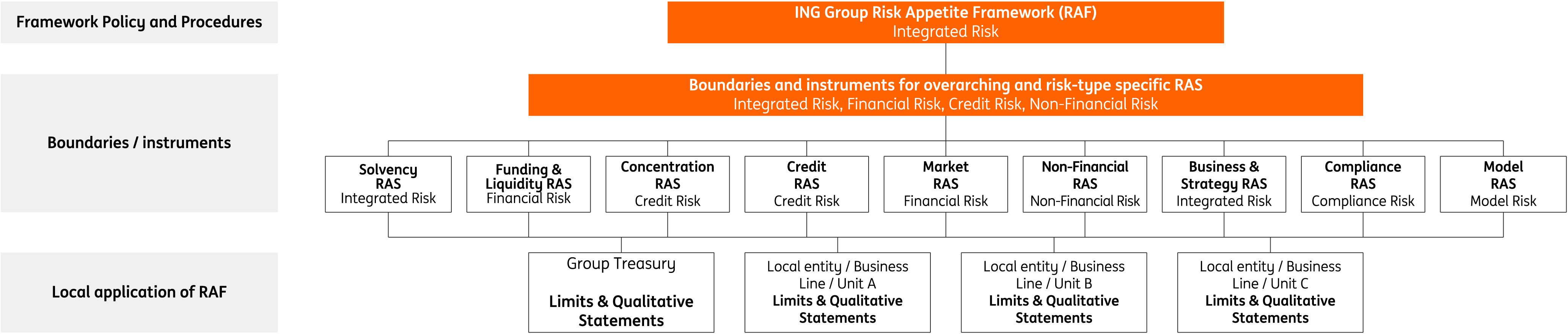
Stress testing
Stress testing is an important risk management tool that provides input for strategic decisions and capital planning. The purpose of stress testing is to assess the impact of plausible but severe stress scenarios on ING’s capital and liquidity position. Stress tests provide complementary and forward-looking insights into the vulnerabilities of certain portfolios, with regards to adverse macroeconomic circumstances, stressed financial markets, and changes in the political and geopolitical climate. In addition to assessing P&L, capital and
liquidity positions of ING for a range of different scenarios, idiosyncratic risks are also included. The outcomes of these stress tests help management get insight into the potential impact, and define actions to mitigate this potential impact.
ING Group Annual Report 2024 on Form 20-F 154
Types of stress tests
Within ING, we perform different types of stress tests. The most comprehensive type of stress tests are the firm-wide scenario analyses, which involve setting scenario assumptions for all the relevant macroeconomic and financial market variables in all countries relevant to ING. These assumptions usually follow a qualitative narrative that provides a background to the scenario. In addition to firm-wide scenario analyses, ING executes scenario analyses for specific countries or portfolios. Furthermore, sensitivity analyses are performed, which focus on stressing one or more risk drivers – usually without an underlying scenario narrative. Finally, ING performs reverse stress tests, which aim to determine scenarios that could lead to a predefined severe adverse outcome.
Process
ING’s stress-testing process consists of several stages:
•Risk identification and risk assessment: it identifies and assesses the risks ING or the relevant entity is facing when executing its strategy, based on the current and possible future economic, political, regulatory and technological environment. It provides a description of the main risks and risk drivers related to the nature of ING’s business, activities and vulnerabilities.
•Scenario definition and parameterisation: based on the outcome of the previous step, a set of scenarios is determined with the relevant scope and set of risk drivers for each scenario, as well as its severity, the key assumptions and input parameters. The output of this phase includes a quantitative description of the stress scenarios to be analysed, the relevant output metrics and, when applicable, a narrative description.
•Impact calculation and aggregation: based on the quantitative description of the stress scenarios determined in the previous step, the impact is determined for the relevant scenario, scope, and horizon. The impact calculation and aggregation can be part of a recurring process or part of a specific process set-up for one-off stress tests.
•Scenario reporting: for each stress test, a report is prepared after each calculation, which describes the results of the scenario and gives a recap of the scenario with its main assumptions and parameters. The stress-test report is sent to the relevant risk committees and/or senior management. It is complemented, if needed, with advice for management action based on the stress-testing results.
•Scenario control and management assessment: depending on the outcomes of the stress test and the likelihood of the scenario, mitigating actions may be proposed. Mitigating actions may include, but are not limited to, sales or transfers of assets and reductions of risk limits.
Methodology
Detailed and comprehensive models are used to calculate the impact of the scenarios. In these models, statistical analysis is combined with expert opinion to make sure the results adequately reflect the scenario assumptions. The methodologies are granular and portfolio-specific, and use different macroeconomic and market variables as input variables. The calculations are in line with our financial and regulatory reporting frameworks. The stress-testing models are subject to review by Model Risk management.
Solvency risk
Introduction
Solvency risk is the risk of lacking sufficient capital to fulfil business objectives, regulatory requirements or market expectations. An insolvent bank is unable to pay its debts and will be forced into bankruptcy.
The level and quality of capital is crucial for the resilience of individual banks. Banks are expected to assess the risks they face and, in a forward-looking manner, ensure they identify and manage all material risks. They must also make sure these risks are sufficiently covered by loss-absorbing capital to provide continuity if unexpected risks materialise in times of stress. Given the interdependencies with other financial and non-financial risks, this balancing act of capital adequacy needs to be done within a sound and integrated management approach. It must coherently link and align all the moving parts of the bank with its long-term business strategy.
ICAAP framework
ING’s internal capital adequacy assessment process (ICAAP) framework aims to ensure that capital levels remain adequate – both forward-looking and under adverse conditions, in terms of covering material risks-to-capital from both a normative and an economic (internal) perspective. The assessment of ING’s capital adequacy takes into account its business strategy and risk profile, market environment, and operating macro environment. This implies that views of various stakeholders, such as regulators, shareholders, investors, rating agencies, clients, and customers play an important role.
The continued strength of ING’s capital position, the adequacy of the financial position, and risk management effectiveness are essential to achieving the strategy. ING’s capital and funding strategy determines the underlying ICAAP elements, and thereby contributes to ING’s business continuity from different perspectives.
Managing ING’s capital entails finding the right balance between supply and demand, while taking into account market and macro circumstances. The process of balancing these strategic goals is captured in the ICAAP framework. It is enabled by six building blocks and underlying elements facilitating the ICAAP. The following building blocks have been defined in the ICAAP framework, which are applied for both the ‘normative’ and ‘economic’ perspective as defined in the ECB guide to ICAAP, published in November 2018:
•Risk identification and assessment;
•Risk appetite;
•Solvency stress testing;
•Planning and forecasting;
•Capital management; and
•Continuity.
ING Group Annual Report 2024 on Form 20-F 155
Risk identification and assessment
ING’s capital management and solvency risk management starts with the risk-identification and risk-assessment process, which is performed on an annual basis. In addition to this annual process, ING also reassesses its risks as part of its capital adequacy statement, a quarterly process to assess ING’s capital adequacy.
Risk appetite
ING has solvency risk appetite statements in place for the following metrics: CET1 ratio, total capital ratio, leverage ratio, total loss-absorbing capacity (TLAC), and minimum requirement for own funds and eligible liabilities (MREL) based on RWA/leverage ratio and economic capital adequacy.
Solvency stress testing
Solvency stress testing allows ING to examine the effect of plausible but severe stress scenarios on the solvency position. It also provides insight into which entities or portfolios are vulnerable to certain types of risks or scenarios. Solvency stress testing is an important tool in identifying, assessing, measuring, and controlling risks to capital, providing a complementary and forward-looking perspective to other solvency risk management tools. For solvency stress testing, ING follows the same steps described in the overall section on stress testing.
The outcomes of solvency stress test analyses are taken into account in capital planning, but also for setting risk appetite statements and the capital management buffer.
Planning and forecasting
The capital and funding plan is an integral part of the dynamic plan, ING’s financial and business planning process. For more information, see section ‘Capital management’.
Capital management
Formulation of the CET1 target is a key element in solvency risk management. The target ratio, based on the management buffer concept, enables ING’s senior management to steer, benchmark and assess the bank’s current and future capital levels much more efficiently. The target level clearly supports trust-building among ING’s key stakeholders (e.g. regulators, investors and customers).
The capital management buffer aims to protect the interests of key stakeholders and plays an important role in the overall capital adequacy governance. The rationale behind the buffer is that it provides an additional cushion on top of the (local) regulatory minimum requirements (e.g. supervisory review and evaluation process (SREP) requirements) to withstand a certain level of stress and facilitate awareness and
preparedness to take management actions. ING reviews its capital management buffer on a regular basis to determine its effectiveness and robustness, updating it as appropriate. See section ‘Capital management’.
Continuity
Risk events with high severity or significant deteriorations of economic and market conditions beyond ING’s control could cause deviations from the business and capital plans, which may result in a potential capital shortfall.
ING has therefore set up a continuity (safety) net of contingency and recovery planning. As part of this, ING set up ongoing monitoring of relevant indicators with the aim of awareness and preparedness to act proactively to ensure continuity. The intervention measures, which can be activated when deemed necessary, consist of predefined RWA reduction measures, as well as direct capital-increasing measures. The escalation mechanisms are defined, governed and detailed in the contingency and recovery plans.
Both plans aim to restore ING’s capital adequacy. Depending on the severity of the situation, the contingency plan can be activated at this warning phase, as well as trigger further mitigating action and the formation of the contingency crisis teams. Further drops in capital levels trigger the alert phase for recovery monitoring and/or the activation of the recovery plan and corresponding crisis teams.
Assessing capital adequacy: Capital Adequacy Statement
The Capital Adequacy Statement is ING Group’s quarterly assessment of its capital adequacy and takes into account different elements with respect to its capital position. The degree to which ING’s capital position is considered adequate depends on a variety of internal and external drivers:
•Current supervisory requirements and (expected) requirements going forward;
•Current internal requirements and (expected) requirements going forward (economic capital/view);
•Coherence of the available capital with the (realisation of) strategic plans; and
•The ability to meet internal and external requirements in the case of stressed events or should a risk materialise.
The Capital Adequacy Statement assesses the adequacy of ING’s capital position in relation to the above-mentioned drivers and states the extent to which the capital position consequently is considered as adequate. The Capital Adequacy Statement document is prepared on a quarterly basis. Additionally, each year the EB/MBB signs and provides a comprehensive assessment of ING’s capital adequacy, supported by the ICAAP outcomes, in the form of a capital adequacy statement.
ING Group Annual Report 2024 on Form 20-F 156
Credit risk
Introduction
Credit risk is the risk of loss from the default and/or credit rating deterioration of clients. Credit risks arise in ING’s lending, financial markets and investment activities. The credit risk section provides information on how ING measures, monitors and manages credit risk and gives an insight into the portfolio from a credit risk perspective.
Credit & counterparty risk categories (*)
In the following table the different types of credit and counterparty risk categories are described and a reconciliation with the notes in the financial statements is also included:
| | | | | | | | |
| Reconciliation between credit & counterparty risk categories and financial position (*) |
| Credit risk categories | Notes in the financial statements |
| Lending risk: The risk that the client (counterparty, corporate or individual) does not pay the principal interest or fees on a loan when they are due, or on demand for letters of credit (LCs) and guarantees provided by ING. | 2 | Cash and balances with central banks |
| 3 | Loans and advances to banks |
| 4 | Financial assets at fair value through profit or loss |
| 5 | Financial assets at fair value through other comprehensive income |
| 7 | Loans and advances to customers |
| 40 | Contingent liabilities and commitments |
| Investment risk: The credit default and risk rating migration risk that is associated with ING’s investments in bonds, commercial paper, equities, securitisations and other similar publicly traded securities. This can be viewed as the potential loss that ING may incur from holding a position in underlying securities whose issuer's credit quality deteriorates or defaults. | 4 | Financial assets at fair value through profit or loss |
| 5 | Financial assets at fair value through other comprehensive income |
| 6 | Debt securities |
| Money market risk: This arises when ING places short-term deposits with a counterparty in order to manage excess liquidity. In the event of a counterparty default, ING may lose the deposit placed. | 2 | Cash and balances with central banks |
| 3 | Loans and advances to banks |
| 7 | Loans and advances to customers |
| Pre-settlement risk: This arises when a client defaults on a transaction before settlement and ING must replace the contract by a trade with another counterparty at the then prevailing (possibly unfavourable) market price. This credit risk category is associated with derivatives transactions (exchange-traded derivatives, over-the-counter (OTC) derivatives and securities financing transactions). | 4 | Financial assets at fair value through profit or loss |
| 14 | Financial liabilities at fair value through profit or loss |
| 39 | Offsetting financial assets and liabilities |
| Settlement risk: This arises when there is an exchange of value (funds or instruments) and receipt from its counterparty is not verified or expected until after ING has given irrevocable instructions to pay or has paid or delivered its side of the trade. The risk is that ING delivers but does not receive delivery from its counterparty. | 4 | Financial assets at fair value through profit or loss |
| 11 | Other assets |
| 14 | Financial liabilities at fair value through profit or loss |
| 16 | Other liabilities |
ING Group Annual Report 2024 on Form 20-F 157
Credit risk appetite and concentration risk framework (*)
The credit risk appetite and concentration risk framework is designed to prevent undesired high levels of credit risk and credit concentrations within various levels of the ING portfolio. It is derived from the concepts of boundaries and instruments as described in the ING RAF.
Credit risk appetite is the maximum level of credit risk ING is willing to accept for growth and value creation. The credit risk appetite is linked to the overall bank-wide RAF and is expressed in quantitative and qualitative measures.
The credit risk appetite is set at different levels and dimensions within ING. The credit risk appetite framework specifies the scope and focus of the credit risk which ING takes and the composition of the credit portfolio, including its concentration and diversification objectives in relation to business lines, locations, sectors and products. The credit risk appetite framework has also been extended to embed climate risk elements. The climate risk elements within the credit risk appetite framework allow for more efficient steering of sector concentrations from a climate risk perspective.
The credit concentration risk framework is composed of:
•Country risk concentration: Country risk is the risk that arises due to events in a specific country (or group of countries). To manage the maximum country loss ING is willing to accept, boundaries are approved by the SB. The estimated level is correlated to the risk rating assigned to a given country. Actual country limits are set by means of country instruments, which are monitored monthly and updated, when needed. For countries with elevated levels of geopolitical or severe economic cycle risk, monitoring is performed on a more frequent basis with strict pipeline and exposure management.
•Single name and secondary risk concentration: ING has an established credit concentration risk framework to identify, measure and monitor single name concentration including secondary risk. The same concept of boundaries and instruments is applicable.
•Sector and product concentration risk are managed via the credit risk appetite framework.
Credit risk models (*)
Within ING, internal CRR-compliant models are used to determine probability of default (PD), exposure at default (EAD) and loss given default (LGD) for regulatory and economic capital purposes. These models also form the basis of ING’s IFRS 9 loan loss provisioning (see ‘IFRS 9 models’ below).
There are two main types of PD, EAD and LGD models used throughout the bank:
•Statistical models are created where a large set of default or detailed loss data is available. They are characterised by sufficient data points to facilitate meaningful statistical estimation of the model parameters. The model parameters are estimated with statistical techniques based on the data set available.
•Hybrid models are statistical models supplemented with knowledge and experience of experts from risk management and front-office staff, literature from rating agencies, supervisors and academics. These models are only used for ‘low default portfolios’, where limited historical defaults exist.
Credit risk rating process (*)
The majority of risk ratings are based on a risk rating (PD) model that complies with the minimum requirements detailed in CRR/CRD, ECB Supervisory Rules and European Banking Authority (EBA) guidelines. This concerns all borrower types and segments.
ING’s PD rating models are based on a 1-22 internal risk rating scale (1 = highest rating; 22 = lowest rating) referred to as the ‘master scale’, which roughly corresponds to the rating grades that are assigned by external rating agencies, such as Standard & Poor’s, Moody’s and Fitch. For example, an ING rating of 1 corresponds to an S&P/Fitch rating of AAA and a Moody’s rating of Aaa; an ING rating of 2 corresponds to an S&P/Fitch rating of AA+ and a Moody’s rating of Aa1, and so on.
The 22 internal risk rating grades are composed of the following categories:
•Investment grade (risk rating 1-10);
•Non-investment grade (risk rating 11-17);
•Performing Restructuring (risk rating 18-19); and
•Non-performing (risk rating 20-22).
The first three categories (1-19) are risk ratings for performing loans. Ratings are calculated in IT systems with internally developed models, based on manually or automatically fed data, or for part of the non-performing loans set by the global or regional credit restructuring department. Under certain conditions, the
ING Group Annual Report 2024 on Form 20-F 158
outcome of a manually fed model can be challenged through a rating appeal process. For securitisation portfolios, the external ratings of the tranche in which ING has invested are leading indicators.
Risk ratings assigned to clients are reviewed at least annually, with the performance of the underlying models monitored regularly. Some of these models are global in nature, such as those for large corporates, commercial banks, insurance companies, central governments, funds, fund managers, project finance and leveraged companies. Other models are more regional or country-specific: there are PD models for small and medium enterprises (SMEs) in the Netherlands, Belgium, and Poland as well as residential mortgage and consumer loan models in the various retail markets.
Rating models for Retail clients are predominantly statistically driven and automated, such that ratings can be updated on a monthly basis. Rating models for large corporates, institutions and banks include both statistical characteristics and expert input, with the ratings being manually updated at least annually. More frequent reviews (e.g. quarterly) are performed where considered necessary.
In line with evolving regulatory expectations on models and emerging industry practices, ING has embarked on a multi-year redevelopment process of its credit risk models. This is also in line with ING’s model governance to ensure continuous improvement of models.
Credit risk tools and data standards
The acceptance, maintenance, measurement, management and reporting of credit risks at all levels of ING are executed through single, common credit risk data standards using shared credit risk tools that support standardised and transparent credit risk practices. ING has chosen to develop credit risk tools centrally with the philosophy of using a single source of data in an integrated way.
Credit risk portfolio (*)
ING’s credit exposure is mainly related to lending to individuals (also referred to as consumer lending, all Retail) and businesses (referred to as business lending, both in Retail and Wholesale), followed by investments in bonds and securitised assets, and money market (Wholesale). Loans to individuals are mainly mortgage loans secured by residential property. Loans (including guarantees issued) to businesses are often collateralised, but may be unsecured based on the internal analysis of the borrower’s creditworthiness. Bonds in the investment portfolio are generally unsecured, but predominantly consist of bonds issued by central governments and EU and/or OECD-based financial institutions. Secured bonds, such as mortgage-backed securities and asset-backed securities are secured by the underlying diversified pool of assets (commercial or residential mortgages, car loans and/or other assets) held by the securities issuer. For money market, exposure is mainly deposits to central banks. The last major credit risk source involves pre-settlement exposures which arise from trading activities, including derivatives, repurchase transactions and securities lending/borrowing transactions. This is also commonly referred to as counterparty credit risk.
Overall portfolio (*)
During 2024, ING’s portfolio size increased by €30.3 billion (3.2%) to €961.9 billion outstanding. Foreign exchange rate changes had a positive impact on the portfolio growth, mainly in WB, increasing total outstanding by €8.0 billion, driven by the appreciation of the US dollar against the euro. Retail banking increased by €18.9 billion mainly due to underlying growth in residential mortgages.
Rating distribution (*)
Overall, the rating class distribution remained stable in 2024. The share of investment grade rating classes increased from 76.8% to 78.1%, while the share of non-investment grade decreased from 21.2% to 19.9%. Performing restructuring outstandings decreased from 0.7% to 0.6% of the total portfolio, whereas non-performing loans increased from 1.3% to 1.4%.
With respect to the rating distribution within the business lines, in WB, investment grade increased to 83.7% from 81.2%, while non-investment grade exposures decreased to 14.6% from 17.1% compared to 2023. Performing restructuring assets decreased from 0.7% to 0.6% of total Wholesale Banking assets where non-performing loans for WB increased from 1.0% to 1.2%. The non-performing loans (NPL) increase in Wholesale Banking is mainly caused by Russian exposures as well as a few large NPLs that are unrelated in terms of asset class, sector or geography.
For Retail Banking, investment grade increased to 73.3% from 73.0%, while non-investment grade exposures decreased to 24.4% from 24.9% as compared to 2023. Performing restructuring increased to 0.7% from 0.6% whereas NPL remained constant at 1.5% in 2024.
Industry (*)
The industry breakdown is presented in accordance with the NAICS definition. The increase of €30.3 billion in total volume during 2024 was mainly due to the increase in Private Individuals (€18.4 billion), Non-Bank Financial Institutions (€8.8 billion) and Commercial Banks (€5.2 billion). The share of Private Individuals increased from 38.8% last year to 39.5%.
ING Group Annual Report 2024 on Form 20-F 159
Portfolio analysis per business line (*)
| | | | | | | | | | | | | | | | | | | | | | | | | | | | | |
Outstandings per line of business (*)1, 2, 3 |
| in € million | Wholesale Banking | Retail Banking | Corporate line | Total |
| Rating class | 2024 | 2023 | 2024 | 2023 | 2024 | 2023 | 2024 | 2023 |
| Investment grade | 1 (AAA) | 53,363 | | 52,665 | | 29,151 | | 34,683 | | 1,790 | | 2,284 | | 84,304 | | 89,631 | |
| 2-4 (AA) | 72,462 | | 67,034 | | 63,187 | | 59,655 | | 4 | | 6 | | 135,653 | | 126,694 | |
| 5-7 (A) | 101,766 | | 95,320 | | 140,479 | | 132,076 | | 154 | | 147 | | 242,400 | | 227,543 | |
| 8-10 (BBB) | 129,429 | | 123,081 | | 155,375 | | 146,295 | | 3,662 | | 2,357 | | 288,466 | | 271,733 | |
| Non-investment grade | 11-13 (BB) | 53,757 | | 57,348 | | 94,753 | | 94,408 | | | | | | 148,510 | | 151,756 | |
| 14-16 (B) | 7,396 | | 12,234 | | 31,165 | | 29,330 | | | | | | 38,561 | | 41,565 | |
| 17 (CCC) | 1,037 | | 1,122 | | 3,345 | | 3,113 | | 170 | | 392 | | 4,552 | | 4,628 | |
| Performing Restructuring loans | 18 (CC) | 1,792 | | 2,523 | | 2,001 | | 1,957 | | | | | | 3,794 | | 4,481 | |
| 19 (C) | 560 | | 535 | | 1,760 | | 1,313 | | | | | | 2,321 | | 1,848 | |
| Non-performing loans | 20-22 (D) | 5,204 | | 4,051 | | 8,100 | | 7,622 | | | | | | 13,303 | | 11,673 | |
| Total | 426,767 | | 415,914 | | 529,317 | | 510,452 | | 5,779 | | 5,186 | | 961,863 | | 931,552 | |
| | | | | | | | | |
| Industry | | | | | | | | | |
| Private Individuals | | 2,116 | | 2,330 | | 377,712 | | 359,057 | | | | | | 379,827 | | 361,387 | |
| Central Banks | | 61,091 | | 70,139 | | 15,044 | | 21,740 | | 1,785 | | 2,269 | | 77,919 | | 94,147 | |
| Natural Resources | | 39,974 | | 40,511 | | 1,925 | | 1,883 | | | | | | 41,899 | | 42,394 | |
| Real Estate | | 24,643 | | 24,904 | | 28,738 | | 26,611 | | | | | | 53,381 | | 51,515 | |
| Commercial Banks | | 40,962 | | 37,342 | | 6,662 | | 6,183 | | 3,616 | | 2,515 | | 51,240 | | 46,040 | |
| Non-Bank Financial Institutions | | 64,217 | | 55,313 | | 2,212 | | 2,290 | | 290 | | 286 | | 66,719 | | 57,889 | |
| Central Governments | | 48,389 | | 45,316 | | 8,107 | | 7,304 | | 1 | | 1 | | 56,497 | | 52,621 | |
| Transportation & Logistics | | 27,499 | | 27,106 | | 6,037 | | 5,784 | | | | | | 33,536 | | 32,890 | |
| Utilities | | 25,517 | | 23,324 | | 2,196 | | 2,184 | | | | | | 27,713 | | 25,509 | |
| Food, Beverages & Personal Care | | 13,827 | | 13,503 | | 10,419 | | 9,883 | | | | | | 24,246 | | 23,386 | |
| Services | | 8,844 | | 9,128 | | 13,442 | | 12,872 | | 27 | | 24 | | 22,312 | | 22,023 | |
| General Industries | | 10,512 | | 12,039 | | 8,812 | | 9,086 | | | | | | 19,324 | | 21,126 | |
| Lower Public Administration | | 6,959 | | 6,211 | | 19,598 | | 17,493 | | | | | | 26,557 | | 23,704 | |
| Other | 52,218 | | 48,748 | | 28,412 | | 28,082 | | 62 | | 92 | | 80,691 | | 76,922 | |
| Total | 426,767 | | 415,914 | | 529,317 | | 510,452 | | 5,779 | | 5,186 | | 961,863 | | 931,552 | |
ING Group Annual Report 2024 on Form 20-F 160
| | | | | | | | | | | | | | | | | | | | | | | | | | | | | |
Outstandings per line of business (*) - continued1, 2, 3 |
| in € million | Wholesale Banking | Retail Banking | Corporate line | Total |
| Region | 2024 | 2023 | 2024 | 2023 | 2024 | 2023 | 2024 | 2023 |
| Europe | Netherlands | 44,421 | | 54,938 | | 164,590 | | 156,182 | | 1,903 | | 2,366 | | 210,913 | | 213,486 | |
| Belgium | 26,506 | | 24,171 | | 95,584 | | 91,744 | | | | 7 | | 122,091 | | 115,921 | |
| Germany | 27,443 | | 26,152 | | 128,598 | | 128,885 | | 30 | | 31 | | 156,071 | | 155,067 | |
| Poland | 21,190 | | 20,346 | | 30,946 | | 28,971 | | | | | | 52,136 | | 49,317 | |
| Spain | 11,990 | | 11,047 | | 28,507 | | 27,158 | | 36 | | 35 | | 40,533 | | 38,240 | |
| United Kingdom | 28,257 | | 28,587 | | 265 | | 275 | | 91 | | 112 | | 28,613 | | 28,974 | |
| Luxembourg | 26,176 | | 23,805 | | 5,139 | | 5,557 | | | | | | 31,314 | | 29,363 | |
| France | 24,351 | | 21,528 | | 3,122 | | 3,108 | | 3 | | 14 | | 27,476 | | 24,650 | |
| Rest of Europe | 72,860 | | 65,157 | | 23,203 | | 20,368 | | 14 | | 32 | | 96,076 | | 85,558 | |
| America | 86,402 | | 78,851 | | 2,402 | | 2,042 | | 232 | | 222 | | 89,037 | | 81,114 | |
| Asia | 44,136 | | 49,851 | | 215 | | 159 | | 3,464 | | 2,365 | | 47,815 | | 52,374 | |
| Australia | 10,887 | | 9,409 | | 46,723 | | 45,977 | | 8 | | 2 | | 57,618 | | 55,389 | |
| Africa | 2,148 | | 2,071 | | 22 | | 26 | | | | | | 2,170 | | 2,098 | |
| Total | 426,767 | | 415,914 | | 529,317 | | 510,452 | | 5,779 | | 5,186 | | 961,863 | | 931,552 | |
1 Based on credit risk measurement contained in lending, pre-settlement, money market and investment activities.
2 Based on the total amount of credit risk in the respective column using ING’s internal credit risk measurement methodologies. Economic sectors (industry) below 2% are not shown separately but grouped in Other.
3 Geographical areas are based on country of residence, except for private individuals for which the geographical areas are based on the primary country of risk.
Portfolio analysis per geographical area (*)
The portfolio analysis per geographical area re-emphasises the international distribution of ING’s credit portfolio. The Netherlands maintains the largest portfolio share in a single country with 21.9% (2023: 22.9%) of the total amount, followed by Germany with 16.2% (2023: 16.6%) and Belgium with 12.7% (2023: 12.4%).
In terms of region, the majority of the portfolio balance remained in Europe with 80.0% (2023: 79.0%), followed by Americas with 9.3% (2023: 8.7%) and Australia with 6.0% (2023: 5.9%). The top five countries within Rest of Europe based on outstandings were Italy (€20.7 billion), Switzerland (€16.4 billion), Romania (€12.4 billion), Türkiye (€8.6 billion) and Ireland (€4.8 billion).
The main contributors for the overall increase in outstanding are Americas (+€7.9 billion), Belgium
(+€6.2 billion), Poland (+€2.8 billion) and France (+€2.8 billion).
Private Individuals remained the largest composition of portfolio balances for the Netherlands at 58.3% (2023: 54.6%), Belgium at 37.4% (2023: 38.5%), Germany at 68.8% (2023: 66.5%) and Australia at 66.1% (2023: 65.6%). The decrease in Central Banks is mainly attributed to the Netherlands (€8.5 billion explaining the decrease in WB Netherlands outstanding), Germany (€5.0 billion) and Asia (€4.1 billion).
In individual countries, the total share of investment grade/non-investment grade remains substantial for the Netherlands at 98.5% (2023: 98.6%), Germany at 98.9% (2023: 99.1%) and in Belgium 96.6% (2023: 96.6%).
In Europe, the increase in investment grade was mainly witnessed in Poland (+€4.3 billion), France
(+€3.2 billion), Spain (+€3.2 billion), Belgium (+€3.2 billion) and Luxembourg (+€3.2 billion). Non-investment grade decreased in the Netherlands (-€2.7 billion), Poland (-€1.8 billion), Luxembourg (-€1.2 billion) and Spain (-€1.0 billion).
ING Group Annual Report 2024 on Form 20-F 161
| | | | | | | | | | | | | | | | | | | | | | | | | | | | | | | | | | | | | | | | | | | | |
Outstandings by economic sectors and geographical area (*) 1 |
| in € million | Region | Total |
| Industry | Netherlands | Belgium | Germany | Poland | Spain | United Kingdom | Luxembourg | France | Rest of Europe | America | Asia | Australia | Africa | 2024 |
| Private Individuals | 122,914 | | 45,611 | | 107,415 | | 16,525 | | 27,083 | | 122 | | 3,058 | | 2,260 | | 16,391 | | 198 | | 129 | | 38,106 | | 16 | | 379,827 | |
| Central Banks | 22,529 | | 10,196 | | 13,966 | | 1,729 | | 510 | | 1,935 | | 5,737 | | | | 10,913 | | | | 9,525 | | 879 | | | | 77,919 | |
| Natural Resources | 2,197 | | 1,531 | | 881 | | 778 | | 152 | | 3,021 | | 2,503 | | 405 | | 11,212 | | 8,475 | | 8,989 | | 1,593 | | 159 | | 41,899 | |
| Real Estate | 16,749 | | 13,387 | | 1,218 | | 2,085 | | 1,595 | | 552 | | 3,446 | | 2,713 | | 3,707 | | 3,220 | | 1,066 | | 3,642 | | | | 53,381 | |
| Commercial Banks | 1,285 | | 314 | | 4,129 | | 695 | | 376 | | 4,733 | | 5,268 | | 5,074 | | 7,779 | | 10,700 | | 9,394 | | 1,336 | | 157 | | 51,240 | |
| Non-Bank Financial Institutions | 2,872 | | 1,766 | | 5,147 | | 2,874 | | 249 | | 8,479 | | 6,031 | | 5,932 | | 5,174 | | 23,367 | | 3,518 | | 1,255 | | 55 | | 66,719 | |
| Central Governments | 1,416 | | 11,009 | | 51 | | 9,435 | | 5,308 | | 48 | | 82 | | 3,202 | | 9,203 | | 15,377 | | 288 | | 488 | | 589 | | 56,497 | |
| Transportation & Logistics | 4,290 | | 2,076 | | 1,426 | | 1,623 | | 679 | | 2,262 | | 828 | | 765 | | 7,407 | | 3,983 | | 6,912 | | 504 | | 781 | | 33,536 | |
| Utilities | 1,805 | | 1,843 | | 3,920 | | 814 | | 1,971 | | 2,826 | | 395 | | 712 | | 3,951 | | 5,886 | | 1,187 | | 2,253 | | 152 | | 27,713 | |
| Food, Beverages & Personal Care | 7,377 | | 3,690 | | 695 | | 2,215 | | 351 | | 328 | | 1,393 | | 1,102 | | 3,008 | | 2,498 | | 1,168 | | 406 | | 14 | | 24,246 | |
| Services | 4,919 | | 8,431 | | 1,852 | | 1,538 | | 122 | | 869 | | 540 | | 310 | | 1,271 | | 1,265 | | 516 | | 680 | | | | 22,312 | |
| General Industries | 4,568 | | 2,690 | | 1,059 | | 2,824 | | 219 | | 301 | | 539 | | 484 | | 3,862 | | 2,039 | | 708 | | 23 | | 8 | | 19,324 | |
| Lower Public Administration | 782 | | 6,824 | | 7,435 | | 608 | | 557 | | | | 246 | | 3,091 | | 476 | | 1,554 | | 44 | | 4,941 | | | | 26,557 | |
| Other | 17,208 | | 12,722 | | 6,876 | | 8,394 | | 1,361 | | 3,137 | | 1,248 | | 1,426 | | 11,722 | | 10,475 | | 4,372 | | 1,513 | | 238 | | 80,691 | |
| Total | 210,913 | | 122,091 | | 156,071 | | 52,136 | | 40,533 | | 28,613 | | 31,314 | | 27,476 | | 96,076 | | 89,037 | | 47,815 | | 57,618 | | 2,170 | | 961,863 | |
| | | | | | | | | | | | | | |
| Rating class | | | | | | | | | | | | | | |
| Investment grade | 170,093 | | 74,882 | | 136,096 | | 36,029 | | 32,741 | | 23,844 | | 27,235 | | 21,886 | | 67,110 | | 72,686 | | 41,203 | | 46,959 | | 59 | | 750,822 | |
| Non-Investment grade | 37,689 | | 43,059 | | 18,238 | | 13,948 | | 7,126 | | 4,388 | | 3,858 | | 5,229 | | 25,679 | | 14,763 | | 5,859 | | 9,889 | | 1,898 | | 191,623 | |
| Performing restructuring | 1,579 | | 1,078 | | 305 | | 701 | | 234 | | 59 | | 56 | | 54 | | 1,369 | | 443 | | 30 | | 203 | | 4 | | 6,114 | |
| Non-performing loans | 1,552 | | 3,071 | | 1,432 | | 1,458 | | 432 | | 322 | | 166 | | 307 | | 1,918 | | 1,145 | | 723 | | 568 | | 210 | | 13,303 | |
| Total | 210,913 | | 122,091 | | 156,071 | | 52,136 | | 40,533 | | 28,613 | | 31,314 | | 27,476 | | 96,076 | | 89,037 | | 47,815 | | 57,618 | | 2,170 | | 961,863 | |
1 Geographical areas are based on country of residence, except for Private Individuals for which the geographical areas are based on the primary country of risk.
ING Group Annual Report 2024 on Form 20-F 162
| | | | | | | | | | | | | | | | | | | | | | | | | | | | | | | | | | | | | | | | | | | | |
Outstandings by economic sectors and geographical area (*) 1 |
| in € million | Region | | Total |
| Industry | Netherlands | Belgium | Germany | Poland | Spain | United Kingdom | Luxembourg | France | Rest of Europe | America | Asia | Australia | Africa | 2023 |
| Private Individuals | 116,530 | | 44,637 | | 103,151 | | 14,860 | | 25,452 | | 128 | | 3,347 | | 2,472 | | 14,179 | | 149 | | 121 | | 36,340 | | 20 | | 361,387 | |
| Central Banks | 31,017 | | 9,756 | | 18,945 | | 2,530 | | 489 | | 4,335 | | 4,853 | | | | 6,166 | | | | 13,668 | | 2,379 | | 9 | | 94,147 | |
| Natural Resources | 2,623 | | 1,346 | | 1,017 | | 685 | | 129 | | 3,789 | | 2,511 | | 429 | | 10,608 | | 8,237 | | 9,785 | | 941 | | 295 | | 42,394 | |
| Real Estate | 16,907 | | 10,986 | | 1,111 | | 2,184 | | 1,551 | | 420 | | 3,563 | | 2,901 | | 3,492 | | 3,323 | | 1,367 | | 3,709 | | | | 51,515 | |
| Commercial Banks | 1,217 | | 404 | | 4,050 | | 601 | | 353 | | 4,488 | | 5,070 | | 4,155 | | 6,757 | | 9,833 | | 8,182 | | 719 | | 210 | | 46,040 | |
| Non-Bank Financial Institutions | 2,573 | | 1,457 | | 5,710 | | 2,532 | | 652 | | 6,837 | | 4,631 | | 4,274 | | 4,269 | | 20,118 | | 3,884 | | 950 | | | | 57,889 | |
| Central Governments | 1,620 | | 9,046 | | 699 | | 8,614 | | 5,491 | | 41 | | 79 | | 2,255 | | 9,384 | | 13,752 | | 520 | | 526 | | 593 | | 52,621 | |
| Transportation & Logistics | 3,860 | | 2,198 | | 1,277 | | 1,598 | | 658 | | 2,113 | | 596 | | 784 | | 8,177 | | 3,511 | | 7,044 | | 456 | | 618 | | 32,890 | |
| Utilities | 2,419 | | 1,634 | | 3,516 | | 792 | | 912 | | 2,723 | | 480 | | 619 | | 4,469 | | 4,424 | | 1,306 | | 2,041 | | 173 | | 25,509 | |
| Food, Beverages & Personal Care | 7,138 | | 3,127 | | 550 | | 2,242 | | 490 | | 540 | | 1,505 | | 1,250 | | 2,455 | | 2,652 | | 1,140 | | 281 | | 18 | | 23,386 | |
| Services | 5,073 | | 8,463 | | 1,725 | | 1,325 | | 71 | | 745 | | 502 | | 380 | | 1,052 | | 1,576 | | 469 | | 642 | | | | 22,023 | |
| General Industries | 5,746 | | 2,604 | | 1,193 | | 2,827 | | 333 | | 199 | | 649 | | 287 | | 3,661 | | 2,848 | | 761 | | 18 | | | | 21,126 | |
| Lower Public Administration | 253 | | 6,607 | | 5,349 | | 669 | | 350 | | | | 249 | | 3,488 | | 356 | | 1,550 | | 7 | | 4,826 | | | | 23,704 | |
| Other | 16,510 | | 13,657 | | 6,774 | | 7,858 | | 1,309 | | 2,615 | | 1,326 | | 1,356 | | 10,532 | | 9,141 | | 4,120 | | 1,562 | | 163 | | 76,922 | |
| Total | 213,486 | | 115,921 | | 155,067 | | 49,317 | | 38,240 | | 28,974 | | 29,363 | | 24,650 | | 85,558 | | 81,114 | | 52,374 | | 55,389 | | 2,098 | | 931,552 | |
| | | | | | | | | | | | | | |
| Rating class | | | | | | | | | | | | | | |
| Investment grade | 170,067 | | 71,730 | | 136,675 | | 31,772 | | 29,583 | | 24,299 | | 24,083 | | 18,692 | | 56,404 | | 63,652 | | 44,481 | | 44,139 | | 24 | | 715,602 | |
| Non-Investment grade | 40,399 | | 40,236 | | 16,929 | | 15,785 | | 8,134 | | 4,508 | | 5,013 | | 5,713 | | 25,967 | | 16,003 | | 6,770 | | 10,715 | | 1,776 | | 197,949 | |
| Performing restructuring | 1,433 | | 799 | | 349 | | 830 | | 230 | | 2 | | 105 | | 122 | | 1,983 | | 245 | | 72 | | 132 | | 26 | | 6,327 | |
| Non-performing loans | 1,587 | | 3,156 | | 1,114 | | 929 | | 293 | | 165 | | 162 | | 124 | | 1,205 | | 1,213 | | 1,051 | | 403 | | 272 | | 11,673 | |
| Total | 213,486 | | 115,921 | | 155,067 | | 49,317 | | 38,240 | | 28,974 | | 29,363 | | 24,650 | | 85,558 | | 81,114 | | 52,374 | | 55,389 | | 2,098 | | 931,552 | |
1 Geographical areas are based on country of residence, except for Private Individuals for which the geographical areas are based on the primary country of risk.
Credit risk mitigation (*)
ING uses various techniques and instruments to mitigate the credit risk associated with an exposure and to reduce the losses incurred subsequent to a default by a customer. The most common terminology used in ING for credit risk protection is ‘cover’. While a cover may be an important mitigant of credit risk and an alternative source of repayment, generally it is ING’s practice to lend on the basis of the customer’s creditworthiness rather than exclusively relying on the value of the cover.
Cover forms (*)
Within ING, there are two distinct forms of covers. First, where the asset has been pledged to ING as collateral or security, ING has the right to liquidate it should the customer be unable to fulfil its financial obligation. As such, the proceeds can be applied towards full or partial compensation of the customer's outstanding exposure. This may be tangible (such as cash, securities, receivables, inventory, plant and machinery, and mortgages on real estate properties) or intangible (such as patents, trademarks, contract rights and licences). Second, where there is a third-party obligation, indemnification or undertaking (either by contract and/or by law), ING has the right to claim from that third party an amount if the customer fails
ING Group Annual Report 2024 on Form 20-F 163
on its obligations. The most common examples are guarantees, such as parent guarantees, export credit insurances or third-party pledged mortgages. Insurance or reinsurance covers, including comprehensive private risk insurance (CPRI) may be recognised as guarantees and effectively function in an equivalent manner. ING accepts credit risk insurance companies and export credit agencies (ECAs) as cover providers.
Cover valuation methodology (*)
General guidelines for cover valuation are established with the objective of ensuring consistent application within ING. These also require that the value of the cover is monitored on a regular basis. Covers are revalued periodically and whenever there is reason to believe that the market is subject to significant changes in conditions. The frequency of monitoring and revaluation depends on the type of cover.
The valuation method also depends on the type of covers. For asset collateral, the valuation sources can be the customer’s balance sheet (e.g. inventory, machinery and equipment), nominal value (e.g. cash and receivables), market value (e.g. securities and commodities), independent valuations (e.g. commercial real estate) and market indices (e.g. residential real estate). For third-party obligations, the valuation is based on the value that is attributed to the contract between ING and that third party.
Where collateral values are used in the calculation of Stage 3 individual loan loss provisions, haircuts may be applied to the valuation in specific circumstances, to sufficiently include all relevant factors impacting future
cash flows. ING applies haircuts to the collateral values of real estate, shipping and aviation assets that are used in the calculation of the loss-given-default in recovery scenarios. The haircut reflects the risks of adverse price developments between the moment of valuation of an asset and the actual settlement/cash receipt.
Cover values (*)
This section provides insight into the types of cover and the extent to which exposures benefit from collateral or guarantees. The disclosure differentiates between risk categories (lending, investment, money market and pre-settlement). The most relevant types of cover include mortgages, financial collateral (cash and securities), guarantees and other covers (mainly pledges). ING obtains covers that are eligible for credit risk mitigation under CRR/CRDIV, as well as covers that are not eligible. Collateral covering financial market transactions is valued on a daily basis, and as such not included in the following tables. To mitigate the credit risk arising from financial markets transactions, the bank enters into legal agreements governing the exchange of financial collateral (high-quality government bonds and cash).
The cover values are presented for the total portfolio of ING, both the performing and non-performing portfolio.
ING Group Annual Report 2024 on Form 20-F 164
| | | | | | | | | | | | | | | | | | | | | | | | | | |
| Cover values including guarantees received (*) |
| in € million | | Cover type and value | Collateralisation |
| 2024 | Outstandings | Mortgages | Financial Collateral | Guarantees | Other covers | No cover | Partially covered | Fully covered |
| Consumer lending | 378,832 | | 865,466 | | 6,257 | | 25,428 | | 55,115 | | 6.5 | % | 2.0 | % | 91.5 | % |
| Business lending | 368,570 | | 163,143 | | 24,838 | | 119,410 | | 484,148 | | 34.1 | % | 23.7 | % | 42.2 | % |
| Investment and money market | 153,493 | | | | | | 1,115 | | 95 | | 99.3 | % | — | % | 0.7 | % |
| Total lending, investment and money market | 900,894 | | 1,028,609 | | 31,095 | | 145,953 | | 539,357 | | 33.6 | % | 10.5 | % | 55.9 | % |
| of which NPL | 13,295 | | 10,427 | | 194 | | 3,093 | | 11,109 | | 27.6 | % | 27.7 | % | 44.7 | % |
| Pre-settlement | 60,968 | | | | | | | | |
| Total Group | 961,863 | | | | | | | | |
| | | | | | | | | | | | | | | | | | | | | | | | | | |
| Cover values including guarantees received (*) |
| in € million | | Cover type and value | Collateralisation |
| 2023 | Outstandings | Mortgages | Financial Collateral | Guarantees | Other covers | No cover | Partially covered | Fully covered |
| Consumer lending | 360,124 | | 804,994 | | 22,401 | | 25,269 | | 29,070 | | 6.2 | % | 2.0 | % | 91.8 | % |
| Business lending | 363,826 | | 162,491 | | 26,333 | | 115,944 | | 428,531 | | 35.2 | % | 22.5 | % | 42.3 | % |
| Investment and money market | 158,506 | | | | | | 1,040 | | 549 | | 99.0 | % | 0.6 | % | 0.4 | % |
| Total lending, investment and money market | 882,455 | | 967,485 | | 48,735 | | 142,252 | | 458,149 | | 34.8 | % | 10.2 | % | 55.0 | % |
| of which NPL | 11,653 | | 8,880 | | 1,609 | | 3,204 | | 9,241 | | 25.7 | % | 26.9 | % | 47.4 | % |
| Pre-settlement | 49,096 | | | | | | | | |
| Total | 931,552 | | | | | | | | |
The above tables gives an overview of the collateralisation of ING’s total portfolio. Excluding the pre-settlement portfolio, 55.9% (2023: 55.0%) of ING’s outstandings were fully collateralised in 2024. Since investments traditionally do not require covers, the ‘no covers’ percentage in this portfolio is over 99%.
Consumer lending portfolio (*)
The consumer lending portfolio accounts for 39.4% (2023: 38.7%) of ING’s total outstanding, primarily consisting of residential mortgage loans and other consumer lending loans. As a result, most collateral consists of mortgages. Mortgage values are collected in an internal central database and in most cases external data is used to index the market value. A significant part of ING’s residential mortgage portfolio is in the Netherlands (34.6%), Germany (27.5%), Belgium including Luxembourg (12.8%) and Australia (10.8%).
Note that the large increase in Other covers and decrease in Financial Collateral is related to a reclassification of certain cover types.
Business lending portfolio (*)
Business lending accounts for 38.3% (2023: 39.1%) of ING’s total outstanding. Business lending presented in this section does not include pre-settlement, investment and money market exposures.
ING Group Annual Report 2024 on Form 20-F 165
Credit quality (*)
ING uses three distinct statuses to categorise the management of clients with (perceived) deteriorating credit risk profiles. ING usually classifies a client first with a “watch list” status when there are concerns of any potential or material deterioration in credit risk profile that may affect the ability of the client to adhere to its debt service obligations or to refinance its existing loans. Watch list status requires more than usual attention, increased monitoring and quarterly reviews. Furthermore, ING makes use of Early Warning Indicators (EWIs) in daily credit risk management processes in non-Retail portfolios which relate to a change in (internal and/or external) circumstances or outlook of the specific Obligor, the sector or portfolio. Some clients with a watch list or EWI status may develop into a performing restructuring status (performing loans that hold a reasonable probability that ING will end up with a loss, if no specific action is taken) or a non-performing status.
When there is increasing doubt as to the performance and the collectability of the client’s contractual obligations the loans are managed by Global Credit Restructuring (GCR) or by restructuring units in the various regions and business units. The statuses and links with rating grades are illustrated in the table below.
| | | | | | | | | | | | | | |
| Credit risk ratings |
| Internal Rating Grade | 1-10 | 11-17 | 18-19 | 20-22 |
| Category | Investment Grade | Non-Investment Grade | Performing Restructuring | Non-Performing |
| Credit risk management | Regular incl EWI/Watchlist | Regular incl EWI/Watchlist | Credit restructuring | Credit restructuring |
| ECL Stage | 1/21 | 1/21 | 2 | 3 |
1 Stage 2 in case one of the Stage 2 triggers is hit, where Watchlist files are always Stage 2 |
| | | | | | | | |
Credit quality outstandings (*) |
| in € million | 2024 | 2023 |
| Performing not past due | 823,478 | | 795,942 | |
| Business lending performing past due | 9,174 | | 8,825 | |
| Consumer lending performing past due | 802 | | 846 | |
| Non-performing | 13,295 | | 11,653 | |
| Total lending and investment | 846,749 | | 817,266 | |
| Money market | 54,145 | | 65,189 | |
| Pre-settlement | 60,968 | | 49,096 | |
| Total | 961,863 | | 931,552 | |
Past due obligations (*)
Retail Banking measures its portfolio in terms of payment arrears and determines on a monthly basis if there are any significant changes in the level of arrears. This methodology is applicable to private individuals, as well as business lending. An obligation is considered ‘past due’ if a payment of interest or principal is more than one day late. ING aims to help its customers as soon as they are past due by reminding them of their payment obligations. In its contact with customers, ING aims to solve the (potential) financial difficulties by offering a range of measures (e.g. payment arrangements, restructuring). If the issues cannot be resolved, for example because the customer is unable or unwilling to pay, the contract is sent to the recovery unit. The facility is downgraded to risk rating 20 (non-performing) when the facility or obligor – depending on the level at which the non-performing status is applied – is more than 90 days past due and to risk rating 21 or 22 in case of an exit scenario.
The table below represents the breakdown of lending and investment credit risk outstandings that are performing by age and geographic area.
ING Group Annual Report 2024 on Form 20-F 166
| | | | | | | | | | | | | | | | | | | | | | | | | | | | | | | |
Ageing analysis (past due but performing): Consumer lending portfolio by geographic area, outstandings (*) |
| in € million | 2024 | 2023 |
| Region | Past due for 1–30 days | Past due for 31–60 days | Past due for 61–90 days | | Total | Past due for 1–30 days | Past due for 31–60 days | Past due for 61–90 days | | Total |
| Europe | Belgium | 185 | | 49 | | 29 | | | 263 | | 223 | | 43 | | 29 | | | 295 | |
| Germany | 65 | | 37 | | 24 | | | 125 | | 89 | | 40 | | 18 | | | 147 | |
| Poland | 61 | | 9 | | 4 | | | 74 | | 76 | | 8 | | 5 | | | 89 | |
| Netherlands | 62 | | 35 | | 4 | | | 101 | | 67 | | 24 | | 6 | | | 97 | |
| Luxembourg | 22 | | 6 | | 3 | | | 32 | | 21 | | 2 | | 2 | | | 25 | |
| Spain | 12 | | 16 | | 8 | | | 36 | | 19 | | 13 | | 6 | | | 38 | |
| Rest of Europe | 93 | | 15 | | 4 | | | 112 | | 64 | | 19 | | 12 | | | 94 | |
| America | 0 | | 0 | | 0 | | | 1 | | 1 | | 0 | | 0 | | | 1 | |
| Asia | 0 | | 0 | | 0 | | | 0 | | 0 | | 0 | | 0 | | | 1 | |
| Australia | 38 | | 19 | | 2 | | | 59 | | 43 | | 15 | | 1 | | | 59 | |
| Africa | 0 | | 0 | | 0 | | | 0 | | 0 | | 0 | | 0 | | | 0 | |
| Total | 538 | | 186 | | 78 | | | 802 | | 602 | | 164 | | 79 | | | 846 | |
The past due but performing consumer lending outstanding decreased by €44 million,due to a decrease in 1-30 days (-€64 million) which was partially offset by an increase in 31-60 (+€22 million). The largest decrease was observed in Belgium (-€32 million) and Germany (-€22 million), mainly in the 1-30 days bucket. The largest increase was seen in Rest of Europe (+€18 million).
ING Group Annual Report 2024 on Form 20-F 167
| | | | | | | | | | | | | | | | | | | | | | | | | | | | | | | |
Ageing analysis (past due but performing): Business lending portfolio by geographic area, outstandings (*) |
| in € million | 2024 | 2023 |
| Region | Past due for 1–30 days | Past due for 31–60 days | Past due for 61–90 days | | Total | Past due for 1–30 days | Past due for 31–60 days | Past due for 61–90 days | | Total |
| Europe | Belgium | 1,187 | | 17 | | 13 | | | 1,217 | | 929 | | 98 | | 11 | | | 1,037 | |
| United Kingdom | 830 | | 8 | | | | | 838 | | 623 | | 659 | | 128 | | | 1,410 | |
| Luxembourg | 367 | | 51 | | 5 | | | 423 | | 577 | | 8 | | 11 | | | 596 | |
| Netherlands | 929 | | 14 | | | | | 943 | | 509 | | 10 | | 12 | | | 531 | |
| Poland | 173 | | 17 | | 19 | | | 209 | | 346 | | 26 | | 10 | | | 383 | |
| Spain | 26 | | | | | | | 26 | | | | | | | | | | |
| France | 194 | | | | | | | 194 | | 58 | | 132 | | | | | 190 | |
| Germany | 215 | | 3 | | 2 | | | 220 | | 131 | | 110 | | 1 | | | 242 | |
| Rest of Europe | 630 | | 4 | | 46 | | | 681 | | 972 | | 2 | | 2 | | | 977 | |
| America | 3,504 | | 95 | | | | | 3,599 | | 2,508 | | 101 | | 41 | | | 2,650 | |
| Asia | 310 | | | | | | | 310 | | 284 | | | | 22 | | | 306 | |
| Australia | 469 | | 6 | | | | | 475 | | 501 | | 1 | | | | | 502 | |
| Africa | 39 | | | | | | | 39 | | | | | | | | | | |
| Total | 8,873 | | 215 | | 86 | | | 9,174 | | 7,437 | | 1,148 | | 240 | | | 8,825 | |
Total past due but performing outstanding of business lending increased by €0.3 billion. Increase was witnessed in the 1–30 days past due bucket (€1.4 billion) which was offset by the decrease observed in the 31-60 days (-€0.9 billion) and 61-90 days (-€0.2 billion) past due buckets. The largest increase was in the Americas (€0.9 billion) while the largest decrease was in the United Kingdom (-€0.6 billion).
Forbearance (*)
Forbearance occurs when a client is unable to meet their financial commitments due to financial difficulties they face or are about to face and ING grants concessions towards them. Forborne assets are assets in respect of which forbearance measures have been granted.
Forbearance may enable clients experiencing financial difficulties to continue repaying their debt.
For business clients, ING mainly applies forbearance measures to support clients with fundamentally sound business models that are experiencing temporary difficulties. The aim is to maximise the client’s repayment ability, thereby avoiding a default situation, or help the client to return to a performing situation.
For ING Retail units, clear criteria have been established to determine whether a client is eligible for the forbearance process. Specific approval mandates are in place to approve the measures, as well as procedures to manage, monitor and report the forbearance activities.
ING reviews the performance of forborne exposures at least quarterly, either on a case-by-case (Business) or on a portfolio (Retail) basis.
All exposures are eligible for forbearance measures, i.e. both performing (risk ratings 1-19) and non-performing (risk ratings 20-22) exposures. ING uses specific criteria to move forborne exposures from non-performing to performing or to remove the forbearance statuses that are consistent with the corresponding European Banking Authority (EBA) standards. An exposure is reported as forborne for a minimum of two years. An additional one-year probation period is applied to forborne exposures that move from non-performing back to performing.
| | | | | | | | | | | | | | | | | | | | | | | | | | |
| Summary Forborne portfolio (*) |
| in € million | 2024 | 2023 |
| Business line | Outstandings | Of which: performing | Of which: non-performing | % of total portfolio | Outstandings | Of which: performing | Of which: non-performing | % of total portfolio |
|
| Wholesale Banking | 5,934 | | 3,191 | | 2,743 | | 1.9 | % | 6,063 | | 3,919 | | 2,144 | | 1.8 | % |
| Retail Banking | 6,883 | | 3,987 | | 2,897 | | 1.3 | % | 7,026 | | 4,128 | | 2,898 | | 1.4 | % |
| Total | 12,817 | | 7,178 | | 5,640 | | 1.5 | % | 13,089 | | 8,047 | | 5,042 | | 1.5 | % |
ING Group Annual Report 2024 on Form 20-F 168
| | | | | | | | | | | | | | | | | | | | | | | | | | |
| Summary Forborne portfolio by forbearance type (*) |
| in € million | 2024 | 2023 |
| Forbearance type | Outstandings | Of which: performing | Of which: non-performing | % of total portfolio | Outstandings | Of which: performing | Of which: non-performing | % of total portfolio |
|
| Loan modification | 11,726 | | 6,734 | | 4,993 | | 1.4 | % | 11,881 | | 7,550 | | 4,331 | | 1.4 | % |
| Refinancing | 1,091 | | 444 | | 647 | | 0.1 | % | 1,208 | | 497 | | 711 | | 0.1 | % |
| Total | 12,817 | | 7,178 | | 5,640 | | 1.5 | % | 13,089 | | 8,047 | | 5,042 | | 1.5 | % |
As of 31 December 2024, ING’s total forborne assets decreased by €272 million compared to 31 December 2023. WB decreased by €129 million and Retail decreased by €143 million.
Wholesale Banking (*)
As of December 2024, WB forborne assets amounted to €5.9 billion (2023: €6.1 billion), which represented 1.9% (2023: 1.8%) of the total WB portfolio.
| | | | | | | | | | | | | | | | | | | | | | | |
| Wholesale Banking: Forborne portfolio by geographical area (*) |
| in € million | 2024 | 2023 |
| Region | Outstandings | Of which: performing | Of which: non-performing | Outstandings | Of which: performing | Of which: non-performing |
|
| Europe | Netherlands | 217 | | 69 | | 148 | | 361 | | 301 | | 60 | |
| Belgium | 172 | | 165 | | 7 | | 454 | | 446 | | 8 | |
| Germany | 372 | | 62 | | 310 | | 288 | | 148 | | 139 | |
| United Kingdom | 444 | | 266 | | 178 | | 583 | | 425 | | 158 | |
| Italy | 389 | | 353 | | 36 | | 54 | | 19 | | 34 | |
| Norway | 0 | | 0 | | 0 | | 6 | | 0 | | 6 | |
| Poland | 630 | | 284 | | 346 | | 520 | | 519 | | 0 | |
| Rest of Europe | 1,339 | | 940 | | 399 | | 1,421 | | 1,142 | | 279 | |
| America | 1,586 | | 867 | | 719 | | 1,025 | | 532 | | 493 | |
| Asia | 652 | | 111 | | 541 | | 1,198 | | 277 | | 921 | |
| Australia | 79 | | 34 | | 44 | | 87 | | 87 | | 0 | |
| Africa | 54 | | 40 | | 15 | | 68 | | 23 | | 45 | |
| Total | 5,934 | | 3,191 | | 2,743 | | 6,063 | | 3,919 | | 2,144 | |
| | | | | | | | | | | | | | | | | | | | |
| Wholesale Banking: Forborne portfolio by economic sector (*) |
| in € million | 2024 | 2023 |
| Industry | Outstandings | Of which: performing | Of which: non-performing | Outstandings | Of which: performing | Of which: non-performing |
|
| Natural Resources | 781 | | 424 | | 356 | | 788 | | 321 | | 467 | |
| Real Estate | 1,115 | | 703 | | 412 | | 1,320 | | 1,254 | | 66 | |
| Transportation & Logistics | 214 | | 83 | | 131 | | 315 | | 175 | | 139 | |
| Food, Beverages & Personal Care | 810 | | 415 | | 395 | | 866 | | 465 | | 401 | |
| Services | 211 | | 176 | | 34 | | 284 | | 254 | | 30 | |
| Automotive | 332 | | 183 | | 149 | | 138 | | 98 | | 40 | |
| Utilities | 677 | | 301 | | 376 | | 510 | | 255 | | 255 | |
| General Industries | 127 | | 70 | | 58 | | 145 | | 74 | | 71 | |
| Retail | 149 | | 21 | | 128 | | 282 | | 104 | | 178 | |
| Chemicals, Health & Pharmaceuticals | 668 | | 136 | | 532 | | 571 | | 559 | | 11 | |
| Builders & Contractors | 122 | | 118 | | 5 | | 133 | | 72 | | 61 | |
| Other | 729 | | 561 | | 168 | | 712 | | 287 | | 425 | |
| Total | 5,934 | | 3,191 | | 2,743 | | 6,063 | | 3,919 | | 2,144 | |
Net decrease in WB is driven by the performing forborne exposures -€728 million. Non-performing forborne assets increased by €599 million, mainly in Chemicals, Health & Pharmaceuticals and in Real Estate in line with earlier mentioned NPL increases.
WB's forborne assets are mainly concentrated in real estate; food, beverages & personal care; natural resources; chemicals, health & pharmaceuticals; and utilities. These five sectors accounted for 68.3% of the total WB forborne outstandings.
Retail Banking (*)
As of 31 December 2024, Retail Banking forborne assets amounted to €6.9 billion (2023: €7.0 billion), which represented 1.3% (2023: 1.4%) of the total RB portfolio. 26.7% of the forborne exposures were in Private Individuals.
ING Group Annual Report 2024 on Form 20-F 169
| | | | | | | | | | | | | | | | | | | | | | | |
| Retail Banking: Forborne portfolio by geographical area (*) |
| in € million | 2024 | 2023 |
| Region | Outstandings | Of which: performing | Of which: non-performing | Outstandings | Of which: performing | Of which: non-performing |
|
| Europe | Netherlands | 1,548 | | 1,134 | | 414 | | 1,483 | | 981 | | 502 | |
| Belgium | 1,942 | | 800 | | 1,142 | | 2,153 | | 838 | | 1,315 | |
| Germany | 1,379 | | 1,052 | | 327 | | 1,309 | | 1,064 | | 246 | |
| Poland | 777 | | 403 | | 374 | | 852 | | 522 | | 330 | |
| Türkiye | 13 | | 9 | | 4 | | 25 | | 15 | | 10 | |
| Italy | 122 | | 43 | | 79 | | 123 | | 51 | | 71 | |
| Romania | 173 | | 72 | | 101 | | 135 | | 49 | | 86 | |
| Spain | 159 | | 127 | | 31 | | 138 | | 118 | | 21 | |
| Rest of Europe | 102 | | 50 | | 52 | | 88 | | 58 | | 30 | |
| America | 22 | | 17 | | 6 | | 21 | | 20 | | | |
| Asia | 1 | | | | 1 | | 2 | | 1 | | 1 | |
| Australia | 646 | | 279 | | 367 | | 697 | | 411 | | 286 | |
| Africa | | | | | | | | | | | | |
| Total | 6,883 | | 3,987 | | 2,897 | | 7,026 | | 4,128 | | 2,898 | |
The main concentration of forborne assets in a single country was in Belgium with 28.2% (2023: 30.6%) of total Retail Banking forborne assets and 39.4% (2023: 45.4%) of the non-performing forborne assets, followed by the Netherlands with 22.5% (2023: 21.1%) and Germany having 20.0% (2023: 18.6%) of the total Retail forborne assets.
Non-performing loans (*)
ING has aligned the regulatory concept of non-performing with that of the definition of default. Hence, borrowers are classified as non-performing when a default trigger occurs:
•ING believes the borrower is unlikely to pay. The borrower has evidenced significant financial difficulty, to the extent that it will have a negative impact on the future cash flows of the financial asset. The following events could be seen as indicators of financial difficulty:
•The borrower (or third party) has started insolvency proceedings;
•A group company/co-borrower has NPL status;
•Indication of fraud (affecting the company’s ability to service its debt);
•There is doubt as to the borrower’s ability to generate stable and sufficient cash flows to service its debt; and
•Restructuring of debt.
•ING has granted concessions relating to the borrower’s financial difficulty, the effect of which is a reduction in expected future cash flows of the financial asset below current carrying amount.
•The obligor has failed in the payment of principal, interest or fees; the total past due amount is above the materiality threshold and this remains the case for more than 90 consecutive days.
Further, WB has an individual name approach, using early warning indicators to signal possible future issues in debt service.
The table below represents the breakdown of credit risk outstandings that have been classified as non-performing by sector and business line.
ING Group Annual Report 2024 on Form 20-F 170
| | | | | | | | | | | | | | | | | | | | | | |
Non-performing Loans: outstandings by economic sector and business lines (*)1 |
| in € million | Wholesale Banking | Retail Banking | | Total |
| Industry | 2024 | 2023 | 2024 | 2023 | | | 2024 | 2023 |
| Private Individuals | 4 | | 4 | | 4,766 | | 4,416 | | | | 4,769 | | 4,419 | |
| Natural Resources | 965 | | 669 | | 99 | | 85 | | | | 1,064 | | 754 | |
| Food, Beverages & Personal Care | 452 | | 565 | | 357 | | 520 | | | | 809 | | 1,085 | |
| Transportation & Logistics | 347 | | 437 | | 157 | | 134 | | | | 504 | | 572 | |
| Services | 102 | | 101 | | 394 | | 481 | | | | 495 | | 582 | |
| Real Estate | 831 | | 592 | | 603 | | 462 | | | | 1,434 | | 1,053 | |
| General Industries | 236 | | 111 | | 451 | | 385 | | | | 687 | | 497 | |
| Builders & Contractors | 51 | | 124 | | 445 | | 453 | | | | 496 | | 577 | |
| Retail | 157 | | 207 | | 224 | | 188 | | | | 381 | | 395 | |
| Utilities | 582 | | 331 | | 19 | | 18 | | | | 600 | | 348 | |
Chemicals, Health &
Pharmaceuticals | 654 | | 101 | | 185 | | 132 | | | | 839 | | 233 | |
| Telecom | 151 | | 378 | | 12 | | 12 | | | | 163 | | 390 | |
| Other | 666 | | 412 | | 387 | | 336 | | | | 1,052 | | 748 | |
| Total | 5,196 | | 4,034 | | 8,099 | | 7,619 | | | | 13,295 | | 11,653 | |
1 Based on lending and investment outstandings.
ING Group Annual Report 2024 on Form 20-F 171
| | | | | | | | | | | | | | | | | | | | | | | | | | | | | | | | | | | | | | | | | | | | |
| Non-performing loans: Outstandings by economic sectors and geographical area (*) |
| in € million | Region | Total |
| Industry | Netherlands | Belgium | Germany | Poland | Spain | United Kingdom | France | Luxembourg | Rest of Europe | America | Asia | Australia | Africa | 2024 |
| Private Individuals | 646 | | 1,461 | | 1,066 | | 210 | | 304 | | 10 | | 8 | | 44 | | 545 | | 2 | | 2 | | 469 | | | | 4,769 | |
| Natural Resources | 13 | | 54 | | | | 33 | | | | | | | | | | 569 | | 31 | | 343 | | 21 | | | | 1,064 | |
| Food, Beverages & Personal Care | 196 | | 154 | | 1 | | 93 | | | | 23 | | 5 | | | | 158 | | 51 | | 127 | | | | | | 809 | |
| Transportation & Logistics | 93 | | 40 | | 3 | | 124 | | 47 | | | | | | 1 | | 136 | | | | | | 1 | | 59 | | 504 | |
| Services | 57 | | 293 | | 5 | | 87 | | 2 | | 1 | | 3 | | 5 | | 10 | | 34 | | | | | | | | 495 | |
| Real Estate | 12 | | 374 | | 63 | | 114 | | 59 | | | | 59 | | 90 | | 6 | | 606 | | | | 52 | | | | 1,434 | |
| General Industries | 153 | | 123 | | 24 | | 147 | | 20 | | | | 2 | | 1 | | 170 | | 17 | | 30 | | | | | | 687 | |
| Builders & Contractors | 68 | | 175 | | 5 | | 162 | | | | | | | | 7 | | 78 | | | | | | | | | | 496 | |
| Retail | 53 | | 97 | | 39 | | 62 | | | | | | 3 | | | | 14 | | 97 | | 15 | | 1 | | | | 381 | |
| Utilities | 13 | | 8 | | 25 | | 21 | | | | 285 | | | | | | 12 | | 128 | | 109 | | | | | | 600 | |
| Chemicals, Health & Pharmaceuticals | 37 | | 94 | | 84 | | 340 | | | | 1 | | 110 | | | | 113 | | 36 | | | | 24 | | | | 839 | |
| Telecom | 7 | | 1 | | | | 3 | | | | | | 44 | | | | 14 | | 90 | | 4 | | | | | | 163 | |
| Other | 202 | | 198 | | 117 | | 60 | | | | 2 | | 72 | | 17 | | 90 | | 54 | | 92 | | | | 150 | | 1,052 | |
| Total | 1,549 | | 3,071 | | 1,432 | | 1,457 | | 432 | | 322 | | 307 | | 166 | | 1,916 | | 1,145 | | 723 | | 567 | | 210 | | 13,295 | |
| | | | | | | | | | | | | | | | | | | | | | | | | | | | | | | | | | | | | | | | | | | | |
| Non-performing Loans: outstandings by economic sectors and geographical area (*) |
| in € million | Region | Total |
| Industry | Netherlands | Belgium | Germany | Poland | Spain | United Kingdom | France | Luxembourg | Rest of Europe | America | Asia | Australia | Africa | 2023 |
| Private Individuals | 609 | | 1,535 | | 885 | | 225 | | 235 | | 3 | | 8 | | 45 | | 489 | | 2 | | 2 | | 380 | | 1 | | 4,419 | |
| Natural Resources | 30 | | 60 | | 1 | | 23 | | | | | | | | 55 | | 164 | | 31 | | 369 | | | | 20 | | 754 | |
| Food, Beverages & Personal Care | 281 | | 157 | | 1 | | 131 | | | | 139 | | 7 | | | | 158 | | 82 | | 128 | | | | | | 1,085 | |
| Transportation & Logistics | 110 | | 50 | | 2 | | 51 | | 47 | | 20 | | | | 1 | | 168 | | 49 | | 1 | | 2 | | 72 | | 572 | |
| Services | 121 | | 342 | | 2 | | 55 | | 2 | | | | 3 | | 8 | | 13 | | 37 | | | | | | | | 582 | |
| Real Estate | 40 | | 297 | | 53 | | 55 | | 9 | | | | 36 | | 16 | | 7 | | 519 | | | | 21 | | | | 1,053 | |
| General Industries | 145 | | 127 | | 49 | | 99 | | | | | | 2 | | 7 | | 24 | | 42 | | | | | | | | 497 | |
| Builders & Contractors | 113 | | 181 | | 2 | | 135 | | | | | | | | 22 | | 91 | | 32 | | | | | | | | 577 | |
| Retail | 51 | | 82 | | 36 | | 52 | | | | | | 2 | | | | 14 | | 149 | | 7 | | | | | | 395 | |
| Utilities | 14 | | 5 | | | | 21 | | | | | | | | | | 18 | | 153 | | 138 | | | | | | 348 | |
| Chemicals, Health & Pharmaceuticals | 31 | | 77 | | 13 | | 25 | | | | | | 64 | | | | 11 | | 12 | | | | | | | | 233 | |
| Telecom | 12 | | 1 | | 28 | | 3 | | | | | | | | | | 13 | | 56 | | 277 | | | | | | 390 | |
Other | 28 | | 239 | | 42 | | 55 | | | | 2 | | 1 | | 6 | | 23 | | 46 | | 128 | | | | 179 | | 748 | |
| Total | 1,586 | | 3,153 | | 1,114 | | 929 | | 293 | | 165 | | 124 | | 162 | | 1,193 | | 1,210 | | 1,050 | | 403 | | 272 | | 11,653 | |
ING Group Annual Report 2024 on Form 20-F 172
In 2024, the NPL portfolio increased to €13.3 billion, an increase in Wholesale Banking (+€1.2 billion) together with an increase in Retail Banking (+€0.5 billion). The increase in Wholesale Banking was mainly witnessed in real estate; chemicals, health & pharmaceuticals; and in natural resources, partially offset by telecom. In Retail Banking, the increase was concentrated in Private Individuals. The top three countries by NPL outstanding are Belgium, the Netherlands and Poland.
Loan loss provisioning (*)
ING recognises loss allowances based on the expected credit loss (ECL) model of IFRS 9, which is designed to be forward-looking. The IFRS 9 impairment requirements are applicable to on-balance-sheet financial assets measured at amortised cost or fair value through other comprehensive income (FVOCI), such as loans, debt securities and lease receivables, as well as off-balance-sheet items such as undrawn loan commitments, financial- and non-financial guarantees issued.
ING distinguishes between two types of calculation methods for credit loss allowances:
•Collective 12-month ECL (Stage 1) and collective lifetime ECL (Stage 2) for portfolios of financial instruments, as well as collective lifetime ECL for credit-impaired exposures (Stage 3) below €1 million; and
•Individual lifetime ECL for credit-impaired (Stage 3) financial instruments with exposures above €1 million.
IFRS 9 models (*)
ING’s IFRS 9 models leverage on the internal rating-based (IRB) models (PD, LGD, EAD), which include certain required conservatism. To include IFRS 9 requirements, such regulatory conservatism is removed from the ECL parameters (PD, LGD and EAD). The IFRS 9 models apply two other types of adjustments to the IRB ECL parameters: (i) to the economic outlook and (ii) for Stage 2 and Stage 3 assets only, to the lifetime horizon. The IFRS 9 model parameters are estimated based on statistical techniques and supported by expert judgement.
ING has aligned the definition of default for regulatory purposes with the definition of ‘credit-impaired’ financial assets under IFRS 9 (Stage 3). ING has also aligned its definition of default between IFRS 9 and the regulatory technical standards (RTS) and EBA guidelines. More information can be found in section 1.5.6 of the consolidated financial statements.
Climate and environmental risks in IFRS 9 models (*)
Climate risk drivers (physical and transition risks) can reduce the ability of businesses and households to fulfil their obligations due on existing lending contracts. These may also lead to the depreciation/erosion of collateral values, which would translate into higher credit losses and loan-to-value ratios in the lending portfolio of ING.
Currently, it is not yet possible to fully incorporate climate risk separately into IFRS 9 ECL models given the lack of sufficient empirical historical data and data limitations in the risk assessments on client level. However, ING has taken next steps in 2024 to more explicitly cover for climate-risk drivers in loan loss provisioning. A management adjustment to ECL models for business clients was introduced to specifically cover for the medium- to long-term transition risk on high greenhouse gas-emitting sectors. For households, particularly the mortgage book, next step in the development will be to apply differentiation in collateral valuation based on EPC labels.
Additionally, where climate and environmental factors have impacted the economy in the recent past or present, these impacts are implicitly embedded in ING’s IFRS 9 ECL models through the projected macroeconomic indicators (e.g. indirectly via GDP growth and unemployment rates). We note, however, that our ECL models are primarily sensitive to the short-term economic outlook as we use a three-year time horizon for macroeconomic outlook, after which a mean reversion approach is applied.
With regard to our evaluation of specific climate-related matters, particularly physical risk events that have already occurred (e.g. floods, stranded assets etc.), the impact of such events is individually assessed in the calculation of Stage 3 individual provisions, collective SICR or management adjustments to ECL models. For example, we consider whether affected assets have suffered from a significant increase in credit risk (or are credit impaired) and whether the ECL is appropriate. Furthermore as at 31 December 2024 we have reported a management adjustment for the increased expected credit risk in the Mortgage and Consumer Lending portfolio in Spain due to payment holidays provided for customers with collateral or activities in the Valencia area impacted by the severe floods in the fourth quarter of 2024. For more, see ‘Management adjustments applied this reporting period’.
Going forward, ING aims to continue to improve on climate risk data, which will enable us to further embed climate risks into the IFRS 9 ECL models. For further details on ESG risk management, see ‘ESG risk’.
ING Group Annual Report 2024 on Form 20-F 173
| | | | | | | | | | | | | | | | | | | | | | | | | | | | | | | | | | | | | | | | | | | | |
| Reconciliation gross carrying amount (IFRS 9 eligible) and statement of financial position |
| in € million | 2024 | 2023 |
| Gross carrying amount | Loan Loss Provisions | Cash and on-demand bank positions | Reverse repurchase transactions | Cash collateral | Other | Statement of financial position | Gross carrying amount | Loan Loss Provisions | Cash and on-demand bank positions | Reverse repurchase transactions | Cash collateral | Other | Statement of financial position |
| Amounts held at central banks | 71,280 | | -14 | | -1,550 | | | | 637 | | 70,353 | | 90,602 | | -5 | | -794 | | | | 410 | | 90,214 | |
| Loans and advances to banks | 4,685 | | -22 | | 3,195 | | 10,777 | | 2,362 | | 773 | | 21,770 | | 5,835 | | -30 | | 2,381 | | 5,251 | | 3,063 | | 209 | | 16,709 | |
| Financial instruments FVOCI loans | 1,671 | | -7 | | | | | -56 | | 1,608 | | 983 | | -8 | | | | | -24 | | 951 | |
| Financial Instruments FVOCI debt securities | 42,185 | | -12 | | | | | 46 | | 42,219 | | 38,323 | | -13 | | | | | -30 | | 38,281 | |
| Securities at amortised cost | 50,701 | | -15 | | | | | -413 | | 50,273 | | 48,770 | | -22 | | | | | -435 | | 48,313 | |
| Loans and advances to customers | 679,422 | | -5,833 | | | 3,471 | | 4,956 | | 1,595 | | 683,611 | | 647,875 | | -5,621 | | | 499 | | 3,914 | | 646 | | 647,313 | |
| Total on-balance (IFRS 9 eligible) | 849,944 | | -5,902 | | 1,645 | | 14,248 | | 7,318 | | 2,581 | | 869,834 | | 832,388 | | -5,697 | | 1,587 | | 5,750 | | 6,978 | | 775 | | 841,780 | |
| Guarantees and irrevocable facilities (IFRS 9 eligible) | 198,630 | | -146 | | | | | | | 192,655 | | -142 | | | | | | |
| Total gross carrying amount (IFRS 9 eligible) | 1,048,574 | | -6,049 | | | | | | | 1,025,043 | | -5,839 | | | | | | |
This table presents the reconciliation between the statement of financial position and the gross carrying amounts used for calculating the expected credit losses. No expected credit loss is calculated for cash, on-demand bank positions, reverse repurchase transactions, cash collateral received in respect of derivatives, and other. Therefore these amounts are not included in the total gross carrying amount (IFRS 9 eligible). Other includes value adjustments on hedged items, deferred acquisition costs on residential mortgages, and a receivable which is offset against a liquidity facility.
Portfolio quality (*)
The table below describes the portfolio composition over the different IFRS 9 stages and rating classes. The Stage 1 portfolio represents 91.1% (2023: 91.5%) of the total gross carrying amounts, mainly composed of investment grade, while Stage 2 makes up 7.6% (2023: 7.3%) and Stage 3 makes up 1.3% (2023: 1.2%) of the total gross carrying amounts, respectively.
ING Group Annual Report 2024 on Form 20-F 174
| | | | | | | | | | | | | | | | | | | | | | | | | | | | | | | | | | | | | | | | | | | | | | | | | | | | | |
Gross carrying amount per IFRS 9 stage and rating class (*)1,2 |
| in € million | 12-month ECL (Stage 1) | Lifetime ECL not credit impaired (Stage 2) | Lifetime ECL credit impaired (Stage 3) | Total |
| Rating class | Gross carrying amount | Provisions | Gross carrying amount | Provisions | Gross carrying amount | Provisions | Gross carrying amount | Provisions |
| | 2024 | 2023 | 2024 | 2023 | 2024 | 2023 | 2024 | 2023 | 2024 | 2023 | 2024 | 2023 | 2024 | 2023 | 2024 | 2023 |
| Investment grade | 1 (AAA) | 79,076 | | 87,071 | | 1 | | 1 | | 281 | | 439 | | | | | | | | | | | | | | 79,357 | | 87,510 | | 1 | | 1 | |
| 2-4 (AA) | 140,671 | | 132,159 | | 10 | | 8 | | 1,579 | | 2,553 | | 1 | | 2 | | | | | | | | | | 142,250 | | 134,711 | | 11 | | 9 | |
| 5-7 (A) | 244,241 | | 231,018 | | 22 | | 24 | | 6,908 | | 6,188 | | 8 | | 6 | | | | | | | | | | 251,149 | | 237,206 | | 29 | | 30 | |
| 8-10 (BBB) | 310,324 | | 302,967 | | 55 | | 85 | | 24,683 | | 17,004 | | 55 | | 24 | | | | | | | | | | 335,008 | | 319,971 | | 110 | | 108 | |
| Non-Investment grade | 11-13 (BB) | 154,348 | | 157,387 | | 190 | | 226 | | 18,479 | | 19,273 | | 91 | | 93 | | | | | | | | | | 172,827 | | 176,661 | | 281 | | 319 | |
| 14-16 (B) | 25,377 | | 26,414 | | 124 | | 164 | | 17,433 | | 19,336 | | 366 | | 455 | | | | | | | | | | 42,811 | | 45,750 | | 490 | | 618 | |
| 17 (CCC) | 905 | | 617 | | 8 | | 10 | | 3,992 | | 4,125 | | 173 | | 233 | | | | | | | | | | 4,897 | | 4,742 | | 181 | | 242 | |
| Performing Restructuring | 18 (CC) | | | | | | | | | 4,059 | | 4,617 | | 233 | | 402 | | | | | | | | | | 4,060 | | 4,617 | | 233 | | 402 | |
| 19 (C) | | | | | | | | | 2,474 | | 1,919 | | 203 | | 221 | | | | | | | | | | 2,474 | | 1,919 | | 203 | | 221 | |
| Non-performing loans | 20-22 (D) | | | | | | | | | | | | | | | | | 13,742 | | 11,956 | | 4,509 | | 3,887 | | 13,742 | | 11,956 | | 4,509 | | 3,887 | |
| Total | 954,943 | | 937,633 | | 409 | | 517 | | 79,888 | | 75,454 | | 1,130 | | 1,435 | | 13,742 | | 11,956 | | 4,509 | | 3,887 | | 1,048,574 | | 1,025,043 | | 6,049 | | 5,839 | |
1 Compared to the credit risk portfolio, the differences are mainly undrawn committed amounts (€156 billion; 2023: €151 billion) and other positions (€6 billion; 2023: €9 billion ) not included in credit outstandings and non-IFRS 9 eligible assets (€75 billion; 2023: €67 billion), mainly pre-settlement exposures) included in credit outstandings but not in the gross carrying amounts.
2 Stage 3 lifetime credit impaired provision includes €21 million (2023: €11 million) on purchased or originated credit impaired.
Changes in gross carrying amounts and loan loss provisions (*)
The table below provides a reconciliation by stage of the gross carrying amount and allowances for loans and advances to banks and customers, including loan commitments and financial guarantees. The transfers of financial instruments represent the impact of stage transfers upon the gross carrying/nominal amount and associated allowance for ECL. This includes the net-remeasurement of ECL arising from stage transfers, for example, moving from a 12-month (Stage 1) to a lifetime (Stage 2) ECL measurement basis.
The net-remeasurement line represents the changes in provisions for facilities that remain in the same stage.
Please note the following comments with respect to the movements observed in the table below:
•Stage 3 gross carrying amount increased by €1.7 billion from €12.0 billion as at 31 December 2023 to €13.7 billion as at 31 December 2024, mainly as a result of €4.8 billion net inflow into NPL (credit impaired) in 2024 which is offset by €1.8 billion derecognitions and repayments and €1.3 billion write-offs and disposals. Following the increase in carrying amount, Stage 3 provisions increased by €0.6 billion.
•Stage 2 gross carrying amounts increased by €4.4 billion from €75.5 billion as at 31 December 2023 to €79.9 billion as at 31 December 2024, largely driven by €23.7 billion net transfers from Stage 1 into Stage 2, including the impact of changes in risk drivers (including updated macro-economic forecasts), model redevelopments mainly for Wholesale Banking models and new Stage 2 overlays. This was offset by a decrease of exposure by €16.2 billion due to derecognised financial assets (including sales), repayments and €2.9 billion exposure moving to Stage 3. Stage 2 provisions decreased by €0.3 billion to €1.1 billion as of 31 December 2024.
ING Group Annual Report 2024 on Form 20-F 175
| | | | | | | | | | | | | | | | | | | | | | | | | | | | | | | | | | | | | | | | | | | | | | | | | | |
Changes in gross carrying amounts and loan loss provisions (*)1, 2 |
| in € million | 12-month ECL (Stage 1) | Lifetime ECL not credit impaired (Stage 2) | Lifetime ECL credit impaired (Stage 3) | Total | 12-month ECL (Stage 1) | Lifetime ECL not credit impaired (Stage 2) | Lifetime ECL credit impaired (Stage 3) | Total |
| Gross carrying amount | Provisions | Gross carrying amount | Provisions | Gross carrying amount | Provisions | Gross carrying amount | Provisions | Gross carrying amount | Provisions | Gross carrying amount | Provisions | Gross carrying amount | Provisions | Gross carrying amount | Provisions |
| 2024 | 2023 |
| Opening balance | 937,633 | 517 | 75,454 | 1,435 | 11,956 | 3,887 | 1,025,043 | 5,839 | 885,222 | 581 | 70,725 | 1,679 | 11,708 | 3,841 | 967,655 | 6,101 |
| Impact of changes in accounting policies | | | | | | | | | 37,078 | 9 | 4,704 | 13 | 158 | 73 | 41,939 | 95 |
| Adjusted opening balance | | | | | | | | | 922,300 | 590 | 75,429 | 1,692 | 11,866 | 3,914 | 1,009,595 | 6,196 |
| Transfer into 12-month ECL (Stage 1) | 20,486 | 22 | -20,236 | -195 | -249 | -34 | 0 | -207 | 11,832 | 28 | -11,583 | -239 | -249 | -36 | 0 | -247 |
| Transfer into lifetime ECL not credit impaired (Stage 2) | -43,155 | -49 | 43,900 | 429 | -745 | -96 | 0 | 285 | -29,470 | -67 | 30,185 | 449 | -716 | -105 | 0 | 276 |
| Transfer into lifetime ECL credit impaired (Stage 3) | -2,980 | -18 | -2,856 | -235 | 5,836 | 1,802 | 0 | 1,548 | -2,053 | -10 | -1,775 | -114 | 3,828 | 978 | 0 | 853 |
| Net remeasurement of loan loss provisions | 0 | -181 | 0 | -137 | 0 | 185 | 0 | -133 | 0 | -149 | 0 | -94 | 0 | 59 | 0 | -183 |
| New financial assets originated or purchased | 212,516 | 192 | 0 | 0 | 0 | 0 | 212,516 | 192 | 195,775 | 204 | 0 | 0 | 0 | 0 | 195,775 | 204 |
| Financial assets that have been derecognised | -126,858 | -76 | -11,840 | -153 | -1,450 | -257 | -140,148 | -485 | -121,991 | -72 | -14,239 | -215 | -1,475 | -266 | -137,705 | -552 |
| Net drawdowns and repayments | -41,763 | | -4,393 | | -309 | | -46,465 | | -38,758 | | -2,525 | | -229 | | -41,511 | |
| Changes in models/risk parameters | 0 | 8 | 0 | -6 | 0 | -22 | 0 | -20 | 0 | 7 | 0 | 11 | 0 | 84 | 0 | 102 |
| Increase in loan loss provisions | | -102 | | -297 | | 1,578 | | 1,179 | | -58 | | -203 | | 714 | | 452 |
Write-offs3 | 0 | 0 | 0 | 0 | -1,017 | -1,017 | -1,017 | -1,017 | -3 | -3 | | 0 | -787 | -787 | -790 | -790 |
Disposals3 | -935 | -1 | -141 | -8 | -279 | -215 | -1,355 | -225 | 0 | 0 | -38 | -38 | -283 | -283 | -321 | -321 |
| Recoveries of amounts previously written off | | 0 | | 0 | | 69 | | 69 | 0 | 0 | 0 | 0 | 0 | 71 | 0 | 71 |
| Foreign exchange and other movements | 0 | -5 | 0 | 0 | 0 | 208 | 0 | 203 | 0 | -12 | 0 | -15 | 0 | 257 | 0 | 231 |
| Closing balance | 954,943 | 409 | 79,888 | 1,130 | 13,742 | 4,509 | 1,048,574 | 6,049 | 937,633 | 517 | 75,454 | 1,435 | 11,956 | 3,887 | 1,025,043 | 5,839 |
1 Stage 3 lifetime credit impaired provision includes €21 million (2023:€11 million) on purchased or originated credit impaired.
2 The addition to the loan provision (in the consolidated statement of profit or loss) amounts to €1,194 million (2023: €520 million) of which €1,170 million (2023: €483 million) related to IFRS 9 eligible financial assets, €9 million (2023: €-31 million) related to non-credit replacement guarantees and €15 million (2023: €67 million) to modification gains and losses on restructured financial assets.
3 Table was updated for presentation purposes to disaggregate utilisation of the provision between write-offs and disposals. Comparatives have been updated accordingly.
ING Group Annual Report 2024 on Form 20-F 176
| | | | | | | | | | | | | | | | | | | | | | |
Exposure per stage, coverage ratio and stage ratios 2 |
| in € million | 2024 | 2023 |
| Balance sheet | Gross carrying amount | Loan loss provisions | | Stage ratio | Gross carrying amount | Loan loss provisions | | Stage ratio |
| Loans and advances to banks (including central banks) | 75,965 | | 35 | | | | | 96,436 | | 34 | | | |
| Stage 1 | 74,632 | | 4 | | | 98 | % | 95,935 | | 4 | | | 99 | % |
| Stage 2 | 1,258 | | 15 | | | 2 | % | 494 | | 17 | | | 1 | % |
| Stage 3 | 75 | | 16 | | | 0.1 | % | 6 | | 13 | | | 0 | % |
| | | | | | | | |
| Loans and advances to customers | 679,422 | | 5,833 | | | | | 647,876 | | 5,621 | | | |
| of which: Residential mortgages | 348,433 | | 814 | | | | | 331,467 | | 821 | | | |
| Stage 1 | 315,775 | | 49 | | | 91 | % | 306,192 | | 97 | | | 92 | % |
| Stage 2 | 29,341 | | 307 | | | 8 | % | 22,167 | | 252 | | | 7 | % |
| Stage 3 | 3,317 | | 458 | | | 1 | % | 3,108 | | 472 | | | 1 | % |
| Of which: Consumer lending (excl. Residential mortgages) | 26,936 | | 957 | | | | | 25,954 | | 1,004 | | | |
| Stage 1 | 22,556 | | 112 | | | 84 | % | 22,081 | | 177 | | | 85 | % |
| Stage 2 | 3,090 | | 191 | | | 11 | % | 2,743 | | 198 | | | 11 | % |
| Stage 3 | 1,290 | | 654 | | | 5 | % | 1,131 | | 629 | | | 4 | % |
| Of which: Loans to public authorities | 23,930 | | 17 | | | | | 19,068 | | 11 | | | |
| Stage 1 | 23,214 | | 6 | | | 97 | % | 18,083 | | 4 | | | 95 | % |
| Stage 2 | 464 | | 3 | | | 2 | % | 691 | | 2 | | | 4 | % |
| Stage 3 | 252 | | 8 | | | 1 | % | 294 | | 5 | | | 2 | % |
| Of which: Corporate lending | 280,123 | | 4,045 | | | | | 271,387 | | 3,785 | | | |
| Stage 1 | 238,606 | | 196 | | | 85 | % | 232,401 | | 185 | | | 86 | % |
| Stage 2 | 33,427 | | 575 | | | 12 | % | 32,178 | | 921 | | | 12 | % |
| Stage 3 | 8,090 | | 3,274 | | | 3 | % | 6,808 | | 2,679 | | | 3 | % |
| | | | | | | | |
Other IFRS 9 eligible financial Instruments 1 | 293,187 | | 180 | | | | | 280,731 | | 184 | | | |
| Stage 1 | 280,161 | | 43 | | | 96 | % | 262,941 | | 50 | | | 94 | % |
| Stage 2 | 12,308 | | 39 | | | 4 | % | 17,181 | | 46 | | | 6 | % |
| Stage 3 | 718 | | 98 | | | 0.2 | % | 609 | | 88 | | | 0.2 | % |
| | | | | | | | |
| Total gross carrying amount (IFRS 9 eligible) | 1,048,574 | | 6,049 | | | | | 1,025,043 | | 5,839 | | | |
2 The exposure classification to residential mortgages, consumer lending and corporate lending is aligned to the regulatory definition.
ING Group Annual Report 2024 on Form 20-F 177
Modification of financial assets (*)
The table below provides the following information:
•Financial assets that were modified during the year (i.e. qualified as forborne) while they had a loss allowance measured at an amount equal to lifetime ECL.
•Financial assets that were reclassified to Stage 1 during the period.
| | | | | | | | |
| Financial assets modified (*) |
| in € million | 2024 | 2023 |
| Financial assets modified during the period | | |
| Amortised cost before modification | 1,888 | | 1,565 | |
| Net modification results | -107 | | -75 | |
| | |
| Financial assets modified since initial recognition | | |
| Gross carrying amount at 31 December of financial assets for which loss allowance has changed to 12-month measurement during the period | 1,506 | | 2,599 | |
Macroeconomic scenarios and sensitivity analysis of key sources of estimation uncertainty (*)
Methodology (*)
Our methodology in relation to the adoption and generation of macroeconomic scenarios is described in this section. We continue to follow this methodology in generating our probability-weighted ECL, with consideration of alternative scenarios and management adjustments supplementing this ECL where, in management's opinion, the consensus forecast does not fully capture the extent of recent credit or economic events. The macroeconomic scenarios are applicable to the whole ING portfolio in the scope of IFRS 9 ECLs.
The IFRS 9 standard, with its inherent complexities and potential impact on the carrying amounts of our assets and liabilities, represents a key source of estimation uncertainty. In particular, ING’s reportable ECL numbers are sensitive to the forward-looking macroeconomic forecasts used as model inputs, the probability-weights applied to each of the three scenarios, and the criteria for identifying a significant increase in credit risk. As such, these crucial components require consultation and management judgement, and are subject to extensive governance.
Baseline scenario (*)
As a baseline for IFRS 9, ING has adopted a market-neutral view combining consensus forecasts for economic variables (GDP, unemployment) with market forwards (for interest rates, exchange rates and oil prices). Input from a leading third-party service provider is used to complement the consensus with consistent projections for variables for which there are no consensus estimates available (most notably house prices and – for some countries – unemployment), to generate alternative scenarios, to convert annual consensus information to a quarterly frequency and to ensure general consistency of the scenarios. As the baseline scenario is consistent with the consensus view, it can be considered as free from any bias.
The relevance and selection of macroeconomic variables is defined by the ECL models under credit risk model governance. The scenarios are reviewed and challenged by two panels of ING experts. The first panel consists of (economic) experts from Global Markets Research, risk and modelling, while the second panel consists of relevant senior managers in ING.
Alternative scenarios and probability weights (*)
Two alternative scenarios are taken into account: an upside and a downside scenario. The alternative scenarios have statistical characteristics as they are based on the forecast deviations of the leading third-party service provider.
To understand the baseline level of uncertainty around any forecast, the leading third-party service provider keeps track of all its deviations (so-called forecast errors) of the past 20 years. The distribution of forecast errors for GDP, unemployment, house prices and share prices is applied to the baseline forecast creating a broad range of alternative outcomes. In addition, to understand the balance of risks facing the economy in an unbiased way, the leading third-party service provider runs a survey with respondents from around the world and across a broad range of industries. In this survey, respondents put forward their views of key risks. Following the survey results, the distribution of forecast errors (that is being used for determining the scenarios) may be skewed.
For the downside scenario, ING has chosen the 90th percentile of that distribution because this corresponds with the way risk management earnings-at-risk is defined within the Group. The upside scenario is represented by the 10th percentile of the distribution. The applicable percentiles of the distribution imply a 20 percent probability for each alternative scenario. Consequently, the baseline scenario has a 60 percent probability weighting. Please note that, given their technical nature, the downside and upside scenarios are not based on an explicit specific narrative.
ING Group Annual Report 2024 on Form 20-F 178
Macroeconomic scenarios applied (*)
The macroeconomic scenarios applied in the calculation of loan loss provisions are based on the consensus forecasts.
Baseline assumptions (*)
The general picture that the consensus conveys is that global economic growth is diverging between major blocs. US growth is expected to continue to outpace European markets, while China is expected to continue on a declining growth trend, but still at higher rates than seen in advanced markets. Inflation is expected to remain near target for most advanced economies, although it is set to remain above target for the United States. With interest rates moderating, although some uncertainty about this path for the US exists at this point, monetary conditions should turn more favourable for growth. For the housing market, continued price growth is expected for almost all main markets.
The December 2024 consensus expects global output (as measured by the weighted average GDP growth rate of ING’s 25 main markets) to slow from 2.5 percent in 2024 to 2.4 percent in 2025. For 2026-2027, economic growth is expected to come in at 2.4 percent and 2.3 percent respectively.
The American economy continues to perform very well despite signs of a slowing labour market around the summer of 2024. Inflation has come down to more benign levels, which has prompted the Federal Reserve to lower interest rates. Still, inflation remains above the 2% target and the outlook for inflation has become more uncertain. The US administration’s economic plans are set to stimulate the economy for 2025, as reflected in the increased expectations for 2025 GDP of consensus forecasters. The consensus expects the growth rate of the US economy to slow from 2.7 percent in 2024 to 2.0 percent for both 2025 and 2026.
The eurozone economy has seen some growth return in 2024 after a long period of stagnation that started during the energy crisis. Still, expectations for 2025 remain modest. The export environment continues to be plagued by weak global demand and investments are stymied by high interest rates and weak manufacturing performance. Expectations of a pickup in growth over the course of the year hang on domestic drivers like a pickup in real wage growth and continued rate cuts from the ECB at the start of the year. Consensus expects the eurozone to have grown by only 0.8 percent in 2024, before recovering slightly to 1.0 percent and 1.2 percent in 2025 and 2026 respectively.
Elsewhere in Europe, the outlook is more upbeat. In Poland, domestic demand appears to remain the key growth driver over the near-term forecast. Foremost, consumers remain willing to spend, encouraged by elevated wage growth and a resilient labour market. The economy is expected to grow by 2.7 percent in 2024, picking up to 3.5 percent in 2025 and 3.8 percent in 2026. The consensus expectation for Türkiye is to see growth slow, which is being confirmed by weak incoming data. Consensus expects growth to slow from 3.1 percent in 2024 to 2.6 percent in 2025, in part due to soft demand from export orders. For 2026, a recovery to 3.5 percent is expected. The Russian economy is expected to slow substantially in 2025 after a
strong 2024. Growth is expected to drop from 3.7 percent in 2024 to 1.6 percent in 2025 and 1.3 percent in 2026.
For China, economic underperformance continues as it still struggles with the impact of the real estate correction and weak domestic demand. Large scale stimulus plans and a possible bottoming out of the real estate market do help economic forecasts for the short-run, although medium term consensus continues to be downbeat for the moment. For 2024, consensus expects 4.8 percent growth, down to 4.4 percent in 2025 and 4.1 percent in 2026.
Economic momentum in Australia is expected to be soft. The economy is lacking a clear growth engine, with the private sector clearly struggling against restrictive policy settings and consumers facing a tough outlook. Growth is expected to have come in at 1.2 percent in 2024, with just moderate pick-up expected for 2025 to 2.0 percent and 2.4 percent for 2026.
When compared to the June 2024 consensus forecast, the December 2024 forecast is relatively stable. Global GDP is expected to increase by 2.5 percent in 2024 (compared to 2.4 percent assumed before) and is expected to grow by 2.4 percent in 2025 (2.3 percent assumed before). With the energy crisis and pandemic now further behind us, the consensus for economic activity in major markets is showing smaller deviations over time despite economic and geopolitical uncertainty still being very prevalent.
Alternative scenarios and risks (*)
The baseline scenario assumes continued steady economic growth. However, a longer period of weakness, due to even more concerning geopolitical tensions, persistent elevated inflation and trade tensions could lead to a more protracted and deeper economic slowdown. As such, the balance of risks to the baseline outlook is negative, and the alternative scenarios have a downward skew in line with the outcomes of Oxford Economics’ Global Risk Survey.
The downside scenario – though technical in nature – sees a recession in 2025 and 2026 for most countries. Unemployment increases strongly in this scenario and house prices in most countries show outright falls. The downside scenario captures the possible impact from escalating geopolitical tensions, increased trade tensions and persistent elevated inflation.
The upside scenario – while equally technical in nature – reflects the possibility of a better economic out-turn because of a substantial loosening of monetary policy, and policy stimulus in China.
Management adjustments applied this reporting period (*)
In times of volatility and uncertainty where portfolio quality and the economic environment are changing rapidly, models alone may not be able to accurately predict losses. In these cases, management adjustments can be applied to appropriately reflect ECL. Management adjustments can also be applied
ING Group Annual Report 2024 on Form 20-F 179
where the impact of the updated macroeconomic scenarios is over- or under-estimated by the IFRS 9 models, as well as to reflect the impact of model redevelopment or recalibration and periodic model assessment procedures that have not been incorporated in the IFRS 9 models yet.
ING has internal governance frameworks and controls in place to assess the appropriateness of all management adjustments.
| | | | | | | | |
| Management adjustments to ECL models (*) |
| in € million | 2024 | 2023 |
| Commercial Real Estate/ Inflation and Interest rate increases | 50 | | 351 | |
| Economic sector / portfolio based adjustments | 38 | | 36 | |
| Mortgage portfolio adjustments | 112 | | 126 | |
| Climate transition risk | 29 | | | |
| Other post model adjustments | -27 | | 64 | |
| Total management adjustments | 203 | | 577 | |
As the ING credit risk models generally assume that inflation and interest rate increase risks materialise via other risk drivers, such as GDP and unemployment rates with a delay, an overlay approach was determined in previous financial years to timely estimate the expected credit losses (ECL) related to reduced repayment capacity and affordability for private individuals and business clients in the Retail Banking segment.
As inflationary stress has decreased since origination of the overlay approach and the limited observed impact in both the Retail and the Wholesale Banking segment, no management adjustment is reported as at 31 December 2024, with exception of a management adjustment of €50 million for the Commercial Real Estate portfolio (31 December 2023: €351 million in total). The €50 million management adjustment related to the Commercial Real Estate portfolio is reported in Wholesale Banking (€33.5 million) and in Business Banking in the Netherlands (€16.5 million) because the prevailing risks from increased levels of interest rates and inflation still exist for this sector in these portfolios. This management adjustment is reflected in Stage 1 and Stage 2.Furthermore, in specific parts in the Retail Banking segment, that were previously included in the inflation and interest rate increases overlay and where increased risked not yet captured in the credit risk models are still observed, specific portfolio-based adjustments have been recognised.
As at 31 December 2024, the economic sector / portfolio based adjustments in Stage 2 of €38 million in total included a management adjustment of €14 million for the increased expected credit risk in the Mortgage and Consumer Lending portfolio in Spain due to payment holidays provided for customers with collateral or activities in the areas impacted by the severe floods in the Valencia area in the fourth quarter of 2024. Furthermore, adjustments have been taken in the Business Banking portfolio in Germany (€10 million) to
cover for the increased uncertainty in the German economy and to the Mortgage portfolio in Australia (€15 million) to cover for affordability risk from inflation and interest rate increases.
The economic sector adjustments as at 31 December 2023 of €36 million, fully related to Business Banking clients that had benefited from government support programmes in the Netherlands during the Covid-19 pandemic. This adjustment was released in full in 2024 as the risk was considered to be no longer present in the portfolio. The overall mortgage portfolio adjustment as at 31 December 2024 decreased to €112 million (31 December 2023: €126 million). The management adjustment in Stage 2 for the risk segmentation model that captures affordability, repayment and refinancing risk on performing mortgage customers with a bullet loan in the Netherlands was decreased to €112 million (31 December 2023: €115 million). The mortgage portfolio adjustment that related to the overvaluation of house prices was released in full in 2024 (31 December 2023: €11 million).
As of 31 December 2024, an adjustment of €29 million was introduced to cover for the impact of climate transition risk in Wholesale Banking (€17 million) and in Business Banking (€12 million). Climate transition risk is expected to lead to a structural change in credit risk, which means specific business activities will become structurally riskier due to environmental policies, technological progress or changes in market sentiment and preferences. The current IFRS 9 models do not capture this (novel) risk. The management adjustment to ECL models for business clients was made to specifically cover for the medium- to long-term transition risk on high greenhouse gas-emitting sectors and is reported in Stage 2.
Other post-model adjustments mainly relate to the impact of model redevelopment or recalibration and periodic model assessment procedures that have not been incorporated in the ECL models yet. The impact on total ECL can be positive or negative. These result from both regular model maintenance and ING’s multiyear programme to update ECL models. These adjustments will be removed once updates to the specific models have been implemented. The change in balance compared to previous reporting date is due to i) released PMAs because of model updates that have been implemented and ii) new PMAs recognised for new redevelopments and recalibrations.
ING Group Annual Report 2024 on Form 20-F 180
Analysis on sensitivity (*)
The table below presents the analysis on the sensitivity of key forward-looking macroeconomic inputs used in the ECL collective-assessment modelling process and the probability weights applied to each of the three scenarios. The countries included in the analysis are the most significant geographic regions in ING, and for Wholesale Banking the US is the most significant in terms of both gross contribution to reportable ECL and sensitivity of ECL to forward-looking macroeconomics. Accordingly, ING considers these portfolios to present the most significant risk of resulting in a material adjustment to the carrying amount of financial assets within the next financial year. ING also observes that, in general, the WB business is more sensitive to the impact of forward-looking macroeconomic scenarios.
The purpose of the sensitivity analysis is to enable the reader to understand the extent of the impact from the upside and downside scenario on model-based reportable ECL.
In the table below, the real GDP is presented in percentage year-on-year change, the unemployment in percentage of total labour force and the house price index (HPI) in percentage year-on-year change.
ING Group Annual Report 2024 on Form 20-F 181
| | | | | | | | | | | | | | | | | | | | | | | |
| Sensitivity analysis as at December 2024 (*) |
| | 2025 | 2026 | 2027 | Unweighted ECL (€ mln) | Probability-weighting | Reportable ECL (€ mln)1 |
Netherlands Upside scenario | Real GDP | 2.6 | | 3.0 | | 2.5 | | 193 | | 20 | % | 270 | |
| Unemployment | 3.5 | | 3.3 | | 3.3 | |
| HPI | 18.9 | | 11.7 | | 2.5 | |
| Baseline scenario | Real GDP | 1.5 | | 1.4 | | 1.5 | | 249 | | 60 | % |
| Unemployment | 4.0 | | 4.1 | | 4.3 | |
| HPI | 9.1 | | 3.5 | | 2.4 | |
| Downside scenario | Real GDP | -0.4 | | -1.4 | | -0.2 | | 411 | | 20 | % |
| Unemployment | 5.7 | | 7.2 | | 8.1 | |
| HPI | -3.7 | | -7.2 | | 2.2 | |
Germany Upside scenario | Real GDP | 2.0 | | 2.8 | | 1.6 | | 510 | | 20 | % | 548 | |
| Unemployment | 2.9 | | 2.4 | | 2.0 | |
| HPI | 5.4 | | 8.9 | | 9.9 | |
| Baseline scenario | Real GDP | 0.5 | | 1.1 | | 1.2 | | 540 | | 60 | % |
| Unemployment | 3.4 | | 3.3 | | 3.2 | |
| HPI | 2.6 | | 5.6 | | 6.3 | |
| Downside scenario | Real GDP | -1.7 | | -1.7 | | 0.3 | | 609 | | 20 | % |
| Unemployment | 4.7 | | 5.6 | | 5.9 | |
| HPI | -1.7 | | 1.3 | | 2.2 | |
Belgium Upside scenario | Real GDP | 2.2 | | 2.6 | | 2.1 | | 534 | | 20 | % | 579 | |
| Unemployment | 5.1 | | 5.0 | | 4.9 | |
| HPI | 4.8 | | 4.5 | | 4.4 | |
| Baseline scenario | Real GDP | 1.1 | | 1.5 | | 1.6 | | 569 | | 60 | % |
| Unemployment | 5.7 | | 5.7 | | 5.6 | |
| HPI | 3.2 | | 4.1 | | 3.8 | |
| Downside scenario | Real GDP | -0.6 | | -0.2 | | 1.1 | | 654 | | 20 | % |
| Unemployment | 7.0 | | 8.0 | | 8.0 | |
| HPI | 1.2 | | 2.9 | | 2.5 | |
United States Upside scenario | Real GDP | 3.1 | | 3.5 | | 3.2 | | 74 | | 20 | % | 113 | |
| Unemployment | 3.4 | | 2.4 | | 2.3 | |
| HPI | 4.3 | | 8.4 | | 9.4 | |
| Baseline scenario | Real GDP | 2.0 | | 2.0 | | 2.0 | | 101 | | 60 | % |
| Unemployment | 4.2 | | 4.1 | | 4.0 | |
| HPI | 3.3 | | 3.7 | | 3.9 | |
| Downside scenario | Real GDP | -0.1 | | -1.1 | | -0.4 | | 187 | | 20 | % |
| Unemployment | 5.9 | | 7.3 | | 8.0 | |
| HPI | -0.7 | | -3.0 | | -2.5 | |
1Excluding management adjustments. |
| | | | | | | | | | | | | | | | | | | | | | | |
| Sensitivity analysis as at December 2023 (*) |
| | 2024 | 2025 | 2026 | Unweighted ECL (€ mln) | Probability-weighting | Reportable ECL (€ mln)1 |
Netherlands Upside scenario | Real GDP | 1.3 | | 3.3 | | 2.8 | | 214 | | 20 | % | 310 | |
| Unemployment | 3.7 | | 3.3 | | 3.3 | |
| HPI | 10.4 | | 11.2 | | 4.0 | |
| Baseline scenario | Real GDP | 0.8 | | 1.6 | | 1.5 | | 282 | | 60 | % |
| Unemployment | 4.1 | | 4.3 | | 4.5 | |
| HPI | 0.9 | | 3.0 | | 3.9 | |
| Downside scenario | Real GDP | -1.7 | | -1.2 | | 0.1 | | 487 | | 20 | % |
| Unemployment | 5.9 | | 7.2 | | 8.1 | |
| HPI | -10.9 | | -7.4 | | 3.7 | |
Germany Upside scenario | Real GDP | 1.4 | | 3.1 | | 1.6 | | 472 | | 20 | % | 525 | |
| Unemployment | 2.6 | | 2.0 | | 1.7 | |
| HPI | 0.9 | | 6.6 | | 8.0 | |
| Baseline scenario | Real GDP | 0.5 | | 1.3 | | 1.2 | | 513 | | 60 | % |
| Unemployment | 3.0 | | 3.0 | | 3.0 | |
| HPI | -1.4 | | 3.4 | | 4.5 | |
| Downside scenario | Real GDP | -2.4 | | -1.4 | | 0.3 | | 615 | | 20 | % |
| Unemployment | 4.5 | | 5.2 | | 5.5 | |
| HPI | -6.0 | | -0.8 | | 0.4 | |
Belgium Upside scenario | Real GDP | 1.5 | | 2.7 | | 2.3 | | 568 | | 20 | % | 619 | |
| Unemployment | 5.3 | | 5.0 | | 4.9 | |
| HPI | 1.3 | | 5.6 | | 4.5 | |
| Baseline Scenario | Real GDP | 0.9 | | 1.5 | | 1.8 | | 604 | | 60 | % |
| Unemployment | 5.6 | | 5.5 | | 5.4 | |
| HPI | 0.4 | | 5.2 | | 3.9 | |
| Downside scenario | Real GDP | -1.3 | | -0.2 | | 1.2 | | 713 | | 20 | % |
| Unemployment | 7.3 | | 8.0 | | 7.9 | |
| HPI | -2.2 | | 3.9 | | 2.6 | |
United States Upside scenario | Real GDP | 1.8 | | 3.2 | | 3.4 | | 102 | | 20 | % | 165 | |
| Unemployment | 4.1 | | 3.3 | | 3.1 | |
| HPI | 0.6 | | 8.7 | | 8.7 | |
| Baseline Scenario | Real GDP | 0.9 | | 1.9 | | 2.1 | | 144 | | 60 | % |
| Unemployment | 4.5 | | 4.5 | | 4.4 | |
| HPI | -0.7 | | 3.5 | | 3.3 | |
| Downside scenario | Real GDP | -1.3 | | -1.4 | | -0.1 | | 292 | | 20 | % |
| Unemployment | 6.6 | | 8.2 | | 8.8 | |
| HPI | -4.2 | | -2.7 | | -3.0 | |
1 Excluding management adjustments. |
ING Group Annual Report 2024 on Form 20-F 182
When compared to the sensitivity analysis of 2023, the macroeconomic inputs are overall more favourable. This is driven by an improved macroeconomic outlook, mainly because economies prove to be rather resilient to increased interest rates, particularly in the US, as well as recovery in house prices in, among others, the Netherlands.
On a total ING level, the unweighted ECL for all collective provisioned clients in the upside scenario was €2,721 million, in the baseline scenario €2,949 million and in the downside scenario €3,533 million compared to €3,020 million reportable collective provisions as at 31 December 2024 (excluding all management adjustments). To perform the sensitivity analysis, a point in time reportable ECL is used as input, which slightly deviates from the total Model ECL as reported below:
| | | | | | | | |
| Reconciliation of reportable collective ECL to total ECL (*) |
| in € million | 2024 | 2023 |
| Total reportable collective provisions | 2,975 | | 2,856 | |
| ECL from individually assessed impairments | 2,871 | | 2,406 | |
| ECL from management adjustments | 203 | | 577 | |
| Total ECL | 6,049 | | 5,839 | |
Criteria for identifying a significant increase in credit risk (SICR) (*)
All assets and off-balance-sheet items that are in scope of IFRS 9 impairment and which are subject to collective ECL assessment are allocated a 12-month ECL if deemed to belong in Stage 1, or a lifetime ECL if deemed to belong in Stages 2 or 3. An asset belongs in Stage 2 if it is considered to have experienced a significant increase in credit risk (SICR) since initial origination or purchase.
The main determinant of SICR is a quantitative test, whereby the lifetime probability of default (PD) of an asset at each reporting date is compared against its lifetime PD determined at the date of initial recognition. If either a threshold for absolute change in lifetime PD or a threshold for relative change in lifetime PD is reached, the item is considered to have experienced a SICR (for more details on absolute and relative thresholds, see the following sections). Furthermore, any facility which shows an increase of 200 percent between the PD at the date of initial recognition and the lifetime PD at the reporting date (i.e. threefold increase in PD) must be classified as Stage 2. This is considered a backstop within the quantitative assessment of SICR.
In Wholesale Banking, significant increase in lifetime PD is not considered plausible for assets of obligors with a credit rating at the reporting date in the top range of investment grade. As of 2024, the assets of these Wholesale Banking obligors are excluded from the assessment of significant increase in credit risk triggers. For these obligors the qualitative significant increases in credit risk triggers remain applicable (see the section below on Qualitative SICR triggers). These are for example the Watchlist and/ or forbearance triggers.
Finally, the 30 days past due backstop also remains applicable for the top range of investment grade exposures to ensure significant increase in credit risk recognition.
Absolute lifetime PD threshold
The absolute threshold is a fixed value calibrated per portfolio/segment and provides a fixed threshold that, if exceeded by the difference between lifetime PD at reporting date and lifetime PD at origination, triggers Stage 2 classification. The absolute threshold is calibrated during model development.
Relative lifetime PD threshold
The relative threshold defines a relative increase of the lifetime PD beyond which a given facility is classified in Stage 2 because of a significant increase in credit risk. The relative threshold is dependent on the individual PD assigned to each facility at the moment of origination, and a scaling factor calibrated in the model development phase.
Ultimately, the relative threshold provides a criterion to assess whether the ratio (i.e. increase) between lifetime PD at reporting date and lifetime PD at origination date is deemed a significant increase in credit risk. If the threshold is breached, SICR is identified and Stage 2 is assigned to the given facility.
The threshold for the relative change in lifetime PD is inversely correlated with the PD at origination; the higher the PD at origination, the lower the threshold. The logic behind this is to allow facilities originated in very favourable ratings to downgrade for longer without the need of a Stage 2 classification. In fact, it is likely that such facilities will still be in favourable ratings even after a downgrade of a few notches. On the contrary, facilities originated in already unfavourable ratings grades are riskier and even a single-notch downgrade might represent a significant increase in credit risk and thus a tighter threshold will be in place. Still, the relative threshold is relatively sensitive for investment-grade assets while the absolute threshold primarily affects non-investment grade assets.
Average threshold ratio
In the table below the average increase in PD at origination needed to be classified in Stage 2 is reported, taking into account the PD at origination of the facilities included in each combination of asset class and rating quality. In terms of rating quality, assets are divided into 'investment grade' and 'non-investment grade' facilities. Rating 18 and 19 are not included in the table, since facilities are not originated in these ratings and they constitute a staging trigger of their own (i.e. if a facility is ever to reach rating 18 or 19 at reporting date, it is classified in Stage 2). In the table, values are weighted by IFRS 9 exposure and shown for both year-end 2023 and year-end 2024.
To represent the thresholds as a ratio (i.e. how much should the PD at origination increase in relative terms to trigger Stage 2 classification) the absolute threshold is recalculated as a relative threshold for disclosure purposes. Since breaching only relative or absolute threshold triggers Stage 2 classification, the minimum between the relative and recalculated absolute threshold is taken as value of reference for each facility.
ING Group Annual Report 2024 on Form 20-F 183
| | | | | | | | | | | | | | |
| Quantitative SICR thresholds (*) |
| 2024 | 2023 |
| Average threshold ratio | Investment grade (rating grade 1-10) | Non-investment grade (rating grade 11-17) | Investment grade (rating grade 1-10) | Non-investment grade (rating grade 11-17) |
| Asset class category | | | | |
| Mortgages | 2.9 | | 2.4 | | 2.5 | | 2.3 | |
| Consumer lending | 2.8 | | 2.1 | | 2.9 | | 2.1 | |
| Business lending | 2.7 | | 2.1 | | 2.7 | | 2.1 | |
| Governments and financial institutions | 2.9 | | 1.9 | | 3.0 | | 1.9 | |
| Other Wholesale Banking | 2.7 | | 1.9 | | 2.8 | | 1.8 | |
As it is apparent from the disclosures above, as per ING’s methodology, the threshold is tighter the higher the riskiness at origination of the assets, illustrated by the difference between the average threshold applied to investment grade facilities and non-investment grade facilities.
Sensitivity of ECL to PD lifetime PD thresholds
The setting of PD threshold bands requires management judgement and is a key source of estimation uncertainty. On Group level, the total model ECL on performing assets, which is the ECL collective-assessment without taking management adjustments into account, was €1,328 million as at 31 December 2024 (31 December 2023: €1,412 million). To demonstrate the sensitivity of the ECL to these PD threshold bands, hypothetically solely applying the upside scenario would result in total model ECL on performing assets of €1,066 million and a decrease in the Stage 2 ratio by 0.5%-point, while solely applying the downside scenario would result in total model ECL on performing assets of €1,911 million and an increase in the Stage 2 ratio by 1.9%-point.
Qualitative SICR thresholds
It should be noted that the lifetime PD thresholds are not the only drivers of stage allocation as ING Group also relies on a number of qualitative indicators to identify and assess SICR. An asset can also change stages as a result of other triggers, such as having over 30 days arrears (used as a backstop), collective SICR assessment, being on a watch list, being under intensive care management, having a substandard internal rating or being forborne.
ING Group Annual Report 2024 on Form 20-F 184
Market risk
Introduction (*)
Market risk is the risk that movements in market variables, such as interest rates, equity prices, foreign exchange rates, credit spreads and real-estate prices negatively impact the bank’s earnings, capital, market value or liquidity position. Market risk either arises through positions in banking books or trading books.
The banking book positions are intended to be held for the long term (or until maturity) or for the purpose of hedging other banking book positions. The trading book positions are typically held with the intention of short-term trading or to hedge other positions in the trading book. Policies and processes are in place to monitor the inclusion of positions in either the trading or banking book as well as to monitor the transfer of risk between the trading and banking books.
The following sections elaborate on the various elements of the risk management framework for:
•Market risk in banking books;
•Market risk in trading books; and
•Market risk capital.
Market risk in banking books (*)
ING makes a distinction between the trading and banking (non-trading) books. Positions in banking books originate from the market risks inherent in commercial products that are sold to clients, Group Treasury exposures, and from the investment of our own funds (core capital). Both the commercial products and the products used to hedge related market-risk exposures are intended to be held until maturity, or at least for the long term.
Risk transfer (*)
Market risks in the banking book are managed via the risk transfer process. In this process the interest rate, FX, funding and liquidity risks are transferred from the commercial books through matched funding or replication to Group Treasury, where they are centrally managed. The scheme below presents the transfer and management process of market risks in the banking books.
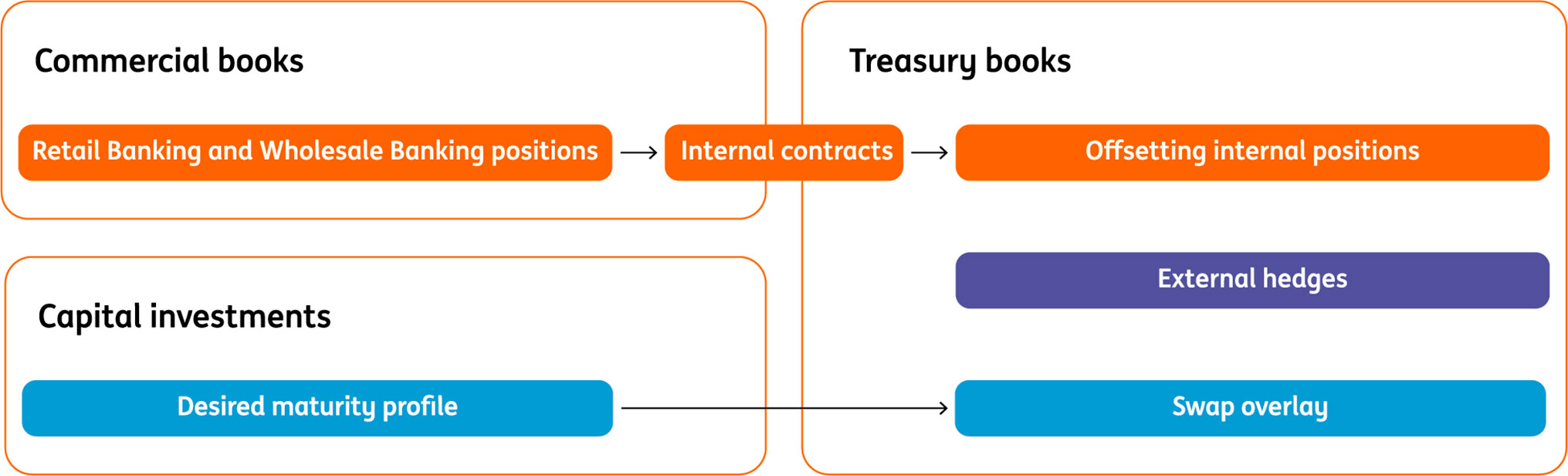
Risk measurement (*)
The main concepts and metrics used for measuring market risk in the banking book are described below per risk type.
Interest rate risk in banking book (*)
Interest rate risk in the banking book is defined as the exposure of a bank’s earnings, capital, and market value to adverse movements in interest rates originated from positions in the banking book.
ING centralises interest rate risk management from commercial books (that capture the products sold to clients) to globally managed interest rate risk books. This enables a clear demarcation between commercial business results and results based on unhedged interest rate positions.
ING distinguishes between three types of activities that generate interest rate risk in the banking book:
•Investment of own funds.
•Commercial business.
•Group Treasury exposures including strategic interest rate positions.
Group Treasury is responsible for managing the investment of own funds (core capital). Capital is invested for longer periods to contribute to stable earnings within the risk appetite boundaries set by ALCO Bank. The main objective is to maximise the economic value of the capital investment book while having stable earnings.
Commercial activities can result in linear interest rate risk due to different re-pricing properties of assets and liabilities. Also, interest rate risk can arise from customer behaviour and/or convexity risk, depending on the nature of the underlying product characteristics.
ING Group Annual Report 2024 on Form 20-F 185
To determine the interest rate risk in particular products (like savings, mortgages) specific assumptions may need to be made. Customer behaviour risk is defined as the potential future (value) loss due to deviations in the actual behaviour of clients versus the modelled behaviour with respect to the embedded options in commercial products. General sources of customer behaviour risk, among other things, include the state of the economy, competition, changes in regulation, legislation and tax regime, developments in the housing market and interest rate developments.
From an interest rate risk perspective, commercial activities can typically be divided into the following main product types: savings and current accounts (funds entrusted), demand deposits, mortgages and loans.
Savings and demand deposits are generally invested in such a way that both the value is hedged and the sensitivity of the margin to market interest rates is minimised. This is achieved by creating the investment profile distributed from short term to long term, which dampens the immediate impact from changes in the market rates as well as stabilises margin in the longer horizon. Interest rate risk is modelled based on the stability of deposits and the pass-through rate. This takes account of different elements, such as pricing strategies, volume developments and the level and shape of the yield curve.
Interest rate risk for mortgages arises due to prepayment or other embedded optionalities. In modelling this risk, both interest-rate-dependent pre-payments and constant prepayments are considered. Next to a dependence on interest rates, modelled prepayments may include other effects such as loan-to-value, seasonality and the reset date of the loan. In addition, the interest sensitivity of embedded offered rate options may be considered.
Wholesale Banking loans typically do not experience interest-rate-dependent prepayment behaviour. These portfolios are match-funded, taking the constant prepayment model into account, and typically do not contain significant convexity risk. Wholesale Banking loans can have an all-in rate floor or a floor on a reference rate.
Customer behaviour in relation to mortgages, loans, savings and demand deposits is modelled, based on extensive analysis of historical data. However, the substantial change in the interest rate environment in recent years makes the analysis more challenging than before and may increase model risk. Models are backtested and updated when deemed necessary in an annual procedure. Model parameters and the resulting risk measures are approved by (local) ALCO, and are closely monitored on a monthly basis.
Linear risk transfers take place from commercial business books to the treasury book (Group Treasury), if necessary, by using estimations of customer behaviour. The originating commercial business is ultimately responsible for estimating this customer behaviour, leaving convexity risk and (unexpected) customer behaviour risk with the commercial business. Risk measurement and the risk transfer process take place at least monthly. If deemed necessary, additional risk transfers can take place.
The commercial business manages the convexity risk that is the result of products that contain embedded options, like mortgages. Here the convexity risk is defined as the optionality effects in the value due to interest rate changes, excluding the first-order effects. In some cases, convexity risk is transferred from the commercial books to treasury books using cap/floor contracts and swaptions.
In the following sections, the interest rate risk exposures in the banking books are presented. ING quantifies risk measures from both earnings and value perspectives. Net interest income (NII)-at-Risk is used to provide the earnings perspective and the net present value (NPV)-at-Risk figures provide the value perspective. Please note that the NPV-at-Risk is measured under a direct interest rate shock. Hence no additional, corrective hedges are included in the measure. The NII-at-Risk measure is measured for interest rate movements over a period, whereby (assumed) corrective hedges are included in the risk metric.
Net interest income (NII) at Risk (*)
The NII-at-Risk measures the impact of changing interest rates on the forecasted net interest income (before tax) of the banking book, excluding the impacts of credit spread sensitivity, fees and fair value impact. Future projected balance sheet developments (dynamic plan) are included in this risk metric. NII-at-Risk provides insight into the sensitivity of ING’s NII under shocked interest rate scenarios against what is projected in a base case scenario.
In its risk management, ING monitors the NII-at-Risk under a three-year time frame. Interest rates are shocked during the first year of analysis through the gradual application of shock. The rate changes considered encompass both upward and downward scenarios, as well as both parallel (equal movements across the yield curve) and non-parallel scenarios.
The impact of changing interest rates on ING’s NII is predominantly caused by the following factors:
•Change in returns of (re)investments of client deposits;
•Change in client deposit rates (mainly savings), (partially) tracking changes in market interest rates;
•Change in the amortisation profile of mortgages, due to an increase or decrease in expected prepayments;
•Higher/lower returns of (re-)investments of capital investment;
•Open interest rate positions, leading to changes in return because of different market rates; and
•Assumed volume development of the balance sheet in line with ING’s dynamic plan.
For projecting the change in client deposit rates, ING uses a client rate model that describes the relation between market interest rates and client deposit rates. The model is calibrated under a range of interest rate scenarios. Per scenario, the actual change in client deposit rates may deviate from this calibrated model. The actual NII development of customer deposits may, indeed, differ from the provided scenarios, depending on, among other things, actual interest rate and savings client rate evolution, as well as changes to ING’s
ING Group Annual Report 2024 on Form 20-F 186
balance sheet composition, such as net deposit growth and relative share of savings deposits and non-remunerated current accounts.
The NII-at-Risk figures in the table below reflect a parallel, linear interest rate movement during a year ('ramped') under the assumption of balance sheet developments in line with ING’s dynamic plan with a time horizon of one year. The majority of the risk comes from fixed-rate positions, most notably non-remunerated current accounts and variable-rate savings accounts.
The NII-at-Risk is mainly influenced by the difference in the sensitivity between client liabilities and client assets and investments to rate changes. The primary factor of NII-at-Risk are the investments of current accounts, while the investments of own funds have a marginal effect, as only a relatively small portion needs to be (re)invested within a one-year period.
| | | | | | | | | | | | | | |
| NII-at-Risk banking book per currency - year one (*) |
| in € million | 2024 | 2023 |
| Ramped, floored | Ramped, floored |
| parallel ▼ | parallel ▲ | parallel ▼ | parallel ▲ |
| By currency | | | | |
| Euro | -146 | | 160 | | -165 | | 155 | |
| US dollar | -4 | | 5 | | -12 | | 12 | |
| Other | -2 | | 21 | | -62 | | 69 | |
| Total | -153 | | 186 | | -239 | | 236 | |
EUR ramped (floored at -100bps) is at +/- 120bps in 1 year (2023: +/-110bps) |
USD ramped (floored at -100bps) is at +/- 120bps in 1 year (2023: +/-110bps) |
The change in NII under declining and upward interest rate scenarios may not be equal. This is due to different expected reactions in prepayment behaviour of mortgages and different pricing developments of commercial loans and deposits products (mainly savings). This is caused by embedded options, explicit or implicit pricing floors and other (assumed) pricing factors.
The metrics mentioned above are internal metrics, which therefore deviate from the regulatory NII SOT metrics.
Year-on-year variance analysis (*)
In 2024, in response to falling inflation, most central banks (including ECB and FED) began to ease their monetary policy, executing series of rates cuts. ING applied a dynamic hedging process, by which interest rate risk was transferred from the business to Group Treasury and subsequently hedged in the markets. The impact of explicit and implicit floors on both rates of client assets and savings remains limited. Pre-existing hedges, as executed by Group Treasury, were also adjusted continuously throughout the year to hedge any interest rate risk coming from lower interest rates. Most of the year-on-year change in NII sensitivity is due to enhancements in risk management framework in one of non-EUR locations. These enhancements are aimed at mitigating sensitivity in a volatile rate environment and include increasing the granularity of risk transferred positions and implementing limits to trigger an intra-month recalibration of the hedges. Excluding model risk, the total NII-at-Risk remains relatively limited in comparison to ING’s total interest income.
Net present value (NPV) at Risk (*)
NPV-at-Risk measures the impact of changing interest rates on the value of the positions in the banking book. The NPV-at-Risk is defined as the outcome of an instantaneous increase or decrease in interest rates from applying currency-specific scenarios. The NPV-at-Risk asymmetry between the downward and upward shock is mainly caused by convexity risk in the mortgage and savings portfolio.
The full value impact cannot be directly linked to the financial position or profit or loss account, as fair value movements in banking books are not necessarily reported through the profit or loss account or through other comprehensive income (OCI). The changes in value are expected to materialise over time in the profit and loss account if interest rates develop according to forward rates throughout the remaining maturity of the portfolio. The majority of the risk comes from the investments of own funds and from positions exhibiting negative convexity due to embedded optionality (most notably variable rate savings and fixed rate mortgages).
The metrics mentioned above are internal metrics, which therefore deviate from the regulatory EVE SOT metrics.
ING Group Annual Report 2024 on Form 20-F 187
| | | | | | | | | | | | | | |
| NPV-at-Risk banking books per currency (*) |
| in € million | 2024 | 2023 |
| floored | floored |
| parallel ▼ | parallel ▲ | parallel ▼ | parallel ▲ |
| By currency | | | | |
| Euro | 154 | | -1,613 | | -291 | | -645 | |
| US dollar | 274 | | -266 | | 186 | | -178 | |
| Other | 321 | | -329 | | 131 | | -146 | |
| Total | 749 | | -2,208 | | 27 | | -969 | |
EUR (floored at -100bps) is at +/- 120bps (2023: +/-110bps) |
USD (floored at -100bps) is at +/- 120bps (2023: +/-110bps) |
Year-on-year variance analysis (*)
The overall NPV sensitivity increased considerably over last year. The worst-case scenario remains the parallel up, while the shock used in calculation for main currencies (EUR and USD) increased from 110bps to 120bps on the back of increased volatility observed in the market during 2023. This increase partially explains the observed higher sensitivity. The other important factor impacting end of 2024 utilisation is convexity: with lower interest rates, the increase in convexity on mortgages and savings accounts was observed, especially for EUR positions. Lastly, Group Treasury actively managed the position and executed investments for capital in the anticipation of possible further rates decreases.
The impact of the benchmark rate reform (*)
In line with the recommendations of the Financial Stability Board, a fundamental review of important interest rates benchmarks has been undertaken. Some interest rate benchmarks have been reformed, while others have or will be replaced by risk-free rates and discontinued. USD LIBOR in its current form ceased on 30 June 2023, whereas the cessation of GBP, CHF, JPY, and EUR LIBOR rates occurred on 31 December 2021.
To support these changes, the financial sector has issued several guidance papers and other initiatives to help phase the transition. In 2024, the benchmark rate reform of only one reference rate, to which the Group has significant exposures as at 31 December 2024, was continuing (i.e. WIBOR). The WIBOR rate is expected to be ceased and replaced by a risk-free rate (RFR) by 31 December 2027.
The Steering Committee of the National Working Group (NWG SC) appointed in connection with the WIBOR benchmark reform the decision (published on 10 December 2024) on the selection of the proposed index with the technical name 'WIRF –' as the ultimate interest rate benchmark in Poland to replace the WIBOR benchmark. On 24 January 2025, the Steering Committee of the National Working Group has selected target name POLSTR (Polish Short Term Rate) for this index. The chosen index is calculated based on unsecured
deposits of Credit and Financial Institutions. Thus, the NWG SC has reviewed and modified its previous decision to select WIRON as alternative RFR in Poland. The WIBOR rate is still expected to be ceased and replaced by a new RFR ("WIRF -") by 31 December 2027.
Due to the discontinuation of WIBOR, ING, its customers, and in general those market participants with exposure to such benchmark rates will be faced with a number of risks. These risks include legal, financial, operational, reputational and conduct risk. The WIBOR rates are used in several of our lending and derivative products, and hence a project team has been established to manage the transition. WIBOR transition is especially important for our Polish subsidiary (ING Bank Śląski S.A.) with a significant amount of Polish zloty-denominated assets and liabilities including derivatives that are continuously rebalanced to hedge the risk exposures.
The tables below summarise the approximate gross exposures of ING that have yet to transition related to USD LIBOR and WIBOR, excluding exposures expiring before the transition date 31 December 2027 for WIBOR.
| | | | | | | | | | | |
| Non-derivative financial instruments to transition to alternative benchmarks (*) |
| Financial assets non-derivative | Financial liabilities non-derivative | Off balance sheet commitments |
| in € million at 31 December 2024 | Carrying value | Carrying value | Nominal value |
| By benchmark rate | | | |
| | | |
| USD LIBOR | | | | | | |
| | | |
| | | |
| | | |
| | | |
| WIBOR | 19,202 | | 134 | | 1,544 | |
| Total | 19,202 | | 134 | | 1,544 | |
| | | |
| in € million at 31 December 2023 | | | |
| By benchmark rate | | | |
| USD LIBOR | 915 | | 16 | | 9 | |
| WIBOR | 18,064 | | | | 1,021 | |
| Total | 18,979 | | 16 | | 1,030 | |
ING Group Annual Report 2024 on Form 20-F 188
| | | | | | | | |
| Derivative financial instruments to transition to alternative benchmarks (*) |
| 31 December 2024 | 31 December 2023 |
| in € million | Nominal value | Nominal value |
By benchmark rate | | |
| | |
| USD LIBOR | | | 151 | |
| WIBOR | 110,189 | | 77,238 | |
| | |
| | |
| | |
| Total | 110,189 | | 77,388 | |
See sections 1.5.4 and 1.5.7 of Note 1 ‘Basis of preparation and material accounting policy information’ for information on the Phase 1 and Phase 2 amendments.As at 31 December 2024, Phase 1 reliefs are applicable to WIBOR indexed fair value and cash flow hedge accounting relationships as there is uncertainty arising from the WIBOR reform with respect to the timing and the amount of the underlying cash flows that the Group is exposed to. Therefore, for WIBOR financial instruments designated in hedge accounting the applicable Phase 1 reliefs will continue to apply until the relevant contract is modified. At that point in time, Phase 2 reliefs will become applicable. For these affected fair value and cash flow hedge relationships, ING assumes that the WIBOR-based cash flows from the hedging instrument and hedged item will remain unaffected.
The same assumption is used to assess the likelihood of occurrence of the forecast transactions that are subject to cash flow hedges. The hedged cash flows in cash flow hedges directly impacted by the WIBOR reform still meet the highly probable requirement, assuming the WIBOR benchmark on which the hedged cash flows are based is not altered as a result of the reform.
The total gross notional amounts of hedging instruments that are used in the ING’s hedge accounting relationships for which the Phase 1 amendments to IAS 39 were applied are:
| | | | | | | | |
| Notional amounts of hedging instruments (*) |
| 31 December 2024 | 31 December 2023 |
| in € million | Nominal value | Nominal value |
By benchmark rate | | |
| WIBOR | 99,663 | | 89,338 | |
| | |
| | |
As at 31 December 2024, 32% (31 December 2023: 29%) of the notional amounts for WIBOR have a maturity date beyond 31 December 2027. The notional amounts of the derivative hedging instruments provide a close approximation of the extent of the risk exposure ING manages through these hedging relationships.
Credit spread risk in banking books (CSRBB) (*)
Credit spread risk is defined as risk driven by the changes of the market price for credit risk, for liquidity and potentially other characteristics of credit-risky instruments, which is not captured by another existing prudential framework such as IRRBB or by expected credit/(jump-to-) default risk. CSRBB framework is implemented based on EBA Guidelines. Metrics used are NPV-at-Risk, NII-at-Risk and Market Value Changes-at Risk and view the positions across different accounting treatments.
Credit spread risk is not part of the internal risk transfer towards Group Treasury and therefore remains in the business unit it originated in. Group Treasury itself is also an important driver of credit spread risk via its HQLA investment portfolio and issuance activities.
Risk appetite limits are set on a combination of metrics and accounting scopes and are cascaded to local ALCOs depending on the type of limit and materiality. Metrics and limits are monitored and reported monthly to ALCO Bank, local ALCOs and various stakeholders.
Foreign exchange (FX) risk in banking books (*)
FX exposures in banking books result from core banking business activities (business units doing business in currencies other than their base currency), foreign currency investments in subsidiaries (including realised net profit and loss), and strategic equity stakes in foreign currencies. The policy regarding these exposures is briefly explained below.
Core banking business (*)
Every business unit hedges the FX risk resulting from core banking business activities into its base currency to prevent volatility in profit and loss. Consequently, assets and liabilities are matched in terms of currency, within certain friction limits.
FX translation (*)
ING’s strategy is to protect the CET1 ratio against adverse impact from FX rate fluctuations, while limiting the volatility in the profit and loss account due to this CET1 hedging and limiting the RWA impact under the regulatory framework. Hedge accounting is applied to the largest extent possible. Taking this into account, the CET1 ratio hedge can be achieved by deliberately taking foreign currency positions equal to certain target positions, such that the CET1 capital and risk-weighted assets are equally sensitive in relative terms to changing FX rates.
Risk profile – FX translation (*)
The following table presents the currency exposures in the banking books for the most important currencies for the FX translation result. Positive figures indicate long positions in the respective currency. As a result of the strategy to hedge the CET1 ratio an open structural FX exposure exists.
ING Group Annual Report 2024 on Form 20-F 189
To measure the volatility of the CET1 ratio from FX rate fluctuations, different metrics are used, including the CET1 Ratio-at-Risk. The impact is controlled via the Solvency and Financial Risk RAS.
EBA Structural FX guidelines
In line with the EBA guidelines on Structural FX, upon permission from the competent authorities, certain currency positions are being excluded from the calculation of net open currency positions under CRR article 352(2). The resulting impact is presented in the Pillar 3 disclosure.
| | | | | | | | | | | | | | | | | | | | |
| Foreign currency exposures banking books (*) |
| in € million | Foreign Investments | Hedges | Net exposures |
| 2024 | 2023 | 2024 | 2023 | 2024 | 2023 |
| US Dollar | 11,251 | | 10,337 | | -4,823 | | -3,416 | | 6,429 | | 6,921 | |
| Pound Sterling | 1,674 | | 1,659 | | -484 | | -156 | | 1,190 | | 1,503 | |
| Polish Zloty | 4,292 | | 3,976 | | -1,616 | | -1,254 | | 2,677 | | 2,722 | |
| Australian Dollar | 3,373 | | 3,620 | | -2,161 | | -2,273 | | 1,212 | | 1,346 | |
| Turkish Lira | 557 | | 517 | | 0 | | 0 | | 557 | | 517 | |
| Chinese Yuan | 2,439 | | 1,815 | | -830 | | -348 | | 1,609 | | 1,466 | |
| Russian Rouble | 396 | | 375 | | 0 | | 0 | | 396 | | 375 | |
| Romanian Leu | 913 | | 895 | | -176 | | -134 | | 736 | | 761 | |
| Thai Baht | 1,266 | | 1,128 | | -838 | | -697 | | 428 | | 431 | |
| Other currency | 3,346 | 3,704 | -2,748 | -2,897 | 599 | 806 |
| Total | 29,509 | 28,024 | -13,675 | -11,175 | 15,834 | 16,849 |
* The FX sensitivity is expressed as the FX spot equivalent position.
Equity price risk in banking books (*)
ING maintains a portfolio with substantial equity exposure in its banking books.
Risk profile (*)
Equity price risk arises from the possibility that an equity security’s price will fluctuate, affecting the values of the equity security itself as well as other instruments whose values react similarly to the particular security, a defined basket of securities, or a securities index. ING’s equity exposure mainly consists of the investments in associates and joint ventures of €1,679 million (2023: €1,509 million) and equity securities held at fair value through other comprehensive income (FVOCI) of €2,562 million (2023: €1,885 million).The value of equity securities held at FVOCI is directly linked to equity security prices with increases/decreases being recognised in the revaluation reserve. Investments in associates and joint ventures are measured in
accordance with the equity method of accounting, and the balance sheet value is therefore not directly linked to equity security prices. The equity sensitivity is expressed as the equity position.
Year-on-year variance analysis (*)
In 2024, the revaluation reserve equity securities increased by €664 million from €1,152 million to €1,816 million mainly due to revaluation of the shares in Bank of Beijing with €652 million. In 2024, the equity securities at fair value through OCI increased by €678 million.
| | | | | | | | |
| Revaluation reserve equity securities at fair value through other comprehensive income (*) |
| in € million | 2024 | 2023 |
| Positive re-measurement | 1,820 | | 1,158 | |
| Negative re-measurement | -4 | | -6 | |
| Total | 1,816 | | 1,152 | |
Market risk in trading books (*)
Within the trading portfolios, the positions are maintained in the financial markets. These positions are often a result of transactions with clients and may benefit from short-term price movements. In 2024, ING continued its strategy of undertaking trading activities to develop its client-driven franchise and deliver a differentiating experience by offering multiple market and trading products.
With respect to the trading portfolios, Trading Risk Management (TRM) focuses on the management of market risks of Wholesale Banking (mainly Financial Markets) as this is the only business line within ING where trading activities take place. Trading activities include facilitation of client business and market making. TRM is responsible for the development and implementation of trading risk policies and risk measurement methodologies, and for reporting and monitoring risk exposures against approved trading limits. TRM also reviews trading mandates and global limits, and performs the gatekeeper role in the product review process (PARP).
Risk measurement (*)
ING uses a comprehensive set of methodologies and techniques to measure market risk in trading books: Value at Risk (VaR) and Stressed Value at Risk (SVaR), Incremental Risk Charge (IRC), and stress testing. Systematic validation processes are in place to validate the accuracy and internal consistency of data and parameters used for the internal models and modelling processes.
Value at Risk (*)
TRM uses the historical simulation VaR methodology (HVaR) as its primary risk measure. The HVaR for market risk quantifies, with a one-sided confidence level of 99 percent, the maximum overnight loss that
ING Group Annual Report 2024 on Form 20-F 190
could occur in the trading portfolio of ING due to changes in risk factors (e.g. interest rates, equity prices, foreign exchange rates, credit spreads, implied volatilities) considering the positions remain unchanged for a time period of one day.
Next to general market movements in these risk factors, HVaR also takes into account market data movements for specific moves in, for example, the underlying issuer or securities. A single model which diversifies general and specific risk is used. In general, a full revaluation approach is applied, while for a limited number of linear trading positions and risk factors in commodity and equity risk classes a sensitivity-based approach is applied. The potential impact of historical market movements on today’s portfolio is estimated, based on equally weighted observed market movements of the previous year (260 business days). When simulating potential movements in risk factors, depending on the risk factor type, either an absolute or a relative shift is used.
The data used in the computations is updated daily. ING uses HVaR with a one-day horizon for internal risk measurement, management control, and backtesting, and HVaR with a 10-day horizon for determining regulatory capital. To compute HVaR with a 10-day horizon, the one-day risk factor shifts are scaled by the square root of 10 and then used as an input for the revaluation. The same model is used for all legal entities within ING with market risk exposure in the trading portfolio.
Limitations (*)
HVaR has some limitations: it uses historical data to forecast future price behaviour, but future price behaviour could differ substantially from past behaviour. Moreover, the use of a one-day holding period (or 10 days for regulatory capital calculations) assumes that all positions in the portfolio can be liquidated or hedged in one day. In periods of illiquidity or market events, this assumption may not hold. Also, the use of a 99 percent confidence level means that HVaR does not take into account any losses that occur beyond this confidence level.
Backtesting (*)
Backtesting is a technique for the ongoing monitoring of the plausibility of the HVaR model in use. Although HVaR models estimate potential future trading results, estimates are based on historical market data. In a backtest, the actual daily trading result (excluding fees and commissions) is compared with the one-day HVaR.
In addition to using actual results for backtesting, ING also uses hypothetical results, which exclude the effects of intraday trading, fees, and commissions. When an actual or a hypothetical loss exceeds the HVaR, an ‘outlier’ occurs. Based on ING’s one-sided confidence level of 99 percent, an outlier is expected once in every 100 business days.
On an overall level in 2024, there was one outlier for hypothetical P&L and zero outliers for actual P&L. The hypothetical outlier occurred in the third quarter of 2024, mainly due to higher interest rate and FX market movements.
Stressed HVaR (*)
The stressed HVaR (SVaR) is intended to replicate the HVaR calculation that would be generated on the bank’s current portfolio with inputs calibrated to the historical data from a continuous 12-month period of significant financial stress relevant to the bank’s portfolio.
To calculate SVaR, ING uses the same model that is used for 1DHVaR, with a 10-day horizon. The data for the historical stress period used currently includes the height of the credit crisis around the fall of Lehman Brothers (2008-2009), and this choice is reviewed regularly. The historical data period is chosen so that it gives the worst-scenario loss estimates for the current portfolio. The same SVaR model is used for management purposes and for regulatory purposes. The same SVaR model is used for all legal entities within ING with market risk exposure in the trading portfolio.
Incremental risk charge (*)
The incremental risk charge (IRC) for ING is an estimate of the default and migration risks for credit products (excluding securitisations) in the trading book, over a one-year capital horizon, with a 99.9 percent confidence level. Trading positions (excluding securitisations) of ING, which are subject to specific interest rate risk included in the internal model approach for market risk regulatory capital, are in scope of the IRC model. By model choice, equity is excluded from the model. For the calculation of IRC, ING performs a Monte Carlo simulation based on a multi-factor t-copula. In the multi-factor IRC model the supervisory asset correlations are no longer applicable and the calibration of the correlations is based on historical market data. The rating change is simulated for all issuers over the different liquidity horizons (i.e. time required to liquidate the position or hedge all significant risks) within one year. Movements across different rating categories and probabilities of default are governed by a credit-rating transition matrix. An internal transition matrix along with internal LGDs is used, to comply with the consistency requirement. The financial impact is then determined for the simulated migration to default, or for the simulated migration to a different rating category, based on LGD or credit spread changes, respectively.
The liquidity horizon has been set to the regulatory minimum of three months for all positions in scope. ING reviews the liquidity horizons on a yearly basis, based on a structured assessment of the time it takes to liquidate the positions in the trading portfolio.
Stress testing and event risk (*)
Stress testing is a valuable risk management tool. In addition to the bank-wide stress-test framework as described in the stress-testing section, Trading Risk Management performs stress tests specific to the trading book with various frequencies. The trading book stress tests evaluate the impact on the bank’s trading book
ING Group Annual Report 2024 on Form 20-F 191
under severe but plausible stress scenarios, using a full revaluation approach. The framework is based on historical as well as hypothetical scenarios. The stress result is an estimate of the profit and loss caused by a potential event and its worldwide impact for ING. The results of the stress tests are used for decision-making, aimed at maintaining a financially healthy going-concern institution after a severe event occurs.
In stress scenarios, shocks are applied to prices (credit spreads, interest rates, equity, commodities, and FX rates) and volatilities. Depending on the type of the stress test, additional scenario assumptions can be made, for example on correlations, dividends, or recovery rates. The structural scenarios are defined to cover market moves in various directions and capture different asset class correlations. Scenarios are calculated using full revaluation approach. The worst scenarios are determined for each product line, business line and super business line, and compared against limits.
Other trading controls
HVaR and event risk limits are the most important limits to control the trading portfolios. Additionally, limits have been set on SVaR and IRC, and ING uses a variety of other controls to supplement these limits. Position and sensitivity limits are used to prevent large concentrations in specific issuers, sectors, or countries. Moreover, other risk limits are set with respect to the activities in complex derivatives trading. The market risk of these products is controlled by product-specific limits and constraints.
Risk profile
The following chart shows the development of the overnight HVaR under a 99 percent confidence level and a one-day horizon versus actual and hypothetical daily trading profits and losses. In calculation of the hypothetical daily profit and loss, the trading position is kept constant and only the market movement is taken into account. The overnight HVaR is presented for the ING trading portfolio for 2024.
The risk figures in the above backtesting graph and in the table below relate to all trading books for which the internal model approach is applied.
| | | | | | | | | | | | | | | | | | | | | | | | | | |
| 1d VaR for internal model approach trading portfolios |
| in € million | Minimum | Maximum | Average | Year end |
| 2024 | 2023 | 2024 | 2023 | 2024 | 2023 | 2024 | 2023 |
Interest rate 1 | 6 | | 6 | | 17 | | 23 | | 12 | | 15 | | 11 | | 8 | |
| Equity and commodity | 2 | | 2 | | 7 | | 4 | | 4 | | 3 | | 6 | | 2 | |
| Foreign exchange | 1 | | 1 | | 14 | | 8 | | 3 | | 3 | | 2 | | 2 | |
| Credit spread | 2 | | 2 | | 12 | | 10 | | 4 | | 5 | | 3 | | 5 | |
Diversification 2 | | | | | -7 | | -8 | | -6 | | -8 | |
Total VaR 2 | 7 | | 9 | | 21 | | 29 | | 15 | | 18 | | 16 | | 9 | |
| | | | | | | | |
1For calculation of HVaR per risk class the full valuation is performed according to HVaR methodology using a set of scenario changes for the risk factors for the particular risk class, while risk factors for all other risk classes are kept unchanged. 2The total HVaR for the columns Minimum and Maximum cannot be calculated by taking the sum of the individual components since the minimum/maximum observations for both the individual markets as well as for total HVaR may occur on different dates. Therefore, diversification is not calculated for the minimum and maximum categories.
|
|
Average 1D/10D HVaR and IRC over 2024 has decreased compared to 2023, while average 10D SVaR went up. The overall average has decreased in 2024, for all trading portfolios. The first half of 2024 was
ING Group Annual Report 2024 on Form 20-F 192
characterised by less elevated levels of volatility compared to 2023. In the second half of 2024, the volatility increased due to the geopolitical risks stemming from the ongoing Russia-Ukraine and Middle East conflicts and the impending US elections as well as risks of economic slowdown.The year-end 1D HVaR has increased at period end of 2024, due to higher volatility in interest rates, equity and commodity markets.
ING doesn’t calculate comprehensive risk capital charge and therefore it appears as n/a in the table below.
| | | | | | | | |
| EU MR3: internal model approach values for trading portfolios |
| in € million | 2024 | 2023 |
| VaR (10 day 99%) | | |
| 1 Maximum value | 73 | | 84 | |
| 2 Average value | 48 | | 53 | |
| 3 Minimum value | 29 | | 25 | |
| 4 Period end | 47 | | 25 | |
| Stressed VaR (10 day 99%) | | |
| 5 Maximum value | 175 | | 116 | |
| 6 Average value | 109 | | 82 | |
| 7 Minimum value | 56 | | 57 | |
| 8 Period end | 98 | | 69 | |
| Incremental risk charge (99.9%) | | |
| 9 Maximum value | 232 | | 304 | |
| 10 Average value | 125 | | 151 | |
| 11 Minimum value | 64 | | 48 | |
| 12 Period end | 100 | | 108 | |
| Comprehensive risk capital charge (99.9%) | | |
| 13 Maximum value | n/a | n/a |
| 14 Average value | n/a | n/a |
| 15 Minimum value | n/a | n/a |
| 16 Period end | n/a | n/a |
Standardised approach
| | | | | | | | |
| EU MR1: market risk under standardised approach |
| in € million | 2024 | 2023 |
| RWA | RWA |
| Outright products | | |
| 1 Interest rate risk (general and specific) | 31 | | 40 | |
| 2 Equity risk (general and specific) | | |
| 3 Foreign exchange risk | 4,374 | | 4,811 | |
| 4 Commodity risk | | |
| Options | | |
| 5 Simplified approach | | |
| 6 Delta-plus method | | |
| 7 Scenario approach | | |
| 8 Securitisation (specific risk) | | |
9 Total | 4,405 | | 4,851 | |
The MRWA under standardised approach have decreased compared to 2024.
ING Group Annual Report 2024 on Form 20-F 193
Internal model approach
Market risk regulatory capital has decreased during 2024 compared to 2023. This mainly reflects lower interest rate positions during 2024, as well as the reduced regulatory-driven capital multiplier.
| | | | | | | | | | | | | | | | | |
| EU MR2-A: Market risk under Internal Model Approach |
| in € million | 2024 | 2023 |
| | RWA | Total own funds requirements | RWA | Total own funds requirements |
| 1 | VaR (higher of values a and b) | 1,964 | 157 | 2,508 | 201 |
| (a) | Previous day’s VaR (VaRt-1) | | 49 | | | 26 | |
| (b) | Multiplication factor (mc) x average of previous 60 working days (VaRavg) | | 157 | | | 201 | |
| 2 | SVaR (higher of values a and b) | 4,915 | | 393 | | 4,385 | | 351 | |
| (a) | Latest available SVaR (SVaRt-1)) | | 116 | | | 75 | |
| (b) | Multiplication factor (ms) x average of previous 60 working days (sVaRavg) | | 393 | | | 351 | |
| 3 | IRC (higher of values a and b) | 1,457 | | 117 | | 1,746 | | 140 | |
| (a) | Most recent IRC measure | | 116 | | | 108 | |
| (b) | 12 weeks average IRC measure | | 117 | | | 140 | |
| 4 | Comprehensive risk measure (higher of values a, b and c) | | | | |
| (a) | Most recent risk measure of comprehensive risk measure | | | | |
| (b) | 12 weeks average of comprehensive risk measure | | | | |
| (c) | Comprehensive risk measure - Floor | | | | |
| 5 | Other | 340 | | 27 | | 810 | | 65 | |
| 6 | Total | 8,676 | | 694 | | 9,449 | | 756 | |
Sensitivities (*)
As part of the risk monitoring framework, TRM actively monitors the sensitivities of the trading portfolios. Sensitivities measure the impact of movements in individual market risk factors (foreign exchange rates, interest rates, credit spreads, equity and commodity prices) on profit and loss results of the trading positions and portfolios.
The following tables show the five largest trading positions in terms of sensitivities to foreign exchange, interest rate and credit spread risk factor movements. These largest exposures also reflect concentrations of risk in FX risk per currency, interest rate risk per currency, and credit spread risk per country, rating and sector. Due to the nature of the trading portfolios, positions in the portfolios can change significantly from day to day, and sensitivities of the portfolios can change daily accordingly.
| | | | | | | | | | | |
| Most important foreign exchange year-end trading positions (*) |
| in € million | 2024 | | 2023 |
| Foreign exchange | | Foreign exchange | |
| US Dollar | -93 | | Japanese Yen | 61 | |
| Turkish Lira | 84 | | Taiwan Dollar | -58 | |
| Korean Won | 62 | | Romanian Leu | 58 | |
| Japanese Yen | 61 | | Chinese Yuan | 49 | |
| Chinese Yuan | -37 | | Hong Kong Dollar | -38 | |
| | | | | | | | | | | |
| Most important interest rate and credit spread sensitivities at year-end (*) |
| in € thousand | 2024 | | 2023 |
Interest rate (BPV) 1 | | Interest rate (BPV) 1 | |
| Euro | -799 | | Euro | -309 | |
| US Dollar | -198 | | Czech Koruna | 71 | |
| British Pound | -189 | | Korean Won | -41 | |
| Korean Won | -54 | | US Dollar | -40 | |
| Philippine Peso | -54 | | British Pound | -35 | |
| | | |
Credit spread (CSO1) 2 | | Credit spread (CSO1) 2 | |
| United States | 193 | | Germany | 405 | |
| Netherlands | -165 | | Netherlands | 120 | |
| France | -113 | | Korea | -111 | |
| Poland | 69 | | Japan | 106 | |
| Germany | 49 | | United Kingdom | 101 | |
1Basis point value (BPV) measures the impact on value of a one basis point increase in interest rates. 2Credit Spread Sensitivity (CS01) measures the impact on value of a one basis point increase in credit spreads. Exposures to supranational institutions are not assigned to a specific country. |
ING Group Annual Report 2024 on Form 20-F 194
| | | | | | | | | | | | | | |
| Credit spread sensitivities per risk class and sector at year-end (*) |
| 2024 | 2023 |
| in € thousand | Corporate | Financial institutions | Corporate | Financial institutions |
Credit spread (CSO1) 1 | | | | |
| Risk classes | | | | |
| 1 (AAA) | -2 | | -118 | | 0 | | 0 | |
| 2–4 (AA) | -44 | | -27 | | 12 | | 50 | |
| 5–7 (A) | 49 | | -246 | | 57 | | 50 | |
| 8–10 (BBB) | 93 | | -76 | | 106 | | 13 | |
| 11–13 (BB) | 38 | | -13 | | 25 | | -25 | |
| 14–16 (B) | 23 | | -12 | | 17 | | -4 | |
| 17–22 (CCC and NPL) | 4 | | 2 | | -8 | | -20 | |
| | | | |
| Total | 162 | | -489 | | 208 | | 65 | |
1Credit Spread Sensitivity (CS01) measures the impact on value of a 1 basis point increase in credit spreads. |
Market risk capital
Economic capital
Market risk economic capital (MREC) measures the capital ING must hold to protect itself against losses due to market risks. MREC covers the entire balance sheet of ING Group, and includes market risk sub-types such as: interest rate and basis risk, credit spread risk, customer behaviour risk, FX risk, equity risk and commodity risk.
MREC is calculated as the 99.9 percent worst value loss that can be incurred from one-year shocks to the underlying risk drivers. While aggregating the different economic capital market risk figures for the different portfolios, diversification benefits are taken into account as it is not expected that all extreme market movements will appear at the same moment.
Regulatory capital
Market risk regulatory capital is the amount of capital that ING has to hold to protect itself against losses due to market risks, as required by the financial regulator. From a regulatory capital perspective, market risk stems from all the positions included in a bank’s trading book, as well as from commodity and foreign exchange risk positions in the whole balance sheet of ING Group. According to the Capital Requirements Regulation (CRR/CRD IV), regulatory capital (own funds requirements) for market risk can be calculated using the standardised approach or an internal model approach.
FX risk in banking book
Regulatory Capital requirements for FX risk in banking book is set out in Part 3, Title IV, Chapter 3 of the Capital Requirements Regulation (CRR). This is further supplemented by EBA guidelines on Structural FX for the calculation of the net open currency positions (CRR Art 352(2)). ING uses the standardised approach where the capital requirement is 8 percent of this total net currency and gold position.
Equity risk in banking book
Equity regulatory capital is included as part of Credit RWA as prescribed by regulations. ING uses the simple risk weight approach (SRWA) under the IRB (internal ratings-based) approach for the calculation of Regulatory Capital as described in Capital Requirements Regulation (CRR) Art 155. Under SRWA, the RWA amount is calculated by multiplying the risk weight with the exposure value (not tailored to a specific internal model). The capital requirement is 8 percent of the RWA value.
Trading book
ING has regulatory approval to use an internal model to determine the regulatory capital for the market risk in all trading books of ING. Market risk capital of trading books is calculated according to the CRR, using internal HVaR, SVaR and IRC models, where diversification is taken into account. Collective investment undertakings (CIUs) exposures in trading books are calculated using the standardised approach with fixed risk weights. ING does not have a correlation trading portfolio or any other securitisations in the trading book.
ING Group Annual Report 2024 on Form 20-F 195
Funding and liquidity risk (*)
Introduction (*)
Funding and liquidity (F&L) risk is the risk that ING or one of its subsidiaries cannot meet their financial obligations upon their maturity date at a reasonable cost and in a timely manner. ING incorporates funding and liquidity risk management in its business strategy and has established a funding and liquidity risk framework to manage these risks within pre-defined boundaries.
The following sections elaborate on the various elements of funding and liquidity risk:
•Funding and liquidity risk framework;
•Funding and liquidity risk management strategy and objectives;
•Funding and liquidity adequacy and risk appetite;
•Funding and liquidity risk indicators;
•Liquidity stress testing; and
•Contingency funding planning.
Funding and liquidity risk framework (*)
Macroeconomic and market environment are important considerations in ING’s F&L framework. The macroeconomic environment is comprised of various exogenous factors over which ING has no control, but which may have a material impact on ING’s F&L position. The main macroeconomic factors analysed on a regular basis include:
•performance of global and local macroeconomic indicators, e.g. shifts in GDP, inflation rates, unemployment rates, and public deficit/surplus;
•developments and risks arising from geopolitical tensions and trends;
•monetary policy with a focus on the alternative monetary measures employed by central banks in recent years as a result of the global energy crisis and the recent period of high inflation; and
•regulatory requirements, e.g. understanding the changing regulatory landscape as well as the impact of ING’s actions on existing regulatory boundaries.
The strategic ambitions of ING, together with the design and execution of the funding plan, are assessed under both current and projected market conditions. An emphasis is placed on understanding overall market trends and developments, credit rating changes and peer comparisons.
The EB, MBB and staff departments from the CRO and CFO domains, as well as Group Treasury, have oversight of, and are responsible for, managing funding and liquidity risks.
Funding and liquidity management strategy and objectives (*)
The main objective of ING’s funding and liquidity risk management is to maintain sufficient liquidity to fund the commercial activities of ING both under normal and stressed market circumstances across various locations, currencies and tenors.
ING’s funding consists mainly of retail and corporate deposits contributing 53% and 22% of total funding, respectively. These funding sources provide a (relatively) stable funding base. The remainder of the required funding is attracted primarily through a combination of long-term and short-term professional funding. Group Treasury manages the professional funding in line with the F&L risk appetite with the aim of ensuring a sufficiently diversified and stable funding base.
| | | | | | | | |
Funding mix1 |
| 2024 | 2023 |
| Funding type | | |
| Customer deposits (retail) | 53 | % | 52 | % |
| Customer deposits (corporate) | 22 | % | 22 | % |
| Lending/repurchase agreements | 5 | % | 7 | % |
| Interbank | 2 | % | 2 | % |
| CD/CP | 5 | % | 5 | % |
| Long-term senior debt | 11 | % | 10 | % |
| Subordinated debt | 2 | % | 2 | % |
| Total | 100 | % | 100 | % |
1 Liabilities excluding trading securities and IFRS equity | | |
ING’s long-term professional funding is well diversified across maturities and currencies. The main portion of long-term professional funding is euro and US dollar denominated, which is in line with the currency composition of customer lending.
ING Group Annual Report 2024 on Form 20-F 196
| | | | | | | | | | | | | | | | | | | | | | | | | | |
ING Group long-term debt maturity profile by currency at year-end 20241 |
| in € billion (nominal amounts) | 2025 | 2026 | 2027 | 2028 | 2029 | 2030 | Beyond 2030 | Total |
| Currency | | | | | | | | |
| EUR | 4.7 | | 9.2 | | 7.1 | | 9.7 | | 10.3 | | 10.6 | | 27.0 | | 78.6 | |
| USD | 0.3 | | 3.9 | | 4.8 | | 3.3 | | 1.4 | | 1.5 | | 7.5 | | 22.8 | |
| Other | 1.2 | | 2.7 | | 1.7 | | 1.8 | | 2.6 | | 0.2 | | 3.1 | | 13.3 | |
| Total | 6.2 | | 15.8 | | 13.6 | | 14.8 | | 14.3 | | 12.4 | | 37.6 | | 114.7 | |
1 Amounts adjusted to exclude Tier 1 instruments.
| | | | | | | | | | | | | | | | | | | | | | | | | | |
ING Group long-term debt maturity profile by currency at year-end 20231 |
| in € billion (nominal amounts) | 2024 | 2025 | 2026 | 2027 | 2028 | 2029 | Beyond 2029 | Total |
| Currency | | | | | | | | |
| EUR | 1.3 | | 6.8 | | 9.1 | | 6.9 | | 8.5 | | 9.8 | | 25.6 | | 68.2 | |
| USD | 0.9 | | 0.4 | | 3.7 | | 4.6 | | 3.1 | | 1.2 | | 4.7 | | 18.5 | |
| Other | 1.2 | | 1.3 | | 2.6 | | 0.3 | | 1.6 | | 0.9 | | 2.9 | | 10.8 | |
| Total | 3.4 | | 8.5 | | 15.4 | | 11.8 | | 13.3 | | 11.8 | | 33.3 | | 97.4 | |
1 Amounts adjusted to exclude Tier 1 instruments.
Funding and liquidity adequacy and risk appetite (*)
ING identifies key drivers of short-term and future liquidity and funding needs on an ongoing basis through the periodic risk-identification process. Taking into consideration the identified risk drivers, ING regularly assesses its current and future liquidity adequacy and, if deemed necessary, takes action to further improve ING’s liquidity position and maintain sufficient counterbalancing capacity. A Liquidity Adequacy Statement is formulated on a regular basis to substantiate and reflect the management view on the current funding and liquidity position as well as the potential future challenges. The Liquidity Adequacy Statement is an important part of ING’s ILAAP process. Additionally, ING completes ad hoc funding and liquidity assessments if deemed necessary. In 2024, ING focused on the implementation of activities which steered the LCR higher and diversified the funding mix in order to ensure funding stability for the bank into the F&L risk appetite.
ING assesses its F&L adequacy through three lenses – stress, economic and normative:
•Through the stress lens, ING evaluates its ability to withstand periods of prolonged F&L stress for both normative and economic requirements or limits under idiosyncratic, market-related, combined idiosyncratic and market-related, and climate risk scenarios, which lead to customer deposit outflows, deterioration of access to funding markets, and lower liquidity value of counterbalancing capacity.
•Through the economic lens, ING assesses the extent to which its customers, professional counterparties and investors are comfortable to provide deposits and funding in the tenors, currencies and instruments necessary to sustainably fund the business (intraday, short-term and long-term) in a going-concern situation.
•Through the normative lens, ING ascertains that the bank is in the position to meet current and future home and host regulatory requirements.
For each lens, ING has established a related set of risk appetite statements, which define ING’s risk appetite, commensurate with the principles of liquidity adequacy.
The F&L risk appetite statements are translated into metrics with appropriate boundaries and instruments which are used to regularly measure and manage ING’s funding and liquidity risk. The risk appetite with respect to the stress lens aims to have sufficient counterbalancing capacity under various internally defined stress scenarios. Regarding the economic perspective, an internally defined stable funding to loans (SFtL) ratio and stable funding surplus (SFS) metric (supplemented by other metrics) is used to stimulate a diversified funding base and to prevent overreliance on professional funding. Finally, the liquidity coverage ratio (LCR) and the net stable funding ratio (NSFR) regulatory metrics are monitored in terms of both ING’s risk appetite and normative requirements.
Funding and liquidity risk indicators
| | | | | | | | |
ING Group liquidity risk indicators |
| 2024 | 2023 |
Liquidity buffer (in € billion)1 | 338.6 | | 311.4 | |
LCR2 | 143 | % | 144 | % |
NSFR3 | 133 | % | 132 | % |
Asset encumbrance (AE)4 | 19 | % | 19 | % |
Survival period (severe stress)5 | >12 months | >12 months |
1 Consolidated Liquidity Buffer is reflected as a fixed point in time.
2 Consolidated LCR is based on a 12-month rolling average.
3 Consolidated NSFR is reflected as a fixed point in time.
4 Consolidated AE is reflected as a median of the end-of period values for each of the four quarters of the reporting year.
ING Group Annual Report 2024 on Form 20-F 197
5 Consolidated Survival period after management actions.
The liquidity buffer (counterbalancing capacity) is expressed as the market value of the underlying positions and consists largely of deposits at central banks and highly liquid assets qualifying as HQLA for the LCR. In addition to the HQLA, other securities, mainly retained covered bonds and ABS, further strengthen the available liquidity buffer. Depending on the underlying assets, haircuts are applied on the market value to determine the liquidity value of the buffer. The market value of the liquidity buffer increased to €338.6 bln as of 31 December 2024. This was attributed to both a stronger HQLA position and to measures taken to build up additional liquidity buffer via the creation of retained assets. The asset encumbrance ratio is managed at a stable level of 19% throughout the year. Similarly, the LCR and NSFR remained stable in 2024.
Liquidity stress testing (*)
Funding and liquidity stress testing forms part of the overall F&L framework. It allows ING to examine the effects of exceptional but plausible future events on ING’s funding and liquidity position and provides insight into which entities, business lines or portfolios are vulnerable to which types of risk drivers or scenarios.
The stress-testing framework encompasses the funding and liquidity risks of the consolidated balance sheet of ING Group, including all entities, business lines as well as on- and off-balance sheet positions. The net liquidity position (NLP) is the main stress-testing measure and is measured at different time buckets.
The stress-testing framework considers idiosyncratic, market-wide, combined (idiosyncratic and market-wide) and climate-stress scenarios. The design of the framework is based on empirical evidence supplemented by expert judgment. The framework can be extended to additional ad-hoc scenarios. For example, it can be used as input for firm-wide stress testing and reverse stress testing.
Outcomes of the stress tests are considered in the key aspects of ING’s F&L risk framework and F&L risk management, including:
•Risk Appetite Framework (through risk appetite statements);
•Risk identification and assessment;
•Monitoring of the liquidity and funding position;
•Business actions (if needed);
•Contingency funding plan; and
•Early-warning indicators.
The funding and liquidity stress-testing framework is also subject to regular internal validation by model validation.
In line with supervisory expectations, ING’s liquidity position is stress tested on (at minimum) a monthly basis using scenarios that form part of the F&L risk appetite statement. The results of all internal stress scenarios are monitored and assessed on a monthly basis. In addition, ad hoc scenarios based on current economic and market developments are run to determine their potential impacts on the funding and liquidity position of ING. In 2024, this included stress-test scenarios assessing the impact of a shutdown of US short- and long-term funding markets and FX markets. The internal stress scenarios and their corresponding results serve as input in the decision on holding additional contingency measures.
Contingency funding planning (*)
ING’s contingent F&L risks are addressed in its Contingency Capital and Funding Plan (CCFP).The objectives of the CCFP include the following:
•Establishment of a monitoring framework to detect approaching contingent events as well as their impact on ING’s F&L position;
•Provision of a plan for responding to various and increasing levels of a bank’s liquidity and capital shortfall under adverse and stressed conditions;
•Designation of management responsibilities, crisis communication methods and channels, and reporting requirements;
•Identification of contingent capital and liquidity sources that can be used under various and increasing adverse as well as stressed circumstances; and
•Description of steps which should be taken to ensure that the bank’s sources of capital and liquidity are sufficient to fund scheduled operating requirements and meet the institution’s commitments with minimal costs and disruption.
The contingency funding measures are developed in conjunction with the ING Recovery Plan and are reviewed and tested on a regular basis.
ING Group Annual Report 2024 on Form 20-F 198
Environmental, social and governance risk
Introduction
ESG risk is defined as any negative financial and/or non-financial impact on ING due to the present or future impact to/dependencies from factors on and stemming from ING’s full value chain.
ESG risk is not an independent risk category/risk type but rather a set of drivers8 affecting the likelihood and severity of existing risk categories/risk types. ESG risk is an overarching set of risk drivers affecting:
•financial risks: credit risk, market risk, funding and liquidity risk;
•non-financial risks and compliance risk; and
•other overarching risks: model risk and business and strategy risk.
The risk drivers9 are defined as risk events that lead to an impact on ING’s financial solvency or liquidity & funding position via the above-mentioned risk types. Our comprehensive approach ensures we integrate ESG considerations into our risk management practices, aligning with our commitment to sustainable growth and resilience.
| | | | | | | | | | | | | | | | | |
| Definitions |
| | | | |
ESG Factors ESG factors are defined as environmental, social or governance matters that may have a positive or negative impact on the non-financial/financial performance or solvency of an entity, sovereign, or individual. ING's ESG taxonomy of ESG factors are defined through the consideration of the CSRD and EUT. | Value chain Value chain is a concept derived from CSRD Annex II as 'the full range of activities, resources and relationships related to the business model(s) of the undertaking and the external environment in which it operates'. For ING, the concept of the value chain defines the scope of the ESG risk management lifecycle. | Double Materiality ING must identify both actual and potential: ▪impacts on people and environment (impact materiality, inside-out), as well as; ▪The sustainability matters that impact ING's financial positions (financial materiality, outside-in).
Impact materiality and financial materiality assessments are interrelated, as financial materiality may stem from negative impact, dependency on resources and context analysis. ING defines material ESG factor per value chain for both impact and financial materiality.
|
| |
| Environment |
| |
| ▪Climate-change adaptation ▪Climate-change mitigation ▪Pollution ▪Water & marine resources ▪Circular economy ▪Biodiversity and ecosystems |
|
| Supply chain |
|
| Own operations |
| | |
| Social | Wholesale banking |
| | |
| ▪Own workforce and workers in the value chain ▪Customers ▪Communities | Business banking |
| |
| Retail banking | |
| |
| Governance | Treasury & other investments | |
| | | |
| ▪Business Conduct | | |
| |
| |
8 In line with the European Central Bank (ECB) guide on Climate-related and Environmental risks
9 As per the ING Group Risk Identification and Risk Assessment Procedure for ICLAAP purposes
ING Group Annual Report 2024 on Form 20-F 199
The ESG risk framework
The environmental, social and governance (ESG) risk framework provides a definition of ESG risk, the governance structure supporting the management of ESG risk, and an overview of the various roles and responsibilities related to ESG risk. The framework assists in managing ESG risk effectively through the application of the risk management process at various levels of the organisation.
Governance
ING has a governance structure with well-defined, transparent, and consistent lines of responsibility in managing ESG risk in line with the three lines of defence. For more information, see ‘Three lines of defence’.
ESG risk bodies
The ESG committees and bodies at ING are responsible for overseeing and integrating ESG matters into ING’s strategy and daily operations in line with our sustainability governance. The following committees, bodies, and their associated charters are relevant with regard to the framework:
•Supervisory Board ESG Committee (SB-ESG): The ESG Committee assists the SB by generally monitoring and advising on relevant ESG developments.
•The key risk committees: Acting within delegated authorities granted by the MBB support on implementation and execution of the controls mitigating material ESG risks.
•Executive Board (EB) and Management Board Banking (MBB): ING’s EB/MBB has overall responsibility for the ESG risk framework and is accountable for having it implemented and embedded.
•ESG Risk Committee (ERC): A standing committee that receives its mandate from the MBB, and is responsible for the approval of ESG risk procedures and mandatory instructions as well as its rollout in the different impacted functions. In addition, it advises MBB and MBB-delegated committees on the implementation and execution of the controls mitigating material ESG risk.
Organisational bodies
Management of ESG risk is embedded within all material risk types across the three lines of defence, with E fully integrated and S&G in the integration phase during 2025. Within the CRO domain, ESG risk governance is integrated and aligned with the existing governance structure around global risk functions responsible for the functional steering of the respective risk categories/risk types globally. The goal of the ESG Risk department is to ensures the adaptation of the various risk functions to account for ESG risk. The operationalisation of ESG risk between the global and local functions and across the three lines of defence is depicted below.
ING Group Annual Report 2024 on Form 20-F 200
Managing ESG risk
The ESG risk framework assists in managing ESG risk effectively through the application of the risk management process at varying levels of the organisation. The risk cycle describes the processes by which ING can identify, assess, mitigate, monitor, and report ESG risk integrated within the existing risk types.
Risk identification
It is our policy to formalise and maintain an up-to-date ESG impact and risk inventory. This inventory includes descriptions of the drivers of ESG negative impacts and ESG risks. Regarding the risk drivers, the inventory further details their transmission channels and maps them to the risk categories where ESG risk drivers can materialise. Additionally, the inventory briefly outlines the drivers of positive impact and opportunities.
Risk assessment
ESG metrics are defined and assessed against predetermined thresholds to determine materiality. The below visualisation and paragraphs illustrate the mapping of ESG risk drivers to financial and non-financial risks across different time horizons.
ING Group Annual Report 2024 on Form 20-F 201
Credit risk
•Climate transition risk
ING has credit exposure to clients whose business models might not be aligned with the transition to an environmentally sustainable economy. As a result, these clients might face a higher risk of business disruption and reduced earnings, which may impair their ability to repay loans or meet other financial obligations. Collateral depreciation is also possible in adverse climate conditions.
Impact on PD: Entities may be affected by increased operating costs and reduced revenue due to fines, taxes and adaptation costs which, in turn, might decrease clients' affordability and ability to repay, thus increasing PDs.
Impact on LGD: The transition to environmentally sustainable economies might make carbon intensive assets in ING’s lending portfolio more vulnerable to disinvestment and demand – leading to potential write-offs, stranded assets, early retirement of assets (based on carbon profiling/intensity) and a decrease in the collateral value for brown assets. This in turn might result in higher loan to values (LTVs) and LGDs.
•Climate physical risk
Climate-related physical impacts can lead to significant losses, unexpected expenses, and reduced income and profits for borrowers. This may impair their ability to repay loans, thereby increasing credit risk for ING. Additionally, the frequency and intensity of extreme events can affect the value of real estate or other collateral, altering the relationship between the loan and the asset's value.
Impact on PD: Acute and chronic risks can negatively impact cash flows of affected entities: 1) as damaged physical capital might generate less income, 2) operational disruptions might lead to decreased productivity and increased operational costs and 3) increased insurance premiums. This might decrease clients' affordability and ability to repay debt and therefore increase PDs. For sovereign and municipal exposures, the income effects from physical risk events may primarily arise through lower tax revenues and higher spending channels to compensate for negative impacts and adaptation costs.
Impact on LGD: Write-offs, asset devaluation and early retirement of existing assets due to acute events decrease the value of collateral and have a negative impact on LTVs, and therefore LGDs.
•Biodiversity and ecosystems (impact on species)
The negative impact on biodiversity, which can result in a demise in natural resources, can disrupt clients’ operations, leading to financial losses.
Financial losses can also occur due to reputational damage and litigation risks. This may leave them unable to repay loans or meet their obligations on other financial transactions at the same time as reducing the value of the business.
Compliance risk
Assuming that attention to greenwashing by society and stakeholders will increase over the upcoming years and decades, the inherent risk may rise accordingly. Additionally, compliance risk may increase in the long term if ING does not meet its externally communicated commitments.
Non-financial risk
Financial materiality of our own workforce can stem from two risks. Firstly, from a reputational risk whereby employees are not happy and, for example, file a lawsuit or raise an issue in the media, which can potentially affect ING’s financial position, financial performance and cash flow. This risk is particularly relevant when ING publicly discloses on targets. Secondly, from a turnover risk whereby the risk of employees leaving the bank results in a position that needs to be filled within the bank that can negatively affect ING’s financial position.
Business and strategy risk
High impact from transition risk may arise in the event that ING fails to meet its sustainability strategy. For instance, negative perceptions can lead to a loss of trust among ING’s customers and stakeholders, which can result in customers choosing to take their business elsewhere. ING may therefore face increased costs related to customer acquisition and retention efforts. Rebuilding a damaged reputation may require significant investment in marketing and public relations. This can increase operational costs and divert resources away from core business activities, ultimately affecting profitability.
Measurement methodologies and tools
ING measures its exposure to ESG risks by assessing risks through risk quantification methodologies and tools. The methodologies take into account qualitative and quantitative criteria, different time horizons as well as scenario analysis and stress testing. Quantification leverages on top-down and bottom-up approaches, when applicable. During 2024, ING continued working on multiple initiatives to support our risk assessment process, focusing on, though not limited to, the initiatives below:
•Physical risk tool: ING has developed a tool to measure and assign a level of physical risk for four chronic and nine acute physical risks across the short, medium and long term for portfolios and geographies in which ING operates. This range of hazards is recognised under EU Taxonomy. The thorough selection of hazards means this tool caters for broad, continent-spanning risks as well as local and nuanced ones. The tool has been developed using physical risk maps obtained and recognised by academically reputable sources.
•Transition risk scorecard is used by ING to quantify transition risk with a scorecard approach at client level. Methodology helps to identify the pool of high-risk clients within specific sectors, in order to subsequently manage these high-risk subsegments, taking into account ING’s public commitments and sector-specific climate strategies (Terra approach). This pool of high-risk clients is subsequently managed via the climate risk appetite setting.
ING Group Annual Report 2024 on Form 20-F 202
•ESG risk-assessment tool:
For WB, ING has developed a new ESG risk-assessment approach which considers the (climate and) environmental, social and governance risk factors, negative impacts and dependencies of our WB customers, and fully integrates the previous ESR framework. Tooling was developed to support the implementation of the assessment approach in the credit granting process. The new approach was gradually rolled out in 2024, and enhancements and refinements will continue during 2025. Depending on the ESG risk-assessment outcome, mitigation actions and escalation to the ESR team for additional due diligence and (binding) advice might be required. In 2024, we began a comprehensive ESR framework review. The implementation efforts of the ESR framework will continue in 2025 and will be rebranded as ING’s new ESG risk framework. For more information about ESR at ING, see our corporate website.
•Stress testing: ING continues enhancing its climate stress-testing methodology to assess the impact of climate risks on corporate and mortgage exposures from a credit risk perspective. This methodology builds on existing stress tests (e.g., ICAAP, EBA) and adds overlays for the impact of transition and physical risks. For transition risk, a data-driven approach reflects increased carbon prices and energy costs, focusing on energy performance certificates (EPC) level for mortgages and NACE sectors for corporates. For physical risk, a dedicated approach assesses flood risk impacts on the mortgages portfolio. The climate stress-test outcome shows a manageable short-term financial impact for ING, as sufficient contingency measures are in place. A dedicated long-term methodology has been developed to assess the impact on provisions under various scenarios and portfolio assumptions. Additionally, methodologies are available to evaluate the impact of climate risk on market risk (banking and trading book) and other risks, including non-financial, issuance, business, and model risks.
Risk mitigation
The mitigation of the identified risks in line with the risk appetite can be performed through several risk mitigating strategies, such as reducing risk level, avoiding risk, accepting risk or transferring the risk. The measures are embedded as part of the updates of the existing policies and procedures in the different risk categories/risk types in order to mitigate material ESG risk. Mitigation activities can be performed at a process, product, portfolio, client or transaction level and include, but are not limited to:
•engaging with high ESG risk counterparties to understand and support their mitigation plans;
•setting RAS to limit the level of acceptable risks with consequence management attached;
•incorporating ESG risks in the collateral valuation process; and
•ensuring appropriate business continuity plans and insurance are in place to reduce the impact of more frequent and severe ESG events for ING’s value chain, thus reducing the residual risk.
Risk monitoring, reporting and disclosures
ING aims to provide regular and transparent reports and regulatory disclosures related to ESG so that the management body and all relevant units in ING receive ESG risk information in a timely, accurate, concise, clear and meaningful manner, containing relevant information on the identification, assessment, measurement, monitoring, and management of ESG risk.
The ESG risk dashboard consists of comprehensive and integrated ESG risk-related, financial and non-financial information on business activities and own operations, summarising the following:
•Results of the double materiality assessment, detailing negative impacts, financial and non-financial materiality for each value chain segment;
•ING key climate risk indicators for material ESG risks across value chain segments. The depth of reporting is informed by the materiality assessments performed; and
•Outcome of the latest climate stress-testing assessment.
ING Group Annual Report 2024 on Form 20-F 203
Introduction
Non-financial risk (NFR) is defined as the risk of financial loss, legal or regulatory sanctions, or reputational damage due to inadequate or failing internal processes, people and systems, a failure to comply with laws, regulations and standards, or external events.
Non-financial risk management
Risk categories
ING categorises non-financial risks in the following 10 areas:
•Continuity risk is the risk of financial loss, regulatory fines, litigation, business disruption and/or reputational damage due to events (e.g. natural disasters, power outages, terrorism) leading to a situation that threatens business continuity.
•Information (technology) risk (including cyber risk) is the risk of financial loss, regulatory fines, litigation, business disruption and/or reputational damage due to breaches of confidentiality, integrity or availability within business processes, the supporting IT systems, of information or lack of information quality, and business disruptions (loss of people, processes, systems, data, premises).
•Fraud is the deliberate abuse of procedures, systems, assets, data, products and/or services of ING by those who intend to benefit themselves deceitfully or unlawfully and/or others. This definition of fraud is specified in the following two categories of fraud:
•Internal fraud: acts of fraud that involve at least one internal party performed by or in collusion with an ING employee or agent with the consequence of financial loss, regulatory fines, litigation loss, business disruption and/or reputational damage for ING.
•External fraud: acts of fraud or scams by individuals and/or parties excluding ING staff (including contractors), with the consequence of financial loss, regulatory fines, litigation loss, business disruption and/or reputational damage for ING.
•Control risk is the risk of financial loss, regulatory fines, litigation, business disruption, reputational damage due to not complying with controls set through governance procedures and/or project management methods caused by improper or insufficient monitoring (testing) of entities or activities.
•Processing risk is the risk of financial loss, regulatory fines, litigation, business disruption and/or reputational damage due to unintentional human error during (transaction) processing.
•Unauthorised activity risk is the risk of financial loss, regulatory fines, litigation, reputational damage due to unauthorised employee activities, approvals or overstepping of authority (based on intentional human behaviour, not intended to deceitfully or unlawfully benefit themselves or others).
•Personal and physical security risk is the risk of personal harm, financial loss, regulatory fines, litigation loss, business disruption, reputational damage due to personal or physical security risk.
•Employment practice risk is the risk of financial loss, regulatory fines, litigation loss, business disruption, reputational damage due to ineffective employee relations or inadequate psychosocial safety caused by breaches of employment or discrimination or health and/or safety legislation, regulations or agreements, or collective labour action.
•Compliance risk is the risk of financial loss, regulatory fines, litigation, business disruption and/or reputational damage due to the impairment of ING Group’s integrity, leading to damage to ING’s reputation, legal or regulatory sanctions, or financial loss, as a result of a failure (or perceived failure) to comply with applicable laws, regulations, and standards.
In line with ING’s strategy on sustainability and regulatory requirements relating to ESG risk management, the NFR Framework has been updated to ensure ESG risk is properly embedded in our risk management cycle and material risk types in line with the overarching ESG risk management framework.
Measurement approach
ING uses an internal model in line with the advanced measurement approach (AMA) to determine the minimum regulatory and economic capital amounts that are necessary to cover potential losses resulting from non-financial risks. This model calculates the non-financial risk exposure by combining a forward-looking and a backward-looking view on non-financial risk events. ING reports the outcome of its AMA model quarterly. As of 1 January 2025, following CRR3 regulations, the AMA is replaced by the standardised measurement approach, a non-model-based formula to calculate regulatory operational risk capital. The internal model has been redesigned and will be used for economic capital and stress testing purposes (Pillar II).
Main developments in 2024
Continuity risk
Providing safe, secure, and seamless services for our customers is at the heart of ING’s strategy. Operational and IT resilience measures are key in preventing disruptions and ensuring a quick recovery in the event of a disruption. In 2024, ING analysed, updated and mapped most critical business services and the related processes and systems, including the facilities, people, third parties and intragroup parties and data therein.
These value chains continue to be tested against severe but plausible scenarios in order to continuously improve and enhance our operational and IT resilience. Furthermore, ING continued with the implementation of the Digital Operational Resilience Act (DORA), which aims to further strengthen the digital operational resilience of financial institutions.
ING Group Annual Report 2024 on Form 20-F 204
Information (technology) risk
The mission of Information (technology) risk is to support ING in staying safe and secure, by preventing and mitigating the risk of unauthorised access to IT systems and processes and protecting the confidentiality, integrity and availability of the data processed and stored therein. To support this mission, IT Risk operates a framework that adapts to emerging or changing risks as a result of, among other things:
•the ongoing release of new regulations and (local) laws, such as the EU AI Act, DORA, PSD3, which require more reporting on how IT systems process data and how customer principles are safeguarded and remain resilient;
•rapidly evolving threats, including increasingly sophisticated cyber attacks, as a result of new modus operandi in combination with the availability of digital capabilities (such as artificial intelligence, QR code phishing or quantum computing);
•further digitalisation of value chains and the use of emerging technologies and digital products therein, such as artificial intelligence and digital currencies; and
•geopolitical risk.
Identity & Access Management (IAM) remains one of the focus areas of ING and an important element in our control framework to prevent and mitigate the risk of unauthorised access to IT systems and the confidentiality, integrity and availability of the data processed and stored therein. This is done by enforcing IAM global processes and controls, which are periodically reviewed and tested. These processes and controls are supported by technologies, tooling and practices managed by a dedicated global IAM team in the Chief Information Security Office (CISO), which aims to ensure that emerging threats and improvements inside and outside ING are identified and responded to. In 2024, ING continued with the standardisation and harmonisation of processes, workflows, and automation of IAM controls as well as the further rollout of supporting global tooling.
External Fraud
The continuous evolution of threats against financial services including developing technologies such as generative AI and deep fake continue to present fraud-management challenges both in the short and medium-term. Criminals are increasingly targeting our customers. In 2024, we saw more AI-enabled social engineering fraud, scams, and authorised push payments, often through social media, online marketplaces, and third-party communication platforms.
There has been a noticeable rise in the incidence of fraud affecting credit facilities, frequently involving the use of forged documentation, with or without customer consent. An increase in impact on fraud on credit facilities is observed, often caused by using forged documentation, with or without customer consent. ING has mobilised its experts to further strengthen this area of concern on prevention and detection. Furthermore, the rise in scams is a major concern for financial institutions and their customers in general, who suffer severe consequences when targeted. Although financial institutions have limited means to prevent authorised transactions, they prioritise fraud prevention through new processes, technology, and
ongoing customer education and awareness. To protect customers and society, ING is enhancing its fraud resilience by collaborating with financial industry peers, law enforcement, government, and other industries. This collaborative approach is essential for effectively combating the societal challenge of fraud.
ING’s newly created Global Fraud Target Operating Model is aimed at ensuring a globally aligned approach and brings together skilled fraud management experts from across domains, ensures continuous evolution of fraud capabilities and ensures that ING's business and fraud strategy remains aligned on fraud threats, market best practices, applicable law and legislation, risk appetite and operational targets.
Data risk management
Data risk management, as part of control risk management, focuses on maintaining high-quality data that is readily available for business or regulatory purposes, in a secure and compliant way.
As reliance on data and data volumes is continuing to rise at a fast pace, one of our top priorities remains to address any societal concerns, data-related regulatory requirements, and risks in the use of data-driven technology like AI. ING has set up governance and initiatives to structurally address the ethical handling of data and implement AI acts in its policies and way of working.
ING's data strategy is to deliver on ING's promise and to improve governance around data, data quality and data risk management in general. Data governance has improved from senior management level to that of data owners and data users. The ING data strategy is also starting to deliver on business value, for example through a master system for customer onboarding and customer administration, which aims to create a single and complete view on ING customers.
ING Group Annual Report 2024 on Form 20-F 205
Compliance risk
Introduction
ING aims to be compliant with applicable internal rules and external laws and regulations at all times, while also taking societal expectations into consideration. A robust compliance risk management framework supports ING in conducting its business activities in line with these objectives. Compliance risk is defined as the risk of ING’s integrity being impaired, which can result in reputational damage, legal, or regulatory sanctions or financial loss, due to failure (or perceived failure) to comply with applicable laws, regulations and standards.
Within ING we apply the following compliance risk categories:
•Financial crime risk refers to the risks of the bank’s products and services being abused for illicit purposes, generating, facilitating or disguising financial and/or economic crimes (FEC).
•Conduct risk refers to compliance risks arising from (the perception of) breaching our obligations towards customers and/or other parties, including inappropriate market conduct.
•Data protection (personal data protection, data retention) risk refers to the personal data protection risk of financial loss (regulatory fines, reputational damage) due to not protecting the personal data rights of individuals as required, and as to data retention risk, to having the records being destroyed too soon or retained too long.
The Compliance organisation has the mission to drive compliance risk management by desire and design throughout the organisation. Compliance's primary role is advising, challenging, and overseeing the first line of defence in how they manage the compliance risks, as well as raising awareness and stimulating a sound compliance risk culture.
Training and awareness
At ING we believe all our people play a role in protecting our customers, the bank and, through that, society too. A sound risk culture is promoted by empowering our employees with the skills and knowledge they need to manage compliance risks. In 2024, we continued to train our people with mandatory trainings on financial crime, fraud, conduct and data protection. Senior Management (MBB and SB) are trained on various compliance risk topics based on a multi-year training plan.
Financial crime and fraud prevention
Financial crime and fraud prevention in the first line of defence and financial crime compliance continue to play a major role in our aim to make sure we only engage and do business with people and entities that meet regulatory requirements. Knowing who we do business with is vital to keeping ING safe, secure, and compliant. As part of our ongoing anti-money laundering efforts, we continuously assess (proposed) relationships with customers, monitor and screen transactions to fulfill our regulatory and reporting obligations and review potentially unusual transactions and/or suspicious transactions and, where applicable, report these to the relevant authorities.
Financial crime risk management
The day-to-day responsibility for the oversight of ING’s compliance with our legal and regulatory obligations, in relation to financial crime risks, sits with the global head of Financial Crime Compliance, who reports to ING’s CCO, with oversight by the CRO. As a global financial institution combatting financial crime, we comply with anti-money laundering and counter-terrorism financing (AML/CTF) laws and regulations, have established a reasonable and risk-based control framework to mitigate continuously evolving financial crime risk, and seek to provide useful information to relevant government agencies.
Operational effectiveness (OE)
ING’s global KYC policy and related control standards set the minimum requirements and control objectives for all ING entities to guard against involvement in financial crime activity, while reflecting relevant national and international laws, regulations, guidance documents, and guidelines from national, European and international authorities, (supra)national risk assessments, and industry standards. In 2024, our focus was on maintaining a sustainable level of OE through oversight and challenge as the second line of defence, as the bank's KYC activities have matured. Being safe, secure and operationally effective in managing KYC continues to be an important part of our strategy.
Bribery and corruption
Bribery and corruption undermine business confidence and corporate integrity, hinder fair business competition, and harm international trade. Bribery and corruption risks are considered as part of our client and third-party due diligence, and financial crime risk monitoring measures. This supports our zero-tolerance approach to bribery and corruption, which is also part of the governance elements of our sustainability objectives.
Customer tax compliance
Compliance with customer tax-related regulations and reporting obligations, under the Foreign Account Tax Compliance Act (FATCA), the Common Reporting Standard (CRS), and Mandatory Disclosure Rules, aims to ensure that ING is not involved in facilitating tax-related financial crime, such as harmful aggressive tax-avoidance schemes, on behalf of its customers.
ING Group Annual Report 2024 on Form 20-F 206
Sanctions
It is ING’s policy to take into consideration the applicable sanctions regimes as imposed by international authorities and by local mandatory sanctions law (as applicable). ING’s policy generally prohibits relationships or transactions involving sanctioned persons and entities or comprehensively sanctioned countries, territories and their governments. This sometimes also means that ING’s risk appetite may be stricter than legal obligations, and we may choose not to support certain customer relationships, business activities and transactions even if permitted by law.
ING continuously monitors external developments to remain proactive to new sanctions packages or updates to existing sanctions packages. Through 2024, geopolitical risk has grown (e.g. through the conflict in the Middle East and the continuation of Russia's invasion in Ukraine), and global sanctions regimes remained increasingly active, creating a complex regulatory and legislative environment. There has been an increasing focus on the potential circumvention of sanctions against Russia, and the roles of third countries and companies in facilitating any circumvention or undermining the sanctions’ measures. This has prompted a concerted effort by governments to impose pressure on companies operating in these jurisdictions, and to prevent sanctions measures being sidestepped by targeted Russian parties. ING’s sanctions programme is designed to comply with sanctions across the multiple jurisdictions in which ING has business operations.
As a result of Russia’s continued occupation of Ukraine and the associated conflict, there has been a continued focus from the EU, US, and other governments to impose additional sanctions and combat the potential circumvention of sanctions against Russia. In addition to several new sanctions packages, there has been an increased focus on the roles of third countries and companies in facilitating the circumvention or undermining of such sanctions' measures. The EU has increased efforts to ensure that EU operators are adhering to the sanctions by implementing new reporting requirements and by implementing new rules to harmonise criminal offences and penalties for the violation and circumvention of EU sanctions. The EU also introduced the 'best efforts' requirements, which seek to hamper sanctions circumvention through a new requirement for EU parent companies to do their 'best efforts' to make their non-EU subsidiaries align with EU sanctions. The extent to which this aimed alignment can in fact be realised as an end-result depends on the applicable factual and legal context. Practical impossibilities or limitations, conflicting applicable laws (potentially including personal liability risks), and/or conflicting regulatory expectations could be complicating factors triggering challenges. An example of such challenges concerns the topic of information sharing by Russian subsidiaries with their EU parent companies, particularly where it relates to their local Russian client data. Under new Russian regulatory restrictions, Russian subsidiaries are locally prohibited from sharing such data, whereas EU parent companies are typically still expected to obtain such data as part of their group-level oversight.
Since February 2022, ING has taken measures to not engage in new Russian business and ING follows an active de-risking approach, aimed to reduce ING’s overall exposure towards Russia, including measures to
reduce operational risks and to further ringfence activities of ING (Bank) Eurasia JSC. ING expects the agreed sale of ING (Bank) Eurasia JSC to close in the third quarter of 2025.
As a result of frequent evaluation of the business from economic, strategic and risk-based perspectives, ING, with limited exception, does not engage in business involving certain countries, including Cuba, Iran, North Korea, Sudan, Syria and the Crimea region. ING has a policy not to enter into new relationships with clients from these countries and processes are in place to discontinue existing relationships involving these countries.
Evolving financial crime landscape
Financial crime continues to evolve, whether through technology, new and sophisticated techniques used by criminals, or the results of geopolitical events. This widespread digitalisation of the economy and use of AI has led to a reshaping of the methods used to launder and finance terrorism. Criminal groups have adopted and are misusing new technologies, AI, and anonymity-enhancing technologies, such as virtual currencies and mixers, to commit criminal activities.
ING is continuing to invest in new and innovative technological capabilities, enhance our cooperation with law-enforcement agencies, industry bodies and regulators, and develop intelligence and data-led collaborative solutions to detect and disrupt financial crime. In this context, this may at times include sharing information within ING to manage our financial crime risk exposure, in line with General Data Protection Regulation requirements and local privacy laws and regulations.
EU AML/CFT legislative package
European legislation continues to evolve with the aim of strengthening and standardising anti-money laundering (AML) and counter-terrorism financing (CTF) regulation. ING welcomes this harmonisation, which removes a degree of regulatory complexity. ING has actively participated through banking associations in assessing the potential impact of the AML legislative package on banks. The regulation (AMLR) and the EU agency (AMLA) that will coordinate national authorities to ensure the correct and consistent application of EU rules, will be fully in force by Q3 2027.
The earlier published report from the Dutch Central Bank (DNB) ‘From Recovery to Balance’ on the use of risk-based approaches and the related ‘Industry Baselines’ on KYC topics that were created with ING being involved, create a necessary step towards fighting financial crime through the enhanced application of a risk-based approach (RBA): focusing efforts on higher risks, while remaining within the boundaries of the applicable laws and regulations.
Public-private partnerships
We continue to work with our peers, regulators and law enforcement in public-private partnerships (PPPs) in our major markets, and on international level – through our Group-level participation in networks such as
ING Group Annual Report 2024 on Form 20-F 207
Europol’s Financial Intelligence Public Private Partnership. We recognise that our risk management frameworks and controls benefit from having a direct dialogue with public partners as well as complementing our understanding of relevant and evolving financial crime threats and risks. Sharing and applying these insights across the organisation helps us move beyond technical compliance and enhances our ability to meet regulatory obligations and protect our customers.
Conduct compliance and ethics
ING’s product governance and conduct compliance risk management amplify that we aim to act in the interest of our customers. Focus areas include customer protection and transparency (referred to as customer centricity), market conduct (including market manipulation and abuse), anti-competitive conduct, and conflicts of interest. ESG- and ethics-related compliance risks, being risk drivers, are different by nature as they potentially have an overarching impact on other compliance risks.
Customer centricity
Customers are our reason for being and customer centricity is therefore key for ING. ING wants to ensure that its customers, particularly those that are vulnerable, are able to make well-informed decisions on the products and services used. In our effort to ensure ING’s approach to customer centricity is carried out consistently throughout the organisation, local standards were complemented by an overarching global Customer Centricity Policy implemented in 2024. In this policy, we set central norms for retail and wholesale banking products (e.g. investments, mortgages and insurance) to meet customer needs on a continuous basis, from the creation of a product and throughout the full product lifecycle. By implementing a policy that manages the way in which we consider and address our customers, we have further enshrined the Orange Code and the Global Code of Conduct.
We aim to build on the Customer Centricity Policy in 2025 by enhancing our approach to social inclusion. We will support the business in the implementation of the EU Accessibility Act by setting minimum norms for the accessibility of products and services. Through an expanded customer centricity module in the product approval and review process, we reinforce that issues such as financial distress and accessibility will be taken into account structurally whenever we launch or review a product, ensuring ING aims to address customer needs.
ESG
We have integrated sustainability into the compliance risk management framework as a continuous reflection of ING’s strategy to put sustainability at the heart of what we do. In 2024, we created the ESG & Ethics team in Group Compliance to ensure a structural approach to ESG-related compliance risks. While material environmental-related compliance risks are now an integral part of the bank's compliance processes, we continue with the translation of the social and governance-related topics. The role of Compliance in the fast-changing and evolving area of sustainability is expected to continue to develop further, alongside the other risk domains within ESG risk management.
Greenwashing has proven to be an important risk with various (legal) actions noted in the market. In 2024, we reviewed our portfolio of sustainable products to identify any potential greenwashing risks, and Compliance Quality Assurance reviews on this topic were performed in multiple ING entities. With the implementation of a Greenwashing Prevention Mandatory Instruction, we further enhance the management of greenwashing risks. Although we observe that the regulatory framework on ESG is maturing, we do expect substantial regulatory developments, setting further requirements for the prevention of greenwashing. Any such developments will be included in the compliance risk management framework.
Speak up and ethics
ING wants to create, facilitate and maintain an environment in which employees feel encouraged and supported to speak up at all times. Conduct ethics is about supporting and protecting our employees by means of (i) dealing with dilemmas; (ii) setting the right environment for ethical decisions and behaviours; and (iii) providing for an escalation/reporting process in case of concerns, and ensuring fair consequence management. For this we rely on our Orange Code, with the values and behaviours that guide us, the Global Code of Conduct – revised in 2024 – that prevents and protects employees from behaving unethically, and the whistleblowing framework in case of concerns.
In 2024, ING further enhanced the whistleblower process with explicit focus on anti-retaliation, fair consequence management, and deliberate after-care. A global cross-channel Speak up programme is in place to harmonise the different Speak up channels for undesirable behaviour.
Market conduct
Market conduct risk stems from behaviour that can negatively impact market integrity. ING has a global market abuse policy and control framework, as well as supplementary procedures that include personal account dealing, management of inside information and information barriers. In 2024, further steps were taken towards automating, standardising, and centralising our approach to personal account dealing, deal conflict clearance, and insider list management across the group.
Conflicts of interest
ING, being a large financial institution, is prone to multiple conflicts of interest, due to overlapping interests of different stakeholders as businesses, employees, customers, shareholders and society. In 2024, we updated the global conflicts of interest policy, including the related framework document, coming into effect in May 2025.
Anti-competitive conduct
Competition law impacts all areas of ING’s business. It is ING’s policy to adhere to competition laws and regulations that promote effective and fair competition, and which benefits and protects society, our clients and business partners, and our own business.
ING Group Annual Report 2024 on Form 20-F 208
Data protection
At ING, data protection is at the core of our strategy and business operations. Our approach can be summarised as 'the right people use the right data for the right purpose'. We are bound by European and local data protection laws, which can differ from country to country. A group-wide, global, personal data protection policy is in place to enable a consistent approach to our way of processing personal data. In addition, we have implemented binding corporate rules within ING Group with the aim of ensuring appropriate safeguards for our internal data transfers.
Regulatory developments which potentially lead to emerging data protection risks are monitored and managed on an ongoing basis. In 2024, following early developments in the application of GenAI and based on the EU AI Act, ING launched a programme to assess potential impact on our way of working – especially with regard to future obligations and requirements to be embedded in our policies and frameworks.
Personal data
In line with the EU’s General Data Protection Regulation (GDPR) and other applicable data protection requirements, we aim to process personal data for a specified business purpose in a fair and lawful manner, observing the rights and liberties of data subjects in scope of our activities. We aim to perform data protection impact assessments (DPIAs) and regular internal audits on the personal data processing that we do for clients and employees, including ING’s technologies.
We strive to be transparent about our use of personal data from customers, employees, suppliers and business partners, who we share personal data with and why. It is our policy that our business entities, support functions, as well as third parties that we engage with, ensure that the data subject is granted a level of protection equivalent to that guaranteed by the GDPR, especially if personal data is transferred outside of the European economic area (EEA). Part of the data protection scope is that personal data is managed in a safe and secure manner, in line with applicable information security standards. More information can be found in the privacy statement on our corporate website.
ING Group Annual Report 2024 on Form 20-F 209
Model risk
Introduction
Model risk is the risk of financial loss, regulatory fines, reputational damage, legal or regulatory sanctions resulting from decisions that are principally based in the output of models. Model risk can arise from errors in the development, implementation, use or interpretation of models, or from incomplete or wrong data etc., leading to inaccurate, non-compliant or misinterpreted model outputs.
Model lines of defence
ING’s model risk and control structure is based on the three-model-lines-of-defence (MLoD) approach. This approach aims to provide a sound governance framework for model risk management by defining and implementing three different management layers with distinct roles and oversight responsibilities.
•The first MLoD is composed of the model owners, model users, data management and model development, and is accountable for the implementation of model risk controls which encompass model development, implementation, and use of the models as well as monitoring of models’ performance.
•The second MLoD owns the model risk management framework, proposes the model risk appetite, provides challenge to model risk identification and assessment and provides an independent validation of models used within ING.
•The third MLoD is the internal audit function.
Model risk appetite (model RAS)
The model risk appetite is designed to determine the level of model risk ING is willing to accept in pursuit of its strategic objectives. Current model RAS metrics are focused on the most important models for ING: credit risk and other models with elevated supervisory attention. These metrics are reported to the MBB monthly.
Model risk management (MoRM)
The ING MoRM policy framework comprises the total set of measures and tools put in place to manage model risk. ING classifies models based on their criticality, financial materiality and complexity. The model classification determines the depth and extent of the applied model risk management activities, including model validation. Model validation is the independent confirmation that a model is valid for its intended use. Models are validated according to procedures applicable to key model types. These procedures are continuously being enhanced to keep up to date with regulatory, technical developments and industry trends.
ING models are developed using a variety of technologies, including AI. As such, ING MoRM has been assessing the requirements of the EU AI Act, designing an AI risk framework and consequently adapting the MoRM approach for AI models. Given the relevance of deploying such new technologies in a safe and secure way, ING has set up a Centre of Excellence for AI Risk Management that will reside within MoRM. Its purpose is to drive the AI risk strategy, centrally coordinate AI risk management activities across ING risk domains, advise on responsible AI use, and facilitate its scalable and responsible adoption.
On an aggregated level, model risk is monitored via analysis of data from the global model inventory, collected across the bank to manage ING model's landscape. Insights are reported to the MoRM Committee, MBB, and other stakeholders so senior management can make well-informed decisions on acceptance or further mitigation of model risk.
Business & strategy risk
Introduction
Business & strategy risk for ING has been defined as the risk inherent to strategy decisions, internal efficiency and the business environment. This risk can be expressed as the value or earnings loss in terms of volumes, margins, expenses and fee and commission income. Business risk is accounted for within the economic capital framework and calculated applying the variance-covariance methodology. This covers the risk that volume, margins, fee and commission income, operating expenses, and regulatory expenses/costs will deviate from the expected expenses and income over the horizon of the relevant activities.
Risk management
ING applies an explicit risk appetite statement regarding business risk, focusing on earnings stability and diversification of the business mix. The underlying economic capital risk types (expense risk, volume-margin risk and regulatory costs) are mitigated and managed via the financial performance of the bank and the business units. Through this process, the reported numbers are compared quarterly against financial projections and discussed continuously within different parts of the organisation.
ING Group Annual Report 2024 on Form 20-F 210
Selected Statistical Information on Banking Operations
Reference is made to Note 1 ‘Basis of preparation and material accounting policy information’ of the Consolidated financial statements for information on Changes in accounting principles, estimates and presentation of the consolidated financial statements and related notes.
The information in this section sets forth selected statistical information regarding the Group’s operations. Information for 2024, 2023 and 2022 is set forth under IFRS-IASB. Unless otherwise indicated, average balances, when used, are calculated from monthly data and the distinction between domestic and foreign is based on the location of the office where the assets and liabilities are booked, as opposed to the domicile of the customer. However, the Company believes that the presentation of these amounts based upon the domicile of the customer would not result in material differences in the amounts presented in this section.
Average balances and interest rates
The following tables show the Group’s operations, average interest-earning assets and average interest-bearing liabilities, together with average rates, for the periods indicated. The calculation of average balance is based on balances as per month-end, while for certain products (such as Securities purchased/sold under agreements to repurchase) balances can fluctuate substantially during the month. The interest income, interest expense and average yield figures do not reflect interest income and expense on derivatives and other interest income and expense not considered to be directly related to interest-bearing assets and liabilities. These items are reflected in the corresponding interest income, interest expense and net interest income figures in the consolidated financial statements. A reconciliation of the interest income, interest expense and net interest income figures to the corresponding line items in the consolidated financial statements is provided hereunder. | | | | | | | | | | | | | | | | | | | | | | | | | | | | | | | | |
| ASSETS |
| | Interest-earning assets |
| | 2024 | 2023 | 2022 |
| | Average balance | Interest income | Average yield % | Average balance | Interest income | Average yield % | Average balance | Interest income | Average yield % |
| | (EUR millions) | | (EUR millions) | | (EUR millions) | |
| Time deposits with banks | | | | | | | | | |
| domestic | 1,921 | 89 | 4.6 | 2,620 | 111 | 4.3 | 3,574 | 52 | 1.4 |
| foreign | 1,388 | 290 | 20.9 | 1,236 | 256 | 20.7 | 2,603 | 197 | 7.6 |
| Loans and advances | | | | | | | | | |
| | | | | | | | | | |
| | | | | | | | | | |
| domestic | 187,540 | 7,191 | 3.8 | 184,864 | 6,548 | 3.5 | 186,808 | 4,617 | 2.5 |
| | | | | | | | | | |
| | | | | | | | | | |
| foreign | 477,603 | 22,216 | 4.7 | 461,351 | 20,287 | 4.4 | 467,736 | 12,666 | 2.7 |
| | | | | | | | | | | | | | | | | | | | | | | | | | | | | | | | |
| ASSETS |
| | Interest-earning assets |
| | 2024 | 2023 | 2022 |
| | Average balance | Interest income | Average yield % | Average balance | Interest income | Average yield % | Average balance | Interest income | Average yield % |
| Securities purchased with agreements to resell | | | | | | | | | |
| domestic | 10,904 | 377 | 3.5 | 17,174 | 343 | 2.0 | 10,305 | 43 | 0.4 |
| foreign | 67,062 | 5,867 | 8.8 | 68,727 | 4,506 | 6.6 | 64,598 | 1,297 | 2.0 |
Interest-earning securities1 | | | | | | | | | |
| domestic | 35,467 | 799 | 2.3 | 32,511 | 562 | 1.7 | 31,609 | 314 | 1.0 |
| foreign | 62,338 | 2,039 | 3.3 | 55,670 | 1,386 | 2.5 | 51,732 | 894 | 1.7 |
| Other interest-earning assets | | | | | | | | | |
| domestic | 44,302 | 2,160 | 4.9 | 56,611 | 2,720 | 4.8 | 65,895 | 444 | 0.7 |
| foreign | 60,717 | 2,062 | 3.4 | 61,658 | 2,118 | 3.4 | 66,298 | 407 | 0.6 |
| Total | 949,242 | 43,089 | 4.5 | 942,421 | 38,839 | 4.1 | 951,158 | 20,931 | 2.2 |
| | | | | | | | | |
| | | | | | | | | |
| Non-interest earning assets | 65,580 | | | 54,850 | | | 51,367 | | |
| Derivatives assets | 26,422 | | | 30,215 | | | 32,480 | | |
| Total assets | 1,041,245 | | | 1,027,486 | | | 1,035,005 | | |
Percentage of assets applicable to foreign operations | | 69.6 | % | | | 67.8 | % | | | 67.7 | % | |
| | | | | | | | | | |
Interest income on derivatives | | 15,717 | | | 13,112 | | | | 6,123 | | |
Other 2 | | 352 | | | 448 | | | | 1,319 | | |
| Total interest income | | 59,159 | | | 52,399 | | | | 28,373 | | |
1 Substantially all interest-earning securities held by the banking operations of the Company are taxable securities. 2 Other includes negative interest expense.
ING Group Annual Report 2024 on Form 20-F 211
| | | | | | | | | | | | | | | | | | | | | | | | | | | | | | | | |
| LIABILITIES |
| | Interest-bearing liabilities |
| | 2024 | 2023 | 2022 |
| | Average balance | Interest expense | Average yield | Average balance | Interest expense | Average yield | Average balance | Interest expense | Average yield |
| | (EUR millions) | % | (EUR millions) | % | (EUR millions) | % |
| Time deposits from banks | | | | | | | | | |
| | | | | | | | | | |
| | | | | | | | | | |
| domestic | 5,797 | | 290 | | 5.0 | | 19,646 | | 678 | | 3.4 | | 53,949 | | -281 | | 0.0 | |
| | | | | | | | | | |
| | | | | | | | | | |
| foreign | 7,806 | | 288 | | 3.7 | | 11,881 | | 308 | | 2.6 | | 24,068 | | -6 | | 0.0 | |
| Current accounts | | | | | | | | | |
| domestic | 88,854 | | 1,349 | | 1.5 | | 97,084 | | 1,025 | | 1.1 | | 107,971 | | 361 | | 0.3 | |
| foreign | 125,858 | | 577 | | 0.5 | | 135,088 | | 362 | | 0.3 | | 155,087 | | 98 | | 0.1 | |
Time deposits 1 | | | | | | | | | |
| domestic | 41,159 | | 2,019 | | 4.9 | | 39,054 | | 1,977 | | 5.1 | | 31,224 | | 567 | | 1.8 | |
| foreign | 76,510 | | 3,293 | | 4.3 | | 43,111 | | 1,876 | | 4.4 | | 9,239 | | 349 | | 3.8 | |
| Savings deposits | | | | | | | | | |
| | | | | | | | | | |
| | | | | | | | | | |
| domestic | 114,398 | | 1,531 | | 1.3 | | 108,789 | | 901 | | 0.8 | | 101,489 | | -311 | | -0.3 | |
| | | | | | | | | | |
| | | | | | | | | | |
| foreign | 232,063 | | 4,239 | | 1.8 | | 234,282 | | 3,148 | | 1.3 | | 233,412 | | 895 | | 0.4 | |
| Securities sold under agreements to repurchase | | | | | | | | | |
| domestic | 2,188 | | 548 | | 25.1 | | 1,085 | | 478 | | 44.1 | | 972 | | 38 | | 3.9 | |
| foreign | 54,823 | | 5,232 | | 9.5 | | 64,905 | | 4,314 | | 6.6 | | 60,127 | | 1,205 | | 2.0 | |
| Commercial paper | | | | | | | | | |
| domestic | 18,072 | | 749 | | 4.1 | | 13,159 | | 484 | | 3.7 | | 7,425 | | 42 | | 0.6 | |
| foreign | 28,090 | | 1,511 | | 5.4 | | 22,099 | | 1,193 | | 5.4 | | 14,050 | | 245 | | 1.7 | |
| Short term debt | | | | | | | | | |
| domestic | 5,288 | | 285 | | 5.4 | | 5,841 | | 286 | | 4.9 | | 3,946 | | 53 | | 1.3 | |
| foreign | 1,738 | | 131 | | 7.6 | | 1,669 | | 72 | | 4.3 | | 2,858 | | 39 | | 1.4 | |
| Long term debt | | | | | | | | | |
| domestic | 72,875 | | 2,281 | | 3.1 | | 62,233 | | 1,750 | | 2.8 | | 55,501 | | 1,268 | | 2.3 | |
| foreign | 22,835 | | 685 | | 3.0 | | 19,106 | | 549 | | 2.9 | | 16,310 | | 257 | | 1.6 | |
| Subordinated liabilities | | | | | | | | | |
| domestic | 16,462 | | 757 | | 4.6 | | 16,057 | | 711 | | 4.4 | | 16,317 | | 650 | | 4.0 | |
| | | | | | | | | | | | | | | | | | | | | | | | | | | | | | | | |
| LIABILITIES |
| | Interest-bearing liabilities |
| | 2024 | 2023 | 2022 |
| | Average balance | Interest expense | Average yield | Average balance | Interest expense | Average yield | Average balance | Interest expense | Average yield |
| foreign | 40 | | | | | | | | | | 0.0 | | 0 | | 0 | | 0.0 | |
Other interest‑bearing liabilities | | | | | | | | | |
| domestic | 5,081 | | 546 | | 10.7 | | 4,705 | | 693 | | 14.7 | | 3,721 | | 235 | | 6.3 | |
| foreign | 7,632 | | 266 | | 3.5 | | 6,639 | | 253 | | 3.8 | | 6,732 | | 116 | | 1.7 | |
| Total | 927,570 | | 26,578 | | 2.9 | | 906,434 | | 21,057 | | 2.3 | | 904,399 | | 5,820 | | 0.6 | |
| | | | | | | | | | |
| | | | | | | | | | |
Non-interest bearing liabilities | 36,419 | | | | 37,365 | | | | 38,995 | | | |
| Derivatives liabilities | 23,236 | | | | 28,452 | | | | 32,364 | | | |
| Total liabilities | 987,225 | | | | 972,251 | | | | 975,758 | | | |
| | | | | | | | | | |
| | | | | | | | | | |
| | | | | | | | | | |
| Group capital | 54,020 | | | | 55,235 | | | | 59,247 | | | |
| Total liabilities and capital | 1,041,245 | | | | 1,027,486 | | | | 1,035,005 | | | |
| Percentage of liabilities applicable to foreign operations | | 59.5 | % | | | 58.8 | % | | | 57.3 | % | |
| Other interest expense: | | | | | | | | | |
Interest expenses on derivatives | | 17,030 | | | | 14,927 | | | | 6,522 | | |
other 2 | | 263 | | | | 253 | | | | 1,438 | | |
| Total interest expense | | 43,871 | | | | 36,237 | | | | 13,780 | | |
| | | | | | | | | | |
| Total net interest result | | 15,288 | | | | 16,162 | | | | 14,593 | | |
1 These captions do not include deposits from banks. 2 Other includes negative interest income.
ING Group Annual Report 2024 on Form 20-F 212
Analysis of changes in net interest income
The following table allocates changes in the Group’s operations’ interest income and expense and net interest result between changes in average balances and rates for the periods indicated. Changes due to a combination of volume and rate have been allocated to changes in average volume. The net changes in interest income, interest expense and net interest result, as calculated in this table, have been reconciled to the changes in interest income, interest expense and net interest result in the consolidated financial statements. See introduction to “Average Balances and Interest Rates” for a discussion of the differences between interest income, interest expense and net interest result as calculated in the following table and as set forth in the consolidated financial statements.
| | | | | | | | | | | | | | | | | | | | | | | |
| | | | | | | |
| | 2024 over 2023 | 2023 over 2022 |
| | Increase (decrease) due to changes in | Increase (decrease) due to changes in |
| | Average volume | Average rate | Net change | Average volume | Average rate | Net change |
| | (EUR millions) | (EUR millions) |
| Interest-earning assets | | | | | | |
| Time deposits to banks | | | | | | |
| domestic | -30 | | 7 | | -23 | | -14 | | 74 | | 60 | |
| foreign | 32 | | 2 | | 34 | | -103 | | 163 | | 59 | |
| Loans and advances | | | | | | |
| | | | | | | |
| | | | | | | |
| | | | | | |
| domestic | 80 | | 563 | | 643 | | -39 | | 1,970 | | 1,931 | |
| | | | | | | |
| | | | | | |
| | | | | | | |
| foreign | 810 | | 1,119 | | 1,929 | | -64 | | 7,684 | | 7,621 | |
| Securities purchased with agreements to resell | | | | | | |
| Domestic | -125 | | 159 | | 33 | | 29 | | 271 | | 300 | |
| foreign | -109 | | 1,470 | | 1,361 | | 83 | | 3,126 | | 3,209 | |
| Interest-earning securities | | | | | | |
| Domestic | 51 | | 186 | | 237 | | 9 | | 239 | | 248 | |
| foreign | 166 | | 486 | | 652 | | 68 | | 425 | | 493 | |
| Other interest-earning assets | | | | | | |
| domestic | -591 | | 32 | | -560 | | -63 | | 2,339 | | 2,276 | |
| foreign | -32 | | -24 | | -57 | | -28 | | 1,740 | | 1,711 | |
| Interest income | | | | | | |
| domestic | -616 | | 947 | | 331 | | -77 | | 4,893 | | 4,815 | |
| foreign | 866 | | 3,053 | | 3,919 | | -45 | | 13,137 | | 13,093 | |
| Total | 250 | | 4,000 | | 4,250 | | -122 | | 18,030 | | 17,908 | |
| Other interest income | | | 2,510 | | | | 6,118 | |
| Total interest income | | | 6,760 | | | | 24,026 | |
ING Group Annual Report 2024 on Form 20-F 213
| | | | | | | | | | | | | | | | | | | | | | | |
| | | | | | | |
| | 2024 over 2023 | 2023 over 2022 |
| | Increase (decrease) due to changes in | Increase (decrease) due to changes in |
| | Average volume | Average rate | Net change | Average volume | Average rate | Net change |
| | (EUR millions) | (EUR millions) |
| Interest-bearing liabilities | | | | | | |
| Time deposits from banks | | | | | | |
| | | | | | | |
| | | | | | | |
| | | | | | | |
| domestic | -478 | | 90 | | -388 | | -55 | | 1,014 | | 958 | |
| | | | | | | |
| | | | | | | |
| | | | | | | |
| foreign | -106 | | 86 | | -20 | | -55 | | 369 | | 314 | |
| Demand deposits | | | | | | |
| domestic | -87 | | 411 | | 324 | | -36 | | 700 | | 664 | |
| foreign | -25 | | 240 | | 216 | | -13 | | 276 | | 263 | |
| Time deposits | | | | | | |
| domestic | 107 | | -65 | | 42 | | 142 | | 1,268 | | 1,411 | |
| foreign | 1,454 | | -37 | | 1,416 | | 1,278 | | 249 | | 1,527 | |
| Savings deposits | | | | | | |
| | | | | | | |
| | | | | | | |
| | | | | | | |
| domestic | 47 | | 583 | | 630 | | 5 | | 1,207 | | 1,212 | |
| | | | | | | |
| | | | | | | |
| | | | | | | |
| foreign | -30 | | 1,121 | | 1,091 | | 4 | | 2,249 | | 2,253 | |
| Short term debt | | | | | | |
| domestic | -27 | | 26 | | -1 | | 25 | | 208 | | 233 | |
| foreign | 3 | | 56 | | 59 | | -16 | | 49 | | 33 | |
| Securities sold under agreements to repurchase | | | | | | |
| domestic | 486 | | -415 | | 71 | | 4 | | 435 | | 440 | |
| foreign | -670 | | 1,588 | | 917 | | 96 | | 3,013 | | 3,109 | |
| Commercial paper | | | | | | |
| domestic | 181 | | 84 | | 265 | | 33 | | 409 | | 442 | |
| foreign | 323 | | -6 | | 318 | | 140 | | 809 | | 949 | |
| Long term debt | | | | | | |
| domestic | 299 | | 232 | | 531 | | 154 | | 328 | | 482 | |
| foreign | 107 | | 29 | | 136 | | 44 | | 247 | | 291 | |
| Subordinated liabilities | | | | | | |
| domestic | 18 | | 27 | | 45 | | -10 | | 71 | | 61 | |
| foreign | | | | | | | 0 | | 0 | | 0 | |
| | | | | | | | | | | | | | | | | | | | | | | |
| | | | | | | |
| | 2024 over 2023 | 2023 over 2022 |
| | Increase (decrease) due to changes in | Increase (decrease) due to changes in |
| | Average volume | Average rate | Net change | Average volume | Average rate | Net change |
| | (EUR millions) | (EUR millions) |
| Other interest-bearing liabilities | | | | | | |
| domestic | 55 | | -202 | | -147 | | 62 | | 396 | | 458 | |
| foreign | 38 | | -25 | | 13 | | -2 | | 138 | | 136 | |
| Interest expense | | | | | | |
| domestic | 601 | | 772 | | 1,372 | | 323 | | 6,038 | | 6,361 | |
| foreign | 1,094 | | 3,052 | | 4,147 | | 1,476 | | 7,400 | | 8,876 | |
| Total | 1,695 | | 3,824 | | 5,519 | | 1,799 | | 13,438 | | 15,237 | |
| Other interest expense | | | 2,114 | | | | 7,219 | |
| Total interest expense | | | 7,633 | | | | 22,456 | |
|
| Net interest | | | | | | |
| | | | | | | |
| domestic | -1,217 | | 176 | | -1,041 | | -401 | | -1,146 | | -1,546 | |
| | | | | | | |
| foreign | -228 | | 1 | | -228 | | -1,521 | | 5,738 | | 4,217 | |
| Net interest | -1,445 | | 176 | | -1,269 | | -1,921 | | 4,592 | | 2,671 | |
| | | | | | | |
| Other net interest result | | | 396 | | | | -1,101 | |
| Net interest result | | | -873 | | | | 1,570 | |
The following table shows the interest spread and net interest margin for the past two years.
ING Group Annual Report 2024 on Form 20-F 214
| | | | | | | | | | | |
|
| | 2024 | 2023 |
| | Average rate | Average rate |
| | % | % |
| Interest spread | | |
| Domestic | 0.8 | | 0.9 | |
| Foreign | 2.0 | | 2.2 | |
| Total | 1.7 | | 1.8 | |
| Net interest margin | | |
| Domestic | (0.1) | | 0.3 | |
| Foreign | 2.5 | | 2.6 | |
| Total | 1.7 | | 1.9 | |
Investments in debt securities
The following tables show the weighted average yield of ING’s investments on debt securities measured at amortised cost and fair value through other comprehensive income. The weighted average yield is calculated as follows:
Nominal value * coupon rate * remaining maturity
Nominal value * remaining maturity
| | | | | | | | | | | | | | |
| Weighted average yield |
| 2024 | 1 year or less | Between 1 and 5 years | Between 5 and 10 years | Over 10 years |
| Fair value through other comprehensive income | | | | |
| Government bonds | 1.44 | % | 4.37 | % | 2.92 | % | 3.38 | % |
| Central Bank bonds | | | | |
| Sub-sovereign, Supranationals and Agencies | 3.10 | % | 2.61 | % | 2.72 | % | 3.88 | % |
| Covered bonds | 0.01 | % | 2.37 | % | 2.59 | % | |
| Corporate bonds | 0.88 | % | 1.29 | % | | |
| Financial institutions bonds | 4.28 | % | 2.81 | % | | |
| ABS portfolio | | 3.36 | % | 3.43 | % | 3.68 | % |
1Since substantially all investment securities held by the banking operations of the Company are taxable securities, the yields are on tax-equivalent basis.
| | | | | | | | | | | | | | |
| Weighted average yield |
| 2024 | 1 year or less | Between 1 and 5 years | Between 5 and 10 years | Over 10 years |
| Securities at amortised cost | | | | |
| Government bonds | 2.21 | % | 2.83 | % | 2.68 | % | 4.44 | % |
| Central Bank bonds | 0.01 | % | | | |
| Sub-sovereign, Supranationals and Agencies | 1.71 | % | 1.58 | % | 2.27 | % | 2.81 | % |
| Covered bonds | 0.68 | % | 1.51 | % | 1.77 | % | |
| Corporate bonds | 2.70 | % | 5.04 | % | 7.34 | % | |
| Financial institutions bonds | 0.20 | % | 6.89 | % | | |
| ABS portfolio | 6.25 | % | 4.02 | % | 4.61 | % | |
1Since substantially all investment securities held by the banking operations of the Company are taxable securities, the yields are on tax-equivalent basis.
Loan Portfolio
Loans and advances to banks and customers
Loans and advances to banks include all receivables from credit institutions, except for cash, current accounts and deposits with other banks (including central banks). Loans and advances to customers includes lending facilities to corporate and private customers encompass among others, loans, overdrafts and finance lease receivables.
ING Group Annual Report 2024 on Form 20-F 215
Maturities and sensitivity of loans to changes in interest rates
The following table analyses loans and advances to banks and customers by time remaining until maturity as of 31 December 2024.
| | | | | | | | | | | | | | | | | |
|
| 2024 | 1 year or less | 1 year to 5 years | 5 years through 15 years | After 15 years | Total |
| By domestic offices: | | | | | |
| Loans to banks | 13,976 | | 303 | | 65 | | 0 | | 14,344 | |
| Loans to public authorities | 262 | | 415 | | 1,013 | | 197 | | 1,888 | |
| Residential mortgages | 2,442 | | 13,425 | | 49,700 | | 53,625 | | 119,191 | |
| Other personal lending | 922 | | 2,298 | | 1,259 | | 528 | | 5,007 | |
| Corporate Lending | 25,709 | | 31,489 | | 9,381 | | 342 | | 66,921 | |
| Total domestic offices | 43,311 | | 47,931 | | 61,418 | | 54,691 | | 207,351 | |
| | | | | |
| By foreign offices: | | | | | |
| Loans to banks | 5,426 | | 1,455 | | 540 | | 5 | | 7,426 | |
| Loans to public authorities | 6,647 | | 3,365 | | 5,582 | | 1,179 | | 16,773 | |
| Residential mortgages | 13,637 | | 49,051 | | 90,871 | | 75,844 | | 229,403 | |
| Other personal lending | 9,585 | | 15,665 | | 4,851 | | 1,689 | | 31,789 | |
| Corporate Lending | 85,382 | | 105,372 | | 26,132 | | 1,587 | | 218,473 | |
| Total foreign offices | 120,676 | | 174,907 | | 127,975 | | 80,304 | | 503,863 | |
| Total gross loans and advances to banks and customers | 163,987 | | 222,839 | | 189,393 | | 134,996 | | 711,215 | |
The following table analyzes loans and advances to banks and customers by interest rate sensitivity by maturity as of 31 December 2024 for loans and advances due after one year.
| | | | | | | | |
|
| 2024 | Predetermined interest rates | Floating or adjustable interest rates 1 |
| Loans to banks | 348 | | 2,020 | |
| Loans to public authorities | 8,237 | | 3,515 | |
| Residential mortgages | 233,616 | | 98,899 | |
| Other personal lending | 21,381 | | 4,909 | |
| Corporate Lending | 53,780 | | 120,522 | |
| Total | 317,362 | | 229,865 | |
1Loans that have an interest rate that remains fixed for more than one year and which can then be changed are classified as “adjustable interest rates”.
Allowance for credit losses
The following table presents the movements in allocation of the provision for loan losses on loans accounted for as loans and advances to banks and customers for 2024, 2023 and 2022 under IFRS-IASB.
| | | | | | | | | | | |
| Movements in allocation of the provision for loan losses on loans |
| 2024 | 2023 | 2022 |
| Balance on 1 January | 5,839 | | 6,101 | | 5,368 | |
| Impact of changes in accounting policies | | | 95 | | | |
| Write-offs | -1,017 | | -1,111 | | -1,130 | |
| Recoveries | 69 | | 71 | | 71 | |
| Net write-offs | -948 | | -1,039 | | -1,059 | |
| Additions and other adjustments (included in value Adjustments to receivables of the Banking operations) | 1,157 | | 683 | | 1,792 | |
| Balance on 31 December | 6,049 | | 5,839 | | 6,101 | |
| Average loans and advances to banks and customers | 690,544 | | 671,424 | | 670,013 | |
| Ratio of net charge‑offs to average loans and advances to banks and customers | 0.14 | % | 0.15 | % | 0.16 | % |
| Ratio of allowance for credit losses to total loans and advances to banks and customers outstanding | 0.85 | % | 0.88 | % | 0.90 | % |
ING Group Annual Report 2024 on Form 20-F 216
Additions to loan loss provisions have increased compared to 2023. Loan loss provisions are influenced by developments in general macroeconomic conditions as well as certain individual exposures. Reference is made to Note 1 ‘Basis of preparation and material accounting policy information’ and ‘Additional information – Risk Management’ for detailed information on loan loss provisioning.
Deposits
Reference is made to ‘Additional information – Average balances and interest rates’ for detailed information on average amount of and the average rate paid on deposit categories.
For the years ended 31 December 2024, 2023 and 2022 the aggregate amount of deposits by foreign depositors in domestic offices was EUR 38,419 million, EUR 37,360 million and EUR 37,042 million. respectively.
Uninsured deposits
For the years ended 31 December 2024 and 2023 the amount of uninsured deposits, which were not covered by DGS, was EUR 202,968 million and EUR 182,155 million, respectively.
Deposit guarantee schemes (DGS) reimburse a limited amount to compensate depositors whose bank has failed. A fundamental principle underlying DGS is that they are funded entirely by banks, and that no taxpayer funds are used. Under EU rules, the Deposit Guarantee Scheme (DGS) guarantees deposits up to a maximum of EUR 100,000 per depositor in case of a bank failure.
On 31 December 2024, the amount of time deposits in excess of (local) deposit insurance regime and time deposits which are otherwise uninsured is as follows: | | | | | | | | |
| | |
| Time deposits in excess on deposit insurance regime | Other uninsured Time deposits |
| (EUR millions) | (EUR millions) |
| 3 months or less | 16,918 | | 20,264 | |
| 6 months or less but over 3 months | 4,094 | | 6,922 | |
| 12 months or less but over 6 months | 4,099 | | 4,902 | |
| Over 12 months | 421 | | 5,206 | |
| Total | 25,533 | | 37,293 | |
For further detailed information on deposits reference is made to Note 12 'Deposits from banks' and Note 13 'Customer deposits' of the consolidated financial statements.
ING Group Annual Report 2024 on Form 20-F 217
Contents
Consolidated financial statements
Notes to the consolidated financial statements
Notes to the consolidated statement of financial position
Notes to the consolidated statement of profit or loss
Segment reporting
Additional notes to the consolidated financial statements
ING Group Annual Report 2024 on Form 20-F F - 218
Report of Independent Registered Public Accounting Firm
To the Shareholders and the Supervisory Board of ING Groep N.V.
Opinion on the Consolidated Financial Statements
We have audited the accompanying consolidated statements of financial position of ING Groep N.V. and subsidiaries (‘the Company’) as of December 31, 2024 and 2023, the related consolidated statements of profit or loss, comprehensive income, changes in equity, and cash flows for each of the years in the three-year period ended December 31, 2024, and the related notes and specific disclosures described in Note 1 as being part of the consolidated financial statements (collectively, the consolidated financial statements).
In our opinion, the consolidated financial statements present fairly, in all material respects, the financial position of the Company as of December 31, 2024 and 2023, and the results of its operations and its cash flows for each of the years in the three-year period ended December 31, 2024, in conformity with International Financial Reporting Standards as issued by the International Accounting Standards Board.
We also have audited, in accordance with the standards of the Public Company Accounting Oversight Board (United States) (PCAOB), the Company’s internal control over financial reporting as of December 31, 2024, based on criteria established in Internal Control – Integrated Framework (2013) issued by the Committee of Sponsoring Organizations of the Treadway Commission, and our report dated March 3, 2025 expressed an unqualified opinion on the effectiveness of the Company’s internal control over financial reporting.
Basis for Opinion
These consolidated financial statements are the responsibility of the Company’s management. Our responsibility is to express an opinion on these consolidated financial statements based on our audits.
We are a public accounting firm registered with the PCAOB and are required to be independent with respect to the Company in accordance with the U.S. federal securities laws and the applicable rules and regulations of the Securities and Exchange Commission and the PCAOB.
We conducted our audits in accordance with the standards of the PCAOB. Those standards require that we plan and perform the audit to obtain reasonable assurance about whether the consolidated financial statements are free of material misstatement, whether due to error or fraud. Our audits included performing procedures to assess the risks of material misstatement of the consolidated financial statements, whether due to error or fraud, and performing procedures that respond to those risks. Such procedures included examining, on a test basis, evidence regarding the amounts and disclosures in the consolidated financial statements. Our audits also included evaluating the accounting principles used and significant estimates made by management, as well as evaluating the overall presentation of the consolidated financial statements. We believe that our audits provide a reasonable basis for our opinion.
Critical Audit Matter
The critical audit matter communicated below is a matter arising from the current period audit of the consolidated financial statements that was communicated or required to be communicated to the audit committee and that: (1) relates to accounts or disclosures that are material to the consolidated financial statements and (2) involved our especially challenging, subjective, or complex judgements. The communication of a critical audit matter does not alter in any way our opinion on the consolidated financial statements, taken as a whole, and we are not, by communicating the critical audit matter below, providing a separate opinion on the critical audit matter or on the accounts or disclosures to which it relates.
Assessment of expected credit losses on loans and advances to customers and loans and advances to banks
As discussed in the Credit Risk section on pages 157 - 184 and in Note 3 and Note 7 in the consolidated financial statements, the loans and advances to customers amount to EUR 680 billion and loans and advances to banks amount to EUR 22 billion as at December 31, 2024. These loans and advances are measured at amortised cost, less expected credit losses (‘ECL’) of EUR 6 billion. For collectively determined ECL, management uses models that estimate expected credit losses using three components: probability of default (‘PD’), loss given default (‘LGD’) and exposure at default (‘EAD’). Management applied forward looking economic scenarios with associated weights. Relevant macroeconomic factors include the gross domestic product (‘GDP’), house price index (‘HPI’) and unemployment rate. The recent economic conditions are outside the bounds of historical experience used to develop ECL model methodologies and result in greater
ING Group Annual Report 2024 on Form 20-F F - 219
uncertainties to estimate ECLs. These uncertainties are considered by management in their assessment of whether judgemental overlays to model-based provisions need to be applied. For individually determined provisions, management estimates ECL using the amount and timing of future expected recovery scenarios and applying probability weights if more than one recovery scenario is present.
We identified the assessment of ECL on loans and advances to customers and loans and advances to banks as a critical audit matter because of the significant and complex auditor judgement and specialized skills and knowledge required to evaluate the following elements of the overall ECL estimate:
–The judgements used to develop the model-driven PD and LGD parameters.
–The use of forward-looking macroeconomic forecasts in ECL, including GDP, HPI and unemployment rate.
–The consistent identification and application of criteria for significant increase in credit risk (‘SICR’).
–The determination of management overlays to the modelled ECL due to the volatility and uncertainty in the economic environment combined with the delay in which the models capture emerging risks.
–The determination of the amount and timing of expected future recovery cash flows for individual loan provision assessments for impaired loans and advances and the probability weights applied in the presence of more than one recovery scenario.
The following are the primary procedures we performed to address this critical audit matter.
–We evaluated the design and tested the operating effectiveness of certain internal controls related to the estimation of ECL for loans and advances to customers and loans and advances to banks. This included controls relating to the selection of key assumptions (including PD, LGD and macroeconomic forecasts), review and authorization of model outputs, governance and monitoring of the ECL process, determination of credit risk ratings, the estimation of future recovery cash flows of individual loan loss provisions and associated scenario weights assigned and the determination of management overlays to the modelled ECL.
–We involved credit risk professionals with specialized skills and knowledge who assisted in evaluating the assumptions used to determine the PD and LGD parameters in models used by the Company to determine the collective provisions, including the evaluation of the recalibrated and redeveloped credit risk models. This included reperforming back-testing of certain models to evaluate the current model performance and evaluation of the identification of SICR in loans and advances by challenging the scope of management’s criteria used in staging assessments, consistent application of the thresholds applied within each criterion, and the ability of staging criteria to identify SICR prior to loans and advances being credit impaired. In addition, the credit risk professionals assisted in testing management overlays recorded, including an overlay related to interest-only residential mortgages in the Netherlands.
–We involved economic professionals with specialized skills and knowledge, who assisted in assessing the Company’s methodology to determine the macroeconomic forecasts used in determining the ECL. We tested the reasonableness of management’s forecasts against other external benchmarks and our own internal forecasts.
–We involved valuation and credit risk professionals with specialized skills and knowledge, who assisted in assessing the methodologies, cash flows and collateral values used in expected future recovery cash flow assessments of individual loan loss provisions for impaired loans and advances and in challenging management’s use of recovery scenarios and expected cash flows by comparing against industry trends and comparable benchmarks and recalculating recovery amounts.
/s/ KPMG Accountants N.V.
We have served as the Company’s auditor since 2016.
Utrecht, The Netherlands
March 3, 2025
ING Group Annual Report 2024 on Form 20-F F - 220
Consolidated statement of financial position
As at 31 December | | | | | | | | | | | | | | | | | | | | |
| | | | | | |
| in EUR million | 2024 | 2023 | | | 2024 | 2023 |
| Assets | | | | Liabilities | | |
Cash and balances with central banks 2 | 70,353 | | 90,214 | | | Deposits from banks 12 | 16,723 | | 23,257 | |
Loans and advances to banks 3 | 21,770 | | 16,709 | | | Customer deposits 13 | 691,661 | | 650,276 | |
Financial assets at fair value through profit or loss 4,6 | | | | Financial liabilities at fair value through profit or loss 14 | | |
| – Trading assets | 72,897 | | 60,229 | | | – Trading liabilities | 35,255 | | 37,220 | |
| – Non-trading derivatives | 2,463 | | 2,028 | | | – Non-trading derivatives | 2,101 | | 2,019 | |
| – Designated as at fair value through profit or loss | 5,740 | | 5,775 | | | – Designated as at fair value through profit or loss | 49,543 | | 55,400 | |
| – Mandatorily at fair value through profit or loss | 56,481 | | 54,983 | | | Current tax liabilities | 276 | | 396 | |
Financial assets at fair value through other comprehensive income 5,6 | 46,389 | | 41,116 | | | Deferred tax liabilities 33 | 1,209 | | 1,447 | |
Securities at amortised cost 6 | 50,273 | | 48,313 | | | Provisions 15 | 774 | | 920 | |
Loans and advances to customers 7 | 683,611 | | 647,313 | | | Other liabilities 16 | 12,369 | | 13,667 | |
Investments in associates and joint ventures 8 | 1,679 | | 1,509 | | | Debt securities in issue 17 | 142,367 | | 124,670 | |
Property and equipment 9 | 2,434 | | 2,399 | | | Subordinated loans 18 | 17,878 | | 15,401 | |
Intangible assets 10 | 1,334 | | 1,198 | | | Total liabilities | 970,158 | | 924,671 | |
| Current tax assets | 485 | | 311 | | | | | |
Deferred tax assets 33 | 1,001 | | 1,085 | | | Equity 19 | | |
Other assets 11 | 6,945 | | 7,117 | | | Share capital and share premium | 17,148 | | 17,151 | |
| | | | Other reserves | -687 | | -2,767 | |
| | | | Retained earnings | 36,243 | | 40,299 | |
| | | | Shareholders’ equity (parent) | 52,703 | | 54,684 | |
| | | | Non-controlling interests | 995 | | 944 | |
| | | | Total equity | 53,698 | | 55,628 | |
| | | | | | |
| Total assets | 1,023,856 | | 980,299 | | | Total liabilities and equity | 1,023,856 | | 980,299 | |
References relate to the accompanying notes. These are an integral part of the Consolidated financial statements.
ING Group Annual Report 2024 on Form 20-F F - 221
Consolidated statement of profit or loss
For the years ended 31 December | | | | | | | | | | | | | | | | | | | | | | | | | | |
| | | | | |
| in EUR million | 2024 | 2023 | 2022 | | | 2024 | 2023 | 2022 |
| | | | | | | | |
| Interest income using effective interest rate method | 49,474 | | 44,658 | | 24,439 | | | Addition to loan loss provisions | 1,194 | | 520 | | 1,861 | |
| Other interest income | 9,685 | | 7,741 | | 3,934 | | | Staff expenses 25 | 7,184 | | 6,725 | | 6,152 | |
| Total interest income | 59,159 | | 52,399 | | 28,373 | | | Other operating expenses 26 | 4,937 | | 4,839 | | 5,047 | |
| | | | | Total expenses | 13,315 | | 12,084 | | 13,060 | |
| Interest expense using effective interest rate method | -34,878 | | -28,510 | | -10,019 | | | | | | |
| Other interest expense | -8,993 | | -7,726 | | -3,762 | | | Result before tax | 7,772 | | 6,037 | | 17,358 | |
| Total interest expense | -43,871 | | -36,237 | | -13,780 | | | | | | |
| | | | | Taxation 33 | 2,181 | | 1,662 | | 5,130 | |
Net interest income 20 | 15,288 | | 16,162 | | 14,593 | | | Net result | 5,592 | | 4,374 | | 12,228 | |
| | | | | | | | |
| Fee and commission income | 5,604 | | 5,109 | | 5,085 | | | Net result attributable to: | | | |
| Fee and commission expense | -1,596 | | -1,514 | | -1,499 | | | Non-controlling interests | 258 | | 235 | | 102 | |
Net fee and commission income 21 | 4,008 | | 3,595 | | 3,586 | | | Shareholders of the parent | 5,334 | | 4,140 | | 12,126 | |
| | | | | | 5,592 | | 4,374 | | 12,228 | |
Valuation results and net trading income 22 | 1,614 | | -1,732 | | 12,214 | | | | | | |
Investment income 23 | 13 | | 95 | | 181 | | | | | | |
Share of result from associates and joint ventures 8 | 205 | | 149 | | 92 | | | | | | |
Impairment of associates and joint ventures 8 | -35 | | -5 | | -192 | | | | | | |
Result on disposal of group companies | 0 | | 0 | | 6 | | | in EUR | | | |
Net result on derecognition of financial assets measured at amortised cost | -2 | | 3 | | -5 | | | Earnings per ordinary share 28 | | | |
Other net income 24 | -3 | | -147 | | -56 | | | Basic earnings per ordinary share | 1.65 | | 1.16 | | 3.35 | |
| Total income | 21,087 | | 18,121 | | 30,418 | | | Diluted earnings per ordinary share | 1.65 | | 1.16 | | 3.35 | |
References relate to the accompanying notes. These are an integral part of the Consolidated financial statements.
ING Group Annual Report 2024 on Form 20-F F - 222
Consolidated statement of comprehensive income
For the years ended 31 December
| | | | | | | | | | | |
|
| in EUR million | 2024 | 2023 | 2022 |
| Net result (before non-controlling interests) | 5,592 | | 4,374 | | 12,228 | |
| | | |
| Other comprehensive income | | | |
| Items that will not be reclassified to the statement of profit or loss: | | | |
| Realised and unrealised revaluations property in own use | 3 | | 10 | | 15 | |
Remeasurement of the net defined benefit asset/liability | -16 | | -85 | | -19 | |
| Net change in fair value of equity instruments at fair value through other comprehensive income | 664 | | -30 | | -126 | |
| Change in fair value of own credit risk of financial liabilities at fair value through profit or loss | -46 | | -39 | | 165 | |
| | | |
| Items that may subsequently be reclassified to the statement of profit or loss: | | | |
| Net change in fair value of debt instruments at fair value through other comprehensive income | -258 | | 67 | | -435 | |
| Realised gains/losses on debt instruments at fair value through other comprehensive income reclassified to the statement of profit or loss | 63 | | 9 | | -26 | |
| Changes in cash flow hedge reserve | 383 | | 1,138 | | -3,158 | |
| Exchange rate differences | 563 | | -85 | | 436 | |
| | | |
| Total other comprehensive income | 1,357 | | 985 | | -3,147 | |
| Total comprehensive income | 6,948 | | 5,360 | | 9,081 | |
| | | |
| Comprehensive income attributable to: | | | |
| Non-controlling interests | 303 | | 444 | | -190 | |
| Shareholders of the parent | 6,645 | | 4,916 | | 9,271 | |
| 6,948 | | 5,360 | | 9,081 | |
Each component of the other comprehensive income is presented after taxation. For the disclosure on the income tax effects on each component, reference is made to Note 33 'Taxation'.
ING Group Annual Report 2024 on Form 20-F F - 223
Consolidated statement of changes in equity
| | | | | | | | | | | | | | | | | | | | | | | | | | | | | |
|
| in EUR million | Share capital and share premium | Other reserves | Retained earnings | | Shareholders' equity (parent) | | Non-controlling interests | | Total equity |
| Balance as at 31 December 2023 | 17,151 | | -2,767 | | 40,299 | | | 54,684 | | | 944 | | | 55,628 | |
| | | | | | | | | |
| | | | | | | | | |
| | | | | | | | | |
| Net result | | | 125 | | 5,209 | | | 5,334 | | | 258 | | | 5,592 | |
| Other comprehensive income | | | 1,311 | | | | | 1,311 | | | 46 | | | 1,357 | |
| Total comprehensive income net of tax | | | 1,436 | | 5,209 | | | 6,645 | | | 303 | | | 6,948 | |
| | | | | | | | | |
Dividends and other cash distributions 29 | | | | | -4,124 | | | -4,124 | | | -253 | | | -4,377 | |
| Share buyback programmes, commitment | | | | | -4,500 | | | -4,500 | | | | | | -4,500 | |
| Share buyback programmes, repurchases of shares | | | -3,817 | | 3,774 | | | -43 | | | | | | -43 | |
| Share buyback programmes, cancellation of shares | -4 | | 5,000 | | -4,996 | | | | | | | | | | |
| Employee share-based compensation plans | | | 43 | | 1 | | | 45 | | | 0 | | | 45 | |
| Other changes in treasury shares | | | 2 | | | | | 2 | | | | | | 2 | |
| Transfers | | | -585 | | 585 | | | | | | | | | | |
| Other changes | | | | | -5 | | | -5 | | | 0 | | | -5 | |
| | | | | | | | | |
| Balance as at 31 December 2024 | 17,148 | | -687 | | 36,243 | | | 52,703 | | | 995 | | | 53,698 | |
In 2024, ING Group updated the presentation of the Consolidated statement of changes in equity to simplify its structure and reduce duplication. Comparative figures have been updated accordingly.
References relate to the accompanying notes. These are an integral part of the Consolidated financial statements. Changes in individual Reserve components are presented in Note 19 'Equity'.
ING Group Annual Report 2024 on Form 20-F F - 224
Consolidated statement of changes in equity - continued
| | | | | | | | | | | | | | | | | | | | | | | | | | | | | |
|
| in EUR million | Share capital and share premium | Other reserves | Retained earnings | | Shareholders' equity (parent) | | Non-controlling interests | | Total equity |
| Balance as at 31 December 2022 | 17,154 | | -2,192 | | 41,538 | | | 56,500 | | | 504 | | | 57,004 | |
Impact of changes in accounting policies 1 | | | | | -45 | | | -45 | | | -1 | | | -46 | |
| Balance as at 1 January 2023 | 17,154 | | -2,192 | | 41,493 | | | 56,455 | | | 503 | | | 56,959 | |
| | | | | | | | | |
| Net result | | | 336 | | 3,804 | | | 4,140 | | | 235 | | | 4,374 | |
| Other comprehensive income | | | 776 | | | | | 776 | | | 209 | | | 985 | |
| Total comprehensive income net of tax | | | 1,112 | | 3,804 | | | 4,916 | | | 444 | | | 5,360 | |
| | | | | | | | | |
Dividends 29 | | | | | -2,668 | | | -2,668 | | | -3 | | | -2,671 | |
| Share buyback programmes, commitment | | | | | -4,000 | | | -4,000 | | | | | | -4,000 | |
| Share buyback programmes, repurchases of shares | | | -3,524 | | 3,482 | | | -42 | | | | | | -42 | |
| Share buyback programmes, cancellation of shares | -2 | | 2,701 | | -2,699 | | | | | | | | | | |
| Employee share-based compensation plans | 0 | | 41 | | -7 | | | 34 | | | | | | 34 | |
| Other changes in treasury shares | | | -7 | | | | | -7 | | | | | | -7 | |
| Transfers | | | -899 | | 899 | | | | | | | | | | |
| Other changes | | | | | -5 | | | -5 | | | | | | -5 | |
| | | | | | | | | |
| Balance as at 31 December 2023 | 17,151 | | -2,767 | | 40,299 | | | 54,684 | | | 944 | | | 55,628 | |
1 Changes in policy following the adoption of IFRS 17 and change in policy for non-financial guarantees.
References relate to the accompanying notes. These are an integral part of the Consolidated financial statements. Changes in individual Reserve components are presented in Note 19 'Equity'.
ING Group Annual Report 2024 on Form 20-F F - 225
Consolidated statement of changes in equity - continued
| | | | | | | | | | | | | | | | | | | | | | | | | | | | | |
|
| in EUR million | Share capital and share premium | Other reserves | Retained earnings | | Shareholders' equity (parent) | | Non-controlling interests | | Total equity |
| Balance as at 31 December 2021 | 17,144 | | -540 | | 35,462 | | | 52,066 | | | 736 | | | 52,802 | |
| Impact of IAS 29 on opening balance | | | 627 | | -563 | | | 64 | | | | | | 64 | |
| Balance as at 1 January 2022 | 17,144 | | 87 | | 34,899 | | | 52,130 | | | 736 | | | 52,866 | |
| | | | | | | | | |
| Net result | | | 161 | | 11,965 | | | 12,126 | | | 102 | | | 12,228 | |
| Other comprehensive income | | | -2,855 | | | | | -2,855 | | | -292 | | | -3,147 | |
| Total comprehensive income net of tax | | | -2,694 | | 11,965 | | | 9,271 | | | -190 | | | 9,081 | |
| | | | | | | | | |
Dividends and other cash distributions 29 | | | | | -3,349 | | | -3,349 | | | -41 | | | -3,390 | |
| Share buyback programmes, commitment | | | | | -1,583 | | | -1,583 | | | | | | -1,583 | |
| Share buyback programmes, repurchases of shares | | | -1,721 | | 1,721 | | | | | | | | | | |
| Share buyback programmes, cancellation of shares | -2 | | 2,124 | | -2,123 | | | | | | | | | | |
| Employee share-based compensation plans | 12 | | | | 15 | | | 27 | | | 0 | | | 27 | |
| Other changes in treasury shares | | | 4 | | | | | 4 | | | | | | 4 | |
| Transfers | | | 8 | | -8 | | | | | | | | | | |
| Other changes | | | | | 1 | | | 1 | | | 0 | | | 0 | |
| | | | | | | | | |
| Balance as at 31 December 2022 | 17,154 | | -2,192 | | 41,538 | | | 56,500 | | | 504 | | | 57,004 | |
References relate to the accompanying notes. These are an integral part of the Consolidated financial statement. Changes in individual Reserve components are presented in Note 19 'Equity'.
ING Group Annual Report 2024 on Form 20-F F - 226
Consolidated statement of cash flows
| | | | | | | | | | | | | | |
| | | | |
| in EUR million, for the years ended 31 December | 2024 | 2023 | 2022 |
Cash flows from operating activities | | | |
| Result before tax | | 7,772 | | 6,037 | | 17,358 | |
| Adjusted for: | – Depreciation and amortisation | 673 | | 674 | | 711 | |
| – Addition to loan loss provisions | 1,194 | | 520 | | 1,861 | |
| – Revaluations | 1,012 | | 1,806 | | -6,002 | |
| – Exchange rate differences and other | 869 | | 260 | | -330 | |
| Taxation paid | | -2,754 | | -2,700 | | -1,474 | |
| Changes in: | – Loans and advances to banks, not available on demand | -7,736 | | 12,693 | | -5,837 | |
| – Deposits from banks, not payable on demand | -7,818 | | -31,804 | | -26,976 | |
| – Trading assets | -12,663 | | -3,359 | | -5,489 | |
| – Trading liabilities | -1,964 | | -1,869 | | 11,975 | |
| – Loans and advances to customers | -34,401 | | -5,816 | | -19,297 | |
| – Customer deposits | 41,090 | | 8,513 | | 25,057 | |
| – Non–trading derivatives | -54 | | 2,409 | | -5,469 | |
| – Assets designated at fair value through profit or loss | 40 | | 260 | | 45 | |
| – Assets mandatorily at fair value through profit or loss | 274 | | -7,402 | | -4,143 | |
| – Other assets | 263 | | 1,727 | | -2,866 | |
| – Other financial liabilities at fair value through profit or loss | -7,800 | | 4,391 | | 9,886 | |
| – Provisions and other liabilities | -542 | | 2,320 | | -123 | |
| Net cash flow from/(used in) operating activities | -22,544 | | -11,340 | | -11,112 | |
| | | | |
| Cash flows from investing activities | | | |
| | | | |
| Investments and advances: | - Associates and joint ventures | -26 | | -55 | | -48 | |
| - Financial assets at fair value through other comprehensive income | -21,091 | | -19,995 | | -18,806 | |
| – Securities at amortised cost1 | -110,052 | | -49,614 | | -24,651 | |
| – Property and equipment | -332 | | -246 | | -231 | |
| | | | | | | | | | | | | | |
| | | | |
| | 2024 | 2023 | 2022 |
| – Other investments | -383 | | -310 | | -198 | |
| Disposals and redemptions: | – Associates and joint ventures | 107 | | 164 | | 58 | |
| – Disposal of subsidiaries, net of cash disposed | | | | | 7 | |
| - Financial assets at fair value through other comprehensive income | 16,949 | | 11,913 | | 14,526 | |
| – Securities at amortised cost1 | 108,732 | | 49,525 | | 23,943 | |
| – Property and equipment | 50 | | 57 | | 83 | |
| | | | |
| – Other investments | 13 | | 15 | | 10 | |
| Net cash flow from/(used in) investing activities | -6,033 | | -8,545 | | -5,307 | |
| | | | |
Cash flows from financing activities | | | |
Proceeds from debt securities1 | 124,701 | | 116,436 | | 92,707 | |
Repayments of debt securities1 | -113,014 | | -90,574 | | -82,844 | |
| Proceeds from issuance of subordinated loans | 4,603 | | 2,225 | | 983 | |
| Repayments of subordinated loans | -2,931 | | -2,894 | | -1,090 | |
| | | | |
| Repayments of principal portion of lease liabilities | -290 | | -291 | | -296 | |
| Purchase/sale of treasury shares | -3,817 | | -3,531 | | -1,717 | |
| Dividends paid | -3,879 | | -2,967 | | -3,093 | |
| Other financing | 0 | | 0 | | 0 | |
| Net cash flow from/(used in) financing activities | 5,374 | | 18,404 | | 4,649 | |
| | | |
| | | |
| Net cash flow | | -23,203 | | -1,481 | | -11,770 | |
| | | | |
Cash and cash equivalents at beginning of year | 93,012 | | 95,391 | | 107,665 | |
| Effect of exchange rate changes on cash and cash equivalents | -740 | | -898 | | -504 | |
Cash and cash equivalents at end of year | 69,069 | | 93,012 | | 95,391 | |
1 Cash flows are reported on a gross basis and include investments and borrowings of short term securities.
ING Group Annual Report 2024 on Form 20-F F - 227
Consolidated statement of cash flows - continued
| | | | | | | | | | | |
| Cash and cash equivalents |
| in EUR million | 2024 | 2023 | 2022 |
| Treasury bills and other eligible bills included in securities at AC | 37 | | 0 | | 1 | |
| Deposits from banks | -6,303 | | -5,132 | | -6,172 | |
| Loans and advances to banks | 4,982 | | 7,931 | | 13,948 | |
| Cash and balances with central banks | 70,353 | | 90,214 | | 87,614 | |
| Cash and cash equivalents at end of year | 69,069 | | 93,012 | | 95,391 | |
Cash and cash equivalents include deposits from banks and loans and advances to banks that are payable on demand.
Included in Cash and cash equivalents are minimum mandatory reserve deposits held at various central banks. Reference is made to Note 38 'Transfer of financial assets, assets pledged and received as collateral' for restrictions on Cash and balances with central banks.
References relate to the accompanying notes. These are an integral part of the Consolidated financial statements.
| | | | | | | | | | | | | | | | | | | | | | | | | | | | | |
| Changes in liabilities arising from financing activities |
| Debt securities in issue | Subordinated Loans | Lease liabilities |
| in EUR million | 2024 | 2023 | 2022 | 2024 | 2023 | 2022 | 2024 | 2023 | 2022 |
| Opening balance | 124,670 | | 95,918 | | 91,784 | | 15,401 | | 15,786 | | 16,715 | | 1,162 | | 1,174 | | 1,220 | |
| Cash flows: | | | | | | | | | |
| Additions | 124,701 | | 116,436 | | 92,707 | | 4,603 | | 2,225 | | 983 | | | | |
| Redemptions / Disposals | -113,014 | | -90,574 | | -82,844 | | -2,931 | | -2,894 | | -1,090 | | -290 | | -291 | | -296 | |
| Non cash changes: | | | | | | | | | |
| Amortisation | 1,098 | | 764 | | 312 | | 28 | | 34 | | 30 | | 27 | | 28 | | 15 | |
| Other | 261 | | 502 | | 39 | | 24 | | 12 | | 7 | | 212 | | 256 | | 239 | |
| Changes in unrealised revaluations | 1,139 | | 2,680 | | -7,658 | | 188 | | 473 | | -1,470 | | | | |
| Foreign exchange movement | 3,512 | | -1,057 | | 1,577 | | 565 | | -235 | | 611 | | 5 | | -4 | | -4 | |
| Closing balance | 142,367 | | 124,670 | | 95,918 | | 17,878 | | 15,401 | | 15,786 | | 1,116 | | 1,162 | | 1,174 | |
Part of Debt securities in issue and subordinated loans are subject to fair value hedge accounting. Hence, changes in unrealised revaluations represent fair value adjustments to the hedged item attributable to the hedged interest rate risk. Reference is made to the paragraph 'fair value hedge accounting' in Note 35 'Derivatives and hedge accounting'.
ING Group Annual Report 2024 on Form 20-F F - 228
The table below presents the Interest and dividend received and paid.
| | | | | | | | | | | |
| | | |
| in EUR million | 2024 | 2023 | 2022 |
| Interest received | 57,200 | | 51,029 | | 28,105 | |
| Interest paid | -41,191 | | -33,734 | | -14,193 | |
| 16,009 | | 17,295 | | 13,911 | |
| | | |
Dividend received | 235 | | 205 | | 229 | |
| Dividend paid | -3,879 | | -2,967 | | -3,093 | |
Dividends received from associates and joint ventures are included in investing activities; interest received, interest paid and other dividends received are included in operating activities; and dividend paid is included in financing activities in the Consolidated statement of cash flows.
ING Group Annual Report 2024 on Form 20-F F - 229
Notes to the Consolidated financial statements
1 Basis of preparation and material accounting policy information
1.1 Reporting entity and authorisation of the Consolidated financial statements
ING Groep N.V. (Naamloze Vennootschap) is a company domiciled in Amsterdam, the Netherlands. Commercial Register of Amsterdam, number 33231073. These Consolidated financial statements, as at and for the year ended 31 December 2024, comprise ING Groep N.V. (the Parent company) and its subsidiaries, together referred to as ING Group. ING Group is a global financial institution with a strong European base, offering a wide range of retail and wholesale banking services to customers.
The ING Group Consolidated financial statements, as at and for the year ended 31 December 2024, were authorised for issue in accordance with a resolution of the Executive Board on 3 March 2025. The Executive Board has the power to amend the financial statements as long as these are not adopted by the General Meeting of Shareholders. The General Meeting of Shareholders may decide not to adopt the financial statements, but may not amend these.
1.2 Basis of preparation of the Consolidated financial statements
The ING Group Consolidated financial statements have been prepared in accordance with International Financial Reporting Standards as issued by the International Accounting Standards Board for purposes of reporting with the U.S. Securities and Exchange Commission (SEC), including financial information contained in this Annual report on Form 20-F. The term ‘IFRS-IASB’ is used to refer to International Financial Reporting Standards as issued by the International Accounting Standards Board, including the decisions ING Group made with regard to the options available under IFRS-IASB.
The ING Group Consolidated financial statements have been prepared on a going concern basis and there are no significant doubts about the ability of ING Group to continue as a going concern.
The Consolidated financial statements are presented in euros and rounded to the nearest million, unless stated otherwise. Amounts may not add up due to rounding.
1.2.1 Presentation of Risk management disclosures
To improve transparency, reduce duplication, and present related information in one place, certain disclosures of the nature and extent of risks related to financial instruments required by IFRS 7 ‘Financial instruments: Disclosures’ are included in the ‘Risk management’ section of the Annual Report.
These disclosures are an integral part of ING Group Consolidated financial statements and are indicated in the ‘Risk management’ section by the symbol (*). Chapters, paragraphs, graphs or tables within the 'Risk management' section that are indicated with this symbol in the respective headings or table header are considered to be an integral part of the Consolidated financial statements.
1.2.2 Reconciliation between IFRS-EU and IFRS-IASB
The published 2024 Consolidated financial statements of ING Group are prepared in accordance with IFRS-EU. IFRS-EU refers to International Financial Reporting Standards (‘IFRS’) as adopted by the European Union (EU), including the decisions ING Group made with regard to the options available under IFRS as adopted by the EU. IFRS-EU differs from IFRS-IASB in respect of certain paragraphs in IAS 39 ‘Financial Instruments: Recognition and Measurement’ regarding hedge accounting for portfolio hedges of interest rate risk.
Under IFRS-EU, ING Group applies fair value hedge accounting for portfolio hedges of interest rate risk (fair value macro hedges) in accordance with the EU carve-out version of IAS 39. Particularly, it is applied to portfolio-based hedging strategies for retail lending (mortgages) and core deposits. Under the EU IAS 39 carve-out, hedge accounting may be applied, in respect of fair value macro hedges, to core deposits. In addition, and in general to any hedge accounting relationship under the EU IAS 39 carve-out, the hedge effectiveness requirements are less strict than under IFRS-IASB and hedge ineffectiveness is only recognised when the revised estimate of the amount of cash flows in scheduled time buckets falls below the original designated amount of that bucket and is not recognised when the revised amount of cash flows in scheduled time buckets is more than the original designated amount. Under IFRS-IASB, hedge accounting for fair value macro hedges cannot be applied to core deposits and ineffectiveness arises whenever the revised estimate of the amount of cash flows in scheduled time buckets is either more or less than the original designated amount of that bucket.
This information under IFRS-IASB is prepared by reversing the hedge accounting impacts that are applied under the EU ‘carve-out’ version of IAS 39. Financial information under IFRS-IASB accordingly does not take into account the possibility that had ING Group applied IFRS-IASB as its primary accounting framework it might have applied alternative hedge strategies where those alternative hedge strategies could have qualified for IFRS-IASB compliant hedge accounting. These decisions could have resulted in different shareholders’ equity and net result amounts compared to those indicated in this Annual Report on Form 20-F.
ING Group Annual Report 2024 on Form 20-F F - 230
In 2024 forward interest rates decreased resulting in a negative EU IAS 39 carve out adjustment after tax of EUR -1,058 million (2023: EUR -3,147 million negative; 2022: EUR 8,451 million positive). The impact of the adjustment is mainly reflected in line item 'Valuation results and net trading income' in the statement of profit or loss. A reconciliation between IFRS-EU and IFRS-IASB is included below.
Both IFRS-EU and IFRS-IASB differ in several areas from accounting principles generally accepted in the United States of America (US GAAP).
| | | | | | | | | | | |
| Reconciliation net result under IFRS-EU and IFRS-IASB |
| in EUR million | 2024 | 2023 | 2022 |
| In accordance with IFRS-EU (attributable to the shareholders of the parent) | 6,392 | | 7,287 | | 3,674 | |
| Adjustment of the EU IAS 39 carve-out | -1,528 | | -4,455 | | 11,856 | |
Tax effect of the adjustment | 470 | | 1,308 | | -3,405 | |
| Effect of adjustment after tax | -1,058 | | -3,147 | | 8,451 | |
| In accordance with IFRS-IASB (attributable to the shareholders of the parent) | 5,334 | | 4,140 | | 12,126 | |
| | | | | | | | | | | |
| Reconciliation shareholders’ equity under IFRS-EU and IFRS-IASB |
| in EUR million | 2024 | 2023 | 2022 |
| In accordance with IFRS-EU (attributable to the shareholders of the parent) | 50,314 | | 51,240 | | 49,909 | |
| Adjustment of the EU IAS 39 carve-out | 3,378 | | 4,902 | | 9,357 | |
| Tax effect of the adjustment | -989 | | -1,457 | | -2,765 | |
| Effect of adjustment after tax | 2,389 | | 3,444 | | 6,592 | |
| In accordance with IFRS-IASB Shareholders’ equity | 52,703 | | 54,684 | | 56,500 | |
1.3 Changes to accounting policies and presentation
ING Group has consistently applied its accounting policies to all periods presented in these Consolidated financial statements. In 2024, ING Group updated the presentation of the Consolidated statement of changes in equity to simplify its structure and reduce duplication. Comparative figures have been updated accordingly. Furthermore, presentation in 'Note 30 Segments' was updated to reflect the clarified requirements for segment disclosures as issued by the IFRIC in an agenda decision issued in July 2024.
1.3.1 Changes in IFRS effective in 2024
The following amendments to IFRS became effective in the current reporting period with no significant impact for ING Group:
•Amendments to IFRS 16 'Leases': Lease Liability in a Sale and Leaseback (issued in September 2022).
•Amendments to IAS 1 ‘Presentation of Financial Statements’: Classification of Liabilities as Current or Non-current (issued in January 2020) and Non-current liabilities with Covenants (issued in October 2022).
•Amendments to IAS 7 'Statement of Cash flows' and IFRS 7 'Financial Instruments: Disclosures': Supplier Finance Arrangements (issued in May 2023).
1.3.2 Upcoming changes in IFRS after 2024
ING Group has not early adopted any of the following Standards, interpretations or amendments that have been issued but are not yet effective, and is assessing their potential impact on the Group.
Effective in 2025:
•Amendments to IAS 21 'The Effects of Changes in Foreign Exchange Rates': Lack of Exchangeability (issued in August 2023).
The implementation of the above amendments is expected to have no significant impact on ING Group's Consolidated financial statements when they become effective.
Effective in 2026:
•Amendments to IFRS 9 'Financial Instruments' and IFRS 7 'Financial Instruments: Disclosure': Classification and Measurement of Financial Instruments (issued in May 2024).
•Amendments to IFRS 9 'Financial Instruments' and IFRS 7 'Financial Instruments: Disclosure': Contracts Referencing Nature-dependent Electricity (issued in December 2024).
•Annual Improvements to IFRS Accounting Standards: Volume 11 (issued in July 2024).
Effective in 2027:
•New Standard IFRS 18 'Presentation and Disclosure in Financial Statements' (issued in April 2024).
In addition, in May 2024, the IASB also issued a new accounting Standard IFRS 19 'Subsidiaries without Public Accountability: Disclosures'. However, it is not applicable for the consolidated financial statements of ING Group.
1.4 Significant judgements and critical accounting estimates and assumptions
The preparation of the Consolidated financial statements requires management to make judgements in the process of applying its accounting policies and to use estimates and assumptions. The estimates and
ING Group Annual Report 2024 on Form 20-F F - 231
assumptions affect the reported amounts of the assets and liabilities and the amounts of the contingent assets and contingent liabilities at the balance sheet date, as well as reported income and expenses for the year. The actual outcome may differ from these estimates. The process of setting assumptions is subject to internal control procedures and approvals.
ING Group has identified areas that require management to make significant judgements and use critical accounting estimates and assumptions based on the information and financial data that may or may not change in future periods. These areas are:
•Loan loss provisions (financial assets) (refer to Note 1.5.6 ‘Impairment of financial assets');
•The determination of the fair values of financial assets and liabilities (refer to Note 1.5.3 for ‘Fair values of financial assets and liabilities’);
•Investment in associate - assessment of additional impairment losses or reversal of previous impairment losses (refer to Note 1.10 ‘Investments in associates and joint ventures); and
•Provisions (refer to Note 1.15 ‘Provisions, contingent liabilities and contingent assets’).
In March 2024 ING repaid the final EUR 6 billion of its Targeted Longer-Term Refinancing Operations (TLTRO) III participation. As a result, accounting for TLTRO is no longer an area of significant judgement in 2024, while it was as such in 2023 and 2022.
1.5 Financial instruments
ING Group applies IFRS 9 ‘Financial Instruments’ to the recognition, classification and measurement, and derecognition of financial assets and financial liabilities and the impairment of financial assets. ING applies the requirements of IAS 39 ‘Financial Instruments: Recognition and Measurement’ for hedge accounting purposes.
1.5.1 Recognition and derecognition of financial instruments
Recognition of financial assets
Financial assets are recognised in the balance sheet when ING Group becomes a party to the contractual provisions of the instrument. For a regular way purchase or sale of a financial asset, trade date and settlement date accounting is applied, depending on the classification of the financial asset.
Derecognition of financial assets
Financial assets are derecognised when the rights to receive cash flows from the financial assets have expired or where ING Group has transferred the rights to receive the cash flows from the financial asset or assumed an obligation to pass on the cash flows and has transferred substantially all the risks and rewards of the asset. If ING Group neither transfers nor retains substantially all the risks and rewards of ownership of a financial asset, it derecognises the financial asset if it no longer has control over the asset. The difference between the carrying amount of a financial asset that has been derecognised and the consideration received is recognised in profit or loss.
Recognition of financial liabilities
Financial liabilities are recognised on the date that the entity becomes a party to the contractual provisions of the instrument.
Derecognition of financial liabilities
Financial liabilities are derecognised when the obligation specified in the contract is discharged, cancelled or expired. The difference between the carrying amount of a financial liability that has been extinguished and the consideration paid is recognised in profit or loss.
1.5.2 Classification and measurement of financial instruments
Financial assets
ING Group classifies its financial assets in the following measurement categories:
•those to be measured subsequently at fair value (either through OCI, or through profit or loss); and
•those to be measured at amortised cost (AC).
At initial recognition, ING Group measures a financial asset at its fair value plus, in the case of a financial asset not at FVPL, transaction costs that are directly attributable to the acquisition of the financial asset. Transaction costs of financial assets carried at fair value through profit or loss (FVPL) are expensed in the statement of profit or loss.
Financial assets – Debt instruments
The classification depends on the entity’s business model for managing the financial assets and the contractual terms of the cash flows at initial recognition.
Business models
Business models are classified as Hold to Collect (HtC), Hold to Collect and Sell (HtC&S) or Other depending on how a portfolio of financial instruments as a whole is managed. ING Group’s business models are based on the existing management structure of the bank, and refined based on an analysis of how businesses are evaluated and reported, how their specific business risks are managed and on historic and expected future sales. Sales are permissible in a HtC business model when these are due to an increase in credit risk, take place close to the maturity date (where the proceeds from the sales approximate the collection of the remaining contractual cash flows), are insignificant in value (both individually and in aggregate) or are infrequent.
Contractual cash flows Solely Payments of Principal and Interest (SPPI)
The contractual cash flows of a financial asset are assessed to determine whether they represent SPPI. Interest includes consideration for the time value of money, credit risk and for other basic lending risks such as consideration for liquidity risk and costs associated with holding the financial asset for a particular period of time. In addition, interest can include a profit margin that is consistent with a basic lending arrangement.
ING Group Annual Report 2024 on Form 20-F F - 232
Financial assets with embedded derivatives are considered in their entirety when determining whether their cash flows are SPPI.
In assessing whether the contractual cash flows are SPPI, ING Group considers the contractual terms of the instrument. This includes assessing whether the financial asset contains a contractual term that could change the timing or amount of contractual cash flows such that it would not meet this condition.
Based on the entity’s business model for managing the financial assets and the contractual terms of the cash flows, there are three measurement categories into which ING Group classifies its debt instruments:
•Amortised Cost (AC):
Debt instruments that are held for collection of contractual cash flows under a HtC business model where those cash flows represent SPPI are measured at AC. Interest income from these financial assets is included in Interest income using the Effective Interest Rate (EIR) method. Any gain or loss arising on derecognition is recognised directly in profit or loss. Impairment losses are presented as a separate line item in the statement of profit or loss.
•FVOCI:
Debt instruments that are held for collection of contractual cash flows and for selling the financial assets under a HtC&S business model, where the assets’ cash flows represent SPPI, are measured at FVOCI. Movements in the carrying amount are recognised in OCI, except for the recognition of impairment gains or losses, interest revenue and foreign exchange gains and losses which are recognised in profit or loss. When the financial asset is derecognised, the cumulative gain or loss previously recognised in OCI is reclassified from equity to profit or loss and presented in Investment income or Other net income, based on the specific characteristics of the business model. Interest income from these financial assets is included in Interest income using the EIR method. Impairment losses are presented as a separate line item in the statement of profit or loss.
•FVPL:
Debt instruments that do not meet the criteria for AC or FVOCI are measured at FVPL. This includes debt instruments that are held-for-trading (presented separately as Trading assets) and all other debt instruments that do not meet the criteria for AC or FVOCI (presented separately as Mandatorily at FVPL). ING Group may in some cases, on initial recognition, irrevocably designate a financial asset as classified and measured at FVPL. This is the case where doing so eliminates or significantly reduces an accounting mismatch that would otherwise arise on assets measured at AC or FVOCI. Fair value movements on trading securities, trading loans and deposits (mainly reverse repo’s) are presented fully within valuation result and net trading income. This also includes interest. The interest arising on financial assets designated as at FVPL is recognised in profit or loss and presented within Other interest income or Other interest expense in the period in which it arises. The interest arising on a debt instrument that is part of a hedge relationship, but not subject to hedge accounting, is recognised in profit or loss and presented within Other interest income or Other interest expense in the period in which it arises.
ING Group reclassifies debt instruments if, and only if, its business model for managing those financial assets changes. Such changes in business models are expected to be very infrequent. There have been no reclassifications during the reporting period.
Financial assets – Equity instruments
All equity investments are measured at fair value. ING Group applies the fair value through OCI option to investments which are considered strategic, consisting of investments that add value to ING Group’s core banking activities.
There is no subsequent recycling of fair value gains and losses to profit or loss following the derecognition of investments if elected to be classified and measured as FVOCI. However, the cumulative gain or loss is transferred within equity to retained earnings on derecognition of such equity instruments. Dividends from such investments continue to be recognised in profit or loss as Investment income when ING Group’s right to receive payments is established. Impairment requirements are not applicable to equity investments classified and measured as FVOCI.
Other remaining equity investments are measured at FVPL. All changes in the fair value are recognised in Valuation result and Net trading income in the Consolidated statement of profit or loss.
Financial liabilities
Financial liabilities are classified and subsequently measured at AC, except for financial guarantee contracts, derivatives and liabilities designated at FVPL. Financial liabilities classified and measured at FVPL are presented as follows:
•the amount of change in the fair value that is attributable to changes in own credit risk of the liability designated at FVPL is presented in OCI. Upon derecognition this Debit Valuation Adjustment (DVA) impact does not recycle from OCI to profit or loss;
•the remaining amount of change in the fair value is presented in profit or loss in ‘Valuation results and net trading income’. Interest on financial liabilities at FVPL is also recognised in the valuation result, except for items voluntarily designated as FVPL for which interest is presented within ‘Other interest income (expense)'.
A financial guarantee contract is a contract that requires ING Group to make specified payments to reimburse the holder for a loss it incurs because a specified debtor fails to make payment when due in accordance with the original or modified terms of a debt instrument. Such a contract is initially recognised at fair value and is subsequently measured at the higher of (a) the amount determined in accordance with impairment provisions of IFRS 9 ‘Financial instruments’ (see section 'Impairment of financial assets') and (b) the amount initially recognised less, when appropriate, cumulative amortisation recognised in accordance with the revenue recognition principle of IFRS 15 ‘Revenue from contracts with customers’.
ING Group Annual Report 2024 on Form 20-F F - 233
Repurchase transactions and reverse repurchase transactions
Securities sold subject to repurchase agreements (repo's), securities lending and similar agreements continue to be recognised in the Consolidated statement of financial position. The counterparty liability is measured at FVPL (designated) and included in Other financial liabilities at FVPL if the asset is measured at FVPL. Otherwise, the counterparty liability is included in Deposits from banks, Customer deposits, or Trading, as appropriate.
Securities purchased under agreements to resell (reverse repos), securities borrowings and similar agreements are not recognised in the Consolidated statement of financial position. The consideration paid to purchase securities is recognised as Loans and advances to customers, Loans and advances to banks, Other financial assets at FVPL or Trading assets, as appropriate. The difference between the sale and repurchase price is treated as interest and amortised over the life of the agreement using the effective interest method for instruments that are not measured at FVPL.
1.5.3 Fair values of financial assets and liabilities
All financial assets and liabilities are recognised initially at fair value. The fair value of a financial instrument on initial recognition is generally its transaction price (that is, the fair value of the consideration given or received). However, if there is a material difference between the transaction price and the fair value of financial instruments whose fair value is based on a valuation technique using significant unobservable inputs, the entire 'day one' difference (a ‘Day One Profit or Loss’) is deferred. ING Group defers the Day One Profit or Loss relating to financial instruments classified as Level 3 and financial instruments with material unobservable inputs into CVA which are not necessarily classified as Level 3. The deferred Day One Profit or Loss is recognised in the statement of profit or loss over the life of the transaction until the transaction matures, or until the significant unobservable inputs become observable, or until the significant unobservable inputs become non-significant. In all other cases, ING Group recognises the difference as a gain or loss at inception.
Subsequently, except for financial assets and financial liabilities measured at amortised cost, all the other financial assets and liabilities are measured at fair value.
Fair value is defined as the price that would be received to sell an asset or paid to transfer a liability in an orderly transaction between market participants at the measurement date. It assumes that market participants would use and take into account the characteristics of the asset or liability when pricing the asset or liability. Fair values of financial assets and liabilities are based on unadjusted quoted market prices where available. Such quoted market prices are primarily obtained from exchange prices for listed financial instruments. Where an exchange price is not available, quoted prices in an active market may be obtained from independent market vendors, brokers, or market makers. In general, positions are valued at the bid price for a long position and at the offer price for a short position or are valued at the price within the bid-offer spread that is most representative of fair value in the circumstances. In some cases where positions are marked at mid-market prices, a fair value adjustment is calculated.
For certain financial assets and liabilities, quoted market prices are not available. For such instruments, fair value is determined using valuation techniques. These range from discounting of cash flows to various valuation models, where relevant pricing factors including the market price of underlying reference instruments, market parameters (volatilities, correlations and credit ratings), and customer behaviour are taken into account. ING Group maximises the use of market observable inputs and minimises the use of unobservable inputs in determining the fair value. It can be subjective dependent on the significance of the unobservable input to the overall valuation. All valuation techniques used are subject to internal review and approval. Most data used in these valuation techniques are validated on a daily basis when possible.
When a group of financial assets and liabilities are managed on the basis of their net risk exposures, the fair value of a group of financial assets and liabilities are measured on a net portfolio level.
To include credit risk in fair value, ING Group applies both Credit and Debit Valuation Adjustments (CVA, DVA, also known as Bilateral Valuation Adjustments or BVA). Own issued debt and structured notes that are designated at FVPL are adjusted for ING Group’s own credit risk by means of a DVA. To include the funding risk, ING Group applies an additional ‘Funding Valuation Adjustment’ (FVA) to the uncollateralised derivatives based on the market price of funding liquidity.ING Group also applies to certain positions other valuation adjustments to arrive at the fair value, such as Bid-Offer adjustments, Model Risk Adjustments and Collateral Valuation Adjustments (CollVA).
ING Group Annual Report 2024 on Form 20-F F - 234
| | | | | | | | | | | |
Significant judgements and critical accounting estimates and assumptions: •Even if market prices are available, when markets are less liquid there may be a range of prices for the same security from different price sources. Selecting the most appropriate price requires judgement and could result in different estimates of fair value. •Valuation techniques are subjective in nature and significant judgement is involved in establishing fair values for certain financial assets and liabilities. Valuation techniques involve various assumptions regarding pricing factors. The use of different valuation techniques and assumptions could produce significantly different estimates of fair value. •Price testing is performed to assess whether the process of valuation has led to an appropriate fair value of the position and to minimise the potential risks of economic losses due to incorrect or misused models. •Assessing whether a market is active, and whether an input is observable and significant, requires judgement. ING Group categorises its financial instruments that are either measured in the statement of financial position at fair value or of which the fair value is disclosed, into a three-level hierarchy based on the observability and significance of the valuation inputs. The use of different approaches to assess whether a market is active, whether an input is observable, and whether an unobservable input is significant could produce different classification within the fair value hierarchy as well as potentially different deferral of the Day One Profit or Loss. •Reference is made to Note 34 'Fair value of assets and liabilities ' and to the ‘Market risk’ paragraph in the ‘Risk management’ section of the Annual Report for the basis of the determination of the fair value of financial instruments and related sensitivities. |
|
|
|
|
|
|
|
|
1.5.4 Derivatives and hedge accounting
IFRS 9 includes an accounting policy choice to defer the adoption of IFRS 9 hedge accounting and to continue with hedge accounting under IAS 39. ING Group decided to exercise this accounting policy choice and did not adopt IFRS 9 hedge accounting as of 1 January 2018.
Derivatives are initially recognised at fair value on the date on which a derivative contract is entered into and are subsequently measured at fair value. Fair values are obtained from quoted market prices in active markets, including market transactions and valuation techniques (such as discounted cash flow models and option pricing models), as appropriate. All derivatives are carried as assets when their fair value is positive and as liabilities when their fair value is negative. Fair value movements on derivatives are presented in profit or loss in 'Valuation result and net trading income', except for derivatives in either a formal hedge relationship or so-called economic hedges that are not in a formal hedge accounting relationship where a component is presented separately in interest result in line with ING Group’s risk management strategy.
Embedded derivatives are separated from financial liabilities and other non-financial contracts and accounted for as a derivative if, and only if:
1.the economic characteristics and risks of the embedded derivative are not closely related to the economic characteristics and risks of the host contract;
2.a separate instrument with the same terms as the embedded derivative would meet the definition of a derivative; and
3.the combined instrument is not measured at fair value with changes in fair value reported in profit or loss.
If an embedded derivative is separated, the host contract is accounted for as a similar free-standing contract.
The method of recognising the resulting fair value gain or loss depends on whether the derivative is designated as a hedging instrument, and if so, the nature of the item being hedged. ING Group designates certain derivatives as hedges of the fair value of recognised assets or liabilities or firm commitments (fair value hedge), hedges of highly probable future cash flows attributable to a recognised asset or liability or a forecast transaction (cash flow hedge), or hedges of a net investment in a foreign operation. Hedge accounting is used for derivatives designated in this way provided certain criteria are met.
At the inception of the transaction, ING Group documents the relationship between hedging instruments and hedged items, its risk management objective, together with the methods selected to assess hedge effectiveness. ING Group also documents its assessment, both at hedge inception and on an ongoing basis, of whether the derivatives that are used in hedging transactions are highly effective in offsetting changes in fair values or cash flows of the hedged items.
Fair value hedges
Changes in the fair value of derivatives that are designated and qualify as fair value hedges are recognised in the statement of profit or loss, together with fair value adjustments to the hedged item attributable to the hedged risk. If the hedge relationship no longer meets the criteria for hedge accounting, the cumulative adjustment of the hedged item is, in the case of interest-bearing instruments, amortised through the statement of profit or loss over the remaining term of the original hedge or recognised directly when the hedged item is derecognised. For non-interest bearing instruments, the cumulative adjustment of the hedged item is recognised in the statement of profit or loss only when the hedged item is derecognised.
ING Group Annual Report 2024 on Form 20-F F - 235
Cash flow hedges
The effective portion of changes in the fair value of derivatives that are designated and qualify as cash flow hedges are recognised in the Other Comprehensive Income. The gain or loss relating to the ineffective portion is recognised immediately in the statement of profit or loss. Amounts accumulated in the Other Comprehensive Income are recycled to the statement of profit or loss in the periods in which the hedged item affects net result. When a hedging instrument expires or is sold, or when a hedge no longer meets the criteria for hedge accounting, any cumulative gain or loss existing in the Other Comprehensive Income at that time remains in the Other Comprehensive Income and is recognised when the forecast transaction is ultimately recognised in the statement of profit or loss. When a forecast transaction is no longer expected to occur, the cumulative gain or loss that was reported in the Other Comprehensive Income is transferred immediately to the statement of profit or loss.
Net investment hedges
Hedges of net investments in foreign operations are accounted for in a similar way to cash flow hedges. Any gain or loss on the hedging instrument relating to the effective portion of the hedge is recognised in the Other Comprehensive Income and the gain or loss relating to the ineffective portion is recognised immediately in the statement of profit or loss. Gains and losses accumulated in the Other Comprehensive Income are included in the statement of profit or loss when the foreign operation is disposed.
Benchmark rate reform – specific policies for hedges directly affected by the benchmark rate reform
As explained in the ‘Impact of the benchmark rate reform’ paragraph of the ‘Risk management’ section, a fundamental review of important interest rate benchmarks has been carried out, and is still ongoing for some of them (for instance, WIBOR).
Given that the benchmark rate reform may have various accounting implications, the IASB has undertaken a two-phase project. Phase 1 (issued in 2019) addresses those issues that affect financial reporting before the replacement of an existing benchmark. Phase 2 (issued in 2020) focuses on issues that may affect financial reporting when the existing benchmark rate is reformed or replaced.
Phase 1 amendments to IFRS allow ING Group to apply a set of temporary exceptions to continue hedge accounting even when there is uncertainty about contractual cash flows arising from the reform. Under these temporary exceptions, interbank-offered rates are assumed to continue unaltered for the purposes of hedge accounting until such time as the uncertainty is resolved.
More specifically, the following temporary reliefs are part of the Phase 1 amendments:
•Highly probable requirement for cash flow hedges
When determining whether a forecast transaction is highly probable, it is assumed that the interest rate benchmark on which the hedged cash flows are based is not altered as a result of the reform.
•Prospective assessment of hedge effectiveness
When performing the prospective assessment it is assumed that the interest rate benchmark on which the hedged cash flows are based is not altered as a result of the reform.
•Retrospective assessment of hedge effectiveness
When performing the retrospective assessment hedges are allowed to pass the assessment even if actual results are outside the 80-125% range, during the period of uncertainty arising from the benchmark rate reform.
•Designation of a component of an item as a hedged item
For hedges of the benchmark component of interest rate risk affected by the reform, the separately identifiable requirement only needs to be demonstrated at the inception of such hedging relationships.
The amendments are relevant given that ING Group hedges and applies hedge accounting to the benchmark interest rate exposure part of the benchmark rate reform. ING Group hedges are being progressively amended, where necessary, to incorporate the new benchmark rates. Temporary exceptions under Phase 1 continued to be relevant for ING Group as at 31 December 2024 (mainly for WIBOR hedges).
ING Group will completely cease to apply the amendments when this uncertainty is no longer present or when the hedging relationship is discontinued. Refer to note ‘Risk management/ Impact of the benchmark rate reform’ for the disclosures relating to the application of the amendments as part of Phase 1.
Phase 2 amendments require that hedge accounting continues on transition to risk free rates provided that the modifications made to financial instruments are those necessary to implement the benchmark rate reform and that the new basis for calculating cash flows is ‘economically equivalent’ to the previous basis. Particularly, Phase 2 amendments allow the continuation of hedging relationships, subject to amending their documentation to reflect changes in hedged instruments, hedging instruments, hedged risk, and/or the method for measuring effectiveness during the transition to the new benchmark rates. By applying these mandatory amendments, ING Group avoids hedge accounting discontinuations when modifying both hedged items and hedging instruments (and related hedge documentation) as a consequence of the benchmark rate reform that would otherwise be required in the absence of Phase 2 amendments. During 2024, Phase 2 continued to be relevant for ING Group when ING actually transitioned its financial instruments (designated in hedge accounting relationships) to the new benchmark rates.
ING Group Annual Report 2024 on Form 20-F F - 236
More specifically, the following temporary reliefs are part of the Phase 2 amendments:
Relief from discontinuing hedging relationships
•Amendments in the hedge documentation as a consequence of changes required by the benchmark rate reform do not result in the discontinuation of the hedge relationship nor the designation of a new hedge relationship. The changes can be in the form of designating an alternative benchmark rate as a hedged risk, the description of the hedging instrument, the description of the hedged item, or the method to measure the effectiveness.
•When the hedged item is amended as a consequence of the benchmark rate reform (or if the hedge has previously been discontinued), amounts accumulated in the cash flow hedge reserve are deemed to be based on the Risk-Free Rate (RFR). This results in the release of the cash flow hedge reserve to profit or loss in the same period or periods in which the hedged cash flows that are now based on the RFR affect profit or loss.
•When the items within a designated group of hedged items are amended as a consequence of the benchmark rate reform, the hedging strategy remains and is not discontinued. As items within the hedged group transition at different times from the benchmark rates to RFRs, they are transferred to sub-groups of instruments that reference RFRs as the hedged risk. The existing benchmark rates remain designated as the hedged risk for the other sub-group of hedged items, until they are also updated to reference the new RFR. The usual hedge accounting requirements are applied to the hedge relationship in its entirety.
•For the assessment of retrospective hedge effectiveness, the cumulative fair value changes may be reset to zero when the exception to the retrospective assessment of the Phase 1 reliefs ends. This decision is made separately for each hedging relationship (i.e., on a hedge-by-hedge basis).
•Temporary relief from having to meet the separately identifiable requirement: a RFR is considered a separately identifiable risk component if it is reasonably expected to meet the separately identifiable requirement within 24 months from the date it is first designated as a non-contractually specified risk component (i.e. when the entity first designates the RFR as a non-contractually specified risk component). This relief applies to each RFR on a rate-by-rate basis.
As explained above, Phase 1 and Phase 2 benchmark rate amendments to IFRS provide specific hedge accounting reliefs that allow hedge accounting relationships to continue when the benchmark rate reform is ongoing. Phase 1 reliefs cease to apply when uncertainty arising from the benchmark rate reform is no longer present with respect to the timing and amount of the benchmark rate-based cash flows of the relevant instruments, or when the hedging instrument is discontinued. It is ING Group’s policy to cease to apply Phase 1 reliefs when the applicable contract (either hedging instrument or hedged item) is actually modified. As a result, for these hedge accounting relationships the applicable Phase 1 reliefs ceased to apply and Phase 2 became applicable. Refer to note ‘Risk management/Impact of the benchmark rate reform’ for the disclosures relating to the application of the amendments as part of Phase 2.
Non-trading derivatives that do not qualify for hedge accounting
Derivative instruments that are used by ING Group as part of its risk management strategies, but which do not qualify for hedge accounting under ING Group’s accounting policies, are presented as non-trading derivatives. Non-trading derivatives are measured at fair value with changes in the fair value taken to the statement of profit or loss.
1.5.5 Offsetting of financial assets and financial liabilities
Financial assets and financial liabilities are offset, and the net amount is reported in the statement of financial position, when ING Group has a current legally enforceable right to set off the recognised amounts and intends to either settle on a net basis or to realise the asset and settle the liability simultaneously. Offsetting is applied to derivatives, repurchase and reverse repurchase agreements and cash pooling agreements. A significant portion of offsetting is applied to derivatives and related cash margin balances, which are either directly cleared through central clearing parties or cleared through clearing members of central clearing parties. For more information, reference is made to Note 39 ‘Offsetting financial assets and liabilities’.
1.5.6 Impairment of financial assets
An Expected Credit Loss (ECL) model is applied to financial assets accounted for at AC or FVOCI such as loans, debt securities and lease receivables, as well as off-balance sheet items such as undrawn loan commitments, certain financial guarantees issued, and undrawn committed revolving credit facilities. Under the ECL model, ING Group calculates the ECL by considering on a discounted basis the cash shortfall it would incur in case of a default and multiplying the shortfall by the probability of a default occurring. The ECL is the sum of the probability-weighted outcomes. The ECL estimates are unbiased and include reasonable and supportable information about past events, current conditions, and forecasts of future economic conditions. ECL is recognised on the balance sheet as loan loss provisions (LLP).
Three-stage approach
Financial assets are classified in one of the below three stages at each reporting date. A financial asset can move between Stages during its lifetime. The Stages are based on changes in credit quality since initial recognition and defined as follows:
•Stage 1
Financial assets that have not had a significant increase in credit risk since initial recognition (i.e. no Stage 2 or 3 triggers apply). Assets are classified as Stage 1 upon initial recognition (with the exception of purchased or originated credit impaired (POCI) assets) and ECL is determined by the probability that a default occurs in the next 12 months (12 months ECL);
•Stage 2
Financial assets showing a significant increase in credit risk since initial recognition. For assets in Stage 2 ECL reflects an estimate on the credit losses over the remaining maturity of the asset (lifetime ECL); or
ING Group Annual Report 2024 on Form 20-F F - 237
•Stage 3
Financial assets that are credit-impaired. Also for these assets ECL is determined over the remaining maturity of the asset.
Significant increase in credit risk
ING Group established a framework, incorporating quantitative and qualitative indicators, to identify and assess significant increases in credit risk (SICR). This is used to determine the appropriate ECL Stage for each financial asset. Reference is made to the ‘Criteria for identifying a significant increase in credit risk (SICR)’ in the ‘Risk management’ section of the Annual Report.
An asset that is in Stage 2 will move back to Stage 1 when none of the above criteria are in place anymore. However, if the asset was moved to Stage 2 based on the forbearance status, then the asset stays in Stage 2 for at least 24 months. If the asset was classified as Stage 2 due to the '30 days past due' trigger, then the asset is moved back to Stage 1 only after three months from when the trigger no longer applies.
Credit-impaired financial assets (Stage 3)
Financial assets are assessed for credit-impairment at each reporting date and more frequently when circumstances warrant further assessment. Evidence of credit-impairment includes arrears of over 90 days on any material credit obligation, indications that the borrower is experiencing significant financial difficulty, a breach of contract, bankruptcy or distressed restructuring. The definition of 'credit-impaired' under IFRS 9 (Stage 3) is aligned with the definition of 'default' used by ING Group for internal risk management purposes, which is also the definition used for regulatory purposes.
An asset (other than a POCI asset) that is in Stage 3 will move back to Stage 2 when, as at the reporting date, it is no longer considered to be credit-impaired, subject to certain probation periods. The asset will migrate back to Stage 1 when its credit risk at the reporting date is no longer considered to have increased significantly since initial recognition.
Macroeconomic scenarios
ING Group has established a quarterly process whereby forward-looking macroeconomics scenarios and probability weightings are developed for the purpose of ECL. ING Group applies data predominantly from a leading service provider enriched with the internal ING Group view. A baseline, up-scenario and down-scenario are determined to reflect an unbiased and probability-weighted ECL amount. As a baseline scenario, ING Group applies the market-neutral view combining consensus forecasts for economic variables such as unemployment rates, GDP growth, house prices, commodity prices, and short-term interest rates. Applying market consensus in the baseline scenario ensures unbiased estimates of the expected credit losses.
The alternative scenarios are based on observed forecast errors in the past, adjusted for the risks affecting the economy today and the forecast horizon. The probabilities assigned are based on the likelihoods of observing the three scenarios and are derived from confidence intervals on a probability distribution. The forecasts for the economic variables are adjusted on a quarterly basis.
The probability weights applied to each of the three scenarios
ING Group uses three macroeconomic scenarios when determining IFRS 9 ECL (baseline, upside and downside). The management approach used to determine the weights of each scenario and in selecting the parts of the distribution of forecast errors from which the weights are derived is disclosed in the 'Alternative Scenarios and Probability Weights' section. Additionally, this approach is detailed in the sensitivity analysis within the 'Risk Management' section of the Annual Report.
Measurement of ECL
ING Group applies a collective assessment method to measure ECL for Stage 1, Stage 2, and certain Stage 3 assets. Other credit-impaired assets subject to ECL measurement apply the individual assessment method.
Collectively assessed assets (Stages 1 to 3)
For collective assessed assets, ING Group applies a model-based approach. ECL is determined by, expressed simplistically, multiplying the probability of default (PD) with the loss given default (LGD) and exposure at default (EAD), adjusted for the time value of money. Assets that are collectively assessed are grouped on the basis of similar credit-risk characteristics, taking into account the loan type, industry, geographic location, collateral type, past due status and other relevant factors. These characteristics are relevant to the estimation of future cash flows for groups of such assets by being indicative of the debtors’ ability to pay all amounts due according to the contractual terms of the assets being evaluated and the loss in case the debtor is not able to pay all amounts due.
For Stage 3 assets, the PD equals 100% and the LGD and EAD represent a lifetime view of the losses based on characteristics of defaulted facilities.
For the measurement of ECL, ING Group’s expected credit loss models (PD, LGD, EAD) used for regulatory purposes have been adjusted. These adjustments include removing embedded prudential conservatism (such as floors) and converted through-the-cycle estimates to point-in-time estimates. The models assess ECL on the basis of forward-looking macroeconomic forecasts and other inputs. For most financial assets, the expected life is limited to the remaining maturity. For overdrafts and certain revolving credit facilities, such as credit cards, the maturity is estimated based on historical data as these do not have a fixed term or repayment schedule.
ING Group Annual Report 2024 on Form 20-F F - 238
Individually assessed assets (Stage 3)
ING Group estimates ECL for individually significant credit-impaired financial assets within Stage 3 on an individual basis. ECL for these Individually assessed assets are determined using the discounted expected future cash flow method. To determine expected future cash flows, one or more scenarios are used. Each scenario is analysed based on the probability of occurrence and includes forward-looking information.
In determining the scenarios, all relevant factors impacting the future cash flows are taken into account. These include expected developments in credit quality, business and economic forecasts, and estimates of if/when recoveries will occur, taking into account ING Group’s restructuring/recovery strategy.
The best estimate of ECL is calculated as the weighted-average of the shortfall (gross carrying amount minus discounted expected future cash flow using the original EIR) per scenario, based on best estimates of expected future cash flows. Recoveries can arise from, among other things, the repayment of the loan, collateral recovery and the sale of the asset. Cash flows from collateral and other credit enhancements are included in the measurement of ECL of the related financial asset when it is part of or integral to the contractual terms of the financial asset and the credit enhancement is not recognised separately. For the individual assessment, with granular (company- or asset-specific) scenarios, specific factors can have a larger impact on the future cash flows than macroeconomic factors.
When a financial asset is credit-impaired, interest income is no longer recognised based on the gross carrying amount of the asset. Instead, interest income is calculated by applying the original effective interest rate to the amortised cost of the asset, which is the gross carrying amount less the related loan loss provision.
Purchased or Originated Credit Impaired (POCI) assets
POCI assets are financial assets that are credit-impaired on initial recognition. Impairment on a POCI asset is determined based on lifetime ECL from initial recognition. POCI assets are recognised initially at an amount net of ECL and are measured at AC using a credit-adjusted effective interest rate. In subsequent periods, any changes to the estimated lifetime ECL are recognised in profit or loss. Favourable changes are recognised as an impairment gain if the lifetime ECL at the reporting date is lower than the estimated lifetime ECL at origination.
Write-off and debt forgiveness
Loans and debt securities are written off (either partially or in full) when there is no reasonable expectation of recovery and/or collectability of amounts due. The following events can lead to a write-off:
•After a restructuring has been completed and there is a high improbability of recovery of part of the remaining loan exposure (including partial debt forgiveness);
•In a bankruptcy liquidation scenario;
•After divestment or sale of a credit facility at a discount; and
•Specific fraud cases with no recourse options.
When a loan is uncollectable, it is written off against the related loan loss provision. Subsequent recoveries of amounts previously written off are recognised in ‘Addition to loan loss provisions’ in the Consolidated statement of profit or loss.
Debt forgiveness (or debt settlement) involves write-off but also involves the forgiveness of a legal obligation, in whole or in part. This means that ING Group forfeits the legal right to recover the debt. As a result, the financial asset needs to be derecognised.
Presentation of ECL
ECL for financial assets measured at AC is deducted from the gross carrying amount of the assets. For debt instruments at FVOCI, the ECL is recognised in OCI, instead of deducting it from the carrying amount of the asset. ECL also reflects any credit losses related to the portion of the loan commitment that is expected to be drawn down over the remaining life of the instrument. The ECL on issued financial guarantee contracts, in scope of IFRS 9 and not measured at FVPL, is recognised as liabilities and presented in Other provisions. ECL are presented in profit or loss in Addition to loan loss provision.
ING Group Annual Report 2024 on Form 20-F F - 239
| | | | | | | | |
| | |
| Significant judgements and critical accounting estimates and assumptions: The calculation of ECL requires a number of judgements and estimates. In particular: •ING Group makes various assumptions about the risk of default, the credit loss rates in case of a default and expected future cash flows. For collective provisions, ING Group applies significant judgement when estimating modelled parameters such as PD, LGD and EAD, including the selection and calibration of relevant models. For Stage 3 individual provisioning, the determination and probabilities of restructuring and recovery scenarios, as well as the amount and timing of expected future cash flows, may be particularly subjective. •Forward-looking macroeconomic scenarios used in impairment assessments are uncertain in nature. The use of alternate forward-looking macroeconomic scenarios can produce significantly different estimates of ECL. This is demonstrated in the sensitivity analysis in the ‘Risk Management’ section of the annual report, where the un-weighted ECL under each of the three scenarios for some significant portfolios is disclosed. •When determining whether the credit risk on a financial asset has increased significantly (criteria for identifying a significant increase in credit risk), ING Group considers reasonable and supportable information to compare the risk of default occurring at reporting date with the risk of a default occurring at initial recognition of the financial asset. Whilst judgement is required in applying a PD rating to each financial asset, there is significant judgement used in determining the Stage allocation PD banding thresholds. The process of comparing a financial asset’s PD with the PD banding thresholds determines its ECL Stage. Assets in Stage 1 are allocated a 12-month ECL, and those in Stage 2 are allocated a lifetime ECL, and the difference is often significant. As such, the judgement made in assigning financial asset PDs and the PD banding thresholds constitutes a significant judgement. Analysis of the sensitivity associated with the assessment of a significant increase in credit risk is presented in the ‘Risk Management’ section of the Annual Report. •Judgement is exercised in management’s evaluation of whether there is objective evidence that exposures are credit-impaired. •To reflect the risks that are not properly captured by the ECL models (including climate risk), a number of management adjustments to the model-based ECL were necessary as at 31 December 2024, which required significant judgement. Reference is made to the ‘Management adjustments applied this reporting period’ paragraph in the ‘Risk management’ section of the Annual Report. | |
| | |
1.5.7 Modification of financial instruments
In certain circumstances ING Group grants borrowers postponement, reduction of loan principal and/or interest payments on a temporary period of time to maximise collection opportunities, and if possible, avoid default, foreclosure, or repossession. When such postponement, reduction of loan principal and/or interest payments are executed based on credit concerns, they are also referred to as forbearance (refer to the ‘Risk Management’ section of the Annual Report for more details) and require analysis on whether the contractual terms have been substantially modified or not. A similar assessment is needed when contractual terms are modified for reasons other than forbearance.
ING Group determines whether there has been a substantial modification using both quantitative and qualitative factors. If the modification results in a substantial modification of the terms of the loan, the original loan is derecognised and a new loan is recognised at fair value at the modification date. In case of a non-substantial modification, a modification gain or loss is recognised in profit or loss.
Benchmark rate reform– specific policies for modifications necessary to implement the benchmark rate reform
As explained in the ‘Benchmark rate reform – specific policies for hedges directly affected by the benchmark rate reform’ paragraph of section ‘1.5.4 Derivatives and hedge accounting’, given that the benchmark rate reform may have various accounting implications, the IASB undertook a two-phase project. Apart from hedge accounting, Phase 2 amendments to IFRS relate to accounting for changes in the basis for determining the contractual cash flows of financial assets and liabilities due to the benchmark rate reform. Specifically, Phase 2 amendments require that the effective interest rate on debt financial instruments is adjusted, but only to the extent that the modifications made to financial instruments are those necessary to implement the benchmark rate reform and that the new basis for calculating cash flows is ‘economically equivalent’ to the previous basis. By applying these mandatory amendments, ING Group avoids recognising modification gains and losses on debt instruments that would otherwise be required in the absence of Phase 2 amendments (changes to debt instruments resulting from the benchmark rate reform are treated as a reset to the instrument’s variable interest rate). Refer to note ‘Risk management/Impact of the benchmark rate reform’ for the disclosures relating to the application of the amendments as part of Phase 2.
1.5.8 Accounting for Targeted Longer-Term Refinancing Operations (TLTRO)
ING Group participated in the Targeted Longer-Term Refinancing Operations (TLTRO III), which mainly affected comparative periods as, in March 2024, ING repaid the final EUR 6 billion of its TLTRO III participation. ING Group considered TLTRO funding provided by the ECB to banks to be on market terms on the basis that the ECB has established a separate market with TLTRO programmes. They have specific terms which are different from other sources of funding available to banks, including those provided by the ECB. Consequently, the rate under TLTRO was considered to be a market conforming rate and TLTRO funding was recognised fully as a financial liability.
ING Group Annual Report 2024 on Form 20-F F - 240
ING Group interpreted the whole rate set by the ECB under TLTRO as a floating rate on the financial liability, being the market rate for each specific period in time. This resulted in discrete rates for discrete interest periods over the life of TLTRO. The change in the applicable rate between interest periods was seen as a change in the floating rate and was accounted for prospectively. Similarly, if the ECB announced changes in the rate for the amounts already drawn under the existing TLTRO, then such changes also represented a change in a floating rate. Following this, such changes led to the recognition of an increased/decreased interest in the relevant period of life of the exposure, rather than by the recognition of an immediate modification gain or loss at the moment of the change of terms by the ECB. If the change related to the periods already passed, the impact for those past periods was recognised in profit or loss immediately. Reference is made to Note 12 ‘Deposits from banks’ and to Note 20 ‘Net interest income’ for the presentation of ING Group’s participation in TLTRO programmes.
1.6 Consolidation
ING Group comprises ING Groep N.V. (the Parent Company), ING Bank N.V. and all other subsidiaries. Subsidiaries are entities controlled by ING Groep N.V. Control exists if ING Groep N.V. is exposed to or has rights to variable returns and has the ability to affect those returns through the power over the subsidiary.
For interests in structured entities, the existence of control requires judgement as these entities are designed so that voting or similar rights are not the dominant factor in deciding who controls the entity. This judgement includes, for example, the involvement in the design of the structured entity, contractual arrangements that give rights to direct the structured entities' relevant activities and commitment to ensure that the structured entity operates as designed.
Transactions between ING Groep N.V. and its subsidiaries are eliminated on consolidation. Reference is made to Note 44 'Principal subsidiaries, investments in associates and joint ventures' for a list of principal subsidiaries and their statutory place of incorporation. A description of ING’s activities involving structured entities is included in Note 44 'Structured entities'.
A list containing the information referred to in Section 379 (1), Book 2 of the Dutch Civil Code has been filed with the office of the Commercial Register of Amsterdam, in accordance with Section 379 (5), Book 2 of the Dutch Civil Code.
ING Groep N.V. and its Dutch group companies are subject to legal restrictions regarding the amount of dividends they can pay to their shareholders. The Dutch Civil Code contains the restriction that dividends can only be paid up to an amount equal to the excess of the company’s own funds over the sum of the paid-up capital and reserves required by law. Certain Group companies are also subject to other restrictions in certain countries, in addition to the restrictions on the amount of funds that may be transferred in the form of dividends, or otherwise, to the parent company.
Furthermore, in addition to the restrictions regarding the minimum capital requirements that are imposed by industry regulators in the countries in which the subsidiaries operate, other limitations exist in certain countries.
1.7 Segment reporting
An operating segment is a distinguishable component of ING Group, engaged in providing products or services, whose operating results are regularly reviewed by the Executive Board of ING Group and the Management Board Banking (together they make up the Chief Operating Decision Maker (CODM)) who decide which resources to allocate to the segment and assess its performance. A geographical area is a distinguishable component of ING Group engaged in providing products or services within a particular economic environment that is subject to risks and returns that differ from those of segments operating in other economic environments.
The CODM reviews and assesses ING Group's performance primarily by line of business. As a result, ING identified five operating segments which are also disclosed as reportable segments. Additionally, the CODM receives information by geographical area based on the location of the office where transactions originate.
1.8 Hyperinflation accounting
Since the second quarter of 2022, Türkiye has been considered a hyperinflationary economy for accounting purposes. As ING Group has a subsidiary in Türkiye, ING Group has applied IAS 29 ‘Financial Reporting in Hyperinflationary Economies’ to its operations since 2022 as if the economy in Türkiye had always been hyperinflationary. Given that ING Group presents its results in EUR, comparatives do not get restated. As a result, the impact of the first-time application of IAS 29, as well as the effect for that year were both recognised in 2022. IAS 29 continued to be relevant for ING’s operations in Türkiye in 2023 and 2024. Under IAS 29, the results of the operations in Türkiye should be stated in terms of the current purchasing power at the reporting date. For that, the consumer price index (CPI) as determined by the Turkish Statistical Institute was used. The CPI for Türkiye (2003=100) at 31 December 2024 was 2,684.55, at 31 December 2023 was 1,859.38 and for 2022 it was 1,128.45 (movement 2024: 44.38%; movement 2023: 64.77%, movement 2022: 64.27%). The effect of such restatement for inflation in the current period of the statement of comprehensive income and the balance sheet has been recognised in the statement of profit or loss within ‘Other net income’ as a ‘Net monetary gain or loss’. The net monetary loss for the period represents the loss of purchasing power by the net monetary position (monetary assets exceeding monetary liabilities) of ING Türkiye.
After the application of the above restatement procedures in Turkish Lira under IAS 29, the financial position and the results for the period of ING Türkiye were translated and presented in EUR at the exchange rate on 31 December 2024. For the statement of comprehensive income this is in contrast with the usual translation procedures where items of comprehensive income are translated at the exchange rate at the date of transaction. Furthermore, ING Group chose to present both the restatement effect resulting from restating
ING Group Annual Report 2024 on Form 20-F F - 241
ING Group’s interest in the equity of ING Türkiye as required by IAS 29, and the translation effect from translating at a closing rate that differs from the previous closing rate, in the Currency translation reserve.
1.9 Foreign currency translation
Functional and presentation currency
Items included in the financial statements of each of ING Group’s entities are measured using the currency of the primary economic environment in which the entity operates (the functional currency). The Consolidated financial statements are presented in euros, which is ING Group’s presentation currency.
Transactions and balances
Foreign currency transactions are translated into the functional currency using the exchange rate prevailing at the date of the transactions. Exchange rate differences resulting from the settlement of such transactions and from the translation at year-end exchange rates of monetary assets and liabilities denominated in foreign currencies are recognised in the statement of profit or loss, except when deferred in equity as part of qualifying cash flow hedges or qualifying net investment hedges.
Non-monetary items that are measured in terms of historical cost in a foreign currency are translated using the exchange rate at the date of the transaction.
Exchange rate differences on non-monetary items, measured at fair value through profit or loss, are reported as part of the fair value gain or loss. Non-monetary items are retranslated at the date the fair value is determined. Exchange rate differences on non-monetary items measured at fair value through other comprehensive income are included in other comprehensive income and get accumulated in the revaluation reserve in equity.
Exchange rate differences in the statement of profit or loss are generally included in ‘Valuation results and net trading income’. Reference is made to Note 22 ‘Valuation results and net trading income’, which discloses the amounts included in the statement of profit or loss. Exchange rate differences relating to the disposal of debt and FVPL equity securities are considered to be an inherent part of the capital gains and losses recognised in Investment income. As mentioned below, in Group companies relating to the disposals of group companies, any exchange rate difference deferred in equity is recognised in the statement of profit or loss in ‘Result on disposal of group companies’. Reference is also made to Note 19 ‘Equity’, which discloses the amounts included in the statement of profit or loss.
Group companies
The results and financial positions of all group companies that have a functional currency different from the presentation currency are translated into the presentation currency as follows:
•Assets and liabilities are translated at the closing rate at the date of the statement of financial position;
•Income and expenses are translated at average exchange rates (unless this average is not a reasonable approximation of the cumulative effect of the rates prevailing on the transaction dates, in which case
income and expenses are translated at the dates of the transactions). However, under hyperinflation accounting, income and expenses of ING Türkiye are translated at the closing rate; and
•All resulting exchange rate differences are recognised in a separate component of equity.
On consolidation, exchange rate differences arising from the translation of a monetary item that forms part of the net investment in a foreign operation, and of borrowings and other instruments designated as hedges of such investments, are taken to shareholders’ equity. When a foreign operation is sold, the corresponding exchange rate differences are recognised in the statement of profit or loss as part of the gain or loss on sale.
Goodwill and fair value adjustments arising from the acquisition of a foreign operation are treated as assets and liabilities of the foreign operation and translated at the exchange rate prevailing at the balance sheet date.
1.10 Investments in associates and joint ventures
Associates are all entities over which ING Group has significant influence but not control. Significant influence is the ability to participate in the financial and operating policies of the investee. It generally results from a shareholding of between 20% and 50% of the voting rights or through situations including, but not limited to one or more of the following:
•Representation on the board of directors;
•Participation in the policymaking process; and
•Interchange of managerial personnel.
Joint ventures are entities over which ING Group has joint control.
Investments in associates and joint ventures are initially recognised at cost and subsequently accounted for using the equity method of accounting.
ING Group’s investment in associates and joint ventures (net of any accumulated impairment loss) includes goodwill identified on acquisition. ING Group’s share of its associates and joint ventures post-acquisition profits or losses is recognised in the statement of profit or loss, and its share of post-acquisition changes in reserves is recognised in equity. The cumulative post-acquisition changes are adjusted against the carrying amount of the investment. When ING Group’s share of losses in an associate or joint venture equals or exceeds its interest in the associate or joint venture, including any long-term interests in the associate like uncollateralised loans that are neither planned nor likely to be settled in the foreseeable future, ING Group does not recognise further losses, unless it has incurred obligations or made payments on behalf of the associate or joint venture.
ING Group Annual Report 2024 on Form 20-F F - 242
Unrealised gains on transactions between ING Group and its associates and joint ventures are eliminated to the extent of ING Group’s interest in the associates and joint ventures. Unrealised losses are also eliminated unless they provide evidence of an impairment of the asset transferred. Accounting policies of associates and joint ventures have been changed where necessary to ensure consistency with the policies adopted by ING Group.
The recoverable amount, being the higher of fair value less cost of disposal and value in use, of the investment in associate and joint venture is determined when there is an indication of potential (reversal of) impairment. An impairment loss is recognised when the carrying amount of the investment exceeds its recoverable amount. Goodwill on acquisitions of interests in associates and joint ventures is not tested separately for impairment, but is assessed as part of the carrying amount of the investment. An impairment loss is subsequently reversed if there is indication of a reversal and there is a change in the estimates used to determine the recoverable amount. An impairment loss is reversed to the extent that the recoverable amount exceeds its carrying amount, but cannot exceed the original impairment loss.
The reporting dates of certain associates and joint ventures can differ from the reporting date of the Group, but by no more than three months.
| | | | | | | | | | | |
Significant judgements and critical accounting estimates and assumptions: Identification of impairment indicators as well as indicators of potential reversal of previous impairments of ING Group’s investment in TMBThanachart Bank Public Company Limited (hereafter: TTB), an associate, requires significant judgement. When there is objective evidence of impairment or indicators that prior period impairment losses no longer exist or may have decreased, value in use (VIU) needs to be determined. Estimation of VIU involves significant estimates and management assumptions. Please refer to note 8 ‘Investments in associates and joint ventures’. |
|
|
|
|
|
|
1.11 Property and equipment
Property in own use
Land and buildings held for own use are stated at fair value at the balance sheet date. Depreciation is recognised on a straight-line basis over the estimated useful life (in general 20–50 years). On disposal, the related revaluation reserve is transferred to retained earnings.
Equipment
Equipment is stated at cost less accumulated depreciation and any impairment losses. The cost of the assets is depreciated on a straight line basis over their estimated useful lives, which are generally as follows: two to five years for data processing equipment, and four to ten years for fixtures and fittings.
Disposals of property and equipment
The difference between the proceeds on disposal and net carrying value is recognised in the statement of profit or loss under Other net income.
Right-of-use assets
ING Group as the lessee
A lessee is required to recognise a right-of-use asset representing its right to use the underlying leased asset and a corresponding liability representing its obligation to make lease payments at the date at which the leased asset is available for use by ING Group. Each lease payment is allocated between the repayment of the liability and finance cost. The finance costs are charged to profit or loss over the lease period so as to produce a constant periodic rate of interest on the remaining balance of the liability for each period. The right-of-use asset is depreciated over the shorter of the asset’s useful life and the lease term on a straight-line basis.
Assets and liabilities arising from a lease are initially measured on a present value basis. Lease liabilities include the net present value of the following lease payments:
•Fixed payments (including in-substance fixed payments), less any lease incentives receivable;
•Variable lease payments that are based on an index or a rate;
•Amounts expected to be payable by the lessee under residual value guarantees;
•The exercise price of a purchase option if the lessee is reasonably certain to exercise that option; and
•Payments of penalties for terminating the lease, if the lease term reflects the lessee exercising that option.
The lease payments are discounted using the interest rate implicit in the lease. If that rate cannot be readily determined, the lessee’s incremental borrowing rate is used, being the rate that the lessee would have to pay to borrow the funds necessary to obtain an asset of similar value in a similar economic environment with similar terms and conditions.
Right-of-use assets are measured at cost comprising the amount of the initial measurement of the lease liability, any lease payments made at or before the commencement date less any lease incentives received and any initial direct costs and restoration costs.
The right-of-use asset is included in the statement of financial position line-item ‘Property and equipment’. The lease liability is included in the statement of financial position line-item ‘Other liabilities’. Refer to Note 9 ‘Property and equipment’ and to Note 16 ‘Other liabilities’.
Subsequent to initial recognition, the right-of-use asset amortises using a straight-line method to the income statement over the life of the lease. The lease liability increases for the accrual of interest and decreases when payments are made. Any remeasurement of the lease liability due to a lease modification
ING Group Annual Report 2024 on Form 20-F F - 243
or other reassessment results in a corresponding adjustment to the carrying amount of the right-of-use asset.
1.12 ING Group as lessor
When ING Group acts as a lessor, a distinction should be made between finance leases and operating leases. For ING Group as a lessor, these are mainly finance leases and are therefore not included in 'Property and equipment'. Instead, the present value of the lease payments is recognised as a receivable under Loans and advances to customers or Loans and advances to banks. The difference between the gross receivable and the present value of the receivable is unearned finance lease income. Lease income is recognised over the term of the lease using the net investment method (before tax), which reflects a constant periodic rate of return.
1.13 Goodwill and other intangible assets
Impairment of goodwill and other non-financial assets
ING Group assesses at each reporting period whether there is an indication that a non-financial asset may be impaired. Irrespective of whether there is an indication of impairment, intangible assets with an indefinite useful life, including goodwill acquired in a business combination, and intangible assets not yet available for use, are tested annually for impairment. Goodwill is allocated to groups of cash generating units (CGUs) for the purpose of impairment testing. These groups of CGUs represent the lowest level at which goodwill is monitored for internal management purposes. Goodwill is tested for impairment by comparing the carrying value of the group of CGUs to the recoverable amount of that group of CGUs. Impairment of goodwill, if applicable, is included in the statement of profit or loss in Other operating expenses and is not subsequently reversed.
Computer software
Computer software that has been purchased or generated internally for own use is stated at cost less amortisation and any impairment losses. Amortisation is calculated on a straight-line basis over its useful life which generally does not exceed five years. Amortisation is included in Other operating expenses.
1.14 Taxation
Income tax on the result for the year consists of current and deferred tax. Income tax is recognised in the statement of profit or loss but it is recognised directly in equity if the tax relates to items that are recognised directly in equity.
Uncertain tax positions are assessed continually by ING Group and in case it is probable that there will be a cash outflow, a current tax liability is recognised.
Deferred income tax
Deferred income tax is provided in full, using the liability method, for temporary differences arising between the tax basis of assets and liabilities and their carrying amounts in the Consolidated statement of financial position. Deferred income tax is determined using tax rates (and laws) that have been enacted or substantively enacted at the balance sheet date and are expected to apply when the related deferred income tax asset is realised or the deferred income tax liability is settled. Deferred tax assets and liabilities are not discounted.
Deferred tax assets are recognised when it is probable that future taxable profit will be available against which the temporary differences can be utilised. Deferred income tax is provided for temporary differences arising from investments in subsidiaries and associates, except where the timing of the reversal of the temporary difference is controlled by ING Group and it is probable that the difference will not reverse in the foreseeable future. The tax effects of income-tax losses available for carry forward are recognised as an asset where it is probable that future taxable profits will be available, against which these losses can be utilised.
Fair value remeasurements of debt and equity instruments measured at FVOCI and cash flow hedges are recognised directly in equity. Deferred tax related to this fair value remeasurement is also recognised directly in equity and is subsequently recognised in the statement of profit or loss together with the deferred gain or loss.
1.15 Provisions, contingent liabilities and contingent assets
A provision is a present obligation arising from past events, the settlement of which is expected to result in an outflow of resources embodying economic benefits. However, the timing or the amount is uncertain. Provisions are discounted when the effect of the time value of money is significant using a pre-tax discount rate.
Reorganisation provisions include employee termination benefits when ING Group is demonstrably committed to either terminate the employment of current employees according to a detailed formal plan without possibility of withdrawal, or providing termination benefits as a result of an offer made to encourage voluntary redundancy.
A liability is recognised for a levy when the activity that triggers payment, as identified by the relevant legislation, occurs. For a levy that is triggered upon reaching a minimum threshold, the liability is recognised only upon reaching the specified minimum threshold.
A contingent liability is a possible obligation that arises from past events and whose existence will be confirmed only by the occurrence or non-occurrence of one or more uncertain future events not wholly within the control of ING Group or a present obligation that arises from past events but is not recognised because it is either not probable that an outflow of economic benefits will be required to settle the obligation or the amount of the obligation cannot be measured reliably. Contingent liabilities are not recognised in the
ING Group Annual Report 2024 on Form 20-F F - 244
statement of financial position, but are rather disclosed in the notes unless the possibility of the outflow of economic benefits is remote.
A contingent asset is a possible asset that arises from past events and whose existence will be confirmed only by the occurrence or non-occurrence of one or more uncertain future events not wholly within the control of ING Group. Contingent assets are recognised in the statement of financial position only when realisation of the income that arises from such an asset is virtually certain. Contingent assets are disclosed in the notes when an inflow of economic benefits is probable.
| | | | | | | | | | | |
Significant judgements and critical accounting estimates and assumptions: The recognition and measurement of provisions is an inherently uncertain process involving using judgement to determine when a present obligation exists and estimates regarding probability, amounts and timing of cash flows. ING Group may become involved in governmental, regulatory, arbitration and legal proceedings and investigations and may be subject to third party claims. With or without reference to the above, ING Group may also offer compensation to certain of its customers. Judgement is required to assess whether a present obligation exists and to estimate the probability of an unfavourable outcome and the amount of potential loss. The degree of uncertainty and the method of making the accounting estimate depends on the individual case, its nature and complexity. Such cases are usually one of a kind. For the assessment of related provisions ING Group consults with internal and external legal experts. Even taking into consideration legal experts’ advice, the probability of an outflow of economic benefits can still be uncertain and the provision recognised can remain sensitive to the assumptions used. Reference is made to Note 15 'Provisions'. For proceedings where it is not possible to make a reliable estimate of the expected financial effect, that could result from the ultimate resolution of the proceedings, no provision is recognised, however disclosure is included in the financial statements, where relevant. Reference is made to Note 41 'Legal proceedings'. Critical accounting estimates and assumptions for the reorganisation provision are in estimating the amounts and timing of cash flows as the announced transformation initiatives are implemented over a period of several years. Reference is made to Note 15 'Provisions'. |
|
|
|
|
|
|
|
|
|
1.16 Irrevocable Payment Commitments on contributions to SRF and DGS
ING makes contributions to the Single Resolution Fund (SRF) and Deposit Guarantee Schemes (DGS). The annual contributions are paid in cash or, in some cases, partly using Irrevocable Payment Commitments (IPCs) that become payable if and when called. Cash contributions are accounted for as levies as described in section 1.15 above while IPCs are disclosed as contingent liabilities in Note 41 'Contingent liabilities and commitments'. Cash collateral posted on IPCs to the SRF is accounted for as an interest bearing financial asset at amortised cost. Government bonds posted as collateral on IPCs to DGS continue to be recognised as
assets of ING as securities at amortised cost.
1.17 Other liabilities
Defined benefit plans
The net defined benefit asset or liability recognised in the statement of financial position in respect of defined benefit pension plans is the fair value of the plan assets less the present value of the defined benefit obligation at the balance sheet date.
Changes in plan assets include mainly:
•Return on plan assets are recognised as staff costs in the statement of profit or loss. It is determined using a high quality corporate bond rate (identical to the discount rate used in determining the defined benefit obligation) at the start of the reporting period; and
•Remeasurements which are recognised in Other comprehensive income.
The defined benefit obligation is calculated by internal and external independent qualified actuaries through actuarial models and calculations using the projected unit credit method. This method considers expected future payments required to settle the obligation resulting from employee service in the current and prior periods, discounted using a high quality corporate bond rate. Inherent in these actuarial models are assumptions including discount rates, rates of increase in future salary and benefit levels, mortality rates, consumer price index and the expected level of indexation. The assumptions are based on available market data as well as management expectations and are updated regularly.
Changes in the defined benefit obligation include mainly:
•Service cost which is recognised as staff costs in the statement of profit or loss;
•Interest expenses are recognised as staff costs in the Statement of profit or loss. It is determined using a high quality corporate bond rate at the start of the period;
•Remeasurements which are recognised in Other comprehensive income (equity) and not recycled to the Statement of profit or loss;
•Any past service cost relating to a plan amendment is recognised in profit or loss in the period of the plan amendment; and
•Gains and losses on curtailments and settlements are recognised in the Statement of profit or loss when the curtailment or settlement occurs.
The recognition of a net defined benefit asset in the Consolidated statement of financial position is limited to the present value of any economic benefits available in the form of refunds from the plans or reductions in future contributions to the plans.
ING Group Annual Report 2024 on Form 20-F F - 245
Defined contribution plans
For defined contribution plans, ING Group pays contributions to publicly or privately administered pension insurance plans on a mandatory, contractual or voluntary basis. ING Group has no further payment obligations once the contributions have been paid. The contributions are recognised as staff expenses in the profit or loss when they are due. Prepaid contributions are recognised as an asset to the extent that a cash refund or a reduction in the future payments is available.
Other post-employment obligations
Some group companies provide other post-employment benefits to former employees. The entitlement to these benefits is usually conditional on the employee remaining in service up to retirement age and the completion of a minimum service period. The expected costs of these benefits are accrued over the period of employment using an accounting methodology similar to that for defined benefit pension plans.
1.18 Treasury shares
Treasury shares (own equity instruments bought back by ING Group or its subsidiaries) are deducted from Equity (Other reserves). No gain or loss is recognised in the statement of profit or loss when purchasing, selling or cancelling these shares. Treasury shares are not taken into account when calculating earnings per ordinary share or dividend per ordinary share as they are not considered to be outstanding.
Treasury shares can be purchased by ING as part of a share buyback programme. If a share buyback is executed by a broker and the agreement with the broker is irrevocable, ING has a contractual obligation to purchase its own shares that is unavoidable once it signs the agreement with the broker. This is the moment when ING recognises a financial liability measured at the present value of the redemption amount with a corresponding reduction in equity (Retained earnings). During the share buyback programme, ING settles this liability for the actual purchase price paid for the shares bought on a daily basis. Actual shares bought back and held by ING are presented as Treasury shares within Other reserves in equity.
1.19 Income recognition
Interest
Interest income and expense are recognised in the statement of profit or loss using the effective interest method. The effective interest method is a method of calculating the amortised cost of a financial asset or a financial liability and of allocating the interest income or interest expense over the relevant period. The effective interest rate is the rate that exactly discounts estimated future cash payments or receipts through the expected life of the financial instrument or, when appropriate, a shorter period to the net carrying amount of the financial asset or financial liability. When calculating the effective interest rate, ING Group estimates cash flows considering all contractual terms of the financial instrument (for example, prepayment options) but does not consider future credit losses.
The calculation includes all fees and points paid or received between parties to the contract that are an integral part of the effective interest rate, transaction costs and all other premiums or discounts. Once a
financial asset or a group of similar financial assets has been written down as a result of an impairment loss, interest income is recognised using the rate of interest used to discount the future cash flows for the purpose of measuring the impairment loss.
Interest results on instruments classified at Amortised Cost, assets measured at FVOCI and derivatives in a formal hedge accounting relationship are presented in ‘Interest income (expense) using effective interest rate method’. Interest result on financial assets and liabilities voluntarily designated as at FVPL and derivatives in so-called economic hedges and instruments designated at fair value are presented in ‘Other interest income (expense)’. Interest result on all other financial assets and liabilities at FVTPL is recognised in ‘Valuation results and net trading income’.
Fees and commissions
Fees and commissions are generally recognised as the service is provided. Loan commitment fees for loans that are likely to be drawn down are deferred (together with related direct costs) and recognised as an adjustment to the effective interest rate on the loan. Loan syndication fees are recognised as income when the performance obligation has been satisfied based on the particular contract and
ING Group has retained no part of the loan package for itself or has retained a part at the same effective interest rate as the other participants. Commission and fees arising from negotiating, or participating in the negotiation of, a transaction for a third party – such as the arrangement of the acquisition of shares or other securities or the purchase or sale of businesses – are recognised on completion of the underlying transaction. Portfolio and other management advisory and service fees are recognised based on the applicable service contracts as the service is provided. Asset management fees related to investment funds and investment contract fees are recognised on a pro-rata basis over the period the service is provided. The same principle is applied for wealth management, financial planning and custody services that are continuously provided over an extended period of time. Fees received and paid between banks for payment services are classified as commission income and expenses.
Lease income
The proceeds from leasing out assets under operating leases are recognised on a straight-line basis over the life of the lease agreement. Lease payments received in respect of finance leases when ING Group is the lessor are divided into an interest component (recognised as interest income) and a repayment component based on a pattern reflecting a constant periodic rate of return on the lessor’s net investment in the lease.
1.20 Expense recognition
Expenses are recognised in the statement of profit or loss as incurred or when a decrease in future economic benefits related to a decrease in an asset or an increase in a liability has arisen that can be measured reliably. Fee and commission expenses generally result from contracts with ING service providers, who perform their service for ING Group’s customers. Costs are generally presented as ‘Commission expenses’ if
ING Group Annual Report 2024 on Form 20-F F - 246
they are specific, incremental, directly attributable and identifiable to generate commission income.
Share-based payments
ING Group only engages in share-based payment transactions with its staff and directors. Share-based payment expenses are recognised as a staff expense over the vesting period. A corresponding increase in equity is recognised for equity-settled share-based payment transactions. A liability is recognised for cash-settled share-based payment transactions. The fair value of equity-settled share-based payment transactions are measured at the grant date, and the fair value of cash-settled share-based payment transactions are measured at each balance sheet date. Rights granted will remain valid until the expiry date, even if the share based payment scheme is discontinued. The rights are subject to certain conditions, including a pre-determined continuous period of service.
1.21 Earnings per ordinary share
Earnings per ordinary share is calculated on the basis of the weighted average number of ordinary shares outstanding. In calculating the weighted average number of ordinary shares outstanding:
•Own shares held by group companies are deducted from the total number of ordinary shares in issue;
•The computation is based on daily averages; and
•In case of exercised warrants, the exercise date is taken into consideration.
Diluted earnings per share data are computed as if all convertible instruments outstanding at year-end were exercised at the beginning of the period. It is also assumed that ING Group uses the assumed proceeds thus received to buy its own shares against the average market price in the financial year. The net increase in the number of shares resulting from the exercise is added to the average number of shares used to calculate diluted earnings per share.
1.22 Statement of cash flows
The statement of cash flows is prepared in accordance with the indirect method, distinguishing cash flows from operating, investing and financing activities. In the net cash flow from operating activities, the result before tax is adjusted for those items in the statement of profit or loss and changes in items per the statement of financial position, which do not result in actual cash flows during the year.
For the purposes of the statement of cash flows, Cash and cash equivalents include deposits from banks and loans and advances to banks that are on demand. Furthermore, it includes treasury bills and other eligible bills shorter than three months. Investments qualify as a cash equivalent if they are readily convertible to a known amount of cash and are subject to an insignificant risk of changes in value.
Cash flows arising from foreign currency transactions are translated into the functional currency using the exchange rates at the date of the cash flows.
The net cash flow shown in respect of Loans and advances to customers relates only to transactions involving actual payments or receipts. The Addition to loan loss provision, which is deducted from the item Loans and advances to customers in the statement of financial position, has been adjusted accordingly from the result before tax and is shown separately in the statement of cash flows.
The difference between the Net cash flow in accordance with the statement of cash flows and the change between the opening and closing balance of Cash and cash equivalents in the statement of financial position is due to exchange rate differences and is presented separately in the cash flow statement.
Liabilities arising from financing activities are debt securities, lease liabilities and subordinated loans.
1.23 Parent company accounts
The condensed parent company financial statements of ING Groep N.V. are prepared using the recognition and measurement principles as those applied in the Consolidated financial statements. Additionally, the investments in Group companies are accounted for in the Parent company accounts according to the equity method.
ING Group Annual Report 2024 on Form 20-F F - 247
Notes to the Consolidated statement of financial position
2 Cash and balances with central banks
| | | | | | | | |
| Cash and balances with central banks |
| in EUR million | 2024 | 2023 |
Amounts held at central banks 1 | 68,708 | | 88,627 | |
| Cash and bank balances | 1,645 | | 1,587 | |
| 70,353 | | 90,214 | |
1 Amounts held at central banks include an amount of EUR -14 million (2023: EUR -5 million) of Loan loss provisions.
Amounts held at central banks reflect on-demand balances. The movement reflects ING’s active liquidity management.
Reference is made to Note 38 'Transfer of financial assets, assets pledged and received as collateral' for restrictions on amounts held at central banks.
3 Loans and advances to banks
| | | | | | | | | | | | | | | | | | | | |
| Loans and advances to banks |
| Netherlands | Rest of the world | Total |
| in EUR million | 2024 | 2023 | 2024 | 2023 | 2024 | 2023 |
| Loans and advances to banks | 14,353 | | 9,453 | | 7,439 | | 7,286 | | 21,792 | | 16,739 | |
| Loan loss provisions | -8 | | -11 | | -13 | | -18 | | -22 | | -30 | |
| 14,344 | | 9,441 | | 7,426 | | 7,268 | | 21,770 | | 16,709 | |
Loans and advances include balances of reverse repurchase transactions. For more information, refer to Note 4 'Financial assets at fair value through profit or loss'. Furthermore, it includes on-demand and term loans, and cash collateral transactions. Reference is made to Note 7 'Loans and advances to customers' for information on finance lease receivables included in Loans and advances to banks.
As at 31 December 2024 and at 31 December 2023, all loans and advances to banks are non-subordinated.
4 Financial assets at fair value through profit or loss
| | | | | | | | |
| Financial assets at fair value through profit or loss |
| in EUR million | 2024 | 2023 |
| Trading assets | 72,897 | | 60,229 | |
| Non-trading derivatives | 2,463 | | 2,028 | |
| Designated at fair value through profit or loss | 5,740 | | 5,775 | |
| Mandatorily measured at fair value through profit or loss | 56,481 | | 54,983 | |
| 137,580 | | 123,015 | |
(Reverse) repurchase transactions
Financial assets at fair value through profit or loss include securities lending and sales and repurchase transactions with securities. At ING, these types of transactions are recognised in several lines in the statement of financial position depending on business model assessment and counterparty. Furthermore, for repurchase agreements the gross amount of assets must be considered together with the gross amount of related liabilities, which are presented separately on the statement of financial position since IFRS does not always allow the netting of these positions in the statement of financial position. Netting is applicable to repurchase agreements that are governed by an established Global Master Repurchase Agreement (GMRA). This netting is restricted to transactions involving the same currency and maturity date, and must occur within the same legal entity. Reference is made to Note 39 'Offsetting financial assets and liabilities'.
Securities purchased under agreements to resell (reverse repos), securities borrowings and similar agreements are not recognised in the consolidated statement of financial position as the counterparty continues to be exposed to substantially all risks and rewards of the transferred security. Based on the business model assessment and counterparty, the consideration paid to purchase securities is recognised as Loans and advances to customers, Loans and advances to banks, financial assets mandatorily at FVPL or Trading assets.
Securities sold subject to repurchase agreements (repos), securities lending and similar agreements continue to be recognised in the consolidated statement of financial position as ING Group continues to be exposed to substantially all risks and rewards of the transferred financial asset. The counterparty liability is designated and measured at FVPL if the asset is measured mandatorily at FVPL. Otherwise, the counterparty liability is included in Deposits from banks, Customer deposits or Trading.
ING Group Annual Report 2024 on Form 20-F F - 248
Reference is made to Note 38 'Transfer of financial assets, assets pledged and received as collateral' for information on transferred assets which were not derecognised.
ING Group’s exposure to (reverse) repurchase transactions is included in the following lines in the statement of financial position:
| | | | | | | | |
| Exposure to (reverse) repurchase agreements |
| in EUR million | 2024 | 2023 |
| Reverse repurchase transactions | | |
| Loans and advances to banks | 10,777 | | 5,251 | |
| Loans and advances to customers | 3,471 | | 499 | |
| Trading assets, loans and receivables | 12,033 | | 12,121 | |
| Loans and receivables mandatorily measured at fair value through profit or loss | 53,393 | | 51,536 | |
| 79,675 | | 69,407 | |
| Repurchase transactions | | |
| Deposits from banks | 33 | | 2,064 | |
| Customer deposits | 1 | | 97 | |
| Trading liabilities, funds on deposit | 5,269 | | 10,337 | |
| Funds entrusted designated and measured at fair value through profit or loss | 38,420 | | 45,729 | |
| 43,723 | | 58,227 | |
Trading assets
| | | | | | | | |
| Trading assets by type |
| in EUR million | 2024 | 2023 |
| Equity securities | 20,717 | | 15,412 | |
| Debt securities | 10,080 | | 6,907 | |
| Derivatives | 29,805 | | 25,680 | |
| Loans and receivables | 12,295 | | 12,231 | |
| 72,897 | | 60,229 | |
Trading assets include assets that are closely related to servicing the needs of the clients of ING Group. ING offers institutional clients, corporate clients, and governments products that are traded on the financial markets. A significant part of the derivatives in the trading portfolio is related to servicing corporate clients in their risk management to hedge, for example, currency or interest rate exposures. In addition, ING provides its customers access to equity and debt markets for issuing their own equity or debt securities (securities underwriting).
Reference is made to Note 14 'Financial liabilities at fair value through profit or loss' for information on trading liabilities.
Non-trading derivatives
| | | | | | | | |
| Non-trading derivatives by type |
| in EUR million | 2024 | 2023 |
| Derivatives used in | | |
| - fair value hedges | 617 | | 716 | |
| - cash flow hedges | 158 | | 440 | |
| - hedges of net investments in foreign operations | 82 | | 100 | |
| Other non-trading derivatives | 1,606 | | 771 | |
| 2,463 | | 2,028 | |
Reference is made to Note 35 'Derivatives and hedge accounting' for information on derivatives designated in hedge accounting.
Other non-trading derivatives mainly includes interest rate swaps, foreign exchange swaps, and cross currency swaps for which no hedge accounting is applied.
Designated at fair value through profit or loss
| | | | | | | | |
| Designated at fair value through profit or loss by type |
| in EUR million | 2024 | 2023 |
| | |
| Debt securities | 4,718 | | 4,470 | |
| Loans and receivables | 1,022 | | 1,306 | |
| 5,740 | | 5,775 | |
‘Financial assets designated at fair value through profit or loss’ is partly economically hedged by credit derivatives. The hedges do not meet the criteria for hedge accounting and the loans and debt securities are recorded at fair value to avoid an accounting mismatch. The maximum credit exposure of the loans and receivables and debt securities included in ‘Financial assets designated at fair value through profit or loss’ approximates its carrying value and amounts to EUR 5,740 million (2023: EUR 5,775 million). In 2024, the change in fair value of these loans and debt securities amounts EUR 5 million (2023: EUR -48 million).
ING has mitigated the credit risk exposure on part of the portfolio. The cost at initial recognition of the financial assets designated at fair value through profit or loss that are economically hedged by credit derivatives is EUR 3,797 million (31 December 2023: EUR 3,181 million) and the cumulative change in fair value attributable to changes in credit risk is EUR 173 million (31 December 2023: EUR 150 million).
ING Group Annual Report 2024 on Form 20-F F - 249
The notional value of the related credit derivatives is EUR 3,807 million (2023: EUR 3,679 million). The cumulative change in fair value of the credit derivatives since the financial assets were first designated, amounts to EUR -214 million (2023: EUR -119 million) and the change for the current year is EUR -95 million (2023: EUR -122 million).
The changes in fair value attributable to changes in credit risk have been calculated by determining the changes in credit spread implicit in the fair value of loans and bonds issued by entities with similar credit characteristics.
Mandatorily at fair value through profit or loss
| | | | | | | | |
| Mandatorily at fair value through profit or loss by type |
| in EUR million | 2024 | 2023 |
| Equity securities | 228 | | 179 | |
| Debt securities | 789 | | 894 | |
| Loans and receivables | 55,464 | | 53,911 | |
| 56,481 | | 54,983 | |
Equity securities are individually insignificant for ING Group. For total exposure to debt securities, reference is made to Note 6 'Debt securities'. Loans and receivables include mainly reverse repurchase agreements.
5 Financial assets at fair value through other comprehensive income
| | | | | | | | |
| Financial assets at fair value through other comprehensive income by type |
| in EUR million | 2024 | 2023 |
| Equity securities | 2,562 | | 1,885 | |
Debt securities 1 | 42,219 | | 38,281 | |
Loans and advances 1 | 1,608 | | 951 | |
| 46,389 | | 41,116 | |
1 Debt securities include an amount of EUR -12 million (2023: EUR -13 million) and the Loans and advances includes EUR -7 million (2023: EUR -8 million) of Loan loss provisions.
Exposure to equity securities | | | | | | | | | | | | | | |
| Equity securities designated as at fair value through other comprehensive income |
| Carrying value | Carrying value | Dividend income | Dividend income |
| in EUR million | 2024 | 2023 | 2024 | 2023 |
| Investment in Bank of Beijing | 2,241 | | 1,590 | | 101 | | 98 | |
| Other Investments | 321 | | 295 | | 16 | | 8 | |
| 2,562 | | 1,885 | | 117 | | 105 | |
As at 31 December 2024 ING holds approximately 13% (2023: 13%) of the shares of Bank of Beijing, a bank listed on the stock exchange of Shanghai. The stake in Bank of Beijing is part of the Corporate Line segment. As per regulatory requirements set by the China Banking and Insurance Regulatory Commission, ING, as a shareholder holding more than 5% of the shares, is required to supply additional capital when necessary. No request for additional capital was received in 2024 (2023: nil).
Changes in fair value through other comprehensive income
The following table presents changes in financial assets at fair value through other comprehensive income.
| | | | | | | | | | | | | | | | | | | | |
| Changes in fair value through other comprehensive income financial assets |
| FVOCI equity securities | FVOCI debt instruments 1 | Total |
| in EUR million | 2024 | 2023 | 2024 | 2023 | 2024 | 2023 |
| Opening balance as at 1 January | 1,885 | | 1,887 | | 39,231 | | 29,739 | | 41,116 | | 31,625 | |
| Additions | 11 | | 28 | | 21,080 | | 19,967 | | 21,091 | | 19,995 | |
| Amortisation | | | | | 77 | | 31 | | 77 | | 31 | |
| Transfers and reclassifications | | | 5 | | 1 | | | | 1 | | 5 | |
Changes in unrealised revaluations 2 | 605 | | 68 | | -96 | | 657 | | 509 | | 725 | |
| Impairments | | | | | 2 | | -1 | | 2 | | -1 | |
| Reversals of impairments | | | | | -7 | | 6 | | -7 | | 6 | |
| Disposals and redemptions | -1 | | -2 | | -16,906 | | -11,912 | | -16,907 | | -11,913 | |
| Exchange rate differences | 62 | | -100 | | 443 | | 751 | | 506 | | 651 | |
| Other changes | | | | | | | -6 | | | | -6 | |
| Closing balance | 2,562 | | 1,885 | | 43,827 | | 39,231 | | 46,389 | | 41,116 | |
1Fair value through other comprehensive income debt instruments includes both debt securities and loans and advances.
2Changes in unrealised revaluations of FVOCI debt instruments include changes on hedged items which are recognised in the statement of profit or loss. Reference is made to Note 19 'Equity' for details on the changes in revaluation reserve.
ING Group Annual Report 2024 on Form 20-F F - 250
FVOCI equity securities
Exchange rate differences of EUR 62 million (31 December 2023: EUR -100 million) are mainly related to the stake in Bank of Beijing following the appreciation of CNY versus EUR. In 2024, changes in unrealised revaluations of equity securities are mainly related to a revaluation of the stake in Bank of Beijing of EUR 590 million (31 December 2023: EUR 77 million) following a change in the share price.
FVOCI debt instruments
In 2024, ING sold the remaining NNHB mortgages, amounting to EUR 263 million to Nationale Nederlanden. ING agreed in 2012 to transfer a portfolio of NNHB mortgages to NN as part of the required restructuring of ING Group by the European Commission after having received state support during the global financial crisis (2008). The majority of these mortgages were not sold immediately but only at the interest reset date of these mortgages.
In 2024, interest rates in the shorter and longer tenors decreased which resulted in changes in unrealised revaluations of debt securities of EUR -96 million. During 2023 interest rates in the longer tenors decreased significantly resulting in unrealised revaluations of EUR 657 million.
Reference is made to Note 6 'Debt securities' for details on ING Group’s total exposure to debt securities.
6 Debt securities
ING Group’s exposure to debt securities is included in the following lines in the statement of financial position:
| | | | | | | | |
| Exposure to debt securities |
| in EUR million | 2024 | 2023 |
| Debt securities at fair value through other comprehensive income | 42,219 | | 38,281 | |
| Debt securities at amortised cost | 50,273 | | 48,313 | |
| Debt securities at fair value through other comprehensive income and amortised cost | 92,493 | | 86,594 | |
| | |
| Trading assets | 10,080 | | 6,907 | |
| Debt securities designated and measured at fair value through profit or loss | 4,718 | | 4,470 | |
| Debt securities mandatorily measured at fair value through profit or loss | 789 | | 894 | |
| Total debt securities at fair value through profit or loss | 15,586 | | 12,270 | |
| 108,078 | | 98,864 | |
| | |
ING Group’s total exposure to debt securities (excluding debt securities held in the trading portfolio) of EUR 97,999 million (31 December 2023: EUR 91,957 million) is specified as follows:
| | | | | | | | | | | | | | | | | | | | | | | | | | |
| Debt securities by type of exposure |
| Debt Securities at FVPL 1 | Debt Securities at FVOCI | Debt Securities at AC | Total |
| in EUR million | 2024 | 2023 | 2024 | 2023 | 2024 | 2023 | 2024 | 2023 |
| Government bonds | 289 | | 362 | | 24,757 | | 20,988 | | 22,734 | | 24,050 | | 47,780 | | 45,400 | |
| Central bank bonds | 444 | | 446 | | | | | | 2,900 | | 2,043 | | 3,344 | | 2,489 | |
| Sub-sovereign, Supranationals and Agencies | 1,027 | | 1,354 | | 11,513 | | 11,587 | | 15,445 | | 14,639 | | 27,985 | | 27,580 | |
| Covered bonds | | | | | 4,108 | | 4,084 | | 5,683 | | 5,231 | | 9,791 | | 9,315 | |
| Corporate bonds | 848 | | 799 | | 79 | | 127 | | 106 | | 109 | | 1,033 | | 1,035 | |
| Financial institutions' bonds | 2,141 | | 1,645 | | 980 | | 483 | | 139 | | 186 | | 3,261 | | 2,314 | |
| ABS portfolio | 757 | | 758 | | 794 | | 1,025 | | 3,281 | | 2,077 | | 4,832 | | 3,860 | |
| 5,506 | | 5,363 | | 42,231 | | 38,293 | | 50,288 | | 48,335 | | 98,026 | | 91,991 | |
| Loan loss provisions | | | -12 | | -13 | | -15 | | -22 | | -27 | | -34 | |
| Debt securities portfolio | 5,506 | | 5,363 | | 42,219 | | 38,281 | | 50,273 | | 48,313 | | 97,999 | | 91,957 | |
1Debt securities at FVPL includes both debt securities designated - and mandatorily measured at fair value through profit or loss.
7 Loans and advances to customers
| | | | | | | | | | | | | | | | | | | | |
| Loans and advances to customers by type |
| Netherlands | Rest of the world | Total |
| in EUR million | 2024 | 2023 | 2024 | 2023 | 2024 | 2023 |
| Loans and advances to public authorities | 1,888 | | 1,070 | | 16,773 | | 13,314 | | 18,661 | | 14,384 | |
| Residential mortgages | 119,191 | | 112,145 | | 229,403 | | 217,361 | | 348,594 | | 329,506 | |
| Other personal lending | 5,007 | | 5,036 | | 31,789 | | 31,535 | | 36,797 | | 36,571 | |
| Corporate Lending | 66,921 | | 62,677 | | 218,473 | | 209,795 | | 285,393 | | 272,472 | |
| 193,007 | | 180,928 | | 496,437 | | 472,005 | | 689,445 | | 652,933 | |
| | | | | | |
| Loan loss provisions | -811 | | -830 | | -5,023 | | -4,791 | | -5,833 | | -5,621 | |
| 192,197 | | 180,099 | | 491,415 | | 467,214 | | 683,611 | | 647,313 | |
For details on credit quality and loan loss provisioning, refer to ‘Risk management – Credit risk’ – paragraphs ‘Credit quality’ and 'Loan loss provisioning'.
ING Group Annual Report 2024 on Form 20-F F - 251
As at 31 December 2024 EUR 683,398 million (2023: EUR 647,120 million) of loans and advances to customers are non-subordinated.
Loans and advances to customers and, to a lesser extent, to banks include finance lease receivables which are detailed as follows:
| | | | | | | | |
Finance lease receivables 1 |
| in EUR million | 2024 | 2023 |
| Maturities of gross investment in finance lease receivables | | |
| - within 1 year | 3,962 | | 3,827 | |
| - between 1-2 years | 2,961 | | 2,742 | |
| - between 2-3 years | 2,283 | | 2,133 | |
| - between 3-4 years | 1,577 | | 1,475 | |
| - between 4-5 years | 902 | | 875 | |
| - more than 5 years | 1,555 | | 1,451 | |
| 13,240 | | 12,503 | |
| | |
| Unearned future finance income on finance leases | -1,145 | | -1,040 | |
| Net investment in finance leases | 12,095 | | 11,463 | |
| | |
| Included in Loans and advances to banks | 5 | | 5 | |
| Included in Loans and advances to customers | 12,091 | | 11,459 | |
| 12,095 | | 11,463 | |
1The total loan loss provision for finance lease receivables is EUR 193 million (2023: EUR 160 million).
The finance lease receivables mainly relate to the financing of equipment and real estate for third parties where ING is the lessor and are mainly part of corporate lending. Interest income in 2024 on finance lease receivables amounts to EUR 522 million (2023: EUR 429 million).
8 Investment in associates and joint ventures
| | | | | | | | | | | | | | | | | | | | | | | |
| Investments in associates and joint ventures |
in EUR million 2024 | Interest held (%) | Fair value of listed invest-ments | Balance sheet value | Total assets | Total liabilities | Total income | Total expenses |
| TMBThanachart Bank Public Company Limited | 23 | % | 1,164 | | 1,266 | | 49,147 | | 42,554 | | 1,474 | | 1,050 | |
| Other investments in associates and joint ventures | | | 412 | | | | | |
| | | 1,679 | | | | | |
| | | | | | | | | | | | | | | | | | | | | | | |
| Investments in associates and joint ventures |
in EUR million 2023 | Interest held (%) | Fair value of listed invest- ments | Balance sheet value | Total assets | Total liabilities | Total income | Total expenses |
| TMBThanachart Bank Public Company Limited | 23 | % | 976 | | 1,128 | | 46,666 | | 40,776 | | 1,386 | | 943 | |
| Other investments in associates and joint ventures | | | 381 | | | | | |
| | | 1,509 | | | | | |
TMBThanachart Bank Public Company Limited
ING Group has a 23% investment in TMBThanachart Bank Public Company Limited (hereafter: TTB), a bank listed on the stock exchange of Thailand. TTB is providing products and services to wholesale, small and medium enterprise (SME), and retail customers. TTB is accounted for as an investment in associate based on the size of ING's shareholding and representation on the Board. TTB is part of the Corporate Line segment.
Other investments in associates and joint ventures
Included in Other investments in associates and joint ventures are mainly financial services and (non-) financial technology funds or vehicles operating predominantly in Europe, and are individually not significant to ING Group.
Significant influence for associates in which the interest held is below 20%, is based on the combination of ING Group’s financial interest and other arrangements, such as participation in the Board of Directors.
ING Group Annual Report 2024 on Form 20-F F - 252
The associates and joint ventures of ING are subject to legal and regulatory restrictions regarding the amount of dividends they can pay to ING. These restrictions are, for example, dependent on the laws in the country of incorporation for declaring dividends or as a result of minimum capital requirements that are imposed by industry regulators in the countries in which the associates and joint ventures operate.
In addition, the associates and joint ventures also consider other factors in determining the appropriate levels of equity needed. These factors and limitations include, but are not limited to, the rating agency and regulatory views, which can change over time.
| | | | | | | | |
| Changes in Investments in associates and joint ventures |
| in EUR million | 2024 | 2023 |
| Opening balance as at 1 January | 1,509 | | 1,500 | |
| Additions | 26 | | 55 | |
| Transfers | -7 | | 0 | |
| Revaluations | 0 | | 4 | |
| Share of results | 205 | | 149 | |
| Dividends received | -91 | | -74 | |
| Disposals | -16 | | -89 | |
| Impairments | -35 | | -5 | |
| Exchange rate differences | 87 | | -32 | |
| Other | 0 | | | |
| Closing balance | 1,679 | | 1,509 | |
Share of results from associates and joint ventures of EUR 205 million (2023: EUR 149 million) as included in the table above is mainly attributable to our share in the results of TTB of EUR 123 million (2023: EUR 107 million) and our share in the result of an associate in Belgium of EUR 77 million following a one-off profit.
The total impairment losses of EUR 35 million relate to associates that are not individually significant.
Impairments and reversal thereof on the investment in TTB
Accumulated impairments on the investment in TTB of EUR 395 million (2023: EUR 395 million) were recognised in previous years. There is no impairment trigger observed as per 31 December 2024. A Value in Use ('VIU') was estimated following the prolonged increase of the quoted TTB share price over the original cost price of the investment and the sustained improved broker consensus outlook. As VIU did not exceed the carrying amount of the investment in TTB no reversal of impairment, was recognised.
Methodology
The recoverable amount is determined as the higher of the fair value less costs of disposal and VIU. Fair value less costs of disposal is based on observable share price. The VIU calculation uses discounted cash flow projections based on management’s best estimates. VIU is derived using a Dividend Discount Model (DDM) where distributable equity, i.e. future earnings available to ordinary shareholders, is used as a proxy for future cash flows. The valuation looks at expected cash flows into perpetuity resulting in two main components to the VIU calculation:
•The estimation of future earnings over a 5-year forecast period; and
•the terminal value being the extrapolation of earnings into perpetuity applying a long-term growth rate. The earnings that are used for extrapolation represent the stable long-term financial results and position of TTB, i.e. a steady state. The terminal value comprises the majority of the total VIU.
Key assumptions used in the VIU calculation as at 31 December 2024
The VIU is determined using a valuation model which is subject to multiple management assumptions. The key assumptions, i.e. those to which the overall result is most sensitive to, are the following:
•Expected future earnings of TTB: Short to medium term expectations are based on forecasts derived from broker consensus. Longer term and steady state expectations into perpetuity are derived using reasonable and supportable assumptions capturing a combination of TTB specific and market data points. A capital maintenance charge is applied, which is management’s forecast of the earnings that need to be withheld in order for TTB to meet target regulatory requirements over the forecast period;
•Discount rate (cost of equity): 10.96%, based on the capital asset pricing model (CAPM) calculated for TTB using current market data; and
•Terminal growth rate: 2.74% consistent with current long term government bond yield in Thailand as a proxy for a risk-free rate.
The model was evaluated for reasonably possible changes to key assumptions in the model. This reflects the sensitivity of the VIU to each key assumption on its own and it is possible that more than one favourable and/or unfavourable change may occur at the same time. The selected rates of reasonably possible changes to key assumptions are based on external analysts’ forecasts and other relevant external data sources, which can change period to period. The sensitivity of the VIU to each key assumption is as follows:
•A favourable change of 10% in the cash flows would result in an increase in VIU of EUR 57 million, while an unfavourable change of -10% would result in a decrease in VIU of EUR -59 million;
•A favourable change of -1% in the discount rate would result in an increase in VIU of EUR 95 million, while an unfavourable change of 1% would result in a decrease in VIU of EUR -75 million;
•A favourable change of 1% in the terminal growth rate would result in an increase in VIU of EUR 68 million, while an unfavourable change of -1% would result in a decrease in VIU of EUR -53 million;
ING Group Annual Report 2024 on Form 20-F F - 253
9 Property and equipment
| | | | | | | | |
| Property and equipment by type | | |
| in EUR million | 2024 | 2023 |
| Property in own use | 758 | | 616 | |
| Equipment: | | |
| - Data processing equipment | 218 | | 213 | |
| - Other equipment | 426 | | 492 | |
| Right- of- use assets: | | |
| - ROU property | 895 | | 972 | |
| - ROU cars | 124 | | 97 | |
| - ROU other leases | 13 | | 9 | |
| 2,434 | | 2,399 | |
| | | | | | | | | | | | | | | | | | | | | | | | | | |
| Changes in property and equipment | | | | | |
| Property in own use | Equipment | Right-of-use assets | Total |
| in EUR million | 2024 | 2023 | 2024 | 2023 | 2024 | 2023 | 2024 | 2023 |
| Opening balance as at 1 January | 616 | | 681 | | 705 | | 689 | | 1,078 | | 1,076 | | 2,399 | | 2,446 | |
| Additions | 92 | | 4 | | 240 | | 241 | | 141 | | 279 | | 473 | | 525 | |
| Transfers | 83 | | -1 | | -78 | | -4 | | -4 | | -4 | | 1 | | -9 | |
| Depreciation | -11 | | -12 | | -204 | | -204 | | -242 | | -246 | | -457 | | -461 | |
Impairments1 | -9 | | -19 | | -10 | | -10 | | -4 | | -12 | | -23 | | -41 | |
Reversals of impairments 1 | 5 | | 10 | | | | | | | | | | 5 | | 10 | |
| Remeasurements | 5 | | 4 | | | | | | 75 | | 9 | | 80 | | 13 | |
| Disposals | -36 | | -47 | | -14 | | -10 | | -18 | | -20 | | -68 | | -78 | |
| Exchange rate differences | 13 | | -4 | | 5 | | 4 | | 8 | | -4 | | 25 | | -5 | |
| Closing balance | 758 | | 616 | | 643 | | 705 | | 1,033 | | 1,078 | | 2,434 | | 2,399 | |
| | | | | | | | |
| Cost price | 871 | | 753 | | 3,027 | | 3,140 | | 1,933 | | 1,851 | | 5,831 | | 5,744 | |
| Accumulated depreciation | -298 | | -305 | | -2,376 | | -2,430 | | -1,098 | | -904 | | -3,772 | | -3,639 | |
| Accumulated impairments | -97 | | -99 | | -8 | | -6 | | -31 | | -32 | | -136 | | -136 | |
| Accumulated revaluation surplus | 282 | | 267 | | | | | | | | | | 282 | | 267 | |
| Accumulated remeasurement | | | | | | | | | 229 | | 163 | | 229 | | 163 | |
| Net carrying value | 758 | | 616 | | 643 | | 705 | | 1,033 | | 1,078 | | 2,434 | | 2,399 | |
1 Impairments and reversals of impairments of property and equipment are presented as Other operating expenses in the statement of Profit or Loss.ING considers valuations from third-party experts in determining the fair values of property in own use. The vast majority of the land and buildings were appraised during 2024. Property in own use purchase costs amounted to EUR 871 million (2023: EUR 753 million). Cost or the purchase price less accumulated depreciation and impairments would have been EUR 476 million (2023: EUR 350 million) had property in own use been valued at cost instead of at fair value.
The reported impairment losses of EUR -23 million (2023: EUR -41 million) mainly result from the closure of branches and unfavourable office market developments.
10 Intangible assets
| | | | | | | | | | | | | | | | | | | | | | | | | | |
| Changes in intangible assets |
| Goodwill | Software | Other | Total |
| in EUR million | 2024 | 2023 | 2024 | 2023 | 2024 | 2023 | 2024 | 2023 |
| Opening balance as at 1 January | 469 | | 464 | | 727 | | 636 | | 2 | | 2 | | 1,198 | | 1,102 | |
| | | | | | | | |
| Additions | 6 | | | | 43 | | 64 | | 1 | | | | 50 | | 64 | |
| Capitalised expenses | | | 324 | | 246 | | | | 324 | | 246 | |
| Amortisation | | | -215 | | -213 | | | | | | -216 | | -213 | |
Impairments 1 | | | | | -12 | | -5 | | | | | | -12 | | -5 | |
| | | | | | | | |
| Exchange rate differences | 1 | | 5 | | 8 | | 2 | | | | | | 9 | | 7 | |
| Disposals | | | | | -9 | | -10 | | | | | | -9 | | -10 | |
| Changes in the composition of the group and other changes | | | | | -10 | | 8 | | | | 1 | | -10 | | 8 | |
| Closing balance | 476 | | 469 | | 855 | | 727 | | 3 | | 2 | | 1,334 | | 1,198 | |
| | | | | | | | |
| Gross carrying amount | 476 | | 469 | | 2,986 | | 2,646 | | 8 | | 8 | | 3,471 | | 3,123 | |
| Accumulated amortisation | | | | | -2,079 | | -1,876 | | -4 | | -4 | | -2,084 | | -1,879 | |
| Accumulated impairments | | | | | -52 | | -43 | | -2 | | -2 | | -53 | | -45 | |
| Net carrying value | 476 | | 469 | | 855 | | 727 | | 3 | | 2 | | 1,334 | | 1,198 | |
1Impairments of intangible assets are presented within Other operating expenses in the statement of Profit or Loss.
ING Group Annual Report 2024 on Form 20-F F - 254
Goodwill
Goodwill is allocated to groups of cash generating units (CGUs) as follows:
| | | | | | | | | | | | | | | | | |
| Goodwill allocation to group of CGUs |
| in EUR million | Method used for recoverable amount | Discount rate | Terminal growth rate | Goodwill | Goodwill |
| Group of CGUs | | | | 2024 | 2023 |
| Retail Netherlands | Value in use | 7.81 | % | 2.00 | % | 30 | | 30 | |
| Retail Germany | Value in use | 7.77 | % | 2.00 | % | 356 | | 349 | |
| Retail Poland | Value in use | 9.30 | % | 2.50 | % | 76 | | 75 | |
| Retail Romania | Value in use | 11.45 | % | 3.00 | % | 15 | | 15 | |
| | | | | |
| | | | 476 | | 469 | |
Impairment testing
Goodwill is tested for impairment annually in the fourth quarter by comparing the recoverable amount of each goodwill-carrying CGU with its carrying amount. The key assumptions used in the calculation of the recoverable amounts are included in the table above. Furthermore, ING Group tests goodwill whenever a triggering event is identified. In 2024, no triggering events were identified.
At the annual impairment test in the fourth quarter, the recoverable amount exceeds the carrying value of the CGUs as at 31 December 2024 and therefore no impairment is required (31 December 2023: nil).
Methodology
The recoverable amount is determined as the higher of the fair value less costs of disposal and Value in Use (VIU). The VIU calculation is based on a Dividend Discount model using three-year management-approved plans, updated for expected changes in the macroeconomic environment. When estimating the VIU of a CGU, local conditions and requirements determine the capital requirements, discount rates, and terminal growth rates. These local conditions and requirements determine the ability to upstream excess capital and profits to ING Group. The discount rate calculation includes other inputs such as equity market premium, country risk premium, and long term inflation which are based on market sources and management’s judgement. The long term growth rate is based on the long-term inflation rate obtained from market sources. The impacts of climate risk are included to the extent that they are observable in discount rates and assets prices.
Sensitivity of key assumptions
Key assumptions in the goodwill impairment test model are the projected locally available cash flows (based on local capital requirements and projected profits), discount rates (cost of equity), and long-term growth rates.
The recoverable amounts of the CGUs are sensitive to the above key assumptions. A decrease in the available cash flows of 10%, an increase in the discount rate of 1 percent point or a reduction of the future growth rate to zero are considered reasonably possible changes in key assumptions. If the aforementioned changes occur to one of the above key assumptions holding the other key assumptions constant, goodwill of the remaining CGUs will continue to be recoverable.
Software
Software includes internally developed software amounting to EUR 768 million (2023: EUR 628 million).
Software is reviewed for indicators of impairment. Irrespective of whether there is an indication of impairment, software under development is tested annually for impairment. In 2024, individually immaterial items were impaired for an amount of EUR 12 million (31 December 2023: EUR 5 million).
11 Other assets
| | | | | | | | |
| Other assets by type |
| in EUR million | 2024 | 2023 |
| Net defined benefit assets | 568 | | 554 | |
| Investment properties | 19 | | 14 | |
| Property development and obtained from foreclosures | 18 | | 32 | |
| Prepayments | 413 | | 438 | |
| Accrued assets | 499 | | 523 | |
| Amounts to be settled | 3,550 | | 3,869 | |
| Other | 1,879 | | 1,687 | |
| 6,945 | | 7,117 | |
Disclosures in respect of Net defined benefit assets are provided in Note 32 'Pensions and other post-employment benefits'.
Amounts to be settled include primarily transactions not settled at the balance sheet date. The nature of these transactions is short term and they are expected to settle shortly after the closing date of the balance sheet. Other relates to various receivables in the normal course of business, including short-term receivables from mortgages issued to notary accounts pending transfer to customers and other amounts receivable from customers.
ING Group Annual Report 2024 on Form 20-F F - 255
12 Deposits from banks
| | | | | | | | | | | | | | | | | | | | |
| Deposits from banks by type |
| Netherlands | Rest of the world | Total |
| in EUR million | 2024 | 2023 | 2024 | 2023 | 2024 | 2023 |
| Non-interest bearing | 5 | | 3 | | 166 | | 174 | | 171 | | 177 | |
| Interest bearing | 5,845 | | 7,803 | | 10,707 | | 15,277 | | 16,553 | | 23,080 | |
| 5,850 | | 7,806 | | 10,873 | | 15,451 | | 16,723 | | 23,257 | |
Deposits from banks include non-subordinated deposits and repurchase transactions. For more information on reverse repurchase transaction, refer to Note 4 'Financial assets at fair value through profit or loss'.
In 2023, deposits from banks included ING’s participation in the Targeted Longer-Term Refinancing Operations (TLTRO) of EUR 6.0 billion which was fully repaid in March 2024.
13 Customer deposits
| | | | | | | | |
Customer deposits |
| in EUR million | 2024 | 2023 |
| Current accounts / Overnight deposits | 227,827 | | 221,773 | |
| Savings accounts | 354,560 | | 334,296 | |
| Time deposits | 107,695 | | 92,154 | |
| Other | 1,579 | | 2,053 | |
| 691,661 | | 650,276 | |
Current accounts / Overnight deposits, Saving accounts and Time deposits include balances with individuals, respectively EUR 107,068 million (2023: EUR 107,711 million), EUR 324,135 million (2023: EUR 305,743 million) and EUR 56,599 million (2023: EUR 46,762 million). | | | | | | | | | | | | | | | | | | | | |
| Customer deposits by type |
| Netherlands | Rest of the world | Total |
| in EUR million | 2024 | 2023 | 2024 | 2023 | 2024 | 2023 |
| Non-interest bearing | 26 | | 239 | | 27,142 | | 25,316 | | 27,168 | | 25,556 | |
Interest bearing 1 | 237,395 | | 232,548 | | 427,098 | | 392,172 | | 664,493 | | 624,720 | |
| 237,421 | | 232,788 | | 454,240 | | 417,488 | | 691,661 | | 650,276 | |
1 Interest bearing includes current accounts which are not remunerated. However ING holds the contractual right to revise the rates.
14 Financial liabilities at fair value through profit or loss
| | | | | | | | |
| Financial liabilities at fair value through profit or loss |
| in EUR million | 2024 | 2023 |
| Trading liabilities | 35,255 | | 37,220 | |
| Non-trading derivatives | 2,101 | | 2,019 | |
| Designated at fair value through profit or loss | 49,543 | | 55,400 | |
| 86,900 | | 94,638 | |
Trading liabilities
| | | | | | | | |
| Trading liabilities by type |
| in EUR million | 2024 | 2023 |
| Equity securities | 467 | | 1,156 | |
| Debt securities | 3,185 | | 2,492 | |
| Funds on deposit | 5,437 | | 10,443 | |
| Derivatives | 26,166 | | 23,129 | |
| 35,255 | | 37,220 | |
Non-trading derivatives
| | | | | | | | |
| Non-trading derivatives by type |
| in EUR million | 2024 | 2023 |
| Derivatives used in: | | |
| - fair value hedges | 79 | | 113 | |
| - cash flow hedges | 573 | | 458 | |
| - hedges of net investments in foreign operations | 117 | | 92 | |
| Other non-trading derivatives | 1,332 | | 1,356 | |
| 2,101 | | 2,019 | |
Reference is made to Note 35 'Derivatives and hedge accounting' for information on derivatives used for hedge accounting.
Other non-trading derivatives mainly include interest-rate swaps, foreign-exchange swaps and cross-currency swaps for which no hedge accounting is applied.
ING Group Annual Report 2024 on Form 20-F F - 256
Designated at fair value through profit or loss
| | | | | | | | |
| Designated at fair value through profit or loss by type |
| in EUR million | 2024 | 2023 |
| Debt securities | 9,844 | | 8,672 | |
| Funds entrusted | 39,577 | | 46,633 | |
| Subordinated liabilities | 122 | | 95 | |
| 49,543 | | 55,400 | |
As at 31 December 2024, the change in the fair value of financial liabilities designated at fair value through profit or loss attributable to changes in credit risk is EUR 17 million on a cumulative basis (2023: EUR -34 million). This change has been determined as the amount of change in fair value of the financial liability that is not attributable to changes in market conditions that gave rise to market risk (i.e. mainly interest-rate risk based on yield curves).
The amount that ING Group is contractually required to pay at maturity to the holders of financial liabilities designated at fair value through profit or loss excluding repurchase agreements (part of funds entrusted) is EUR 11,376 million (2023: EUR 9,957 million).
Funds entrusted include mainly repurchase agreements. For more information on repurchase transactions refer to Note 4 'Financial assets at fair value through profit or loss'.
15 Provisions
| | | | | | | | |
| Provisions by type |
| in EUR million | 2024 | 2023 |
| Reorganisation provisions | 201 | | 231 | |
| Litigation provisions | 288 | | 193 | |
| Other provisions | 139 | | 355 | |
| 628 | | 779 | |
| Loan loss provisions for guarantees | 146 | | 142 | |
| 774 | | 920 | |
| | | | | | | | | | | | | | | | | | | | | | | | | | |
| Changes in provisions |
| Reorganisation | Litigation | Other provisions | Total |
| in EUR million | 2024 | 2023 | 2024 | 2023 | 2024 | 2023 | 2024 | 2023 |
| Opening balance as at 1 January | 231 | | 418 | | 193 | | 150 | | 355 | | 455 | | 779 | | 1,022 | |
Additions 1 | 146 | | 207 | | 116 | | 78 | | 26 | | 39 | | 288 | | 325 | |
| Interest | | | | | | | | | | | | | | | | |
Releases 1 | -4 | | -34 | | -15 | | -26 | | -46 | | -22 | | -64 | | -82 | |
| Utilised | -163 | | -356 | | -31 | | -23 | | -196 | | -11 | | -390 | | -389 | |
| Exchange rate differences | | | -1 | | 1 | | 1 | | -1 | | -3 | | | | -4 | |
| Other changes | -10 | | -3 | | 25 | | 13 | | 1 | | -104 | | 16 | | -94 | |
| Closing balance | 201 | | 231 | | 288 | | 193 | | 139 | | 355 | | 628 | | 779 | |
1Additions to provisions and unused amounts released are presented in Note 26 'Other operating expenses' in the Statement of Profit
or Loss.
As at 31 December 2024, amounts expected to be settled within 12 months in provisions amount to EUR 574 million (2023: EUR 720 million). The amounts included are based on best estimates with regard to amounts and timing of cash flows required to settle the obligation.
Reorganisation provisions
The additions in 2024 mainly relate to restructuring activities in Belgium, the Netherlands, and at head office. In 2023, the additions to the reorganisation provisions mainly relate to restructuring activities in Belgium, Poland, and the Netherlands.
These initiatives are implemented over a period of several years and the estimate of the reorganisation provisions is inherently uncertain.
Litigation provisions
Reference is made to Note 41 'Legal proceedings' for developments in litigation provisions.
Other provisions
In 2024, the utilisations in the Other provisions mainly relate to the provision for the compensation of Dutch retail customers for past interest charges that did not sufficiently track market rates. This provision of EUR 180 million was recognized in 2021 and subsequently had been increased by EUR 75 million in 2023.
In 2023, ING Group voluntarily changed its accounting policy for non-financial guarantees that are subject to contractual indemnification rights from IAS 37 principles to loan commitment accounting under IFRS 9. The
ING Group Annual Report 2024 on Form 20-F F -257
change from IAS 37 to IFRS 9 resulted in derecognition of the existing IAS 37 provision of EUR 109 million as per 1 January 2023 and recognition of a provision for expected credit losses of EUR 151 million for non-financial guarantees as per 1 January 2023 (EUR 42 million pre-tax impact on Equity at the beginning of 2023). This change is included in Other changes in the movement table.
For details and changes on loan loss provisioning, refer to ‘Risk management – Credit risk’ paragraph 'Loan loss provisioning'.
16 Other liabilities
| | | | | | | | |
| Other liabilities by type |
| In EUR million | 2024 | 2023 |
| Net defined benefit liability | 152 | | 164 | |
| Other post-employment benefits | 38 | | 30 | |
| Other staff-related liabilities | 784 | | 719 | |
| | |
| Other taxation and social security contributions | 899 | | 641 | |
| Rents received in advance | 14 | | 14 | |
| Costs payable | 1,764 | | 2,170 | |
| Amounts to be settled | 4,290 | | 6,509 | |
| Lease liabilities | 1,116 | | 1,162 | |
| Other | 3,311 | | 2,258 | |
| 12,369 | | 13,667 | |
Disclosures in respect of Net defined benefit liabilities are provided in Note 32 'Pensions and other post-employment benefits'. Other staff-related liabilities includes vacation leave provisions, jubilee provisions, disability/illness provisions and liabilities related with variable compensations.
Lease liabilities relate to right-of-use assets. Disclosures regarding right-of-use assets are provided in Note 9 'Property and equipment'. The total cash outflow for leases in 2024 was EUR 290 million (2023: EUR 291 million).
Amounts to be settled include primarily transactions not settled at the balance sheet date. The nature of these transactions is short term and have settled after the closing date of the balance sheet. The line Other relates mainly to amounts payable to customers. It also includes the remaining EUR 1,275 million (2023: EUR 538 million) obligation related with share buyback programme and an additional cash dividend liability of EUR 423 million (2023: EUR nil).
17 Debt securities in issue
Debt securities in issue relate to debentures and other issued debt securities with either fixed interest rates or interest rates based on floating interest rate levels, such as certificates of deposit and accepted bills issued by ING Group, except for subordinated items. Debt securities in issue do not include debt securities presented as Financial liabilities at fair value through profit or loss. ING Group does not have debt securities that are issued on terms other than those available in the normal course of business.
| | | | | | | | |
| Debt securities in issue – maturities |
| In EUR million | 2024 | 2023 |
| Fixed rate debt securities | | |
| Within 1 year | 27,333 | | 31,255 | |
| More than 1 year but less than 2 years | 13,085 | | 7,855 | |
| More than 2 years but less than 3 years | 10,857 | | 13,361 | |
| More than 3 years but less than 4 years | 13,300 | | 10,265 | |
| More than 4 years but less than 5 years | 12,201 | | 11,924 | |
| More than 5 years | 30,640 | | 26,987 | |
| Total fixed rate debt securities | 107,416 | | 101,645 | |
| | |
| Floating rate debt securities | | |
| Within 1 year | 26,262 | | 17,871 | |
| More than 1 year but less than 2 years | 2,821 | | 226 | |
| More than 2 years but less than 3 years | 1,939 | | 2,624 | |
| More than 3 years but less than 4 years | 117 | | 880 | |
| More than 4 years but less than 5 years | 902 | | 0 | |
| More than 5 years | 2,910 | | 1,423 | |
| Total floating rate debt securities | 34,951 | | 23,025 | |
| | |
| Total debt securities | 142,367 | | 124,670 | |
Reference is made to the consolidated statement of cash flows for further information on issuances, redemptions and non-cash movements.
18 Subordinated loans
| | | | | | | | |
| Subordinated loans |
| In EUR million | 2024 | 2023 |
Subordinated loans | 17,878 | | 15,401 | |
ING Group Annual Report 2024 on Form 20-F F -258
Subordinated loans are bonds issued by ING Groep N.V. and its subsidiaries to raise Tier 1 and Tier 2 (CRR- eligible) capital. Under IFRS these securities are classified as liabilities, and for regulatory purposes they are considered as capital.
In 2024 ING Groep N.V. issued USD 1.25 billion 8.00% Perpetual AT1 Contingent Convertible Capital Securities in February, EUR 1.25 billion 4.38% Fixed Rate Subordinated Tier 2 Notes in May, EUR 1.25 billion 4.25% Fixed Rate Subordinated Tier 2 Notes in August and USD 1 billion 7.25% Perpetual AT1 Contingent Convertible Capital Securities in September.
In 2024 ING Türkiye issued USD 150 million 8.50% Fixed Rate Subordinated Tier 2 Notes in September.
In 2024 ING Groep N.V. redeemed USD 1.25 billion 6.75% Perpetual AT1 Contingent Convertible Capital Securities in April, EUR 750 million 2.50% Fixed Subordinated Tier 2 notes in February and EUR 1 billion 1.63% Fixed Subordinated Tier 2 notes in September on their first call dates.
Reference is made to the consolidated statement of cash flows for further information on issuances and redemptions.
The average interest rate on subordinated loans is 4.59% (2023: 4.44%).
19 Equity
| | | | | | | | | | | |
| Total equity |
| In EUR million | 2024 | 2023 | 2022 |
| Share capital and share premium | | | |
| - Share capital | 31 | | 35 | | 37 | |
| - Share premium | 17,116 | | 17,116 | | 17,116 | |
| 17,148 | | 17,151 | | 17,154 | |
| | | |
| Other reserves | | | |
| - Revaluation reserve: Equity securities at FVOCI | 1,816 | | 1,152 | | 1,187 | |
| - Revaluation reserve: Debt instruments at FVOCI | -479 | | -280 | | -341 | |
| - Revaluation reserve: Cash flow hedge | -1,693 | | -2,058 | | -3,055 | |
| - Revaluation reserve: Credit liability | -15 | | 31 | | 70 | |
| - Revaluation reserve: Property in own use | 161 | | 178 | | 176 | |
| - Net defined benefit asset/liability remeasurement reserve | -333 | | -317 | | -232 | |
| - Currency translation reserve | -1,986 | | -2,527 | | -2,395 | |
| - Share of associates and joint ventures and other reserves | 2,607 | | 3,047 | | 3,603 | |
| - Treasury shares | -765 | | -1,994 | | -1,205 | |
| -687 | | -2,767 | | -2,192 | |
| | | |
| Retained earnings | 36,243 | | 40,299 | | 41,538 | |
| | | |
| Shareholders’ equity (parent) | 52,703 | | 54,684 | | 56,500 | |
| Non-controlling interests | 995 | | 944 | | 504 | |
| Total equity | 53,698 | | 55,628 | | 57,004 | |
Adjustments for hyperinflation
ING applies IAS 29 ‘Hyperinflation’ on its investment in Türkiye since 2022. The IAS 29 indexation impact on equity was EUR 50 million (2023: EUR 54 million; 2022: EUR 100 million) of which EUR 202 million (2023: EUR 284 million; 2022: EUR 1,011 million) in the currency translation reserve, EUR 0 million (2023: EUR 0 million; 2022: EUR -563 million) in retained earnings, EUR 4 million (2023: EUR 3 million; 2022: EUR -17 million) in revaluation reserves and EUR -156 million (2023: EUR -234 million; 2022: EUR -331 million) in profit or loss.
ING Group Annual Report 2024 on Form 20-F F -259
Share capital and share premium
| | | | | | | | | | | | | | | | | | | | |
| Share capital |
| | Ordinary shares (par value EUR 0.01) |
| Number x 1,000 | In EUR million |
| 2024 | 2023 | 2022 | 2024 | 2023 | 2022 |
| Authorised share capital | 9,142,000 | 9,142,000 | 9,142,000 | 91 | | 91 | | 91 | |
| Unissued share capital | 5,994,609 | 5,643,806 | 5,415,461 | 60 | | 56 | | 54 | |
| Issued share capital | 3,147,391 | 3,498,194 | 3,726,539 | 31 | | 35 | | 37 | |
| | | | | | | | |
| Changes in issued share capital |
| Ordinary shares (par value EUR 0.01) |
| Number x 1,000 | In EUR million |
| Issued share capital as at 31 December 2021 | 3,904,065 | 39 | |
| Issue of shares | 2,935 | | |
| Cancellation of shares | -180,461 | -2 | |
| Issued share capital as at 31 December 2022 | 3,726,539 | 37 | |
| Issue of shares | 5 | | |
| Cancellation of shares | -228,350 | -2 | |
| Issued share capital as at 31 December 2023 | 3,498,194 | 35 | |
| Cancellation of shares | -350,803 | -4 | |
| Issued share capital as at 31 December 2024 | 3,147,391 | 31 | |
In 2022, shares were issued in order to fund obligations arising from share-based employee incentive programmes. As from 2023 these shares are repurchased from the market. The cancellation of shares relates to the shares purchased under the share buyback programmes (reference is made to 'Ordinary shares held by ING Group (treasury shares)').
As at 31 December 2024 ING Groep N.V. has issued USD 8,750 million (2023: USD 7,750 million; 2022: USD 6,750 million) Perpetual Additional Tier 1 Contingent Convertible Capital Securities which can, in accordance with their terms and conditions, convert by operation of law into ordinary shares if the conditions (when the Group CET1 ratio has fallen below 7.00%) to such a conversion are fulfilled. As a result of this conversion, the issued share capital can increase by up to 982 million (2023: 864 million; 2022: 750 million) ordinary shares. Reference is made to Note 18 'Subordinated loans'.
Ordinary shares
All ordinary shares are registered. No share certificates have been issued. The par value of ordinary shares is EUR 0.01. The authorised ordinary share capital of ING Groep N.V. currently consists of 9,142 million ordinary shares. As at 31 December 2024, 3,147 million ordinary shares were issued and fully paid.
Ordinary shares held by ING Group (Treasury shares)
As at 31 December 2024, 51.1 million ordinary shares (2023: 154.6 million; 2022: 107.4 million) of ING Groep N.V. with a par value of EUR 0.01 are held by ING Groep N.V. or its subsidiaries.
| | | | | | | | | | | |
| Share premium |
| In EUR million | 2024 | 2023 | 2022 |
| Opening balance | 17,116 | | 17,116 | | 17,105 | |
| Issue of shares | 0 | | 0 | | 12 | |
| Closing balance | 17,116 | | 17,116 | | 17,116 | |
| | | |
Revaluation reserves
| | | | | | | | | | | | | | | | | | | | |
| Changes in revaluation reserve: Equity securities and Debt instruments at FVOCI |
| Equity securities at FVOCI | Debt instruments at FVOCI |
|
| In EUR million | 2024 | 2023 | 2022 | 2024 | 2023 | 2022 |
| Opening balance | 1,152 | | 1,187 | | 1,282 | | -280 | | -341 | | 96 | |
| Unrealised revaluations | 664 | | -35 | | -118 | | -261 | | 53 | | -412 | |
| Realised gains/losses transferred to the statement of profit or loss | | | | 62 | | 9 | | -25 | |
| Realised revaluations transferred to retained earnings | 0 | | 1 | | 23 | | | | |
| | | | | | |
| Closing balance | 1,816 | | 1,152 | | 1,187 | | -479 | | -280 | | -341 | |
ING Group Annual Report 2024 on Form 20-F F -260
Equity securities at FVOCI
In 2024, the unrealised revaluation of EUR 664 million (2023: EUR -35 million; 2022: EUR -118 million) includes revaluation of shares in Bank of Beijing for EUR 652 million (2023: EUR -24 million; 2022: EUR -86 million).
| | | | | | | | | | | | | | | | | | | | |
| Changes in cash flow hedge and credit liability reserve |
| Cash flow hedge | Credit liability |
|
| In EUR million | 2024 | 2023 | 2022 | 2024 | 2023 | 2022 |
| Opening balance | -2,058 | | -3,055 | | -153 | | 31 | | 70 | | -80 | |
| Changes in credit liability reserve | | | | | | | -46 | | -39 | | 165 | |
| Unrealised revaluations | 365 | | 997 | | -2,901 | | | | | | | |
| Realised revaluations transferred to retained earnings | | | | | | | | | | -15 | |
| | | | | | |
| Closing balance | -1,693 | | -2,058 | | -3,055 | | -15 | | 31 | | 70 | |
Cash flow hedge
ING mainly hedges floating rate lending with interest rate swaps. Due to a decrease in forward interest rates in 2024, the interest rate swaps had a positive revaluation of EUR 365 million which is recognised in the cash flow hedge reserve.
| | | | | | | | | | | |
| Changes in Property in own use reserve | | |
| In EUR million | 2024 | 2023 | 2022 |
| Opening balance | 178 | | 176 | | 208 | |
Impact of IAS 29 on opening balance1 | | | | -20 | |
| Unrealised revaluations | 3 | | 10 | | 15 | |
| Realised revaluations transferred to retained earnings | -20 | | -8 | | -26 | |
| | | |
| Closing balance | 161 | | 178 | | 176 | |
1 Impact of application of hyperinflation accounting under IAS 29.
Net defined benefit asset/liability remeasurement reserve
Reference is made to Note 32 'Pensions and other post-employment benefits'.
Currency translation reserve
| | | | | | | | | | | |
| Changes in currency translation reserve |
| In EUR million | 2024 | 2023 | 2022 |
| Opening balance | -2,527 | | -2,395 | | -3,483 | |
Impact of IAS 29 on opening balance1 | | | | 647 | |
| Unrealised revaluations | -222 | | 183 | | -7 | |
| Realised gains/losses transferred to the statement of profit or loss | 1 | | | | 4 | |
| Exchange rate differences | 763 | | -316 | | 444 | |
| Closing balance | -1,986 | | -2,527 | | -2,395 | |
1 Impact of application of hyperinflation accounting under IAS 29.
Unrealised revaluations relates to changes in the value of hedging instruments that are designated as net investment hedges. The hedging strategy is to protect the CET1 ratio against adverse impact from exchange rate fluctuations. The net increase of unrealised revaluations and Exchange rate differences of EUR 541 million is related to several currencies including USD (EUR 354 million), TRY (EUR 148 million including EUR 202 million IAS 29 indexation effect), GBP (EUR 75 million), PLN (EUR 18 million), CHF (EUR -10 million), AUD (EUR -35 million), RUB (EUR -47 million), THB (EUR 31 million), CNY (EUR 3 million) and other currencies (EUR 4 million).
Share of associates and joint ventures and other reserves
| | | | | | | | | | | |
| Changes in share of associates, joint ventures and other reserves |
| In EUR million | 2024 | 2023 | 2022 |
| Opening balance | 3,047 | | 3,603 | | 3,416 | |
| Result for the year | 125 | | 336 | | 161 | |
| Transfer to/from retained earnings | -565 | | -892 | | 26 | |
| Closing balance | 2,607 | | 3,047 | | 3,603 | |
The Share of associates, joint ventures and other reserves includes non-distributable profits from associates and joint ventures of EUR 940 million (2023: EUR 815 million; 2022: EUR 797 million). Other reserves includes a statutory reserve of EUR 897 million (2023: EUR 1,602 million; 2022: EUR 2,264 million) related to the former Stichting Regio Bank and the former Stichting Vakbondsspaarbank SPN and a legal reserve of EUR 768 million (2023: EUR 628 million; 2022: EUR 540 million) related to internally developed software. The transfer to retained earnings of EUR -565 million includes the release of the Regio bank and Vakbondsspaarbank SPN reserve of EUR -830 million (2023:EUR -998 million; 2022: EUR 0 million) against regulatory expenses which are recognised in the statement of profit or loss.
ING Group Annual Report 2024 on Form 20-F F -261
Treasury shares
| | | | | | | | | | | | | | | | | | | | |
| Changes in treasury shares |
| In EUR million | Number x 1,000 |
| 2024 | 2023 | 2022 | 2024 | 2023 | 2022 |
| Opening balance | -1,994 | | -1,205 | | -1,612 | | 154,571 | | 107,395 | | 128,301 | |
| Purchased/sold for trading purposes | 2 | | -7 | | 4 | | -211 | | 464 | | -312 | |
| Purchased under staff share plans | -43 | | -42 | | | | 3,319 | | 3,156 | | |
| Distributed under staff share plans | 43 | | 41 | | | | -3,343 | | -3,106 | | |
| Purchased under Share buyback programme | -3,774 | | -3,482 | | -1,721 | | 247,584 | | 275,013 | | 159,866 | |
| Cancelled Share buyback programme | 5,000 | | 2,701 | | 2,124 | | -350,803 | | -228,350 | | -180,461 | |
| Closing balance | -765 | | -1,994 | | -1,205 | | 51,117 | | 154,571 | | 107,395 | |
In 2024 ING Group initiated three share buyback programmes and completed one from 2023:
•EUR 2,500 million, commencing on 3 November 2023 and completed by February 2024. A total of 195 million shares have been repurchased at an average effective price of EUR 12.83 per share. The shares have been cancelled in April 2024;
•EUR 50 million, commencing on 4 March 2024 and completed by 5 March 2024. A total of 3 million shares have been repurchased at an average price of EUR 12.99 per share and for a total consideration of EUR 43 million. The purpose of the share repurchase programme was to meet obligations under the share-based compensation plans;
•EUR 2,500 million, commencing on 2 May 2024 and completed by October 2024. A total of 156 million shares have been repurchased at an average effective price of EUR 16.03 per share. The shares have been cancelled in November and December 2024;
•EUR 2,000 million, commencing on 31 October 2024 and expected to be completed before 30 April 2025. As per 31 December 2024 a total of 50 million shares have been repurchased at an average price of EUR 14.97 per share and for a total consideration of EUR 756 million. ING has the intention to cancel these shares in June 2025.
Retained earnings
| | | | | | | | | | | |
| Changes in retained earnings |
| In EUR million | 2024 | 2023 | 2022 |
| Opening balance | 40,299 | | 41,538 | | 35,462 | |
Impact on opening balance1 | | | -45 | | -563 | |
| Transfer to/from other reserves | 585 | | 899 | | -8 | |
| Result for the year | 5,209 | | 3,804 | | 11,965 | |
| Dividend and other distributions | -4,124 | | -2,668 | | -3,349 | |
| Employee share plans | 1 | | -7 | | 15 | |
| Share buybacks and other changes | -5,728 | | -3,222 | | -1,984 | |
| Closing balance | 36,243 | | 40,299 | | 41,538 | |
1 In 2023, changes in policy following the adoption of IFRS 17 and change in policy for non-financial guarantees. 2022: impact of application of hyperinflation accounting under IAS 29.
Dividend and other distributions
In 2024, a cash dividend of EUR 3,626 million (2023: EUR 2,668 million; 2022: EUR 2,178 million) and in January 2025 an additional cash distribution of EUR 498 million (2023: EUR 0 million; 2022: EUR 1,171 million) were paid to the shareholders of ING Group. For further information, reference is made to Note 29 'Dividend per ordinary share'.
Share buybacks and other changes
Share buybacks and other changes includes an amount of EUR -5,723 million (2023: EUR -3,217 million; 2022: EUR -1,983 million), which corresponds to the purchase and cancellation of treasury shares purchased under the share buyback programmes.
Ordinary shares - Restrictions with respect to dividend and repayment of capital
The following equity components cannot be freely distributed: Revaluation reserves, Net defined benefit asset/liability remeasurement reserve, Currency translation reserve, Share of associates and joint ventures reserve and Other reserves including the reserve related to the former Stichting Regio Bank and the former Stichting Vakbondsspaarbank SPN.
ING Groep N.V. is subject to legal restrictions regarding the amount of dividends it can pay to the holders of its ordinary shares. Pursuant to the Dutch Civil Code, dividends can only be paid up to an amount equal to the excess of the company’s own funds over the sum of the paid-up capital and reserves required by law.
ING Group Annual Report 2024 on Form 20-F F -262
Moreover, ING Groep N.V.’s ability to pay dividends is dependent on the dividend payment ability of its subsidiaries, associates and joint ventures. ING Groep N.V. is legally required to create a non-distributable reserve insofar as profits of its subsidiaries, associates and joint ventures are subject to dividend payment restrictions which apply to those subsidiaries, associates and joint ventures themselves.
Non-distributable reserves, determined in accordance with the financial reporting requirements included in Part 9 of Book 2 of the Dutch Civil Code, from ING Group’s subsidiaries, associates and joint ventures are as follows:
| | | | | | | | | | | |
| Non-distributable reserves |
| In EUR million | 2024 | 2023 | 2022 |
| ING Bank | 5,672 | | 6,727 | | 8,408 | |
| Other | 0 | | 0 | | 0 | |
| Non-distributable reserves | 5,672 | | 6,727 | | 8,408 | |
In addition to the legal and regulatory restrictions on distributing dividends from subsidiaries, associates and joint ventures to ING Groep N.V. there are various other considerations and limitations that are taken into account in determining the appropriate levels of equity in the Group’s subsidiaries, associates and joint ventures. These considerations and limitations include, but are not restricted to, minimum capital requirements that are imposed by industry regulators in the countries in which the subsidiaries, associates and joint ventures operate, or other limitations which may exist in certain countries and may or may not be temporary in nature. It is not possible to disclose a reliable quantification of these limitations. Without prejudice to the authority of the Executive Board to allocate profits to reserves and to the fact that the ordinary shares are the most junior securities issued by ING Groep N.V., no specific dividend payment restrictions with respect to ordinary shares exist.
Furthermore, ING Groep N.V. is subject to legal restrictions with respect to repayment of capital to holders of ordinary shares. Pursuant to the Dutch Civil Code, capital may only be repaid if none of ING Groep N.V.’s creditors opposes such a repayment within two months following the announcement of a resolution to that effect.
Cumulative preference shares (not issued)
Pursuant to the Articles of Association of ING Groep N.V. the authorised cumulative preference share capital consists of 4.6 billion cumulative preference shares, of which none have been issued. The par value of these cumulative preference shares is EUR 0.01. A right to acquire cumulative preference shares has been granted to Stichting Continuïteit ING (ING Continuity Foundation).
The cumulative preference shares rank before the ordinary shares in entitlement to dividend and to distributions upon liquidation of ING Groep N.V.
The dividend on the cumulative preference shares will be equal to a percentage, calculated on the amount compulsorily paid up or yet to be paid up. This percentage shall be equal to the average of the euro short-term rate (€STR) as calculated by the European Central Bank during the financial year for which the distribution is made; this percentage being weighted on the basis of the number of days for which it applies, and increased by 2.585 percentage points.
If, and to the extent that, the profit available for distribution is not sufficient to pay the dividend referred to above in full, the shortfall will be made up from the reserves insofar as possible. If, and to the extent that, the dividend distribution cannot be made from the reserves, the profits earned in subsequent years shall first be used to make up the shortfall before any distribution may be made on shares of any other category.
ING Groep N.V.’s Articles of Association make provision for the cancellation of cumulative preference shares. Upon cancellation of cumulative preference shares and upon liquidation of ING Groep N.V., the amount paid up on the cumulative preference shares will be repaid together with the accrued dividend as well as any dividend shortfall in preceding years, insofar as this shortfall has not yet been made up. No specific dividend payment restrictions with respect to the cumulative preference shares exist.
ING Group Annual Report 2024 on Form 20-F F -263
Notes to the Consolidated statement of profit or loss
20 Net interest income
| | | | | | | | | | | | | | | | | | | | | | | | | | |
Net interest income1 |
| in EUR million | 2024 | 2023 | 2022 | | | 2024 | 2023 | 2022 |
Interest income on loans2 | 34,146 | | 32,021 | | 19,327 | | | Interest expense on deposits3 | 15,105 | | 11,940 | | 3,506 | |
| Interest income on debt securities at amortised cost | 1,204 | | 877 | | 591 | | | Interest expense on debt securities in issue | 5,254 | | 4,014 | | 1,722 | |
| Interest income on financial assets at fair value through OCI | 1,481 | | 1,078 | | 511 | | | Interest expense on subordinated loans | 753 | | 708 | | 648 | |
| Interest income on non-trading derivatives (hedge accounting) | 12,644 | | 10,682 | | 4,011 | | | Interest expense on non-trading derivatives (hedge accounting) | 13,767 | | 11,849 | | 4,144 | |
| Total interest income using effective interest rate method | 49,474 | | 44,658 | | 24,439 | | | Total interest expense using effective interest rate method | 34,878 | | 28,510 | | 10,019 | |
| | | | | | | | |
| Interest income on financial assets at fair value through profit or loss | 6,343 | | 4,934 | | 1,444 | | | Interest expense on financial liabilities at fair value through profit or loss | 5,479 | | 4,410 | | 1,237 | |
| Interest income on non-trading derivatives (no hedge accounting) | 3,168 | | 2,637 | | 2,390 | | | Interest expense on non-trading derivatives (no hedge accounting) | 3,308 | | 3,131 | | 2,411 | |
| Interest income other | 173 | | 171 | | 100 | | | Interest expense on lease liabilities | 27 | | 28 | | 15 | |
| Total other interest income | 9,685 | | 7,741 | | 3,934 | | | Interest expense other | 178 | | 157 | | 98 | |
| | | | | Total other interest expense | 8,993 | | 7,726 | | 3,762 | |
| | | | | | | | |
| Total interest income | 59,159 | | 52,399 | | 28,373 | | | Total interest expense | 43,871 | | 36,237 | | 13,780 | |
| | | | | | | | |
| | | | | Net interest income | 15,288 | | 16,162 | | 14,593 | |
1 Table has been updated to a more aggregated view for presentation purposes and comparatives have been adjusted accordingly. Negative interest on assets and liabilities is no longer presented separately. Furthermore, interest expense on deposits from customers and banks is now presented on a combined basis within Interest expense on deposits. Refer to footnote 2 and 3.
2 Includes interest income on loans to customers and banks, cash balances as well as negative interest on liabilities. Negative interest on liabilities amounted to EUR 7 million (2023: EUR 19 million; 2022: EUR 887 million).
3 Includes interest paid on deposits from customers and banks, and negative interest on assets. Negative interest on assets amounted to EUR 1 million (2023: EUR nil; 2022: EUR 285 million).
Net interest income was affected by reversing the hedge accounting impacts that are applied under EU ‘IAS 39 carve-out’ with an impact of EUR 265 million (2023: EUR 187 million; 2022: EUR 836 million). The net decrease, without the IAS 39 carve out impact, is EUR 609 million. In 2022, a one-off adjustment was recorded in interest income on loans regarding the credit moratoria in Poland (EUR -343 million).
Due to prevalent rates during the comparative years, Negative interest on liabilities includes the ECB funding rate benefit from the TLTRO III programme of EUR 314 million in 2022, while for 2024 Interest expense on deposits includes interest paid under the TLTRO III programme of EUR 59 million (2023: EUR 557 million). The funding under this programme was fully repaid during the first quarter of 2024.
ING Group Annual Report 2024 on Form 20-F F -264
21 Net fee and commission income
| | | | | | | | | | | |
| Net fee and commission income | | | |
| in EUR million | 2024 | 2023 | 2022 |
| Fee and commission income | | | |
| Payment Services | 2,219 | | 2,062 | | 1,888 | |
| Securities business | 734 | | 584 | | 632 | |
| Insurance and other broking | 594 | | 529 | | 682 | |
| Portfolio management | 699 | | 625 | | 600 | |
| Lending business | 650 | | 602 | | 556 | |
| Financial guarantees and other commitments | 454 | | 459 | | 496 | |
| Other fee and commission income | 255 | | 248 | | 232 | |
| Total fee and commission income | 5,604 | | 5,109 | | 5,085 | |
| | | |
| Fee and commission expenses | | | |
| Payment Services | 756 | | 704 | | 600 | |
| Securities business | 147 | | 128 | | 160 | |
| Distribution of products | 475 | | 480 | | 555 | |
| Other fee and commission expenses | 218 | | 202 | | 184 | |
| Total fee and commission expenses | 1,596 | | 1,514 | | 1,499 | |
| | | |
| Net fee and commission income | 4,008 | | 3,595 | | 3,586 | |
Payment services fees are earned for providing services for deposit accounts and cards, cash management and transaction processing including interchange. Securities fees and commissions are fees for securities brokerage and securities underwriting. Portfolio management fees include fees earned for asset management activities, fiduciary and related activities in which ING holds or invests assets on behalf of its customers. Fees and commissions from lending (syndication) business include income earned for lending advisory, origination, underwriting and loan commitments which are not part of the effective interest rate. Financial guarantees and other commitments fees and commissions are earned from bank guarantees, letters of credit and other trade finance related products, factoring and leasing. Fees paid for distribution of products are all fees paid for the distribution of ING’s products and services through external providers.
Reference is made to Note 30 'Segments' which includes net fee and commission income, as reported to the Executive Board and the Management Board Banking, disaggregated by line of business and by geographical segment.
22 Valuation results and net trading income
| | | | | | | | | | | |
| Valuation results and net trading income |
| in EUR million | 2024 | 2023 | 2022 |
| Securities trading results | 996 | | 873 | | -356 | |
| Derivatives trading results | 207 | | 116 | | 11 | |
| Other trading results | 336 | | 273 | | 71 | |
| Change in fair value of derivatives relating to | | | |
| – fair value hedges | 1,016 | | 1,606 | | -5,928 | |
| – cash flow hedges (ineffective portion) | 35 | | 48 | | 20 | |
| – other non-trading derivatives | 140 | | -4,071 | | 12,358 | |
| Change in fair value of assets and liabilities (hedged items) | -1,043 | | -1,679 | | 5,563 | |
| Valuation results on assets and liabilities designated at FVPL (excluding trading) | 32 | | -128 | | 439 | |
| Foreign exchange transactions results | -105 | | 1,230 | | 38 | |
| 1,614 | | -1,732 | | 12,214 | |
In general, the fair value movements are influenced by changes in the market conditions, such as stock prices, credit spreads, interest rates and currency exchange rates. In 2024, the interest rate volatility resulted in a negative EU IAS39 carve out adjustment of EUR -1,793 million (2023: EUR -4,642 million; 2022: EUR 10,713 million).
Net trading income relates to trading assets and trading liabilities which include assets and liabilities that are classified under IFRS as Trading but are closely related to servicing the needs of the clients of ING. ING offers products that are traded on the financial markets to institutional clients, corporate clients, and governments. ING’s trading books are managed based on internal limits and comprise a mix of products with results which could be offset. A significant part of the derivatives in the trading portfolio are related to servicing corporate clients in their risk management to hedge for example currency or interest rate exposures. From a risk perspective, the gross amount of trading assets must be considered together with the gross amount of trading liabilities, which are presented separately on the statement of financial position. However, IFRS does not always allow the netting of these positions in the statement of financial position. Reference is made to Note 4 'Financial assets at fair value through profit or loss' and Note 14 'Financial liabilities at fair value through profit or loss' for information on trading assets and trading liabilities respectively.
Securities trading results include the results of market making in instruments such as government securities, equity securities, corporate debt securities, money-market instruments. Derivatives trading results include the results of derivatives such as interest rate swaps, options, futures, and forward contracts. Trading gains and losses relating to trading securities still held as at 31 December 2024 amount to EUR 20 million (2023: EUR 160 million; 2022: EUR -157 million). The majority of the risks involved in security and currency trading
ING Group Annual Report 2024 on Form 20-F F -265
are economically hedged with derivatives. The securities trading results are partly offset by results on these derivatives. The result of these derivatives is included in Derivatives trading results.
Other trading results include the results of trading loans and funds entrusted.
Foreign exchange transactions results include gains and losses from spot and forward contracts, options, futures, and translated foreign currency assets and liabilities. The result on currency trading is included in foreign exchange transactions results.
‘Valuation results and net trading income’ include the fair value movements on derivatives (used for both hedge accounting and economically hedging exposures) as well as the changes in the fair value of assets and liabilities included in hedging relationships as hedged items. In 2024, fluctuations in interest rate had a significant impact on the fair value changes of other non-trading derivatives, as well as the fair value changes of both the derivatives and the hedged items designated in fair value hedges. Reference is made to Note 35 'Derivatives and hedge accounting' for information on derivatives used for hedge accounting.
Furthermore, derivatives trading results are also impacted by fair value movements arising from changes in credit spreads (CVA and DVA), bid offer spreads, model risk and incremental cost of funding on derivatives (FVA and CollVA). Refer to Note 34 'Fair value of assets and liabilities' for information on these valuation adjustments.
23 Investment income
| | | | | | | | | | | |
| Investment income |
| in EUR million | 2024 | 2023 | 2022 |
| Dividend income | 117 | | 105 | | 149 | |
| Realised gains/losses on disposal of debt instruments measured at FVOCI | -104 | | -11 | | 32 | |
| | | |
| Income from and fair value gains/losses on investment properties | | | | | -1 | |
| 13 | | 95 | | 181 | |
In 2024, 2023 and 2022 dividend income mainly consists of dividend received from ING’s equity stake in Bank of Beijing.
24 Other net income
In 2024, Other net income of EUR -3 million (2023: EUR -147 million; 2022: EUR -56 million) includes EUR -159 million (2023: EUR -244 million; 2022: EUR -333 million) net monetary loss reflecting the IAS 29 hyperinflation impact in Türkiye related to the indexation of Türkiye's statement of financial position and statement of
profit or loss with an offsetting effect in the currency translation reserve. Other net income in 2024 also includes EUR 53 million receivable related to a prior insolvency of a financial institution in the Netherlands and a result of EUR 21 million on the sale of the remaining NNHB mortgages. Furthermore, it includes the positive recovery of defaulted receivables of EUR 27 million (2023 EUR 25 million; 2022 EUR 32 million).
In 2022, other net income includes the proceeds of the agreement with Boursorama after our exit from the retail banking market in France of EUR 125 million and a gain of EUR 67 million from a legacy entity in Retail Belgium.
25 Staff expenses
| | | | | | | | | | | |
| Staff expenses |
| in EUR million | 2024 | 2023 | 2022 |
| Salaries | 4,906 | | 4,559 | | 4,145 | |
| Pension costs and other staff-related benefit costs | 455 | | 418 | | 390 | |
| Social security costs | 690 | | 635 | | 584 | |
| Share-based compensation arrangements | 45 | | 31 | | 26 | |
| External employees | 720 | | 776 | | 738 | |
| Education | 49 | | 50 | | 47 | |
| Other staff costs | 319 | | 256 | | 222 | |
| 7,184 | | 6,725 | | 6,152 | |
Share-based compensation arrangements include EUR 45 million (2023: EUR 31 million; 2022: EUR 25 million) relating to equity-settled share-based payment arrangements. Cash-settled share-based payment arrangements were terminated in 2023.
| | | | | | | | | | | | | | | | | | | | | | | | | | | | | |
| Number of employees |
| Netherlands | Rest of the world | Total |
| 2024 | 2023 | 2022 | 2024 | 2023 | 2022 | 2024 | 2023 | 2022 |
| Total average number of internal employees at full time equivalent basis | 14,821 | 14,449 | 14,488 | 46,301 | 44,985 | 43,081 | 61,121 | 59,434 | 57,569 |
Remuneration of senior management, Executive Board and Supervisory Board
Reference is made to Note 45 'Related parties'.
ING Group Annual Report 2024 on Form 20-F F -266
Share plans
ING grants various types of share awards, namely deferred and upfront shares, which form part of the variable remuneration offering via the Long-term Sustainable Performance Plan (LSPP). The entitlement to the LSPP share awards is granted conditionally. If the participant remains in employment for an uninterrupted period between the grant date and the vesting date, the entitlement becomes unconditional, with the exception of the upfront shares which are immediately vested upon grant. Upfront and deferred shares awarded to the Executive Board and Management Board members of ING Group as well as identified staff, have a retention obligation that must be adhered to upon vesting, typically a minimum retention of 12 months applies for staff and up to 60 months for Board. ING has the authority to apply a holdback to awarded but unvested shares and a clawback to vested shares.
The share awards granted in 2024 relate to the performance year 2023. In 2024, 59,490 share awards (2023: 52,693; 2022: 55,651) were granted to the members of the Executive Board of ING Groep N.V., and 121,504 share awards (2023: 172,103; 2022: 137,506) were granted to the Management Board Banking. To senior management and other employees 4,248,400 share awards (2023: 3,244,951; 2022: 2,913,926) were granted.
In 2024 and 2023, shares are bought back from the market to fund share plans. In 2022 the obligations with regard to share plans were funded by newly issued shares at the discretion of ING Group.
| | | | | | | | | | | | | | | | | | | | |
| Changes in share awards |
| Share awards (in numbers) | Weighted average grant date fair values (in euros) |
| 2024 | 2023 | 2022 | 2024 | 2023 | 2022 |
| Opening balance as at 1 January | 3,897,800 | 3,699,555 | 3,674,672 | 8.81 | | 7.97 | | 7.60 | |
| Granted | 4,429,394 | 3,469,747 | 3,107,083 | 13.75 | | 9.71 | | 8.99 | |
| | | | | | |
| Vested | -3,343,429 | -3,113,115 | -2,962,698 | 12.29 | | 8.83 | | 8.60 | |
| Forfeited | -128,223 | -158,387 | -119,502 | 10.73 | | 8.54 | | 7.63 | |
| Closing balance | 4,855,542 | 3,897,800 | 3,699,555 | 10.88 | | 8.81 | | 7.97 | |
As at 31 December 2024, there were 4,855,542 share awards outstanding (2023: 3,897,800; 2022: 3,699,555). These all are related to equity-settled share-based payment arrangements, as cash-settled share-based payment arrangements were terminated in 2023.
The fair value of share awards granted is recognised as an expense under Staff expenses and is allocated over the vesting period of the share awards. The fair value calculation takes into account the current share prices, expected volatilities and the dividend yield of ING shares.
As at 31 December 2024, total unrecognised compensation costs related to share awards amount to EUR 25 million (2023: EUR 15 million; 2022: EUR 13 million). These costs are expected to be recognised over a weighted average period of 2.0 years (2023: 2.0 years; 2022: 1.9 years).
26 Other operating expenses
| | | | | | | | | | | |
| Other operating expenses |
| in EUR million | 2024 | 2023 | 2022 |
| Regulatory costs | 882 | | 1,042 | | 1,250 | |
| Audit and non-audit services | 43 | | 36 | | 31 | |
| IT related expenses | 1,048 | | 948 | | 818 | |
| Advertising and public relations | 441 | | 369 | | 331 | |
| External advisory fees | 321 | | 299 | | 310 | |
| Office expenses | 277 | | 289 | | 273 | |
| Travel and accommodation expenses | 126 | | 125 | | 91 | |
| Contributions and subscriptions | 133 | | 122 | | 109 | |
| Postal charges | 39 | | 36 | | 31 | |
| Depreciation of property and equipment | 457 | | 461 | | 485 | |
| Amortisation of intangible assets | 216 | | 213 | | 226 | |
| (Reversals of) impairments of property and equipment | 18 | | 32 | | 19 | |
| (Reversals of) impairments of intangible assets | 13 | | 6 | | 60 | |
| Addition to / (unused amounts reversed of) provision for reorganisations | 142 | | 173 | | 170 | |
| Addition to / (unused amounts reversed of) other provisions | 76 | | 70 | | 117 | |
| Other | 704 | | 617 | | 726 | |
| 4,937 | | 4,839 | | 5,047 | |
Reference is made to Note 9 'Property and equipment' for (reversals of) impairments of property and equipment and Note 10 'Intangible assets' for (reversals of) impairments of intangible assets.
For further information on addition to (unused amounts reversed of) provision for reorganisations refer to Note 15 'Provisions' and for further information on addition to (unused amounts reversed of) other provisions refer to Note 15 'Provisions' and Note 41 'Legal proceedings'.
ING Group Annual Report 2024 on Form 20-F F -267
Regulatory costs
Regulatory costs represent contributions to the Deposit Guarantee Schemes (DGS), the Single Resolution Fund (SRF), local bank taxes and local resolution funds. Included in Regulatory costs for 2024, are contributions to DGS of EUR 230 million (2023: EUR 320 million; 2022: EUR 425 million) mainly related to the Netherlands, Germany, Belgium and Poland and contributions to the SRF and local resolution funds of EUR 35 million (2023: EUR 251 million; 2022: EUR 354 million). In 2024 local bank taxes increased by EUR 145 million from EUR 472 million in 2023 to EUR 617 million (2022: EUR 470 million).
27 Audit fees
Total audit and non-audit services include the following fees for services provided by the Group’s auditor.
| | | | | | | | | | | |
| Fees of Group’s auditors |
| in EUR million | 2024 | 2023 | 2022 |
| Audit fees | 33 | | 29 | | 27 | |
| Audit related fees | 4 | | 1 | | | |
Total1 2 | 37 | | 30 | | 27 | |
1 The Group’s auditors did not provide any non-audit services.
2 The increase in fees was caused by fees for the limited assurance engagement on compliance of the Sustainability Statement with CSRD, one-off additional audit procedures and inflation.
Fees as disclosed in the table above relate to the network of the Group’s auditors and are the total fees charged for the period excluding VAT.
28 Earnings per ordinary share
| | | | | | | | | | | | | | | | | | | | | | | | | | | | | |
| Earnings per ordinary share |
| | | | Weighted average number | | | |
| | | | of ordinary shares outstanding | | | |
| Amount | during the period | Per ordinary share |
| (in EUR million) | (in millions) | (in EUR) |
| 2024 | 2023 | 2022 | 2024 | 2023 | 2022 | 2024 | 2023 | 2022 |
| Basic earnings | 5,334 | | 4,140 | | 12,126 | | 3,228.7 | 3,562.9 | 3,619.1 | 1.65 | | 1.16 | | 3.35 | |
| Basic earnings from continuing operations | 5,334 | | 4,140 | | 12,126 | | | | | 1.65 | | 1.16 | | 3.35 | |
| | | | | | | | | |
| Effect of dilutive instruments: | | | | | | | | | |
| Share plans | | | | 0.0 | 2.4 | 5.2 | | | |
| | | | 0.0 | 2.4 | 5.2 | | | |
| | | | | | | | | |
| Diluted earnings | 5,334 | | 4,140 | | 12,126 | | 3,228.7 | 3,565.3 | 3,624.3 | 1.65 | | 1.16 | | 3.35 | |
| Diluted earnings from continuing operations | 5,334 | | 4,140 | | 12,126 | | | | | 1.65 | | 1.16 | | 3.35 | |
Earnings per ordinary share is calculated on the basis of the weighted average number of ordinary shares outstanding. In calculating the weighted average number of ordinary shares outstanding, own shares held by group companies (including share buyback programmes) are deducted from the total number of ordinary shares in issue.
Dilutive instruments
Diluted earnings per share is calculated as if the share plans outstanding at the end of the period had been exercised at the beginning of the period and assuming that the cash received from dilutive instruments (if any) is used to buy own shares against the average market price during the period. The net increase in the number of shares resulting from exercising share plans is added to the average number of shares used for the calculation of diluted earnings per share.
ING Group Annual Report 2024 on Form 20-F F -268
29 Dividend per ordinary share
| | | | | | | | |
| Dividends to shareholders of the parent |
| Per ordinary share (in EUR) | Total (in EUR million) |
| Dividends on ordinary shares: | | |
| In respect of 2022 | | |
| - Interim dividend, paid August 2022 | 0.170 | | 636 | |
| - Final dividend, paid May 2023 | 0.389 | | 1,408 | |
| Total dividend in respect of 2022 | 0.559 | | 2,044 | |
| In respect of 2023 | | |
| - Interim dividend, paid August 2023 | 0.350 | | 1,260 | |
| - Final dividend, paid May 2024 | 0.756 | | 2,497 | |
| Total dividend in respect of 2023 | 1.106 | | 3,757 | |
| In respect of 2024 | | |
| - Interim dividend, paid August 2024 | 0.350 | | 1,129 | |
| - Final dividend declared | 0.710 | | 2,145 | |
| Total dividend in respect of 2024 | 1.060 | | 3,274 | |
| | |
On 25 April 2024, the Annual General Meeting of shareholders ratified the total dividend of EUR 1.106 per ordinary share of which EUR 0.35 per share was paid as an interim cash dividend during August 2023. The final dividend of EUR 0.756 per ordinary share was paid entirely in cash.
In October 2024 an additional cash distribution of EUR 0.161 per share was declared to shareholders of ING Group and EUR 498 million was paid in January 2025 (2023: nil 2022: EUR 1,171 million, EUR 0.31 per share).
The Board has proposed to pay a final cash dividend over 2024 of EUR 0.710 per share. This is subject to approval by shareholders at the Annual General Meeting in April 2025.
ING Groep N.V. is required to withhold tax of 15% on dividends paid. Reference is made to Note 19 'Equity' for further information on share buyback programmes and other distributions.
Segment reporting
30 Segments
ING Group’s segments are based on the internal reporting structure by lines of business.
The Executive Board of ING Group and the Management Board Banking (together the Chief Operating Decision Maker (CODM)) set the performance targets, and approve and monitor the budgets prepared by the business lines. Business lines formulate strategic, commercial, and financial plans in conformity with the strategy and performance targets set by the CODM.
Recognition and measurement of segment results are in line with the accounting policies as described in Note 1 'Basis of preparation and material accounting policy information'. The results for the period for each reportable segment are after intercompany and intersegment eliminations and are those reviewed by the CODM to assess performance of the segments. Corporate expenses are allocated to business lines based on time spent by head office personnel, the relative number of staff, or on the basis of income, expenses and/or assets of the segment. Interest income per segment is reported as net interest income because management relies primarily on net (rather than gross) interest revenue to assess the performance of the segments.
The following table specifies the segments by line of business and the main sources of income of each of the segments:
ING Group Annual Report 2024 on Form 20-F F -269
| | | | | |
| Specification of the main sources of income of each of the segments by line of business |
| Segments by line of business | Main source of income |
| Retail Netherlands | Income from products and services provided to private individuals, business banking clients and private banking clients in the Netherlands. The main products and services offered are daily banking, lending, savings, investments and insurance. |
| Retail Belgium | Income from products and services provided to private individuals, business banking clients and private banking clients in Belgium and Luxembourg. The main products and services offered are similar to those in the Netherlands. |
|
| Retail Germany | Income from products and services provided to private individuals, business banking clients and private banking clients in Germany. The main products and services offered are similar to those in the Netherlands. |
|
| Retail Other | Income from products and services provided to private individuals, business banking clients and private banking clients in the other retail countries. The main products and services offered are similar to those in the Netherlands. |
|
| Wholesale Banking | Income from wholesale banking activities, of which the main products are lending, payments & cash management, working capital solutions, trade finance, financial markets, corporate finance and treasury. |
| | | | | |
| Specification of geographical split of the segments |
| Geographical split of the segments | Main countries |
| The Netherlands | |
| Belgium | Including Luxembourg |
| Germany | |
Other Challengers 1 | Australia, Italy, Spain and Portugal |
Growth Markets 1 | Poland, Romania and Türkiye |
| Wholesale Banking Rest of World | Other countries in Europe & Middle East, Americas, Asia |
| Other | Corporate Line |
1 In 2022, ING discontinued its retail activities in France (Other Challengers) and the Philippines (Growth Markets).
ING Group monitors and evaluates the performance of ING Group at a consolidated level and by segment. The Executive Board and the Management Board Banking consider this to be relevant to an understanding of the Group’s financial performance, because it allows investors to understand the primary method used by management to evaluate the Group’s operating performance and make decisions about allocating resources.
In addition, ING Group believes that the presentation of results in accordance with IFRS-EU helps investors compare its segment performance on a meaningful basis by highlighting result before tax attributable to ongoing operations and the profitability of the segment businesses. IFRS-EU result is derived by including the impact of the IFRS-EU ‘IAS 39 carve out’ adjustment.
The IFRS-EU ‘IAS 39 carve-out’ adjustment relates to fair value portfolio hedge accounting strategies for the mortgage and savings portfolios in the Benelux, Germany and Other Challengers that are not eligible under IFRS-IASB. As no hedge accounting is applied to these mortgage and savings portfolios under IFRS-IASB, the fair value changes of the derivatives are not offset by fair value changes of the hedge items (mortgages and savings).
The segment reporting in the annual report on Form 20-F has been prepared in accordance with International Financial Reporting Standards as issued by the EU (IFRS-EU) and reconciled to International Financial Reporting Standards as issued by the International Accounting Standards Board (IFRS-IASB) for consistency with the other financial information contained in this report. The difference between the accounting standards is reflected in the Wholesale Banking segment, and in the geographical split of the segments in the Netherlands, Belgium, Germany and Other Challengers.
Reference is made to Note 1 'Basis of preparation and material accounting policy information' for a reconciliation between IFRS-EU and IFRS-IASB. Corporate expenses are allocated to business lines based on time spent by head office personnel, the relative number of staff, or on the basis of income, expenses and/or assets of the segment.
ING Group reconciles the total segment results to the total result using Corporate Line. The Corporate Line includes capital management activities, as ING Group applies a system of capital charging for its banking operations in order to create a comparable basis for the results of business units globally, irrespective of the business units’ book equity and the currency they operate in.
Corporate Line includes certain other income and expenses that are not allocated to the banking businesses. Furthermore, as from 2022, results in the Corporate Line have been impacted by the application of hyperinflation accounting in the consolidation of our subsidiary in Türkiye (IAS 29).
Total income for Corporate Line in 2024 amounted to EUR 378 million compared with EUR 450 million in 2023. This included a hyperinflation accounting impact of EUR -117 million in 2024 versus EUR -179 million in 2023. Excluding hyperinflation accounting impact, total income declined by EUR 134 million, mainly attributable to a lower net interest income from Treasury, partly offset by the recognition of a EUR 53 million receivable related to a prior insolvency of a financial institution in the Netherlands (recorded in other income). Operating expenses for Corporate Line were EUR 533 million, 1.7% down from EUR 542 million in 2023. Expenses in 2024 included a hyperinflation impact of EUR 35 million, EUR 25 million of restructuring costs, EUR 22 million for a one-off CLA related payment to our staff in the Netherlands and a EUR 21 million
ING Group Annual Report 2024 on Form 20-F F -270
litigation provision. Expenses in 2023 had included a hyperinflation impact of EUR 48 million and EUR 51 million that had been provisioned.
The information presented in this note is in line with the information presented to the Executive Board of ING Group and Management Board Banking.
This note does not provide information on the types of products and services from which each reportable segment derives its revenues, as this is not reported internally and is therefore not readily available.
| | | | | | | | | | | | | | | | | | | | | | | | | | | | | | | | | | | | | | | | | | | | | | | |
| Reconciliation between IFRS-IASB and IFRS-EU income, expense and net result |
| 12 month period | 2024 | | | | | 2023 | | | | | 2022 | | | | |
| in EUR million | Income | Expenses | Taxation | Non-controlling interests | Net result 1 | Income | Expenses | Taxation | Non-controlling interests | Net result1 | Income | Expenses | Taxation | Non-controlling interests | Net result1 |
| Net result IFRS-IASB attributable to equity holder of the parent | 21,087 | | 13,315 | | 2,181 | | 258 | | 5,334 | | 18,121 | | 12,084 | | 1,662 | | 235 | | 4,140 | | 30,418 | | 13,060 | | 5,130 | | 102 | | 12,126 | |
| | | | | | | | | | | | | | | |
| Remove impact of: | | | | | | | | | | | | | | | |
Adjustment of the EU 'IAS 39 carve out' 2 | 1,528 | | | 470 | | | 1,058 | | 4,455 | | | 1,308 | | | 3,147 | | -11,856 | | | -3,405 | | | -8,451 | |
Net result ING Group IFRS-EU 3 | 22,615 | | 13,315 | | 2,650 | | 258 | | 6,392 | | 22,575 | | 12,084 | | 2,970 | | 235 | | 7,287 | | 18,561 | | 13,060 | | 1,725 | | 102 | | 3,674 | |
1Net result reflects the net result attributable to shareholders of the parent.
2ING prepares the Form 20-F in accordance with IFRS-IASB. This information is prepared by reversing the hedge accounting impacts that applied under the EU 'carve-out' version of IAS 39. For the underlying result, the impact of the carve-out is re-instated as this is the measure at which management monitors the business.
3IFRS-EU figures include the impact of applying the EU 'IAS 39 carve-out'.
ING Group Annual Report 2024 on Form 20-F F -271
| | | | | | | | | | | | | | | | | | | | | | | | | | | | | | | | | | | |
| ING Group Total | | | | | | | | |
| 12 month period | 2024 | | | | 2023 | | | | 2022 | | |
| in EUR million | ING Bank | Other | Total ING Group | | ING Bank | Other | Total ING Group | | ING Bank | Other | Total ING Group |
| Income | | | | | | | | | | | |
| – Net interest income | 14,749 | | 275 | | 15,023 | | | 15,809 | | 166 | | 15,976 | | | 13,745 | | 11 | | 13,756 | |
| – Net fee and commission income | 4,002 | | 6 | | 4,008 | | | 3,586 | | 9 | | 3,595 | | | 3,586 | | | | 3,586 | |
| Total investment and other income | 3,584 | | | | 3,584 | | | 3,006 | | -1 | | 3,005 | | | 1,215 | | 4 | | 1,219 | |
| – of which share of result from associates and joint ventures | 170 | | | | 170 | | | 144 | | | | 144 | | | -101 | | | | -101 | |
| – of which revaluations and trading income | 3,407 | | 1 | | 3,407 | | | 2,910 | | | | 2,910 | | | 1,503 | | -1 | | 1,501 | |
| Total income | 22,334 | | 281 | | 22,615 | | | 22,401 | | 174 | | 22,575 | | | 18,546 | | 16 | | 18,561 | |
| | | | | | | | | | | |
| Expenditure | | | | | | | | | | | |
| Operating expenses | 12,116 | | 5 | | 12,121 | | | 11,563 | | 1 | | 11,564 | | | 11,193 | | 6 | | 11,199 | |
| – of which Regulatory expenses | 882 | | | | 882 | | | 1,042 | | | | 1,042 | | | 1,250 | | | | 1,250 | |
| – Addition to loan loss provisions | 1,194 | | | | 1,194 | | | 520 | | | | 520 | | | 1,861 | | | | 1,861 | |
| Total expenses | 13,310 | | 5 | | 13,315 | | | 12,083 | | 1 | | 12,084 | | | 13,053 | | 6 | | 13,060 | |
| | | | | | | | | | | |
| Result before taxation | 9,025 | | 275 | | 9,300 | | | 10,318 | | 173 | | 10,492 | | | 5,493 | | 9 | | 5,502 | |
| Taxation | 2,580 | | 71 | | 2,650 | | | 2,926 | | 44 | | 2,970 | | | 1,723 | | 2 | | 1,725 | |
| Non-controlling interests | 258 | | | | 258 | | | 235 | | | | 235 | | | 102 | | | | 102 | |
| Net result IFRS-EU | 6,187 | | 205 | | 6,392 | | | 7,157 | | 129 | | 7,287 | | | 3,667 | | 7 | | 3,674 | |
| Adjustment of the EU 'IAS 39 carve out' | -1,058 | | | -1,058 | | | -3,147 | | | -3,147 | | | 8,451 | | | 8,451 | |
| Net result IFRS-IASB | 5,130 | | 205 | | 5,334 | | | 4,010 | | 129 | | 4,140 | | | 12,119 | | 7 | | 12,126 | |
ING Group Annual Report 2024 on Form 20-F F -272
| | | | | | | | | | | | | | | | | | | | | | | | | | | | | | | | | | | | | | | | | | | | | | | | | | | | | | | | | | | | | | | | | |
| Segments |
| 12 month period | 2024 | | | | | | | 2023 | | | | | | | 2022 | | | | | | |
| in EUR million | Retail Nether-lands | Retail Belgium | Retail Germany | Retail Other | Wholesale Banking | Corporate Line | Total | Retail Nether-lands | Retail Belgium | Retail Germany | Retail Other | Wholesale Banking | Corporate Line | Total | Retail Nether-lands | Retail Belgium | Retail Germany | Retail Other 1 | Wholesale Banking | Corporate Line | Total |
|
| Income | | | | | | | | | | | | | | | | | | | | | |
| Net interest income | 3,027 | | 1,959 | | 2,647 | | 3,817 | | 3,259 | | 315 | | 15,023 | | 3,096 | | 2,063 | | 2,862 | | 3,437 | | 4,028 | | 489 | | 15,976 | | 2,888 | | 1,668 | | 1,666 | | 2,725 | | 4,260 | | 550 | | 13,756 | |
| Net fee and commission income | 1,049 | | 603 | | 433 | | 609 | | 1,317 | | -3 | | 4,008 | | 959 | | 502 | | 357 | | 519 | | 1,259 | | -1 | | 3,595 | | 892 | | 511 | | 437 | | 535 | | 1,217 | | -6 | | 3,586 | |
| Total investment and other income | 835 | | 189 | | -173 | | 263 | | 2,405 | | 66 | | 3,584 | | 945 | | 117 | | -67 | | 277 | | 1,771 | | -38 | | 3,005 | | 417 | | -32 | | 69 | | 377 | | 849 | | -460 | | 1,219 | |
| – of which share of result from associates and joint ventures | | | 81 | | | | 8 | | -36 | | 118 | | 170 | | | | | | | | 7 | | 31 | | 107 | | 144 | | | | 1 | | | | 5 | | 18 | | -125 | | -101 | |
| – of which revaluations and trading income | 810 | | 81 | | -160 | | 253 | | 2,478 | | -55 | | 3,407 | | 898 | | 61 | | -57 | | 264 | | 1,730 | | 13 | | 2,910 | | 327 | | 113 | | 57 | | 200 | | 952 | | -148 | | 1,501 | |
| Total income | 4,910 | | 2,751 | | 2,906 | | 4,688 | | 6,981 | | 378 | | 22,615 | | 5,001 | | 2,683 | | 3,152 | | 4,233 | | 7,057 | | 450 | | 22,575 | | 4,196 | | 2,147 | | 2,172 | | 3,637 | | 6,325 | | 84 | | 18,561 | |
| | | | | | | | | | | | | | | | | | | | | |
| Expenditure | | | | | | | | | | | | | | | | | | | | | |
| Operating expenses | 2,124 | | 1,811 | | 1,303 | | 2,792 | | 3,558 | | 533 | | 12,121 | | 2,135 | | 1,852 | | 1,243 | | 2,479 | | 3,313 | | 542 | | 11,564 | | 2,115 | | 1,786 | | 1,140 | | 2,509 | | 3,114 | | 535 | | 11,199 | |
| – of which Regulatory expenses | 114 | | 206 | | 88 | | 261 | | 212 | | 1 | | 882 | | 212 | | 211 | | 96 | | 252 | | 271 | | | | 1,042 | | 250 | | 244 | | 93 | | 369 | | 293 | | | | 1,250 | |
| Addition to loan loss provisions | -8 | | 134 | | 149 | | 291 | | 627 | | 1 | | 1,194 | | 5 | | 169 | | 119 | | 313 | | -92 | | 5 | | 520 | | 67 | | 139 | | 131 | | 302 | | 1,220 | | 2 | | 1,861 | |
| Total expenses | 2,117 | | 1,944 | | 1,452 | | 3,083 | | 4,185 | | 534 | | 13,315 | | 2,140 | | 2,022 | | 1,362 | | 2,792 | | 3,222 | | 547 | | 12,084 | | 2,182 | | 1,924 | | 1,271 | | 2,812 | | 4,334 | | 537 | | 13,060 | |
| | | | | | | | | | | | | | | | | | | | | |
| Result before taxation | 2,793 | | 807 | | 1,455 | | 1,605 | | 2,796 | | -156 | | 9,300 | | 2,861 | | 661 | | 1,790 | | 1,441 | | 3,836 | | -97 | | 10,492 | | 2,014 | | 223 | | 901 | | 825 | | 1,991 | | -453 | | 5,502 | |
| Taxation | 723 | | 210 | | 505 | | 381 | | 693 | | 138 | | 2,650 | | 740 | | 182 | | 631 | | 359 | | 900 | | 158 | | 2,970 | | 540 | | 72 | | 202 | | 254 | | 581 | | 76 | | 1,725 | |
| Non-controlling interests | 0 | | 0 | | 1 | | 221 | | 35 | | 0 | | 258 | | 0 | | 0 | | 0 | | 174 | | 61 | | 0 | | 235 | | 0 | | 0 | | 3 | | 47 | | 52 | | 1 | | 102 | |
Net result IFRS-EU 2 | 2,070 | | 597 | | 949 | | 1,002 | | 2,068 | | -294 | | 6,392 | | 2,121 | | 479 | | 1,159 | | 908 | | 2,875 | | -255 | | 7,287 | | 1,474 | | 151 | | 696 | | 525 | | 1,358 | | -530 | | 3,674 | |
| Adjustment of the EU 'IAS 39 carve out' | | | | | -1,058 | | | -1,058 | | | | | | -3,147 | | | -3,147 | | | | | | 8,451 | | | 8,451 | |
Net result IFRS-IASB 2 | 2,070 | | 597 | | 949 | | 1,002 | | 1,010 | | -294 | | 5,334 | | 2,121 | | 479 | | 1,159 | | 908 | | -272 | | -255 | | 4,140 | | 1,474 | | 151 | | 696 | | 525 | | 9,810 | | -530 | | 12,126 | |
1 In 2022, ING discontinued its retail activities in France (Other Challengers) and the Philippines (Growth Markets).
2 Net result reflects the net result attributable to shareholders of the parent.
ING Group Annual Report 2024 on Form 20-F F -273
| | | | | | | | | | | | | | | | | | | | | | | | | | | | | | | | | | | | | | | | | | | | | | | | | | | | | | | | | | | | | | | | | | | | | | | | | | |
| Geographical split of the segments |
| 12 month period | 2024 | | | | | | | | 2023 | | | | | | | | 2022 | | | | | | | |
in EUR million
Income | Nether-lands | Belgium | Ger-many | Other Challengers | Growth markets | Wholesale Banking Rest of World | Other | Total | Nether-lands | Belgium | Ger-many | Other Challengers | Growth markets | Wholesale Banking Rest of World | Other | Total | Nether-lands | Belgium | Ger-many | Other Challengers 1 | Growth markets 1 | Wholesale Banking Rest of World | Other | Total |
| Net interest income | 3,063 | | 2,478 | | 3,182 | | 2,131 | | 2,409 | | 1,448 | | 312 | | 15,023 | | 3,773 | | 2,712 | | 3,375 | | 2,121 | | 1,961 | | 1,548 | | 486 | | 15,976 | | 3,782 | | 2,065 | | 2,126 | | 1,842 | | 1,462 | | 1,933 | | 546 | | 13,756 | |
| Net fee and commission income | 1,329 | | 832 | | 484 | | 337 | | 445 | | 585 | | -3 | | 4,008 | | 1,239 | | 715 | | 400 | | 285 | | 384 | | 573 | | -1 | | 3,595 | | 1,171 | | 714 | | 494 | | 290 | | 375 | | 548 | | -6 | | 3,586 | |
| Total investment and other income | 1,889 | | 207 | | -188 | | 27 | | 408 | | 1,167 | | 74 | | 3,584 | | 1,627 | | 145 | | -81 | | 21 | | 487 | | 829 | | -25 | | 3,005 | | 577 | | -14 | | 94 | | 182 | | 386 | | 449 | | -455 | | 1,219 | |
| – of which share of result from associates and joint ventures | -45 | | 87 | | | | | | 8 | | | | 120 | | 170 | | 31 | | | | | | | | 7 | | | | 107 | | 144 | | 16 | | 1 | | | | | | 5 | | | | -123 | | -101 | |
| – of which revaluations and trading income | 1,916 | | 119 | | -191 | | 2 | | 403 | | 1,217 | | -58 | | 3,407 | | 1,568 | | 95 | | -83 | | 4 | | 479 | | 841 | | 6 | | 2,910 | | 453 | | 174 | | 65 | | 3 | | 377 | | 532 | | -103 | | 1,501 | |
| Total income | 6,282 | | 3,517 | | 3,478 | | 2,495 | | 3,262 | | 3,200 | | 382 | | 22,615 | | 6,639 | | 3,573 | | 3,694 | | 2,427 | | 2,833 | | 2,950 | | 460 | | 22,575 | | 5,531 | | 2,765 | | 2,714 | | 2,314 | | 2,223 | | 2,930 | | 84 | | 18,561 | |
| | | | | | | | | | | | | | | | | | | | | | | | |
| Expenditure | | | | | | | | | | | | | | | | | | | | | | | | |
| Operating expenses | 3,026 | | 2,170 | | 1,512 | | 1,454 | | 1,759 | | 1,669 | | 531 | | 12,121 | | 3,065 | | 2,195 | | 1,437 | | 1,320 | | 1,495 | | 1,509 | | 544 | | 11,564 | | 3,001 | | 2,120 | | 1,318 | | 1,380 | | 1,426 | | 1,418 | | 536 | | 11,199 | |
| – of which Regulatory expenses | 159 | | 228 | | 90 | | 61 | | 260 | | 83 | | 1 | | 882 | | 296 | | 243 | | 103 | | 92 | | 207 | | 101 | | | | 1,042 | | 357 | | 283 | | 99 | | 88 | | 324 | | 98 | | | | 1,250 | |
| Addition to loan loss provisions | 42 | | 148 | | 222 | | 188 | | 214 | | 378 | | 1 | | 1,194 | | -111 | | 139 | | 35 | | 166 | | 189 | | 96 | | 5 | | 520 | | 181 | | 230 | | 460 | | 140 | | 230 | | 618 | | 2 | | 1,861 | |
| Total expenses | 3,068 | | 2,319 | | 1,734 | | 1,642 | | 1,973 | | 2,047 | | 532 | | 13,315 | | 2,954 | | 2,334 | | 1,472 | | 1,486 | | 1,683 | | 1,605 | | 549 | | 12,084 | | 3,182 | | 2,350 | | 1,778 | | 1,519 | | 1,657 | | 2,036 | | 538 | | 13,060 | |
| | | | | | | | | | | | | | | | | | | | | | | | |
| Result before taxation | 3,213 | | 1,198 | | 1,744 | | 853 | | 1,289 | | 1,153 | | -149 | | 9,300 | | 3,685 | | 1,239 | | 2,222 | | 941 | | 1,149 | | 1,345 | | -89 | | 10,492 | | 2,349 | | 415 | | 936 | | 795 | | 567 | | 894 | | -454 | | 5,502 | |
| Retail Banking | 2,793 | | 807 | | 1,455 | | 534 | | 1,071 | | | | | | 6,660 | | 2,861 | | 661 | | 1,790 | | 649 | | 792 | | | | | | 6,753 | | 2,014 | | 223 | | 901 | | 547 | | 278 | | | | | | 3,964 | |
| Wholesale Banking | 420 | | 391 | | 289 | | 319 | | 218 | | 1,153 | | 7 | | 2,796 | | 824 | | 577 | | 432 | | 292 | | 357 | | 1,345 | | 8 | | 3,836 | | 335 | | 192 | | 34 | | 248 | | 288 | | 894 | | | | 1,991 | |
| Corporate Line | | | | | | | | | | | | | -156 | | -156 | | | | | | | | | | | | | | -97 | | -97 | | | | | | | | | | | | | | -453 | | -453 | |
| Result before taxation | 3,213 | | 1,198 | | 1,744 | | 853 | | 1,289 | | 1,153 | | -149 | | 9,300 | | 3,685 | | 1,239 | | 2,222 | | 941 | | 1,149 | | 1,345 | | -89 | | 10,492 | | 2,349 | | 415 | | 936 | | 795 | | 567 | | 894 | | -454 | | 5,502 | |
| Taxation | 847 | | 308 | | 563 | | 272 | | 256 | | 267 | | 137 | | 2,650 | | 909 | | 349 | | 723 | | 282 | | 225 | | 335 | | 148 | | 2,970 | | 658 | | 114 | | 297 | | 258 | | 153 | | 186 | | 60 | | 1,725 | |
| Non-controlling interests | | | | | 1 | | | | 256 | | | | | | 258 | | | | | | | | | | 234 | | | | | | 235 | | | | | | 3 | | | | 98 | | | | 1 | | 102 | |
Net result IFRS-EU 2 | 2,367 | | 889 | | 1,179 | | 581 | | 777 | | 886 | | -286 | | 6,392 | | 2,776 | | 889 | | 1,499 | | 659 | | 690 | | 1,011 | | -237 | | 7,287 | | 1,691 | | 301 | | 636 | | 537 | | 316 | | 708 | | -515 | | 3,674 | |
| Adjustment of the EU 'IAS 39 carve out' | 225 | | -398 | | -860 | | -5 | | | | -20 | | | | -1,058 | | -277 | | -1,012 | | -1,825 | | -9 | | | | -23 | | | | -3,147 | | 2,818 | | 1,570 | | 3,911 | | 15 | | | | 137 | | | | 8,451 | |
Net result IFRS-IASB 2 | 2,591 | | 492 | | 319 | | 576 | | 777 | | 865 | | -286 | | 5,334 | | 2,499 | | -123 | | -326 | | 649 | | 690 | | 988 | | -237 | | 4,140 | | 4,510 | | 1,871 | | 4,547 | | 552 | | 316 | | 845 | | -515 | | 12,126 | |
1In 2022, ING discontinued its retail activities in France (Other Challengers) and the Philippines (Growth Markets).
2Net result reflects the net result attributable to shareholders of the parent.
ING Group Annual Report 2024 on Form 20-F F -274
31 Information on geographical areas
ING Group’s business lines operate in different geographical areas: the Netherlands, Belgium, Germany, Rest of Europe and Rest of the World. The geographical analyses are based on the location of the office from which the transactions are originated and do not include countries where ING only has representation offices. The Netherlands is ING Group’s country of domicile.
In order to increase ING Group’s tax transparency, additional financial information on a per country basis has been included in this disclosure: Tax paid represents all income tax paid to and/or received from tax authorities in the current year, irrespective of the fiscal year to which these payments or refunds relate. Total assets by country do not include intercompany balances and reconcile to the total assets in the consolidated statement of financial position of ING Group.
ING Group is subject to top-up tax (Global Anti-Base Erosion Model Rules (Pillar Two)) in relation to its operations in countries where the effective tax rate falls below 15%. This includes Switzerland, Ireland and Bulgaria as a result of their lower nominal tax rates, as well as Singapore, where special local tax rates for certain types of income reduce the effective tax rate.
ING Group has applied a temporary mandatory relief from deferred tax accounting for the impacts of the top-up tax and accounts for it as a current tax when it is incurred. The total top-up tax that is expected to be paid by ING Group per jurisdiction over 2024 amounts to EUR 9.5 million.
| | | | | | | | | | | | | |
| Overview Top up tax to be paid per jurisdiction | | | | | | | | |
| Country | Top-up tax (EUR million) | | | | | | | | |
Singapore1 | 6.5 | | | | | | | | |
Ireland2 | 2.1 | | | | | | | | |
Bulgaria2 | 0.6 | | | | | | | | |
Switzerland2 | 0.3 | | | | | | | | |
| 9.5 | | | | | | | | |
1 Booked and to be paid in the Netherlands.
2 Booked and to be paid locally.
The table below provides additional information, for the years 2024, 2023 and 2022 respectively, on names of principal subsidiaries and branches, the nature of main activities and the average number of employees on a full-time equivalent basis by country/tax jurisdiction.
ING Group Annual Report 2024 on Form 20-F F -275
| | | | | | | | | | | | | | | | | | | | | | | | | | | | | | | | | | | | | | | | | | | | | | | | | | | | | | | | | | | | | | | | | |
| Additional information by country |
| Geographical area | Country/Tax jurisdiction | Name of principal subsidiary | Main (banking) activity | Average number of employees at full time equivalent basis | Total income | Total assets | Result before tax | Taxation | Tax paid |
| | | | 2024 | 2023 | 2022 | 2024 | 2023 | 2022 | 2024 | 2023 | 2022 | 2024 | 2023 | 2022 | 2024 | 2023 | 2022 | 2024 | 2023 | 2022 |
| Netherlands | Netherlands | ING Bank N.V. | Wholesale / Retail | 14,821 | 14,449 | 14,488 | 5,201 | | 5,171 | | 8,831 | | 301,955 | | 294,485 | | 310,912 | | 1,408 | | 1,445 | | 4,874 | | 519 | | 461 | | 1,399 | | 589 | | 601 | | 376 | |
| Belgium | Belgium | ING België N.V. | Wholesale / Retail | 5,994 | 6,392 | 6,582 | 2,767 | | 1,917 | | 4,365 | | 136,765 | | 128,391 | | 128,323 | | 759 | | -119 | | 2,297 | | 198 | | 7 | | 584 | | 272 | | 169 | | 152 | |
| Luxembourg | ING Luxembourg S.A. | Wholesale / Retail | 887 | 939 | 927 | 469 | | 587 | | 503 | | 13,961 | | 14,435 | | 18,415 | | 192 | | 328 | | 262 | | 48 | | 84 | | 66 | | 116 | | 40 | | 37 | |
| Germany | Germany | ING DiBa A.G. | Wholesale / Retail | 5,460 | 5,499 | 5,573 | 2,582 | | 1,244 | | 8,573 | | 174,500 | | 171,899 | | 167,516 | | 853 | | -221 | | 6,798 | | 280 | | -55 | | 2,176 | | 663 | | 904 | | 189 | |
| Rest of Europe | Poland 1 | ING Bank Slaski S.A | Wholesale / Retail | 11,575 | 11,677 | 11,130 | 2,620 | | 2,350 | | 1,652 | | 56,090 | | 52,134 | | 45,598 | | 1,313 | | 1,236 | | 544 | | 280 | | 286 | | 143 | | 231 | | 136 | | -23 | |
| Spain | Branch of ING Bank N.V. | Wholesale / Retail | 1,692 | 1,576 | 1,439 | 1,224 | | 1,156 | | 899 | | 35,917 | | 33,092 | | 32,277 | | 549 | | 533 | | 321 | | 174 | | 125 | | 105 | | 185 | | 114 | | 101 | |
| Italy | Branch of ING Bank N.V. | Wholesale / Retail | 1,235 | 1,190 | 1,118 | 513 | | 433 | | 345 | | 16,444 | | 14,832 | | 14,152 | | 119 | | 128 | | 63 | | 38 | | 54 | | 22 | | 16 | | 19 | | 2 | |
| Romania 1 | Branch of ING Bank N.V. | Wholesale / Retail | 4,282 | 3,971 | 3,580 | 749 | | 690 | | 584 | | 12,937 | | 11,496 | | 10,555 | | 401 | | 396 | | 324 | | 67 | | 61 | | 51 | | 76 | | 55 | | 67 | |
| Türkiye | ING Bank A.S. | Wholesale / Retail | 2,795 | 2,973 | 3,076 | 142 | | 14 | | 64 | | 4,897 | | 4,770 | | 5,400 | | -110 | | -232 | | -143 | | 18 | | -20 | | 65 | | 5 | | 29 | | 79 | |
| UK | Branch of ING Bank N.V. | Wholesale | 741 | 722 | 692 | 811 | | 758 | | 693 | | 59,615 | | 50,572 | | 46,066 | | 249 | | 510 | | 286 | | 52 | | 131 | | 81 | | 70 | | 101 | | 58 | |
| Switzerland | Branch of ING Bank N.V. | Wholesale | 300 | 292 | 277 | 228 | | 248 | | 290 | | 9,086 | | 8,501 | | 9,513 | | 104 | | 137 | | 182 | | 16 | | 19 | | 25 | | 29 | | 52 | | 45 | |
| France 2,3 | Branch of ING Bank N.V. | Wholesale | 194 | 194 | 600 | 214 | | 221 | | 557 | | 7,928 | | 8,458 | | 9,086 | | -23 | | 91 | | 228 | | -3 | | 25 | | 60 | | 9 | | 7 | | 22 | |
| Ireland | Branch of ING Bank N.V. | Wholesale | 119 | 82 | 72 | 135 | | 83 | | 66 | | 3,593 | | 3,907 | | 2,773 | | 102 | | 71 | | 28 | | 15 | | 9 | | 3 | | 12 | | 8 | | 6 | |
| Czech Republic | Branch of ING Bank N.V. | Wholesale | 122 | 134 | 137 | 77 | | 76 | | 78 | | 3,382 | | 3,191 | | 3,192 | | 37 | | 33 | | 38 | | 8 | | 6 | | 6 | | 4 | | 10 | | 13 | |
| Hungary | Branch of ING Bank N.V. | Wholesale | 128 | 127 | 120 | 63 | | 85 | | 82 | | 2,179 | | 1,893 | | 1,993 | | 6 | | 35 | | 38 | | 3 | | 7 | | 5 | | 9 | | 9 | | 2 | |
| Russia | ING Bank (Eurasia) Z.A.O. | Wholesale | 236 | 259 | 272 | 139 | | 136 | | 246 | | 764 | | 925 | | 2,783 | | 99 | | 151 | | 128 | | 19 | | 31 | | 9 | | 21 | | 20 | | 21 | |
| Slovakia 1 | Branch of ING Bank N.V. | Wholesale | 1,489 | 1,347 | 1,129 | 22 | | 20 | | 15 | | 612 | | 618 | | 391 | | 8 | | 11 | | -1 | | 3 | | 2 | | 1 | | 4 | | 2 | | 0 | |
| Portugal | Branch of ING Bank N.V. | Wholesale | 11 | 10 | 11 | 23 | | 17 | | 15 | | 815 | | 620 | | 689 | | 18 | | 12 | | 9 | | 4 | | 3 | | 3 | | 4 | | 2 | | 2 | |
| Ukraine | PJSC ING Bank Ukraine | Wholesale | 92 | 91 | 91 | 45 | | 53 | | 45 | | 651 | | 590 | | 385 | | 29 | | 44 | | 9 | | 14 | | 22 | | 2 | | 25 | | 7 | | 2 | |
| Bulgaria | Branch of ING Bank N.V. | Wholesale | 64 | 61 | 60 | 27 | | 23 | | 15 | | 570 | | 530 | | 436 | | 13 | | 11 | | 1 | | 2 | | 1 | | 0 | | 2 | | 1 | | 0 | |
| Austria | Branch of ING Bank N.V. | Wholesale | 20 | 17 | 17 | 10 | | 9 | | 19 | | 394 | | 383 | | 261 | | -2 | | -4 | | 9 | | 0 | | -1 | | 2 | | 0 | | 1 | | 3 | |
1 Includes significant number of FTEs in relation to global services provided.
2 Public subsidies received, as defined in article 89 of the CRD IV, amounts to EUR 0.1 million (2023: EUR 0.2 million; 2022: EUR 0.1 million).
3 In 2022, ING exited from the retail banking markets in France and the Philippines.
ING Group Annual Report 2024 on Form 20-F F -276
| | | | | | | | | | | | | | | | | | | | | | | | | | | | | | | | | | | | | | | | | | | | | | | | | | | | | | | | | | | | | | | | | | | | |
| Additional information by country (continued) |
| Geographical area | Country/Tax jurisdiction | Name of principal subsidiary | Main (banking) activity | Average number of employees at full-time equivalent basis | Total income | | Total assets | Result before tax | Taxation | Tax paid |
| | | | 2024 | 2023 | 2022 | 2024 | 2023 | 2022 | | | | 2024 | 2023 | 2022 | 2024 | 2023 | 2022 | 2024 | 2023 | 2022 | 2024 | 2023 | 2022 |
| Rest of the World | Australia | ING Bank (Australia) Ltd. | Wholesale / Retail | 1,994 | 1,820 | 1,556 | 994 | | 1,033 | | 948 | | | | | 53,895 | | 52,734 | | 52,728 | | 460 | | 572 | | 557 | | 142 | | 174 | | 172 | | 195 | | 185 | | 135 | |
| USA | ING Financial Holdings Corp. | Wholesale | 659 | 603 | 586 | 1,277 | | 1,124 | | 892 | | | | | 65,197 | | 66,143 | | 65,024 | | 759 | | 654 | | 413 | | 195 | | 185 | | 115 | | 175 | | 183 | | 135 | |
| Singapore | Branch of ING Bank N.V. | Wholesale | 572 | 576 | 565 | 474 | | 354 | | 354 | | | | | 34,593 | | 26,816 | | 25,701 | | 333 | | 172 | | 105 | | 44 | | 24 | | 14 | | 24 | | 13 | | 21 | |
| Japan | Branch of ING Bank N.V. | Wholesale | 32 | 32 | 31 | 42 | | 40 | | 30 | | | | | 9,570 | | 14,267 | | 5,128 | | 25 | | 17 | | 20 | | 5 | | 7 | | 7 | | 4 | | 10 | | -1 | |
| South Korea | Branch of ING Bank N.V. | Wholesale | 86 | 86 | 78 | 86 | | 92 | | 86 | | | | | 8,050 | | 6,167 | | 7,989 | | 32 | | 39 | | 47 | | 7 | | 9 | | 12 | | 7 | | 24 | | 7 | |
| Hong Kong | Branch of ING Bank N.V. | Wholesale | 100 | 104 | 103 | 76 | | 101 | | 82 | | | | | 3,512 | | 4,378 | | 4,343 | | 24 | | -18 | | -33 | | 4 | | -2 | | -5 | | 0 | | 0 | | 0 | |
| Taiwan | Branch of ING Bank N.V. | Wholesale | 37 | 37 | 35 | 27 | | 39 | | 33 | | | | | 3,507 | | 2,597 | | 3,578 | | 4 | | 0 | | -16 | | 1 | | 1 | | -5 | | 3 | | 0 | | 4 | |
| China | Branch of ING Bank N.V. | Wholesale | 78 | 78 | 76 | 29 | | 18 | | 30 | | | | | 1,935 | | 998 | | 1,181 | | -5 | | -12 | | 4 | | -1 | | 2 | | 5 | | 0 | | -9 | | 13 | |
| Philippines 1,3 | Branch of ING Bank N.V. | Wholesale | 5,290 | 4,079 | 3,098 | 16 | | 10 | | 10 | | | | | 477 | | 403 | | 381 | | 14 | | 1 | | -39 | | 3 | | 2 | | 8 | | 3 | | 2 | | 2 | |
| United Arab Emirates | Branch of ING Bank N.V. | Wholesale | 12 | 11 | 10 | 0 | | -2 | | -1 | | | | | 1 | | 1 | | 1 | | 0 | | -3 | | -1 | | 0 | | 0 | | 0 | | 0 | | 0 | | 0 | |
| Sri Lanka | Branch of ING Hubs B.V. | Global services | 5 | 4 | 4 | 0 | | 0 | | 0 | | | | | 0 | | 0 | | 0 | | 0 | | 0 | | 0 | | 0 | | 0 | | 0 | | 0 | | 0 | | 0 | |
| Brazil | ING ADMINISTRAÇÃO LTDA. | In run-off / liquidation | 0 | 2 | 30 | 4 | | 18 | | 17 | | | | | 63 | | 73 | | 57 | | 3 | | 17 | | 9 | | 25 | | 0 | | 1 | | 1 | | 4 | | 5 | |
| Mexico | ING Consulting, S.A. de C.V. | In run-off / liquidation | 0 | 0 | 6 | 0 | | 0 | | 0 | | | | | 0 | | 0 | | 1 | | 0 | | 0 | | -2 | | 0 | | 0 | | 0 | | | | 0 | | 0 | |
| Canada | Payvision Canada Services Ltd. | Dissolved in 2023 | | 0 | 0 | | 0 | 0 | | | | | | 0 | 0 | | | 0 | 0 | | | 0 | 0 | | | 0 | 0 | |
| Macau | Payvision Macau Ltd. | Liquidated in 2022 | | | 0 | | | 0 | | | | | | | 0 | | | | 0 | | | | 0 | | | | 0 | |
| Indonesia | PT ING Securities Indonesia | Liquidated in 2022 | | | 0 | | | 0 | | | | | | | 0 | | | | 0 | | | | 0 | | | | 0 | |
| Malaysia | Branch of ING Bank N.V. | Closed in 2022 | | | 0 | | | 0 | | | | | | | 1 | | | | 0 | | | | 0 | | | | 0 | |
| Mauritius | ING Mauritius Investment I | Liquidated in 2022 | | | 0 | | | 0 | | | | | | | 0 | | | | 0 | | | | 0 | | | | 0 | |
| Total | | | | 61,121 | 59,434 | 57,569 | 21,087 | | 18,121 | | 30,418 | | | | | 1,023,856 | | 980,299 | | 976,834 | | 7,772 | | 6,037 | | 17,358 | | 2,181 | | 1,662 | | 5,130 | | 2,754 | | 2,700 | | 1,474 | |
1 Includes significant number of FTEs in relation to global services provided.
3 In 2022, ING exited from the retail banking markets in France and the Philippines.
ING Group Annual Report 2024 on Form 20-F F -277
2024
The higher tax charge of 37% in the Netherlands (compared to the statutory rate of 25.8%) was mainly caused by the non-deductible Dutch bank tax (EUR 246 million) and other non-deductible expenses.
The positive tax charge reported for ING Türkiye with respect to its loss was mainly caused by the non-deductibility for tax purposes of the accounting loss based on hyperinflation accounting.
The high tax charge in Brazil is caused by tax corrections prior periods in connection with the run-off of our Brazilian operations.
ING has taken on no new business with Russian companies in 2024, has scaled down operations and has taken actions to separate the business from ING’s networks and systems. On 28 January 2025, ING announced that it has reached an agreement on the sale of its business in Russia to Global Development JSC. For further information, reference is made to Note 48 'Subsequent events '.
2023
The higher tax charge of 32% in the Netherlands (compared to the statutory rate of 25.8%) was mainly caused by the non-deductible Dutch bank tax (EUR 189 million) and other non-deductible expenses.
The lower tax charge in Spain was caused by a tax refund (EUR 43 million) regarding previous years.
ING continued reducing Russian-related exposure during 2023, the local results on a standalone basis were positively impacted by releases of loan loss provisions following improved macroeconomic indicators and decrease in exposures following sales and repayments.
The lower negative tax charge reported for ING Türkiye with respect to its loss was mainly caused by the non deductibility for tax purposes of the accounting loss based on hyperinflation accounting.
2022
The higher tax charge of 29% in the Netherlands (compared to the statutory rate of 25.8%) was mainly caused by the non-deductible Dutch bank tax (EUR 179 million) and the non-deductible impairments regarding goodwill ING Türkiye (EUR 32 million) and TTB (EUR 165 million).
The higher positive tax charge of Türkiye combined with an accounting loss based on hyperinflation accounting was mainly caused by the non deductibility of this loss for tax purposes.
Since the Russian invasion of Ukraine, our strategy is no new business with Russian clients, including Russian-owned entities outside of Russia, and to get existing Russia-related credit exposures repaid as quickly as possible. These exposures are booked in various countries and totalled EUR 6.7 billion, published on 4 March
2022. Remaining at risk for ING Group at year-end 2022 is EUR 0.3 billion local equity and EUR 2.5 billion credit exposures booked outside of Russia. In 2022, ING's results in connection with Russia-related credit exposures declined significantly, as we have recognized EUR 0.5 billion risk costs related to these exposures. The local results on a standalone basis were higher compared to 2021. This was driven by the high local interest-rate environment and increased rouble inflow from existing, predominantly non-Russian, clients. Under local law and banking regulations, ING Russia must accept these rouble inflows. Furthermore, the local result before tax expressed in EUR (EUR 128 million) was positively impacted by the appreciation of the rouble against the euro for an amount of EUR 80 million throughout 2022. Going forward, we will continue to actively reduce our Russia-related credit exposure.
The higher tax charge in Poland is mainly caused by non-deductible regulatory and other costs.
Additional notes to the consolidated financial statements
32 Pensions and other post-employment benefits
Most group companies sponsor defined contribution pension plans. The assets of all ING Group’s defined contribution plans are held in independently administered funds. Contributions, including the defined contribution plan in the Netherlands, are principally determined as a percentage of remuneration. These plans do not give rise to provisions in the statement of financial position, other than relating to short-term timing differences included in other assets and in other liabilities.
ING Group Annual Report 2024 on Form 20-F F -278
ING Group maintains defined benefit retirement plans in some countries. These plans provide benefits that are related to the remuneration and service of employees upon retirement. The benefits in some of these plans are subject to various forms of indexation. The indexation is, in some cases, at the discretion of management; in other cases it is dependent upon the sufficiency of plan assets.
Annual contributions are paid to the funds at a rate necessary to adequately finance the accrued liabilities of the plans calculated in accordance with local legal requirements. Plans in all countries are designed to comply with applicable local regulations governing investments and funding levels.
ING Group provides other post-employment benefits to certain former employees. These post-employment benefits are primarily discounts on ING products.
Defined contribution plans
ING, as part of the labour agreements with its employees, sponsors a number of defined contribution plans. ING’s obligation is limited to contributions which are agreed in advance and also includes employee contributions. The most significant plans are in the Netherlands and Belgium. The employer's contribution is recognised as an expense which amounted in 2024 to EUR 423 million (2023: EUR 391 million).
Defined benefit retirement plans
Statement of financial position - Net defined benefit asset/liability
| | | | | | | | | | | | | | | | | | | | |
| Plan assets and defined benefit obligation per country |
| Plan assets | Defined benefit obligation | Funded Status |
| in EUR million | 2024 | 2023 | 2024 | 2023 | 2024 | 2023 |
| The Netherlands | 325 | | 331 | | 415 | | 426 | | -90 | | -95 | |
| United States | 250 | | 257 | | 235 | | 245 | | 15 | | 12 | |
| United Kingdom | 1,206 | | 1,257 | | 751 | | 790 | | 455 | | 467 | |
| Belgium | 513 | | 516 | | 450 | | 473 | | 63 | | 43 | |
| Other countries | 341 | | 317 | | 368 | | 353 | | -26 | | -37 | |
| Funded status (Net defined benefit asset/liability) | 2,636 | | 2,678 | | 2,219 | | 2,288 | | 416 | | 390 | |
| | | | | | |
| Presented as: | | | | | | |
| - Other assets | | | | | 568 | | 554 | |
| - Other liabilities | | | | | -152 | | -164 | |
| | | | | 416 | | 390 | |
The most recent (actuarial) valuations of the plan assets and the present value of the defined benefit obligation were carried out as at 31 December 2024. The present value of the defined benefit obligation, and the related current service cost and past service cost, were determined using the projected unit credit method.
ING Group Annual Report 2024 on Form 20-F F -279
Changes in the fair value of plan assets for the period were as follows:
| | | | | | | | |
| Changes in fair value of plan assets |
| in EUR million | 2024 | 2023 |
| Opening balance as at 1 January | 2,678 | | 2,637 | |
| Interest income | 106 | | 115 | |
| Remeasurements: Return on plan assets excluding amounts included in interest income | -118 | | -8 | |
| Employer's contribution | 23 | | 28 | |
| Participants contributions | 4 | | 4 | |
| Benefits paid | -128 | | -119 | |
| Effect of curtailment or settlement | -8 | | 0 | |
| Exchange rate differences | 79 | | 22 | |
| Closing balance | 2,636 | | 2,678 | |
| | |
| Actual return on the plan assets | -12 | | 107 | |
As at 31 December 2024 the defined benefit plans did not hold any direct investments in ING Groep N.V. (2023: nil). During 2024 and 2023 there were no purchases or sales of assets between ING and the pension funds.
ING does not manage the pension funds and thus receives no compensation for fund management. The pension funds have not engaged ING in any swap or derivative transactions to manage the risk of the pension funds.
No plan assets are expected to be returned to ING Group during 2025.
Changes in the present value of the defined benefit obligation and other post-employment benefits for the period were as follows:
| | | | | | | | | | | | | | |
| Changes in defined benefit obligation and other post-employment benefits |
| Defined benefit obligation | Other post-employment benefits |
| in EUR million | 2024 | 2023 | 2024 | 2023 |
| Opening balance as at 1 January | 2,288 | | 2,159 | | 30 | | 29 | |
| Current service cost | 28 | | 27 | | 1 | | 1 | |
| Interest cost | 87 | | 92 | | 3 | | 2 | |
| Remeasurements: Actuarial gains and losses arising from changes in demographic assumptions | -3 | | -9 | | | |
| Remeasurements: Actuarial gains and losses arising from changes in financial assumptions | -94 | | 127 | | 5 | | 1 | |
| Participants’ contributions | 3 | | 3 | | | | | |
| Benefits paid | -132 | | -123 | | -1 | | -1 | |
| Past service cost | 1 | | 1 | | | | | |
| Effect of curtailment or settlement | -9 | | | | | | | |
| Exchange rate differences and other changes | 51 | | 12 | | 1 | | -2 | |
| Closing balance | 2,219 | | 2,288 | | 38 | | 30 | |
| | | | |
ING Group Annual Report 2024 on Form 20-F F -280
Amounts recognised directly in Other comprehensive income were as follows:
| | | | | | | | |
| Changes in the net defined benefit assets/liability remeasurement reserve |
| in EUR million | 2024 | 2023 |
| Opening balance as at 1 January | -317 | | -232 | |
| | |
| Remeasurement of plan assets | -118 | | -8 | |
| Actuarial gains and losses arising from changes in demographic assumptions | 3 | | 9 | |
| Actuarial gains and losses arising from changes in financial assumptions | 94 | | -127 | |
| Taxation and Exchange rate differences | 5 | | 40 | |
| Total Other comprehensive income movement for the year | -16 | | -85 | |
| | |
| Closing balance | -333 | | -317 | |
In 2024, the EUR -118 million (2023: EUR -8 million) of remeasurements of plan assets, that is recognised as a loss in other comprehensive income, is driven by yield changes on investments.
The EUR -94 million (2023: EUR 127 million) of actuarial gains arising from changes in financial assumptions in the calculation of the defined benefit obligation is mainly due to an increase in discount rates.
The accumulated amount of remeasurements recognised directly in Other comprehensive income is EUR -447 million (EUR -333 million after tax) as at 31 December 2024 (2023: EUR -397 million; EUR -317 million after tax).
Amounts recognised in the statement of profit or loss related to pension and other staff-related benefits are as follows:
| | | | | | | | | | | | | | | | | | | | | | | | | | | | | |
| Pension and other staff-related benefit costs |
| Net defined benefit asset/liability | Other post-employment benefits | Total |
| in EUR million | 2024 | 2023 | 2022 | 2024 | 2023 | 2022 | 2024 | 2023 | 2022 |
| Current service cost | 28 | | 27 | | 33 | | 1 | | 1 | | 1 | | 29 | | 28 | | 34 | |
| Past service cost | 1 | | 1 | | | | | | | | -1 | | 1 | | 1 | | | |
| Net Interest cost | -19 | | -23 | | -8 | | 3 | | 2 | | 1 | | -16 | | -21 | | -6 | |
| Effect of curtailment or settlement | -1 | | | | | | | | | -1 | | | | | |
| Defined benefit plans | 9 | | 5 | | 26 | | 4 | | 3 | | 2 | | 13 | | 8 | | 27 | |
| | | | | | | | | |
| Defined contribution plans | | | | | | | 423 | | 391 | | 364 | |
| Pension and other post-employment benefits | | | | | | | 435 | | 399 | | 392 | |
| Other staff-related benefits | | | | | | | 20 | | 19 | | -2 | |
| Pension and other staff-related benefits | | | | | | | 455 | | 418 | | 390 | |
Determination of the net defined benefit asset/liability
The net defined benefit asset/liability is reviewed and adjusted annually. The assumptions used in the determination of the net defined benefit asset/liability and the Other post-employment benefits include discount rates, mortality rates, expected rates of salary increases (excluding promotion increases), and indexation. The rates used for salary developments, interest discount factors, and other adjustments reflect country-specific conditions.
The key assumption in the determination of the net defined benefit asset/liability is the discount rate. The discount rate is the weighted average of the discount rates that are applied in different regions where ING Group has defined benefit pension plans (weighted by the defined benefit obligation). The discount rate is
ING Group Annual Report 2024 on Form 20-F F -281
based on a methodology that uses market yields on high quality corporate bonds of the specific regions with durations matching the pension liabilities as key input. Market yields of high quality corporate bonds reflect the yield on corporate bonds with an AA rating for durations where such yields are available. An extrapolation is applied in order to determine the yield to the longer durations for which no AA-rated corporate bonds are available. As a result of the limited availability of long-duration AA-rated corporate bonds, extrapolation is an important element of the determination of the discount rate. The weighted average discount rate applied for net defined benefit asset/liability for 2024 was 4.4% (2023: 4.0%) based on the pension plan in the Netherlands, Germany, Belgium, the United States of America, and the United Kingdom. The average discount rate applied for Other post-employment benefits in 2024 was 5.7% (2023: 5.2%).
Sensitivity analysis of key assumptions
ING performs sensitivity analyses on the most significant assumptions: discount rates, mortality, expected rate of salary increase, and indexation. The sensitivity analysis has been carried out under the assumption that the changes occurred at the end of the reporting period.
The sensitivity analysis calculates the financial impact on the defined benefit obligation of an increase or decrease of the weighted averages of each significant actuarial assumption with all other assumptions held constant. In practice, this is unlikely to occur, and some changes of the assumptions may be correlated. Changes to mortality, expected rate of salary increase, and indexation would have no material impact on the defined benefit obligation. The most significant impact would be from a change in the discount rate. An increase or decrease in the discount rate of 1.0% creates an impact on the defined benefit obligation of EUR 212 million (increase) and EUR 253 million (decrease), respectively.
Expected cash flows
ING Group’s subsidiaries should fund the cost of the entitlements expected to be earned on a yearly basis.
For 2025, the expected contributions to defined benefit pension plans are EUR -48 million.
The benefit payments for defined benefit and other post-employment benefits expected to be made by the plan between 2025-2029 are estimated to be between EUR 145 million and EUR 156 million per year. From 2029 to 2033, the total payments made by the plan are expected to be EUR -768 million.
33 Taxation
Statement of financial position – Deferred tax
Deferred taxes are recognised on all temporary differences under the liability method using tax rates applicable in the jurisdictions in which ING Group is subject to taxation.
| | | | | | | | | | | | | | | | | | | | |
| Changes in deferred tax |
in EUR million 2024 | Net liability (-) Net asset (+) opening balance | Change through equity | Change through net result | Exchange rate differences | Changes in the composition of the group and other changes | Net liability (-) Net asset (+) ending balance |
| Financial assets at FVOCI | 64 | | 70 | | -8 | | | | | | 126 | |
| Financial assets and liabilities at FVPL | -1,461 | | | 441 | | 12 | | | | -1,008 | |
| Depreciation | -13 | | | | -9 | | | | | | -22 | |
| Cash flow hedges | 502 | | -138 | | | | -1 | | | | 363 | |
| Pension and post-employment benefits | -33 | | 6 | | 1 | | -5 | | -1 | | -32 | |
| Other provisions | 48 | | | | 12 | | 1 | | 1 | | 62 | |
| Loans and advances | 475 | | | | -49 | | | | | | 427 | |
| Unused tax losses carried forward | 209 | | | | -128 | | 3 | | | | 85 | |
| Other | -154 | | -41 | | -9 | | -5 | | 1 | | -208 | |
| Total | -362 | | -103 | | 251 | | 6 | | | | -208 | |
| Presented in the statement of financial position as: | | | | | | |
| – Deferred tax liabilities | -1,447 | | | | | | -1,209 | |
| – Deferred tax assets | 1,085 | | | | | | 1,001 | |
| -362 | | | | | | -208 | |
The above table shows netted deferred tax amounts related to right-of-use assets and lease liabilities included in the row ‘Other’, and includes a deferred tax amount for right-of-use assets of EUR 178 million (2023: EUR 195 million and 2022: EUR 205 million) and a deferred tax amount for lease liabilities of EUR 197 million (2023: EUR 217 million and 2022: EUR 231 million).
The changes in Deferred tax on financial assets and liabilities at FVPL in 2024 amounting to EUR 441 million (2023: EUR 1,264 million) is mainly driven by interest yield developments related to derivatives that are under IFRS-EU used in portfolio based hedging strategies for retail mortgages and savings. These portfolio
ING Group Annual Report 2024 on Form 20-F F -282
hedging strategies are not allowed under IFRS-IASB and is referred to as the EU IAS39 carve out adjustment for which we refer to Note 1.2.2 Reconciliation between IFRS-EU and IFRS-IASB.
The deferred tax on cash flow hedges relate to floating rate lending with interest rate swaps. Due to decreased (longer-term) interest rate yield curve in 2024 there was a positive revaluation of the cash flow hedge through other comprehensive income. This resulted in a decline in the deferred tax asset by EUR-138 million compared to the decline in deferred tax assets in 2023 by EUR -251 million due to the decline in the interest yield curve. The deferred tax asset in cash flow hedges decreased from EUR 502 million in 2023 to EUR 363 million in 2024.
The deferred tax on Loans and advances changes through net result in 2024 EUR -49 million (2023: EUR -140 million) relates mainly to valuation changes of collectively assessed expected credit losses.
Unused tax losses carried forward declined by EUR 124 million mainly due to realised results on derivatives used in Cash flow hedging which in previous years led to a tax loss in Poland.
The deferred tax changes through equity - Other in 2024 of EUR -41 million (2023: EUR 13 million) is due to FX developments following the USD appreciation and the application of IAS 29 Hyperinflation in Türkiye, and also due to the decline in the Credit liability Reserve due to credit spread tightening.
| | | | | | | | | | | | | | | | | | | | |
| Changes in deferred tax |
in EUR million 2023 | Net liability (-) Net asset (+) opening balance | Change through equity | Change through net result | Exchange rate differences | Changes in the composition of the group and other changes | Net liability (-) Net asset (+) ending balance |
| Financial assets at FVOCI | 81 | | -10 | | -3 | | -4 | | | | 64 | |
| Financial assets and liabilities at FVPL | -2,739 | | | 1,264 | | 13 | | | | -1,461 | |
| Depreciation | -13 | | | | -6 | | 3 | | 4 | | -13 | |
| Cash flow hedges | 752 | | -251 | | | | 1 | | | | 502 | |
| Pension and post-employment benefits | -54 | | 31 | | -7 | | -4 | | | | -33 | |
| Other provisions | 59 | | | | -12 | | -3 | | 4 | | 48 | |
| Loans and advances | 612 | | 8 | | -140 | | -6 | | 2 | | 475 | |
| Unused tax losses carried forward | 327 | | | | -128 | | 11 | | -1 | | 209 | |
| Other | -251 | | 13 | | 90 | | -2 | | -4 | | -154 | |
| Total | -1,227 | | -209 | | 1,059 | | 10 | | 5 | | -362 | |
| Presented in the statement of financial position as: | | | | | | |
| – deferred tax liabilities | -2,652 | | | | | | -1,447 | |
| – deferred tax assets | 1,425 | | | | | | 1,085 | |
| -1,227 | | | | | | -362 | |
| | | | | | | | |
| Deferred tax in connection with unused tax losses carried forward |
| in EUR million | 2024 | 2023 |
| Total unused tax losses carried forward | 1,345 | | 1,870 | |
| Unused tax losses carried forward not recognised as a deferred tax asset | 951 | | 815 | |
| Unused tax losses carried forward recognised as a deferred tax asset | 394 | | 1,055 | |
| | |
| Average tax rate | 21.6 | % | 19.9 | % |
| Deferred tax asset | 85 | | 209 | |
ING Group Annual Report 2024 on Form 20-F F -283
| | | | | | | | | | | | | | |
| Total unused tax losses carried forward analysed by expiry terms |
| No deferred tax asset recognised | Deferred tax asset recognised |
| in EUR million | 2024 | 2023 | 2024 | 2023 |
| Within 1 year | | | | | | | | |
| More than 1 year but less than 5 years | 135 | | 126 | | 14 | | 633 | |
| More than 5 years but less than 10 years | 9 | | 9 | | 66 | | 2 | |
| More than 10 years but less than 20 years | | | | | | | | |
| Unlimited | 808 | | 681 | | 313 | | 421 | |
| 951 | | 815 | | 394 | | 1,055 | |
Deferred tax assets are recognised for temporary deductible differences, for tax losses carried forward and unused tax credits only to the extent that realisation of the related tax benefit is probable
| | | | | | | | |
| Breakdown of certain net deferred tax asset positions by jurisdiction |
| in EUR million | 2024 | 2023 |
| Poland | | 244 | |
| | |
| Slovakia | | 1 | |
| China | 9 | | 2 | |
| Australia | 1 | | 1 | |
| Hong Kong | 5 | | 8 | |
| United States of America | 1 | | |
| Türkiye | 40 | | 41 | |
| Taiwan | 10 | | 11 | |
| 66 | | 308 | |
The table above includes a breakdown of certain net deferred tax asset positions by jurisdiction for which the utilisation of the deferred tax asset is dependent on future taxable profits in excess of the profits arising from the reversal of existing taxable temporary differences whilst the related entities have incurred losses in either the current or the preceding year.
In 2024 as in 2023, ING Bank Slaski (Poland) realised a tax profit following the value changes of the cash flow hedge derivatives which are settled net via a central clearing party, whereas in the years before, ING Bank Slaski incurred a tax loss following the large value changes of the cash flow hedge derivatives. In 2024 ING Slaski utilised the tax assets related to the 2023 unused tax losses carried forward.
At 31 December 2024 and 2023, ING Group had no significant temporary differences associated with the parent company’s investments in subsidiaries and associates as any economic benefit from those investments will not be taxable at parent company-level.
Statement of profit or loss – Taxation
| | | | | | | | | | | | | | | | | | | | | | | | | | | | | |
| Taxation by type |
| Netherlands | Rest of the world | Total |
| in EUR million | 2024 | 2023 | 2022 | 2024 | 2023 | 2022 | 2024 | 2023 | 2022 |
| Current taxation | 454 | | 601 | | 498 | | 1,977 | | 2,121 | | 1,510 | | 2,432 | | 2,722 | | 2,008 | |
| Deferred taxation | 65 | | -141 | | 901 | | -315 | | -918 | | 2,221 | | -251 | | -1,059 | | 3,122 | |
| 519 | | 460 | | 1,399 | | 1,662 | | 1,202 | | 3,731 | | 2,181 | | 1,662 | | 5,130 | |
| | | | | | | | | | | |
| Reconciliation of the weighted average statutory income tax rate to ING Group’s effective income tax rate |
| in EUR million | 2024 | 2023 | 2022 |
| Result before tax from continuing operations | 7,772 | | 6,037 | | 17,358 | |
| Weighted average statutory tax rate | 24.0 | % | 22.7 | % | 27.5 | % |
| Weighted average statutory tax amount | 1,864 | | 1,371 | | 4,770 | |
| | | |
| Permanent differences affecting current tax | | | |
| Participation exemption | -87 | | -43 | | -64 | |
| Other income not subject to tax | -64 | | -68 | | -40 | |
| Expenses not deductible for tax purposes | 424 | | 398 | | 403 | |
| Current tax from previously unrecognised amounts | -1 | | 1 | | 10 | |
| State and local taxes | 77 | | 99 | | 68 | |
| Adjustments to prior periods | -34 | | -72 | | -29 | |
| Differences affecting deferred tax | | | |
| Impact on deferred tax from change in tax rates | -1 | | 2 | | 5 | |
| Deferred tax benefit from previously unrecognised amounts | -1 | | -30 | | -3 | |
| Write-off/reversal of deferred tax assets | 4 | | 4 | | 10 | |
| Effective tax amount | 2,181 | | 1,662 | | 5,130 | |
| | | |
| Effective tax rate | 28.1 | % | 27.5 | % | 29.6 | % |
ING Group Annual Report 2024 on Form 20-F F -284
The effective tax rate of 28.1% in 2024 is higher than the weighted average statutory tax rate This is mainly caused by the impact in 2024 of the following non-deductible items for income tax purposes: hyperinflation accounting loss in Türkiye, interest expenses, and bank- and local taxes in various countries. State and local taxes mainly relate to Base Erosion and anti-Abuse Tax (BEAT) in the United States of America and top-up Tax based on Global Anti-Base Erosion Model Rules (Pillar Two).
The effective tax rate of 27.5% ín 2023 was higher than the weighted average statutory tax rate. This is mainly caused by the impact in 2023 of the following non-deductible items for income tax purposes: hyperinflation accounting loss in Türkiye, interest expenses, and bank- and local taxes in various countries. Adjustments to prior periods mainly relate to a tax refund in Spain.
The effective tax rate of 29.6% in 2022 was higher than the weighted average statutory tax rate. This is mainly caused by the impact in 2022 of the following non-deductible items for income tax purposes: hyperinflation accounting loss in Türkiye, impairments on TTB, and interest expenses in various countries.
Equity - Other comprehensive income
| | | | | | | | | | | |
| Income tax related to components of other comprehensive income |
| in EUR million | 2024 | 2023 | 2022 |
| | | |
| | | |
| Unrealised revaluations of financial assets at fair value through other comprehensive income and other revaluations | 99 | | -7 | | 142 | |
Realised gains/losses transferred to the statement of profit or loss (reclassifications from equity to profit or loss) | -29 | | -3 | | 8 | |
| Changes in cash flow hedge reserve | -138 | | -251 | | 875 | |
| Remeasurement of the net defined benefit asset/liability | 6 | | 31 | | 6 | |
Changes in fair value of own credit risk of financial liabilities at fair value through profit or loss | 5 | | 2 | | 19 | |
| Exchange rate differences and other | -46 | | 19 | | -141 | |
| Total income tax related to components of other comprehensive income | -103 | | -209 | | 910 | |
34 Fair value of assets and liabilities
a) Valuation methods
The estimated fair values represent the price that would be received to sell an asset or paid to transfer a liability in an orderly transaction between market participants at the measurement date. It is a market-based measurement, which is based on assumptions that market participants would use and takes into account the characteristics of the asset or liability that market participants would take into account when pricing the asset or liability.
Fair values of financial assets and liabilities are based on quoted prices in active market where available. When such quoted prices are not available, the fair value is determined by using valuation techniques.
b) Valuation control framework
The valuation control framework covers the product approval process (PARP), pricing, market data assessment and independent price verification (IPV), valuation adjustments, model use, fair value hierarchy and day one profit or loss. Valuation processes are governed by various governance bodies, including Local Parameter Committees, the Global Valuation and Impairment Committee, the Market Data Committee and the Valuation Model Committee. All relevant committees meet on a regular basis (monthly/quarterly), where the agenda covers the aforementioned valuation controls.
The Global Valuation and Impairment Committee is responsible for the oversight and the approval of the outcome of impairments (other than loan loss provisions) and valuation processes. It oversees the quality and coherence of valuation methodologies and performance. The Valuation Model Committee is responsible for the approval of all valuation models used for the Fair valuation (IFRS) and Prudent Valuation (CRR) of positions measured at fair value. The Local Parameter Committee discusses the valuation results and monitors the performance of the valuation activities carried out on local or regional level. The Global Financial Markets Parameter Committee reviews the consolidated valuation outcome and resulting P&L for Financial Market products, targeting a globally consistent treatment across Financial Markets. The Market Data Committee is responsible for the approval of the market data used in valuation.
c) Valuation adjustments
Valuation adjustments are an integral part of the fair value. They are the adjustments to the output from a valuation technique in order to appropriately determine a fair value in accordance with IFRS13. ING considers various fair value adjustments including Bid-Offer adjustments, Model Risk adjustments, Bilateral Valuation Adjustments (BVA, consisting of Credit Valuation Adjustments or CVA, and Debit valuation Adjustments or DVA), Collateral Valuation Adjustment (CollVA) and Funding Valuation Adjustment (FVA).
ING Group Annual Report 2024 on Form 20-F F -285
For financial instruments where the fair value at initial recognition is based on one or more significant unobservable inputs, a difference between the transaction price and the fair value resulting from the internal valuation process can occur. Such difference is referred to as Day One Profit or Day One Loss (hereafter: DOP). ING defers material DOP of instruments with significant unobservable valuation inputs, which are the financial instruments classified as Level 3 and financial instruments with material unobservable inputs into CVA which are not necessarily classified as Level 3. The DOP is amortised over the life of the instrument, or until the significant unobservable inputs become observable, or until the significant unobservable inputs become non-significant. Both the impact on the profit and loss in 2024 and the DOP reserve is disclosed in the below table.
Deferred Day One Profit or Loss Reserve
The table below summarises the movement in the aggregate DOP not recognised when financial instruments were initially recognised, because of the use of valuation techniques for which not all the inputs were market observable data.
| | | | | | | | |
| Deferred day one profit or loss reserve |
| in EUR million | 2024 | 2023 |
| Opening balance at 1 January | -90 | | -108 | |
| DOP deferred on new transactions during the period | -62 | | -83 | |
| DOP recognised in the statement of profit or loss during the period | | |
–of which release | 27 | | 85 | |
–of which amortisation and exchange differences | 32 | | 15 | |
| Closing balance at 31 December | -94 | | -90 | |
The following table presents the model reserves for financial assets and liabilities. | | | | | | | | |
| Valuation adjustment reserves on financial assets and liabilities |
| in EUR million | 2024 | 2023 |
| Deferred Day One Profit or Loss | -94 | | -90 | |
| Own credit adjustments | -17 | | 34 | |
| Bid/Offer | -130 | | -154 | |
| Model Risk | -33 | | -26 | |
| CVA | -123 | | -131 | |
| DVA | 50 | | 55 | |
| CollVA | -3 | | -4 | |
| FVA | -64 | | -68 | |
| Other valuation adjustments | 2 | | 0 | |
| Total Valuation Adjustments | -412 | | -385 | |
Own Credit Adjustment
Own issued debt and structured notes that are designated at fair value through profit or loss are adjusted for ING's own credit risk by means of DVA.
Bid-Offer Adjustment
For positions priced based upon mid-market input parameters, Bid-Offer adjustments are required in order to reflect the valuation of that position based on bid price or offer price. In practice this adjustment accounts for the difference in valuation from ‘mid to bid’ and ‘mid to offer’ for long and short exposures respectively. In principle, assets are valued at the bid prices and liabilities are valued at the offer price. For certain assets or liabilities, where a market-quoted price is not available, the price used is the fair value that is most representative within the bid-offer spread.
Model Risk Adjustment
Financial instruments that are valued using a valuation model can be subject to model risk. Model risk is the risk of possible financial loss resulting from a pricing model or model-based parameter deficiencies and/or uncertainties.
Bilateral Valuation Adjustments (Credit and Debit Valuation Adjustments)
Bilateral Valuation Adjustment is the valuation adjustment reflecting the counterparty credit risk of derivative contracts. It has a bilateral nature, where both the counterparty’s credit risk (i.e. Credit Valuation Adjustment or CVA) and ING’s own credit risk (Debit Valuation Adjustment or DVA) are taken into account:
•CVA is the fair value adjustment applicable to derivative instruments to account for the possibility that the counterparty defaults (i.e. it is the market value of the counterparty’s credit risk).
ING Group Annual Report 2024 on Form 20-F F -286
•DVA is the fair value adjustment applicable to derivative instruments to account for the possibility that ING defaults (i.e. it is the market value of ING’s credit risk).
The calculation of CVA and DVA on derivatives is based on their expected exposures, and the counterparties’ and ING’s risk of default, taking into account the collateral agreements as well as netting agreements. The counterparties’ risk of default is measured by probability of default and expected loss given default, which is based on market information including credit default swap (CDS) spreads. Where counterparty CDS spreads are not available, relevant proxy spreads are used. Additionally, wrong-way risk (which occurs when the probability of default by the counterparty increases or decreases when ING’s exposure to the counterparty increases (decreases)) and right-way risk (which occurs when the probability of default by the counterparty increases (decreases) when ING’s exposure to the counterparty decreases (increases)) are included in the adjustment.
Collateral Valuation Adjustment (CollVA)
Collateral Valuation Adjustment is a fair valuation adjustment applied on derivative instruments to capture specific features of CSA (Credit Support Annex) with a counterparty that the regular OIS discounting framework does not capture. Non-standard CSA features may include deviations in relation to the currencies in which ING posts or receives collateral, deviations in the remuneration rate on collateral which may pay lower or higher rate than the overnight rate or even no interest at all; other deviations can be posting securities rather than cash as collateral.
Funding Valuation Adjustment (FVA)
Funding Valuation Adjustment (FVA) is a fair valuation adjustment applied on derivative instruments to address the asymmetry in funding costs or funding benefits between collateralised and uncollateralised derivative portfolios. This adjustment is based on the expected exposure profiles of the uncollateralised or partially collateralised OTC derivatives and market-based funding spreads.
Other Valuation Adjustments
This pertains to other valuation adjustments that are immaterial to ING. Most of the balance consists of the Market Price Uncertainty (MPU) adjustment in fair value, which accounts for the price uncertainty risk inherent in the valuation inputs to fair value.
d) Fair value hierarchy
ING Group has categorised its financial instruments that are either measured in the statement of financial position at fair value or of which the fair value is disclosed, into a three level hierarchy based on the observability of the valuation inputs. Highest priority is retained to unadjusted quoted prices in active markets for identical assets or liabilities and the lowest priority to valuation techniques supported by unobservable inputs.
Transfers into and transfers out of fair value hierarchy levels are made on a quarterly basis at the end of the reporting period.
Level 1 – (Unadjusted) quoted prices in active markets
This category includes financial instruments whose fair value is determined directly by reference to (unadjusted) quoted prices in an active market. A financial instrument is regarded as quoted in an active market if quoted prices are readily and regularly available from an exchange, dealer markets, brokered markets, or principal to principal markets. Those prices represent actual and regularly occurring market transactions with sufficient frequency and volume to provide pricing information on an ongoing basis. Transfers out of Level 1 into Level 2 or Level 3 occur when ING Group establishes that markets are no longer active and therefore (unadjusted) quoted prices no longer provide reliable pricing information.
Level 2 – Valuation technique supported by observable inputs
This category includes financial instruments whose fair value is based on market observable inputs, either directly or indirectly, other than quoted prices included within Level 1. The fair value for financial instruments in this category can be determined by reference to quoted prices for similar instruments in active markets, quoted prices for identical or similar instruments in markets that are not active, inputs other than quoted prices that are observable or market-corroborated inputs. ING analyses how the prices are derived and determines whether the prices are liquid tradable prices or model-based consensus prices taking various data as inputs.
For financial instruments that do not have a reference price available, fair value is determined using a valuation technique (e.g., a model), where inputs in the model are taken from an active market or are observable, such as interest rates and yield curves observable at commonly quoted intervals, implied volatilities, and credit spreads.
Instruments where inputs are unobservable are classified in this category, provided that the impact of those unobservable inputs on the overall valuation is insignificant. The notion of significant is particularly relevant for the distinction between Level 2 and Level 3 assets and liabilities, as the significance assessment of the valuation input on the entire fair value measurement will determine whether the instrument should be classified as Level 2 or Level 3. Expert judgement is required on the significance assessment approach.
Level 3 – Valuation technique supported by unobservable inputs
This category includes financial instruments whose fair value is determined using a valuation technique for which a significant part of the overall valuation is driven by unobservable valuation inputs. Where valuation inputs are unobservable, the Group must use the best information available to value the instruments. This may require internally derived inputs taking into account market participants' assumptions that are reasonably available, including assumptions on the risk inherent in a particular valuation technique used to measure fair value and the risk inherent in the inputs to the valuation technique. Unobservable inputs may
ING Group Annual Report 2024 on Form 20-F F -287
include, among others, volatility, correlation, spreads to discount rates, default rates, recovery rates, prepayment rates, and certain credit spreads.
Financial instruments at fair value
The fair values of the financial instruments were determined as follows:
| | | | | | | | | | | | | | | | | | | | | | | | | | |
| Methods applied in determining fair values of financial assets and liabilities (carried at fair value) |
| Level 1 | Level 2 | Level 3 | Total |
| in EUR million | 2024 | 2023 | 2024 | 2023 | 2024 | 2023 | 2024 | 2023 |
| Financial Assets | | | | | | | | |
| Financial assets at fair value through profit or loss | | | | | | | | |
| - Equity securities | 20,789 | | 15,438 | | 15 | | 3 | | 141 | | 150 | | 20,945 | | 15,590 | |
| - Debt securities | 7,485 | | 4,825 | | 4,596 | | 4,081 | | 3,505 | | 3,364 | | 15,586 | | 12,270 | |
| - Derivatives | 1 | | 39 | | 31,792 | | 27,134 | | 475 | | 535 | | 32,268 | | 27,708 | |
| - Loans and receivables | 0 | | 0 | | 62,168 | | 63,316 | | 6,614 | | 4,131 | | 68,782 | | 67,446 | |
| 28,275 | | 20,302 | | 98,571 | | 94,533 | | 10,734 | | 8,179 | | 137,580 | | 123,015 | |
| Financial assets at fair value through other comprehensive income | | | | | | | | |
| - Equity securities | 2,292 | | 1,622 | | 0 | | 0 | | 270 | | 263 | | 2,562 | | 1,885 | |
| - Debt securities | 39,859 | | 35,848 | | 2,360 | | 2,433 | | 0 | | 0 | | 42,219 | | 38,281 | |
| - Loans and receivables | 0 | | 0 | | 1,608 | | 275 | | 0 | | 676 | | 1,608 | | 951 | |
| 42,151 | | 37,470 | | 3,967 | | 2,707 | | 270 | | 938 | | 46,389 | | 41,116 | |
| Financial liabilities | | | | | | | | |
| Financial liabilities at fair value through profit or loss | | | | | | | | |
| – Debt securities | 1,455 | | 1,088 | | 8,445 | | 7,635 | | 67 | | 47 | | 9,966 | | 8,770 | |
| – Deposits | 0 | | 0 | | 45,014 | | 57,063 | | 0 | | 13 | | 45,014 | | 57,076 | |
| – Trading securities | 3,631 | | 3,604 | | 12 | | 41 | | 10 | | 0 | | 3,653 | | 3,645 | |
| – Derivatives | 45 | | 41 | | 27,528 | | 24,437 | | 694 | | 670 | | 28,267 | | 25,148 | |
| 5,131 | | 4,733 | | 80,998 | | 89,175 | | 770 | | 729 | | 86,900 | | 94,638 | |
The following methods and assumptions were used by ING Group to estimate the fair value of the financial instruments:
Equity securities
Instrument description: Equity securities include stocks and shares, corporate investments and private equity investments.
Valuation: If available, the fair values of publicly traded equity securities and private equity securities are based on quoted market prices. In the absence of active markets, fair values are estimated by analysing the investee’s financial position, result, risk profile, prospect, price, earnings comparisons and revenue multiples. Additionally, reference is made to valuations of peer entities where quoted prices in active markets are available. For equity securities, best market practice will be applied using the most relevant valuation method. All non-listed equity investments, including investments in private equity funds, are subject to a standard review framework which ensures that valuations reflect the fair values.
Fair value hierarchy: The majority of equity securities are publicly traded, and quoted prices are readily and regularly available. Hence, these securities are classified as Level 1. Equity securities which are not traded in active markets mainly include corporate investments, fund investments and other equity securities and are classified as Level 3.
Debt securities
Instrument description: Debt securities include government bonds, financial institutions bonds and Asset-backed securities (ABS).
Valuation: Where available, fair values for debt securities are generally based on quoted market prices. Quoted market prices are obtained from an exchange market, dealer, broker, industry group, pricing service, or regulatory service. The quoted prices from non-exchange sources are reviewed on their tradability of market prices. If quoted prices in an active market are not available, fair value is based on an analysis of available market inputs, which include consensus prices obtained from one or more pricing services. Furthermore, fair values are determined by valuation techniques discounting expected future cash flows using market interest rate curves, referenced credit spreads, maturity of the investment, and estimated prepayment rates where applicable.
Fair value hierarchy: Government bonds and financial institution bonds are generally traded in active markets. Where quoted prices are readily and regularly available, they are classified as Level 1. The remaining positions are classified as Level 2 or Level 3 depending on the trading activity and observability of prices. Asset backed securities for which no active market is available and a wide discrepancy in quoted prices exists, are classified as Level 3.
Derivatives
Instrument description: Derivative contracts can either be exchange-traded or over the counter (OTC). Derivatives include interest rate derivatives, FX derivatives, credit derivatives, equity derivatives and commodity derivatives.
Valuation: The fair value of exchange-traded derivatives is determined using quoted market prices in an active market and are classified as Level 1 of the fair value hierarchy. For instruments that are not actively
ING Group Annual Report 2024 on Form 20-F F -288
traded, fair values are estimated based on valuation techniques. OTC derivatives and derivatives trading in an inactive market are valued using valuation techniques. The valuation techniques and inputs depend on the type of derivatives and the nature of the underlying instruments. The principal techniques used to value these instruments are based on, among others, discounted cash flows, option pricing models and Monte Carlo simulations. These valuation models calculate the present value of expected future cash flows, based on ‘no-arbitrage’ principles. The models are commonly used in the financial industry and inputs to the validation models are determined from observable market data where possible. Certain inputs may not be observable in the market, but can be determined from observable prices via valuation model calibration procedures. These inputs include prices available from exchanges, dealers, brokers or providers of pricing, yield curves, credit spreads, default rates, recovery rates, dividend rates, volatility of underlying interest rates, equity prices, and foreign currency exchange rates and reference is made to quoted prices, recently executed trades, independent market quotes and consensus data, where available. For uncollateralised OTC derivatives, ING applies Credit Valuation Adjustment to correctly reflect the counterparty credit risk in the valuation and Debit Valuation Adjustments to reflect the credit risk of ING for its counterparty. In addition, for these derivatives ING applies Funding Valuation Adjustment. See sections CVA/DVA and FVA in section c) Valuation Adjustments for more details regarding the calculation.
Fair value hierarchy: The majority of the derivatives are priced using observable inputs and are classified as Level 2. Derivatives for which the input cannot be implied from observable market data are classified as Level 3.
Loans and receivables
Instrument description: Loans and receivables are non-derivative financial assets with fixed or determinable payments that are not quoted in an active market. Loans and receivables carried at fair value include trading loans, being securities lending and similar agreement comparable to collateralised lending, syndicated loans, loans expected to be sold and receivables with regards to reverse repurchase transactions.
Valuation: The fair value of loans and receivables is generally estimated by discounting expected future cash flows using a discount rate that reflects credit risk, liquidity, and other current market conditions. The fair value of mortgage loans is estimated by taking into account prepayment behaviour.
Fair value hierarchy: Loans and receivables are predominantly classified as Level 2. Loans and receivables for which current market information about similar assets to use as observable, corroborated data for all significant inputs into a valuation model is not available, are classified as Level 3.
Financial liabilities at fair value through profit and loss
Instrument description: Financial liabilities at fair value through profit and loss include debt securities and debt instruments, primarily comprised of structured notes, which are held at fair value under the fair value option. Besides that, they include derivative contracts and repurchase agreements.
Valuation: The fair values of securities in the trading portfolio and other liabilities at fair value through profit or loss are based on quoted market prices, where available. For those securities not actively traded, fair values are estimated based on internal discounted cash flow valuation techniques using interest rates and credit spreads that apply to similar instruments.
Fair value hierarchy: The majority of the derivatives and debt instruments are classified as Level 2. Derivatives and debt instruments for which the input cannot be derived from observable market data are classified as Level 3.
e) Transfers between Level 1 and 2
As a consequence of change in observable inputs, ING recorded a EUR 0.8 billion transfer from Level 2 to Level 1 in debt securities measured at fair value through other comprehensive income. No significant transfers from Level 1 to Level 2 were recorded in the reporting period 2024.
f) Level 3: Valuation techniques and inputs used
Financial assets and liabilities in Level 3 include both assets and liabilities for which the fair value was determined using (i) valuation techniques that incorporate unobservable inputs as well as (ii) quoted prices which have been adjusted to reflect that the market was not actively trading at or around the balance sheet date. Unobservable inputs are inputs which are based on ING’s own assumptions about the factors that market participants would use in pricing an asset or liability, developed based on the best information available in the circumstances. Unobservable inputs may include volatility, correlation, spreads to discount rates, default rates and recovery rates, prepayment rates, and certain credit spreads. Valuation techniques that incorporate unobservable inputs are sensitive to the inputs used.
Of the total amount of financial assets classified as Level 3 as at 31 December 2024 of EUR 11.0 billion (31 December 2023: EUR 9.1 billion), an amount of EUR 9.6 billion (87.2%) (31 December 2023: EUR 7.0 billion, being 76.7%) is based on unadjusted quoted prices in inactive markets. As ING does not generally adjust quoted prices using its own inputs, there is no significant sensitivity to ING’s own unobservable inputs.
Furthermore, Level 3 financial assets include EUR 0.1 billion (31 December 2023: EUR 0.3 billion) which relates to financial assets that are part of structures that are designed to be fully neutral in terms of market risk. Such structures include various financial assets and liabilities for which the overall sensitivity to market risk is insignificant. Whereas the fair value of individual components of these structures may be determined using different techniques and the fair value of each of the components of these structures may be sensitive to unobservable inputs, the overall sensitivity is by design not significant.
The remaining EUR 1.3 billion (31 December 2023: EUR 1.8 billion) of the fair value classified in Level 3 financial assets is established using valuation techniques that incorporate certain inputs that are unobservable.
Of the total amount of financial liabilities classified as Level 3 as at 31 December 2024 of EUR 0.8 billion (31 December 2023: EUR 0.7 billion), an amount of EUR 0.6 billion (75.7%) (31 December 2023: EUR 0.4 billion, being 50.0%) is based on unadjusted quoted prices in inactive markets. As ING does not generally adjust quoted prices using its own inputs, there is no significant sensitivity to ING’s own unobservable inputs.
ING Group Annual Report 2024 on Form 20-F F -289
Furthermore, Level 3 financial liabilities include EUR 0.1 billion (31 December 2023: EUR 0.3 billion) which relates to financial liabilities that are part of structures that are designed to be fully neutral in terms of market risk. As explained above, the fair value of each of the components of these structures may be sensitive to unobservable inputs, but the overall sensitivity is by design not significant.
The remaining EUR 0.1 billion (31 December 2023: EUR 0.1 billion) of the fair value classified in Level 3 financial liabilities is established using valuation techniques that incorporates certain inputs that are unobservable.
The table below provides a summary of the valuation techniques, key unobservable inputs and the lower and upper range of such unobservable inputs, by type of Level 3 asset/liability. The lower and upper range mentioned in the overview represent the lowest and highest variance of the respective valuation input as actually used in the valuation of the different financial instruments. Amounts and percentages stated are unweighted. The range can vary from period to period subject to market movements and change in Level 3 position. Lower and upper bounds reflect the variability of Level 3 positions and their underlying valuation inputs in the portfolio, but do not adequately reflect their level of valuation uncertainty. For valuation uncertainty assessment, reference is made to section Sensitivity analysis of unobservable inputs (Level 3).
ING Group Annual Report 2024 on Form 20-F F -290
| | | | | | | | | | | | | | | | | | | | | | | | | | | | | | | | |
| Valuation techniques and range of unobservable inputs (Level 3) |
| Assets | Liabilities | Valuation techniques | Significant unobservable inputs | Lower range | Upper range |
| In EUR million | 2024 | 2023 | 2024 | 2023 | | | 2024 | 2023 | 2024 | 2023 |
| At fair value through profit or loss | | | | | | | | | | |
| Debt securities | 3,504 | | 3,364 | | 10 | | 0 | | Price based | Price (%) | 0 | % | 0 | % | 120 | % | 122 | % |
| | | | | | Price (price per share) | 327 | 97 | 520 | 236 |
| | | | | Present value techniques | Credit spread (bps) | n.a. | 94 | n.a. | 94 |
| | | | | | Price (%) | 95.85 | % | n.a. | 100 | % | n.a. |
| Equity securities | 141 | | 150 | | | | Price based | Price (price per share) | 0 | 0 | 5,475 | 5,457 |
| Loans and advances | 1,565 | | 2,298 | | 0 | | 13 | | Price based | Price (%) | 0 | % | 0 | % | 107 | % | 117 | % |
| | | | | Present value techniques | Credit spread (bps) | 576 | 1 | 629 | 12 |
| | | | | | | | | | |
| | | | | | Prepayment rate (%) | 2 | % | n.a. | 100 | % | n.a. |
| (Reverse) repos | 5,050 | | 1,832 | | | | Present value techniques | Interest rate (%) | 2 | % | n.a. | 2 | % | n.a. |
| Structured notes | | | 67 | | 47 | | Price based | Price (%) | 93 | % | 88 | % | 104 | % | 96 | % |
| | | | | Option pricing model | Equity volatility (%) | n.a. | 9 | % | n.a. | 23 | % |
| | | | | | Equity/Equity correlation | 0.7 | 0.8 | 0.7 | 0.9 |
| | | | | | Equity/FX correlation | n.a. | -0.2 | n.a. | 0.6 |
| | | | | | Dividend yield (%) | n.a. | 0 | % | n.a. | 4 | % |
| | | | | Present value techniques | Credit spreads (bps) | n.a. | 100 | n.a. | 101 |
| | | | | | Prepayment rate (%) | 99.59 | % | n.a. | 100.09 | % | n.a. |
| Derivatives | | | | | | | | | | |
| – Rates | 413 | | 283 | | 389 | | 301 | | Option pricing model | Interest rate volatility (bps) | n.a. | 1 | n.a. | 3 |
| | | | | Present value techniques | Reset spread (%) | 2 | % | n.a. | 2 | % | n.a. |
| | | | | | | | | | |
| | | | | | Prepayment rate (%) | n.a. | 0 | % | n.a. | 0 | % |
| | | | | | | | | | |
| | | | | | | | | | |
| – FX | 6 | | 2 | | 8 | | 3 | | Option pricing model | Implied volatility (%) | 2 | % | 3 | % | 15 | % | 18 | % |
| | | | | | | | | | |
| – Credit | 39 | | 216 | | 241 | | 343 | | Present value techniques | Credit spread (bps) | 0 | 3 | 91 | 149 |
| | | | | | | | | | |
| | | | | Price based | Price (%) | 0 | % | 0 | % | 100 | % | 100 | % |
| – Equity | 10 | | 20 | | 47 | | 17 | | Option pricing model | Equity volatility (%) | 7 | % | 12 | % | 81 | % | 75 | % |
| | | | | | Equity/Equity correlation | 0.0 | 0.2 | 1.0 | 1.0 |
| | | | | | Equity/FX correlation | -0.6 | -0.5 | 0.6 | 1.0 |
| | | | | | Dividend yield (%) | 0 | % | 0 | % | 33 | % | 14 | % |
| | | | | Price based | Price (%) | n.a. | 0 | % | n.a. | 21 | % |
| – Other | 6 | | 14 | | 9 | | 7 | | Option pricing model | Commodity volatility (%) | 13.1 | % | 11 | % | 61 | % | 94 | % |
| | | | | | | | | | |
| | | | | | Com/FX correlation | -0.40 | n.a. | -0.25 | n.a. |
| | | | | Price based | Price (commodity) | 68 | n.a. | 68 | n.a. |
| At fair value through other comprehensive income | | | | | | | | | | |
| – Loans and advances | | 676 | | | | Price based | Price (%) | n.a. | 85 | % | n.a. | 96 | % |
| | | | | | | | | | |
| – Equity | 270 | | 263 | | | | Present value techniques | Credit spread (bps) | 5.67 | 5.2 | 5.76 | 5.2 |
| | | | | | Interest rate (%) | 1.5 | % | 4 | % | 3.5 | % | 4 | % |
| | | | | | Payout ratio (%) | 70 | % | n.a. | 90 | % | n.a. |
| | | | | Price based | Price (%) | 122 | % | 122 | % | 122 | % | 122 | % |
| | | | | | | | | | |
| Total | 11,005 | | 9,118 | | 770 | | 729 | | | | | | | |
1 The abbreviation n.a. stands for not applicable or not available.
ING Group Annual Report 2024 on Form 20-F F -291
Price
For securities where market prices are not available, fair value is measured by comparison with observable pricing data from similar instruments. Prices of 0% are distressed to the point that no recovery is expected, while prices significantly in excess of 100% or par are expected to pay a yield above current market rates.
Credit spreads
Credit spread is the premium above a benchmark interest rate required by the market participant to accept a lower credit quality. Higher credit spreads indicate lower credit quality and a lower value of an asset.
Volatility
Volatility is a measure for variation of the price of a financial instrument or other valuation input over time. Volatility is one of the key inputs in option pricing models. Typically, the higher the volatility, the higher value of the option. Volatility varies by the underlying reference (equity, commodity, foreign currency and interest rates), by strike, and maturity of the option. The minimum level of volatility is 0% and there is no theoretical maximum.
Correlation
Correlation is a measure of dependence between two underlying references which is relevant for valuing derivatives and other instruments having more than one underlying reference. High positive correlation (close to 1) indicates a strong positive (statistical) relationship, where underliers move, everything else equal, into the same direction. The same holds for a high negative correlation.
Interest rate
An interest rate is the amount of interest due per period, as a proportion of the amount lent, deposited, or borrowed.
Reset spread
Reset spreads are key inputs to mortgage-linked prepayment swaps valuation. Reset spread is the future spread at which mortgages will re-price at interest rate reset dates.
Dividend yield
Dividend yield is an important input for equity option pricing models showing how much dividends a company is expected to pay out each year relative to its share price. Dividend yields are generally expressed as an annualised percentage of share price.
Payout ratio
Dividend payout ratio is an input that shows the percentage of dividends a company is expected to pay out each year relative to its net income.
Prepayment rate
Prepayment rate is a key input to mortgage and loan valuation. Prepayment rate is the estimated rate at which mortgage borrowers will repay their mortgages early, e.g. 5% per year. Prepayment rate and reset spread are key inputs to mortgage-linked prepayment swaps valuation.
ING Group Annual Report 2024 on Form 20-F F -292
Level 3: Changes during the period
| | | | | | | | | | | | | | | | | | | | | | | | | | | | | | | | | | | | | | |
| Changes in Level 3 Financial assets |
| Trading assets | Non-trading derivatives | Financial assets mandatorily at FVPL | Financial assets designated at FVPL | Financial assets at FVOCI | Total |
|
| In EUR million | 2024 | 2023 | 2024 | 2023 | 2024 | 2023 | 2024 | 2023 | 2024 | 2023 | 2024 | 2023 |
| Opening balance as at 1 January | 848 | | 873 | | 286 | | 421 | | 3,499 | | 1,849 | | 3,547 | | 3,492 | | 938 | | 891 | | 9,118 | | 7,526 | |
Realised gain/loss recognised in the statement of profit or loss during the period 1 | -175 | | 235 | | -38 | | -142 | | 294 | | -33 | | -54 | | -383 | | | 0 | 28 | | -322 | |
Revaluation recognised in other comprehensive income during the period 2 | | | | | | | | | -3 | | -6 | | -3 | | -6 | |
| Purchase of assets | 486 | | 1,246 | | 198 | | 76 | | 4,424 | | 2,208 | | 1,600 | | 873 | | 154 | | 331 | | 6,862 | | 4,735 | |
| Sale of assets | -111 | | -889 | | -257 | | -55 | | -1,605 | | -1,109 | | -10 | | -138 | | -418 | | -243 | | -2,402 | | -2,433 | |
| Maturity/settlement | -140 | | -1,005 | | -7 | | -15 | | -294 | | -576 | | -988 | | -292 | | -20 | | -22 | | -1,449 | | -1,910 | |
| Reclassifications | 0 | 0 | 0 | 0 | 0 | 723 | 0 | 0 | 0 | 5 | | 0 | 728 | |
| Transfers into Level 3 | 370 | | 879 | | 0 | 0 | 615 | | 981 | | 30 | | 1 | | 0 | 0 | 1,014 | | 1,860 | |
| Transfers out of Level 3 | -454 | | -459 | | -114 | | 0 | -1,214 | | -534 | | -3 | | 0 | -384 | | 0 | -2,169 | | -994 | |
| Exchange rate differences | 0 | -31 | | 0 | 0 | 5 | | -9 | | -2 | | -9 | | 9 | | -10 | | 12 | | -59 | |
| Changes in the composition of the group and other changes | 0 | 0 | 0 | 0 | -1 | | 0 | 0 | 2 | | -5 | | -8 | | -6 | | -6 | |
| Closing balance | 824 | | 848 | | 68 | | 286 | | 5,721 | | 3,499 | | 4,121 | | 3,547 | | 270 | | 938 | | 11,005 | | 9,118 | |
| | | | | | | | | | | | |
1 Net gains/losses were recorded as ‘Valuation results and net trading income’ in the statement of profit or loss. The total amounts includes EUR -41 million (2023: EUR 316 million) of unrealised gains and losses recognised in the statement of profit or loss.
2 Revaluation recognised in other comprehensive income is included on the line ‘Net change in fair value of debt instruments at fair value through other comprehensive income’.In 2024 and 2023, transfers into and out of Level 3 of financial assets mandatorily at fair value mainly relate to (long- term) reverse repurchase transactions for which the valuation being significantly impacted by unobservable inputs and no longer significantly impacted by unobservable inputs, respectively.
In 2024, the transfer into Level 3 trading assets consisted of cross currency swap trades, which were transferred to Level 3 as a result of the valuation being significantly impacted by unobservable inputs. Conversely, the transfer out of Level 3 in trading assets and non-trading derivatives primarily involved derivative instruments, as their valuations were no longer significantly impacted by unobservable inputs.
In 2024, the transfer out of Level 3 of financial assets at FVOCI relates to HtC&S portfolio transferred to Level 2 resulting from change in methodology.
In 2023, the transfer into Level 3 trading assets is mainly driven by debt securities that are part of a structure transferred into level 3 due to market illiquidity which decreased observability for an input.
ING Group Annual Report 2024 on Form 20-F F -293
| | | | | | | | | | | | | | | | | | | | | | | | | | |
| Changes in Level 3 Financial liabilities |
| Trading liabilities | Non-trading derivatives | Financial liabilities designated as at fair value through profit or loss | Total |
|
| in EUR million | 2024 | 2023 | 2024 | 2023 | 2024 | 2023 | 2024 | 2023 |
| Opening balance as at 1 January | 382 | | 229 | | 301 | | 449 | | 47 | | 54 | | 729 | | 732 | |
Realised gain/loss recognised in the statement of profit or loss during the period1 | -104 | | 224 | | -98 | | -151 | | -5 | | -2 | | -206 | | 72 | |
| Additions | 55 | | 53 | | 190 | | 72 | | 29 | | 18 | | 274 | | 142 | |
| Redemptions | -12 | | -102 | | -209 | | -53 | | 0 | | -2 | | -222 | | -156 | |
| Maturity/settlement | -15 | | -13 | | -7 | | -16 | | -4 | | -1 | | -26 | | -30 | |
| Transfers into Level 3 | 364 | | 40 | | 0 | | 0 | | 34 | | 32 | | 399 | | 72 | |
| Transfers out of Level 3 | -33 | | -49 | | -111 | | 0 | | -34 | | -54 | | -179 | | -102 | |
| Exchange rate differences | 0 | | 0 | | 0 | | 0 | | 0 | | 0 | | 0 | | 0 | |
| Closing balance | 637 | | 382 | | 67 | | 301 | | 67 | | 47 | | 770 | | 729 | |
| | | | | | | | |
1Net gains/losses were recorded as ‘Valuation results and net trading income’ in the statement of profit or loss. The total amount includes EUR -206 million (2023: EUR 72 million) of unrealised gains and losses recognised in the statement of profit or loss.
In 2024, the transfers into Level 3 mainly consisted of trading liabilities attributed to cross currency swap trades transferred into Level 3 as a result of the valuation being significantly impacted by unobservable inputs. The transfers out of Level 3 for non-trading derivatives are driven by interest rate swap trades, which were reclassified out of Level 3 as their valuations were no longer influenced by significantly unobservable inputs.
In 2023, transfers of financial liabilities into and out of Level 3 mainly consisted of structured notes, measured as designated at fair value through profit or loss. The structured notes were transferred out of Level 3 as the valuation was no longer impacted by significantly unobservable inputs.
g) Recognition of unrealised gains and losses in Level 3
Amounts recognised in the statement of profit or loss relating to unrealised gains and losses during the year that relate to Level 3 assets and liabilities are included in the line item ‘Valuation results and net trading income’ in the statement of profit or loss.
h) Level 3: Sensitivity analysis of unobservable inputs
Where the fair value of a financial instrument is determined using inputs which are unobservable and which have a more than insignificant impact on the fair value of the instrument, the actual value of those inputs at the balance date may be drawn from a range of reasonably possible alternatives. In line with market practice, the upper and lower bounds of the range of alternative input values reflect a level of valuation certainty. The actual levels chosen for the unobservable inputs in preparing the financial statements are consistent with the valuation methodology used for fair valued financial instruments.
In practice, valuation uncertainty is measured and managed per exposure to individual valuation inputs (i.e. risk factors) at portfolio-level across different product categories. Where the disclosure looks at individual Level 3 inputs, the actual valuation adjustments may also reflect the benefits of portfolio offsets.
This disclosure does not attempt to indicate or predict future fair value movement. The numbers in isolation give limited information as in most cases these Level 3 assets and liabilities should be seen in combination with other instruments (for example as a hedge) that are classified as Level 2.
The valuation uncertainty in the table below is broken down by related risk class rather than by product. The possible impact of a change of unobservable inputs in the fair value of financial instruments where unobservable inputs are significant to the valuation is as follows:
| | | | | | | | | | | | | | |
| Sensitivity analysis of Level 3 instruments |
| Positive fair value movements from using reasonable possible alternatives | Negative fair value movements from using reasonable possible alternatives |
| in EUR million | 2024 | 2023 | 2024 | 2023 |
| Equity (equity derivatives, structured notes) | 21 | | 18 | | -20 | | -9 | |
| Interest rates (Rates derivatives, FX derivatives) | 5 | | 3 | | 0 | | 0 | |
| Credit (Debt securities, Loans, structured notes, credit derivatives) | 2 | | 45 | | -27 | | -54 | |
| Loans and advances | 0 | | 3 | | 0 | | -17 | |
| 28 | | 69 | | -47 | | -80 | |
i) Financial instruments not measured at fair value
The following table presents the estimated fair values of the financial instruments not measured at fair value in the statement of financial position.
ING Group Annual Report 2024 on Form 20-F F -294
| | | | | | | | | | | | | | | | | | | | | | | | | | | | | | | | | | | | | | |
| Methods applied in determining fair values of financial assets and liabilities (carried at amortised cost) |
| Carrying Amount | Carrying amount presented as fair value1 | Level 1 | Level 2 | Level 3 | Total fair value |
| in EUR million | 2024 | 2023 | 2024 | 2023 | 2024 | 2023 | 2024 | 2023 | 2024 | 2023 | 2024 | 2023 |
| Financial Assets | | | | | | | | | | | | |
| Loans and advances to banks | 21,770 | | 16,709 | | 3,195 | | 2,722 | | | | 15,614 | | 11,430 | | 2,957 | | 2,511 | | 21,766 | | 16,662 | |
Loans and advances to customers | 683,611 | | 647,313 | | 18,291 | | 15,681 | | | | 18,626 | | 14,602 | | 630,493 | | 593,098 | | 667,410 | | 623,381 | |
Securities at amortised cost | 50,273 | | 48,313 | | | | 42,871 | | 40,041 | | 2,908 | | 4,277 | | 2,523 | | 1,693 | | 48,303 | | 46,010 | |
| 755,655 | | 712,335 | | 21,486 | | 18,403 | | 42,871 | | 40,041 | | 37,149 | | 30,308 | | 635,973 | | 597,302 | | 737,479 | | 686,053 | |
| | | | | | | | | | | | |
| Financial liabilities | | | | | | | | | | | | |
| Deposits from banks | 16,723 | | 23,257 | | 4,348 | | 3,764 | | | | 8,208 | | 15,066 | | 3,943 | | 3,968 | | 16,499 | | 22,799 | |
| Customer deposits | 691,661 | | 650,276 | | 582,387 | | 556,060 | | | | 61,916 | | 52,486 | | 46,984 | | 41,063 | | 691,287 | | 649,609 | |
Debt securities in issue2 | 142,367 | | 124,670 | | | | 79,254 | | 62,197 | | 61,651 | | 42,606 | | 2,000 | | 20,450 | | 142,905 | | 125,253 | |
Subordinated loans | 17,878 | | 15,401 | | | | 17,968 | | 15,050 | | 389 | | 311 | | | | 18,357 | | 15,361 | |
| 868,630 | | 813,603 | | 586,735 | | 559,824 | | 97,221 | | 77,248 | | 132,164 | | 110,469 | | 52,927 | | 65,482 | | 869,048 | | 813,022 | |
| | | | | | | | | | | | |
1 In accordance with IFRS and for the purpose of this disclosure, the carrying amount of financial instruments with an immediate on demand feature is presented as fair value.
2 In 2023, debt securities included a commercial paper issued classified as Level 3. Following a change in valuation technique in 2024, it transferred to Level 2.
The aggregation of the fair values presented above does not represent, and should not be construed as representing, the underlying value of ING Group. These fair values were calculated for disclosure purposes only. The carrying amount of financial instruments presented in the above table includes, when applicable, the fair value hedge adjustment, this explains why (for these cases) the carrying amount approximates fair value.
Loans and advances to banks
For short-term receivables from banks carrying amounts represent a reasonable estimate of the fair value. The fair value of long-term receivables from banks is estimated by discounting expected future cash flows using a discount rate based on specific available market data, such as interest rates and appropriate spreads that reflects current credit risk or quoted bonds.
Loans and advances to customers
For short-term loans, carrying amounts represent a reasonable estimate of the fair value. The fair value of long-term loans is estimated by discounting expected future cash flows using a discount rate that reflects current credit risk, current interest rates, and other current market conditions where applicable. The fair value of mortgage loans is estimated by taking into account prepayment behaviour. Loans with similar characteristics are aggregated for calculation purposes.
Securities at amortised cost
Where available, fair values for debt securities are generally based on quoted market prices. Quoted market prices are obtained from an exchange market, dealer, broker, industry group, pricing service, or regulatory service. The quoted prices from non-exchange sources are reviewed on their tradability of market prices. If quoted prices in an active market are not available, fair value is based on an analysis of available market inputs, which include consensus prices obtained from one or more pricing services. Furthermore, fair values are determined by valuation techniques discounting expected future cash flows using market interest rate curves, referenced credit spreads, maturity of the investment, and estimated prepayment rates where applicable.
ING Group Annual Report 2024 on Form 20-F F -295
Deposits from banks
For short-term payables to banks carrying amounts represent a reasonable estimate of the fair value. The fair value of long-term payables to banks is estimated by discounting expected future cash flows using a discount rate based on available market interest rates and appropriate spreads that reflect ING’s own credit risk.
Customer deposits
In the current interest rate environment, there is significant embedded value in our on-demand deposits. However, for the purpose of this disclosure and in accordance with IFRS, the carrying amounts of deposits with an immediate on demand feature are presented as fair value.
The fair value of deposits with fixed contractual terms has been estimated based on discounting future cash flows using the interest rates currently applicable to deposits of similar maturities.
Debt securities in issue
The fair value of debt securities in issue is generally based on quoted market prices, or if not available, on estimated prices by discounting expected future cash flows using a current market interest rate and credit spreads applicable to the yield, credit quality and maturity.
Subordinated loans
The fair value of publicly traded subordinated loans are based on quoted market prices when available. Where no quoted market prices are available, fair value of the subordinated loans is estimated using discounted cash flows based on interest rates and credit spreads that apply to similar instruments.
35 Derivatives and hedge accounting
Use of derivatives
ING uses derivatives for economic hedging purposes to manage its asset and liability portfolios and structural risk positions. The primary objective of ING’s hedging activities is to manage the risks which arise from structural imbalances in the duration and other profiles of its assets and liabilities. The objective of economic hedging is to enter into positions with an opposite risk profile to an identified risk exposure to reduce that exposure. The main risks which are being hedged are interest rate risk and foreign currency exchange rate risk. These risks are primarily hedged with interest rate swaps, cross currency swaps and foreign exchange forwards/swaps.
ING uses credit derivatives to manage its economic exposure to credit risk, including total return swaps and credit default swaps, to sell or buy protection for credit risk exposures in the loan, investment, and trading portfolios. Hedge accounting is not applied in relation to these credit derivatives.
Hedge accounting
Derivatives that qualify for hedge accounting under IFRS are classified and accounted for in accordance with the nature of the instrument hedged and the type of IFRS hedge accounting model that is applicable. The three models applicable under IFRS are: fair value hedge accounting, cash flow hedge accounting, and hedge accounting of a net investment in a foreign operation. How and to what extent these models are applied are described under the relevant headings below. The company’s detailed accounting policies for these three hedge models are set out in paragraph 1.5 ‘Financial instruments’ of Note 1 ‘Basis of preparation and material accounting policy information’.
The benchmark rate reform
Reference is made to note 'Risk management / The impact of the benchmark rate reform' for information on how ING is managing the transition to alternative benchmark rates and ING’s progress in completing the transition with respect to derivatives in hedge accounting relationships.
Fair value hedge accounting
ING’s fair value hedges principally consist of interest rate swaps that are used to protect against changes in the fair value of fixed-rate instruments due to movements in market interest rates. ING’s approach to managing market risk, including interest rate risk, is discussed in ‘Risk management –Market risk’. ING’s exposure to interest rate risk is disclosed in paragraph ‘Interest rate risk in banking book’.
ING Group designates specific non-contractual risk components of hedged items. This is usually determined by designating benchmark interest rates such as EURIBOR, SOFR, SONIA or TONAR, between others, because the fair value of a fixed-rate instrument varies directly in response to changes in its benchmark interest rate.
By using derivative financial instruments to hedge exposures to changes in interest rates, ING also exposes itself to credit risk of the derivative counterparty, which is not offset by the hedged item. ING minimises counterparty credit risk in derivative instruments by clearing most of the derivatives through Central Clearing Counterparties. In addition, ING only enters into transactions with high-quality counterparties and requires posting collateral.
ING Group applies fair value hedge accounting on micro level in which one hedged item is hedged with one or multiple hedging instruments. Micro fair value hedge accounting is mainly applied on issued debt securities and purchased debt instruments for hedging interest rate risk.
Before fair value hedge accounting is applied, ING determines whether an economic relationship between the hedged item and the hedging instrument exists based on an evaluation of the quantitative characteristics of these items and the hedged risk that is supported by quantitative analysis. ING considers whether the critical terms of the hedged item and hedging instrument closely align when assessing the
ING Group Annual Report 2024 on Form 20-F F -296
presence of an economic relationship. ING evaluates whether the fair value of the hedged item and the hedging instrument respond similarly to similar risks. In addition, ING is mainly using regression analysis to assess whether the hedging instrument is expected to be and has been highly effective in offsetting changes in the fair value of the hedged item.
ING uses the following derivative financial instruments in a fair value hedge accounting relationship:
| | | | | | | | | | | | | | |
| Gross carrying value of derivatives designated under fair value hedge accounting |
| Assets | Liabilities | Assets | Liabilities |
| in EUR million | 2024 | 2024 | 2023 | 2023 |
| As at 31 December | | | | |
| Hedging instrument on interest rate risk | | | | |
| – Interest rate swaps | 3,080 | | 5,673 | | 3,011 | | 6,410 | |
| – Other interest derivatives | 207 | | 23 | | 284 | | 34 | |
| Hedging instrument on FX rate risk | | | | |
| – Cross currency swaps | 12 | | 3 | | | |
The derivatives used for fair value hedge accounting are included in the statement of financial position line-item ‘Financial assets at fair value through profit or loss – Non-trading derivatives’ for EUR 617 million (2023: EUR 716 million) respectively ‘Financial liabilities at fair value through profit or loss – Non-trading derivatives’ EUR 79 million (2023: EUR 113 million). The difference between the gross carrying value as presented in the table and the net carrying value as presented in the statement of financial position is due to offsetting with other derivatives and collaterals paid or received.
For our main currencies the average fixed rate for interest rate swaps used in fair value hedge accounting are 2.08% (2023: 2.76%) for EUR and 4.22% (2023: 3.93%) for USD.
The following table shows the net notional amount of derivatives designated in fair value hedging, split into the maturity of the instruments. The net notional amounts presented in the table are a combination of payer (-) and receiver (+) swaps.
| | | | | | | | | | | | | | | | | | | | | | | | | | | | | |
| Maturity derivatives designated in fair value hedging |
| in EUR million | Less than 1 month | 1 to 3 months | 3 to 12 months | 1 to 2 years | 2 to 3 years | 3 to 4 years | 4 to 5 years | >5 years | Total |
As at 31 December 2024 | | | | | | | | | |
| Hedging instrument on interest rate risk | | | | | | | | | |
| – Interest rate swaps | 43 | | 1,224 | | 7,341 | | 14,134 | | 6,313 | | 12,050 | | 7,688 | | 1,564 | | 50,358 | |
| – Other interest derivatives | -4 | | -47 | | -218 | | -317 | | -389 | | -347 | | -287 | | -932 | | -2,540 | |
| Hedging instrument on FX rate risk | | | | | | | | | |
| – Cross currency swaps | -142 | | -60 | | -98 | | | | | | | | | | | | -299 | |
As at 31 December 2023 | | | | | | | | | |
| Hedging instrument on interest rate risk | | | | | | | | | |
| - Interest rate swaps | -670 | | 623 | | 4,648 | | 9,482 | | 13,201 | | 7,224 | | 10,164 | | 1,798 | | 46,471 | |
| – Other interest derivatives | | | -42 | | -183 | | -361 | | -263 | | -230 | | -277 | | -442 | | -1,797 | |
| | | | | | | | | |
Gains and losses on derivatives designated under fair value hedge accounting are recognised in the statement of profit or loss. The effective portion of the fair value change on the hedged item is also recognised in the statement of profit or loss in 'Valuation results and net trading income'. As a result, only the net accounting ineffectiveness has an impact on the net result.
ING Group Annual Report 2024 on Form 20-F F -297
| | | | | | | | | | | | | | | | | | | | | | | |
| Hedged items included in a fair value hedging relationship |
| Carrying amount of the hedged items | Accumulated amount of fair value hedge adjustment on the hedged item included in the carrying amount of the hedged item | Change in fair value of the hedged item for measuring ineffectiveness for the period | Change in fair value hedging instruments for the period | Hedge ineffectiveness recognised in the statement of profit or loss gain (+) / loss (-) |
| in EUR million | Assets | Liabilities | Assets | Liabilities | | | |
As at 31 December 2024 | | | | | | | |
| Interest rate risk and FX rate risk | | | | | | | |
| | | | | | | |
| – Debt securities at fair value through other comprehensive income | 35,119 | | | n/a | | 269 | | | |
| – Loans at FVOCI | | | | n/a | | | | | |
| – Loans and advances to customers | 1,149 | | | -6 | | | -35 | | | |
| – Debt instruments at amortised cost | 13,802 | | | -179 | | | 49 | | | |
| – Debt securities in issue | | 83,669 | | | -2,234 | | -1,139 | | | |
| | | | | | | |
| – Subordinated loans | | 17,131 | | | -665 | | -188 | | | |
| | | | | | | |
| – Customer deposits and other funds on deposit | | 28 | | | -1 | | 1 | | | |
| – Discontinued hedges | | | 58 | | -5 | | | | |
| Total | 50,070 | | 100,827 | | -126 | | -2,906 | | -1,043 | | 1,016 | | -27 | |
As at 31 December 2023 | | | | | | | |
| Interest rate risk and FX rate risk | | | | | | | |
| | | | | | | |
| – Debt securities at fair value through other comprehensive income | 31,224 | | | n/a | | 1,224 | | | |
| – Loans at FVOCI | | | | n/a | | | | | |
| – Loans and advances to customers | 898 | | | | | | 15 | | | |
| – Debt instruments at amortised cost | 8,272 | | | -205 | | | 234 | | | |
| – Debt securities in issue | | 70,280 | | | -3,383 | | -2,680 | | | |
| – Subordinated loans | | 14,643 | | | -834 | | -473 | | | |
| | | | | | | |
| – Customer deposits and other funds on deposit | | 44 | | | -1 | | | | | |
| – Discontinued hedges | | | 91 | | -4 | | | | |
| Total | 40,394 | | 84,967 | | -113 | | -4,221 | | -1,679 | | 1,606 | | -73 | |
| | | | | | | |
During 2024, the interest rate movements significantly affected the fair value changes of both the derivatives and the hedged items designated in fair value hedges. However, no material hedging relationship was discontinued as a result of the interest rate movements in 2024. Refer to note 22 ‘Valuation results and
net trading income'. In addition, the net increase in hedged items is due to higher volumes in debt securities (in issue) designated in hedge accounting.
ING Group Annual Report 2024 on Form 20-F F -298
The main sources of ineffectiveness are:
•differences in maturities of the hedged item(s) and hedging instrument(s);
•different interest rate curves applied to discount the hedged item(s) and hedging instrument(s);
•differences in timing of cash flows of the hedged item(s) and hedging instrument(s).
There were no other sources of significant ineffectiveness in these hedging relationships.
Cash flow hedge accounting
ING applies cash flow hedge accounting on a micro and macro level. ING’s cash flow hedges mainly consist of interest rate swaps and cross-currency swaps that are used to protect against the exposure to variability in future cash flows on non-trading assets and liabilities that bear interest at variable rates or are expected to be refunded or reinvested in the future. The amounts and timing of future cash flows, representing both principal and interest flows, are projected for each portfolio of financial assets and liabilities, based on contractual terms and other variables including estimates of prepayments. These projected cash flows form the basis for identifying the notional amount subject to interest rate risk or foreign currency exchange rate risk that is designated under cash flow hedge accounting.
ING’s approach to manage market risk, including interest rate risk and foreign currency exchange rate risk, is discussed in ‘Risk management – Market risk’. ING determines the amount of the exposures to which it applies hedge accounting by assessing the potential impact of changes in interest rates and foreign currency exchange rates on the future cash flows from its floating-rate assets and liabilities. This assessment is performed using analytical techniques.
As noted above for fair value hedges, by using derivative financial instruments to hedge exposures to changes in interest rates and foreign currency exchange rates, ING exposes itself to credit risk of the derivative counterparty, which is not offset by the hedged items. This exposure is managed similarly to that for fair value hedges.
Gains and losses on the effective portions of derivatives designated under cash flow hedge accounting are recognised in Other Comprehensive Income. Interest cash flows on these derivatives are recognised in the statement of profit or loss in ‘Net interest income’ consistent with the manner in which the forecasted cash flows affect the net result. The gains and losses on ineffective portions of such derivatives are recognised immediately in the statement of profit or loss in ‘Valuation results and net trading income’.
ING determines an economic relationship between the cash flows of the hedged item and the hedging instrument based on an evaluation of the quantitative characteristics of these items and the hedged risk that is supported by quantitative analysis. ING considers whether the critical terms of the hedged item and hedging instrument closely align when assessing the presence of an economic relationship. ING evaluates whether the cash flows of the hedged item and the hedging instrument respond similarly to the hedged risk, such as the benchmark interest rate of foreign currency. In addition, a regression analysis is performed to assess whether the hedging instrument is expected to be and has been highly effective in offsetting changes in the fair value of the hedged item.
ING uses the following derivative financial instruments in a cash flow hedge accounting relationship:
| | | | | | | | | | | | | | |
| Gross carrying value of derivatives used for cash flow hedge accounting |
| Assets | Liabilities | Assets | Liabilities |
| in EUR million | 2024 | 2024 | 2023 | 2023 |
| As at 31 December | | | | |
| Hedging instrument on interest rate risk | | | | |
| – Interest rate swaps | 10,635 | | 12,814 | | 11,839 | | 14,051 | |
| Hedging instrument on FX rate risk | | | | |
| – Cross currency swaps | 472 | | 339 | | 324 | | 39 | |
| Hedging instrument on combined interest and FX rate risk | | | | |
| – Cross currency interest rate swaps | | | 10 | | 57 | | | |
The derivatives used for cash flow hedge accounting are included in the statement of financial position line-item ‘Financial assets at fair value through profit or loss – Non-trading derivatives’ EUR 158 million (2023: EUR 440 million) respectively ‘Financial liabilities at fair value through profit or loss – Non-trading derivatives’ EUR 573 million (2023: EUR 458 million). The difference between the gross carrying value as presented in the table and the net carrying value as presented in the statement of financial position is due to offsetting with other derivatives and collaterals paid or received.
For the main currencies the average fixed rate for interest rate swaps used in cash flow hedge accounting are 1.79% (2023: 1.26%) for EUR, 4.37% (2023: 4.09%) for PLN, 3.99% (2023: 4.33%) for USD and 3.29% (2023: 2.80%) for AUD. The average currency exchange rates for cross currency swaps used in cash flow hedge accounting is for EUR/USD 1.03 (2023: 0.98) and for EUR/AUD 1.52 (2023: 1.58).
ING Group Annual Report 2024 on Form 20-F F -299
The following table shows the net notional amount of derivatives designated in cash flow hedging split into the maturity of the instruments. The net notional amounts presented in the table are a combination of payer (+) and receiver (-) swaps.
| | | | | | | | | | | | | | | | | | | | | | | | | | | | | |
| Maturity derivatives designated in cash flow hedging |
| in EUR million | Less than 1 month | 1 to 3 months | 3 to 12 months | 1 to 2 years | 2 to 3 years | 3 to 4 years | 4 to 5 years | >5 years | Total |
As at 31 December 2024 | | | | | | | | | |
| Hedging instrument on interest rate risk | | | | | | | | | |
| – Interest rate swaps | -1,805 | | -768 | | -10,590 | | -13,389 | | -10,551 | | -6,040 | | -4,522 | | -3,222 | | -50,886 | |
| Hedging instrument on FX rate risk | | | | | | | | | |
| – Cross currency swaps | | | -241 | | -972 | | 122 | | -1,029 | | -262 | | -238 | | -999 | | -3,619 | |
| Hedging instrument on combined interest and FX rate risk | | | | | | | | | |
| – Cross currency interest rate swaps | | | | | -25 | | | | -1,283 | | -1,578 | | | | | | -2,887 | |
As at 31 December 2023 | | | | | | | | | |
| Hedging instrument on interest rate risk | | | | | | | | | |
| – Interest rate swaps | -214 | | 184 | | -8,557 | | -18,551 | | -6,636 | | -7,246 | | -4,896 | | -3,384 | | -49,300 | |
| Hedging instrument on FX rate risk | | | | | | | | | |
| – Cross currency swaps | | | 249 | | 1,029 | | -932 | | 503 | | -683 | | 167 | | -693 | | -362 | |
| Hedging instrument on combined interest and FX rate risk | | | | | | | | | |
| – Cross currency interest rate swaps | | | | | | | -24 | | -1,232 | | -1,479 | | | | | | -2,736 | |
The following table shows the cash flow hedge accounting impact on profit or loss and comprehensive income:
| | | | | | | | | | | | | | | | | | |
| Cash flow hedging – impact of hedging instruments on the statement of profit or loss and other comprehensive income |
| in EUR million | Change in value of hedged item used for calculating hedge ineffectiveness for the period | Carrying amount cash flow hedge reserve at the end of the reporting period1 | Amount reclassified from CFH reserve to profit or loss 2 | | Change in value of hedging instrument recognised in OCI for the period | Hedge ineffectiveness recognised in the statement of profit or loss, gain (+) / loss (-) |
As at 31 December 2024 | | | | | | |
| Interest rate risk on: | | | | | | |
| – Floating rate lending | -668 | | -2,850 | | 496 | | | | |
| – Floating rate borrowing | 114 | | 125 | | -425 | | | | |
| – Other | 1 | | 1 | | | | | | |
| – Discontinued hedges | | 89 | | -51 | | | | |
| Total interest rate risk | -553 | | -2,635 | | 20 | | | 526 | | 39 | |
| FX rate risk on: | | | | | | |
| – Floating rate lending | -79 | | -55 | | -121 | | | | |
| – Floating rate borrowing | 12 | | 5 | | -37 | | | | |
| – Other | | | | | | | | | |
| – Discontinued hedges | | | | -4 | | | | |
| Total FX risk | -67 | | -51 | | -162 | | | 220 | | -3 | |
| Combined interest and FX rate risk on: | | | | | | |
| – Floating rate lending | 70 | | 72 | | -68 | | | | |
| – Floating rate borrowing | | | | | | | | | |
| – Other | | | | | | | | | |
| – Discontinued hedges | | | | | | | | |
| Total combined interest and FX risk | 70 | | 72 | | -68 | | | -3 | | -2 | |
| Total cash flow hedge | -550 | | -2,614 | | -209 | | | 743 | | 35 | |
| | | | | | |
ING Group Annual Report 2024 on Form 20-F F -300
| | | | | | | | | | | | | | | | | | |
| Cash flow hedging – impact of hedging instruments on the statement of profit or loss and other comprehensive income |
| in EUR million | Change in value of hedged item used for calculating hedge ineffectiveness for the period | Carrying amount cash flow hedge reserve at the end of the reporting period1 | Amount reclassified from CFH reserve to profit or loss 2 | | Change in value of hedging instrument recognised in OCI for the period | Hedge ineffectiveness recognised in the statement of profit or loss, gain (+) / loss (-) |
As at 31 December 2023 | | | | | | |
| Interest rate risk on: | | | | | | |
| – Floating rate lending | -2,694 | | -3,545 | | 590 | | | | |
| – Floating rate borrowing | 933 | | 151 | | -497 | | | | |
| – Other | | | | | | | | | |
| – Discontinued hedges | | 194 | | -150 | | | | |
| Total interest rate risk | -1,760 | | -3,200 | | -57 | | | 1,654 | | 58 | |
| FX rate risk on: | | | | | | |
| – Floating rate lending | 27 | | -42 | | -185 | | | | |
| – Floating rate borrowing | -25 | | 1 | | -33 | | | | |
| – Other | | | | | | | | | |
| – Discontinued hedges | | 7 | | -5 | | | | |
| Total FX risk | 2 | | -35 | | -223 | | | 200 | | -12 | |
| Combined interest and FX rate risk on: | | | | | | |
| – Floating rate lending | -20 | | 78 | | -46 | | | | |
| – Floating rate borrowing | | | | | 1 | | | | |
| – Other | | | | | | | | | |
| – Discontinued hedges | | | | -1 | | | | |
| Total combined interest and FX risk | -20 | | 78 | | -46 | | | 68 | | 2 | |
| Total cash flow hedge | -1,778 | | -3,157 | | -325 | | | 1,922 | | 48 | |
1The carrying amount is the gross amount, excluding tax adjustments.
2The amounts are reclassified to Net interest income - interest income and/or expense on non-trading derivatives (hedge accounting).
In 2024 and 2023 there are no amounts reclassified from CFH reserve to profit or loss for cash flows that are no longer expected to occur.
The increase in the carrying amount of the cash flow hedge reserve is driven by the interest rate movements. No material hedging relationship was discontinued as a result of the interest rate movements in 2024.
The main sources of ineffectiveness for cash flow hedges are:
•differences in timing of cash flows of the hedged item(s) and hedging instrument(s);
•mismatches in reset frequency between hedged item and hedging instrument.
The following table shows the movement of the cash flow hedge reserve:
| | | | | | | | |
| Movement cash flow hedge reserve |
| in EUR million | 2024 | 2023 |
| Opening balance | -2,058 | | -3,055 | |
| Value changes recognised in OCI | 743 | | 1,922 | |
| Amounts recycled to profit or loss | -209 | | -325 | |
| Income tax | -140 | | -381 | |
| Exchange rate and other changes | -14 | | -103 | |
| Adjustment for non controlling interest | -14 | | -116 | |
| Movement for the year | 365 | | 997 | |
| Ending balance | -1,693 | | -2,058 | |
Hedges of net investments in foreign operations
A foreign currency exposure arises from a net investment in subsidiaries that have a different functional currency from the presentation currency of ING. The risk arises from the fluctuation in spot exchange rates between the functional currency of the subsidiaries and ING’s presentation currency, which causes the amount of the net investment to vary in the consolidated financial statements of ING. This risk may have a significant impact on ING’s financial statements. ING’s policy is to hedge these exposures only when these are expected to have a significant impact on the regulatory capital ratios of ING and its subsidiaries.
ING’s net investment hedges principally consist of derivatives (including currency forwards and swaps) and non-derivative financial instruments such as foreign currency denominated funding. When the hedging instrument is foreign currency-denominated debt, ING assesses effectiveness by comparing past changes in the carrying amount of the debt that are attributable to a change in the spot rate with past changes in the investment in the foreign operation due to movement in the spot rate (the offset method).
ING Group Annual Report 2024 on Form 20-F F -301
Gains and losses on the effective portions of derivatives designated under net investment hedge accounting are recognised in Other Comprehensive Income. The balance in equity is recognised in the statement of profit or loss when the related foreign subsidiary is disposed. The gains and losses on ineffective portions are recognised immediately in the statement of profit or loss in 'Valuation results and net trading income'.
ING has the following derivative financial instruments used for net investment hedging:
| | | | | | | | | | | | | | |
| Gross carrying value of derivatives used for net investment hedging |
| Assets | Liabilities | Assets | Liabilities |
| in EUR million | 2024 | 2024 | 2023 | 2023 |
| As at 31 December | | | | |
| – FX forwards and Cross currency swaps | 82 | | 117 | | 100 | | 92 | |
The derivatives used for net investment hedge accounting are included in the statement of financial position line-item ‘Financial assets at fair value through profit or loss – Non-trading derivatives’ EUR 82 million (2023: EUR 100 million) respectively ‘Financial liabilities at fair value through profit or loss – Non trading derivatives’ EUR 117 million (2023: EUR 92 million).
For ING’s main currencies the average exchange rates used in net investment hedge accounting for 2024 are EUR/USD 1.08 (2023: 1.08), EUR/PLN 4.31 (2023: 4.54), EUR/AUD 1.64 (2023: 1.63) and EUR/THB 38.00 (2023: 37.65).
The following table shows the notional amount of derivatives designated in net investment hedging split into the maturity of the instruments:
| | | | | | | | | | | | | | | | | | | | | | | | | | | | | |
| Maturity derivatives designated in net investment hedging |
| in EUR million | Less than 1 month | 1 to 3 months | 3 to 12 months | 1 to 2 years | 2 to 3 years | 3 to 4 years | 4 to 5 years | >5 years | Total |
As at 31 December 2024 | | | | | | | | | |
| – FX forwards and cross currency swaps | -8,681 | | -4,158 | | -76 | | | | | | | | | | | | -12,916 | |
| | | | | | | | | |
As at 31 December 2023 | | | | | | | | | |
| – FX forwards and Cross currency swaps | -6,009 | | -4,576 | | -87 | | | | | | | | | | | | -10,672 | |
| | | | | | | | | |
| | | | | | | | | |
The effect of the net investment hedge accounting in the statement of profit or loss and other comprehensive income is as follows:
| | | | | | | | | | | | | | | | | |
| Net investment hedge accounting – Impact on statement of profit or loss and other comprehensive income |
| in EUR million | Change in value of hedged item used for calculating hedge ineffectiveness for the period | Carrying amount net investment hedge reserve at the end of the reporting period1 | Hedged item affected statement of profit or loss | Change in value of hedging instrument recognised in OCI | Hedge ineffectiveness recognised in the statement of profit or loss, gain(+) / Loss(-) |
As at 31 December 2024 | | | | | |
| Investment in foreign operations | 295 | | -95 | | | | -295 | | | |
| Discontinued hedges | | 302 | | | | | |
As at 31 December 2023 | | | | | |
| Investment in foreign operations | -183 | | 123 | | | | 183 | | | |
| Discontinued hedges | | 263 | | | | | |
1 The carrying amount is the gross amount, excluding tax adjustments.
ING Group Annual Report 2024 on Form 20-F F -302
36 Assets by contractual maturity
Amounts presented by contractual maturity are the amounts as presented in the statement of financial position and are discounted cash flows. Reference is made to ‘Risk Management – Funding and liquidity risk’. | | | | | | | | | | | | | | | | | | | | | | | |
| Assets by contractual maturity |
| in EUR million | | | | | | Maturity not applicable | |
| 2024 | Less than 1 month 1 | 1-3 months | 3-12 months | 1-5 years | Over 5 years | Total |
| Cash and balances with central banks | 70,353 | | | | | | | 70,353 | |
| Loans and advances to banks | 16,826 | | 1,254 | | 1,322 | | 1,759 | | 610 | | | 21,770 | |
| Financial assets at fair value through profit or loss | | | | | | | | |
| – Trading assets | 22,154 | | 8,044 | | 14,501 | | 16,006 | | 12,192 | | | 72,897 | |
| – Non-trading derivatives | 602 | | 368 | | 465 | | 356 | | 672 | | | 2,463 | |
| – Mandatorily at fair value through profit or loss | 30,002 | | 11,263 | | 7,222 | | 5,931 | | 1,835 | | 228 | | 56,481 | |
| – Designated as at fair value through profit or loss | 145 | | 198 | | 1,070 | | 2,110 | | 2,217 | | | 5,740 | |
| Financial assets at fair value through other comprehensive income | | | | | | | |
| – Equity securities | | | | | | 2,562 | | 2,562 | |
| – Debt securities | 365 | | 456 | | 2,027 | | 18,064 | | 21,307 | | | 42,219 | |
| – Loans and advances | 2 | | 4 | | 94 | | 871 | | 637 | | | 1,608 | |
| Securities at amortised cost | 2,075 | | 2,646 | | 5,729 | | 22,838 | | 16,985 | | | 50,273 | |
| Loans and advances to customers | 53,672 | | 26,456 | | 61,544 | | 219,414 | | 322,526 | | | 683,611 | |
Other assets 2 | 5,488 | | 590 | | 1,058 | | 629 | | 1,107 | | 5,006 | | 13,878 | |
| Total assets | 201,683 | | 51,279 | | 95,030 | | 287,977 | | 380,089 | | 7,796 | | 1,023,856 | |
| 2023 | | | | | | | |
| Cash and balances with central banks | 90,214 | | | | | | | 90,214 | |
| Loans and advances to banks | 11,985 | | 1,021 | | 1,744 | | 1,527 | | 431 | | | | 16,709 | |
| Financial assets at fair value through profit or loss | | | | | | | |
| – Trading assets | 17,000 | | 7,363 | | 11,448 | | 13,216 | | 11,201 | | | | 60,229 | |
| – Non-trading derivatives | 138 | | 80 | | 297 | | 613 | | 900 | | | | 2,028 | |
| – Mandatorily at fair value through profit or loss | 32,835 | | 12,040 | | 5,303 | | 3,587 | | 1,040 | | 179 | | 54,983 | |
| – Designated as at fair value through profit or loss | 550 | | 200 | | 792 | | 2,092 | | 2,141 | | | | 5,775 | |
| Financial assets at fair value through other comprehensive income | | | | | | | |
| – Equity securities | | | | | | | | | | | 1,885 | | 1,885 | |
| – Debt securities | 579 | | 232 | | 2,021 | | 13,686 | | 21,763 | | | | 38,281 | |
| – Loans and advances | | | 3 | | 41 | | 619 | | 287 | | | | 951 | |
| Securities at amortised cost | 2,220 | | 1,142 | | 6,667 | | 22,540 | | 15,744 | | | | 48,313 | |
| Loans and advances to customers | 49,633 | | 21,298 | | 57,516 | | 211,349 | | 307,517 | | | | 647,313 | |
Other assets 2 | 5,658 | | 257 | | 1,088 | | 951 | | 1,020 | | 4,645 | | 13,618 | |
| Total assets | 210,812 | | 43,636 | | 86,917 | | 270,181 | | 362,045 | | 6,709 | | 980,299 | |
| | | | | | | |
1 Includes assets on demand.
2 Includes assets such as current and deferred tax assets as presented in the consolidated statement of the financial position. Additionally, assets are included in that position where maturities are not applicable such as property and equipment and investments in associates and joint ventures. Due to their nature, non-financial assets consist mainly of assets expected to be recovered after more than 12 months.
ING Group Annual Report 2024 on Form 20-F F -303
37 Liabilities and off-balance sheet commitments by maturity
The tables below include all liabilities and off-balance sheet commitments by maturity, based on contractual, undiscounted cash flows. These balances are included in the maturity analysis as follows:
•Perpetual liabilities are included in the column ‘Maturity not applicable’.
•Derivative liabilities are included on a net basis if cash flows are settled net. For other derivative liabilities the contractual gross cash flow payable is included.
•Undiscounted future coupon interest on financial liabilities payable is included in a separate line and in the relevant maturity bucket.
•Non-financial liabilities are included based on a breakdown of the amounts per statement of financial position, per expected maturity.
•Loans and other credit-related commitments are classified on the basis of the earliest date they can be drawn down.
ING Group’s expected cash flows on some financial liabilities vary significantly from contractual cash flows. Principal differences are in demand deposits from customers that are expected to remain stable or increase and in unrecognised loan commitments that are not all expected to be drawn down immediately. Reference is made to the liquidity risk paragraph in ‘Risk Management – Funding and liquidity risk’ for a description on how liquidity risk is managed.
ING Group Annual Report 2024 on Form 20-F F -304
| | | | | | | | | | | | | | | | | | | | | | | | | | |
| Liabilities and off-balance sheet commitments by maturity |
| in EUR million | | | | | | | | |
| 2024 | Less than 1 month 1 | 1–3 months | 3–12 months | 1–5 years | Over 5 years | Maturity not applicable | Adjustment 2 | Total |
| Deposits from banks | 9,104 | | 1,367 | | 2,085 | | 1,637 | | 2,484 | | | 47 | | 16,723 | |
| Customer deposits | 610,184 | | 23,312 | | 49,284 | | 4,448 | | 2,081 | | | 2,352 | | 691,661 | |
| Financial liabilities at fair value through profit or loss | | | | | | | | |
| – Other trading liabilities | 5,790 | | 230 | | 313 | | 1,325 | | 1,465 | | | -34 | | 9,089 | |
| – Trading derivatives | 2,631 | | 2,367 | | 3,730 | | 7,641 | | 5,499 | | | 4,298 | | 26,166 | |
| – Non-trading derivatives | 419 | | 57 | | -36 | | 711 | | 149 | | | 801 | | 2,101 | |
| – Designated at fair value through profit or loss | 32,644 | | 5,842 | | 1,798 | | 5,097 | | 4,367 | | 34 | | -239 | | 49,543 | |
| Debt securities in issue | 1,949 | | 18,610 | | 33,037 | | 55,221 | | 34,857 | | | -1,307 | | 142,367 | |
| Subordinated loans | | | | | | | | | 9,962 | | 8,415 | | -499 | | 17,878 | |
| Lease liabilities | 20 | | 44 | | 162 | | 607 | | 328 | | | -45 | | 1,116 | |
| Financial liabilities | 662,741 | | 51,829 | | 90,375 | | 76,688 | | 61,191 | | 8,448 | | 5,374 | | 956,646 | |
| | | | | | | | |
Other liabilities 3 | 7,718 | | 530 | | 3,371 | | 1,423 | | 470 | | | | 13,512 | |
| | | | | | | | |
| Total liabilities | 670,459 | | 52,359 | | 93,745 | | 78,111 | | 61,661 | | 8,448 | | 5,374 | | 970,158 | |
| | | | | | | | |
| Coupon interest due on financial liabilities | 2,284 | | 1,603 | | 5,903 | | 10,191 | | 8,137 | | 514 | | | 28,632 | |
| | | | | | | | |
| Contingent liabilities in respect of | | | | | | | | |
| – Discounted bills | | | | | | | | | | | | | | |
| – Guarantees | 26,355 | | | | | | 3 | | 550 | | | | 26,908 | |
| – Irrevocable letters of credit | 16,388 | | | | | | | | | | | | 16,388 | |
| Guarantees issued by ING Groep N.V. | 210 | | | | | | | | 210 | |
| Irrevocable facilities | 175,000 | | 9 | | 15 | | 143 | | 56 | | | | 175,222 | |
| 217,953 | | 9 | | 15 | | 146 | | 606 | | | | | | 218,728 | |
1 Includes liabilities on demand.
2 This column reconciles the contractual undiscounted cash flows on financial liabilities to the statement of financial position values. The adjustments mainly relate to the impact of discounting and fair value hedge adjustments, and for derivatives, to the fact that the contractual cash flows are presented on a gross basis (unless the cash flows are actually settled net).
3 Includes Other liabilities, Current and deferred tax liabilities, and Provisions as presented in the Consolidated statement of financial position.
ING Group Annual Report 2024 on Form 20-F F -305
| | | | | | | | | | | | | | | | | | | | | | | | | | |
| Liabilities and off-balance sheet commitments by maturity |
| in EUR million | | | | | | | | |
| 2023 | Less than 1 month 1 | 1–3 month | 3–12 months | 1–5 years | Over 5 years | Maturity not applicable | Adjustment 2 | Total |
| Deposits from banks | 9,294 | | 7,800 | | 2,074 | | 1,898 | | 2,002 | | | 189 | | 23,257 | |
| Customer deposits | 583,335 | | 19,510 | | 40,976 | | 3,585 | | 1,931 | | | 939 | | 650,276 | |
| Financial liabilities at fair value through profit or loss | | | | | | | | |
| – Other trading liabilities | 10,981 | | 697 | | 545 | | 1,003 | | 897 | | | -36 | | 14,087 | |
| – Trading derivatives | 2,292 | | 2,243 | | 5,148 | | 10,204 | | 7,110 | | | -3,865 | | 23,132 | |
| – Non-trading derivatives | 505 | | 96 | | 139 | | 1,002 | | 355 | | | -78 | | 2,019 | |
| – Designated at fair value through profit or loss | 29,856 | | 12,754 | | 5,442 | | 3,834 | | 3,546 | | 25 | | -57 | | 55,400 | |
| Debt securities in issue | 3,442 | | 10,801 | | 34,882 | | 47,134 | | 31,196 | | | -2,786 | | 124,670 | |
| Subordinated loans | | | | | | | | | 9,104 | | 6,988 | | -691 | | 15,401 | |
| Lease liabilities | 17 | | 45 | | 175 | | 627 | | 359 | | | -61 | | 1,162 | |
| Financial liabilities | 639,722 | | 53,946 | | 89,381 | | 69,286 | | 56,500 | | 7,014 | | -6,446 | | 909,403 | |
| | | | | | | | |
Other liabilities 3 | 9,739 | | 619 | | 2,829 | | 1,662 | | 420 | | | | 15,268 | |
| | | | | | | | |
| Total liabilities | 649,462 | | 54,565 | | 92,209 | | 70,948 | | 56,920 | | 7,014 | | -6,446 | | 924,671 | |
| | | | | | | | |
| Coupon interest due on financial liabilities | 1,047 | | 1,653 | | 6,014 | | 10,007 | | 5,030 | | 402 | | | 24,153 | |
| | | | | | | | |
| Contingent liabilities in respect of | | | | | | | | |
| – Discounted bills | 2 | | | | | | | | | | | | 2 | |
| – Guarantees | 27,340 | | | | | | 4 | | 550 | | | | 27,894 | |
| – Irrevocable letters of credit | 14,925 | | | | | | | | | | | | 14,925 | |
| Guarantees issued by ING Groep N.V. | 197 | | | | | | | | 197 | |
Irrevocable facilities | 166,361 | | 12 | | 63 | | 314 | | 60 | | | | 166,810 | |
| 208,825 | | 12 | | 63 | | 318 | | 610 | | | | | | 209,828 | |
| | | | | | | | |
1Includes liabilities on demand.
2This column reconciles the contractual undiscounted cash flows on financial liabilities to the statement of financial position values. The adjustments mainly relate to the impact of discounting and fair value hedge adjustments, and for derivatives, to the fact that the contractual cash flows are presented on a gross basis (unless the cash flows are actually settled net).
3Includes Other liabilities, Current and deferred tax liabilities, and Provisions as presented in the Consolidated statement of financial position.
ING Group Annual Report 2024 on Form 20-F F -306
38 Transfer of financial assets, assets pledged and received as collateral
Financial assets pledged as collateral
The financial assets pledged as collateral consist primarily of mortgages pledged to secure covered bonds and securitisations, deposits from the Dutch Central Bank and other banks, as well as debt and equity securities used in securities lending or sale and repurchase transactions. They serve to secure margin accounts and are used for other purposes required by law. Pledges are generally conducted under terms that are usual and customary for collateralised transactions including standard sale and repurchase agreements, securities lending and borrowing and derivatives margining. The financial assets pledged are as follows:
| | | | | | | | |
| Financial assets pledged as collateral | | |
| in EUR million | 2024 | 2023 |
| Banks | | |
| – Cash and balances with central banks | 397 | | 322 | |
| – Loans and advances to banks | 2,211 | | 3,305 | |
| Financial assets at fair value through profit or loss | 28,905 | | 23,641 | |
| Financial assets at fair value through OCI | 3,037 | | 1,896 | |
| Securities at amortised cost | 3,184 | | 2,672 | |
| Loans and advances to customers | 67,706 | | 73,860 | |
| Other assets | 503 | | 357 | |
| 105,944 | | 106,052 | |
In some jurisdictions ING Bank N.V. has an obligation to maintain a reserve with central banks. As at 31 December 2024, the minimum mandatory reserve deposits with various central banks amount to EUR 11,648 million (2023: EUR 11,653 million).
Financial assets received as collateral
The financial assets received as collateral that can be sold or repledged in absence of default by the owner of the collateral consists of securities obtained through reverse repurchase transactions and securities borrowing transactions.
These transactions are generally conducted under standard market terms for most repurchase transactions and the recipient of the collateral has an unrestricted right to sell or repledge it, provided that the collateral (or equivalent collateral) is returned to the counterparty at term.
| | | | | | | | |
| Financial assets received as collateral |
| in EUR million | 2024 | 2023 |
| Total received collateral available for sale or repledge at fair value | | |
| – equity securities | 22,815 | | 33,234 | |
| – debt securities | 140,285 | | 119,908 | |
| | |
| of which sold or repledged at fair value | | |
| – equity securities | 12,024 | | 20,526 | |
| – debt securities | 90,708 | | 86,448 | |
Transfer of financial assets
The majority of ING's financial assets that have been transferred, but do not qualify for derecognition are debt and equity instruments used in securities lending or sale and repurchase transactions.
| | | | | | | | | | | | | | | | | | | | | | | | | | |
| Transfer of financial assets not qualifying for derecognition |
| Securities lending | Sale and repurchase |
| Equity | Debt | Equity | Debt |
| in EUR million | 2024 | 2023 | 2024 | 2023 | 2024 | 2023 | 2024 | 2023 |
| Transferred assets at carrying amount | | | | | | | | |
| Financial assets at fair value through profit or loss | 4,141 | | 3,894 | | 3 | | | 7,273 | | 7,357 | | 16,929 | | 11,780 | |
| Financial assets at fair value through other comprehensive income | | | 603 | | 328 | | | | 1,956 | | 470 | |
| Loans and advances to customers | | | | | | | | | 2,396 | |
| Securities at amortised cost | | | 635 | | 431 | | | | 819 | | 465 | |
| | | | | | | | |
Associated liabilities at carrying amount1 | | | | | | | | |
| Financial liabilities at fair value through profit or loss | n/a | n/a | n/a | n/a | 7,005 | | 11,010 | | 11,901 | | 9,467 | |
1The table includes the associated liabilities which are reported after offsetting, compared to the gross positions of the encumbered assets.
The table above does not include assets transferred to consolidated securitisation entities as the related assets remain recognised in the consolidated statement of financial position. Transferred financial assets that are derecognised in their entirety are mentioned in Note 44 'Structured entities'.
ING Group Annual Report 2024 on Form 20-F F -307
39 Offsetting financial assets and liabilities
The following tables include information about rights to offset and the related arrangements. The amounts included consist of all recognised financial instruments that are presented net in the statement of financial position under the IFRS netting criteria (legal right to offset and intention to settle net or to realise the asset and settle the liability simultaneously) and amounts presented gross in the statement of financial position but subject to enforceable master netting arrangements or similar arrangements.
At ING Group, amounts that are offset mainly relate to derivatives transactions, sale and repurchase agreements, securities lending agreements and cash pooling arrangements. A significant portion of offsetting is applied to OTC derivatives which are cleared through central clearing parties.
Related amounts not offset in the statement of financial position include transactions where:
•The counterparty has an offsetting exposure and a master netting or similar arrangement is in place with a right to offset only in the event of default, insolvency or bankruptcy, or the offsetting criteria are otherwise not satisfied; and
•In the case of derivatives and securities lending or sale and repurchase agreements, cash and non-cash collateral has been received or pledged to cover net exposure in the event of a default or other predetermined events. The effect of Over-collateralization is excluded.
The net amounts resulting after offsetting are not intended to represent ING’s actual exposure to counterparty risk, as risk management employs a number of credit risk mitigation strategies in addition to netting and collateral arrangements. Reference is made to the Risk Management Credit risk’ section ‘Credit risk mitigation'.
ING Group Annual Report 2024 on Form 20-F F -308
| | | | | | | | | | | | | | | | | | | | | | | | | | | | | |
| Financial assets subject to offsetting, enforceable master netting arrangements and similar agreements |
in EUR million 2024 | | Gross amounts of recognised financial assets | Gross amounts of recognised financial liabilities offset in the statement of financial position | Net amounts of financial assets presented in the statement of financial position | Related amounts not offset in the statement of financial position | Net amount | Amounts not subject to enforceable netting arrangements | Statement of financial position total ¹ |
| Financial instruments | Cash and financial instruments received as collateral |
Statement of financial position line item | Financial instrument | | | | | | | | |
Loans and advances to banks 2 | Reverse repurchase, securities borrowing and similar agreements | 3,752 | | -31 | | 3,721 | | | | 3,683 | | 38 | | 7,057 | | 10,777 | |
| Other | | | | | | | | | | | | | | | | |
| | 3,752 | | -31 | | 3,721 | | | | 3,683 | | 38 | | 7,057 | | 10,777 | |
| Financial assets at fair value through profit or loss | | | | | | | | | |
| Trading and Non-trading | Reverse repurchase, securities borrowing and similar agreements | 98,679 | | -49,365 | | 49,315 | | 219 | | 48,676 | | 420 | | 16,112 | | 65,426 | |
| Derivatives 3 | 93,034 | | -66,877 | | 26,157 | | 17,598 | | 3,643 | | 4,916 | | 6,111 | | 32,268 | |
| | 191,713 | | -116,241 | | 75,472 | | 17,818 | | 52,319 | | 5,336 | | 22,222 | | 97,694 | |
Loans and advances to customers 4 | Reverse repurchase, securities borrowing and similar agreements | 4,444 | | -1,216 | | 3,228 | | | | 3,191 | | 37 | | 243 | | 3,471 | |
| Cash pools | 237,248 | | -234,838 | | 2,410 | | 65 | | 1,730 | | 615 | | | | 2,410 | |
| | 241,691 | | -236,053 | | 5,638 | | 65 | | 4,921 | | 652 | | 243 | | 5,881 | |
Other items where offsetting is applied in the statement of financial position 5 | | 6,666 | | -6,284 | | 382 | | 79 | | | | 303 | | | | 382 | |
| | | | | | | | | | | |
| Total financial assets | | 443,822 | | -358,609 | | 85,213 | | 17,962 | | 60,922 | | 6,329 | | 29,522 | | 114,735 | |
| | | | | | | | | |
1‘The statement of financial position total’ is the sum of ‘Net amounts of financial assets presented in the statement of financial position’ and ’Amounts not subject to enforceable master netting arrangements’.
2At 31 December 2024, the total amount of ‘Loans and advances to banks’ excluding repurchase agreements is EUR 10,992 million which is not subject to offsetting.
3Derivative assets and derivative liabilities include certain exchange traded future and option positions with the same underlying.
4At 31 December 2024, the total amount of ‘Loans and advances to customers’ excluding repurchase agreements is EUR 683,611 million of which the net cash pool position of EUR 2,410 million is subject to offsetting.
5Other items include amounts to be settled with Central Clearing Counterparties regarding securities and derivatives transactions and are included in ‘Other Assets – Amounts to be settled’ for EUR 3,550 million in the statement of financial position of which EUR 382 million is subject to offsetting as at 31 December 2024.
ING Group Annual Report 2024 on Form 20-F F -309
| | | | | | | | | | | | | | | | | | | | | | | | | | | | | |
| Financial assets subject to offsetting, enforceable master netting arrangements and similar agreements |
in EUR million 2023 | | Gross amounts of recognised financial assets | Gross amounts of recognised financial liabilities offset in the statement of financial position | Net amounts of financial assets presented in the statement of financial position | Related amounts not offset in the statement of financial position | Net amount | Amounts not subject to enforceable netting arrangements | Statement of financial position total ¹ |
| Financial instruments | Cash and financial instruments received as collateral |
| Statement of financial position line item | Financial instrument | | | | | | | | |
Loans and advances to banks 2 | Reverse repurchase, securities borrowing and similar agreements | 1,840 | | -29 | | 1,811 | | | | 1,811 | | | | 3,440 | | 5,251 | |
| Other | | | | | | | | | | | | | | | | |
| | 1,840 | | -29 | | 1,811 | | | | 1,811 | | | | 3,440 | | 5,251 | |
| Financial assets at fair value through profit or loss | | | | | | | | | | |
| Trading and Non-trading | Reverse repurchase, securities borrowing and similar agreements | 76,304 | | -34,738 | | 41,566 | | 235 | | 41,063 | | 268 | | 22,091 | | 63,657 | |
| Derivatives | 105,928 | | -83,312 | | 22,617 | | 14,868 | | 2,915 | | 4,834 | | 5,091 | | 27,708 | |
| | 182,232 | | -118,049 | | 64,183 | | 15,103 | | 43,977 | | 5,102 | | 27,182 | | 91,365 | |
Loans and advances to customers 3 | Reverse repurchase, securities borrowing and similar agreements | | | | | | | | | | | | | 499 | | 499 | |
| Cash pools | 236,233 | | -234,617 | | 1,616 | | 41 | | 1,217 | | 358 | | | | 1,616 | |
| | 236,233 | | -234,617 | | 1,616 | | 41 | | 1,217 | | 358 | | 499 | | 2,115 | |
Other items where offsetting is applied in the statement of financial position 4 | | 7,124 | | -6,428 | | 695 | | 21 | | | | 675 | | | | 695 | |
| | | | | | | | | | | |
| Total financial assets | | 427,428 | | -359,124 | | 68,305 | | 15,165 | | 47,005 | | 6,135 | | 31,121 | | 99,425 | |
| | | | | | | | | |
1‘The statement of financial position total’ is the sum of ‘Net amounts of financial assets presented in the statement of financial position’ and ’Amounts not subject to enforceable master netting arrangements’.
2At 31 December 2023, the total amount of ‘Loans and advances to banks’ excluding repurchase agreements is EUR 11,458 million which is not subject to offsetting.
3At 31 December 2023, the total amount of ‘Loans and advances to customers’ excluding repurchase agreements is EUR 646,814 million of which the net cash pool position of EUR 1,616 million is subject to offsetting.
4Other items include amounts to be settled with Central Clearing Counterparties regarding securities and derivatives transactions and are included in ‘Other Assets – Amounts to be settled’ for EUR 3,869 million in the statement of financial position of which EUR 695 million is subject to offsetting as at 31 December 2023.
ING Group Annual Report 2024 on Form 20-F F -310
| | | | | | | | | | | | | | | | | | | | | | | | | | | | | |
| Financial liabilities subject to offsetting, enforceable master netting arrangements and similar agreements |
in EUR million 2024 | | | | | Related amounts not offset in the statement of financial position | | Amounts not subject to enforceable netting arrangements | Statement of financial position total ¹ |
| Gross amounts of recognised financial liabilities | Gross amounts of recognised financial assets offset in the statement of financial position | Net amounts of financial liabilities presented in the statement of financial position | Financial instruments | Cash and financial instruments pledged as collateral | Net amount |
| Statement of financial position line item | Financial instrument | | | | | | | | |
Deposits from banks 2 | Repurchase, securities lending and similar agreements | 64 | | -31 | | 33 | | | | 33 | | | | | | 33 | |
| Other | 62 | | -62 | | | | | | | | | | | | | |
| | 126 | | -93 | | 33 | | | | 33 | | | | | | 33 | |
Customer deposits 4 | Repurchase, securities lending and similar agreements | 1,214 | | -1,214 | | | | | | | | | | 1 | | 1 | |
| Cash pools | 251,655 | | -234,838 | | 16,817 | | 21 | | | | 16,796 | | | | 16,817 | |
| | 252,868 | | -236,052 | | 16,817 | | 21 | | | | 16,796 | | 1 | | 16,818 | |
| Financial liabilities at fair value through profit or loss | | | | | | | | | |
| Trading and Non-trading | Repurchase, securities lending and similar agreements | 81,384 | | -49,365 | | 32,019 | | 219 | | 31,669 | | 130 | | 11,670 | | 43,689 | |
| Derivatives 3 | 89,386 | | -67,731 | | 21,655 | | 17,639 | | 2,745 | | 1,272 | | 6,612 | | 28,267 | |
| | 170,769 | | -117,095 | | 53,674 | | 17,858 | | 34,414 | | 1,402 | | 18,282 | | 71,956 | |
| | | | | | | | | | |
Other items where offsetting is applied in the statement of financial position 5 | | 5,609 | | -5,368 | | 242 | | 83 | | | | 159 | | | | 242 | |
| | | | | | | | | | |
| Total financial liabilities | | 429,373 | | -358,608 | | 70,765 | | 17,962 | | 34,447 | | 18,357 | | 18,283 | | 89,049 | |
1‘The statement of financial position total’ is the sum of ‘Net amounts of financial liabilities presented in the statement of financial position’ and ’Amounts not subject to enforceable master netting arrangements’.
2At 31 December 2024, the total amount of ‘Deposits from banks’ excluding repurchase agreements is EUR 16,690 million of which EUR 0 million is subject to offsetting.
3Derivative assets and derivative liabilities include certain exchange traded future and option positions with the same underlying.
4At 31 December 2024, the total amount of ‘Customers deposits’ excluding repurchase agreements is EUR 691,661 million of which the net cash pool position of EUR 16,817 million is subject to offsetting.
5Other items include amounts to be settled with Central Clearing Counterparties regarding securities and derivatives transactions and are included in ‘Other Liabilities – Amounts to be settled’ for EUR 4,290 million in the statement of financial position of which EUR 242 million is subject to offsetting as at 31 December 2024.
ING Group Annual Report 2024 on Form 20-F F -311
| | | | | | | | | | | | | | | | | | | | | | | | | | | | | |
| Financial liabilities subject to offsetting, enforceable master netting arrangements and similar agreements |
in EUR million 2023 | | | | | Related amounts not offset in the statement of financial position | | Amounts not subject to enforceable netting arrangements | Statement of financial position total ¹ |
| Gross amounts of recognised financial liabilities | Gross amounts of recognised financial assets offset in the statement of financial position | Net amounts of financial liabilities presented in the statement of financial position | Financial instruments | Cash and financial instruments pledged as collateral | Net amount |
| Statement of financial position line item | Financial instrument | | | | | | | | |
Deposits from banks 2 | Repurchase, securities lending and similar agreements | 29 | | -29 | | | | | | | | | | 2,064 | | 2,064 | |
| Other | 290 | | -290 | | | | | | | | | | | | | |
| | 319 | | -319 | | | | | | | | | | 2,064 | | 2,064 | |
Customer deposits 3 | Repurchase, securities lending and similar agreements | | | | | | | | | | | | | | | |
| Cash pools | 249,734 | | -234,617 | | 15,116 | | 13 | | | | 15,103 | | | | 15,116 | |
| | 249,734 | | -234,617 | | 15,116 | | 13 | | | | 15,103 | | | | 15,116 | |
| Financial liabilities at fair value through profit or loss | | | | | | | | | |
| Trading and Non-trading | Repurchase, securities lending and similar agreements | 76,581 | | -34,738 | | 41,844 | | 235 | | 41,653 | | -44 | | 14,222 | | 56,065 | |
| Derivatives | 101,218 | | -82,677 | | 18,541 | | 14,881 | | 3,455 | | 204 | | 6,607 | | 25,148 | |
| | 177,799 | | -117,415 | | 60,384 | | 15,117 | | 45,108 | | 160 | | 20,829 | | 81,213 | |
| | | | | | | | | |
Other items where offsetting is applied in the statement of financial position 4 | | 7,285 | | -6,773 | | 512 | | 35 | | | | 477 | | | | 512 | |
| | | | | | | | | |
| Total financial liabilities | | 435,137 | | -359,124 | | 76,013 | | 15,165 | | 45,108 | | 15,740 | | 22,892 | | 98,905 | |
1‘The statement of financial position total’ is the sum of ‘Net amounts of financial liabilities presented in the statement of financial position’ and ’Amounts not subject to enforceable master netting arrangements’.
2At 31 December 2023, the total amount of ‘Deposits from banks’ excluding repurchase agreements is EUR 21,193 million of which EUR 0 million is subject to offsetting.
3At 31 December 2023, the total amount of ‘Customers deposits’ excluding repurchase agreements is EUR 650,179 million of which the net cash pool position of EUR 15,116 million is subject to offsetting.
4Other items include amounts to be settled with Central Clearing Counterparties regarding securities and derivatives transactions and are included in ‘Other Liabilities – Amounts to be settled’ for EUR 6,509 million in the statement of financial position of which EUR 512 million is subject to offsetting as at 31 December 2023.
ING Group Annual Report 2024 on Form 20-F F -312
40 Contingent liabilities and commitments
In the normal course of business, ING Group is party to activities where risks are not reflected in whole or in part in the consolidated financial statements. In response to the needs of its customers, the Group offers financial products related to loans. These products include traditional off-balance sheet credit-related financial instruments.
| | | | | | | | |
| Contingent liabilities and commitments |
| in EUR million | 2024 | 2023 |
| Contingent liabilities in respect of | | |
| – Discounted Bills | | | 2 | |
| – Guarantees | 26,908 | | 27,894 | |
| – Irrevocable letters of credit | 16,388 | | 14,925 | |
| | |
| 43,296 | | 42,821 | |
| | |
| Guarantees issued by ING Groep N.V. | 210 | | 197 | |
| | |
| Irrevocable facilities | 175,222 | | 166,810 | |
| 218,728 | | 209,828 | |
| | |
Guarantees relate both to credit and non-credit substitute guarantees. Credit substitute guarantees are guarantees given by ING Group in respect of credit granted to customers by a third party. Many of them are expected to expire without being drawn on and therefore do not necessarily represent future cash outflows.
Irrevocable letters of credit mainly secure payments to third parties for a customer’s foreign and domestic trade transactions in order to finance a shipment of goods. ING Group’s credit risk in these transactions is limited since these transactions are collateralised by the commodity shipped and are of a short duration.
Irrevocable facilities mainly constitute unused portions of irrevocable credit facilities granted to corporate clients. Many of these facilities are for a fixed duration and bear interest at a floating rate. ING Group’s credit risk and interest rate risk in these transactions is limited. The unused portion of irrevocable credit facilities is partly secured by customers’ assets or counter-guarantees by the central governments and other public sector entities under the regulatory requirements. Irrevocable facilities also include commitments made to purchase securities to be issued by governments and private issuers.
As at 31 December 2024, ING Groep N.V. guarantees various US dollar debentures (that mature on 2026 and 2036) which were issued by a subsidiary of Voya Financial Inc. In accordance with the Shareholder’s agreement, the net exposure of ING Groep N.V. as at 31 December 2024 and 31 December 2023 was nil, as
the outstanding principal amount of the US dollar debentures was fully covered with collateral of EUR 219 million(2023: EUR 205 million) pledged by Voya Financial Inc
In addition to the items included in contingent liabilities, ING Group has issued certain guarantees as a participant in collective arrangements of national banking funds and as a participant in required collective guarantee schemes which apply in different countries.
ING Bank N.V. provided a guarantee to the German Deposit Guarantee Fund (‘Einlagensicherungsfonds’ or ESF) under section 5 (10) of the by-laws of this fund, where ING Bank N.V. indemnifies the Association of German Banks Berlin against any losses it might incur as result of actions taken with respect to ING Germany. The ESF is a voluntary collective guarantee scheme for retail savings and deposits in excess of EUR 100,000.
ING uses Irrevocable Payment Commitments (IPCs) for a part of its contributions to the Single Resolution Fund (SRF). ING Group has EUR 346 million of IPCs outstanding to the SRF as at 31 December 2024 (31 December 2023: EUR 346 million). No IPCs were provided to the SRF during 2024 (2023: EUR 63 million). No IPCs were called by the SRF in 2024 (2023: nil). Cash collateral provided to the SRF is equal to the outstanding amount of IPCs.
ING also uses IPCs for a part of its contributions to the Deposit Guarantee Scheme in Germany. Contingent liabilities for such outstanding IPCs amount to EUR 309 million as at 31 December 2024 (31 December 2023: EUR 273 million). Of these, EUR 35 million of IPCs were provided to the DGS during 2024 (2023: EUR 36 million). No IPCs were called by the DGS in 2024 (2023: nil). ING posted government bonds as collateral for the total nominal amount of EUR 336 million as at 31 December 2024 (31 December 2023: EUR 319 million).
Furthermore we refer to Note 41 'Legal proceedings' for any contingent liabilities in respect of legal proceedings.
41 Legal proceedings
ING Group and its consolidated subsidiaries are involved in governmental, regulatory, arbitration and legal proceedings and investigations in the Netherlands and in a number of foreign jurisdictions, including the U.S., involving claims by and against them which arise in the ordinary course of their businesses, including in connection with their activities as lenders, broker-dealers, underwriters, issuers of securities and investors and their position as employers and taxpayers. In certain of such proceedings, very large or indeterminate amounts are sought, including punitive and other damages. While it is not feasible to predict or determine the ultimate outcome of all pending or threatened governmental, regulatory, arbitration and legal proceedings and investigations, ING is of the opinion that the proceedings and investigations set out below may have or have in the recent past had a significant effect on the financial position, profitability or reputation of the ING and/or the ING and its consolidated subsidiaries.
ING Group Annual Report 2024 on Form 20-F F -313
Settlement agreement: On 4 September 2018, ING announced that it had entered into a settlement agreement with the Dutch Public Prosecution Service relating to previously disclosed investigations regarding various requirements for client on-boarding and the prevention of money laundering and corrupt practices. Following the entry into the settlement agreement, ING has experienced heightened scrutiny from authorities in various countries. ING is also aware, including as a result of media reports, that other parties may, among other things, seek to commence legal proceedings against ING in connection with the subject matter of the settlement. Certain parties filed requests with the Court of Appeal in The Netherlands to reconsider the prosecutor’s decision to enter into the settlement agreement with ING and not to prosecute ING or (former) ING employees. In December 2020, the Court of Appeal issued its final ruling. In this ruling the prosecutors' decision to enter into the settlement agreement with ING was upheld, making the settlement final. However, in a separate ruling, the Court ordered the prosecution of ING’s former CEO. In December 2024, the Dutch Public Prosecution Service announced that they will ask the Court’s approval not to prosecute ING’s former CEO.
Litigation by investors: In February and March 2024, ING and certain (former) board members were served with a writ of summons for litigation in The Netherlands on behalf of investors who claim to have suffered financial losses in connection with ING's disclosures on historic shortcomings in its financial economic crime policies, related risk management and control systems, the investigation by and settlement with the Dutch authorities in 2018 and related risks for ING. We do not agree with the allegations and will defend ourselves against these and the claimed damages of EUR 587 million. In February 2025, ING and the (former) board members have filed their statement of defense against the allegations. Separately, but relating to the same matters, in July 2024 another group of investors claiming to have suffered financial losses requested disclosure of certain ING documents and to question witnesses. ING has subsequently filed its response to the requests made with the court. We follow IFRS rules for taking legal provisions and would disclose material amounts in this regard if and when applicable - which currently is not the case.
Findings regarding AML processes: As previously disclosed, after its September 2018 settlement with Dutch authorities concerning anti-money laundering matters, and in the context of significantly increased attention on the prevention of financial economic crime, ING has experienced heightened scrutiny by authorities in various countries. The interactions with such regulatory and judicial authorities have included, and can be expected to continue to include, onsite visits, information requests, investigations and other enquiries. Such interactions, as well as ING’s internal assessments in connection with its global enhancement programme, have in some cases resulted in satisfactory outcomes, and also have resulted in, and may continue to result in, findings, or other conclusions which may require appropriate remedial actions by ING, or may have other consequences. ING intends to continue to work in close cooperation with authorities as it seeks to improve its management of non-financial risks in terms of policies, tooling, monitoring, governance, knowledge and behaviour.
In January 2022, a Luxembourg investigating judge informed ING Luxembourg that he intends to instruct the relevant prosecutor to prepare a criminal indictment regarding alleged shortcomings in the AML process at
ING Luxembourg. In November 2024, the Court decided to refer the case to the ‘Tribunal Correctionnel’ for alleged shortcomings in a limited number of individual client files. ING Luxembourg filed an appeal against this procedural decision. It is currently not possible to determine how this matter will be resolved or the timing of any such resolution, ING does not expect a financial outcome of this matter to have a material effect.
ING's subsidiary Payvision was the subject of a criminal investigation by Dutch authorities regarding money laundering and various requirements of the Dutch act on Anti-Money Laundering and Counter Terrorist Financing, focusing on the period from 1 January 2015 up to and including April 2020. Payvision cooperated with such investigation. In October 2021, the phasing out of Payvision was announced. The phasing out of activities and the transfer of customers to a new service provider were completed in 2022. At the request of Payvision, its license has been withdrawn. In April 2024, the Dutch authorities closed the investigation, without charges against Payvision, but with the issuance of a penalty order against two former directors of Payvision.
ING continues to take steps to enhance its management of compliance risks and embed stronger awareness across the whole organisation. These steps are part of the global 'know your customer' (KYC) programme and set of initiatives, which includes enhancing KYC files and working on various structural improvements in compliance policies, tooling, monitoring, governance, knowledge and behaviour.
Tax cases: Because of the geographic spread of its business, ING may be subject to tax audits, investigations and procedures in numerous jurisdictions at any point in time. Although ING believes that it has adequately provided for all its tax positions, the ultimate resolution of these audits, investigations and procedures is uncertain and may result in liabilities which are materially different from the amounts recognised.
Litigation regarding products of a former subsidiary in Mexico: Proceedings in which ING is involved include complaints and lawsuits concerning the performance of certain interest sensitive products that were sold by a former subsidiary of ING in Mexico.
Claims regarding accounts with predecessors of ING Bank Türkiye: ING Bank Türkiye has received numerous claims from (former) customers of legal predecessors of ING Bank Türkiye. The claims are based on offshore accounts held with these banks, which banks were seized by the Savings Deposit Insurance Fund (“SDIF”) prior to the acquisition of ING Bank Türkiye in 2007 from OYAK. Pursuant to the acquisition contract, ING Bank Türkiye can claim compensation from SDIF if a court orders ING Bank Türkiye to pay amounts to the offshore account holders. SDIF has made payments to ING Bank Türkiye pursuant to such compensation requests, but filed various lawsuits to receive those amounts back. In April 2022 the Turkish Supreme Court decided that the prescription period for the offshore account holders’ compensation claims starts on the transfer date of the account holders to the offshore accounts. As of January 2025, three lawsuits have been finalized in favour of ING Bank Türkiye with the Turkish Supreme Court’s verdict, which are likely to be precedent decisions for the other ongoing files.
ING Group Annual Report 2024 on Form 20-F F -314
In 2024 SDIF initiated enforcement procedures against ING Bank Türkiye, based on the decision in April 2022 by the Turkish Supreme Court referred to above. SDIF alleges that this decision means that ING Bank Türkiye has to return certain payments made by SDIF regarding the offshore depositors' receivables cases, as the statute of limitations had already expired.
At this moment it is not possible to assess the outcome of these procedures nor to provide an estimate of the (potential) financial effect of these claims.
Interest rate derivatives claims: In the past a uniform recovery framework for Dutch SME clients with interest rate derivatives was established by a committee of independent experts appointed by the Dutch Ministry of Finance. In the context of this recovery framework most claims have been settled, however ING is still involved in several legal proceedings in the Netherlands with respect to interest rate derivatives that were sold to clients in connection with floating interest rate loans in order to hedge the interest rate risk of the loans. These proceedings are based on several legal grounds, depending on the facts and circumstances of each specific case, inter alia alleged breach of duty of care, insufficient information provided to the clients on the product and its risks and other elements related to the interest rate derivatives that were sold to clients. In some cases, the court has ruled in favour of the claimants and awarded damages, annulled the interest rate derivative or ordered repayment of certain amounts to the claimants. In one case, the business client filed an appeal in cassation with the Dutch Supreme Court in January 2024. In December 2024, the Supreme Court rejected such appeal. As there are only two lawsuits still pending, we do not expect that these cases will have a significant impact in the future.
Interest surcharges claims: ING received complaints and was involved in litigation with certain individuals in the Netherlands regarding increases in interest surcharges with respect to several credit products, including but not limited to commercial property. ING has reviewed the relevant product portfolio. The provision previously taken has been reversed for certain of these complaints. All claims are dealt with individually. Thus far, the courts have ruled in favour of ING in each case, ruling that ING was allowed to increase the interest surcharge based upon the essential obligations in the contract. In a relevant case the Dutch Supreme Court ruled in favour of another Dutch bank, addressing the question whether or not a bank is allowed to increase interest surcharges unilaterally. The Dutch Supreme Court ruled affirmatively and referred the case to the Court of Appeal in The Hague. The Court of Appeal also ruled in favour of the Dutch bank in October 2022 and this ruling has been confirmed by the Dutch Supreme Court in its ruling of 22 December 2023. ING will continue to deal with all claims individually. In the last pending case against ING, the claimant filed an appeal in cassation with the Dutch Supreme Court in April 2024. The Supreme Court rejected the appeal in cassation in February 2025. There are no other lawsuits related to client surcharges on the Euribor rates of so-called Euroflex loans. We therefore do not expect that this issue will have a significant impact in the future.
Mortgage expenses claims: ING Spain has received claims and is involved in procedures with customers regarding reimbursement of expenses associated with the formalisation of mortgages. In most first instance
court proceedings the expense clause of the relevant mortgage contract has been declared null and ING Spain has been ordered to reimburse all or part of the applicable expenses. Since 2018, the Spanish Supreme Court and the European Court of Justice ("CJEU") have issued rulings setting out which party should bear notary, registration, agency, and stamp duty costs. In January 2021, the Spanish Supreme Court ruled that valuation costs of mortgages, signed prior to 16 June 2019, the date the new mortgage law entered into force, should be borne by the bank. Media attention for the statute of limitations applicable to the right to claim reimbursement of costs resulted in an increased number of claims at the beginning of 2021. In June 2021, the Spanish Supreme Court published a press release stating its decision to ask the CJEU for a preliminary ruling regarding the criteria that should be applied to determine the date from which the action for claiming the reimbursement of mortgage expenses is considered to be expired. In January 2024, the CJEU ruled that the limitation period for the judicial claim for reimbursement of expenses cannot begin to run from a Supreme Court decision declaring the clause null and void, nor from the moment of the payment of the expenses. The CJEU indicated that it is up to national case-law to determine the criterion that should be applied for the calculation of the limitation period. In April 2024, the CJEU ruled that it was not against European Union laws that the period of prescription began to be calculated from the moment the clause was declared null. Following the CJEU approach, on 14 June 2024 the Spanish Supreme Court issued its final decision stating in short that the 5-year period to claim the reimbursement of costs can only begin from the date each individual clause is declared null by a judge. The Spanish Supreme Court also leaves a small door open for banks in case they can demonstrate that a specific individual indeed had knowledge of the unfairness of the clause before that moment. ING is reviewing the best way to address the latest developments.
ING Spain was also included, together with other Spanish banks, in three class actions filed by customer associations. In one of the class actions an agreement was reached with the association. In another class action the association withdrew from the proceedings. With respect to the third class action, ING filed an appeal asking the Spanish Court of Appeal to determine that the ruling of the court of first instance is only applicable to the consumers that were part of the case. The National Court has revoked the ruling and declared that the consumers will not be able to initiate an action for compensation based on the first instance ruling, as the claimant association intended. This last decision is not yet final, as it has been appealed in the Supreme Court. A provision has been established in the past and has been adjusted where appropriate.
Imtech claims: In January 2018, ING Bank received a claim from Stichting ImtechClaim.nl and Imtech Shareholders Action Group B.V. on behalf of certain (former) shareholders of Imtech. In March 2018, ING Bank received another claim on the same subject matter from the Dutch Association of Stockholders (Vereniging van Effectenbezitters, “VEB”). In 2022, these claimants reiterated and further substantiated their claim in a letter to ING. Each of the claimants allege inter alia that shareholders they represent were misled by the prospectus of the rights issues of Imtech in July 2013 and October 2014. Underwriters, including ING are held liable by these claimants for the damages that shareholders would have suffered. ING responded to these claimants denying any and all responsibility in relation to the allegations made in the relevant letters. In March 2024, Imtech trustees, VEB and other parties entered into a settlement agreement that contained a
ING Group Annual Report 2024 on Form 20-F F -315
release for claims regarding this subject matter. This release, by way of third-party clause, applies to ING as well. The other claimants (one of which is now dissolved) are not party to this agreement and at this moment it is not possible to assess whether the remaining claims would lead to any court case and what the outcome of such court cases would be.
Claims regarding mortgage loans in Swiss franc in Poland: ING Poland is a defendant in several lawsuits with retail customers who took out mortgage loans indexed to the Swiss franc. Such customers have alleged that the mortgage loan contract contains abusive clauses. One element that the court is expected to consider in determining whether such contracts contain abusive clauses is whether the rules to determine the exchange rate used for the conversion of the loan from Polish zloty to Swiss franc are unambiguous and verifiable. In December 2020, the Polish Financial Supervision Authority (PFSA) proposed that lenders offer borrowers voluntary out-of-court settlements on foreign-currency mortgage disputes, with mortgages indexed to Swiss franc serving as a reference point. In February 2021, ING Poland announced its support for this initiative and in October 2021 began offering the settlements to the borrowers following the PFSA’s proposal. In October 2022, a hearing of the European Court of Justice ("CJEU") was held inter alia on the question whether, after cancellation of a contract regarding a Swiss franc loan by a court, banks may still charge interests for the amount borrowed under such loan prior to cancellation.
In June 2023, the CJEU issued a ruling. It ruled that under EU law when a loan agreement indexed to the Swiss franc is declared null and void, banks cannot claim any remuneration (i.e. interest) for the duration the principal amount was available to the customer. The customer, however, may assert claims against banks in addition to reimbursement of interest and instalments previously paid to the bank. In September and December 2023, the CJEU issued rulings providing further clarity on the limitation period and about the question of when a contract clause can be considered unfair. In April 2024, the Polish Supreme Court issued a ruling stating that if it is impossible to establish a binding foreign currency exchange rate for the parties in the indexed or denominated loan agreement, the agreement is also not binding in other respects. ING has recorded a portfolio provision. In October and November 2024, seven new preliminary questions were referred to the CJEU which focus on the claims of banks in a situation of annulment of a credit agreement.
Certain Consumer Credit Products: In October 2021, ING announced that it would offer compensation to its Dutch retail customers in connection with certain revolving consumer loans with variable interest rates that allegedly did not sufficiently follow market rates. This announcement was made in response to several rulings by the Dutch Institute for Financial Disputes (Kifid) regarding similar products at other banks. ING has recognized a provision of EUR 180 million in 2021 for compensation and costs in connection with this matter. On 22 December 2021, ING announced that it reached an agreement with the Dutch Consumers’ Association (Consumentenbond) on the compensation methodology for revolving credits. Based on a Kifid ruling regarding similar products, ING has amended its previously announced compensation scheme by also compensating interest on interest. In the third quarter of 2022, ING increased its provision for this matter by EUR 75 million. In the fourth quarter of 2022, ING and the Dutch Consumers’ Association reached an agreement on the compensation of customers who have had an overdraft facility or a revolving credit card
with a variable interest rate. ING has started compensating such customers in line with Kifid rulings about revolving credits including ‘interest-on-interest’-effect in these cases. Timelines for compensation vary depending on customer and product segmentation and are dependent on the availability of data. In 2024 the compensation process was expedited. The compensation process is still ongoing.
Climate litigation: In January 2024, Friends of the Earth Netherlands (Milieudefensie) announced that it holds ING liable for alleged contribution to climate change and threatens to initiate legal proceedings against ING. In January 2025, Milieudefensie sent a new letter in which it reiterated its threat to initiate legal proceedings against ING, but revised its demands. If necessary, ING will defend its science-based climate approach in court.
Russian claims: Several ING entities have received claims from, and are involved in litigation with, certain Russia-linked entities. They claim the payment of principal or interest or other amounts that they have not received pursuant to sanctions. Claims are also made related to the settlement of contracts that have been terminated after sanctions were imposed. In at least one case, the claimant seized assets in Russia of ING entities. We do not agree with these claims, as they do not comply with the underlying contracts or applicable laws, including sanctions. We follow IFRS rules for taking legal provisions and would disclose material amounts in that regard if and when applicable which currently is not the case.
42 Consolidated companies and businesses acquired and divested
Acquisitions and divestments
There were no significant acquisitions in 2024, 2023 or 2022, and there was no significant divestment in 2024 and 2023.
Divestments 2022
ING announced at 13 December 2022 that it had sold its interest (80%) in Intersoftware Holding BV to the Sky Group/ DIAS and realised a transaction result of EUR 11.0 million which consisted of a profit of EUR 7.0 on sale of InterSoftware Holding BV and the release of the redemption liability of EUR 3.0 million.
43 Principal subsidiaries, investments in associates and joint ventures
For the majority of ING’s principal subsidiaries, ING Groep N.V. has control because it either directly or indirectly owns more than half of the voting power. For subsidiaries in which the interest held is below 50%, control exists based on the combination of ING’s financial interest and its rights from other contractual arrangements which result in control over the operating and financial policies of the entity.
For each of the subsidiaries listed, the voting rights held equal the proportion of ownership interest, and consolidation by ING is based on the majority of ownership.
ING Group Annual Report 2024 on Form 20-F F -316
For the principal investments in associates and joint ventures ING Group has significant influence but not control. Significant influence generally results from a shareholding of between 20% and 50% of the voting rights, but also the ability to participate in the financial and operating policies through situations including, but not limited to one or more of the following:
•Representation on the board of directors;
•Participation in the policymaking process; and
•Interchange of managerial personnel.
The principal subsidiaries, investments in associates and joint ventures of ING Groep N.V. and their statutory place of incorporation or primary place of business are as follows:
| | | | | | | | | | | | | | |
| Principal subsidiaries, investments in associates and joint ventures |
| Proportion of ownership and interest held by the group |
|
| | | 2024 | 2023 |
| Subsidiary | Statutory place of Incorporation | Country of operation | | |
| ING Bank N.V. | Amsterdam | the Netherlands | 100 | % | 100 | % |
Bank Mendes Gans N.V.3 | Amsterdam | the Netherlands | | 100 | % |
| ING Belgium S.A./N.V. | Brussels | Belgium | 100 | % | 100 | % |
| ING Luxembourg S.A. | Luxembourg City | Luxembourg | 100 | % | 100 | % |
| ING-DiBa AG | Frankfurt am Main | Germany | 100 | % | 100 | % |
ING Bank Slaski S.A.1 | Katowice | Poland | 75 | % | 75 | % |
| ING Financial Holdings Corporation | Delaware | United States of America | 100 | % | 100 | % |
| ING Bank A.S. | Istanbul | Türkiye | 100 | % | 100 | % |
| ING Bank (Australia) Ltd | Sydney | Australia | 100 | % | 100 | % |
| ING Commercial Finance B.V. | Amsterdam | the Netherlands | 100 | % | 100 | % |
ING Groenbank N.V.3 | Amsterdam | the Netherlands | | 100 | % |
| Investments in associates and joint ventures | | | | |
TMBThanachart Bank Public Company Ltd2 | Bangkok | Thailand | 23 | % | 23 | % |
1The shares of the non-controlling interest stake of 25% are listed on the Warsaw Stock Exchange, for summarised financial information we refer to Note 31 'Information on geographical areas'.
2Reference is made to Note 8 'Investment in associates and joint ventures'.
3In 2024, Bank Mendes Gans N.V. and ING Groenbank N.V merged with ING Bank N.V.
44 Structured entities
ING Group’s activities involve transactions with various structured entities (SE) in the normal course of its business. A structured entity is an entity that has been designed so that voting or similar rights are not the dominant factor in deciding who controls the entity, such as when any voting rights relate to administrative tasks only and the relevant activities are directed by means of contractual arrangements. ING Group’s involvement in these entities varies and includes both debt financing and equity financing of these entities as well as other relationships. Based on its accounting policies, ING establishes whether these involvements result in no significant influence, significant influence, joint control or control over the structured entity.
The structured entities over which ING can exercise control are consolidated. ING may provide support to these consolidated structured entities as and when appropriate. However, this is fully reflected in the consolidated financial statements of ING Group as all assets and liabilities of these entities are included and off-balance sheet commitments are disclosed.
ING’s activities involving structured entities are explained below in the following categories:
1. Consolidated ING originated securitisation programmes;
2. Consolidated ING originated Covered bond programme (CBC);
3. Consolidated ING sponsored Securitisation programme (Mont Blanc);
4. Unconsolidated Securitisation programme; and
5. Other structured entities.
1. Consolidated ING originated securitisation programmes
ING Group enters into liquidity management securitisation programmes in order to obtain funding and improve liquidity. Within the programme ING Group sells ING-originated assets to a structured entity. The underlying exposures include residential mortgages and SME loans in the Netherlands, Belgium, Spain, Italy, Australia and Germany.
The structured entity issues securitised notes (traditional securitisations) which are eligible collateral for central bank liquidity purposes. In most programmes ING Group acts as investor of the securitised notes. ING Group continues to consolidate these structured entities if it is deemed to control the entities.
The structured entity issues securitisation notes in two or more tranches, of which the senior tranche obtains a high rating (AAA or AA) by a rating agency. The retained tranche can subsequently be used by ING Group as collateral in the money market for secured borrowings.
ING Group originated various securitisations, and as at 31 December 2024, these consisted of EUR 74 billion (2023: EUR 67 billion) of senior and subordinated notes, of which EUR 4 billion (2023: EUR 2 billion) were issued externally. The underlying exposures are residential mortgages and SME loans. Apart from the third
ING Group Annual Report 2024 on Form 20-F F -317
party funding, these securitisations did not impact ING Group’s Consolidated statement of financial position and profit or loss.
In 2024, there are no non-controlling interests as part of the securitisation structured entities that are significant to ING Group.
2. Consolidated ING originated covered bond programme (CBC)
ING Group has entered into a covered bond programme. Under the covered bond programme, ING issues bonds. The payment of interest and principal is guaranteed by the ING administered structured entities, ING Covered Bond Company B.V., ING SB Covered Bond Company B.V. and ING SB2 Covered Bond Company B.V. In order for these entities to fulfil their guarantee, ING legally transfers mainly Dutch mortgage loans originated by ING. Furthermore, ING offers protection against deterioration of the mortgage loans. The entities are consolidated by ING Group.
| | | | | | | | |
| Covered bond programme |
| Fair value pledged mortgage loans |
| in EUR million | 2024 | 2023 |
| Dutch Covered Bond programmes | 27,172 | | 27,148 | |
| Diba Mortgage Pfandbriefe | 15,050 | | 18,276 | |
| ING Belgium Residential Pandbrieven Programme | 9,024 | | 7,347 | |
| IBAL Covered Bond | 3,676 | | 3,781 | |
| ING Bank Hipoteczny CBP | 602 | | 544 | |
| 55,524 | | 57,096 | |
For the covered bond programme, third-party investors in securities issued by the structured entity have recourse to the assets of the entity and to the assets of ING Group.
3. Consolidated ING sponsored Securitisation programme (Mont Blanc)
In the normal course of business, ING Group structures financing transactions for its clients by assisting them in obtaining sources of liquidity by selling the clients’ receivables or other financial assets to a Special Purpose Vehicle (SPV). The senior positions in these transactions may be funded by the ING administered multi-seller Asset Backed Commercial Paper (ABCP) conduit Mont Blanc Capital Corp. (rated A-1/P-1). Mont Blanc Capital Corp. funds itself externally in the ABCP markets.
ING Group facilitates these transactions by acting as administrative agent, swap counterparty and liquidity provider to Mont Blanc Capital Corp. ING Group also provides support facilities (i.e. liquidity) backing the
transactions funded by the conduit. The types of asset currently in the Mont Blanc conduit include trade receivables, consumer finance receivables, car leases and residential mortgages.
ING Group supports the ABCP programmes by providing Mont Blanc Capital Corp. with short-term liquidity facilities. Once drawn these facilities bear normal credit risk.
The liquidity facilities provided to Mont Blanc are EUR 3,119 million (2023: EUR 2,268 million). The drawn liquidity amount is nil as at 31 December 2024 (2023: nil).
The standby liquidity facilities are reported under irrevocable facilities. All facilities, which vary in risk profile, are granted to the Mont Blanc Capital Corp. subject to normal ING Group credit and liquidity risk analysis procedures. The fees received for services provided and for facilities are charged subject to market conditions.
4. Unconsolidated Securitisation programme
In 2013 ING transferred financial assets (mortgage loans) for an amount of EUR 2 billion to a special purpose vehicle (SPV). The transaction resulted in full derecognition of the financial assets from ING’s statement of financial position. Following this transfer ING continues to have two types of ongoing involvement in the transferred assets: as counterparty to the SPE of a non-standard interest rate swap, which is recognised as a non-trading derivative and as servicer of the transferred assets. ING has an option to unwind the transaction by redeeming all notes at their principal outstanding amount, in the unlikely event of changes in accounting and/or regulatory requirements that significantly impact the transaction. The fair value of the swap held by ING at 31 December 2024 amounted to EUR -11 million(2023: EUR -26 million); fair value changes on this swap recognised in the statement of profit or loss in 2024 were EUR 14 million (2023: EUR 14 million). Service fee income recognised, for the role as administrative agent, in the statement of profit or loss in 2024 amounted to EUR 1 million (2023: EUR 1 million). The cumulative income recognised in profit or loss since derecognition amounts to EUR 20 million (2023: EUR 19 million).
5. Other structured entities
In the normal course of business, ING Group enters into transactions with structured entities as counterparty. Predominantly in its structured finance operations, ING can be instrumental in facilitating the creation of these structured entity counterparties. These entities are generally not included in the consolidated financial statements of ING Group, as ING facilitates these transactions as administrative agent by providing structuring, accounting, funding, lending, and operation services.
ING Group offers various investment fund products to its clients. ING Group does not invest in these investment funds for its own account nor acts as the fund manager.
ING Group Annual Report 2024 on Form 20-F F -318
45 Related parties
In the normal course of business, ING Group enters into various transactions with related parties. Parties are considered to be related if one party has the ability to control or exercise significant influence over the other party in making financial or operating decisions. Related parties of ING Group include, among others, its associates, joint ventures, key management personnel, and various defined benefit and contribution plans. For post-employment benefit plans, reference is made to Note 32 'Pensions and other post-employment benefits'. Transactions between related parties include rendering or receiving of services, leases, transfers under finance arrangements and provisions of guarantees or collateral. All transactions with related parties took place at conditions customary in the market. There are no significant provisions for doubtful debts or individually significant bad debt expenses recognised on outstanding balances with related parties.
Associates and joint ventures
| | | | | | | | | | | | | | |
| Transactions with ING Group’s main associates and joint ventures |
| Associates | Joint ventures |
| in EUR million | 2024 | 2023 | 2024 | 2023 |
| Assets | 142 | | 121 | | 0 | | 0 | |
| Liabilities | 263 | | 424 | | 10 | | 1 | |
| Off-balance sheet commitments | 23 | | 20 | | 0 | | 0 | |
| | | | |
| Income received | 16 | | 10 | | 0 | | 0 | |
| Expenses paid | 2 | | 3 | | 0 | | 0 | |
Assets, liabilities, commitments, and income related to Associates and joint ventures result from transactions which are executed as part of the normal Banking business. Dividends received by associates and joint ventures are included in Note 8 'Investment in associates and joint ventures'.
Key management personnel compensation
The Executive Board of ING Groep N.V., the Management Board Banking and the Supervisory Board are considered Key Management personnel of ING. In 2024, 2023 and 2022, the three members of the Executive Board of ING Groep N.V. were also members of the Management Board Banking.
Transactions with key management personnel, including their compensation are included in the tables below.
| | | | | | | | | | | |
| Key management personnel compensation (Executive Board and Management Board Banking) |
2024 in EUR thousands | Executive Board of ING Groep N.V. | Management Board Banking 1 | Total |
| Fixed Compensation | | | |
| – Base salary | 4,388 | | 3,598 | | 7,987 | |
– Collective fixed allowances 2 | 1,033 | | 790 | | 1,823 | |
| – Pension costs | 84 | | 95 | | 179 | |
– Severance benefits | | | |
| Variable compensation | | | |
| – Upfront cash | 0 | | 609 | | 609 | |
| – Upfront shares | 302 | | 609 | | 911 | |
| – Deferred cash | 0 | | 914 | | 914 | |
| – Deferred shares | 453 | | 914 | | 1,367 | |
– Other emoluments 3 | 306 | | 418 | | 724 | |
| Total compensation | 6,566 | | 7,948 | | 14,513 | |
1Excluding members of the Management Board Banking that are also members of the Executive Board of ING Groep N.V.
2The collective fixed allowances consist of two savings allowances applicable to employees in the Netherlands; an individual savings allowance of 3.5% and a collective savings allowance to compensate for the loss of pension benefits with respect to salary in excess of EUR 137,800.
3This includes expatriate allowances (such as housing, school/tuition fees and international health insurances, if applicable); banking and insurance benefits from ING (on the same terms as for other employees of ING in the Netherlands); tax and financial planning services to ensure compliance with the relevant legislative requirements; and the use of a company car or driver service.
ING Group Annual Report 2024 on Form 20-F F -319
| | | | | | | | | | | |
| Key management personnel compensation (Executive Board and Management Board Banking) |
2023 in EUR thousands | Executive Board of ING Groep N.V. | Management Board Banking 1 | Total |
| Fixed Compensation | | | |
| – Base salary | 4,220 | | 4,200 | | 8,420 | |
– Collective fixed allowances 2 | 1,002 | | 887 | | 1,889 | |
| – Pension costs | 78 | | 107 | | 185 | |
– Severance benefits | | 734 | | 734 | |
| Variable compensation | | | |
| – Upfront cash | | 598 | | 598 | |
| – Upfront shares | 293 | | 598 | | 891 | |
| – Deferred cash | | 897 | | 897 | |
| – Deferred shares | 439 | | 897 | | 1,336 | |
– Other emoluments 3 | 344 | | 487 | | 832 | |
| Total compensation | 6,376 | | 9,405 | | 15,782 | |
1Excluding members of the Management Board Banking that are also members of the Executive Board of ING Groep N.V.
2The collective fixed allowances consist of two savings allowances applicable to employees in the Netherlands; an individual savings allowance of 3.5% and a collective savings allowance to compensate for the loss of pension benefits with respect to salary in excess of EUR 128,810.
3This includes expatriate allowances (such as housing, school/tuition fees and international health insurances, if applicable); banking and insurance benefits from ING (on the same terms as for other employees of ING in the Netherlands); tax and financial planning services to ensure compliance with the relevant legislative requirements; reimbursement of costs under the Directors & Officers indemnity provided by ING; and the use of a company car or driver service.
| | | | | | | | | | | |
| Key management personnel compensation (Executive Board and Management Board Banking) |
| 2022 | Executive Board of ING Groep N.V. | Management Board Banking 1 | Total |
in EUR thousands |
| Fixed Compensation | | | |
| – Base salary | 4,220 | | 4,969 | | 9,189 | |
– Collective fixed allowances 2 | 1,011 | | 1,073 | | 2,084 | |
| – Pension costs | 70 | | 116 | | 186 | |
| – Severance benefits | | 932 | | 932 | |
| Variable compensation | | | |
| – Upfront cash | | 803 | | 803 | |
| – Upfront shares | 268 | | 803 | | 1,071 | |
| – Deferred cash | | 1,204 | | 1,204 | |
| – Deferred shares | 401 | | 1,204 | | 1,605 | |
– Other emoluments 3 | 296 | | 638 | | 934 | |
| Total compensation | 6,266 | | 11,742 | | 18,008 | |
1Excluding members of the Management Board Banking that are also members of the Executive Board of ING Groep N.V.
2The collective fixed allowances consist of two savings allowances applicable to employees in the Netherlands; an individual savings allowance of 3.5% and a collective savings allowance to compensate for loss of pension benefits with respect to salary in excess of EUR 114,866.
3This includes amongst others: housing, school/tuition fees, international health insurance, relocation costs and tax and financial planning.
ING indemnifies the members of the EB against direct financial losses in connection with claims from third parties filed, or threatened to be filed, against them by virtue of their service as a member of the EB, as far as permitted by law, on the conditions laid down in the Articles of Association and their commission contract. ING has taken out liability insurance for the members of the EB.
In accordance with the Articles of Association ING indemnifies the members of the Supervisory Board as far as legally permitted against direct financial losses in connection with claims from third parties filed or threatened to be filed against them by virtue of their service as a member of the Supervisory Board.
Key management personnel compensation is generally included in Staff expenses in the statement of profit or loss. The total remuneration of the Executive Board and Management Board Banking is disclosed in the table above. Under IFRS, certain components of variable remuneration are not recognised in the statement of profit or loss directly, but are allocated over the vesting period of the award. The comparable amount recognised in Staff expenses in 2024 relating to the fixed expenses of 2024 and the vesting of variable remuneration of earlier performance years, is EUR 12 million in 2024 (2023: EUR 14 million; 2022: EUR 14 million).
ING Group Annual Report 2024 on Form 20-F F -320
The table below shows the total of fixed remuneration, expense allowances and attendance fees for the Supervisory Board in 2024, 2023 and 2022.
| | | | | | | | | | | |
| Key management personnel compensation (Supervisory Board) | |
| in EUR thousands | 2024 | 2023 | 2022 |
| Total compensation | 1,191 | 1,152 | 1,048 |
Loans and advances to key management personnel
As at 31 December 2024 Loans and advances outstanding to key management personnel amounted to EUR 1.1 million (2023: EUR 1.7 million) with an average interest rate of 2.1% (2023: 2.1%) and loan commitments to key management personnel amounted to EUR 145 thousand (2023: EUR 138 thousand). Total interest received in 2024 on these loans and advances amounted to EUR 28 thousand (2023: EUR 30 thousand).
These loans and advances and loan commitments (1) were made in the ordinary course of business, (2) were granted on conditions that are comparable to those of loans and advances granted to all employees and (3) did not involve more than the normal risk of collectability or present other unfavourable features.
Deposits outstanding to key management personnel
As at 31 December 2024 Deposits outstanding from key management personnel amounted to EUR 15.8 million (2023: EUR 13.9 million). Total interest paid in 2024 on these deposits amounted to EUR 324 thousand (2023: EUR 197 thousand).
ING shares held by key management personnel
| | | | | | | | |
| Number of ING Groep N.V. shares to key management personnel |
| ING Groep N.V. shares |
| in numbers | 2024 | 2023 |
| Executive Board members | 152,652 | 128,241 |
| Management Board Banking | 343,055 | 262,507 |
| Supervisory Board members | 5,295 | 5,295 |
46 Capital management
Capital management strategy
Group Treasury (GT) is responsible for maintaining the adequate capitalisation of ING Group and ING Bank entities to manage the risk associated with ING’s business activities. This involves not only managing, planning and allocating capital within ING Group, ING Bank and its various entities, but also executing necessary capital market transactions, term (capital) funding and risk management transactions. ING takes an integrated approach to assess the adequacy of its capital position in relation to its risk profile and operating environment. This means GT takes into account both regulatory and internal, economic-based metrics and requirements as well as the interests of key stakeholders, such as customers, shareholders and rating agencies.
ING applies the following main capital definitions:
•Common equity Tier 1 capital (CET1) is defined as shareholders’ equity less regulatory adjustments. CET1 capital divided by risk-weighted assets equals the CET1 ratio.
•Tier 1 capital is defined as CET1 capital plus Additional Tier 1 (hybrid) securities and other regulatory adjustments. Tier 1 capital divided by risk-weighted assets equals the Tier 1 capital ratio.
•Total capital is Tier 1 capital plus subordinated Tier 2 liabilities and regulatory adjustments. Total capital divided by risk-weighted assets equals the Total capital ratio.
•ING’s fully loaded CET1 ratio target is built on the CET1 requirements specified for ING, potential increase in the regulatory requirement of the countercyclical buffer, the potential impact of a standardised and pre-determined stress scenario and available mitigating actions, and general uncertainties.
•Leverage ratio (LR) is defined as Tier 1 capital divided by the leverage exposure.
•Minimum Required Eligible Liabilities (MREL)/ Total Loss Absorbing Capacity (TLAC) is Total capital plus senior unsecured bonds and amortisations. MREL/TLAC ratios are based on both risk-weighted assets and leverage exposure.
Dividend and distribution policy
ING’s distribution policy is a pay-out ratio of 50% of resilient net profit. Resilient net profit is defined as net profit adjusted for significant items not linked to the normal course of business. The 50% pay-out may be in the form of cash, or a combination of cash and share repurchases, with the majority in cash. Additional distributions to be considered periodically, taking into account alternative opportunities, macro-economic circumstances and the outcome of our capital planning. Prerequisite for a distribution is a CET1 ratio of at least prevailing Maximum Distributable Amount (MDA) level after distribution.
For further information on dividend and other distributions, reference is made to Note ‘Dividend per share’ and Note ‘Equity’.
ING Group Annual Report 2024 on Form 20-F F -321
Capital position as per 31 December 2024
| | | | | | | | |
| ING Group capital position according to CRR II / CRD V |
| in EUR million | 2024 | 2023 |
Shareholders’ equity 1 | 50,314 | 51,240 |
| - Interim profits not included in CET1 capital | -2,152 | -2,504 |
| - Other adjustments | -2,902 | -1,880 |
| Regulatory adjustments | -5,054 | -4,384 |
| Available common equity Tier 1 capital | 45,260 | 46,856 |
| | |
Additional Tier 1 securities | 7,965 | 6,983 |
| Regulatory adjustments additional Tier 1 | 66 | 59 |
| Available Tier 1 capital | 53,291 | 53,898 |
| | |
Supplementary capital Tier 2 bonds 2 | 9,852 | 9,115 |
| Regulatory adjustments Tier 2 | 50 | 40 |
| Available Total capital | 63,194 | 63,052 |
| | |
| Risk weighted assets | 333,708 | 319,169 |
| | |
| Common equity Tier 1 ratio | 13.6 | % | 14.7 | % |
| Tier 1 ratio | 16.0 | % | 16.9 | % |
| Total capital ratio | 18.9 | % | 19.8 | % |
1Shareholders’ equity is determined in accordance with IFRS-EU.
2All T2 securities are CRR/CRD V-compliant for 2024.
In accordance with the applicable regulation, credit and operational risk models used in the capital ratios calculations are not audited.
Regulatory requirements
Capital adequacy and the determination of required regulatory capital are based on the guidelines developed by the Basel Committee on Banking Supervision (the Basel Committee) and the European Union Directives, as implemented by the Dutch Central Bank and the ECB for supervisory purposes. In 2010, the Basel Committee issued new solvency and liquidity requirements that superseded Basel II, implemented in the European Union (EU) via Capital Requirements Regulation (CRR) / Capital Requirements Directive (CRD). In
accordance with the CRR the minimum Pillar 1 capital requirements applicable to ING Group are: a CET1 ratio of 4.5%, a Tier 1 ratio of 6.0% and a Total capital ratio of 8.0% of risk-weighted assets.
The overall SREP CET1 requirement (including buffer requirements) for ING Group at a consolidated level decreased during 2024, mainly due to a reduction of the O-SII (other systemically important institutions) buffer requirement and was 10.76% at the end of December 2024. This requirement is the sum of a 4.5% Pillar I requirement, a 0.93% Pillar II requirement, a 2.5% capital conservation buffer (CCB), a 0.83% countercyclical buffer (CCyB) and a 2.0% O-SII (Other Systemically Important Institutions) buffer that is set separately for Dutch systemic banks by the Dutch Central Bank (De Nederlandsche Bank). This requirement excludes the Pillar II guidance, which is not disclosed. ING met the externally imposed regulatory capital requirements in 2024.
ING’s fully loaded CET1 requirement stood at 10.88% in 4Q2024 (4Q2023: 10.76%), which is higher than the prevailing CET1 ratio requirement as a result of countercyclical buffers that will become effective over the coming quarters.
The MDA trigger level stood at 10.76% in 4Q2024 for CET1, 12.57% for Tier 1 Capital and 14.98% for Total capital. These MDA levels are in line with the application of Art.104a in CRD V, which allows ING to partly fulfil the total Pillar II requirement (1.65%) with Additional Tier 1 and Tier 2 capital. An MDA requirement on the leverage ratio of 3.5% applies to ING Group. In the event that ING Group breaches an MDA level, ING may face restrictions on dividend payments, coupons on AT1 securities and payment of variable remuneration.
ING Group Annual Report 2024 on Form 20-F F -322
47 Condensed financial information of the parent company
Parent company condensed statement of financial position
as at 31 December before appropriation of result
| | | | | | | | | | | | | | | | | | | | |
| | | | | | |
| in EUR million | 2024 | 2023 | | | 2024 | 2023 |
| Assets | | | | Equity | | |
Investments in group companies | 45,187 | 43,687 | | Share capital | 31 | 35 |
| Fixed assets | 45,187 | 43,687 | | Share premium | 17,116 | 17,116 |
| | | | Legal and statutory reserves | 78 | -773 |
Receivables from group companies 1 | 77,739 | 70,524 | | Other reserves | 31,397 | 35,761 |
| Other assets | 16 | 11 | | Unappropriated result | 4,080 | 2,544 |
| Current assets | 77,755 | 70,535 | | Total equity | 52,703 | 54,684 |
| | | | | | |
| | | | Liabilities | | |
| | | | Subordinated loans | 18,522 | 16,330 |
| | | | Debenture loans | 49,751 | 42,569 |
| | | | Other non-current liabilities | 0 | 0 |
| | | | Non-current liabilities | 68,273 | 58,899 |
| | | | | | |
| | | | Amounts owed to group companies | 72 | 56 |
| | | | Other liabilities | 1,893 | 584 |
| | | | Current liabilities | 1,966 | 639 |
| | | | | | |
| Total assets | 122,942 | 114,222 | | Total equity and liabilities | 122,942 | 114,222 |
1 Receivables from Group companies include EUR 18,523 million subordinated loans provided by ING Groep N.V. to ING Bank N.V. (2023: EUR 16,330 million).
ING Group Annual Report 2024 on Form 20-F F -323
Parent company condensed statement of profit or loss
for the years ended 31 December
| | | | | | | | | | | |
| | | |
| in EUR million | 2024 | 2023 | 2022 |
Staff expenses | 0 | 0 | 0 |
Other expenses | 8 | 7 | 9 |
| Total expenses | 8 | 7 | 8 |
| | | |
Interest and other financial income | 2,497 | 2,003 | 1,466 |
| Valuation results | 0 | 0 | -1 |
Interest and other financial expenses | -2,217 | -1,828 | -1,450 |
| Net interest and other financial income | 281 | 174 | 15 |
| | | |
| Result before tax | 273 | 167 | 7 |
Taxation | 70 | 43 | 2 |
| Result after tax | 202 | 124 | 5 |
Result from (disposal of) group companies and participating interests after taxation | 5,132 | 4,016 | 12,121 |
| Net result | 5,334 | 4,140 | 12,126 |
Parent company condensed statement of other comprehensive income
for the years ended 31 December
| | | | | | | | | | | |
|
| in EUR million | 2024 | 2023 | 2022 |
| Net result | 5,334 | | 4,140 | | 12,126 | |
| | | |
| Other comprehensive income | | | |
| Items that will not be reclassified to the statement of profit or loss: | | | |
| | | |
| | | |
| | | |
| | | |
| Equity-accounted investees - share of OCI | 604 | -149 | 22 |
| | | |
| Items that may subsequently be reclassified to the statement of profit or loss: | | | |
| | | |
| | | |
| | | |
| | | |
| Equity-accounted investees - share of OCI | 706 | 926 | -2,250 |
| | | |
| Total other comprehensive income | 1,311 | 776 | -2,228 |
| | | |
| Total comprehensive income | 6,645 | 4,916 | 9,898 |
| | | |
ING Group Annual Report 2024 on Form 20-F F -324
Parent company condensed statement of changes in equity
| | | | | | | | | | | | | | | | | | | | |
| | | | | | |
| in EUR million | Share capital | Share premium | Legal and statutory reserves | Other reserves | Unappropriated results | Total |
| Balance as at 31 December 2023 | 35 | 17,116 | -773 | 35,761 | 2,544 | 54,684 |
| | | | | | |
| | | | | | |
| | | | | | |
| Net results | | | 125 | | 5,209 | 5,334 |
| Amounts net of tax directly recognised in equity | | | 1,311 | | 0 | 1,311 |
| Total comprehensive income net of tax | | | 1,436 | | 5,209 | 6,645 |
| | | | | | |
| Dividends | | | | -498 | -3,626 | -4,124 |
| Share buyback programmes, commitment | | | | -4,500 | | -4,500 |
| Share buyback programmes, cancellation of shares | -4 | | | 4 | | |
| Employee share-based compensation plans | | | | 2 | | 2 |
| Other changes in treasury shares | | | | 2 | | 2 |
| Transfers | | | -585 | 631 | -47 | |
| Other changes | | | | -5 | | -5 |
| | | | | | |
| Balance as at 31 December 2024 | 31 | 17,116 | 78 | 31,397 | 4,080 | 52,703 |
ING Group Annual Report 2024 on Form 20-F F -325
Parent company condensed statement of changes in equity - continued
| | | | | | | | | | | | | | | | | | | | |
| | | | | | |
| in EUR million | Share capital | Share premium | Legal and statutory reserves | Other reserves | Unappropriated results | Total |
| Balance as at 31 December 2022 | 37 | | 17,116 | | -986 | | 29,002 | | 11,331 | | 56,500 | |
| | | | | | |
| | | | | | |
| | | | | | |
| Net results | | | 336 | | | | 3,804 | | 4,140 | |
| Amounts net of tax directly recognised in equity | | | 776 | | | | | | 776 | |
| Total comprehensive income net of tax | | | 1,112 | | 3,804 | 4,916 |
| | | | | | |
| Dividends | | | | | | | -2,668 | | -2,668 | |
| Share buyback programmes, commitment | | | | | -4,000 | | | | -4,000 | |
| Share buyback programmes, cancellation of shares | -2 | | | | | 2 | | | | | |
| Employee share-based compensation plans | | | | | -7 | | | | -7 | |
| Other changes in treasury shares | | | | | -7 | | | | -7 | |
| Transfers | | | -899 | | 10,823 | | -9,923 | | | |
| Other changes | | | | | -50 | | | | -50 | |
| | | | | | |
| Balance as at 31 December 2023 | 35 | | 17,116 | | -773 | | 35,761 | | 2,544 | | 54,684 | |
ING Group Annual Report 2024 on Form 20-F F -326
Parent company condensed statement of changes in equity - continued
| | | | | | | | | | | | | | | | | | | | |
| | | | | | |
| in EUR million | Share capital | Share premium | Legal and statutory reserves | Other reserves | Unappropriated results | Total |
| Balance as at 31 December 2021 | 39 | | 17,105 | | 1,073 | | 28,892 | | 4,957 | | 52,066 | |
| | | | | | |
| | | | | | |
| | | | | | |
| Net results | | | 161 | | | 11,965 | | 12,126 | |
| Amounts net of tax directly recognised in equity | | | -2,228 | | | | -2,228 | |
| Total comprehensive income net of tax | | | -2,067 | | 11,965 | 9,898 |
| | | | | | |
| Dividends | | | | -1,171 | | -2,178 | | -3,349 | |
| Share buyback programmes, commitment | | | | -1,583 | | | -1,583 | |
| Share buyback programmes, cancellation of shares | -2 | | | | 2 | | | | |
| Employee share-based compensation plans | | 12 | | | 15 | | | 27 | |
| Other changes in treasury shares | | | | 4 | | | 4 | |
| Transfers | | | 8 | | 3,405 | | -3,412 | | | |
| Other changes | | | | -562 | | | -562 | |
| | | | | | |
| Balance as at 31 December 2022 | 37 | | 17,116 | | -986 | | 29,002 | | 11,331 | | 56,500 | |
ING Group Annual Report 2024 on Form 20-F F -327
Parent company condensed statement of cash flows
for the years ended 31 December
| | | | | | | | | | | | | | | | | | | | | | | | | | | | | | | | |
| | | | | | | |
| in EUR million | | 2024 | 2023 | 2022 | | | | 2024 | 2023 | 2022 |
Cash flows from operating activities | | | | | Cash flows from financing activities | | | |
| Result before tax | | 273 | | 167 | | 7 | | | Proceeds from debt securities | 9,480 | | 6,012 | | 11,176 | |
| Adjusted for: | – non-cash items in Result before tax | 232 | | 221 | | 213 | | | Repayments of debt securities | -3,695 | | -4,591 | | -4,302 | |
| Taxation paid | | 0 | | 0 | | 16 | | | Proceeds from issuance of subordinated loans | 4,492 | | 2,240 | | 993 | |
| Changes in: | – Net change in Loans and advances to/from banks, not available/payable on demand | -5,899 | | -6,485 | | -8,191 | | | Repayments of subordinated loans | -2,944 | | -2,132 | | -1,090 | |
| – Other | -66 | | 19 | | -84 | | | Purchase of treasury shares (share buyback programme) | -3,817 | | -3,524 | | -1,721 | |
| Net cash flow from/(used in) operating activities | -5,461 | | -6,079 | | -8,040 | | | Dividends paid | -3,626 | | -2,964 | | -3,052 | |
| | | | | Other financing | | | | | | |
| Cash flows from investing activities | | | | | Net cash flow from/(used in) financing activities | -109 | | -4,959 | | 2,004 | |
| Disposals and redemptions: | – dividends received from group companies | 4,986 | | 10,269 | | 6,277 | | | | | | |
| – securities at amortised cost | | | 1,000 | | | | | Net cash flow | -583 | | 231 | | 241 | |
| Net cash flow from/(used in) investing activities | 4,986 | | 11,269 | | 6,277 | | | | | | |
| | | | | | Cash and cash equivalents at beginning of year | 614 | | 383 | | 142 | |
| | | | | Effect of exchange rate changes on cash and cash equivalents | 0 | | 0 | | 0 | |
| | | | | | Cash and cash equivalents at end of year | 31 | | 614 | | 383 | |
ING Group Annual Report 2024 on Form 20-F F -328
Five-year schedule of maturities of subordinated and debenture loans
| | | | | | | | | | | | | | |
|
| Subordinated loans | Debenture loans |
| in EUR million | 2024 | 2023 | 2024 | 2023 |
| Less than 1 year | | | | 1,010 | | 1,474 | |
| 1 to 2 years | | | | 8,053 | | 3,250 | |
| 2 to 3 years | | | | 7,401 | | 7,616 | |
| 3 to 4 years | | | | 7,523 | | 7,049 | |
| 4 to 5 years | | | | 6,220 | | 7,306 | |
| Longer than 5 years | 10,035 | | 9,317 | | 19,544 | | 15,875 | |
| Maturity not applicable | 8,487 | | 7,014 | | | |
| 18,522 | | 16,330 | | 49,751 | | 42,569 | |
As at 31 December 2024 ING Groep N.V. has issued USD 8,750 million (2023: USD 7,750 million) Perpetual Additional Tier 1 Contingent Convertible Capital Securities which can, in accordance with their terms and conditions, convert by operation of law into ordinary shares if the conditions to such a conversion are fulfilled. As a result of this conversion, the issued share capital can increase by up to 982 million (2023: 864 million) ordinary shares. Reference is made to the ING Group Consolidated financial statements, Note 18 'Subordinated loans' and Note 19 'Equity'.
The amount of debentures held by Group companies as at 31 December 2024 is EUR 10 million (2023: nil).
48 Subsequent events
On January 28, 2025 ING announced that it has reached an agreement on the sale of its business in Russia to Global Development JSC, a Russian company owned by a Moscow-based financial investor with a background in factoring services. This transaction will effectively end ING’s activities in the Russian market. Under the terms of the agreement, Global Development will acquire all shares of ING Bank (Eurasia) JSC, taking over all Russian onshore activities and staff. Global Development intends to continue to serve customers in Russia under a new brand. The transaction, which has been preceded by extensive due diligence, is subject to various regulatory approvals and is expected to be closed in the third quarter of 2025.
ING has taken on no new business with Russian companies, has scaled down operations and has taken actions to separate the business from ING’s networks and systems.
ING estimates a negative impact to the Result on disposal of Group companies of EUR 0.7 billion post tax. This includes an estimated book loss of EUR 0.4 billion, representing the expected difference between the sale price and the book value of the business. It also includes an estimated negative impact of EUR 0.3 billion
from recycling the currency translation adjustment net of the Net Investment hedge reserve through P&L, that is currently booked in equity for past changes of the value of ING Bank (Eurasia) JSC as a result of changes in exchange rates.
On 2 March 2025, ING agreed with a minority shareholder to acquire their 17.6% stake in Van Lanschot Kempen N.V. Per the agreement, ING has directly acquired 7.2% with the remainder of the transaction subject to regulatory approval. Together with ING’s existing stake of 2.7%, ING is expected to hold a total of 20.3% after completion of the transaction.
There are no other subsequent events to report other than those already disclosed in Note 41 'Legal proceedings' of the consolidated financial statements.
ING Group Annual Report 2024 on Form 20-F F -329